EP1980562A1 - Taxol derivatives with antitumor activity - Google Patents
Taxol derivatives with antitumor activity Download PDFInfo
- Publication number
- EP1980562A1 EP1980562A1 EP07701954A EP07701954A EP1980562A1 EP 1980562 A1 EP1980562 A1 EP 1980562A1 EP 07701954 A EP07701954 A EP 07701954A EP 07701954 A EP07701954 A EP 07701954A EP 1980562 A1 EP1980562 A1 EP 1980562A1
- Authority
- EP
- European Patent Office
- Prior art keywords
- compound
- salts
- alkyl
- hydroxyl
- deacetyl
- Prior art date
- Legal status (The legal status is an assumption and is not a legal conclusion. Google has not performed a legal analysis and makes no representation as to the accuracy of the status listed.)
- Withdrawn
Links
- 230000000259 anti-tumor effect Effects 0.000 title claims description 9
- 150000004579 taxol derivatives Chemical class 0.000 title abstract description 6
- 150000003839 salts Chemical class 0.000 claims abstract description 25
- 238000002360 preparation method Methods 0.000 claims abstract description 4
- XEKOWRVHYACXOJ-UHFFFAOYSA-N Ethyl acetate Chemical compound CCOC(C)=O XEKOWRVHYACXOJ-UHFFFAOYSA-N 0.000 claims description 96
- 150000001875 compounds Chemical class 0.000 claims description 59
- 125000002496 methyl group Chemical group [H]C([H])([H])* 0.000 claims description 52
- YMWUJEATGCHHMB-UHFFFAOYSA-N Dichloromethane Chemical compound ClCCl YMWUJEATGCHHMB-UHFFFAOYSA-N 0.000 claims description 51
- WYURNTSHIVDZCO-UHFFFAOYSA-N Tetrahydrofuran Chemical compound C1CCOC1 WYURNTSHIVDZCO-UHFFFAOYSA-N 0.000 claims description 16
- 125000000217 alkyl group Chemical group 0.000 claims description 14
- 125000002887 hydroxy group Chemical group [H]O* 0.000 claims description 14
- 238000006243 chemical reaction Methods 0.000 claims description 11
- 229910052739 hydrogen Inorganic materials 0.000 claims description 11
- 239000001257 hydrogen Substances 0.000 claims description 11
- 238000000034 method Methods 0.000 claims description 11
- -1 carboxylic Chemical group 0.000 claims description 10
- 229910052736 halogen Inorganic materials 0.000 claims description 8
- 150000002367 halogens Chemical group 0.000 claims description 8
- YLQBMQCUIZJEEH-UHFFFAOYSA-N tetrahydrofuran Natural products C=1C=COC=1 YLQBMQCUIZJEEH-UHFFFAOYSA-N 0.000 claims description 8
- 125000003545 alkoxy group Chemical group 0.000 claims description 7
- 125000003118 aryl group Chemical group 0.000 claims description 6
- 125000000623 heterocyclic group Chemical group 0.000 claims description 6
- 125000002252 acyl group Chemical group 0.000 claims description 4
- 125000004423 acyloxy group Chemical group 0.000 claims description 4
- 125000004453 alkoxycarbonyl group Chemical group 0.000 claims description 4
- 125000003368 amide group Chemical group 0.000 claims description 4
- 125000005161 aryl oxy carbonyl group Chemical group 0.000 claims description 4
- 239000003814 drug Substances 0.000 claims description 4
- 125000001997 phenyl group Chemical group [H]C1=C([H])C([H])=C(*)C([H])=C1[H] 0.000 claims description 4
- 125000002924 primary amino group Chemical group [H]N([H])* 0.000 claims description 4
- 125000003342 alkenyl group Chemical group 0.000 claims description 3
- 125000000304 alkynyl group Chemical group 0.000 claims description 3
- QTBSBXVTEAMEQO-UHFFFAOYSA-M Acetate Chemical compound CC([O-])=O QTBSBXVTEAMEQO-UHFFFAOYSA-M 0.000 claims description 2
- 239000002904 solvent Substances 0.000 claims description 2
- WEVYAHXRMPXWCK-UHFFFAOYSA-N Acetonitrile Chemical compound CC#N WEVYAHXRMPXWCK-UHFFFAOYSA-N 0.000 claims 6
- 125000006273 (C1-C3) alkyl group Chemical group 0.000 claims 4
- IJGRMHOSHXDMSA-UHFFFAOYSA-N Atomic nitrogen Chemical compound N#N IJGRMHOSHXDMSA-UHFFFAOYSA-N 0.000 claims 4
- RTZKZFJDLAIYFH-UHFFFAOYSA-N Diethyl ether Chemical compound CCOCC RTZKZFJDLAIYFH-UHFFFAOYSA-N 0.000 claims 4
- 150000002431 hydrogen Chemical class 0.000 claims 4
- 125000004169 (C1-C6) alkyl group Chemical group 0.000 claims 3
- UFHFLCQGNIYNRP-UHFFFAOYSA-N Hydrogen Chemical compound [H][H] UFHFLCQGNIYNRP-UHFFFAOYSA-N 0.000 claims 3
- YXFVVABEGXRONW-UHFFFAOYSA-N Toluene Chemical compound CC1=CC=CC=C1 YXFVVABEGXRONW-UHFFFAOYSA-N 0.000 claims 3
- 125000002950 monocyclic group Chemical group 0.000 claims 3
- 125000006559 (C1-C3) alkylamino group Chemical group 0.000 claims 2
- 125000000041 C6-C10 aryl group Chemical group 0.000 claims 2
- MYMOFIZGZYHOMD-UHFFFAOYSA-N Dioxygen Chemical compound O=O MYMOFIZGZYHOMD-UHFFFAOYSA-N 0.000 claims 2
- 125000004429 atom Chemical group 0.000 claims 2
- PESYEWKSBIWTAK-UHFFFAOYSA-N cyclopenta-1,3-diene;titanium(2+) Chemical compound [Ti+2].C=1C=C[CH-]C=1.C=1C=C[CH-]C=1 PESYEWKSBIWTAK-UHFFFAOYSA-N 0.000 claims 2
- 229910052757 nitrogen Inorganic materials 0.000 claims 2
- 229910052760 oxygen Inorganic materials 0.000 claims 2
- 239000001301 oxygen Substances 0.000 claims 2
- 229910052717 sulfur Inorganic materials 0.000 claims 2
- 125000004434 sulfur atom Chemical group 0.000 claims 2
- 125000004191 (C1-C6) alkoxy group Chemical group 0.000 claims 1
- 125000005913 (C3-C6) cycloalkyl group Chemical group 0.000 claims 1
- 125000000882 C2-C6 alkenyl group Chemical group 0.000 claims 1
- ZAFNJMIOTHYJRJ-UHFFFAOYSA-N Diisopropyl ether Chemical compound CC(C)OC(C)C ZAFNJMIOTHYJRJ-UHFFFAOYSA-N 0.000 claims 1
- PXGOKWXKJXAPGV-UHFFFAOYSA-N Fluorine Chemical compound FF PXGOKWXKJXAPGV-UHFFFAOYSA-N 0.000 claims 1
- DTQVDTLACAAQTR-UHFFFAOYSA-M Trifluoroacetate Chemical compound [O-]C(=O)C(F)(F)F DTQVDTLACAAQTR-UHFFFAOYSA-M 0.000 claims 1
- 239000003377 acid catalyst Substances 0.000 claims 1
- ORTQZVOHEJQUHG-UHFFFAOYSA-L copper(II) chloride Chemical compound Cl[Cu]Cl ORTQZVOHEJQUHG-UHFFFAOYSA-L 0.000 claims 1
- 125000004367 cycloalkylaryl group Chemical group 0.000 claims 1
- 229910052731 fluorine Inorganic materials 0.000 claims 1
- 239000011737 fluorine Substances 0.000 claims 1
- 125000002541 furyl group Chemical group 0.000 claims 1
- RXPAJWPEYBDXOG-UHFFFAOYSA-N hydron;methyl 4-methoxypyridine-2-carboxylate;chloride Chemical compound Cl.COC(=O)C1=CC(OC)=CC=N1 RXPAJWPEYBDXOG-UHFFFAOYSA-N 0.000 claims 1
- 239000003208 petroleum Substances 0.000 claims 1
- 125000004076 pyridyl group Chemical group 0.000 claims 1
- 125000000168 pyrrolyl group Chemical group 0.000 claims 1
- 125000004213 tert-butoxy group Chemical group [H]C([H])([H])C(O*)(C([H])([H])[H])C([H])([H])[H] 0.000 claims 1
- 239000002246 antineoplastic agent Substances 0.000 abstract description 5
- OKKJLVBELUTLKV-UHFFFAOYSA-N Methanol Chemical compound OC OKKJLVBELUTLKV-UHFFFAOYSA-N 0.000 description 69
- VLKZOEOYAKHREP-UHFFFAOYSA-N n-Hexane Chemical compound CCCCCC VLKZOEOYAKHREP-UHFFFAOYSA-N 0.000 description 48
- 239000000243 solution Substances 0.000 description 32
- 206010028980 Neoplasm Diseases 0.000 description 29
- 239000000203 mixture Substances 0.000 description 27
- ZMANZCXQSJIPKH-UHFFFAOYSA-N Triethylamine Chemical class CCN(CC)CC ZMANZCXQSJIPKH-UHFFFAOYSA-N 0.000 description 22
- OVMSOCFBDVBLFW-VHLOTGQHSA-N 5beta,20-epoxy-1,7beta,13alpha-trihydroxy-9-oxotax-11-ene-2alpha,4alpha,10beta-triyl 4,10-diacetate 2-benzoate Chemical compound O([C@@H]1[C@@]2(C[C@H](O)C(C)=C(C2(C)C)[C@H](C([C@]2(C)[C@@H](O)C[C@H]3OC[C@]3([C@H]21)OC(C)=O)=O)OC(=O)C)O)C(=O)C1=CC=CC=C1 OVMSOCFBDVBLFW-VHLOTGQHSA-N 0.000 description 20
- 239000007787 solid Substances 0.000 description 18
- 229930190007 Baccatin Natural products 0.000 description 17
- ZDZOTLJHXYCWBA-VCVYQWHSSA-N N-debenzoyl-N-(tert-butoxycarbonyl)-10-deacetyltaxol Chemical compound O([C@H]1[C@H]2[C@@](C([C@H](O)C3=C(C)[C@@H](OC(=O)[C@H](O)[C@@H](NC(=O)OC(C)(C)C)C=4C=CC=CC=4)C[C@]1(O)C3(C)C)=O)(C)[C@@H](O)C[C@H]1OC[C@]12OC(=O)C)C(=O)C1=CC=CC=C1 ZDZOTLJHXYCWBA-VCVYQWHSSA-N 0.000 description 17
- 229940063683 taxotere Drugs 0.000 description 17
- 238000005160 1H NMR spectroscopy Methods 0.000 description 16
- 238000002330 electrospray ionisation mass spectrometry Methods 0.000 description 16
- 239000007858 starting material Substances 0.000 description 15
- 239000000284 extract Substances 0.000 description 13
- 125000000999 tert-butyl group Chemical group [H]C([H])([H])C(*)(C([H])([H])[H])C([H])([H])[H] 0.000 description 12
- 241001465754 Metazoa Species 0.000 description 11
- 238000011580 nude mouse model Methods 0.000 description 11
- 208000002154 non-small cell lung carcinoma Diseases 0.000 description 10
- 208000029729 tumor suppressor gene on chromosome 11 Diseases 0.000 description 10
- XLYOFNOQVPJJNP-UHFFFAOYSA-N water Substances O XLYOFNOQVPJJNP-UHFFFAOYSA-N 0.000 description 10
- 241000699660 Mus musculus Species 0.000 description 9
- 241000699670 Mus sp. Species 0.000 description 9
- 239000003480 eluent Substances 0.000 description 9
- 238000012360 testing method Methods 0.000 description 9
- CSCPPACGZOOCGX-UHFFFAOYSA-N Acetone Chemical compound CC(C)=O CSCPPACGZOOCGX-UHFFFAOYSA-N 0.000 description 8
- HPALAKNZSZLMCH-UHFFFAOYSA-M sodium;chloride;hydrate Chemical class O.[Na+].[Cl-] HPALAKNZSZLMCH-UHFFFAOYSA-M 0.000 description 8
- 229930012538 Paclitaxel Natural products 0.000 description 7
- PMZURENOXWZQFD-UHFFFAOYSA-L Sodium Sulfate Chemical compound [Na+].[Na+].[O-]S([O-])(=O)=O PMZURENOXWZQFD-UHFFFAOYSA-L 0.000 description 7
- UIIMBOGNXHQVGW-UHFFFAOYSA-M Sodium bicarbonate Chemical compound [Na+].OC([O-])=O UIIMBOGNXHQVGW-UHFFFAOYSA-M 0.000 description 7
- 239000012300 argon atmosphere Substances 0.000 description 7
- 229960001592 paclitaxel Drugs 0.000 description 7
- 238000010898 silica gel chromatography Methods 0.000 description 7
- 238000003756 stirring Methods 0.000 description 7
- RCINICONZNJXQF-MZXODVADSA-N taxol Chemical compound O([C@@H]1[C@@]2(C[C@@H](C(C)=C(C2(C)C)[C@H](C([C@]2(C)[C@@H](O)C[C@H]3OC[C@]3([C@H]21)OC(C)=O)=O)OC(=O)C)OC(=O)[C@H](O)[C@@H](NC(=O)C=1C=CC=CC=1)C=1C=CC=CC=1)O)C(=O)C1=CC=CC=C1 RCINICONZNJXQF-MZXODVADSA-N 0.000 description 7
- 230000001225 therapeutic effect Effects 0.000 description 7
- YNAVUWVOSKDBBP-UHFFFAOYSA-N Morpholine Natural products C1COCCN1 YNAVUWVOSKDBBP-UHFFFAOYSA-N 0.000 description 5
- 238000010253 intravenous injection Methods 0.000 description 5
- 239000002253 acid Substances 0.000 description 4
- 125000004435 hydrogen atom Chemical class [H]* 0.000 description 4
- CURLTUGMZLYLDI-UHFFFAOYSA-N Carbon dioxide Chemical compound O=C=O CURLTUGMZLYLDI-UHFFFAOYSA-N 0.000 description 3
- DKGAVHZHDRPRBM-UHFFFAOYSA-N Tert-Butanol Chemical compound CC(C)(C)O DKGAVHZHDRPRBM-UHFFFAOYSA-N 0.000 description 3
- 230000037396 body weight Effects 0.000 description 3
- 235000011089 carbon dioxide Nutrition 0.000 description 3
- 238000009472 formulation Methods 0.000 description 3
- 238000002347 injection Methods 0.000 description 3
- 239000007924 injection Substances 0.000 description 3
- 229920006395 saturated elastomer Polymers 0.000 description 3
- 229910000030 sodium bicarbonate Inorganic materials 0.000 description 3
- 235000017557 sodium bicarbonate Nutrition 0.000 description 3
- 125000001424 substituent group Chemical group 0.000 description 3
- NQRYJNQNLNOLGT-UHFFFAOYSA-N tetrahydropyridine hydrochloride Natural products C1CCNCC1 NQRYJNQNLNOLGT-UHFFFAOYSA-N 0.000 description 3
- NHBKXEKEPDILRR-UHFFFAOYSA-N 2,3-bis(butanoylsulfanyl)propyl butanoate Chemical compound CCCC(=O)OCC(SC(=O)CCC)CSC(=O)CCC NHBKXEKEPDILRR-UHFFFAOYSA-N 0.000 description 2
- YWLXLRUDGLRYDR-ZHPRIASZSA-N 5beta,20-epoxy-1,7beta,10beta,13alpha-tetrahydroxy-9-oxotax-11-ene-2alpha,4alpha-diyl 4-acetate 2-benzoate Chemical compound O([C@H]1[C@H]2[C@@](C([C@H](O)C3=C(C)[C@@H](O)C[C@]1(O)C3(C)C)=O)(C)[C@@H](O)C[C@H]1OC[C@]12OC(=O)C)C(=O)C1=CC=CC=C1 YWLXLRUDGLRYDR-ZHPRIASZSA-N 0.000 description 2
- ZVAFCKLQJCZGAP-WDEREUQCSA-N CC(C)(C)OC(N[C@H]([C@H](C(O)=O)O)c1ccccc1)=O Chemical compound CC(C)(C)OC(N[C@H]([C@H](C(O)=O)O)c1ccccc1)=O ZVAFCKLQJCZGAP-WDEREUQCSA-N 0.000 description 2
- 0 CC1(C)C([C@]2OC(CN3CCOCC3)O[C@@]22)=C(C)CC[C@@]1(*)C[C@]([C@]1(C(C3)OC1)OC(C)=O)[C@@]2(C)[C@]3O Chemical compound CC1(C)C([C@]2OC(CN3CCOCC3)O[C@@]22)=C(C)CC[C@@]1(*)C[C@]([C@]1(C(C3)OC1)OC(C)=O)[C@@]2(C)[C@]3O 0.000 description 2
- OKKJLVBELUTLKV-MZCSYVLQSA-N Deuterated methanol Chemical compound [2H]OC([2H])([2H])[2H] OKKJLVBELUTLKV-MZCSYVLQSA-N 0.000 description 2
- VEXZGXHMUGYJMC-UHFFFAOYSA-N Hydrochloric acid Chemical compound Cl VEXZGXHMUGYJMC-UHFFFAOYSA-N 0.000 description 2
- RWRDLPDLKQPQOW-UHFFFAOYSA-N Pyrrolidine Chemical compound C1CCNC1 RWRDLPDLKQPQOW-UHFFFAOYSA-N 0.000 description 2
- 125000000278 alkyl amino alkyl group Chemical group 0.000 description 2
- 125000003282 alkyl amino group Chemical group 0.000 description 2
- 125000004103 aminoalkyl group Chemical group 0.000 description 2
- 239000012267 brine Substances 0.000 description 2
- 150000001732 carboxylic acid derivatives Chemical group 0.000 description 2
- 238000007385 chemical modification Methods 0.000 description 2
- 125000000753 cycloalkyl group Chemical group 0.000 description 2
- 238000011161 development Methods 0.000 description 2
- 230000018109 developmental process Effects 0.000 description 2
- 229940079593 drug Drugs 0.000 description 2
- 230000000694 effects Effects 0.000 description 2
- 238000005259 measurement Methods 0.000 description 2
- 239000011259 mixed solution Substances 0.000 description 2
- 210000004798 organs belonging to the digestive system Anatomy 0.000 description 2
- 239000012071 phase Substances 0.000 description 2
- OSFBJERFMQCEQY-UHFFFAOYSA-N propylidene Chemical group [CH]CC OSFBJERFMQCEQY-UHFFFAOYSA-N 0.000 description 2
- 239000011734 sodium Substances 0.000 description 2
- JQWHASGSAFIOCM-UHFFFAOYSA-M sodium periodate Chemical compound [Na+].[O-]I(=O)(=O)=O JQWHASGSAFIOCM-UHFFFAOYSA-M 0.000 description 2
- VEPTXBCIDSFGBF-UHFFFAOYSA-M tetrabutylazanium;fluoride;trihydrate Chemical compound O.O.O.[F-].CCCC[N+](CCCC)(CCCC)CCCC VEPTXBCIDSFGBF-UHFFFAOYSA-M 0.000 description 2
- 230000001988 toxicity Effects 0.000 description 2
- 231100000419 toxicity Toxicity 0.000 description 2
- VZCYOOQTPOCHFL-UHFFFAOYSA-N trans-butenedioic acid Natural products OC(=O)C=CC(O)=O VZCYOOQTPOCHFL-UHFFFAOYSA-N 0.000 description 2
- 238000002054 transplantation Methods 0.000 description 2
- ZFOKPFPITUUCJX-TYSVMGFPSA-N (1r,4r)-2-oxa-5-azabicyclo[2.2.1]heptane;hydrochloride Chemical compound Cl.C1O[C@@]2([H])CN[C@]1([H])C2 ZFOKPFPITUUCJX-TYSVMGFPSA-N 0.000 description 1
- ZFOKPFPITUUCJX-FHAQVOQBSA-N (1s,4s)-2-oxa-5-azabicyclo[2.2.1]heptane;hydrochloride Chemical compound Cl.C1O[C@]2([H])CN[C@@]1([H])C2 ZFOKPFPITUUCJX-FHAQVOQBSA-N 0.000 description 1
- RYHBNJHYFVUHQT-UHFFFAOYSA-N 1,4-Dioxane Chemical compound C1COCCO1 RYHBNJHYFVUHQT-UHFFFAOYSA-N 0.000 description 1
- UWKQJZCTQGMHKD-UHFFFAOYSA-N 2,6-di-tert-butylpyridine Chemical compound CC(C)(C)C1=CC=CC(C(C)(C)C)=N1 UWKQJZCTQGMHKD-UHFFFAOYSA-N 0.000 description 1
- LBLYYCQCTBFVLH-UHFFFAOYSA-M 2-methylbenzenesulfonate Chemical compound CC1=CC=CC=C1S([O-])(=O)=O LBLYYCQCTBFVLH-UHFFFAOYSA-M 0.000 description 1
- MCIPQLOKVXSHTD-UHFFFAOYSA-N 3,3-diethoxyprop-1-ene Chemical compound CCOC(C=C)OCC MCIPQLOKVXSHTD-UHFFFAOYSA-N 0.000 description 1
- YYBXNWIRMJXEQJ-UHFFFAOYSA-N 4-piperidin-4-ylmorpholine Chemical compound C1CNCCC1N1CCOCC1 YYBXNWIRMJXEQJ-UHFFFAOYSA-N 0.000 description 1
- STWODXDTKGTVCJ-UHFFFAOYSA-N 4-pyrrolidin-1-ylpiperidine Chemical compound C1CCCN1C1CCNCC1 STWODXDTKGTVCJ-UHFFFAOYSA-N 0.000 description 1
- 206010006187 Breast cancer Diseases 0.000 description 1
- 208000026310 Breast neoplasm Diseases 0.000 description 1
- BTXDOEMRBSRCLA-NMIMEWEHSA-N CC(C)(C)OC(N[C@H]([C@H](C(O)O[C@@H](C1)C(C)=C([C@H]([C@]2(C3C4CCC23)[C@](C)([C@H](CC2OC3)O)[C@H]([C@@H]5OC(c6ccccc6)=O)[C@@]23OC(C)=O)OC4C=O)C(C)(C)[C@@]15O)O)c1ccccc1)=O Chemical compound CC(C)(C)OC(N[C@H]([C@H](C(O)O[C@@H](C1)C(C)=C([C@H]([C@]2(C3C4CCC23)[C@](C)([C@H](CC2OC3)O)[C@H]([C@@H]5OC(c6ccccc6)=O)[C@@]23OC(C)=O)OC4C=O)C(C)(C)[C@@]15O)O)c1ccccc1)=O BTXDOEMRBSRCLA-NMIMEWEHSA-N 0.000 description 1
- BREDCUCZOYHWRX-UKMWYVFFSA-N CC(C)(C)OC(N[C@H]([C@H](C(O[C@@H](C1)C(C)=C([C@H]2OC(C=C)O[C@H]2[C@](C)([C@H](CC2OC3)O)C([C@@H]4OC(c5ccccc5)=O)[C@@]23OC(C)=O)C(C)(C)[C@@]14O)=O)O)c1ccccc1)=O Chemical compound CC(C)(C)OC(N[C@H]([C@H](C(O[C@@H](C1)C(C)=C([C@H]2OC(C=C)O[C@H]2[C@](C)([C@H](CC2OC3)O)C([C@@H]4OC(c5ccccc5)=O)[C@@]23OC(C)=O)C(C)(C)[C@@]14O)=O)O)c1ccccc1)=O BREDCUCZOYHWRX-UKMWYVFFSA-N 0.000 description 1
- CGEDVHFDYCGFCP-XZRAHSBESA-N CC(C)(C)OC(N[C@H]([C@H](C(O[C@@H](C1)C(C)=C([C@H]2OC(C=O)OC2[C@](C)([C@H](CC2OC3)O)[C@H](C4)[C@@]23OC(C)=O)C(C)(C)[C@@]14[O](C(c1ccccc1)=O)=C)=O)O)c1ccccc1)=O Chemical compound CC(C)(C)OC(N[C@H]([C@H](C(O[C@@H](C1)C(C)=C([C@H]2OC(C=O)OC2[C@](C)([C@H](CC2OC3)O)[C@H](C4)[C@@]23OC(C)=O)C(C)(C)[C@@]14[O](C(c1ccccc1)=O)=C)=O)O)c1ccccc1)=O CGEDVHFDYCGFCP-XZRAHSBESA-N 0.000 description 1
- FPWFEOIDTGWYRE-AWEZNQCLSA-N CC(C)[C@@H](CCN(C)C)CN1CCCCC1 Chemical compound CC(C)[C@@H](CCN(C)C)CN1CCCCC1 FPWFEOIDTGWYRE-AWEZNQCLSA-N 0.000 description 1
- OERUARARXIUKTN-JTQLQIEISA-O CCCN[C@@H](C)CCN(CC)[SH+]C Chemical compound CCCN[C@@H](C)CCN(CC)[SH+]C OERUARARXIUKTN-JTQLQIEISA-O 0.000 description 1
- OUEPXRLLHRSWCC-UHFFFAOYSA-N CC[IH]CCNC1CCN(C)CC1 Chemical compound CC[IH]CCNC1CCN(C)CC1 OUEPXRLLHRSWCC-UHFFFAOYSA-N 0.000 description 1
- SKAGMIKIHFHLJW-UHFFFAOYSA-N CN(CC1)CCC1N1CCOCC1 Chemical compound CN(CC1)CCC1N1CCOCC1 SKAGMIKIHFHLJW-UHFFFAOYSA-N 0.000 description 1
- JMGQDYJFBQGUDC-WDSKDSINSA-N CN1[C@@H](C2)CO[C@@H]2C1 Chemical compound CN1[C@@H](C2)CO[C@@H]2C1 JMGQDYJFBQGUDC-WDSKDSINSA-N 0.000 description 1
- JMGQDYJFBQGUDC-PHDIDXHHSA-N CN1[C@H](C2)CO[C@H]2C1 Chemical compound CN1[C@H](C2)CO[C@H]2C1 JMGQDYJFBQGUDC-PHDIDXHHSA-N 0.000 description 1
- ILWKVNBAOBZBMJ-KRWDZBQOSA-N C[C@@H](CCN(C)CCF)NCCCCCCN1CCCC1 Chemical compound C[C@@H](CCN(C)CCF)NCCCCCCN1CCCC1 ILWKVNBAOBZBMJ-KRWDZBQOSA-N 0.000 description 1
- KRKNYBCHXYNGOX-UHFFFAOYSA-K Citrate Chemical compound [O-]C(=O)CC(O)(CC([O-])=O)C([O-])=O KRKNYBCHXYNGOX-UHFFFAOYSA-K 0.000 description 1
- 241000196324 Embryophyta Species 0.000 description 1
- VZCYOOQTPOCHFL-OWOJBTEDSA-N Fumaric acid Chemical compound OC(=O)\C=C\C(O)=O VZCYOOQTPOCHFL-OWOJBTEDSA-N 0.000 description 1
- 201000003741 Gastrointestinal carcinoma Diseases 0.000 description 1
- DGAQECJNVWCQMB-PUAWFVPOSA-M Ilexoside XXIX Chemical compound C[C@@H]1CC[C@@]2(CC[C@@]3(C(=CC[C@H]4[C@]3(CC[C@@H]5[C@@]4(CC[C@@H](C5(C)C)OS(=O)(=O)[O-])C)C)[C@@H]2[C@]1(C)O)C)C(=O)O[C@H]6[C@@H]([C@H]([C@@H]([C@H](O6)CO)O)O)O.[Na+] DGAQECJNVWCQMB-PUAWFVPOSA-M 0.000 description 1
- 208000008839 Kidney Neoplasms Diseases 0.000 description 1
- JVTAAEKCZFNVCJ-UHFFFAOYSA-M Lactate Chemical compound CC(O)C([O-])=O JVTAAEKCZFNVCJ-UHFFFAOYSA-M 0.000 description 1
- 241000124008 Mammalia Species 0.000 description 1
- AFVFQIVMOAPDHO-UHFFFAOYSA-N Methanesulfonic acid Chemical compound CS(O)(=O)=O AFVFQIVMOAPDHO-UHFFFAOYSA-N 0.000 description 1
- 102000029749 Microtubule Human genes 0.000 description 1
- 108091022875 Microtubule Proteins 0.000 description 1
- MBBZMMPHUWSWHV-BDVNFPICSA-N N-methylglucamine Chemical class CNC[C@H](O)[C@@H](O)[C@H](O)[C@H](O)CO MBBZMMPHUWSWHV-BDVNFPICSA-N 0.000 description 1
- LFTLOKWAGJYHHR-UHFFFAOYSA-N N-methylmorpholine N-oxide Chemical compound CN1(=O)CCOCC1 LFTLOKWAGJYHHR-UHFFFAOYSA-N 0.000 description 1
- 229910002651 NO3 Inorganic materials 0.000 description 1
- NHNBFGGVMKEFGY-UHFFFAOYSA-N Nitrate Chemical compound [O-][N+]([O-])=O NHNBFGGVMKEFGY-UHFFFAOYSA-N 0.000 description 1
- 206010061535 Ovarian neoplasm Diseases 0.000 description 1
- 229910019142 PO4 Inorganic materials 0.000 description 1
- QAOWNCQODCNURD-UHFFFAOYSA-L Sulfate Chemical compound [O-]S([O-])(=O)=O QAOWNCQODCNURD-UHFFFAOYSA-L 0.000 description 1
- 241000202349 Taxus brevifolia Species 0.000 description 1
- 208000024313 Testicular Neoplasms Diseases 0.000 description 1
- 208000002495 Uterine Neoplasms Diseases 0.000 description 1
- 238000010521 absorption reaction Methods 0.000 description 1
- DHKHKXVYLBGOIT-UHFFFAOYSA-N acetaldehyde Diethyl Acetal Natural products CCOC(C)OCC DHKHKXVYLBGOIT-UHFFFAOYSA-N 0.000 description 1
- GLDOVVLQCQEQJU-UHFFFAOYSA-N acetic acid;2-fluoro-n-methylethanamine Chemical compound CC(O)=O.CNCCF GLDOVVLQCQEQJU-UHFFFAOYSA-N 0.000 description 1
- 239000000654 additive Substances 0.000 description 1
- 239000003513 alkali Substances 0.000 description 1
- 229910052783 alkali metal Inorganic materials 0.000 description 1
- 229910052784 alkaline earth metal Inorganic materials 0.000 description 1
- 150000003863 ammonium salts Chemical class 0.000 description 1
- 230000003698 anagen phase Effects 0.000 description 1
- 230000002421 anti-septic effect Effects 0.000 description 1
- 229940064004 antiseptic throat preparations Drugs 0.000 description 1
- 239000007864 aqueous solution Substances 0.000 description 1
- 239000007900 aqueous suspension Substances 0.000 description 1
- 238000004500 asepsis Methods 0.000 description 1
- 239000012752 auxiliary agent Substances 0.000 description 1
- 229930014667 baccatin III Natural products 0.000 description 1
- SRSXLGNVWSONIS-UHFFFAOYSA-M benzenesulfonate Chemical compound [O-]S(=O)(=O)C1=CC=CC=C1 SRSXLGNVWSONIS-UHFFFAOYSA-M 0.000 description 1
- 229940077388 benzenesulfonate Drugs 0.000 description 1
- 230000015572 biosynthetic process Effects 0.000 description 1
- 159000000007 calcium salts Chemical class 0.000 description 1
- 239000002775 capsule Substances 0.000 description 1
- 125000003178 carboxy group Chemical class [H]OC(*)=O 0.000 description 1
- 210000004027 cell Anatomy 0.000 description 1
- 238000004113 cell culture Methods 0.000 description 1
- 230000032823 cell division Effects 0.000 description 1
- 239000003638 chemical reducing agent Substances 0.000 description 1
- 238000001816 cooling Methods 0.000 description 1
- JAGHDVYKBYUAFD-UHFFFAOYSA-L cyclopenta-1,3-diene;titanium(4+);dichloride Chemical compound [Cl-].[Cl-].[Ti+4].C1C=CC=[C-]1.C1C=CC=[C-]1 JAGHDVYKBYUAFD-UHFFFAOYSA-L 0.000 description 1
- 238000013461 design Methods 0.000 description 1
- 239000002552 dosage form Substances 0.000 description 1
- 238000001035 drying Methods 0.000 description 1
- 239000003995 emulsifying agent Substances 0.000 description 1
- 239000000839 emulsion Substances 0.000 description 1
- 125000001495 ethyl group Chemical group [H]C([H])([H])C([H])([H])* 0.000 description 1
- 125000000219 ethylidene group Chemical group [H]C(=[*])C([H])([H])[H] 0.000 description 1
- 238000011156 evaluation Methods 0.000 description 1
- 239000006260 foam Substances 0.000 description 1
- 238000004108 freeze drying Methods 0.000 description 1
- 239000008187 granular material Substances 0.000 description 1
- 230000012010 growth Effects 0.000 description 1
- 201000010536 head and neck cancer Diseases 0.000 description 1
- 208000014829 head and neck neoplasm Diseases 0.000 description 1
- 201000005787 hematologic cancer Diseases 0.000 description 1
- 208000024200 hematopoietic and lymphoid system neoplasm Diseases 0.000 description 1
- USZLCYNVCCDPLQ-UHFFFAOYSA-N hydron;n-methoxymethanamine;chloride Chemical compound Cl.CNOC USZLCYNVCCDPLQ-UHFFFAOYSA-N 0.000 description 1
- 238000000338 in vitro Methods 0.000 description 1
- 230000005764 inhibitory process Effects 0.000 description 1
- 238000011081 inoculation Methods 0.000 description 1
- 201000002313 intestinal cancer Diseases 0.000 description 1
- 238000007918 intramuscular administration Methods 0.000 description 1
- 238000001990 intravenous administration Methods 0.000 description 1
- 238000011835 investigation Methods 0.000 description 1
- 125000000468 ketone group Chemical group 0.000 description 1
- 239000012669 liquid formulation Substances 0.000 description 1
- YNESATAKKCNGOF-UHFFFAOYSA-N lithium bis(trimethylsilyl)amide Chemical compound [Li+].C[Si](C)(C)[N-][Si](C)(C)C YNESATAKKCNGOF-UHFFFAOYSA-N 0.000 description 1
- 229910003002 lithium salt Inorganic materials 0.000 description 1
- 159000000002 lithium salts Chemical class 0.000 description 1
- 208000014018 liver neoplasm Diseases 0.000 description 1
- 208000020816 lung neoplasm Diseases 0.000 description 1
- 159000000003 magnesium salts Chemical class 0.000 description 1
- VZCYOOQTPOCHFL-UPHRSURJSA-N maleic acid Chemical compound OC(=O)\C=C/C(O)=O VZCYOOQTPOCHFL-UPHRSURJSA-N 0.000 description 1
- 229910052751 metal Inorganic materials 0.000 description 1
- 239000002184 metal Substances 0.000 description 1
- 125000000956 methoxy group Chemical group [H]C([H])([H])O* 0.000 description 1
- 210000004688 microtubule Anatomy 0.000 description 1
- 239000002808 molecular sieve Substances 0.000 description 1
- RUFSHRICEZJQDT-UHFFFAOYSA-N n-cyclopropylpiperidin-4-amine Chemical compound C1CC1NC1CCNCC1 RUFSHRICEZJQDT-UHFFFAOYSA-N 0.000 description 1
- 229930014626 natural product Natural products 0.000 description 1
- 239000012053 oil suspension Substances 0.000 description 1
- 239000012074 organic phase Substances 0.000 description 1
- 229910000489 osmium tetroxide Inorganic materials 0.000 description 1
- 239000012285 osmium tetroxide Substances 0.000 description 1
- 239000008194 pharmaceutical composition Substances 0.000 description 1
- NBIIXXVUZAFLBC-UHFFFAOYSA-K phosphate Chemical compound [O-]P([O-])([O-])=O NBIIXXVUZAFLBC-UHFFFAOYSA-K 0.000 description 1
- 239000010452 phosphate Substances 0.000 description 1
- XAEFZNCEHLXOMS-UHFFFAOYSA-M potassium benzoate Chemical compound [K+].[O-]C(=O)C1=CC=CC=C1 XAEFZNCEHLXOMS-UHFFFAOYSA-M 0.000 description 1
- 239000000843 powder Substances 0.000 description 1
- 239000002243 precursor Substances 0.000 description 1
- 125000001501 propionyl group Chemical group O=C([*])C([H])([H])C([H])([H])[H] 0.000 description 1
- 125000006239 protecting group Chemical group 0.000 description 1
- 239000011541 reaction mixture Substances 0.000 description 1
- 229910052708 sodium Inorganic materials 0.000 description 1
- URGAHOPLAPQHLN-UHFFFAOYSA-N sodium aluminosilicate Chemical compound [Na+].[Al+3].[O-][Si]([O-])=O.[O-][Si]([O-])=O URGAHOPLAPQHLN-UHFFFAOYSA-N 0.000 description 1
- BEOOHQFXGBMRKU-UHFFFAOYSA-N sodium cyanoborohydride Chemical compound [Na+].[B-]C#N BEOOHQFXGBMRKU-UHFFFAOYSA-N 0.000 description 1
- 159000000000 sodium salts Chemical class 0.000 description 1
- AKHNMLFCWUSKQB-UHFFFAOYSA-L sodium thiosulfate Chemical compound [Na+].[Na+].[O-]S([O-])(=O)=S AKHNMLFCWUSKQB-UHFFFAOYSA-L 0.000 description 1
- 235000019345 sodium thiosulphate Nutrition 0.000 description 1
- 238000009987 spinning Methods 0.000 description 1
- 239000003381 stabilizer Substances 0.000 description 1
- 238000010025 steaming Methods 0.000 description 1
- 238000007920 subcutaneous administration Methods 0.000 description 1
- 239000000126 substance Substances 0.000 description 1
- 239000000375 suspending agent Substances 0.000 description 1
- 239000000725 suspension Substances 0.000 description 1
- 238000001308 synthesis method Methods 0.000 description 1
- 238000003786 synthesis reaction Methods 0.000 description 1
- 239000006188 syrup Substances 0.000 description 1
- 235000020357 syrup Nutrition 0.000 description 1
- 239000003826 tablet Substances 0.000 description 1
- YBRBMKDOPFTVDT-UHFFFAOYSA-O tert-butylammonium Chemical compound CC(C)(C)[NH3+] YBRBMKDOPFTVDT-UHFFFAOYSA-O 0.000 description 1
- STMPXDBGVJZCEX-UHFFFAOYSA-N triethylsilyl trifluoromethanesulfonate Chemical compound CC[Si](CC)(CC)OS(=O)(=O)C(F)(F)F STMPXDBGVJZCEX-UHFFFAOYSA-N 0.000 description 1
- LENZDBCJOHFCAS-UHFFFAOYSA-N tris Chemical class OCC(N)(CO)CO LENZDBCJOHFCAS-UHFFFAOYSA-N 0.000 description 1
- 210000004881 tumor cell Anatomy 0.000 description 1
- 238000005303 weighing Methods 0.000 description 1
Images

Classifications
-
- C—CHEMISTRY; METALLURGY
- C07—ORGANIC CHEMISTRY
- C07D—HETEROCYCLIC COMPOUNDS
- C07D493/00—Heterocyclic compounds containing oxygen atoms as the only ring hetero atoms in the condensed system
- C07D493/02—Heterocyclic compounds containing oxygen atoms as the only ring hetero atoms in the condensed system in which the condensed system contains two hetero rings
- C07D493/08—Bridged systems
-
- C—CHEMISTRY; METALLURGY
- C07—ORGANIC CHEMISTRY
- C07D—HETEROCYCLIC COMPOUNDS
- C07D493/00—Heterocyclic compounds containing oxygen atoms as the only ring hetero atoms in the condensed system
- C07D493/02—Heterocyclic compounds containing oxygen atoms as the only ring hetero atoms in the condensed system in which the condensed system contains two hetero rings
- C07D493/04—Ortho-condensed systems
-
- A—HUMAN NECESSITIES
- A61—MEDICAL OR VETERINARY SCIENCE; HYGIENE
- A61P—SPECIFIC THERAPEUTIC ACTIVITY OF CHEMICAL COMPOUNDS OR MEDICINAL PREPARATIONS
- A61P35/00—Antineoplastic agents
Definitions
- the present invention relates to a novel taxol derivatives with antitumor activity.
- Taxol is a natural compound having the following chemical formula, which can be obtained from a trunk of Taxus brevifolia in a small amount.
- taxol has an antitumor activity and its action mechanism is based on the depolymerization inhibition action of microtubule during cell division, and thereby it was expected as an antitumor agent, which is different from the general antitumor agents in clinical application.
- taxol can be only obtained in an extremely small amount from the natural source, recently the synthesis of taxol derivatives were disclosed by using a starting material 10-O-deacethylbaccatin III having the following structure:
- the compounds having the formula III as taxol precursors can be obtained from leaves and the like of the taxaceous plants in a relatively large amount.
- a compound (TaxotereTM) having the following structure has been drawn attention as a compound with an antitumor activity similar to or higher than that of taxol and is now under development as an antitumor agent:
- Taxol and Taxotere TM are also the desired antitumor compounds.
- said compounds have low efficacy on the digestive organ cancers, especially large bowel cancers, so that great concern has been directed toward the development of the derivatives which have stronger antitumor effect.
- the 9-position of taxol derivatives is generally a ketone group, but some derivatives are also known in which 9-position is reduced.
- a compound having a ⁇ -configuration hydroxyl group at 9-position was obtained from a natural source, and various types of the 9-position ⁇ -hydroxyl group derivatives obtained by chemical modification of the said compound have been reported.
- a compound having a ⁇ -configuration hydroxyl group at the 9-position can be synthesized chemically by reducing 10-O-deacethylbaccatin III using a reducing agent, and various types of the 9-position ⁇ -hydroxyl group derivatives obtained by chemical modification of the said compound have been reported (for example, see in WO 94/20088 ).
- Configuration of the 3'-position, to which the substituent group Z 3 is linked can be one of both the configurations, but preferably the same configuration with natural taxol. Also, configuration of the 7-position is either ⁇ - or ⁇ -configuration.
- the taxol derivatives of the present invention may be in the free form as such and in the form of an acid addition salt or a salt of carboxylic acid.
- the acid addition salt include inorganic acid salts which comprise, but not limit to, sulfate, nitrate, hydrobromate, hydroiodate, and phosphate and organic acid salts which comprise, but not limit to, acetate, methane sulfonate, benzene sulfonate, toluene sulfonate, citrate, maleate, fumarate, and lactate.
- Examples of the salts of carboxyl group may be either inorganic salts or organic salts, which include alkali metal salts, such as lithium salt, sodium salt, potassium salt, alkaline earth metal salts, such as magnesium salt, calcium salt and the like, as well as ammonium salt, triethylamine salt, N-methylglucamine salt, tris-(hydroxymethyl) aminomethane salt and the like.
- alkali metal salts such as lithium salt, sodium salt, potassium salt, alkaline earth metal salts, such as magnesium salt, calcium salt and the like, as well as ammonium salt, triethylamine salt, N-methylglucamine salt, tris-(hydroxymethyl) aminomethane salt and the like.
- the preparation method of the compounds of the present invention is described as follows.
- the substituent groups may be protected with the protecting groups if desired, and the conversion sequence of each substituent group is not particularly limited.
- the compounds of the present invention can be used in the treatment of various cancers, such as lung cancers, digestive organ cancers, ovary cancers, uterine cancers, breast cancers, liver cancers, head and neck cancers, blood cancers, renal cancers, testicular tumors and the like.
- various cancers such as lung cancers, digestive organ cancers, ovary cancers, uterine cancers, breast cancers, liver cancers, head and neck cancers, blood cancers, renal cancers, testicular tumors and the like.
- Suitable administration routes of the compounds of the present invention may include, but not limit to, various injections, such as intravenous, intramuscular, subcutaneous and the like or other various routes of administration such as oral administration, transdermal absorption and the like.
- the preferred routes of administration are intravenous injection by the solutions and oral.
- the solutions can be prepared by forming an acid addition with a pharmacologically acceptable acid or the metal salt of alkali, such as sodium and the like.
- the compounds may be in its free form or salt form.
- Suitable pharmaceutical formulations can be selected according to the various administrations of the present invention and formulated in conventional manner.
- examples of oral administrations include tablets, powders, granules, capsules, solutions, syrups, elixirs, oil or aqueous suspensions and the like.
- stabilizing agents, antiseptics, solubilizing agents and the like may be used in the formulations.
- the auxiliary agents containing injections may be dispensed into containers and made of the solid formulations by freeze-drying and the like, which can be dissolved again before use.
- Liquid formulations include solutions, suspensions, emulsions and the like.
- the suspending agents, emulsifying agents and the like may be used as the additives when the said formulations are prepared.
- the compounds of the present invention can be used for the treatment of cancers in mammals, particularly in human. In the case of human, it may preferably be administered once a day repeatedly at appropriate intervals.
- the dosage of administration is about 0.5 to about 50 mg/m 2 of body surface, preferably about 1 to about 20 mg/m 2 of body surface.
- 10-deacetylbaccatin III A (1.4g, 2.57mmol, 1.0eq), 40ml anhydrous dichloromethane and 40ml anhydrous 1,4-dioxane was added into a 250ml dry three-neck flask to obtain a solution while maintaining the temperature at 25°C ⁇ 30°C under an argon atmosphere. And then tert-butylammonium borohydride (2.65g, 0.3mmol, 4.0eq) was added into the solution under stirring to form a mixture. Upon completion of the addition, the mixture was stirred at 25°C ⁇ 30°C for 19 hours.
- step 1 The resulting compounds from step 1, 9 ⁇ -10-deacetyl-9-dihydro baccatinIII B (1.2g, 2.20mmol, 1.0eq) was suspended in 60ml anhydrous dichloromethane to form a solution. And then, acrolein diethyl acetal (1.68ml, 11.0mmol, 5.0eq) and bis(cyclopentadienyl) titanium (IV) dichloride (0.05g, 0.22mmol, 0.2eq) were added into the solution with stirring under an argon atmosphere to form a mixture. Upon completion of the addition, the mixture was stirred for 18 hours while maintaining the temperature at 24°C ⁇ 28°C.
- the dry ice/acetone bath was removed, and the temperature was warmed to room temperature.
- the mixture was separated to organic phase and water phase.
- the water phase was extracted with ethyl acetate (100 ml ⁇ 4) to obtain the organic extracts.
- the combined organic extracts were washed with saturated brine (25 ml ⁇ 1), dried with anhydrous sodium sulfate, filtered and concentrated under reduced pressure to obtain a residue.
- the title compound was prepared under the same processes as described in Example 1 by reacting the resulting compound H from step 7, 9 ⁇ -13-O-[(2R,3S)-3-(tert-butyloxycarbonylamino)-2-hydroxyl-3-phenylpropionyl]-10-deacetyl-9-dihydro -9,10-O-acetaldehydebaccatin H with O,N-Dimethyl-hydroxylamine hydrochloride as the starting materials to provide 9 ⁇ -13-O-[(2R,3S)-3-(tert-butyloxycarbonyl amino)-2-hydroxyl-3-phenylpropionyl]-10-deacetyl-9-dihydro-9,10-O-(2-methoxyl methylaminoethylidene) baccatin K (0.48 g, white-like solid) with a yield of 85%.
- the title compound was prepared under the same processes as described in Example 1 by reacting the resulting compound H from step 7, 9 ⁇ -13-O-[(2R,3S)-3-(tert-butyloxycarbonylamino)-2-hydroxyl-3-phenylpropionyl]-10-deacetyl-9-dihydro -9,10-O-acetaldehydebaccatin H with 4-pyrrolidin-1-yl-piperidine as starting materials to provide 9 ⁇ -13-O-[(2R,3S)-3-(tert-butyloxycarbonylamino)-2-hydroxyl-3-phenylpropionyl]-10-deacetyl-9-dihydro-9,10-O-[2-N-(4-pyrrolidin)-piperidine ethylidene] baccatin L (0.402 g, white-like solid) with a yield of 64.5%.
- the title compound was prepared under the same processes as described in Example 1 by reacting the resulting compound H from step 7, 9 ⁇ -13-O-[(2R,3S)-3-(tert-butyloxycarbonylamino)-2-hydroxyl-3-phenylpropionyl]-10-deacetyl-9-dihydro -9,10-O-acetaldehydebaccatin H with (S)-(+)-1-(2-pyrrolidin methyl)pyrrolidin as starting materials to provide 9 ⁇ -13-O-[(2R,3S)-3-(tert-butyloxycarbonylamino)-2-hydroxyl-3-phenylpropionyl]-10-deacetyl-9-dihydro-9,10-O-[2-N-(S)-(2-pyrrolidin-1-methyl)- piperidine ethylidene] baccatin M (0.457g, white-like solid) with a yield of 73.3%.
- the title compound was prepared under the same processes as described in Example 1 by reacting the resulting compound H from step 7, 9 ⁇ -13-O-[(2R,3S)-3-(tert-butyloxycarbonylamino)-2-hydroxyl-3-phenylpropionyl]-10-deacetyl-9-dihydro -9,10-O-acetaldehydebaccatin H with (2-fluoro-ethyl)-methyl-amine acetate as starting materials to provide 9 ⁇ -13-O-[(2R,3S)-3-(tert-butyloxycarbonylamino)-2-hydroxyl-3-phenylpropionyl]-10-deacetyl-9-dihydro-9,10-O-[2-(2-fluoro-ethyl)-m ethylamino ethylidene] baccatin N (0.322 g, white-like solid) with a yield of 56 %.
- the title compound was prepared under the same processes as described in Example 1 by reacting the resulting compound H from step 7, 9 ⁇ -13-O-[(2R,3S)-3-(tert-butyloxycarbonylamino)-2-hydroxyl-3-phenylpropionyl]-10-deacetyl-9-dihydro -9,10-O-acetaldehydebaccatin H with (R)-(+)-1-(2-pyrrolidin methyl)pyrrolidin as starting materials to provide 9 ⁇ -13-O-[(2R,3S)-3-(tert-butyloxycarbonylamino)-2-hydroxyl-3-phenylpropionyl]-10-deacetyl-9-dihydro-9,10-O-[2-N-(R)-(2-pyrrolidi n-1-methyl)- piperidine ethylidene] baccatin O (0.362 g, white-like solid) with a yield of 58%.
- the title compound was prepared under the same processes as described in Example 1 by reacting the resulting compound H from step 7, 9 ⁇ -13-O-[(2R,3S)-3-(tert-butyloxycarbonylamino)-2-hydroxyl-3-phenylpropionyl]-10-deacetyl-9-dihydro -9,10-O-acetaldehydebaccatin H with 4-piperidin-4-yl-morpholine as starting materials to provide 9 ⁇ -13-O-[(2R,3S)-3-(tert-butyloxycarbonylamino)-2-hydroxyl-3-phenylpropionyl]-10-deacetyl-9-dihydro-9,10-O-[2-N-(4-morpholine)-piperidine ethylidene] baccatin P (0.47 g, white-like solid) with a yield of 74.4%.
- the title compound was prepared under the same processes as described in Example 1 by reacting the resulting compound H from step 7, 9 ⁇ -13-O-[(2R,3S)-3-(tert-butyloxycarbonylamino)-2-hydroxyl-3-phenylpropionyl]-10-deacetyl-9-dihydro -9,10-O-acetaldehydebaccatin H with cyclopropyl-piperidin-4-yl-amine as starting materials to provide 9 ⁇ -13-O-[(2R,3S)-3-(tert-butyloxycarbonylamino)-2-hydroxyl-3-phenylpropionyl]-10-deacetyl-9-dihydro-9,10-O-[2-N-(cyclopropylamino)-piperidi ne ethylidene] baccatin Q (0.29 g, white-like solid) with a yield of 47%.
- the title compound was prepared under the same processes as described in Example 1 by reacting the resulting compound H from step 7, 9 ⁇ -13-O-[(2R,3S)-3-(tert-butyloxycarbonylamino)-2-hydroxyl-3-phenylpropionyl]-10-deacetyl-9-dihydro -9,10-O-acetaldehydebaccatinIII H with morpholine as starting materials to provide 9 ⁇ -13-O-[(2R,3S)-3-(tert-butyloxycarbonylamino)-2-hydroxyl-3-phenylpropionyl]-1 0-deacetyl-9-dihydro-9,10-O-(2- morpholine ethylidene) baccatinIII R (0.517 g, white-like solid with a yield of 89%.
- Numbers of animals 9 mice in control group, 5 mice in medication administration team.
- mice were randomly divided into teams of SHR-110008 and Taxotere(d0).
- the doses of SHR-110008 were 10 and 16mg/kg, and the doses of Taxotere were 12 and 19mg/kg, separately.
- the route of administration is intravenous injection.
- SHR-110008(10mg/kg) and Taxotere(12mg/kg) were administrated on d0, d4, d8, totally three times.
- V 1/2 ⁇ a ⁇ b 2 , a: length of tumor, b: width of tumor.
- Shr1021-47 inhibited the growth of human A549 NSCLC tumors in nude mice obviously. Although the toxicity of Shr1021-47 is a little big, but it can be well tolerant to mice. The efficacy of Shr1021-47 is better than Taxotere.
Landscapes
- Organic Chemistry (AREA)
- Chemical & Material Sciences (AREA)
- Health & Medical Sciences (AREA)
- Life Sciences & Earth Sciences (AREA)
- General Health & Medical Sciences (AREA)
- Nuclear Medicine, Radiotherapy & Molecular Imaging (AREA)
- General Chemical & Material Sciences (AREA)
- Pharmacology & Pharmacy (AREA)
- Chemical Kinetics & Catalysis (AREA)
- Animal Behavior & Ethology (AREA)
- Medicinal Chemistry (AREA)
- Public Health (AREA)
- Veterinary Medicine (AREA)
- Pharmaceuticals Containing Other Organic And Inorganic Compounds (AREA)
- Epoxy Compounds (AREA)
- Heterocyclic Carbon Compounds Containing A Hetero Ring Having Oxygen Or Sulfur (AREA)
- Nitrogen And Oxygen Or Sulfur-Condensed Heterocyclic Ring Systems (AREA)
Abstract
Description
- The present invention relates to a novel taxol derivatives with antitumor activity.
- Taxol is a natural compound having the following chemical formula, which can be obtained from a trunk of Taxus brevifolia in a small amount.

- It is known in the art that taxol has an antitumor activity and its action mechanism is based on the depolymerization inhibition action of microtubule during cell division, and thereby it was expected as an antitumor agent, which is different from the general antitumor agents in clinical application.
- Although taxol can be only obtained in an extremely small amount from the natural source, recently the synthesis of taxol derivatives were disclosed by using a starting material 10-O-deacethylbaccatin III having the following structure:

- The compounds having the formula III as taxol precursors can be obtained from leaves and the like of the taxaceous plants in a relatively large amount. Among the compounds, a compound (Taxotere™) having the following structure has been drawn attention as a compound with an antitumor activity similar to or higher than that of taxol and is now under development as an antitumor agent:

- Taxol and Taxotere™ are also the desired antitumor compounds. However, according to the clinical tests, it is known that said compounds have low efficacy on the digestive organ cancers, especially large bowel cancers, so that great concern has been directed toward the development of the derivatives which have stronger antitumor effect.
- The 9-position of taxol derivatives is generally a ketone group, but some derivatives are also known in which 9-position is reduced. A compound having a α-configuration hydroxyl group at 9-position was obtained from a natural source, and various types of the 9-position α-hydroxyl group derivatives obtained by chemical modification of the said compound have been reported. Also, it is known in the art that a compound having a β-configuration hydroxyl group at the 9-position can be synthesized chemically by reducing 10-O-deacethylbaccatin III using a reducing agent, and various types of the 9-position β-hydroxyl group derivatives obtained by chemical modification of the said compound have been reported (for example, see in
WO 94/20088 - As a result of extensive investigation, the present inventors have found that the antitumor activity of the aforementioned 9-position β-hydroxyl group taxol derivatives sharply increases when the 9-position hydroxyl group and 10-position hydroxyl group thereof are converted into cyclic acetal. So the present invention has been accomplished according to the above.
- Accordingly, the present invention is directed to compounds having the following general formula or the salts thereof:

- R1 or R2 each independently represents hydrogen, alkyl, halogen-substituted alkyl, or the groups composed of R1, R2, N and/or O selected from the groups consisting of:


- Z1 represents hydrogen, hydroxyl, halogen, or alkyl;
- Z2 represents hydrogen, hydroxyl, halogen, or alkyl;
- Z3 represents alkyl, alkenyl, alkynyl, cycloalkyl, aryl or heterocyclic, wherein each of said alkyl, alkenyl, alkynyl, cycloalkyl, aryl or heterocyclic is optionally substituted by one or more groups selected from the group consisting of halogen, hydroxyl, carboxylic, alkyl, alkoxyl, aryl, amino, alkylamino, aminoalkyl, alkylaminoalkyl, alkoxyl carbonyl, aryloxy carbonyl, acyl, amido and acyloxy;
- Z4 represents alkyl, aryl or alkoxy, wherein each of said alkyl, aryl or alkoxy is optionally substituted by one or more groups selected from the group consisting of halogen, hydroxyl, carboxylic acid, alkyl, alkoxyl, phenyl, amino, alkylamino, aminoalkyl, alkylaminoalkyl, alkoxyl carbonyl, aryloxy carbonyl, acyl, amido and acyloxy;
- Configuration of the 3'-position, to which the substituent group Z3 is linked, can be one of both the configurations, but preferably the same configuration with natural taxol. Also, configuration of the 7-position is either α- or β-configuration.
- The taxol derivatives of the present invention may be in the free form as such and in the form of an acid addition salt or a salt of carboxylic acid. Examples of the acid addition salt include inorganic acid salts which comprise, but not limit to, sulfate, nitrate, hydrobromate, hydroiodate, and phosphate and organic acid salts which comprise, but not limit to, acetate, methane sulfonate, benzene sulfonate, toluene sulfonate, citrate, maleate, fumarate, and lactate.
- Examples of the salts of carboxyl group may be either inorganic salts or organic salts, which include alkali metal salts, such as lithium salt, sodium salt, potassium salt, alkaline earth metal salts, such as magnesium salt, calcium salt and the like, as well as ammonium salt, triethylamine salt, N-methylglucamine salt, tris-(hydroxymethyl) aminomethane salt and the like.
- The preparation method of the compounds of the present invention is described as follows. During the reaction, the substituent groups may be protected with the protecting groups if desired, and the conversion sequence of each substituent group is not particularly limited.
-

- R1 or R2 each independently represents hydrogen, alkyl, halogen-substituted alkyl, or the groups composed of R1, R2, N and/or O selected from the groups consisting of:


- The compounds of the present invention can be used in the treatment of various cancers, such as lung cancers, digestive organ cancers, ovary cancers, uterine cancers, breast cancers, liver cancers, head and neck cancers, blood cancers, renal cancers, testicular tumors and the like.
- Suitable administration routes of the compounds of the present invention may include, but not limit to, various injections, such as intravenous, intramuscular, subcutaneous and the like or other various routes of administration such as oral administration, transdermal absorption and the like. The preferred routes of administration are intravenous injection by the solutions and oral. The solutions can be prepared by forming an acid addition with a pharmacologically acceptable acid or the metal salt of alkali, such as sodium and the like. In the case of oral administration, the compounds may be in its free form or salt form.
- Suitable pharmaceutical formulations can be selected according to the various administrations of the present invention and formulated in conventional manner. In the dosage forms of the antitumor agent of the present invention, examples of oral administrations include tablets, powders, granules, capsules, solutions, syrups, elixirs, oil or aqueous suspensions and the like. In the case of injection administrations, stabilizing agents, antiseptics, solubilizing agents and the like may be used in the formulations. The auxiliary agents containing injections may be dispensed into containers and made of the solid formulations by freeze-drying and the like, which can be dissolved again before use.
- Liquid formulations include solutions, suspensions, emulsions and the like. The suspending agents, emulsifying agents and the like may be used as the additives when the said formulations are prepared.
- The compounds of the present invention can be used for the treatment of cancers in mammals, particularly in human. In the case of human, it may preferably be administered once a day repeatedly at appropriate intervals.
- The dosage of administration is about 0.5 to about 50 mg/m2 of body surface, preferably about 1 to about 20 mg/m2 of body surface.
-
-
Figure 1 is the weight effect of compounds SHR-110008 and Taxotere against tumors in nude mice. -
Figure 2 is the weight effect of compound SHR1021-47 against tumors in nude mice wherein *P<0.01. - The following examples and the test examples are provided to the skilled person in the art to more clearly understand and practice the present invention, which should not be considered as limiting the scope of the invention, but merely as being illustrative and representative thereof.

-

pH 6 with 1N hydrochloric acid solution. And then, water was added into the mixture quickly and the ice bath was removed. The mixture was stirred for 0.5-1 hour. The mixture was extracted with ethyl acetate (100mL×4) to obtain the organic extracts. The combined organic extracts were washed with water (25 ml×1) and saturated brine (25 ml×1), dried with anhydrous sodium sulfate over night, filtered and concentrated under reduced pressure to obtain a residue. The residue was purified by silica gel column chromatography with hexane: ethyl acetate: methanol=15:25:1) as eluents to provide 9β-10-deacetyl-9-dihydro baccatin III B (1.2 g, a white-like solid) with the yield of 85%. - Rf=0.42(ethyl acetate: methanol=40: 1(V/V)).
- MW=546, ESI-MS: [M+H]+=547.
- 1H-NMR(CD3OD, 400MHz): δ8.11-7.4(m, 5H, Ar-H), 6.1(d, J=5.3Hz, 1H, C2-H), 5.1(d, J=5.7Hz, 1H, C10-H), 5.0(d, J=8.9Hz, 1H, C5-H), 4.8(b, 1H, C13-H), 4.6-4.5(d, J=5.7Hz, 1H, C9-H), 4.3-4.2(d, J=7.7Hz, 1H, C20-Hα), 4.2-4.1(d, J=7.7Hz, 1H, C20-Hβ), 3.9(dd, J=7.3Hz, J'=9.7Hz, 1H, C7-H), 3.3-3.2(d, J=4.9Hz, 1H, C3-H), 2.6-2.4(m, 1H, C6-Hα), 2.4-2.3(m, 1H, C14-Hα), 2.3-2.2(m, 1H, C14-Hβ), 2.2(s, 3H, Ac-CH3), 1.9(s, 3H, C18-H), 1.9-1.8(m, 1H, C6-Hβ), 1.7(s, 3H, C16-H), 1.6(s, 3H, C19-H), 1.2 (s, 3H, C17-H).
-

- The resulting compounds from step 1, 9β-10-deacetyl-9-dihydro baccatinIII B (1.2g, 2.20mmol, 1.0eq) was suspended in 60ml anhydrous dichloromethane to form a solution. And then, acrolein diethyl acetal (1.68ml, 11.0mmol, 5.0eq) and bis(cyclopentadienyl) titanium (IV) dichloride (0.05g, 0.22mmol, 0.2eq) were added into the solution with stirring under an argon atmosphere to form a mixture. Upon completion of the addition, the mixture was stirred for 18 hours while maintaining the temperature at 24°C∼28°C. It is shown that the starting materials were completely reacted during the reaction according to the Point-plate tracking (ethyl acetate: methanol = 40:1). The reaction was quenched with triethylamine (adjusted to pH 7), and remove the solution by spinning steaming under reduced pressure to obtain a residue. The residue was purified by silica gel column chromatography with hexane: ethyl acetate = 1:1 as eluents to provide 9β-10-deacetyl-9-dihydro-9,10-O-(2-allylidene) baccatinIII C (0.979 g, a white-like solid) with the yield of 75.9%.
- Rf=0.44 (eluents: hexane: ethyl acetate=1: 1(V/V)).
- MW=584, ESI-MS: [M+H]+=585.
- 1H-NMR(CD3Cl3, 400MHz): δ8.2-7.4(m, 5H, Ar-H), 6.2-5.9(m, 1H, CH2=CH-H), 6.1-6.0(d, J=5.7Hz, 1H, C2-H), 5.6-5.5(d, J=17.4Hz, 1H, trans-CH2=CH-), 5.5-5.4(d, J=10.9Hz, 1H, cis-CH2=CH-), 5.3(d, J=7.3Hz, 1H, C10-H), 5.2(d, J=6.1Hz, 1H, C5-H), 5.1(s, 1H, OH), 4.8(b, 1H, C13-H), 4.6(d, J=8.1Hz, 1H, CH2=CH-), 4.4(d, J=8.5Hz, 1H, C20-Hα), 4.3(d, J=8.5Hz, 1H, C20-Hβ), 4.1(m, 1H, C7-H), 3.9(d, J=6.9Hz, 1H, C9-H), 3.1-3.0(d, J=5.3Hz C3-H), 2.4-2.3(m, 1H, C6-Hα), 2.4-2.3(s, 3H, Ac-CH3), 2.3-2.1(m, 2H, C14-H), 2.0-1.9(m, 1H, C6-Hβ),1.9(s, 3H, C18-H), 1.8(s, OH), 1.7-1.6(s, 3H, C16-H), 1.6(s, 3H, C19-H), 1.3-1.2 (s, OH), 1.2 (s, 3H, C17-H).
-

- The resulting compound from
step 2, 9β-10-deacetyl-9-dihydro-9,10-O-(2-allylidene) baccatinIII C (2.298g, 3.93mmol, 1.0eq) was dissolved in anhydrous dichloromethane (378 ml) in a 500ml dry three-neck flask under an argon atmosphere to obtain a solution. After cooling in dry ice/acetone bath, 2,6-di-tert-butyl-pyridine (1.27g, 5.62mmol, 1.56eq) was added into the solution while maintaining the temperature at -78°C, then triethylsilyl trifluoromethanesulfonate (1.38ml, 6.13mmol, 1.56eq) was added dropwise slowly to the solution to obtain a mixture. Upon completion of the addition, the mixture was stirred at -78°C for 40 minutes. It is shown that the starting materials were completely reacted during the reaction according to the Point-plate tracking (hexane: ethyl acetate = 2:1). The reaction was quenched by adding the saturated aqueous sodium bicarbonate (50ml). The dry ice/acetone bath was removed, and the temperature was warmed to room temperature. The mixture was separated to organic phase and water phase. The water phase was extracted with ethyl acetate (100 ml×4) to obtain the organic extracts. The combined organic extracts were washed with saturated brine (25 ml×1), dried with anhydrous sodium sulfate, filtered and concentrated under reduced pressure to obtain a residue. The residue was purified by silica gel column chromatography with hexane: ethyl acetate = 3:1 as eluents to provide 9β-10-deacetyl-9-dihydro-9,10-O-(2-allylidene)-7- O-triethylsilyl baccatinIII D (2.208 g, foam or wax solid) with the yield of 80.8%. - Rf=0.49 (eluents: hexane: ethyl acetate=1: 1(V/V)).
- MW=698, ESI-MS: [M+H]+=699.
- 1H-NMR(CD3Cl3, 400MHz): δ8.2-7.4(m, 5H, Ar-H), 6.3-6.1(m, 1H, CH2=CH-H), 5.9(d, J=5.3Hz, 1H, C2-H), 5.6-5.5(d, J=17.8Hz, 1H, trans-CH 2=CH-), 5.5-5.4(d, J=10.7Hz, 1H, cis-CH2=CH-), 5.4-5.3(d, J=8.5Hz, 1H, C10-H), 5.1(d, J=6.1Hz, 1H, C5-H), 4.9-4.7(m, 1H, C9-H), 4.8-4.7(b, 1H, C13-H), 4.6(b, 1H, OH), 4.4-4.3(d, AB-type, J=8.5Hz, 2H, C20-H), 4.0-3.9(m, 1H, C7-H), 3.2(d, J=5.3Hz, 1H, C3-H), 2.3(s, 3H, Ac-CH3), 2.5-2.0(m, 4H, C6-H, C14-H), 2.0-1.9(s, 1H, C18-H), 1.8-1.7(s, 1H, OH), 1.6(s, 3H, C16-H), 1.6-1.5(s, 3H, C19-H), 1.1(s, 3H, C17-H), 1.1-0.9(t, J=7.7Hz, 9H, SiCH2 CH 3), 0.7-0.6 (q, J=7.7Hz, 6H, SiCH 2CH3).
-

- The resulting compounds from step 3, 9β-10-deacetyl-9-dihydro-9,10-O-(2-allylidene) -7-O-triethylsilyl baccatinIII D (1.85g, 2.65mmol, 1.0eq) was dissolved in 68.5ml anhydrous tetrahydrofuran under an argon atmosphere and cooled down to -55°C to obtain a first solution. During slowly stirring, a solution of lithium hexamethyldisilazide in anhydrous tetrahydrofuran (4 ml, 1M/L, 1.5eq) was added dropwise to the first solution to obtain a second solution while stirring under the temperature of -55°C in 0.5 hour. A solution of (3R,4R)-1-(tert-butylcarboxylic) -3-(triethylmethylsiloxy)-4-phenylnitroheterobutyl-2-one (3.02g, 8.0mmol, 3.0eq) in anhydrous tetrahydrofuran (21.5ml) was added dropwise to the second solution to form a mixture. Upon completion of the addition, the dry ice/acetone is removed. The mixture was stirred for 0.5-1 hour in the ice/water bath and added with 180ml saturated aqueous sodium bicarbonate. Upon completion of the addition, the mixture was extracted with ethyl acetate (180 mL×4) to form the organic extracts. The combined organic extracts were washed with saturated brine (50 ml×1), dried with anhydrous sodium sulfate, filtered and concentrated under reduced pressure. The residue was purified by silica gel column chromatography with hexane: ethyl acetate = 8:1 as eluents to provide 9β-13-O-[(2R,3S)-3-(tert-butyloxycarbonyl amino)-2-(triethylmethylsiloxy)-3-phenylpropionyl]-10-deacetyl-9-dihydro-9,10-O-( 2-allylidene)-7-O-triethylsilyl baccatin III E (2.432 g, white-like solid) with the yield of 85.6%.
- Rf=0.34 (hexane: ethyl acetate = 8:1(V/V)).
- MW=1075, ESI-MS: [M+H]+=1076.
- 1H-NMR(CD3Cl3, 400MHz): δ8.2-7.2(m, 10H, Ar-H), 6.3-6.0(m, 2H), 5.9(d, J=5.3Hz, 1H, C2-H), 5.6-5.5(d, J=17.5Hz, 1H, trans-CH 2=CH-), 5.5-5.4(d, J=10.4Hz, 1H, cis-CH2=CH-), 5.6-5.4(m, 1H, C9-H), 5.3-5.2(d, J=9.1Hz, 1H, C10-H), 5.1-5.0(d, J=5.9Hz, 1H, C5-H), 4.9-4.8(m, 1H), 4.6(d, J=8.8Hz, 1H), 4.6-4.5(b, 1H, OH), 4.5-4.3(d, AB-type, J=8.5Hz, 2H, C20-H), 4.0-3.9(dd, 1H, J=5.1Hz, J'=10.5Hz), 3.2(d, J=5.6Hz, 1H), 2.5(s, 3H, Ac-CH3), 2.5-2.0(m, 5H), 1.8(s, 3H), 1.6-1.5(s, 12H, t-Bu, CH3), 1.4-1.3(s, 3H), 1.3-1.2(s, 3H), 1.1-0.9(t, J=7.8Hz, 9H), 0.8-0.7(t, J=8.0Hz, 9H), 0.7-0.6(m, 6H), 0.5-0.3(m, 6H).
-

- The resulting compound from
step 4, 9β-13-O-[(2R,3S)-3-(tert-butyloxycarbonyl amino)-2-(triethylmethylsiloxy)-3-phenylpropionyl]-10-deacetyl-9-dihydro-9,10-O-( 2-allylidene)-7-O-triethylsilyl baccatinIII E (0.819g, 0.761 mmol, 1.0eq) was added into 10ml anhydrous tetrahydrofuran in a 100ml dry three-neck flask to form a solution under an argon atmosphere. A solution of tetrabutylammonium fluoride trihydrate (0.96g, 3.04mmol, 4.0eq) in 10ml anhydrous tetrahydrofuran was added dropwise into the solution in an ice/salt bath for 30 minutes. The reaction mixture was added with 40ml saturated brine and 40ml ethyl acetate, extracted with ethyl acetate (100 mL×4) to form the organic extracts. The combined organic extracts were dried with anhydrous sodium sulfate, filtered and concentrated under reduced pressure to form a residue. The residue was purified by silica gel column chromatography with hexane: ethyl acetate: methanol =25:15:1 as eluents to to provide 9β-13-O-[(2R,3S)-3-(tert-butyloxycarbonylamino)-2-hydroxyl-3-phenyl propionyl]-10-deacetyl-9-dihydro-9,10-O-(2-allylidene)baccatinIII F (0.596 g, white-like solid) with a yield of 92.4%. - Rf=0.38(hexane: ethyl acetate: methanol=25:15:1(V/V)).
- MW=847, ESI-MS: [M+H]+=848.
- 1H-NMR(CD3Cl3, 400MHz): δ8.2-7.2(m, 10H, Ar-H), 6.2-5.9(m, 3H), 5.7-5.6(d, J=9.9Hz, 1H), 5.6-5.5(d, J=16.9Hz, 1H, trans-CH 2=CH-), 5.5-5.4(d, J=10.5Hz, 1H, cis-CH 2=CH-), 5.4-5.2(m, 1H), 5.3(d, J=7.2Hz, 1H), 5.2(d, J=6.4Hz, 1H, CH2=CH-), 5.1(b, 1H, OH), 4.7-4.6(b, 1H), 4.6-4.5(d, J=7.8Hz, 1H), 4.4-4.2(dd, AB-type, J=8.6Hz, 2H, C20-H), 4.2(b, 1H), 4.1(m, 1H), 3.9-3.8(d, J=7.0Hz, 1H), 2.9(d, J=4.8Hz, 1H), 2.4-2.3(dd, J=9.8Hz, J'=15.2Hz, 1H), 2.3(s, 3H, Ac-CH3), 2.3-2.0(m, 3H), 1.9(s, 1H), 1.7(s, 3H, CH3), 1.6(s, 3H, CH3), 1.6-1.5(s, 3H, CH3), 1.4(s, 9H, t-Bu), 1.3(s, 3H, CH3).
-

- The resulting compound from step 5, 9β-13-O-[(2R,3S)-3-(tert-butyloxycarbonyl amino)-2-hydroxyl-3-phenylpropionyl]-10-deacetyl-9-dihydro-9,10-O-(2-allylidene) baccatinIII F (0.596g, 0.703mmol, 1.0eq) was further added into N-methyl-morpholine N-oxide (0.412g, 3.51mmol, 5.0eq) in a 100ml three-neck flask under an argon atmosphere to obtain a first solution, and then the first solution was dissolved in a mixed solution of 15ml tetrahydrofuran, 15ml acetone and 15ml water to form a second solution. Under stirring, a solution of osmium tetroxide (0.725ml, 35.7mg, 0.2eq) in tert-butyl alcohol was added into the second solution to form a mixture, while maintaining the temperature under 28°C over night. Upon completion of the addition, the mixture was quenched with 90ml 10% aqueous solution of sodium thiosulfate, stirred in 10 minutes, and extracted with ethyl acetate (100 mL×3) to obtain the organic extracts. The combined organic extracts were washed with 25ml saturated aqueous sodium bicarbonate and 25ml saturated brine, dried with anhydrous sodium sulfate, filtered and concentrated under reduced pressure to form a residue. The residue was purified by silica gel column chromatography with dichloromethane: methanol = 20:1 as eluents to provide 9β-13-O-[(2R,3S)-3-(tert-butyloxycarbonyl amino)-2-hydroxyl-3-phenylpropionyl]-10-deacetyl-9-dihydro-9,10-O-(2,3-dihydrox yl propylidene) baccatinIII G (0.61g, white-like solid) with a yield of 98%.
- Rf-0.24(dichloromethane: methanol = 20:1(V/V)).
- MW=881, ESI-MS: [M+H]+=882.
- 1H-NMR(CD3Cl3, 400MHz): δ8.2-7.2(m, 10H, Ar-H), 6.2-6.1(m, H), 6.1-6.0(d, J=5.4Hz, 1H), 5.7-5.6(m, 1H), 5.4-5.2(m, 2H), 5.1(s, 1H), 4.9(d, J=6.5Hz, 1H), 4.9-4.7(m, 1H), 4.6(s, 1H), 4.5-4.2(dd, AB-type, J=8.5Hz, 2H), 4.2-4.0(m, 2H), 4.0-3.7(m, 5H), 2.9(d, J=6.8Hz, 1H), 2.5-2.3(dd, J=9.8Hz, J'=15.2Hz, 1H), 2.3(s, 3H), 2.3-2.2(m, 2H), 2.2-2.0(m, 2H), 1.9(b, 1H), 1.7(s, 3H, CH3), 1.65(s, 3H, CH3), 1.4(s, 9H, t-Bu), 1.4-1.3(s, 3H, CH3, two isomers).
-

- The resulting compound from
step 6, 9β-13-O-[(2R,3S)-3-(tert-butyloxycarbonyl amino)-2-hydroxyl-3-phenylpropionyl]-10-deacetyl-9-dihydro-9,10-O-(2,3-dihydrox yl propylidene) baccatinIII G (0.556g, 0.63mmol, 1.0eq) was dissolved into a mixed solution of 7ml tetrahydrofuran, 7ml methanol and 7ml water to form a solution at room temperature. And then, under stirring, sodium periodate (0.887g, 4.16mmol, 6.6eq) was added into the solution to form a mixture. Upon completion of the addition, the mixture was stirred for 2 hours at room temperature. It is shown that the starting materials are completely reacted during the reaction according to the Point-plate tracking (dichloromethane: methanol = 20:1). The resulting mixture was added with 50ml water and 50ml brine, extracted with ethyl acetate (80 ml×3). The combined organic extracts were washed with 25ml water and 25ml brine, dried with anhydrous sodium sulfate, filtered and concentrated under reduced pressure to provide 9β-13-O-[(2R,3S)-3-(tert-butyloxycarbonylamino)-2-hydroxyl-3-phenylpropionyl]-1 0-deacetyl-9-dihydro-9,10-O-acetaldehydebaccatinIII H (0.582g, white-like solid) which was used as following. -

- The resulting compound from step 7, 9β-13-O-[(2R,3S)-3-(tert-butyloxycarbonyl amino)-2-hydroxyl-3-phenylpropionyl]-10-deacetyl-9-dihydro-9,10-O-acetaldehyde baccatin H(0.545g, 0.63mmol, 1.0eq) was dissolved in 30ml anhydrous methanol in a 100ml three-neck flask to form a solution under an argon atmosphere. And then, a minor amount of drying molecular sieve (4Å) and (S,S)-2-oxa-5-aza-bicyclo[2.2.1] heptane hydrochloride (0.568g, 4.16mmol, 6.6eq) were added into the solution during stirring at room temperature to form a mixture. Upon completion of the addition, the mixture was stirred for 30 minutes at room temperature. Sodium cyanoborohydride (0.261g, 4.16mmol, 6.6eq) was added into the mixture. Upon completion of the addition, the mixture was stirred for 1.5 hours at room temperature. It is shown that the starting materials are completely reacted during the reaction according to the Point-plate tracking (dichloromethane: ethyl acetate: methanol = 10:10:1). The resulting mixture was quenched with 70ml saturated sodium bicarbonate solution, extracted with ethyl acetate (100 ml×4) to form the organic extracts. The combined organic extracts were washed with 25ml water and 25ml saturated brine, dried over anhydrous sodium sulfate, filtered and concentrated under reduced pressure to form a residue. The residue was purified by silica gel column chromatography with hexane: dichloromethane: ethyl acetate: methanol =20:10:10:2 as eluents firstly, then with dichloromethane: ethyl acetate: methanol =30:10:2 to provide 9β-13-O-[(2R,3S)-3-(tert-butyloxycarbonylamino)-2-hydroxyl-3-phenylpropionyl] -10-deacetyl-9-dihydro-9,10-O-[2-N-(2S,4S)-2-Oxa-5-aza-bicyclo[2.2.1]hept-5-ylm ethyl] baccatinIII I (0.412 g, white-like solid) with a yield of 70%.
- Rf=0.29(dichloromethane: ethyl acetate: methanol = 10:10:1(V/V))
- MW=933, ESI-MS:[M+H]+=933.9.
- 1H-NMR(CD3Cl3, 400MHz): δ8.1(d, J=7.5Hz, 2H, Ar-H), 7.7-7.5(t, J=7.0Hz, 1H, Ar-H), 7.5-7.2(m, 7H), 6.1-6.0(m, 2H), 5.7-5.6(d, J=9.4Hz, 1H), 5.3(d, J=9.4Hz, 1H), 5.2(d, J=7.0Hz, 1H), 5.1(s, 1H), 5.0-4.9(b, 1H), 4.7-4.6(d, J=8.2Hz, 1H), 4.6(b, 1H), 4.4(b, 1H), 4.4-4.2(dd, AB-type, J=8.4Hz, 2H), 4.2-4.0(m, 2H), 4.0(d, J=7.9Hz, 1H), 3.8(d, J=7.1Hz, 1H), 3.7-3.6(d, J=7.8Hz, 1H), 3.6(b, 1H), 3.1-3.0(m, 2H), 3.0-2.9(m, 1H), 2.9(d, J=4.7Hz, 1H), 2.7(m, J=10.2Hz, 1H), 2.4(dd, J=9.7Hz, J'=14.6Hz, 1H), 2.3(s, 3H, CH3), 2.3-2.2(m, 1H), 2.2-2.0(m, 2H), 1.9(b, 1H), 1.9-1.8(m, 1H), 1.8-1.7(m, 1H), 1.65(s, 3H, CH3), 1.60(s, 3H, CH3), 1.55(s, 3H, CH3), 1.4(s, 9H, t-Bu), 1.3(s, 3H, CH3).
-

- The title compound was prepared under the same processes as described in Example 1 by reacting the resulting compound H from step 7, 9β-13-O-[(2R,3S)-3-(tert-butyloxycarbonylamino)-2-hydroxyl-3-phenylpropionyl]-10-deacetyl-9-dihydro -9,10-O-acetaldehydebaccatin H with (R,R)-2-oxa-5-aza-bicyclo[2.2.1]heptane hydrochloride as the starting materials to provide 9β-13-O-[(2R,3S)-3-(tert-butyl oxycarbonylamino)-2-hydroxyl-3-phenylpropionyl]-10-deacetyl-9-dihydro-9,10-O-[ 2-N-(2R,4R)-2-oxa-5-aza-bicyclo[2.2.1]hept-5-ylmethyl] baccatin J (0.4 g, white-like solid) with a yield of 68%.
- Rf=0.32(dichloromethane: ethyl acetate: methanol=10: 10: 1(V/V)).
- MW=933, ESI-MS:[M+H]+=933.9.
- 1H-NMR(CD3Cl3, 400MHz): δ8.11(d, J=7.3Hz, 2H, Ar-H), 7.59(t, J=7.3Hz, 1H, Ar-H), 7.19-7.53(m, 7H), 6.1-6.0(m, 2H), 5.6(d, J=9.0Hz, 1H), 5.3(d, J=7.1Hz, 1H), 5.2(d, J=7.0Hz, 1H), 5.1(s, 1H), 5.0(b, 1H), 4.7-4.6(d, J=7.8Hz, 1H), 4.6(s, 1H), 4.5-4.4(s, 1H), 4.4-4.3(dd, AB-type, J=8.2Hz, 2H), 4.2-4.0(m, 3H), 3.8(d, J=7.0Hz, 1H), 3.7(d, J=8.5Hz, 1H), 3.6(b, 1H), 3.1(m, 1H), 3.1-2.9(m, 2H), 2.9(d, J=4.7Hz, 1H), 2.7(m, 1H), 2.4(dd, J=9.8Hz, J'=14.9Hz, 1H), 2.3(s, 3H, CH3), 2.3-2.2(m, 1H), 2.2-2.0(m, 2H), 1.9(b, 1H), 1.8(m, 1H), 1.7-1.6(m, 1H), 1.7(s, 3H, CH3), 1.65(s, 3H, CH3), 1.6(s, 3H, CH3), 1.4(s, 9H, t-Bu), 1.3(s, 3H, CH3).
-

- The title compound was prepared under the same processes as described in Example 1 by reacting the resulting compound H from step 7, 9β-13-O-[(2R,3S)-3-(tert-butyloxycarbonylamino)-2-hydroxyl-3-phenylpropionyl]-10-deacetyl-9-dihydro -9,10-O-acetaldehydebaccatin H with O,N-Dimethyl-hydroxylamine hydrochloride as the starting materials to provide 9β-13-O-[(2R,3S)-3-(tert-butyloxycarbonyl amino)-2-hydroxyl-3-phenylpropionyl]-10-deacetyl-9-dihydro-9,10-O-(2-methoxyl methylaminoethylidene) baccatin K (0.48 g, white-like solid) with a yield of 85%.
- Rf=0.39(hexane: ethyl acetate: methanol=20: 20: 1(V/V)).
- MW=895, ESI-MS: [M+H]+=895.7, [M+Na]+=917.6.
- 1H-NMR(CD3Cl3, 400MHz): δ8.1(d, J=7.4Hz, 2H, Ar-H), 7.6(t, J=7.1Hz, 1H, Ar-H), 7.5-7.2(m, 7H), 6.2-6.0(m, 2H), 5.7-5.6(m, 1H), 5.3(d, J=6.6Hz, 1H), 5.2(d, J=6.3Hz, 1H), 5.1(b, 1H), 5.1-5.0(b, 1H), 4.7-4.4(m, 1H), 4.6(b, 1H), 4.4-4.2(dd, AB-type, J=8.6Hz, 2H), 4.2(m, 1H), 4.1(m, 1H), 3.8(d, J=6.6Hz, 1H), 3.6-3.5(s, 3H, OCH3), 3.1-3.0(m, 2H), 2.95(b, 1H), 2.9(m, 1H), 2.85(b, 1H), 2.7-2.6(s, 3H, NCH3), 2.4-2.3(dd, J=10.8Hz, J'=14.1Hz, 1H), 2.3(s, 3H, CH3), 2.3-2.0(m, 1H), 1.9(b, 1H), 1.7(s, 3H, CH3), 1.60(s, 3H, CH3), 1.55(s, 3H, CH3), 1.4(s, 9H, t-Bu), 1.3(s, 3H, CH3).
-

- The title compound was prepared under the same processes as described in Example 1 by reacting the resulting compound H from step 7, 9β-13-O-[(2R,3S)-3-(tert-butyloxycarbonylamino)-2-hydroxyl-3-phenylpropionyl]-10-deacetyl-9-dihydro -9,10-O-acetaldehydebaccatin H with 4-pyrrolidin-1-yl-piperidine as starting materials to provide 9β-13-O-[(2R,3S)-3-(tert-butyloxycarbonylamino)-2-hydroxyl-3-phenylpropionyl]-10-deacetyl-9-dihydro-9,10-O-[2-N-(4-pyrrolidin)-piperidine ethylidene] baccatin L (0.402 g, white-like solid) with a yield of 64.5%.
- Rf=0.29(dichloromethane: methanol: triethylamine=40: 4: 0.25(V/V)).
- MW=988, ESI-MS: [M+H]+=988.9
- 1H-NMR(CD3Cl3, 400MHz): δ8.1(d, J=7.6Hz, 2H, Ar-H), 7.6(t, J=7.4Hz, 1H, Ar-H), 7.5-7.2(m, 7H), 6.1(b, 2H), 6.0(d, J=4.7Hz, 1H), 5.7(d, J=9.8Hz, 1H), 5.2(d, J=7.4Hz, 1H), 5.1(b, 1H), 5.0(t, J=4.4Hz, 1H), 4.7(d, J=8.2Hz, 1H), 4.6(b, 1H), 4.4-4.2(dd, AB-type, J=8.6Hz, 2H), 4.1-4.0(m, 1H), 3.8(d, J=7.4Hz, 1H), 3.2-3.0(m, 6H), 2.9(b, 1H), 2.8-2.7(m, 2H), 2.3(s, 3H, CH3), 2.3-1.9(m, 12H), 1.9(s, 1H), 1.9-1.8(m, 1H), 1.65(s, 3H), 1.55(s, 3H), 1.5(s, 3H), 1.4(s, 9H, t-Bu), 1.3(s, 3H), 1.4-1.3(m, 2H), 1.3-1.2(m, 2H).
-

- The title compound was prepared under the same processes as described in Example 1 by reacting the resulting compound H from step 7, 9β-13-O-[(2R,3S)-3-(tert-butyloxycarbonylamino)-2-hydroxyl-3-phenylpropionyl]-10-deacetyl-9-dihydro -9,10-O-acetaldehydebaccatin H with (S)-(+)-1-(2-pyrrolidin methyl)pyrrolidin as starting materials to provide 9β-13-O-[(2R,3S)-3-(tert-butyloxycarbonylamino)-2-hydroxyl-3-phenylpropionyl]-10-deacetyl-9-dihydro-9,10-O-[2-N-(S)-(2-pyrrolidin-1-methyl)- piperidine ethylidene] baccatin M (0.457g, white-like solid) with a yield of 73.3%.
- Rf=0.2 (dichloromethane: methanol: triethylamine=40: 2: 0.25(V/V)).
- MW=988, ESI-MS: [M+H]+=988.8
- 1H-NMR(CD3Cl3, 400MHz): δ8.1(d, J=7.6Hz, 2H), 7.6(t, J=7.4Hz, 1H), 7.5-7.2(m, 7H), 6.1(b, 1H), 6.0(d, J=5.1Hz, 1H), 5.7-5.6(d, J=9.8Hz, 1H), 5.2(d, J=7.5Hz, 1H), 5.1(b, 1H), 5.0(t, J=4.5Hz, 1H), 4.6(b, 1H), 4.4-4.2(dd, AB-type, J=8.6Hz, 2H), 4.1-4.0(b, 1H), 3.8(d, J=7.0Hz, 1H), 3.3-3.2(m, 2H), 3.0-2.8(m, 6H), 2.8-2.6(m, 2H), 2.6-2.4(m, 1H), 2.4-2.3(dd, J=9.8Hz, J'=15.3Hz, 1H), 2.3(s, 3H, CH3), 2.3-2.0(m, 4H), 1.9(b, 5H), 1.9-1.7(m, 4H), 1.7(s, 3H, CH3), 1.6(m, 5H), 1.4(s, 9H, t-Bu), 1.4-1.3(t, 2H), 1.3(s, 3H, CH3).
-

- The title compound was prepared under the same processes as described in Example 1 by reacting the resulting compound H from step 7, 9β-13-O-[(2R,3S)-3-(tert-butyloxycarbonylamino)-2-hydroxyl-3-phenylpropionyl]-10-deacetyl-9-dihydro -9,10-O-acetaldehydebaccatin H with (2-fluoro-ethyl)-methyl-amine acetate as starting materials to provide 9β-13-O-[(2R,3S)-3-(tert-butyloxycarbonylamino)-2-hydroxyl-3-phenylpropionyl]-10-deacetyl-9-dihydro-9,10-O-[2-(2-fluoro-ethyl)-m ethylamino ethylidene] baccatin N (0.322 g, white-like solid) with a yield of 56 %.
- Rf=0.17(dichloromethane: methanol: triethylamine=10: 10: 1(V/V)).
- MW=911, ESI-MS: [M+H]+=911.8
- 1H-NMR(CD3Cl3, 400MHz): δ8.1(d, J=7.0Hz, 2H), 7.6(t, J=7.0Hz, 1H), 7.5-7.2(m, 7H), 6.1-6.0(m, 2H), 5.7(d, J=9Hz, 1H), 5.3(d, J=8Hz, 1H), 5.1(b, 1H), 5.0(b, 1H), 4.6(b, 2H), 4.5(t, J=5Hz, 1H), 4.4-4.2(dd, AB-type, J=8Hz, 1H), 4.1(b, 1H), 3.8(d, J=7Hz, 1H), 3.0-2.8(m, 6H), 2.5(s, 3H, CH3), 2.4 (dd, J=9Hz, J'=15Hz, 1H), 2.3(s, 3H, CH3), 2.3-2.0(m, 4H), 1.9(b, 1H), 1.7(s, 3H, CH3), 1.6(s, 3H, CH3), 1.55(s, 3H, CH3), 1.4(s, 9H, t-Bu), 1.3(s, 3H, CH3).
-
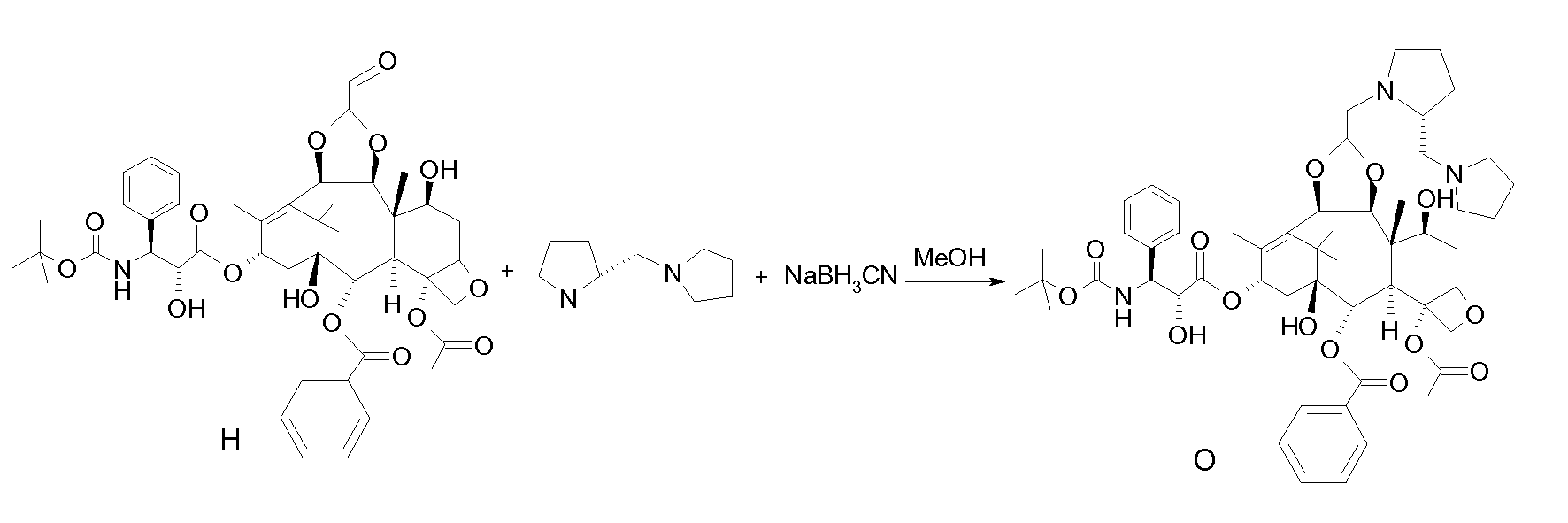
- The title compound was prepared under the same processes as described in Example 1 by reacting the resulting compound H from step 7, 9β-13-O-[(2R,3S)-3-(tert-butyloxycarbonylamino)-2-hydroxyl-3-phenylpropionyl]-10-deacetyl-9-dihydro -9,10-O-acetaldehydebaccatin H with (R)-(+)-1-(2-pyrrolidin methyl)pyrrolidin as starting materials to provide 9β-13-O-[(2R,3S)-3-(tert-butyloxycarbonylamino)-2-hydroxyl-3-phenylpropionyl]-10-deacetyl-9-dihydro-9,10-O-[2-N-(R)-(2-pyrrolidi n-1-methyl)- piperidine ethylidene] baccatin O (0.362 g, white-like solid) with a yield of 58%.
- Rf=0.28(hexane: ethyl acetate: methanol: triethylamine=20: 20: 1: 1(V/V)).
- MW=988, ESI-MS: [M+H]+=988.9
- 1H-NMR(CD3Cl3, 400MHz): δ8.1(d, J=7.6Hz, 2H), 7.6(t, J=7.4Hz, 1H), 7.5-7.2(m, 7H), 6.1-6.0(m, 2H), 5.7-5.6(d, J=9.4Hz, 1H), 5.3(d, J=10.3Hz, 1H), 5.2(d, J=7.3Hz, 1H), 5.1(s, 1H), 5.0(dd, AB-type, J=3.4Hz, J'=6.4Hz, 1H), 4.7(b, 1H), 4.6(s, 1H), 4.4-4.3(dd, AB-type, J=8.6Hz, 1H), 4.2(b, 1H), 4.1(m, 1H), 3.8(d, J=7.3Hz, 1H), 3.3-3.2(m, 2H), 2.9(m, 1H), 2.8-2.4(m, 1H), 2.4-2.3(m, 1H), 2.3(s, 3H, CH3), 2.3-1.9(m, 4H), 1.9(s, 1H), 1.9-1.7(m, 1H), 1.7(s, 3H, CH3), 1.6(m, 5H), 1.4(s, 9H, t-Bu), 1.3(s, 3H, CH3).
-

- The title compound was prepared under the same processes as described in Example 1 by reacting the resulting compound H from step 7, 9β-13-O-[(2R,3S)-3-(tert-butyloxycarbonylamino)-2-hydroxyl-3-phenylpropionyl]-10-deacetyl-9-dihydro -9,10-O-acetaldehydebaccatin H with 4-piperidin-4-yl-morpholine as starting materials to provide 9β-13-O-[(2R,3S)-3-(tert-butyloxycarbonylamino)-2-hydroxyl-3-phenylpropionyl]-10-deacetyl-9-dihydro-9,10-O-[2-N-(4-morpholine)-piperidine ethylidene] baccatin P (0.47 g, white-like solid) with a yield of 74.4%.
- Rf=0.18(hexane: ethyl acetate: methanol: triethylamine=30: 10: 3: 2(V/V)).
- MW=1004, ESI-MS: [M+H]+=1004.9
- 1H-NMR(CD3Cl3, 400MHz): δ8.1(d, J=7.5Hz, 2H), 7.6(t, J=7.4Hz, 1H), 7.5-7.2(m, 7H), 6.1-6.0(m, 2H), 5.6(d, J=9.8Hz, 1H), 5.3(d, J=6.6Hz, 1H), 5.2(d, J=6.3Hz, 1H), 5.1(b, 2H), 5.0(b, 1H), 4.7(d, J=8.2Hz, 1H), 4.6(b, 1H), 4.4-4.3(dd, AB-type, J=8.5Hz, 2H), 4.0(m, 1H), 3.8(d, J=7.2Hz, 1H), 3.8-3.7(m, 4H), 3.2-3.0(m, 2H), 2.9-2.8(m, 1H), 2.8-2.7(m, 2H), 2.6-2.5(m, 4H), 2.4-2.3(dd, J=9.8Hz, J'=15.3Hz, 1H), 2.3(s, 3H, CH3), 2.3-2.0(m, 6H), 1.9(b, 1H), 1.9-1.7(m, 2H), 1.7(s, 3H, CH3), 1.65(s, 3H, CH3),1.55(s, 3H, CH3), 1.4(s, 3H), 1.3(s, 9H, t-Bu).
-

- The title compound was prepared under the same processes as described in Example 1 by reacting the resulting compound H from step 7, 9β-13-O-[(2R,3S)-3-(tert-butyloxycarbonylamino)-2-hydroxyl-3-phenylpropionyl]-10-deacetyl-9-dihydro -9,10-O-acetaldehydebaccatin H with cyclopropyl-piperidin-4-yl-amine as starting materials to provide 9β-13-O-[(2R,3S)-3-(tert-butyloxycarbonylamino)-2-hydroxyl-3-phenylpropionyl]-10-deacetyl-9-dihydro-9,10-O-[2-N-(cyclopropylamino)-piperidi ne ethylidene] baccatin Q (0.29 g, white-like solid) with a yield of 47%.
- Rf=0.20(hexane: dichloromethane: ethyl acetate: methanol=30: 10: 2: 3(V/V)).
- MW=974, ESI-MS: [M+H]+=974.9
- 1H-NMR(CD3Cl3, 400MHz): δ8.1(d, J=7.3Hz, 2H), 7.6(t, J=7.3Hz, 1H), 7.5-7.2(m, 7H), 6.1-6.0(m, 2H), 5.6(d, J=9.8Hz, 1H), 5.3(d, J=7.5Hz, 1H), 5.2(d, J=6.4Hz, 1H), 5.1(b, 1H), 5.0(t, J=3.9Hz, 1H), 4.7(d, J=8.3Hz, 1H), 4.6(b, 1H), 4.4-4.2(dd, AB-type, J=18.5Hz, J'=9.8Hz, 2H), 4.2-4.1(m, 1H), 4.1-4.0(m, 1H), 3.8(d, J=7.2Hz, 1H), 3.1-2.7(m, 5H), 2.6-2.5(m, 3H), 2.4-2.3(dd, J=9.8Hz, J'=15.3Hz, 1H), 2.3(s, 3H, CH3), 2.3-1.9(m, 9H), 1.9-1.8(m, 3H), 1.6(s, 3H, CH3), 1.55(s, 3H, CH3),1.5 (s, 3H, CH3), 1.4(s, 9H, t-Bu), 1.3(s, 3H, CH3).
-

- The title compound was prepared under the same processes as described in Example 1 by reacting the resulting compound H from step 7, 9β-13-O-[(2R,3S)-3-(tert-butyloxycarbonylamino)-2-hydroxyl-3-phenylpropionyl]-10-deacetyl-9-dihydro -9,10-O-acetaldehydebaccatinIII H with morpholine as starting materials to provide 9β-13-O-[(2R,3S)-3-(tert-butyloxycarbonylamino)-2-hydroxyl-3-phenylpropionyl]-1 0-deacetyl-9-dihydro-9,10-O-(2- morpholine ethylidene) baccatinIII R (0.517 g, white-like solid with a yield of 89%.
- Rf=0.22(hexane: ethyl acetate: methyl: triethylamine =20: 20: 1: 1(V/V)).
- MW=921, ESI-MS: [M+H]+=921.7
- 1H-NMR(CD3Cl3, 400MHz): δ8.1(d, J=7.3Hz, 2H), 7.59(t, J=7.3Hz, 1H), 7.5-7.2(m, 7H), 6.1-6.0(m, 2H), 5.6(d, J=10.0Hz, 1H), 5.3(d, J=10.0Hz, 1H), 5.2(d, J=6.9Hz, 1H), 5.1(s, 1H), 5.0(t, J=3.9Hz, 1H), 4.7(d, J=8.3Hz, 1H), 4.6(s, 1H), 4.4(d, J=8.3Hz, 1H), 4.3(d, J=8.3Hz, 1H), 4.2-4.0(m, 2H), 3.9-3.6(m, 5H), 2.9(d, J=4.9, 1H), 2.8-2.7(dd, AB-type, J=18.4Hz, J'=4.4Hz, 2H), 2.7-2.5(m, 4H), 2.3(s, 3H), 2.5-1.9(m, 4H), 1.9(s, 1H), 1.65(s, 3H), 1.6(s, 3H), 1.4(s, 9H), 1.3(s, 6H).
- Animal species: BALB/cA-nude mice.
- Numbers of animals: 9 mice in control group, 5 mice in medication administration team.
- Animals were adapted in animal house for 1 week and were hypodermic inoculated human A549 NSCLC tumors. After tumors grew to 100-300mm3, mice were randomly divided into teams of SHR-110008 and Taxotere(d0). The doses of SHR-110008 were 10 and 16mg/kg, and the doses of Taxotere were 12 and 19mg/kg, separately. The route of administration is intravenous injection. SHR-110008(10mg/kg) and Taxotere(12mg/kg) were administrated on d0, d4, d8, totally three times. SHR-110008(16mg/kg) and Taxotere(19mg/kg) were administrated on d0, d7, totally two times. The volume of tumors and weigh the mice were measured for 2-3 times per week. The calculation formula of the volume of tumor (V) is: V= 1/2×a×b2, a: length of tumor, b: width of tumor.
-
Table 1 Intravenous injection (i. v); the therapeutic effect of SHR110008, Taxotere against xenografts of human A549 NSCLC tumors in nude mice. Group Dose Administration Animal Numbers Body weight(g) TV(X±SD,mm3) RTV T/C (%) (mg/kg) d0/dn d0 dn d0 dn X±SD Control 9/9 17.5 16.2 140±15 3056±11161 22.13±9.5 SHR-110008 10 d0,4,8 5/5 18.4 16.9 129±20 1383±243 10.81±1.79 48.8* SHR-110008 16 d0,7 5/5 18.0 16.6 143±38 612±340 4.41±2.43 19.9* Taxotere 12 d0,4,8 5/5 17.6 14.1 140±24 1149±627 8.65±5.83 39.1* Taxotere 19 d0,7 5/5 17.7 13.0 134±19 902±736 7.13±6.00 32.2* d0: the time of the first dosage; dn: the 14th day after the first dosage; *P<0.01 vs control. Table 2 Intravenous injection (i. v); the therapeutic effect of SHR110008, Taxotere against xenografts of human A549 NSCLC tumors in nude mice (weighing method). Group Dose Animal Numbers Body weight(g) Weight of tumors(g) T/C (%) (mg/kg) d0/dn d0 dn x±SD Control 9 9 17.5 16.2 2.59±1.01 SHR-110008 10 5 5 18.4 16.9 1.59±0.57 38.6* SHR-110008 16 5 5 18.0 16.6 0.67±0.23 74.1* Taxotere 12 5 5 17.6 14.1 1.25±0.71 51.7* Taxotere 19 5 5 17.7 13.0 1.09±0.73 57.9* d0: the time of the first dosage; dn: the 14th day after the first dosage. *P<0.01 vs control. - Refer to table 1, table 2 and
fig 1 , under the suitable dose schedule, the therapeutic effect and toxicity of SHR110008 were better than that of Taxotere. -
- Animal species: BALB/cA-nude mice.
- Numbers of animals: 12 mice in control group, 6 mice in medication administration team.
-
- Cell culture: Human A549 NSCLC tumor cells were cultured in vitro remaining on logarithmic growth phase.
- Transplantation: Take the prepared cells to inoculate subcutaneously to the nude mice.
- Inoculation: Take the tumor lump to inoculate in one side of oxter on the condition of asepsis.
- Grouping and dose design: Measure the diameter of transplantation tumor by sliding caliper. After tumors grew to 100-250mm3, mice were randomly divided into groups of Shr1021-47(8mg/kg, 12 mg/kg, 16mg/kg) and Taxotere(12 mg/kg).
- Administration route and time: i.v administration. Shr1021-47 and Taxotere were administrated on d0, d7, 2 times in all. Measure the volume of tumor and weigh the mice 2-3 times per week.
- Evaluation criterion:
- The calculation formula of the volume of tumor(V) is: V=1/2×a×b2, a: length of tumor, b: width of tumor. Calculate the relative tumor volume(RTV) according to the measurements. The formula is: RTV=Vt/V0. V0 refers to the volume of tumor on d0; Vt refers to the volume of tumor on every measurement. The index of antitumor activity is T/C(%). The formula is: T/C(%)=TRTV/CRTV×100, TRTV: RTV of treatment group, CRTV: RTV of control group.
-
Table 3 Intravenous injection (i. v); the therapeutic effect of Shr1021-47 against xenografts of human A549 NSCLC tumors in nude mice. Group Dose (mg/kg) Animal Numbers Body weight(g) TV(X±SD,mm3) RTV T/C (%) d0 dn d0 dn d0 dn X± SD Control 12 12 18.7 16.9 181±29 2513±855 14.3±5.2 Shr1021-47 8 6 6 18.7 16.6 168±21 2047±279 12.3±1.6 86.0 Shr1021-47 12 6 6 18.5 16.3 198±47 1293±458 6.6±2.6 46.2* Shr1021-47 16 6 6 20.7 17.1 178±45 705±360 4.3±2.8 30.1* Taxotere 12 6 6 20.7 15.6 156±20 1679±749 11.2±6.0 78.3 d0: the time of the first dosage; dn: the day which the therapeutic effects were best actually. In this test, dn refers to the 14th day after the first dosage. - Refer to
fig 2 and table 3, Shr1021-47 inhibited the growth of human A549 NSCLC tumors in nude mice obviously. Although the toxicity of Shr1021-47 is a little big, but it can be well tolerant to mice. The efficacy of Shr1021-47 is better than Taxotere.
Claims (15)


wherein the acid catalysts comprise dicyclopentadienyl titanium chloride; copper chloride; cooper acetate; bismuth nitrate and cooper trifluoroacetate, preferably dicyclopentadienyl titanium chloride;
wherein the reaction temperature is -78 to 200 , more preferably is 0∼50 , most preferably is 25 ;
wherein the solvents comprise acetonitrile, tetrahydrofuran, dichloromethane, toluene, ethyl acetate, ether, petroleum ether and isopropyl ether, and so one, preferably acetonitrile and dichloromethane.
Applications Claiming Priority (2)
| Application Number | Priority Date | Filing Date | Title |
|---|---|---|---|
| CNB2006100012057A CN100516067C (en) | 2006-01-10 | 2006-01-10 | Taxol derivatives with antitumor activity |
| PCT/CN2007/000022 WO2007079666A1 (en) | 2006-01-10 | 2007-01-05 | Taxol derivatives with antitumor activity |
Publications (2)
| Publication Number | Publication Date |
|---|---|
| EP1980562A1 true EP1980562A1 (en) | 2008-10-15 |
| EP1980562A4 EP1980562A4 (en) | 2010-10-27 |
Family
ID=38255980
Family Applications (1)
| Application Number | Title | Priority Date | Filing Date |
|---|---|---|---|
| EP07701954A Withdrawn EP1980562A4 (en) | 2006-01-10 | 2007-01-05 | Taxol derivatives with antitumor activity |
Country Status (13)
| Country | Link |
|---|---|
| US (1) | US8362240B2 (en) |
| EP (1) | EP1980562A4 (en) |
| JP (1) | JP2009522380A (en) |
| KR (1) | KR20080094025A (en) |
| CN (1) | CN100516067C (en) |
| AU (1) | AU2007204520A1 (en) |
| BR (1) | BRPI0706384A2 (en) |
| CA (1) | CA2636211A1 (en) |
| MX (1) | MX2008008905A (en) |
| RU (1) | RU2419622C2 (en) |
| UA (1) | UA97237C2 (en) |
| WO (1) | WO2007079666A1 (en) |
| ZA (1) | ZA200805910B (en) |
Families Citing this family (1)
| Publication number | Priority date | Publication date | Assignee | Title |
|---|---|---|---|---|
| SMT202500447T1 (en) | 2021-11-02 | 2026-01-12 | Flare Therapeutics Inc | Pparg inverse agonists and uses thereof |
Family Cites Families (10)
| Publication number | Priority date | Publication date | Assignee | Title |
|---|---|---|---|---|
| RU2059631C1 (en) * | 1991-11-29 | 1996-05-10 | Дзе Юниверсити оф Канзас | Derivatives of taxol and pharmaceutical composition showing antitumor activity |
| FR2698871B1 (en) * | 1992-12-09 | 1995-02-24 | Rhone Poulenc Rorer Sa | New taxoids, their preparation and the pharmaceutical compositions containing them. |
| EP0688212B1 (en) | 1993-03-05 | 2002-06-12 | Florida State University | C9 taxane derivatives and pharmaceutical compositions containing them |
| US5475011A (en) * | 1993-03-26 | 1995-12-12 | The Research Foundation Of State University Of New York | Anti-tumor compounds, pharmaceutical compositions, methods for preparation thereof and for treatment |
| US6075140A (en) * | 1995-04-28 | 2000-06-13 | Daiichi Pharmaceutical Co., Ltd. | Pentacyclic compound |
| TW527183B (en) * | 1996-06-06 | 2003-04-11 | Daiichi Seiyaku Co | Drug complex |
| US6677456B2 (en) * | 1999-10-15 | 2004-01-13 | Daiichi Pharmaceutical Co., Ltd. | Pentacyclic taxan compound |
| RU2257387C2 (en) * | 1999-10-15 | 2005-07-27 | Дайити Фармасьютикал Ко., Лтд. | Taxane pentacyclic compound and antitumor agents based on thereof |
| CA2411585A1 (en) * | 2000-06-22 | 2001-12-27 | Pharmos Corporation | Novel non-psychotropic cannabinoids |
| WO2004064728A2 (en) * | 2003-01-16 | 2004-08-05 | Paratek Pharmaceuticals, Inc. | Use of specific tetracycline compounds in therapy |
-
2006
- 2006-01-10 CN CNB2006100012057A patent/CN100516067C/en not_active Expired - Fee Related
-
2007
- 2007-01-05 BR BRPI0706384-9A patent/BRPI0706384A2/en not_active IP Right Cessation
- 2007-01-05 CA CA002636211A patent/CA2636211A1/en not_active Abandoned
- 2007-01-05 WO PCT/CN2007/000022 patent/WO2007079666A1/en not_active Ceased
- 2007-01-05 UA UAA200810233A patent/UA97237C2/en unknown
- 2007-01-05 ZA ZA200805910A patent/ZA200805910B/en unknown
- 2007-01-05 KR KR1020087019233A patent/KR20080094025A/en not_active Ceased
- 2007-01-05 EP EP07701954A patent/EP1980562A4/en not_active Withdrawn
- 2007-01-05 JP JP2008549744A patent/JP2009522380A/en active Pending
- 2007-01-05 MX MX2008008905A patent/MX2008008905A/en unknown
- 2007-01-05 AU AU2007204520A patent/AU2007204520A1/en not_active Abandoned
- 2007-01-05 US US12/160,456 patent/US8362240B2/en not_active Expired - Fee Related
- 2007-01-05 RU RU2008132871/04A patent/RU2419622C2/en not_active IP Right Cessation
Also Published As
| Publication number | Publication date |
|---|---|
| KR20080094025A (en) | 2008-10-22 |
| RU2419622C2 (en) | 2011-05-27 |
| US20100168420A1 (en) | 2010-07-01 |
| UA97237C2 (en) | 2012-01-25 |
| MX2008008905A (en) | 2008-10-03 |
| CN100516067C (en) | 2009-07-22 |
| AU2007204520A1 (en) | 2007-07-19 |
| WO2007079666A1 (en) | 2007-07-19 |
| CA2636211A1 (en) | 2007-07-19 |
| CN100999524A (en) | 2007-07-18 |
| AU2007204520A2 (en) | 2008-09-25 |
| RU2008132871A (en) | 2010-02-20 |
| JP2009522380A (en) | 2009-06-11 |
| EP1980562A4 (en) | 2010-10-27 |
| ZA200805910B (en) | 2009-10-28 |
| BRPI0706384A2 (en) | 2011-03-22 |
| US8362240B2 (en) | 2013-01-29 |
Similar Documents
| Publication | Publication Date | Title |
|---|---|---|
| JP3360186B2 (en) | Paclitaxel modified at the 6 and 7 positions | |
| US5821263A (en) | Sulfenamide taxane derivatives | |
| KR970011287B1 (en) | Pharmaceutical Compositions Containing Benzopyran-2-methanol Derivatives | |
| RU2125996C1 (en) | 7-HALO- AND 7β, 8β--METHANOTAXOLS, PHARMACEUTICAL COMPOSITION, INTERMEDIATE COMPOUNDS AND METHODS OF SYNTHESIS OF INTERMEDIATE COMPOUNDS | |
| JPH1192468A (en) | New taxane derivatives | |
| CZ96593A3 (en) | Process for preparing taxane derivatives, novel derivatives obtained in such a manner, and pharmaceutical preparations in which said derivatives are comprised | |
| CZ20013503A3 (en) | C7 ester substituted taxanes functioning as antitumor substances | |
| SK118395A3 (en) | Taxanes, preparing method and pharmaceutical compositions on their base | |
| US6201140B1 (en) | 7-0-ethers of taxane derivatives | |
| SK68195A3 (en) | Taxane derivatives, method of their preparation and pharmaceutical agents containing these derivatives | |
| EP1688415A1 (en) | Cytotoxic agents comprising new C-2 modified taxanes | |
| US6476242B1 (en) | 2-aroyl-4-acyl paclitaxel (Taxol) analogs | |
| WO1999032473A1 (en) | Taxane derivatives | |
| EP4357336A1 (en) | Benzoxazinone derivatives | |
| SK139994A3 (en) | Taxane derivatives, their preparation and compositions containing same | |
| SK13632001A3 (en) | C10 carbonate substituted taxanes as antitumor agents | |
| US6362217B2 (en) | Taxane anticancer agents | |
| JPWO2001027115A1 (en) | Pentacyclic taxane compounds | |
| EP0693485A2 (en) | Baccatin derivatives and processes for preparing the same | |
| HK1117166A (en) | Taxol derivatives with antitumor activity | |
| US8362240B2 (en) | Taxol derivatives with antitumor activity | |
| US20130164218A1 (en) | Hypoxia inducible factor-1 pathway inhibitors and uses as anticancer and imaging agents | |
| US6080859A (en) | Pyrroloindole derivatives and intermediates in producing the same | |
| WO1999032109A1 (en) | 7-deoxy-6-nitrogen substituted paclitaxels | |
| EP1737444A1 (en) | C7 lactyloxy-substituted taxanes |
Legal Events
| Date | Code | Title | Description |
|---|---|---|---|
| PUAI | Public reference made under article 153(3) epc to a published international application that has entered the european phase |
Free format text: ORIGINAL CODE: 0009012 |
|
| 17P | Request for examination filed |
Effective date: 20080805 |
|
| AK | Designated contracting states |
Kind code of ref document: A1 Designated state(s): AT BE BG CH CY CZ DE DK EE ES FI FR GB GR HU IE IS IT LI LT LU LV MC NL PL PT RO SE SI SK TR |
|
| REG | Reference to a national code |
Ref country code: HK Ref legal event code: DE Ref document number: 1117166 Country of ref document: HK |
|
| A4 | Supplementary search report drawn up and despatched |
Effective date: 20100923 |
|
| 17Q | First examination report despatched |
Effective date: 20111103 |
|
| DAX | Request for extension of the european patent (deleted) | ||
| STAA | Information on the status of an ep patent application or granted ep patent |
Free format text: STATUS: THE APPLICATION IS DEEMED TO BE WITHDRAWN |
|
| 18D | Application deemed to be withdrawn |
Effective date: 20120515 |
|
| REG | Reference to a national code |
Ref country code: HK Ref legal event code: WD Ref document number: 1117166 Country of ref document: HK |