EP1980560B1 - C-glycoside derivatives for the treatment of diabetes - Google Patents
C-glycoside derivatives for the treatment of diabetes Download PDFInfo
- Publication number
- EP1980560B1 EP1980560B1 EP08012499A EP08012499A EP1980560B1 EP 1980560 B1 EP1980560 B1 EP 1980560B1 EP 08012499 A EP08012499 A EP 08012499A EP 08012499 A EP08012499 A EP 08012499A EP 1980560 B1 EP1980560 B1 EP 1980560B1
- Authority
- EP
- European Patent Office
- Prior art keywords
- lower alkyl
- mixture
- alkylene
- nmr
- lower alkylene
- Prior art date
- Legal status (The legal status is an assumption and is not a legal conclusion. Google has not performed a legal analysis and makes no representation as to the accuracy of the status listed.)
- Expired - Lifetime
Links
- 0 COC1OC(C*)C(*)C(*)C1* Chemical compound COC1OC(C*)C(*)C(*)C1* 0.000 description 5
- WDORVKOJJWRVPO-FLBLCADYSA-N CC(C)(C)OC(NCCOc1c([C@@H]([C@@H](C2OCc3ccccc3)OCc3ccccc3)O[C@H](COCc3ccccc3)[C@H]2OCc2ccccc2)cc(Cc2cc3ccccc3[s]2)cc1)=O Chemical compound CC(C)(C)OC(NCCOc1c([C@@H]([C@@H](C2OCc3ccccc3)OCc3ccccc3)O[C@H](COCc3ccccc3)[C@H]2OCc2ccccc2)cc(Cc2cc3ccccc3[s]2)cc1)=O WDORVKOJJWRVPO-FLBLCADYSA-N 0.000 description 1
- FPVAKFWUSWDMRJ-AJQQNOENSA-N CC(CC1Sc2ccc(C)cc2C1)(C1)C=CC=C1C([C@@H](C1O)O)OC(CO)C1I Chemical compound CC(CC1Sc2ccc(C)cc2C1)(C1)C=CC=C1C([C@@H](C1O)O)OC(CO)C1I FPVAKFWUSWDMRJ-AJQQNOENSA-N 0.000 description 1
- HPIDUQOUKNKNBS-UHFFFAOYSA-N CC(Cc1cc2ccccc2[s]1)(C1)C=CC(CC=N)=C1C(C(C1O)O)OC(CO)C1O Chemical compound CC(Cc1cc2ccccc2[s]1)(C1)C=CC(CC=N)=C1C(C(C1O)O)OC(CO)C1O HPIDUQOUKNKNBS-UHFFFAOYSA-N 0.000 description 1
- SAUJLYOWSKGTQQ-JOZVKIIOSA-N CC(OCC([C@H](C(C1)OC(C)=O)OC(C)=O)OC1c(cc(Cc1cc2ccccc2[s]1)c(F)c1)c1OC)=O Chemical compound CC(OCC([C@H](C(C1)OC(C)=O)OC(C)=O)OC1c(cc(Cc1cc2ccccc2[s]1)c(F)c1)c1OC)=O SAUJLYOWSKGTQQ-JOZVKIIOSA-N 0.000 description 1
- JJMIAMKEKCAPRK-PCAVGTKXSA-N CC(OCC([C@H]([C@@H]([C@H]1OC(C)=O)OC(C)=O)OC(C)=O)OC1c1cc(Cc2cc(cc(C)c(C)c3)c3[o]2)ccc1OC(C)=O)=O Chemical compound CC(OCC([C@H]([C@@H]([C@H]1OC(C)=O)OC(C)=O)OC(C)=O)OC1c1cc(Cc2cc(cc(C)c(C)c3)c3[o]2)ccc1OC(C)=O)=O JJMIAMKEKCAPRK-PCAVGTKXSA-N 0.000 description 1
- NOWHWPHIDTYZLT-MYZTUTKLSA-N CCc1ccc(Cc2cc([C@@H]([C@@H](C3O)O)OC(CO)[C@H]3O)ccc2)[s]1 Chemical compound CCc1ccc(Cc2cc([C@@H]([C@@H](C3O)O)OC(CO)[C@H]3O)ccc2)[s]1 NOWHWPHIDTYZLT-MYZTUTKLSA-N 0.000 description 1
- VDUQTAARHAAOCY-DVYJMMETSA-N CN(C(c1cc([C@@H]([C@@H](C2OCc3ccccc3)OCc3ccccc3)O[C@H](COCc3ccccc3)[C@H]2OCc2ccccc2)ccc1)=O)OC Chemical compound CN(C(c1cc([C@@H]([C@@H](C2OCc3ccccc3)OCc3ccccc3)O[C@H](COCc3ccccc3)[C@H]2OCc2ccccc2)ccc1)=O)OC VDUQTAARHAAOCY-DVYJMMETSA-N 0.000 description 1
- VUTIOYYWHHFGFA-BVKKKHPASA-N CN(C)CCOc1c([C@@H]([C@@H]([C@H]2O)O)OC(CO)[C@H]2O)cc(Cc2cc3ccccc3[s]2)cc1 Chemical compound CN(C)CCOc1c([C@@H]([C@@H]([C@H]2O)O)OC(CO)[C@H]2O)cc(Cc2cc3ccccc3[s]2)cc1 VUTIOYYWHHFGFA-BVKKKHPASA-N 0.000 description 1
- CCQAMUOIXXYUPA-LOSRFJQJSA-N Cc(cc1)cc2c1[s]c(Cc1cc([C@@H]([C@@H]([C@H]3OCc4ccccc4)OCc4ccccc4)O[C@H](COCc4ccccc4)[C@H]3OCc3ccccc3)ccc1)c2 Chemical compound Cc(cc1)cc2c1[s]c(Cc1cc([C@@H]([C@@H]([C@H]3OCc4ccccc4)OCc4ccccc4)O[C@H](COCc4ccccc4)[C@H]3OCc3ccccc3)ccc1)c2 CCQAMUOIXXYUPA-LOSRFJQJSA-N 0.000 description 1
- FHRMUAJQLNGMML-UJCLMKEVSA-N O=C(C(C1)=CC2=C1C=CC=CC2)c1cc(C(OC(COCc2ccccc2)[C@H]2OCc3ccccc3)[IH]C2OCc2ccccc2)ccc1 Chemical compound O=C(C(C1)=CC2=C1C=CC=CC2)c1cc(C(OC(COCc2ccccc2)[C@H]2OCc3ccccc3)[IH]C2OCc2ccccc2)ccc1 FHRMUAJQLNGMML-UJCLMKEVSA-N 0.000 description 1
- WYRNCDXQVZFXFZ-ORAHWAPJSA-N OCC([C@H](C(C1O)O)O)OC1c1cccc(Cc2c[s]c3c2cccc3)c1 Chemical compound OCC([C@H](C(C1O)O)O)OC1c1cccc(Cc2c[s]c3c2cccc3)c1 WYRNCDXQVZFXFZ-ORAHWAPJSA-N 0.000 description 1
- BQGUZVHZZRWHLG-PASKXLHSSA-N OCc1cc(C([C@@H](C2OCc3ccccc3)OCc3ccccc3)OC(COCc3ccccc3)[C@H]2OCc2ccccc2)cc(F)c1 Chemical compound OCc1cc(C([C@@H](C2OCc3ccccc3)OCc3ccccc3)OC(COCc3ccccc3)[C@H]2OCc2ccccc2)cc(F)c1 BQGUZVHZZRWHLG-PASKXLHSSA-N 0.000 description 1
Classifications
-
- C—CHEMISTRY; METALLURGY
- C07—ORGANIC CHEMISTRY
- C07D—HETEROCYCLIC COMPOUNDS
- C07D495/00—Heterocyclic compounds containing in the condensed system at least one hetero ring having sulfur atoms as the only ring hetero atoms
- C07D495/02—Heterocyclic compounds containing in the condensed system at least one hetero ring having sulfur atoms as the only ring hetero atoms in which the condensed system contains two hetero rings
- C07D495/04—Ortho-condensed systems
-
- C—CHEMISTRY; METALLURGY
- C07—ORGANIC CHEMISTRY
- C07D—HETEROCYCLIC COMPOUNDS
- C07D309/00—Heterocyclic compounds containing six-membered rings having one oxygen atom as the only ring hetero atom, not condensed with other rings
- C07D309/02—Heterocyclic compounds containing six-membered rings having one oxygen atom as the only ring hetero atom, not condensed with other rings having no double bonds between ring members or between ring members and non-ring members
- C07D309/08—Heterocyclic compounds containing six-membered rings having one oxygen atom as the only ring hetero atom, not condensed with other rings having no double bonds between ring members or between ring members and non-ring members with hetero atoms or with carbon atoms having three bonds to hetero atoms with at the most one bond to halogen, e.g. ester or nitrile radicals, directly attached to ring carbon atoms
- C07D309/10—Oxygen atoms
-
- A—HUMAN NECESSITIES
- A61—MEDICAL OR VETERINARY SCIENCE; HYGIENE
- A61K—PREPARATIONS FOR MEDICAL, DENTAL OR TOILETRY PURPOSES
- A61K31/00—Medicinal preparations containing organic active ingredients
- A61K31/33—Heterocyclic compounds
- A61K31/335—Heterocyclic compounds having oxygen as the only ring hetero atom, e.g. fungichromin
- A61K31/35—Heterocyclic compounds having oxygen as the only ring hetero atom, e.g. fungichromin having six-membered rings with one oxygen as the only ring hetero atom
- A61K31/351—Heterocyclic compounds having oxygen as the only ring hetero atom, e.g. fungichromin having six-membered rings with one oxygen as the only ring hetero atom not condensed with another ring
-
- A—HUMAN NECESSITIES
- A61—MEDICAL OR VETERINARY SCIENCE; HYGIENE
- A61K—PREPARATIONS FOR MEDICAL, DENTAL OR TOILETRY PURPOSES
- A61K31/00—Medicinal preparations containing organic active ingredients
- A61K31/33—Heterocyclic compounds
- A61K31/38—Heterocyclic compounds having sulfur as a ring hetero atom
- A61K31/381—Heterocyclic compounds having sulfur as a ring hetero atom having five-membered rings
-
- A—HUMAN NECESSITIES
- A61—MEDICAL OR VETERINARY SCIENCE; HYGIENE
- A61K—PREPARATIONS FOR MEDICAL, DENTAL OR TOILETRY PURPOSES
- A61K31/00—Medicinal preparations containing organic active ingredients
- A61K31/33—Heterocyclic compounds
- A61K31/395—Heterocyclic compounds having nitrogen as a ring hetero atom, e.g. guanethidine or rifamycins
- A61K31/40—Heterocyclic compounds having nitrogen as a ring hetero atom, e.g. guanethidine or rifamycins having five-membered rings with one nitrogen as the only ring hetero atom, e.g. sulpiride, succinimide, tolmetin, buflomedil
- A61K31/403—Heterocyclic compounds having nitrogen as a ring hetero atom, e.g. guanethidine or rifamycins having five-membered rings with one nitrogen as the only ring hetero atom, e.g. sulpiride, succinimide, tolmetin, buflomedil condensed with carbocyclic rings, e.g. carbazole
- A61K31/4035—Isoindoles, e.g. phthalimide
-
- A—HUMAN NECESSITIES
- A61—MEDICAL OR VETERINARY SCIENCE; HYGIENE
- A61K—PREPARATIONS FOR MEDICAL, DENTAL OR TOILETRY PURPOSES
- A61K31/00—Medicinal preparations containing organic active ingredients
- A61K31/33—Heterocyclic compounds
- A61K31/395—Heterocyclic compounds having nitrogen as a ring hetero atom, e.g. guanethidine or rifamycins
- A61K31/40—Heterocyclic compounds having nitrogen as a ring hetero atom, e.g. guanethidine or rifamycins having five-membered rings with one nitrogen as the only ring hetero atom, e.g. sulpiride, succinimide, tolmetin, buflomedil
- A61K31/403—Heterocyclic compounds having nitrogen as a ring hetero atom, e.g. guanethidine or rifamycins having five-membered rings with one nitrogen as the only ring hetero atom, e.g. sulpiride, succinimide, tolmetin, buflomedil condensed with carbocyclic rings, e.g. carbazole
- A61K31/404—Indoles, e.g. pindolol
-
- A—HUMAN NECESSITIES
- A61—MEDICAL OR VETERINARY SCIENCE; HYGIENE
- A61K—PREPARATIONS FOR MEDICAL, DENTAL OR TOILETRY PURPOSES
- A61K31/00—Medicinal preparations containing organic active ingredients
- A61K31/33—Heterocyclic compounds
- A61K31/395—Heterocyclic compounds having nitrogen as a ring hetero atom, e.g. guanethidine or rifamycins
- A61K31/41—Heterocyclic compounds having nitrogen as a ring hetero atom, e.g. guanethidine or rifamycins having five-membered rings with two or more ring hetero atoms, at least one of which being nitrogen, e.g. tetrazole
-
- A—HUMAN NECESSITIES
- A61—MEDICAL OR VETERINARY SCIENCE; HYGIENE
- A61K—PREPARATIONS FOR MEDICAL, DENTAL OR TOILETRY PURPOSES
- A61K31/00—Medicinal preparations containing organic active ingredients
- A61K31/33—Heterocyclic compounds
- A61K31/395—Heterocyclic compounds having nitrogen as a ring hetero atom, e.g. guanethidine or rifamycins
- A61K31/41—Heterocyclic compounds having nitrogen as a ring hetero atom, e.g. guanethidine or rifamycins having five-membered rings with two or more ring hetero atoms, at least one of which being nitrogen, e.g. tetrazole
- A61K31/4164—1,3-Diazoles
- A61K31/4184—1,3-Diazoles condensed with carbocyclic rings, e.g. benzimidazoles
-
- A—HUMAN NECESSITIES
- A61—MEDICAL OR VETERINARY SCIENCE; HYGIENE
- A61K—PREPARATIONS FOR MEDICAL, DENTAL OR TOILETRY PURPOSES
- A61K31/00—Medicinal preparations containing organic active ingredients
- A61K31/33—Heterocyclic compounds
- A61K31/395—Heterocyclic compounds having nitrogen as a ring hetero atom, e.g. guanethidine or rifamycins
- A61K31/41—Heterocyclic compounds having nitrogen as a ring hetero atom, e.g. guanethidine or rifamycins having five-membered rings with two or more ring hetero atoms, at least one of which being nitrogen, e.g. tetrazole
- A61K31/42—Oxazoles
- A61K31/423—Oxazoles condensed with carbocyclic rings
-
- A—HUMAN NECESSITIES
- A61—MEDICAL OR VETERINARY SCIENCE; HYGIENE
- A61K—PREPARATIONS FOR MEDICAL, DENTAL OR TOILETRY PURPOSES
- A61K31/00—Medicinal preparations containing organic active ingredients
- A61K31/33—Heterocyclic compounds
- A61K31/395—Heterocyclic compounds having nitrogen as a ring hetero atom, e.g. guanethidine or rifamycins
- A61K31/41—Heterocyclic compounds having nitrogen as a ring hetero atom, e.g. guanethidine or rifamycins having five-membered rings with two or more ring hetero atoms, at least one of which being nitrogen, e.g. tetrazole
- A61K31/425—Thiazoles
- A61K31/428—Thiazoles condensed with carbocyclic rings
-
- A—HUMAN NECESSITIES
- A61—MEDICAL OR VETERINARY SCIENCE; HYGIENE
- A61K—PREPARATIONS FOR MEDICAL, DENTAL OR TOILETRY PURPOSES
- A61K31/00—Medicinal preparations containing organic active ingredients
- A61K31/33—Heterocyclic compounds
- A61K31/395—Heterocyclic compounds having nitrogen as a ring hetero atom, e.g. guanethidine or rifamycins
- A61K31/435—Heterocyclic compounds having nitrogen as a ring hetero atom, e.g. guanethidine or rifamycins having six-membered rings with one nitrogen as the only ring hetero atom
- A61K31/44—Non condensed pyridines; Hydrogenated derivatives thereof
- A61K31/4427—Non condensed pyridines; Hydrogenated derivatives thereof containing further heterocyclic ring systems
- A61K31/4433—Non condensed pyridines; Hydrogenated derivatives thereof containing further heterocyclic ring systems containing a six-membered ring with oxygen as a ring hetero atom
-
- A—HUMAN NECESSITIES
- A61—MEDICAL OR VETERINARY SCIENCE; HYGIENE
- A61K—PREPARATIONS FOR MEDICAL, DENTAL OR TOILETRY PURPOSES
- A61K31/00—Medicinal preparations containing organic active ingredients
- A61K31/33—Heterocyclic compounds
- A61K31/395—Heterocyclic compounds having nitrogen as a ring hetero atom, e.g. guanethidine or rifamycins
- A61K31/495—Heterocyclic compounds having nitrogen as a ring hetero atom, e.g. guanethidine or rifamycins having six-membered rings with two or more nitrogen atoms as the only ring heteroatoms, e.g. piperazine or tetrazines
- A61K31/4965—Non-condensed pyrazines
- A61K31/497—Non-condensed pyrazines containing further heterocyclic rings
-
- A—HUMAN NECESSITIES
- A61—MEDICAL OR VETERINARY SCIENCE; HYGIENE
- A61K—PREPARATIONS FOR MEDICAL, DENTAL OR TOILETRY PURPOSES
- A61K31/00—Medicinal preparations containing organic active ingredients
- A61K31/33—Heterocyclic compounds
- A61K31/395—Heterocyclic compounds having nitrogen as a ring hetero atom, e.g. guanethidine or rifamycins
- A61K31/535—Heterocyclic compounds having nitrogen as a ring hetero atom, e.g. guanethidine or rifamycins having six-membered rings with at least one nitrogen and one oxygen as the ring hetero atoms, e.g. 1,2-oxazines
- A61K31/5375—1,4-Oxazines, e.g. morpholine
- A61K31/5377—1,4-Oxazines, e.g. morpholine not condensed and containing further heterocyclic rings, e.g. timolol
-
- A—HUMAN NECESSITIES
- A61—MEDICAL OR VETERINARY SCIENCE; HYGIENE
- A61P—SPECIFIC THERAPEUTIC ACTIVITY OF CHEMICAL COMPOUNDS OR MEDICINAL PREPARATIONS
- A61P3/00—Drugs for disorders of the metabolism
- A61P3/04—Anorexiants; Antiobesity agents
-
- A—HUMAN NECESSITIES
- A61—MEDICAL OR VETERINARY SCIENCE; HYGIENE
- A61P—SPECIFIC THERAPEUTIC ACTIVITY OF CHEMICAL COMPOUNDS OR MEDICINAL PREPARATIONS
- A61P3/00—Drugs for disorders of the metabolism
- A61P3/08—Drugs for disorders of the metabolism for glucose homeostasis
- A61P3/10—Drugs for disorders of the metabolism for glucose homeostasis for hyperglycaemia, e.g. antidiabetics
-
- A—HUMAN NECESSITIES
- A61—MEDICAL OR VETERINARY SCIENCE; HYGIENE
- A61P—SPECIFIC THERAPEUTIC ACTIVITY OF CHEMICAL COMPOUNDS OR MEDICINAL PREPARATIONS
- A61P43/00—Drugs for specific purposes, not provided for in groups A61P1/00-A61P41/00
-
- A—HUMAN NECESSITIES
- A61—MEDICAL OR VETERINARY SCIENCE; HYGIENE
- A61P—SPECIFIC THERAPEUTIC ACTIVITY OF CHEMICAL COMPOUNDS OR MEDICINAL PREPARATIONS
- A61P5/00—Drugs for disorders of the endocrine system
- A61P5/48—Drugs for disorders of the endocrine system of the pancreatic hormones
- A61P5/50—Drugs for disorders of the endocrine system of the pancreatic hormones for increasing or potentiating the activity of insulin
-
- C—CHEMISTRY; METALLURGY
- C07—ORGANIC CHEMISTRY
- C07D—HETEROCYCLIC COMPOUNDS
- C07D405/00—Heterocyclic compounds containing both one or more hetero rings having oxygen atoms as the only ring hetero atoms, and one or more rings having nitrogen as the only ring hetero atom
- C07D405/02—Heterocyclic compounds containing both one or more hetero rings having oxygen atoms as the only ring hetero atoms, and one or more rings having nitrogen as the only ring hetero atom containing two hetero rings
- C07D405/04—Heterocyclic compounds containing both one or more hetero rings having oxygen atoms as the only ring hetero atoms, and one or more rings having nitrogen as the only ring hetero atom containing two hetero rings directly linked by a ring-member-to-ring-member bond
-
- C—CHEMISTRY; METALLURGY
- C07—ORGANIC CHEMISTRY
- C07D—HETEROCYCLIC COMPOUNDS
- C07D405/00—Heterocyclic compounds containing both one or more hetero rings having oxygen atoms as the only ring hetero atoms, and one or more rings having nitrogen as the only ring hetero atom
- C07D405/02—Heterocyclic compounds containing both one or more hetero rings having oxygen atoms as the only ring hetero atoms, and one or more rings having nitrogen as the only ring hetero atom containing two hetero rings
- C07D405/10—Heterocyclic compounds containing both one or more hetero rings having oxygen atoms as the only ring hetero atoms, and one or more rings having nitrogen as the only ring hetero atom containing two hetero rings linked by a carbon chain containing aromatic rings
-
- C—CHEMISTRY; METALLURGY
- C07—ORGANIC CHEMISTRY
- C07D—HETEROCYCLIC COMPOUNDS
- C07D407/00—Heterocyclic compounds containing two or more hetero rings, at least one ring having oxygen atoms as the only ring hetero atoms, not provided for by group C07D405/00
- C07D407/02—Heterocyclic compounds containing two or more hetero rings, at least one ring having oxygen atoms as the only ring hetero atoms, not provided for by group C07D405/00 containing two hetero rings
- C07D407/10—Heterocyclic compounds containing two or more hetero rings, at least one ring having oxygen atoms as the only ring hetero atoms, not provided for by group C07D405/00 containing two hetero rings linked by a carbon chain containing aromatic rings
-
- C—CHEMISTRY; METALLURGY
- C07—ORGANIC CHEMISTRY
- C07D—HETEROCYCLIC COMPOUNDS
- C07D409/00—Heterocyclic compounds containing two or more hetero rings, at least one ring having sulfur atoms as the only ring hetero atoms
- C07D409/02—Heterocyclic compounds containing two or more hetero rings, at least one ring having sulfur atoms as the only ring hetero atoms containing two hetero rings
- C07D409/10—Heterocyclic compounds containing two or more hetero rings, at least one ring having sulfur atoms as the only ring hetero atoms containing two hetero rings linked by a carbon chain containing aromatic rings
-
- C—CHEMISTRY; METALLURGY
- C07—ORGANIC CHEMISTRY
- C07D—HETEROCYCLIC COMPOUNDS
- C07D413/00—Heterocyclic compounds containing two or more hetero rings, at least one ring having nitrogen and oxygen atoms as the only ring hetero atoms
- C07D413/02—Heterocyclic compounds containing two or more hetero rings, at least one ring having nitrogen and oxygen atoms as the only ring hetero atoms containing two hetero rings
- C07D413/10—Heterocyclic compounds containing two or more hetero rings, at least one ring having nitrogen and oxygen atoms as the only ring hetero atoms containing two hetero rings linked by a carbon chain containing aromatic rings
-
- C—CHEMISTRY; METALLURGY
- C07—ORGANIC CHEMISTRY
- C07D—HETEROCYCLIC COMPOUNDS
- C07D417/00—Heterocyclic compounds containing two or more hetero rings, at least one ring having nitrogen and sulfur atoms as the only ring hetero atoms, not provided for by group C07D415/00
- C07D417/02—Heterocyclic compounds containing two or more hetero rings, at least one ring having nitrogen and sulfur atoms as the only ring hetero atoms, not provided for by group C07D415/00 containing two hetero rings
- C07D417/10—Heterocyclic compounds containing two or more hetero rings, at least one ring having nitrogen and sulfur atoms as the only ring hetero atoms, not provided for by group C07D415/00 containing two hetero rings linked by a carbon chain containing aromatic rings
Definitions
- the present invention relates to C-glycoside derivatives and salts thereof. More particularly, the present invention relates to C-glycoside derivatives and salts thereof useful as a Na + -glucose cotransporter inhibitor. C-glycoside derivatives and salts thereof of the present invention are useful for treatment of various diabetes-related diseases inclusive of insulin-dependent diabetes (type 1 diabetes), insulin-independent diabetes (type 2 diabetes), insulin-resistant diseases and obesity, and the prevention of these diseases.
- various diabetes-related diseases inclusive of insulin-dependent diabetes (type 1 diabetes), insulin-independent diabetes (type 2 diabetes), insulin-resistant diseases and obesity, and the prevention of these diseases.
- a medicine to inhibit glucose-reabsorption by Na + -glucose cotransporters (SGLT) in the intestinal tract and kidney (a Na + -glucose cotransporter inhibitor) has been demanded as an antidiabetic agent to rapidly normalize hyperglycemia and improve the energy balance in the body.
- a Na + -glucose cotransporter inhibitor has been expected as an excellent agent for treating or preventing various diabetes-related diseases such as insulin-dependent diabetes (type 1 diabetes) and insulin-independent diabetes (type 2 diabetes), as well as insulin-resistant diseases and obesity.
- any of these compounds is an O-glycoside derivative comprising an O-glucoside bond formed between glucose and an aglycon moiety, it has a problem that the inhibition effect is reduced due to hydrolysis of O-glucoside bond by glucosidase or the like in the small intestine when orally absorbed.
- phloretin which is an aglycon moiety of phloridin
- phloretin is known as a strong inhibitor for a facilitated diffusion-type glucose transporter.
- a rat e.g. Stroke, 1983, 14, 388
- Phloretin is also known as an inhibitor of a vitamin C transporter ( Wang, Y. et al., Biochem. Biophys. Res. Commun., 2000, 267, 488-494 ).
- JP-A-2001-288178 Patent Document 1 describes that compounds of the following formula are effective in inhibiting Na + -glucose cotransporters and are useful as a treating agent or preventing agent for diabetes and a hypoglycemic agent.
- R 1 represents H, OH, lower alkyl group, -O-lower alkyl group, or the like
- R 2 represents H, -COO-lower alkyl group, or the like
- R 5 represents -CH 2 OH, -CH 2 OCOO-lower alkyl group, or the like
- a 1 represents pyridine, furan, thiophene, quinoline, indole, or the like
- n is 0, 1, 2, or 3
- m is 0 or 1 (See Patent Document 1 for further details on the symbols of the above formula).
- Patent Document 2 describes that a compound of the following formula can be used as the Na + -glucose cotransporter inhibitor to treat obesity or type 2 diabetes.
- R 1 , R 2 , and R 2a individually represent a hydrogen atom, OH, OR 5 , alkyl, CF 3 , OCHF 2 , OCF 3 , or the like
- R 3 and R 4 individually represent a hydrogen atom, OH, OR 5a , -O-aryl, -O-CH 2 -aryl, alkyl, cycloalkyl, CF 3 , or the like
- A represents O, S, NH, or (CH 2 ) n , and n is 0, 1, 2, or 3 (See Patent Document 2 for further details on the symbols of the above formula).
- the C-glycoside derivatives are useful to a certain extent for treating diabetes due to the effect of inhibiting a Na + -glucose cotransporter.
- a Na + -glucose cotransporter due to the recent rise in incidence of diabetes which is a lifestyle-related disease and could even be called one of the most popular diseases in Japan, compounds having a chemical structure different from that of known compounds and showing the effect of inhibiting Na + -glucose cotransporters more rapidly and more significantly have been increasingly desired for the clinical practice of diabetes treatment or the like.
- the present inventors have found that C-glycoside derivatives shown by the following formula (I), and defined in claims 1-7, have a significant effect of inhibiting a Na + -glucose cotransporter. Thereby the present invention has been achieved. That is, the present invention relates to compounds shown by the following formula (I) or salts thereof (hereinafter both sometimes referred to as "compound of the present invention").
- the compound of the present invention can be suitably used as a Na + -glucose cotransporter inhibitor using the compound as an active ingredient, particularly as a therapeutic agent or preventive agent for diabetes.
- the chemical structure of the compound of the present invention differs from those of Patent Documents 1 and 2 in that the A ring and the B ring of the compound of the present invention are not benzene rings at the same time. That is, the present invention provides a Na+-glucose cotransporter inhibitor having a new structure.
- the present invention provides C-glycoside derivatives described bellow, pharmaceutically acceptable salts thereof, pharmaceutical composition containing these compounds, use of these compounds for producing a Na + -glucose cotransporter inhibitor or an antidiabetic agent, and their use in methods for treating diabetes.
- Examples of "a saturated or an unsaturated eight to ten-membered bicyclic hetero ring having 1 to 4 hetero atom(s) selected from N, S, and O" include benzofuran, benzothiophene, indole, benzoxazole, benzothiazole, benzimidazole, quinoline, isoquinoline, quinazoline, quinoxaline, and tetrahydroisoquinoline. Of these, benzofuran, benzothiophene, benzoxazole, and benzothiazole are preferable.
- Examples of "a saturated or an unsaturated eight to ten-membered bicyclic hydrocarbon ring” include indane, indene, and tetrahydronaphthalene. Of these, indene is preferable.
- lower refers to a linear or branched carbon chain having 1-6 carbon atoms, unless otherwise specified.
- a lower alkyl include linear or branched alkyls having 1-6 carbon atoms such as a methyl, ethyl, propyl, isopropyl, butyl, isobutyl, sec-butyl, tert-butyl, pentyl, isopentyl, hexyl, and isohexyl. Of these, alkyls having 1-3 carbon atoms are preferable, and a methyl and ethyl are particularly preferable.
- a lower alkylene in addition to a methylene, ethylene, propylene, and butylene, a branched lower alkylene may be used. Of these, a methylene and ethylene are preferable.
- a cycloalkyl examples include three to eight-membered cycloalkyls. Of these, cyclopropyl, cyclobutyl, cyclopentyl, and cyclohexyl are preferable.
- a halogen atom examples include fluorine atom, chlorine atom, bromine atom, or iodine atom. Of these, fluorine atom, chlorine atom, and bromine atom are preferable.
- halogen-substituted lower alkyl and "a halogen-substituted lower alkylene” include a lower alkyl substituted with the above halogen atom and a lower alkylene substituted with the above halogen atom, respectively. Of these, a lower alkyl and a lower alkylene substituted with one or more fluorine atoms are particularly preferable.
- aryl refers to a monocyclic to tricyclic aromatic hydrocarbon group having 6-14 carbon atoms.
- examples of the aryl include phenyl, naphthyl, anthranyl, and phenanthryl. Of these, phenyl and naphthyl are preferable.
- Examples of "a lower alkylene-aryl” include benzyl and phenethyl.
- an acyl examples include formyl, acetyl, propionyl, butyryl, valeryl, and pivaloyl. Of these, acetyl is preferable.
- a ring or B ring is, for example, a pyridine ring
- the compounds of the present invention includes a mixture or isolated product of various stereoisomers such as a tautomer and an optical isomer.
- the compounds of the present invention may form an acid-addition salt or, depending on the type of substituent, a salt with a base.
- a salt include an acid-addition salt with a mineral acid such as hydrochloric acid, hydrobromic acid, hydroiodic acid, sulfuric acid, nitric acid, and phosphoric acid; with an organic acid such as formic acid, acetic acid, propionic acid, oxalic acid, malonic acid, succinic acid, fumaric acid, maleic acid, lactic acid, malic acid, tartaric acid, citric acid, methanesulfonic acid, and ethanesulfonic acid; or with an acidic amino acid such as aspartic acid and glutamic acid; a salt with an inorganic base such as sodium, potassium, magnesium, calcium, and aluminum; with an organic base such as methylamine, ethylamine, and ethanolamine; or with a basic amino acid such as lysine and ornithine; and am
- the compounds of the present invention further include hydrates and various pharmaceutically acceptable solvates and polymorphs.
- the compounds of the present invention should not be limited to the compounds later described in Examples, but include all the compounds of the above formula (I) (C-glycoside derivatives) and the pharmaceutically acceptable salts thereof.
- the compounds of the present invention can be produced by various known synthetic methods utilizing characteristics based on the type of its basic structure or substituent.
- a suitable protective group that is, a group which can readily be converted to the functional group, at the stage of a starting material or intermediate, depending on the type of functional group.
- the protective group is optionally removed to obtain the target compound.
- a functional group include a hydroxyl group and a carboxyl group
- examples of a protective group for these functional groups include protective groups described in Greene and Wuts, "Protective Groups in Organic Synthesis," Third Edition. These groups may be suitably used according to the reaction conditions.
- Preparation Process 1 are carried out an addition reaction with a halide (1) and an aldehyde derivative (2), followed by reduction, an addition reaction with a lactone derivative (4), followed by reduction to obtain a compound (I), and deprotecting the compound (I) to obtain a compound (I'), as shown in the following formula.
- a ring, B ring, X, and R 1 to R 11 in the formula mean the same things as the ones mentioned above.
- the addition reaction with a halide (1) and an aldehyde derivative (2) is carried out in the presence of an alkyl lithium reagent such as n-butyl lithium, sec-butyl lithium, or t-butyl lithium in a suitable solvent.
- an alkyl lithium reagent such as n-butyl lithium, sec-butyl lithium, or t-butyl lithium
- the solvent include ethers such as diethyl ether, tetrahydrofuran, and diglyme, and the solvent is appropriately selected according to the type of reaction substrate or the reaction conditions.
- the reaction temperature is generally from about -100°C to about 180°C, and preferably from about -80°C to about 30°C though it varies, depending upon the type of starting material compounds, the reaction conditions, or the likes
- the subsequent reduction reaction is carried out in the presence of an appropriate reducing agent and acid catalyst in a suitable solvent.
- an appropriate reducing agent include triethylsilane, triisopropylsilane, and t-butyldimethylsilane.
- the acid catalyst include boron trifluoride-diethyl ether complex, trifluoroacetic acid, and trimethylsilyl trifluoromethanesulfonate.
- the solvent include haloalkyls such as chloroform, dichloromethane, and 1,2-dichloroethane; ethers such as diethyl ether, tetrahydrofuran, and diglyme; acetonitrile; and a mixture of these solvents; and the solvent is appropriately selected according to the type of reaction substrate or the reaction conditions.
- the reaction temperature is generally from about -100°C to about 180°C, and preferably from about -40°C to about 20°C though it varies, depending upon the type of starting material compounds, the reaction conditions, or the like.
- the subsequent addition reaction of a lactone derivative (4) is carried out in the presence of an alkyl lithium reagent such as n-butyl lithium, sec-butyl lithium, or t-butyl lithium in a suitable solvent.
- an alkyl lithium reagent such as n-butyl lithium, sec-butyl lithium, or t-butyl lithium
- the solvent include ethers such as diethyl ether, tetrahydrofuran, and diglyme, and the solvent is appropriately selected according to the type of reaction substrate or the reaction conditions.
- the reaction temperature is generally from about -100°C to about 180°C, and preferably from about -80°C to about 30°C though it varies, depending upon the type of starting material compounds, the reaction conditions, or the like.
- the subsequent reduction reaction is carried out in the same manner as the above reduction reaction.
- the deprotection is carried out in the presence of a metal catalyst such as palladium/carbon, palladium hydroxide, or platinum/carbon in a suitable solvent in a hydrogen atmosphere, or in the presence of a Lewis acid in a suitable solvent.
- a metal catalyst such as palladium/carbon, palladium hydroxide, or platinum/carbon in a suitable solvent in a hydrogen atmosphere
- a Lewis acid include boron trichloride, boron tribromide, and aluminum trichloride.
- Specific examples of the solvent include ethers such as tetrahydrofuran and dioxane; esters such as ethyl acetate; alcohols such as methanol and ethanol acetonitrile; and a mixture of these solvents, and the solvent is appropriately selected according to the type of reaction substrate or the reaction conditions.
- the reaction temperature is from about -100°C to about 180°C, and preferably from about -40°C to about 20°C though it varies, depending upon the
- Preparation Process 2 are carried out an addition reaction with an aldehyde derivative (5) and a halide (6), followed by reduction, an addition reaction with a lactone derivative (4), followed by reduction to obtain a compound (I), and deprotecting the compound (I) to prepare a compound (I'), as shown in the following formula.
- a ring, B ring, X, and R 1 to R 11 in the formula mean the same things as the ones mentioned above
- the addition reaction with an aldehyde derivative (5) and a halide (6) is carried out in a manner similar to that of the addition reaction with a halide (1) and an aldehyde derivative (2).
- the addition reaction may be carried alternatively by reacting the compound (6) with the compound (5) in an appropriate solvent, using a Grignard reagent prepared using a metal reagent such as magnesium.
- a Grignard reagent prepared using a metal reagent such as magnesium.
- the solvent include ethers such as diethyl ether, tetrahydrofuran, and diglyme; and the solvent is appropriately selected according to the type of reaction substrate or the reaction conditions.
- the reaction temperature is generally from about 0°C to about 180°C, and preferably from about 20°C to about 80°C though it varies, depending upon the type of starting material compounds, the reaction conditions, or the like.
- the subsequent reduction reaction is carried out in the same manner as the reduction reaction in Preparation Process 1.
- the subsequent reduction reaction is carried out in the same manner as the reduction reaction in Preparation Process 1.
- the deprotection is carried out in the same manner as the deprotection in Preparation Process 1.
- Preparation Process 3 are carried out a substitution reaction in an appropriate solvent with a compound (8) and a compound (9), followed by alkylation by halide (11) to obtain a compound (I), and deprotecting the compound (I) to obtain a compound (I').
- a ring, B ring, X, and R 1 to R 11 in the formula mean the same things as the ones mentioned above
- Y is a group to be eliminated. Examples of the group to be eliminated are halide, acetoxy, trifluoroacetoxy, and trifluoromethanesulfoxy.
- the substitution reaction is carried out in an appropriate solvent in the presence of an appropriate Grignard reagent.
- the Grignard reagent include methylmagnesium chloride, ethylmagnesium bromide, and isopropylmagnesium chloride.
- the solvent include ethers such as diethyl ether, tetrahydrofuran, and diglyme; benzene; and a mixture of these solvents; and the solvent is appropriately selected according to the type of reaction substrate or the reaction conditions.
- the reaction temperature is generally from about 0°C to about 180°C, and preferably from about 20°C to about 80°C though it varies, depending upon the type of starting material compounds, the reaction conditions, or the like.
- the alkylation is carried out in the presence of an appropriate base.
- the base include potassium hydroxide; sodium hydroxide; and Grignard reagents include ethers such as methylmagnesium chloride, ethylmagnesium bromide, and isopropylmagnesium chloride.
- the solvent include ethers such as diethyl ether, tetrahydrofuran, and diglyme; benzene; and a mixture of these solvents; and the solvent is appropriately selected according to the type of reaction substrate or the reaction conditions.
- the reaction temperature is generally from about 0°C to about 180°C, and preferably from about 20°C to about 80°C though it varies, depending upon the type of starting material compounds, the reaction conditions, or the like,
- the deprotection is carried out in the same manner as the deprotection in Preparation Process 1.
- Preparation Process 4 are carried out protection of an alcohol (12), followed by an addition reaction with a lactone derivative (4), reduction, followed by deprotection to obtain a compound (13), which is then subjected to oxidation and an addition reaction with a compound (15), followed by reduction to obtain a compound (I), and deprotecting the compound (I) to prepare a compound (I').
- a ring, B ring, X, and R 1 to R 11 in the formula mean the same things as the ones mentioned above , and Y and Z are halogen or hydrogen.
- the alcohol (12) is protected according to a general manner with, for example, an appropriate protecting group such as tert-butyldimethylsilyl group, tert-butyldiphenylsilil group, and tetrahydropyranyl group.
- an appropriate protecting group such as tert-butyldimethylsilyl group, tert-butyldiphenylsilil group, and tetrahydropyranyl group.
- the addition reaction with a lactone derivative (4) is carried out in an appropriate solvent in the present of an alkyllithium reagent such as n-butyllithium, sec-butyllithium, and tert-butyllithium.
- the solvent include ethers such as diethyl ether, tetrahydrofuran, and diglyme; and the solvent is appropriately selected according to the type of reaction substrate or the reaction conditions.
- the reaction temperature is generally from about -100°C to about 180°C, and preferably from about -
- the subsequent reduction reaction is carried out in the same manner as the reduction reaction shown in Preparation Process 1.
- the subsequent deprotection is carried out in an appropriate solvent in the presence of an appropriate catalyst.
- the catalyst include tetrabutylammoniumfluoride, boron trifluoride ethylether complex, hydrogen fluoride, acetic acid, and p-toluenesulfonic acid.
- the solvent include ethers such as tetrahydrofuran and dioxane; alcohols such as methanol and ethanol; water; and a mixture of these solvents; and the solvent is appropriately selected according to the type of reaction substrate or the reaction conditions.
- the reaction temperature is generally from about -100°C to about 180°C, and preferably from about 20°C to about 80°C though it varies, depending upon the type of starting material compounds, the reaction conditions, or the like.
- the subsequent oxidation is carried out in a solvent in the presence of an appropriate oxidizing agent.
- the oxidizing agent include manganese dioxide, hydrogen peroxide, and pyridinium chlorochromate.
- the solvent include ethers such as tetrahydrofuran and dioxane; haloalkyls such as chloroform, dichloromethane, and 1,2-dichloroethane; and a mixture of these solvents; and the solvent is appropriately selected according to the type of reaction substrate or the reaction conditions.
- the reaction temperature is generally from about -100°C to about 180°C, and preferably from about 20°C to about 80°C though it varies, depending upon the type of starting material compounds, the reaction conditions, or the like.
- the subsequent addition reaction is carried out in the same manner as the addition reaction of a halide (1) and an aldehyde derivative (2) shown in Preparation Process (1).
- the subsequent reduction reaction is carried out in the same manner as the reduction reaction shown in Preparation Process 1.
- the deprotection is carried out in the same manner as the deprotection in Preparation Process 1.
- Preparation Process 5 a compound (16) alone or a compound (16) and a metal are reacted to prepare a metal reagent, which is reacted with a compound (17) in the present of a palladium catalyst and, as necessary, an appropriate phosphine to obtain a compound (1), and the compound (I) is deprotected to obtain a compound (I').
- a ring, B ring, X, and R 1 to R 11 in the formula mean the same things as the ones mentioned above
- Y is a group to be eliminated. Examples of the group to be eliminated are halogen, acetoxy, trifluoroacetoxy, and trifluoromethanesulfoxy.
- Z represents a hydrogen atom, MeS-, R a 3 Sn-, and (R a O) 2 B- R a represents a lower alkyl.
- the metal used in the reaction of the compound (16) and the compound (17) include copper, zinc, iron, and magnesium.
- Specific examples of the palladium catalyst include tetrakistriphenylphosphine palladium (0), palladium acetate (II), bistriphenylphosphine palladium dichloride (II), and trisdibenzyliden acetone dipalladium (0).
- Specific examples of the phosphine include triphenylphosphine, trifurylphosphine, diphenylphosphino ferrocene, diphenylphosphino ethane, dicyclohexylphosphino biphenyl, and tritert-butylphosphine.
- the solvent include ethers such as diethyl ether, tetrahydrofuran, and diglyme; and the solvent is appropriately selected according to the type of reaction substrate or the reaction conditions.
- the reaction temperature is generally from about 20°C to about 180°C, and preferably from about 40°C to about 100°C though it varies, depending upon the type of starting material compounds, the reaction conditions, or the like.
- the deprotection is carried out in the same manner as the deprotection in Preparation Process 1.
- a nitrile compound is subjected to a cyclization reaction to obtain an alkylated compound (I), followed by deprotection to obtain a compound (I)'.
- a ring, B ring, X, and R 1 to R 11 in the formula mean the same things as the ones mentioned above , and Y is a group to be eliminated. Examples of the group to be eliminated are halogen, acetoxy, trifluoroacetoxy, and trifluoromethanesulfoxy.
- the cyclization reaction is carried out in an appropriate solvent in the presence of an appropriate azide derivative and a hydrochloride of an amine.
- the azide derivative include sodium azide and trimethylsilyl azide.
- the amine include triethyl amine, triisopropyl amine, and diisopropylethyl amine.
- the solvent include dimethylformamide; dimethylsulfoxide; N-methylpyrrolidone; 1,3-Dimethyl-2-imidazolidinone: and a mixture of these solvents; and the solvent is appropriately selected according to the type of reaction substrate or the reaction conditions.
- the reaction temperature is generally from about -100°C to about 180°C, and preferably from about 20°C to about 80°C though it varies, depending upon the type of starting material compounds, the reaction conditions, or the like.
- the alkylation is carried out in an appropriate solvent in the presence of a halide (13) and an appropriate amine.
- a halide (13) an appropriate amine.
- the amine include triethyl amine, diisopropylethyl amine, and pyridine.
- the solvent include ethers such as tetrahydrofuran and dioxane; dimethyl formaldehyde; acetonitrile; and a mixture of these solvents; and the solvent is appropriately selected according to the type of reaction substrate or the reaction conditions.
- the reaction temperature is generally from about -100°C to about 180°C, and preferably from about 20°C to about 80°C though it varies, depending upon the type of starting material compounds, the reaction conditions, or the like.
- the deprotection is carried out in the presence of an appropriate base.
- the base include sodium hydroxide; potassium hydroxide; sodium carbonate; potassium carbonate; sodium methoxide; and sodium ethoxide.
- the solvent include alcohols such as methanol and ethanol; water; and a mixture of these solvents, and the solvent is appropriately selected according to the type of reaction substrate or the reaction conditions.
- the reaction temperature is from about -100°C to about 180°C, and preferably from about 20°C to about 80°C though it varies, depending upon the type of starting materials, the reaction conditions, or the like.
- N-Bromosuccinimide (7.35 g) and benzoyl peroxide (196 mg) were added to a solution of 4-bromo-2-methylbiphenyl (5.0g) in carbon tetrachloride (150 ml), and the mixture was stirred over night under reflux condition. After cooling to room temperature, the reaction mixture was poured into water and extracted with chloroform. The organic layer was washed with saturated saline solution and dried over anhydrous magnesium sulfate. After filtration, the solvent was evaporated therefrom under reduced pressure to give the residue.
- Triphenylphosphine (926 m) and carbon tetrabromide (1.17 g) were added to a solution of (1S)-2,3,4,6-tetra-0-acetyl-1,5-anhydro-1-[3-(hydroxymethyl)phenyl]-D-glucitol (1.29 g) in dichloromethane (40 ml) under cooling with ice, and the mixture was stirred for 20 minutes at room temperature. Saturated aqueous solution of sodium bicarbonate (60 ml) was added to the reaction mixture to separate the organic layer. Then, the mixture was dried over magnesium sulfate, and the solvent was evaporated therefrom under reduced pressure to give the residue.
- Triisopropylsilane (31 ml) and borontrifluoride diethylether complex (12.6 ml) were added to a solution of 2,3,4,6-tetra-0-benzy-1-C-[2-(benzyloxy) -5-methylphenyl]-D-glucopyranose in dicyclomethane-acetonitrile (1:3) (400 ml) under cooling with ice in an argon atmosphere, and the mixture was stirred for one hour at the same temperature.
- the reaction mixture was poured into saturated aqueous solution of sodium bicarbonate and extracted with chloroform. The organic layer was dried over anhydrous magnesium sulfate and filtrated, and then the solvent was evaporated from the filtrate under reduced pressure to give the residue.
- Triethylsilane (1.3 ml) and borontrifluoride diethylether complex (0.9 ml) were added to a solution of 2,3,4,6-tetra-0-benzy-1-C-[3-( ⁇ [tert-butyl(diphenyl)silyl]oxy ⁇ methyl )-5-fluorophenyl]-D-glucopyranose in dicyclomethane-acetonitrile (1:1) (120 ml) under cooling with ice in an argon atmosphere, and the mixture was stirred for one hour at the same temperature.
- N,0-dimethylhydroxylamine hydrochloride (0.14 g), triethyl amine (0.2 ml), and 1-ethyl-3-(3-dimethylaminopropyl) carbodiimide (0.28 g) were added to a solution of 3-(2,3,4,6-tetra-0-benzyl- ⁇ -D-glucopyranosyl) benzoic acid in dichloromethane (10 ml), and the mixture was stirred for four hours at room temperature. Then, the reaction mixture was poured into ice-cooled water and extracted with ethyl acetate. The organic layer was washed with saturated saline solution and dried over anhydrous sodium sulfate.
- Diisopropyl amine (2.34 g) was dissolved in tetrahydrofuran (60 ml).
- 1.58 M n-hexane solution (13.3 ml) of n-butyllithium was added dropwise to the mixture at -78°C, and the mixture was stirred for half an hour at 0°C.
- 2,6-dichloropyrazine (2.98 g) was added to the reaction mixture at -78°C, and the mixture was stirred for ten minutes.
- 1,3-Dibromobenzene (25 g) and a solution of a Grignard reagent prepared using metal magnesium in ether (50 ml) were added to a solution of 5-ethylthiophene-2-carboxyaldehyde (5.0 g) in tetrahydrofuran (50 ml) at 0°C, and the mixture was stirred for one hour.
- the reaction mixture was poured into ice-cooled water and extracted with ethyl acetate. The organic layer was washed with saturated saline solution and dried over anhydrous sodium sulfate.
- Benzo[b]thiophene (1.12 g) was dissolved in tetrahydrofuran (50 ml). This solution was cooled to -78°C, and a solution of 1.58 M hexane (10.5 ml) of n-butyllithium was added dropwise to the solution, and the mixture was stirred for 15 minutes at -78°C. Then, 5-chloro-2-bromobenzaldehyde (3.15 g) dissolved in tetrahydrofuran (50 ml) was added dropwise to the reaction mixture, and the mixture was stirred for two hours at room temperature.
- Pentamethylbenzene (3.62 g) was dissolved in a solution of methyl-4-(1-benzothien-2-ylmethyl)-2-(2,3,4,6-tetra-0-benzyl- ⁇ -D-glucopyranosyl) benzoate (1.31 g) in dichloromethane (150 ml), and 1 M n-heptane solution (6.83 ml) of boron trichloride was added dropwise to the mixture at -78°C, and the mixture was stirred for two hours at the same temperature. Then, methanol (40 ml) was added dropwise to the reaction mixture at -78°C.
- Triethyl amine (1.0 ml) was added to the reaction mixture, and the solvent was evaporated therefrom under reduced pressure to give the residue.
- the resulting residue was purified by silica gel column chromatography (n-hexane-ethyl acetate) to obtain 1,4:5,9-dianhydro-6,7,8,10-tetra-0-benzyl -2,3-dideoxy-2(4-methoxybenzyl)-1-thio-D-glycero-D-glo-deca-1,3-d ariatol (0.72 g).
- Triethylsilane (14.7 ml) and boron trifluoride diethylether complex (4.1 ml) were added to the solution at -40°C, and the mixture was stirred for four hours at -20°C.
- the reaction mixture was washed with saturated sodium bicarbonate, and a water layer was extracted with chloroform. The whole organic layer combined was dried with sodium sulfate, and the solvent was evaporated therefrom under reduced pressure to give the residue.
- acetyl chloride (0.14 ml) and diisopropylethylamine (0.35 ml) were added to the mixture, and the mixture was stirred for 14 hours at room temperature.
- the reaction mixture was diluted with 1M hydrochloric acid and extracted with diethyl ether. The organic layer was dried over sodium sulfate, and the solvent was evaporated therefrom under reduced pressure to give the residue.
- Example 44 The compound in Example 44 was obtained in a manner similar to that of Comparative Example 43.
- Example 46 The compound in Example 46 was obtained in a manner similar to that of Comparative Example 45.
- Example 48 The compound in Example 48 was obtained in a manner similar to that of Comparative Example 47.
- Methyl 4-(1-benzothien-2-ylmethyl)-2-(2,3,4,6-tetra-0-benzyl- ⁇ -D-glucopyranosyl)benzoate (5.26 g) is dissolved in tetrahydrofuran (5 ml). Methanol (10 ml) and aqueous solution of 10M sodium hydroxide (10 ml) was added to the mixture, and the mixture was stirred for 21 hours at 60°C. The reaction mixture was cooled to room temperature, and acidified by addition of 6M hydrochloric acid, and thereafter extracted three times with chloroform. The organic layer was washed with saturated saline solution and dried over anhydrous magnesium sulfate.
- Oxarylchloride (0.16 ml) and a drop of dimethylformamide was added to a solution of [4-(1-benzothien-2-ylmethyl)-2-(2,3,4,6-tetra-0-benzyl- ⁇ -D-glucopyranosyl)phenoxy]acetic acid (770 mg) in dichloromethane (10 ml) under cooling with ice, and the mixture was stirred for two hours at room temperature. The reaction mixture was subjected to evaporation under reduced pressure, and the residue obtained was dissolved in dichloromethane (15 ml). 28% aqueous ammonia (10 ml) was added to the solution, and the mixture was stirred for one hour at room temperature.
- Lithium aluminum hydride (68 mg) was added to anhydrous tetrahydrofuran (15 ml) under an argon atmosphere, and a solution of tert-butyl 4-(1-benzothien-2-ylmethyl)-2-(2,3,4,6-tetra -0-benzyl- ⁇ -D-glucopyranosyl)phenylcarbamate (1.27 g) in anhydrous tetrahydrofuran (15 ml) was gradually added dropwise to the mixture. The reaction mixture was stirred for two hours at 75°C. After the reaction was completed, the mixture was cooled to room temperature.
- Example 62 The compound in Example 62 was obtained in a manner similar to that of Comparative Example 59. So too were Comparative Examples 60 and 61.
- Phthalimide (294 mg), triphenylphosphine (525 mg), and diethlazodicarboxylate (0.32 ml) were added to a solution of (1S)-1,5-anhydro-1-[5-(1-benzothien-2-ylmethyl)-2-(hydroxyl ethoxy) phenyl]-2-(2,3,4,6-tetra-0-benzyl-D-glucitol (1.35 g) in tetrahydrofuran (20 ml), and the mixture was stirred for six hours at room temperature.
- Silica gel (3 g) was added to the reaction mixture, and the mixture was dry-solidified under reduced pressure and purified by column chromatography.
- the residue was purified by silica gel column chromatography (chloroform-n-hexane-acetone).
- the residue (1.52 g) obtained was dissolved in dehydrated tetrahydrofuran (15 ml).
- a solution of tetra-n-butyl ammonium fluoride in 1.0 M tetrahydrofuran (2.0 ml) was added to the mixture, and the mixture was stirred for 65 minutes at room temperature. After the solvent was evaporated therefrom under reduced pressure to give the residue, the residue was purified by silica gel column chromatography (n-hexane-ethyl acetate).
- Triethylsilane (0.239 ml) and borontrifluoride diethyl ether complex (0.175 ml) were added to a solution of the residue (500 mg) obtained in acetonitrile (5 ml), and the mixture was stirred for five hours.
- aqueous solution of saturated sodium hydrogencarbonate was added to the mixture was added aqueous solution of saturated sodium hydrogencarbonate, and then extracted three times with chloroform after decomposition of excessive reagent.
- the organic layer was washed with aqueous solution of saturated sodium hydrogencarbonate and saturated saline solution, and dried over anhydrous sodium sulfate. The solid was removed by filtration, and the solvent was evaporated from the filtrate under reduced pressure to give the residue to give the residue.
- Comparative Examples 66 to 68 were obtained in a manner similar to that of Comparative Example 65.
- the residue was purified by silica gel column chromatography (n-hexane-ethyl acetate). Triethylsilane (0.146 ml) and boron trifluoride-diethyl ether complex (0.105 ml) was added to a solution of the residue (600 mg) obtained in acetonitrile (6 ml) at -20°C, and the mixture was stirred for three hours. Triethylsilane (0.073 ml) and boron trifluoride-diethyl ether complex (0.048 ml) was further added to the mixture. The temperature was raised to -10°C, and the mixture was stirred for two hours.
- Comparative Example 70 The compound in Comparative Example 70 was obtained in a manner similar to that of Comparative Example 69.
- Methyl iodide (0.28 ml) was added dropwise to the reaction mixture under cooling with ice, and the mixture was stirred for 2.5 hours at the same temperature.
- Water was added to the reaction mixture, and extracted with ethyl acetate. The organic layer was dried over anhydrous magnesium sulfate. After filtration, the solvent was evaporated from the filtrate under reduced pressure to give the residue, and the residue was dissolved in toluene (20 ml).
- Tributyltin hydride (3.28 ml) and ⁇ ' ⁇ '-azoisobutyronitrile (82 mg) were added to the mixture, and the mixture was stirred for 64 hours under reflux condition.
- 1,2-Dibromoethane one drop was added to a solution of zinc dust (86 mg) in tetrahydrofuran (2.0 ml) in an argon atmosphere, and the solution was refluxed for five minutes.
- Chlorotrimethylsilane (a drop) was added to the mixture at room temperature, and the mixture was stirred for 15 minutes.
- (1S)-2,3,4,6-tetra-0-acetyl-1,5-anhydro-1-(3-bromomethyl -6-methoxy)phenyl-D-glucitol 700 mg was added to the mixture, and the mixture was refluxed for one hour.
- Triethylamine (0.6 ml) was added to a solution of (1S)-2,3,4,6-tetra-0-acetyl-1,5-anhydro-1-(1H-tetrazole-5-yl)-D-glucitol (0.85 g) in tetrahydrofuran (10.0 ml), and 4-ethylbenzyl bromide (0.50 g) was added to the mixture. The mixture was stirred for 17 hours at room temperature. Water was added to the reaction mixture, and extracted with ethyl acetate. The organic layer was washed with water and saturated saline solution and dried over anhydrous magnesium sulfate.
- Pentamethylbenzene (1.57 g) and 1.0 M n-heptane solution (2.97 ml) of boron trichloride were added to a solution of (1S)-1,5-anhydro-1-[3-[(5-methyl-1-benzothien-2-yl)methyl]phenyl ]-2,3,4,6-tetra-0-benzyl-D-glucitol (538 mg) in dichloromethane (25 ml), and the mixture was stirred for one hour. After the reaction was completed, methanol (5 ml) was added to decompose excessive reagent, and the resultant was subjected to evaporation under reduced pressure to remove solvent and give the residue.
- Comparative Example 155 The compound in Comparative Example 155 was obtained in a manner similar to that of Comparative Example 154.
- Example 159 The compound in Example 159 was obtained in a manner similar to that of Comparative Example 156. So too were Comparative Examples 157, 158 and 160-178.
- reaction mixture was neutralized by adding 1 M aqueous solution of hydrochloric acid (1,5 ml)
- the reaction mixture was concentrated, and the residue was purified by a reversed-phase column chromatography (water-methanol) to obtain 4-(1-benzothien-2-ylmethyl)-2-( ⁇ -D-glucopyranosyl)benzoic acid (67 mg).
- N-Methylmorpholine (412 mg) and chlorotrimethylsilane (295 mg) were added to a solution of (2R,3S,4S,4aR,10bS)-7-(1-benzothien-2-ylmethyl)-3,4-dihydroxy-2-hydroxymethyl)-3,4,4 a,10b-tetrahydropyrano[3,2-c]isocumene-6(2H)-one (280 mg) in tetrahydrofuran (14 ml) at -5°C, and the mixture was stirred for 12 hours at 40°C. Toluene and water were added to the reaction mixture, and the organic layer was extracted.
- Comparative Example 187 The compound in Comparative Example 187 was obtained in a manner similar to that of Comparative Example 186.
- C-glycoside derivatives and the salts thereof have the effects of inhibiting a Na + -glucose cotransporter and reducing the level of blood glucose
- these compounds are useful for treating or preventing diabetes such as insulin-dependent diabetes (type 1 diabetes) and insulin-independent diabetes (type 2 diabetes), insulin-resistant diseases, and obesity, for example, as a medicine, particularly as a Na +- glucose cotransporter inhibitor.
- single-strand cDNA was reversely transcripted from total RNA originating from the human kidney (manufactured by BD Biosciences Clontech) using a Superscript II (manufactured by Invitrogen Corporation) and a random hexamer.
- the amplified fragment was cloned into a pCR2.1-Topo vector using a Topo TA Cloning Kit (manufactured by Invitrogen Corporation) and the cloned vector was transfected into a competent cell of Escherichia coli JM109. Ampicillin-resistant clones were cultured in a LB medium containing ampicillin (100 mg/l). A plasmid was purified from the cultured Escherichia coli using the method of Hanahan (see Maniatis et al., "Molecular Cloning ").
- a DNA fragment for encoding a human SGLT2 was obtained by the Hind III / EcoRI digestion of the plasmid and ligated and cloned to the same site of the expression vector pcDNA 3.1 (manufactured by Invitrogen Corporation) using a DNA ligase (manufactured by Roche Diagnostics).
- the ligated clone was transfected into a competent cell of Escherichia coli JM109 in the same manner as described above and cultured in a LB medium containing ampicillin, and a human SGLT2 expression vector was obtained using the method of Hanahan.
- the human SGLT2 expression vector was transfected into a CHO-K1 cell using Lipofectamine2000 (manufactured by Invitrogen Corporation).
- the cell was cultured in a Ham's F12 medium (manufactured by Nissui Pharmaceutical Co., Ltd.) containing penicillin (50 IU/ml, manufactured by Dainippon Pharmaceutical Co., Ltd.), streptomycin (50 ⁇ g/ml, manufactured by Dainippon Pharmaceutical Co., Ltd.), Geneticin (40 ⁇ g/ml, manufactured by Invitrogen Corporation), and 10% fetal bovine serum in the presence of 5%CO 2 at 37°C for two weeks, and Geneticin-resistant clones were obtained.
- a pretreatment buffer solution (buffer solution of pH 7.4 containing choline chloride (140 mM), potassium chloride (2 mM), calcium chloride (1 mM), magnesium chloride (1 mM), 2-[4-(2-hydroxyethyl) 1-piperazinyl] ethanesulfonic acid (10 mM), and tris(hydroxymethyl) aminomethane (5 mM)) was added in the amount of 100 ⁇ l per well, and incubated at 37°C for 20 minutes.
- buffer solution of pH 7.4 containing choline chloride (140 mM), potassium chloride (2 mM), calcium chloride (1 mM), magnesium chloride (1 mM), 2-[4-(2-hydroxyethyl) 1-piperazinyl] ethanesulfonic acid (10 mM), and tris(hydroxymethyl) aminomethane (5 mM) was added in the amount of 100 ⁇ l per well, and incubated at 37°C for 20 minutes.
- 11 ⁇ l of methyl- ⁇ -D-(U-14C)glucopyranoside was mixed with 1,000 ⁇ l of a buffer solution for intake containing a test compound (buffer solution of pH 7.4 containing sodium chloride (140 mM), potassium chloride (2 mM), calcium chloride (1 mM), magnesium chloride (1 mM), methyl- ⁇ -D-glucopyranoside (50 ⁇ M), 2-[4-(2-hydroxy ethyl)1-piperazinyl]ethanesulfonic acid (10 mM), and tris(hydroxymethyl)aminomethane (5 mM)) to prepare a buffer solution for intake.
- a buffer solution for intake without a test compound was prepared for a control group.
- a buffer solution for basal intake without a test compound containing choline chloride (140 mM) instead of sodium chloride for measuring the basal intake was prepared as well.
- buffer solution for intake was added (25 ⁇ l per well) and incubated at 37°C for two hours.
- a buffer solution for washing buffer solution of pH 7.4 containing choline chloride (140 mM), potassium chloride (2 mM), calcium chloride (1 mM), magnesium chloride (1 mM), methyl- ⁇ -D-glucopyranoside (10 mM), 2-[4-(2-hydroxyethyl) -1-piperazinyl] ethanesulfonic acid (10 mM), and tris(hydroxymethyl) aminomethane (5 mM) was added (200 ⁇ l per one well). The mixture was immediately removed. This washing operation was carried out once more.
- Sodium lauryl sulfate was added (25 ⁇ l per well) to solubilize the cells. Seventy five ⁇ l of Microscint 40 (manufactured by PerkinElmer, Inc.) was added to the solubilized cell and the radiation activity was measured using a microscintillation counter TopCount (manufactured by Perkin Elmer, Inc.). The value obtained by subtracting the basal intake amount from the intake amount of the control group was defined as 100%. The concentration for 50% inhibition of the above value (IC 50 value) was calculated from a concentration-inhibition curve using the least squares method. As a result, the compound of the present invention exhibited a strong effect of inhibiting a Na+-glucose cotransporter activity.
- IC 50 values of typical compounds of the present invention are shown in Table 40.
- Table 40 Compound IC 50 (nM) Compound IC 50 (nM) *Example 117 13 Example 142 21 *Example 134 14 *Example 150 6.5 Example 141 3.8 *Example 174 6.6 * Comparative Example
- Fed KK-A y mice (CLEA Japan, Inc., male) were used.
- the test compound was suspended in 0.5% methylcellulose solution to a concentration of 1 mg/10 ml) The weight of each mouse was measured.
- the test compound suspension was orally administered to the mice at a dose of 10 ml/kg. Only 0.5% methylcellulose solution was administered to the mice of a control group. Each group consisted of six mice. Blood was collected from the tail vein immediately before administering the compound and one, two, four, and eight hours after administering the compound. The blood glucose value was measured using a glucose CII Test Wako (manufactured by Wako Pure Chemical Industries, Ltd.).
- the intensity of hypoglycemic activity was determined by calculating the area under the blood glucose value-time curve (AUC) using a trapezoidal method from the glucose value of 0-8 hours after administering the compound and calculating the rate (%) of the decrease in the AUC of the drug-administered group from that of the control group.
- AUC blood glucose value-time curve
- the compound of the present invention exhibited a strong hypoglycemic activity.
- the hypoglycemic activity of typical compounds of the present invention are shown in Table 41.
- Table 41 Compound Hypoglycemic activity (%) *Example 134 39
- compounds of the present invention showed a remarkable effect by inhibiting a Na +- glucose cotransporter activity and a strong hypoglycemic activity. Therefore, it is expected that compounds of the present invention can serve as an antidiabetic medicine having the same or higher effect in comparison with the conventional antidiabetic medicines.
- the pharmaceutical composition containing one or more of the compounds of the present invention and the pharmaceutically acceptable salts thereof is prepared as a tablet, powder, fine granule, granule, capsule, pill, liquid, injection, suppository, ointment, adhesive, or the like using a carrier, vehicle, or other additives commonly used for preparation and is orally or parenterally administered.
- the amount of the compound of the present invention to be clinically administered to the human body is appropriately determined, taking the symptoms, weight, age, sex, and the like of a patient to which the compound is administered into consideration, in the range of 0.1-500 mg per day for oral administration or in the range of 0.01-100 mg per day for parenteral administration, once or several times a day. Since the amount to be administered varies, depending upon various conditions, it may be sufficient to administer the compound at a smaller amount than the above-described amount.
- a solid composition for oral administration of the compound of the present invention a tablet, powder, granule, or the like is used.
- one or more active substances are mixed with at least one inert diluent such as lactose, mannitol, glucose, hydroxypropylcellulose, microcrystal cellulose, starch, polyvinylpyrrolidone, or magnesium aluminometasilicate.
- the composition may contain additives other than the inert diluent such as a lubricant such as magnesium stearate, a disintegrator such as carboxymethylcellulose calcium, a stabilizer such as sucrose, a solubilizer such as glutamic acid and aspartic acid, an adjuvant for solubilization, and the like by a conventional method.
- a lubricant such as magnesium stearate
- a disintegrator such as carboxymethylcellulose calcium
- a stabilizer such as sucrose
- a solubilizer such as glutamic acid and aspartic acid
- an adjuvant for solubilization and the like by a conventional method.
- the tablet or pill may be optionally coated with a film of glucose or a stomach-soluble or intestines-soluble substance such as sucrose, gelatin, hydroxypropylcellulose, or hydroxypropyl-methylcellulose phthalate.
- the liquid composition for oral administration includes pharmaceutically acceptable preparations such as an emulsion preparation, solution preparation, suspension preparation, syrup preparation, elixir preparation, and the like and contains a commonly used inert diluent such as purified water and ethyl alcohol.
- the composition may contain, in addition to the diluent, adjuvants such as a solubilizer, humectant, and suspending agent, sweetener, flavorer, perfume, and preservative.
- the injection for parenteral administration includes a sterilized aqueous or nonaqueous solution, suspension, and emulsion.
- the diluent for the aqueous solution or suspension include distilled water and a physiological saline solution for injection.
- the diluent for the nonaqueous solution or suspension include propylene glycol, polyethylene glycol, and vegetable oils such as olive oil; alcohols such as ethyl alcohol; and Polysolvate 80 (trade name).
- Such a composition may further contain additives such as an isotonizing agent, preservative, humectant, emulsifier, dispersant, stabilizer (e.g. lactose), solubilizer and adjuvant for solubilization.
- additives such as an isotonizing agent, preservative, humectant, emulsifier, dispersant, stabilizer (e.g. lactose), solubilizer and adjuvant for solubilization.
- additives such as an isotonizing agent, preservative, humectant, emulsifier, dispersant, stabilizer (e.g. lactose), solubilizer and adjuvant for solubilization.
- These compounds are sterilized by filtering through a bacteria-retaining filter and adding a disinfectant or irradiating, for example.
- These compounds may be used by producing a sterilized solid composition and dissolving the composition in a sterilized water or injection solvent before using.
Landscapes
- Health & Medical Sciences (AREA)
- Chemical & Material Sciences (AREA)
- Organic Chemistry (AREA)
- Veterinary Medicine (AREA)
- Pharmacology & Pharmacy (AREA)
- Public Health (AREA)
- General Health & Medical Sciences (AREA)
- Animal Behavior & Ethology (AREA)
- Medicinal Chemistry (AREA)
- Life Sciences & Earth Sciences (AREA)
- Epidemiology (AREA)
- Diabetes (AREA)
- General Chemical & Material Sciences (AREA)
- Engineering & Computer Science (AREA)
- Nuclear Medicine, Radiotherapy & Molecular Imaging (AREA)
- Chemical Kinetics & Catalysis (AREA)
- Bioinformatics & Cheminformatics (AREA)
- Endocrinology (AREA)
- Obesity (AREA)
- Hematology (AREA)
- Child & Adolescent Psychology (AREA)
- Emergency Medicine (AREA)
- Pharmaceuticals Containing Other Organic And Inorganic Compounds (AREA)
- Saccharide Compounds (AREA)
- Pyrane Compounds (AREA)
- Plural Heterocyclic Compounds (AREA)
- Heterocyclic Carbon Compounds Containing A Hetero Ring Having Oxygen Or Sulfur (AREA)
Abstract
Description
- The present invention relates to C-glycoside derivatives and salts thereof. More particularly, the present invention relates to C-glycoside derivatives and salts thereof useful as a Na+-glucose cotransporter inhibitor. C-glycoside derivatives and salts thereof of the present invention are useful for treatment of various diabetes-related diseases inclusive of insulin-dependent diabetes (type 1 diabetes), insulin-independent diabetes (type 2 diabetes), insulin-resistant diseases and obesity, and the prevention of these diseases.
- In recent years, a medicine to inhibit glucose-reabsorption by Na+-glucose cotransporters (SGLT) in the intestinal tract and kidney (a Na+-glucose cotransporter inhibitor) has been demanded as an antidiabetic agent to rapidly normalize hyperglycemia and improve the energy balance in the body. Such a Na+-glucose cotransporter inhibitor has been expected as an excellent agent for treating or preventing various diabetes-related diseases such as insulin-dependent diabetes (type 1 diabetes) and insulin-independent diabetes (type 2 diabetes), as well as insulin-resistant diseases and obesity.
- As compounds used for the Na+-glucose cotransporter inhibitor, phloridzin described in Welch, C.A. et al. (J. Natr., 1989, 119(11) 1698), and synthetic O-glycoside derivatives described in Hongu, M. et al. (Chem. Pharm. Bull., 1998, 46(1) 22) and
JP-A-11-21243 - However, because any of these compounds is an O-glycoside derivative comprising an O-glucoside bond formed between glucose and an aglycon moiety, it has a problem that the inhibition effect is reduced due to hydrolysis of O-glucoside bond by glucosidase or the like in the small intestine when orally absorbed.
- In addition, in the case of phloridin, phloretin, which is an aglycon moiety of phloridin, is known as a strong inhibitor for a facilitated diffusion-type glucose transporter. For example, it is reported that the cerebral glucose concentration decreases when phloretin is administered to the vein of a rat (e.g. Stroke, 1983, 14, 388). Phloretin is also known as an inhibitor of a vitamin C transporter (Wang, Y. et al., Biochem. Biophys. Res. Commun., 2000, 267, 488-494).
- Therefore, an attempt has been made to use a C-glycoside prepared by converting oxygen in the glucoside bond of the O-glycoside to carbon as the Na+-glucose cotransporter inhibitor.
- For example,
JP-A-2001-288178 
- In addition, the pamphlet of
WO 01/27128 
- As explained above, the C-glycoside derivatives are useful to a certain extent for treating diabetes due to the effect of inhibiting a Na+-glucose cotransporter. However, due to the recent rise in incidence of diabetes which is a lifestyle-related disease and could even be called one of the most popular diseases in Japan, compounds having a chemical structure different from that of known compounds and showing the effect of inhibiting Na+-glucose cotransporters more rapidly and more significantly have been increasingly desired for the clinical practice of diabetes treatment or the like.
- The present inventors have found that C-glycoside derivatives shown by the following formula (I), and defined in claims 1-7, have a significant effect of inhibiting a Na+-glucose cotransporter. Thereby the present invention has been achieved. That is, the present invention relates to compounds shown by the following formula (I) or salts thereof (hereinafter both sometimes referred to as "compound of the present invention"). The compound of the present invention can be suitably used as a Na+-glucose cotransporter inhibitor using the compound as an active ingredient, particularly as a therapeutic agent or preventive agent for diabetes.
- The chemical structure of the compound of the present invention differs from those of Patent Documents 1 and 2 in that the A ring and the B ring of the compound of the present invention are not benzene rings at the same time. That is, the present invention provides a Na+-glucose cotransporter inhibitor having a new structure.
- Specifically, the present invention provides C-glycoside derivatives described bellow, pharmaceutically acceptable salts thereof, pharmaceutical composition containing these compounds, use of these compounds for producing a Na+-glucose cotransporter inhibitor or an antidiabetic agent, and their use in methods for treating diabetes.
- [1] A C-glycoside derivative of the following formula (I) or a salt thereof:

R1 to R4 individually represent a hydrogen atom, a lower alkyl, -C(=O)-lower alkyl, or -lower alkylene-aryl;
R5 and R6 individually represent lower alkyl, a cycloalkyl, a halogen, a halogen-substituted lower alkyl, -OH, =O, -NH2, lower alkyl sulfonyl-, halogen-substituted lower alkyl sulfonyl-, aryl sutfonyl-, an aryl, a saturated or an unsaturated five or six-membered monocyclic hetero ring having 1 to 4 hetero atom(s) selected from N, S, and O, -lower alkylene-OH, -lower alkylene-O-lower alkyl, -lower alkylene-O-C(=O)-lower alkyl, -lower alkylene-O-lower alkylene-COOH, -lower alkylene-O-lower alkylene-C(=O)-O-lower alkyl, -lower alkylene-NH2, -lower alkylene-NH-lower alkyl, -lower alkylene-N(lower alkyl)2, -lower alkylene-NH-C(=O)-lower alkyl, -COOH, -CN, -C(=O)-O-lower alkyl, - C(=O)-NH2, -C(=O)-NH-lower alkyl, -C(=O)-N(lower alkyl)2, -O-lower alkyl, -O-cycloalkyl, -O-lower alkylene-OH, -O-lower alkylene-O-lower alkyl, -O-lower alkylene-COOH, -O-lower alkylene-C(=O)-O-lower alkyl, -O-lower alkylene-C(=O)-NH2, -O-lower alkylene-C(=O)-NH-lower alkyl, -O-lower alkylene-C(=O)-N(lower alkyl)2, -O-lower alkylene-CH(OH)-CH2(OH), -O-lower alkylene-NH2, -O-lower alkylene-NH-lower alkyl, -O-lower alkylene-N(lower alkyl)2, -O-lower alkylene-NH-C(=O)-lower alkyl, -NH-lower alkyl, - N(lower alkyl)2, -NH-SO2-lower alkyl, -NH-SO2-halogen-substituted lower alkyl, -NH-lower alkylene-OH, -NH-C(=O)-lower alkyl, -NH-C(=O)-NH2, -NH-C(=O)-NH-lower alkyl, -NH-C(=O)-N(lower alkyl)2, or , -NH-C(=O)-O-lower alkyl; and.
R7 to R11 individually represent a hydrogen atom, a lower alkyl, a cycloalkyl, a halogen, a halogen-substituted lower alkyl, -OH, =O, -NH2, lower alkyl sulfonyl-, halogen-substituted lower alkyl sulfonyl-, aryl sulfonyl-, an aryl, a saturated or an unsaturated five or six-membered monocyclic hetero ring having 1 to 4 hetero atom(s) selected from N, S, and O, -lower alkylene-OH, -lower alkylene-O-lower alkyl, -lower alkylene-O-C(=O)-lower alkyl, -lower alkylene-O-lower alkylene-COOH, -lower alkylene-O-lower alkylene-C(=O)-O-lower alkyl, -lower alkylene-NH2, -lower alkylene-NH-lower alkyl, -lower alkylene-N(lower alkyl)2, -lower alkylene-NH-C(=O)-lower alkyl, -COOH, -CN, -C(=O)-O-lower alkyl, -C(=O)-NH2, -C(=O)-NH-lower alkyl, -C(=O)-N(lower alkyl)2, -O-lower alkyl, -O-cycloalkyl, -O-lower alkylene-OH, -O-lower alkylene-O-lower alkyl, -O-lower alkylene-COOH, -O-lower alkylene-C(=O)-O-lower alkyl, -O-lower alkylene-C(=O)-NH2, -O-lower alkylene-C(=O)-NH-lower alkyl, -O-lower alkylene-C(=O)-N(lower alkyl)2, -O-lower alkylene-CH(OH)-CH2(OH), -O-lower alkylene-NH2, -O-lower alkylene-NH-lower alkyl, - O-lower alkylene-N(lower alkyl)2, -O-lower alkylene-NH-C(=O)-lower alkyl, -NH-lower alkyl, -N(lower alkyl)2, -NH-SO2-lower alkyl, -NH-SO2-halogen-substituted lower alkyl, - NH-lower alkylene-OH, -NH-C(=O)-lower alkyl, -NH-C(=O)-NH2, -NH-C(=O)-NH-lower alkyl, -NH-C(=O)-N(lower alkyl)2, or , -NH-C(=O)-O-lower alkyl; wherein the term "lower" refers to a linear or branched carbon chain having 1-6 carbon atoms. - [2] A C-glycoside derivative or the salt thereof according to [1], wherein the R1 to R4 in the formula (I) are hydrogen atoms.
- [3] A C-glycoside derivative or the salt thereof according to [1], wherein the C-glycoside derivative of the formula (I) is (1S)-1,5-anhydro-1-[5-(1-benzothien-2-ylmethyl)-2,4-dimethoxyphenyl]-D-glucitol.
- [4] A C-glycoside derivative or the salt thereof according to [1], wherein the C-glycoside derivative of the formula (I) is (1S)-1,5-anhydro-1-[5-(1-benzothien-2-ylmethyl)-4-chloro-2-methoxyphenyl]-D-glucitol.
- [5] A C-glycoside derivative or the salt thereof according to [1], wherein the C-glycoside derivative of the formula (I) is (1S)-1,5-anhydro-1-[5-(1-benzothien-2-ylmethyl)-4-chloro-2-hydroxyphenyl]-D-glucitol.
- [6] A C-glycoside derivative or the salt thereof according to [1], wherein the C-glycoside derivative of the formula (I) is (1S)-1,5-anhydro-1-[5-(1-benzothien-2-ylmethyl)-4-fluoro-2-hydroxyphenyl]-D-glucitol.
- [7] A C-glycoside derivative or the salt thereof according to [1], wherein the C-glycoside derivative of the formula (I) is (1S)-1,5-anhydro-1-[5-(1-benzothien-2-ylmethyl)-4-fluoro-2-methoxyphenyl]-D-glucitol.
- [8] A pharmaceutical composition containing a pharmaceutically effective amount of a C-glycoside derivative or a salt thereof according to [1], and a pharmaceutically acceptable carrier.
- [9] Use of the C-glycoside derivative or the salt thereof according to [1] for preparation of an Na+-glucose cotransporter inhibitor or an antidiabetic agent.
- [10] The C-glycoside derivative or the salt thereof according to [1] for use in a method of treating diabetes.
- The best mode for carrying out the present invention will hereinbelow be described in detail.
- Examples of "a saturated or an unsaturated eight to ten-membered bicyclic hetero ring having 1 to 4 hetero atom(s) selected from N, S, and O" include benzofuran, benzothiophene, indole, benzoxazole, benzothiazole, benzimidazole, quinoline, isoquinoline, quinazoline, quinoxaline, and tetrahydroisoquinoline. Of these, benzofuran, benzothiophene, benzoxazole, and benzothiazole are preferable.
- Examples of "a saturated or an unsaturated eight to ten-membered bicyclic hydrocarbon ring" include indane, indene, and tetrahydronaphthalene. Of these, indene is preferable.
- In the definition of the formulas in this specification, "lower" refers to a linear or branched carbon chain having 1-6 carbon atoms, unless otherwise specified. Accordingly, examples of "a lower alkyl" include linear or branched alkyls having 1-6 carbon atoms such as a methyl, ethyl, propyl, isopropyl, butyl, isobutyl, sec-butyl, tert-butyl, pentyl, isopentyl, hexyl, and isohexyl. Of these, alkyls having 1-3 carbon atoms are preferable, and a methyl and ethyl are particularly preferable.
- As "a lower alkylene", in addition to a methylene, ethylene, propylene, and butylene, a branched lower alkylene may be used. Of these, a methylene and ethylene are preferable.
- Examples of "a cycloalkyl" include three to eight-membered cycloalkyls. Of these, cyclopropyl, cyclobutyl, cyclopentyl, and cyclohexyl are preferable.
- Examples of "a halogen atom" include fluorine atom, chlorine atom, bromine atom, or iodine atom. Of these, fluorine atom, chlorine atom, and bromine atom are preferable.
- Examples of "a halogen-substituted lower alkyl" and "a halogen-substituted lower alkylene" include a lower alkyl substituted with the above halogen atom and a lower alkylene substituted with the above halogen atom, respectively. Of these, a lower alkyl and a lower alkylene substituted with one or more fluorine atoms are particularly preferable.
- "An aryl" refers to a monocyclic to tricyclic aromatic hydrocarbon group having 6-14 carbon atoms. Examples of the aryl include phenyl, naphthyl, anthranyl, and phenanthryl. Of these, phenyl and naphthyl are preferable.
- Examples of "a lower alkylene-aryl" include benzyl and phenethyl.
- Examples of "an acyl" include formyl, acetyl, propionyl, butyryl, valeryl, and pivaloyl. Of these, acetyl is preferable.
- In R5 to R11, "=O" means an oxo group. However, when A ring or B ring is, for example, a pyridine ring, "=O" sometimes means an oxopyridine ring, which is an N-oxide of a pyridine ring.
- In addition, the compounds of the present invention includes a mixture or isolated product of various stereoisomers such as a tautomer and an optical isomer.
- The compounds of the present invention may form an acid-addition salt or, depending on the type of substituent, a salt with a base. Specific examples of such a salt include an acid-addition salt with a mineral acid such as hydrochloric acid, hydrobromic acid, hydroiodic acid, sulfuric acid, nitric acid, and phosphoric acid; with an organic acid such as formic acid, acetic acid, propionic acid, oxalic acid, malonic acid, succinic acid, fumaric acid, maleic acid, lactic acid, malic acid, tartaric acid, citric acid, methanesulfonic acid, and ethanesulfonic acid; or with an acidic amino acid such as aspartic acid and glutamic acid; a salt with an inorganic base such as sodium, potassium, magnesium, calcium, and aluminum; with an organic base such as methylamine, ethylamine, and ethanolamine; or with a basic amino acid such as lysine and ornithine; and ammonium salts.
- The compounds of the present invention further include hydrates and various pharmaceutically acceptable solvates and polymorphs.
- Incidentally, as a matter of course, the compounds of the present invention should not be limited to the compounds later described in Examples, but include all the compounds of the above formula (I) (C-glycoside derivatives) and the pharmaceutically acceptable salts thereof.
- The compounds of the present invention (compounds shown by the above formula (I) or pharmaceutically acceptable salts thereof) can be produced by various known synthetic methods utilizing characteristics based on the type of its basic structure or substituent. In this case, from the viewpoint of production technique, it may be effective to substitute the functional group with a suitable protective group, that is, a group which can readily be converted to the functional group, at the stage of a starting material or intermediate, depending on the type of functional group. Following this, the protective group is optionally removed to obtain the target compound. Examples of such a functional group include a hydroxyl group and a carboxyl group, and examples of a protective group for these functional groups include protective groups described in Greene and Wuts, "Protective Groups in Organic Synthesis," Third Edition. These groups may be suitably used according to the reaction conditions.
- Examples of typical production processes of a compound of the present invention will be hereinbelow described:
- In Preparation Process 1 are carried out an addition reaction with a halide (1) and an aldehyde derivative (2), followed by reduction, an addition reaction with a lactone derivative (4), followed by reduction to obtain a compound (I), and deprotecting the compound (I) to obtain a compound (I'), as shown in the following formula.

- The addition reaction with a halide (1) and an aldehyde derivative (2) is carried out in the presence of an alkyl lithium reagent such as n-butyl lithium, sec-butyl lithium, or t-butyl lithium in a suitable solvent. Specific examples of the solvent include ethers such as diethyl ether, tetrahydrofuran, and diglyme, and the solvent is appropriately selected according to the type of reaction substrate or the reaction conditions. The reaction temperature is generally from about -100°C to about 180°C, and preferably from about -80°C to about 30°C though it varies, depending upon the type of starting material compounds, the reaction conditions, or the likes
- The subsequent reduction reaction is carried out in the presence of an appropriate reducing agent and acid catalyst in a suitable solvent. Specific examples of the reducing agent include triethylsilane, triisopropylsilane, and t-butyldimethylsilane. Specific examples of the acid catalyst include boron trifluoride-diethyl ether complex, trifluoroacetic acid, and trimethylsilyl trifluoromethanesulfonate. Specific examples of the solvent include haloalkyls such as chloroform, dichloromethane, and 1,2-dichloroethane; ethers such as diethyl ether, tetrahydrofuran, and diglyme; acetonitrile; and a mixture of these solvents; and the solvent is appropriately selected according to the type of reaction substrate or the reaction conditions. The reaction temperature is generally from about -100°C to about 180°C, and preferably from about -40°C to about 20°C though it varies, depending upon the type of starting material compounds, the reaction conditions, or the like.
- The subsequent addition reaction of a lactone derivative (4) is carried out in the presence of an alkyl lithium reagent such as n-butyl lithium, sec-butyl lithium, or t-butyl lithium in a suitable solvent. Specific examples of the solvent include ethers such as diethyl ether, tetrahydrofuran, and diglyme, and the solvent is appropriately selected according to the type of reaction substrate or the reaction conditions. The reaction temperature is generally from about -100°C to about 180°C, and preferably from about -80°C to about 30°C though it varies, depending upon the type of starting material compounds, the reaction conditions, or the like.
- The subsequent reduction reaction is carried out in the same manner as the above reduction reaction.
- The deprotection is carried out in the presence of a metal catalyst such as palladium/carbon, palladium hydroxide, or platinum/carbon in a suitable solvent in a hydrogen atmosphere, or in the presence of a Lewis acid in a suitable solvent. Specific examples of the Lewis acid include boron trichloride, boron tribromide, and aluminum trichloride. Specific examples of the solvent include ethers such as tetrahydrofuran and dioxane; esters such as ethyl acetate; alcohols such as methanol and ethanol acetonitrile; and a mixture of these solvents, and the solvent is appropriately selected according to the type of reaction substrate or the reaction conditions. The reaction temperature is from about -100°C to about 180°C, and preferably from about -40°C to about 20°C though it varies, depending upon the type of starting material compounds, the reaction conditions, or the like.
- In Preparation Process 2 are carried out an addition reaction with an aldehyde derivative (5) and a halide (6), followed by reduction, an addition reaction with a lactone derivative (4), followed by reduction to obtain a compound (I), and deprotecting the compound (I) to prepare a compound (I'), as shown in the following formula.

- The addition reaction with an aldehyde derivative (5) and a halide (6) is carried out in a manner similar to that of the addition reaction with a halide (1) and an aldehyde derivative (2).
- The addition reaction may be carried alternatively by reacting the compound (6) with the compound (5) in an appropriate solvent, using a Grignard reagent prepared using a metal reagent such as magnesium. Specific examples of the solvent include ethers such as diethyl ether, tetrahydrofuran, and diglyme; and the solvent is appropriately selected according to the type of reaction substrate or the reaction conditions. The reaction temperature is generally from about 0°C to about 180°C, and preferably from about 20°C to about 80°C though it varies, depending upon the type of starting material compounds, the reaction conditions, or the like.
- The subsequent reduction reaction is carried out in the same manner as the reduction reaction in Preparation Process 1.
- The subsequent addition reaction of a lactone derivative (4) is carried out in the same manner as the addition reaction of a lactone derivative (4) in Preparation Process 1.
- The subsequent reduction reaction is carried out in the same manner as the reduction reaction in Preparation Process 1.
- The deprotection is carried out in the same manner as the deprotection in Preparation Process 1.
- In Preparation Process 3 are carried out a substitution reaction in an appropriate solvent with a compound (8) and a compound (9), followed by alkylation by halide (11) to obtain a compound (I), and deprotecting the compound (I) to obtain a compound (I').

- The substitution reaction is carried out in an appropriate solvent in the presence of an appropriate Grignard reagent. Specific examples of the Grignard reagent include methylmagnesium chloride, ethylmagnesium bromide, and isopropylmagnesium chloride. Specific examples of the solvent include ethers such as diethyl ether, tetrahydrofuran, and diglyme; benzene; and a mixture of these solvents; and the solvent is appropriately selected according to the type of reaction substrate or the reaction conditions. The reaction temperature is generally from about 0°C to about 180°C, and preferably from about 20°C to about 80°C though it varies, depending upon the type of starting material compounds, the reaction conditions, or the like.
- The alkylation is carried out in the presence of an appropriate base. Specific examples of the base include potassium hydroxide; sodium hydroxide; and Grignard reagents include ethers such as methylmagnesium chloride, ethylmagnesium bromide, and isopropylmagnesium chloride. Specific examples of the solvent include ethers such as diethyl ether, tetrahydrofuran, and diglyme; benzene; and a mixture of these solvents; and the solvent is appropriately selected according to the type of reaction substrate or the reaction conditions. The reaction temperature is generally from about 0°C to about 180°C, and preferably from about 20°C to about 80°C though it varies, depending upon the type of starting material compounds, the reaction conditions, or the like,
- The deprotection is carried out in the same manner as the deprotection in Preparation Process 1.
- In Preparation Process 4 are carried out protection of an alcohol (12), followed by an addition reaction with a lactone derivative (4), reduction, followed by deprotection to obtain a compound (13), which is then subjected to oxidation and an addition reaction with a compound (15), followed by reduction to obtain a compound (I), and deprotecting the compound (I) to prepare a compound (I').

- The alcohol (12) is protected according to a general manner with, for example, an appropriate protecting group such as tert-butyldimethylsilyl group, tert-butyldiphenylsilil group, and tetrahydropyranyl group. Then, the addition reaction with a lactone derivative (4) is carried out in an appropriate solvent in the present of an alkyllithium reagent such as n-butyllithium, sec-butyllithium, and tert-butyllithium. Specific examples of the solvent include ethers such as diethyl ether, tetrahydrofuran, and diglyme; and the solvent is appropriately selected according to the type of reaction substrate or the reaction conditions. The reaction temperature is generally from about -100°C to about 180°C, and preferably from about -80°C to about 30°C though it varies, depending upon the type of starting material compounds, the reaction conditions, or the like.
- The subsequent reduction reaction is carried out in the same manner as the reduction reaction shown in Preparation Process 1.
- The subsequent deprotection is carried out in an appropriate solvent in the presence of an appropriate catalyst. Examples of the catalyst include tetrabutylammoniumfluoride, boron trifluoride ethylether complex, hydrogen fluoride, acetic acid, and p-toluenesulfonic acid. Examples of the solvent include ethers such as tetrahydrofuran and dioxane; alcohols such as methanol and ethanol; water; and a mixture of these solvents; and the solvent is appropriately selected according to the type of reaction substrate or the reaction conditions. The reaction temperature is generally from about -100°C to about 180°C, and preferably from about 20°C to about 80°C though it varies, depending upon the type of starting material compounds, the reaction conditions, or the like.
- The subsequent oxidation is carried out in a solvent in the presence of an appropriate oxidizing agent. Specific examples of the oxidizing agent include manganese dioxide, hydrogen peroxide, and pyridinium chlorochromate. Specific examples of the solvent include ethers such as tetrahydrofuran and dioxane; haloalkyls such as chloroform, dichloromethane, and 1,2-dichloroethane; and a mixture of these solvents; and the solvent is appropriately selected according to the type of reaction substrate or the reaction conditions. The reaction temperature is generally from about -100°C to about 180°C, and preferably from about 20°C to about 80°C though it varies, depending upon the type of starting material compounds, the reaction conditions, or the like.
- The subsequent addition reaction is carried out in the same manner as the addition reaction of a halide (1) and an aldehyde derivative (2) shown in Preparation Process (1).
- The subsequent reduction reaction is carried out in the same manner as the reduction reaction shown in Preparation Process 1.
- The deprotection is carried out in the same manner as the deprotection in Preparation Process 1.
- In Preparation Process 5, a compound (16) alone or a compound (16) and a metal are reacted to prepare a metal reagent, which is reacted with a compound (17) in the present of a palladium catalyst and, as necessary, an appropriate phosphine to obtain a compound (1), and the compound (I) is deprotected to obtain a compound (I').

- Specific examples of the metal used in the reaction of the compound (16) and the compound (17) include copper, zinc, iron, and magnesium. Specific examples of the palladium catalyst include tetrakistriphenylphosphine palladium (0), palladium acetate (II), bistriphenylphosphine palladium dichloride (II), and trisdibenzyliden acetone dipalladium (0). Specific examples of the phosphine include triphenylphosphine, trifurylphosphine, diphenylphosphino ferrocene, diphenylphosphino ethane, dicyclohexylphosphino biphenyl, and tritert-butylphosphine. Specific examples of the solvent include ethers such as diethyl ether, tetrahydrofuran, and diglyme; and the solvent is appropriately selected according to the type of reaction substrate or the reaction conditions. The reaction temperature is generally from about 20°C to about 180°C, and preferably from about 40°C to about 100°C though it varies, depending upon the type of starting material compounds, the reaction conditions, or the like.
- The deprotection is carried out in the same manner as the deprotection in Preparation Process 1.
- In Preparation Process 6, a nitrile compound is subjected to a cyclization reaction to obtain an alkylated compound (I), followed by deprotection to obtain a compound (I)'.

- The cyclization reaction is carried out in an appropriate solvent in the presence of an appropriate azide derivative and a hydrochloride of an amine. Specific examples of the azide derivative include sodium azide and trimethylsilyl azide. Specific examples of the amine include triethyl amine, triisopropyl amine, and diisopropylethyl amine. Specific examples of the solvent include dimethylformamide; dimethylsulfoxide; N-methylpyrrolidone; 1,3-Dimethyl-2-imidazolidinone: and a mixture of these solvents; and the solvent is appropriately selected according to the type of reaction substrate or the reaction conditions. The reaction temperature is generally from about -100°C to about 180°C, and preferably from about 20°C to about 80°C though it varies, depending upon the type of starting material compounds, the reaction conditions, or the like.
- The alkylation is carried out in an appropriate solvent in the presence of a halide (13) and an appropriate amine. Specific examples of the amine include triethyl amine, diisopropylethyl amine, and pyridine. Examples of the solvent include ethers such as tetrahydrofuran and dioxane; dimethyl formaldehyde; acetonitrile; and a mixture of these solvents; and the solvent is appropriately selected according to the type of reaction substrate or the reaction conditions. The reaction temperature is generally from about -100°C to about 180°C, and preferably from about 20°C to about 80°C though it varies, depending upon the type of starting material compounds, the reaction conditions, or the like.
- The deprotection is carried out in the presence of an appropriate base. Specific examples of the base include sodium hydroxide; potassium hydroxide; sodium carbonate; potassium carbonate; sodium methoxide; and sodium ethoxide. Specific examples of the solvent include alcohols such as methanol and ethanol; water; and a mixture of these solvents, and the solvent is appropriately selected according to the type of reaction substrate or the reaction conditions. The reaction temperature is from about -100°C to about 180°C, and preferably from about 20°C to about 80°C though it varies, depending upon the type of starting materials, the reaction conditions, or the like.
- The compound of the present invention will now be described in more detail by way of examples. Since starting materials of the compounds of the present invention include novel compounds, the methods for preparing these compounds will also be described in Reference Examples.
- Potassium carbonatede (2.08 g) was added to a solution of 5-bromo-2,4-dihydroxybenzaldehyde (1.09g) in acetone (20 ml), and the mixture was stirred for 30 minutes at room temperature. Then, chloromethyl methyl ether (1.01g) was added to the reaction mixture, and the mixture was stirred over night at room temperature. To the reaction mixture were added water and toluene, and the toluene layer was separated, and then washed witch saturated sodium bicarbonate solution and saturated saline solution, followed by drying and filtration, and the solvent was evaporated from the filtrate under reduced pressure to give the residue to obtain a solid. The solid was washed with diisopropylether and dried to obtain 5-bromo-2,4-bis (methoxymethoxy)benzaldehyde (0.91 g).
- N-Bromosuccinimide (7.35 g) and benzoyl peroxide (196 mg) were added to a solution of 4-bromo-2-methylbiphenyl (5.0g) in carbon tetrachloride (150 ml), and the mixture was stirred over night under reflux condition. After cooling to room temperature, the reaction mixture was poured into water and extracted with chloroform. The organic layer was washed with saturated saline solution and dried over anhydrous magnesium sulfate. After filtration, the solvent was evaporated therefrom under reduced pressure to give the residue. The residue was purified by silica gel column chromatography (n-hexane-ethyl acetate) to obtain 4-bromo-2-(dibromomethyl)biphenyl (7.9 g). Sodium acetate (9.6 g) was added to a solution of 4-bromo-2-(dibromomethyl)biphenyl in acetic acid (240 ml) and stirred for two days under reflux condition. After cooling to room temperature, 4M hydrochloric acid (50 ml) was added to the reaction mixture, and the resulting mixture was stirred for two hours under reflux condition. After cooling to room temperature, the solvent was evaporated therefrom under reduced pressure to give the residue, ethyl acetate was added to the resulting residue, and the resultant was washed with 1M hydrochloric acid and saturated saline solution in order and dried over anhydrous magnesium sulfate. After filtration, the solvent was evaporated from the filtrate under reduced pressure to give the residue, and the resulting residue was dried to obtain 4-bromo biphenyl-3-carboaldehyde (5.05 g).
- Imidazole (3.3 g) and tert-butyl-diphenylchlorosilane (10.0 g) were added to a solution of (3-bromo-o-fluorophenyl)methanol (5.0g) in dimethylformamide (50 ml), and the mixture was stirred over night at room temperature. The reaction mixture was poured into water and extracted with ethyl acetate. The organic layer was washed with saturated saline solution and dried over anhydrous magnesium sulfate. After filtration, the solvent was evaporated from the filtrate under reduced pressure to give the residue. The resulting residue was purified by silica gel column chromatography (n-hexane-ethyl acetate) to obtain [(3-bromo-5-fluorobenzyl)oxyl (tert-butyl)diphenylsilane (9.5 g).
- The compounds in Reference Examples 4, 5, 6 were obtained in a manner similar to that of Reference Example 3.
- Ten percents of palladium/carbon (500 mg) was added to a solution of (1S)-1,5-anhydro-2,3,4,6-tetra-O-benzyl-1-(3-([[tert-butyl (diphenyl)silyl]oxy]methyl)phenyl)-D-glucitol (5.93 g) in tetrahydrofuran (45 ml), and the mixture was stirred for 20 hours at room temperature in a hydrogen atmosphere. After filtration through celite of the reaction mixture, the solvent was evaporated from the filtrate under reduced pressure to give the residue, and the residue (3.47 g) was dissolved in pyridine (40 ml). To the resulting solution were added acetic anhydride (2.68 ml) and 4-dimethylaminopyridine (catalyst amount), and the resulting mixture was stirred for 16 hours at room temperature. Then, methanol (50ml) was added dropwise to the reaction mixture, the solvent was evaporated therefrom under reduced pressure to give the residue, and the resulting residue was subjected to co-evaporation with toluene. The resulting residue was dissolved in ethyl acetate-toluene (3:2), washed, and then dried over magnesium sulfate. Then, the solvent was evaporated therefrom under reduced pressure to give the residue, and the residue (4.48 g) was dissolved in tetrahydrofuran (100 ml), and 1M tetrahydrofuran solution (8.12 ml) of tetrabutylammoniumfluoride was dropped, and the solution was stirred for two hours at room temperature. Then, the reaction mixture was concentrated and purified by silica gel column chromatography to obtain (1S)-2,3,4,6-tetra-0-acetyl -1,5-anhydro-1-[3-(hydroxymethyl)phenyl]-D-glucitol (1.30 g).
- Triphenylphosphine (926 m) and carbon tetrabromide (1.17 g) were added to a solution of (1S)-2,3,4,6-tetra-0-acetyl-1,5-anhydro-1-[3-(hydroxymethyl)phenyl]-D-glucitol (1.29 g) in dichloromethane (40 ml) under cooling with ice, and the mixture was stirred for 20 minutes at room temperature. Saturated aqueous solution of sodium bicarbonate (60 ml) was added to the reaction mixture to separate the organic layer. Then, the mixture was dried over magnesium sulfate, and the solvent was evaporated therefrom under reduced pressure to give the residue. The residue was purified by silica gel column chromatography to obtain (1S)-2,3,4,6-tetra-0-acetyl-1,5-anhydro-1-[3-(bromomethyl)phenyl]-D-glucitol (1.04 g).
- 1.56 Moles of n-hexane solution of n-butyllithium (50 ml) were added dropwise to a solution of 1-(benzyloxy)-2-bromo -4-methylbenzene (20 g) in tetrahydrofuran (250 ml) at -78°C in an argon atmosphere, and the mixture was stirred for one hour at the same temperature. To the reaction mixture was added dropwise a solution of 2,3,4,6-tetra-0-benzyl-D-(+)-glucono-1,5-lactone (35.0 g) in tetrahydrofuran (200 ml) at -78°C, and the resulting mixture was stirred for one hour at the same temperature. Aqueous solution of 1M hydrochloric acid (10 ml) was added to the mixture, and the temperature was raised to room temperature. Then, anhydrous magnesium sulfate (50 g) was added to the mixture, and the mixture was stirred for one hour at room temperature. After filtration, the filtrate was concentrated, and the resulting residue was purified by silica gel column chromatography (n-hexane-ethyl acetate) to obtain 2,3,4,6-tetra-0-benzy-1-C-[2-(benzyloxy) -5-methylphenyl]-D-glucopyranose (37 g). Triisopropylsilane (31 ml) and borontrifluoride diethylether complex (12.6 ml) were added to a solution of 2,3,4,6-tetra-0-benzy-1-C-[2-(benzyloxy) -5-methylphenyl]-D-glucopyranose in dicyclomethane-acetonitrile (1:3) (400 ml) under cooling with ice in an argon atmosphere, and the mixture was stirred for one hour at the same temperature. The reaction mixture was poured into saturated aqueous solution of sodium bicarbonate and extracted with chloroform. The organic layer was dried over anhydrous magnesium sulfate and filtrated, and then the solvent was evaporated from the filtrate under reduced pressure to give the residue. The residue was purified by silica gel column chromatography (n-hexane-ethyl acetate) to obtain (1S)-1,5-anhydro-2,3,4,6-tetra-0-benzyl-1-[2-(benzyloxy) -5-methylphenyl]-D-glucitol (16.9 g).
- 1.56 Moles of n-hexane solution of n-butyllithium (14.5 ml) were added dropwise to a solution of [(3-bromo-5-fluorobenzyl)oxyl (tert-butyl)diphenylsilane (10 g) in tetrahydrofuran (100 ml) at -78°C in an argon atmosphere, and the mixture was stirred for half an hour at the same temperature. To the reaction mixture was added dropwise a solution of 2,3,4,6-tetra-0-benzyl-D-(+)-glucono -1,5-lactose (12.2 g) in tetrahydrofuran (100 ml) at -78°C, and the mixture was stirred for two hours at the same temperature. Aqueous solution of 1M hydrochloric acid (10 ml) was added to the mixture, and the temperature was raised to room temperature. Then, anhydrous magnesium sulfate (50 g) was added to the mixture, and the mixture was stirred for one hour at room temperature. After filtration, the filtrate was concentrated, and the residue was purified by silica gel column chromatography (n-hexane-ethyl acetate) to obtain 2,3,4,6-tetra-0-benzy-l-C-[3-({[tert-butyl(diphenyl)silyl]oxy}methyl)-5-fluorophenyl]-D-glucopyranose (6 g). Triethylsilane (1.3 ml) and borontrifluoride diethylether complex (0.9 ml) were added to a solution of 2,3,4,6-tetra-0-benzy-1-C-[3-({[tert-butyl(diphenyl)silyl]oxy}methyl )-5-fluorophenyl]-D-glucopyranose in dicyclomethane-acetonitrile (1:1) (120 ml) under cooling with ice in an argon atmosphere, and the mixture was stirred for one hour at the same temperature.
- The reaction mixture was poured into saturated aqueous solution of sodium bicarbonate and extracted with chloroform. The organic layer was dried over anhydrous magnesium sulfate and filtrated, and then the solvent was evaporated from the filtrate under reduced pressure to give the residue. The residue was purified by silica gel column chromatography (n-hexane-ethyl acetate) to obtain (1S)-1,5-anhydro-2,3,4,6-tetra-0-benzyl-1-[3-({[tert-butyl (diphenyl)silyl]oxy)methyl)-5-fluorophenyl]-D-glucitol (4.2 g). 1 M tetrahydrofuran solution of tetrabutylammoniumfluoride (9.5 ml) was added dropwise to a solution of (1S)-1,5-anhydro-2,3,4,6-tetra -0-benzyl-1-[3-({[tert-butyl(diphenyl)silyl]oxy}methyl)-5-fluorophe nyl]-D-glucitol in tetrahydrofuran (90 ml), and the mixture was stirred for one hour at room temperature. The reaction mixture was concentrated, and the resulting residue was purified by silica gel column chromatography (n-hexane-ethyl acetate) to obtain (1S)-1,5-anhydro-2,3,4,6-tetra-0-benzyl-1-[3-fluoro-5-(hydroxymeth yl)phenyl]-D-glucitol (0.5 g).
- The compounds in Reference Examples 11, 12, 13 were obtained in a manner similar to that of Reference Example 10.
- Methanol (75 ml), Pd(OH)2 (168 mg) was added to a solution of (1S)-1,5-anhydro-2,3,4,6-tetra-0-benzyl-1-[2-(benzyloxy)-5-methylphenyl]-D-glucitol (16.8 g) in ethyl acetate (150 ml), and the mixture was stirred over night in a hydrogen atmosphere. After filtration through celite, the filtrate was concentrated. The obtained solid was recrystallized from ethyl acetate. Acetic anhydride (15 ml) was added to a solution of the obtained white crystals (6.6 g) in pyridine (30 ml) and the mixture was stirred over night at room temperature. Methanol was added to the reaction mixture, the solvent was evaporated therefrom under reduced pressure to give the residue, and the resulting residue was subjected to co-evaporation with toluene. The obtained solid was recrystallized from ethanol to obtain (1S)-1-[2-(acetoxy)-5-methylphenyl]-2,3,4,6-tetra-0-acetyl-1,5-anhydro-D-glucitol (9.1 g).
- N-bromosuccinimide and (α, α'-azoisobutylo)nitrile was added to (1S)-1-[2-(acetoxy)-5-methylphenyl]-2,3,4,6-tetra-0-acetyl-1,5-anhydro-D-glucitol (9.1 g) in carbon tetrachloride (180 ml), and the mixture was stirred for two hours under reflux condition. After cooling to room temperature, the reaction mixture was poured into water and extracted with chloroform. The organic layer was washed with water and saturated saline solution and dried over anhydrous magnesium sulfate. After filtration, the solvent was evaporated from the filtrate under reduced pressure to give the residue. The resulting residue was purified by silica gel column chromatography (n-hexane-ethyl acetate) to obtain (1S)-1-[2-(acetoxy)-5-(bromomethyl)phenyl] -2,3,4,6-tetra-0-acetyl-1,5-anhydro-D-glucitol (7.8 g).
- The compound in Reference Example 16 was obtained in a manner similar to that of Reference Example 9.
- 3-(2,3,4,6-Tetra-0-benzyl-β-D-glucopyranosyl)-4-fluorobenzonitrile (1.20 g) was dissolved in morpholine (10 ml), and the mixture was stirred for 24 hours at 110°C. The mixture was cooled to room temperature, and the solvent was evaporated from the filtrate under reduced pressure to give the residue. The residue was purified by silica gel column chromatography (n-hexane-ethyl acetate) to obtain 3-(2,3,4,6-tetra-0-benzyl-β -D-glucopyranosyl)-4-morpholinobenzonitrile (0.93 g).
- A solution of 1.01 M toluene (2.1 ml) of diisobutyl aluminum hydride was added dropwise to a solution of 3-(2,3,4,6-tetra-0-benzyl-β-D-glucopyranosyl)-4-morpholino benzonitrile (700 mg) in toluene (10 ml) cooled at -78°C under an argon atmosphere, and the mixture was stirred for 1.5 hours. Aqueous solution of saturated ammonium chloride was added to the mixture, and extracted with chloroform. The organic layer was washed with saturated saline solution and dried over anhydrous sodium sulfate. After filtration, the solvent was evaporated from the filtrate under reduced pressure to give the residue. The residue was purified by silica gel column chromatography (n-hexane-ethyl acetate) to obtain 3-(2,3,4,6-tetra-0-benzyl-β -D-glucopyranosyl)-4-morpholinobenzaldehyde (517 g).
- Manganese dioxide (740 mg) was added to a solution of (1S)-1,5-anhydro-2,3,4,6-tetra-0-benzyl-1-[3-fluoro-5-(hydroxyl methyl)phenyl]-D-glucitol (0.5 g) in chloroform (10 ml), and the mixture was stirred for 24 hours. After filtration through celite, washing with chloroform was carried out, and the filtrate was concentrated. The resulting residue was dried to obtain 3-(-2,3,4,6-tetra-0-benzyl-β-D-glucopyranosyl)-5-fluoro benzaldehyde (0.4 g).
- The compounds in Reference Examples 20 to 22 were obtained in a manner similar to that of Reference Example 19.
- 1.6 Moles of n-hexane solution of n-butyllithium (4.6 ml) were added dropwise to a solution of 1-bromo-3-(dimethoxymethyl) benzene (1.7 g) in tetrahydrofuran (20 ml) at -78°C, and the mixture was stirred for half an hour. To the reaction mixture was added dropwise a solution of 2,3,4,6-tetra-0-benzyl-D-(+)-glucono-1,5-lactone (4.0 g) in tetrahydrofuran (20 ml), and the mixture was stirred for one hour. Aqueous solution of saturated ammonium chloride was added to the mixture, and extracted with ethyl acetate. The organic layer was washed with saturated saline solution and dried over anhydrous sodium sulfate. After filtration, the solvent was evaporated from the filtrate under reduced pressure to give the residue. The resulting residue was purified by silica gel column chromatography (n-hexane-ethyl acetate) to obtain 2,3,4,6-tetra-0-benzyl-1-C-[3-dimethoxymethyl]phenyl]-D -glucopyranose (1.83 g). To a solution of 2,3,4,6-tetra-0-benzyl -1-C-3-dimethoxymethyl]phenyl]-D-glucopyranose in acetone-water (2:1) (30 ml) were added sulfamic acid (0.51 g) and sodium chlorite (0.6 g), and the mixture was stirred for eight hours at room temperature. Ten percents of hydrochloric acid was added to the reaction mixture to adjust the pH to 2, and extracted with chloroform. The organic layer was washed with saturated saline solution and dried over anhydrous sodium sulfate. After filtration, the solvent was evaporated from the filtrate under reduced pressure to give the residue. The resulting residue was purified by silica gel column chromatography (n-hexane-ethyl acetate) to obtain 3-(2,3,4,6-tetra-0-benzyl-D-glucopyranose-1-C)-yl-benzoic acid (1.3 g). Triethylsilane (0.63 ml) and trifluoroacetic acid (0.15 ml) were added to a solution of 3-(2,3,4,6-tetra-0-benzyl-D-glucopyranose-1-C)-yl-benzoic acid in dichloromethane (15 ml), and the mixture was stirred for 15 hours at room temperature. Aqueous solution of 10% sodium hydroxide was added to the reaction mixture, and extracted with dichloromethane. The organic layer was washed with saturated saline solution and dried over anhydrous sodium sulfate. After filtration, the solvent was evaporated from the filtrate under reduced pressure to give the residue. The resulting residue was purified by silica gel column chromatography (n-hexane-ethyl acetate) to obtain 3-(2,3,4,6-tetra-0-benzyl-β-D-glucopyranosyl)benzoic acid (0.85 g). N,0-dimethylhydroxylamine hydrochloride (0.14 g), triethyl amine (0.2 ml), and 1-ethyl-3-(3-dimethylaminopropyl) carbodiimide (0.28 g) were added to a solution of 3-(2,3,4,6-tetra-0-benzyl-β-D-glucopyranosyl) benzoic acid in dichloromethane (10 ml), and the mixture was stirred for four hours at room temperature. Then, the reaction mixture was poured into ice-cooled water and extracted with ethyl acetate. The organic layer was washed with saturated saline solution and dried over anhydrous sodium sulfate. After filtration, the solvent was evaporated from the filtrate under reduced pressure to give the residue, and the resulting residue was purified by silica gel column chromatography (n-hexane-ethyl acetate) to obtain 3-(2,3,4,6-tetra-0-benzyl-β-D-glucopyranosyl)-N-methyl-N-methoxybenzamide (0.42 g).
- The compound in Reference Example 24 was obtained in a manner similar to that of Example 47.
- Diisopropyl amine (2.34 g) was dissolved in tetrahydrofuran (60 ml). 1.58 M n-hexane solution (13.3 ml) of n-butyllithium was added dropwise to the mixture at -78°C, and the mixture was stirred for half an hour at 0°C. Then, 2,6-dichloropyrazine (2.98 g) was added to the reaction mixture at -78°C, and the mixture was stirred for ten minutes. Then, a solution of 2,3,4,6-tetra-0-benzyl-D-(+)-glucono-1,5-lactone (10.8 g) in tetrahydrofuran (100 ml) was added to the mixture, and the mixture was stirred for three hours at -78°C. The reaction mixture was washed with saturated ammonium chloride, and the water layer was extracted with diethyl ether. The organic layer was dried over sodium sulfate, the solvent was evaporated therefrom under reduced pressure to give the residue, and the resulting residue was purified by silica gel column chromatography (n-hexane-ethyl acetate) to obtain 2,3,4,6-tetra-0-benzyl-1-C. (3,5-dichloropyrazine-2-yl)-D-glucopyranose (9.07 g). The obtained 2,3,4,6-tetra-0-benzyl-1-C-(3,5-dichloropyrazine -2-yl)-D-glucopyranose (7.93 g) was dissolved in dichloromethane (90 ml), and triethyl silane (36.8 ml) and trifluoloacetic acid (17.7 ml) were added to the mixture, and the mixture was stirred for 19 days at room temperature. The reaction mixture was washed with saturated sodium bicarbonate solution, and the water layer was extracted with chloroform. The organic layer was dried over sodium sulfate, the solvent was evaporated therefrom under reduced pressure to give the residue, and the resulting residue was purified by silica gel column chromatography (n-hexane-ethyl acetate) to obtain (1S)-1,5-anhydro-2,3,4,6-tetra. 0-benzyl-1-(3,5-dichloropyrazine-2-yl)-D-glucitol (2.15 g).
- 1,3-Dibromobenzene (25 g) and a solution of a Grignard reagent prepared using metal magnesium in ether (50 ml) were added to a solution of 5-ethylthiophene-2-carboxyaldehyde (5.0 g) in tetrahydrofuran (50 ml) at 0°C, and the mixture was stirred for one hour. The reaction mixture was poured into ice-cooled water and extracted with ethyl acetate. The organic layer was washed with saturated saline solution and dried over anhydrous sodium sulfate. After filtration, the solvent was evaporated from the filtrate under reduced pressure to give the residue, and the resulting residue was purified by silica gel column chromatography (n-hexane-ethyl acetate) to obtain (3-bromophenyl) (5-ethyl-2-thienyl) methanol (5.57 g). Borontrifluoride diethyl ether complex (1.57 ml) and triethylsilane (3.83 ml) were added to a solution of (3-bromophenyl) (5-ethyl-2-thienyl) methanol in acetonitrile (20 ml) at -40°C, and the mixture was stirred for two hours. Aqueous solution of saturated potassium carbonate was added to the reaction mixture, and extracted with ethyl acetate. The organic layer was washed with saturated saline solution and dried over anhydrous sodium sulfate. After filtration, the solvent was evaporated from the filtrate under reduced pressure to give the residue, and the residue was purified by silica gel column chromatography (n-hexane-ethyl acetate) to obtain 2-(3-bromobenzyl)-5-methylthiophene (3.77 g).
- The compounds in Reference Examples 27 and 28 were obtained in a manner similar to that of Reference Example 26.
- A solution of 1.56 M hexane (23.7 ml) of n-butyl lithium was added dropwise to a solution of 3-methyl-1-benzothiophene (5.0 g) in tetrahydrofuran (50 ml) at -78°C under an argon atmosphere, and the mixture was stirred for half an hour at the same temperature. Then, a solution of 3-bromobenzaldehyde (6.05 g) in tetrahydrofuran (6 ml) was added dropwise to the mixture, and the mixture was stirred for half an hour. Water was added to the reaction mixture, and extracted with ethyl acetate. The organic layer was washed with aqueous solution of saturated ammonium chloride and dried over anhydrous magnesium sulfate. After filtration, the solvent was evaporated from the filtrate under reduced pressure to give the residue, and the residue was purified by silica gel column chromatography (n-hexane-ethyl acetate) to obtain (3-bromophenyl)(3-methyl-1-benzothiene-2-yl) methanol (10.0 g) as achromatic oily matter. Borontrifluoride diethyl ether complex (4.42 ml) and triethylsilane (9.58 ml) were added to a solution of (3-bromophenyl)(3-methyl-1-benzothiene-2-yl) methanol in dichloromethane (100 ml) at -30°C, and the mixture was stirred for half an hours. After the reaction mixture was heated to -10°C and stirred for 10 minutes, aqueous solution of saturated sodium carbonate was added to the reaction mixture, and extracted with ethyl acetate. The organic layer was washed with saturated saline solution and dried over anhydrous magnesium sulfate. After filtration, the solvent was evaporated from the filtrate under reduced pressure to give the residue, and the residue was purified by silica gel column chromatography (n-hexane-ethyl acetate) to obtain 2-(3-bromobenzyl)-3-methyl-1-benzothiophene (6.68 g).
- The compounds in Reference Examples 30 to 36 were obtained in a manner similar to that of Reference Example 29.
- Benzo[b]thiophene (1.12 g) was dissolved in tetrahydrofuran (50 ml). This solution was cooled to -78°C, and a solution of 1.58 M hexane (10.5 ml) of n-butyllithium was added dropwise to the solution, and the mixture was stirred for 15 minutes at -78°C. Then, 5-chloro-2-bromobenzaldehyde (3.15 g) dissolved in tetrahydrofuran (50 ml) was added dropwise to the reaction mixture, and the mixture was stirred for two hours at room temperature. Aqueous solution of saturated ammonium chloride was added to the reaction mixture, and then the solvent was evaporated from the filtrate under reduced pressure to give the residue. Ethyl acetate and water were added to the residue obtained, and extracted with ethyl acetate. The organic layer was dried over magnesium sulfate, the solvent was evaporated from the filtrate under reduced pressure to give the residue, and the residue was purified by silica gel column chromatography (n-hexane-ethyl acetate) to obtain 1-benzothien-2-yl(5-bromo-2-chlorophenyl) methanol (4.75 g). Imidazole (1.08 g) and tert-butyl dimethylchlorosilane (2.99 g) were added to a solution of 1-benzothien-2-yl(5-bromo-2-chlorophenyl) methanol in dimethylformamide (100 ml), and the mixture was stirred for three hours at 70°C. Water was added to the reaction mixture, and extracted with diethyl ether. The organic layer was dried over magnesium sulfate, the solvent was evaporated therefrom under reduced pressure to give the residue, and the resulting residue was purified by silica gel column chromatography (n-hexane-ethyl acetate) to obtain [1-benzothien-2-yl(5-bromo-2-chloro phenyl)methoxy](tert-butyl) dimethylsilane (3.34 g).
- The compounds in Reference Examples 38, 39 and 40 were obtained in a manner similar to that of Reference Example 37.
- Aluminum chloride (8.9 g) and 4-ethylbenzoylchloride (5.96 g) were added to a solution of 2-bromothiophene (3.2 ml) in dichloromethane (50 ml) at 0°C, and the mixture was stirred for four hours at room temperature. 10% hydrochloric acid was added to the reaction mixture, and extracted with ethyl acetate. The organic layer was washed with water and saturated saline solution in order and dried over anhydrous sodium sulfate. After filtration, the solvent was evaporated from the filtrate under reduced pressure to give the residue. The residue was purified by silica gel column chromatography (n-hexane-ethyl acetate) to obtain (5-bromo-2-thienyl)(4-ethylphenyl) methanone (8.97 g). Borontrifluoride diethyl ether complex (1.57 ml) and triethylsilane (3.83 ml) were added to a solution of (5-bromo-2-thienyl) (4-ethylphenyl) methanone in acetonitrile (20 ml) at -40°C, and the mixture was stirred for two hours. Aqueous solution of saturated potassium carbonate was added to the reaction mixture, and extracted with ethyl acetate. The organic layer was washed with saturated saline solution and dried over anhydrous sodium sulfate. After filtration, the solvent was evaporated from the filtrate under reduced pressure to give the residue, and the residue was purified by silica gel column chromatography (n-hexane-ethyl acetate) to obtain 2-bromo-(4-ethylbenzyl)thiophene (6.78 g).
- A solution of 1M tetrahydrofuran (2.98 ml) of ethylmagnesium bromide was added dropwise to pyrrole (0.2 g), and the mixture was stirred for half an hour. The solvent was evaporated from the filtrate under reduced pressure to give the residue, and 4-ethylbenzyl bromide (663 mg) was added to a solution of the obtained residue in benzene (5.0 ml), and the mixture was stirred for five hours at 60°C. Aqueous solution of saturated ammonium chloride was added to the reaction mixture, and extracted with ethyl acetate. The organic layer was washed with saturated saline solution and dried over anhydrous sodium sulfate. After filtration, the solvent was evaporated from the filtrate under reduced pressure to give the residue, and the residue was purified by silica gel column chromatography (n-hexane-ethyl acetate) to obtain 2-(4-ethylbenzyl)-1H-pyrrole (0.12 g).
- A solution of 1.5 M hexane (21 ml) of n-butyllithium was added dropwise to a solution of 6,7-dimethyl-benzofuran (4.1 g) in tetrahydrofuran (100 ml) at -78°C under an argon atmosphere, and the mixture was stirred for half an hour. Then, chloro tri-n-butyltin (8.4 ml) was added to the mixture, and the mixture was stirred for one hour. Aqueous solution of saturated ammonium chloride was added to the reaction mixture, and extracted with ethyl acetate. The organic layer was washed with saturated saline solution and dried over anhydrous sodium sulfate. After filtration, the filtrate was concentrated, and the residue was purified by silica gel column chromatography (n-hexane) to obtain tri-n-butyl(6,7-dimethyl-benzofuran-2-yl) tin (10.8 g).
- The compounds in Reference Examples 44 to 49 were obtained in a manner similar to that of Reference Example 43.
- Sodium borohydride (1.3 g) was added to a solution of 6-methyl-indane-1-one (5.0 g) in methanol (50 ml) at 0°C, and the mixture was stirred for one hour. The reaction mixture was poured into ice-cooled water, and extracted with ethyl acetate. The organic layer was washed with saturated saline solution and dried over anhydrous sodium sulfate. After filtration, the filtrate was concentrated to obtain 6-methylindane-1-ol (5.5 g). To a solution of 6-methylindane-1-ol in toluene (50 ml) was added p-toluene sulfonic acid monohydrate (0.2 g), and the mixture was stirred for 20 minutes. The temperature of the reaction mixture was returned to room temperature, and the reaction mixture was washed with water, 5% sodium hydrogencarbonate aqueous solution, and saturated saline solution in order and dried over anhydrous sodium sulfate. After filtration, the filtrate was concentrated to obtain 5-methyl-1H-indene (5.5 g).
- The compound in Reference Example 51 was obtained in a manner similar to that of Reference Example 50.
- Water (0.6 ml) and N-bromosuccinimide (6.1 g) was added to a solution of 5-methyl-1H-indene (4.4 g) in dimethylsulfoxide (50 ml), and the mixture was stirred for 40 minutes at room temperature. The reaction mixture was poured into ice-cooled water, and extracted with ether. The organic layer was washed with water, 5% sodium hydrogencarbonate aqueous solution, and saturated saline solution in order and dried over anhydrous sodium sulfate. After filtration, the filtrate was concentrated, and the resulting crystals were washed with hexane to obtain, by filtration, 2-bromo-6-methylindane-1-ol (4.4 g). To a solution of 2-bromo-6-methylindane-1-ol in toluene (50 ml) was added p-toluene sulfonic acid monohydrate (0.1 g), and the mixture was stirred for 20 minutes. The temperature of the reaction mixture was returned to room temperature, and the reaction mixture was washed with water, 5% sodium hydrogencarbonate aqueous solution, and saturated saline solution in order and dried over anhydrous sodium sulfate. After filtration, the filtrate was concentrated, and the residue was purified by silica gel column chromatography (n-hexane-ethyl acetate) to obtain 2-bromo-5-methyl-1H-indene (1.7 g).
- The compound in Reference Example 53 was obtained in a manner similar to that of Reference Example 52.
- 2-Bromo-1H-indene (3.0 g) and a solution of a Grignard reagent prepared using metal magnesium in tetrahydrofuran (20 ml) were added to a solution of 3-(2,3,4,6-tetra-0-benzyl-β -D-glucopyranosyl)-N-methyl-N-methoxybenzamide (6.99 g) in tetrahydrofuran (20 ml) at 0°C, and the mixture was stirred for two hours. The reaction mixture was poured into ice-cooled water and extracted with ethyl acetate. The organic layer was washed with saturated saline solution and dried over anhydrous sodium sulfate. After filtration, the solvent was evaporated from the filtrate under reduced pressure to give the residue, and the residue was purified by silica gel column chromatography (n-hexane-ethyl acetate) to obtain (1H-indene-2-yl)[3-(2,3,4,6-tetra-0-benzyl- β -D-glucopyranosyl)phenyl] methanone (0.84 g).
- Pentamethylbenzene (3.62 g) was dissolved in a solution of methyl-4-(1-benzothien-2-ylmethyl)-2-(2,3,4,6-tetra-0-benzyl-β-D-glucopyranosyl) benzoate (1.31 g) in dichloromethane (150 ml), and 1 M n-heptane solution (6.83 ml) of boron trichloride was added dropwise to the mixture at -78°C, and the mixture was stirred for two hours at the same temperature. Then, methanol (40 ml) was added dropwise to the reaction mixture at -78°C. After the temperature was raised to room temperature, the solvent was evaporated therefrom under reduced pressure to give the residue, and the resulting residue was purified by silica gel column chromatography (n-hexane-ethyl acetate) to obtain (2R,3S,4S,4aR, 10bS)-7-(1-benzothien-2-ylmethyl)-3,4-dihydroxy-2 -(hydroxymethyl)-3,4,4a,10b-tetrahydropyrano[3,2-c]isocumene -6(2H)-one (420 mg).
- 1.58 Moles of n-hexane solution of n-butyllithium (2.4 ml) were added dropwise to a solution of benzo[b]thiophene (504 mg) in tetrahydrofuran (10 ml) at -78°C in an argon atmosphere, and the mixture was stirred for two hours at the same temperature. To the reaction mixture was added dropwise a solution of 3-(2,3,4,6-tetra -0-benzyl-β-D-gluglucopyranosyl) benzaldehyde (1.57 g) in tetrahydrofuran (45 ml), and the mixture was stirred for five hours at the same temperature. Water (60 ml) was added to the reaction mixture, and extracted with ethyl acetate. The organic layer was dried over anhydrous sodium sulfate. After filtration, the solvent was evaporated from the filtrate under reduced pressure to give the residue. The residue was purified by silica gel column chromatography (n-hexane-ethyl acetate). Triethylsilane (0.67 ml) and a solution of boron trifluoride diethylether complex (447 ml) in dichloromethane (15 ml) were added dropwise to a solution of the residue (1.6 g) in dichloromethane (25 ml) under cooling with ice, and the mixture was stirred for two hours at the same temperature. Saturated sodium bicarbonate was added to the reaction mixture, and the organic layer was separated and dried over anhydrous magnesium sulfate. After filtration, the solvent was evaporated from the filtrate under reduced pressure to give the residue. The residue was purified by silica gel column chromatography (n-hexane-ethyl acetate) to obtain (1S)-1,5-anhydro-2,3,4,6-tetra-0-benzyl-1-[3-[(1-benzothien-2-yl) methyl]phenyl]-D-glucitol (1.56 g).
- The compounds in Examples 14 and 15 were obtained in a manner similar to that of Comparative Example 1. So too were Comparative Examples 2-13 and 16.
- 1.58 Moles of n-hexane solution of n-butyllithium (1.18 ml) were added dropwise to a solution of 3-(4-methoxybenzyl) thiophene (0.38 g) in tetrahydrofuran (10 ml) at -78°C, and the mixture was stirred for one hour. To the reaction mixture was added dropwise a solution of 2,3,4,6-tetra-0-benzyl-D-(+)-glucono-1,5-lactone (1.0 g) in tetrahydrofuran (10 ml), and the mixture was stirred for one hour. 1.0 M hydrochloric acid was added to the reaction mixture, and extracted with ethyl acetate. After washing with saturated saline solution, the resultant was dried over anhydrous sodium sulfate. After filtration, the solvent was evaporated from the filtrate under reduced pressure to give the residue. The resulting residue was purified by silica gel column chromatography (n-hexane-chloroform-acetone). Triisopropylsilane (0.78 ml) and boron trifluoride diethylether complex (0.32 ml) were added to a solution of the residue (0.94 g) in chloroform (1.0 ml) and acetonitrile (5.0 ml) under cooling with ice, and the mixture was stirred for half an hour. Triethyl amine (1.0 ml) was added to the reaction mixture, and the solvent was evaporated therefrom under reduced pressure to give the residue. The resulting residue was purified by silica gel column chromatography (n-hexane-ethyl acetate) to obtain 1,4:5,9-dianhydro-6,7,8,10-tetra-0-benzyl -2,3-dideoxy-2(4-methoxybenzyl)-1-thio-D-glycero-D-glo-deca-1,3-d ienitol (0.72 g).
- The compounds in Comparative Examples 18 to 24 were obtained in a manner similar to that of Comparative Example 17.
- 2-[3-Bromo-4-(methoxymethoxy)benzyl]-1-benzothiophene (17.4 g) was dissolved in tetrahydrofuran (200 ml). 1.58 Moles of n-hexane solution of n-butyl lithium (30.4 ml) were added dropwise to the mixture at -78°C, and the mixture was stirred for one hour at -78°C. Then, to the reaction mixture was added a solution of 2,3,4,6-tetra-0-benzyl-D-(+)-glucono-1,5-lactone (21.6 g) in tetrahydrofuran (150 ml), and the mixture was stirred for three hours at -78°C. The reaction mixture was washed with saturated ammonium chloride solution, and a water layer was extracted with ethyl acetate. The whole organic layer combined was dried over anhydrous sodium sulfate, and the solvent was evaporated therefrom under reduced pressure to give the residue. The obtained solid was recrystallized (hexane-ethyl acetate) to obtain 1-C-[5-(1-benzothien-2-ylmethyl)-2-(methoxymethoxy)phenyl]-2,3,4,6-tetra-0-benzyl-D-glucopyranose (25.3 g). This was dissolved in dichloromethane (500 ml). Triethylsilane (14.7 ml) and boron trifluoride diethylether complex (4.1 ml) were added to the solution at -40°C, and the mixture was stirred for four hours at -20°C. The reaction mixture was washed with saturated sodium bicarbonate, and a water layer was extracted with chloroform. The whole organic layer combined was dried with sodium sulfate, and the solvent was evaporated therefrom under reduced pressure to give the residue. The resulting residue was purified by silica gel column chromatography (n-hexane-ethyl acetate) to obtain (1S)-1,5-anhydro-1-[5-(1-benzothien-2-ylmethyl)-2-(methoxy methoxy)phenyl]-2,3,4,6-tetra-0-benzyl-D-glucitol (21.8 g).
- The compounds in Examples 26 and 27 were obtained in a manner similar to that of Comparative of Example 25. So too were Comparative Examples 28 and 29.
- (1S)-1,5-Anhydro-1-[5-(1-benzothien-2-ylmethyl)-2-(methoxymethoxy)phenyl]-2,3,4,6-tetra-0-benzyl-D-glucitol (21.7 g) was dissolved in ethyl acetate (135 ml). To the mixture was added 4M hydrochloric acid-ethyl acetate solution (135 ml), and the mixture was stirred for 14 hours at room temperature. The reaction mixture was concentrated, and the resulting residue was purified by silica gel column chromatography (n-hexane-ethyl acetate) to obtain (1S)-1,5-anhydro-1-[5-(1-benzothien-2-ylmethyl) -2-hydroxyphenyl]-2,3,4,6-tetra-0-benzyl-D-glucitol (18.6 g).
- The compounds in Comparative Example 31 and Example 32 were obtained in a manner similar to that of Comparative Example 30.
- (1S)-1,5-Anhydro-1-[5-(1-benzothien-2-ylmethyl)-2-hydroxyphenyl]-2,3,4,6-tetra-0-benzyl-D-glucitol (763 mg) was dissolved in dimethylformamide (10 ml). To the mixture was added potassium carbonate (207 mg) and methyl iodide (0.095 ml), and the mixture was stirred for 16 hours at room temperature. The reaction mixture was diluted with sodium sulfate washed with water and saturated saline solution. The organic layer was dried with sodium sulfate, and the solvent was evaporated therefrom under reduced pressure to give the residue. The resulting residue was purified by silica gel column chromatography (n-hexane-ethyl acetate) to obtain (1S)-1,5-anhydro-1-[5-(1-benzothien-2-yl methyl)-2-methoxyphenyl]-2,3,4,6-tetra-0-benzyl-D-glucitol (736 mg).
- The compounds in Examples 34 and 39 were obtained in a manner similar to that of Comparative Example 33. So too were Comparative Examples 36-38 and 40.
- Tert-butyl[2-(4-(1-benzothien-2-ylmethyl)-2-(2,3,4,6-tetra-0-benzyl-β--D-glucopyranosyl)phenoxy)ethyl]carbamate (910 mg) was dissolved in tetrahydrofuran (20 ml), and lithium aluminum hydride (76 mg) was added to the mixture, and the mixture was stirred for seven hours under reflux condition. Aqueous solution of sodium hydroxide was added to the reaction mixture, and the precipitate was separated by filtration through celite. The filtrate was concentrate, and the resulting residue was diluted with chloroform and dried over sodium sulfate. The solvent was evaporated therefrom under reduced pressure to give the residue, and the obtained residue was purified by silica gel column chromatography (chloroform-methanol) to obtain (1S)-1,5-anhydro -1-[5-(1-benzothien-2-ylmethyl)-2-[2-methylamino]ethoxy]phenyl] -2,3,4,6-tetra-0-benzyl-D-glucitol (612 mg).
- Tert-butyl[2-(4-(1-benzothien-2-ylmethyl)-2-(2,3,4,6-tetra-0 -benzyl-β-D-glucopyranosyl)phenoxy)ethyl]carbamate (906 mg) was dissolved in acetonitrile (10 ml), and methanol (0.08 ml), sodium iodide (300 mg), and acetyl chloride (0.28 ml), and the mixture was stirred for one hour at room temperature. To the mixture was added diisopropylethylamine (0.70 ml), and the mixture was stirred for 1.5 hours at room temperature. Further, acetyl chloride (0.14 ml) and diisopropylethylamine (0.35 ml) were added to the mixture, and the mixture was stirred for 14 hours at room temperature. The reaction mixture was diluted with 1M hydrochloric acid and extracted with diethyl ether. The organic layer was dried over sodium sulfate, and the solvent was evaporated therefrom under reduced pressure to give the residue. The residue was purified by silica gel column chromatography (n-hexane-ethyl acetate) to obtain N-[2-(4-(1-benzothien-2-yl methyl)-2-(2,3,4,6-tetra-0-benzyl-β-D-glucopyranosyl)phenoxy) ethyl]acetamide (387 mg).
- (1S)-1,5-Anhydro-1-[5-(1-benzothien-2-ylmethyl)-2-hydroxy phenyl]-D-glucitol (1.33 g) was dissolved in acetic anhydride -pyridine (1:2) (30 ml), and the mixture was stirred for 25 hours at room temperature. The reaction mixture was concentrated, and the obtained solid was washed with ethanol to obtain (1S)-2,3,4,6-tetra-0-acetyl-1,5-anhydro-1-[2-acetoxyphenyl-5-(1-benzothien-2-ylmethyl)-D-glucitol (1.93 g).
- The compound in Example 44 was obtained in a manner similar to that of Comparative Example 43.
- (1S)-2,3,4,6-Tetra-0-acetyl-1,5-anhydro-1-[2-acetoxyphenyl-5-(1-benzothien-2-ylmethyL)-D-glucitol (1.93 g) was dissolved in acetonitrile (30 ml). 1,1,3,3-Tetramethylguanidine (1.6 ml) was added to the mixture, and the mixture was stirred for 2.5 hours at 50°C. The reaction mixture was concentrated, and the resulting residue was diluted with saturated ammonium chloride solution and extracted with ethyl acetate. The organic layer was dried over sodium sulfate. The solvent was evaporated therefrom under reduced pressure to give the residue. The resulting residue was purified by silica gel column chromatography (n-hexane-ethyl acetate) to obtain (1S)-2,3,4,6-tetra-0-acetyl-1,5-anhydro-1-[5-(1-benzothien-2-ylmethyl)-2-hydroxyphenyl]-D-glucitol (1.85 g).
- The compound in Example 46 was obtained in a manner similar to that of Comparative Example 45.
- (1S)-2,3,4,6-Tetra-0-acetyl-1,5-anhydro-1-[5-(1-benzothien-2-ylmethyl)-2-hydroxyphenyl]-D-glucitol (570 mg) was dissolved in dimethylformamide (10 ml), and potassium carbonate (0.69 g), cyclopentyl bromide (0.54 ml), and potassium iodide (83 mg) were added to the mixture, and the mixture was stirred for two days at 50°C. The reaction mixture was diluted with ethyl acetate and washed with water. The organic layer was dried with sodium sulfate, and the solvent was evaporated therefrom under reduced pressure to give the residue. The resulting residue was purified by silica gel column chromatography (n-hexane-ethyl acetate) to obtain (1S)-2,3,4,6-tetra-0-acetyl-1,5-anhydro-1-[5-(1-benzo thien-2-ylmethyl)-2-(cyclopentyloxy)phenyl]-D-glucitol (393 mg).
- The compound in Example 48 was obtained in a manner similar to that of Comparative Example 47.
- (1S)-2,3,4,6-Tetra-0-acetyl-1,5-anhydro-1-[5-(1-benzothien -2-ylmethyl)-2-hydroxyphenyl]-D-glucitol (570 mg) was dissolved in tetrahydrofuran (10 ml). 2-propanol (0.38 ml), diethyl azodicarboxylato (0.63 ml), and triphenylphosphine (1.05 g) were added to the mixture, and the mixture was stirred for two days at room temperature. Further, 2-propanol (0.23 ml), diethyl azodicarboxylato (0.31 ml), and triphenylphosphine (0.52 g) were added to the mixture, and the mixture was stirred for four hours at room temperature. The reaction mixture was concentrated, and the residue was purified by silica gel column chromatography (n-hexane-ethyl acetate) to obtain (1S)-2,3,4,6-tetra-0-acetyl -1,5-anhydro-1-[5-(1-benzothien-2-ylmethyl)-2-(isopropyloxy) phenyl]-D-glucitol (544 mg).
- Sodium hydride (60 %) is suspended in dimethylsulfoxide (3 ml), and the mixture was stirred for half an hour at 60°C. To the mixture was added a solution of (1S)-2,3,4,6-tetra-0-acetyl -1,5-anhydro-1-[5'(1-benzothien-2-ylmethyl)-2-hydroxyphenyl]-D-glucitol (571 mg) in dimethylsulfoxide (2 ml), and the mixture was stirred for one hour at room temperature. Then, (S)-(-)-4-chloro methyl-2,2-dimethyl-1,3-dioxolane (0.21 ml), and the mixture was stirred for seven hours at 80°C. The reaction mixture was diluted with water and extracted with dichloromethane. The organic layer was dried over sodium sulfate, and the solvent was evaporated therefrom under reduced pressure to give the residue. The resulting residue was purified by silica gel column chromatography (n-hexane-ethyl acetate) to obtain (1S)-2,3,4,6-tetra-0-acetyl-1,5-anhydro-1-[5-(1-benzothien-2-yl methyl)-2-{[(4R)-2,2-dimethyl-1,3-dioxolane-4-yl]methoxy}phenyl)-D-glucitol (77 mg).
- 2,6-Lutidine (3.98 ml) and trifluoromethanesulfonic anhydride (3.45 ml) were added to a solution of (1S)-1,5-anhydro-1-[5-(benzothien-2-ylmethyl)-2-hydroxyphenyl]-2,3,4,6-tetra-0-benzyl-D-glucitol (13.1 g) in dichloromethane (150 ml) cooled at -20°C under an argon atmosphere, and the mixture was stirred for three hours. To the mixture were further added 2,6-lutidine (2.00 ml) and trifluoromethanesulfonic anhydride (1.73 ml), and the mixture was stirred for one hour. Aqueous solution of saturated sodium bicarbonate was added to the mixture, and extracted three times with chloroform. The organic layer was washed with water and saturated saline solution and dried over anhydrous magnesium sulfate. The solid was removed by filtration, and the solvent was evaporated from the filtrate under reduced pressure to give the residue. The residue was purified by silica gel column chromatography (n-hexane-ethyl acetate) to obtain (1S)-1,5-anhydro-1-[5-(benzothien-2-ylmethyl)-2-trifluoromethane sulfonylphenyl]-2,3,4,6-tetra-0-benzyl-D-glucitol (13.9 g).
- (1S)-1,5-Anhydro-1-[5-(benzothien-2-ylmethyl)-2-trifluorom ethanesulfonylphenyl]-2,3,4,5-tetra-0-benzyl-D-glucitol (5.67 g) was dissolved in a mixed solvent of dimethylsulfoxide (30 ml) and methanol (25 ml). Palladium acetate (II) (285 mg), 1,3-bis(diphenylphosphino)propane (524 mg), and triethyl amine (1.94 ml) was added to the mixture, and the mixture was stirred for two days at 55°C in a carbon monoxide atmosphere. The mixture was cooled to room temperature and then extracted three times with ethyl acetate. The organic layer was washed with water two times and saturated saline solution and dried over anhydrous magnesium sulfate. The solid was removed by filtration, and the solvent was evaporated the filtrate under reduced pressure to give the residue. The residue was purified by silica gel column chromatography (n-hexane-ethyl acetate) to obtain methyl 4-(1-benzothien-2-ylmethyl)-2-(2,3,4,6-tetra-0-benzyl-β -D-glucopyranosyl)benzoate (2.74 g).
- Methyl 4-(1-benzothien-2-ylmethyl)-2-(2,3,4,6-tetra-0-benzyl-β-D-glucopyranosyl)benzoate (5.26 g) is dissolved in tetrahydrofuran (5 ml). Methanol (10 ml) and aqueous solution of 10M sodium hydroxide (10 ml) was added to the mixture, and the mixture was stirred for 21 hours at 60°C. The reaction mixture was cooled to room temperature, and acidified by addition of 6M hydrochloric acid, and thereafter extracted three times with chloroform. The organic layer was washed with saturated saline solution and dried over anhydrous magnesium sulfate. The solid was removed by filtration, and the solvent was evaporated from the filtrate under reduced pressure to give the residue. The residue was subjected to vacuum drying to obtain 4-(1-benzothien-2-yl methyl)-2-(2,3,4,6-tetra-0-benzyl-β-D-glucopyranosyl)benzoic acid (5.13 g).
- The compound in Comparative Example 54 was obtained in a manner similar to that of Comparative Example 53.
- Oxarylchloride (0.16 ml) and a drop of dimethylformamide was added to a solution of [4-(1-benzothien-2-ylmethyl)-2-(2,3,4,6-tetra-0-benzyl-β -D-glucopyranosyl)phenoxy]acetic acid (770 mg) in dichloromethane (10 ml) under cooling with ice, and the mixture was stirred for two hours at room temperature. The reaction mixture was subjected to evaporation under reduced pressure, and the residue obtained was dissolved in dichloromethane (15 ml). 28% aqueous ammonia (10 ml) was added to the solution, and the mixture was stirred for one hour at room temperature. The organic layer was separated and dried over magnesium sulfate. The solvent was evaporated therefrom under reduced pressure to give the residue to obtain [4-(1-benzothien-2-ylmethyl) -2-(2,3,4,6-tetra-0-benzyl-β-D-glucopyranosyl) phenoxy]acetamide (740 mg).
- The compound in Comparative Example 56 was obtained in a manner similar to that of Comparative Example 55.
- 4-(1-Benzothien-2-ylmethyl)-2-(2,3,4,6-tetra-0-benzyl-β -D-glucopyranosyl)benzoic acid (2.23 g) was dissolved in toluene (20 ml), and triethylamine (0.590 ml) was added to the solution, and the mixture was cooled to 0°C. Diphenylphosphorylazide (0.67 ml) was added dropwise gradually to the mixture, and the mixture was stirred for 2.5 hours at room temperature. The reaction mixture was diluted with toluene, and then was washed with aqueous solution of 1% sodium hydrogencarbonate and saturated saline solution and dried over anhydrous magnesium sulfate. The solid was removed by filtration, and the solvent was evaporated the filtrate under reduced pressure to give the residue. The residue was dissolved in toluene (20 ml), and the mixture was stirred for three hours at 130°C. 2-Propanol (30 ml) was further added to the mixture, and the mixture was stirred for 16 hours at 110°C. The mixture was cooled to room temperature, and water was added to the mixture, and extracted three times with chloroform. The organic layer was washed with saturated saline solution and dried over anhydrous magnesium sulfate. The solid was removed by filtration, and the solvent was evaporated from the filtrate under reduced pressure to give the residue. The residue was purified by silica gel column chromatography (n-hexane-ethyl acetate) to obtain tert-butyl 4-(1-benzothien-2-ylmethyl)-2-(2,3,4,6-tetra -0-benzyl-β-D-glucopyranosyl)phenylcarbamate (1.50 g).
- Tert-butyl 4-(1-benzothien-2-ylmethyl)-2-(2,3,4,6-tetra -0-benzyl-β-D-glucopyranosyl)phenylcarbamate (1.11 g) was dissolved in ethyl acetate (3 ml). 4M Ethyl acetate hydrochloride (3 ml) was added to the mixture under cooling with ice, and the temperature of the mixture was raised to room temperature. Then, the mixture was stirred for three hours. Aqueous solution of 1M sodium hydroxide was added to the mixture, and extracted three times with chloroform. The organic layer was washed with aqueous solution of 1M sodium hydroxide and saturated saline solution and dried over anhydrous magnesium sulfate. The solid was removed by filtration, and the solvent was evaporated the filtrate under reduced pressure to give the residue. The residue was purified by silica gel column chromatography (n-chloroform-methanol-aqueous ammonia) to obtain (1S)-1,5-anhydro-1-[2-amino-5-(1-benzothien-2-ylmethyl)phenyl]-2-(2,3,4,6-tetra-0-benzyl-D-glucitol (576 mg).
- Lithium aluminum hydride (68 mg) was added to anhydrous tetrahydrofuran (15 ml) under an argon atmosphere, and a solution of tert-butyl 4-(1-benzothien-2-ylmethyl)-2-(2,3,4,6-tetra -0-benzyl-β-D-glucopyranosyl)phenylcarbamate (1.27 g) in anhydrous tetrahydrofuran (15 ml) was gradually added dropwise to the mixture. The reaction mixture was stirred for two hours at 75°C. After the reaction was completed, the mixture was cooled to room temperature. Water (1.0 ml), aqueous solution of 15% sodium hydroxide (10 ml), and water (3.0 ml) were added in order, and the mixture was stirred at room temperature. The solid was removed by filtration through celite, and the solvent was evaporated from the filtrate under reduced pressure to give the residue. Chloroform was added to the mixture, and the mixture was washed with saturated saline solution and dried over anhydrous magnesium sulfate. The solid was removed by filtration, and the solvent was evaporated the filtrate under reduced pressure to give the residue. The residue was purified by silica gel column chromatography (n-hexane-ethyl acetate) to obtain (1S)-1,5-anhydro-1-[5-(1-benzothien-2-ylmethyl)-2-(methylamino)phenyl]-2-(2,3,4,6-tetra-0-benzyl-D-glucitol (737 mg) as achromatic viscous matter.
- The compound in Example 62 was obtained in a manner similar to that of Comparative Example 59. So too were Comparative Examples 60 and 61.
- Phthalimide (294 mg), triphenylphosphine (525 mg), and diethlazodicarboxylate (0.32 ml) were added to a solution of (1S)-1,5-anhydro-1-[5-(1-benzothien-2-ylmethyl)-2-(hydroxyl ethoxy) phenyl]-2-(2,3,4,6-tetra-0-benzyl-D-glucitol (1.35 g) in tetrahydrofuran (20 ml), and the mixture was stirred for six hours at room temperature. Silica gel (3 g) was added to the reaction mixture, and the mixture was dry-solidified under reduced pressure and purified by column chromatography. The residue was dissolved in tetrahydrofuran (15 ml) and ethanol (15 ml). Hydrazine hydrate (0.54 ml) was added dropwise to the mixture, and the mixture was stirred for 24 hours at room temperature. After insoluble matter was separated by filtration, the filtrate was concentrated to obtain the residue. Chloroform was added to the residue, and insoluble matter was further separated by filtration. The filtrate was washed with water, dried over magnesium sulfate, and concentrated. The residue obtained was purified by silica gel column chromatography to obtain (1S)-1,5-anhydro-1-[2-(aminoethoxy)-5-(1-benzothien-2-ylmethyl)phenyl]-2,3,4,6-tetra-0-benzyl-D-glucitol (960 mg).
- (1S)-1,5-Anhydro-1-[5-(1-benzothien-2-ylmethyl)-2-(methyl amino)phenyl]-2,3,4,6-tetra-0-benzyl-D-glucitol (179 mg) was dissolved in dichloromethane (3 ml). 35% Formalin (0.008 ml) and acetic acid (0.02 ml) were added to the mixture, and the mixture was stirred at room temperature. Sodium triacetoxy boronhydride (74 mg) was added to the mixture, and the mixture was stirred for 11 hours. Aqueous solution of saturated sodium hydrogencarbonate was added to the reaction mixture, and extracted three times with chloroform after decomposition of the excessive reagent. The organic layer was washed with saturated saline solution and dried over anhydrous magnesium sulfate. The solid was removed by filtration, and the solvent was evaporated from the filtrate under reduced pressure to give the residue. The residue was purified by silica gel column chromatography (n-hexane-ethyl acetate) to obtain (1S)-1,5-anhydro-1-[5-(1-benzo thien-2-ylmethyl)-2-(dimethylamino)phenyl]-2,3,4,6-tetra-0-benzy 1-D-glucitol (124 mg).
- A solution of 1.58 M n-hexane (2.2 ml) of n-butyl lithium was added dropwise to a solution of [1-benzothien-2-yl(5-bromo-2-fluorophenyl)methoxy](tert-butyl)dimethylsilane (1.50 g) in anhydrous tetrahydrofuran (15 ml) cooled at -78°C under an argon atmosphere, and the mixture was stirred for half an hour. Then, a solution of 2,3,4,6-tetra-0-benzylgluconolactone (1.90 g) in anhydrous tetrahydrofuran (20 ml) was added to the reaction mixture, and the mixture was stirred for 1.5 with gradually raising the temperature from -78°C. to 0°C. Aqueous solution of saturated ammonium chloride was added to the mixture, and extracted three times with ethyl acetate. The organic layer was washed with aqueous solution of saturated ammonium chloride and saturated saline solution and dried over anhydrous magnesium sulfate. The solid was removed by filtration, and the solvent was evaporated from the filtrate under reduced pressure to give the residue. The residue was purified by silica gel column chromatography (chloroform-n-hexane-acetone). The residue (1.52 g) obtained was dissolved in dehydrated tetrahydrofuran (15 ml). A solution of tetra-n-butyl ammonium fluoride in 1.0 M tetrahydrofuran (2.0 ml) was added to the mixture, and the mixture was stirred for 65 minutes at room temperature. After the solvent was evaporated therefrom under reduced pressure to give the residue, the residue was purified by silica gel column chromatography (n-hexane-ethyl acetate). Triethylsilane (0.239 ml) and borontrifluoride diethyl ether complex (0.175 ml) were added to a solution of the residue (500 mg) obtained in acetonitrile (5 ml), and the mixture was stirred for five hours. To the mixture was added aqueous solution of saturated sodium hydrogencarbonate, and then extracted three times with chloroform after decomposition of excessive reagent. The organic layer was washed with aqueous solution of saturated sodium hydrogencarbonate and saturated saline solution, and dried over anhydrous sodium sulfate. The solid was removed by filtration, and the solvent was evaporated from the filtrate under reduced pressure to give the residue to give the residue. The residue was purified by silica gel column chromatography (n-hexane-ethyl acetate) to obtain 1,5-anbydro-1-[3-(1-benzothien-2-ylmethyl)-4-fluorophenyl]-2,3,4,6-tetra-0-benz yl-D-glucitol (150 mg) as light-yellow viscous matter.
- The compounds in Comparative Examples 66 to 68 were obtained in a manner similar to that of Comparative Example 65.
- Magnesium (granules; 131 mg), and 1,2-dibromoethane (a drop) were added to tetrahydrofuran (10 ml) under an argon atmosphere. A solution of 2-(1-benzothien-2-ylmethyl) -4-bromophenyl methyl ether (1.5 g) in tetrahydrofuran (15 ml) was gradually added dropwise to the mixture, and the temperature was raised from room temperature to 60°C to prepare a Grignard reagent. After cooling to room temperature, a solution of 2,3,4,6-tetra-0-benzyl-D-(+)- glucono-1,5-lactone (2.91 g) in tetrahydrofuran (20 ml) was added to the reagent, and the mixture was stirred for three hours. Aqueous solution of saturated ammonium chloride was added to the mixture, and extracted three times with ethyl acetate. The organic layer was washed with aqueous solution of saturated ammonium chloride and saturated saline solution and dried over anhydrous magnesium sulfate. The solid was removed by filtration, and the solvent was evaporated from the filtrate under reduced pressure to give the residue. The residue was purified by silica gel column chromatography (n-hexane-ethyl acetate). Triethylsilane (0.146 ml) and boron trifluoride-diethyl ether complex (0.105 ml) was added to a solution of the residue (600 mg) obtained in acetonitrile (6 ml) at -20°C, and the mixture was stirred for three hours. Triethylsilane (0.073 ml) and boron trifluoride-diethyl ether complex (0.048 ml) was further added to the mixture. The temperature was raised to -10°C, and the mixture was stirred for two hours. Aqueous solution of saturated sodium hydrogencarbonate was added to the mixture to decompose superfluous reagent, and extracted three times with chloroform. The organic layer was washed with saturated saline solution and dried over anhydrous magnesium sulfate. The solid was removed by filtration, and the solvent was evaporated from the filtrate under reduced pressure to give the residue. The residue was purified by silica gel column chromatography (n-hexane-ethyl acetate) to obtain (1S)-1,5-anhydro-1-[3-(1-benzothien -2-ylmethyl)-4-methoxyphenyl]-2,3,4,6-tetra-0-benzyl-D-glucitol (394 mg).
- The compound in Comparative Example 70 was obtained in a manner similar to that of Comparative Example 69.
- A solution of 2-bromopyridine (342 mg) in tetrahydrofuran (13 ml) was added dropwise to a solution of 1.59 M hexane (1.36 ml) of n-butyl lithium at -78°C under an argon atmosphere, and the mixture was stirred for one hour at the same temperature. Then, a solution of 3-(2,3,4,6-tetra-0-benzyl-β-D-gluglucopyranosyl) benzaldehyde (1.13 g) in tetrahydrofuran (35 ml) was added dropwise to the mixture, and the mixture was stirred for 2.5 hours. Water (40 ml) was added to the reaction mixture, and extracted with ethyl acetate, and the organic layer was dried over anhydrous magnesium sulfate. After filtration, the solvent was evaporated from the filtrate under reduced pressure to give the residue, and the resulting residue was purified by silica gel column chromatography (n-hexane-ethyl acetate) to obtain (1S)-1,5-anhydro-2,3,4,6-tetra-0-benzyl-1-[3-[hydroxy(pyridine-2-yl) methyl]phenyl] -D-glucitol (0.99 g). Sodium hydride (60%) (202 mg) was added to a solution of (1S)-1,5-anhydro-2,3,4,6-tetra-0-benzyl -1-[3- [hydroxy(pyridine-2-yl)methyl]phenyl]-D-glucitol (1.78 g) in tetrahydrofuran (12 ml) at room temperature, and the mixture was stirred for half an hour. Carbon disulfide (1.15 ml) was added dropwise to the mixture under cooling with ice, and the mixture was stirred for two hours at the same temperature and further two hours at room temperature. Methyl iodide (0.28 ml) was added dropwise to the reaction mixture under cooling with ice, and the mixture was stirred for 2.5 hours at the same temperature. Water was added to the reaction mixture, and extracted with ethyl acetate. The organic layer was dried over anhydrous magnesium sulfate. After filtration, the solvent was evaporated from the filtrate under reduced pressure to give the residue, and the residue was dissolved in toluene (20 ml). Tributyltin hydride (3.28 ml) and α'α'-azoisobutyronitrile (82 mg) were added to the mixture, and the mixture was stirred for 64 hours under reflux condition. The solvent was evaporated from the filtrate under reduced pressure to give the residue, and the residue was purified by silica gel column chromatography (n-hexane-ethyl acetate) to obtain (1S)-1,5-anhydro-2,3,4,6-tetra-0-benzyl-1-[3-[(pyridine-2-yl)methyl ]phenyl]-D-glucitol (1.51 g).
- The compound in Comparative Example 72 was obtained in a manner similar to that of Comparative Example 71.
- (1S)-1,5-Anhydro-2,3,4,6-tetra-0-benzyl-1-[3-[(hydroxyl methyl)phenyl]-D-glucitol (631 mg) and phthalimide (154 mg) were dissolved in tetrahydrofuran (10 ml). Diethylazodicarboxylate (0.18 ml) and triphenylphosphine (303 mg) were added to the mixture under cooling with ice, and the mixture was stirred for 20 hours at room temperature. The reaction mixture was concentrated, and the residue was purified by silica gel column chromatography (n-hexane-ethyl acetate) to obtain (1S)-1,5-anhydro-2,3,4,6-tetra-0-benzyl-1-C-{3-[(1,3-dioxo-1,8-dihydro-2H-isoindole-2-yl)methyl]phenyl}-D-glucitol (784 mg).
- 1,2-Dibromoethane (one drop) was added to a solution of zinc dust (86 mg) in tetrahydrofuran (2.0 ml) in an argon atmosphere, and the solution was refluxed for five minutes. Chlorotrimethylsilane (a drop) was added to the mixture at room temperature, and the mixture was stirred for 15 minutes. Then, (1S)-2,3,4,6-tetra-0-acetyl-1,5-anhydro-1-(3-bromomethyl -6-methoxy)phenyl-D-glucitol (700 mg) was added to the mixture, and the mixture was refluxed for one hour. 2-bromo-1H-indene (128 mg) and tetrakis (triphenylphosphine) palladium (76 mg) were added to the mixture, and the mixture was heat-refluxed for five hours. The temperature of the mixture was cooled to room temperature, and aqueous solution of saturated ammonium chloride was added. The insoluble matter was separated by filtration, and the filtrate was extracted with ethyl acetate. The organic layer was washed with saturated saline solution and dried with anhydrous sodium sulfate. After filtration, the solvent was evaporated from the filtrate under reduced pressure to give the residue, and the residue was purified by silica gel column chromatography (chloroform-ethyl acetate) to obtain (1S)-2,3,4,6-tetra-0-acetyl-1,5-anhydro-1-[3-[(1H-indene -2-yl)methyl-6-methoxy]phenyl]-D-glucitol (190 mg).
- The compounds in Comparative Examples 75 to 79 were obtained in a manner similar to that of Comparative Example 74.
- Active zinc (131 mg) was suspended in tetrahydrofuran (2 ml). 1,2-dibromoethane (0.07 ml) was added to the suspension, and the suspension was stirred for five minutes at 60°C. Then, trimethylsilyl chloride (0.10 ml) was added to the mixture, and the mixture was stirred for 10 minutes at room temperature. Subsequently, a solution of (1S)-1,5-anhydro-2,3,4,6-tetra-0-benzyl-[3-(bromomethyl)phenyl]-D-glucitol (694 mg) in tetrahydrofuran (3 ml) was added to the mixture, and the mixture was stirred for one hour at 60°C. Then, 2-(methylthio) benzothiazole (181 mg) and tetrakis (triphenylphosphine) palladium (231 mg) were added to the mixture, and the mixture was stirred for 15 hours at 60°C. After the precipitate was separated by filtration, the filtrate was concentrated. The residue obtained was diluted with ethyl acetate and washed with saturated aqueous sodium bicarbonate and saturated saline solution. The organic layer was dried over sodium sulfate, and the solvent was evaporated therefrom under reduced pressure to give the residue. The residue was purified by silica gel column chromatography (n-hexane-ethyl acetate) to obtain (1S)-1,5-anhydro-2,3,4,6-tetra-0-benzyl -1-[3-(1,3-benzothiazole-2-ylmethyl)phenyl]-D-glucitol (355 mg).
- 1,4-Dioxane (10 ml) suspension of (1S)-2,3,4,6-tetra-0-acetyl-1,5-anhydro-1-[3-(bromomethyl)phenyl]-D-glucitol (501 mg), 1-methyl-2-(tributylstanyl)-1H-indole (546 mg), tris(dibenzylideneacetone)dipalladium (92 mg), 2-(dicyclohexylphosphino)biphenyl (88 mg), potassium fluoride (174 mg), and cesium carbonate (652 mg) was stirred for 18 hours at 60°C. The insoluble matter was removed by filtration, and the solvent was evaporated from the filtrate to give the residue. The residue obtained was subjected to silica gel column chromatography to obtain (1S)-2,3,4,6-tetra -0-acetyl-1,5-anhydro-1-{3-[(1-methyl-1H-indole-2-yl)methyl]pheny l}-D-glucitol (280 mg).
- The compounds in Comparative Examples 82 to 91 were obtained in a manner similar to that of Comparative Example 81.
- Tetrakis (triphenylphosphine) palladium(0) (43 mg) and dimethyl-1-benzothien-3-ylboronate (132 mg) to a solution of 1-(2,3,4,6-tetra-0-benzyl-β-D-glucopyranosyl)-3-(trifluoro methanesulfonyl)benzene (280 mg) in toluene (10 ml) at room temperature. Aqueous solution of saturated sodium bicarbonate (4 ml) was further added to the mixture, and the mixture was stirred for four hours at 90°C. Ethyl acetate and saturated saline solution were added to the reaction mixture, the insoluble matter was subjected to filtration through celite, and the organic layer was extracted. The organic layer was washed with water and saturated saline solution, dried over anhydrous magnesium sulfate, and concentrated to give the residue. The resulting residue was purified by silica gel column chromatography (n-hexane-ethyl acetate) to obtain (1S)-1,5-anhydro-1-[3-(1-benzothien-3-yl) phenyl]-2,3,4,6-tetra-0-benzyl-D-glucitol (170 mg).
- Twenty percents of palladium hydroxide/carbon (800 mg) were added to a suspension of 1,4:5,9-dianhydro-6,7,8,10-tetra -0-benzyl-2,3-dideoxy-2-(4-methoxybenzyl)-1-thio-D-glycero-D-deca-1,3-dienitol (0.72 g) in tetrahydrofurane (5.0 ml) and hydrochloric acid in 2% methanol solution (10 ml), and the mixture was stirred for 18 hours at hydrogen atmosphere (1 atm). The reaction mixture was filtrated through celite, and the filtrate was concentrated. Then, pyridine (3.0 ml) and acetic anhydride (1.5 ml) were added to the residue, and the mixture was stirred over night at room temperature. The solvent was evaporated therefrom under reduced pressure, and the resultant was co-evaporated with toluene. The resulting residue was purified by silica gel column chromatography (n-hexane-ethyl acetate) to obtain 6,7,8,10-tetra-0-acetyl-l,4:5,9-dianhydro-2,3-dideoxy-2-(4-methoxybenzyl)-1-thio-D-glycero-D-deca-1,3-dienitol (0.13 g).
- 0.76 Mole of tetrahydrofuran solution of isopropylmagnesium bromide (27.6 ml) was added dropwise to a solution of 2-(4-ethylbenzyl)-1H-pyrrole (4.14 g) in tetrahydrofuran (10 ml), and the mixture was stirred for two hours. To the mixture was added dropwise 2,3,4,6-tetra-0-benzyl-D-glucopyranosyl fluoride (3.80 g), and the mixture was stirred for five hours. Aqueous solution of saturated ammonium chloride was added to the reaction mixture, and extracted with ethyl acetate. The organic layer was washed with saturated saline solution and dried over anhydrous sodium sulfate. After filtration, the solvent was evaporated from the filtrate under reduced pressure to give the residue. The residue was purified by silica gel column chromatography (n-hexane-ethyl acetate) to obtain (1S)-1,5-anhydro-2,3,4,6-tetra-0-benzyl-1-[5-(4-ethyl benzyl)-1H-pyrrole-2-yl]-D-glucitol (1.89 g).
- Fifteen mg of sodium hydride (60%) were added to a solution of (1S)-1,5-anhydro-2,3,4,6-tetra-0-benzyl-1-[5-(4-ethylbenzyl)-1H-pyrrole-2-yl]-D-glucitol (210 mg) in dimethylformamide (3.0 ml), and the mixture was stirred for 15 minutes at room temperature. Then, methyl iodide (0.185 ml) was added to the mixture, and the mixture was stirred for half an hour. Water was added to the reaction mixture, and extracted with diethyl ether. The organic layer was washed with water and saturated saline solution and dried over anhydrous sodium sulfate. After filtration, the solvent was evaporated from the filtrate under reduced-pressure to give the residue. The residue was purified by silica gel column chromatography (n-hexane-ethyl acetate) to obtain (1S)-1,5-anhydro-2,3,4,6-tetra-0-benzyl-1-[5-(4-ethylbenzyl) -1-methyl-1H-pyrrole-2-yl]-D-glucitol (143 g).
- (1S)-1,5-Anhydro-2,3,4,6-tetra-0-benzyl-1-(1H-pyrrole-2-yl)-D-glucitol (773 mg) was added to a suspension of tetrabutyl ammonium bromide (42.2 mg) and potassium hydroxide (150 mg) in benzene (5.0 ml), and 4-ethylbenzyl bromide (331 mg) was added to the mixture. The mixture was stirred for two hours at room temperature. Water was added to the reaction mixture, and extracted with ethyl acetate. The organic layer was washed with saturated saline solution and dried over anhydrous sodium sulfate. After filtration, the solvent was evaporated from the filtrate under reduced pressure to give the residue. The resulting residue was purified by silica gel column chromatography (n-hexane-ethyl acetate) to obtain (1S)-1,5-anhydro-2,3,4,6-tetra-0-benzyl-1-[1-(4-ethylbenzyl)-1H-pyrrole-2-yl]-D-glucitol (695 mg).
- Triethylamine (0.6 ml) was added to a solution of (1S)-2,3,4,6-tetra-0-acetyl-1,5-anhydro-1-(1H-tetrazole-5-yl)-D-glucitol (0.85 g) in tetrahydrofuran (10.0 ml), and 4-ethylbenzyl bromide (0.50 g) was added to the mixture. The mixture was stirred for 17 hours at room temperature. Water was added to the reaction mixture, and extracted with ethyl acetate. The organic layer was washed with water and saturated saline solution and dried over anhydrous magnesium sulfate. After filtration, the solvent was evaporated from the filtrate under reduced pressure to give the residue. The resulting residue was purified by silica gel column chromatography (n-hexane-ethyl acetate) to obtain (1S)-2,3,4,6-tetra-0-acetyl-1,5-anhydro-1-[2-(4-ethylbenzyl)-1H-tet razole-5-yl]-D-glucitol (0.22 g).
- 2,3,4,6-Tetra-0-benzyl-1-C-(3,5-dichloropyrazine-2-yl)-D-glucopyranose (7.93 g) was dissolved in dichloromethane (90 ml), and triethylsilane (36.8 ml) and trifluoroacetic acid (17.7 ml) were added to the mixture, and the mixture was stirred for 19 days at room temperature. The reaction mixture was washed with saturated sodium bicarbonate, and the water layer was extracted with chloroform. The whole organic layer combined was dried over sodium sulfate, and the solvent was evaporated from the filtrate under reduced pressure to give the residue. The resulting residue was purified by silica gel column chromatography (n-hexane-ethyl acetate) to obtain (1S)-1,5-anhydro-2,3,4,6-tetra-0-benzyl -1-(3,5-dichloropyrazine-2-yl)-D-glucitol (2.15 g).
- 1.58 Moles of n-hexane solution (2.15 ml) of n-butyllithium were diluted with tetrahydrofuran (20 ml), and 2,2,6,6-tetramethyl piperidine (0.64 ml) was added dropwise to the solution at -78°C, and the mixture was stirred for one hour at 0°C. Subsequently, a solution of (1S)-1,5-anhydro-2,3,4,6-tetra-0-benzyl -1-(3,5-dichloropyrazine-2-yl)-D-glucitol (2.09 g) in tetrahydrofuran (20 ml) was added to the mixture at -78°C, and the mixture was stirred for one hour at -78°C. Then, 4-ehylbenzaldehyde (1.28 ml) was added to the mixture, and the mixture was stirred for 1.5 hours at -78°C. The reaction mixture was washed with saturated aqueous ammonium chloride, and the water layer was extracted with diethyl ether. The whole organic layer combined was dried over sodium sulfate, and the solvent was evaporated therefrom under reduced pressure to give the residue. The resulting residue was purified by silica gel column chromatography (n-hexane-ethyl acetate) to obtain (1S)-1,5-anhydro-2,3,4,6-tetra-0-benzyl-1-(3,5-dichloro -6-[(4-ethylphenyl)(hydroxy)methyllpyrazine-2-yl)-D-glucitol (842 mg).
- Pentamethylbenzene (1.57 g) and 1.0 M n-heptane solution (2.97 ml) of boron trichloride were added to a solution of (1S)-1,5-anhydro-1-[3-[(5-methyl-1-benzothien-2-yl)methyl]phenyl ]-2,3,4,6-tetra-0-benzyl-D-glucitol (538 mg) in dichloromethane (25 ml), and the mixture was stirred for one hour. After the reaction was completed, methanol (5 ml) was added to decompose excessive reagent, and the resultant was subjected to evaporation under reduced pressure to remove solvent and give the residue. The residue was purified by silica gel column chromatography (chloroform-methanol) to obtain (1S)-1,5-anhydro-1-[3-[(5-methyl -1-benzothien-2-yl)methyl]phenyl]-D-glucitol (274 mg).
- The compounds in Examples 141 to 146 were obtained in a manner similar to that of Comparative Example 100. So too were Comparative Example 101-140 and 147-153
- 1Mole of n-heptane solution of borontribromide (4.54 ml) was added dropwise to a solution of (1S)-1,5-anhydro-2,3,4,6-tetra-0-benzyl-1-[3-[(benzothiophene-2-yl)methyl]phenyl]-D-glucitol (0.77 g) and pentamethylbenzene (2.3 g) in dichloromethane (20 ml) at -78°C in an argon atmosphere, and the mixture was stirred for 90 minutes. Methanol was added dropwise to the reaction mixture at -78°C, and the mixture was stirred till the temperature became room temperature. The solvent was evaporated therefrom under reduced pressure to give the residue, and methanol (20 ml) was further added thereto, and concentrated to give the residue. Then, toluene was added for further thereto, and concentrated to give the residue. The resulting residue was purified by silica gel column chromatography (chloroform-methanol) to obtain yellow amorphous (390 mg). This was further purified by a reversed-phase column chromatography to obtain (1S)-1,5-anhydro-1-[3-[(1-benzo thiophene-2-yl)methyl]phenyl]-D-glucitol (270 mg).
- The compound in Comparative Example 155 was obtained in a manner similar to that of Comparative Example 154.
- (1S)-2,3,4,6-Tetra-0-acetyl-1,5-anhydro-1-[5-(1-benzo thiophene-2-ylmethyl)-2-(cyclopentyloxy)phenyl]-D-glucitol (381 mg) was dissolved in methanol (10 ml). Sodium methoxide (32 mg) was added to the solution, and the mixture was stirred for three hours at room temperature. The reaction mixture was neutralized with acid ion-exchange resin, and the resin was separated by filtration. The filtrate was concentrated, and the resulting residue was purified by silica gel column chromatography (chloroform-methanol) to obtain (1S)-1,5-anhydro-1-[5-(1-benzo thien-2-yl)methyl]-2-(cyclopentyloxy)phenyl]-D-glucitol (215 mg).
- The compound in Example 159 was obtained in a manner similar to that of Comparative Example 156. So too were Comparative Examples 157, 158 and 160-178.
- (1S)-1,5-Anhydro-1-{5-[1-benzothien-2-ylmethyl]-2-[(2-dimethylamino)ethoxy]phenyl}-2,3,4,6-tetra-0-benzyl-D-glucitol (520 mg) was dissolved in dichloromethane (25 ml). After pentamethylbenzene (1.39 g) was added to the solution, the resultant was cooled to -78°C. 1.0 Mole of n-heptane solution (3.4 ml) of boron trichloride was added thereto, and the resultant mixture was stirred for four hours at -78°C. Methanol was added to the reaction mixture, and the solvent was evaporated therefrom under reduced pressure to give the residue. A mixed solution of toluene-diethyl ether (1:1) was added thereto, and extracted with aqueous solution of saturated sodium hydrogencarbonate. Water was evaporated under reduced pressure, and the residue was purified by a reversed-phase column chromatography (methanol-water). Finally, the solid obtained was washed with diethyl ether to obtain (1S)-1,5-anhydro-1-{5-[1-benzothien-2-yl methyl]-2-[(2-dimethyl amino)ethoxy]phenyl}-D-glucitol (104 mg).
- 1 Mole of aqueous solution of sodium hydroxide (1.5 ml) was added to (2R,3S,4S,4aR,10bS)-7-(1-benzothien-2-ylmethyl) -3,4-dihydroxy-hydroxymethyl)-3,4,4a,10b-tetrahydropyrano[3,2-c] isocumene-6(2H)-one (80 mg), and the mixture was stirred for two hours. Then, the reaction mixture was neutralized by adding 1 M aqueous solution of hydrochloric acid (1,5 ml) The reaction mixture was concentrated, and the residue was purified by a reversed-phase column chromatography (water-methanol) to obtain 4-(1-benzothien-2-ylmethyl)-2-(β-D-glucopyranosyl)benzoic acid (67 mg).
- N-Methylmorpholine (412 mg) and chlorotrimethylsilane (295 mg) were added to a solution of (2R,3S,4S,4aR,10bS)-7-(1-benzothien-2-ylmethyl)-3,4-dihydroxy-2-hydroxymethyl)-3,4,4 a,10b-tetrahydropyrano[3,2-c]isocumene-6(2H)-one (280 mg) in tetrahydrofuran (14 ml) at -5°C, and the mixture was stirred for 12 hours at 40°C. Toluene and water were added to the reaction mixture, and the organic layer was extracted. The organic layer was washed with water and saturated saline solution and dried over anhydrous sodium sulfate. The resulting residue (384 mg) was dissolved in tetrahydrofuran (15 ml), and lithium aluminum hydride (56 mg) was added to the solution at -10°C. After the mixture was stirred for three hours under cooling with ice, sodium sulfate decahydrate was added thereto. After the resultant was filtrated through celite, the filtrate was concentrated to give the residue. The residue was purified by a reversed-phase column chromatography (water-methanol) to obtain (1S)-1,5-anhydro -1-[5-(1-benzothien-2-ylmethyl)-2-(hydroxymethyl)phenyl] -D-glucitol (90 mg).
- Twenty percents of hydrochloric acid-methanol (three drops) and 5% palladium-carbon (0.1 g) were added to a solution of (1H-indene-2-yl)[3-(2,3,4,6-tetra-0-benzyl-β-D-glucopyranosyl) phenyl]methanone (0.84 g) in methanol (10 ml), and the resultant was stirred for 18 hours in a hydrogen atmosphere. The reaction mixture was filtrated, and the solvent was evaporated from the filtrate under reduced pressure to give the residue, and the resulting residue was purified by silica gel column chromatography (chloroform-methanol) to obtain (1S)-1,5-anhydro-1-[3-[(2,3-dihydro-1H-indene-2-yl)methyl]phenyl]-D-glucitol (16 mg).
- The compounds in Comparative Examples 183 and 184 were obtained in a manner similar to that of Comparative Example 182.
- Sodium hydride (42 mg) was added to a solution of pyrrole (64 mg) in dimethylformamide (10 ml) under cooling with ice, and the mixture was stirred for half an hour at room temperature. After the mixture was cooled to -30°C, a solution of (1S)-2,3,4,6-tetra-0-acetyl-1,5-anhydro-1-[3-(bromomethyl)phenyl]-D-glucitol (80 mg) in tetrahydrofuran (2 ml) was added dropwise thereto, and the resultant was stirred for one hour at room temperature. Methanol (10 ml) and sodium methoxide (44 mg) was added thereto, and the resultant was stirred for one hour at the same temperature. After the completion of the reaction, the reaction mixture was concentrated to give the residue. The resulting residue was purified by a reversed-phase column chromatography (water-methanol) to obtain (1S)-1,5-anhydro-1-[3-(1H-pyrrole-1-ylmethyl)-phenyl]-D-glucitol (18 mg).
- Twenty percents of palladium hydroxide/carbon (130 mg) were added to a suspension of (1S)-1,5-anhydro-2,3,4,6-tetra -0-benzyl-1-[5-(4-ethyl benzyl)-1H-pyrrole-2-yl]-D-glucitol (400 mg) in ethyl acetate-acetic acid (10:1) (11 ml), and the resultant was stirred for one hour in a hydrogen atmosphere (1 atm). The reaction mixture was filtrated through celite, and the filtrate was concentrated to give the residue. The resulting residue was purified by silica gel column chromatography (chloroform-methanol) to obtain (1S)-1,5-anhydro-1-[5-(4-ethyl benzyl)-1H-pyrrole-2-yl]-D-glucitol (25 mg).
- The compound in Comparative Example 187 was obtained in a manner similar to that of Comparative Example 186.
- Ten percents of palladium/carbon (450 mg) was added to a solution of (1S)-1,5-anhydro-2,3,4,6-tetra-0-benzyl -1-[1-(4-ethylbenzyl)-1H-pyrrole-2-yl]-D-glucitol (587 mg) in ethyl acetate-methanol-acetic acid (10:2:1) (39 ml), and the resultant was stirred for 22 hours in a hydrogen atmosphere. The reaction
- mixture was filtrated through celite, and the filtrate was concentrated to give the residue. The resulting residue was purified by silica gel column chromatography (chloroform-methanol) to obtain (1S)-1,5-anhydro-1-[1-(4-ethyl benzyl)-1H-pyrrole-2-yl] -D-glucitol (59 mg).
- The structural formulas and physicochemical properties of the compounds of Reference Examples are shown by the following Tables 1 - 6. The structural formulas and physicochemical properties of the compounds of Examples and Comparative Examples are shown by the following Tables 7-36.
- Incidentally, the symbols in the tables have the following meanings:
- Rf.: number of Reference Example, Ex: number of Example, Structure: structural formula, Me: methyl group, Et: ethyl group, Bn: benzyl group, Bu: butyl group, TBDMS: tert-butyldimethylsilyl group, TBDPS: tert-butyldiphenylsilyl group, Ac: Acetyl group, Tf: trifluoromethanesulfonyl group, Data: property data, NMR: nuclear magnetic resonance spectrum (TMS internal standard), MS: mass analysis value
- Compounds listed in Tables 37 to 39 can be easily prepared in a manner similar to that of Examples and Preparation Examples or by a method with minor modifications which are obvious for persons of ordinary skill in the art. Tables 37 to 39 are given after Tables 1 to 36.
- Since C-glycoside derivatives and the salts thereof (the compounds of the present invention) have the effects of inhibiting a Na+-glucose cotransporter and reducing the level of blood glucose, these compounds are useful for treating or preventing diabetes such as insulin-dependent diabetes (type 1 diabetes) and insulin-independent diabetes (type 2 diabetes), insulin-resistant diseases, and obesity, for example, as a medicine, particularly as a Na+-glucose cotransporter inhibitor.
- The significant effects of inhibiting a Na+-glucose cotransporter and reducing the blood glucose of the compound of the present invention have been confirmed by the following pharmacological tests (Test Examples 1 and 2).
- First, single-strand cDNA was reversely transcripted from total RNA originating from the human kidney (manufactured by BD Biosciences Clontech) using a Superscript II (manufactured by Invitrogen Corporation) and a random hexamer. Second, using the cDNA as a template, a DNA fragment encoding a human SGLT2 (Wells, R.G. et al., Am. J. Physiol., 1992, 263(3) F459) was amplified by the PCR reaction using Pyrobest DNA polymerase (manufactured by Takara Bio Inc.). That is, a Hind III site and an EcoRI site were inserted into the 5' side and the 3' side of the DNA fragment, respectively by using primers.
- The amplified fragment was cloned into a pCR2.1-Topo vector using a Topo TA Cloning Kit (manufactured by Invitrogen Corporation) and the cloned vector was transfected into a competent cell of Escherichia coli JM109. Ampicillin-resistant clones were cultured in a LB medium containing ampicillin (100 mg/l). A plasmid was purified from the cultured Escherichia coli using the method of Hanahan (see Maniatis et al., "Molecular Cloning"). A DNA fragment for encoding a human SGLT2 was obtained by the Hind III/EcoRI digestion of the plasmid and ligated and cloned to the same site of the expression vector pcDNA 3.1 (manufactured by Invitrogen Corporation) using a DNA ligase (manufactured by Roche Diagnostics). The ligated clone was transfected into a competent cell of Escherichia coli JM109 in the same manner as described above and cultured in a LB medium containing ampicillin, and a human SGLT2 expression vector was obtained using the method of Hanahan.
- The human SGLT2 expression vector was transfected into a CHO-K1 cell using Lipofectamine2000 (manufactured by Invitrogen Corporation). The cell was cultured in a Ham's F12 medium (manufactured by Nissui Pharmaceutical Co., Ltd.) containing penicillin (50 IU/ml, manufactured by Dainippon Pharmaceutical Co., Ltd.), streptomycin (50 µg/ml, manufactured by Dainippon Pharmaceutical Co., Ltd.), Geneticin (40 µg/ml, manufactured by Invitrogen Corporation), and 10% fetal bovine serum in the presence of 5%CO2 at 37°C for two weeks, and Geneticin-resistant clones were obtained. A cell which stably expresses the human SGLT2, which exhibits sodium-dependent intake of methyl-α -D-glucopyranoside, was obtained (See the following paragraphs for the method for measuring the methyl-α-D-glucopyranoside intake).
- After removing the medium of a CHO cell which stably expresses the human SGLT2, a pretreatment buffer solution (buffer solution of pH 7.4 containing choline chloride (140 mM), potassium chloride (2 mM), calcium chloride (1 mM), magnesium chloride (1 mM), 2-[4-(2-hydroxyethyl) 1-piperazinyl] ethanesulfonic acid (10 mM), and tris(hydroxymethyl) aminomethane (5 mM)) was added in the amount of 100 µl per well, and incubated at 37°C for 20 minutes.
- 11 µl of methyl- α-D-(U-14C)glucopyranoside (manufactured by Amersham Pharmacia Biotech) was mixed with 1,000 µl of a buffer solution for intake containing a test compound (buffer solution of pH 7.4 containing sodium chloride (140 mM), potassium chloride (2 mM), calcium chloride (1 mM), magnesium chloride (1 mM), methyl- α -D-glucopyranoside (50 µM), 2-[4-(2-hydroxy ethyl)1-piperazinyl]ethanesulfonic acid (10 mM), and tris(hydroxymethyl)aminomethane (5 mM)) to prepare a buffer solution for intake. A buffer solution for intake without a test compound was prepared for a control group. A buffer solution for basal intake without a test compound containing choline chloride (140 mM) instead of sodium chloride for measuring the basal intake was prepared as well.
- After removing the pretreatment buffer solution, the buffer solution for intake was added (25 µl per well) and incubated at 37°C for two hours. After removing the buffer solution for intake, a buffer solution for washing (buffer solution of pH 7.4 containing choline chloride (140 mM), potassium chloride (2 mM), calcium chloride (1 mM), magnesium chloride (1 mM), methyl- α-D-glucopyranoside (10 mM), 2-[4-(2-hydroxyethyl) -1-piperazinyl] ethanesulfonic acid (10 mM), and tris(hydroxymethyl) aminomethane (5 mM)) was added (200 µl per one well). The mixture was immediately removed. This washing operation was carried out once more. 0.5% Sodium lauryl sulfate was added (25 µl per well) to solubilize the cells. Seventy five µl of Microscint 40 (manufactured by PerkinElmer, Inc.) was added to the solubilized cell and the radiation activity was measured using a microscintillation counter TopCount (manufactured by Perkin Elmer, Inc.). The value obtained by subtracting the basal intake amount from the intake amount of the control group was defined as 100%. The concentration for 50% inhibition of the above value (IC50 value) was calculated from a concentration-inhibition curve using the least squares method. As a result, the compound of the present invention exhibited a strong effect of inhibiting a Na+-glucose cotransporter activity. The IC50 values of typical compounds of the present invention are shown in Table 40.
Table 40 Compound IC50 (nM) Compound IC50 (nM) *Example 117 13 Example 142 21 *Example 134 14 *Example 150 6.5 Example 141 3.8 *Example 174 6.6 * Comparative Example - Fed KK-Ay mice (CLEA Japan, Inc., male) were used. The test compound was suspended in 0.5% methylcellulose solution to a concentration of 1 mg/10 ml) The weight of each mouse was measured. The test compound suspension was orally administered to the mice at a dose of 10 ml/kg. Only 0.5% methylcellulose solution was administered to the mice of a control group. Each group consisted of six mice. Blood was collected from the tail vein immediately before administering the compound and one, two, four, and eight hours after administering the compound. The blood glucose value was measured using a glucose CII Test Wako (manufactured by Wako Pure Chemical Industries, Ltd.). The intensity of hypoglycemic activity was determined by calculating the area under the blood glucose value-time curve (AUC) using a trapezoidal method from the glucose value of 0-8 hours after administering the compound and calculating the rate (%) of the decrease in the AUC of the drug-administered group from that of the control group.
- As a result, the compound of the present invention exhibited a strong hypoglycemic activity. The hypoglycemic activity of typical compounds of the present invention are shown in Table 41.
Table 41 Compound Hypoglycemic activity (%) *Example 134 39 Example 141 34 * Comparative Example - The pharmaceutical composition containing one or more of the compounds of the present invention and the pharmaceutically acceptable salts thereof is prepared as a tablet, powder, fine granule, granule, capsule, pill, liquid, injection, suppository, ointment, adhesive, or the like using a carrier, vehicle, or other additives commonly used for preparation and is orally or parenterally administered.
- The amount of the compound of the present invention to be clinically administered to the human body is appropriately determined, taking the symptoms, weight, age, sex, and the like of a patient to which the compound is administered into consideration, in the range of 0.1-500 mg per day for oral administration or in the range of 0.01-100 mg per day for parenteral administration, once or several times a day. Since the amount to be administered varies, depending upon various conditions, it may be sufficient to administer the compound at a smaller amount than the above-described amount.
- As a solid composition for oral administration of the compound of the present invention, a tablet, powder, granule, or the like is used. In such a solid composition, one or more active substances are mixed with at least one inert diluent such as lactose, mannitol, glucose, hydroxypropylcellulose, microcrystal cellulose, starch, polyvinylpyrrolidone, or magnesium aluminometasilicate. The composition may contain additives other than the inert diluent such as a lubricant such as magnesium stearate, a disintegrator such as carboxymethylcellulose calcium, a stabilizer such as sucrose, a solubilizer such as glutamic acid and aspartic acid, an adjuvant for solubilization, and the like by a conventional method. The tablet or pill may be optionally coated with a film of glucose or a stomach-soluble or intestines-soluble substance such as sucrose, gelatin, hydroxypropylcellulose, or hydroxypropyl-methylcellulose phthalate.
- The liquid composition for oral administration includes pharmaceutically acceptable preparations such as an emulsion preparation, solution preparation, suspension preparation, syrup preparation, elixir preparation, and the like and contains a commonly used inert diluent such as purified water and ethyl alcohol. The composition may contain, in addition to the diluent, adjuvants such as a solubilizer, humectant, and suspending agent, sweetener, flavorer, perfume, and preservative.
- The injection for parenteral administration includes a sterilized aqueous or nonaqueous solution, suspension, and emulsion. Examples of the diluent for the aqueous solution or suspension include distilled water and a physiological saline solution for injection. Examples of the diluent for the nonaqueous solution or suspension include propylene glycol, polyethylene glycol, and vegetable oils such as olive oil; alcohols such as ethyl alcohol; and Polysolvate 80 (trade name).
- Such a composition may further contain additives such as an isotonizing agent, preservative, humectant, emulsifier, dispersant, stabilizer (e.g. lactose), solubilizer and adjuvant for solubilization. These compounds are sterilized by filtering through a bacteria-retaining filter and adding a disinfectant or irradiating, for example. These compounds may be used by producing a sterilized solid composition and dissolving the composition in a sterilized water or injection solvent before using.
(Table 1) Rf. STRUCTURE DATA 1 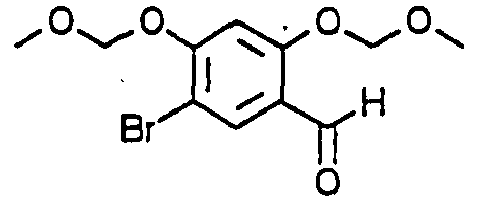
FAB-MS(m/z);307 [M+H]+ 2 
EI-MS(m/z);261[M]+ 3 
FAB-MS(m/z);443[M]+ 4 
FAB-MS(m/z);459[M]+ 5 
EI-MS (m/z);518 [M-H]- 6 
1H-NMR (CDCl3);1.09(9H,s),4.70(2H,s), 5.11(2H,s),6.61(1H, d),7.32-7.48(11H,m), 7.63-7.70(5H,m) 7 
FAB-MS(m/z);439[M+H]+ 8 
FAB-MS(m/z);502[M+H]+ 9 
1H-NMR(CDCl3);2.29(3H,s), 3.54-3.90(6H,m),3.98(1H,d), 4.40-4.68 (4H,m),4.75-5.05(6H,m), 6.75-7.43 (28H,m) (Table 2) Rf. STRUCTURE DATA 10 
FAB-MS(m/z);648 [M+H]+ 11 
FAB-MS(m/z);665 [M+H]+ 12 
EI-MS(m/z);748[M+Na]+ 13 
EI-MS(m/z);777[M+Na]+ 14 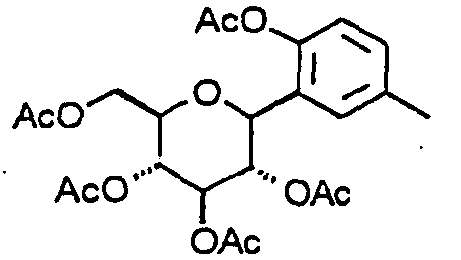
FAB-MS(m/z);481[M+H]+ 15 
FAB-MS(m/z);559[M+H]+ 16 
ES-MS(m/z);666[M+Na]+ 17 
FAB-MS(m/z);711[M+H]+ (Table 3) Rf. STRUCTURE DATA 18 
ES-MS(m/z);714[M+H]+ 19 
ES-MS(m/z);669[M+Na]+ 20 
ES-MS(m/z);685[M+Na]+ 21 
ES-MS(m/z);746[M+Na]+ 22 
FAB-MS(m/z);753[M+H]+ 23 
1H-NMR(CDCl3);3.33(3H,s),3.47(3H,s), 3.61-3.84(7H,m),4.28-4.96(8H,m), 6.89-7.39(20H,m),7.42(1H,t),7.55(1H,d), 7.66(1H,d),7.81(1H,s) 24 
ES-MS(m/z);749[M+H]+ 25 
FAB-MS(m/z);671[M+H]+ (Table 4) Rf. STRUCTURE DATA 26 
1H-NMR(CDCl3);1.27(3H,t),2.76(2H,dd), 4.04(2H,s),6.60(2H,d),7.16-7.39(4H,m) 27 
1H-NMR(CDCl3);2.16(3H,s),4.04(2H,s), 6.82(1H,d),7.07(1H,d),7.12-7.34(4H,s) 28 
FAB-MS(m/z);203[M-H]- 29 
1H-NMR(CDCl3);2.36(3H,s),4.18(2H,s), 7.14-7.18(2H,m),7.25-7.40(4H,m), 7.65(1H,d),7.74(1H,d) 30 
1H-NMR(CDCl3);4.16(2H,s),7.13(1H,d), 7.15-7.19(2H,m),7.33-7.38(3H,m), 7.42(1H,s),7.67(1H,m),7.87(1H,m) 31 
EI-MS(m/z);364[M+H]+ 32 
EI-MS(m/z);334[M+H]+ 33 
FAB-M5(m/z);423[M+H]+ 34 
EI-MS(m/z);364[M+H]+ 35 
EI-MS(m/z);380[M+H]+ (Table 5) Rf. STRUCTURE DATA 36 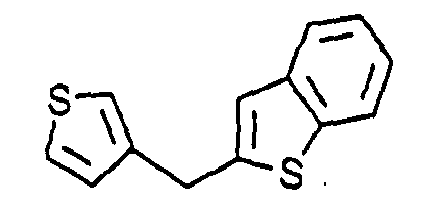
EI-MS;230[M]+ 37 
FAB-MS(m/z);467[M]+ 38 
FAB-MS(m/z);451[M]+ 39 
FAB-MS(m/z);451[M]+ 40 
FAB-MS(m/z);493[M]+ 41 
1H-NMR(CDCl3);1.22(3H,t), 2.63(2H,q),4.03(2H,s),6.55(1H,d), 6.85(1H,d),7.14(4H,s) 42 
1H-NMR(CDCl3); 1.22(3H,t),2.62(2H, q), 3.44(2H,s),5.96-6.01(1H,m), 6.14(1H,dd), 6.65 (1H,dd),7.00-7.28(4H,m) 43 
1H-NMR(CDCl3);0.90(9H,m), 1.12-1.39(12H,m),1.60(6H,m),2.37(3H,s), 2.44(3H,s),6.83(1H,s),6.98(1H,d), 7.26(1H,m) 44 
1H-NMR(CDCl3);0.88(9H,m), 1.12-1.38(14H,m),1.58(4H,m), 2.42(3H,s),2.47(3H,s),6.81(1H,s), 6.84(1H,s),7.14(1H,s) 45 
1H-NMR(CDCl3);0.91 (9H,m), 1.08-1.62(18H,m),2.43(3H,s),6.81(1H,s), 7.02(1H, d);7.32(1H,s),7.36(1H,d) (Table 6) Rf. STRUCTURE DATA 46 
1H-NMR(CDCl3);0.90(9H,m), 1.14(6H,m),1.36(6H,m),1.61(6H,m), 2.34(3H,s),2.40(3H,s),2.44(3H,s), 6.80(1H,s),6.83(1H,s) 47 
1H-NMR(CDCl3);0.90(9H,m),1.14(6H,m), 1.35(6H,m),1.60(6H,m),2.34(3H,s), 2.42(3H,s),6.87(1H,s),7.00(1H,d), 7.23 (1H, d) 48 
1H-NMR(CDCl3);0.89(9H,m),1.12(6H,m), 1.33 (6H,m)" 1.57(6H, m),2.32(3H, s), 2.35(3H,s),6.78(1H,d),7.28(2H,s) 49 
ES-MS(m/z);431[M+H]+ 50 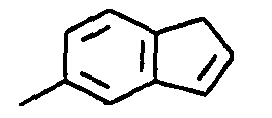
1H-NMR(CDCl3);2.39(3H,s),3.35(2H,s), 6.52-6.54(1H,m),6.82-6.84(1H,m), 6.99-7.35(2H,ABq),7.22(1H,s) 51 
1H-NMR(CDCl3);2.37(3H,s),3.55(2H,s), 6.87(1H,s),6.96-7.25(2H,ABq),7.11(1H,s) 52 
1H-NMR(CDCl3);2.29(6H,s),3.33(2H,s), 6.45(1H,d),6.80(1H,d),7.18(1H,s), 7.24(1H,s) 53 
1H-NMR(CDCl3);2.26(3H,s),2.27(3H,s), 3.53(2H,s),6.85(1H,s),7.08(1H,s), 7.14(1H,s) 54 
1H-NMR(CDCl3);3.52-4.06 (6H, m), 4.33 (1H, d), 4.45-4.95 (10H, m), 6.75 (1H, d), 7.67-7.86 (4H, m), 6.90-7.98 (27H, m), 8.23 (1H, s) 55 
FAB-MS(m/z);413[M+H]+ (Table 7) Ex. STRUCTURE DATA Comparative 1 
1H-NMR(CDCl3);3.51(1H,m),3.59(1H,m), 3.73-3.81(5H,m),4.21-4.24(3H,m), 4.35(1H,d),4.50-4.65(3H,m), 4.82-4.94(3H,m),6.87-6.89(2H,m), 6.97(1H,s),7.13-7.40(24H,m),7.66(1H,d), 7.68(1H,d)
FAB-MS(m/z);746[M-H]-Comparative 2 
1H-NMR(CDCl3);2.41(3H,s), 3.48-3.59(2H,m),3.76-3.82(5H,m), 4.20(2H,s),4.22(1H,d),4.34(1H,d), 4.54(1H,d),4.62-4.66(2H,m),4.86(1H,d), 4.87(1H,d),4.94(1H,d),6.87-6.89(3H,m), 7.04-7.40(24H,m),7.55(1H,d)
FA-B-MS(m/z);759[M-H]-Comparative3 
1H-NMR(CDCl3);7.52-7.58(2H,m), 7.11-7.40(23H,m),6.85-6.90(3H,m), 4.84-4.94(3H,m),4.51-4.67(3H,m), 4.36(1H,d),4.24(1H,d),4.19(2H,s), 3.72-3.82(5H,m),3.48-3.62(2H,m)
FAB-MS(m/z);781[M]+Comparative 4 
1H-NMR(CDCl3);3.48-3.60(2H,m), 3.76-3.82(5H,m),4.20(2H,s),4.24(1H,d), 4.36(1H,d),4.54(1H,d),4.61-4.85(2H,m), 4.86(1H,d),4.88(1H,d),4.93(1H,d), 6.87-6.91(3H,m),6.94-7.01(1H,m), 7.13-7.39(23H,m),7.56(1H,dd)
FAB-MS(m/z);763 [M-H]-Comparative 5 
1H-NMR(CDCl3);2.29(3H,s), 3.47-3.59(2H,m),3.73-3.82(5H,m), 4.17(2H,s),4.22(1H,d),4.34(1H,d), 4.53(1H,d),4.63(2H,d),4.86(1H,d), 4.87(1H,d),4.92(1H,d),6.87-6.89(2H,m), 6.97-7.03(1H,m),7.11-7.36(23H,m), 7.55(1H,dd)
ES-MS(m/z);801[M+Na]+(Table 8) Ex. STRUCTURE DATA Comparative 6 
1H-NMR(CDCl3);2.28(3H,s), 3.47-3.58(2H,m),3.73-3.82(5H,m), 4.18(2H,s),4.22(1H,d),4.34(1H,d), 4.53(1H,d),4.63(2H,d),4.86(1H,d), 4.87(1H,d),4.92(1H,d),6.86-6.89(2H,m), 7.11-7.36(23H,m),7.53-7.56(2H,m)
ES-MS(m/z);817[M+Na]+Comparative 7 
1H-NMR(CDCl3);1.35 (9H, s), 3.49-3.59(2H,m),3.76-3.82(5H,m), 4.20(2H,s),4.23(1H,d),4.34(1H,d), 4.56(1H,d),4.63(1H,d),4.64(1H,d), 4.86(1H,d),4.87(1H,d),4.94(1H,d), 6.86-6.88 (2H,m), 6.94(1H,brs), 7.08-7.36(22H,m),7.40(1H,brs), 7.60-7.62(2H,m)
ES-MS(m/z);825[M+Na]+Comparative 8 
1H-NMR(CDCl3);3.49-3.59(2H,m), 3.77-3.80(5H,m),3.81(3H,s),4.20(2H,s), 4.23(1H,d),4.35(1H,d),4.54(1H,d), 4.62-4.66(2H,m),4.86(1H,d),4.88(1H,d), 4.93(1H,d),6.86-6.90(3H,m),7.05(1H,d), 7.10-7.36(22H,m),7.40(1H,brs),7.53(1H,d)
FAB-MS(m/z);777[M+H]+Comparative 9 
1H-NMR(CDCl3):2.93(6H,s), 3.49-3.59(2H,m),3.73-3.82(5H,m), 4.18(2H,s),4.23(1H,d),4.34(1H,d), 4.55(1H,d),4.63(1H,d),4.64(1H,d), 4.86(1H,d),4.87(1H,d),4.93(1H,d), 6.81-6.91(5H,m),7.11-7.35(21H,m), 7.40(1H,brs),7.49(1H,d)
ES-MS(m/z);790(M+H)+Comparative 10 
1H-NMR(CDCl3);1.14(6H,t),3.34(4H,q), 3.49-3.59(2H,m),3.73-3.82(5H,m), 4.17(2H,s),4.22(1H,d),4.33(1H,d), 4.53(1H,d),4.63(1H,d),4.64(1H,d), 4.86(1H,d),4.87(1H,d),4.94(1H,d), 6.76(1H,dd),6.82(3H,m),7.10-7.35(21H,m), 7.40(1H,brs),7.47(1H,d)
FAB-MS(m/z);818[M+H]+Comparative 11 
1H-NMR(CDCl3);2.92(4H,brs),3.60(1H,m), 3.71-3.76(8H,m),3.98(1H,m), 4.17-4.24(2H,m),4.39-4.59(5H,m), 4.86-4.94(4H,m),6.70-6.72(2H,m), 6.94(1H,s),7.08-7.30(23H,m),7.46(2H,m), 7.56-7.59(1H,m)
ES-MS(m/z);832[M+H]+(Table 9) Ex. STRUCTURE DATA Comparative 12 
1H-NMR(CDCl3);3.40-3.63(2H,m), 3.70-3.90(5H,m),4.15-4.25(3H,m), 4.42(1H,d),4.50-4.66(3H,m), 4.82-4.96(3H,m),6.88-7.35(26H,m), 7.59-7.65(1H,m),7.67-7.72(1H,m) 1
ES-MS(m/z);787[M+Na]+Comparative 13 
1H-NMR(CDCl3);3.61-3.66(2H,m), 3.71-3.88(4H,m),3.95(1H,d),4.18(2H,s), 4.37(1H,d),4.51(1H,d),4.61(1H,d), 4.63(1H,d),4.83-4.94(4H,m), 6.93-6.96(3H,m),7.13-7.31(21H,m), 7.35(1H,d),7.48(1H,d),7.58(1H,d), 7.67(1H,d)
ES-MS(m/z);803[M+Na]+14 
1H-NMR(CDCl3);3.33(3H,d), 3.54-3.87(6H,m),3.98-4.05(1H,m), 4.16-4.34(2H,m),4.44-4.78(5H,m), 4.82-5.07(5H,m),6.91-6.98(3H,m), 7.05-7.35(21H,m),7.41(1H,d),7.52(1H,d), 7.62(1H)
ES-MS(m/z);841[M]+15 
1H-NMR(CDCl3);3.56-3.60(1H,m), 3.66-3.83(5H,m),4.01(1H,d), 4.09-4.24(2H,m),4.43-4.65(4H,m), 4.75(1H,brs),4.82-4.99(5H,m),6.63(1H,d), 6.88(2H,d),6.93(1H,s),7.06-7.40(26H,m), 7.56(1H,d),7.65(1H,d)
EI-MS(m/z);894[M+Na]+Comparative 16 
1H-NMR(CDCl3);3.48-3.60(2H,m), 3.73-3.81(5H,m),4.10(2H,s),4.24(1H,d), 4.37(1H,d),4.54(1H,d),4.62-4.66(2H,m), 4.86(1H,d),4.88(1H,d),4.94(1H,d), 6.32(1H,d),6.87-6.90(2H,m), 7.11-7.43(26H,m) ES-MS(m/z);753[M+Na]+ Comparative 17 
1H-NMR(CDCl3);3.47-4.07(12H,m), 4.42-4.70(5H,m),4.80-4.95(3H,m), 7.75-7.38(26H,m)
EI-MS(m/z);726[M]+(Table 10) Ex. STRUCTURE DATA Comparative 18 
1H-NMR(CDCl3);1.21(3H,t),2.62(5H,q), 3.49-4.13(7H,m),4.10(2H,s), 4.43-4.95(8H,m),6.69-7.34(26H,m)
ES-MS(m/z);747[M+Na]+Comparative 19 
1H-NMR(CDCl3);2.36(3H,s), 3.51-3.82(7H,m),4.06(2H,s),4.23(1H,d), 4.35(1H,d),4.54-4.96(6H,m), 6.51-7.33(26H,m)
ES-MS(m/z);728[M+NH4]+Comparative 20 
1H-NMR(CDCl3);1.21(3H,t),2.70(2H,dd), 3.49-3.82(7H,m),4.07(2H,s),4.23(1H,d), 4.35-4.95(7H,m),6.53(2H,dd), 6.89-7.36(24H,m)
ES-MS(m/z);742[M+NH4]+Comparative 21 
1H-NMR(CDCl3);2.14(3H,s), 3.48-3.81(7H,m),4.06(2H,s), 4.20-4.96(8H,m),6.77-7.36(26H,m)
ES.MS(m/z);728[M+NH4]+Comparative 22 
1H-NMR(CDCl3);7.67(1H,d),7.61(1H,d), 7.11-7.38(24H,m),6.89(2H,d), 4.84-4.94(3H,m),4.63(2H,d),4.54(1H,d), 4.33(1H,d),4.22(1H,d),4.19(2H,s), 3.72-3.82(5H,m),3.48-3.62(2H,m), 2.34(3H,s)
FAB-MS(m/z);760[M]+Comparative 23 
1H-NMR(CDCl3);3.49-3.77(6H,m), 4.05-4.22(3H,m),4.40-5.00(8H,m), 6.85-7.74(27H,m)
FAB-MS(m/z);751 [M+H]-Comparative 24 
1H-NMR(CDCl3);7.83(1H,brd), 7.65(1H,dd),7.15-7.40(24H,m),6.93(1H,s), 6.89(2H,dd),4.84-4.94(3H,m),4.63(2H,d), 4.53(1H,d),4.34(1H,d),4.22(1H,d), 4.19(2H,s),3.72-3.82(5H,m), 3.48-3.62(2H,m) (Table 11) Ex. STRUCTURE DATA Comparative 25 
1H-NMR(CDCl3);3.35(3H,s), 3.59-3.61(1H,m),3.72-3.82(5H,m), 3.93(1H,d),4.12-4.22(2H,m),4.43(1H,d), 4.51(1H,d),4.60(1H,d),4.64(1H,d), 4.73-4.79(1H,br),4.87(1H,d),4.88(1H,d), 4.95(1H,d),5.03-5.07(2H,m), 6.85-6.88(2H,m),6.96(1H,s), 7.09-7.31(22H,m),7.42(1H,d),7.56(1H,d), 7.66(1H,d)
EI-MS(m/z);829[M+Na]+26 
1H-NMR(CDCl3);3.37(3H,s),3.41(3H,s), 3.50-3.80(4H,s),4.00(1H,d), 4.10-4.72(8H,m),4.84-5.23(8H,m), 6.73-7.02(4H,m),7.07-7.39(21H,m), 7.51(1H,d),7.63(1H,d)
ES-MS(m/z);889[M+Na]+27 
1H-NMR(CDCl3);3.17-4.01(13H,m), 4.10(1H,d),4.19(1H,d),4.36-5.00(8H,m), 6.46(1H,s),6.85-7.40(24H,m),7.52(1H,d), 7.63(1H,m)
FAB-MS(m/z);808[M+H]+Comparative 28 
1H-NMR(CDCl3);3.45-5.35(17H,m), 6.70-7.85(33H,m).
ES-MS(m/z);845[M+Na]+Comparative 29 
1H-NMR(CDCl3);3.50-3.56(1H,m), 3.60-3.64(1H,m),3.71(1H,d), 3.75-3.84(4H,m),4.12(2H,s),4.31(1H,d), 4.32(1H,d),4.56(1H,d),4.64(1H,d), 4.65(1H,d),4.88(1H,d),4.89(1H,d), 4.96(1H,d),6.36(1H,s),6.84-6.87(2H,m), 7.10-7.40(25H,m),7.55(1H,d)
FAB-MS (m/z);731 [M+H]+Comparative 30 
1H-NMR(CDCl3);3.54-3.58(1H,m), 3.67-3.77(4H,m),3.83-3.97(2H,m), 4.05-4.17(2H,m),4.37-4.48(3H,m), 4.52-4.62(2H,m),4.83-4.95(3H,m), 6.90-6.96(3H,m),7.08-7.34(22H), 7.60(1H,d),7.67-7.69(2H,m)
EI-MS(m/z);785[M+Na]+(Table 12) Ex. STRUCTURE DATA Comparative 31 
1H-NMR(CDCl3);3.44-3.65(2H,m), 3.70-3.92(4H,m),4.13-4.27(3H,m), 4.37(1H,d),4.50-4.67(3H,m), 4.80-4.96(3H,m),6.75-7.05(3H,m), 7.08-7.35(22H),7.56(1H,d),7.67(1H,d)
FAB-MS(m/z);761[M-H]-32 
1H-NMR(CDCl3);3.51-3.59(1H,m), 3.63-3.78(4H,m),3.84-4.00(2H,m), 4.04-4.16(1H,m),4.26-4.40(2H,m), 4.43-4.61(4H,m),4.82-4.95(3H,m), 6.90-6.98(2H,m),6.99-7.03(1H,m), 7.05-7.09(1H,m),7.12-7.37(20H,m), 7.56-7.63(1H,m),7.66-7.72(1H,m), 7.80-7.88(1H,m)
FAB-MS(m/z);795[M-H]-Comparative 33 
1H-NMR(CDCl3);3.58-3.62(1H,m), 3.71-3.82(9H,m),3.92(1H,d), 4.15-4.19(2H,m),4.40(1H,d),4.52(1H,d), 4.61-4.65(2H,m),4.84-4.88(2H,m), 4.94(1H,d),6.84-6.89(3H,m),6.95(1H,s), 7.11-7.31(21H,m),7.42(1H,d),7.56(1H,d), 7.65(1H,d).
EI-MS(m/z);799[M+Na]+34 
1H-NMR(CDCl3);3.53-3.82(9H,m), 3.97-4.20(1H,m),4.17-4.32(2H,m), 4.41-4.66(4H,m),4.73(1H,brs), 4.81-4.95(3H,m),6.83-6.94(4H,m), 7.09-7.32(20H,m),7.38-7.43(1H,m), 7.48-7.55(1H,m),7.58-7.64(1H,m)
ES-MS(m/z);811[M]+Comparative 35 
1H-NMR(CDCl3);3.38(3H,s), 3.5 6-3.62(2H,m),3.64-3.81(7H,m), 3.92(1H,d),3.95-4.08(2H,m),4.14(1H,d), 4.19(1H,d),4.40(1H,d),4.51(1H,d), 4.62(1H,d),4.63(1H,d),4.84-4.88(2H,m), 4.93(1H,d),6.84-6.88(3H,m),6.96(1H,s), 7.09-7.31(21H,m),7.39(1H,s),7.57(1H,d), 7.66(1H,d).
EI-MS(m/z);843[M+Na]+Comparative 36 
1H-NMR(CDCl3);3.40-3.65(3H,m), 3.70-3.98(7H,m),4.05-4.47(6H,m), 4.50-4.70(3H,m),4.80-4.95(3H,m), 6.80-6.96(3H,m),7.06-7.40(21H,m), 7.55(1H,d),7.66(1H,d).
FAB-MS(m/z);806[M-H]-(Table 13) Ex. STRUCTURE DATA Comparative 37 
1H-NMR(CDCl3);1.40(9H,s),3.32-3.38(2H,m), 3.58-3.61(1H,m),3.71-3.83(6H,m),3.95-4.03(2H,m), 4.13(1H,d),4.18(1H,d),4.45-4.52(2H,m), 4.56-4.63(2H,m),4.84-4.89(2H,m),4.97(1H,d), 5.36-5.44(1H,d),6.77(1H,d),6.82(2H,d),6.98(1H,s), 7.06-7.32(21H,m),7.35(1H,s),7.59(1H,d), 7.67(1H,d).
EI-MS(m/z);928[M+Na]+Comparative 38 
1H-NMR(CDCl3);3.61(1H,m),3.72(3H,s), 3.73-3.84(5H,m),4.00(1H,d),4.15-4.19(2H,m), 4.41(1H,d),4.48-4.55(3H,m),4.59-4.66(2H,m), 4.84-4.96(4H,m),6.74(1H,d),6.86-6.90(2H,m), 6.96(1H,s),7.08-7.32(21H,m),7.41(1H,s), 7.57(1H,d),7.66(1H,d)
FAB-MS(m/z);836[M+H]+39 
1H-NMR(CDCl3);1.28(3H,t),3.56-3.62(1H,m), 3.67-3.84(5H,m),4.08(1H,d),4.19-4.27(4H,m), 4.45-4.52(4H,m),4.56-4.65(2H,m),4.74(1H,brs), 4.83-4.93(3H,m),6.80(1H,s),6.88-6.95(3H,m), 7.08-7.32(20H,m),7.40(1H,s),7.53-7.67(1H,m), 7.63-7.67(1H,m)
ES-MS(m/z);905[M+Na]+Comparative 40 
1H-NMR(CDCl3);1.25(3H,t),3.58-3.87(8H,m), 4.10(2H,s),4.12-4.19(3H,m),4.34-4.37(2H,m), 4.49(1H,d),4.55(1H,d),4.62(1H,d),4.84-4.96(3H,m), 6.45(1H,d),6.90-6.96(3H,m),7.08-7.31(22H,m), 7.60(1H,d),7.68(1H,d)
ES-MS(m/z);848[M+H]+Comparative 41 
1H-NMR(CDCl3);2.40(3H,s),2.90(2H,t), 3.57-3.61(1H,m),3.71-3.79(6H,m),3.94-4.04(3H,m), 4.14(1H,d),4.19(1H,d),4.38(1H,d),4.51(1H,d), 4.58-4.63(2H,m),4.86(1H,d),4.87(1H,d),4.93(1H,d), 6.83-6.87(3H,m),6.96(1H,s),7.08-7.31(21H,m), 7.37(1H,s),7.57(1H,d),7.66(1H,d).
FAB-MS(m/z);820[M+H]+Comparative 42 
1H-NMR(CDCl3);1.70(3H,s),3.37-3.50(2H,m), 3.59-3.63(1H,m),3.68-3.83(7H,m),3.92(1H,d), 4.08-4.12(1H,m),4.17(1H,d),4.22(1H,d),4.44(1H,d), 4.52(1H,d),4.59(1H,d),4.63(1H,d),4.85(1H,d), 4.91(2H,s),6.76-6.83(3H,m),6.99(1H,s), 7.08-7.33(21H,m),7.42(1H,s),7.59(1H,d), 7.67(1H,d).
EI-MS(m/z);848[M+H]+(Table 14) Ex. STRUCTURE DATA Comparative 43 
1H-NMR(CDCl3);1.73(3H,s),2.00(3H,s), 2.04(6H,s),2.36(3H,s),3.80(1H,ddd),4.09(1H,dd); 4.21(2H,s),4.30(1H,dd),4.57-4.63(1H,m), 5.17-5.22(1H,m),5.28-5.32(2H,m),6.98(1H,s), 7.04(1H,d),7.24-7.32(3H,m),7.36(1H,d), 7.67(1H,d),7.73(1H,d)
FAB-MS(m/z);612[M+H]+44 
1H-NMR(CDCl3);1.74(3H,s),1.99(3H,s), 2.02(3H,s),2.04(3H,s),2.36(3H,s), 3.75-3.82(1H,m),4.07(1H,dd),4.22(2H,brs), 4.28(1H,dd),4.55(1H,d),5.13-5.33(3H,m), 6.88(1H,d),7.00(1H,s),7.22-7.37(3H,m), 7.64-7.78(2H,m)
EI-MS(m/z);653[M+Na]+Comparative 45 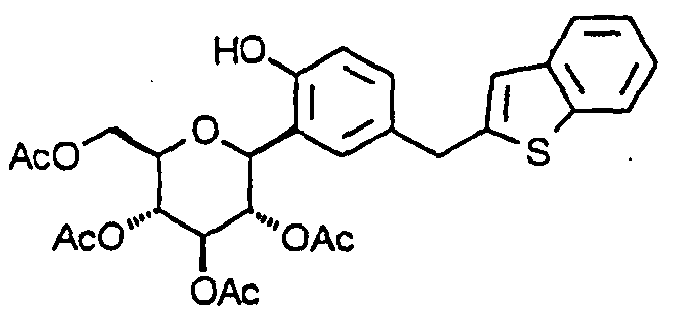
1H-NMR(CDCl3);1.60(3H,s),1.98(3H,s), 2.05(3H,s),2.12(3H,s),3.83-3.88(1H,m), 4.10(2H,s),4.17(1H,dd),4.33(1H,dd), 4.52-4.56(1H,m),5.27-5.31(3H,m), 6.87-6.89(2H,m),6.94(1H,d),6.97(1H,s), 7.16-7.31(2H,m),7.64(1H,d),7.71(1H,dd)
FAB-MS(m/z);570[M+H]+46 
1H-NMR(CDCl3);1.59(3H,s),1.98(3H,s), 2.05(3H,s),2.12(3H,s),3.80-3.87(1H,m), 4.07(1H,t),4.31(1H,dd),4.47-4.53(1H,m), 5.21-5.30(3H,m),6.66(1H,d),6.83(1H,d), 6.96(1H,s),7.22-7.32(2H,m),7.64(1H,d), 7.71(1H,d)
EI-MS(m/z);611[M+Na]+Comparative 47 
1H-NMR(CDCl3);1.60-1.69(2H,m),1.71(3H,s), 1.78-1.92(6H,m),2.00(3H,s),2.036(3H,s), 2.040(3H,s),3.78-3.83(1H,m),4.10-4.18(3H,m), 4.26(1H,dd),4.75-4.85(2H,m),5.20(1H,t), 5.30-5.40(2H,m),6.80(1H,d),6.95(1H,s), 7.15(1H,dd),7.20-7.30(3H,m),7.65(1H,d), 7.71(1H,d).
FAB-MS(m/z);638[M+H]+48 
1H-NMR(CDCl3);1.73(3H,s),1.99(3H,s), 2.02(3H,s),2.04(3H,s),3.77-3.85(4H,m), 4.09-4.19(3H,m),4.24(1H,dd),4.77-4.86(1H,m), 5.16-5.24(1H,m),5.28-5.38(2H,m),6.61(1H,d), 6.96(1H,s),7.20-7.32(3H,m),7.65(1H,d), 7.72(1H,d)
EI-MS(m/z);625[M+Na]+(Table 15) Ex. STRUCTURE DATA Comparative 49 
1H-NMR(CDCl3);1.35(3H,d),1.36(3H,d), 1.72(3H,s),2.00(3H,s),2.03(3H,s),2,04(3H,s), 3.81-3.85(1H,m),4.11-4.14(3H,m),4.24(1H,dd), 4.50-4.56(1H,m),4.92(1H,brs),5.21(1H,t), 5.32-5.38(2H,m),6.81(1H,d),6.96(1H,s), 7.15(1H,dd),7.21-7.30(3H,m),7.66(1H,d), 7.72(1H,dd).
EI-MS(m/z);613[M+H]+Comparative 50 
1H-NMR(CDCl3);1.42(3H,s),1.50(3H,s), 1.71(3H,s),1.99(3H,s),2.04(6H,s), 3.81-3.86(1H,m),3.97-4.06(3H,m), 4.10-4.22(4H,m),4.27(1H,dd),4.48-4.54(1H,m), 4.80-4.90(1H,br),5.21(1H,t),5.31(1H,t), 5.35-5.45(1H,br),6.82(1H,d),6.95(1H,d), 7.17-7.31(4H,m),7.66(1H,d),7.72(1H,dd).
FAB-MS(m/z);685[M+H]+Comparative 51 
1H-NMR(DMSO-d6 ),3.62-3.84(6H,m), 4.02(1H,d),4.19(2H,s),4.44-4.62(5H,m), 4.83-4.88(3H,m),6.83(2H,m),6.99(1H,s), 7.06-7.33(22H,m),7.44(1H,d),7.60(1H,m), 7.68(1H,m)
ES-MS(m/z);917[M+Na]+Comparative 52 
1H-NMR(DMSO-d6 );3.55(1H,m),3.71(3H,s), 3.76-3.86(6H,m),4.22(2H,s),4.38(1H,d), 4.52(1H,d),4.61(1H,d),4.63(1H,d), 4.84-4.93(3H,m),5.37(1H,d),6.90-6.93(2H,m), 6.96(1H,s),7.12-7.30(21H,m),7.59(2H,m), 7.68(1H,d),7.74(1H,d)
ES-MS(m/z);827[M+Na]+Comparative 53 
1H-NMR(DMSO-d6 );3.56-3.81(7H,m), 4.24(1H,d),4.32(2H,s),4.45-4.59(3H,m), 4.73-4.78(3H,m),5.37(1H,d),6.84(2H,d), 7.01-7.40(22H,m),7.66(2H,m),7.77(2H,d), 12.9(1H,s)
FAB-MS(m/z);791[M+H]+Comparative 54 
1H-NMR(CDCl3);3.62(1H,m),3.69-3.83(5H,m), 3.99(1H,d),4,18(2H,s),4.25-4.68(7H,m), 4.85(1H,d),4.93(2H,s),6.72-6.78(3H,m), 7.00(1H,m),7.03-7.09(2H,m),7.13-7.19(3H,m), 7.23-7.36(17H,m),7.63(1H,d),7.70(1H,d)
FAB-MS(m/z);819[M-H]+(Table 16) Ex. STRUCTURE DATA Comparative 55 
1H-NMR(CDCl3);3.54(1H,m),3.72-3.87(5H,m), 3.91(1H,d),4.18(2H,s),4.29(1H,m), 4.40-4.55(6H,m),4.63-4.70(2H,m), 4.88-4.96(3H,m),6.72-6.80(3H,m),7.00(1H,s), 7.04-7.10(2H,m),7.14(1H,d),7.21-7.36(19H,m), 7.62(1H,d),7.70(1H,d)
FAB-MS(m/z);819[M-H]-Comparative 56 
1H-NMR(CDCl3);2.81(3H,s),2.85(3H,s), 3.54-3.83(6H,m),3.91(1H,d),4.12-4.23(2H,m), 4.41-4.66(7H,m),4.84-4.97(3H,m), 6.80-6.85(2H,m),6.91(1H,d),6.96(1H,d), 7.08-7.33(21H,m),7.42(1H,brs),7.56(1H,d), 7.64(1H,d)
FAB-MS(m/z);849[M+H]+Comparative 57 
1H-NMR(CDCl3);1.48(9H,s),3.53(1H,m), 3.70-3.85(5H,m),4.15(2H,s),4.35(2H,t), 4.55-4.63(4H,m),4.85-4.95(3H,m), 6.90-6.95(3H,m),7.10-7.31(23H,m),7.60(1H,d), 7.69(1H,d),8.05(1H,m)
ES-MS(m/z);884[M+Na]+Comparative 58 
1H-NMR(CDCl3);3.52(1H,d),3.71-3.90(5H,m), 4.06(1H,m),4.10(2H,s),4.32-4.61(5H,m), 4.85-4.97(3H,m),6.92-6.96(3H,m), 7.07-7.32(23H,m),7.60(1H,d),7.68(1H,d)
ES-MS(m/z);762[M+H]+Comparative 59 
1H-NMR(CDCl3);2.62(3H,s),3.52(1H,d), 3.74-3.93(5H,m),4.11(2H,s),4.33(2H,m), 4.45-4.64(4H,m),4.85-4.96(4H,m),6.90(2H,m), 6.96(1H,s),7.09-7.33(23H,m),7.59(1H,d), 7.68(1H,d)
FAB-MS(m/z);776[M+H]+Comparative 60 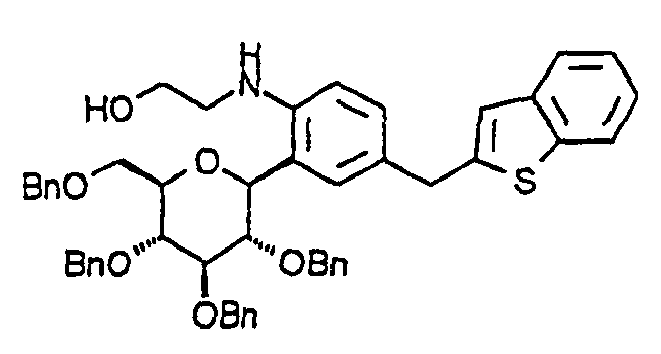
1H-NMR(CDCl3);3.08-3.14(2H,m), 3.51-3.66(3H,m),3.70-3.88(5H,m), 3.98-4.07(1H,m),4.10(2H,s),4.32(1H,d), 4.34(1H,d),4.45-4.60(4H,m),4.84-5.01(4H,m), 6.65(1H,d),6.89-6.91(2H,m),6.97(2H,m), 7.06-7.33(21H,m),7.59(1H,d),7.68(1H,d)
ES-MS(m/z);806[M+H]+(Table 17) Ex. STRUCTURE DATA Comparative 61 
1H-NMR(CDCl3);3.56(1H,m),3.67-3.80(6H,m), 3.83-3.92(2H,m),3.98(1H,m),4.03(1H,d), 4.11(1H,m),4.16(2H,s),4.39-4.53(5H,m), 4.81-4.95(3H,m),6.79-6.85(3H,m),6.99(1H,s), 7.04-7.09(2H,m),7.11-7.17(3H,m), 7.19-7.33(17H,m),7.60(1H,d),7.69(1H,d)
FAB-MS(m/z);808[M+H]+62 
1H-NMR(CDCl3);3.38-4.15(12H,m), 4.19-4.31(2H,m),4.36-4.66(4H,m), 4.80-4.94(3H,m),6.80-6.98(3H,m), 7.03-7.10(1H,m),7.12-7.35(21H,m), 7.52-7.60(1H,m),7.61-7.69(1H,m)
EI-MS(m/z);863[M+Na]+Comparative 63 
1H-NMR(CDCl3);2.97(1H,m),2.95(1H,m), 3.59(1H,brs),3.71-3.82(6H,m),3.89-3.97(1H,m), 4.18(2H,d),4.43(1H,d),4.47-4.65(3H,m), 4.84-4.97(3H,m),6.79-6.87(2H,m),6.98(1H,s), 7.08-7.17(2H,m),7.18-7.34(20H,m),7.39(1H,s), 7.58(1H,d),7.67(1H,d)
FAB-MS(m/z);807[M+H]+Comparative 64 
1H-NMR(CDCl3);2.69(6H,s),3.64-3.82(5H,m), 3.93(1H,d),4.16(2H,d),4.37(1H,d),4.48(1H,d), 4.58-4.64(2H,m),4.85-4.94(4H,m),6.76(2H,m), 6.94(1H,s),7.10-7.28(22H,m),7.43(1H,m), 7.49(1H,d),7.60(1H,d)
ES-MS(m/z);790[M+H]+Comparative 65 
1H-NMR(CDCl3);3.42-3.48(1H,m), 3.55-3.58(1H,m),3.72-3.78(4H,m),3.83(1H,d), 4.14-4.30(3H,m),4.39(1H,d),4.51-4.67(4H,m), 4.83-4.94(2H,m),6.86-6.90(1H,m),6.98(1H,brs), 7.06-7.37(24H,m),7.57-7.60(1H,m), 7.66-7.69(1H,m)
EI-MS(m/z);787[M+Na]+Comparative 66 
1H-NMR(CDCl3);3.42-3.48(1H,m), 3.50-3.64(1H,m),3.72-3.78(4H,m),3.88(1H,d), 4.19(1H,d),4.22-4.34(2H,m),4.35-4.45(1H,m), 4.50-4.65(4H,m),4.85(1H,d),4.89(1H,d), 6.90(2H,d),6.94(1H,s),7.10-7.42(23H,m), 7.56(1H,d),7.65(1H,d) (Table 18) Ex. STRUCTURE DATA Comparative 67 
1H-NMR(CDCl3);3.60-3.68(1H,m), 3.73-3.85(3H,m),3.92-4.23(3H,m), 4.42-4.78(8H,m),4.83-4.95(2H,m), 6.85-6.98(3H,m),7.05-7.39(23H,m), 7.54-7.61(1H,m),7.62-7.69(1H,m) Comparative 68 
1H-NMR(CDCl3);3.40-3.63(4H,m), 3.68-3.90(4H,m),4.10-4.40(4H,m), 4.45-4.75(5H,m),4.80-4.95(3H,m), 5.22(2H,s),6.84-6.95(3H,m), 7.05-7.40(23H,m),7.54(1H,d), 7.65(1H,d) Comparative 69 
1H-NMR(CDCl3);3.47-3.78(1H,m), 3.87(3H,s),4.13-4.29(4H,m),4.33(1H,d), 4.49-4.75(4H,m),4.84-4.94(3H,m), 6.86-6.95(3H,m),7.06-7.37(23H,m), 7.58(1H,d),7.66(1H,d)
FAB-MS(m/z);775[M-H]-Comparative 70 
1H-NMR(CDCl3);3.48-3.62(2H,d), 3.72-3.82(5H,d),4.19(2H,s),4.22(1H,d), 4.34(1H,d),4.53(1H,d),4.63(2H,d), 4.84-4.94(3H,m),6.89(2H,dd),6.93(1H,s), 7.15-7.40(24H,m),7.65(1H,dd), 7.83(1H,brd) Comparative 71 
1H-NMR(CDCl3);3.50(1H,m),3.58(1H,m), 3.74-3.81(5H,m),4.16(2H,s),4.22(1H,d), 4.34(1H,d),4.52-4.65(3H,m), 4.85-4.94(3H,m),6.87-6.89(2H,m), 7.00-7.06(2H,m),7.15-7.36(22H,m), 7.45(1H,dt),8.50(1H,m)
FAB-MS(m/z);692[M+H]+Comparative 72 
1H-NMR(CDCl3);3.36-3.62(5H,m), 4.21(1H,d),4.30(2H,s),4.52(1H,d), 4.60(1H,d),4.62(1H,d),4.83-4.97(3H,m), 6.84-6.90(2H,m),7,12-7.78(26H,m)
FAB-MS(m/z);765[M+H]+Comparative 73 
1H-NMR(CDCl3);3.50-3.60(2H,m), 3.72-3.81(5H,m),4.22(1H,d),4.36(1H,d), 4.54(1H,d),4.62-4.66(2H,m), 4.72-4.94(5H,m),6.82-6.87(2H,m), 7.11-7.13(3H,m),7.19-7.40(18H,m), 7.53(1H,s),7.65-7.68(2H,m), 7.77-7.80(2H,m).
EI-MS(m/z);782[M+Na]+(Table 19) Ex. STRUCTURE DATA Comparative 74 
1H-NMR(CDCl3);1.73(3H,s),2.00(3H,s), 2.04(3H,s),2.05(3H,s),3.25(2H,s),3.74(2H,s), 3.82(3H,s),3.84(1H,m),4.14(1H,dd),4.26(1H,dd), 4.92(1H,m);5.23(1H,m),5.33(2H,m),6.46(1H,s), 6.79(1H,d),7.08-7.35(6H,m)
ES-MS(m/z);567[M+H]+Comparative 75 
1H-NMR(CDCl3);2.29(3H,s),2.32(3H,s), 3.43(2H,m),3.58(2H,m),3.83(1H,m),3.88(1H,m), 3.99(2H,s),4.48(1H,d),6.25(1H,s),6.83(1H,d), 7.10(1H,d),7.15(1H,s),7.20(2H,s)
ES-MS(m/z);608[M]+Comparative 76 
1H-NMR(CDCl3);3.26(2H,s),3.40(2H,m), 3.53(2H,m),3.67(1H,dd),3.76(2H,s),3.82(3H,s), 3.86(1H,m),4.70(1H,d),6.48(1H,s),6.91(1H,d), 7.01(1H,m),7.03-7.22(3H,m),7.29(1H,d), 7.32(1H,d)
ES-MS(m/z);622[M]+Comparative 77 
1H-NMR(CDCl3);1.71(3H,s),1.99(3H,s), 2.06(3H,s),2.11(3H,s),3.82(1H,m),4.14(1H,m) 4.25(2H,s),4.27(1H,dd),4.39(1H,d),5.10(1H,t), 5.22(1H,t),5.31(1H,t),7.28-7.38(6H,m), 7.45(1H,m),7.67(1H,m)
ES-MS(m/z);540[M+H]+Comparative 78 
1H-NMR(CDCl3);1.76(3H,s),2.01(3H,s), 2.05(3H,s),2.09(3H,s),2.35(3H,s),3.81(1H,m), 4.30(1H,dd),4.60(1H,d),4.80(2H,s), 5.16-5.34(4H,m),7.03(1H,d),7.40-7.59(4H,m), 7.70(1H,dd),8.32(1H,d)
ES-MS(m/z);598[M+H]+Comparative 79 
1H-NMR(CDCl3);1.75(3H,s),1.99(3H,s), 2.06(3H,s),2.08(3H,s),3.82(1H,m),4.13(1H,m), 4.17(2H,s),4.27(1H,dd),4.37(1H,d),5.11(1H,t), 5.22(1H,t),5.31(1H,t),7.21-7.32(4H,m), 8.43(2H,m),8.53(1H,s)
ES-MS(m/z);501[M+H]+(Table 20) Ex. STRUCTURE DATA Comparative 80 
1H-NMR(CDCl3);3.49-3.54(1H,m), 3.58-3.62(1H,m),3.74-3.82(5H,m),4.25(1H,d), 4.37(1H,d),4.44(2H,s),4.55(1H,d),4.63(2H,d), 4.86(1H,d),4.88(1H,d),4.93(1H,d), 6.88-6.90(2H,m),7.10-7.48(24H,m),7.71(1H,d), 7.97(1H,d).
FAB-MS(m/z);748[M+H]+Comparative 81 
1H-NMR(CDCl3);1.68(3H,s),1.98(3H,s), 2.05(3H,s),2.06(3H,s),3.54(3H,s),3.82(1H,m), 4.11-4.16(2H,m),4.17(1H,d),4.28(1H,dd), 4.35(1H,d),5.10(1H,t),5.18-5.33(2H,m), 6.24(1H,s),7.07(1H,m),7.13-7.20(3H,m), 7.21-7.31(3H,m),7.54(1H,d)
FAB-MS(m/z);552[M+H]+Comparative 82 
1H-NMR(CDCl3);1.74(3H,s),2.00(3H,s), 2.04(6H,s),2.35(3H,s),3.55(3H,s),3.81(1H,m), 4.10(1H,dd),4.13(2H,s),4.30(1H,dd),4.59(1H,d), 5.21(1H,m),5.23-5.34(2H,m),6.26(1H,brs), 6.99(1H,d),7.05-7.20(3H,m),7.26(1H,m), 7.33(1H,d),7.55(1H,m)
FAB-MS(m/z);610[M+H]+Comparative 83 
1H-NMR(CDCl3);1.64(3H,s),1.90(3H,s), 2.12(3H,s),2.60(3H,s),3.96(1H,m),3.98(2H,s), 4.17(1H,m),4.32(1H,dd),4.56(1H,m), 5.24-5.34(3H,m),6.31(1H,s),6.88(1H,m), 7.00-7.48(7H,m)
FAB-MS(m/z);553[M-H]+Comparative 84 
1H-NMR(CDCl3);1.74(3H,s),2.00(3H,s), 2.04(3H,s),2.05(3H,s),2.35(3H,s),3.82(1H,m), 4,09(3H,m),4.30(1H,dd),4.60(1H,m), 5.20-5.32(3H,m),6.29(1H,s),6.96-7.03(3H,m), 7.18(1H,d),7.37(1H,s)
ES-MS(m/z);642[M+NH4]+Comparative 85 
1H-NMR(CDCl3);1.73(3H,s),2.01(3H,s), 2.04(3H,s),2.07(3H,s),2.36(3H,s),2.39(3H,s), 2.41(3H,s),3.80(1H,m),4.07(1H,m),4.30(1H,dd), 4.59(1H,d),5.19(1H,m),5.30(2H,m),6.32(1H,s), 6.81(1H,s),7.01(1H,s),7.03(1H,s),7.25(1H,s), 7.35(1H,s)
ES-MS(m/z);642[M+NH4]+(Table 21) Ex. STRUCTURE DATA Comparative 86 
1H-NMR(CDCl3);1.79(3H,s),1.99(3H,s), 2.05(3H,s),2.09(3H,s),2.34(3H,s),2.35(3H,s), 3.80(1H,m),4.07(2H,s),4.11(1H,m),4.28(1H,m), 4.60(1H,m),5.28(1H,m),6.30(1H,s),6.93(1H,d), 7.02(3H,m),7.26(1H,m),7.35(1H,s)
ES-MS(m/z);628[M+NH4]+Comparative 87 
1H-NMR(CDCl3);1.74(3H,s),2.00(3H,s), 2.04(3H,s),2.05(3H,s),2.32(3H,s),2.35(3H,s), 2.36(3H,s),2.38(3H,s),3.81(1H,m),4.08(2H,s), 4.09(1H,m),4.30(1H,dd),4.59(1H,d),5.20(1H,m), 5.30(2H,m),6.29(1H,s),6.79(1H,s),7.02(1H,d), 7.26(1H,m),7.37(1H,d)
ES-MS(m/z);656[M+NH4]Comparative 88 
1H-NMR(CDCl3);1.74(3H,s),2.00(3H,s), 2.04(6H,s),2.32(3H,s),2.34(3H,s),2.35(3H,s), 3.80(1H,m),4.12(3H,m),4.30(1H,dd), 4.59(1H,m),4.92(1H,m),5.21(1H,m),5.30(2H,m), 6.36(1H,s),7.00(1H,d),7.02(1H,d), 7.12(1H,d),7.26(1H,m),7.36(1H,s)
ES-MS(m/z);642[M+NH4]+Comparative 89 
1H-NMR(CDCl3);1.65(3H,s),1.99(3H,s), 2.05(3H,s),2.08(3H,s),2.12(3H,s),2.31(3H,s), 2.33(3H,s),3.86(1H,m),3.94(2H,s),4.16(1H,m), 4.31(1H,dd),4.52(1H,m),5.28(3H,m),6.20(1H,s), 6.85(2H,m),6.98(1H,s),7.13(1H,s),7.19(1H, s)
ES-MS(m/z);642[M+NH4]+Comparative 90 
1H-NMR(CDCl3);1.12(1H,d),1.73(2H,s), 1.98-2.12(10H,m),2.33-2.35(3H,dd), 3.79-3.81(1H,m),4.06-4.09(1H,d),4.18(2H,s), 4.28-4.33(1H,dd),4.58-4.60(1H,m), 5.28-5.30(2H,m),6.92(1H,s),7.00-7.02(1H,d), 7.12-7.13(1H,d),7.23-7.31(3H,m)
ES-MS(m/z);636[M+NH4]+Comparative 91 
1H-NMR(CDCl3);1.67(3H,s),2.00(3H,s), 2.06(3H,s),2.12(3H,s),3.83-3.89(1H,m), 4.03(2H,s),4.17(1H,dd),4.32(1H,dd), 4.50-4.59(1H,m),5.25-5.35(3H,m), 6.70-7.03(4H,m),7.10-7.25(2H,m)
FAB-MS(m/z);521[M+H]+(Table 22) Ex. STRUCTURE DATA Comparative 92 
1H-NMR(CDCl3);3.50-3.92(7H,m), 4.33(1H,dd),4.49(1H,d),4.53-4.70(3H,m), 4.85-5.00(3H,m),6.92(2H,d),7.06-7.93(27H,m)
EI-MS(ES):756[M+Na]+Comparative 93 
1H-NMR(CDCl3);1.79(3H,s),2.00(3H,s), 2.04(3H,s),2.08(3H,s),3.76-3.85(6H,m), 4.16(1H,dd),4.26(1H,dd),4.61(1H,d), 5.07-5.31(3H,m),6.77-6.90(4H,m),7.07(2H,d)
EI-MS;534Comparative 94 
1H-NMR(CDCl3);1.19(3H,t),2.59(2H,q), 3.40-3.98(9H,m),4.22(1H,d),4.33(1H,d), 4.45-4.62(4H,m),4.80-4.96(3H,m), 5.95(1H,dd),6.18(1H,dd),6.85-7.33(26H,m), 8.17(1H,s)
FAB-MS(m/z);708[M+H]+Comparative 95 
1H-NMR(CDCl3);1.20(3H,t),2.59(2H,q), 3.40(3H,s),3.49-3.56(1H,m),3.65-3.78(5H,m), 3.91(2H,s),4.03(1H,d),4.31(1H,d),4.39(1H,d), 4.47-4.64(3H,m),4.82-4.97(3H,m),5.94(1H,d), 6.20(1H,d),6.98-7.34(26H,m)
FAB-MS(m/z);722[M+H]+Comparative 96 
1H-NMR(CDCl3);1.18(3H,t),2.58(2H,q), 3.38-3.45(1H,m),3.60-3.78(5H,m),4.11(1H,d), 4.31(1H,d),4.40-4.63(4H,m),4.80-4.95(3H,m), 5.08(1H,d),5.15(1H,d),6.17(1H,dd),6.31(1H,dd), 6.64(1H,dd),6.97-7.33(24H,m)
FAB-MS(m/z);708[M+H]+Comparative 97 
1H-NMR(CDCl3);1.21(3H,t),1.71(3H,s), 2.01(3H,s),2.05(3H,s),2.07(3H,s),2.63(2H,dd), 3.88(1H,dddd),4.15(1H,dd),4.28(1H,dd), 4.87(1H,d),5.23(1H,t),5.33(1H,t),5.55(1H,dd), 5.71(2H,s),7.18-7.29(4H,m)
FAB-MS(m/z);519[M+H]+Comparative 98 
1H-NMR(CDCl3);1.10(3H,t),2.50(2H,q), 3.63-3.68(1H,m),3.72-3.82(3H,m),3.90(1H,t), 4.10-4.23(4H,m),4.49(1H,d),4.59-4.66(3H,m), 4.78(1H,d),4.86-4.97(3H,m),6.78(2H,d), 6.97(2H,d),7.09-7.33(20H,m)
EI-MS(m/z);789[M+H]+(Table 23) Ex. STRUCTURE DATA Comparative 99 
1H-NMR(CDCl3);1.15(3H,t),2.54(2H,q), 3.63-3.68(1H,m),3.74-3.81(3H,m),3.87(1H,t), 3.93-4.00(2H,m),4.11(2H,s),4.43(1H,d), 4.48(1H,d),4.53(1H,d),4.59(1H,d), 4.62(1H,d),4.87(1H,d),4.92(2H,s),6.75(2H,d), 7.04(2H,d),7.08-7.34(20H,m),8.36(1H,s), 8.48(1H,s). Comparative 100 
1H-NMR(CD3OD);2.44(3H,S), 3.35-3.49(4H,m),3.59-3.71(1H,m), 3.86-3.89(1H,m),4.18(1H,d),4.21(2H,s), 6.97(1H,s),7.05-7.08(1H,m), 7.22-7.32(3H,m),7.39(1H,brs),7.46(1H,brs), 7.58(1H,d)
FAB-MS(m/z);399[M-H]-Comparative 101 
1H-NMR(CD3OD);3.34-3.49(4H,m), 3.59-3.71(1H,m),3.86-3.89(1H,m), 4.12(1H,d),4.23(2H,s),6.99-7.05(2H,m), 7.23-7.40(5H,m),7.70(1H,m)
FAB-MS(m/z);403[M-H]-Comparative 102 
1H-NMR(CD3OD);7.69(1H,d),7.66(1H,d), 7.40(1H,s),7.20-7.36(4H,m),7.05(1H,s), 4.24(2H,s),4.13(1H,d);3.86(1H,dd), 3.70(1H,dd);3.33-3.50(4H,m)
FAB-MS(m/z);420[M]+Comparative 103 
1H-NMR(CD3OD);7.71(1H,d),7.65(1H,d), 7.15-7.35(6H,m),4.22(2H,s),4.10(1H,d), 3.88(1H,dd),3.68(1H,m),3.32-3.49(4H,m), 2.37(3H,s)
FAB-MS(m/z);400[M]+Comparative 104 
1H-NMR(CD3OD);2.34(3H,s), 3.32-3.46(4H,m),3.66-3.70(1H,m), 3.87(1H,dd),4.10(1H,d),4.22(2H,s), 7.01-7.06(1H,m),7.16-7.19(1H,m), 7.27-7.37(4H,m),7.70(1H,dd),
FAB-MS(m/z);417[M-H]-Comparative 105 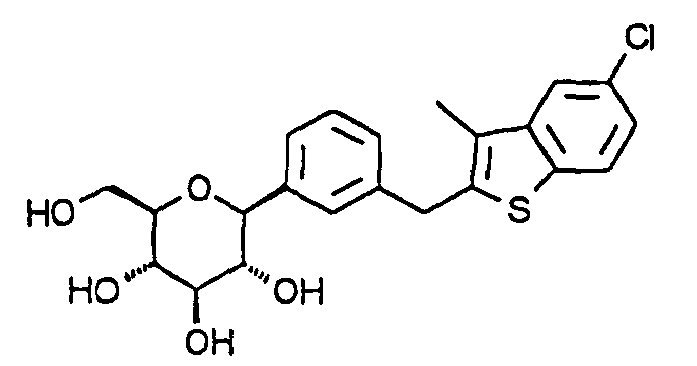
1H-NMR(CD3OD);2.36(3H,s), 3.33-3.49(4H,m),3.66-3.70(1H,m), 3.86-3.89(1H,m),4.10(1H,d),4.22(2H,s), 7.17-7.19(1H,m),7.24(1H,dd), 7.27-7.31(2H,m),7.34(1H,brs),7.65(1H,d), 7.69(1H,d)
FAB-MS(m/z);433[M-H]-(Table 24) Ex. STRUCTURE DATA Comparative 106 
1H-NMR(CD3OD);1.36(9H,s), 3.35-3.49(4H,m),3.67-3.71(1H,m), 3.86-3.71(1H,s),4.12(1H,d),4.21(2H,s), 7.02(1H,m),7.15-7.31(3H,m),7.33(1H,dd), 7.39(1H,brs),7.62(1H,d),7.67(1H,d)
FAB-MS(m/z);442[M]+Comparative 107 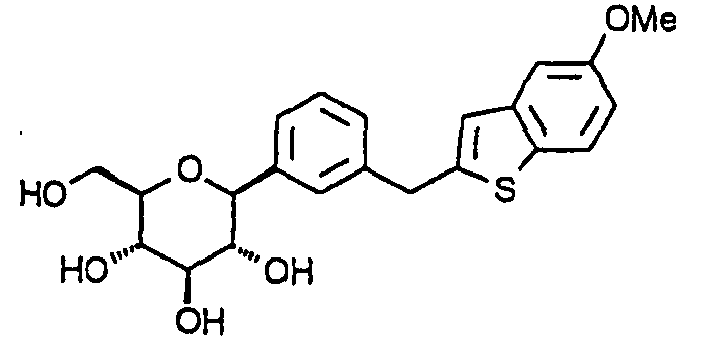
1H-NMR(CD3OD);3.35-3.47(4H,m), 3.67-3.71(1H,m),3.81(3H,s), 3.86-3.89(1H,m),4.12(1H,d),4.21(2H,s), 6.86(1H,d),6.99(1H,s),7.18(1H,d), 7.23-7.31(3H,m),7.39(1H,s),7.56(1H,d)
FAB-MS(m/z);415[M-H]+Comparative 108 
1H-NMR(CD3OD);2.94(6H,s), 3.35-3.49(4H,m),3.67-3.71(1H,m), 3.86-3.89(1H,m),4.12(1H,d),4.19(2H,s), 6.92(1H,dd),6.95(1H,s),7.10(1H,d), 7.17-7.31(3H,m),7.39(1H,brs),7.54(1H,d)
FAB-MS(m/z);430[M+H]+Comparative 109 
1H-NMR(CD3OD);1.13(6H,t),3.36(4H,q), 3.39-3.41(4H,m),3.67-3.71(1H,m), 3.86-3.89(1H,m),4.12(1H,d),4.18(2H,s), 6.84(1H,m),6.91(1H,s),7.02(1H,s), 7.22-7.30(3H,m),7.39(1H,s),7.51(1H,d)
FAB-MS(m/z);458[M+H]+Comparative 110 
1H-NMR(CD3OD);7.84(1H,m),7.74(1H,m), 7.39(1H,s),7.14-7.34(6H,m),4.24(2H,s), 4.10(1H,d);3.87(1H,dd),3.69(1H,dd), 3.30-3.50(4H,m)
FAB-MS(m/z);386[M]+Comparative 111 
1H-NMR(CD3OD);3.35-3.50(4H,m), 3.67-3.71(1H,m),3.86-3.89(1H,m), 4.10(2H,s),4.13(1H,d),6.44(1H,s), 7.13-7.18(2H,m),7.26-7.36(4H,m), 7.41(1H,brs),7.45-7.47(1H,m)
FAB-MS(m/z);369[M-H]-Comparative 112 
1H-NMR(CD3OD);3.35-3.50(4H,m), 3.67-3.72(1H,m),3.88(1H,dd),4.14(1H,d), 4.49(2H,s),7.32-7.43(4H,m), 7.48-7.53(2H,m),7.91-7.93(2H,m).
FAB-MS(m/z);388[M+H]+(Table 25) Ex. STRUCTURE DATA Comparative 113 
1H-NMR(CD3OD);2.42(3H,s), 3.34-3.94(6H,m),4.09(2H,s),4.16(1H,d), 6.57-6.62(2H,m),7.20-7.36(4H,m)
ES-MS(m/z);373[M+Na]+Comparative 114 
1H-NMR(CD3OD);1.27(3H,t),2.79(2H,dd), 3.39-3.52(4H,m),3.74-3.94(2H,m), 4.10(2H,s),4.17(1H,d),6.62(2H,dd), 7.20-7.37(4H,m)
ES-MS(m/z);382[M+NH4]+Comparative 115 
1H-NMR(CD3OD);2.21(3H,s), 3.35-3.52(4H,m),3.73-3.94(2H,m), 4.11(2H,s),4.15(1H,d),6.84(1H,d), 7.10(1H,d),7.14-7.33(4H,m)
ES-MS(m/z);368[M+NH4]+Comparative 116 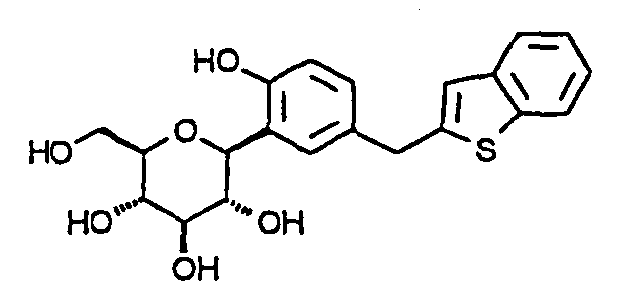
1H-NMR(CD3OD);3.39-3.43(2H,m), 3.44-3.58(2H,m),3.67-3.73(2H,m), 3.86(1H,m),4.14(2H,s),4.57(1H,d), 6.78(1H,d),7.02(1H,s),7.08(1H,dd), 7.24(1H,m),7.31(1H,d),7.64(1H,d), 7.71(1H,d)
EI-MS(m/z);402[M]+Comparative 117 
1H-NMR(CD3OD);3.36-3.39(2H,m), 3.46-3.54(2H,m),3.63-3.68(1H,m), 3.81-3.86(4H,m),4.12(2H,s),4.69(1H,d), 6.94(1H,d),7.04(1H,s),7.20-7.28(3H,m), 7.39(1H,d),7.64(1H,d),7.71(1H,d).
FAB-MS(m/z);416[(M+H)+]Comparative 118 
1H-NMR(CD3OD);3.38-3.56(7H,m), 3.64-3.68(1H,m),3.74-3.76(2H,m), 3.82(1H,d),4.17(2H,t),4.19(2H,s), 4.70(1H,d),6.94(1H,d),7.04(1H,s), 7.19-7.28(3H,m),7.40(1H,d),7.65(1H,d), 7.71(1H,d).
FAB-MS(m/z);483[M+Na]+Comparative 119 
1H-NMR(CD3OD);1.96(3H,s), 3.39-3.41(2H,m),3.46-3.52(3H,m), 3.59-3.70(2H,m),3.86(1H,d), 4.01-4.14(2H,m),4.17(2H,s),4.72(1H,d), 6.92(1H,d),7.04(1H,d),7.18-7.29(3H,m), 7.42(1H,d),7.64(1H,d),7.71(1H,dd).
FAB-MS(m/z);488[M+H]+(Table 26) Ex. STRUCTURE DATA Comparative 120 
1H-NMR(CD3OD);2.43(3H,s),2.88-2.99(2H,m), 3.37-3.39(2H,m),3.45-3.55(2H,m), 3.64-3.68(1H,m),3.85(1H,dd),4.09-4.15(2H,m), 4.18(2H,s),4.67(1H,d),6.94(1H,d),7.04(1H,s), 7.19-7.29(3H,m),7.40(1H,d),7.65(1H,d), 7.71(1H,d).
EI-MS(m/z);460[M+H]+Comparative 121 
1H-NMR(CD3OD);3.59-3.42(2H,m), 3.47-3.57(2H,m),3.66(1H,m),3.78(3H,s), 3.85(1H,d),4.18(2H,s),4.72-4.74(3H,m), 6.87(1H,d),7.04(1H,s),7.18-7.30(3H,m), 7.44(1H,d),7.65(1H,d),7.72(1H,m)
FAB-MS(m/z);475[M+H]+Comparative 122 
1H-NMR(CD3OD);3.39-3.43(2H,m), 3.50-3.54(2H,m),3.67(1H,m),3.86(1H,d), 4.18(2H,s),4.56-4.70(2H,m),4.78(1H,m), 6.87(1H,d),7.03(1H,s),7.17-7.30(3H,m), 7.44(1H,d),7.64(1H,d),7.72(1H,d)
FAB-MS(m/z);459[M-H]+Comparative 123 
1H-NMR(CD3OD);3.39-3.43(2H,m), 3.48-3.53(2H,m),3.68(1H,m),3.86(1H,d), 4.19(2H,s),4.48-4.63(2H,m), 4.69(1H,d,J=9.3Hz),6.89(1H,d),7.04(1H,s), 7.13-7.30(3H,m),7.45(1H,d),7.65(1H,d), 7.71(1H,d)
FAB-MS(m/z);458[M-H]+Comparative 124 
1H-NMR(CD3OD);2.97(3H,s),3.07(3H,s), 3.36-3.43(2H,m),3.46-3.54(2H,m), 3.62-3.68(1H,m),3.84(1H,d),4.18(2H,s), 4.73-4.87(3H,m),6.91(1H,d),7.04(1H,s), 7.15-7.29(3H,m),7.44(1H,d),7.64(1H,d), 7.71(1H,dd)
FAB-MS(m/z);488[M+H]+Comparative 125 
1H-NMR(CD3OD);3.38-3.42(2H,m), 3.47-3.52(2H,m),3.67(1H,m),3.82-3.94(3H,m), 4.03-4.12(2H,m),4.17(2H,s),4.76(1H,m), 6.94(1H,d),7.04(1H,s),7.17-7.28(3H,m), 7.42(1H,d),7.65(1H,d),7.71(1H,d)
FAB-MS(m/z);447[M+H]+Comparative 126 
1H-NMR(CD3OD);3.38-3.50(3H,m), 3.62-3.74(2H,m),3.87-3.90(1H,m),4.13(2H,s), 4.33(1H,d),6.82(1H;d),7.02(1H,s), 7.05-7.08(1H,m),7.19-7.28(3H,m),2.78(3H,s), 7.64(1H,d),7.70(1H,d)
FAB-MS(m/z);402[M+H]+(Table 27) Ex. STRUCTURE DATA Comparative 127 
1H-NMR(CD3OD);2.78(3H,s),3.36-3.51(3H,m), 3.68-3.76(2H,m),3.85-3.88(1H,m),4.11(2H,s), 4.26(1H,d),6.65(1H,d),7.00(1H,s),7.12(1H,dd), 7.17-7.27(3H,m),7.62(1H,d),7.69(1H,d)
FAB-MS(m/z);416[M+H]+Comparative 128 
1H-NMR(CD3OD);3.15-3.20(2H,m),3.36-3.40(1H,m), 3.45-3.47(2H,m),3.69-3.83(6H,m),3.87(1H,dd), 4.10(2H,s),4.26(1H,d),6.67(1H,d),7.00(1H,s), 7.10(1H,dd),7.13(1H,d),7.19-7.25(2H,m),7.63(1H,d), 7.70(1H,d)
FAB-MS(m/z);446[M+H]+Comparative 129 
1H-NMR(CD3OD);2.76(6H,s),3.58-3.40(4H,m), 3.66(1H,dd),3.85(1H,m),4.21(2H,s),7.06(1H,s), 7.20-7.29(4H,m),7.47(1H,s),7.65(1H,d),7.71(1H,d)
FAB-MS(m/z);430[M+H]+Comparative 130 
1H-NMR(CD3OD);2.89-2.94(2H,m),3.02-3.07(2H,m), 3.36-3.37(1H,m),3.56-3.61(1H,m),3.70-3.75(1H,m), 3.78-3.87(5H,m),4.21(2H,s),4.85(1H,d),7.05(1H,s), 7.17(1H,d),7.20-7.29(3H,m),7.44(1H,d),7.65(1H,d), 7.72(1H,d)
FAB-MS(m/z);472[M+H]+Comparative 131 
1H-NMR(CD3OD);3.34-3.52(4H,m),3.66-3.72(1H,m), 3.87(1H,d),4.22(2H,s),4.46-4.56(1H,m), 6.98-7.08(2H,m),7.18-7.32(3H,m),7.49(1H,dd), 7.66(1H,d),7.72(1H,d)
EI-MS(m/z);405[M+H]+Comparative 132 
1H-NMR(CD3OD);3.41-3.44(2H,m), 3.49-3.55(2H,m),3.66-3.70(1H,m),3.86(1H,d), 4.24(2H,s),4.71-4.74(1H,m),7.07(1H,s), 7.21-7.29(3H,m),7.34(1H,d),7.55(1H,s),7.66(1H,d), 7.73(1H,d)
FAB-MS(m/z);419[M-H]+Comparative 133 
1H-NMR(CD3OD);3.33-3.46(4H,m),3.62-3.68(1H,m), 3.84(1H,dd),4.02(1H,d),4.18(2H,dd),6.80(1H,d), 7.03(1H,d),7.11-7.27(4H,m),7.62(1H,m),7.69(1H,m)
FAB-MS(m/z);401[M-H]-Comparative 134 
1H-NMR(CD3OD);3.34-3.45(4H,m),3.65-3.69(1H,m), 3.85(3H,s),4.06(1H,d),4.20(2H,d),6.96(1H,d), 7.00(1H,d),7.18-7.31(4H,m),7.61(1H,d),7.69(1H,d)
FAB-MS(m/z);415[M-H]-(Table 28) Ex. STRUCTURE DATA Comparative 135 
1H-NMR(CD3OD);3.33-3.53(4H,m), 3.60-3.72(1H,m),3.80-3.94(3H,m), 4.02-4.13(3H,m),4.27(2H,dd),6.96(1H,d), 7.06(1H,s),7.18-7.38(4H,m),7.63(1H,d), 7.70(1H,d)
FAB-MS(m/z);446[M+H]+Comparative 136 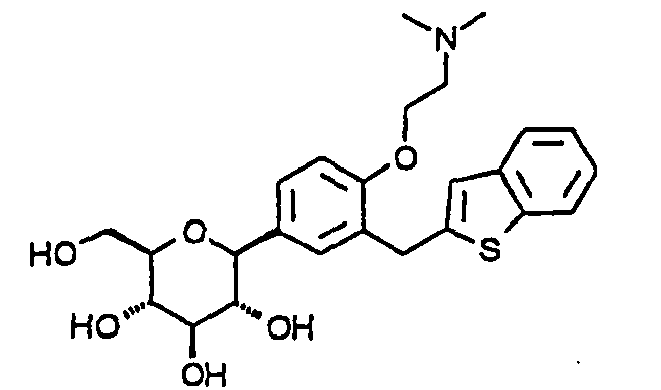
1H-NMR(CD3OD);2.21(6H,s),2.70(2H,t), 3.23-3.40(4H,m),3.52-3.63(1H,m),3.76(1H,d), 3.94-4.22(5H,m),6.87(2H,d),7.05-7.27(4H,m), 7.47-753(1H,m),7.56-7.63(1H,m)
FAB-MS(m/z);474[M+H]+Comparative 137 
1H-NMR(CD3OD);3.26-3.52(4H,m), 3.69(1H,dd),3.87(1H,d),4.12(1H,d), 4.36(2H,dd),7.20-7.29(m,2H),7.34(1H,dd), 7.40(1H,d),7.48(1H,d),7.64(1H,d),7.73(1H,d)
FAB-MS(m/z);420[M+H]+Comparative 138 
1H-NMR(CD3OD);3.38-3.49(3H,m), 3.68(1H,dd),3.87(1H,m),4.11(1H,d); 4.23(2H,d),7.05-7.08(2H,m),7.21-7.30(1H,m), 7.33-7.38(1H,m),7.43(1H,d);7.66(1H,d); 7.72(1H,d)
FAB-MS(m/z);404[M+]Comparative 139 
1H-NMR(CD3OD);3.33-3.53(3H,m), 3.70(1H,dd),3.88(1H,dd),4.13(1H,d), 4.25(2H,s),6.94-6.99(1H,m),7.05-7.11(2H,m), 7.20-7.32(3H,m),7.67(1H,d),7.73(1H,d)
ES-MS(m/z);427[M+Na]+Comparative 140 
1H-NMR(CD3OD);3.36-3.54(4H,m), 3.64-3.76(1H,m),3.89(1H,d),4.12-4.22(3H,m), 6.78(1H,s),7.16-7.52(10H,m),7.58(1H,d), 7.78(1H,d)
FAB-MS(m/z);461[M-H]-(Table 29) Ex. STRUCTURE DATA 141 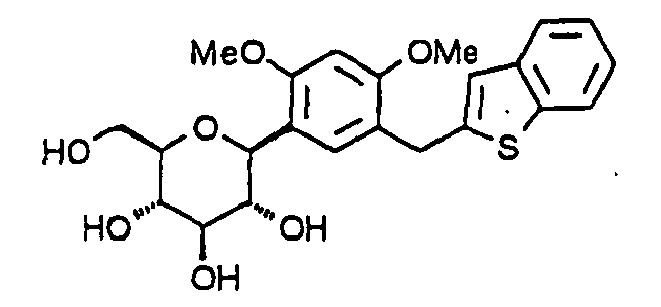
1H-NMR(CD3OD);3.24-3.30(2H,m),3.36(1H,t), 3.43(1H,t),3.51-3.57(1H,m),3.73(1H,dd), 3.75(3H,s),3.78(3H,s),4.00(1H,d),4.05(1H,d), 4.51(1H,d),6.53(1H,s),6.87(1H,d),7.08(1H,ddd), 7.14(1H,ddd),7.19(1H,s),7.51(1H,d),7.58(1H,dd)
ES-MS(m/z);469[M+Na]+142 
1H-NMR(CD3OD);3.24-3.39(3H,m),3.45(1H,t), 3.58(1H,dd),3.74(1H,dd),3.97(1H,d),4.03(1H,d), 4.35(1H,d),6.28(1H,s),6.89(1H,s),7.02(1H,s), 7.06-7.17(2H,m),7.51(1H,d),7.59(1H,dd)
FAB-MS(m/z);419[M+H]+143 
1H-NMR(CD3OD);3.35-3.56(4H,m),3.69(1H,dd), 3.85(1H,d),4.09-4.21(2H,m),4.55(1H,d), 6.57(1H,d),7.01(1H,s),7.18-7.30(2H,m), 7.33(1H,d),7.64(1H,d),7.71(1H,d,J=7.8Hz)
EI-MS(m/z);420[M]+144 
1H-NMR(CD3OD);3.37-3.53(4H,m), 3.66-3.73(1H,m),3.82-3.89(1H,m),4.26(2H,dd), 4.56(1H,d),6.88(1H,s),6.98(1H,s), 7.18-7.29(2H,m),7.40(1H,s),7.63(1H,d), 7.72(1H,d)
EI-MS(m/z);458[M+Na]+145 
1H-NMR(CD3OD);3.35-3.39(2H,m), 3.44-3.48(2H,m),3.62-3.69(1H,m),3.83(3H,s), 3.84-3.86(1H,m),4.29(2H,dd),4.61-4.68(1H,m), 6.99(1H,s),7.04(1H,s),7.18-7.29(2H,m), 7.48(1H,s),7.63(1H,d),7.72(1H,d)
FAB-MS(m/z);449[M-H]-146 
1H-NMR(CD3OD);3.37-3.51(4H,m), 3.62-3.69(1H,m),3.81-3.90(3H,m),4.10(2H,dd), 4.30(2H,dd),4.72(1H,d),7.00(1H,s),7.07(1H,s), 7.19-7.29(2H,m),7.5(1H,s),7.64(1H,d),7.72(1H,d)
EI-MS(m/z);503[M+Na]+Comparative 147 
1H-NMR(CD3OD);3.30-3.50(4H,m),3.69(1H,dd), 3.87(1H,dd),4.10(1H,d),4.24(2H,s), 7.14-7.34(6H,m),7.39(1H,s),7.74(1H,m), 7.84(1H,m)
FAB-MS(m/z);386[M]+Comparative 148 
1H-NMR(CD3OD);2.61-2.97(5H,m), 3.54-3.79(6H,m),4.07(1H,d),4.17-4.95(4H,m), 7.03-7.24(7H,m),7.51(1H,s)
EI-MS(m/z);370[M]+(Table 30) Ex. STRUCTURE DATA Comparative 149 
1H-NMR(CD3OD);2.61-2.97(5H,m), 3.54-3.79(6H,m),4.07(1H,d), 3.33-3.52(4H,m),3.65(1H,dd),3.87(1H,dd), 4.16-4.22(2H,m),4.37(1H,d), 7.00-7.33(5H,m),7.60-7.76(2H,m)
FAB-MS(m/z);392[M]+Comparative 150 
1H-NMR(CD3OD);1.19(3H,t),2.59(2H,q), 3.39-3.50(2H,m),3.56(1H,t),3.66(1H,dd), 3.88(1H,dd),4.01(1H,t),4.28(2H,s), 4.75(1H,d),7.12(2H,d),7.18(2H,d).
FAB-MS(m/z);429[M+H]+Comparative 151 
1H-NMR(CD3OD);1.20(3H,t),2.60(2H,q), 3.45-3.56(3H,m),3.64(1H,t),3.70-3.75(1H,m), 3.89(1H,dd),4.17(2H,s),4.37(1H,d), 7.13(2H,d),7.19(2H,d),8.40(1H,s),8.56(1H,s).
EI-MS(m/z);361[M+H]+Comparative 152 
1H-NMR(CD3OD);3.39-3.51(4H,m), 3.70(1H,dd),3.88(1H,dd),4.09(2H,s), 4.19(1H,d),6.43(1H,s),7.20-7.35(7H,m), 7.54(1H,d).
EI-MS(m/z);393[M+Na]+Comparative 153 
1H-NMR(CD3OD);3.40-3.59(4H,m), 3.66-3.76(1H,m),3.90(1H,dd),4.24(1H,d) 7.36-7.42(2H,m),7.44-7.57(4H,m), 7.67(1H,brs),7.89-7.96(2H,m) FAB-MS(m/z);372[M+H]+ Comparative 154 
1H-NMR(CD3OD);3.34-3.49(4H,m), 3.67(1H,m),3.87(1H,d),4.12(1H,d), 4.24(2H,s),7.06(1H,s),7.06-7.33(5H,m), 7.40(1H,s),7.65(1H,d),7.72(1H,d)
FAB-MS(m/z);385[M-H]+Comparative 155 
1H-NMR(CD3OD):3.23-3.49(4H,m), 3.69(1H,dd),3.87(1H,m),4.10(1H,d), 4.14(2H,s),7.15(1H,m),7.18-7.31(4H,m), 7.36(1H,s),7.73(1H,dt),8.42(1H,m).
FAB-MS(m/z);332[M+H]+(Table 31) Ex. STRUCTURE DATA Comparative 156 
1H-NMR(CD3OD);1.61-1.65(2H,m), 1.79-1.90(6H,m),3.34-3.40(2H,m), 3.44-3.48(1H,m),3.61-3.66(2H,m),3.83(1H,dd), 4.17(2H,s),4.60(1H,d),4.80-4.85(1H,m), 6.93(1H,d),7.04(1H,d),7.17-7.29(3H,m), 7.36(1H,d),7.65(1H,d),7.70-7.72(1H,m).
EI-MS(m/z);471[M+H]+Comparative 157 
1H-NMR(CD3OD);1.33(6H,t),3.36-3.39(2H,m), 3.46-3.50(1H,m),3.57-3.67(2H,m),3.84(1H,dd), 4.17(2H,s),4.54-4.61(1H,m),4.67(1H,d), 6.94(1H,d),7.05(1H,d),7.17-7.29(3H,m), 7.38(1H,d),7.65(1H,d),7.71(1H,dd).
EI-MS(m/z);445[M+H]+Comparative 158 
1H-NMR(CD3OD);3.38-3.42(2H,m), 3.45-3.54(2H,m),3.64-3.74(3H,m),3.87(1H,dd), 3.93-3.98(1H,m),4.03-4.12(2H,m),4.18(2H,s), 4.72(1H,d),6.96(1H,d),7.04(1H,s), 7.19-7.22(1H,m),7.24(1H,dd),7.28(1H,dd), 7.40(1H,d),7.65(1H,d),7.71(1H,d).
EI-MS(m/z);477[M+H]+159 
1H-NMR(CD3OD);3.33-3.42(2H,m), 3.43-3.52(2H,m),3.61-3.68(1H,m), 3.80-3.86(4H,m),4.12-4.24(2H,m),4.63(1H,d), 6.79(1H,d),7.02(1H,s),7.18-7.30(2H,m), 7.41(1H,d),7.64(1H,d),7.72(1H,dd)
EI-MS(m/z);457[M+Na]+Comparative 160 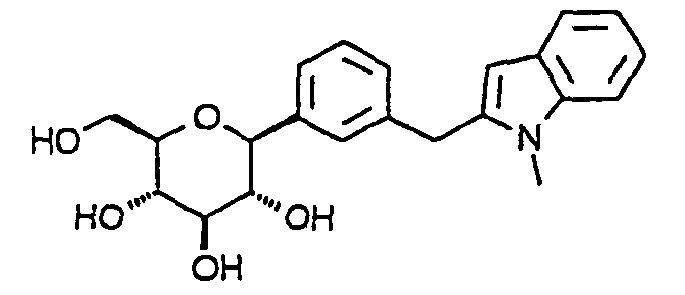
1H-NMR(CD3OD);3.32-3.48(4H,m),3.57(3H,s), 3.67(1H,m),3.86(1H,m),4.09(1H,d,J=9.3Hz), 4.17(2H,s),6.22(1H,s),6.97(1H,m),7.08(1H,m), 7.14(1H,m),7.24-7.32(4H,m),7.43(1H,d).
EI-MS(m/z);382[M-H]+Comparative 161 
1H-NMR(CD3OD);3.38-3.55(4H,m),3.56(3H,s), 3.69(1H,m),3.86(1H,m),4.06(2H,s), 4.54(1H,d,J=9.2Hz),6.17(1H,s),6.75(1H,d), 6.92-7.00(2H,m),7.06(1H,m),7.20-7.27(2H,m), 7.42(1H,d)
EI-MS(m/z);400[M+H]+(Table 32) Ex. STRUCTURE DATA Comparative 162 
1H-NMR(CD3OD);3.44(2H,m),3.56(2H,m), 3.77(1H,dd),3.88(1H,m),4.17(1H,d), 4.28(2H,s),7.31-7.38(5H,m),7.44(1H,s), 7.50(1H,m),7.61(1H,m)
ES-MS(m/z);372[M+H]+Comparative 163 
1H-NMR(CD3OD);3.46(1H,m),3.56(1H,m), 3.79(1H,dd),3.89(1H,d),4.20(2H,s), 4.53(1H,d),6.85(1H,d),7.17(1H,d), 7.33(3H,m),7.49(1H,m),7.61(1H,m)
ES-MS(m/z);388[M+H]+Comparative 164 
1H-NMR(CD3OD);3.38-3.44(2H,m), 3.45-3.58(2H,m),3.70(1H,m),3.87(1H,m), 4.01(2H,s),4.58(1H,d),6.39(1H,s),6.78(1H,d), 7.06-7.18(3H,m),7.30-7.36(2H,m), 7.44(1H,m)
FAB-MS(m/z);385[M-H]-Comparative 165 
1H-NMR(CD3OD);2.35(3H,s),2.38(3H,s), 3.46(1H,m),3.56(3H,m),3.81(1H,m), 3.88(1H,dd),4.01(2H,s),4.51(1H,d), 6.26(1H,d),6.83(1H,d),6.96(1H,d), 7.11(1H,d),7.15(1H,d),7.25(1H,s)
ES-MS(m/z);413[M-H]-Comparative 166 
1H-NMR(CD3OD);2.39(3H,s),2.40(3H,s), 3.60(4H,m),3.82(1H,m),3.89(1H,m), 4.00(1H,s),4.51(1H,d),6.31(1H,d),6.80(1H,s), 6.83(1H,dd),7.01(1H,s),7.11(1H,d), 7.24(1H,s)
ES-MS(m/z);414[M]+Comparative 167 
1H-NMR(CD3OD);2.40(3H,s), 3.37-3.58(4H,m),3.82(1H,m),3.88(1H,m), 4.00(2H,s),4.50(1H,d),6.29(1H,s),6.83(1H,d), 6.99(1H,d),7.10(1H,d),7.23(1H,m), 7.32(2H,m)
ES-MS(m/z);399[M-H]-(Table 33) Ex. STRUCTURE DATA Comparative 168 
1H-NMR(CD3OD);2.31(3H,s),2.34(3H,s), 2.36(3H,s),3.45(1H,m),3.57(3H,m),3.81(2H,m), 4.01(2H,s),4.51(1H,d),6.28(1H,s),6.78(1H,s), 6.83(1H,d),7.12(1H,d),7.26(1H,s)
ES-MS(m/z);427[M-H]-Comparative 169 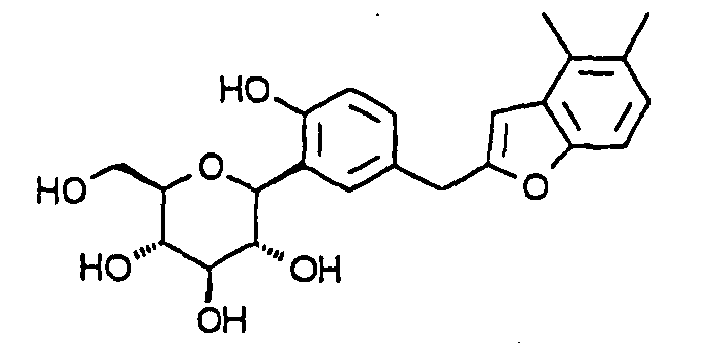
1H-NMR(CD3OD);2.31(3H,s),2.34(3H,s), 3.45(1H,m),3.58(3H,m),3.83(1H,m), 3.87(1H,m),4.01(2H,s),4.49(1H,d),6.35(1H,s), 6.84(1H,d),6.98(1H,d),7.11(2H,m),7.21(1H,s)
ES-MS(m/z);413[M-H]-Comparative 170 
1H-NMR(CD3OD);2.29(3H,s),2.32(3H,s), 3.43(2H,m),3.58(2H,m),3.83(1H,m), 3.88(1H,m),3.99(2H,s),4.48(1H,d),6.25(1H,s), 6.83(1H,d),7.10(1H,d),7.15(1H,s),7.20(2H,s)
ES-MS(m/z);413[M-H]-Comparative 171 
1H-NMR(CD3OD);3.26(2H,s),3.40(2H,m), 3.53(2H,m),3.67(1H,dd,),3.76(2H,s), 3.82(3H,s),3.86(1H,m),4.70(1H,d),6.48(1H,s), 6.91(1H,d),7.01(1H,m),7.03-7.22(3H,m), 7.29(1H,d),7.32(1H,d)
ES-MS(m/z);421[M+Na]+Comparative 172 
1H-NMR(CD3OD);2.31(3H,s),3.20(2H,s), 3.23-3.43(4H,m),3.60(1H,d),3.68(2H,s), 3.76(1H,d),4.36(1H,t),4.47(1H,d),4.85(2H,brs), 4.92(1H,brs),6.42(1H,s),6.73(1H,d), 6.84-6.96(2H,m),7.03(1H,s),7.16(1H,s), 7.19(1H,d),8.74(1H,brs)
ES-MS(m/z);398[M]+Comparative 173 
1H-NMR(CD3OD);2.23(6H,s),3.18(2H,s), 3.40-3.51(4H,m),3.68(2H,s),3.70(1H,d), 3.86(1H,d),4.07(1H,t),4.50(1H,d),4.57(2H,s), 4.68(1H,d),4.91(1H,d),6.39(1H,s), 6.75-6.98(2H,m),6.99(1H,s),7.08(1H,s), 7.19(1H,d),8.42(1H,s)
ES-MS(m/z);412[M]+(Table 34) Ex. STRUCTURE DATA Comparative 174 
1H-NMR(CD3OD);3.25-3.87(3H,m), 3.67-3.72(1H,dd),3.84-3.87(1H,dd),4.11(2H,s), 4.55-4.57(1H,d),6.74-6.77(1H,d),6.96(1H,s); 7.04-7.06(1H,dd),7.11-7.12(1H,d), 7.28-7.29(1H,d),7.34-7.35(1H,d)
ES-MS(m/z);431[M+Na]+Comparative 175 
1H-NMR(CD3OD);3.27-3.48(4H,m), 3.61(1H,dd),3.77(1H,dd),3.96(2H,s),4.46(1H,d), 6.65(1H,d),6.68-6.71(1H,m),6.78(1H,dd), 6.91(1H,dd),7.06(1H,dd),7.16(1H,d)
ES-MS(m/z); 351[M-H]-Comparative 176 
1H-NMR(CD3OD);3.36-3.56(5H,m), 3.77(1H,dd),4.16(1H,d),4.20(2H,s), 7.19-7.37(4H,m),8.42(1H,d),8.49(2H,d)
EI-MS(m/z);332[M]+Comparative 177 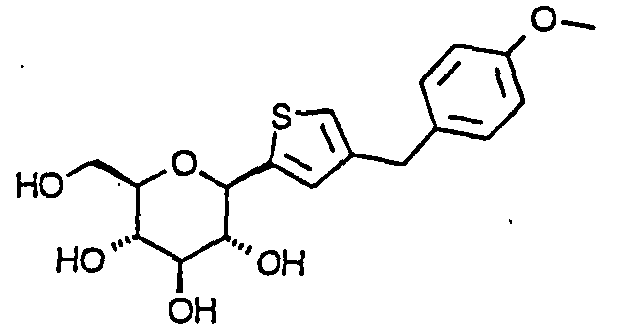
1H-NMR(CD3OD);3.29-3.44(4H,m), 3.64(1H,dd),3.75(3H,s),3.82-3.90(3H,m), 4.33(1H,d),6.81(2H,d),6.92(2H,s),7.11(2H,d)
FAB-MS(m/z);365[M-H]-Comparative 178 
1H-NMR(CD3OD);1.20(3H,t),2.63(2H,dd), 3.34-3.86(6H,m),4.56(1H,d),4.84(2H,s), 7.21(2H,d),7.32(2H,d)
FAB-MS(m/z);351[M+H]+Comparative 179 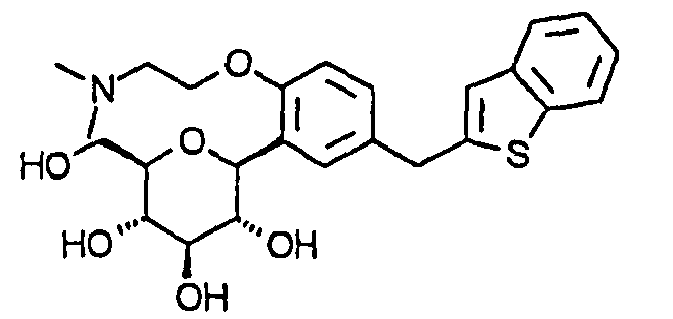
1H-NMR(CD3OD);2.27(6H,s), 2.61-2.75(2H,m),3.28(1H,t),3.36-3.47(2H,m), 3.68(1H,d),4.01-4.10(4H,m),4.18(2H,s), 4.52(1H,d),6.95(1H,d),7.15-7.21(2H,m), 7.23-7.34(3H,m),7.73(1H,d),7.83(1H,d)
FAB-MS(m/z);474[M+H]+Comparative 180 
1H-NMR(CD3OD);3.31-3.54(4H,m), 3.72(1H,dd),3.88(1H,dd),4.30(2H,s),5.19(1H,d), 7.08(1H,s),7.20-7.35(3H,m),7.68(1H,d), 7.71-7.80(3H,m)
FAB-MS(m/z);429[M-H]-(Table 35) Ex. STRUCTURE DATA Comparative 181 
1H-NMR(CD3OD);3.38-3.53(4H,m), 3.68(1H,dd),3.88(1H,dd),4.24(2H,s),4.55(1H,d), 4.66(1H,d),4.73(1H,d),7.06(1H,d), 7.19-7.30(3H,m),7.34(1H,d),7.54(1H,d), 7.63-7.74(2H,m)
FAB-MS(m/z);415[M-H]-Comparative 182 
1H-NMR(CD3OD);2.61-2.97(5H,m), 3.54-3.79(6H,m),4.07(1H,d),4.17-4.95(4H,m), 7.03-7.24(7H,m),7.51(1H,s)
EI-MS(m/z);370[M]+Comparative 183 
1H-NMR(CD3OD);3.34-3.51(4H,m), 3.66-3.70(1H,m),3.87(1H,dd),4.13(1H,d), 4.40(2H,s),7.26(1H,d),7.31-7.40(3H,m), 7.48-7.52(2H,m),7.57-7.61(1H,m),7.81(1H,d). Comparative 184 
1H-NMR(CD3OD);3.29-3.50(4H,m), 3.64-3.70(1H,m),3.70(3H,s),3.86(1H,dd), 4.09(1H,d),4.35(2H,s),7.18(1H,d), 7.21-7.37(5H,m),7.43(1H,dd),7.60(1H,dd)
FAB-MS(m/z);385[M+H]+Comparative 185 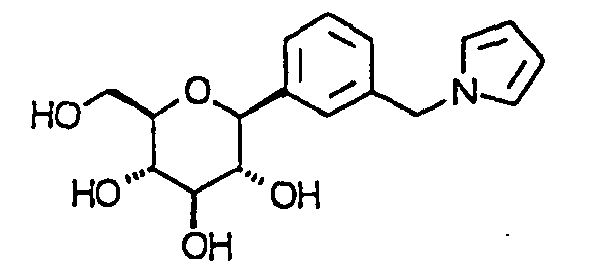
1H-NMR(CD3OD);1H-NMR(CD3OD); 3.32-3.50(4H,m),3.69(1H,dd),3.84(1H,dd), 4.10(1H,d),5.07(1H,d),6.05(2H,t),6.70(2H,t), 7.05(1H,d),7.25-7.35(3H,m)
FAB-MS(m/z);320[M+H]+Comparative 186 
1H-NMR(CD3OD);1.19(3H,t),2.58(2H,q), 3.24-3.46(4H,m),3.65(1H,dd),3.80-3.86(3H,m), 4.15(1H,d),5.73(1H,d),6.02(1H,d),7.07(1H,d), 7.12(1H,d)
FAB-MS(m/z);348[M+H]+(Table 36) Ex. STRUCTURE DATA Comparative 187 
1H-NMR(CD3OD);1.10(3H,t),2.49(2H,q), 3.19-3.63(7H,m),3.70-3.83(4H,m),4.16(1H,d), 5.71(1H,d),6.01(1H,d),6.95(1H,d),6.98(1H,d)
FAB-MS(m/z);360[M-H]-Comparative 188 
1H-NMR(CD3OD);1.20(3H,t),2.60(2H,q), 3.20-3.39(3H,m),3.56(1H,dd),3.66(1H,dd), 3.73(1H,dd),4.17(1H,d),5.13(1H,d),5.22(1H,d), 6.06(1H,dd),6.23(1H,dd),6.70(1H,dd),7.06(2H,d), 7.13(2H,d)
FAB-MS(m/z);348[M+H]+


Claims (10)
- A C-glycoside derivative of the following formula (I) or a salt thereof:

R1 to R4 individually represent a hydrogen atom, a lower alkyl, -C(=O)-lower alkyl, or -lower alkylene-aryl;
R5 and R6 individually represent, lower alkyl, a cycloalkyl, a halogen, a halogen-substituted lower alkyl, -OH, =O, -NH2, lower alkyl sulfonyl-, halogen-substituted lower alkyl suffonyl-, aryl sulfonyl-, an aryl, a saturated or an unsaturated five or six-membered monocyclic hetero ring having 1 to 4 hetero atom(s) selected from N, S, and O, -lower alkylene-OH, -lower alkylene-O-lower alkyl, -lower alkylene-O-C(=O)-lower alkyl, -lower alkylene-O-lower alkylene-COOH, -lower alkylene-O-lower alkylene-C(=O)-O-lower alkyl, -lower alkylene-NH2, -lower alkylene-NH-lower alkyl, -lower alkylene-N(lower alkyl)2, -lower alkylene-NH-C(=O)-lower alkyl, -COOH, -CN, -C(=O)-O-lower alkyl, -C(=O)-NH2, -C(=O)-NH-lower alkyl, -C(=O)-N(lower alkyl)2, -O-lower alkyl, -O-cycloalkyl, -O-lower alkylene-OH, -O-lower alkylene-O-lower alkyl, -O-lower alkylene-COOH, -O-lower alkylene-C(=O)-O-lower alkyl, -O-lower alkylene-C(=O)-NH2, -O-lower alkylene-C(=O)-NH-lower alkyl, -O-lower alkylene-C(=O)-N(lower alkyl)2, -O-lower alkylene-CH(OH)-CH2(OH), -O-lower alkylene-NH2, -O-lower alkylene-NH-lower alkyl, - O-lower alkylene-N(lower alkyl)2, -O-lower alkylene-NH-C(=O)-lower alkyl, -NH-lower alkyl, -N(lower alkyl)2, -NH-SO2-lower alkyl, -NH-SO2-halogen-substituted lower alkyl, - NH-lower alkylene-OH, -NH-C(=O)-lower alkyl, -NH-C(=O)-NH2, -NH-C(=O)-NH-lower alkyl, -NH-C(=O)-N(lower alkyl)2, or, -NH-C(=O)-O-lower alkyl; and
R7 to R11 individually represent a hydrogen atom, a lower alkyl, a cycloalkyl, a halogen, a halogen-substituted lower alkyl, -OH, =O, -NH2, lower alkyl sulfonyl-, halogen-substituted lower alkyl sulfonyl-, aryl sulfonyl-, an aryl, a saturated or an unsaturated five or six-membered monocyclic hetero ring having 1 to 4 hetero atom(s) selected from N, S, and O, -lower alkylene-OH, -lower alkylene-O-lower alkyl, -lower alkylene-O-C(=O)-lower alkyl, -lower alkylene-O-lower alkylene-COOH, -lower alkylene-O-lower alkylene-C(=O)-O-lower alkyl, -lower alkylene-NH2, -lower alkylene-NH-lower alkyl, -lower alkylene-N(lower alkyl)2, -lower alkylene-NH-C(=O)-lower alkyl, -COOH, -CN, -C(=O)-O-lower alkyl, -C(=O)-NH2, -C(=O)-NH-lower alkyl, -C(=O)-N(lower alkyl)2, -O-lower alkyl, -O-cycloalkyl, -O-lower alkylene-OH, -O-lower alkylene-O-lower alkyl, -O-lower alkylene-COOH, -O-lower alkylene-C(=O)-O-lower alkyl, -O-lower alkylene-C(=O)-NH2, -O-lower alkylene-C(=O)-NH-lower alkyl, -O-lower alkylene-C(=O)-N(lower alkyl)2, -O-lower alkylene-CH(OH)-CH2(OH), -O-lower alkylene-NH2, -O-lower alkylene-NH-lower alkyl, - O-lower alkylene-N(lower alkyl)2, -O-lower alkylene-NH-C(=O)-lower alkyl, -NH-lower alkyl, -N(lower alkyl)2, -NH-SO2-lower alkyl, -NH-SO2-halogen-substituted lower alkyl,-NH-lower alkylene-OH, -NH-C(=O)-lower alkyl, -NH-C(=O)-NH2, -NH-C(=O)-NH-lower alkyl, -NH-C(=O)-N(lower alkyl)2, or , -NH-C(=O)-O-lower alkyl; wherein the term "lower" refers to a linear or branched carbon chain having 1-6 carbon atoms. - A C-glycoside derivative or the salt thereof according to Claim 1, wherein the R1 to R4 in the formula (I) are hydrogen atoms.
- A C-glycoside derivative or the salt thereof according to Claim 1, wherein the C-glycoside derivative of the formula (I) is (1S)-1,5-anhydro-1-[5-(1-benzothien-2-ylmethyl)-2,4-dimethoxyphenyl]-D-glucitol.
- A C-glycoside derivative or the salt thereof according to Claim 1, wherein the C-glycoside derivative of the formula (I) is (1S)-1,5-anhydro-1-[5-(1-benzothien-2-ylmethyl)-4-chloro-2-methoxyphenyl]-D-glucitol.
- A C-glycoside derivative or the salt thereof according to Claim 1, wherein the C-glycoside derivative of the formula (I) is (1S)-1,5-anhydro-1-[5-(1-benzothien-2-ylmethyl)-4-chloro-2-hydroxyphenyl]-D-glucitol.
- A C-glycoside derivative or the salt thereof according to Claim 1, wherein the C-glycoside derivative of the formula (I) is (1S)-1,5-anhydro-1-[5-(1-benzothien-2-ylmethyl)-4-fluoro-2-hydroxyphenyl]-D-glucitol.
- A C-glycoside derivative or the salt thereof according to Claim 1, wherein the C-glycoside derivative of the formula (I) is (1S)-1,5-anhydro-1-[5-(1-benzothien-2-ylmethyl)-4-fluoro-2-methoxyphenyl]-D-glucitol.
- A pharmaceutical composition containing a pharmaceutically effective amount of a C-glycoside derivative or a salt thereof according to Claim 1, and a pharmaceutically acceptable carrier.
- Use of the C-glycoside derivative or the salt thereof according to Claim 1 for preparation of an Na+-glucose cotransporter inhibitor or an antidiabetic agent.
- The C-glycoside derivative or the salt thereof according to Claim 1 for use in a method of treating diabetes.
Priority Applications (1)
| Application Number | Priority Date | Filing Date | Title |
|---|---|---|---|
| PL08012499T PL1980560T3 (en) | 2003-03-14 | 2004-03-12 | C-glycoside derivatives for the treatment of diabetes |
Applications Claiming Priority (2)
| Application Number | Priority Date | Filing Date | Title |
|---|---|---|---|
| JP2003070297 | 2003-03-14 | ||
| EP04720254.4A EP1609785B1 (en) | 2003-03-14 | 2004-03-12 | C-glycoside derivatives and salts thereof |
Related Parent Applications (3)
| Application Number | Title | Priority Date | Filing Date |
|---|---|---|---|
| EP04720254.4A Division EP1609785B1 (en) | 2003-03-14 | 2004-03-12 | C-glycoside derivatives and salts thereof |
| EP04720254.4A Division-Into EP1609785B1 (en) | 2003-03-14 | 2004-03-12 | C-glycoside derivatives and salts thereof |
| EP04720254.4 Division | 2004-03-12 |
Publications (3)
| Publication Number | Publication Date |
|---|---|
| EP1980560A2 EP1980560A2 (en) | 2008-10-15 |
| EP1980560A3 EP1980560A3 (en) | 2008-10-29 |
| EP1980560B1 true EP1980560B1 (en) | 2011-05-25 |
Family
ID=32984648
Family Applications (2)
| Application Number | Title | Priority Date | Filing Date |
|---|---|---|---|
| EP04720254.4A Expired - Lifetime EP1609785B1 (en) | 2003-03-14 | 2004-03-12 | C-glycoside derivatives and salts thereof |
| EP08012499A Expired - Lifetime EP1980560B1 (en) | 2003-03-14 | 2004-03-12 | C-glycoside derivatives for the treatment of diabetes |
Family Applications Before (1)
| Application Number | Title | Priority Date | Filing Date |
|---|---|---|---|
| EP04720254.4A Expired - Lifetime EP1609785B1 (en) | 2003-03-14 | 2004-03-12 | C-glycoside derivatives and salts thereof |
Country Status (19)
| Country | Link |
|---|---|
| US (3) | US7202350B2 (en) |
| EP (2) | EP1609785B1 (en) |
| JP (2) | JP4222450B2 (en) |
| KR (2) | KR101001848B1 (en) |
| CN (1) | CN1802366B (en) |
| AT (1) | ATE510834T1 (en) |
| AU (2) | AU2004220222B2 (en) |
| BR (1) | BRPI0408140B8 (en) |
| CA (1) | CA2526145C (en) |
| ES (2) | ES2567571T3 (en) |
| MX (1) | MXPA05009356A (en) |
| NO (1) | NO334799B1 (en) |
| NZ (1) | NZ542399A (en) |
| PL (2) | PL1980560T3 (en) |
| PT (1) | PT1980560E (en) |
| RU (1) | RU2317288C3 (en) |
| TW (2) | TWI309980B (en) |
| WO (1) | WO2004080990A1 (en) |
| ZA (1) | ZA200507754B (en) |
Families Citing this family (199)
| Publication number | Priority date | Publication date | Assignee | Title |
|---|---|---|---|---|
| CN1020944C (en) * | 1990-01-30 | 1993-05-26 | 阿图尔-费希尔股份公司费希尔厂 | Fastening element |
| CN1802366B (en) * | 2003-03-14 | 2010-12-22 | 安斯泰来制药有限公司 | C-glycoside derivatives and their salts |
| TW200524951A (en) | 2003-08-01 | 2005-08-01 | Janssen Pharmaceutica Nv | Substituted benzimidazole-, benztriazole-, and benzimidazolone-O-glucosides |
| MXPA06001274A (en) * | 2003-08-01 | 2006-04-11 | Tanabe Seiyaku Co | NEW COMPOUNDS THAT HAVE INHIBITORY ACTIVITY AGAINST SODIUM-DEPENDENT CARRIER. |
| RS20060320A (en) | 2003-08-01 | 2008-08-07 | Janssen Pharmaceutica N.V., | Substituted indazole-o-glucosides |
| EP1680131A4 (en) | 2003-08-01 | 2009-05-27 | Janssen Pharmaceutica Nv | Substituted indole-o-glucosides |
| AU2004261660A1 (en) | 2003-08-01 | 2005-02-10 | Janssen Pharmaceutica N.V. | Substituted fused heterocyclic C-glycosides |
| US8785403B2 (en) | 2003-08-01 | 2014-07-22 | Mitsubishi Tanabe Pharma Corporation | Glucopyranoside compound |
| WO2005085237A1 (en) * | 2004-03-04 | 2005-09-15 | Kissei Pharmaceutical Co., Ltd. | Fused heterocycle derivative, medicinal composition containing the same, and medicinal use thereof |
| RU2387663C2 (en) * | 2004-03-04 | 2010-04-27 | Киссеи Фармасьютикал Ко., Лтд. | Condensed heterocyclic derivatives medical compositions containing them and their medical application |
| EP2360165A3 (en) | 2004-03-16 | 2012-01-04 | Boehringer Ingelheim International GmbH | Glucopyranosyl-substituted benzene derivatives, medicaments containing such compounds, their use and process for their manufacture |
| US7393836B2 (en) | 2004-07-06 | 2008-07-01 | Boehringer Ingelheim International Gmbh | D-xylopyranosyl-substituted phenyl derivatives, medicaments containing such compounds, their use and process for their manufacture |
| EP1773800A1 (en) * | 2004-07-27 | 2007-04-18 | Boehringer Ingelheim International GmbH | D-glucopyranosyl phenyl-substituted cyclene, medicaments containing these compounds, their use, and method for the production thereof |
| WO2006018150A1 (en) * | 2004-08-11 | 2006-02-23 | Boehringer Ingelheim International Gmbh | D-xylopyranosyl-phenyl-substituited cyclene, medicaments containing said compounds, use thereof and method for the production thereof |
| JP5046370B2 (en) * | 2004-09-29 | 2012-10-10 | キッセイ薬品工業株式会社 | 1- (β-D-glycopyranosyl) -3-substituted nitrogen-containing heterocyclic compound, pharmaceutical composition containing the same, and pharmaceutical use thereof |
| DE102004048388A1 (en) * | 2004-10-01 | 2006-04-06 | Boehringer Ingelheim Pharma Gmbh & Co. Kg | D-pyranosyl-substituted phenyls, pharmaceutical compositions containing them, their use and processes for their preparation |
| US7750145B2 (en) | 2004-11-18 | 2010-07-06 | Kissei Pharmaceutical Co., Ltd. | 1-substituted-3-β-D-glucopyranosylated nitrogenous hetero-cyclic compounds and medicines containing the same |
| WO2006064033A2 (en) * | 2004-12-16 | 2006-06-22 | Boehringer Ingelheim International Gmbh | Glucopyranosyl-substituted benzene derivatives, medicaments containing such compounds, their use and process for their manufacture |
| TW200637839A (en) | 2005-01-07 | 2006-11-01 | Taisho Pharmaceutical Co Ltd | 1-thio-d-glucitol derivatives |
| TW200637869A (en) | 2005-01-28 | 2006-11-01 | Chugai Pharmaceutical Co Ltd | The spiroketal derivatives and the use as therapeutical agent for diabetes of the same |
| JP4496174B2 (en) * | 2005-01-31 | 2010-07-07 | 田辺三菱製薬株式会社 | Pharmaceutical composition |
| MY147375A (en) | 2005-01-31 | 2012-11-30 | Mitsubishi Tanabe Pharma Corp | Indole derivatives |
| WO2006089872A1 (en) * | 2005-02-23 | 2006-08-31 | Boehringer Ingelheim International Gmbh | Glucopyranosyl-substituted ( (hetero)arylethynyl-benzyd-benzene derivatives and use thereof as sodium-dependent glucose cotransporter 2 (sglt2) inhibitors |
| ATE453656T1 (en) | 2005-04-15 | 2010-01-15 | Boehringer Ingelheim Int | GLUCOPYRANOSYL-SUBSTITUTED (HETEROARYLOXY-BENZYL)-BENZENE DERIVATIVES AS SGLT INHIBITORS |
| UA91546C2 (en) | 2005-05-03 | 2010-08-10 | Бьорінгер Інгельхайм Інтернаціональ Гмбх | Crystalline form of 1-chloro-4-(я-d-glucopyranos-1-yl)-2-[4-((s)-tetrahydrofuran-3-yloxy)-benzyl]-benzene, a method for its preparation and the use thereof for preparing medicaments |
| US7723309B2 (en) * | 2005-05-03 | 2010-05-25 | Boehringer Ingelheim International Gmbh | Crystalline forms of 1-chloro-4-(β-D-glucopyranos-1-yl)-2-[4-((R)-tetrahydrofuran-3-yloxy)-benzyl]-benzene, a method for its preparation and the use thereof for preparing medicaments |
| US7772191B2 (en) * | 2005-05-10 | 2010-08-10 | Boehringer Ingelheim International Gmbh | Processes for preparing of glucopyranosyl-substituted benzyl-benzene derivatives and intermediates therein |
| WO2007000445A1 (en) * | 2005-06-29 | 2007-01-04 | Boehringer Ingelheim International Gmbh | Glucopyranosyl-substituted benzyl-benzene derivatives, medicaments containing such compounds, their use and process for their manufacture |
| TW200726755A (en) * | 2005-07-07 | 2007-07-16 | Astellas Pharma Inc | A crystalline choline salt of an azulene derivative |
| ES2346347T3 (en) * | 2005-07-27 | 2010-10-14 | Boehringer Ingelheim International Gmbh | DERIVATIVES OF ((HETERO) CICLOALQUILETINIL-BENCIL) -BENZENE AND ITS USE AS INHIBITORS OF THE SODIUM DEPENDENT GLUCOSE COTRANSPORTADOR (SGLT). |
| ATE484499T1 (en) | 2005-08-30 | 2010-10-15 | Boehringer Ingelheim Int | GLUCOPYRANOSYL-SUBSTITUTED BENZYL DERIVATIVES, MEDICATIONS CONTAINING SUCH COMPOUNDS, THEIR USE AND PRODUCTION METHOD THEREOF |
| CN101238112A (en) * | 2005-09-08 | 2008-08-06 | 贝林格尔·英格海姆国际有限公司 | Crystal form of 1-chloro-4-(β-D-glucopyranose-1-yl)-2-(4-ethynyl-benzyl)-benzene, its preparation method and its use in the preparation of medicaments |
| AR056195A1 (en) * | 2005-09-15 | 2007-09-26 | Boehringer Ingelheim Int | PROCEDURES TO PREPARE DERIVATIVES OF (ETINIL-BENCIL) -BENZENE REPLACED GLUCOPYRANOSIL AND INTERMEDIATE COMPOUNDS OF THE SAME |
| AU2007216452A1 (en) * | 2006-02-15 | 2007-08-23 | Boehringer Ingelheim International Gmbh | Glucopyranosyl-substituted benzonitrile derivatives, pharmaceutical compositions containing such compounds, their use and process for their manufacture |
| TWI370818B (en) * | 2006-04-05 | 2012-08-21 | Astellas Pharma Inc | Cocrystal of c-glycoside derivative and l-proline |
| PE20080697A1 (en) | 2006-05-03 | 2008-08-05 | Boehringer Ingelheim Int | BENZONITRILE DERIVATIVES SUBSTITUTED WITH GLUCOPYRANOSIL, PHARMACEUTICAL COMPOSITIONS CONTAINING COMPOUNDS OF THIS TYPE, THEIR USE AND PROCEDURE FOR THEIR MANUFACTURE |
| PE20080251A1 (en) | 2006-05-04 | 2008-04-25 | Boehringer Ingelheim Int | USES OF DPP IV INHIBITORS |
| TW200812995A (en) * | 2006-05-19 | 2008-03-16 | Taisho Pharmaceutical Co Ltd | C-phenyl glycitol compound |
| US7803778B2 (en) * | 2006-05-23 | 2010-09-28 | Theracos, Inc. | Glucose transport inhibitors and methods of use |
| US7919598B2 (en) | 2006-06-28 | 2011-04-05 | Bristol-Myers Squibb Company | Crystal structures of SGLT2 inhibitors and processes for preparing same |
| TWI403516B (en) | 2006-07-27 | 2013-08-01 | Chugai Pharmaceutical Co Ltd | To replace spirocyclic alcohol derivatives, and its use as a therapeutic agent for diabetes |
| TWI432446B (en) | 2006-07-27 | 2014-04-01 | Chugai Pharmaceutical Co Ltd | Fused ring spiroketal derivative and use thereof as anti-diabetic drug |
| TWI418556B (en) | 2006-07-27 | 2013-12-11 | Mitsubishi Tanabe Pharma Corp | Indole derivatives |
| US20080027014A1 (en) * | 2006-07-28 | 2008-01-31 | Tanabe Seiyaku Co., Ltd. | Novel SGLT inhibitors |
| CA2656847A1 (en) | 2006-08-15 | 2008-02-21 | Boehringer Ingelheim International Gmbh | Glucopyranosyl-substituted cyclopropylbenzene derivatives, pharmaceutical compositions containing such compounds, their use as sglt inhibitors and process for their manufacture |
| US7858587B2 (en) * | 2006-09-21 | 2010-12-28 | Boehringer Ingelheim International Gmbh | Glucopyranosyl-substituted difluorobenzyl-benzene derivates, medicaments containing such compounds, their use and process for their manufacture |
| TWI499414B (en) | 2006-09-29 | 2015-09-11 | Lexicon Pharmaceuticals Inc | Inhibitors of sodium glucose co-transporter 2 and methods of their use |
| CN101522699A (en) | 2006-10-13 | 2009-09-02 | 中外制药株式会社 | Thioglucose spiroketal derivative and use thereof as therapeutic agent for diabetes |
| EP2086991A1 (en) * | 2006-10-27 | 2009-08-12 | Boehringer Ingelheim International GmbH | CRYSTALLINE FORM OF 4-(ß-D-GLUCOPYRANOS-1-YL)-1-METHYL-2-[4-((S)-TETRAHYDROFURAN-3-YLOXY)-BENZYL]-BENZENE, A METHOD FOR ITS PREPARATION AND THE USE THEREOF FOR PREPARING MEDICAMENTS |
| UY30730A1 (en) | 2006-12-04 | 2008-07-03 | Mitsubishi Tanabe Pharma Corp | CRYSTAL FORM OF HEMIHYDRATE 1- (B (BETA) -D-GLUCOPYRANOSIL) -4-METHYL-3- [5- (4-FLUOROPHENYL) -2-TIENYLMETHYL] BENZENE |
| JP5298025B2 (en) * | 2006-12-04 | 2013-09-25 | ジヤンセン・フアーマシユーチカ・ナームローゼ・フエンノートシヤツプ | Thienyl-containing glycopyranosyl derivatives as antidiabetic agents |
| MX2009006444A (en) | 2006-12-21 | 2009-06-26 | Astellas Pharma Inc | Method for producing c-glycoside derivative and synthetic intermediate thereof. |
| US7795228B2 (en) * | 2006-12-28 | 2010-09-14 | Theracos, Inc. | Spiroheterocyclic glycosides and methods of use |
| US7846945B2 (en) * | 2007-03-08 | 2010-12-07 | Lexicon Pharmaceuticals, Inc. | Piperdine-based inhibitors of sodium glucose co-transporter 2 and methods of their use |
| TW200904454A (en) | 2007-03-22 | 2009-02-01 | Bristol Myers Squibb Co | Methods for treating obesity employing an SGLT2 inhibitor and compositions thereof |
| CN104803957A (en) * | 2007-04-02 | 2015-07-29 | 泰拉科斯有限公司 | Benzylic glycoside derivatives and methods of use |
| CN101343296B (en) * | 2007-07-10 | 2013-04-10 | 莱西肯医药有限公司 | Inhibitors of sodium-glucose cotransporter 2 and uses thereof |
| ES2375800T3 (en) * | 2007-07-26 | 2012-03-06 | Lexicon Pharmaceuticals, Inc. | METHODS AND USEFUL COMPOUNDS FOR THE PREPARATION OF SODIUM-GLUCOSE COTRANSPORTADOR 2 INHIBITORS. |
| PE20090938A1 (en) | 2007-08-16 | 2009-08-08 | Boehringer Ingelheim Int | PHARMACEUTICAL COMPOSITION INCLUDING A BENZENE DERIVATIVE SUBSTITUTED WITH GLUCOPYRANOSIL |
| PE20090603A1 (en) * | 2007-08-16 | 2009-06-11 | Boehringer Ingelheim Int | PHARMACEUTICAL COMPOSITION INCLUDING A SGLT2 INHIBITOR AND A DPP IV INHIBITOR |
| WO2009026537A1 (en) * | 2007-08-23 | 2009-02-26 | Theracos, Inc. | Benzylbenzene derivatives and methods of use |
| CN101801371B (en) * | 2007-09-10 | 2012-11-28 | 詹森药业有限公司 | Process for the preparation of compounds useful as SGLT inhibitors |
| EP2674417A3 (en) * | 2007-11-21 | 2014-04-09 | Decode Genetics EHF | Biaryl PDE4 inhibitors for treating inflammation |
| UA101004C2 (en) | 2007-12-13 | 2013-02-25 | Теракос, Инк. | Derivatives of benzylphenylcyclohexane and use thereof |
| CL2008003653A1 (en) | 2008-01-17 | 2010-03-05 | Mitsubishi Tanabe Pharma Corp | Use of a glucopyranosyl-derived sglt inhibitor and a selected dppiv inhibitor to treat diabetes; and pharmaceutical composition. |
| ES2541141T3 (en) * | 2008-01-31 | 2015-07-16 | Astellas Pharma Inc. | Pharmaceutical composition for the treatment of fatty liver diseases |
| CL2009000309A1 (en) * | 2008-02-13 | 2009-06-26 | Sanofi Aventis | Aromatic fluoroglycoside derivatives, pharmaceutical composition containing these compounds, procedure to prepare it and its use in the treatment of type 1 and type 2 diabetes. |
| DE102008017590A1 (en) * | 2008-04-07 | 2009-10-08 | Merck Patent Gmbh | Glucopyranosidderivate |
| BRPI0913129A2 (en) | 2008-05-22 | 2016-01-05 | Bristol Myers Squibb Co | method for treating hyperuricemia employing an sglt2 inhibitor and composition containing the same |
| PT2324002T (en) * | 2008-08-22 | 2016-11-09 | Theracos Sub Llc | Processes for the preparation of sglt2 inhibitors |
| MX2011002166A (en) * | 2008-08-28 | 2011-04-07 | Pfizer | Dioxa-bicyclo[3.2.1.]octane-2,3,4-triol derivatives. |
| CN102159206A (en) * | 2008-09-19 | 2011-08-17 | 诺瓦提斯公司 | Glucoside derivatives and uses thereof as sglt inhibitors |
| US9056850B2 (en) * | 2008-10-17 | 2015-06-16 | Janssen Pharmaceutica N.V. | Process for the preparation of compounds useful as inhibitors of SGLT |
| WO2010074219A1 (en) * | 2008-12-26 | 2010-07-01 | アステラス製薬株式会社 | Benzothiophen compound |
| MY161472A (en) | 2009-02-13 | 2017-04-14 | Boehringer Ingelheim Int | Sglt-2 inhibitor for treating type 1 diabetes mellitus, type 2 diabetes mellitus, impaired glucose tolerance or hyperglycemia |
| MX345494B (en) * | 2009-02-13 | 2017-02-02 | Boehringer Ingelheim Int Gmbh * | Pharmaceutical composition comprising glucopyranosyl diphenylmethane derivatives, pharmaceutical dosage form thereof, process for their preparation and uses thereof for improved glycemic control in a patient. |
| PL2395983T3 (en) | 2009-02-13 | 2020-09-07 | Boehringer Ingelheim International Gmbh | Pharmaceutical composition comprisng a sglt2 inhibitor, a dpp-iv inhibitor and optionally a further antidiabetic agent and uses thereof |
| CA2752212C (en) * | 2009-02-23 | 2016-08-16 | Taisho Pharmaceutical Co., Ltd. | 4-isopropylphenyl glucitol compounds as sglt1 inhibitors |
| US20110009347A1 (en) | 2009-07-08 | 2011-01-13 | Yin Liang | Combination therapy for the treatment of diabetes |
| KR101532412B1 (en) | 2009-07-10 | 2015-06-29 | 얀센 파마슈티카 엔.브이. | Crystallization method of 1- (β-D-glucopyranosyl) -4-methyl-3- (5- (4-fluorophenyl) -2-thienylmethyl) benzene |
| BR112012007085B8 (en) | 2009-09-30 | 2021-05-25 | Boehringer Ingelheim Int | processes for the preparation of glycopyranosyl substituted benzyl-benzene derivatives |
| HUE029381T2 (en) | 2009-09-30 | 2017-02-28 | Boehringer Ingelheim Int | A method for preparing a crystalline form of 1-chloro-4- (beta-D-glucopyranos-1-yl) -2- [4 - ((S) -tetrahydrofuran-3-yloxy) benzyl] benzene. |
| US10610489B2 (en) | 2009-10-02 | 2020-04-07 | Boehringer Ingelheim International Gmbh | Pharmaceutical composition, pharmaceutical dosage form, process for their preparation, methods for treating and uses thereof |
| SG10201500258WA (en) | 2009-10-14 | 2015-03-30 | Janssen Pharmaceutica Nv | Process for the preparation of compounds useful as inhibitors of sglt2 |
| US8163704B2 (en) | 2009-10-20 | 2012-04-24 | Novartis Ag | Glycoside derivatives and uses thereof |
| KR20120087950A (en) | 2009-10-20 | 2012-08-07 | 노파르티스 아게 | Glycoside derivative and uses thereof |
| US20120214753A1 (en) * | 2009-10-23 | 2012-08-23 | Keisuke Sakaura | Pharmaceutical composition for oral administration |
| NZ599945A (en) | 2009-11-02 | 2014-05-30 | Pfizer | Dioxa-bicyclo[3.2.1]octane-2,3,4-triol derivatives |
| WO2011070592A2 (en) | 2009-12-09 | 2011-06-16 | Panacea Biotec Ltd. | Novel sugar derivatives |
| CN102134226B (en) * | 2010-01-26 | 2013-06-12 | 天津药物研究院 | Phenyl C-glucoside derivatives, preparation method and use thereof |
| CN102146066A (en) * | 2010-02-05 | 2011-08-10 | 天津药物研究院 | C-glucoside derivatives containing saturated six-membered ring as well as preparation method and application thereof |
| US8575114B2 (en) | 2010-03-23 | 2013-11-05 | Albany Molecular Research, Inc. | SGLT-2 inhibitors, methods of making them, and uses thereof |
| MX2012011631A (en) | 2010-04-06 | 2013-01-18 | Arena Pharm Inc | Modulators of the gpr119 receptor and the treatment of disorders related thereto. |
| LT2568988T (en) | 2010-05-11 | 2016-09-12 | Janssen Pharmaceutica, N.V. | Pharmaceutical formulations comprising 1-(beta-d-glucopyranosyl)-2-thienylmethylbenzene derivatives as inhibitors of sglt |
| WO2011153712A1 (en) | 2010-06-12 | 2011-12-15 | Theracos, Inc. | Crystalline form of benzylbenzene sglt2 inhibitor |
| JP2012001515A (en) * | 2010-06-21 | 2012-01-05 | Toyama Univ | Glycogen degrading enzyme inhibitor |
| CN102372722A (en) * | 2010-08-10 | 2012-03-14 | 江苏恒瑞医药股份有限公司 | C-aryl glucoside derivative, preparation method thereof and application of C-aryl glucoside derivative in medicine |
| WO2012025857A1 (en) | 2010-08-23 | 2012-03-01 | Hetero Research Foundation | Cycloalkyl methoxybenzyl phenyl pyran derivatives as sodium dependent glucose co transporter (sglt2) inhibitors |
| KR101513234B1 (en) * | 2010-09-10 | 2015-04-17 | 주식회사 녹십자 | Novel thiophene derivative as sglt2 inhibitor and pharmaceutical composition comprising same |
| MX2013003184A (en) | 2010-09-22 | 2013-06-07 | Arena Pharm Inc | Modulators of the gpr119 receptor and the treatment of disorders related thereto. |
| WO2012041898A1 (en) | 2010-09-29 | 2012-04-05 | Celon Pharma Sp. Z O.O. | Combination of sglt2 inhibitor and a sugar compound for the treatment of diabetes |
| US20120283169A1 (en) | 2010-11-08 | 2012-11-08 | Boehringer Ingelheim International Gmbh | Pharmaceutical composition, methods for treating and uses thereof |
| US20130035281A1 (en) | 2011-02-09 | 2013-02-07 | Boehringer Ingelheim International Gmbh | Pharmaceutical composition, methods for treating and uses thereof |
| WO2012109996A1 (en) | 2011-02-18 | 2012-08-23 | 上海璎黎科技有限公司 | Aryl glycoside compound, preparation method and use thereof |
| UY33937A (en) | 2011-03-07 | 2012-09-28 | Boehringer Ingelheim Int | PHARMACEUTICAL COMPOSITIONS CONTAINING DPP-4 AND / OR SGLT-2 AND METFORMIN INHIBITORS |
| WO2012135570A1 (en) | 2011-04-01 | 2012-10-04 | Arena Pharmaceuticals, Inc. | Modulators of the gpr119 receptor and the treatment of disorders related thereto |
| AU2012241897C1 (en) | 2011-04-13 | 2017-05-11 | Janssen Pharmaceutica Nv | Process for the preparation of compounds useful as inhibitors of SGLT2 |
| US8614195B2 (en) * | 2011-04-14 | 2013-12-24 | Novartis Ag | Glycoside derivatives and uses thereof |
| CN103619862A (en) * | 2011-04-14 | 2014-03-05 | 诺瓦提斯公司 | Glycoside derivatives and uses thereof |
| WO2012145361A1 (en) | 2011-04-19 | 2012-10-26 | Arena Pharmaceuticals, Inc. | Modulators of the gpr119 receptor and the treatment of disorders related thereto |
| WO2012144592A1 (en) * | 2011-04-22 | 2012-10-26 | アステラス製薬株式会社 | Solid pharmaceutical composition |
| US20140038889A1 (en) | 2011-04-22 | 2014-02-06 | Arena Pharmaceuticals, Inc. | Modulators Of The GPR119 Receptor And The Treatment Of Disorders Related Thereto |
| US20140051714A1 (en) | 2011-04-22 | 2014-02-20 | Arena Pharmaceuticals, Inc. | Modulators Of The GPR119 Receptor And The Treatment Of Disorders Related Thereto |
| TWI542596B (en) | 2011-05-09 | 2016-07-21 | 健生藥品公司 | (2S,3R,4R,5S,6R)-2-(3-((5-(4-fluorophenyl)thiophen-2-yl)methyl)-4-methylphenyl)-6-(hydroxyl L-proline and citric acid cocrystals of methyl)tetrahydro-2H-piperan-3,4,5-triol |
| EP2712359B1 (en) * | 2011-05-20 | 2017-06-21 | Janssen Pharmaceutica NV | Process for the preparation of compounds useful as inhibitors of sglt-2 |
| EA201301354A1 (en) | 2011-06-03 | 2014-05-30 | Бёрингер Ингельхайм Интернациональ Гмбх | SGLT-2 INHIBITORS DESIGNED FOR THE TREATMENT OF METABOLIC DISORDERS IN PATIENTS TREATED BY NEUROLEPTICS |
| WO2012170702A1 (en) | 2011-06-08 | 2012-12-13 | Arena Pharmaceuticals, Inc. | Modulators of the gpr119 receptor and the treatment of disorders related thereto |
| CN102863417B (en) * | 2011-07-09 | 2015-01-14 | 山东轩竹医药科技有限公司 | C-indican derivative |
| EP2755722B1 (en) | 2011-09-13 | 2017-05-24 | Panacea Biotec Ltd. | Novel sglt inhibitors |
| EP2573088A1 (en) * | 2011-09-26 | 2013-03-27 | Prous Institute for Biomedical Research, S.A. | Pyrano[3,2-c]benzopyran-6(2h)-one derivatives and uses thereof |
| CN102408459B (en) * | 2011-09-29 | 2014-07-23 | 天津药物研究院 | Anomeric alkyl-containing phenyl C-glucoside derivative, preparation thereof and application |
| WO2013055910A1 (en) | 2011-10-12 | 2013-04-18 | Arena Pharmaceuticals, Inc. | Modulators of the gpr119 receptor and the treatment of disorders related thereto |
| CN103508989A (en) * | 2011-12-12 | 2014-01-15 | 天津药物研究院 | Preparation method for (1S)-1,6-dideoxy-1-[4-hydroxy-3-(trans-4-substituted cyclohexyl) methyl phenyl]-D-glucopyranose compound |
| CN103524469A (en) * | 2011-12-12 | 2014-01-22 | 天津药物研究院 | (1S)-1,6-dideoxygenated-1-[4-hydroxy-3-(trans-4-substituted cyclohexyl)methyl phenyl]-D-glucopyranose compound and preparation method thereof |
| CN102516215B (en) * | 2011-12-12 | 2014-04-09 | 天津药物研究院 | Preparation method of C-glucoside containing saturated cyclohexane structure |
| US9555001B2 (en) | 2012-03-07 | 2017-01-31 | Boehringer Ingelheim International Gmbh | Pharmaceutical composition and uses thereof |
| US9192617B2 (en) | 2012-03-20 | 2015-11-24 | Boehringer Ingelheim International Gmbh | Pharmaceutical composition, methods for treating and uses thereof |
| WO2013152476A1 (en) | 2012-04-10 | 2013-10-17 | Theracos, Inc. | Process for the preparation of benzylbenzene sglt2 inhibitors |
| WO2014074668A1 (en) | 2012-11-08 | 2014-05-15 | Arena Pharmaceuticals, Inc. | Modulators of gpr119 and the treatment of disorders related thereto |
| EP3246324B1 (en) | 2012-12-17 | 2021-08-25 | Tianjin Institute of Pharmaceutical Research | Phenyl c-glucoside derivative containing deoxyglucose structure, preparation method and uses thereof |
| CN103910769B (en) | 2012-12-31 | 2018-10-02 | 上海璎黎药业有限公司 | The compound of glucosan derivative and proline, crystal, preparation method and application |
| EP2968258B1 (en) * | 2013-03-11 | 2020-02-12 | Janssen Pharmaceutica NV | Dual sglt1/sglt2 inhibitors |
| PT3466431T (en) | 2013-03-14 | 2024-01-26 | Msd Int Gmbh | Crystalline forms and methods for preparing sglt2 inhibitors |
| EP4245765A3 (en) | 2013-04-04 | 2024-03-20 | Boehringer Ingelheim Vetmedica GmbH | Treatment of metabolic disorders in equine animals |
| HRP20190101T1 (en) | 2013-04-05 | 2019-03-08 | Boehringer Ingelheim International Gmbh | THERAPEUTIC USES OF EMPAGLIFLOZINE |
| US11813275B2 (en) | 2013-04-05 | 2023-11-14 | Boehringer Ingelheim International Gmbh | Pharmaceutical composition, methods for treating and uses thereof |
| CA2812519A1 (en) | 2013-04-05 | 2014-10-05 | Boehringer Ingelheim International Gmbh | Pharmaceutical composition, methods for treating and uses thereof |
| US20140303097A1 (en) | 2013-04-05 | 2014-10-09 | Boehringer Ingelheim International Gmbh | Pharmaceutical composition, methods for treating and uses thereof |
| KR102309654B1 (en) | 2013-04-18 | 2021-10-08 | 베링거 인겔하임 인터내셔날 게엠베하 | Pharmaceutical composition, methods for treating and uses thereof |
| JP5646706B2 (en) * | 2013-07-24 | 2014-12-24 | 壽製薬株式会社 | Method for producing C-glycoside derivative |
| CN105611920B (en) | 2013-10-12 | 2021-07-16 | 泰拉科斯萨普有限责任公司 | Preparation of hydroxy-diphenylmethane derivatives |
| ES2969764T3 (en) | 2013-12-17 | 2024-05-22 | Boehringer Ingelheim Vetmedica Gmbh | An SGLT-2 inhibitor for use in the treatment of a metabolic disorder in feline animals |
| CN115282284A (en) | 2014-01-23 | 2022-11-04 | 勃林格殷格翰动物保健有限公司 | Treatment of metabolic disorders in canines |
| ES2811261T3 (en) | 2014-04-01 | 2021-03-11 | Boehringer Ingelheim Vetmedica Gmbh | Treatment of metabolic disorders in equine animals |
| CN105001213B (en) * | 2014-04-14 | 2020-08-28 | 上海迪诺医药科技有限公司 | C-aryl glycoside derivative, pharmaceutical composition, preparation method and application thereof |
| TW201623321A (en) * | 2014-05-13 | 2016-07-01 | 韓美藥品股份有限公司 | Bicyclic derivatives and pharmaceutical composition including the same |
| CN107108539A (en) * | 2014-09-15 | 2017-08-29 | 北京生命科学研究所 | Sodium glucose cotransporter 2 (SGLT 2) inhibitor |
| HUE068152T2 (en) | 2014-09-25 | 2024-12-28 | Boehringer Ingelheim Vetmedica Gmbh | Combination treatment of sglt2 inhibitors and dopamine agonists for preventing metabolic disorders in equine animals |
| CN104478957A (en) * | 2015-01-14 | 2015-04-01 | 佛山市赛维斯医药科技有限公司 | Derivative containing nitrile-based benzene and bis-O-glucoside, preparation method thereof and application |
| CN104447905A (en) * | 2015-01-14 | 2015-03-25 | 佛山市赛维斯医药科技有限公司 | Derivative containing nitrobenzene and bis-O-glucoside and preparation method and application of derivative |
| CN104447906A (en) * | 2015-01-14 | 2015-03-25 | 佛山市赛维斯医药科技有限公司 | Alcoxyl phenyl group diosgenin-diglucoside derivative and preparation method and application thereof |
| CN104478970A (en) * | 2015-01-14 | 2015-04-01 | 佛山市赛维斯医药科技有限公司 | O-galactoside derivative with phenyl group and thiazolyl and preparation method and application thereof |
| CN104478958A (en) * | 2015-01-14 | 2015-04-01 | 佛山市赛维斯医药科技有限公司 | Compound with halogenated biphenyl double-glucoside structure and preparation method and application thereof |
| CN104530149A (en) * | 2015-01-14 | 2015-04-22 | 佛山市赛维斯医药科技有限公司 | Halogen-substituted phenyl group double-O-glucoside derivant, and preparation method and application thereof |
| CN104478959A (en) * | 2015-01-14 | 2015-04-01 | 佛山市赛维斯医药科技有限公司 | Compound with nitrile group biphenyl double-glucoside structure and preparation method and application thereof |
| CN104447907A (en) * | 2015-01-14 | 2015-03-25 | 佛山市赛维斯医药科技有限公司 | Compound containing nitro biphenyl diosgenin-diglucoside structure and preparation method and application thereof |
| CN104530150A (en) * | 2015-01-14 | 2015-04-22 | 佛山市赛维斯医药科技有限公司 | Compound with amino benzene and diosgenin-diglucoside structure and preparation method and application thereof |
| CN104478964A (en) * | 2015-01-15 | 2015-04-01 | 佛山市赛维斯医药科技有限公司 | Benzene O-glucoside derivative with acrylonitrile structure and preparation method and application thereof |
| EP3256482B1 (en) * | 2015-02-09 | 2019-11-27 | Indoco Remedies Limited | Process for the preparation of sglt inhibitor compounds |
| CN106188022A (en) * | 2015-04-30 | 2016-12-07 | 上海医药工业研究院 | The preparation method that Yi Gelie is clean |
| US20170071970A1 (en) | 2015-09-15 | 2017-03-16 | Janssen Pharmaceutica Nv | Co-therapy comprising canagliflozin and phentermine for the treatment of obesity and obesity related disorders |
| WO2017141202A1 (en) | 2016-02-17 | 2017-08-24 | Lupin Limited | Complex of sglt2 inhibitor and process for preparation thereof |
| EA201990951A1 (en) | 2016-10-19 | 2019-11-29 | COMBINATIONS CONTAINING SSAO / VAP-1 INHIBITOR AND SGLT2 INHIBITOR, AND THEIR APPLICATION | |
| CA3039745A1 (en) | 2016-11-10 | 2018-05-17 | Boehringer Ingelheim International Gmbh | Pharmaceutical composition, methods for treating and uses thereof |
| JP7202892B2 (en) | 2017-01-11 | 2023-01-12 | 興和株式会社 | Prophylactic and therapeutic agent for non-alcoholic fatty liver disease |
| WO2018207111A1 (en) | 2017-05-09 | 2018-11-15 | Piramal Enterprises Limited | A process for the preparation of sglt2 inhibitors and intermediates thereof |
| CN108017613B (en) * | 2017-12-13 | 2020-02-14 | 大连大学 | Method for preparing polyaryl substituted naphthalene derivative by ruthenium-catalyzed reaction of heterocyclic aromatic ketone and tolane |
| CN111989103A (en) | 2018-04-17 | 2020-11-24 | 勃林格殷格翰国际有限公司 | Pharmaceutical compositions, methods of treatment and uses thereof |
| CN110551088B (en) * | 2018-06-01 | 2022-10-21 | 北京惠之衡生物科技有限公司 | Deuterium-modified benzyl-4-chlorophenyl C-glycoside derivatives |
| WO2020016335A1 (en) | 2018-07-19 | 2020-01-23 | Astrazeneca Ab | Methods of treating hfpef employing dapagliflozin and compositions comprising the same |
| WO2020039394A1 (en) | 2018-08-24 | 2020-02-27 | Novartis Ag | New drug combinations |
| SG11202102440SA (en) | 2018-10-29 | 2021-04-29 | Boehringer Ingelheim Int | Pyridinyl sulfonamide derivatives, pharmaceutical compositions and uses thereof |
| WO2020089025A1 (en) | 2018-10-29 | 2020-05-07 | Boehringer Ingelheim International Gmbh | Pyridinyl sulfonamide derivatives, pharmaceutical compositions and uses thereof |
| CN111471040B (en) * | 2019-01-24 | 2023-06-02 | 北京盈科瑞创新药物研究有限公司 | Synthesis method of glycoside derivative, intermediate and application thereof |
| WO2020151621A1 (en) * | 2019-01-24 | 2020-07-30 | 北京盈科瑞创新药物研究有限公司 | Compound, preparation method therefor and medical uses thereof |
| CN110054603B (en) * | 2019-05-13 | 2020-12-01 | 南开大学 | A kind of synthetic method of aryl carbon glycoside compound |
| KR102097250B1 (en) | 2019-11-09 | 2020-04-03 | 유니셀랩 주식회사 | A New Crystal form of Ipragliflozin, Method for Preparing or Use Thereof |
| CN114727624A (en) | 2019-11-28 | 2022-07-08 | 勃林格殷格翰动物保健有限公司 | Use of SGLT-2 inhibitors in weaning of non-human mammals |
| KR20220143732A (en) | 2020-02-17 | 2022-10-25 | 베링거잉겔하임베트메디카게엠베하 | Use of SGLT-2 inhibitors to prevent and/or treat heart disease in felines |
| CN115209894B (en) | 2020-03-06 | 2025-05-02 | 弗特克斯药品有限公司 | Methods for treating APOL-1-dependent focal segmental glomerulosclerosis |
| WO2021214023A1 (en) | 2020-04-22 | 2021-10-28 | Bayer Aktiengesellschaft | Combination of finerenone and a sglt2 inhibitor for the treatment and/or prevention of cardiovascular and/or renal diseases |
| AU2021202643B2 (en) | 2020-07-27 | 2023-02-02 | Astrazeneca Ab | Methods of treating chronic kidney disease with dapagliflozin |
| PT4188389T (en) | 2020-07-27 | 2025-10-07 | Astrazeneca Ab | Methods of treating chronic kidney disease with dapagliflozin |
| CN112062742B (en) * | 2020-09-22 | 2021-08-20 | 广州市力鑫药业有限公司 | Preparation method of tylosin |
| KR102660615B1 (en) | 2020-10-28 | 2024-04-26 | 동방에프티엘(주) | Novel cocrystal of Ipragliflozin and manufacture method thereof |
| WO2022208172A1 (en) | 2021-04-01 | 2022-10-06 | Astrazeneca Uk Limited | Systems and methods for managing prediabetes with a gliflozin sodium-glucose cotransport 2 inhibitor pharmaceutical composition |
| MX2024001184A (en) | 2021-07-28 | 2024-02-27 | Boehringer Ingelheim Vetmedica Gmbh | Use of sglt-2 inhibitors for the prevention and/or treatment of cardiac diseases in non-human mammals excluding felines, in particular canines. |
| EP4376819A1 (en) | 2021-07-28 | 2024-06-05 | Boehringer Ingelheim Vetmedica GmbH | Use of sglt-2 inhibitors for the prevention and/or treatment of hypertension in non-human mammals |
| MX2024001185A (en) | 2021-07-28 | 2024-02-27 | Boehringer Ingelheim Vetmedica Gmbh | Use of sglt-2 inhibitors for the prevention and/or treatment of renal diseases in non-human mammals. |
| IL314031A (en) | 2021-12-30 | 2024-09-01 | Newamsterdam Pharma B V | Materials and methods for improved phosphotransferases |
| CN118510504A (en) | 2022-01-26 | 2024-08-16 | 阿斯利康(瑞典)有限公司 | Dapagliflozin for use in the treatment of pre-diabetes or in reducing the risk of developing type 2 diabetes |
| EP4531810A1 (en) | 2022-05-25 | 2025-04-09 | Boehringer Ingelheim Vetmedica GmbH | Aqueous pharmaceutical compositions comprising sglt-2 inhibitors |
| KR102887058B1 (en) | 2022-11-08 | 2025-11-18 | 동방에프티엘(주) | Novel preparing method of Ipragliflozin |
| US20240307628A1 (en) | 2023-03-06 | 2024-09-19 | Boehringer Ingelheim Vetmedica Gmbh | Systems and methods for delivery of liquid pharmaceutical compositions in particular comprising one or more sglt-2 inhibitor(s) |
| EP4701626A1 (en) | 2023-04-24 | 2026-03-04 | NewAmsterdam Pharma B.V. | Amorphous obicetrapib and sglt2 inhibitor combination |
| KR20260019532A (en) | 2023-05-24 | 2026-02-10 | 베링거잉겔하임베트메디카게엠베하 | Combination treatment and/or prevention of renal disease and/or hypertension in non-human mammals comprising one or more SGLT-2 inhibitors and telmisartan |
| WO2024240632A1 (en) | 2023-05-24 | 2024-11-28 | Boehringer Ingelheim Vetmedica Gmbh | Combination treatment and/or prevention of cardiac diseases in non-human mammals comprising one or more sglt-2 inhibitors and pimobendan and/or telmisartan |
| WO2025125513A1 (en) | 2023-12-15 | 2025-06-19 | AstraZeneca Ireland Limited | Sglt2 inhibitors and baxdrostat for treating chronic kidney disease and hypertension |
| WO2025224069A1 (en) | 2024-04-23 | 2025-10-30 | Bayer Aktiengesellschaft | Co-crystals of finerenone, pecavaptan, and sglt2 inhibitors |
Family Cites Families (22)
| Publication number | Priority date | Publication date | Assignee | Title |
|---|---|---|---|---|
| CN1020944C (en) | 1990-01-30 | 1993-05-26 | 阿图尔-费希尔股份公司费希尔厂 | Fastening element |
| JPH06199695A (en) | 1992-03-06 | 1994-07-19 | Yunie:Kk | Agent for amelioration and treatment of diabetes |
| AU6024998A (en) * | 1997-01-15 | 1998-08-07 | Glycomed Incorporated | Aryl c-glycoside compounds and sulfated esters thereof |
| JPH1121243A (en) | 1997-05-06 | 1999-01-26 | Tanabe Seiyaku Co Ltd | Pharmaceutical composition |
| PH12000002657B1 (en) | 1999-10-12 | 2006-02-21 | Bristol Myers Squibb Co | C-aryl glucoside SGLT2 inhibitors |
| US6515117B2 (en) | 1999-10-12 | 2003-02-04 | Bristol-Myers Squibb Company | C-aryl glucoside SGLT2 inhibitors and method |
| US6627611B2 (en) | 2000-02-02 | 2003-09-30 | Kotobuki Pharmaceutical Co Ltd | C-glycosides and preparation of thereof as antidiabetic agents |
| JP4456768B2 (en) | 2000-02-02 | 2010-04-28 | 壽製薬株式会社 | Drug containing C-glycoside |
| US6936590B2 (en) * | 2001-03-13 | 2005-08-30 | Bristol Myers Squibb Company | C-aryl glucoside SGLT2 inhibitors and method |
| US6617313B1 (en) | 2002-03-13 | 2003-09-09 | Council Of Scientific And Industrial Research | Glucopyranoside and process of isolation thereof from pterocarpus marsupium pharmaceutical composition containing the same and use thereof |
| US6777392B2 (en) * | 2002-03-28 | 2004-08-17 | Council Of Scientific And Industrial Research | 8-(C-β-D-glucopyranosyl)-7, 3', 4'-trihydroxyflavone, process of isolation thereof, pharmaceutical composition and method for the treatment of diabetes |
| EP1495019B1 (en) * | 2002-04-08 | 2008-07-02 | Council of Scientific and Industrial Research | Glucopyranoside, process for isolation thereof, pharmaceutical composition containing same and use thereof |
| EP1501520A1 (en) * | 2002-05-06 | 2005-02-02 | Diakron Pharmaceuticals, Inc. | Pharmaceutical compositions for lowering blood glucose and blood cholesterol levels |
| TWI254635B (en) | 2002-08-05 | 2006-05-11 | Yamanouchi Pharma Co Ltd | Azulene derivative and salt thereof |
| CN1802366B (en) * | 2003-03-14 | 2010-12-22 | 安斯泰来制药有限公司 | C-glycoside derivatives and their salts |
| EP1680131A4 (en) | 2003-08-01 | 2009-05-27 | Janssen Pharmaceutica Nv | Substituted indole-o-glucosides |
| TW200524951A (en) | 2003-08-01 | 2005-08-01 | Janssen Pharmaceutica Nv | Substituted benzimidazole-, benztriazole-, and benzimidazolone-O-glucosides |
| MXPA06001274A (en) * | 2003-08-01 | 2006-04-11 | Tanabe Seiyaku Co | NEW COMPOUNDS THAT HAVE INHIBITORY ACTIVITY AGAINST SODIUM-DEPENDENT CARRIER. |
| AU2004261660A1 (en) | 2003-08-01 | 2005-02-10 | Janssen Pharmaceutica N.V. | Substituted fused heterocyclic C-glycosides |
| RS20060320A (en) | 2003-08-01 | 2008-08-07 | Janssen Pharmaceutica N.V., | Substituted indazole-o-glucosides |
| TWI370818B (en) * | 2006-04-05 | 2012-08-21 | Astellas Pharma Inc | Cocrystal of c-glycoside derivative and l-proline |
| MX2009006444A (en) * | 2006-12-21 | 2009-06-26 | Astellas Pharma Inc | Method for producing c-glycoside derivative and synthetic intermediate thereof. |
-
2004
- 2004-03-12 CN CN2004800067612A patent/CN1802366B/en not_active Expired - Lifetime
- 2004-03-12 US US10/541,615 patent/US7202350B2/en not_active Expired - Lifetime
- 2004-03-12 MX MXPA05009356A patent/MXPA05009356A/en active IP Right Grant
- 2004-03-12 BR BRPI0408140A patent/BRPI0408140B8/en not_active IP Right Cessation
- 2004-03-12 ZA ZA200507754A patent/ZA200507754B/en unknown
- 2004-03-12 KR KR1020057017126A patent/KR101001848B1/en not_active Expired - Lifetime
- 2004-03-12 NZ NZ542399A patent/NZ542399A/en not_active IP Right Cessation
- 2004-03-12 PT PT08012499T patent/PT1980560E/en unknown
- 2004-03-12 CA CA002526145A patent/CA2526145C/en not_active Expired - Fee Related
- 2004-03-12 RU RU2005131838A patent/RU2317288C3/en active Protection Beyond IP Right Term
- 2004-03-12 AU AU2004220222A patent/AU2004220222B2/en not_active Ceased
- 2004-03-12 AT AT08012499T patent/ATE510834T1/en active
- 2004-03-12 ES ES04720254.4T patent/ES2567571T3/en not_active Expired - Lifetime
- 2004-03-12 PL PL08012499T patent/PL1980560T3/en unknown
- 2004-03-12 ES ES08012499T patent/ES2363941T3/en not_active Expired - Lifetime
- 2004-03-12 WO PCT/JP2004/003324 patent/WO2004080990A1/en not_active Ceased
- 2004-03-12 TW TW097128123A patent/TWI309980B/en not_active IP Right Cessation
- 2004-03-12 PL PL04720254T patent/PL1609785T3/en unknown
- 2004-03-12 EP EP04720254.4A patent/EP1609785B1/en not_active Expired - Lifetime
- 2004-03-12 KR KR1020087015323A patent/KR101001850B1/en not_active Expired - Fee Related
- 2004-03-12 EP EP08012499A patent/EP1980560B1/en not_active Expired - Lifetime
- 2004-03-12 JP JP2005503610A patent/JP4222450B2/en not_active Expired - Lifetime
- 2004-03-12 TW TW093106714A patent/TWI310033B/en not_active IP Right Cessation
-
2005
- 2005-10-13 NO NO20054713A patent/NO334799B1/en not_active IP Right Cessation
-
2007
- 2007-02-26 US US11/710,434 patent/US7772407B2/en not_active Expired - Fee Related
-
2008
- 2008-06-16 AU AU2008202654A patent/AU2008202654B8/en not_active Ceased
- 2008-07-15 US US12/173,614 patent/US7977466B2/en not_active Expired - Fee Related
- 2008-08-29 JP JP2008222927A patent/JP4913104B2/en not_active Expired - Lifetime
Also Published As
Similar Documents
| Publication | Publication Date | Title |
|---|---|---|
| EP1609785B1 (en) | C-glycoside derivatives and salts thereof | |
| CA2494177C (en) | Azulene derivatives and salts thereof for use as na+-glucose cotransporter inhibitors | |
| JP5876570B2 (en) | Novel diphenylmethane derivatives as SGLT2 inhibitors | |
| BRPI0408140B1 (en) | C-glycoside derivative or salt thereof, pharmaceutical composition and use of the C-glycoside derivative or salt thereof | |
| HK1103393B (en) | Cyclohexane derivative, prodrug thereof and salt thereof, and therapeutic agent containing the same for diabetes | |
| HK1103393A1 (en) | Cyclohexane derivative, prodrug thereof and salt thereof, and therapeutic agent containing the same for diabetes |
Legal Events
| Date | Code | Title | Description |
|---|---|---|---|
| PUAI | Public reference made under article 153(3) epc to a published international application that has entered the european phase |
Free format text: ORIGINAL CODE: 0009012 |
|
| PUAL | Search report despatched |
Free format text: ORIGINAL CODE: 0009013 |
|
| 17P | Request for examination filed |
Effective date: 20080710 |
|
| AC | Divisional application: reference to earlier application |
Ref document number: 1609785 Country of ref document: EP Kind code of ref document: P |
|
| AK | Designated contracting states |
Kind code of ref document: A2 Designated state(s): AT BE BG CH CY CZ DE DK EE ES FI FR GB GR HU IE IT LI LU MC NL PL PT RO SE SI SK TR |
|
| AX | Request for extension of the european patent |
Extension state: AL LT LV MK |
|
| AK | Designated contracting states |
Kind code of ref document: A3 Designated state(s): AT BE BG CH CY CZ DE DK EE ES FI FR GB GR HU IE IT LI LU MC NL PL PT RO SE SI SK TR |
|
| AX | Request for extension of the european patent |
Extension state: AL LT LV MK |
|
| RIN1 | Information on inventor provided before grant (corrected) |
Inventor name: IMAMURA, MASAKAZU Inventor name: MURAKAMI, TAKESHI Inventor name: KOBAYASHI, YOSHINORI Inventor name: KUROSAKI, EIJI Inventor name: SUGANE, TAKASHI Inventor name: IWASAKI, FUMIYOSHI Inventor name: IKEGAI, KAZUHIRO Inventor name: SHIRAKI, RYOTA,ASTELLAS PHARMA INC. Inventor name: TOMIYAMA, HIROSHI Inventor name: KITTA, KAYOKO Inventor name: NODA, ATSUSHI |
|
| AKX | Designation fees paid |
Designated state(s): AT BE BG CH CY CZ DE DK EE ES FI FR GB GR HU IE IT LI LU MC NL PL PT RO SE SI SK TR |
|
| AXX | Extension fees paid |
Extension state: MK Payment date: 20080710 Extension state: LT Payment date: 20080710 Extension state: LV Payment date: 20080710 Extension state: AL Payment date: 20080710 |
|
| 17Q | First examination report despatched |
Effective date: 20090721 |
|
| GRAP | Despatch of communication of intention to grant a patent |
Free format text: ORIGINAL CODE: EPIDOSNIGR1 |
|
| GRAS | Grant fee paid |
Free format text: ORIGINAL CODE: EPIDOSNIGR3 |
|
| RIN1 | Information on inventor provided before grant (corrected) |
Inventor name: KOBAYASHI, YOSHINORI Inventor name: KITTA, KAYOKO Inventor name: TOMIYAMA, HIROSHI Inventor name: SHIRAKI, RYOTA,ASTELLAS PHARMA INC. Inventor name: NODA, ATSUSHI Inventor name: IKEGAI, KAZUHIRO Inventor name: IWASAKI, FUMIYOSHI Inventor name: SUGANE, TAKASHI Inventor name: KUROSAKI, EIJI Inventor name: MURAKAMI, TAKESHI Inventor name: IMAMURA, MASAKAZU |
|
| GRAA | (expected) grant |
Free format text: ORIGINAL CODE: 0009210 |
|
| AC | Divisional application: reference to earlier application |
Ref document number: 1609785 Country of ref document: EP Kind code of ref document: P |
|
| AK | Designated contracting states |
Kind code of ref document: B1 Designated state(s): AT BE BG CH CY CZ DE DK EE ES FI FR GB GR HU IE IT LI LU MC NL PL PT RO SE SI SK TR |
|
| AX | Request for extension of the european patent |
Extension state: AL LT LV MK |
|
| REG | Reference to a national code |
Ref country code: GB Ref legal event code: FG4D |
|
| REG | Reference to a national code |
Ref country code: CH Ref legal event code: EP |
|
| REG | Reference to a national code |
Ref country code: IE Ref legal event code: FG4D |
|
| REG | Reference to a national code |
Ref country code: PT Ref legal event code: SC4A Free format text: AVAILABILITY OF NATIONAL TRANSLATION Effective date: 20110614 |
|
| REG | Reference to a national code |
Ref country code: CH Ref legal event code: NV Representative=s name: E. BLUM & CO. AG PATENT- UND MARKENANWAELTE VSP |
|
| REG | Reference to a national code |
Ref country code: DE Ref legal event code: R096 Ref document number: 602004032884 Country of ref document: DE Effective date: 20110707 |
|
| REG | Reference to a national code |
Ref country code: ES Ref legal event code: FG2A Ref document number: 2363941 Country of ref document: ES Kind code of ref document: T3 Effective date: 20110819 |
|
| REG | Reference to a national code |
Ref country code: NL Ref legal event code: T3 |
|
| REG | Reference to a national code |
Ref country code: SE Ref legal event code: TRGR |
|
| REG | Reference to a national code |
Ref country code: GR Ref legal event code: EP Ref document number: 20110401911 Country of ref document: GR Effective date: 20110916 |
|
| PG25 | Lapsed in a contracting state [announced via postgrant information from national office to epo] |
Ref country code: CY Free format text: LAPSE BECAUSE OF FAILURE TO SUBMIT A TRANSLATION OF THE DESCRIPTION OR TO PAY THE FEE WITHIN THE PRESCRIBED TIME-LIMIT Effective date: 20110525 Ref country code: SI Free format text: LAPSE BECAUSE OF FAILURE TO SUBMIT A TRANSLATION OF THE DESCRIPTION OR TO PAY THE FEE WITHIN THE PRESCRIBED TIME-LIMIT Effective date: 20110525 Ref country code: FI Free format text: LAPSE BECAUSE OF FAILURE TO SUBMIT A TRANSLATION OF THE DESCRIPTION OR TO PAY THE FEE WITHIN THE PRESCRIBED TIME-LIMIT Effective date: 20110525 |
|
| REG | Reference to a national code |
Ref country code: PL Ref legal event code: T3 |
|
| PG25 | Lapsed in a contracting state [announced via postgrant information from national office to epo] |
Ref country code: EE Free format text: LAPSE BECAUSE OF FAILURE TO SUBMIT A TRANSLATION OF THE DESCRIPTION OR TO PAY THE FEE WITHIN THE PRESCRIBED TIME-LIMIT Effective date: 20110525 Ref country code: CZ Free format text: LAPSE BECAUSE OF FAILURE TO SUBMIT A TRANSLATION OF THE DESCRIPTION OR TO PAY THE FEE WITHIN THE PRESCRIBED TIME-LIMIT Effective date: 20110525 |
|
| PG25 | Lapsed in a contracting state [announced via postgrant information from national office to epo] |
Ref country code: DK Free format text: LAPSE BECAUSE OF FAILURE TO SUBMIT A TRANSLATION OF THE DESCRIPTION OR TO PAY THE FEE WITHIN THE PRESCRIBED TIME-LIMIT Effective date: 20110525 Ref country code: SK Free format text: LAPSE BECAUSE OF FAILURE TO SUBMIT A TRANSLATION OF THE DESCRIPTION OR TO PAY THE FEE WITHIN THE PRESCRIBED TIME-LIMIT Effective date: 20110525 Ref country code: RO Free format text: LAPSE BECAUSE OF FAILURE TO SUBMIT A TRANSLATION OF THE DESCRIPTION OR TO PAY THE FEE WITHIN THE PRESCRIBED TIME-LIMIT Effective date: 20110525 |
|
| PLBE | No opposition filed within time limit |
Free format text: ORIGINAL CODE: 0009261 |
|
| STAA | Information on the status of an ep patent application or granted ep patent |
Free format text: STATUS: NO OPPOSITION FILED WITHIN TIME LIMIT |
|
| 26N | No opposition filed |
Effective date: 20120228 |
|
| REG | Reference to a national code |
Ref country code: DE Ref legal event code: R097 Ref document number: 602004032884 Country of ref document: DE Effective date: 20120228 |
|
| PG25 | Lapsed in a contracting state [announced via postgrant information from national office to epo] |
Ref country code: MC Free format text: LAPSE BECAUSE OF NON-PAYMENT OF DUE FEES Effective date: 20120331 |
|
| PG25 | Lapsed in a contracting state [announced via postgrant information from national office to epo] |
Ref country code: BG Free format text: LAPSE BECAUSE OF FAILURE TO SUBMIT A TRANSLATION OF THE DESCRIPTION OR TO PAY THE FEE WITHIN THE PRESCRIBED TIME-LIMIT Effective date: 20110825 |
|
| PG25 | Lapsed in a contracting state [announced via postgrant information from national office to epo] |
Ref country code: LU Free format text: LAPSE BECAUSE OF NON-PAYMENT OF DUE FEES Effective date: 20120312 |
|
| PGFP | Annual fee paid to national office [announced via postgrant information from national office to epo] |
Ref country code: TR Payment date: 20140120 Year of fee payment: 11 |
|
| PG25 | Lapsed in a contracting state [announced via postgrant information from national office to epo] |
Ref country code: HU Free format text: LAPSE BECAUSE OF FAILURE TO SUBMIT A TRANSLATION OF THE DESCRIPTION OR TO PAY THE FEE WITHIN THE PRESCRIBED TIME-LIMIT Effective date: 20040312 |
|
| REG | Reference to a national code |
Ref country code: FR Ref legal event code: PLFP Year of fee payment: 13 |
|
| PGFP | Annual fee paid to national office [announced via postgrant information from national office to epo] |
Ref country code: NL Payment date: 20160321 Year of fee payment: 13 Ref country code: CH Payment date: 20160204 Year of fee payment: 13 Ref country code: IT Payment date: 20160219 Year of fee payment: 13 Ref country code: ES Payment date: 20160127 Year of fee payment: 13 Ref country code: DE Payment date: 20160317 Year of fee payment: 13 Ref country code: IE Payment date: 20160226 Year of fee payment: 13 |
|
| PGFP | Annual fee paid to national office [announced via postgrant information from national office to epo] |
Ref country code: FR Payment date: 20160128 Year of fee payment: 13 Ref country code: PT Payment date: 20160115 Year of fee payment: 13 Ref country code: BE Payment date: 20160128 Year of fee payment: 13 Ref country code: PL Payment date: 20160118 Year of fee payment: 13 Ref country code: GB Payment date: 20160118 Year of fee payment: 13 Ref country code: GR Payment date: 20160331 Year of fee payment: 13 Ref country code: AT Payment date: 20160218 Year of fee payment: 13 Ref country code: SE Payment date: 20160322 Year of fee payment: 13 |
|
| REG | Reference to a national code |
Ref country code: SE Ref legal event code: RPOT |
|
| PG25 | Lapsed in a contracting state [announced via postgrant information from national office to epo] |
Ref country code: TR Free format text: LAPSE BECAUSE OF NON-PAYMENT OF DUE FEES Effective date: 20150312 |
|
| REG | Reference to a national code |
Ref country code: DE Ref legal event code: R119 Ref document number: 602004032884 Country of ref document: DE |
|
| REG | Reference to a national code |
Ref country code: SE Ref legal event code: EUG Ref country code: CH Ref legal event code: PL |
|
| REG | Reference to a national code |
Ref country code: NL Ref legal event code: MM Effective date: 20170401 |
|
| REG | Reference to a national code |
Ref country code: AT Ref legal event code: MM01 Ref document number: 510834 Country of ref document: AT Kind code of ref document: T Effective date: 20170312 |
|
| GBPC | Gb: european patent ceased through non-payment of renewal fee |
Effective date: 20170312 |
|
| PG25 | Lapsed in a contracting state [announced via postgrant information from national office to epo] |
Ref country code: SE Free format text: LAPSE BECAUSE OF NON-PAYMENT OF DUE FEES Effective date: 20170313 Ref country code: PT Free format text: LAPSE BECAUSE OF NON-PAYMENT OF DUE FEES Effective date: 20170912 |
|
| REG | Reference to a national code |
Ref country code: IE Ref legal event code: MM4A |
|
| REG | Reference to a national code |
Ref country code: FR Ref legal event code: ST Effective date: 20171130 |
|
| PG25 | Lapsed in a contracting state [announced via postgrant information from national office to epo] |
Ref country code: DE Free format text: LAPSE BECAUSE OF NON-PAYMENT OF DUE FEES Effective date: 20171003 Ref country code: FR Free format text: LAPSE BECAUSE OF NON-PAYMENT OF DUE FEES Effective date: 20170331 Ref country code: NL Free format text: LAPSE BECAUSE OF NON-PAYMENT OF DUE FEES Effective date: 20170401 Ref country code: AT Free format text: LAPSE BECAUSE OF NON-PAYMENT OF DUE FEES Effective date: 20170312 |
|
| PG25 | Lapsed in a contracting state [announced via postgrant information from national office to epo] |
Ref country code: CH Free format text: LAPSE BECAUSE OF NON-PAYMENT OF DUE FEES Effective date: 20170331 Ref country code: IT Free format text: LAPSE BECAUSE OF NON-PAYMENT OF DUE FEES Effective date: 20170312 Ref country code: GR Free format text: LAPSE BECAUSE OF NON-PAYMENT OF DUE FEES Effective date: 20171005 Ref country code: LI Free format text: LAPSE BECAUSE OF NON-PAYMENT OF DUE FEES Effective date: 20170331 Ref country code: GB Free format text: LAPSE BECAUSE OF NON-PAYMENT OF DUE FEES Effective date: 20170312 Ref country code: IE Free format text: LAPSE BECAUSE OF NON-PAYMENT OF DUE FEES Effective date: 20170312 |
|
| REG | Reference to a national code |
Ref country code: BE Ref legal event code: MM Effective date: 20170331 |
|
| PG25 | Lapsed in a contracting state [announced via postgrant information from national office to epo] |
Ref country code: BE Free format text: LAPSE BECAUSE OF NON-PAYMENT OF DUE FEES Effective date: 20170331 |
|
| REG | Reference to a national code |
Ref country code: ES Ref legal event code: FD2A Effective date: 20180629 |
|
| PG25 | Lapsed in a contracting state [announced via postgrant information from national office to epo] |
Ref country code: ES Free format text: LAPSE BECAUSE OF NON-PAYMENT OF DUE FEES Effective date: 20170313 |
|
| PG25 | Lapsed in a contracting state [announced via postgrant information from national office to epo] |
Ref country code: PL Free format text: LAPSE BECAUSE OF NON-PAYMENT OF DUE FEES Effective date: 20170312 |