EP1979395B1 - Method for the production of block copolycarbonate/phosphonates and compositions therefrom - Google Patents
Method for the production of block copolycarbonate/phosphonates and compositions therefrom Download PDFInfo
- Publication number
- EP1979395B1 EP1979395B1 EP06840049.8A EP06840049A EP1979395B1 EP 1979395 B1 EP1979395 B1 EP 1979395B1 EP 06840049 A EP06840049 A EP 06840049A EP 1979395 B1 EP1979395 B1 EP 1979395B1
- Authority
- EP
- European Patent Office
- Prior art keywords
- phenol
- phosphonate
- predominately
- copolycarbonate
- mixture
- Prior art date
- Legal status (The legal status is an assumption and is not a legal conclusion. Google has not performed a legal analysis and makes no representation as to the accuracy of the status listed.)
- Active
Links
- 238000000034 method Methods 0.000 title claims description 76
- 239000000203 mixture Substances 0.000 title claims description 74
- 238000004519 manufacturing process Methods 0.000 title description 5
- ISWSIDIOOBJBQZ-UHFFFAOYSA-N Phenol Chemical compound OC1=CC=CC=C1 ISWSIDIOOBJBQZ-UHFFFAOYSA-N 0.000 claims description 93
- IISBACLAFKSPIT-UHFFFAOYSA-N bisphenol A Chemical compound C=1C=C(O)C=CC=1C(C)(C)C1=CC=C(O)C=C1 IISBACLAFKSPIT-UHFFFAOYSA-N 0.000 claims description 84
- 229920000515 polycarbonate Polymers 0.000 claims description 59
- 239000004417 polycarbonate Substances 0.000 claims description 56
- 239000003054 catalyst Substances 0.000 claims description 54
- UEZVMMHDMIWARA-UHFFFAOYSA-M phosphonate Chemical compound [O-]P(=O)=O UEZVMMHDMIWARA-UHFFFAOYSA-M 0.000 claims description 52
- 229930185605 Bisphenol Natural products 0.000 claims description 51
- ZLLNYWQSSYUXJM-UHFFFAOYSA-M tetraphenylphosphanium;phenoxide Chemical compound [O-]C1=CC=CC=C1.C1=CC=CC=C1[P+](C=1C=CC=CC=1)(C=1C=CC=CC=1)C1=CC=CC=C1 ZLLNYWQSSYUXJM-UHFFFAOYSA-M 0.000 claims description 40
- 239000002253 acid Substances 0.000 claims description 39
- 229920000642 polymer Polymers 0.000 claims description 36
- -1 poly(acrylonitrile butadiene styrene) Polymers 0.000 claims description 35
- 229920002959 polymer blend Polymers 0.000 claims description 29
- 150000002989 phenols Chemical class 0.000 claims description 25
- 238000005809 transesterification reaction Methods 0.000 claims description 25
- ROORDVPLFPIABK-UHFFFAOYSA-N diphenyl carbonate Chemical compound C=1C=CC=CC=1OC(=O)OC1=CC=CC=C1 ROORDVPLFPIABK-UHFFFAOYSA-N 0.000 claims description 23
- 239000000155 melt Substances 0.000 claims description 20
- 238000010992 reflux Methods 0.000 claims description 15
- NESLWCLHZZISNB-UHFFFAOYSA-M sodium phenolate Chemical compound [Na+].[O-]C1=CC=CC=C1 NESLWCLHZZISNB-UHFFFAOYSA-M 0.000 claims description 14
- OAICVXFJPJFONN-UHFFFAOYSA-N Phosphorus Chemical compound [P] OAICVXFJPJFONN-UHFFFAOYSA-N 0.000 claims description 9
- 229910052698 phosphorus Inorganic materials 0.000 claims description 9
- 239000011574 phosphorus Substances 0.000 claims description 9
- RTZKZFJDLAIYFH-UHFFFAOYSA-N ether Substances CCOCC RTZKZFJDLAIYFH-UHFFFAOYSA-N 0.000 claims description 8
- 238000010438 heat treatment Methods 0.000 claims description 5
- 239000004793 Polystyrene Substances 0.000 claims description 4
- 229920002223 polystyrene Polymers 0.000 claims description 4
- XQUPVDVFXZDTLT-UHFFFAOYSA-N 1-[4-[[4-(2,5-dioxopyrrol-1-yl)phenyl]methyl]phenyl]pyrrole-2,5-dione Chemical compound O=C1C=CC(=O)N1C(C=C1)=CC=C1CC1=CC=C(N2C(C=CC2=O)=O)C=C1 XQUPVDVFXZDTLT-UHFFFAOYSA-N 0.000 claims description 3
- 229920000106 Liquid crystal polymer Polymers 0.000 claims description 3
- 239000004952 Polyamide Substances 0.000 claims description 3
- 229920002732 Polyanhydride Polymers 0.000 claims description 3
- 239000004698 Polyethylene Substances 0.000 claims description 3
- 239000004642 Polyimide Substances 0.000 claims description 3
- 239000004734 Polyphenylene sulfide Substances 0.000 claims description 3
- 239000004743 Polypropylene Substances 0.000 claims description 3
- 229920002396 Polyurea Polymers 0.000 claims description 3
- 229920002678 cellulose Polymers 0.000 claims description 3
- 239000001913 cellulose Substances 0.000 claims description 3
- 229920003192 poly(bis maleimide) Polymers 0.000 claims description 3
- 229920000058 polyacrylate Polymers 0.000 claims description 3
- 229920002239 polyacrylonitrile Polymers 0.000 claims description 3
- 229920002647 polyamide Polymers 0.000 claims description 3
- 229920001230 polyarylate Polymers 0.000 claims description 3
- 229920000573 polyethylene Polymers 0.000 claims description 3
- 229920001721 polyimide Polymers 0.000 claims description 3
- 229920000069 polyphenylene sulfide Polymers 0.000 claims description 3
- 229920001155 polypropylene Polymers 0.000 claims description 3
- 229920002635 polyurethane Polymers 0.000 claims description 3
- 239000004814 polyurethane Substances 0.000 claims description 3
- 229920000915 polyvinyl chloride Polymers 0.000 claims description 3
- 229920006395 saturated elastomer Polymers 0.000 claims description 3
- 229920006305 unsaturated polyester Polymers 0.000 claims description 3
- 229920001567 vinyl ester resin Polymers 0.000 claims description 3
- 239000004721 Polyphenylene oxide Substances 0.000 claims description 2
- 229920005669 high impact polystyrene Polymers 0.000 claims description 2
- 229920000570 polyether Polymers 0.000 claims description 2
- 229920006380 polyphenylene oxide Polymers 0.000 claims description 2
- 229920000647 polyepoxide Polymers 0.000 claims 1
- 239000010408 film Substances 0.000 description 69
- 238000006243 chemical reaction Methods 0.000 description 36
- YMWUJEATGCHHMB-UHFFFAOYSA-N Dichloromethane Chemical compound ClCCl YMWUJEATGCHHMB-UHFFFAOYSA-N 0.000 description 27
- 239000011541 reaction mixture Substances 0.000 description 27
- 125000003118 aryl group Chemical group 0.000 description 21
- 238000004821 distillation Methods 0.000 description 20
- 238000012360 testing method Methods 0.000 description 17
- 239000000126 substance Substances 0.000 description 15
- HPUPGAFDTWIMBR-UHFFFAOYSA-N [methyl(phenoxy)phosphoryl]oxybenzene Chemical compound C=1C=CC=CC=1OP(=O)(C)OC1=CC=CC=C1 HPUPGAFDTWIMBR-UHFFFAOYSA-N 0.000 description 14
- 230000015572 biosynthetic process Effects 0.000 description 14
- 238000003786 synthesis reaction Methods 0.000 description 14
- 239000000463 material Substances 0.000 description 13
- 239000000243 solution Substances 0.000 description 9
- 239000002904 solvent Substances 0.000 description 9
- 125000000217 alkyl group Chemical group 0.000 description 8
- 239000006085 branching agent Substances 0.000 description 8
- 238000012733 comparative method Methods 0.000 description 7
- 229920001577 copolymer Polymers 0.000 description 7
- UHOVQNZJYSORNB-UHFFFAOYSA-N Benzene Chemical compound C1=CC=CC=C1 UHOVQNZJYSORNB-UHFFFAOYSA-N 0.000 description 6
- OKKJLVBELUTLKV-UHFFFAOYSA-N Methanol Chemical compound OC OKKJLVBELUTLKV-UHFFFAOYSA-N 0.000 description 6
- 238000002360 preparation method Methods 0.000 description 6
- 125000003837 (C1-C20) alkyl group Chemical group 0.000 description 5
- WVDDGKGOMKODPV-UHFFFAOYSA-N Benzyl alcohol Chemical compound OCC1=CC=CC=C1 WVDDGKGOMKODPV-UHFFFAOYSA-N 0.000 description 5
- LFQSCWFLJHTTHZ-UHFFFAOYSA-N Ethanol Chemical compound CCO LFQSCWFLJHTTHZ-UHFFFAOYSA-N 0.000 description 5
- 150000008378 aryl ethers Chemical class 0.000 description 5
- 125000004432 carbon atom Chemical group C* 0.000 description 5
- 150000004820 halides Chemical class 0.000 description 5
- 230000008569 process Effects 0.000 description 5
- 125000001424 substituent group Chemical group 0.000 description 5
- 239000003039 volatile agent Substances 0.000 description 5
- VPWNQTHUCYMVMZ-UHFFFAOYSA-N 4,4'-sulfonyldiphenol Chemical class C1=CC(O)=CC=C1S(=O)(=O)C1=CC=C(O)C=C1 VPWNQTHUCYMVMZ-UHFFFAOYSA-N 0.000 description 4
- BVKZGUZCCUSVTD-UHFFFAOYSA-L Carbonate Chemical compound [O-]C([O-])=O BVKZGUZCCUSVTD-UHFFFAOYSA-L 0.000 description 4
- 239000004425 Makrolon Substances 0.000 description 4
- 150000001875 compounds Chemical class 0.000 description 4
- 125000004093 cyano group Chemical group *C#N 0.000 description 4
- BHEPBYXIRTUNPN-UHFFFAOYSA-N hydridophosphorus(.) (triplet) Chemical compound [PH] BHEPBYXIRTUNPN-UHFFFAOYSA-N 0.000 description 4
- 229910052739 hydrogen Inorganic materials 0.000 description 4
- 239000001257 hydrogen Substances 0.000 description 4
- 125000002887 hydroxy group Chemical group [H]O* 0.000 description 4
- 125000000449 nitro group Chemical group [O-][N+](*)=O 0.000 description 4
- 125000001997 phenyl group Chemical group [H]C1=C([H])C([H])=C(*)C([H])=C1[H] 0.000 description 4
- XYFCBTPGUUZFHI-UHFFFAOYSA-O phosphonium Chemical compound [PH4+] XYFCBTPGUUZFHI-UHFFFAOYSA-O 0.000 description 4
- 230000035484 reaction time Effects 0.000 description 4
- PXKLMJQFEQBVLD-UHFFFAOYSA-N Bisphenol F Natural products C1=CC(O)=CC=C1CC1=CC=C(O)C=C1 PXKLMJQFEQBVLD-UHFFFAOYSA-N 0.000 description 3
- KFZMGEQAYNKOFK-UHFFFAOYSA-N Isopropanol Chemical compound CC(C)O KFZMGEQAYNKOFK-UHFFFAOYSA-N 0.000 description 3
- 238000013459 approach Methods 0.000 description 3
- 125000001797 benzyl group Chemical group [H]C1=C([H])C([H])=C(C([H])=C1[H])C([H])([H])* 0.000 description 3
- 239000003795 chemical substances by application Substances 0.000 description 3
- MHDVGSVTJDSBDK-UHFFFAOYSA-N dibenzyl ether Chemical compound C=1C=CC=CC=1COCC1=CC=CC=C1 MHDVGSVTJDSBDK-UHFFFAOYSA-N 0.000 description 3
- 229920006351 engineering plastic Polymers 0.000 description 3
- 229910052731 fluorine Inorganic materials 0.000 description 3
- 238000005227 gel permeation chromatography Methods 0.000 description 3
- 238000002156 mixing Methods 0.000 description 3
- 239000000178 monomer Substances 0.000 description 3
- 238000005580 one pot reaction Methods 0.000 description 3
- BDERNNFJNOPAEC-UHFFFAOYSA-N propan-1-ol Chemical compound CCCO BDERNNFJNOPAEC-UHFFFAOYSA-N 0.000 description 3
- 230000009467 reduction Effects 0.000 description 3
- 125000002023 trifluoromethyl group Chemical group FC(F)(F)* 0.000 description 3
- 125000004178 (C1-C4) alkyl group Chemical group 0.000 description 2
- KBPLFHHGFOOTCA-UHFFFAOYSA-N 1-Octanol Chemical compound CCCCCCCCO KBPLFHHGFOOTCA-UHFFFAOYSA-N 0.000 description 2
- 229920001081 Commodity plastic Polymers 0.000 description 2
- PXGOKWXKJXAPGV-UHFFFAOYSA-N Fluorine Chemical compound FF PXGOKWXKJXAPGV-UHFFFAOYSA-N 0.000 description 2
- QIGBRXMKCJKVMJ-UHFFFAOYSA-N Hydroquinone Chemical compound OC1=CC=C(O)C=C1 QIGBRXMKCJKVMJ-UHFFFAOYSA-N 0.000 description 2
- UFWIBTONFRDIAS-UHFFFAOYSA-N Naphthalene Chemical compound C1=CC=CC2=CC=CC=C21 UFWIBTONFRDIAS-UHFFFAOYSA-N 0.000 description 2
- YGYAWVDWMABLBF-UHFFFAOYSA-N Phosgene Chemical compound ClC(Cl)=O YGYAWVDWMABLBF-UHFFFAOYSA-N 0.000 description 2
- ATUOYWHBWRKTHZ-UHFFFAOYSA-N Propane Chemical compound CCC ATUOYWHBWRKTHZ-UHFFFAOYSA-N 0.000 description 2
- DKGAVHZHDRPRBM-UHFFFAOYSA-N Tert-Butanol Chemical compound CC(C)(C)O DKGAVHZHDRPRBM-UHFFFAOYSA-N 0.000 description 2
- 150000001450 anions Chemical class 0.000 description 2
- 239000011230 binding agent Substances 0.000 description 2
- 230000000052 comparative effect Effects 0.000 description 2
- 125000000753 cycloalkyl group Chemical group 0.000 description 2
- 238000009826 distribution Methods 0.000 description 2
- 230000002349 favourable effect Effects 0.000 description 2
- 239000011737 fluorine Substances 0.000 description 2
- 230000009477 glass transition Effects 0.000 description 2
- ZSIAUFGUXNUGDI-UHFFFAOYSA-N hexan-1-ol Chemical compound CCCCCCO ZSIAUFGUXNUGDI-UHFFFAOYSA-N 0.000 description 2
- 229930195733 hydrocarbon Natural products 0.000 description 2
- 150000002430 hydrocarbons Chemical class 0.000 description 2
- 150000002431 hydrogen Chemical class 0.000 description 2
- 238000002844 melting Methods 0.000 description 2
- 230000008018 melting Effects 0.000 description 2
- VNWKTOKETHGBQD-UHFFFAOYSA-N methane Chemical compound C VNWKTOKETHGBQD-UHFFFAOYSA-N 0.000 description 2
- ISWSIDIOOBJBQZ-UHFFFAOYSA-M phenolate Chemical compound [O-]C1=CC=CC=C1 ISWSIDIOOBJBQZ-UHFFFAOYSA-M 0.000 description 2
- 229940031826 phenolate Drugs 0.000 description 2
- GHMLBKRAJCXXBS-UHFFFAOYSA-N resorcinol Chemical compound OC1=CC=CC(O)=C1 GHMLBKRAJCXXBS-UHFFFAOYSA-N 0.000 description 2
- 230000000717 retained effect Effects 0.000 description 2
- 239000007787 solid Substances 0.000 description 2
- XLYOFNOQVPJJNP-UHFFFAOYSA-N water Substances O XLYOFNOQVPJJNP-UHFFFAOYSA-N 0.000 description 2
- RNFJDJUURJAICM-UHFFFAOYSA-N 2,2,4,4,6,6-hexaphenoxy-1,3,5-triaza-2$l^{5},4$l^{5},6$l^{5}-triphosphacyclohexa-1,3,5-triene Chemical compound N=1P(OC=2C=CC=CC=2)(OC=2C=CC=CC=2)=NP(OC=2C=CC=CC=2)(OC=2C=CC=CC=2)=NP=1(OC=1C=CC=CC=1)OC1=CC=CC=C1 RNFJDJUURJAICM-UHFFFAOYSA-N 0.000 description 1
- CQOZJDNCADWEKH-UHFFFAOYSA-N 2-[3,3-bis(2-hydroxyphenyl)propyl]phenol Chemical compound OC1=CC=CC=C1CCC(C=1C(=CC=CC=1)O)C1=CC=CC=C1O CQOZJDNCADWEKH-UHFFFAOYSA-N 0.000 description 1
- VZQSBJKDSWXLKX-UHFFFAOYSA-N 3-(3-hydroxyphenyl)phenol Chemical compound OC1=CC=CC(C=2C=C(O)C=CC=2)=C1 VZQSBJKDSWXLKX-UHFFFAOYSA-N 0.000 description 1
- RXNYJUSEXLAVNQ-UHFFFAOYSA-N 4,4'-Dihydroxybenzophenone Chemical compound C1=CC(O)=CC=C1C(=O)C1=CC=C(O)C=C1 RXNYJUSEXLAVNQ-UHFFFAOYSA-N 0.000 description 1
- BRPSWMCDEYMRPE-UHFFFAOYSA-N 4-[1,1-bis(4-hydroxyphenyl)ethyl]phenol Chemical compound C=1C=C(O)C=CC=1C(C=1C=CC(O)=CC=1)(C)C1=CC=C(O)C=C1 BRPSWMCDEYMRPE-UHFFFAOYSA-N 0.000 description 1
- ZVCDIDHRGYCQDA-UHFFFAOYSA-N 4-[1-[6,6-bis(4-hydroxyphenyl)cyclohexa-2,4-dien-1-yl]-2,2,2-trifluoro-1-(4-hydroxyphenyl)ethyl]-3-(1,1,1,3,3,3-hexafluoropropan-2-ylidene)cyclohexa-1,5-dien-1-ol Chemical compound OC1=CC=C(C=C1)C1(C(C=CC=C1)C(C(F)(F)F)(C1C(C=C(C=C1)O)=C(C(F)(F)F)C(F)(F)F)C1=CC=C(C=C1)O)C1=CC=C(C=C1)O ZVCDIDHRGYCQDA-UHFFFAOYSA-N 0.000 description 1
- NUDSREQIJYWLRA-UHFFFAOYSA-N 4-[9-(4-hydroxy-3-methylphenyl)fluoren-9-yl]-2-methylphenol Chemical compound C1=C(O)C(C)=CC(C2(C3=CC=CC=C3C3=CC=CC=C32)C=2C=C(C)C(O)=CC=2)=C1 NUDSREQIJYWLRA-UHFFFAOYSA-N 0.000 description 1
- 239000004429 Calibre Substances 0.000 description 1
- OKTJSMMVPCPJKN-UHFFFAOYSA-N Carbon Chemical group [C] OKTJSMMVPCPJKN-UHFFFAOYSA-N 0.000 description 1
- 239000004215 Carbon black (E152) Substances 0.000 description 1
- UFHFLCQGNIYNRP-UHFFFAOYSA-N Hydrogen Chemical compound [H][H] UFHFLCQGNIYNRP-UHFFFAOYSA-N 0.000 description 1
- 238000012696 Interfacial polycondensation Methods 0.000 description 1
- 229920004142 LEXAN™ Polymers 0.000 description 1
- 239000004418 Lexan Substances 0.000 description 1
- OFOBLEOULBTSOW-UHFFFAOYSA-N Malonic acid Chemical compound OC(=O)CC(O)=O OFOBLEOULBTSOW-UHFFFAOYSA-N 0.000 description 1
- 239000004419 Panlite Substances 0.000 description 1
- 239000004423 Trirex Substances 0.000 description 1
- 239000000654 additive Substances 0.000 description 1
- 239000000853 adhesive Substances 0.000 description 1
- 230000001070 adhesive effect Effects 0.000 description 1
- 150000001336 alkenes Chemical class 0.000 description 1
- 125000003342 alkenyl group Chemical group 0.000 description 1
- 125000003545 alkoxy group Chemical group 0.000 description 1
- 125000003282 alkyl amino group Chemical group 0.000 description 1
- 239000003963 antioxidant agent Substances 0.000 description 1
- 125000001204 arachidyl group Chemical group [H]C([*])([H])C([H])([H])C([H])([H])C([H])([H])C([H])([H])C([H])([H])C([H])([H])C([H])([H])C([H])([H])C([H])([H])C([H])([H])C([H])([H])C([H])([H])C([H])([H])C([H])([H])C([H])([H])C([H])([H])C([H])([H])C([H])([H])C([H])([H])[H] 0.000 description 1
- 150000001601 aromatic carbocyclic compounds Chemical class 0.000 description 1
- QVGXLLKOCUKJST-UHFFFAOYSA-N atomic oxygen Chemical compound [O] QVGXLLKOCUKJST-UHFFFAOYSA-N 0.000 description 1
- 125000001743 benzylic group Chemical group 0.000 description 1
- 239000004305 biphenyl Chemical group 0.000 description 1
- 235000010290 biphenyl Nutrition 0.000 description 1
- VCCBEIPGXKNHFW-UHFFFAOYSA-N biphenyl-4,4'-diol Chemical compound C1=CC(O)=CC=C1C1=CC=C(O)C=C1 VCCBEIPGXKNHFW-UHFFFAOYSA-N 0.000 description 1
- 229920001400 block copolymer Polymers 0.000 description 1
- 229910052799 carbon Inorganic materials 0.000 description 1
- 238000000576 coating method Methods 0.000 description 1
- 239000003086 colorant Substances 0.000 description 1
- 238000013329 compounding Methods 0.000 description 1
- 238000006482 condensation reaction Methods 0.000 description 1
- 239000000470 constituent Substances 0.000 description 1
- 239000007822 coupling agent Substances 0.000 description 1
- 239000003431 cross linking reagent Substances 0.000 description 1
- 125000000113 cyclohexyl group Chemical group [H]C1([H])C([H])([H])C([H])([H])C([H])(*)C([H])([H])C1([H])[H] 0.000 description 1
- 125000001511 cyclopentyl group Chemical group [H]C1([H])C([H])([H])C([H])([H])C([H])(*)C1([H])[H] 0.000 description 1
- 230000003247 decreasing effect Effects 0.000 description 1
- 125000002704 decyl group Chemical group [H]C([H])([H])C([H])([H])C([H])([H])C([H])([H])C([H])([H])C([H])([H])C([H])([H])C([H])([H])C([H])([H])C([H])([H])* 0.000 description 1
- 125000004663 dialkyl amino group Chemical group 0.000 description 1
- ASMQGLCHMVWBQR-UHFFFAOYSA-M diphenyl phosphate Chemical compound C=1C=CC=CC=1OP(=O)([O-])OC1=CC=CC=C1 ASMQGLCHMVWBQR-UHFFFAOYSA-M 0.000 description 1
- OASFYFTVWALXTH-UHFFFAOYSA-L disodium;diphenoxide Chemical compound [Na+].[Na+].[O-]C1=CC=CC=C1.[O-]C1=CC=CC=C1 OASFYFTVWALXTH-UHFFFAOYSA-L 0.000 description 1
- 239000000975 dye Substances 0.000 description 1
- 229920003247 engineering thermoplastic Polymers 0.000 description 1
- 125000001495 ethyl group Chemical group [H]C([H])([H])C([H])([H])* 0.000 description 1
- 238000001704 evaporation Methods 0.000 description 1
- 230000008020 evaporation Effects 0.000 description 1
- 238000001125 extrusion Methods 0.000 description 1
- 239000000835 fiber Substances 0.000 description 1
- 239000003733 fiber-reinforced composite Substances 0.000 description 1
- 239000000945 filler Substances 0.000 description 1
- 230000009970 fire resistant effect Effects 0.000 description 1
- 239000003063 flame retardant Substances 0.000 description 1
- 239000006260 foam Substances 0.000 description 1
- 239000012634 fragment Substances 0.000 description 1
- 239000012760 heat stabilizer Substances 0.000 description 1
- 125000000623 heterocyclic group Chemical group 0.000 description 1
- 230000003301 hydrolyzing effect Effects 0.000 description 1
- 239000000976 ink Substances 0.000 description 1
- 125000000959 isobutyl group Chemical group [H]C([H])([H])C([H])(C([H])([H])[H])C([H])([H])* 0.000 description 1
- 125000001449 isopropyl group Chemical group [H]C([H])([H])C([H])(*)C([H])([H])[H] 0.000 description 1
- 125000002463 lignoceryl group Chemical group [H]C([*])([H])C([H])([H])C([H])([H])C([H])([H])C([H])([H])C([H])([H])C([H])([H])C([H])([H])C([H])([H])C([H])([H])C([H])([H])C([H])([H])C([H])([H])C([H])([H])C([H])([H])C([H])([H])C([H])([H])C([H])([H])C([H])([H])C([H])([H])C([H])([H])C([H])([H])C([H])([H])C([H])([H])[H] 0.000 description 1
- 238000005259 measurement Methods 0.000 description 1
- 238000010907 mechanical stirring Methods 0.000 description 1
- 125000002496 methyl group Chemical group [H]C([H])([H])* 0.000 description 1
- 125000001421 myristyl group Chemical group [H]C([*])([H])C([H])([H])C([H])([H])C([H])([H])C([H])([H])C([H])([H])C([H])([H])C([H])([H])C([H])([H])C([H])([H])C([H])([H])C([H])([H])C([H])([H])C([H])([H])[H] 0.000 description 1
- 125000004108 n-butyl group Chemical group [H]C([H])([H])C([H])([H])C([H])([H])C([H])([H])* 0.000 description 1
- 125000004123 n-propyl group Chemical group [H]C([H])([H])C([H])([H])C([H])([H])* 0.000 description 1
- 125000001624 naphthyl group Chemical group 0.000 description 1
- 125000002347 octyl group Chemical group [H]C([*])([H])C([H])([H])C([H])([H])C([H])([H])C([H])([H])C([H])([H])C([H])([H])C([H])([H])[H] 0.000 description 1
- 229920002842 oligophosphate Polymers 0.000 description 1
- 229910052760 oxygen Inorganic materials 0.000 description 1
- 239000001301 oxygen Substances 0.000 description 1
- 125000000913 palmityl group Chemical group [H]C([*])([H])C([H])([H])C([H])([H])C([H])([H])C([H])([H])C([H])([H])C([H])([H])C([H])([H])C([H])([H])C([H])([H])C([H])([H])C([H])([H])C([H])([H])C([H])([H])C([H])([H])C([H])([H])[H] 0.000 description 1
- ZUOUZKKEUPVFJK-UHFFFAOYSA-N phenylbenzene Chemical group C1=CC=CC=C1C1=CC=CC=C1 ZUOUZKKEUPVFJK-UHFFFAOYSA-N 0.000 description 1
- 230000000704 physical effect Effects 0.000 description 1
- 229920003023 plastic Polymers 0.000 description 1
- 239000004033 plastic Substances 0.000 description 1
- 229920000090 poly(aryl ether) Polymers 0.000 description 1
- 229920000728 polyester Polymers 0.000 description 1
- 239000004800 polyvinyl chloride Substances 0.000 description 1
- 238000001556 precipitation Methods 0.000 description 1
- 239000002243 precursor Substances 0.000 description 1
- 125000002924 primary amino group Chemical group [H]N([H])* 0.000 description 1
- 239000001294 propane Substances 0.000 description 1
- 229920005604 random copolymer Polymers 0.000 description 1
- 238000005204 segregation Methods 0.000 description 1
- 239000000779 smoke Substances 0.000 description 1
- 238000003756 stirring Methods 0.000 description 1
- 239000004094 surface-active agent Substances 0.000 description 1
- 238000010189 synthetic method Methods 0.000 description 1
- 125000000999 tert-butyl group Chemical group [H]C([H])([H])C(*)(C([H])([H])[H])C([H])([H])[H] 0.000 description 1
- XZZNDPSIHUTMOC-UHFFFAOYSA-N triphenyl phosphate Chemical compound C=1C=CC=CC=1OP(OC=1C=CC=CC=1)(=O)OC1=CC=CC=C1 XZZNDPSIHUTMOC-UHFFFAOYSA-N 0.000 description 1
- UNXRWKVEANCORM-UHFFFAOYSA-N triphosphoric acid Polymers OP(O)(=O)OP(O)(=O)OP(O)(O)=O UNXRWKVEANCORM-UHFFFAOYSA-N 0.000 description 1
- 238000004148 unit process Methods 0.000 description 1
Classifications
-
- C—CHEMISTRY; METALLURGY
- C08—ORGANIC MACROMOLECULAR COMPOUNDS; THEIR PREPARATION OR CHEMICAL WORKING-UP; COMPOSITIONS BASED THEREON
- C08G—MACROMOLECULAR COMPOUNDS OBTAINED OTHERWISE THAN BY REACTIONS ONLY INVOLVING UNSATURATED CARBON-TO-CARBON BONDS
- C08G64/00—Macromolecular compounds obtained by reactions forming a carbonic ester link in the main chain of the macromolecule
- C08G64/04—Aromatic polycarbonates
- C08G64/06—Aromatic polycarbonates not containing aliphatic unsaturation
- C08G64/08—Aromatic polycarbonates not containing aliphatic unsaturation containing atoms other than carbon, hydrogen or oxygen
- C08G64/083—Aromatic polycarbonates not containing aliphatic unsaturation containing atoms other than carbon, hydrogen or oxygen containing phosphorus
-
- C—CHEMISTRY; METALLURGY
- C08—ORGANIC MACROMOLECULAR COMPOUNDS; THEIR PREPARATION OR CHEMICAL WORKING-UP; COMPOSITIONS BASED THEREON
- C08G—MACROMOLECULAR COMPOUNDS OBTAINED OTHERWISE THAN BY REACTIONS ONLY INVOLVING UNSATURATED CARBON-TO-CARBON BONDS
- C08G64/00—Macromolecular compounds obtained by reactions forming a carbonic ester link in the main chain of the macromolecule
-
- C—CHEMISTRY; METALLURGY
- C08—ORGANIC MACROMOLECULAR COMPOUNDS; THEIR PREPARATION OR CHEMICAL WORKING-UP; COMPOSITIONS BASED THEREON
- C08G—MACROMOLECULAR COMPOUNDS OBTAINED OTHERWISE THAN BY REACTIONS ONLY INVOLVING UNSATURATED CARBON-TO-CARBON BONDS
- C08G64/00—Macromolecular compounds obtained by reactions forming a carbonic ester link in the main chain of the macromolecule
- C08G64/18—Block or graft polymers
-
- C—CHEMISTRY; METALLURGY
- C08—ORGANIC MACROMOLECULAR COMPOUNDS; THEIR PREPARATION OR CHEMICAL WORKING-UP; COMPOSITIONS BASED THEREON
- C08G—MACROMOLECULAR COMPOUNDS OBTAINED OTHERWISE THAN BY REACTIONS ONLY INVOLVING UNSATURATED CARBON-TO-CARBON BONDS
- C08G64/00—Macromolecular compounds obtained by reactions forming a carbonic ester link in the main chain of the macromolecule
- C08G64/20—General preparatory processes
-
- C—CHEMISTRY; METALLURGY
- C08—ORGANIC MACROMOLECULAR COMPOUNDS; THEIR PREPARATION OR CHEMICAL WORKING-UP; COMPOSITIONS BASED THEREON
- C08G—MACROMOLECULAR COMPOUNDS OBTAINED OTHERWISE THAN BY REACTIONS ONLY INVOLVING UNSATURATED CARBON-TO-CARBON BONDS
- C08G64/00—Macromolecular compounds obtained by reactions forming a carbonic ester link in the main chain of the macromolecule
- C08G64/42—Chemical after-treatment
-
- C—CHEMISTRY; METALLURGY
- C08—ORGANIC MACROMOLECULAR COMPOUNDS; THEIR PREPARATION OR CHEMICAL WORKING-UP; COMPOSITIONS BASED THEREON
- C08L—COMPOSITIONS OF MACROMOLECULAR COMPOUNDS
- C08L69/00—Compositions of polycarbonates; Compositions of derivatives of polycarbonates
Definitions
- PCs Polycarbonates
- PCs are outstanding engineering thermoplastics that have an excellent combination of properties, such as, high heat distortion temperatures, low color, transparency, melt processability and outstanding toughness. These materials are used in a wide variety of applications and are produced on an enormous scale commercially.
- polycarbonates lack flame resistance, and there is a demand and need for flame resistant polycarbonates.
- a variety of approaches have been undertaken to impart flame resistance to these materials, but these approaches have been unsuccessful largely because flame resistant PCs lose a lot of the advantageous properties that polycarbonates inherently possess.
- Polyphosphonates are known to exhibit excellent fire resistance (see for example, U.S. Patent Nos. 2,682,522 , 2,891,915 and 4,331,614 ). Thus, it would seem reasonable to combine polycarbonates and polyphosphonates in an attempt to combine their attributes to produce a material with the physical properties of polycarbonates and the added feature of flame resistance. However, the realization of this combination's properties by combining polycarbonates and polyphosphonates has proven to be extremely difficult.
- random copolycarbonate/phosphonates have been synthesized from the reaction of a diaryl carbonate, an aromatic bisphenol and a phosphonic acid diaryl ester in a melt condensation reaction using a basic catalyst, and in some cases a branching agent as described in U.S. Patents Nos. 4,322,520 , 4,401,802 , 4,481,350 , 4,508,890 , 4,762,905 .
- This synthetic method also gives completely random copolycarbonate/phosphonates that do not exhibit an acceptable combination of properties. Most notably, these random copolycarbonate/phosphonates lack toughness, and their heat distortion temperature is significantly reduced below that of polycarbonate.
- U.S. Patent No. 4,719,279 described another process wherein oligophosphonates with phenolic endgroups are first synthesized via the reaction of a phosphonic acid diaryl ester with an excess of an aromatic bisphenol using a basic catalyst. This oligomer is subsequently reacted in a phase boundry process with an aromatic dicarboxylic acid dichloride or phosgene, or a mixture of both, to give a product with less than 0.01% phenolic content by weight.
- This method is somewhat complex and requires the use of halogenated solvents that are environmentally unacceptable.
- the resultant materials do not exhibit a favorable combination of properties with regard to toughness and other mechanical properties.
- U.S. Patent No. 4,332,921 described methods that attempt to combine the attributes of polycarbonates and polyphosphonates by making physical blends of the two via melt mixing. This method gives a physical blend of a polycarbonate and a polyphosphonate with 2 different distinct glass transition temperatures, one for PC and one for polyphosphonate. This blend is likely to be unstable under various thermal conditions and mechanical loads leading to subsequent phase segregation and consequent changes in properties.
- compositions are comprised of block copolycarbonate/phosphonates that exhibit significant improvements in flame resistance relative to polycarbonate, with minimal sacrifice to the properties of polycarbonates such as high heat distortion temperature, low color, high toughness, hydrolytical stability, and high glass transition temperature (Tg). Further, the block copolycarbonate/phosphonates exhibit higher Tgs, superior heat distortion temperatures, and toughness as compared to random copolycarbonate/phosphonates.
- the invention presented herein generally includes a method of preparing block copolycarbonate/phosphonates comprising, obtaining a predominately phenol terminated oligocarbonate, and optionally free bisphenol, in a first step; and reacting the predominately phenol terminated oligocarbonate, and optionally free bisphenol, with an alkylphosphonic acid diarylester at an elevated temperature under reduced pressure in a melt to make a block copolycarbonate/phosphonate in a second step.
- the method may also include performing the second step under elevated temperature and reduced pressure such that phenol is removed without removing alkylphosphonic acid diarylester.
- the method may further include reacting a polycarbonate with a phenolic compound under conditions such that the phenolic compound is refluxing but is not removed to obtain the predominately phenol terminated oligocarbonate and optionally free bisphenol.
- the phenolic compound may be phenol, and the phenolic compound may, generally, be provided at a molar ratio of about 0.1 to about 5 of the polycarbonate.
- the step of reacting the polycarbonate with the phenolic compound may occur in the presence of the alkylphosphonic acid diarylester.
- the method may further include reacting diphenyl carbonate, a molar excess of a bisphenol which may be about 1.2 to about 6, and a transesterification catalyst at elevated temperature under reduced pressure in a melt to obtain the predominately phenol terminated oligocarbonate and optionally free bisphenol.
- the bisphenol of certain embodiments may be 2,2-bis(4-hydroxyphenyl)propane.
- the alkylphosphonic acid diarylester may be methylphosphonic acid diphenylester and may be provided at a molar ratio of from about 0.1 to about 5 of the predominately phenol terminated oligocarbonate.
- Some embodiments may include providing a transesterification catalyst, and the transesterification catalyst may be sodium phenolate, tetraphenylphosphonium phenolate, or combinations thereof.
- the transesterification catalyst may be provided prior to the step of reacting, and in other embodiments, the transesterification catalyst may be provided during the step of reacting.
- the predominately phenol terminated oligocarbonate may be linear oligocarbonate, branched oligocarbonate, and combinations thereof, in some embodiments. In other embodiments, the predominately phenol terminated oligocarbonate may have a relative viscosity ( ⁇ rel ) of from about 1.02 to about 1.18.
- the elevated temperature and reduced pressure may be maintained from about 0.5 to about 24 hours, and in certain embodiments, the method may include the step of heating a mixture resulting from the second step to a temperature of from about 250°C to about 310°C for from about 0.5 to about 10 hours.
- the block copolycarbonate/phosphonate produced may be from about 0.1% to about 10% by weight phosphorus and, in some embodiments may be from about 0.1 to about 5% by weight phosphorus is present in the block copolycarbonate/phosphonate.
- the invention also includes a method for preparing block copolycarbonate/phosphonate including reacting a polycarbonate, a phenolic compound, and an alkylphosphonic acid diaryl ester in a first step under conditions such that the phenolic compound is refluxing but is not removed for a first time period, and reacting a mixture resulting from the first step at elevated temperature under reduced pressure such that volatile compounds are removed for a second time period to make the block copolycarbonate/phosphonate in a second step.
- An oligocarbonate may, generally, be formed in the first step.
- the phenolic compound may be phenol, and in others, the alkylphosphonic acid diaryl ester is methylphosphonic acid diphenylester.
- the invention further relates to a block copolycarbonate/phosphonates prepared by a method including obtaining a predominately phenol terminated oligocarbonate and optionally free bisphenol in a first step, and reacting the predominately phenol terminated oligocarbonate and optionally free bisphenol with an alkylphosphonic acid diarylester at an elevated temperature under reduced pressure in a melt to make a block copolycarbonate/phosphonate in a second step.
- the elevated temperature and reduced pressure of the second step may be such that phenol is removed without removing alkylphosphonic acid diarylester.
- the method may further include reacting a diphenyl carbonate with a molar excess of bisphenol to obtain the oligocarbonate and optionally free bisphenol, and the step of reacting the diphenyl carbonate with a molar excess of bisphenol may occur at an elevated temperature and reduced pressure.
- a block copolycarbonate/phosphonates prepared by a method including reacting diphenyl carbonate and a molar excess of bisphenol to obtain a predominately phenol terminated oligocarbonate and optionally free bisphenol in a first step, and reacting the predominately phenol terminated oligocarbonate and optionally free bisphenol with an alkylphosphonic acid diaryl ester at an elevated temperature under reduced pressure in a melt to make a block copolycarbonate/phosphonate in a second step.
- the first step may occur at an elevated temperature under reduced pressure.
- Still other embodiments of the invention include a block copolycarbonate/phosphonates prepared by a method including reacting a polycarbonate, a phenolic compound, and an alkylphosphonic acid diaryl ester under conditions such that the phenolic compound is refluxing but is not removed for a first time period in a first step, and reacting a mixture resulting from the first step at an elevated temperature under reduced pressure such that phenol is removed without removing alkylphosphonic acid diarylester for a second time period to make the block copolycarbonate/phosphonate in a second step.
- Another aspect of the invention includes a polymer blend or mixture including at least one block copolycarbonate/phosphonate prepared by a method including obtaining a predominately phenol terminated oligocarbonate and optionally free bisphenol in a first step, and reacting the predominately phenol terminated oligocarbonate with an alkylphosphonic acid diarylester at an elevated temperature under reduced pressure in a melt to make a block copolycarbonate/phosphonate in a second step, and at least one other polymer to make a polymer blend or mixture.
- the step of obtaining a predominately phenol terminated oligocarbonate and optionally free bisphenol may include reacting a polycarbonate with a phenolic compound under conditions such that the phenolic compound is refluxing but is not removed to obtain the predominately phenol terminated oligocarbonate and optionally free bisphenol.
- the step of obtaining a predominately phenol terminated oligocarbonate and optionally free bisphenol comprises reacting diphenyl carbonate, a molar excess of a bisphenol, and a transesterification catalyst at elevated temperature under reduced pressure in a melt to obtain the predominately phenol terminated oligocarbonate and optionally free bisphenol.
- the other polymer is selected from polycarbonates, polyacrylates, polyacrylonitriles, saturated and unsaturated polyesters, polyamides, polystyrenes, high impact polystyrenes, polyurethanes, polyureas, polyepoxies, poly(acrylonitrile butadiene styrene)s, polyimides, polyarylates, poly(arylene ether)s, polyethylenes, polypropylenes, polyphenylene sulfides, poly(vinyl ester)s, polyvinyl chlorides, bismaleimide polymers, polyanhydrides, liquid crystalline polymers, polyethers, polyphenylene oxides, cellulose polymers, and combination thereof.
- the term "about” means plus or minus 10% of the numerical value of the number with which it is being used. Therefore, about 50% means in the range of 45%-55%.
- alkyl or “alkyl group” refers to a branched or unbranched hydrocarbon or group of 1 to 20 carbon atoms, such as but not limited to methyl, ethyl, n-propyl, isopropyl, n-butyl, isobutyl, t-butyl, octyl, decyl, tetradecyl, hexadecyl, eicosyl, tetracosyl and the like.
- Cycloalkyl or “cycloalkyl groups” are branched or unbranched hydrocarbons in which all or some of the carbons are arranged in a ring such as but not limited to cyclopentyl, cyclohexyl, methylcyclohexyl and the like.
- the term “lower alkyl” includes an alkyl group of 1 to 10 carbon atoms.
- aryl refers to monovalent aromatic hydrocarbon radicals or groups consisting of one or more fused rings in which at least one ring is aromatic in nature.
- Aryls may include but are not limited to phenyl, naphtyl, biphenyl ring systems and the like.
- the aryl group way be unsubstituted or substituted with a variety of substituents including but not limited to alkyl, alkenyl, halide, benzylic, alkyl or aromatic ether, nitro, cyano and the like and combinations thereof.
- Substituent refers to a molecular group that replaces a hydrogen in a compound and may include but is not limited to trifluoromethyl, nitro, cyano, C 1 -C 20 alkyl aromatic or aryl, halide (F, Cl, Br, I), C 1 -C 20 alkyl ether, benzyl halide, benzyl ether, aromatic or aryl ether, hydroxy, alkoxy, amino, alkylamino (-NHR'), dialkylamino (-NR'R”) or other goups which do not interfere with the formation of the diaryl alkylphosphonate.
- an "arylol” or an “arylol group” is an aryl group with a hydroxyl, OH, group substituent on the aryl ring.
- arylols are phenol, naphthalene and the like.
- a wide variety of arylols may be used in the embodiments of the invention and are commercially available.
- alkanol or “alkanol group” refers to a compound comprising an alkyl of 1 to 20 carbon atoms or more having at least one hydroxyl group substituent.
- alkanols include but are not limited to methanol, ethanol, 1- and 2-propanol, 1,1-dimethylethanol, hexanol, octanol and the like.
- Alkanol groups may be optionally substituted with substituents as described above.
- alkenol or "alkenol group” refers to a compound comprising an alkene 2 to 20 carbon atoms or more having at least one hydroxyl group substituent. The hydroxyl may be arranged in either isomeric configuration (cis or trans). Alkenols may be further substituted with one or more substituents as described above and may be used in place of alkanols in some embodiments of the invention. Alkenols are known to those skilled in the art and many are readily available commercially.
- flame retardant means that the composition exhibits a limiting oxygen index (LOI) of at least 27.
- Molecular weight is determined by relative viscosity ( ⁇ rel ) and/or gel permeation chromatography (GPC).
- ⁇ rel relative viscosity
- GPC gel permeation chromatography
- Relative viscosity is measured by dissolving a known quantity of polymer in a solvent and comparing the time it takes for this solution and the neat solvent to travel through a specially designed capillary (viscometer) at a constant temperature. Relative viscosity is a measurement that is indicative of the molecular weight of a polymer.
- GPC provides information about the molecular weight and molecular weight distribution of a polymer. It is known that the molecular weight distribution of a polymer is important to properties such as thermo-oxidative stability (due to different amount of end groups), toughness, melt flow, and fire resistance, for example, low molecular weight polymers drip more when burned.
- toughness is determined qualitatively on a film or a molded specimen.
- tetraphenylphosphonium phenolate as used herein is meant to describe the chemical complex of about 70% tetraphenylphosphonium phenolate and about 30% phenol. The melting point of this complex is typically about 145°C.
- predominately phenol terminated oligocarbonates is meant to describe carbonate oligomers having at least about 20% phenolic end groups and, more preferably, at least about 50% phenolic end groups.
- Embodiments of the invention presented herein may pertain to a method for producing block copolycarbonate/phosphonates, block copolycarbonate/phosphonates prepared by this method, and compositions related to the method.
- Block copolycarbonate/phosphonates prepared by the method presented herein may have an advantageous combination of properties, including, for example, fire resistance, melt processability, high toughness, high Tg, high heat distortion temperatures, hydrolytic stability, and low color.
- the compositions produced from methods of embodiments may include block copolycarbonate/phosphonates that may contain from about 0.1% to about 10% phosphorus by weight in some embodiments and from about 1% to 5% by weight in others.
- block copolycarbonate/phosphonates may be prepared from a predominately phenol terminated linear or branched oligocarbonate, and optionally free bisphenol, an alkylphosphonic acid diaryl ester and a transesterification catalyst in a melt using a method that may include at least two steps and an optional third step.
- a first step may involve the preparation of a predominately phenol terminated branched or linear oligocarbonate which may or may not contain free bisphenol.
- the predominately phenol terminated oligocarbonate, and optionally free bisphenol may be reacted with an alkylphosphonic acid diarylester, and optionally a transesterification catalyst and/or a branching agent such as, for example, triphenol or triphenylphosphate, in a melt.
- An optional third step may include heating the reaction mixture obtained after the first two steps have been completed under temperature and reduced pressure such that all volatile components are removed.
- the first step may include the preparation of a predominately phenol terminated linear oligocarbonate, and optionally free bisphenol, by reacting diphenyl carbonate with a molar excess of an aromatic bisphenol and a transesterification catalyst in a melt.
- a predominately phenol terminated branched oligocarbonate which may or may not contain free bisphenol may be prepared in the first step by reacting diphenyl carbonate with a molar excess of an aromatic bisphenol a branching agent, and a transesterification catalyst in a melt.
- the first step may be conducted under a combination of temperature and reduced pressure such that phenol may be distilled from the reaction mixture and diphenyl carbonate may be retained in the reaction mixture and may continue for a period of time from about 0.5 to about 24 hours.
- the predominately phenol terminated oligocarbonate may optionally be isolated before proceeding to the second step.
- the step of isolating the oligocarbonate is not necessary, therefore, the method may be conducted in a continuous manner in a single reaction vessel in a one-pot synthesis.
- the relative molar ratio of the aromatic bisphenol to the diphenyl carbonate may range from about 1.2 to about 1, and in some embodiments, the molar ratio of aromatic bisphenol to the diphenyl carbonate may be from about 6 to about 1.
- the second step may include the addition of an alkylphosphonic acid diarylester to a mixture resulting from the first step wherein oligocarbonates are synthesized and may be carried out under a combination of temperature and reduced pressure such that phenol is distilled from the reaction mixture while the alkylphosphonic acid diarylester may be retained in the reaction mixture as, during the second step, the oligocarbonates, and optionally free bisphenol, produced in the first step may react with the alkylphosphonic acid diarylester to produce a block copolycarbonate/phosphonate.
- a distillation column may be used to facilitate the removal of phenol from the reaction mixture without removing the alkylphosphonic acid diarylester.
- the second step may continue for a period of time ranging from about 0.5 to about 24 hours, and in others, the period of time may range from about 0.5 to 10 hours.
- the reaction temperature for the second step of embodiments may range from about 250°C to about 310°C.
- the first step may include the preparation of oligocarbonates, and optionally free bisphenol, by reacting a branched or linear polycarbonate with an aromatic alcohol, such as, for example, phenol or substituted phenol and, optionally, in the presence of an alkylphosphonic acid diarylester and optionally, a transesterification catalyst in a melt.
- oligocarbonates may be prepared from a reaction mixture having branched or linear polycarbonates, an aromatic alcohol, an alkylphosphonic acid diarylester, and optionally a transesterification catalyst. The reaction of embodiments may be conducted under conditions of temperature and pressure such that the phenolic compound refluxes, but is not removed from the reaction mixture.
- the reaction vessel may be fitted with a condenser to prevent the phenolic compound from being distilled out during the first step.
- these reaction conditions may be maintained for from about 0.5 to about 24 hours.
- the aromatic alcohol may react with the polycarbonate and may cleave the polycarbonate into smaller fragments producing predominately phenol terminated oligocarbonates that may be utilized in a second step to produce block copolycarbonate/phosphonates.
- the relative molar ratio of the phenolic compound to the polycarbonate may range from about 0.001 to about 10, and in some embodiments, the molar ratio of polycarbonate to aromatic alcohol may be from about 0.1 to about 5.
- the molar ratio of alkylphosphonic acid diarylester to branched or linear polycarbonate may be from about 0.01 to about 10 in some embodiments, and from about 0.1 to about 5 in others.
- the second step of embodiments including a first step in which oligocarbonates, and optionally free bisphenol, are prepared from polycarbonates may include reducing the pressure of the reaction, such that the phenolic compound may be distilled away from the reaction mixture without removing the alkylphosphonic acid diarylester, and in some embodiments, this may require replacing a condenser on a reactor with a distillation column.
- the oligocarbonates, and optionally free bisphenol, prepared in the first step may than react with the alkylphosphonic acid diarylester of the reaction mixture to produce a block copolycarbonate/phosphonate.
- a transesterification catalyst may be included in the reaction mixture in either or both of the first and second steps.
- the second step of embodiments may continue for a period of time ranging from about 0.5 to about 24 hours, and in other embodiments, the period of time may range from about 0.5 to 10 hours.
- the reaction temperature for the second step may range from about 250°C to about 310°C.
- Certain embodiments of the method described hereinabove may include an optional third step wherein a reaction mixture resulting from the second step may be heated to a temperature of from about 250°C to about 310°C under reduced pressure such that all volatile components such as, for example, phenol, alkylphosphonic acid diarylester, and the like are removed.
- the third step may continue for a period of from about 0.5 to about 10 hours, and a transesterification catalyst may optionally be added to the reaction mixture before or during the heating process of the optional third step.
- the third step may include the removal of the distillation column to facilitate the removal of volatile components, and in certain embodiments, the third step may be repeated (i.e. conducted more than once) to assure complete removal of volatiles.
- the method of embodiments may be conducted in a one pot synthesis, wherein first the oligocarbonate, and optionally free bisphenol, may be prepared either from carbonate monomers or from polycarbonates, and the alkylphosphonic acid diarylster, and optionally a transesterification catalyst may be subsequently added to a reaction mixture resulting from the preparation of oligocarbonates, and optionally free bisphenol, in the same reactor, and reaction conditions in the reactor may be altered to stimulate the reaction of the alkylphosphonic acid diarylester with the oligocarbonates.
- the alkylphosphonic acid diarylester and optionally a transesterification catalyst may already, be present in the reaction mixture resulting from the preparation of oligocarbonates, and in such cases, reaction conditions in the reactor may be changed to facilitate the reaction of the alkylphosphonic acid diarylester with the oligocarbonates.
- the optional third step may also be conducted in the same reactor or the reaction conditions in the reactor may be changed to facilitate the third step.
- Either commercial or custom synthesized branched or linear polycarbonates may be suitable for use in embodiments of the method described herein.
- the polycarbonates may have a relative viscosity ( ⁇ rel ) of at least about 1.2 or from about 1.02 to about 1.18 in certain embodiments.
- ⁇ rel relative viscosity
- Non-limiting examples of commercially available polycarbonates may be those available under the trade names Lexan (General Electric Company), Makrolon (Bayer AG), Apec (Bayer AG), Hiloy (ComAlloy) , Calibre (Dow Chemical Co.), Lupilonx (Mitsubishi), Naxell (MRC Polymers), Edgetek (PolyOne), Trirex (Kasei) and Panlite (Teijin Chemicals). It should be understood that any polycarbonate available now or in the future may be used in embodiments of the method presented herein.
- Custom polycarbonates may be prepared by any method known in the art
- custom polycarbonates may be synthesized from diphenyl carbonate and any known bisphenol using a transesterification catalyst, and in the case of branched polycarbonates, a branching agent, or by an interfacial polycondensation process using phosgene and any bisphenol with or without a branching agent.
- a variety of bisphenols can be used in such reactions, and a compilation of known bisphenols readily available and well known to those skilled in the art including those containing heterocyclic structures can be found in " Engineering Plastics: A Handbook of Polyarylethers" by Robert J. Cotter, Gordon and Breach Science Publishers S.A., Switzerland 1995 .
- bisphenols may include, but are not limited to, resorcinol, hydroquinone, 4,4'-biphenol, 2,2-bis(4-hydroxyphenyl)propane (bisphenol A), 3,3'-biphenol, 4,4'-dihydroxyphenyl ether, 4,4'-dihydroxydiphenylsulfone, 9,9-dihydroxyphenyl fluorine, 1,1-bis(4-hydroxyphenyl)-3,3-dimethyl-5-methylcyclohexane, 4,4'-dihydroxybenzophenone, 4,4'-dihydroxyphenyl sulfide, 1-methyl-1-phenyl bis(4-hydroxyphenyl)methane, bis(3-hydroxyphenyl)methane, bis(4-hydroxyphenyl)methane, 9,9-bis(3-methyl-4-hydroxyphenyl)fluorene, 9,9-bis(3,5-dimethyl-4-hydroxyphenyl)fluorine, 1,4-bis[(1-
- predominately phenol terminated oligocarbonate may be available, for example, commercially or custom synthesized.
- the first step may be omitted, and the method may be started with the second step.
- a manufactured predominately phenol terminated oligocarbonate may be placed in a reaction vessel with alkylphosphonic acid diarylester, and optionally a transesterification catalyst and/or a branching agent, and the method may begin at the second step.
- the reaction may be conducted under a combination of temperature and reduced pressure such that phenol is being distilled from the reaction mixture while the unreacted alkylphosphonic acid diarylester remains in the reaction mixture for a period of time ranging from about 0.5 to about 24 hours, and the alkyphosphonic acid diarylester may react with the predominately phenol terminated oligocarbonate to produce block copolycarbonates/phosphonates.
- the method of embodiments may use a variety of alkylphophonic acid diarylesters, such as, for example, those of general formula I, wherein R 1 is represented by general formula (II); wherein R 3 , R 4 , R 5 , R 6 , and R 7 represent any combination of the following radicals: hydrogen, trifluoromethyl, nitro, cyano, C 1 -C 20 alkyl, aromatic, halide, C 1 -C 20 alkyl ether, benzyl halide, benzyl ether, and aromatic ether, and wherein R 2 represents an alkyl radical having a carbon chain ranging from 1 to 20 arranged in a varied of isomeric configurations.
- the alkylphosphonic acid diarylester may be methylphosphonic acid diphenylester (See formula III).
- a phenolic compound may be of general formula. IV: wherein R 3 , R 4 , R 5 , R 6 , and R 7 represent any combination of the following radicals; hydrogen, trifluoromethyl, nitro, cyano, C 1 -C 20 alkyl, aromatic, halide, C 1 -C 20 alkyl ether, benzyl halide, benzyl ether, and aromatic ether.
- the phenolic compound may be phenol wherein R 3 , R 4 , R 5 , R 6 , and R 7 represent hydrogen radicals.
- the transesterification catalyst of embodiments may be any transesterification catalyst known in the art and used for polycarbonate synthesis.
- the catalysts are added in the first step, in the second step, and optionally in the third step, or in any combination of these steps and the transesterification catalysts used may be the same for each step or may be different.
- the transesterification catalysts used may be any of those discussed in " Unit Processes in Organic Synthesis", Groggins, 4th Edition, McGraw Hill Book Co., 1952, pages 616-620 , or U.S. Patent Nos.
- the transesterification catalysts may include, but is not limited to, sodium phenolate, sodium bisphenolate, quarternary phosphonium, and aqueous-based phenol quarternary phosphonium catalysts and combinations and mixtures thereof.
- quarternary phosphonium catalysts may be those represented in general formula V.
- R 1 -R 4 are each independently phenyl, benzyl, alkyl or inertly-substituted alkyl having 1-12 carbon atoms, and in some embodiment, R 1 -R 4 may each be benzyl, phenyl or C 1 -C 4 alkyl, or R 1 -R 3 may each be phenyl and R 4 may be a C 1 -C 4 alkyl or benzyl.
- X may be a conjugate base of an aromatic carbocyclic compound and may bear at least one nuclear hydroxyl group, and m may be the valence of the anion X.
- anions may include diphenylphosphate, tetraaryl borohydride, a halide, and the like, or a substituted or unsubstituted phenolate group.
- tetrahydrocarbylphosphonium phenoxide compounds may be complexed with one or more equivalents of a carboxylic hydroxyl compound, H m X, wherein X and m are defined above.
- Tetraphenylphosphonium phenolate may exist as a complex of about 70% tetraphenylphosphonium phenolate and about 30% phenol in some embodiments and may be the catalyst used in the third step in other embodiments.
- These quarternary phosphonium catalysts may be added to the reaction mixture as a solid or, alternatively may be dissolved in a solvent such as alcohol, water or alcohol/water mixtures.
- the catalyst may be sodium phenolate and tetraphenylphosphonium phenolate.
- branching agent known in the art may be used in the synthesis of the branched predominately phenol terminated oligocarbonates in embodiments, such as, for example, the branching agent may be 1,1,1-tris(4-hydroxyphenyl)ethane.
- the reaction time and temperature may vary between embodiments of the method and within steps of the embodiments.
- the reaction time at which reflux occurs while phenol is being removed from the reaction mixture can range from about 0.5 to 24 hours in some embodiments and 1 to 8 hours in others.
- the reaction time at which reflux occurs while the phenolic compound remains in the reaction mixture may range from about 0.5 to about 24 hours in some embodiments, and from about 1 to about 8 hours in others
- the reaction time at which reflux occurs while phenol is removed from the reaction mixture may range from about 0.5 to 24 hours, in embodiments, and 1 to 8 hours, in others.
- a time period for an optional third step may range from about 0.5 to about 10 hours.
- the temperature may range from about 200°C to about 310°C, and in embodiments, the vacuum may range from about 10 mm to about 0.001 mm Hg, or in other embodiments, the vacuum may be adjusted during the course of the reaction from just below 760 mm to about 0.001 mm Hg.
- the temperature and vacuum under which the reaction takes place may be adjusted during the course of the method to stimulate various steps and during each individual step to achieve maximum efficiency.
- the temperature and vacuum may be adjusted to provide the proper reflux conditions enabling removal of phenol while keeping the diphenyl carbonate in the reaction mixture during the production of oligocarbonates, in some embodiments, or the temperature and vacuum may be adjusted to provide reflux without the removal of phenol while oligocarbonates are produced from polycarbonates, in other embodiments.
- the temperature and vacuum may be adjusted to provide, conditions that enable the removal of phenol while keeping the alkylphosphonic acid diarylester in the reaction mixture while block copolycarbonate/phosphonates are produced and the temperature and vacuum may be adjusted again to facilitate the removal of all volatiles in the third step.
- the method of embodiments may occur in three distinct steps, the third step being optional.
- the reaction may be conducted in a continuous manner in a single reaction vessel in a one-pot method.
- the first step of the reaction may be conducted in a batch reactor with mechanical stirring
- the second step may be conducted in a continuous reactor in which high shear stirring may be used to spread the reaction mixture into a thin layer on the side walls of the reactor to provide a large surface area which may enhance the removal of volatiles.
- the molecular architecture (i.e block copolymer) of the block copolycarbonate/phosphonates produced using methods described herein may explain differences in properties as compared to random copolymers described in the prior art. However, it is not obvious that this molecular architecture would result from the instant method, nor is it obvious that this molecular architecture would give rise to the observed combination of physical and mechanical properties possessed by the compositions produced by the instant method.
- the block copolycarbonate/phosphonates prepared using the methods presented herein may be used to produce polymer mixtures or blends with commodity and engineering plastics, and may impart to these polymer mixtures or blends the advantageous characteristics described above.
- polymer mixtures or blends may refer to a composition having at least one block copolycarbonate prepared using the methods described above and at least one other polymer.
- other polymer refers to any polymer other than the block copolycarbonate/phosphonate composition of the present invention.
- Those other polymers may be commodity or engineering plastics such as polycarbonate, polyacrylate, polyacrylonitrile, saturated or unsaturated polyester, polyamide, polystyrene (including high impact strength polystyrene), polyurea, polyurethane, polyepoxy, poly(acrylonitrile butadiene styrene), polyimide, polyarylate, poly(arylene ether), polyethylene, polypropylene, polyphenylene sulfide, poly(vinyl ester), polyvinyl chloride, bismaleimide polymer, polyanhydride, liquid crystalline polymer, cellulose polymer, or any combination thereof (commercially available from, for example, GE Plastics, Pittsfield, MA; Rohm & Haas.
- the polymer mixtures or blends may be produced via blending; mixing, or compounding the constituent materials.
- block copolycarbonate/phosphonates or the polymer mixtures or blends described herein may also contain other components, such as fillers, surfactants, organic binders, polymeric binders, crosslinking agents, coupling agents, anti-dripping agents, heat stabilizers, antioxidants, colorants, inks, dyes, or any combination thereof.
- other components such as fillers, surfactants, organic binders, polymeric binders, crosslinking agents, coupling agents, anti-dripping agents, heat stabilizers, antioxidants, colorants, inks, dyes, or any combination thereof.
- the block oopolycarbonate/phosphonate compositions or the polymer mixtures or blends of embodiments presented herein may generally be self-extinguishing in that they quickly stop burning when removed from a flame.
- drops produced by melting these block copolycarbonate/phosphonate compositions or the polymer mixtures or blends in a flame quickly stop burning and typically do not propagate fire to surrounding materials,
- these block copolycarbonate/phosphonate compositions or the polymer mixtures or blends usually may not evolve any noticeable smoke when a flame is applied.
- block copolycarbonate/phosphonate compositions or the polymer mixtures or blends of embodiments can be used as coatings or can be used to fabricate articles, such as, free-standing films, fibers, foams, molded articles, adhesives and fiber reinforced composites. These articles may be well-suited for applications requiring fire resistance.
- the block copolycarbonate/phosphonate compositions and the block copolycarbonate/phosphonate polymer mixtures exhibit outstanding flame resistance and an advantageous combination of properties such as high heat distortion temperatures, low color, high toughness, hydrolytical stability, and Tgs.
- the block copolycarbonate/phosphonates exhibit equivalent flame resistance, but have noticeably improved toughness and higher Tgs. Such improvements make these materials useful in applications in the automotive and electronic sectors that require outstanding fire resistance, high temperature performance, low color, and melt processability.
- This state-of-the-art comparative example was prepared following the procedure described in U.S. Patent 4,322,520 .
- the column was removed from the flask and the mixture heated to 300°C under 1.5 mm Hg for 5 hours. Distillate (1.9 g) was also collected during this step.
- the yellow solid (38.62 g) exhibited a relative viscosity of 1.18 and a Tg of 126°C. The percentage of phosphorous in this polymer was 3.16%.
- a film was cast from methylene chloride and subsequently dried. The film was light yellow in color. A qualitative tear test conducted on the film indicated that it was relatively brittle. Qualitative flame testing of the film indicated that it had good self-extinguishing characteristics.
- TPPOP tetraphenylphosphonium phenolate
- a film was cast from methylene chloride and subsequently dried. The film was light yellow in color. A qualitative tear test was conducted on the film. In comparison to the film prepared from the state-of-the-art random copolycarbonate/phosphonates example, this film was significantly tougher. In addition, the film from this method exhibited a significantly higher Tg (133°C) than the state-of-the-art random copolycarbonate/phosphonate film (126°C) of the, comparative method. Qualitative flame testing of the film indicated that it had excellent self-extinguishing characteristics and was comparable to that of the state-of-the-art random copolycarbonate/phosphonate film.
- the mixture was subsequently allowed to cool and methylphosphonic acid diphenyl ester (23.4 g, 0.094 mole) and 12 mg of TPPOP catalyst which is a chemical complex of tetraphenylphosphonium phenolate and phenol consisting of about 70% and about 30% of each, respectively (m.p. 145°C) were added.
- the mixture was heated from 250 to 300°C while reducing the pressure from 150 to 1.5 mm Hg over about a 5 to 5.5 hour period. Approximately 28 g of distillate was collected during this step.
- the distillation column was subsequently removed from the flask and 12 mg of TPPOP catalyst was added.
- the mixture was heated to 300°C under full vacuum (approximately 0.1 mm. Hg) for approximately 1 hour. A noticeable, rapid increase in solution viscosity of the melt was observed over the last 0.5 to 0.75 hour of the reaction,
- a film was cast from methylene chloride and subsequently dried. The film was light yellow in color. A qualitative tear test was conducted the film. In comparison to the film prepared from the state-of-the-art random copolycarbonate/phosphonates example, this film was significantly tougher. In addition, the film from this method exhibited a significantly higher Tg (134°C) than the state-of-the-art random copolycarbonate/phosphonate film (126°C) of the comparative method. Qualitative flame testing of the film indicated that it had excellent self-extinguishing characteristics and was comparable to that of the state-of-the-art random copolycarbonate/phosphonate film.
- the mixture was subsequently allowed to cool and methylphosphonic acid diphenyl ester (23.4 g, 0.094 mole) and 12 mg of TPPOP catalyst which is a chemical complex of tetraphenylphosphonium phenolate and phenol consisting of about 70% and about 30% of each, respectively (m.p. 145°C) were added.
- the mixture was heated from 250 to 300°C while reducing the pressure from 150 to 1.5 mm Hg over about a 5 hour period.
- the mixture was allowed to cool to room temperature overnight.
- the solution was subsequently heated to 300°C under full vacuum for about 1 to 1.5 hours. Approximately 29 g of distillate was collected during this step.
- a film was cast from methylene chloride and subsequently dried. The film was light yellow in color. A qualitative tear test was conducted on the film. In comparison to the film prepared from the state-of-the-art random copolycarbonate/phosphonates example, this film was significantly tougher. In addition, the film from this method exhibited a significantly higher Tg (135°C) than the state-of-the-art random copolycarbonate/phosphonate film (126°C) of the comparative method. Qualitative flame testing of the film indicated that it had excellent self-extinguishing characteristics and was comparable to that of the state-of-the-art random copolycarbonate/phosphonate film.
- TPPOP catalyst which is a chemical complex of tetraphenylphosphonium phenolate and phenol consisting of about 70% and about 30% of each, respectively (m.p. 145°C) were added.
- a film was east from methylene chloride and subsequently dried. The film was light yellow in color. A qualitative tear test was conducted on the film. In comparison to the film prepared from the state-of-the-art random copolycarbonate/phosphonates example, this film was significantly tougher. In addition, the film from this method exhibited a significantly higher Tg (134°C) than the state-of-the-art random copolycarnonate/phosphonate film (126°C) of the comparative method. Qualitative flame testing of the film indicated that it had excellent self-extinguishing characteristics and was comparable to that of the state-of-the-art random copolycarbonate/phosphonate film.
- TPPOP catalyst which is a chemical complex of tetraphenylphosphonium phenolate and phenol consisting of about 70% and about 30% of each, respectively (m.p. 145°C) were added.
- the mixture was heated from 250 to 300°C while reducing the pressure from 150 to 1.5 mm Hg over about a 5 hour period. A noticeable, rapid increase in solution viscosity of the melt was observed over the last hour of the reaction. Approximately 29.6 g of distillate was collected during this step.
- the pale yellow, very tough polymer exhibited a Tg of 132°C
- TPPOP tetraphenylphosphonium phenolate
- the mixture was heated under vacuum (about 500 mm Hg) at 240°C for 3 hours. During this first step, the phenol was refluxing, but not being distilled from the reaction vessel. In the second step, the temperature was increased to 300°C and the pressure was reduced to about 1.5 mm Hg for a period of 6 hours. During this time a significant amount of distillate was collected. In the third step, the distillation column was removed and an additional 12 mg of TPPOP was added. The reaction mixture was heated to 300°C under 0.1 mm Hg for 5 hours.
- a film was cast from methylene chloride and subsequently dried. The film was light yellow in color. A qualitative tear test was conducted on the film. In comparison to the film prepared from the state-of-the-art random copolycarbonate/phosphonates example, this film was noticeably tougher. In addition, the film from this method exhibited a significantly higher Tg (134°C) than the state-of-the-art random copolycarbonate/phosphonate film (126°C) from the comparative method. Qualitative flame testing of the film indicated that it had excellent selt-extinguishing characteristics and was comparable to that of the state-of-the-art random copolycarbonate/phosphonate film.
- TPPOP tetraphenylphosphonium phenolate
- the mixture was heated under vacuum (about 500 mm Hg) at 240°C for 3 hours.
- the phenol was refluxing, but not being distilled from the reaction vessel.
- the temperature was increased to 300°C and the pressure was reduced to about 1.5 mm Hg for a period of 6 hours. During this time a significant amount of distillate was collected (20.27 g).
- the distillation, column was subsequently removed and an additional 12 mg of TPPOP was added.
- the reaction mixture was heated to 300°C under 0.1 mm Hg for 5 hours. An additional 0.33g of distillate was collected during this second heating step.
- the product was light brownish and tough.
- the amount of phosphorus in the copolymer was 1.09% by weight.
- a film was cast from methylene chloride and subsequently dried. The film was light yellow in color. A qualitative tear test was conducted on the film. In comparison to the film prepare from the state-of-the-art random copolycarbonate/phosphonates example, this film was noticeably tougher. In addition, the film from this method exhibited a significantly higher Tg (134°C) than the state-of-the-art random copolycarbonate/phosphonate film (126°C) of the comparative method. Qualitative flame testing of the film indicated that it had excellent self-extinguishing characteristics and was comparable to that of the state of the art random copolycarbonate/phosphonate film.
- a film was cast from methylene chloride and subsequently dried. The film was light yellow in color. A qualitative tear test was conducted on the film. In comparison to the film prepared from the state of the art random copolycarbonate/phosphonates example, this film was noticeably tougher. In addition, the film from this method exhibited a significantly higher Tg (136°C) than the state-of-the-art random copolycarbonate/phosphonate film (126°C) of the comparative method. Qualitative flame testing of the film indicated that it had excellent self-extinguishing characteristics and was comparable to that of the state of the art random copolycarbonate/phosphonate film.
- TPPOP Tetraphenylphosphonium phenolate
- TPPOP Tetraphenylphosphonium phenolate
Landscapes
- Chemical & Material Sciences (AREA)
- Health & Medical Sciences (AREA)
- Chemical Kinetics & Catalysis (AREA)
- Medicinal Chemistry (AREA)
- Polymers & Plastics (AREA)
- Organic Chemistry (AREA)
- General Chemical & Material Sciences (AREA)
- Compositions Of Macromolecular Compounds (AREA)
- Polyesters Or Polycarbonates (AREA)
- Polymers With Sulfur, Phosphorus Or Metals In The Main Chain (AREA)
Description
- The application claims priority
U.S. Provisional Application No. 60/741,124 filed December 1, 2005 U.S. Provisional Application No. 60/749,389 filed December 12, 2005 - Polycarbonates (PCs) are outstanding engineering thermoplastics that have an excellent combination of properties, such as, high heat distortion temperatures, low color, transparency, melt processability and outstanding toughness. These materials are used in a wide variety of applications and are produced on an enormous scale commercially. However, polycarbonates lack flame resistance, and there is a demand and need for flame resistant polycarbonates. A variety of approaches have been undertaken to impart flame resistance to these materials, but these approaches have been unsuccessful largely because flame resistant PCs lose a lot of the advantageous properties that polycarbonates inherently possess.
- Polyphosphonates are known to exhibit excellent fire resistance (see for example,
U.S. Patent Nos. 2,682,522 ,2,891,915 and4,331,614 ). Thus, it would seem reasonable to combine polycarbonates and polyphosphonates in an attempt to combine their attributes to produce a material with the physical properties of polycarbonates and the added feature of flame resistance. However, the realization of this combination's properties by combining polycarbonates and polyphosphonates has proven to be extremely difficult. - The synthesis of random copolycarbonate/phosphonates by condensing a carbonate precursor, an aryl phosphonic acid dichloride and an aromatic diol in a halogenated solvent such as methylene chloride is described in
U.S. Patent No. 4,223,104 . Using this process, random copolycarbonate/phosphonates are isolated from a solution by precipitation into methanol or by evaporation of the solvent. However, this method gives completely random copolycarbonate/phosphonates, uses expensive monomers (aryl phosphonic acid dichloride), and undesirable halogenated solvents. - In a similar manner, random copolycarbonate/phosphonates have been synthesized from the reaction of a diaryl carbonate, an aromatic bisphenol and a phosphonic acid diaryl ester in a melt condensation reaction using a basic catalyst, and in some cases a branching agent as described in
U.S. Patents Nos. 4,322,520 ,4,401,802 ,4,481,350 ,4,508,890 ,4,762,905 . This synthetic method also gives completely random copolycarbonate/phosphonates that do not exhibit an acceptable combination of properties. Most notably, these random copolycarbonate/phosphonates lack toughness, and their heat distortion temperature is significantly reduced below that of polycarbonate. -
U.S. Patent No. 4,719,279 described another process wherein oligophosphonates with phenolic endgroups are first synthesized via the reaction of a phosphonic acid diaryl ester with an excess of an aromatic bisphenol using a basic catalyst. This oligomer is subsequently reacted in a phase boundry process with an aromatic dicarboxylic acid dichloride or phosgene, or a mixture of both, to give a product with less than 0.01% phenolic content by weight. This method is somewhat complex and requires the use of halogenated solvents that are environmentally unacceptable. Moreover, the resultant materials do not exhibit a favorable combination of properties with regard to toughness and other mechanical properties. - Another method, as described in
U.S. Patent No. 4,782,123 , involves the preparation of copolycarboxylate/carbonate/phosphonates by the extrusion of a mixture of an aromatic polyester, a polycarbonate, and an aromatic polyphosphonate in a solvent at temperatures ranging from 150 to 420°C. However, this approach also utilizes halogenated solvents that are environmentally unacceptable.WO 2007/022008 refers to the combination of an oligophosphate with a polycarbonate. -
U.S. Patent No. 4,332,921 described methods that attempt to combine the attributes of polycarbonates and polyphosphonates by making physical blends of the two via melt mixing. This method gives a physical blend of a polycarbonate and a polyphosphonate with 2 different distinct glass transition temperatures, one for PC and one for polyphosphonate. This blend is likely to be unstable under various thermal conditions and mechanical loads leading to subsequent phase segregation and consequent changes in properties. - Attempts have been made to add flame resistance to the properties of polycarbonates through the use of phosphorus containing additives, monomers, and polymers. However, none have been successful in producing a material that could be prepared in a simple and facile manner at an acceptable cost and having an acceptable combination of physical and mechanical properties.
- In view of the above, there is a need for a simple, facile, cost effective method to produce copolycarbonate/phosphonates that exhibit a favorable combination of physical and mechanical properties. Therefore a method to produce such materials is disclosed in the instant invention. The compositions are comprised of block copolycarbonate/phosphonates that exhibit significant improvements in flame resistance relative to polycarbonate, with minimal sacrifice to the properties of polycarbonates such as high heat distortion temperature, low color, high toughness, hydrolytical stability, and high glass transition temperature (Tg). Further, the block copolycarbonate/phosphonates exhibit higher Tgs, superior heat distortion temperatures, and toughness as compared to random copolycarbonate/phosphonates.
- The invention presented herein generally includes a method of preparing block copolycarbonate/phosphonates comprising, obtaining a predominately phenol terminated oligocarbonate, and optionally free bisphenol, in a first step; and reacting the predominately phenol terminated oligocarbonate, and optionally free bisphenol, with an alkylphosphonic acid diarylester at an elevated temperature under reduced pressure in a melt to make a block copolycarbonate/phosphonate in a second step. The method may also include performing the second step under elevated temperature and reduced pressure such that phenol is removed without removing alkylphosphonic acid diarylester.
- In some embodiments, the method may further include reacting a polycarbonate with a phenolic compound under conditions such that the phenolic compound is refluxing but is not removed to obtain the predominately phenol terminated oligocarbonate and optionally free bisphenol. The phenolic compound, of certain embodiments, may be phenol, and the phenolic compound may, generally, be provided at a molar ratio of about 0.1 to about 5 of the polycarbonate. In other embodiments, the step of reacting the polycarbonate with the phenolic compound may occur in the presence of the alkylphosphonic acid diarylester.
- In other embodiments, the method may further include reacting diphenyl carbonate, a molar excess of a bisphenol which may be about 1.2 to about 6, and a transesterification catalyst at elevated temperature under reduced pressure in a melt to obtain the predominately phenol terminated oligocarbonate and optionally free bisphenol. The bisphenol of certain embodiments may be 2,2-bis(4-hydroxyphenyl)propane.
- In embodiments, the alkylphosphonic acid diarylester may be methylphosphonic acid diphenylester and may be provided at a molar ratio of from about 0.1 to about 5 of the predominately phenol terminated oligocarbonate.
- Some embodiments may include providing a transesterification catalyst, and the transesterification catalyst may be sodium phenolate, tetraphenylphosphonium phenolate, or combinations thereof. In embodiments, the transesterification catalyst may be provided prior to the step of reacting, and in other embodiments, the transesterification catalyst may be provided during the step of reacting.
- The predominately phenol terminated oligocarbonate may be linear oligocarbonate, branched oligocarbonate, and combinations thereof, in some embodiments. In other embodiments, the predominately phenol terminated oligocarbonate may have a relative viscosity (ηrel) of from about 1.02 to about 1.18.
- In embodiments, the elevated temperature and reduced pressure may be maintained from about 0.5 to about 24 hours, and in certain embodiments, the method may include the step of heating a mixture resulting from the second step to a temperature of from about 250°C to about 310°C for from about 0.5 to about 10 hours.
- The block copolycarbonate/phosphonate produced may be from about 0.1% to about 10% by weight phosphorus and, in some embodiments may be from about 0.1 to about 5% by weight phosphorus is present in the block copolycarbonate/phosphonate.
- The invention also includes a method for preparing block copolycarbonate/phosphonate including reacting a polycarbonate, a phenolic compound, and an alkylphosphonic acid diaryl ester in a first step under conditions such that the phenolic compound is refluxing but is not removed for a first time period, and reacting a mixture resulting from the first step at elevated temperature under reduced pressure such that volatile compounds are removed for a second time period to make the block copolycarbonate/phosphonate in a second step. An oligocarbonate may, generally, be formed in the first step. In some embodiments, the phenolic compound may be phenol, and in others, the alkylphosphonic acid diaryl ester is methylphosphonic acid diphenylester.
- The invention further relates to a block copolycarbonate/phosphonates prepared by a method including obtaining a predominately phenol terminated oligocarbonate and optionally free bisphenol in a first step, and reacting the predominately phenol terminated oligocarbonate and optionally free bisphenol with an alkylphosphonic acid diarylester at an elevated temperature under reduced pressure in a melt to make a block copolycarbonate/phosphonate in a second step. In embodiments, the elevated temperature and reduced pressure of the second step may be such that phenol is removed without removing alkylphosphonic acid diarylester.
- In some embodiments, the method may further include reacting a diphenyl carbonate with a molar excess of bisphenol to obtain the oligocarbonate and optionally free bisphenol, and the step of reacting the diphenyl carbonate with a molar excess of bisphenol may occur at an elevated temperature and reduced pressure.
- Other aspects of the invention include a block copolycarbonate/phosphonates prepared by a method including reacting diphenyl carbonate and a molar excess of bisphenol to obtain a predominately phenol terminated oligocarbonate and optionally free bisphenol in a first step, and reacting the predominately phenol terminated oligocarbonate and optionally free bisphenol with an alkylphosphonic acid diaryl ester at an elevated temperature under reduced pressure in a melt to make a block copolycarbonate/phosphonate in a second step. In some embodiments, the first step may occur at an elevated temperature under reduced pressure.
- Still other embodiments of the invention include a block copolycarbonate/phosphonates prepared by a method including reacting a polycarbonate, a phenolic compound, and an alkylphosphonic acid diaryl ester under conditions such that the phenolic compound is refluxing but is not removed for a first time period in a first step, and reacting a mixture resulting from the first step at an elevated temperature under reduced pressure such that phenol is removed without removing alkylphosphonic acid diarylester for a second time period to make the block copolycarbonate/phosphonate in a second step.
- Another aspect of the invention includes a polymer blend or mixture including at least one block copolycarbonate/phosphonate prepared by a method including obtaining a predominately phenol terminated oligocarbonate and optionally free bisphenol in a first step, and reacting the predominately phenol terminated oligocarbonate with an alkylphosphonic acid diarylester at an elevated temperature under reduced pressure in a melt to make a block copolycarbonate/phosphonate in a second step, and at least one other polymer to make a polymer blend or mixture. In some embodiments, the step of obtaining a predominately phenol terminated oligocarbonate and optionally free bisphenol may include reacting a polycarbonate with a phenolic compound under conditions such that the phenolic compound is refluxing but is not removed to obtain the predominately phenol terminated oligocarbonate and optionally free bisphenol. In other embodiments, the step of obtaining a predominately phenol terminated oligocarbonate and optionally free bisphenol comprises reacting diphenyl carbonate, a molar excess of a bisphenol, and a transesterification catalyst at elevated temperature under reduced pressure in a melt to obtain the predominately phenol terminated oligocarbonate and optionally free bisphenol. In certain embodiments, the other polymer is selected from polycarbonates, polyacrylates, polyacrylonitriles, saturated and unsaturated polyesters, polyamides, polystyrenes, high impact polystyrenes, polyurethanes, polyureas, polyepoxies, poly(acrylonitrile butadiene styrene)s, polyimides, polyarylates, poly(arylene ether)s, polyethylenes, polypropylenes, polyphenylene sulfides, poly(vinyl ester)s, polyvinyl chlorides, bismaleimide polymers, polyanhydrides, liquid crystalline polymers, polyethers, polyphenylene oxides, cellulose polymers, and combination thereof.
- Before the present compositions and methods are described, it is to be understood that this invention is not limited to the particular processes, compositions, or methodologies described, as these may vary. It is also to be understood that the terminology used in the description is for the purpose of describing the particular versions or embodiments only, and is not intended to limit the scope of the present invention which will be limited only by the appended claims.
- It must also be noted that as used herein and in the appended claims, the singular forms "a", "an", and "the" include plural reference unless the context clearly dictates otherwise. Thus, for example, reference to a "polycarbonate" is a reference to one or more polycarbonates and equivalents thereof known to those skilled in the art, and so forth. Unless defined otherwise, all technical and scientific terms used herein have the same meanings as commonly understood by one of ordinary skill in the art. Although any methods and materials similar or equivalent to those described herein can be used in the practice or testing of embodiments of the present invention, the preferred methods, devices, and materials are now described.
- As used herein, the term "about" means plus or minus 10% of the numerical value of the number with which it is being used. Therefore, about 50% means in the range of 45%-55%.
- "Optional" or "optionally" means that the subsequently described event or circumstance may or may not occur, and that the description includes instances where the event occurs and instances where it does not.
The term "alkyl" or "alkyl group" refers to a branched or unbranched hydrocarbon or group of 1 to 20 carbon atoms, such as but not limited to methyl, ethyl, n-propyl, isopropyl, n-butyl, isobutyl, t-butyl, octyl, decyl, tetradecyl, hexadecyl, eicosyl, tetracosyl and the like. "Cycloalkyl" or "cycloalkyl groups" are branched or unbranched hydrocarbons in which all or some of the carbons are arranged in a ring such as but not limited to cyclopentyl, cyclohexyl, methylcyclohexyl and the like. The term "lower alkyl" includes an alkyl group of 1 to 10 carbon atoms. - The term "aryl" or "aryl group" refers to monovalent aromatic hydrocarbon radicals or groups consisting of one or more fused rings in which at least one ring is aromatic in nature. Aryls may include but are not limited to phenyl, naphtyl, biphenyl ring systems and the like. The aryl group way be unsubstituted or substituted with a variety of substituents including but not limited to alkyl, alkenyl, halide, benzylic, alkyl or aromatic ether, nitro, cyano and the like and combinations thereof.
- "Substituent" refers to a molecular group that replaces a hydrogen in a compound and may include but is not limited to trifluoromethyl, nitro, cyano, C1-C20 alkyl aromatic or aryl, halide (F, Cl, Br, I), C1-C20 alkyl ether, benzyl halide, benzyl ether, aromatic or aryl ether, hydroxy, alkoxy, amino, alkylamino (-NHR'), dialkylamino (-NR'R") or other goups which do not interfere with the formation of the diaryl alkylphosphonate.
- As defined herein, an "arylol" or an "arylol group" is an aryl group with a hydroxyl, OH, group substituent on the aryl ring. Non-limiting examples of arylols are phenol, naphthalene and the like. A wide variety of arylols may be used in the embodiments of the invention and are commercially available.
- The term "alkanol" or "alkanol group" refers to a compound comprising an alkyl of 1 to 20 carbon atoms or more having at least one hydroxyl group substituent. Examples of alkanols include but are not limited to methanol, ethanol, 1- and 2-propanol, 1,1-dimethylethanol, hexanol, octanol and the like. Alkanol groups may be optionally substituted with substituents as described above.
- The term "alkenol" or "alkenol group" refers to a compound comprising an alkene 2 to 20 carbon atoms or more having at least one hydroxyl group substituent. The hydroxyl may be arranged in either isomeric configuration (cis or trans). Alkenols may be further substituted with one or more substituents as described above and may be used in place of alkanols in some embodiments of the invention. Alkenols are known to those skilled in the art and many are readily available commercially.
- The terms "flame retardant", "flame resistant", "fire resistant" or "fire resistance", as used herein mean that the composition exhibits a limiting oxygen index (LOI) of at least 27.
- "Molecular weight", as used herein, is determined by relative viscosity (ηrel) and/or gel permeation chromatography (GPC). "Relative viscosity" of a polymer is measured by dissolving a known quantity of polymer in a solvent and comparing the time it takes for this solution and the neat solvent to travel through a specially designed capillary (viscometer) at a constant temperature. Relative viscosity is a measurement that is indicative of the molecular weight of a polymer. It is also well known that a reduction in relative viscosity is indicative of a reduction in molecular weight, and reduction in molecular weight causes loss of mechanical properties such as strength and toughness, GPC provides information about the molecular weight and molecular weight distribution of a polymer. It is known that the molecular weight distribution of a polymer is important to properties such as thermo-oxidative stability (due to different amount of end groups), toughness, melt flow, and fire resistance, for example, low molecular weight polymers drip more when burned.
- The term toughness", as used herein, is determined qualitatively on a film or a molded specimen.
- Unless otherwise stated, the term "tetraphenylphosphonium phenolate" as used herein is meant to describe the chemical complex of about 70% tetraphenylphosphonium phenolate and about 30% phenol. The melting point of this complex is typically about 145°C.
- The term "predominately phenol terminated oligocarbonates" is meant to describe carbonate oligomers having at least about 20% phenolic end groups and, more preferably, at least about 50% phenolic end groups.
- Embodiments of the invention presented herein may pertain to a method for producing block copolycarbonate/phosphonates, block copolycarbonate/phosphonates prepared by this method, and compositions related to the method. Block copolycarbonate/phosphonates prepared by the method presented herein may have an advantageous combination of properties, including, for example, fire resistance, melt processability, high toughness, high Tg, high heat distortion temperatures, hydrolytic stability, and low color. The compositions produced from methods of embodiments may include block copolycarbonate/phosphonates that may contain from about 0.1% to about 10% phosphorus by weight in some embodiments and from about 1% to 5% by weight in others.
- In embodiments, block copolycarbonate/phosphonates may be prepared from a predominately phenol terminated linear or branched oligocarbonate, and optionally free bisphenol, an alkylphosphonic acid diaryl ester and a transesterification catalyst in a melt using a method that may include at least two steps and an optional third step. A first step may involve the preparation of a predominately phenol terminated branched or linear oligocarbonate which may or may not contain free bisphenol. In a second step, the predominately phenol terminated oligocarbonate, and optionally free bisphenol, may be reacted with an alkylphosphonic acid diarylester, and optionally a transesterification catalyst and/or a branching agent such as, for example, triphenol or triphenylphosphate, in a melt. An optional third step may include heating the reaction mixture obtained after the first two steps have been completed under temperature and reduced pressure such that all volatile components are removed.
- In some embodiments, the first step may include the preparation of a predominately phenol terminated linear oligocarbonate, and optionally free bisphenol, by reacting diphenyl carbonate with a molar excess of an aromatic bisphenol and a transesterification catalyst in a melt. In other embodiments, a predominately phenol terminated branched oligocarbonate which may or may not contain free bisphenol may be prepared in the first step by reacting diphenyl carbonate with a molar excess of an aromatic bisphenol a branching agent, and a transesterification catalyst in a melt. The first step may be conducted under a combination of temperature and reduced pressure such that phenol may be distilled from the reaction mixture and diphenyl carbonate may be retained in the reaction mixture and may continue for a period of time from about 0.5 to about 24 hours. In certain embodiments, the predominately phenol terminated oligocarbonate may optionally be isolated before proceeding to the second step. However, the step of isolating the oligocarbonate is not necessary, therefore, the method may be conducted in a continuous manner in a single reaction vessel in a one-pot synthesis.
- In embodiments wherein the first step includes reacting diphenyl carbonate with a molar excess of an aromatic bisphenol, the relative molar ratio of the aromatic bisphenol to the diphenyl carbonate may range from about 1.2 to about 1, and in some embodiments, the molar ratio of aromatic bisphenol to the diphenyl carbonate may be from about 6 to about 1.
- In embodiments, the second step may include the addition of an alkylphosphonic acid diarylester to a mixture resulting from the first step wherein oligocarbonates are synthesized and may be carried out under a combination of temperature and reduced pressure such that phenol is distilled from the reaction mixture while the alkylphosphonic acid diarylester may be retained in the reaction mixture as, during the second step, the oligocarbonates, and optionally free bisphenol, produced in the first step may react with the alkylphosphonic acid diarylester to produce a block copolycarbonate/phosphonate. In some embodiments a distillation column may be used to facilitate the removal of phenol from the reaction mixture without removing the alkylphosphonic acid diarylester. In embodiments the second step may continue for a period of time ranging from about 0.5 to about 24 hours, and in others, the period of time may range from about 0.5 to 10 hours. The reaction temperature for the second step of embodiments may range from about 250°C to about 310°C.
- In other embodiments, the first step may include the preparation of oligocarbonates, and optionally free bisphenol, by reacting a branched or linear polycarbonate with an aromatic alcohol, such as, for example, phenol or substituted phenol and, optionally, in the presence of an alkylphosphonic acid diarylester and optionally, a transesterification catalyst in a melt. In certain embodiments, oligocarbonates may be prepared from a reaction mixture having branched or linear polycarbonates, an aromatic alcohol, an alkylphosphonic acid diarylester, and optionally a transesterification catalyst. The reaction of embodiments may be conducted under conditions of temperature and pressure such that the phenolic compound refluxes, but is not removed from the reaction mixture. For example in some embodiments, the reaction vessel may be fitted with a condenser to prevent the phenolic compound from being distilled out during the first step. In such embodiments, these reaction conditions may be maintained for from about 0.5 to about 24 hours. Without wishing to be bound by theory, the aromatic alcohol may react with the polycarbonate and may cleave the polycarbonate into smaller fragments producing predominately phenol terminated oligocarbonates that may be utilized in a second step to produce block copolycarbonate/phosphonates.
- In embodiments wherein the first step includes combining a branched or linear polycarbonate with an aromatic alcohol, the relative molar ratio of the phenolic compound to the polycarbonate may range from about 0.001 to about 10, and in some embodiments, the molar ratio of polycarbonate to aromatic alcohol may be from about 0.1 to about 5. The molar ratio of alkylphosphonic acid diarylester to branched or linear polycarbonate may be from about 0.01 to about 10 in some embodiments, and from about 0.1 to about 5 in others.
- The second step of embodiments including a first step in which oligocarbonates, and optionally free bisphenol, are prepared from polycarbonates may include reducing the pressure of the reaction, such that the phenolic compound may be distilled away from the reaction mixture without removing the alkylphosphonic acid diarylester, and in some embodiments, this may require replacing a condenser on a reactor with a distillation column. The oligocarbonates, and optionally free bisphenol, prepared in the first step may than react with the alkylphosphonic acid diarylester of the reaction mixture to produce a block copolycarbonate/phosphonate. In such embodiments, a transesterification catalyst may be included in the reaction mixture in either or both of the first and second steps. The second step of embodiments may continue for a period of time ranging from about 0.5 to about 24 hours, and in other embodiments, the period of time may range from about 0.5 to 10 hours. In embodiments, the reaction temperature for the second step may range from about 250°C to about 310°C.
- Certain embodiments of the method described hereinabove may include an optional third step wherein a reaction mixture resulting from the second step may be heated to a temperature of from about 250°C to about 310°C under reduced pressure such that all volatile components such as, for example, phenol, alkylphosphonic acid diarylester, and the like are removed. In such embodiments, the third step may continue for a period of from about 0.5 to about 10 hours, and a transesterification catalyst may optionally be added to the reaction mixture before or during the heating process of the optional third step. In embodiments where a distillation column has been utilized during the second step, the third step may include the removal of the distillation column to facilitate the removal of volatile components, and in certain embodiments, the third step may be repeated (i.e. conducted more than once) to assure complete removal of volatiles.
- As described above, the method of embodiments may be conducted in a one pot synthesis, wherein first the oligocarbonate, and optionally free bisphenol, may be prepared either from carbonate monomers or from polycarbonates, and the alkylphosphonic acid diarylster, and optionally a transesterification catalyst may be subsequently added to a reaction mixture resulting from the preparation of oligocarbonates, and optionally free bisphenol, in the same reactor, and reaction conditions in the reactor may be altered to stimulate the reaction of the alkylphosphonic acid diarylester with the oligocarbonates. In other embodiments, the alkylphosphonic acid diarylester and optionally a transesterification catalyst may already, be present in the reaction mixture resulting from the preparation of oligocarbonates, and in such cases, reaction conditions in the reactor may be changed to facilitate the reaction of the alkylphosphonic acid diarylester with the oligocarbonates. In still other embodiments, the optional third step may also be conducted in the same reactor or the reaction conditions in the reactor may be changed to facilitate the third step.
- Either commercial or custom synthesized branched or linear polycarbonates may be suitable for use in embodiments of the method described herein. In some embodiments the polycarbonates may have a relative viscosity (ηrel) of at least about 1.2 or from about 1.02 to about 1.18 in certain embodiments. Non-limiting examples of commercially available polycarbonates may be those available under the trade names Lexan (General Electric Company), Makrolon (Bayer AG), Apec (Bayer AG), Hiloy (ComAlloy), Calibre (Dow Chemical Co.), Lupilonx (Mitsubishi), Naxell (MRC Polymers), Edgetek (PolyOne), Trirex (Kasei) and Panlite (Teijin Chemicals). It should be understood that any polycarbonate available now or in the future may be used in embodiments of the method presented herein.
- Custom polycarbonates may be prepared by any method known in the art For example, custom polycarbonates may be synthesized from diphenyl carbonate and any known bisphenol using a transesterification catalyst, and in the case of branched polycarbonates, a branching agent, or by an interfacial polycondensation process using phosgene and any bisphenol with or without a branching agent. A variety of bisphenols can be used in such reactions, and a compilation of known bisphenols readily available and well known to those skilled in the art including those containing heterocyclic structures can be found in "Engineering Plastics: A Handbook of Polyarylethers" by Robert J. Cotter, Gordon and Breach Science Publishers S.A., Switzerland 1995. For example, bisphenols may include, but are not limited to, resorcinol, hydroquinone, 4,4'-biphenol, 2,2-bis(4-hydroxyphenyl)propane (bisphenol A), 3,3'-biphenol, 4,4'-dihydroxyphenyl ether, 4,4'-dihydroxydiphenylsulfone, 9,9-dihydroxyphenyl fluorine, 1,1-bis(4-hydroxyphenyl)-3,3-dimethyl-5-methylcyclohexane, 4,4'-dihydroxybenzophenone, 4,4'-dihydroxyphenyl sulfide, 1-methyl-1-phenyl bis(4-hydroxyphenyl)methane, bis(3-hydroxyphenyl)methane, bis(4-hydroxyphenyl)methane, 9,9-bis(3-methyl-4-hydroxyphenyl)fluorene, 9,9-bis(3,5-dimethyl-4-hydroxyphenyl)fluorine, 1,4-bis[(4-hydroxyphenyl)-2-propyl]benzene, 1,4-bis[(4-hydroxyphenyl)-3,5 dimethylphenyl]-2-propyl]benzene, 4,4'-bis(4-hydroxyphenyl)diphenyl methane, 2,2-bis(4-hydroxyphenyl)hexafluoroisopropylidene, 1-trifluoromethyl-1-phenyl bis(4-hydroxyphenyl)methane and combinations thereof.
- In some embodiments, predominately phenol terminated oligocarbonate may be available, for example, commercially or custom synthesized. In such cases, the first step may be omitted, and the method may be started with the second step. For example, a manufactured predominately phenol terminated oligocarbonate may be placed in a reaction vessel with alkylphosphonic acid diarylester, and optionally a transesterification catalyst and/or a branching agent, and the method may begin at the second step. In particular, the reaction may be conducted under a combination of temperature and reduced pressure such that phenol is being distilled from the reaction mixture while the unreacted alkylphosphonic acid diarylester remains in the reaction mixture for a period of time ranging from about 0.5 to about 24 hours, and the alkyphosphonic acid diarylester may react with the predominately phenol terminated oligocarbonate to produce block copolycarbonates/phosphonates.
- The method of embodiments may use a variety of alkylphophonic acid diarylesters, such as, for example, those of general formule I,

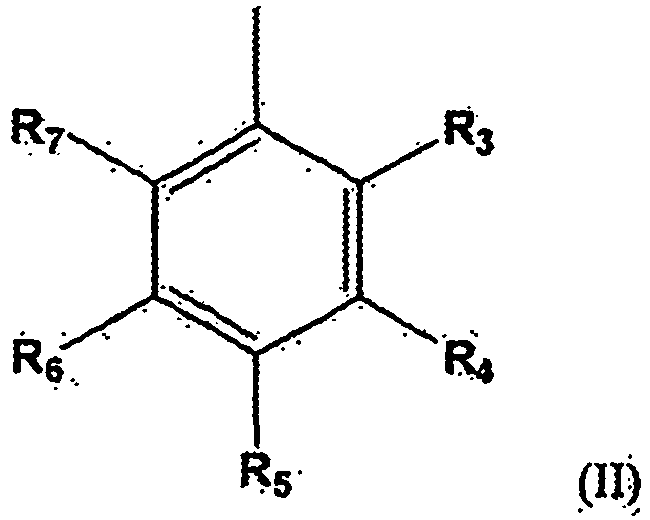

- In embodiments including a phenolic compound, a variety of commercially available or custom synthesized phenolic compounds may be used. For example, a phenolic compound may be of general formula. IV:

- The transesterification catalyst of embodiments may be any transesterification catalyst known in the art and used for polycarbonate synthesis. In embodiments, the catalysts are added in the first step, in the second step, and optionally in the third step, or in any combination of these steps and the transesterification catalysts used may be the same for each step or may be different. For example, the transesterification catalysts used may be any of those discussed in "Unit Processes in Organic Synthesis", Groggins, 4th Edition, McGraw Hill Book Co., 1952, pages 616-620, or
U.S. Patent Nos. 3,153,008 and3,442,854 , and in certain embodiments, the transesterification catalysts may include, but is not limited to, sodium phenolate, sodium bisphenolate, quarternary phosphonium, and aqueous-based phenol quarternary phosphonium catalysts and combinations and mixtures thereof. For example, quarternary phosphonium catalysts may be those represented in general formula V.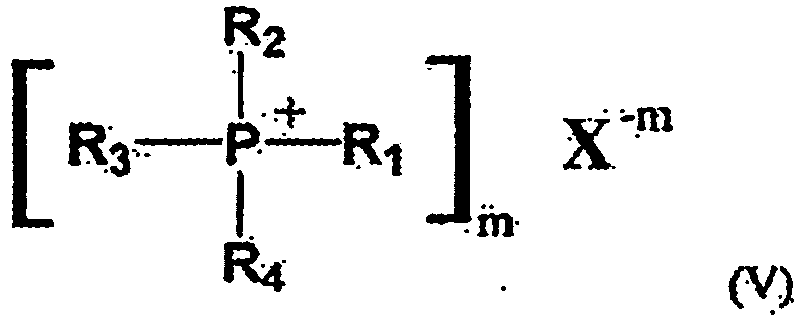
- Any branching agent known in the art may be used in the synthesis of the branched predominately phenol terminated oligocarbonates in embodiments, such as, for example, the branching agent may be 1,1,1-tris(4-hydroxyphenyl)ethane.
- The reaction time and temperature may vary between embodiments of the method and within steps of the embodiments. In some embodiments during a first step involving synthesis of the predominately phenol terminated branched and linear oligocarbonates from diphenyl carbonate with a molar excess of an aromatic bisphenol, the reaction time at which reflux occurs while phenol is being removed from the reaction mixture can range from about 0.5 to 24 hours in some embodiments and 1 to 8 hours in others. In other embodiments during a first step involving reacting polycarbonates with at least one phenolic compound to prepare oligocarbonates, the reaction time at which reflux occurs while the phenolic compound remains in the reaction mixture may range from about 0.5 to about 24 hours in some embodiments, and from about 1 to about 8 hours in others For the second step, the reaction time at which reflux occurs while phenol is removed from the reaction mixture may range from about 0.5 to 24 hours, in embodiments, and 1 to 8 hours, in others. A time period for an optional third step may range from about 0.5 to about 10 hours. For the overall method (steps 1-3 combined), the temperature may range from about 200°C to about 310°C, and in embodiments, the vacuum may range from about 10 mm to about 0.001 mm Hg, or in other embodiments, the vacuum may be adjusted during the course of the reaction from just below 760 mm to about 0.001 mm Hg.
- The temperature and vacuum under which the reaction takes place may be adjusted during the course of the method to stimulate various steps and during each individual step to achieve maximum efficiency. For example, during the first step, the temperature and vacuum may be adjusted to provide the proper reflux conditions enabling removal of phenol while keeping the diphenyl carbonate in the reaction mixture during the production of oligocarbonates, in some embodiments, or the temperature and vacuum may be adjusted to provide reflux without the removal of phenol while oligocarbonates are produced from polycarbonates, in other embodiments. During the second step, the temperature and vacuum may be adjusted to provide, conditions that enable the removal of phenol while keeping the alkylphosphonic acid diarylester in the reaction mixture while block copolycarbonate/phosphonates are produced and the temperature and vacuum may be adjusted again to facilitate the removal of all volatiles in the third step.
- As described above, the method of embodiments may occur in three distinct steps, the third step being optional. However, the reaction may be conducted in a continuous manner in a single reaction vessel in a one-pot method. For example, in embodiments wherein the block copolycarbonate/phosphonates of embodiments are produced on a large scale, the first step of the reaction may be conducted in a batch reactor with mechanical stirring, and the second step may be conducted in a continuous reactor in which high shear stirring may be used to spread the reaction mixture into a thin layer on the side walls of the reactor to provide a large surface area which may enhance the removal of volatiles.
- Without wishing to be bound by theory, the molecular architecture (i.e block copolymer) of the block copolycarbonate/phosphonates produced using methods described herein may explain differences in properties as compared to random copolymers described in the prior art. However, it is not obvious that this molecular architecture would result from the instant method, nor is it obvious that this molecular architecture would give rise to the observed combination of physical and mechanical properties possessed by the compositions produced by the instant method.
- The block copolycarbonate/phosphonates prepared using the methods presented herein may be used to produce polymer mixtures or blends with commodity and engineering plastics, and may impart to these polymer mixtures or blends the advantageous characteristics described above. The term "polymer mixtures or blends", as used herein, may refer to a composition having at least one block copolycarbonate prepared using the methods described above and at least one other polymer. There term other polymer", as used herein, refers to any polymer other than the block copolycarbonate/phosphonate composition of the present invention. Those other polymers may be commodity or engineering plastics such as polycarbonate, polyacrylate, polyacrylonitrile, saturated or unsaturated polyester, polyamide, polystyrene (including high impact strength polystyrene), polyurea, polyurethane, polyepoxy, poly(acrylonitrile butadiene styrene), polyimide, polyarylate, poly(arylene ether), polyethylene, polypropylene, polyphenylene sulfide, poly(vinyl ester), polyvinyl chloride, bismaleimide polymer, polyanhydride, liquid crystalline polymer, cellulose polymer, or any combination thereof (commercially available from, for example, GE Plastics, Pittsfield, MA; Rohm & Haas. Co., Philadelphia, PA, Bayer Corp. - Polymers, Akron, OH; Reichold; DuPont; Huntsman LLC, West Deptford, NJ; BASF Corp., Mount Olive, NJ; Dow Chemical Co., Midland, Ml; ExxonMobil Chemical Corp., Houston, TX; ExxonMobil; Mobay Chemical Corp., Kansas. City, KS; Goodyear Chemical, Akron, OH; BASF Corp.; 3M Corp., St. Paul, MN; Solutia, Inc., St. Louis, MO; and. Eastman Chemical Co., Kingsport, TN, respectively). The polymer mixtures or blends may be produced via blending; mixing, or compounding the constituent materials.
- The block copolycarbonate/phosphonates or the polymer mixtures or blends described herein may also contain other components, such as fillers, surfactants, organic binders, polymeric binders, crosslinking agents, coupling agents, anti-dripping agents, heat stabilizers, antioxidants, colorants, inks, dyes, or any combination thereof.
- The block oopolycarbonate/phosphonate compositions or the polymer mixtures or blends of embodiments presented herein, may generally be self-extinguishing in that they quickly stop burning when removed from a flame. In addition, drops produced by melting these block copolycarbonate/phosphonate compositions or the polymer mixtures or blends in a flame quickly stop burning and typically do not propagate fire to surrounding materials, Moreover, these block copolycarbonate/phosphonate compositions or the polymer mixtures or blends usually may not evolve any noticeable smoke when a flame is applied.
- The block copolycarbonate/phosphonate compositions or the polymer mixtures or blends of embodiments can be used as coatings or can be used to fabricate articles, such as, free-standing films, fibers, foams, molded articles, adhesives and fiber reinforced composites. These articles may be well-suited for applications requiring fire resistance.
- In summary, the block copolycarbonate/phosphonate compositions and the block copolycarbonate/phosphonate polymer mixtures exhibit outstanding flame resistance and an advantageous combination of properties such as high heat distortion temperatures, low color, high toughness, hydrolytical stability, and Tgs. Relative to the state-of-the-art random copolycarbonate/phosphonates, the block copolycarbonate/phosphonates exhibit equivalent flame resistance, but have noticeably improved toughness and higher Tgs. Such improvements make these materials useful in applications in the automotive and electronic sectors that require outstanding fire resistance, high temperature performance, low color, and melt processability.
- This invention and embodiments illustrating the method and materials used may be further understood by reference to the following non-limiting examples.
- This state-of-the-art comparative example was prepared following the procedure described in
U.S. Patent 4,322,520 . - Into a 250 mL three neck round bottom flask equipped with a distillation column and mechanical stirrer was placed 2,2-bis(4-hydrophenyl) propane (bisphenol A, 32.2 g, 0.167 mole), methylphosphonic acid diphenyl ester (96% purity, 4% phenol) (12.41 g, 0.048 mole), diphenylcarbonate (29.65 g, 0.139 mole) and 5 mg of sodium phenolate catalyst. The mixture was heated to 250°C under vacuum. The temperature was gradually increased to 300°C over a 6 hour period. As the temperature was increased the vacuum was decreased from about 200 mm to about 1.5 mm Hg. During this time 36.30 g of distillate was collected. The column was removed from the flask and the mixture heated to 300°C under 1.5 mm Hg for 5 hours. Distillate (1.9 g) was also collected during this step. The yellow solid (38.62 g) exhibited a relative viscosity of 1.18 and a Tg of 126°C. The percentage of phosphorous in this polymer was 3.16%.
- A film was cast from methylene chloride and subsequently dried. The film was light yellow in color. A qualitative tear test conducted on the film indicated that it was relatively brittle. Qualitative flame testing of the film indicated that it had good self-extinguishing characteristics.
- Into a 250 mL three neck round bottom flask equipped with a distillation column and mechanical stirrer was placed the 2,2-bis(4-hydroxyphenyl)propane (bisphenol A, 53.70 g, 0.236 mole) diphenylcarbonate (33.70 g, 0.158 mole) and 8. mg of sodium phenolate (NaOPh) catalyst. The mixture was heated to 250°C under vacuum (150-200 mm Hg) for about 1.5 hours. The mixture was subsequently allowed to cool and methylphosphonic acid diphenyl ester (23.4 g, 0.094 mole) and 12 mg of tetraphenylphosphonium phenolate (TPPOP) catalyst which is a chemical complex of tetraphenylphosphonium phenolate and phenol consisting of about 70% and about 30% of each, respectively (m.p. 145°C) were added. The mixture was heated from 250 to 300°C while reducing the pressure from 150 to 1.5 mm Hg over about a 4.5 to 5 hour period. A noticeable, rapid increase in solution viscosity of the melt was observed over the last hour of the reaction.
- Approximately 53 g of distillate was collected over the course of the reaction. The pale yellow, tough polymer exhibited a ηrel = 1.30 and a Tg of 133°C. The percentage phosphorous in this polymer was 3.49%.
- A film was cast from methylene chloride and subsequently dried. The film was light yellow in color. A qualitative tear test was conducted on the film. In comparison to the film prepared from the state-of-the-art random copolycarbonate/phosphonates example, this film was significantly tougher. In addition, the film from this method exhibited a significantly higher Tg (133°C) than the state-of-the-art random copolycarbonate/phosphonate film (126°C) of the, comparative method. Qualitative flame testing of the film indicated that it had excellent self-extinguishing characteristics and was comparable to that of the state-of-the-art random copolycarbonate/phosphonate film.
- Into a 250 mL three neck round bottom flask equipped with a distillation column and mechanical stirrer was placed the 2,2-bis(4-hydroxyphenyl)propane (bisphenol A, 53.70 g, 0.236 mole) diphenylcarbonate (33.70 g, 0.158 mole) and 12 mg of tetraphenylphosphonium phenolate (TPPOP) catalyst. The mixture was heated to 250°C under vacuum (150-200 mm Hg) for about 1.5 hours. Approximately 20 g of distillate was collected during this step. The mixture was subsequently allowed to cool and methylphosphonic acid diphenyl ester (23.4 g, 0.094 mole) and 12 mg of TPPOP catalyst which is a chemical complex of tetraphenylphosphonium phenolate and phenol consisting of about 70% and about 30% of each, respectively (m.p. 145°C) were added. The mixture was heated from 250 to 300°C while reducing the pressure from 150 to 1.5 mm Hg over about a 5 to 5.5 hour period. Approximately 28 g of distillate was collected during this step.
- The distillation column was subsequently removed from the flask and 12 mg of TPPOP catalyst was added. The mixture was heated to 300°C under full vacuum (approximately 0.1 mm. Hg) for approximately 1 hour. A noticeable, rapid increase in solution viscosity of the melt was observed over the last 0.5 to 0.75 hour of the reaction,
- Approximately 3.8 g of distillate was collected during this step of the reaction. The pale yellow, tough polymer exhibited a ηrel = 1.23 and a Tg of 131°C.
- In an attempt to ensure that all volatiles had been removed, approximately 38 g of the block copolycabonate/phosphonate and 12 mg of TPPOP catalyst were placed into the 250 mL three neck round bottom flask equipped with a mechanical stirrer. The mixture was heated to 300°C under full vacuum for about 1 hour. Approximately 0.3 g of distillate was collected during this step. The pale yellow, tough polymer exhibited a ηrel = 1.31 and a Tg of 134°C.
- A film was cast from methylene chloride and subsequently dried. The film was light yellow in color. A qualitative tear test was conducted the film. In comparison to the film prepared from the state-of-the-art random copolycarbonate/phosphonates example, this film was significantly tougher. In addition, the film from this method exhibited a significantly higher Tg (134°C) than the state-of-the-art random copolycarbonate/phosphonate film (126°C) of the comparative method. Qualitative flame testing of the film indicated that it had excellent self-extinguishing characteristics and was comparable to that of the state-of-the-art random copolycarbonate/phosphonate film.
- Into a 250 mL three neck round bottom flask equipped with a distillation column and mechanical stirrer was placed the 2,2-bis(4-hydroxyphenyl)propane (bisphenol A, 53.70 g 0.236 mole) diphenylcarbonate (33.70 g, 0.158 mole) and 8 mg of sodium phenolate catalyst. The mixture was heated to 250°C under vacuum (150-200 mm Hg) for about 1.5 hours. Approximately 21 g of distillate was collected during this step. At this stage the block copolycarbonate/phosphonate exhibited a ηrel = 1.02.
- The mixture was subsequently allowed to cool and methylphosphonic acid diphenyl ester (23.4 g, 0.094 mole) and 12 mg of TPPOP catalyst which is a chemical complex of tetraphenylphosphonium phenolate and phenol consisting of about 70% and about 30% of each, respectively (m.p. 145°C) were added. The mixture was heated from 250 to 300°C while reducing the pressure from 150 to 1.5 mm Hg over about a 5 hour period. The mixture was allowed to cool to room temperature overnight. The solution was subsequently heated to 300°C under full vacuum for about 1 to 1.5 hours. Approximately 29 g of distillate was collected during this step. The pale yellow, tough polymer exhibited a ηrel = 1.21 and a of 132°C.
- In an attempt to ensure that all volatiles had been removed, approximately 50 g of the block copolycarbonate/phosphonate and 12 mg of TPPOP catalyst were placed into the 250 mL three neck round bottom flask equipped with a mechanical stirrer. The mixture was heated to 300°C under full vacuum for about 2 hours. Approximately 0.4 g of distillate was collected during this step. The pale yellow, tough polymer exhibited a ηrel = 1.28 and a Tg of 135°C.
- A film was cast from methylene chloride and subsequently dried. The film was light yellow in color. A qualitative tear test was conducted on the film. In comparison to the film prepared from the state-of-the-art random copolycarbonate/phosphonates example, this film was significantly tougher. In addition, the film from this method exhibited a significantly higher Tg (135°C) than the state-of-the-art random copolycarbonate/phosphonate film (126°C) of the comparative method. Qualitative flame testing of the film indicated that it had excellent self-extinguishing characteristics and was comparable to that of the state-of-the-art random copolycarbonate/phosphonate film.
- Into a 250 mL three neck round bottom flask equipped with a distillation column and mechanical stirrer was placed the 2,2-bis(4-hydroxyphenyl)propane (bisphenol A, 53.70 g, 0.236 mole) diphenylcarbonate (33.70 g, 0.158 mole) and 8 mg of sodium phenolate catalyst. The mixture was heated to 250°C under vacuum (150-200 mm Hg) for about 1.5 hours. Approximately 21.5 g of distillate was collected during this step. At this stage the block copolycarbonate/phosphonate exhibited a ηrel = 1.04.
- The mixture was subsequently allowed to cool and methylphosphonic acid diphenyl ester (23.4 g, 0.094 mole) and 12 mg of TPPOP catalyst which is a chemical complex of tetraphenylphosphonium phenolate and phenol consisting of about 70% and about 30% of each, respectively (m.p. 145°C) were added. The mixture was heated from 250 to 300°C while reducing the pressure from 150 to 1.5 mm Hg over about a 4.5 to 5 hour period. A noticeable, rapid increase in solution viscosity of the melt was observed over the last hour of the reaction. Approximately 27.2 g of distillate was collected during this step. The pale yellow, tough polymer exhibited a ηrel = 1.26 and a Tg of 134°C.
- A film was east from methylene chloride and subsequently dried. The film was light yellow in color. A qualitative tear test was conducted on the film. In comparison to the film prepared from the state-of-the-art random copolycarbonate/phosphonates example, this film was significantly tougher. In addition, the film from this method exhibited a significantly higher Tg (134°C) than the state-of-the-art random copolycarnonate/phosphonate film (126°C) of the comparative method. Qualitative flame testing of the film indicated that it had excellent self-extinguishing characteristics and was comparable to that of the state-of-the-art random copolycarbonate/phosphonate film.
- Into a 250 mL three neck round bottom flask equipped with a distillation column and mechanical stirrer was placed the 2,2-bis(4-hydroxyphenyl)propane (bisphenol A, 53.70 g, 0.236 mole) diphenylcarbonate (33.70 g, 0.158 mole) and 8 mg of sodium phenolate catalyst. The mixture was heated to 250°C under vacuum (150-200 mm Hg) for about 2 hours. Approximately 23.2 g of distillate was collected during this step. At this stage the block copolycarbonate/phosphonate exhibited a ηrel = 1.04.
- The mixture was subsequently allowed to cool and methylphosphonic acid diphenyl ester (23.4 g, 0.094 mole) and 12 mg of TPPOP catalyst which is a chemical complex of tetraphenylphosphonium phenolate and phenol consisting of about 70% and about 30% of each, respectively (m.p. 145°C) were added. The mixture was heated from 250 to 300°C while reducing the pressure from 150 to 1.5 mm Hg over about a 5 hour period. A noticeable, rapid increase in solution viscosity of the melt was observed over the last hour of the reaction. Approximately 29.6 g of distillate was collected during this step. The pale yellow, very tough polymer exhibited a Tg of 132°C
- Into a 250 mL three neck round bottom flask equipped with a distillation column and mechanical stirrer was placed the polycarbonate (Makrolon 3103, ηrel = 1.29-1.30) (25.4 g, 0.10 mole), methylphosphonic acid diphenyl ester (95% purity, 5% phenol) (26.1 g, 0.10 mole), phenol (18.8 g, 0.20 mole) and 12 mg of tetraphenylphosphonium phenolate (TPPOP) catalyst which is a chemical complex of tretraphenylphosphonium phenolate and phenol consisting of about 70% and about 30% of each, respectively (m.p. 145°C). The mixture was heated under vacuum (about 500 mm Hg) at 240°C for 3 hours. During this first step, the phenol was refluxing, but not being distilled from the reaction vessel. In the second step, the temperature was increased to 300°C and the pressure was reduced to about 1.5 mm Hg for a period of 6 hours. During this time a significant amount of distillate was collected. In the third step, the distillation column was removed and an additional 12 mg of TPPOP was added. The reaction mixture was heated to 300°C under 0.1 mm Hg for 5 hours.
- During the course of the entire reaction 38.4 g of distillate was collected. The amount of light brownish product obtained was 24.5 g. The material exhibited a ηrel = 1.18 and a Tg of 126°C. The amount of phosphorus in the copolymer was 2.85% by weight.
- In order to determine if volatile removal was complete, the third step was repeated as follows; the product (23 g) and TPPOP (12 mg) were placed in a 100 mL three neck flask equipped with a distillation column and mechanical stirrer. The mixture was heated to 300°C under 0.1 mm Hg for 5 hours. Additional distillate (2.21 g) was collected, and the product (18.5 g) was slightly brownish and noticeably tougher. The copolymer exhibited a ηrel = 1.30 and a Tg of 134°C. The amount of phosphorus in the copolymer was 3.07% by weight.
- A film was cast from methylene chloride and subsequently dried. The film was light yellow in color. A qualitative tear test was conducted on the film. In comparison to the film prepared from the state-of-the-art random copolycarbonate/phosphonates example, this film was noticeably tougher. In addition, the film from this method exhibited a significantly higher Tg (134°C) than the state-of-the-art random copolycarbonate/phosphonate film (126°C) from the comparative method. Qualitative flame testing of the film indicated that it had excellent selt-extinguishing characteristics and was comparable to that of the state-of-the-art random copolycarbonate/phosphonate film.
- Into a 250 mL three neck round bottom flask equipped with a distillation column and mechanical stirrer was placed the polycarbonate (Makrolon 3103, ηrel = 1.29-1.30) (50.8 g, 0.20 mole), methylphosphonic acid diphenyl ester (94% purity, 6% phenol) (13.19 g, 0.05 mole), phenol (9.4 g, 0.10 mole) and 12 mg of tetraphenylphosphonium phenolate (TPPOP) catalyst which is a chemical complex of tetraphenylphosphonium phenolate and phenol consisting of about 70% and about 30% of each, respectively (m.p. 145°C). The mixture was heated under vacuum (about 500 mm Hg) at 240°C for 3 hours. During this first step, the phenol was refluxing, but not being distilled from the reaction vessel. In the second step, the temperature was increased to 300°C and the pressure was reduced to about 1.5 mm Hg for a period of 6 hours. During this time a significant amount of distillate was collected (20.27 g). In the third step, the distillation, column was subsequently removed and an additional 12 mg of TPPOP was added. The reaction mixture was heated to 300°C under 0.1 mm Hg for 5 hours. An additional 0.33g of distillate was collected during this second heating step. The product was light brownish and tough. The copolymer exhibited a ηrel = 1.21 and a Tg of 134°C The amount of phosphorus in the copolymer was 1.09% by weight.
- A film was cast from methylene chloride and subsequently dried. The film was light yellow in color. A qualitative tear test was conducted on the film. In comparison to the film prepare from the state-of-the-art random copolycarbonate/phosphonates example, this film was noticeably tougher. In addition, the film from this method exhibited a significantly higher Tg (134°C) than the state-of-the-art random copolycarbonate/phosphonate film (126°C) of the comparative method. Qualitative flame testing of the film indicated that it had excellent self-extinguishing characteristics and was comparable to that of the state of the art random copolycarbonate/phosphonate film.
- Into a 250 mL three neck round bottom flask equipped with a distillation column and mechanical stirrer was placed the polycarbonate (Makrolon 3103, ηrel = 1.29-1.30) (38.1 g, 0.15 mole), methylphosphonic acid diphenyl ester (94% purity, 6% phenol) (19.82 g, 0.075 mole), phenol (14.1 g, 0.15 mole) and 12 mg of tetraphenylphosphonium phenolate (TPPOP) catalyst which is a chemical complex of tetraphenylphosphonium phenolate and phenol consisting of about 70% and about 30% of each, respectively (m.p. 145°C). The mixture was heated under vacuum (about 500 mm Hg) at 240°C for 3 hours. During this first step, the phenol was refluxing, but not being distilled from the reaction vessel. In the second step, the temperature was increased to 300°C and the pressure was reduced to about 1.5 mm Hg for a period of 6 hours. During this time a significant amount of distillate was collected (31.23 g), In the third step, the distillation column was subsequently removed and an additional 12 mg of TPPOP was added. The reaction mixture was heated to 300°C under 0.1 mm Hg for 5 hours and an additional 2.56 g of distillate was collected. The product was light brownish and tough. The copolymer exhibited a ηrel = 1.21 and a Tg of 136°C. The amount of phosphorus in the copolymer was 1.59% by weight,
- A film was cast from methylene chloride and subsequently dried. The film was light yellow in color. A qualitative tear test was conducted on the film. In comparison to the film prepared from the state of the art random copolycarbonate/phosphonates example, this film was noticeably tougher. In addition, the film from this method exhibited a significantly higher Tg (136°C) than the state-of-the-art random copolycarbonate/phosphonate film (126°C) of the comparative method. Qualitative flame testing of the film indicated that it had excellent self-extinguishing characteristics and was comparable to that of the state of the art random copolycarbonate/phosphonate film.
- Into 12 L reactor equipped with a distillation column and mechanical stirrer was placed the 2,2-bis-(4-hydroxyphenyl) propane (bisphenol A, 4.028 kg, 17.67 mol), Diphenyl carbonate (818 g, 3.82 mol) and 600 mg Sodium phenolate (NaOPh) catalyst. The mixture was heated to 250°C under vacuum (150 - 200 mmHg) for about 1.5 hours. The mixture was subsequently allowed to cool and methylphosphonic acid diphenyl ester (3697 g, 14.91 mol) and 900 mg Tetraphenylphosphonium phenolate (TPPOP) catalyst wich is a chemical complex of tetraphenylphosphonium phenolate and phenol consisting of about 70% and about 30% of each, respectively (m.p 145°C) were added. The mixture was heated from 250 to 300°C while reducing the pressure from 150 to 1.5 mm Hg over about 16 to 16.5 hours period. A noticeable, rapid increase in solution viscosity of the melt was observed over the last hour of the reaction.
- Approximately 3465.7 g of distillate was collected over the course of the reaction. The pale yellow, tough polymer exhibited a ηrel = 1.35 and a Tg of 109°C. The percentage of phosphorous in this polymer was 8.09 %.
- Into 12 L reactor equipped with a distillation column and mechanical stirrer was placed the 2,2-bis-(4-hydroxyphenyl) propane (bisphenol A, 4,028 kg, 17.67 mol), Diphenyl carbonate (2812 g, 13.14 mol) and 600 mg Sodium phenolate (NaOPh) catalyst. The mixture was heated to 250°C under vacuum (150-200 mmHg) for about 1.5 hours. The mixture was subsequently allowed to cool and methylphosphonic acid diphenyl ester (1396 g, 5.63 mol) and 900 mg Tetraphenylphosphonium phenolate (TPPOP) catalyst which is a chemical complex of tetraphenylphophonium phenolate and phenol consisting of about 70% and about 30% of each, respectively (mp 145°C) were added. The mixture was heated from 250 to 300°C while reducing the pressure form 150 to 1.5 mm Hg over about 9 hours period. A noticeable, rapid increase in solution viscosity of the melt was observed over the last hour of the reaction.
- Approximately 3656 g of distillate was collected over the course of the reaction. The pale yellow, tough polymer exhibited a ηrel = 1.25 and a Tg of 129°C. The percentage of phosphorous in this polymer was 3.57 %.
- Although the present invention has been described in considerable detail with reference to certain preferred embodiments thereof, other versions are possible.
Claims (15)
- A method of preparing block copolycarbonate/phosphonates comprising;
obtaining a predominately phenol terminated oligocarbonate, and optionally free bisphenol, in a first step; and
reacting the predominately phenol terminated oligocarbonate and optionally free bisphenol with an alkylphosphonic acid diarylester at an elevated temperature under reduced pressure in a melt to make a block copolycarbonate/phosphonate in a second step. - The method of claim 1, wherein the elevated temperature and reduced pressure of the second step are such that phenol is removed without removing alkylphosphonic acid diarylester.
- The method of claim 1, wherein the step of obtaining the predominately phenol terminated oligocarbonate and optionally free bisphenol comprises reacting a polycarbonate with phenol under conditions such that the phenol is refluxing but is not removed.
- The method of claim 1, wherein the step of obtaining the predominately phenol terminated oligocarbonate and optionally free bisphenol comprises reacting a polycarbonate with phenol in the presence of the alkylphosphonic acid diarylester under conditions such that the phenol is refluxing but is not removed.
- The method of claim 1, wherein the step of obtaining the predominately phenol terminated oligocarbonate and optionally free bisphenol comprises reacting diphenyl carbonate, a molar excess of a bisphenol, and a transesterification catalyst at elevated temperature under reduced pressure in a melt.
- The method of claim 1, wherein the molar ratio of the alkylphosphonic acid diarylester to predominantly phenol terminated oligocarbonate is from about 0.1 to about 5.
- The method of claim 1, wherein the step of obtaining the predominanantly phenol terminated oligocarbonate and optionally free bisphenol comprises combining a branched or linear polycarbonate with phenol or substituted phenol, and wherein the relative molar ratio of the phenol or substituted phenol to the polycarbonate is from about 0.001 to about 10.
- The method of claim 1, further comprising providing a transesterification catalyst, optionally selected from sodium phenolate, tetraphenylphosphonium phenolate, or combinations thereof.
- The method of claim 1, wherein the predominately phenol terminated oligocarbonate has a relative viscosity (ηrel) of from about 1.02 to about 1.18.
- The method of claim 1, wherein the elevated temperature and reduced pressure are maintained from about 0.5 to about 24 hours.
- The method of claim 1, further comprising the step of heating a mixture resulting from the step of reacting the predominately phenol terminated oligocarbonate and optionally free bisphenol with an alkylphosphonic acid diarylester to a temperature of from about 250°C to about 310°C for from about 0.5 to about 10 hours.
- The method of claim 1, wherein from about 0.1 % to about 10%, optionally from about 0.1 to about 5%, by weight phosphorus is present in the block copolycarbonate/phosphonate.
- A block copolycarbonate/phosphonate obtainable from the method as claimed in any one of claims 1 to 12.
- A polymer blend or mixture, comprising: at least one block copolycarbonate/phosphonate as claimed in claim 13; and at least one other polymer to make a polymer blend or mixture.
- The polymer blend or mixture of claim 14, wherein the other polymer is selected from polycarbonates, polyacrylates, polyacrylonitriles, saturated and unsaturated polyesters, polyamides, polystyrenes high impact polystyrenes, polyurethanes, polyureas, polyepoxides, poly(acrylonitrile butadiene styrene)s, polyimides, polyarylates, poly(arylene ether)s, polyethylenes, polypropylenes, polyphenylene sulfides, poly(vinyl ester)s, polyvinyl chlorides, bismaleimide polymers, polyanhydrides, liquid crystalline polymers, polyethers, polyphenylene oxides, cellulose polymers, and combinations thereof.
Applications Claiming Priority (4)
| Application Number | Priority Date | Filing Date | Title |
|---|---|---|---|
| US74112405P | 2005-12-01 | 2005-12-01 | |
| US74938905P | 2005-12-12 | 2005-12-12 | |
| US11/563,941 US7838604B2 (en) | 2005-12-01 | 2006-11-28 | Method for the production of block copolycarbonate/phosphonates and compositions therefrom |
| PCT/US2006/061318 WO2007065094A2 (en) | 2005-12-01 | 2006-11-29 | Method for the production of block copolycarbonate/phosphonates and compositions therefrom |
Publications (3)
| Publication Number | Publication Date |
|---|---|
| EP1979395A2 EP1979395A2 (en) | 2008-10-15 |
| EP1979395A4 EP1979395A4 (en) | 2010-06-16 |
| EP1979395B1 true EP1979395B1 (en) | 2013-05-01 |
Family
ID=38093377
Family Applications (1)
| Application Number | Title | Priority Date | Filing Date |
|---|---|---|---|
| EP06840049.8A Active EP1979395B1 (en) | 2005-12-01 | 2006-11-29 | Method for the production of block copolycarbonate/phosphonates and compositions therefrom |
Country Status (7)
| Country | Link |
|---|---|
| US (2) | US7838604B2 (en) |
| EP (1) | EP1979395B1 (en) |
| JP (3) | JP5714800B2 (en) |
| KR (2) | KR101165280B1 (en) |
| CN (2) | CN102443258A (en) |
| ES (1) | ES2424165T3 (en) |
| WO (1) | WO2007065094A2 (en) |
Families Citing this family (18)
| Publication number | Priority date | Publication date | Assignee | Title |
|---|---|---|---|---|
| US7838604B2 (en) * | 2005-12-01 | 2010-11-23 | Frx Polymers, Inc. | Method for the production of block copolycarbonate/phosphonates and compositions therefrom |
| ES2549124T3 (en) * | 2007-07-16 | 2015-10-23 | Frx Polymers, Inc. | Flame retardant industrial use polymer compositions |
| EP2616496A4 (en) * | 2010-09-16 | 2016-05-18 | Frx Polymers Inc | COPOLY (PHOSPHONATE CARBONATES) RANDOM OF HIGH MOLECULAR WEIGHT, BASED ON BISPHENOL |
| KR101913669B1 (en) | 2010-11-17 | 2018-11-01 | 에프알엑스 폴리머스, 인코포레이티드 | Phosphonate polymers, copolymers, and their respective oligomers as flame retardants for polyester fibers |
| US8563638B2 (en) | 2010-12-22 | 2013-10-22 | Frx Polymers, Inc. | Oligomeric phosphonates and compositions including the same |
| CN103619959A (en) * | 2011-04-14 | 2014-03-05 | Frx聚合物股份有限公司 | Polyphosphonate and copolyphosphonate additive mixtures |
| TWI638005B (en) | 2011-08-19 | 2018-10-11 | 法克斯聚合物股份有限公司 | Thermoplastic polyurethanes with exceptional fire resistance |
| KR101437140B1 (en) * | 2011-09-21 | 2014-09-02 | 제일모직주식회사 | Polycarbonate and Method for Preparing the Same |
| KR101489956B1 (en) * | 2011-12-30 | 2015-02-06 | 제일모직주식회사 | Flame retardant thermoplastic resin composition |
| JP2013166839A (en) * | 2012-02-15 | 2013-08-29 | Mitsubishi Engineering Plastics Corp | Carbon fiber-reinforced polycarbonate resin composition |
| WO2013175452A1 (en) | 2012-05-24 | 2013-11-28 | Sabic Innovative Plastics Ip B.V. | Improved flame retardant polymer compositions |
| EP2948464A4 (en) | 2013-01-22 | 2016-12-07 | Frx Polymers Inc | PHOSPHORUS-CONTAINING EPOXY COMPOUNDS AND COMPOSITIONS THEREOF |
| WO2015057717A1 (en) | 2013-10-14 | 2015-04-23 | Frx Polymers, Inc. | Flame retardant thermoplastic elastomers for extrusion or injection molding |
| JP6234198B2 (en) | 2013-12-04 | 2017-11-22 | 三菱重工業株式会社 | Turbocharger device |
| TW201542670A (en) | 2014-03-04 | 2015-11-16 | Frx Polymers Inc | Epoxy compositions |
| TW201833194A (en) | 2017-01-05 | 2018-09-16 | 美商法克斯聚合物股份有限公司 | Curing of epoxy resins with phosphonate oligomers |
| CN111615529A (en) | 2018-01-16 | 2020-09-01 | 赢创运营有限公司 | Composition containing nanoparticles |
| WO2020079565A1 (en) | 2018-10-16 | 2020-04-23 | Sabic Global Technologies B.V. | Continuous fiber reinforced composite prepreg formed of flame retardant polyester |
Family Cites Families (75)
| Publication number | Priority date | Publication date | Assignee | Title |
|---|---|---|---|---|
| US2534242A (en) * | 1950-12-19 | B-haloxanthine salts of z-alkyl-z | ||
| US2435252A (en) * | 1944-01-01 | 1948-02-03 | Victor Chemical Works | Aryl phosphorus containing resins and the method of preparing the same |
| US2716101A (en) * | 1952-09-10 | 1955-08-23 | Eastman Kodak Co | Polymeric organo-phosphonates containing phosphato groups |
| US2682522A (en) * | 1952-09-10 | 1954-06-29 | Eastman Kodak Co | Process for preparing polymeric organo-phosphonates |
| US2891915A (en) * | 1954-07-02 | 1959-06-23 | Du Pont | Organophosphorus polymers |
| US3153008A (en) * | 1955-07-05 | 1964-10-13 | Gen Electric | Aromatic carbonate resins and preparation thereof |
| US3271329A (en) * | 1958-09-19 | 1966-09-06 | Eastman Kodak Co | Method for producing polymers derived from phosphites and glycols |
| US3326852A (en) * | 1964-08-10 | 1967-06-20 | Owens Illinois Inc | Resinous polymeric phosphonates |
| DE1274578B (en) * | 1965-01-21 | 1968-08-08 | Bayer Ag | Process for the preparation of cycloalkylamine compounds |
| US3932351A (en) * | 1971-04-08 | 1976-01-13 | Monsanto Company | Method of preparing phosphorus-bromine containing fire retardant polyester fibers |
| US4033927A (en) * | 1971-11-01 | 1977-07-05 | General Electric Company | Flame retardant polyester resin compositions |
| JPS5046794A (en) * | 1973-08-27 | 1975-04-25 | ||
| NL90598C (en) * | 1973-11-14 | |||
| US3932566A (en) * | 1974-09-16 | 1976-01-13 | Celanese Corporation | Phosphonate polymers |
| GB1514511A (en) * | 1975-05-21 | 1978-06-14 | Texaco Belgium Nv Sa | Polyureas |
| US4152373A (en) * | 1975-09-22 | 1979-05-01 | Stauffer Chemical Company | Process for preparing diaryl methylphosphonate and derivatives thereof |
| US4078016A (en) * | 1976-05-17 | 1978-03-07 | Celanese Corporation | Halogenated aromatic polymer/metal phosphinate polymer flame retardant composition |
| US4064107A (en) * | 1976-08-12 | 1977-12-20 | Celanese Corporation | High temperature polyurea resins |
| US4093582A (en) * | 1976-12-08 | 1978-06-06 | General Electric Company | Organo phosphorus ester plasticized polycarbonate composition |
| US4223104A (en) * | 1978-08-11 | 1980-09-16 | Stauffer Chemical Company | Copoly (carbonate/phosphonate) compositions |
| US4205162A (en) * | 1978-11-03 | 1980-05-27 | Stauffer Chemical Company | Polymer recovery process |
| NL7901769A (en) | 1979-03-06 | 1980-09-09 | Gen Electric | FLAME RETARDANT, POLYPHENYLENE ETHER CONTAINING COMPOSITIONS. |
| US4254177A (en) * | 1979-05-07 | 1981-03-03 | W. R. Grace & Co. | Fire-retardant product and method of making |
| DE2925208A1 (en) * | 1979-06-22 | 1981-01-29 | Bayer Ag | METHOD FOR PRODUCING AROMATIC THERMOPLASTIC POLYPHOSPHONATOCARBONATES |
| DE2925207A1 (en) * | 1979-06-22 | 1981-01-29 | Bayer Ag | THERMOPLASTIC, BRANCHED, AROMATIC POLYPHOSPHONATES, THEIR USE AND A METHOD FOR THE PRODUCTION THEREOF |
| DE2935317A1 (en) | 1979-08-31 | 1981-03-26 | Bayer Ag, 51373 Leverkusen | HIGH MOLECULAR, SEGMENTED, THERMOPLASTICALLY PROCESSABLE, AROMATIC POLYCARBONATES WITH CONDENSED DIMERICO FETAL ESTERS, THEIR PRODUCTION AND THEIR USE |
| DE2944093A1 (en) * | 1979-10-31 | 1981-05-14 | Bayer Ag, 5090 Leverkusen | METHOD FOR PRODUCING THERMOPLASTIC AROMATIC POLYPHOSPHONATES OF IMPROVED THERMAL AGING RESISTANCE AND USE THEREOF |
| DE3001863A1 (en) * | 1980-01-19 | 1981-07-23 | Bayer Ag, 5090 Leverkusen | METHOD FOR PRODUCING THERMOPLASTIC AROMATIC POLYPHOSPHONATOCARBONATES OF IMPROVED THERMAL AGING RESISTANCE AND THE USE THEREOF |
| DE3001895A1 (en) * | 1980-01-19 | 1981-07-23 | Bayer Ag, 5090 Leverkusen | METHOD FOR PRODUCING ALKANPHOSPHONIC ACID DIARYLESTER AND ALKANPHOSPHINE ACID ALARYL ESTERS |
| DE3002550A1 (en) * | 1980-01-25 | 1981-07-30 | Bayer Ag, 5090 Leverkusen | HALOGEN-FREE COMBUSTIBLE FILMS |
| DE3002792A1 (en) * | 1980-01-26 | 1981-07-30 | Bayer Ag, 5090 Leverkusen | FLAME-RETARDANT COMPOSITION OF POLYPHENYLENETHER, POLYSTYRENE RESIN AND POLYPHOSPHONATE |
| US4381390A (en) * | 1981-10-15 | 1983-04-26 | Mobay Chemical Corporation | Thermoplastic polyphosphonatophenyl ester carbonate from aryloxycarbonyloxy-benzoic acid aryl ester and preparation thereof |
| CA1207487A (en) | 1981-10-19 | 1986-07-08 | Manfred Schmidt | Polysulfone-polyphosphonate molding compositions |
| US4408033A (en) * | 1981-12-14 | 1983-10-04 | The Dow Chemical Company | Polyurethanes prepared from polyisocyanate, polyol and phosphonopolyester oligomers |
| US4481350A (en) * | 1982-03-22 | 1984-11-06 | Bayer Aktiengesellschaft | Process for the preparation of thermoplastic aromatic polyphosphonates containing small proportions of carbonate structures and product thereof |
| US4474937A (en) * | 1983-10-03 | 1984-10-02 | The Dow Chemical Company | Phosphorus-modified polyestercarbonate resins |
| US4594404A (en) * | 1984-03-20 | 1986-06-10 | Union Carbide Corporation | Polycarbonates having improved hydrolytic stability |
| DE3517271A1 (en) * | 1985-05-14 | 1986-11-20 | Bayer Ag, 5090 Leverkusen | METHOD FOR PRODUCING COPOLYPHOSPHONATES WITH HIGH IMPACT STRENGTH |
| DE3520296A1 (en) * | 1985-06-07 | 1986-12-11 | Bayer Ag, 5090 Leverkusen | METHOD FOR PRODUCING COPOLYPHOSPHONATES WITH HIGH TOUGHNESS |
| JPH0649753B2 (en) * | 1986-01-22 | 1994-06-29 | ダイセル化学工業株式会社 | Method for producing polycarbonate by melting method |
| US4788259A (en) * | 1986-04-22 | 1988-11-29 | Bayer Aktiengesellschaft | Flame-proof polyamides |
| JP2577900B2 (en) * | 1987-02-18 | 1997-02-05 | イハラケミカル工業 株式会社 | Method for producing polyurea resin |
| DE3730204A1 (en) * | 1987-09-09 | 1989-03-30 | Bayer Ag | FIRE PROTECTIVE |
| JPH0641512B2 (en) * | 1989-01-18 | 1994-06-01 | 日本エステル株式会社 | Method for producing flame resistant polyester |
| DE3933548A1 (en) * | 1989-10-07 | 1991-04-11 | Bayer Ag | Highly branched polyphosphates |
| DE4113157A1 (en) * | 1990-09-06 | 1992-03-12 | Bayer Ag | MELAMINE BASED BRANCHED POLYPHOSPHONATES |
| US5319058A (en) * | 1991-10-22 | 1994-06-07 | Ihara Chemical Industry Co., Ltd. | Method for the preparation of a polyurea resin |
| DE4238123C2 (en) * | 1992-11-12 | 2000-03-09 | Bayer Ag | Process for the production of thermoplastic polycarbonates |
| BR9307484A (en) * | 1992-11-20 | 1999-08-24 | Dow Chemical Co | Polyurea polymers that have improved stability at high temperature but obtain them |
| DE4240314A1 (en) * | 1992-12-01 | 1994-06-09 | Bayer Ag | Prepn of polycarbonate(s) by melt esterification, by degrading polycarbonate from di:phenol - using quat. ammonium or phosphonium cpd as catalyst, prepn. of oligo:carbonate and polycondensation |
| DE4410378A1 (en) * | 1994-03-25 | 1995-09-28 | Hoechst Ag | Halogen-free and filler-containing, flame-retardant polyurea foam, process for its production and its use |
| DE4421701A1 (en) * | 1994-06-21 | 1996-01-04 | Bayer Ag | Process for the chemical recycling of polycarbonates |
| DE19512470A1 (en) * | 1995-04-04 | 1996-10-10 | Bayer Ag | Process for the production of particularly advantageous flame-retardant, halogen-free polyurethane polyureas |
| EP0812883A4 (en) * | 1995-12-28 | 2001-05-16 | Toray Industries | EPOXY RESIN COMPOSITION |
| US6066700A (en) * | 1997-03-12 | 2000-05-23 | Bayer Aktiengesellschaft | Process for the production of polysiloxane/polycarbonate block co-condensation products |
| DE19710081A1 (en) * | 1997-03-12 | 1998-09-17 | Bayer Ag | Process for the preparation of polysiloxane-polysiloxane-polycarbonate block cocondensates |
| US6642322B2 (en) * | 1998-01-21 | 2003-11-04 | The University Of North Carolina At Chapel Hill | Methods of making telechelic oligomers, methods of making block copolymers, and novel block copolymers |
| DE19810745C2 (en) | 1998-03-12 | 2000-05-04 | Bayer Ag | Liquid catalyst formulation of tetraphenylphosphonium phenolate and phenol and their use |
| US6153212A (en) * | 1998-10-02 | 2000-11-28 | Guilford Pharmaceuticals Inc. | Biodegradable terephthalate polyester-poly (phosphonate) compositions, articles, and methods of using the same |
| US6419709B1 (en) * | 1998-10-02 | 2002-07-16 | Guilford Pharmaceuticals, Inc. | Biodegradable terephthalate polyester-poly(Phosphite) compositions, articles, and methods of using the same |
| JP2000219745A (en) | 1999-02-02 | 2000-08-08 | Johoku Kagaku Kogyo Kk | Flame-retardant compound, its production, and flame- retarded organic polymer material |
| US6288210B1 (en) | 1999-11-12 | 2001-09-11 | Virginia Tech. Intellectual Properties, Inc. | High refractive index thermoplastic polyphosphonates |
| US6458304B1 (en) * | 2000-03-22 | 2002-10-01 | E. I. Du Pont De Nemours And Company | Flash spinning process and solutions of polyester |
| JP4778601B2 (en) * | 2000-03-27 | 2011-09-21 | 出光興産株式会社 | Flame retardant polycarbonate resin composition and molded article |
| DE10114808A1 (en) * | 2001-03-26 | 2002-10-10 | Bayer Ag | Process for the preparation of oligocarbonates |
| CN100546992C (en) * | 2001-10-04 | 2009-10-07 | 旭瑞达有限公司 | Hydroxy-terminated oligomeric phosphonates |
| JP4155068B2 (en) * | 2002-03-20 | 2008-09-24 | 東レ株式会社 | Resin, method for producing the same, and molded body using the same |
| US20040197301A1 (en) * | 2003-02-18 | 2004-10-07 | Zhong Zhao | Hybrid polymers and methods of making the same |
| US6861499B2 (en) * | 2003-02-24 | 2005-03-01 | Triton Systems, Inc. | Branched polyphosphonates that exhibit an advantageous combination of properties, and methods related thereto |
| US20040167283A1 (en) | 2003-02-24 | 2004-08-26 | Michael Vinciguerra | Linear polyphosphonates that exhibit an advantageous combination of properties, and methods related thereto |
| US7560525B2 (en) * | 2004-04-02 | 2009-07-14 | Frx Polymers, Llc | Crystalline polyphosphonates and methods related thereto |
| US20060020104A1 (en) * | 2004-06-04 | 2006-01-26 | Dieter Freitag | Preparation of polyphosonates via transesterification without a catalyst |
| US7645850B2 (en) * | 2005-08-11 | 2010-01-12 | Frx Polymers, Inc. | Poly(block-phosphonato-ester) and poly(block-phosphonato-carbonate) and methods of making same |
| JP2007122031A (en) * | 2005-09-28 | 2007-05-17 | Toray Ind Inc | Resin, molded body made of the resin, film, optical lens, and retardation film |
| US7838604B2 (en) * | 2005-12-01 | 2010-11-23 | Frx Polymers, Inc. | Method for the production of block copolycarbonate/phosphonates and compositions therefrom |
-
2006
- 2006-11-28 US US11/563,941 patent/US7838604B2/en not_active Expired - Fee Related
- 2006-11-29 JP JP2008543569A patent/JP5714800B2/en not_active Expired - Fee Related
- 2006-11-29 CN CN2011103293392A patent/CN102443258A/en active Pending
- 2006-11-29 ES ES06840049T patent/ES2424165T3/en active Active
- 2006-11-29 KR KR1020087015924A patent/KR101165280B1/en not_active Expired - Fee Related
- 2006-11-29 EP EP06840049.8A patent/EP1979395B1/en active Active
- 2006-11-29 WO PCT/US2006/061318 patent/WO2007065094A2/en not_active Ceased
- 2006-11-29 KR KR1020127000646A patent/KR101415630B1/en not_active Expired - Fee Related
- 2006-11-29 CN CN2006800452638A patent/CN101321804B/en not_active Expired - Fee Related
-
2010
- 2010-10-26 US US12/911,818 patent/US8415438B2/en not_active Expired - Fee Related
-
2014
- 2014-06-04 JP JP2014115669A patent/JP6023123B2/en not_active Expired - Fee Related
- 2014-12-18 JP JP2014256229A patent/JP2015120912A/en active Pending
Also Published As
| Publication number | Publication date |
|---|---|
| JP5714800B2 (en) | 2015-05-07 |
| KR20120007091A (en) | 2012-01-19 |
| JP6023123B2 (en) | 2016-11-09 |
| US20100130703A1 (en) | 2010-05-27 |
| EP1979395A2 (en) | 2008-10-15 |
| KR20080104261A (en) | 2008-12-02 |
| WO2007065094A2 (en) | 2007-06-07 |
| JP2015120912A (en) | 2015-07-02 |
| CN101321804A (en) | 2008-12-10 |
| KR101415630B1 (en) | 2014-07-09 |
| JP2014208824A (en) | 2014-11-06 |
| CN101321804B (en) | 2011-12-28 |
| CN102443258A (en) | 2012-05-09 |
| EP1979395A4 (en) | 2010-06-16 |
| JP2009518468A (en) | 2009-05-07 |
| ES2424165T3 (en) | 2013-09-27 |
| KR101165280B1 (en) | 2012-07-19 |
| US7838604B2 (en) | 2010-11-23 |
| US20110039987A1 (en) | 2011-02-17 |
| WO2007065094A3 (en) | 2007-12-27 |
| US8415438B2 (en) | 2013-04-09 |
Similar Documents
| Publication | Publication Date | Title |
|---|---|---|
| US8415438B2 (en) | Method for the production of block copolycarbonate/phosphonates and compositions therefrom | |
| EP1919977B1 (en) | Poly (block-phosphonato-ester) and poly (block-phosphonato-carbonate) and methods of making same | |
| CN1777632B (en) | branched polyphosphonate | |
| TWI580734B (en) | Polyphosphonate and copoly (phosphonate carbonate) additive mixtures | |
| JP5603238B2 (en) | Insoluble branched polyphosphonates and related methods | |
| JP5964307B2 (en) | High molecular weight random copoly (phosphonate carbonate) based on bisphenol | |
| US20060020104A1 (en) | Preparation of polyphosonates via transesterification without a catalyst |
Legal Events
| Date | Code | Title | Description |
|---|---|---|---|
| PUAI | Public reference made under article 153(3) epc to a published international application that has entered the european phase |
Free format text: ORIGINAL CODE: 0009012 |
|
| 17P | Request for examination filed |
Effective date: 20080626 |
|
| AK | Designated contracting states |
Kind code of ref document: A2 Designated state(s): AT BE BG CH CY CZ DE DK EE ES FI FR GB GR HU IE IS IT LI LT LU LV MC NL PL PT RO SE SI SK TR |
|
| AX | Request for extension of the european patent |
Extension state: AL BA HR MK RS |
|
| A4 | Supplementary search report drawn up and despatched |
Effective date: 20100517 |
|
| 17Q | First examination report despatched |
Effective date: 20110419 |
|
| RAP1 | Party data changed (applicant data changed or rights of an application transferred) |
Owner name: FRX POLYMERS, INC. |
|
| GRAP | Despatch of communication of intention to grant a patent |
Free format text: ORIGINAL CODE: EPIDOSNIGR1 |
|
| GRAS | Grant fee paid |
Free format text: ORIGINAL CODE: EPIDOSNIGR3 |
|
| GRAP | Despatch of communication of intention to grant a patent |
Free format text: ORIGINAL CODE: EPIDOSNIGR1 |
|
| GRAA | (expected) grant |
Free format text: ORIGINAL CODE: 0009210 |
|
| AK | Designated contracting states |
Kind code of ref document: B1 Designated state(s): AT BE BG CH CY CZ DE DK EE ES FI FR GB GR HU IE IS IT LI LT LU LV MC NL PL PT RO SE SI SK TR |
|
| AX | Request for extension of the european patent |
Extension state: AL BA HR MK RS |
|
| REG | Reference to a national code |
Ref country code: GB Ref legal event code: FG4D |
|
| REG | Reference to a national code |
Ref country code: AT Ref legal event code: REF Ref document number: 609925 Country of ref document: AT Kind code of ref document: T Effective date: 20130515 Ref country code: CH Ref legal event code: EP |
|
| REG | Reference to a national code |
Ref country code: IE Ref legal event code: FG4D |
|
| REG | Reference to a national code |
Ref country code: DE Ref legal event code: R096 Ref document number: 602006036110 Country of ref document: DE Effective date: 20130627 |
|
| REG | Reference to a national code |
Ref country code: NL Ref legal event code: T3 |
|
| REG | Reference to a national code |
Ref country code: AT Ref legal event code: MK05 Ref document number: 609925 Country of ref document: AT Kind code of ref document: T Effective date: 20130501 |
|
| REG | Reference to a national code |
Ref country code: ES Ref legal event code: FG2A Ref document number: 2424165 Country of ref document: ES Kind code of ref document: T3 Effective date: 20130927 |
|
| REG | Reference to a national code |
Ref country code: LT Ref legal event code: MG4D |
|
| PG25 | Lapsed in a contracting state [announced via postgrant information from national office to epo] |
Ref country code: IS Free format text: LAPSE BECAUSE OF FAILURE TO SUBMIT A TRANSLATION OF THE DESCRIPTION OR TO PAY THE FEE WITHIN THE PRESCRIBED TIME-LIMIT Effective date: 20130901 Ref country code: PT Free format text: LAPSE BECAUSE OF FAILURE TO SUBMIT A TRANSLATION OF THE DESCRIPTION OR TO PAY THE FEE WITHIN THE PRESCRIBED TIME-LIMIT Effective date: 20130902 Ref country code: AT Free format text: LAPSE BECAUSE OF FAILURE TO SUBMIT A TRANSLATION OF THE DESCRIPTION OR TO PAY THE FEE WITHIN THE PRESCRIBED TIME-LIMIT Effective date: 20130501 Ref country code: LT Free format text: LAPSE BECAUSE OF FAILURE TO SUBMIT A TRANSLATION OF THE DESCRIPTION OR TO PAY THE FEE WITHIN THE PRESCRIBED TIME-LIMIT Effective date: 20130501 Ref country code: SI Free format text: LAPSE BECAUSE OF FAILURE TO SUBMIT A TRANSLATION OF THE DESCRIPTION OR TO PAY THE FEE WITHIN THE PRESCRIBED TIME-LIMIT Effective date: 20130501 Ref country code: FI Free format text: LAPSE BECAUSE OF FAILURE TO SUBMIT A TRANSLATION OF THE DESCRIPTION OR TO PAY THE FEE WITHIN THE PRESCRIBED TIME-LIMIT Effective date: 20130501 Ref country code: SE Free format text: LAPSE BECAUSE OF FAILURE TO SUBMIT A TRANSLATION OF THE DESCRIPTION OR TO PAY THE FEE WITHIN THE PRESCRIBED TIME-LIMIT Effective date: 20130501 Ref country code: GR Free format text: LAPSE BECAUSE OF FAILURE TO SUBMIT A TRANSLATION OF THE DESCRIPTION OR TO PAY THE FEE WITHIN THE PRESCRIBED TIME-LIMIT Effective date: 20130802 |
|
| PG25 | Lapsed in a contracting state [announced via postgrant information from national office to epo] |
Ref country code: BG Free format text: LAPSE BECAUSE OF FAILURE TO SUBMIT A TRANSLATION OF THE DESCRIPTION OR TO PAY THE FEE WITHIN THE PRESCRIBED TIME-LIMIT Effective date: 20130801 Ref country code: CY Free format text: LAPSE BECAUSE OF FAILURE TO SUBMIT A TRANSLATION OF THE DESCRIPTION OR TO PAY THE FEE WITHIN THE PRESCRIBED TIME-LIMIT Effective date: 20130501 Ref country code: PL Free format text: LAPSE BECAUSE OF FAILURE TO SUBMIT A TRANSLATION OF THE DESCRIPTION OR TO PAY THE FEE WITHIN THE PRESCRIBED TIME-LIMIT Effective date: 20130501 |
|
| PG25 | Lapsed in a contracting state [announced via postgrant information from national office to epo] |
Ref country code: LV Free format text: LAPSE BECAUSE OF FAILURE TO SUBMIT A TRANSLATION OF THE DESCRIPTION OR TO PAY THE FEE WITHIN THE PRESCRIBED TIME-LIMIT Effective date: 20130501 |
|
| PG25 | Lapsed in a contracting state [announced via postgrant information from national office to epo] |
Ref country code: CZ Free format text: LAPSE BECAUSE OF FAILURE TO SUBMIT A TRANSLATION OF THE DESCRIPTION OR TO PAY THE FEE WITHIN THE PRESCRIBED TIME-LIMIT Effective date: 20130501 Ref country code: SK Free format text: LAPSE BECAUSE OF FAILURE TO SUBMIT A TRANSLATION OF THE DESCRIPTION OR TO PAY THE FEE WITHIN THE PRESCRIBED TIME-LIMIT Effective date: 20130501 Ref country code: EE Free format text: LAPSE BECAUSE OF FAILURE TO SUBMIT A TRANSLATION OF THE DESCRIPTION OR TO PAY THE FEE WITHIN THE PRESCRIBED TIME-LIMIT Effective date: 20130501 Ref country code: DK Free format text: LAPSE BECAUSE OF FAILURE TO SUBMIT A TRANSLATION OF THE DESCRIPTION OR TO PAY THE FEE WITHIN THE PRESCRIBED TIME-LIMIT Effective date: 20130501 |
|
| PG25 | Lapsed in a contracting state [announced via postgrant information from national office to epo] |
Ref country code: IT Free format text: LAPSE BECAUSE OF FAILURE TO SUBMIT A TRANSLATION OF THE DESCRIPTION OR TO PAY THE FEE WITHIN THE PRESCRIBED TIME-LIMIT Effective date: 20130501 Ref country code: RO Free format text: LAPSE BECAUSE OF FAILURE TO SUBMIT A TRANSLATION OF THE DESCRIPTION OR TO PAY THE FEE WITHIN THE PRESCRIBED TIME-LIMIT Effective date: 20130501 |
|
| PLBE | No opposition filed within time limit |
Free format text: ORIGINAL CODE: 0009261 |
|
| STAA | Information on the status of an ep patent application or granted ep patent |
Free format text: STATUS: NO OPPOSITION FILED WITHIN TIME LIMIT |
|
| 26N | No opposition filed |
Effective date: 20140204 |
|
| REG | Reference to a national code |
Ref country code: DE Ref legal event code: R097 Ref document number: 602006036110 Country of ref document: DE Effective date: 20140204 |
|
| REG | Reference to a national code |
Ref country code: CH Ref legal event code: PL |
|
| GBPC | Gb: european patent ceased through non-payment of renewal fee |
Effective date: 20131129 |
|
| PG25 | Lapsed in a contracting state [announced via postgrant information from national office to epo] |
Ref country code: MC Free format text: LAPSE BECAUSE OF FAILURE TO SUBMIT A TRANSLATION OF THE DESCRIPTION OR TO PAY THE FEE WITHIN THE PRESCRIBED TIME-LIMIT Effective date: 20130501 Ref country code: LI Free format text: LAPSE BECAUSE OF NON-PAYMENT OF DUE FEES Effective date: 20131130 Ref country code: CH Free format text: LAPSE BECAUSE OF NON-PAYMENT OF DUE FEES Effective date: 20131130 |
|
| REG | Reference to a national code |
Ref country code: FR Ref legal event code: ST Effective date: 20140731 |
|
| REG | Reference to a national code |
Ref country code: IE Ref legal event code: MM4A |
|
| PG25 | Lapsed in a contracting state [announced via postgrant information from national office to epo] |
Ref country code: IE Free format text: LAPSE BECAUSE OF NON-PAYMENT OF DUE FEES Effective date: 20131129 |
|
| PG25 | Lapsed in a contracting state [announced via postgrant information from national office to epo] |
Ref country code: FR Free format text: LAPSE BECAUSE OF NON-PAYMENT OF DUE FEES Effective date: 20131202 Ref country code: GB Free format text: LAPSE BECAUSE OF NON-PAYMENT OF DUE FEES Effective date: 20131129 |
|
| PG25 | Lapsed in a contracting state [announced via postgrant information from national office to epo] |
Ref country code: TR Free format text: LAPSE BECAUSE OF FAILURE TO SUBMIT A TRANSLATION OF THE DESCRIPTION OR TO PAY THE FEE WITHIN THE PRESCRIBED TIME-LIMIT Effective date: 20130501 |
|
| PG25 | Lapsed in a contracting state [announced via postgrant information from national office to epo] |
Ref country code: HU Free format text: LAPSE BECAUSE OF FAILURE TO SUBMIT A TRANSLATION OF THE DESCRIPTION OR TO PAY THE FEE WITHIN THE PRESCRIBED TIME-LIMIT; INVALID AB INITIO Effective date: 20061129 Ref country code: LU Free format text: LAPSE BECAUSE OF NON-PAYMENT OF DUE FEES Effective date: 20131129 |
|
| PGFP | Annual fee paid to national office [announced via postgrant information from national office to epo] |
Ref country code: NL Payment date: 20161126 Year of fee payment: 11 |
|
| PGFP | Annual fee paid to national office [announced via postgrant information from national office to epo] |
Ref country code: ES Payment date: 20161128 Year of fee payment: 11 |
|
| PGFP | Annual fee paid to national office [announced via postgrant information from national office to epo] |
Ref country code: DE Payment date: 20171129 Year of fee payment: 12 |
|
| PGFP | Annual fee paid to national office [announced via postgrant information from national office to epo] |
Ref country code: BE Payment date: 20171127 Year of fee payment: 12 |
|
| REG | Reference to a national code |
Ref country code: NL Ref legal event code: MM Effective date: 20171201 |
|
| PG25 | Lapsed in a contracting state [announced via postgrant information from national office to epo] |
Ref country code: NL Free format text: LAPSE BECAUSE OF NON-PAYMENT OF DUE FEES Effective date: 20171201 |
|
| PG25 | Lapsed in a contracting state [announced via postgrant information from national office to epo] |
Ref country code: ES Free format text: LAPSE BECAUSE OF NON-PAYMENT OF DUE FEES Effective date: 20171130 |
|
| REG | Reference to a national code |
Ref country code: DE Ref legal event code: R119 Ref document number: 602006036110 Country of ref document: DE |
|
| REG | Reference to a national code |
Ref country code: BE Ref legal event code: MM Effective date: 20181130 |
|
| PG25 | Lapsed in a contracting state [announced via postgrant information from national office to epo] |
Ref country code: DE Free format text: LAPSE BECAUSE OF NON-PAYMENT OF DUE FEES Effective date: 20190601 |
|
| PG25 | Lapsed in a contracting state [announced via postgrant information from national office to epo] |
Ref country code: BE Free format text: LAPSE BECAUSE OF NON-PAYMENT OF DUE FEES Effective date: 20181130 |