EP1978151A1 - Fibrous structure - Google Patents
Fibrous structure Download PDFInfo
- Publication number
- EP1978151A1 EP1978151A1 EP07706744A EP07706744A EP1978151A1 EP 1978151 A1 EP1978151 A1 EP 1978151A1 EP 07706744 A EP07706744 A EP 07706744A EP 07706744 A EP07706744 A EP 07706744A EP 1978151 A1 EP1978151 A1 EP 1978151A1
- Authority
- EP
- European Patent Office
- Prior art keywords
- fiber structure
- grade
- washing
- triazine ring
- resin film
- Prior art date
- Legal status (The legal status is an assumption and is not a legal conclusion. Google has not performed a legal analysis and makes no representation as to the accuracy of the status listed.)
- Withdrawn
Links
Classifications
-
- D—TEXTILES; PAPER
- D06—TREATMENT OF TEXTILES OR THE LIKE; LAUNDERING; FLEXIBLE MATERIALS NOT OTHERWISE PROVIDED FOR
- D06M—TREATMENT, NOT PROVIDED FOR ELSEWHERE IN CLASS D06, OF FIBRES, THREADS, YARNS, FABRICS, FEATHERS OR FIBROUS GOODS MADE FROM SUCH MATERIALS
- D06M13/00—Treating fibres, threads, yarns, fabrics or fibrous goods made from such materials, with non-macromolecular organic compounds; Such treatment combined with mechanical treatment
- D06M13/322—Treating fibres, threads, yarns, fabrics or fibrous goods made from such materials, with non-macromolecular organic compounds; Such treatment combined with mechanical treatment with compounds containing nitrogen
- D06M13/35—Heterocyclic compounds
- D06M13/355—Heterocyclic compounds having six-membered heterocyclic rings
-
- D—TEXTILES; PAPER
- D06—TREATMENT OF TEXTILES OR THE LIKE; LAUNDERING; FLEXIBLE MATERIALS NOT OTHERWISE PROVIDED FOR
- D06M—TREATMENT, NOT PROVIDED FOR ELSEWHERE IN CLASS D06, OF FIBRES, THREADS, YARNS, FABRICS, FEATHERS OR FIBROUS GOODS MADE FROM SUCH MATERIALS
- D06M13/00—Treating fibres, threads, yarns, fabrics or fibrous goods made from such materials, with non-macromolecular organic compounds; Such treatment combined with mechanical treatment
- D06M13/322—Treating fibres, threads, yarns, fabrics or fibrous goods made from such materials, with non-macromolecular organic compounds; Such treatment combined with mechanical treatment with compounds containing nitrogen
- D06M13/35—Heterocyclic compounds
- D06M13/355—Heterocyclic compounds having six-membered heterocyclic rings
- D06M13/358—Triazines
-
- D—TEXTILES; PAPER
- D06—TREATMENT OF TEXTILES OR THE LIKE; LAUNDERING; FLEXIBLE MATERIALS NOT OTHERWISE PROVIDED FOR
- D06M—TREATMENT, NOT PROVIDED FOR ELSEWHERE IN CLASS D06, OF FIBRES, THREADS, YARNS, FABRICS, FEATHERS OR FIBROUS GOODS MADE FROM SUCH MATERIALS
- D06M15/00—Treating fibres, threads, yarns, fabrics, or fibrous goods made from such materials, with macromolecular compounds; Such treatment combined with mechanical treatment
- D06M15/19—Treating fibres, threads, yarns, fabrics, or fibrous goods made from such materials, with macromolecular compounds; Such treatment combined with mechanical treatment with synthetic macromolecular compounds
- D06M15/21—Macromolecular compounds obtained by reactions only involving carbon-to-carbon unsaturated bonds
- D06M15/263—Macromolecular compounds obtained by reactions only involving carbon-to-carbon unsaturated bonds of unsaturated carboxylic acids; Salts or esters thereof
- D06M15/277—Macromolecular compounds obtained by reactions only involving carbon-to-carbon unsaturated bonds of unsaturated carboxylic acids; Salts or esters thereof containing fluorine
-
- D—TEXTILES; PAPER
- D06—TREATMENT OF TEXTILES OR THE LIKE; LAUNDERING; FLEXIBLE MATERIALS NOT OTHERWISE PROVIDED FOR
- D06M—TREATMENT, NOT PROVIDED FOR ELSEWHERE IN CLASS D06, OF FIBRES, THREADS, YARNS, FABRICS, FEATHERS OR FIBROUS GOODS MADE FROM SUCH MATERIALS
- D06M15/00—Treating fibres, threads, yarns, fabrics, or fibrous goods made from such materials, with macromolecular compounds; Such treatment combined with mechanical treatment
- D06M15/19—Treating fibres, threads, yarns, fabrics, or fibrous goods made from such materials, with macromolecular compounds; Such treatment combined with mechanical treatment with synthetic macromolecular compounds
- D06M15/37—Macromolecular compounds obtained otherwise than by reactions only involving carbon-to-carbon unsaturated bonds
- D06M15/39—Aldehyde resins; Ketone resins; Polyacetals
- D06M15/423—Amino-aldehyde resins
-
- D—TEXTILES; PAPER
- D06—TREATMENT OF TEXTILES OR THE LIKE; LAUNDERING; FLEXIBLE MATERIALS NOT OTHERWISE PROVIDED FOR
- D06M—TREATMENT, NOT PROVIDED FOR ELSEWHERE IN CLASS D06, OF FIBRES, THREADS, YARNS, FABRICS, FEATHERS OR FIBROUS GOODS MADE FROM SUCH MATERIALS
- D06M2200/00—Functionality of the treatment composition and/or properties imparted to the textile material
- D06M2200/10—Repellency against liquids
- D06M2200/11—Oleophobic properties
-
- D—TEXTILES; PAPER
- D06—TREATMENT OF TEXTILES OR THE LIKE; LAUNDERING; FLEXIBLE MATERIALS NOT OTHERWISE PROVIDED FOR
- D06M—TREATMENT, NOT PROVIDED FOR ELSEWHERE IN CLASS D06, OF FIBRES, THREADS, YARNS, FABRICS, FEATHERS OR FIBROUS GOODS MADE FROM SUCH MATERIALS
- D06M2200/00—Functionality of the treatment composition and/or properties imparted to the textile material
- D06M2200/10—Repellency against liquids
- D06M2200/12—Hydrophobic properties
-
- Y—GENERAL TAGGING OF NEW TECHNOLOGICAL DEVELOPMENTS; GENERAL TAGGING OF CROSS-SECTIONAL TECHNOLOGIES SPANNING OVER SEVERAL SECTIONS OF THE IPC; TECHNICAL SUBJECTS COVERED BY FORMER USPC CROSS-REFERENCE ART COLLECTIONS [XRACs] AND DIGESTS
- Y10—TECHNICAL SUBJECTS COVERED BY FORMER USPC
- Y10T—TECHNICAL SUBJECTS COVERED BY FORMER US CLASSIFICATION
- Y10T428/00—Stock material or miscellaneous articles
- Y10T428/29—Coated or structually defined flake, particle, cell, strand, strand portion, rod, filament, macroscopic fiber or mass thereof
- Y10T428/2913—Rod, strand, filament or fiber
- Y10T428/2933—Coated or with bond, impregnation or core
- Y10T428/2938—Coating on discrete and individual rods, strands or filaments
Definitions
- the present invention relates to a fiber structure having durable water repellency, oil repellency and antifouling properties.
- Means for letting fiber fabrics have water repellency and oil repellency durable against laundering include a method of mixing an isocyanate-based compound (Patent Document 1), a method of treating with an isocyanate-based compound and subsequently treating with a water repellent (Patent Document 2), a method of treating with a compound containing a polymerizable vinyl group and a condensable methylol group (Patent Document 3), a method of treating with an aqueous fluorine-based water/oil repellent and subsequently treating with a solvent-based fluorine-based water/oil repellent (Patent Document 4), a method of enhancing abrasion resistance during washing (Patent Document 5), etc.
- these methods are insufficient in washing durability and no method additionally assuring antifouling properties has been proposed.
- swimwear are also often requested to have water repellency and oil repellency (Patent Documents 6 and 7), and especially swimwear for swimming races, etc. are provided for the purpose of decreasing resistance, while general swimwear are provided for the purpose of decreasing energy loss with less water wettability in view of health.
- Patent Documents 6 and 7 water repellency and oil repellency
- general swimwear are provided for the purpose of decreasing energy loss with less water wettability in view of health.
- the object of this invention is to provide a fiber structure having excellent water repellency, oil repellency and antifouling properties, these properties are durable after washing.
- This invention employs the following means for solving the abovementioned problems.
- each fiber is covered, on the surface thereof, with a fluorine-based water/oil repellent compound layer via a very thin polymerization film, or with a very thin polymerization film containing a fluorine-based water/oil repellent compound, a fiber structure having durable water/oil repellency for washing and durable antifouling properties for washing can be stably supplied.
- the multifunctional fiber structure of this invention can be effectively used especially for sporting wear application, uniform wear application, casual wear application, general wear application, bedclothes application, interior application, etc.
- the inventors made an intensive study on the aforementioned problems, namely, to provide all the functions of excellent durable water repellency, oil repellency and antifouling properties, and as a result found that said problems could be solved all at once by covering each single fiber, on the surface thereof, with a resin film containing an organic fluorochemicals via a resin film containing a triazine ring-containing compound in layers, or by covering each single fiber, on the surface thereof, with a resin film containing an organic fluorochemicals and a triazine ring-containing compound.
- the fiber materials used for the fiber structure of this invention include synthetic fibers such as polyethylene terephthalate, polypropylene phthalate, polybutylene terephthalate, etc., aromatic polyester-based fibers obtained by copolymerizing the foregoing with an other ingredient, aliphatic polyester-based fibers typified by those with L-lactic acid as a main component, polyamide-based fibers such as nylon 6 and nylon 66, acrylic fibers with polyacrylonitrile as a main component, polyolefin-based fibers such as polyethylene and polypropylene and polyvinyl chloride-based fibers, semi-synthetic fibers such as acetate and rayon, natural fibers such as cotton, silk and wool, etc.
- any of these types of fibers can be used alone, or two or more of them can also be used as a mixture.
- fibers with polyester-based fibers or polyamide-based fibers as a main component can be preferably used.
- polyurethane-based elastic yarns polytrimethylene terephthalate yarns
- conjugate yarns typified by a bimetal structure using two or more polytrimethylene terephthalates different in viscosity, polymerization degree, shrinkage performance, etc.
- conjugate yarns consisting of polymethylene terephthalate and polyethylene terephthalate, etc.
- the fibers used in this invention can be any of various types of fibers including ordinary flat yarns, and also false twist textured yarns, hard twist yarns, Taslan textured yarns, filament yarns such as thick and thin yarns, combined filament yarns, staple fibers, tow yarns, spun yarns, etc.
- the fiber structure of this invention can be a fabric formed of the aforementioned fibers such as a knitted fabric, woven fabric or nonwoven fabric, or can also be a string-like material, etc.
- a resin film containing a triazine ring-containing compound or a resin film containing an organic fluorochemicals and a triazine ring-containing compound is formed on the surfaces of single fibers composed of any of the abovementioned materials. That is, a resin film containing a triazine ring-containing compound as an essential component or a resin film containing an organic fluorochemicals and a triazine ring-containing compound as essential components is formed on the surfaces of single fibers.
- the triazine ring-containing compound of this invention is a compound containing a triazine ring and at least two polymerizable functional groups, and examples of it include those represented by the following general formula.
- the ethylene urea copolymer, dimethylol urea copolymer, dimethylol thiourea copolymer, acid colloid, etc. of any of the abovementioned compounds can also be used.
- the method for forming the resin film containing a triazine ring-containing compound or the resin film containing an organic fluorochemicals and a triazine ring-containing compound (hereinafter called the resin film containing a triazine ring-containing compound, etc.) of this invention is as described below.
- An aqueous liquid consisting of a monomer and a catalyst for forming the abovementioned resin film is applied to fibers and heat-treated for polymerization.
- the catalyst can be an acid such as acetic acid, formic acid, acrylic acid, malic acid, tartaric acid, maleic acid, phthalic acid, sulfuric acid, persulfuric acid, hydrochloric acid or phosphoric acid, and any one or more of them can be used. Above all, ammonium persulfate and potassium persulfate can be preferably used. It is preferred that the amount of the catalyst used is 0.1 to 20 wt% based on the weight of the monomer used.
- the heat treatment for the polymerization is preferably dry heat treatment or steam heat treatment at a temperature of 50 to 180°C for 0.1 to 30 minutes.
- Steam heat treatment allows a uniform film to be formed more easily on the surfaces of single fibers, and after completion of film formation, the touch is soft.
- saturated water vapor or superheated water vapor of 80 to 160°C is used. More preferably in the case of saturated water vapor, saturated water vapor of 90 to 130°C is used, or superheated water vapor with a temperature of 110 to 160°C is used. In either case, the treatment is performed for several seconds to several minutes.
- the deposited amount of the resin containing a triazine ring-containing compound, etc. is 0.5 to 5 wt% based on the weight of the fibers, and a more preferred range is 1 to 3 wt%.
- a mixed solution consisting of a triazine ring-containing compound and an organic fluorochemicals can be used for treatment as described before, to form the film. It is preferred that the mixing ratio by weight of said triazine ring-containing compound and said organic fluorochemicals (triazine ring-containing compound/organic fluorochemicals) is 1/0.001 to 1.
- the mixing ratio is decided to achieve a water repellency level of grade 3 or lower, preferably grade 2 or lower in the case where drying and heat treatment are performed after completion of film formation, lest the wettability and impregnability of the organic fluorochemicals used for treatment in succession to the abovementioned treatment should be impaired.
- the organic fluorochemicals can be a compound identical with or different from the fluorine compound used in the organic fluorochemicals-containing resin film formed in succession to the abovementioned treatment.
- the thickness of the resin film containing a triazine ring-containing compound, etc. of this invention as observed with a transmission electron microscope (TEM) at a magnification of 100,000x is 5 to 100 nm. If the film is formed by the abovementioned forming method, the film formed has such a thickness.
- the resin film containing a triazine ring-containing compound, etc. can contain inorganic particles.
- the inorganic particles can be aluminum oxide, silicon oxide, titanium oxide, kaolinite, talc, calcium carbonate, calcium silicate or magnesium oxide, etc. Any one of them can be used alone or two or more of them can also be used as a mixture.
- the number average particle size of said particles is 5 to 400 nm, and it is more preferred to use those of 10 to 100 nm. It is preferred that the inorganic particles are used in the state of an aqueous dispersion.
- the inorganic particles of this invention can be mixed with an aqueous polymerizable monomer solution, when used.
- a preferred mixing ratio by weight to the polymerizable monomer is 0.03-1.0 with the monomer as 1.
- a more preferred range is 0.05 to 0.5. If said particles are mixed, the capability to form the resin film containing a triazine ring-containing compound, etc. can be enhanced and a tough film can be formed. So, the durability can be further enhanced.
- a water absorbent for example, a water absorbent, moisture absorbent, ultraviolet light absorber, photostabilizer, lubricant, antislipping agent, organic particles, antistatic agent, deodorizer, antimicrobial agent, flame retarder, colorant, color deepening agent, water repellent, oil repellent, antifouling agent, etc.
- a water absorbent for example, a water absorbent, moisture absorbent, ultraviolet light absorber, photostabilizer, lubricant, antislipping agent, organic particles, antistatic agent, deodorizer, antimicrobial agent, flame retarder, colorant, color deepening agent, water repellent, oil repellent, antifouling agent, etc.
- a resin film containing an organic fluorochemicals is formed on the abovementioned resin film containing a triazine ring-containing compound, etc.
- the organic fluorochemicals can be exemplified by the acrylic compounds containing a perfluoroalkyl group represented by the following general formula.
- R1 denotes a hydrogen atom or lower alkyl group
- Rf denotes a group having a perfluoroalkyl group represented by C m F 2m+1 and at least one group selected from hydroxyl group and unsaturated groups
- m denotes an integer of 1 to 20
- n denotes an integer of 10 to 200.
- the organic fluorochemicals can be a polymer or copolymer consisting of one or more compounds represented by the abovementioned general formula, or a copolymer with a polymerizable compound other than the abovementioned compounds such as acrylic acid, methacrylic acid, styrene, vinyl chloride-based compound or polyethylene glycol.
- the method for forming the resin film containing an organic fluorochemicals can comprise the steps of immersing the fiber structure having the triazine ring-containing compound film formed thereon into an aqueous liquid or a solvent-based liquid, mangling with a mangle, etc. to achieve the intended deposited amount, drying suitably at a temperature of 100 to 150°C, heat-treating suitably at a temperature of 160 to 190°C or immersing in a diluent at a temperature of 60 to 130°C to let the surfaces of fibers adsorb.
- the method is not limited to this method. It is preferred that the deposited amount of the organic fluorochemicals-containing resin is 0.1 to 8 wt% based on the weight of the fibers.
- a more preferred range is 0.5 to 4 wt%. It is preferred that said organic fluorochemicals forms a film layer containing at least one of triazine ring-containing compounds and isocyanate-based compounds.
- the triazine ring-containing compound used can be identical with or different from the compound used for forming the aforementioned film.
- the isocyanate-based compound a compound having two or more isocyanate groups blocked by sodium sulfite or oxime-based compound such as methyl ethyl ketone oxime can be used.
- a water absorbent, moisture absorbent, ultraviolet light absorber, photostabilizer, lubricant, antislipping agent, inorganic particles, organic particles, antistatic agent, deodorizer, antimicrobial agent, flame retarder, colorant, color deepening agent, water repellent, oil repellent, antifouling agent, etc. can be added to such an extent that the effects of this invention are not impaired.
- the fiber structure of this invention has a water repellency level of grade 4 or higher and an oil repellency level of grade 4 or higher after 20 times of washing.
- the organic fluorochemicals per se is not directly fixed to the fibers, but is fixed via the resin film containing a triazine ring-containing compound, etc., or the organic fluorochemicals contained together with the triazine ring-containing compound in the resin is fixed to the single fibers, to greatly enhance the washing durability of the organic fluorochemicals.
- the fiber structure exhibits high performance of grade 4 or higher in water repellency and oil repellency even after 20 times of washing.
- the fiber structure of this invention has excellent antifouling properties.
- the fiber structure of this invention has a contamination resistance level, namely, a contamination imperviousness level of grade 3 or higher and a washing removability level of grade 3 or higher, respectively against food contamination after 20 times of washing.
- a uniform film of an organic fluorochemicals and a triazine ring-containing compound is formed on the fibers, to provide performance of grade 4 or higher in water repellency and oil repellency after 20 times of washing, and exhibits performance of grade 3 or higher in contamination resistance and grade 3 or higher in washing removability, respectively against food contamination consisting of a water and oil mixture.
- the fiber structure of this invention has a contamination resistance level, namely, a contamination imperviousness level of grade 3 or higher and a washing removability level of grade 4 or higher, respectively against Indian ink contamination. Since Indian ink contains carbon and glue and is a highly adhesive substance, it has a nature of being adhesive and stubbornly sticky. However, as described above, since an organic fluorochemicals and a triazine ring-containing compound form a uniform film on the fibers, the fiber structure has performance of grade 4 or higher in water repellency and oil repellency after 20 times of washing, and exhibits performance of grade 3 or higher in contamination resistance and grade 4 or higher in washing removability, respectively also against Indian ink contamination.
- the fiber structure of this invention has a sand deposition preventability level, namely, a sand imperviousness level of grade 3 or higher after 20 times of washing.
- the fiber structure is worn as swimwear, for example, on a sandy beach, etc., sand is little deposited on the swimwear, since the fiber structure has performance of grade 4 or higher in water repellency after 20 times of washing, to exhibit a higher sand deposition preventive effect. Further, considering the sand covered with sun oil and the sun oil per se deposited on the swimwear, high oil repellency is also required. Since the fiber structure of this invention has performance of grade 4 or higher in oil repellency after 20 times of washing, a fiber structure having a sand deposition preventability level of grade 3 or higher can be obtained. Therefore, the fiber structure of this invention can be suitably used as swimwear.
- the fiber structure of this invention has a mud contamination removability level of grade 4 or higher after 20 times of washing. Mud in the state of containing water and oil is often rubbed into clothes when it is deposited on the clothes in daily life or during sporting activities. In such a case, since an organic fluorochemicals and a triazine ring-containing compound are used to form a uniform film on the fibers in this invention, the fiber structure has a water repellency level and an oil repellency level of grade 4 or higher respectively. Therefore, it can be prevented that mud contamination is directly deposited on the fibers, to enhance the mud contamination resistance, for providing a fiber structure with a removability level of grade 4 or higher.
- the water repellency was measured by the spray method specified in JIS L 1092 "Testing methods for water resistance of textiles” (1998).
- the oil repellency was measured by the method specified in AATCC TM-1966.
- Sesame oil Kadoya Pure Sesame Oil
- the dropped amount of each contaminant was 0.1 cc in case of liquid, or 0.1 g in case of paste.
- the state where the sample was perfectly soaked in water refers to the state where the fabric sank in water or where water permeated the fabric and came out from the other side of the fabric.
- Tuff load grains blackish volcanic ash soil and water were ground and mixed at a ratio by weight of 1/1/1, to prepare a contaminant.
- a specimen was washed in an automatic forward and reverse turning centrifugal washing machine using a solution containing 0.2% of a weakly alkaline synthetic detergent in conformity with JIS K 337 at a bath ratio of 1:50 at a temperature of 40 ⁇ 2°C under the strong condition for 5 minutes. After draining, the specimen was washed with cold water for 5 minutes. This operation was performed 20 times repetitively, and the specimen was dried in air.
- False twist textured polyethylene terephthalate 84-decitex 72-filament yarns were used as warp threads and weft threads and woven to form a plain weave fabric, and said woven fabric was scoured by an open soaper type continuous scouring machine at a temperature of 95°C, washed with hot water at a temperature of 60°C, washed with cold water, then dried at a temperature of 130°C, jet-dyed to light yellow at a temperature of 130°C, washed with hot water, dried at 130°C, and set on a pin tenter at a temperature of 170°C, to obtain a woven fabric with a warp thread density/weft thread density of 138/90/2.54 cm.
- Said dyed fabric was subjected to the following fiber surface covering treatment and organic fluorochemicals treatment. The results of evaluating the performance of the obtained fabric are shown in Table 1.
- Polyethylene terephthalate 44-decitex 36-filament yarns and 44-decitex polyurethane elastic yarns produced by Opelontex Co., Ltd. were used.
- the polyethylene terephthalate yarns were supplied to the front reed of a 32-gauge two-reed single tricot machine and polyurethane yarns were supplied to the back reed, to knit a half-tricot fabric consisting of 80 wt% of polyethylene terephthalate yarns and 20 wt% of polyurethane yarns.
- said knitted fabric was scoured using an open soaper type continuous scouring machine at a temperature of 95°C, washed with hot water at a temperature of 60°C, washed with cold water, then dried at a temperature of 130°C, set on a pin tenter at 190°C, subsequently jet-dyed to light beige at a temperature of 130°C, washed with hot water, dried at 130°C, and set again on a pin tenter at a temperature of 160°C, to obtain a knitted fabric with a wale density of 62 wales/2.54 cm, a course density of 104 courses/2.54 cm, and a unit area weight of 220 g/m 2 .
- the dyed fabric was subjected to the following fiber surface covering treatment and organic fluorochemicals treatment. The results of evaluating the performance of the obtained fabric are shown in Table 2.
Landscapes
- Engineering & Computer Science (AREA)
- Textile Engineering (AREA)
- Chemical & Material Sciences (AREA)
- Chemical Kinetics & Catalysis (AREA)
- Treatments For Attaching Organic Compounds To Fibrous Goods (AREA)
- Professional, Industrial, Or Sporting Protective Garments (AREA)
Abstract
Description
- The present invention relates to a fiber structure having durable water repellency, oil repellency and antifouling properties.
- As conventional methods for letting fabrics, etc. formed of synthetic fibers, natural fibers and mixed fibers thereof have water repellency and oil repellency, many methods are used for treating the fabrics with fluorine-based compounds, silicone-based compounds, etc.
- In recent years, consumers' demands for water repellency and oil repellency performance are growing sharply. Especially demands for clothes with excellent washing durability are strong in the field of sporting wear such as windbreakers, golf wear and ski wear, and demands for clothes with antifouling properties, especially food contamination resistance and washing removability of deposited contamination in addition to durable water repellency and oil repellency are growing in the field of ladies' wear such as coats, blouses, slacks and skirts and in the field of uniform wear such as working clothes and uniforms.
- Means for letting fiber fabrics have water repellency and oil repellency durable against laundering include a method of mixing an isocyanate-based compound (Patent Document 1), a method of treating with an isocyanate-based compound and subsequently treating with a water repellent (Patent Document 2), a method of treating with a compound containing a polymerizable vinyl group and a condensable methylol group (Patent Document 3), a method of treating with an aqueous fluorine-based water/oil repellent and subsequently treating with a solvent-based fluorine-based water/oil repellent (Patent Document 4), a method of enhancing abrasion resistance during washing (Patent Document 5), etc. However, these methods are insufficient in washing durability and no method additionally assuring antifouling properties has been proposed.
- Further, swimwear are also often requested to have water repellency and oil repellency (Patent Documents 6 and 7), and especially swimwear for swimming races, etc. are provided for the purpose of decreasing resistance, while general swimwear are provided for the purpose of decreasing energy loss with less water wettability in view of health. However, on a sandy beach, etc., in the case where a non-water repellent swimsuit or a slightly water repellent swimsuit or the like is worn, if the swimsuit and/or the sand is wet, there arises a problem of appearance, since the sand adheres to the swimsuit. Further, some sand not only temporarily adheres, but also penetrates into the clearances of the texture of the woven or knitted fabric, to raise such a problem that even if the fabric is washed, the sand cannot be removed. However, no proposal has been made with attention paid to this problem.
- Patent Document 1:
JP 54-133486A - Patent Document 2:
JP54-139641A - Patent Document 3:
JP59-130374A - Patent Document 4:
JP60-151380A - Patent Document 5:
JP7-216749A - Patent Document 6:
JP11-279810 - Patent Document 7:
JP2002-294563A - In view of the prior art background as described above, the object of this invention is to provide a fiber structure having excellent water repellency, oil repellency and antifouling properties, these properties are durable after washing.
- This invention employs the following means for solving the abovementioned problems.
- (1) A fiber structure characterized in that each of the single fibers used it is covered, on the surface thereof, with a resin film containing an organic fluorochemicals via a resin film containing a triazine ring-containing compound or a resin film containing an organic fluorochemicals and a triazine ring-containing compound, and that said fiber structure has a water repellency level of grade 4 or higher and an oil repellency level of grade 4 or higher after 20 times of washing.
- (2) A fiber structure, according to the abovementioned (1), wherein the thickness of said resin film containing a triazine ring-containing compound or said resin film containing an organic fluorochemicals and a triazine ring-containing compound is 5 to 100 nm.
- (3) A fiber structure, according to the abovementioned (1) or (2), wherein said resin film containing an organic fluorochemicals contains a triazine ring-containing compound and/or an isocyanate-based compound.
- (4) A fiber structure, according to any one of the abovementioned (1) through (3), wherein said fiber structure has a contamination resistance level of grade 3 or higher and a washing removability level of grade 3 or higher, respectively against food contamination after 20 times of washing.
- (5) A fiber structure, according to any one of the abovementioned (1) through (3), wherein said fiber structure has a contamination resistance level of grade 3 or higher and a washing removability level of grade 4 or higher, respectively against Indian ink contamination after 20 times of washing.
- (6) A fiber structure, according to any one of the abovementioned (1) through (3), wherein said fiber structure has a sand deposition preventability level of grade 3 or higher after 20 times of washing.
- (7) A fiber structure, according to any one of the abovementioned (1) through (3), wherein said fiber structure has a mud contamination removability level of grade 4 or higher after 20 times of washing.
- (8) Swimwear comprising the fiber structure as set forth in the abovementioned (6).
- (9) Swimwear, according to the abovementioned (8), wherein the fabric uses polyurethane-based elastic yarns and/or polytrimethylene terephthalate fibers at least partially.
- According to this invention, since each fiber is covered, on the surface thereof, with a fluorine-based water/oil repellent compound layer via a very thin polymerization film, or with a very thin polymerization film containing a fluorine-based water/oil repellent compound, a fiber structure having durable water/oil repellency for washing and durable antifouling properties for washing can be stably supplied.
- The multifunctional fiber structure of this invention can be effectively used especially for sporting wear application, uniform wear application, casual wear application, general wear application, bedclothes application, interior application, etc.
- The inventors made an intensive study on the aforementioned problems, namely, to provide all the functions of excellent durable water repellency, oil repellency and antifouling properties, and as a result found that said problems could be solved all at once by covering each single fiber, on the surface thereof, with a resin film containing an organic fluorochemicals via a resin film containing a triazine ring-containing compound in layers, or by covering each single fiber, on the surface thereof, with a resin film containing an organic fluorochemicals and a triazine ring-containing compound.
- The fiber materials used for the fiber structure of this invention include synthetic fibers such as polyethylene terephthalate, polypropylene phthalate, polybutylene terephthalate, etc., aromatic polyester-based fibers obtained by copolymerizing the foregoing with an other ingredient, aliphatic polyester-based fibers typified by those with L-lactic acid as a main component, polyamide-based fibers such as nylon 6 and nylon 66, acrylic fibers with polyacrylonitrile as a main component, polyolefin-based fibers such as polyethylene and polypropylene and polyvinyl chloride-based fibers, semi-synthetic fibers such as acetate and rayon, natural fibers such as cotton, silk and wool, etc. In this invention, any of these types of fibers can be used alone, or two or more of them can also be used as a mixture. However, fibers with polyester-based fibers or polyamide-based fibers as a main component can be preferably used.
- Further usable are polyurethane-based elastic yarns, polytrimethylene terephthalate yarns, conjugate yarns typified by a bimetal structure using two or more polytrimethylene terephthalates different in viscosity, polymerization degree, shrinkage performance, etc., conjugate yarns consisting of polymethylene terephthalate and polyethylene terephthalate, etc.
- The fibers used in this invention can be any of various types of fibers including ordinary flat yarns, and also false twist textured yarns, hard twist yarns, Taslan textured yarns, filament yarns such as thick and thin yarns, combined filament yarns, staple fibers, tow yarns, spun yarns, etc.
- The fiber structure of this invention can be a fabric formed of the aforementioned fibers such as a knitted fabric, woven fabric or nonwoven fabric, or can also be a string-like material, etc.
- In this invention, a resin film containing a triazine ring-containing compound or a resin film containing an organic fluorochemicals and a triazine ring-containing compound is formed on the surfaces of single fibers composed of any of the abovementioned materials. That is, a resin film containing a triazine ring-containing compound as an essential component or a resin film containing an organic fluorochemicals and a triazine ring-containing compound as essential components is formed on the surfaces of single fibers.
- The triazine ring-containing compound of this invention is a compound containing a triazine ring and at least two polymerizable functional groups, and examples of it include those represented by the following general formula.

- In addition to those represented by the abovementioned general formula, the ethylene urea copolymer, dimethylol urea copolymer, dimethylol thiourea copolymer, acid colloid, etc. of any of the abovementioned compounds can also be used.
- The method for forming the resin film containing a triazine ring-containing compound or the resin film containing an organic fluorochemicals and a triazine ring-containing compound (hereinafter called the resin film containing a triazine ring-containing compound, etc.) of this invention is as described below.
- An aqueous liquid consisting of a monomer and a catalyst for forming the abovementioned resin film is applied to fibers and heat-treated for polymerization.
- The catalyst can be an acid such as acetic acid, formic acid, acrylic acid, malic acid, tartaric acid, maleic acid, phthalic acid, sulfuric acid, persulfuric acid, hydrochloric acid or phosphoric acid, and any one or more of them can be used. Above all, ammonium persulfate and potassium persulfate can be preferably used. It is preferred that the amount of the catalyst used is 0.1 to 20 wt% based on the weight of the monomer used.
- The heat treatment for the polymerization is preferably dry heat treatment or steam heat treatment at a temperature of 50 to 180°C for 0.1 to 30 minutes. Steam heat treatment allows a uniform film to be formed more easily on the surfaces of single fibers, and after completion of film formation, the touch is soft. For the steam heat treatment, preferably saturated water vapor or superheated water vapor of 80 to 160°C is used. More preferably in the case of saturated water vapor, saturated water vapor of 90 to 130°C is used, or superheated water vapor with a temperature of 110 to 160°C is used. In either case, the treatment is performed for several seconds to several minutes. After completion of the steam heat treatment, it is preferred to wash with hot water at a temperature of 50 to 95°C or with a nonionic surfactant and sodium carbonate for removing the unreactive monomer and the catalyst and for assuring color fastness. It is preferred that the deposited amount of the resin containing a triazine ring-containing compound, etc. is 0.5 to 5 wt% based on the weight of the fibers, and a more preferred range is 1 to 3 wt%.
- In this invention, in the case where a resin film containing an organic fluorochemicals and a triazine ring-containing compound is formed, a mixed solution consisting of a triazine ring-containing compound and an organic fluorochemicals can be used for treatment as described before, to form the film. It is preferred that the mixing ratio by weight of said triazine ring-containing compound and said organic fluorochemicals (triazine ring-containing compound/organic fluorochemicals) is 1/0.001 to 1. However, it is preferred that the mixing ratio is decided to achieve a water repellency level of grade 3 or lower, preferably grade 2 or lower in the case where drying and heat treatment are performed after completion of film formation, lest the wettability and impregnability of the organic fluorochemicals used for treatment in succession to the abovementioned treatment should be impaired. The organic fluorochemicals can be a compound identical with or different from the fluorine compound used in the organic fluorochemicals-containing resin film formed in succession to the abovementioned treatment.
- It is preferred that the thickness of the resin film containing a triazine ring-containing compound, etc. of this invention as observed with a transmission electron microscope (TEM) at a magnification of 100,000x is 5 to 100 nm. If the film is formed by the abovementioned forming method, the film formed has such a thickness. In this invention, the resin film containing a triazine ring-containing compound, etc. can contain inorganic particles. The inorganic particles can be aluminum oxide, silicon oxide, titanium oxide, kaolinite, talc, calcium carbonate, calcium silicate or magnesium oxide, etc. Any one of them can be used alone or two or more of them can also be used as a mixture. It is preferred that the number average particle size of said particles is 5 to 400 nm, and it is more preferred to use those of 10 to 100 nm. It is preferred that the inorganic particles are used in the state of an aqueous dispersion. The inorganic particles of this invention can be mixed with an aqueous polymerizable monomer solution, when used. A preferred mixing ratio by weight to the polymerizable monomer is 0.03-1.0 with the monomer as 1. A more preferred range is 0.05 to 0.5. If said particles are mixed, the capability to form the resin film containing a triazine ring-containing compound, etc. can be enhanced and a tough film can be formed. So, the durability can be further enhanced. When the film of this invention is formed, other compounds, for example, a water absorbent, moisture absorbent, ultraviolet light absorber, photostabilizer, lubricant, antislipping agent, organic particles, antistatic agent, deodorizer, antimicrobial agent, flame retarder, colorant, color deepening agent, water repellent, oil repellent, antifouling agent, etc. can be added to such an extent that the effects of this invention are not impaired.
- In this invention, a resin film containing an organic fluorochemicals is formed on the abovementioned resin film containing a triazine ring-containing compound, etc. The organic fluorochemicals can be exemplified by the acrylic compounds containing a perfluoroalkyl group represented by the following general formula.
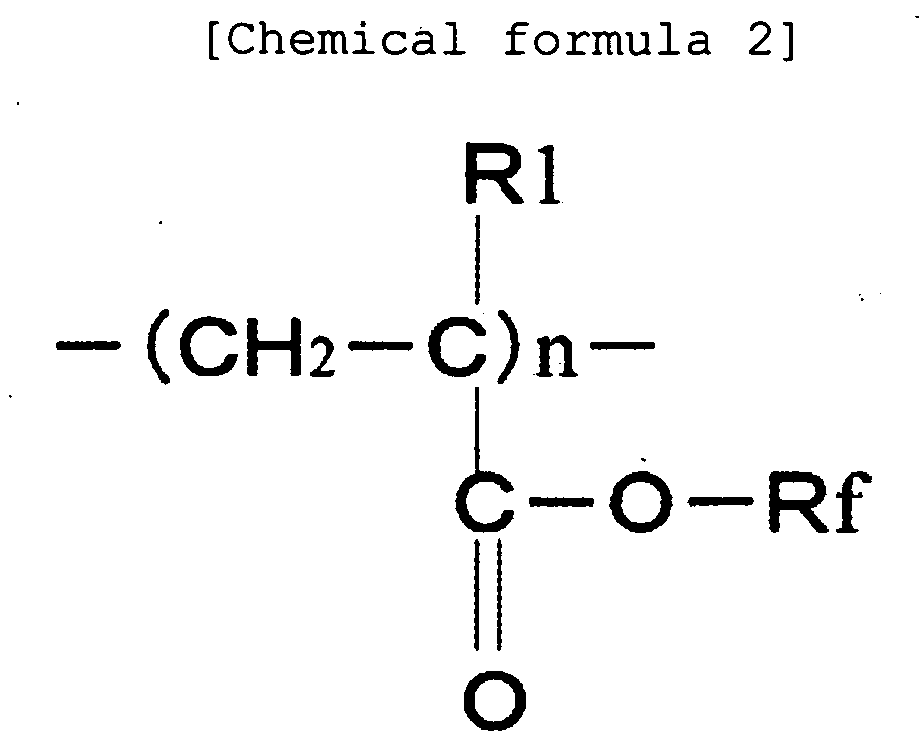
- The organic fluorochemicals can be a polymer or copolymer consisting of one or more compounds represented by the abovementioned general formula, or a copolymer with a polymerizable compound other than the abovementioned compounds such as acrylic acid, methacrylic acid, styrene, vinyl chloride-based compound or polyethylene glycol.
- The method for forming the resin film containing an organic fluorochemicals can comprise the steps of immersing the fiber structure having the triazine ring-containing compound film formed thereon into an aqueous liquid or a solvent-based liquid, mangling with a mangle, etc. to achieve the intended deposited amount, drying suitably at a temperature of 100 to 150°C, heat-treating suitably at a temperature of 160 to 190°C or immersing in a diluent at a temperature of 60 to 130°C to let the surfaces of fibers adsorb.
The method is not limited to this method. It is preferred that the deposited amount of the organic fluorochemicals-containing resin is 0.1 to 8 wt% based on the weight of the fibers. A more preferred range is 0.5 to 4 wt%. It is preferred that said organic fluorochemicals forms a film layer containing at least one of triazine ring-containing compounds and isocyanate-based compounds. The triazine ring-containing compound used can be identical with or different from the compound used for forming the aforementioned film. As the isocyanate-based compound, a compound having two or more isocyanate groups blocked by sodium sulfite or oxime-based compound such as methyl ethyl ketone oxime can be used. Further, other compounds, for example, a water absorbent, moisture absorbent, ultraviolet light absorber, photostabilizer, lubricant, antislipping agent, inorganic particles, organic particles, antistatic agent, deodorizer, antimicrobial agent, flame retarder, colorant, color deepening agent, water repellent, oil repellent, antifouling agent, etc. can be added to such an extent that the effects of this invention are not impaired. - The fiber structure of this invention has a water repellency level of grade 4 or higher and an oil repellency level of grade 4 or higher after 20 times of washing. The organic fluorochemicals per se is not directly fixed to the fibers, but is fixed via the resin film containing a triazine ring-containing compound, etc., or the organic fluorochemicals contained together with the triazine ring-containing compound in the resin is fixed to the single fibers, to greatly enhance the washing durability of the organic fluorochemicals. Thus, the fiber structure exhibits high performance of grade 4 or higher in water repellency and oil repellency even after 20 times of washing.
- Further, owing to a thin film structure in which the thickness of the resin film containing a triazine ring-containing compound, etc. is 5 to 100 nm, the coming-off of the resin due to washing can be further inhibited to remarkably enhance the washing durability. Because of such high water repellency and oil repellency, the fiber structure of this invention has excellent antifouling properties.
- The fiber structure of this invention has a contamination resistance level, namely, a contamination imperviousness level of grade 3 or higher and a washing removability level of grade 3 or higher, respectively against food contamination after 20 times of washing. A uniform film of an organic fluorochemicals and a triazine ring-containing compound is formed on the fibers, to provide performance of grade 4 or higher in water repellency and oil repellency after 20 times of washing, and exhibits performance of grade 3 or higher in contamination resistance and grade 3 or higher in washing removability, respectively against food contamination consisting of a water and oil mixture.
- Furthermore, the fiber structure of this invention has a contamination resistance level, namely, a contamination imperviousness level of grade 3 or higher and a washing removability level of grade 4 or higher, respectively against Indian ink contamination. Since Indian ink contains carbon and glue and is a highly adhesive substance, it has a nature of being adhesive and stubbornly sticky. However, as described above, since an organic fluorochemicals and a triazine ring-containing compound form a uniform film on the fibers, the fiber structure has performance of grade 4 or higher in water repellency and oil repellency after 20 times of washing, and exhibits performance of grade 3 or higher in contamination resistance and grade 4 or higher in washing removability, respectively also against Indian ink contamination.
- Moreover, the fiber structure of this invention has a sand deposition preventability level, namely, a sand imperviousness level of grade 3 or higher after 20 times of washing.
- If the fiber structure is worn as swimwear, for example, on a sandy beach, etc., sand is little deposited on the swimwear, since the fiber structure has performance of grade 4 or higher in water repellency after 20 times of washing, to exhibit a higher sand deposition preventive effect. Further, considering the sand covered with sun oil and the sun oil per se deposited on the swimwear, high oil repellency is also required. Since the fiber structure of this invention has performance of grade 4 or higher in oil repellency after 20 times of washing, a fiber structure having a sand deposition preventability level of grade 3 or higher can be obtained. Therefore, the fiber structure of this invention can be suitably used as swimwear.
- Furthermore, the fiber structure of this invention has a mud contamination removability level of grade 4 or higher after 20 times of washing. Mud in the state of containing water and oil is often rubbed into clothes when it is deposited on the clothes in daily life or during sporting activities. In such a case, since an organic fluorochemicals and a triazine ring-containing compound are used to form a uniform film on the fibers in this invention, the fiber structure has a water repellency level and an oil repellency level of grade 4 or higher respectively. Therefore, it can be prevented that mud contamination is directly deposited on the fibers, to enhance the mud contamination resistance, for providing a fiber structure with a removability level of grade 4 or higher.
- This invention is explained below in detail in reference to examples, but is not limited thereto or thereby. Meanwhile, various properties in the examples were evaluated according to the following methods.
- The water repellency was measured by the spray method specified in JIS L 1092 "Testing methods for water resistance of textiles" (1998).
- The oil repellency was measured by the method specified in AATCC TM-1966.
-
- Worcester sauce (Kagome Worcester Jojuku) was used at room temperature.
- • Coffee (Nescafe Gold Blend/Bright/Sugar) was used at 90°C.
- • Soy sauce (Kikkoman) was used at room temperature.
- • Sesame oil (Kadoya Pure Sesame Oil) was used at room temperature.
- (b) Paste
- Ketchup (Kagome Tomato Ketchup) was used at room temperature.
- B. Indian ink
- (a) Liquid
- Kuretake Seishodo Calligraphic Ink (produced by Kuretake Seishodo) was used at room temperature.
- (a) 10 cm x 10 cm specimens were prepared.
- (b) A specimen was placed on a 10 cm x 10 cm glass sheet, and a contaminant was dropped on the central portion of the specimen. A 1 mm thick 5 cm x 5 cm glass sheet was placed on the contaminated specimen and a load of 200 g was placed on the glass sheet. The test set was allowed to stand for 1 minute.
- The dropped amount of each contaminant was 0.1 cc in case of liquid, or 0.1 g in case of paste.
- (c) The load and the glass sheet were removed, and the specimen was moved onto filter paper and covered with tissue paper. A roller was applied to the tissue paper, and the contamination was wiped off. The specimen was kept horizontal and allowed to stand for 24 hours, to be naturally dried.
- (d) The grade of the contamination resistance of the contaminated specimen was judged in reference to the contamination judging gray scale for JIS color fastness, to identify the "contamination resistance."
- (e) The contaminated specimen was washed in an automatic forward and reverse turning centrifugal washing machine using 25 liters of a solution containing 0.1% of a weakly alkaline synthetic detergent in conformity with JIS K 337 at a bath ratio of 1:50 at a temperature of 40±2°C under the strong condition for 5 minutes. After draining, the specimen was washed with cold water for 5 minutes. The washed specimen was taken out without being squeezed, and lightly pressed with filter cloth for draining. It was kept horizontal and naturally dried.
- (f) The grade of the contamination resistance of the dried specimen was judged in reference to the contamination judging gray scale for JIS color fastness, to identify the "washing removability."
- 2. Sand deposition preventability was evaluated according to the following method.
- (1) A 20 x 20 cm sample was perfectly soaked in water.
- The state where the sample was perfectly soaked in water refers to the state where the fabric sank in water or where water permeated the fabric and came out from the other side of the fabric.
- (2) A water repellency tester (spray method) was used, and a perfectly soaked fabric was attached to the metallic frame.
- (3) According to an ordinary water repellency testing method (spray method), water of room temperature was poured over the fabric.
- (4) Immediately after water was exhausted, dry standard sand (Toyo Dry Sand No. 6 produced by Toyo Matelan Co., Ltd.) was sprinkled evenly over the fabric.
- (5) The metallic frame was removed from the base, and one end of it was held and shaken lightly in the vertical direction to drop sand.
- (6) After the sand was dropped, the sand remaining state was visually judged (A specimen deposited with much sand was evaluated as grade 1, while a specimen deposited with little sand was evaluated as grade 5.)
- Tuff load grains, blackish volcanic ash soil and water were ground and mixed at a ratio by weight of 1/1/1, to prepare a contaminant.
- (a) A 10 cm x 10 cm specimen was prepared.
- (b) The specimen was placed on a 10 cm x 10 cm glass sheet, and was coated with 20 g of the contaminant using a knife coater. The coated specimen was allowed to stand for being dried for 24 hours, and the contaminant was knocked off by hand.
- (c) The grade of the contamination resistance of the contaminated specimen was judged in reference to the contamination judging gray scale for JIS color fastness, to identify the "contamination resistance."
- (d) The contaminated specimen was washed in an automatic forward and reverse turning centrifugal washing machine using 25 liters of a solution containing 0.1% of a weakly alkaline synthetic detergent in conformity with JIS K 337 at a bath ratio of 1:50 at a temperature of 40±2°C under the strong condition for 5 minutes. After draining, the specimen was washed with cold water for 5 minutes. The washed specimen was taken out without being squeezed, and lightly pressed with filter cloth for draining. It was kept horizontal and naturally dried.
- (e) The grade of the contamination resistance of the dried specimen was judged in reference to the contamination judging gray scale for JIS color fastness, to identify the "washing removability."
- The abovementioned food contamination resistance, washing removability, etc. were measured as the performance of each fiber structure washed 20 times by the following washing method.
- A specimen was washed in an automatic forward and reverse turning centrifugal washing machine using a solution containing 0.2% of a weakly alkaline synthetic detergent in conformity with JIS K 337 at a bath ratio of 1:50 at a temperature of 40±2°C under the strong condition for 5 minutes. After draining, the specimen was washed with cold water for 5 minutes. This operation was performed 20 times repetitively, and the specimen was dried in air.
- False twist textured polyethylene terephthalate 84-decitex 72-filament yarns were used as warp threads and weft threads and woven to form a plain weave fabric, and said woven fabric was scoured by an open soaper type continuous scouring machine at a temperature of 95°C, washed with hot water at a temperature of 60°C, washed with cold water, then dried at a temperature of 130°C, jet-dyed to light yellow at a temperature of 130°C, washed with hot water, dried at 130°C, and set on a pin tenter at a temperature of 170°C, to obtain a woven fabric with a warp thread density/weft thread density of 138/90/2.54 cm. Said dyed fabric was subjected to the following fiber surface covering treatment and organic fluorochemicals treatment. The results of evaluating the performance of the obtained fabric are shown in Table 1.
-
- (a) Beckamine M-3 (triazine ring-containing compound, solid content 80%, produced by Dainippon Ink and Chemicals, Inc.)
- (b) F-200 (fluorine-based compound, solid content 20%, produced by Kyoken Kasei KK)
- (c) NK Guard SR-108 (fluorine-based resin, solid content 20%, produced by Nicca Chemical Co., Ld.)
- Then, it was washed with hot water at a temperature of 70°C, washed with cold water, dried at a temperature of 130°C, and set on a pin tenter at a temperature of 160°C.
-
- (i) F-470 (fluorine-based compound, solid content 20%, produced by Kyoken Kasei KK)
- (ii) F-200 (fluorine-based compound, solid content 20%, produced by Kyoken Kasei KK)
- (iii) NK Guard SR-108 (fluorine-based resin, solid content 20%, produced by Nicca Chemical Co., Ltd.)
- (iv) AG-E061 (fluorine-based resin, solid content 20%, produced by Asahi Glass Co., Ltd.)
- From Table 1, it can be seen that the fabrics in conformity with this invention had all of excellent durable water repellency, oil repellency and antifouling properties.
- [Table 1]

- Polyethylene terephthalate 44-decitex 36-filament yarns and 44-decitex polyurethane elastic yarns produced by Opelontex Co., Ltd. were used. The polyethylene terephthalate yarns were supplied to the front reed of a 32-gauge two-reed single tricot machine and polyurethane yarns were supplied to the back reed, to knit a half-tricot fabric consisting of 80 wt% of polyethylene terephthalate yarns and 20 wt% of polyurethane yarns. Then, said knitted fabric was scoured using an open soaper type continuous scouring machine at a temperature of 95°C, washed with hot water at a temperature of 60°C, washed with cold water, then dried at a temperature of 130°C, set on a pin tenter at 190°C, subsequently jet-dyed to light beige at a temperature of 130°C, washed with hot water, dried at 130°C, and set again on a pin tenter at a temperature of 160°C, to obtain a knitted fabric with a wale density of 62 wales/2.54 cm, a course density of 104 courses/2.54 cm, and a unit area weight of 220 g/m2. The dyed fabric was subjected to the following fiber surface covering treatment and organic fluorochemicals treatment. The results of evaluating the performance of the obtained fabric are shown in Table 2.
-
- (d) Beckamine M-3 (triazine ring-containing compound, solid content 80%, produced by Dainippon Ink and Chemicals, Inc.)
- (e) F-200 (fluorine-based compound, solid content 20%, produced by Kyoken Kasei KK)
- (f) Asahi Guard AG-1100 (fluorine-based resin, solid content 20%, produced by Meisei Chemical Works, Ltd.)
- Then, it was washed with hot water at a temperature of 70°C, washed with cold water, dried at a temperature of 130°C, and set on a pin tenter at a temperature of 160°C.
-
- (v) F-470 (fluorine-based compound, solid content 20%, produced by Kyoken Kasei KK)
- (vi) AG-E061 (fluorine-based resin, solid content 20%, produced by Asahi Glass Co., Ltd.)
- From Table 2, it can be seen that the fabrics in conformity with this invention had all of excellent durable water repellency, oil repellency and antifouling properties.
- [Table 2]

Claims (9)
- A fiber structure characterized in that each of the single fibers used in it is covered, on the surface thereof, with a resin film containing an organic fluorochemicals via a resin film containing a triazine ring-containing compound or a resin film containing an organic fluorochemicals and a triazine ring-containing compound, and that said fiber structure has a water repellency level of grade 4 or higher and an oil repellency level of grade 4 or higher after 20 times of washing.
- A fiber structure, according to claim 1, wherein the thickness of said resin film containing a triazine ring-containing compound or said resin film containing an organic fluorochemicals and a triazine ring-containing compound is 5 to 100 nm.
- A fiber structure, according to claim 1 or 2, wherein said resin film containing an organic fluorochemicals contains a triazine ring-containing compound and/or an isocyanate-based compound.
- A fiber structure, according to any one of claims 1 through 3, wherein said fiber structure has a contamination resistance level of grade 3 or higher and a washing removability level of grade 3 or higher, respectively against food contamination after 20 times of washing.
- A fiber structure, according to any one of claims 1 through 3, wherein said fiber structure has a contamination resistance level of grade 3 or higher and a washing removability level of grade 4 or higher, respectively against Indian ink contamination after 20 times of washing.
- A fiber structure, according to any one of claims 1 through 3, wherein said fiber structure has a sand deposition preventability level of grade 3 or higher after 20 times of washing.
- A fiber structure, according to any one of claims 1 through 3, wherein said fiber structure has a mud contamination removability level of grade 4 or higher after 20 times of washing.
- Swimwear comprising the fiber structure as set forth in claim 6.
- Swimwear, according to claim 8, wherein the fabric uses polyurethane-based elastic yarns and/or polytrimethylene terephthalate fibers at least partially.
Applications Claiming Priority (3)
| Application Number | Priority Date | Filing Date | Title |
|---|---|---|---|
| JP2006009667 | 2006-01-18 | ||
| JP2006154361 | 2006-06-02 | ||
| PCT/JP2007/050410 WO2007083596A1 (en) | 2006-01-18 | 2007-01-15 | Fibrous structure |
Publications (2)
| Publication Number | Publication Date |
|---|---|
| EP1978151A1 true EP1978151A1 (en) | 2008-10-08 |
| EP1978151A4 EP1978151A4 (en) | 2011-03-30 |
Family
ID=38287548
Family Applications (1)
| Application Number | Title | Priority Date | Filing Date |
|---|---|---|---|
| EP07706744A Withdrawn EP1978151A4 (en) | 2006-01-18 | 2007-01-15 | Fibrous structure |
Country Status (4)
| Country | Link |
|---|---|
| US (1) | US20100192272A1 (en) |
| EP (1) | EP1978151A4 (en) |
| JP (1) | JPWO2007083596A1 (en) |
| WO (1) | WO2007083596A1 (en) |
Families Citing this family (2)
| Publication number | Priority date | Publication date | Assignee | Title |
|---|---|---|---|---|
| CN103435738B (en) * | 2013-04-15 | 2016-06-15 | 多喜爱家纺股份有限公司 | A kind of preparation technology of Medical face fabric activity three anti-auxiliary agents |
| WO2020203434A1 (en) * | 2019-04-01 | 2020-10-08 | 東レ株式会社 | Fibrous structure containing elastic polyurethane yarn |
Family Cites Families (21)
| Publication number | Priority date | Publication date | Assignee | Title |
|---|---|---|---|---|
| US3128272A (en) * | 1957-06-11 | 1964-04-07 | Minnesota Mining & Mfg | Perfluoroalkyl-substituted triazines |
| US3087905A (en) * | 1960-05-03 | 1963-04-30 | American Cyanamid Co | Durable fluorochemical-melamine resin textile finish |
| JPS54133486A (en) | 1978-04-07 | 1979-10-17 | Asahi Glass Co Ltd | Water and oil repellent composition with improved durability |
| JPS54139641A (en) | 1978-04-21 | 1979-10-30 | Asahi Glass Co Ltd | Water and oil repellent treatment |
| JPS55103370A (en) * | 1979-02-01 | 1980-08-07 | Toray Industries | Stain proofing fabric and method |
| JPS5819794B2 (en) * | 1979-06-01 | 1983-04-20 | 東レ株式会社 | Antifouling fabric and its manufacturing method |
| JPS59130374A (en) | 1983-01-13 | 1984-07-26 | 東レ株式会社 | Water and oil repellent fiber product and production thereof |
| JPS60151380A (en) | 1984-01-19 | 1985-08-09 | 大日本インキ化学工業株式会社 | Durable water and oil repellent processing |
| US4803256A (en) * | 1988-02-01 | 1989-02-07 | Dow Corning Corporation | Method of altering the surface of a solid synthetic polymer |
| US6309752B1 (en) * | 1991-04-02 | 2001-10-30 | 3M Innovative Properties Company | Substrate having high initial water repellency and a laundry durable water repellency |
| JPH0681271A (en) | 1992-09-02 | 1994-03-22 | Unitika Ltd | Production of water-and oil-repellent cloth |
| JP3421774B2 (en) | 1994-01-31 | 2003-06-30 | 東洋紡績株式会社 | Method for producing water- and oil-repellent fiber structure |
| GB9414570D0 (en) * | 1994-07-19 | 1994-09-07 | Secr Defence | Oil and water repellent dyestuffs |
| JPH0967776A (en) | 1995-08-31 | 1997-03-11 | Unitika Ltd | Durable water repellent polyamide fiber cloth |
| JPH09137382A (en) * | 1995-11-10 | 1997-05-27 | Unitika Ltd | Water repellent fiber cloth |
| JPH10325078A (en) | 1997-05-21 | 1998-12-08 | Unitika Ltd | Production of durably antistatic and water-repelling fiber fabric |
| JPH11279810A (en) | 1998-03-25 | 1999-10-12 | Mizuno Corp | Swimsuit |
| JP2000129572A (en) | 1998-08-18 | 2000-05-09 | Daikin Ind Ltd | Novel carpet, antifouling agent and treatment method for carpet |
| US6391948B1 (en) * | 1999-12-14 | 2002-05-21 | 3M Innovative Properties Company | Triazine compounds and use thereof |
| JP4657562B2 (en) | 2001-01-26 | 2011-03-23 | 東レ株式会社 | Fiber structure |
| JP2005281952A (en) | 2004-03-05 | 2005-10-13 | Toray Ind Inc | Nylon fiber structure and manufacturing method thereof |
-
2007
- 2007-01-15 WO PCT/JP2007/050410 patent/WO2007083596A1/en not_active Ceased
- 2007-01-15 EP EP07706744A patent/EP1978151A4/en not_active Withdrawn
- 2007-01-15 US US12/160,944 patent/US20100192272A1/en not_active Abandoned
- 2007-01-15 JP JP2007508200A patent/JPWO2007083596A1/en active Pending
Also Published As
| Publication number | Publication date |
|---|---|
| EP1978151A4 (en) | 2011-03-30 |
| WO2007083596A1 (en) | 2007-07-26 |
| JPWO2007083596A1 (en) | 2009-06-11 |
| US20100192272A1 (en) | 2010-08-05 |
Similar Documents
| Publication | Publication Date | Title |
|---|---|---|
| JP2008542567A (en) | Textile base material with layered finish structure | |
| AU2001273163A1 (en) | Textile substrates having improved durable water repellency and soil release andmethod for producing same | |
| WO2009064503A1 (en) | Fabric treatment process | |
| JP2007270374A (en) | Water repellent and oil repellent cloth and method for producing the same | |
| Jabbar et al. | Oxygen plasma treatment to mitigate the shedding of fragmented fibres (microplastics) from polyester textiles | |
| US7012033B2 (en) | Fluorochemical-containing textile finishes that exhibit wash-durable soil release and moisture wicking properties | |
| EP3321418B1 (en) | Stainproof fiber structure | |
| JPH01225643A (en) | Surface modification of solid synthetic polymer | |
| JP7544028B2 (en) | Method for manufacturing water-repellent fiber structure, fiber structure and clothing | |
| US20100192272A1 (en) | Fiber structure | |
| CA2930467A1 (en) | Soil repellant fiber and methods of making the same | |
| CN101370976A (en) | Fibrous structure | |
| US20030154553A1 (en) | Chemically modified nonwoven articles and method for producing the same | |
| JP3852156B2 (en) | Antifouling synthetic fiber fabric and method for producing the same | |
| KR101004245B1 (en) | Compositions and Treated Substrates with Reversible Adjustable Surface Energy Properties and Methods for Making the Same | |
| US6602437B1 (en) | Chemically modified nonwoven articles and method for producing the same | |
| US20040116015A1 (en) | Fluorochemical-containing textile finishes that exhibit wash-durable soil release and moisture wicking properties | |
| JP5114946B2 (en) | Fiber structure | |
| US20030157854A1 (en) | Chemically modified nonwoven articles and method for producing the same | |
| JP2007146313A (en) | Fiber structure | |
| JP2008303511A (en) | Fiber structure | |
| JPH0681271A (en) | Production of water-and oil-repellent cloth | |
| JP2007247090A (en) | Fiber structure | |
| WO2019073898A1 (en) | Stainproof fiber structure | |
| JP2008163476A (en) | Fiber structure |
Legal Events
| Date | Code | Title | Description |
|---|---|---|---|
| PUAI | Public reference made under article 153(3) epc to a published international application that has entered the european phase |
Free format text: ORIGINAL CODE: 0009012 |
|
| 17P | Request for examination filed |
Effective date: 20080808 |
|
| AK | Designated contracting states |
Kind code of ref document: A1 Designated state(s): AT BE BG CH CY CZ DE DK EE ES FI FR GB GR HU IE IS IT LI LT LU LV MC NL PL PT RO SE SI SK TR |
|
| RIN1 | Information on inventor provided before grant (corrected) |
Inventor name: ABE, WATARU Inventor name: KAWASAKI, TAKASHI Inventor name: SEKI, MASAO Inventor name: SHIMIZU, TOSHIAKI Inventor name: KARASAWA, RUMI Inventor name: SATO, MASANOBU |
|
| A4 | Supplementary search report drawn up and despatched |
Effective date: 20110302 |
|
| GRAP | Despatch of communication of intention to grant a patent |
Free format text: ORIGINAL CODE: EPIDOSNIGR1 |
|
| RIC1 | Information provided on ipc code assigned before grant |
Ipc: A41D 7/00 20060101ALI20120210BHEP Ipc: D06M 13/358 20060101ALI20120210BHEP Ipc: D06M 13/355 20060101AFI20120210BHEP Ipc: D06M 15/423 20060101ALI20120210BHEP Ipc: D06M 15/277 20060101ALI20120210BHEP |
|
| DAX | Request for extension of the european patent (deleted) | ||
| STAA | Information on the status of an ep patent application or granted ep patent |
Free format text: STATUS: THE APPLICATION IS DEEMED TO BE WITHDRAWN |
|
| 18D | Application deemed to be withdrawn |
Effective date: 20120725 |