EP1976853B1 - Novel compounds and use thereof - Google Patents
Novel compounds and use thereof Download PDFInfo
- Publication number
- EP1976853B1 EP1976853B1 EP07709426A EP07709426A EP1976853B1 EP 1976853 B1 EP1976853 B1 EP 1976853B1 EP 07709426 A EP07709426 A EP 07709426A EP 07709426 A EP07709426 A EP 07709426A EP 1976853 B1 EP1976853 B1 EP 1976853B1
- Authority
- EP
- European Patent Office
- Prior art keywords
- compound
- compound according
- cells
- formula
- pharmaceutical composition
- Prior art date
- Legal status (The legal status is an assumption and is not a legal conclusion. Google has not performed a legal analysis and makes no representation as to the accuracy of the status listed.)
- Active
Links
- 0 CN(C)CCN1C2Nc(cc(*)c(*)c3)c3NC2C2C1CCC(C*(C*)I)C2 Chemical compound CN(C)CCN1C2Nc(cc(*)c(*)c3)c3NC2C2C1CCC(C*(C*)I)C2 0.000 description 3
Classifications
-
- A—HUMAN NECESSITIES
- A61—MEDICAL OR VETERINARY SCIENCE; HYGIENE
- A61K—PREPARATIONS FOR MEDICAL, DENTAL OR TOILETRY PURPOSES
- A61K31/00—Medicinal preparations containing organic active ingredients
- A61K31/33—Heterocyclic compounds
- A61K31/395—Heterocyclic compounds having nitrogen as a ring hetero atom, e.g. guanethidine or rifamycins
- A61K31/495—Heterocyclic compounds having nitrogen as a ring hetero atom, e.g. guanethidine or rifamycins having six-membered rings with two or more nitrogen atoms as the only ring heteroatoms, e.g. piperazine or tetrazines
- A61K31/4985—Pyrazines or piperazines ortho- or peri-condensed with heterocyclic ring systems
-
- C—CHEMISTRY; METALLURGY
- C07—ORGANIC CHEMISTRY
- C07D—HETEROCYCLIC COMPOUNDS
- C07D487/00—Heterocyclic compounds containing nitrogen atoms as the only ring hetero atoms in the condensed system, not provided for by groups C07D451/00 - C07D477/00
- C07D487/02—Heterocyclic compounds containing nitrogen atoms as the only ring hetero atoms in the condensed system, not provided for by groups C07D451/00 - C07D477/00 in which the condensed system contains two hetero rings
- C07D487/04—Ortho-condensed systems
-
- A—HUMAN NECESSITIES
- A61—MEDICAL OR VETERINARY SCIENCE; HYGIENE
- A61P—SPECIFIC THERAPEUTIC ACTIVITY OF CHEMICAL COMPOUNDS OR MEDICINAL PREPARATIONS
- A61P31/00—Antiinfectives, i.e. antibiotics, antiseptics, chemotherapeutics
-
- A—HUMAN NECESSITIES
- A61—MEDICAL OR VETERINARY SCIENCE; HYGIENE
- A61P—SPECIFIC THERAPEUTIC ACTIVITY OF CHEMICAL COMPOUNDS OR MEDICINAL PREPARATIONS
- A61P31/00—Antiinfectives, i.e. antibiotics, antiseptics, chemotherapeutics
- A61P31/12—Antivirals
-
- A—HUMAN NECESSITIES
- A61—MEDICAL OR VETERINARY SCIENCE; HYGIENE
- A61P—SPECIFIC THERAPEUTIC ACTIVITY OF CHEMICAL COMPOUNDS OR MEDICINAL PREPARATIONS
- A61P31/00—Antiinfectives, i.e. antibiotics, antiseptics, chemotherapeutics
- A61P31/12—Antivirals
- A61P31/20—Antivirals for DNA viruses
- A61P31/22—Antivirals for DNA viruses for herpes viruses
-
- Y—GENERAL TAGGING OF NEW TECHNOLOGICAL DEVELOPMENTS; GENERAL TAGGING OF CROSS-SECTIONAL TECHNOLOGIES SPANNING OVER SEVERAL SECTIONS OF THE IPC; TECHNICAL SUBJECTS COVERED BY FORMER USPC CROSS-REFERENCE ART COLLECTIONS [XRACs] AND DIGESTS
- Y02—TECHNOLOGIES OR APPLICATIONS FOR MITIGATION OR ADAPTATION AGAINST CLIMATE CHANGE
- Y02A—TECHNOLOGIES FOR ADAPTATION TO CLIMATE CHANGE
- Y02A50/00—TECHNOLOGIES FOR ADAPTATION TO CLIMATE CHANGE in human health protection, e.g. against extreme weather
- Y02A50/30—Against vector-borne diseases, e.g. mosquito-borne, fly-borne, tick-borne or waterborne diseases whose impact is exacerbated by climate change
Definitions
- the present invention relates to novel indoloquinoxaline derivatives, to methods for preparing them as well as to their pharmaceutical use.
- the invention relates to novel indoloquinoxaline derivatives and their use in the treatment of viral infections.
- viruses are the etiologic cause of many, sometimes life-threatening, diseases of both humans and animals.
- herpes viruses such as herpes simplex 1 (HSV-1), herpes simplex 2 (HSV-2), cytomegalovirus (CMV), Epstein-Barr virus (EBV), varicella zoster virus (VZV) and human herpes virus 6 (HHV 6) are associated with many common viral illnesses.
- HSV-1 herpes simplex 1
- HSV-2 herpes simplex 2
- CMV cytomegalovirus
- EBV Epstein-Barr virus
- VZV varicella zoster virus
- HHV 6 human herpes virus 6
- HCMV infection Human CMV (HCMV) infection is a life-long affliction which can result in morbidity and mortality.
- the pathologies associated with HMCV include microcephaly, heptosplenomegaly, jaundice, encephalitis, infections of the newborn infants or fetuses in utero, and infections of immunocompromised hosts.
- HCMV infection For several reasons, increasing numbers of persons are at risk for HCMV infection, and presently an estimated 80% of adults in the United States are infected with HCMV.
- a particularly susceptible group is those of weakened immune system, such as AIDS patients, where HCMV infection may cause retinitis, gastritis and pneumonitis.
- HCMV-induced pneumonias or hepatitis are frequent and serious complications of bone marrow transplants.
- European patent EP 0 238 459 relates to substituted indoloquinoxalines having the general formula wherein R 1 represents hydrogen or one or several, preferably 1 to 4, similar or different substituents in the positions 1-4 and/or 7-10, selected from halogen, preferably Br, lower alkyl/alkoxy group having not more than 4 carbon atoms, trifluoromethyl group, trichloromethyl group;
- X is a group -(CH 2 )n-R 2 , wherein R 2 represents a nitrogen containing basic residue such as NH 2 , NHR 4 or NR 5 R 6 , wherein R 4 , R 5 and R 6 independently are lower alkyl or cycloalkyl and n is an integer of from 1 to 4 and R 3 represents hydrogen, lower alkyl/cycloallcyl group having not more than 4 carbon atoms, and the physiologically acceptable addition products of the compounds with acids and halogen adducts, preferably adducts with iodine,
- the invention provides a compound according to formula (I) wherein R 1 is selected from H, F, Cl, Br, CF 3 , C 1 -C 6 alkoxy and OH; R 2 is selected from H and C 1 -C 6 alkyl; n is 1-12; m is 0 or 1; and Y is selected from CH 2 , NR 3 , (NR 3 R 4 ) + X - , O and S; R 3 and R 4 are independently selected from H and C 1 -C 4 alkyl; and X - is selected from pharmaceutically acceptable anions.
- R 1 is selected from H, F, Cl, Br, CF 3 , C 1 -C 6 alkoxy and OH
- R 2 is selected from H and C 1 -C 6 alkyl
- n is 1-12
- m is 0 or 1
- Y is selected from CH 2 , NR 3 , (NR 3 R 4 ) + X - , O and S
- R 3 and R 4 are independently selected from
- a method of preparing a compound according to formula (I) is provided, by reacting a compound of formula (II) with a compound of formula (III) L(CH 2 ) n (Y) m (CH2) n L (III) wherein R 1 , R 2 , Y, m and n are as defined herein above in respect of formula (I); and L is a leaving group; in a solvent or mixture of solvents.
- the invention provides a pharmaceutical composition
- a pharmaceutical composition comprising a compound according to formula (I) in association with at least one pharmaceutically acceptable excipient.
- the pharmaceutical composition is an antiviral composition suitable for the treatment of a viral infection.
- R 1 in formula (I) is selected from H, F, Cl, Br, CF 3 , OCH 3 and OH.
- R 2 in formula (I) is selected from H and and C 1 -C 4 alkyl, e.g. H and C 1 -C 3 alkyl, such as H and CH 3 .
- the counterion X - in formula (I) may be any suitable pharmaceutically acceptable anion, such as Cl - , Br - , methanesulfonate, toluenesulfonate, acetate, citrate and maleate.
- the index n in formula (I) may be selected from any value between 1 and 12, such as 2-10, or 4-10, e.g. 4-8; or 1-6, e.g. 1-3.
- the compound of formula (II), used in preparing the compound of the invention may itself be prepared as generally taught in EP 0 238 459 as well as in US patent 4,990,510 .
- the compound of formula (III), viz. L(CH 2 ) n (Y) m (CH 2 ) n L, may be synthesized by methods well-known to the person skilled in the art, or may be purchased from chemical suppliers.
- the leaving group L of formula (III) may suitably be selected from e.g. Cl, Br, methanesulfonyl and toluenesulfonyl, although the skilled person will realise that also other leaving groups may be contemplated.
- the solvent system used should be one wherein the reactants are soluble at the selected conditions of the reaction and should suitably be such as to favour the reaction leading to the desired product.
- a polar aprotic or protic solvent may be selected, such as acetonitril, THF, methanol, ethanol, isopropanol, ethyl acetate and methyl acetate. It is well within the knowledge of the skilled person to select such solvent system as well as suitable conditions of the reaction.
- an antiviral pharmaceutical composition comprising a compound of formula (I) and at least one pharmaceutically acceptable excipient.
- the pharmaceutical composition is for the treatment of a virus selected from herpes viruses, such as herpes simplex 1 (HSV-1), herpes simplex 2
- herpes viruses such as herpes simplex 1 (HSV-1), herpes simplex 2
- the pharmaceutical composition is for the treatment of a virus selected from herpes viruses, such as herpes simplex 1 (HSV-1), herpes simplex 2 (HSV-2), cytomegalovirus (CMV), Epstein-Barr virus (EBV), varicella zoster virus (VZV) and human herpes virus 6 (HHV 6).
- herpes viruses such as herpes simplex 1 (HSV-1), herpes simplex 2 (HSV-2), cytomegalovirus (CMV), Epstein-Barr virus (EBV), varicella zoster virus (VZV) and human herpes virus 6 (HHV 6).
- the virus is a human cytomegalovirus.
- the pharmaceutically acceptable excipients may be for example, vehicles, adjuvants, carriers or diluents, such as are well-known to the person skilled in the art and as described e.g. in Remington: The Science and Practice of Pharmacy, 21th ed., Mack Printing Company, Easton, Pennsylvania (2005 ). Further, it is contemplated that the pharmaceutical composition of the invention, in addition to a compound of formula (I), may contain also other therapeutically active substances, e.g. other antiviral agents.
- the pharmaceutical composition of the invention may be administered parenterally or orally and may be used in a local or systemic antiviral treatment of a vertebrate in need of such treatment, e.g. a bird or a mammal, such as a human or an animal such as a domestic animal or a farm animal. It is contemplated that a pharmaceutical composition of the invention may be administered together with other, compatible drugs, such as another antiviral drug in multidrug therapy.
- R 1 H
- R 2 H
- X - Br -
- B-220 (or derivatives thereof), dihaloalkane and acetonitrile were heated at reflux for 20 h. The solid thus formed was isolated by filtration, washed with acetonitrile and dried.
- the reference compound termed B-220 is 2,3-dimethyl-6-(N,N-dimethylaminoethyl)-6H-indolo(2,3-b)quinoxaline, disclosed in European patent EP 0 238 459 .
- the inhibitory effect of the tested substances is shown in Table 1, as the % of inhibition of infection. These data are the results from plaque assays using strain AD169 and TB 40 of HCMV infected human lung fibroblasts. Table 1. Inhibitory effect of tested substances as % inhibition of infection Substance Inhibitory effect (%) 1a 100 IVIg (reference) 100 B-220 (reference) 20 Leflunomide (reference) 25-50 Foscavir (reference) 20-50 Ganciclovir (reference) 20-30 The results of the test indicate that the inventive compounds have excellent inhibitory effect on viral infection.
- Infected human lung fibroblast cells were treated with the antiviral agent B-220 and with other reference substances, as shown in Table 2, and with inventive compound 1a in order to assess the effect of the inventive compounds on HCMV infection, assembly and egress.
- the antiviral agents were added at 3 or 5 days post infection (dpi) in these experiments and left in culture until 7dpi. Thereafter supernatant and crushed cells were transferred to new cell cultures over night and subsequently stained for IE expression. The results indicate how well the substances impede viral assembly and egress. More specifically, at 3dpi the majority of the viral capsids are being assembled in the nucleus whereas at 5dpi they are mainly receiving their tegumentation in the cytoplasm and some have commenced their secondary envelopment.
- the tested inventive compound 1a shows very clear inhibition of IE expression.
- electron microscopy data indicate impairment of virus assembly.
- the image analysis technique used to identify and quantify stable intermediate particles of HCMV indicated impairment of tegument protein binding to the viral capsid.
- these data show a high potential for the use of the inventive compounds in antiviral therapy.
- inventive compounds in combination with at least one other antivirally active agent, such as in a multidrug therapy, a synergistic effect is expected and the risk of acquired drug resistance may be reduced or avoided.
- the inventive compounds did not show any toxicity as assayed by propidium iodide staining of cell cultures of infected and uninfected human lung fibroblasts.
- a concentration of compound 1a 10 times the one used in the experiments showed no toxicity during the time frame 0-7dpi.
- the concentrations of compounds used in the viral experiments were at the ⁇ M level.
- Cellular toxicity for B-220 has been shown for concentrations above 100 ⁇ M.
- the human lung fibroblasts, HL-cells (MRC-5), used in these experiments were incubated at 37°C and 5% CO 2 in a solution of MEM with Earle's and L-glutamine (from GIBCO) into which 10% Foetal Calf Serum (FCS) and 1% Penicillin and Streptomycin (PeSt) were added.
- FCS Foetal Calf Serum
- PeSt Penicillin and Streptomycin
- the HL cells were being kept in a Falcon cell culture flask of 175cm 2 . Trypsin and EDTA were used to loosen the cells from the cell culture flask when transferring them to 48-well multiwells (Becton Dickinson) for infection and incubation with the antiviral agents.
- the cells were incubated until 50% confluence was reached under the same conditions as above and were used up to the 26 th passage.
- the HL cells were infected with HCMV, viral strain TB 40/E [an endothelial adapted clinical isolate (UR1814) kindly provided by Prof. G. Jahn] and viral strain AD-169, respectively, at a multiplicity of infection (MOI) of 0,02 and incubated until 3 or 5 days post infection (dpi) at 37°C and 5% CO 2 in the same mediums as above. Some cells (for the 0dpi experiment) were simultaneously exposed to the antiviral agents (see below). The negative controls were left uninfected.
- MOI multiplicity of infection
- the existing medium in the 3 and 5dpi experiments was changed and new medium added, with inhibitors and antiviral agents at different concentrations. However this was done simultaneously to the infection in the 0dpi experiment and left to incubate until 1dpi.
- the medium containing IVIg was incubated for an hour with the virus on ice prior to being added to the cells.
- the supernatant of the MRC-5 cells was transferred to uninfected cells to asses the amount of excreted virus.
- the remaining cells were given new medium and crushed with glass marbles by shaking the multiwells on an IKA-Vibrax-VXR at 300 shakes pm for 10min. Thereafter the cellular debris was transferred to uninfected cells to be able to evaluate the amount of infectious intracellular viral particles.
- Positive controls untreated infected cells
- negative controls untreated uninfected cells
- the new HL cells (in the 3 and 5dpi experiments) were fixed the following day with 3% paraformaldehyde (PFA) for 15 min at room temperature (RT).
- PFA paraformaldehyde
- RT room temperature
- 0.3% TritonX in Phosphate Buffer Saline (PBS) was used for 15 min incubation at RT followed by blocking of the background with background block from DAKO for 20 min at RT, with an amount just large enough to cover the entire surface. Thereafter all multiwells were incubated with primary antibodies (mouse), diluted to 1:100, against immediate early antigen (IEA, Antigene) for 45 min at 8 °C.
- DAPI is a chemical substance that stains the nucleus of the cells.
- the cells were analyzed by fluorescent microscopy using a Nikon Eclipse TE 2000-U.
- the amount of cells expressing IEA, in two different parts of the well, was counted by the naked eye and compared to the total amount of cells (indicated with DAPI), in those same parts. These values were used to appreciate the percentage of infected cells in each well from which the amount of inhibition achieved by the different substances was calculated. This method of calculating the percentage of infected cells in two parts of a well and then applying it to the entire well was chosen since the total amount of cells in a well would be impossible to count manually.
Landscapes
- Health & Medical Sciences (AREA)
- Chemical & Material Sciences (AREA)
- Organic Chemistry (AREA)
- Life Sciences & Earth Sciences (AREA)
- Medicinal Chemistry (AREA)
- Veterinary Medicine (AREA)
- Public Health (AREA)
- General Health & Medical Sciences (AREA)
- Animal Behavior & Ethology (AREA)
- Pharmacology & Pharmacy (AREA)
- Virology (AREA)
- Communicable Diseases (AREA)
- Nuclear Medicine, Radiotherapy & Molecular Imaging (AREA)
- General Chemical & Material Sciences (AREA)
- Chemical Kinetics & Catalysis (AREA)
- Oncology (AREA)
- Epidemiology (AREA)
- Molecular Biology (AREA)
- Biotechnology (AREA)
- Engineering & Computer Science (AREA)
- Pharmaceuticals Containing Other Organic And Inorganic Compounds (AREA)
- Organic Low-Molecular-Weight Compounds And Preparation Thereof (AREA)
- Nitrogen And Oxygen Or Sulfur-Condensed Heterocyclic Ring Systems (AREA)
- Nitrogen Condensed Heterocyclic Rings (AREA)
Abstract
Description
- The present invention relates to novel indoloquinoxaline derivatives, to methods for preparing them as well as to their pharmaceutical use. In particular, the invention relates to novel indoloquinoxaline derivatives and their use in the treatment of viral infections.
- As is well-known, viruses are the etiologic cause of many, sometimes life-threatening, diseases of both humans and animals. For example, herpes viruses such as herpes simplex 1 (HSV-1), herpes simplex 2 (HSV-2), cytomegalovirus (CMV), Epstein-Barr virus (EBV), varicella zoster virus (VZV) and human herpes virus 6 (HHV 6) are associated with many common viral illnesses.
- Human CMV (HCMV) infection is a life-long affliction which can result in morbidity and mortality. The pathologies associated with HMCV include microcephaly, heptosplenomegaly, jaundice, encephalitis, infections of the newborn infants or fetuses in utero, and infections of immunocompromised hosts.
- For several reasons, increasing numbers of persons are at risk for HCMV infection, and presently an estimated 80% of adults in the United States are infected with HCMV. A particularly susceptible group is those of weakened immune system, such as AIDS patients, where HCMV infection may cause retinitis, gastritis and pneumonitis. Also, HCMV-induced pneumonias or hepatitis are frequent and serious complications of bone marrow transplants.
- European patent
EP 0 238 459 relates to substituted indoloquinoxalines having the general formula
- However, it is clear that there still exists an urgent need for new medicaments having antiviral efficacy, in particular against herpes viruses such as HMCV, and an object of the present invention is to provide compounds fulfilling this need.
- According to a first aspect the invention provides a compound according to formula (I)

R1 is selected from H, F, Cl, Br, CF3, C1-C6 alkoxy and OH;
R2 is selected from H and C1-C6 alkyl;
n is 1-12;
m is 0 or 1; and
Y is selected from CH2, NR3, (NR3R4)+X-, O and S;
R3 and R4 are independently selected from H and C1-C4 alkyl; and
X- is selected from pharmaceutically acceptable anions. - According to another aspect, a method of preparing a compound according to formula (I) is provided, by reacting a compound of formula (II)

L(CH2)n(Y)m(CH2)nL (III)
wherein
R1, R2, Y, m and n are as defined herein above in respect of formula (I); and
L is a leaving group;
in a solvent or mixture of solvents. - According to a still further aspect the invention provides a pharmaceutical composition comprising a compound according to formula (I) in association with at least one pharmaceutically acceptable excipient.
- According to a one aspect of the invention, the pharmaceutical composition is an antiviral composition suitable for the treatment of a viral infection.
- Further aspects of the invention as well as embodiments thereof are as defined in the claims.
- In one embodiment of the present invention, R1 in formula (I) is selected from H, F, Cl, Br, CF3, OCH3 and OH.
- Furthermore, in one embodiment of the invention, R2 in formula (I) is selected from H and and C1-C4 alkyl, e.g. H and C1-C3 alkyl, such as H and CH3.
- The counterion X- in formula (I) may be any suitable pharmaceutically acceptable anion, such as Cl-, Br-, methanesulfonate, toluenesulfonate, acetate, citrate and maleate.
- The index n in formula (I) may be selected from any value between 1 and 12, such as 2-10, or 4-10, e.g. 4-8; or 1-6, e.g. 1-3.
- The compound of formula (II), used in preparing the compound of the invention, may itself be prepared as generally taught in
EP 0 238 459 as well as inUS patent 4,990,510 . - The compound of formula (III), viz. L(CH2)n(Y)m(CH2)nL, may be synthesized by methods well-known to the person skilled in the art, or may be purchased from chemical suppliers.
- The leaving group L of formula (III) may suitably be selected from e.g. Cl, Br, methanesulfonyl and toluenesulfonyl, although the skilled person will realise that also other leaving groups may be contemplated.
- The solvent system used should be one wherein the reactants are soluble at the selected conditions of the reaction and should suitably be such as to favour the reaction leading to the desired product. As an example, one or several of a polar aprotic or protic solvent may be selected, such as acetonitril, THF, methanol, ethanol, isopropanol, ethyl acetate and methyl acetate. It is well within the knowledge of the skilled person to select such solvent system as well as suitable conditions of the reaction.
- The compounds of the invention are useful as antiviral agents and thus, according to one aspect of the invention, an antiviral pharmaceutical composition is provided comprising a compound of formula (I) and at least one pharmaceutically acceptable excipient.
- In one embodiment of the invention, the pharmaceutical composition is for the treatment of a virus selected from herpes viruses, such as herpes simplex 1 (HSV-1), herpes simplex 2
- In one embodiment of the invention, the pharmaceutical composition is for the treatment of a virus selected from herpes viruses, such as herpes simplex 1 (HSV-1), herpes simplex 2 (HSV-2), cytomegalovirus (CMV), Epstein-Barr virus (EBV), varicella zoster virus (VZV) and human herpes virus 6 (HHV 6).
- In one embodiment of the invention, the virus is a human cytomegalovirus.
- The pharmaceutically acceptable excipients may be for example, vehicles, adjuvants, carriers or diluents, such as are well-known to the person skilled in the art and as described e.g. in Remington: The Science and Practice of Pharmacy, 21th ed., Mack Printing Company, Easton, Pennsylvania (2005). Further, it is contemplated that the pharmaceutical composition of the invention, in addition to a compound of formula (I), may contain also other therapeutically active substances, e.g. other antiviral agents.
- The pharmaceutical composition of the invention may be administered parenterally or orally and may be used in a local or systemic antiviral treatment of a vertebrate in need of such treatment, e.g. a bird or a mammal, such as a human or an animal such as a domestic animal or a farm animal. It is contemplated that a pharmaceutical composition of the invention may be administered together with other, compatible drugs, such as another antiviral drug in multidrug therapy.
- Herein below the invention is further illustrated by examples that should however not be construed as limiting the invention, the scope of which is defined by the claims. It is noted that the numbering of each one of the two ring systems is the same as for the general formula of the substituted indoloquinoxaline of European patent
EP 0 238 459 , as shown herein above. - NMR spectra were recorded in DMSO-d6 solutions at room temperature and using the signal from DMSO-d6 (1H: δ = 2.50 ppm; 13C: δ = 39.5) as internal standard, on a Bruker DPX 300 (300 MHz) spectrometer. Values of δ are given in ppm. Solvents were of analytical grade and were used as received from the supplier.
- B-220 (formula II, R1 = H, R2 = CH3, or derivatives thereof), dihaloalkane and acetonitrile were heated (at reflux or at 70 °C) for 15 h. The solid thus formed was isolated by filtration, washed with acetonitrile and dried.
- Yield: 70%; 1H-NMR δ: 8.34 (d, 1H), 7.94 (m, 2H), 7.77 (m, 2H), 7.43 (t, 1H), 4.93 (br. s, 2H), 3.86 (br. s, 2H), 3.54 (br. s, 2H), 3.27 (s, 6H), 2.39 (s, 6H), 1.77 (br. s, 2H), 1.28 (br. s, 2H).
- Yield: 49 %; 1H-NMR δ: 8.35 (d, 1H), 8.00 (s, 1H), 7.92 (d, 1H), 7.80 (m, 2H), 7.45 (t, 1H), 4.91 (t, 2H), 3.85 (t, 2H), 3.49 (m, 2H), 3.24 (s, 6H), 2.48 (s, 3H), 2.45 (s, 3H), 1.69 (m, 2H), 1.17 (s, 6H).
- Yield: 73 %; 1H-NMR δ: 8.39 (s, 1H), 8.08-7.81 (m, 3H), 7.73 (s, 1H), 5.16 (br. s, 2H), 3.69 (br. s, 2H), 3.43 (br. s, 2H), 3.25 (s, 6H), 2.39 (s, 3H), 2.37 (s, 3H), 1.88 (br. s, 2H), 1.32 (br. s, 2H).
- 13C-NMR DMSO-d6 δ: 21.6 (t), 25.2 (t), 35.3 (t), 50.8 (q), 59.0 (t), 63.3 (t), 112.6 (d), 120.4 (s), 121.6 (d), 126.1 (s), 126.8 (d), 127.5 (d), 129.3 (d), 129.8 (d), 131.1 (d), 138.6 (s), 139.0 (s), 139.8 (s), 142.0 (s), 144.9 (s).
- 13C-NMR DMSO-d6 δ: 17.0 (t), 35.0 (t), 50.9 (q), 59.9 (t), 60.5 (t), 110.8 (d), 119.0 (s), 121.7 (d), 122.4 (d), 126.5 (d), 127.5 (d), 129.2 (d)*, 131.5 (d), 138.9 (s), 139.5 (s), 139.7 (s) 143.5 (s), 144.7 (s).
* 1 signal for two carbons - 13C-NMR DMSO-d6 δ: 21.7 (t), 25.4 (t), 35.0 (t), 50.8 (q), 59.2(t), 63.2 (t), 110.7 (d), 119.1 (s), 121.8 (d), 122.5 (d), 126.6 (d), 127.4 (d), 129.2 (d), 129.3 (d), 131.6 (d), 139.0 (s), 139.6 (s), 139.8 (s), 143.6 (s), 144.8 (s).
- B-220 (or derivatives thereof), dihaloalkane and acetonitrile were heated at reflux for 20 h. The solid thus formed was isolated by filtration, washed with acetonitrile and dried.
- Yield: 58 %; 1H-NMR δ: 8.22 (d, 1H), 7.84 (s, 1H), 7.72 (m, 2H), 7.59 (s, 1H), 7.47 (d, 1H), 7.38 (t, 1H), 7.08 (d, 1H), 4.85 (t, 2H), 4.09 (br. s, 2H), 3.93 (m, 4H), 3.29 (s, 6H), 2.35 (s, 3H), 2.26 (s, 3H), 2.24 (s, 3H).
- Yield: 91 %; 1H-NMR δ: 8.02 (d, 1H), 7.77-7.66 (m, 3H), 7.49 (s, 1H), 7.45 (d, 2H), 7.07 (d, 2H), 4.78 (t, 2H), 4.11 (br. s, 2H), 3.95-3.90 (m, 4H), 3.27 (s, 6H), 2.31 (s, 3H), 2.26 (s, 3H), 2.18 (s, 3H).
- Tests of antiviral activity against human cytomegalovirus as described herein below were performed on a compound according to the invention, viz. the compound 1a of EXAMPLE 1. The reference compound termed B-220 is 2,3-dimethyl-6-(N,N-dimethylaminoethyl)-6H-indolo(2,3-b)quinoxaline, disclosed in European patent
EP 0 238 459 . - In order to assess whether targeting structural viral proteins would be as efficient as targeting viral transcription a modified plaque assay was set up, wherein one of the new antiviral agents was compared with already acknowledged antiviral agents that inhibit either HCMV's transcription [GCV (Cymevene, Roche) and PFA (Foscavir, AstraZeneca)] or infection [IVIg (MG CP, Biotest Pharma), an antibody.
- In a 0 dpi (days post infection) experiment the antiviral agents and TB40/E were added simultaneously, thereby indicating how well the agents inhibit infection. The results from this experiment were obtained by comparing the amount of infected cells of the treated wells to that of the positive controls, thus calculating the inhibition of infection achieved by the agents in question. The experiment was repeated with the HCMV strain AD-169 and with a clinical isolate, respectively, with essentially the same results.
- The inhibitory effect of the tested substances is shown in Table 1, as the % of inhibition of infection. These data are the results from plaque assays using strain AD169 and TB 40 of HCMV infected human lung fibroblasts.
Table 1. Inhibitory effect of tested substances as % inhibition of infection Substance Inhibitory effect (%) 1a 100 IVIg (reference) 100 B-220 (reference) 20 Leflunomide (reference) 25-50 Foscavir (reference) 20-50 Ganciclovir (reference) 20-30 - Infected human lung fibroblast cells (HL cells) were treated with the antiviral agent B-220 and with other reference substances, as shown in Table 2, and with inventive compound 1a in order to assess the effect of the inventive compounds on HCMV infection, assembly and egress.
- The antiviral agents were added at 3 or 5 days post infection (dpi) in these experiments and left in culture until 7dpi. Thereafter supernatant and crushed cells were transferred to new cell cultures over night and subsequently stained for IE expression. The results indicate how well the substances impede viral assembly and egress. More specifically, at 3dpi the majority of the viral capsids are being assembled in the nucleus whereas at 5dpi they are mainly receiving their tegumentation in the cytoplasm and some have commenced their secondary envelopment.
- In Table 2 the inhibitory effect of the antiviral substances using the modified plaque assay system is shown. Several substances showed 100% inhibition of IE expression as measured by IE staining and no capsid formation was observed in the nucleus of the majority of the treated cells as observed by electron microscopy examination. The inventive compound termed 1a showed extremely good results matching the results obtained by Ganciclovir.
Table 2. Inhibitory effect of antiviral substances Substance Inhibition 3dpi (%) Inhibition 5dpi (%) 1a 95-100 85-95 B-220 (reference) 65-85 65-80 Leflonumide (reference) 65-80 80-90 Foscavir (reference) 85-100 65-85 Ganciclovir (reference) 100 80-95 - Without wishing to be bound to any theory of the mechanism of action of the inventive compounds, it is noted that the tested inventive compound 1a shows very clear inhibition of IE expression. Furthermore, electron microscopy data indicate impairment of virus assembly. Indeed, the image analysis technique used to identify and quantify stable intermediate particles of HCMV indicated impairment of tegument protein binding to the viral capsid. Together these data show a high potential for the use of the inventive compounds in antiviral therapy. Also, by using the inventive compounds in combination with at least one other antivirally active agent, such as in a multidrug therapy, a synergistic effect is expected and the risk of acquired drug resistance may be reduced or avoided.
- The inventive compounds did not show any toxicity as assayed by propidium iodide staining of cell cultures of infected and uninfected human lung fibroblasts. A concentration of compound 1a 10 times the one used in the experiments showed no toxicity during the time frame 0-7dpi. The concentrations of compounds used in the viral experiments were at the µM level. Cellular toxicity for B-220 has been shown for concentrations above 100µM.
- The human lung fibroblasts, HL-cells (MRC-5), used in these experiments were incubated at 37°C and 5% CO2 in a solution of MEM with Earle's and L-glutamine (from GIBCO) into which 10% Foetal Calf Serum (FCS) and 1% Penicillin and Streptomycin (PeSt) were added.
- When the experiment commenced the HL cells were being kept in a Falcon cell culture flask of 175cm2. Trypsin and EDTA were used to loosen the cells from the cell culture flask when transferring them to 48-well multiwells (Becton Dickinson) for infection and incubation with the antiviral agents.
- The cells were incubated until 50% confluence was reached under the same conditions as above and were used up to the 26th passage.
- The HL cells were infected with HCMV, viral strain TB 40/E [an endothelial adapted clinical isolate (UR1814) kindly provided by Prof. G. Jahn] and viral strain AD-169, respectively, at a multiplicity of infection (MOI) of 0,02 and incubated until 3 or 5 days post infection (dpi) at 37°C and 5% CO2 in the same mediums as above. Some cells (for the 0dpi experiment) were simultaneously exposed to the antiviral agents (see below). The negative controls were left uninfected.
- The existing medium (in the 3 and 5dpi experiments) was changed and new medium added, with inhibitors and antiviral agents at different concentrations. However this was done simultaneously to the infection in the 0dpi experiment and left to incubate until 1dpi. The medium containing IVIg was incubated for an hour with the virus on ice prior to being added to the cells.
- In the 3- and 5dpi-experiments the supernatant of the MRC-5 cells was transferred to uninfected cells to asses the amount of excreted virus. The remaining cells were given new medium and crushed with glass marbles by shaking the multiwells on an IKA-Vibrax-VXR at 300 shakes pm for 10min. Thereafter the cellular debris was transferred to uninfected cells to be able to evaluate the amount of infectious intracellular viral particles.
- After letting the viral particles infect the new cells for approximately one hour the medium was changed, thus washing away the cellular debris.
- In the 0dpi-experiments the cells were fixed immediately 1dpi (in accordance with the procedure explained below).
- Positive controls (untreated infected cells) and negative controls (untreated uninfected cells), were treated, respectively, as above.
- The new HL cells (in the 3 and 5dpi experiments) were fixed the following day with 3% paraformaldehyde (PFA) for 15 min at room temperature (RT). To make the cells permeable, 0.3% TritonX in Phosphate Buffer Saline (PBS) was used for 15 min incubation at RT followed by blocking of the background with background block from DAKO for 20 min at RT, with an amount just large enough to cover the entire surface. Thereafter all multiwells were incubated with primary antibodies (mouse), diluted to 1:100, against immediate early antigen (IEA, Antigene) for 45 min at 8 °C. Subsequently the cells were incubated with secondary antibodies, rabbit anti mouse FITC (Dako Cytomation), diluted to 1:100, for 45 min at 8 °C and simultaneously stained with DAPI (Sigma), diluted to 1:250 DAPI is a chemical substance that stains the nucleus of the cells.
- The positive and negative controls, of both cell types, were treated, respectively, as above.
- The cells were analyzed by fluorescent microscopy using a Nikon Eclipse TE 2000-U. The amount of cells expressing IEA, in two different parts of the well, was counted by the naked eye and compared to the total amount of cells (indicated with DAPI), in those same parts. These values were used to appreciate the percentage of infected cells in each well from which the amount of inhibition achieved by the different substances was calculated. This method of calculating the percentage of infected cells in two parts of a well and then applying it to the entire well was chosen since the total amount of cells in a well would be impossible to count manually.
Claims (17)
- A compound of formula (I)
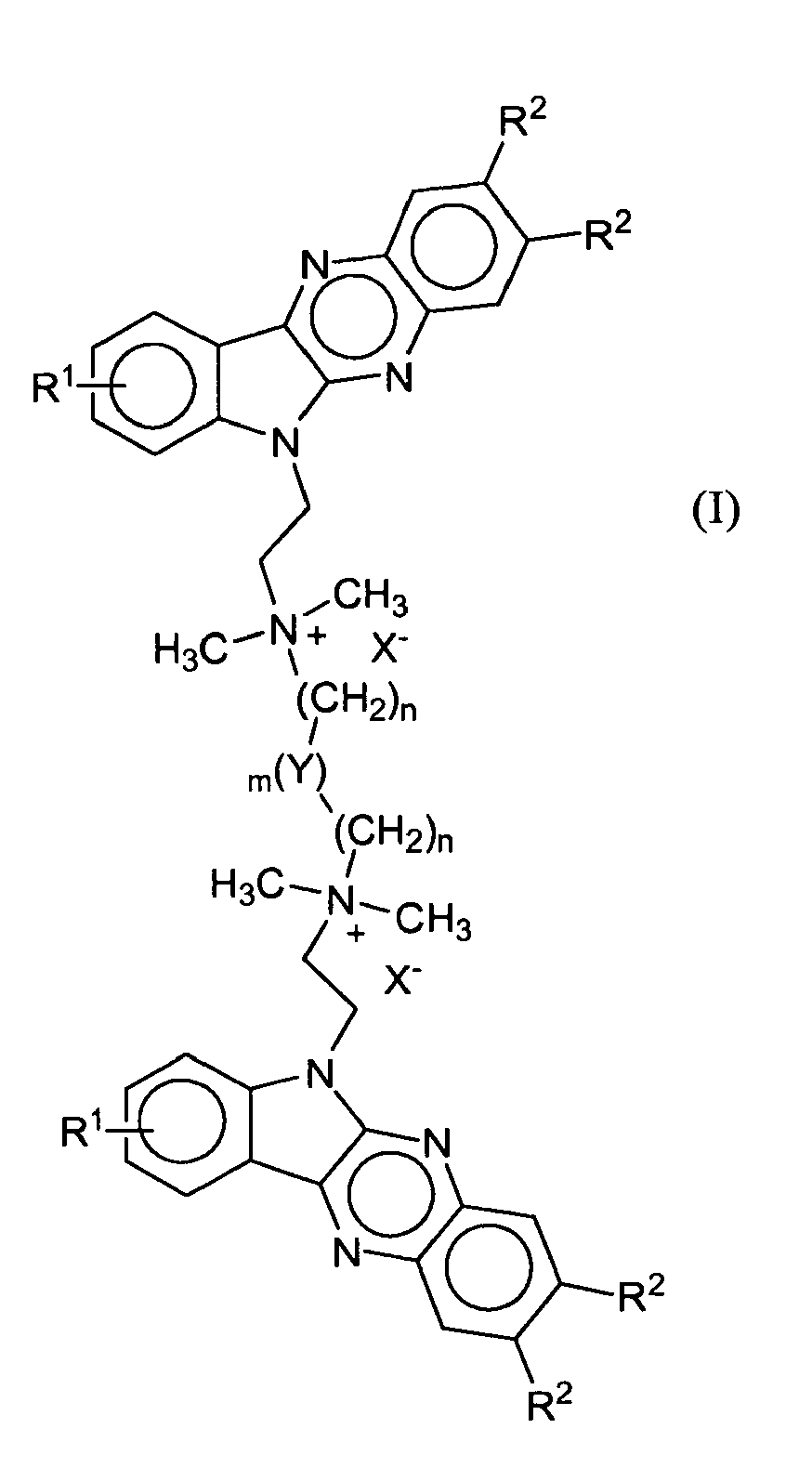
R1 is selected from H, F, Cl, Br, CF3, C1-C6 alkoxy and OH;
R2 is selected from H and C1-C6 alkyl;
n is 1-12;
m is 0 or 1; and
Y is selected from CH2, NR3, (NR3R4)+X-, O and S;
R3 and R4 are independently selected from H and C1-C4 alkyl; and
X- is selected from pharmaceutically acceptable anions. - A compound according to claim 1, wherein R1 is selected from H, F, Cl, Br, CF3, OCH3 and OH.
- A compound according to claim 1 or 2, wherein R2 is selected from H and CH3.
- A compound according to any of the claims 1-3, wherein X- is selected from Cl-, Br-, methanesulfonate, toluenesulfonate, acetate, citrate and maleate.
- A compound according to any of the claims 1-4, wherein m is 0.
- A compound according to any of the claims 1-4, wherein m is 1.
- A compound according to according to claim 6, wherein Y is O.
- A compound according to any of the claims 1-7, wherein n is 4-10.
- A compound according to any of the claims 1-7, wherein n is 1-3.
- A compound according to claim 1, wherein
R1=H, R2=CH3, n=3, m=0, X-=Br-;
R1=H, R2=CH3, n=5, m=0, X-=Br-;
R1 = 9-Br, R2 = CH3, n = 3, m = 0, X-= Br-;
R1=9-Cl, R2=H, n=3, m=0, X-=Br-;
R1 =H, R2=H, n= 1, m = 1, Y = CH2, X-= Br-;
R1=H, R2=H, n=3, m=0, X-=Br-;
R1=H, R2=CH3, n=2, Y=O, m=1, X-=Br-; or
R1 = 9-Br, R2 = CH3, n =2, Y = O, m = 1, X-=Br-. - A method of preparing a compound according to any of the claims 1-10, by reacting a compound of formula (II)

L(CH2)n(Y)m(CH2)nL (III)
wherein
R1, R2, Y, m and n are as defined in any of the claims 1-10; and
L is a leaving group; in a solvent or mixture of solvents. - A method according to claim 11, wherein the leaving group is selected from Cl, Br, methanesulfonyl and toluenesulfonyl.
- A compound according to any of the claims 1-10 for use as a pharmaceutical.
- A pharmaceutical composition comprising a compound according to any of the claims 1-10 and a pharmaceutically acceptable excipient.
- A pharmaceutical composition according to claim 14, for use as an antiviral drug.
- A pharmaceutical composition according to claim 15, for use as a drug against herpes virus.
- A pharmaceutical composition according to claim 16, wherein the herpes virus is human cytomegalovirus.
Priority Applications (3)
| Application Number | Priority Date | Filing Date | Title |
|---|---|---|---|
| SI200730657T SI1976853T1 (en) | 2006-01-23 | 2007-01-22 | Novel compounds and use thereof |
| PL07709426T PL1976853T3 (en) | 2006-01-23 | 2007-01-22 | Novel compounds and use thereof |
| CY20111100698T CY1112596T1 (en) | 2006-01-23 | 2011-07-18 | NEW UNIONS AND USE OF THEM |
Applications Claiming Priority (2)
| Application Number | Priority Date | Filing Date | Title |
|---|---|---|---|
| SE0600134A SE529777C2 (en) | 2006-01-23 | 2006-01-23 | New compounds and their use |
| PCT/SE2007/050033 WO2007084073A1 (en) | 2006-01-23 | 2007-01-22 | Novel compounds and use thereof |
Publications (3)
| Publication Number | Publication Date |
|---|---|
| EP1976853A1 EP1976853A1 (en) | 2008-10-08 |
| EP1976853A4 EP1976853A4 (en) | 2010-04-21 |
| EP1976853B1 true EP1976853B1 (en) | 2011-04-20 |
Family
ID=38287919
Family Applications (1)
| Application Number | Title | Priority Date | Filing Date |
|---|---|---|---|
| EP07709426A Active EP1976853B1 (en) | 2006-01-23 | 2007-01-22 | Novel compounds and use thereof |
Country Status (24)
| Country | Link |
|---|---|
| US (1) | US8076341B2 (en) |
| EP (1) | EP1976853B1 (en) |
| JP (1) | JP5190379B2 (en) |
| CN (1) | CN101374845B (en) |
| AR (1) | AR059149A1 (en) |
| AT (1) | ATE506365T1 (en) |
| AU (1) | AU2007206092B2 (en) |
| BR (1) | BRPI0707203C1 (en) |
| CA (1) | CA2637417C (en) |
| CY (1) | CY1112596T1 (en) |
| DE (1) | DE602007014008D1 (en) |
| DK (1) | DK1976853T3 (en) |
| ES (1) | ES2365423T3 (en) |
| HR (1) | HRP20110534T1 (en) |
| IL (1) | IL192820A (en) |
| NZ (1) | NZ569840A (en) |
| PL (1) | PL1976853T3 (en) |
| PT (1) | PT1976853E (en) |
| RS (1) | RS51933B (en) |
| RU (1) | RU2437887C2 (en) |
| SE (1) | SE529777C2 (en) |
| SI (1) | SI1976853T1 (en) |
| WO (1) | WO2007084073A1 (en) |
| ZA (1) | ZA200806315B (en) |
Families Citing this family (3)
| Publication number | Priority date | Publication date | Assignee | Title |
|---|---|---|---|---|
| EP2128160B1 (en) | 2008-04-30 | 2010-07-14 | Universität Duisburg-Essen | Indolo[2,3-b]-, Indeno[1,2-b]- and Indeno[2,1-b]pyrido[2,3-f] quinoxaline-3-carboxylic acids and esters, processes for their preparation and their use as antiviral, antibiotic and antitumor agents |
| EP2489354A1 (en) | 2011-02-18 | 2012-08-22 | Vironova AB | Pharmaceutical formulation of B220 for topical treatment of herpes |
| CN105061432B (en) * | 2015-07-16 | 2017-09-29 | 河北大学 | [2,3 b] quinoxaline derivant, pharmaceutical composition and its preparation of 6H indoles and application |
Family Cites Families (4)
| Publication number | Priority date | Publication date | Assignee | Title |
|---|---|---|---|---|
| SE8600261D0 (en) * | 1986-01-21 | 1986-01-21 | Lundblad Leif | INDOLOKINOXALINES WITH SUBSTITUTIONS IN 6-POSITION CONTAINING CYCLIC GROUPS |
| SE8600260D0 (en) * | 1986-01-21 | 1986-01-21 | Lundblad Leif | SUBSTITUTED INDOLOKINOXALINES |
| SE504862C2 (en) * | 1994-12-27 | 1997-05-20 | Leif J I Lundblad | Use of certain indolo- §2,3b-quinoxalines for the preparation of a drug for the protection of DNA in the initiation and / or promotional phase of carcinogenesis and for the prevention of oxidative stress in patients with diseases related to free radicals |
| SE527639C2 (en) * | 2004-06-17 | 2006-05-02 | Oxypharma Ab | Alkyl-substituted indoloquinoxalins |
-
2006
- 2006-01-23 SE SE0600134A patent/SE529777C2/en not_active IP Right Cessation
-
2007
- 2007-01-22 RS RS20110304A patent/RS51933B/en unknown
- 2007-01-22 JP JP2008551228A patent/JP5190379B2/en not_active Expired - Fee Related
- 2007-01-22 AU AU2007206092A patent/AU2007206092B2/en not_active Ceased
- 2007-01-22 PT PT07709426T patent/PT1976853E/en unknown
- 2007-01-22 BR BRPI0707203A patent/BRPI0707203C1/en not_active IP Right Cessation
- 2007-01-22 AT AT07709426T patent/ATE506365T1/en active
- 2007-01-22 EP EP07709426A patent/EP1976853B1/en active Active
- 2007-01-22 PL PL07709426T patent/PL1976853T3/en unknown
- 2007-01-22 RU RU2008134509/04A patent/RU2437887C2/en active
- 2007-01-22 CN CN2007800028861A patent/CN101374845B/en not_active Expired - Fee Related
- 2007-01-22 ZA ZA200806315A patent/ZA200806315B/en unknown
- 2007-01-22 WO PCT/SE2007/050033 patent/WO2007084073A1/en not_active Ceased
- 2007-01-22 HR HR20110534T patent/HRP20110534T1/en unknown
- 2007-01-22 CA CA2637417A patent/CA2637417C/en not_active Expired - Fee Related
- 2007-01-22 SI SI200730657T patent/SI1976853T1/en unknown
- 2007-01-22 NZ NZ569840A patent/NZ569840A/en not_active IP Right Cessation
- 2007-01-22 AR ARP070100274A patent/AR059149A1/en not_active Application Discontinuation
- 2007-01-22 DK DK07709426.6T patent/DK1976853T3/en active
- 2007-01-22 DE DE602007014008T patent/DE602007014008D1/en active Active
- 2007-01-22 US US12/161,081 patent/US8076341B2/en not_active Expired - Fee Related
- 2007-01-22 ES ES07709426T patent/ES2365423T3/en active Active
-
2008
- 2008-07-15 IL IL192820A patent/IL192820A/en active IP Right Grant
-
2011
- 2011-07-18 CY CY20111100698T patent/CY1112596T1/en unknown
Also Published As
Similar Documents
| Publication | Publication Date | Title |
|---|---|---|
| JP6336036B2 (en) | Macrocyclic deazaprinone for the treatment of viral infections | |
| KR102207888B1 (en) | Macrocyclic purines for the treatment of viral infections | |
| RU2103272C1 (en) | Bicyclic heterocyclic amines and their pharmaceutically acceptable salts as inhibitors of reactive oxygen | |
| US6342501B1 (en) | Pyrrolo[2,3-d] pyrimidines as antiviral agents | |
| AU2018274911A1 (en) | Pyrrolo[3,2-c]Pyrimidine derivatives for the treatment of viral infections and other diseases | |
| IL250389A (en) | Subsituted aliphanes, cyclophanes, heteraphanes, heterophanes, hetero-heteraphanes and metallocenes useful for treating hcv infections | |
| AU2006244195B2 (en) | Diaryl-purine, azapurines and -deazapurines as non-nucleoside reverse transcriptase inhibitors for treatment of HIV | |
| CN117177960B (en) | Heterocyclic compounds as TYK2 pseudokinase domain inhibitors and synthesis methods and uses thereof | |
| CN113278010A (en) | Protein kinase degradation agent and application thereof | |
| EP0806418A2 (en) | Novel pyrimidine compound and anti-rotavirus agent | |
| US8076341B2 (en) | Compounds and use thereof | |
| US6458846B1 (en) | Ion channel modulating agents | |
| AU2023226510A1 (en) | Use of hpk1 inhibitor in treatment of interferon-related diseases | |
| Solomyannyi et al. | In vitro activity of the novel pyrimidines and their condensed derivatives against poliovirus | |
| US20240158368A1 (en) | Pyrrolidine Main Protease Inhibitors as Antiviral Agents | |
| EP2905024A1 (en) | Pyrido[2,3-d]pyrimidine-7(8H)-one derivatives for the treatment of infections caused by Flaviviridae | |
| KR20210134621A (en) | Internal cyclic sulfamidine amide-aryl amide compounds and their use for the treatment of hepatitis B | |
| RU2839407C1 (en) | ETHYL ESTER OF 2-(ADAMANTAN-1-yl)-3-BROMO-7-OXO-4,7-DIHYDROPYRAZOLO[1,5-a]PYRIMIDINE-6-CARBOXYLIC ACID, HAVING ANTIVIRAL ACTION ON SARS-CoV-2 CORONAVIRUS | |
| JP6944514B2 (en) | Their use in the treatment or prevention of pyrimidine derivatives and respiratory syncytial virus infections | |
| CN120513238A (en) | Preparation method of PARP7 inhibitor | |
| US20050049273A1 (en) | Acridone derivatives as anti-herpesvirus agents | |
| WO2014170368A1 (en) | Novel antiviral compounds | |
| NZ714267B2 (en) | Pyrrolo[3,2-d]pyrimidine derivatives for the treatment of viral infections and other diseases | |
| CS202561B2 (en) | Process for preparing 1-sulphonylbenzimidazoles substituted on carbonyl group |
Legal Events
| Date | Code | Title | Description |
|---|---|---|---|
| PUAI | Public reference made under article 153(3) epc to a published international application that has entered the european phase |
Free format text: ORIGINAL CODE: 0009012 |
|
| 17P | Request for examination filed |
Effective date: 20080711 |
|
| AK | Designated contracting states |
Kind code of ref document: A1 Designated state(s): AT BE BG CH CY CZ DE DK EE ES FI FR GB GR HU IE IS IT LI LT LU LV MC NL PL PT RO SE SI SK TR |
|
| AX | Request for extension of the european patent |
Extension state: AL BA HR MK RS |
|
| RAP1 | Party data changed (applicant data changed or rights of an application transferred) |
Owner name: VIRONOVA AB |
|
| A4 | Supplementary search report drawn up and despatched |
Effective date: 20100318 |
|
| GRAP | Despatch of communication of intention to grant a patent |
Free format text: ORIGINAL CODE: EPIDOSNIGR1 |
|
| RIC1 | Information provided on ipc code assigned before grant |
Ipc: A61P 31/22 20060101ALI20100817BHEP Ipc: C07D 487/04 20060101AFI20100817BHEP Ipc: A61P 31/12 20060101ALI20100817BHEP Ipc: C07D 519/00 20060101ALI20100817BHEP Ipc: A61K 31/4985 20060101ALI20100817BHEP |
|
| GRAS | Grant fee paid |
Free format text: ORIGINAL CODE: EPIDOSNIGR3 |
|
| GRAA | (expected) grant |
Free format text: ORIGINAL CODE: 0009210 |
|
| AK | Designated contracting states |
Kind code of ref document: B1 Designated state(s): AT BE BG CH CY CZ DE DK EE ES FI FR GB GR HU IE IS IT LI LT LU LV MC NL PL PT RO SE SI SK TR |
|
| AX | Request for extension of the european patent |
Extension state: AL BA HR MK RS |
|
| REG | Reference to a national code |
Ref country code: GB Ref legal event code: FG4D |
|
| REG | Reference to a national code |
Ref country code: CH Ref legal event code: EP |
|
| REG | Reference to a national code |
Ref country code: IE Ref legal event code: FG4D |
|
| REF | Corresponds to: |
Ref document number: 602007014008 Country of ref document: DE Date of ref document: 20110601 Kind code of ref document: P |
|
| REG | Reference to a national code |
Ref country code: DE Ref legal event code: R096 Ref document number: 602007014008 Country of ref document: DE Effective date: 20110601 |
|
| REG | Reference to a national code |
Ref country code: RO Ref legal event code: EPE Ref country code: HR Ref legal event code: TUEP Ref document number: P20110534 Country of ref document: HR |
|
| REG | Reference to a national code |
Ref country code: PT Ref legal event code: SC4A Free format text: AVAILABILITY OF NATIONAL TRANSLATION Effective date: 20110714 |
|
| REG | Reference to a national code |
Ref country code: SE Ref legal event code: TRGR |
|
| REG | Reference to a national code |
Ref country code: NL Ref legal event code: T3 |
|
| REG | Reference to a national code |
Ref country code: DK Ref legal event code: T3 |
|
| REG | Reference to a national code |
Ref country code: GR Ref legal event code: EP Ref document number: 20110401741 Country of ref document: GR Effective date: 20110829 |
|
| REG | Reference to a national code |
Ref country code: PL Ref legal event code: T3 Ref country code: HR Ref legal event code: T1PR Ref document number: P20110534 Country of ref document: HR |
|
| REG | Reference to a national code |
Ref country code: ES Ref legal event code: FG2A Ref document number: 2365423 Country of ref document: ES Kind code of ref document: T3 Effective date: 20111004 |
|
| REG | Reference to a national code |
Ref country code: SK Ref legal event code: T3 Ref document number: E 9842 Country of ref document: SK |
|
| REG | Reference to a national code |
Ref country code: HU Ref legal event code: AG4A Ref document number: E011786 Country of ref document: HU |
|
| PLBE | No opposition filed within time limit |
Free format text: ORIGINAL CODE: 0009261 |
|
| STAA | Information on the status of an ep patent application or granted ep patent |
Free format text: STATUS: NO OPPOSITION FILED WITHIN TIME LIMIT |
|
| 26N | No opposition filed |
Effective date: 20120123 |
|
| REG | Reference to a national code |
Ref country code: DE Ref legal event code: R097 Ref document number: 602007014008 Country of ref document: DE Effective date: 20120123 |
|
| REG | Reference to a national code |
Ref country code: FR Ref legal event code: PLFP Year of fee payment: 10 |
|
| REG | Reference to a national code |
Ref country code: CH Ref legal event code: PUE Owner name: VIRONOVA HERPES AB, SE Free format text: FORMER OWNER: VIRONOVA AB, SE Ref country code: CH Ref legal event code: NV Representative=s name: DR. LUSUARDI AG, CH |
|
| REG | Reference to a national code |
Ref country code: HR Ref legal event code: PPPP Ref document number: P20110534 Country of ref document: HR Owner name: VIRONOVA HERPES AB, SE |
|
| REG | Reference to a national code |
Ref country code: ES Ref legal event code: PC2A Owner name: VIRONOVA HERPES AB Effective date: 20160630 |
|
| REG | Reference to a national code |
Ref country code: DE Ref legal event code: R081 Ref document number: 602007014008 Country of ref document: DE Owner name: VIRONOVA HERPES AB, SE Free format text: FORMER OWNER: VIRONOVA AB, STOCKHOLM, SE |
|
| REG | Reference to a national code |
Ref country code: EE Ref legal event code: GB1A Ref document number: E005715 Country of ref document: EE |
|
| REG | Reference to a national code |
Ref country code: SI Ref legal event code: SP73 Owner name: VIRONOVA HERPES AB; SE Effective date: 20160728 |
|
| REG | Reference to a national code |
Ref country code: SK Ref legal event code: PC4A Ref document number: E 9842 Country of ref document: SK Owner name: VIRONOVA HERPES AB, STOCKHOLM, SE Free format text: FORMER OWNER: VIRONOVA AB, STOCKHOLM, SE Effective date: 20160816 |
|
| REG | Reference to a national code |
Ref country code: NL Ref legal event code: PD Owner name: VIRONOVA HERPES AB; SE Free format text: DETAILS ASSIGNMENT: VERANDERING VAN EIGENAAR(S), OVERDRACHT; FORMER OWNER NAME: VIRONOVA AB Effective date: 20160607 |
|
| REG | Reference to a national code |
Ref country code: AT Ref legal event code: PC Ref document number: 506365 Country of ref document: AT Kind code of ref document: T Owner name: VIRONOVA HERPES AB, SE Effective date: 20160803 |
|
| REG | Reference to a national code |
Ref country code: GB Ref legal event code: 732E Free format text: REGISTERED BETWEEN 20160915 AND 20160921 |
|
| REG | Reference to a national code |
Ref country code: FR Ref legal event code: TP Owner name: VIRONOVA HERPES AB, SE Effective date: 20161018 |
|
| REG | Reference to a national code |
Ref country code: FR Ref legal event code: PLFP Year of fee payment: 11 |
|
| REG | Reference to a national code |
Ref country code: HU Ref legal event code: FH1C Free format text: FORMER REPRESENTATIVE(S): DR. TOEROEK FERENC, DANUBIA SZABADALMI ES JOGI IRODA KFT., HU Representative=s name: DANUBIA SZABADALMI ES JOGI IRODA KFT., HU Ref country code: HU Ref legal event code: GB9C Owner name: VIRONOVA HERPES AB, SE Free format text: FORMER OWNER(S): VIRONOVA AB, SE |
|
| REG | Reference to a national code |
Ref country code: FR Ref legal event code: PLFP Year of fee payment: 12 |
|
| REG | Reference to a national code |
Ref country code: HR Ref legal event code: ODRP Ref document number: P20110534 Country of ref document: HR Payment date: 20190107 Year of fee payment: 13 |
|
| PGFP | Annual fee paid to national office [announced via postgrant information from national office to epo] |
Ref country code: LT Payment date: 20181220 Year of fee payment: 13 |
|
| PGFP | Annual fee paid to national office [announced via postgrant information from national office to epo] |
Ref country code: LU Payment date: 20190125 Year of fee payment: 13 |
|
| PGFP | Annual fee paid to national office [announced via postgrant information from national office to epo] |
Ref country code: SI Payment date: 20190103 Year of fee payment: 13 |
|
| PGFP | Annual fee paid to national office [announced via postgrant information from national office to epo] |
Ref country code: SK Payment date: 20190116 Year of fee payment: 13 |
|
| REG | Reference to a national code |
Ref country code: HR Ref legal event code: PBON Ref document number: P20110534 Country of ref document: HR Effective date: 20200122 |
|
| PG25 | Lapsed in a contracting state [announced via postgrant information from national office to epo] |
Ref country code: MC Free format text: LAPSE BECAUSE OF NON-PAYMENT OF DUE FEES Effective date: 20200131 |
|
| REG | Reference to a national code |
Ref country code: EE Ref legal event code: MM4A Ref document number: E005715 Country of ref document: EE Effective date: 20200131 |
|
| REG | Reference to a national code |
Ref country code: SK Ref legal event code: MM4A Ref document number: E 9842 Country of ref document: SK Effective date: 20200122 |
|
| PG25 | Lapsed in a contracting state [announced via postgrant information from national office to epo] |
Ref country code: LU Free format text: LAPSE BECAUSE OF NON-PAYMENT OF DUE FEES Effective date: 20200122 Ref country code: SK Free format text: LAPSE BECAUSE OF NON-PAYMENT OF DUE FEES Effective date: 20200122 Ref country code: EE Free format text: LAPSE BECAUSE OF NON-PAYMENT OF DUE FEES Effective date: 20200131 |
|
| REG | Reference to a national code |
Ref country code: LT Ref legal event code: MM4D Effective date: 20200122 |
|
| PG25 | Lapsed in a contracting state [announced via postgrant information from national office to epo] |
Ref country code: SI Free format text: LAPSE BECAUSE OF NON-PAYMENT OF DUE FEES Effective date: 20200123 Ref country code: LV Free format text: LAPSE BECAUSE OF NON-PAYMENT OF DUE FEES Effective date: 20200122 |
|
| REG | Reference to a national code |
Ref country code: SI Ref legal event code: KO00 Effective date: 20201030 |
|
| PG25 | Lapsed in a contracting state [announced via postgrant information from national office to epo] |
Ref country code: LT Free format text: LAPSE BECAUSE OF NON-PAYMENT OF DUE FEES Effective date: 20200122 |
|
| PGFP | Annual fee paid to national office [announced via postgrant information from national office to epo] |
Ref country code: RO Payment date: 20201223 Year of fee payment: 15 Ref country code: CZ Payment date: 20201222 Year of fee payment: 15 |
|
| PGFP | Annual fee paid to national office [announced via postgrant information from national office to epo] |
Ref country code: PL Payment date: 20201222 Year of fee payment: 15 |
|
| PGFP | Annual fee paid to national office [announced via postgrant information from national office to epo] |
Ref country code: FI Payment date: 20210120 Year of fee payment: 15 Ref country code: CH Payment date: 20210119 Year of fee payment: 15 Ref country code: CY Payment date: 20201228 Year of fee payment: 15 Ref country code: FR Payment date: 20210118 Year of fee payment: 15 Ref country code: GR Payment date: 20210126 Year of fee payment: 15 Ref country code: IE Payment date: 20210118 Year of fee payment: 15 Ref country code: IT Payment date: 20210122 Year of fee payment: 15 Ref country code: NL Payment date: 20210119 Year of fee payment: 15 Ref country code: PT Payment date: 20210113 Year of fee payment: 15 |
|
| PGFP | Annual fee paid to national office [announced via postgrant information from national office to epo] |
Ref country code: ES Payment date: 20210201 Year of fee payment: 15 Ref country code: GB Payment date: 20210120 Year of fee payment: 15 Ref country code: TR Payment date: 20210104 Year of fee payment: 15 Ref country code: SE Payment date: 20210118 Year of fee payment: 15 Ref country code: IS Payment date: 20210118 Year of fee payment: 15 Ref country code: HU Payment date: 20210102 Year of fee payment: 15 Ref country code: DE Payment date: 20210121 Year of fee payment: 15 Ref country code: BE Payment date: 20210120 Year of fee payment: 15 Ref country code: BG Payment date: 20210106 Year of fee payment: 15 Ref country code: AT Payment date: 20210121 Year of fee payment: 15 Ref country code: DK Payment date: 20210118 Year of fee payment: 15 |
|
| REG | Reference to a national code |
Ref country code: DE Ref legal event code: R119 Ref document number: 602007014008 Country of ref document: DE |
|
| REG | Reference to a national code |
Ref country code: FI Ref legal event code: MAE |
|
| REG | Reference to a national code |
Ref country code: DK Ref legal event code: EBP Effective date: 20220131 |
|
| REG | Reference to a national code |
Ref country code: SE Ref legal event code: EUG |
|
| REG | Reference to a national code |
Ref country code: CH Ref legal event code: PL |
|
| REG | Reference to a national code |
Ref country code: NL Ref legal event code: MM Effective date: 20220201 |
|
| REG | Reference to a national code |
Ref country code: AT Ref legal event code: MM01 Ref document number: 506365 Country of ref document: AT Kind code of ref document: T Effective date: 20220122 |
|
| GBPC | Gb: european patent ceased through non-payment of renewal fee |
Effective date: 20220122 |
|
| REG | Reference to a national code |
Ref country code: BE Ref legal event code: MM Effective date: 20220131 |
|
| PG25 | Lapsed in a contracting state [announced via postgrant information from national office to epo] |
Ref country code: SE Free format text: LAPSE BECAUSE OF NON-PAYMENT OF DUE FEES Effective date: 20220123 Ref country code: RO Free format text: LAPSE BECAUSE OF NON-PAYMENT OF DUE FEES Effective date: 20220122 Ref country code: PT Free format text: LAPSE BECAUSE OF NON-PAYMENT OF DUE FEES Effective date: 20220722 Ref country code: NL Free format text: LAPSE BECAUSE OF NON-PAYMENT OF DUE FEES Effective date: 20220201 Ref country code: GR Free format text: LAPSE BECAUSE OF NON-PAYMENT OF DUE FEES Effective date: 20220805 Ref country code: GB Free format text: LAPSE BECAUSE OF NON-PAYMENT OF DUE FEES Effective date: 20220122 Ref country code: FI Free format text: LAPSE BECAUSE OF NON-PAYMENT OF DUE FEES Effective date: 20220122 Ref country code: DE Free format text: LAPSE BECAUSE OF NON-PAYMENT OF DUE FEES Effective date: 20220802 Ref country code: CZ Free format text: LAPSE BECAUSE OF NON-PAYMENT OF DUE FEES Effective date: 20220122 Ref country code: CY Free format text: LAPSE BECAUSE OF NON-PAYMENT OF DUE FEES Effective date: 20220122 Ref country code: BG Free format text: LAPSE BECAUSE OF NON-PAYMENT OF DUE FEES Effective date: 20220731 Ref country code: AT Free format text: LAPSE BECAUSE OF NON-PAYMENT OF DUE FEES Effective date: 20220122 |
|
| PG25 | Lapsed in a contracting state [announced via postgrant information from national office to epo] |
Ref country code: HU Free format text: LAPSE BECAUSE OF NON-PAYMENT OF DUE FEES Effective date: 20220123 Ref country code: FR Free format text: LAPSE BECAUSE OF NON-PAYMENT OF DUE FEES Effective date: 20220131 Ref country code: BE Free format text: LAPSE BECAUSE OF NON-PAYMENT OF DUE FEES Effective date: 20220131 |
|
| PG25 | Lapsed in a contracting state [announced via postgrant information from national office to epo] |
Ref country code: LI Free format text: LAPSE BECAUSE OF NON-PAYMENT OF DUE FEES Effective date: 20220131 Ref country code: CH Free format text: LAPSE BECAUSE OF NON-PAYMENT OF DUE FEES Effective date: 20220131 |
|
| PG25 | Lapsed in a contracting state [announced via postgrant information from national office to epo] |
Ref country code: IT Free format text: LAPSE BECAUSE OF NON-PAYMENT OF DUE FEES Effective date: 20220122 Ref country code: IE Free format text: LAPSE BECAUSE OF NON-PAYMENT OF DUE FEES Effective date: 20220122 Ref country code: DK Free format text: LAPSE BECAUSE OF NON-PAYMENT OF DUE FEES Effective date: 20220131 |
|
| REG | Reference to a national code |
Ref country code: ES Ref legal event code: FD2A Effective date: 20230301 |
|
| PG25 | Lapsed in a contracting state [announced via postgrant information from national office to epo] |
Ref country code: ES Free format text: LAPSE BECAUSE OF NON-PAYMENT OF DUE FEES Effective date: 20220123 |
|
| PG25 | Lapsed in a contracting state [announced via postgrant information from national office to epo] |
Ref country code: PL Free format text: LAPSE BECAUSE OF NON-PAYMENT OF DUE FEES Effective date: 20220122 |
|
| PG25 | Lapsed in a contracting state [announced via postgrant information from national office to epo] |
Ref country code: TR Free format text: LAPSE BECAUSE OF NON-PAYMENT OF DUE FEES Effective date: 20220122 |
|
| PG25 | Lapsed in a contracting state [announced via postgrant information from national office to epo] |
Ref country code: BG Free format text: LAPSE BECAUSE OF NON-PAYMENT OF DUE FEES Effective date: 20220122 |
|
| PG25 | Lapsed in a contracting state [announced via postgrant information from national office to epo] |
Ref country code: BG Free format text: LAPSE BECAUSE OF NON-PAYMENT OF DUE FEES Effective date: 20220122 |
|
| PG25 | Lapsed in a contracting state [announced via postgrant information from national office to epo] |
Ref country code: IS Free format text: LAPSE BECAUSE OF NON-PAYMENT OF DUE FEES Effective date: 20220805 |