EP1976318A1 - Method and system for optimal flow assignment for heterogeneous network access - Google Patents
Method and system for optimal flow assignment for heterogeneous network access Download PDFInfo
- Publication number
- EP1976318A1 EP1976318A1 EP07006381A EP07006381A EP1976318A1 EP 1976318 A1 EP1976318 A1 EP 1976318A1 EP 07006381 A EP07006381 A EP 07006381A EP 07006381 A EP07006381 A EP 07006381A EP 1976318 A1 EP1976318 A1 EP 1976318A1
- Authority
- EP
- European Patent Office
- Prior art keywords
- network
- access
- access networks
- networks
- traffic flow
- Prior art date
- Legal status (The legal status is an assumption and is not a legal conclusion. Google has not performed a legal analysis and makes no representation as to the accuracy of the status listed.)
- Granted
Links
Images








Classifications
-
- H—ELECTRICITY
- H04—ELECTRIC COMMUNICATION TECHNIQUE
- H04W—WIRELESS COMMUNICATION NETWORKS
- H04W28/00—Network traffic management; Network resource management
- H04W28/02—Traffic management, e.g. flow control or congestion control
- H04W28/10—Flow control between communication endpoints
-
- H—ELECTRICITY
- H04—ELECTRIC COMMUNICATION TECHNIQUE
- H04W—WIRELESS COMMUNICATION NETWORKS
- H04W48/00—Access restriction; Network selection; Access point selection
- H04W48/18—Selecting a network or a communication service
-
- H—ELECTRICITY
- H04—ELECTRIC COMMUNICATION TECHNIQUE
- H04W—WIRELESS COMMUNICATION NETWORKS
- H04W80/00—Wireless network protocols or protocol adaptations to wireless operation
- H04W80/04—Network layer protocols, e.g. mobile IP [Internet Protocol]
Definitions
- step d) uses a Markov decision process to select an access network for the detected traffic flow. It is to be noted that the delay of each access network can be evaluated from the round trip time (RTT) and corresponds especially to the half of the measured round trip time.
- RTT round trip time
- a communication system for dynamically assigning traffic flows to a plurality of access networks which comprises:
- the laptop 10 then dynamically assigns and reassigns each traffic flow at predetermined times to a selected one of these access networks 20, 30 or 40 based on the varying network characteristics like available bite rate (ABR) and delay and routes the flows via these networks 20, 30 or 40 and the Internet 60 to a destination which is not depicted.
- ABR available bite rate
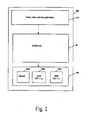
- Fig. 2 shows an exemplary block diagram 201 of the device 10 shown in Fig. 1 for performing flow assignment method highlighted above.
- Device 10 comprises a device application module 202, middleware 50, and access network interfaces 204.
- the device application module 202 tracks the applications originating on the device 10 and retrieves flows via known methods, for instance via the source IP address, source port number, destinations IP address, destination port number, and as described, for instance, in F. Guo, J. Chen, W. Li, and T. Chiueh, "Experiences in building a multihoming load balancing system," in Proc. IEEE INFOCOM, 2004 .
- Fig. 9 shows the average rate of flows during the simulation run for different flow assignment schemes.
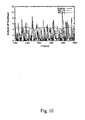
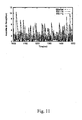
- Figs 10 , 11 and 12 respectively plot the ABR for different networks in a window from 1000 to 1500 seconds of simulation run.
- the bandwidth on the IEEE 802.11b network for the greedy-AIMD remains unutilized as no flow is assigned to the network.
- the packet loss rate during a simulation run for different flow assignment schemes is compared in Fig. 13 .
- Tables IV shows the average of packet loss rate and flows rate for the 14 flows.
- the greedy-AIMD policy results in a higher average flow rate and hence suffers a high packet loss rate. As can be seen in Fig.
- a noticeable aspect is the ability of MDP based flow assignment to offer low packet loss rates while allowing the flows to have their share of bit rates on different networks.
- Other policies RP-AIMD and greedy-AIMD
- RP-AIMD RP-AIMD
- greedy-AIMD RP-AIMD
- the MDP based flow assignment can easily guarantee acceptable PSNRs for multimedia flows whose performance depends on the bit rate and the packet loss.
- the deadlines for packet delivery becomes less stringent the flow assignment policy results in a significant reduction in packet loss rates (Table VII).
Landscapes
- Engineering & Computer Science (AREA)
- Computer Networks & Wireless Communication (AREA)
- Signal Processing (AREA)
- Computer Security & Cryptography (AREA)
- Data Exchanges In Wide-Area Networks (AREA)
Abstract
Description
- The invention relates to method and communication system for dynamically assigning traffic flows to a plurality of access networks, wherein the traffic flows are provided by a source having multiple access networking capabilities. Furthermore, the invention concerns a device for use with in such a communication network.
- Several networking technologies have evolved and become popular over the past few decades. Ethernet, DSL, cellular wireless networks, and IEEE 802.11 based wireless local area networks have become widely deployed and increasingly accessible. Existing networks tend to be heterogeneous in their attributes such as the supporting infrastructure, protocols, signaling mechanisms, offered data rates, etc. With the realization that several technologies will continue to coexist and there will be no clear winner, the drive towards convergence of networks is gaining momentum. Integration of heterogeneous access networks is part of the 4G network design as explained in P. Vidales, J. Baliosion, J. Serrat, G. Mapp, F. Stejano, and A. Hopper, "Autonomic sytem for mobility support in 4G networks," in IEEE Journal on Selcted Areas in Communications' 05, vol. 23, no. 12, Dec. 2005. The IEEE 802.21 standard which is available online: http;//www.ieee802.org/21/ is delineating a framework to enable handovers and interoperability between heterogeneous wireless and wireline networks. The IP Multimedia Subsystems (IMS), as explained in A. Cuevas, J. I. Moreno, P. Vidales, and H. Einsiedler, "The IMS platform: A solution for next generation network operators to be more than bit pipes," in IEEE Communicaticns Magazine, issue on Advances of Service Platform Technologies, Aug. 2006, has defined an overlay architecture for providing multimedia services on top of heterogeneous networks.
- It is an object of the present invention to provide a method and a communication system which efficiently route traffic flows over multiple access networks to destinations connected to a core network.
- A core aspect of the present invention is to prcvide a device with a plurality of networking capabilities for accessing multiple networks with heterogeneous characteristics. In particular, a method is implemented for dynamically assigning traffic flows to different networks which leads to an efficient utilization of multiple access networks, e. g. wireless and/or wireline networks.) Therefore, a device middleware functionality is provided that monitors network characteristics, e. g. the available bit rate and the delay, of each access network and employs a Markov Decision Process (MDP) based control scheme that in conjunction with stochastic characterization of the available bit rate and delay of the access networks generates an optimal policy for allocation of flows to different networks. It should be noted that the delay corresponds to half of the measured round trip time (RTT) from the device to the host to which a given flow is destined. The optimal policy is periodically updated and is consulted by the traffic flows to dynamically perform network selection during their lifetimes.
- In particular, measurement tests are performed to collect values or traces of available bit rate and delay characteristics for example on Ethernet and WLAN networks on a work day in a corporate work environment.
- To prove the results the flow assignment framework is implemented in the network simulator (ns-2). Information thereon is available online: http://www.isi.edu/ns/). Furthemore, the system performance for a set of elastic video-like flows using the collected traces is simulated.
- The method using the MDP based flow assignment policy leads to significant enhancement in the QoS provisioning, i. e. lower packet delays and packet loss rates for the flows, as compared to policies which do not perform dynamic flow assignment but statically allocate flows to different networks using heuristics like average available bit rate on the networks.
- The technical problem is solved by a method for dynamically assigning traffic flows to a plurality of access networks, wherein the traffic flows are provided by a source having multiple access networking capabilities. A source having multiple access networking capabilities is in particular a device which is adapted to transmit traffic flows via a plurality of access networks the device is connected to. The method comprises the following steps:
- a) measuring at given time intervals predetermined network characteristics of a plurality of access networks,
- b) estimating the network characteristic variation behavior of each access network of the plurality of access networks using the measured network characteristics,
- c) detecting a traffic flow of at least one application running at a source to be transmitted from a source to a destination,
- d) in response to the detected traffic flow selecting an access network from the plurality of access networks by using the network characteristic variation behavior of the plurality of access networks,
- e) repeating steps c) and d) every time the application provides a traffic flow to be transmitted.
- Due to the variation in network characteristics, in particular the available bit rate (ABR) and the delay, especially when the access networks include wireless links, the network characteristics variations require robust modeling techniques and stochastic tools. Therefore, in a preferred embodiment step d) uses a Markov decision process to select an access network for the detected traffic flow. It is to be noted that the delay of each access network can be evaluated from the round trip time (RTT) and corresponds especially to the half of the measured round trip time.
- To define the network characteristic variation behavior of the plurality of access a stochastic model is used which is based on a finite state space which represents the delay and available bit rate values of all access networks.
- In order to optimize the flow assignment for the detected traffic flow the reward of each access network for the identified traffic flow is determined and in step d) the optimal access network is selected as a function of the determined reward values.
- In a preferred embodiment the step of determining the reward comprises the step of classifying the detected traffic flow. The traffic flow can be a video traffic flow, an audio traffic flow and the like.
- The technical problem is also solved by a communication system for dynamically assigning traffic flows to a plurality of access networks, which comprises:
- a plurality of access networks connected to a core network, and at least a source device. The device comprises multiple access networking interfaces each associated with a separate access network of the plurality of access networks, means for measuring at given time intervals predetermined network characteristics of each access network, storing means for storing the measured network characteristics, means for estimating the network characteristic variation behavior of each access network of the plurality of access networks using the measured network characteristics, means for detecting a traffic flow of at least one application running at the source device to be transmitted to a destination, means for selecting in response to the detected traffic flow an access network from the plurality of access networks by using the network characteristic variation behavior of the plurality of access networks.
- To control the traffic flow to destinations the device includes means for allowing an application running at the source device to transmit a traffic flow and to invoke the detecting means.
- In a preferred embodiment, the selecting means uses a Markov decision process to select an access network for the identified traffic flow.
- In particular, the estimation means uses a stochastic model to define the network characteristic variation behavior of the plurality of access networks.
- In order to optimize the flow assignment for the detected traffic flow the device includes means for determining the reward of each access network for the identified traffic flow, wherein the optimal access network is selected as a function of the determined reward values.
- In addition the technical problem is further solved by a device for use within such a communication system.
-
- Fig. 1
- shows a device according to the invention;
- Fig. 2
- shows an exemplary system for performing flow assignment in the device of
Fig. 1 ; - Fig. 3
- shows an exemplary system with the exemplary components of the middleware in the device of
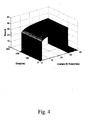
Fig. 1 ; - Fig. 4
- shows a Reward with units of PSNR (dB)) offered by a network to an incoming flow for θ = 97.8, r0 = 0.075 (in Mbps), Do = 0.49, T =150ms, and Rmin = 2Mbps;
- Fig. 5
- shows the measured available bit rate on an Ethernet access link regarding a flow transmission from a host located in Deutsche Telekom laboratories, Berlin to a host located in Stanford University in California;
- Fig. 6
- shows measured available bit rate on an 802.11g access link regarding a flow transmission from a host located in Deutsche Telekom laboratories, Berlin to a host located in Stanford University in California;
- Fig. 7
- shows the measured available bit rate on an 802.11b access link regarding a flow transmission from a host located in Deutsche Telekom laboratories, Berlin to a host located in Stanford University in California;
- Fig. 8
- shows a network topology employed for simulation with the network simulator ns-2;
- Fig. 9
- shows the average flow rate for traffic flows from a host located in Deutsche Telekom laboratories, Berlin to a host located in Stanford University in California;
- Fig. 10
- shows the available bit rate for a greecly-AIMD flow assignment regarding a flow transmission from a host located in Deutsche Telekom laboratories, Berlin to a host located in Stanford University in California;
- Fig. 11
- shows the available bit rate for a RP-AIMD flow assignment regarding a flow transmission from a host located in Deutsche Telekom laboratories, Berlin to a host located in Stanford University in California;
- Fig. 12
- shows the available bit rate for the MDP based flow assignment according to the invention regarding a flow transmission from a host located in Deutsche Telekom laboratories, Berlin to a host located in Stanford University in California;
- Fig. 13
- shows the average percentage packet loss regarding a traffic flow from a host located in Deutsche Telekom laboratories, Berlin to a host located in Stanford University in California;
- Fig. 14
- shows a CDF (cumulative distribution function) of delay for an Ethernet access link regarding a flow transmission from a host located in Deutsche Telekom laboratories, Berlin to a host located in Stanford University in California;
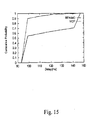
- Fig. 15
- shows a CDF of delay for an 802.11g access link regarding a flow transmission from a host: located in Deutsche Telekom laboratories, Berlin to a host located in Stanford University in California;
- Fig. 16
- shows a CDF of delay for an 802.11b access link regarding a flow transmission from a host: located in Deutsche Telekom laboratories, Berlin to a host located in Stanford University in California;
- Fig. 17
- shows the average percentage packet loss regarding a traffic flow from a host located in Deutsche Telekom laboratories, Berlin to a host located in Stanford University in California;
- Fig. 18
- shows the average percentage packet loss regarding a traffic flow from a host located in Deutsche Telekom laboratories, Berlin to a host located in the Technical University of Berlin.
- It is today commonplace to have electronic devices with multiple networking capabilities. Personal computers and laptops typically come equipped with a built-in WLAN card, a PCMCIA slot, and an Ethernet port. PDAs with WLAN and GPRS connectivity are becoming popular.
-
Fig. 1 depicts an exemplary operational scenario for routing of traffic flows originating fromapplications 1 to n+1 running on adevice 10 viaaccess networks device 10 has access to. Thedevice 10 can be a laptop. In particular, thedevice 10 can be, for example, connected to acore network 60, e. g. the Internet via a local area network (LAN) 20, e. g. an Ethernet based access network, an 802.11g basedaccess network 30, an 802.11b based access network or adigital subscriber line 40. In the embodiment shown inFigs. 1 ,2 and3 , three access network interfaces are implemented in thelaptop 10. - As a multitude of bandwidth demanding applications such as IPTV and Internet Video run on devices, a single network may often not be sufficient to meet the requirements of the applications. Several interesting scenarios may be envisioned. Imagine a user in a corporate setting participating in a video conference call via her
device 10 having a DSL, an Ethernet and IEEE 802.11g connectivity as shown inFig. 1 . While engaged in the conference proceedings, the user is uploading content on a remote server for the participants to access, and at the same time needs to retrieve some files from the server. Several traffic flows are hence created by thelaptop 10 which dynamically monitors the networks at its disposal. Thelaptop 10 then dynamically assigns and reassigns each traffic flow at predetermined times to a selected one of theseaccess networks networks Internet 60 to a destination which is not depicted. - While the distribution of traffic flows amongst the
access networks laptop 10 is equipped with a middleware functionality schematically depicted inFig 1 byfunctional block 50 which monitors the available bit rate and delays on thedifferent networks - In a preferred embodiment,
functional block 50 is adapted to estimate the available bit rate and delay values via theaccess networks Internet 60. Theapplications 1 to n+1 running on thedevice 10 consultfunctional block 50 for routing each traffic flows via a selected access network, which is dynamically assigned to each application. The list of preferred destinations hosts can be maintained at thedevice 10 based on user usage history, user preferences, etc., as for instance described in F. Guo, J. Chen, W. Li, and T. Chiueh, "Experiences in building a multihoming load balancing system," in Proc. IEEE INFOCOM, 2004. - We denote the set of access networks available to the
device 10 by I= {1,2,...,N} . In the preferred embodiment as shown inFig. 1 N is set to 3. The system state, designated as s ∈ S , represents the delay and available bit rate (ABR) characteristics of all theaccess networks device 10 to a suitable network. - Each access network i ∈ I is characterized by delay and ABR values di ∈[d min,d max] and ri ∈[r min,rmax] measured at a given time. The range of delay and ABR values of each network is mapped to a set of quantized states. Let Sl d = {Si dl,...,Si dM} and Si r={S i r1,..., SirM} represent states based on the quantized delay and ABR of the network i. Then each network is associated with a single superset of states Si := Si d x Si r and the whole system with S:=Πi∈l S' obtained through cross-product operations on the sets.
- The delay and ABR of each access network exhibits variations due to a multitude of underlying factors ranging from fading and shadowing in wireless channels to congestion in wired ones. While the wired access networks may be characterized using simpler techniques, the fast variations in wireless access network characteristics require robust stochastic models. It is shown in the literature that Markov models can well characterize network characteristic variation behavior. In addition, there exists well-established computational and theoretical methods to optimize Markovian processes as explained in D. Bertsekas, Dynamic Programming and Optimal Control, 2nd ed. Belmont, MA: Athena Scientific, 2001, vol. 2. Hence, a finite-state Markov chain is defined on the state space S to model the access network behaviors. We denote by pi,j the transition probability

where i,j ∈ S and s(n) represents the current state of allavailable access networks - Consequently, the state transition matrix is defined by M = [(pi,j )] and the system equation is

where p̅ denotes the probability vector over the state space S corresponding to all possible states of theaccess networks - There exist a variety of methods for computing the transition probabilities between network states. We make the implicit assumption of ergodicity and stationarity over a certain time interval over which M is time-invariant. Given sufficiently many state transition pairs obtained from the evolution of network characteristics over time it is possible to compute M using standard methods, as for instance explained in G. Froyland, Nonlinear Dynamics and Statistics: Proceedings, Newton Institute, Cambridge, 1998. Birkhauser, 2001, ch. Extracting dynamical behavior via Markov models, pp. 283-324. Let us use the first state of each pair C"=p(n)where n is even, as initial conditions for the underlying dynamical system and denote Cout=p̃(n)where n is odd as the image of these points after one iterate of the dynamical system. After identifying the sets of input and output samples Cin and Cout the transition probability from state ito j is estimated as

where

- As the number of state-transition pairs increases, i.e., as n→∞ the invariant measure of the Markovian operator M approximates the time-averaged distribution of the states better.
- The control action u corresponding to the choice of a single network modifies the dynamical system and leads to control Markov chains M(u). The transition probability pij(µk) of the controlled Markov chain denotes the probability of the next state being in j conditioned on the current state being in i and control being Uk. M(u) for a given µ has a dimension SXS.
- Using a Markov model on a finite state space S with finitely many control actions u, a Markov Decision process is defined to dynamically assigning traffic flows to the
access networks - Towards this end a real-valued reward function R(s,u) is defined over the set of states S and as a function of the control action u. The reward function quantifies the preference for a system state and the choice of a network by a flow and can then be expressed as :

where
- In a preferred embodiment


where f(r j ) is a concave utility function, and us(rj) and us(rj) are unit step functions. The flows represented in equation (2) are characterized by a minimum usable bit rate r min . For rates greater than r min , the utility function for the flows is concave with respect to the allocated bit rate. Furthermore, the packets belonging to the flows are associated with a maximum latency (or the playout deadline) T that they can tolerate. For f(rj ) in equation (2), we employ video encoder rate distortion models from K. StuhlMuller, N. Farber, M. Link, and B. Girod, "Analysis of video transmission over lossy channels," in IEEE Journal on Selected Areas in Communication, vol. 18, no. 6, June 2000, and adopt the following form:

- The parameters θ,D 0,r 0 as discussed in K. StuhlMuller, N. Farber, M. Link, and B. Girod, "Analysis of video transmission over lossy channels," in IEEE Journal on Selected Areas in Communication, vol. 18, no. 6, June 2000 can be estimated from empirical rate-distortion curves via regression techniques.
- Now the reward per stage in the MDP framework, g : SXI →R under a stationary policy µ(s): S→I and at stage n is given by g(s(n), µ(s)), with R representing the set of real numbers. Notice that for a system state s and a given stationary policy µ(s), g(s,µ(s)) is equal to the reward R(s,u) with u =µ(s)
- Although the stationarity window for the policies may be limited an infinite horizon formulation of the problem as a simplification is assumed. Then the total reward J is given as :

positive scalar 0<α<1denotes the discount factor over future stages (decisions). The maximum total reward is defined by
where Π is the set of all possible policies. The policy µ(s) for assigning an access network to a specific flow is optimal if J̇µ(s)=Jµ(s) for all states s. It is a well known fact that under certain assumptions as pointed cut inChapter 1 of D. Bertsekas, Dynamic Programming end Optimal Control, 2nd ed. Belmont, MA: Athena Scientific, 2001, vol. 2., there exists an optimal deterministic stationary policy µ̇(s) that solves the Bellman's equation, i.e.,
- Furthermore, J̇ = J̇µ(s)is the unique solution of Bellman's equation.
- There are multiple alternative algorithms to solve the infinite horizon discounted reward problem described above. However, without loss of generality the well-known value iteration algorithm is used. The right hand side of the Bellman's equation in (7) actually corresponds to a single iteration or recursion of the venerable dynamic programming algorithm (DPA)


- The value iteration algorithm as described above is executed by the
middleware block 50 on thedevice 10 to evaluate the optimal control policy µ̇(s) for the assignment of a flow to an access network. The state space S is ascertained from the ABR and RTT measurements made by the middleware to the destination of a flow. M(u) is evaluated by observing the state transitions associated with control actions. -
Block 50 gives the flows on device 10 a token in a round robin fashion and the flow with the token seeks middleware consultation and is reassigned according to the control policy. Whenever a traffic flow is reassigned to a different network that it was previously on, it is provided a rate which is half of the ABR on that network. On the other hand, if the reassignment decision for a flow is to have it stay on the same network, the rate of the flow is increased by half of ABR on the network. -
Fig. 2 shows an exemplary block diagram 201 of thedevice 10 shown inFig. 1 for performing flow assignment method highlighted above.Device 10 comprises adevice application module 202,middleware 50, and access network interfaces 204. Thedevice application module 202 tracks the applications originating on thedevice 10 and retrieves flows via known methods, for instance via the source IP address, source port number, destinations IP address, destination port number, and as described, for instance, in F. Guo, J. Chen, W. Li, and T. Chiueh, "Experiences in building a multihoming load balancing system," in Proc. IEEE INFOCOM, 2004. - The
middleware 50 performs flow assignment to appropriate interfaces in 204.Interfaces networks -
Fig. 3 shows the exemplary components of themiddleware 50 ofFig. 2 .Middleware 50 comprises acomputational component 50a that runs a network measurement tool on theinterfaces 204 for measuring the available bit rate and the delay on eachaccess network storage component 50b that stores the history of the measured available bit rate and delay values of each access network, and acomputational facility 50c that runs the flow assignment policy which is on the MDP based optimal flow assignment discussed before and directs flows generated from theapplication module 202 to theappropriate interfaces 204. - To compare the result of the middleware according to the invention it is assumed that different flow assignment policies may be performed by
block 50. For instance a static flow assignment policy which allocates newly admitted flows on suitable networks and does not' reassign them for the rest of their lifetime can be employed. In this case, the flows are admitted with a rate equal to the r min for their class. Thereafter the flows exercise an Additive Increase Multiplicative Decrease (AIMD) rate control for rate adaptation. Each flow increases its rate by Δ, every Δ t seconds unless network congestion is perceived by a flow in which case it drops its rate by (r-r min)/2. Two kinds of static flow assignment policies may be envisioned - one where the flows are assigned to networks in a greedy fashion and the other in proportion to the average ABRs of the networks. Under the former policy, a flow is assigned to a network that offers the maximum instantaneous reward (as given by equation (2)) to a flow upon its admission. We term this policy as greed y-AIMD. Under the other static assignment scheme, flows are allocated to different networks in proportion to the average ABR on the networks. We call this assignment scheme Rate Proportional AIMD (RP-AIMD). - In the subsequent section, we will compare the performance of the MDP based flow assignment policy described with a static flow assignment with
- In this section we present results from network measurements conducted in a real world setting. Employing the modeling framework of the previous section, we will use the measurement traces to simulate and evaluate the flow assignment framework in the subsequent sections.
- We conduct measurement tests in a corporate work environment where the users have access to networks like Ethernet, IEEE 802.11g and IEEE 802.11b WLANs, GPRS, and DSL. We monitor the ABR and RTT on different networks between 2 pm and 4 pm on a work day. The tests are conducted between hosts in Deutsche Telekom Laboratories (T-Labs) in Berlin to three destinations - Stanford University, Technical University of Munich (TU Munich), and the Technical University of Berlin (TU Berlin) - respectively representing long, mid, and close distance destinations. We surveyed several publicly available tools including Pathrate, Nettest, CapProbe and choose Abing (J. Navratil and R. L. Cottrell. Abing. Available online: http://www-iepm.slac.stanford.edu/tools/abing/) for measurement of ABR and round trip time (RTT). Abing has a fast convergence of the order of 1-2 seconds, and the ability to run accurately on paths with high packet loss rates, and is hence reported to be suitable for wireless networks. It is based on packet pair dispersion technique and reports the ABR for bidirectional links between two hosts in the Internet which run Abing client and server.
- Abing server is run at the machines at Stanford, TU Munich and TU Berlin, and the clients at machines in T-Labs in Berlin. The ABR and RTT values are then noted for the links from T-Labs and to different destinations.
- For the purpose of this work we consider the data collected on 100 Mbps Ethernet, IEEE 802.11g, and IEEE 802.11b networks. The 802.11g and 802.11b networks were accessed by laptops with Intel PRO/Wireless 2200 b/g cards through T-Sinus 154 and linksys WRT-54GL wireless access points (APs) respectively.
TABLE I ABR(Mbps) RTT(ms) Ethernet Avg. 31.5 190.1 Std. Dev. 1 .7 0.03 802.11g Avg. 15.1 193.0 Std. Dev. 3.6 3.2 802.11b Avg 4.2 195.7 Std. Dev 0.3 0.3 TABLE II AVAILABLE BIT RATE AND RTT FROM T-LABS TO TU MUNICH ABR(Mbps) RTT(ms) Ethernet Avg. 90.8 14,4 Std. Dev. 6.0 0.1 802.11g Avg. 15.0 16.9 Std. Dev. 3.8 4.5 802.11b Avg. 4.4 4.4 19.8 Std. Dev. 0.4 1.0 TABLE III AVAILABLE BIT RATE AND RTT FROM T-LABS TO TU BERLIN ABR(Mbps) RTT(ms) Ethernet Avg. 71.8 5.2 Std. Dev. 13.0 0.04 802.11g Avg. 14.3 7.8 Std. Dev. 3.6 0.4 8.02.11b Avg. 4.5 10.7 Std, Dev. 0.5 0.6 - The test environment represented a well provisioned wireless LAN setting with 5 APs in a large office room. The measured networks had interference from other APs in the room and also APs from the higher and lower floors in the building. Tables I, II and III show the average ABR and RTT and their standard deviations to different destinations and for different networks for the 2 hour traces. Ethernet can be seen to have different ABRs to different destinations which can be attributed to different cross-traffic and intermediate bottleneck link capacities to these destinations. However, the average bit rates to different destinations are not much different for 802.11g and 802.11b indicating the possibility that ABR is constrained by the bottleneck wireless hop. RTTs to a destination are lowest for Ethernet and highest for 802.11b.
-
Figs. 5 ,6 and7 show representative histograms of the available bit rates for the destination Stanford. The statistics can be seen to have diversity in ABRs across the three networks wherein the average ABR on Ethernet can be seen from Table I to be twice as much as on 802.11g which is roughly four times as much for 802.11b. All the networks display noticeable variation in ABRs. For instance the available bit rate ABR on 802.11g can be as high as 24 Mbps and can drop down to as low as 6 Mbps. - The different ABRs on the networks reflect the difference in the ability of these networks in accommodating traffic flow volumes. Flows may be assigned to the networks according to their ABRs. However, as the characteristics of a given network fluctuate for instance when there are abrupt drops in ABR, the supported applications may suffer from performance degradation. Then, if some of the traffic flows under adverse network conditions can be directed to another network, the performance of the applications and utilization of the networks can be improved.
- It is to be noted that the scale of variation of ABR and delay was much greater for the wireless networks than for Ethernet, which justifies the use of MDP based stochastic modeling over a simpler approach when the access environment includes wired and wireless networks. For instance the average interval of variation of ABR by 10% was 10 times higher for 802.11b and 3 times higher for 802.11g than the ABR variation over Ethernet for T-Labs to Stanford case.
- We now consider the simulation of the flow assignment framework using ns-2. The sample network topology created for the purpose is shown in
Fig. 8 . Anode 100 represents the sending device which is adapted to send traffic flows to adestination node 170 via threeaccess networks - 1} Simulation of Access Networks : Each
network - 2) Flow Assignment : An instance of hash classifier as described in the documentation of the network simulator (ns-2), which is available online: http://www.isi.edu/ns/ is attached to
node 100 performing flow routing and is used to simulate a broker whose function is to direct various flows to thedifferent networks middleware 150. Part of the middleware functionality has been implemented by interfacing python functions with ns-2. Themiddleware 150 fordevice 100 measures the available bit rate and delay values on thenetworks node 100 are identified via flow ids. It is ensured that the broker agent attached to thenode 100 has information about every flow generated from the source and coming to the source from the Internet. - 3) Network delay measurement: We employ CapProbe implementation for ns-2 to calculate RTT of networks (U. N. R. Laboratory, CapProbe which is available online:
http://www.cs.ucla.edu/NRL/CapProbe/). For this purpose, we attach a ping agent for everynetwork node 100 performing flow assignment and associate every ping agent with a flow id to be used by the hash classifier for routing the ping traffic. - 4) ABR Measurement : The available bit rate of each network utilized at a given time is measured during the simulation via queue monitors as described in the documentation of the network simulator (ns-2) (Available:
http://www.isi.edu/ns/). The number of bytes transferred via the link of each network during a 0.1 second interval is used to calculate the used bandwidth. The available bit rate during the simulation is periodically evaluated by subtracting the network bandwidth being used from the present value of ABR used to characterize the network. In real world scenarios, tools like Abing can be used to measure the available bit rate. - For the demonstration of evaluation results, the three
networks Fig. 8 are taken as Ethernet, 802.11g, and 802.11b with ABR (r) and delay (d) characteristics. The delay d is approximated as half of RTT values measured for the different networks. Simulations are run over the 2 hour data traces for different destinations. For the 302.11b and 802.11g wireless networks a 1% random packet loss has been introduced in the simulations. - High bit rate flows are employed with the network characteristics of equation (3) with r min = 2 Mbps and T=150 ms. At the beginning of a simulation, a total of 14 flows arrive with a rate of 2 Mbps each and an inter-arrival time of 0.5 seconds. Subsequently the rates of the flows evolve as per the rate control associated with the employed flow assignment policy. The middleware monitors the available bit rate and the round trip time to the
destination host 170 via eachnetwork - For the greedy-AIMD policy, a flow upon its arrival is allocated to a network that offers the maximum instantaneous reward given by (2). For RP-AIMD, flows are allocated to networks in proportion to the average ABR reported in Tables I, II, and III. For these static policies, the available bit rate of each flow is varied according to a token-based round-robin scheme where the token is circulated every 2 seconds. The round robin scheme operates separately and independently on each network. The flow with a token on a given network increases its flow rate by Δr=1 Mbps and passes the token to the next flow on the network. Whenever a delay rise beyond the preset threshold, dt =150 ms, is observed by CapProbe measurement tool for any of the networks, a delay alarm for that access network is triggered, and the bit rate for the flow is reduced by (r-r min)/2.
This cooperative rate allocation scheme ensures efficient utilization of the network available bit rates while preventing excessive rate fluctuations for the flows. - For the MDP based flow assignment, the parameter β value in equation (1) is selected as 0.8. We will discuss more about the selection of β later on in the invention. When the flows initially arrive, they are greedily allocated to the networks based on the maximum reward. Thereafter, the reassignment and rate allocation of the flows is done via a round robin token scheme with a token circulation interval of 2 seconds. Every time during a simulation a flow gets a token, the optimal MDP policy in the
middleware 150 is consulted by the broker, the control action suggesting a suitable interface for the flow is executed, and rate allocation for the flow is performed. - For evaluating the MDP policy, the middleware needs information about the system state transitions vis-a-vis the control actions. For the purpose we maintain a sliding window of last 800 transitions and action tuples. The state transitions associated with an action are ascertained as those occurring from the state at the time of the control action to the states visited before the next action.
- Before the MDP based flow assignment can be invoked for the first time by the middleware, MDP needs a training period to evaluate M(u). We hence train the MDP in the middleware for initial 100 seconds with u based on a reward-maximizing greedy approach for network selection. The rate allocation during this phase is kept the same as that discussed in the analytical framework under MDP based flow assignment, i.e. if as a consequence of a control action a flow is reassigned to a different network than it was previously on, then it is provided a rate which is half of ABR on the new network, otherwise the rate of the flow is increased by half of ABR of the present network.
- With the simulation methodology described above, the performance of the static policies is compared with dynamic MDP based approach. First, the performance of flow assignment schemes for T-Labs to Stanford hosts is discussed. While the MDP based approach dynamically assigns the flows to different networks during the simulation, the greedy-AIMD policy leads to an allocation of 11, 3, and 0 flows on the Ethernet, 802.11g and B02.11b respectively and the RP-AIMD leads to a distribution of 9, 4, and 1 flows on the networks.
-
Fig. 9 shows the average rate of flows during the simulation run for different flow assignment schemes.Figs 10 ,11 and12 respectively plot the ABR for different networks in a window from 1000 to 1500 seconds of simulation run. As apparent fromFig. 10 , the bandwidth on the IEEE 802.11b network for the greedy-AIMD remains unutilized as no flow is assigned to the network.
The packet loss rate during a simulation run for different flow assignment schemes is compared inFig. 13 . Tables IV shows the average of packet loss rate and flows rate for the 14 flows. The greedy-AIMD policy results in a higher average flow rate and hence suffers a high packet loss rate. As can be seen inFig. 13 and Table IV, the MDP based flow assignment policy leads to a reduction of packet loss rate from around 45% for Greedy-AIMD and 40% for RP-AIMD to a significantly lower 2%.TABLE IV PACKET LOSS RATE (PER) AND FLOW RATE STATISTICS FOR STANFORD UNIVERSITY Greedy AIMD RP AIMD MDP Avg. PLR(%) 43.69 8.74 1.78 Avg ABR(Mbps) 2.77 1.76 2.7 - The MDP based flow assignment leads to significantly lower delays on all three networks. The cdfs (cumulative distribution functions) of the delays (truncated at 150 ms, the playout deadline for the flows) for greedy-FP and MDP based flow assignment are plotted in
Fig. 14 ,15 and16 . For greedy-AIMD, the delay performance is further worse than RP-AIMD on Ethernet and 802.11g networks; however delays are low for this scheme on 802.11b since no flows are allocated to the network. - Next the performance for T-Labs to TU Munich anc TU Berlin cases is discussed. Since Ethernet for TU Munich and TU Berlin cases has high ABRs (see Tables II and III) the greedy-AIMD policy leads to assignment of all flows to Ethernet as they arrive. The RP-AIMD results in a respective distribution of {12,2,0} and {11,2,1} flows on {Ethernet, 802.11g, 802.11b} networks for TU Munich and TU Berlin cases. As before, the MDP based approach dynamically assigns flows to networks during the simulation runs.
- The packet loss rates for T-Labs to TU Munich and TU Berlin cases are shown in
Figs 17 and18 . - Tables V and VI show the average packet loss rate and flows rate for the 14 flows for the destinations TU Munich and TU Berlin. While the greedy-AIMD policy suffers from high packet loss rates for all cases, MDP based flow assignment leads to the significantly lower packet loss rates. Again, the delay performance of the MDP based flow assignment scheme is better than the static policies and; the plots are suppressed for brevity.
TABLE V PACKET LOSS RATE (PLR) AND FLOW RATE STATISTICS FOR TU MUNICH Greedy AIMD RP AIMD MDP Avg. PLR(%) 34.21 30.56 11.88 Avg.ABR(Mbps) 8.87 5.21 5.19 TABLE VI PACKET LOSS RATE (PLR) AND FLOW RATE STATISTICS FOR TU BERLIN Greedy AIMD RP AIMD MDP avg. PLR(%) 36.82 33.49 13.15 Avg. ABR(Mbps) 9.78 5.46 6.22 - The impact of variation of playout deadline (T) on the packet loss rate performance for the TU Berlin case is shown in Table VII. Increase in the deadline leads to significant reduction in packet loss rate for MD? based flow assignment, but does not have as noticeable an impact for the greedy-AIMD and RP-AIMD policies.
TABLE VII IMPACT OF THE PLAYOUT DEADLINE T(ms) Greedy AImD RP AIMD MDP 150 36.82 33.49 13.15 250 31.25 25.38 3.55 500 22.00 20.48 0.26 - Multiple network utilization via a flow allocation policy which stochastically characterizes the network characteristics and dynamically assigns flows tc the networks results in significantly enhanced perfermance over a static policy which assign flows based on heuristics like average ABR on the networks. Even in conjunction with a suitable rate control scheme, a static flow allocation policy suffers from degraded performance owing to the fact that network characteristics like ABR and delay vary to fluctuations in cross-traffic and changes in the channel characteristics for wireless networks.
- A dynamic flow assignment policy is able to utilize the diversity of available networks to enhance the QoS provisioning for applications. For instance when ABR on a network drops or the delay shoots up, flows on the network may be reassigned to another network which may be experiencing a better network quality. An MDP based dynamical flow assignment presented in this work is demonstrated to result in better performance in terms of packet delays and packet loss rates experienced by applications, and bandwidth utilization for different networks.
- We observed a tradeoff between selfish and global good as represented by the value of β in equation (1). For low values of β representing a higher concern for characteristics of other interfaces than the one associated with the control action, the flows did not always drive the system to a state where they received a good reward on a network dictated by the control action, and this lead to bandwidth wastage. On the other hand, overtly selfish behavior (β =1) pushed the system into high delay states as the flows would eagerly choose a state that maximized their reward even if the state represented high delays and low ABR for the other interfaces.
- A noticeable aspect is the ability of MDP based flow assignment to offer low packet loss rates while allowing the flows to have their share of bit rates on different networks. Other policies (RP-AIMD and greedy-AIMD) are unable to keep the packet loss rate within acceptable limits. Hence, the MDP based flow assignment can easily guarantee acceptable PSNRs for multimedia flows whose performance depends on the bit rate and the packet loss. Again, as the deadlines for packet delivery becomes less stringent, the flow assignment policy results in a significant reduction in packet loss rates (Table VII).
- In a setting where devices have access to multiple networks, the distribution of traffic flows amongst different networks can enable better network utilization than single network use at a time. However, the variation in network characteristics like ABR and delay make the problem of flow assignment challenging. A static flow allocation policy can result in unsatisfactory performance due varying characteristics of networks. However, the adaptive assignment of flows to different access networks results in a much better performance in terms of packet losses, delays and allocated bit rates. Such adaptive flow reassignment according to the invention is controlled by using stochastic characterization of the networks and adopting an MDP based approach to optimally assign flows to networks.
Claims (16)
- A method for dynamically assigning traffic flows to a plurality of access networks, wherein the traffic flows are provided by a source having multiple access networking capabilities, the method comprising the steps of:a) measuring at given time intervals predetermined network characteristics of a plurality of access networks,b) estimating the network characteristic variation behavior of each access network of the plurality of access networks using the measured network characteristics,c) detecting a traffic flow of at least one application running at a source to be transmitted from a source to a destination,d) in response to the identified traffic flow selecting an access network from the plurality of access networks by using the network characteristic variation behavior of the plurality of access networks,e) repeating steps c) and d) every time the application provides a traffic flow to be transmitted.
- The method of claim 2, wherein
step d) uses a Markov decision process to select an access network for the identified traffic fLow. - The method of claim 1 or 2, wherein the predetermined network characteristics comprise the available bit rate and the round trip time of each access network.
- The method of any one of the preceding claims, wherein step b) uses a stochastic model to define the network characteristic variation behavior of the plurality of access networks.
- The method of any one of the preceding claims, wherein step b) uses a Markov model to define the network characteristic variation behavior of the plurality of access networks.
- The method of any one of the preceding claims, wherein the reward of each access network for the identified traffic flow is determined and in step d) the optimal access network is selected as a function of the determined reward values.
- The method of claim 6, wherein,
the step of determining the reward comprises the step of classifying the detected traffic flow. - The method of claim 6, wherein,
the step of determining the reward comprises the step of categorizing the performance, in particular the peak signal to noise ratio, of the detected traffic flow according as per the network characteristics. - A communication system for dynamically assigning traffic flows to a plurality of access networks, comprising
a plurality of access networks (20, 30, 40) connected to a core network (60),
at least a source device (10), which comprises multiple access networking interfaces (204) each associated with a separate access network cf the plurality of access networks,
means (50a) for measuring at given time intervals predetermined network characteristics of each access network (20, 30, 40),
storing means (50b) for storing the measured network
characteristics,
means (50c) for estimating the network characteristic variation behavior of each access network of the plurality of access networks using the measured network characteristics,
means (50c) for detecting a traffic flow of at least one application (202) running at the source device (10) to be transmitted to a destination,
means (50c) for selecting in response to the detected traffic flow an access network from the plurality of access networks by using the network characteristic variation behavior of the plurality of access networks. - The communication system of claim 9, comprising
means for allowing an application (202) running at the source device (10) to transmit a traffic flow and to invoke the detecting means (50c). - The communication system of claim 9 or 10 wherein
the selecting means (50c) uses a Markov decision process to select an access network for the identified traffic flow. - The communication system claims 9, 10 or 11, wherein the predetermined network characteristics comprise the available bit rate and the round trip time of each access network.
- The communication system of any one of the claims 9 to 12, wherein the estimation means (50c) uses a stochastic model to define the network characteristic variation behavior of the plurality of access networks.
- The communication system of any one of the claims 9 to 12, wherein the estimation means (50c) uses a Markov model to define the network characteristic variation behavior of the plurality of access networks.
- The communication system of any one of the claims 9 to 14, characterized by
means for determining the reward of each access network (20, 30, 40) for the identified traffic flow, wherein the optimal access network is selected as a function of the determined reward values. - A device for use within a communication system according to any one of the claim 9 to 15, comprising at least a source device (10), which comprises: multiple access networking interfaces (204) each associated with a separate access network of a plurality of access networks (20, 30, 40),
means (50a) for measuring at given time intervals predetermined network characteristics of each access network (20, 30, 40),
storing means (50b) for storing the measured network
characteristics,
means (50c) for estimating the network characteristic variation behavior of each access network of the plurality of access networks using the measured network characteristics,
means (50c) for detecting a traffic flow of at least one application (202) running at the source device (10) to be transmitted to a destination,
means (50c) for selecting in response to the detected traffic flow an access network from the plurality of access networks by using the network characteristic variation behavior of the plurality of access networks.
Priority Applications (1)
| Application Number | Priority Date | Filing Date | Title |
|---|---|---|---|
| EP07006381.3A EP1976318B1 (en) | 2007-03-28 | 2007-03-28 | Method, system and device for optimal flow assignment for heterogeneous network access |
Applications Claiming Priority (1)
| Application Number | Priority Date | Filing Date | Title |
|---|---|---|---|
| EP07006381.3A EP1976318B1 (en) | 2007-03-28 | 2007-03-28 | Method, system and device for optimal flow assignment for heterogeneous network access |
Publications (2)
| Publication Number | Publication Date |
|---|---|
| EP1976318A1 true EP1976318A1 (en) | 2008-10-01 |
| EP1976318B1 EP1976318B1 (en) | 2019-05-15 |
Family
ID=38330796
Family Applications (1)
| Application Number | Title | Priority Date | Filing Date |
|---|---|---|---|
| EP07006381.3A Active EP1976318B1 (en) | 2007-03-28 | 2007-03-28 | Method, system and device for optimal flow assignment for heterogeneous network access |
Country Status (1)
| Country | Link |
|---|---|
| EP (1) | EP1976318B1 (en) |
Cited By (4)
| Publication number | Priority date | Publication date | Assignee | Title |
|---|---|---|---|---|
| US20120008501A1 (en) * | 2009-03-19 | 2012-01-12 | Telefonaktiebolaget Lm Ericsson (Publ) | HSPA Relative Bit-Rate AIMD-Based QoS Profiling |
| CN109492132A (en) * | 2018-10-26 | 2019-03-19 | 广州市香港科大霍英东研究院 | Method, system, terminal and the storage medium of Heterogeneous Information internet startup disk |
| CN113542002A (en) * | 2021-05-27 | 2021-10-22 | 广州杰赛科技股份有限公司 | Slice scheduling method, device, equipment and storage medium for 5G wireless access network |
| CN113868961A (en) * | 2021-10-18 | 2021-12-31 | 哈尔滨理工大学 | A power tracking control method for nuclear power system based on adaptive value iteration |
Citations (4)
| Publication number | Priority date | Publication date | Assignee | Title |
|---|---|---|---|---|
| WO2003047177A1 (en) * | 2001-11-27 | 2003-06-05 | Intel Corporation | Device and method for intelligent wireless communication selection |
| US20040185785A1 (en) * | 2003-03-18 | 2004-09-23 | Mir Idreas A. | Method and apparatus for testing a wireless link using configurable channels and rates |
| WO2005055524A1 (en) | 2003-12-01 | 2005-06-16 | Telefonaktiebolaget Lm Ericsson (Publ) | Traffic control method |
| WO2005062652A1 (en) | 2003-12-22 | 2005-07-07 | Telefonaktiebolaget Lm Ericsson (Publ) | A system and method for multi-access |
-
2007
- 2007-03-28 EP EP07006381.3A patent/EP1976318B1/en active Active
Patent Citations (4)
| Publication number | Priority date | Publication date | Assignee | Title |
|---|---|---|---|---|
| WO2003047177A1 (en) * | 2001-11-27 | 2003-06-05 | Intel Corporation | Device and method for intelligent wireless communication selection |
| US20040185785A1 (en) * | 2003-03-18 | 2004-09-23 | Mir Idreas A. | Method and apparatus for testing a wireless link using configurable channels and rates |
| WO2005055524A1 (en) | 2003-12-01 | 2005-06-16 | Telefonaktiebolaget Lm Ericsson (Publ) | Traffic control method |
| WO2005062652A1 (en) | 2003-12-22 | 2005-07-07 | Telefonaktiebolaget Lm Ericsson (Publ) | A system and method for multi-access |
Non-Patent Citations (2)
| Title |
|---|
| A. CUEVAS ET AL.: "The IMS platform: A solution for next generation network operators to be more than bit pipes", IEEE COMMUNICATIONS MAGAZINE, ISSUE ON ADVANCES OF SERVICE PLATFORM TECHNOLOGIES, August 2006 (2006-08-01) |
| P. VIDALES ET AL.: "Autonomic sytem for mobility support in 4G networks", IEEE JOURNAL ON SELCTED AREAS IN COMMUNICATIONS'05, vol. 23, no. 12, December 2005 (2005-12-01), XP008123776, DOI: doi:10.1109/JSAC.2005.857198 |
Cited By (6)
| Publication number | Priority date | Publication date | Assignee | Title |
|---|---|---|---|---|
| US20120008501A1 (en) * | 2009-03-19 | 2012-01-12 | Telefonaktiebolaget Lm Ericsson (Publ) | HSPA Relative Bit-Rate AIMD-Based QoS Profiling |
| US8964551B2 (en) * | 2009-03-19 | 2015-02-24 | Telefonaktiebolaget L M Ericsson (Publ) | HSPA relative bit-rate AIMD-based QoS profiling |
| CN109492132A (en) * | 2018-10-26 | 2019-03-19 | 广州市香港科大霍英东研究院 | Method, system, terminal and the storage medium of Heterogeneous Information internet startup disk |
| CN113542002A (en) * | 2021-05-27 | 2021-10-22 | 广州杰赛科技股份有限公司 | Slice scheduling method, device, equipment and storage medium for 5G wireless access network |
| CN113542002B (en) * | 2021-05-27 | 2023-07-18 | 广州杰赛科技股份有限公司 | Slice scheduling method, device, equipment and storage medium of 5G wireless access network |
| CN113868961A (en) * | 2021-10-18 | 2021-12-31 | 哈尔滨理工大学 | A power tracking control method for nuclear power system based on adaptive value iteration |
Also Published As
| Publication number | Publication date |
|---|---|
| EP1976318B1 (en) | 2019-05-15 |
Similar Documents
| Publication | Publication Date | Title |
|---|---|---|
| US8773992B2 (en) | Methods and apparatus for hierarchical routing in communication networks | |
| US9712400B1 (en) | System, method, and computer program for selecting from among available network access points based on an associated quality of experience for use by a client device to access a network | |
| US9998338B2 (en) | System and method for dynamic effective rate estimation for real-time video traffic | |
| US20170366467A1 (en) | Data traffic control | |
| Seppänen et al. | An autonomous QoE-driven network management framework | |
| US10091675B2 (en) | System and method for estimating an effective bandwidth | |
| Xu et al. | Impact of flow-level dynamics on QoE of video streaming in wireless networks | |
| CN108293200B (en) | Device throughput determination | |
| Lin et al. | Machine learning for predicting QoE of video streaming in mobile networks | |
| Siris et al. | Mobile quality of experience: Recent advances and challenges | |
| Petrangeli et al. | Software‐defined network‐based prioritization to avoid video freezes in HTTP adaptive streaming | |
| Hammad et al. | Analytical approximation of packet delay jitter in simple queues | |
| Alpcan et al. | Robust rate control for heterogeneous network access in multihomed environments | |
| EP1976318B1 (en) | Method, system and device for optimal flow assignment for heterogeneous network access | |
| Joseph et al. | Optimal rate allocation for adaptive wireless video streaming in networks with user dynamics | |
| JP2019169783A (en) | Routing control system, routing control method, and program | |
| Singh et al. | An optimal flow assignment framework for heterogeneous network access | |
| Singh et al. | A markov decision process based flow assignment framework for heterogeneous network access | |
| CA2592448A1 (en) | Capacity management system for passive optical networks | |
| Hoßfeld et al. | The interplay between QoE, user behavior and system blocking in QoE management | |
| Bonald et al. | A queueing analysis of data networks | |
| US20060239184A1 (en) | Method and apparatus for quality-of-service-based admission control | |
| Oliveira et al. | QoE-based load balancing of OTT video content in SDN networks | |
| Pradeepa et al. | An estimated delay based association policy for web browsing in a multirate WLAN | |
| JP5194025B2 (en) | How to optimize the sharing of multiple network resources between multiple application flows |
Legal Events
| Date | Code | Title | Description |
|---|---|---|---|
| PUAI | Public reference made under article 153(3) epc to a published international application that has entered the european phase |
Free format text: ORIGINAL CODE: 0009012 |
|
| AK | Designated contracting states |
Kind code of ref document: A1 Designated state(s): AT BE BG CH CY CZ DE DK EE ES FI FR GB GR HU IE IS IT LI LT LU LV MC MT NL PL PT RO SE SI SK TR |
|
| AX | Request for extension of the european patent |
Extension state: AL BA HR MK RS |
|
| 17P | Request for examination filed |
Effective date: 20090129 |
|
| 17Q | First examination report despatched |
Effective date: 20090303 |
|
| RAP1 | Party data changed (applicant data changed or rights of an application transferred) |
Owner name: DEUTSCHE TELEKOM AG |
|
| AKX | Designation fees paid |
Designated state(s): AT BE BG CH CY CZ DE DK EE ES FI FR GB GR HU IE IS IT LI LT LU LV MC MT NL PL PT RO SE SI SK TR |
|
| GRAP | Despatch of communication of intention to grant a patent |
Free format text: ORIGINAL CODE: EPIDOSNIGR1 |
|
| STAA | Information on the status of an ep patent application or granted ep patent |
Free format text: STATUS: GRANT OF PATENT IS INTENDED |
|
| RIC1 | Information provided on ipc code assigned before grant |
Ipc: H04W 28/10 20090101AFI20180131BHEP Ipc: H04W 80/04 20090101ALN20180131BHEP Ipc: H04W 48/18 20090101ALI20180131BHEP |
|
| RIC1 | Information provided on ipc code assigned before grant |
Ipc: H04W 28/10 20090101AFI20180212BHEP Ipc: H04W 80/04 20090101ALN20180212BHEP Ipc: H04W 48/18 20090101ALI20180212BHEP |
|
| INTG | Intention to grant announced |
Effective date: 20180302 |
|
| GRAJ | Information related to disapproval of communication of intention to grant by the applicant or resumption of examination proceedings by the epo deleted |
Free format text: ORIGINAL CODE: EPIDOSDIGR1 |
|
| STAA | Information on the status of an ep patent application or granted ep patent |
Free format text: STATUS: EXAMINATION IS IN PROGRESS |
|
| REG | Reference to a national code |
Ref country code: DE Ref legal event code: R079 Ref document number: 602007058357 Country of ref document: DE Free format text: PREVIOUS MAIN CLASS: H04Q0007380000 Ipc: H04W0028100000 |
|
| GRAS | Grant fee paid |
Free format text: ORIGINAL CODE: EPIDOSNIGR3 |
|
| STAA | Information on the status of an ep patent application or granted ep patent |
Free format text: STATUS: GRANT OF PATENT IS INTENDED |
|
| INTC | Intention to grant announced (deleted) | ||
| GRAP | Despatch of communication of intention to grant a patent |
Free format text: ORIGINAL CODE: EPIDOSNIGR1 |
|
| RIC1 | Information provided on ipc code assigned before grant |
Ipc: H04W 80/04 20090101ALN20180718BHEP Ipc: H04W 28/10 20090101AFI20180718BHEP Ipc: H04W 48/18 20090101ALI20180718BHEP |
|
| INTG | Intention to grant announced |
Effective date: 20180814 |
|
| RIC1 | Information provided on ipc code assigned before grant |
Ipc: H04W 80/04 20090101ALN20180718BHEP Ipc: H04W 48/18 20090101ALI20180718BHEP Ipc: H04W 28/10 20090101AFI20180718BHEP |
|
| GRAA | (expected) grant |
Free format text: ORIGINAL CODE: 0009210 |
|
| STAA | Information on the status of an ep patent application or granted ep patent |
Free format text: STATUS: THE PATENT HAS BEEN GRANTED |
|
| AK | Designated contracting states |
Kind code of ref document: B1 Designated state(s): AT BE BG CH CY CZ DE DK EE ES FI FR GB GR HU IE IS IT LI LT LU LV MC MT NL PL PT RO SE SI SK TR |
|
| REG | Reference to a national code |
Ref country code: CH Ref legal event code: EP Ref country code: GB Ref legal event code: FG4D |
|
| REG | Reference to a national code |
Ref country code: DE Ref legal event code: R096 Ref document number: 602007058357 Country of ref document: DE |
|
| REG | Reference to a national code |
Ref country code: IE Ref legal event code: FG4D |
|
| REG | Reference to a national code |
Ref country code: NL Ref legal event code: MP Effective date: 20190515 |
|
| REG | Reference to a national code |
Ref country code: LT Ref legal event code: MG4D |
|
| PG25 | Lapsed in a contracting state [announced via postgrant information from national office to epo] |
Ref country code: SE Free format text: LAPSE BECAUSE OF FAILURE TO SUBMIT A TRANSLATION OF THE DESCRIPTION OR TO PAY THE FEE WITHIN THE PRESCRIBED TIME-LIMIT Effective date: 20190515 Ref country code: FI Free format text: LAPSE BECAUSE OF FAILURE TO SUBMIT A TRANSLATION OF THE DESCRIPTION OR TO PAY THE FEE WITHIN THE PRESCRIBED TIME-LIMIT Effective date: 20190515 Ref country code: PT Free format text: LAPSE BECAUSE OF FAILURE TO SUBMIT A TRANSLATION OF THE DESCRIPTION OR TO PAY THE FEE WITHIN THE PRESCRIBED TIME-LIMIT Effective date: 20190915 Ref country code: NL Free format text: LAPSE BECAUSE OF FAILURE TO SUBMIT A TRANSLATION OF THE DESCRIPTION OR TO PAY THE FEE WITHIN THE PRESCRIBED TIME-LIMIT Effective date: 20190515 Ref country code: ES Free format text: LAPSE BECAUSE OF FAILURE TO SUBMIT A TRANSLATION OF THE DESCRIPTION OR TO PAY THE FEE WITHIN THE PRESCRIBED TIME-LIMIT Effective date: 20190515 Ref country code: LT Free format text: LAPSE BECAUSE OF FAILURE TO SUBMIT A TRANSLATION OF THE DESCRIPTION OR TO PAY THE FEE WITHIN THE PRESCRIBED TIME-LIMIT Effective date: 20190515 |
|
| PG25 | Lapsed in a contracting state [announced via postgrant information from national office to epo] |
Ref country code: BG Free format text: LAPSE BECAUSE OF FAILURE TO SUBMIT A TRANSLATION OF THE DESCRIPTION OR TO PAY THE FEE WITHIN THE PRESCRIBED TIME-LIMIT Effective date: 20190815 Ref country code: GR Free format text: LAPSE BECAUSE OF FAILURE TO SUBMIT A TRANSLATION OF THE DESCRIPTION OR TO PAY THE FEE WITHIN THE PRESCRIBED TIME-LIMIT Effective date: 20190816 Ref country code: LV Free format text: LAPSE BECAUSE OF FAILURE TO SUBMIT A TRANSLATION OF THE DESCRIPTION OR TO PAY THE FEE WITHIN THE PRESCRIBED TIME-LIMIT Effective date: 20190515 |
|
| REG | Reference to a national code |
Ref country code: AT Ref legal event code: MK05 Ref document number: 1134849 Country of ref document: AT Kind code of ref document: T Effective date: 20190515 |
|
| PG25 | Lapsed in a contracting state [announced via postgrant information from national office to epo] |
Ref country code: SK Free format text: LAPSE BECAUSE OF FAILURE TO SUBMIT A TRANSLATION OF THE DESCRIPTION OR TO PAY THE FEE WITHIN THE PRESCRIBED TIME-LIMIT Effective date: 20190515 Ref country code: RO Free format text: LAPSE BECAUSE OF FAILURE TO SUBMIT A TRANSLATION OF THE DESCRIPTION OR TO PAY THE FEE WITHIN THE PRESCRIBED TIME-LIMIT Effective date: 20190515 Ref country code: CZ Free format text: LAPSE BECAUSE OF FAILURE TO SUBMIT A TRANSLATION OF THE DESCRIPTION OR TO PAY THE FEE WITHIN THE PRESCRIBED TIME-LIMIT Effective date: 20190515 Ref country code: DK Free format text: LAPSE BECAUSE OF FAILURE TO SUBMIT A TRANSLATION OF THE DESCRIPTION OR TO PAY THE FEE WITHIN THE PRESCRIBED TIME-LIMIT Effective date: 20190515 Ref country code: AT Free format text: LAPSE BECAUSE OF FAILURE TO SUBMIT A TRANSLATION OF THE DESCRIPTION OR TO PAY THE FEE WITHIN THE PRESCRIBED TIME-LIMIT Effective date: 20190515 Ref country code: EE Free format text: LAPSE BECAUSE OF FAILURE TO SUBMIT A TRANSLATION OF THE DESCRIPTION OR TO PAY THE FEE WITHIN THE PRESCRIBED TIME-LIMIT Effective date: 20190515 |
|
| REG | Reference to a national code |
Ref country code: DE Ref legal event code: R097 Ref document number: 602007058357 Country of ref document: DE |
|
| PG25 | Lapsed in a contracting state [announced via postgrant information from national office to epo] |
Ref country code: IT Free format text: LAPSE BECAUSE OF FAILURE TO SUBMIT A TRANSLATION OF THE DESCRIPTION OR TO PAY THE FEE WITHIN THE PRESCRIBED TIME-LIMIT Effective date: 20190515 |
|
| PLBE | No opposition filed within time limit |
Free format text: ORIGINAL CODE: 0009261 |
|
| STAA | Information on the status of an ep patent application or granted ep patent |
Free format text: STATUS: NO OPPOSITION FILED WITHIN TIME LIMIT |
|
| PG25 | Lapsed in a contracting state [announced via postgrant information from national office to epo] |
Ref country code: TR Free format text: LAPSE BECAUSE OF FAILURE TO SUBMIT A TRANSLATION OF THE DESCRIPTION OR TO PAY THE FEE WITHIN THE PRESCRIBED TIME-LIMIT Effective date: 20190515 |
|
| 26N | No opposition filed |
Effective date: 20200218 |
|
| PG25 | Lapsed in a contracting state [announced via postgrant information from national office to epo] |
Ref country code: PL Free format text: LAPSE BECAUSE OF FAILURE TO SUBMIT A TRANSLATION OF THE DESCRIPTION OR TO PAY THE FEE WITHIN THE PRESCRIBED TIME-LIMIT Effective date: 20190515 |
|
| PG25 | Lapsed in a contracting state [announced via postgrant information from national office to epo] |
Ref country code: SI Free format text: LAPSE BECAUSE OF FAILURE TO SUBMIT A TRANSLATION OF THE DESCRIPTION OR TO PAY THE FEE WITHIN THE PRESCRIBED TIME-LIMIT Effective date: 20190515 |
|
| PG25 | Lapsed in a contracting state [announced via postgrant information from national office to epo] |
Ref country code: MC Free format text: LAPSE BECAUSE OF FAILURE TO SUBMIT A TRANSLATION OF THE DESCRIPTION OR TO PAY THE FEE WITHIN THE PRESCRIBED TIME-LIMIT Effective date: 20190515 |
|
| REG | Reference to a national code |
Ref country code: CH Ref legal event code: PL |
|
| REG | Reference to a national code |
Ref country code: BE Ref legal event code: MM Effective date: 20200331 |
|
| PG25 | Lapsed in a contracting state [announced via postgrant information from national office to epo] |
Ref country code: LU Free format text: LAPSE BECAUSE OF NON-PAYMENT OF DUE FEES Effective date: 20200328 |
|
| PG25 | Lapsed in a contracting state [announced via postgrant information from national office to epo] |
Ref country code: CH Free format text: LAPSE BECAUSE OF NON-PAYMENT OF DUE FEES Effective date: 20200331 Ref country code: IE Free format text: LAPSE BECAUSE OF NON-PAYMENT OF DUE FEES Effective date: 20200328 Ref country code: LI Free format text: LAPSE BECAUSE OF NON-PAYMENT OF DUE FEES Effective date: 20200331 |
|
| PG25 | Lapsed in a contracting state [announced via postgrant information from national office to epo] |
Ref country code: BE Free format text: LAPSE BECAUSE OF NON-PAYMENT OF DUE FEES Effective date: 20200331 |
|
| PGFP | Annual fee paid to national office [announced via postgrant information from national office to epo] |
Ref country code: FR Payment date: 20210322 Year of fee payment: 15 |
|
| PGFP | Annual fee paid to national office [announced via postgrant information from national office to epo] |
Ref country code: GB Payment date: 20210324 Year of fee payment: 15 Ref country code: DE Payment date: 20210323 Year of fee payment: 15 |
|
| PG25 | Lapsed in a contracting state [announced via postgrant information from national office to epo] |
Ref country code: MT Free format text: LAPSE BECAUSE OF FAILURE TO SUBMIT A TRANSLATION OF THE DESCRIPTION OR TO PAY THE FEE WITHIN THE PRESCRIBED TIME-LIMIT Effective date: 20190515 Ref country code: CY Free format text: LAPSE BECAUSE OF FAILURE TO SUBMIT A TRANSLATION OF THE DESCRIPTION OR TO PAY THE FEE WITHIN THE PRESCRIBED TIME-LIMIT Effective date: 20190515 |
|
| PG25 | Lapsed in a contracting state [announced via postgrant information from national office to epo] |
Ref country code: IS Free format text: LAPSE BECAUSE OF FAILURE TO SUBMIT A TRANSLATION OF THE DESCRIPTION OR TO PAY THE FEE WITHIN THE PRESCRIBED TIME-LIMIT Effective date: 20190915 |
|
| REG | Reference to a national code |
Ref country code: DE Ref legal event code: R119 Ref document number: 602007058357 Country of ref document: DE |
|
| GBPC | Gb: european patent ceased through non-payment of renewal fee |
Effective date: 20220328 |
|
| PG25 | Lapsed in a contracting state [announced via postgrant information from national office to epo] |
Ref country code: GB Free format text: LAPSE BECAUSE OF NON-PAYMENT OF DUE FEES Effective date: 20220328 Ref country code: FR Free format text: LAPSE BECAUSE OF NON-PAYMENT OF DUE FEES Effective date: 20220331 Ref country code: DE Free format text: LAPSE BECAUSE OF NON-PAYMENT OF DUE FEES Effective date: 20221001 |