EP1976201A1 - Shared communication capabilities of mobile stations for high bandwidth communications - Google Patents
Shared communication capabilities of mobile stations for high bandwidth communications Download PDFInfo
- Publication number
- EP1976201A1 EP1976201A1 EP07251434A EP07251434A EP1976201A1 EP 1976201 A1 EP1976201 A1 EP 1976201A1 EP 07251434 A EP07251434 A EP 07251434A EP 07251434 A EP07251434 A EP 07251434A EP 1976201 A1 EP1976201 A1 EP 1976201A1
- Authority
- EP
- European Patent Office
- Prior art keywords
- mobile stations
- communication
- portions
- server
- group connection
- Prior art date
- Legal status (The legal status is an assumption and is not a legal conclusion. Google has not performed a legal analysis and makes no representation as to the accuracy of the status listed.)
- Withdrawn
Links
- 238000004891 communication Methods 0.000 title claims abstract description 112
- 238000000034 method Methods 0.000 claims description 14
- 238000010586 diagram Methods 0.000 description 4
- 238000005516 engineering process Methods 0.000 description 3
- 230000009286 beneficial effect Effects 0.000 description 1
- 230000000694 effects Effects 0.000 description 1
- 238000012986 modification Methods 0.000 description 1
- 230000004048 modification Effects 0.000 description 1
Images

Classifications
-
- H—ELECTRICITY
- H04—ELECTRIC COMMUNICATION TECHNIQUE
- H04W—WIRELESS COMMUNICATION NETWORKS
- H04W28/00—Network traffic management; Network resource management
- H04W28/16—Central resource management; Negotiation of resources or communication parameters, e.g. negotiating bandwidth or QoS [Quality of Service]
- H04W28/18—Negotiating wireless communication parameters
- H04W28/20—Negotiating bandwidth
-
- H—ELECTRICITY
- H04—ELECTRIC COMMUNICATION TECHNIQUE
- H04L—TRANSMISSION OF DIGITAL INFORMATION, e.g. TELEGRAPHIC COMMUNICATION
- H04L45/00—Routing or path finding of packets in data switching networks
- H04L45/24—Multipath
-
- H—ELECTRICITY
- H04—ELECTRIC COMMUNICATION TECHNIQUE
- H04L—TRANSMISSION OF DIGITAL INFORMATION, e.g. TELEGRAPHIC COMMUNICATION
- H04L47/00—Traffic control in data switching networks
- H04L47/10—Flow control; Congestion control
- H04L47/41—Flow control; Congestion control by acting on aggregated flows or links
-
- H—ELECTRICITY
- H04—ELECTRIC COMMUNICATION TECHNIQUE
- H04W—WIRELESS COMMUNICATION NETWORKS
- H04W28/00—Network traffic management; Network resource management
- H04W28/02—Traffic management, e.g. flow control or congestion control
-
- H—ELECTRICITY
- H04—ELECTRIC COMMUNICATION TECHNIQUE
- H04W—WIRELESS COMMUNICATION NETWORKS
- H04W8/00—Network data management
- H04W8/02—Processing of mobility data, e.g. registration information at HLR [Home Location Register] or VLR [Visitor Location Register]; Transfer of mobility data, e.g. between HLR, VLR or external networks
- H04W8/04—Registration at HLR or HSS [Home Subscriber Server]
-
- H—ELECTRICITY
- H04—ELECTRIC COMMUNICATION TECHNIQUE
- H04W—WIRELESS COMMUNICATION NETWORKS
- H04W4/00—Services specially adapted for wireless communication networks; Facilities therefor
- H04W4/06—Selective distribution of broadcast services, e.g. multimedia broadcast multicast service [MBMS]; Services to user groups; One-way selective calling services
-
- H—ELECTRICITY
- H04—ELECTRIC COMMUNICATION TECHNIQUE
- H04W—WIRELESS COMMUNICATION NETWORKS
- H04W76/00—Connection management
Definitions
- This invention generally relates to communication. More particularly, this invention relates to high bandwidth communications.
- Communication systems are in use for a variety of purposes and they take many forms.
- One popular type of communication system is a wireless communication system that allows individuals to communicate using mobile stations (e.g., cell phones, laptop computers or personal digital assistants).
- Such wireless communication systems have been providing increasing capabilities to subscribers.
- Current wireless systems are used for voice communications, data communications, internet surfing, email, multi-media applications and combinations of these. There is a desire to provide even more and better service to subscribers.
- a mobile station typically has a wireless link with a wireless communication network over which communications are transmitted between the network and the mobile station.
- Wireless links have limited bandwidth and, therefore, limit the amount of information that can be exchanged between the mobile station and the network. More complex types of communications require higher bandwidth.
- Various applications and programs that individuals would like to run on a mobile station using a wireless communication link require more bandwidth than is currently available. In some cases, an application could be run but the quality seems less than desirable because of a slower exchange of information due to the available bandwidth.
- One example method of communicating includes communicating between a server and a plurality of mobile stations over a corresponding plurality of wireless links between the server and the mobile stations.
- the plurality of mobile stations have a local group connection between them that is distinct from the wireless links.
- a communication is divided into a plurality of portions.
- a first one of the portions is transmitted over a first one of the wireless links between one of the mobile stations and the server.
- a second one of the portions is transmitted over a second one of the wireless links between another one of the mobile stations and the server.
- An indication regarding how the portions are to be combined is provided such that the entire communication is available for a receiver.
- At least one of the mobile stations is the receiver that obtains the entire communication.
- the server is the receiver that obtains the entire communication.
- An example mobile station device comprises a transceiver portion for communicating over a wireless communication link with a remotely located server.
- a group connection portion is for communicating with at least one other device over a local group connection that is distinct from the wireless communication link.
- a group bandwidth sharing module of the mobile station device is configured to transmit at least one portion of a communication shared by the mobile station device and the at least one other device over the wireless communication link.
- the group bandwidth sharing module is also configured to combine at least one portion of a communication received by the mobile station device over the wireless communication link with at least one other portion of the same communication received by the at least one other device. This combination allows for obtaining the entire communication at the mobile station device without requiring the entire communication to be transmitted over the wireless communication link between the mobile station device and the remotely located server.
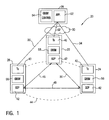
- Figure 1 schematically illustrates selected portions of a wireless communication arrangement that is useful with an embodiment of this invention.
- Figure 2 is a flowchart diagram summarizing an example approach that is useful with the embodiment of Figure 1 , for example.
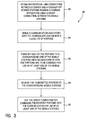
- Figure 3 is a flowchart diagram summarizing another example approach that is useful with the embodiment of Figure 1 , for example.
- FIG. 1 schematically shows selected portions of a wireless communication arrangement 20 including a plurality of mobile stations 22, 24 and 26 and a remotely located server 28.
- a wireless network 30 facilitates wireless communication links 32, 34 and 36 between the server 28 and the mobile stations 22, 24 and 26, respectively.
- Each of the wireless links 32, 34 and 36 allows for communications between the respective mobile stations and the server using known wireless communication techniques.
- Each wireless station includes a transceiver portion 40 that is useful for uplink and downlink communications over the respective link with the server 28.
- Each mobile station includes a group connection portion 42 for establishing a local group connection 44 between the mobile stations.
- the local group connection 44 uses Bluetooth technology.
- the local group connection 44 uses WiFi technology.
- the local group connection 44 allows for communications among the mobile stations as schematically shown at 46, 48 and 50.
- the mobile stations use the local group connection 44 for sharing a common application that is run by each of the mobile stations.
- a common application can be considered a common application to the mobile stations or a shared application.
- the server 28 facilitates the same application 52.
- the server 28 includes a group bandwidth sharing manager (GBSM) 54 that is useful for controlling how the mobile stations share information for running the common application 52.
- GBSM group bandwidth sharing manager
- Each of the example mobile stations includes a group bandwidth sharing module 56 that communicates with the GBSM 54 for facilitating communications among the mobile stations over the local group connection 44 on the one hand and between each of the mobile stations and the server 28 for purposes of running the application 52 on the other hand.
- One feature of the example of Figure 1 is that the amount of bandwidth required for efficiently running an application and communicating the necessary associated data between the server 28 and a mobile station is divided among the individual wireless links 32, 34 and 36, which effectively provides an increased total bandwidth. Instead of being limited to the bandwidth available to a single wireless link between one mobile station and the server 28, the total achievable bandwidth is based on that which is available over all of the wireless links involved.
- the local group connection 44, the GBSM 54 and the group bandwidth sharing modules 56 facilitate realizing the effect of the combined bandwidth from the individual wireless communication links 32, 34 and 36.
- Figure 2 summarizes a technique for providing a communication to the server 28 from the mobile stations, for example, in a flow chart diagram 60.
- a group connection is established between the plurality of mobile stations 22, 24 and 26.
- the group connection 44 may be based upon WiFi or Bluetooth technologies, for example.
- a common application will be run on the plurality of mobile stations.
- Individual links are established (e.g., the wireless communication links 32, 34 and 36) between the mobile stations and the remotely located server 28.
- a communication associated with the application run on the mobile stations is divided into a plurality of portions.
- a data communication necessary for running the application 52 will have a certain size (e.g., number of bits) that could exceed the bandwidth of any of the individual wireless communication links 32, 34 and 36.
- the communication is divided into a plurality of portions, each having a reduced size compared to the entire communication.
- each one of the portions of the divided communication is assigned to a corresponding one of the mobile stations.
- each mobile station transmits its assigned portion over the corresponding wireless link to the server 28.
- the server 28 receives all of the transmitted portions and combines them into the original communication necessary for running the application 52.
- the local group connection 44 facilitates communications between the mobile stations regarding how the communication will be divided into portions and facilitates the assignment of each portion to the respective mobile stations.
- the GBSM 54 provides information to the group bandwidth sharing modules 56 on the mobile stations to indicate how a communication should be divided among the mobile stations.
- the GBSM 54 determines what mobile stations belong to a particular group having a local group connection 44 and communicating with the application 52 on the server 28.
- the GBSM 54 facilitates dividing communications into portions and combining them back into the entire communication so that the individual portions can be communicated over the individual wireless links between the server 28 and the mobile stations 22, 24 and 26, respectively.
- the group bandwidth sharing modules 56 and the group connection portions 42 of each mobile station coordinate communications among the mobile stations to achieve the desired apportionment of a communication among the mobile stations and the communication of those portions between the server 28 and the mobile stations.
- one of the mobile stations 22 will be assigned the task of being a coordinator mobile station.
- the GBSM 54 can communicate primarily with the group bandwidth sharing module 56 of the coordinator mobile station for providing instructions for dividing communications to be sent to the server.
- the coordinator mobile station responsively provides corresponding instructions to the other mobile stations through the local group connection 44.
- the GBSM 54 can also primarily communicate with the coordinator mobile station regarding how respective portions sent by the server 28 to the individual mobile stations should be combined to achieve the entire communication.
- the coordinator mobile station communicates with the other mobile stations over the local group connection 44 so that they share the received portions in a manner that they are combined into the entire communication for use by any or all of the mobile stations.
- Such an example allows for reducing the number of communications between the GBSM 54 and the individual mobile stations and relies upon the local group connection 44 for sharing information among the mobile stations regarding how communication portions should be handled.
- the GBSM 54 instructs the mobile stations how to divide up communications or how to allocate bandwidth among the different links between the server 28 and the mobile stations.
- the GBSM 54 already knows how to recombine communication portions received over the individual wireless links 32, 34 and 36.
- the wireless stations provide an indication along with transmitted portions of a communication to allow the server 28 to determine how to combine those portions into the entire communication so that it is available for the application 52.
- Figure 3 includes a flowchart diagram 80 that summarizes an approach for providing a communication from the server 28 to the mobile stations.
- the individual wireless link connections 32, 34 and 36 are established between the server 28 and the plurality of mobile stations, which are running a common application using the local group connection 44 between the mobile stations.
- a communication associated with the common application is divided into a plurality of portions at the application 52.
- each of the portions is transmitted to a corresponding one of the mobile stations.
- Each portion is transmitted over one of the individual wireless links 32, 34 and 36 in one example.
- the transmitted portions include an indication of how the portions are to be combined for eventual use by at least one of the mobile stations.
- the server 28 in this example provides an indication of how the individual portions transmitted on the individual wireless links 32, 34 and 36 should be combined using the local group connection 44 so that the entire communication is available to any of the mobile stations requiring that communication.
- each of the mobile stations receives the corresponding portion transmitted to it over its individual wireless link with the server 28.
- the group bandwidth sharing modules 56 and the group connection portions 42 use the local group connection 44 for communicating the different portions among the different mobile stations for combining the received portions into the communication so that the entire communication is available for at least one of the mobile stations.
- a local group connection among a plurality of mobile stations can be used in combination with individual wireless links between the mobile stations and a remotely located server for realizing an effective higher bandwidth of communication between the server and the mobile stations.
- a high bandwidth communication can be divided into portions and transmitted over a plurality of links between the plurality of mobile stations and the server.
- the local group connection between the mobile stations facilitates dividing a communication that will be transmitted to the server and combining a plurality of portions of a communication received from the server.
- the intended receiver e.g., the server or the mobile stations
- the intended receiver has the entire communication available once the individually transmitted portions are combined.
Landscapes
- Engineering & Computer Science (AREA)
- Computer Networks & Wireless Communication (AREA)
- Signal Processing (AREA)
- Quality & Reliability (AREA)
- Databases & Information Systems (AREA)
- Mobile Radio Communication Systems (AREA)
Abstract
Description
- This invention generally relates to communication. More particularly, this invention relates to high bandwidth communications.
- Communication systems are in use for a variety of purposes and they take many forms. One popular type of communication system is a wireless communication system that allows individuals to communicate using mobile stations (e.g., cell phones, laptop computers or personal digital assistants). Such wireless communication systems have been providing increasing capabilities to subscribers. Current wireless systems are used for voice communications, data communications, internet surfing, email, multi-media applications and combinations of these. There is a desire to provide even more and better service to subscribers.
- Once challenge that arises when trying to increase the quality and versatility of wireless communications is that it is difficult to communicate large amounts of information very rapidly given current bandwidth availability. A mobile station typically has a wireless link with a wireless communication network over which communications are transmitted between the network and the mobile station. Wireless links have limited bandwidth and, therefore, limit the amount of information that can be exchanged between the mobile station and the network. More complex types of communications require higher bandwidth. Various applications and programs that individuals would like to run on a mobile station using a wireless communication link require more bandwidth than is currently available. In some cases, an application could be run but the quality seems less than desirable because of a slower exchange of information due to the available bandwidth.
- It would be beneficial to provide improved arrangements that allow for accomplishing higher bandwidth communications without having to significantly alter existing wireless communication network infrastructure.
- An exemplary method of communication and an exemplary mobile station device are defined by the appended claims.
- One example method of communicating includes communicating between a server and a plurality of mobile stations over a corresponding plurality of wireless links between the server and the mobile stations. The plurality of mobile stations have a local group connection between them that is distinct from the wireless links. A communication is divided into a plurality of portions. A first one of the portions is transmitted over a first one of the wireless links between one of the mobile stations and the server. A second one of the portions is transmitted over a second one of the wireless links between another one of the mobile stations and the server. An indication regarding how the portions are to be combined is provided such that the entire communication is available for a receiver.
- In one example, at least one of the mobile stations is the receiver that obtains the entire communication. In another example, the server is the receiver that obtains the entire communication.
- An example mobile station device comprises a transceiver portion for communicating over a wireless communication link with a remotely located server. A group connection portion is for communicating with at least one other device over a local group connection that is distinct from the wireless communication link. A group bandwidth sharing module of the mobile station device is configured to transmit at least one portion of a communication shared by the mobile station device and the at least one other device over the wireless communication link. The group bandwidth sharing module is also configured to combine at least one portion of a communication received by the mobile station device over the wireless communication link with at least one other portion of the same communication received by the at least one other device. This combination allows for obtaining the entire communication at the mobile station device without requiring the entire communication to be transmitted over the wireless communication link between the mobile station device and the remotely located server.
- The various features and advantages of the disclosed example arrangements will become apparent to those skilled in the art from the following detailed description. The drawings that accompany the detailed description can be briefly described as follows.
-
Figure 1 schematically illustrates selected portions of a wireless communication arrangement that is useful with an embodiment of this invention. -
Figure 2 is a flowchart diagram summarizing an example approach that is useful with the embodiment ofFigure 1 , for example. -
Figure 3 is a flowchart diagram summarizing another example approach that is useful with the embodiment ofFigure 1 , for example. -
Figure 1 schematically shows selected portions of awireless communication arrangement 20 including a plurality ofmobile stations server 28. Awireless network 30 facilitateswireless communication links server 28 and themobile stations wireless links transceiver portion 40 that is useful for uplink and downlink communications over the respective link with theserver 28. - Each mobile station includes a
group connection portion 42 for establishing alocal group connection 44 between the mobile stations. In one example, thelocal group connection 44 uses Bluetooth technology. In another example, thelocal group connection 44 uses WiFi technology. Thelocal group connection 44 allows for communications among the mobile stations as schematically shown at 46, 48 and 50. - In one example, the mobile stations use the
local group connection 44 for sharing a common application that is run by each of the mobile stations. In this sense, such an application can be considered a common application to the mobile stations or a shared application. - The
server 28 facilitates thesame application 52. Theserver 28 includes a group bandwidth sharing manager (GBSM) 54 that is useful for controlling how the mobile stations share information for running thecommon application 52. Each of the example mobile stations includes a groupbandwidth sharing module 56 that communicates with the GBSM 54 for facilitating communications among the mobile stations over thelocal group connection 44 on the one hand and between each of the mobile stations and theserver 28 for purposes of running theapplication 52 on the other hand. - One feature of the example of
Figure 1 is that the amount of bandwidth required for efficiently running an application and communicating the necessary associated data between theserver 28 and a mobile station is divided among the individualwireless links server 28, the total achievable bandwidth is based on that which is available over all of the wireless links involved. Thelocal group connection 44, the GBSM 54 and the groupbandwidth sharing modules 56 facilitate realizing the effect of the combined bandwidth from the individualwireless communication links -
Figure 2 summarizes a technique for providing a communication to theserver 28 from the mobile stations, for example, in a flow chart diagram 60. At 62 a group connection is established between the plurality ofmobile stations group connection 44 may be based upon WiFi or Bluetooth technologies, for example. As represented at 64, a common application will be run on the plurality of mobile stations. Individual links are established (e.g., thewireless communication links server 28. - As shown at 68, a communication associated with the application run on the mobile stations is divided into a plurality of portions. For example, a data communication necessary for running the
application 52 will have a certain size (e.g., number of bits) that could exceed the bandwidth of any of the individualwireless communication links - At 72, each mobile station transmits its assigned portion over the corresponding wireless link to the
server 28. At 74, theserver 28 receives all of the transmitted portions and combines them into the original communication necessary for running theapplication 52. - In this example, the
local group connection 44 facilitates communications between the mobile stations regarding how the communication will be divided into portions and facilitates the assignment of each portion to the respective mobile stations. In one example, theGBSM 54 provides information to the groupbandwidth sharing modules 56 on the mobile stations to indicate how a communication should be divided among the mobile stations. In one example, theGBSM 54 determines what mobile stations belong to a particular group having alocal group connection 44 and communicating with theapplication 52 on theserver 28. TheGBSM 54 facilitates dividing communications into portions and combining them back into the entire communication so that the individual portions can be communicated over the individual wireless links between theserver 28 and themobile stations bandwidth sharing modules 56 and thegroup connection portions 42 of each mobile station coordinate communications among the mobile stations to achieve the desired apportionment of a communication among the mobile stations and the communication of those portions between theserver 28 and the mobile stations. - In one example, one of the
mobile stations 22 will be assigned the task of being a coordinator mobile station. TheGBSM 54 can communicate primarily with the groupbandwidth sharing module 56 of the coordinator mobile station for providing instructions for dividing communications to be sent to the server. The coordinator mobile station responsively provides corresponding instructions to the other mobile stations through thelocal group connection 44. TheGBSM 54 can also primarily communicate with the coordinator mobile station regarding how respective portions sent by theserver 28 to the individual mobile stations should be combined to achieve the entire communication. In this situation, the coordinator mobile station communicates with the other mobile stations over thelocal group connection 44 so that they share the received portions in a manner that they are combined into the entire communication for use by any or all of the mobile stations. Such an example allows for reducing the number of communications between theGBSM 54 and the individual mobile stations and relies upon thelocal group connection 44 for sharing information among the mobile stations regarding how communication portions should be handled. - In one example, the
GBSM 54 instructs the mobile stations how to divide up communications or how to allocate bandwidth among the different links between theserver 28 and the mobile stations. In such an example, when the groupbandwidth sharing modules 56 of the mobile stations respond to such an instruction from theGBSM 54, theGBSM 54 already knows how to recombine communication portions received over theindividual wireless links server 28 to determine how to combine those portions into the entire communication so that it is available for theapplication 52. -
Figure 3 includes a flowchart diagram 80 that summarizes an approach for providing a communication from theserver 28 to the mobile stations. At 82, the individualwireless link connections server 28 and the plurality of mobile stations, which are running a common application using thelocal group connection 44 between the mobile stations. At 84, a communication associated with the common application is divided into a plurality of portions at theapplication 52. At 86, each of the portions is transmitted to a corresponding one of the mobile stations. Each portion is transmitted over one of theindividual wireless links server 28 and the mobile stations will not be required by all of the mobile stations. In other examples, the communication will be relevant to running thecommon application 52 and, therefore, will eventually be used by all of the mobile stations. In either scenario, theserver 28 in this example provides an indication of how the individual portions transmitted on theindividual wireless links local group connection 44 so that the entire communication is available to any of the mobile stations requiring that communication. - At 88, each of the mobile stations receives the corresponding portion transmitted to it over its individual wireless link with the
server 28. At 90, the groupbandwidth sharing modules 56 and thegroup connection portions 42 use thelocal group connection 44 for communicating the different portions among the different mobile stations for combining the received portions into the communication so that the entire communication is available for at least one of the mobile stations. - It can be appreciated from the disclosed examples how a local group connection among a plurality of mobile stations can be used in combination with individual wireless links between the mobile stations and a remotely located server for realizing an effective higher bandwidth of communication between the server and the mobile stations. With the disclosed example, it is not necessary to transmit an entire high bandwidth communication over a single link between a mobile station and a server. Instead, a high bandwidth communication can be divided into portions and transmitted over a plurality of links between the plurality of mobile stations and the server. The local group connection between the mobile stations facilitates dividing a communication that will be transmitted to the server and combining a plurality of portions of a communication received from the server. In either event, the intended receiver (e.g., the server or the mobile stations) has the entire communication available once the individually transmitted portions are combined.
- The preceding description is exemplary rather than limiting in nature. Variations and modifications to the disclosed examples may become apparent to those skilled in the art that do not necessarily depart from the essence of this invention. The scope of legal protection given to this invention can only be determined by studying the following claims.
Claims (19)
- A method of communicating, comprising the steps of:communicating between a server and a plurality of mobile stations over a corresponding plurality of wireless links between the server and the mobile stations, the plurality of mobile stations having a local group connection between the mobile stations that is distinct from the wireless links;characterized by
dividing a communication into a plurality of portions;
transmitting a first one of the portions over a first one of the wireless links between a first one of the mobile stations and the server;
transmitting a second one of the portions over a second one of the wireless links between a second one of the mobile stations and the server; and
providing an indication regarding how the portions are to be combined such that the entire communication is available for a receiver. - The method of claim 1, wherein the mobile stations transmit the portions and the server is the receiver.
- The method of either of claims 1 or 2, comprising
providing an indication to the mobile stations how to divide up a communication intended for the server; and
using the provided indication for combining a subsequently received plurality of portions from the mobile stations. - The method of either of claims 1 or 2, comprising
using an indication associated with the portions for determining how to combine the portions. - The method of claim 1, wherein the server transmits the portions and at least one of the mobile stations is the receiver.
- The method of claim 5, comprising
providing the entire communication to all of the plurality of mobile stations. - The method of either of claims 5 or 6, comprising
using at least one group bandwidth sharing module of at least one of the mobile stations for determining how to combine the portions into the complete communication. - The method of any of claims 1, or 5-7, comprising
establishing a local group connection among the plurality of mobile stations;
running a common application on each of the mobile stations using the local group connection;
using the local group connection for dividing up a communication into a plurality of portions for transmitting the portions from respective ones of the mobile stations; and
using the local group connection for combining a plurality of received portions into a single communication for at least one of the mobile stations. - The method of any of claims 1-8, wherein the mobile stations run an application and the divided communication comprises data associated with the application.
- The method of claim 9, wherein the application facilitates one of playing a game or viewing a video.
- A mobile station device, comprising
a transceiver portion for communicating over a wireless communication link with a remotely located server;
a group connection portion for communicating with at least one other device over a local group connection that is distinct from the wireless communication link; and
characterized by
a group bandwidth sharing module that is configured to
transmit at least one portion of a communication shared by the mobile station device and the at least one other device over the wireless communication link, and
combine at least one portion of a communication received by the mobile station device over the wireless communication link with at least one other portion of the communication received by the at least one other device for obtaining the entire communication at the mobile station device. - The mobile station device of claim 11, wherein the group connection portion communicates with at least one other device using a first protocol and the transceiver portion communicates with the server using a second, different protocol.
- The mobile station device of claim 12, wherein the first protocol comprises at least one of a Bluetooth protocol or a WiFi protocol.
- The mobile station device of claim 11, wherein the mobile station runs an application and the portions of the communication comprise portions of data associated with the application.
- The mobile station device of claim 14, wherein the application facilitates one of playing a game or viewing a video.
- A wireless communication server device, comprising
a transceiver portion for communicating over a plurality of wireless links with a corresponding plurality of mobile stations; and
characterized by
a group bandwidth sharing manager that is configured to
divide a communication intended for at least one of the mobile stations into a plurality of portions and transmit each of the portions over a respective one of the links; and
receive at least one portion of a communication on each of the wireless links, respectively, and combine the received portions into a single communication. - The device of claim 16, wherein the group bandwidth sharing manager is configured to provide an indication to the mobile stations how to divide a communication among the mobile stations for transmitting the portions of the communication the server device.
- The device of claim 16, wherein the server device runs an application and the portions of the communication comprise portions of data associated with the application.
- The device of claim 18, wherein the application facilitates one of playing a game or viewing a video.
Priority Applications (4)
| Application Number | Priority Date | Filing Date | Title |
|---|---|---|---|
| EP07251434A EP1976201A1 (en) | 2007-03-30 | 2007-03-30 | Shared communication capabilities of mobile stations for high bandwidth communications |
| PCT/US2008/003671 WO2008121248A1 (en) | 2007-03-30 | 2008-03-20 | Shared communication capabilities of mobile stations for high bandwidth communications |
| US12/077,975 US20080242336A1 (en) | 2007-03-30 | 2008-03-24 | Shared communication capabilities of mobile stations for high bandwidth communications |
| CNA2008100884878A CN101277534A (en) | 2007-03-30 | 2008-03-31 | Shared communication capacity of mobile stations for high bandwidth communication |
Applications Claiming Priority (1)
| Application Number | Priority Date | Filing Date | Title |
|---|---|---|---|
| EP07251434A EP1976201A1 (en) | 2007-03-30 | 2007-03-30 | Shared communication capabilities of mobile stations for high bandwidth communications |
Publications (1)
| Publication Number | Publication Date |
|---|---|
| EP1976201A1 true EP1976201A1 (en) | 2008-10-01 |
Family
ID=38038941
Family Applications (1)
| Application Number | Title | Priority Date | Filing Date |
|---|---|---|---|
| EP07251434A Withdrawn EP1976201A1 (en) | 2007-03-30 | 2007-03-30 | Shared communication capabilities of mobile stations for high bandwidth communications |
Country Status (4)
| Country | Link |
|---|---|
| US (1) | US20080242336A1 (en) |
| EP (1) | EP1976201A1 (en) |
| CN (1) | CN101277534A (en) |
| WO (1) | WO2008121248A1 (en) |
Families Citing this family (3)
| Publication number | Priority date | Publication date | Assignee | Title |
|---|---|---|---|---|
| US8185120B2 (en) * | 2010-03-26 | 2012-05-22 | Microsoft Corporation | Cellular service with improved service availability |
| CN102378394B (en) | 2010-08-12 | 2015-04-15 | 华为技术有限公司 | A network connection method and system |
| IL210169A0 (en) | 2010-12-22 | 2011-03-31 | Yehuda Binder | System and method for routing-based internet security |
Citations (2)
| Publication number | Priority date | Publication date | Assignee | Title |
|---|---|---|---|---|
| WO2002052787A2 (en) * | 2000-12-22 | 2002-07-04 | The Charles Stark Draper Laboratory, Inc. | Message splitting and spatially diversified message routing for increasing transmission assurance and data security over distributed networks |
| US20030026222A1 (en) | 2001-08-02 | 2003-02-06 | Kotzin Michael D. | Method and apparatus for aggregation of wireless resources of proximal wireless units to facilitate diversity signal combining |
-
2007
- 2007-03-30 EP EP07251434A patent/EP1976201A1/en not_active Withdrawn
-
2008
- 2008-03-20 WO PCT/US2008/003671 patent/WO2008121248A1/en not_active Ceased
- 2008-03-24 US US12/077,975 patent/US20080242336A1/en not_active Abandoned
- 2008-03-31 CN CNA2008100884878A patent/CN101277534A/en active Pending
Patent Citations (2)
| Publication number | Priority date | Publication date | Assignee | Title |
|---|---|---|---|---|
| WO2002052787A2 (en) * | 2000-12-22 | 2002-07-04 | The Charles Stark Draper Laboratory, Inc. | Message splitting and spatially diversified message routing for increasing transmission assurance and data security over distributed networks |
| US20030026222A1 (en) | 2001-08-02 | 2003-02-06 | Kotzin Michael D. | Method and apparatus for aggregation of wireless resources of proximal wireless units to facilitate diversity signal combining |
Also Published As
| Publication number | Publication date |
|---|---|
| CN101277534A (en) | 2008-10-01 |
| US20080242336A1 (en) | 2008-10-02 |
| WO2008121248A1 (en) | 2008-10-09 |
Similar Documents
| Publication | Publication Date | Title |
|---|---|---|
| US20190327593A1 (en) | D2D Communication Method and Device | |
| CN114828080B (en) | Communication methods, devices, terminals, network equipment and storage media | |
| US10555328B2 (en) | Scalable coexistence scheme for WLAN operation with multiple periodic BT connections | |
| US8601145B2 (en) | Inter-processor communication link with manageability port | |
| US9237556B2 (en) | Method of operating access point and wireless communication system using access point | |
| CN103442391A (en) | Data transmission method and system as well as user terminal | |
| CN104823393A (en) | Data stream division method to increase data transmission rates | |
| CN112153632B (en) | A method and communication device for capability reporting | |
| CN111132223B (en) | Data packet transmission method and communication equipment | |
| CN110971349B (en) | Repeated transmission method, terminal and network side equipment | |
| CN116830679A (en) | Communication methods, electronic devices and storage media | |
| CN105245265B (en) | User service mode selection method under 3D wave beam, pilot frequency information sending method and device | |
| US20080242336A1 (en) | Shared communication capabilities of mobile stations for high bandwidth communications | |
| US9635586B2 (en) | Method and apparatus for using call admission control for client balancing | |
| CN112333690B (en) | Data transmission method, device, storage medium, terminal and network access point equipment | |
| CN103428905A (en) | Telematics communication system and method | |
| US8782137B2 (en) | Multi-hop MIMO system and method | |
| CN121533124A (en) | Techniques supporting predictive scheduling for low-latency communication | |
| JP7682663B2 (en) | COMMUNICATION DEVICE, COMMUNICATION METHOD, AND PROGRAM | |
| CN116830720A (en) | Low-latency service transmission methods, electronic equipment and storage media | |
| US8320950B2 (en) | Method for increasing synchronous control channel capacity in a wireless system | |
| CN108076013B (en) | A multi-channel terminal multi-party calling method and device | |
| EP3007472B1 (en) | Service scheduling method, system, terminal and storage medium based on clustering system | |
| US10869225B2 (en) | Automatically select uplink based on user anchor controller | |
| US20180035482A1 (en) | Video communication system, video transmission terminal, video reception terminal, communication method, and recording medium |
Legal Events
| Date | Code | Title | Description |
|---|---|---|---|
| PUAI | Public reference made under article 153(3) epc to a published international application that has entered the european phase |
Free format text: ORIGINAL CODE: 0009012 |
|
| 17P | Request for examination filed |
Effective date: 20070413 |
|
| AK | Designated contracting states |
Kind code of ref document: A1 Designated state(s): AT BE BG CH CY CZ DE DK EE ES FI FR GB GR HU IE IS IT LI LT LU LV MC MT NL PL PT RO SE SI SK TR |
|
| AX | Request for extension of the european patent |
Extension state: AL BA HR MK RS |
|
| 17Q | First examination report despatched |
Effective date: 20081120 |
|
| AKX | Designation fees paid |
Designated state(s): AT BE BG CH CY CZ DE DK EE ES FI FR GB GR HU IE IS IT LI LT LU LV MC MT NL PL PT RO SE SI SK TR |
|
| RAP3 | Party data changed (applicant data changed or rights of an application transferred) |
Owner name: LUCENT TECHNOLOGIES INC. |
|
| STAA | Information on the status of an ep patent application or granted ep patent |
Free format text: STATUS: THE APPLICATION IS DEEMED TO BE WITHDRAWN |
|
| 18D | Application deemed to be withdrawn |
Effective date: 20100323 |