EP1975859A2 - Method and system for continuous multi-objective optimization of designs - Google Patents
Method and system for continuous multi-objective optimization of designs Download PDFInfo
- Publication number
- EP1975859A2 EP1975859A2 EP08152929A EP08152929A EP1975859A2 EP 1975859 A2 EP1975859 A2 EP 1975859A2 EP 08152929 A EP08152929 A EP 08152929A EP 08152929 A EP08152929 A EP 08152929A EP 1975859 A2 EP1975859 A2 EP 1975859A2
- Authority
- EP
- European Patent Office
- Prior art keywords
- population
- neighbourhood
- size
- points
- convergence
- Prior art date
- Legal status (The legal status is an assumption and is not a legal conclusion. Google has not performed a legal analysis and makes no representation as to the accuracy of the status listed.)
- Withdrawn
Links
Images
Classifications
-
- G—PHYSICS
- G06—COMPUTING OR CALCULATING; COUNTING
- G06N—COMPUTING ARRANGEMENTS BASED ON SPECIFIC COMPUTATIONAL MODELS
- G06N3/00—Computing arrangements based on biological models
- G06N3/12—Computing arrangements based on biological models using genetic models
- G06N3/126—Evolutionary algorithms, e.g. genetic algorithms or genetic programming
Definitions
- the present invention relates to a method and a system for continuous multi-objective optimization of designs.
- a typical application of the invention is the optimisation of aerodynamic or hydrodynamic bodies.
- Multi-objective optimization refers to the fact that multiple physical parameters are to be optimized simultaneously, e.g. weight, tensile strength, drag, etc.
- the objective function represents the body being subject to optimization, such as a rotor blade.
- the inputs to the objective function may represent relevant parameters of the body's design, e.g. geometric properties such as curvature.
- the outputs of the objective function may represent the physical properties of the design, with respect to which the design object is to be optimised.
- a wing's curvature input
- output output
- the Pareto Set of a continuous MOP is an (m - 1)-dimensional manifold [11].
- regularity has rarely been exploited in multiobjective evolutionary algorithms [6].
- several methods based on this regularity property have been proposed for dealing with continuous MOPs with variable linkages [7], [13], [15].
- Local principal component analysis (LPCA) [8] and generative topographic mapping (GTM) [1] are utilized in our methods for modelling the distribution of promising search areas in the decision space.
- the invention introduces simple yet effective modelling strategy. It builds a number of local models in the search space. The neighbourhood size of each local model is adjusted during the search according to a new proposed convergence criterion, which measures the progress of the algorithm. This strategy provides a natural way for balancing exploitation and exploration.
- piecewise linear models may be used to approximate the Pareto Set and the major difference from the LPCA based method, i.e. RM-MEDA [13], is on how to select some points to build a model.
- an adaptive method is used and the basic idea is as follows: in each step, firstly some evenly distributed reference points are selected from the population; secondly for each reference point, a neighbourhood is randomly generated from the population, and those which are close to the reference point are chosen out to build a model.
- the invention is characterized in that the size of a neighbourhood is adaptively adjusted by a convergence criterion which measures the progress of the algorithm. Since in the proposed method, models are built adaptively, it may be called an adaptive model based multi-objective estimation of distribution algorithm (AM-MEDA).
- AM-MEDA adaptive model based multi-objective estimation of distribution algorithm
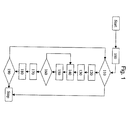
- Figure 1 shows a flowchart of a method according to one embodiment of the invention. The following notation will be used in describing the method:
- Step 100 the population is randomly initialized.
- Step 110 the stopping condition is controlled by the maximal number of generations.
- the MaxiMin sorting scheme [12] is used to select an even distributed subset of points from a set.
- the candidate set is firstly sorted according to the rank values as the non-dominated sorting scheme [2].
- the MaxiMin scheme uses the following process: firstly the m (number of objectives) extreme points are selected into a subset, then the point which has the maximal distance to the subset (the distance is measured as the minimal Euclidean distance from the point to all points in the subset) will be selected into the subset, the process repeats until all points with the same rank value are processed and the selected order is the sorting order.
- the advantages of this scheme are: (1) the time complexity of the process is O(MN) where N is the population size and M the size of selected points; (2) the extreme points and the points in sparse regions are emphasized. More details on this scheme may be found in [12].
- the method may further comprise the step of outputting the optimized result and using it for providing or building an optimized aerodynamic or hydrodynamic design, e.g. a turbine.
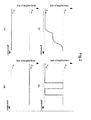
- Figure 2 illustrates how neighbourhood control may be effected in one embodiment of the invention.
- a convergence criterion is proposed to measure the convergence of a cluster and genetics or model based generator are applied adaptively according to the convergence criterion.
- the dynamics of evolution are further considered and therefore, a convergence criterion is introduced to test the change of a population.
- N t C the size of neighborhood, N t C , at generation t.
- At least four neighbourhood control strategies by convergence criterion may be considered in various embodiments of the invention:
- the i-th principal component v i k is a unity eigenvector associated with the i-th largest eigenvalue ⁇ i k of the matrix Cov k .
- a linear model with Gaussian noise denoted as A k , is built as follows.
- s i ⁇ [ s i k , min , s i k , max ]
- [ s i k , min , s i k , max ] is the range of projection in i th eigenvector
- s i k , min min x ⁇ S k ⁇ x - x ⁇ k T ⁇ v i k s i k
- max max x ⁇ S k ⁇ x - x ⁇ k T ⁇ v i k
- ⁇ k is a noise vector with mean 0 and variance ⁇ k , i.e ⁇ k ⁇ N
- a model is chosen according to the evenness of a model.
- evenness(S k ) denotes the evenness of model A k and it is calculated as the average density of solutions in S k
- evenness ( S k ) 1 N P ⁇ x ⁇ S k density x
- density(x) denotes the density of a solution x and it is estimated as the second minimal distance to x in P t .
- the search space is extended by 50% along the manifold. As discussed in previous work [13], the reason is the population may not cover the whole Pareto Set, by extension the algorithm can explore more ranges.
- the reproduction process may be set up as follows:
- the invention proposes a multi-objective estimation of distribution algorithm in which an adaptive modelling technique is utilized by considering the dynamics of evolution.
- a convergence criterion is introduced to test the dynamics of the population and this criterion is further used to adjust the neighbourhoods of the reference points.
- each model is built based on the information studied from the population adaptively and the exploration and exploitation is thus balanced dynamically.
- the number of models used is still fixed.
- the convergence criterion may be a measurement of how "converged" the individuals are in the population.
- Candidates for such a convergence criterion may be the ratio between the largest and the second largest values, or the distance between the non-dominated fronts of the population of generation (t-k) and generation t, t means the current generation, and k>0 is the offset
Landscapes
- Engineering & Computer Science (AREA)
- Physics & Mathematics (AREA)
- Health & Medical Sciences (AREA)
- Life Sciences & Earth Sciences (AREA)
- Biophysics (AREA)
- Bioinformatics & Cheminformatics (AREA)
- Bioinformatics & Computational Biology (AREA)
- Evolutionary Biology (AREA)
- Theoretical Computer Science (AREA)
- Computational Linguistics (AREA)
- Molecular Biology (AREA)
- Biomedical Technology (AREA)
- Genetics & Genomics (AREA)
- Data Mining & Analysis (AREA)
- Evolutionary Computation (AREA)
- General Health & Medical Sciences (AREA)
- Artificial Intelligence (AREA)
- Computing Systems (AREA)
- General Engineering & Computer Science (AREA)
- General Physics & Mathematics (AREA)
- Mathematical Physics (AREA)
- Software Systems (AREA)
- Physiology (AREA)
- Management, Administration, Business Operations System, And Electronic Commerce (AREA)
Abstract
providing an initial population;
selecting some evenly distributed reference points from the population;
generating randomly, for each reference point, a neighbourhood from the population,
building a probability model based on points from the neighbourhood;
generating a next population by sampling points from the probability model characterized in that
the size of the neighbourhood is adaptively adjusted.
Description
- The present invention relates to a method and a system for continuous multi-objective optimization of designs. A typical application of the invention is the optimisation of aerodynamic or hydrodynamic bodies.
- With respect to the invention, "optimisation of a design" is understood as the following process:
- an initial body to be optimized is provided in encoded form (spline encoding, CAD data, etc.),
- an optimisation computer program generates an optimised encoded representation of the body which, if materialised, yields a physical body optimized with respect to at least one physical parameter, and
- data are provided (and may be output) representing the optimized body and constituting a building plan for building the optimized body in the real world. The building may be done automatically when the encoded representation is available, e.g. as CAD data which may be directly fed into a CAD milling machine, for example.
- Multi-objective optimization refers to the fact that multiple physical parameters are to be optimized simultaneously, e.g. weight, tensile strength, drag, etc.
- The invention considers continuous multi-objective optimization problems (MOPs). Mathematically, a continuous MOP may be defined as follows:

where X ⊂ Rn is the decision space and x = (x1, ... , xn)T ∈ Rn is the decision variable vector. F : X → Rm consists of m real-valued continuous objective functions fi(x) (i = 1, 2, ... ,m) ∈ Rm is the objective space. - In the optimisation of aerodynamic or hydrodynamic bodies, the objective function represents the body being subject to optimization, such as a rotor blade. The inputs to the objective function may represent relevant parameters of the body's design, e.g. geometric properties such as curvature. The outputs of the objective function may represent the physical properties of the design, with respect to which the design object is to be optimised. Within this framework, a wing's curvature (input) may be adapted to yield minimal lift-to-drag ratio (output).
- Under certain smoothness conditions, the Pareto Set of a continuous MOP is an (m - 1)-dimensional manifold [11]. However, such regularity has rarely been exploited in multiobjective evolutionary algorithms [6]. Very recently, several methods based on this regularity property have been proposed for dealing with continuous MOPs with variable linkages [7], [13], [15]. Local principal component analysis (LPCA) [8] and generative topographic mapping (GTM) [1] are utilized in our methods for modelling the distribution of promising search areas in the decision space.
- Experimental studies have shown that these methods are able to deal with MOPs with variable linkages. However, LPCA and GTM are computationally rather expensive, particularly, when the MOP has many decision variables. Besides, the number of clusters must be pre-defined in the LPCA based approach.
- It is therefore an object of the invention to provide a method and a system for multi-objective optimisation of physical designs that is computationally efficient.
- This object is achieved by a method and a system according to the independent claims. Advantageous embodiments are defined in the dependent claims.
- The invention introduces simple yet effective modelling strategy. It builds a number of local models in the search space. The neighbourhood size of each local model is adjusted during the search according to a new proposed convergence criterion, which measures the progress of the algorithm. This strategy provides a natural way for balancing exploitation and exploration.
- These and further aspects and advantages of the present invention will become clearer when considering the following detailed description of exemplary embodiments of the invention in connection with the annexed drawing in which
- Fig. 1
- shows a flowchart of a method according to one embodiment of the invention;
- Fig. 2
- illustrates how neighbourhood control may be effected in one embodiment of the invention; and
- Fig. 3
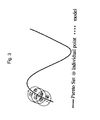
- is an illustration of model building according to one embodiment of the invention.
- According to the invention, piecewise linear models may be used to approximate the Pareto Set and the major difference from the LPCA based method, i.e. RM-MEDA [13], is on how to select some points to build a model. In the invention, an adaptive method is used and the basic idea is as follows: in each step, firstly some evenly distributed reference points are selected from the population; secondly for each reference point, a neighbourhood is randomly generated from the population, and those which are close to the reference point are chosen out to build a model.
- The invention is characterized in that the size of a neighbourhood is adaptively adjusted by a convergence criterion which measures the progress of the algorithm. Since in the proposed method, models are built adaptively, it may be called an adaptive model based multi-objective estimation of distribution algorithm (AM-MEDA).
-
Figure 1 shows a flowchart of a method according to one embodiment of the invention. The following notation will be used in describing the method: - Pt
- population set with size N in generation t.
- Qt
- offspring set in generation t.
- N
- size of Pt and Qt (algorithm parameter).
- NP
- number of points to build a model (algorithm parameter).
- NI
- number of reference points, NI = N/NP.
- Nt C
- size of neighborhood in generation t.
- T
- maximal number of generations (algorithm parameter).
- The individual steps of the method are as follows:
- /* Initialization */
-
Step 100 - Set t := 0. Generate and evaluate an initial population P0.
-
Step 110 - If stopping condition is met, stop and return the non-dominated solutions in Pt.
-
- /* Model Building */
-
Step 120 - Select a set of reference points {xi I, i = 1,...,NI} from Pt, set k := 1.
-
Step 130 - Update the size of neighbourhood, Nt C.
-
Step 140 - Randomly select Nt C candidate points from current population to form a neighbourhood and choose the NP closest to xk I out.
-
Step 150 - Build a probability model on the selected xk I points in the above step.
-
Step 160 - Set k :=k+1,if k <NI go to
Step 140.
-
- /* Model Sampling */
-
Step 170 - Generate offspring set Qt from the models and evaluate Qt.
-
- /* Selection */
-
Step 180 - Select N individuals from Qt Pt to create Pt+1.

-
Step 190 - Set t := t + 1 and go to
Step 100.
-
- The algorithm shall now be described in more detail. In
Step 100, the population is randomly initialized. InStep 110, the stopping condition is controlled by the maximal number of generations. - In
Step 120 andStep 180, the MaxiMin sorting scheme [12] is used to select an even distributed subset of points from a set. In MaxiMin sorting scheme, the candidate set is firstly sorted according to the rank values as the non-dominated sorting scheme [2]. Instead of using crowded distance to sort points with same rank value, the MaxiMin scheme uses the following process: firstly the m (number of objectives) extreme points are selected into a subset, then the point which has the maximal distance to the subset (the distance is measured as the minimal Euclidean distance from the point to all points in the subset) will be selected into the subset, the process repeats until all points with the same rank value are processed and the selected order is the sorting order. The advantages of this scheme are: (1) the time complexity of the process is O(MN) where N is the population size and M the size of selected points; (2) the extreme points and the points in sparse regions are emphasized. More details on this scheme may be found in [12]. - With regard to the handling of boundaries, suppose the search space is X = [xi 1, xi u]n, i = 1,..., n. The newly created solution is x*. All offspring may be made feasible by

where i = 1,..., n and x is randomly selected from the current population Pt. - The method may further comprise the step of outputting the optimized result and using it for providing or building an optimized aerodynamic or hydrodynamic design, e.g. a turbine.
- The mating strategy and offspring reproduction will be discussed in more detail in the following.
-
Figure 2 illustrates how neighbourhood control may be effected in one embodiment of the invention. - In [14], a convergence criterion is proposed to measure the convergence of a cluster and genetics or model based generator are applied adaptively according to the convergence criterion. Here, the dynamics of evolution are further considered and therefore, a convergence criterion is introduced to test the change of a population. The proposed convergence criterion may be defined as:

wherein the term
measures the distance from population Pt1 to population Pt2 , Δt is the size of test window and Δt = 10. By equation (2), one may say that a population converges, if C(Pt) < ε where ε is a predefined algorithm parameter. - With convergence test (2), one may further control the size of neighborhood, Nt C, at generation t. One may restrict Nt C ∈ [Nmin,Nmax] where Nmin = NP and Nmax = N - NP are the minimal and maximal size respectively.
- From the method steps shown above in connection with
figure 1 , one may see that - 1. if Nt C = Nmin, the models will be built on some randomly selected points which represent the current population statistically and
- 2. on the contrary if Nt C = Nmax, to select some points, the whole population will be considered and thus the models will represent the local information of the population.
- As shown in
figure 2 , at least four neighbourhood control strategies by convergence criterion may be considered in various embodiments of the invention: - 1) Adaptive Neighborhood (S1)
The basic idea of this strategy is to increase the size of neighborhood adaptively as follows:
where tk, k = 0, 1, ···are some change points, i.e for all t ∈ [tk-1, tk), C(Pt) > ε and C(Pt) ≤ε when t = tk. T is the maximal generation and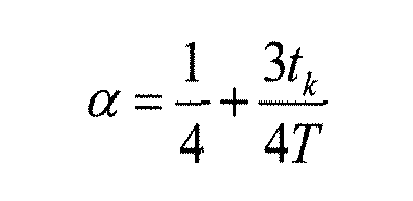
In (3), when C(Pt) ≤ ε and t = tk +¼ (T - Tk), Nt C = Ntk C + ½ (Nmax - Ntk).
As illustrated inFig. 2(a) , the size of neighbourhood keeps stable until C(Pt) ≤ ε and then the size will increase until C(Pt) > ε.
By utilizing this strategy, at the beginning, the size of neighbourhood is small and thus each model will represent the whole population while at the end, on the contrary each model will represent a part of the population but all models will hopefully approximate the population. The size of neighbourhood increases by the convergence criterion and exploration and exploitation may be balanced adaptively. - 2) Alternative Neighbourhood (S2)
As shown inFig. 2(b) , in this strategy two sizes, Nmin and Nmax, may be utilized alternatively.
where 0 < t ≤ T.
The main characteristic of this strategy is that, if the population converges, i.e. C(Pt) ≤ ε, the algorithm turns to do exploitation, and on the other hand if the population does not converge, i.e. C(Pt) > ε, the algorithm turns to do exploration. - 3) Minimum Neighborhood (S3)
As shown inFig. 2(c) , there is no restriction on the size of the neighbourhood which is fixed as:
where 0 < t ≤ T . In this case, the algorithm keeps on exploration in the evolution. - 4) Maximum Neighbourhood (S4)
As shown inFig. 2(d) , the size of the neighbourhood always keeps maximal as:
-
Figure 3 is an illustration of model building according to one embodiment of the invention. Without loss of generality, one may suppose the selected points near to reference point xk are Sk = {x1 k ,..., xNP k}, k = 1,...,NI. The mean of Sk is
- The covariance matrix of Sk is

- The i-th principal component vi k is a unity eigenvector associated with the i-th largest eigenvalue λi k of the matrix Covk.
- As shown in
Fig. 3 , a linear model with Gaussian noise, denoted as Ak, is built as follows.
where
projection in ith eigenvector, and

ε k is a noise vector with mean 0 and variance δ k , i.e ε k ~ N(0, δ k I), I is an identity matrix and
- When sampling new trial solutions, a model is chosen according to the evenness of a model.
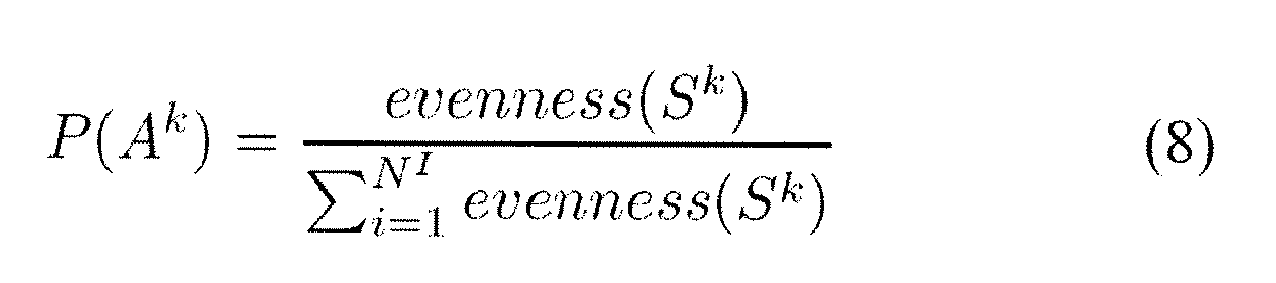
where evenness(Sk) denotes the evenness of model Ak and it is calculated as the average density of solutions in Sk,
where density(x) denotes the density of a solution x and it is estimated as the second minimal distance to x in Pt. - In the reproduction, the search space is extended by 50% along the manifold. As discussed in previous work [13], the reason is the population may not cover the whole Pareto Set, by extension the algorithm can explore more ranges.
- The reproduction process may be set up as follows:
-
- Step 0 Set Qt = φ.
- Step 1 Randomly select a model Ak by (8).
- Step 2 Randomly generate

- Step 3 Generate a noise vector ε k ~ N(0, δ k I).
- Step 4 Get a new trial solution x by (7) and let Qt = Qt ∪ {x}.
- Step 5 Go to Step 1 if |Qt | < N.
- The invention proposes a multi-objective estimation of distribution algorithm in which an adaptive modelling technique is utilized by considering the dynamics of evolution. A convergence criterion is introduced to test the dynamics of the population and this criterion is further used to adjust the neighbourhoods of the reference points. In such a way, each model is built based on the information studied from the population adaptively and the exploration and exploitation is thus balanced dynamically.
- However, in the described method, the number of models used is still fixed. As the next step, one may use a convergence criterion to adapt the number of models in addition to the neighbourhood size. In other words
- 1. The number of models may be adjustable during the optimization using a convergence criterion. This number may then determine the number of index points or the number of clusters. Note that for each cluster or each index point, a model may be built. In this way, the number of models may be adaptive.
- 2. If index points are used for building the models, individuals in the neighbourhood of the index point may be used to build the model. The size of the neighbourhood may also be adapted using a convergence criterion as discussed above.
- 3. The convergence criterion may further be used to adjust the number of reference points, thus also the number of models.
- The convergence criterion may be a measurement of how "converged" the individuals are in the population. Candidates for such a convergence criterion may be the ratio between the largest and the second largest values, or the distance between the non-dominated fronts of the population of generation (t-k) and generation t, t means the current generation, and k>0 is the offset
-
- [1] Christopher M. Bishop, Markus Svens'en, and Christopher K. I. Williams. GTM:the generative topographic mapping. Neural Computation, 10(1):215-234, 1998.
- [2] Kalyanmoy Deb. Multi-Objective Optimization using Evolutionary Algorithms. John Wiley & Sons, LTD, Baffins Lane, Chichester, 2001.
- [3] Kalyanmoy Deb, Amrit Pratap, Sameer Agarwal, and T. Meyarivan. A fast and elitist multiobjective genetic algorithm: NSGA-II. IEEE Transactions on Evolutionary Computation, 6(2):182-197, 2002.
- [4] Kalyanmoy Deb, Ankur Sinha, and Saku Kukkonen. Multi-Objective Test Problems, Linkages, and Evolutionary Methodologies. In Maarten Keijzer et al., editor, 2006 Genetic and Evolutionary Computation Conference (GECCO 2006), volume 2, pages 1141-1148, Seattle, Washington, USA, July 2006. ACM Press.
- [5] Kalyanmoy Deb, Lothar Thiele, Marco Laumanns, and Eckart Zitzler. Scalable Test Problems for Evolutionary Multiobjective Optimization. In Ajith Abraham, Lakhmi Jain, and Robert Goldberg, editors, Evolutionary Multiobjective Optimization. Theoretical Advances and Applications, pages 105-145. Springer, USA, 2005.
- [6] Yaochu Jin and Bernhard Sendhoff. Connectedness, regularity and the success of local search in evolutionary multi-objective optimization. In Proceedings of the Congress on Evolutionary Computation (CEC 2003), pages 1910-1917, Canberra, Australia, December 2003. IEEE Press.
- [7] Yaochu Jin, Aimin Zhou, Qingfu Zhang, Bernhard Sendhoff, and Edward Tsang. Modeling regularity to improve scalability of model-based multiobjective optimization algorithms. In Multi-Objective Problem Solving From Nature: From Concepts to Applications. Springer, 2007. to appear.
- [8] Nandakishore Kambhatla and Todd K. Leen. Dimension reduction by local principal component analysis. Neural Computation, 9(7):1493-1516, October 1997.
- [9] Saku Kukkonen and Jouni Lampinen. GDE3: The third evolution step of generalized differential evolution. In Proceedings of the Congress on Evolutionary Computation (CEC 2005), pages 443-450, Edinburgh, U.K, September 2005. IEEE Press.
- [10] Hui Li and Qingfu Zhang. A multiobjective differential evolution based on decomposition for multiobjective optimization with variable linkages. In Parallel Problem Solving from Nature (PPSN IX), volume 4193 of Lecture Notes in Computer Science, pages 583-592, Reykjavik, Iceland, 2006. Springer.
- [11] Kaisa Miettinen. Nonlinear Multiobjective Optimization, volume 12 of Kluwer's International Series in Operations Research & Management Science. Kluwer Academic Publishers, 1999.
- [12] E J Solteiro Pires, J A Tenreiro Machado, and P B de Moura Oliveira. Multi-objective MaxiMin sorting scheme. In Carlos A. Coello Coello, Arturo Hern'andez Aguirre, and Eckart Zitzler, editors, Third International Conference on Evolutionary Multi-Criterion Optimization (EMO 2005), volume 3410 of Lecture Notes in Computer Science, pages 165-175, Guanajuato, Mexico, March 2005. Springer.
- [13] Qingfu Zhang, Aimin Zhou, and Yaochu Jin. Modelling the regularity in estimation of distribution algorithm for continuous multi-objective evolutionary optimization with variable linkages. IEEE Transactions on Evolutionary Computation, 2007. accepted for publication.
- [14] Aimin Zhou, Yaochu Jin, Qingfu Zhang, Bernhard Sendhoff, and Edward Tsang. Combining model-based and genetics-based offspring generation for multi-objective optimization using a convergence criterion. In Proceedings of the Congress on Evolutionary Computation (CEC 2006), pages 3234-3241, Vancouver, BC, Canada, July 2006. IEEE Press.
- [15] Aimin Zhou, Qingfu Zhang, Yaochu Jin, Edward Tsang, and Tatsuya Okabe. A model-based evolutionary algorithm for bi-objective optimization. In Proceedings of the Congress on Evolutionary Computation (CEC 2005), pages 2568-2575, Edinburgh, U.K, September 2005. IEEE Press.
Claims (13)
- Method for multi-objective optimization of a physical body, comprising the steps:encoding an initial body,providing an initial population comprised of random variations of the parameter set encoding the initial body;selecting some evenly distributed reference points from the population;generating randomly, for each reference point, a neighbourhood from the population,building a probability model based on points from the neighbourhood;generating a next population by sampling points from the probability model andcontinuing the cycle until a termination criterion is met;outputting a signal representing the optimised physical body in encoded form;characterized in thatthe size of the neighbourhood is adaptively adjusted during the course of the optimization cycles.
- Method according to claim 1, wherein
the initial population is provided by random initialization. - Method according to claim 1, wherein
the MaxiMin sorting scheme is used for selecting the set of reference points. - Method according to claim 1, wherein
the size of the neighbourhood is adaptively adjusted based on the convergence of the population. - Method according to claim 4, wherein
the convergence of the population is calculated based on the change of the population. - Method according to claim 5, wherein
the size of the neighbourhood is only increased if the convergence is smaller than or equal to a predetermined threshold value. - Method according to claim 5, wherein
the size of the neighbourhood is minimal if the convergence is smaller than a predetermined threshold value and maximal otherwise. - Method according to claim 5, wherein
the size of the neighbourhood is always minimal. - Method according to claim 5, wherein
the size of the neighbourhood is always maximal. - Method according to claim 1, wherein
the probabilistic model is a linear model with Gaussian noise. - Method according to claim 1, wherein
the number of reference points is adjusted based on a convergence criterion. - Computer program product, comprising instructions that, when executed on a computer, implement a method according to claims 1 to 11.
- System, comprising
means for providing an initial population;
means for selecting some evenly distributed reference points from the population;
means for generating randomly, for each reference point, a neighbourhood from the population,
means for building a probability model based on points which are close to the reference point;
means for generating a next population by sampling points from the probability model and
means for adaptively adjusting the size of the neighbourhood.
Priority Applications (1)
| Application Number | Priority Date | Filing Date | Title |
|---|---|---|---|
| EP08152929A EP1975859A3 (en) | 2007-03-30 | 2008-03-18 | Method and system for continuous multi-objective optimization of designs |
Applications Claiming Priority (2)
| Application Number | Priority Date | Filing Date | Title |
|---|---|---|---|
| EP07105372 | 2007-03-30 | ||
| EP08152929A EP1975859A3 (en) | 2007-03-30 | 2008-03-18 | Method and system for continuous multi-objective optimization of designs |
Publications (2)
| Publication Number | Publication Date |
|---|---|
| EP1975859A2 true EP1975859A2 (en) | 2008-10-01 |
| EP1975859A3 EP1975859A3 (en) | 2009-12-23 |
Family
ID=39535751
Family Applications (1)
| Application Number | Title | Priority Date | Filing Date |
|---|---|---|---|
| EP08152929A Withdrawn EP1975859A3 (en) | 2007-03-30 | 2008-03-18 | Method and system for continuous multi-objective optimization of designs |
Country Status (1)
| Country | Link |
|---|---|
| EP (1) | EP1975859A3 (en) |
-
2008
- 2008-03-18 EP EP08152929A patent/EP1975859A3/en not_active Withdrawn
Non-Patent Citations (15)
Also Published As
| Publication number | Publication date |
|---|---|
| EP1975859A3 (en) | 2009-12-23 |
Similar Documents
| Publication | Publication Date | Title |
|---|---|---|
| Jahromi et al. | Sequential fuzzy clustering based dynamic fuzzy neural network for fault diagnosis and prognosis | |
| Mishra et al. | A new meta-heuristic bat inspired classification approach for microarray data | |
| Ozyildirim et al. | Generalized classifier neural network | |
| Dehuri et al. | Evolutionarily optimized features in functional link neural network for classification | |
| Ventresca et al. | A diversity maintaining population-based incremental learning algorithm | |
| Zhang et al. | A comparison study of credit scoring models | |
| JP4790590B2 (en) | Combining model-based and genetic-based offspring generation for multi-objective optimization using convergence criteria | |
| Oudelha et al. | HMM parameters estimation using hybrid Baum-Welch genetic algorithm | |
| Shamsudin et al. | An optimized support vector machine with genetic algorithm for imbalanced data classification | |
| Guskov et al. | Covariant gradient descent | |
| Asparoukhov et al. | Non-parametric smoothing of the location model in mixed variable discrimination | |
| EP4625262A1 (en) | System and method for simulated quantum annealing to solve optimization problems | |
| Kaylani et al. | AG-ART: an adaptive approach to evolving ART architectures | |
| CN112541530A (en) | Data preprocessing method and device for clustering model | |
| Polani | On the optimization of self-organizing maps by genetic algorithms | |
| CN111612101A (en) | Gene expression data clustering method, device and equipment for nonparametric Watson mixture model | |
| CN111563684A (en) | Load identification method and device and terminal | |
| Hassan et al. | Rough neural classifier system | |
| Pehlivanoglu et al. | Vibrational genetic algorithm enhanced with fuzzy logic and neural networks | |
| Asadi et al. | An unsupervised feed forward neural network method for efficient clustering. | |
| Jwa et al. | Performance Comparison of Design Optimization and Deep Learning-based Inverse Design | |
| Benediktsson et al. | Consensus based classification of multisource remote sensing data | |
| Jin et al. | Modeling regularity to improve scalability of model-based multiobjective optimization algorithms | |
| Mostafa et al. | Estimate of stochastic model parameter of exchange rate using machine learning techniques | |
| Kumar et al. | Optimal Economic Load Dispatch Using Fuzzy Logic & Genetic Algorithms |
Legal Events
| Date | Code | Title | Description |
|---|---|---|---|
| PUAI | Public reference made under article 153(3) epc to a published international application that has entered the european phase |
Free format text: ORIGINAL CODE: 0009012 |
|
| AK | Designated contracting states |
Kind code of ref document: A2 Designated state(s): AT BE BG CH CY CZ DE DK EE ES FI FR GB GR HR HU IE IS IT LI LT LU LV MC MT NL NO PL PT RO SE SI SK TR |
|
| AX | Request for extension of the european patent |
Extension state: AL BA MK RS |
|
| PUAL | Search report despatched |
Free format text: ORIGINAL CODE: 0009013 |
|
| AK | Designated contracting states |
Kind code of ref document: A3 Designated state(s): AT BE BG CH CY CZ DE DK EE ES FI FR GB GR HR HU IE IS IT LI LT LU LV MC MT NL NO PL PT RO SE SI SK TR |
|
| AX | Request for extension of the european patent |
Extension state: AL BA MK RS |
|
| 17P | Request for examination filed |
Effective date: 20100429 |
|
| AKX | Designation fees paid |
Designated state(s): DE FR GB |
|
| 17Q | First examination report despatched |
Effective date: 20120327 |
|
| STAA | Information on the status of an ep patent application or granted ep patent |
Free format text: STATUS: THE APPLICATION IS DEEMED TO BE WITHDRAWN |
|
| 18D | Application deemed to be withdrawn |
Effective date: 20120807 |