EP1975791A2 - A method for automated code conversion - Google Patents
A method for automated code conversion Download PDFInfo
- Publication number
- EP1975791A2 EP1975791A2 EP08153186A EP08153186A EP1975791A2 EP 1975791 A2 EP1975791 A2 EP 1975791A2 EP 08153186 A EP08153186 A EP 08153186A EP 08153186 A EP08153186 A EP 08153186A EP 1975791 A2 EP1975791 A2 EP 1975791A2
- Authority
- EP
- European Patent Office
- Prior art keywords
- data
- level
- memory units
- layout
- locality
- Prior art date
- Legal status (The legal status is an assumption and is not a legal conclusion. Google has not performed a legal analysis and makes no representation as to the accuracy of the status listed.)
- Withdrawn
Links
Images


Classifications
-
- G—PHYSICS
- G06—COMPUTING OR CALCULATING; COUNTING
- G06F—ELECTRIC DIGITAL DATA PROCESSING
- G06F8/00—Arrangements for software engineering
- G06F8/40—Transformation of program code
- G06F8/52—Binary to binary
-
- G—PHYSICS
- G06—COMPUTING OR CALCULATING; COUNTING
- G06F—ELECTRIC DIGITAL DATA PROCESSING
- G06F8/00—Arrangements for software engineering
- G06F8/40—Transformation of program code
- G06F8/41—Compilation
- G06F8/44—Encoding
- G06F8/443—Optimisation
Definitions
- the invention relates to compilers and pre-compilers, also called language re-writers, implementing methods for automated code conversion and to the methods themselves, said methods targeting a computation engine with a predefined architecture.
- a compiler is a computer program that translates text written in a first computer language, the source language which usually is a high-level programming language such as e.g. Fortran, Pascal or C, into a second computer language, the target language which usually is a lower level language such as e.g. assembly language or machine language.
- the input to the compiler is called the source code, and the output is called the object code.
- Conversion methods or compilers exist for various computation engines, e.g. traditional compilers for computation engines based on a general purpose processor. Also vendors of other computation engines provide with their device a suitable compiler.
- code is rewritten in a same language but in a different form. This is done in a language rewriter or pre-compiler, which is a program that translates the form of expressions without a change of language. This may for example be done to optimise code.
- VLIW Very Long Instruction Word
- a VLIW processor executes instructions in parallel based on a fixed schedule determined when the program is compiled. Since determining the order of execution of instructions, including which instructions can execute simultaneously, is handled by the compiler, the processor does not need scheduling hardware. As a result, VLIW processors offer significant computational power with limited hardware complexity.
- a principle of locality also called locality of reference. This is the phenomenon that a same value or related storage location is frequently accessed. Different types of locality of reference are to be distinguished. In temporal locality, a resource that is referenced at one point in time is referenced again soon afterwards. In spatial locality, the likelihood of referencing a storage location is greater if a storage location near it has been recently referenced. Programs and systems which exhibit locality exhibit predictable behaviour, and thus provide opportunities for designers to improve performance through pre-fetching, pre-computing and caching of code and data for future use.
- VLIW Very Long Instruction Word
- SPM scratch pad memory
- the present invention provides a method for automatedly converting application code into optimised application code or into one or more execution codes suitable for execution on a computation engine with an architecture comprising at least a first and a second level of data memory units.
- the method comprises:
- access locality is performed before layout locality, whereby for data which is accessed again and again, accesses are brought together in time where possible when data transfer operations happen, and data which is accessed one after the other is brought together in space where possible. Therefore, in a first step (access locality) a partial fix is done, giving a range of options, and hence freedom. In a second step (layout locality) one option is picked from the pre-defined range. This picking of one option may be done based on a cost function.
- step (b) may effectively use at least part of the additional freedom provided by step (a).
- step (b) may use all additional freedom provided by step (a) to decide on layout of data in the second level of memory units.
- step (b) may use only part of the additional freedom provided by step (a) to decide on layout of data in the second level of memory units, thereby leaving further freedom to further steps, e.g. further access and layout steps.
- step (a) may lead to a plurality of possible schedules of the data transfer operations, and step (b) may further comprise deciding or selecting on some of the schedules of the data transfer operations.
- the decision on the internal organization of at least some of the data transferred is based on a cost function.
- the decision which data transfers to schedule at what moment in time depends on a cost function. A data transfer will not be scheduled if it does not improve the cost function too much.
- a polyhedral model may be used for the code, and the cost function may be built with values extracted from the polyhedral model.
- the values extracted from the polyhedral model may be data dependencies and/or data reuse.
- data accessed may comprise at least a first and a second group of data and the data layout may be performed on these groups of data.
- the architecture may comprise a SPM, a cache or a VWR (see US-2006/212685 ) having a width
- the group of data may comprise at least one line of data having the width of the SPM, the cache or the VWR.
- the architecture may comprise at least one functional unit having a width
- the group of data may comprise at least one word having the width of functional unit, possibly a line.
- the architecture may comprise at least one functional unit having a width
- the group of data may comprise at least one sub-word, the width of the functional unit and the sub-words being such that multiple sub-words can operate in parallel in the functional unit (SMD).
- SMD functional unit
- the converting step may furthermore comprise, before said step of scheduling of data transfer operations, a step of improving parallelism of the data transfers between the first and the second levels of memory units.
- the step of improving parallelism of the data transfers between the first and the second levels of memory units may be based on a cost function.
- the first level of memory units may be a higher level of memory units than the second level of memory units.
- the architecture may furthermore comprise a third level of memory units, the third level of memory units being lower level than the second level of memory units, wherein the said converting step is first performed between the first and second level of memory units, and is thereafter performed between the second and third level of memory units.
- the converting step may furthermore comprise, before said step of converting of data transfer operations between the second and the third levels, a step of improving parallelism of the data transfers between the second and the third levels of memory units. The step of improving parallelism of the data transfers between the second and third levels of memory units may be based on a cost function.
- the present invention provides a pre-compiler for automatedly converting application code into optimised application code for execution on a computation engine with an architecture comprising at least a first and a second level of data memory units, the pre-compiler comprising means for carrying out any of the method steps in accordance with any of the embodiments of the first aspect of the present invention.
- Embodiments of the second aspect of the present invention provide a pre-compiler for converting application code into optimised application code for execution on a computation engine with an architecture comprising at least a first and a second level of data memory units.
- the pre-compiler comprises:
- the present invention provides a compiler for automatedly converting application code into execution code suitable for execution on a computation engine with an architecture comprising at least a first and a second level of data memory units, the compiler comprising means for carrying out any of the method steps in accordance with any of the embodiments of the first aspect.
- Embodiments of the third aspect of the present invention provide a compiler for converting application code into execution code suitable for execution on a computation engine with an architecture comprising at least a first and a second level of data memory units.
- the compiler comprises:
- the present invention provides a computer program product with program code means to execute the steps in accordance with any of the method embodiments of the first aspect of the present invention when executed on a computation engine having an architecture comprising at least a first and a second level of data memory units.
- the computer program product may be part of a computer software product (i.e. a carrier medium) that includes one or more code segments that cause a processor such as a CPU of the computation engine to carry out the steps of the method.
- Embodiments of the present invention also provide such machine readable data storage storing the computer program product of embodiments of the present invention.
- carrier medium and “machine readable data storage” as used herein refer to any medium that participates in providing instructions to a processor for execution.
- Non-volatile media include, for example, optical or magnetic disks, such as a storage device which is part of mass storage.
- Volatile media include dynamic memory such as RAM.
- Transmission media include coaxial cables, copper wire and fiber optics, including the wires that comprise a bus within a computer. Transmission media can also take the form of acoustic or light waves, such as those generated during radio wave and infra-red data communications.
- Computer readable media include, for example a floppy disk, a flexible disk, a hard disk, magnetic tape, or any other magnetic medium, a CD-ROM, any other optical medium, punch cards, paper tapes, any other physical medium with patterns of holes, a RAM, a PROM, an EPROM, a FLASH-EPROM, any other memory chip or cartridge, a carrier wave as described hereafter, or any other medium from which a computer can read.
- Various forms of computer readable media may be involved in carrying one or more sequences of one or more instructions to a processor for execution.
- the instructions may initially be carried on a magnetic disk of a remote computer.
- the remote computer can load the instructions into its dynamic memory and send the instructions over a telephone line using a modem.
- a modem local to the computer system can receive the data on the telephone line and use an infrared transmitter to convert the data to an infrared signal.
- An infrared detector coupled to a bus can receive the data carried in the infra-red signal and place the data on the bus.
- the bus carries data to main memory, from which a processor retrieves and executes the instructions.
- main memory may optionally be stored on a storage device either before or after execution by a processor.
- the instructions can also be transmitted via a carrier wave in a network, such as a LAN, a WAN or the internet.
- Transmission media can take the form of acoustic or light waves, such as those generated during radio wave and infrared data communications. Transmission media include coaxial cables, copper wire and fibre optics, including the wires that form a bus within a computer.
- Coupled should not be interpreted as being restricted to direct connections only.
- the terms “coupled” and “connected”, along with their derivatives, may be used. It should be understood that these terms are not intended as synonyms for each other.
- the scope of the expression “a device A coupled to a device B” should not be limited to devices or systems wherein an output of device A is directly connected to an input of device B. It means that there exists a path between an output of A and an input of B which may be a path including other devices or means.
- Coupled may mean that two or more elements are either in direct physical or electrical contact, or that two or more elements are not in direct contact with each other but yet still co-operate or interact with each other.
- an element described herein of an apparatus embodiment is an example of a means for carrying out the function performed by the element for the purpose of carrying out the invention.
- access and layout locality are differentiated from temporal and spatial locality as generally known in the art.
- the purpose of locality optimization is to reduce the number of unnecessary transfers of data between foreground and background memories. This can be achieved by reordering the accesses such that multiple references to the same data are brought close together in time. A code where multiple accesses of the same data occur close together is referred to as exhibiting access locality.
- the primary instrument to achieve access locality, for the accesses occurring inside loop-nests, is loop transformation. Linear loop transformations such as interchange, rotation, reflection and skewing can be mathematically modelled and instrumented using unimodular matrices, as known by a person skilled in the art.
- the common practice is to amortize that fixed cost by transferring more than just one data item in a single transfer. For instance, to fetch a word from SDRAM to the L1-cache, the SDRAM row needs to be pre-charged which usually takes several processor cycles. However, once pre-charged, each element in the SDRAM row can be obtained in a single cycle with the burst mode. Therefore, transferring several data items together in a single transfer, using burst mode, can lead to performance improvement. This is true, provided, data items that are grouped to be transferred together are actually referenced in the same time period.
- a code where unnecessary movement of data, due to transfers in groups, is minimized is termed by us as exhibiting layout locality.
- An equivalent way of expressing layout locality is -- a code exhibits layout locality if it maximizes the opportunity offered by transfers in group, to organize code and data such that each transfer carries immediately useful data items.
- the second definition looks at layout locality as an opportunity that is to be maximized rather than a problem, according to the first definition, that has to be somehow overcome.
- placement of data items could be organized in such a way that each transfer carries items that is certain to be referenced soon in the future.
- the accesses could be reordered such that data items that are placed together are referenced together.
- the two instruments naturally, can be employed together to decide placement and access order simultaneously.
- loop transformation step the order in which the data would be referenced can be decided completely.
- placement step the arrangement of data items in the memory can be decided.
- partitioning the problem into loop transformation and placement decisions leads to the following problem.
- we perform loop transformation first Since placement has not been done yet, the loop transformation can only optimize reuse. In the process, it fixes the access order completely -- more than what is necessary to exploit the reuse. This completely fixing of the access order takes away many good placement solutions. Therefore performing loop transformation first leads easily to sub-optimal solution.
- placement step has no information based on which good layout decisions can be made. Therefore, placement before loop transformation also leads to poor locality solution.
- placement transformation matrix M p is applied to array A p to improve its layout locality in the loop nest I ' k .
- consecutive iterations of the innermost loop in I ' k must access consecutive elements of A p . Therefore, the following relationship must be satisfied:
- the above equation basically formulates the layout locality constraint: in order to have good layout locality, if we move from iteration I ' k to the next iteration, i.e. only the last row of I ' k increases by 1, then the data-layout or placement matrix M p should be such that the displacement in the referencing of array A p , is only in the last dimension and by 1 as well.
- T k has an effect on the access pattern of array A p , assuming array A p is accessed inside loop-nest I k . If the loop order is changed, then obviously the access pattern of the arrays accessed inside that loop-nest will change. In order to still have layout locality, the placements of the arrays may therefore have to be changed. That is, if T k is changed then M p may have to be changed. Moreover, since A p could have been accessed in some other loop-nest, say I l , the choice of M p may have an impact on T l .
- the access order of I l may have to be changed by choosing an appropriate T / .
- T l may destroy the layout locality of A q , in I l . That can be rectified by applying M q to A q .
- a q is also accessed in I k
- a transformation T k ' must be applied (as placement of A q is now already fixed). But now there is a problem of going in circles.
- the access locality of A p in I k may be destroyed by T k '.
- one loop-nest there is started with one loop-nest.
- its access locality is improved by computing the reuse vectors and applying them to find an appropriate transformation matrix T t .
- an additional transformation T s may then be applied to improve the layout locality of the arrays accessed in that loop-nest, and whose data placement is already fixed.
- T s should not destroy the access locality.
- the placement M for the arrays accessed in the loop-nest is fixed, whose placement is not already fixed, with the objective of improving the layout locality.
- the placement information is then propagated to the next loop-nest where the above process is repeated. It is to be noted that by deciding on T first and then M's the quadratic integer problem is avoided.
- Access locality is more important than layout. Therefore, it may not be desired to transform a loop-nest down the chain to improve layout locality if the process access locality would be destroyed. Therefore, the presence of reuse imposes constraints on transformation to improve layout locality, much like data-dependences do.
- Constraints in performing access and layout locality are data dependences and data-reuse.
- Loop-Nest I is first optimised and then the placement information is propagated to Loop-Nest II. Since Loop-Nest I has no reuse, only layout locality can be optimised. If there is no reuse, no access locality has to be dealt with. For optimising layout locality, data dependences are taken into account. For the array B to have good layout locality in Loop-Nest I, the placement of B may be set to be row-major. This decision about the placement is next propagated as a constraint to Loop-Nest II.
- Loop-Nest II array B is accessed in a semi-diagonal manner.
- loop transformation By applying a loop transformation to Loop-Nest II, it is possible to change the access order such tlhat B gets accessed in row-major fashion. Thereby, B would have good layout locality in Loop-Nest II. For now, let us ignore the data dependences.
- T 1 1 2 - 1 - 1 .
- T the index expression changing from R I + o to RT -1 I ' + o
- R the original reference matrix
- I the iteration vector in the original iteration space
- a transformation T is valid when T d ⁇ 0 .
- the transformation T turns out to be invalid. So it can be seen that dependences can obstruct layout locality optimization.
- M B needs to be propagated to Loop-Nest I, where B is originally accessed as B [ i ][ j ] .
- Applying the layout M B results in the index expression of B in Loop-Nest I becoming B [ i -2 *j ] [ j ].
- Array B now has poor layout locality.
- Loop-Nest I has no data-dependence, we can go ahead and apply an appropriate loop transformation so that the access changes to semi-diagonal as well.
- the maximum angle can be measured by which a loop nest can be skewed before one or more of the data-dependences become violated. This is because all loop transformations that are designed to improve layout locality involve only rotation and reflection. Reflection as such does not create or destroy spatial locality, hence the rotation angle is an accurate metric to measure constraints.
- Loop-Nest II there is reuse in reference of array C . This can be converted to access locality by performing a loop-interchange. However, this will change the access order of array B to column-major. This is bad for layout locality of B as its placement has already been set to row-major.
- Loop-Nest II If instead there was started with Loop-Nest II, then a loop-interchange could be performed to improve access locality for C . This would mean that B's layout should be set to column-major for good layout locality in Loop-Nest II. Next, this placement is propagated to Loop-Nest I. As it is not constrained by reuse or data dependence a loop-interchange of Loop-Nest I can now be performed to improve layout locality of B here as well.
- the transformed code is shown below:
- Loop-Nest II has only one reuse possibility: the reference C[j]. Since there is only one reuse possibility and good access locality is desired, alternate access patterns, made possible through loop transformations, are not feasible. This means that there is not much freedom for additional layout locality optimization, through loop transformation, for arrays B and D . Loop-Nest I on the other hand has full freedom for layout locality optimization as it has no reuse.
- the general technique for computing the reuse options in a loop-nest would start with computing the reuse vectors for each reference. Then it would find the composite reuse vectors that would provide the maximum benefit when converted to locality. The flexibility of a loop-nest is then just a measure of how many different reuse vectors exist, all of which provide the same benefit.
- Te reuse subspace of reference B spans two dimensions in a three-dimensional iteration-space. Any transformation that lets the innermost loop cut just one reuse subspace, i.e. not cutting several reuse subspace, will provide good access locality, while still at the same time providing enough flexibility for layout locality optimising transformation on top of the access locality.
- Embodiments of the invention relate to a method for pre-compiling or compiling code so as to be suitable for execution on a computation engine with a predefined architecture.
- Embodiments of the present invention in particular describe the ordering of the different steps or sub steps (phases) of computer code.
- Embodiments of the present invention relate to methods for automated conversion of application code into optimised application code or into execution code suitable for execution on a computation engine with an architecture comprising at least a first and a second level of data memory units.
- the invention may especially be targeting computation engines with VLIW architectures and architectures as described in US-2006/212685 and/or WO 2007/065627 , which can exploit line level access and layout locality.
- a method for conversion of application code into optimised application code or into execution code comprises obtaining the application code, which includes data transfer operations between the levels of the memory units. At least part of the obtained application code is converted such that the data transfer operations between the memory units, and the data layout within the memory units are modified with respect to the corresponding data transfer operations and data layout of the non-converted code.
- the conversion step comprises dealing with access locality before dealing with layout locality, whereby, when dealing with access locality, decisions on the internal organisation of at least some of the data transferred are not taken yet.
- the scheduling of data transfer operations between the memory units is only partially fixed, while also partially, but not fully, fixing the placement of data transferred within the memory units. This partial fixing within the memory units of the placement of data transferred provides some freedom to the step of layout locality.
- a method is provided wherein steps improving access locality are performed and steps of improving the layout locality. It is characteristic for such embodiments that the access locality improvement steps are performed before the layout locality improvement steps.
- Embodiments of the invention can thus be seen as a pre-compilation step 11 applicable on application code 10, as illustrated in Fig. 1 , whereby the outcome of the method is optimised application code 12 which is further used as input for one or more compilers 13 so as to generate execution code 14.
- the method can be fully integrated within a compiler 20 generating from the application code 10 executable code 14 for a predefined architecture.
- the method may provide for a plurality of executable codes.
- a method is provided wherein a step of parallelization improvement is performed. This means that parallelisation of data transfers between the different levels of memory units is performed. It is characteristic for such embodiments that this parallelization improvement step is executed before said locality (both access and layout locality) are executed.
- a conversion method according to embodiments of the present invention is within the context of parallel data transfer and storage exploration and hence focuses on those parts of the application code with data parallel loops.
- a conversion method according to embodiments of the present invention will focus both on data-level aspects of different levels of memory units, such as back-ground memories, foreground memories, registers, and on functional units.
- a conversion method is targeted for a computation engine with a pre-defined architecture.
- the pre-defined architecture comprises at least a first and a second level of memory units.
- the pre-defined architecture may comprise a first level of memory units being a background memory 30 with slow access (about 10.000.000 clock cycles), a second level of memory units being scratch pad memory 31 (RAM) with fast access (about 100 clock cycles), a third level of memory units being a data register 32 (or VWR) for immediate access (about 1 clock cycle), and a functional unit 33 (or data path).
- the access times given hereinabove are only approximations of typical values as on the date of the invention.
- a conversion method handles data transfer instructions and handles data at various levels of granularity, i.e. between various levels of memory units.
- granularity i.e. between various levels of memory units.
- a basic-group is a set of data items that are accessed in the same way and therefore form a cohesive entity for transfer to and from a level of memory units, e.g. the SPM. Items in a basic group typically have strong interactions between them (i.e. there are strong consumer producer links between them).
- a basic group is an alternate view to arrays and therefore a BG can be parts of different arrays clubbed together or a part of one array that is differently accessed.
- a line is a data set that fits in a row of a monolithic partition of a level of memory units, e.g. the SPM.
- a line consists of words.
- a word is a data set that can be read out from or written to 1 port of the VWR to/from the data path.
- a word consists of 1 or more sub-words. Sub-words are data elements within a word that can operate in parallel in the data path (in a SIMD manner).
- a conversion method is structured in various sub steps. Some of these focus on layout locality (defined for a particular data element on a level of memory units, e.g. a component like SPM, VWR, main memory e.g. SDRAM or L2 level memory), others on access locality (defined in terms of an interface between two components), each of these terms being applicable to a different granularity of data as shown below:
- layout locality defined for a particular data element on a level of memory units, e.g. a component like SPM, VWR, main memory e.g. SDRAM or L2 level memory
- access locality defined in terms of an interface between two components
- line level parallelism may be improved.
- Line level parallelism is a form of coarse grained (multiprocessor) parallelism unlike the fine grained parallelism of SIMD (data-level) and ILP (instruction-level).
- SIMD data-level
- ILP instruction-level
- One way to exploit line level parallelism is by having two or more SPMs operating in parallel.
- Another way that line level parallelism information could be useful is that inter-line level access locality needs this line-level parallelism information to make better decisions. For example, if two basic groups can be operated in parallel, it means that data-dependence between them is absent.
- a pre-compiler or a compiler will need to search across loop-nests to find line level parallelism. In embodiments of the present invention this can be done by taking into account data dependencies.
- a polyhedral model may be used to find a good solution.. It is assumed that the program has been well (function) in-lined to provide a wider scope. In this case, the analysis may look at a larger part of the program, for example across multiple loops.
- the information needed to provide quality line-level parallelism is: (a) the degree of parallelism to be provided; (b) the size of each parallel code that needs to be executed; (c) the degree of fine grained parallelism remaining in each line-level parallel code and (d) from the code - access pattern and data dependence.
- Cost factor to be taken into consideration when considering line level parallelisation is size of each parallel code, since ach parallel code should have sufficient computation in it. This is very similar to any coarse-grained parallel system. The larger the size (in data but more importantly in computation) of each code the lesser the synchronization overhead.
- This parallelisation step provides a set of basic groups assigned to each SPM.
- this step schedules data transfer operations from a first level of memory units to a second level of memory units, e.g. from background memory to SPM.
- the original program may or may not have high access locality (i.e. basic groups that are reused quickly once they are produced).
- the purpose of converting the code to improve inter-line access locality is to bring reuse of basic groups closer together in time than would be the case in the original code.
- the internal organization of the basic groups within the second level of memory units is therefore not yet decided, at least not completely. Any freedom that can still be provided to subsequent steps (layout locality) will be provided.
- composition across shorter time spans regarding which basic groups reside on SPM have to be found. This may be done by using a polyhedral model and analyzing the access pattern of the different arrays. The search is therefore across basic groups (defined earlier as parts of a single or multiple array elements that are accessed in a similar way) and the accompanying computation.
- the main objective of this step is to minimize multiple transfers of the same basic group from a first level of memory units to a second level of memory units, e.g. from SDRAM to SPM or vice versa.
- the Inter-line access locality optimization step only partially fixes the access order, so that accesses of data accessed multiple times are brought closer together in time than would be the case in the original, non-converted code.
- the placement of the basic group is not fixed at all, or is at least not completely fixed. This is done in the next step of layout locality.
- This step determines the content and placement of basic groups on the second level of memory units, e.g. the SPM.
- the basic groups in SPM must be placed such that layout locality is improved, i.e. such that data which is accessed closer together in time is also brought closer together in the layout than would be the case in the original, non-converted application code. This may be done in a way which is similar to the previous set of access and layout locality optimisation steps. Instead of working at arrays this works in basic groups.
- the content and placement is only at the basic group level. Inside the basic group, the content and placement of each line is not decided in this step. This is performed at another level of granularity.
- the size, composition and access order of the basic groups must be known. Additionally, access matrix for the arrays or basic groups referenced, loop structure and loop bounds must be known.
- the intention is to reduce shuffling effort so that basic groups fit nicely on the SPM at any time.
- the access and layout decision of each constituent line of the basic groups can be done, if there are more than two levels of memory units.
- the step subsequent to the inter-line step is the line level step, which is to be performed with respect to the third level of memory units, e.g. the VWR.
- the VWR step will be provided with flexibility to organize data and operations within the lines.
- the information that the present step - inter-line layout locality - provides to the line-level step is: (a) the (freedom) information - what is fixed and what decisions are still to be made; (b) organization of basic groups on the second level of memory units, e.g. SPM and (c) the items in the basic group.
- This step decides on which words are to be used (read) in parallel either across two third-level memory units, e.g. VWRs (assuming a dual issue architecture) or reading from two ports of the third level memory units, e.g. VWR, in parallel assuming two words read can be operated on simultaneously.
- the word level parallelization decision is optional.
- the complete application code of the program or function would be in the search scope of this step.
- the information needed for this step is the control data flow graph (CDFG) of the program, a graph to schedule memory accesses and operations for hardware design, as well as the polyhedral model (PDG) of the array accesses.
- CDFG control data flow graph
- PDG polyhedral model
- the first thing to do is an analysis of the CDFG and the polyhedral model to analyze which parts of the execution can potentially be done in parallel. Given the CDFG, the dependencies between operations are known. Once two operations are found that do not have dependencies, they can potentially be executed in parallel. The transformations done in this step would combine the words (in different or same arrays or basic groups) that can be done in parallel.
- This step potentially influences the instruction memory hierarchy the most as the instructions required for the two parallel operations can be coupled together. This would mean that the bits required for indication which operation to perform need not be duplicated. The register file inputs would need to be different though. Hence some compression on the bits required to be read out from the instruction memory can be reduced.
- This word level parallelisation step precedes the line level access and layout locality steps.
- the optional word level parallelisation step precedes the line level steps because it has a wider search scope than that of the line level steps.
- the word-level parallelisation step looks across dependence chains because it needs to find data parallelism across loops else no gains would be obtained globally.
- the word level parallelisation step looks across dependence chains and already ensures that there is consistency in the access patterns and hence, this need not be explored again by the line-level steps. Hence, the more global step has to precede the more local steps.
- the gains of the line-level locality steps would not be reduced by making it local because of the fact that the global analysis required for the step has already been performed in the word level parallelization step which precedes it.
- the Line Level Access Locality step precedes the Line Level Layout Locality step.
- the line-level access locality step decides what the order is in which words will be accessed from a given line and the corresponding local transformations/optimizations associated with this. This may be done by 'partially' inserting/fixing a data transfer operation of a certain set of data from the second level of memory units to the third level of memory units. This step should improve the access locality for the read and write accesses between the second and third levels of memory units, e.g. the SPM and the VWR components, thereby reducing the cost, in terms of energy consumption. This again is in accordance with embodiments of the present invention, where scheduling of data transfer operation precedes deciding on layout, the data transfers being partially fixed.
- the line-level access locality steps decide on the schedule for the accesses of the above four decisions.
- the search scope relevant for this step would be in worst case the complete program, i.e. the complete application code.
- To decide (DS) for a given array A, the Information (IN) needed would be the production and consumptions of every single element of array A along with the production/consumption of the arrays that are accessed with A.
- this step of line level access locality decides the line-level access locality of the second and third levels of memory units, e.g. the SPM and the VWR, it definitely needs to take into account the cost of these levels of memory units, e.g. the SPM and the VWR.
- MMU memory management unit
- DP datapath
- the line level locality steps succeed the word level parallelization step.
- the line-level access locality precedes line level layout locality.
- the line level steps follow the inter-line access and layout locality.
- the line level locality also follows the global word-level transformations.
- the inputs to the Line level access locality step come from the global word level transformation step.
- the inputs include transformations that have improved parallelization possibilities for the sub word parallelization/SIMD parallelization step. Decisions have been made by the earlier steps (Inter-line access locality step) on coarser (larger data chunks) access patterns. This step decides further on the access order of a smaller granularity of data chunks (lines). This is passed as constraints to the following step. In a pathological case, this could also mean completely fix the access order for each word. This would completely remove freedom for the following steps. In a typical case according to embodiments of the present invention freedom is given from the inter-line and word level parallel steps to the line level step and a similar sort of freedom is passed on to the following steps, if applicable.
- the line-level layout locality step decides on the layout organization of data present in the different components constituting the second and third levels of memory elements, e.g. SPM and VWR. Given the freedom from the previous access locality step, the layout locality step partially fixes the layout of words inside lines.
- This layout allocation in embodiments of the present invention, depends on the register allocation, which therefore needs to be decided together. Improving the line-level layout locality of these components reduces the access cost as the addressing is simplified and at the same time the number of accesses is reduced.
- the interface changes the layout when read out from the second level of memory units, e.g. SPM, to the third level of memory units, e.g. VWR.
- the layout can be the same due to cost reasons, e.g. if the shuffle network required for generically shuffling all the words of the second level of memory units, e.g. SPM, to the third level of memory units, e.g. VWR, is too expensive, e.g. because a large full cross-bar is needed.
- the inter-line step has fixed that array elements A[0-15] go to logical line L1 of the second level of memory units, e.g. SPM, and elements A[16-31] go to line L2. This would mean that the contents of lines L1 and L2 have been completely fixed and the placement of the words inside the line is still not fixed, and the freedom is still available.
- the search scope relevant for this step would be worst case the complete program.
- To decide (DS) for a given array A, the Information (IN) needed would be the production and consumptions of every single element of array A along with the production/consumption of the arrays that are accessed with A.
- the costs are high-level estimates as these steps have not been finalized.
- a person skilled in the art can think of various ways to do this. For example the number of independent instructions in one way of finding what the ILP available is.
- this step follows the access locality. This step precedes the sub-word parallelization/SIMD parallelization step.
- the line level layout step gets constrained by the two inter-line steps as well as by the line-level access step. With these inputs the line level layout step would pass on constraints on position of words inside a line to the following steps, such as e.g. sub-word parallelisaton/SIMD or the remaining compiler steps in case the proposed technique is used as a pre-compiler.
- steps such as e.g. sub-word parallelisaton/SIMD or the remaining compiler steps in case the proposed technique is used as a pre-compiler.
- This step improves the layout locality on a smaller part of a second level of memory units, e.g. SPM, in particular the line.
- a target architecture for use with embodiments of the present invention has lines (which are transferred between lines of the second level of memory units, e.g. SPM lines, and the third level of memory units, e.g. VWR) and hence the opportunity to improve the layout locality in these lines, by nature of the proposed architecture, this problem needs to be addressed.
- the access locality step may provide a plurality of schedules, while the layout locality step then may select one of the schedules. This selection of one of the schedules may be performed based on a cost function.
- FIG. 4 An example of access and layout locality performed in accordance with embodiments of the present invention is illustrated in Fig. 4 .
- access and layout locality are dealt with at SPM level.
- Each basic group comprises arrays or parts of arrays which have a similar access pattern and are used together.
- the inter-line access step performs the scheduling of the transfers of at least one of these basic groups from the first level of memory units, e.g. SDRAM, to the second level of memory units, e.g. SRAM.
- the objective of this step is to reduce the number of transfers between the first level of memory units, e.g. SDRAM, and the second level of memory units, e.g. SRAM. This implies that for the reduced number of transfers, the ACCESS step would fix the transfers of the basic groups in any of the following orders, as illustrated in the middle part of Fig. 4 :
- the access step only partially constraints the order of access.
- the scheduling of the data transfer operations thus only partially decides on the internal organisation of the data transferred. It does not decide on the internal organisation of at least some of the data transferred, hence fixing the scheduling of data transfer operations only partially while also partially fixing the placement of all the data transferred, thereby providing freedom to the subsequent step of inter-line layout locality.
- the inter-line layout step then performs the precise layout of the basic groups in the second level of memory units, e.g. SRAM, by modifying the index expressions of the different arrays in the basic group and their corresponding access functions. Since only a partial schedule is fixed by the preceding access step, the layout step has a substantial freedom to find a layout solution such that basic groups that are accessed together are physically located near to each other (improved locality). This step would then also fix the final schedule, for example, as illustrates at the bottom of Fig. 4 :
- access and layout locality are dealt with at VWR level.
- these access and layout locality steps at VWR level can be dealt with after the access and layout locality steps at SPM level has been dealt with.
- VWRs very wide registers
- VWR1, VWR2, VWR3, very wide registers
- each VWR in turn can store 4 words.
- a conflict graph may be used of different arrays used in different loops.
- a conflict graph representation is used for the different arrays. Then the arrays in each loop are allocated to a VWR and the number of words in a VWR.
- This allocation step decides how much data needs to be transferred and when it needs to be transferred from the second level of memory units, e.g. SRAM, to the third level of memory units, e.g. VWRs.
- the precise schedule of the transfers is still not fixed. This allows the freedom for the next step (layout locality) to explore the best layout for the different data in the SPM and also in the VWRs.
- a and E are on a same line as in L2. They are allocated to the same VWR1, with 2 locations for each of the arrays. This provides reduced loads during L2.
Landscapes
- Engineering & Computer Science (AREA)
- General Engineering & Computer Science (AREA)
- Theoretical Computer Science (AREA)
- Software Systems (AREA)
- Physics & Mathematics (AREA)
- General Physics & Mathematics (AREA)
- Design And Manufacture Of Integrated Circuits (AREA)
- Devices For Executing Special Programs (AREA)
- Compression, Expansion, Code Conversion, And Decoders (AREA)
Abstract
obtaining application code, the application code including data transfer operations between said levels of memory units; and
converting at least a part of the application code such that data transfer operations between and data layout within said memory units are modified. The modification may include an improvement with respect to energy and/or performance. The converting step comprises:
(a) scheduling of data transfer operations from a first level of memory units to a second level of memory units such that accesses of data accessed multiple times are brought closer together in time than would be the case in the original code, and thereafter,
(b) deciding on layout of the data in the second level of memory units to improve the data layout locality such that data which is accessed closer together in time is also brought closer together in the layout than would be the case in the original code,
whereby step (a) does not decide on the internal organization of at least some of the data transferred, hence fixing the scheduling of data transfer operations only partially while also partially, but not yet fully, fixing the placement of all the data transferred, thereby providing freedom to subsequent step (b).
Description
- The invention relates to compilers and pre-compilers, also called language re-writers, implementing methods for automated code conversion and to the methods themselves, said methods targeting a computation engine with a predefined architecture.
- Before applications can be executed on a computation engine, also called computer system, the source code of said applications must be converted into a sequence of instructions, understood by said computation engine. This is performed in a compiler. A compiler is a computer program that translates text written in a first computer language, the source language which usually is a high-level programming language such as e.g. Fortran, Pascal or C, into a second computer language, the target language which usually is a lower level language such as e.g. assembly language or machine language. The input to the compiler is called the source code, and the output is called the object code.
- Conversion methods or compilers exist for various computation engines, e.g. traditional compilers for computation engines based on a general purpose processor. Also vendors of other computation engines provide with their device a suitable compiler.
- Sometimes, code is rewritten in a same language but in a different form. This is done in a language rewriter or pre-compiler, which is a program that translates the form of expressions without a change of language. This may for example be done to optimise code.
- A VLIW (Very Long Instruction Word) processor executes instructions in parallel based on a fixed schedule determined when the program is compiled. Since determining the order of execution of instructions, including which instructions can execute simultaneously, is handled by the compiler, the processor does not need scheduling hardware. As a result, VLIW processors offer significant computational power with limited hardware complexity.
- When scheduling instructions, a principle of locality, also called locality of reference, is used. This is the phenomenon that a same value or related storage location is frequently accessed. Different types of locality of reference are to be distinguished. In temporal locality, a resource that is referenced at one point in time is referenced again soon afterwards. In spatial locality, the likelihood of referencing a storage location is greater if a storage location near it has been recently referenced. Programs and systems which exhibit locality exhibit predictable behaviour, and thus provide opportunities for designers to improve performance through pre-fetching, pre-computing and caching of code and data for future use.
- In computer code, current state of the art techniques, used for example for regular processors like a Very Long Instruction Word (VLIW) processor connected to a scratch pad memory (SPM), exploit locality in only two ways:
- 1. Temporal Locality of the SPM or the register (register spilling): Prior art temporal locality of the SPM or the register (register allocation) looks at all the data on the scratch pad or the register, respectively, as a whole.
- 2. Spatial Locality of the SPM or the register: bring data accessed together in space.
- The register spilling problem has also been addressed by various research groups. These techniques once again look at singular registers instead of data arrays.
- Current state of the art techniques perform optimizations that improve the spatial locality in the SPM only. This step improves the "layout locality" on a smaller part of a SPM in particular the line.
- It is an object of embodiments of the present invention to provide good apparatus or methods for converting application code into optimised application code or execution code.
- The above objective is accomplished by methods and devices according to embodiments of the present invention.
- In a first aspect, the present invention provides a method for automatedly converting application code into optimised application code or into one or more execution codes suitable for execution on a computation engine with an architecture comprising at least a first and a second level of data memory units. The method comprises:
- obtaining application code, the application code including data transfer operations between said levels of memory units; in embodiments of the present invention, the data transfer operations may be explicitly present in the code and in other embodiments of the present invention the transfer operations may be implicitly present in the code via data access operations (e.g. high level code such as for example C code, C++ code, system C code, etc.); and
- converting at least a part of the application code such that data transfer operations between and data layout within said memory units are modified. The modification may include an improvement with respect to energy and/or performance.
- (a) scheduling of data transfer operations from a first level of memory units to a second level of memory units such that accesses of data accessed multiple times are brought closer together in time than would be the case in the original code, and thereafter,
- (b) deciding on layout of the data in the second level of memory units to improve the data layout locality such that data which is accessed closer together in time is also brought closer together in the layout than would be the case in the original code,
- Put in other words, in accordance with embodiments of the present invention, access locality is performed before layout locality, whereby for data which is accessed again and again, accesses are brought together in time where possible when data transfer operations happen, and data which is accessed one after the other is brought together in space where possible. Therefore, in a first step (access locality) a partial fix is done, giving a range of options, and hence freedom. In a second step (layout locality) one option is picked from the pre-defined range. This picking of one option may be done based on a cost function.
- In accordance with embodiments of the present invention, step (b) may effectively use at least part of the additional freedom provided by step (a). In embodiments of the present invention, step (b) may use all additional freedom provided by step (a) to decide on layout of data in the second level of memory units. In alternative embodiments of the present invention, step (b) may use only part of the additional freedom provided by step (a) to decide on layout of data in the second level of memory units, thereby leaving further freedom to further steps, e.g. further access and layout steps.
- In accordance of the present invention, step (a) may lead to a plurality of possible schedules of the data transfer operations, and step (b) may further comprise deciding or selecting on some of the schedules of the data transfer operations.
- In a method according to embodiments of the present invention, the decision on the internal organization of at least some of the data transferred is based on a cost function. The decision which data transfers to schedule at what moment in time depends on a cost function. A data transfer will not be scheduled if it does not improve the cost function too much.
- In embodiments of the present invention, a polyhedral model may be used for the code, and the cost function may be built with values extracted from the polyhedral model. The values extracted from the polyhedral model may be data dependencies and/or data reuse.
- In a method according to embodiments of the present invention, data accessed may comprise at least a first and a second group of data and the data layout may be performed on these groups of data.
- The architecture may comprise a SPM, a cache or a VWR (see
US-2006/212685 ) having a width, and the group of data may comprise at least one line of data having the width of the SPM, the cache or the VWR. - The architecture may comprise at least one functional unit having a width, and the group of data may comprise at least one word having the width of functional unit, possibly a line.
- The architecture may comprise at least one functional unit having a width, and the group of data may comprise at least one sub-word, the width of the functional unit and the sub-words being such that multiple sub-words can operate in parallel in the functional unit (SMD).
- In a method according to embodiments of the present invention, the converting step may furthermore comprise, before said step of scheduling of data transfer operations, a step of improving parallelism of the data transfers between the first and the second levels of memory units. The step of improving parallelism of the data transfers between the first and the second levels of memory units may be based on a cost function.
- In methods according to embodiments of the present invention, the first level of memory units may be a higher level of memory units than the second level of memory units. In embodiments of the present invention, the architecture may furthermore comprise a third level of memory units, the third level of memory units being lower level than the second level of memory units, wherein the said converting step is first performed between the first and second level of memory units, and is thereafter performed between the second and third level of memory units. Here again, the converting step may furthermore comprise, before said step of converting of data transfer operations between the second and the third levels, a step of improving parallelism of the data transfers between the second and the third levels of memory units. The step of improving parallelism of the data transfers between the second and third levels of memory units may be based on a cost function.
- In a second aspect, the present invention provides a pre-compiler for automatedly converting application code into optimised application code for execution on a computation engine with an architecture comprising at least a first and a second level of data memory units, the pre-compiler comprising means for carrying out any of the method steps in accordance with any of the embodiments of the first aspect of the present invention.
- Embodiments of the second aspect of the present invention provide a pre-compiler for converting application code into optimised application code for execution on a computation engine with an architecture comprising at least a first and a second level of data memory units. The pre-compiler comprises:
- means for receiving application code, the application code including data transfer operations between said levels of memory units, and
- means for converting at least part of the application code. The means for converting comprises
- (a) means for scheduling data transfer operations from a first level of memory units to a second level of memory units such that accesses of data accessed multiple times are brought closer together in time than would be the case in the original code, and
- (b) means for thereafter deciding on layout of the data in the second level of memory units such that accesses of data which is accessed closer together in time are also brought closer together in the layout than would be the case in the original code,
- In a third aspect, the present invention provides a compiler for automatedly converting application code into execution code suitable for execution on a computation engine with an architecture comprising at least a first and a second level of data memory units, the compiler comprising means for carrying out any of the method steps in accordance with any of the embodiments of the first aspect.
- Embodiments of the third aspect of the present invention provide a compiler for converting application code into execution code suitable for execution on a computation engine with an architecture comprising at least a first and a second level of data memory units. The compiler comprises:
- means for receiving application code, the application code including data transfer operations between said levels of memory units, and
- means for converting at least part of the application code, the means for converting comprising
- (a) means for scheduling data transfer operations from a first level of memory units to a second level of memory units such that accesses of data accessed multiple times are brought closer together in time than would be the case in the original code, and
- (b) means for thereafter deciding on layout of the data in the second level of memory units such that accesses of data which is accessed closer together in time are also brought closer together in the layout than would be the case in the original code,
- In a fourth aspect, the present invention provides a computer program product with program code means to execute the steps in accordance with any of the method embodiments of the first aspect of the present invention when executed on a computation engine having an architecture comprising at least a first and a second level of data memory units. The computer program product may be part of a computer software product (i.e. a carrier medium) that includes one or more code segments that cause a processor such as a CPU of the computation engine to carry out the steps of the method. Embodiments of the present invention also provide such machine readable data storage storing the computer program product of embodiments of the present invention. The terms "carrier medium" and "machine readable data storage" as used herein refer to any medium that participates in providing instructions to a processor for execution. Such a medium may take many forms, including but not limited to, non-volatile media, volatile media, and transmission media. Non-volatile media include, for example, optical or magnetic disks, such as a storage device which is part of mass storage. Volatile media include dynamic memory such as RAM. Transmission media include coaxial cables, copper wire and fiber optics, including the wires that comprise a bus within a computer. Transmission media can also take the form of acoustic or light waves, such as those generated during radio wave and infra-red data communications.
- Common forms of computer readable media include, for example a floppy disk, a flexible disk, a hard disk, magnetic tape, or any other magnetic medium, a CD-ROM, any other optical medium, punch cards, paper tapes, any other physical medium with patterns of holes, a RAM, a PROM, an EPROM, a FLASH-EPROM, any other memory chip or cartridge, a carrier wave as described hereafter, or any other medium from which a computer can read.
- Various forms of computer readable media may be involved in carrying one or more sequences of one or more instructions to a processor for execution. For example, the instructions may initially be carried on a magnetic disk of a remote computer. The remote computer can load the instructions into its dynamic memory and send the instructions over a telephone line using a modem. A modem local to the computer system can receive the data on the telephone line and use an infrared transmitter to convert the data to an infrared signal. An infrared detector coupled to a bus can receive the data carried in the infra-red signal and place the data on the bus. The bus carries data to main memory, from which a processor retrieves and executes the instructions. The instructions received by main memory may optionally be stored on a storage device either before or after execution by a processor. The instructions can also be transmitted via a carrier wave in a network, such as a LAN, a WAN or the internet. Transmission media can take the form of acoustic or light waves, such as those generated during radio wave and infrared data communications. Transmission media include coaxial cables, copper wire and fibre optics, including the wires that form a bus within a computer.
- Particular and preferred aspects of the invention are set out in the accompanying independent and dependent claims. Features from the dependent claims may be combined with features of the independent claims and with features of other dependent claims as appropriate and not merely as explicitly set out in the claims.
- Although there has been constant improvement, change and evolution of methods and devices in this field, the present concepts are believed to represent substantial new and novel improvements, including departures from prior practices, resulting in the provision of more efficient computer code.
- The above and other characteristics, features and advantages of the present invention will become apparent from the following detailed description, taken in conjunction with the accompanying drawings, which illustrate, by way of example, the principles of the invention. This description is given for the sake of example only, without limiting the scope of the invention. The reference figures quoted below refer to the attached drawings.
-
-
Fig. 1 is block schematic diagram representing a conversion from application code to execution code, where a method according to embodiments of the invention may be implemented in a pre-compiler. -
Fig. 2 is block schematic diagram representing a conversion from application code to execution code, where a method according to embodiments of the invention may be implemented in a compiler. -
Fig. 3 illustrates different levels of memory units where a method according to embodiments of the present invention may be implemented. -
Fig. 4 illustrates an example of performing access locality before performing layout locality in accordance with embodiments of the present invention. -
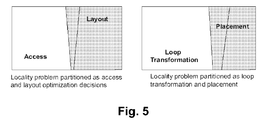
Fig. 5 illustrates that locality optimization can be partitioned (1) as access and layout optimization, as in accordance with embodiments of the present invention; or (2) as loop transformation and placement optimization as known from the prior art. The latter split has significant overlap in objectives, leading to sub-optimal solution. The second split has high overlap as loop transformation step constrains placement decisions completely. The first split is more effective at arriving at a good global solution as access locality optimization still leaves sufficient freedom for the subsequent layout optimization step. - In the different figures, the same reference signs refer to the same or analogous elements.
- The present invention will be described with respect to particular embodiments and with reference to certain drawings but the invention is not limited thereto but only by the claims. The drawings described are only schematic and are non-limiting.
- Furthermore, the terms first, second, third and the like in the description and in the claims, are used for distinguishing between similar elements and not necessarily for describing a sequence, either temporally, spatially, in ranking or in any other manner. It is to be understood that the terms so used are interchangeable under appropriate circumstances and that the embodiments of the invention described herein are capable of operation in other sequences than described or illustrated herein.
- Moreover, the terms top, bottom, over, under and the like in the description and the claims are used for descriptive purposes and not necessarily for describing relative positions. It is to be understood that the terms so used are interchangeable under appropriate circumstances and that the embodiments of the invention described herein are capable of operation in other orientations than described or illustrated herein.
- It is to be noticed that the term "comprising", used in the claims, should not be interpreted as being restricted to the means listed thereafter; it does not exclude other elements or steps. It is thus to be interpreted as specifying the presence of the stated features, integers, steps or components as referred to, but does not preclude the presence or addition of one or more other features, integers, steps or components, or groups thereof. Thus, the scope of the expression "a device comprising means A and B" should not be limited to devices consisting only of components A and B. It means that with respect to the present invention, the only relevant components of the device are A and B.
- Similarly, it is to be noticed that the term "coupled", also used in the claims, should not be interpreted as being restricted to direct connections only. The terms "coupled" and "connected", along with their derivatives, may be used. It should be understood that these terms are not intended as synonyms for each other. Thus, the scope of the expression "a device A coupled to a device B" should not be limited to devices or systems wherein an output of device A is directly connected to an input of device B. It means that there exists a path between an output of A and an input of B which may be a path including other devices or means. "Coupled" may mean that two or more elements are either in direct physical or electrical contact, or that two or more elements are not in direct contact with each other but yet still co-operate or interact with each other.
- Reference throughout this specification to "one embodiment" or "an embodiment" means that a particular feature, structure or characteristic described in connection with the embodiment is included in at least one embodiment of the present invention. Thus, appearances of the phrases "in one embodiment" or "in an embodiment" in various places throughout this specification are not necessarily all referring to the same embodiment, but may. Furthermore, the particular features, structures or characteristics may be combined in any suitable manner, as would be apparent to one of ordinary skill in the art from this disclosure, in one or more embodiments.
- Similarly it should be appreciated that in the description of exemplary embodiments of the invention, various features of the invention are sometimes grouped together in a single embodiment, figure, or description thereof for the purpose of streamlining the disclosure and aiding in the understanding of one or more of the various inventive aspects. This method of disclosure, however, is not to be interpreted as reflecting an intention that the claimed invention requires more features than are expressly recited in each claim. Rather, as the following claims reflect, inventive aspects lie in less than all features of a single foregoing disclosed embodiment. Thus, the claims following the detailed description are hereby expressly incorporated into this detailed description, with each claim standing on its own as a separate embodiment of this invention.
- Furthermore, while some embodiments described herein include some but not other features included in other embodiments, combinations of features of different embodiments are meant to be within the scope of the invention, and form different embodiments, as would be understood by those in the art. For example, in the following claims, any of the claimed embodiments can be used in any combination.
- Furthermore, some of the embodiments are described herein as a method or combination of elements of a method that can be implemented by a processor of a computer system or by other means of carrying out the function. Thus, a processor with the necessary instructions for carrying out such a method or element of a method forms a means for carrying out the method or element of a method. Furthermore, an element described herein of an apparatus embodiment is an example of a means for carrying out the function performed by the element for the purpose of carrying out the invention.
- In the description provided herein, numerous specific details are set forth. However, it is understood that embodiments of the invention may be practiced without these specific details. In other instances, well-known methods, structures and techniques have not been shown in detail in order not to obscure an understanding of this description.
- With respect to the present invention, access and layout locality are differentiated from temporal and spatial locality as generally known in the art.
- The purpose of locality optimization is to reduce the number of unnecessary transfers of data between foreground and background memories. This can be achieved by reordering the accesses such that multiple references to the same data are brought close together in time. A code where multiple accesses of the same data occur close together is referred to as exhibiting access locality. The primary instrument to achieve access locality, for the accesses occurring inside loop-nests, is loop transformation. Linear loop transformations such as interchange, rotation, reflection and skewing can be mathematically modelled and instrumented using unimodular matrices, as known by a person skilled in the art.
- As the fixed cost related to initiation and execution of a transfer between foreground and background memory is rather high, the common practice is to amortize that fixed cost by transferring more than just one data item in a single transfer. For instance, to fetch a word from SDRAM to the L1-cache, the SDRAM row needs to be pre-charged which usually takes several processor cycles. However, once pre-charged, each element in the SDRAM row can be obtained in a single cycle with the burst mode. Therefore, transferring several data items together in a single transfer, using burst mode, can lead to performance improvement. This is true, provided, data items that are grouped to be transferred together are actually referenced in the same time period.
- A code where unnecessary movement of data, due to transfers in groups, is minimized is termed by us as exhibiting layout locality. An equivalent way of expressing layout locality is -- a code exhibits layout locality if it maximizes the opportunity offered by transfers in group, to organize code and data such that each transfer carries immediately useful data items. The second definition looks at layout locality as an opportunity that is to be maximized rather than a problem, according to the first definition, that has to be somehow overcome.
- To improve layout locality, there are two instruments available. Firstly, placement of data items could be organized in such a way that each transfer carries items that is certain to be referenced soon in the future. Secondly, the accesses could be reordered such that data items that are placed together are referenced together. The two instruments, naturally, can be employed together to decide placement and access order simultaneously.
- Now, instead of decomposing the problem into access and layout locality optimizations, one could perhaps split it into loop transformation and placement decisions. In the loop transformation step the order in which the data would be referenced can be decided completely. In the placement step, the arrangement of data items in the memory can be decided. However, partitioning the problem into loop transformation and placement decisions leads to the following problem. Suppose that we perform loop transformation first. Since placement has not been done yet, the loop transformation can only optimize reuse. In the process, it fixes the access order completely -- more than what is necessary to exploit the reuse. This completely fixing of the access order takes away many good placement solutions. Therefore performing loop transformation first leads easily to sub-optimal solution. Next, suppose the placement is done before any loop transformation. Since the access order will change later, during loop transformation step, placement step has no information based on which good layout decisions can be made. Therefore, placement before loop transformation also leads to poor locality solution.
- Therefore, as shown also in
Fig. 5 , dividing the problem of locality optimization into loop transformation and placement decisions as known in the art leads to significant overlap in the objective space. Loop transformation fixes completely the access order, thereby making ineffective a lot of potentially good placement decisions. If placement is done first, it has no information on access order and so it cannot make meaningful decisions. On the other hand, the partition of locality into access and layout in accordance with embodiments of the present invention, allows access locality optimization to proceed without taking away all the good layout solutions because in improving access locality, the access order is not completely fixed. - In the literature, locality is usually split into temporal and spatial. By spatial, however, some authors as for example Randy Allen and Ken Kennedy, in "Optimizing Compilers for Modern Architectures", Morgan Kaufmann Publishers, 2001, imply simply placement of data, or data-layout. By temporal locality they mean loop transformation. This interpretation of temporal and spatial is then exactly the same as the above categorization, into loop transformation and placement. Therefore it suffers from the exactly same problem as identified above.
- Locality optimization across multiple loop-nest can be a difficult problem. However, the problem can still be solved in an effective, scalable, way by ranking the loop-nests, based on constraints emanating from data-dependences and data reuse.
- Suppose that we have n loop-nests in an application and the iteration-space of the kth loop-nest is denoted by
I k. To avoid additional notation,I k will be used to denote both the vector-space and a particular vector in that space. The distinction will be clear from the context. Let the set of arrays referenced in these n loop-nests be A = {A1, A2, ..., Am}. A problem now is to find the loop and data placement transformations that result in the best combination of access and layout locality. - If a loop transformation, denoted by matrix Tk, is applied to loop nest
I k, then a vectorI k is mapped to vectorI' k, and the two are connected by the relationI 'k= TI k . If array Ap, was accessed inI k using the reference matrix Rp , and offseto p then the new index expression in spaceI 'k will be RpTk -1I k +o p. - Suppose also that placement transformation matrix Mp , is applied to array Ap to improve its layout locality in the loop nest
I 'k. In order to have layout locality, consecutive iterations of the innermost loop inI 'k must access consecutive elements of Ap. Therefore, the following relationship must be satisfied:
- The above equation basically formulates the layout locality constraint: in order to have good layout locality, if we move from iteration
I 'k to the next iteration, i.e. only the last row ofI ' k increases by 1, then the data-layout or placement matrix Mp should be such that the displacement in the referencing of array Ap, is only in the last dimension and by 1 as well. The above layout locality constraint simplifies to:
where dim(I k) is the number of dimensions inI k, and dim(Ap) is the number of dimensions in array Ap.U d is a d-dimensional column vector of which all elements are zero, except the last one which is a 1. For example,U 3 = [0 0 1]. - Firstly, it is to be noted that, when improving layout locality for the loop-nests neither Tk nor Mp are known. In Eq. 1, observe that Tk and Mp appear jointly as product terms. Therefore, the problem at hand is at least as complex as integer quadratic constraint programming. However, since the matrices Tk and Mp must be unimodular, or at least invertible and integer-valued, the problem quickly becomes highly non-linear even for a single loop-nest.
- Secondly, a particular choice of Tk has an effect on the access pattern of array Ap, assuming array Ap is accessed inside loop-nest
I k. If the loop order is changed, then obviously the access pattern of the arrays accessed inside that loop-nest will change. In order to still have layout locality, the placements of the arrays may therefore have to be changed. That is, if Tk is changed then Mp may have to be changed. Moreover, since Ap could have been accessed in some other loop-nest, sayI l, the choice of Mp may have an impact on Tl. For instance, if the access pattern of Ap , in loop-nestI l does not match the way decided to do placement for Ap, reflected in the choice of Mp, then the access order ofI l may have to be changed by choosing an appropriate T /. - Next, suppose another array Aq is also accessed in both
I k andI l. Tl may destroy the layout locality of Aq, inI l. That can be rectified by applying Mq to Aq . Next, as Aq is also accessed inI k, if the layout locality of Aq (with Mq) inI k is also poor then a transformation Tk ' must be applied (as placement of Aq is now already fixed). But now there is a problem of going in circles. The access locality of Ap inI k may be destroyed by Tk'. - In conclusion: decisions about Mp, Mq,Tk and Tl must be taken together as they affect each other. However, as Mp and Tk appear as product terms in Eq. 1, the problem at hand is at least as complex as integer quadratic constraint programming which ILP (Integer Linear Programming) solvers cannot even handle. Since Tk and Mp need to be invertible and integer-valued, and access locality and data dependencies also need to be taken into consideration, the problem quickly becomes combinatorially explosive.
- Locality optimization across multiple loop-nests is thus a complex, non-linear problem, for which a reasonable, near-optimal and scalable solution is provided in accordance with embodiments of the present invention.
- In accordance with embodiments of the present invention, there is started with one loop-nest. First, its access locality is improved by computing the reuse vectors and applying them to find an appropriate transformation matrix Tt . Having improved the access locality, an additional transformation Ts may then be applied to improve the layout locality of the arrays accessed in that loop-nest, and whose data placement is already fixed. However, Ts should not destroy the access locality. The complete transformation is T = Ts * Tt and it must respect the data-dependences. Having fixed T, thereafter the placement M for the arrays accessed in the loop-nest is fixed, whose placement is not already fixed, with the objective of improving the layout locality. The placement information is then propagated to the next loop-nest where the above process is repeated. It is to be noted that by deciding on T first and then M's the quadratic integer problem is avoided.
- In an optimisation process according to embodiments of the present invention, what is essentially done is fixing the placement or data-layout of the arrays as the procedure goes along from one loop-nest to another. The reasoning is that the loop-nests down the chain could be transformed easily to align their access pattern to the prefixed placements so that good layout locality may still be achieved.
- Access locality is more important than layout. Therefore, it may not be desired to transform a loop-nest down the chain to improve layout locality if the process access locality would be destroyed. Therefore, the presence of reuse imposes constraints on transformation to improve layout locality, much like data-dependences do.
- Constraints in performing access and layout locality are data dependences and data-reuse.
- With regard to data dependences, consider the two loop-nests in the code below:
       for ( i = 0 ; i < 3*N ; i++)// Loop-Nest I
             for ( j = 0 ; j < N ; j++)
                    C[j][i] = B[i][j];
       ...
       for ( i = 0 ; i < N ; i++)// Loop-Nest II
             for ( j = 0 ; j < N ; j++)
                    A[i+1][j+1]=B[i+2*j][j]-A[i][j]-A[i][j+2];


 for ( i = -2*(N-1) ; i < 3*N ; i++) //Loop-Nest I
       for (j=max (0, -i/2) ; j<min (N-1, (3*N-1-i)/2)+1 ; j++)
             C [j][i+2*j] = B[i+2*N-2][j ] ;
 ...
 for (i = 0 ; i < N ; i++)// Loop-Nest II
       for ( j = 0 ; j i < N ; j++)
             A[i+1] [j+1]=B[i+2*N-2] [j]-A[i] [j]-A[i] [j+2] ;
       for ( i = 0 ; i < N ; i++) // Loop-Nest I

             for ( j = 0 ; j i < N ; j++)
                    B [i] [j ] = A[i] [j ] ;
       ...
       for ( i = 0 ; i < N ; i++) // Loop-Nest II
             for ( j = 0 ; j i < N ; j++)
                    D[i] [j] - B[i] [j] + C[j];
       for ( j = 0 ; j < N ; j++) //Loop-Nest I

             for ( i = 0 ; i < N ; i++)
                    B[i][j]=A[i][j]; //A:col-major, B:col-major
       ...
       for ( j = 0 ; j < N ; j++) //Loop-Nest II
             for ( i = 0 ; i < N ; i++)
                    D[i] [j]=B[i] [j]+C[j];
                                       //B:col-major,D:col-major
       for ( i = 0 ; i < N ; i++)

             for ( j = 0 ; j < N ; j++)
                    for ( k = 0 ; k < N ; k++)
                          A[i] [j+k] [k] = B [i] + C [j] [k] [i] ;
- Inter-Line Level Layout Locality = lines that are accessed closely together in time are brought together in space
- Line Level Layout Locality = words from a line that are accessed closely together in time, are brought together closer in the line in space
- Word Level Layout Locality = sub-words from words that are accessed closely together in time are brought together closer in the word in space
- Basic Group Access Locality (for example for the SDRAM-SPM interface) = Basic groups that are reused are brought together in time; e.g. communication between the SDRAM and the SPM is reused.
- Line Access Locality (for the SPM-VRW interface) = lines that are reused are brought together in time; e.g. communication between of the SPM and VWR is reused.
- 1. Schedule read decision from second level of memory units toward third level of memory units, e.g. from SPM toward VWR
- 2. Schedule write decision from third level of memory units to second level of memory units, e.g. from VWR toward SPM
- 3. Schedule read decision from third level of memory units towards second level of memory units, e.g. from VWR toward SPM
- 4. Schedule write decision from second level of memory units towards third level of memory units, e.g. from SPM toward VWR
- 1. One dependence deep
- 2. Multiple dependence deep: Another possibility is to increase the information used to make the same decision by looking at multiple levels of production/consumption of the arrays that are accessed together (read/write).
- 1. Data layout (of words) inside a line of the second level of memory units, e.g. SPM
- 2. Data layout (of words) inside the third level of memory units, e.g. VWR
- 1. access inter-line: partly fix; leave some freedom for layout
- 2. layout inter)line: partly fix; leave some freedom for next step
- 3. access line: partly fix; leave some freedom for layout
- 4. layout line: partly fix; leave some freedom for a next step or completely fix if no next step available
- 1. One dependence deep:
- 2. Multiple dependence deep:
- Since this step decides the line-level layout locality of the second and third levels of memory units, e.g. SPM and VWR, it definitely needs to take into account the cost of the SPM and the VWR. As it feeds into the MMU and the DP, high-level estimates of these components are also needed. The cost consists of two parts: (1) the components that are directly affected/decisions are made and (2) the components that are constrained due to the decision made.
- a,e,b,e,c,f,d,f or
- a,e,b,e,d,f,c,f.
- a,e,b,e,d,f,c,f
- a | e | b | d | f | c
             L1: for (i=0; i<8; i++) {
              a[i] = b[i] + c [i] ;
             }
             L2: for (i=0; i<8; i++) {
              T = b [i] + a [i] ;
              d[i] = T + e [i] ;
             }
             L3: for (i=0; i<8; i++) {
              q[i] = f [i] ;
             }
- In view of the conflict graph representation, the 3 arrays have to be allocated to different VWRs, eg. VWR1, VWR2, VWR3. In case there is no conflict, this freedom is passed on to the following (layout) step.
- Loop L1: a is allocated to VWRx and 2 words, b is allocated to VWRy and 2 words, c is allocated to VWRz and 2 words; x ≠ y ≠ z.
- Loop L2: a is allocated VWRp and 2 words, b is allocated VWRq and 2 words, d is allocated VWRr and 2 words, e is allocated VWRt and 2 words; p ≠ q and r ≠ t.
- Loop L3: g is allocated VWRm and 4 words and f is allocated VWRn and 4 words; m ≠ n.
| A[0] | A[1] | A[2] | A[3] |
| A[4] | A[5] | A[6] | A[7] |
| B[0] | B[1] | B[2] | B[3] |
| B[4] | B[5] | B[6] | B[7] |
| G[4] | G[5] | G[6] | G[7] |
| A[0] | A[1] | E[0] | E[1] |
| A[2] | A[3] | E[2] | E[3] |
| B[0] | B[1] | C[0] | C[1] |
| B[2] | B[3] | C[2] | C[3] |
| G[4] | G[5] | G[6] | |
Claims (23)
- A method for converting application code into optimised application code or into execution code suitable for execution on a computation engine with an architecture comprising at least a first and a second level of memory units,
the method comprising:obtaining application code, the application code including data transfer operations between said levels of memory units; andconverting at least a part of the application code, said converting step comprising:whereby step (a) does not decide on the internal organization of at least some of the data transferred, hence fixing the scheduling of data transfer operations only partially while also partially fixing the placement of all the data transferred, thereby providing freedom to subsequent step (b).(a) scheduling of data transfer operations from a first level of memory units to a second level of memory units such that accesses of data accessed multiple times are brought closer together in time than would be the case in the original code,
thereafter(b) deciding on layout of the data in the second level of memory units to improve the data layout locality such that data which is accessed closer together in time is also brought closer together in the layout than would be the case in the original code - A method according to claim 1, wherein step (b) uses at least part of the additional freedom provided by step (a).
- A method according to any of the previous claims, wherein step (a) provides a plurality of possible schedules of data transfer operations, and step (b) further comprises selecting some of the schedules of the data transfer operations.
- A method according to any of the previous claims, wherein the decision on the internal organization of at least some of the data transferred is based on a cost function.
- A method according to claim 4, wherein a polyhedral model is used for the code, and the cost function is built with values extracted from the polyhedral model.
- A method according to claim 5, wherein the values represent data dependencies and/or data reuse.
- A method according to any of the previous claims, wherein data accessed comprises at least a first and a second group of data and the data layout is performed on these groups of data.
- A method according to claim 7, the architecture comprising a SPM, a cache or a VWR having a width, wherein a group of data comprises at least one line of data having the width of the SPM, the cache or the VWR.
- A method according to claim 7, the architecture comprising at least one functional unit having a width, wherein a group of data comprises at least one word having the width of functional unit.
- A method according to claim 7, the architecture comprising at least one functional unit having a width, wherein a group of data comprises at least one sub-word, the width of the functional unit and the sub-words being such that multiple sub-words can operate in parallel in the functional unit.
- A method according to any of the previous claims, wherein said converting step furthermore comprises, before said step of scheduling of data transfer operations, a step of improving parallelism of the data transfers between the first and the second levels of memory units.
- A method according to claim 11, wherein the step of improving parallelism of the data transfers between the first and the second levels of memory units is based on a cost function.
- A method according to any of the previous claims, wherein the first level of memory units is a higher level memory unit than the second level of memory units.
- A method according to claim 13, the architecture furthermore comprising a third level of memory units, the third level of memory units being lower level than the second level of memory units, wherein the said converting step is first performed between the first and second level of memory units, and is thereafter performed between the second and third level of memory units.
- A method according to claim 14, wherein said converting step furthermore comprises, before said step of converting of data transfer operations between the second and the third levels, a step of improving parallelism of the data transfers between the second and the third levels of memory units.
- A method according to claim 15, wherein the step of improving parallelism of the data transfers between the second and third levels of memory units is based on a cost function.
- A pre-compiler for converting application code into optimised application code for execution on a computation engine with an architecture comprising at least a first and a second level of memory units, the pre-compiler comprising means for carrying out any of the method steps in accordance with any of the claim 1 to 16.
- A pre-compiler for converting application code into optimised application code for execution on a computation engine with an architecture comprising at least a first and a second level of memory units, the pre-compiler comprising:means for receiving application code, the application code including data transfer operations between said levels of memory units, andmeans for converting at least part of the application code, the means for converting comprisingwhereby the means for scheduling data transfer operations does not decide on the internal organisation of at least some of the data transferred, hence fixing the scheduling of data transfer operations only partially while also partially fixing the placement of all the data transferred, thereby providing freedom to the means for deciding on layout of the data in the second level of memory units.(a) means for scheduling data transfer operations from a first level of memory units to a second level of memory units such that accesses of data accessed multiple times are brought closer together in time than would be the case in the original code, and(b) means for thereafter deciding on layout of the data in the second level of memory units such that accesses of data which is accessed closer together in time are also brought closer together in the layout than would be the case in the original code,
- A compiler for converting application code into execution code suitable for execution on a computation engine with an architecture comprising at least a first and a second level of memory units, the compiler comprising means for carrying out any of the method steps in accordance with any of the claim 1 to 16.
- A compiler for converting application code into execution code suitable for execution on a computation engine with an architecture comprising at least a first and a second level of memory units, the compiler comprising:means for receiving application code, the application code including data transfer operations between said levels of memory units, andmeans for converting at least part of the application code, the means for converting comprisingwhereby the means for scheduling data transfer operations does not decide on the internal organisation of at least some of the data transferred, hence fixing the scheduling of data transfer operations only partially while also partially fixing the placement of all the data transferred, thereby providing freedom to the means for deciding on layout of the data in the second level of memory units.(a) means for scheduling data transfer operations from a first level of memory units to a second level of memory units such that accesses of data accessed multiple times are brought closer together in time than would be the case in the original code, and(b) means for thereafter deciding on layout of the data in the second level of memory units such that accesses of data which is accessed closer together in time are also brought closer together in the layout than would be the case in the original code,
- A computer program product with program code means to execute the steps in accordance with any of the claims 1 to 16 when executed on a computation engine having an architecture comprising at least a first and a second level of memory units.
- A machine readable data storage storing the computer program product of claim 21.
- Transmission of signals representing the computer program product of claim 21 over a local or wide area telecommunications network.
Applications Claiming Priority (1)
| Application Number | Priority Date | Filing Date | Title |
|---|---|---|---|
| US92022607P | 2007-03-26 | 2007-03-26 |
Publications (2)
| Publication Number | Publication Date |
|---|---|
| EP1975791A2 true EP1975791A2 (en) | 2008-10-01 |
| EP1975791A3 EP1975791A3 (en) | 2009-01-07 |
Family
ID=39598458
Family Applications (1)
| Application Number | Title | Priority Date | Filing Date |
|---|---|---|---|
| EP08153186A Withdrawn EP1975791A3 (en) | 2007-03-26 | 2008-03-21 | A method for automated code conversion |
Country Status (2)
| Country | Link |
|---|---|
| US (1) | US8261252B2 (en) |
| EP (1) | EP1975791A3 (en) |
Cited By (1)
| Publication number | Priority date | Publication date | Assignee | Title |
|---|---|---|---|---|
| CN114513556A (en) * | 2021-12-31 | 2022-05-17 | 西安电子科技大学 | Two-stage time-triggered service scheduling method and system based on deterministic network |
Families Citing this family (11)
| Publication number | Priority date | Publication date | Assignee | Title |
|---|---|---|---|---|
| US8056065B2 (en) * | 2007-09-26 | 2011-11-08 | International Business Machines Corporation | Stable transitions in the presence of conditionals for an advanced dual-representation polyhedral loop transformation framework |
| US8087010B2 (en) * | 2007-09-26 | 2011-12-27 | International Business Machines Corporation | Selective code generation optimization for an advanced dual-representation polyhedral loop transformation framework |
| US8060870B2 (en) * | 2007-09-26 | 2011-11-15 | International Business Machines Corporation | System and method for advanced polyhedral loop transformations of source code in a compiler |
| US8087011B2 (en) * | 2007-09-26 | 2011-12-27 | International Business Machines Corporation | Domain stretching for an advanced dual-representation polyhedral loop transformation framework |
| US8677338B2 (en) * | 2008-06-04 | 2014-03-18 | Intel Corporation | Data dependence testing for loop fusion with code replication, array contraction, and loop interchange |
| US8584103B2 (en) | 2010-06-17 | 2013-11-12 | International Business Machines Corporation | Reducing parallelism of computer source code |
| JP2017004281A (en) * | 2015-06-11 | 2017-01-05 | 富士通株式会社 | Compilation program and compilation method |
| JP7035751B2 (en) * | 2018-04-12 | 2022-03-15 | 富士通株式会社 | Code conversion device, code conversion method, and code conversion program |
| IL311783A (en) | 2020-11-04 | 2024-05-01 | Mynatix Ag | System for auto-parallelization of processing codes for multi-processor systems with optimized latency, and method thereof |
| US20240232585A1 (en) * | 2021-07-29 | 2024-07-11 | Qualcomm Incorporated | Channel-guided nested loop transformation and scalar replacement |
| EP4702427A1 (en) | 2023-04-24 | 2026-03-04 | mynatix AG | High-performance code parallelization compiler with loop-level parallelization |
Citations (2)
| Publication number | Priority date | Publication date | Assignee | Title |
|---|---|---|---|---|
| US20060212685A1 (en) | 2005-03-11 | 2006-09-21 | Praveen Raghavan | Ultra low power ASIP architecture |
| WO2007065627A2 (en) | 2005-12-05 | 2007-06-14 | Interuniversitair Microelektronica Centrum Vzw | Distributed loop controller architecture for multi-threading in uni-threaded processors |
Family Cites Families (13)
| Publication number | Priority date | Publication date | Assignee | Title |
|---|---|---|---|---|
| US5317734A (en) * | 1989-08-29 | 1994-05-31 | North American Philips Corporation | Method of synchronizing parallel processors employing channels and compiling method minimizing cross-processor data dependencies |
| US5202975A (en) * | 1990-06-11 | 1993-04-13 | Supercomputer Systems Limited Partnership | Method for optimizing instruction scheduling for a processor having multiple functional resources |
| JPH06250837A (en) * | 1993-02-25 | 1994-09-09 | Ricoh Co Ltd | Scheduling processing method |
| US5742814A (en) * | 1995-11-01 | 1998-04-21 | Imec Vzw | Background memory allocation for multi-dimensional signal processing |
| US6523119B2 (en) * | 1996-12-04 | 2003-02-18 | Rainbow Technologies, Inc. | Software protection device and method |
| US5966534A (en) * | 1997-06-27 | 1999-10-12 | Cooke; Laurence H. | Method for compiling high level programming languages into an integrated processor with reconfigurable logic |
| US7296084B2 (en) * | 2002-06-11 | 2007-11-13 | Hewlett-Packard Development Company, L.P. | Data management system and method |
| US7281228B2 (en) * | 2004-02-11 | 2007-10-09 | Infineon Technologies Ag | Configurable memory system for embedded processors |
| US20060020935A1 (en) * | 2004-07-02 | 2006-01-26 | Tran Sang V | Scheduler for dynamic code reconfiguration |
| US7254679B2 (en) * | 2004-08-04 | 2007-08-07 | Infineon Technologies Ag | Computer system for data processing and method for the transfer of an array segment of an affine-indexed multi-dimensional array referenced in a loop nest from a first memory to a second memory |
| US7886283B2 (en) * | 2004-09-17 | 2011-02-08 | The Regents Of The University Of California | Phantom serializing compiler and method of operation of same |
| US7814486B2 (en) * | 2006-06-20 | 2010-10-12 | Google Inc. | Multi-thread runtime system |
| US8443348B2 (en) * | 2006-06-20 | 2013-05-14 | Google Inc. | Application program interface of a parallel-processing computer system that supports multiple programming languages |
-
2008
- 2008-03-21 EP EP08153186A patent/EP1975791A3/en not_active Withdrawn
- 2008-03-26 US US12/056,174 patent/US8261252B2/en active Active
Patent Citations (2)
| Publication number | Priority date | Publication date | Assignee | Title |
|---|---|---|---|---|
| US20060212685A1 (en) | 2005-03-11 | 2006-09-21 | Praveen Raghavan | Ultra low power ASIP architecture |
| WO2007065627A2 (en) | 2005-12-05 | 2007-06-14 | Interuniversitair Microelektronica Centrum Vzw | Distributed loop controller architecture for multi-threading in uni-threaded processors |
Cited By (2)
| Publication number | Priority date | Publication date | Assignee | Title |
|---|---|---|---|---|
| CN114513556A (en) * | 2021-12-31 | 2022-05-17 | 西安电子科技大学 | Two-stage time-triggered service scheduling method and system based on deterministic network |
| CN114513556B (en) * | 2021-12-31 | 2024-02-02 | 西安电子科技大学 | A two-level time-triggered service scheduling method and system based on deterministic network |
Also Published As
| Publication number | Publication date |
|---|---|
| US8261252B2 (en) | 2012-09-04 |
| EP1975791A3 (en) | 2009-01-07 |
| US20080263530A1 (en) | 2008-10-23 |
Similar Documents
| Publication | Publication Date | Title |
|---|---|---|
| US8261252B2 (en) | Method and system for automated code conversion | |
| Catthoor et al. | Data access and storage management for embedded programmable processors | |
| Callahan et al. | for Reconfigurable Computing | |
| Rong et al. | Single-dimension software pipelining for multidimensional loops | |
| Diniz et al. | Bridging the gap between compilation and synthesis in the DEFACTO system | |
| Gupta et al. | Compilation techniques for parallel systems | |
| Kelefouras et al. | A methodology correlating code optimizations with data memory accesses, execution time and energy consumption: V. Kelefouras, K. Djemame | |
| Dimitroulakos et al. | Resource aware mapping on coarse grained reconfigurable arrays | |
| Kelefouras et al. | A methodology for efficient tile size selection for affine loop kernels | |
| Baradaran et al. | A compiler approach to managing storage and memory bandwidth in configurable architectures | |
| Sánchez | Loop pipelining with resource and timing constraints | |
| Hornung et al. | A case for improved C++ compiler support to enable performance portability in large physics simulation codes | |
| Kelefouras et al. | A methodology for speeding up fast fourier transform focusing on memory architecture utilization | |
| Diguet et al. | Hierarchy exploration in high level memory management | |
| Liang et al. | DISC: Exploiting Data Parallelism of Non-Stencil Computations on CGRAs via Dynamic Iteration Scheduling | |
| Fernandes | A clustered VLIW architecture based on queue register files | |
| Rashid | A dual-engine fetch/compute overlay processor for fpgas | |
| Qian | Loop transformations for clustered VLIW architectures | |
| Kelefouras et al. | A methodology for speeding up loop kernels by exploiting the software information and the memory architecture | |
| Yuan et al. | A Mapping Strategy Optimization Framework for Systolic Array Accelerators | |
| Ma et al. | Practical loop transformations for tensor contraction expressions on multi-level memory hierarchies | |
| Weng | Developing, Synthesizing, and Automating Domain-Specific Accelerators | |
| Kaufman et al. | Morello: Compiling Fast Neural Networks with Dynamic Programming and Spatial Compression | |
| Bataev | LLVM Loop Vectorizer | |
| Kulkarni et al. | Code Generation for Near-Roofline Finite Element Actions on GPUs from Symbolic Variational Forms |
Legal Events
| Date | Code | Title | Description |
|---|---|---|---|
| PUAI | Public reference made under article 153(3) epc to a published international application that has entered the european phase |
Free format text: ORIGINAL CODE: 0009012 |
|
| AK | Designated contracting states |
Kind code of ref document: A2 Designated state(s): AT BE BG CH CY CZ DE DK EE ES FI FR GB GR HR HU IE IS IT LI LT LU LV MC MT NL NO PL PT RO SE SI SK TR |
|
| AX | Request for extension of the european patent |
Extension state: AL BA MK RS |
|
| PUAL | Search report despatched |
Free format text: ORIGINAL CODE: 0009013 |
|
| AK | Designated contracting states |
Kind code of ref document: A3 Designated state(s): AT BE BG CH CY CZ DE DK EE ES FI FR GB GR HR HU IE IS IT LI LT LU LV MC MT NL NO PL PT RO SE SI SK TR |
|
| AX | Request for extension of the european patent |
Extension state: AL BA MK RS |
|
| RAP1 | Party data changed (applicant data changed or rights of an application transferred) |
Owner name: KATHOLIEKE UNIVERSITEIT LEUVEN Owner name: IMEC |
|
| 17P | Request for examination filed |
Effective date: 20090707 |
|
| AKX | Designation fees paid |
Designated state(s): AT BE BG CH CY CZ DE DK EE ES FI FR GB GR HR HU IE IS IT LI LT LU LV MC MT NL NO PL PT RO SE SI SK TR |
|
| 17Q | First examination report despatched |
Effective date: 20130516 |
|
| STAA | Information on the status of an ep patent application or granted ep patent |
Free format text: STATUS: THE APPLICATION IS DEEMED TO BE WITHDRAWN |
|
| 18D | Application deemed to be withdrawn |
Effective date: 20130927 |