EP1974944A1 - Thermal transfer ink sheet, ink cartridge, coating composition for dye layer of thermal transfer ink sheet, and thermal transfer recording method - Google Patents
Thermal transfer ink sheet, ink cartridge, coating composition for dye layer of thermal transfer ink sheet, and thermal transfer recording method Download PDFInfo
- Publication number
- EP1974944A1 EP1974944A1 EP08006328A EP08006328A EP1974944A1 EP 1974944 A1 EP1974944 A1 EP 1974944A1 EP 08006328 A EP08006328 A EP 08006328A EP 08006328 A EP08006328 A EP 08006328A EP 1974944 A1 EP1974944 A1 EP 1974944A1
- Authority
- EP
- European Patent Office
- Prior art keywords
- group
- thermal transfer
- substituted
- ink sheet
- alkyl group
- Prior art date
- Legal status (The legal status is an assumption and is not a legal conclusion. Google has not performed a legal analysis and makes no representation as to the accuracy of the status listed.)
- Granted
Links
- 238000012546 transfer Methods 0.000 title claims abstract description 82
- 239000008199 coating composition Substances 0.000 title claims description 19
- 238000000034 method Methods 0.000 title claims description 14
- 125000000217 alkyl group Chemical group 0.000 claims abstract description 62
- 125000004122 cyclic group Chemical group 0.000 claims abstract description 37
- 150000001875 compounds Chemical class 0.000 claims abstract description 30
- 229920002554 vinyl polymer Polymers 0.000 claims abstract description 26
- DHKHKXVYLBGOIT-UHFFFAOYSA-N acetaldehyde Diethyl Acetal Natural products CCOC(C)OCC DHKHKXVYLBGOIT-UHFFFAOYSA-N 0.000 claims abstract description 25
- 125000004435 hydrogen atom Chemical group [H]* 0.000 claims abstract description 15
- 229920005989 resin Polymers 0.000 claims abstract description 11
- 239000011347 resin Substances 0.000 claims abstract description 11
- 239000011230 binding agent Substances 0.000 claims abstract description 6
- 125000002777 acetyl group Chemical class [H]C([H])([H])C(*)=O 0.000 claims abstract 3
- 229920000642 polymer Polymers 0.000 claims description 47
- 125000001997 phenyl group Chemical group [H]C1=C([H])C([H])=C(*)C([H])=C1[H] 0.000 claims description 24
- 239000004816 latex Substances 0.000 claims description 23
- 229920000126 latex Polymers 0.000 claims description 23
- 125000000623 heterocyclic group Chemical group 0.000 claims description 14
- 229910052799 carbon Inorganic materials 0.000 claims description 9
- 125000002723 alicyclic group Chemical group 0.000 claims description 7
- 125000003545 alkoxy group Chemical group 0.000 claims description 5
- 125000005059 halophenyl group Chemical group 0.000 claims description 4
- UFHFLCQGNIYNRP-UHFFFAOYSA-N Hydrogen Chemical compound [H][H] UFHFLCQGNIYNRP-UHFFFAOYSA-N 0.000 claims 1
- 229910052739 hydrogen Inorganic materials 0.000 claims 1
- 239000001257 hydrogen Substances 0.000 claims 1
- 239000000976 ink Substances 0.000 description 88
- 239000010410 layer Substances 0.000 description 64
- 239000000975 dye Substances 0.000 description 58
- YXFVVABEGXRONW-UHFFFAOYSA-N Toluene Chemical compound CC1=CC=CC=C1 YXFVVABEGXRONW-UHFFFAOYSA-N 0.000 description 24
- ZWEHNKRNPOVVGH-UHFFFAOYSA-N Methyl ethyl ketone Natural products CCC(C)=O ZWEHNKRNPOVVGH-UHFFFAOYSA-N 0.000 description 23
- 238000004519 manufacturing process Methods 0.000 description 23
- 150000001241 acetals Chemical class 0.000 description 22
- 125000004432 carbon atom Chemical group C* 0.000 description 21
- -1 silver halide Chemical class 0.000 description 19
- 239000000126 substance Substances 0.000 description 18
- 239000000463 material Substances 0.000 description 15
- 125000001424 substituent group Chemical group 0.000 description 15
- 230000000052 comparative effect Effects 0.000 description 14
- 125000003118 aryl group Chemical group 0.000 description 13
- 239000011248 coating agent Substances 0.000 description 10
- 238000000576 coating method Methods 0.000 description 10
- 239000011229 interlayer Substances 0.000 description 10
- 239000000178 monomer Substances 0.000 description 10
- 229920001577 copolymer Polymers 0.000 description 8
- 125000005842 heteroatom Chemical group 0.000 description 8
- 239000002245 particle Substances 0.000 description 8
- 239000006185 dispersion Substances 0.000 description 7
- 238000011156 evaluation Methods 0.000 description 6
- 150000002576 ketones Chemical class 0.000 description 6
- 239000000203 mixture Substances 0.000 description 6
- 229920002037 poly(vinyl butyral) polymer Polymers 0.000 description 6
- 150000001299 aldehydes Chemical class 0.000 description 5
- 0 CO*C(Cc1ccccc1)OC Chemical compound CO*C(Cc1ccccc1)OC 0.000 description 4
- 108010010803 Gelatin Proteins 0.000 description 4
- VEXZGXHMUGYJMC-UHFFFAOYSA-N Hydrochloric acid Chemical compound Cl VEXZGXHMUGYJMC-UHFFFAOYSA-N 0.000 description 4
- 239000004698 Polyethylene Substances 0.000 description 4
- 229920001328 Polyvinylidene chloride Polymers 0.000 description 4
- PPBRXRYQALVLMV-UHFFFAOYSA-N Styrene Chemical compound C=CC1=CC=CC=C1 PPBRXRYQALVLMV-UHFFFAOYSA-N 0.000 description 4
- 230000015572 biosynthetic process Effects 0.000 description 4
- 125000000392 cycloalkenyl group Chemical group 0.000 description 4
- 125000000753 cycloalkyl group Chemical group 0.000 description 4
- 239000010419 fine particle Substances 0.000 description 4
- 229920000159 gelatin Polymers 0.000 description 4
- 235000019322 gelatine Nutrition 0.000 description 4
- 235000011852 gelatine desserts Nutrition 0.000 description 4
- 229920000578 graft copolymer Polymers 0.000 description 4
- 125000005843 halogen group Chemical group 0.000 description 4
- 229910052757 nitrogen Inorganic materials 0.000 description 4
- 229920001225 polyester resin Polymers 0.000 description 4
- 239000004645 polyester resin Substances 0.000 description 4
- 229920000573 polyethylene Polymers 0.000 description 4
- 229920001296 polysiloxane Polymers 0.000 description 4
- 229920002635 polyurethane Polymers 0.000 description 4
- 239000004814 polyurethane Substances 0.000 description 4
- 229920002689 polyvinyl acetate Polymers 0.000 description 4
- 229920002451 polyvinyl alcohol Polymers 0.000 description 4
- 235000019422 polyvinyl alcohol Nutrition 0.000 description 4
- 229920000915 polyvinyl chloride Polymers 0.000 description 4
- 230000035945 sensitivity Effects 0.000 description 4
- 239000002904 solvent Substances 0.000 description 4
- 125000000547 substituted alkyl group Chemical group 0.000 description 4
- QTBSBXVTEAMEQO-UHFFFAOYSA-N Acetic acid Chemical compound CC(O)=O QTBSBXVTEAMEQO-UHFFFAOYSA-N 0.000 description 3
- YMWUJEATGCHHMB-UHFFFAOYSA-N Dichloromethane Chemical compound ClCCl YMWUJEATGCHHMB-UHFFFAOYSA-N 0.000 description 3
- CERQOIWHTDAKMF-UHFFFAOYSA-M Methacrylate Chemical compound CC(=C)C([O-])=O CERQOIWHTDAKMF-UHFFFAOYSA-M 0.000 description 3
- OKKJLVBELUTLKV-UHFFFAOYSA-N Methanol Chemical compound OC OKKJLVBELUTLKV-UHFFFAOYSA-N 0.000 description 3
- 229920000459 Nitrile rubber Polymers 0.000 description 3
- 239000000654 additive Substances 0.000 description 3
- 125000004429 atom Chemical group 0.000 description 3
- 125000000113 cyclohexyl group Chemical group [H]C1([H])C([H])([H])C([H])([H])C([H])(*)C([H])([H])C1([H])[H] 0.000 description 3
- 230000007547 defect Effects 0.000 description 3
- 239000000499 gel Substances 0.000 description 3
- 239000008273 gelatin Substances 0.000 description 3
- 150000002430 hydrocarbons Chemical group 0.000 description 3
- AJDUTMFFZHIJEM-UHFFFAOYSA-N n-(9,10-dioxoanthracen-1-yl)-4-[4-[[4-[4-[(9,10-dioxoanthracen-1-yl)carbamoyl]phenyl]phenyl]diazenyl]phenyl]benzamide Chemical compound O=C1C2=CC=CC=C2C(=O)C2=C1C=CC=C2NC(=O)C(C=C1)=CC=C1C(C=C1)=CC=C1N=NC(C=C1)=CC=C1C(C=C1)=CC=C1C(=O)NC1=CC=CC2=C1C(=O)C1=CC=CC=C1C2=O AJDUTMFFZHIJEM-UHFFFAOYSA-N 0.000 description 3
- 125000004433 nitrogen atom Chemical group N* 0.000 description 3
- 239000003960 organic solvent Substances 0.000 description 3
- 125000004430 oxygen atom Chemical group O* 0.000 description 3
- 229920000058 polyacrylate Polymers 0.000 description 3
- 229920000728 polyester Polymers 0.000 description 3
- 238000006116 polymerization reaction Methods 0.000 description 3
- 229920000098 polyolefin Polymers 0.000 description 3
- 125000000391 vinyl group Chemical group [H]C([*])=C([H])[H] 0.000 description 3
- 239000001043 yellow dye Substances 0.000 description 3
- MHXFWEJMQVIWDH-UHFFFAOYSA-N 1-amino-4-hydroxy-2-phenoxyanthracene-9,10-dione Chemical compound C1=C(O)C=2C(=O)C3=CC=CC=C3C(=O)C=2C(N)=C1OC1=CC=CC=C1 MHXFWEJMQVIWDH-UHFFFAOYSA-N 0.000 description 2
- UZKWTJUDCOPSNM-UHFFFAOYSA-N 1-ethenoxybutane Chemical compound CCCCOC=C UZKWTJUDCOPSNM-UHFFFAOYSA-N 0.000 description 2
- NIXOWILDQLNWCW-UHFFFAOYSA-N 2-Propenoic acid Natural products OC(=O)C=C NIXOWILDQLNWCW-UHFFFAOYSA-N 0.000 description 2
- NQAJBKZEQYYFGK-UHFFFAOYSA-N 2-[[4-[2-(4-cyclohexylphenoxy)ethyl-ethylamino]-2-methylphenyl]methylidene]propanedinitrile Chemical compound C=1C=C(C=C(C#N)C#N)C(C)=CC=1N(CC)CCOC(C=C1)=CC=C1C1CCCCC1 NQAJBKZEQYYFGK-UHFFFAOYSA-N 0.000 description 2
- KUDUQBURMYMBIJ-UHFFFAOYSA-N 2-prop-2-enoyloxyethyl prop-2-enoate Chemical compound C=CC(=O)OCCOC(=O)C=C KUDUQBURMYMBIJ-UHFFFAOYSA-N 0.000 description 2
- HRPVXLWXLXDGHG-UHFFFAOYSA-N Acrylamide Chemical compound NC(=O)C=C HRPVXLWXLXDGHG-UHFFFAOYSA-N 0.000 description 2
- SOGAXMICEFXMKE-UHFFFAOYSA-N Butylmethacrylate Chemical compound CCCCOC(=O)C(C)=C SOGAXMICEFXMKE-UHFFFAOYSA-N 0.000 description 2
- OKTJSMMVPCPJKN-UHFFFAOYSA-N Carbon Chemical group [C] OKTJSMMVPCPJKN-UHFFFAOYSA-N 0.000 description 2
- WOBHKFSMXKNTIM-UHFFFAOYSA-N Hydroxyethyl methacrylate Chemical compound CC(=C)C(=O)OCCO WOBHKFSMXKNTIM-UHFFFAOYSA-N 0.000 description 2
- RRHGJUQNOFWUDK-UHFFFAOYSA-N Isoprene Chemical compound CC(=C)C=C RRHGJUQNOFWUDK-UHFFFAOYSA-N 0.000 description 2
- BAPJBEWLBFYGME-UHFFFAOYSA-N Methyl acrylate Chemical compound COC(=O)C=C BAPJBEWLBFYGME-UHFFFAOYSA-N 0.000 description 2
- NBIIXXVUZAFLBC-UHFFFAOYSA-N Phosphoric acid Chemical compound OP(O)(O)=O NBIIXXVUZAFLBC-UHFFFAOYSA-N 0.000 description 2
- 239000004372 Polyvinyl alcohol Substances 0.000 description 2
- QAOWNCQODCNURD-UHFFFAOYSA-N Sulfuric acid Chemical compound OS(O)(=O)=O QAOWNCQODCNURD-UHFFFAOYSA-N 0.000 description 2
- 238000006359 acetalization reaction Methods 0.000 description 2
- 239000003377 acid catalyst Substances 0.000 description 2
- ORILYTVJVMAKLC-UHFFFAOYSA-N adamantane Chemical compound C1C(C2)CC3CC1CC2C3 ORILYTVJVMAKLC-UHFFFAOYSA-N 0.000 description 2
- 125000001931 aliphatic group Chemical group 0.000 description 2
- 150000001336 alkenes Chemical class 0.000 description 2
- 125000003342 alkenyl group Chemical group 0.000 description 2
- 125000000304 alkynyl group Chemical group 0.000 description 2
- 125000003277 amino group Chemical group 0.000 description 2
- 150000001721 carbon Chemical group 0.000 description 2
- 238000006243 chemical reaction Methods 0.000 description 2
- 238000003851 corona treatment Methods 0.000 description 2
- 229920006037 cross link polymer Polymers 0.000 description 2
- 125000004093 cyano group Chemical group *C#N 0.000 description 2
- ZSWFCLXCOIISFI-UHFFFAOYSA-N cyclopentadiene Chemical compound C1C=CC=C1 ZSWFCLXCOIISFI-UHFFFAOYSA-N 0.000 description 2
- TUXJTJITXCHUEL-UHFFFAOYSA-N disperse red 11 Chemical compound C1=CC=C2C(=O)C3=C(N)C(OC)=CC(N)=C3C(=O)C2=C1 TUXJTJITXCHUEL-UHFFFAOYSA-N 0.000 description 2
- 239000002612 dispersion medium Substances 0.000 description 2
- GVGUFUZHNYFZLC-UHFFFAOYSA-N dodecyl benzenesulfonate;sodium Chemical compound [Na].CCCCCCCCCCCCOS(=O)(=O)C1=CC=CC=C1 GVGUFUZHNYFZLC-UHFFFAOYSA-N 0.000 description 2
- 238000001035 drying Methods 0.000 description 2
- 229920001971 elastomer Polymers 0.000 description 2
- 239000000839 emulsion Substances 0.000 description 2
- 230000009477 glass transition Effects 0.000 description 2
- 229920001600 hydrophobic polymer Polymers 0.000 description 2
- 229920000515 polycarbonate Polymers 0.000 description 2
- 239000004417 polycarbonate Substances 0.000 description 2
- 229920000647 polyepoxide Polymers 0.000 description 2
- 229920006267 polyester film Polymers 0.000 description 2
- 239000004848 polyfunctional curative Substances 0.000 description 2
- 230000000379 polymerizing effect Effects 0.000 description 2
- 229920001451 polypropylene glycol Polymers 0.000 description 2
- 238000007639 printing Methods 0.000 description 2
- 239000011241 protective layer Substances 0.000 description 2
- 239000005060 rubber Substances 0.000 description 2
- 229940080264 sodium dodecylbenzenesulfonate Drugs 0.000 description 2
- 230000003068 static effect Effects 0.000 description 2
- 229920003048 styrene butadiene rubber Polymers 0.000 description 2
- 229920003002 synthetic resin Polymers 0.000 description 2
- 239000000057 synthetic resin Substances 0.000 description 2
- JOXIMZWYDAKGHI-UHFFFAOYSA-N toluene-4-sulfonic acid Chemical compound CC1=CC=C(S(O)(=O)=O)C=C1 JOXIMZWYDAKGHI-UHFFFAOYSA-N 0.000 description 2
- XLYOFNOQVPJJNP-UHFFFAOYSA-N water Substances O XLYOFNOQVPJJNP-UHFFFAOYSA-N 0.000 description 2
- 150000007934 α,β-unsaturated carboxylic acids Chemical class 0.000 description 2
- WAVDSLLYAQBITE-UHFFFAOYSA-N (4-ethenylphenyl)methanamine Chemical compound NCC1=CC=C(C=C)C=C1 WAVDSLLYAQBITE-UHFFFAOYSA-N 0.000 description 1
- CLECMSNCZUMKLM-UHFFFAOYSA-N (4-ethenylphenyl)methanol Chemical compound OCC1=CC=C(C=C)C=C1 CLECMSNCZUMKLM-UHFFFAOYSA-N 0.000 description 1
- PMJHHCWVYXUKFD-SNAWJCMRSA-N (E)-1,3-pentadiene Chemical compound C\C=C\C=C PMJHHCWVYXUKFD-SNAWJCMRSA-N 0.000 description 1
- NWRZGFYWENINNX-UHFFFAOYSA-N 1,1,2-tris(ethenyl)cyclohexane Chemical compound C=CC1CCCCC1(C=C)C=C NWRZGFYWENINNX-UHFFFAOYSA-N 0.000 description 1
- WEERVPDNCOGWJF-UHFFFAOYSA-N 1,4-bis(ethenyl)benzene Chemical compound C=CC1=CC=C(C=C)C=C1 WEERVPDNCOGWJF-UHFFFAOYSA-N 0.000 description 1
- QIABNQHWGHBJEE-UHFFFAOYSA-N 1,4-bis(ethenyl)cyclohexane Chemical compound C=CC1CCC(C=C)CC1 QIABNQHWGHBJEE-UHFFFAOYSA-N 0.000 description 1
- PGRNEGLBSNLPNP-UHFFFAOYSA-N 1,6-dichloro-3-methylhex-1-ene Chemical compound ClC=CC(C)CCCCl PGRNEGLBSNLPNP-UHFFFAOYSA-N 0.000 description 1
- PQUXFUBNSYCQAL-UHFFFAOYSA-N 1-(2,3-difluorophenyl)ethanone Chemical compound CC(=O)C1=CC=CC(F)=C1F PQUXFUBNSYCQAL-UHFFFAOYSA-N 0.000 description 1
- QTKWLGPILKQVJB-UHFFFAOYSA-N 1-buta-1,3-dienylnaphthalene Chemical compound C1=CC=C2C(C=CC=C)=CC=CC2=C1 QTKWLGPILKQVJB-UHFFFAOYSA-N 0.000 description 1
- GXZPMXGRNUXGHN-UHFFFAOYSA-N 1-ethenoxy-2-methoxyethane Chemical compound COCCOC=C GXZPMXGRNUXGHN-UHFFFAOYSA-N 0.000 description 1
- OSSNTDFYBPYIEC-UHFFFAOYSA-N 1-ethenylimidazole Chemical compound C=CN1C=CN=C1 OSSNTDFYBPYIEC-UHFFFAOYSA-N 0.000 description 1
- XLPJNCYCZORXHG-UHFFFAOYSA-N 1-morpholin-4-ylprop-2-en-1-one Chemical compound C=CC(=O)N1CCOCC1 XLPJNCYCZORXHG-UHFFFAOYSA-N 0.000 description 1
- QEDJMOONZLUIMC-UHFFFAOYSA-N 1-tert-butyl-4-ethenylbenzene Chemical compound CC(C)(C)C1=CC=C(C=C)C=C1 QEDJMOONZLUIMC-UHFFFAOYSA-N 0.000 description 1
- IGGDKDTUCAWDAN-UHFFFAOYSA-N 1-vinylnaphthalene Chemical compound C1=CC=C2C(C=C)=CC=CC2=C1 IGGDKDTUCAWDAN-UHFFFAOYSA-N 0.000 description 1
- GKZPEYIPJQHPNC-UHFFFAOYSA-N 2,2-bis(hydroxymethyl)propane-1,3-diol prop-2-enoic acid Chemical compound OC(=O)C=C.OC(=O)C=C.OC(=O)C=C.OC(=O)C=C.OC(=O)C=C.OC(=O)C=C.OCC(CO)(CO)CO GKZPEYIPJQHPNC-UHFFFAOYSA-N 0.000 description 1
- SMZOUWXMTYCWNB-UHFFFAOYSA-N 2-(2-methoxy-5-methylphenyl)ethanamine Chemical compound COC1=CC=C(C)C=C1CCN SMZOUWXMTYCWNB-UHFFFAOYSA-N 0.000 description 1
- JAHNSTQSQJOJLO-UHFFFAOYSA-N 2-(3-fluorophenyl)-1h-imidazole Chemical compound FC1=CC=CC(C=2NC=CN=2)=C1 JAHNSTQSQJOJLO-UHFFFAOYSA-N 0.000 description 1
- OEPOKWHJYJXUGD-UHFFFAOYSA-N 2-(3-phenylmethoxyphenyl)-1,3-thiazole-4-carbaldehyde Chemical compound O=CC1=CSC(C=2C=C(OCC=3C=CC=CC=3)C=CC=2)=N1 OEPOKWHJYJXUGD-UHFFFAOYSA-N 0.000 description 1
- GOXQRTZXKQZDDN-UHFFFAOYSA-N 2-Ethylhexyl acrylate Chemical compound CCCCC(CC)COC(=O)C=C GOXQRTZXKQZDDN-UHFFFAOYSA-N 0.000 description 1
- TXBCBTDQIULDIA-UHFFFAOYSA-N 2-[[3-hydroxy-2,2-bis(hydroxymethyl)propoxy]methyl]-2-(hydroxymethyl)propane-1,3-diol Chemical compound OCC(CO)(CO)COCC(CO)(CO)CO TXBCBTDQIULDIA-UHFFFAOYSA-N 0.000 description 1
- ZTJNPDLOIVDEEL-UHFFFAOYSA-N 2-acetyloxyethyl 2-methylprop-2-enoate Chemical compound CC(=C)C(=O)OCCOC(C)=O ZTJNPDLOIVDEEL-UHFFFAOYSA-N 0.000 description 1
- DADINJSQBPUGEI-UHFFFAOYSA-N 2-buta-1,3-dienylnaphthalene Chemical compound C1=CC=CC2=CC(C=CC=C)=CC=C21 DADINJSQBPUGEI-UHFFFAOYSA-N 0.000 description 1
- WHBAYNMEIXUTJV-UHFFFAOYSA-N 2-chloroethyl prop-2-enoate Chemical compound ClCCOC(=O)C=C WHBAYNMEIXUTJV-UHFFFAOYSA-N 0.000 description 1
- AEPWOCLBLLCOGZ-UHFFFAOYSA-N 2-cyanoethyl prop-2-enoate Chemical compound C=CC(=O)OCCC#N AEPWOCLBLLCOGZ-UHFFFAOYSA-N 0.000 description 1
- BQBSIHIZDSHADD-UHFFFAOYSA-N 2-ethenyl-4,5-dihydro-1,3-oxazole Chemical compound C=CC1=NCCO1 BQBSIHIZDSHADD-UHFFFAOYSA-N 0.000 description 1
- XUDBVJCTLZTSDC-UHFFFAOYSA-N 2-ethenylbenzoic acid Chemical compound OC(=O)C1=CC=CC=C1C=C XUDBVJCTLZTSDC-UHFFFAOYSA-N 0.000 description 1
- WDQMWEYDKDCEHT-UHFFFAOYSA-N 2-ethylhexyl 2-methylprop-2-enoate Chemical compound CCCCC(CC)COC(=O)C(C)=C WDQMWEYDKDCEHT-UHFFFAOYSA-N 0.000 description 1
- YXYJVFYWCLAXHO-UHFFFAOYSA-N 2-methoxyethyl 2-methylprop-2-enoate Chemical compound COCCOC(=O)C(C)=C YXYJVFYWCLAXHO-UHFFFAOYSA-N 0.000 description 1
- UYJCRMOPNVBSNM-UHFFFAOYSA-N 2-methyl-1-[4-(2-methylprop-2-enoyl)piperazin-1-yl]prop-2-en-1-one Chemical compound CC(=C)C(=O)N1CCN(C(=O)C(C)=C)CC1 UYJCRMOPNVBSNM-UHFFFAOYSA-N 0.000 description 1
- WPFTVIVHDBZTSZ-UHFFFAOYSA-N 2-methyl-n-(2,4,4-trimethylpentan-2-yl)prop-2-enamide Chemical compound CC(=C)C(=O)NC(C)(C)CC(C)(C)C WPFTVIVHDBZTSZ-UHFFFAOYSA-N 0.000 description 1
- JGBOVFKUKBGAJQ-UHFFFAOYSA-N 2-methylidenebutanediamide Chemical compound NC(=O)CC(=C)C(N)=O JGBOVFKUKBGAJQ-UHFFFAOYSA-N 0.000 description 1
- RKOOOVKGLHCLTP-UHFFFAOYSA-N 2-methylprop-2-enoic acid;propane-1,2,3-triol Chemical compound CC(=C)C(O)=O.OCC(O)CO RKOOOVKGLHCLTP-UHFFFAOYSA-N 0.000 description 1
- LPIQIQPLUVLISR-UHFFFAOYSA-N 2-prop-1-en-2-yl-4,5-dihydro-1,3-oxazole Chemical compound CC(=C)C1=NCCO1 LPIQIQPLUVLISR-UHFFFAOYSA-N 0.000 description 1
- KFNGWPXYNSJXOP-UHFFFAOYSA-N 3-(2-methylprop-2-enoyloxy)propane-1-sulfonic acid Chemical compound CC(=C)C(=O)OCCCS(O)(=O)=O KFNGWPXYNSJXOP-UHFFFAOYSA-N 0.000 description 1
- SBWOBTUYQXLKSS-UHFFFAOYSA-N 3-(2-methylprop-2-enoyloxy)propanoic acid Chemical compound CC(=C)C(=O)OCCC(O)=O SBWOBTUYQXLKSS-UHFFFAOYSA-N 0.000 description 1
- PYSRRFNXTXNWCD-UHFFFAOYSA-N 3-(2-phenylethenyl)furan-2,5-dione Chemical compound O=C1OC(=O)C(C=CC=2C=CC=CC=2)=C1 PYSRRFNXTXNWCD-UHFFFAOYSA-N 0.000 description 1
- XDLMVUHYZWKMMD-UHFFFAOYSA-N 3-trimethoxysilylpropyl 2-methylprop-2-enoate Chemical compound CO[Si](OC)(OC)CCCOC(=O)C(C)=C XDLMVUHYZWKMMD-UHFFFAOYSA-N 0.000 description 1
- DBCAQXHNJOFNGC-UHFFFAOYSA-N 4-bromo-1,1,1-trifluorobutane Chemical compound FC(F)(F)CCCBr DBCAQXHNJOFNGC-UHFFFAOYSA-N 0.000 description 1
- KFDVPJUYSDEJTH-UHFFFAOYSA-N 4-ethenylpyridine Chemical compound C=CC1=CC=NC=C1 KFDVPJUYSDEJTH-UHFFFAOYSA-N 0.000 description 1
- OIYTYGOUZOARSH-UHFFFAOYSA-N 4-methoxy-2-methylidene-4-oxobutanoic acid Chemical compound COC(=O)CC(=C)C(O)=O OIYTYGOUZOARSH-UHFFFAOYSA-N 0.000 description 1
- CNGYZEMWVAWWOB-VAWYXSNFSA-N 5-[[4-anilino-6-[bis(2-hydroxyethyl)amino]-1,3,5-triazin-2-yl]amino]-2-[(e)-2-[4-[[4-anilino-6-[bis(2-hydroxyethyl)amino]-1,3,5-triazin-2-yl]amino]-2-sulfophenyl]ethenyl]benzenesulfonic acid Chemical compound N=1C(NC=2C=C(C(\C=C\C=3C(=CC(NC=4N=C(N=C(NC=5C=CC=CC=5)N=4)N(CCO)CCO)=CC=3)S(O)(=O)=O)=CC=2)S(O)(=O)=O)=NC(N(CCO)CCO)=NC=1NC1=CC=CC=C1 CNGYZEMWVAWWOB-VAWYXSNFSA-N 0.000 description 1
- AIXZBGVLNVRQSS-UHFFFAOYSA-N 5-tert-butyl-2-[5-(5-tert-butyl-1,3-benzoxazol-2-yl)thiophen-2-yl]-1,3-benzoxazole Chemical compound CC(C)(C)C1=CC=C2OC(C3=CC=C(S3)C=3OC4=CC=C(C=C4N=3)C(C)(C)C)=NC2=C1 AIXZBGVLNVRQSS-UHFFFAOYSA-N 0.000 description 1
- NLHHRLWOUZZQLW-UHFFFAOYSA-N Acrylonitrile Chemical compound C=CC#N NLHHRLWOUZZQLW-UHFFFAOYSA-N 0.000 description 1
- UJHSNBQGRUKSSG-UHFFFAOYSA-N CC(CC(OC)OC)C(CC1)=CC=C1C(C)(C)C Chemical compound CC(CC(OC)OC)C(CC1)=CC=C1C(C)(C)C UJHSNBQGRUKSSG-UHFFFAOYSA-N 0.000 description 1
- WCLMJJWBZBUPPW-UHFFFAOYSA-N COC(C1=CC2C=CC=CC2C=C1)OC Chemical compound COC(C1=CC2C=CC=CC2C=C1)OC WCLMJJWBZBUPPW-UHFFFAOYSA-N 0.000 description 1
- 239000004215 Carbon black (E152) Substances 0.000 description 1
- 241000016649 Copaifera officinalis Species 0.000 description 1
- 239000004859 Copal Substances 0.000 description 1
- VGGSQFUCUMXWEO-UHFFFAOYSA-N Ethene Chemical compound C=C VGGSQFUCUMXWEO-UHFFFAOYSA-N 0.000 description 1
- JIGUQPWFLRLWPJ-UHFFFAOYSA-N Ethyl acrylate Chemical compound CCOC(=O)C=C JIGUQPWFLRLWPJ-UHFFFAOYSA-N 0.000 description 1
- 239000005977 Ethylene Substances 0.000 description 1
- 101150096839 Fcmr gene Proteins 0.000 description 1
- 244000043261 Hevea brasiliensis Species 0.000 description 1
- 229920000663 Hydroxyethyl cellulose Polymers 0.000 description 1
- 229920000877 Melamine resin Polymers 0.000 description 1
- CERQOIWHTDAKMF-UHFFFAOYSA-N Methacrylic acid Chemical compound CC(=C)C(O)=O CERQOIWHTDAKMF-UHFFFAOYSA-N 0.000 description 1
- VVQNEPGJFQJSBK-UHFFFAOYSA-N Methyl methacrylate Chemical compound COC(=O)C(C)=C VVQNEPGJFQJSBK-UHFFFAOYSA-N 0.000 description 1
- GYCMBHHDWRMZGG-UHFFFAOYSA-N Methylacrylonitrile Chemical compound CC(=C)C#N GYCMBHHDWRMZGG-UHFFFAOYSA-N 0.000 description 1
- IMNFDUFMRHMDMM-UHFFFAOYSA-N N-Heptane Chemical group CCCCCCC IMNFDUFMRHMDMM-UHFFFAOYSA-N 0.000 description 1
- WHNWPMSKXPGLAX-UHFFFAOYSA-N N-Vinyl-2-pyrrolidone Chemical compound C=CN1CCCC1=O WHNWPMSKXPGLAX-UHFFFAOYSA-N 0.000 description 1
- 229920002845 Poly(methacrylic acid) Polymers 0.000 description 1
- 239000004952 Polyamide Substances 0.000 description 1
- 239000004743 Polypropylene Substances 0.000 description 1
- 239000004793 Polystyrene Substances 0.000 description 1
- OFOBLEOULBTSOW-UHFFFAOYSA-N Propanedioic acid Natural products OC(=O)CC(O)=O OFOBLEOULBTSOW-UHFFFAOYSA-N 0.000 description 1
- JUJWROOIHBZHMG-UHFFFAOYSA-N Pyridine Chemical group C1=CC=NC=C1 JUJWROOIHBZHMG-UHFFFAOYSA-N 0.000 description 1
- 239000006087 Silane Coupling Agent Substances 0.000 description 1
- 229920002125 Sokalan® Polymers 0.000 description 1
- 229920002472 Starch Polymers 0.000 description 1
- 229920000147 Styrene maleic anhydride Polymers 0.000 description 1
- 239000002174 Styrene-butadiene Substances 0.000 description 1
- LCXXNKZQVOXMEH-UHFFFAOYSA-N Tetrahydrofurfuryl methacrylate Chemical compound CC(=C)C(=O)OCC1CCCO1 LCXXNKZQVOXMEH-UHFFFAOYSA-N 0.000 description 1
- GWEVSGVZZGPLCZ-UHFFFAOYSA-N Titan oxide Chemical compound O=[Ti]=O GWEVSGVZZGPLCZ-UHFFFAOYSA-N 0.000 description 1
- DAKWPKUUDNSNPN-UHFFFAOYSA-N Trimethylolpropane triacrylate Chemical compound C=CC(=O)OCC(CC)(COC(=O)C=C)COC(=O)C=C DAKWPKUUDNSNPN-UHFFFAOYSA-N 0.000 description 1
- XTXRWKRVRITETP-UHFFFAOYSA-N Vinyl acetate Chemical compound CC(=O)OC=C XTXRWKRVRITETP-UHFFFAOYSA-N 0.000 description 1
- 229920002433 Vinyl chloride-vinyl acetate copolymer Polymers 0.000 description 1
- QYKIQEUNHZKYBP-UHFFFAOYSA-N Vinyl ether Chemical class C=COC=C QYKIQEUNHZKYBP-UHFFFAOYSA-N 0.000 description 1
- XZKRXPZXQLARHH-XVNBXDOJSA-N [(1e)-buta-1,3-dienyl]benzene Chemical compound C=C\C=C\C1=CC=CC=C1 XZKRXPZXQLARHH-XVNBXDOJSA-N 0.000 description 1
- HVVWZTWDBSEWIH-UHFFFAOYSA-N [2-(hydroxymethyl)-3-prop-2-enoyloxy-2-(prop-2-enoyloxymethyl)propyl] prop-2-enoate Chemical compound C=CC(=O)OCC(CO)(COC(=O)C=C)COC(=O)C=C HVVWZTWDBSEWIH-UHFFFAOYSA-N 0.000 description 1
- HSZUHSXXAOWGQY-UHFFFAOYSA-N [2-methyl-3-prop-2-enoyloxy-2-(prop-2-enoyloxymethyl)propyl] prop-2-enoate Chemical compound C=CC(=O)OCC(C)(COC(=O)C=C)COC(=O)C=C HSZUHSXXAOWGQY-UHFFFAOYSA-N 0.000 description 1
- PRPAGESBURMWTI-UHFFFAOYSA-N [C].[F] Chemical compound [C].[F] PRPAGESBURMWTI-UHFFFAOYSA-N 0.000 description 1
- 239000002250 absorbent Substances 0.000 description 1
- 230000002745 absorbent Effects 0.000 description 1
- 239000011354 acetal resin Substances 0.000 description 1
- 125000002252 acyl group Chemical group 0.000 description 1
- 125000004442 acylamino group Chemical group 0.000 description 1
- 125000004423 acyloxy group Chemical group 0.000 description 1
- 230000000996 additive effect Effects 0.000 description 1
- 239000012790 adhesive layer Substances 0.000 description 1
- 125000005250 alkyl acrylate group Chemical group 0.000 description 1
- 125000003282 alkyl amino group Chemical group 0.000 description 1
- 125000004414 alkyl thio group Chemical group 0.000 description 1
- XYLMUPLGERFSHI-UHFFFAOYSA-N alpha-Methylstyrene Chemical compound CC(=C)C1=CC=CC=C1 XYLMUPLGERFSHI-UHFFFAOYSA-N 0.000 description 1
- 229910000147 aluminium phosphate Inorganic materials 0.000 description 1
- 125000004397 aminosulfonyl group Chemical group NS(=O)(=O)* 0.000 description 1
- 125000005577 anthracene group Chemical group 0.000 description 1
- 125000001769 aryl amino group Chemical group 0.000 description 1
- 125000005161 aryl oxy carbonyl group Chemical group 0.000 description 1
- 125000005110 aryl thio group Chemical group 0.000 description 1
- DZGUJOWBVDZNNF-UHFFFAOYSA-N azanium;2-methylprop-2-enoate Chemical compound [NH4+].CC(=C)C([O-])=O DZGUJOWBVDZNNF-UHFFFAOYSA-N 0.000 description 1
- 230000004888 barrier function Effects 0.000 description 1
- GCTPMLUUWLLESL-UHFFFAOYSA-N benzyl prop-2-enoate Chemical compound C=CC(=O)OCC1=CC=CC=C1 GCTPMLUUWLLESL-UHFFFAOYSA-N 0.000 description 1
- 229920001400 block copolymer Polymers 0.000 description 1
- CQEYYJKEWSMYFG-UHFFFAOYSA-N butyl acrylate Chemical compound CCCCOC(=O)C=C CQEYYJKEWSMYFG-UHFFFAOYSA-N 0.000 description 1
- UTOVMEACOLCUCK-PLNGDYQASA-N butyl maleate Chemical compound CCCCOC(=O)\C=C/C(O)=O UTOVMEACOLCUCK-PLNGDYQASA-N 0.000 description 1
- 125000003917 carbamoyl group Chemical group [H]N([H])C(*)=O 0.000 description 1
- 125000001951 carbamoylamino group Chemical group C(N)(=O)N* 0.000 description 1
- 125000002915 carbonyl group Chemical group [*:2]C([*:1])=O 0.000 description 1
- 125000003178 carboxy group Chemical group [H]OC(*)=O 0.000 description 1
- 150000007942 carboxylates Chemical class 0.000 description 1
- 239000005018 casein Substances 0.000 description 1
- BECPQYXYKAMYBN-UHFFFAOYSA-N casein, tech. Chemical compound NCCCCC(C(O)=O)N=C(O)C(CC(O)=O)N=C(O)C(CCC(O)=N)N=C(O)C(CC(C)C)N=C(O)C(CCC(O)=O)N=C(O)C(CC(O)=O)N=C(O)C(CCC(O)=O)N=C(O)C(C(C)O)N=C(O)C(CCC(O)=N)N=C(O)C(CCC(O)=N)N=C(O)C(CCC(O)=N)N=C(O)C(CCC(O)=O)N=C(O)C(CCC(O)=O)N=C(O)C(COP(O)(O)=O)N=C(O)C(CCC(O)=N)N=C(O)C(N)CC1=CC=CC=C1 BECPQYXYKAMYBN-UHFFFAOYSA-N 0.000 description 1
- 235000021240 caseins Nutrition 0.000 description 1
- 239000003054 catalyst Substances 0.000 description 1
- 229920002301 cellulose acetate Polymers 0.000 description 1
- 229920006217 cellulose acetate butyrate Polymers 0.000 description 1
- 239000012461 cellulose resin Substances 0.000 description 1
- 230000008859 change Effects 0.000 description 1
- 239000012295 chemical reaction liquid Substances 0.000 description 1
- 239000007795 chemical reaction product Substances 0.000 description 1
- 229910052801 chlorine Inorganic materials 0.000 description 1
- 125000001309 chloro group Chemical group Cl* 0.000 description 1
- 239000003086 colorant Substances 0.000 description 1
- 238000007334 copolymerization reaction Methods 0.000 description 1
- KBLWLMPSVYBVDK-UHFFFAOYSA-N cyclohexyl prop-2-enoate Chemical compound C=CC(=O)OC1CCCCC1 KBLWLMPSVYBVDK-UHFFFAOYSA-N 0.000 description 1
- 125000001511 cyclopentyl group Chemical group [H]C1([H])C([H])([H])C([H])([H])C([H])(*)C1([H])[H] 0.000 description 1
- 238000001514 detection method Methods 0.000 description 1
- 238000011161 development Methods 0.000 description 1
- OGVXYCDTRMDYOG-UHFFFAOYSA-N dibutyl 2-methylidenebutanedioate Chemical compound CCCCOC(=O)CC(=C)C(=O)OCCCC OGVXYCDTRMDYOG-UHFFFAOYSA-N 0.000 description 1
- 150000001990 dicarboxylic acid derivatives Chemical class 0.000 description 1
- 150000001993 dienes Chemical class 0.000 description 1
- LDCRTTXIJACKKU-ARJAWSKDSA-N dimethyl maleate Chemical compound COC(=O)\C=C/C(=O)OC LDCRTTXIJACKKU-ARJAWSKDSA-N 0.000 description 1
- RBYDCVNTVVKIQT-UHFFFAOYSA-L dipotassium;2-methylidenebutanedioate Chemical compound [K+].[K+].[O-]C(=O)CC(=C)C([O-])=O RBYDCVNTVVKIQT-UHFFFAOYSA-L 0.000 description 1
- AFOSIXZFDONLBT-UHFFFAOYSA-N divinyl sulfone Chemical compound C=CS(=O)(=O)C=C AFOSIXZFDONLBT-UHFFFAOYSA-N 0.000 description 1
- GMSCBRSQMRDRCD-UHFFFAOYSA-N dodecyl 2-methylprop-2-enoate Chemical compound CCCCCCCCCCCCOC(=O)C(C)=C GMSCBRSQMRDRCD-UHFFFAOYSA-N 0.000 description 1
- 230000000694 effects Effects 0.000 description 1
- 238000004945 emulsification Methods 0.000 description 1
- 230000001804 emulsifying effect Effects 0.000 description 1
- 239000003822 epoxy resin Substances 0.000 description 1
- 150000002148 esters Chemical class 0.000 description 1
- XJELOQYISYPGDX-UHFFFAOYSA-N ethenyl 2-chloroacetate Chemical compound ClCC(=O)OC=C XJELOQYISYPGDX-UHFFFAOYSA-N 0.000 description 1
- CMXXMZYAYIHTBU-UHFFFAOYSA-N ethenyl 2-hydroxybenzoate Chemical compound OC1=CC=CC=C1C(=O)OC=C CMXXMZYAYIHTBU-UHFFFAOYSA-N 0.000 description 1
- UIWXSTHGICQLQT-UHFFFAOYSA-N ethenyl propanoate Chemical compound CCC(=O)OC=C UIWXSTHGICQLQT-UHFFFAOYSA-N 0.000 description 1
- NKSJNEHGWDZZQF-UHFFFAOYSA-N ethenyl(trimethoxy)silane Chemical compound CO[Si](OC)(OC)C=C NKSJNEHGWDZZQF-UHFFFAOYSA-N 0.000 description 1
- GCSJLQSCSDMKTP-UHFFFAOYSA-N ethenyl(trimethyl)silane Chemical compound C[Si](C)(C)C=C GCSJLQSCSDMKTP-UHFFFAOYSA-N 0.000 description 1
- STVZJERGLQHEKB-UHFFFAOYSA-N ethylene glycol dimethacrylate Substances CC(=C)C(=O)OCCOC(=O)C(C)=C STVZJERGLQHEKB-UHFFFAOYSA-N 0.000 description 1
- 229910052731 fluorine Inorganic materials 0.000 description 1
- 239000011737 fluorine Substances 0.000 description 1
- 230000004927 fusion Effects 0.000 description 1
- VOZRXNHHFUQHIL-UHFFFAOYSA-N glycidyl methacrylate Chemical compound CC(=C)C(=O)OCC1CO1 VOZRXNHHFUQHIL-UHFFFAOYSA-N 0.000 description 1
- 238000007646 gravure printing Methods 0.000 description 1
- 150000004820 halides Chemical class 0.000 description 1
- LNEPOXFFQSENCJ-UHFFFAOYSA-N haloperidol Chemical compound C1CC(O)(C=2C=CC(Cl)=CC=2)CCN1CCCC(=O)C1=CC=C(F)C=C1 LNEPOXFFQSENCJ-UHFFFAOYSA-N 0.000 description 1
- 230000020169 heat generation Effects 0.000 description 1
- 238000010438 heat treatment Methods 0.000 description 1
- UIZVMOZAXAMASY-UHFFFAOYSA-N hex-5-en-1-ol Chemical compound OCCCCC=C UIZVMOZAXAMASY-UHFFFAOYSA-N 0.000 description 1
- 229920001519 homopolymer Polymers 0.000 description 1
- 229930195733 hydrocarbon Natural products 0.000 description 1
- 125000002887 hydroxy group Chemical group [H]O* 0.000 description 1
- 235000019447 hydroxyethyl cellulose Nutrition 0.000 description 1
- 238000012690 ionic polymerization Methods 0.000 description 1
- 229920000554 ionomer Polymers 0.000 description 1
- PBOSTUDLECTMNL-UHFFFAOYSA-N lauryl acrylate Chemical compound CCCCCCCCCCCCOC(=O)C=C PBOSTUDLECTMNL-UHFFFAOYSA-N 0.000 description 1
- CDOSHBSSFJOMGT-UHFFFAOYSA-N linalool Chemical compound CC(C)=CCCC(C)(O)C=C CDOSHBSSFJOMGT-UHFFFAOYSA-N 0.000 description 1
- VZCYOOQTPOCHFL-UPHRSURJSA-N maleic acid Chemical compound OC(=O)\C=C/C(O)=O VZCYOOQTPOCHFL-UPHRSURJSA-N 0.000 description 1
- 239000011976 maleic acid Substances 0.000 description 1
- FQPSGWSUVKBHSU-UHFFFAOYSA-N methacrylamide Chemical compound CC(=C)C(N)=O FQPSGWSUVKBHSU-UHFFFAOYSA-N 0.000 description 1
- RBQRWNWVPQDTJJ-UHFFFAOYSA-N methacryloyloxyethyl isocyanate Chemical compound CC(=C)C(=O)OCCN=C=O RBQRWNWVPQDTJJ-UHFFFAOYSA-N 0.000 description 1
- MPHUYCIKFIKENX-UHFFFAOYSA-N methyl 2-ethenylbenzoate Chemical compound COC(=O)C1=CC=CC=C1C=C MPHUYCIKFIKENX-UHFFFAOYSA-N 0.000 description 1
- PWAJIGUTWKGVLP-UHFFFAOYSA-N methyl non-8-enoate Chemical compound COC(=O)CCCCCCC=C PWAJIGUTWKGVLP-UHFFFAOYSA-N 0.000 description 1
- XJRBAMWJDBPFIM-UHFFFAOYSA-N methyl vinyl ether Chemical compound COC=C XJRBAMWJDBPFIM-UHFFFAOYSA-N 0.000 description 1
- LVHBHZANLOWSRM-UHFFFAOYSA-N methylenebutanedioic acid Natural products OC(=O)CC(=C)C(O)=O LVHBHZANLOWSRM-UHFFFAOYSA-N 0.000 description 1
- 239000000693 micelle Substances 0.000 description 1
- 150000007522 mineralic acids Chemical class 0.000 description 1
- AADMRFXTAGXWSE-UHFFFAOYSA-N monoacetoxyscirpenol Natural products CC(=O)OC1C(O)C2OC3(C)C=C(C)CCC3(CO)C1(C)C24CO4 AADMRFXTAGXWSE-UHFFFAOYSA-N 0.000 description 1
- 239000012170 montan wax Substances 0.000 description 1
- WFKDPJRCBCBQNT-UHFFFAOYSA-N n,2-dimethylprop-2-enamide Chemical compound CNC(=O)C(C)=C WFKDPJRCBCBQNT-UHFFFAOYSA-N 0.000 description 1
- ZIUHHBKFKCYYJD-UHFFFAOYSA-N n,n'-methylenebisacrylamide Chemical compound C=CC(=O)NCNC(=O)C=C ZIUHHBKFKCYYJD-UHFFFAOYSA-N 0.000 description 1
- 229940088644 n,n-dimethylacrylamide Drugs 0.000 description 1
- YLGYACDQVQQZSW-UHFFFAOYSA-N n,n-dimethylprop-2-enamide Chemical compound CN(C)C(=O)C=C YLGYACDQVQQZSW-UHFFFAOYSA-N 0.000 description 1
- KJWDFJXMZXZWTC-UHFFFAOYSA-N n-(2-hydroxyethyl)-n,2-dimethylprop-2-enamide Chemical compound OCCN(C)C(=O)C(C)=C KJWDFJXMZXZWTC-UHFFFAOYSA-N 0.000 description 1
- PMJFVKWBSWWAKT-UHFFFAOYSA-N n-cyclohexylprop-2-enamide Chemical compound C=CC(=O)NC1CCCCC1 PMJFVKWBSWWAKT-UHFFFAOYSA-N 0.000 description 1
- SEEYREPSKCQBBF-UHFFFAOYSA-N n-methylmaleimide Chemical compound CN1C(=O)C=CC1=O SEEYREPSKCQBBF-UHFFFAOYSA-N 0.000 description 1
- BPCNEKWROYSOLT-UHFFFAOYSA-N n-phenylprop-2-enamide Chemical compound C=CC(=O)NC1=CC=CC=C1 BPCNEKWROYSOLT-UHFFFAOYSA-N 0.000 description 1
- XFHJDMUEHUHAJW-UHFFFAOYSA-N n-tert-butylprop-2-enamide Chemical compound CC(C)(C)NC(=O)C=C XFHJDMUEHUHAJW-UHFFFAOYSA-N 0.000 description 1
- 125000001624 naphthyl group Chemical group 0.000 description 1
- 229920003052 natural elastomer Polymers 0.000 description 1
- 239000000025 natural resin Substances 0.000 description 1
- 229920001194 natural rubber Polymers 0.000 description 1
- 125000001971 neopentyl group Chemical group [H]C([*])([H])C(C([H])([H])[H])(C([H])([H])[H])C([H])([H])[H] 0.000 description 1
- 150000002825 nitriles Chemical class 0.000 description 1
- 125000000449 nitro group Chemical group [O-][N+](*)=O 0.000 description 1
- 229920001778 nylon Polymers 0.000 description 1
- JRZJOMJEPLMPRA-UHFFFAOYSA-N olefin Natural products CCCCCCCC=C JRZJOMJEPLMPRA-UHFFFAOYSA-N 0.000 description 1
- HVAMZGADVCBITI-UHFFFAOYSA-N pent-4-enoic acid Chemical compound OC(=O)CCC=C HVAMZGADVCBITI-UHFFFAOYSA-N 0.000 description 1
- PNJWIWWMYCMZRO-UHFFFAOYSA-N pent‐4‐en‐2‐one Natural products CC(=O)CC=C PNJWIWWMYCMZRO-UHFFFAOYSA-N 0.000 description 1
- YNPNZTXNASCQKK-UHFFFAOYSA-N phenanthrene Chemical group C1=CC=C2C3=CC=CC=C3C=CC2=C1 YNPNZTXNASCQKK-UHFFFAOYSA-N 0.000 description 1
- 239000005011 phenolic resin Substances 0.000 description 1
- 229920006287 phenoxy resin Polymers 0.000 description 1
- 239000013034 phenoxy resin Substances 0.000 description 1
- 125000003386 piperidinyl group Chemical group 0.000 description 1
- PMJHHCWVYXUKFD-UHFFFAOYSA-N piperylene Natural products CC=CC=C PMJHHCWVYXUKFD-UHFFFAOYSA-N 0.000 description 1
- 229920003229 poly(methyl methacrylate) Polymers 0.000 description 1
- 229920002285 poly(styrene-co-acrylonitrile) Polymers 0.000 description 1
- 229920002492 poly(sulfone) Polymers 0.000 description 1
- 229920002647 polyamide Polymers 0.000 description 1
- 229920006122 polyamide resin Polymers 0.000 description 1
- 229920001707 polybutylene terephthalate Polymers 0.000 description 1
- 229920000139 polyethylene terephthalate Polymers 0.000 description 1
- 239000005020 polyethylene terephthalate Substances 0.000 description 1
- 239000002861 polymer material Substances 0.000 description 1
- 229920005672 polyolefin resin Polymers 0.000 description 1
- 229920006324 polyoxymethylene Polymers 0.000 description 1
- 229920001155 polypropylene Polymers 0.000 description 1
- 229920002223 polystyrene Polymers 0.000 description 1
- 229920005990 polystyrene resin Polymers 0.000 description 1
- 239000011118 polyvinyl acetate Substances 0.000 description 1
- 239000004800 polyvinyl chloride Substances 0.000 description 1
- 239000005033 polyvinylidene chloride Substances 0.000 description 1
- 229920000036 polyvinylpyrrolidone Polymers 0.000 description 1
- 235000013855 polyvinylpyrrolidone Nutrition 0.000 description 1
- ABPDLUFRMRZSIX-UHFFFAOYSA-M potassium;4-ethenylbenzenesulfinate Chemical compound [K+].[O-]S(=O)C1=CC=C(C=C)C=C1 ABPDLUFRMRZSIX-UHFFFAOYSA-M 0.000 description 1
- 230000008569 process Effects 0.000 description 1
- FBCQUCJYYPMKRO-UHFFFAOYSA-N prop-2-enyl 2-methylprop-2-enoate Chemical compound CC(=C)C(=O)OCC=C FBCQUCJYYPMKRO-UHFFFAOYSA-N 0.000 description 1
- HJWLCRVIBGQPNF-UHFFFAOYSA-N prop-2-enylbenzene Chemical compound C=CCC1=CC=CC=C1 HJWLCRVIBGQPNF-UHFFFAOYSA-N 0.000 description 1
- QQONPFPTGQHPMA-UHFFFAOYSA-N propylene Natural products CC=C QQONPFPTGQHPMA-UHFFFAOYSA-N 0.000 description 1
- 125000004805 propylene group Chemical group [H]C([H])([H])C([H])([*:1])C([H])([H])[*:2] 0.000 description 1
- 238000010526 radical polymerization reaction Methods 0.000 description 1
- 229920005604 random copolymer Polymers 0.000 description 1
- 238000010992 reflux Methods 0.000 description 1
- 238000007763 reverse roll coating Methods 0.000 description 1
- 150000003839 salts Chemical class 0.000 description 1
- 229920006395 saturated elastomer Polymers 0.000 description 1
- 238000007650 screen-printing Methods 0.000 description 1
- 239000004332 silver Substances 0.000 description 1
- 229910052709 silver Inorganic materials 0.000 description 1
- 229940047670 sodium acrylate Drugs 0.000 description 1
- XFTALRAZSCGSKN-UHFFFAOYSA-M sodium;4-ethenylbenzenesulfonate Chemical compound [Na+].[O-]S(=O)(=O)C1=CC=C(C=C)C=C1 XFTALRAZSCGSKN-UHFFFAOYSA-M 0.000 description 1
- 239000007787 solid Substances 0.000 description 1
- 239000008107 starch Substances 0.000 description 1
- 235000019698 starch Nutrition 0.000 description 1
- 125000003107 substituted aryl group Chemical group 0.000 description 1
- 125000005750 substituted cyclic group Chemical group 0.000 description 1
- 229920003051 synthetic elastomer Polymers 0.000 description 1
- 229920001059 synthetic polymer Polymers 0.000 description 1
- 239000005061 synthetic rubber Substances 0.000 description 1
- 238000012360 testing method Methods 0.000 description 1
- 125000003396 thiol group Chemical group [H]S* 0.000 description 1
- OGIDPMRJRNCKJF-UHFFFAOYSA-N titanium oxide Inorganic materials [Ti]=O OGIDPMRJRNCKJF-UHFFFAOYSA-N 0.000 description 1
- VZCYOOQTPOCHFL-UHFFFAOYSA-N trans-butenedioic acid Natural products OC(=O)C=CC(O)=O VZCYOOQTPOCHFL-UHFFFAOYSA-N 0.000 description 1
- 238000010023 transfer printing Methods 0.000 description 1
- JOYRKODLDBILNP-UHFFFAOYSA-N urethane group Chemical group NC(=O)OCC JOYRKODLDBILNP-UHFFFAOYSA-N 0.000 description 1
- KOZCZZVUFDCZGG-UHFFFAOYSA-N vinyl benzoate Chemical compound C=COC(=O)C1=CC=CC=C1 KOZCZZVUFDCZGG-UHFFFAOYSA-N 0.000 description 1
- 229920001567 vinyl ester resin Polymers 0.000 description 1
- NLVXSWCKKBEXTG-UHFFFAOYSA-N vinylsulfonic acid Chemical compound OS(=O)(=O)C=C NLVXSWCKKBEXTG-UHFFFAOYSA-N 0.000 description 1
- 230000000007 visual effect Effects 0.000 description 1
- 239000001993 wax Substances 0.000 description 1
Classifications
-
- B—PERFORMING OPERATIONS; TRANSPORTING
- B41—PRINTING; LINING MACHINES; TYPEWRITERS; STAMPS
- B41M—PRINTING, DUPLICATING, MARKING, OR COPYING PROCESSES; COLOUR PRINTING
- B41M5/00—Duplicating or marking methods; Sheet materials for use therein
- B41M5/26—Thermography ; Marking by high energetic means, e.g. laser otherwise than by burning, and characterised by the material used
- B41M5/382—Contact thermal transfer or sublimation processes
- B41M5/392—Additives, other than colour forming substances, dyes or pigments, e.g. sensitisers, transfer promoting agents
- B41M5/395—Macromolecular additives, e.g. binders
-
- C—CHEMISTRY; METALLURGY
- C09—DYES; PAINTS; POLISHES; NATURAL RESINS; ADHESIVES; COMPOSITIONS NOT OTHERWISE PROVIDED FOR; APPLICATIONS OF MATERIALS NOT OTHERWISE PROVIDED FOR
- C09D—COATING COMPOSITIONS, e.g. PAINTS, VARNISHES OR LACQUERS; FILLING PASTES; CHEMICAL PAINT OR INK REMOVERS; INKS; CORRECTING FLUIDS; WOODSTAINS; PASTES OR SOLIDS FOR COLOURING OR PRINTING; USE OF MATERIALS THEREFOR
- C09D129/00—Coating compositions based on homopolymers or copolymers of compounds having one or more unsaturated aliphatic radicals, each having only one carbon-to-carbon double bond, and at least one being terminated by an alcohol, ether, aldehydo, ketonic, acetal, or ketal radical; Coating compositions based on hydrolysed polymers of esters of unsaturated alcohols with saturated carboxylic acids; Coating compositions based on derivatives of such polymers
- C09D129/14—Homopolymers or copolymers of acetals or ketals obtained by polymerisation of unsaturated acetals or ketals or by after-treatment of polymers of unsaturated alcohols
Definitions
- the present invention relates to a thermal transfer ink sheet containing a polyvinyl acetal having a specific structure, and to an ink cartridge, a coating composition for dye layer of thermal transfer ink sheet, and a thermal transfer recording method.
- a color image-forming material is the mainstream of an image-recording material; and concretely, inkjet-type recording materials, thermal transfer-type image-recording materials, electrophotographic recording materials, transfer-type silver halide photosensitive materials, printing inks and recording pens are much used.
- Thermal transfer recording includes a recording system where a thermal transfer material having a thermofusible ink layer formed on a base film (support) is heated with a thermal head to thereby melt the ink for recording on an image-receiving material, and a recording system where a thermal transfer material having a thermal transferable dye-containing dye-donating layer formed on a base film is heated with a thermal head to thereby thermally diffuse and transfer the dye onto an image-receiving material.
- the dye transfer rate may be varied by changing the energy to be applied to the thermal head, therefore facilitating gradation recording, and the system is especially advantageous for high-quality full-color recording.
- a dye-containing thermal transfer sheet hereinafter this may be referred to as "ink sheet”
- a thermal transfer image-receiving sheet hereinafter this may be referred to as “image-receiving sheet”
- image-receiving sheet a thermal transfer image-receiving sheet
- three colors of cyan, magenta and yellow may be transferred and recorded on the sheet, thereby producing a color image having a continuous color gradation.
- An ink sheet polymer plays a role of holding a dye in the thermal transfer sheet, and polyester resins have heretofore been used for it.
- Polymer materials capable of forming color images of high density are reported in Japanese Patent 3263138 and JP-A 7-32742 . These days, however, the increase in the printing speed is extremely great, and the above resins could hardly satisfy both the requirement for the rapid transfer printing speed and the requirement for good photographic properties of high transfer sensitivity.
- the invention is to provide a thermal transfer ink sheet having high sensitivity and capable of giving a good image with few image defects, and to provide an ink cartridge, a coating composition for dye layer of thermal transfer ink sheet, and a thermal transfer recording method.
- thermo transfer ink sheet having high sensitivity and capable of giving a good image with few image defects, and to provide an ink cartridge, a coating composition for dye layer of thermal transfer ink sheet, and a thermal transfer recording method.
- thermal transfer recording ink sheet The thermal transfer recording ink sheet, the ink cartridge, the coating composition and the thermal transfer recording method are described in detail hereinunder.
- the description of the constitutive elements of the invention given hereinunder is for some typical embodiments of the invention, to which, however, the invention should not be limited.
- the numerical range expressed by the wording "a number to another number” means the range that falls between the former number indicating the lowermost limit of the range and the latter number indicating the uppermost limit thereof.
- the polyvinyl acetal for thermal transfer ink sheet of the invention use in the invention (hereinafter called “the polyvinyl acetal in the invention") is described.
- "An acetal'' of the polyvinyl acetal in the invention not only means an acetal in a strict sense but also includes an acetal and a ketal.
- the polyvinyl acetal in the invention is modified with an aldehyde and/or a ketone of the formula [1] .
- the polyvinyl acetal in the invention includes a ketal modified with a ketone of formula (1).
- R 1 is a substituted linear alkyl group, a substituted branched alkyl group, or a substituted or unsubstituted cyclic group
- R 2 is a hydrogen atom, a substituted or unsubstituted linear alkyl group, a substituted or unsubstituted branched alkyl group, or a substituted or unsubstituted cyclic group with the proviso that when R 1 is a monophenyl alkyl group or an unsubstituted phenyl group, R 2 is not a hydrogen atom.
- the substituted linear alkyl group of R 1 , the substituted branched alkyl group of R 1 , the substituted or unsubstituted linear alkyl group of R 2 and the substituted or unsubstituted branched alkyl group of R 2 are preferably an alkyl group having from 1 to 10 carbon atoms, more preferably from 1 to 5 carbon atoms, even more preferably 1 to 3 carbon atoms.
- the branched alkyl group of R 1 and R 2 may be branched at any site of the alkyl chain thereof.
- it includes a group branched at the carbon atom bonding to the carbonyl group, such as a secondary alkyl group or a tertiary alkyl group, or a group branched at the other carbon atom than that carbon atom (e.g., 2-ethylhexyl group and 2,2-dimethylpropyl group).
- a group branched at the carbon atom bonding to the carbonyl group such as a secondary alkyl group or a tertiary alkyl group, or a group branched at the other carbon atom than that carbon atom (e.g., 2-ethylhexyl group and 2,2-dimethylpropyl group).
- the substituted or unsubstituted cyclic group of R 1 and R 2 may be any cyclic group. Typically it includes an aliphatic carbon cyclic group, an aryl group and a hetero-cyclic group. These groups may have a substituent.
- Preferable aliphatic carbon cyclic group are an aliphatic carbon mono-cyclic group such as a cycloalkyl group and a cycloalkenyl group, a crosslinked cyclic group having one or more bridge bond such as a bicyclo ring and a tricycle ring, and a condensed cyclic group condensed with any other ring.
- Preferable crosslinked cyclic group are a bicycle[2.2.1]heptane ring, a bicycle[2.2.1]hepta-2-en ring and an adamantane.
- Preferable condensed cyclic group include a plural aliphatic carbon ring (preferably 5 or 6 membered saturated or unsaturated ring) condensed with each other, an aliphatic carbon ring condensed with an aromatic ring (preferably a phenyl ring) and/or a hetero ring (preferably 5 or 6 membered hetero ring containing at least any one of a oxygen atom, a nitrogen atom and a sulfer atom as a heteroatom) .
- a crosslinked cyclic group and the condensed cyclic group an alicyclic group having from 10 to 30 carbon atoms is preferred.
- aryl group examples include a benzene ring, a naphthalene ring, an anthracene ring and a phenanthrene ring.
- a benzene ring is preferred.
- the heterocyclic group includes an aromatic hetero ring, a non-aromatic unsaturated or saturated hetero ring.
- a 5 or 6 membered hetero ring containing at least one of a oxygen atom, a nitrogen atom and a sulfer atom as a heteroatom is preferred.
- Typical example of the heterocyclic group is a pyridine ring.
- the substituent for the substituted alkyl group or the substituted cyclic group may be any group which can substitute.
- the substituent include a hydrocarbon group (an alkyl group, an alkenyl group, an alkynyl group, a cycloalkyl group and a cycloalkenyl group), an aryl group, a heterocyclic group, a halogen atom, a nitro group, a cyano group, a mercapto group, a hydroxyl group, an alkoxy group, an allyoxy group, an alkylthio group, an arylthio group, an amino group, an alkylamino group, an arylamino group, a heterocyclic amino group, a hydroxyl amino group, an acylamino group, a sulfone amide group, a carbamoyl group, a sulfamoyl group, an acyl group, an acyloxy group, an alcoxycarbonyl
- the alkyl containing substituents are preferably those having an alkyl group with from 1 to 10 carbon atoms, more preferably from 1 to 5 carbon atoms, even more preferably from 1 to 3 carbon atoms.
- the aryl containing substituents are preferably those having an aryl group with from 6 to 30 carbon atoms, more preferably from 6 to 20 carbon atoms, even more preferably from 6 to 10 carbon atoms.
- the heterocyclic group containing substituents are preferably those having a heterocyclic group with from 4 to 30 carbon atoms, more preferably from 4 to 20 carbon atoms, even more preferably from 5 to 10 carbon atoms.
- the alkenyl or alkynyl group containing substituents are preferably those having from 2 to 30 carbon atoms, more preferably from 2 to 20 carbon atoms, even more preferably from 2 to 10 carbon atoms.
- the cycloalkyl or cycloalkenyl group containing substituents are preferably those having from 5 to 30 carbon atoms, more preferably having from 5 to 20 carbon atoms, even more preferably having from 5 to 10 carbon atoms.
- Preferable aryl substituted alkyl groups are an alkyl group substituted by two or more aryl groups, an alkyl group substituted by a substituted aryl group, and an alkyl group substituted by an aryl group and other group.
- R 1 is an aryl substituted alkyl group or an unsubstituted phenyl group
- R 2 is preferably a substituted or unsubstituted linear alkyl group, a substituted or unsubstituted branched alkyl group, or a substituted or unsubstituted cyclic group.
- R 1 is preferably a substituted or unsubstituted cyclic group, more preferably a crosslinked cyclic group, a condensed cyclic group, an aliphatic carbon mono-cyclic group (a cycloalkyl group or a cycloalkenyl group is preferred and 5 or 6 member is preferred) or a hetero-cyclic group (preferably 5 or 6 membered hetero ring containing at least any one of a oxygen atom, a nitrogen atom and a sulfer atom as a heteroatom), even more preferably a crosslinked cyclic group (preferably a crosslinked alicyclic group having from 10 to 30 carbon atoms), a condensed cyclic group (preferably a condensed alicyclic group having from 10 to 30 carbon atoms).
- R 2 is preferably a hydrogen atom.
- a compound of the formula [1] preferably contains both branched alkyl group and cyclic group (for example, a cyclic group substituted branched alkyl group), and/or a heterocyclic group, more preferably a heterocyclic group.
- R 1 is also preferably a substituted phenyl group.
- R 2 is preferably a hydrogen atom or a linear or branched alkyl group, more preferably a hydrogen atom.
- the substituent of the substituted phenyl group may be any group which can substitute. Typical examples are the substituent exemplified above as the substituent for an alkyl group or a phenyl group. It is preferably a hydrocarbon group (preferably a alkyl group), an aryl group, an alkoxy group, a halogen atom or a cyano group, more preferably a hydrocarbon group (preferably a alkyl group), an alkoxy group or a halogen atom, even more preferably a halogen atom, most preferably a chlorine atom.
- Each preferable range of these groups is the same as the range of the groups described in the substituent for an alkyl group or a phenyl group.
- the phenyl ring has one or more substituents.
- the phenyl ring may have two or more kinds of substituents.
- the number of the substituents on the phenyl ring is preferably from 1 to 3, more preferably 1 or 2, even more preferably 1.
- R 2 As the linear or branched alkyl group in R 2 in this case, it is the same as the alkyl group described above.
- the amount of the compound of formula [1] that constitutes the polyvinyl acetal modified by the compound represented by the formula [1] is preferably from 10% by mass to 100% by mass based on all the polymerization units to constitute the polymer, more preferably from 30% by mass to 95% by mass, even more preferably from 50% by mass to 90% by mass.
- the mass-average molecular weight of the polyvinyl acetal modified by the compound represented by the formula [1] is from 3, 000 to 500, 000, more preferably from 6,000 to 300,000, even more preferably from 8,000 to 200,000.
- the mass-average molecular weight and the molecular weight as referred to herein are polystyrene-based molecular weights determined through detection with a differential refractiometer in a solvent of THF, using a GPC analyzer with a column of TSK gel GMHxL, TSK gel G4000HxL, TSK gel G2000HxL (all trade names by Toso).
- the polyvinyl acetal modified by the compound represented by the formula [1] is prepared by reacting a polyvinyl alcohol with an aldehyde and/or a ketone, using an acid catalyst, in water or in an organic solvent.
- a compound of formula [1] may be used as the aldehyde and/or the ketone; or a compound of formula [1] may be combined with an aldehyde and/or a ketone not represented by the formula [1].
- the acid catalyst for acetalization includes an inorganic acid such as hydrochloric acid, sulfuric acid, phosphoric acid; as well as acetic acid, p-toluenesulfonic acid, etc.
- the amount of the catalyst to be used is preferably from 0.005 to 0.2 mols relative to 1 mol of the aldehyde and/or ketone for the reaction.
- the acetalization temperature may be from 20°C to 100°C or so, preferably from 40°C to 90°C.
- the polyvinyl acetal in the invention may be combined with any polymer.
- the polymer that may be combined with it is preferably transparent or semitransparent and colorless, including natural resins, polymers and copolymers, and synthetic resins, polymers and copolymers, and other film-forming media, for example, gelatins, polyvinyl alcohols, hydroxyethyl celluloses, cellulose acetates, cellulose acetate butyrates, polyvinylpyrrolidones, casein, starch, polyacrylic acids, polymethyl methacrylates, polyvinyl chlorides, polymethacrylic acids, styrene-maleic anhydride copolymers, styrene-acrylonitrile copolymers, styrene-butadiene copolymers, polyvinyl acetals (e.g., polyvinyl formal, polyvinyl butyral), polyesters, polyurethanes, phenoxy resins, polyviny
- the thermal transfer ink sheet of the invention contains a polyvinyl acetal modified with at least one compound of the above formula [1].
- a thermal transfer recording ink sheet generally has a structure with a dye layer formed on a support, and a polyvinyl acetal modified with at least one compound of formula [1] is incorporated in the dye layer.
- the thermal transfer recording ink sheet of the invention may be produced by dissolving a thermal transferable dye in a solvent along with a polyvinyl acetal modified with at least one compound of formula [1] therein, or by dispersing it in a solvent as fine particles to prepare an ink, then applying the ink to a support, and suitably drying it to form a dye layer thereon.
- the thermal transfer ink sheet of the invention may have any other layer than the dye layer within a range not too much detracting from the effect of the invention.
- an interlayer may be provided between the support and the dye-donating layer; or a back layer may be provided on the surface of the support opposite to the side of the dye layer (this may be hereinafter referred to as "back surface") .
- the interlayer includes, for example, an undercoating layer, and a diffusion-preventing layer for preventing the dye from diffusing toward the support (hydrophilic barrier layer),
- the back layer is, for example, a heat-resistant slip layer, which is for preventing a thermal head from sticking to the ink sheet.
- any ordinary one heretofore used as a support for ink sheets may be suitably selected and used.
- the material described in JP-A 7-137466 , paragraph [0050] may be favorably used.
- the thickness of the support is preferably from 2 to 30 ⁇ m.
- any dyes may be used so long as they are thermal transferable.
- Typical examples of the dyes which can be used in the invention include a cyan dye, a magenta dye, a yellow dye, a black dye, an infrared dye and a ultraviolet dye etc.
- One or more these dyes may be used herein either singly or as combined depending on a purpose or the purpose for controlling a color phase.
- cyan dye for example, preferably used are those described in JP-A 3-103477 , 3-150194 .
- magenta dye for example, preferably used are those described in JP-A 5-286268 .
- yellow dye for example, preferably used are those described in JP-A 1-225592 .
- the content of the dye in the dye layer is preferably from 0.03 to 1.0 g/m 2 , more preferably from 0.1 to 0.6 g/m 2 .
- the thickness of the dye layer is preferably from 0.2 to 5 ⁇ m, more preferably from 0.4 to 2 ⁇ m.
- any kinds of conventional additives may be added to the dye layer in addition to the above resin binder and the dye.
- an organic fine particles such as polyethylene wax or an inorganic fine particles may be used for improving releasability from a thermal transfer image-receiving sheet or coatability of the ink.
- a hardener for example, a silane coupling agent
- a releasant may also be used.
- Preferable releasant is a releasable graft copolymer.
- the releasable graft copolymer is the graft copolymer in which any one of a releasable segment selected from the group consisting of polysiloxane segment, fluorine carbon segment, fluorine hydrocarbon segment and long-chain alkyl segment is graft polymerized in the main chain thereof. More preferable is the graft copolymer in which polysiloxane segment is graft polymerized in the main chain of polyvinyl acetal resin.
- the thermal transfer ink sheet of the invention is preferably fabricated by applying the coating composition for the dye layer of the invention containing the thermal transferable dye and a polyvinyl acetal modified with at least one compound of the above formula [1].
- the coating composition for the dye layer of the invention is preferably prepared by dissolving the thermal transferable dye in an organic solvent or dispersing the thermal transferable dye as fine particle in a solvent.
- the coating composition for the dye layer of the invention may contain the additives, hardeners and releasant set forth above.
- the coating composition for the dye layer of the invention is applied onto a support with any ordinary known method like a gravure printing, a screen printing, a reverse roll coating with gravure coater.
- a cyan ink sheet containing a thermal transferable cyan dye capable of forming cyan images it is desirable that a magenta ink sheet containing a thermal transferable magenta dye capable of forming magenta images, and a yellow ink sheet containing a thermal transferable yellow dye capable of forming yellow images are formed successively on a support.
- an ink sheet containing a black image-forming substance may be further formed.
- a transferable protective layer is preferably further formed.
- a protective layer may be preferably coated on the outermost layer.
- the thermal transfer ink sheet of the invention may be charged in an ink cartridge.
- any ones heretofore employed in the field of thermal transfer recording can be used in the invention.
- the technique of cartridges as in JP-UM-A 63-161851 , 1-101864 may apply also to the invention; and in particular, those described in JP-UM-A 1-101864 are more preferred.
- a heating unit such as a thermal head and an image-receiving material are used as combined. Specifically, heat energy is applied to the ink sheet from a thermal head according to an image recording signal, and the dye in the part having received the heat energy is transferred to and fixed in an image-receiving sheet to attain image recording.
- thermal transfer image-receiving sheet to be combined with the thermal transfer ink sheet of the invention is described below.
- the thermal transfer image-receiving sheet has a dye-receiving layer (receiving layer) formed on a support.
- a dye-receiving layer (receiving layer) formed on a support.
- an underlayer is formed between the receiving layer and the support, and for example, a white background-controlling layer, a static charge-controlling layer, an adhesive layer or a primer layer may be formed.
- a heat-insulating layer is formed between the underlayer and the support.
- the layer between the support and the receiving layer may be referred to simply as "interlayer", and this includes the above underlayer and heat-insulating layer.
- the thermal transfer image-receiving sheet contains at least one receiving layer and at least one interlayer. On the back of the support, preferably formed is a curl-controlling layer, a writing layer or a static charge-controlling layer.
- the receiving layer plays a role of receiving the dye transferred from an ink sheet and to keep the formed image.
- a dyeable resin (dyeable receiving polymer) is used in the receiving layer.
- polyolefin resins such as polyethylene, polypropylene; halide resins such as polyvinyl chloride, polyvinylidene chloride; vinyl resins such as polyvinyl acetate, polyacrylates; and their copolymers; polyester resins such as polyethylene terephthalate, polybutylene terephthalate; polystyrene resins, polyamide resins, polycarbonates, phenol resins, polyurethanes, epoxy resins, polysulfones, butyral resins, melamine resins, polyvinyl alcohols, copolymers of olefin such as ethylene or propylene with any other vinyl monomer; vinyl chloride-vinyl acetate copolymers, styrene-acryl copolymers, ionomers, cellulose resins, natural rubbers, synthetic rubbers; and these may be used either singly or as their mixtures; however, the invention should not be limited to these.
- the receiving resins such as polyethylene,
- the polymer latex is described.
- the polymer latex to be in the receiving layer is a dispersion of water-insoluble hydrophobic polymer particles dispersed in a water-soluble dispersion medium.
- the dispersion may be any one prepared by emulsifying a polymer in a dispersion medium, one prepared by emulsification and polymerization, one prepared by micelle dispersion, or a molecular dispersion of polymer molecules partially having a hydrophilic structure, in which the molecular chains themselves are molecularly dispersed.
- the polymer latex is described, for example, in Taira Okuda & Hiroshi Inagaki, "Synthetic Resin Emulsion", issued by the Polymer Publishing, 1978 ; Takaaki Sugimura, Yasuo Kataoka, Soichi Suzuki, & Keiji Kasahara, "Applications of Synthetic Latex”, issued by the Polymer Publishing, 1993 ; Soichi Muroi, “Chemistry of Synthetic Latex”, issued by the Polymer Publishing, 1970 ; Yoshiaki Miyosawa, “Development and Application of Water-Base Coating Material", by CMC, 2004 ; and JP-A 64-538 .
- the mean particle size of the dispersion particles is preferably within a range of from 1 to 50000 nm, more preferably from 5 to 1000 nm.
- the particle size distribution of the dispersion particles is not specifically defined, and the particles may have a broad particle size distribution or may have a monodispersion particle size distribution.
- the polymer latex may be an ordinary uniform-structured polymer latex, and in addition, it may also be a core/shell-structured polymer latex. In the latter case, it is often desirable that the core and the shell have a different glass transition temperature.
- the glass transition temperature of the polymer latex for use in the invention is preferably from -30°C to 130°C, more preferably from 0°C to 100°C, even more preferably from 10°C to 80°C.
- hydrophobic polymers are preferably used therein, including, for example, acrylic polymers, polyesters, rubbers (e.g., SBR resin), polyurethanes, polyvinyl chlorides, polyvinyl acetates, polyvinylidene chlorides, polyolefins.
- acrylic polymers e.g., acrylic polymers, polyesters, rubbers (e.g., SBR resin), polyurethanes, polyvinyl chlorides, polyvinyl acetates, polyvinylidene chlorides, polyolefins.
- These polymers may be linear polymers, or branched polymers, or crosslinked polymers, and they may be homopolymers formed by polymerization of a single monomer or copolymers formed by copolymerization of two or more different monomers.
- the copolymers may be random copolymers or block copolymers.
- the number-average molecular weight of the polymer is from 5000 to 1000000, more preferably from 10000 to 500000.
- the mechanical strength of the layer containing the polymer latex may be insufficient; but when a polymer having a too large molecular weight is used, then it is unfavorable since its film formability is poor.
- a crosslinked polymer latex is also preferably used in the invention.
- the monomer for use in producing the polymer latex may be any one capable of polymerizing in an ordinary radical polymerization or ionic polymerization method.
- Polymer latex is commercially available, and the following polymers are usable.
- acrylic polymers are Daicel Chemical Industry's Sevian A-4635, 4718, 4601; Nippon Zeon's Nipol Lx811, 814, 821, 820, 855 (P-17: Tg 36°C), 857x2 (P-18: Tg 43°C) ; Dai-Nippon Ink Chemical's Voncoat R3370 (P-19: Tg 25°C), 4280 (P-20: Tg 15°C), Nippon Pure Chemicals' Jurymer ET-410 (P-21: Tg 44°C), JSR's AE116 (P-22: Tg 50°C), AE119 (P-23: Tg 55°C), AE121 (P-24: Tg 58°C), AE125 (P-25: Tg 60°C), AE134 (P-26: Tg 48°C), AE137 (P-27: Tg 48°C), AE140 (P-28: Tg 53°
- polyesters are Dai-Nippon Ink Chemical's FINETEX ES550, 611, 675, 850, Eastman Chemical's WD-size, WMS, Takamatsu Yushi's A-110, A-115GE, A-120, A-121, A-124GP, A-124S, A-160P, A-210, A-215GE, A-510, A-513E, A-515GE, A-520, A-610, A-613, A-615GE, A-620, WAC-10, WAC-15, WAC-17XC, WAC-20, S-110, S-110EA, S-1118L, S-120, S-140, S-140A, S-250, S-252G, S-250S, S-320, S-680, DNS-63P, NS-122L, NS-122LX, NS-244LX, NS-140L, NS-141LX, NS-282LX, Toa Gosei's Aron Melt P
- polyurethanes are Dai-Nippon Ink Chemical's HYDRAN AP10, AP20, AP30, AP40, 101H, Vondic 1320NS, 1610NS, Dainichi Seika's D-1000, D-2000, D-6000, D-4000, D-9000, Takamatsu Yushi's NS-155X, NS-310.A, NS-310X, NS-311X, Dai-ichi Kogyo Pharmaceutical's Elastron (all trade names).
- Examples of rubbers are LACSTAR 7310K, 3307B, 4700H, 7132C (all by Dai-Nippon Ink Chemical), Nipol Lx416, LX410, LX430, LX435, LX110, LX415A, LX438C, 2507H, LX303A, LX407BP Series, V1004, MH5055 (all by Nippon Zeon) (all trade names).
- polyvinyl chlorides are Nippon Zeon's G351, G576, Nisshin Chemical Industry's Vinybran 240, 270, 277, 375, 386, 609, 550, 601, 602, 630, 660, 671, 683, 680, 680S, 681N, 685R, 277, 380, 381, 410, 430, 432, 860, 863, 865, 867, 900, 900GT, 938, 950 (all trade names).
- polyvinylidene chlorides are Asahi Kasei's L502, L513, Dai-Nippon Ink Chemical's D-5071 (all trade names).
- polyolefins examples include Mitsui Petrochemical's Chemipearl S120, SR100, V300 (P-40: Tg 80°C), Dai-Nippon Ink Chemical's Voncoat 2830, 2210, 2960, Sumitomo Seika's Zaikthene, Ceporjon G; and examples of copolymer nylons are Sumitomo Seika's Ceporjon PA (all trade names).
- polyvinyl acetates are Nisshin Chemical Industry's Vinybran 1080, 1082, 1085W, 1108W, 1108S, 1563M, 1566, 1570, 1588C, A22J7-F2, 1128C, 1137, 1138, A20J2, A23J1, A23K1, A23P2E, A68JIN, 1086A, 1086, 1086D, 11085, 1187:, 1241LT, 1580N, 1083, 1571, 1572, 1581, 4465, 4466, 4468W, 4468S, 4470, 4485LL, 4495LL, 1023, 1042, 1060, 1060S, 1080M, 1084W, 1084S, 1096, 1570K, 1050, 1050S, 3290, 1017AD, 1002, 1006, 1008, 1107L, 1225, 1245L, GV-6170, GV-6181, 4468W, 4468S (all trade names).
- polymer latexes may be used herein either singly or as combined.
- polymer latexes usable in the invention are shown below; however, the polymer latex usable in the invention should not be limited to these.
- the numerals in the formulae indicate the ratio by weight of the constitutive monomer components. Mw means a mass-average molecular weight.
- Polyvinyl alcohol (PVA110, by Kuraray) (20 g), methylene chloride (400 g), hydrochloric acid (2.0 g) and A-1 (93 g) were put into a reactor equipped with a stirrer and a reflux condenser, and heated at 40°C for 40 hours to complete the reaction. Next, the reaction liquid was reprecipitated in methanol to obtain a reaction product. Its mass-average molecular weight was 1.5 ⁇ 10 6 .
- AP-2 to AP-43 were produced in the same manner as that for AP-1.
- a polyester film (Lumirror, trade name by Toray) having a thickness of 6.0 ⁇ m was used as a support film.
- a heat-resistant slip layer (thickness 1 ⁇ m) was formed on the back of the film, and to its surface, yellow, magenta and cyan compositions mentioned below were applied each as single color (coating amount of the dry film, 1 g/m 2 ).
- Yellow ink Dye (Macrolex Yellow 6G, trade name by Bayer) 5.5 mas.pts. Polymer AP-1 Methyl ethyl ketone/toluene (1/1 by mass) 4.4 mas.pts.
- Magenta ink 90 mas.pts.
- Magenta dye (Disperse Red 60) 5.5 mas.pts. Polymer AP-1 4.4 mas.pts. Methyl ethyl ketone/toluene (1/1 by mass) 90 mas.pts. Cyan ink: Cyan dye (Disperse Red 63) 5.5 mas.pts. Polymer AP-1 4.4 mas.pts. Methyl ethyl ketone/toluene (1/1 by mass) 90 mas.pts.
- a sample 102 of the invention was fabricated in the same manner as that for the sample 101, for which, however, the compound AP-1 was changed to AP-5.
- a sample 103 of the invention was fabricated in the same manner as that for the sample 101, for which, however, the compound AP-1 was changed to AP-10.
- a sample 104 of the invention was fabricated in the same manner as that for the sample 101, for which, however, the compound AP-1 was changed to AP-18.
- a sample 105 of the invention was fabricated in the same manner as that for the sample 101, for which, however, the compound AP-1 was changed to AP-23.
- a sample 106 of the invention was fabricated in the same manner as that for the sample 101, for which, however, the compound AP-1 was changed to AP-19.
- a sample 107 of the invention was fabricated in the same manner as that for the sample 101, for which, however, the compound AP-1 (4.4 mas.pts.) was changed to AP-9 (5.5 mas.pts.).
- a sample 108 of the invention was fabricated in the same manner as that for the sample 101, for which, however, the compound AP-1 (4.4 mas.pts.) was changed to AP-26 (5.5 mas.pts.).
- a sample 109 of the invention was fabricated in the same manner as that for the sample 101, for which, however, the compound AP-1 (4.4 mas.pts.) was changed to AP-29 (5.5 mas.pts.)
- a sample 110 of the invention was fabricated in the same manner as that for the sample 101, for which, however, the compound AP-1 (4.4 mas.pts.) was changed to AP-34 (5.5 mas.pts.).
- a sample 111 of the invention was fabricated in the same manner as that for the sample 101, for which, however, the compound AP-1 (4.4 mas.pts.) was changed to AP-43 (5.5 mas.pts.).
- a polyester film (Lumirror, trade name by Toray) having a thickness of 6.0 ⁇ m was used as a support film.
- a heat-resistant slip layer (thickness 1 ⁇ m) was formed on the back of the film, and to its surface, yellow, magenta and cyan compositions mentioned below were applied each as single color (coating amount of the dry film, 1 g/m 2 ).
- Dye Macrolex Yellow 6G, trade name by Bayer
- Polyvinyl butyral (Eslec BX-1, trade name by Sekisui Chemical Industry) 4.5 mas.pts. Methyl ethyl ketone/toluene (1/1 by mass) 90 mas.pts.
- Magenta ink Magenta dye (Disperse Red 60)
- Polyvinyl butyral (Eslec BX-1, trade name by Sekisui Chemical 5.5 mas.pts. Industry) 4.5 mas.pts. Methyl ethyl ketone/toluene (1/1 by mass) 90 mas.pts.
- Cyan ink Cyan dye (Disperse Red 63) 5.5 mas.pts. Polyvinyl butyral (Eslec BX-1, trade name by Sekisui Chemical Industry) 4.5 mas.pts. Methyl ethyl ketone/toluene (1/1 by mass) 90 mas.pts.
- a sample 113 of the invention was fabricated in the same manner as that for the sample 112, for which, however, the amount of polyvinyl butyral in the yellow ink, magenta ink and cyan ink is changed from 4.5 to 5.5 mas.pts.
- Example 1 An ink sheet of Example 1 described in JP-A 7-23742 was fabricated.
- the surface of a paper support double-laminated with polyethylene was processed for corona discharge treatment, and then a sodium dodecylbenzenesulfonate-containing gelatin underlayer was formed on it.
- a coating composition for an interlayer A having the composition mentioned below was formed, using a bar coater, and dried, and then a coating composition for a receiving layer A having the composition mentioned below was formed, using a bar coater, and dried.
- the bar coating was attained at 40°C, and the drying was attained at 50°C for 16 hours for every layer.
- the layer formation by coating was so controlled that the dry coating amount of the interlayer A could be 1.0 g/m 2 and that of the receiving layer A could be 2.5 g/m 2 .
- Coating composition for interlayer A Polyester resin (Vylon 200, trade name by Toyobo) 10 mas.pts. Fluorescent brightener (Uvitex OB, trade name by Ciba-Geigy) 1 mas.pts. Titanium oxide 30 mas.pts. Methyl ethyl ketone/toluene (1/1 by mass) 90 mas.pts.
- Coating composition for receiving Layer A Polyester resin (resin described in Example 1 in JP -A 2-265789 ) 100 mas.pts. Amino-modified silicone (Shin-etsu Chemical Industry's trade name, X-22-3050C) 5 mas.pts.
- Epoxy-modified silicone (Shin-etsu Chemical Industry's trade name, X-22-300E) 5 mas.pts. Methyl ethyl ketone/toluene (1/1 by mass) 400 mas.pts.
- the above ink sheets and the image-receiving sheet 1 were processed so as to be charged in a sublimation-type printer, Nippon Densan Copal' s ASK2000 (trade name). Set in the printer, these were tested for image outputting according to a high-speed print mode to give a black solid image.
- the visual density of the black image obtained under the above condition was determined, using Photographic Densitometer (trade name by X-Rite Incorporated). Table 1 shows the relative value of the transfer density of each sample, based on the standard value 100 of sample 106.
- the thermal transfer ink sheet and the image-receiving sheet were put one upon another in such a manner that the dye layer and the image-receiving layer could face each other, and this was led to pass through a hot roll laminator so that the surface temperature of the thermal transfer ink sheet could be 70°C, and then the density of the dye transferred to the dye-receiving layer was measured with Photographic Densitometer (by X-Rite Incorporated). Before and after the test, the density change ( ⁇ D) was computed. The obtained results are shown in Table 1.
- the samples 101 to 111 of the invention all had an excellent relative transfer density with no ink stickiness. Accordingly, using the specific resin binder in the invention makes it possible to provide a thermal transfer ink sheet of high sensitivity with few surface defects.
- a coating composition for an interlayer B and a coating composition for a receiving layer B each having the composition mentioned below were laminated by coating in that order from the support, according to the method illustrated in Fig. 9 in USP 2,761,791 . Immediately after the coating, this was dried at 50°C for 16 hours.
- the layer formation was so controlled that the dry coating amount of the interlayer B could be 15 g/m 2 and that of the receiving layer B could be 2.5 g/m 2 Coating composition for interlayer B: Hollow polymer latex (MH5055, trade name by Nippon Zeon) 563 mas.pts. Gelatin 120 mas.pts.
- MH5055 Hollow polymer latex (MH5055, trade name by Nippon Zeon) 563 mas.pts. Gelatin 120 mas.pts.
- the hollow polymer latex is an aqueous dispersion of a hollow-structured polymer having an outer diameter of 0.5 ⁇ m.
- Coating composition for receiving Layer B Polymer P-9 48 mas.pts.
- Benzotriazole-type UV absorbent polymer latex (ULS1700, trade name by Ipposha Yushi Kogyo) 15 mas.pts. Montan wax (J537, trade name by Chukyo Yushi) 10 mas.pts.
- Example 2 Relative Transfer Density Ink Stickiness Background Soiling Sample 101 (Example) 125 5 0.04 Sample 102 (Example) 130 5 0.05 Sample 103 (Example) 130 5 0.05 Sample 104 (Example) 125 5 0.04 Sample 105 (Example) 120 5 0.05 Sample 106 (Example) 130 5 0.04 Sample 107(Example) 125 5 0.05 Sample 108 (Example) 130 5 0.05 Sample 109(Example) 125 5 0.05 Sample 110 (Example) 130 5 0.05 Sample 111 (Example) 120 5 0.05 Sample 112 (Comparative Example) 100 5 0.09 Sample 113 (Comparative Example) 100 5 0.09 Sample 114 4 (Comparative Example) 110 4 0.12 Sample 115 (Comparative Example)
- the samples 101 to 111 of the invention all had an excellent relative transfer density with no ink stickiness in this Example, and their relative transfer density was higher than that in Example 1.
Landscapes
- Chemical & Material Sciences (AREA)
- Physics & Mathematics (AREA)
- Optics & Photonics (AREA)
- Life Sciences & Earth Sciences (AREA)
- Engineering & Computer Science (AREA)
- Materials Engineering (AREA)
- Wood Science & Technology (AREA)
- Organic Chemistry (AREA)
- Thermal Transfer Or Thermal Recording In General (AREA)
- Inks, Pencil-Leads, Or Crayons (AREA)
Abstract

Description
- The present invention relates to a thermal transfer ink sheet containing a polyvinyl acetal having a specific structure, and to an ink cartridge, a coating composition for dye layer of thermal transfer ink sheet, and a thermal transfer recording method.
- These days, in particular, a color image-forming material is the mainstream of an image-recording material; and concretely, inkjet-type recording materials, thermal transfer-type image-recording materials, electrophotographic recording materials, transfer-type silver halide photosensitive materials, printing inks and recording pens are much used.
- Thermal transfer recording includes a recording system where a thermal transfer material having a thermofusible ink layer formed on a base film (support) is heated with a thermal head to thereby melt the ink for recording on an image-receiving material, and a recording system where a thermal transfer material having a thermal transferable dye-containing dye-donating layer formed on a base film is heated with a thermal head to thereby thermally diffuse and transfer the dye onto an image-receiving material. In the latter thermal transfer system, the dye transfer rate may be varied by changing the energy to be applied to the thermal head, therefore facilitating gradation recording, and the system is especially advantageous for high-quality full-color recording.
- In the thermal diffusive transfer recording system, a dye-containing thermal transfer sheet (hereinafter this may be referred to as "ink sheet") and a thermal transfer image-receiving sheet (hereinafter this may be referred to as "image-receiving sheet") are put one upon another, and then the ink sheet is heated with a thermal head from which the heat generation is controlled by an electric signal applied thereto, whereby the dye in the ink sheet is transferred onto the image-receiving sheet to attain image information recording thereon. In the system, three colors of cyan, magenta and yellow may be transferred and recorded on the sheet, thereby producing a color image having a continuous color gradation.
- An ink sheet polymer plays a role of holding a dye in the thermal transfer sheet, and polyester resins have heretofore been used for it. Polymer materials capable of forming color images of high density are reported in Japanese Patent
3263138 JP-A 7-32742 - The invention is to provide a thermal transfer ink sheet having high sensitivity and capable of giving a good image with few image defects, and to provide an ink cartridge, a coating composition for dye layer of thermal transfer ink sheet, and a thermal transfer recording method.
- The present inventors have assiduously studied and, as a result, have found that the above-mentioned objects can be attained by the following constitution:
- (1) A thermal transfer ink sheet comprising, as formed on a support, a dye layer containing a thermal transferable dye in a resin binder, wherein the dye layer contains a polyvinyl acetal modified with at least one compound of the following formula [1]:

- (2) The thermal transfer ink sheet according to (1), wherein one of R1 and R2 is a crosslinked cyclic group, a condensed cyclic group, an aliphatic carbon mono-cyclic group or a hetero-cyclic group.
- (3) The thermal transfer ink sheet according to (1), wherein one of R1 and R2 is a crosslinked cyclic group or a condensed cyclic group.
- (4) The thermal transfer ink sheet according to (1), wherein one of R1 and R2 is a crosslinked alicyclic group or a condensed alicyclic group.
- (5) The thermal transfer ink sheet according to (1), wherein R1 is a substituted phenyl group and R2 is a hydrogen atom, a linear alkyl group or a branched alkyl group.
- (6) The thermal transfer ink sheet according to (1), wherein R1 is an alkyl substituted phenyl group, an alkoxy substituted phenyl group or a halophenyl group.
- (7) The thermal transfer ink sheet according to (1), wherein R1 is a halophenyl group.
- (8) An ink cartridge filled with the thermal transfer ink sheet of any one of the above (1) to (7).
- (9) A thermal transfer recording method comprising forming an image by use of the thermal transfer ink sheet of any one of the above (1) to (7) on an image-receiving sheet comprising a polymer latex-containing ink-receiving layer on a support.
- (10) A coating composition for the dye layer of a thermal transfer ink sheet, containing a thermal transferable dye and a polyvinyl acetal modified with at least one compound of the following formula [1]:

- According to the invention, there are provided a thermal transfer ink sheet having high sensitivity and capable of giving a good image with few image defects, and to provide an ink cartridge, a coating composition for dye layer of thermal transfer ink sheet, and a thermal transfer recording method.
- The thermal transfer recording ink sheet, the ink cartridge, the coating composition and the thermal transfer recording method are described in detail hereinunder.
- The description of the constitutive elements of the invention given hereinunder is for some typical embodiments of the invention, to which, however, the invention should not be limited. In this description, the numerical range expressed by the wording "a number to another number" means the range that falls between the former number indicating the lowermost limit of the range and the latter number indicating the uppermost limit thereof.
- The polyvinyl acetal for thermal transfer ink sheet of the invention use in the invention (hereinafter called "the polyvinyl acetal in the invention") is described. "An acetal'' of the polyvinyl acetal in the invention not only means an acetal in a strict sense but also includes an acetal and a ketal.
- The polyvinyl acetal in the invention is modified with an aldehyde and/or a ketone of the formula [1] . The polyvinyl acetal in the invention includes a ketal modified with a ketone of formula (1).

- In formula [1], R1 is a substituted linear alkyl group, a substituted branched alkyl group, or a substituted or unsubstituted cyclic group, and R2 is a hydrogen atom, a substituted or unsubstituted linear alkyl group, a substituted or unsubstituted branched alkyl group, or a substituted or unsubstituted cyclic group with the proviso that when R1 is a monophenyl alkyl group or an unsubstituted phenyl group, R2 is not a hydrogen atom.
- In this, the substituted linear alkyl group of R1, the substituted branched alkyl group of R1, the substituted or unsubstituted linear alkyl group of R2 and the substituted or unsubstituted branched alkyl group of R2 are preferably an alkyl group having from 1 to 10 carbon atoms, more preferably from 1 to 5 carbon atoms, even more preferably 1 to 3 carbon atoms. The branched alkyl group of R1 and R2 may be branched at any site of the alkyl chain thereof. For example, it includes a group branched at the carbon atom bonding to the carbonyl group, such as a secondary alkyl group or a tertiary alkyl group, or a group branched at the other carbon atom than that carbon atom (e.g., 2-ethylhexyl group and 2,2-dimethylpropyl group).
- The substituted or unsubstituted cyclic group of R1 and R2 may be any cyclic group. Typically it includes an aliphatic carbon cyclic group, an aryl group and a hetero-cyclic group. These groups may have a substituent.
- Preferable aliphatic carbon cyclic group are an aliphatic carbon mono-cyclic group such as a cycloalkyl group and a cycloalkenyl group, a crosslinked cyclic group having one or more bridge bond such as a bicyclo ring and a tricycle ring, and a condensed cyclic group condensed with any other ring. Preferable crosslinked cyclic group are a bicycle[2.2.1]heptane ring, a bicycle[2.2.1]hepta-2-en ring and an adamantane. Preferable condensed cyclic group include a plural aliphatic carbon ring (preferably 5 or 6 membered saturated or unsaturated ring) condensed with each other, an aliphatic carbon ring condensed with an aromatic ring (preferably a phenyl ring) and/or a hetero ring (preferably 5 or 6 membered hetero ring containing at least any one of a oxygen atom, a nitrogen atom and a sulfer atom as a heteroatom) . More preferable are a condensed cyclic group of a cyclohexane ring with a cyclopentane ring, a cyclohexane ring, a cyclohexane ring, piperidine ring or a benzene ring. As the crosslinked cyclic group and the condensed cyclic group, an alicyclic group having from 10 to 30 carbon atoms is preferred.
- Examples of the aryl group include a benzene ring, a naphthalene ring, an anthracene ring and a phenanthrene ring. A benzene ring is preferred.
- The heterocyclic group includes an aromatic hetero ring, a non-aromatic unsaturated or saturated hetero ring. As the heterocyclic group, a 5 or 6 membered hetero ring containing at least one of a oxygen atom, a nitrogen atom and a sulfer atom as a heteroatom is preferred. Typical example of the heterocyclic group is a pyridine ring.
- The substituent for the substituted alkyl group or the substituted cyclic group may be any group which can substitute. Examples of the substituent include a hydrocarbon group (an alkyl group, an alkenyl group, an alkynyl group, a cycloalkyl group and a cycloalkenyl group), an aryl group, a heterocyclic group, a halogen atom, a nitro group, a cyano group, a mercapto group, a hydroxyl group, an alkoxy group, an allyoxy group, an alkylthio group, an arylthio group, an amino group, an alkylamino group, an arylamino group, a heterocyclic amino group, a hydroxyl amino group, an acylamino group, a sulfone amide group, a carbamoyl group, a sulfamoyl group, an acyl group, an acyloxy group, an alcoxycarbonyl group, an aryloxycarbonyl group, a carboxyl group, a slufo group, an alkylslufonyl group, a arylslufonyl group, an ureido group, an urethane group, an alkylslufonyloxy group, arylslufonyl group and etc. In those, preferred are an aryl group and a heterocyclic group.
- Among them, the alkyl containing substituents are preferably those having an alkyl group with from 1 to 10 carbon atoms, more preferably from 1 to 5 carbon atoms, even more preferably from 1 to 3 carbon atoms. The aryl containing substituents are preferably those having an aryl group with from 6 to 30 carbon atoms, more preferably from 6 to 20 carbon atoms, even more preferably from 6 to 10 carbon atoms. The heterocyclic group containing substituents are preferably those having a heterocyclic group with from 4 to 30 carbon atoms, more preferably from 4 to 20 carbon atoms, even more preferably from 5 to 10 carbon atoms. The alkenyl or alkynyl group containing substituents are preferably those having from 2 to 30 carbon atoms, more preferably from 2 to 20 carbon atoms, even more preferably from 2 to 10 carbon atoms. The cycloalkyl or cycloalkenyl group containing substituents are preferably those having from 5 to 30 carbon atoms, more preferably having from 5 to 20 carbon atoms, even more preferably having from 5 to 10 carbon atoms.
- Preferable aryl substituted alkyl groups are an alkyl group substituted by two or more aryl groups, an alkyl group substituted by a substituted aryl group, and an alkyl group substituted by an aryl group and other group. In case where R1 is an aryl substituted alkyl group or an unsubstituted phenyl group, R2 is preferably a substituted or unsubstituted linear alkyl group, a substituted or unsubstituted branched alkyl group, or a substituted or unsubstituted cyclic group.
- In the formula [1], R1 is preferably a substituted or unsubstituted cyclic group, more preferably a crosslinked cyclic group, a condensed cyclic group, an aliphatic carbon mono-cyclic group (a cycloalkyl group or a cycloalkenyl group is preferred and 5 or 6 member is preferred) or a hetero-cyclic group (preferably 5 or 6 membered hetero ring containing at least any one of a oxygen atom, a nitrogen atom and a sulfer atom as a heteroatom), even more preferably a crosslinked cyclic group (preferably a crosslinked alicyclic group having from 10 to 30 carbon atoms), a condensed cyclic group (preferably a condensed alicyclic group having from 10 to 30 carbon atoms). In this, R2 is preferably a hydrogen atom.
- A compound of the formula [1] preferably contains both branched alkyl group and cyclic group (for example, a cyclic group substituted branched alkyl group), and/or a heterocyclic group, more preferably a heterocyclic group.
- In the formula [1], R1 is also preferably a substituted phenyl group. In this, R2 is preferably a hydrogen atom or a linear or branched alkyl group, more preferably a hydrogen atom.
- The substituent of the substituted phenyl group may be any group which can substitute. Typical examples are the substituent exemplified above as the substituent for an alkyl group or a phenyl group. It is preferably a hydrocarbon group (preferably a alkyl group), an aryl group, an alkoxy group, a halogen atom or a cyano group, more preferably a hydrocarbon group (preferably a alkyl group), an alkoxy group or a halogen atom, even more preferably a halogen atom, most preferably a chlorine atom.
- Each preferable range of these groups is the same as the range of the groups described in the substituent for an alkyl group or a phenyl group.
- In the substituted phenyl group, the phenyl ring has one or more substituents. The phenyl ring may have two or more kinds of substituents. The number of the substituents on the phenyl ring is preferably from 1 to 3, more preferably 1 or 2, even more preferably 1.
- As the linear or branched alkyl group in R2 in this case, it is the same as the alkyl group described above.
- Specific examples of the compounds of formula [1] are shown below; however, the compounds of formula [1] for use in the invention should not be limited to these.


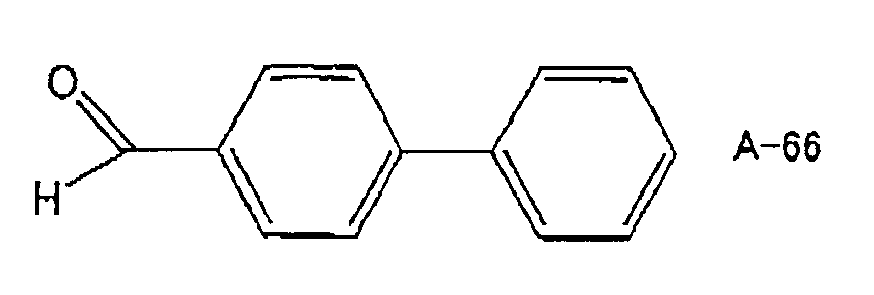
- The amount of the compound of formula [1] that constitutes the polyvinyl acetal modified by the compound represented by the formula [1] is preferably from 10% by mass to 100% by mass based on all the polymerization units to constitute the polymer, more preferably from 30% by mass to 95% by mass, even more preferably from 50% by mass to 90% by mass.
- If desired, two or more different types of the compounds of formula [1] may be used herein, as combined.
- Preferably, the mass-average molecular weight of the polyvinyl acetal modified by the compound represented by the formula [1] is from 3, 000 to 500, 000, more preferably from 6,000 to 300,000, even more preferably from 8,000 to 200,000.
- The mass-average molecular weight and the molecular weight as referred to herein are polystyrene-based molecular weights determined through detection with a differential refractiometer in a solvent of THF, using a GPC analyzer with a column of TSK gel GMHxL, TSK gel G4000HxL, TSK gel G2000HxL (all trade names by Toso).
- In general, the polyvinyl acetal modified by the compound represented by the formula [1] is prepared by reacting a polyvinyl alcohol with an aldehyde and/or a ketone, using an acid catalyst, in water or in an organic solvent. In this, only a compound of formula [1] may be used as the aldehyde and/or the ketone; or a compound of formula [1] may be combined with an aldehyde and/or a ketone not represented by the formula [1].
- The acid catalyst for acetalization includes an inorganic acid such as hydrochloric acid, sulfuric acid, phosphoric acid; as well as acetic acid, p-toluenesulfonic acid, etc. The amount of the catalyst to be used is preferably from 0.005 to 0.2 mols relative to 1 mol of the aldehyde and/or ketone for the reaction.
- The acetalization temperature may be from 20°C to 100°C or so, preferably from 40°C to 90°C.
- Specific examples of the structures of the polyvinyl acetal modified by the compound represented by the formula [1] are shown below, to which, however, the invention should not be limited. In the formulae, the numerals indicate the ratio by mass of the constitutive monomer components. Mw means a mass-average molecular weight.


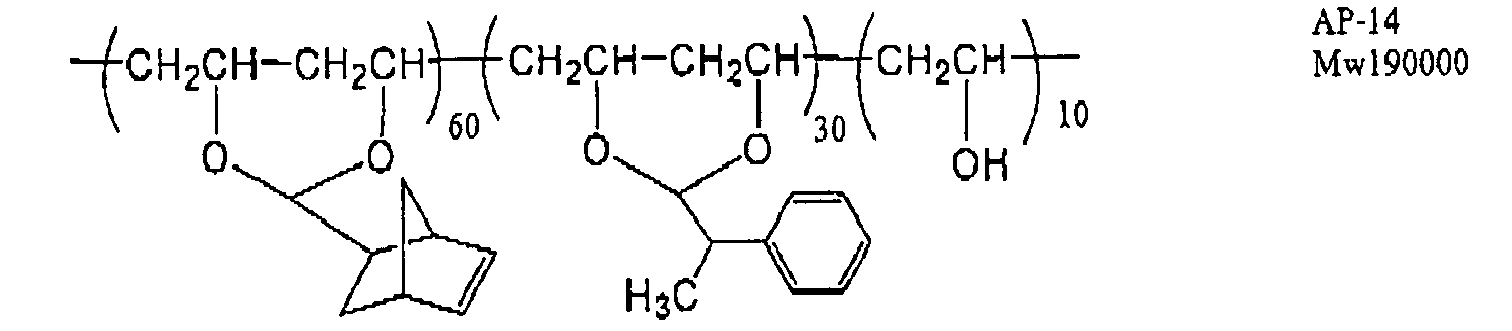


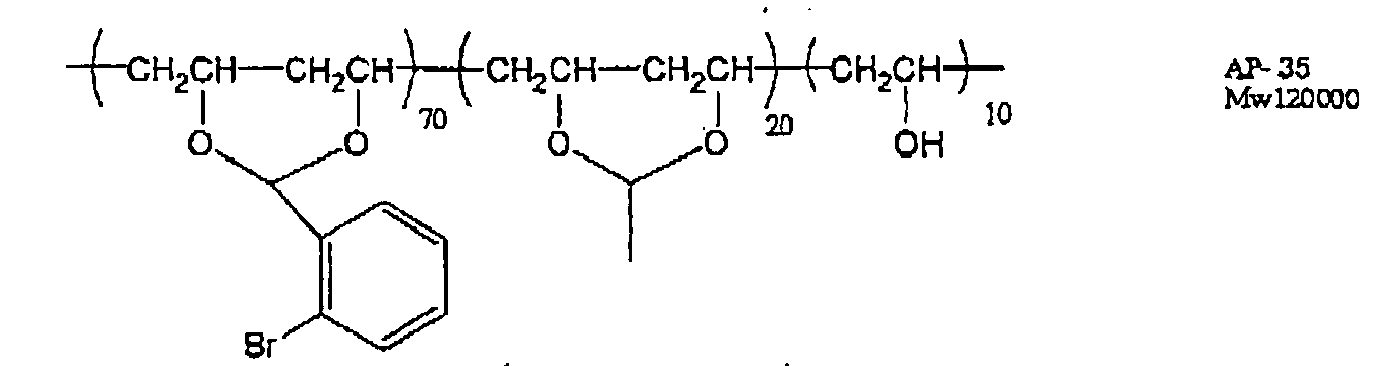


- The polyvinyl acetal in the invention may be combined with any polymer. The polymer that may be combined with it is preferably transparent or semitransparent and colorless, including natural resins, polymers and copolymers, and synthetic resins, polymers and copolymers, and other film-forming media, for example, gelatins, polyvinyl alcohols, hydroxyethyl celluloses, cellulose acetates, cellulose acetate butyrates, polyvinylpyrrolidones, casein, starch, polyacrylic acids, polymethyl methacrylates, polyvinyl chlorides, polymethacrylic acids, styrene-maleic anhydride copolymers, styrene-acrylonitrile copolymers, styrene-butadiene copolymers, polyvinyl acetals (e.g., polyvinyl formal, polyvinyl butyral), polyesters, polyurethanes, phenoxy resins, polyvinylidene chlorides, polyepoxides, polycarbonates, polyvinyl acetates, polyolefins, polyamides. The binder may be formed from water or from an organic solvent or an emulsion by coating.
- The thermal transfer ink sheet of the invention contains a polyvinyl acetal modified with at least one compound of the above formula [1]. A thermal transfer recording ink sheet generally has a structure with a dye layer formed on a support, and a polyvinyl acetal modified with at least one compound of formula [1] is incorporated in the dye layer. The thermal transfer recording ink sheet of the invention may be produced by dissolving a thermal transferable dye in a solvent along with a polyvinyl acetal modified with at least one compound of formula [1] therein, or by dispersing it in a solvent as fine particles to prepare an ink, then applying the ink to a support, and suitably drying it to form a dye layer thereon.
- The thermal transfer ink sheet of the invention may have any other layer than the dye layer within a range not too much detracting from the effect of the invention. For example, an interlayer may be provided between the support and the dye-donating layer; or a back layer may be provided on the surface of the support opposite to the side of the dye layer (this may be hereinafter referred to as "back surface") . The interlayer includes, for example, an undercoating layer, and a diffusion-preventing layer for preventing the dye from diffusing toward the support (hydrophilic barrier layer), The back layer is, for example, a heat-resistant slip layer, which is for preventing a thermal head from sticking to the ink sheet.
- As the support of the thermal transfer recording ink sheet of the invention, any ordinary one heretofore used as a support for ink sheets may be suitably selected and used. For example, the material described in
JP-A 7-137466 - As the dye for use in the dye layer of the invention, any dyes may be used so long as they are thermal transferable. Typical examples of the dyes which can be used in the invention include a cyan dye, a magenta dye, a yellow dye, a black dye, an infrared dye and a ultraviolet dye etc. One or more these dyes may be used herein either singly or as combined depending on a purpose or the purpose for controlling a color phase.
- As the cyan dye, for example, preferably used are those described in
JP-A 3-103477 3-150194 JP-A 5-286268 JP-A 1-225592 - The content of the dye in the dye layer is preferably from 0.03 to 1.0 g/m2, more preferably from 0.1 to 0.6 g/m2. The thickness of the dye layer is preferably from 0.2 to 5 µm, more preferably from 0.4 to 2 µm.
- If desired, any kinds of conventional additives may be added to the dye layer in addition to the above resin binder and the dye. As the additive, for example, an organic fine particles such as polyethylene wax or an inorganic fine particles may be used for improving releasability from a thermal transfer image-receiving sheet or coatability of the ink. A hardener (for example, a silane coupling agent) or a releasant may also be used. Preferable releasant is a releasable graft copolymer. The releasable graft copolymer is the graft copolymer in which any one of a releasable segment selected from the group consisting of polysiloxane segment, fluorine carbon segment, fluorine hydrocarbon segment and long-chain alkyl segment is graft polymerized in the main chain thereof. More preferable is the graft copolymer in which polysiloxane segment is graft polymerized in the main chain of polyvinyl acetal resin.
- The thermal transfer ink sheet of the invention is preferably fabricated by applying the coating composition for the dye layer of the invention containing the thermal transferable dye and a polyvinyl acetal modified with at least one compound of the above formula [1]. The coating composition for the dye layer of the invention is preferably prepared by dissolving the thermal transferable dye in an organic solvent or dispersing the thermal transferable dye as fine particle in a solvent. The coating composition for the dye layer of the invention may contain the additives, hardeners and releasant set forth above. The coating composition for the dye layer of the invention is applied onto a support with any ordinary known method like a gravure printing, a screen printing, a reverse roll coating with gravure coater.
- In case where the invention is applied to thermal transfer recording material that enables full-color image recording, it is desirable that a cyan ink sheet containing a thermal transferable cyan dye capable of forming cyan images, a magenta ink sheet containing a thermal transferable magenta dye capable of forming magenta images, and a yellow ink sheet containing a thermal transferable yellow dye capable of forming yellow images are formed successively on a support. If desired, an ink sheet containing a black image-forming substance may be further formed. A transferable protective layer is preferably further formed.
- A protective layer may be preferably coated on the outermost layer.
- The thermal transfer ink sheet of the invention may be charged in an ink cartridge. Regarding the structure of the ink cartridge and the charging method, any ones heretofore employed in the field of thermal transfer recording can be used in the invention. Concretely, the technique of cartridges as in
JP-UM-A 63-161851 1-101864 JP-UM-A 1-101864 - In thermal transfer recording by the use of the thermal transfer ink sheet of the invention, a heating unit such as a thermal head and an image-receiving material are used as combined. Specifically, heat energy is applied to the ink sheet from a thermal head according to an image recording signal, and the dye in the part having received the heat energy is transferred to and fixed in an image-receiving sheet to attain image recording.
- The thermal transfer image-receiving sheet to be combined with the thermal transfer ink sheet of the invention is described below.
- The thermal transfer image-receiving sheet has a dye-receiving layer (receiving layer) formed on a support. Preferably, an underlayer is formed between the receiving layer and the support, and for example, a white background-controlling layer, a static charge-controlling layer, an adhesive layer or a primer layer may be formed. Preferably, a heat-insulating layer is formed between the underlayer and the support. The layer between the support and the receiving layer may be referred to simply as "interlayer", and this includes the above underlayer and heat-insulating layer. The thermal transfer image-receiving sheet contains at least one receiving layer and at least one interlayer. On the back of the support, preferably formed is a curl-controlling layer, a writing layer or a static charge-controlling layer.
- The receiving layer plays a role of receiving the dye transferred from an ink sheet and to keep the formed image.
- Accordingly, a dyeable resin (dyeable receiving polymer) is used in the receiving layer.
- For example, usable are polyolefin resins such as polyethylene, polypropylene; halide resins such as polyvinyl chloride, polyvinylidene chloride; vinyl resins such as polyvinyl acetate, polyacrylates; and their copolymers; polyester resins such as polyethylene terephthalate, polybutylene terephthalate; polystyrene resins, polyamide resins, polycarbonates, phenol resins, polyurethanes, epoxy resins, polysulfones, butyral resins, melamine resins, polyvinyl alcohols, copolymers of olefin such as ethylene or propylene with any other vinyl monomer; vinyl chloride-vinyl acetate copolymers, styrene-acryl copolymers, ionomers, cellulose resins, natural rubbers, synthetic rubbers; and these may be used either singly or as their mixtures; however, the invention should not be limited to these. Preferably, the receiving polymer to be used in the receiving layer is in the form of a polymer latex.
- The polymer latex is described. In a thermal transfer image-receiving sheet, the polymer latex to be in the receiving layer is a dispersion of water-insoluble hydrophobic polymer particles dispersed in a water-soluble dispersion medium. The dispersion may be any one prepared by emulsifying a polymer in a dispersion medium, one prepared by emulsification and polymerization, one prepared by micelle dispersion, or a molecular dispersion of polymer molecules partially having a hydrophilic structure, in which the molecular chains themselves are molecularly dispersed. The polymer latex is described, for example, in Taira Okuda & Hiroshi Inagaki, "Synthetic Resin Emulsion", issued by the Polymer Publishing, 1978; Takaaki Sugimura, Yasuo Kataoka, Soichi Suzuki, & Keiji Kasahara, "Applications of Synthetic Latex", issued by the Polymer Publishing, 1993; Soichi Muroi, "Chemistry of Synthetic Latex", issued by the Polymer Publishing, 1970; Yoshiaki Miyosawa, "Development and Application of Water-Base Coating Material", by CMC, 2004; and
JP-A 64-538 - The polymer latex may be an ordinary uniform-structured polymer latex, and in addition, it may also be a core/shell-structured polymer latex. In the latter case, it is often desirable that the core and the shell have a different glass transition temperature. The glass transition temperature of the polymer latex for use in the invention is preferably from -30°C to 130°C, more preferably from 0°C to 100°C, even more preferably from 10°C to 80°C.
- As preferred embodiments of the polymer latex, hydrophobic polymers are preferably used therein, including, for example, acrylic polymers, polyesters, rubbers (e.g., SBR resin), polyurethanes, polyvinyl chlorides, polyvinyl acetates, polyvinylidene chlorides, polyolefins. These polymers may be linear polymers, or branched polymers, or crosslinked polymers, and they may be homopolymers formed by polymerization of a single monomer or copolymers formed by copolymerization of two or more different monomers. The copolymers may be random copolymers or block copolymers. Preferably, the number-average molecular weight of the polymer is from 5000 to 1000000, more preferably from 10000 to 500000. In case where a polymer having a too small molecular weight is used, the mechanical strength of the layer containing the polymer latex may be insufficient; but when a polymer having a too large molecular weight is used, then it is unfavorable since its film formability is poor. A crosslinked polymer latex is also preferably used in the invention.
- Not specifically defined, the monomer for use in producing the polymer latex may be any one capable of polymerizing in an ordinary radical polymerization or ionic polymerization method. For example, preferred are those of the following monomer groups (a) to (j) . From these monomers, any ones may be independently suitably selected and combined and used in producing the polymer latex for use herein.
- -Monomer Groups (a) to (j)-
- (a) Conjugated dienes: 1,3-pentadiene, isoprene, 1-phenyl-1,3-butadiene, 1-α-naphthyl-1,3-butadiene, 1-β-naphthyl-1,3-butadiene, cyclopentadiene, etc.
- (b) Olefins: ethylene, propylene, vinyl chloride, vinylidene chloride, 6-hydroxy-1-hexene, 4-pentenoic acid, methyl 8-nonenoate, vinylsulfonic acid, trimethylvinylsilane, trimethoxyvinylsilane, 1,4-divinylcyclohexane, 7.,2,5,trivinylcyclohexane, etc.
- (c) α,β-unsaturated carboxylates: alkyl acrylates (e.g., methyl acrylate, ethyl acrylate, butyl acrylate, cyclohexyl acrylate, 2-ethylhexyl acrylate, dodecyl acrylate), substituted alkyl acrylates (e.g., 2-chloroethyl acrylate, benzyl acrylate, 2-cyanoethyl acrylate), alkyl methacrylates (e.g., methyl methacrylate, butyl methacrylate, 2-ethylhexyl methacrylate, dodecyl methacrylate), substituted alkyl methacrylates (e.g., 2-hydroxyethyl methacrylate, glycidyl methacrylate, glycerin monomethacrylate, 2-acetoxyethyl methacrylate, tetrahydrofurfuryl methacrylate, 2-methoxyethyl methacrylate, polypropylene glycol monomethacrylate (molar number of added polyoxypropylene = 2 to 100), 3-N,N-dimethylaminopxopyl methacrylate, chloro-3-N,N,N-trimethylammoniopropyl methacrylate, 2-carboxyethyl methacrylate, 3-sulfopropyl methacrylate, 4-oxysulfobutyl methacrylate, 3-trimethoxysilylpropyl methacrylate, allyl methacrylate, 2-isocyanatoethyl methacrylate), unsaturated dicarboxylic acid derivatives (e.g., monobutyl maleate, dimethyl maleate, monomethyl itaconate, dibutyl itaconate), polyfunctional esters (e.g., ethylene glycol diacrylate, ethylene glycol dimethacrylate, 1,4-cyclohexane diacrylate, pentaerythritol tetramethacrylate, pentaerythritol triacrylate, trimethylolpropane triacrylate, trimethylolethane triacrylate, dipentaerythritol pentamethacrylate, pentaerythritol hexaacrylate, 1,2,4-cyclohexane tetraacrylate), etc.
- (d) α,β-unsaturated carboxylic acid amides: for example, acrylamide, methacrylamide, N-methylmethacrylamide, N,N-dimethylacrylamide, N-methyl-N-hydroxyethylmethacrylamide, N-tert-butylacrylamide, N-tert-octylmethacrylamide, N-cyclohexylacrylamide, N-phenylacrylamide, N-(2-acetacetoxyethyl)acrylamide, N-acryloylmorpholine, diacetonacrylamide, itaconic acid diamide, N-methylmaleimide, 2-acrylamide-methylpropanesulfonic acid, methylenebisacrylamide, dimethacryloylpiperazine, etc.
- (e) Unsaturated nitriles: acrylonitrile, methacrylonitrile, etc.
- (f) Styrene and its derivatives: styrene, vinyltoluene, p-tert-butylstyrene, vinylbenzoic acid, methyl vinylbenzoate, α-methylstyrene, p-chloromethylstyx'ene, vinylnaphthalene, p-hydroxymethylstyrene, sodium p-styrenesulfonate, potassium p-styrenesulfinate, p-aminomethylstyrene, 1,4-divinylbenzene, etc.
- (g) Vinyl ethers: methyl vinyl ether, butyl vinyl ether, methoxyethyl vinyl ether, etc.
- (h) Vinyl esters: vinyl acetate, vinyl propionate, vinyl benzoate, vinyl salicylate, vinyl chloroacetate, etc.
- (i) α,β-unsaturated carboxylic acids and their salts: acrylic acid, methacrylic acid, itaconic acid, maleic acid, sodium acrylate, ammonium methacrylate, potassium itaconate, etc.
- (j) Other polymerizing monomers: N-vinylimidazole, 4-vinylpyridine, N-vinylpyrrolidone, 2-vinyloxazoline, 2-isopropenyloxazoline, divinylsulfone, etc.
- Polymer latex is commercially available, and the following polymers are usable. Examples of acrylic polymers are Daicel Chemical Industry's Sevian A-4635, 4718, 4601; Nippon Zeon's Nipol Lx811, 814, 821, 820, 855 (P-17: Tg 36°C), 857x2 (P-18: Tg 43°C) ; Dai-Nippon Ink Chemical's Voncoat R3370 (P-19: Tg 25°C), 4280 (P-20: Tg 15°C), Nippon Pure Chemicals' Jurymer ET-410 (P-21: Tg 44°C), JSR's AE116 (P-22: Tg 50°C), AE119 (P-23: Tg 55°C), AE121 (P-24: Tg 58°C), AE125 (P-25: Tg 60°C), AE134 (P-26: Tg 48°C), AE137 (P-27: Tg 48°C), AE140 (P-28: Tg 53°C), AE173 (P-29: Tg 60°C), Toa Gosei's Aron A-104 (P-30: Tg 45°C), Takamatsu Yushi's NS-600X, NS-620X, Nisshin Chemical Industry's Vinybran 2580, 2583, 2641, 2770, 2770H, 2635, 2886, 5202C, 2706 (all trade names).
- Examples of polyesters are Dai-Nippon Ink Chemical's FINETEX ES550, 611, 675, 850, Eastman Chemical's WD-size, WMS, Takamatsu Yushi's A-110, A-115GE, A-120, A-121, A-124GP, A-124S, A-160P, A-210, A-215GE, A-510, A-513E, A-515GE, A-520, A-610, A-613, A-615GE, A-620, WAC-10, WAC-15, WAC-17XC, WAC-20, S-110, S-110EA, S-1118L, S-120, S-140, S-140A, S-250, S-252G, S-250S, S-320, S-680, DNS-63P, NS-122L, NS-122LX, NS-244LX, NS-140L, NS-141LX, NS-282LX, Toa Gosei's Aron Melt PES-1000 Series, PES-2000 Series, Toyobo's Vylonal MD-1100, MD-1200, MD-1220, MD-1245, MD-1250, MD-1335, MD-1400, MD-1480, MD-1500, MD-1930, MD-1985, Sumitomo Seika's Ceporjon ES (all trade names).
- Examples of polyurethanes are Dai-Nippon Ink Chemical's HYDRAN AP10, AP20, AP30, AP40, 101H, Vondic 1320NS, 1610NS, Dainichi Seika's D-1000, D-2000, D-6000, D-4000, D-9000, Takamatsu Yushi's NS-155X, NS-310.A, NS-310X, NS-311X, Dai-ichi Kogyo Pharmaceutical's Elastron (all trade names).
- Examples of rubbers are LACSTAR 7310K, 3307B, 4700H, 7132C (all by Dai-Nippon Ink Chemical), Nipol Lx416, LX410, LX430, LX435, LX110, LX415A, LX438C, 2507H, LX303A, LX407BP Series, V1004, MH5055 (all by Nippon Zeon) (all trade names).
- Examples of polyvinyl chlorides are Nippon Zeon's G351, G576, Nisshin Chemical Industry's Vinybran 240, 270, 277, 375, 386, 609, 550, 601, 602, 630, 660, 671, 683, 680, 680S, 681N, 685R, 277, 380, 381, 410, 430, 432, 860, 863, 865, 867, 900, 900GT, 938, 950 (all trade names). Examples of polyvinylidene chlorides are Asahi Kasei's L502, L513, Dai-Nippon Ink Chemical's D-5071 (all trade names). Examples of polyolefins are Mitsui Petrochemical's Chemipearl S120, SR100, V300 (P-40: Tg 80°C), Dai-Nippon Ink Chemical's Voncoat 2830, 2210, 2960, Sumitomo Seika's Zaikthene, Ceporjon G; and examples of copolymer nylons are Sumitomo Seika's Ceporjon PA (all trade names).
- Examples of polyvinyl acetates are Nisshin Chemical Industry's Vinybran 1080, 1082, 1085W, 1108W, 1108S, 1563M, 1566, 1570, 1588C, A22J7-F2, 1128C, 1137, 1138, A20J2, A23J1, A23K1, A23P2E, A68JIN, 1086A, 1086, 1086D, 11085, 1187:, 1241LT, 1580N, 1083, 1571, 1572, 1581, 4465, 4466, 4468W, 4468S, 4470, 4485LL, 4495LL, 1023, 1042, 1060, 1060S, 1080M, 1084W, 1084S, 1096, 1570K, 1050, 1050S, 3290, 1017AD, 1002, 1006, 1008, 1107L, 1225, 1245L, GV-6170, GV-6181, 4468W, 4468S (all trade names).
- One or more these polymer latexes may be used herein either singly or as combined.
- Specific examples of the structures of polymer latexes usable in the invention are shown below; however, the polymer latex usable in the invention should not be limited to these. The numerals in the formulae indicate the ratio by weight of the constitutive monomer components. Mw means a mass-average molecular weight.


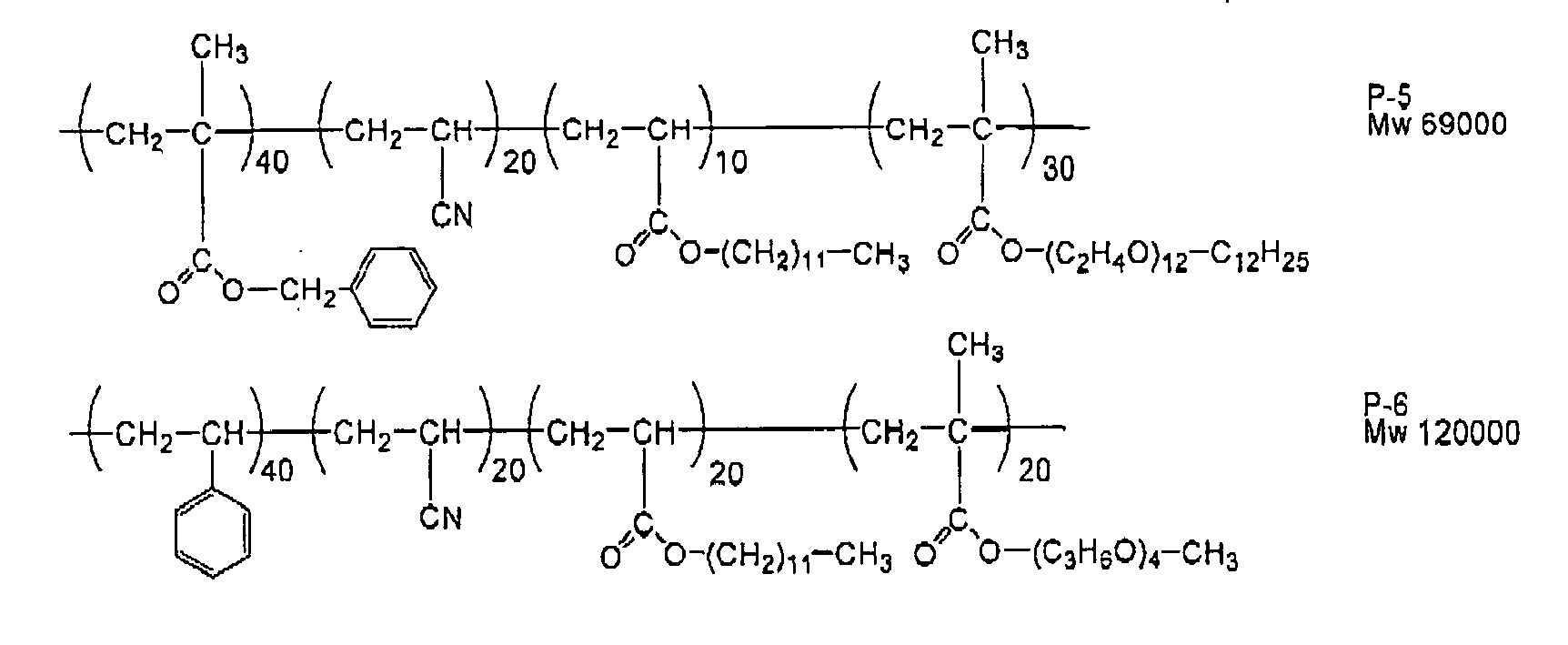





- The characteristics of the invention are described more concretely with reference to Production Examples and Examples given below.
- In the following Examples, the material used, its amount and the ratio, the details of the treatment and the treatment process may be suitably modified or changed not overstepping the scope of the invention. Accordingly, the invention should not be limitatively interpreted by the Examples mentioned below.
- Polyvinyl alcohol (PVA110, by Kuraray) (20 g), methylene chloride (400 g), hydrochloric acid (2.0 g) and A-1 (93 g) were put into a reactor equipped with a stirrer and a reflux condenser, and heated at 40°C for 40 hours to complete the reaction. Next, the reaction liquid was reprecipitated in methanol to obtain a reaction product. Its mass-average molecular weight was 1.5 × 10⁶.

- AP-2 to AP-43 were produced in the same manner as that for AP-1.
- A polyester film (Lumirror, trade name by Toray) having a thickness of 6.0 µm was used as a support film. A heat-resistant slip layer (thickness 1 µm) was formed on the back of the film, and to its surface, yellow, magenta and cyan compositions mentioned below were applied each as single color (coating amount of the dry film, 1 g/m2). Yellow ink:
Dye (Macrolex Yellow 6G, trade name by Bayer) 5.5 mas.pts. Polymer AP-1 Methyl ethyl ketone/toluene (1/1 by mass) 4.4 mas.pts. Magenta ink: 90 mas.pts. Magenta dye (Disperse Red 60) 5.5 mas.pts. Polymer AP-1 4.4 mas.pts. Methyl ethyl ketone/toluene (1/1 by mass) 90 mas.pts. Cyan ink: Cyan dye (Disperse Red 63) 5.5 mas.pts. Polymer AP-1 4.4 mas.pts. Methyl ethyl ketone/toluene (1/1 by mass) 90 mas.pts. - A sample 102 of the invention was fabricated in the same manner as that for the sample 101, for which, however, the compound AP-1 was changed to AP-5.
- A sample 103 of the invention was fabricated in the same manner as that for the sample 101, for which, however, the compound AP-1 was changed to AP-10.
- A sample 104 of the invention was fabricated in the same manner as that for the sample 101, for which, however, the compound AP-1 was changed to AP-18.
- A sample 105 of the invention was fabricated in the same manner as that for the sample 101, for which, however, the compound AP-1 was changed to AP-23.
- A sample 106 of the invention was fabricated in the same manner as that for the sample 101, for which, however, the compound AP-1 was changed to AP-19.
- A sample 107 of the invention was fabricated in the same manner as that for the sample 101, for which, however, the compound AP-1 (4.4 mas.pts.) was changed to AP-9 (5.5 mas.pts.).
- A sample 108 of the invention was fabricated in the same manner as that for the sample 101, for which, however, the compound AP-1 (4.4 mas.pts.) was changed to AP-26 (5.5 mas.pts.).
- A sample 109 of the invention was fabricated in the same manner as that for the sample 101, for which, however, the compound AP-1 (4.4 mas.pts.) was changed to AP-29 (5.5 mas.pts.)
- A sample 110 of the invention was fabricated in the same manner as that for the sample 101, for which, however, the compound AP-1 (4.4 mas.pts.) was changed to AP-34 (5.5 mas.pts.).
- A sample 111 of the invention was fabricated in the same manner as that for the sample 101, for which, however, the compound AP-1 (4.4 mas.pts.) was changed to AP-43 (5.5 mas.pts.).
- A polyester film (Lumirror, trade name by Toray) having a thickness of 6.0 µm was used as a support film. A heat-resistant slip layer (thickness 1 µm) was formed on the back of the film, and to its surface, yellow, magenta and cyan compositions mentioned below were applied each as single color (coating amount of the dry film, 1 g/m2).
-
Dye (Macrolex Yellow 6G, trade name by Bayer) 5.5 mas.pts. Polyvinyl butyral (Eslec BX-1, trade name by Sekisui Chemical Industry) 4.5 mas.pts. Methyl ethyl ketone/toluene (1/1 by mass) 90 mas.pts. Magenta ink: Magenta dye (Disperse Red 60) Polyvinyl butyral (Eslec BX-1, trade name by Sekisui Chemical 5.5 mas.pts. Industry) 4.5 mas.pts. Methyl ethyl ketone/toluene (1/1 by mass) 90 mas.pts. Cyan ink: Cyan dye (Disperse Red 63) 5.5 mas.pts. Polyvinyl butyral (Eslec BX-1, trade name by Sekisui Chemical Industry) 4.5 mas.pts. Methyl ethyl ketone/toluene (1/1 by mass) 90 mas.pts. - A sample 113 of the invention was fabricated in the same manner as that for the sample 112, for which, however, the amount of polyvinyl butyral in the yellow ink, magenta ink and cyan ink is changed from 4.5 to 5.5 mas.pts.
- An ink sheet of Example 1 described in Japanese Patent No.
3263138 - An ink sheet of Example 5 described in Japanese Patent No.
3263138 - An ink sheet of Example 1 described in
JP-A 7-23742 - The surface of a paper support double-laminated with polyethylene was processed for corona discharge treatment, and then a sodium dodecylbenzenesulfonate-containing gelatin underlayer was formed on it. On this, a coating composition for an interlayer A having the composition mentioned below was formed, using a bar coater, and dried, and then a coating composition for a receiving layer A having the composition mentioned below was formed, using a bar coater, and dried. The bar coating was attained at 40°C, and the drying was attained at 50°C for 16 hours for every layer. The layer formation by coating was so controlled that the dry coating amount of the interlayer A could be 1.0 g/m2 and that of the receiving layer A could be 2.5 g/m2.
Coating composition for interlayer A: Polyester resin (Vylon 200, trade name by Toyobo) 10 mas.pts. Fluorescent brightener (Uvitex OB, trade name by Ciba-Geigy) 1 mas.pts. Titanium oxide 30 mas.pts. Methyl ethyl ketone/toluene (1/1 by mass) 90 mas.pts. Coating composition for receiving Layer A: Polyester resin (resin described in Example 1 in JP -A 2-265789 100 mas.pts. Amino-modified silicone (Shin-etsu Chemical Industry's trade name, X-22-3050C) 5 mas.pts. Epoxy-modified silicone (Shin-etsu Chemical Industry's trade name, X-22-300E) 5 mas.pts. Methyl ethyl ketone/toluene (1/1 by mass) 400 mas.pts. - The above ink sheets and the image-receiving sheet 1 were processed so as to be charged in a sublimation-type printer, Nippon Densan Copal' s ASK2000 (trade name). Set in the printer, these were tested for image outputting according to a high-speed print mode to give a black solid image.
- The visual density of the black image obtained under the above condition was determined, using Photographic Densitometer (trade name by X-Rite Incorporated). Table 1 shows the relative value of the transfer density of each sample, based on the standard value 100 of sample 106.
- For evaluation of ink stickiness, the print part giving Dmax of the image was checked for the ink stickiness condition, according to the following criteria. The obtained results are shown in Table 1.
-
- 5: The image-receiving sheet smoothly peeled from the ink sheet, with no ink fusion (stickiness) to the image receiving sheet.
- 4: The area where the two stuck to each other was at most 1% relative to the print area of the density region that was sticky.
- 3: The area where the two stuck to each other was more than 1% and at most 10% relative to the print area of the density region that was sticky.
- 2: The area where the two stuck to each other was more than 10% and at most 20% relative to the print area of the density region that was sticky.
- 1: The area where the two stuck to each other was more than 20% relative to the print area of the density region that was sticky.
- The thermal transfer ink sheet and the image-receiving sheet were put one upon another in such a manner that the dye layer and the image-receiving layer could face each other, and this was led to pass through a hot roll laminator so that the surface temperature of the thermal transfer ink sheet could be 70°C, and then the density of the dye transferred to the dye-receiving layer was measured with Photographic Densitometer (by X-Rite Incorporated). Before and after the test, the density change (ΔD) was computed. The obtained results are shown in Table 1.
Table 1 Relative Transfer Density Ink Stickiness Background Soiling Sample 101 (Example) 120 5 0.04 Sample 102 (Example) 125 5 0.05 Sample 103 (Example) 125 5 0.05 Sample 104 (Example) 120 5 0.04 Sample 105 (Example) 110 5 0.06 Sample 106 (Example) 125 5 0.04 Sample 107 (Example) 120 5 0.04 Sample 108 (Example) 125 5 0.03 Sample 109 (Example) 120 5 0.03 Sample 110 (Example) 125 5 0.03 Sample 111 (Example) 110 5 0.04 Sample 112 (Comparative Example) 100 5 0.09 Sample 113 (Comparative Example) 100 5 0.08 Sample 114 (Comparative Example) 110 3 0.11 Sample 115 (Comparative Example) 105 3 0.04 Sample 116 (Comparative Example) 100 5 0.08 - As is obvious from the results in Table 1, the samples 112, 113, 115 and 116 could not give an increased relative transfer density in high-speed transfer recording. The sample 115 gave an increased relative transfer density, but had a problem of ink stickiness.
- It is known that the samples 101 to 111 of the invention all had an excellent relative transfer density with no ink stickiness. Accordingly, using the specific resin binder in the invention makes it possible to provide a thermal transfer ink sheet of high sensitivity with few surface defects.
- Samples were fabricated in the same manner as in Example 1, for which, however, the image-receiving sheet 1 was changed to an image-receiving sheet 2 mentioned below.
- The surface of a paper support double-laminated with polyethylene was processed for corona discharge treatment, and then a sodium dodecylbenzenesulfonate-containing gelatin underlayer was formed on it. On this, a coating composition for an interlayer B and a coating composition for a receiving layer B each having the composition mentioned below were laminated by coating in that order from the support, according to the method illustrated in Fig. 9 in
USP 2,761,791 . Immediately after the coating, this was dried at 50°C for 16 hours. The layer formation was so controlled that the dry coating amount of the interlayer B could be 15 g/m2 and that of the receiving layer B could be 2.5 g/m2Coating composition for interlayer B: Hollow polymer latex (MH5055, trade name by Nippon Zeon) 563 mas.pts. Gelatin 120 mas.pts. - In this, the hollow polymer latex is an aqueous dispersion of a hollow-structured polymer having an outer diameter of 0.5 µm.
Coating composition for receiving Layer B: Polymer P-9 48 mas.pts. Benzotriazole-type UV absorbent polymer latex (ULS1700, trade name by Ipposha Yushi Kogyo) 15 mas.pts. Montan wax (J537, trade name by Chukyo Yushi) 10 mas.pts. - The above ink sheets obtained in Example 1 and the image-receiving sheet 2 were processed in the same manner as that for Example 1 and images were formed. The samples were tested in the same manner as in Example 1. The results are shown in Table 2.
Table 2 Relative Transfer Density Ink Stickiness Background Soiling Sample 101 (Example) 125 5 0.04 Sample 102 (Example) 130 5 0.05 Sample 103 (Example) 130 5 0.05 Sample 104 (Example) 125 5 0.04 Sample 105 (Example) 120 5 0.05 Sample 106 (Example) 130 5 0.04 Sample 107(Example) 125 5 0.05 Sample 108 (Example) 130 5 0.05 Sample 109(Example) 125 5 0.05 Sample 110 (Example) 130 5 0.05 Sample 111 (Example) 120 5 0.05 Sample 112 (Comparative Example) 100 5 0.09 Sample 113 (Comparative Example) 100 5 0.09 Sample 114 4 (Comparative Example) 110 4 0.12 Sample 115 (Comparative Example) 105 4 0.05 5ample,116 (Comparative Example) 100 5 0.08 - The samples 101 to 111 of the invention all had an excellent relative transfer density with no ink stickiness in this Example, and their relative transfer density was higher than that in Example 1.
Claims (10)
- A thermal transfer ink sheet comprising, as formed on a support, a dye layer containing a thermal transferable dye in a resin binder, wherein the dye layer contains a polyvinyl acetal modified with at least one compound of the following formula [1]:

- The thermal transfer ink sheet according to claim 1, wherein one of R1 and R2 is a crosslinked cyclic group, a condensed cyclic group, an aliphatic carbon mono-cyclic group or a hetero-cyclic group.
- The thermal transfer ink sheet according to claim 1, wherein one of R1 and R2 is a crosslinked cyclic group or a condensed cyclic group.
- The thermal transfer ink sheet according to claim 1, wherein one of R1 and R2 is a crosslinked alicyclic group or a condensed alicyclic group.
- The thermal transfer ink sheet according to claim 1, wherein R1 is a substituted phenyl group and R2 is a hydrogen atom, a linear alkyl group or a branched alkyl group.
- The thermal transfer ink sheet according to claim 1, wherein R1 is an alkyl substituted phenyl group, an alkoxy substituted phenyl group or a halophenyl group.
- The thermal transfer ink sheet according to claim 1, wherein R1 is a halophenyl group.
- An ink cartridge filled with the thermal transfer ink sheet of any one of claims 1 to 7.
- A thermal transfer recording method comprising forming an image by use of the thermal transfer ink sheet of any one of claims 1 to 7 on an image-receiving sheet comprising a polymer latex-containing ink-receiving layer on a support.
- A coating composition for the dye layer of a thermal transfer ink sheet, containing a thermal transferable dye and a polyvinyl acetal modified with at least one compound of the following formula [1]:

Applications Claiming Priority (1)
| Application Number | Priority Date | Filing Date | Title |
|---|---|---|---|
| JP2007092240 | 2007-03-30 |
Publications (2)
| Publication Number | Publication Date |
|---|---|
| EP1974944A1 true EP1974944A1 (en) | 2008-10-01 |
| EP1974944B1 EP1974944B1 (en) | 2009-12-02 |
Family
ID=39485113
Family Applications (1)
| Application Number | Title | Priority Date | Filing Date |
|---|---|---|---|
| EP08006328A Not-in-force EP1974944B1 (en) | 2007-03-30 | 2008-03-31 | Thermal transfer ink sheet, ink cartridge, coating composition for dye layer of thermal transfer ink sheet, and thermal transfer recording method |
Country Status (4)
| Country | Link |
|---|---|
| US (1) | US8105978B2 (en) |
| EP (1) | EP1974944B1 (en) |
| AT (1) | ATE450381T1 (en) |
| DE (1) | DE602008000329D1 (en) |
Families Citing this family (5)
| Publication number | Priority date | Publication date | Assignee | Title |
|---|---|---|---|---|
| CN105102236B (en) | 2013-04-08 | 2017-05-31 | 柯达阿拉里斯股份有限公司 | The thermal image receiver element prepared using aqueous composite |
| US9440473B2 (en) | 2013-12-07 | 2016-09-13 | Kodak Alaris Inc. | Conductive thermal imaging receiving layer with receiver overcoat layer comprising a surfactant |
| WO2015085084A1 (en) | 2013-12-07 | 2015-06-11 | Kodak Alaris Inc. | Conductive thermal transfer recording dye-receiving element |
| CN106457866B (en) | 2014-04-09 | 2018-10-26 | 柯达阿拉里斯股份有限公司 | Conductive heat imaging receiver layer with the receiver external coating comprising surfactant |
| EP3247568B1 (en) | 2015-01-19 | 2025-04-02 | Kodak Alaris Inc. | Conductive thermal imaging receiving layer with receiver overcoat layer comprising a surfactant |
Citations (16)
| Publication number | Priority date | Publication date | Assignee | Title |
|---|---|---|---|---|
| US2761791A (en) | 1955-02-23 | 1956-09-04 | Eastman Kodak Co | Method of multiple coating |
| GB940199A (en) * | 1959-01-24 | 1963-10-23 | Hoechst Ag | Modified polyvinyl acetals and polyvinyl ketals and process for preparing them |
| JPS63161851A (en) | 1986-12-23 | 1988-07-05 | Mitsubishi Electric Corp | Squirrel-cage induction motor |
| JPS64538A (en) | 1987-02-19 | 1989-01-05 | Fuji Photo Film Co Ltd | Silver halide photographic sensitive material |
| JPH01101864A (en) | 1987-10-13 | 1989-04-19 | Hokubii:Kk | Preparation of marbling meat |
| JPH01225592A (en) | 1988-03-04 | 1989-09-08 | Fuji Photo Film Co Ltd | Thermal transfer material |
| JPH02265789A (en) | 1989-04-07 | 1990-10-30 | Fuji Photo Film Co Ltd | Thermal transfer image receiving material |
| JPH03103477A (en) | 1989-09-18 | 1991-04-30 | Fuji Photo Film Co Ltd | 3-hydroxypyridineazomethin pigment and production thereof |
| JPH03150194A (en) | 1989-11-07 | 1991-06-26 | Konica Corp | Heat sensitive transfer recording material |
| EP0495439A1 (en) * | 1991-01-16 | 1992-07-22 | Denki Kagaku Kogyo Kabushiki Kaisha | Binder resin for a heat transfer layer and heat transfer ink ribbon |
| JPH05286268A (en) | 1992-04-08 | 1993-11-02 | Fuji Photo Film Co Ltd | Thermal transfer dye donating material |
| JPH0723742A (en) | 1993-07-06 | 1995-01-27 | Japan Organo Co Ltd | Processed meat product |
| JPH0732742A (en) | 1993-07-20 | 1995-02-03 | Dainippon Printing Co Ltd | Thermal transfer sheet |
| JPH07137466A (en) | 1993-11-15 | 1995-05-30 | Fuji Photo Film Co Ltd | Thermal transfer dye donating material using pyrazolopyrimidin-7-one azo dye, silver halide photosensitive material using compound liberating azo dye and novel pyrazolopyrymidin-7-one azo dye |
| JP3263138B2 (en) | 1992-07-31 | 2002-03-04 | 大日本印刷株式会社 | Thermal transfer sheet |
| EP1429400A1 (en) * | 2001-09-21 | 2004-06-16 | Sekisui Chemical Co., Ltd. | Modified polyvinyl acetal resin |
-
2008
- 2008-03-27 US US12/056,729 patent/US8105978B2/en not_active Expired - Fee Related
- 2008-03-31 AT AT08006328T patent/ATE450381T1/en not_active IP Right Cessation
- 2008-03-31 EP EP08006328A patent/EP1974944B1/en not_active Not-in-force
- 2008-03-31 DE DE602008000329T patent/DE602008000329D1/en active Active
Patent Citations (16)
| Publication number | Priority date | Publication date | Assignee | Title |
|---|---|---|---|---|
| US2761791A (en) | 1955-02-23 | 1956-09-04 | Eastman Kodak Co | Method of multiple coating |
| GB940199A (en) * | 1959-01-24 | 1963-10-23 | Hoechst Ag | Modified polyvinyl acetals and polyvinyl ketals and process for preparing them |
| JPS63161851A (en) | 1986-12-23 | 1988-07-05 | Mitsubishi Electric Corp | Squirrel-cage induction motor |
| JPS64538A (en) | 1987-02-19 | 1989-01-05 | Fuji Photo Film Co Ltd | Silver halide photographic sensitive material |
| JPH01101864A (en) | 1987-10-13 | 1989-04-19 | Hokubii:Kk | Preparation of marbling meat |
| JPH01225592A (en) | 1988-03-04 | 1989-09-08 | Fuji Photo Film Co Ltd | Thermal transfer material |
| JPH02265789A (en) | 1989-04-07 | 1990-10-30 | Fuji Photo Film Co Ltd | Thermal transfer image receiving material |
| JPH03103477A (en) | 1989-09-18 | 1991-04-30 | Fuji Photo Film Co Ltd | 3-hydroxypyridineazomethin pigment and production thereof |
| JPH03150194A (en) | 1989-11-07 | 1991-06-26 | Konica Corp | Heat sensitive transfer recording material |
| EP0495439A1 (en) * | 1991-01-16 | 1992-07-22 | Denki Kagaku Kogyo Kabushiki Kaisha | Binder resin for a heat transfer layer and heat transfer ink ribbon |
| JPH05286268A (en) | 1992-04-08 | 1993-11-02 | Fuji Photo Film Co Ltd | Thermal transfer dye donating material |
| JP3263138B2 (en) | 1992-07-31 | 2002-03-04 | 大日本印刷株式会社 | Thermal transfer sheet |
| JPH0723742A (en) | 1993-07-06 | 1995-01-27 | Japan Organo Co Ltd | Processed meat product |
| JPH0732742A (en) | 1993-07-20 | 1995-02-03 | Dainippon Printing Co Ltd | Thermal transfer sheet |
| JPH07137466A (en) | 1993-11-15 | 1995-05-30 | Fuji Photo Film Co Ltd | Thermal transfer dye donating material using pyrazolopyrimidin-7-one azo dye, silver halide photosensitive material using compound liberating azo dye and novel pyrazolopyrymidin-7-one azo dye |
| EP1429400A1 (en) * | 2001-09-21 | 2004-06-16 | Sekisui Chemical Co., Ltd. | Modified polyvinyl acetal resin |
Also Published As
| Publication number | Publication date |
|---|---|
| US20080241434A1 (en) | 2008-10-02 |
| US8105978B2 (en) | 2012-01-31 |
| EP1974944B1 (en) | 2009-12-02 |
| DE602008000329D1 (en) | 2010-01-14 |
| ATE450381T1 (en) | 2009-12-15 |
Similar Documents
| Publication | Publication Date | Title |
|---|---|---|
| EP1974943B1 (en) | Thermal transfer ink sheet, ink cartridge, coating composition for dye layer of thermal transfer ink sheet, and thermal transfer recording method | |
| EP1974951B1 (en) | Thermal transfer image-receiving sheet | |
| EP1974944B1 (en) | Thermal transfer ink sheet, ink cartridge, coating composition for dye layer of thermal transfer ink sheet, and thermal transfer recording method | |
| US7863218B2 (en) | Coating composition for producing heat-sensitive transfer image-receiving sheet and heat-sensitive transfer image-receiving sheet | |
| JP2007055254A (en) | Thermal transfer image-receiving sheet and method for producing the same | |
| CN110546013B (en) | Thermal transfer recording media | |
| US7442437B2 (en) | Adhesive composition and thermal transfer sheet | |
| US8124562B2 (en) | Thermal transfer ink sheet, ink cartridge, coating composition for dye layer of thermal transfer ink sheet, and thermal transfer recording method | |
| JP2009056713A (en) | Thermal transfer ink sheet, coating composition for dye layer of thermal transfer ink sheet, ink cartridge, and thermal transfer recording method | |
| CN101316719B (en) | Heat-sensitive transfer image-receiving sheet | |
| JP2009073167A (en) | Thermal transfer ink sheet, ink cartridge, coating composition for dye layer of thermal transfer ink sheet, and thermal transfer recording method | |
| JP2009073168A (en) | Thermal transfer ink sheet, ink cartridge, coating composition for dye layer of thermal transfer ink sheet, and thermal transfer recording method | |
| JP2008087234A (en) | Dye layer forming coating composition for thermal transfer ink sheet, thermal transfer ink sheet, ink cartridge, and thermal transfer recording method | |
| JP2008087239A (en) | Dye layer forming coating composition for thermal transfer ink sheet, thermal transfer ink sheet, ink cartridge, and thermal transfer recording method | |
| JP4007140B2 (en) | Thermal transfer receiving sheet | |
| JP2008087237A (en) | Dye layer forming coating composition for thermal transfer ink sheet, thermal transfer ink sheet, ink cartridge, and thermal transfer recording method | |
| JP2008087235A (en) | Dye layer forming coating composition for thermal transfer ink sheet, thermal transfer ink sheet, ink cartridge, and thermal transfer recording method | |
| JP2008087236A (en) | Dye layer forming coating composition for thermal transfer ink sheet, thermal transfer ink sheet, ink cartridge, and thermal transfer recording method | |
| JP2008087238A (en) | Dye layer forming coating composition for thermal transfer ink sheet, thermal transfer ink sheet, ink cartridge, and thermal transfer recording method | |
| US8129308B2 (en) | Thermal transfer image-receiving sheet and surface condition improver | |
| JP2004341273A (en) | Temperature control display label | |
| JP5756286B2 (en) | Resin for thermal transfer image-receiving sheet | |
| JP2006272926A (en) | Thermal transfer image receiving sheet | |
| JP2008246910A (en) | Thermal transfer ink sheet, ink cartridge, coating composition for dye layer of thermal transfer ink sheet, and thermal transfer recording method | |
| JPH04327986A (en) | Dye thermal transfer image receiving sheet |
Legal Events
| Date | Code | Title | Description |
|---|---|---|---|
| PUAI | Public reference made under article 153(3) epc to a published international application that has entered the european phase |
Free format text: ORIGINAL CODE: 0009012 |
|
| AK | Designated contracting states |
Kind code of ref document: A1 Designated state(s): AT BE BG CH CY CZ DE DK EE ES FI FR GB GR HR HU IE IS IT LI LT LU LV MC MT NL NO PL PT RO SE SI SK TR |
|
| AX | Request for extension of the european patent |
Extension state: AL BA MK RS |
|
| 17P | Request for examination filed |
Effective date: 20090331 |
|
| AKX | Designation fees paid |
Designated state(s): AT BE BG CH CY CZ DE DK EE ES FI FR GB GR HR HU IE IS IT LI LT LU LV MC MT NL NO PL PT RO SE SI SK TR |
|
| GRAP | Despatch of communication of intention to grant a patent |
Free format text: ORIGINAL CODE: EPIDOSNIGR1 |
|
| GRAS | Grant fee paid |
Free format text: ORIGINAL CODE: EPIDOSNIGR3 |
|
| GRAA | (expected) grant |
Free format text: ORIGINAL CODE: 0009210 |
|
| AK | Designated contracting states |
Kind code of ref document: B1 Designated state(s): AT BE BG CH CY CZ DE DK EE ES FI FR GB GR HR HU IE IS IT LI LT LU LV MC MT NL NO PL PT RO SE SI SK TR |
|
| REG | Reference to a national code |
Ref country code: GB Ref legal event code: FG4D |
|
| REG | Reference to a national code |
Ref country code: CH Ref legal event code: EP |
|
| REG | Reference to a national code |
Ref country code: IE Ref legal event code: FG4D |
|
| REF | Corresponds to: |
Ref document number: 602008000329 Country of ref document: DE Date of ref document: 20100114 Kind code of ref document: P |
|
| REG | Reference to a national code |
Ref country code: NL Ref legal event code: VDEP Effective date: 20091202 |
|
| PG25 | Lapsed in a contracting state [announced via postgrant information from national office to epo] |
Ref country code: SE Free format text: LAPSE BECAUSE OF FAILURE TO SUBMIT A TRANSLATION OF THE DESCRIPTION OR TO PAY THE FEE WITHIN THE PRESCRIBED TIME-LIMIT Effective date: 20091202 Ref country code: NO Free format text: LAPSE BECAUSE OF FAILURE TO SUBMIT A TRANSLATION OF THE DESCRIPTION OR TO PAY THE FEE WITHIN THE PRESCRIBED TIME-LIMIT Effective date: 20100302 Ref country code: LT Free format text: LAPSE BECAUSE OF FAILURE TO SUBMIT A TRANSLATION OF THE DESCRIPTION OR TO PAY THE FEE WITHIN THE PRESCRIBED TIME-LIMIT Effective date: 20091202 Ref country code: FI Free format text: LAPSE BECAUSE OF FAILURE TO SUBMIT A TRANSLATION OF THE DESCRIPTION OR TO PAY THE FEE WITHIN THE PRESCRIBED TIME-LIMIT Effective date: 20091202 |
|
| LTIE | Lt: invalidation of european patent or patent extension |
Effective date: 20091202 |
|
| PG25 | Lapsed in a contracting state [announced via postgrant information from national office to epo] |
Ref country code: CY Free format text: LAPSE BECAUSE OF FAILURE TO SUBMIT A TRANSLATION OF THE DESCRIPTION OR TO PAY THE FEE WITHIN THE PRESCRIBED TIME-LIMIT Effective date: 20091202 Ref country code: SI Free format text: LAPSE BECAUSE OF FAILURE TO SUBMIT A TRANSLATION OF THE DESCRIPTION OR TO PAY THE FEE WITHIN THE PRESCRIBED TIME-LIMIT Effective date: 20091202 Ref country code: HR Free format text: LAPSE BECAUSE OF FAILURE TO SUBMIT A TRANSLATION OF THE DESCRIPTION OR TO PAY THE FEE WITHIN THE PRESCRIBED TIME-LIMIT Effective date: 20091202 Ref country code: LV Free format text: LAPSE BECAUSE OF FAILURE TO SUBMIT A TRANSLATION OF THE DESCRIPTION OR TO PAY THE FEE WITHIN THE PRESCRIBED TIME-LIMIT Effective date: 20091202 Ref country code: PL Free format text: LAPSE BECAUSE OF FAILURE TO SUBMIT A TRANSLATION OF THE DESCRIPTION OR TO PAY THE FEE WITHIN THE PRESCRIBED TIME-LIMIT Effective date: 20091202 |
|
| PG25 | Lapsed in a contracting state [announced via postgrant information from national office to epo] |
Ref country code: AT Free format text: LAPSE BECAUSE OF FAILURE TO SUBMIT A TRANSLATION OF THE DESCRIPTION OR TO PAY THE FEE WITHIN THE PRESCRIBED TIME-LIMIT Effective date: 20091202 |
|
| PG25 | Lapsed in a contracting state [announced via postgrant information from national office to epo] |
Ref country code: EE Free format text: LAPSE BECAUSE OF FAILURE TO SUBMIT A TRANSLATION OF THE DESCRIPTION OR TO PAY THE FEE WITHIN THE PRESCRIBED TIME-LIMIT Effective date: 20091202 Ref country code: RO Free format text: LAPSE BECAUSE OF FAILURE TO SUBMIT A TRANSLATION OF THE DESCRIPTION OR TO PAY THE FEE WITHIN THE PRESCRIBED TIME-LIMIT Effective date: 20091202 Ref country code: NL Free format text: LAPSE BECAUSE OF FAILURE TO SUBMIT A TRANSLATION OF THE DESCRIPTION OR TO PAY THE FEE WITHIN THE PRESCRIBED TIME-LIMIT Effective date: 20091202 Ref country code: BG Free format text: LAPSE BECAUSE OF FAILURE TO SUBMIT A TRANSLATION OF THE DESCRIPTION OR TO PAY THE FEE WITHIN THE PRESCRIBED TIME-LIMIT Effective date: 20100302 Ref country code: ES Free format text: LAPSE BECAUSE OF FAILURE TO SUBMIT A TRANSLATION OF THE DESCRIPTION OR TO PAY THE FEE WITHIN THE PRESCRIBED TIME-LIMIT Effective date: 20100313 Ref country code: IS Free format text: LAPSE BECAUSE OF FAILURE TO SUBMIT A TRANSLATION OF THE DESCRIPTION OR TO PAY THE FEE WITHIN THE PRESCRIBED TIME-LIMIT Effective date: 20100402 |
|
| PG25 | Lapsed in a contracting state [announced via postgrant information from national office to epo] |
Ref country code: CZ Free format text: LAPSE BECAUSE OF FAILURE TO SUBMIT A TRANSLATION OF THE DESCRIPTION OR TO PAY THE FEE WITHIN THE PRESCRIBED TIME-LIMIT Effective date: 20091202 Ref country code: SK Free format text: LAPSE BECAUSE OF FAILURE TO SUBMIT A TRANSLATION OF THE DESCRIPTION OR TO PAY THE FEE WITHIN THE PRESCRIBED TIME-LIMIT Effective date: 20091202 Ref country code: BE Free format text: LAPSE BECAUSE OF FAILURE TO SUBMIT A TRANSLATION OF THE DESCRIPTION OR TO PAY THE FEE WITHIN THE PRESCRIBED TIME-LIMIT Effective date: 20091202 |
|
| PLBE | No opposition filed within time limit |
Free format text: ORIGINAL CODE: 0009261 |
|
| STAA | Information on the status of an ep patent application or granted ep patent |
Free format text: STATUS: NO OPPOSITION FILED WITHIN TIME LIMIT |
|
| PG25 | Lapsed in a contracting state [announced via postgrant information from national office to epo] |
Ref country code: MC Free format text: LAPSE BECAUSE OF NON-PAYMENT OF DUE FEES Effective date: 20100331 Ref country code: GR Free format text: LAPSE BECAUSE OF FAILURE TO SUBMIT A TRANSLATION OF THE DESCRIPTION OR TO PAY THE FEE WITHIN THE PRESCRIBED TIME-LIMIT Effective date: 20100303 |
|
| 26N | No opposition filed |
Effective date: 20100903 |
|
| REG | Reference to a national code |
Ref country code: FR Ref legal event code: ST Effective date: 20101130 |
|
| PG25 | Lapsed in a contracting state [announced via postgrant information from national office to epo] |
Ref country code: FR Free format text: LAPSE BECAUSE OF NON-PAYMENT OF DUE FEES Effective date: 20100331 Ref country code: IE Free format text: LAPSE BECAUSE OF NON-PAYMENT OF DUE FEES Effective date: 20100331 Ref country code: DK Free format text: LAPSE BECAUSE OF FAILURE TO SUBMIT A TRANSLATION OF THE DESCRIPTION OR TO PAY THE FEE WITHIN THE PRESCRIBED TIME-LIMIT Effective date: 20091202 |
|
| PG25 | Lapsed in a contracting state [announced via postgrant information from national office to epo] |
Ref country code: IT Free format text: LAPSE BECAUSE OF FAILURE TO SUBMIT A TRANSLATION OF THE DESCRIPTION OR TO PAY THE FEE WITHIN THE PRESCRIBED TIME-LIMIT Effective date: 20091202 |
|
| PG25 | Lapsed in a contracting state [announced via postgrant information from national office to epo] |
Ref country code: MT Free format text: LAPSE BECAUSE OF FAILURE TO SUBMIT A TRANSLATION OF THE DESCRIPTION OR TO PAY THE FEE WITHIN THE PRESCRIBED TIME-LIMIT Effective date: 20091202 |
|
| PG25 | Lapsed in a contracting state [announced via postgrant information from national office to epo] |
Ref country code: LU Free format text: LAPSE BECAUSE OF NON-PAYMENT OF DUE FEES Effective date: 20100331 Ref country code: HU Free format text: LAPSE BECAUSE OF FAILURE TO SUBMIT A TRANSLATION OF THE DESCRIPTION OR TO PAY THE FEE WITHIN THE PRESCRIBED TIME-LIMIT Effective date: 20100603 Ref country code: PT Free format text: LAPSE BECAUSE OF FAILURE TO SUBMIT A TRANSLATION OF THE DESCRIPTION OR TO PAY THE FEE WITHIN THE PRESCRIBED TIME-LIMIT Effective date: 20100502 |
|
| PG25 | Lapsed in a contracting state [announced via postgrant information from national office to epo] |
Ref country code: TR Free format text: LAPSE BECAUSE OF FAILURE TO SUBMIT A TRANSLATION OF THE DESCRIPTION OR TO PAY THE FEE WITHIN THE PRESCRIBED TIME-LIMIT Effective date: 20091202 |
|
| REG | Reference to a national code |
Ref country code: CH Ref legal event code: PL |
|
| GBPC | Gb: european patent ceased through non-payment of renewal fee |
Effective date: 20120331 |
|
| PG25 | Lapsed in a contracting state [announced via postgrant information from national office to epo] |
Ref country code: LI Free format text: LAPSE BECAUSE OF NON-PAYMENT OF DUE FEES Effective date: 20120331 Ref country code: CH Free format text: LAPSE BECAUSE OF NON-PAYMENT OF DUE FEES Effective date: 20120331 Ref country code: GB Free format text: LAPSE BECAUSE OF NON-PAYMENT OF DUE FEES Effective date: 20120331 |
|
| PGFP | Annual fee paid to national office [announced via postgrant information from national office to epo] |
Ref country code: DE Payment date: 20190319 Year of fee payment: 12 |
|
| REG | Reference to a national code |
Ref country code: DE Ref legal event code: R119 Ref document number: 602008000329 Country of ref document: DE |
|
| PG25 | Lapsed in a contracting state [announced via postgrant information from national office to epo] |
Ref country code: DE Free format text: LAPSE BECAUSE OF NON-PAYMENT OF DUE FEES Effective date: 20201001 |