EP1974912A1 - A method for making a lithographic printing plate precursor. - Google Patents
A method for making a lithographic printing plate precursor. Download PDFInfo
- Publication number
- EP1974912A1 EP1974912A1 EP07105315A EP07105315A EP1974912A1 EP 1974912 A1 EP1974912 A1 EP 1974912A1 EP 07105315 A EP07105315 A EP 07105315A EP 07105315 A EP07105315 A EP 07105315A EP 1974912 A1 EP1974912 A1 EP 1974912A1
- Authority
- EP
- European Patent Office
- Prior art keywords
- printing plate
- solution
- support
- coating
- printing
- Prior art date
- Legal status (The legal status is an assumption and is not a legal conclusion. Google has not performed a legal analysis and makes no representation as to the accuracy of the status listed.)
- Withdrawn
Links
- 238000007639 printing Methods 0.000 title claims abstract description 110
- 239000002243 precursor Substances 0.000 title claims abstract description 44
- 238000000034 method Methods 0.000 title claims abstract description 36
- 238000000576 coating method Methods 0.000 claims abstract description 63
- 239000011248 coating agent Substances 0.000 claims abstract description 62
- 239000002245 particle Substances 0.000 claims abstract description 56
- 150000001875 compounds Chemical class 0.000 claims abstract description 40
- 229920001169 thermoplastic Polymers 0.000 claims abstract description 38
- 239000007864 aqueous solution Substances 0.000 claims abstract description 29
- 230000002209 hydrophobic effect Effects 0.000 claims abstract description 22
- 229910052782 aluminium Inorganic materials 0.000 claims abstract description 19
- -1 silicate anion Chemical class 0.000 claims abstract description 19
- XAGFODPZIPBFFR-UHFFFAOYSA-N aluminium Chemical compound [Al] XAGFODPZIPBFFR-UHFFFAOYSA-N 0.000 claims abstract description 18
- 150000003839 salts Chemical class 0.000 claims abstract description 17
- 150000007524 organic acids Chemical group 0.000 claims abstract description 8
- 150000001768 cations Chemical class 0.000 claims abstract description 6
- 150000002148 esters Chemical class 0.000 claims abstract description 6
- ABLZXFCXXLZCGV-UHFFFAOYSA-N phosphonic acid group Chemical group P(O)(O)=O ABLZXFCXXLZCGV-UHFFFAOYSA-N 0.000 claims description 11
- 239000002253 acid Substances 0.000 claims description 9
- BPQQTUXANYXVAA-UHFFFAOYSA-N Orthosilicate Chemical compound [O-][Si]([O-])([O-])[O-] BPQQTUXANYXVAA-UHFFFAOYSA-N 0.000 claims description 7
- 239000004615 ingredient Substances 0.000 claims description 7
- 239000007788 liquid Substances 0.000 claims description 7
- 229920000642 polymer Polymers 0.000 claims description 6
- 238000003384 imaging method Methods 0.000 claims description 5
- 229920002845 Poly(methacrylic acid) Polymers 0.000 claims description 4
- 125000002843 carboxylic acid group Chemical group 0.000 claims description 3
- 239000000243 solution Substances 0.000 description 86
- 239000010410 layer Substances 0.000 description 39
- 230000000052 comparative effect Effects 0.000 description 25
- 229920002125 Sokalan® Polymers 0.000 description 22
- XLYOFNOQVPJJNP-UHFFFAOYSA-N water Substances O XLYOFNOQVPJJNP-UHFFFAOYSA-N 0.000 description 22
- 238000001035 drying Methods 0.000 description 20
- 239000004584 polyacrylic acid Substances 0.000 description 20
- 239000000975 dye Substances 0.000 description 18
- 239000000976 ink Substances 0.000 description 18
- 239000000758 substrate Substances 0.000 description 17
- 238000011282 treatment Methods 0.000 description 17
- 239000004816 latex Substances 0.000 description 15
- 229920000126 latex Polymers 0.000 description 15
- 239000004094 surface-active agent Substances 0.000 description 14
- 238000007598 dipping method Methods 0.000 description 13
- 239000000203 mixture Substances 0.000 description 13
- PPBRXRYQALVLMV-UHFFFAOYSA-N Styrene Chemical compound C=CC1=CC=CC=C1 PPBRXRYQALVLMV-UHFFFAOYSA-N 0.000 description 12
- 239000000178 monomer Substances 0.000 description 12
- 239000006185 dispersion Substances 0.000 description 11
- 125000001072 heteroaryl group Chemical group 0.000 description 11
- NLHHRLWOUZZQLW-UHFFFAOYSA-N Acrylonitrile Chemical compound C=CC#N NLHHRLWOUZZQLW-UHFFFAOYSA-N 0.000 description 10
- 230000035945 sensitivity Effects 0.000 description 10
- DBVJJBKOTRCVKF-UHFFFAOYSA-N Etidronic acid Chemical compound OP(=O)(O)C(O)(C)P(O)(O)=O DBVJJBKOTRCVKF-UHFFFAOYSA-N 0.000 description 9
- QAOWNCQODCNURD-UHFFFAOYSA-N Sulfuric acid Chemical compound OS(O)(=O)=O QAOWNCQODCNURD-UHFFFAOYSA-N 0.000 description 9
- 239000000463 material Substances 0.000 description 8
- NBIIXXVUZAFLBC-UHFFFAOYSA-N Phosphoric acid Chemical compound OP(O)(O)=O NBIIXXVUZAFLBC-UHFFFAOYSA-N 0.000 description 7
- 229910052783 alkali metal Inorganic materials 0.000 description 7
- 125000003118 aryl group Chemical group 0.000 description 7
- 239000011230 binding agent Substances 0.000 description 7
- 125000004122 cyclic group Chemical group 0.000 description 7
- 125000005343 heterocyclic alkyl group Chemical group 0.000 description 7
- 238000002360 preparation method Methods 0.000 description 7
- VYPSYNLAJGMNEJ-UHFFFAOYSA-N silicon dioxide Inorganic materials O=[Si]=O VYPSYNLAJGMNEJ-UHFFFAOYSA-N 0.000 description 7
- 239000004793 Polystyrene Substances 0.000 description 6
- 125000004432 carbon atom Chemical group C* 0.000 description 6
- 229920001577 copolymer Polymers 0.000 description 6
- 230000018109 developmental process Effects 0.000 description 6
- 229910052736 halogen Inorganic materials 0.000 description 6
- 150000002367 halogens Chemical class 0.000 description 6
- 125000002887 hydroxy group Chemical group [H]O* 0.000 description 6
- 239000004611 light stabiliser Substances 0.000 description 6
- 229920002223 polystyrene Polymers 0.000 description 6
- UCWBKJOCRGQBNW-UHFFFAOYSA-M sodium;hydroxymethanesulfinate;dihydrate Chemical compound O.O.[Na+].OCS([O-])=O UCWBKJOCRGQBNW-UHFFFAOYSA-M 0.000 description 6
- 238000003756 stirring Methods 0.000 description 6
- 125000001424 substituent group Chemical group 0.000 description 6
- CIHOLLKRGTVIJN-UHFFFAOYSA-N tert‐butyl hydroperoxide Chemical compound CC(C)(C)OO CIHOLLKRGTVIJN-UHFFFAOYSA-N 0.000 description 6
- DGAQECJNVWCQMB-PUAWFVPOSA-M Ilexoside XXIX Chemical compound C[C@@H]1CC[C@@]2(CC[C@@]3(C(=CC[C@H]4[C@]3(CC[C@@H]5[C@@]4(CC[C@@H](C5(C)C)OS(=O)(=O)[O-])C)C)[C@@H]2[C@]1(C)O)C)C(=O)O[C@H]6[C@@H]([C@H]([C@@H]([C@H](O6)CO)O)O)O.[Na+] DGAQECJNVWCQMB-PUAWFVPOSA-M 0.000 description 5
- 150000001340 alkali metals Chemical class 0.000 description 5
- 125000000217 alkyl group Chemical group 0.000 description 5
- 230000008901 benefit Effects 0.000 description 5
- 239000011148 porous material Substances 0.000 description 5
- 239000011734 sodium Substances 0.000 description 5
- 229940017704 sodium formaldehyde sulfoxylate dihydrate Drugs 0.000 description 5
- 238000003860 storage Methods 0.000 description 5
- 239000001117 sulphuric acid Substances 0.000 description 5
- 235000011149 sulphuric acid Nutrition 0.000 description 5
- 239000004416 thermosoftening plastic Substances 0.000 description 5
- IJGRMHOSHXDMSA-UHFFFAOYSA-N Atomic nitrogen Chemical compound N#N IJGRMHOSHXDMSA-UHFFFAOYSA-N 0.000 description 4
- 229940126062 Compound A Drugs 0.000 description 4
- NLDMNSXOCDLTTB-UHFFFAOYSA-N Heterophylliin A Natural products O1C2COC(=O)C3=CC(O)=C(O)C(O)=C3C3=C(O)C(O)=C(O)C=C3C(=O)OC2C(OC(=O)C=2C=C(O)C(O)=C(O)C=2)C(O)C1OC(=O)C1=CC(O)=C(O)C(O)=C1 NLDMNSXOCDLTTB-UHFFFAOYSA-N 0.000 description 4
- DBMJMQXJHONAFJ-UHFFFAOYSA-M Sodium laurylsulphate Chemical compound [Na+].CCCCCCCCCCCCOS([O-])(=O)=O DBMJMQXJHONAFJ-UHFFFAOYSA-M 0.000 description 4
- 229910000272 alkali metal oxide Inorganic materials 0.000 description 4
- 125000003277 amino group Chemical group 0.000 description 4
- 125000003178 carboxy group Chemical group [H]OC(*)=O 0.000 description 4
- 239000003795 chemical substances by application Substances 0.000 description 4
- 125000004435 hydrogen atom Chemical class [H]* 0.000 description 4
- 239000011241 protective layer Substances 0.000 description 4
- 239000000377 silicon dioxide Substances 0.000 description 4
- 235000019333 sodium laurylsulphate Nutrition 0.000 description 4
- 239000000126 substance Substances 0.000 description 4
- 125000003107 substituted aryl group Chemical group 0.000 description 4
- BDHFUVZGWQCTTF-UHFFFAOYSA-N sulfonic acid Chemical group OS(=O)=O BDHFUVZGWQCTTF-UHFFFAOYSA-N 0.000 description 4
- LCPVQAHEFVXVKT-UHFFFAOYSA-N 2-(2,4-difluorophenoxy)pyridin-3-amine Chemical compound NC1=CC=CN=C1OC1=CC=C(F)C=C1F LCPVQAHEFVXVKT-UHFFFAOYSA-N 0.000 description 3
- WKBOTKDWSSQWDR-UHFFFAOYSA-N Bromine atom Chemical group [Br] WKBOTKDWSSQWDR-UHFFFAOYSA-N 0.000 description 3
- KZBUYRJDOAKODT-UHFFFAOYSA-N Chlorine Chemical compound ClCl KZBUYRJDOAKODT-UHFFFAOYSA-N 0.000 description 3
- WMFOQBRAJBCJND-UHFFFAOYSA-M Lithium hydroxide Chemical compound [Li+].[OH-] WMFOQBRAJBCJND-UHFFFAOYSA-M 0.000 description 3
- HEMHJVSKTPXQMS-UHFFFAOYSA-M Sodium hydroxide Chemical compound [OH-].[Na+] HEMHJVSKTPXQMS-UHFFFAOYSA-M 0.000 description 3
- 239000000654 additive Substances 0.000 description 3
- 229910052784 alkaline earth metal Inorganic materials 0.000 description 3
- 125000003545 alkoxy group Chemical group 0.000 description 3
- 125000003282 alkyl amino group Chemical group 0.000 description 3
- 239000004411 aluminium Substances 0.000 description 3
- 238000007743 anodising Methods 0.000 description 3
- 239000003963 antioxidant agent Substances 0.000 description 3
- 230000003078 antioxidant effect Effects 0.000 description 3
- 235000006708 antioxidants Nutrition 0.000 description 3
- 238000006243 chemical reaction Methods 0.000 description 3
- 239000000460 chlorine Substances 0.000 description 3
- 229910052801 chlorine Inorganic materials 0.000 description 3
- KRKNYBCHXYNGOX-UHFFFAOYSA-N citric acid Chemical compound OC(=O)CC(O)(C(O)=O)CC(O)=O KRKNYBCHXYNGOX-UHFFFAOYSA-N 0.000 description 3
- 238000004581 coalescence Methods 0.000 description 3
- 239000012530 fluid Substances 0.000 description 3
- 239000001257 hydrogen Substances 0.000 description 3
- 229910052739 hydrogen Inorganic materials 0.000 description 3
- 230000005660 hydrophilic surface Effects 0.000 description 3
- 229910052751 metal Inorganic materials 0.000 description 3
- 239000002184 metal Substances 0.000 description 3
- 150000002894 organic compounds Chemical class 0.000 description 3
- 239000003960 organic solvent Substances 0.000 description 3
- 235000012239 silicon dioxide Nutrition 0.000 description 3
- 229910052708 sodium Inorganic materials 0.000 description 3
- CHQMHPLRPQMAMX-UHFFFAOYSA-L sodium persulfate Substances [Na+].[Na+].[O-]S(=O)(=O)OOS([O-])(=O)=O CHQMHPLRPQMAMX-UHFFFAOYSA-L 0.000 description 3
- 229910052911 sodium silicate Inorganic materials 0.000 description 3
- 239000002904 solvent Substances 0.000 description 3
- 238000005507 spraying Methods 0.000 description 3
- QGKMIGUHVLGJBR-UHFFFAOYSA-M (4z)-1-(3-methylbutyl)-4-[[1-(3-methylbutyl)quinolin-1-ium-4-yl]methylidene]quinoline;iodide Chemical compound [I-].C12=CC=CC=C2N(CCC(C)C)C=CC1=CC1=CC=[N+](CCC(C)C)C2=CC=CC=C12 QGKMIGUHVLGJBR-UHFFFAOYSA-M 0.000 description 2
- SMZOUWXMTYCWNB-UHFFFAOYSA-N 2-(2-methoxy-5-methylphenyl)ethanamine Chemical compound COC1=CC=C(C)C=C1CCN SMZOUWXMTYCWNB-UHFFFAOYSA-N 0.000 description 2
- NIXOWILDQLNWCW-UHFFFAOYSA-N 2-Propenoic acid Natural products OC(=O)C=C NIXOWILDQLNWCW-UHFFFAOYSA-N 0.000 description 2
- 241001479434 Agfa Species 0.000 description 2
- CIWBSHSKHKDKBQ-JLAZNSOCSA-N Ascorbic acid Natural products OC[C@H](O)[C@H]1OC(=O)C(O)=C1O CIWBSHSKHKDKBQ-JLAZNSOCSA-N 0.000 description 2
- RGHNJXZEOKUKBD-SQOUGZDYSA-N D-gluconic acid Chemical compound OC[C@@H](O)[C@@H](O)[C@H](O)[C@@H](O)C(O)=O RGHNJXZEOKUKBD-SQOUGZDYSA-N 0.000 description 2
- KFZMGEQAYNKOFK-UHFFFAOYSA-N Isopropanol Chemical compound CC(C)O KFZMGEQAYNKOFK-UHFFFAOYSA-N 0.000 description 2
- 229910019142 PO4 Inorganic materials 0.000 description 2
- 239000004372 Polyvinyl alcohol Substances 0.000 description 2
- ZLMJMSJWJFRBEC-UHFFFAOYSA-N Potassium Chemical compound [K] ZLMJMSJWJFRBEC-UHFFFAOYSA-N 0.000 description 2
- XUIMIQQOPSSXEZ-UHFFFAOYSA-N Silicon Chemical group [Si] XUIMIQQOPSSXEZ-UHFFFAOYSA-N 0.000 description 2
- GWEVSGVZZGPLCZ-UHFFFAOYSA-N Titan oxide Chemical compound O=[Ti]=O GWEVSGVZZGPLCZ-UHFFFAOYSA-N 0.000 description 2
- 238000002679 ablation Methods 0.000 description 2
- 239000006096 absorbing agent Substances 0.000 description 2
- 230000032683 aging Effects 0.000 description 2
- 229910052910 alkali metal silicate Inorganic materials 0.000 description 2
- 239000012670 alkaline solution Substances 0.000 description 2
- 239000005030 aluminium foil Substances 0.000 description 2
- PNEYBMLMFCGWSK-UHFFFAOYSA-N aluminium oxide Inorganic materials [O-2].[O-2].[O-2].[Al+3].[Al+3] PNEYBMLMFCGWSK-UHFFFAOYSA-N 0.000 description 2
- IWOUKMZUPDVPGQ-UHFFFAOYSA-N barium nitrate Chemical compound [Ba+2].[O-][N+]([O-])=O.[O-][N+]([O-])=O IWOUKMZUPDVPGQ-UHFFFAOYSA-N 0.000 description 2
- 230000003115 biocidal effect Effects 0.000 description 2
- 239000003139 biocide Substances 0.000 description 2
- 230000015271 coagulation Effects 0.000 description 2
- 238000005345 coagulation Methods 0.000 description 2
- 239000003086 colorant Substances 0.000 description 2
- 238000011109 contamination Methods 0.000 description 2
- 239000000994 contrast dye Substances 0.000 description 2
- 229910052593 corundum Inorganic materials 0.000 description 2
- 238000002296 dynamic light scattering Methods 0.000 description 2
- 239000000839 emulsion Substances 0.000 description 2
- 125000001153 fluoro group Chemical group F* 0.000 description 2
- 239000011888 foil Substances 0.000 description 2
- 239000011521 glass Substances 0.000 description 2
- 238000010438 heat treatment Methods 0.000 description 2
- 125000000623 heterocyclic group Chemical group 0.000 description 2
- 150000002443 hydroxylamines Chemical class 0.000 description 2
- 239000003999 initiator Substances 0.000 description 2
- 150000002500 ions Chemical class 0.000 description 2
- 230000031700 light absorption Effects 0.000 description 2
- 239000011777 magnesium Substances 0.000 description 2
- 239000002609 medium Substances 0.000 description 2
- 229910052605 nesosilicate Inorganic materials 0.000 description 2
- 229910052757 nitrogen Inorganic materials 0.000 description 2
- QJGQUHMNIGDVPM-UHFFFAOYSA-N nitrogen group Chemical group [N] QJGQUHMNIGDVPM-UHFFFAOYSA-N 0.000 description 2
- 230000003647 oxidation Effects 0.000 description 2
- 238000007254 oxidation reaction Methods 0.000 description 2
- 235000021317 phosphate Nutrition 0.000 description 2
- 239000000049 pigment Substances 0.000 description 2
- 229920002451 polyvinyl alcohol Polymers 0.000 description 2
- 229910052700 potassium Inorganic materials 0.000 description 2
- 239000011591 potassium Substances 0.000 description 2
- 229910052913 potassium silicate Inorganic materials 0.000 description 2
- 235000019353 potassium silicate Nutrition 0.000 description 2
- 238000002203 pretreatment Methods 0.000 description 2
- 239000012966 redox initiator Substances 0.000 description 2
- 235000019795 sodium metasilicate Nutrition 0.000 description 2
- 239000007787 solid Substances 0.000 description 2
- 125000000542 sulfonic acid group Chemical group 0.000 description 2
- 230000003746 surface roughness Effects 0.000 description 2
- XJDNKRIXUMDJCW-UHFFFAOYSA-J titanium tetrachloride Chemical compound Cl[Ti](Cl)(Cl)Cl XJDNKRIXUMDJCW-UHFFFAOYSA-J 0.000 description 2
- 229910001845 yogo sapphire Inorganic materials 0.000 description 2
- 229920002818 (Hydroxyethyl)methacrylate Polymers 0.000 description 1
- 0 *C(*)(OC1)OC1C(C(O)=C1O)OC1=O Chemical compound *C(*)(OC1)OC1C(C(O)=C1O)OC1=O 0.000 description 1
- VZSRBBMJRBPUNF-UHFFFAOYSA-N 2-(2,3-dihydro-1H-inden-2-ylamino)-N-[3-oxo-3-(2,4,6,7-tetrahydrotriazolo[4,5-c]pyridin-5-yl)propyl]pyrimidine-5-carboxamide Chemical compound C1C(CC2=CC=CC=C12)NC1=NC=C(C=N1)C(=O)NCCC(N1CC2=C(CC1)NN=N2)=O VZSRBBMJRBPUNF-UHFFFAOYSA-N 0.000 description 1
- NEAQRZUHTPSBBM-UHFFFAOYSA-N 2-hydroxy-3,3-dimethyl-7-nitro-4h-isoquinolin-1-one Chemical class C1=C([N+]([O-])=O)C=C2C(=O)N(O)C(C)(C)CC2=C1 NEAQRZUHTPSBBM-UHFFFAOYSA-N 0.000 description 1
- OMIGHNLMNHATMP-UHFFFAOYSA-N 2-hydroxyethyl prop-2-enoate Chemical compound OCCOC(=O)C=C OMIGHNLMNHATMP-UHFFFAOYSA-N 0.000 description 1
- KXGFMDJXCMQABM-UHFFFAOYSA-N 2-methoxy-6-methylphenol Chemical compound [CH]OC1=CC=CC([CH])=C1O KXGFMDJXCMQABM-UHFFFAOYSA-N 0.000 description 1
- 125000004493 2-methylbut-1-yl group Chemical group CC(C*)CC 0.000 description 1
- 229940046305 5-bromo-5-nitro-1,3-dioxane Drugs 0.000 description 1
- HRPVXLWXLXDGHG-UHFFFAOYSA-N Acrylamide Chemical compound NC(=O)C=C HRPVXLWXLXDGHG-UHFFFAOYSA-N 0.000 description 1
- QGRPIQDIZFVGGN-UHFFFAOYSA-N C=CCCC(OC1)OC1C(C(O)=C1O)OC1=O Chemical compound C=CCCC(OC1)OC1C(C(O)=C1O)OC1=O QGRPIQDIZFVGGN-UHFFFAOYSA-N 0.000 description 1
- VEXZGXHMUGYJMC-UHFFFAOYSA-M Chloride anion Chemical compound [Cl-] VEXZGXHMUGYJMC-UHFFFAOYSA-M 0.000 description 1
- 241000579895 Chlorostilbon Species 0.000 description 1
- RGHNJXZEOKUKBD-UHFFFAOYSA-N D-gluconic acid Natural products OCC(O)C(O)C(O)C(O)C(O)=O RGHNJXZEOKUKBD-UHFFFAOYSA-N 0.000 description 1
- CIWBSHSKHKDKBQ-DUZGATOHSA-N D-isoascorbic acid Chemical class OC[C@@H](O)[C@H]1OC(=O)C(O)=C1O CIWBSHSKHKDKBQ-DUZGATOHSA-N 0.000 description 1
- FEWJPZIEWOKRBE-JCYAYHJZSA-N Dextrotartaric acid Chemical compound OC(=O)[C@H](O)[C@@H](O)C(O)=O FEWJPZIEWOKRBE-JCYAYHJZSA-N 0.000 description 1
- IMROMDMJAWUWLK-UHFFFAOYSA-N Ethenol Chemical compound OC=C IMROMDMJAWUWLK-UHFFFAOYSA-N 0.000 description 1
- 108010010803 Gelatin Proteins 0.000 description 1
- NVXLIZQNSVLKPO-UHFFFAOYSA-N Glucosereductone Chemical group O=CC(O)C=O NVXLIZQNSVLKPO-UHFFFAOYSA-N 0.000 description 1
- VEXZGXHMUGYJMC-UHFFFAOYSA-N Hydrochloric acid Chemical compound Cl VEXZGXHMUGYJMC-UHFFFAOYSA-N 0.000 description 1
- 229920000663 Hydroxyethyl cellulose Polymers 0.000 description 1
- 239000004354 Hydroxyethyl cellulose Substances 0.000 description 1
- WOBHKFSMXKNTIM-UHFFFAOYSA-N Hydroxyethyl methacrylate Chemical compound CC(=C)C(=O)OCCO WOBHKFSMXKNTIM-UHFFFAOYSA-N 0.000 description 1
- 241000408529 Libra Species 0.000 description 1
- WHXSMMKQMYFTQS-UHFFFAOYSA-N Lithium Chemical compound [Li] WHXSMMKQMYFTQS-UHFFFAOYSA-N 0.000 description 1
- FYYHWMGAXLPEAU-UHFFFAOYSA-N Magnesium Chemical compound [Mg] FYYHWMGAXLPEAU-UHFFFAOYSA-N 0.000 description 1
- CERQOIWHTDAKMF-UHFFFAOYSA-N Methacrylic acid Chemical compound CC(=C)C(O)=O CERQOIWHTDAKMF-UHFFFAOYSA-N 0.000 description 1
- CNCOEDDPFOAUMB-UHFFFAOYSA-N N-Methylolacrylamide Chemical compound OCNC(=O)C=C CNCOEDDPFOAUMB-UHFFFAOYSA-N 0.000 description 1
- KKCBUQHMOMHUOY-UHFFFAOYSA-N Na2O Inorganic materials [O-2].[Na+].[Na+] KKCBUQHMOMHUOY-UHFFFAOYSA-N 0.000 description 1
- JMWWYUUQUBTATQ-UHFFFAOYSA-N OC(C(C1OC(c2ccc[o]2)OC1)OC1=O)=C1O Chemical compound OC(C(C1OC(c2ccc[o]2)OC1)OC1=O)=C1O JMWWYUUQUBTATQ-UHFFFAOYSA-N 0.000 description 1
- VJKGWQAUECALGS-UHFFFAOYSA-N OCCP(O)(=O)OP(O)=O Chemical compound OCCP(O)(=O)OP(O)=O VJKGWQAUECALGS-UHFFFAOYSA-N 0.000 description 1
- RPDUDBYMNGAHEM-UHFFFAOYSA-N PROXYL Chemical group CC1(C)CCC(C)(C)N1[O] RPDUDBYMNGAHEM-UHFFFAOYSA-N 0.000 description 1
- 239000004698 Polyethylene Substances 0.000 description 1
- 239000004115 Sodium Silicate Substances 0.000 description 1
- 229920002472 Starch Polymers 0.000 description 1
- FEWJPZIEWOKRBE-UHFFFAOYSA-N Tartaric acid Natural products [H+].[H+].[O-]C(=O)C(O)C(O)C([O-])=O FEWJPZIEWOKRBE-UHFFFAOYSA-N 0.000 description 1
- MCMNRKCIXSYSNV-UHFFFAOYSA-N ZrO2 Inorganic materials O=[Zr]=O MCMNRKCIXSYSNV-UHFFFAOYSA-N 0.000 description 1
- XURQCZDBMKCQDD-UHFFFAOYSA-N [Zr].Cl=O Chemical compound [Zr].Cl=O XURQCZDBMKCQDD-UHFFFAOYSA-N 0.000 description 1
- 238000005299 abrasion Methods 0.000 description 1
- 150000001242 acetic acid derivatives Chemical class 0.000 description 1
- 230000002378 acidificating effect Effects 0.000 description 1
- 239000003513 alkali Substances 0.000 description 1
- 125000002877 alkyl aryl group Chemical group 0.000 description 1
- 229910000147 aluminium phosphate Inorganic materials 0.000 description 1
- 150000001412 amines Chemical class 0.000 description 1
- 239000002280 amphoteric surfactant Substances 0.000 description 1
- 150000001450 anions Chemical class 0.000 description 1
- 238000002048 anodisation reaction Methods 0.000 description 1
- 239000002518 antifoaming agent Substances 0.000 description 1
- 239000011260 aqueous acid Substances 0.000 description 1
- 239000012736 aqueous medium Substances 0.000 description 1
- 125000003710 aryl alkyl group Chemical group 0.000 description 1
- 235000010323 ascorbic acid Nutrition 0.000 description 1
- 229960005070 ascorbic acid Drugs 0.000 description 1
- 125000004429 atom Chemical group 0.000 description 1
- JPIYZTWMUGTEHX-UHFFFAOYSA-N auramine O free base Chemical compound C1=CC(N(C)C)=CC=C1C(=N)C1=CC=C(N(C)C)C=C1 JPIYZTWMUGTEHX-UHFFFAOYSA-N 0.000 description 1
- 239000002585 base Substances 0.000 description 1
- 229910052790 beryllium Inorganic materials 0.000 description 1
- 238000007664 blowing Methods 0.000 description 1
- 150000001642 boronic acid derivatives Chemical class 0.000 description 1
- XVBRCOKDZVQYAY-UHFFFAOYSA-N bronidox Chemical compound [O-][N+](=O)C1(Br)COCOC1 XVBRCOKDZVQYAY-UHFFFAOYSA-N 0.000 description 1
- 229910052791 calcium Inorganic materials 0.000 description 1
- 125000002837 carbocyclic group Chemical group 0.000 description 1
- 235000014633 carbohydrates Nutrition 0.000 description 1
- 150000001720 carbohydrates Chemical class 0.000 description 1
- 239000006229 carbon black Substances 0.000 description 1
- BVKZGUZCCUSVTD-UHFFFAOYSA-N carbonic acid Chemical group OC(O)=O BVKZGUZCCUSVTD-UHFFFAOYSA-N 0.000 description 1
- 238000001311 chemical methods and process Methods 0.000 description 1
- 235000015165 citric acid Nutrition 0.000 description 1
- 239000008139 complexing agent Substances 0.000 description 1
- 238000001816 cooling Methods 0.000 description 1
- 238000005100 correlation spectroscopy Methods 0.000 description 1
- 238000005260 corrosion Methods 0.000 description 1
- 230000007797 corrosion Effects 0.000 description 1
- 238000004132 cross linking Methods 0.000 description 1
- 239000013078 crystal Substances 0.000 description 1
- ZXJXZNDDNMQXFV-UHFFFAOYSA-M crystal violet Chemical compound [Cl-].C1=CC(N(C)C)=CC=C1[C+](C=1C=CC(=CC=1)N(C)C)C1=CC=C(N(C)C)C=C1 ZXJXZNDDNMQXFV-UHFFFAOYSA-M 0.000 description 1
- 239000001002 diarylmethane dye Substances 0.000 description 1
- 238000003618 dip coating Methods 0.000 description 1
- 238000004090 dissolution Methods 0.000 description 1
- 239000003792 electrolyte Substances 0.000 description 1
- 229910052876 emerald Inorganic materials 0.000 description 1
- 239000010976 emerald Substances 0.000 description 1
- 238000005530 etching Methods 0.000 description 1
- 238000001704 evaporation Methods 0.000 description 1
- 230000008020 evaporation Effects 0.000 description 1
- 150000004673 fluoride salts Chemical class 0.000 description 1
- 229920000159 gelatin Polymers 0.000 description 1
- 239000008273 gelatin Substances 0.000 description 1
- 235000019322 gelatine Nutrition 0.000 description 1
- 235000011852 gelatine desserts Nutrition 0.000 description 1
- 230000009477 glass transition Effects 0.000 description 1
- 239000000174 gluconic acid Substances 0.000 description 1
- 235000012208 gluconic acid Nutrition 0.000 description 1
- 229920001519 homopolymer Polymers 0.000 description 1
- 229940042795 hydrazides for tuberculosis treatment Drugs 0.000 description 1
- 229930195733 hydrocarbon Natural products 0.000 description 1
- 150000002430 hydrocarbons Chemical class 0.000 description 1
- 150000003840 hydrochlorides Chemical class 0.000 description 1
- 150000002433 hydrophilic molecules Chemical class 0.000 description 1
- 229920001477 hydrophilic polymer Polymers 0.000 description 1
- 229920001600 hydrophobic polymer Polymers 0.000 description 1
- 230000003165 hydrotropic effect Effects 0.000 description 1
- XLYOFNOQVPJJNP-UHFFFAOYSA-M hydroxide Chemical compound [OH-] XLYOFNOQVPJJNP-UHFFFAOYSA-M 0.000 description 1
- 235000019447 hydroxyethyl cellulose Nutrition 0.000 description 1
- 238000002329 infrared spectrum Methods 0.000 description 1
- 239000003112 inhibitor Substances 0.000 description 1
- 229910052742 iron Inorganic materials 0.000 description 1
- 125000001449 isopropyl group Chemical group [H]C([H])([H])C([H])(*)C([H])([H])[H] 0.000 description 1
- 239000003446 ligand Substances 0.000 description 1
- 229910052744 lithium Inorganic materials 0.000 description 1
- 229910052749 magnesium Inorganic materials 0.000 description 1
- YIXJRHPUWRPCBB-UHFFFAOYSA-N magnesium nitrate Inorganic materials [Mg+2].[O-][N+]([O-])=O.[O-][N+]([O-])=O YIXJRHPUWRPCBB-UHFFFAOYSA-N 0.000 description 1
- FDZZZRQASAIRJF-UHFFFAOYSA-M malachite green Chemical compound [Cl-].C1=CC(N(C)C)=CC=C1C(C=1C=CC=CC=1)=C1C=CC(=[N+](C)C)C=C1 FDZZZRQASAIRJF-UHFFFAOYSA-M 0.000 description 1
- 229940107698 malachite green Drugs 0.000 description 1
- FPYJFEHAWHCUMM-UHFFFAOYSA-N maleic anhydride Chemical compound O=C1OC(=O)C=C1 FPYJFEHAWHCUMM-UHFFFAOYSA-N 0.000 description 1
- 229910052748 manganese Inorganic materials 0.000 description 1
- 238000004519 manufacturing process Methods 0.000 description 1
- 239000006224 matting agent Substances 0.000 description 1
- 238000002844 melting Methods 0.000 description 1
- 230000008018 melting Effects 0.000 description 1
- DZVCFNFOPIZQKX-LTHRDKTGSA-M merocyanine Chemical compound [Na+].O=C1N(CCCC)C(=O)N(CCCC)C(=O)C1=C\C=C\C=C/1N(CCCS([O-])(=O)=O)C2=CC=CC=C2O\1 DZVCFNFOPIZQKX-LTHRDKTGSA-M 0.000 description 1
- 239000011259 mixed solution Substances 0.000 description 1
- 238000002156 mixing Methods 0.000 description 1
- DNTMQTKDNSEIFO-UHFFFAOYSA-N n-(hydroxymethyl)-2-methylprop-2-enamide Chemical compound CC(=C)C(=O)NCO DNTMQTKDNSEIFO-UHFFFAOYSA-N 0.000 description 1
- 125000000740 n-pentyl group Chemical group [H]C([H])([H])C([H])([H])C([H])([H])C([H])([H])C([H])([H])* 0.000 description 1
- 125000004123 n-propyl group Chemical group [H]C([H])([H])C([H])([H])C([H])([H])* 0.000 description 1
- 125000001971 neopentyl group Chemical group [H]C([*])([H])C(C([H])([H])[H])(C([H])([H])[H])C([H])([H])[H] 0.000 description 1
- 230000007935 neutral effect Effects 0.000 description 1
- 150000002823 nitrates Chemical class 0.000 description 1
- 239000002736 nonionic surfactant Substances 0.000 description 1
- 238000007645 offset printing Methods 0.000 description 1
- 150000004762 orthosilicates Chemical class 0.000 description 1
- 150000003891 oxalate salts Chemical class 0.000 description 1
- CMOAHYOGLLEOGO-UHFFFAOYSA-N oxozirconium;dihydrochloride Chemical compound Cl.Cl.[Zr]=O CMOAHYOGLLEOGO-UHFFFAOYSA-N 0.000 description 1
- 125000004430 oxygen atom Chemical group O* 0.000 description 1
- DCKVFVYPWDKYDN-UHFFFAOYSA-L oxygen(2-);titanium(4+);sulfate Chemical compound [O-2].[Ti+4].[O-]S([O-])(=O)=O DCKVFVYPWDKYDN-UHFFFAOYSA-L 0.000 description 1
- RVTZCBVAJQQJTK-UHFFFAOYSA-N oxygen(2-);zirconium(4+) Chemical compound [O-2].[O-2].[Zr+4] RVTZCBVAJQQJTK-UHFFFAOYSA-N 0.000 description 1
- 150000004686 pentahydrates Chemical class 0.000 description 1
- JRKICGRDRMAZLK-UHFFFAOYSA-L peroxydisulfate Chemical compound [O-]S(=O)(=O)OOS([O-])(=O)=O JRKICGRDRMAZLK-UHFFFAOYSA-L 0.000 description 1
- ISWSIDIOOBJBQZ-UHFFFAOYSA-N phenol group Chemical group C1(=CC=CC=C1)O ISWSIDIOOBJBQZ-UHFFFAOYSA-N 0.000 description 1
- 239000005011 phenolic resin Substances 0.000 description 1
- 229920001568 phenolic resin Polymers 0.000 description 1
- NBIIXXVUZAFLBC-UHFFFAOYSA-K phosphate Chemical compound [O-]P([O-])([O-])=O NBIIXXVUZAFLBC-UHFFFAOYSA-K 0.000 description 1
- 239000010452 phosphate Substances 0.000 description 1
- AQSJGOWTSHOLKH-UHFFFAOYSA-N phosphite(3-) Chemical class [O-]P([O-])[O-] AQSJGOWTSHOLKH-UHFFFAOYSA-N 0.000 description 1
- 150000003008 phosphonic acid esters Chemical class 0.000 description 1
- 150000003013 phosphoric acid derivatives Chemical class 0.000 description 1
- 229920003227 poly(N-vinyl carbazole) Polymers 0.000 description 1
- 229920001483 poly(ethyl methacrylate) polymer Polymers 0.000 description 1
- 229920003229 poly(methyl methacrylate) Polymers 0.000 description 1
- 229920000573 polyethylene Polymers 0.000 description 1
- 238000006116 polymerization reaction Methods 0.000 description 1
- 229920005862 polyol Polymers 0.000 description 1
- 150000003077 polyols Chemical class 0.000 description 1
- 229920002689 polyvinyl acetate Polymers 0.000 description 1
- 229920000915 polyvinyl chloride Polymers 0.000 description 1
- 229920000036 polyvinylpyrrolidone Polymers 0.000 description 1
- 239000001267 polyvinylpyrrolidone Substances 0.000 description 1
- 235000013855 polyvinylpyrrolidone Nutrition 0.000 description 1
- HHDOORYZQSEMGM-UHFFFAOYSA-L potassium;oxalate;titanium(4+) Chemical compound [K+].[Ti+4].[O-]C(=O)C([O-])=O HHDOORYZQSEMGM-UHFFFAOYSA-L 0.000 description 1
- SQTLECAKIMBJGK-UHFFFAOYSA-I potassium;titanium(4+);pentafluoride Chemical compound [F-].[F-].[F-].[F-].[F-].[K+].[Ti+4] SQTLECAKIMBJGK-UHFFFAOYSA-I 0.000 description 1
- 239000003755 preservative agent Substances 0.000 description 1
- 230000002335 preservative effect Effects 0.000 description 1
- 230000001681 protective effect Effects 0.000 description 1
- 150000003254 radicals Chemical class 0.000 description 1
- 230000008929 regeneration Effects 0.000 description 1
- 238000011069 regeneration method Methods 0.000 description 1
- 230000001105 regulatory effect Effects 0.000 description 1
- 239000013557 residual solvent Substances 0.000 description 1
- 238000007763 reverse roll coating Methods 0.000 description 1
- 238000007788 roughening Methods 0.000 description 1
- 238000007789 sealing Methods 0.000 description 1
- 239000004065 semiconductor Substances 0.000 description 1
- 239000003352 sequestering agent Substances 0.000 description 1
- 150000004760 silicates Chemical class 0.000 description 1
- NTHWMYGWWRZVTN-UHFFFAOYSA-N sodium silicate Chemical compound [Na+].[Na+].[O-][Si]([O-])=O NTHWMYGWWRZVTN-UHFFFAOYSA-N 0.000 description 1
- 230000007928 solubilization Effects 0.000 description 1
- 238000005063 solubilization Methods 0.000 description 1
- 125000006850 spacer group Chemical group 0.000 description 1
- 239000003381 stabilizer Substances 0.000 description 1
- 235000019698 starch Nutrition 0.000 description 1
- 239000008107 starch Substances 0.000 description 1
- CIOAGBVUUVVLOB-UHFFFAOYSA-N strontium atom Chemical compound [Sr] CIOAGBVUUVVLOB-UHFFFAOYSA-N 0.000 description 1
- DHEQXMRUPNDRPG-UHFFFAOYSA-N strontium nitrate Inorganic materials [Sr+2].[O-][N+]([O-])=O.[O-][N+]([O-])=O DHEQXMRUPNDRPG-UHFFFAOYSA-N 0.000 description 1
- 125000005017 substituted alkenyl group Chemical group 0.000 description 1
- 125000000547 substituted alkyl group Chemical group 0.000 description 1
- 125000004426 substituted alkynyl group Chemical group 0.000 description 1
- 150000003467 sulfuric acid derivatives Chemical class 0.000 description 1
- 238000004381 surface treatment Methods 0.000 description 1
- 239000001648 tannin Substances 0.000 description 1
- 235000018553 tannin Nutrition 0.000 description 1
- 229920001864 tannin Polymers 0.000 description 1
- 239000011975 tartaric acid Substances 0.000 description 1
- 235000002906 tartaric acid Nutrition 0.000 description 1
- 125000001973 tert-pentyl group Chemical group [H]C([H])([H])C([H])([H])C(*)(C([H])([H])[H])C([H])([H])[H] 0.000 description 1
- RLQWHDODQVOVKU-UHFFFAOYSA-N tetrapotassium;silicate Chemical compound [K+].[K+].[K+].[K+].[O-][Si]([O-])([O-])[O-] RLQWHDODQVOVKU-UHFFFAOYSA-N 0.000 description 1
- 150000003568 thioethers Chemical class 0.000 description 1
- 239000004408 titanium dioxide Substances 0.000 description 1
- 229910000348 titanium sulfate Inorganic materials 0.000 description 1
- YONPGGFAJWQGJC-UHFFFAOYSA-K titanium(iii) chloride Chemical compound Cl[Ti](Cl)Cl YONPGGFAJWQGJC-UHFFFAOYSA-K 0.000 description 1
- 235000010384 tocopherol Nutrition 0.000 description 1
- 125000002640 tocopherol group Chemical group 0.000 description 1
- 239000001003 triarylmethane dye Substances 0.000 description 1
- 238000002211 ultraviolet spectrum Methods 0.000 description 1
- ROVRRJSRRSGUOL-UHFFFAOYSA-N victoria blue bo Chemical compound [Cl-].C12=CC=CC=C2C(NCC)=CC=C1C(C=1C=CC(=CC=1)N(CC)CC)=C1C=CC(=[N+](CC)CC)C=C1 ROVRRJSRRSGUOL-UHFFFAOYSA-N 0.000 description 1
- 229920002554 vinyl polymer Polymers 0.000 description 1
- ZTWTYVWXUKTLCP-UHFFFAOYSA-N vinylphosphonic acid Chemical compound OP(O)(=O)C=C ZTWTYVWXUKTLCP-UHFFFAOYSA-N 0.000 description 1
- 239000003232 water-soluble binding agent Substances 0.000 description 1
- 238000009736 wetting Methods 0.000 description 1
- 229910052725 zinc Inorganic materials 0.000 description 1
- 229910052726 zirconium Inorganic materials 0.000 description 1
- DUNKXUFBGCUVQW-UHFFFAOYSA-J zirconium tetrachloride Chemical compound Cl[Zr](Cl)(Cl)Cl DUNKXUFBGCUVQW-UHFFFAOYSA-J 0.000 description 1
Classifications
-
- B—PERFORMING OPERATIONS; TRANSPORTING
- B41—PRINTING; LINING MACHINES; TYPEWRITERS; STAMPS
- B41N—PRINTING PLATES OR FOILS; MATERIALS FOR SURFACES USED IN PRINTING MACHINES FOR PRINTING, INKING, DAMPING, OR THE LIKE; PREPARING SUCH SURFACES FOR USE AND CONSERVING THEM
- B41N3/00—Preparing for use and conserving printing surfaces
- B41N3/03—Chemical or electrical pretreatment
- B41N3/038—Treatment with a chromium compound, a silicon compound, a phophorus compound or a compound of a metal of group IVB; Hydrophilic coatings obtained by hydrolysis of organometallic compounds
-
- B—PERFORMING OPERATIONS; TRANSPORTING
- B41—PRINTING; LINING MACHINES; TYPEWRITERS; STAMPS
- B41C—PROCESSES FOR THE MANUFACTURE OR REPRODUCTION OF PRINTING SURFACES
- B41C1/00—Forme preparation
- B41C1/10—Forme preparation for lithographic printing; Master sheets for transferring a lithographic image to the forme
- B41C1/1008—Forme preparation for lithographic printing; Master sheets for transferring a lithographic image to the forme by removal or destruction of lithographic material on the lithographic support, e.g. by laser or spark ablation; by the use of materials rendered soluble or insoluble by heat exposure, e.g. by heat produced from a light to heat transforming system; by on-the-press exposure or on-the-press development, e.g. by the fountain of photolithographic materials
- B41C1/1025—Forme preparation for lithographic printing; Master sheets for transferring a lithographic image to the forme by removal or destruction of lithographic material on the lithographic support, e.g. by laser or spark ablation; by the use of materials rendered soluble or insoluble by heat exposure, e.g. by heat produced from a light to heat transforming system; by on-the-press exposure or on-the-press development, e.g. by the fountain of photolithographic materials using materials comprising a polymeric matrix containing a polymeric particulate material, e.g. hydrophobic heat coalescing particles
-
- B—PERFORMING OPERATIONS; TRANSPORTING
- B41—PRINTING; LINING MACHINES; TYPEWRITERS; STAMPS
- B41N—PRINTING PLATES OR FOILS; MATERIALS FOR SURFACES USED IN PRINTING MACHINES FOR PRINTING, INKING, DAMPING, OR THE LIKE; PREPARING SUCH SURFACES FOR USE AND CONSERVING THEM
- B41N3/00—Preparing for use and conserving printing surfaces
- B41N3/03—Chemical or electrical pretreatment
- B41N3/036—Chemical or electrical pretreatment characterised by the presence of a polymeric hydrophilic coating
-
- C—CHEMISTRY; METALLURGY
- C25—ELECTROLYTIC OR ELECTROPHORETIC PROCESSES; APPARATUS THEREFOR
- C25F—PROCESSES FOR THE ELECTROLYTIC REMOVAL OF MATERIALS FROM OBJECTS; APPARATUS THEREFOR
- C25F3/00—Electrolytic etching or polishing
- C25F3/02—Etching
- C25F3/04—Etching of light metals
-
- B—PERFORMING OPERATIONS; TRANSPORTING
- B41—PRINTING; LINING MACHINES; TYPEWRITERS; STAMPS
- B41C—PROCESSES FOR THE MANUFACTURE OR REPRODUCTION OF PRINTING SURFACES
- B41C2201/00—Location, type or constituents of the non-imaging layers in lithographic printing formes
- B41C2201/02—Cover layers; Protective layers
-
- B—PERFORMING OPERATIONS; TRANSPORTING
- B41—PRINTING; LINING MACHINES; TYPEWRITERS; STAMPS
- B41C—PROCESSES FOR THE MANUFACTURE OR REPRODUCTION OF PRINTING SURFACES
- B41C2201/00—Location, type or constituents of the non-imaging layers in lithographic printing formes
- B41C2201/14—Location, type or constituents of the non-imaging layers in lithographic printing formes characterised by macromolecular organic compounds, e.g. binder, adhesives
-
- B—PERFORMING OPERATIONS; TRANSPORTING
- B41—PRINTING; LINING MACHINES; TYPEWRITERS; STAMPS
- B41C—PROCESSES FOR THE MANUFACTURE OR REPRODUCTION OF PRINTING SURFACES
- B41C2210/00—Preparation or type or constituents of the imaging layers, in relation to lithographic printing forme preparation
- B41C2210/04—Negative working, i.e. the non-exposed (non-imaged) areas are removed
-
- B—PERFORMING OPERATIONS; TRANSPORTING
- B41—PRINTING; LINING MACHINES; TYPEWRITERS; STAMPS
- B41C—PROCESSES FOR THE MANUFACTURE OR REPRODUCTION OF PRINTING SURFACES
- B41C2210/00—Preparation or type or constituents of the imaging layers, in relation to lithographic printing forme preparation
- B41C2210/06—Developable by an alkaline solution
-
- B—PERFORMING OPERATIONS; TRANSPORTING
- B41—PRINTING; LINING MACHINES; TYPEWRITERS; STAMPS
- B41C—PROCESSES FOR THE MANUFACTURE OR REPRODUCTION OF PRINTING SURFACES
- B41C2210/00—Preparation or type or constituents of the imaging layers, in relation to lithographic printing forme preparation
- B41C2210/22—Preparation or type or constituents of the imaging layers, in relation to lithographic printing forme preparation characterised by organic non-macromolecular additives, e.g. dyes, UV-absorbers, plasticisers
-
- B—PERFORMING OPERATIONS; TRANSPORTING
- B41—PRINTING; LINING MACHINES; TYPEWRITERS; STAMPS
- B41C—PROCESSES FOR THE MANUFACTURE OR REPRODUCTION OF PRINTING SURFACES
- B41C2210/00—Preparation or type or constituents of the imaging layers, in relation to lithographic printing forme preparation
- B41C2210/24—Preparation or type or constituents of the imaging layers, in relation to lithographic printing forme preparation characterised by a macromolecular compound or binder obtained by reactions involving carbon-to-carbon unsaturated bonds, e.g. acrylics, vinyl polymers
Definitions
- the present invention relates to a method for making a heat- and/or light sensitive printing plate precursor.
- Lithographic printing presses use a so-called printing master such as a printing plate which is mounted on a cylinder of the printing press.
- the master carries a lithographic image on its surface and a print is obtained by applying ink to said image and then transferring the ink from the master onto a receiver material, which is typically paper.
- ink as well as an aqueous fountain solution (also called dampening liquid) are supplied to the lithographic image which consists of oleophilic (or hydrophobic, i.e. ink-accepting, water-repelling) areas as well as hydrophilic (or oleophobic, i.e. water-accepting, ink-repelling) areas.
- driographic printing the lithographic image consists of ink-accepting and ink-abhesive (ink-repelling) areas and during driographic printing, only ink is supplied to the master.
- Printing masters are generally obtained by the image-wise exposure and processing of an imaging material called plate precursor.
- plate precursor an imaging material
- heat-sensitive printing plate precursors have become very popular in the late 1990s.
- thermal materials offer the advantage of daylight stability and are especially used in the so-called computer-to-plate method wherein the plate precursor is directly exposed, i.e. without the use of a film mask.
- the material is exposed to heat or to infrared light and the generated heat triggers a (physico-)chemical process, such as ablation, polymerization, insolubilization by cross linking of a polymer, heat-induced solubilization, or by particle coagulation of a thermoplastic polymer latex.
- a (physico-)chemical process such as ablation, polymerization, insolubilization by cross linking of a polymer, heat-induced solubilization, or by particle coagulation of a thermoplastic polymer latex.
- the most popular thermal plates form an image by a heat-induced solubility difference in an alkaline developer between exposed and non-exposed areas of the coating.
- the coating typically comprises an oleophilic binder, e.g. a phenolic resin, of which the rate of dissolution in the developer is either reduced (negative working) or increased (positive working) by the image-wise exposure.
- the solubility differential leads to the removal of the non-image (non-printing) areas of the coating, thereby revealing the hydrophilic support, while the image (printing) areas of the coating remain on the support.
- Typical examples of such plates are described in e.g.
- Negative working plate precursors which do not require a pre-heat step may contain an image-recording layer that works by heat-induced particle coalescence of a thermoplastic polymer particle (latex), as described in e.g. EP-As 770 494 , 770 495 , 770 496 and 770 497 .
- EP-As 770 494 , 770 495 , 770 496 and 770 497 disclose a method for making a lithographic printing plate comprising the steps of (1) image-wise exposing an imaging element comprising hydrophobic thermoplastic polymer particles dispersed in a hydrophilic binder and a compound capable of converting light into heat, (2) and developing the image-wise exposed element by applying fountain and/or ink.
- Some of these thermal processes enable plate making without wet processing and are for example based on ablation of one or more layers of the coating. At the exposed areas the surface of an underlying layer is revealed which has a different affinity towards ink or fountain than the surface of the unexposed coating.
- thermal processes which enable plate making without wet processing are for example processes based on a heat-induced hydrophilic/ oleophilic conversion of one or more layers of the coating so that at exposed areas a different affinity towards ink or fountain is created than at the surface of the unexposed coating.
- EP-A 1 614 538 describes a negative working lithographic printing plate precursor which comprises a support having a hydrophilic surface or which is provided with a hydrophilic layer and a coating provided thereon, the coating comprising an image-recording layer which includes hydrophobic thermoplastic polymer particles and a hydrophilic binder, characterised in that the hydrophobic thermoplastic polymer particles have an average particle size in the range from 45 nm to 63 nm, and that the amount of the hydrophobic thermoplastic polymer particles in the image-recording layer is at least 70 % by weight relative to the image-recording layer.
- EP-A 1 614 539 and EP-A 1 614 540 describe a method of making a lithographic printing plate comprising the steps of (1) image-wise exposing an imaging element disclosed in EP-A 1 614 538 and (2) developing the image-wise exposed element by applying an aqueous, alkaline solution.
- WO2006/037716 describes a method for preparing a negative-working lithographic printing plate which comprises the steps of (1) image-wise exposing an imaging element comprising hydrophobic thermoplastic polymer particles dispersed in a hydrophilic binder and a compound capable of converting light into heat and (2) developing the image-wise exposed element by applying a gum solution; characterised in that the average particle size of the thermoplastic polymer particles ranges between 40 nm and 63 nm and wherein the amount of the hydrophobic thermoplastic polymer particles is more than 70 % and less than 85 % by weight relative to the image recording layer.
- the unpublished European Patent Application EP-A 06 114 473 disclose a printing plate precursor comprising thermoplastic polymer particles having an average particle size of less than 40 nm and an infrared light absorbing dye in an amount, without taking into account an optional counterion, of more than 0.80 mg per m 2 of the total surface of the hydrophobic particles.
- Unpublished EP-A 06 122 415 discloses a heat-sensitive negative-working lithographic printing plate precursor comprising on a support an image-recording layer comprising hydrophobic thermoplastic polymer particles, an infrared light absorbing dye and a compound comprising an aromatic moiety and at least one acidic group or salt thereof and having a most bathochromic light absorption peak at a wavelength between 300 nm and 450 nm.
- Unpublished EP-A 06 122 423 discloses a heat-sensitive negative-working lithographic printing plate precursor comprising on a support an image-recording layer comprising hydrophobic thermoplastic polymer particles, an infrared light absorbing dye and a dye with a specified structure and a most bathochromic light absorption peak between 451 nm and 750 nm.
- EP 1 247 644 discloses a lithographic printing plate comprising a support which is subjected to a hydrophilic surface treatment by dipping it in an aqueous solution containing one or more hydrophilic compounds selected from compounds having a sulfonic acid group, polyvinyl phosphonic acid, sugar compounds or silicate compounds.
- a solution comprising an alkali metal silicate, zirconium potassium fluoride or a mixture of a phosphate and an inorganic fluoro compound, may be used.
- EP 1 142 707 discloses a method whereby the density of micropores present at the anodic oxidation layer of a grained and anodized aluminum support is controlled by specific treatments such as treating the support in an aqueous acid or alkali solution (a pore widening treatment) which may be followed by a treatment with a hydrophylic compound such as polyvinylphosphonic acid, compounds containing sulfonic acid groups, and saccharide compounds. After the pore widening treatment, a pore sealing treatment may be carried out.
- JP 2005/063518 discloses a method for making a photosensitive, lithographic printing plate comprising the steps of treating a grained and anodized aluminum support with sodium silicate and polyvinylphosphonic acid followed by drying the support at a temperature between 150 and 230°C.
- a major problem associated with negative-working printing plates that work according to the mechanism of heat-induced latex-coalescence is their relative low sensitivity. It has been disclosed in the art that the sensitivity of such printing plates can be improved by applying a coating comprising hydrophobic thermoplastic particles with a small particle diameter. However, the shelf life obtained for printing plate precursors comprising such small hydrophobic thermoplastic particles is highly reduced.
- It an object of the present invention to provide a method for making a negative working, heat-sensitive lithographic printing plate precursor with an improved shelf life.
- the shelf life of a printing plate comprising a grained and anodized aluminum support which was first treated with an aqueous solution comprising a compound containing a silicate anion and one or more cations followed by an aqueous solution comprising a compound containing an organic acid group and/or an ester or a salt thereof, is substantially improved compared to such printing plates comprising supports post-treated according to the prior art.
- the support of the lithographic printing plate precursor is a grained and anodized aluminum support.
- the support may be a sheet-like material such as a plate or it may be a cylindrical element such as a sleeve which can be slid around a print cylinder of a printing press.
- the aluminum support has usually a thickness of about 0.1-0.6 mm. However, this thickness can be changed appropriately depending on the size of the printing plate used and/or the size of the plate-setters on which the printing plate precursors are exposed.
- the aluminum is preferably grained by electrochemical graining, and anodized by means of anodizing techniques employing sulphuric acid or a sulphuric acid/phosphoric acid mixture. Methods of both graining and anodization of aluminum are very well known in the art.
- the surface roughness is often expressed as arithmetical mean center-line roughness Ra (ISO 4287/1 or DIN 4762) and may vary between 0.05 and 1.5 ⁇ m.
- the aluminum substrate of the current invention has preferably an Ra value less then 0.45 ⁇ m, more preferably lower than 0.40 ⁇ m, even more preferably lower than 0.30 ⁇ m and most preferably lower than 0.25 ⁇ m.
- the lower limit of the Ra value is preferably about 0.1 ⁇ m. More details concerning the preferred Ra values of the surface of the grained and anodized aluminum support are described in EP 1 356 926 .
- the anodic weight (g/m 2 Al 2 O 3 formed on the aluminium surface) varies between 1 and 8 g/m 2 .
- the anodic weight is preferably ⁇ 3 g/m 2 , more preferably ⁇ 3.2 g/m 2 ; even more preferably ⁇ 3.5 g/m 2 and most preferably ⁇ 4.0 g/m 2
- An optimal ratio between pore diameter of the surface of the aluminium support and the average particle size of hydrophobic thermoplastic particles provided thereon may enhance the press life of the printing plate and may improve the toning behaviour of the prints.
- This ratio of the average pore diameter of the surface of the aluminium support to the average particle size of the thermoplastic particles present in the image-recording layer of the coating preferably ranges from 0.05:1 to 1.0:1, more preferably from 0.10:1 to 0.80:1 and most preferably from 0.15:1 to 0.65:1.
- the support is first treated with an aqueous solution comprising a compound containing a silicate anion and one or more cations (compound A).
- the silicate anion is preferably an anion in which one or more central silicon atoms are surrounded by electronegative ligands such as for example fluor or oxygen atoms.
- the silicate anion is preferably selected from phosphosilicates, orthosilicates, metasilicates, hydrosilicates, polysilicates or pyrosilicates.
- the one or more cations make the compound electrically neutral and are preferably selected from alkali metals, Mg, Be , Zn , Fe, Ca, Al, Mn or Zr, and/or mixtures thereof.
- alkali metals such as sodium, potassium and lithium are preferred.
- Particularly preferred compounds herein are alkali metal orthosilicates such as sodium or potassium orthosilicate, and alkali metal metasilicates such as sodium or potassium metasilicate.
- the aqueous solution containing compound A may contain a suitable amount of hydroxide such as sodium, potassium, and/or lithium hydroxide to raise the pH value.
- Said solution may further contain alkali earth metal salts or the fourth group (IVB) metal salts.
- the alkaline earth metal salts are, for example, water soluble salts such as nitrates (strontium, magnesium, and barium nitrate), sulfates, hydrochlorides, phosphates, acetates, oxalates and borates.
- the fourth group (IVB) metal salts are, for example, titanium tetrachloride, titanium trichloride, titanium potassium fluoride, titanium potassium oxalate, titanium sulfate, titanium tetrachloride, zirconium chloroxide, zirconium dioxide, zirconium oxychloride, and zirconium tetrachloride etc. These alkaline earth metal salts and the fourth group (IVB) metal salts may be used alone or in combination of more than two thereof.
- the aqueous solution comprising compound A preferably has a concentration of 5-100 g/l, more preferably a concentration of 10-50 g/l and has a preferred pH value of 10-13 at 25°C.
- the treatment is preferably performed by for example dipping the support in said aqueous solution at a preferred temperature of 20-100°C, and more preferably at 25-50°C for preferably 0.5-40 s, and more preferably for 1-20 s.
- the support is further treated with an aqueous solution comprising a compound including an organic acid group and/or an ester or a salt thereof (compound B).
- Suitable examples thereof include compounds comprising a carboxylic acid group and/or a phosphonic acid group, or their salts.
- Suitable examples of a compound including a carboxylic acid group such as a hydroxycarboxylic acid group are gluconic acid, citric acid or tartaric acid.
- Suitable examples of a compound with a phosphonic acid group are represented by the following formula I: or a salt thereof and wherein:
- the optional substituents present on the straight, branched, cyclic or heterocyclic alkyl group or on the aryl or heteroaryl group represent a halogen such as a chlorine or bromine atom, a hydroxyl group, an amino group, a (di)alkylamino group, an alkoxy group, a carboxyl group, a sulphonic acid group, a sulphuric acid group, phosphoric acid group and a phosphonic acid group.
- the aryl or heteroaryl group may further comprise an alkyl group as optional substituent.
- the compound with a phosphonic acid group is represented by formula II: or a salt thereof and wherein:
- the optional substituents present on the straight, branched or cyclic or heterocyclic alkyl group or on the aryl or heteroaryl group represent a halogen such as a chlorine or bromine atom, a hydroxyl group, an amino group, a (di)alkylamino group, an alkoxy group, a carboxyl group, a sulphonic acid group, a sulphuric acid group, a phosphoric acid group and a phosphonic acid group.
- the aryl or heteroaryl group may further comprise an alkyl group as optional substituent.
- the compound with a phosphonic acid group is represented by formula III: or a salt thereof and wherein:
- the optional substituents present on the straight, branched or cyclic or heterocyclic alkyl group or on the aryl or heteroaryl group represent a halogen such as a chlorine or bromine atom, a hydroxyl group, an amino group, a (di)alkylamino group, an alkoxy group, a carboxyl group, a sulphonic acid group, a sulphuric acid group, phosphoric acid group and a phosphonic acid group.
- the aryl or heteroaryl group may further comprise an alkyl group as optional substituent.
- compound B is a polymer comprising a repeating structural unit which comprises the organic acid group and/or an ester or a salt thereof.
- Suitable examples thereof include polyvinylphosphonic acid, polyvinylmethylphosphonic acid, phosphonic acid esters of polyvinyl alcohol, polyacrylic acid, polymethacrylic acid and a copolymer of acrylic acid and vinylphosphonic acid.
- a solution comprising polyvinylphosphonic acid or poly(meth)acrylic acid is highly preferred.
- the treatment using the aqueous solution comprising compound B is preferably performed by for example dipping the support in said aqueous solution having a concentration preferably ranging between 0.5-100 g/l, more preferably a concentration of 1-50 g/l; a dipping temperature of preferably 20-120°C, and more preferably of 50-100°C and a dipping time preferably ranging between 1-120 s, more preferably between 2-60 s.
- the support is first treated with a solution comprising an alkali metal orthosilicate or an alkali metal metasilicate followed by a treatment with a solution comprising polyvinylphosphonic acid or poly(meth)acrylic acid.
- the solution for a post-anodic treatment may also contain materials such as sequestering agents, tannin, sulphuric acid, fluorides and other additives which are known to improve the lithographic properties of a substrate.
- various other coating techniques may be employed for application of the post anodic solution; for example spray coating, slot coating, reverse roll coating or electrochemical coating. Umong these coating techniques, spray coating is preferred. Single pass processes are also preferred since they facilitate the avoidance of contamination which could otherwise occur as a consequence of re-circulation of the solution.
- the lithographic printing plate precursor of the present invention comprises a heat-sensitive coating on the hydrophilic support.
- Said heat-sensitive coating comprises hydrophobic thermoplastic polymer particles which are preferably dispersed in a hydrophilic binder.
- the coating may comprise one or more layer(s) and the layer comprising the hydrophobic thermoplastic polymer particles is referred to herein as the image-recording layer.
- thermoplastic polymer particles may fuse or coagulate so as to form a developer-resistant phase which corresponds to the printing areas of the printing plate. Coagulation may result from heat-induced coalescence, softening or melting of the thermoplastic polymer particles.
- the thermoplastic polymer particles preferably have an average particle size below 200 nm, preferably between 10 nm to 75 nm, more preferably between 15 nm and 65 nm and most preferably between 20 nm and 55 nm.
- the thermoplastic polymer particles have preferably an average particle size of less than 45 nm, more preferably of less than 38 nm and most preferably of less than 36 nm.
- the particle size is defined as the particle diameter, measured by Photon Correlation Spectrometry, also known as Quasi-Elastic or Dynamic Light-Scattering.
- the amount of hydrophobic thermoplastic polymer particles present in the image-recording layer of the coating is preferably at least 60% by weight, more preferably at least 70% by weight and most preferably at least 80% by weight.
- the amount of hydrophobic thermoplastic polymer particles in the image-recording layer of the coating is between 65% by weight and 85% by weight, and more preferably between 75% by weight and 85% by weight.
- the weight percentage of the thermoplastic polymer particles is determined relative to the weight of all the components in the image-recording layer.
- thermoplastic polymer particles are preferably hydrophobic polymers selected from polyethylene, poly(vinyl)chloride, polymethyl(meth)acrylate , polyethyl (meth)acrylate, poyvinylidene chloride, poly(meth)acrylonitrile, polyvinylcarbazole, polystyrene or copolymers thereof.
- the thermoplastic polymer particles comprise polystyrene or derivatives thereof, mixtures comprising polystyrene and poly(meth)acrylonitrile or derivatives thereof, or copolymers comprising polystyrene and poly(meth)acrylonitrile or derivatives thereof.
- the latter copolymers may comprise at least 50% by weight of polystyrene, and more preferably at least 65% by weight of polystyrene.
- the thermoplastic polymer particles preferably comprise at least 5% by weight of nitrogen containing units as described in EP 1 219 416 , more preferably at least 30% by weight of nitrogen containing units, such as (meth)acrylonitrile.
- the thermoplastic polymer particles consist essentially of styrene and acrylonitrile units in a weight ratio between 1:1 and 5:1 (styrene:acrylonitrile), e.g. in a 2:1 ratio.
- the weight average molecular weight of the thermoplastic polymer particles may range from 5,000 to 1,000,000 g/mol.
- thermoplastic polymer particles present in the coating can be applied onto the lithographic base in the form of a dispersion in an aqueous coating liquid and may be prepared by the methods disclosed in US 3,476,937 or EP 1 217 010 .
- Another method especially suitable for preparing an aqueous dispersion of the thermoplastic polymer particles comprises:
- the coating further preferably comprises a hydrophilic binder which is preferably soluble in an aqueous developer.
- a hydrophilic binder which is preferably soluble in an aqueous developer.
- suitable hydrophilic binders are homopolymers and copolymers of vinyl alcohol, acrylamide, methylol acrylamide, methylol methacrylamide, acrylic acid, methacrylic acid, hydroxyethyl acrylate, hydroxyethyl methacrylate and maleic anhydride/vinylmethylether copolymers.
- the coating preferably also contains one or more compound(s) which absorbs infrared light and convert the absorbed energy into heat.
- the amount of infrared absorbing agent(s) in the coating is preferably between 0.25 and 25.0 % by weight, more preferably between 0.5 and 20.0 % by weight.
- the infrared absorbing compound(s) can be present in the image-recording layer and/or an optional other layer.
- Preferred IR absorbing compounds are dyes such as cyanine, merocyanine, indoaniline, oxonol, pyrilium and squarilium dyes or pigments such as carbon black. Examples of suitable infrared absorbers are described in e.g.
- EP 823 327 EP 978 376 , EP 1 029 667 , EP 1 053 868 , EP 1 093 934 ; WO 97/39894 and WO 00/29214 .
- Infrared absorbing dyes which become intensively colored after exposure by infrared irradiation or heating and thereby form a visible image, are also of interest and are extensively described in EP 1 614 541 and PCT 2006/063327 .
- Another preferred IR compound is the following cyanine dye IR-1:
- the coating may in addition to the image-recording layer also contain one or more additional layer(s).
- the coating may also comprise a protective layer such as a covering layer which is removed during processing.
- This layer protects the surface of the coating in particular from mechanical damage and generally comprises at least one water-soluble binder, such as polyvinyl alcohol, polyvinylpyrrolidone, partially hydrolyzed polyvinyl acetates, gelatin, carbohydrates or hydroxyethylcellulose.
- the protective layer can be produced in any known manner such as from an aqueous solution or dispersion and may contain small amounts, i.e. less than 5% by weight, of organic solvents.
- the thickness of the protective layer is advantageously up to 5.0 ⁇ m thick, preferably from 0.1 to 3.0 ⁇ m, particularly preferably from 0.15 to 1.0 ⁇ m.
- the coating may further comprise for example an adhesion-improving layer between the image-recording layer and the support.
- the coating may further contain additional ingredients such as surfactants, especially perfluoro surfactants, colorants, silicon or titanium dioxide particles or polymers particles such as matting agents and spacers.
- additional ingredients such as surfactants, especially perfluoro surfactants, colorants, silicon or titanium dioxide particles or polymers particles such as matting agents and spacers.
- colorants such as dyes or pigments which provide a visible color to the coating and remain in the exposed areas of the coating after the processing step, are advantageous.
- the image-areas which are not removed during the processing step form a visible image on the printing plate and examination of the developed printing plate already at this stage becomes feasible.
- Typical examples of such contrast dyes are the amino-substituted tri- or diarylmethane dyes, e.g.
- the image-recording layer comprises an organic compound, characterised in that said organic compound comprises at least one phosphonic acid group or at least one phosphoric acid group or a salt thereof, as described in the unpublished European Patent Application 05 109 781 (filed 2005-10-20 ).
- the image-recording layer comprises an organic compound as represented by formula III above. These compounds may be present in the image-recording layer in an amount between 0.05 and 15 o by weight, preferably between 0.5 and 10 % by weight, more preferably between 1 and 5 % by weight relative to the total weight of the ingredients of the image-recording layer.
- the coating may further comprise a light stabilizer or anti-oxidant.
- the light stabilizer or anti-oxidant is preferably selected from the group consisting steric hindered phenoles, hindered amine light stabilizers (HALS) and their N-oxyl radicals, tocopheroles, hydroxyl amine derivatives, such as hydroxamic acids and substituted hydroxylamines, hydrazides, thioethers, trivalent organophosphor compounds such as phosphites and reductones.
- the light stabilizer is a reductone.
- the light stabilizer is an ascorbic or isoascorbic acid derivative according to Formula IV: wherein R 1 and R 2 independently represent a hydrogen atom, an optionally substituted alkyl group, an optionally substituted alkenyl group, an optionally substituted alkynyl group, an optionally substituted aralkyl group, an optionally substituted alkaryl group, an optionally substituted heterocyclic group or an optionally substituted heteroaryl group.
- R 1 and R 2 may represent the necessary atoms to form a carbocyclic or a heterocyclic ring.
- both R 1 and R 2 represent a C-1 to C-5 alkyl group.
- the alkyl group referred to means all variants possible for each number of carbon atoms in the alkyl group, i.e. for three carbon atoms: n-propyl and i-propyl; for four carbon atoms: n-pentyl, 1,1-dimethylpropyl, 2,2-dimethylpropyl and 2-methylbutyl; etc.
- the stabilizer according to Formula IV is preferably added in an amount of from 1 to 100 mg/m 2 , more preferably from 2 to 50 mg/m 2 , most preferably from 5 to 25 mg/m 2 .
- any coating method can be used for applying two or more coating solutions to the hydrophilic surface of the support.
- the multi-layer coating can be applied by coating/drying each layer consecutively or by the simultaneous coating of several coating solutions at once.
- the volatile solvents are removed from the coating until the coating is self-supporting and dry to the touch.
- the residual solvent content may be regarded as an additional composition variable by means of which the composition may be optimized. Drying is typically carried out by blowing hot air onto the coating, typically at a temperature of at least 70°C, suitably 80-150°C and especially 90-140°C. Also infrared lamps can be used.
- the drying time may typically be 15-600 seconds.
- a heat treatment and subsequent cooling may provide additional benefits, as described in WO99/21715 , EP-A 1074386 , EP-A 1074889 , WO00/29214 , and WO/04030923 , WO/04030924 , WO/04030925 .
- the printing plate precursor of the present invention can be image-wise exposed directly with heat, e.g. by means of a thermal head, or indirectly by infrared light by means of e.g. LEDs or an infrared laser.
- the infrared light is preferably converted into heat by an IR light absorbing compound as discussed above.
- lasers emitting near infrared light having a wavelength in the range from about 700 to about 1500 nm, e.g. a semiconductor laser diode, a Nd:YAG or a Nd:YLF laser, are used. Most preferably, a laser emitting in the range between 780 and 830 nm is used.
- the required laser power depends on the sensitivity of the image-recording layer, the pixel dwell time of the laser beam, which is determined by the spot diameter (typical value of modern plate-setters at 1/e 2 of maximum intensity : 10-25 ⁇ m), the scan speed and the resolution of the exposure apparatus (i.e. the number of addressable pixels per unit of linear distance, often expressed in dots per inch or dpi; typical value : 1000-4000 dpi).
- ITD plate-setters for thermal plates are typically characterized by a very high scan speed up to 500 m/sec and may require a laser power of several Watts.
- An XTD platesetter equipped with one or more laserdiodes emitting in the wavelength range between 750 and 850 nm is an especially preferred embodiment for the method of the present invention.
- the known plate-setters can be used as an off-press exposure apparatus, which offers the benefit of reduced press down-time.
- XTD plate-setter configurations can also be used for on-press exposure, offering the benefit of immediate registration in a multi-color press. More technical details of on-press exposure apparatuses are described in e.g. US 5,174,205 and US 5,163,368 .
- the precursor can be developed by means of a suitable processing liquid, such as an aqueous alkaline solution, whereby the non-image areas of the coating are removed; the development step may be combined with mechanical rubbing, e.g. by using a rotating brush. During development, any water-soluble protective layer present is also removed.
- a suitable processing liquid such as an aqueous alkaline solution
- a preferred aqueous alkaline developer is a silicate-based developer which has a ratio of silicon dioxide to alkali metal oxide of at least 1 and with a pH ⁇ 11.
- Preferred alkali metal oxides include Na 2 O and K 2 O, and mixtures thereof.
- a particularly preferred silicate-based developer solution is a developer solution comprising sodium or potassium metasilicate, i.e. a silicate where the ratio of silicon dioxide to alkali metal oxide is 1.
- the developer may optionally contain further components, such as buffer substances, complexing agents, antifoaming agents, organic solvents in small amounts, corrosion inhibitors, dyes, surfactants and/or hydrotropic agents as known in the art.
- Preferred surfactants include non-ionic surfactants such as Genapol C 200 (trademark from Clariant GmbH) and amphoteric surfactants such as librateric AA30 (trademark from Libra Chemicals Limited).
- the development is preferably carried out at temperatures of from 20 to 40 °C in automated processing units as customary in the art.
- alkali metal silicate solutions having alkali metal contents of from 0.6 to 2.0 mol/l can suitably be used. These solutions may have the same silica/alkali metal oxide ratio as the developer (generally, however, it is lower) and likewise optionally contain further additives.
- the required amounts of regenerated material must be tailored to the developing apparatuses used, daily plate throughputs, image areas, etc. and are in general from 1 to 50 ml per square meter of plate precursor.
- the addition of replenisher can be regulated, for example, by measuring the conductivity of the developer as described in EP 0 556 690 .
- the printing plate can also be developed using plain water or aqueous solutions, e.g. a gumming solution.
- the gum solution is typically an aqueous liquid which comprises one or more surface protective compounds that are capable of protecting the lithographic image of a printing plate against contamination or damaging. Suitable examples of such compounds are film-forming hydrophilic polymers or surfactants.
- the gum solution has preferably a pH from 4 to 10, more preferably from 5 to 8. Preferred gum solutions are described in EP 1 342 568 .
- the printing plate precursor can after exposure directly be mounted on a printing press and be developed on-press by supplying ink and/or fountain to the precursor.
- EP 1 614 538 More details concerning the development step can be found in for example EP 1 614 538 , EP 1 614 539 , EP 1 614 540 and WO/2004071767 .
- the development step may be followed by a rinsing step and/or a gumming step.
- the gumming step involves post-treatment of the lithographic printing plate with a gum solution as described above.
- the plate precursor may be post-treated with a suitable correcting agent or preservative as known in the art.
- the layer can be heated to elevated temperatures (so called 'baking').
- the plate can be heated at a temperature which is higher than the glass transition temperature of the thermoplastic particles, e.g. between 100 °C and 230 °C for a period of 40 minutes to 5 minutes.
- a preferred baking temperature is above 60 °C.
- the exposed and developed plates can be baked at a temperature of 230 °C for 5 minutes, at a temperature of 150 °C for 10 minutes or at a temperature of 120 °C for 30 minutes.
- Baking can be done in conventional hot air ovens or by irradiation with lamps emitting in the infrared or ultraviolet spectrum. As a result of this baking step, the resistance of the printing plate to plate cleaners, correction agents and UV-curable printing inks increases.
- Such a thermal post-treatment is for example described in DE 1 447 963 and GB 1 154 749 .
- the printing plates thus obtained can be used for conventional, so-called wet offset printing, in which ink and an aqueous dampening liquid are supplied to the plate.
- Another suitable printing method uses so-called single-fluid ink without a dampening liquid.
- Suitable single-fluid inks have been described in US 4,045,232 ; US 4,981,517 and US 6,140,392 .
- the single-fluid ink comprises an ink phase, also called the hydrophobic or oleophilic phase, and a polyol phase as described in WO 00/32705 .
- a 0.3 mm thick aluminium foil was degreased by spraying with an aqueous solution containing 34 g/l NaOH at 70°C for 6 seconds and rinsed with demineralised water for 3.6 seconds.
- the foil was then electrochemically grained during 8 seconds using an alternating current in an aqueous solution containing 15 g/l HCl, 15 g/l SO4 2 ions and 5 g/l Al 3+ ions at a temperature of 37°C and a current density of about 100 A/dm 2 (charge density of about 800 C/dm 2 ).
- the aluminium foil was desmutted by etching with an aqueous solution containing 145 g/l of sulphuric acid at 80°C for 5 seconds and rinsed with demineralised water for 4 seconds.
- the foil was subsequently subjected to anodic oxidation during 10 seconds in an aqueous solution containing 145 g/l of sulphuric acid at a temperature of 57°C and a current density of 33 A/dm 2 (charge density of 330 C/dm 2 ), then washed with demineralised water for 7 seconds and dried at 120°C for 7 seconds.
- the reference substrate AS-01 is obtained.
- the untreated substrate AS-01 was dipped in a Na-silicate solution (see below) at a dipping temperature of 30°C and a dipping time of 10 s resulting in substrates AS-02 to AS-04 (Table 1).
- Substrates AS-05 to AS-07 were obtained by further treating the silicate treated substrates with a PVPA solution (see below) at a dipping temperature of 70°C and a dipping time of 5 s (Table 1).
- the post-anodic treated samples were rinsed for 5 seconds with demineralized water and dried according to the conditions described in Table 1.
- the support thus obtained has a surface roughness Ra of 0.35-0.4 ⁇ m (measured with interferometer NT1100) and an anodic weight of 4.0 g/m 2 .
- Na-orthosilicate solution A solution of Na-orthosilicate ((Natriumsilikat 5/2, commercially available from Roland N.V) in demineralized water at a concentration of 25 g/l was used. This solution is called herein "Na-silicate solution”.
- PVPS100 polyvinylphosphonic acid, trademark of Clariant GmbH
- PVPA solution A solution of PVPS100 (polyvinylphosphonic acid, trademark of Clariant GmbH) in demineralized water at a concentration 20 g/l was used. This solution is called herein "PVPA solution”.
- Table 1 substrates AS-02 to AS-07. Al. substr. PAT Sol. 1 Drying temp. °C Drying time S PAT Sol. 2 Drying temp. °C Drying time s AS-02 Na-silicate Room temp. Till dry - - - AS- AS-03 Na-silicate 120 180 - - - AS-04 Na-silicate 160 180 - - - AS-05 Na-silicate No drying No drying PVPA Room temp. Till dry AS-06 Na-silicate No drying No drying PVPA 120 180 AS-07 Na-silicate No drying No drying PVPA 160 180
- the polymer emulsion is prepared by means of a semi-continuous emulsion polymerisation were all monomers (styrene and acrylonitrile) are added to the reactor. All surfactant (3% towards the monomer amount) is present in the reactor before the monomer addition is started.
- a double-jacketed reactor of 2 liter 10 grams,8 grams of Sodium dodecyl sulfate (SDS Ultra Pure obtained via Alkemi BV, Lokeren, Belgium ) and 1243,9 grams of demineralised water was added. The reactor was flushed with nitrogen and heated until 80 C. When the reactor content reached a temperature of 80 C, 12 gram of a 5% solution of sodium persulfate in water was added.
- the reactor is subsequently heated for 15 minutes at 80 C. Then the monomer mixture (238,5 gram of styrene and 121,5 grams of acrylonitrile) was dosed during 180 minutes. Simultaneously during the monomer addition an additional an aqueous persulfate solution was added (24 grams of a 5% aqueous Na2S208 solution). After the monomer addition is finished the reactor is heated for 30 minutes at 80 C.
- a redox-initiation system is added (1,55 gram sodium formaldehyde sulfoxylate dihydrate (SFS) dissolved in 120 gram water and 2,57 gram of a 70 wt% tert.butyl hydroperoxide (TBHP) diluted with 22,5 gram of water.
- SFS sodium formaldehyde sulfoxylate dihydrate
- TBHP tert.butyl hydroperoxide
- the aqueous solutions of SFS and TBHP are added separately during 80 minutes.
- the reaction is then heated for another 10 minutes and is subsequently cooled to room temperature.
- 100 ppm of Proxyl ultra (5-bromo-5-nitro-1,3-dioaxane) is added as biocide and the latex is filtered using coarse filter paper.
- the coating solution for the printing plate precursors PPP-02 to PPP-07 was prepared as follows: the latex dispersion LX-01 was added to demineralized water and the obtained dispersion was stirred for 10 minutes. Subsequently the IR-dye was added and after stirring the solution for 60 minutes, the polyacrylic acid solution was added. After 10 minutes of stirring the DEQUEST 2010 solution was added and subsequently after another 10 minutes of stirring the surfactant solution. The coating dispersion was stirred for another 30 minutes and the pH was adjusted to a value of 3.6. Table 2 lists the dry coating weight of the different ingredients of the coating.
- the obtained coating solution was subsequently coated on the Al-substrates AS-02 to AS-07 with a coating knife at a wet thickness of 30 ⁇ m. After drying at 60°C this resulted in printing plate precursors PPP-02 to PPP-07.
- Table 2 Dry coating weight.
- Latex LX-01 Ingredients g/m 2 Latex LX-01 (1) 0,540 IR-dye IR-2 (2) 0,108 Polyacrylic acid (3) 0,081 DEQUEST 2010 (4) 0,025 Surfactant (5) 0,005 Total (g/m2) 0,759 (1) latex LX-01 as synthesized in point 3 above; (2) Aqueous IR dye solution containing 1% by weight of IR-2 : (3) Aqueous solution containing 5% by weight of polyacrylic acid (PAA)(Aquatreat AR7H commercially available from National Starch & Chemical Company); (4) Aqueous solution containing 10% by weight of hydroxyethyldiphosphonate (HEDP, commercially available from Monsanto Solutia Europe); (5) Aqueous surfactant solution containing 5% by weight of the fluoro surfactant Zonyl FS0100(trademark of Dupont).
- PAA polyacrylic acid
- HEDP hydroxyethyldiphosphonate
- printing plate precursors PPP-02 to PPP-07 Of each of printing plate precursors PPP-02 to PPP-07 one plate was immediately exposed ("fresh" printing plate precursors) and another plate was stored for 7 days at 80% relative humidity and 35°C before exposure, these are the "aged” printing plate precursors.
- the plate sensitivity is defined as the lowest energy density at which the 2% dot is perfectly visible on print 1.000 by means of a 5x magnifying glass.
- the plate sensitivity obtained for all the aged and fresh printing plates was ⁇ 150 mJ/m 2 .
- the shelf life of the printing plates was measured in terms of clean out results obtained on aged printing plates. A plate has a good shelf life if its clean-out behaviour is maintained or only slightly reduced after the aging period.
- the untreated substrate AS-01 (see Example 1) was dipped in a Na-metasilicate solution (see below), in a PVPA solution, in a PAA solution (see below) and/or in a mixed solution (see below) according to the conditions described in Table 4.
- the temperature of each of these solutions was 70°C.
- the post-anodic treated substrates AS-08 to AS-16 were rinsed for 5 seconds with demineralized water and dried at room temperature.
- the composition of the PVPA solution is described in Example 1.
- Na-metasilicate pentahydrate (commercially available from Van Baerle & Co. Chemische Fabrik) was dissolved in demineralized water at a concentration of 25 g/l. This solution is called herein "Na-metasilicate solution”.
- a solution of a mixture of Na-metasilicate and polyacrylic acid was used at concentrations of respectively 25 g/l and 20 g/l.
- a solution of a mixture of Na-metasilicate and polyvinylphosphonic acid was used at concentrations of respectively 25 g/l and 20 g/l.
- Table 4 Aluminum substrates AS-08 to AS-16. Al. substr. PAT solution 1 Dipping time s PAT solution 2 Dipping time s AS-08 comparative PAA 5 - - AS-09 comparative PVPA 5 - - AS-10 comparative Na-metasilicate 10 - - AS-11 comparative Na-metasilicate + PAA 10 - - AS-12 comparative Na-metasilicate + PVPA 10 - - AS-13 comparative PAA 5 Na-metasilicate 10 AS-14 comparative PVPA 5 Na-metasilicate 10 AS-15 inventive Na-metasilicate 10 PAA 5 AS-16 inventive Na-metasilicate 10 PVPA 5
- a redox-initiation system was added: 6.99 gram of sodium formaldehyde sulphoxylate dihydrate (SFS) dissolved in 534 g water and 11.43 g of a 70 % by weight solution of t-butyl hydroperoxide (TBHP) diluted with 100 g of water.
- SFS sodium formaldehyde sulphoxylate dihydrate
- TBHP t-butyl hydroperoxide
- the aqueous solutions of SFS and TBHP were added separately during 80 minutes. The reaction was then heated for another 10 minutes and subsequently cooled to room temperature. 100 ppm of 5-bromo-5-nitro-1,3-dioxane was added as biocide and the latex was filtered using coarse filter paper.
- the coating solution for the printing plate precursors PPP-08 to PPP-016 was prepared as follows: the latex dispersion LX-02 was added to demineralized water and the obtained dispersion was stirred for 10 minutes. Subsequently the IR-dye was added and after stirring the solution for 60 minutes, the polyacrylic acid solution was added. After 10 minutes of stirring the DEQUEST 2010 solution was added and subsequently after another 10 minutes of stirring the surfactant solution. The coating dispersion was stirred for another 30 minutes and the pH was adjusted to a value of 3.6. Table 5 lists the dry coating weight of the different ingredients of the coating.
- the obtained coating solution was subsequently coated on the Al-substrates AS-08 to AS-16 with a coating knife at a wet thickness of 30 ⁇ m. After drying at 60°C this resulted in printing plate precursors PPP-08 to PPP-16. Table 5: Dry coating weight.
- printing plate precursors PPP-08 to PPP-16 one plate was immediately exposed ("fresh” printing plate precursors) and another plate was stored for 7 days at 80% relative humidity and 35°C before exposure, these are the “aged” printing plate precursors.
- the plate sensitivity is defined as the lowest energy density at which the 2% dot is perfectly visible on print 1.000 by means of a 5x magnifying glass.
- the plate sensitivity obtained for all the fresh printing plates was ⁇ 120 mJ/m 2 .
- the shelf life of the printing plates was measured in terms of clean out results obtained on aged printing plates. A plate has a good shelf life if its clean-out behaviour is maintained or only slightly reduced after the aging period.
Landscapes
- Chemical & Material Sciences (AREA)
- Engineering & Computer Science (AREA)
- Organic Chemistry (AREA)
- Electrochemistry (AREA)
- Materials Engineering (AREA)
- Metallurgy (AREA)
- Chemical Kinetics & Catalysis (AREA)
- Physics & Mathematics (AREA)
- Optics & Photonics (AREA)
- Thermal Sciences (AREA)
- Manufacturing & Machinery (AREA)
- Printing Plates And Materials Therefor (AREA)
- Materials For Photolithography (AREA)
- Photosensitive Polymer And Photoresist Processing (AREA)
Abstract
- providing a grained and anodized aluminum support;
- treating the support with an aqueous solution comprising a compound containing a silicate anion and one or more cations;
- treating the support with an aqueous solution comprising a compound containing an organic acid group and/or an ester or a salt thereof;
- applying a coating on to said treated support comprising an image-recording layer including hydrophobic thermoplastic polymer particles having a particle size ranging between 20 nm and 55 nm.
Description
- The present invention relates to a method for making a heat- and/or light sensitive printing plate precursor.
- Lithographic printing presses use a so-called printing master such as a printing plate which is mounted on a cylinder of the printing press. The master carries a lithographic image on its surface and a print is obtained by applying ink to said image and then transferring the ink from the master onto a receiver material, which is typically paper. In conventional, so-called "wet" lithographic printing, ink as well as an aqueous fountain solution (also called dampening liquid) are supplied to the lithographic image which consists of oleophilic (or hydrophobic, i.e. ink-accepting, water-repelling) areas as well as hydrophilic (or oleophobic, i.e. water-accepting, ink-repelling) areas. In so-called driographic printing, the lithographic image consists of ink-accepting and ink-abhesive (ink-repelling) areas and during driographic printing, only ink is supplied to the master.
- Printing masters are generally obtained by the image-wise exposure and processing of an imaging material called plate precursor. In addition to the well-known photosensitive, so-called pre-sensitized plates, which are suitable for UV contact exposure through a film mask, also heat-sensitive printing plate precursors have become very popular in the late 1990s. Such thermal materials offer the advantage of daylight stability and are especially used in the so-called computer-to-plate method wherein the plate precursor is directly exposed, i.e. without the use of a film mask. The material is exposed to heat or to infrared light and the generated heat triggers a (physico-)chemical process, such as ablation, polymerization, insolubilization by cross linking of a polymer, heat-induced solubilization, or by particle coagulation of a thermoplastic polymer latex.
- The most popular thermal plates form an image by a heat-induced solubility difference in an alkaline developer between exposed and non-exposed areas of the coating. The coating typically comprises an oleophilic binder, e.g. a phenolic resin, of which the rate of dissolution in the developer is either reduced (negative working) or increased (positive working) by the image-wise exposure. During processing, the solubility differential leads to the removal of the non-image (non-printing) areas of the coating, thereby revealing the hydrophilic support, while the image (printing) areas of the coating remain on the support. Typical examples of such plates are described in e.g.
EP-A 625728, 823327 825927, 864420 894622 901902 EP-A 625,728 - Negative working plate precursors which do not require a pre-heat step may contain an image-recording layer that works by heat-induced particle coalescence of a thermoplastic polymer particle (latex), as described in e.g.
EP-As 770 494 770 495 770 496 770 497 - Some of these thermal processes enable plate making without wet processing and are for example based on ablation of one or more layers of the coating. At the exposed areas the surface of an underlying layer is revealed which has a different affinity towards ink or fountain than the surface of the unexposed coating.
- Other thermal processes which enable plate making without wet processing are for example processes based on a heat-induced hydrophilic/ oleophilic conversion of one or more layers of the coating so that at exposed areas a different affinity towards ink or fountain is created than at the surface of the unexposed coating.
-
EP-A 1 614 538 describes a negative working lithographic printing plate precursor which comprises a support having a hydrophilic surface or which is provided with a hydrophilic layer and a coating provided thereon, the coating comprising an image-recording layer which includes hydrophobic thermoplastic polymer particles and a hydrophilic binder, characterised in that the hydrophobic thermoplastic polymer particles have an average particle size in the range from 45 nm to 63 nm, and that the amount of the hydrophobic thermoplastic polymer particles in the image-recording layer is at least 70 % by weight relative to the image-recording layer. -
EP-A 1 614 539 andEP-A 1 614 540 describe a method of making a lithographic printing plate comprising the steps of (1) image-wise exposing an imaging element disclosed inEP-A 1 614 538 and (2) developing the image-wise exposed element by applying an aqueous, alkaline solution. -
WO2006/037716 describes a method for preparing a negative-working lithographic printing plate which comprises the steps of (1) image-wise exposing an imaging element comprising hydrophobic thermoplastic polymer particles dispersed in a hydrophilic binder and a compound capable of converting light into heat and (2) developing the image-wise exposed element by applying a gum solution; characterised in that the average particle size of the thermoplastic polymer particles ranges between 40 nm and 63 nm and wherein the amount of the hydrophobic thermoplastic polymer particles is more than 70 % and less than 85 % by weight relative to the image recording layer. - The unpublished European Patent Application
EP-A 06 114 473 (filed on 24-05-2006 - Unpublished
EP-A 06 122 415 (filed 17-10-2006 EP-A 06 122 423 (filed 17-10-2006 -
EP 1 247 644 discloses a lithographic printing plate comprising a support which is subjected to a hydrophilic surface treatment by dipping it in an aqueous solution containing one or more hydrophilic compounds selected from compounds having a sulfonic acid group, polyvinyl phosphonic acid, sugar compounds or silicate compounds. Alternatively, a solution comprising an alkali metal silicate, zirconium potassium fluoride or a mixture of a phosphate and an inorganic fluoro compound, may be used. -
EP 1 142 707 discloses a method whereby the density of micropores present at the anodic oxidation layer of a grained and anodized aluminum support is controlled by specific treatments such as treating the support in an aqueous acid or alkali solution (a pore widening treatment) which may be followed by a treatment with a hydrophylic compound such as polyvinylphosphonic acid, compounds containing sulfonic acid groups, and saccharide compounds. After the pore widening treatment, a pore sealing treatment may be carried out. -
JP 2005/063518 - A major problem associated with negative-working printing plates that work according to the mechanism of heat-induced latex-coalescence is their relative low sensitivity. It has been disclosed in the art that the sensitivity of such printing plates can be improved by applying a coating comprising hydrophobic thermoplastic particles with a small particle diameter. However, the shelf life obtained for printing plate precursors comprising such small hydrophobic thermoplastic particles is highly reduced.
- It an object of the present invention to provide a method for making a negative working, heat-sensitive lithographic printing plate precursor with an improved shelf life.
- This object is realized by claim 1, i.e. a method for making a lithographic printing plate precursor comprising the steps of:
- providing a grained and anodized aluminum support;
- treating the support with an aqueous solution comprising a compound containing a silicate anion and one or more cations;
- treating the support with an aqueous solution comprising a compound containing an organic acid group and/or an ester or a salt thereof;
- applying a coating on to said treated support comprising an image-recording layer including hydrophobic thermoplastic polymer particles having a particle size ranging between 20 nm and 55 nm.
- According to the present invention, it was surprisingly found that the shelf life of a printing plate comprising a grained and anodized aluminum support which was first treated with an aqueous solution comprising a compound containing a silicate anion and one or more cations followed by an aqueous solution comprising a compound containing an organic acid group and/or an ester or a salt thereof, is substantially improved compared to such printing plates comprising supports post-treated according to the prior art.
- Other features, elements, steps, characteristics and advantages of the present invention will become more apparent from the following detailed description of preferred embodiments of the present invention.
- The support of the lithographic printing plate precursor is a grained and anodized aluminum support. The support may be a sheet-like material such as a plate or it may be a cylindrical element such as a sleeve which can be slid around a print cylinder of a printing press. The aluminum support has usually a thickness of about 0.1-0.6 mm. However, this thickness can be changed appropriately depending on the size of the printing plate used and/or the size of the plate-setters on which the printing plate precursors are exposed.
- The aluminum is preferably grained by electrochemical graining, and anodized by means of anodizing techniques employing sulphuric acid or a sulphuric acid/phosphoric acid mixture. Methods of both graining and anodization of aluminum are very well known in the art.
- By graining (or roughening) the aluminum support, both the adhesion of the printing image and the wetting characteristics of the non-image areas are improved. By varying the type and/or concentration of the electrolyte and the applied voltage in the graining step, different type of grains can be obtained. The surface roughness is often expressed as arithmetical mean center-line roughness Ra (ISO 4287/1 or DIN 4762) and may vary between 0.05 and 1.5 µm. The aluminum substrate of the current invention has preferably an Ra value less then 0.45 µm, more preferably lower than 0.40 µm, even more preferably lower than 0.30 µm and most preferably lower than 0.25 µm. The lower limit of the Ra value is preferably about 0.1 µm. More details concerning the preferred Ra values of the surface of the grained and anodized aluminum support are described in
EP 1 356 926 . - By anodising the aluminum support, its abrasion resistance and hydrophilic nature are improved. The microstructure as well as the thickness of the Al2O3 layer are determined by the anodising step, the anodic weight (g/m2 Al2O3 formed on the aluminium surface) varies between 1 and 8 g/m2. In the current invention, the anodic weight is preferably ≥ 3 g/m2, more preferably ≥ 3.2 g/m2; even more preferably ≥ 3.5 g/m2 and most preferably ≥ 4.0 g/m2
- An optimal ratio between pore diameter of the surface of the aluminium support and the average particle size of hydrophobic thermoplastic particles provided thereon may enhance the press life of the printing plate and may improve the toning behaviour of the prints. This ratio of the average pore diameter of the surface of the aluminium support to the average particle size of the thermoplastic particles present in the image-recording layer of the coating preferably ranges from 0.05:1 to 1.0:1, more preferably from 0.10:1 to 0.80:1 and most preferably from 0.15:1 to 0.65:1.
- According to the present invention, the support is first treated with an aqueous solution comprising a compound containing a silicate anion and one or more cations (compound A). The silicate anion is preferably an anion in which one or more central silicon atoms are surrounded by electronegative ligands such as for example fluor or oxygen atoms. The silicate anion is preferably selected from phosphosilicates, orthosilicates, metasilicates, hydrosilicates, polysilicates or pyrosilicates. The one or more cations make the compound electrically neutral and are preferably selected from alkali metals, Mg, Be , Zn , Fe, Ca, Al, Mn or Zr, and/or mixtures thereof. Especially the alkali metals such as sodium, potassium and lithium are preferred. Particularly preferred compounds herein are alkali metal orthosilicates such as sodium or potassium orthosilicate, and alkali metal metasilicates such as sodium or potassium metasilicate.
- The aqueous solution containing compound A may contain a suitable amount of hydroxide such as sodium, potassium, and/or lithium hydroxide to raise the pH value. Said solution may further contain alkali earth metal salts or the fourth group (IVB) metal salts. The alkaline earth metal salts are, for example, water soluble salts such as nitrates (strontium, magnesium, and barium nitrate), sulfates, hydrochlorides, phosphates, acetates, oxalates and borates. The fourth group (IVB) metal salts are, for example, titanium tetrachloride, titanium trichloride, titanium potassium fluoride, titanium potassium oxalate, titanium sulfate, titanium tetrachloride, zirconium chloroxide, zirconium dioxide, zirconium oxychloride, and zirconium tetrachloride etc. These alkaline earth metal salts and the fourth group (IVB) metal salts may be used alone or in combination of more than two thereof.
- The aqueous solution comprising compound A preferably has a concentration of 5-100 g/l, more preferably a concentration of 10-50 g/l and has a preferred pH value of 10-13 at 25°C. The treatment is preferably performed by for example dipping the support in said aqueous solution at a preferred temperature of 20-100°C, and more preferably at 25-50°C for preferably 0.5-40 s, and more preferably for 1-20 s.
- Following the treatment of the support with the aqueous solution comprising compound A, the support is further treated with an aqueous solution comprising a compound including an organic acid group and/or an ester or a salt thereof (compound B). Suitable examples thereof include compounds comprising a carboxylic acid group and/or a phosphonic acid group, or their salts. Suitable examples of a compound including a carboxylic acid group such as a hydroxycarboxylic acid group are gluconic acid, citric acid or tartaric acid. Suitable examples of a compound with a phosphonic acid group are represented by the following formula I:

- R1 and R2 independently represent hydrogen, an optionally substituted straight, branched, cyclic or heterocyclic alkyl group having unto 8 carbon atoms, a halogen, a hydroxyl group, an optionally substituted aryl or heteroaryl group;
- R3 represents an optionally substituted straight, branched, cyclic or heterocyclic alkyl group having unto 8 carbon atoms, a halogen, a hydroxyl group, an optionally substituted aryl or heteroaryl group, a carboxyl group, a phosphonic acid group, a phosphoric acid group, a sulphuric acid group or a sulphonic acid group.
- The optional substituents present on the straight, branched, cyclic or heterocyclic alkyl group or on the aryl or heteroaryl group represent a halogen such as a chlorine or bromine atom, a hydroxyl group, an amino group, a (di)alkylamino group, an alkoxy group, a carboxyl group, a sulphonic acid group, a sulphuric acid group, phosphoric acid group and a phosphonic acid group. The aryl or heteroaryl group may further comprise an alkyl group as optional substituent.
- In a more preferred embodiment, the compound with a phosphonic acid group is represented by formula II:

- R4 and R5 independently represent hydrogen, an optionally substituted straight, branched, cyclic or heterocyclic alkyl group having unto 8 carbon atoms, a halogen, a hydroxyl group, an optionally substituted aryl or heteroaryl group.
- The optional substituents present on the straight, branched or cyclic or heterocyclic alkyl group or on the aryl or heteroaryl group represent a halogen such as a chlorine or bromine atom, a hydroxyl group, an amino group, a (di)alkylamino group, an alkoxy group, a carboxyl group, a sulphonic acid group, a sulphuric acid group, a phosphoric acid group and a phosphonic acid group. The aryl or heteroaryl group may further comprise an alkyl group as optional substituent.
- In a most preferred embodiment, the compound with a phosphonic acid group is represented by formula III:

- R6 independently represent hydrogen, an optionally substituted straight, branched, cyclic or heterocyclic alkyl group or an optionally substituted aryl or heteroaryl group.
- The optional substituents present on the straight, branched or cyclic or heterocyclic alkyl group or on the aryl or heteroaryl group represent a halogen such as a chlorine or bromine atom, a hydroxyl group, an amino group, a (di)alkylamino group, an alkoxy group, a carboxyl group, a sulphonic acid group, a sulphuric acid group, phosphoric acid group and a phosphonic acid group. The aryl or heteroaryl group may further comprise an alkyl group as optional substituent.
- Specific compound especially suitable to be used in the current invention are the following compounds com-1 and com-2:


- Preferably, compound B is a polymer comprising a repeating structural unit which comprises the organic acid group and/or an ester or a salt thereof. Suitable examples thereof include polyvinylphosphonic acid, polyvinylmethylphosphonic acid, phosphonic acid esters of polyvinyl alcohol, polyacrylic acid, polymethacrylic acid and a copolymer of acrylic acid and vinylphosphonic acid. A solution comprising polyvinylphosphonic acid or poly(meth)acrylic acid is highly preferred.
- The treatment using the aqueous solution comprising compound B is preferably performed by for example dipping the support in said aqueous solution having a concentration preferably ranging between 0.5-100 g/l, more preferably a concentration of 1-50 g/l; a dipping temperature of preferably 20-120°C, and more preferably of 50-100°C and a dipping time preferably ranging between 1-120 s, more preferably between 2-60 s.
- In a highly preferred embodiment, the support is first treated with a solution comprising an alkali metal orthosilicate or an alkali metal metasilicate followed by a treatment with a solution comprising polyvinylphosphonic acid or poly(meth)acrylic acid.
- Specifically, the solution for a post-anodic treatment may also contain materials such as sequestering agents, tannin, sulphuric acid, fluorides and other additives which are known to improve the lithographic properties of a substrate.
- Besides the highly preferred dip coating of the support, various other coating techniques may be employed for application of the post anodic solution; for example spray coating, slot coating, reverse roll coating or electrochemical coating. Umong these coating techniques, spray coating is preferred. Single pass processes are also preferred since they facilitate the avoidance of contamination which could otherwise occur as a consequence of re-circulation of the solution.
- The lithographic printing plate precursor of the present invention comprises a heat-sensitive coating on the hydrophilic support. Said heat-sensitive coating comprises hydrophobic thermoplastic polymer particles which are preferably dispersed in a hydrophilic binder. The coating may comprise one or more layer(s) and the layer comprising the hydrophobic thermoplastic polymer particles is referred to herein as the image-recording layer.
- Due to heat generated during the exposure step, the thermoplastic polymer particles may fuse or coagulate so as to form a developer-resistant phase which corresponds to the printing areas of the printing plate. Coagulation may result from heat-induced coalescence, softening or melting of the thermoplastic polymer particles. The thermoplastic polymer particles preferably have an average particle size below 200 nm, preferably between 10 nm to 75 nm, more preferably between 15 nm and 65 nm and most preferably between 20 nm and 55 nm. The thermoplastic polymer particles have preferably an average particle size of less than 45 nm, more preferably of less than 38 nm and most preferably of less than 36 nm. The particle size is defined as the particle diameter, measured by Photon Correlation Spectrometry, also known as Quasi-Elastic or Dynamic Light-Scattering. The amount of hydrophobic thermoplastic polymer particles present in the image-recording layer of the coating is preferably at least 60% by weight, more preferably at least 70% by weight and most preferably at least 80% by weight. Alternatively, the amount of hydrophobic thermoplastic polymer particles in the image-recording layer of the coating is between 65% by weight and 85% by weight, and more preferably between 75% by weight and 85% by weight. The weight percentage of the thermoplastic polymer particles is determined relative to the weight of all the components in the image-recording layer.
- The thermoplastic polymer particles are preferably hydrophobic polymers selected from polyethylene, poly(vinyl)chloride, polymethyl(meth)acrylate , polyethyl (meth)acrylate, poyvinylidene chloride, poly(meth)acrylonitrile, polyvinylcarbazole, polystyrene or copolymers thereof. According to a preferred embodiment, the thermoplastic polymer particles comprise polystyrene or derivatives thereof, mixtures comprising polystyrene and poly(meth)acrylonitrile or derivatives thereof, or copolymers comprising polystyrene and poly(meth)acrylonitrile or derivatives thereof. The latter copolymers may comprise at least 50% by weight of polystyrene, and more preferably at least 65% by weight of polystyrene. In order to obtain sufficient resistivity towards organic chemicals such as hydrocarbons used in plate cleaners, the thermoplastic polymer particles preferably comprise at least 5% by weight of nitrogen containing units as described in
EP 1 219 416 , more preferably at least 30% by weight of nitrogen containing units, such as (meth)acrylonitrile. According to the most preferred embodiment, the thermoplastic polymer particles consist essentially of styrene and acrylonitrile units in a weight ratio between 1:1 and 5:1 (styrene:acrylonitrile), e.g. in a 2:1 ratio. - The weight average molecular weight of the thermoplastic polymer particles may range from 5,000 to 1,000,000 g/mol.
- The thermoplastic polymer particles present in the coating can be applied onto the lithographic base in the form of a dispersion in an aqueous coating liquid and may be prepared by the methods disclosed in
US 3,476,937 orEP 1 217 010 . Another method especially suitable for preparing an aqueous dispersion of the thermoplastic polymer particles comprises: - dissolving the thermoplastic polymer in an organic water immiscible solvent,
- dispersing the thus obtained solution in water or in an aqueous medium and
- removing the organic solvent by evaporation.
- The coating further preferably comprises a hydrophilic binder which is preferably soluble in an aqueous developer. Examples of suitable hydrophilic binders are homopolymers and copolymers of vinyl alcohol, acrylamide, methylol acrylamide, methylol methacrylamide, acrylic acid, methacrylic acid, hydroxyethyl acrylate, hydroxyethyl methacrylate and maleic anhydride/vinylmethylether copolymers.
- The coating preferably also contains one or more compound(s) which absorbs infrared light and convert the absorbed energy into heat. The amount of infrared absorbing agent(s) in the coating is preferably between 0.25 and 25.0 % by weight, more preferably between 0.5 and 20.0 % by weight. The infrared absorbing compound(s) can be present in the image-recording layer and/or an optional other layer. Preferred IR absorbing compounds are dyes such as cyanine, merocyanine, indoaniline, oxonol, pyrilium and squarilium dyes or pigments such as carbon black. Examples of suitable infrared absorbers are described in e.g.
EP 823 327 EP 978 376 EP 1 029 667 ,EP 1 053 868 ,EP 1 093 934 ;WO 97/39894 WO 00/29214 EP 1 614 541 andPCT 2006/063327
Another preferred IR compound is the following cyanine dye IR-1:
- The coating may in addition to the image-recording layer also contain one or more additional layer(s). Besides the optional light-absorbing layer comprising one or more compounds that are capable of converting infrared light into heat, the coating may also comprise a protective layer such as a covering layer which is removed during processing. This layer protects the surface of the coating in particular from mechanical damage and generally comprises at least one water-soluble binder, such as polyvinyl alcohol, polyvinylpyrrolidone, partially hydrolyzed polyvinyl acetates, gelatin, carbohydrates or hydroxyethylcellulose. The protective layer can be produced in any known manner such as from an aqueous solution or dispersion and may contain small amounts, i.e. less than 5% by weight, of organic solvents. The thickness of the protective layer is advantageously up to 5.0 µm thick, preferably from 0.1 to 3.0 µm, particularly preferably from 0.15 to 1.0 µm. The coating may further comprise for example an adhesion-improving layer between the image-recording layer and the support.
- Optionally, the coating may further contain additional ingredients such as surfactants, especially perfluoro surfactants, colorants, silicon or titanium dioxide particles or polymers particles such as matting agents and spacers. Especially addition of colorants such as dyes or pigments which provide a visible color to the coating and remain in the exposed areas of the coating after the processing step, are advantageous. Thus, the image-areas which are not removed during the processing step form a visible image on the printing plate and examination of the developed printing plate already at this stage becomes feasible. Typical examples of such contrast dyes are the amino-substituted tri- or diarylmethane dyes, e.g. crystal violet, methyl violet, victoria pure blue, flexoblau 630, basonylblau 640, auramine and malachite green. Also the dyes which are discussed in depth in the detailed description of
EP 400 706 - Preferably the image-recording layer comprises an organic compound, characterised in that said organic compound comprises at least one phosphonic acid group or at least one phosphoric acid group or a salt thereof, as described in the unpublished European Patent Application
05 109 781 (filed 2005-10-20 - The coating, more preferably the image-recording layer, may further comprise a light stabilizer or anti-oxidant. The light stabilizer or anti-oxidant is preferably selected from the group consisting steric hindered phenoles, hindered amine light stabilizers (HALS) and their N-oxyl radicals, tocopheroles, hydroxyl amine derivatives, such as hydroxamic acids and substituted hydroxylamines, hydrazides, thioethers, trivalent organophosphor compounds such as phosphites and reductones. In a particularly preferred embodiment, the light stabilizer is a reductone. Most preferably, the light stabilizer is an ascorbic or isoascorbic acid derivative according to Formula IV:

- In a most preferred embodiment, both R1 and R2 represent a C-1 to C-5 alkyl group. The alkyl group referred to means all variants possible for each number of carbon atoms in the alkyl group, i.e. for three carbon atoms: n-propyl and i-propyl; for four carbon atoms: n-pentyl, 1,1-dimethylpropyl, 2,2-dimethylpropyl and 2-methylbutyl; etc.
- The stabilizer according to Formula IV is preferably added in an amount of from 1 to 100 mg/m2, more preferably from 2 to 50 mg/m2, most preferably from 5 to 25 mg/m2.
- Typical examples of light stabilizers according to Formula IV are given below:


- Any coating method can be used for applying two or more coating solutions to the hydrophilic surface of the support. The multi-layer coating can be applied by coating/drying each layer consecutively or by the simultaneous coating of several coating solutions at once. In the drying step, the volatile solvents are removed from the coating until the coating is self-supporting and dry to the touch. However it is not necessary (and may not even be possible) to remove all the solvent in the drying step. Indeed the residual solvent content may be regarded as an additional composition variable by means of which the composition may be optimized. Drying is typically carried out by blowing hot air onto the coating, typically at a temperature of at least 70°C, suitably 80-150°C and especially 90-140°C. Also infrared lamps can be used. The drying time may typically be 15-600 seconds.
- Between coating and drying, or after the drying step, a heat treatment and subsequent cooling may provide additional benefits, as described in
WO99/21715 EP-A 1074386 ,EP-A 1074889 ,WO00/29214 WO/04030923 WO/04030924 WO/04030925 - The printing plate precursor of the present invention can be image-wise exposed directly with heat, e.g. by means of a thermal head, or indirectly by infrared light by means of e.g. LEDs or an infrared laser. The infrared light is preferably converted into heat by an IR light absorbing compound as discussed above. Preferably lasers, emitting near infrared light having a wavelength in the range from about 700 to about 1500 nm, e.g. a semiconductor laser diode, a Nd:YAG or a Nd:YLF laser, are used. Most preferably, a laser emitting in the range between 780 and 830 nm is used. The required laser power depends on the sensitivity of the image-recording layer, the pixel dwell time of the laser beam, which is determined by the spot diameter (typical value of modern plate-setters at 1/e2 of maximum intensity : 10-25 µm), the scan speed and the resolution of the exposure apparatus (i.e. the number of addressable pixels per unit of linear distance, often expressed in dots per inch or dpi; typical value : 1000-4000 dpi).
- Two types of laser-exposure apparatuses are commonly used: internal (ITD) and external drum (XTD) platesetters. ITD plate-setters for thermal plates are typically characterized by a very high scan speed up to 500 m/sec and may require a laser power of several Watts. XTD plate-setters for thermal plates having a typical laser power from about 200 mW to about 1 W operate at a lower scan speed, e.g. from 0.1 to 10 m/sec. An XTD platesetter equipped with one or more laserdiodes emitting in the wavelength range between 750 and 850 nm is an especially preferred embodiment for the method of the present invention.
- The known plate-setters can be used as an off-press exposure apparatus, which offers the benefit of reduced press down-time. XTD plate-setter configurations can also be used for on-press exposure, offering the benefit of immediate registration in a multi-color press. More technical details of on-press exposure apparatuses are described in e.g.
US 5,174,205 andUS 5,163,368 . - After exposure, the precursor can be developed by means of a suitable processing liquid, such as an aqueous alkaline solution, whereby the non-image areas of the coating are removed; the development step may be combined with mechanical rubbing, e.g. by using a rotating brush. During development, any water-soluble protective layer present is also removed.
- A preferred aqueous alkaline developer is a silicate-based developer which has a ratio of silicon dioxide to alkali metal oxide of at least 1 and with a pH ≥ 11. Preferred alkali metal oxides include Na2O and K2O, and mixtures thereof. A particularly preferred silicate-based developer solution is a developer solution comprising sodium or potassium metasilicate, i.e. a silicate where the ratio of silicon dioxide to alkali metal oxide is 1. The developer may optionally contain further components, such as buffer substances, complexing agents, antifoaming agents, organic solvents in small amounts, corrosion inhibitors, dyes, surfactants and/or hydrotropic agents as known in the art. Preferred surfactants include non-ionic surfactants such as Genapol C 200 (trademark from Clariant GmbH) and amphoteric surfactants such as librateric AA30 (trademark from Libra Chemicals Limited).
- The development is preferably carried out at temperatures of from 20 to 40 °C in automated processing units as customary in the art. In the embodiment where a silicate-based developer is used, for regeneration, alkali metal silicate solutions having alkali metal contents of from 0.6 to 2.0 mol/l can suitably be used. These solutions may have the same silica/alkali metal oxide ratio as the developer (generally, however, it is lower) and likewise optionally contain further additives. The required amounts of regenerated material must be tailored to the developing apparatuses used, daily plate throughputs, image areas, etc. and are in general from 1 to 50 ml per square meter of plate precursor. The addition of replenisher can be regulated, for example, by measuring the conductivity of the developer as described in
EP 0 556 690 . - The printing plate can also be developed using plain water or aqueous solutions, e.g. a gumming solution. The gum solution is typically an aqueous liquid which comprises one or more surface protective compounds that are capable of protecting the lithographic image of a printing plate against contamination or damaging. Suitable examples of such compounds are film-forming hydrophilic polymers or surfactants. The gum solution has preferably a pH from 4 to 10, more preferably from 5 to 8. Preferred gum solutions are described in
EP 1 342 568 . - Alternatively, the printing plate precursor can after exposure directly be mounted on a printing press and be developed on-press by supplying ink and/or fountain to the precursor.
- More details concerning the development step can be found in for example
EP 1 614 538 ,EP 1 614 539 ,EP 1 614 540 andWO/2004071767 . - The development step may be followed by a rinsing step and/or a gumming step. The gumming step involves post-treatment of the lithographic printing plate with a gum solution as described above.
- The plate precursor may be post-treated with a suitable correcting agent or preservative as known in the art. To increase the resistance of the finished printing plate and hence to extend the run length, the layer can be heated to elevated temperatures (so called 'baking'). During the baking step, the plate can be heated at a temperature which is higher than the glass transition temperature of the thermoplastic particles, e.g. between 100 °C and 230 °C for a period of 40 minutes to 5 minutes. A preferred baking temperature is above 60 °C. For example, the exposed and developed plates can be baked at a temperature of 230 °C for 5 minutes, at a temperature of 150 °C for 10 minutes or at a temperature of 120 °C for 30 minutes. Baking can be done in conventional hot air ovens or by irradiation with lamps emitting in the infrared or ultraviolet spectrum. As a result of this baking step, the resistance of the printing plate to plate cleaners, correction agents and UV-curable printing inks increases. Such a thermal post-treatment is for example described in
DE 1 447 963 andGB 1 154 749 - The printing plates thus obtained can be used for conventional, so-called wet offset printing, in which ink and an aqueous dampening liquid are supplied to the plate. Another suitable printing method uses so-called single-fluid ink without a dampening liquid. Suitable single-fluid inks have been described in
US 4,045,232 ;US 4,981,517 andUS 6,140,392 . In a most preferred embodiment, the single-fluid ink comprises an ink phase, also called the hydrophobic or oleophilic phase, and a polyol phase as described inWO 00/32705 - A 0.3 mm thick aluminium foil was degreased by spraying with an aqueous solution containing 34 g/l NaOH at 70°C for 6 seconds and rinsed with demineralised water for 3.6 seconds. The foil was then electrochemically grained during 8 seconds using an alternating current in an aqueous solution containing 15 g/l HCl, 15 g/l SO42 ions and 5 g/l Al3+ ions at a temperature of 37°C and a current density of about 100 A/dm2 (charge density of about 800 C/dm2). Afterwards, the aluminium foil was desmutted by etching with an aqueous solution containing 145 g/l of sulphuric acid at 80°C for 5 seconds and rinsed with demineralised water for 4 seconds. The foil was subsequently subjected to anodic oxidation during 10 seconds in an aqueous solution containing 145 g/l of sulphuric acid at a temperature of 57°C and a current density of 33 A/dm2 (charge density of 330 C/dm2), then washed with demineralised water for 7 seconds and dried at 120°C for 7 seconds. The reference substrate AS-01 is obtained.
- Subsequently, the untreated substrate AS-01 was dipped in a Na-silicate solution (see below) at a dipping temperature of 30°C and a dipping time of 10 s resulting in substrates AS-02 to AS-04 (Table 1). Substrates AS-05 to AS-07 were obtained by further treating the silicate treated substrates with a PVPA solution (see below) at a dipping temperature of 70°C and a dipping time of 5 s (Table 1).
After each dipping step, the post-anodic treated samples were rinsed for 5 seconds with demineralized water and dried according to the conditions described in Table 1. - The support thus obtained has a surface roughness Ra of 0.35-0.4 µm (measured with interferometer NT1100) and an anodic weight of 4.0 g/m2.
- A solution of Na-orthosilicate ((Natriumsilikat 5/2, commercially available from Roland N.V) in demineralized water at a concentration of 25 g/l was used. This solution is called herein "Na-silicate solution".
- A solution of PVPS100 (polyvinylphosphonic acid, trademark of Clariant GmbH) in demineralized water at a concentration 20 g/l was used. This solution is called herein "PVPA solution".
Table 1: substrates AS-02 to AS-07. Al. substr. PAT Sol. 1 Drying temp. °C Drying time S PAT Sol. 2 Drying temp. °C Drying time s AS-02 Na-silicate Room temp. Till dry - - - AS-03 Na-silicate 120 180 - - - AS-04 Na-silicate 160 180 - - - AS-05 Na-silicate No drying No drying PVPA Room temp. Till dry AS-06 Na-silicate No drying No drying PVPA 120 180 AS-07 Na-silicate No drying No drying PVPA 160 180 - The polymer emulsion is prepared by means of a semi-continuous emulsion polymerisation were all monomers (styrene and acrylonitrile) are added to the reactor. All surfactant (3% towards the monomer amount) is present in the reactor before the monomer addition is started. In a double-jacketed reactor of 2 liter 10,8 grams of Sodium dodecyl sulfate (SDS Ultra Pure obtained via Alkemi BV, Lokeren, Belgium ) and 1243,9 grams of demineralised water was added. The reactor was flushed with nitrogen and heated until 80 C. When the reactor content reached a temperature of 80 C, 12 gram of a 5% solution of sodium persulfate in water was added. The reactor is subsequently heated for 15 minutes at 80 C. Then the monomer mixture (238,5 gram of styrene and 121,5 grams of acrylonitrile) was dosed during 180 minutes. Simultaneously during the monomer addition an additional an aqueous persulfate solution was added (24 grams of a 5% aqueous Na2S208 solution). After the monomer addition is finished the reactor is heated for 30 minutes at 80 C. To reduce the amount of residual monomer a redox-initiation system is added (1,55 gram sodium formaldehyde sulfoxylate dihydrate (SFS) dissolved in 120 gram water and 2,57 gram of a 70 wt% tert.butyl hydroperoxide (TBHP) diluted with 22,5 gram of water. The aqueous solutions of SFS and TBHP are added separately during 80 minutes. The reaction is then heated for another 10 minutes and is subsequently cooled to room temperature. 100 ppm of Proxyl ultra (5-bromo-5-nitro-1,3-dioaxane) is added as biocide and the latex is filtered using coarse filter paper.
This resulted in a latex dispersion with a solid content of 20,84 % and a pH of 3,46. The average particle size was 36 nm (measured using a Brookhaven BI-90 analyzer, commercially available from Brookhaven Instrument Company, Holtsville, NY, USA). - The coating solution for the printing plate precursors PPP-02 to PPP-07 was prepared as follows: the latex dispersion LX-01 was added to demineralized water and the obtained dispersion was stirred for 10 minutes. Subsequently the IR-dye was added and after stirring the solution for 60 minutes, the polyacrylic acid solution was added. After 10 minutes of stirring the DEQUEST 2010 solution was added and subsequently after another 10 minutes of stirring the surfactant solution. The coating dispersion was stirred for another 30 minutes and the pH was adjusted to a value of 3.6. Table 2 lists the dry coating weight of the different ingredients of the coating.
- The obtained coating solution was subsequently coated on the Al-substrates AS-02 to AS-07 with a coating knife at a wet thickness of 30 µm. After drying at 60°C this resulted in printing plate precursors PPP-02 to PPP-07.
Table 2: Dry coating weight. Ingredients g/m2 Latex LX-01 (1) 0,540 IR-dye IR-2 (2) 0,108 Polyacrylic acid (3) 0,081 DEQUEST 2010 (4) 0,025 Surfactant (5) 0,005 Total (g/m2) 0,759 (1) latex LX-01 as synthesized in point 3 above;
(2) Aqueous IR dye solution containing 1% by weight of IR-2 :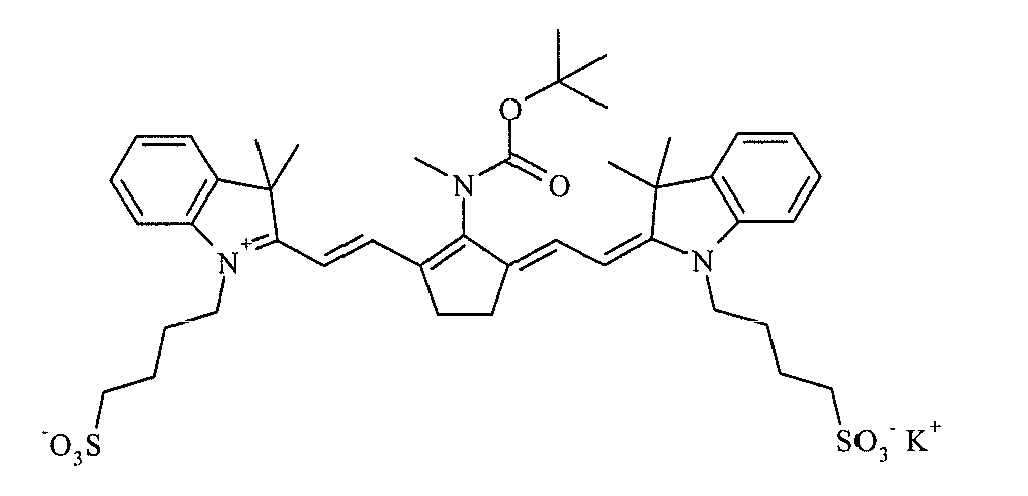
(4) Aqueous solution containing 10% by weight of hydroxyethyldiphosphonate (HEDP, commercially available from Monsanto Solutia Europe);
(5) Aqueous surfactant solution containing 5% by weight of the fluoro surfactant Zonyl FS0100(trademark of Dupont). - Of each of printing plate precursors PPP-02 to PPP-07 one plate was immediately exposed ("fresh" printing plate precursors) and another plate was stored for 7 days at 80% relative humidity and 35°C before exposure, these are the "aged" printing plate precursors.
- All "fresh" and "aged" printing plate precursors were exposed on a Creo TrendSetter 3244 40W fast head IR-laser platesetter with an exposure series 210 - 180 - 150 - 120 - 90 mJ/cm2 @ 150 rpm, using an addressability of 2400 dpi and a 200 lpi screen. These exposed printing plates were directly mounted on a Heidelberg GTO46 printing press (available from Heidelberger Druckmaschinen AG) without any processing or pre-treatment. A compressible blanket was used and printing was done with 3% Agfa Prima FS101 (trademark of Agfa) + 10% isopropanol as a fountain solution and K+E 800 black ink (trademark of K&E).
The following start-up procedure was used : first 5 revolutions with the dampening rollers engaged, then 5 revolutions with both the dampening and ink rollers engaged, then start printing. 1000 Prints were made on 80 g offset paper. - The plate sensitivity is defined as the lowest energy density at which the 2% dot is perfectly visible on print 1.000 by means of a 5x magnifying glass. The plate sensitivity obtained for all the aged and fresh printing plates was ≤150 mJ/m2.
- The shelf life of the printing plates was measured in terms of clean out results obtained on aged printing plates. A plate has a good shelf life if its clean-out behaviour is maintained or only slightly reduced after the aging period.
- The clean-out results obtained for the fresh comparative and inventive printing plates PP-02 to PP-07 was for all plates equal to 5. The clean-out results measured on the aged samples is given in Table 3.
Table 3: clean-out results of the aged printing plates. Printing Plates Al. Substrates Clean-out* PP-02 (comparative ex.) AS-02 0 PP-03 (comparative ex.) AS-03 0 PP-04 (comparative ex.) AS-04 0 PP-05 (inventive ex.) AS-05 4/5 PP-06 (inventive ex.) AS-06 4 PP-07 (inventive ex.) AS-07 4 * Clean-out was measured on the printed sheet using the following criteria:
0 = complete black image at print ≤ 25 and print 250;
1 = severely toned image at print ≤ 25 but complete black image at print 250;
2 = severely toned image at print ≤ 25 and print 250;
3 = medium toned image at print ≤ 25 and print 250;
4 = slight toning at print 250;
5 = complete clean background at print ≤ 25 and print 250. - The results in Table 3 show that using a single-step post-anodic treatment (only a Na-silicate treatment) no proper clean-out of the plate can be obtained after storage under warm and humid conditions indicating a bad shelf life of the plate (comparative printing plates PP-02 to PP-04). When first a Na-silicate post-anodic treatment and then a PVPA post-anodic treatment is carried out, the clean-out performance after storage under warm and humid conditions is only slightly reduced to 4/5, indicating a good shelf life (inventive printing plates PP-05 to PP-07).
- The untreated substrate AS-01 (see Example 1) was dipped in a Na-metasilicate solution (see below), in a PVPA solution, in a PAA solution (see below) and/or in a mixed solution (see below) according to the conditions described in Table 4. The temperature of each of these solutions was 70°C.
After each dipping step, the post-anodic treated substrates AS-08 to AS-16 were rinsed for 5 seconds with demineralized water and dried at room temperature.
The composition of the PVPA solution is described in Example 1. - Na-metasilicate pentahydrate (commercially available from Van Baerle & Co. Chemische Fabrik) was dissolved in demineralized water at a concentration of 25 g/l. This solution is called herein "Na-metasilicate solution".
- A solution of Aqualic AS58 (polyacrylic acid, trademark of Nippon Shokubai, Japan) in demineralized water at a concentration of 20 g/l was used. This solution is called herein "PAA solution".
- A solution of a mixture of Na-metasilicate and polyacrylic acid was used at concentrations of respectively 25 g/l and 20 g/l.
- A solution of a mixture of Na-metasilicate and polyvinylphosphonic acid was used at concentrations of respectively 25 g/l and 20 g/l.
Table 4: Aluminum substrates AS-08 to AS-16. Al. substr. PAT solution 1 Dipping time s PAT solution 2 Dipping time s AS-08 comparative PAA 5 - - AS-09 comparative PVPA 5 - - AS-10 comparative Na-metasilicate 10 - - AS-11 comparative Na-metasilicate + PAA 10 - - AS-12 comparative Na-metasilicate + PVPA 10 - - AS-13 comparative PAA 5 Na-metasilicate 10 AS-14 comparative PVPA 5 Na-metasilicate 10 AS-15 inventive Na-metasilicate 10 PAA 5 AS-16 inventive Na-metasilicate 10 PVPA 5 - In a double-jacketed reactor of 8 liter 40.0 g of sodium dodecyl sulphate (SDS Ultra Pure obtained via Alkemi BV, Lokeren, Belgium) and 5495.3 g of demineralized water was added. The reactor was flushed with nitrogen and heated up to 75 °C. When the reactor content reached a temperature of 75 °C, a mixture of 15.9 grams of styrene and 8.1 grams of acrylonitrile (i.e. 1.5% of the total monomer amount) was added to prepare a latex seed. After mixing for 10 minutes, to homogeneously disperse the added monomers, a part of the initiator solution (50% of the total amount of initiator) is added, i.e. 105.6 grams of a 5% aqueous sodium persulfate solution. The reactor is subsequently heated to 80 °C during 30 minutes followed by dosing a monomer mixture of 1044.1 gram of styrene and 531.9 grams of acrylonitrile during 180 minutes. Simultaneously, 105.6 grams of a 5% sodium persulfate solution was dosed, also in 180 minutes. Upon completion of the monomer addition, the reactor was heated for 30 minutes at 80 °C. To reduce the amount of residual monomer a redox-initiation system was added: 6.99 gram of sodium formaldehyde sulphoxylate dihydrate (SFS) dissolved in 534 g water and 11.43 g of a 70 % by weight solution of t-butyl hydroperoxide (TBHP) diluted with 100 g of water. The aqueous solutions of SFS and TBHP were added separately during 80 minutes. The reaction was then heated for another 10 minutes and subsequently cooled to room temperature. 100 ppm of 5-bromo-5-nitro-1,3-dioxane was added as biocide and the latex was filtered using coarse filter paper. This resulted in the latex dispersion LX-02 with a solid content of 20.74% by weight and a pH of 2.99. The average particle size was 41 nm (measured using a Brookhaven BI-90 analyzer, commercially available from Brookhaven Instrument Company, Holtsville, NY (USA)).
- The coating solution for the printing plate precursors PPP-08 to PPP-016 was prepared as follows: the latex dispersion LX-02 was added to demineralized water and the obtained dispersion was stirred for 10 minutes. Subsequently the IR-dye was added and after stirring the solution for 60 minutes, the polyacrylic acid solution was added. After 10 minutes of stirring the DEQUEST 2010 solution was added and subsequently after another 10 minutes of stirring the surfactant solution. The coating dispersion was stirred for another 30 minutes and the pH was adjusted to a value of 3.6. Table 5 lists the dry coating weight of the different ingredients of the coating.
- The obtained coating solution was subsequently coated on the Al-substrates AS-08 to AS-16 with a coating knife at a wet thickness of 30 µm. After drying at 60°C this resulted in printing plate precursors PPP-08 to PPP-16.
Table 5: Dry coating weight. Ingredients g/m2 Latex LX-02 (1) 0,406 IR-dye IR-3 (2) 0,075 Polyacrylic acid (3) 0,056 DEQUEST 2010 (4) 0,016 Ascorox (5) 0.013 Surfactant (6) 0,005 Total (g/m2) 0,571 (1) latex LX-02 as synthesized in point 2 above;
(2) Aqueous IR dye solution containing 1% by weight of IR-3:
(4) Aqueous solution containing 10% by weight of 1-hydroxyethylidene-1,1-diphosphonic acid (HEDP, commercially available from Monsanto Solutia Europe);
(5) Anti-oxidant ST-01 (see above in the description);
(6) Aqueous surfactant solution containing 5% by weight of the fluoro surfactant Zonyl FSO100 (trademark of Dupont). - Of each of printing plate precursors PPP-08 to PPP-16 one plate was immediately exposed ("fresh" printing plate precursors) and another plate was stored for 7 days at 80% relative humidity and 35°C before exposure, these are the "aged" printing plate precursors.
- All "fresh" and "aged" printing plate precursors were exposed on a Creo TrendSetter 3244 40W fast head IR-laser platesetter with an exposure series 210 - 180 - 150 - 120 - 90 mJ/cm2 @ 150 rpm, using a addressability of 2400 dpi and a 200 lpi screen. These exposed printing plate precursors were directly mounted on a Heidelberg GT046 printing press(equiped with a Kompac III dampening system (trademark of VARN)) without any processing or pre-treatment. A compressible blanket was used and printing was done with 4% Emerald Premium 3520 (trademark of Anchor) as a fountain solution and K+E 800 black ink (trademark of K&E).
- The following start-up procedure was used : first 5 revolutions with the dampening rollers engaged, then 5 revolutions with both the dampening and ink rollers engaged, then start printing. 1000 Prints were made on 80 g offset paper.
- The plate sensitivity is defined as the lowest energy density at which the 2% dot is perfectly visible on print 1.000 by means of a 5x magnifying glass. The plate sensitivity obtained for all the fresh printing plates was ≤120 mJ/m2. For the comparative printing plates PP-10, PP-13 and PP-14 it was difficult to determine the sensitivity due to a bad clean-out performance.
- The shelf life of the printing plates was measured in terms of clean out results obtained on aged printing plates. A plate has a good shelf life if its clean-out behaviour is maintained or only slightly reduced after the aging period.
- The clean-out results obtained for the fresh comparative and inventive printing plates PP-08 to PP-16 was for all plates equal to 5 except for comparative printing plates PP-10, PP-13 and PP-14 which had a bad clean-out performance. The clean-out results obtained for the aged comparative and inventive printing plates is given in Table 6.
Table 6: clean-out results of the aged printing plates. Printing Plates Clean-out on print* PP-08 (comparative ex.) 3 PP-09 (comparative ex.) 2 PP-10 (comparative ex.) 1 PP-11 (comparative ex.) 3 PP-12 (comparative ex.) 2 PP-13 (comparative ex.) 0 PP-14 (comparative ex.) 0 PP-15 (inventive ex.) 4 PP-16 (inventive ex.) 4 * The following clean-out criteria were used:
0 = complete black image at print ≤ 25 and print 250;
1 = severely toned image at print ≤ 25 but complete black image at print 250;
2 = severely toned image at print ≤ 25 and print 250;
3 = medium toned image at print ≤ 25 and print 250;
4 = slight toning at print 250;
5 = complete clean background at print 250. - The results in Table 6 show that:
- the comparative printing plates PP-08 to PP-12 which comprise a support which had a single-step post-anodic treatment (either a Na-metasilicate solution, a PVPA solution, a mixed Na-metasilicate/PAA solution or a mixed Na-metasilicate/PVPA solution) give bad clean-out results after storage under warm and humid conditions;
- the comparative printing plates PP-13 and PP-14 which comprise a support which was first treated with a PVPA solution or a PAA solution and then with a metasilicate solution give an unacceptable clean-out result after storage under warm and humid conditions;
- the inventive printing plates PP-15 to PP-16 which comprise a support which was first treated with a Na-metasilicate solution and then with a PVPA solution or PAA solution give a good clean-out performance after storage under warm and humid conditions.
Claims (10)
- A method for making a lithographic printing plate precursor comprising the steps of:(i) providing a grained and anodized aluminum support;(ii) treating said support with an aqueous solution comprising a compound containing a silicate anion and one or more cations;(iii) treating the support with an aqueous solution comprising a compound containing an organic acid group and/or an ester or a salt thereof;(iv) applying a coating on to the treated support comprising an image-recording layer comprising hydrophobic thermoplastic polymer particles with an average particle size ranging from 20 nm to 55 nm.
- A method according to claim 1 wherein the amount of hydrophobic thermoplastic polymer particles relative to the total weight of the ingredients present in the imaging layer is at least 70 %.
- A method according to any of the preceding claims wherein the silicate anion is selected from phosphosilicate, orthosilicate, metasilicate, hydrosilicate, polysilicate or pyrosilicate.
- A method according to claim 3 wherein the silicate anion is an orthosilicate or a metasilicate.
- A method according to any of the preceding claims wherein the organic acid group is selected from a carboxylic acid group and/or a phosphonic acid group.
- A method according to any of the preceding claims 1 to 5 wherein the compound of step (iii) is a polymer comprising a repeating structural unit which contains the organic acid group.
- A method according to claim 6 wherein the polymer is polyvinylphosphonic acid or poly(meth)acrylic acid.
- A method according to any of the preceding claims wherein the support has an Ra value below 0.45pm and an anodic weight ≥ 3.2 g/m2
- A method for making a lithographic printing plate comprising the steps of:(i) providing a printing plate precursor according to the method of claims 1 to 8;(ii) exposing said printing plate precursor to light and/or heat;(iii) optionally developing said exposed precursor with a processing liquid.
- A method of printing comprising the steps of:(i) providing a printing plate according to the method of claim 9;(ii) mounting the obtained printing plate on a printing press and supplying ink and/or fountain.
Priority Applications (3)
| Application Number | Priority Date | Filing Date | Title |
|---|---|---|---|
| EP07105315A EP1974912A1 (en) | 2007-03-30 | 2007-03-30 | A method for making a lithographic printing plate precursor. |
| PCT/EP2008/052811 WO2008119619A1 (en) | 2007-03-30 | 2008-03-10 | A method for making a lithographic printing plate precursor |
| CN 200880011040 CN101652251A (en) | 2007-03-30 | 2008-03-10 | Method for making a lithographic printing plate precursor |
Applications Claiming Priority (1)
| Application Number | Priority Date | Filing Date | Title |
|---|---|---|---|
| EP07105315A EP1974912A1 (en) | 2007-03-30 | 2007-03-30 | A method for making a lithographic printing plate precursor. |
Publications (1)
| Publication Number | Publication Date |
|---|---|
| EP1974912A1 true EP1974912A1 (en) | 2008-10-01 |
Family
ID=38437826
Family Applications (1)
| Application Number | Title | Priority Date | Filing Date |
|---|---|---|---|
| EP07105315A Withdrawn EP1974912A1 (en) | 2007-03-30 | 2007-03-30 | A method for making a lithographic printing plate precursor. |
Country Status (3)
| Country | Link |
|---|---|
| EP (1) | EP1974912A1 (en) |
| CN (1) | CN101652251A (en) |
| WO (1) | WO2008119619A1 (en) |
Cited By (8)
| Publication number | Priority date | Publication date | Assignee | Title |
|---|---|---|---|---|
| EP2072570A1 (en) | 2007-12-20 | 2009-06-24 | Agfa Graphics N.V. | A lithographic printing plate precursor |
| EP2243628A1 (en) | 2009-04-24 | 2010-10-27 | Agfa Graphics N.V. | A lithographic printing plate precursor |
| WO2010127903A1 (en) | 2009-05-08 | 2010-11-11 | Novelis Inc. | Aluminium lithographic sheet |
| CN102317075A (en) * | 2009-02-13 | 2012-01-11 | 伊斯曼柯达公司 | Negative-working imageable elements |
| WO2012059362A1 (en) | 2010-11-04 | 2012-05-10 | Novelis Inc. | Aluminium lithographic sheet |
| WO2012145162A1 (en) | 2011-04-19 | 2012-10-26 | Eastman Kodak Company | Aluminum substrates and lithographic printing plate precursors |
| US8778590B2 (en) | 2008-12-18 | 2014-07-15 | Agfa Graphics Nv | Lithographic printing plate precursor |
| WO2021132647A1 (en) * | 2019-12-27 | 2021-07-01 | 富士フイルム株式会社 | Original plate for lithographic printing, method for manufacturing lithographic printing plate, and printing method |
Families Citing this family (1)
| Publication number | Priority date | Publication date | Assignee | Title |
|---|---|---|---|---|
| AU2017235148A1 (en) * | 2016-03-16 | 2018-07-12 | Agfa Nv | Method and apparatus for processing a lithographic printing plate |
Citations (4)
| Publication number | Priority date | Publication date | Assignee | Title |
|---|---|---|---|---|
| EP0565006A2 (en) * | 1992-04-06 | 1993-10-13 | Fuji Photo Film Co., Ltd. | Method for preparing PS plate |
| EP1132200A2 (en) * | 2000-01-14 | 2001-09-12 | Fuji Photo Film Co., Ltd. | Lithographic printing plate precursor |
| EP1400352A2 (en) * | 2002-09-20 | 2004-03-24 | Konica Corporation | Printing plate precursor and printing method |
| EP1614538A2 (en) * | 2004-07-08 | 2006-01-11 | Agfa-Gevaert | Method for making a negative working, heat-sensitive lithographic printing plate precursor. |
-
2007
- 2007-03-30 EP EP07105315A patent/EP1974912A1/en not_active Withdrawn
-
2008
- 2008-03-10 WO PCT/EP2008/052811 patent/WO2008119619A1/en not_active Ceased
- 2008-03-10 CN CN 200880011040 patent/CN101652251A/en active Pending
Patent Citations (4)
| Publication number | Priority date | Publication date | Assignee | Title |
|---|---|---|---|---|
| EP0565006A2 (en) * | 1992-04-06 | 1993-10-13 | Fuji Photo Film Co., Ltd. | Method for preparing PS plate |
| EP1132200A2 (en) * | 2000-01-14 | 2001-09-12 | Fuji Photo Film Co., Ltd. | Lithographic printing plate precursor |
| EP1400352A2 (en) * | 2002-09-20 | 2004-03-24 | Konica Corporation | Printing plate precursor and printing method |
| EP1614538A2 (en) * | 2004-07-08 | 2006-01-11 | Agfa-Gevaert | Method for making a negative working, heat-sensitive lithographic printing plate precursor. |
Cited By (14)
| Publication number | Priority date | Publication date | Assignee | Title |
|---|---|---|---|---|
| EP2072570A1 (en) | 2007-12-20 | 2009-06-24 | Agfa Graphics N.V. | A lithographic printing plate precursor |
| US8778590B2 (en) | 2008-12-18 | 2014-07-15 | Agfa Graphics Nv | Lithographic printing plate precursor |
| CN102317075A (en) * | 2009-02-13 | 2012-01-11 | 伊斯曼柯达公司 | Negative-working imageable elements |
| CN102317075B (en) * | 2009-02-13 | 2014-05-07 | 伊斯曼柯达公司 | Negative-working imageable elements |
| US8685622B2 (en) | 2009-04-24 | 2014-04-01 | Agfa Graphics Nv | Method for preparing a lithographic printing plate |
| EP2243628A1 (en) | 2009-04-24 | 2010-10-27 | Agfa Graphics N.V. | A lithographic printing plate precursor |
| WO2010122042A1 (en) | 2009-04-24 | 2010-10-28 | Agfa Graphics Nv | A lithographic printing plate precursor |
| WO2010127903A1 (en) | 2009-05-08 | 2010-11-11 | Novelis Inc. | Aluminium lithographic sheet |
| US8961870B2 (en) | 2009-05-08 | 2015-02-24 | Novelis Inc. | Aluminium lithographic sheet |
| WO2012059362A1 (en) | 2010-11-04 | 2012-05-10 | Novelis Inc. | Aluminium lithographic sheet |
| US8632940B2 (en) | 2011-04-19 | 2014-01-21 | Eastman Kodak Company | Aluminum substrates and lithographic printing plate precursors |
| WO2012145162A1 (en) | 2011-04-19 | 2012-10-26 | Eastman Kodak Company | Aluminum substrates and lithographic printing plate precursors |
| US9120299B2 (en) | 2011-04-19 | 2015-09-01 | Eastman Kodak Company | Aluminum substrates and lithographic printing plate precursors |
| WO2021132647A1 (en) * | 2019-12-27 | 2021-07-01 | 富士フイルム株式会社 | Original plate for lithographic printing, method for manufacturing lithographic printing plate, and printing method |
Also Published As
| Publication number | Publication date |
|---|---|
| CN101652251A (en) | 2010-02-17 |
| WO2008119619A1 (en) | 2008-10-09 |
Similar Documents
| Publication | Publication Date | Title |
|---|---|---|
| EP1940620B1 (en) | Negative working, heat-sensitive lithographic printing plate precursor | |
| EP1356926B1 (en) | Negative-working thermal lithographic printing plate precursor comprising a smooth aluminum support. | |
| EP1614538B1 (en) | Method for making a negative working, heat-sensitive lithographic printing plate precursor. | |
| EP1614539B1 (en) | Method for making a lithographic printing plate | |
| EP1614540B1 (en) | Method for making a lithographic printing plate | |
| US7195861B2 (en) | Method for making a negative working, heat-sensitive lithographic printing plate precursor | |
| US8216769B2 (en) | Negative working, heat sensitive lithographic printing plate precursor | |
| WO2008119619A1 (en) | A method for making a lithographic printing plate precursor | |
| EP2871057B1 (en) | Negative working, heat-sensitive lithographic printing plate precursor | |
| US6983694B2 (en) | Negative-working thermal lithographic printing plate precursor comprising a smooth aluminum support | |
| EP1972461B1 (en) | A method for making a lithographic printing plate support | |
| EP1777067B1 (en) | A method for making a lithographic printing plate precursor | |
| EP1859936A1 (en) | Method for making a lithographic printing plate | |
| EP3239184A1 (en) | Thermoplastic polymer particles and a lithographic printing plate precursor | |
| US20030224259A1 (en) | Method of lithographic printing from a reusable aluminum support | |
| EP1974911B1 (en) | Method of making a lithographic printing plate | |
| US7354696B2 (en) | Method for making a lithographic printing plate | |
| US7425405B2 (en) | Method for making a lithographic printing plate | |
| EP1914068A1 (en) | Negative working, heat-sensitive lithographic printing plate precursor |
Legal Events
| Date | Code | Title | Description |
|---|---|---|---|
| PUAI | Public reference made under article 153(3) epc to a published international application that has entered the european phase |
Free format text: ORIGINAL CODE: 0009012 |
|
| AK | Designated contracting states |
Kind code of ref document: A1 Designated state(s): AT BE BG CH CY CZ DE DK EE ES FI FR GB GR HU IE IS IT LI LT LU LV MC MT NL PL PT RO SE SI SK TR |
|
| AX | Request for extension of the european patent |
Extension state: AL BA HR MK RS |
|
| 17P | Request for examination filed |
Effective date: 20090401 |
|
| AKX | Designation fees paid |
Designated state(s): AT BE BG CH CY CZ DE DK EE ES FI FR GB GR HU IE IS IT LI LT LU LV MC MT NL PL PT RO SE SI SK TR |
|
| 17Q | First examination report despatched |
Effective date: 20090727 |
|
| GRAP | Despatch of communication of intention to grant a patent |
Free format text: ORIGINAL CODE: EPIDOSNIGR1 |
|
| STAA | Information on the status of an ep patent application or granted ep patent |
Free format text: STATUS: THE APPLICATION IS DEEMED TO BE WITHDRAWN |
|
| 18D | Application deemed to be withdrawn |
Effective date: 20100721 |