EP1973900B1 - Hydantoin compounds for the treatment of inflammatory disorders - Google Patents
Hydantoin compounds for the treatment of inflammatory disorders Download PDFInfo
- Publication number
- EP1973900B1 EP1973900B1 EP07716637.9A EP07716637A EP1973900B1 EP 1973900 B1 EP1973900 B1 EP 1973900B1 EP 07716637 A EP07716637 A EP 07716637A EP 1973900 B1 EP1973900 B1 EP 1973900B1
- Authority
- EP
- European Patent Office
- Prior art keywords
- compound
- disease
- mmol
- pharmaceutically acceptable
- solvate
- Prior art date
- Legal status (The legal status is an assumption and is not a legal conclusion. Google has not performed a legal analysis and makes no representation as to the accuracy of the status listed.)
- Active
Links
- 0 COc1cc(C(N(CC(C(N2)=O)(c(cc3)ccc3F)NC2=O)C2)=*)c2cn1 Chemical compound COc1cc(C(N(CC(C(N2)=O)(c(cc3)ccc3F)NC2=O)C2)=*)c2cn1 0.000 description 2
- CDUWYBWKFWIPAI-FIAMCOGQSA-N C/C=C\C(\C#Cc1ccc([C@@H](/C(/N2)=[O]/C(c(cc3)c4cc3OC)N(C)C4=O)NC2=O)cc1)=N/C Chemical compound C/C=C\C(\C#Cc1ccc([C@@H](/C(/N2)=[O]/C(c(cc3)c4cc3OC)N(C)C4=O)NC2=O)cc1)=N/C CDUWYBWKFWIPAI-FIAMCOGQSA-N 0.000 description 1
- FVZFUFFMFCTTEI-GXDBFRLMSA-N C/C=C\C(\C#Cc1ccc([C@](CN(Cc(c2c3)ccc3OC)C2=O)(C(N2)=O)NC2=O)cc1)=N/C Chemical compound C/C=C\C(\C#Cc1ccc([C@](CN(Cc(c2c3)ccc3OC)C2=O)(C(N2)=O)NC2=O)cc1)=N/C FVZFUFFMFCTTEI-GXDBFRLMSA-N 0.000 description 1
- KNFJMCSGVMEAAT-UHFFFAOYSA-N CC(CN(CC1=C2C(C)=C=CC=C1)C2=O)(C(C=C1C)=O)NC1=O Chemical compound CC(CN(CC1=C2C(C)=C=CC=C1)C2=O)(C(C=C1C)=O)NC1=O KNFJMCSGVMEAAT-UHFFFAOYSA-N 0.000 description 1
- MZXKYWGISKAACU-QHCPKHFHSA-N CN(C)CC#Cc1ccc([C@@](CN(Cc(cc2)c3cc2O)C3=O)(C(N2)=O)NC2=O)cc1 Chemical compound CN(C)CC#Cc1ccc([C@@](CN(Cc(cc2)c3cc2O)C3=O)(C(N2)=O)NC2=O)cc1 MZXKYWGISKAACU-QHCPKHFHSA-N 0.000 description 1
- IVWBDVJIUHIJFU-UHFFFAOYSA-N COc1cc(C(N(CC(C(N2)=O)(c(cc3)ccc3F)NC2=O)C2)=O)c2cn1 Chemical compound COc1cc(C(N(CC(C(N2)=O)(c(cc3)ccc3F)NC2=O)C2)=O)c2cn1 IVWBDVJIUHIJFU-UHFFFAOYSA-N 0.000 description 1
- NNUDSTKYGPKRGA-UHFFFAOYSA-N COc1cc(C(N(CC(C(N2)=O)(c3ccccc3)NC2=O)C2)=O)c2cc1 Chemical compound COc1cc(C(N(CC(C(N2)=O)(c3ccccc3)NC2=O)C2)=O)c2cc1 NNUDSTKYGPKRGA-UHFFFAOYSA-N 0.000 description 1
- YTSZJIUVQXJBEO-UHFFFAOYSA-N COc1cc(C(N(CC(CC(N2C(C3CC3)c3ccccc3CC2)=O)(C(N2)=O)NC2=O)C2)=O)c2cc1 Chemical compound COc1cc(C(N(CC(CC(N2C(C3CC3)c3ccccc3CC2)=O)(C(N2)=O)NC2=O)C2)=O)c2cc1 YTSZJIUVQXJBEO-UHFFFAOYSA-N 0.000 description 1
- GDVNIONGVQABSO-UHFFFAOYSA-N COc1cc(C(N(CC(CC(N2CCCCC2)=O)(C(N2)=O)NC2=O)C2)=O)c2cc1 Chemical compound COc1cc(C(N(CC(CC(N2CCCCC2)=O)(C(N2)=O)NC2=O)C2)=O)c2cc1 GDVNIONGVQABSO-UHFFFAOYSA-N 0.000 description 1
- IBQSUYWOHDKMAY-UHFFFAOYSA-N COc1cc(C(N(CC(CC(NCC2OCCC2)=O)(C(N2)=O)NC2=O)C2)=O)c2cc1 Chemical compound COc1cc(C(N(CC(CC(NCC2OCCC2)=O)(C(N2)=O)NC2=O)C2)=O)c2cc1 IBQSUYWOHDKMAY-UHFFFAOYSA-N 0.000 description 1
- DWKKKEBJKSQHPL-SRQIZXRXSA-N C[C@H](C1)[C@H]1[C@@H](N)OC Chemical compound C[C@H](C1)[C@H]1[C@@H](N)OC DWKKKEBJKSQHPL-SRQIZXRXSA-N 0.000 description 1
- OVPYKTQWEXAZMP-UHFFFAOYSA-N O=C(C(CN(CC(C1=C2)=CNC2=O)C1=O)(c(cc1)ccc1F)N1)NC1=O Chemical compound O=C(C(CN(CC(C1=C2)=CNC2=O)C1=O)(c(cc1)ccc1F)N1)NC1=O OVPYKTQWEXAZMP-UHFFFAOYSA-N 0.000 description 1
- AXELXFJETPEKBS-UHFFFAOYSA-N Oc1cc(C(N(CC(C(N2)=O)(c3ccccc3)NC2=O)C2)=O)c2cc1 Chemical compound Oc1cc(C(N(CC(C(N2)=O)(c3ccccc3)NC2=O)C2)=O)c2cc1 AXELXFJETPEKBS-UHFFFAOYSA-N 0.000 description 1
- IQUMCGFETPPNRQ-UHFFFAOYSA-N Oc1cc(C(N(CC(C(N2S)=O)(c3ccccc3)NC2=O)C2)=O)c2cc1 Chemical compound Oc1cc(C(N(CC(C(N2S)=O)(c3ccccc3)NC2=O)C2)=O)c2cc1 IQUMCGFETPPNRQ-UHFFFAOYSA-N 0.000 description 1
Classifications
-
- C—CHEMISTRY; METALLURGY
- C07—ORGANIC CHEMISTRY
- C07D—HETEROCYCLIC COMPOUNDS
- C07D491/00—Heterocyclic compounds containing in the condensed ring system both one or more rings having oxygen atoms as the only ring hetero atoms and one or more rings having nitrogen atoms as the only ring hetero atoms, not provided for by groups C07D451/00 - C07D459/00, C07D463/00, C07D477/00 or C07D489/00
- C07D491/02—Heterocyclic compounds containing in the condensed ring system both one or more rings having oxygen atoms as the only ring hetero atoms and one or more rings having nitrogen atoms as the only ring hetero atoms, not provided for by groups C07D451/00 - C07D459/00, C07D463/00, C07D477/00 or C07D489/00 in which the condensed system contains two hetero rings
- C07D491/04—Ortho-condensed systems
- C07D491/044—Ortho-condensed systems with only one oxygen atom as ring hetero atom in the oxygen-containing ring
- C07D491/048—Ortho-condensed systems with only one oxygen atom as ring hetero atom in the oxygen-containing ring the oxygen-containing ring being five-membered
-
- C—CHEMISTRY; METALLURGY
- C07—ORGANIC CHEMISTRY
- C07D—HETEROCYCLIC COMPOUNDS
- C07D403/00—Heterocyclic compounds containing two or more hetero rings, having nitrogen atoms as the only ring hetero atoms, not provided for by group C07D401/00
- C07D403/14—Heterocyclic compounds containing two or more hetero rings, having nitrogen atoms as the only ring hetero atoms, not provided for by group C07D401/00 containing three or more hetero rings
-
- A—HUMAN NECESSITIES
- A61—MEDICAL OR VETERINARY SCIENCE; HYGIENE
- A61K—PREPARATIONS FOR MEDICAL, DENTAL OR TOILETRY PURPOSES
- A61K31/00—Medicinal preparations containing organic active ingredients
- A61K31/33—Heterocyclic compounds
- A61K31/395—Heterocyclic compounds having nitrogen as a ring hetero atom, e.g. guanethidine or rifamycins
- A61K31/41—Heterocyclic compounds having nitrogen as a ring hetero atom, e.g. guanethidine or rifamycins having five-membered rings with two or more ring hetero atoms, at least one of which being nitrogen, e.g. tetrazole
- A61K31/4164—1,3-Diazoles
- A61K31/4178—1,3-Diazoles not condensed 1,3-diazoles and containing further heterocyclic rings, e.g. pilocarpine, nitrofurantoin
-
- A—HUMAN NECESSITIES
- A61—MEDICAL OR VETERINARY SCIENCE; HYGIENE
- A61P—SPECIFIC THERAPEUTIC ACTIVITY OF CHEMICAL COMPOUNDS OR MEDICINAL PREPARATIONS
- A61P1/00—Drugs for disorders of the alimentary tract or the digestive system
- A61P1/02—Stomatological preparations, e.g. drugs for caries, aphtae, periodontitis
-
- A—HUMAN NECESSITIES
- A61—MEDICAL OR VETERINARY SCIENCE; HYGIENE
- A61P—SPECIFIC THERAPEUTIC ACTIVITY OF CHEMICAL COMPOUNDS OR MEDICINAL PREPARATIONS
- A61P1/00—Drugs for disorders of the alimentary tract or the digestive system
- A61P1/04—Drugs for disorders of the alimentary tract or the digestive system for ulcers, gastritis or reflux esophagitis, e.g. antacids, inhibitors of acid secretion, mucosal protectants
-
- A—HUMAN NECESSITIES
- A61—MEDICAL OR VETERINARY SCIENCE; HYGIENE
- A61P—SPECIFIC THERAPEUTIC ACTIVITY OF CHEMICAL COMPOUNDS OR MEDICINAL PREPARATIONS
- A61P1/00—Drugs for disorders of the alimentary tract or the digestive system
- A61P1/14—Prodigestives, e.g. acids, enzymes, appetite stimulants, antidyspeptics, tonics, antiflatulents
-
- A—HUMAN NECESSITIES
- A61—MEDICAL OR VETERINARY SCIENCE; HYGIENE
- A61P—SPECIFIC THERAPEUTIC ACTIVITY OF CHEMICAL COMPOUNDS OR MEDICINAL PREPARATIONS
- A61P1/00—Drugs for disorders of the alimentary tract or the digestive system
- A61P1/16—Drugs for disorders of the alimentary tract or the digestive system for liver or gallbladder disorders, e.g. hepatoprotective agents, cholagogues, litholytics
-
- A—HUMAN NECESSITIES
- A61—MEDICAL OR VETERINARY SCIENCE; HYGIENE
- A61P—SPECIFIC THERAPEUTIC ACTIVITY OF CHEMICAL COMPOUNDS OR MEDICINAL PREPARATIONS
- A61P11/00—Drugs for disorders of the respiratory system
-
- A—HUMAN NECESSITIES
- A61—MEDICAL OR VETERINARY SCIENCE; HYGIENE
- A61P—SPECIFIC THERAPEUTIC ACTIVITY OF CHEMICAL COMPOUNDS OR MEDICINAL PREPARATIONS
- A61P11/00—Drugs for disorders of the respiratory system
- A61P11/02—Nasal agents, e.g. decongestants
-
- A—HUMAN NECESSITIES
- A61—MEDICAL OR VETERINARY SCIENCE; HYGIENE
- A61P—SPECIFIC THERAPEUTIC ACTIVITY OF CHEMICAL COMPOUNDS OR MEDICINAL PREPARATIONS
- A61P11/00—Drugs for disorders of the respiratory system
- A61P11/06—Antiasthmatics
-
- A—HUMAN NECESSITIES
- A61—MEDICAL OR VETERINARY SCIENCE; HYGIENE
- A61P—SPECIFIC THERAPEUTIC ACTIVITY OF CHEMICAL COMPOUNDS OR MEDICINAL PREPARATIONS
- A61P11/00—Drugs for disorders of the respiratory system
- A61P11/08—Bronchodilators
-
- A—HUMAN NECESSITIES
- A61—MEDICAL OR VETERINARY SCIENCE; HYGIENE
- A61P—SPECIFIC THERAPEUTIC ACTIVITY OF CHEMICAL COMPOUNDS OR MEDICINAL PREPARATIONS
- A61P13/00—Drugs for disorders of the urinary system
- A61P13/12—Drugs for disorders of the urinary system of the kidneys
-
- A—HUMAN NECESSITIES
- A61—MEDICAL OR VETERINARY SCIENCE; HYGIENE
- A61P—SPECIFIC THERAPEUTIC ACTIVITY OF CHEMICAL COMPOUNDS OR MEDICINAL PREPARATIONS
- A61P17/00—Drugs for dermatological disorders
-
- A—HUMAN NECESSITIES
- A61—MEDICAL OR VETERINARY SCIENCE; HYGIENE
- A61P—SPECIFIC THERAPEUTIC ACTIVITY OF CHEMICAL COMPOUNDS OR MEDICINAL PREPARATIONS
- A61P17/00—Drugs for dermatological disorders
- A61P17/02—Drugs for dermatological disorders for treating wounds, ulcers, burns, scars, keloids, or the like
-
- A—HUMAN NECESSITIES
- A61—MEDICAL OR VETERINARY SCIENCE; HYGIENE
- A61P—SPECIFIC THERAPEUTIC ACTIVITY OF CHEMICAL COMPOUNDS OR MEDICINAL PREPARATIONS
- A61P17/00—Drugs for dermatological disorders
- A61P17/06—Antipsoriatics
-
- A—HUMAN NECESSITIES
- A61—MEDICAL OR VETERINARY SCIENCE; HYGIENE
- A61P—SPECIFIC THERAPEUTIC ACTIVITY OF CHEMICAL COMPOUNDS OR MEDICINAL PREPARATIONS
- A61P19/00—Drugs for skeletal disorders
- A61P19/02—Drugs for skeletal disorders for joint disorders, e.g. arthritis, arthrosis
-
- A—HUMAN NECESSITIES
- A61—MEDICAL OR VETERINARY SCIENCE; HYGIENE
- A61P—SPECIFIC THERAPEUTIC ACTIVITY OF CHEMICAL COMPOUNDS OR MEDICINAL PREPARATIONS
- A61P19/00—Drugs for skeletal disorders
- A61P19/08—Drugs for skeletal disorders for bone diseases, e.g. rachitism, Paget's disease
- A61P19/10—Drugs for skeletal disorders for bone diseases, e.g. rachitism, Paget's disease for osteoporosis
-
- A—HUMAN NECESSITIES
- A61—MEDICAL OR VETERINARY SCIENCE; HYGIENE
- A61P—SPECIFIC THERAPEUTIC ACTIVITY OF CHEMICAL COMPOUNDS OR MEDICINAL PREPARATIONS
- A61P21/00—Drugs for disorders of the muscular or neuromuscular system
-
- A—HUMAN NECESSITIES
- A61—MEDICAL OR VETERINARY SCIENCE; HYGIENE
- A61P—SPECIFIC THERAPEUTIC ACTIVITY OF CHEMICAL COMPOUNDS OR MEDICINAL PREPARATIONS
- A61P25/00—Drugs for disorders of the nervous system
-
- A—HUMAN NECESSITIES
- A61—MEDICAL OR VETERINARY SCIENCE; HYGIENE
- A61P—SPECIFIC THERAPEUTIC ACTIVITY OF CHEMICAL COMPOUNDS OR MEDICINAL PREPARATIONS
- A61P25/00—Drugs for disorders of the nervous system
- A61P25/02—Drugs for disorders of the nervous system for peripheral neuropathies
-
- A—HUMAN NECESSITIES
- A61—MEDICAL OR VETERINARY SCIENCE; HYGIENE
- A61P—SPECIFIC THERAPEUTIC ACTIVITY OF CHEMICAL COMPOUNDS OR MEDICINAL PREPARATIONS
- A61P25/00—Drugs for disorders of the nervous system
- A61P25/04—Centrally acting analgesics, e.g. opioids
-
- A—HUMAN NECESSITIES
- A61—MEDICAL OR VETERINARY SCIENCE; HYGIENE
- A61P—SPECIFIC THERAPEUTIC ACTIVITY OF CHEMICAL COMPOUNDS OR MEDICINAL PREPARATIONS
- A61P25/00—Drugs for disorders of the nervous system
- A61P25/30—Drugs for disorders of the nervous system for treating abuse or dependence
- A61P25/32—Alcohol-abuse
-
- A—HUMAN NECESSITIES
- A61—MEDICAL OR VETERINARY SCIENCE; HYGIENE
- A61P—SPECIFIC THERAPEUTIC ACTIVITY OF CHEMICAL COMPOUNDS OR MEDICINAL PREPARATIONS
- A61P27/00—Drugs for disorders of the senses
- A61P27/02—Ophthalmic agents
-
- A—HUMAN NECESSITIES
- A61—MEDICAL OR VETERINARY SCIENCE; HYGIENE
- A61P—SPECIFIC THERAPEUTIC ACTIVITY OF CHEMICAL COMPOUNDS OR MEDICINAL PREPARATIONS
- A61P27/00—Drugs for disorders of the senses
- A61P27/02—Ophthalmic agents
- A61P27/06—Antiglaucoma agents or miotics
-
- A—HUMAN NECESSITIES
- A61—MEDICAL OR VETERINARY SCIENCE; HYGIENE
- A61P—SPECIFIC THERAPEUTIC ACTIVITY OF CHEMICAL COMPOUNDS OR MEDICINAL PREPARATIONS
- A61P29/00—Non-central analgesic, antipyretic or antiinflammatory agents, e.g. antirheumatic agents; Non-steroidal antiinflammatory drugs [NSAID]
-
- A—HUMAN NECESSITIES
- A61—MEDICAL OR VETERINARY SCIENCE; HYGIENE
- A61P—SPECIFIC THERAPEUTIC ACTIVITY OF CHEMICAL COMPOUNDS OR MEDICINAL PREPARATIONS
- A61P29/00—Non-central analgesic, antipyretic or antiinflammatory agents, e.g. antirheumatic agents; Non-steroidal antiinflammatory drugs [NSAID]
- A61P29/02—Non-central analgesic, antipyretic or antiinflammatory agents, e.g. antirheumatic agents; Non-steroidal antiinflammatory drugs [NSAID] without antiinflammatory effect
-
- A—HUMAN NECESSITIES
- A61—MEDICAL OR VETERINARY SCIENCE; HYGIENE
- A61P—SPECIFIC THERAPEUTIC ACTIVITY OF CHEMICAL COMPOUNDS OR MEDICINAL PREPARATIONS
- A61P3/00—Drugs for disorders of the metabolism
-
- A—HUMAN NECESSITIES
- A61—MEDICAL OR VETERINARY SCIENCE; HYGIENE
- A61P—SPECIFIC THERAPEUTIC ACTIVITY OF CHEMICAL COMPOUNDS OR MEDICINAL PREPARATIONS
- A61P3/00—Drugs for disorders of the metabolism
- A61P3/08—Drugs for disorders of the metabolism for glucose homeostasis
- A61P3/10—Drugs for disorders of the metabolism for glucose homeostasis for hyperglycaemia, e.g. antidiabetics
-
- A—HUMAN NECESSITIES
- A61—MEDICAL OR VETERINARY SCIENCE; HYGIENE
- A61P—SPECIFIC THERAPEUTIC ACTIVITY OF CHEMICAL COMPOUNDS OR MEDICINAL PREPARATIONS
- A61P3/00—Drugs for disorders of the metabolism
- A61P3/12—Drugs for disorders of the metabolism for electrolyte homeostasis
- A61P3/14—Drugs for disorders of the metabolism for electrolyte homeostasis for calcium homeostasis
-
- A—HUMAN NECESSITIES
- A61—MEDICAL OR VETERINARY SCIENCE; HYGIENE
- A61P—SPECIFIC THERAPEUTIC ACTIVITY OF CHEMICAL COMPOUNDS OR MEDICINAL PREPARATIONS
- A61P31/00—Antiinfectives, i.e. antibiotics, antiseptics, chemotherapeutics
-
- A—HUMAN NECESSITIES
- A61—MEDICAL OR VETERINARY SCIENCE; HYGIENE
- A61P—SPECIFIC THERAPEUTIC ACTIVITY OF CHEMICAL COMPOUNDS OR MEDICINAL PREPARATIONS
- A61P31/00—Antiinfectives, i.e. antibiotics, antiseptics, chemotherapeutics
- A61P31/04—Antibacterial agents
-
- A—HUMAN NECESSITIES
- A61—MEDICAL OR VETERINARY SCIENCE; HYGIENE
- A61P—SPECIFIC THERAPEUTIC ACTIVITY OF CHEMICAL COMPOUNDS OR MEDICINAL PREPARATIONS
- A61P31/00—Antiinfectives, i.e. antibiotics, antiseptics, chemotherapeutics
- A61P31/12—Antivirals
-
- A—HUMAN NECESSITIES
- A61—MEDICAL OR VETERINARY SCIENCE; HYGIENE
- A61P—SPECIFIC THERAPEUTIC ACTIVITY OF CHEMICAL COMPOUNDS OR MEDICINAL PREPARATIONS
- A61P31/00—Antiinfectives, i.e. antibiotics, antiseptics, chemotherapeutics
- A61P31/12—Antivirals
- A61P31/14—Antivirals for RNA viruses
- A61P31/18—Antivirals for RNA viruses for HIV
-
- A—HUMAN NECESSITIES
- A61—MEDICAL OR VETERINARY SCIENCE; HYGIENE
- A61P—SPECIFIC THERAPEUTIC ACTIVITY OF CHEMICAL COMPOUNDS OR MEDICINAL PREPARATIONS
- A61P33/00—Antiparasitic agents
- A61P33/02—Antiprotozoals, e.g. for leishmaniasis, trichomoniasis, toxoplasmosis
- A61P33/06—Antimalarials
-
- A—HUMAN NECESSITIES
- A61—MEDICAL OR VETERINARY SCIENCE; HYGIENE
- A61P—SPECIFIC THERAPEUTIC ACTIVITY OF CHEMICAL COMPOUNDS OR MEDICINAL PREPARATIONS
- A61P35/00—Antineoplastic agents
-
- A—HUMAN NECESSITIES
- A61—MEDICAL OR VETERINARY SCIENCE; HYGIENE
- A61P—SPECIFIC THERAPEUTIC ACTIVITY OF CHEMICAL COMPOUNDS OR MEDICINAL PREPARATIONS
- A61P35/00—Antineoplastic agents
- A61P35/02—Antineoplastic agents specific for leukemia
-
- A—HUMAN NECESSITIES
- A61—MEDICAL OR VETERINARY SCIENCE; HYGIENE
- A61P—SPECIFIC THERAPEUTIC ACTIVITY OF CHEMICAL COMPOUNDS OR MEDICINAL PREPARATIONS
- A61P35/00—Antineoplastic agents
- A61P35/04—Antineoplastic agents specific for metastasis
-
- A—HUMAN NECESSITIES
- A61—MEDICAL OR VETERINARY SCIENCE; HYGIENE
- A61P—SPECIFIC THERAPEUTIC ACTIVITY OF CHEMICAL COMPOUNDS OR MEDICINAL PREPARATIONS
- A61P37/00—Drugs for immunological or allergic disorders
-
- A—HUMAN NECESSITIES
- A61—MEDICAL OR VETERINARY SCIENCE; HYGIENE
- A61P—SPECIFIC THERAPEUTIC ACTIVITY OF CHEMICAL COMPOUNDS OR MEDICINAL PREPARATIONS
- A61P37/00—Drugs for immunological or allergic disorders
- A61P37/02—Immunomodulators
-
- A—HUMAN NECESSITIES
- A61—MEDICAL OR VETERINARY SCIENCE; HYGIENE
- A61P—SPECIFIC THERAPEUTIC ACTIVITY OF CHEMICAL COMPOUNDS OR MEDICINAL PREPARATIONS
- A61P37/00—Drugs for immunological or allergic disorders
- A61P37/02—Immunomodulators
- A61P37/04—Immunostimulants
-
- A—HUMAN NECESSITIES
- A61—MEDICAL OR VETERINARY SCIENCE; HYGIENE
- A61P—SPECIFIC THERAPEUTIC ACTIVITY OF CHEMICAL COMPOUNDS OR MEDICINAL PREPARATIONS
- A61P37/00—Drugs for immunological or allergic disorders
- A61P37/02—Immunomodulators
- A61P37/06—Immunosuppressants, e.g. drugs for graft rejection
-
- A—HUMAN NECESSITIES
- A61—MEDICAL OR VETERINARY SCIENCE; HYGIENE
- A61P—SPECIFIC THERAPEUTIC ACTIVITY OF CHEMICAL COMPOUNDS OR MEDICINAL PREPARATIONS
- A61P37/00—Drugs for immunological or allergic disorders
- A61P37/08—Antiallergic agents
-
- A—HUMAN NECESSITIES
- A61—MEDICAL OR VETERINARY SCIENCE; HYGIENE
- A61P—SPECIFIC THERAPEUTIC ACTIVITY OF CHEMICAL COMPOUNDS OR MEDICINAL PREPARATIONS
- A61P39/00—General protective or antinoxious agents
-
- A—HUMAN NECESSITIES
- A61—MEDICAL OR VETERINARY SCIENCE; HYGIENE
- A61P—SPECIFIC THERAPEUTIC ACTIVITY OF CHEMICAL COMPOUNDS OR MEDICINAL PREPARATIONS
- A61P43/00—Drugs for specific purposes, not provided for in groups A61P1/00-A61P41/00
-
- A—HUMAN NECESSITIES
- A61—MEDICAL OR VETERINARY SCIENCE; HYGIENE
- A61P—SPECIFIC THERAPEUTIC ACTIVITY OF CHEMICAL COMPOUNDS OR MEDICINAL PREPARATIONS
- A61P7/00—Drugs for disorders of the blood or the extracellular fluid
-
- A—HUMAN NECESSITIES
- A61—MEDICAL OR VETERINARY SCIENCE; HYGIENE
- A61P—SPECIFIC THERAPEUTIC ACTIVITY OF CHEMICAL COMPOUNDS OR MEDICINAL PREPARATIONS
- A61P7/00—Drugs for disorders of the blood or the extracellular fluid
- A61P7/02—Antithrombotic agents; Anticoagulants; Platelet aggregation inhibitors
-
- A—HUMAN NECESSITIES
- A61—MEDICAL OR VETERINARY SCIENCE; HYGIENE
- A61P—SPECIFIC THERAPEUTIC ACTIVITY OF CHEMICAL COMPOUNDS OR MEDICINAL PREPARATIONS
- A61P7/00—Drugs for disorders of the blood or the extracellular fluid
- A61P7/04—Antihaemorrhagics; Procoagulants; Haemostatic agents; Antifibrinolytic agents
-
- A—HUMAN NECESSITIES
- A61—MEDICAL OR VETERINARY SCIENCE; HYGIENE
- A61P—SPECIFIC THERAPEUTIC ACTIVITY OF CHEMICAL COMPOUNDS OR MEDICINAL PREPARATIONS
- A61P9/00—Drugs for disorders of the cardiovascular system
-
- A—HUMAN NECESSITIES
- A61—MEDICAL OR VETERINARY SCIENCE; HYGIENE
- A61P—SPECIFIC THERAPEUTIC ACTIVITY OF CHEMICAL COMPOUNDS OR MEDICINAL PREPARATIONS
- A61P9/00—Drugs for disorders of the cardiovascular system
- A61P9/02—Non-specific cardiovascular stimulants, e.g. drugs for syncope, antihypotensives
-
- A—HUMAN NECESSITIES
- A61—MEDICAL OR VETERINARY SCIENCE; HYGIENE
- A61P—SPECIFIC THERAPEUTIC ACTIVITY OF CHEMICAL COMPOUNDS OR MEDICINAL PREPARATIONS
- A61P9/00—Drugs for disorders of the cardiovascular system
- A61P9/04—Inotropic agents, i.e. stimulants of cardiac contraction; Drugs for heart failure
-
- A—HUMAN NECESSITIES
- A61—MEDICAL OR VETERINARY SCIENCE; HYGIENE
- A61P—SPECIFIC THERAPEUTIC ACTIVITY OF CHEMICAL COMPOUNDS OR MEDICINAL PREPARATIONS
- A61P9/00—Drugs for disorders of the cardiovascular system
- A61P9/08—Vasodilators for multiple indications
-
- A—HUMAN NECESSITIES
- A61—MEDICAL OR VETERINARY SCIENCE; HYGIENE
- A61P—SPECIFIC THERAPEUTIC ACTIVITY OF CHEMICAL COMPOUNDS OR MEDICINAL PREPARATIONS
- A61P9/00—Drugs for disorders of the cardiovascular system
- A61P9/10—Drugs for disorders of the cardiovascular system for treating ischaemic or atherosclerotic diseases, e.g. antianginal drugs, coronary vasodilators, drugs for myocardial infarction, retinopathy, cerebrovascula insufficiency, renal arteriosclerosis
-
- C—CHEMISTRY; METALLURGY
- C07—ORGANIC CHEMISTRY
- C07D—HETEROCYCLIC COMPOUNDS
- C07D401/00—Heterocyclic compounds containing two or more hetero rings, having nitrogen atoms as the only ring hetero atoms, at least one ring being a six-membered ring with only one nitrogen atom
- C07D401/02—Heterocyclic compounds containing two or more hetero rings, having nitrogen atoms as the only ring hetero atoms, at least one ring being a six-membered ring with only one nitrogen atom containing two hetero rings
- C07D401/06—Heterocyclic compounds containing two or more hetero rings, having nitrogen atoms as the only ring hetero atoms, at least one ring being a six-membered ring with only one nitrogen atom containing two hetero rings linked by a carbon chain containing only aliphatic carbon atoms
-
- C—CHEMISTRY; METALLURGY
- C07—ORGANIC CHEMISTRY
- C07D—HETEROCYCLIC COMPOUNDS
- C07D401/00—Heterocyclic compounds containing two or more hetero rings, having nitrogen atoms as the only ring hetero atoms, at least one ring being a six-membered ring with only one nitrogen atom
- C07D401/14—Heterocyclic compounds containing two or more hetero rings, having nitrogen atoms as the only ring hetero atoms, at least one ring being a six-membered ring with only one nitrogen atom containing three or more hetero rings
-
- C—CHEMISTRY; METALLURGY
- C07—ORGANIC CHEMISTRY
- C07D—HETEROCYCLIC COMPOUNDS
- C07D403/00—Heterocyclic compounds containing two or more hetero rings, having nitrogen atoms as the only ring hetero atoms, not provided for by group C07D401/00
- C07D403/02—Heterocyclic compounds containing two or more hetero rings, having nitrogen atoms as the only ring hetero atoms, not provided for by group C07D401/00 containing two hetero rings
- C07D403/06—Heterocyclic compounds containing two or more hetero rings, having nitrogen atoms as the only ring hetero atoms, not provided for by group C07D401/00 containing two hetero rings linked by a carbon chain containing only aliphatic carbon atoms
-
- C—CHEMISTRY; METALLURGY
- C07—ORGANIC CHEMISTRY
- C07D—HETEROCYCLIC COMPOUNDS
- C07D405/00—Heterocyclic compounds containing both one or more hetero rings having oxygen atoms as the only ring hetero atoms, and one or more rings having nitrogen as the only ring hetero atom
- C07D405/14—Heterocyclic compounds containing both one or more hetero rings having oxygen atoms as the only ring hetero atoms, and one or more rings having nitrogen as the only ring hetero atom containing three or more hetero rings
-
- C—CHEMISTRY; METALLURGY
- C07—ORGANIC CHEMISTRY
- C07D—HETEROCYCLIC COMPOUNDS
- C07D409/00—Heterocyclic compounds containing two or more hetero rings, at least one ring having sulfur atoms as the only ring hetero atoms
- C07D409/14—Heterocyclic compounds containing two or more hetero rings, at least one ring having sulfur atoms as the only ring hetero atoms containing three or more hetero rings
-
- C—CHEMISTRY; METALLURGY
- C07—ORGANIC CHEMISTRY
- C07D—HETEROCYCLIC COMPOUNDS
- C07D413/00—Heterocyclic compounds containing two or more hetero rings, at least one ring having nitrogen and oxygen atoms as the only ring hetero atoms
- C07D413/14—Heterocyclic compounds containing two or more hetero rings, at least one ring having nitrogen and oxygen atoms as the only ring hetero atoms containing three or more hetero rings
-
- C—CHEMISTRY; METALLURGY
- C07—ORGANIC CHEMISTRY
- C07D—HETEROCYCLIC COMPOUNDS
- C07D417/00—Heterocyclic compounds containing two or more hetero rings, at least one ring having nitrogen and sulfur atoms as the only ring hetero atoms, not provided for by group C07D415/00
- C07D417/14—Heterocyclic compounds containing two or more hetero rings, at least one ring having nitrogen and sulfur atoms as the only ring hetero atoms, not provided for by group C07D415/00 containing three or more hetero rings
-
- C—CHEMISTRY; METALLURGY
- C07—ORGANIC CHEMISTRY
- C07D—HETEROCYCLIC COMPOUNDS
- C07D471/00—Heterocyclic compounds containing nitrogen atoms as the only ring hetero atoms in the condensed system, at least one ring being a six-membered ring with one nitrogen atom, not provided for by groups C07D451/00 - C07D463/00
- C07D471/02—Heterocyclic compounds containing nitrogen atoms as the only ring hetero atoms in the condensed system, at least one ring being a six-membered ring with one nitrogen atom, not provided for by groups C07D451/00 - C07D463/00 in which the condensed system contains two hetero rings
- C07D471/04—Ortho-condensed systems
-
- C—CHEMISTRY; METALLURGY
- C07—ORGANIC CHEMISTRY
- C07D—HETEROCYCLIC COMPOUNDS
- C07D473/00—Heterocyclic compounds containing purine ring systems
-
- C—CHEMISTRY; METALLURGY
- C07—ORGANIC CHEMISTRY
- C07D—HETEROCYCLIC COMPOUNDS
- C07D513/00—Heterocyclic compounds containing in the condensed system at least one hetero ring having nitrogen and sulfur atoms as the only ring hetero atoms, not provided for in groups C07D463/00, C07D477/00 or C07D499/00 - C07D507/00
- C07D513/02—Heterocyclic compounds containing in the condensed system at least one hetero ring having nitrogen and sulfur atoms as the only ring hetero atoms, not provided for in groups C07D463/00, C07D477/00 or C07D499/00 - C07D507/00 in which the condensed system contains two hetero rings
- C07D513/04—Ortho-condensed systems
Definitions
- This invention relates generally to novel hydantoin derivatives that can inhibit matrix metalloproteinases (MMPs), a disintegrin and metalloproteases (ADAMs) and/or tumor necrosis factor alpha - converting enzyme (TACE) and in so doing prevent the release of tumor necrosis factor alpha (TNF- ⁇ ) and pharmaceutical compositions comprising such compounds.
- MMPs matrix metalloproteinases
- ADAMs disintegrin and metalloproteases
- TACE tumor necrosis factor alpha - converting enzyme
- Osteo- and rheumatoid arthritis are destructive diseases of articular cartilage characterized by localized erosion of the cartilage surface. Findings have shown that articular cartilage from the femoral heads of patients with OA, for example, had a reduced incorporation of radiolabeled sulfate over controls, suggesting that there must be an enhanced rate of cartilage degradation in OA ( Mankin et al. J. Bone Joint Surg. 52A (1970) 424-434 ).
- MPs Metalloproteases
- MMPs are a family of over 20 different enzymes that are involved in a variety of biological processes important in the uncontrolled breakdown of connective tissue, including proteoglycan and collagen, leading to resorption of the extracellular matrix. This is a feature of many pathological conditions, such as RA and OA, corneal, epidermal or gastric ulceration; tumor metastasis or invasion; periodontal disease and bone disease. Normally these catabolic enzymes are tightly regulated at the level of their synthesis as well as at their level of extracellular activity through the action of specific inhibitors, such as alpha-2-macroglobulins and TIMPs (tissue inhibitor of MPs), which form inactive complexes with the MMP's.
- specific inhibitors such as alpha-2-macroglobulins and TIMPs (tissue inhibitor of MPs)
- Tumor necrosis factor alpha is a cell-associated cytokine that is processed from a 26 kDa precursor form to a 17 kd active form. See Black R.A. "Tumor necrosis factor-alpha converting enzyme” Int J Biochem Cell Biol. 2002 Jan; 34(1):1-5 and Moss ML, White JM, Lambert MH, Andrews RC.”TACE and other ADAM proteases as targets for drug discovery" Drug Discov Today. 2001 Apr 1 6(8):417-426 .
- TNF- ⁇ has been shown to play a pivotal role in immune and inflammatory responses. Inappropriate or over-expression of TNF- ⁇ is a hallmark of a number of diseases, including RA, Crohn's disease, multiple sclerosis, psoriasis and sepsis. Inhibition of TNF- ⁇ production has been shown to be beneficial in many preclinical models of inflammatory disease, making inhibition of TNF- ⁇ production or signaling an appealing target for the development of novel anti-inflammatory drugs.
- TNF- ⁇ is a primary mediator in humans and animals of inflammation, fever and acute phase responses, similar to those observed during acute infection and shock. Excess TNF- ⁇ has been shown to be lethal. Blocking the effects of TNF- ⁇ with specific antibodies can be beneficial in a variety of conditions, including autoimmune diseases such as RA ( Feldman et al, Lancet, (1994) 344, 1105 ), non-insulin dependent diabetes mellitus ( Lohmander L. S. et al., Arthritis Rheum. 36 (1993) 1214-22 ) and Crohn's disease ( Macdonald T. et al., Clin. Exp. Immunol. 81 (1990) 301 ).
- RA Feldman et al, Lancet, (1994) 344, 1105
- non-insulin dependent diabetes mellitus Lohmander L. S. et al., Arthritis Rheum. 36 (1993) 1214-22
- Crohn's disease Macdonald T.
- TNF- ⁇ Compounds that inhibit the production of TNF- ⁇ are therefore of therapeutic importance for the treatment of inflammatory disorders. Recently it has been shown that metalloproteases, such as TACE, are capable of converting TNF- ⁇ from its inactive to active form ( Gearing et al Nature, 1994, 370, 555 ). Since excessive TNF- ⁇ production has been noted in several disease conditions also characterized by MMP-mediated tissue degradation, compounds which inhibit both MMPs and TNF- ⁇ production may also have a particular advantage in diseases where both mechanisms are involved.
- TACE is a member of the ADAM family of type I membrane proteins and mediates the ectodomain shedding of various membrane-anchored signaling and adhesion proteins. TACE has become increasingly important in the study of several diseases, including inflammatory disease, because of its role in cleaving TNF- ⁇ from its "stalk" sequence and thus releasing the soluble form of the TNF- ⁇ protein ( Black R.A. Int J Biochem Cell Biol. 2002 34,1-5 ).
- PCT Publication WO2006/019768 refers to hydantoin derivatives that are TACE inhibitors.
- WO-A-2004024721 (AstraZeneca UK Limited) discloses uncondensed hydantoin derivatives for inhibiting metalloproteinases such as TACE.
- TNF- ⁇ MMPs, ADAMs, TACE, and TNF- ⁇
- the inhibition of TNF- ⁇ , TACE and or other MMPs can prevent the degradation of cartilage by these enzymes, thereby alleviating the pathological conditions of OA and RA as well as many other auto-immune diseases.
- the present invention provides a novel class of compounds as inhibitors of TACE, the production of TNF- ⁇ , MMPs, ADAMs, aggrecanase, or any combination thereof, methods of preparing such compounds, pharmaceutical compositions comprising one or more such compounds and methods of preparing pharmaceutical formulations comprising one or more such compounds; and discloses methods of treatment, prevention, inhibition or amelioration of one or more diseases associated with TACE, aggrecanase TNF- ⁇ , MMPs, ADAMs or any combination thereof using such compounds or pharmaceutical compositions.
- the present application discloses a compound of Formula I, or pharmaceutically acceptable salts, esters or solvates of said compound, said compound having the structure: Compound ID Structures 1 2 3 4 5 6 7 8 9 10 11 12 13 14 15 16 17 18 19 20 21 22 23 24 25 26 27 28 29 30 31 32 33 34 35 36 37
- the compound of Formula I is chosen from compounds 2, 23, 24, 32 and 33.
- the compound of Formula I is chosen from compounds 1, 2, 3, 4, 5, 6, 7, 8, 9, 10, 11, 12, 13, 14, 15, 16, 17, 30 and 31.
- the compound of Formula I is chosen from compounds 35, 36 and 37.
- the compound of Formula I is chosen from compounds 18, 19, 20, 21 and 22.
- the compound of Fomula I is chosen from compounds 25, 26, 27, 28 and 29.
- “Mammal” means humans and other mammalian animals.
- isolated or “in isolated form” for a compound refers to the physical state of said compound after being isolated from a synthetic process or natural source or combination thereof.
- purified or “in purified form” for a compound refers to the physical state of said compound after being obtained from a purification process or processes described herein or well known to the skilled artisan, in sufficient purity to be characterizable by standard analytical techniques described herein or well known to the skilled artisan.
- composition is intended to encompass a product comprising the specified ingredients in the specified amounts, as well as any product which results, directly or indirectly, from combination of the specified ingredients in the specified amounts.
- Solvate means a physical association of a compound of this invention with one or more solvent molecules. This physical association involves varying degrees of ionic and covalent bonding, including hydrogen bonding. In certain instances the solvate will be capable of isolation, for example when one or more solvent molecules are incorporated in the crystal lattice of the crystalline solid.
- Solvate encompasses both solution-phase and isolatable solvates. Non-limiting examples of suitable solvates include ethanolates, methanolates, and the like.
- “Hydrate” is a solvate wherein the solvent molecule is H 2 O.
- Effective amount or “therapeutically effective amount” is meant to describe an amount of compound or a composition of the present invention effective in inhibiting TACE, the production of TNF- ⁇ , MMPs, ADAMS or any combination thereof and thus producing the desired therapeutic, ameliorative, inhibitory or preventative effect.
- the compounds of Formula I can form salts which are also within the scope of this invention.
- Reference to a compound of Formula I herein is understood to include reference to salts thereof, unless otherwise indicated.
- the term "salt(s)", as employed herein, denotes acidic salts formed with inorganic and/or organic acids, as well as basic salts formed with inorganic and/or organic bases.
- zwitterions inner salts may be formed and are included within the term "salt(s)" as used herein.
- Salts of the compounds of the Formula I may be formed, for example, by reacting a compound of Formula I with an amount of acid or base, such as an equivalent amount, in a medium such as one in which the salt precipitates or in an aqueous medium followed by lyophilization.
- Exemplary acid addition salts include acetates, ascorbates, benzoates, benzenesulfonates, bisulfates, borates, butyrates, citrates, camphorates, camphorsulfonates, fumarates, hydrochlorides, hydrobromides, hydroiodides, lactates, maleates, methanesulfonates, naphthalenesulfonates, nitrates, oxalates, phosphates, propionates, salicylates, succinates, sulfates, tartarates, thiocyanates, toluenesulfonates (also known as tosylates,) and the like.
- Exemplary basic salts include ammonium salts, alkali metal salts such as sodium, lithium, and potassium salts, alkaline earth metal salts such as calcium and magnesium salts, salts with organic bases (for example, organic amines) such as dicyclohexylamines, t-butyl amines, and salts with amino acids such as arginine, lysine and the like.
- Basic nitrogen-containing groups may be quarternized with agents such as lower alkyl halides (e.g. methyl, ethyl, and butyl chlorides, bromides and iodides), dialkyl sulfates (e.g.
- dimethyl, diethyl, and dibutyl sulfates dimethyl, diethyl, and dibutyl sulfates
- long chain halides e.g. decyl, lauryl, and stearyl chlorides, bromides and iodides
- aralkyl halides e.g. benzyl and phenethyl bromides
- All stereoisomers (for example, geometric isomers, optical isomers and the like) of the present compounds including those of the salts and solvates), such as those which may exist due to asymmetric carbons on various substituents, including enantiomeric forms (which may exist even in the absence of asymmetric carbons), rotameric forms, atropisomers, and diastereomeric forms, are contemplated within the scope of this invention.
- Individual stereoisomers of the compounds of the invention may, for example, be substantially free of other isomers, or may be admixed, for example, as racemates or with all other, or other selected, stereoisomers.
- the chiral centers of the present invention can have the S or R configuration as defined by the IUPAC 1974 Recommendations.
- the use of the terms "salt”, “solvate” and the like, is intended to equally apply to the salt and solvate of enantiomers, stereoisomers, rotamers, tautomers or racemates of the inventive compounds.
- the compounds according to the invention have pharmacological properties; in particular, the compounds of Formula I can be inhibitors of TACE, aggrecanase, TNF- ⁇ and/or MMP activity.
- the invention provides a pharmaceutical composition comprising as an active ingredient at least one compound of formula (I).
- the invention provides a pharmaceutical composition of formula (I) additionally comprising at least one pharmaceutically acceptable carrier.
- the invention provides a use of a compound of formula (I) for the manufacture of a medicament to treat disorders associated with TACE, aggrecanase, TNF- ⁇ , MMPs, ADAMs or any combination thereof.
- the compounds of Formula (I) can have anti-inflammatory activity and/or immunomodulatory activity and can be useful in the treatment of diseases including but not limited to septic shock, haemodynamic shock, sepsis syndrome, post ischaemic reperfusion injury, malaria, mycobacterial infection, meningitis, psoriasis, congestive heart failure, fibrotic diseases, cachexia, graft rejection, cancers such as cutaneous T-cell lymphoma, diseases involving angiogenesis, autoimmune diseases, skin inflammatory diseases, inflammatory bowel diseases such as Crohn's disease and colitis, OA and RA, ankylosing spondylitis, psoriatic arthritis, adult Still's disease, ureitis, Wegener's granulomatosis, Behcehe disease, Sjogren's syndrome, sarcoidosis, polymyositis, dermatomyositis, multiple sclerosis, sciatica, complex regional pain syndrome, radiation damage, hyperoxic alveolar injury, period
- the invention provides a method of preparing a pharmaceutical composition for treating the disorders associated with TACE, aggrecanase, TNF- ⁇ , MMPs, ADAMs or any combination thereof, said method comprising bringing into intimate contact at least one compound of formula (I) and at least one pharmaceutically acceptable carrier.
- the invention provides a compound of formula (I) exhibiting TACE, TNF- ⁇ , MMPs, ADAMs or any combination thereof inhibitory activity, including enantiomers, stereoisomers and tautomers of said compound, and pharmaceutically acceptable salts, solvates, or esters of said compound, said compound being selected from the compounds of structures listed in Table 1 set forth above.
- the invention provides a pharmaceutical composition for treating disorders associated with TACE, aggrecanase, TNF- ⁇ , MMP, ADAM or any combination thereof in a subject comprising, administering to the subject in need of such treatment a therapeutically effective amount of at least one compound of formula (I) or a pharmaceutically acceptable salt, solvate or ester thereof.
- the invention provides a compound of formula (I) in purified form.
- Also disclosed is a method of treating a condition or disease mediated by TACE, MMPs, TNF- ⁇ , aggrecanase, or any combination thereof in a subject comprising: administering to the subject in need of such treatment a therapeutically effective amount of at least one compound of formula (I) or a pharmaceutically acceptable salt, solvate or ester thereof.
- a method of treating a condition or disease selected from the group consisting of rheumatoid arthritis, osteoarthritis, periodontitis, gingivitis, corneal ulceration, solid tumor growth and tumor invasion by secondary metastases, neovascular glaucoma, inflammatory bowel disease, multiple sclerosis and psoriasis in a subject comprising: administering to the subject in need of such treatment a therapeutically effective amount of at least one compound of formula (I) or a pharmaceutically acceptable salt, solvate or ester thereof.
- Also dislosed is a method of treating a condition or disease selected from the group consisting of fever, cardiovascular conditions, hemorrhage, coagulation, cachexia, anorexia, alcoholism, acute phase response, acute infection, shock, graft versus host reaction, autoimmune disease and HIV infection in a subject comprising administering to the subject in need of such treatment a therapeutically effective amount of at least one compound of formula (I) or a pharmaceutically acceptable salt, solvate or ester thereof.
- a condition or disease selected from the group consisting of septic shock, haemodynamic shock, sepsis syndrome, post ischaemic reperfusion injury, malaria, mycobacterial infection, meningitis, psoriasis, congestive heart failure, fibrotic diseases, cachexia, graft rejection, cancers such as cutaneous T-cell lymphoma, diseases involving angiogenesis, autoimmune diseases, skin inflammatory diseases, inflammatory bowel diseases such as Crohn's disease and colitis, osteo and rheumatoid arthritis, ankylosing spondylitis, psoriatic arthritis, adult Still's disease, ureitis, Wegener's granulomatosis, Behcehe disease, Sjogren's syndrome, sarcoidosis, polymyositis, dermatomyositis, multiple sclerosis, sciatica, complex regional pain syndrome, radiation damage, hyperoxic alveolar injury, periodontal disease, HIV, non-insulin
- a method of treating a condition or disease associated with rheumatoid arthritis comprising: administering to the subject in need of such treatment a therapeutically effective amount of at least one compound of formula (I) or a pharmaceutically acceptable salt, solvate or ester thereof.
- a method of treating a condition or disease associated with psoriasis comprising: administering to the subject in need of such treatment a therapeutically effective amount of at least one compound of formula (I) or a pharmaceutically acceptable salt, solvate or ester thereof.
- a method of treating a condition or disease associated with sciatica comprising: administering to the subject in need of such treatment a therapeutically effective amount of at least one compound of formula (I) or a pharmaceutically acceptable salt, solvate or ester thereof.
- Also dislosed is a method of treating a condition or disease associated with complex regional pain syndrome comprising: administering to the subject in need of such treatment a therapeutically effective amount of at least one compound of formula (I) or a pharmaceutically acceptable salt, solvate or ester thereof.
- a method of treating a condition or disease associated with psoriatic arthritis comprising: administering to the subject in need of such treatment a therapeutically effective amount of at least one compound of formula (I), or a pharmaceutically acceptable salt, solvate or ester thereof.
- Also disclosed is a method of treating a condition or disease associated with multiple sclerosis comprising: administering to the subject in need of such treatment a therapeutically effective amount of at least one compound of formula (I) or a pharmaceutically acceptable salt, solvate or ester thereof, in combination with a compound selected from the group consisting of Avonex, Betaseron, Copaxone or other compounds indicated for the treatment of multiple sclerosis.
- a compound of the present invention may be co-administered or used in combination with disease-modifying antirheumatic drugs (DMARDS) such as methotrexate, azathioprine, leflunomide, pencillinamine, gold salts, mycophenolate mofetil, cyclophosphamide and other similar drugs.
- DARDS disease-modifying antirheumatic drugs
- NSAIDs non-steroidal anti-inflammatory drugs
- COX-2 selective (COX-2) inhibitors such as Vioxx and Celebrex
- immunosuppressives such as steroids, cyclosporin, Tacrolimus, rapamycin and the like
- biological response modifiers BRMs
- BRMs biological response modifiers
- IL-1 antagonists anti-CD40, anti-CD28, IL-10, anti-adhesion molecules and the like
- other anti-inflammatory agents such as p38 kinase inhibitors, PDE4 inhibitors, other chemically different TACE inhibitors, chemokine receptor antagonists, Thalidomide and other small molecule inhibitors of pro-inflammatory cytokine production.
- a compound of the present invention may be co-administered or used in combination with an H1 antagonist for the treatment of seasonal allergic rhinitis and/or asthma.
- H1 antagonists may be, for example, Claritin®, Clarinex®, Allegra®, or Zyrtec®.
- Also disclosed is a method of treating a condition or disease mediated by TACE, MMPs, TNF- ⁇ , aggrecanase, or any combination thereof in a subject comprising: administering to the subject in need of such treatment a therapeutically effective amount of at least one compound of formula (I) or a pharmaceutically acceptable salt or solvate thereof in combination with a therapeutically effective amount of at least one medicament selected from the group consisting of disease modifying anti-rheumatic drugs (DMARDS), NSAIDs, COX-2 inhibitors, COX-1 inhibitors, immunosuppressives, biological response modifiers (BRMs), anti-inflammatory agents and H1 antagonists.
- DARDS disease modifying anti-rheumatic drugs
- NSAIDs NSAIDs
- COX-2 inhibitors COX-1 inhibitors
- immunosuppressives biological response modifiers
- BRMs biological response modifiers
- a method of treating a condition or disease selected from the group consisting of rheumatoid arthritis, osteoarthritis, periodontitis, gingivitis, corneal ulceration, solid tumor growth and tumor invasion by secondary metastases, neovascular glaucoma, inflammatory bowel disease, multiple sclerosis and psoriasis in a subject comprising: administering to the subject in need of such treatment a therapeutically effective amount of at least one compound of Formula (I) or a pharmaceutically acceptable salt, solvate or ester thereof in combination with a therapeutically effective amount of at least one medicament selected from the group consisting of DMARDS, NSAIDs, COX-2 inhibitors, COX-1 inhibitors, immunosuppressives, BRMs, anti-inflammatory agents and H1 antagonists.
- a condition or disease selected from the group consisting of rheumatoid arthritis, osteoarthritis, periodontitis, gingivitis, corneal ulceration, solid tumor growth and tumor invasion by secondary metastases,
- a condition or disease selected from the group consisting of septic shock, haemodynamic shock, sepsis syndrome, post ischaemic reperfusion injury, malaria, mycobacterial infection, meningitis, psoriasis, congestive heart failure, fibrotic diseases, cachexia, graft rejection, cancers such as cutaneous T-cell lymphoma, diseases involving angiogenesis, autoimmune diseases, skin inflammatory diseases, inflammatory bowel diseases such as Crohn's disease and colitis, osteo and rheumatoid arthritis, ankylosing spondylitis, psoriatic arthritis, adult Still's disease, ureitis, Wegener's granulomatosis, Behcehe disease, Sjogren's syndrome, sarcoidosis, polymyositis, dermatomyositis, multiple sclerosis, sciatica, complex regional pain syndrome, radiation damage, hyperoxic alveolar injury, periodontal disease, HIV, non-insulin
- a method for treating RA comprising administering a compound of the formula I in combination with compound selected from the class consisting of a COX-2 inhibitor e.g. Celebrex® or Vioxx®; a COX-1 inhibitor e.g. Feldene®; an immunosuppressive e.g. methotrexate or cyclosporin; a steroid e.g. methasone; and anti-TNF- ⁇ compound, e.g. Enbrel® or Remicade®; a PDE IV inhibitor, or other classes of compounds indicated for the treatment of RA.
- a COX-2 inhibitor e.g. Celebrex® or Vioxx®
- COX-1 inhibitor e.g. Feldene®
- an immunosuppressive e.g. methotrexate or cyclosporin
- a steroid e.g. methasone
- anti-TNF- ⁇ compound e.g. Enbrel® or Remicade®
- PDE IV inhibitor e.g. En
- Also disclosed is a method for treating multiple sclerosis comprising administering a compound of the formula (I) in combination with a compound selected from the group consisting of Avonex®, Betaseron, Copaxone or other compounds indicated for the treatment of multiple sclerosis.
- TACE activity is determined by a kinetic assay measuring the rate of increase in fluorescent intensity generated by TACE catalyzed cleavage of an internally quenched peptide substrate (SPDL-3).
- SPDL-3 internally quenched peptide substrate
- the purified catalytic domain of recombinant human TACE (rhTACEc, Residue 215 to 477 with two mutation (S266A and N452Q) and a 6xHis tail) is used in the assay. It is purified from the baculovirus/Hi5 cells expression system using affinity chromatography.
- the substrate SPDL-3 is an internally quenched peptide (MCA-Pro-Leu-Ala-Gln-Ala-Val-Arg-Ser-Ser-Ser-Dpa-Arg-NH2), with its sequence derived from the pro-TNF ⁇ cleavage site.
- MCA is (7-Methoxycoumarin-4-yl)acetyl.
- Dpa is N-3-(2,4-Dinitrophenyl)-L-2,3-diaminopropionyl.
- a 50 ⁇ l assay mixture contains 20 mM HEPES, pH 7.3, 5 mM CaCl 2 , 100 ⁇ M ZnCl 2 , 2 % DMSO, 0.04% Methylcellulose, 30 ⁇ M SPDL-3, 70 pM rhTACEc and a test compound.
- RhTACEc is pre-incubated with the testing compound for 90 min. at 25 °C. Reaction is started by addition of the substrate.
- the fluorescent intensity (excitation at 320 nm, emission at 405 nm) was measured every 45 seconds for 30 min. using a fluorospectrometer (GEMINI XS, Molecular Devices). Rate of enzymatic reaction is shown as Units per second. Effect of a test compound is shown as % of TACE activity in the absence of the compound.
- compositions containing the active ingredient may be in a form suitable for oral use, for example, as tablets, lozenges, aqueous or oily suspensions, dispersible powders or granules, emulsions, hard or soft capsules, or syrups or elixirs.
- Compositions intended for oral use may be prepared according to any method known to the art for the manufacture of pharmaceutical compositions and such compositions may contain one or more agents selected from the group consisting of sweetening agents, flavoring agents, coloring agents and preserving agents in order to provide pharmaceutically elegant and palatable preparations. Tablets contain the active ingredient in admixture with non-toxic pharmaceutically acceptable excipients that are suitable for the manufacture of tablets.
- excipients may be for example, inert diluents, such as calcium carbonate, sodium carbonate, lactose, calcium phosphate or sodium phosphate; granulating and disintegrating agents, for example, corn starch, or alginic acid; binding agents, for example starch, gelatin or acacia, and lubricating agents, for example magnesium stearate, stearic acid or talc.
- the tablets may be uncoated or they may be coated by known techniques to delay disintegration and absorption in the gastrointestinal tract and thereby provide a sustained action over a longer period.
- a time delay material such as glyceryl monostearate or glyceryl distearate may be employed. They may also be coated by the technique described in the U.S. Pat. Nos. 4,256,108 ; 4,166,452 ; and 4,265,874 to form osmotic therapeutic tablets for controlled release.
- composition is also intended to encompass both the bulk composition and individual dosage units comprised of more than one (e.g., two) pharmaceutically active agents such as, for example, a compound of the present invention and an additional agent selected from the lists of the additional agents described herein, along with any pharmaceutically inactive excipients.
- the bulk composition and each individual dosage unit can contain fixed amounts of the afore-said "more than one pharmaceutically active agents".
- the bulk composition is material that has not yet been formed into individual dosage units.
- An illustrative dosage unit is an oral dosage unit such as tablets, pills and the like.
- the herein-described method of treating a patient by administering a pharmaceutical composition of the present invention is also intended to encompass the administration of the afore-said bulk composition and individual dosage units.
- Formulations for oral use may also be presented as hard gelatin capsules wherein the active ingredients is mixed with an inert solid diluent, for example, calcium carbonate, calcium phosphate or kaolin, or a soft gelatin capsules where in the active ingredient is mixed with water or an oil medium, for example peanut oil, liquid paraffin or olive oil.
- an inert solid diluent for example, calcium carbonate, calcium phosphate or kaolin
- an oil medium for example peanut oil, liquid paraffin or olive oil.
- Aqueous suspensions contain the active material in admixture with excipients suitable for the manufacture of aqueous suspensions.
- excipients are suspending agents, for example, sodium carboxymethylcellulose, methylcellulose, hydroxypropylmethyl-cellulose, sodium alginate, polyvinyl-pyrrolidone, gum tragacanth and gum acacia; dispersing or wetting agents may be a naturally-occurring phosphatide, for example, lecithin, or condensation products of an alkylene oxide with fatty acids, for example polyoxyethylene stearate, or condensation products of ethylene oxide with long chain aliphatic alcohols, for example, heptadecaethylene-oxycetanol, or condensation products of ethylene oxide with partial esters derived from fatty acids and a hexitol such as polyoxyethylene sorbitol monooleate, or condensation products of ethylene oxide with partial esters derived from fatty acids and hexitol anhydrides, for example, polyethylene
- the aqueous suspensions may also contain one or more preservatives, for example, ethyl or n-propyl, p-hydroxybenzoate, one or more coloring agents, one or more flavoring agents, and one or more sweetening agents, such as sucrose, saccharin or aspartame.
- preservatives for example, ethyl or n-propyl, p-hydroxybenzoate, one or more coloring agents, one or more flavoring agents, and one or more sweetening agents, such as sucrose, saccharin or aspartame.
- Oily suspensions may be formulated by suspending the active ingredient in a vegetable oil, for example, arachis oil, olive oil, sesame oil or coconut oil, or in mineral oil such as liquid paraffin.
- the oily suspensions may contain a thickening agent, for example, beeswax, hard paraffin or cetyl alcohol. Sweetening agents such as those set forth above, and flavoring agents may be added to provide a palatable oral preparation. These compositions may be preserved by the addition of an anti-oxidant such as ascorbic acid.
- Dispersible powders and granules suitable for preparation of an aqueous suspension by the addition of water provide the active ingredient in admixture with a dispersing or wetting agent, suspending agent and one or more preservatives.
- a dispersing or wetting agent e.g., sodium EDTA
- suspending agent e.g., sodium EDTA
- preservatives e.g., sodium EDTA, sodium sulfate, sodium bicarbonate
- the pharmaceutical compositions of the invention may also be in the form of an oil-in-water emulsion.
- the oily phase may be a vegetable oil, e.g., olive oil or arachis oil, or a mineral oil, e.g., liquid paraffin or mixtures of these.
- Suitable emulsifying agents may be naturally-occurring phosphatides, e.g., soy beans, lecithin, and esters or partial esters derived from fatty acids and hexitol anhydrides, for example, sorbitan monooleate, and condensation products of the said partial esters with ethylene oxide, e.g., polyoxyethylene sorbitan monooleate.
- the emulsions may also contain sweetening and flavoring agents.
- Syrups and elixirs may be formulated with sweetening agents, for example, glycerol, propylene glycol, sorbitol or sucrose. Such formulations may also contain a demulcent, a preservative and flavoring and coloring agents.
- sweetening agents for example, glycerol, propylene glycol, sorbitol or sucrose.
- Such formulations may also contain a demulcent, a preservative and flavoring and coloring agents.
- the pharmaceutical compositions may be in the form of a sterile injectable aqueous or oleagenous suspension.
- This suspension may be formulated according to the known art using those suitable dispersing or wetting agents and suspending agents which have been mentioned above.
- the sterile injectable preparation may also be a sterile injectable solution or suspension in a non-toxic parenterally-acceptable diluent or solvent, e.g., as a solution in 1,3-butane diol.
- the acceptable vehicles and solvents that may be employed are water, Ringer's solution and isotonic sodium chloride solution.
- sterile fixed oils are conventionally employed as a solvent or suspending medium.
- any bland fixed oil may be employed including synthetic mono- or diglycerides.
- fatty acids such as oleic acid find use in the preparation of injectables.
- compositions can be prepared by mixing the drug with a suitable non-irritating excipient which is solid at ordinary temperatures but liquid at the rectal temperature and will therefore melt in the rectum to release the drug.
- suitable non-irritating excipient which is solid at ordinary temperatures but liquid at the rectal temperature and will therefore melt in the rectum to release the drug.
- Such materials are cocoa butter and polyethylene glycols.
- creams, ointments, jellies, solutions or suspensions, etc., containing the compounds of the invention are employed.
- topical application shall include mouthwashes and gargles.
- the compounds for the present invention can be administered in the intranasal form via topical use of suitable intranasal vehicles, or via transdermal routes, using those forms of transdermal skin patches well known to those of ordinary skill in the art.
- the dosage administration will, of course, be continuous rather than intermittent throughout the dosage regimen.
- Compounds of the present invention may also be delivered as a suppository employing bases such as cocoa butter, glycerinated gelatin, hydrogenated vegetable oils, mixtures of polyethylene glycols of various molecular weights and fatty acid esters of polyethylene glycol.
- the dosage regimen utilizing the compounds of the present invention is selected in accordance with a variety of factors including type, species, weight, sex and medical condition of the patient; the severity of the condition to be treated; the route of administration; the renal and hepatic function of the patient; and the particular compound thereof employed.
- a physician or veterinarian of ordinary skill can readily determine and prescribe the effective amount of the drug required to prevent, counter, arrest or reverse the progress of the condition.
- Optimal precision in achieving concentration of drug within the range that yields efficacy without toxicity requires a regimen based on the kinetics of the drug's availability to target sites. This involves a consideration of the distribution, equilibrium, and elimination of a drug.
- doses of the compound of Formula I useful in the method of the present invention range from 0.01 to 1000 mg per day. More preferably, dosages range from 0.1 to 1000 mg/day. Most preferably, dosages range from 0.1 to 500 mg/day.
- the compositions are preferably provided in the form of tablets containing 0.01 to 1000 milligrams of the active ingredient, particularly 0.01, 0.05, 0.1, 0.5, 1.0, 2.5, 5.0, 10.0, 15.0, 25.0, 50.0, 100 and 500 milligrams of the active ingredient for the symptomatic adjustment of the dosage to the patient to be treated.
- An effective amount of the drug is ordinarily supplied at a dosage level of from about 0.0002 mg/kg to about 50 mg/kg of body weight per day. The range is more particularly from about 0.001 mg/kg to 1 mg/kg of body weight per day.
- the active agent of the present invention may be administered in a single daily dose, or the total daily dosage may be administered in dividend doses of two, three or four time daily.
- the amount of active ingredient that may be combined with the carrier materials to produce single dosage form will vary depending upon the host treated and the particular mode of administration.
- the compounds of the invention may be produced by processes known to those skilled in the art and as shown in the following reaction schemes and in the preparations and examples described below.
- step 1 Compound 1A (either commercially available, or prepared by a procedure similar to that described by Abdalla, G. M. and Sowell, J. W. Journal of Heterocyclic Chemistry, 1987, 24(2), 297-301 ) was treated with one equivalent of Di-tert-butyl dicarbonate in polar solvent, such as DMF, for 30 minutes to 12 hours. The solvent was removed and compound 1B could be used without further purification or purified by silica gel chromatography.
- polar solvent such as DMF
- step 2 compound 1B was reacted with potassium cyanide and ammonium carbonate in an alcohol and water solution, at 50 °C to 90 °C, for 5 hours to 48 hours. After cooling down, water was added and compound 1C could be collected by filtration.
- step 3 compound 1C was stirred with 2 to 20 equivalents of hydrogen chloride in methanol for 5 to 48 hours. After ethyl ether was added, compound 1D could be collected by filtration.
- Compound 5A was prepared using chemistry similar to that described in Examples 1, 2, 3 and 4.
- Compound 6A was prepared using chemistry similar to that described in Examples 1, 2, 3 4, and 5.
- Example 7 The procedures described in Example 7 were used to prepare compounds 1 through 17 in Table 1.
- Compound 8A was prepared using chemistry similar to that described in Examples 1, 2, 3, 4 and 5.
- Racemic compound 9A was prepared using chemistry similar to that described in Examples 1, 2, 3, 4 and 5. The enantiomers were resolved by Chiralcel OD column (Mobile phase: Hexane/2-propanol 3:1). The first peak was collected and concentrated to give compound 9A in its enantiomerically pure form.
- Compound 11A was prepared via procedure similar to those described in Examples 8 and 10.
- the product was purified by C18 reverse phase chromatography (CH 3 CN/water, 5% to 90%, with 0.1% HCO 2 H) to give compound 23 .
- Compound 23 was dissolved in methanol, and HCl (4M in dioxane, 0.5 mL) was added. The solution was stirred at 25°C for 30 minutes. The solvent was removed and the product was suspended in water. The water was removed by lyophilizer to give compound 23 (22 mg) in Table 1 .
- Compound 37A was prepared using procedures described in Example 375.
Landscapes
- Health & Medical Sciences (AREA)
- Chemical & Material Sciences (AREA)
- Organic Chemistry (AREA)
- Life Sciences & Earth Sciences (AREA)
- Veterinary Medicine (AREA)
- Medicinal Chemistry (AREA)
- Pharmacology & Pharmacy (AREA)
- Animal Behavior & Ethology (AREA)
- General Health & Medical Sciences (AREA)
- Public Health (AREA)
- General Chemical & Material Sciences (AREA)
- Nuclear Medicine, Radiotherapy & Molecular Imaging (AREA)
- Chemical Kinetics & Catalysis (AREA)
- Bioinformatics & Cheminformatics (AREA)
- Engineering & Computer Science (AREA)
- Immunology (AREA)
- Diabetes (AREA)
- Cardiology (AREA)
- Hematology (AREA)
- Rheumatology (AREA)
- Pulmonology (AREA)
- Heart & Thoracic Surgery (AREA)
- Oncology (AREA)
- Physical Education & Sports Medicine (AREA)
- Neurology (AREA)
- Communicable Diseases (AREA)
- Orthopedic Medicine & Surgery (AREA)
- Neurosurgery (AREA)
- Biomedical Technology (AREA)
- Dermatology (AREA)
- Tropical Medicine & Parasitology (AREA)
- Virology (AREA)
- Obesity (AREA)
- Ophthalmology & Optometry (AREA)
- Pain & Pain Management (AREA)
- Endocrinology (AREA)
- Urology & Nephrology (AREA)
- Addiction (AREA)
- Gastroenterology & Hepatology (AREA)
- Otolaryngology (AREA)
Description
- This invention relates generally to novel hydantoin derivatives that can inhibit matrix metalloproteinases (MMPs), a disintegrin and metalloproteases (ADAMs) and/or tumor necrosis factor alpha - converting enzyme (TACE) and in so doing prevent the release of tumor necrosis factor alpha (TNF-α) and pharmaceutical compositions comprising such compounds.
- Osteo- and rheumatoid arthritis (OA and RA, respectively) are destructive diseases of articular cartilage characterized by localized erosion of the cartilage surface. Findings have shown that articular cartilage from the femoral heads of patients with OA, for example, had a reduced incorporation of radiolabeled sulfate over controls, suggesting that there must be an enhanced rate of cartilage degradation in OA (Mankin et al. J. Bone Joint Surg. 52A (1970) 424-434). There are four classes of protein degradative enzymes in mammalian cells: serine, cysteine, aspartic and metalloproteases. The available evidence supports the belief that it is the metalloproteases that are responsible for the degradation of the extracellular matrix of articullar cartilage in OA and RA. Increased activities of collagenases and stromelysin have been found in OA cartilage and the activity correlates with severity of the lesion (Mankin et al. Arthritis Rheum. 21, 1978, 761-766, Woessner et al. Arthritis Rheum. 26, 1983, 63-68 and Ibid. 27, 1984, 305-312). In addition, aggrecanase (a newly identified metalloprotease) has been identified that provides the specific cleavage product of proteoglycan, found in RA and OA patients (Lohmander L. S. et al. Arthritis Rheum. 36, 1993, 1214-22).
- Metalloproteases (MPs) have been implicated as the key enzymes in the destruction of mammalian cartilage and bone. It can be expected that the pathogenesis of such diseases can be modified in a beneficial manner by the administration of MP inhibitors (see Wahl et al. Ann. Rep. Med. Chem. 25, 175-184, AP, San Diego, 1990).
- MMPs are a family of over 20 different enzymes that are involved in a variety of biological processes important in the uncontrolled breakdown of connective tissue, including proteoglycan and collagen, leading to resorption of the extracellular matrix. This is a feature of many pathological conditions, such as RA and OA, corneal, epidermal or gastric ulceration; tumor metastasis or invasion; periodontal disease and bone disease. Normally these catabolic enzymes are tightly regulated at the level of their synthesis as well as at their level of extracellular activity through the action of specific inhibitors, such as alpha-2-macroglobulins and TIMPs (tissue inhibitor of MPs), which form inactive complexes with the MMP's.
- Tumor necrosis factor alpha (TNF-α) is a cell-associated cytokine that is processed from a 26 kDa precursor form to a 17 kd active form. See Black R.A. "Tumor necrosis factor-alpha converting enzyme" Int J Biochem Cell Biol. 2002 Jan; 34(1):1-5 and Moss ML, White JM, Lambert MH, Andrews RC."TACE and other ADAM proteases as targets for drug discovery" Drug Discov Today. 2001 Apr 1 6(8):417-426.
- TNF-α has been shown to play a pivotal role in immune and inflammatory responses. Inappropriate or over-expression of TNF-α is a hallmark of a number of diseases, including RA, Crohn's disease, multiple sclerosis, psoriasis and sepsis. Inhibition of TNF-α production has been shown to be beneficial in many preclinical models of inflammatory disease, making inhibition of TNF-α production or signaling an appealing target for the development of novel anti-inflammatory drugs.
- TNF-α is a primary mediator in humans and animals of inflammation, fever and acute phase responses, similar to those observed during acute infection and shock. Excess TNF-α has been shown to be lethal. Blocking the effects of TNF-α with specific antibodies can be beneficial in a variety of conditions, including autoimmune diseases such as RA (Feldman et al, Lancet, (1994) 344, 1105), non-insulin dependent diabetes mellitus (Lohmander L. S. et al., Arthritis Rheum. 36 (1993) 1214-22) and Crohn's disease (Macdonald T. et al., Clin. Exp. Immunol. 81 (1990) 301).
- Compounds that inhibit the production of TNF-α are therefore of therapeutic importance for the treatment of inflammatory disorders. Recently it has been shown that metalloproteases, such as TACE, are capable of converting TNF-α from its inactive to active form (Gearing et al Nature, 1994, 370, 555). Since excessive TNF-α production has been noted in several disease conditions also characterized by MMP-mediated tissue degradation, compounds which inhibit both MMPs and TNF-α production may also have a particular advantage in diseases where both mechanisms are involved.
- One approach to inhibiting the harmful effects of TNF-α is to inhibit the enzyme, TACE before it can process TNF-α to its soluble form. TACE is a member of the ADAM family of type I membrane proteins and mediates the ectodomain shedding of various membrane-anchored signaling and adhesion proteins. TACE has become increasingly important in the study of several diseases, including inflammatory disease, because of its role in cleaving TNF-α from its "stalk" sequence and thus releasing the soluble form of the TNF-α protein (Black R.A. Int J Biochem Cell Biol. 2002 34,1-5).
- There are numerous patents and publications which disclose hydroxamate, sulphonamide, hydantoin, carboxylate and/or lactam based MMP inhibitors.
-
US 6,677,355 andUS 6,534,491 (B2 ), describe compounds that are hydroxamic acid derivatives and MMP inhibitors. -
US 6,495,565 discloses lactam derivatives that are potential inhibitors of MMPs and/or TNF-α. -
PCT Publications WO2002/074750 ,WO2002/096426 ,WO20040067996 WO2004012663 ,WO200274750 WO2004024721 disclose hydantoin derivatives that are potential inhibitors of MMPs. -
PCT Publications WO2004024698 andWO2004024715 disclose sulphonamide derivatives that are potential inhibitors of MMPs. -
PCT Publications WO2004056766 ,WO2003053940 andWO2003053941 also describe potential inhibitors of TACE and MMPs. -
PCT Publication WO2006/019768 refers to hydantoin derivatives that are TACE inhibitors. -
WO-A-2004024721 (AstraZeneca UK Limited) discloses uncondensed hydantoin derivatives for inhibiting metalloproteinases such as TACE. - There is a need in the art for inhibitors of MMPs, ADAMs, TACE, and TNF-α, which can be useful as anti-inflammatory compounds and cartilage protecting therapeutics. The inhibition of TNF-α, TACE and or other MMPs can prevent the degradation of cartilage by these enzymes, thereby alleviating the pathological conditions of OA and RA as well as many other auto-immune diseases.
- In its many embodiments, the present invention provides a novel class of compounds as inhibitors of TACE, the production of TNF-α, MMPs, ADAMs, aggrecanase, or any combination thereof, methods of preparing such compounds, pharmaceutical compositions comprising one or more such compounds and methods of preparing pharmaceutical formulations comprising one or more such compounds; and discloses methods of treatment, prevention, inhibition or amelioration of one or more diseases associated with TACE, aggrecanase TNF-α, MMPs, ADAMs or any combination thereof using such compounds or pharmaceutical compositions.
- In one embodiment, the present application discloses a compound of Formula I, or pharmaceutically acceptable salts, esters or solvates of said compound, said compound having the structure:
Compound ID Structures 1 
2 
3 
4 
5 
6 
7 
8 
9 
10 
11 
12 
13 
14 
15 
16 
17 
18 
19 
20 
21 
22 
23 
24 
25 
26 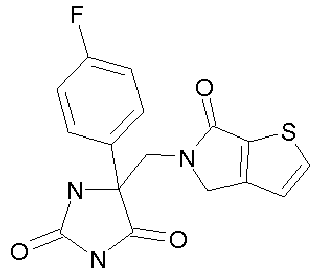
27 
28 
29 
30 
31 
32 
33 
34 
35 
36 
37 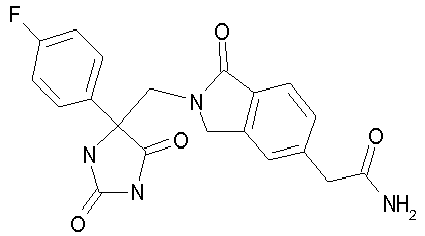
- In an embodiment the compound of Formula I is chosen from compounds 2, 23, 24, 32 and 33.
- In another embodiment the compound of Formula I is chosen from compounds 1, 2, 3, 4, 5, 6, 7, 8, 9, 10, 11, 12, 13, 14, 15, 16, 17, 30 and 31.
- In another embodiment the compound of Formula I is chosen from compounds 35, 36 and 37.
- In another embodiment the compound of Formula I is chosen from compounds 18, 19, 20, 21 and 22.
- In another embodiment the compound of Fomula I is chosen from compounds 25, 26, 27, 28 and 29.
- This Table 1 below also lists the mass spectroscopy data and the Ki rating for each compound. Those compounds having a Ki value of less than 10 nM (<10 nM) are designated with letter "A"; those with a Ki value of from 10 to less than 100 nM (10 - <100 nM) are designated with letter "B"; those with a Ki value of from
100 to 1000 nM are designated with letter "C"; and those with a Ki value of more than 1000 nM (>1000 nM) are designated with letter "D". The syntheis and characterization of these compounds is described hereinbelow in the "EXAMPLES" section of the present application.Table 1 Compound ID Structures Exact Mass Mass Obsvd Ki Rating 1 
361.13 362.2[M+H]+ B 2 
333.10 334.2[M+H]+ C 3 
402.15 403.2[M+H]+ B 4 
436.2 437.2[M+H]+ B 5 
386.2 387.2[M+H]+ A 6 
414.19 415.2[M+H]+ B 7 
374.16 375.2[M+H]+ B 8 
388.17 389.2[M+H]+ B 9 
400.17 401.2[M+H]+ A 10 
465.11 466.3[M+H]+ A 11 
388.17 389.2[M+H]+ B 12 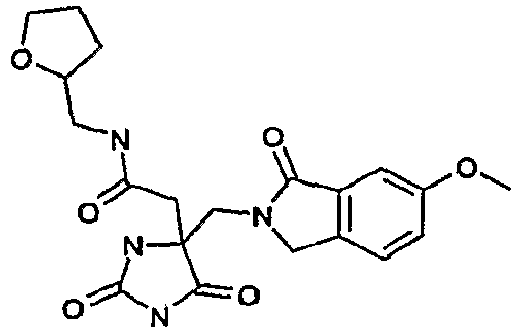
416.17 417.2[M+H]+ B 13 
415.19 416.2[M+H]+ B 14 
490.22 491.3[M+H]+ A 15 
488.21 489.3[M+H]+ A 16 
501.20 502.3[M+H]+ B 17 
434.16 435.07[M+H]+ B 18 
432.18 433.2[M+H]+ A 19 
418.16 419.2[M+H]+ B 20 
405.13 406.2[M+H]+ A 21 
452.15 453.2[M+H]+ B 22 
452.15 453.2[M+H]+ A 23 
471.15 472.3[M+H]+ A 24 
470.16 471.3[M+H]+ A 25 
260.09 261.1[M+H]+ D 26 
345.35 346.2[M+H]+ B 27 
340.31 341.2[M+H]+ D 28 
370.11 371.1 [M+H] A 29 
356.09 357.1 [M+H] B 30 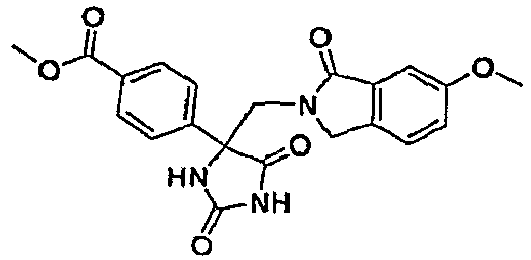
409.13 410.1[M+H]+ A 31 
448.17 449.2[M+H]+ A 32 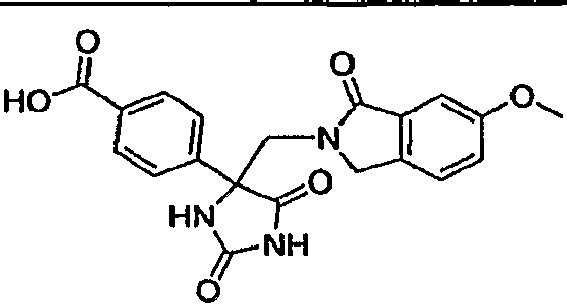
395.11 396.1[M+H]+ A 33 
429.10 430.0[M+H]+ A 34 
422.16 423.0[M+H]+ B 35 
364.10 365.0[M+H]+ B 36 
397.11 398.0[M+H]+ C 37 
396.12 397.1[M+H]+ B - As used above, and throughout this disclosure, the following terms, unless otherwise indicated, shall be understood to have the following meanings:
- "Patient" includes both human and animals.
- "Mammal" means humans and other mammalian animals.
- The term "isolated" or "in isolated form" for a compound refers to the physical state of said compound after being isolated from a synthetic process or natural source or combination thereof. The term "purified" or "in purified form" for a compound refers to the physical state of said compound after being obtained from a purification process or processes described herein or well known to the skilled artisan, in sufficient purity to be characterizable by standard analytical techniques described herein or well known to the skilled artisan.
- As used herein, the term "composition" is intended to encompass a product comprising the specified ingredients in the specified amounts, as well as any product which results, directly or indirectly, from combination of the specified ingredients in the specified amounts.
- Solvates of the compounds of the invention are also contemplated herein.
- "Solvate" means a physical association of a compound of this invention with one or more solvent molecules. This physical association involves varying degrees of ionic and covalent bonding, including hydrogen bonding. In certain instances the solvate will be capable of isolation, for example when one or more solvent molecules are incorporated in the crystal lattice of the crystalline solid. "Solvate" encompasses both solution-phase and isolatable solvates. Non-limiting examples of suitable solvates include ethanolates, methanolates, and the like. "Hydrate" is a solvate wherein the solvent molecule is H2O.
- "Effective amount" or "therapeutically effective amount" is meant to describe an amount of compound or a composition of the present invention effective in inhibiting TACE, the production of TNF-α, MMPs, ADAMS or any combination thereof and thus producing the desired therapeutic, ameliorative, inhibitory or preventative effect.
- The compounds of Formula I can form salts which are also within the scope of this invention. Reference to a compound of Formula I herein is understood to include reference to salts thereof, unless otherwise indicated. The term "salt(s)", as employed herein, denotes acidic salts formed with inorganic and/or organic acids, as well as basic salts formed with inorganic and/or organic bases. In addition, when a compound of Formula I contains both a basic moiety, such as, but not limited to a pyridine or imidazole, and an acidic moiety, such as, but not limited to a carboxylic acid, zwitterions ("inner salts") may be formed and are included within the term "salt(s)" as used herein. Pharmaceutically acceptable (i.e., non-toxic, physiologically acceptable) salts are preferred, although other salts are also useful. Salts of the compounds of the Formula I may be formed, for example, by reacting a compound of Formula I with an amount of acid or base, such as an equivalent amount, in a medium such as one in which the salt precipitates or in an aqueous medium followed by lyophilization.
- Exemplary acid addition salts include acetates, ascorbates, benzoates, benzenesulfonates, bisulfates, borates, butyrates, citrates, camphorates, camphorsulfonates, fumarates, hydrochlorides, hydrobromides, hydroiodides, lactates, maleates, methanesulfonates, naphthalenesulfonates, nitrates, oxalates, phosphates, propionates, salicylates, succinates, sulfates, tartarates, thiocyanates, toluenesulfonates (also known as tosylates,) and the like. Additionally, acids which are generally considered suitable for the formation of pharmaceutically useful salts from basic pharmaceutical compounds are discussed, for example, by P. Stahl et al, Camille G. (eds.) Handbook of Pharmaceutical Salts. Properties, Selection and Use. (2002) Zurich: Wiley-VCH; S. Berge et al, Journal of Pharmaceutical Sciences (1977) 66(1 ) 1-19; P. Gould, International J. of Pharmaceutics (1986) 33 201-217; Anderson et al, The Practice of Medicinal Chemistry (1996), Academic Press, New York; and in The Orange Book (Food & Drug Administration, Washington, D.C. on their website).
- Exemplary basic salts include ammonium salts, alkali metal salts such as sodium, lithium, and potassium salts, alkaline earth metal salts such as calcium and magnesium salts, salts with organic bases (for example, organic amines) such as dicyclohexylamines, t-butyl amines, and salts with amino acids such as arginine, lysine and the like. Basic nitrogen-containing groups may be quarternized with agents such as lower alkyl halides (e.g. methyl, ethyl, and butyl chlorides, bromides and iodides), dialkyl sulfates (e.g. dimethyl, diethyl, and dibutyl sulfates), long chain halides (e.g. decyl, lauryl, and stearyl chlorides, bromides and iodides), aralkyl halides (e.g. benzyl and phenethyl bromides), and others.
- All such acid salts and base salts are intended to be pharmaceutically acceptable salts within the scope of the invention and all acid and base salts are considered equivalent to the free forms of the corresponding compounds for purposes of the invention.
- Compounds of Formula I, and salts and solvates thereof, may exist in their tautomeric form (for example, as an amide or imino ether). All such tautomeric forms are contemplated herein as part of the present invention.
- All stereoisomers (for example, geometric isomers, optical isomers and the like) of the present compounds (including those of the salts and solvates), such as those which may exist due to asymmetric carbons on various substituents, including enantiomeric forms (which may exist even in the absence of asymmetric carbons), rotameric forms, atropisomers, and diastereomeric forms, are contemplated within the scope of this invention. Individual stereoisomers of the compounds of the invention may, for example, be substantially free of other isomers, or may be admixed, for example, as racemates or with all other, or other selected, stereoisomers. The chiral centers of the present invention can have the S or R configuration as defined by the IUPAC 1974 Recommendations. The use of the terms "salt", "solvate" and the like, is intended to equally apply to the salt and solvate of enantiomers, stereoisomers, rotamers, tautomers or racemates of the inventive compounds.
- Polymorphic forms of the compounds of Formula I, and of the salts and solvates of the compounds of Formula I, are intended to be included in the present invention.
- The compounds according to the invention have pharmacological properties; in particular, the compounds of Formula I can be inhibitors of TACE, aggrecanase, TNF-α and/or MMP activity.
- In one aspect, the invention provides a pharmaceutical composition comprising as an active ingredient at least one compound of formula (I).
- In another aspect, the invention provides a pharmaceutical composition of formula (I) additionally comprising at least one pharmaceutically acceptable carrier.
- Also disclosed is a method of treating disorders associated with TACE, aggrecanase, TNF-α, MMPs, ADAMs or any combination thereof, said method comprising administering to a patient in need of such treatment an effective amount of at least one compound of formula (I).
- In another aspect, the invention provides a use of a compound of formula (I) for the manufacture of a medicament to treat disorders associated with TACE, aggrecanase, TNF-α, MMPs, ADAMs or any combination thereof.
- The compounds of Formula (I) can have anti-inflammatory activity and/or immunomodulatory activity and can be useful in the treatment of diseases including but not limited to septic shock, haemodynamic shock, sepsis syndrome, post ischaemic reperfusion injury, malaria, mycobacterial infection, meningitis, psoriasis, congestive heart failure, fibrotic diseases, cachexia, graft rejection, cancers such as cutaneous T-cell lymphoma, diseases involving angiogenesis, autoimmune diseases, skin inflammatory diseases, inflammatory bowel diseases such as Crohn's disease and colitis, OA and RA, ankylosing spondylitis, psoriatic arthritis, adult Still's disease, ureitis, Wegener's granulomatosis, Behcehe disease, Sjogren's syndrome, sarcoidosis, polymyositis, dermatomyositis, multiple sclerosis, sciatica, complex regional pain syndrome, radiation damage, hyperoxic alveolar injury, periodontal disease, HIV, non-insulin dependent diabetes mellitus, systemic lupus erythematosus, glaucoma, sarcoidosis, idiopathic pulmonary fibrosis, bronchopulmonary dysplasia, retinal disease, scleroderma, osteoporosis, renal ischemia, myocardial infarction, cerebral stroke, cerebral ischemia, nephritis, hepatitis, glomerulonephritis, cryptogenic fibrosing aveolitis, psoriasis, transplant rejection, atopic dermatitis, vasculitis, allergy, seasonal allergic rhinitis, reversible airway obstruction, adult respiratory distress syndrome, asthma, chronic obstructive pulmonary disease (COPD) and/or bronchitis. It is contemplated that a compound of this invention may be useful in treating one or more of the diseases listed.
- In another aspect, the invention provides a method of preparing a pharmaceutical composition for treating the disorders associated with TACE, aggrecanase, TNF-α, MMPs, ADAMs or any combination thereof, said method comprising bringing into intimate contact at least one compound of formula (I) and at least one pharmaceutically acceptable carrier.
- In another aspect, the invention provides a compound of formula (I) exhibiting TACE, TNF-α, MMPs, ADAMs or any combination thereof inhibitory activity, including enantiomers, stereoisomers and tautomers of said compound, and pharmaceutically acceptable salts, solvates, or esters of said compound, said compound being selected from the compounds of structures listed in Table 1 set forth above.
- In another aspect, the invention provides a pharmaceutical composition for treating disorders associated with TACE, aggrecanase, TNF-α, MMP, ADAM or any combination thereof in a subject comprising, administering to the subject in need of such treatment a therapeutically effective amount of at least one compound of formula (I) or a pharmaceutically acceptable salt, solvate or ester thereof.
- In another aspect, the invention provides a compound of formula (I) in purified form.
- Also disclosed is a method of treating a condition or disease mediated by TACE, MMPs, TNF-α, aggrecanase, or any combination thereof in a subject comprising: administering to the subject in need of such treatment a therapeutically effective amount of at least one compound of formula (I) or a pharmaceutically acceptable salt, solvate or ester thereof.
- Further disclosed is a method of treating a condition or disease selected from the group consisting of rheumatoid arthritis, osteoarthritis, periodontitis, gingivitis, corneal ulceration, solid tumor growth and tumor invasion by secondary metastases, neovascular glaucoma, inflammatory bowel disease, multiple sclerosis and psoriasis in a subject, comprising: administering to the subject in need of such treatment a therapeutically effective amount of at least one compound of formula (I) or a pharmaceutically acceptable salt, solvate or ester thereof.
- Also dislosed is a method of treating a condition or disease selected from the group consisting of fever, cardiovascular conditions, hemorrhage, coagulation, cachexia, anorexia, alcoholism, acute phase response, acute infection, shock, graft versus host reaction, autoimmune disease and HIV infection in a subject comprising administering to the subject in need of such treatment a therapeutically effective amount of at least one compound of formula (I) or a pharmaceutically acceptable salt, solvate or ester thereof.
- Further disclosed is a method of treating a condition or disease selected from the group consisting of septic shock, haemodynamic shock, sepsis syndrome, post ischaemic reperfusion injury, malaria, mycobacterial infection, meningitis, psoriasis, congestive heart failure, fibrotic diseases, cachexia, graft rejection, cancers such as cutaneous T-cell lymphoma, diseases involving angiogenesis, autoimmune diseases, skin inflammatory diseases, inflammatory bowel diseases such as Crohn's disease and colitis, osteo and rheumatoid arthritis, ankylosing spondylitis, psoriatic arthritis, adult Still's disease, ureitis, Wegener's granulomatosis, Behcehe disease, Sjogren's syndrome, sarcoidosis, polymyositis, dermatomyositis, multiple sclerosis, sciatica, complex regional pain syndrome, radiation damage, hyperoxic alveolar injury, periodontal disease, HIV, non-insulin dependent diabetes mellitus, systemic lupus erythematosus, glaucoma, sarcoidosis, idiopathic pulmonary fibrosis, bronchopulmonary dysplasia, retinal disease, scleroderma, osteoporosis, renal ischemia, myocardial infarction, cerebral stroke, cerebral ischemia, nephritis, hepatitis, glomerulonephritis, cryptogenic fibrosing aveolitis, psoriasis, transplant rejection, atopic dermatitis, vasculitis, allergy, seasonal allergic rhinitis, reversible airway obstruction, adult respiratory distress syndrome, asthma, chronic obstructive pulmonary disease (COPD) and bronchitis in a subject comprising administering to the subject in need of such treatment a therapeutically effective amount of at least one compound of formula (I) or a pharmaceutically acceptable salt, solvate or ester thereof.
- Also disclosed is a method of treating a condition or disease associated with COPD, comprising: administering to the subject in need of such treatment a therapeutically effective amount of at least one compound of Formula (I) or a pharmaceutically acceptable salt, solvate or ester thereof.
- Further disclosed is a method of treating a condition or disease associated with rheumatoid arthritis, comprising: administering to the subject in need of such treatment a therapeutically effective amount of at least one compound of formula (I) or a pharmaceutically acceptable salt, solvate or ester thereof.
- Also disclosed is a method of treating a condition or disease associated with Crohn's disease, comprising: administering to the subject in need of such treatment a therapeutically effective amount of at least one compound of formula (I) or a pharmaceutically acceptable salt, solvate or ester thereof.
- Further disclosed is a method of treating a condition or disease associated with psoriasis, comprising: administering to the subject in need of such treatment a therapeutically effective amount of at least one compound of formula (I) or a pharmaceutically acceptable salt, solvate or ester thereof.
- Also disclosed is a method of treating a condition or disease associated with ankylosing spondylitis, comprising: administering to the subject in need of such treatment a therapeutically effective amount of at least one compound of formula (I) or a pharmaceutically acceptable salt, solvate or ester thereof.
- Further disclosed is a method of treating a condition or disease associated with sciatica, comprising: administering to the subject in need of such treatment a therapeutically effective amount of at least one compound of formula (I) or a pharmaceutically acceptable salt, solvate or ester thereof.
- Also dislosed is a method of treating a condition or disease associated with complex regional pain syndrome, comprising: administering to the subject in need of such treatment a therapeutically effective amount of at least one compound of formula (I) or a pharmaceutically acceptable salt, solvate or ester thereof.
- Further disclosed is a method of treating a condition or disease associated with psoriatic arthritis, comprising: administering to the subject in need of such treatment a therapeutically effective amount of at least one compound of formula (I), or a pharmaceutically acceptable salt, solvate or ester thereof.
- Also disclosed is a method of treating a condition or disease associated with multiple sclerosis, comprising: administering to the subject in need of such treatment a therapeutically effective amount of at least one compound of formula (I) or a pharmaceutically acceptable salt, solvate or ester thereof, in combination with a compound selected from the group consisting of Avonex, Betaseron, Copaxone or other compounds indicated for the treatment of multiple sclerosis.
- Additionally, a compound of the present invention may be co-administered or used in combination with disease-modifying antirheumatic drugs (DMARDS) such as methotrexate, azathioprine, leflunomide, pencillinamine, gold salts, mycophenolate mofetil, cyclophosphamide and other similar drugs. They may also be co-administered with or used in combination with non-steroidal anti-inflammatory drugs (NSAIDs) such as piroxicam, naproxen, indomethacin, ibuprofen and the like; cycloxygenase-2 selective (COX-2) inhibitors such as Vioxx and Celebrex; immunosuppressives such as steroids, cyclosporin, Tacrolimus, rapamycin and the like; biological response modifiers (BRMs) such as Enbrel, Remicade, IL-1 antagonists, anti-CD40, anti-CD28, IL-10, anti-adhesion molecules and the like; and other anti-inflammatory agents such as p38 kinase inhibitors, PDE4 inhibitors, other chemically different TACE inhibitors, chemokine receptor antagonists, Thalidomide and other small molecule inhibitors of pro-inflammatory cytokine production.
- Also, a compound of the present invention may be co-administered or used in combination with an H1 antagonist for the treatment of seasonal allergic rhinitis and/or asthma. Suitable H1 antagonists may be, for example, Claritin®, Clarinex®, Allegra®, or Zyrtec®.
- Also disclosed is a method of treating a condition or disease mediated by TACE, MMPs, TNF-α, aggrecanase, or any combination thereof in a subject comprising: administering to the subject in need of such treatment a therapeutically effective amount of at least one compound of formula (I) or a pharmaceutically acceptable salt or solvate thereof in combination with a therapeutically effective amount of at least one medicament selected from the group consisting of disease modifying anti-rheumatic drugs (DMARDS), NSAIDs, COX-2 inhibitors, COX-1 inhibitors, immunosuppressives, biological response modifiers (BRMs), anti-inflammatory agents and H1 antagonists.
- Further disclosed is a method of treating a condition or disease selected from the group consisting of rheumatoid arthritis, osteoarthritis, periodontitis, gingivitis, corneal ulceration, solid tumor growth and tumor invasion by secondary metastases, neovascular glaucoma, inflammatory bowel disease, multiple sclerosis and psoriasis in a subject, comprising: administering to the subject in need of such treatment a therapeutically effective amount of at least one compound of Formula (I) or a pharmaceutically acceptable salt, solvate or ester thereof in combination with a therapeutically effective amount of at least one medicament selected from the group consisting of DMARDS, NSAIDs, COX-2 inhibitors, COX-1 inhibitors, immunosuppressives, BRMs, anti-inflammatory agents and H1 antagonists.
- Also disclosed is a method of treating a condition or disease selected from the group consisting of septic shock, haemodynamic shock, sepsis syndrome, post ischaemic reperfusion injury, malaria, mycobacterial infection, meningitis, psoriasis, congestive heart failure, fibrotic diseases, cachexia, graft rejection, cancers such as cutaneous T-cell lymphoma, diseases involving angiogenesis, autoimmune diseases, skin inflammatory diseases, inflammatory bowel diseases such as Crohn's disease and colitis, osteo and rheumatoid arthritis, ankylosing spondylitis, psoriatic arthritis, adult Still's disease, ureitis, Wegener's granulomatosis, Behcehe disease, Sjogren's syndrome, sarcoidosis, polymyositis, dermatomyositis, multiple sclerosis, sciatica, complex regional pain syndrome, radiation damage, hyperoxic alveolar injury, periodontal disease, HIV, non-insulin dependent diabetes mellitus, systemic lupus erythematosus, glaucoma, sarcoidosis, idiopathic pulmonary fibrosis, bronchopulmonary dysplasia, retinal disease, scleroderma, osteoporosis, renal ischemia, myocardial infarction, cerebral stroke, cerebral ischemia, nephritis, hepatitis, glomerulonephritis, cryptogenic fibrosing aveolitis, psoriasis, transplant rejection, atopic dermatitis, vasculitis, allergy, seasonal allergic rhinitis, reversible airway obstruction, adult respiratory distress syndrome, asthma, chronic obstructive pulmonary disease (COPD) and bronchitis in a subject comprising administering to the subject in need of such treatment a therapeutically effective amount of at least one compound of Formula (I), or a pharmaceutically acceptable salt, solvate or ester thereof in combination with a therapeutically effective amount of at least one medicament selected from the group consisting of DMARDS, NSAIDs, COX-2 inhibitors, COX-1 inhibitors, immunosuppressives, BRMs, anti-inflammatory agents and H1 antagonists.
- Further disclosed is a method for treating RA comprising administering a compound of the formula I in combination with compound selected from the class consisting of a COX-2 inhibitor e.g. Celebrex® or Vioxx®; a COX-1 inhibitor e.g. Feldene®; an immunosuppressive e.g. methotrexate or cyclosporin; a steroid e.g. methasone; and anti-TNF-α compound, e.g. Enbrel® or Remicade®; a PDE IV inhibitor, or other classes of compounds indicated for the treatment of RA.
- Also disclosed is a method for treating multiple sclerosis comprising administering a compound of the formula (I) in
combination with a compound selected from the group consisting of Avonex®, Betaseron, Copaxone or other compounds indicated for the treatment of multiple sclerosis. - TACE activity is determined by a kinetic assay measuring the rate of increase in fluorescent intensity generated by TACE catalyzed cleavage of an internally quenched peptide substrate (SPDL-3). The purified catalytic domain of recombinant human TACE (rhTACEc, Residue 215 to 477 with two mutation (S266A and N452Q) and a 6xHis tail) is used in the assay. It is purified from the baculovirus/Hi5 cells expression system using affinity chromatography. The substrate SPDL-3 is an internally quenched peptide (MCA-Pro-Leu-Ala-Gln-Ala-Val-Arg-Ser-Ser-Ser-Dpa-Arg-NH2), with its sequence derived from the pro-TNF□ cleavage site. MCA is (7-Methoxycoumarin-4-yl)acetyl. Dpa is N-3-(2,4-Dinitrophenyl)-L-2,3-diaminopropionyl.
- A 50 µl assay mixture contains 20 mM HEPES, pH 7.3, 5 mM CaCl2 , 100 □M ZnCl2, 2 % DMSO, 0.04% Methylcellulose, 30 µM SPDL-3, 70 pM rhTACEc and a test compound. RhTACEc is pre-incubated with the testing compound for 90 min. at 25 °C. Reaction is started by addition of the substrate. The fluorescent intensity (excitation at 320 nm, emission at 405 nm) was measured every 45 seconds for 30 min. using a fluorospectrometer (GEMINI XS, Molecular Devices). Rate of enzymatic reaction is shown as Units per second. Effect of a test compound is shown as % of TACE activity in the absence of the compound.
- The pharmaceutical compositions containing the active ingredient may be in a form suitable for oral use, for example, as tablets, lozenges, aqueous or oily suspensions, dispersible powders or granules, emulsions, hard or soft capsules, or syrups or elixirs. Compositions intended for oral use may be prepared according to any method known to the art for the manufacture of pharmaceutical compositions and such compositions may contain one or more agents selected from the group consisting of sweetening agents, flavoring agents, coloring agents and preserving agents in order to provide pharmaceutically elegant and palatable preparations. Tablets contain the active ingredient in admixture with non-toxic pharmaceutically acceptable excipients that are suitable for the manufacture of tablets. These excipients may be for example, inert diluents, such as calcium carbonate, sodium carbonate, lactose, calcium phosphate or sodium phosphate; granulating and disintegrating agents, for example, corn starch, or alginic acid; binding agents, for example starch, gelatin or acacia, and lubricating agents, for example magnesium stearate, stearic acid or talc. The tablets may be uncoated or they may be coated by known techniques to delay disintegration and absorption in the gastrointestinal tract and thereby provide a sustained action over a longer period. For example, a time delay material such as glyceryl monostearate or glyceryl distearate may be employed. They may also be coated by the technique described in the
U.S. Pat. Nos. 4,256,108 ;4,166,452 ; and4,265,874 to form osmotic therapeutic tablets for controlled release. - The term pharmaceutical composition is also intended to encompass both the bulk composition and individual dosage units comprised of more than one (e.g., two) pharmaceutically active agents such as, for example, a compound of the present invention and an additional agent selected from the lists of the additional agents described herein, along with any pharmaceutically inactive excipients. The bulk composition and each individual dosage unit can contain fixed amounts of the afore-said "more than one pharmaceutically active agents". The bulk composition is material that has not yet been formed into individual dosage units. An illustrative dosage unit is an oral dosage unit such as tablets, pills and the like. Similarly, the herein-described method of treating a patient by administering a pharmaceutical composition of the present invention is also intended to encompass the administration of the afore-said bulk composition and individual dosage units.
- Formulations for oral use may also be presented as hard gelatin capsules wherein the active ingredients is mixed with an inert solid diluent, for example, calcium carbonate, calcium phosphate or kaolin, or a soft gelatin capsules where in the active ingredient is mixed with water or an oil medium, for example peanut oil, liquid paraffin or olive oil.
- Aqueous suspensions contain the active material in admixture with excipients suitable for the manufacture of aqueous suspensions. Such excipients are suspending agents, for example, sodium carboxymethylcellulose, methylcellulose, hydroxypropylmethyl-cellulose, sodium alginate, polyvinyl-pyrrolidone, gum tragacanth and gum acacia; dispersing or wetting agents may be a naturally-occurring phosphatide, for example, lecithin, or condensation products of an alkylene oxide with fatty acids, for example polyoxyethylene stearate, or condensation products of ethylene oxide with long chain aliphatic alcohols, for example, heptadecaethylene-oxycetanol, or condensation products of ethylene oxide with partial esters derived from fatty acids and a hexitol such as polyoxyethylene sorbitol monooleate, or condensation products of ethylene oxide with partial esters derived from fatty acids and hexitol anhydrides, for example, polyethylene sorbitan monooleate. The aqueous suspensions may also contain one or more preservatives, for example, ethyl or n-propyl, p-hydroxybenzoate, one or more coloring agents, one or more flavoring agents, and one or more sweetening agents, such as sucrose, saccharin or aspartame.
- Oily suspensions may be formulated by suspending the active ingredient in a vegetable oil, for example, arachis oil, olive oil, sesame oil or coconut oil, or in mineral oil such as liquid paraffin. The oily suspensions may contain a thickening agent, for example, beeswax, hard paraffin or cetyl alcohol. Sweetening agents such as those set forth above, and flavoring agents may be added to provide a palatable oral preparation. These compositions may be preserved by the addition of an anti-oxidant such as ascorbic acid.
- Dispersible powders and granules suitable for preparation of an aqueous suspension by the addition of water provide the active ingredient in admixture with a dispersing or wetting agent, suspending agent and one or more preservatives. Suitable dispersing or wetting agents and suspending agents are exemplified by those already mentioned above. Additional excipients, e.g., sweetening, flavoring and coloring agents, may also be present.
- The pharmaceutical compositions of the invention may also be in the form of an oil-in-water emulsion. The oily phase may be a vegetable oil, e.g., olive oil or arachis oil, or a mineral oil, e.g., liquid paraffin or mixtures of these. Suitable emulsifying agents may be naturally-occurring phosphatides, e.g., soy beans, lecithin, and esters or partial esters derived from fatty acids and hexitol anhydrides, for example, sorbitan monooleate, and condensation products of the said partial esters with ethylene oxide, e.g., polyoxyethylene sorbitan monooleate. The emulsions may also contain sweetening and flavoring agents.
- Syrups and elixirs may be formulated with sweetening agents, for example, glycerol, propylene glycol, sorbitol or sucrose. Such formulations may also contain a demulcent, a preservative and flavoring and coloring agents.
- The pharmaceutical compositions may be in the form of a sterile injectable aqueous or oleagenous suspension. This suspension may be formulated according to the known art using those suitable dispersing or wetting agents and suspending agents which have been mentioned above. The sterile injectable preparation may also be a sterile injectable solution or suspension in a non-toxic parenterally-acceptable diluent or solvent, e.g., as a solution in 1,3-butane diol. Among the acceptable vehicles and solvents that may be employed are water, Ringer's solution and isotonic sodium chloride solution. In addition, sterile fixed oils are conventionally employed as a solvent or suspending medium. For this purpose any bland fixed oil may be employed including synthetic mono- or diglycerides. In addition, fatty acids such as oleic acid find use in the preparation of injectables.
- Compounds of the invention may also be administered in the form of suppositories for rectal administration of the drug. The compositions can be prepared by mixing the drug with a suitable non-irritating excipient which is solid at ordinary temperatures but liquid at the rectal temperature and will therefore melt in the rectum to release the drug. Such materials are cocoa butter and polyethylene glycols.
- For topical use, creams, ointments, jellies, solutions or suspensions, etc., containing the compounds of the invention are employed. (For purposes of this application, topical application shall include mouthwashes and gargles.)
- The compounds for the present invention can be administered in the intranasal form via topical use of suitable intranasal vehicles, or via transdermal routes, using those forms of transdermal skin patches well known to those of ordinary skill in the art. To be administered in the form of a transdermal delivery system, the dosage administration will, of course, be continuous rather than intermittent throughout the dosage regimen. Compounds of the present invention may also be delivered as a suppository employing bases such as cocoa butter, glycerinated gelatin, hydrogenated vegetable oils, mixtures of polyethylene glycols of various molecular weights and fatty acid esters of polyethylene glycol.
- The dosage regimen utilizing the compounds of the present invention is selected in accordance with a variety of factors including type, species, weight, sex and medical condition of the patient; the severity of the condition to be treated; the route of administration; the renal and hepatic function of the patient; and the particular compound thereof employed. A physician or veterinarian of ordinary skill can readily determine and prescribe the effective amount of the drug required to prevent, counter, arrest or reverse the progress of the condition. Optimal precision in achieving concentration of drug within the range that yields efficacy without toxicity requires a regimen based on the kinetics of the drug's availability to target sites. This involves a consideration of the distribution, equilibrium, and elimination of a drug. Preferably, doses of the compound of Formula I useful in the method of the present invention range from 0.01 to 1000 mg per day. More preferably, dosages range from 0.1 to 1000 mg/day. Most preferably, dosages range from 0.1 to 500 mg/day. For oral administration, the compositions are preferably provided in the form of tablets containing 0.01 to 1000 milligrams of the active ingredient, particularly 0.01, 0.05, 0.1, 0.5, 1.0, 2.5, 5.0, 10.0, 15.0, 25.0, 50.0, 100 and 500 milligrams of the active ingredient for the symptomatic adjustment of the dosage to the patient to be treated. An effective amount of the drug is ordinarily supplied at a dosage level of from about 0.0002 mg/kg to about 50 mg/kg of body weight per day. The range is more particularly from about 0.001 mg/kg to 1 mg/kg of body weight per day.
- Advantageously, the active agent of the present invention may be administered in a single daily dose, or the total daily dosage may be administered in dividend doses of two, three or four time daily.
- The amount of active ingredient that may be combined with the carrier materials to produce single dosage form will vary depending upon the host treated and the particular mode of administration.
- It will be understood, however, that the specific dose level for any particular patient will depend upon a variety of factors including the age, body weight, general health, sex, diet, time of administration, route or administration, rate of excretion, drug combination and the severity of the particular disease undergoing therapy.
- The compounds of the invention may be produced by processes known to those skilled in the art and as shown in the following reaction schemes and in the preparations and examples described below.
- The following abbreviations may be used in the procedures and schemes below:
- ACN
- Acetonitrile
- AcOH
- Acetic acid
- Aq
- Aqueous
- BOC
- tert-Butoxycarbonyl
- BOC2O
- BOC Anhydride
- C
- degrees Celsius
- CBZCl
- Benzyl chloroformate
- DBU
- 1,8-Diazabicyclo[5.4.0]undec-7-ene
- DCM
- Dichloromethane
- DEAD
- Diethyl azodicarboxylate
- (DHQ)2PHAL
- Hydroquinine 1,4-phthalazinediyl diether
- DIAD
- Diisopropylazodicarboxylate
- DIPEA
- Diisopropylethylamine
- DMA
- N,N-Dimethylacetamide
- DMAP
- 4-Dimethylaminopyridine
- DME
- Dimethoxyethane
- DMF
- Dimethylformamide
- DMPU
- 1,3-Dimethyl-3,4,5,6-tetrahydro-2(1h)-pyrimidinone
- DMSO
- Dimethyl sulfoxide
- EDCl
- 1-(3-Dimethylaminopropyl)-3-ethylcarbodiimide hydrochloride
- EI
- Electron impact
- eq
- Equivalents
- EtOAc
- Ethyl acetate
- EtOH
- Ethanol
- g
- grams
- h
- hours
- hr
- hours
- 1H
- proton
- HATU
- N,N,N',N'-Tetramethyl-O-(7-Azabenzotriazol-1-yl)Uronium hexafluorophosphate
- Hex
- hexanes
- HOBT
- 1-Hydroxybenzotriazole
- HMPA
- Hexamethyl phosphoramide
- HPLC
- High pressure liquid chromatography
- HPLC/MS
- High pressure liquid chromatography/Mass spectroscopy
- LC/MS
- Liquid chromatorgraphy/mass spectroscopy
- LAH
- Lithium aluminum hydride
- LDA
- Lithium diisopropylamide
- M
- Molar
- mmol
- millimoles
- mCPBA
- meta-Chloroperoxybenzoic acid
- Me
- Methyl
- MeCN
- Acetonitrile
- MeOH
- Methanol
- min
- Minutes
- mg
- Milligrams
- MHz
- Megahertz
- mL
- Milliliter
- MPLC
- Medium Pressure Liquid Chromatography
- NMR
- Nuclear Magnetic Resonance
- MS
- Mass Spectroscopy
- NBS
- N-Bromosuccinimide
- NMM
- N-Methylmorpholine
- NMP
- 1-methyl-2-pyrrolidone
- ON
- Overnight
- PCC
- Pyridinium Chlorochromate
- PTLC
- Preparative thin layer chromatography
- PyBrOP
- Bromo-tris-pyrrolidino-phosphonium hexafluorophosphate
- Pyr
- Pyridine
- RT
- Room temperature
- SEM
- 2-(Trimethylsilyl)-ethoxymethyl
- sgc
- Silica gel 60 chromatography
- tBOC
- tert-Butoxycarbonyl
- TACE
- Tumor Necrosis Factor-alpha converting enzyme
- TEA
- Triethylamine
- TFA
- Trifluoroacetic acid
- THF
- Tetrahydrofuran
- TLC
- Thin layer chromatography
- TR
- Retention time
- X-PHOS
- 2-dicyclohexylphosphino-2', 4', 6'-tri-isopropyl-1', 1-biphenyl
-

- In step 1, Compound 1A (either commercially available, or prepared by a procedure similar to that described by Abdalla, G. M. and Sowell, J. W. Journal of Heterocyclic Chemistry, 1987, 24(2), 297-301) was treated with one equivalent of Di-tert-butyl dicarbonate in polar solvent, such as DMF, for 30 minutes to 12 hours. The solvent was removed and compound 1B could be used without further purification or purified by silica gel chromatography.
- In step 2, compound 1B was reacted with potassium cyanide and ammonium carbonate in an alcohol and water solution, at 50 °C to 90 °C, for 5 hours to 48 hours. After cooling down, water was added and compound 1C could be collected by filtration.
- In step 3, compound 1C was stirred with 2 to 20 equivalents of hydrogen chloride in methanol for 5 to 48 hours. After ethyl ether was added, compound 1D could be collected by filtration.
-

- Compound 2A (Abdalla, G. M. and Sowell, J. W. Journal of Heterocyclic Chemistry, 1987, 24(2), 297-301) (Hydrochloride salt, 8.60g, 45.4 mmol), triethyl amine (19.0 mL, 136 mmol), and di-tert-butyl dicarbonate (11.9g, 54.4 mmol) were stirred in methylene chloride (100 mL) at 25 °C for 16 hours. Saturated aqueous NaHCO3 (150 mL) was added. The aqueous layer was extracted with CH2Cl2 (100 mL) twice. The organic phase was washed with brine (100 mL) and dried over Na2SO4. The solvent was removed by rotary evaporator to give compound 2B which was used without further purification.
- Compound 2B (9.06 g, 35.8 mmol), KCN (3.49 g, 53.7 mmol), and (NH4)2CO3 (12.0 g, 125.2 mmol) were suspended in a mixture of EtOH (35 mL) and water (35 mL). The solution was stirred at 70 °C for three days. After cooling down, water (35 mL) was added. The solid was filtered and washed with water three times. The solid was dried under vacuum at 40 °C for 16 hours to give compound 2C (7.9 g, 68%).
- Compound 2C (4.0 g) was suspended in methanol (50 mL) and HCl (4M in dioxane, 20 mL) was added. The solution was stirred at 25°C for 3 hours. Ethyl ether (50 ml) was added. The solid was filtered, washed with ethyl ether twice, and dried under vacuum for 12 hours to give compound 2D (2.7 g, 84%).
-

- Compound 3A (prepared according to the procedure described by Wyrick, S. D. et al. Journal of Medicinal Chemistry, 1987, 30(10), 1798-806) (3.33 g, 18.5 mmol) was dissolved in dry benzene (40 mL). NBS (3.45 g, 19.4 mmol) and benzoyl peroxide (134 mg, 0.55 mmol) were added. The solution was stirred in a 75 °C oil bath for about 2 hours. After cooling down, the solid was filtered and washed with Et2O (150 mL). The organic solution was then washed with water (50 mL) twice, dried over Na2SO4 or MgSO4, filtered, and concentrated by rotary evaporator. The crude product was dried under vacuum to give compound 3B which was used without further purification. 1H-NMR appeared to indicate that approximately 75% of this material was compound 3B.
- Compound 3B (4.62 mmol), Compound 3C (824 mg, 4.62 mmol), and K2CO3 (1.28 g, 9.24 mmol) were mixed in DMF (30 mL). The solution was stirred at room temperature for 20 hours. DMF (15 mL) was added and the solid was filtered and washed with DMF. All the DMF solution was combined and concentrated to 25 mL. The resulting solution was purified via reverse phase MPLC (CH3CN/water, 5% to 90%, containing 0.1%HCO2H) to give compound 3D (198 mg, 15%).
-

- Compound 4A (20g, 81.61 mmol), 4B (13.36 mL, 97.93 mmol), Pd(dppf)Cl2 (1.0g, 1.36 mmol), dioxane (350 mL), water (50 mL), and Cs2CO3 (22.5g, 163 mmol) were stirred at 110 °C (oil bath) under nitrogen for 16 hours. After cooling, the solid was removed by filtration. The solution was concentrated and purified by sgc (Hexane/EtOAc, 10:1) to give 4C (12.1g, 80%).
- Compound 4C was converted to Compound 4D using a procedure similar to that described in Example 3.
-

- Compound 5A was prepared using chemistry similar to that described in Examples 1, 2, 3 and 4.
- Compound 5A (1.18 g, 3.36mmol) and pyridine hydrochloride (2.33 g, 20.17 mmol) were added into a 20 mL microwave reactor tube and reacted at 200 °C for 1 hour. After cooling down, the solid was dissolved in DMF and purified by reverse phase chromatography on a C-18 cartridge (CH3CN/water 5% to 90%, with 0.1% HCO2H) to give compound 5B (0.87 g, 77%).
- Compound 5B (0.75 g, 2.22 mmol) was dissolved in DMF (12 mL). SEMCI (0.48 mL, 2.44 mmol) and DIPEA (0.775 mL, 4.44 mmol) were added and the solution was stirred at 25°C for 4 hours. DMF was removed under vacuum and the product was purified by sgc (Hexane/EtOAc: 3:1 to 1:1) to give compound 5C (0.81 g, 78%).
-

- Compound 6A was prepared using chemistry similar to that described in Examples 1, 2, 3 4, and 5.
- Compound 6A was resolved by Chiralcel OD column (Mobile phase: Hexane:2-propanol 4:1). The first peak was collected and concentrated to give compound 6B.
- Compound 6B (0.2 g, 0.36 mmol), allyl palladium chloride dimer (3 mg, 0.008 mmol), and DMF (3 mL) were added to a round bottomed flask and cycled between vacuum and nitrogen three times. Tri-tert-butyl phosphine (30 microliters of 10% solution in hexanes-Strem), piperidine (61 mg, 0.7 mmol), and 3-dimethylamino-1-propyne were added via syringe. The reaction was left stirring overnight at rt. The following morning, the reaction was stirred for 1 hr at 50 °C. The resulting material was diluted with EtOAc, washed with water, dried with MgSO4, and concentrated to dryness. The crude product was purified via flash silica gel chromatography using a gradient elution of 70% (5% Methanol in EtOAC) in hexanes to 100% (5% Methanol in EtOAc) giving 55 mg of compound 6C.
- Compound 6C (55 mg) was dissolved in 10 mL of 4 M HCl in dioxane (Aldrich) and 10 ml of methanol and the solution was added to a pressure tube. The tube was capped and heated to 90°C. The reaction mixture was stirred at 90 °C for 4 hr, then allowed to cool to room temperature. The reaction mixture was concentrated to dryness. Methanol was added and the reaction mixture was reconcentrated to dryness. Methanol (5 ml) and triethylamine (1 mL) were added and the reaction mixture was stirred at rt for 2 hr. The resulting solution was concentrated to dryness. The crude product was purified on a C-18 Isco cartridge using an (acetonitrile:water (+0.1 % formic acid)) gradient as the mobile phase to give 6D.
- Chemistry similar to the procedures described in Examples 6, 8, 1, 2, 3, 4, and 5 was used to prepare compounds 18, 19, 20, 21, and 22 in Table 1.
-

- Compound 4D (16.26 g, 62.77 mmol) was dissolved in 100 mL of DMF and glycine ethyl ester hydrochloride (9.68 g, 69.35 mmol) was added. Diisopropylethylamine (21 mL, 15.6 mmol) was added and the reaction mixture was placed in a 70 °C oil bath. The reaction mixture was stirred overnight at 70°C. After 17 hr, the reaction mixture was allowed to cool to rt. EtOAc, water, and 5 mL of 1 M aq NaHSO4 were added and the layers were separated. The organic layer was washed with water and brine, dried with MgSO4, filtered and concentrated to an orange oil (14.8 g). The crude product was purified via flash silica gel chromatoghraphy using a 20% to 60% EtOAc:Hexanes gradient as the mobile phase to give 6.8 g of 7A as product.
- Compound 7A (6.31 g, 25.3 mmol) was dissolved in dioxane (88 mL). A 1.0 M aq soln of LiOH (28 mL, 28 mmol) was added followed by 10 mL of absolute ethanol. The reaction mixture was stirred at rt for 3 hr, then partially concentrated on the rotary evaporator. Dichloromethane and 1 M aq NaHSO4 were added and the layers were separated. The aq layer was extracted with CH2Cl2. The combined organic layer was filtered, dried with MgSO4, filtered again, and concentrated to dryness giving 4.04 g of 7B.
- Compound 7B (2.02 g, 9.13 mmol) was suspended in 15 mL of THF. Carbonyl diimidazole was added in one portion. After 10 min, acetonitrile (10 mL) was also added. The reaction mixture was stirred at rt for 1 hr. Magnesium chloride and ethyl potassium malonate were added. The reaction mixture was left stirring overnight at room temperature under a drying tube. The reaction mixture was concentrated to near dryness. EtOAc and 1.0 M pH 5.5 sodium phosphate buffer were added. The layers were separated. The organic layer was washed with water and brine, dried with MgSO4, filtered, and concentrated to dryness. An off white solid was obtained. The crude product was purified via silica gel chromatoghraphy using a 50% to 100% EtOAc: Hexanes gradient as the mobile phase to give 1.87 g of 7C.
- Compound 7C was dissolved in 18 mL of absolute ethanol and 8 mL of water. The solution was added to a thick walled glass pressure bottle and ammonium carbonate (2.21 g, 23.0 mmol) was added. The bottle was capped and the reaction mixture was stirred at rt for 15 min. Potassium cyanide was added, the bottle was recapped, and the reaction mixture was stirred at 70°C for 16 hr. The resulting mixture was poured into 250 mL of water and suction filtered to give 7D (1.86 g) as a white solid.
- Compound 7D (0.83 g, 2.29 mmol) was suspended in 9 mL of dioxane. Aq 1.0 M LiOH (4.6 mL, 4.6 mmol) was added, causing the material to dissolve. The reaction mixture was stirred at rt for 5.5 hr. Additional LiOH was added (1.0 mL. 1.0 mmol) and the reaction mixture was stirred for 1 hr. The reaction mixture was concentrated to near dryness. The resulting mixture was acidified with aq 1 M NaHSO4 causing a precipitate to form. The flask was placed in an ice water bath and stirred for 30 min. The resulting mixture was suction filtered to give 7E (0.70 g) as a white solid.
- Compound 7E (31 mg, 0.093 mmol) was dissolved in DMF (400 µL). Carbonyl diimidazole (18 mg, 0.11 mmole) was added and the reaction mixture was stirred at rt for 30 min. Pyrrolidine (20 µL) was added and the reaction mixture was stirred at rt for 5 hr. Aq 1 M NaHSO4 was added (7 mL) followed by EtOAc. The layers were separated. The organic layer was dried with MgSO4 filtered, and concentrated to dryness. the crude product was purified via reverse phase (C-18 Isco cartridge) chromatography using a 10% to 60% acetonitrile:water + (0.1% formic acid) gradient as the mobile phase. A white solid was obtained as product giving compound 5 in Table 1, which is one embodiment of the class of compounds 7F.
- The procedures described in Example 7 were used to prepare compounds 1 through 17 in Table 1.
-

- Compound 8A was prepared using chemistry similar to that described in Examples 1, 2, 3, 4 and 5.
- Compound 8A was resolved by Chiralcel OD column (Mobile phase: Hexane:2-propanol 4:1). The first peak was collected and concentrated to give compound 8B.
-

- Racemic compound 9A was prepared using chemistry similar to that described in Examples 1, 2, 3, 4 and 5. The enantiomers were resolved by Chiralcel OD column (Mobile phase: Hexane/2-propanol 3:1). The first peak was collected and concentrated to give compound 9A in its enantiomerically pure form.
- To a dry flask was added compound 9A (1.5 g, 2.73 mmol) and 4-pyridyl boronic acid (670 mg, 5.50 mmol). The flask was subjected to vacuum and refilled with nitrogen three times. Pd(dppf)Cl2 (220 mg, 0.30 mmol) was added and followed by addition of CH3CN (20 mL) and aq. K2CO3 (1 M, 15 mL). The solution was stirred at 80°C (oil bath) for 16 hours. After cooling down, CH3CN (100 mL) was added and the solid was removed by filtration. The aqueous layer was separated and extracted with EtOAc (20 mL) once. The organic solution was combined and concentrated. The product was purified by SGC (CH2Cl2/MeOH/NH4OH: 20:1:0.1) to give compound 9B.
- Compound 9B was dissolved in a mixture of methanol and HCl (4M in dioxane) (2:1, 30 mL) and was stirred overnight in a sealed pressure flask at 90°C (oil bath). After the solution was cooled, the solution was transferred into a 250 mL round bottom flask. It was concentrated and dried under vacuum. The crude mixture was dissolved in methanol (50 mL) and Et3N (0.5 mL) was added and stirred overnight at 25°C. The solvent was then removed and the product was purified by C18 reverse phase chromatography (CHaCN/water 5% to 90%, with addition of 0.1% HCO2H) to give compound 9C (815 mg).
- Chemistry similar to that described in Examples 8 and 9 was used to prepare compound 24 in Table 1.
-

- A mixture of compound 9A (0.3 g, 0.55 mmol), bis(pinacolato)diboron (10A; 170 mg, 0.65 mmol), potassium acetate (170 mg, 1.70 mmol), and [PdCl2(dppf)]CH2Cl2 (50 mg, 0.05 mmol) in 1,4-dioxane (10 mL) was cycled between vacuum and argon three times. The reaction mixture was stirred at 100 °C (oil bath) for 1.5 hours. After cooling down, the mixture was diluted in EtOAc (50 mL) and filtered through a Celite pad. The filtrate was concentrated in vacuo and the residual material was purified by silica gel column chromatography (2% MeOH in CH2Cl2) to afford compound 10B (300 mg, 91% yield).
- A solution of compound 10B (60 mg, 0.10 mmol), 3-bromoimidazo[1,2-a]pyridine (30 mg, 0.15 mmol), and [PdCl2(dppf)]CH2Cl2 (8.2 mg, 0.01 mmol) in CH3CN (3 mL) was treated with potassium carbonate (0.6 mL, 0.6 mmol, 1 M in H2O). The mixture was subjected to vacuum and refilled with argon three times. The reaction mixture was stirred at 90°C (oil bath) for 17 hours. After cooling, the mixture was diluted in EtOAc (20 mL) and filtered through a Celite pad. The filtrate was concentrated in vacuo and the residual material was purified by preparative TLC (10% MeOH in CH2Cl2) to afford compound 10C (42 mg, 71% yield).
-

- Compound 11A was prepared via procedure similar to those described in Examples 8 and 10.
- Compounds 11A (53 mg) was dissolved in 2 mL methanol in a 15 mL pressure tube. HCl (4M in dioxane, 1 mL) was added. The tube was sealed and put into an 80°C oil bath for 16 h. After cooling down, the solution was transferred into a 100 mL flask and the solvent was removed. NH3 (7N in methanol, 3 mL) was added and the solution was transferred into a 15 mL pressure tube. The tube was sealed and put into a 70 °C oil bath for three hours. After cooling down, the solution was transferred into 100 mL flask and the solvent was removed. The product was purified by C18 reverse phase chromatography (CH3CN/water, 5% to 90%, with 0.1% HCO2H) to give compound 23. Compound 23 was dissolved in methanol, and HCl (4M in dioxane, 0.5 mL) was added. The solution was stirred at 25°C for 30 minutes. The solvent was removed and the product was suspended in water. The water was removed by lyophilizer to give compound 23 (22 mg) in Table 1.

- Amine hydrochloride 2D (1.13g, 3.75 mmol) in DMF (30 mL) was treated with thiophenedialdehyde (0.3g, 1.9 mmol) and the mixture was stirred at ambient temperature for 1 h. The reaction was diluted with ethyl acetate (100 mL) and the organics were washed with water (3 X 50 mL) and brine (1 X 50 mL), dried over MgSO4 and concentrated to provide a crude oil. The crude product was subjected to silica-gel chromatography using CH2Cl2-5% CH3OH/CH2Cl2 as the gradient eluting solvent to yield 26 (0.08 g).

- Amine hydrochloride 2D (2.7 g, 8 mmol) in DMF (30 mL) was treated with bromoethylester 27A (3.6 g, 15 mmol) and diisopropylethylamine (2.6 mL). The mixture was heated to 55 °C and stirred for 24 h. The reaction was diluted with ethyl acetate (200 mL) and the organics were washed with water (3 X 50 mL) and brine (1 X 50 mL), dried over MgSO4 and concentrated to provide crude solid. The product 27 (1.8 g) was isolated by recrystallization (ethyl acetate : ether; 2:1). The product 27A was prepared from commercially available (Aldrich) ethyl nicitinate using the process described in step 1 example 3.
- Compound #25 (Table 1) was prepared analogously using appropriate starting materials.
-

- Part A:
Compound 300 (20.0 g, 81.61 mmol), trimethylboroxine (13.36 mL, 97.93 mmol), Pd(dppf)Cl2 (1.0 g, 1.36 mmol), dioxane (350 mL), water (50 mL), and cesium carbonate (22.5 g, 163 mmol) were stirred at 110°C (oil bath) under nitrogen for 16 hours. After cooling, the solid was removed by filtration. The solution was concentrated and purified by sgc (10:1 EtOAc/hexanes) to give 301 (12.1 g, 80%). - Part B:
Compound 301 (4.4 g, 24.2 mmol) was dissolved in carbon tetrachloride (80 mL) and N-bromosuccinimide (4.48 g, 24.2 mmol) and benzoyl peroxide (276 mg, 1.13 mmol) were added. The reaction mixture was stirred at reflux for 3 hours and then solids were filtered and washed with ether. The combined organic layers were washed with water, dried over sodium sulfate, and concentrated to provide the desired product 302 (6.1 g, 98%). - Part C:
Compound 302 (32.0 g, 124.0 mmol) was dissolved in 7 M ammonia in MeOH (150 mL) and stirred in a sealed pressure flask at 60 °C overnight. The reaction mixture was cooled and the solvent was removed under reduced pressure. The residue was suspended in ethyl acetate and stirred for 30 minutes. The solids were filtered and dissolved in methylene chloride. The methylene chloride was washed with water, dried over sodium sulfate, and concentrated to provide the desired product 303 (13.5 g, 67%). - Part D:
Compound 303 (2.2 g, 13.4 mmol) was dissolved in THF (250 mL) and DMPU (40 mL). Sodium t-butoxide (1.55 g, 16.13 mmol) was added and stirred for 5 hours. Chloromethylpivalate (3.0 mL, 20.1 mmol) was added dropwise and stirred overnight. The reaction was quenched with saturated ammonium chloride and extracted with ethyl acetate. The combined ethyl acetate layers were washed with water, brine, dried over sodium sulfate and concentrated. Purification by column chromatography (SiO2 25% ethyl acetate/hexanes) afforded the desired product 304 (2.5 g, 67%). - Part E:
Compound 304 (288 mg, 1.04 mmol) was dissolved in methylene chloride (5 mL) and cooled in an ice bath. Bromotrimethylsilane (0.3 mL, 2.08 mmol) was added dropwise and stirred in the ice bath for 30 minutes followed by 2 hours at room temperature. The reaction mixture was concentrated and re-dissolved in methylene chloride (2 mL). Hexanes (8 mL) was added and the solids were filtered to provide the desired product 305 (218 mg, 83%). -

- Part A:
Glyoxylic acid monohydrate (20.0 g, 218 mmol) and methyl carbamate (16.3 g, 218 mmol) were dissolved in diethyl ether (200 mL) and stirred overnight. The solids were filtered to provide the desired product 306B (32.0 g, 98%). - Part B:
Compound 306B (32.0 g, 214 mmol) was dissolved in MeOH (200 mL) and cooled in an ice bath. Concentrated sulfuric acid (8 mL) was added dropwise and the reaction was stirred overnight. The reaction mixture was diluted with ethyl acetate and water. The organic layer was washed with brine, dried over sodium sulfate, and concentrated to provide compound 306C that was used without purification (27.0 g, 71%). - Part C:
Compound 306C (27.0 g, 152 mmol) was dissolved in carbon tetrachloride (700 mL). Phosphorus pentachloride (50 g, 240 mmol) was added and the suspension was stirred for 18 hours (solution became clear over time). The solvent was removed under reduced pressure and the residue was stirred in petroleum ether (500 mL) overnight. The solids were filtered to provide compound 307 with no need for purification (26.5 g, 96%). Trituration step was repeated if mass yield was too high. - Part D:
Compound 307 (15.0 g, 82.7 mmol) was dissolved in methylene chloride (140 mL) and cooled in an ice bath. Bis(trimethylsilyl)acetylene (15.0 g, 88.2 mmol) was added in methylene chloride (20 mL). Freshly crushed aluminum chloride (11.0 g, 82.7 mmol) was added in portions over 20 minutes. The reaction mixture was allowed to slowly warm to room temperature and stirred overnight. The reaction was cooled in an ice bath and slowly quenched with water. The organic layer was washed several times with water, dried over sodium sulfate, and concentrated. The residue was triturated/recrystallized from hexanes to provide the desired product 308 (14.8 g, 69%). HPLC-MS tR = 1.84 min (ELSD); mass calculated for formula C10H17NO4Si 243.09, observed LCMS m/z 244.1 (M+H). - Part E:
Compound 308 (24.0 g, 98.7 mmol) and compound 305 (25.1 g, 99.0 mmol) were dissolved in THF (300 mL) and cooled to -78°C. A 1 M solution of LiHMDS (198 mL, 198 mmol) was added dropwise over 30 minutes and the reaction mixture was stirred for 2 hours. Saturated ammonium chloride solution was added slowly and the reaction was allowed to warm to room temperature. The aqueous layer was extracted with ethyl acetate. The combined organic layers were washed with water, brine, dried over sodium sulfate, and concentrated. Purification by column chromatography (SiO2, 33% ethyl acetate/hexanes to 50% ethyl acetate/hexanes) afforded the desired product 309 (26.0 g, 63%). HPLC-MS tR = 1.90 min (UV254 nm); mass calculated for formula C20H26N2O6Si 418.15, observed LCMS m/z 419.2 (M+H). - Part F:
The two isomers were separated using a chiral OD column. One gram of material was injected into the column and the two peaks were separated by using a solvent mixture of 85% hexanes/ethanol. The second isomer was the desired compound 309B (400 mg, 80%). - Part G:
Compound 309B (8.0 g, 19.1 mmol) was dissolved in THF (250 mL) and cooled to 0°C. Tetrabutylammonium fluoride (1 M in THF, 22.9 mL, 22.9 mmol) was added dropwise and the reaction was stirred for 1 hour at room temperature. The reaction mixture was diluted with ethyl acetate and water. The organic layer was washed with water, saturated sodium bicarbonate, brine, dried over sodium sulfate and concentrated to provide compound 400 (5.8 g, 88%). The product was used without purification. - Part H:
Compound 400 (75 mg, 0.22 mmol) was combined with 3-bromoquinoline (0.032 mL, 0.24 mmol), Pd(PPh3)2Cl2 (3 mg, 0.0044 mmol), Cul (2 mg, 0.009 mmol), diisopropylamine (0.062 mL, 0.44 mmol) in DMF (1 mL) and stirred overnight at 80 °C. The reaction mixture was diluted with ethyl acetate and water. The organic layer was washed with water, brine, dried over sodium sulfate and concentrated. Purification by column chromatography (SiO2, 50% ethyl acetate/hexane to 80% ethyl acetate/hexane) afforded the desired product 400A (93 mg, 89%). HPLC-MS tR = 1.66 min (UV254 nm); mass calculated for formula C26H23N3O6 473.16, observed LCMS m/z 474.1 (M+H). - Part I:
Compound 400A (77 mg, 0.16 mmol) was dissolved in 7 M ammonia solution (3 mL) and stirred in a sealed pressure tube at 90 °C overnight. The reaction mixture was cooled to room temperature and concentrated to afford compound 400B. HPLC-MS tR = 1.41 min (UV254 nm); mass calculated for formula C24H18N4O4 426.13, observed LCMS m/z 427.0 (M+H). -

- Part A:
Sodium pellets (3.6 g, 156 mmol) were dissolved in MeOH (100 mL) at 0 °C. Compound 320 (3.0 g, 15.6 mmol) was added and stirred at 100°C in a sealed pressure flask overnight. The reaction was cooled to room temperature and diluted with ethyl acetate and 1N HCl. The organic layer was dried over sodium sulfate and concentrated to provide the desired product 321 with no need for purification (2.1 g, 72%). - Part B:
Compound 321 (2.1 g, 11.1 mmol) was dissolved in toluene (30 mL) and methanol (30 ml) and cooled in an ice bath. TMS diazomethane (2M in hexanes, 11 mL) was added dropwise until yellow color persisted. The solvent was evaporated under reduced pressure to provide the desired product 322 with no need for purification (2.2 g, quant.). - Part C:
Compound 322 (1.0 g, 5.0 mmol) was combined with Pd(P-tBu3)2 (128 mg, 0.25 mmol), Pd(dba)3 (250 mg, 0.25 mmol), trimethylboroxine (1.0 mL, 6.5 mmol), potassium phosphate monohydrate (3.69 g, 15 mmol) in dioxane (25 mL) and stirred at 90 °C overnight. The reaction mixture was filtered and the solvent was evaporated under reduced pressure. Purification by column chromatography (SiO2, 10% ethyl acetate/hexanes) afforded the desired product 323 (0.500 g, 55%). - Part D:
Compound 323 (210 mg, 1.16 mmol) was dissolved in carbon tetrachloride (6 mL) and N-bromosuccinimide (228 mg, 1.28 mmol) and benzoyl peroxide (10 mg) were added. The reaction mixture was stirred at reflux overnight, cooled to room temperature, and filtered (solids were washed with ether). The combined organic layers was washed with water, dried over sodium sulfate, and concentrated to provide the desired product 324 (0.20 g, 67%). - Part E:
Compound 324 (75 mg, 0.29 mmol) and compound 2D (75 mg, 0.29 mmol) were dissolved in DMF (5 mL) and DIEA (0.15 mL, 0.87 mmol) and stirred at 70 °C overnight. The reaction mixture was diluted with ethyl acetate and water. The organic layer was washed with water, brine, dried over sodium sulfate, and concentrated. The residue was purified by reverse phase chromatography to provide the desired product 325 (24.1 mg, 22%). HPLC-MS tR = 1.269 min (UV254 nm); mass calculated for formula C18H15N4O4F 370.10, observed LCMS m/z 371.1 (M+H). -

- Part A:
Compound 325 (140 mg, 0.378 mmol), chlorotrimethylsilane (226 mg, 1.89 mmol), and sodium iodide (283 mg, 1.89 mmol) were dissolved in acetonitrile (5 mL) and stirred at reflux for 10 minutes. Water (0.3 mL) was added and the reaction was refluxed for 3 hours. The reaction mixture was cooled and diluted with ethyl acetate and water. The organic layer was dried over sodium sulfate and concentrated. Purification by reverse phase chromatography provided the desired product 326 (7.1 mg, 5%). HPLC-MS tR = 0.855 min (UV254 nm); mass calculated for formula C17H13N4O4F 356.09, observed LCMS m/z 357.1 (M+H). -

- Part A
To a solution of methyl 4-acetylbenzoate (1.9 g, 10.6 mmol) in acetic acid (10 mL) was added dropwise bromine (1.7 g, 21.3 mmol). The mixture was heated at 60 °C for 30 min, then stirred at room temperature for 1 hour, and poured into cold water (30 mL). The light yellow precipitate was collected, washed with water and dried (2.6 g, 96%). - Part B
Compound 32A was treated with one equivalent of hexamethylene tetraamine in chloroform for about 1 hour. The product was collected by filtration and then treated with HCl in methanol for 2 hours. The solid was then collected by filtration to give compound 32B. - Part C
Compound 30 was prepared following the procedures described in Example 2 Steps 1, 2, 3 and in Example 300E Part E: HPLC-MS tR = 1.36 min (UV254 nm); mass calculated for formula C21H19N3O6 409.1, observed LCMS m/z 410.1 (M+H). - Part D
Compound 30 (60 mg, 0.147 mmol) was heated in 5% KOH in MeOH (2 mL) at 60 °C overnight, cooled to room temperature and concentrated. The residue was dissolved in water (5 mL), acidified with conc. HCl and filtered. The solid was collected and dried to give compound 32 (23 mg, 40%): HPLC-MS tR = 1.04 min (UV254 nm); mass calculated for formula C20H17N3O6 395.1, observed LCMS m/z 396.1 (M+H). - Part E
Compound 30 (39 mg, 0.095 mmol) was heated in pyrrolidine (2 mL) at 60 °C overnight, cooled to room temperature and concentrated. The residue was purified by reverse phase chromatography to give 31: HPLC-MS tR = 1.19 min (UV254 nm); mass calculated for formula C24H24N4O5 448.2, observed LCMS m/z 449.2 (M+H). - Part F
A mixture of compound 32 (49 mg, 0.12 mmol), dimethylamine hydrochloride (20 mg, 0.25 mmol), HATU (61 mg, 0.16 mmol), DMAP (2 mg, 0.012 mmol) and diisopropylethylamine (0.065 mL, 0.37 mmol) was stirred in DMF (2 mL) at room temperature overnight. The mixture was diluted with ethyl acetate, washed with 0.1 N HCl, water and brine, dried over sodium sulfate and evaporated. The residue was purified by reverse phase chromatography to give 34: HPLC-MS tR = 1.09 min (UV254 nm); mass calculated for formula C22H22N4O5 422.2, observed LCMS m/z 423.1 (M+H). -

- Part A
Compound 33 was prepared from 33A following procedures described in Example 32 Part B and Part C: HPLC-MS tR = 1.08 min (UV254 nm); mass calculated for formula C20H19N3O6S 429.1, observed LCMS m/z 430.0 (M+H). -
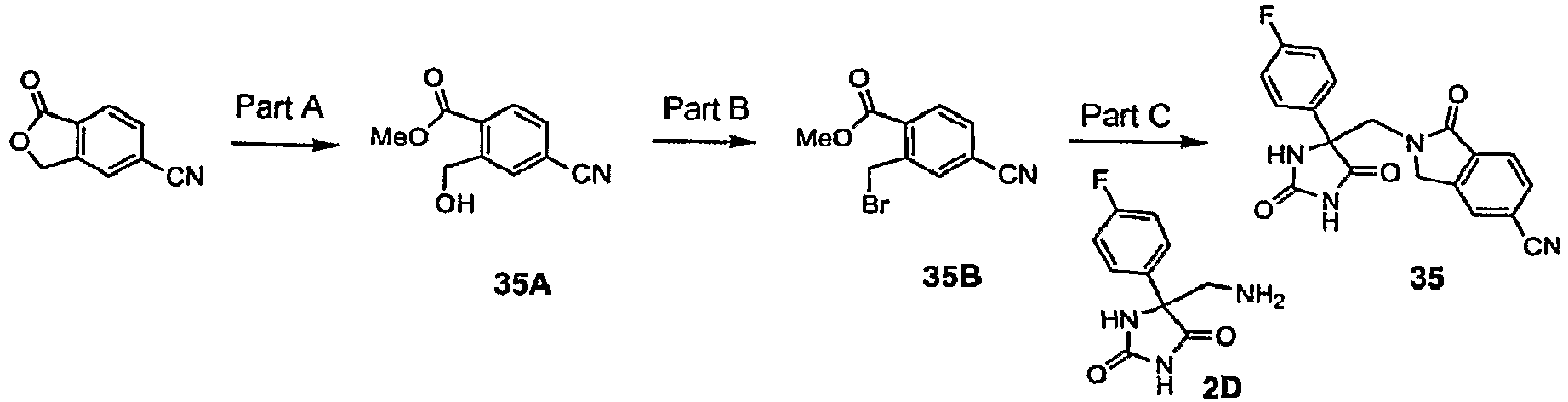
- Part A:
A mixture of 5-cyanophthalide (5.0 g, 31.4 mmol) and 1 N of NaOH (31.4 mL) was stirred at 100 °C for 1 h. The solution was concentrated to dryness with azotropic distillation with toluene. The resulting white solid was dissolved in dry DMF (30 mL). Methyl iodide (5.88 mL, 94.2 mmol) was added slowly, and the reaction mixture was allowed to stir at room temperature for 2 h. It was then diluted with H2O and back extracted with EtOAc (30 mL x 4). EtOAc extracts were combined, washed with brine, dried over Na2SO4, and concentrated. Flash column chromatography on silica (EtOAc / hexane 40:60) gave compound 35A as a white solid (5.5 g, 91 %) - Part B:
To compound 35A (5.5 g, 28.77 mmol) in THF (60 mL) was added carbon tetrabromide (11.45 g, 34.52 mmol). The solution was cooled to 0 °C in an ice/water bath, and triphenylphosphine (9.05 g, 34.52 mmol) was added portionwise. The reaction mixture was stirred at room temperature for 3 h under argon. After removing the precipitate by filtration, the solution was concentrated. The residue was dissolved in EtOAc (100 mL), washed with 1 N HCl, H2O, brine, dried over Na2SO4, and concentrated. Flash column chromatography on silica (EtOAc / hexane 20:80) gave compound 35B as a pale yellow solid (6.8 g, 93%). - Part C:
Compound 35 was prepared using previously described methods from 2D and 35B. HPLC-MS tR = 2.943 min (UV254 nm), Mass calculated for formula C19H13FN4O3 364.1, observed LCMS m/z 365.0 (M+H). -
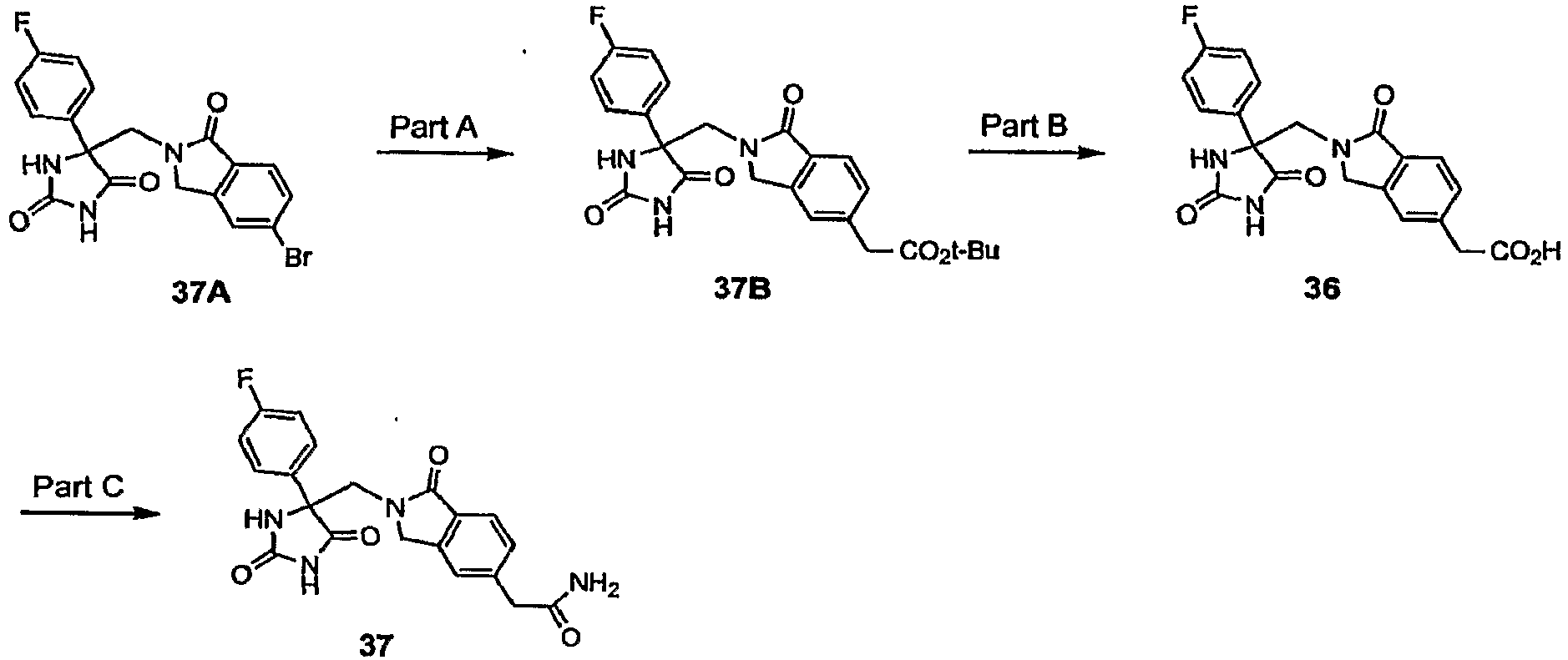
- Compound 37A was prepared using procedures described in Example 375.
- Part A:
Compound 37A (550 mg, 1.32 mmol) and Pd(t-Bu3P)2 (34 mg, 0.066 mmol, 5 mol%) in NMP (5 mL) were added with a 0.5 M solution of 2-tert-butoxy-2-oxoethylzinc chloride in THF (10.5 mL, 5.2 mmol) under argon. The reaction mixture was allowed to stir at 90 °C overnight. After cooling to room temperature, it was diluted with EtOAc, washed with water, brine, dried over Na2SO4, and concentrated. Column chromatography on silica gel (MeOH / DCM, 10:90) afforded 37B as a pale yellow solid (260 mg, 43%). HPLC-MS (5 min) tR = 1.69 min (UV254 nm), Mass calculated for formula C19H13FN4O3 453.2, observed LCMS m/z 454.1 (M+H). - Part B:
Compound 37B (40 mg, 0.088 mmol) was treated with TFA in DCM at room temperature to afford 36 as a white solid (20 mg, 27%). HPLC-MS tR = 2.64min (UV254 nm), Mass calculated for formula C20H16FN3O5 397.1, observed LCMS m/z 398.0 (M+H). - Part C:
Compound 36 (20 mg, 0.05 mmol) in DMF (1 mL) was added with HOBt (14 mg, 0.1 mmol) and EDC (19 mg, 0.1 mmol). After stirring at room temperature for 10 min, NH4Cl (20 mg, 0.15 mol) was added, followed by the addition of DIEA (0.026 mL). The reaction mixture was then stirred at room temperature overnight. It was diluted with EtOAc, washed with 1 N HCl, saturated NaHCO3, and brine, dried over Na2SO4, and concentrated. Recrystallization in EtOAc gave 37 (7.4 mg, 37%) as a white solid. HPLC-MS tR = 2.64min (UV254 nm), Mass calculated for formula C20H17FN4O4 396.1, observed LCMS m/z 397.1 (M+H).
Claims (9)
- A compound of Formula I selected from the group consisting of:
Compound ID Structures 1 
2 
3 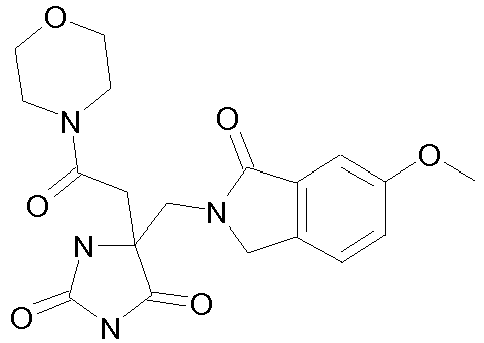
4 
5 
6 
7 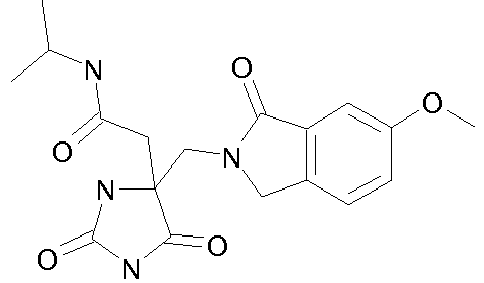
8 
9 
10 
11 
12 
13 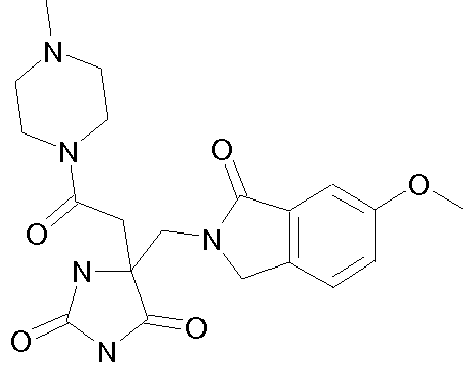
14 
15 
16 
17 
18 
19 
20 
21 
22 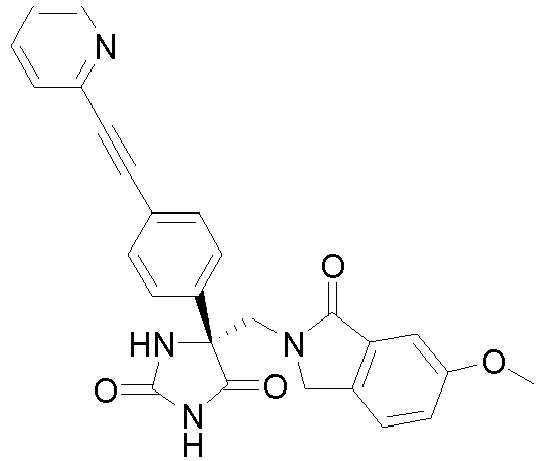
23 
24 
25 
26 
27 
28 
29 
30 
31 
32 
33 
34 
35 
36 
37 
- A pharmaceutical composition comprising the compound of claim 1 or a pharmaceutically acceptable salt, solvate or ester thereof, and at least one pharmaceutically acceptable carrier.
- A compound of claim 1 or a pharmaceutically acceptable salt, ester or solvate thereof, for use in a method of treatment of the human body by therapy.
- The compound for use of claim 3 wherein the therapy is treating a condition or disease selected from rheumatoid arthritis, osteoarthritis, periodontitis, gingivitis, corneal ulceration, solid tumor growth and tumor invasion by secondary metastases, neovascular glaucoma, inflammatory bowel disease, multiple sclerosis and psoriasis.
- The compound for use of claim 3 wherein the therapy is treating a condition or disease selected from fever, cardiovascular conditions, hemorrhage, coagulation, cachexia, anorexia, alcoholism, acute phase response, acute infection, shock, graft versus host reaction, autoimmune disease and HIV infection.
- The compound for use of claim 3 wherein the therapy is treating a condition or disease selected from septic shock, haemodynamic shock, sepsis syndrome, post ischaemic reperfusion injury, malaria, mycobacterial infection, meningitis, psoriasis, congestive heart failure, fibrotic diseases, cachexia, graft rejection, cancers such as cutaneous T-cell lymphoma, diseases involving angiogenesis, autoimmune diseases, skin inflammatory diseases, inflammatory bowel diseases such as Crohn's disease and colitis, osteo and rheumatoid arthritis, ankylosing spondylitis, psoriatic arthritis, adult Still's disease, ureitis, Wegener's granulomatosis, Behcehe disease, Sjogren's syndrome, sarcoidosis, polymyositis, dermatomyositis, multiple sclerosis, sciatica, complex regional pain syndrome, radiation damage, hyperoxic alveolar injury, periodontal disease, HIV, non-insulin dependent diabetes mellitus, systemic lupus erythematosus, glaucoma, sarcoidosis, idiopathic pulmonary fibrosis, bronchopulmonary dysplasia, retinal disease, scleroderma, osteoporosis, renal ischemia, myocardial infarction, cerebral stroke, cerebral ischemia, nephritis, hepatitis, glomerulonephritis, cryptogenic fibrosing aveolitis, psoriasis, transplant rejection, atopic dermatitis, vasculitis, allergy, seasonal allergic rhinitis, reversible airway obstruction, adult respiratory distress syndrome, asthma, chronic obstructive pulmonary disease (COPD) and bronchitis.
- Use of a compound of claim 1 of a pharmaceutically acceptable salt, ester or solvate thereof, for the manufacture of a medicament for treating a condition or disease as defined in claim 4, 5 or 6.
- A combination of a compound of claim 1 or a pharmaceutically acceptable salt or solvate thereof, and interferon beta-1 a, interferon beta-1 b or glatiramer acetate.
- A combination of a compound of claim 1 or a pharmaceutically acceptable salt, ester or solvate thereof and at least one medicament selected from disease modifying anti-rheumatic drugs (DMARDS), non-steroidal anti-inflammatory drugs (NSAIDs), cycloxygenase-2 selective (COX-2) inhibitors, COX-1 inhibitors, immunosuppressives, biological response modifiers (BRMs), anti-inflammatory agents and H1 antagonists.
Applications Claiming Priority (2)
| Application Number | Priority Date | Filing Date | Title |
|---|---|---|---|
| US75930006P | 2006-01-17 | 2006-01-17 | |
| PCT/US2007/001030 WO2007084455A1 (en) | 2006-01-17 | 2007-01-16 | Hydantoin compounds for the treatment of inflammatory disorders |
Publications (2)
| Publication Number | Publication Date |
|---|---|
| EP1973900A1 EP1973900A1 (en) | 2008-10-01 |
| EP1973900B1 true EP1973900B1 (en) | 2017-04-05 |
Family
ID=38038495
Family Applications (2)
| Application Number | Title | Priority Date | Filing Date |
|---|---|---|---|
| EP07716634.6A Active EP1973901B1 (en) | 2006-01-17 | 2007-01-16 | Hydantoin derivatives for the treatment of inflammatory disorders |
| EP07716637.9A Active EP1973900B1 (en) | 2006-01-17 | 2007-01-16 | Hydantoin compounds for the treatment of inflammatory disorders |
Family Applications Before (1)
| Application Number | Title | Priority Date | Filing Date |
|---|---|---|---|
| EP07716634.6A Active EP1973901B1 (en) | 2006-01-17 | 2007-01-16 | Hydantoin derivatives for the treatment of inflammatory disorders |
Country Status (17)
| Country | Link |
|---|---|
| US (4) | US7683088B2 (en) |
| EP (2) | EP1973901B1 (en) |
| JP (2) | JP2009523796A (en) |
| KR (2) | KR20080085221A (en) |
| CN (2) | CN101405286A (en) |
| AR (2) | AR059037A1 (en) |
| AU (2) | AU2007207711A1 (en) |
| BR (2) | BRPI0706598A2 (en) |
| CA (2) | CA2637196A1 (en) |
| EC (2) | ECSP088626A (en) |
| IL (2) | IL192691A0 (en) |
| NO (2) | NO20083568L (en) |
| PE (2) | PE20071240A1 (en) |
| RU (2) | RU2008133382A (en) |
| TW (2) | TW200736247A (en) |
| WO (2) | WO2007084455A1 (en) |
| ZA (1) | ZA200806072B (en) |
Families Citing this family (52)
| Publication number | Priority date | Publication date | Assignee | Title |
|---|---|---|---|---|
| US7504424B2 (en) | 2004-07-16 | 2009-03-17 | Schering Corporation | Compounds for the treatment of inflammatory disorders |
| US7488745B2 (en) | 2004-07-16 | 2009-02-10 | Schering Corporation | Compounds for the treatment of inflammatory disorders |
| WO2006019768A1 (en) | 2004-07-16 | 2006-02-23 | Schering Corporation | Hydantoin derivatives for the treatment of inflammatory disorders |
| US8518950B2 (en) | 2005-01-25 | 2013-08-27 | Synta Pharmaceuticals Corp. | 2-amido pyrazines for inflammation and immune related uses |
| US7902352B2 (en) | 2005-05-06 | 2011-03-08 | Medtronic, Inc. | Isolated nucleic acid duplex for reducing huntington gene expression |
| EP1948638B1 (en) * | 2005-08-12 | 2011-08-03 | Schering Corporation | Compounds for the treatment of inflammatory disorders |
| PE20071240A1 (en) * | 2006-01-17 | 2008-01-14 | Schering Corp | HYDANTOIN-DERIVED COMPOUNDS FOR THE TREATMENT OF INFLAMMATORY DISORDERS |
| US20090175852A1 (en) | 2006-06-06 | 2009-07-09 | Schering Corporation | Imidazopyrazines as protein kinase inhibitors |
| JP2010502617A (en) | 2006-08-31 | 2010-01-28 | シェーリング コーポレイション | Hydantoin derivatives useful as antibacterial substances |
| CN101186611B (en) | 2006-11-15 | 2011-05-18 | 天津和美生物技术有限公司 | Pyrroline-2-one derivative capable of inhibiting cell to release tumor necrotic factor and its preparation and application |
| CN101186612B (en) * | 2006-11-15 | 2012-10-03 | 天津和美生物技术有限公司 | Pyrroline derivative capable of inhibiting cell to release tumor necrotic factor and its preparation and application |
| US8450355B2 (en) | 2008-09-24 | 2013-05-28 | Merck Sharp & Dohme Corp. | Compounds for the treatment of inflammatory diseases |
| EP2331528B1 (en) | 2008-09-24 | 2020-05-27 | Merck Sharp & Dohme Corp. | Compounds for the treatment of inflammatory disorders |
| US8541572B2 (en) * | 2008-11-10 | 2013-09-24 | Merck Sharp & Dohme Corp. | Compounds for the treatment of inflammatory disorders |
| US8569336B2 (en) | 2008-11-10 | 2013-10-29 | Ling Tong | Compounds for the treatment of inflammatory disorders |
| KR101822444B1 (en) | 2010-07-08 | 2018-01-26 | 가켄 세이야쿠 가부시키가이샤 | N-hydroxyformamide Derivative And Pharmaceutical Containing Same |
| US8772276B2 (en) * | 2011-05-03 | 2014-07-08 | Merck Sharp & Dohme Corp. | Alkyne benzotriazole derivatives |
| NO2789607T3 (en) | 2011-12-09 | 2018-07-07 | ||
| AR092971A1 (en) * | 2012-10-26 | 2015-05-06 | Lilly Co Eli | AGRECANASA INHIBITORS |
| AU2014275835B2 (en) | 2013-06-07 | 2018-08-16 | Kaken Pharmaceutical Co., Ltd. | (+)-5-(3,4-difluorophenyl)-5-[(3-methyl-2-oxopyridin-1(2H)-yl)methyl]imidazolidine-2,4-dione and drug containing same |
| CN104803861B (en) * | 2014-01-27 | 2017-05-24 | 上海博邦医药科技有限公司 | Method for synthesizing tapentadol hydrochloride |
| EP3527569B1 (en) | 2014-02-03 | 2021-08-25 | Vitae Pharmaceuticals, LLC | Dihydropyrrolopyridine inhibitors of ror-gamma for use in treating drye eye |
| TWI675032B (en) | 2014-10-14 | 2019-10-21 | 美商維它藥物公司 | Dihydropyrrolopyridine inhibitors of ror-gamma |
| US9663515B2 (en) | 2014-11-05 | 2017-05-30 | Vitae Pharmaceuticals, Inc. | Dihydropyrrolopyridine inhibitors of ROR-gamma |
| US9845308B2 (en) | 2014-11-05 | 2017-12-19 | Vitae Pharmaceuticals, Inc. | Isoindoline inhibitors of ROR-gamma |
| WO2016126726A1 (en) | 2015-02-02 | 2016-08-11 | Forma Therapeutics, Inc. | Bicyclic [4,6,0] hydroxamic acids as hdac6 inhibitors |
| WO2016126721A1 (en) | 2015-02-02 | 2016-08-11 | Forma Therapeutics, Inc. | 3-aryl-bicyclic [4,5,0] hydroxamic acids as hdac inhibitors |
| MX376130B (en) * | 2015-07-09 | 2025-03-07 | Mitsubishi Tanabe Pharma Corp | NOVEL IMIDE DERIVATIVES AND THEIR USE AS MEDICINES. |
| CN105153048B (en) * | 2015-07-31 | 2017-10-24 | 苏州大学 | A kind of preparation method of 2,4 quinazoline diketone compound |
| ES2856931T3 (en) | 2015-08-05 | 2021-09-28 | Vitae Pharmaceuticals Llc | ROR-gamma modulators |
| EP3868750A1 (en) | 2015-11-20 | 2021-08-25 | Vitae Pharmaceuticals, LLC | Modulators of ror-gamma |
| TW202220968A (en) | 2016-01-29 | 2022-06-01 | 美商維它藥物有限責任公司 | Modulators of ror-gamma |
| US9481674B1 (en) | 2016-06-10 | 2016-11-01 | Vitae Pharmaceuticals, Inc. | Dihydropyrrolopyridine inhibitors of ROR-gamma |
| EP3472131B1 (en) | 2016-06-17 | 2020-02-19 | Forma Therapeutics, Inc. | 2-spiro-5- and 6-hydroxamic acid indanes as hdac inhibitors |
| EP3478676A1 (en) | 2016-06-29 | 2019-05-08 | Orion Corporation | Benzodioxane derivatives and their pharmaceutical use |
| JP7030776B2 (en) | 2016-07-20 | 2022-03-07 | ノバルティス アーゲー | Use as aminopyridine derivatives and their selective ALK-2 inhibitors |
| WO2018165520A1 (en) | 2017-03-10 | 2018-09-13 | Vps-3, Inc. | Metalloenzyme inhibitor compounds |
| CN107311962A (en) * | 2017-07-12 | 2017-11-03 | 安徽省诚联医药科技有限公司 | The preparation method of the net intermediates of Yi Palie |
| CN107382679A (en) * | 2017-07-12 | 2017-11-24 | 安徽省诚联医药科技有限公司 | The preparation method of Dapagliflozin intermediate |
| MA49685A (en) | 2017-07-24 | 2021-04-14 | Vitae Pharmaceuticals Llc | MMR gamma INHIBITORS |
| WO2019018975A1 (en) | 2017-07-24 | 2019-01-31 | Vitae Pharmaceuticals, Inc. | Inhibitors of ror gamma |
| CN107573311A (en) * | 2017-08-09 | 2018-01-12 | 江苏工程职业技术学院 | A kind of synthetic method of Dapagliflozin |
| CN107556309B (en) * | 2017-09-11 | 2020-12-01 | 浙江永宁药业股份有限公司 | Pharmaceutical application of polysubstituted tetrahydronaphthyridine compound and preparation method thereof |
| CN111094289B (en) | 2018-07-03 | 2022-11-22 | 江苏恒瑞医药股份有限公司 | Pyridopyrimidine derivative, preparation method thereof and application thereof in medicine |
| WO2021021979A2 (en) | 2019-07-30 | 2021-02-04 | Eikonizo Therapapeutics, Inc. | Hdac6 inhibitors and uses thereof |
| BR112022009710A2 (en) | 2019-11-22 | 2022-08-09 | Incyte Corp | COMBINATION THERAPY COMPRISING AN ALK2 INHIBITOR AND A JAK2 INHIBITOR |
| WO2021204185A1 (en) * | 2020-04-10 | 2021-10-14 | 深圳信立泰药业股份有限公司 | Benzo[d]azepine derivative as inhibitor of aggrecanase-2, preparation method therefor, and pharmaceutical use thereof |
| CN113754635B (en) * | 2020-06-02 | 2024-06-21 | 成都康弘药业集团股份有限公司 | Condensed ring compound and preparation method and application thereof |
| CA3187767A1 (en) | 2020-06-16 | 2021-12-23 | Incyte Corporation | Alk2 inhibitors for the treatment of anemia |
| EP4289850A4 (en) * | 2021-02-05 | 2024-12-11 | Scinnohub Pharmaceutical Co., Ltd | PLASMIN INHIBITOR, ITS PREPARATION METHOD AND ITS APPLICATION |
| EP4504190A4 (en) | 2022-04-08 | 2026-03-25 | Eikonizo Therapeutics Inc | OXADIAZOL-HDAC6 INTAKERS AND USES |
| WO2025038927A1 (en) * | 2023-08-16 | 2025-02-20 | Raythera, Inc. | Modulators of tnf alpha activity and uses thereof |
Family Cites Families (18)
| Publication number | Priority date | Publication date | Assignee | Title |
|---|---|---|---|---|
| US6228869B1 (en) | 1996-10-16 | 2001-05-08 | American Cyanamid Company | Ortho-sulfonamido bicyclic hydroxamic acids as matrix metalloproteinase and TACE inhibitors |
| TR200202164T2 (en) | 1999-08-18 | 2002-11-21 | Warner-Lambert Company | Hydroxamic acid compounds useful as matrix metalloproteinase inhibitors. |
| AU2001250850A1 (en) | 2000-03-17 | 2001-10-03 | Dupont Pharmaceuticals Company | Beta-amino acid derivatives as inhibitors of matrix metalloproteases and tnf-alpha |
| JP2004527511A (en) | 2001-03-15 | 2004-09-09 | アストラゼネカ・アクチエボラーグ | Metalloproteinase inhibitors |
| SE0100902D0 (en) * | 2001-03-15 | 2001-03-15 | Astrazeneca Ab | Compounds |
| JP2004535411A (en) | 2001-05-25 | 2004-11-25 | ブリストルーマイヤーズ スクイブ カンパニー | Hydantoins and related heterocyclic compounds as inhibitors of matrix metalloproteinases and / or TNF-α convertases (TACE) |
| WO2003053941A2 (en) | 2001-12-20 | 2003-07-03 | Bristol-Myers Squibb Company | Barbituric acid derivatives as inhibitors of tnf-alpha converting enzyme (tace) and/or matrix metalloproteinases |
| WO2003053940A1 (en) | 2001-12-20 | 2003-07-03 | Bristol-Myers Squibb Company | Barbituric acid derivatives as inhibitors of tnf-$g(a) converting enzyme (tace) and/or matrix metalloproteinases |
| WO2004012663A2 (en) | 2002-08-01 | 2004-02-12 | Bristol-Myers Squibb Company | Hydantoin derivatives as inhibitors of matrix metalloproteinases and/or tnf-alpha converting enzyme |
| GB0221246D0 (en) * | 2002-09-13 | 2002-10-23 | Astrazeneca Ab | Compounds |
| GB0221250D0 (en) | 2002-09-13 | 2002-10-23 | Astrazeneca Ab | Compounds |
| AU2003282920A1 (en) | 2002-10-04 | 2004-05-04 | Bristol-Myers Squibb Company | Hydantoin derivatives as inhibitors of matrix metalloproteinases and/or tnf-alpha converting enzyme (tace) |
| CA2510807C (en) | 2002-12-19 | 2011-11-22 | Vertex Pharmaceuticals Incorporated | Inhibitors of tace |
| WO2006019768A1 (en) | 2004-07-16 | 2006-02-23 | Schering Corporation | Hydantoin derivatives for the treatment of inflammatory disorders |
| US7488745B2 (en) | 2004-07-16 | 2009-02-10 | Schering Corporation | Compounds for the treatment of inflammatory disorders |
| US7504424B2 (en) | 2004-07-16 | 2009-03-17 | Schering Corporation | Compounds for the treatment of inflammatory disorders |
| PE20071240A1 (en) | 2006-01-17 | 2008-01-14 | Schering Corp | HYDANTOIN-DERIVED COMPOUNDS FOR THE TREATMENT OF INFLAMMATORY DISORDERS |
| JP2010502617A (en) | 2006-08-31 | 2010-01-28 | シェーリング コーポレイション | Hydantoin derivatives useful as antibacterial substances |
-
2007
- 2007-01-15 PE PE2007000036A patent/PE20071240A1/en not_active Application Discontinuation
- 2007-01-15 AR ARP070100164A patent/AR059037A1/en not_active Application Discontinuation
- 2007-01-15 AR ARP070100163A patent/AR059036A1/en not_active Application Discontinuation
- 2007-01-15 PE PE2007000041A patent/PE20071241A1/en not_active Application Discontinuation
- 2007-01-16 CN CNA2007800091850A patent/CN101405286A/en active Pending
- 2007-01-16 AU AU2007207711A patent/AU2007207711A1/en not_active Abandoned
- 2007-01-16 EP EP07716634.6A patent/EP1973901B1/en active Active
- 2007-01-16 JP JP2008551310A patent/JP2009523796A/en not_active Withdrawn
- 2007-01-16 KR KR1020087019782A patent/KR20080085221A/en not_active Withdrawn
- 2007-01-16 RU RU2008133382/04A patent/RU2008133382A/en not_active Application Discontinuation
- 2007-01-16 WO PCT/US2007/001030 patent/WO2007084455A1/en not_active Ceased
- 2007-01-16 CA CA002637196A patent/CA2637196A1/en not_active Abandoned
- 2007-01-16 EP EP07716637.9A patent/EP1973900B1/en active Active
- 2007-01-16 US US11/653,798 patent/US7683088B2/en active Active
- 2007-01-16 AU AU2007207707A patent/AU2007207707A1/en not_active Abandoned
- 2007-01-16 TW TW096101542A patent/TW200736247A/en unknown
- 2007-01-16 CN CNA2007800091278A patent/CN101410390A/en active Pending
- 2007-01-16 US US11/653,511 patent/US7524842B2/en active Active
- 2007-01-16 BR BRPI0706598-1A patent/BRPI0706598A2/en not_active IP Right Cessation
- 2007-01-16 KR KR1020087019785A patent/KR20080085222A/en not_active Withdrawn
- 2007-01-16 TW TW096101540A patent/TW200738688A/en unknown
- 2007-01-16 JP JP2008551312A patent/JP2009523797A/en not_active Withdrawn
- 2007-01-16 BR BRPI0706599-0A patent/BRPI0706599A2/en not_active IP Right Cessation
- 2007-01-16 CA CA002637198A patent/CA2637198A1/en not_active Abandoned
- 2007-01-16 RU RU2008133383/04A patent/RU2008133383A/en not_active Application Discontinuation
- 2007-01-16 WO PCT/US2007/001025 patent/WO2007084451A1/en not_active Ceased
-
2008
- 2008-07-08 IL IL192691A patent/IL192691A0/en unknown
- 2008-07-08 IL IL192690A patent/IL192690A0/en unknown
- 2008-07-11 ZA ZA200806072A patent/ZA200806072B/en unknown
- 2008-07-16 EC EC2008008626A patent/ECSP088626A/en unknown
- 2008-07-16 EC EC2008008625A patent/ECSP088625A/en unknown
- 2008-08-15 NO NO20083568A patent/NO20083568L/en not_active Application Discontinuation
- 2008-08-15 NO NO20083567A patent/NO20083567L/en not_active Application Discontinuation
-
2009
- 2009-02-03 US US12/364,845 patent/US7772263B2/en active Active
-
2010
- 2010-01-20 US US12/690,633 patent/US8178553B2/en active Active
Non-Patent Citations (1)
| Title |
|---|
| None * |
Also Published As
Similar Documents
| Publication | Publication Date | Title |
|---|---|---|
| EP1976849B1 (en) | Compounds for the treatment of inflammatory disorders | |
| EP1973901B1 (en) | Hydantoin derivatives for the treatment of inflammatory disorders | |
| EP1778676B1 (en) | Hydantoin derivatives for the treatment of inflammatory disorders | |
| US7488745B2 (en) | Compounds for the treatment of inflammatory disorders | |
| US7553864B2 (en) | Compounds for the treatment of inflammatory disorders and microbial diseases | |
| US7598242B2 (en) | Compounds for the treatment of inflammatory disorders | |
| US20120010181A1 (en) | Compounds for the treatment of inflammatory disorders | |
| EP1948638B1 (en) | Compounds for the treatment of inflammatory disorders | |
| MX2008009297A (en) | Hydantoin compounds for the treatment of inflammatory disorders |
Legal Events
| Date | Code | Title | Description |
|---|---|---|---|
| PUAI | Public reference made under article 153(3) epc to a published international application that has entered the european phase |
Free format text: ORIGINAL CODE: 0009012 |
|
| 17P | Request for examination filed |
Effective date: 20080331 |
|
| AK | Designated contracting states |
Kind code of ref document: A1 Designated state(s): AT BE BG CH CY CZ DE DK EE ES FI FR GB GR HU IE IS IT LI LT LU LV MC NL PL PT RO SE SI SK TR |
|
| AX | Request for extension of the european patent |
Extension state: AL BA HR MK RS |
|
| RIN1 | Information on inventor provided before grant (corrected) |
Inventor name: RIZVI, RAZIA Inventor name: YANG, DE-YI Inventor name: KIM, SEONG-HEON Inventor name: MICULA, ANETA, M. Inventor name: LI, DANSU Inventor name: GIRIJAVALLABHAN, VINAY, M. Inventor name: POPOVICI-MULLER, JANETA Inventor name: DAI, CHAOYANG Inventor name: ROSNER, KRISTIN, E. Inventor name: SIDDIQUI, M., ARSHAD Inventor name: SHIH, NENG-YANG Inventor name: SHANKAR, BANDARPALLE, B. Inventor name: WONG, MICHAEL, K.C. Inventor name: YU, WENSHENG Inventor name: TONG, LING Inventor name: ZHOU, GUOWEI Inventor name: KOZLOWSKI, JOSEPH, A. Inventor name: LAVEY, BRIAN, J. |
|
| REG | Reference to a national code |
Ref country code: HK Ref legal event code: DE Ref document number: 1122810 Country of ref document: HK |
|
| RAP1 | Party data changed (applicant data changed or rights of an application transferred) |
Owner name: MERCK SHARP & DOHME CORP. |
|
| 17Q | First examination report despatched |
Effective date: 20140805 |
|
| REG | Reference to a national code |
Ref country code: HK Ref legal event code: WD Ref document number: 1122810 Country of ref document: HK |
|
| GRAP | Despatch of communication of intention to grant a patent |
Free format text: ORIGINAL CODE: EPIDOSNIGR1 |
|
| INTG | Intention to grant announced |
Effective date: 20161107 |
|
| GRAS | Grant fee paid |
Free format text: ORIGINAL CODE: EPIDOSNIGR3 |
|
| GRAA | (expected) grant |
Free format text: ORIGINAL CODE: 0009210 |
|
| AK | Designated contracting states |
Kind code of ref document: B1 Designated state(s): AT BE BG CH CY CZ DE DK EE ES FI FR GB GR HU IE IS IT LI LT LU LV MC NL PL PT RO SE SI SK TR |
|
| AX | Request for extension of the european patent |
Extension state: AL BA HR MK RS |
|
| REG | Reference to a national code |
Ref country code: GB Ref legal event code: FG4D |
|
| REG | Reference to a national code |
Ref country code: CH Ref legal event code: EP |
|
| REG | Reference to a national code |
Ref country code: AT Ref legal event code: REF Ref document number: 881711 Country of ref document: AT Kind code of ref document: T Effective date: 20170415 |
|
| REG | Reference to a national code |
Ref country code: IE Ref legal event code: FG4D |
|
| REG | Reference to a national code |
Ref country code: DE Ref legal event code: R096 Ref document number: 602007050469 Country of ref document: DE |
|
| REG | Reference to a national code |
Ref country code: NL Ref legal event code: MP Effective date: 20170405 |
|
| REG | Reference to a national code |
Ref country code: LT Ref legal event code: MG4D |
|
| REG | Reference to a national code |
Ref country code: AT Ref legal event code: MK05 Ref document number: 881711 Country of ref document: AT Kind code of ref document: T Effective date: 20170405 |
|
| PG25 | Lapsed in a contracting state [announced via postgrant information from national office to epo] |
Ref country code: NL Free format text: LAPSE BECAUSE OF FAILURE TO SUBMIT A TRANSLATION OF THE DESCRIPTION OR TO PAY THE FEE WITHIN THE PRESCRIBED TIME-LIMIT Effective date: 20170405 |
|
| PG25 | Lapsed in a contracting state [announced via postgrant information from national office to epo] |
Ref country code: FI Free format text: LAPSE BECAUSE OF FAILURE TO SUBMIT A TRANSLATION OF THE DESCRIPTION OR TO PAY THE FEE WITHIN THE PRESCRIBED TIME-LIMIT Effective date: 20170405 Ref country code: LT Free format text: LAPSE BECAUSE OF FAILURE TO SUBMIT A TRANSLATION OF THE DESCRIPTION OR TO PAY THE FEE WITHIN THE PRESCRIBED TIME-LIMIT Effective date: 20170405 Ref country code: AT Free format text: LAPSE BECAUSE OF FAILURE TO SUBMIT A TRANSLATION OF THE DESCRIPTION OR TO PAY THE FEE WITHIN THE PRESCRIBED TIME-LIMIT Effective date: 20170405 Ref country code: GR Free format text: LAPSE BECAUSE OF FAILURE TO SUBMIT A TRANSLATION OF THE DESCRIPTION OR TO PAY THE FEE WITHIN THE PRESCRIBED TIME-LIMIT Effective date: 20170706 Ref country code: ES Free format text: LAPSE BECAUSE OF FAILURE TO SUBMIT A TRANSLATION OF THE DESCRIPTION OR TO PAY THE FEE WITHIN THE PRESCRIBED TIME-LIMIT Effective date: 20170405 |
|
| PG25 | Lapsed in a contracting state [announced via postgrant information from national office to epo] |
Ref country code: IS Free format text: LAPSE BECAUSE OF FAILURE TO SUBMIT A TRANSLATION OF THE DESCRIPTION OR TO PAY THE FEE WITHIN THE PRESCRIBED TIME-LIMIT Effective date: 20170805 Ref country code: LV Free format text: LAPSE BECAUSE OF FAILURE TO SUBMIT A TRANSLATION OF THE DESCRIPTION OR TO PAY THE FEE WITHIN THE PRESCRIBED TIME-LIMIT Effective date: 20170405 Ref country code: BG Free format text: LAPSE BECAUSE OF FAILURE TO SUBMIT A TRANSLATION OF THE DESCRIPTION OR TO PAY THE FEE WITHIN THE PRESCRIBED TIME-LIMIT Effective date: 20170705 Ref country code: PL Free format text: LAPSE BECAUSE OF FAILURE TO SUBMIT A TRANSLATION OF THE DESCRIPTION OR TO PAY THE FEE WITHIN THE PRESCRIBED TIME-LIMIT Effective date: 20170405 Ref country code: SE Free format text: LAPSE BECAUSE OF FAILURE TO SUBMIT A TRANSLATION OF THE DESCRIPTION OR TO PAY THE FEE WITHIN THE PRESCRIBED TIME-LIMIT Effective date: 20170405 |
|
| REG | Reference to a national code |
Ref country code: FR Ref legal event code: PLFP Year of fee payment: 12 |
|
| REG | Reference to a national code |
Ref country code: DE Ref legal event code: R097 Ref document number: 602007050469 Country of ref document: DE |
|
| PG25 | Lapsed in a contracting state [announced via postgrant information from national office to epo] |
Ref country code: SK Free format text: LAPSE BECAUSE OF FAILURE TO SUBMIT A TRANSLATION OF THE DESCRIPTION OR TO PAY THE FEE WITHIN THE PRESCRIBED TIME-LIMIT Effective date: 20170405 Ref country code: EE Free format text: LAPSE BECAUSE OF FAILURE TO SUBMIT A TRANSLATION OF THE DESCRIPTION OR TO PAY THE FEE WITHIN THE PRESCRIBED TIME-LIMIT Effective date: 20170405 Ref country code: DK Free format text: LAPSE BECAUSE OF FAILURE TO SUBMIT A TRANSLATION OF THE DESCRIPTION OR TO PAY THE FEE WITHIN THE PRESCRIBED TIME-LIMIT Effective date: 20170405 Ref country code: RO Free format text: LAPSE BECAUSE OF FAILURE TO SUBMIT A TRANSLATION OF THE DESCRIPTION OR TO PAY THE FEE WITHIN THE PRESCRIBED TIME-LIMIT Effective date: 20170405 Ref country code: CZ Free format text: LAPSE BECAUSE OF FAILURE TO SUBMIT A TRANSLATION OF THE DESCRIPTION OR TO PAY THE FEE WITHIN THE PRESCRIBED TIME-LIMIT Effective date: 20170405 |
|
| PLBE | No opposition filed within time limit |
Free format text: ORIGINAL CODE: 0009261 |
|
| STAA | Information on the status of an ep patent application or granted ep patent |
Free format text: STATUS: NO OPPOSITION FILED WITHIN TIME LIMIT |
|
| PG25 | Lapsed in a contracting state [announced via postgrant information from national office to epo] |
Ref country code: IT Free format text: LAPSE BECAUSE OF FAILURE TO SUBMIT A TRANSLATION OF THE DESCRIPTION OR TO PAY THE FEE WITHIN THE PRESCRIBED TIME-LIMIT Effective date: 20170405 |
|
| 26N | No opposition filed |
Effective date: 20180108 |
|
| PG25 | Lapsed in a contracting state [announced via postgrant information from national office to epo] |
Ref country code: SI Free format text: LAPSE BECAUSE OF FAILURE TO SUBMIT A TRANSLATION OF THE DESCRIPTION OR TO PAY THE FEE WITHIN THE PRESCRIBED TIME-LIMIT Effective date: 20170405 |
|
| REG | Reference to a national code |
Ref country code: CH Ref legal event code: PL |
|
| PG25 | Lapsed in a contracting state [announced via postgrant information from national office to epo] |
Ref country code: LU Free format text: LAPSE BECAUSE OF NON-PAYMENT OF DUE FEES Effective date: 20180116 |
|
| REG | Reference to a national code |
Ref country code: IE Ref legal event code: MM4A |
|
| REG | Reference to a national code |
Ref country code: BE Ref legal event code: MM Effective date: 20180131 |
|
| PG25 | Lapsed in a contracting state [announced via postgrant information from national office to epo] |
Ref country code: LI Free format text: LAPSE BECAUSE OF NON-PAYMENT OF DUE FEES Effective date: 20180131 Ref country code: BE Free format text: LAPSE BECAUSE OF NON-PAYMENT OF DUE FEES Effective date: 20180131 Ref country code: CH Free format text: LAPSE BECAUSE OF NON-PAYMENT OF DUE FEES Effective date: 20180131 |
|
| PG25 | Lapsed in a contracting state [announced via postgrant information from national office to epo] |
Ref country code: IE Free format text: LAPSE BECAUSE OF NON-PAYMENT OF DUE FEES Effective date: 20180116 |
|
| PG25 | Lapsed in a contracting state [announced via postgrant information from national office to epo] |
Ref country code: MC Free format text: LAPSE BECAUSE OF FAILURE TO SUBMIT A TRANSLATION OF THE DESCRIPTION OR TO PAY THE FEE WITHIN THE PRESCRIBED TIME-LIMIT Effective date: 20170405 |
|
| PGFP | Annual fee paid to national office [announced via postgrant information from national office to epo] |
Ref country code: FR Payment date: 20191226 Year of fee payment: 14 |
|
| PG25 | Lapsed in a contracting state [announced via postgrant information from national office to epo] |
Ref country code: TR Free format text: LAPSE BECAUSE OF FAILURE TO SUBMIT A TRANSLATION OF THE DESCRIPTION OR TO PAY THE FEE WITHIN THE PRESCRIBED TIME-LIMIT Effective date: 20170405 |
|
| PGFP | Annual fee paid to national office [announced via postgrant information from national office to epo] |
Ref country code: DE Payment date: 20191218 Year of fee payment: 14 Ref country code: GB Payment date: 20191231 Year of fee payment: 14 |
|
| PG25 | Lapsed in a contracting state [announced via postgrant information from national office to epo] |
Ref country code: PT Free format text: LAPSE BECAUSE OF FAILURE TO SUBMIT A TRANSLATION OF THE DESCRIPTION OR TO PAY THE FEE WITHIN THE PRESCRIBED TIME-LIMIT Effective date: 20170405 Ref country code: HU Free format text: LAPSE BECAUSE OF FAILURE TO SUBMIT A TRANSLATION OF THE DESCRIPTION OR TO PAY THE FEE WITHIN THE PRESCRIBED TIME-LIMIT; INVALID AB INITIO Effective date: 20070116 |
|
| PG25 | Lapsed in a contracting state [announced via postgrant information from national office to epo] |
Ref country code: CY Free format text: LAPSE BECAUSE OF FAILURE TO SUBMIT A TRANSLATION OF THE DESCRIPTION OR TO PAY THE FEE WITHIN THE PRESCRIBED TIME-LIMIT Effective date: 20170405 |
|
| REG | Reference to a national code |
Ref country code: DE Ref legal event code: R119 Ref document number: 602007050469 Country of ref document: DE |
|
| GBPC | Gb: european patent ceased through non-payment of renewal fee |
Effective date: 20210116 |
|
| PG25 | Lapsed in a contracting state [announced via postgrant information from national office to epo] |
Ref country code: FR Free format text: LAPSE BECAUSE OF NON-PAYMENT OF DUE FEES Effective date: 20210131 |
|
| PG25 | Lapsed in a contracting state [announced via postgrant information from national office to epo] |
Ref country code: GB Free format text: LAPSE BECAUSE OF NON-PAYMENT OF DUE FEES Effective date: 20210116 Ref country code: DE Free format text: LAPSE BECAUSE OF NON-PAYMENT OF DUE FEES Effective date: 20210803 |