EP1973050A1 - Virtual screening of chemical spaces - Google Patents
Virtual screening of chemical spaces Download PDFInfo
- Publication number
- EP1973050A1 EP1973050A1 EP20070104765 EP07104765A EP1973050A1 EP 1973050 A1 EP1973050 A1 EP 1973050A1 EP 20070104765 EP20070104765 EP 20070104765 EP 07104765 A EP07104765 A EP 07104765A EP 1973050 A1 EP1973050 A1 EP 1973050A1
- Authority
- EP
- European Patent Office
- Prior art keywords
- molecules
- mdag
- molecule
- graph
- directed acyclic
- Prior art date
- Legal status (The legal status is an assumption and is not a legal conclusion. Google has not performed a legal analysis and makes no representation as to the accuracy of the status listed.)
- Withdrawn
Links
Images





Classifications
-
- G—PHYSICS
- G16—INFORMATION AND COMMUNICATION TECHNOLOGY [ICT] SPECIALLY ADAPTED FOR SPECIFIC APPLICATION FIELDS
- G16B—BIOINFORMATICS, i.e. INFORMATION AND COMMUNICATION TECHNOLOGY [ICT] SPECIALLY ADAPTED FOR GENETIC OR PROTEIN-RELATED DATA PROCESSING IN COMPUTATIONAL MOLECULAR BIOLOGY
- G16B35/00—ICT specially adapted for in silico combinatorial libraries of nucleic acids, proteins or peptides
-
- G—PHYSICS
- G16—INFORMATION AND COMMUNICATION TECHNOLOGY [ICT] SPECIALLY ADAPTED FOR SPECIFIC APPLICATION FIELDS
- G16C—COMPUTATIONAL CHEMISTRY; CHEMOINFORMATICS; COMPUTATIONAL MATERIALS SCIENCE
- G16C20/00—Chemoinformatics, i.e. ICT specially adapted for the handling of physicochemical or structural data of chemical particles, elements, compounds or mixtures
- G16C20/60—In silico combinatorial chemistry
-
- G—PHYSICS
- G16—INFORMATION AND COMMUNICATION TECHNOLOGY [ICT] SPECIALLY ADAPTED FOR SPECIFIC APPLICATION FIELDS
- G16C—COMPUTATIONAL CHEMISTRY; CHEMOINFORMATICS; COMPUTATIONAL MATERIALS SCIENCE
- G16C20/00—Chemoinformatics, i.e. ICT specially adapted for the handling of physicochemical or structural data of chemical particles, elements, compounds or mixtures
- G16C20/60—In silico combinatorial chemistry
- G16C20/64—Screening of libraries
-
- G—PHYSICS
- G16—INFORMATION AND COMMUNICATION TECHNOLOGY [ICT] SPECIALLY ADAPTED FOR SPECIFIC APPLICATION FIELDS
- G16C—COMPUTATIONAL CHEMISTRY; CHEMOINFORMATICS; COMPUTATIONAL MATERIALS SCIENCE
- G16C20/00—Chemoinformatics, i.e. ICT specially adapted for the handling of physicochemical or structural data of chemical particles, elements, compounds or mixtures
- G16C20/40—Searching chemical structures or physicochemical data
Definitions
- the present invention relates to the screening of molecules, for example for candidates for the development of new drugs.
- the invention relates to a method for searching molecules among a number of molecules to be screened that are similar to a given set of query molecules.
- a frequently used approach for the development of new drugs is similarity-based screening. This approach does not depend on structural knowledge about the molecular target - the binding mode and the exact location of the interaction between the drug and the body of the patient. The knowledge of one drug (active compound) is sufficient. Starting from this single or a small set ( ⁇ 1000) of active compounds databases of small (druglike) molecules are screened for candidates for the development of new drugs. Publicly available databases contain between two and three million druglike molecules. Proprietary databases may contain a multiple of this number.
- the screening can be done in a laboratory or (virtually) with a computer. In practice the virtual screening is done prior to lab-based screening for time and economical reasons.
- Established virtual screening methods use one-to-one comparisons between active compounds and the screened molecules. Simple bit-vector-based methods can calculate one million pairwise comparisons in one minute. More elaborate graph-based methods, which compute maximum common substructures or edit-distances need several hours for one million pairwise comparisons.
- Fast virtual screening programs represent molecules by a vector of bits. Examples for these programs are MACCS Keys from MDL Information System Inc., BCI fingerprints from Barnard Chemical Information Ltd. and Daylight Fingerprints. The screening is done by bit-vector comparison. Each bit codes the absence or presence of one or a set of small molecular fragments within the represented molecule.
- Subgraph isomorphism based methods are used successfully for substructure searching in molecular databases (see M. G. Hicks and C. Jochum, J. Chem. Inf. Comput. Sci., 30:191-199, 1990 ; J. M. Barnard, J. Chem. Inf. Comput. Sci., 33:533-538, 1993 ).
- a fast bit-vector based screening (prefiltering) program identifies a course set of most similar molecules. Then a subgraph isomorphism program is applied to the reduced input set.
- HTSS hierarchical tree substructure search program
- M. Z. Nagy, S. Kozics, T. Veszpremi, and P. Bruck "Substructure search on very large files using tree-structured databases", in W. A. Warr, editor, "Chemical Structures. The International Language of Chemistry.”, pages 127-130, Springer-Verlag, Berlin, Germany, 1988 ).
- This program precomputes a tree of expanding atomic neighborhoods. For each atom of the query molecule a path of exactly matching neighborhoods in the tree is traversed. A subgraph isomorphism match can be directly inferred from a matching set of atomic neighborhoods. A direct extension of this approach to the computation of maximum common subgraphs or edit-distances is not possible. Instead of exactly matching neighborhoods and a simple path traversal, approximate matches and a backtracking procedure would be necessary.
- Wipke and Rogers introduced such an algorithm using a more general tree of subgraphs instead of atomic neighborhoods (see W. T. Wipke and D. Rogers, Tetrahedron Computer Methodology, 2:177-202, 1989 ). While the algorithm gives a good speedup compared to the computation of maximum common subgraphs between the query and each database molecule, it cannot be combined with prefiltering methods and uses exponential time for each traversed node of the substructure tree.
- Bit-vector based screening methods are fast, but applied to a database that contains millions of compounds a single screening run takes several minutes. Therefore the methods can not be used interactively and the results are hard to interpret.
- None of the discussed methods computes the substructure space of a given set of molecules.
- the algorithms compute a set of molecules similar to a given query without further structuring the result.
- An extension of the result set can only be done by a complete recomputation. All discussed approaches for the computation of maximum common subgraphs in the 1-to-n case cannot be easily extended to edit-distances or general topological transformations or the m-to-n case where multiple query molecules are searched simultaneously.
- the present invention relates to a topological index of a given set of molecules in form of a directed acyclic graph (tDAG), which contains all topologically different, connected, uncolored subgraphs of the given set of colored graphs, wherein the uncolored graphs are the nodes of the directed acyclic graph and two nodes of the tDAG are connected, when the graph corresponding to the target node can be derived from the graph corresponding to the source node by a primitive structural transformation.
- tDAG directed acyclic graph
- the present invention relates to a directed acyclic graph of maximum common substructures (mDAG) of a given set of molecules, wherein the nodes are colored graphs, wherein all molecules to be screened and the query molecules are contained as nodes within the mDAG and wherein for each pair of molecules to be screened and the query molecules the mDAG contains paths such that the molecules are connected with their respective maximum common substructure.
- mDAG maximum common substructures
- a weighting schema is applied to the directed acyclic graph of maximum common substructures to determine the maximum weight common substructures.
- the present invention relates to a method of computing a directed acyclic graph of maximum common substructures (mDAG) of a given set of molecules, for use in searching molecules among a number of molecules to be screened that are similar to a given set of query molecules, wherein the given set of molecules contains the molecules to be screened and the query molecules, wherein each molecule to be screened and each query molecule forms a node in the directed acyclic graph, the method comprising the steps of:
- mDAG maximum common substructures
- steps a) and b) are preceded by steps:
- a subgraph-based similarity measure is used for determining the maximum common substructure.
- a weighting schema is used for determining the maximum weight common substructure in the method of computing a directed acyclic graph of maximum common substructures (mDAG).
- mDAG is computed from a precomputed tDAG.
- the present invention relates to a method for searching molecules among a number of molecules to be screened that are similar to a given set of query molecules, comprising the steps of:
- the data set is created by walking zero, one or several steps up the path from the query molecule to a substructure and zero, one or several steps down the path to one of the molecules to be screened.
- the data sets are outputted ordered by decreasing similarity.
- the search terminates if
- a weighting schema is applied for providing a directed acyclic graph of maximum weight common substructures of a given set of molecules.
- step a) of the method for searching molecules an mDAG is provided.
- one molecule together with its neighbors within the mDAG is visualized, such that the chemical space of the set of molecules can be interactively traversed by repeatedly selecting a molecule neighboring the currently selected molecule, followed by visualization of the newly selected molecule together with its neighbors.
- steps a) and b) of the method for searching molecules are preceded by a fragmentation step, wherein each of the query molecules and the molecules to be screened are fragmented into overlapping fragments, and steps a) and b) are succeeded by a combination step, wherein the fragments are combined.
- the used similarity measure can be subgraph-based, edit-distance-based, general topological-transformation-based or a combination of these approaches.
- Figure 1 shows examples of similar graphs using similarity measures based on different structural dependencies.
- a high subgraph-based similarity between two molecules implies that the molecular graph of one molecule is a subgraph of the other molecule or, more general, that both molecules share a large maximum common subgraph (see figure 1a ).
- the subgraph dependency transforms molecules by removing non-bridging edges.
- a high edit-distance similarity implies a large maximum common substructure that can be reached by removing edges and merging the nodes adjacent to the removed edges (see figure 1b ).
- a high general topology-based similarity implies, that a large common substructure can be reached by a small number of substructure transformations.
- Figure 1c shows a transformation where a ring is transformed into a star (ring-to-star-transformation).
- transformations used by subgraph- and edit-distance-based similarity measures can be considered as special cases of general topological transformations. In general every kind of transformation is allowed, as long as the transformed structures and thereby the maximum common substructure is smaller or equal to the compared molecules.
- Figure 2 shows, as an example, three different representations of the HIV-drug zidovudine.
- Figure 2a shows zidovudine as a hydrogen reduced graph.
- the Figures 2b and 2c represent zidovudine as a feature and a reduced feature graph. While basically every graphical representation of a molecule can be used by the method, the feature graphs are especially well suited.
- the linker nodes (L) of a feature graph represent the topology of the represented molecule.
- the feature nodes (A,D,...) represent the physico-chemical properties of the adjacent linker nodes.
- topologically similar molecules which differ by their composition of hetero atoms using a subgraph-based similarity measure: Like benzol, pyridine and pyrazine.
- a subgraph-based similarity measure Like benzol, pyridine and pyrazine.
- molecules within one representation can be transformed stepwise into other representations.
- the feature graph representation of zidovudine can be transformed into its reduced feature graph representation by two ring-to-star-transformations.
- the presented method compares two molecules by their maximum common substructure. If one or both molecules are present within multiple protonation states and/or representations, the most similar pair of representations is chosen.
- the maximum common substructure approach can be generalized to a maximum weight common substructure approach by the introduction of a non-negative weighting-schema. By using a weighting schema the influence of differently colored nodes or edges on the result can be (re)balanced.
- the maximum weight common substructure is not necessarily the largest, but the highest weighted substructure according to the weighting schema.
- Figure 3 shows an example for the calculation of the weight of two molecules and their maximum weight common substructure.
- the weights of the compared molecules, the weight of their respective maximum weight common substructures and (optionally) the weights of the unmatched substructures can be combined into the final similarity measure.
- the similarity of the two molecules A and B shown in Figure 3 is 0.29.
- the underlying idea of the presented method is the use of structural similarities between the screened molecules, such that multiple comparisons of identical substructures in different molecules are avoided.
- an index structure - the mDAG - of the given set of molecules is computed.
- the set of molecules has to contain both, the screened molecules and the active compounds used for the screening.
- the mDAG is a connected, directed acyclic graph (DAG). Directed acyclic graphs are known to the person skilled in the art of computer science and mathematics.
- a root of a DAG is a node which has only incoming, but no outgoing edges.
- the nodes of the mDAG are colored graphs. All molecules of the input are contained as nodes within the mDAG.
- the mDAG For each pair of molecules of the input the mDAG contains pairs of paths such that the molecules are connected with their respective maximum (weight) common substructure.
- the weighting schema has not to be known during the construction of the mDAG. A prior knowledge of the weighting schema allows for a faster construction of a smaller targeted mDAG that is limited to weighting schemas that are similar to the one used during the construction.
- Figure 4 shows a set of graphs that represent a set of molecules - the different node colors represent discernable chemical groups (The different colors are in the drawings represented by different grey scales, white and black).
- Figure 5 shows the mDAG of the set of molecules ⁇ A,B,C,D,E ⁇ using a subgraph-based similarity measure. Depending on the weighting schema only two graphs can become the maximum weight common subgraph of A and C, the graphs a and b.
- the mDAG of a set of graphs can be computed interactively or that it is minimal, i.e. that it contains a minimum number of nodes and edges.
- the mDAG of a set of two million druglike molecules, using a subgraph-based similarity measure, one protonation state per molecule and a reduced feature graph representation can be done within a couple of days using a state of the art workstation.
- the resulting mDAG may have a size in the order of 10 gigabytes.
- the virtual screening for molecules similar to a given set of active compounds equals a local search within the precomputed mDAG.
- a similar molecule and their respective maximum weight common substructure (cf. Figure 3 ) are returned ordered by decreasing similarity.
- the search terminates, when the complete mDAG is traversed, a given minimum similarity is reached or a given maximal number of requested results is returned.
- the local search is similar to a breath first search (BFS) within an undirected version of the mDAG.
- BFS-algorithm is additionally constrained, by walking zero, one or several steps up the path from the query molecule to a substructure and zero, one or several steps down the path to one of the molecules to be screened.
- the mDAG can also be used for the visualization of the underlying set of molecules. Due to its size it is not possible to show the complete mDAG of a non-trivial set of molecules, but it is possible to visualize one molecule together with its neighbors within the mDAG, such that the chemical space of the set of molecules can be interactively traversed by repeatedly selecting a molecule neighboring the currently selected molecule, followed by visualization of the newly selected molecule together with its neighbors. In this way it is possible for the user to "scroll" through the mDAG and find molecules similar to the starting molecule, which might be active substances, , without relying on similarities between the molecules that are computed using a global weighting schema, which does not explicitly give results of possibly active substances. By way of applying his knowledge and experience, the user might be able to find active substances faster than by screening molecules ordered by decreasing similarity.
- the mDAG of a given set of colored graphs (molecules) and a given structure based similarity measure can be computed by using a topological index - the tDAG - of the set of colored graphs.
- the tDAG is a connected, single rooted DAG.
- the nodes of the tDAG are uncolored graphs. Therefore, the tDAG does not contain information about the chemical or physical nature of the atoms or groups of the molecules.
- the tDAG of a given set of graphs contains all topologically different (non-isomorphic), connected, uncolored subgraphs of the given set of colored graphs.
- the nodes of the tDAG contain links to the corresponding molecules of the input set.
- a node of the tDAG may contain links to several different molecules, which are topologically identical if the chemical nature of the atoms is disregarded.
- the graph corresponding to the target node can be derived from the graph corresponding to the source node by a primitive structural transformation, i.e. like the removal of an edge or a ring-to-star-transformation.
- Figure 6 shows the tDAG of the set of colored graphs ⁇ A,B,C,D,E ⁇ using a subgraph based similarity measure.
- the graphs contained within the tDAG are uncolored.
- the colors used in figure 6 are solely used to visualize equivalent structural transformations.
- By removing any of the green colored edges of the graph B the graph b is reached by the green edge of the tDAG starting at B.
- each node of the tDAG stores a set of generators of the corresponding permutation group.
- the permutation group is the group of possible symmetry operations, which, applied to the graph result in an identical graph.
- the algorithm generates during the calculation of the mDAG the complete substructure space, the cDAG, of the given set of colored graphs.
- Figure 7 shows a picture of the substructure space of the set of colored graphs ⁇ A,B,C,D,E ⁇ .
- the cDAG is very large. For a nontrivial set of molecules it is not possible to store the entire cDAG.
- An approximate setcover algorithm is used to limit the output of the algorithm to a coarse superset of a minimal size mDAG.
- the colored graphs of the input set are assigned to the corresponding uncolored graphs of the tDAG.
- the algorithm calculates the mDAG level-by-level starting from the leafs most distant from the root and ending at the root(s) of the mDAG. Nodes of the DAG that have only outgoing and no incoming edges are leafs.
- the levels of the DAG are assigned such that the source of all edges of the DAG are in a higher level than the target. A sorting of the graphs according to their number of contained edges is sufficient in the presented case. For each level all colored graphs assigned to the same uncolored graph of the tDAG are processed together. First the generators of the permutation group of the uncolored graph are used to remove identical (isomorphic) colored graphs.
- edges of the tDAG are used to derive and assign the subgraphs of the considered graphs to the next level.
- the approximate setcover algorithm is used to decide for each colored graph (edge) of the cDAG if it has to be added to the mDAG.
- Figure 8 shows the state of the algorithm during the computation of the third level of the mDAG.
- the higher levels (four and five) of the mDAG are already computed.
- Nine differently (non-isomorphic) colored graphs ⁇ D,b,c,d,e,f,g,h,E ⁇ are considered.
- the graphs D and E belong to the input set; these graphs are always added to the mDAG.
- the graphs b,c,d,f,g and h have just one incident edge, therefore any pair of graphs, like B and C, which shares one of these graphs, in this case g, as a common subgraph, also shares its predecessor, a.
- graph g can never become maximum common substructure of B and C because there exists a larger common substructure a, which is the maximum common substructure of B and C. Accordingly, graph g can be omitted from the mDAG.
- the graph e has two incident edges. One from A the other from a. By the first edge the input graph A can be reached, by the second edge the input graphs B and C.
- the algorithm can be stated as a classical setcover problem.
- X be the set of all nodes of the tDAG that correspond to colored graphs contained in the input set and that are reachable from the node under consideration.
- ⁇ X1,X2,...,Xn ⁇ be the set of sets of nodes that are reachable from the considered node by traversing the first, second,..., last incoming edge.
- any approximate or exact setcover algorithm can be used (see T. H. Cormen, C. E. Leiserson, and R. L.
- the algorithm stores the unfinished levels using, for example, external memory such as a hard disc.
- external memory such as a hard disc.
- first all contained colored subgraphs are sorted by their corresponding uncolored graphs in external memory. Then at a time only those colored graphs that correspond to a single uncolored graph (a node of the tDAG) are loaded.
- the size of the computed substructure space can be further reduced by the computation of a targeted mDAG.
- a targeted mDAG is computed like a normal mDAG, but together with the input set of colored graphs a weighting schema and a minimum similarity is given. This weighting schema is used to prune substructures where no pair of input graphs exists, such that: 1) The substructure is a minimum weight substructure of the given pair of graphs, and 2) the similarity between the pair of graphs is higher than the given minimum similarity.
- the advantage of the improved version of the algorithm is, that it can be stopped at any time.
- the nodes that are still contained in the BFS-queue are added to the output, irrespective if they correspond to input molecules or not.
- the derived setcover is a superset of the setcover derived after the normal termination of the BFS-algorithm.
- Another advantage is, that it is not necessary to add sets to the output, which are covered by other sets that were written to the output before. This allows for an early termination of the BFS-algorithm, whenever all sets corresponding to the nodes contained in the BFS-queue are covered.
- One way to compute the tDAG of a given set of molecules is by using a program, that computes for a given uncolored graph a canonical code.
- the program naughty (see B. D. McKay, "Practical Graph Isomorphism” Congr. Numer., volume 30, pages 45-87, 1981 ) is an example for such a kind of program.
- a canonical code of a graph is a number that is assigned to the given graph by means of a canonization procedure; like the procedure implemented within the program naughty.
- the canonization procedure guaranties that any pair of identical graphs is assigned the same canonical code and that any pair of non-identical graphs is assigned a pair of non-identical codes.
- the algorithm for the computation of the tDAG uses a lookup table that maps the canonical codes of the graphs currently contained in the tDAG to the nodes of the tDAG itself. For every molecule that has to be included into the tDAG first the corresponding uncolored graph is derived. Then the canonic code of the uncolored graph is computed. If the code is already present within the table the molecule is assigned to the corresponding node of the tDAG and the computation proceeds with the next molecule. Otherwise the uncolored graph is inserted into the tDAG, the molecule is assigned to the new node and the new node together with the corresponding canonic code is inserted into the table.
- the described procedure can in principle also be applied for the direct computation of the cDAG and thereby for the computation of the mDAG.
- the cDAG and the required lookup table do not fit into the memory of a computer, which means that the large amount of random access operations required by the algorithm have to be done using external memory. This renders the algorithm useless for the computation of the mDAG.
- the new idea about the computation of the tDAG is to store the graphs together with the connecting edges and to compute the tDAG at all, instead of computing the cDAG, which is too large to be used directly.
- the computation of the tDAG essentially splits the problem into a pure topological part that is solved by the tDAG and a colored part, which is addressed by the computation of the mDAG.
- the presented method is limited to molecules having less than 35 edges.
- search and combine strategy can be used. Instead of indexing complete molecules, for each molecule a set of overlapping fragments is stored. During the search a set of query fragments is used instead of the complete query molecule. Finally maximum common substructure matches of fragments, which correspond to the same result molecule, are combined into an approximate maximum common substructure match of the complete query and the complete result molecule.
- Figure 9 shows an example for the application of the fragmentation, search and combine strategy for the query molecule A and the result molecule B.
- the function mcsg(A,B) provides the maximum common substructure of A and B.
- the fragmentation, search and combine strategy relies on the capability of the search procedure to retrieve large and therefore significant matching fragments in very short time, which is facilitated by the present invention.
Landscapes
- Chemical & Material Sciences (AREA)
- Engineering & Computer Science (AREA)
- Health & Medical Sciences (AREA)
- Life Sciences & Earth Sciences (AREA)
- Bioinformatics & Cheminformatics (AREA)
- Theoretical Computer Science (AREA)
- General Health & Medical Sciences (AREA)
- Bioinformatics & Computational Biology (AREA)
- Computing Systems (AREA)
- Crystallography & Structural Chemistry (AREA)
- Medicinal Chemistry (AREA)
- Library & Information Science (AREA)
- Physics & Mathematics (AREA)
- Biochemistry (AREA)
- Biophysics (AREA)
- Molecular Biology (AREA)
- Biotechnology (AREA)
- Evolutionary Biology (AREA)
- Medical Informatics (AREA)
- Spectroscopy & Molecular Physics (AREA)
- Information Retrieval, Db Structures And Fs Structures Therefor (AREA)
Abstract
The present invention relates to the screening of molecules, for example for candidates for the development of new drugs. In more detail, the invention relates to a method for searching molecules among a number of molecules to be screened that are similar to a given set of query molecules.
Description
- The present invention relates to the screening of molecules, for example for candidates for the development of new drugs. In more detail, the invention relates to a method for searching molecules among a number of molecules to be screened that are similar to a given set of query molecules.
- A frequently used approach for the development of new drugs is similarity-based screening. This approach does not depend on structural knowledge about the molecular target - the binding mode and the exact location of the interaction between the drug and the body of the patient. The knowledge of one drug (active compound) is sufficient. Starting from this single or a small set (<1000) of active compounds databases of small (druglike) molecules are screened for candidates for the development of new drugs. Publicly available databases contain between two and three million druglike molecules. Proprietary databases may contain a multiple of this number.
- The screening can be done in a laboratory or (virtually) with a computer. In practice the virtual screening is done prior to lab-based screening for time and economical reasons. Established virtual screening methods use one-to-one comparisons between active compounds and the screened molecules. Simple bit-vector-based methods can calculate one million pairwise comparisons in one minute. More elaborate graph-based methods, which compute maximum common substructures or edit-distances need several hours for one million pairwise comparisons.
- Fast virtual screening programs represent molecules by a vector of bits. Examples for these programs are MACCS Keys from MDL Information System Inc., BCI fingerprints from Barnard Chemical Information Ltd. and Daylight Fingerprints. The screening is done by bit-vector comparison. Each bit codes the absence or presence of one or a set of small molecular fragments within the represented molecule.
- While the comparison of bit-vectors is very fast, the results are hard to interpret. The descriptor allows for high similarities between completely unrelated structures that share a set of common fragments. A maximum common subgraph based similarity measure, as applied in this invention, is highly specific. The reported matches can be easily visualized and interpreted. The measure can be relaxed in well defined ways by using edit operations or by representing the compared molecules as reduced graphs.
- Subgraph isomorphism based methods are used successfully for substructure searching in molecular databases (see M. G. Hicks and C. Jochum, J. Chem. Inf. Comput. Sci., 30:191-199, 1990; J. M. Barnard, J. Chem. Inf. Comput. Sci., 33:533-538, 1993). Here generally a two-step procedure is used: A fast bit-vector based screening (prefiltering) program identifies a course set of most similar molecules. Then a subgraph isomorphism program is applied to the reduced input set.
- The main drawback of this approach for virtual screening is the absence of useful boundaries for the maximum common subgraph similarity given the result of the prefiltering program. This is acceptable for substructure searching where only exact matching subgraphs are desired and a high similarity threshold can be used for the prefiltering. In virtual screening, where maximum common subgraph based similarity values of 0.8 and below are desired, the prefiltering step becomes inefficient.
- An interesting approach for substructure searching is used by the hierarchical tree substructure search program (HTSS) (see M. Z. Nagy, S. Kozics, T. Veszpremi, and P. Bruck, "Substructure search on very large files using tree-structured databases", in W. A. Warr, editor, "Chemical Structures. The International Language of Chemistry.", pages 127-130, Springer-Verlag, Berlin, Germany, 1988). This program precomputes a tree of expanding atomic neighborhoods. For each atom of the query molecule a path of exactly matching neighborhoods in the tree is traversed. A subgraph isomorphism match can be directly inferred from a matching set of atomic neighborhoods. A direct extension of this approach to the computation of maximum common subgraphs or edit-distances is not possible. Instead of exactly matching neighborhoods and a simple path traversal, approximate matches and a backtracking procedure would be necessary.
- Wipke and Rogers introduced such an algorithm using a more general tree of subgraphs instead of atomic neighborhoods (see W. T. Wipke and D. Rogers, Tetrahedron Computer Methodology, 2:177-202, 1989). While the algorithm gives a good speedup compared to the computation of maximum common subgraphs between the query and each database molecule, it cannot be combined with prefiltering methods and uses exponential time for each traversed node of the substructure tree.
- Messmer, Shearer, Bunke and Venkatesh introduced a decision tree for the computation of subgraph- and maximum common subgraph isomorphisms of object-graphs derived from video images against a database of model graphs (see B. T. Messmer and H. Bunke, Pattern Recognition, 32(12):1979-1998, 1999 and K. Shearer, H. Bunke, and S. Venkatesh, Pattern Recognition, 34(5):1075-1091, 2001). The approach stores in a preprocessing step the complete isomorphism classes of all model graphs in a decision tree. An asymmetric graph with n nodes has n! (n factorial) isomorphic representations. The size of graphs to be stored and searched in the decision tree is limited to 12 nodes using current hardware and will never exceed 14 in the foreseeable future.
- Borgelt, Meinl and Berthold (see C. Borgelt, T. Meinl, and M. R. Berthold, "MoSS: A program for molecular substructure mining" in Workshop Open Source Data Mining Software - 2005, OSDM, pages 6-15, 2005; C. Borgelt, "Combining ring extensions and canonical form pruning" in Workshop on Mining and Learning with Graphs - 2006, MGL, 2006) introduced in the field of frequent subgraph mining an algorithm for the computation of a subgraph tree containing canonic representatives of all subgraphs that have a given minimal support in a set of molecules. The algorithm is used for mining subgraphs that are correlated with molecular properties. Activity against a given target is such a property.
- Bit-vector based screening methods are fast, but applied to a database that contains millions of compounds a single screening run takes several minutes. Therefore the methods can not be used interactively and the results are hard to interpret.
- None of the discussed methods computes the substructure space of a given set of molecules. The algorithms compute a set of molecules similar to a given query without further structuring the result. An extension of the result set can only be done by a complete recomputation. All discussed approaches for the computation of maximum common subgraphs in the 1-to-n case cannot be easily extended to edit-distances or general topological transformations or the m-to-n case where multiple query molecules are searched simultaneously.
- It has now been found that the presented method according to the invention allows for the virtual screening of millions of druglike molecules within a second.
- In one aspect, the present invention relates to a topological index of a given set of molecules in form of a directed acyclic graph (tDAG), which contains all topologically different, connected, uncolored subgraphs of the given set of colored graphs, wherein the uncolored graphs are the nodes of the directed acyclic graph and two nodes of the tDAG are connected, when the graph corresponding to the target node can be derived from the graph corresponding to the source node by a primitive structural transformation.
- In another aspect, the present invention relates to a directed acyclic graph of maximum common substructures (mDAG) of a given set of molecules, wherein the nodes are colored graphs, wherein all molecules to be screened and the query molecules are contained as nodes within the mDAG and wherein for each pair of molecules to be screened and the query molecules the mDAG contains paths such that the molecules are connected with their respective maximum common substructure.
- Preferably, a weighting schema is applied to the directed acyclic graph of maximum common substructures to determine the maximum weight common substructures.
- In a further aspect, the present invention relates to a method of computing a directed acyclic graph of maximum common substructures (mDAG) of a given set of molecules, for use in searching molecules among a number of molecules to be screened that are similar to a given set of query molecules, wherein the given set of molecules contains the molecules to be screened and the query molecules, wherein each molecule to be screened and each query molecule forms a node in the directed acyclic graph, the method comprising the steps of:
- a) determining for each pair of molecules of the given set of molecules a maximum common substructure forming nodes of the directed acyclic graph; and
- b) connecting each of the molecule with its respective maximum common substructure forming paths of the directed acyclic graph.
- Preferably, steps a) and b) are preceded by steps:
- a1) creating a node of the mDAG for each molecule to be screened and for each of the query molecules containing a colored graph of the molecule, except for molecules, for which an identical node already exists;
- a2) sorting the nodes into levels of the mDAG according to the number of bonds in the graph of the node or any other mean such that the source of all edges of the mDAG is assigned to a higher level than the target.;
- a3) creating subgraphs for each node by performing primitive structural transformations starting from the highest level, wherein the edges of the mDAG denote said primitive structural transformations which transform the graph corresponding to the source node into the graph corresponding to the target node;
- a4) moving to the next lower level and repeating step c) until the lowest level node, containing a subgraph consisting of one atom only, is reached.
- In the method of computing a directed acyclic graph of maximum common substructures (mDAG), preferably, a subgraph-based similarity measure is used for determining the maximum common substructure.
- Preferably, a weighting schema is used for determining the maximum weight common substructure in the method of computing a directed acyclic graph of maximum common substructures (mDAG). Preferably, the mDAG is computed from a precomputed tDAG.
- In another aspect, the present invention relates to a method for searching molecules among a number of molecules to be screened that are similar to a given set of query molecules, comprising the steps of:
- a) providing a directed acyclic graph of maximum common substructures (mDAG) of a given set of molecules;
- b) providing, for each query molecule, a data set comprising the query molecule, a molecule to be screened locally located in the directed acyclic graph, and their respective maximum common substructure.
- Preferably the data set is created by walking zero, one or several steps up the path from the query molecule to a substructure and zero, one or several steps down the path to one of the molecules to be screened.
- Preferably, the data sets are outputted ordered by decreasing similarity.
- Preferably, the search terminates if
- i) the complete directed acyclic graph is traversed;
- ii) a given minimum similarity is reached;
- iii) a given maximal number of requested results is returned.
- Preferably, in step a) of the method for searching molecules a weighting schema is applied for providing a directed acyclic graph of maximum weight common substructures of a given set of molecules.
- Preferably, in step a) of the method for searching molecules an mDAG is provided.
- In the method for searching molecules, preferably, one molecule together with its neighbors within the mDAG is visualized, such that the chemical space of the set of molecules can be interactively traversed by repeatedly selecting a molecule neighboring the currently selected molecule, followed by visualization of the newly selected molecule together with its neighbors.
- Preferably, for large molecules, steps a) and b) of the method for searching molecules are preceded by a fragmentation step, wherein each of the query molecules and the molecules to be screened are fragmented into overlapping fragments, and steps a) and b) are succeeded by a combination step, wherein the fragments are combined.
- In the accompanying drawings:
- Fig. 1.
- exemplifies several structure-based similarity measures;
- Fig. 2.
- shows possible representations of the HIV-drug zidovudine;
- Fig. 3.
- shows a triple of two molecules and their maximum weight common substructure;
- Fig. 4.
- shows a set of colored Graphs {A,B,C,D,E};
- Fig. 5.
- shows the mDAG of {A,B,C,D,E};
- Fig. 6.
- shows the tDAG of {A,B,C,D,E};
- Fig. 7.
- shows the cDAG of {A,B,C,D,E};
- Fig. 8.
- shows a scheme of the computation of the mDAG of {A,B,C,D,E}; and
- Fig. 9.
- shows a scheme of the Fragmentation, Search and Combine strategy.
- The used similarity measure can be subgraph-based, edit-distance-based, general topological-transformation-based or a combination of these approaches.
-
Figure 1 shows examples of similar graphs using similarity measures based on different structural dependencies. A high subgraph-based similarity between two molecules implies that the molecular graph of one molecule is a subgraph of the other molecule or, more general, that both molecules share a large maximum common subgraph (seefigure 1a ). The subgraph dependency transforms molecules by removing non-bridging edges. A high edit-distance similarity implies a large maximum common substructure that can be reached by removing edges and merging the nodes adjacent to the removed edges (seefigure 1b ). A high general topology-based similarity implies, that a large common substructure can be reached by a small number of substructure transformations.Figure 1c shows a transformation where a ring is transformed into a star (ring-to-star-transformation). - The transformations used by subgraph- and edit-distance-based similarity measures can be considered as special cases of general topological transformations. In general every kind of transformation is allowed, as long as the transformed structures and thereby the maximum common substructure is smaller or equal to the compared molecules.
- The presented method allows for different protonation states and representations of a molecule.
Figure 2 shows, as an example, three different representations of the HIV-drug zidovudine.Figure 2a shows zidovudine as a hydrogen reduced graph. TheFigures 2b and 2c represent zidovudine as a feature and a reduced feature graph. While basically every graphical representation of a molecule can be used by the method, the feature graphs are especially well suited. The linker nodes (L) of a feature graph represent the topology of the represented molecule. The feature nodes (A,D,...) represent the physico-chemical properties of the adjacent linker nodes. This allows for a matching of topologically similar molecules which differ by their composition of hetero atoms using a subgraph-based similarity measure: Like benzol, pyridine and pyrazine. By using general topological transformations molecules within one representation can be transformed stepwise into other representations. The feature graph representation of zidovudine can be transformed into its reduced feature graph representation by two ring-to-star-transformations. - The presented method compares two molecules by their maximum common substructure. If one or both molecules are present within multiple protonation states and/or representations, the most similar pair of representations is chosen. The maximum common substructure approach can be generalized to a maximum weight common substructure approach by the introduction of a non-negative weighting-schema. By using a weighting schema the influence of differently colored nodes or edges on the result can be (re)balanced. The maximum weight common substructure is not necessarily the largest, but the highest weighted substructure according to the weighting schema.
-
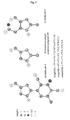
Figure 3 shows an example for the calculation of the weight of two molecules and their maximum weight common substructure. The weights of the compared molecules, the weight of their respective maximum weight common substructures and (optionally) the weights of the unmatched substructures can be combined into the final similarity measure. A commonly used combination schema is the tanimoto coefficient: simtanimoto(A,B) = weight(AB)/(weight(A)+weight(B)-weight(AB)). The similarity of the two molecules A and B shown inFigure 3 is 0.29. - The underlying idea of the presented method is the use of structural similarities between the screened molecules, such that multiple comparisons of identical substructures in different molecules are avoided. In a preprocessing step an index structure - the mDAG - of the given set of molecules is computed. The set of molecules has to contain both, the screened molecules and the active compounds used for the screening. The mDAG is a connected, directed acyclic graph (DAG). Directed acyclic graphs are known to the person skilled in the art of computer science and mathematics. A root of a DAG is a node which has only incoming, but no outgoing edges. The nodes of the mDAG are colored graphs. All molecules of the input are contained as nodes within the mDAG. For each pair of molecules of the input the mDAG contains pairs of paths such that the molecules are connected with their respective maximum (weight) common substructure. The weighting schema has not to be known during the construction of the mDAG. A prior knowledge of the weighting schema allows for a faster construction of a smaller targeted mDAG that is limited to weighting schemas that are similar to the one used during the construction.
-
Figure 4 shows a set of graphs that represent a set of molecules - the different node colors represent discernable chemical groups (The different colors are in the drawings represented by different grey scales, white and black). -
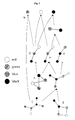
Figure 5 shows the mDAG of the set of molecules {A,B,C,D,E} using a subgraph-based similarity measure. Depending on the weighting schema only two graphs can become the maximum weight common subgraph of A and C, the graphs a and b. - It is not necessary that the mDAG of a set of graphs can be computed interactively or that it is minimal, i.e. that it contains a minimum number of nodes and edges. For the use as an efficient index structure it is sufficient, that it is possible to compute the mDAG for a large set of molecules and that it fits into the main memory of a computer to allow for fast searches. The mDAG of a set of two million druglike molecules, using a subgraph-based similarity measure, one protonation state per molecule and a reduced feature graph representation, can be done within a couple of days using a state of the art workstation. The resulting mDAG may have a size in the order of 10 gigabytes.
- The virtual screening for molecules similar to a given set of active compounds equals a local search within the precomputed mDAG. Starting from the active compounds triples comprising an active compound, a similar molecule and their respective maximum weight common substructure (cf.
Figure 3 ) are returned ordered by decreasing similarity. The search terminates, when the complete mDAG is traversed, a given minimum similarity is reached or a given maximal number of requested results is returned. The local search is similar to a breath first search (BFS) within an undirected version of the mDAG. However, in the present method the BFS-algorithm is additionally constrained, by walking zero, one or several steps up the path from the query molecule to a substructure and zero, one or several steps down the path to one of the molecules to be screened. - Preferably, the mDAG can also be used for the visualization of the underlying set of molecules. Due to its size it is not possible to show the complete mDAG of a non-trivial set of molecules, but it is possible to visualize one molecule together with its neighbors within the mDAG, such that the chemical space of the set of molecules can be interactively traversed by repeatedly selecting a molecule neighboring the currently selected molecule, followed by visualization of the newly selected molecule together with its neighbors. In this way it is possible for the user to "scroll" through the mDAG and find molecules similar to the starting molecule, which might be active substances, , without relying on similarities between the molecules that are computed using a global weighting schema, which does not explicitly give results of possibly active substances. By way of applying his knowledge and experience, the user might be able to find active substances faster than by screening molecules ordered by decreasing similarity.
- The mDAG of a given set of colored graphs (molecules) and a given structure based similarity measure can be computed by using a topological index - the tDAG - of the set of colored graphs.
- The tDAG is a connected, single rooted DAG. The nodes of the tDAG are uncolored graphs. Therefore, the tDAG does not contain information about the chemical or physical nature of the atoms or groups of the molecules. The tDAG of a given set of graphs contains all topologically different (non-isomorphic), connected, uncolored subgraphs of the given set of colored graphs. The nodes of the tDAG contain links to the corresponding molecules of the input set. A node of the tDAG may contain links to several different molecules, which are topologically identical if the chemical nature of the atoms is disregarded. Depending on the chosen structure based similarity measure two nodes of the tDAG are connected, when the graph corresponding to the target node can be derived from the graph corresponding to the source node by a primitive structural transformation, i.e. like the removal of an edge or a ring-to-star-transformation.
-
Figure 6 shows the tDAG of the set of colored graphs {A,B,C,D,E} using a subgraph based similarity measure. The graphs contained within the tDAG are uncolored. The colors used infigure 6 are solely used to visualize equivalent structural transformations. By removing any of the green colored edges of the graph B the graph b is reached by the green edge of the tDAG starting at B. Together with the uncolored graph each node of the tDAG stores a set of generators of the corresponding permutation group. The permutation group is the group of possible symmetry operations, which, applied to the graph result in an identical graph. - The algorithm generates during the calculation of the mDAG the complete substructure space, the cDAG, of the given set of colored graphs.
-
Figure 7 shows a picture of the substructure space of the set of colored graphs {A,B,C,D,E}. The cDAG is very large. For a nontrivial set of molecules it is not possible to store the entire cDAG. An approximate setcover algorithm is used to limit the output of the algorithm to a coarse superset of a minimal size mDAG. - Initially the colored graphs of the input set are assigned to the corresponding uncolored graphs of the tDAG. Then the algorithm calculates the mDAG level-by-level starting from the leafs most distant from the root and ending at the root(s) of the mDAG. Nodes of the DAG that have only outgoing and no incoming edges are leafs. The levels of the DAG are assigned such that the source of all edges of the DAG are in a higher level than the target. A sorting of the graphs according to their number of contained edges is sufficient in the presented case. For each level all colored graphs assigned to the same uncolored graph of the tDAG are processed together. First the generators of the permutation group of the uncolored graph are used to remove identical (isomorphic) colored graphs. Then the edges of the tDAG are used to derive and assign the subgraphs of the considered graphs to the next level. Finally the approximate setcover algorithm is used to decide for each colored graph (edge) of the cDAG if it has to be added to the mDAG.
-
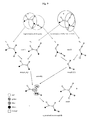
Figure 8 shows the state of the algorithm during the computation of the third level of the mDAG. The higher levels (four and five) of the mDAG are already computed. Nine differently (non-isomorphic) colored graphs {D,b,c,d,e,f,g,h,E} are considered. The graphs D and E belong to the input set; these graphs are always added to the mDAG. The graphs b,c,d,f,g and h have just one incident edge, therefore any pair of graphs, like B and C, which shares one of these graphs, in this case g, as a common subgraph, also shares its predecessor, a. For this reason the graph g can never become maximum common substructure of B and C because there exists a larger common substructure a, which is the maximum common substructure of B and C. Accordingly, graph g can be omitted from the mDAG. The graph e has two incident edges. One from A the other from a. By the first edge the input graph A can be reached, by the second edge the input graphs B and C. - Therefore e can become maximum weight common subgraph of the pairs A,B and A,C. The graph e has to be added to the mDAG.
- The algorithm can be stated as a classical setcover problem. Let X be the set of all nodes of the tDAG that correspond to colored graphs contained in the input set and that are reachable from the node under consideration. Let {X1,X2,...,Xn} be the set of sets of nodes that are reachable from the considered node by traversing the first, second,..., last incoming edge. Find a minimal size subset of {X1,X2,...,Xn} whose union contains all elements of X. For the solution of the problem any approximate or exact setcover algorithm can be used (see T. H. Cormen, C. E. Leiserson, and R. L. Rivest, "Introduction to Algorithms", McGraw-Hill, pages 974-978, 1990). If a single set Xi is sufficient to cover X the considered node is omitted from the mDAG. Otherwise the node, together with those edges that correspond to elements of the covering set, is added to the mDAG. In the case of the node e the set X equals {A,B,C} and the sets X1 and X2 equal {A} and {B,C}.
- Instead of storing the complete sets of all reachable molecules within each of the tDAG node it is much more space efficient to compute the sets whenever necessary by traversing the already computed part of the tDAG.
- The algorithm stores the unfinished levels using, for example, external memory such as a hard disc. Within a given level, first all contained colored subgraphs are sorted by their corresponding uncolored graphs in external memory. Then at a time only those colored graphs that correspond to a single uncolored graph (a node of the tDAG) are loaded.
- The size of the computed substructure space can be further reduced by the computation of a targeted mDAG. A targeted mDAG is computed like a normal mDAG, but together with the input set of colored graphs a weighting schema and a minimum similarity is given. This weighting schema is used to prune substructures where no pair of input graphs exists, such that: 1) The substructure is a minimum weight substructure of the given pair of graphs, and 2) the similarity between the pair of graphs is higher than the given minimum similarity.
- Instead of computing the sets X1, X2, ..., Xn corresponding to the incoming edges of the considered node n directly, it is possible to first traverse the already constructed part of the tDAG reachable from n in a breath-first search (BFS) fashion and to compute for each traversed node m the reachable subset of ingoing edges to n. A computed subset is output whenever the traversed node m corresponds to a molecule of the input set. Finally the sets X1, X2, ..., Xn are constructed from the output and the algorithm continues as before.
- The advantage of the improved version of the algorithm is, that it can be stopped at any time. When the algorithm is stopped, the nodes that are still contained in the BFS-queue are added to the output, irrespective if they correspond to input molecules or not. The derived setcover is a superset of the setcover derived after the normal termination of the BFS-algorithm.
Another advantage is, that it is not necessary to add sets to the output, which are covered by other sets that were written to the output before. This allows for an early termination of the BFS-algorithm, whenever all sets corresponding to the nodes contained in the BFS-queue are covered. - One way to compute the tDAG of a given set of molecules is by using a program, that computes for a given uncolored graph a canonical code. The program naughty (see B. D. McKay, "Practical Graph Isomorphism" Congr. Numer., volume 30, pages 45-87, 1981) is an example for such a kind of program. A canonical code of a graph is a number that is assigned to the given graph by means of a canonization procedure; like the procedure implemented within the program naughty. The canonization procedure guaranties that any pair of identical graphs is assigned the same canonical code and that any pair of non-identical graphs is assigned a pair of non-identical codes.
- The algorithm for the computation of the tDAG uses a lookup table that maps the canonical codes of the graphs currently contained in the tDAG to the nodes of the tDAG itself. For every molecule that has to be included into the tDAG first the corresponding uncolored graph is derived. Then the canonic code of the uncolored graph is computed. If the code is already present within the table the molecule is assigned to the corresponding node of the tDAG and the computation proceeds with the next molecule. Otherwise the uncolored graph is inserted into the tDAG, the molecule is assigned to the new node and the new node together with the corresponding canonic code is inserted into the table. Then recursively all direct substructures of the uncolored graph are derived by application of the underlying set of primitive structural transformations (like removing non-bridging edges or ring to star transformations) and inserted into the tDAG. Finally, after the termination of the recursive calls, the nodes of the tDAG corresponding to the substructures are connected with the node of the tDAG corresponding to the uncolored graph. The program naughty also computes a generating set of the permutation group of the uncolored graph. This set is needed for the computation of the mDAG and stored in the node too.
- The described procedure can in principle also be applied for the direct computation of the cDAG and thereby for the computation of the mDAG. However for a non-trivial set of input molecules the cDAG and the required lookup table do not fit into the memory of a computer, which means that the large amount of random access operations required by the algorithm have to be done using external memory. This renders the algorithm useless for the computation of the mDAG.
- Besides the described procedure several other algorithms exist, that can be used to compute the uncolored graphs corresponding to the nodes of the tDAG. The new idea about the computation of the tDAG is to store the graphs together with the connecting edges and to compute the tDAG at all, instead of computing the cDAG, which is too large to be used directly. The computation of the tDAG essentially splits the problem into a pure topological part that is solved by the tDAG and a colored part, which is addressed by the computation of the mDAG.
- Due to the exponential growth of the size of the chemical space in the size of the contained molecules, the presented method is limited to molecules having less than 35 edges. In order to process larger molecules a fragmentation, search and combine strategy can be used. Instead of indexing complete molecules, for each molecule a set of overlapping fragments is stored. During the search a set of query fragments is used instead of the complete query molecule. Finally maximum common substructure matches of fragments, which correspond to the same result molecule, are combined into an approximate maximum common substructure match of the complete query and the complete result molecule.
-
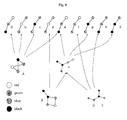
Figure 9 shows an example for the application of the fragmentation, search and combine strategy for the query molecule A and the result molecule B. InFigure 9 , the function mcsg(A,B) provides the maximum common substructure of A and B. - The fragmentation, search and combine strategy relies on the capability of the search procedure to retrieve large and therefore significant matching fragments in very short time, which is facilitated by the present invention.
- The present invention has now been described with reference to several embodiments thereof. It will be apparent to those skilled in the art that many changes can be made in the embodiments described without departing from the scope of the present invention. Thus the scope of the present invention should not be limited to the structures described in this application, but only by structures described by the language of the claims and the equivalents of those structures.
Claims (21)
- A topological index of a given set of molecules in form of a directed acyclic graph (tDAG), which contains all topologically different, connected, uncolored subgraphs of the given set of colored graphs, wherein the uncolored graphs are the nodes of the directed acyclic graph and two nodes of the tDAG are connected, when the graph corresponding to the target node can be derived from the graph corresponding to the source node by a primitive structural transformation..
- The index of claim 1, wherein molecules are included into the tDAG using different protonation states and representations.
- A directed acyclic graph of maximum common substructures (mDAG) of a given set of molecules, wherein the nodes are colored graphs, wherein all molecules to be screened and the query molecules are contained as nodes within the mDAG and wherein for each pair of molecules to be screened and the query molecules the mDAG contains paths such that the molecules are connected with their respective maximum common substructure.
- The directed acyclic graph of maximum common substructures of claim 3, wherein molecules are included into the tDAG using different protonation states and representations.
- The directed acyclic graph of maximum common substructures (mDAG) of claim 3, wherein a weighting schema is applied to determine the maximum weight common substructures (targeted mDAG).
- A method of computing a directed acyclic graph of maximum common substructures (mDAG) of a given set of molecules, for use in searching molecules among a number of molecules to be screened that are similar to a given set of query molecules, wherein the given set of molecules contains the molecules to be screened and the query molecules, wherein each molecule to be screened and each query molecule forms a node in the directed acyclic graph, the method comprising the steps of:a) determining for each pair of molecules of the given set of molecules a maximum common substructure forming nodes of the directed acyclic graph; andb) connecting each of the molecule with its respective maximum common substructure forming paths of the directed acyclic graph.
- The method of claim 6, wherein steps a) and b) are preceded by steps:a1) creating a node of the mDAG for each molecule to be screened and for each of the query molecules containing a colored graph of the molecule, except for molecules, for which an identical node already exists;a2) sorting the nodes into levels of the mDAG according to the number of bonds in the graph of the node or any other mean such that the source of all edges of the mDAG is assigned to a higher level than the target;a3) identifying and merging nodes that contain identical graph;a4) adding nodes that contain unique graphs to the mDAG, together with the corresponding incoming edges;a5) creating subgraphs for each node by performing primitive structural transformations starting from the highest level, wherein the edges of the mDAG denote said primitive structural transformations which transform the graph corresponding to the source node into the graph corresponding to the target node;a6) moving to the next lower level and repeating step a3) to a6) until the lowest level node, containing a subgraph consisting of one atom only, is reached.
- The method of claim 7, wherein in step a4) a set cover algorithm is used to limit the output of the algorithm to a coarse superset of a minimal size mDAG.
- The method of any of claims 6 to 8, wherein a subgraph-based similarity measure is used for determining the maximum common substructure.
- The method of any of claims 6 to 8, wherein an edit-distance-based similarity measure is used for determining the maximum common substructure.
- The method of any of claims 6 to 8, wherein a general topological-transformation-based similarity measure is used for determining the maximum common substructure.
- The method of any of claims 6 to 11, wherein a weighting schema is used for determining the maximum weight common substructure.
- The method of any of claims 6 to 12, wherein the mDAG is computed from a precomputed tDAG according to claim 1.
- A method for searching molecules among a number of molecules to be screened that are similar to a given set of query molecules, comprising the steps of:a) providing a directed acyclic graph of maximum common substructures (mDAG) of a given set of molecules;b) providing, for each query molecule, a data set comprising the query molecule, a molecule to be screened locally located in the directed acyclic graph, and their respective maximum common substructure.
- The method of claim 14, wherein the data set is created by walking zero, one or several steps up the path from the query molecule to a substructure and zero, one or several steps down the path to one of the molecules to be screened.
- The method of claim 14 or 15, wherein the data sets are calculated and outputted ordered by decreasing similarity.
- The method of any of claims 14 to 16, wherein the search terminates ifi) the complete directed acyclic graph is traversed;ii) a given minimum similarity is reached;iii) a given maximal number of requested results is returned.
- The method of any of claims 14 to 17, wherein in step a) a weighting schema is applied for providing a directed acyclic graph of maximum weight common substructures of a given set of molecules (targeted mDAG).
- The method of any of claims 14 to 18, wherein in step a) an mDAG according to claim 4 or 5 is provided.
- The method of any of claims 14 to 19, wherein one molecule together with its neighbors within the mDAG is visualized, such that the chemical space of the set of molecules can be interactively traversed by repeatedly selecting a molecule neighboring the currently selected molecule, followed by visualization of the newly selected molecule together with its neighbors.
- The method of any of claims 14 to 20, wherein steps a) and b) are preceded by a fragmentation step, wherein each of the query molecules and the molecules to be screened are fragmented into overlapping fragments, and steps a) and b) are succeeded by a combination step, wherein the fragments are combined.
Priority Applications (4)
| Application Number | Priority Date | Filing Date | Title |
|---|---|---|---|
| EP20070104765 EP1973050A1 (en) | 2007-03-23 | 2007-03-23 | Virtual screening of chemical spaces |
| PCT/EP2008/053330 WO2008116811A1 (en) | 2007-03-23 | 2008-03-19 | Virtual screening of chemical spaces |
| US12/531,662 US8428885B2 (en) | 2007-03-23 | 2008-03-19 | Virtual screening of chemical spaces |
| EP08718051.9A EP2140389B1 (en) | 2007-03-23 | 2008-03-19 | Virtual screening of chemical spaces |
Applications Claiming Priority (1)
| Application Number | Priority Date | Filing Date | Title |
|---|---|---|---|
| EP20070104765 EP1973050A1 (en) | 2007-03-23 | 2007-03-23 | Virtual screening of chemical spaces |
Publications (1)
| Publication Number | Publication Date |
|---|---|
| EP1973050A1 true EP1973050A1 (en) | 2008-09-24 |
Family
ID=38691142
Family Applications (2)
| Application Number | Title | Priority Date | Filing Date |
|---|---|---|---|
| EP20070104765 Withdrawn EP1973050A1 (en) | 2007-03-23 | 2007-03-23 | Virtual screening of chemical spaces |
| EP08718051.9A Not-in-force EP2140389B1 (en) | 2007-03-23 | 2008-03-19 | Virtual screening of chemical spaces |
Family Applications After (1)
| Application Number | Title | Priority Date | Filing Date |
|---|---|---|---|
| EP08718051.9A Not-in-force EP2140389B1 (en) | 2007-03-23 | 2008-03-19 | Virtual screening of chemical spaces |
Country Status (3)
| Country | Link |
|---|---|
| US (1) | US8428885B2 (en) |
| EP (2) | EP1973050A1 (en) |
| WO (1) | WO2008116811A1 (en) |
Families Citing this family (3)
| Publication number | Priority date | Publication date | Assignee | Title |
|---|---|---|---|---|
| WO2017059012A1 (en) * | 2015-09-29 | 2017-04-06 | Skytree, Inc. | Exporting a transformation chain including endpoint of model for prediction |
| US10740935B2 (en) * | 2019-01-11 | 2020-08-11 | International Business Machines Corporation | Molecular structure generation with substructure representations |
| CN113436686B (en) * | 2021-06-23 | 2024-02-27 | 腾讯科技(深圳)有限公司 | Compound library construction method, device, equipment and storage medium based on artificial intelligence |
Citations (1)
| Publication number | Priority date | Publication date | Assignee | Title |
|---|---|---|---|---|
| US20060224562A1 (en) * | 2005-03-31 | 2006-10-05 | International Business Machines Corporation | System and method for efficiently performing similarity searches of structural data |
Family Cites Families (1)
| Publication number | Priority date | Publication date | Assignee | Title |
|---|---|---|---|---|
| US7974978B2 (en) | 2004-04-30 | 2011-07-05 | International Business Machines Corporation | System and method for graph indexing |
-
2007
- 2007-03-23 EP EP20070104765 patent/EP1973050A1/en not_active Withdrawn
-
2008
- 2008-03-19 WO PCT/EP2008/053330 patent/WO2008116811A1/en not_active Ceased
- 2008-03-19 US US12/531,662 patent/US8428885B2/en not_active Expired - Fee Related
- 2008-03-19 EP EP08718051.9A patent/EP2140389B1/en not_active Not-in-force
Patent Citations (1)
| Publication number | Priority date | Publication date | Assignee | Title |
|---|---|---|---|---|
| US20060224562A1 (en) * | 2005-03-31 | 2006-10-05 | International Business Machines Corporation | System and method for efficiently performing similarity searches of structural data |
Non-Patent Citations (4)
| Title |
|---|
| CERRUELA GARCÍA GONZALO ET AL: "Step-by-step calculation of all maximum common substructures through a constraint satisfaction based algorithm.", JOURNAL OF CHEMICAL INFORMATION AND COMPUTER SCIENCES 2004 JAN-FEB, vol. 44, no. 1, January 2004 (2004-01-01), pages 30 - 41, XP002466662, ISSN: 0095-2338 * |
| RAYMOND JOHN W ET AL: "Effectiveness of graph-based and fingerprint-based similarity measures for virtual screening of 2D chemical structure databases", JOURNAL OF COMPUTER-AIDED MOLECULAR DESIGN, vol. 16, no. 1, January 2002 (2002-01-01), pages 59 - 71, XP002466665, ISSN: 0920-654X * |
| RAYMOND JOHN W ET AL: "Heuristics for similarity searching of chemical graphs using a maximum common edge subgraph algorithm.", JOURNAL OF CHEMICAL INFORMATION AND COMPUTER SCIENCES 2002 MAR-APR, vol. 42, no. 2, March 2002 (2002-03-01), pages 305 - 316, XP002466664, ISSN: 0095-2338 * |
| RAYMOND JOHN W ET AL: "Maximum common subgraph isomorphism algorithms for the matching of chemical structures.", JOURNAL OF COMPUTER-AIDED MOLECULAR DESIGN, vol. 16, no. 7, July 2002 (2002-07-01), pages 521 - 533, XP002466663, ISSN: 0920-654X * |
Also Published As
| Publication number | Publication date |
|---|---|
| EP2140389A1 (en) | 2010-01-06 |
| US8428885B2 (en) | 2013-04-23 |
| WO2008116811A1 (en) | 2008-10-02 |
| US20100325141A1 (en) | 2010-12-23 |
| EP2140389B1 (en) | 2016-05-11 |
Similar Documents
| Publication | Publication Date | Title |
|---|---|---|
| Brint et al. | Pharmacophoric pattern matching in files of 3D chemical structures: comparison of geometric searching algorithms | |
| Bystroff et al. | HMMSTR: a hidden Markov model for local sequence-structure correlations in proteins | |
| Awale et al. | Chemical space: big data challenge for molecular diversity | |
| Ndiaye et al. | When less is more: sketching with minimizers in genomics | |
| Djeddi et al. | A novel computational approach for global alignment for multiple biological networks | |
| US20030220716A1 (en) | Method and apparatus for automated design of chemical synthesis routes | |
| CN108804871A (en) | Key protein matter recognition methods based on maximum neighbours' subnet | |
| US8428885B2 (en) | Virtual screening of chemical spaces | |
| CN103810388A (en) | Large-scale ontology mapping method based on partitioning technology oriented towards mapping | |
| Li et al. | Seeding with minimized subsequence | |
| Hallinan¹ et al. | Asynchronous dynamics of an artificial genetic regulatory network | |
| Chen et al. | ClusterX: a novel representation learning-based deep clustering framework for accurate visual inspection in virtual screening | |
| Jin et al. | prague: A practical framework for blending visual subgraph query formulation and query processing | |
| KR100456627B1 (en) | System and method for predicting 3d-structure based on the macromolecular function | |
| Ferrari et al. | A grid-aware approach to protein structure comparison | |
| Nafar et al. | Data mining methods for protein-protein interactions | |
| Nishiyama-Jr et al. | The SUCEST-FUN regulatory network database: designing an energy grass. | |
| Chen | Substructure and maximal common substructure searching | |
| Ivković et al. | Designing dna microarrays with ant colony optimization | |
| Jungck et al. | Multiscale graph-theoretic modeling of biomolecular structures | |
| Duesbury | Applications and variations of the maximum common subgraph for the determination of chemical similarity | |
| Jancura et al. | Dividing protein interaction networks by growing orthologous articulations | |
| Mohapatra et al. | Motif search in DNA sequences using generalized suffix tree | |
| Chang | Data structures and algorithms for read mapping to pangenome graphs | |
| Lam et al. | Structural data mining on secondary genomic structure |
Legal Events
| Date | Code | Title | Description |
|---|---|---|---|
| PUAI | Public reference made under article 153(3) epc to a published international application that has entered the european phase |
Free format text: ORIGINAL CODE: 0009012 |
|
| AK | Designated contracting states |
Kind code of ref document: A1 Designated state(s): AT BE BG CH CY CZ DE DK EE ES FI FR GB GR HU IE IS IT LI LT LU LV MC MT NL PL PT RO SE SI SK TR |
|
| AX | Request for extension of the european patent |
Extension state: AL BA HR MK RS |
|
| AKX | Designation fees paid | ||
| STAA | Information on the status of an ep patent application or granted ep patent |
Free format text: STATUS: THE APPLICATION IS DEEMED TO BE WITHDRAWN |
|
| 18D | Application deemed to be withdrawn |
Effective date: 20090325 |
|
| REG | Reference to a national code |
Ref country code: DE Ref legal event code: 8566 |