EP1972357A1 - Release mechanism for patient interface and method for releasing patient interface - Google Patents
Release mechanism for patient interface and method for releasing patient interface Download PDFInfo
- Publication number
- EP1972357A1 EP1972357A1 EP08153251A EP08153251A EP1972357A1 EP 1972357 A1 EP1972357 A1 EP 1972357A1 EP 08153251 A EP08153251 A EP 08153251A EP 08153251 A EP08153251 A EP 08153251A EP 1972357 A1 EP1972357 A1 EP 1972357A1
- Authority
- EP
- European Patent Office
- Prior art keywords
- cord
- mask
- latch
- elongate
- tape
- Prior art date
- Legal status (The legal status is an assumption and is not a legal conclusion. Google has not performed a legal analysis and makes no representation as to the accuracy of the status listed.)
- Granted
Links
- 230000007246 mechanism Effects 0.000 title claims abstract description 35
- 238000000034 method Methods 0.000 title claims description 8
- 230000008901 benefit Effects 0.000 description 4
- 230000000994 depressogenic effect Effects 0.000 description 3
- 206010009244 Claustrophobia Diseases 0.000 description 2
- 238000012986 modification Methods 0.000 description 2
- 230000004048 modification Effects 0.000 description 2
- 208000019899 phobic disease Diseases 0.000 description 2
- 206010007559 Cardiac failure congestive Diseases 0.000 description 1
- 206010019280 Heart failures Diseases 0.000 description 1
- 208000008589 Obesity Diseases 0.000 description 1
- 208000006011 Stroke Diseases 0.000 description 1
- 238000007681 bariatric surgery Methods 0.000 description 1
- 208000012696 congenital leptin deficiency Diseases 0.000 description 1
- 206010012601 diabetes mellitus Diseases 0.000 description 1
- 238000003780 insertion Methods 0.000 description 1
- 230000037431 insertion Effects 0.000 description 1
- 208000001022 morbid obesity Diseases 0.000 description 1
- 230000000414 obstructive effect Effects 0.000 description 1
- 201000002859 sleep apnea Diseases 0.000 description 1
Images






Classifications
-
- A—HUMAN NECESSITIES
- A61—MEDICAL OR VETERINARY SCIENCE; HYGIENE
- A61M—DEVICES FOR INTRODUCING MEDIA INTO, OR ONTO, THE BODY; DEVICES FOR TRANSDUCING BODY MEDIA OR FOR TAKING MEDIA FROM THE BODY; DEVICES FOR PRODUCING OR ENDING SLEEP OR STUPOR
- A61M16/00—Devices for influencing the respiratory system of patients by gas treatment, e.g. ventilators; Tracheal tubes
- A61M16/06—Respiratory or anaesthetic masks
- A61M16/0683—Holding devices therefor
-
- A—HUMAN NECESSITIES
- A44—HABERDASHERY; JEWELLERY
- A44B—BUTTONS, PINS, BUCKLES, SLIDE FASTENERS, OR THE LIKE
- A44B11/00—Buckles; Similar fasteners for interconnecting straps or the like, e.g. for safety belts
- A44B11/25—Buckles; Similar fasteners for interconnecting straps or the like, e.g. for safety belts with two or more separable parts
-
- A—HUMAN NECESSITIES
- A44—HABERDASHERY; JEWELLERY
- A44B—BUTTONS, PINS, BUCKLES, SLIDE FASTENERS, OR THE LIKE
- A44B11/00—Buckles; Similar fasteners for interconnecting straps or the like, e.g. for safety belts
- A44B11/25—Buckles; Similar fasteners for interconnecting straps or the like, e.g. for safety belts with two or more separable parts
- A44B11/2503—Safety buckles
- A44B11/2546—Details
-
- A—HUMAN NECESSITIES
- A61—MEDICAL OR VETERINARY SCIENCE; HYGIENE
- A61M—DEVICES FOR INTRODUCING MEDIA INTO, OR ONTO, THE BODY; DEVICES FOR TRANSDUCING BODY MEDIA OR FOR TAKING MEDIA FROM THE BODY; DEVICES FOR PRODUCING OR ENDING SLEEP OR STUPOR
- A61M16/00—Devices for influencing the respiratory system of patients by gas treatment, e.g. ventilators; Tracheal tubes
- A61M16/06—Respiratory or anaesthetic masks
- A61M16/0605—Means for improving the adaptation of the mask to the patient
- A61M16/0616—Means for improving the adaptation of the mask to the patient with face sealing means comprising a flap or membrane projecting inwards, such that sealing increases with increasing inhalation gas pressure
- A61M16/0622—Means for improving the adaptation of the mask to the patient with face sealing means comprising a flap or membrane projecting inwards, such that sealing increases with increasing inhalation gas pressure having an underlying cushion
-
- A—HUMAN NECESSITIES
- A61—MEDICAL OR VETERINARY SCIENCE; HYGIENE
- A61M—DEVICES FOR INTRODUCING MEDIA INTO, OR ONTO, THE BODY; DEVICES FOR TRANSDUCING BODY MEDIA OR FOR TAKING MEDIA FROM THE BODY; DEVICES FOR PRODUCING OR ENDING SLEEP OR STUPOR
- A61M16/00—Devices for influencing the respiratory system of patients by gas treatment, e.g. ventilators; Tracheal tubes
- A61M16/06—Respiratory or anaesthetic masks
- A61M16/0605—Means for improving the adaptation of the mask to the patient
- A61M16/0633—Means for improving the adaptation of the mask to the patient with forehead support
-
- A—HUMAN NECESSITIES
- A61—MEDICAL OR VETERINARY SCIENCE; HYGIENE
- A61M—DEVICES FOR INTRODUCING MEDIA INTO, OR ONTO, THE BODY; DEVICES FOR TRANSDUCING BODY MEDIA OR FOR TAKING MEDIA FROM THE BODY; DEVICES FOR PRODUCING OR ENDING SLEEP OR STUPOR
- A61M16/00—Devices for influencing the respiratory system of patients by gas treatment, e.g. ventilators; Tracheal tubes
- A61M16/08—Bellows; Connecting tubes ; Water traps; Patient circuits
- A61M16/0816—Joints or connectors
-
- A—HUMAN NECESSITIES
- A41—WEARING APPAREL
- A41D—OUTERWEAR; PROTECTIVE GARMENTS; ACCESSORIES
- A41D2400/00—Functions or special features of garments
- A41D2400/44—Donning facilities
-
- A—HUMAN NECESSITIES
- A61—MEDICAL OR VETERINARY SCIENCE; HYGIENE
- A61M—DEVICES FOR INTRODUCING MEDIA INTO, OR ONTO, THE BODY; DEVICES FOR TRANSDUCING BODY MEDIA OR FOR TAKING MEDIA FROM THE BODY; DEVICES FOR PRODUCING OR ENDING SLEEP OR STUPOR
- A61M16/00—Devices for influencing the respiratory system of patients by gas treatment, e.g. ventilators; Tracheal tubes
- A61M16/06—Respiratory or anaesthetic masks
Definitions
- the present invention relates to quick release mechanisms for allowing a patient interface, such as a Continuous Positive Airway Pressure (CPAP) mask, to be quickly and easily removed from a patient's face. More particularly, the invention relates to a clip assembly for interconnection between a patient interface and headgear.
- CPAP Continuous Positive Airway Pressure
- CPAP masks are generally used for treating Obstructive Sleep Apnoea (OSA) and can take a number of different forms, such as a nasal, full-face or nasal prong type mask.
- OSA Obstructive Sleep Apnoea
- a mask according to the invention can be removed from the patient's face quickly and easily in one continuous movement in the case of an emergency or discomfort (e.g. claustrophobia).
- some other masks with quick release mechanisms require three movements (particularly when the patient is lying on their back), these being: (1) pulling the cord to undo/release the headgear, (2) gripping the mask, and (3) removing the mask from the face.
- Another advantage of the mask of the present invention is that it is removed by pulling the cord across one's face rather than outwardly. This is a natural, ergonomic hand/arm movement and so can be readily performed in an emergency.
- the mask also advantageously provides both a headgear clip and quick release clip in one clip. This allows the clip to be easily retrofitted to current mask products and may reduce the total number of parts required to achieve the same functionality. It should be appreciated that one or more of these advantages apply to the following aspects of the invention.
- An aspect of the invention relates to a quick release mechanism for allowing a patient interface to be quickly and easily removed from the patient's face.
- Another aspect of the invention relates to a clip for interconnection between a patient interface and headgear, the clip performing the function of both a headgear clip and a quick release clip.
- the patient interface can be quickly released and removed from a patient's face by simply pulling on a cord attached to the clip.
- Yet another aspect of the invention relates to a pull cord for a patient mask which, when pulled by a patient, disengages one side of the headgear from the mask and pulls the mask off the patient's face.
- a mechanism for releasing a mask from a patient's face comprises a first portion comprising a latch; a second portion comprising a latch receiving portion that is adapted to receive the latch when a headgear of the mask is engaged with a frame of the mask; and a cord secured to the latch such that when the cord is pulled by the patient the latch disengages from the latch receiving portion and the mask is pulled off the patient's face.
- a clip assembly for releasing a mask from a patient's face comprises a first portion adapted for releasable attachment to a frame of the mask; and a second portion adapted for releasable attachment to a headgear of the mask, the first and second portions together comprising a disconnection arrangement, wherein the disconnection arrangement comprises a manual actuation member which when actuated by a patient causes the first portion to disconnect from the second portion and the mask to be pulled off and away from the patient's face by a single movement of the actuation member.
- a mask comprises a frame having at least one male portion, the male portion comprising a latch; headgear having at least one female portion, the female portion comprising a latch receiving portion that is adapted to receive the latch when the male portion is inserted into the female portion; and a cord having one end secured to the latch, such that when the cord is pulled by the patient, the latch disengages from the latch receiving portion and the frame is pulled away from the patient's face.
- a method of releasing a mask from a patient's face comprises pulling a cord toward a frame of the mask to release a latch of the mask frame from a latch receiving portion of a headgear of the mask to release the latch from the latch receiving portion.
- Fig. 1 shows a perspective view of a mask including a headgear clip having a pull-cord quick release mechanism in accordance with a first embodiment of the present invention
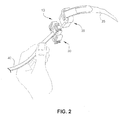
- Fig. 2 shows a perspective view of the headgear clip of Fig. 1 where the quick release mechanism has been activated by a patient;
- Fig. 3 shows a perspective view of the headgear clip of Fig. 1 where the quick release mechanism has not been activated
- Fig. 4 shows a perspective view of the headgear clip of Fig. 1 where the quick release mechanism has been activated.
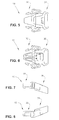
- Fig. 5 shows a top view of the headgear clip of Fig. 1 ;
- Fig. 6 shows a bottom view of the headgear clip of Fig. 1 ;
- Figs. 7 and 8 show left and right side views of the headgear clip of Fig. 1 ;
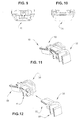
- Figs. 9 and 10 show front and rear end views of the headgear clip of Fig. 1 ;
- Fig. 11 shows a perspective cross-sectional view of the headgear clip of Fig. 1 where the quick release mechanism has not been activated;
- Fig. 12 shows a perspective cross-sectional view of the headgear clip of Fig. 1 where the quick release mechanism has been activated;
- Fig. 13 shows a side cross-sectional view of the headgear clip of Fig. 1 where the quick release mechanism has not been activated;
- Fig. 14 shows a side cross-sectional view of the headgear clip of Fig. 1 where the quick release mechanism has been activated;
- Fig. 15 shows a top view of a frame part of the headgear clip of Fig. 1 ;
- Fig. 16 shows a bottom view of the frame part of Fig. 15 ;
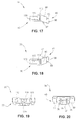
- Figs. 17 and 18 show left and right side views of the frame part of Fig. 15 ;
- Figs. 19 and 20 show front and rear end views of the frame part of Fig. 15 ;
- Fig. 21 shows a top view of a headgear part of the headgear clip of Fig. 1 ;
- Fig. 22 shows a bottom view of the headgear part of Fig. 21 ;
- Figs. 23 and 24 show left and right side views of the headgear part of Fig. 21 ;
- Figs. 25 and 26 show front and rear end views of the headgear part of Fig. 21 ;
- Fig. 27 shows a perspective view of a latching portion of the headgear clip of Fig. 1 ;
- Fig. 28 shows a perspective cross-sectional view of the latching portion of Fig. 27 ;
- Fig. 29 shows a perspective cross-sectional view of the latching portion of Fig. 27 where the quick release mechanism has been activated
- Fig. 30 shows a perspective cross-sectional view of the latching portion of Fig. 27 where the quick release mechanism has not been activated
- Figs. 31-34 show a sequence of side cross-sectional views that depict the releasing of the quick release mechanism of the headgear clip of Fig. 1 , wherein
- Fig. 31 shows the clip in a connected state
- Fig. 32 shows a lip of the latching portion of the quick release mechanism being translated downwards
- Fig. 33 shows the lip disengaged from an aperture in the headgear part of the clip
- Fig. 34 shows the headgear part released from the frame part of the clip.
- Figs. 1-14 depict a quick release clip 10 for a patient interface or mask 15.
- the clip 10 is located between a frame 20 and headgear 25 of the mask 15 and allows a patient to disconnect the frame 20 from the headgear 25 and remove the frame 20 from their face.
- the clip 10 comprises a frame part 30, a headgear part 35 and a cord 40.
- the frame part 30 comprises a male connection 45, e.g. a latch, at one end and a frame engagement portion 50 at the other.
- the headgear part 35 comprises a female connection 55, e.g. a latch receiving portion, at one end and a headgear engagement portion 60 at the other.
- the male connection 45 is sized and adapted to be slidingly received within the female connection 55.
- the male connection 45 comprises two substantially parallel longitudinal side walls 56, a transverse wall 57 extending between and connecting the side walls 56 and an arm 65 extending longitudinally from the transverse wall 57.
- a proximal end 75 of the arm 65 is fixedly mounted to the transverse wall 57.
- a distal end 80 of the arm 65 can be resiliently displaced with respect to the proximal end 75.
- the distal end 80 includes an elongate lip 85 having a wedge-shaped cross-section that is configured to cooperate with an aperture 86 in the headgear part 35.
- the overall length and width of the frame part 30 are approximately 20 - 35 mm, for example 28mm, and 25 - 50 mm, for example 33mm, respectively.
- the two substantially parallel side walls 56 are approximately 10-35 mm, for example 18 mm, apart.
- the arm 65 is approximately 10 - 20 mm, for example 13 mm, long and the elongate lip 85 is approximately 2- 6 mm, for example 3.5 mm, wide and approximately 3-15 mm, for example 8 mm, long.
- the arm 65 is approximately 0.5 - 3 mm, for example 0.9mm, thick and the lip 85 is approximately 0.7 - 3 mm, for example 1.2 mm, thick.
- the transverse wall 57 is approximately 5 - 16 mm, for example 11 mm, long.
- a rectangular ring-like structure 87 is provided to which one end of the cord 40 is secured.
- the cord 40 then extends forwards (towards the frame engagement portion 50) underneath the arm 65, under the transverse wall 57 and up through an aperture 88 in the frame part 30.
- the aperture 88 is approximately 5 - 15 m, for example 10mm, long and approximately 1 - 3 mm, for example 2mm, wide.
- the frame engagement portion 50 of the frame part 30 comprises two frog-like legs 90 that extend respectively from either side of a mid-section 95 of the frame part 30, and a central tongue 100.
- the legs 90 are shaped such that they initially extend rearwards in spaced relation to the male connection 45 then double back over themselves and extend approximately the length of the frame part 30 in spaced relation to the rearwardly extending portion of the legs 90 and then to the tongue 100.
- Free ends 105 of the legs 90 include arrow-like portions 110 that are configured to engage apertures/recesses 111 provided by headgear clip receptacles 115 in the frame 20.
- the free ends 105 of the legs 90 are approximately 21 mm apart.
- Each leg 90 includes a gripping region 112 comprising a series of ribs adjacent the respective dog-leg portion 120.
- the arrow-like portions 110 are resiliently displaced towards each other by manual clamping of the gripping regions 112 during insertion of the frame engagement portion 50 into the headgear clip receptacles 115. Once properly located, the legs can be released and the arrow-like portions locate in the apertures/recesses 111 to lock the frame engagement portion 50 to the frame 20.
- the free ends 105 of the legs 90 are approximately 3-8, for example 5mm, wide and approximately 0.7 - 3 mm, for example 1.2mm, thick.
- the legs 90 also include dog-leg portions 120 that enable the legs 90 to run closer to the sides of the tongue 100.
- the dog-leg portions 120 are located approximately 5 - 16 mm, for example 11 mm, back from the front of the tongue 100.
- the tongue 100 includes a convergent longitudinal recess 125 that is adapted to slidingly receive a wall portion 130 of the clip receptacles 115. Provision of the recess 125 and wall portion 130 aids location of the frame engagement portion 50 in the clip receptacles 115, which might otherwise be difficult for patient's who are not particularly dextrous.
- the tongue is approximately 4 - 11 mm, for example 7mm, thick.
- the headgear part 35 will now be described with reference to Figs. 21 to 26 .
- the female connection 55 is configured to slidingly receive the male connection 45. Once properly located, the lip 85 of the arm 65 of the male connection 45 engages the aperture 86 and retains the male connection 45 substantially within the female connection 55.
- the headgear engagement portion 60 comprises a loop 135 having a width and height that are sufficient to allow it to slidingly receive a strap of the headgear 25.
- the headgear part 35 is approximately 20 - 30 mm, for example 25mm, wide at the headgear engagement portion 60 and approximately 10-30 mm, for example 19mm, wide at the female connection 55.
- the headgear part 35 is approximately 15 - 40 mm, for example 23mm, long and approximately 4 - 11 mm, for example 8mm, thick.
- the general recess provided by the female connection 55 for receiving the male connection 45 is approximately 10-35 mm, for example 17mm, wide and approximately 3 - 10 mm, for example 7mm, high.
- the aperture 86 is approximately 2 - 6 mm, for example 3.6mm, wide.
- Fig. 31 shows the clip 10 in normal use with the frame part 30 secured to the headgear part 35.
- the patient or a clinician or other third party has decided to remove the mask 15 from the patient and so has pulled the cord 40.
- the cord 40 slides under the transverse wall 57 and pulls the arm 65 and lip 85 downwardly. This moves the lip 85 out of engagement with the aperture 86.
- the transverse wall 57 ensures that the force applied to the arm 65 by the cord 40 is in the correct direction (i.e. downwards) to bend the arm 65.
- the cord 40 can be pulled at a range of different angles including, from left-to-right (in use) an angular range of about 180 degrees and from up-to-down (in use) an angular range of about 120 degrees.
- the male connection 45 slides out of the female connection 55 until the frame part 30 is completely separated from the headgear part 35 as depicted in Fig. 34 .
- the mask 15 can be pulled off the patient's face altogether.
- the mask 15 can advantageously be released and removed from the patient's face by a single movement, that is, the pulling of the pull cord 40.
- the mask 15 can be removed quickly and easily in the case of an emergency or even discomfort (e.g. claustrophobia).
- some other masks with quick release mechanisms require three movements (particularly when the patient is lying on their back), these being: (1) pulling the cord to undo/release the headgear, (2) gripping the mask, and (3) removing the mask from the face.
- Another advantage of the mask 15 is that it is removed by pulling the cord across one's face. This is a natural, ergonomic hand/arm movement and so can be readily performed in an emergency.
- the invention provides both a headgear clip and quick release clip in the one clip. This allows the clip to be easily retrofitted to current mask products and may reduce the total number of parts required to achieve the same functionality.
- the cord 40 may include a loop along its length or at its free end to aid a patient in pulling it.
- the cord 40 is replaced by a springloaded button or a lever.
- the button is depressed or the lever is actuated the arm 65 is depressed and similar functionality is achieved to the cord 40.
- the button faces away from the patient's face such that it can be easily accessed but cannot easily be accidentally depressed.
- the cord 40 may have a round cross-section to allow the cord to be pulled over a wider range of angles (left to right, up to down) and still allow the clip 10 to properly function.
- the aperture 88 may take a convex conical form or a form that tapers from a smaller diameter to a larger diameter with large radius' around both edges.
- the lip 85 may have a different cross-section.
- the cross-section will enable better retainment of the headgear part 35 to the frame part 30 if the cross-section includes a retaining wall (i.e. a wall like the perpendicular wall provided by the wedge cross-section). Therefore, other suitable lip 85 cross-sections include a rectangular cross-section and a semi-bullet-shaped cross-section.
Landscapes
- Health & Medical Sciences (AREA)
- Emergency Medicine (AREA)
- Pulmonology (AREA)
- Engineering & Computer Science (AREA)
- Anesthesiology (AREA)
- Biomedical Technology (AREA)
- Heart & Thoracic Surgery (AREA)
- Hematology (AREA)
- Life Sciences & Earth Sciences (AREA)
- Animal Behavior & Ethology (AREA)
- General Health & Medical Sciences (AREA)
- Public Health (AREA)
- Veterinary Medicine (AREA)
- Respiratory Apparatuses And Protective Means (AREA)
Abstract
Description
- This application claims priority to Australian Provisional Application
2007901505, filed March 23, 2007 U.S. Provisional Application 60/969,723, filed September 4, 2007 - The present invention relates to quick release mechanisms for allowing a patient interface, such as a Continuous Positive Airway Pressure (CPAP) mask, to be quickly and easily removed from a patient's face. More particularly, the invention relates to a clip assembly for interconnection between a patient interface and headgear.
- CPAP masks are generally used for treating Obstructive Sleep Apnoea (OSA) and can take a number of different forms, such as a nasal, full-face or nasal prong type mask.
- Various connection and release mechanisms or arrangements for masks are known. Examples of these include
U.S. Patent 6,422,238 (Lithgow ),U.S. Patent 5,441,046 (Starr et al. ) andWO 2004/030736 (Gradon et al. ). - Advantageously, a mask according to the invention can be removed from the patient's face quickly and easily in one continuous movement in the case of an emergency or discomfort (e.g. claustrophobia). To remove a mask from one's face, some other masks with quick release mechanisms require three movements (particularly when the patient is lying on their back), these being: (1) pulling the cord to undo/release the headgear, (2) gripping the mask, and (3) removing the mask from the face. Another advantage of the mask of the present invention is that it is removed by pulling the cord across one's face rather than outwardly. This is a natural, ergonomic hand/arm movement and so can be readily performed in an emergency. The mask also advantageously provides both a headgear clip and quick release clip in one clip. This allows the clip to be easily retrofitted to current mask products and may reduce the total number of parts required to achieve the same functionality. It should be appreciated that one or more of these advantages apply to the following aspects of the invention.
- An aspect of the invention relates to a quick release mechanism for allowing a patient interface to be quickly and easily removed from the patient's face.
- Another aspect of the invention relates to a clip for interconnection between a patient interface and headgear, the clip performing the function of both a headgear clip and a quick release clip. The patient interface can be quickly released and removed from a patient's face by simply pulling on a cord attached to the clip.
- Yet another aspect of the invention relates to a pull cord for a patient mask which, when pulled by a patient, disengages one side of the headgear from the mask and pulls the mask off the patient's face.
- According to a sample embodiment of the invention, a mechanism for releasing a mask from a patient's face comprises a first portion comprising a latch; a second portion comprising a latch receiving portion that is adapted to receive the latch when a headgear of the mask is engaged with a frame of the mask; and a cord secured to the latch such that when the cord is pulled by the patient the latch disengages from the latch receiving portion and the mask is pulled off the patient's face.
- According to still another sample embodiment of the invention, a clip assembly for releasing a mask from a patient's face comprises a first portion adapted for releasable attachment to a frame of the mask; and a second portion adapted for releasable attachment to a headgear of the mask, the first and second portions together comprising a disconnection arrangement, wherein the disconnection arrangement comprises a manual actuation member which when actuated by a patient causes the first portion to disconnect from the second portion and the mask to be pulled off and away from the patient's face by a single movement of the actuation member.
- According to a further sample embodiment of the invention, a mask comprises a frame having at least one male portion, the male portion comprising a latch; headgear having at least one female portion, the female portion comprising a latch receiving portion that is adapted to receive the latch when the male portion is inserted into the female portion; and a cord having one end secured to the latch, such that when the cord is pulled by the patient, the latch disengages from the latch receiving portion and the frame is pulled away from the patient's face.
- According to yet another sample embodiment of the invention, a method of releasing a mask from a patient's face comprises pulling a cord toward a frame of the mask to release a latch of the mask frame from a latch receiving portion of a headgear of the mask to release the latch from the latch receiving portion.
- These and other aspects will be described in or apparent from the following detailed description.
- The accompanying drawings facilitate an understanding of the various embodiments of the present invention. In such drawings:
-
Fig. 1 shows a perspective view of a mask including a headgear clip having a pull-cord quick release mechanism in accordance with a first embodiment of the present invention; -
Fig. 2 shows a perspective view of the headgear clip ofFig. 1 where the quick release mechanism has been activated by a patient; -
Fig. 3 shows a perspective view of the headgear clip ofFig. 1 where the quick release mechanism has not been activated; -
Fig. 4 shows a perspective view of the headgear clip ofFig. 1 where the quick release mechanism has been activated. -
Fig. 5 shows a top view of the headgear clip ofFig. 1 ; -
Fig. 6 shows a bottom view of the headgear clip ofFig. 1 ; -
Figs. 7 and 8 show left and right side views of the headgear clip ofFig. 1 ; -
Figs. 9 and 10 show front and rear end views of the headgear clip ofFig. 1 ; -
Fig. 11 shows a perspective cross-sectional view of the headgear clip ofFig. 1 where the quick release mechanism has not been activated; -
Fig. 12 shows a perspective cross-sectional view of the headgear clip ofFig. 1 where the quick release mechanism has been activated; -
Fig. 13 shows a side cross-sectional view of the headgear clip ofFig. 1 where the quick release mechanism has not been activated; -
Fig. 14 shows a side cross-sectional view of the headgear clip ofFig. 1 where the quick release mechanism has been activated; -
Fig. 15 shows a top view of a frame part of the headgear clip ofFig. 1 ; -
Fig. 16 shows a bottom view of the frame part ofFig. 15 ; -
Figs. 17 and 18 show left and right side views of the frame part ofFig. 15 ; -
Figs. 19 and 20 show front and rear end views of the frame part ofFig. 15 ; -
Fig. 21 shows a top view of a headgear part of the headgear clip ofFig. 1 ; -
Fig. 22 shows a bottom view of the headgear part ofFig. 21 ; -
Figs. 23 and 24 show left and right side views of the headgear part ofFig. 21 ; -
Figs. 25 and 26 show front and rear end views of the headgear part ofFig. 21 ; -
Fig. 27 shows a perspective view of a latching portion of the headgear clip ofFig. 1 ; -
Fig. 28 shows a perspective cross-sectional view of the latching portion ofFig. 27 ; -
Fig. 29 shows a perspective cross-sectional view of the latching portion ofFig. 27 where the quick release mechanism has been activated; -
Fig. 30 shows a perspective cross-sectional view of the latching portion ofFig. 27 where the quick release mechanism has not been activated; and -
Figs. 31-34 show a sequence of side cross-sectional views that depict the releasing of the quick release mechanism of the headgear clip ofFig. 1 , wherein -
Fig. 31 shows the clip in a connected state; -
Fig. 32 shows a lip of the latching portion of the quick release mechanism being translated downwards; -
Fig. 33 shows the lip disengaged from an aperture in the headgear part of the clip, and -
Fig. 34 shows the headgear part released from the frame part of the clip. -
Figs. 1-14 depict aquick release clip 10 for a patient interface ormask 15. Theclip 10 is located between aframe 20 andheadgear 25 of themask 15 and allows a patient to disconnect theframe 20 from theheadgear 25 and remove theframe 20 from their face. Theclip 10 comprises aframe part 30, aheadgear part 35 and acord 40. Theframe part 30 comprises amale connection 45, e.g. a latch, at one end and aframe engagement portion 50 at the other. Theheadgear part 35 comprises afemale connection 55, e.g. a latch receiving portion, at one end and aheadgear engagement portion 60 at the other. - The
frame part 30 will now be described with reference toFigs. 15-20 and27-30 . Themale connection 45 is sized and adapted to be slidingly received within thefemale connection 55. Themale connection 45 comprises two substantially parallellongitudinal side walls 56, atransverse wall 57 extending between and connecting theside walls 56 and anarm 65 extending longitudinally from thetransverse wall 57. Aproximal end 75 of thearm 65 is fixedly mounted to thetransverse wall 57. Adistal end 80 of thearm 65 can be resiliently displaced with respect to theproximal end 75. Thedistal end 80 includes anelongate lip 85 having a wedge-shaped cross-section that is configured to cooperate with anaperture 86 in theheadgear part 35. - The overall length and width of the
frame part 30 are approximately 20 - 35 mm, for example 28mm, and 25 - 50 mm, for example 33mm, respectively. The two substantiallyparallel side walls 56 are approximately 10-35 mm, for example 18 mm, apart. Thearm 65 is approximately 10 - 20 mm, for example 13 mm, long and theelongate lip 85 is approximately 2- 6 mm, for example 3.5 mm, wide and approximately 3-15 mm, for example 8 mm, long. Thearm 65 is approximately 0.5 - 3 mm, for example 0.9mm, thick and thelip 85 is approximately 0.7 - 3 mm, for example 1.2 mm, thick. Thetransverse wall 57 is approximately 5 - 16 mm, for example 11 mm, long. - Underneath the
arm 65, substantially opposite thelip 85, a rectangular ring-like structure 87 is provided to which one end of thecord 40 is secured. Thecord 40 then extends forwards (towards the frame engagement portion 50) underneath thearm 65, under thetransverse wall 57 and up through anaperture 88 in theframe part 30. Theaperture 88 is approximately 5 - 15 m, for example 10mm, long and approximately 1 - 3 mm, for example 2mm, wide. - The
frame engagement portion 50 of theframe part 30 comprises two frog-like legs 90 that extend respectively from either side of a mid-section 95 of theframe part 30, and acentral tongue 100. Thelegs 90 are shaped such that they initially extend rearwards in spaced relation to themale connection 45 then double back over themselves and extend approximately the length of theframe part 30 in spaced relation to the rearwardly extending portion of thelegs 90 and then to thetongue 100. - Free ends 105 of the
legs 90 include arrow-like portions 110 that are configured to engage apertures/recesses 111 provided byheadgear clip receptacles 115 in theframe 20. The free ends 105 of thelegs 90 are approximately 21 mm apart. Eachleg 90 includes agripping region 112 comprising a series of ribs adjacent the respective dog-leg portion 120. In use, the arrow-like portions 110 are resiliently displaced towards each other by manual clamping of thegripping regions 112 during insertion of theframe engagement portion 50 into theheadgear clip receptacles 115. Once properly located, the legs can be released and the arrow-like portions locate in the apertures/recesses 111 to lock theframe engagement portion 50 to theframe 20. The free ends 105 of thelegs 90 are approximately 3-8, for example 5mm, wide and approximately 0.7 - 3 mm, for example 1.2mm, thick. - The
legs 90 also include dog-leg portions 120 that enable thelegs 90 to run closer to the sides of thetongue 100. The dog-leg portions 120 are located approximately 5 - 16 mm, for example 11 mm, back from the front of thetongue 100. - The
tongue 100 includes a convergentlongitudinal recess 125 that is adapted to slidingly receive awall portion 130 of theclip receptacles 115. Provision of therecess 125 andwall portion 130 aids location of theframe engagement portion 50 in theclip receptacles 115, which might otherwise be difficult for patient's who are not particularly dextrous. The tongue is approximately 4 - 11 mm, for example 7mm, thick. - The
headgear part 35 will now be described with reference toFigs. 21 to 26 . Thefemale connection 55 is configured to slidingly receive themale connection 45. Once properly located, thelip 85 of thearm 65 of themale connection 45 engages theaperture 86 and retains themale connection 45 substantially within thefemale connection 55. Theheadgear engagement portion 60 comprises aloop 135 having a width and height that are sufficient to allow it to slidingly receive a strap of theheadgear 25. - The
headgear part 35 is approximately 20 - 30 mm, for example 25mm, wide at theheadgear engagement portion 60 and approximately 10-30 mm, for example 19mm, wide at thefemale connection 55. Theheadgear part 35 is approximately 15 - 40 mm, for example 23mm, long and approximately 4 - 11 mm, for example 8mm, thick. The general recess provided by thefemale connection 55 for receiving themale connection 45 is approximately 10-35 mm, for example 17mm, wide and approximately 3 - 10 mm, for example 7mm, high. Theaperture 86 is approximately 2 - 6 mm, for example 3.6mm, wide. - The functionality of the
clip 10 will now be described with particular reference toFigs. 31 to 34. Fig. 31 shows theclip 10 in normal use with theframe part 30 secured to theheadgear part 35. - In
Fig. 32 , the patient or a clinician or other third party has decided to remove themask 15 from the patient and so has pulled thecord 40. Thecord 40 slides under thetransverse wall 57 and pulls thearm 65 andlip 85 downwardly. This moves thelip 85 out of engagement with theaperture 86. Advantageously, thetransverse wall 57 ensures that the force applied to thearm 65 by thecord 40 is in the correct direction (i.e. downwards) to bend thearm 65. Thus, thecord 40 can be pulled at a range of different angles including, from left-to-right (in use) an angular range of about 180 degrees and from up-to-down (in use) an angular range of about 120 degrees. - Referring to
Fig. 33 , by further pulling of thecord 40 themale connection 45 slides out of thefemale connection 55 until theframe part 30 is completely separated from theheadgear part 35 as depicted inFig. 34 . By continuing the pulling action, themask 15 can be pulled off the patient's face altogether. - It should be appreciated that the
mask 15 can advantageously be released and removed from the patient's face by a single movement, that is, the pulling of thepull cord 40. - Advantageously, the
mask 15 can be removed quickly and easily in the case of an emergency or even discomfort (e.g. claustrophobia). To remove themask 15 from one's face, some other masks with quick release mechanisms require three movements (particularly when the patient is lying on their back), these being: (1) pulling the cord to undo/release the headgear, (2) gripping the mask, and (3) removing the mask from the face. Another advantage of themask 15 is that it is removed by pulling the cord across one's face. This is a natural, ergonomic hand/arm movement and so can be readily performed in an emergency. Advantageously, the invention provides both a headgear clip and quick release clip in the one clip. This allows the clip to be easily retrofitted to current mask products and may reduce the total number of parts required to achieve the same functionality. - While the invention has been described in connection with what are presently considered to be the most practical and preferred embodiments, it is to be understood that the invention is not to be limited to the disclosed embodiments, but on the contrary, is intended to cover various modifications and equivalent arrangements included within the spirit and scope of the invention.
- For example, the
cord 40 may include a loop along its length or at its free end to aid a patient in pulling it. In another embodiment, thecord 40 is replaced by a springloaded button or a lever. When the button is depressed or the lever is actuated thearm 65 is depressed and similar functionality is achieved to thecord 40. Preferably, the button faces away from the patient's face such that it can be easily accessed but cannot easily be accidentally depressed. - In yet another embodiment, the
cord 40 may have a round cross-section to allow the cord to be pulled over a wider range of angles (left to right, up to down) and still allow theclip 10 to properly function. To better accommodate around cord 40, theaperture 88 may take a convex conical form or a form that tapers from a smaller diameter to a larger diameter with large radius' around both edges. - In another variation, the
lip 85 may have a different cross-section. Generally, the cross-section will enable better retainment of theheadgear part 35 to theframe part 30 if the cross-section includes a retaining wall (i.e. a wall like the perpendicular wall provided by the wedge cross-section). Therefore, othersuitable lip 85 cross-sections include a rectangular cross-section and a semi-bullet-shaped cross-section. - The dimensions provided in this specification could be altered by up to 20% or by up to 50% and a similar functionality still achieved.
- Also, the various embodiments described above may be implemented in conjunction with other embodiments, e.g., aspects of one embodiment may be combined with aspects of another embodiment to realize yet other embodiments. Further, each independent feature or component of any given assembly may constitute an additional embodiment. In addition, while the invention has particular application to patients who suffer from OSA, it is to be appreciated that patients who suffer from other illnesses (e.g., congestive heart failure, diabetes, morbid obesity, stroke, bariatric surgery, etc.) can derive benefit from the above teachings. Moreover, the above teachings have applicability with patients and non-patients alike in non-medical applications.
- Although the invention has been described in terms of preferred embodiments as set forth above, it should be understood that these embodiments are illustrative only and that the claims are not limited to those embodiments. Those skilled in the art will be able to make modifications and alternatives in view of the disclosure which are contemplated as falling within the scope of the appended claims. Each feature disclosed or illustrated in the present specification may be incorporated in the invention, whether alone or in any appropriate combination with any other feature disclosed or illustrated herein.
Claims (30)
- A mechanism for releasing a mask from a patient's face, comprising:- a first portion (30) comprising a latch (45);- a second portion (35) comprising a latch receiving portion (55) that is adapted to receive the latch (45) when a headgear (25) of the mask (15) is engaged with a frame (20) of the mask (15); anda cord, wire, tape or other elongate, flexible member (40) secured to the latch (45) such that when the cord, wire, tape or other elongate, flexible member (40) is pulled by the patient the latch (45) disengages from the latch receiving portion (55) and the mask (15) is pulled off the patient's face.
- A mechanism according to claim 1, wherein the first portion (30) is configured for attachment to the frame (2) of the mask (15) and the second portion (35) is configured for attachment to the headgear (25) of the mask (15).
- A mechanism according to claim 1 or claim 2, wherein the first portion (30) is configured for releasable attachment to the frame (20) and the second portion (35) is configured for releasable attachment to the headgear (25).
- A mechanism according to any one of claims 1-3, wherein the latch (45) comprises an arm (65) that is connected to the first portion (30) in a cantilevered fashion and wherein one end of the cord, wire, tape or other elongate, flexible member (40) is connected to the free end (80) of the arm (65).
- A mechanism according to claim 4, wherein the latch (45) comprises a wall (57) configured to direct a tension force on the cord, wire, tape or other elongate, flexible member (40) to disengage the latch (45) from the latch receiving portion (55) when the cord, wire, tape or other elongate, flexible member (40) is pulled in a range of about 180 degrees extending from left to right and in a range from about 120 degrees extending up-to-down.
- A mechanism according to any one of claims 1-5, wherein the first portion (30) comprises a tongue (100) and resilient legs (90) on opposite sides of the tongue (100), the tongue (100) and the resilient legs (90) being insertable into a receptacle (115) on the mask frame (20).
- A mechanism according to claim 6, wherein ends (110) of the resilient legs (90) are received in apertures (111) in the receptacle (115).
- A mechanism according to claim 6 or claim 7, wherein the tongue (100) includes a groove (125) that receives a wall portion (130) of the receptacle (115) so that the first portion (30) is insertable in the receptacle (115) in only one configuration.
- A mechanism according to claim 4, wherein the arm (65) comprises a lip (85) and the latch receiving portion (55) comprises a slot that receives the arm (65) and an aperture (86) in the slot that receives the lip (85).
- A mechanism according to claim 9, wherein the cord, wire, tape or other elongate, flexible member (40) is attached to the arm (65) and, in use, pulling on the cord, wire, tape or other elongate, flexible member (40) disengages the lip (85) of the arm from the aperture (86) of the slot to permit release of the mask (15) from the patient's face.
- A mechanism according to claim 10, wherein the latch (45) comprises a transverse wall (57) that directs a tension force on the cord, wire, tape or other elongate, flexible member (40) to disengage the lip (85) from the aperture (86) when the cord, wire, tape or other elongate, flexible member (40) is pulled in a range of about 180 degrees extending from left to right and in a range of about 120 degrees extending up-to-down.
- A mechanism according to any one of claims 1-11, wherein the cord, wire, tape or other elongate, flexible member (40) has a round cross section.
- A mechanism according to any one of claims 1-2, wherein a free end of the cord, wire, tape or other elongate, flexible member (40) is unattached.
- A mechanism according to claim 13, wherein the free end of the cord, wire, tape or other elongate, flexible member (40) includes a loop.
- A mask (15) comprising the mechanism of any one of claims 1-14.
- A clip assembly (10) for releasing a mask (15) from a patient's face, comprising:a first portion (30) adapted for releasable attachment to a frame (20) of the mask (15); anda second portion (35) adapted for releasable attachment to a headgear (25) of the mask (15), the first and second portions (30, 35) together comprising a disconnection arrangement, wherein the disconnection arrangement comprises a cord, wire, tape or other elongate, flexible member or other manual actuation member (40) which when actuated by a patient causes the first portion (30) to disconnect from the second portion (35) and the mask (15) to be pulled off and away from the patient's face by a single movement of the cord, wire, tape or other elongate, flexible member or other actuation member (40).
- A clip assembly (10) according to claim 16, wherein the cord, wire, tape or other elongate, flexible member or other actuation member comprises a pull cord (40), one end of the pull cord (40) being secured to the first portion (30), the arrangement being such that when the pull cord (40) is pulled, the first portion (30) is disconnected from the second portion (35) and the mask (15) is pulled off the patient's face.
- A clip assembly (10) according to claim 17, wherein the first portion (30) is disconnected from the second portion (35) when the pull cord (40) is pulled in a range of about 180 degrees extending left to right and in a range of about 120 degrees extending up-to-down.
- A clip assembly (10) according to claim 17 or claim 18, wherein a second end of the pull cord (40) is unattached.
- A clip assembly (10) according to any one of claims 17-19, wherein pulling the pull cord (40) comprises pulling the pull cord (40) away from, or along, the mask frame (20).
- A mask (15), comprising:a frame (20) having at least one male portion (30), the male portion (30) comprising a latch (45);headgear (25) having at least one female portion (35), the female portion (35) comprising a latch receiving portion (55) that is adapted to receive the latch (45) when the male portion (30) is inserted into the female portion (35), anda cord, wire, tape or other elongate, flexible member (40) having one end secured to the latch (45), such that when the cord, wire, tape or other elongate, flexible member (40) is pulled by the patient, the latch (45) disengages from the latch receiving portion (55) and the frame (20) is pulled away from the patient's face.
- A mask (15) according to claim 21, wherein the male portion (30) is releasably attached to the frame (20) and the female portion (35) is releasably attached to the headgear (25).
- A mask (15) according to claim 21 or claim 22, wherein a first end of the cord, wire, tape or other elongate, flexible member (40) is attached to the latch (45) and a second end of the cord, wire, tape or other elongate, flexible member (40) is unattached.
- A mask (15) according to any of claims 21-23, wherein pulling the cord, wire, tape or other elongate, flexible member (40) in a range of about 180 degrees extending from left to right and in a range of about 120 degrees extending up-to-down disengages the latch from the latch receiving portion.
- A method of releasing a mask (15) from a patient's face comprising:pulling a cord, wire, tape or other elongate, flexible member (40) away from, or along, a frame (20) of the mask (15) to release a latch (45) of the mask frame (20) from a latch receiving portion (55) of a headgear (25) of the mask (15) to release the latch (45) from the latch receiving portion (55).
- A method according to claim 25, further comprising:releasably attaching the latch (45) to the frame (20); andreleasably attaching the latch receiving portion (55) to the headgear (25).
- A method according to claim 25 or claim 26, wherein pulling the cord, wire, tape or other elongate, flexible member (40) comprises pulling the cord, wire, tape or other elongate, flexible member (40) in a range of about 180 degrees extending left to right and in a range of about 120 degrees extending up-to-down.
- A method according to any of claims 25-27, further comprising:securing one end of the cord, wire, tape or other elongate, flexible member (40) to the latch (45).
- A method according to claim 28, wherein pulling the cord, wire, tape or other elongate, flexible member (40) comprises pulling a second end of the cord, wire, tape or other elongate, flexible member (40).
- A method according to claim 29, wherein the second end of the cord, wire, tape or other elongate, flexible member (40) is unattached.
Applications Claiming Priority (2)
| Application Number | Priority Date | Filing Date | Title |
|---|---|---|---|
| AU2007901505A AU2007901505A0 (en) | 2007-03-23 | Release Mechanism | |
| US96972307P | 2007-09-04 | 2007-09-04 |
Publications (2)
| Publication Number | Publication Date |
|---|---|
| EP1972357A1 true EP1972357A1 (en) | 2008-09-24 |
| EP1972357B1 EP1972357B1 (en) | 2016-05-04 |
Family
ID=39537988
Family Applications (1)
| Application Number | Title | Priority Date | Filing Date |
|---|---|---|---|
| EP08153251.7A Not-in-force EP1972357B1 (en) | 2007-03-23 | 2008-03-25 | Release mechanism for patient interface |
Country Status (2)
| Country | Link |
|---|---|
| US (2) | US9149596B2 (en) |
| EP (1) | EP1972357B1 (en) |
Cited By (28)
| Publication number | Priority date | Publication date | Assignee | Title |
|---|---|---|---|---|
| EP2281597A1 (en) | 2009-08-06 | 2011-02-09 | Air Liquide Medical Systems | Respiratory nasal mask with a rotatable gas connector having one or several venting ports |
| EP2281596A1 (en) | 2009-08-06 | 2011-02-09 | Air Liquide Medical Systems | Respiratory nasal mask with improved headgear connections |
| EP2295105A1 (en) | 2009-08-06 | 2011-03-16 | Air Liquide Medical Systems | Respiratory nasal mask with an oxygen port protected by a mobile flap |
| EP2329858A1 (en) | 2009-12-02 | 2011-06-08 | Air Liquide Medical Systems | Respiratory nasal mask with pivotable arm for holding and orientating the forehead support |
| EP2818193A1 (en) | 2013-06-27 | 2014-12-31 | Air Liquide Medical Systems | Respiratory mask with detachable holding arm |
| EP2818195A1 (en) | 2013-06-27 | 2014-12-31 | Air Liquide Medical Systems | Pediatric respiratory mask with ball head connector |
| EP2818194A1 (en) | 2013-06-27 | 2014-12-31 | Air Liquide Medical Systems | Nasal respiratory mask integrally made of silicone |
| EP2954919A1 (en) | 2014-06-11 | 2015-12-16 | Air Liquide Medical Systems | Respiratory mask with venting holes |
| EP2954918A1 (en) | 2014-06-11 | 2015-12-16 | Air Liquide Medical Systems | New structure for a nasal respiratory mask |
| EP2954921A1 (en) | 2014-06-11 | 2015-12-16 | Air Liquide Medical Systems | Respiratory mask with an anti-rotation system |
| EP2954920A1 (en) | 2014-06-11 | 2015-12-16 | Air Liquide Medical Systems | Nasal respiratory mask with flexible arms |
| EP3095478A1 (en) | 2015-05-19 | 2016-11-23 | Air Liquide Medical Systems | Respiratory mask with improved cushion |
| EP3246065A1 (en) | 2016-05-20 | 2017-11-22 | Air Liquide Medical Systems | Light pediatric respiratory mask |
| EP3275493A1 (en) | 2016-07-29 | 2018-01-31 | Air Liquide Medical Systems | Respiratory mask with anti-rotation system and misalignment indicators |
| EP3300761A1 (en) | 2016-10-03 | 2018-04-04 | Air Liquide Medical Systems | Hollow connector with a gas venting system suitable for respiratory mask |
| EP3305354A1 (en) | 2016-10-07 | 2018-04-11 | Air Liquide Medical Systems | Hollow curved connector with several abutment structures for a respiratory mask |
| EP3369451A1 (en) | 2017-03-02 | 2018-09-05 | Air Liquide Medical Systems | Frameless respiratory mask |
| EP3375476A1 (en) | 2017-03-14 | 2018-09-19 | Air Liquide Medical Systems | Respiratory mask with a resilient element between the mask body and the shroud |
| EP3470101A1 (en) | 2017-10-11 | 2019-04-17 | Air Liquide Medical Systems | Respiratory mask with pivoting elbow connector and shroud |
| EP3563895A1 (en) | 2018-05-02 | 2019-11-06 | Air Liquide Medical Systems | Respiratory mask with a flexible cushion detachably coupled to the mask body |
| EP3981455A1 (en) | 2020-10-08 | 2022-04-13 | Air Liquide Medical Systems | Headgear structure for a respiratory mask |
| EP4249024A1 (en) | 2022-03-22 | 2023-09-27 | Air Liquide Medical Systems | Minimum contact respiratory nasal mask |
| EP4279108A1 (en) | 2022-05-18 | 2023-11-22 | Air Liquide Medical Systems | Minimum contact respiratory nasal mask |
| EP4523723A1 (en) | 2023-09-18 | 2025-03-19 | Air Liquide Medical Systems | Improved minimal contact respiratory nasal mask |
| AU2023210645B2 (en) * | 2014-11-14 | 2025-10-02 | Fisher & Paykel Healthcare Limited | Patient interface |
| EP4631557A1 (en) | 2024-04-08 | 2025-10-15 | Air Liquide Medical Systems | Minimal contact respiratory nasal mask with improved lateral arm structure |
| EP4635542A1 (en) | 2024-04-15 | 2025-10-22 | Air Liquide Medical Systems | Improved headgear for a respiratory nasal mask |
| EP4674455A1 (en) | 2024-07-03 | 2026-01-07 | Air Liquide Medical Systems | Forehead pad for respiratory mask |
Families Citing this family (42)
| Publication number | Priority date | Publication date | Assignee | Title |
|---|---|---|---|---|
| WO2005079726A1 (en) | 2004-02-23 | 2005-09-01 | Fisher & Paykel Healthcare Limited | Breathing assistance apparatus |
| US9072852B2 (en) | 2004-04-02 | 2015-07-07 | Fisher & Paykel Healthcare Limited | Breathing assistance apparatus |
| WO2005094928A1 (en) | 2004-04-02 | 2005-10-13 | Fisher & Paykel Healthcare Limited | Breathing assistance apparatus |
| ES2954589T3 (en) | 2006-07-14 | 2023-11-23 | Fisher & Paykel Healthcare Ltd | Respiratory assistance device |
| US9149596B2 (en) * | 2007-03-23 | 2015-10-06 | Resmed Limited | Release mechanism for patient interface and method for releasing patient interface |
| US9562746B2 (en) | 2007-10-08 | 2017-02-07 | Mku Pvt Ltd | Quickly releasable vest |
| US10792451B2 (en) | 2008-05-12 | 2020-10-06 | Fisher & Paykel Healthcare Limited | Patient interface and aspects thereof |
| US10258757B2 (en) | 2008-05-12 | 2019-04-16 | Fisher & Paykel Healthcare Limited | Patient interface and aspects thereof |
| US11660413B2 (en) | 2008-07-18 | 2023-05-30 | Fisher & Paykel Healthcare Limited | Breathing assistance apparatus |
| ES2652561T3 (en) | 2008-10-10 | 2018-02-05 | Fisher & Paykel Healthcare Limited | Nasal pads for a patient interface |
| EP3741418B1 (en) | 2009-11-18 | 2024-05-08 | Fisher & Paykel Healthcare Limited | Nasal interface |
| CA2785582C (en) | 2009-12-23 | 2020-08-25 | Fisher & Paykel Healthcare Limited | Patient interface and headgear |
| US8839785B2 (en) * | 2010-03-10 | 2014-09-23 | 3M Innovative Properties Company | Respirator harness having collapsible head cradle |
| EP4640259A3 (en) | 2010-10-08 | 2025-11-12 | Fisher & Paykel Healthcare Limited | Mask seal assembly |
| EP2489409B1 (en) * | 2011-02-17 | 2019-04-10 | Löwenstein Medical Technology S.A. | Mounting device for a banding |
| DK3117861T3 (en) | 2011-04-15 | 2021-06-21 | Fisher & Paykel Healthcare Ltd | INTERFACE INCLUDING A ROLLING NOSE |
| US10603456B2 (en) | 2011-04-15 | 2020-03-31 | Fisher & Paykel Healthcare Limited | Interface comprising a nasal sealing portion |
| WO2014025267A1 (en) | 2012-08-08 | 2014-02-13 | Fisher & Paykel Healthcare Limited | Headgear for patient interface |
| WO2014038959A1 (en) | 2012-09-04 | 2014-03-13 | Fisher & Paykel Healthcare Limited | Valsalva mask |
| CN105392516B (en) | 2013-04-24 | 2018-05-25 | 费雪派克医疗保健有限公司 | Self-Adjusting Headgear for Patient Interface Incorporated by Reference to Any Priority Application |
| WO2015039055A2 (en) * | 2013-09-16 | 2015-03-19 | Mku Pvt Ltd | Quickly releasable vest |
| CN110433373A (en) * | 2013-10-18 | 2019-11-12 | 费雪派克医疗保健有限公司 | Wear tool |
| ES2723473T3 (en) | 2014-05-22 | 2019-08-28 | 3M Innovative Properties Co | Strap connection buckle set for personal protection device |
| SG10201913698XA (en) * | 2014-06-18 | 2020-03-30 | Fisher & Paykel Healthcare Ltd | Patient interface and component parts |
| CN106659864B (en) | 2014-07-18 | 2019-10-01 | 费雪派克医疗保健有限公司 | Head-wearing tool clamping device |
| GB2585605B (en) | 2014-08-25 | 2021-07-07 | Fisher & Paykel Healthcare Ltd | Respiratory mask and related portions, components or sub-assemblies |
| US10874814B2 (en) | 2014-09-16 | 2020-12-29 | Fisher & Paykel Healthcare Limited | Headgear assemblies and interface assemblies with headgear |
| US10828452B2 (en) | 2014-09-16 | 2020-11-10 | Fisher & Paykel Healthcare Limited | Intramold headgear |
| US10646680B2 (en) | 2014-09-19 | 2020-05-12 | Fisher & Paykel Healthcare Limited | Headgear assemblies and interface assemblies with headgear |
| SG11201706750RA (en) | 2015-03-04 | 2017-09-28 | Fisher & Paykel Healthcare Ltd | Mask system headgear |
| EP3901488B1 (en) | 2016-03-16 | 2024-08-21 | Fisher & Paykel Healthcare Limited | Directional lock for interface headgear arrangement |
| AU2017234315C1 (en) | 2016-03-16 | 2023-02-02 | Fisher & Paykel Healthcare Limited | Strap assembly, strap connector, headgear, headgear assembly, method of forming headgear, tubular connector, patient interface and method of joining straps |
| US11000663B2 (en) | 2016-03-16 | 2021-05-11 | Fisher & Paykel Healthcare Limited | Intra-mould substrate |
| USD882066S1 (en) | 2016-05-13 | 2020-04-21 | Fisher & Paykel Healthcare Limited | Frame for a breathing mask |
| USD824020S1 (en) | 2017-02-23 | 2018-07-24 | Fisher & Paykel Healthcare Limited | Cushion assembly for breathing mask assembly |
| USD823454S1 (en) | 2017-02-23 | 2018-07-17 | Fisher & Paykel Healthcare Limited | Cushion assembly for breathing mask assembly |
| USD823455S1 (en) | 2017-02-23 | 2018-07-17 | Fisher & Paykel Healthcare Limited | Cushion assembly for breathing mask assembly |
| CN109125874B (en) * | 2017-06-19 | 2023-09-15 | 律维施泰因医学技术股份有限公司 | Respiratory mask with breathing gas opening in mask body |
| US12102764B2 (en) | 2017-06-26 | 2024-10-01 | Fisher & Paykel Healthcare Limited | Respiratory mask system |
| EP4241814B1 (en) | 2017-12-21 | 2025-05-07 | Fisher & Paykel Healthcare Limited | Respiratory mask system |
| CN117618719A (en) | 2018-03-16 | 2024-03-01 | 费雪派克医疗保健有限公司 | Headgear with lock-and-release engagement mechanism |
| USD1117734S1 (en) * | 2023-08-09 | 2026-03-10 | Dcstar Inc | Mask |
Citations (4)
| Publication number | Priority date | Publication date | Assignee | Title |
|---|---|---|---|---|
| US5259093A (en) * | 1992-03-09 | 1993-11-09 | Js Industries, Inc. | Strap connector |
| US5441046A (en) | 1993-09-29 | 1995-08-15 | Respironics, Inc. | Quick release mechanism for nasal and/or oral gas delivery mask |
| US6422238B1 (en) | 1999-01-12 | 2002-07-23 | Resmed Limited | Headgear |
| WO2004030736A1 (en) | 2002-10-02 | 2004-04-15 | Fisher & Paykel Healthcare Limited | Release mechanism for masks |
Family Cites Families (16)
| Publication number | Priority date | Publication date | Assignee | Title |
|---|---|---|---|---|
| US4960121A (en) * | 1987-03-18 | 1990-10-02 | Figgie International, Inc. | Half-face mask assembly |
| JPH0540734Y2 (en) * | 1987-10-06 | 1993-10-15 | ||
| JPH0626168Y2 (en) * | 1988-06-28 | 1994-07-20 | 吉田工業株式会社 | buckle |
| US5531622A (en) | 1995-03-15 | 1996-07-02 | Nealy; Robert B. | Quick disconnect leash for surfboard and the like |
| US5727940A (en) * | 1996-10-08 | 1998-03-17 | Fildan Accessories Corporation | Dental head gear |
| US6374826B1 (en) * | 1999-03-18 | 2002-04-23 | Resmed Limited | Mask and headgear connector |
| US6701926B2 (en) | 2000-06-14 | 2004-03-09 | Fisher & Paykel Healthcare Limited | Breathing assistance apparatus |
| US6789541B2 (en) | 2000-06-14 | 2004-09-14 | Fisher & Paykel Healthcare Limited | Breathing assistance apparatus |
| CA2413938C (en) | 2000-06-14 | 2007-05-15 | Lewis George Gradon | Breathing assistance apparatus |
| CA2350351C (en) | 2000-06-14 | 2008-11-25 | Fisher And Paykel Limited | Nasal mask |
| US6487761B2 (en) * | 2001-01-17 | 2002-12-03 | Charles E. Van Tassel | Quick release buckle for divers |
| DE10103154C1 (en) * | 2001-01-24 | 2002-05-23 | Draeger Safety Ag & Co Kgaa | Breathing mask with rapid-release fixing bands has tension device between fixing bands attached at sides of mask for simultaneous release |
| US7753050B2 (en) | 2001-09-07 | 2010-07-13 | Resmed Limited | Headgear connection assembly for a respiratory mask assembly |
| US7900630B2 (en) * | 2005-06-17 | 2011-03-08 | Nellcor Puritan Bennett Llc | Gas delivery mask with flexible bellows |
| US7448116B1 (en) * | 2006-05-01 | 2008-11-11 | Illinois Tool Works Inc. | Quick release buckle |
| US9149596B2 (en) * | 2007-03-23 | 2015-10-06 | Resmed Limited | Release mechanism for patient interface and method for releasing patient interface |
-
2008
- 2008-03-24 US US12/053,853 patent/US9149596B2/en active Active
- 2008-03-25 EP EP08153251.7A patent/EP1972357B1/en not_active Not-in-force
-
2015
- 2015-06-10 US US14/735,248 patent/US20150273173A1/en not_active Abandoned
Patent Citations (4)
| Publication number | Priority date | Publication date | Assignee | Title |
|---|---|---|---|---|
| US5259093A (en) * | 1992-03-09 | 1993-11-09 | Js Industries, Inc. | Strap connector |
| US5441046A (en) | 1993-09-29 | 1995-08-15 | Respironics, Inc. | Quick release mechanism for nasal and/or oral gas delivery mask |
| US6422238B1 (en) | 1999-01-12 | 2002-07-23 | Resmed Limited | Headgear |
| WO2004030736A1 (en) | 2002-10-02 | 2004-04-15 | Fisher & Paykel Healthcare Limited | Release mechanism for masks |
Cited By (30)
| Publication number | Priority date | Publication date | Assignee | Title |
|---|---|---|---|---|
| EP2281597A1 (en) | 2009-08-06 | 2011-02-09 | Air Liquide Medical Systems | Respiratory nasal mask with a rotatable gas connector having one or several venting ports |
| EP2281596A1 (en) | 2009-08-06 | 2011-02-09 | Air Liquide Medical Systems | Respiratory nasal mask with improved headgear connections |
| EP2295105A1 (en) | 2009-08-06 | 2011-03-16 | Air Liquide Medical Systems | Respiratory nasal mask with an oxygen port protected by a mobile flap |
| EP2329858A1 (en) | 2009-12-02 | 2011-06-08 | Air Liquide Medical Systems | Respiratory nasal mask with pivotable arm for holding and orientating the forehead support |
| EP2818193A1 (en) | 2013-06-27 | 2014-12-31 | Air Liquide Medical Systems | Respiratory mask with detachable holding arm |
| EP2818195A1 (en) | 2013-06-27 | 2014-12-31 | Air Liquide Medical Systems | Pediatric respiratory mask with ball head connector |
| EP2818194A1 (en) | 2013-06-27 | 2014-12-31 | Air Liquide Medical Systems | Nasal respiratory mask integrally made of silicone |
| EP2954918A1 (en) | 2014-06-11 | 2015-12-16 | Air Liquide Medical Systems | New structure for a nasal respiratory mask |
| EP2954921A1 (en) | 2014-06-11 | 2015-12-16 | Air Liquide Medical Systems | Respiratory mask with an anti-rotation system |
| EP2954920A1 (en) | 2014-06-11 | 2015-12-16 | Air Liquide Medical Systems | Nasal respiratory mask with flexible arms |
| EP2954919A1 (en) | 2014-06-11 | 2015-12-16 | Air Liquide Medical Systems | Respiratory mask with venting holes |
| US12582791B2 (en) | 2014-11-14 | 2026-03-24 | Fisher & Paykel Healthcare Limited | Patient interface |
| AU2023210645B2 (en) * | 2014-11-14 | 2025-10-02 | Fisher & Paykel Healthcare Limited | Patient interface |
| EP3095478A1 (en) | 2015-05-19 | 2016-11-23 | Air Liquide Medical Systems | Respiratory mask with improved cushion |
| EP3246065B1 (en) | 2016-05-20 | 2021-08-25 | Air Liquide Medical Systems | Light pediatric respiratory mask |
| EP3246065A1 (en) | 2016-05-20 | 2017-11-22 | Air Liquide Medical Systems | Light pediatric respiratory mask |
| EP3275493A1 (en) | 2016-07-29 | 2018-01-31 | Air Liquide Medical Systems | Respiratory mask with anti-rotation system and misalignment indicators |
| EP3300761A1 (en) | 2016-10-03 | 2018-04-04 | Air Liquide Medical Systems | Hollow connector with a gas venting system suitable for respiratory mask |
| EP3305354A1 (en) | 2016-10-07 | 2018-04-11 | Air Liquide Medical Systems | Hollow curved connector with several abutment structures for a respiratory mask |
| EP3369451A1 (en) | 2017-03-02 | 2018-09-05 | Air Liquide Medical Systems | Frameless respiratory mask |
| EP3375476A1 (en) | 2017-03-14 | 2018-09-19 | Air Liquide Medical Systems | Respiratory mask with a resilient element between the mask body and the shroud |
| EP3470101A1 (en) | 2017-10-11 | 2019-04-17 | Air Liquide Medical Systems | Respiratory mask with pivoting elbow connector and shroud |
| EP3563895A1 (en) | 2018-05-02 | 2019-11-06 | Air Liquide Medical Systems | Respiratory mask with a flexible cushion detachably coupled to the mask body |
| EP3981455A1 (en) | 2020-10-08 | 2022-04-13 | Air Liquide Medical Systems | Headgear structure for a respiratory mask |
| EP4249024A1 (en) | 2022-03-22 | 2023-09-27 | Air Liquide Medical Systems | Minimum contact respiratory nasal mask |
| EP4279108A1 (en) | 2022-05-18 | 2023-11-22 | Air Liquide Medical Systems | Minimum contact respiratory nasal mask |
| EP4523723A1 (en) | 2023-09-18 | 2025-03-19 | Air Liquide Medical Systems | Improved minimal contact respiratory nasal mask |
| EP4631557A1 (en) | 2024-04-08 | 2025-10-15 | Air Liquide Medical Systems | Minimal contact respiratory nasal mask with improved lateral arm structure |
| EP4635542A1 (en) | 2024-04-15 | 2025-10-22 | Air Liquide Medical Systems | Improved headgear for a respiratory nasal mask |
| EP4674455A1 (en) | 2024-07-03 | 2026-01-07 | Air Liquide Medical Systems | Forehead pad for respiratory mask |
Also Published As
| Publication number | Publication date |
|---|---|
| EP1972357B1 (en) | 2016-05-04 |
| US9149596B2 (en) | 2015-10-06 |
| US20150273173A1 (en) | 2015-10-01 |
| US20080230069A1 (en) | 2008-09-25 |
Similar Documents
| Publication | Publication Date | Title |
|---|---|---|
| EP1972357B1 (en) | Release mechanism for patient interface | |
| CN101810903B (en) | For the head-shield coupling assembling of respiratory mask assembly | |
| US20230166084A1 (en) | Systems and methods for anchoring medical devices | |
| AU2004277994B2 (en) | Through the scope tension member release clip | |
| EP2380509B1 (en) | Apparatus for deployment of a hemostatic clip | |
| CN109640841B (en) | Hemostatic reloadable gripping device with cannula engagement | |
| TWI357309B (en) | Buckle | |
| US20140283826A1 (en) | Quick Release Magnetic Clasp for Continuous Positive Airway Pressure Interface Devices | |
| EP1196095B1 (en) | Surgical clip | |
| JP2009527285A (en) | A device with a closed injection needle having a skeleton-shaped release mechanism of a platypus | |
| CN110464410A (en) | The clamp apparatus and its clamping part that cooperation endoscope uses | |
| CN217853157U (en) | Clamping device and medical instrument for hemostasis or closure of tissue | |
| JP2019532709A (en) | User-actuated reloadable clip cartridge | |
| AU2008200547A1 (en) | Auxiliary device for a puncture needle | |
| US20200397437A1 (en) | Hemostasis clip reduced length deployment mechanism | |
| CN106457007B (en) | Personal protective device strap with buckle assembly | |
| CN109692057B (en) | An interventional instrument delivery device that facilitates recovery control | |
| CN211355689U (en) | Clip device for use with endoscope and clip portion thereof | |
| EP3922208A1 (en) | Orthodontic bracket | |
| CN100528254C (en) | Ejector device for infusion set | |
| CN107567290A (en) | Reversible connectors part | |
| CN218419950U (en) | Hemostatic clamp body for clamping tissue and hemostatic clamp | |
| CN217138283U (en) | Mouth pad for preventing tongue from falling | |
| CN109009312A (en) | A kind of disposable hemostatic clamp | |
| CN115364334B (en) | Implant release mechanism and conveying device with same |
Legal Events
| Date | Code | Title | Description |
|---|---|---|---|
| PUAI | Public reference made under article 153(3) epc to a published international application that has entered the european phase |
Free format text: ORIGINAL CODE: 0009012 |
|
| AK | Designated contracting states |
Kind code of ref document: A1 Designated state(s): AT BE BG CH CY CZ DE DK EE ES FI FR GB GR HR HU IE IS IT LI LT LU LV MC MT NL NO PL PT RO SE SI SK TR |
|
| AX | Request for extension of the european patent |
Extension state: AL BA MK RS |
|
| 17P | Request for examination filed |
Effective date: 20090324 |
|
| 17Q | First examination report despatched |
Effective date: 20090423 |
|
| AKX | Designation fees paid |
Designated state(s): AT BE BG CH CY CZ DE DK EE ES FI FR GB GR HR HU IE IS IT LI LT LU LV MC MT NL NO PL PT RO SE SI SK TR |
|
| GRAP | Despatch of communication of intention to grant a patent |
Free format text: ORIGINAL CODE: EPIDOSNIGR1 |
|
| INTG | Intention to grant announced |
Effective date: 20151110 |
|
| GRAS | Grant fee paid |
Free format text: ORIGINAL CODE: EPIDOSNIGR3 |
|
| GRAA | (expected) grant |
Free format text: ORIGINAL CODE: 0009210 |
|
| AK | Designated contracting states |
Kind code of ref document: B1 Designated state(s): AT BE BG CH CY CZ DE DK EE ES FI FR GB GR HR HU IE IS IT LI LT LU LV MC MT NL NO PL PT RO SE SI SK TR |
|
| REG | Reference to a national code |
Ref country code: GB Ref legal event code: FG4D |
|
| REG | Reference to a national code |
Ref country code: CH Ref legal event code: EP |
|
| REG | Reference to a national code |
Ref country code: AT Ref legal event code: REF Ref document number: 796349 Country of ref document: AT Kind code of ref document: T Effective date: 20160515 |
|
| REG | Reference to a national code |
Ref country code: IE Ref legal event code: FG4D |
|
| REG | Reference to a national code |
Ref country code: DE Ref legal event code: R096 Ref document number: 602008043953 Country of ref document: DE |
|
| REG | Reference to a national code |
Ref country code: NL Ref legal event code: MP Effective date: 20160504 |
|
| REG | Reference to a national code |
Ref country code: LT Ref legal event code: MG4D |
|
| PG25 | Lapsed in a contracting state [announced via postgrant information from national office to epo] |
Ref country code: FI Free format text: LAPSE BECAUSE OF FAILURE TO SUBMIT A TRANSLATION OF THE DESCRIPTION OR TO PAY THE FEE WITHIN THE PRESCRIBED TIME-LIMIT Effective date: 20160504 Ref country code: LT Free format text: LAPSE BECAUSE OF FAILURE TO SUBMIT A TRANSLATION OF THE DESCRIPTION OR TO PAY THE FEE WITHIN THE PRESCRIBED TIME-LIMIT Effective date: 20160504 Ref country code: NL Free format text: LAPSE BECAUSE OF FAILURE TO SUBMIT A TRANSLATION OF THE DESCRIPTION OR TO PAY THE FEE WITHIN THE PRESCRIBED TIME-LIMIT Effective date: 20160504 Ref country code: NO Free format text: LAPSE BECAUSE OF FAILURE TO SUBMIT A TRANSLATION OF THE DESCRIPTION OR TO PAY THE FEE WITHIN THE PRESCRIBED TIME-LIMIT Effective date: 20160804 |
|
| REG | Reference to a national code |
Ref country code: AT Ref legal event code: MK05 Ref document number: 796349 Country of ref document: AT Kind code of ref document: T Effective date: 20160504 |
|
| PG25 | Lapsed in a contracting state [announced via postgrant information from national office to epo] |
Ref country code: ES Free format text: LAPSE BECAUSE OF FAILURE TO SUBMIT A TRANSLATION OF THE DESCRIPTION OR TO PAY THE FEE WITHIN THE PRESCRIBED TIME-LIMIT Effective date: 20160504 Ref country code: SE Free format text: LAPSE BECAUSE OF FAILURE TO SUBMIT A TRANSLATION OF THE DESCRIPTION OR TO PAY THE FEE WITHIN THE PRESCRIBED TIME-LIMIT Effective date: 20160504 Ref country code: GR Free format text: LAPSE BECAUSE OF FAILURE TO SUBMIT A TRANSLATION OF THE DESCRIPTION OR TO PAY THE FEE WITHIN THE PRESCRIBED TIME-LIMIT Effective date: 20160805 Ref country code: HR Free format text: LAPSE BECAUSE OF FAILURE TO SUBMIT A TRANSLATION OF THE DESCRIPTION OR TO PAY THE FEE WITHIN THE PRESCRIBED TIME-LIMIT Effective date: 20160504 Ref country code: PT Free format text: LAPSE BECAUSE OF FAILURE TO SUBMIT A TRANSLATION OF THE DESCRIPTION OR TO PAY THE FEE WITHIN THE PRESCRIBED TIME-LIMIT Effective date: 20160905 Ref country code: LV Free format text: LAPSE BECAUSE OF FAILURE TO SUBMIT A TRANSLATION OF THE DESCRIPTION OR TO PAY THE FEE WITHIN THE PRESCRIBED TIME-LIMIT Effective date: 20160504 |
|
| PG25 | Lapsed in a contracting state [announced via postgrant information from national office to epo] |
Ref country code: IT Free format text: LAPSE BECAUSE OF FAILURE TO SUBMIT A TRANSLATION OF THE DESCRIPTION OR TO PAY THE FEE WITHIN THE PRESCRIBED TIME-LIMIT Effective date: 20160504 |
|
| PG25 | Lapsed in a contracting state [announced via postgrant information from national office to epo] |
Ref country code: RO Free format text: LAPSE BECAUSE OF FAILURE TO SUBMIT A TRANSLATION OF THE DESCRIPTION OR TO PAY THE FEE WITHIN THE PRESCRIBED TIME-LIMIT Effective date: 20160504 Ref country code: EE Free format text: LAPSE BECAUSE OF FAILURE TO SUBMIT A TRANSLATION OF THE DESCRIPTION OR TO PAY THE FEE WITHIN THE PRESCRIBED TIME-LIMIT Effective date: 20160504 Ref country code: CZ Free format text: LAPSE BECAUSE OF FAILURE TO SUBMIT A TRANSLATION OF THE DESCRIPTION OR TO PAY THE FEE WITHIN THE PRESCRIBED TIME-LIMIT Effective date: 20160504 Ref country code: SK Free format text: LAPSE BECAUSE OF FAILURE TO SUBMIT A TRANSLATION OF THE DESCRIPTION OR TO PAY THE FEE WITHIN THE PRESCRIBED TIME-LIMIT Effective date: 20160504 Ref country code: DK Free format text: LAPSE BECAUSE OF FAILURE TO SUBMIT A TRANSLATION OF THE DESCRIPTION OR TO PAY THE FEE WITHIN THE PRESCRIBED TIME-LIMIT Effective date: 20160504 |
|
| REG | Reference to a national code |
Ref country code: DE Ref legal event code: R097 Ref document number: 602008043953 Country of ref document: DE |
|
| REG | Reference to a national code |
Ref country code: FR Ref legal event code: PLFP Year of fee payment: 10 |
|
| PG25 | Lapsed in a contracting state [announced via postgrant information from national office to epo] |
Ref country code: BE Free format text: LAPSE BECAUSE OF FAILURE TO SUBMIT A TRANSLATION OF THE DESCRIPTION OR TO PAY THE FEE WITHIN THE PRESCRIBED TIME-LIMIT Effective date: 20160504 Ref country code: PL Free format text: LAPSE BECAUSE OF FAILURE TO SUBMIT A TRANSLATION OF THE DESCRIPTION OR TO PAY THE FEE WITHIN THE PRESCRIBED TIME-LIMIT Effective date: 20160504 Ref country code: AT Free format text: LAPSE BECAUSE OF FAILURE TO SUBMIT A TRANSLATION OF THE DESCRIPTION OR TO PAY THE FEE WITHIN THE PRESCRIBED TIME-LIMIT Effective date: 20160504 |
|
| PLBE | No opposition filed within time limit |
Free format text: ORIGINAL CODE: 0009261 |
|
| STAA | Information on the status of an ep patent application or granted ep patent |
Free format text: STATUS: NO OPPOSITION FILED WITHIN TIME LIMIT |
|
| 26N | No opposition filed |
Effective date: 20170207 |
|
| PGFP | Annual fee paid to national office [announced via postgrant information from national office to epo] |
Ref country code: DE Payment date: 20170321 Year of fee payment: 10 Ref country code: FR Payment date: 20170213 Year of fee payment: 10 |
|
| PG25 | Lapsed in a contracting state [announced via postgrant information from national office to epo] |
Ref country code: SI Free format text: LAPSE BECAUSE OF FAILURE TO SUBMIT A TRANSLATION OF THE DESCRIPTION OR TO PAY THE FEE WITHIN THE PRESCRIBED TIME-LIMIT Effective date: 20160504 |
|
| PGFP | Annual fee paid to national office [announced via postgrant information from national office to epo] |
Ref country code: GB Payment date: 20170322 Year of fee payment: 10 |
|
| REG | Reference to a national code |
Ref country code: CH Ref legal event code: PL |
|
| PG25 | Lapsed in a contracting state [announced via postgrant information from national office to epo] |
Ref country code: MC Free format text: LAPSE BECAUSE OF FAILURE TO SUBMIT A TRANSLATION OF THE DESCRIPTION OR TO PAY THE FEE WITHIN THE PRESCRIBED TIME-LIMIT Effective date: 20160504 |
|
| REG | Reference to a national code |
Ref country code: IE Ref legal event code: MM4A |
|
| PG25 | Lapsed in a contracting state [announced via postgrant information from national office to epo] |
Ref country code: LU Free format text: LAPSE BECAUSE OF NON-PAYMENT OF DUE FEES Effective date: 20170325 |
|
| PG25 | Lapsed in a contracting state [announced via postgrant information from national office to epo] |
Ref country code: IE Free format text: LAPSE BECAUSE OF NON-PAYMENT OF DUE FEES Effective date: 20170325 Ref country code: LI Free format text: LAPSE BECAUSE OF NON-PAYMENT OF DUE FEES Effective date: 20170331 Ref country code: CH Free format text: LAPSE BECAUSE OF NON-PAYMENT OF DUE FEES Effective date: 20170331 |
|
| PG25 | Lapsed in a contracting state [announced via postgrant information from national office to epo] |
Ref country code: MT Free format text: LAPSE BECAUSE OF NON-PAYMENT OF DUE FEES Effective date: 20170325 |
|
| REG | Reference to a national code |
Ref country code: DE Ref legal event code: R119 Ref document number: 602008043953 Country of ref document: DE |
|
| GBPC | Gb: european patent ceased through non-payment of renewal fee |
Effective date: 20180325 |
|
| PG25 | Lapsed in a contracting state [announced via postgrant information from national office to epo] |
Ref country code: DE Free format text: LAPSE BECAUSE OF NON-PAYMENT OF DUE FEES Effective date: 20181002 |
|
| PG25 | Lapsed in a contracting state [announced via postgrant information from national office to epo] |
Ref country code: GB Free format text: LAPSE BECAUSE OF NON-PAYMENT OF DUE FEES Effective date: 20180325 |
|
| PG25 | Lapsed in a contracting state [announced via postgrant information from national office to epo] |
Ref country code: FR Free format text: LAPSE BECAUSE OF NON-PAYMENT OF DUE FEES Effective date: 20180331 |
|
| PG25 | Lapsed in a contracting state [announced via postgrant information from national office to epo] |
Ref country code: HU Free format text: LAPSE BECAUSE OF FAILURE TO SUBMIT A TRANSLATION OF THE DESCRIPTION OR TO PAY THE FEE WITHIN THE PRESCRIBED TIME-LIMIT; INVALID AB INITIO Effective date: 20080325 |
|
| PG25 | Lapsed in a contracting state [announced via postgrant information from national office to epo] |
Ref country code: BG Free format text: LAPSE BECAUSE OF FAILURE TO SUBMIT A TRANSLATION OF THE DESCRIPTION OR TO PAY THE FEE WITHIN THE PRESCRIBED TIME-LIMIT Effective date: 20160504 |
|
| PG25 | Lapsed in a contracting state [announced via postgrant information from national office to epo] |
Ref country code: CY Free format text: LAPSE BECAUSE OF NON-PAYMENT OF DUE FEES Effective date: 20160504 |
|
| PG25 | Lapsed in a contracting state [announced via postgrant information from national office to epo] |
Ref country code: TR Free format text: LAPSE BECAUSE OF FAILURE TO SUBMIT A TRANSLATION OF THE DESCRIPTION OR TO PAY THE FEE WITHIN THE PRESCRIBED TIME-LIMIT Effective date: 20160504 |
|
| PG25 | Lapsed in a contracting state [announced via postgrant information from national office to epo] |
Ref country code: IS Free format text: LAPSE BECAUSE OF FAILURE TO SUBMIT A TRANSLATION OF THE DESCRIPTION OR TO PAY THE FEE WITHIN THE PRESCRIBED TIME-LIMIT Effective date: 20160904 |