EP1968944B1 - Alkylsulphonamide quinolines - Google Patents
Alkylsulphonamide quinolines Download PDFInfo
- Publication number
- EP1968944B1 EP1968944B1 EP06835833.2A EP06835833A EP1968944B1 EP 1968944 B1 EP1968944 B1 EP 1968944B1 EP 06835833 A EP06835833 A EP 06835833A EP 1968944 B1 EP1968944 B1 EP 1968944B1
- Authority
- EP
- European Patent Office
- Prior art keywords
- compound
- acceptable salt
- pharmaceutically
- prophylaxis
- treatment
- Prior art date
- Legal status (The legal status is an assumption and is not a legal conclusion. Google has not performed a legal analysis and makes no representation as to the accuracy of the status listed.)
- Active
Links
Classifications
-
- C—CHEMISTRY; METALLURGY
- C07—ORGANIC CHEMISTRY
- C07D—HETEROCYCLIC COMPOUNDS
- C07D215/00—Heterocyclic compounds containing quinoline or hydrogenated quinoline ring systems
- C07D215/02—Heterocyclic compounds containing quinoline or hydrogenated quinoline ring systems having no bond between the ring nitrogen atom and a non-ring member or having only hydrogen atoms or carbon atoms directly attached to the ring nitrogen atom
- C07D215/16—Heterocyclic compounds containing quinoline or hydrogenated quinoline ring systems having no bond between the ring nitrogen atom and a non-ring member or having only hydrogen atoms or carbon atoms directly attached to the ring nitrogen atom with hetero atoms or with carbon atoms having three bonds to hetero atoms with at the most one bond to halogen, e.g. ester or nitrile radicals, directly attached to ring carbon atoms
- C07D215/38—Nitrogen atoms
-
- A—HUMAN NECESSITIES
- A61—MEDICAL OR VETERINARY SCIENCE; HYGIENE
- A61K—PREPARATIONS FOR MEDICAL, DENTAL OR TOILETRY PURPOSES
- A61K31/00—Medicinal preparations containing organic active ingredients
- A61K31/33—Heterocyclic compounds
- A61K31/395—Heterocyclic compounds having nitrogen as a ring hetero atom, e.g. guanethidine or rifamycins
- A61K31/435—Heterocyclic compounds having nitrogen as a ring hetero atom, e.g. guanethidine or rifamycins having six-membered rings with one nitrogen as the only ring hetero atom
- A61K31/47—Quinolines; Isoquinolines
-
- A—HUMAN NECESSITIES
- A61—MEDICAL OR VETERINARY SCIENCE; HYGIENE
- A61P—SPECIFIC THERAPEUTIC ACTIVITY OF CHEMICAL COMPOUNDS OR MEDICINAL PREPARATIONS
- A61P1/00—Drugs for disorders of the alimentary tract or the digestive system
-
- A—HUMAN NECESSITIES
- A61—MEDICAL OR VETERINARY SCIENCE; HYGIENE
- A61P—SPECIFIC THERAPEUTIC ACTIVITY OF CHEMICAL COMPOUNDS OR MEDICINAL PREPARATIONS
- A61P1/00—Drugs for disorders of the alimentary tract or the digestive system
- A61P1/04—Drugs for disorders of the alimentary tract or the digestive system for ulcers, gastritis or reflux esophagitis, e.g. antacids, inhibitors of acid secretion, mucosal protectants
-
- A—HUMAN NECESSITIES
- A61—MEDICAL OR VETERINARY SCIENCE; HYGIENE
- A61P—SPECIFIC THERAPEUTIC ACTIVITY OF CHEMICAL COMPOUNDS OR MEDICINAL PREPARATIONS
- A61P1/00—Drugs for disorders of the alimentary tract or the digestive system
- A61P1/08—Drugs for disorders of the alimentary tract or the digestive system for nausea, cinetosis or vertigo; Antiemetics
-
- A—HUMAN NECESSITIES
- A61—MEDICAL OR VETERINARY SCIENCE; HYGIENE
- A61P—SPECIFIC THERAPEUTIC ACTIVITY OF CHEMICAL COMPOUNDS OR MEDICINAL PREPARATIONS
- A61P11/00—Drugs for disorders of the respiratory system
-
- A—HUMAN NECESSITIES
- A61—MEDICAL OR VETERINARY SCIENCE; HYGIENE
- A61P—SPECIFIC THERAPEUTIC ACTIVITY OF CHEMICAL COMPOUNDS OR MEDICINAL PREPARATIONS
- A61P13/00—Drugs for disorders of the urinary system
- A61P13/08—Drugs for disorders of the urinary system of the prostate
-
- A—HUMAN NECESSITIES
- A61—MEDICAL OR VETERINARY SCIENCE; HYGIENE
- A61P—SPECIFIC THERAPEUTIC ACTIVITY OF CHEMICAL COMPOUNDS OR MEDICINAL PREPARATIONS
- A61P15/00—Drugs for genital or sexual disorders; Contraceptives
-
- A—HUMAN NECESSITIES
- A61—MEDICAL OR VETERINARY SCIENCE; HYGIENE
- A61P—SPECIFIC THERAPEUTIC ACTIVITY OF CHEMICAL COMPOUNDS OR MEDICINAL PREPARATIONS
- A61P25/00—Drugs for disorders of the nervous system
-
- A—HUMAN NECESSITIES
- A61—MEDICAL OR VETERINARY SCIENCE; HYGIENE
- A61P—SPECIFIC THERAPEUTIC ACTIVITY OF CHEMICAL COMPOUNDS OR MEDICINAL PREPARATIONS
- A61P25/00—Drugs for disorders of the nervous system
- A61P25/18—Antipsychotics, i.e. neuroleptics; Drugs for mania or schizophrenia
-
- A—HUMAN NECESSITIES
- A61—MEDICAL OR VETERINARY SCIENCE; HYGIENE
- A61P—SPECIFIC THERAPEUTIC ACTIVITY OF CHEMICAL COMPOUNDS OR MEDICINAL PREPARATIONS
- A61P25/00—Drugs for disorders of the nervous system
- A61P25/22—Anxiolytics
-
- A—HUMAN NECESSITIES
- A61—MEDICAL OR VETERINARY SCIENCE; HYGIENE
- A61P—SPECIFIC THERAPEUTIC ACTIVITY OF CHEMICAL COMPOUNDS OR MEDICINAL PREPARATIONS
- A61P25/00—Drugs for disorders of the nervous system
- A61P25/24—Antidepressants
-
- A—HUMAN NECESSITIES
- A61—MEDICAL OR VETERINARY SCIENCE; HYGIENE
- A61P—SPECIFIC THERAPEUTIC ACTIVITY OF CHEMICAL COMPOUNDS OR MEDICINAL PREPARATIONS
- A61P25/00—Drugs for disorders of the nervous system
- A61P25/28—Drugs for disorders of the nervous system for treating neurodegenerative disorders of the central nervous system, e.g. nootropic agents, cognition enhancers, drugs for treating Alzheimer's disease or other forms of dementia
-
- A—HUMAN NECESSITIES
- A61—MEDICAL OR VETERINARY SCIENCE; HYGIENE
- A61P—SPECIFIC THERAPEUTIC ACTIVITY OF CHEMICAL COMPOUNDS OR MEDICINAL PREPARATIONS
- A61P29/00—Non-central analgesic, antipyretic or antiinflammatory agents, e.g. antirheumatic agents; Non-steroidal antiinflammatory drugs [NSAID]
-
- A—HUMAN NECESSITIES
- A61—MEDICAL OR VETERINARY SCIENCE; HYGIENE
- A61P—SPECIFIC THERAPEUTIC ACTIVITY OF CHEMICAL COMPOUNDS OR MEDICINAL PREPARATIONS
- A61P3/00—Drugs for disorders of the metabolism
- A61P3/04—Anorexiants; Antiobesity agents
-
- A—HUMAN NECESSITIES
- A61—MEDICAL OR VETERINARY SCIENCE; HYGIENE
- A61P—SPECIFIC THERAPEUTIC ACTIVITY OF CHEMICAL COMPOUNDS OR MEDICINAL PREPARATIONS
- A61P35/00—Antineoplastic agents
-
- A—HUMAN NECESSITIES
- A61—MEDICAL OR VETERINARY SCIENCE; HYGIENE
- A61P—SPECIFIC THERAPEUTIC ACTIVITY OF CHEMICAL COMPOUNDS OR MEDICINAL PREPARATIONS
- A61P37/00—Drugs for immunological or allergic disorders
-
- A—HUMAN NECESSITIES
- A61—MEDICAL OR VETERINARY SCIENCE; HYGIENE
- A61P—SPECIFIC THERAPEUTIC ACTIVITY OF CHEMICAL COMPOUNDS OR MEDICINAL PREPARATIONS
- A61P43/00—Drugs for specific purposes, not provided for in groups A61P1/00-A61P41/00
-
- A—HUMAN NECESSITIES
- A61—MEDICAL OR VETERINARY SCIENCE; HYGIENE
- A61P—SPECIFIC THERAPEUTIC ACTIVITY OF CHEMICAL COMPOUNDS OR MEDICINAL PREPARATIONS
- A61P5/00—Drugs for disorders of the endocrine system
-
- A—HUMAN NECESSITIES
- A61—MEDICAL OR VETERINARY SCIENCE; HYGIENE
- A61P—SPECIFIC THERAPEUTIC ACTIVITY OF CHEMICAL COMPOUNDS OR MEDICINAL PREPARATIONS
- A61P5/00—Drugs for disorders of the endocrine system
- A61P5/06—Drugs for disorders of the endocrine system of the anterior pituitary hormones, e.g. TSH, ACTH, FSH, LH, PRL, GH
-
- A—HUMAN NECESSITIES
- A61—MEDICAL OR VETERINARY SCIENCE; HYGIENE
- A61P—SPECIFIC THERAPEUTIC ACTIVITY OF CHEMICAL COMPOUNDS OR MEDICINAL PREPARATIONS
- A61P5/00—Drugs for disorders of the endocrine system
- A61P5/24—Drugs for disorders of the endocrine system of the sex hormones
- A61P5/28—Antiandrogens
-
- A—HUMAN NECESSITIES
- A61—MEDICAL OR VETERINARY SCIENCE; HYGIENE
- A61P—SPECIFIC THERAPEUTIC ACTIVITY OF CHEMICAL COMPOUNDS OR MEDICINAL PREPARATIONS
- A61P9/00—Drugs for disorders of the cardiovascular system
-
- C—CHEMISTRY; METALLURGY
- C07—ORGANIC CHEMISTRY
- C07D—HETEROCYCLIC COMPOUNDS
- C07D215/00—Heterocyclic compounds containing quinoline or hydrogenated quinoline ring systems
- C07D215/02—Heterocyclic compounds containing quinoline or hydrogenated quinoline ring systems having no bond between the ring nitrogen atom and a non-ring member or having only hydrogen atoms or carbon atoms directly attached to the ring nitrogen atom
- C07D215/12—Heterocyclic compounds containing quinoline or hydrogenated quinoline ring systems having no bond between the ring nitrogen atom and a non-ring member or having only hydrogen atoms or carbon atoms directly attached to the ring nitrogen atom with substituted hydrocarbon radicals attached to ring carbon atoms
- C07D215/14—Radicals substituted by oxygen atoms
-
- C—CHEMISTRY; METALLURGY
- C07—ORGANIC CHEMISTRY
- C07D—HETEROCYCLIC COMPOUNDS
- C07D215/00—Heterocyclic compounds containing quinoline or hydrogenated quinoline ring systems
- C07D215/02—Heterocyclic compounds containing quinoline or hydrogenated quinoline ring systems having no bond between the ring nitrogen atom and a non-ring member or having only hydrogen atoms or carbon atoms directly attached to the ring nitrogen atom
- C07D215/16—Heterocyclic compounds containing quinoline or hydrogenated quinoline ring systems having no bond between the ring nitrogen atom and a non-ring member or having only hydrogen atoms or carbon atoms directly attached to the ring nitrogen atom with hetero atoms or with carbon atoms having three bonds to hetero atoms with at the most one bond to halogen, e.g. ester or nitrile radicals, directly attached to ring carbon atoms
- C07D215/48—Carbon atoms having three bonds to hetero atoms with at the most one bond to halogen
- C07D215/50—Carbon atoms having three bonds to hetero atoms with at the most one bond to halogen attached in position 4
- C07D215/52—Carbon atoms having three bonds to hetero atoms with at the most one bond to halogen attached in position 4 with aryl radicals attached in position 2
Definitions
- This invention relates to a quinoline derivative, pharmaceutical compositions comprising it, and the compound when used in the treatment of central nervous system and peripheral diseases or disorders.
- This compound may also be used in combination with one or more other CNS agents to potentiate the effects of the other CNS agents.
- the compound of this invention is also useful as probes for the localization of cell surface receptors.
- Tachykinin receptors are the targets of a family of structurally related peptides that include substance P (SP), neurokinin A (NKA) and neurokinin B (NKB), collectively "tachykinins.” Tachykinins are synthesized in the central nervous system (CNS), and peripheral tissues, where they exert a variety of biological activities. Three tachykinin receptors are known which are named neurokinin-1 (NK-1), neurokinin-2 (NK-2) and neurokinin-3 (NK-3) receptors. NK-1 and NK-2 receptors are expressed in a wide variety of peripheral tissues and NK-1 receptors are also expressed in the CNS whereas NK-3 receptors are primarily expressed in the CNS.
- SP substance P
- NKA neurokinin A
- NKB neurokinin B
- tachykinins are synthesized in the central nervous system (CNS), and peripheral tissues, where they exert a variety of biological activities.
- CNS central nervous system
- NK-1 neurokinin-1
- the neurokinin receptors mediate a variety of tachykinin-stimulated biological effects that include: transmission of excitatory neuronal signals in the CNS and periphery (e.g. pain signals), modulation of smooth muscle contractile activity, modulation of immune and inflammatory responses, induction of hypotensive effects via dilation of the peripheral vasculature, and stimulation of endocrine and exocrine gland secretions.
- tachykinin-stimulated biological effects include: transmission of excitatory neuronal signals in the CNS and periphery (e.g. pain signals), modulation of smooth muscle contractile activity, modulation of immune and inflammatory responses, induction of hypotensive effects via dilation of the peripheral vasculature, and stimulation of endocrine and exocrine gland secretions.
- NK-3 receptors In the CNS, activation of NK-3 receptors has been shown to modulate dopamine, acetylcholine and serotonin release, suggesting a therapeutic utility for NK-3 ligands for the treatment of a variety of disorders including anxiety, depression, schizophrenia and obesity.
- Studies in primate brain have shown the presence of NK-3 mRNA in a variety of regions relevant to these disorders.
- Studies in rats have shown NK-3 receptors to be located on MCH-containing neurons in the lateral hypothalamus and zona incerta, again suggesting a therapeutic utility for NK-3 ligands for obesity.
- Non-peptide ligands have been developed for each of the tachykinin receptors, however known non-peptide NK-3 receptor antagonists suffer from a number of problems such as species selectivity which limits the potential to evaluate these compounds in many appropriate disease models. New non-peptide NK-3 receptor ligands are therefore desirable for use as therapeutic agents and as tools to investigate the biological consequences of NK-3 receptor modulation.
- WO 95/32948 discloses quinoline derivatives as tachykinin NK3 receptor antagonists.
- WO 00/31037 discloses quinoline-4-carboxamide derivatives as NK-3 and NK-2 receptor antagonists.
- WO 02/38548 discloses quinoline-4-carboxamide derivatives as NK-3 and NK-2 receptor antagonists.
- WO 00/64877 discloses 2-aminoquinolinecarboxamides as neurokinin receptor ligands.
- WO 97/19926 discloses quinoline-4-carboxamide derivatives, their preparation and their use as neurokinin 3 (NK-3)-and neurokinin 2 (NK-2) receptor antagonists.
- WO 2006/050991 discloses compounds having activity at NK3 receptor and uses thereof in medicine.
- NK-3r NK-3 receptors
- This compound has potential for the treatment of a broad array of diseases, disorders and conditions including but not limited to depression, anxiety, cognitive disorders, psychoses, obesity, inflammatory diseases including irritable bowel syndrome and inflammatory bowel disorder, emesis, pre-eclampsia, chronic obstructive pulmonary disease, disorders associated with excessive gonadotrophins and/or androgens including dysmenorrhea, benign prostatic hyperplasia, prostatic cancer, and testicular cancer in which modulation of the activity of NK-3 receptors is beneficial.
- diseases, disorders and conditions including but not limited to depression, anxiety, cognitive disorders, psychoses, obesity, inflammatory diseases including irritable bowel syndrome and inflammatory bowel disorder, emesis, pre-eclampsia, chronic obstructive pulmonary disease, disorders associated with excessive gonadotrophins and/or androgens including dysmenorrhea, benign prostatic hyperplasia, prostatic cancer, and testicular cancer in which modulation
- NK-3 receptors The ligands for NK-3 receptors disclosed or pharmaceutically-acceptable salts thereof are represented by a compound of Formula I, selected from:
- compositions and formulations containing the compound are also disclosed, their use in treating diseases and conditions either alone or in combination with other therapeutically-active compounds or substances, processes and intermediates used to prepare them, uses of them as medicaments, uses of them in the manufacture of medicaments and uses of them for diagnostic and analytic purposes.
- the compound of the invention is a compound of Formula I, selected from:
- the compound of the present invention has the advantage that it may be more soluble, be more easily absorbed and more efficacious in vivo, produce fewer side effects, be less toxic, be more potent, more selective, be longer acting, be less metabolized and/or have a better pharmacokinetic profile than, or have other useful pharmacological or physicochemical properties over known compounds.
- the compound of the invention will be found to have IC 50 's of less than about 1 ⁇ M for NK-3 receptors potentially less than about 100 nM for NK-3 receptors.
- halo or halogen refers to fluorine, chlorine, bromine, or iodine
- hydroxy, amino, or other reactive groups may be protected using a protecting group as described in the standard text " Protecting groups in Organic Synthesis", 3rd Edition (1999) by Greene and Wuts .
- reactions are conducted under an inert atmosphere, preferably under a nitrogen atmosphere and are usually conducted at a pressure of about one to about three atmospheres, preferably at ambient pressure (about one atmosphere).
- the compound of the invention and intermediates may be isolated from their reaction mixtures by standard techniques.
- Acid addition salts of the compound of Formula I which may be mentioned include salts of mineral acids, for example the hydrochloride and hydrobromide salts; and salts formed with organic acids such as formate, acetate, maleate, benzoate, tartrate, and fumarate salts.
- Acid addition salts of the compound of Formula I may be formed by reacting the free base or a salt, enantiomer or protected derivative thereof, with one or more equivalents of the appropriate acid.
- the reaction may be carried out in a solvent or medium in which the salt is insoluble or in a solvent in which the salt is soluble, e.g., water, dioxane, ethanol, tetrahydrofuran or diethyl ether, or a mixture of solvents, which may be removed in vacuum or by freeze drying.
- the reaction may be a metathetical process or it may be carried out on an ion exchange resin.
- the compound of Formula I may exist in tautomeric forms, all of which are included within the scope of the invention.
- Optical isomers may be isolated by separation of a racemic mixture of the compounds using conventional techniques, e.g. fractional crystallization, or chiral HPLC.
- the individual enantiomer may be made by reaction of the appropriate optically active starting material under reaction conditions which will not cause racemization.
- the invention relates to compounds described herein wherein one or more of the atoms is a radioisotope of the same element.
- the compound is labeled with tritium.
- radio-labeled compounds are synthesized either by incorporating radio-labeled starting materials or, in the case of tritium, exchange of hydrogen for tritium by known methods.
- Known methods include (1) electrophilic halogenation, followed by reduction of the halogen in the presence of a tritium source, for example, by hydrogenation with tritium gas in the presence of a palladium catalyst, or (2) exchange of hydrogen for tritium performed in the presence of tritium gas and a suitable organometallic (e.g. palladium) catalyst.
- Compounds of the invention labeled with tritium are useful for the discovery of novel medicinal compounds that bind to and modulate the activity, by agonism, partial agonism, or antagonism, of an NK-3 receptor.
- Such tritium-labeled compounds may be used in assays that measure the displacement of such compounds to assess the binding of ligands that bind to NK-3 receptors.
- the invention relates to compounds described herein additionally comprising one or more atoms of a radioisotope.
- the compound comprises a radioactive halogen.
- Such radio-labeled compounds are synthesized by incorporating radio-labeled starting materials by known methods.
- Such compounds comprising one or more atoms of a radioisotope are useful as positron emission tomography (PET) ligands and for other uses and techniques to determine the location of NK3 receptors.
- PET positron emission tomography
- a further aspect of the invention is the compound according to the invention, or a pharmaceutically-acceptable salt thereof, for use in the treatment or prophylaxis of a disease or condition selected from depression, anxiety, cognitive disorders, psychoses, obesity, inflammatory diseases including irritable bowel syndrome and inflammatory bowel disorder, emesis, pre-eclampsia, chronic obstructive pulmonary disease, disorders associated with excessive gonadotrophins and/or androgens including dysmenorrhea, benign prostatic hyperplasia, prostatic cancer, and testicular cancer. More particular embodiments encompass the compound or a pharmaceutically acceptable salt thereof for use in the treatment or prophylaxis of anxiety, depression or obesity.
- a further aspect of the invention is the use of the compound according to the invention, or a pharmaceutically-acceptable salt thereof, in the manufacture of a medicament for the treatment or prophylaxis of diseases or conditions selected from depression, anxiety, cognitive disorders, psychoses, obesity, inflammatory diseases including irritable bowel syndrome and inflammatory bowel disorder, emesis, pre-eclampsia, chronic obstructive pulmonary disease, disorders associated with excessive gonadotrophins and/or androgens including dysmenorrhea, benign prostatic hyperplasia, prostatic cancer, and testicular cancer.
- diseases or conditions selected from depression, anxiety, cognitive disorders, psychoses, obesity, inflammatory diseases including irritable bowel syndrome and inflammatory bowel disorder, emesis, pre-eclampsia, chronic obstructive pulmonary disease, disorders associated with excessive gonadotrophins and/or androgens including dysmenorrhea, benign prostatic hyperplasia, prostatic cancer, and testicular cancer.
- the compound of the invention or a pharmaceutically-acceptable salt thereof may be used on its own or in the form of appropriate medicinal preparations for enteral or parenteral administration.
- a pharmaceutical composition comprising a therapeutically effective amount of the compound of the invention or a therapeutically acceptable salt thereof, together with at least one pharmaceutically-acceptable diluent, lubricant or carrier.
- the composition comprises less than 80% and more preferably less than 50% by weight of the compound of the invention in admixture with an inert pharmaceutically-acceptable diluent, lubricant or carrier.
- diluents, lubricants and carriers are:
- Pharmaceutically-acceptable derivatives include solvates and salts.
- the compound of the invention may form acid addition salts with acids, such as conventional pharmaceutically-acceptable acids including maleic, hydrochloric, hydrobromic, phosphoric, acetic, fumaric, salicylic, citric, lactic, mandelic, tartaric and methanesulfonic acids.
- Acid addition salts of the compound of Formula I which may be mentioned include salts of mineral acids, for example the hydrochloride and hydrobromide salts; and salts formed with organic acids such as formate, acetate, maleate, benzoate, tartrate, and fumarate salts. Acid addition salts of the compound of Formula I may be formed by reacting the free base or a salt, enantiomer or protected derivative thereof, with one or more equivalents of the appropriate acid.
- the reaction may be carried out in a solvent or medium in which the salt is insoluble or in a solvent in which the salt is soluble, e.g., water, dioxane, ethanol, tetrahydrofuran or diethyl ether, or a mixture of solvents, which may be removed in vacuum or by freeze drying.
- a solvent or medium in which the salt is insoluble e.g., water, dioxane, ethanol, tetrahydrofuran or diethyl ether, or a mixture of solvents, which may be removed in vacuum or by freeze drying.
- the reaction may be a metathetical process or it may be carried out on an ion exchange resin.
- the amount of compound used and the dosage administered will, of course, vary with the compound employed, the mode of administration and the treatment desired. However, in general, satisfactory results are obtained when the compound of the invention is administered at a daily dosage of about 0.1 mg to about 20 mg/kg of animal body weight. Such doses may be given in divided doses 1 to 4 times a day or in sustained release form. For man, the total daily dose is in the range of from 5 mg to 1,400 mg, more preferably from 10 mg to 100 mg, and unit dosage forms suitable for oral administration comprise from 2 mg to 1,400 mg of the compound admixed with a solid or liquid pharmaceutical carriers, lubricants and diluents.
- the compound of the invention may exist in tautomeric forms, all of which are included within the scope of the invention.
- the optical isomer may be isolated by separation of a racemic mixture of the compounds using conventional techniques, e.g. fractional crystallization, or chiral HPLC. Alternatively the individual enantiomer may be made by reaction of the appropriate optically active starting materials under reaction conditions that will not cause racemization.
- Example 1 3-[(Methylsulfonyl)amino]-2-phenyl-N-[(1S)-1-phenylpropyl]quinolin-4-carboxamide (1) (identifiers in Example 1 refer to Scheme 1).
- NK-3r binding activity may be assessed using assays performed as described in Krause et al., (Proc. Natl. Acad. Sci. USA 94: 310-315, 1997 ).
- NK-3r complementary DNA is cloned from human hypothalamic RNA using standard procedures.
- the receptor cDNA is inserted into a suitable expression vector transfected into a Chinese hamster ovary cell line, and a stably-expressing clonal cell line may be isolated, characterized and used for experiments.
- Cells may be grown in tissue culture medium by techniques known to those of skill in the art and recovered by low speed centrifugation. Cell pellets may be homogenized, total cellular membranes isolated by high speed centrifugation and suspended in buffered saline. Generally, receptor binding assays may be performed by incubating suitable amounts of purified membrane preparations with [ 125 I]-methylPhe7-neurokinin B, in the presence or absence of test compounds. Membrane proteins may be harvested by rapid filtration and radioactivity may be quantitated in a ⁇ -plate scintillation counter. Nonspecific binding may be distinguished from specific binding by use of suitable controls and the affinity of compounds for the expressed receptor may be determined by using different concentrations of compounds.
- a human NK-3 receptor gene was cloned using methods similar to those described for other human NK receptors ( Aharony et al., Mol. Pharmacol. 45:9-19, 1994 ; Caccese et al., Neuropeptides 33, 239-243, 1999 ).
- the DNA sequence of the cloned NK-3 receptor differed from the published sequence ( Buell et al., FEBS Letts. 299,90-95, 1992 ; Huang et al., Biochem. Biophys. Res. Commun. 184,966-972, 1992 ) having a silent single T>C base change at nucleotide 1320 of the coding sequence.
- the cloned gene provides a primary amino acid sequence for the encoded NK-3 receptor protein identical to the published sequence.
- the receptor cDNA was used to transfect CHO-K1 cells using standard methods and a clone stably-expressing the receptor was isolated and characterized. Plasma membranes from these cells were prepared as published (Aharony et al. , 1994).
- Cells were harvested and centrifuged to remove medium.
- the pelleted cells were homogenized (Brinkman Polytron, three 15 sec bursts on ice) in a buffer consisting of 50 mM Tris-HCl (pH 7.4), 120 mM NaCl, 5 mM KCI, 10 mM EDTA and protease inhibitors (0.1 mg/ml soybean trypsin inhibitor, and 1 mM iodoacetamide).
- the homogenate was centrifuged at 1000xg for 10 min at 4 °C to remove cell debris. Pellets were washed once with homogenizing buffer. Supernatants were combined and centrifuged at 40,000xg for 20 min at 4 °C.
- the membrane-containing pellet was homogenized with a Polytron as before.
- the suspension was centrifuged at 40,000xg for 20 min at 4 °C, the pellet suspended in buffer (20 mM HEPES, pH 7.4 containing 3 mM MgCl 2 , 30 mM KCI, and 100 ⁇ M thiorphan) and the protein concentration determined.
- the membrane suspension was then diluted to 3 mg/ml with buffer containing 0.02% BSA, and flash frozen. Samples were stored at -80 °C until used.
- a receptor binding assay method with [ 125 I]-MePhe7-NKB was modified from that described by Aharony et al., J. Pharmacol. Exper. Ther., 274:1216-1221, 1995 .
- NK-3 functional activity may be assessed by using calcium mobilization assays in stable NK-3r-expressing cell lines.
- Calcium mobilization induced by the methylPhe7-neurokinin B agonist may be monitored using a FLIPR (Molecular Devices) instrument in the manner described by the manufacturer.
- Agonists may be added to the cells and fluorescence responses continuously recorded for up to 5 min.
- the actions of antagonists may be assessed by preincubating cells prior to administration of the methylPhe7-neurokinin B agonist.
- the action of agonists may be assessed by observing their intrinsic activity in such a system.
- NK-3 receptor expressing CHO cells were maintained in growth media (Ham's F12 medium, 10% FBS, 2mM L-glutamine, and 50 mg/mL Hygromycin B). One day prior to the assay cells were dispensed into 384-well plates in Ultraculture media (Cambrex Bio Science) with 2 mM L-glutamine to achieve 70-90% confluency. To quantify NK-3 receptor-induced calcium mobilization, cells were first washed with assay buffer consisting of Hanks' Balanced Salt Solution, 15 mM HEPES, and 2.5 mM probenecid, pH 7.4. The cells were then loaded with Fluo4/AM dye (4.4 ⁇ M) in assay buffer.
- assay buffer consisting of Hanks' Balanced Salt Solution, 15 mM HEPES, and 2.5 mM probenecid, pH 7.4.
Landscapes
- Health & Medical Sciences (AREA)
- Chemical & Material Sciences (AREA)
- Organic Chemistry (AREA)
- Public Health (AREA)
- Life Sciences & Earth Sciences (AREA)
- Veterinary Medicine (AREA)
- General Health & Medical Sciences (AREA)
- Pharmacology & Pharmacy (AREA)
- Medicinal Chemistry (AREA)
- Animal Behavior & Ethology (AREA)
- Nuclear Medicine, Radiotherapy & Molecular Imaging (AREA)
- General Chemical & Material Sciences (AREA)
- Chemical Kinetics & Catalysis (AREA)
- Bioinformatics & Cheminformatics (AREA)
- Engineering & Computer Science (AREA)
- Biomedical Technology (AREA)
- Neurosurgery (AREA)
- Neurology (AREA)
- Endocrinology (AREA)
- Diabetes (AREA)
- Psychiatry (AREA)
- Hospice & Palliative Care (AREA)
- Pain & Pain Management (AREA)
- Immunology (AREA)
- Hematology (AREA)
- Obesity (AREA)
- Child & Adolescent Psychology (AREA)
- Heart & Thoracic Surgery (AREA)
- Cardiology (AREA)
- Rheumatology (AREA)
- Pulmonology (AREA)
- Otolaryngology (AREA)
- Reproductive Health (AREA)
- Urology & Nephrology (AREA)
- Epidemiology (AREA)
- Pharmaceuticals Containing Other Organic And Inorganic Compounds (AREA)
Description
- This invention relates to a quinoline derivative, pharmaceutical compositions comprising it, and the compound when used in the treatment of central nervous system and peripheral diseases or disorders. This compound may also be used in combination with one or more other CNS agents to potentiate the effects of the other CNS agents. The compound of this invention is also useful as probes for the localization of cell surface receptors.
- Tachykinin receptors are the targets of a family of structurally related peptides that include substance P (SP), neurokinin A (NKA) and neurokinin B (NKB), collectively "tachykinins." Tachykinins are synthesized in the central nervous system (CNS), and peripheral tissues, where they exert a variety of biological activities. Three tachykinin receptors are known which are named neurokinin-1 (NK-1), neurokinin-2 (NK-2) and neurokinin-3 (NK-3) receptors. NK-1 and NK-2 receptors are expressed in a wide variety of peripheral tissues and NK-1 receptors are also expressed in the CNS whereas NK-3 receptors are primarily expressed in the CNS.
- The neurokinin receptors mediate a variety of tachykinin-stimulated biological effects that include: transmission of excitatory neuronal signals in the CNS and periphery (e.g. pain signals), modulation of smooth muscle contractile activity, modulation of immune and inflammatory responses, induction of hypotensive effects via dilation of the peripheral vasculature, and stimulation of endocrine and exocrine gland secretions.
- In the CNS, activation of NK-3 receptors has been shown to modulate dopamine, acetylcholine and serotonin release, suggesting a therapeutic utility for NK-3 ligands for the treatment of a variety of disorders including anxiety, depression, schizophrenia and obesity. Studies in primate brain have shown the presence of NK-3 mRNA in a variety of regions relevant to these disorders. Studies in rats have shown NK-3 receptors to be located on MCH-containing neurons in the lateral hypothalamus and zona incerta, again suggesting a therapeutic utility for NK-3 ligands for obesity.
- Non-peptide ligands have been developed for each of the tachykinin receptors, however known non-peptide NK-3 receptor antagonists suffer from a number of problems such as species selectivity which limits the potential to evaluate these compounds in many appropriate disease models. New non-peptide NK-3 receptor ligands are therefore desirable for use as therapeutic agents and as tools to investigate the biological consequences of NK-3 receptor modulation.
-
WO 95/32948 WO 00/31037 WO 02/38548 WO 00/64877 WO 97/19926 WO 2006/050991 discloses compounds having activity at NK3 receptor and uses thereof in medicine. - Disclosed is a compound with an affinity for NK-3 receptors (NK-3r). This compound has potential for the treatment of a broad array of diseases, disorders and conditions including but not limited to depression, anxiety, cognitive disorders, psychoses, obesity, inflammatory diseases including irritable bowel syndrome and inflammatory bowel disorder, emesis, pre-eclampsia, chronic obstructive pulmonary disease, disorders associated with excessive gonadotrophins and/or androgens including dysmenorrhea, benign prostatic hyperplasia, prostatic cancer, and testicular cancer in which modulation of the activity of NK-3 receptors is beneficial.
- The ligands for NK-3 receptors disclosed or pharmaceutically-acceptable salts thereof are represented by a compound of Formula I,

- 3-[(methylsulfonyl)amino]-2-phenyl-N-[(1S)-1-phenylpropyl]quinolin-4-carboxamide.
- Also disclosed are pharmaceutical compositions and formulations containing the compound, its use in treating diseases and conditions either alone or in combination with other therapeutically-active compounds or substances, processes and intermediates used to prepare them, uses of them as medicaments, uses of them in the manufacture of medicaments and uses of them for diagnostic and analytic purposes. In particular is disclosed a compound, compositions containing it, and its use in treating or preventing conditions and disorders associated with a wide range of diseases or disorders in which NK-3 receptors are considered to have a role.
- The compound of the invention is a compound of Formula I,

- 3-[(methylsulfonyl)amino]-2-phenyl-N-[(1S)-1-phenylpropyl]quinolin-4-carboxamide or a pharmaceutically-acceptable salt thereof.
- The compound of the present invention has the advantage that it may be more soluble, be more easily absorbed and more efficacious in vivo, produce fewer side effects, be less toxic, be more potent, more selective, be longer acting, be less metabolized and/or have a better pharmacokinetic profile than, or have other useful pharmacological or physicochemical properties over known compounds. Using assays for functional activity described herein, the compound of the invention will be found to have IC50's of less than about 1 µM for NK-3 receptors potentially less than about 100 nM for NK-3 receptors.
- As used herein, unless otherwise indicated, halo or halogen refers to fluorine, chlorine, bromine, or iodine;
- EDC refers to 1-(3-dimethylaminopropyl)-3-ethylcarbodiimide;
- EDTA refers to ethylenediaminetetraacetic acid;
- HEPES refers to 4-(2-hydroxyethyl)-1-piperazine ethane sulfonic acid, monosodium salt, and
- TEA refers to triethylamine.
- In processes described herein, where necessary, hydroxy, amino, or other reactive groups may be protected using a protecting group as described in the standard text "Protecting groups in Organic Synthesis", 3rd Edition (1999) by Greene and Wuts.
- Unless otherwise stated, reactions are conducted under an inert atmosphere, preferably under a nitrogen atmosphere and are usually conducted at a pressure of about one to about three atmospheres, preferably at ambient pressure (about one atmosphere).
- The compound of the invention and intermediates may be isolated from their reaction mixtures by standard techniques.
- Acid addition salts of the compound of Formula I which may be mentioned include salts of mineral acids, for example the hydrochloride and hydrobromide salts; and salts formed with organic acids such as formate, acetate, maleate, benzoate, tartrate, and fumarate salts.
- Acid addition salts of the compound of Formula I may be formed by reacting the free base or a salt, enantiomer or protected derivative thereof, with one or more equivalents of the appropriate acid. The reaction may be carried out in a solvent or medium in which the salt is insoluble or in a solvent in which the salt is soluble, e.g., water, dioxane, ethanol, tetrahydrofuran or diethyl ether, or a mixture of solvents, which may be removed in vacuum or by freeze drying. The reaction may be a metathetical process or it may be carried out on an ion exchange resin.
- The compound of Formula I may exist in tautomeric forms, all of which are included within the scope of the invention. Optical isomers may be isolated by separation of a racemic mixture of the compounds using conventional techniques, e.g. fractional crystallization, or chiral HPLC. Alternatively the individual enantiomer may be made by reaction of the appropriate optically active starting material under reaction conditions which will not cause racemization.
- Compounds of Formula I may be made by the methods illustrated in the following schemes.
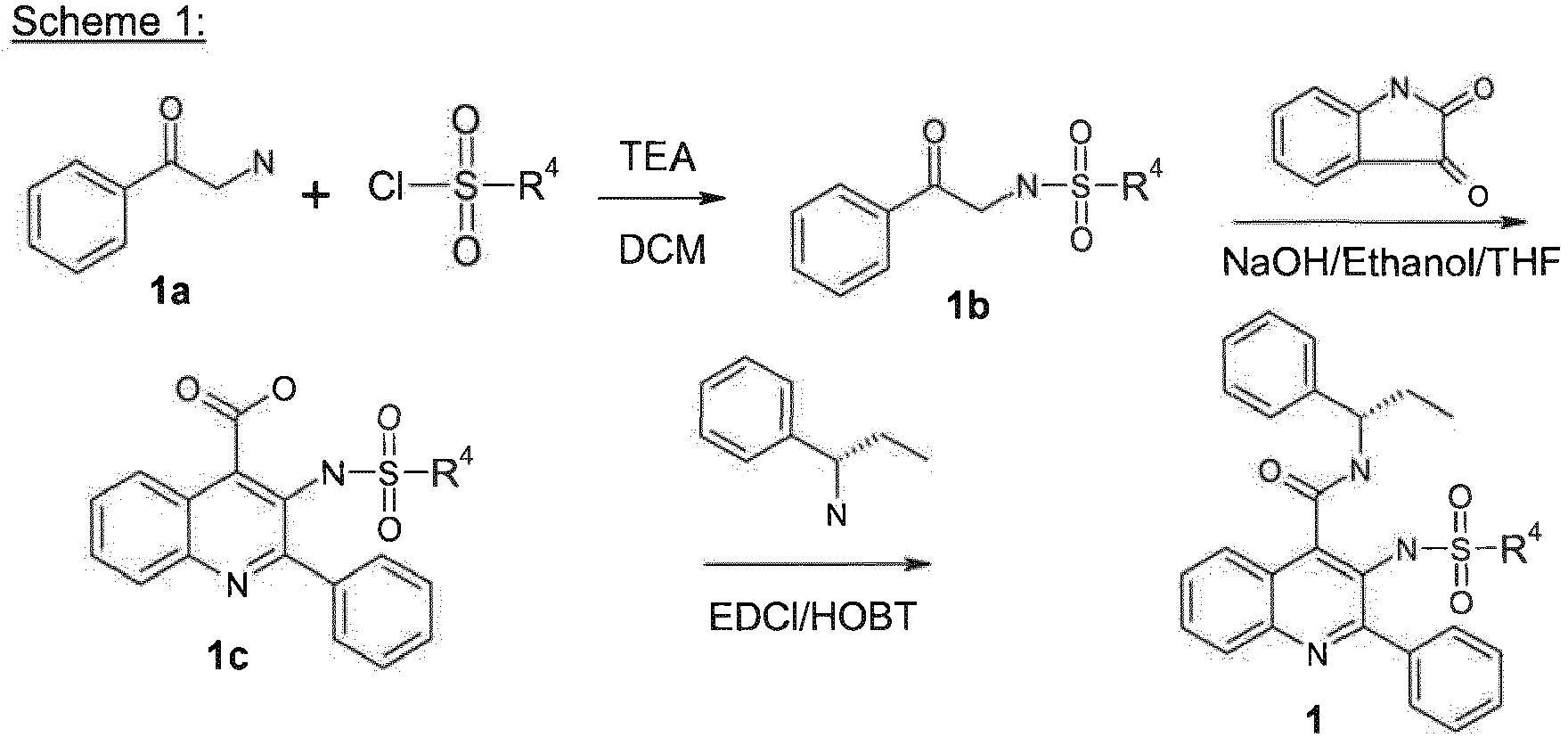
- Scheme 1 illustrates the synthesis of Example 1.
- In a further aspect the invention relates to compounds described herein wherein one or more of the atoms is a radioisotope of the same element. In a particular form of this aspect of the invention the compound is labeled with tritium. Such radio-labeled compounds are synthesized either by incorporating radio-labeled starting materials or, in the case of tritium, exchange of hydrogen for tritium by known methods. Known methods include (1) electrophilic halogenation, followed by reduction of the halogen in the presence of a tritium source, for example, by hydrogenation with tritium gas in the presence of a palladium catalyst, or (2) exchange of hydrogen for tritium performed in the presence of tritium gas and a suitable organometallic (e.g. palladium) catalyst.
- Compounds of the invention labeled with tritium are useful for the discovery of novel medicinal compounds that bind to and modulate the activity, by agonism, partial agonism, or antagonism, of an NK-3 receptor. Such tritium-labeled compounds may be used in assays that measure the displacement of such compounds to assess the binding of ligands that bind to NK-3 receptors.
- In a further aspect the invention relates to compounds described herein additionally comprising one or more atoms of a radioisotope. In a particular form of this aspect of the invention the compound comprises a radioactive halogen. Such radio-labeled compounds are synthesized by incorporating radio-labeled starting materials by known methods. Such compounds comprising one or more atoms of a radioisotope are useful as positron emission tomography (PET) ligands and for other uses and techniques to determine the location of NK3 receptors.
Therapeutic uses of compounds: - A further aspect of the invention is the compound according to the invention, or a pharmaceutically-acceptable salt thereof, for use in the treatment or prophylaxis of a disease or condition selected from depression, anxiety, cognitive disorders, psychoses, obesity, inflammatory diseases including irritable bowel syndrome and inflammatory bowel disorder, emesis, pre-eclampsia, chronic obstructive pulmonary disease, disorders associated with excessive gonadotrophins and/or androgens including dysmenorrhea, benign prostatic hyperplasia, prostatic cancer, and testicular cancer. More particular embodiments encompass the compound or a pharmaceutically acceptable salt thereof for use in the treatment or prophylaxis of anxiety, depression or obesity.
- A further aspect of the invention is the use of the compound according to the invention, or a pharmaceutically-acceptable salt thereof, in the manufacture of a medicament for the treatment or prophylaxis of diseases or conditions selected from depression, anxiety, cognitive disorders, psychoses, obesity, inflammatory diseases including irritable bowel syndrome and inflammatory bowel disorder, emesis, pre-eclampsia, chronic obstructive pulmonary disease, disorders associated with excessive gonadotrophins and/or androgens including dysmenorrhea, benign prostatic hyperplasia, prostatic cancer, and testicular cancer.
- The compound of the invention or a pharmaceutically-acceptable salt thereof, may be used on its own or in the form of appropriate medicinal preparations for enteral or parenteral administration. According to a further aspect of the invention, there is provided a pharmaceutical composition comprising a therapeutically effective amount of the compound of the invention or a therapeutically acceptable salt thereof, together with at least one pharmaceutically-acceptable diluent, lubricant or carrier.
- Preferably the composition comprises less than 80% and more preferably less than 50% by weight of the compound of the invention in admixture with an inert pharmaceutically-acceptable diluent, lubricant or carrier.
Examples of diluents, lubricants and carriers are: - for tablets and dragees: lactose, starch, talc, stearic acid;
- for capsules: tartaric acid or lactose;
- for injectable solutions: water, alcohols, glycerin, vegetable oils;
- for suppositories: natural or hardened oils or waxes.
- There is also disclosed a process for the preparation of such a pharmaceutical composition which process comprises mixing or compounding the ingredients together and forming the mixed ingredients into tablets or suppositories, encapsulating the ingredients in capsules or dissolving the ingredients to form injectable solutions.
- Pharmaceutically-acceptable derivatives include solvates and salts. For example, the compound of the invention may form acid addition salts with acids, such as conventional pharmaceutically-acceptable acids including maleic, hydrochloric, hydrobromic, phosphoric, acetic, fumaric, salicylic, citric, lactic, mandelic, tartaric and methanesulfonic acids.
- Acid addition salts of the compound of Formula I which may be mentioned include salts of mineral acids, for example the hydrochloride and hydrobromide salts; and salts formed with organic acids such as formate, acetate, maleate, benzoate, tartrate, and fumarate salts. Acid addition salts of the compound of Formula I may be formed by reacting the free base or a salt, enantiomer or protected derivative thereof, with one or more equivalents of the appropriate acid. The reaction may be carried out in a solvent or medium in which the salt is insoluble or in a solvent in which the salt is soluble, e.g., water, dioxane, ethanol, tetrahydrofuran or diethyl ether, or a mixture of solvents, which may be removed in vacuum or by freeze drying. The reaction may be a metathetical process or it may be carried out on an ion exchange resin.
- For the uses, medicaments and compositions mentioned herein the amount of compound used and the dosage administered will, of course, vary with the compound employed, the mode of administration and the treatment desired. However, in general, satisfactory results are obtained when the compound of the invention is administered at a daily dosage of about 0.1 mg to about 20 mg/kg of animal body weight. Such doses may be given in divided doses 1 to 4 times a day or in sustained release form. For man, the total daily dose is in the range of from 5 mg to 1,400 mg, more preferably from 10 mg to 100 mg, and unit dosage forms suitable for oral administration comprise from 2 mg to 1,400 mg of the compound admixed with a solid or liquid pharmaceutical carriers, lubricants and diluents.
- The compound of the invention may exist in tautomeric forms, all of which are included within the scope of the invention. The optical isomer may be isolated by separation of a racemic mixture of the compounds using conventional techniques, e.g. fractional crystallization, or chiral HPLC. Alternatively the individual enantiomer may be made by reaction of the appropriate optically active starting materials under reaction conditions that will not cause racemization.
-

- A solution of 3-[(methylsulfonyl)amino]-2-phenylquinoline-4-carboxylic acid (1c) (342 mg, 1.0 mmol), HOBT hydrate (231 mg, 1.5 mmol), 4-methylmorpholine (276 µL, 1.5 mmol) in tetrahydrofuran (50 ml) was added EDCI (289 mg, 1.5 mmol) at RT under N2. (S)-1-Phenyl propylamine (135 mg, 1.0 mmol) was then added and the reaction mixture stirred at RT for 12 h. All solvent was removed in vacuo and the residue was partitioned between ethyl acetate and 10% aqueous sodium bicarbonate solution, dried over sodium sulfate and then concentrated in vacuo. The residue was purified by chromatography eluting with 15-25% ethyl acetate / hexane to give the title compound (70 mg, 15%) as a solid. 1H NMR (300MHz, CDCl3) δ 0.94 (t, 3H), 1.97 (m, 2H), 3.44 (s, 3H), 5.17 (q, 1 H), 5.47 (m, 2H), 7.32 (d, 2H), 7.34 (d, 2H), 7.39 (m, 1 H), 7.78 (m, 2H), 7.84 (m, 2H), 8.08 (m, 1 H), 8.30 (m, 2H), 8.42 (m, 2H). MS APCI, m/z = 460 (M+1). LCMS: 2.51 min.
- The starting acid, 3-[(methylsulfonyl)amino]-2-phenylquinoline-4-carboxylic acid (1c), was prepared in the following manner:
- To a solution of 2-amino-1-phenylethanonehydrochloride (1a) (1715 mg, 10 mmol) in DMF (20 mL) was added TEA (2.8 mL, 20 mmol). Upon cooling under ice-water bath, methylsulfonyl chloride (0.77 mL, 10 mmol) was added slowly and the reaction mixture stirred at RT for 12 h. The mixture was partitioned between dichloromethane and brine, dried over sodium sulfate and then concentrated in vacuo to give the title compound (2100 mg, 98%) as an off white solid. MS APCI, m/z = 214 (M+1). LCMS: 1.19 min.
- To isatin (441 mg, 3 mmol) was added a solution of sodium hydroxide (1.15 g, 29.0 mmol) in water (2.5 mL). The resulting brown precipitate was stirred vigorously at RT for 20 minutes before being heated to 85 °C. A solution of N-(2-oxo-2-phenylethyl)methanesulfonamide (1 b) (639 mg, 3.0 mmol) in ethanol/THF/water (6.3 mL/1.25 mL/6.3 mL was then added dropwise over 30 minutes. The reaction mixture was stirred at 85 °C for further 4h before cooling to RT. All organic solvents were removed in vacuo and the aqueous residue reduced to a volume of approximately 6 mL. The aqueous residue was washed with ether (3 x 10 mL) and then the aqueous residue were acidified with cooling to pH 4 with acetic acid. The precipitate formed were collected, washed with water and dried to give the title compound as a solid (721 mg, 70.3%). 1H NMR (300MHz, CDCl3) δ 3.11 (s, 3H), 7.05 (d, 1 H), 7.39 (d, 2H), 7.64 (m, 2H), 7.78 (m, 1 H), 8.06 (m, 1 H), 8.19 (m, 1 H), 8.47 (m, 1H), 10.03 (b, 2H). MS APCI, m/z = 343 (M+1). LCMS: 1.07 min.
- Generally, NK-3r binding activity may be assessed using assays performed as described in Krause et al., (Proc. Natl. Acad. Sci. USA 94: 310-315, 1997). NK-3r complementary DNA is cloned from human hypothalamic RNA using standard procedures. The receptor cDNA is inserted into a suitable expression vector transfected into a Chinese hamster ovary cell line, and a stably-expressing clonal cell line may be isolated, characterized and used for experiments.
- Cells may be grown in tissue culture medium by techniques known to those of skill in the art and recovered by low speed centrifugation. Cell pellets may be homogenized, total cellular membranes isolated by high speed centrifugation and suspended in buffered saline. Generally, receptor binding assays may be performed by incubating suitable amounts of purified membrane preparations with [125I]-methylPhe7-neurokinin B, in the presence or absence of test compounds. Membrane proteins may be harvested by rapid filtration and radioactivity may be quantitated in a β-plate scintillation counter. Nonspecific binding may be distinguished from specific binding by use of suitable controls and the affinity of compounds for the expressed receptor may be determined by using different concentrations of compounds.
- A human NK-3 receptor gene was cloned using methods similar to those described for other human NK receptors (Aharony et al., Mol. Pharmacol. 45:9-19, 1994; Caccese et al., Neuropeptides 33, 239-243, 1999). The DNA sequence of the cloned NK-3 receptor differed from the published sequence (Buell et al., FEBS Letts. 299,90-95, 1992; Huang et al., Biochem. Biophys. Res. Commun. 184,966-972, 1992) having a silent single T>C base change at nucleotide 1320 of the coding sequence. Since the change is silent, the cloned gene provides a primary amino acid sequence for the encoded NK-3 receptor protein identical to the published sequence. The receptor cDNA was used to transfect CHO-K1 cells using standard methods and a clone stably-expressing the receptor was isolated and characterized. Plasma membranes from these cells were prepared as published (Aharony et al., 1994).
- Cells were harvested and centrifuged to remove medium. The pelleted cells were homogenized (Brinkman Polytron, three 15 sec bursts on ice) in a buffer consisting of 50 mM Tris-HCl (pH 7.4), 120 mM NaCl, 5 mM KCI, 10 mM EDTA and protease inhibitors (0.1 mg/ml soybean trypsin inhibitor, and 1 mM iodoacetamide). The homogenate was centrifuged at 1000xg for 10 min at 4 °C to remove cell debris. Pellets were washed once with homogenizing buffer. Supernatants were combined and centrifuged at 40,000xg for 20 min at 4 °C. The membrane-containing pellet was homogenized with a Polytron as before. The suspension was centrifuged at 40,000xg for 20 min at 4 °C, the pellet suspended in buffer (20 mM HEPES, pH 7.4 containing 3 mM MgCl2, 30 mM KCI, and 100 µM thiorphan) and the protein concentration determined. The membrane suspension was then diluted to 3 mg/ml with buffer containing 0.02% BSA, and flash frozen. Samples were stored at -80 °C until used.
- A receptor binding assay method with [125I]-MePhe7-NKB was modified from that described by Aharony et al., J. Pharmacol. Exper. Ther., 274:1216-1221, 1995.
- Competition experiments were carried out in 0.2 mL assay buffer (50 mM Tris-HCl, 4 mM MnCl2, 10 µM thiorphan, pH 7.4) containing membranes (2 µg protein/reaction), tested competitors, and [125I]-MePhe7NKB (0.2 nM). Unlabeled homologue ligand (0.5 µM) was used to define nonspecific binding. Incubations were carried out at 25 °C for 90 min. Receptor-bound ligand was isolated by vacuum filtration in a Packard Harvester onto GF/C plates presoaked in 0.5% BSA. Plates were washed with 0.02 M Tris, pH 7.4. Computation of equilibrium binding constants (KD and Ki), receptor density (Bmax), and statistical analysis was carried out as published previously (Aharony et al., 1995) using GraphPad Prism or IDBS XLfit software.
- Generally, NK-3 functional activity may be assessed by using calcium mobilization assays in stable NK-3r-expressing cell lines. Calcium mobilization induced by the methylPhe7-neurokinin B agonist may be monitored using a FLIPR (Molecular Devices) instrument in the manner described by the manufacturer. Agonists may be added to the cells and fluorescence responses continuously recorded for up to 5 min. The actions of antagonists may be assessed by preincubating cells prior to administration of the methylPhe7-neurokinin B agonist. The action of agonists may be assessed by observing their intrinsic activity in such a system.
- NK-3 receptor expressing CHO cells were maintained in growth media (Ham's F12 medium, 10% FBS, 2mM L-glutamine, and 50 mg/mL Hygromycin B). One day prior to the assay cells were dispensed into 384-well plates in Ultraculture media (Cambrex Bio Science) with 2 mM L-glutamine to achieve 70-90% confluency. To quantify NK-3 receptor-induced calcium mobilization, cells were first washed with assay buffer consisting of Hanks' Balanced Salt Solution, 15 mM HEPES, and 2.5 mM probenecid, pH 7.4. The cells were then loaded with Fluo4/AM dye (4.4 µM) in assay buffer. Cells were incubated for one hour and then washed with assay buffer, exposed to 0.02 - 300 nM senktide and the fluorescence response recorded using a FLIPR instrument (Molecular Devices Corporation). To quantify antagonism of the agonist response, cells were preincubated with varying concentrations of test compound for 2-20 min and then exposed to 2 nM senktide, a concentration that alone elicits about an 70% maximal calcium response. The resulting data was analyzed using XLfit software (IDBS manufacturer) to determine EC50 and IC50 values.
Claims (6)
- A compound that is 3-[(methylsulfonyl)amino]-2-phenyl-N-[(1S)-1-phenylpropyl]quinolin-4-carboxamide, or a pharmaceutically acceptable salt thereof.
- A pharmaceutical composition comprising a therapeutically effective amount of the compound of claim 1 or a pharmaceutically-acceptable salt thereof, together with at least one pharmaceutically acceptable diluent, lubricant or carrier.
- A compound as defined in claim 1 or a pharmaceutically-acceptable salt thereof, for use in the treatment or prophylaxis of a disease or condition selected from depression, anxiety, cognitive disorders, psychoses, obesity, inflammatory diseases including irritable bowel syndrome and inflammatory bowel disorder, emesis, pre-eclampsia, chronic obstructive pulmonary disease, disorders associated with excessive gonadotrophins and/or androgens including dysmenorrhea, benign prostatic hyperplasia, prostatic cancer, and testicular cancer.
- A compound as defined in claim 1 or a pharmaceutically acceptable salt thereof for use in the treatment or prophylaxis of ansiety, depression or obesity.
- Use of a compound as defined in claim 1 or a pharmaceutically-acceptable salt thereof in the manufacture of a medicament for the treatment or prophylaxis of a disease or condition a compound as defined in claim 1 or a pharmaceutically-acceptable salt thereof, for use in the treatment or prophylaxis of a disease or condition selected from depression, anxiety, cognitive disorders, psychoses, obesity, inflammatory diseases including irritable bowel syndrome and inflammatory bowel disorder, emesis, pre-eclampsia, chronic obstructive pulmonary disease, disorders associated with excessive gonadotrophins and/or androgens including dysmenorrhea, benign prostatic hyperplasia, prostatic cancer, and testicular cancer.
- Use of a compound as defined in claim 1 or a pharmaceutically acceptable salt thereof in the manufacture of a medicament for the treatment or prophylaxis of a compound as defined in claim 1 or a pharmaceutically acceptable salt thereof for use in the treatment or prophylaxis of ansiety, depression or obesity.
Applications Claiming Priority (3)
| Application Number | Priority Date | Filing Date | Title |
|---|---|---|---|
| US74943105P | 2005-12-12 | 2005-12-12 | |
| US82101606P | 2006-08-01 | 2006-08-01 | |
| PCT/SE2006/001408 WO2007069977A1 (en) | 2005-12-12 | 2006-12-11 | Alkylsulphonamide quinolines |
Publications (3)
| Publication Number | Publication Date |
|---|---|
| EP1968944A1 EP1968944A1 (en) | 2008-09-17 |
| EP1968944A4 EP1968944A4 (en) | 2011-01-12 |
| EP1968944B1 true EP1968944B1 (en) | 2016-04-20 |
Family
ID=38163189
Family Applications (1)
| Application Number | Title | Priority Date | Filing Date |
|---|---|---|---|
| EP06835833.2A Active EP1968944B1 (en) | 2005-12-12 | 2006-12-11 | Alkylsulphonamide quinolines |
Country Status (20)
| Country | Link |
|---|---|
| US (3) | US20080293765A1 (en) |
| EP (1) | EP1968944B1 (en) |
| JP (1) | JP5165581B2 (en) |
| KR (1) | KR20080075867A (en) |
| AR (1) | AR056890A1 (en) |
| AU (1) | AU2006325572B2 (en) |
| BR (1) | BRPI0619746A2 (en) |
| CA (1) | CA2633129A1 (en) |
| DK (1) | DK1968944T3 (en) |
| EC (1) | ECSP088546A (en) |
| ES (1) | ES2571834T3 (en) |
| HU (1) | HUE029805T2 (en) |
| IL (1) | IL191628A0 (en) |
| NO (1) | NO20083029L (en) |
| PL (1) | PL1968944T3 (en) |
| PT (1) | PT1968944T (en) |
| RU (1) | RU2421447C2 (en) |
| TW (2) | TW201018662A (en) |
| UY (1) | UY30001A1 (en) |
| WO (1) | WO2007069977A1 (en) |
Families Citing this family (7)
| Publication number | Priority date | Publication date | Assignee | Title |
|---|---|---|---|---|
| TW201018662A (en) * | 2005-12-12 | 2010-05-16 | Astrazeneca Ab | Alkylsulphonamide quinolines |
| AU2010209825A1 (en) * | 2009-01-30 | 2011-08-11 | F. Hoffmann-La Roche Ag | Piperidine derivatives as NK3 receptor antagonists |
| CN103619366B (en) | 2011-04-15 | 2018-02-16 | 马萨诸塞州大学 | Surgical cavity drainage and closed-system |
| WO2013112586A1 (en) | 2012-01-24 | 2013-08-01 | Smith & Nephew, Inc. | Porous structure and methods of making same |
| WO2014170648A1 (en) | 2013-04-19 | 2014-10-23 | Astrazeneca Ab | A nk3 receptor antagonist compound (nk3ra) for use in a method for the treatment of polycystic ovary syndrome (pcos) |
| GB201315846D0 (en) * | 2013-09-05 | 2013-10-23 | Imp Innovations Ltd | Method for treating or preventing hot flushes |
| GB201503207D0 (en) | 2015-02-26 | 2015-04-15 | Univ Edinburgh | Female health compounds |
Family Cites Families (44)
| Publication number | Priority date | Publication date | Assignee | Title |
|---|---|---|---|---|
| CA1288436C (en) * | 1983-07-22 | 1991-09-03 | David Paul Hesson | Phenylquinolinecarboxylic acids and derivatives as antitumor agents |
| US5177096A (en) * | 1989-10-25 | 1993-01-05 | Smithkline Beecham Corporation | Substituted 5-((tetrazolyl)alkenyl)imidazoles and pharmaceutical methods of use thereof |
| US5248689A (en) * | 1989-11-06 | 1993-09-28 | Smithkline Beecham Corporation | Substituted N-(imidazolyl)alkyl alanine derivatives |
| NZ238688A (en) * | 1990-06-28 | 1992-05-26 | Smithkline Beecham Corp | Substituted histidines: pharmaceutical compositions, preparation and uses thereof |
| MX9300141A (en) * | 1992-01-13 | 1994-07-29 | Smithkline Beecham Corp | NOVEL IMIDAZOLE COMPOUNDS, PROCEDURE FOR THE PREPARATION AND PHARMACEUTICAL COMPOSITIONS CONTAINING IT. |
| FR2719311B1 (en) | 1994-03-18 | 1998-06-26 | Sanofi Sa | Compounds that are selective antagonists of the human NK3 receptor and their use as drugs and diagnostic tools. |
| RO114445B1 (en) * | 1994-05-27 | 1999-04-30 | Smithkline Beecham S.P.A. | Quinoline derivatives, antagonists of nk3 tachiquinine receptor, process for preparation, pharmaceutical compositions containing the same and method of treatment |
| IT1270615B (en) | 1994-07-14 | 1997-05-07 | Smithkline Beecham Farma | USE OF QUINOLINE DERIVATIVES |
| CZ132798A3 (en) * | 1995-10-30 | 1999-02-17 | Smithkline Beecham Corporation | Protease inhibitors |
| AR004735A1 (en) * | 1995-11-24 | 1999-03-10 | Smithkline Beecham Spa | CHINOLEIN 4-AMIDO SUBSTITUTED, A PROCEDURE FOR ITS PREPARATION, A PHARMACEUTICAL COMPOSITION THAT CONTAINS THEM AND THE USE OF THE SAME FOR THE PREPARATION OF A MEDICINAL PRODUCT. |
| GB9524104D0 (en) | 1995-11-24 | 1996-01-24 | Smithkline Beecham Spa | Novel compounds |
| GB9524137D0 (en) | 1995-11-24 | 1996-01-24 | Smithkline Beecham Spa | Novel compounds |
| DE69634416T2 (en) * | 1995-11-24 | 2005-12-29 | Glaxosmithkline S.P.A. | QUINOLINE DERIVATIVES |
| WO1997035856A1 (en) * | 1996-03-25 | 1997-10-02 | Smithkline Beecham Corporation | Novel treatment for cns injuries |
| PE20000354A1 (en) | 1998-04-03 | 2000-05-20 | Advanced Medicine Inc | NEW COMPOUNDS AND LOCAL ANESTHETIC USES |
| US6184226B1 (en) | 1998-08-28 | 2001-02-06 | Scios Inc. | Quinazoline derivatives as inhibitors of P-38 α |
| CN1406225A (en) | 1998-11-20 | 2003-03-26 | 葛兰素史密丝克莱恩有限公司 | Quinoline-4-carboxamide derivatives as NK-3 and NK-2 receptor antagonists |
| AU4802500A (en) | 1999-04-26 | 2000-11-10 | Neurogen Corporation | 2-aminoquinolinecarboxamides: neurokinin receptor ligands |
| JP2003501351A (en) * | 1999-05-27 | 2003-01-14 | ファルマシア・アンド・アップジョン・カンパニー | Bicyclic oxazolidinones as antibacterial agents |
| US6858630B2 (en) * | 1999-12-06 | 2005-02-22 | Smithkline Beecham Corporation | Naphthimidazole derivatives and their use as thrombopoietin mimetics |
| US6248136B1 (en) * | 2000-02-03 | 2001-06-19 | Micell Technologies, Inc. | Methods for carbon dioxide dry cleaning with integrated distribution |
| WO2002013825A1 (en) | 2000-08-11 | 2002-02-21 | Smithkline Beecham P.L.C. | Novel pharmaceutical use of quinnoline derivatives |
| EP1192952A3 (en) | 2000-09-28 | 2003-03-26 | Pfizer Products Inc. | Combination, for treating depression and anxiety, containing an NK-3 receptor antagonist and a CNS penetrant NK-1 receptor antagonist |
| EP1415987B1 (en) * | 2000-10-20 | 2007-02-28 | Eisai R&D Management Co., Ltd. | Nitrogenous aromatic ring compounds as anti cancer agents |
| GB0027701D0 (en) * | 2000-11-13 | 2000-12-27 | Smithkline Beecham Spa | Novel compounds |
| MY134211A (en) | 2001-05-18 | 2007-11-30 | Smithkline Beecham Corp | Novel use |
| US20040006135A1 (en) * | 2002-06-19 | 2004-01-08 | Pfizer Inc. | Combination treatment for depression and anxiety |
| GB0228287D0 (en) | 2002-12-04 | 2003-01-08 | Smithkline Beecham Corp | Chemical compounds |
| GB0228288D0 (en) | 2002-12-04 | 2003-01-08 | Smithkline Beecham Corp | Chemical compounds |
| EP2258365B1 (en) | 2003-03-28 | 2013-05-29 | Novartis Vaccines and Diagnostics, Inc. | Use of organic compounds for immunopotentiation |
| WO2005014533A2 (en) | 2003-08-08 | 2005-02-17 | Transtech Pharma, Inc. | Aryl and heteroaryl compounds, compositions, and methods of use |
| US7501538B2 (en) | 2003-08-08 | 2009-03-10 | Transtech Pharma, Inc. | Aryl and heteroaryl compounds, compositions and methods of use |
| US7732442B2 (en) * | 2003-09-05 | 2010-06-08 | Ono Pharmaceutical Co., Ltd. | Chemokine receptor antagonist and medical use thereof |
| JP2007530591A (en) | 2004-03-25 | 2007-11-01 | スミスクライン・ビーチャム・コーポレイション | Use of NK3 antagonists to treat bipolar disorder |
| EP1745019A1 (en) | 2004-05-06 | 2007-01-24 | Pfizer Inc. | Novel compounds of proline and morpholine derivatives |
| GB0425077D0 (en) * | 2004-11-12 | 2004-12-15 | Smithkline Beecham Corp | Novel compounds |
| GB0509405D0 (en) | 2005-05-10 | 2005-06-15 | Merck Sharp & Dohme | Therapeutic compounds |
| AU2006259890A1 (en) * | 2005-06-23 | 2006-12-28 | Astrazeneca Ab | Quinoline 3 -sulfonate esters as NK3 receptor modulators |
| US20080200504A1 (en) * | 2005-08-11 | 2008-08-21 | Astrazeneca Ab | Amide Alkyl Pyridiyl Quinolines as Nk3 Receptor Modulators |
| CA2618827A1 (en) | 2005-08-12 | 2007-02-22 | The Regents Of The University Of California | Inhibition of phosphatase activity of soluble epoxide hydrolase amino terminus and uses thereof |
| AR058051A1 (en) * | 2005-09-21 | 2008-01-23 | Astrazeneca Ab | ALQUILNITRILO QUINOLINAS. OBTAINING PROCESS AND PHARMACEUTICAL COMPOSITIONS. |
| TW201018662A (en) * | 2005-12-12 | 2010-05-16 | Astrazeneca Ab | Alkylsulphonamide quinolines |
| WO2007086799A1 (en) * | 2006-01-27 | 2007-08-02 | Astrazeneca Ab | Amide substituted quinolines |
| PE20080906A1 (en) | 2006-08-17 | 2008-07-05 | Kemia Inc | HETEROARYL DERIVATIVES AS CYTOKINE INHIBITORS |
-
2006
- 2006-12-05 TW TW099103065A patent/TW201018662A/en unknown
- 2006-12-05 TW TW095145166A patent/TW200804288A/en unknown
- 2006-12-11 WO PCT/SE2006/001408 patent/WO2007069977A1/en not_active Ceased
- 2006-12-11 US US12/096,997 patent/US20080293765A1/en not_active Abandoned
- 2006-12-11 EP EP06835833.2A patent/EP1968944B1/en active Active
- 2006-12-11 AU AU2006325572A patent/AU2006325572B2/en not_active Ceased
- 2006-12-11 US US11/609,166 patent/US7608628B2/en not_active Expired - Fee Related
- 2006-12-11 ES ES06835833T patent/ES2571834T3/en active Active
- 2006-12-11 DK DK06835833.2T patent/DK1968944T3/en active
- 2006-12-11 PT PT68358332T patent/PT1968944T/en unknown
- 2006-12-11 CA CA002633129A patent/CA2633129A1/en not_active Abandoned
- 2006-12-11 UY UY30001A patent/UY30001A1/en unknown
- 2006-12-11 BR BRPI0619746-9A patent/BRPI0619746A2/en not_active IP Right Cessation
- 2006-12-11 PL PL06835833.2T patent/PL1968944T3/en unknown
- 2006-12-11 KR KR1020087014020A patent/KR20080075867A/en not_active Withdrawn
- 2006-12-11 JP JP2008545536A patent/JP5165581B2/en not_active Expired - Fee Related
- 2006-12-11 AR ARP060105444A patent/AR056890A1/en not_active Application Discontinuation
- 2006-12-11 HU HUE06835833A patent/HUE029805T2/en unknown
- 2006-12-11 RU RU2008121761/04A patent/RU2421447C2/en not_active IP Right Cessation
-
2008
- 2008-05-22 IL IL191628A patent/IL191628A0/en unknown
- 2008-06-13 EC EC2008008546A patent/ECSP088546A/en unknown
- 2008-07-04 NO NO20083029A patent/NO20083029L/en not_active Application Discontinuation
-
2009
- 2009-10-09 US US12/576,319 patent/US8071621B2/en not_active Expired - Fee Related
Non-Patent Citations (1)
| Title |
|---|
| HASSEN RATNI ET AL: "Rational design of novel pyrrolidine derivatives as orally active neurokinin-3 receptor antagonists", BIOORGANIC & MEDICINAL CHEMISTRY LETTERS, vol. 20, no. 22, 1 November 2010 (2010-11-01), pages 6735 - 6738, XP055013803, ISSN: 0960-894X, DOI: 10.1016/j.bmcl.2010.08.138 * |
Also Published As
| Publication number | Publication date |
|---|---|
| EP1968944A1 (en) | 2008-09-17 |
| US8071621B2 (en) | 2011-12-06 |
| AU2006325572B2 (en) | 2011-02-24 |
| US7608628B2 (en) | 2009-10-27 |
| US20080021062A1 (en) | 2008-01-24 |
| BRPI0619746A2 (en) | 2011-10-11 |
| WO2007069977A1 (en) | 2007-06-21 |
| JP5165581B2 (en) | 2013-03-21 |
| IL191628A0 (en) | 2008-12-29 |
| CA2633129A1 (en) | 2007-06-21 |
| UY30001A1 (en) | 2007-07-31 |
| DK1968944T3 (en) | 2016-08-01 |
| HUE029805T2 (en) | 2017-03-28 |
| AU2006325572A1 (en) | 2007-06-21 |
| ES2571834T3 (en) | 2016-05-27 |
| US20080293765A1 (en) | 2008-11-27 |
| PL1968944T3 (en) | 2016-11-30 |
| RU2421447C2 (en) | 2011-06-20 |
| US20100029717A1 (en) | 2010-02-04 |
| TW201018662A (en) | 2010-05-16 |
| PT1968944T (en) | 2016-07-29 |
| ECSP088546A (en) | 2008-07-30 |
| EP1968944A4 (en) | 2011-01-12 |
| HK1121759A1 (en) | 2009-04-30 |
| KR20080075867A (en) | 2008-08-19 |
| TW200804288A (en) | 2008-01-16 |
| RU2008121761A (en) | 2010-01-20 |
| NO20083029L (en) | 2008-07-09 |
| AR056890A1 (en) | 2007-10-31 |
| JP2009519331A (en) | 2009-05-14 |
Similar Documents
| Publication | Publication Date | Title |
|---|---|---|
| US8071621B2 (en) | Alkylsulphonamide quinolines | |
| US20080200500A1 (en) | Quinoline Derivatives as Nk3 Antagonists | |
| US20080306110A1 (en) | Alkylnitrile Quinolines as Nk-3 Receptor Ligands | |
| US20080194622A1 (en) | Quinoline 3-Sulfonate Esters as Nk3 Receptor Modulators | |
| US20080200504A1 (en) | Amide Alkyl Pyridiyl Quinolines as Nk3 Receptor Modulators | |
| US20080280949A1 (en) | Oxopyridyl Quinoline Amides as Nk3 Receptor Modulators | |
| HK1121759B (en) | Alkylsulphonamide quinolines | |
| US20080287492A1 (en) | Alkylpyridyl Quinolines as Nk3 Receptor Modulators | |
| US20080234269A1 (en) | N-Oxo-Heterocycle and N-Oxo-Alkyl Quinoline-4-Carboxamides as Nk-3 Receptor Ligands | |
| CN101370782A (en) | Alkylsulfonamide quinoline |
Legal Events
| Date | Code | Title | Description |
|---|---|---|---|
| PUAI | Public reference made under article 153(3) epc to a published international application that has entered the european phase |
Free format text: ORIGINAL CODE: 0009012 |
|
| 17P | Request for examination filed |
Effective date: 20080714 |
|
| AK | Designated contracting states |
Kind code of ref document: A1 Designated state(s): AT BE BG CH CY CZ DE DK EE ES FI FR GB GR HU IE IS IT LI LT LU LV MC NL PL PT RO SE SI SK TR |
|
| AX | Request for extension of the european patent |
Extension state: AL BA HR MK RS |
|
| REG | Reference to a national code |
Ref country code: HK Ref legal event code: DE Ref document number: 1121759 Country of ref document: HK |
|
| A4 | Supplementary search report drawn up and despatched |
Effective date: 20101210 |
|
| 17Q | First examination report despatched |
Effective date: 20111208 |
|
| GRAP | Despatch of communication of intention to grant a patent |
Free format text: ORIGINAL CODE: EPIDOSNIGR1 |
|
| INTG | Intention to grant announced |
Effective date: 20151021 |
|
| GRAS | Grant fee paid |
Free format text: ORIGINAL CODE: EPIDOSNIGR3 |
|
| GRAA | (expected) grant |
Free format text: ORIGINAL CODE: 0009210 |
|
| AK | Designated contracting states |
Kind code of ref document: B1 Designated state(s): AT BE BG CH CY CZ DE DK EE ES FI FR GB GR HU IE IS IT LI LT LU LV MC NL PL PT RO SE SI SK TR |
|
| AX | Request for extension of the european patent |
Extension state: AL BA HR MK RS |
|
| REG | Reference to a national code |
Ref country code: GB Ref legal event code: FG4D |
|
| REG | Reference to a national code |
Ref country code: FR Ref legal event code: PLFP Year of fee payment: 11 |
|
| REG | Reference to a national code |
Ref country code: CH Ref legal event code: EP |
|
| REG | Reference to a national code |
Ref country code: AT Ref legal event code: REF Ref document number: 792290 Country of ref document: AT Kind code of ref document: T Effective date: 20160515 |
|
| REG | Reference to a national code |
Ref country code: IE Ref legal event code: FG4D |
|
| REG | Reference to a national code |
Ref country code: ES Ref legal event code: FG2A Ref document number: 2571834 Country of ref document: ES Kind code of ref document: T3 Effective date: 20160527 |
|
| REG | Reference to a national code |
Ref country code: DE Ref legal event code: R096 Ref document number: 602006048821 Country of ref document: DE |
|
| REG | Reference to a national code |
Ref country code: CH Ref legal event code: NV Representative=s name: ING. MARCO ZARDI C/O M. ZARDI AND CO. S.A., CH |
|
| REG | Reference to a national code |
Ref country code: NL Ref legal event code: FP |
|
| REG | Reference to a national code |
Ref country code: PT Ref legal event code: SC4A Ref document number: 1968944 Country of ref document: PT Date of ref document: 20160729 Kind code of ref document: T Free format text: AVAILABILITY OF NATIONAL TRANSLATION Effective date: 20160720 |
|
| REG | Reference to a national code |
Ref country code: DK Ref legal event code: T3 Effective date: 20160726 |
|
| REG | Reference to a national code |
Ref country code: SE Ref legal event code: TRGR |
|
| REG | Reference to a national code |
Ref country code: LT Ref legal event code: MG4D |
|
| PGFP | Annual fee paid to national office [announced via postgrant information from national office to epo] |
Ref country code: TR Payment date: 20160517 Year of fee payment: 11 |
|
| REG | Reference to a national code |
Ref country code: GR Ref legal event code: EP Ref document number: 20160401080 Country of ref document: GR Effective date: 20160628 |
|
| PG25 | Lapsed in a contracting state [announced via postgrant information from national office to epo] |
Ref country code: LT Free format text: LAPSE BECAUSE OF FAILURE TO SUBMIT A TRANSLATION OF THE DESCRIPTION OR TO PAY THE FEE WITHIN THE PRESCRIBED TIME-LIMIT Effective date: 20160420 |
|
| REG | Reference to a national code |
Ref country code: HK Ref legal event code: GR Ref document number: 1121759 Country of ref document: HK |
|
| PG25 | Lapsed in a contracting state [announced via postgrant information from national office to epo] |
Ref country code: LV Free format text: LAPSE BECAUSE OF FAILURE TO SUBMIT A TRANSLATION OF THE DESCRIPTION OR TO PAY THE FEE WITHIN THE PRESCRIBED TIME-LIMIT Effective date: 20160420 |
|
| REG | Reference to a national code |
Ref country code: DE Ref legal event code: R097 Ref document number: 602006048821 Country of ref document: DE |
|
| PG25 | Lapsed in a contracting state [announced via postgrant information from national office to epo] |
Ref country code: EE Free format text: LAPSE BECAUSE OF FAILURE TO SUBMIT A TRANSLATION OF THE DESCRIPTION OR TO PAY THE FEE WITHIN THE PRESCRIBED TIME-LIMIT Effective date: 20160420 Ref country code: RO Free format text: LAPSE BECAUSE OF FAILURE TO SUBMIT A TRANSLATION OF THE DESCRIPTION OR TO PAY THE FEE WITHIN THE PRESCRIBED TIME-LIMIT Effective date: 20160420 Ref country code: SK Free format text: LAPSE BECAUSE OF FAILURE TO SUBMIT A TRANSLATION OF THE DESCRIPTION OR TO PAY THE FEE WITHIN THE PRESCRIBED TIME-LIMIT Effective date: 20160420 |
|
| PLBE | No opposition filed within time limit |
Free format text: ORIGINAL CODE: 0009261 |
|
| STAA | Information on the status of an ep patent application or granted ep patent |
Free format text: STATUS: NO OPPOSITION FILED WITHIN TIME LIMIT |
|
| REG | Reference to a national code |
Ref country code: HU Ref legal event code: AG4A Ref document number: E029805 Country of ref document: HU |
|
| 26N | No opposition filed |
Effective date: 20170123 |
|
| PG25 | Lapsed in a contracting state [announced via postgrant information from national office to epo] |
Ref country code: SI Free format text: LAPSE BECAUSE OF FAILURE TO SUBMIT A TRANSLATION OF THE DESCRIPTION OR TO PAY THE FEE WITHIN THE PRESCRIBED TIME-LIMIT Effective date: 20160420 |
|
| PG25 | Lapsed in a contracting state [announced via postgrant information from national office to epo] |
Ref country code: MC Free format text: LAPSE BECAUSE OF FAILURE TO SUBMIT A TRANSLATION OF THE DESCRIPTION OR TO PAY THE FEE WITHIN THE PRESCRIBED TIME-LIMIT Effective date: 20160420 |
|
| PG25 | Lapsed in a contracting state [announced via postgrant information from national office to epo] |
Ref country code: LU Free format text: LAPSE BECAUSE OF NON-PAYMENT OF DUE FEES Effective date: 20161211 |
|
| REG | Reference to a national code |
Ref country code: FR Ref legal event code: PLFP Year of fee payment: 12 |
|
| PGFP | Annual fee paid to national office [announced via postgrant information from national office to epo] |
Ref country code: CZ Payment date: 20171228 Year of fee payment: 12 Ref country code: FI Payment date: 20171228 Year of fee payment: 12 Ref country code: NL Payment date: 20171221 Year of fee payment: 12 Ref country code: DK Payment date: 20171228 Year of fee payment: 12 Ref country code: FR Payment date: 20171221 Year of fee payment: 12 |
|
| PGFP | Annual fee paid to national office [announced via postgrant information from national office to epo] |
Ref country code: GB Payment date: 20171220 Year of fee payment: 12 Ref country code: GR Payment date: 20171227 Year of fee payment: 12 Ref country code: IE Payment date: 20171222 Year of fee payment: 12 Ref country code: PT Payment date: 20171219 Year of fee payment: 12 Ref country code: BE Payment date: 20171228 Year of fee payment: 12 Ref country code: SE Payment date: 20171221 Year of fee payment: 12 Ref country code: CH Payment date: 20171228 Year of fee payment: 12 Ref country code: AT Payment date: 20171228 Year of fee payment: 12 Ref country code: PL Payment date: 20171228 Year of fee payment: 12 |
|
| PGFP | Annual fee paid to national office [announced via postgrant information from national office to epo] |
Ref country code: DE Payment date: 20171220 Year of fee payment: 12 Ref country code: ES Payment date: 20180102 Year of fee payment: 12 |
|
| PG25 | Lapsed in a contracting state [announced via postgrant information from national office to epo] |
Ref country code: CY Free format text: LAPSE BECAUSE OF FAILURE TO SUBMIT A TRANSLATION OF THE DESCRIPTION OR TO PAY THE FEE WITHIN THE PRESCRIBED TIME-LIMIT Effective date: 20160420 |
|
| PGFP | Annual fee paid to national office [announced via postgrant information from national office to epo] |
Ref country code: HU Payment date: 20180108 Year of fee payment: 12 Ref country code: IT Payment date: 20171221 Year of fee payment: 12 |
|
| PG25 | Lapsed in a contracting state [announced via postgrant information from national office to epo] |
Ref country code: IS Free format text: LAPSE BECAUSE OF FAILURE TO SUBMIT A TRANSLATION OF THE DESCRIPTION OR TO PAY THE FEE WITHIN THE PRESCRIBED TIME-LIMIT Effective date: 20160420 |
|
| PG25 | Lapsed in a contracting state [announced via postgrant information from national office to epo] |
Ref country code: BG Free format text: LAPSE BECAUSE OF FAILURE TO SUBMIT A TRANSLATION OF THE DESCRIPTION OR TO PAY THE FEE WITHIN THE PRESCRIBED TIME-LIMIT Effective date: 20160420 |
|
| REG | Reference to a national code |
Ref country code: AT Ref legal event code: UEP Ref document number: 792290 Country of ref document: AT Kind code of ref document: T Effective date: 20160420 |
|
| REG | Reference to a national code |
Ref country code: DE Ref legal event code: R119 Ref document number: 602006048821 Country of ref document: DE |
|
| REG | Reference to a national code |
Ref country code: DK Ref legal event code: EBP Effective date: 20181231 |
|
| REG | Reference to a national code |
Ref country code: SE Ref legal event code: EUG |
|
| PG25 | Lapsed in a contracting state [announced via postgrant information from national office to epo] |
Ref country code: SE Free format text: LAPSE BECAUSE OF NON-PAYMENT OF DUE FEES Effective date: 20181212 Ref country code: CZ Free format text: LAPSE BECAUSE OF NON-PAYMENT OF DUE FEES Effective date: 20181211 Ref country code: FI Free format text: LAPSE BECAUSE OF NON-PAYMENT OF DUE FEES Effective date: 20181211 Ref country code: PT Free format text: LAPSE BECAUSE OF NON-PAYMENT OF DUE FEES Effective date: 20190611 |
|
| REG | Reference to a national code |
Ref country code: CH Ref legal event code: PL |
|
| REG | Reference to a national code |
Ref country code: NL Ref legal event code: MM Effective date: 20190101 |
|
| REG | Reference to a national code |
Ref country code: AT Ref legal event code: MM01 Ref document number: 792290 Country of ref document: AT Kind code of ref document: T Effective date: 20181211 |
|
| GBPC | Gb: european patent ceased through non-payment of renewal fee |
Effective date: 20181211 |
|
| REG | Reference to a national code |
Ref country code: IE Ref legal event code: MM4A |
|
| PG25 | Lapsed in a contracting state [announced via postgrant information from national office to epo] |
Ref country code: NL Free format text: LAPSE BECAUSE OF NON-PAYMENT OF DUE FEES Effective date: 20190101 |
|
| REG | Reference to a national code |
Ref country code: BE Ref legal event code: MM Effective date: 20181231 |
|
| PG25 | Lapsed in a contracting state [announced via postgrant information from national office to epo] |
Ref country code: FR Free format text: LAPSE BECAUSE OF NON-PAYMENT OF DUE FEES Effective date: 20181231 Ref country code: IT Free format text: LAPSE BECAUSE OF NON-PAYMENT OF DUE FEES Effective date: 20181211 Ref country code: IE Free format text: LAPSE BECAUSE OF NON-PAYMENT OF DUE FEES Effective date: 20181211 Ref country code: DE Free format text: LAPSE BECAUSE OF NON-PAYMENT OF DUE FEES Effective date: 20190702 |
|
| PG25 | Lapsed in a contracting state [announced via postgrant information from national office to epo] |
Ref country code: HU Free format text: LAPSE BECAUSE OF NON-PAYMENT OF DUE FEES Effective date: 20181212 Ref country code: BE Free format text: LAPSE BECAUSE OF NON-PAYMENT OF DUE FEES Effective date: 20181231 Ref country code: GR Free format text: LAPSE BECAUSE OF NON-PAYMENT OF DUE FEES Effective date: 20190702 |
|
| PG25 | Lapsed in a contracting state [announced via postgrant information from national office to epo] |
Ref country code: GB Free format text: LAPSE BECAUSE OF NON-PAYMENT OF DUE FEES Effective date: 20181211 Ref country code: LI Free format text: LAPSE BECAUSE OF NON-PAYMENT OF DUE FEES Effective date: 20181231 Ref country code: CH Free format text: LAPSE BECAUSE OF NON-PAYMENT OF DUE FEES Effective date: 20181231 Ref country code: AT Free format text: LAPSE BECAUSE OF NON-PAYMENT OF DUE FEES Effective date: 20181211 |
|
| PG25 | Lapsed in a contracting state [announced via postgrant information from national office to epo] |
Ref country code: DK Free format text: LAPSE BECAUSE OF NON-PAYMENT OF DUE FEES Effective date: 20181231 |
|
| REG | Reference to a national code |
Ref country code: ES Ref legal event code: FD2A Effective date: 20200203 |
|
| PG25 | Lapsed in a contracting state [announced via postgrant information from national office to epo] |
Ref country code: ES Free format text: LAPSE BECAUSE OF NON-PAYMENT OF DUE FEES Effective date: 20181212 |
|
| PG25 | Lapsed in a contracting state [announced via postgrant information from national office to epo] |
Ref country code: PL Free format text: LAPSE BECAUSE OF NON-PAYMENT OF DUE FEES Effective date: 20181211 |
|
| PG25 | Lapsed in a contracting state [announced via postgrant information from national office to epo] |
Ref country code: TR Free format text: LAPSE BECAUSE OF NON-PAYMENT OF DUE FEES Effective date: 20181211 |