EP1968287A1 - Capacitively enabling mobile telephone's UI for operational use - Google Patents
Capacitively enabling mobile telephone's UI for operational use Download PDFInfo
- Publication number
- EP1968287A1 EP1968287A1 EP07004552A EP07004552A EP1968287A1 EP 1968287 A1 EP1968287 A1 EP 1968287A1 EP 07004552 A EP07004552 A EP 07004552A EP 07004552 A EP07004552 A EP 07004552A EP 1968287 A1 EP1968287 A1 EP 1968287A1
- Authority
- EP
- European Patent Office
- Prior art keywords
- user
- mobile telephone
- key
- telephone
- change
- Prior art date
- Legal status (The legal status is an assumption and is not a legal conclusion. Google has not performed a legal analysis and makes no representation as to the accuracy of the status listed.)
- Withdrawn
Links
- 230000008859 change Effects 0.000 claims abstract description 14
- 230000001419 dependent effect Effects 0.000 claims abstract description 4
- 230000000903 blocking effect Effects 0.000 description 4
- 238000010586 diagram Methods 0.000 description 3
- 230000003993 interaction Effects 0.000 description 3
- 238000013459 approach Methods 0.000 description 2
- 239000003990 capacitor Substances 0.000 description 2
- 238000004891 communication Methods 0.000 description 2
- 230000000694 effects Effects 0.000 description 2
- 230000008901 benefit Effects 0.000 description 1
- 230000001934 delay Effects 0.000 description 1
- 230000000994 depressogenic effect Effects 0.000 description 1
- 230000007274 generation of a signal involved in cell-cell signaling Effects 0.000 description 1
- 230000001939 inductive effect Effects 0.000 description 1
- 239000002184 metal Substances 0.000 description 1
- 238000000034 method Methods 0.000 description 1
- 230000008569 process Effects 0.000 description 1
- 230000001681 protective effect Effects 0.000 description 1
Images

Classifications
-
- H—ELECTRICITY
- H04—ELECTRIC COMMUNICATION TECHNIQUE
- H04M—TELEPHONIC COMMUNICATION
- H04M1/00—Substation equipment, e.g. for use by subscribers
- H04M1/66—Substation equipment, e.g. for use by subscribers with means for preventing unauthorised or fraudulent calling
-
- H—ELECTRICITY
- H04—ELECTRIC COMMUNICATION TECHNIQUE
- H04M—TELEPHONIC COMMUNICATION
- H04M1/00—Substation equipment, e.g. for use by subscribers
- H04M1/66—Substation equipment, e.g. for use by subscribers with means for preventing unauthorised or fraudulent calling
- H04M1/667—Preventing unauthorised calls from a telephone set
- H04M1/67—Preventing unauthorised calls from a telephone set by electronic means
-
- H—ELECTRICITY
- H04—ELECTRIC COMMUNICATION TECHNIQUE
- H04M—TELEPHONIC COMMUNICATION
- H04M1/00—Substation equipment, e.g. for use by subscribers
- H04M1/72—Mobile telephones; Cordless telephones, i.e. devices for establishing wireless links to base stations without route selection
- H04M1/724—User interfaces specially adapted for cordless or mobile telephones
-
- H—ELECTRICITY
- H04—ELECTRIC COMMUNICATION TECHNIQUE
- H04M—TELEPHONIC COMMUNICATION
- H04M1/00—Substation equipment, e.g. for use by subscribers
- H04M1/72—Mobile telephones; Cordless telephones, i.e. devices for establishing wireless links to base stations without route selection
- H04M1/724—User interfaces specially adapted for cordless or mobile telephones
- H04M1/72466—User interfaces specially adapted for cordless or mobile telephones with selection means, e.g. keys, having functions defined by the mode or the status of the device
-
- H—ELECTRICITY
- H04—ELECTRIC COMMUNICATION TECHNIQUE
- H04M—TELEPHONIC COMMUNICATION
- H04M2250/00—Details of telephonic subscriber devices
- H04M2250/12—Details of telephonic subscriber devices including a sensor for measuring a physical value, e.g. temperature or motion
-
- H—ELECTRICITY
- H04—ELECTRIC COMMUNICATION TECHNIQUE
- H04M—TELEPHONIC COMMUNICATION
- H04M2250/00—Details of telephonic subscriber devices
- H04M2250/22—Details of telephonic subscriber devices including a touch pad, a touch sensor or a touch detector
Definitions
- the invention relates to a mobile electronic device, such as a mobile telephone, comprising a user interface with a key for controlling a functionality of the device..
- a mobile, personal, electronic device such as a mobile telephone, which comprises a user interface with a key pad, may get activated inadvertently while it is being carried around. For example, a key may get depressed inadvertently as the device rubs against a seam in the lining of a pocket in the user's coat. Unintended calls may be the result.
- a first type of mobile telephones wherein a keyboard can be disabled and/or enabled under password control.
- this feature is primarily meant as a security measure to prevent unauthorized access to the telephone's operations, a mobile telephone with a keyboard disabled under password control will not give rise to inadvertent calls being made as a result of unintended key-presses.
- the known device of the first type requires the user to first enable the telephone by entering a password, which is an operation that introduces a delay from the user's point of view.
- the known device of the second type requires additional mechanical components that increase the device's weight, bulkiness and costs of assembly.
- the user first needs to open the hatch before user interaction is possible in operational use, which again introduces a delay from the user's perspective.
- a mobile electronic device e.g., a mobile telephone or a personal digital assistant (PDA)
- PDA personal digital assistant
- a keyboard blocking function in a mobile electronic device of the invention is automatically switched on or off under control of a touch-sensing electronic circuit in the mobile device.
- the touch-related physical quantity is a capacitance and the tactile sensor is a capacitive sensor.
- US patent application publication 20060104435 discloses a telephone with a telephone hook switch.
- the switch includes: a capacitive sensor having a capacitance that varies when an object or a part of a human body having a charge contacts or approaches it; and a signal generation circuit for detecting the variation of the capacitance of the capacitive sensor when the object or the part of the human body contacts or approaches so as to generate an ON/OFF signal.
- the known telephone is a desktop telephone, not a mobile telephone, and the capacitive sensor is used as an alternative to the mechanical plunger to indicate that the user wants to make a call by lifting the hook from the telephone's main body.
- Document US 20060104435 does not address inadvertent operation of the desktop telephone.
- certain known desktop telephone sets have speakerphone functionality that can be switched on or off via a button for communication without the hook being lifted off the apparatus. An inadvertent switching on of the speakerphone functionality is not prevented by a capacitive sensor in the hook.
- an electronic device e.g. a mobile telephone, having a front cover and a capacitive proximity sensor, comprising: a first electrode and a second electrode, said first electrode having a large face; and detector means connected to the first electrode and the second electrode for detecting the capacitance of the first electrode relatively to the second electrode and for providing a control signal responsive to the capacitance.
- the large face of the first electrode is inclined relative to the front cover.
- the proximity sensor and detector can be used to control various functions, e.g., for answering an incoming call, controlling the volume of a loudspeaker, etc.
- US patent 6,442,013 neither teaches nor suggests a user interface with a key for control of a functionality of the device in operational use, and a proximity sensor for enabling the control of the functionality through the key dependent on proximity of a user.
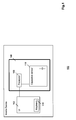
- Fig.1 is a block diagram of a mobile electronic device 100 in the invention .
- Device 100 comprises a user interface (UI) 102 with a keyboard 104.
- Keyboard 104 can be a hard-keyboard (with separate physical elements representing individual keys or buttons) or a soft-keyboard (with a touch screen functionality, wherein different icons rendered thereon represent different key inputs).
- Device 100 has a blocking function for blocking interaction with device 100 via UI 102 and/or keyboard 104. The switching on and switching off of the automatic blocking function is controlled by an electronic circuit 106 in mobile device 100 that senses a change in capacitance owing to the proximity of the user.
- Circuit 106 comprises a data processor 108 and capacitive sensing circuitry 110.
- Capacitive sensing circuitry is well known in the art, e.g., from US patent 7,088,112 ; US patent 7,088,112 ; US patent 7,138,809 .
- Data processor 108 then processes the measuring of the magnitude of one or more the capacitances, or the (order of) magnitude of the change(s) thereof, or the change(s) per unit of time, or the comparison of the measured magnitude(s) to one or more threshold values. This then enables processor 108 to discriminate between a touch by the user and another physical contact, e.g., with a piece of lining or a ballpoint. If needed, multiple capacitors can be used in circuitry 110, each at another strategic position at the body or housing of device 100.
- the positions are then typically chosen so as to coincide with the positions of the user's touching or holding device 100 in operational use. If a capacitance change is sensed at only a single position or if multiple capacitance changes are detected at different positions but at different moments, data processor 108 concludes that device 100 is not being manipulated by the user for user interaction via UI 102. If multiple changes occur substantially simultaneously, processor 108 concludes that the user intends to interact with device 100 via UI 102.
- device 100 is its user-friendliness.
- the known devices require extra user intervention for locking or unlocking the keyboard or user-interface, e.g., by pressing a combination of keys or navigating through a layered menu in order to enter the proper combination of user inputs. Entering only part of the combination of keys will result in a device still not blocked.
- Another key-press may well trigger undesired operations, such as unintentionally placing a telephone call if the device comprises a mobile telephone.
- device 100 is configured to only respond to key presses if device 100 is kept in the user's hand having a certain posture that creates a capacitive effect recognized by processor 108 as an intended use.
- circuitry 106 discriminates between high and low values of sensed changes in the capacitance(s). This then will not let children activate keyboard 104 or user interface 102 of device 100 when they are playing with device 100 owing to a smaller capacitive effect.
- device 100 is configurable, programmable or user-programmable with respect to what processor 108 identifies as a valid indication of the user intending to interact with device 100. For example, the sensed magnitude of the capacitance can be programmed above which the locking is cancelled.
- device 100 provides for also having keyboard 104 or user interface 102 unlocked by a specific (preferably programmable) combination of key-presses if the capacitance trigger does not work or does not work properly yet. Programming by the user is accomplished by setting device 100 into a configuration mode via UI 102.
- the body of the device in the invention is at least partly electrically conductive, e.g., made of metal or having a conductive layer on the outside. That part of the body then functionally forms part of the capacitor whose capacitance is being affected by the proximity of the user.
- Fig.2 is a block diagram of an embodiment of a device 200 in the invention, wherein proximity of the user is detected as a temperature change at one or more specific locations at the body of device 200 relative to the rest of the body where the temperature stays fixed or does not increase as fast.
- Device 200 comprises an electronic circuit 202 for sensing temperature.
- Circuitry 202 comprises one or more temperature sensors 204, e.g., multiple infrared (IR) sensors, connected to data processor 108.
- IR infrared
- Processor 108 compares the temperatures sensed at one or multiple specific locations on the body of device 200, e.g., at opposite parts. This enables processor 108 to discriminate between, on the one hand, the user actually holding and touching device 200 and, on the other hand, device 200 being carried in a pocket near the user's body. Again, processor 108 may take into account the relative rate of temperature change per temperature sensor location in order to identify an intended operational use of device 200.
- proximity sensors can be used, such as inductive sensors that sense a change in the inductance of one or more inductors (or: coils), light sensors at strategic places on the body of the device to determine, on the basis of light blocked or received, whether or not the device is being held in a way that is typical for operational use, etc.
Landscapes
- Engineering & Computer Science (AREA)
- Computer Security & Cryptography (AREA)
- Signal Processing (AREA)
- Human Computer Interaction (AREA)
- Computer Networks & Wireless Communication (AREA)
- Telephone Function (AREA)
Abstract
Description
- The invention relates to a mobile electronic device, such as a mobile telephone, comprising a user interface with a key for controlling a functionality of the device..
- A mobile, personal, electronic device such as a mobile telephone, which comprises a user interface with a key pad, may get activated inadvertently while it is being carried around. For example, a key may get depressed inadvertently as the device rubs against a seam in the lining of a pocket in the user's coat. Unintended calls may be the result.
- A first type of mobile telephones is known, wherein a keyboard can be disabled and/or enabled under password control. Although this feature is primarily meant as a security measure to prevent unauthorized access to the telephone's operations, a mobile telephone with a keyboard disabled under password control will not give rise to inadvertent calls being made as a result of unintended key-presses.
- Another type of mobile telephones is known from
US patent 6,374,088 . This publication discloses an arrangement in connection with an, at least partly, transparent pivotable protective hatch or flip for a mobile telephone apparatus. The flip is arranged to physically cover at least part of a keypad on the apparatus to prevent inadvertent keypad commands. - The known device of the first type requires the user to first enable the telephone by entering a password, which is an operation that introduces a delay from the user's point of view. The known device of the second type requires additional mechanical components that increase the device's weight, bulkiness and costs of assembly. In addition, the user first needs to open the hatch before user interaction is possible in operational use, which again introduces a delay from the user's perspective.
- It is an object of the invention to provide an alternative to the known devices in order to solve similar and other problems while avoiding the delays.
- To this end, the inventor proposes a mobile electronic device, e.g., a mobile telephone or a personal digital assistant (PDA), that has a user interface with a key for controlling a functionality of the device, and with a tactile sensor for enabling the control of the functionality through the key dependent on a change of a sensed touch-related physical quantity due to a change in proximity of a user to the device. Accordingly, a keyboard blocking function in a mobile electronic device of the invention is automatically switched on or off under control of a touch-sensing electronic circuit in the mobile device. Preferably, the touch-related physical quantity is a capacitance and the tactile sensor is a capacitive sensor.
- For completeness, reference is made to
US patent application publication 20060104435 that discloses a telephone with a telephone hook switch. The switch includes: a capacitive sensor having a capacitance that varies when an object or a part of a human body having a charge contacts or approaches it; and a signal generation circuit for detecting the variation of the capacitance of the capacitive sensor when the object or the part of the human body contacts or approaches so as to generate an ON/OFF signal. As a result, mechanical and structural limitations on the telephone are overcome, and the economic use of an inner space of the telephone can be improved. In addition, various applications can be made to conform to an external shape of the telephone in terms of design. The known telephone is a desktop telephone, not a mobile telephone, and the capacitive sensor is used as an alternative to the mechanical plunger to indicate that the user wants to make a call by lifting the hook from the telephone's main body. In addition, DocumentUS 20060104435 does not address inadvertent operation of the desktop telephone. Also note that certain known desktop telephone sets have speakerphone functionality that can be switched on or off via a button for communication without the hook being lifted off the apparatus. An inadvertent switching on of the speakerphone functionality is not prevented by a capacitive sensor in the hook. - For completeness, reference is made to
US patent 6,442,013 . This publication discloses an electronic device, e.g. a mobile telephone, having a front cover and a capacitive proximity sensor, comprising: a first electrode and a second electrode, said first electrode having a large face; and detector means connected to the first electrode and the second electrode for detecting the capacitance of the first electrode relatively to the second electrode and for providing a control signal responsive to the capacitance. The large face of the first electrode is inclined relative to the front cover. When an object moves farther away from, or closer to, the device, e.g. when the user grips around the communication device, the relative capacitance between the two electrodes will change significantly due to the spatial arrangement of the electrodes relatively to each other. The proximity sensor and detector can be used to control various functions, e.g., for answering an incoming call, controlling the volume of a loudspeaker, etc.US patent 6,442,013 neither teaches nor suggests a user interface with a key for control of a functionality of the device in operational use, and a proximity sensor for enabling the control of the functionality through the key dependent on proximity of a user. - The invention is explained in further detail, by way of example and with reference to the accompanying drawing, wherein:
-
Fig.1 and2 are block diagrams of a mobile device in the invention. - Throughout the Figures, similar or corresponding features are indicated by same reference numerals.
-
Fig.1 is a block diagram of a mobileelectronic device 100 in the invention .Device 100 comprises a user interface (UI) 102 with akeyboard 104. Keyboard 104 can be a hard-keyboard (with separate physical elements representing individual keys or buttons) or a soft-keyboard (with a touch screen functionality, wherein different icons rendered thereon represent different key inputs).Device 100 has a blocking function for blocking interaction withdevice 100 viaUI 102 and/orkeyboard 104. The switching on and switching off of the automatic blocking function is controlled by anelectronic circuit 106 inmobile device 100 that senses a change in capacitance owing to the proximity of the user.Circuit 106 comprises adata processor 108 andcapacitive sensing circuitry 110. Capacitive sensing circuitry is well known in the art, e.g., fromUS patent 7,088,112 ;US patent 7,088,112 ;US patent 7,138,809 .Data processor 108 then processes the measuring of the magnitude of one or more the capacitances, or the (order of) magnitude of the change(s) thereof, or the change(s) per unit of time, or the comparison of the measured magnitude(s) to one or more threshold values. This then enablesprocessor 108 to discriminate between a touch by the user and another physical contact, e.g., with a piece of lining or a ballpoint. If needed, multiple capacitors can be used incircuitry 110, each at another strategic position at the body or housing ofdevice 100. The positions are then typically chosen so as to coincide with the positions of the user's touching or holdingdevice 100 in operational use. If a capacitance change is sensed at only a single position or if multiple capacitance changes are detected at different positions but at different moments,data processor 108 concludes thatdevice 100 is not being manipulated by the user for user interaction viaUI 102. If multiple changes occur substantially simultaneously,processor 108 concludes that the user intends to interact withdevice 100 via UI 102. - An advantage of
device 100 over the known devices is its user-friendliness. The known devices require extra user intervention for locking or unlocking the keyboard or user-interface, e.g., by pressing a combination of keys or navigating through a layered menu in order to enter the proper combination of user inputs. Entering only part of the combination of keys will result in a device still not blocked. Another key-press may well trigger undesired operations, such as unintentionally placing a telephone call if the device comprises a mobile telephone. In the invention,device 100 is configured to only respond to key presses ifdevice 100 is kept in the user's hand having a certain posture that creates a capacitive effect recognized byprocessor 108 as an intended use. - In an interesting embodiment of
device 100,circuitry 106 discriminates between high and low values of sensed changes in the capacitance(s). This then will not let children activatekeyboard 104 oruser interface 102 ofdevice 100 when they are playing withdevice 100 owing to a smaller capacitive effect. Preferably,device 100 is configurable, programmable or user-programmable with respect to whatprocessor 108 identifies as a valid indication of the user intending to interact withdevice 100. For example, the sensed magnitude of the capacitance can be programmed above which the locking is cancelled. Possibly,device 100 provides for also havingkeyboard 104 oruser interface 102 unlocked by a specific (preferably programmable) combination of key-presses if the capacitance trigger does not work or does not work properly yet. Programming by the user is accomplished by settingdevice 100 into a configuration mode viaUI 102. - Preferably, the body of the device in the invention is at least partly electrically conductive, e.g., made of metal or having a conductive layer on the outside. That part of the body then functionally forms part of the capacitor whose capacitance is being affected by the proximity of the user.
- Above embodiments address capacitive sensing of the user's proximity. Other embodiments may rely on different types of sensors to sense proximity.
- For example,
Fig.2 is a block diagram of an embodiment of adevice 200 in the invention, wherein proximity of the user is detected as a temperature change at one or more specific locations at the body ofdevice 200 relative to the rest of the body where the temperature stays fixed or does not increase as fast.Device 200 comprises anelectronic circuit 202 for sensing temperature.Circuitry 202 comprises one ormore temperature sensors 204, e.g., multiple infrared (IR) sensors, connected todata processor 108. Typically, ifdevice 200 is not manipulated, its body will assume a more or less uniform temperature throughout. If the user touchesdevice 200, the user's body heat will increase the temperature at those locations wheredevice 200 is being touched.Processor 108 compares the temperatures sensed at one or multiple specific locations on the body ofdevice 200, e.g., at opposite parts. This enablesprocessor 108 to discriminate between, on the one hand, the user actually holding and touchingdevice 200 and, on the other hand,device 200 being carried in a pocket near the user's body. Again,processor 108 may take into account the relative rate of temperature change per temperature sensor location in order to identify an intended operational use ofdevice 200. - Other proximity sensors can be used, such as inductive sensors that sense a change in the inductance of one or more inductors (or: coils), light sensors at strategic places on the body of the device to determine, on the basis of light blocked or received, whether or not the device is being held in a way that is typical for operational use, etc.
Claims (4)
- A mobile electronic device comprising:a user interface with a key for controlling a functionality of the device;a tactile sensor for enabling the control of the functionality via the key dependent on a change of a touch-related physical quantity due to a change in proximity of a user.
- The device of claim 1, wherein the touch-related physical quantity comprises a capacitance and wherein the tactile sensor comprises a capacitive sensor.
- The device of claim 1, wherein the touch-related physical quantity comprises a temperature, and wherein the tactile sensor comprises a temperature sensor.
- The device of claim 1, comprising a mobile telephone.
Priority Applications (1)
| Application Number | Priority Date | Filing Date | Title |
|---|---|---|---|
| EP07004552A EP1968287A1 (en) | 2007-03-06 | 2007-03-06 | Capacitively enabling mobile telephone's UI for operational use |
Applications Claiming Priority (1)
| Application Number | Priority Date | Filing Date | Title |
|---|---|---|---|
| EP07004552A EP1968287A1 (en) | 2007-03-06 | 2007-03-06 | Capacitively enabling mobile telephone's UI for operational use |
Publications (1)
| Publication Number | Publication Date |
|---|---|
| EP1968287A1 true EP1968287A1 (en) | 2008-09-10 |
Family
ID=38330577
Family Applications (1)
| Application Number | Title | Priority Date | Filing Date |
|---|---|---|---|
| EP07004552A Withdrawn EP1968287A1 (en) | 2007-03-06 | 2007-03-06 | Capacitively enabling mobile telephone's UI for operational use |
Country Status (1)
| Country | Link |
|---|---|
| EP (1) | EP1968287A1 (en) |
Cited By (3)
| Publication number | Priority date | Publication date | Assignee | Title |
|---|---|---|---|---|
| WO2009110814A3 (en) * | 2008-03-04 | 2009-12-10 | Boban Stojanovic | Standup senzor |
| CN102340300A (en) * | 2010-07-21 | 2012-02-01 | 中兴通讯股份有限公司 | Mobile terminal touch key locking method and apparatus thereof |
| EP2530915A4 (en) * | 2011-05-04 | 2013-02-13 | Huawei Device Co Ltd | METHOD FOR LOCKING THE MOBILE PHONE KEYBOARD AND MOBILE TELEPHONE THEREFOR |
Citations (5)
| Publication number | Priority date | Publication date | Assignee | Title |
|---|---|---|---|---|
| GB2256772A (en) * | 1991-05-28 | 1992-12-16 | So Hing Chung | Telephone with proximity switch |
| DE19638127A1 (en) * | 1996-09-18 | 1998-02-05 | Siemens Ag | Cordless telephone set with switch responsive to handling by user |
| GB2346500A (en) * | 1999-02-03 | 2000-08-09 | Motorola Inc | Sensor controlled user interface for portable communication device |
| EP1109382A2 (en) * | 1999-12-17 | 2001-06-20 | Nokia Mobile Phones Ltd. | Controlling a terminal of a communication system |
| EP1755322A2 (en) * | 2005-08-15 | 2007-02-21 | IDT Communication Technology Limited | Handheld telecommunication device with key-lock and method of locking the keys thereof |
-
2007
- 2007-03-06 EP EP07004552A patent/EP1968287A1/en not_active Withdrawn
Patent Citations (5)
| Publication number | Priority date | Publication date | Assignee | Title |
|---|---|---|---|---|
| GB2256772A (en) * | 1991-05-28 | 1992-12-16 | So Hing Chung | Telephone with proximity switch |
| DE19638127A1 (en) * | 1996-09-18 | 1998-02-05 | Siemens Ag | Cordless telephone set with switch responsive to handling by user |
| GB2346500A (en) * | 1999-02-03 | 2000-08-09 | Motorola Inc | Sensor controlled user interface for portable communication device |
| EP1109382A2 (en) * | 1999-12-17 | 2001-06-20 | Nokia Mobile Phones Ltd. | Controlling a terminal of a communication system |
| EP1755322A2 (en) * | 2005-08-15 | 2007-02-21 | IDT Communication Technology Limited | Handheld telecommunication device with key-lock and method of locking the keys thereof |
Cited By (3)
| Publication number | Priority date | Publication date | Assignee | Title |
|---|---|---|---|---|
| WO2009110814A3 (en) * | 2008-03-04 | 2009-12-10 | Boban Stojanovic | Standup senzor |
| CN102340300A (en) * | 2010-07-21 | 2012-02-01 | 中兴通讯股份有限公司 | Mobile terminal touch key locking method and apparatus thereof |
| EP2530915A4 (en) * | 2011-05-04 | 2013-02-13 | Huawei Device Co Ltd | METHOD FOR LOCKING THE MOBILE PHONE KEYBOARD AND MOBILE TELEPHONE THEREFOR |
Similar Documents
| Publication | Publication Date | Title |
|---|---|---|
| CN101689853B (en) | An input device and an electronic device comprising an input device | |
| US20090262078A1 (en) | Cellular phone with special sensor functions | |
| US20080316181A1 (en) | Moving buttons | |
| KR101575343B1 (en) | Portable communication apparatus having touch screen locking device | |
| WO2012009891A1 (en) | Method and apparatus for locking touch keys of mobile terminal | |
| JP4260198B2 (en) | Mobile information terminal and mobile phone | |
| CN103516861B (en) | Handheld device and its control method for automatically answering phone and locking touch screen | |
| GB2450583A (en) | Cellular phone with automatic function activation depending upon sensor detections | |
| CN101715020A (en) | Method for preventing error touches during conversation and touch mobile phone using same | |
| EP1508239B1 (en) | Mobile communication device including an array sensor | |
| TWI428783B (en) | Unlocking method with touch sensor | |
| US20130278547A1 (en) | Electronic device | |
| EP1408400A2 (en) | Touch-pad for use on a portable electronic device | |
| CN104518770A (en) | Method and device for preventing electronic device from being touched by mistake | |
| EP3764254A1 (en) | Fingerprint unlocking method, and terminal | |
| US20120040711A1 (en) | Mobile telephone enabling a user to answer a call without pressing a button | |
| CN101930309B (en) | Method and device for preventing false triggering caused by touching key | |
| CN101494679B (en) | App unlock method with touch sensor | |
| KR101332708B1 (en) | Mobile terminal and case with rear side auxiliary touch input device | |
| CN206181325U (en) | Earphone wire control device | |
| KR101100008B1 (en) | Method for preventing malfunction through touch screen and terminal for same | |
| CN104932802A (en) | Mobile terminal input response control method and mobile terminal | |
| CN112912833A (en) | Secondary back surface touch sensor for handheld device | |
| CN105930025B (en) | A kind of quick screenshot method and the mobile device with quick screenshot function | |
| KR20150091036A (en) | Portable communication apparatus having touch screen locking device |
Legal Events
| Date | Code | Title | Description |
|---|---|---|---|
| PUAI | Public reference made under article 153(3) epc to a published international application that has entered the european phase |
Free format text: ORIGINAL CODE: 0009012 |
|
| AK | Designated contracting states |
Kind code of ref document: A1 Designated state(s): AT BE BG CH CY CZ DE DK EE ES FI FR GB GR HU IE IS IT LI LT LU LV MC MT NL PL PT RO SE SI SK TR |
|
| AX | Request for extension of the european patent |
Extension state: AL BA HR MK RS |
|
| 17P | Request for examination filed |
Effective date: 20090310 |
|
| 17Q | First examination report despatched |
Effective date: 20090408 |
|
| AKX | Designation fees paid |
Designated state(s): AT BE BG CH CY CZ DE DK EE ES FI FR GB GR HU IE IS IT LI LT LU LV MC MT NL PL PT RO SE SI SK TR |
|
| STAA | Information on the status of an ep patent application or granted ep patent |
Free format text: STATUS: THE APPLICATION HAS BEEN WITHDRAWN |
|
| 18W | Application withdrawn |
Effective date: 20090522 |