EP1967138A1 - Methodology and display instrument to noninvasively determine pulmonary characteristics through breath analysis and arterial blood measurement - Google Patents
Methodology and display instrument to noninvasively determine pulmonary characteristics through breath analysis and arterial blood measurement Download PDFInfo
- Publication number
- EP1967138A1 EP1967138A1 EP08004086A EP08004086A EP1967138A1 EP 1967138 A1 EP1967138 A1 EP 1967138A1 EP 08004086 A EP08004086 A EP 08004086A EP 08004086 A EP08004086 A EP 08004086A EP 1967138 A1 EP1967138 A1 EP 1967138A1
- Authority
- EP
- European Patent Office
- Prior art keywords
- partial pressure
- gas
- renewed
- ratio
- partial
- Prior art date
- Legal status (The legal status is an assumption and is not a legal conclusion. Google has not performed a legal analysis and makes no representation as to the accuracy of the status listed.)
- Withdrawn
Links
- 210000004369 blood Anatomy 0.000 title claims abstract description 156
- 239000008280 blood Substances 0.000 title claims abstract description 156
- 238000000034 method Methods 0.000 title claims abstract description 126
- 238000004458 analytical method Methods 0.000 title description 14
- 238000005259 measurement Methods 0.000 title description 14
- 230000002685 pulmonary effect Effects 0.000 title description 10
- 230000000241 respiratory effect Effects 0.000 claims abstract description 110
- 230000000747 cardiac effect Effects 0.000 claims abstract description 45
- 210000004072 lung Anatomy 0.000 claims abstract description 28
- 230000029058 respiratory gaseous exchange Effects 0.000 claims description 49
- 238000004364 calculation method Methods 0.000 claims description 9
- 230000004087 circulation Effects 0.000 abstract description 10
- 210000002216 heart Anatomy 0.000 abstract description 7
- 229910002092 carbon dioxide Inorganic materials 0.000 description 238
- 239000007789 gas Substances 0.000 description 167
- CURLTUGMZLYLDI-UHFFFAOYSA-N Carbon dioxide Chemical compound O=C=O CURLTUGMZLYLDI-UHFFFAOYSA-N 0.000 description 116
- 238000009423 ventilation Methods 0.000 description 15
- 210000000056 organ Anatomy 0.000 description 7
- 210000005241 right ventricle Anatomy 0.000 description 7
- QVGXLLKOCUKJST-UHFFFAOYSA-N atomic oxygen Chemical compound [O] QVGXLLKOCUKJST-UHFFFAOYSA-N 0.000 description 6
- 229910052760 oxygen Inorganic materials 0.000 description 6
- 239000001301 oxygen Substances 0.000 description 6
- 230000010412 perfusion Effects 0.000 description 6
- 210000001147 pulmonary artery Anatomy 0.000 description 6
- 238000004590 computer program Methods 0.000 description 5
- 238000007796 conventional method Methods 0.000 description 5
- 239000001569 carbon dioxide Substances 0.000 description 4
- 230000002612 cardiopulmonary effect Effects 0.000 description 4
- 238000009792 diffusion process Methods 0.000 description 4
- 230000008569 process Effects 0.000 description 4
- 210000003492 pulmonary vein Anatomy 0.000 description 4
- 210000005245 right atrium Anatomy 0.000 description 4
- 210000000709 aorta Anatomy 0.000 description 3
- 230000017531 blood circulation Effects 0.000 description 3
- 238000010276 construction Methods 0.000 description 3
- 210000002683 foot Anatomy 0.000 description 3
- 210000005240 left ventricle Anatomy 0.000 description 3
- 239000007788 liquid Substances 0.000 description 3
- 230000004088 pulmonary circulation Effects 0.000 description 3
- 230000009897 systematic effect Effects 0.000 description 3
- 210000001367 artery Anatomy 0.000 description 2
- 230000008901 benefit Effects 0.000 description 2
- 210000004204 blood vessel Anatomy 0.000 description 2
- 239000010432 diamond Substances 0.000 description 2
- 229940079593 drug Drugs 0.000 description 2
- 239000003814 drug Substances 0.000 description 2
- 208000015181 infectious disease Diseases 0.000 description 2
- 210000005246 left atrium Anatomy 0.000 description 2
- 238000000691 measurement method Methods 0.000 description 2
- 229920001690 polydopamine Polymers 0.000 description 2
- 208000023504 respiratory system disease Diseases 0.000 description 2
- XLYOFNOQVPJJNP-UHFFFAOYSA-N water Chemical compound O XLYOFNOQVPJJNP-UHFFFAOYSA-N 0.000 description 2
- 102000001554 Hemoglobins Human genes 0.000 description 1
- 108010054147 Hemoglobins Proteins 0.000 description 1
- 210000003423 ankle Anatomy 0.000 description 1
- 210000001765 aortic valve Anatomy 0.000 description 1
- 210000002565 arteriole Anatomy 0.000 description 1
- 238000010241 blood sampling Methods 0.000 description 1
- 230000001413 cellular effect Effects 0.000 description 1
- 210000004351 coronary vessel Anatomy 0.000 description 1
- 230000003111 delayed effect Effects 0.000 description 1
- 238000010586 diagram Methods 0.000 description 1
- 229910003460 diamond Inorganic materials 0.000 description 1
- 238000010494 dissociation reaction Methods 0.000 description 1
- 230000005593 dissociations Effects 0.000 description 1
- 230000000694 effects Effects 0.000 description 1
- 230000005611 electricity Effects 0.000 description 1
- 210000003743 erythrocyte Anatomy 0.000 description 1
- 238000011156 evaluation Methods 0.000 description 1
- 210000003191 femoral vein Anatomy 0.000 description 1
- 210000004247 hand Anatomy 0.000 description 1
- 230000036541 health Effects 0.000 description 1
- 238000010438 heat treatment Methods 0.000 description 1
- 238000009434 installation Methods 0.000 description 1
- 210000004731 jugular vein Anatomy 0.000 description 1
- 239000004973 liquid crystal related substance Substances 0.000 description 1
- 239000012528 membrane Substances 0.000 description 1
- 210000004115 mitral valve Anatomy 0.000 description 1
- 238000012986 modification Methods 0.000 description 1
- 230000004048 modification Effects 0.000 description 1
- 238000012544 monitoring process Methods 0.000 description 1
- 210000004165 myocardium Anatomy 0.000 description 1
- 210000003102 pulmonary valve Anatomy 0.000 description 1
- 238000005086 pumping Methods 0.000 description 1
- 210000003742 purkinje fiber Anatomy 0.000 description 1
- 230000004202 respiratory function Effects 0.000 description 1
- 230000004044 response Effects 0.000 description 1
- 210000001013 sinoatrial node Anatomy 0.000 description 1
- 230000001839 systemic circulation Effects 0.000 description 1
- 230000009885 systemic effect Effects 0.000 description 1
- 210000000591 tricuspid valve Anatomy 0.000 description 1
- 210000005166 vasculature Anatomy 0.000 description 1
- 210000003462 vein Anatomy 0.000 description 1
- 210000001631 vena cava inferior Anatomy 0.000 description 1
- 210000002620 vena cava superior Anatomy 0.000 description 1
- 210000000264 venule Anatomy 0.000 description 1
- 210000000707 wrist Anatomy 0.000 description 1
Images


Classifications
-
- A—HUMAN NECESSITIES
- A61—MEDICAL OR VETERINARY SCIENCE; HYGIENE
- A61B—DIAGNOSIS; SURGERY; IDENTIFICATION
- A61B5/00—Measuring for diagnostic purposes; Identification of persons
- A61B5/08—Measuring devices for evaluating the respiratory organs
-
- A—HUMAN NECESSITIES
- A61—MEDICAL OR VETERINARY SCIENCE; HYGIENE
- A61B—DIAGNOSIS; SURGERY; IDENTIFICATION
- A61B5/00—Measuring for diagnostic purposes; Identification of persons
- A61B5/08—Measuring devices for evaluating the respiratory organs
- A61B5/083—Measuring rate of metabolism by using breath test, e.g. measuring rate of oxygen consumption
- A61B5/0836—Measuring rate of CO2 production
-
- A—HUMAN NECESSITIES
- A61—MEDICAL OR VETERINARY SCIENCE; HYGIENE
- A61B—DIAGNOSIS; SURGERY; IDENTIFICATION
- A61B5/00—Measuring for diagnostic purposes; Identification of persons
- A61B5/02—Detecting, measuring or recording for evaluating the cardiovascular system, e.g. pulse, heart rate, blood pressure or blood flow
- A61B5/0205—Simultaneously evaluating both cardiovascular conditions and different types of body conditions, e.g. heart and respiratory condition
-
- A—HUMAN NECESSITIES
- A61—MEDICAL OR VETERINARY SCIENCE; HYGIENE
- A61B—DIAGNOSIS; SURGERY; IDENTIFICATION
- A61B5/00—Measuring for diagnostic purposes; Identification of persons
- A61B5/02—Detecting, measuring or recording for evaluating the cardiovascular system, e.g. pulse, heart rate, blood pressure or blood flow
- A61B5/026—Measuring blood flow
- A61B5/029—Measuring blood output from the heart, e.g. minute volume
Definitions
- the present invention relates to methodology and display instruments to non-invasively determine pulmonary blood gas characteristics; more particularly, the method is based on measurement of inspiration capacity V I (or W I ), O 2 -CO 2 partial pressures of inspiration gas, I*, O 2 -CO 2 partial pressures of end-tidal gas of breath, ET*, and O 2 -CO 2 gas partial pressures of arterial blood, a*; the method makes use of these measured values as input to a computer program to determine O 2 -CO 2 partial pressures of mixed venous, V*, O 2 -CO 2 partial pressures of alveolar gas, A*, and respiratory characteristics of lungs-pulmonary circulation system such as O 2 -CO 2 partial pressures of end-capillary blood, C*, pulmonary ventilation, VA*, end-capillary gas flow rate, Q, cardiac output, Q total , shunt ratio Y, respiratory dead space ratio X, etc.
- the present invention relates to an instrument to display the input values of measured breath and blood gas partial pressures and the output values of the pulmonary characteristics, wherein the measurement device for the input variables is connected either by a cable or wireless to the display device for the output variables such as computer terminal, printer, PDA, cellular phone and the like, so as to utilize the displayed output results for medical and health care purpose.
- the measurement device for the input variables is connected either by a cable or wireless to the display device for the output variables such as computer terminal, printer, PDA, cellular phone and the like, so as to utilize the displayed output results for medical and health care purpose.
- the heartbeat of an adult in relaxed condition is about 60 to 70 times per minute. It is approximately equivalent to 100,000 per day or 2.6 billion times in a lifetime of 70 years.
- Blood volume in a body is about 5 liters and cardiac output per heartbeat is about 60 to 70cc; cardiac pumping rate is about 3.5 to 5.0 liters per minute; complete circulation of blood in a body takes about 40 to 50 seconds.
- Mechanical power of the heart is about 6,000cal per hour.
- a heart has two pumps, the right ventricle in charge of pulmonary circulation and the left ventricle in charge of systemic circulation.
- the vasculature includes aorta, pulmonary artery, coronary artery, artery, arteriole, end-capillary blood vessel, venules, vein, pulmonary vein, inferior and superior vena cavae.
- the extended total length of the blood vessel is about 96,000km, two and half times of the earth equator. Electricity is generated from the sinus node of heart and distributed by Purkinje fibers to make the heart muscles contract. Fig.
- FIG. 1 shows the order of blood circulation: right ventricle 270 ⁇ (pulmonary valve) ⁇ pulmonary artery 240 ⁇ pulmonary end-capillaries 250 ⁇ pulmonary vein 230 ⁇ left atrium 280 ⁇ (mitral valve) ⁇ left ventricle 290 ⁇ (aortic valve) ⁇ aorta 210 ⁇ artery ⁇ systemic end-capillaries 300 ⁇ vein ⁇ vena cava 220 ⁇ right atrium 260 ⁇ (tricuspid valve) ⁇ right ventricle 270.
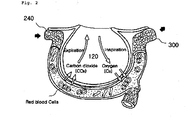
- pulmonary circulation blood is pumped by the right ventricle 270 to a network of a few micrometer-thick capillaries 250 via pulmonary arteries 240 in the right and left lungs 200; the blood is returned to the left atrium 280 via pulmonary vein 230, with very rapid two-way oxygen and carbon dioxide diffusion between breath air and blood through thin alveolar membrane of the capillaries, as shown in Fig. 2 .
- Pulmonary arterial blood or the mixed venous blood is rich of carbon dioxide; pulmonary venous blood is rich of oxygen and becomes the arterial blood after it is pumped to the aorta by the left ventricle.
- Gas exchange in the lung removes carbon dioxide and supply oxygen to the blood. Since there is no oxygen reservoir in the human body, one would die in a few minutes if oxygen supply is stopped by accident. Partial pressure of the O 2 and CO 2 blood gases of a patient is therefore very important information to a clinical doctor. Blood gas partial pressures can be measured using blood samples taken from the patient. The pulmonary vein is, however, hidden deep in the body to make the invasive mixed-venous blood sampling extremely difficult; it is not only painful but also costly. Therefore, it will be valuable if the partial pressures of the mixed-venous blood gas can be determined by mathematical and physiological model using input data obtained by minimally invasive method, such as O 2 and CO 2 partial pressures measured from arterial blood and breath gas; arterial blood can be sampled relatively easy and fast.
- minimally invasive method such as O 2 and CO 2 partial pressures measured from arterial blood and breath gas
- arterial blood can be sampled relatively easy and fast.
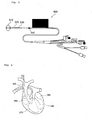
- the first method Korean Patent Application No. 1987-0002027 , entitled "catheter for determining cardiac output and catheter for determining blood flow rate", disclosed a method of predicting the cardiac output or the blood volume flow rate pumped by the right ventricle; it is a direct measurement method using a catheter shown in Fig.3 .
- the catheter 500 comprises: an opening 510 to discharge liquid and a temperature detector 530 or a thermistor 520 to determine the blood temperature at a distance from the opening; and a flow rate detector 540 installed near the thermistor 520.
- the flow rate detector 540 makes use of a self-heating thermistor and determines the blood volume flow rate by thermodilution principle.
- the catheter is inserted into the pulmonary artery from the incision made on either jugular vein or femoral vein; it passes through superior vena cava or inferior vena cava, right atrium 260 and right ventricle 270 as in Fig.4 ; a hot or cold liquid is injected into the right atrium 260 of heart and the thermistor measures how much the liquid is cooled or heated in the pulmonary artery.
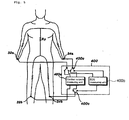
- Fig. 5 illustrates the apparatus comprising; current electrodes 32a and 32b mounted on the right hand (or arm) and right foot (or leg); voltage electrodes 34a and 34b mounted on the left hand (or arm) and left foot (or leg); a switching device 400c to connect the electrodes 32a and 32b, 34a and 34b to output devices such as cardiac output device 400a and electrocardiograph (ECG) 400b.
- ECG electrocardiograph
- the cardiac output device applies high frequency current to the current electrodes 32a and 32b through the switching device 400c; it measures voltages from the voltage electrodes 34a and 34b; it measures ECG by receiving difference signals from the voltage electrodes 34a and 34b; a control device outputs control signals to the switching device 400c to display the measured values on the display devices.
- the third method is the so-called NICO (Non Invasive Cardiac Output); it employs a non-invasive evaluation of cardiac output by measuring expiration gas based on the Partial CO 2 rebreathing method developed by Novametrix Medical Systems. This method comprises measurement of CO 2 partial pressure in the expiration gas to solve Fick's equation for CO 2 to evaluate cardiac output.
- NICO Non Invasive Cardiac Output
- This method comprises measurement of CO 2 partial pressure in the expiration gas to solve Fick's equation for CO 2 to evaluate cardiac output.
- the above method is simple since it requires CO 2 input values with no need of other information like O 2 ; it, however, has a poor prediction accuracy.
- the fourth method is Korean Patent Laid-Open No. 1999-22493 ; it disclosed a method of evaluating O 2 partial pressure in the mixed venous blood by solving Fick's equation using input values such as measured cardiac output, O 2 uptake and/or O 2 partial pressure in the arterial blood.
- the first method has high accuracy but is a severely invasive method; it can possibly cause pain, complications and infection in the patients.
- the second method is inconvenient by the troubles of mounting electrodes on desired sites of human body.
- the third method is simple by using only the measured CO 2 partial pressure to solve Fick's equation. However, it is well known that this method has poor accuracy unless the cardiac output is about 6 liters/min.
- the fourth method has poor accuracy because it makes use of insufficient number of input values and only one Fick's equation instead of many; the method is restricted because only O 2 partial pressure of mixed venous blood is predicted, not its CO 2 partial pressure.
- the present invention employs a more complete set of governing equations consisting of mass balance equations for O 2 , CO 2 and N 2 , shunt ratio equation, respiration quotient ratio equation, ventilation-perfusion ratio equation, etc.; it calculate as output the shunt ratio, dead space ratio, O 2 -CO 2 partial pressures of alveolar gas, cardiac output and O 2 -CO 2 partial pressure of mixed venous blood.
- the present invention is minimally invasive since the most-invasive O 2 -CO 2 partial pressure of mixed venous blood is predicted, not measured. Therefore this method is clearly different from the conventional methods.
- a human lung has some shunt and dead space even for a healthy person.
- a patient with respiratory disease has severe shunt and physiological dead space causing respiratory function to be significantly reduced.
- the present invention offers a method to determine shunt ratio, dead space ratio, O 2 -CO 2 partial pressures of alveolar gas, alveolar ventilation, cardiac output, respiration quotient ratio; it applies a variety of more complex numerical formulae such as mass balance equation for O 2 , mass balance equation for CO 2 , shunt ratio equation for O 2 , shunt ratio equation for CO 2 , respiration quotient ratio equation for ventilation, respiration quotient ratio equation for blood, ventilation-perfusion ratio equation for O 2 , ventilation-perfusion ratio equation for CO 2 , etc.
- a gas exchanging process in a lung means that blood simultaneously releases CO 2 and receives O 2 by diffusion, and must have a connection for reversing increase and decrease of partial pressures both of the gases.
- O 2 -CO 2 partial pressures of the alveolar gas A* is substantially equal to O 2 -CO 2 partial pressures of end-capillaries C* through equilibrium at the end of expiration. If there is physiological dead space in a lung, non-functional air not used in gas exchange is mixed in the lung so that the end-tidal gas has lower CO 2 partial pressure and high O 2 partial pressure compared to functional air after completion of the gas exchange in the alveolar.
- an object of the present invention is to provide a method for computer analysis of numerical formulae systems such as mass balance equations for O 2 and CO 2 , comprising: measuring flow rates of inspiration and/or expiration air in ventilation gas during breathing, and O 2 -CO 2 partial pressure thereof; measuring O 2 -CO 2 partial pressures of arterial blood as an input value; and using the input value to analyze the numerical formulae.
- the present invention further provides a method and an apparatus to accurately predict O 2 -CO 2 partial pressures of mixed venous blood, O 2 -CO 2 partial pressures of end-capillaries, O 2 -CO 2 partial pressures of alveolar, cardiac output, shunt ratio and physiological dead space in respiratory organs by applying the solutions resulted from the computer analysis.
- the present invention provides a method comprising the steps of: passing ventilation air through a nozzle; measuring inspiration capacity V I (or W I ), O 2 -CO 2 partial pressures at inspiration I* and O 2 -CO 2 partial pressures of end-tidal gas ET* through a gas sensor mounted on the nozzle during breathing and using the measured values as primary input values of respiratory gases; measuring O 2 -CO 2 gas partial pressure of arterial blood a*; and inputting the measured values into a computer program and solving numerical systems such as mass balance equations for O 2 and CO 2 to determine significant physiological characteristics of the respiratory organs.
- the physiological characteristics are output values including, for example: respiratory functional characteristics such as O 2 -CO 2 partial pressure of mixed venous blood and end-capillary (or commonly known as alveolar gas); cardiac functional characteristics such as cardiac output; and lung structural characteristics such as shunt ratio and physiological dead space.
- respiratory functional characteristics such as O 2 -CO 2 partial pressure of mixed venous blood and end-capillary (or commonly known as alveolar gas)
- cardiac functional characteristics such as cardiac output
- lung structural characteristics such as shunt ratio and physiological dead space.
- partial pressures and concentrations of O 2 and CO 2 which are combined with and/or separated from hemoglobin in red blood cells and diffused into blood and respiratory air reach an inter-equilibrium in alveolar and end-capillary, and are thereby capable of being inter-conversed through gas dissociation curve.
- Primary measurement values entered as input data have less numerical values but require many respiratory characteristics to be determined.
- the present invention can construct and analyze a system with more complex numerical formulae including, for example, mass balance equations for O 2 and CO 2 , shunt ratio equations for O 2 and CO 2 , respiratory equation of ventilation, respiratory equation of blood, ventilation-perfusion ratio equation for O 2 and CO 2 and the like, compared to those used in conventional methods.
- An aspect of the present invention is to adopt a systematic method to solve complicated formula systems described above, comprising: classifying respiratory problems into 'the first respiration model' with a small number of input values and 'the second respiration model' with a large number of input values; and applying analysis solutions and results induced from 'the first model' to a solution of 'the second model' as the more complicated question.
- the first respiration model relates to a lung without shunt or physiological dead space, in which a blood boundary value comprises O 2 -CO 2 partial pressures of mixed venous blood V* and a gas boundary value comprises O 2 -CO 2 partial pressures of I* at the inspiration.
- the second respiration model relates to a lung with shunt or physiological dead space, in which a blood boundary value comprises information of mixed venous blood V*, supporting information for blood comprises O 2 -CO 2 partial pressures of arterial blood a* and supporting information for gas comprises O 2 -CO 2 partial pressures of end-tidal gas ET*.
- respiration models have two types of models based on preference of variables in numerical solutions and, more particularly, the present invention classifies and describes 'first respiration model: first type model', 'first respiration model: second type model', 'second respiration model: first type model' and 'second respiration model: second type model'.
- first type model' as one of methods for determining respiratory characteristics of the present invention, the method includes the steps of: (a) inputting O 2 -CO 2 partial pressure of mixed venous blood and O 2 -CO 2 partial pressure of inspiration gas as specified boundary values, into an automatic computing device; (b) inputting an initial value VA/Q of ventilation-perfusion ratio for start of a do-loop into the automatic computing device; (c) inputting a pair of initial values of O 2 -CO 2 partial pressure of alveolar gas, (A1, A2), for start of another do-loop, which satisfy ventilation-perfusion ratio equation, into the automatic computing device; (d) applying the O 2 -CO 2 partial pressure of mixed venous blood, the O 2 -CO 2 partial pressure of alveolar gas and the ventilation-perfusion ratio to solve the governing respiration equations; (e) solving a group of governing equations for respiratory blood gas in the automatic computing device and obtaining renewed values of alveolar-gas partial pressures (A1*, A
- the O 2 -CO 2 partial pressures of mixed venous blood V* and the O 2 -CO 2 partial pressures of inspiration gas I* are directly measured or usually obtained from alternative sources.
- the respiratory governing equations for respiratory blood gas comprises mass balance equations for O 2 , CO 2 and N 2 , combined equations for gas partial pressure such as Equation Nos. 3 to 6, and ventilation-perfusion ratio equations such as Equation Nos. 11 and 12.
- O 2 partial pressure of alveolar A1* is obtained by substituting VA/Q (a initial value in the step (b)) for Eq. 3 as a mass balance equation for O 2 , or for Eq. 11 as a ventilation-perfusion ratio equation for O 2 .
- CO 2 partial pressure of alveolar A2* is obtained by substituting VA/Q for Eq. 4 as a mass balance equation for CO 2 , or for Eq. 12 as a ventilation-perfusion ratio equation for CO 2 .
- the ventilation-perfusion ratio requirement is characterized in directly determining whether a difference of the calculated initial value VA/Q for ventilation-perfusion ratio in the step (b) and the renewed value VA/Q* obtained in the step (f) is within a constant range and, if the requirement is not satisfied, the present inventive method includes returning to the step (c) and repeatedly carrying out the steps (d) to (g) for a renewed pair of O 2 -CO 2 partial pressure of alveolar gas (A1, A2).
- the ventilation-perfusion ratio requirement is further characterized in indirectly determining whether a difference of the setup O 2 -CO 2 partial pressure (A1, A2) inputted in the step (c) and the renewed O 2 -CO 2 partial pressure (A1*, A2*) obtained in the step (e) are within constant ranges, respectively.
- the renewed pair of O 2 -CO 2 partial pressure of alveolar gas (A1, A2) in the step (c) comprise CO 2 partial pressure A2 renewed according to a specific regulation and the renewed O 2 partial pressure A1* obtained from the ventilation-perfusion ratio equation in association with the CO 2 partial pressure A2.
- the pair of O 2 -CO 2 partial pressure of alveolar gas (A1*, A2*) obtained in the step (e) comprise the renewed O 2 partial pressure A1* obtained in the step (c) and CO 2 partial pressure A2* obtained by solving a group of governing equations for respiratory blood gas using the renewed O 2 partial pressure A1*.
- the renewed pair of O 2 -CO 2 partial pressure of alveolar gas (A1, A2) in the step (c) comprise O 2 partial pressure A1 renewed according to a specific regulation and the renewed CO 2 partial pressure A2* obtained from the ventilation-perfusion ratio equation in association with the O 2 partial pressure A1.
- the pair of O 2 -CO 2 partial pressure of alveolar gas (A1*, A2*) obtained in the step (e) comprise the renewed CO 2 partial pressure A2* obtained in the step (c) and O 2 partial pressure A1* obtained by solving a group of governing equations for respiratory blood gas using the renewed CO 2 partial pressure A2*.
- the pair of O 2 -CO 2 partial pressure of alveolar gas (A1*, A2*) obtained in the step (h) comprise solutions (A1*, A2*) obtained from the steps (c) to (e) using initial value VA/Q and renewed value VA/Q* for ventilation-perfusion ratio in the step (b).
- a method for determining respiratory characteristics includes the steps of: obtaining a solution A* of O 2 -CO 2 partial pressures of alveolar gas in the step (h) corresponding to initial value VA/Q for ventilation-perfusion ratio in the step (b); renewing initial value VA/Q for ventilation-perfusion ratio after returning to the step (b); and repeatedly carrying out the steps (c) to (h).
- a method for determining respiratory characteristics includes repeating the steps (a) to (h) to obtain a desired distribution of O 2 -CO 2 partial pressures A* of alveolar gas corresponding to all of initial values VA/Q for ventilation-perfusion ratio.
- Requirement for ventilation-perfusion ratio in the step (h) means ventilation-perfusion ratio is within a specific range, which is calculated by any of various ventilation-perfusion ratio equations including ventilation-perfusion ratio equation (Eq. 9) induced from Fick's equation for O 2 (Eq. 1); ventilation-perfusion ratio equation (Eq. 11) induced from mass balance equation for O 2 (Eq. 3); ventilation-perfusion ratio equation (Eq. 10) induced from Fick's equation for CO 2 (Eq. 2); and/or ventilation-perfusion ratio equation (Eq. 12) induced from mass balance equation for CO 2 (Eq. 4).
- the respiratory characteristics are determined when the above requirement is satisfied.
- the first respiration model for determining respiratory characteristics according to the present invention is solved by means of ventilation-perfusion ratio curve or Kelman's curve.
- first type model' an computing subroutines for determining respiratory characteristics and analysis thereof is described as follows.
- the computing subroutines is run in a computer containing a computer program written by the present inventors and a principal construction for analysis of the above determining method includes the following loops and/or steps of: forming an outer do-loop and inputting an initial value VA/Q of ventilation-perfusion ratio into the loop; forming an inner do-loop and inputting an initial value of O 2 partial pressure information A1 of alveolar gas (referring to as A1*); calculating CO 2 partial pressure A2* by solving a mass balance equation; and using a pair of the values A1* and A2* to calculate another value VA/Q* for ventilation-perfusion ratio.
- A1* and A2* are defined as solutions to escape the inner do-loop.
- the above calculation process is repeated to offer a Kelman's curve formed of a set of O 2 -CO 2 partial pressure of alveolar matching A* regularly altered VA/Q values, which is often called ventilation-perfusion ratio curve or O 2 -CO 2 diagram.
- the O 2 -CO 2 partial pressures A* is substantially equal to any one selected from information of end-capillary blood C*, information of end-tidal gas ET* and O 2 -CO 2 partial pressures of arterial blood a*.
- second type model' is a method for using a pair of O 2 -CO 2 partial pressures initial values A1 and A2 of alveolar gas and comprises the steps of: (a) inputting O 2 -CO 2 partial pressures of mixed venous blood and O 2 -CO 2 partial pressure of inspiration gas as specified boundary values, into an automatic computing device; (b) inputting a pair of initial values of O 2 -CO 2 partial pressure of alveolar gas, (A1, A2), for start of a do-loop into the automatic computing device; (c) inputting an initial value VA/Q for ventilation-perfusion ratio, for start of another do-loop, which satisfy ventilation-perfusion ratio equation using the above O 2 -CO 2 partial pressures initial values (A1, A2), into the automatic computing device; (d) applying the O 2 -CO 2 partial pressure of mixed venous blood, the O 2 -CO 2 partial pressure of alveolar gas and the ventilation-perfusion ratio to solve the governing respiration equations; (e)
- the O 2 -CO 2 partial pressures of mixed venous blood V* and the O 2 -CO 2 partial pressures of inspiration gas I* in the step (a) are directly measured or usually obtained from alternative sources.
- the equation group for respiratory blood gas comprises mass balance equations for O 2 , CO 2 and N 2 , and combined equations for gas partial pressure.
- the ventilation-perfusion ratio requirement is characterized in determining whether a difference of the calculated initial value VA/Q and the renewed value VA/Q* for ventilation-perfusion ratio obtained in the step (f) is within a constant range and, if the requirement is not satisfied, the present inventive method includes returning to the step (b) and repeatedly carrying out the steps (c) to (g) for a renewed pair of O 2 -CO 2 partial pressure of alveolar gas A1 and A2.
- the renewed pair of O 2 -CO 2 partial pressure of alveolar gas A1 and A2 in the step (b) comprise CO 2 partial pressure A2 setup as an initial value and O 2 partial pressure A1 obtained by mass balance equation for O 2 using the CO 2 partial pressure A2.
- the pair of O 2 -CO 2 partial pressure of alveolar gas A1* and A2* obtained in the step (e) comprise CO 2 partial pressure A2 as an initial value (referring to as A2*) obtained in the step (b) and O 2 partial pressure A1* obtained by solving a group of governing equations for respiratory blood gas using the initial CO 2 partial pressure A2*.
- the renewed pair of O 2 -CO 2 partial pressure of alveolar gas A1 and A2 in the step (b) comprise O 2 partial pressure A1 setup as an initial value and CO 2 partial pressure A2 obtained by mass balance equation for CO 2 using the initial O 2 partial pressure A1.
- the pair of O 2 -CO 2 partial pressure of alveolar gas A1* and A2* obtained in the step (e) comprise O 2 partial pressure A1 as an initial value (referring to as A1*) obtained in the step (b) and CO 2 partial pressure A2* obtained by solving a group of governing equations for respiratory blood gas using the initial O 2 partial pressure A1*.
- the ventilation-perfusion ratio requirement is characterized in directly determining whether a difference of the calculated initial value VA/Q for ventilation-perfusion ratio in the step (c) and the renewed value VA/Q* obtained in the step (f) is within a constant range and, if the requirement is not satisfied, the present inventive method includes returning to the step (b) and repeatedly carrying out the steps (c) to (h) for a renewed pair of O 2 -CO 2 partial pressure of alveolar gas A1 and A2 .
- the ventilation-perfusion ratio requirement is further characterized in indirectly determining whether a difference of the setup O 2 -CO 2 partial pressure A1 and A2 inputted in the step (b) and the renewed O 2 -CO 2 partial pressure A1* and A2* obtained in the step (e) are within constant ranges, respectively.
- a method for determining respiratory characteristics includes the steps of: obtaining final solutions of O 2 -CO 2 partial pressure of alveolar gas (A1*, A2*) with regard to O 2 -CO 2 partial pressures initial values of alveolar gas (A1, A2) or initial value VA/Q for ventilation-perfusion ratio corresponding thereto; renewing O 2 partial pressure A1 after returning to the step (b); and repeatedly carrying out the steps (c) to (h).
- a method for determining respiratory characteristics includes the steps of: obtaining final solutions of O 2 -CO 2 partial pressure of alveolar gas (A1*, A2*) with regard to O 2 -CO 2 partial pressures initial values of alveolar gas (A1, A2) or initial value VA/Q for ventilation-perfusion ratio corresponding thereto; renewing CO 2 partial pressure A2 after returning to the step (b); and repeatedly carrying out the steps (c) to (h).
- 'second respiration model' is preferably suggested in the method for determining extended respiratory characteristics according to the present invention.
- first type model' has physiological dead space ratio X as an initial value
- second type model' has shunt ratio Y as an initial value.
- first type model' of the present invention comprises the steps of: (a) inputting blood boundary value, gas boundary value, supporting information for blood, supporting information for gas and inspiration flow rate into an automatic computing device; (b) inputting initial value of physiological dead space ratio X into the automatic computing device; (c) inputting a pair of O 2 -CO 2 partial pressures initial values of alveolar gas (A1, A2) into the automatic computing device using the initial value of the dead space ratio X; (d) applying the boundary value, the initial value and the initial values to an computing subroutines built in the automatic computing device; (e) solving a group of governing equations for respiratory blood gas in the computing subroutines and obtaining newly renewed O 2 -CO 2 partial pressure of alveolar gas (A1*, A2*) based on the solutions; (f) calculating O 2 shunt ratio Y1 and CO 2 shunt ratio Y2 if the renewed O 2 -CO 2 partial pressure satisfy requirement for O 2 -CO 2 partial pressures
- the blood boundary value comprises O 2 -CO 2 partial pressures V* of mixed venous blood or O 2 partial pressure only while the gas boundary value comprises all of O 2 -CO 2 partial pressure at inspiration I* or O 2 partial pressure only.
- the supporting information for blood comprises all of O 2 -CO 2 partial pressure of arterial blood a* or O 2 partial pressure only.
- the supporting information for gas comprises all of O 2 -CO 2 partial pressure of end-tidal gas ET* or CO 2 partial pressure only.
- Inspiration capacity VI in the step (a) means flow rate of external air entered into lungs and, for tidal breathing, the capacity VI is substantially equal to expiration capacity VE released outside from the lungs.
- the equation group for respiratory blood gas comprises mass balance equations for O 2 , CO 2 and N 2 and combined equations for gas partial pressure.
- a method for determining respiratory characteristics is characterized by repetition of the steps (d) and (e) for a renewed pair of O 2 -CO 2 partial pressures initial values of alveolar gas (A1, A2) after returning to the step (c) if the requirements for O 2 -CO 2 partial pressures in the step (f) were not satisfied.
- the O 2 -CO 2 partial pressure (A1, A2) are a new pair of partial pressures (A1, A2*) comprising O 2 partial pressure A1 to be a repeatedly renewed initial value and CO 2 partial pressure A2 (referred to as A2*) obtained using the initial value of the dead space ratio X.
- the renewed O 2 -CO 2 partial pressure of alveolar gas (A1*, A2*) obtained in the step (e) comprise the CO 2 partial pressure of alveolar gas A2* obtained in the step (c) and renewed O 2 partial pressure A1* obtained by solving a group of governing equations for respiratory blood gas including mass balance equations for O 2 , CO 2 and N 2 and combined equations for gas partial pressure using the O 2 -CO 2 partial pressure (A1, A2*) determined in the step (c).
- Requirement for O 2 -CO 2 partial pressures in the step (f) is characterized in determining whether a difference between the O 2 partial pressure A1 renewed initial value in the step (c) and the O 2 partial pressure A1* obtained by solving a group of governing equations for respiratory blood gas is within a specific range.
- the O 2 -CO 2 partial pressure of alveolar gas (A1, A2) are a new pair of partial pressures (A1*, A2) comprising CO 2 partial pressure A2 to be a repeatedly renewed initial value and O 2 partial pressure A1 (referred to as A1*) obtained using the initial shunt ratio X.
- the renewed O 2 -CO 2 partial pressure of alveolar gas (A1*, A2*) obtained in the step (e) comprise the O 2 partial pressure of alveolar gas A1* obtained in the step (c) and renewed CO 2 partial pressure A2* obtained by solving a group of governing equations for respiratory blood gas including mass balance equations for O 2 , CO 2 and N 2 and combined equations for gas partial pressure using the O 2 -CO 2 partial pressure (A1*, A2*) determined in the step (c).
- Requirement for O 2 -CO 2 partial pressures in the step (f) is characterized in determining whether a difference between the CO 2 partial pressure A2 renewed initial value in the step (c) and the CO 2 partial pressure A2* obtained by solving a group of governing equations for respiratory blood gas is within a specific range.
- Requirement for shunt ratio in the step (g) is characterized in determining whether a difference between O 2 shunt ratio Y1 and CO 2 shunt ratio Y2 is within a specific range and, if the requirement for shunt ratio is not satisfied, the present inventive method includes returning to the step (b) and repeatedly renewing physiological dead space ratio X.
- first type model' comprises the steps of: setting up any greater value than O 2 partial pressure of arterial blood a1 as an initial value for O 2 partial pressure A1; and inputting an initial dead space ratio X and an initial value for CO 2 partial pressure A2 calculated using the dead space ratio X into an automatic computing device.
- initial values for mass balance equation Eq. 4 or Eq. 12 for CO 2 By substituting the initial values for mass balance equation Eq. 4 or Eq. 12 for CO 2 , a corresponding value VA/Q for ventilation-perfusion ratio is obtained.
- the renewed O 2 partial pressure A1* is obtained by substituting the above initial values and the value VA/Q for mass balance equation Eq. 3 or Eq. 11 for O 2 .
- the present inventive method includes returning to the step (b), setting up a new dead space ratio X so as to calculate a new renewed CO 2 partial pressure A2*, and repeatedly carrying out the same calculation to obtain a new O 2 partial pressure of alveolar gas A1**. From the resulting values, alternative O 2 shunt ratio Y1* and CO 2 shunt ratio Y2* are calculated again and the same calculation is repeatedly carried out until a difference between these values Y1* and Y2* is within the specific range, thereby obtaining O 2 -CO 2 partial pressures of alveolar gas.
- Respiratory characteristics determined in the above step (g) include latest stored O 2 -CO 2 partial pressure of alveolar gas (A1*, A2*) during repeat process, O 2 -CO 2 partial pressures of end-capillary C*, shunt ratio Y1* or Y2* and physiological dead space ratio X*.
- Cardiac output determined in the step (h) is obtained by equations Eq. 15 and 16 and using measured inspiration capacity VI or expiration capacity VE, perfusion capacity Q, shunt ratio Y*, and physiological dead space ratio X*.
- first type model' uses information of mixed venous blood V* and information of arterial blood a* as blood input values as well as inspiration gas information I* and end-tidal gas information ET* as gas input values.
- the computing subroutines is run in a computer containing a computer program written by the present inventors, and a principal construction for analysis of the present inventive method for determining respiratory characteristics includes the following loops and/or steps of: forming an outer do-loop and setting up an initial value of dead space ratio X; inputting an initial value of O 2 partial pressure of alveolar gas A1 into an inner do-loop and calculating CO 2 partial pressure of alveolar gas A2 by solving a mass balance equation system; or, inputting an initial value of CO 2 partial pressure of alveolar gas A2 into an inner do-loop and calculating O 2 partial pressure of alveolar gas A1 by solving a mass balance equation system; using O 2 -CO 2 partial pressures setup data of alveolar gas (A1, A2) to calculate O 2 shunt ratio Y1 by an equation Eq.
- an alternative method for determining respiratory characteristics of the present invention is 'second respiration model: second type model', comprising the steps of: (a) inputting blood boundary value, gas boundary value, supporting information for blood, supporting information for gas and inspiration capacity into an automatic computing device; (b) inputting an initial value of shunt ratio Y into the automatic computing device; (c) inputting a pair of O 2 -CO 2 partial pressures initial values of alveolar gas (A1, A2) obtained by the initial shunt ratio Y into the automatic computing device; (d) applying the boundary value, the initial value and the initial values to an computing subroutines built in the automatic computing device; (e) solving a group of governing equations for respiratory blood gas in the computing subroutines and obtaining renewed O 2 -CO 2 partial pressure of alveolar gas (A1*, A2*) based on the solutions of the equation group; (f) calculating O 2 dead space ratio X1 and CO 2 dead space ratio X2 if the renewed O 2 -CO 2 partial pressure (A
- the gas boundary value comprises all of O 2 -CO 2 partial pressure at inspiration I* or O 2 partial pressure only.
- the supporting information for blood comprises all of O 2 -CO 2 partial pressure of arterial blood a* or O 2 partial pressure only.
- the supporting information for gas comprises all of O 2 -CO 2 partial pressure of end-tidal gas ET* or CO 2 partial pressure only.
- Inspiration capacity VI in the step (a) means flow rate of external air entered into lungs and, for tidal breathing, the capacity VI is substantially equal to expiration capacity VE released outside from the lungs.
- the analysis equation group for respiratory blood gas comprises mass balance equations for O 2 , CO 2 and N 2 and combined equations for gas partial pressure.
- a method for predicting respiratory characteristics is characterized by repetition of the steps (d) and (e) for a renewed pair of O 2 -CO 2 partial pressures initial values of alveolar gas (A1, A2) after returning to the step (c) if the requirements for O 2 -CO 2 partial pressures in the step (f) were not satisfied.
- the O 2 -CO 2 partial pressure of alveolar gas (A1, A2) are a new pair of partial pressures (A1, A2*) comprising O 2 partial pressure A1 to be a repeatedly renewed initial value and CO 2 partial pressure A2 (referred to as A2*) obtained using the initial shunt ratio Y.
- the renewed O 2 -CO 2 partial pressure of alveolar gas (A1*, A2*) obtained in the step (e) comprise the CO 2 partial pressure of alveolar gas A2* obtained in the step (c) and renewed O 2 partial pressure A1* obtained by solving a group of governing equations for respiratory blood gas including mass balance equations for O 2 , CO 2 and N 2 and combined equations for gas partial pressure using the O 2 -CO 2 partial pressure (A1, A2*) determined in the step (c).
- Requirement for O 2 -CO 2 partial pressures in the step (f) is characterized in determining whether a difference between the O 2 partial pressure A1 renewed initial value in the step (c) and the O 2 partial pressure A1* obtained by solving a group of governing equations for respiratory blood gas is within a specific range.
- the O 2 -CO 2 partial pressure (A1, A2) are a new pair of partial pressures (A1*, A2) comprising CO 2 partial pressure A2 to be a repeatedly renewed initial value and O 2 partial pressure A1 (referred to as A1*) obtained using the initial shunt ratio Y.
- the renewed O 2 -CO 2 partial pressure of alveolar gas (A1*, A2*) obtained in the step (e) comprise the O 2 partial pressure of alveolar gas A1* obtained in the step (c) and renewed CO 2 partial pressure A2* obtained by solving a group of governing equations for respiratory blood gas including mass balance equations for O 2 , CO 2 and N 2 and combined equations for gas partial pressure using the O 2 -CO 2 partial pressure (A1*, A2) determined in the step (c).
- Requirement for O 2 -CO 2 partial pressures in the step (f) is characterized in determining whether a difference between the CO 2 partial pressure A2 renewed initial value in the step (c) and the CO 2 partial pressure A2* obtained by solving a group of governing equations for respiratory blood gas is within a specific range.
- Requirement for shunt ratio in the step (g) is characterized in determining whether a difference between O 2 dead space ratio X1 and CO 2 dead space ratio X2 is within a specific range and, if the requirement for dead space ratio is not satisfied, the present inventive method includes returning to the step (b) and repeatedly renewing physiological shunt ratio Y.
- second type model' comprises the steps of: setting up any greater value than O 2 partial pressure of arterial blood a1 as an initial value for O 2 partial pressure A1; and inputting an initial shunt ratio Y and an initial value for CO 2 partial pressure A2 calculated using the shunt ratio Y into an automatic computing device.
- initial values for mass balance equation Eq. 4 or Eq. 12 for CO 2 a corresponding value VA/Q for ventilation-perfusion ratio is obtained.
- the renewed O 2 partial pressure A1* is obtained by substituting the above initial values and the value VA/Q for mass balance equation Eq. 3 or Eq. 11 for O 2 .
- the present inventive method includes returning to the step (b), setting up a new shunt ratio Y so as to calculate a new renewed CO 2 partial pressure A2*, and repeatedly carrying out the same calculation to obtain a new O 2 partial pressure of alveolar gas A1**. From the resulting values, alternative O 2 dead space ratio X1* and CO 2 dead space ratio X2* are calculated again and the same calculation is repeatedly carried out until a difference between these values is within the specific range, thereby obtaining O 2 -CO 2 partial pressures of alveolar gas.
- Respiratory characteristics determined in the above step (g) include latest stored O 2 -CO 2 partial pressure of alveolar gas (A1*, A2*) during repeat process, O 2 -CO 2 partial pressures of end-capillary C*, physiological dead space ratio X1* or X2* and shunt ratio Y*.
- Cardiac output determined in the step (h) is obtained by equations Eq. 15 and 16 and using measured inspiration capacity VI or expiration capacity VE, perfusion capacity Q, shunt ratio Y*, and physiological dead space ratio X*.
- second type model' uses information of mixed venous blood V* and information of arterial blood a* as blood input values as well as inspiration gas information I* and end-tidal gas information ET* as gas input values.
- the computing subroutines is run in a computer containing a computer program written by the present inventors, and a principal construction for analysis of the present inventive method for determining respiratory characteristics includes the following loops and/or steps of: forming an outer do-loop and setting up an initial value of shunt ratio Y; inputting an initial value of O 2 partial pressure of alveolar gas A1 into an inner do-loop and calculating CO 2 partial pressure of alveolar gas A2 by solving a mass balance equation system; or, inputting an initial value of CO 2 partial pressure of alveolar gas A2 into an inner do-loop and calculating O 2 partial pressure of alveolar gas A1 by solving a mass balance equation system; using O 2 -CO 2 partial pressures setup data of alveolar gas (A1, A2) to calculate O 2 dead space ratio X1 by an equation Eq.
- an instrument for displaying respiratory characteristics includes an information terminal connected to the automatic computing device to visually display results predicted by the method for determining respiratory characteristics of the present invention, so as to preferably and conveniently provide the results to a user.
- Such computing device may comprise computer processors and/or embedded chips fixed in a computer.
- the present inventive display instrument is portably carried by wired or wireless connection of the information terminal to the computing device.
- the display instrument is a system for simultaneously predicting various physiological characteristics of cardiopulmonary organs including, for example: respiratory functional characteristics such as O 2 -CO 2 partial pressure of mixed venous blood and end-capillary (or commonly known as alveolar gas); cardiac functional characteristics such as cardiac output; and lung structural characteristics such as shunt ratio and physiological dead space ratio.
- respiratory functional characteristics such as O 2 -CO 2 partial pressure of mixed venous blood and end-capillary (or commonly known as alveolar gas)
- cardiac functional characteristics such as cardiac output
- lung structural characteristics such as shunt ratio and physiological dead space ratio.
- the instrument comprises: a nozzle 1 for passing ventilation air; means 3, 4 and 5 for measuring primary variables in ventilation through a gas sensor mounted on the ventilation nozzle 1; a means for measuring O 2 -CO 2 partial pressures of arterial blood; a means 7 for analyzing numerical formulae systems such as mass balance equations for O 2 and CO 2 by computer to induce blood respiratory characteristics, cardiac functional characteristics and lung structural characteristics; and a display means 8 for visually illustrating various input and output values.
- Fig. 6 is a systematic view to illustrate an instrument for determining respiratory characteristics of lung-pulmonary circulation system according to the present invention.
- Such instrument includes: a mask and a nozzle 1 and 2 for passing ventilation air; sensor measuring means 3, 4 and 5 to measure primary respiratory values of the ventilation air from sensors mounted on the ventilation nozzle; a micro-processor or computer 7 which has a program to solve respiration model questions in order to calculate respiratory characteristics of lung-pulmonary circulation system by using the primary respiratory values; and a means 8 for visually displaying the primary values and renewed respiratory characteristics on liquid crystal displays, computer terminals, printers, mobile phones, PDAs, etc. through wired or wireless telecommunication.
- the present invention uses specific numerical formulae in order to calculate physiological characteristics of lung-pulmonary circulation system using the primarily measured values as described above.
- Such numerical formulae mathematically illustrate physiological relations between breathing related values and, relate to the following variables and equations.
- Examples of input and output values include O 2 -CO 2 information of mixed venous blood V*, O 2 -CO 2 information of end-capillary C*, O 2 -CO 2 information of arterial blood a*, O 2 -CO 2 information of inspiration air I*, O 2 -CO 2 information of alveolar gas A*, O 2 -CO 2 information of end-tidal gas ET*, ventilation through alveolar VA, inspiration capacity VI, perfusion Q, cardiac output Q total , shunt ratio Y, physiological dead space ratio X, etc.
- the equations include, for example: mass balance equations for O 2 , CO 2 and N 2 such as Eq. 3 to 5; Fick' s equations such as Eq. 1 and 2; shunt ratio equations such as Eq. 7 and 8; respiratory equations such as Eq. 13 and 14; ventilation-perfusion equations such as Eq. 9 to 12; cardiac output equations such as Eq. 15 and 16; and/or dead space ratio equations such as Eq. 17 and 18.
- the present invention applies primary measurement values to be easily and non-invasively measured, for example, inspiration capacity, partial pressures of O 2 and CO 2 during ventilation and/or O 2 and CO 2 concentration measured in arterial blood in order to calculate or obtain important information such as: blood respiratory characteristics of lungs and pulmonary circulation organs, which have a significant difficulty in measurement; cardiac functional characteristics; and/or lung functional characteristics by adopting the following equations and values:
- a clinical respiratory data set M was prepared from five(5) individual patients with severe respiratory diseases hospitalized in the intensive care units (abbrev. to ICU patients) in Respiratory Medicine, Medicine College, Chung-Nam University of Korea.
- left two(2) columns showed O 2 -CO 2 partial pressures of mixed venous blood V* among the prepared data set M.
- the measured data further comprises arterial blood data a*, inspiration data I* and data at the end of expiration ET*.
- Fig. 7 illustrates O 2 -CO 2 partial pressures of lung circulation system determined by the present invention, and corresponding values in the clinical measurement data set M of Chung-Nam University used as input values.
- Curves shown in Fig. 7 (1, 2, 3, 4 and 5) are ventilation-perfusion ratio curves resulted from solutions of 'first respiration model' questions for five patients.
- a symbol with a "diamond shape" at the left end of each of the curves (V1, V2 ... V5) represents measured O 2 -CO 2 partial pressures value of mixed venous blood V* among the clinical data set M.
- a black circle (a1, a2 ... and a5) near the diamond symbol represents O 2 -CO 2 partial pressures of arterial blood a* as clinical measurement value.
- a large triangle at center portion of each of the curves (A1 and A2 ... A5) is partial pressure A* of alveolar gas which was defined by using V*, a*, I* and ET* among the clinical measurement data set M as well as solutions of 'second respiration model' of the present invention.
- a blank square (E1, E2 ... E5) represents CO 2 partial pressure of end-tidal gas contained in the clinical measurement data set M marked on the ventilation-perfusion ratio curve obtained from 'first respiration model', while small and black squares near the blank square correctly indicate O 2 -CO 2 partial pressures points of end-tidal gas ET* by further applying O 2 partial pressure of end-tidal gas calculated from solutions of 'second respiration model".
- the present invention provides: a measurement apparatus to non-invasively determine partial O 2 and CO 2 pressures of ventilation gas and arterial blood, respectively; classification of two kinds of respiration models to sequentially solve and analyze complicated questions, so as to evaluate physiological characteristics such as blood respiratory characteristics of cardiopulmonary organs, cardiac functional characteristics, lung functional characteristics, etc.; and computer analysis of each of the respiration models and computing devices corresponding to the analysis.
- the present inventive measurement method has an advantage of improved accuracy and usefulness even for a lung with shunt and/or dead space as well as without the same.
- the present invention can eliminate pain, infection and/or complications of patients possibly caused by the catheter operation. Moreover, the present invention has no trouble of using electrodes required for receiving electrical bio-signals by attaching or fixing the electrodes to correct sites on hands (or arms) and legs (or feet).
- the present invention also considers equilibriums by O 2 diffusion as well as CO 2 diffusion in pulmonary capillary, compared to CO 2 -rebreathing method developed by Novametrix which uses only CO 2 data obtained by breathing and is effective in a specific narrow range of cardiac outputs, so that various respiratory characteristics in lungs-pulmonary circulation system can be predicted or determined in the more extended range of cardiac outputs than that of the CO 2 -rebreathing method.
Landscapes
- Health & Medical Sciences (AREA)
- Life Sciences & Earth Sciences (AREA)
- Physiology (AREA)
- Cardiology (AREA)
- Biomedical Technology (AREA)
- Molecular Biology (AREA)
- Veterinary Medicine (AREA)
- Biophysics (AREA)
- Pathology (AREA)
- Engineering & Computer Science (AREA)
- Public Health (AREA)
- Heart & Thoracic Surgery (AREA)
- Medical Informatics (AREA)
- Physics & Mathematics (AREA)
- Surgery (AREA)
- Animal Behavior & Ethology (AREA)
- General Health & Medical Sciences (AREA)
- Pulmonology (AREA)
- Hematology (AREA)
- Obesity (AREA)
- Emergency Medicine (AREA)
- Measurement Of The Respiration, Hearing Ability, Form, And Blood Characteristics Of Living Organisms (AREA)
- Measuring Pulse, Heart Rate, Blood Pressure Or Blood Flow (AREA)
Abstract
Description
- This application claims priority to Korean Patent Application No.
10-2007-0021264, filed on March 5, 2007 - The present invention relates to methodology and display instruments to non-invasively determine pulmonary blood gas characteristics; more particularly, the method is based on measurement of inspiration capacity VI (or WI ), O2-CO2 partial pressures of inspiration gas, I*, O2-CO2 partial pressures of end-tidal gas of breath, ET*, and O2-CO2 gas partial pressures of arterial blood, a*; the method makes use of these measured values as input to a computer program to determine O2-CO2 partial pressures of mixed venous, V*, O2-CO2 partial pressures of alveolar gas, A*, and respiratory characteristics of lungs-pulmonary circulation system such as O2-CO2 partial pressures of end-capillary blood, C*, pulmonary ventilation, VA*, end-capillary gas flow rate, Q, cardiac output, Qtotal, shunt ratio Y, respiratory dead space ratio X, etc. Also, the present invention relates to an instrument to display the input values of measured breath and blood gas partial pressures and the output values of the pulmonary characteristics, wherein the measurement device for the input variables is connected either by a cable or wireless to the display device for the output variables such as computer terminal, printer, PDA, cellular phone and the like, so as to utilize the displayed output results for medical and health care purpose.
- In general, the heartbeat of an adult in relaxed condition is about 60 to 70 times per minute. It is approximately equivalent to 100,000 per day or 2.6 billion times in a lifetime of 70 years. Blood volume in a body is about 5 liters and cardiac output per heartbeat is about 60 to 70cc; cardiac pumping rate is about 3.5 to 5.0 liters per minute; complete circulation of blood in a body takes about 40 to 50 seconds. Mechanical power of the heart is about 6,000cal per hour. A heart has two pumps, the right ventricle in charge of pulmonary circulation and the left ventricle in charge of systemic circulation. The vasculature includes aorta, pulmonary artery, coronary artery, artery, arteriole, end-capillary blood vessel, venules, vein, pulmonary vein, inferior and superior vena cavae. The extended total length of the blood vessel is about 96,000km, two and half times of the earth equator. Electricity is generated from the sinus node of heart and distributed by Purkinje fibers to make the heart muscles contract.
Fig. 1 shows the order of blood circulation:right ventricle 270 → (pulmonary valve) →pulmonary artery 240 → pulmonary end-capillaries 250 →pulmonary vein 230 →left atrium 280 → (mitral valve) →left ventricle 290 → (aortic valve) →aorta 210 → artery → systemic end-capillaries 300 → vein →vena cava 220 →right atrium 260 → (tricuspid valve) →right ventricle 270. - In the pulmonary circulation, blood is pumped by the
right ventricle 270 to a network of a few micrometer-thick capillaries 250 viapulmonary arteries 240 in the right andleft lungs 200; the blood is returned to theleft atrium 280 viapulmonary vein 230, with very rapid two-way oxygen and carbon dioxide diffusion between breath air and blood through thin alveolar membrane of the capillaries, as shown inFig. 2 . Pulmonary arterial blood or the mixed venous blood is rich of carbon dioxide; pulmonary venous blood is rich of oxygen and becomes the arterial blood after it is pumped to the aorta by the left ventricle. - Gas exchange in the lung removes carbon dioxide and supply oxygen to the blood. Since there is no oxygen reservoir in the human body, one would die in a few minutes if oxygen supply is stopped by accident. Partial pressure of the O2 and CO2 blood gases of a patient is therefore very important information to a clinical doctor. Blood gas partial pressures can be measured using blood samples taken from the patient. The pulmonary vein is, however, hidden deep in the body to make the invasive mixed-venous blood sampling extremely difficult; it is not only painful but also costly. Therefore, it will be valuable if the partial pressures of the mixed-venous blood gas can be determined by mathematical and physiological model using input data obtained by minimally invasive method, such as O2 and CO2 partial pressures measured from arterial blood and breath gas; arterial blood can be sampled relatively easy and fast.
- The first method, Korean Patent Application No.
1987-0002027 Fig.3 . Thecatheter 500 comprises: anopening 510 to discharge liquid and atemperature detector 530 or athermistor 520 to determine the blood temperature at a distance from the opening; and aflow rate detector 540 installed near thethermistor 520. Theflow rate detector 540 makes use of a self-heating thermistor and determines the blood volume flow rate by thermodilution principle. - The catheter is inserted into the pulmonary artery from the incision made on either jugular vein or femoral vein; it passes through superior vena cava or inferior vena cava,
right atrium 260 andright ventricle 270 as inFig.4 ; a hot or cold liquid is injected into theright atrium 260 of heart and the thermistor measures how much the liquid is cooled or heated in the pulmonary artery. - The second method, Korean Patent Application No.
10-1999-0000417 Fig. 5 . illustrates the apparatus comprising;current electrodes 32a and 32b mounted on the right hand (or arm) and right foot (or leg); voltage electrodes 34a and 34b mounted on the left hand (or arm) and left foot (or leg); aswitching device 400c to connect theelectrodes 32a and 32b, 34a and 34b to output devices such as cardiac output device 400a and electrocardiograph (ECG) 400b. The cardiac output device applies high frequency current to thecurrent electrodes 32a and 32b through theswitching device 400c; it measures voltages from the voltage electrodes 34a and 34b; it measures ECG by receiving difference signals from the voltage electrodes 34a and 34b; a control device outputs control signals to theswitching device 400c to display the measured values on the display devices. - The third method is the so-called NICO (Non Invasive Cardiac Output); it employs a non-invasive evaluation of cardiac output by measuring expiration gas based on the Partial CO2 rebreathing method developed by Novametrix Medical Systems. This method comprises measurement of CO2 partial pressure in the expiration gas to solve Fick's equation for CO2 to evaluate cardiac output. The above method is simple since it requires CO2 input values with no need of other information like O2; it, however, has a poor prediction accuracy.
- The fourth method is Korean Patent Laid-Open No.
1999-22493 - The first method has high accuracy but is a severely invasive method; it can possibly cause pain, complications and infection in the patients. The second method is inconvenient by the troubles of mounting electrodes on desired sites of human body. The third method is simple by using only the measured CO2 partial pressure to solve Fick's equation. However, it is well known that this method has poor accuracy unless the cardiac output is about 6 liters/min. Likewise, the fourth method has poor accuracy because it makes use of insufficient number of input values and only one Fick's equation instead of many; the method is restricted because only O2 partial pressure of mixed venous blood is predicted, not its CO2 partial pressure.
- In contrast, the present invention employs a more complete set of governing equations consisting of mass balance equations for O2, CO2 and N2, shunt ratio equation, respiration quotient ratio equation, ventilation-perfusion ratio equation, etc.; it calculate as output the shunt ratio, dead space ratio, O2-CO2 partial pressures of alveolar gas, cardiac output and O2-CO2 partial pressure of mixed venous blood. The present invention is minimally invasive since the most-invasive O2-CO2 partial pressure of mixed venous blood is predicted, not measured. Therefore this method is clearly different from the conventional methods.
- A human lung has some shunt and dead space even for a healthy person. A patient with respiratory disease has severe shunt and physiological dead space causing respiratory function to be significantly reduced. The present invention offers a method to determine shunt ratio, dead space ratio, O2-CO2 partial pressures of alveolar gas, alveolar ventilation, cardiac output, respiration quotient ratio; it applies a variety of more complex numerical formulae such as mass balance equation for O2, mass balance equation for CO2, shunt ratio equation for O2, shunt ratio equation for CO2, respiration quotient ratio equation for ventilation, respiration quotient ratio equation for blood, ventilation-perfusion ratio equation for O2, ventilation-perfusion ratio equation for CO2, etc.
- A gas exchanging process in a lung means that blood simultaneously releases CO2 and receives O2 by diffusion, and must have a connection for reversing increase and decrease of partial pressures both of the gases. In general, O2-CO2 partial pressures of the alveolar gas A* is substantially equal to O2-CO2 partial pressures of end-capillaries C* through equilibrium at the end of expiration. If there is physiological dead space in a lung, non-functional air not used in gas exchange is mixed in the lung so that the end-tidal gas has lower CO2 partial pressure and high O2 partial pressure compared to functional air after completion of the gas exchange in the alveolar. If there is shunt in the lung, non-functional blood not used in gas exchange is mixed in the lung so that the arterial blood has lower O2 partial pressure and high CO2 partial pressure compared to functional blood after completion of the gas exchange in the capillary. Accordingly, measurement of the end-tidal gas or gas partial pressure of arterial blood cannot be connected by prediction of gas partial pressure for gas in alveolar and/or end-capillaries and collection of alveolar gas or blood in capillaries itself is very difficult, so that it is substantially impossible to find out O2-CO2 gas partial pressure of alveolar gas or blood in capillaries through direct measurement.
- Consequently, using shunt or physiological dead space, it is very important to predict physiological characteristics of cardiopulmonary organs of a human body and there is a strong requirement for more advanced ideas and techniques to provide non-invasive and systematically rapid prediction means and/or instruments, compared to conventional methods known in the art.
- Accordingly, the present invention has been proposed to solve problems such as damage at administration, side effects, uncertainty and/or delayed response in conventional techniques described above and an object of the present invention is to provide a method for computer analysis of numerical formulae systems such as mass balance equations for O2 and CO2, comprising: measuring flow rates of inspiration and/or expiration air in ventilation gas during breathing, and O2-CO2 partial pressure thereof; measuring O2-CO2 partial pressures of arterial blood as an input value; and using the input value to analyze the numerical formulae. The present invention further provides a method and an apparatus to accurately predict O2-CO2 partial pressures of mixed venous blood, O2-CO2 partial pressures of end-capillaries, O2-CO2 partial pressures of alveolar, cardiac output, shunt ratio and physiological dead space in respiratory organs by applying the solutions resulted from the computer analysis.
- In order to accomplish the above described object, the present invention provides a method comprising the steps of: passing ventilation air through a nozzle; measuring inspiration capacity VI (or WI ), O2-CO2 partial pressures at inspiration I* and O2-CO2 partial pressures of end-tidal gas ET* through a gas sensor mounted on the nozzle during breathing and using the measured values as primary input values of respiratory gases; measuring O2-CO2 gas partial pressure of arterial blood a*; and inputting the measured values into a computer program and solving numerical systems such as mass balance equations for O2 and CO2 to determine significant physiological characteristics of the respiratory organs. The physiological characteristics are output values including, for example: respiratory functional characteristics such as O2-CO2 partial pressure of mixed venous blood and end-capillary (or commonly known as alveolar gas); cardiac functional characteristics such as cardiac output; and lung structural characteristics such as shunt ratio and physiological dead space. In addition, partial pressures and concentrations of O2 and CO2 which are combined with and/or separated from hemoglobin in red blood cells and diffused into blood and respiratory air reach an inter-equilibrium in alveolar and end-capillary, and are thereby capable of being inter-conversed through gas dissociation curve.
- Primary measurement values entered as input data have less numerical values but require many respiratory characteristics to be determined.
- Accordingly, the present invention can construct and analyze a system with more complex numerical formulae including, for example, mass balance equations for O2 and CO2, shunt ratio equations for O2 and CO2, respiratory equation of ventilation, respiratory equation of blood, ventilation-perfusion ratio equation for O2 and CO2 and the like, compared to those used in conventional methods.
- These and other objects, features, aspects, and advantages of the present invention will be more fully described in the following detailed description of preferred embodiments and examples, taken in conjunction with the accompanying drawings. In the drawings:
-
Fig. 1 is a schematic view illustrating order of blood circulation in heart and lungs of a human body; -
Fig. 2 is a view describing alveolar model in which O2 and CO2 are diffused and exchanged with each other; -
Fig. 3 illustrates a pulmonary arterial catheter for evaluating cardiac output by means of a conventional thermodilution method; -
Fig. 4 is a view describing an example of catheter installation using a conventional right heart catheter; -
Fig. 5 is a constructional view illustrating a conventional apparatus equipped with electrodes to display cardiac output and electrocardiogram (ECG); -
Fig. 6 is a schematic view illustrating an apparatus to evaluate gas characteristics of alveolar gas and gas in end-capillary according to the present invention; and -
Fig. 7 is graphs illustrating ventilation-perfusion ratio curves, input data and calculated prediction results determined by a method and an apparatus according to the present invention. - Hereinafter, the present invention will be described in detail with reference to the accompanying drawings.
- An aspect of the present invention is to adopt a systematic method to solve complicated formula systems described above, comprising: classifying respiratory problems into 'the first respiration model' with a small number of input values and 'the second respiration model' with a large number of input values; and applying analysis solutions and results induced from 'the first model' to a solution of 'the second model' as the more complicated question.
- First, the first respiration model relates to a lung without shunt or physiological dead space, in which a blood boundary value comprises O2-CO2 partial pressures of mixed venous blood V* and a gas boundary value comprises O2-CO2 partial pressures of I* at the inspiration. The second respiration model relates to a lung with shunt or physiological dead space, in which a blood boundary value comprises information of mixed venous blood V*, supporting information for blood comprises O2-CO2 partial pressures of arterial blood a* and supporting information for gas comprises O2-CO2 partial pressures of end-tidal gas ET*. Also, the above respiration models have two types of models based on preference of variables in numerical solutions and, more particularly, the present invention classifies and describes 'first respiration model: first type model', 'first respiration model: second type model', 'second respiration model: first type model' and 'second respiration model: second type model'.
- For 'first respiration model: first type model' as one of methods for determining respiratory characteristics of the present invention, the method includes the steps of: (a) inputting O2-CO2 partial pressure of mixed venous blood and O2-CO2 partial pressure of inspiration gas as specified boundary values, into an automatic computing device; (b) inputting an initial value VA/Q of ventilation-perfusion ratio for start of a do-loop into the automatic computing device; (c) inputting a pair of initial values of O2-CO2 partial pressure of alveolar gas, (A1, A2), for start of another do-loop, which satisfy ventilation-perfusion ratio equation, into the automatic computing device; (d) applying the O2-CO2 partial pressure of mixed venous blood, the O2-CO2 partial pressure of alveolar gas and the ventilation-perfusion ratio to solve the governing respiration equations; (e) solving a group of governing equations for respiratory blood gas in the automatic computing device and obtaining renewed values of alveolar-gas partial pressures (A1*, A2*) as a result; (f) calculating the renewed value VA/Q* for ventilation-perfusion ratio from the governing equations of respiratory gas, using the renewed O2-CO2 partial pressure of alveolar gas (A1*, A2*); (g) determining whether the renewed ventilation-perfusion ratio value VA/Q* satisfies the requirement of solution; (h) making decision whether the renewed O2-CO2 partial pressures (A1*, A2*) in pair with the renewed ventilation-perfusion ratio VA/Q* are correct solutions.
- In the step (a), the O2-CO2 partial pressures of mixed venous blood V* and the O2-CO2 partial pressures of inspiration gas I* are directly measured or usually obtained from alternative sources.
- In the step (e), the respiratory governing equations for respiratory blood gas comprises mass balance equations for O2, CO2 and N2, combined equations for gas partial pressure such as Equation Nos. 3 to 6, and ventilation-perfusion ratio equations such as Equation Nos. 11 and 12. More particularly, O2 partial pressure of alveolar A1* is obtained by substituting VA/Q (a initial value in the step (b)) for Eq. 3 as a mass balance equation for O2, or for Eq. 11 as a ventilation-perfusion ratio equation for O2. Likewise, CO2 partial pressure of alveolar A2* is obtained by substituting VA/Q for Eq. 4 as a mass balance equation for CO2, or for Eq. 12 as a ventilation-perfusion ratio equation for CO2.
- In the step (g), the ventilation-perfusion ratio requirement is characterized in directly determining whether a difference of the calculated initial value VA/Q for ventilation-perfusion ratio in the step (b) and the renewed value VA/Q* obtained in the step (f) is within a constant range and, if the requirement is not satisfied, the present inventive method includes returning to the step (c) and repeatedly carrying out the steps (d) to (g) for a renewed pair of O2-CO2 partial pressure of alveolar gas (A1, A2).
- In the above step (g), the ventilation-perfusion ratio requirement is further characterized in indirectly determining whether a difference of the setup O2-CO2 partial pressure (A1, A2) inputted in the step (c) and the renewed O2-CO2 partial pressure (A1*, A2*) obtained in the step (e) are within constant ranges, respectively.
- The renewed pair of O2-CO2 partial pressure of alveolar gas (A1, A2) in the step (c) comprise CO2 partial pressure A2 renewed according to a specific regulation and the renewed O2 partial pressure A1* obtained from the ventilation-perfusion ratio equation in association with the CO2 partial pressure A2. Similarly, the pair of O2-CO2 partial pressure of alveolar gas (A1*, A2*) obtained in the step (e) comprise the renewed O2 partial pressure A1* obtained in the step (c) and CO2 partial pressure A2* obtained by solving a group of governing equations for respiratory blood gas using the renewed O2 partial pressure A1*.
- The renewed pair of O2-CO2 partial pressure of alveolar gas (A1, A2) in the step (c) comprise O2 partial pressure A1 renewed according to a specific regulation and the renewed CO2 partial pressure A2* obtained from the ventilation-perfusion ratio equation in association with the O2 partial pressure A1. Similarly, the pair of O2-CO2 partial pressure of alveolar gas (A1*, A2*) obtained in the step (e) comprise the renewed CO2 partial pressure A2* obtained in the step (c) and O2 partial pressure A1* obtained by solving a group of governing equations for respiratory blood gas using the renewed CO2 partial pressure A2*.
- The pair of O2-CO2 partial pressure of alveolar gas (A1*, A2*) obtained in the step (h) comprise solutions (A1*, A2*) obtained from the steps (c) to (e) using initial value VA/Q and renewed value VA/Q* for ventilation-perfusion ratio in the step (b).
- A method for determining respiratory characteristics includes the steps of: obtaining a solution A* of O2-CO2 partial pressures of alveolar gas in the step (h) corresponding to initial value VA/Q for ventilation-perfusion ratio in the step (b); renewing initial value VA/Q for ventilation-perfusion ratio after returning to the step (b); and repeatedly carrying out the steps (c) to (h).
- Also, a method for determining respiratory characteristics includes repeating the steps (a) to (h) to obtain a desired distribution of O2-CO2 partial pressures A* of alveolar gas corresponding to all of initial values VA/Q for ventilation-perfusion ratio.
- Requirement for ventilation-perfusion ratio in the step (h) means ventilation-perfusion ratio is within a specific range, which is calculated by any of various ventilation-perfusion ratio equations including ventilation-perfusion ratio equation (Eq. 9) induced from Fick's equation for O2 (Eq. 1); ventilation-perfusion ratio equation (Eq. 11) induced from mass balance equation for O2 (Eq. 3); ventilation-perfusion ratio equation (Eq. 10) induced from Fick's equation for CO2 (Eq. 2); and/or ventilation-perfusion ratio equation (Eq. 12) induced from mass balance equation for CO2 (Eq. 4). The respiratory characteristics are determined when the above requirement is satisfied.
- The first respiration model for determining respiratory characteristics according to the present invention is solved by means of ventilation-perfusion ratio curve or Kelman's curve. Especially, with regard to 'first respiration model: first type model', an computing subroutines for determining respiratory characteristics and analysis thereof is described as follows.
- At first, the computing subroutines is run in a computer containing a computer program written by the present inventors and a principal construction for analysis of the above determining method includes the following loops and/or steps of: forming an outer do-loop and inputting an initial value VA/Q of ventilation-perfusion ratio into the loop; forming an inner do-loop and inputting an initial value of O2 partial pressure information A1 of alveolar gas (referring to as A1*); calculating CO2 partial pressure A2* by solving a mass balance equation; and using a pair of the values A1* and A2* to calculate another value VA/Q* for ventilation-perfusion ratio. When the value VA/Q is equal to the value VA/Q* as the requirement for ventilation-perfusion ratio, A1* and A2* are defined as solutions to escape the inner do-loop. For renewal of initial value of VA/Q in the outer do-loop, the above calculation process is repeated to offer a Kelman's curve formed of a set of O2-CO2 partial pressure of alveolar matching A* regularly altered VA/Q values, which is often called ventilation-perfusion ratio curve or O2-CO2 diagram. As the above 'first respiration model' has no shunt or physiological dead space, the O2-CO2 partial pressures A* is substantially equal to any one selected from information of end-capillary blood C*, information of end-tidal gas ET* and O2-CO2 partial pressures of arterial blood a*.
- Next, 'first respiration model: second type model' is a method for using a pair of O2-CO2 partial pressures initial values A1 and A2 of alveolar gas and comprises the steps of: (a) inputting O2-CO2 partial pressures of mixed venous blood and O2-CO2 partial pressure of inspiration gas as specified boundary values, into an automatic computing device; (b) inputting a pair of initial values of O2-CO2 partial pressure of alveolar gas, (A1, A2), for start of a do-loop into the automatic computing device; (c) inputting an initial value VA/Q for ventilation-perfusion ratio, for start of another do-loop, which satisfy ventilation-perfusion ratio equation using the above O2-CO2 partial pressures initial values (A1, A2), into the automatic computing device; (d) applying the O2-CO2 partial pressure of mixed venous blood, the O2-CO2 partial pressure of alveolar gas and the ventilation-perfusion ratio to solve the governing respiration equations; (e) solving a group of governing equations for respiratory blood gas in the automatic computing device and obtaining renewed values of alveolar-gas partial pressures (A1*, A2*) as a result; (f) calculating the renewed value VA/Q* for ventilation-perfusion ratio from the governing equations of respiratory gas, using the renewed O2-CO2 partial pressure of alveolar gas (A1*, A2*); (g) determining whether the renewed O2-CO2 partial pressure of alveolar gas (A1*, A2*) satisfies requirement of solution; and (h) making decision whether the renewed O2-CO2 partial pressures (A1*, A2*) in pair with the initial ventilation-perfusion ratio VA/Q are correct solutions.
- In the step (a), the O2-CO2 partial pressures of mixed venous blood V* and the O2-CO2 partial pressures of inspiration gas I* in the step (a) are directly measured or usually obtained from alternative sources. In the step (e), the equation group for respiratory blood gas comprises mass balance equations for O2, CO2 and N2, and combined equations for gas partial pressure.
- In the step (g), the ventilation-perfusion ratio requirement is characterized in determining whether a difference of the calculated initial value VA/Q and the renewed value VA/Q* for ventilation-perfusion ratio obtained in the step (f) is within a constant range and, if the requirement is not satisfied, the present inventive method includes returning to the step (b) and repeatedly carrying out the steps (c) to (g) for a renewed pair of O2-CO2 partial pressure of alveolar gas A1 and A2.
- The renewed pair of O2-CO2 partial pressure of alveolar gas A1 and A2 in the step (b) comprise CO2 partial pressure A2 setup as an initial value and O2 partial pressure A1 obtained by mass balance equation for O2 using the CO2 partial pressure A2. Similarly, the pair of O2-CO2 partial pressure of alveolar gas A1* and A2* obtained in the step (e) comprise CO2 partial pressure A2 as an initial value (referring to as A2*) obtained in the step (b) and O2 partial pressure A1* obtained by solving a group of governing equations for respiratory blood gas using the initial CO2 partial pressure A2*.
- The renewed pair of O2-CO2 partial pressure of alveolar gas A1 and A2 in the step (b) comprise O2 partial pressure A1 setup as an initial value and CO2 partial pressure A2 obtained by mass balance equation for CO2 using the initial O2 partial pressure A1. Similarly, the pair of O2-CO2 partial pressure of alveolar gas A1* and A2* obtained in the step (e) comprise O2 partial pressure A1 as an initial value (referring to as A1*) obtained in the step (b) and CO2 partial pressure A2* obtained by solving a group of governing equations for respiratory blood gas using the initial O2 partial pressure A1*.
- In the step (h), the ventilation-perfusion ratio requirement is characterized in directly determining whether a difference of the calculated initial value VA/Q for ventilation-perfusion ratio in the step (c) and the renewed value VA/Q* obtained in the step (f) is within a constant range and, if the requirement is not satisfied, the present inventive method includes returning to the step (b) and repeatedly carrying out the steps (c) to (h) for a renewed pair of O2-CO2 partial pressure of alveolar gas A1 and A2 .
- In the above step (h), the ventilation-perfusion ratio requirement is further characterized in indirectly determining whether a difference of the setup O2-CO2 partial pressure A1 and A2 inputted in the step (b) and the renewed O2-CO2 partial pressure A1* and A2* obtained in the step (e) are within constant ranges, respectively.
- A method for determining respiratory characteristics includes the steps of: obtaining final solutions of O2-CO2 partial pressure of alveolar gas (A1*, A2*) with regard to O2-CO2 partial pressures initial values of alveolar gas (A1, A2) or initial value VA/Q for ventilation-perfusion ratio corresponding thereto; renewing O2 partial pressure A1 after returning to the step (b); and repeatedly carrying out the steps (c) to (h).
- Also, a method for determining respiratory characteristics includes the steps of: obtaining final solutions of O2-CO2 partial pressure of alveolar gas (A1*, A2*) with regard to O2-CO2 partial pressures initial values of alveolar gas (A1, A2) or initial value VA/Q for ventilation-perfusion ratio corresponding thereto; renewing CO2 partial pressure A2 after returning to the step (b); and repeatedly carrying out the steps (c) to (h).
- However, in case of practically determining respiratory characteristics, shunt or physiological dead space must be considered. Therefore, 'second respiration model' is preferably suggested in the method for determining extended respiratory characteristics according to the present invention. Among "second respiration model', 'second respiration model: first type model' has physiological dead space ratio X as an initial value while 'second respiration model: second type model' has shunt ratio Y as an initial value.
- Hereinafter, the present invention will be more particularly explained for the 'second respiration model: second type model' in the following description.
- 'Second respiration model: first type model' of the present invention comprises the steps of: (a) inputting blood boundary value, gas boundary value, supporting information for blood, supporting information for gas and inspiration flow rate into an automatic computing device; (b) inputting initial value of physiological dead space ratio X into the automatic computing device; (c) inputting a pair of O2-CO2 partial pressures initial values of alveolar gas (A1, A2) into the automatic computing device using the initial value of the dead space ratio X; (d) applying the boundary value, the initial value and the initial values to an computing subroutines built in the automatic computing device; (e) solving a group of governing equations for respiratory blood gas in the computing subroutines and obtaining newly renewed O2-CO2 partial pressure of alveolar gas (A1*, A2*) based on the solutions; (f) calculating O2 shunt ratio Y1 and CO2 shunt ratio Y2 if the renewed O2-CO2 partial pressure satisfy requirement for O2-CO2 partial pressures; (g) determining desired respiratory characteristics if the shunt ratio requirement is satisfied; and (h) determining cardiac output.
- In the above step (a), the blood boundary value comprises O2-CO2 partial pressures V* of mixed venous blood or O2 partial pressure only while the gas boundary value comprises all of O2-CO2 partial pressure at inspiration I* or O2 partial pressure only. Also, the supporting information for blood comprises all of O2-CO2 partial pressure of arterial blood a* or O2 partial pressure only.
- In the above step (a), the supporting information for gas comprises all of O2-CO2 partial pressure of end-tidal gas ET* or CO2 partial pressure only. Inspiration capacity VI in the step (a) means flow rate of external air entered into lungs and, for tidal breathing, the capacity VI is substantially equal to expiration capacity VE released outside from the lungs.
- In the step (e), the equation group for respiratory blood gas comprises mass balance equations for O2, CO2 and N2 and combined equations for gas partial pressure.
- A method for determining respiratory characteristics is characterized by repetition of the steps (d) and (e) for a renewed pair of O2-CO2 partial pressures initial values of alveolar gas (A1, A2) after returning to the step (c) if the requirements for O2-CO2 partial pressures in the step (f) were not satisfied.
- In the step (c), the O2-CO2 partial pressure (A1, A2) are a new pair of partial pressures (A1, A2*) comprising O2 partial pressure A1 to be a repeatedly renewed initial value and CO2 partial pressure A2 (referred to as A2*) obtained using the initial value of the dead space ratio X.
- The renewed O2-CO2 partial pressure of alveolar gas (A1*, A2*) obtained in the step (e) comprise the CO2 partial pressure of alveolar gas A2* obtained in the step (c) and renewed O2 partial pressure A1* obtained by solving a group of governing equations for respiratory blood gas including mass balance equations for O2, CO2 and N2 and combined equations for gas partial pressure using the O2-CO2 partial pressure (A1, A2*) determined in the step (c).
- Requirement for O2-CO2 partial pressures in the step (f) is characterized in determining whether a difference between the O2 partial pressure A1 renewed initial value in the step (c) and the O2 partial pressure A1* obtained by solving a group of governing equations for respiratory blood gas is within a specific range.
- In the step (c), the O2-CO2 partial pressure of alveolar gas (A1, A2) are a new pair of partial pressures (A1*, A2) comprising CO2 partial pressure A2 to be a repeatedly renewed initial value and O2 partial pressure A1 (referred to as A1*) obtained using the initial shunt ratio X.
- The renewed O2-CO2 partial pressure of alveolar gas (A1*, A2*) obtained in the step (e) comprise the O2 partial pressure of alveolar gas A1* obtained in the step (c) and renewed CO2 partial pressure A2* obtained by solving a group of governing equations for respiratory blood gas including mass balance equations for O2, CO2 and N2 and combined equations for gas partial pressure using the O2-CO2 partial pressure (A1*, A2*) determined in the step (c).
- Requirement for O2-CO2 partial pressures in the step (f) is characterized in determining whether a difference between the CO2 partial pressure A2 renewed initial value in the step (c) and the CO2 partial pressure A2* obtained by solving a group of governing equations for respiratory blood gas is within a specific range.
- Requirement for shunt ratio in the step (g) is characterized in determining whether a difference between O2 shunt ratio Y1 and CO2 shunt ratio Y2 is within a specific range and, if the requirement for shunt ratio is not satisfied, the present inventive method includes returning to the step (b) and repeatedly renewing physiological dead space ratio X.
- Briefly, the above 'second respiration model: first type model' comprises the steps of: setting up any greater value than O2 partial pressure of arterial blood a1 as an initial value for O2 partial pressure A1; and inputting an initial dead space ratio X and an initial value for CO2 partial pressure A2 calculated using the dead space ratio X into an automatic computing device. By substituting the initial values for mass balance equation Eq. 4 or Eq. 12 for CO2, a corresponding value VA/Q for ventilation-perfusion ratio is obtained. Also, the renewed O2 partial pressure A1* is obtained by substituting the above initial values and the value VA/Q for mass balance equation Eq. 3 or Eq. 11 for O2. When a difference between O2 shunt ratio Y1 and CO2 shunt ratio Y2 is not within a specific range, the present inventive method includes returning to the step (b), setting up a new dead space ratio X so as to calculate a new renewed CO2 partial pressure A2*, and repeatedly carrying out the same calculation to obtain a new O2 partial pressure of alveolar gas A1**. From the resulting values, alternative O2 shunt ratio Y1* and CO2 shunt ratio Y2* are calculated again and the same calculation is repeatedly carried out until a difference between these values Y1* and Y2* is within the specific range, thereby obtaining O2-CO2 partial pressures of alveolar gas.
- Respiratory characteristics determined in the above step (g) include latest stored O2-CO2 partial pressure of alveolar gas (A1*, A2*) during repeat process, O2-CO2 partial pressures of end-capillary C*, shunt ratio Y1* or Y2* and physiological dead space ratio X*.
- Cardiac output determined in the step (h) is obtained by equations Eq. 15 and 16 and using measured inspiration capacity VI or expiration capacity VE, perfusion capacity Q, shunt ratio Y*, and physiological dead space ratio X*.
- In other words, the above 'second respiration model: first type model' uses information of mixed venous blood V* and information of arterial blood a* as blood input values as well as inspiration gas information I* and end-tidal gas information ET* as gas input values.
- A method for analysis of the above model questions and an computing subroutines for the same is more particularly described as follows.
- At first, the computing subroutines is run in a computer containing a computer program written by the present inventors, and a principal construction for analysis of the present inventive method for determining respiratory characteristics includes the following loops and/or steps of: forming an outer do-loop and setting up an initial value of dead space ratio X; inputting an initial value of O2 partial pressure of alveolar gas A1 into an inner do-loop and calculating CO2 partial pressure of alveolar gas A2 by solving a mass balance equation system; or, inputting an initial value of CO2 partial pressure of alveolar gas A2 into an inner do-loop and calculating O2 partial pressure of alveolar gas A1 by solving a mass balance equation system; using O2-CO2 partial pressures setup data of alveolar gas (A1, A2) to calculate O2 shunt ratio Y1 by an equation Eq. 7 and calculate shunt ratio Y2 by an equation Eq. 8, and determining whether these values are same as each other as a requirement for shunt ratio; if the result does not satisfy the requirement for shunt ratio, returning to the start of outer do-loop to renew the initial value for dead space ratio X and repeating the above calculation; if the result satisfies the requirement for shunt ratio, releasing out of both of the inner do-loop and the outer do-loop and taking O2-CO2 partial pressures of alveolar gas A*, shunt ratio Y* and physiological dead space ratio X* from the finally stored values in a memory device as final solutions; and applying inputted inspiration capacity VI (or WI ), calculated perfusion Q, dead space ratio X* and shunt ratio Y* to determine cardiac output Qtotal according to a cardiac output equation Eq. 15 or 16.
- Meanwhile, an alternative method for determining respiratory characteristics of the present invention is 'second respiration model: second type model', comprising the steps of: (a) inputting blood boundary value, gas boundary value, supporting information for blood, supporting information for gas and inspiration capacity into an automatic computing device; (b) inputting an initial value of shunt ratio Y into the automatic computing device; (c) inputting a pair of O2-CO2 partial pressures initial values of alveolar gas (A1, A2) obtained by the initial shunt ratio Y into the automatic computing device; (d) applying the boundary value, the initial value and the initial values to an computing subroutines built in the automatic computing device; (e) solving a group of governing equations for respiratory blood gas in the computing subroutines and obtaining renewed O2-CO2 partial pressure of alveolar gas (A1*, A2*) based on the solutions of the equation group; (f) calculating O2 dead space ratio X1 and CO2 dead space ratio X2 if the renewed O2-CO2 partial pressure (A1*, A2*) satisfy requirements for O2-CO2 partial pressures; (g) determining desired respiratory characteristics if the dead space ratio requirement is satisfied; and (h) determining cardiac output.
- In the above step (a), the gas boundary value comprises all of O2-CO2 partial pressure at inspiration I* or O2 partial pressure only. Also, the supporting information for blood comprises all of O2-CO2 partial pressure of arterial blood a* or O2 partial pressure only.
- In the above step (a), the supporting information for gas comprises all of O2-CO2 partial pressure of end-tidal gas ET* or CO2 partial pressure only. Inspiration capacity VI in the step (a) means flow rate of external air entered into lungs and, for tidal breathing, the capacity VI is substantially equal to expiration capacity VE released outside from the lungs.
- In the step (e), the analysis equation group for respiratory blood gas comprises mass balance equations for O2, CO2 and N2 and combined equations for gas partial pressure.
- A method for predicting respiratory characteristics is characterized by repetition of the steps (d) and (e) for a renewed pair of O2-CO2 partial pressures initial values of alveolar gas (A1, A2) after returning to the step (c) if the requirements for O2-CO2 partial pressures in the step (f) were not satisfied.
- In the step (c), the O2-CO2 partial pressure of alveolar gas (A1, A2) are a new pair of partial pressures (A1, A2*) comprising O2 partial pressure A1 to be a repeatedly renewed initial value and CO2 partial pressure A2 (referred to as A2*) obtained using the initial shunt ratio Y.
- The renewed O2-CO2 partial pressure of alveolar gas (A1*, A2*) obtained in the step (e) comprise the CO2 partial pressure of alveolar gas A2* obtained in the step (c) and renewed O2 partial pressure A1* obtained by solving a group of governing equations for respiratory blood gas including mass balance equations for O2, CO2 and N2 and combined equations for gas partial pressure using the O2-CO2 partial pressure (A1, A2*) determined in the step (c).
- Requirement for O2-CO2 partial pressures in the step (f) is characterized in determining whether a difference between the O2 partial pressure A1 renewed initial value in the step (c) and the O2 partial pressure A1* obtained by solving a group of governing equations for respiratory blood gas is within a specific range.
- In the step (c), the O2-CO2 partial pressure (A1, A2) are a new pair of partial pressures (A1*, A2) comprising CO2 partial pressure A2 to be a repeatedly renewed initial value and O2 partial pressure A1 (referred to as A1*) obtained using the initial shunt ratio Y.
- The renewed O2-CO2 partial pressure of alveolar gas (A1*, A2*) obtained in the step (e) comprise the O2 partial pressure of alveolar gas A1* obtained in the step (c) and renewed CO2 partial pressure A2* obtained by solving a group of governing equations for respiratory blood gas including mass balance equations for O2, CO2 and N2 and combined equations for gas partial pressure using the O2-CO2 partial pressure (A1*, A2) determined in the step (c).
- Requirement for O2-CO2 partial pressures in the step (f) is characterized in determining whether a difference between the CO2 partial pressure A2 renewed initial value in the step (c) and the CO2 partial pressure A2* obtained by solving a group of governing equations for respiratory blood gas is within a specific range.
- Requirement for shunt ratio in the step (g) is characterized in determining whether a difference between O2 dead space ratio X1 and CO2 dead space ratio X2 is within a specific range and, if the requirement for dead space ratio is not satisfied, the present inventive method includes returning to the step (b) and repeatedly renewing physiological shunt ratio Y.
- Briefly, the above 'second respiration model: second type model' comprises the steps of: setting up any greater value than O2 partial pressure of arterial blood a1 as an initial value for O2 partial pressure A1; and inputting an initial shunt ratio Y and an initial value for CO2 partial pressure A2 calculated using the shunt ratio Y into an automatic computing device. By substituting the initial values for mass balance equation Eq. 4 or Eq. 12 for CO2, a corresponding value VA/Q for ventilation-perfusion ratio is obtained. Also, the renewed O2 partial pressure A1* is obtained by substituting the above initial values and the value VA/Q for mass balance equation Eq. 3 or Eq. 11 for O2. When a difference between O2 dead space ratio X1 and CO2 dead space ratio X2 is not within a specific range, the present inventive method includes returning to the step (b), setting up a new shunt ratio Y so as to calculate a new renewed CO2 partial pressure A2*, and repeatedly carrying out the same calculation to obtain a new O2 partial pressure of alveolar gas A1**. From the resulting values, alternative O2 dead space ratio X1* and CO2 dead space ratio X2* are calculated again and the same calculation is repeatedly carried out until a difference between these values is within the specific range, thereby obtaining O2-CO2 partial pressures of alveolar gas.
- Respiratory characteristics determined in the above step (g) include latest stored O2-CO2 partial pressure of alveolar gas (A1*, A2*) during repeat process, O2-CO2 partial pressures of end-capillary C*, physiological dead space ratio X1* or X2* and shunt ratio Y*.
- Cardiac output determined in the step (h) is obtained by equations Eq. 15 and 16 and using measured inspiration capacity VI or expiration capacity VE, perfusion capacity Q, shunt ratio Y*, and physiological dead space ratio X*.
- In other words, the above 'second respiration model: second type model' uses information of mixed venous blood V* and information of arterial blood a* as blood input values as well as inspiration gas information I* and end-tidal gas information ET* as gas input values.
- A method for analysis of the above model questions and an computing subroutines for the same is more particularly described as follows.
- At first, the computing subroutines is run in a computer containing a computer program written by the present inventors, and a principal construction for analysis of the present inventive method for determining respiratory characteristics includes the following loops and/or steps of: forming an outer do-loop and setting up an initial value of shunt ratio Y; inputting an initial value of O2 partial pressure of alveolar gas A1 into an inner do-loop and calculating CO2 partial pressure of alveolar gas A2 by solving a mass balance equation system; or, inputting an initial value of CO2 partial pressure of alveolar gas A2 into an inner do-loop and calculating O2 partial pressure of alveolar gas A1 by solving a mass balance equation system; using O2-CO2 partial pressures setup data of alveolar gas (A1, A2) to calculate O2 dead space ratio X1 by an equation Eq. 17 and calculate CO2 dead space ratio X2 by an equation Eq. 18, and determining whether these values are same as each other as a requirement for dead space ratio; if the result does not satisfy the requirement for shunt ratio, returning to the start of outer do-loop to renew the initial value for shunt ratio Y and repeating the above calculation; if the result satisfies the requirement for dead space ratio, releasing out of both of the inner do-loop and the outer do-loop and taking O2-CO2 partial pressures of alveolar gas A*, shunt ratio Y* and physiological dead space ratio X* from the finally stored values in a memory device as final solutions; and applying inputted inspiration capacity VI (or WI ), calculated perfusion Q, dead space ratio X* and shunt ratio Y* to determine cardiac output Qtotal according to a cardiac output equation Eq. 15 or 16.
- Furthermore, an instrument for displaying respiratory characteristics according to the present invention includes an information terminal connected to the automatic computing device to visually display results predicted by the method for determining respiratory characteristics of the present invention, so as to preferably and conveniently provide the results to a user. Such computing device may comprise computer processors and/or embedded chips fixed in a computer.
- The present inventive display instrument is portably carried by wired or wireless connection of the information terminal to the computing device.
- As described above, the display instrument is a system for simultaneously predicting various physiological characteristics of cardiopulmonary organs including, for example: respiratory functional characteristics such as O2-CO2 partial pressure of mixed venous blood and end-capillary (or commonly known as alveolar gas); cardiac functional characteristics such as cardiac output; and lung structural characteristics such as shunt ratio and physiological dead space ratio. The instrument comprises: a
nozzle 1 for passing ventilation air; means 3, 4 and 5 for measuring primary variables in ventilation through a gas sensor mounted on theventilation nozzle 1; a means for measuring O2-CO2 partial pressures of arterial blood; a means 7 for analyzing numerical formulae systems such as mass balance equations for O2 and CO2 by computer to induce blood respiratory characteristics, cardiac functional characteristics and lung structural characteristics; and a display means 8 for visually illustrating various input and output values. -
Fig. 6 is a systematic view to illustrate an instrument for determining respiratory characteristics of lung-pulmonary circulation system according to the present invention. Such instrument includes: a mask and anozzle 1 and 2 for passing ventilation air; sensor measuring means 3, 4 and 5 to measure primary respiratory values of the ventilation air from sensors mounted on the ventilation nozzle; a micro-processor or computer 7 which has a program to solve respiration model questions in order to calculate respiratory characteristics of lung-pulmonary circulation system by using the primary respiratory values; and a means 8 for visually displaying the primary values and renewed respiratory characteristics on liquid crystal displays, computer terminals, printers, mobile phones, PDAs, etc. through wired or wireless telecommunication. - The present invention uses specific numerical formulae in order to calculate physiological characteristics of lung-pulmonary circulation system using the primarily measured values as described above. Such numerical formulae mathematically illustrate physiological relations between breathing related values and, relate to the following variables and equations. Examples of input and output values include O2-CO2 information of mixed venous blood V*, O2-CO2 information of end-capillary C*, O2-CO2 information of arterial blood a*, O2-CO2 information of inspiration air I*, O2-CO2 information of alveolar gas A*, O2-CO2 information of end-tidal gas ET*, ventilation through alveolar VA, inspiration capacity VI, perfusion Q, cardiac output Qtotal, shunt ratio Y, physiological dead space ratio X, etc. The equations include, for example: mass balance equations for O2, CO2 and N2 such as Eq. 3 to 5; Fick' s equations such as Eq. 1 and 2; shunt ratio equations such as Eq. 7 and 8; respiratory equations such as Eq. 13 and 14; ventilation-perfusion equations such as Eq. 9 to 12; cardiac output equations such as Eq. 15 and 16; and/or dead space ratio equations such as Eq. 17 and 18.
- The present invention applies primary measurement values to be easily and non-invasively measured, for example, inspiration capacity, partial pressures of O2 and CO2 during ventilation and/or O2 and CO2 concentration measured in arterial blood in order to calculate or obtain important information such as: blood respiratory characteristics of lungs and pulmonary circulation organs, which have a significant difficulty in measurement; cardiac functional characteristics; and/or lung functional characteristics by adopting the following equations and values:
- Fick's equations:


- Mass balance equations:


- Shunt ratio equations:


- Ventilation-perfusion ratio equations:




- Respiration quotient ratio equations:


- Cardiac output equations:


- Dead space ratio equations:


- Symbols used in the above equations have meanings as follows:
- W O2 :
- oxygen uptake into capillary [ml/min]
- W CO2 :
- carbon dioxide output into alveolar [ml/min]
- C CO2 :
- O2 concentration in capillary [%]
- C C
CO2 : - CO2 concentration in capillary [%]
- C
V O2 - O2 concentration in mixed venous blood[%]
- C
V CO2 - CO2 concentration in mixed venous blood[%]
- W :
- perfusion of capillary [liters/min]
- W total:
- cardiac output [liters/min]
- P A
O2 : - O2 partial pressure in alveolar [mmHg]
- P A
CO2 : - CO2 partial pressure in alveolar [mmHg]
- P A
N2 : - partial N2 pressure in alveolar [mmHg]
- P A
H2O : - water vapor pressure in alveolar [mmHg]
- P I
O2 : - O2 partial pressure of air in atmosphere [mmHg]
- P I
N2 : - partial N2 pressure of air in atmosphere [mmHg]
- P C
N2 : - partial N2 pressure in capillary [mmHg]
- P
V N2 - partial N2 pressure in mixed venous blood[mmHg]
- W I :
- flow rate of inspiration air [liters/min]
- W A :
- flow rate of air gas-exchanged in alveolar [liters/min]
- W D:
- flow rate of dead space air [liter/min]
- W T :
- total inspiration or expiration capacity of air [liters/min]
- X :
- dead space ratio
- Y :
- shunt ratio
- κ :
- respiratory quotient
- λ :
- constant for blood and air
- FiCO2 :
- CO2 partial pressure ratio in atmosphere
- FiN2 :
- partial N2 pressure ratio in atmosphere
- R :
- respiratory quotient ratio (R = W CO2/W O2)
- In order to verify the above methods and results thereof, a clinical respiratory data set M was prepared from five(5) individual patients with severe respiratory diseases hospitalized in the intensive care units (abbrev. to ICU patients) in Respiratory Medicine, Medicine College, Chung-Nam University of Korea. In the following Table 1, left two(2) columns showed O2-CO2 partial pressures of mixed venous blood V* among the prepared data set M. The measured data further comprises arterial blood data a*, inspiration data I* and data at the end of expiration ET*.
TABLE 1: O2 and CO2 concentrations of mixed venous blood Number of patients Measured Mixed venous data A* (PvO2, PvCO2) [mmHg] 1 (42, 53) 2 (37, 63) 3 (36, 67) 4 (39, 42) 5 (53, 50) - Alternatively,
Fig. 7 illustrates O2-CO2 partial pressures of lung circulation system determined by the present invention, and corresponding values in the clinical measurement data set M of Chung-Nam University used as input values. Curves shown inFig. 7 (1, 2, 3, 4 and 5) are ventilation-perfusion ratio curves resulted from solutions of 'first respiration model' questions for five patients. A symbol with a "diamond shape" at the left end of each of the curves (V1, V2 ... V5) represents measured O2-CO2 partial pressures value of mixed venous blood V* among the clinical data set M. A black circle (a1, a2 ... and a5) near the diamond symbol represents O2-CO2 partial pressures of arterial blood a* as clinical measurement value. A large triangle at center portion of each of the curves (A1 and A2 ... A5) is partial pressure A* of alveolar gas which was defined by using V*, a*, I* and ET* among the clinical measurement data set M as well as solutions of 'second respiration model' of the present invention. A blank square (E1, E2 ... E5) represents CO2 partial pressure of end-tidal gas contained in the clinical measurement data set M marked on the ventilation-perfusion ratio curve obtained from 'first respiration model', while small and black squares near the blank square correctly indicate O2-CO2 partial pressures points of end-tidal gas ET* by further applying O2 partial pressure of end-tidal gas calculated from solutions of 'second respiration model". - As shown in
Fig. 7 and the above Table 1, when the calculated values were compared with the clinical values, it is clearly demonstrated that the systematic respiration analysis method according to the present invention can accurately predict and/or determine physiological characteristics of cardiopulmonary organs. - The present invention provides: a measurement apparatus to non-invasively determine partial O2 and CO2 pressures of ventilation gas and arterial blood, respectively; classification of two kinds of respiration models to sequentially solve and analyze complicated questions, so as to evaluate physiological characteristics such as blood respiratory characteristics of cardiopulmonary organs, cardiac functional characteristics, lung functional characteristics, etc.; and computer analysis of each of the respiration models and computing devices corresponding to the analysis. Especially, the present inventive measurement method has an advantage of improved accuracy and usefulness even for a lung with shunt and/or dead space as well as without the same.
- In contrast to conventional techniques such as thermodilution that inserts a pulmonary arterial catheter into the pulmonary artery via the right ventricle and the right atrium, the present invention can eliminate pain, infection and/or complications of patients possibly caused by the catheter operation. Moreover, the present invention has no trouble of using electrodes required for receiving electrical bio-signals by attaching or fixing the electrodes to correct sites on hands (or arms) and legs (or feet). The present invention also considers equilibriums by O2 diffusion as well as CO2 diffusion in pulmonary capillary, compared to CO2-rebreathing method developed by Novametrix which uses only CO2 data obtained by breathing and is effective in a specific narrow range of cardiac outputs, so that various respiratory characteristics in lungs-pulmonary circulation system can be predicted or determined in the more extended range of cardiac outputs than that of the CO2-rebreathing method.
- While the present invention has been described with reference to the preferred embodiments, it will be understood by those skilled in the art that various modifications and variations may be made therein without departing from the scope of the present invention as defined by the appended claims.
Claims (63)
- A method for predicting respiratory characteristics, comprising the steps of:(a) inputting O2-CO2 partial pressure of mixed venous blood and O2-CO2 partial pressure of inspiration gas as specified boundary values, into an automatic computing device;(b) inputting an initial value VA/Q of ventilation-perfusion ratio for start of a do-loop into the automatic computing device;(c) inputting a pair of initial values of O2-CO2 partial pressure of alveolar gas, (A1, A2), for start of another do-loop, which satisfy ventilation-perfusion ratio equation, into the automatic computing device;(d) applying the O2-CO2 partial pressure of mixed venous blood, the O2-CO2 partial pressure of alveolar gas and the ventilation-perfusion ratio to solve the governing respiration equations;(e) solving a group of governing equations for respiratory blood gas in the automatic computing device and obtaining renewed values of alveolar-gas partial pressures (A1*, A2*) as a result;(f) calculating the renewed value VA/Q* for ventilation-perfusion ratio from the governing equations of respiratory gas, using the renewed O2-CO2 partial pressure of alveolar gas (A1*, A2*);(g) determining whether the renewed ventilation-perfusion ratio value VA/Q* satisfies the requirement of solution;(h) making decision whether the renewed O2-CO2 partial pressures (A1*, A2*) in pair with the renewed ventilation-perfusion ratio VA/Q* are correct solutions.
- The method according to claim 1, wherein the O2-CO2 partial pressures of mixed venous blood V* and the O2-CO2 partial pressures of inspiration gas I* in the step (a) are directly measured or usually obtained from alternative sources.
- The method according to claim 1, wherein the governing equations for respiratory blood gas in the step (e) comprises mass balance equations for O2, CO2 and N2.
- The method according to claim 1, wherein the renewed ventilation-perfusion ratio VA/Q* in the step (f) is compared to the iterative initial value VA/Q in the step (b) to check whether the difference of VA/Q* and VA/Q is small enough relative to the value of VA/Q in the step (g).
- The method according to claim 4, further comprising:calculation returning back to the steps (c) to (g) with renewed O2-CO2 partial pressures of alveolar gas, (A1, A2), if the ventilation-perfusion ratio VA/Q* does not satisfy requirement for solution in the step (g).
- The method according to claim 5, wherein the renewed pair of O2-CO2 partial pressures of alveolar gas, (A1, A2), in the step (c) comprise CO2 partial pressure, A2, that is renewed according to a specific regulation, and wherein the O2 partial pressure, A1*, is renewed by the ventilation-perfusion ratio equation using the CO2 partial pressure, A2.
- The method according to claim 6, wherein the pair of O2-CO2 partial pressures of alveolar gas, (A1*, A2*), obtained in the step (e) comprise the renewed O2 partial pressure, A1*, obtained in the step (c) and CO2 partial pressure, A2*, obtained by solving the governing equations for respiratory blood gas using renewed O2 partial pressure, A1*.
- The method according to claim 5, wherein the renewed pair of O2-CO2 partial pressure of alveolar gas, (A1, A2), in the step (c) comprise O2 partial pressure, A1, renewed according to a specific regulation, and wherein the renewed CO2 partial pressure, A2*, obtained from the ventilation-perfusion ratio equation using O2 partial pressure, A1.
- The method according to claim 8, wherein the pair of O2-CO2 partial pressures of alveolar gas, (A1*, A2*), obtained in the step (e) comprise the renewed CO2 partial pressure, A2*, obtained in the step (c) and O2 partial pressure, A1*, obtained by solving the governing equations for respiratory blood gas using renewed CO2 partial pressure, A2*.
- The method according to any one of claims 6 to 9, wherein the O2-CO2 partial pressures of alveolar gas, (A1*, A2*), are obtained in the step (h) using initial ventilation-perfusion ratio VA/Q in the step (b), subsequent steps (c) to (e), and renewed ventilation-perfusion ratio VA/Q* in the step (f).
- The method according to claim 10, wherein the step (h) includes: obtaining the solution of O2-CO2 partial pressures of alveolar gas, A*, for the given initial ventilation-perfusion ratio VA/Q in the step (b); taking new initial value of VA/Q after returning back to the step (b); and repeating the steps (c) to (h).
- The method according to claim 11, wherein the steps (a) to (h) are iterated over to obtain a set of alveolar O2-CO2 partial pressure solutions, corresponding to a set of pre-assigned initial values of the ventilation-perfusion ratio VA/Q.
- A method for predicting respiratory characteristics, comprising the steps of:(a) inputting O2-CO2 partial pressures of mixed venous blood and O2-CO2 partial pressure of inspiration gas as specified boundary values, into an automatic computing device;(b) inputting a pair of initial values of O2-CO2 partial pressure of alveolar gas, (A1, A2), for start of a do-loop into the automatic computing device;(c) inputting an initial value VA/Q for ventilation-perfusion ratio, for start of another do-loop, which satisfy ventilation-perfusion ratio equation using the above O2-CO2 partial pressures initial values (A1, A2), into the automatic computing device;(d) applying the O2-CO2 partial pressure of mixed venous blood, the O2-CO2 partial pressure of alveolar gas and the ventilation-perfusion ratio to solve the governing respiration equations;(e) solving a group of governing equations for respiratory blood gas in the automatic computing device and obtaining renewed values of alveolar-gas partial pressures (A1*, A2*) as a result;(f) calculating the renewed value VA/Q* for ventilation-perfusion ratio from the governing equations of respiratory gas, using the renewed O2-CO2 partial pressure of alveolar gas (A1*, A2*);(g) determining whether the renewed O2-CO2 partial pressure of alveolar gas (A1*, A2*) satisfies requirement of solution; and(h) making decision whether the renewed O2-CO2 partial pressures (A1*, A2*) in pair with the initial ventilation-perfusion ratio VA/Q are correct solutions.
- The method according to claim 13, wherein the O2-CO2 partial pressures of mixed venous blood V* and the O2-CO2 partial pressures of inspiration gas I* in the step (a) are directly measured or usually obtained from alternative sources.
- The method according to claim 13, wherein the governing equations for respiratory blood gas in the step (e) comprises mass balance equations for O2, CO2 and N2.
- The method according to claim 13, wherein the renewed ventilation-perfusion ratio VA/Q* in the step (f) is compared to the iterative initial value VA/Q in the step (b) to check whether the difference of VA/Q* and VA/Q is small enough relative to the value of VA/Q in the step (g).
- The method according to claim 16, further comprising: calculation returning back to the steps (c) to (g) with renewed O2-CO2 partial pressures of alveolar gas, (A1, A2), if the ventilation-perfusion ratio VA/Q* does not satisfy requirement for solution in the step (g).
- The method according to claim 17, wherein the renewed pair of O2-CO2 partial pressure of alveolar gas, (A1, A2), in the step (b) comprise CO2 partial pressure, A2, setup as an initial value and O2 partial pressure A1 obtained by mass balance equation for O2 using the CO2 partial pressure A2.
- The method according to claim 18, wherein the pair of O2-CO2 partial pressure of alveolar gas (A1*, A2*) obtained in the step (e) comprise the initial CO2 partial pressure A2 obtained in the step (b) and O2 partial pressure A1* obtained by solving a group of governing equations for respiratory blood gas using the initial CO2 partial pressure A2.
- The method according to claim 17, wherein the renewed pair of O2-CO2 partial pressure of alveolar gas (A1, A2) in the step (b) comprise O2 partial pressure A1 setup as an initial value and CO2 partial pressure A2 obtained by mass balance equation for CO2 using the O2 partial pressure A1.
- The method according to claim 20, wherein the pair of O2-CO2 partial pressure of alveolar gas (A1*, A2*) obtained in the step (e) comprise the initial O2 partial pressure A1 obtained in the step (b) and CO2 partial pressure A2* obtained by solving a group of governing equations for respiratory blood gas using the initial O2 partial pressure A1.
- The method according to any one of claims 18 to 21, wherein the pair of O2-CO2 partial pressure of alveolar gas (A1, A2) satisfying the ventilation-perfusion ratio requirement in the step (h) comprise solutions (A1*, A2*) satisfying the equation for respiratory blood gas using initial value VA/Q for ventilation-perfusion ratio.
- The method according to claim 22, further comprising the steps of: obtaining final solutions of O2-CO2 partial pressure of alveolar gas (A1*, A2*) with regard to O2-CO2 partial pressures initial values of alveolar gas (A1, A2) or initial value VA/Q for ventilation-perfusion ratio corresponding thereto; renewing O2 partial pressure A1 after returning to the step (b); and repeatedly carrying out the steps (c) to (h).
- The method according to claim 22, further comprising the steps of: obtaining final solutions of O2-CO2 partial pressure of alveolar gas (A1*, A2*) with regard to O2-CO2 partial pressures initial values of alveolar gas (A1, A2) or initial value VA/Q for ventilation-perfusion ratio corresponding thereto; renewing CO2 partial pressure A2 after returning to the step (b); and repeatedly carrying out the steps (c) to (h).
- A method for predicting respiratory characteristics, comprising the steps of:(a) inputting blood boundary value, gas boundary value, supporting information for blood, supporting information for gas and inspiration flow rate into an automatic computing device;(b) inputting initial value of physiological dead space ratio X into the automatic computing device;(c) inputting a pair of O2-CO2 partial pressures initial values of alveolar gas (A1, A2) into the automatic computing device using the initial value of the dead space ratio X;(d) applying the boundary value, the initial value and the initial values to an computing subroutines built in the automatic computing device;(e) solving a group of governing equations for respiratory blood gas in the computing subroutines and obtaining newly renewed O2-CO2 partial pressure of alveolar gas (A1*, A2*) based on the solutions;(f) calculating O2 shunt ratio Y1 and CO2 shunt ratio Y2 if the renewed O2-CO2 partial pressure satisfy requirement for O2-CO2 partial pressures;(g) determining desired respiratory characteristics if the shunt ratio requirement is satisfied; and(h) determining cardiac output.
- The method according to claim 25, wherein the blood boundary value in the step (a) comprises O2-CO2 partial pressures V* of mixed venous blood or is obtained from alternative sources.
- The method according to claim 25, wherein the gas boundary value in the step (a) comprises all of O2-CO2 partial pressure at inspiration I* or O2 partial pressure only.
- The method according to claim 25, wherein the supporting information for blood in the step (a) comprises all of O2-CO2 partial pressure of arterial blood a* or O2 partial pressure only.
- The method according to claim 25, wherein the supporting information for gas in the step (a) comprises all of O2-CO2 partial pressure of end-tidal gas ET* or CO2 partial pressure only.
- The method according to claim 25, wherein the inspiration capacity VI in the step (a) means flow rate of external air entered into lungs and, for tidal breathing, the capacity VI is substantially equal to expiration capacity VE released outside from the lungs.
- The method according to claim 25, wherein the respiratory governing equations for respiratory blood gas in the step (e) comprises mass balance equations for O2, CO2 and N2 and combined equations for gas partial pressure.
- The method according to claim 25, further comprising: repetition of the steps (d) and (e) for a renewed pair of O2-CO2 partial pressures initial values of alveolar gas (A1, A2) after returning to the step (c) if the requirement for O2-CO2 partial pressures in the step (f) was not satisfied.
- The method according to claim 32, wherein the O2-CO2 partial pressure (A1, A2) in the step (c) are a new pair of partial pressures (A1, A2*) comprising O2 partial pressure A1 to be a repeatedly renewed initial value and CO2 partial pressure A2* obtained using the dead space ratio X.
- The method according to claim 33, wherein the O2-CO2 partial pressure of alveolar gas (A1*, A2*) obtained in the step (e) comprise the CO2 partial pressure of alveolar gas A2* obtained in the step (c) and renewed O2 partial pressure A1* obtained by solving a group of governing equations for respiratory blood gas including mass balance equations for O2, CO2 and N2 and combined equations for gas partial pressure using the O2-CO2 partial pressure (A1, A2*) determined in the step (c).
- The method according to claim 34, wherein the requirement for O2-CO2 partial pressures in the step (f) is characterized in determining whether a difference between the O2 partial pressure A1 renewed initial value in the step (c) and the O2 partial pressure A1* obtained by solving a group of governing equations for respiratory blood gas is within a specific range.
- The method according to claim 32, wherein the O2-CO2 partial pressure (A1, A2) in the step (c) are a new pair of partial pressures (A1*, A2) comprising CO2 partial pressure A2 to be a repeatedly renewed initial value and O2 partial pressure A1* obtained using the initial value of the dead space ratio X.
- The method according to claim 36, wherein the pair of O2-CO2 partial pressure of alveolar gas (A1*, A2*) obtained in the step (e) comprise the O2 partial pressure of alveolar gas A1* obtained in the step (c) and renewed CO2 partial pressure A2* obtained by solving a group of governing equations for respiratory blood gas including mass balance equations for O2, CO2 and N2 and combined equations for gas partial pressure using the O2-CO2 partial pressure (A1*, A2) determined in the step (c).
- The method according to claim 37, wherein requirement for O2-CO2 partial pressures in the step (f) is characterized in determining whether a difference between the CO2 partial pressure A2 renewed initial value in the step (c) and the CO2 partial pressure A2* obtained by solving a group of governing equations for respiratory blood gas is within a specific range.
- The method according to claim 25, wherein requirement for shunt ratio in the step (g) is characterized in determining whether a difference between O2 shunt ratio Y1 and CO2 shunt ratio Y2 is within a specific range.
- The method according to claim 25, further comprising: returning to the step (b) and repeatedly renewing physiological dead space ratio X, if the requirement for dead space ratio in the step (g) is not satisfied.
- The method according to claim 25, wherein respiratory characteristics determined in the step (g) includes any one selected from O2-CO2 partial pressures A* of alveolar gas, O2-CO2 partial pressures of capillary C*, shunt ratio Y* and physiological dead space ratio X*.
- The method according to claim 25, wherein cardiac output determined in the step (h) is obtained by using measured inspiration capacity VI or expiration capacity VE and physiological dead space ratio X*.
- A method for predicting respiratory characteristics, comprising the steps of:(a) inputting blood boundary value, gas boundary value, supporting information for blood, supporting information for gas and inspiration capacity into an automatic computing device;(b) inputting an initial value of shunt ratio Y into the automatic computing device;(c) inputting a pair of O2-CO2 partial pressures initial values of alveolar gas (A1, A2) obtained by the initial shunt ratio Y into the automatic computing device;(d) applying the boundary value, the initial value and the initial values to computing subroutines built in the automatic computing device;(e) solving a group of governing equations for respiratory blood gas in the computing subroutines and obtaining renewed O2-CO2 partial pressure of alveolar gas (A1*, A2*) based on the solutions of the equation group;(f) calculating O2 dead space ratio X1 and CO2 dead space ratio X2 if the renewed O2-CO2 partial pressure (A1*, A2*) satisfy requirements for O2-CO2 partial pressures;(g) determining desired respiratory characteristics if the dead space ratio requirement is satisfied; and(h) determining cardiac output.
- The method according to claim 43, wherein the blood boundary value in the step (a) comprises O2-CO2 partial pressures V* of mixed venous blood or is obtained from alternative sources.
- The method according to claim 43, wherein the gas boundary value in the step (a) comprises all of O2-CO2 partial pressure at inspiration I* or O2 partial pressure only.
- The method according to claim 43, wherein the supporting information for blood in the step (a) comprises all of O2-CO2 partial pressure of arterial blood a* or O2 partial pressure only.
- The method according to claim 43, wherein the supporting information for gas in the step (a) comprises all of O2-CO2 partial pressure of end-tidal gas ET* or CO2 partial pressure only.
- The method according to claim 43, wherein the inspiration capacity VI in the step (a) means flow rate of external air entered into lungs and is substantially equal to expiration capacity VE released outside from the lungs.
- The method according to claim 43, wherein the respiratory governing equations for respiratory blood gas in the step (e) comprises mass balance equations for O2, CO2 and N2 and combined equations for gas partial pressure.
- The method according to claim 43, further comprising: repetition of the steps (d) and (e) for a renewed pair of O2-CO2 partial pressures initial values of alveolar gas (A1, A2) after returning to the step (c) if the requirement for O2-CO2 partial pressures in the step (f) was not satisfied.
- The method according to claim 50, wherein the O2-CO2 partial pressure (A1, A2) in the step (c) are a new pair of partial pressures (A1, A2*) comprising O2 partial pressure A1 to be a repeatedly renewed initial value and CO2 partial pressure A2* obtained using the initial shunt ratio Y.
- The method according to claim 50, wherein the renewed O2-CO2 partial pressure of alveolar gas (A1*, A2*) obtained in the step (e) comprise the CO2 partial pressure of alveolar gas A2* obtained in the step (c) and renewed O2 partial pressure A1* obtained by solving a group of governing equations for respiratory blood gas including mass balance equations for O2, CO2 and N2 and combined equations for gas partial pressure using the O2-CO2 partial pressure (A1, A2*) determined in the step (c).
- The method according to claim 52, wherein the requirement for O2-CO2 partial pressures in the step (f) is characterized in determining whether a difference between the O2 partial pressure A1 renewed initial value in the step (c) and the O2 partial pressure A1* obtained by solving a group of governing equations for respiratory blood gas is within a specific range.
- The method according to claim 50, wherein the pair of O2-CO2 partial pressure (A1, A2) in the step (c) are a new pair of partial pressures (A1*, A2) comprising CO2 partial pressure A2 to be a repeatedly renewed initial value and O2 partial pressure A1* obtained using the initial shunt ratio Y.
- The method according to claim 54, wherein the renewed O2-CO2 partial pressure of alveolar gas (A1*, A2*) obtained in the step (e) comprise the O2 partial pressure of alveolar gas A1* obtained in the step (c) and renewed CO2 partial pressure A2* obtained by solving a group of governing equations for respiratory blood gas including mass balance equations for O2, CO2 and N2 and combined equations for gas partial pressure using the O2-CO2 partial pressure (A1*, A2) determined in the step (c).
- The method according to claim 55, wherein requirement for O2-CO2 partial pressures in the step (f) is characterized in determining whether a difference between the CO2 partial pressure A2 renewed initial value in the step (c) and the CO2 partial pressure A2* obtained by solving a group of governing equations for respiratory blood gas is within a specific range.
- The method according to claim 43, wherein requirement for shunt ratio in the step (g) is characterized in determining whether a difference between O2 dead space ratio X1 and CO2 dead space ratio X2 is within a specific range, and which comprises returning to the step (b) and repeatedly renewing physiological shunt ratio Y, if the requirement for dead space ratio is not satisfied.
- The method according to claim 43, further comprising: returning to the step (b) and repeatedly renewing physiological shunt ratio Y, if the requirement for dead space ratio in the step (g) is not satisfied.
- The method according to claim 43, wherein respiratory characteristics determined in the step (g) includes any one selected from O2-CO2 partial pressures A* of alveolar gas, O2-CO2 partial pressures of capillary C*, shunt ratio Y* and physiological dead space ratio X*.
- The method according to claim 43, wherein cardiac output determined in the step (h) is obtained by using measured inspiration capacity VI or expiration capacity VE and physiological dead space ratio X*.
- An instrument for displaying respiratory characteristics including an information terminal connected to an automatic computing device to visually display respiratory characteristics which are predicted or determined by a method for determining the respiratory characteristics defined in any one of claims 1, 13, 25 and 43.
- The instrument according to claim 61, wherein the information terminal is wired or wirelessly connected to the automatic computing device and portably carried.
- The instrument according to claim 62, wherein the automatic computing device comprises a computer processor or embedded chip.
Applications Claiming Priority (1)
| Application Number | Priority Date | Filing Date | Title |
|---|---|---|---|
| KR1020070021264A KR100874111B1 (en) | 2007-03-05 | 2007-03-05 | Noninvasive Respiratory Characteristic Prediction Method and Indicator by Respiratory Analysis and Arterial Blood |
Publications (1)
| Publication Number | Publication Date |
|---|---|
| EP1967138A1 true EP1967138A1 (en) | 2008-09-10 |
Family
ID=39351848
Family Applications (1)
| Application Number | Title | Priority Date | Filing Date |
|---|---|---|---|
| EP08004086A Withdrawn EP1967138A1 (en) | 2007-03-05 | 2008-03-05 | Methodology and display instrument to noninvasively determine pulmonary characteristics through breath analysis and arterial blood measurement |
Country Status (4)
| Country | Link |
|---|---|
| US (1) | US20080221460A1 (en) |
| EP (1) | EP1967138A1 (en) |
| JP (1) | JP2008212686A (en) |
| KR (1) | KR100874111B1 (en) |
Cited By (2)
| Publication number | Priority date | Publication date | Assignee | Title |
|---|---|---|---|---|
| EP2098163A1 (en) * | 2008-03-04 | 2009-09-09 | Korea Advanced Institute of Science and Technology | Method and display apparatus for non-invasively determining pulmonary characteristics by measuring breath gas and blood gas |
| WO2011055105A1 (en) * | 2009-11-03 | 2011-05-12 | The University Of Manchester | Lung function analysis method and apparatus |
Families Citing this family (7)
| Publication number | Priority date | Publication date | Assignee | Title |
|---|---|---|---|---|
| KR101104759B1 (en) * | 2009-10-30 | 2012-01-12 | 동의대학교 산학협력단 | Methane gas emission measuring device in ruminant breathing |
| JP5793506B2 (en) * | 2009-12-29 | 2015-10-14 | コーニンクレッカ フィリップス エヌ ヴェ | System configured to monitor dead space rate and method of operating the same |
| EP2727076A4 (en) * | 2011-06-30 | 2014-12-31 | Univ Pittsburgh | SYSTEM AND METHOD FOR DETERMINING A SUSCEPTIBILITY TO CARDIORESPIRATORY INSUFFICIENCY |
| KR101404369B1 (en) * | 2012-08-14 | 2014-06-09 | 경희대학교 산학협력단 | A real-time bio-signal measurement device for cardiac ischemia - reperfusion |
| US11844610B2 (en) | 2019-12-23 | 2023-12-19 | Koninklijke Philips N.V. | System and method for monitoring gas exchange |
| KR102413448B1 (en) * | 2021-10-19 | 2022-06-27 | 주식회사 티알 | Respiratory disease checker with AI system |
| US20250285722A1 (en) * | 2024-03-07 | 2025-09-11 | Nihon Kohden Digital Health Solutions, Inc. | Shock detection and management system |
Citations (5)
| Publication number | Priority date | Publication date | Assignee | Title |
|---|---|---|---|---|
| KR900000362B1 (en) | 1986-03-07 | 1990-01-25 | 데루모가부시끼가이샤 | Catheters for measurement of cardiac output and blood flow velocity |
| KR19990022493A (en) | 1995-06-07 | 1999-03-25 | 로스 데도르 디. | System for measuring blood oxygen concentration |
| US6258038B1 (en) * | 1998-09-09 | 2001-07-10 | Ntc Technology, Inc. | Methods of non-invasively estimating intrapulmonary shunt fraction and measuring cardiac output |
| US20010029339A1 (en) * | 1996-12-19 | 2001-10-11 | Orr Joseph A. | Apparatus and method for non-invasively measuring cardiac output |
| US7008380B1 (en) * | 1999-02-03 | 2006-03-07 | Stephen Edward Rees | Automatic lung parameter estimator |
Family Cites Families (10)
| Publication number | Priority date | Publication date | Assignee | Title |
|---|---|---|---|---|
| US4083367A (en) | 1976-07-28 | 1978-04-11 | Andros Incorporated | Method and apparatus for pulmonary function analysis |
| DE69131836T2 (en) * | 1990-09-19 | 2000-07-27 | The University Of Melbourne, Parkville | CONTROL CIRCUIT FOR MONITORING THE ARTERIAL CO 2 CONTENT |
| EP0892926B2 (en) | 1996-04-09 | 2006-12-06 | Aperon Biosystems, Inc. | Method and apparatus for the measurement of components of exhaled breath in humans |
| WO2000042908A1 (en) * | 1999-01-21 | 2000-07-27 | Metasensors, Inc. | Non-invasive cardiac output and pulmonary function monitoring using respired gas analysis techniques and physiological modeling |
| US6629933B1 (en) * | 2000-04-25 | 2003-10-07 | Envitec Wismar Gmbh | Method and device for determining per breath the partial pressure of a gas component in the air exhaled by a patient |
| US6699202B1 (en) | 2000-11-03 | 2004-03-02 | It Gambert Gmbh | Method and device for physiologic analysis |
| US20030225339A1 (en) * | 2002-05-06 | 2003-12-04 | Respironics Novametrix | Methods for inducing temporary changes in ventilation for estimation of hemodynamic performance |
| WO2004073779A2 (en) * | 2003-02-18 | 2004-09-02 | Joseph Fisher | Breathing circuits to facilitate the measurement of cardiac output during controlled and spontaneous ventilation |
| US8460202B2 (en) * | 2003-02-19 | 2013-06-11 | Thornhill Scientific Inc. | Method of measuring cardiac related parameters non-invasively via the lung during spontaneous and controlled ventilation |
| US6954702B2 (en) * | 2003-02-21 | 2005-10-11 | Ric Investments, Inc. | Gas monitoring system and sidestream gas measurement system adapted to communicate with a mainstream gas measurement system |
-
2007
- 2007-03-05 KR KR1020070021264A patent/KR100874111B1/en not_active Expired - Fee Related
-
2008
- 2008-03-05 JP JP2008054317A patent/JP2008212686A/en not_active Ceased
- 2008-03-05 US US12/073,396 patent/US20080221460A1/en not_active Abandoned
- 2008-03-05 EP EP08004086A patent/EP1967138A1/en not_active Withdrawn
Patent Citations (5)
| Publication number | Priority date | Publication date | Assignee | Title |
|---|---|---|---|---|
| KR900000362B1 (en) | 1986-03-07 | 1990-01-25 | 데루모가부시끼가이샤 | Catheters for measurement of cardiac output and blood flow velocity |
| KR19990022493A (en) | 1995-06-07 | 1999-03-25 | 로스 데도르 디. | System for measuring blood oxygen concentration |
| US20010029339A1 (en) * | 1996-12-19 | 2001-10-11 | Orr Joseph A. | Apparatus and method for non-invasively measuring cardiac output |
| US6258038B1 (en) * | 1998-09-09 | 2001-07-10 | Ntc Technology, Inc. | Methods of non-invasively estimating intrapulmonary shunt fraction and measuring cardiac output |
| US7008380B1 (en) * | 1999-02-03 | 2006-03-07 | Stephen Edward Rees | Automatic lung parameter estimator |
Cited By (3)
| Publication number | Priority date | Publication date | Assignee | Title |
|---|---|---|---|---|
| EP2098163A1 (en) * | 2008-03-04 | 2009-09-09 | Korea Advanced Institute of Science and Technology | Method and display apparatus for non-invasively determining pulmonary characteristics by measuring breath gas and blood gas |
| WO2011055105A1 (en) * | 2009-11-03 | 2011-05-12 | The University Of Manchester | Lung function analysis method and apparatus |
| US9289156B2 (en) | 2009-11-03 | 2016-03-22 | BlOxyDyn Limited | Lung function analysis method and apparatus |
Also Published As
| Publication number | Publication date |
|---|---|
| US20080221460A1 (en) | 2008-09-11 |
| KR20080081388A (en) | 2008-09-10 |
| JP2008212686A (en) | 2008-09-18 |
| KR100874111B1 (en) | 2008-12-15 |
Similar Documents
| Publication | Publication Date | Title |
|---|---|---|
| EP2098163A1 (en) | Method and display apparatus for non-invasively determining pulmonary characteristics by measuring breath gas and blood gas | |
| US20080221460A1 (en) | Methodology and display instrument to noninvasively determine pulmonary characteristics through breath analysis and arterial blood measurement | |
| Gold et al. | Pulmonary function testing | |
| US10485434B2 (en) | Non-invasive and non-occlusive blood pressure monitoring devices and methods | |
| US6402697B1 (en) | Non-invasive cardiac output and pulmonary function monitoring using respired gas analysis techniques and physiological modeling | |
| US6819950B2 (en) | Method for noninvasive continuous determination of physiologic characteristics | |
| ES2252178T3 (en) | MEASUREMENT RELATED TO THE HUMAN ENERGETIC METABOLISM. | |
| Zeballos et al. | Behind the scenes of cardiopulmonary exercise testing | |
| WO1998020791A1 (en) | Noninvasive hemodynamic analyzer alterable to a continuous invasive hemodynamic monitor | |
| EP2898823A1 (en) | Monitoring apparatus | |
| Wang et al. | An advanced signal processing technique for impedance cardiography | |
| Marini et al. | Critical care medicine: the essentials and more | |
| US20080194980A1 (en) | Method of and Unit for Determining the Cardiac Output of the Human Heart | |
| Phillips et al. | A comparison of central venous and arterial blood gas values in the critically ill | |
| Koohi et al. | Metrological characterization of a method for blood pressure estimation based on arterial lumen area model | |
| Marques et al. | A real time, wearable ECG and blood pressure monitoring system | |
| Sundar et al. | LiDCO systems | |
| US10478081B2 (en) | Systems and method for identifying the need for measurement of cardiac output | |
| US20240363253A1 (en) | Method for treating a patient with respiratory illness | |
| Myers et al. | Towards data-driven pre-operative evaluation of lung cancer patients: the case of smart mask | |
| Luiz Segel | Bedside measurements of oxygen consumption and end-expiratory lung volume in mechanically ventilated patients | |
| Wininger et al. | Coefficient-Determined Cardiac Output in The Cardiac Catheterization Laboratory. | |
| Roxas et al. | Non-Invasive Classification of Hypertension Using Ballistocardiograph and Photoplethysmography | |
| Hakim et al. | An Integrated Monitoring System for ICU Patient | |
| KR20250089198A (en) | Wristband measuring device for transcutaneous pCO2 measurement and controlling method for the same |
Legal Events
| Date | Code | Title | Description |
|---|---|---|---|
| PUAI | Public reference made under article 153(3) epc to a published international application that has entered the european phase |
Free format text: ORIGINAL CODE: 0009012 |
|
| 17P | Request for examination filed |
Effective date: 20080305 |
|
| AK | Designated contracting states |
Kind code of ref document: A1 Designated state(s): AT BE BG CH CY CZ DE DK EE ES FI FR GB GR HR HU IE IS IT LI LT LU LV MC MT NL NO PL PT RO SE SI SK TR |
|
| AX | Request for extension of the european patent |
Extension state: AL BA MK RS |
|
| 17Q | First examination report despatched |
Effective date: 20090402 |
|
| AKX | Designation fees paid |
Designated state(s): AT BE BG CH CY CZ DE DK EE ES FI FR GB GR HR HU IE IS IT LI LT LU LV MC MT NL NO PL PT RO SE SI SK TR |
|
| STAA | Information on the status of an ep patent application or granted ep patent |
Free format text: STATUS: THE APPLICATION IS DEEMED TO BE WITHDRAWN |
|
| 18D | Application deemed to be withdrawn |
Effective date: 20090813 |