EP1964857B1 - Polymerization of acyclic aliphatic olefins - Google Patents
Polymerization of acyclic aliphatic olefins Download PDFInfo
- Publication number
- EP1964857B1 EP1964857B1 EP08151811A EP08151811A EP1964857B1 EP 1964857 B1 EP1964857 B1 EP 1964857B1 EP 08151811 A EP08151811 A EP 08151811A EP 08151811 A EP08151811 A EP 08151811A EP 1964857 B1 EP1964857 B1 EP 1964857B1
- Authority
- EP
- European Patent Office
- Prior art keywords
- flask
- polymerization process
- ligand
- contents
- hydrogen
- Prior art date
- Legal status (The legal status is an assumption and is not a legal conclusion. Google has not performed a legal analysis and makes no representation as to the accuracy of the status listed.)
- Ceased
Links
- -1 acyclic aliphatic olefins Chemical class 0.000 title claims description 41
- 238000006116 polymerization reaction Methods 0.000 title claims description 22
- 239000003054 catalyst Substances 0.000 claims description 36
- 229920000642 polymer Polymers 0.000 claims description 36
- 239000003446 ligand Substances 0.000 claims description 32
- ZUOUZKKEUPVFJK-UHFFFAOYSA-N diphenyl Chemical compound C1=CC=CC=C1C1=CC=CC=C1 ZUOUZKKEUPVFJK-UHFFFAOYSA-N 0.000 claims description 20
- 239000000203 mixture Substances 0.000 claims description 20
- 229910052739 hydrogen Inorganic materials 0.000 claims description 16
- 239000001257 hydrogen Substances 0.000 claims description 16
- KDLHZDBZIXYQEI-UHFFFAOYSA-N Palladium Chemical compound [Pd] KDLHZDBZIXYQEI-UHFFFAOYSA-N 0.000 claims description 15
- 239000012535 impurity Substances 0.000 claims description 14
- XLYOFNOQVPJJNP-UHFFFAOYSA-N water Substances O XLYOFNOQVPJJNP-UHFFFAOYSA-N 0.000 claims description 13
- VGGSQFUCUMXWEO-UHFFFAOYSA-N Ethene Chemical compound C=C VGGSQFUCUMXWEO-UHFFFAOYSA-N 0.000 claims description 12
- 239000005977 Ethylene Substances 0.000 claims description 12
- 229910052751 metal Inorganic materials 0.000 claims description 12
- 125000003118 aryl group Chemical group 0.000 claims description 11
- 125000004432 carbon atom Chemical group C* 0.000 claims description 11
- CURLTUGMZLYLDI-UHFFFAOYSA-N Carbon dioxide Chemical compound O=C=O CURLTUGMZLYLDI-UHFFFAOYSA-N 0.000 claims description 10
- 235000010290 biphenyl Nutrition 0.000 claims description 10
- 239000004305 biphenyl Substances 0.000 claims description 10
- 125000001997 phenyl group Chemical group [H]C1=C([H])C([H])=C(*)C([H])=C1[H] 0.000 claims description 10
- 239000000178 monomer Substances 0.000 claims description 9
- UFHFLCQGNIYNRP-UHFFFAOYSA-N Hydrogen Chemical compound [H][H] UFHFLCQGNIYNRP-UHFFFAOYSA-N 0.000 claims description 8
- 150000002431 hydrogen Chemical class 0.000 claims description 8
- JRZJOMJEPLMPRA-UHFFFAOYSA-N olefin Natural products CCCCCCCC=C JRZJOMJEPLMPRA-UHFFFAOYSA-N 0.000 claims description 8
- 229910052736 halogen Inorganic materials 0.000 claims description 7
- 150000002367 halogens Chemical class 0.000 claims description 7
- 229910052763 palladium Inorganic materials 0.000 claims description 7
- OAICVXFJPJFONN-UHFFFAOYSA-N Phosphorus Chemical group [P] OAICVXFJPJFONN-UHFFFAOYSA-N 0.000 claims description 6
- QVGXLLKOCUKJST-UHFFFAOYSA-N atomic oxygen Chemical compound [O] QVGXLLKOCUKJST-UHFFFAOYSA-N 0.000 claims description 6
- 239000001301 oxygen Substances 0.000 claims description 6
- 229910052760 oxygen Inorganic materials 0.000 claims description 6
- 229910052698 phosphorus Inorganic materials 0.000 claims description 6
- 239000011574 phosphorus Substances 0.000 claims description 6
- 125000003860 C1-C20 alkoxy group Chemical group 0.000 claims description 5
- 125000003358 C2-C20 alkenyl group Chemical group 0.000 claims description 5
- QMMFVYPAHWMCMS-UHFFFAOYSA-N Dimethyl sulfide Chemical compound CSC QMMFVYPAHWMCMS-UHFFFAOYSA-N 0.000 claims description 5
- 125000002877 alkyl aryl group Chemical group 0.000 claims description 5
- 125000003710 aryl alkyl group Chemical group 0.000 claims description 5
- 125000004104 aryloxy group Chemical group 0.000 claims description 5
- 125000001181 organosilyl group Chemical group [SiH3]* 0.000 claims description 5
- 125000000951 phenoxy group Chemical group [H]C1=C([H])C([H])=C(O*)C([H])=C1[H] 0.000 claims description 5
- 125000001424 substituent group Chemical group 0.000 claims description 5
- 125000003837 (C1-C20) alkyl group Chemical group 0.000 claims description 4
- OKTJSMMVPCPJKN-OUBTZVSYSA-N Carbon-13 Chemical compound [13C] OKTJSMMVPCPJKN-OUBTZVSYSA-N 0.000 claims description 4
- HSFWRNGVRCDJHI-UHFFFAOYSA-N alpha-acetylene Natural products C#C HSFWRNGVRCDJHI-UHFFFAOYSA-N 0.000 claims description 4
- 238000002844 melting Methods 0.000 claims description 4
- 230000008018 melting Effects 0.000 claims description 4
- 125000002534 ethynyl group Chemical group [H]C#C* 0.000 claims description 3
- 239000002184 metal Substances 0.000 claims description 3
- WYURNTSHIVDZCO-UHFFFAOYSA-N Tetrahydrofuran Chemical compound C1CCOC1 WYURNTSHIVDZCO-UHFFFAOYSA-N 0.000 description 66
- 239000000047 product Substances 0.000 description 33
- YLQBMQCUIZJEEH-UHFFFAOYSA-N tetrahydrofuran Natural products C=1C=COC=1 YLQBMQCUIZJEEH-UHFFFAOYSA-N 0.000 description 33
- 239000007787 solid Substances 0.000 description 32
- JUJWROOIHBZHMG-UHFFFAOYSA-N Pyridine Chemical compound C1=CC=NC=C1 JUJWROOIHBZHMG-UHFFFAOYSA-N 0.000 description 26
- IJGRMHOSHXDMSA-UHFFFAOYSA-N nitrogen Substances N#N IJGRMHOSHXDMSA-UHFFFAOYSA-N 0.000 description 25
- MZRVEZGGRBJDDB-UHFFFAOYSA-N N-Butyllithium Chemical compound [Li]CCCC MZRVEZGGRBJDDB-UHFFFAOYSA-N 0.000 description 22
- YMWUJEATGCHHMB-UHFFFAOYSA-N Dichloromethane Chemical compound ClCCl YMWUJEATGCHHMB-UHFFFAOYSA-N 0.000 description 20
- 238000013019 agitation Methods 0.000 description 20
- CSCPPACGZOOCGX-UHFFFAOYSA-N Acetone Chemical compound CC(C)=O CSCPPACGZOOCGX-UHFFFAOYSA-N 0.000 description 18
- YXFVVABEGXRONW-UHFFFAOYSA-N Toluene Chemical compound CC1=CC=CC=C1 YXFVVABEGXRONW-UHFFFAOYSA-N 0.000 description 15
- 238000006243 chemical reaction Methods 0.000 description 14
- MUJIDPITZJWBSW-UHFFFAOYSA-N palladium(2+) Chemical compound [Pd+2] MUJIDPITZJWBSW-UHFFFAOYSA-N 0.000 description 14
- 229910052757 nitrogen Inorganic materials 0.000 description 13
- UMJSCPRVCHMLSP-UHFFFAOYSA-N pyridine Natural products COC1=CC=CN=C1 UMJSCPRVCHMLSP-UHFFFAOYSA-N 0.000 description 13
- SRSXLGNVWSONIS-UHFFFAOYSA-N benzenesulfonic acid Chemical compound OS(=O)(=O)C1=CC=CC=C1 SRSXLGNVWSONIS-UHFFFAOYSA-N 0.000 description 12
- 229940092714 benzenesulfonic acid Drugs 0.000 description 11
- SZFRZEBLZFTODC-UHFFFAOYSA-N 2,3,4-trimethylpent-2-ene Chemical group CC(C)C(C)=C(C)C SZFRZEBLZFTODC-UHFFFAOYSA-N 0.000 description 10
- RTZKZFJDLAIYFH-UHFFFAOYSA-N Diethyl ether Chemical compound CCOCC RTZKZFJDLAIYFH-UHFFFAOYSA-N 0.000 description 10
- 235000011089 carbon dioxide Nutrition 0.000 description 9
- CSNNHWWHGAXBCP-UHFFFAOYSA-L Magnesium sulfate Chemical compound [Mg+2].[O-][S+2]([O-])([O-])[O-] CSNNHWWHGAXBCP-UHFFFAOYSA-L 0.000 description 8
- 125000001183 hydrocarbyl group Chemical group 0.000 description 7
- 125000002496 methyl group Chemical group [H]C([H])([H])* 0.000 description 7
- 239000012044 organic layer Substances 0.000 description 7
- OFBQJSOFQDEBGM-UHFFFAOYSA-N Pentane Chemical compound CCCCC OFBQJSOFQDEBGM-UHFFFAOYSA-N 0.000 description 6
- 239000008346 aqueous phase Substances 0.000 description 6
- 238000001914 filtration Methods 0.000 description 6
- 239000000463 material Substances 0.000 description 6
- VLKZOEOYAKHREP-UHFFFAOYSA-N n-Hexane Chemical compound CCCCCC VLKZOEOYAKHREP-UHFFFAOYSA-N 0.000 description 6
- FAIAAWCVCHQXDN-UHFFFAOYSA-N phosphorus trichloride Chemical compound ClP(Cl)Cl FAIAAWCVCHQXDN-UHFFFAOYSA-N 0.000 description 6
- 230000015572 biosynthetic process Effects 0.000 description 5
- 239000000843 powder Substances 0.000 description 5
- 238000003786 synthesis reaction Methods 0.000 description 5
- 239000003039 volatile agent Substances 0.000 description 5
- QGZKDVFQNNGYKY-UHFFFAOYSA-N Ammonia Chemical class N QGZKDVFQNNGYKY-UHFFFAOYSA-N 0.000 description 4
- HEDRZPFGACZZDS-MICDWDOJSA-N Trichloro(2H)methane Chemical compound [2H]C(Cl)(Cl)Cl HEDRZPFGACZZDS-MICDWDOJSA-N 0.000 description 4
- 125000004429 atom Chemical group 0.000 description 4
- WPYMKLBDIGXBTP-UHFFFAOYSA-N benzoic acid Chemical compound OC(=O)C1=CC=CC=C1 WPYMKLBDIGXBTP-UHFFFAOYSA-N 0.000 description 4
- 229910052943 magnesium sulfate Inorganic materials 0.000 description 4
- 230000007935 neutral effect Effects 0.000 description 4
- XAEFZNCEHLXOMS-UHFFFAOYSA-M potassium benzoate Chemical compound [K+].[O-]C(=O)C1=CC=CC=C1 XAEFZNCEHLXOMS-UHFFFAOYSA-M 0.000 description 4
- 125000006527 (C1-C5) alkyl group Chemical group 0.000 description 3
- KLIDCXVFHGNTTM-UHFFFAOYSA-N 2,6-dimethoxyphenol Chemical group COC1=CC=CC(OC)=C1O KLIDCXVFHGNTTM-UHFFFAOYSA-N 0.000 description 3
- WEVYAHXRMPXWCK-UHFFFAOYSA-N Acetonitrile Chemical compound CC#N WEVYAHXRMPXWCK-UHFFFAOYSA-N 0.000 description 3
- OKKJLVBELUTLKV-UHFFFAOYSA-N Methanol Chemical compound OC OKKJLVBELUTLKV-UHFFFAOYSA-N 0.000 description 3
- 238000005481 NMR spectroscopy Methods 0.000 description 3
- 239000002253 acid Substances 0.000 description 3
- PBAYDYUZOSNJGU-UHFFFAOYSA-N chelidonic acid Natural products OC(=O)C1=CC(=O)C=C(C(O)=O)O1 PBAYDYUZOSNJGU-UHFFFAOYSA-N 0.000 description 3
- 125000004122 cyclic group Chemical group 0.000 description 3
- 125000000392 cycloalkenyl group Chemical group 0.000 description 3
- 125000000753 cycloalkyl group Chemical group 0.000 description 3
- 239000012153 distilled water Substances 0.000 description 3
- 125000001188 haloalkyl group Chemical group 0.000 description 3
- 239000010410 layer Substances 0.000 description 3
- 238000000034 method Methods 0.000 description 3
- 239000011368 organic material Substances 0.000 description 3
- 239000012074 organic phase Substances 0.000 description 3
- FVZVCSNXTFCBQU-UHFFFAOYSA-N phosphanyl Chemical group [PH2] FVZVCSNXTFCBQU-UHFFFAOYSA-N 0.000 description 3
- LPNYRYFBWFDTMA-UHFFFAOYSA-N potassium tert-butoxide Chemical compound [K+].CC(C)(C)[O-] LPNYRYFBWFDTMA-UHFFFAOYSA-N 0.000 description 3
- 238000002360 preparation method Methods 0.000 description 3
- 150000003222 pyridines Chemical class 0.000 description 3
- 238000011084 recovery Methods 0.000 description 3
- 229920006395 saturated elastomer Polymers 0.000 description 3
- 238000000926 separation method Methods 0.000 description 3
- LBLYYCQCTBFVLH-UHFFFAOYSA-N 2-Methylbenzenesulfonic acid Chemical compound CC1=CC=CC=C1S(O)(=O)=O LBLYYCQCTBFVLH-UHFFFAOYSA-N 0.000 description 2
- RRTLQRYOJOSPEA-UHFFFAOYSA-N 2-bromo-1,3,5-trimethylbenzene Chemical compound CC1=CC(C)=C(Br)C(C)=C1 RRTLQRYOJOSPEA-UHFFFAOYSA-N 0.000 description 2
- 239000005711 Benzoic acid Substances 0.000 description 2
- LFQSCWFLJHTTHZ-UHFFFAOYSA-N Ethanol Chemical compound CCO LFQSCWFLJHTTHZ-UHFFFAOYSA-N 0.000 description 2
- KWYHDKDOAIKMQN-UHFFFAOYSA-N N,N,N',N'-tetramethylethylenediamine Chemical compound CN(C)CCN(C)C KWYHDKDOAIKMQN-UHFFFAOYSA-N 0.000 description 2
- 239000004698 Polyethylene Substances 0.000 description 2
- NINIDFKCEFEMDL-UHFFFAOYSA-N Sulfur Chemical compound [S] NINIDFKCEFEMDL-UHFFFAOYSA-N 0.000 description 2
- 150000001242 acetic acid derivatives Chemical class 0.000 description 2
- 125000002015 acyclic group Chemical group 0.000 description 2
- 229910021529 ammonia Inorganic materials 0.000 description 2
- 235000010233 benzoic acid Nutrition 0.000 description 2
- 125000006269 biphenyl-2-yl group Chemical group [H]C1=C([H])C([H])=C(C([H])=C1[H])C1=C(*)C([H])=C([H])C([H])=C1[H] 0.000 description 2
- 229910052799 carbon Inorganic materials 0.000 description 2
- 239000007795 chemical reaction product Substances 0.000 description 2
- 229920001577 copolymer Polymers 0.000 description 2
- 150000004292 cyclic ethers Chemical class 0.000 description 2
- 238000005516 engineering process Methods 0.000 description 2
- 150000002576 ketones Chemical class 0.000 description 2
- 239000007788 liquid Substances 0.000 description 2
- 235000019341 magnesium sulphate Nutrition 0.000 description 2
- 125000002950 monocyclic group Chemical group 0.000 description 2
- 150000002825 nitriles Chemical class 0.000 description 2
- 150000002940 palladium Chemical class 0.000 description 2
- 229920000573 polyethylene Polymers 0.000 description 2
- 238000003756 stirring Methods 0.000 description 2
- 239000000126 substance Substances 0.000 description 2
- 125000003107 substituted aryl group Chemical group 0.000 description 2
- 229910052717 sulfur Inorganic materials 0.000 description 2
- 239000011593 sulfur Substances 0.000 description 2
- 239000000725 suspension Substances 0.000 description 2
- 239000004711 α-olefin Substances 0.000 description 2
- RRKODOZNUZCUBN-CCAGOZQPSA-N (1z,3z)-cycloocta-1,3-diene Chemical compound C1CC\C=C/C=C\C1 RRKODOZNUZCUBN-CCAGOZQPSA-N 0.000 description 1
- 125000006729 (C2-C5) alkenyl group Chemical group 0.000 description 1
- VYXHVRARDIDEHS-UHFFFAOYSA-N 1,5-cyclooctadiene Chemical compound C1CC=CCCC=C1 VYXHVRARDIDEHS-UHFFFAOYSA-N 0.000 description 1
- 239000004912 1,5-cyclooctadiene Substances 0.000 description 1
- HTDQSWDEWGSAMN-UHFFFAOYSA-N 1-bromo-2-methoxybenzene Chemical compound COC1=CC=CC=C1Br HTDQSWDEWGSAMN-UHFFFAOYSA-N 0.000 description 1
- KTADSLDAUJLZGL-UHFFFAOYSA-N 1-bromo-2-phenylbenzene Chemical group BrC1=CC=CC=C1C1=CC=CC=C1 KTADSLDAUJLZGL-UHFFFAOYSA-N 0.000 description 1
- BUOWTUULDKULFI-UHFFFAOYSA-N 1-bromo-3,5-ditert-butylbenzene Chemical compound CC(C)(C)C1=CC(Br)=CC(C(C)(C)C)=C1 BUOWTUULDKULFI-UHFFFAOYSA-N 0.000 description 1
- PHQVPLFRGMMSCP-UHFFFAOYSA-N 1-chlorocycloocta-1,5-diene Chemical compound ClC1=CCCC=CCC1 PHQVPLFRGMMSCP-UHFFFAOYSA-N 0.000 description 1
- HECLRDQVFMWTQS-RGOKHQFPSA-N 1755-01-7 Chemical compound C1[C@H]2[C@@H]3CC=C[C@@H]3[C@@H]1C=C2 HECLRDQVFMWTQS-RGOKHQFPSA-N 0.000 description 1
- 238000005160 1H NMR spectroscopy Methods 0.000 description 1
- PUOROVCYOTZRRV-UHFFFAOYSA-N 2-(2-bromophenyl)-1,3-dimethoxybenzene Chemical group COC1=CC=CC(OC)=C1C1=CC=CC=C1Br PUOROVCYOTZRRV-UHFFFAOYSA-N 0.000 description 1
- HEPJJUUIROATOD-UHFFFAOYSA-N 2-bis(2,4,6-trimethylphenyl)phosphanylbenzenesulfonic acid Chemical compound CC1=CC(C)=CC(C)=C1P(C=1C(=CC(C)=CC=1C)C)C1=CC=CC=C1S(O)(=O)=O HEPJJUUIROATOD-UHFFFAOYSA-N 0.000 description 1
- JXGLKSYXGALSRX-UHFFFAOYSA-N 2-bis(2-ethylphenyl)phosphanylbenzenesulfonic acid Chemical compound CCC1=CC=CC=C1P(C=1C(=CC=CC=1)S(O)(=O)=O)C1=CC=CC=C1CC JXGLKSYXGALSRX-UHFFFAOYSA-N 0.000 description 1
- VQRUUXZDQURDKJ-UHFFFAOYSA-N 2-bis(3,5-ditert-butylphenyl)phosphanylbenzenesulfonic acid Chemical compound CC(C)(C)C1=CC(C(C)(C)C)=CC(P(C=2C=C(C=C(C=2)C(C)(C)C)C(C)(C)C)C=2C(=CC=CC=2)S(O)(=O)=O)=C1 VQRUUXZDQURDKJ-UHFFFAOYSA-N 0.000 description 1
- APSMUYYLXZULMS-UHFFFAOYSA-N 2-bromonaphthalene Chemical compound C1=CC=CC2=CC(Br)=CC=C21 APSMUYYLXZULMS-UHFFFAOYSA-N 0.000 description 1
- HGWGEQXOJCXFBA-UHFFFAOYSA-N 2-dicyclohexylphosphanylbenzenesulfonic acid Chemical compound OS(=O)(=O)C1=CC=CC=C1P(C1CCCCC1)C1CCCCC1 HGWGEQXOJCXFBA-UHFFFAOYSA-N 0.000 description 1
- VZUONTGHHLGTTF-UHFFFAOYSA-N 2-dinaphthalen-2-ylphosphanylbenzenesulfonic acid Chemical compound OS(=O)(=O)C1=CC=CC=C1P(C=1C=C2C=CC=CC2=CC=1)C1=CC=C(C=CC=C2)C2=C1 VZUONTGHHLGTTF-UHFFFAOYSA-N 0.000 description 1
- WMPPDTMATNBGJN-UHFFFAOYSA-N 2-phenylethylbromide Chemical compound BrCCC1=CC=CC=C1 WMPPDTMATNBGJN-UHFFFAOYSA-N 0.000 description 1
- 238000004679 31P NMR spectroscopy Methods 0.000 description 1
- XYZWMVYYUIMRIZ-UHFFFAOYSA-N 4-bromo-n,n-dimethylaniline Chemical compound CN(C)C1=CC=C(Br)C=C1 XYZWMVYYUIMRIZ-UHFFFAOYSA-N 0.000 description 1
- HLZRGETUKYGKEP-UHFFFAOYSA-N 6-bromo-1-phenyl-2,6-di(propan-2-yloxy)cyclohexa-1,3-diene Chemical group CC(C)OC1(Br)CC=CC(OC(C)C)=C1C1=CC=CC=C1 HLZRGETUKYGKEP-UHFFFAOYSA-N 0.000 description 1
- LSNNMFCWUKXFEE-UHFFFAOYSA-M Bisulfite Chemical compound OS([O-])=O LSNNMFCWUKXFEE-UHFFFAOYSA-M 0.000 description 1
- WKBOTKDWSSQWDR-UHFFFAOYSA-N Bromine atom Chemical compound [Br] WKBOTKDWSSQWDR-UHFFFAOYSA-N 0.000 description 1
- DERDQGFBBFVZER-UHFFFAOYSA-N CCCC[N](C)(C)C Chemical compound CCCC[N](C)(C)C DERDQGFBBFVZER-UHFFFAOYSA-N 0.000 description 1
- ZAMOUSCENKQFHK-UHFFFAOYSA-N Chlorine atom Chemical compound [Cl] ZAMOUSCENKQFHK-UHFFFAOYSA-N 0.000 description 1
- PXGOKWXKJXAPGV-UHFFFAOYSA-N Fluorine Chemical compound FF PXGOKWXKJXAPGV-UHFFFAOYSA-N 0.000 description 1
- 239000002841 Lewis acid Substances 0.000 description 1
- UFWIBTONFRDIAS-UHFFFAOYSA-N Naphthalene Chemical compound C1=CC=CC2=CC=CC=C21 UFWIBTONFRDIAS-UHFFFAOYSA-N 0.000 description 1
- RQUJFDYDXNHOCV-UHFFFAOYSA-N [2-bis[2-[2,6-di(propan-2-yloxy)phenyl]phenyl]phosphanylphenyl]methanesulfonic acid Chemical compound C(C)(C)OC1=C(C(=CC=C1)OC(C)C)C1=C(C=CC=C1)P(C1=C(CS(=O)(=O)O)C=CC=C1)C1=C(C=CC=C1)C1=C(C=CC=C1OC(C)C)OC(C)C RQUJFDYDXNHOCV-UHFFFAOYSA-N 0.000 description 1
- DAQSEOCKEWWQKG-UHFFFAOYSA-N [C-]1(C=CC=C1)P(C1=C(C=CC=C1)S(=O)(=O)O)[C-]1C=CC=C1.[CH-]1C=CC=C1.[Fe+2].[CH-]1C=CC=C1.[Fe+2] Chemical compound [C-]1(C=CC=C1)P(C1=C(C=CC=C1)S(=O)(=O)O)[C-]1C=CC=C1.[CH-]1C=CC=C1.[Fe+2].[CH-]1C=CC=C1.[Fe+2] DAQSEOCKEWWQKG-UHFFFAOYSA-N 0.000 description 1
- YRKCREAYFQTBPV-UHFFFAOYSA-N acetylacetone Chemical compound CC(=O)CC(C)=O YRKCREAYFQTBPV-UHFFFAOYSA-N 0.000 description 1
- 150000001336 alkenes Chemical class 0.000 description 1
- 125000003545 alkoxy group Chemical group 0.000 description 1
- 150000003973 alkyl amines Chemical class 0.000 description 1
- 150000001450 anions Chemical class 0.000 description 1
- 125000002178 anthracenyl group Chemical group C1(=CC=CC2=CC3=CC=CC=C3C=C12)* 0.000 description 1
- 150000004982 aromatic amines Chemical class 0.000 description 1
- MVIOINXPSFUJEN-UHFFFAOYSA-N benzenesulfonic acid;hydrate Chemical compound O.OS(=O)(=O)C1=CC=CC=C1 MVIOINXPSFUJEN-UHFFFAOYSA-N 0.000 description 1
- GDTBXPJZTBHREO-UHFFFAOYSA-N bromine Substances BrBr GDTBXPJZTBHREO-UHFFFAOYSA-N 0.000 description 1
- SISAYUDTHCIGLM-UHFFFAOYSA-N bromine dioxide Inorganic materials O=Br=O SISAYUDTHCIGLM-UHFFFAOYSA-N 0.000 description 1
- 229910052794 bromium Inorganic materials 0.000 description 1
- AQNQQHJNRPDOQV-UHFFFAOYSA-N bromocyclohexane Chemical compound BrC1CCCCC1 AQNQQHJNRPDOQV-UHFFFAOYSA-N 0.000 description 1
- 230000005587 bubbling Effects 0.000 description 1
- 150000001721 carbon Chemical group 0.000 description 1
- 150000001768 cations Chemical class 0.000 description 1
- 238000005119 centrifugation Methods 0.000 description 1
- 239000000460 chlorine Substances 0.000 description 1
- 229910052801 chlorine Inorganic materials 0.000 description 1
- 150000001875 compounds Chemical class 0.000 description 1
- 150000004696 coordination complex Chemical class 0.000 description 1
- KDUIUFJBNGTBMD-VXMYFEMYSA-N cyclooctatetraene Chemical compound C1=C\C=C/C=C\C=C1 KDUIUFJBNGTBMD-VXMYFEMYSA-N 0.000 description 1
- 238000011067 equilibration Methods 0.000 description 1
- 238000000605 extraction Methods 0.000 description 1
- KTWOOEGAPBSYNW-UHFFFAOYSA-N ferrocene Chemical compound [Fe+2].C=1C=C[CH-]C=1.C=1C=C[CH-]C=1 KTWOOEGAPBSYNW-UHFFFAOYSA-N 0.000 description 1
- 239000000835 fiber Substances 0.000 description 1
- 239000011737 fluorine Substances 0.000 description 1
- 229910052731 fluorine Inorganic materials 0.000 description 1
- 125000000524 functional group Chemical group 0.000 description 1
- 239000007789 gas Substances 0.000 description 1
- 125000000262 haloalkenyl group Chemical group 0.000 description 1
- 238000010438 heat treatment Methods 0.000 description 1
- 125000005842 heteroatom Chemical group 0.000 description 1
- 238000004128 high performance liquid chromatography Methods 0.000 description 1
- 238000011065 in-situ storage Methods 0.000 description 1
- PNDPGZBMCMUPRI-UHFFFAOYSA-N iodine Chemical compound II PNDPGZBMCMUPRI-UHFFFAOYSA-N 0.000 description 1
- 150000007517 lewis acids Chemical class 0.000 description 1
- 238000004895 liquid chromatography mass spectrometry Methods 0.000 description 1
- 239000000314 lubricant Substances 0.000 description 1
- 239000011777 magnesium Substances 0.000 description 1
- 238000012423 maintenance Methods 0.000 description 1
- 238000004519 manufacturing process Methods 0.000 description 1
- 238000002156 mixing Methods 0.000 description 1
- 238000000465 moulding Methods 0.000 description 1
- 125000001624 naphthyl group Chemical group 0.000 description 1
- QJGQUHMNIGDVPM-UHFFFAOYSA-N nitrogen group Chemical group [N] QJGQUHMNIGDVPM-UHFFFAOYSA-N 0.000 description 1
- 230000000737 periodic effect Effects 0.000 description 1
- 239000002685 polymerization catalyst Substances 0.000 description 1
- 238000000746 purification Methods 0.000 description 1
- 239000002994 raw material Substances 0.000 description 1
- 239000000376 reactant Substances 0.000 description 1
- 239000011541 reaction mixture Substances 0.000 description 1
- 238000010992 reflux Methods 0.000 description 1
- 229920005989 resin Polymers 0.000 description 1
- 239000011347 resin Substances 0.000 description 1
- 150000003839 salts Chemical group 0.000 description 1
- 239000002002 slurry Substances 0.000 description 1
- 239000002904 solvent Substances 0.000 description 1
- 229940066769 systemic antihistamines substituted alkylamines Drugs 0.000 description 1
- 230000001988 toxicity Effects 0.000 description 1
- 231100000419 toxicity Toxicity 0.000 description 1
- 229910052723 transition metal Inorganic materials 0.000 description 1
- 150000003623 transition metal compounds Chemical class 0.000 description 1
- 150000003624 transition metals Chemical class 0.000 description 1
- ITMCEJHCFYSIIV-UHFFFAOYSA-M triflate Chemical compound [O-]S(=O)(=O)C(F)(F)F ITMCEJHCFYSIIV-UHFFFAOYSA-M 0.000 description 1
- 239000001993 wax Substances 0.000 description 1
Classifications
-
- C—CHEMISTRY; METALLURGY
- C08—ORGANIC MACROMOLECULAR COMPOUNDS; THEIR PREPARATION OR CHEMICAL WORKING-UP; COMPOSITIONS BASED THEREON
- C08F—MACROMOLECULAR COMPOUNDS OBTAINED BY REACTIONS ONLY INVOLVING CARBON-TO-CARBON UNSATURATED BONDS
- C08F10/00—Homopolymers and copolymers of unsaturated aliphatic hydrocarbons having only one carbon-to-carbon double bond
-
- C—CHEMISTRY; METALLURGY
- C08—ORGANIC MACROMOLECULAR COMPOUNDS; THEIR PREPARATION OR CHEMICAL WORKING-UP; COMPOSITIONS BASED THEREON
- C08F—MACROMOLECULAR COMPOUNDS OBTAINED BY REACTIONS ONLY INVOLVING CARBON-TO-CARBON UNSATURATED BONDS
- C08F4/00—Polymerisation catalysts
- C08F4/42—Metals; Metal hydrides; Metallo-organic compounds; Use thereof as catalyst precursors
- C08F4/44—Metals; Metal hydrides; Metallo-organic compounds; Use thereof as catalyst precursors selected from light metals, zinc, cadmium, mercury, copper, silver, gold, boron, gallium, indium, thallium, rare earths or actinides
- C08F4/60—Metals; Metal hydrides; Metallo-organic compounds; Use thereof as catalyst precursors selected from light metals, zinc, cadmium, mercury, copper, silver, gold, boron, gallium, indium, thallium, rare earths or actinides together with refractory metals, iron group metals, platinum group metals, manganese, rhenium technetium or compounds thereof
-
- C—CHEMISTRY; METALLURGY
- C08—ORGANIC MACROMOLECULAR COMPOUNDS; THEIR PREPARATION OR CHEMICAL WORKING-UP; COMPOSITIONS BASED THEREON
- C08F—MACROMOLECULAR COMPOUNDS OBTAINED BY REACTIONS ONLY INVOLVING CARBON-TO-CARBON UNSATURATED BONDS
- C08F110/00—Homopolymers of unsaturated aliphatic hydrocarbons having only one carbon-to-carbon double bond
- C08F110/02—Ethene
Definitions
- the present invention relates to a robust, impurity tolerant method of making substantially linear polymers of acyclic aliphatic olefins using catalyst complexes comprising a single palladium metal center and a substituted tri-aryl ligand.
- Polymers of acyclic alpha olefin monomers are of significant commercial importance and are used in a variety of applications.
- Low molecular weight polyethylenes are used as, for example, lubricants and in waxes.
- Higher molecular weight polyethylene grades are used in, for example, fibers, films and molding resins.
- ethylene is polymerized with the aid of a catalyst, typically a transition metal compound or complex.
- catalysts vary in cost, for example, per unit weight of polymer produced, the structure of the polymer produced, the possible need to remove the catalyst from the polymer product and the toxicity of the catalyst. Given the commercial importance of polymers of acyclic alpha olefins, new polymerization catalysts are constantly being sought.
- Bennett, et al. disclose a process for the polymerization of ethylene, comprising, contacting, at a temperature of about -20°C to about 200°C, ethylene, optionally a Lewis acid, and a compound of the formula or wherein: R 1 , R 2 , R 3 , and R 4 are each independently hydrogen, hydrocarbyl, substituted hydrocarbyl, or an inert functional group; R 5 and R 6 are each independently hydrogen, hydrocarbyl or substituted hydrocarbyl; n is 1, 2 or 3; Ar 1 is aryl or substituted aryl; Ar 2 and Ar 3 are each independently hydrocarbyl or substituted hydrocarbyl; L 1 is a neutral monodentate ligand and L 2 is a monoanionic monodentate ligand, or L 1 and L 2 taken together are a monoanionic bidentate ligand, provided that said
- Drent, et al. disclose a group of palladium catalyst complexes comprising a palladium metal center complexed with an anion derived from an acid having a pK a of less than 3, and containing an atom of Group VA of the Periodic Table of Elements, wherein the Group VA atom is substituted with at least one aryl group, said aryl group being substituted with a polar group on the ortho position.
- a polymerization process for preparing a polymer comprising contacting at least one acyclic aliphatic olefin monomer and a catalyst composition comprising a palladium metal center complexed with at least one ligand, wherein the at least one ligand has a structure according to Formula I wherein R 1 -R 14 are independently selected from a hydrogen; a halogen; and, a substituent selected from C 1 -C 20 alkyl, C 3 -C 20 cycloalkyl, C 2 -C 20 alkenyl, C 2 -C 20 alkynyl, aryl, arylalkyl, alkylaryl, phenyl, biphenyl, C 1 -C 20 carboxylate, C 1 -C 20 alkoxy, C 2 -C 20 alkenyloxy, C 2 -C 20 alkynyloxy, aryloxy, C 2 -C 20 alkoxycarbonyl, C
- a polymerization process for preparing a polymer comprising contacting at least one acyclic aliphatic olefin monomer and a catalyst composition comprising a palladium metal center complexed with at least one ligand, wherein the at least one ligand has a structure according to Formula I wherein R 1 -R 14 are independently selected from a hydrogen; a halogen; and, a substituent selected from C 1 -C 20 alkyl, C 3 -C 20 cycloalkyl, C 2 -C 20 alkenyl, C 2 -C 20 alkynyl, aryl, arylalkyl, alkylaryl, phenyl, biphenyl, C 1 -C 20 carboxylate, C 1 -C 20 alkoxy, C 2 -C 20 alkenyloxy, C 2 -C 20 alkynyloxy, aryloxy, C 2 -C 20 alkoxycarbonyl, C
- labile neutral electron donor ligand refers to any ligand that is not strongly bound to the metal center, M, such that it is easily displaced from the metal center; and when separated from the metal center in its closed shell electron configuration exhibits a neutral charge.
- polar groups refers to a group of atoms wherein the bond between the group of atoms and the remainder of the molecule is between a carbon atom and a heteroatom selected from nitrogen, oxygen and sulfur.
- the at least one acyclic aliphatic olefin monomer is a C 2 -C 20 acyclic aliphatic olefin monomer. In some aspects of these embodiments, the at least one acyclic aliphatic olefin monomer is ethylene.
- the catalyst composition comprises a palladium metal center complexed with at least one ligand, wherein the at least one ligand has a structure according to Formula I; wherein R 1 -R 14 are independently selected from a hydrogen; a halogen; and, a substituent selected from C 1 -C 20 alkyl, C 3 -C 20 cycloalkyl, C 2 -C 20 alkenyl, C 2 -C 20 alkynyl, aryl, arylalkyl, alkylaryl, phenyl, biphenyl, C 1 -C 20 carboxylate, C 1 -C 20 alkoxy, C 2 -C 20 alkenyloxy, C 2 -C 20 alkynyloxy, aryloxy, C 2 -C 20 alkoxycarbonyl, C 1 -C 20 alkylthio, C 1 -C 20 alkylsulfonyl, C 1 -C 20 alkylsulfin
- none of R 1 , R 5 , R 6 and R 10 is selected from CH 3 , CF 3 , F, SMe 2 , biphenyl and phenoxy.
- two or more adjacent R groups selected from R 1 -R 5 may be linked to form a substituted or unsubstituted, saturated or unsaturated ring structure.
- two or more adjacent R groups selected from R 6 -R 10 may be linked to form a substituted or unsubstituted, saturated or unsaturated ring structure.
- two or more adjacent R groups selected from R 11 -R 14 may be linked to form a substituted or unsubstituted, saturated or unsaturated ring structure.
- At least one of R 1 , R 5 , R 6 and R 10 is selected from a phenyl and a derivative thereof. In some aspects of these embodiments, at least one of R 1 , R 5 , R 6 and R 10 is an ortho substituted phenyl.
- the ortho substituted phenyl is 2,6-R 16 R 17 -phenyl, wherein R 16 and R 17 are independently selected from hydrogen, halogen, C 1 -C 20 alkyl, C 3 -C 20 cycloalkyl, C 2 -C 20 alkenyl, C 2 -C 20 alkynyl, aryl, arylalkyl, alkylaryl, phenyl, biphenyl, C 1 -C 20 carboxylate, C 1 -C 20 alkoxy, C 2 -C 20 alkenyloxy, C 2 -C 20 alkynyloxy, aryloxy, C 2 -C 20 alkoxycarbonyl, C 1 -C 20 alkylthio, C 1 -C 20 alkylsulfonyl, C 1 -C 20 alkylsulfinyl, silyl and derivatives thereof.
- the derivatives of the foregoing groups may include such groups optionally substituted with hydrocarbyl and/or heteroatom substituents selected from linear or branched C 1 -C 5 alkyl, linear or branched C 1 -C 5 haloalkyl, linear or branched C 2 -C 5 alkenyl and haloalkenyl, halogen, sulfur, oxygen, nitrogen, phosphorus and phenyl, optionally substituted with linear or branched C 1 -C 5 alkyl, linear or branched C 1 -C 5 haloalkyl and halogen.
- the cycloalkyl and cycloalkenyl groups may be monocyclic or multicyclic.
- the aryl groups may comprise a single ring (e.g., phenyl) or a fused ring system (e.g., naphthyl, anthracenyl).
- the cycloalkyl, cycloalkenyl and aryl groups may be taken together to form a fused ring system.
- each of the monocyclic and multicyclic ring systems may optionally be monosubstituted or multisubstituted with a substituent independently selected from hydrogen, linear and branched C 1 -C 5 alkyl, linear and branched C 1 -C 5 haloalkyl, linear and branched C 1 -C 5 alkoxy, chlorine, fluorine, iodine, bromine, C 5 -C 10 cycloalkyl, C 6 -C 15 cycloalkenyl and C 6 -C 30 aryl.
- a substituent independently selected from hydrogen, linear and branched C 1 -C 5 alkyl, linear and branched C 1 -C 5 haloalkyl, linear and branched C 1 -C 5 alkoxy, chlorine, fluorine, iodine, bromine, C 5 -C 10 cycloalkyl, C 6 -C 15 cycloalkenyl and C 6 -C 30 aryl.
- At least one of R 1 , R 5 , R 6 and R 10 is 2,6-dimethoxy phenyl.
- R 13 is a methyl
- R 1 or R 5 is a 2,6-dimethoxy phenyl
- R 6 or R 10 is a 2,6-dimethoxy phenyl.
- R 22 is selected from H and a hydrocarbyl radical; preferably R 22 is selected from H, a C 1-20 cyclic hydrocarbyl radical and a C 1-20 aliphatic hydrocarbyl radical; wherein L is a labile neutral
- L is selected from pyridine; substituted pyridines; nitrile (e.g., acetonitrile); substituted nitrile; ammonia; alkyl amines; substituted alkyl amines; aryl amines; substituted aryl amines; water; alkyl phosphines; substituted alkyl phosphines; aryl phosphines; substituted aryl phosphines; alkyl phosphites; substituted alkyl phosphites; aryl phosphites; substituted aryl phosphites; cyclic olefins (e.g., cyclooctadiene, cyclooctatetraene, norbomadiene and dicyclopentadiene); substituted cyclic olefins; aliphatic ethers; substituted aliphatic ethers; cyclic ethers;
- the catalyst composition is prepared in situ by reacting a ligand having a structure according to Formula I with a palladium salt.
- the ligand having a structure according to Formula I is used in an acid or salt form, wherein R 15 further comprises a proton or a cation which reacts with the palladium salt to form the catalyst composition.
- the polymerization temperature is 0 to 200°C. In some aspects of these embodiments, the polymerization temperature is 10 to 180°C. In some aspects of these embodiments, the polymerization temperature is 30 to 150°C. In some aspects of these embodiments, the polymerization temperature is 60 to 120°C.
- the catalyst composition of the present invention is exposed during the polymerization process to at least one impurity selected from acetylene CO 2 , oxygen and water, wherein the at least one impurity is present at a level of >5ppm. In some aspects of these embodiments, the catalyst composition is exposed during the polymerization process to at least one impurity selected from acetylene, oxygen and water, wherein the at least one impurity is present at a level of >10 ppm. In some aspects of these embodiments, the catalyst composition is exposed during the polymerization process to at least one impurity selected from acetylene, oxygen and water, wherein the at least one impurity is present at a level of > 20 ppm.
- the impurity present during the polymerization can be introduced as a contaiminant in one of the reactants and/or through exposure of the internal reactor space to atmosphere (e.g., when opening vessels for maintenance).
- the catalyst composition exhibits a productivity of ⁇ 100 kg/g of metal. In some aspects of these embodiments, the catalyst composition exhibits a productivity of ⁇ 125 kg/g. In some aspects of these embodiments, the catalyst composition exhibits a productivity of ⁇ 150 kg/g. In some aspects of these embodiments, the catalyst composition exhibits a productivity of ⁇ 175 kg/g.
- the polymer produced has a branch content of ⁇ 15 branches/1,000 carbon atoms. In some aspects of these embodiments, the polymer produced has a branch content of ⁇ 10 branches/1,000 carbon atoms. In some aspects of these embodiments, the polymer produced has a branch content of ⁇ 5 branches/1,000 carbon atoms. In some aspects of these embodiments, the polymer produced has a branch content of ⁇ 1 branch/1,000 carbon atoms. In some aspects of these embodiments, the polymer produced has a branch content between 0.5 and 15 branches/1,000 carbon atoms; alternatively between 0.5 and 5 branches/1,000 carbon atoms. In some aspects of these embodiments, the branches contain at least two carbon atoms. The branching content of the copolymer is determined by Carbon 13 NMR and the melting point temperature of the copolymer.
- the polymer produced exhibits a number average molecular weight, M n , of ⁇ 25,000. In some aspects of these embodiments, the polymer produced exhibits a number average molecular weight, M n , of ⁇ 50,000. In some aspects of these embodiments, the polymer produced exhibits a number average molecular weight, M n , of ⁇ 100,000. In some aspects of these embodiments, the polymer produced exhibits a number average molecular weight, M n , of ⁇ 200,000. In some aspects of these embodiments, the polymer produced exhibits a number average molecular weight, M n , of ⁇ 500,000.
- the polymer produced exhibits a number average molecular weight, M n , of ⁇ 1,000,000. In some aspects of these embodiments, the polymer produced has a number average molecular weight, M n , of 25,000 to 5,000,000. In some aspects of these embodiments, the polymer produced has a number average molecular weight, M n , of 100,000 to 5,000,000. In some aspects of these embodiments, the polymer produced has a number average molecular weight, M n , of 200,000 to 2,000,000.
- Component A was added to a 100 mL flask ("Flask A”) then placed under vacuum and refilled with nitrogen and charged with 60 mL of tetrahydrofuran (THF). Flask A was then placed in an ice bath and allowed to cool to 0°C. 10.1 mL of 2.5 molar n-BuLi was then injected. Flask A was then placed in a dry ice/acetone bath and allowed to cool to about -78°C.
- Flask A was then placed in a dry ice/acetone bath and allowed to cool to about -78°C.
- Flask B A separate 500 mL Schlenk flask (“Flask B”) was placed under vacuum. Flask B was purged with nitrogen and charged with ⁇ 50 mL of THF. Flask B was then placed in a dry ice/acetone bath and allowed to cool to about -78°C. 1.10 mL of PCl 3 was then added to Flask B with agitation. The contents of Flask A were then slowly transferred to Flask B using a cannula with vigorous agitation.
- Flask C A separate 100 mL flask (“Flask C”) was purged and filled with nitrogen. Flask C was then charged with ⁇ 60 mL of THF and Component B . Flask C was then placed in a dry ice/acetone bath and allowed to cool with agitation to about -78°C. 10.1 mL of 2.5 molar n-BuLi was added to Flask C and allowed to react for about 15 minutes. The contents of Flask C were then transferred to Flask B, maintained at -78°C, using a cannula with continued vigorous agitation. Following the complete addition of the contents of Flask C into Flask B, Flask B was allowed to warm to room temperature for about 30 minutes.
- Flask B The contents of Flask B were then poured into a 500 mL recovery flask (Flask D) and the THF was removed, leaving a solid.
- the solid in Flask D was then mixed with distilled water and then transferred to a separation flask (Flask E).
- 100 mL of CH 2 Cl 2 was added to the contents of Flask E.
- Flask E was shaken to mix the two layers.
- About 5 mL of concentrated HCl was then added to Flask E.
- Flask E was shaken again.
- the mixture in Flask E was then allowed to settle, forming two layers--an organic phase on the bottom and a aqueous phase on the top. The organic layer was collected.
- the aqueous phase was washed with 50 mL of CH 2 Cl 2 .
- the organic wash material was collected and added to the previously collected organic layer material.
- the combined organic material was then contacted with MgSO 4 and rotovaped to dryness, leaving a solid.
- the solid was then washed first with diethyl ether and then with THF to remove impurities.
- the washed Product Solid was collected by filtration with the yield reported in Table 1 .
- a 0.45 g (0.81 mmol) sample of Product Solid (i.e., ligand Structure VI ) prepared according to Example 6 was added to 50 mL of THF in a reaction flask with vigorous agitation to form a ligand solution.
- 0.10 g (0.88 mmol) of potassium tert -butoxide was dissolved in 20 mL of THF.
- the resulting potassium tert -butoxide solution was then added dropwise to the contents of the reaction flask with agitation.
- the contents of the reaction flask were reduced by vacuum extraction of some of the THF solvent leaving approximately 25 mL of product solution in the reaction flask.
- a potassium salt of the ligand was then precipitated from the remaining product solution through the addition of 20 mL of pentane.
- the precipitated potassium salt of the ligand was recovered by filtration through a fine porosity frit and washed with pentane 3 x 20 mL.
- the potassium salt of the ligand was then subjected to vacuum to remove the remaining volatiles, leaving a dark orange Product Powder 0.40 g (0.67 mmol, 83 %).
- a sample of Component A identified in Table 2 was added to 30 mL of tetrahydrofuran in a reaction flask with agitation. To the contents of the reaction flask was then added Component B identified in Table 2, with continued agitation. The contents of the reaction flask were then agitated for 30 minutes before adding Component C identified in Table 2. The contents of the reaction flask were then reduced under vacuum and pentane was added to precipitate the product catalyst complex. The product catalyst complex was collected by filtration through a fine porosity frit and washed with pentane 2 x 20 mL. The product catalyst complex was then subjected to vacuum to remove the remaining volatiles, leaving the Product Yield reported in Table 2.
- a first 100 mL Schlenk flask was charged with benzenesulfonic acid hydrate (1.7 g, 10.7 mmol, C 6 H 6 O 3 S-H 2 O, 158.71 g/mol, MP Bio Medicals 98-11-3).
- the flask was evacuated under vacuum.
- the bottom of the flask was then heated using a heat gun.
- the flask contents melted to form a brown liquid, which started bubbling.
- the heating was continued until the liquid started to reflux and the pressure dropped to approximately 10 mTorr.
- the flask was filled with nitrogen, cooled and THF (anhydrous, Acros, ⁇ 50mL) was added to the flask forming a clear colorless solution.
- n-BuLi 2.5 M hexane solution, 11.4 mmol, 8.6 mL, Aldrich
- the contents of the second 100 mL Schlenk flask was cooled to -78°C and transferred to the 200 mL Schlenk flask via cannula. The contents of the 200 mL Schlenk flask were then warmed to ambient temperature and stirred for about an hour to yield a yellow solution.
- a 500 mL Schlenk flask was charged with 2'-Br-2,6-(Me) 2 biphenyl (3.14 g, 10.7 mmol, C 14 H 13 BrO 2 , 293.16 g/mol, Aldrich) ant THF (150 mL).
- the contents of the 500 mL Schlenk flask were cooled to -78°C.
- n-BuLi 4.3 mL, 2.5 M hexane solution, 10.7 mmol, Aldrich
- the 500 mL Schlenk flask was shaken by hand to ensure mixing.
- Toluene sulfonic acid (2.05g., 10.8mmol) was added to a 100 mL flask ("Flask A") then placed under vacuum and refilled with nitrogen and charged with 50 mL of tetrahydrofuran (THF). Flask A was then placed in an ice bath and allowed to cool to 0°C. 8.8 mL of 2.5 molar n-Butyl Lithium (n-BuLi) was then injected. Flask A was then placed in a dry ice/acetone bath and allowed to cool to about -78°C.
- Flask B A separate 200 mL Schlenk flask (“Flask B”) was placed under vacuum. Flask B was purged with nitrogen and charged with ⁇ 50 mL of THF. Phosphorus trichloride (PCl 3 ) (1.0mL, 11.5mmol) was then added to Flask B with agitation. Flask B was then placed in a dry ice/acetone bath and allowed to cool to about -78°C. The contents of Flask A were then slowly transferred to Flask B using a cannula with vigorous agitation.
- PCl 3 Phosphorus trichloride
- Flask C A separate 500 mL flask (“Flask C”) was purged and filled with nitrogen. Flask C was then charged with ⁇ 200 mL of THF and 2'-Bromo-2,6 dimethoxybiphenyl (7.26g., 24.8 mmol). Flask C was then placed in a dry ice/acetone bath and allowed to cool with agitation to about -78°C. 10.03 mL of 2.5 molar n-BuLi was added to Flask C and allowed to react for about 10 minutes. The contents of Flask B were then transferred to Flask C, maintained at -78°C, using a cannula with continued vigorous agitation.
- Flask C was allowed to warm to room temperature for 45 min. The contents of Flask C were then poured into a 1000 mL recovery flask (Flask D) and the THF was removed, leaving a solid. The solid in Flask D was then mixed with ⁇ 150 mL of distilled water and then transferred to a separation flask (Flask E). 100 mL of Methylene Chloride (CH 2 Cl 2 ) was added to the contents of Flask E. Flask E was shaken to mix the two layers. About 20 mL of concentrated HCl was then added to Flask E and was shaken again.
- CH 2 Cl 2 Methylene Chloride
- 1.364 g ligand prepared according to Example 33 was added to ⁇ 20 mL of tetrahydrofuran (THF) in a reaction flask with agitation. To the contents of the reaction flask was then added 3.09 g tetramethylethylenediamine palladium (II) with continued agitation. The contents of the reaction flask were then agitated for approximately 1 hour. The product catalyst complex was collected by filtration through a fine porosity frit and washed with THF. The product catalyst complex was then subjected to vacuum to remove the remaining volatiles, leaving 6.98 g of white solid as the reaction product.
- THF tetrahydrofuran
- Toluene sulfonic acid (2.05g., 10.8mmol) was added to a 100 mL flask ("Flask A") then placed under vacuum and refilled with nitrogen and charged with 50 mL of tetrahydrofuran (THF). Flask A was then placed in an ice bath and allowed to cool to 0 °C. 8.8 mL of 2.5 molar n-Butyl Lithium (n-BuLi) was then injected. Flask A was then placed in a dry ice/acetone bath and allowed to cool to about -78°C.
- Flask B A separate 200 mL Schlenk flask (“Flask B”) was placed under vacuum. Flask B was purged with nitrogen and charged with ⁇ 50 mL of THF. Phosphorus trichloride (PCl 3 ) (1.0mL, 11.5mmol) was then added to Flask B with agitation. Flask B was then placed in a dry ice/acetone bath and allowed to cool to about -78°C. The contents of Flask A were then slowly transferred to Flask B using a cannula with vigorous agitation.
- PCl 3 Phosphorus trichloride
- Flask C A separate 500 mL flask (“Flask C”) was purged and filled with nitrogen. Flask C was then charged with ⁇ 200 mL of THF and 2'-Bromo-2',6'-diisopropoxybiphenyl (8.66g., 24.8 mmol). Flask C was then placed in a dry ice/acetone bath and allowed to cool with agitation to about -78°C. 10.03 mL of 2.5 molar n-BuLi was added to Flask C and allowed to react for about 10 minutes. The contents of Flask B were then transferred to Flask C, maintained at -78°C, using a cannula with continued vigorous agitation.
- Flask C was allowed to warm to room temperature for 45 min. The contents of Flask C were then poured into a 1000 mL recovery flask (Flask D) and the THF was removed, leaving a solid. The solid in Flask D was then mixed with ⁇ 150 mL of distilled water and then transferred to a separation flask (Flask E). 100 mL of Methylene Chloride (CH 2 Cl 2 ) was added to the contents of Flask E. Flask E was shaken to mix the two layers. About 20 mL of concentrated HCl was then added to Flask E and was shaken again.
- CH 2 Cl 2 Methylene Chloride
- a 13 mL reactor cell of an Argonaut Technologies Endeavor TM was charged with 5.0 mL toluene from a bottle of Aldrich Chromasolv® brand HPLC grade toluene (purity >99.9%, water ⁇ 0.02% unopened) that was about 4 weeks old.
- the toluene was used out of the bottle without additional purification.
- the reactor cell was outfitted with anchor bladed stirring shaft and stirred at a rate of 925 rpm.
- the reactor cell was heated to 100°C and charged with 400 psig ethylene gas.
- the contents of the reator cell were then added to 50 mL of stirred methanol. After stirring for 3 hours, the product polymer was isolated by centrifugation. The product polymer was dried under vacuum at 60 °C for 18 hours. The polymer yield was 0.500 g.
Landscapes
- Chemical & Material Sciences (AREA)
- Health & Medical Sciences (AREA)
- Chemical Kinetics & Catalysis (AREA)
- Medicinal Chemistry (AREA)
- Polymers & Plastics (AREA)
- Organic Chemistry (AREA)
- Engineering & Computer Science (AREA)
- Materials Engineering (AREA)
- Transition And Organic Metals Composition Catalysts For Addition Polymerization (AREA)
- Organic Low-Molecular-Weight Compounds And Preparation Thereof (AREA)
- Polymerization Catalysts (AREA)
Description
- This invention was made with United States Government support under ATP Award No. 70NANB4H3014 awarded by the National Institute of Standards and Technology (NIST). The United States Government has certain rights in the invention.
- The present invention relates to a robust, impurity tolerant method of making substantially linear polymers of acyclic aliphatic olefins using catalyst complexes comprising a single palladium metal center and a substituted tri-aryl ligand.
- Polymers of acyclic alpha olefin monomers (e.g., ethylene) are of significant commercial importance and are used in a variety of applications. Low molecular weight polyethylenes are used as, for example, lubricants and in waxes. Higher molecular weight polyethylene grades are used in, for example, fibers, films and molding resins. In most conventional applications, ethylene is polymerized with the aid of a catalyst, typically a transition metal compound or complex. These catalysts vary in cost, for example, per unit weight of polymer produced, the structure of the polymer produced, the possible need to remove the catalyst from the polymer product and the toxicity of the catalyst. Given the commercial importance of polymers of acyclic alpha olefins, new polymerization catalysts are constantly being sought.
- One class of catalysts for the polymerization of ethylene is disclosed by Bennett, et al. in
U.S. Patent No. 6,060,569. Bennett, et al. disclose a process for the polymerization of ethylene, comprising, contacting, at a temperature of about -20°C to about 200°C, ethylene, optionally a Lewis acid, and a compound of the formula

- Another class of catalysts for the polymerization of ethylene and, optionally, one or more other olefin monomers is disclosed in International Publication Number
WO 00/06615 to Drent - Notwithstanding, there remains a need for methods of making substantially linear polymers from acyclic aliphatic olefins using catalyst complexes that are robust, i.e, tolerant of impurities present in the raw materials or equipment used to prepare the polymers.
- In one aspect of the present invention, there is provided a polymerization process for preparing a polymer, comprising contacting at least one acyclic aliphatic olefin monomer and a catalyst composition comprising a palladium metal center complexed with at least one ligand, wherein the at least one ligand has a structure according to Formula I

- In another aspect of the present invention, there is provided a polymerization process for preparing a polymer, comprising contacting at least one acyclic aliphatic olefin monomer and a catalyst composition comprising a palladium metal center complexed with at least one ligand, wherein the at least one ligand has a structure according to Formula I

- The term "labile neutral electron donor ligand" as used herein and in the appended claims refers to any ligand that is not strongly bound to the metal center, M, such that it is easily displaced from the metal center; and when separated from the metal center in its closed shell electron configuration exhibits a neutral charge.
- The term "polar groups" as used herein and in the appended claims refers to a group of atoms wherein the bond between the group of atoms and the remainder of the molecule is between a carbon atom and a heteroatom selected from nitrogen, oxygen and sulfur.
- In some embodiments of the present invention, the at least one acyclic aliphatic olefin monomer is a C2-C20 acyclic aliphatic olefin monomer. In some aspects of these embodiments, the at least one acyclic aliphatic olefin monomer is ethylene.
- In some embodiments of the present invention, the catalyst composition comprises a palladium metal center complexed with at least one ligand, wherein the at least one ligand has a structure according to Formula I; wherein R1-R14 are independently selected from a hydrogen; a halogen; and, a substituent selected from C1-C20alkyl, C3-C20 cycloalkyl, C2-C20 alkenyl, C2-C20alkynyl, aryl, arylalkyl, alkylaryl, phenyl, biphenyl, C1-C20carboxylate, C1-C20 alkoxy, C 2-C20 alkenyloxy, C2-C20 alkynyloxy, aryloxy, C2-C20 alkoxycarbonyl, C1-C20 alkylthio, C1-C20 alkylsulfonyl, C1-C20 alkylsulfinyl, silyl and derivatives thereof; wherein Q is phosphorus; wherein R15 is -SO3, -PO3, -AsO3, -C(CF3)2O; ; with the proviso that R1-R10 are not all hydrogen; with the proviso that when R2, R4, R7 and R9 are each a hydrogen, none of R1, R5, R6 and R10 are CH3, CF3, F, SMe2, biphenyl or phenoxy; and, with the proviso that none of R1, R5, R6 and R10 are a polar group.
- In some embodiments of the present invention, none of R1, R5, R6 and R10 is selected from CH3, CF3, F, SMe2, biphenyl and phenoxy.
- In some embodiments of the present invention, two or more adjacent R groups selected from R1-R5 may be linked to form a substituted or unsubstituted, saturated or unsaturated ring structure.
- In some embodiments of the present invention, two or more adjacent R groups selected from R6-R10 may be linked to form a substituted or unsubstituted, saturated or unsaturated ring structure.
- In some embodiments of the present invention, two or more adjacent R groups selected from R11-R14 may be linked to form a substituted or unsubstituted, saturated or unsaturated ring structure.
- In some embodiments of the present invention, at least one of R1, R5, R6 and R10 is selected from a phenyl and a derivative thereof. In some aspects of these embodiments, at least one of R1, R5, R6 and R10 is an ortho substituted phenyl. In some aspects of these embodiments, the ortho substituted phenyl is 2,6-R16R17-phenyl, wherein R16 and R17 are independently selected from hydrogen, halogen, C1-C20 alkyl, C3-C20 cycloalkyl, C2-C20 alkenyl, C2-C20 alkynyl, aryl, arylalkyl, alkylaryl, phenyl, biphenyl, C1-C20 carboxylate, C1-C20 alkoxy, C 2-C20 alkenyloxy, C2-C20 alkynyloxy, aryloxy, C2-C20 alkoxycarbonyl, C1-C20 alkylthio, C1-C20 alkylsulfonyl, C1-C20 alkylsulfinyl, silyl and derivatives thereof. In some aspects of these embodiments, the derivatives of the foregoing groups may include such groups optionally substituted with hydrocarbyl and/or heteroatom substituents selected from linear or branched C1-C5 alkyl, linear or branched C1-C5 haloalkyl, linear or branched C2-C5 alkenyl and haloalkenyl, halogen, sulfur, oxygen, nitrogen, phosphorus and phenyl, optionally substituted with linear or branched C1-C5 alkyl, linear or branched C1-C5 haloalkyl and halogen. In some aspects of these embodiments, the cycloalkyl and cycloalkenyl groups may be monocyclic or multicyclic. In some aspects of these embodiments, the aryl groups may comprise a single ring (e.g., phenyl) or a fused ring system (e.g., naphthyl, anthracenyl). In some aspects of these embodiments, the cycloalkyl, cycloalkenyl and aryl groups may be taken together to form a fused ring system. In some aspects of these embodiments, each of the monocyclic and multicyclic ring systems may optionally be monosubstituted or multisubstituted with a substituent independently selected from hydrogen, linear and branched C1-C5 alkyl, linear and branched C1-C5 haloalkyl, linear and branched C1-C5 alkoxy, chlorine, fluorine, iodine, bromine, C5-C10 cycloalkyl, C6-C15 cycloalkenyl and C6-C30 aryl.
- In some embodiments of the present invention, at least one of R1, R5, R6 and R10 is 2,6-dimethoxy phenyl. In some aspects of these embodiments, R13 is a methyl, R1 or R5 is a 2,6-dimethoxy phenyl; and R6 or R10 is a 2,6-dimethoxy phenyl.
- In some embodiments of the present invention, the catalyst composition is prepared as a discrete complex according to Formula II

- In some embodiments of the present invention, the catalyst composition is prepared in situ by reacting a ligand having a structure according to Formula I with a palladium salt. In some aspects of these embodiments, the ligand having a structure according to Formula I is used in an acid or salt form, wherein R15 further comprises a proton or a cation which reacts with the palladium salt to form the catalyst composition.
- In some embodiments of the present invention, the polymerization temperature is 0 to 200°C. In some aspects of these embodiments, the polymerization temperature is 10 to 180°C. In some aspects of these embodiments, the polymerization temperature is 30 to 150°C. In some aspects of these embodiments, the polymerization temperature is 60 to 120°C.
- The catalyst composition of the present invention is exposed during the polymerization process to at least one impurity selected from acetylene CO2, oxygen and water, wherein the at least one impurity is present at a level of >5ppm. In some aspects of these embodiments, the catalyst composition is exposed during the polymerization process to at least one impurity selected from acetylene, oxygen and water, wherein the at least one impurity is present at a level of >10 ppm. In some aspects of these embodiments, the catalyst composition is exposed during the polymerization process to at least one impurity selected from acetylene, oxygen and water, wherein the at least one impurity is present at a level of > 20 ppm. The impurity present during the polymerization can be introduced as a contaiminant in one of the reactants and/or through exposure of the internal reactor space to atmosphere (e.g., when opening vessels for maintenance).
- In some embodiments of the present invention, the catalyst composition exhibits a productivity of ≥ 100 kg/g of metal. In some aspects of these embodiments, the catalyst composition exhibits a productivity of ≥ 125 kg/g. In some aspects of these embodiments, the catalyst composition exhibits a productivity of ≥ 150 kg/g. In some aspects of these embodiments, the catalyst composition exhibits a productivity of ≥ 175 kg/g.
- The polymer produced has a branch content of ≤15 branches/1,000 carbon atoms. In some aspects of these embodiments, the polymer produced has a branch content of ≤ 10 branches/1,000 carbon atoms. In some aspects of these embodiments, the polymer produced has a branch content of <5 branches/1,000 carbon atoms. In some aspects of these embodiments, the polymer produced has a branch content of ≤1 branch/1,000 carbon atoms. In some aspects of these embodiments, the polymer produced has a branch content between 0.5 and 15 branches/1,000 carbon atoms; alternatively between 0.5 and 5 branches/1,000 carbon atoms. In some aspects of these embodiments, the branches contain at least two carbon atoms. The branching content of the copolymer is determined by Carbon 13 NMR and the melting point temperature of the copolymer.
- In some embodiments of the present invention, the polymer produced exhibits a number average molecular weight, Mn, of ≥25,000. In some aspects of these embodiments, the polymer produced exhibits a number average molecular weight, Mn, of ≥50,000. In some aspects of these embodiments, the polymer produced exhibits a number average molecular weight, Mn, of ≥100,000. In some aspects of these embodiments, the polymer produced exhibits a number average molecular weight, Mn, of ≥200,000. In some aspects of these embodiments, the polymer produced exhibits a number average molecular weight, Mn, of ≥500,000. In some aspects of these embodiments, the polymer produced exhibits a number average molecular weight, Mn, of ≥1,000,000. In some aspects of these embodiments, the polymer produced has a number average molecular weight, Mn, of 25,000 to 5,000,000. In some aspects of these embodiments, the polymer produced has a number average molecular weight, Mn, of 100,000 to 5,000,000. In some aspects of these embodiments, the polymer produced has a number average molecular weight, Mn, of 200,000 to 2,000,000.
- Some embodiments of the present invention will now be described in detail in the following Examples. All fractions and percentages set forth below in the Examples are by weight unless otherwise specified. The chemical structures presented in Table 1 have been drawn according to the general rules for drawing Lewis structures of molecules as described in, for example, Brown, et al., Organic Chemistry, Brooks-Cole, 4th ed 2004.
- Following the general procedure presented below using Component A and Component B identified in Table 1 in the amounts listed in Table 1, the Product Solids listed in Table 1 were prepared with the reported yield for examples 1-15, respectively.
- Component A was added to a 100 mL flask ("Flask A") then placed under vacuum and refilled with nitrogen and charged with 60 mL of tetrahydrofuran (THF). Flask A was then placed in an ice bath and allowed to cool to 0°C. 10.1 mL of 2.5 molar n-BuLi was then injected. Flask A was then placed in a dry ice/acetone bath and allowed to cool to about -78°C.
- A separate 500 mL Schlenk flask ("Flask B") was placed under vacuum. Flask B was purged with nitrogen and charged with ~50 mL of THF. Flask B was then placed in a dry ice/acetone bath and allowed to cool to about -78°C. 1.10 mL of PCl3 was then added to Flask B with agitation. The contents of Flask A were then slowly transferred to Flask B using a cannula with vigorous agitation.
- A separate 100 mL flask ("Flask C") was purged and filled with nitrogen. Flask C was then charged with ~60 mL of THF and Component B. Flask C was then placed in a dry ice/acetone bath and allowed to cool with agitation to about -78°C. 10.1 mL of 2.5 molar n-BuLi was added to Flask C and allowed to react for about 15 minutes. The contents of Flask C were then transferred to Flask B, maintained at -78°C, using a cannula with continued vigorous agitation. Following the complete addition of the contents of Flask C into Flask B, Flask B was allowed to warm to room temperature for about 30 minutes. The contents of Flask B were then poured into a 500 mL recovery flask (Flask D) and the THF was removed, leaving a solid. The solid in Flask D was then mixed with distilled water and then transferred to a separation flask (Flask E). 100 mL of CH2Cl2 was added to the contents of Flask E. Flask E was shaken to mix the two layers. About 5 mL of concentrated HCl was then added to Flask E. Flask E was shaken again. The mixture in Flask E was then allowed to settle, forming two layers--an organic phase on the bottom and a aqueous phase on the top. The organic layer was collected. The aqueous phase was washed with 50 mL of CH2Cl2. The organic wash material was collected and added to the previously collected organic layer material. The combined organic material was then contacted with MgSO4 and rotovaped to dryness, leaving a solid. The solid was then washed first with diethyl ether and then with THF to remove impurities. The washed Product Solid was collected by filtration with the yield reported in Table 1.
Table 1 Ex# Component A Component B Product Solid / Yield Chemical Name Structure 1 benzene sulfonic acid (2.10 g) 2',6' dimethoxy-2-biphenylbromide (7.45 g) 2-(bis (2',6' dimethoxy-2-biphenyl) phosphino) benzene sulfonic acid (~5 g) 
2 benzene sulfonic acid (2.10 g) 2-bromoethylbenzene (4.7 g) 2-(bis (2-ethylphenyl) phosphino) benzene sulfonic acid (~2 g) 
3 benzene sulfonic acid (2,10 g) 4-bromo-N,N-dimethylaniline (5.1 g) 2-(bis(4-dimethylaminophenyl) phosphino benzene sulfonic acid (~2g) 
5 benzene sulfonic acid (2.10 g) 2-bromo-naphthalene (5.25 g) 2-(bis (2-naphthalenyl) phosphino) benzene sulfonic acid (~2 g) 
6 benzene sulfonic acid (2.10 g) Ferrocene (4.7 g) 2-(bis(ferrocenyl) phosphino) benzene sulfonic acid (~2g) 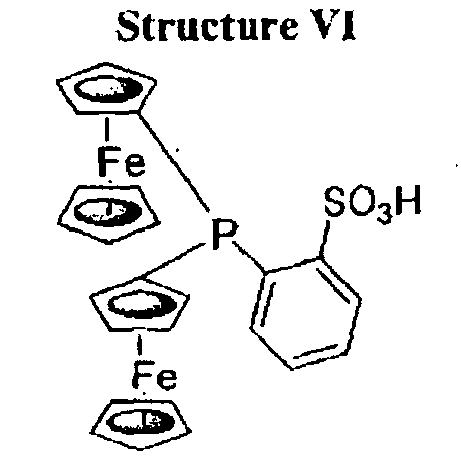
9 benzene sulfonic acid (2.10 g) Mesitylbromide (5.04 g) 2-(bis(mesityl) phosphino) benzene sulfonic acid (~2g) 
10 napthalenesulfonic acid (2.63 g) Mesitylbromide (5.04 g) 2-(bis(mesityl) phosphino) napthalene sulfonic acid (~2.5 g) 
11 benzene sulfonic acid (2.10 g) 2-bromobiphenyl (5.9 g) 2-(bis (2-biphenyl) phosphino) benzene sulfonic acid (~2 g) 
12 benzene sulfonic acid (2.10 g) 3,5-di-t-butyl-bromobenzene (6.81 g) 2-(bis (3,5-di-t-butyl-phenyl) phosphino) benzene sulfonic acid (~2g) 
13 benzoic acid (2.10 g) 2',6'dimethoxy-2-biphenylbromide (7.45 g) 2-(bis (2',6'dimethoxy-2-biphenyl) phosphino) benzoic acid (~5 g) 
15 benzene sulfonic acid (2.10 g) Bromocyclohexane (4.13 g) 2-Dicyclohexyl phosphanyl-benzenesulfonic acid (~2 g) 
- A 0.45 g (0.81 mmol) sample of Product Solid (i.e., ligand Structure VI) prepared according to Example 6 was added to 50 mL of THF in a reaction flask with vigorous agitation to form a ligand solution. In a separate container, 0.10 g (0.88 mmol) of potassium tert-butoxide was dissolved in 20 mL of THF. The resulting potassium tert-butoxide solution was then added dropwise to the contents of the reaction flask with agitation. Following the addition of the potassium tert-butoxide solution, the contents of the reaction flask were reduced by vacuum extraction of some of the THF solvent leaving approximately 25 mL of product solution in the reaction flask. A potassium salt of the ligand was then precipitated from the remaining product solution through the addition of 20 mL of pentane. The precipitated potassium salt of the ligand was recovered by filtration through a fine porosity frit and washed with pentane 3 x 20 mL. The potassium salt of the ligand was then subjected to vacuum to remove the remaining volatiles, leaving a dark orange Product Powder 0.40 g (0.67 mmol, 83 %).
- A sample of Component A identified in Table 2 was added to 30 mL of tetrahydrofuran in a reaction flask with agitation. To the contents of the reaction flask was then added Component B identified in Table 2, with continued agitation. The contents of the reaction flask were then agitated for 30 minutes before adding Component C identified in Table 2. The contents of the reaction flask were then reduced under vacuum and pentane was added to precipitate the product catalyst complex. The product catalyst complex was collected by filtration through a fine porosity frit and washed with pentane 2 x 20 mL. The product catalyst complex was then subjected to vacuum to remove the remaining volatiles, leaving the Product Yield reported in Table 2.
Table 2 Ex.# Component A Component B Component C Product Yield 18 Product Solid prepared according to Example 1 (0.943 g) dimethyl tetramethylethylene diamine palladium (II) (0.388 g) Pyridine (~0.2 ml) 940 mg 19 Product Solid prepared according to Example 2 (340 mg) dimethyl tetramethylethylene diamine palladium (II) (200 mg) Pyridine (~0.2 ml) 440 mg 20 Product Solid prepared according to Example 3 (79 mg) dimethyl tetramethylethylene diamine palladium (II) (50 mg) Pyridine (~0.2 ml) 87 mg 21 Product Solid prepared according to Example 4 (45 mg) dimethyl tetramethylethylene diamine palladium (II) (25 mg) Pyridine (~0.2 ml) 33 mg 22 Product Solid prepared according to Example 5 (44 mg) dimethyl tetramethylethylene diamine palladium (II) (25 mg) Pyridine (~0.2 ml) 41 mg 24 Product Solid prepared according to Example 9 (0.640 g) dimethyl tetramethylethylene diamine palladium (II) (0.350 g) Pyridine (~0.2 ml) 700 mg 25 Product Solid prepared according to Example 11 (0.396 g) dimethyl tetramethylethylene diamine palladium (II) (0.200 g) Pyridine (~0.2 ml) 540 mg 26 Product Solid prepared according to Example 12 (0.2272 g) dimethyl tetramethylethylene diamine palladium (II) (0.100 g) Pyridine (~0.2 ml) 320 mg 27 Product Solid prepared according to Example 13 (210 mg) dimethyl tetramethylethylene diamine palladium (II) (150 mg) Pyridine (~0.2 ml) 200 mg 29 Product Solid prepared according to Example 15 (83 mg) dimethyl tetramethylethylene diamine palladium (II) (50 mg) Pyridine (~0.2 ml) 5 mg 30 Product Powder prepared according to Example 16 (0.135 g) (1,5 cyclooctadiene) methyl palladium (II) triflate (0.086 g) none 148 mg 31 Product Powder prepared according to Example 17 (0.098 g) chloro(1,5 cyclooctadiene) methyl palladium (II) (0.046 g) none 780 mg -

- A first 100 mL Schlenk flask was charged with benzenesulfonic acid hydrate (1.7 g, 10.7 mmol, C6H6O3S-H2O, 158.71 g/mol, MP Bio Medicals 98-11-3). The flask was evacuated under vacuum. The bottom of the flask was then heated using a heat gun. The flask contents melted to form a brown liquid, which started bubbling. The heating was continued until the liquid started to reflux and the pressure dropped to approximately 10 mTorr. The flask was filled with nitrogen, cooled and THF (anhydrous, Acros, ~50mL) was added to the flask forming a clear colorless solution. At 0°C, n-BuLi (2.5 M hexane solution, 11.4 mmol, 8.6 mL, Aldrich) was added to yield a beige suspension, which was stirred for 0.5 hr before being cooled at -78 °C.
- A second 100 mL Schlenk flask was charged with Mg (0.30 g, 0.0125 mmol, powder, Aldrich). THF (50 mL, anhydrous, Acros) and 2-bromoanisole (2.10 g, 0.0112 mmol, C7H7BrO, 187.04 g/mol, Acros) were added to the second Schlenk flask. The contents of the second Schlenk flask were sonicated (~30 sec.) and the contents were observed to exhibit a temperature rise. The mixture was stirred until it cooled back down to room temperature.
- A 200 mL Schlenk flask was charged with THF (~50 mL). At -78°C, PCl3 (0.93 mL, 1.47 g, 0.0107 mol, 1.574 g/mL, 137.33 g/mol, Aldrich) was added to the 200mL Schlenk flask via syringe. The beige suspension in the first 100 mL Schlenk flask was transferred to the 200 mL Schlenk flask at -78°C via cannula. The contents of the 200 mL Schlenk flask were then stirred for 0.5 hours while maintaining the temperature at -78°C. The contents of the second 100 mL Schlenk flask was cooled to -78°C and transferred to the 200 mL Schlenk flask via cannula. The contents of the 200 mL Schlenk flask were then warmed to ambient temperature and stirred for about an hour to yield a yellow solution.
- A 500 mL Schlenk flask was charged with 2'-Br-2,6-(Me)2biphenyl (3.14 g, 10.7 mmol, C14H13BrO2, 293.16 g/mol, Aldrich) ant THF (150 mL). The contents of the 500 mL Schlenk flask were cooled to -78°C. n-BuLi (4.3 mL, 2.5 M hexane solution, 10.7 mmol, Aldrich) at -78°C was added to the 500 mL Schlenk flask, yielding a thick, white slurry. The 500 mL Schlenk flask was shaken by hand to ensure mixing. A 0.5 hour after the addition of the n-BuLi, the contents of the 200 mL Schlenk flask were added to the 500 mL Schlenk flask via cannula. The contents of the 500 mL Schlenk flask were then allowed to gradually warm to ambient temperature. The contents of the 500 mL Schlenk flask were stirred overnight to yield a clear yellow solution. The volatiles were removed from the 500 mL Schlenk flask under vacuum. The resulting solid was extracted using CH2Cl2 (200 mL), H2O (200 mL), HCl (concentrated, 20 mL). The organic layer from the extract was dried with MgSO4 and the volatile portion of the extract was removed under vacuum to leave a pale yellow solid. The pale yellow solid was collected and washed with THF (3x15 mL) and Et2O (3x15 mL) to yield a white powder product ligand (2.3 g, 44% yield). 1H NMR (CDCl3, °C): δ 8.32 (m, 1H), 7.71 (q, J= 8.5, 2H), 7.56 (m, 1H), 7.47-7.40 (m, 4H), 7.33-7.27 (m, 2H), 6.99 (m, 2H), 6.91 (m, 1H), 6.57 (d, J= 8.5, 1H), 6.44 (d, J= 8.5, 1H), 3.73 (s, 3H), 3.64 (s, 3H), 3.19 (s, 3H). 31P NMR (CDCl3, °C): δ -7.1 (s). LC-MS: m/z = 509.2.
- Toluene sulfonic acid (2.05g., 10.8mmol) was added to a 100 mL flask ("Flask A") then placed under vacuum and refilled with nitrogen and charged with 50 mL of tetrahydrofuran (THF). Flask A was then placed in an ice bath and allowed to cool to 0°C. 8.8 mL of 2.5 molar n-Butyl Lithium (n-BuLi) was then injected. Flask A was then placed in a dry ice/acetone bath and allowed to cool to about -78°C.
- A separate 200 mL Schlenk flask ("Flask B") was placed under vacuum. Flask B was purged with nitrogen and charged with ~50 mL of THF. Phosphorus trichloride (PCl3) (1.0mL, 11.5mmol) was then added to Flask B with agitation. Flask B was then placed in a dry ice/acetone bath and allowed to cool to about -78°C. The contents of Flask A were then slowly transferred to Flask B using a cannula with vigorous agitation.
- A separate 500 mL flask ("Flask C") was purged and filled with nitrogen. Flask C was then charged with ~200 mL of THF and 2'-Bromo-2,6 dimethoxybiphenyl (7.26g., 24.8 mmol). Flask C was then placed in a dry ice/acetone bath and allowed to cool with agitation to about -78°C. 10.03 mL of 2.5 molar n-BuLi was added to Flask C and allowed to react for about 10 minutes. The contents of Flask B were then transferred to Flask C, maintained at -78°C, using a cannula with continued vigorous agitation. Following the complete addition of the contents of Flask B into Flask C, Flask C was allowed to warm to room temperature for 45 min. The contents of Flask C were then poured into a 1000 mL recovery flask (Flask D) and the THF was removed, leaving a solid. The solid in Flask D was then mixed with ~ 150 mL of distilled water and then transferred to a separation flask (Flask E). 100 mL of Methylene Chloride (CH2Cl2) was added to the contents of Flask E. Flask E was shaken to mix the two layers. About 20 mL of concentrated HCl was then added to Flask E and was shaken again. ~ 20mL of 3A alcohol was added to Flask E and was shaken again. The mixture in Flask E was then allowed to settle, forming two layers--an organic phase on the bottom and an aqueous phase on the top. The organic layer was collected. The aqueous phase was washed with 50 mL of CH2Cl2. The organic wash material was collected and added to the previously collected organic layer material. The combined organic material was then contacted with Magnesium Sulfate and rotovaped to dryness, leaving a solid. The solid was then washed with THF and diethyl ether to remove impurities. Approximately 2 g- of the washed
- 1.364 g ligand prepared according to Example 33 was added to ~20 mL of tetrahydrofuran (THF) in a reaction flask with agitation. To the contents of the reaction flask was then added 3.09 g tetramethylethylenediamine palladium (II) with continued agitation. The contents of the reaction flask were then agitated for approximately 1 hour. The product catalyst complex was collected by filtration through a fine porosity frit and washed with THF. The product catalyst complex was then subjected to vacuum to remove the remaining volatiles, leaving 6.98 g of white solid as the reaction product.
- Toluene sulfonic acid (2.05g., 10.8mmol) was added to a 100 mL flask ("Flask A") then placed under vacuum and refilled with nitrogen and charged with 50 mL of tetrahydrofuran (THF). Flask A was then placed in an ice bath and allowed to cool to 0 °C. 8.8 mL of 2.5 molar n-Butyl Lithium (n-BuLi) was then injected. Flask A was then placed in a dry ice/acetone bath and allowed to cool to about -78°C.
- A separate 200 mL Schlenk flask ("Flask B") was placed under vacuum. Flask B was purged with nitrogen and charged with ~50 mL of THF. Phosphorus trichloride (PCl3) (1.0mL, 11.5mmol) was then added to Flask B with agitation. Flask B was then placed in a dry ice/acetone bath and allowed to cool to about -78°C. The contents of Flask A were then slowly transferred to Flask B using a cannula with vigorous agitation.
- A separate 500 mL flask ("Flask C") was purged and filled with nitrogen. Flask C was then charged with ~200 mL of THF and 2'-Bromo-2',6'-diisopropoxybiphenyl (8.66g., 24.8 mmol). Flask C was then placed in a dry ice/acetone bath and allowed to cool with agitation to about -78°C. 10.03 mL of 2.5 molar n-BuLi was added to Flask C and allowed to react for about 10 minutes. The contents of Flask B were then transferred to Flask C, maintained at -78°C, using a cannula with continued vigorous agitation. Following the complete addition of the contents of Flask B into Flask C, Flask C was allowed to warm to room temperature for 45 min. The contents of Flask C were then poured into a 1000 mL recovery flask (Flask D) and the THF was removed, leaving a solid. The solid in Flask D was then mixed with ~ 150 mL of distilled water and then transferred to a separation flask (Flask E). 100 mL of Methylene Chloride (CH2Cl2) was added to the contents of Flask E. Flask E was shaken to mix the two layers. About 20 mL of concentrated HCl was then added to Flask E and was shaken again. ~20mL of 3A alcohol was added to Flask E and was shaken again. The mixture in Flask E was then allowed to settle, forming two layers--an organic phase on the bottom and an aqueous phase on the top. The organic layer was collected. The aqueous phase was washed with 50 mL of CH2Cl2. The organic wash material was collected and added to the previously collected organic layer material. The combined organic material was then contacted with Magnesium Sulfate and rotovaped to dryness, leaving a solid. The solid was then washed with THF and diethyl ether to remove impurities. Approximately 2 g. of the washed product solid 2-[Bis-(2',6'-Diisopropoxy-biphenyl-2yl)-phosphanyl]-toluene sulfonic acid was collected by filtration.
- 1.61 g ligand prepared according to Example 35 was added to ~20 mL of tetrahydrofuran (THF) in a reaction flask with agitation. To the contents of the reaction flask was then added 3.09 g tetramethylethylenediamine palladium (II) with continued agitation. The contents of the reaction flask were then agitated for approximately 1 hour. The product catalyst complex was collected by filtration through a fine porosity frit and washed with THF. The product catalyst complex was then subjected to vacuum to remove the remaining volatiles, leaving 7.81 g of white solid as the reaction product.
- In a nitrogen filled glovebox, a 13 mL reactor cell of an Argonaut Technologies Endeavor™ was charged with 5.0 mL toluene from a bottle of Aldrich Chromasolv® brand HPLC grade toluene (purity >99.9%, water <0.02% unopened) that was about 4 weeks old. The toluene was used out of the bottle without additional purification. The reactor cell was outfitted with anchor bladed stirring shaft and stirred at a rate of 925 rpm. The reactor cell was heated to 100°C and charged with 400 psig ethylene gas. After temperature and pressure equilibration, 0.5 µmol of catalyst prepared according to Example 34 mixed into 0.5 mL of toluene was injected into the reactor cell followed by an additional 0.5 mL of toluene rinse. The reaction mixture was stirred for 1 hour, after which the residual ethylene was vented and the contents of the reactor cell were allowed to cool.
- The contents of the reator cell were then added to 50 mL of stirred methanol. After stirring for 3 hours, the product polymer was isolated by centrifugation. The product polymer was dried under vacuum at 60 °C for 18 hours. The polymer yield was 0.500 g.
Claims (5)
- A polymerization process for preparing a polymer, comprising contacting at least one acyclic aliphatic olefin monomer and a catalyst composition comprising a palladium metal center complexed with at least one ligand, wherein the at least one ligand has a structure according to Formula I

wherein Q is phosphorus;
wherein R15 is -SO3;
wherein the polymer prepared exhibits a branch content of < 15 branched/1,000 carbon atoms, wherein the branch content is determined by Carbon 13 NMR and the melting point of the polymer prepared, wherein the branches contain at least two carbon atoms;
wherein the catalyst composition is exposed during the polymerization process to at least one impurity selected from acetylene, CO2, oxygen and water; and wherein the at least one impurity is present at a level of > 5 ppm;
with the proviso that R1-R10 are not all hydrogen;
with the proviso that when R2, R4, R7 and R9 are each a hydrogen, none of R1, R5, R6 and R10 are CH3, CF3, F, SMe2, biphenyl or phenoxy; and,
with the proviso that none of R1, R5, R6 and R10 is a polar group. - The polymerization process of claim 1, wherein the catalyst composition exhibits a productivity of ≥ 100 kg/g of metal.
- The polymerization process of claim 1, wherein the at least one acyclic aliphatic olefin monomer is ethylene.
- The polymerization process of claim 1, wherein the polymerization temperature is 0 to 200°C.
- The polymerization process of claim 1, wherein the polymer prepared exhibits a number average molecular weight, Mn, of > 21,200.
Applications Claiming Priority (1)
| Application Number | Priority Date | Filing Date | Title |
|---|---|---|---|
| US89200807P | 2007-02-28 | 2007-02-28 |
Publications (2)
| Publication Number | Publication Date |
|---|---|
| EP1964857A1 EP1964857A1 (en) | 2008-09-03 |
| EP1964857B1 true EP1964857B1 (en) | 2009-09-09 |
Family
ID=39345423
Family Applications (1)
| Application Number | Title | Priority Date | Filing Date |
|---|---|---|---|
| EP08151811A Ceased EP1964857B1 (en) | 2007-02-28 | 2008-02-22 | Polymerization of acyclic aliphatic olefins |
Country Status (8)
| Country | Link |
|---|---|
| US (1) | US7671150B2 (en) |
| EP (1) | EP1964857B1 (en) |
| JP (1) | JP5111145B2 (en) |
| KR (1) | KR100995551B1 (en) |
| CN (1) | CN101255205B (en) |
| CA (1) | CA2622690C (en) |
| DE (1) | DE602008000133D1 (en) |
| TW (1) | TWI361199B (en) |
Families Citing this family (6)
| Publication number | Priority date | Publication date | Assignee | Title |
|---|---|---|---|---|
| CN102292344B (en) | 2008-11-20 | 2014-12-10 | 日本聚乙烯株式会社 | Novel triaryl phosphine or triaryl arsine compound and α-olefin polymerization catalyst, terpolymer and α-olefin/(meth)acrylic acid copolymer |
| JP5666808B2 (en) * | 2009-02-05 | 2015-02-12 | 日本ポリエチレン株式会社 | A novel triarylphosphine or triarylarsine compound, an α-olefin polymerization catalyst using the same, and a method for producing an α-olefin copolymer. |
| JP5694846B2 (en) * | 2010-05-13 | 2015-04-01 | 日本ポリエチレン株式会社 | Novel triarylphosphine or triarylarsine compound, α-olefin polymerization catalyst using them, and method for producing α-olefin polymer |
| JP5945449B2 (en) * | 2011-04-27 | 2016-07-05 | 日本ポリエチレン株式会社 | Novel triarylphosphine or triarylarsine compound, olefinic polymerization catalyst and olefinic copolymer production process therewith |
| JP6332978B2 (en) * | 2014-01-20 | 2018-05-30 | 国立大学法人 東京大学 | Method for producing polar group-containing olefin polymer |
| KR20230008138A (en) * | 2020-04-24 | 2023-01-13 | 사빅 글로벌 테크놀러지스 비.브이. | Post-metallocene compound |
Family Cites Families (13)
| Publication number | Priority date | Publication date | Assignee | Title |
|---|---|---|---|---|
| US4698403A (en) * | 1985-10-15 | 1987-10-06 | E. I. Du Pont De Nemours And Company | Nickel-catalyzed copolymerization of ethylene |
| US4855400A (en) * | 1985-11-26 | 1989-08-08 | Shell Oil Company | Removal of catalyst residues from carbon monoxide/olefin polymers with catalyst complexing agent |
| US4689437A (en) * | 1986-07-21 | 1987-08-25 | Union Carbide Corporation | Oligomerization to alpha-olefins |
| US4855399A (en) * | 1987-02-26 | 1989-08-08 | Shell Oil Company | Carbon monoxide/olefin co-polymerization process with phosphino substituted sulfonic acid catalyst |
| EP0589527B1 (en) | 1992-09-21 | 1999-07-28 | Montell Technology Company bv | Polymerization process |
| AU5915198A (en) * | 1997-01-14 | 1998-08-03 | E.I. Du Pont De Nemours And Company | Polymerization of ethylene |
| US6417303B1 (en) * | 1997-12-16 | 2002-07-09 | Exxonmobil Research And Engineering Company | Substantially linear copolymers |
| KR20010072084A (en) | 1998-07-27 | 2001-07-31 | 간디 지오프레이 에이치. | A polymerization process |
| AU2001275070B2 (en) * | 2000-05-31 | 2005-11-10 | E.I. Du Pont De Nemours And Company | Catalysts for olefin polymerization |
| FR2814169B1 (en) * | 2000-09-19 | 2005-07-08 | Atofina | CATALYST FOR POLYMERIZATION OF OLEFINS |
| JP2003268028A (en) * | 2002-03-20 | 2003-09-25 | Mitsubishi Chemicals Corp | Method for producing ethylene polymer |
| US7087687B2 (en) | 2003-08-21 | 2006-08-08 | Rohm And Haas Company | Catalytic composition and its preparation and use for preparing polymers from ethylenically unsaturated monomers |
| US7635739B2 (en) * | 2005-08-31 | 2009-12-22 | Rohm And Haas Company | Substantially linear polymers and methods of making and using same |
-
2008
- 2008-02-13 JP JP2008031806A patent/JP5111145B2/en not_active Expired - Fee Related
- 2008-02-14 TW TW097105126A patent/TWI361199B/en not_active IP Right Cessation
- 2008-02-20 US US12/070,632 patent/US7671150B2/en not_active Expired - Fee Related
- 2008-02-21 KR KR1020080015690A patent/KR100995551B1/en not_active Expired - Fee Related
- 2008-02-21 CN CN2008100810484A patent/CN101255205B/en not_active Expired - Fee Related
- 2008-02-22 DE DE602008000133T patent/DE602008000133D1/en active Active
- 2008-02-22 EP EP08151811A patent/EP1964857B1/en not_active Ceased
- 2008-02-22 CA CA2622690A patent/CA2622690C/en not_active Expired - Fee Related
Also Published As
| Publication number | Publication date |
|---|---|
| TW200848444A (en) | 2008-12-16 |
| KR100995551B1 (en) | 2010-11-19 |
| US20080207855A1 (en) | 2008-08-28 |
| DE602008000133D1 (en) | 2009-10-22 |
| KR20080080010A (en) | 2008-09-02 |
| JP2008214630A (en) | 2008-09-18 |
| CN101255205B (en) | 2010-12-22 |
| TWI361199B (en) | 2012-04-01 |
| CN101255205A (en) | 2008-09-03 |
| JP5111145B2 (en) | 2012-12-26 |
| EP1964857A1 (en) | 2008-09-03 |
| US7671150B2 (en) | 2010-03-02 |
| CA2622690C (en) | 2012-10-02 |
| CA2622690A1 (en) | 2008-08-28 |
Similar Documents
| Publication | Publication Date | Title |
|---|---|---|
| KR100881446B1 (en) | Practically straight polymer and its preparation method | |
| US7524905B2 (en) | Substantially linear copolymers and methods of making the same | |
| US7671150B2 (en) | Polymerization of acyclic aliphatic olefins | |
| JP5102863B2 (en) | Ligand synthesis | |
| EP2014668B1 (en) | Single site palladium catalyst complexes | |
| WO2014069989A1 (en) | Process for producing an oligo(alpha-olefin) and the use of a particular form of methylaluminoxane in such process |
Legal Events
| Date | Code | Title | Description |
|---|---|---|---|
| PUAI | Public reference made under article 153(3) epc to a published international application that has entered the european phase |
Free format text: ORIGINAL CODE: 0009012 |
|
| 17P | Request for examination filed |
Effective date: 20080222 |
|
| AK | Designated contracting states |
Kind code of ref document: A1 Designated state(s): AT BE BG CH CY CZ DE DK EE ES FI FR GB GR HR HU IE IS IT LI LT LU LV MC MT NL NO PL PT RO SE SI SK TR |
|
| AX | Request for extension of the european patent |
Extension state: AL BA MK RS |
|
| 17Q | First examination report despatched |
Effective date: 20081015 |
|
| AKX | Designation fees paid |
Designated state(s): DE FR GB |
|
| GRAP | Despatch of communication of intention to grant a patent |
Free format text: ORIGINAL CODE: EPIDOSNIGR1 |
|
| GRAS | Grant fee paid |
Free format text: ORIGINAL CODE: EPIDOSNIGR3 |
|
| GRAA | (expected) grant |
Free format text: ORIGINAL CODE: 0009210 |
|
| AK | Designated contracting states |
Kind code of ref document: B1 Designated state(s): DE FR GB |
|
| REG | Reference to a national code |
Ref country code: GB Ref legal event code: FG4D |
|
| REF | Corresponds to: |
Ref document number: 602008000133 Country of ref document: DE Date of ref document: 20091022 Kind code of ref document: P |
|
| PLBE | No opposition filed within time limit |
Free format text: ORIGINAL CODE: 0009261 |
|
| STAA | Information on the status of an ep patent application or granted ep patent |
Free format text: STATUS: NO OPPOSITION FILED WITHIN TIME LIMIT |
|
| 26N | No opposition filed |
Effective date: 20100610 |
|
| REG | Reference to a national code |
Ref country code: FR Ref legal event code: PLFP Year of fee payment: 9 |
|
| REG | Reference to a national code |
Ref country code: FR Ref legal event code: PLFP Year of fee payment: 10 |
|
| REG | Reference to a national code |
Ref country code: FR Ref legal event code: PLFP Year of fee payment: 11 |
|
| PGFP | Annual fee paid to national office [announced via postgrant information from national office to epo] |
Ref country code: DE Payment date: 20200211 Year of fee payment: 13 Ref country code: GB Payment date: 20200212 Year of fee payment: 13 |
|
| PGFP | Annual fee paid to national office [announced via postgrant information from national office to epo] |
Ref country code: FR Payment date: 20200113 Year of fee payment: 13 |
|
| REG | Reference to a national code |
Ref country code: DE Ref legal event code: R119 Ref document number: 602008000133 Country of ref document: DE |
|
| GBPC | Gb: european patent ceased through non-payment of renewal fee |
Effective date: 20210222 |
|
| PG25 | Lapsed in a contracting state [announced via postgrant information from national office to epo] |
Ref country code: DE Free format text: LAPSE BECAUSE OF NON-PAYMENT OF DUE FEES Effective date: 20210901 Ref country code: GB Free format text: LAPSE BECAUSE OF NON-PAYMENT OF DUE FEES Effective date: 20210222 Ref country code: FR Free format text: LAPSE BECAUSE OF NON-PAYMENT OF DUE FEES Effective date: 20210228 |