EP1963328B1 - Inhibitors of cysteine proteases, the pharmaceutical compositions thereof and their therapeutic applications - Google Patents
Inhibitors of cysteine proteases, the pharmaceutical compositions thereof and their therapeutic applications Download PDFInfo
- Publication number
- EP1963328B1 EP1963328B1 EP06831646.2A EP06831646A EP1963328B1 EP 1963328 B1 EP1963328 B1 EP 1963328B1 EP 06831646 A EP06831646 A EP 06831646A EP 1963328 B1 EP1963328 B1 EP 1963328B1
- Authority
- EP
- European Patent Office
- Prior art keywords
- pentaaza
- fluoren
- cyclopenta
- compound
- diseases
- Prior art date
- Legal status (The legal status is an assumption and is not a legal conclusion. Google has not performed a legal analysis and makes no representation as to the accuracy of the status listed.)
- Not-in-force
Links
Classifications
-
- C—CHEMISTRY; METALLURGY
- C07—ORGANIC CHEMISTRY
- C07D—HETEROCYCLIC COMPOUNDS
- C07D487/00—Heterocyclic compounds containing nitrogen atoms as the only ring hetero atoms in the condensed system, not provided for by groups C07D451/00 - C07D477/00
- C07D487/02—Heterocyclic compounds containing nitrogen atoms as the only ring hetero atoms in the condensed system, not provided for by groups C07D451/00 - C07D477/00 in which the condensed system contains two hetero rings
- C07D487/04—Ortho-condensed systems
-
- A—HUMAN NECESSITIES
- A61—MEDICAL OR VETERINARY SCIENCE; HYGIENE
- A61P—SPECIFIC THERAPEUTIC ACTIVITY OF CHEMICAL COMPOUNDS OR MEDICINAL PREPARATIONS
- A61P1/00—Drugs for disorders of the alimentary tract or the digestive system
- A61P1/02—Stomatological preparations, e.g. drugs for caries, aphtae, periodontitis
-
- A—HUMAN NECESSITIES
- A61—MEDICAL OR VETERINARY SCIENCE; HYGIENE
- A61P—SPECIFIC THERAPEUTIC ACTIVITY OF CHEMICAL COMPOUNDS OR MEDICINAL PREPARATIONS
- A61P1/00—Drugs for disorders of the alimentary tract or the digestive system
- A61P1/16—Drugs for disorders of the alimentary tract or the digestive system for liver or gallbladder disorders, e.g. hepatoprotective agents, cholagogues, litholytics
-
- A—HUMAN NECESSITIES
- A61—MEDICAL OR VETERINARY SCIENCE; HYGIENE
- A61P—SPECIFIC THERAPEUTIC ACTIVITY OF CHEMICAL COMPOUNDS OR MEDICINAL PREPARATIONS
- A61P13/00—Drugs for disorders of the urinary system
- A61P13/12—Drugs for disorders of the urinary system of the kidneys
-
- A—HUMAN NECESSITIES
- A61—MEDICAL OR VETERINARY SCIENCE; HYGIENE
- A61P—SPECIFIC THERAPEUTIC ACTIVITY OF CHEMICAL COMPOUNDS OR MEDICINAL PREPARATIONS
- A61P19/00—Drugs for skeletal disorders
- A61P19/02—Drugs for skeletal disorders for joint disorders, e.g. arthritis, arthrosis
-
- A—HUMAN NECESSITIES
- A61—MEDICAL OR VETERINARY SCIENCE; HYGIENE
- A61P—SPECIFIC THERAPEUTIC ACTIVITY OF CHEMICAL COMPOUNDS OR MEDICINAL PREPARATIONS
- A61P19/00—Drugs for skeletal disorders
- A61P19/08—Drugs for skeletal disorders for bone diseases, e.g. rachitism, Paget's disease
-
- A—HUMAN NECESSITIES
- A61—MEDICAL OR VETERINARY SCIENCE; HYGIENE
- A61P—SPECIFIC THERAPEUTIC ACTIVITY OF CHEMICAL COMPOUNDS OR MEDICINAL PREPARATIONS
- A61P19/00—Drugs for skeletal disorders
- A61P19/08—Drugs for skeletal disorders for bone diseases, e.g. rachitism, Paget's disease
- A61P19/10—Drugs for skeletal disorders for bone diseases, e.g. rachitism, Paget's disease for osteoporosis
-
- A—HUMAN NECESSITIES
- A61—MEDICAL OR VETERINARY SCIENCE; HYGIENE
- A61P—SPECIFIC THERAPEUTIC ACTIVITY OF CHEMICAL COMPOUNDS OR MEDICINAL PREPARATIONS
- A61P25/00—Drugs for disorders of the nervous system
-
- A—HUMAN NECESSITIES
- A61—MEDICAL OR VETERINARY SCIENCE; HYGIENE
- A61P—SPECIFIC THERAPEUTIC ACTIVITY OF CHEMICAL COMPOUNDS OR MEDICINAL PREPARATIONS
- A61P25/00—Drugs for disorders of the nervous system
- A61P25/14—Drugs for disorders of the nervous system for treating abnormal movements, e.g. chorea, dyskinesia
- A61P25/16—Anti-Parkinson drugs
-
- A—HUMAN NECESSITIES
- A61—MEDICAL OR VETERINARY SCIENCE; HYGIENE
- A61P—SPECIFIC THERAPEUTIC ACTIVITY OF CHEMICAL COMPOUNDS OR MEDICINAL PREPARATIONS
- A61P25/00—Drugs for disorders of the nervous system
- A61P25/28—Drugs for disorders of the nervous system for treating neurodegenerative disorders of the central nervous system, e.g. nootropic agents, cognition enhancers, drugs for treating Alzheimer's disease or other forms of dementia
-
- A—HUMAN NECESSITIES
- A61—MEDICAL OR VETERINARY SCIENCE; HYGIENE
- A61P—SPECIFIC THERAPEUTIC ACTIVITY OF CHEMICAL COMPOUNDS OR MEDICINAL PREPARATIONS
- A61P27/00—Drugs for disorders of the senses
- A61P27/02—Ophthalmic agents
- A61P27/12—Ophthalmic agents for cataracts
-
- A—HUMAN NECESSITIES
- A61—MEDICAL OR VETERINARY SCIENCE; HYGIENE
- A61P—SPECIFIC THERAPEUTIC ACTIVITY OF CHEMICAL COMPOUNDS OR MEDICINAL PREPARATIONS
- A61P29/00—Non-central analgesic, antipyretic or antiinflammatory agents, e.g. antirheumatic agents; Non-steroidal antiinflammatory drugs [NSAID]
-
- A—HUMAN NECESSITIES
- A61—MEDICAL OR VETERINARY SCIENCE; HYGIENE
- A61P—SPECIFIC THERAPEUTIC ACTIVITY OF CHEMICAL COMPOUNDS OR MEDICINAL PREPARATIONS
- A61P3/00—Drugs for disorders of the metabolism
- A61P3/08—Drugs for disorders of the metabolism for glucose homeostasis
- A61P3/10—Drugs for disorders of the metabolism for glucose homeostasis for hyperglycaemia, e.g. antidiabetics
-
- A—HUMAN NECESSITIES
- A61—MEDICAL OR VETERINARY SCIENCE; HYGIENE
- A61P—SPECIFIC THERAPEUTIC ACTIVITY OF CHEMICAL COMPOUNDS OR MEDICINAL PREPARATIONS
- A61P31/00—Antiinfectives, i.e. antibiotics, antiseptics, chemotherapeutics
- A61P31/04—Antibacterial agents
-
- A—HUMAN NECESSITIES
- A61—MEDICAL OR VETERINARY SCIENCE; HYGIENE
- A61P—SPECIFIC THERAPEUTIC ACTIVITY OF CHEMICAL COMPOUNDS OR MEDICINAL PREPARATIONS
- A61P31/00—Antiinfectives, i.e. antibiotics, antiseptics, chemotherapeutics
- A61P31/10—Antimycotics
-
- A—HUMAN NECESSITIES
- A61—MEDICAL OR VETERINARY SCIENCE; HYGIENE
- A61P—SPECIFIC THERAPEUTIC ACTIVITY OF CHEMICAL COMPOUNDS OR MEDICINAL PREPARATIONS
- A61P31/00—Antiinfectives, i.e. antibiotics, antiseptics, chemotherapeutics
- A61P31/12—Antivirals
-
- A—HUMAN NECESSITIES
- A61—MEDICAL OR VETERINARY SCIENCE; HYGIENE
- A61P—SPECIFIC THERAPEUTIC ACTIVITY OF CHEMICAL COMPOUNDS OR MEDICINAL PREPARATIONS
- A61P31/00—Antiinfectives, i.e. antibiotics, antiseptics, chemotherapeutics
- A61P31/12—Antivirals
- A61P31/20—Antivirals for DNA viruses
- A61P31/22—Antivirals for DNA viruses for herpes viruses
-
- A—HUMAN NECESSITIES
- A61—MEDICAL OR VETERINARY SCIENCE; HYGIENE
- A61P—SPECIFIC THERAPEUTIC ACTIVITY OF CHEMICAL COMPOUNDS OR MEDICINAL PREPARATIONS
- A61P33/00—Antiparasitic agents
-
- A—HUMAN NECESSITIES
- A61—MEDICAL OR VETERINARY SCIENCE; HYGIENE
- A61P—SPECIFIC THERAPEUTIC ACTIVITY OF CHEMICAL COMPOUNDS OR MEDICINAL PREPARATIONS
- A61P35/00—Antineoplastic agents
-
- A—HUMAN NECESSITIES
- A61—MEDICAL OR VETERINARY SCIENCE; HYGIENE
- A61P—SPECIFIC THERAPEUTIC ACTIVITY OF CHEMICAL COMPOUNDS OR MEDICINAL PREPARATIONS
- A61P35/00—Antineoplastic agents
- A61P35/04—Antineoplastic agents specific for metastasis
-
- A—HUMAN NECESSITIES
- A61—MEDICAL OR VETERINARY SCIENCE; HYGIENE
- A61P—SPECIFIC THERAPEUTIC ACTIVITY OF CHEMICAL COMPOUNDS OR MEDICINAL PREPARATIONS
- A61P37/00—Drugs for immunological or allergic disorders
- A61P37/02—Immunomodulators
-
- A—HUMAN NECESSITIES
- A61—MEDICAL OR VETERINARY SCIENCE; HYGIENE
- A61P—SPECIFIC THERAPEUTIC ACTIVITY OF CHEMICAL COMPOUNDS OR MEDICINAL PREPARATIONS
- A61P43/00—Drugs for specific purposes, not provided for in groups A61P1/00-A61P41/00
-
- A—HUMAN NECESSITIES
- A61—MEDICAL OR VETERINARY SCIENCE; HYGIENE
- A61P—SPECIFIC THERAPEUTIC ACTIVITY OF CHEMICAL COMPOUNDS OR MEDICINAL PREPARATIONS
- A61P9/00—Drugs for disorders of the cardiovascular system
-
- A—HUMAN NECESSITIES
- A61—MEDICAL OR VETERINARY SCIENCE; HYGIENE
- A61P—SPECIFIC THERAPEUTIC ACTIVITY OF CHEMICAL COMPOUNDS OR MEDICINAL PREPARATIONS
- A61P9/00—Drugs for disorders of the cardiovascular system
- A61P9/04—Inotropic agents, i.e. stimulants of cardiac contraction; Drugs for heart failure
Definitions
- the present invention concerns new inhibitors of cysteine proteases, their process of preparation and their therapeutic use.
- Proteases can be categorized based on their substrate specificities or mechanisms of catalysis. Upon the basis of the mechanism of peptide hydrolysis, five major protease classes are known: serine, cysteine, aspartic, threonine and metallo-proteases. Cysteine proteases comprise, inter allia, de-ubiquitination enzymes, caspases, cathepsins, calpains as well as viral, bacterial or parasitic cysteine proteases.
- De-ubiquitination enzymes include Ubiquitin Specific Proteases (USPs) and Ubiquitin Carboxy Hydrolases (UCHs).
- USPs Ubiquitin Specific Proteases
- UCHs Ubiquitin Carboxy Hydrolases
- the ubiquitin pathway regulates protein degradation and is more particularly involved in cancer, in neurodegenerative diseases such as Alzheimer's disease, Parkinson's disease, in inflammation, in viral infectivity and latency (in particular for Herpes simplex virus-1, Epstein-Barr virus, SARS coronavirus), or in cardiovascular diseases ( Chem. Rev. 1997, 97, p. 133-171 ; Chem. Rev. 2002, 102, p. 4459-4488 ; J. Biochem. 2003, 134, p. 9-18 ; J. Virology, 2005, 79(7), p. 4550-4551 ; Cardiovasc. Res. 2004, 61, p. 11-21 ).
- Caspases have been shown to be involved in apoptosis and hence are targets in hepatitis, liver failure, inflammation, cardiac ischemia and failure, renal failure, neurodegeneration, deafness, diabetes, or stroke ( J. Pharmacol Exp. Ther., 2004, 308(3), p. 1191-1196 , J. Cell. Physiol., 2004, 200(2), p. 177-200 ; Kidney Int, 2004, 66(2), p. 500-506 ; Am. J. Pathol., 2004, 165(2), p. 353-355 ; Mini Rev. Chem., 2004, 4(2), p. 153-165 ; Otol. Neurotol., 2004, 25(4), p. 627-632 ; Ref. 7, 21, 22, 23, 24, 25).
- Cathepsins generally have been shown to be involved in cancer and metastasis, inflammation, immunology/immunoregulation ( Eur. Respir. J., 2004, 23(4), p. 620-628 ) and atherosclerosis ( Ageing Res. Rev. 2003, 2(4), p. 407-418 ). More particularly, cathepsins include cathepsin B and B-like which are implicated in cancer and metastasis, and arthritis ( Cancer Metastasis Rev., 2003, 22(2-3), p. 271-286 ; Biol. Chem., 2003, 384(6), p. 845-854 and Biochem. Soc. Symp., 2003, 70, p.
- cathepsin D involved in particular in cancer and metastasis
- cathepsin K acting in osteoporosis and arthritis
- cathepsin S which has been shown to play a role in antigen presentation in immunology
- Viral cysteine proteases have been identified in rhinoviruses, poliomyelitis virus, hepatitis A virus, hepatitis C virus, adenovirus, or SARS coronavirus ( Chem. Rev. 1997, 97, p. 133-171 ; Chem. Rev. 2002, 102, p. 4459-4488 ; J. Virology, 2005, 79(7), p. 4550-4551 and Acta Microbiol. Immunol. Hung., 2003, 50(1), p. 95-101 ).
- Bacterial cysteine proteases include streptopain, staphylococcal cysteine protease, clostripain or gingipains; yeasts such as Aspergillus flavus have also been shown to express cysteine proteases which may constitute a virulence factor ( Chem. Rev. 1997, 97, p. 133-171 ).
- the present invention concerns a compound of formula (I): wherein:
- X, T, U, V, W are chosen from C and N.
- Ru is chosen from Aryle, Alk, NRR', Hal, -AlkAryl, -AlkOH, -AlkOAlk, Cycloalkyl, -CF 3 , -CH 2 -(OC 2 H 4 ) 2 - O CH 3 .
- R3, R4, R5, R6 are each identical or different and are independently chosen from the group consisting in H, Hal, Alk, OAlk, OH, OCF 3 .
- R and R' are each identical or different and are independently chosen from the group consisting in H, Alk.
- Rv, Rw are either H or absent.
- Preferred compounds of formula (I) are those of formula (Ia): wherein R3-R6 and Ru, Rv, Rw, T, U, V, W, X are as defined above and Y, Z, identical or different, are independently chosen from C or N. More preferably, compounds of formula (I) are of formula (Ib): wherein R3-R8 and Ru, Rv, Rw, T, U, V, W, X are as defined above.
- Preferred compounds of the invention are chosen from the group consisting in:
- heterocycle or “heterocyclic” refer to a saturated, partially unsaturated or unsaturated, non aromatic stable 3 to 14, preferably 5 to 10 membered mono, bi or multicyclic rings wherein at least one member of the ring is a hetero atom.
- heteroatoms include, but are not limited to, oxygen, nitrogen, sulfur, selenium, and phosphorus atoms.
- Preferable heteroatoms are oxygen, nitrogen and sulfur.
- Suitable heterocycles are also disclosed in The Handbook of Chemistry and Physics, 76th Edition, CRC Press, Inc., 1995-1996, p. 2-25 to 2-26 , the disclosure of which is hereby incorporated by reference.
- Preferred non aromatic heterocyclic include, but are not limited to pyrrolidinyl, pyrazolidinyl, imidazolidinyl, oxiranyl, tetrahydrofuranyl, dioxolanyl, tetrahydropyranyl, dioxanyl, dioxolanyl, piperidyl, piperazinyl, morpholinyl, pyranyl, imidazolinyl, pyrrolinyl, pyrazolinyl, thiazolidinyl, tetrahydrothiopyranyl, dithianyl, thiomorpholinyl, dihydro-pyranyl, tetrahydropyranyl, dihydropyranyl, tetrahydropyridyl, dihydropyridyl, tetrahydropyrinidinyl, dihydrothiopyranyl, azepanyl, as well as the fused systems resulting from the condensation with a
- heteroaryl refers to a 5 to 14, preferably 5 to 10 membered aromatic hetero, mono-, bi- or multicyclic ring.
- examples include pyrrolyl, pyridyl, pyrazolyl, thienyl, pyrimidinyl, pyrazinyl, tetrazolyl, indolyl, quinolinyl, purinyl, imidazolyl, thienyl, thiazolyl, benzothiazolyl, furanyl, benzofuranyl, 1,2,4-thiadiazolyl, isothiazolyl, triazoyl, tetrazolyl, isoquinolyl, benzothienyl, isobenzofuryl, pyrazolyl, carbazolyl, benzimidazolyl, isoxazolyl, pyridyl-N-oxide, as well as the fused systems resulting from the condensation with a
- Alkyl refers also to the corresponding "alkylene”, “cycloalkylene”, “alkenylene”, “alkynylene”, “arylene”, “heteroarylene”, “heterocyclene” and the likes which are formed by the removal of two hydrogen atoms.
- the term "patient” refers to either an animal, such as a valuable animal for breeding, company or preservation purposes, or preferably a human or a human child, which is afflicted with, or has the potential to be afflicted with one or more diseases and conditions described herein.
- a "therapeutically effective amount” refers to an amount of a compound of the present invention which is effective in preventing, reducing, eliminating, treating or controlling the symptoms of the herein-described diseases and conditions.
- controlling is intended to refer to all processes wherein there may be a slowing, interrupting, arresting, or stopping of the progression of the diseases and conditions described herein, but does not necessarily indicate a total elimination of all disease and condition symptoms, and is intended to include prophylactic treatment.
- the term "pharmaceutically acceptable” refers to those compounds, materials, excipients, compositions or dosage forms which are, within the scope of sound medical judgment, suitable for contact with the tissues of human beings and animals without excessive toxicity, irritation, allergic response or other problem complications commensurate with a reasonable benefit/risk ratio.
- pharmaceutically acceptable salts refer to derivatives of the disclosed compounds wherein the parent compound is modified by making acid or base salts thereof.
- the pharmaceutically acceptable salts include the conventional non-toxic salts or the quaternary ammonium salts of the parent compound formed, for example, from non-toxic inorganic or organic acids.
- such conventional non-toxic salts include those derived from inorganic acids such as hydrochloric, hydrobromic, sulfuric, sulfamic, phosphoric, nitric and the like; and the salts prepared from organic acids such as acetic, propionic, succinic, tartaric, citric, methanesulfonic, benzenesulfonic, glucoronic, glutamic, benzoic, salicylic, toluenesulfonic, oxalic, fumaric, maleic, lactic and the like.
- Further addition salts include ammonium salts such as tromethamine, meglumine, epolamine, etc., metal salts such as sodium, potassium, calcium, zinc or magnesium.
- the pharmaceutically acceptable salts of the present invention can be synthesized from the parent compound which contains a basic or acidic moiety by conventional chemical methods.
- such salts can be prepared by reacting the free acid or base forms of these compounds with a stoichiometric amount of the appropriate base or acid in water or in an organic solvent, or in a mixture of the two.
- non-aqueous media like ether, ethyl acetate, ethanol, isopropanol, or acetonitrile are preferred. Lists of suitable salts are found in Remington's Pharmaceutical Sciences, 17th ed., Mack Publishing Company, Easton, PA, 1985, p. 1418 , the disclosure of which is hereby incorporated by reference.
- the present invention is also concerned with the process of preparation of the compounds of formula (1).
- the compounds and process of the present invention may be prepared in a number of ways well-known to those skilled in the art.
- the compounds can be synthesized, for example, by application or adaptation of the methods described below, or variations thereon as appreciated by the skilled artisan.
- the appropriate modifications and substitutions will be readily apparent and well known or readily obtainable from the scientific literature to those skilled in the art.
- the compounds of the present invention may contain one or more asymmetrically substituted carbon atoms, and may be isolated in optically active or racemic forms.
- optically active or racemic forms all chiral, diastereomeric, racemic forms, isomeric forms of a structure are intended, unless the specific stereochemistry or isomeric form is specifically indicated.
- mixtures of stereoisomers may be separated by standard techniques including, but not limited to, resolution of racemic forms, normal, reverse-phase, and chiral chromatography, preferential salt formation, recrystallization, and the like, or by chiral synthesis either from chiral starting materials or by deliberate synthesis of target chiral centers.
- Some reactions may be carried out in the presence of a base.
- a base There is no particular restriction on the nature of the base to be used in this reaction, and any base conventionally used in reactions of this type may equally be used here, provided that it has no adverse effect on other parts of the molecule.
- suitable bases include: sodium hydroxide, potassium carbonate, triethylamine, alkali metal hydrides, such as sodium hydride and potassium hydride; alkyllithium compounds, such as methyllithium and butyllithium; and alkali metal alkoxides, such as sodium methoxide and sodium ethoxide.
- Suitable solvents include: hydrocarbons, which may be aromatic, aliphatic or cycloaliphatic hydrocarbons, such as hexane, cyclohexane, benzene, toluene and xylene; amides, such as dimethylformamide; alcohols such as ethanol and methanol and ethers, such as diethyl ether and tetrahydrofuran.
- hydrocarbons which may be aromatic, aliphatic or cycloaliphatic hydrocarbons, such as hexane, cyclohexane, benzene, toluene and xylene
- amides such as dimethylformamide
- alcohols such as ethanol and methanol and ethers, such as diethyl ether and tetrahydrofuran.
- the reactions can take place over a wide range of temperatures. In general, it is found convenient to carry out the reaction at a temperature of from 0°C to 150°C (more preferably from about room temperature to 100°C).
- the time required for the reaction may also vary widely, depending on many factors, notably the reaction temperature and the nature of the reagents. However, provided that the reaction is effected under the preferred conditions outlined above, a period of from 3 hours to 20 hours will usually suffice.
- the compound thus prepared may be recovered from the reaction mixture by conventional means.
- the compounds may be recovered by distilling off the solvent from the reaction mixture or, if necessary, after distilling off the solvent from the reaction mixture, pouring the residue into water followed by extraction with a water-immiscible organic solvent and distilling off the solvent from the extract.
- the product can, if desired, be further purified by various well-known techniques, such as recrystallization, reprecipitation or the various chromatography techniques, notably column chromatography or preparative thin layer chromatography.
- compounds of the invention of formula (I) can be obtained from reacting corresponding compounds of formula (II) and (III): wherein R3, R4, R5, R6, T, U, V, W, X, Ru, Rv, Rw are defined as in formula (I).
- reaction is carried out in an organic protic solvent, such as an alcohol (preferably ethanol), in the presence of an acid such as acetic acid.
- organic protic solvent such as an alcohol (preferably ethanol)
- an acid such as acetic acid
- compounds of formula (I) may be obtained from corresponding compounds of formula (I'): wherein Het1, T, U, V, W, X are defined as in anyone of claims 1 to 7, and wherein at least one of R 3 ', R 4 ', R 5 ', R 6 ', Ru', Rv', Rw' is a precursor group of corresponding R 3 , R 4 , R 5 , R 6 , Ru, Rv, Rw and the others are similar to the desired R 3 , R 4 , R 5 , R 6 , Ru, Rv, Rw, by one or more step allowing a precursor group to be transformed into the desired R 3 , R 4 , R 5 , R 6 , Ru, Rv or Rw group, and optionally isolating the compound of formula (I).
- the expression "precursor group" of a functional group refers to any group which can, by one or more reactions, lead to the desired function, by means of one or more suitable reagents. Those reactions include de-protection, as well as usual addition, substitution or functionalization reactions.
- process of the invention may also comprise the additional step of isolating the compound of formula (I). This can be done by the skilled person by any of the known conventional means, such as the recovery methods described above.
- the starting products (II) and (III) are commercially available or may be obtained by applying or adapting any known methods or those described in the examples.
- the synthesis may also be carried out in one pot as a multicomponent reaction.
- the present invention concerns also the pharmaceutical compositions comprising a compound of formula (I) as defined below: wherein :
- Preferred embodiments of formula (I) are as defined above in respect of the compounds of the invention.
- Preferred compounds for the therapeutic use according to the invention are chosen from the group consisting in:
- the present invention concerns the use of a compound of formula (I), as defined above in respect of the pharmaceutical composition, for the preparation of a medicament for inhibiting cysteine protease.
- the compounds of the invention are useful for Inhibiting cysteine proteases, in particular de-ubiquitination enzymes (such as USPs and UCHs), caspases, cathepsins (in particular cathepsin B, D, K, S and the like), calpains as well as viral, bacterial or parasitic cysteine proteases in patients in the need thereof.
- de-ubiquitination enzymes such as USPs and UCHs
- caspases such as USPs and UCHs
- cathepsins in particular cathepsin B, D, K, S and the like
- calpains as well as viral, bacterial or parasitic cysteine proteases in patients in the need thereof.
- the compounds of the invention are particularly useful for treating and/or preventing cancer and metastasis, more particularly prostate and/or colon cancers, neurodegenerative diseases such as Alzheimer's disease and Parkinson's disease, deafness, disorders associated with ageing, inflammatory disorders, arthritis, osteoporosis, hepatitis, liver failure, cardiac ischemia and failure, stroke, atherosclerosis, renal failure, diabetes, cataract; viral acute or latent infections by Herpes simplex virus-1, Epstein-Barr virus, SARS coronavirus, rhinoviruses, poliomyelitis virus, hepatitis A virus, hepatitis C virus, adenoviruses, and the like; bacterial or fungal infections by pathogenic agents belonging to the Streptococcus sp., Staphylococcus sp., Clostidium sp., Aspergillus sp., genera and the like; protozoal infections by species members of the Trypanosoma sp., Plasmodium
- the present disclosure also concerns the corresponding methods of treatment comprising the administration of a compound of the invention together with a pharmaceutically acceptable carrier or excipient to a patient in the need thereof.
- a therapeutically effective amount can be readily determined by the attending diagnostician, as one skilled in the art, by the use of conventional techniques and by observing results obtained under analogous circumstances.
- determining the therapeutically effective amount a number of factors are considered by the attending diagnostician, including, but not limited to: the species of subject; its size, age, and general health; the specific disease involved; the degree of involvement or the severity of the disease; the response of the individual subject; the particular compound administered; the mode of administration; the bioavailability characteristic of the preparation administered; the dose regimen selected; the use of concomitant medication; and other relevant circumstances.
- the amount of a compound of formula (I), which is required to achieve the desired biological effect will vary depending upon a number of factors, including the chemical characteristics (e.g. hydrophobicity) of the compounds employed, the potency of the compounds, the type of disease, the species to which the patient belongs, the diseased state of the patient, the route of administration, the bioavailability of the compound by the chosen route, all factors which dictate the required dose amounts, delivery and regimen to be administered.
- chemical characteristics e.g. hydrophobicity
- “Pharmaceutically” or “pharmaceutically acceptable” refer to molecular entities and compositions that do not produce an adverse, allergic or other untoward reaction when administered to an animal, or a human, as appropriate.
- pharmaceutically acceptable excipient includes any carriers, diluents, adjuvants, or vehicles, such as preserving or antioxidant agents, fillers, disintegrating agents, wetting agents, emulsifying agents, suspending agents, solvents, dispersion media, coatings, antibacterial and antifungal agents, isotonic and absorption delaying agents and the like.
- preserving or antioxidant agents such as preserving or antioxidant agents, fillers, disintegrating agents, wetting agents, emulsifying agents, suspending agents, solvents, dispersion media, coatings, antibacterial and antifungal agents, isotonic and absorption delaying agents and the like.
- disintegrating agents such as preserving or antioxidant agents, fillers, disintegrating agents, wetting agents, emulsifying agents, suspending agents, solvents, dispersion media, coatings, antibacterial and antifungal agents, isotonic and absorption delaying agents and the like.
- emulsifying agents such as preserving or antioxidant agents, fillers, disintegrating agents, wetting agents,
- treating means reversing, alleviating, inhibiting the progress of, or preventing the disorder or condition to which such term applies, or one or more symptoms of such disorder or condition.
- “Therapeutically effective amount” means an amount of a compound/ medicament according to the present invention effective in preventing or treating a pathological condition requiring the inhibition of an active cysteine protease involved in its pathogenesis.
- the term "patient”, or “patient in need thereof”, is intended for an animal or a human being affected or likely to be affected with a pathological condition involving an active cysteine protease in its pathogenesis.
- the patient is human.
- the compounds of this invention may be provided in an aqueous physiological buffer solution containing 0.1 to 10 % w/v compound for parenteral administration.
- Typical dose ranges are from 1 ⁇ g/kg to 0.1 g/kg of body weight per day; a preferred dose range is from 0.01 mg/kg to 10 mg/kg of body weight per day or an equivalent dose in a human child.
- the preferred dosage of drug to be administered is likely to depend on such variables as the type and extent of progression of the disease or disorder, the overall health status of the particular patient, the relative biological efficacy of the compound selected, the formulation of the compound, the route of administration (intravenous, intramuscular, or other), the pharmacokinetic properties of the compound by the chosen delivery route, and the speed (bolus or continuous infusion) and schedule of administrations (number of repetitions in a given period of time).
- unit dose means a single dose, which is capable of being administered to a patient, and which can be readily handled and packaged, remaining as a physically and chemically stable unit dose comprising either the active compound itself, or as a pharmaceutically acceptable composition, as described hereinafter.
- typical total daily dose ranges are from 0.01 to 100 mg/kg of body weight.
- unit doses for humans range from 1 mg to 3000 mg per day.
- the unit dose range is from 1 to 500 mg administered one to six times a day, and even more preferably from 10 mg to 500 mg, once a day.
- compositions can be formulated into pharmaceutical compositions by admixture with one or more pharmaceutically acceptable excipients.
- unit dose compositions may be prepared for use by oral administration, particularly in the form of tablets, simple capsules or soft gel capsules; or intranasally, particularly in the form of powders, nasal drops, or aerosols; or dermally, for example, topically in ointments, creams, lotions, gels or sprays, or via trans-dermal patches.
- compositions may conveniently be administered in unit dosage form and may be prepared by any of the methods well-known in the pharmaceutical art, for example, as described in Remington: The Science and Practice of Pharmacy, 20th ed.; Gennaro, A. R., Ed.; Lippincott Williams & Wilkins: Philadelphia, PA, 2000 .
- Preferred formulations include pharmaceutical compositions in which a compound of the present invention is formulated for oral or parenteral administration.
- tablets, pills, powders, capsules, troches and the like can contain one or more of any of the following ingredients, or compounds of a similar nature: a binder such as microcrystalline cellulose, or gum tragacanth; a diluent such as starch or lactose; a disintegrant such as starch and cellulose derivatives; a lubricant such as magnesium stearate; a glidant such as colloidal silicon dioxide; a sweetening agent such as sucrose or saccharin; or a flavoring agent such as peppermint, or methyl salicylate.
- a binder such as microcrystalline cellulose, or gum tragacanth
- a diluent such as starch or lactose
- a disintegrant such as starch and cellulose derivatives
- a lubricant such as magnesium stearate
- a glidant such as colloidal silicon dioxide
- a sweetening agent such as sucrose or saccharin
- a flavoring agent such
- Capsules can be in the form of a hard capsule or soft capsule, which are generally made from gelatin blends optionally blended with plasticizers, as well as a starch capsule.
- dosage unit forms can contain various other materials that modify the physical form of the dosage unit, for example, coatings of sugar, shellac, or enteric agents.
- Other oral dosage forms syrup or elixir may contain sweetening agents, preservatives, dyes, colorings, and flavorings.
- the active compounds may be incorporated into fast dissolve, modified-release or sustained-release preparations and formulations, and wherein such sustained-release formulations are preferably bimodal.
- Preferred tablets contain lactose, cornstarch, magnesium silicate, croscarmellose sodium, povidone, magnesium stearate, or talc in any combination.
- Liquid preparations for parenteral administration include sterile aqueous or non-aqueous solutions, suspensions, and emulsions.
- the liquid compositions may also include binders, buffers, preservatives, chelating agents, sweetening, flavoring and coloring agents, and the like.
- Non-aqueous solvents include alcohols, propylene glycol, polyethylene glycol, vegetable oils such as olive oil, and organic esters such as ethyl oleate.
- Aqueous carriers include mixtures of alcohols and water, buffered media, and saline.
- biocompatible, biodegradable lactide polymer, lactide/glycolide copolymer, or polyoxyethylene-polyoxypropylene copolymers may be useful excipients to control the release of the active compounds.
- Intravenous vehicles can include fluid and nutrient replenishers, electrolyte replenishers, such as those based on Ringer's dextrose, and the like.
- Other potentially useful parenteral delivery systems for these active compounds include ethylene-vinyl acetate copolymer particles, osmotic pumps, implantable infusion systems, and liposomes.
- formulations for inhalation which include such means as dry powder, aerosol, or drops. They may be aqueous solutions containing, for example, polyoxyethylene-9-lauryl ether, glycocholate and deoxycholate, or oily solutions for administration in the form of nasal drops, or as a gel to be applied intranasally.
- Formulations for buccal administration include, for example, lozenges or pastilles and may also include a flavored base, such as sucrose or acacia, and other excipients such as glycocholate.
- Formulations suitable for rectal administration are preferably presented as unit-dose suppositories, with a solid based carrier, such as cocoa butter, and may include a salicylate.
- Formulations for topical application to the skin preferably take the form of an ointment, cream, lotion, paste, gel, spray, aerosol, or oil.
- Carriers which can be used include petroleum jelly, lanolin, polyethylene glycols, alcohols, or their combinations.
- Formulations suitable for transdermal administration can be presented as discrete patches and can be lipophilic emulsions or buffered, aqueous solutions, dissolved and/or dispersed in a polymer or an adhesive.
- the crude was purified as follows: silica gel flash chromatography (toluene/MeOH 95:5 to 8:2 or CH 2 Cl 2 /EtOAc 9:1 to 1:1) for the purification of the regioisomeric mixture, then neutral alumina (grade II) flash chromatography (CH 2 Cl 2 /EtOAc 7:3 to CH 2 Cl 2 / MeOH 1:1 + 5% HCOOH or AcOH) for the separation of the regioisomers.
- a regioisomeric mixture of amines 1c (400 mg, 1.68 mmol) was added in portions to a solution of tert -butyl nitrite (300 ⁇ l, 2.52 mmol) and copper(II) halide (2.52 mmol) in acetonitrile (8 ml) at 60° C. The mixture was heated at 80°C for two hours, then it was cooled and the solvents evaporated. The crude was purified by flash chromatography (EtOAc/MeOH 99:1 or CH 2 Cl 2 /acetone 95:5).
- USP5 was diluted in USP buffer (50 mM Tris HCl; 0.5 mM EDTA; 5 mM DTT; 0.01% Triton X-100; Bovine Serum Albumin 0.05 mg.ml -1 pH 7.6).
- Compounds stocks (100 mM) were stored at -20°C in DMSO. Compounds were tested at the following final concentrations: 100 ⁇ M; 33.3 ⁇ M; 11.1 ⁇ M; 3.7 ⁇ M; 1.23 ⁇ M; 412 nM; 137 nM; 45.7 nM; 15.2 nM; 5 nM.
- Reactions were performed as duplicates in Black LJL 96 well plates (HE microplates; Molecular Devices; 20 ⁇ l final reaction volume).
- the substrate concentration for USP5 was 400 nM Ub-AMC (Boston Biochem).
- the concentrations of the enzyme (USP5) in specificity assays was 300 pM. The concentrations were determined in order to perform specificity assays under initial velocities at fixed substrate concentration.
- Compounds were pre-incubated with enzymes for 30 minutes at 25°C. Reactions were initiated by addition of substrate to the plates containing the enzymes (+/- compounds) diluted in assay buffer. Reactions were incubated for 60 minutes at 37°C. Reactions were stopped by adding acetic acid (100 mM final).
- the cDNA encoding USP7 was obtained by PCR amplification from placenta mRNA. USP7 cDNA was subcloned by PCR into a baculovirus expression vector (pFastBac-HT; Invitrogen). A cDNA encoding a mutated USP7 was generated by mutagenic PCR. The corresponding protein encodes a cysteine to alanine substitution at residue 223. The sequences were ascertained by sequencing of the entire open reading frame. Bacmids encoding USP7 were generated following DH10bac transposition. The corresponding bacmids were transfected into insect cells (Sf9). Viruses were recovered from culture supernatant and amplified twice.
- Insect cells (Sf9 or High Five; Invitrogen) were infected for 72 hours. Total cell lysates were harvested and lyzed in lysis buffer (Tris HCl 50 mM pH7.6; 0.75 % NP40; 500 mM NaCl; 10 % glycerol; 1 mM DTT; 10 mM imidazole; Protease Inhibitor Cocktail; AEBSF 20 ⁇ g.ml -1 ; Aprotinin 10 ⁇ g.ml -1 ). Proteins were affinity purified on metal affinity resins (Talon Metal affinity resin; BD Biosciences).
- Bound materials were extensively washed in wash buffer (50mM Sodium Phosphate pH7.0; 300 mM NaCl; 10 mM imidazole; 0.5% Triton X-100; 10% glycerol) and eluted from the resin in 250 mM imidazole-containing wash buffer. Proteins were dialyzed in dialysis buffer (Tris HCl pH 7.6 20 mM; NaCl 200 mM; DTT 1 mM; EDTA 1 mM; 10% Glycerol). Proteins purifications were analyzed on 4-12% NuPAGE (Invitrogen).
- USP7 was diluted in USP buffer (50 mM Tris HCl; 0.5 mM EDTA; 5 mM DTT; 0.01 % Triton X-100; Bovine Serum Albumin 0.05 mg.ml -1 pH7.6).
- Compounds stocks (100 mM) were stored at -20°C in DMSO. Compounds were tested at the following final concentrations: 100 ⁇ M; 33.3 ⁇ M; 11.1 ⁇ M; 3.7 ⁇ M; 1.23 ⁇ M; 412 nM; 137 nM; 45.7 nM; 15.2 nM; 5 nM.
- the cDNA encoding USP8 was obtained by PCR amplification from placenta mRNA. USP8 cDNA was subcloned by PCR into a baculovirus expression vector (pFastBac-HT; Invitrogen). A cDNA encoding a mutated USP8 was generated by mutagenic PCR. The corresponding protein encodes a cysteine to alanine substitution at residue 786. The sequences were ascertained by sequencing of the entire open reading frame. Bacmids encoding USP7 were generated following DH10bac transposition. The corresponding bacmids were transfected into insect cells (Sf9). Viruses were recovered from culture supernatant and amplified twice.
- Insect cells (Sf9 or High Five; Invitrogen) were infected for 72 hours. Total cell lysates were harvested and lyzed in lysis buffer (Tris HCl 50 mM pH7.6; 0.75 % NP40; 500 mM NaCl; 10 % glycerol; 1 mM DTT; 10 mM imidazole; Protease Inhibitor Cocktail; AEBSF 20 ⁇ g.ml -1 ; Aprotinin 10 ⁇ g.ml -1 ). Proteins were affinity purified on metal affinity resins (Talon Metal affinity resin; BD Biosciences).
- Bound materials were extensively washed in wash buffer (50 mM Sodium Phosphate pH 7.0; 300 mM NaCl; 10 mM imidazole; 0.5% Triton X-100; 10% glycerol) and eluted from the resin in 250 mM imidazole-containing wash buffer. Proteins were dialyzed in dialysis buffer (Tris HCl pH 7.6 20 mM; NaCl 200 mM; DTT 1 mM; EDTA 1 mM; 10% Glycerol). Proteins purifications were analyzed on 4-12% NuPAGE (Invitrogen).
- USP8 was diluted in USP buffer (50 mM Tris HCl; 0.5 mM EDTA; 5 mM DTT; 0.01% Triton X-100; Bovine Serum Albumin 0.05 mg.ml -1 pH8.8).
- Compounds stocks (100 mM) were stored at -20°C in DMSO. Compounds were tested at the following final concentrations: 100 ⁇ M; 33.3 ⁇ M; 11.1 ⁇ M; 3.7 ⁇ M; 1.23 ⁇ M; 412 nM; 137 nM; 45.7 nM; 15.2 nM; 5 nM.
- Reactions were performed as duplicates in Black LJL 96 well plates (HE microplates; Molecular Devices; 20 ⁇ l final reaction volume).
- the substrate concentration for USP8 was 400 nM Ub-AMC (Boston Biochem).
- the concentrations of the enzyme (USP8) in specificity assays was 630 pM. The concentrations were determined in order to perform specificity assays under initial velocities at fixed substrate concentration.
- Compounds were pre-incubated with enzymes for 30 minutes at 25°C. Reactions were initiated by addition of substrate to the plates containing the enzymes (+/- compounds) diluted in assay buffer. Reactions were incubated for 60 minutes at 37°C. Reactions were stopped by adding acetic acid (100 mM final).
- Uch-L3 was diluted in USP buffer (50 mM Tris HCl; 0.5 mM EDTA; 5 mM DTT; 0.01% Triton X-100; Bovine Serum Albumin 0.05 mg.ml -1 pH7.6).
- Compounds stocks (100 mM) were stored at -20°C in DMSO. Compounds were tested at the following final concentrations: 100 ⁇ M; 33.3 ⁇ M; 11.1 ⁇ M; 3.7 ⁇ M; 1.23 ⁇ M; 412 nM; 137 nM; 45.7 nM; 15.2 nM; 5 nM.
- Reactions were performed as duplicates in Black LJL 96 well plates (HE microplates; Molecular Devices; 20 ⁇ l final reaction volume).
- the substrate concentration for Uch-L3 was 400 nM Ub-AMC (Boston Biochem).
- the concentration of the enzyme (Uch-L3) in specificity assays was 13 pM. The concentrations were determined in order to perform specificity assays under initial velocities at fixed substrate concentration.
- Compounds were pre-incubated with enzymes for 30 minutes at 25°C. Reactions were initiated by addition of substrate to the plates containing the enzymes (+/- compounds) diluted in assay buffer. Reactions were incubated for 60 minutes at 37°C. Reactions were stopped by adding acetic acid (100 mM final).
- the cDNA encoding SENP1 was obtained by PCR amplification from placenta mRNA.
- SENP1 cDNA was subcloned by PCR into a bacterial expression vector (pMAL-C2X; New England BioLabs, Inc). The sequence was ascertained by sequencing of the entire open reading frame.
- pMAL-C2-SENP1 was transformed into BL21 cells and grown in LB-ampicillin medium supplemented with glucose (2 g.l -1 ). Fusion protein expression was induced by IPTG (0.5 mM).
- Bacterial cell lysates were harvested and lyzed in lysis buffer (Tris HCl 20 mM pH7.4; 1 mM EDTA; 200 mM NaCl; 0.5% Triton X-100; 10 % glycerol; Protease Inhibitor Cocktail) followed by sonication. Proteins were affinity purified on amylose affinity resin (New England BioLabs, Inc). Bound materials were extensively washed in wash buffer (20mM Tris HCl pH7.4; 200 mM NaCl; 1 mM EDTA; 0.5% Triton X-100; 10% glycerol) and eluted from the resin in 10 mM maltose-containing wash buffer.
- wash buffer 20mM Tris HCl pH7.4; 200 mM NaCl; 1 mM EDTA; 0.5% Triton X-100; 10% glycerol
- Proteins were dialyzed in dialysis buffer (Tris HCl pH 7.6 20 mM; NaCl 200 mM; DTT 1 mM; EDTA 1 mM; 10% Glycerol). Proteins purifications were analyzed on 4-12% NuPAGE (Invitrogen).
- MBP-SENP1 was diluted in SENP1 buffer (50 mM Tris HCl; 0.5 mM EDTA; 5 mM DTT; 0.01 % Triton X-100; Bovine Serum Albumin 0.05 mg.ml -1 pH7.6).
- Compounds stocks (100 mM) were stored at -20°C in DMSO. Compounds were tested at the following final concentrations: 100 ⁇ M; 33.3 ⁇ M; 11.1 ⁇ M; 3.7 ⁇ M; 1.23 ⁇ M; 412 nM; 137 nM; 45.7 nM; 15.2 nM; 5 nM.
- Reactions were performed as duplicates in Black LJL 96 well plates (HE microplates; Molecular Devices; 20 ⁇ l final reaction volume).
- the substrate concentration for SENP1 was 200 nM SUMO-AMC ( Chem. Biol., 2003, 10, p. 837-846 ) (Boston Biochem).
- the concentration of the enzyme (SENP1) in specificity assays was 1.8 nM. The concentrations were determined in order to perform specificity assays under initial velocities at fixed substrate concentration. Compounds were pre-incubated with enzymes for 30 minutes at 25°C. Reactions were initiated by addition of substrate to the plates containing the enzymes (+/- compounds) diluted in assay buffer. Reactions were incubated for 60 minutes at 37°C.
- Caspase 3 was diluted in Caspase 3 buffer (100 mM Hepes pH 7.5; 10% sucrose; 0.1 % CHAPS). Compounds stocks (100 mM) were stored at -20°C in DMSO. Compounds were tested at the following final concentrations: 100 ⁇ M; 33.3 ⁇ M; 11.1 ⁇ M; 3.7 ⁇ M; 1.23 ⁇ M; 412 nM; 137 nM; 45.7 nM; 15.2 nM; 5 nM. Reactions were performed as duplicates in Black LJL 96 well plates (HE microplates; Molecular Devices; 20 ⁇ l final reaction volume).
- the substrate concentration for caspase 3 specificity assay was 500 nM (Ac-DEVD-AMC; Promega).
- the concentration of the enzyme (Caspase 3) in specificity assays was 3.2 nM.
- the concentrations were determined in order to perform specificity assays under initial velocities at fixed substrate concentration.
- Compounds were pre-incubated with enzymes for 30 minutes at 25°C. Reactions were initiated by addition of substrate to the plates containing the enzymes (+/compounds) diluted in assay buffer. Reactions were incubated for 60 minutes at 37°C. Reactions were stopped by adding acetic acid (100 mM final). Readings were performed on a Pherastar Fluorescent Reader (BMG).
- Cathepsin B was diluted in Cathepsin B buffer (20 mM Tris HCl pH 6.8; 1 mM EDTA; 1 mM DTT). Compounds stocks (100 mM) were stored at -20°C in DMSO. Compounds were tested at the following final concentrations: 100 ⁇ M; 33.3 ⁇ M; 11.1 ⁇ M; 3.7 ⁇ M; 1.23 ⁇ M; 412 nM; 137 nM; 45.7 nM; 15.2 nM; 5 nM. Reactions were performed as duplicates in Black LJL 96 well plates (HE microplates; Molecular Devices; 20 ⁇ l final reaction volume).
- the substrate concentration for cathepsin B specificity assay was 36 ⁇ M (z-RR-AMC; Calbiochem).
- the concentration of the enzyme (Cathepsin B) in specificity assays was 3.6 nM.
- the concentrations were determined in order to perform specificity assays under initial velocities at fixed substrate concentration.
- Compounds were pre-incubated with enzymes for 30 minutes at 25°C. Reactions were initiated by addition of substrate to the plates containing the enzymes (+/- compounds) diluted in assay buffer. Reactions were incubated for 60 minutes at 37°C. Reactions were stopped by adding acetic acid (100 mM final). Readings were performed on a Pherastar Fluorescent Reader (BMG).
- HCT116 colon cancer cells were obtained from ATCC (American Type Culture Collection), and maintained in Mc Coy's 5A medium containing 10% FBS, 3 mM glutamine and 1% penicillin/streptomycin. Cells were incubated at 37°C in a humidified atmosphere containing 5% CO 2 .
- MTS - (3-(4,5-dimethyl-thiazol-2-yl)-5-(3-carboxymethoxyphenyl)-2-(4-sulfophenyl)-2H-tetra-zolium) is a MTT-derived tetrazolium that is reduced in metabolically active cells into a soluble, cell-permeant formazan. The amount of formazan, detected by its absorbance at 492 nm is proportional to the number of living, metabolically active cells.
- 10 3 HCT116 cells were seeded per well. 24 hours later, the medium was changed and the cells treated in triplicate with the following concentrations of each compound: 10 ⁇ M - 3.33 ⁇ M - 1.11 ⁇ M - 370 nM - 123 nM - 41 nM-14 nM and 5 nM. The compounds were diluted in 100% DMSO, whose final concentration on cells was kept at 0.5%.
- PC-3 prostate cancer cells were obtained from ATCC, and maintained in F-12K medium containing 7% FBS and 1% penicillin/streptomycin. Cells were incubated at 37°C in a humidified atmosphere containing 5% CO 2 .
- MTS 3-(4,5-dimethyl-thiazol-2-yl)-5-(3-carboxymethoxyphenyl) -2-(4-sulfophenyl)-2H-tetrazolium
- MTT-derived tetrazolium is a MTT-derived tetrazolium that is reduced in metabolically active cells into a soluble, cell-permeant formazan: The amount of formazan, detected by its absorbance at 492 nm is proportional to the number of living, metabolically active cells.
- Example 1b/A 0.516 ⁇ M Example 1b/B 0.143 ⁇ M Example 1c 0.240 ⁇ M Example 1c/A 0.860 ⁇ M Example 1c/B 0.133 ⁇ M Example 1d/A 0.430 ⁇ M Example 1d/B 0.095 ⁇ M Example 1e/A 1.27 ⁇ M Example 1e/B 0.168 ⁇ M Example 1f/A 0.364 ⁇ M Example 1f/B 0.091 ⁇ M Example 1g/A 0.636 ⁇ M Example 1g/B 0.183 ⁇ M Example 1h/A 0.39 ⁇ M Example 1h/B 0.158 ⁇ M Example 1i/A 0.261 ⁇ M Example 1i/B 0.202 ⁇ M Example 1j/A 1.9 ⁇ M Example 1j/B 0.055 ⁇ M Example 1k/A 0.598 ⁇ M Example 1k/B 0.164 ⁇ M Example 1l/A 0.8 ⁇ M Example 2a/A 0.133 ⁇ M Example 2b - Example 3/BA
- Example 1b/A > 100 ⁇ M Example 1b/B 0.706 ⁇ M Example 1c/B 0.731 ⁇ M Example 1d/B 0.415 ⁇ M Example 1e/A 5.88 ⁇ M Example 1e/B 0.694 ⁇ M Example 1f/8 0.229 ⁇ M Example 1g/B 0.954 ⁇ M Example 1h/A > 100 ⁇ M Example 1h/B 1.02 ⁇ M Experimental N° SENP1 Example 1i/A 22.1 ⁇ M Example 1i/B 1.09 ⁇ M Example 1j/B 0.299 ⁇ M Example 1k/B 1.21 ⁇ M Example 3/A > 100 ⁇ M Example 3/B 0.855 ⁇ M Example 5b/A 35.7 ⁇ M Example 5b/B 1.28 ⁇ M
- Example 1b/A 24 ⁇ M Example 1b/B 0.182 ⁇ M
- Example 1c/A 5.0 ⁇ M
- Example 1d/B 0.150 ⁇ M
- Example 1e/A 5.41 ⁇ M
- Example 1e/B 0.267 ⁇ M
- Example 1f/A 6.5 ⁇ M
- Example 1f/B 0.233 ⁇ M
- Example 19/A 4.62 ⁇ M
- Example 1g/B 0.264 ⁇ M Example 1h/A 30 ⁇ M
- Example 1h/B 0.547 ⁇ M
- Example 1j/B 0.181 ⁇ M
- Example 1l/A 9.2 ⁇ M
- Example 3/B 0.147 ⁇ M
- Example 1b/A 1.3 ⁇ M Example 1b/B 0.084 ⁇ M Example 1c 1.5 ⁇ M Example 1c/A 8.5 ⁇ M Example 1c/B 0.981 ⁇ M Example 1d/A 1.4 ⁇ M Example 1d/B 0.059 ⁇ M Example 1e/A 3.1 ⁇ M Example 1e/B 0.067 ⁇ M Example 1f/A 1.357 ⁇ M Example 1f/B 0.040 ⁇ M Example 1g/A 3.0 ⁇ M Example 1g/B 0.053 ⁇ M Example 1h/A 2.05 ⁇ M Example 1h/B 0.323 ⁇ M Example 1i/A 1.285 ⁇ M Example 1i/B 0.065 ⁇ M Example 1j/B 0.160 ⁇ M Example 1k/B 0.149 ⁇ M Example 1l/A 2.25 ⁇ M Example 1l/B 0.157 ⁇ M Example 1m/A 0.028 ⁇ M Example 1n/A 1.91 ⁇ M Example 2a/A 1.3 ⁇ M Example 1b/B
Landscapes
- Health & Medical Sciences (AREA)
- Life Sciences & Earth Sciences (AREA)
- Organic Chemistry (AREA)
- Chemical & Material Sciences (AREA)
- Veterinary Medicine (AREA)
- Chemical Kinetics & Catalysis (AREA)
- Medicinal Chemistry (AREA)
- Nuclear Medicine, Radiotherapy & Molecular Imaging (AREA)
- General Chemical & Material Sciences (AREA)
- Pharmacology & Pharmacy (AREA)
- Animal Behavior & Ethology (AREA)
- General Health & Medical Sciences (AREA)
- Public Health (AREA)
- Engineering & Computer Science (AREA)
- Bioinformatics & Cheminformatics (AREA)
- Physical Education & Sports Medicine (AREA)
- Neurology (AREA)
- Rheumatology (AREA)
- Neurosurgery (AREA)
- Oncology (AREA)
- Biomedical Technology (AREA)
- Virology (AREA)
- Communicable Diseases (AREA)
- Orthopedic Medicine & Surgery (AREA)
- Diabetes (AREA)
- Immunology (AREA)
- Cardiology (AREA)
- Ophthalmology & Optometry (AREA)
- Heart & Thoracic Surgery (AREA)
- Hospice & Palliative Care (AREA)
- Psychology (AREA)
- Psychiatry (AREA)
- Tropical Medicine & Parasitology (AREA)
- Obesity (AREA)
- Hematology (AREA)
- Emergency Medicine (AREA)
- Endocrinology (AREA)
- Pain & Pain Management (AREA)
- Urology & Nephrology (AREA)
- Molecular Biology (AREA)
Description
- The present invention concerns new inhibitors of cysteine proteases, their process of preparation and their therapeutic use.
- Proteases can be categorized based on their substrate specificities or mechanisms of catalysis. Upon the basis of the mechanism of peptide hydrolysis, five major protease classes are known: serine, cysteine, aspartic, threonine and metallo-proteases. Cysteine proteases comprise, inter allia, de-ubiquitination enzymes, caspases, cathepsins, calpains as well as viral, bacterial or parasitic cysteine proteases.
- De-ubiquitination enzymes include Ubiquitin Specific Proteases (USPs) and Ubiquitin Carboxy Hydrolases (UCHs). Broadly speaking, the ubiquitin pathway regulates protein degradation and is more particularly involved in cancer, in neurodegenerative diseases such as Alzheimer's disease, Parkinson's disease, in inflammation, in viral infectivity and latency (in particular for Herpes simplex virus-1, Epstein-Barr virus, SARS coronavirus), or in cardiovascular diseases ( Chem. Rev. 1997, 97, p. 133-171; Chem. Rev. 2002, 102, p. 4459-4488; J. Biochem. 2003, 134, p. 9-18; J. Virology, 2005, 79(7), p. 4550-4551; Cardiovasc. Res. 2004, 61, p. 11-21).
- Caspases have been shown to be involved in apoptosis and hence are targets in hepatitis, liver failure, inflammation, cardiac ischemia and failure, renal failure, neurodegeneration, deafness, diabetes, or stroke ( J. Pharmacol Exp. Ther., 2004, 308(3), p. 1191-1196, J. Cell. Physiol., 2004, 200(2), p. 177-200; Kidney Int, 2004, 66(2), p. 500-506; Am. J. Pathol., 2004, 165(2), p. 353-355 ; Mini Rev. Chem., 2004, 4(2), p. 153-165; Otol. Neurotol., 2004, 25(4), p. 627-632; Ref. 7, 21, 22, 23, 24, 25).
- Cathepsins generally have been shown to be involved in cancer and metastasis, inflammation, immunology/immunoregulation ( Eur. Respir. J., 2004, 23(4), p. 620-628) and atherosclerosis ( Ageing Res. Rev. 2003, 2(4), p. 407-418). More particularly, cathepsins include cathepsin B and B-like which are implicated in cancer and metastasis, and arthritis ( Cancer Metastasis Rev., 2003, 22(2-3), p. 271-286; Biol. Chem., 2003, 384(6), p. 845-854 and Biochem. Soc. Symp., 2003, 70, p. 263-276), cathepsin D, involved in particular in cancer and metastasis ( Clin. Exp. Metastasis, 2004, 21(2), p. 91-166), cathepsin K acting in osteoporosis and arthritis ( Int. J. Pharm., 2004, 277(1-2), p. 73-79); cathepsin S which has been shown to play a role in antigen presentation in immunology ( Drug News Perspective, 2004, 17(6), p. 357-363).
- Calpains play a role in ageing in general ( Ageing Res. Rev. 2003, 2(4), p. 407-418), as well as diabetes (Mol. Cell. Biochem., 2004, 261(1), p.161-167) and cataract (Trends Mol. Med., 2004, 10(2), p. 78-84) more particularly.
- Viral cysteine proteases have been identified in rhinoviruses, poliomyelitis virus, hepatitis A virus, hepatitis C virus, adenovirus, or SARS coronavirus (Chem. Rev. 1997, 97, p. 133-171; Chem. Rev. 2002, 102, p. 4459-4488; J. Virology, 2005, 79(7), p. 4550-4551 and Acta Microbiol. Immunol. Hung., 2003, 50(1), p. 95-101).
- Bacterial cysteine proteases include streptopain, staphylococcal cysteine protease, clostripain or gingipains; yeasts such as Aspergillus flavus have also been shown to express cysteine proteases which may constitute a virulence factor ( Chem. Rev. 1997, 97, p. 133-171).
- Parasitic cysteine proteases have been reviewed in Molecular & Biochemical Parasitology (2002, 120, p. 1-21) and Chem. Rev. (2002, 102, p. 4459-4488) for example. It is worth noting that the parasitic agents responsible for most major parasitic diseases are making use of their own cysteine proteases at some point or another of their infective, nutritive or reproductive cycles; such diseases include malaria, Chagas' disease, African trypanosomiasis, leishmaniasis, giardiasis, trichomoniasis, amoebiasis, crypto-sporidiasis, toxoplamiasis, schistosomiasls, fasclolasis, onchocercosis, and other infections by some other flat or round worms.
- Therefore, identifying a novel class of inhibitors of cysteine proteases is of significant Importance in a wide range of diseases and pathological conditions.
- Abd el Basat Hassanein et al., Synthetic communications, 30(21), 3883-3895, 2000 ; Hassan et al., Monatshefte fuer Chemie, 128(1), 61-70, 1997; Beilstein Crossfire Institut zur Foerderung der Chemischen Wissenschaften, DE, BRN 7227978, 1993; Metwally et al., Zeitschríft fuer Naturforschung, Teil B : Anorganiche Chemie, Organische Chemie, 41B(4), 486-8, 1986 ; Ali et al., Phosphorus and Sulfur and the related elements, 39(3-4), 211-16, 1988 ; Hassaneen et al., Heteroatom Chemistry, 14(6), 491-497, 2003 ; Fischer-Colbrie et al., Monatshefte fuer Chemie, 106(3), 743-53, 1975; Prostakov et al., Khimiya Geterotsiklischeskikh Soedinenii (6), 794-8, 1979; Krause et al., Khimiya Geterotsiklicheskikh Soedinenii, (1), 115-19, 1990; Prostakov et al., Khimiya Geterotsiklicheskikh Soedinenii (2), 252-5, 1983 ; Beilstein Crossfire Institut zur Foerderung der Chemischen Wissenschaften, DE, Citation No. 5846828, 1993;
US 6,514,972 ;WO01/79209 WO 00/54772 US 5,726,175 andWO02/02562 - According to a first object, the present invention concerns a compound of formula (I):

- ---- is either a single or double bond, as appropriate;
- ------ is either none or a single bond, as appropriate;
-


- T, U, V, W, X are the same or different and independently may be chosen from C or N.
- Rv, Rw are independently H or absent
- Ru, may be chosen from the group consisting in H, CN, =O, Hal, Alk, OAlk, OH, perhalogenoalkyle, NRCN, C(CN)=C(OH)(OAlk), SR, NRR', C(O)NRR', Heterocycle, Aryle, Heteroaryle, Cycloalkyle, where Alk, Aryle, Heteroaryle, Heterocycle, Cycloalkyle are optionally substituted by one or more of Hal, NRR', CN, OH, CF3, Aryle, Heteroaryle, OAlk or poly(alkylenoxy),
- R3, R4, R5, R6 are each identical or different and are independently chosen from the group consisting in H, OAlk, Alk, Hal, NRR', CN, OH, OCF3, CF3, Aryle, Heteroaryle;
- R and R' are each identical or different and are independently chosen from the group consisting in H, Alk, wherein Alk is optionally substituted by one or more of Hal, NRR', CN, OH, CF3, Aryle, Heteroaryle;
- Preferably, X, T, U, V, W are chosen from C and N.
- Preferably,


- Preferably, Ru is chosen from Aryle, Alk, NRR', Hal, -AlkAryl, -AlkOH, -AlkOAlk, Cycloalkyl, -CF3, -CH2-(OC2H4)2-OCH3.
- Preferably, R3, R4, R5, R6 are each identical or different and are independently chosen from the group consisting in H, Hal, Alk, OAlk, OH, OCF3.
- Preferably, R and R' are each identical or different and are independently chosen from the group consisting in H, Alk.
- Preferably, Rv, Rw are either H or absent.
- Preferred compounds of formula (I) are those of formula (Ia):

More preferably, compounds of formula (I) are of formula (Ib):
- According to preferred aspects:
- Rv=Rw=H and Ru is chosen from Aryl, Alk, NRR', Hal, -AlkAryl, -AlkOH, -AlkOAlk, Cycloalkyl, -CF3, -CH2-(OC2H4)2-OCH3; and/or
- R4=R5=H and R3, R6 are independently chosen from the group consisting in H, Hal, Alk, OAlk, OH, OCF3, more preferably OAlk.
- Preferred compounds of the invention are chosen from the group consisting in:
- 3-Methyl-1,2,3a,4,10-pentaaza-cyclopenta[b]fluoren-9-one
- 3-Amino-1,2,3a,4,10-pentaaza-cyclopenta[b]fluoren-9-one
- 3-Ethyl-1,2,3a,4,10-pentaaza-cyclopenta[b]fluoren-9-one
- 3-Propyl-1,2,3a,4,10-pentaaza-cyclopenta[b]fluoren-9-one
- 3-Butyl-1,2,3a,4,10-pentaaza-cyclopenta[b]fluoren-9-one
- 3-Isobutyl-1,2,3a,4,10-pentaaza-cyclopenta[b]fluoren-9-one
- 3-Hydroxymethyl-1,2,3a,4,10-pentaaza-cyclopenta[b]fluoren-9-one
- 3-Methoxymethyl-1,2,3a,4,10-pentaaza-cyclopenta[b]fluoren-9-one
- 3-Cyclopropyl-1,2,3a,4,10-pentaaza-cyclopenta[b]fluoren-9-one
- 3-Benzyl-1,2,3a,4,10-pentaaza-cyclopenta[b]fluoren-9-one
- 3-bromo-1,2,3a,4,10-pentaaza-cyclopenta[b]fluoren-9-one
- 7-Chloro-3-methyl-1,2,3a,4,10-pentaaza-cyclopenta[b]fluoren-9-one
- 3-Isopropyl-1,2,3a,4,10-pentaaza-cyclopenta[b]fluoren-9-one
- 3-Trifluoromethyl-1,2,3a,4,10-pentaaza-cyclopenta[b]fluoren-9-one
- 6,7-Dimethoxy-3-methyl-1,2,3a,4,10-pentaaza-cyclopenta[b]fluoren-9-one
- 3-Ethyl-6,7-dimethoxy-1,2,3a,4,10-pentaaza-cyclopenta[b]fluoren-9-one
- 6,7-Dimethoxy-3-propyl-1,2,3a,4,10-pentaaza-cyclopenta[b]fluoren-9-one
- 3-Ethyl-5,8-dimethoxy-1,2,3a,4,10-pentaaza-cyclopenta[b]fluoren-9-one
- As used hereabove or hereafter:
- Alk represents alkyl, alken or alkyn.
- "Alkyl" means an aliphatic hydrocarbon group which may be straight or branched having 1 to 20 carbon atoms in the chain. Preferred alkyl groups have 1 to 12 carbon atoms in the chain. "Branched" means that one or more lower alkyl groups such as methyl, ethyl or propyl are attached to a linear alkyl chain. Exemplary alkyl groups include methyl, ethyl, n-propyl, i-propyl, n-butyl, t-butyl, n-pentyl, 3-pentyl, octyl, nonyl, decyl.
- "Alken" means an aliphatic hydrocarbon group containing a carbon-carbon double bond and which may be straight or branched having 2 to 15 carbon atoms in the chain. Preferred alkenyl groups have 2 to 12 carbon atoms in the chain: and more preferably about 2 to 4 carbon atoms in the chain. Exemplary alkenyl groups include ethenyl, propenyl, n-butenyl, i-butenyl, 3-methylbut-2-enyl, n-pentenyl, heptenyl, octenyl, nonenyl, decenyl,
- "Alkyn" means an aliphatic hydrocarbon group containing a carbon-carbon triple bond and which may be straight or branched having 2 to 15 carbon atoms in the chain. Preferred alkynyl groups have 2 to 12 carbon atoms in the chain; and more preferably 2 to 4 carbon atoms in the chain. Exemplary alkynyl groups Include ethynyl, propynyl, n-butynyl, 2-butynyl, 3-methylbutynyl, n-pentynyl, heptynyl, octynyl and decynyl.
- "Halogen atom" refers to fluorine, chlorine, bromine or iodine atom; preferably fluorine and chlorine atom.
- "Aryl" means an aromatic monocyclic or multicyclic hydrocarbon ring system of 6 to 14 carbon atoms, preferably of 6 to 10 carbon atoms. Exemplary aryl groups include phenyl or naphthyl.
- As used herein, the terms "heterocycle" or "heterocyclic" refer to a saturated, partially unsaturated or unsaturated, non aromatic stable 3 to 14, preferably 5 to 10 membered mono, bi or multicyclic rings wherein at least one member of the ring is a hetero atom. Typically, heteroatoms include, but are not limited to, oxygen, nitrogen, sulfur, selenium, and phosphorus atoms. Preferable heteroatoms are oxygen, nitrogen and sulfur.
- Suitable heterocycles are also disclosed in The Handbook of Chemistry and Physics, 76th Edition, CRC Press, Inc., 1995-1996, p. 2-25 to 2-26, the disclosure of which is hereby incorporated by reference.
- Preferred non aromatic heterocyclic include, but are not limited to pyrrolidinyl, pyrazolidinyl, imidazolidinyl, oxiranyl, tetrahydrofuranyl, dioxolanyl, tetrahydropyranyl, dioxanyl, dioxolanyl, piperidyl, piperazinyl, morpholinyl, pyranyl, imidazolinyl, pyrrolinyl, pyrazolinyl, thiazolidinyl, tetrahydrothiopyranyl, dithianyl, thiomorpholinyl, dihydro-pyranyl, tetrahydropyranyl, dihydropyranyl, tetrahydropyridyl, dihydropyridyl, tetrahydropyrinidinyl, dihydrothiopyranyl, azepanyl, as well as the fused systems resulting from the condensation with a phenyl group.
- As used herein, the term "heteroaryl" or aromatic heterocycles refers to a 5 to 14, preferably 5 to 10 membered aromatic hetero, mono-, bi- or multicyclic ring. Examples include pyrrolyl, pyridyl, pyrazolyl, thienyl, pyrimidinyl, pyrazinyl, tetrazolyl, indolyl, quinolinyl, purinyl, imidazolyl, thienyl, thiazolyl, benzothiazolyl, furanyl, benzofuranyl, 1,2,4-thiadiazolyl, isothiazolyl, triazoyl, tetrazolyl, isoquinolyl, benzothienyl, isobenzofuryl, pyrazolyl, carbazolyl, benzimidazolyl, isoxazolyl, pyridyl-N-oxide, as well as the fused systems resulting from the condensation with a phenyl group.
- "Alkyl", "cycloalkyl", "alkenyl", "alkynyl", "aryl", "heteroaryl", "heterocycle" and the likes refers also to the corresponding "alkylene", "cycloalkylene", "alkenylene", "alkynylene", "arylene", "heteroarylene", "heterocyclene" and the likes which are formed by the removal of two hydrogen atoms.
- As used herein, the term "patient" refers to either an animal, such as a valuable animal for breeding, company or preservation purposes, or preferably a human or a human child, which is afflicted with, or has the potential to be afflicted with one or more diseases and conditions described herein.
- As used herein, a "therapeutically effective amount" refers to an amount of a compound of the present invention which is effective in preventing, reducing, eliminating, treating or controlling the symptoms of the herein-described diseases and conditions. The term "controlling" is intended to refer to all processes wherein there may be a slowing, interrupting, arresting, or stopping of the progression of the diseases and conditions described herein, but does not necessarily indicate a total elimination of all disease and condition symptoms, and is intended to include prophylactic treatment.
- As used herein, the term "pharmaceutically acceptable" refers to those compounds, materials, excipients, compositions or dosage forms which are, within the scope of sound medical judgment, suitable for contact with the tissues of human beings and animals without excessive toxicity, irritation, allergic response or other problem complications commensurate with a reasonable benefit/risk ratio.
- As used herein, "pharmaceutically acceptable salts" refer to derivatives of the disclosed compounds wherein the parent compound is modified by making acid or base salts thereof. The pharmaceutically acceptable salts include the conventional non-toxic salts or the quaternary ammonium salts of the parent compound formed, for example, from non-toxic inorganic or organic acids. For example, such conventional non-toxic salts include those derived from inorganic acids such as hydrochloric, hydrobromic, sulfuric, sulfamic, phosphoric, nitric and the like; and the salts prepared from organic acids such as acetic, propionic, succinic, tartaric, citric, methanesulfonic, benzenesulfonic, glucoronic, glutamic, benzoic, salicylic, toluenesulfonic, oxalic, fumaric, maleic, lactic and the like. Further addition salts include ammonium salts such as tromethamine, meglumine, epolamine, etc., metal salts such as sodium, potassium, calcium, zinc or magnesium.
- The pharmaceutically acceptable salts of the present invention can be synthesized from the parent compound which contains a basic or acidic moiety by conventional chemical methods. Generally, such salts can be prepared by reacting the free acid or base forms of these compounds with a stoichiometric amount of the appropriate base or acid in water or in an organic solvent, or in a mixture of the two. Generally, non-aqueous media like ether, ethyl acetate, ethanol, isopropanol, or acetonitrile are preferred. Lists of suitable salts are found in Remington's Pharmaceutical Sciences, 17th ed., Mack Publishing Company, Easton, PA, 1985, p. 1418, the disclosure of which is hereby incorporated by reference.
- The compounds of the general formula (I) having geometrical and stereoisomers are also a part of the invention.
- According to a further object, the present invention is also concerned with the process of preparation of the compounds of formula (1).
- The compounds and process of the present invention may be prepared in a number of ways well-known to those skilled in the art. The compounds can be synthesized, for example, by application or adaptation of the methods described below, or variations thereon as appreciated by the skilled artisan. The appropriate modifications and substitutions will be readily apparent and well known or readily obtainable from the scientific literature to those skilled in the art.
- In particular, such methods can be found in R.C. Larock, Comprehensive Organic Transformations, Wiley-VCH Publishers, 1999.
- It will be appreciated that the compounds of the present invention may contain one or more asymmetrically substituted carbon atoms, and may be isolated in optically active or racemic forms. Thus, all chiral, diastereomeric, racemic forms, isomeric forms of a structure are intended, unless the specific stereochemistry or isomeric form is specifically indicated. It is well-known in the art how to prepare and isolate such optically active forms. For example, mixtures of stereoisomers may be separated by standard techniques including, but not limited to, resolution of racemic forms, normal, reverse-phase, and chiral chromatography, preferential salt formation, recrystallization, and the like, or by chiral synthesis either from chiral starting materials or by deliberate synthesis of target chiral centers.
- Additionally, the process of the invention may lead to several regioisomers which are all encompassed by the present invention. Regioisomers are generally isolated by chromatography.
- Compounds of the present invention may be prepared by a variety of synthetic routes. The reagents and starting materials are commercially available, or readily synthesized by well-known techniques by one of ordinary skill in the arts. All substituents, unless otherwise indicated, are as previously defined.
- In the reactions described hereinafter, it may be necessary to protect reactive functional groups, for example hydroxy, amino, imino, thio or carboxy groups, where these are desired in the final product, to avoid their unwanted participation in the reactions. Conventional protecting groups may be used in accordance with standard practice, for examples see T.W. Greene and P. G. M. Wuts in Protective Groups in Organic Chemistry, 3rd ed., John Wiley and Sons, 1999; J. F. W. McOmie in Protective Groups in Organic Chemistry, Plenum Press, 1973.
- Some reactions may be carried out in the presence of a base. There is no particular restriction on the nature of the base to be used in this reaction, and any base conventionally used in reactions of this type may equally be used here, provided that it has no adverse effect on other parts of the molecule. Examples of suitable bases include: sodium hydroxide, potassium carbonate, triethylamine, alkali metal hydrides, such as sodium hydride and potassium hydride; alkyllithium compounds, such as methyllithium and butyllithium; and alkali metal alkoxides, such as sodium methoxide and sodium ethoxide.
- Usually, reactions are carried out in a suitable solvent. A variety of solvents may be used, provided that it has no adverse effect on the reaction or on the reagents involved. Examples of suitable solvents include: hydrocarbons, which may be aromatic, aliphatic or cycloaliphatic hydrocarbons, such as hexane, cyclohexane, benzene, toluene and xylene; amides, such as dimethylformamide; alcohols such as ethanol and methanol and ethers, such as diethyl ether and tetrahydrofuran.
- The reactions can take place over a wide range of temperatures. In general, it is found convenient to carry out the reaction at a temperature of from 0°C to 150°C (more preferably from about room temperature to 100°C). The time required for the reaction may also vary widely, depending on many factors, notably the reaction temperature and the nature of the reagents. However, provided that the reaction is effected under the preferred conditions outlined above, a period of from 3 hours to 20 hours will usually suffice.
- The compound thus prepared may be recovered from the reaction mixture by conventional means. For example, the compounds may be recovered by distilling off the solvent from the reaction mixture or, if necessary, after distilling off the solvent from the reaction mixture, pouring the residue into water followed by extraction with a water-immiscible organic solvent and distilling off the solvent from the extract. Additionally, the product can, if desired, be further purified by various well-known techniques, such as recrystallization, reprecipitation or the various chromatography techniques, notably column chromatography or preparative thin layer chromatography.
- The process of preparation of a compound of formula (I) of the invention is a further object of the present invention.
- According to a first aspect, compounds of the invention of formula (I) can be obtained from reacting corresponding compounds of formula (II) and (III):

- Generally, the reaction is carried out in an organic protic solvent, such as an alcohol (preferably ethanol), in the presence of an acid such as acetic acid.
- Alternatively and/or cumulatively, compounds of formula (I) may be obtained from corresponding compounds of formula (I'):

- According to the present invention, the expression "precursor group" of a functional group refers to any group which can, by one or more reactions, lead to the desired function, by means of one or more suitable reagents. Those reactions include de-protection, as well as usual addition, substitution or functionalization reactions.
- Compounds of formula (I') may be obtained from corresponding compounds of formula (II) and (III) as discussed above.
- The above reactions can be carried out by the skilled person by applying or adapting the methods illustrated in the examples hereinafter.
- Further, the process of the invention may also comprise the additional step of isolating the compound of formula (I). This can be done by the skilled person by any of the known conventional means, such as the recovery methods described above.
- The starting products (II) and (III) are commercially available or may be obtained by applying or adapting any known methods or those described in the examples.
- The synthesis may also be carried out in one pot as a multicomponent reaction.
- According to a further object, the present invention concerns also the pharmaceutical compositions comprising a compound of formula (I) as defined below:

- ---- is either a single or double bond, as appropriate;
- ------ is either none or a single bond, as appropriate;
-


- T, U, V, W, X are the same or different and independently C or N.
- Rv, Rw are Independently H or absent
- Ru, may be chosen from the group consisting in H, CN, =O, Hal, Alk, OAlk, OH, perhalogenoalkyle, NRCN, C(CN)=C(OH)(OAlk), SR, NRR', C(O)NRR', Heterocycle, Aryle, Heteroaryle, Cycloalkyle, where Alk, Aryle, Heteroaryle, Heterocycle, Cycloalkyle are optionally substituted by one or more of Hal, NRR', CN, OH, CF3, Aryle, Heteroaryle , OAlk or poly(alkylenoxy),
- R3, R4, R5, R6 are each identical or different and are independently chosen from the group consisting in H, OAlk, Alk, Hal, NRR', CN, OH, OCF3, CF3, Aryle, Heteroaryle;
- R and R' are each identical or different and are independently chosen from the group consisting in H, Alk, wherein Alk is optionally substituted by one or more of Hal, NRR', CN, OH, CF3, Aryle, Heteroaryle;
- Preferred embodiments of formula (I) are as defined above in respect of the compounds of the invention.
Preferred compounds for the therapeutic use according to the invention are chosen from the group consisting in: - 3-Methyl-1,2,3a,4,10-pentaaza-cyclopenta[b]fluoren-9-one
- 3-Amino-1,2,3a,4,10-pentaaza-cyclopenta[b]fluoren-9-one
- 3-Ethyl-1,2,3a,4,10-pentaaza-cyclopenta[b]fluoren-9-one
- 3-Propyl-1,2,3a,4,10-pentaaza-cyclopenta[b]fluoren-9-one
- 3-Butyl-1,2,3a,4,10..pentaaza-cyclopenta[b]fluoren-9-one
- 3-lsobutyl-1,2,3a,4,10-pentaaza-cyclopenta[b]fluoren-9-one
- 3-Hydroxymethyl-1,2,3a,4,10-pentaaza-cyclopenta[b]fluoren-9-one
- 3-Methoxymethyl-1,2,3a,4,10-pentaaza-cyclopenta[b]fluoren-9-one
- 3-Cyclopropyl-1,2,3a,4,10-pentaaza-cyclopenta[b]fluoren-9-one
- 3- Benzyl-1,2,3a,4,10-pentaaza-cyclopenta[b]fluoren-9-one
- 3-bromo-1,2,3a,4,10-pentaaza-cyclopenta[b]fluoren-9-one
- 7-Chloro-3-methyl-1,2,3a,4,10-pentaaza-cyclopenta[b]fluoren-9-one
- 3-Isopropyl-1,2.3a,4,10-pentaaza-cyclopenta[b]fluoren-9-one
- 3-Trifluoromethyl-1,2,3a,4,10-pentaaza-cyclopenta[b]fluoren-9-one
- 6,7-Dimethoxy-3-methyl-1,2,3a,4,10-pentaaza-cyclopenta[b]fluoren-9-one
- 3-Ethyl-6,7-dimethoxy-1,2,3a,4,10-pentaaza-cyclopenta[b]fluoren-9-one
- 6,7-Dimethoxy-3-propyl-1,2,3a,4,10-pentaaza-cyclopenta[b]fluoren-9-one
- 3-Ethyl-5,8-dimethoxy-1,2,3a,4,10-pentaaza-cyclopenta[b]fluoren-9-one
- According to a still further object, the present invention concerns the use of a compound of formula (I), as defined above in respect of the pharmaceutical composition, for the preparation of a medicament for inhibiting cysteine protease.
- The compounds of the invention are useful for Inhibiting cysteine proteases, in particular de-ubiquitination enzymes (such as USPs and UCHs), caspases, cathepsins (in particular cathepsin B, D, K, S and the like), calpains as well as viral, bacterial or parasitic cysteine proteases in patients in the need thereof.
- The compounds of the invention are particularly useful for treating and/or preventing cancer and metastasis, more particularly prostate and/or colon cancers, neurodegenerative diseases such as Alzheimer's disease and Parkinson's disease, deafness, disorders associated with ageing, inflammatory disorders, arthritis, osteoporosis, hepatitis, liver failure, cardiac ischemia and failure, stroke, atherosclerosis, renal failure, diabetes, cataract; viral acute or latent infections by Herpes simplex virus-1, Epstein-Barr virus, SARS coronavirus, rhinoviruses, poliomyelitis virus, hepatitis A virus, hepatitis C virus, adenoviruses, and the like; bacterial or fungal infections by pathogenic agents belonging to the Streptococcus sp., Staphylococcus sp., Clostidium sp., Aspergillus sp., genera and the like; protozoal infections by species members of the Trypanosoma sp., Plasmodium sp., Leishmania sp., Trichomonas sp., Entamoeba sp., Giardia sp., Toxoplasma sp., Cryptosporidium sp., genera and the like; flat or round worm infections by species members of the Fasciola sp., Schistosoma sp., Onchocerca sp., Ascaris sp., Taenia sp., Caenorhabitis sp., Toxocara sp., Haemonchus sp., Ancylostoma sp., Trichuris sp., Trichinella sp., Strongyloides sp., Brugia sp., genera and the like; as well as immunological, immunoregulatory or antigen presentation disorders.
- The present disclosure also concerns the corresponding methods of treatment comprising the administration of a compound of the invention together with a pharmaceutically acceptable carrier or excipient to a patient in the need thereof.
- The identification of those subjects who are in need of treatment of herein-described diseases and conditions is well within the ability and knowledge of one skilled in the art. A veterinarian or a physician skilled in the art can readily identify, by the use of clinical tests, physical examination, medical/family history or biological and diagnostic tests, those subjects who are in need of such treatment.
- A therapeutically effective amount can be readily determined by the attending diagnostician, as one skilled in the art, by the use of conventional techniques and by observing results obtained under analogous circumstances. In determining the therapeutically effective amount, a number of factors are considered by the attending diagnostician, including, but not limited to: the species of subject; its size, age, and general health; the specific disease involved; the degree of involvement or the severity of the disease; the response of the individual subject; the particular compound administered; the mode of administration; the bioavailability characteristic of the preparation administered; the dose regimen selected; the use of concomitant medication; and other relevant circumstances.
- The amount of a compound of formula (I), which is required to achieve the desired biological effect, will vary depending upon a number of factors, including the chemical characteristics (e.g. hydrophobicity) of the compounds employed, the potency of the compounds, the type of disease, the species to which the patient belongs, the diseased state of the patient, the route of administration, the bioavailability of the compound by the chosen route, all factors which dictate the required dose amounts, delivery and regimen to be administered.
- "Pharmaceutically" or "pharmaceutically acceptable" refer to molecular entities and compositions that do not produce an adverse, allergic or other untoward reaction when administered to an animal, or a human, as appropriate.
- As used herein, "pharmaceutically acceptable excipient" includes any carriers, diluents, adjuvants, or vehicles, such as preserving or antioxidant agents, fillers, disintegrating agents, wetting agents, emulsifying agents, suspending agents, solvents, dispersion media, coatings, antibacterial and antifungal agents, isotonic and absorption delaying agents and the like. The use of such media and agents for pharmaceutical active substances is well-known in the art. Except insofar as any conventional media or agent is incompatible with the active ingredient, its use in the therapeutic compositions is contemplated. Supplementary active ingredients can also be incorporated into the compositions as suitable therapeutic combinations.
- In the context of the invention, the term "treating" or "treatment", as used herein, means reversing, alleviating, inhibiting the progress of, or preventing the disorder or condition to which such term applies, or one or more symptoms of such disorder or condition.
- "Therapeutically effective amount" means an amount of a compound/ medicament according to the present invention effective in preventing or treating a pathological condition requiring the inhibition of an active cysteine protease involved in its pathogenesis.
- According to the invention, the term "patient", or "patient in need thereof", is intended for an animal or a human being affected or likely to be affected with a pathological condition involving an active cysteine protease in its pathogenesis. Preferably, the patient is human.
- In general terms, the compounds of this invention may be provided in an aqueous physiological buffer solution containing 0.1 to 10 % w/v compound for parenteral administration. Typical dose ranges are from 1 µg/kg to 0.1 g/kg of body weight per day; a preferred dose range is from 0.01 mg/kg to 10 mg/kg of body weight per day or an equivalent dose in a human child. The preferred dosage of drug to be administered is likely to depend on such variables as the type and extent of progression of the disease or disorder, the overall health status of the particular patient, the relative biological efficacy of the compound selected, the formulation of the compound, the route of administration (intravenous, intramuscular, or other), the pharmacokinetic properties of the compound by the chosen delivery route, and the speed (bolus or continuous infusion) and schedule of administrations (number of repetitions in a given period of time).
- The compounds of the present invention are also capable of being administered in unit dose forms; wherein the term "unit dose" means a single dose, which is capable of being administered to a patient, and which can be readily handled and packaged, remaining as a physically and chemically stable unit dose comprising either the active compound itself, or as a pharmaceutically acceptable composition, as described hereinafter. As such, typical total daily dose ranges are from 0.01 to 100 mg/kg of body weight. By way of general guidance, unit doses for humans range from 1 mg to 3000 mg per day. Preferably, the unit dose range is from 1 to 500 mg administered one to six times a day, and even more preferably from 10 mg to 500 mg, once a day. Compounds provided herein can be formulated into pharmaceutical compositions by admixture with one or more pharmaceutically acceptable excipients. Such unit dose compositions may be prepared for use by oral administration, particularly in the form of tablets, simple capsules or soft gel capsules; or intranasally, particularly in the form of powders, nasal drops, or aerosols; or dermally, for example, topically in ointments, creams, lotions, gels or sprays, or via trans-dermal patches.
- The compositions may conveniently be administered in unit dosage form and may be prepared by any of the methods well-known in the pharmaceutical art, for example, as described in Remington: The Science and Practice of Pharmacy, 20th ed.; Gennaro, A. R., Ed.; Lippincott Williams & Wilkins: Philadelphia, PA, 2000.
- Preferred formulations include pharmaceutical compositions in which a compound of the present invention is formulated for oral or parenteral administration.
- For oral administration, tablets, pills, powders, capsules, troches and the like can contain one or more of any of the following ingredients, or compounds of a similar nature: a binder such as microcrystalline cellulose, or gum tragacanth; a diluent such as starch or lactose; a disintegrant such as starch and cellulose derivatives; a lubricant such as magnesium stearate; a glidant such as colloidal silicon dioxide; a sweetening agent such as sucrose or saccharin; or a flavoring agent such as peppermint, or methyl salicylate. Capsules can be in the form of a hard capsule or soft capsule, which are generally made from gelatin blends optionally blended with plasticizers, as well as a starch capsule. In addition, dosage unit forms can contain various other materials that modify the physical form of the dosage unit, for example, coatings of sugar, shellac, or enteric agents. Other oral dosage forms syrup or elixir may contain sweetening agents, preservatives, dyes, colorings, and flavorings. In addition, the active compounds may be incorporated into fast dissolve, modified-release or sustained-release preparations and formulations, and wherein such sustained-release formulations are preferably bimodal. Preferred tablets contain lactose, cornstarch, magnesium silicate, croscarmellose sodium, povidone, magnesium stearate, or talc in any combination.
- Liquid preparations for parenteral administration include sterile aqueous or non-aqueous solutions, suspensions, and emulsions. The liquid compositions may also include binders, buffers, preservatives, chelating agents, sweetening, flavoring and coloring agents, and the like. Non-aqueous solvents include alcohols, propylene glycol, polyethylene glycol, vegetable oils such as olive oil, and organic esters such as ethyl oleate. Aqueous carriers include mixtures of alcohols and water, buffered media, and saline. In particular, biocompatible, biodegradable lactide polymer, lactide/glycolide copolymer, or polyoxyethylene-polyoxypropylene copolymers may be useful excipients to control the release of the active compounds. Intravenous vehicles can include fluid and nutrient replenishers, electrolyte replenishers, such as those based on Ringer's dextrose, and the like. Other potentially useful parenteral delivery systems for these active compounds include ethylene-vinyl acetate copolymer particles, osmotic pumps, implantable infusion systems, and liposomes.
- Alternative modes of administration include formulations for inhalation, which include such means as dry powder, aerosol, or drops. They may be aqueous solutions containing, for example, polyoxyethylene-9-lauryl ether, glycocholate and deoxycholate, or oily solutions for administration in the form of nasal drops, or as a gel to be applied intranasally. Formulations for buccal administration include, for example, lozenges or pastilles and may also include a flavored base, such as sucrose or acacia, and other excipients such as glycocholate. Formulations suitable for rectal administration are preferably presented as unit-dose suppositories, with a solid based carrier, such as cocoa butter, and may include a salicylate. Formulations for topical application to the skin preferably take the form of an ointment, cream, lotion, paste, gel, spray, aerosol, or oil. Carriers which can be used include petroleum jelly, lanolin, polyethylene glycols, alcohols, or their combinations. Formulations suitable for transdermal administration can be presented as discrete patches and can be lipophilic emulsions or buffered, aqueous solutions, dissolved and/or dispersed in a polymer or an adhesive.
- The invention is further illustrated but not restricted by the description in the following examples.
- Representative compounds of the invention are summarized in the table below. Reference compounds are identified with a star (*)
Formula Preparation procedure 
Example 1b/A* 
Example 1b/B 
Example 1c 
Example 1c/A* 
Example 1c/B 
Example 1d/A* 
Example 1d/B 
Example 1e/A* 
Example 1e/B 
Example 1f/A* 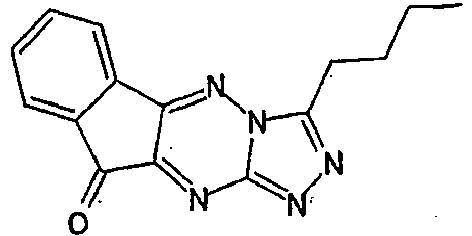
Example 1f/B 
Example 1g/A* 
Example 1g/B 
Example 1h/A* 
Example 1 h/B 
Example 1i/A* 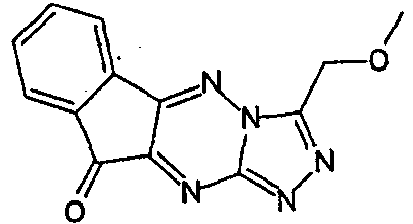
Example 1i/B 
Example 1j/A* 
Example 1j/B 
Example 1k/A* 
Example 1k/B 
Example 1l/A* 
Example 1l/B 
Example 1m/A* 
Example 1m/B 
Example 1n/A* 
Example 2a/A 
Example 2b 
Example 3/A* 
Example 3/B 
Example 4a* 
Example 4b* 
Example 5a/A* 
Example 5a/B 
Example 5b/A* 
Example 5b/B 
Example 5c/A* 
Example 5c/B 
Example 6/A* 
Example 6/B 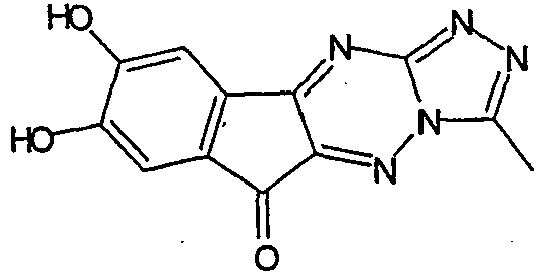
Example 7* - Representative compounds of the invention can be synthesized according to the following procedures:
-

- A mixture of substituted (1,2,4)-triazole-3,4-diamine (8.8 mmol) and ninhydrin (1.57 g, 8.8 mmol) in EtOH (10 ml) and AcOH (1.5 ml) was refluxed for 2-16 hours. The solvent was removed under reduced pressure and the residue was dissolved in EtOAc, washed with saturated K2CO3 and brine. The organic phase was dried over Na2SO4, filtered and the solvents removed by evaporation under reduced pressure. The crude was purified as follows: silica gel flash chromatography (toluene/MeOH 95:5 to 8:2 or CH2Cl2/EtOAc 9:1 to 1:1) for the purification of the regioisomeric mixture, then neutral alumina (grade II) flash chromatography (CH2Cl2/EtOAc 7:3 to CH2Cl2/ MeOH 1:1 + 5% HCOOH or AcOH) for the separation of the regioisomers.
- Prepared according to the general procedure A in 13% yield as yellow solid.
1H NMR (300 MHz, DMSO d6): δ 8.23 (d, 1 H), 8.02 (m, 2H), 7.89 (ddd, 1H), 2.72 (s, 3H). ESI+MS: calcd for C12H7N5O: 237.22; found: 238.2 (MH+). - Prepared according to the general procedure A in 30% yield as yellow solid.
1H NMR (300 MHz, DMSO d6): δ 8.16 (d, 1H), 8.05-7.95 (m, 2H), 7.85 (ddd, 1 H), 2.77 (s, 3H). ESI+MS: calcd for C12H7N5O: 237.22; found: 238.2 (MH+). -

- A mixture of (1,2,4)-triazole-3,4,5-triamine (2.5 g, 21.9 mmol) in 1:1 AcOH/H2O (80 ml) was heated to 70° C. Ninhydrin (3.9 g, 21.9 mmol) was dissolved in 1:1 AcOH/H2O (80 ml), heated at 50° C and subsequently added to the triamine solution. The reaction was heated at 70° C for 3 hours and then stirred overnight at room temperature. The mixture was cooled to 0° C and stirred for 1 hour. The precipitate was collected by filtration, washed with cold water and dried under vacuum, leading to 3,9 g of 1 c as regioisomeric mixture (6:4 ratio, 82 % yield). The regioisomers were separated following the General procedure A.
1-Amino-2,3,4,10,10a-pentaaza-cyclopenta[b]fluoren-9-one (1c/A)
Red solid. 1H NMR (300 MHz, DMSO d6): δ 8.15 (d, 1H), 8.01-7.95 (m, 2H), 7.83 (ddd, 1 H), 6.98 (s, 2H). ESI+MS: calcd for C11H6N6O: 238.21; found: 239.1 (MH+). - Brown solid. 1H NMR (300 MHz, DMSO d6): δ8.05-7.93 (m, 3H), 7.82 (ddd, 1H), 7.14 (s, 2H). ESI+MS: calcd for C11H6N6O: 238.21; found: 239.1 (MH+).
-

- The preparation of diaminotriazoles follows the procedure reported in Eur. J. Med. Chem.-chim. Ther. 1986, 21, 235.
A mixture of diaminoguanidine hydrochloride (1 g, 8 mmol) in an excess (10 g) of the appropriate carboxylic acid was stirred and heated at 120-130°C for 12-24 hours. The solution was cooled to room temperature and HCl 37% (10 ml) was added. The mixture was refluxed for 2-3 hours and then concentrated to dryness in vacuo. The obtained crude was washed with Et2O (x3) and used without any further purification.
For the condensation between the crude diaminotriazole and ninhydrin, see the General procedure A. - Prepared according to the general procedure B in 48% yield as yellow solid.
1H NMR (300 MHz, CDCl3): δ 8.21 (d, 1H), 8.00 (d, 1H), 7.90 (ddd, 1H), 7.77 (ddd, 1 H), 3.21 (q, 2H), 1.49 (t, 3H). ESI+MS: calcd for C13H9N5O: 251.25; found: 252.1 (MH+). - Prepared according to the general procedure B in 32% yield as yellow solid. 1H NMR (300 MHz, CDCl3): δ 8.12 (d, 1 H), 8.02 (d, 1H), 7.88 (ddd, 1H), 7.75 (ddd, 1H), 3.25 (q, 2H), 1.53 (t, 3H). ESI+MS: calcd for C13H9N5O: 251.25; found: 252.1 (MH+).
- Prepared according to the general procedure B in 14% yield as yellow solid.
1H NMR (300 MHz, CDCl3): δ 8.18 (d, 1 H), 7.97 (d, 1 H), 7.87 (ddd, 1 H), 7.75 (ddd, 1H), 3.12 (dd, 2H), 1.91 (m, 2H), 1.01 (t, 3H). ESI+MS: calcd for C14H11N5O: 265.28; found: 266.2 (MH+). - Prepared according to the general procedure B in 12% yield as yellow solid.
1H NMR (300 MHz, CDCl3): δ 8.10 (ddd, 1H), 8.00 (ddd, 1H), 7.86 (ddd, 1H), 7.74 (ddd, 1 H), 3.19 (dd, 2H), 1.96 (m, 2H), 1.06 (t, 3H). ESI+MS: calcd for C14H11N5O: 265.28; found: 266.2 (MH+). - Prepared according to the general procedure B in 6% yield as yellow solid.
1H NMR (300 MHz, DMSO d6): δ 8.23 (d, 1 H), 8.02 (m, 2H), 7.89 (ddd, 1 H), 3.10 (dd, 2H), 1.81 (m, 2H), 1.42 (m, 2H), 0.94 (t, 3H). ESI+MS: calcd for C15H13N5O: 279.30; found: 280.2 (MH+). - Prepared according to the general procedure B in 10% yield as yellow solid.
1H NMR (300 MHz, DMSO d6): δ 8.16 (d, 1H), 7.99 (m, 2H), 7.85 (dd, 1H), 3.16 (dd, 2H), 1.87 (m, 2H), 1.44 (m, 2H), 0.96 (t, 3H). ESI+MS: calcd for C15H13N5O: 279.30; found: 280.3 (MH+). - Prepared, according to the general procedure B in 17% yield as yellow solid.
1H NMR (300 MHz, CDCl3): 8 8.20 (d, 1 H), 7.99 (d, 1 H), 7.89 (ddd, 1H), 7.76 (ddd, 1H), 3.06 (d, 2H), 2.34 (m, 1H), 1.00 (d, 6H). ESI+MS: calcd for C15H13N5O: 279.30; found: 280.2 (MH+). - Prepared according to the general procedure B in 12% yield as yellow solid.
1H NMR (300 MHz, CDCl3): δ 8.10 (d, 1H), 7.99 (d, 1H), 7.86 (ddd, 1 H), 7.74 (ddd, 1H), 3.11 (d, 2H), 2.38 (m, 1H), 1.04 (d, 6H). ESI+MS: calcd for C15H13N5O: 279.30; found: 280.2 (MH+). - Prepared according to the general procedure B in 10% yield as yellow solid.
1H NMR (300 MHz, DMSO d6): δ 8.24 (d, 1 H), 8.02 (m, 2H), 7.90 (ddd, 1 H), 5.85 (t, 1 H), 4.92 (d, 2H). ESI+MS: calcd for C12H7N5O2: 253.22; found: 254.1 (MH+) - Prepared according to the general procedure B in 1 % yield as brown solid.
1H NMR (300 MHz, DMSO d6): δ 8.15 (d, 1 H), 8.06-7.96 (m, 2H), 7.86 (ddd, 1 H), 5.84 (t, 1 H), 4.98 (d, 2H). ESI+MS: calcd for C12H7N5O2: 253.22; found: 254.2 (MH+). - Prepared according to the general procedure B in 2% yield as yellow solid.
1H NMR (300 MHz, CDCl3): δ 8.18 (ddd, 1H), 7.96 (ddd, 1H), 7.87 (ddd, 1H), 7.75 (ddd, 1H), 4.92 (s, 2H), 3.42 (s, 3H). ESI+MS: calcd for C13H9N5O2: 267.25; found: 268.1 (MH+). - Prepared according to the general procedure B in 2% yield as brown solid.
1H NMR (300 MHz, CDCl3): δ 8.13 (d, 1 H), 8.01 (d, 1 H), 7.87 (ddd, 1 H), 7.76 (ddd, 1H), 5.02 (s, 2H), 5.49 (s, 3H). ESI+MS: calcd for C13H9N5O2: 267.25; found: 268.1 (MH+). - Prepared according to the general procedure B in 6% yield as yellow solid. 1H NMR (300 MHz, CDCl3): δ 8.25 (dd, 1H), 8.04 (dd, 1H), 7.93 (ddd, 1H), 7.80 (ddd, 1 H), 2.51 (m, 1 H), 1.44 (m, 2H), 1.26 (m, 2H). ESI+MS: calcd for C14H9N5O: 263.26; found: 264.2 (MH+).
- Prepared according to the general procedure B in 4% yield as yellow solid. 1H NMR (300 MHz, CDCl3): δ 8.14 (dd, 1H), 8.05 (dd, 1 H), 7.90 (ddd, 1 H), 7.78 (ddd, 1 H), 2.55 (m, 1 H), 1.52 (m, 2H), 1.31 (m, 2H). ESI+MS: calcd for C14H9N5O: 263.26; found: 264.1 (MH+).
- Prepared according to the general procedure B in 12% yield as bright yellow solid. 1H NMR (300 MHz, CDCl3): δ 8.23 (dd, 1H), 8.03 (dd, 1 H), 7.92 (ddd, 1H), 7.79 (ddd, 1 H), 7.46 (m, 2H), 7.31 (m, 2H), 7.24 (m, 1H), 4.56 (s, 2H). ESI+MS: calcd for C18H11N5O: 313.32; found: 314.2 (MH+).
- Prepared according to the general procedure B in 6% yield as yellow solid. 1H NMR (300 MHz, CDCl3): δ 8.11 (dd, 1H), 8.04 (dd, 1H), 7.90 (ddd, 1 H), 7.77 (ddd, 1 H), 7.45 (m, 2H), 7.32 (m, 2H), 7.25 (m, 1H), 4.62 (s, 2H). ESI+MS: calcd for C18H11N5O: 313.32; found: 314.1 (MH+).
- Prepared according to the general procedure B in 39% yield as yellow solid. 1H NMR (300 MHz, CDCl3): δ 8.19 (d, 1 H), 7.99 (d, 1 H), 7.89 (ddd, 1H), 7.76 (ddd, 1 H), 3.62 (m, 1 H), 1.51 (d, 6H). ESI+MS: calcd for C14H11N5O: 265.28; found: 266.2 (MH+).
- Prepared according to the general procedure B in 10% yield as yellow-brown solid. 1H NMR (300 MHz, CDCl3): δ 8.16 (dd, 1 H), 8.07 (dd, 1H), 7.93 (ddd, 1 H), 7.80 (ddd, 1H), 3.73 (dq, 1H), 1.62 (d, 6H). ESI+MS: calcd for C14H11N5O: 265.28; found: 266.2 (MH+).
- Prepared according to the general procedure B in 21% yield as yellow solid. 1H NMR (300 MHz, CDCl3): δ 8.39 (dd, 1H), 8.12 (dd, 1H), 8.03 (ddd, 1H), 7.92 (ddd, 1H). ESI+MS: calcd for C12H4F3N5O: 291.19; found: 292.3 (MH+).
- Prepared according to the general procedure B in 14% yield as yellow-green solid. 1H NMR (300 MHz, CDCl3): δ 8.25 (dd, 1 H), 8.13 (dd, 1 H), 7.99 (ddd, 1 H), 7.88 (ddd, 1H). ESI+MS: calcd for C12H4F3N5O: 291.19; found: 292.2 (MH+).
- Prepared according to the general procedure B in 14% (over 2 steps) yield as yellow solid. 1H NMR (300 MHz, CDCl3): δ 8.29 (dd, 1 H), 8.07 (dd, 1 H), 7.97 (ddd, 1 H), 7.84 (ddd, 1 H), 5.16 (s, 2H), 3.88 (m, 2H), 3.71 (m, 2H), 3.65 (m, 2H), 3.53 (m, 2H), 3.34 (s, 3H). ESI+MS: calcd for C17H17N5O4: 355.36; found: 356.2 (MH+).
-

- A regioisomeric mixture of amines 1c (400 mg, 1.68 mmol) was added in portions to a solution of tert-butyl nitrite (300 µl, 2.52 mmol) and copper(II) halide (2.52 mmol) in acetonitrile (8 ml) at 60° C. The mixture was heated at 80°C for two hours, then it was cooled and the solvents evaporated. The crude was purified by flash chromatography (EtOAc/MeOH 99:1 or CH2Cl2/acetone 95:5).
- Prepared according to the general procedure C in 49% yield as yellow solid as single regioisomer. 1H NMR (300 MHz, DMSO d6): δ 8.29 (d, 1 H), 8.07 (m, 2H), 7.95 (dd, 1 H). ESI+MS: calcd for C11H4ClN5O: 257.64; found: 258.1 (MH+).
- Prepared according to the general procedure C in 69% yield as yellow solid as 6:4 regioisomeric mixture. 1H NMR (300 MHz, DMSO d6) (mixture of isomers): δ 8.28 and 8.23 (d, 1H), 8.10-7.86 (m, 3H). ESI+MS: calcd for C11H4BrN5O: 302.09; found: 302.0 (MH+).
-
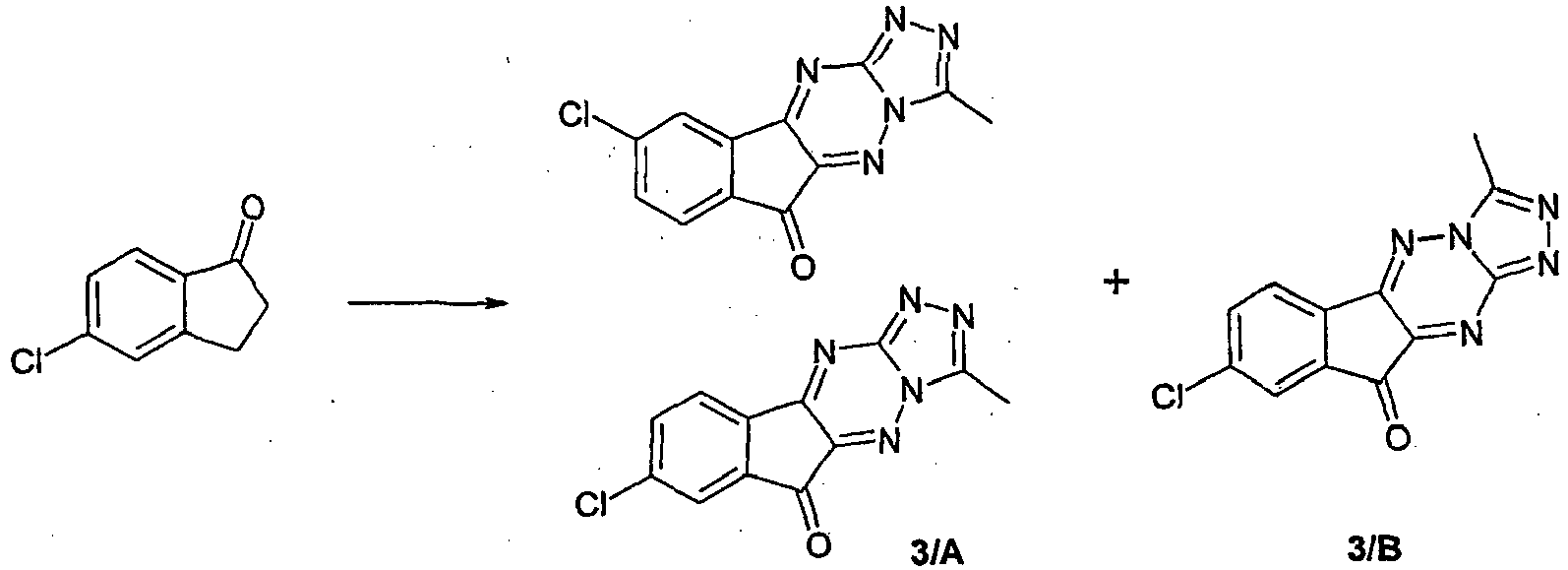
- A solution of 5-chloro 1-indanone (0.97 g, 5.8 mmol) and N-bromo succinimide (2.1 g, 11.6 mmol) in DMSO (23 ml) was stirred 16 hours at 40°C and 4 hours at 80°C under vacuum. Brine (25 ml) was added and the mixture was extracted with CH2Cl2 (4x25 ml). The collected organic layers were dried over Na2SO4, filtered and evaporated. The crude was used without any further purification. For the condensation between the crude diaminotriazole and ninhydrin, see the General procedure A.
- Yield: 13%, yellow solid, 1:1 regioisomeric mixture: 1H NMR (300 MHz, CDCl3) (mixture of isomers): δ 8.19 (d, 1H), 7.96 (d, 1H), 7.74 (dd, 1H), 2.84 (s, 3H). 8.17 (d, 1 H), 7.97 (d, 1 H), 7.86 (dd, 1H), 2.83 (s, 3H). ESI+MS: calcd for C12H6ClN5O: 271.67; found: 272.0 (MH+).
- Yield: 3%, brownish solid: 1H NMR (300 MHz, CDCl3): 8 8.03 (d, 1H), 7.90 (d, 1 H), 7.65 (dd, 1 H), 2.79 (s, 3H). ESI+MS: calcd for C12H6ClN5O: 271.67; found: 272.0 (MH+).
-

- 1-Methyl-3,4-diamino-1,2,5 triazole and 1-benzyl-3,4-diamino-1,2,5 triazole were prepared according to the procedure described in Chem. Heterocycl. Compd. 1992, 803, starting from dithiooxamide.
For the condensation between the crude diaminotriazole and ninhydrin, see the General procedure A. The raw product was purified by silica gel flash chromatography (CH2Cl2/MeOH 95:5). - Prepared according to the general procedure D in 12% yield as brown solid.
1H NMR (300 MHz, DMSO d6): δ 8.09 (d, 1 H), 7.88 (m, 2H), 7.72 (ddd, 1 H), 4.59 (s, 3H). ESI+MS: calcd for C12H7N5O: 237.22; found: 238.1 (MH+). - Prepared according to the general procedure D in 7% yield as brown solid.
1H NMR (300 MHz, DMSO d6): δ 8.07 (d, 1H), 7.88 (m, 2H), 7.73 (ddd, 1H), 7.51-7.33 (m, 5H), 6.05 (s, 2H). ESI+MS: calcd for C18H11N5O: 313.32; found: 314.1 (MH+). -

- A mixture of 5,6-dimethoxy-1-indanone (2.23 g, 11.6 mmol) and N-bromosuccinimide (4.13 g, 23.2 mmol) in DMSO (46 ml) was stirred overnight at 40°C and 5h at 80°C under vacuum. Water (46 ml) was added and the mixture was extracted with CH2Cl2 (1×10 ml). The aqueous layer was saturated with solid NaCl and then extracted with CH2Cl2 (3x80 ml). The collected organic phases of the second extraction were dried over Na2SO4 and the solvent evaporated. The crude was used without further purification.
The condensation between 5,6-dimethoxy-1,2,3-indantrione and the substituted (1,2,4)-triazole-3,4-diamine hydrochloride followed the general procedure B. - Prepared according to the general procedure E in 35% yield as orange solid. 1H NMR (300 MHz, CDCl3): δ 7.55 (s, 1 H), 7.40 (s, 1 H), 4.10 (s, 3H), 4.03 (s, 3H), 2.78 (s, 3H). ESI+MS: calcd for C14H11N5O3: 297.28; found: 298.3 (MH+).
- Prepared according to the general procedure E in 15% yield as red solid. 1H NMR (300 MHz, CDCl3): δ 7.42 (s, 1 H), 7.41 (s, 1H), 4.11 (s, 3H), 4.03 (s, 3H), 2.82 (s, 3H). ESI+MS: calcd for C14H11N5O3: 297.28; found: 298.3 (MH+).
- Prepared according to the general procedure E in 27% yield (over 2 steps) as yellow-orange solid. 1H NMR (300 MHz, CDCl3): δ 7.57 (s, 1 H), 7.42 (s, 1H), 4.12 (s, 3H), 4.06 (s, 3H), 3.20 (q, 2H), 1.51 (t, 3H). ESI+MS: calcd for C15H13N5O3: 311.30; found: 312.2 (MH+).
- Prepared according to the general procedure E in 15% yield (over 2 steps) as orange solid. 1H NMR (300 MHz, CDCl3): δ 7.44 (s, 1 H), 7.42 (s, 1 H), 4.15 (s, 3H), 4.06 (s, 3H), 3.24 (q, 2H), 1.54 (t, 3H). ESI+MS: calcd for C15H13N5O3: 311.30; found: 312.2 (MH+).
- Prepared according to the general procedure E in 33% yield as orange solid. 1H NMR (300 MHz, CDCl3): δ 7.56 (s, 1 H), 7.41 (s, 1 H), 4.11 (s, 3H), 4.05 (s, 3H), 3.14 (dd, 2H), 1.95 (m, 2H), 1.07 (t, 3H). ESI+MS: calcd for C16H15N5O3 325.33; found: 326.3 (MH+).
- Prepared according to the general procedure in 13% yield as red-brown solid. 1H NMR (300 MHz, CDCl3): 8 7.42 (s, 1 H), 7.41 (s, 1 H), 4.13 (s, 3H), 4.03 (s, 3H), 3.17 (dd, 2H), 1.98 (m, 2H), 1.09 (t, 3H). ESI+MS: calcd for C16H15N5O3: 325.33; found: 326.3 (MH+).
-

- The preparation of ethyl-5,8-dimethoxy pentaaza-cyclopenta[b]fluoren-9-ones followed the procedure reported in the general procedure E, using 4,7-dimethoxy-1-indanone as starting material and the corresponding diaminotriazole.
- Yield: 20% (over 2-steps), orange-red solid. 1H NMR (300 MHz, CDCl3): δ 7.37 (d, 1 H), 7.24 (d, 1H), 4.06 (s, 3H), 4.03 (s, 3H), 3.21 (q, 2H), 1.50 (t, 3H). ESI+MS: calcd for C15H13N5O3: 311.30; found: 312.3 (MH+).
- Yield: 11 % (over 2 steps), red solid. 1H NMR (300 MHz, DMSO d6): δ 7.33 (d, 1H), 7.18 (d, 1H), 4.02 (s, 3H), 3.99 (s, 3H), 3.23 (q, 2H), 1.51 (t, 3H). ESI+MS: calcd for C15H13N5O3: 311.30; found: 312.5 (MH+).
-

- To a suspension of 6/A (97 mg, 0.32 mmol) in CH2Cl2 (3.2 ml) a 1M solution of BBr3 in CH2Cl2 (0.96 ml) was added and the mixture was stirred 2h at room temperature. The solvent was evaporated under reduced pressure and the residue was washed with EtOH and CH2Cl2. The crude was dissolved in DMSO and the expected product was precipitated by addition of H2O. After drying, 7 was recovered as brown solid in 79% yield (68 mg).
1H NMR (300 MHz, DMSO d6): δ 7.37 (s, 1 H), 7.24 (s, 1H), 2.63 (s, 3H). ESI+MS: calcd for C12H7N5O3: 269.22; found: 270.1 (MH+). - USP5 was diluted in USP buffer (50 mM Tris HCl; 0.5 mM EDTA; 5 mM DTT; 0.01% Triton X-100; Bovine Serum Albumin 0.05 mg.ml-1 pH 7.6). Compounds stocks (100 mM) were stored at -20°C in DMSO. Compounds were tested at the following final concentrations: 100 µM; 33.3 µM; 11.1 µM; 3.7 µM; 1.23 µM; 412 nM; 137 nM; 45.7 nM; 15.2 nM; 5 nM.
- Reactions were performed as duplicates in Black LJL 96 well plates (HE microplates; Molecular Devices; 20 µl final reaction volume).The substrate concentration for USP5 was 400 nM Ub-AMC (Boston Biochem). The concentrations of the enzyme (USP5) in specificity assays was 300 pM. The concentrations were determined in order to perform specificity assays under initial velocities at fixed substrate concentration. Compounds were pre-incubated with enzymes for 30 minutes at 25°C. Reactions were initiated by addition of substrate to the plates containing the enzymes (+/- compounds) diluted in assay buffer. Reactions were incubated for 60 minutes at 37°C. Reactions were stopped by adding acetic acid (100 mM final). Readings were performed on a Pherastar Fluorescent Reader (BMG). λ Emission 380 nm; λ Excitation = 460 nm. Data (mean values +/- standard deviation) were analyzed as % of control (no compound) and plotted as percentage versus the Log of the compound concentration using GraphPad (Prism). Data were fitted to a sigmoidal model (variable slope).
- The cDNA encoding USP7 was obtained by PCR amplification from placenta mRNA. USP7 cDNA was subcloned by PCR into a baculovirus expression vector (pFastBac-HT; Invitrogen). A cDNA encoding a mutated USP7 was generated by mutagenic PCR. The corresponding protein encodes a cysteine to alanine substitution at residue 223. The sequences were ascertained by sequencing of the entire open reading frame. Bacmids encoding USP7 were generated following DH10bac transposition. The corresponding bacmids were transfected into insect cells (Sf9). Viruses were recovered from culture supernatant and amplified twice. Insect cells (Sf9 or High Five; Invitrogen) were infected for 72 hours. Total cell lysates were harvested and lyzed in lysis buffer (Tris HCl 50 mM pH7.6; 0.75 % NP40; 500 mM NaCl; 10 % glycerol; 1 mM DTT; 10 mM imidazole; Protease Inhibitor Cocktail; AEBSF 20 µg.ml-1; Aprotinin 10 µg.ml-1). Proteins were affinity purified on metal affinity resins (Talon Metal affinity resin; BD Biosciences). Bound materials were extensively washed in wash buffer (50mM Sodium Phosphate pH7.0; 300 mM NaCl; 10 mM imidazole; 0.5% Triton X-100; 10% glycerol) and eluted from the resin in 250 mM imidazole-containing wash buffer. Proteins were dialyzed in dialysis buffer (Tris HCl pH 7.6 20 mM; NaCl 200 mM; DTT 1 mM; EDTA 1 mM; 10% Glycerol). Proteins purifications were analyzed on 4-12% NuPAGE (Invitrogen).
- USP7 was diluted in USP buffer (50 mM Tris HCl; 0.5 mM EDTA; 5 mM DTT; 0.01 % Triton X-100; Bovine Serum Albumin 0.05 mg.ml-1 pH7.6). Compounds stocks (100 mM) were stored at -20°C in DMSO. Compounds were tested at the following final concentrations: 100 µM; 33.3 µM; 11.1 µM; 3.7 µM; 1.23 µM; 412 nM; 137 nM; 45.7 nM; 15.2 nM; 5 nM.
- Reactions were performed as duplicates in Black LJL 96 well plates (HE microplates; Molecular Devices; 20 µl final reaction volume).The substrate concentration for USP7 was 400 nM Ub-AMC ( Chem. Biol., 2003, 10, p. 837-846) (Boston Biochem). The concentrations of the enzyme (USP7) in specificity assays was 152 pM. The concentrations were determined in order to perform specificity assays under initial velocities at fixed substrate concentration. Compounds were pre-incubated with enzymes for 30 minutes at 25°C. Reactions were initiated by addition of substrate to the plates containing the enzymes (+/- compounds) diluted in assay buffer. Reactions were incubated for 60 minutes at 37°C. Reactions were stopped by adding acetic acid (100 mM final). Readings were performed on a Pherastar Fluorescent Reader (BMG). λ Emission 380 nm; λ Excitation = 460 nm. Data (mean values +/- standard deviation) were analyzed as % of control (no compound) and plotted as percentage versus the Log of the compound concentration using GraphPad (Prism). Data were fitted to a sigmoidal model (variable slope).
- The cDNA encoding USP8 was obtained by PCR amplification from placenta mRNA. USP8 cDNA was subcloned by PCR into a baculovirus expression vector (pFastBac-HT; Invitrogen). A cDNA encoding a mutated USP8 was generated by mutagenic PCR. The corresponding protein encodes a cysteine to alanine substitution at residue 786. The sequences were ascertained by sequencing of the entire open reading frame. Bacmids encoding USP7 were generated following DH10bac transposition. The corresponding bacmids were transfected into insect cells (Sf9). Viruses were recovered from culture supernatant and amplified twice. Insect cells (Sf9 or High Five; Invitrogen) were infected for 72 hours. Total cell lysates were harvested and lyzed in lysis buffer (Tris HCl 50 mM pH7.6; 0.75 % NP40; 500 mM NaCl; 10 % glycerol; 1 mM DTT; 10 mM imidazole; Protease Inhibitor Cocktail; AEBSF 20 µg.ml-1; Aprotinin 10 µg.ml-1). Proteins were affinity purified on metal affinity resins (Talon Metal affinity resin; BD Biosciences). Bound materials were extensively washed in wash buffer (50 mM Sodium Phosphate pH 7.0; 300 mM NaCl; 10 mM imidazole; 0.5% Triton X-100; 10% glycerol) and eluted from the resin in 250 mM imidazole-containing wash buffer. Proteins were dialyzed in dialysis buffer (Tris HCl pH 7.6 20 mM; NaCl 200 mM; DTT 1 mM; EDTA 1 mM; 10% Glycerol). Proteins purifications were analyzed on 4-12% NuPAGE (Invitrogen).
- USP8 was diluted in USP buffer (50 mM Tris HCl; 0.5 mM EDTA; 5 mM DTT; 0.01% Triton X-100; Bovine Serum Albumin 0.05 mg.ml-1 pH8.8). Compounds stocks (100 mM) were stored at -20°C in DMSO. Compounds were tested at the following final concentrations: 100 µM; 33.3 µM; 11.1 µM; 3.7 µM; 1.23 µM; 412 nM; 137 nM; 45.7 nM; 15.2 nM; 5 nM.
- Reactions were performed as duplicates in Black LJL 96 well plates (HE microplates; Molecular Devices; 20 µl final reaction volume).The substrate concentration for USP8 was 400 nM Ub-AMC (Boston Biochem). The concentrations of the enzyme (USP8) in specificity assays was 630 pM. The concentrations were determined in order to perform specificity assays under initial velocities at fixed substrate concentration. Compounds were pre-incubated with enzymes for 30 minutes at 25°C. Reactions were initiated by addition of substrate to the plates containing the enzymes (+/- compounds) diluted in assay buffer. Reactions were incubated for 60 minutes at 37°C. Reactions were stopped by adding acetic acid (100 mM final). Readings were performed on a Pherastar Fluorescent Reader (BMG). λ Emission 380 nm; λ Excitation = 460 nm. Data (mean values +/- standard deviation) were analyzed as % of-control (no compound) and plotted as percentage versus the Log of the compound concentration using GraphPad (Prism). Data were fitted to a sigmoidal model (variable slope).
- Uch-L3 was diluted in USP buffer (50 mM Tris HCl; 0.5 mM EDTA; 5 mM DTT; 0.01% Triton X-100; Bovine Serum Albumin 0.05 mg.ml-1 pH7.6). Compounds stocks (100 mM) were stored at -20°C in DMSO. Compounds were tested at the following final concentrations: 100 µM; 33.3 µM; 11.1 µM; 3.7 µM; 1.23 µM; 412 nM; 137 nM; 45.7 nM; 15.2 nM; 5 nM.
- Reactions were performed as duplicates in Black LJL 96 well plates (HE microplates; Molecular Devices; 20 µl final reaction volume).The substrate concentration for Uch-L3 was 400 nM Ub-AMC (Boston Biochem). The concentration of the enzyme (Uch-L3) in specificity assays was 13 pM. The concentrations were determined in order to perform specificity assays under initial velocities at fixed substrate concentration. Compounds were pre-incubated with enzymes for 30 minutes at 25°C. Reactions were initiated by addition of substrate to the plates containing the enzymes (+/- compounds) diluted in assay buffer. Reactions were incubated for 60 minutes at 37°C. Reactions were stopped by adding acetic acid (100 mM final). Readings were performed on a Pherastar Fluorescent Reader (BMG). δ Emission 380 nm; δ Excitation = 460 nm. Data (mean values +/- standard deviation) were analyzed as % of control (no compound) and plotted as percentage versus the Log of the compound concentration, using GraphPad (Prism). Data were fitted to a sigmoidal model (variable slope).
- The cDNA encoding SENP1 was obtained by PCR amplification from placenta mRNA. SENP1 cDNA was subcloned by PCR into a bacterial expression vector (pMAL-C2X; New England BioLabs, Inc). The sequence was ascertained by sequencing of the entire open reading frame. pMAL-C2-SENP1 was transformed into BL21 cells and grown in LB-ampicillin medium supplemented with glucose (2 g.l-1). Fusion protein expression was induced by IPTG (0.5 mM). Bacterial cell lysates were harvested and lyzed in lysis buffer (Tris HCl 20 mM pH7.4; 1 mM EDTA; 200 mM NaCl; 0.5% Triton X-100; 10 % glycerol; Protease Inhibitor Cocktail) followed by sonication. Proteins were affinity purified on amylose affinity resin (New England BioLabs, Inc). Bound materials were extensively washed in wash buffer (20mM Tris HCl pH7.4; 200 mM NaCl; 1 mM EDTA; 0.5% Triton X-100; 10% glycerol) and eluted from the resin in 10 mM maltose-containing wash buffer. Proteins were dialyzed in dialysis buffer (Tris HCl pH 7.6 20 mM; NaCl 200 mM; DTT 1 mM; EDTA 1 mM; 10% Glycerol). Proteins purifications were analyzed on 4-12% NuPAGE (Invitrogen).
- MBP-SENP1 was diluted in SENP1 buffer (50 mM Tris HCl; 0.5 mM EDTA; 5 mM DTT; 0.01 % Triton X-100; Bovine Serum Albumin 0.05 mg.ml-1 pH7.6). Compounds stocks (100 mM) were stored at -20°C in DMSO. Compounds were tested at the following final concentrations: 100 µM; 33.3 µM; 11.1 µM; 3.7 µM; 1.23 µM; 412 nM; 137 nM; 45.7 nM; 15.2 nM; 5 nM.
- Reactions were performed as duplicates in Black LJL 96 well plates (HE microplates; Molecular Devices; 20 µl final reaction volume).The substrate concentration for SENP1 was 200 nM SUMO-AMC (Chem. Biol., 2003, 10, p. 837-846) (Boston Biochem). The concentration of the enzyme (SENP1) in specificity assays was 1.8 nM. The concentrations were determined in order to perform specificity assays under initial velocities at fixed substrate concentration. Compounds were pre-incubated with enzymes for 30 minutes at 25°C. Reactions were initiated by addition of substrate to the plates containing the enzymes (+/- compounds) diluted in assay buffer. Reactions were incubated for 60 minutes at 37°C. Reactions were stopped by adding acetic acid (100 mM final). Readings were performed on a Pherastar Fluorescent Reader (BMG). λ Emission 380 nm; λ Excitation = 460 nm. Data (mean values +/- standard deviation) were analyzed as % of control (no compound) and plotted as percentage versus the Log of the compound concentration using GraphPad (Prism). Data were fitted to a sigmoidal model (variable slope).
- Caspase 3 was diluted in Caspase 3 buffer (100 mM Hepes pH 7.5; 10% sucrose; 0.1 % CHAPS). Compounds stocks (100 mM) were stored at -20°C in DMSO. Compounds were tested at the following final concentrations: 100 µM; 33.3 µM; 11.1 µM; 3.7 µM; 1.23 µM; 412 nM; 137 nM; 45.7 nM; 15.2 nM; 5 nM. Reactions were performed as duplicates in Black LJL 96 well plates (HE microplates; Molecular Devices; 20 µl final reaction volume). The substrate concentration for caspase 3 specificity assay was 500 nM (Ac-DEVD-AMC; Promega). The concentration of the enzyme (Caspase 3) in specificity assays was 3.2 nM. The concentrations were determined in order to perform specificity assays under initial velocities at fixed substrate concentration. Compounds were pre-incubated with enzymes for 30 minutes at 25°C. Reactions were initiated by addition of substrate to the plates containing the enzymes (+/compounds) diluted in assay buffer. Reactions were incubated for 60 minutes at 37°C. Reactions were stopped by adding acetic acid (100 mM final). Readings were performed on a Pherastar Fluorescent Reader (BMG). δ Emission 380 nm; δ Excitation = 460 nm. Data (mean values +/- standard deviation) were analyzed as % of control (no compound) and plotted as percentage versus the Log of the compound concentration using GraphPad (Prism). Data were fitted to a sigmoidal model (variable slope).
- Cathepsin B was diluted in Cathepsin B buffer (20 mM Tris HCl pH 6.8; 1 mM EDTA; 1 mM DTT). Compounds stocks (100 mM) were stored at -20°C in DMSO. Compounds were tested at the following final concentrations: 100 µM; 33.3 µM; 11.1 µM; 3.7 µM; 1.23 µM; 412 nM; 137 nM; 45.7 nM; 15.2 nM; 5 nM. Reactions were performed as duplicates in Black LJL 96 well plates (HE microplates; Molecular Devices; 20 µl final reaction volume). The substrate concentration for cathepsin B specificity assay was 36 µM (z-RR-AMC; Calbiochem).The concentration of the enzyme (Cathepsin B) in specificity assays was 3.6 nM. The concentrations were determined in order to perform specificity assays under initial velocities at fixed substrate concentration. Compounds were pre-incubated with enzymes for 30 minutes at 25°C. Reactions were initiated by addition of substrate to the plates containing the enzymes (+/- compounds) diluted in assay buffer. Reactions were incubated for 60 minutes at 37°C. Reactions were stopped by adding acetic acid (100 mM final). Readings were performed on a Pherastar Fluorescent Reader (BMG). δ Emission 380 nm; δ Excitation = 460 nm. Data (mean values +/- standard deviation) were analyzed as % of control (no compound) and plotted as percentage versus the Log of the compound concentration using GraphPad (Prism). Data were fitted to a sigmoidal model (variable slope).
- HCT116 colon cancer cells were obtained from ATCC (American Type Culture Collection), and maintained in Mc Coy's 5A medium containing 10% FBS, 3 mM glutamine and 1% penicillin/streptomycin. Cells were incubated at 37°C in a humidified atmosphere containing 5% CO2.
- Cell viability was assayed using the MTS technique in 96-well culture plates (CellTiter 96® Aqueous Non-Radioactive Cell Proliferation Assay, Promega) according to the manufacturer's instructions. MTS- (3-(4,5-dimethyl-thiazol-2-yl)-5-(3-carboxymethoxyphenyl)-2-(4-sulfophenyl)-2H-tetra-zolium) is a MTT-derived tetrazolium that is reduced in metabolically active cells into a soluble, cell-permeant formazan. The amount of formazan, detected by its absorbance at 492 nm is proportional to the number of living, metabolically active cells.
- 103 HCT116 cells were seeded per well. 24 hours later, the medium was changed and the cells treated in triplicate with the following concentrations of each compound: 10 µM - 3.33 µM - 1.11 µM - 370 nM - 123 nM - 41 nM-14 nM and 5 nM. The compounds were diluted in 100% DMSO, whose final concentration on cells was kept at 0.5%.
- Cells were incubated with the compounds for 72 hours, and their viability then assayed by the addition of MTS for 2 hours. Absorbance at 492 nm was measured directly from the 96-well culture plates. GI50 (Growth Inhibition 50) concentrations for each compound were calculated using a sigmoidal variable slope fit (Prism 4.0, Graphpad Softwares). Values represent mean of, three independent experiments.
- PC-3 prostate cancer cells were obtained from ATCC, and maintained in F-12K medium containing 7% FBS and 1% penicillin/streptomycin. Cells were incubated at 37°C in a humidified atmosphere containing 5% CO2.
- Cell viability was assayed using the MTS technique in 96-well culture plates (CellTiter 96® Aqueous. Non-Radioactive Cell Proliferation Assay, Promega) according to the manufacturer's instructions. MTS (3-(4,5-dimethyl-thiazol-2-yl)-5-(3-carboxymethoxyphenyl) -2-(4-sulfophenyl)-2H-tetrazolium) is a MTT-derived tetrazolium that is reduced in metabolically active cells into a soluble, cell-permeant formazan: The amount of formazan, detected by its absorbance at 492 nm is proportional to the number of living, metabolically active cells.
- 2 x 10³ PC3 cells were seeded per well. 24 hours later, the medium was changed and the cells treated in triplicate with the following concentrations of each compound: 10uM - 3.33µM - 1.11 µM - 370nM - 123nM - 41 nM - 14 nM and 5 nM. The compounds were diluted in 100% DMSO, whose final concentration on cells was kept at 0.5%.
- Cells were incubated with the compounds for 72 hours, and their viability then assayed by the addition of MTS for 2 hours. Absorbance at 492 nm was measured directly from the 96-well culture plates. GI50 (Growth Inhibition 50) concentrations for each compound were calculated using a sigmoidal variable slope fit (Prism 4.0, Graphpad Softwares). Values represent mean of three independent experiments.
-
Experimental N° USP 5 Example 1b/A 7.6 µM Example 1b/B 0.234 µM Example 1c 0.700 µM Example 1c/A 2.8 µM Example 1c/B 0.390 µM Example 1d/A 3.23 µM Example 1d/B 0.253 µM Example 1e/B 0.363 µM Example 1f/A 3.9 µM Example 1f/8 0.237 µM Example 1g/B 0.423 µM Example 1h/A 2.5 µM Example 1h/B 0.546 µM Example 1i/B 0.487 µM Example 1j/A 3.1 µM Example 1j/B 0.317 µM Example 1k/A 34.8 µM Example 1k/B 0.206 µM Example 1l/A 3.9 µM Example 2a/A 0.549 µM Example 3/A 1.54 µM Example 3/B 0.260 µM Example 4a 23 µM Example 4b > 100 µM Example 5b/A 4.8 µM Example 5b/B 0.276 µM 

-
Experimental N° Uch-L3 Example 1b/A 0.516 µM Example 1b/B 0.143 µM Example 1c 0.240 µM Example 1c/A 0.860 µM Example 1c/B 0.133 µM Example 1d/A 0.430 µM Example 1d/B 0.095 µM Example 1e/A 1.27 µM Example 1e/B 0.168 µM Example 1f/A 0.364 µM Example 1f/B 0.091 µM Example 1g/A 0.636 µM Example 1g/B 0.183 µM Example 1h/A 0.39 µM Example 1h/B 0.158 µM Example 1i/A 0.261 µM Example 1i/B 0.202 µM Example 1j/A 1.9 µM Example 1j/B 0.055 µM Example 1k/A 0.598 µM Example 1k/B 0.164 µM Example 1l/A 0.8 µM Example 2a/A 0.133 µM Example 2b - Example 3/BA 0.071 323 µM Example 3/AB 0.323 071 µM Example 4a 3.4 µM Example 4b 7.8 µM Example 5b/A 1.8 µM Example 5b/B 0.131 µM -
Experimental N° SENP1 Example 1b/A > 100 µM Example 1b/B 0.706 µM Example 1c/B 0.731 µM Example 1d/B 0.415 µM Example 1e/A 5.88 µM Example 1e/B 0.694 µM Example 1f/8 0.229 µM Example 1g/B 0.954 µM Example 1h/A > 100 µM Example 1h/B 1.02 µM Experimental N° SENP1 Example 1i/A 22.1 µM Example 1i/B 1.09 µM Example 1j/B 0.299 µM Example 1k/B 1.21 µM Example 3/A > 100 µM Example 3/B 0.855 µM Example 5b/A 35.7 µM Example 5b/B 1.28 µM -
Experimental N° Caspase 3 Example 1b/A 4.1 µM Example 1b/B 0.424 µM Example 1c/A 3.7 µM Example 1c/B 0.212 µM Example 1d/A 11.6 µM Example 1d/B 0.467 µM Example 1e/B 0.727 µM Example 1f/A 4.6 µM Example 1f/B 0.475 µM Example 1g/B 0.629 µM Example 1h/A 3.9 µM Example 1h/B 1.02 µM Example 1i/A 0.926 µM Example 1i/B 0.556 µM Example 1j/A 1.9 µM Example 1j/B 0.188 µM Example 1k/A 0.598 µM Example 1k/B 0.164 µM Example 1l/A 5.0 µM Example 3/A 1.51 µM Example 3/B 0.743 µM Example 5b/A 5.2 µM Example 5b/B 0.314 µM -
Experimental N° Cathepsin B Example 1b/A 24 µM Example 1b/B 0.182 µM Example 1c/A 5.0 µM Example 1c/B 0.103 µM Example 1d/B 0.150 µM Example 1e/A 5.41 µM Example 1e/B 0.267 µM Example 1f/A 6.5 µM Example 1f/B 0.233 µM Example 19/A 4.62 µM Example 1g/B 0.264 µM Example 1h/A 30 µM Example 1h/B 0.547 µM Example 1i/A 1.02 µM Example 1i/B 0.314 µM Example 1j/B 0.181 µM Example 1k/B 0.363 µM Example 1l/A 9.2 µM Example 2a/A 12 µM Example 3/A 17.4 µM Example 3/B 0.147 µM -
Experimental N° HCT116 GI50 D3 Example 1b/A 1.3 µM Example 1b/B 0.084 µM Example 1c 1.5 µM Example 1c/A 8.5 µM Example 1c/B 0.981 µM Example 1d/A 1.4 µM Example 1d/B 0.059 µM Example 1e/A 3.1 µM Example 1e/B 0.067 µM Example 1f/A 1.357 µM Example 1f/B 0.040 µM Example 1g/A 3.0 µM Example 1g/B 0.053 µM Example 1h/A 2.05 µM Example 1h/B 0.323 µM Example 1i/A 1.285 µM Example 1i/B 0.065 µM Example 1j/B 0.160 µM Example 1k/B 0.149 µM Example 1l/A 2.25 µM Example 1l/B 0.157 µM Example 1m/A 0.028 µM Example 1n/A 1.91 µM Example 2a/A 0.581 µM Example 3/B 0.098 µM Example 3A 0.361 µM Example 5a/B 0.818 µM Example 5b/B 1.18 µM Example 5c/B 0.594 µM Example 6/B 0.257 µM -
Experimental N° PC3 GI50 D3 Example 1b/A 7.09 µM Example 1b/B 0.334 µM Example 1c 4.0 µM Example 1c/B 3.17 µM Example 1d/A 5.4 µM Example 1d/B 0.256 µM Example 1e/A 4.2 µM Example 1e/B 0.175 µM Example 1f/A 3.8 µM Example 1f/B 0.096 µM Example 1g/A 4.0 µM Example 1g/A 4.0 µM Example 1g/B 0.162 µM Example 1h/A 4.0 µM Example 1h/B 1.442 µM Example 1i/A 1.751 µM Example 1i/B 0.238 µM Example 1j/B 0.107 µM Example 1k/B 0.235 µM Example 2a/A 0.983 µM Example 3/B 0.286 µM Example 3A 0.994 µM
Claims (19)
- A compound of formula (I):
 ---- is either a single or double bond, as appropriate ;------ is either none or a single bond, as appropriate;
 T, U, V, W, X are the same or different and may be chosen from C or N.Ru may be chosen from the group consisting in CN, =O, Hal, Alk, OAlk, OH, perhalogenoalkyle, NRCN, C(CN)=COOH)(OAlk), SR, NRR', C(O)NRR', Heterocycle, Aryle, Heteroaryle, Cycloalkyle, where Alk, Aryle, Heteroaryle, Heterocycle, Cycloalkyle are optionally substituted by one or more of Hal, NRR', CN, OH, CF3, Aryle, Heteroaryle, OAlk or poly(alkylenoxy),Rv and Rw are independently H or absentR3, R4, R5, R6 are each Identical or different and are independently chosen from the group consisting in H, OAlk, Alk, Hal, NRR', CN, OH, OCF3, CF3, Aryle, Heteroaryle;R and R' are each identical or different and are independently chosen from the group consisting in H, Alk, wherein Alk is optionally substituted by one or more of Hal, NRR', CN, OH, CF3, Aryle, Heteroaryle;or their pharmaceutically acceptable salts, hydrates, or hydrated salts, or their optical isomers, racemates, diastereomers or enantiomers.
 - A compound of formula (I) according to claim 1, wherein Ru is chosen from Aryle, Alk, NRR', Hal, -AlkAryl, -AlkOH, -AlkOAlk, Cycloalkyl, -CF3, -CH2-(OC2H4)2- O CH3.
- A compound according to claim 1 or 2, wherein R3, R4, R5, R6 are each identical or different and are independently chosen from the group consisting in H, Hal, Alk, OAlk, OH, OCF3.
- A compound of formula (I) according to anyone of the preceding claims, wherein it is of formula (Ib):

- A compound of formula (I) according to anyone of the preceding claims, wherein Rv=Rw=H and Ru is chosen from Aryl, Alk, NRR', Hal, -AlkAryl, -AlkOH, -AlkOAlk, Cycloalkyl, -CF3, -CH2-(OC2H4)2- O CH3.
- A compound of formula (I) according to anyone of the preceding claims, wherein R4=R5=H and R3, R6 are independently chosen from the group consisting in H, Hal, Alk, OAlk, OH, OCF3.
- A compound according to anyone of the preceding claims chosen from the group consisting in:- 3-Methyl-1,2,3a,4,10-pentaaza-cyclopenta[b]fluoren-9-one- 3-Amino-1,2,3a,4,10-pentaaza-cyclopenta[b]fluoren-9-one- 3-Ethyl-1,2,3a,4,10-pentaaza-cyclopenta[b]fluoren-9-one- 3-Propyl-1,2,3a,4,10-pentaaza-cyclopenta[b]fluoren-9-one- 3-Butyl-1,2,3a,4,10-pentaaza-cyclopenta[b]fluoren-9-one- 3-Isabutyl-1,2,3a,4,10-pentaaza-cyclopenta[b]fluoren-9-one- 3-Hydroxymethyl-1,2,3a,4,10-pentaaza-cyclopenta[b]fluoren-9-one- 3-Methoxymethyl-1,2,3a,4,10-pentaaza-cyclopenta[b]fluoren-9-one- 3-Cyclopropyl-1,2,3a,4,10-pentaaza-cyclopenta[b]fluoren-9-one- 3- Benzyl-1,2,3a,4,10-pentaaza-cyclopenta[b]fluoren-9-one- 3-bromo-1,2,3a,4,10-pentaaza-cyclopenta[b]fluoren-9-one- 7-Chloro-3-methyl-1,2,3a,4,10-pentaaza-cyclopenta[b]fluoren-9-one- 3-Isopropyl-1,2,3a,4,10-pentaaza-cyclopenta[b]fluoren-9-one- 3-Trifluoromethyl-1,2,3a,4,10-pentaaza-cyclopenta[b]fluoren-9-one- 6,7-Dimethoxy-3-methyl-1,2,3a,4,10-pentaaza-cyclopenta[b]fluoren-9-one- 3-Ethyl-6,7-dimethoxy-1,2,3a,4,10-pentaaza-cyclopenta[b]fluoren-9-one- 6,7-Dimethoxy-3-propyl-1,2,3a,4,10-pentaaza-cyclopenta[b]fluoren-9-one- 3-Ethyl-5,8-dimethoxy-1,2,3a,4,10-pentaaza-cyclopenta[b]fluoren-9-oneor their pharmaceutically acceptable salts, hydrates, or hydrated salts, or their optical isomers, racemates, diastereomers or enantiomers.
- Process of preparation of a compound of formula (I) according to anyone of the preceding claims comprising the step of reacting a corresponding compound of formula (I'):

- Process of preparation of a compound according to anyone of the preceding claims comprising the step of reacting corresponding compounds of formula (II) and (III):

- The process according to claim 9, wherein the reaction is carried out in an organic protic solvent In the presence of an acid.
- A pharmaceutical composition comprising a compound of formula (I)
 ---- is either a single or double bond, as appropriate ;------- is either none or a single bond, as appropriate;
 T, U, V, W, X are the same or different and may be chosen from C or N.Ru may be chosen from the group consisting in CN, =O, Hal, Alk, OAlk, OH, perhalogenoalkyle, NRCN, C(CN)=C(OH)(OAlk), SR, NRR', C(O)NRR', Heterocycle, Aryle, Heteroaryle, Cycloalkyle, where Alk, Aryle, Heteroaryle, Heterocycle, Cycloalkyle are optionally substituted by one or more of Hal, NRR', CN, OH, CF3, Aryle, Heteroaryle , OAlk or poly(alkylenoxy),Rv and Rw are independently H or absentR3, R4, R5, R6 are each identical or different and are independently chosen from the group consisting in H, OAlk, Alk, Hal, NRR', CN, OH, OCF3, CF3, Aryle, Heteroaryle;R and R' are each identical or different and are independently chosen from the group consisting in H, Alk, wherein Alk is optionally substituted by one or more of Hal, NRR', CN, OH, CF3, Aryle, Heteroaryle;or their pharmaceutically acceptable salts, hydrates, or hydrated salts or their optical isomers, racemates, diastereomers or enantiomers,
and a pharmaceutically acceptable carrier. - A pharmaceutical composition according to claim 11, wherein formula (I) is defined as in anyone of claims 2 to 6.
- A pharmaceutical composition according to claim 11 or 12, wherein said compound of formula (I) is chosen from the group consisting In:- 3-Methyl-1,2,3a,4,10-pentaaza-cyclopenta[b]fluoren-9-one- 3-Amino-1,2,3a,4,10-pentaaza-cyclopenta[b]fluoren-9-one- 3-Ethyl-1,2,3a,4,10-pentaaza-cyclopenta[b]fluoren-9-one- 3-Propyl-1,2,3a,4,10-pentaaza-cyclopenta[b]fluoren-9-one- 3-Butyl-1,2,3a,4,10-pentaaza-cyclopenta[b]fluoren-9-one- 3-Isobutyl-1,2,3a,4,10-pentaaza-cyclopenta[b]fluoren-9-one- 3-Hydroxymethyl-1,2,3a,4,10-pentaaza-cyclopenta[b]fluoren-9-one- 3-Methoxymethyl-1,2,3a,4,10-pentaaza-cyclopenta[b]fluoren-9-one- 3-Cyclopropyl-1,2,3a,4,10-pentaaza-cyclopenta[b]fluoren-9-one- 3-Benzyl-1,2,3a,4,10-pentaaza-cyclopenta[b]fluoren-9-one- 3-bromo-1,2,3a,4,10-pentaaza-cyclopenta[b]fluoren-9-one- 7-Chloro-3-methyl-1,2,3a,4,10-pentaaza-cyclopenta[b]fluoren-9-one- 3-Isopropyl-1,2,3a,4,10-pentaaza-cyclopenta[b]fluoren-9-one- 3-Trifluoromethyl-1,2,3a,4,10-pentaaza-cyclopenta[b]fluoren-9-one- 6,7-Dimethoxy-3-methyl-1,2,3a,4,10-pentaaza-cyclopenta[b]fluoren-9-one- 3-Ethyl-6,7-dimethoxy-1,2,3a,4,10-pentaaza-cyclopenta[b]fluoren-9-one- 6,7-Dimethoxy-3-propyl-1,2,3a,4,10-pentaaza-cyclopenta[b]fluoren-9-one- 3-Ethyl-5,8-dimethoxy-1,2,3a,4,10-pentaaza-cyclopenta[b]fluoren-9-oneor their pharmaceutically acceptable salts, hydrates, or hydrated salts or their optical isomers, racemates, diastereomers or enantiomers.
- A compound of formula (I) as defined In anyone of claims 11 to 13 for use in a method for inhibiting one or more cysteine proteases.
- The compound according to claim 14, wherein said cysteine proteases belong to one or more groups of de-ubiquitination enzymes, caspases, cathepsins, calpains as well as viral, bacterial, fungal or parasitic cysteine proteases.
- A compound of formula (I) as defined in anyone of claims 11 to 13 for use in a method for treating and/or preventing cancer and metastasis, neurodegenerative diseases, such as Alzheimer's disease and Parkinson's disease, inflammatory disorders, cardiovascular diseases and/or viral infectivity and/or latency in particular for Herpes simplex virus-1, Epstein-Barr virus, SARS coronavirus, inflammatory disorders, neurodegenerative disorders, preferably nervous cell damage caused by stroke, liver damage and liver failure resulting from acute or chronic infectious, ischemic or chemical liver injury, renal damage and renal failure resulting from acute or chronic infectious, ischemic or chemical kidney injury, heart damage and heart failure resulting from acute or chronic infectious, ischemic or chemical cardiac injury, diabetes resulting from acute or chronic autoimmune, chemical, oxidative, metabolic injury to the insulin beta-cells of the pancreatic islets, cancer and metastasis, cardiovascular diseases, immunological disorders, bone and joint diseases, osteoporosis, arthritis, ageing disorders, late onset diabetes, cataract, viral infections and diseases, bacterial infections and diseases, fungal infections and diseases, protozoal parasitic infections and diseases, flat worm parasitic infections and diseases, round worm parasitic infections and diseases.
- The compound according to claim 16, wherein said viral infections and diseases are chosen from hepatitis A, hepatitis C, SARS coronavirus infection and disease, rhinoviral infections and diseases, adenoviral infections and diseases, poliomyelitis.
- The compound according to claim 16, wherein said bacterial infections or diseases are chosen from streptococcal infections and diseases, infections and diseases caused by bacteria of the Clostridium sp. Genus, staphylococcal infections and diseases, gingivitis and periodontal diseases.
- A combination comprising a compound acoording to claims 11 to 13 with one or more therapies chosen from anti-cancer therapies, neurological therapies, thrombolytic therapies, antioxidant therapies. anti-infective, antihypertensive therapies, diuretic therapies, thrombolytic therapies, immunosuppressive therapies, cardiovascular therapies, immuno-modulatory therapies, anti-inflammatory therapies, antiviral therapies, anti-bacterial therapies, anti-fungal therapies, anti-protozoal therapies, antiparasitic therapies.
Priority Applications (1)
| Application Number | Priority Date | Filing Date | Title |
|---|---|---|---|
| EP06831646.2A EP1963328B1 (en) | 2005-12-08 | 2006-12-05 | Inhibitors of cysteine proteases, the pharmaceutical compositions thereof and their therapeutic applications |
Applications Claiming Priority (4)
| Application Number | Priority Date | Filing Date | Title |
|---|---|---|---|
| EP05292612A EP1798232A1 (en) | 2005-12-08 | 2005-12-08 | Inhibitors of cysteine proteases, the pharmaceutical compositions thereof and their therapeutic applications |
| US11/296,564 US7462615B2 (en) | 2005-12-08 | 2005-12-08 | Inhibitors of cysteine proteases, the pharmaceutical compositions thereof and their therapeutic applications |
| EP06831646.2A EP1963328B1 (en) | 2005-12-08 | 2006-12-05 | Inhibitors of cysteine proteases, the pharmaceutical compositions thereof and their therapeutic applications |
| PCT/IB2006/003475 WO2007066200A2 (en) | 2005-12-08 | 2006-12-05 | Inhibitors of cysteine proteases, the pharmaceutical compositions thereof and their therapeutic applications |
Publications (2)
| Publication Number | Publication Date |
|---|---|
| EP1963328A2 EP1963328A2 (en) | 2008-09-03 |
| EP1963328B1 true EP1963328B1 (en) | 2013-10-30 |
Family
ID=38006777
Family Applications (1)
| Application Number | Title | Priority Date | Filing Date |
|---|---|---|---|
| EP06831646.2A Not-in-force EP1963328B1 (en) | 2005-12-08 | 2006-12-05 | Inhibitors of cysteine proteases, the pharmaceutical compositions thereof and their therapeutic applications |
Country Status (10)
| Country | Link |
|---|---|
| EP (1) | EP1963328B1 (en) |
| JP (1) | JP5173829B2 (en) |
| AU (1) | AU2006322958B2 (en) |
| CA (1) | CA2632635C (en) |
| ES (1) | ES2439456T3 (en) |
| IL (1) | IL191992A (en) |
| MX (1) | MX2008007195A (en) |
| NZ (1) | NZ568805A (en) |
| RU (1) | RU2440351C2 (en) |
| WO (1) | WO2007066200A2 (en) |
Families Citing this family (5)
| Publication number | Priority date | Publication date | Assignee | Title |
|---|---|---|---|---|
| WO2008053301A2 (en) * | 2006-10-30 | 2008-05-08 | Hybrigenics Sa | Novel tetracyclic inhibitors of cysteine proteases, the pharmaceutical compositions thereof and their therapeutic applications |
| EP2208725A1 (en) * | 2009-01-13 | 2010-07-21 | Hybrigenics S.A. | Novel specific inhibitors of ubiquitin specific protease 7, the pharmaceutical compositions thereof and their therapeutic applications |
| WO2011069149A2 (en) | 2009-12-04 | 2011-06-09 | Dcb-Usa Llc | Cathepsin s inhibitors |
| CA3200234A1 (en) | 2020-11-25 | 2022-06-02 | Daryl C. Drummond | Lipid nanoparticles for delivery of nucleic acids, and related methods of use |
| EP4531819A2 (en) | 2022-05-25 | 2025-04-09 | Akagera Medicines, Inc. | Lipid nanoparticles for delivery of nucleic acids and methods of use thereof |
Family Cites Families (5)
| Publication number | Priority date | Publication date | Assignee | Title |
|---|---|---|---|---|
| US4405619A (en) * | 1981-09-02 | 1983-09-20 | Diamond Shamrock Corporation | Antiinflammatory substituted-1,2,4-triazolo[4,3-b]-1,2,4-triazines |
| FR2722789B1 (en) * | 1994-07-20 | 1996-08-23 | Rhone Poulenc Rorer Sa | IMIDAZO (1,2-A) INDENO (1,2-E) PYRAZINE-2-CARBOXYLIC ACID DERIVATIVES, THEIR PREPARATION AND THE MEDICINAL PRODUCTS CONTAINING THEM |
| JP2002539162A (en) * | 1999-03-12 | 2002-11-19 | アベンテイス・フアルマ・ソシエテ・アノニム | Treatment of amyotrophic lateral sclerosis using a combination of riluzole and AMPA receptor antagonist |
| AU2001240021A1 (en) * | 2000-04-13 | 2001-10-30 | Millennium Pharmaceuticals, Inc. | Diazafluorenone il-8 receptor antagonists |
| ES2243527T3 (en) * | 2000-07-06 | 2005-12-01 | Qlt Inc. | HETEROPOLICICLIC INHIBITORS. |
-
2006
- 2006-12-05 RU RU2008127502/04A patent/RU2440351C2/en not_active IP Right Cessation
- 2006-12-05 WO PCT/IB2006/003475 patent/WO2007066200A2/en not_active Ceased
- 2006-12-05 MX MX2008007195A patent/MX2008007195A/en active IP Right Grant
- 2006-12-05 NZ NZ568805A patent/NZ568805A/en not_active IP Right Cessation
- 2006-12-05 EP EP06831646.2A patent/EP1963328B1/en not_active Not-in-force
- 2006-12-05 CA CA2632635A patent/CA2632635C/en not_active Expired - Fee Related
- 2006-12-05 AU AU2006322958A patent/AU2006322958B2/en not_active Ceased
- 2006-12-05 ES ES06831646.2T patent/ES2439456T3/en active Active
- 2006-12-05 JP JP2008543932A patent/JP5173829B2/en not_active Expired - Fee Related
-
2008
- 2008-06-05 IL IL191992A patent/IL191992A/en not_active IP Right Cessation
Also Published As
| Publication number | Publication date |
|---|---|
| AU2006322958A1 (en) | 2007-06-14 |
| WO2007066200A2 (en) | 2007-06-14 |
| NZ568805A (en) | 2011-06-30 |
| JP2009518383A (en) | 2009-05-07 |
| JP5173829B2 (en) | 2013-04-03 |
| ES2439456T3 (en) | 2014-01-23 |
| MX2008007195A (en) | 2008-09-10 |
| RU2008127502A (en) | 2010-01-20 |
| CA2632635C (en) | 2014-04-29 |
| RU2440351C2 (en) | 2012-01-20 |
| IL191992A0 (en) | 2008-12-29 |
| WO2007066200A3 (en) | 2007-09-07 |
| CA2632635A1 (en) | 2007-06-14 |
| IL191992A (en) | 2016-09-29 |
| AU2006322958B2 (en) | 2012-06-07 |
| EP1963328A2 (en) | 2008-09-03 |
Similar Documents
| Publication | Publication Date | Title |
|---|---|---|
| US20110177105A1 (en) | Novel Selective Inhibitors of Ubiquitin Specific Protease 7, the Pharmaceutical Compositions Thereof and Their Therapeutic Applications | |
| US20100048575A1 (en) | Novel tetracyclic inhibitors of cysteine proteases, the pharmaceutical compositions thereof and their therapeutic applications | |
| EP1749822B1 (en) | Novel cysteine protease inhibitors and their therapeutic applications | |
| EP2208725A1 (en) | Novel specific inhibitors of ubiquitin specific protease 7, the pharmaceutical compositions thereof and their therapeutic applications | |
| IL189286A (en) | Cysteine protease inhibitors, processes for their preparation and their therapeutic uses | |
| AU2006322958B2 (en) | Inhibitors of cysteine proteases, the pharmaceutical compositions thereof and their therapeutic applications | |
| US7462615B2 (en) | Inhibitors of cysteine proteases, the pharmaceutical compositions thereof and their therapeutic applications | |
| US20090181972A1 (en) | Novel Inhibitors of Cysteine Proteases, the Pharmaceutical Compositions Thereof and their Therapeutic Applications | |
| EP2084163B1 (en) | Tetracyclic inhibitors of cysteine proteases, the pharmaceutical compositions thereof and their therapeutic applications | |
| CN101611036B (en) | Novel tetracyclic inhibitors of cysteine proteases, the pharmaceutical compositions thereof and their therapeutic applications | |
| US20070032499A1 (en) | Novel cysteine protease inhibitors and their therapeutic applications | |
| RU2481349C2 (en) | New tetracyclic cystein protease inhibitors, pharmaceutical compositions thereof and application thereof | |
| MX2008001718A (en) | Novel cysteine protease inhibitors and their therapeutic applications |
Legal Events
| Date | Code | Title | Description |
|---|---|---|---|
| PUAI | Public reference made under article 153(3) epc to a published international application that has entered the european phase |
Free format text: ORIGINAL CODE: 0009012 |
|
| 17P | Request for examination filed |
Effective date: 20080603 |
|
| AK | Designated contracting states |
Kind code of ref document: A2 Designated state(s): AT BE BG CH CY CZ DE DK EE ES FI FR GB GR HU IE IS IT LI LT LU LV MC NL PL PT RO SE SI SK TR |
|
| RIN1 | Information on inventor provided before grant (corrected) |
Inventor name: DELANSORNE, REMI Inventor name: VIGNANDO, STEFANO Inventor name: GUEDAT, PHILIPPE Inventor name: DAVIET, LAURENT Inventor name: COLLAND, FREDERIC Inventor name: FORMSTECHER, ETIENNE Inventor name: BORG-CAPRA, CATHERINE Inventor name: JACQ, XAVIER Inventor name: RAIN, JEAN-CHRISTOPHE Inventor name: BOISSY, GUILLAUME Inventor name: PERETTO, ILARIA |
|
| 17Q | First examination report despatched |
Effective date: 20110420 |
|
| DAX | Request for extension of the european patent (deleted) | ||
| GRAP | Despatch of communication of intention to grant a patent |
Free format text: ORIGINAL CODE: EPIDOSNIGR1 |
|
| INTG | Intention to grant announced |
Effective date: 20130523 |
|
| GRAS | Grant fee paid |
Free format text: ORIGINAL CODE: EPIDOSNIGR3 |
|
| GRAA | (expected) grant |
Free format text: ORIGINAL CODE: 0009210 |
|
| AK | Designated contracting states |
Kind code of ref document: B1 Designated state(s): AT BE BG CH CY CZ DE DK EE ES FI FR GB GR HU IE IS IT LI LT LU LV MC NL PL PT RO SE SI SK TR |
|
| REG | Reference to a national code |
Ref country code: GB Ref legal event code: FG4D |
|
| REG | Reference to a national code |
Ref country code: CH Ref legal event code: EP Ref country code: CH Ref legal event code: NV Representative=s name: ARNOLD AND SIEDSMA AG, CH |
|
| REG | Reference to a national code |
Ref country code: AT Ref legal event code: REF Ref document number: 638452 Country of ref document: AT Kind code of ref document: T Effective date: 20131115 |
|
| REG | Reference to a national code |
Ref country code: IE Ref legal event code: FG4D |
|
| REG | Reference to a national code |
Ref country code: NL Ref legal event code: T3 |
|
| REG | Reference to a national code |
Ref country code: DE Ref legal event code: R096 Ref document number: 602006039064 Country of ref document: DE Effective date: 20131224 |
|
| REG | Reference to a national code |
Ref country code: ES Ref legal event code: FG2A Ref document number: 2439456 Country of ref document: ES Kind code of ref document: T3 Effective date: 20140123 |
|
| REG | Reference to a national code |
Ref country code: AT Ref legal event code: MK05 Ref document number: 638452 Country of ref document: AT Kind code of ref document: T Effective date: 20131030 |
|
| REG | Reference to a national code |
Ref country code: LT Ref legal event code: MG4D |
|
| PG25 | Lapsed in a contracting state [announced via postgrant information from national office to epo] |
Ref country code: IS Free format text: LAPSE BECAUSE OF FAILURE TO SUBMIT A TRANSLATION OF THE DESCRIPTION OR TO PAY THE FEE WITHIN THE PRESCRIBED TIME-LIMIT Effective date: 20140228 Ref country code: FI Free format text: LAPSE BECAUSE OF FAILURE TO SUBMIT A TRANSLATION OF THE DESCRIPTION OR TO PAY THE FEE WITHIN THE PRESCRIBED TIME-LIMIT Effective date: 20131030 Ref country code: SE Free format text: LAPSE BECAUSE OF FAILURE TO SUBMIT A TRANSLATION OF THE DESCRIPTION OR TO PAY THE FEE WITHIN THE PRESCRIBED TIME-LIMIT Effective date: 20131030 Ref country code: LT Free format text: LAPSE BECAUSE OF FAILURE TO SUBMIT A TRANSLATION OF THE DESCRIPTION OR TO PAY THE FEE WITHIN THE PRESCRIBED TIME-LIMIT Effective date: 20131030 |
|
| PG25 | Lapsed in a contracting state [announced via postgrant information from national office to epo] |
Ref country code: CY Free format text: LAPSE BECAUSE OF FAILURE TO SUBMIT A TRANSLATION OF THE DESCRIPTION OR TO PAY THE FEE WITHIN THE PRESCRIBED TIME-LIMIT Effective date: 20131030 Ref country code: AT Free format text: LAPSE BECAUSE OF FAILURE TO SUBMIT A TRANSLATION OF THE DESCRIPTION OR TO PAY THE FEE WITHIN THE PRESCRIBED TIME-LIMIT Effective date: 20131030 Ref country code: LV Free format text: LAPSE BECAUSE OF FAILURE TO SUBMIT A TRANSLATION OF THE DESCRIPTION OR TO PAY THE FEE WITHIN THE PRESCRIBED TIME-LIMIT Effective date: 20131030 |
|
| PG25 | Lapsed in a contracting state [announced via postgrant information from national office to epo] |
Ref country code: PT Free format text: LAPSE BECAUSE OF FAILURE TO SUBMIT A TRANSLATION OF THE DESCRIPTION OR TO PAY THE FEE WITHIN THE PRESCRIBED TIME-LIMIT Effective date: 20140228 |
|
| PG25 | Lapsed in a contracting state [announced via postgrant information from national office to epo] |
Ref country code: MC Free format text: LAPSE BECAUSE OF FAILURE TO SUBMIT A TRANSLATION OF THE DESCRIPTION OR TO PAY THE FEE WITHIN THE PRESCRIBED TIME-LIMIT Effective date: 20131030 Ref country code: EE Free format text: LAPSE BECAUSE OF FAILURE TO SUBMIT A TRANSLATION OF THE DESCRIPTION OR TO PAY THE FEE WITHIN THE PRESCRIBED TIME-LIMIT Effective date: 20131030 |
|
| REG | Reference to a national code |
Ref country code: DE Ref legal event code: R097 Ref document number: 602006039064 Country of ref document: DE |
|
| PG25 | Lapsed in a contracting state [announced via postgrant information from national office to epo] |
Ref country code: SK Free format text: LAPSE BECAUSE OF FAILURE TO SUBMIT A TRANSLATION OF THE DESCRIPTION OR TO PAY THE FEE WITHIN THE PRESCRIBED TIME-LIMIT Effective date: 20131030 Ref country code: PL Free format text: LAPSE BECAUSE OF FAILURE TO SUBMIT A TRANSLATION OF THE DESCRIPTION OR TO PAY THE FEE WITHIN THE PRESCRIBED TIME-LIMIT Effective date: 20131030 Ref country code: LU Free format text: LAPSE BECAUSE OF FAILURE TO SUBMIT A TRANSLATION OF THE DESCRIPTION OR TO PAY THE FEE WITHIN THE PRESCRIBED TIME-LIMIT Effective date: 20131205 Ref country code: RO Free format text: LAPSE BECAUSE OF FAILURE TO SUBMIT A TRANSLATION OF THE DESCRIPTION OR TO PAY THE FEE WITHIN THE PRESCRIBED TIME-LIMIT Effective date: 20131030 Ref country code: CZ Free format text: LAPSE BECAUSE OF FAILURE TO SUBMIT A TRANSLATION OF THE DESCRIPTION OR TO PAY THE FEE WITHIN THE PRESCRIBED TIME-LIMIT Effective date: 20131030 |
|
| PLBE | No opposition filed within time limit |
Free format text: ORIGINAL CODE: 0009261 |
|
| STAA | Information on the status of an ep patent application or granted ep patent |
Free format text: STATUS: NO OPPOSITION FILED WITHIN TIME LIMIT |
|
| REG | Reference to a national code |
Ref country code: IE Ref legal event code: MM4A |
|
| PG25 | Lapsed in a contracting state [announced via postgrant information from national office to epo] |
Ref country code: DK Free format text: LAPSE BECAUSE OF FAILURE TO SUBMIT A TRANSLATION OF THE DESCRIPTION OR TO PAY THE FEE WITHIN THE PRESCRIBED TIME-LIMIT Effective date: 20131030 |
|
| 26N | No opposition filed |
Effective date: 20140731 |
|
| PG25 | Lapsed in a contracting state [announced via postgrant information from national office to epo] |
Ref country code: IE Free format text: LAPSE BECAUSE OF NON-PAYMENT OF DUE FEES Effective date: 20131205 |
|
| REG | Reference to a national code |
Ref country code: DE Ref legal event code: R097 Ref document number: 602006039064 Country of ref document: DE Effective date: 20140731 |
|
| PG25 | Lapsed in a contracting state [announced via postgrant information from national office to epo] |
Ref country code: SI Free format text: LAPSE BECAUSE OF FAILURE TO SUBMIT A TRANSLATION OF THE DESCRIPTION OR TO PAY THE FEE WITHIN THE PRESCRIBED TIME-LIMIT Effective date: 20131030 |
|
| PG25 | Lapsed in a contracting state [announced via postgrant information from national office to epo] |
Ref country code: TR Free format text: LAPSE BECAUSE OF FAILURE TO SUBMIT A TRANSLATION OF THE DESCRIPTION OR TO PAY THE FEE WITHIN THE PRESCRIBED TIME-LIMIT Effective date: 20131030 |
|
| PG25 | Lapsed in a contracting state [announced via postgrant information from national office to epo] |
Ref country code: HU Free format text: LAPSE BECAUSE OF FAILURE TO SUBMIT A TRANSLATION OF THE DESCRIPTION OR TO PAY THE FEE WITHIN THE PRESCRIBED TIME-LIMIT; INVALID AB INITIO Effective date: 20061205 Ref country code: BG Free format text: LAPSE BECAUSE OF FAILURE TO SUBMIT A TRANSLATION OF THE DESCRIPTION OR TO PAY THE FEE WITHIN THE PRESCRIBED TIME-LIMIT Effective date: 20131030 |
|
| PG25 | Lapsed in a contracting state [announced via postgrant information from national office to epo] |
Ref country code: GR Free format text: LAPSE BECAUSE OF NON-PAYMENT OF DUE FEES Effective date: 20131030 |
|
| REG | Reference to a national code |
Ref country code: FR Ref legal event code: PLFP Year of fee payment: 10 |
|
| PG25 | Lapsed in a contracting state [announced via postgrant information from national office to epo] |
Ref country code: GR Free format text: LAPSE BECAUSE OF FAILURE TO SUBMIT A TRANSLATION OF THE DESCRIPTION OR TO PAY THE FEE WITHIN THE PRESCRIBED TIME-LIMIT Effective date: 20140131 |
|
| REG | Reference to a national code |
Ref country code: FR Ref legal event code: PLFP Year of fee payment: 11 |
|
| PGFP | Annual fee paid to national office [announced via postgrant information from national office to epo] |
Ref country code: GB Payment date: 20161221 Year of fee payment: 11 Ref country code: CH Payment date: 20161222 Year of fee payment: 11 Ref country code: NL Payment date: 20161117 Year of fee payment: 11 |
|
| PGFP | Annual fee paid to national office [announced via postgrant information from national office to epo] |
Ref country code: BE Payment date: 20161216 Year of fee payment: 11 Ref country code: FR Payment date: 20161206 Year of fee payment: 11 Ref country code: ES Payment date: 20161229 Year of fee payment: 11 Ref country code: IT Payment date: 20161215 Year of fee payment: 11 |
|
| PGFP | Annual fee paid to national office [announced via postgrant information from national office to epo] |
Ref country code: DE Payment date: 20161221 Year of fee payment: 11 |
|
| REG | Reference to a national code |
Ref country code: DE Ref legal event code: R119 Ref document number: 602006039064 Country of ref document: DE |
|
| REG | Reference to a national code |
Ref country code: CH Ref legal event code: PL |
|
| REG | Reference to a national code |
Ref country code: NL Ref legal event code: MM Effective date: 20180101 |
|
| GBPC | Gb: european patent ceased through non-payment of renewal fee |
Effective date: 20171205 |
|
| PG25 | Lapsed in a contracting state [announced via postgrant information from national office to epo] |
Ref country code: NL Free format text: LAPSE BECAUSE OF NON-PAYMENT OF DUE FEES Effective date: 20180101 |
|
| REG | Reference to a national code |
Ref country code: FR Ref legal event code: ST Effective date: 20180831 |
|
| REG | Reference to a national code |
Ref country code: BE Ref legal event code: MM Effective date: 20171231 |
|
| PG25 | Lapsed in a contracting state [announced via postgrant information from national office to epo] |
Ref country code: DE Free format text: LAPSE BECAUSE OF NON-PAYMENT OF DUE FEES Effective date: 20180703 Ref country code: FR Free format text: LAPSE BECAUSE OF NON-PAYMENT OF DUE FEES Effective date: 20180102 Ref country code: IT Free format text: LAPSE BECAUSE OF NON-PAYMENT OF DUE FEES Effective date: 20171205 |
|
| PG25 | Lapsed in a contracting state [announced via postgrant information from national office to epo] |
Ref country code: GB Free format text: LAPSE BECAUSE OF NON-PAYMENT OF DUE FEES Effective date: 20171205 Ref country code: CH Free format text: LAPSE BECAUSE OF NON-PAYMENT OF DUE FEES Effective date: 20171231 Ref country code: LI Free format text: LAPSE BECAUSE OF NON-PAYMENT OF DUE FEES Effective date: 20171231 Ref country code: BE Free format text: LAPSE BECAUSE OF NON-PAYMENT OF DUE FEES Effective date: 20171231 |
|
| REG | Reference to a national code |
Ref country code: ES Ref legal event code: FD2A Effective date: 20190702 |
|
| PG25 | Lapsed in a contracting state [announced via postgrant information from national office to epo] |
Ref country code: ES Free format text: LAPSE BECAUSE OF NON-PAYMENT OF DUE FEES Effective date: 20171206 |