EP1963296B1 - Optically active carbamates, process for preparation thereof and use thereof as pharmaceutical intermediates - Google Patents
Optically active carbamates, process for preparation thereof and use thereof as pharmaceutical intermediates Download PDFInfo
- Publication number
- EP1963296B1 EP1963296B1 EP06831510A EP06831510A EP1963296B1 EP 1963296 B1 EP1963296 B1 EP 1963296B1 EP 06831510 A EP06831510 A EP 06831510A EP 06831510 A EP06831510 A EP 06831510A EP 1963296 B1 EP1963296 B1 EP 1963296B1
- Authority
- EP
- European Patent Office
- Prior art keywords
- formula
- chlorophenyl
- piperazine
- phenylmethyl
- acid
- Prior art date
- Legal status (The legal status is an assumption and is not a legal conclusion. Google has not performed a legal analysis and makes no representation as to the accuracy of the status listed.)
- Active
Links
- 238000000034 method Methods 0.000 title claims abstract description 51
- 230000008569 process Effects 0.000 title claims abstract description 39
- 238000002360 preparation method Methods 0.000 title claims abstract description 19
- 150000004657 carbamic acid derivatives Chemical class 0.000 title description 2
- 239000012450 pharmaceutical intermediate Substances 0.000 title description 2
- 150000003839 salts Chemical class 0.000 claims abstract description 24
- JMQVUSCMFQCHMY-UHFFFAOYSA-N 2,2,2-trichloroethyl 4-[(4-chlorophenyl)-phenylmethyl]piperazine-1-carboxylate Chemical compound C1=CC(Cl)=CC=C1C(C=1C=CC=CC=1)N1CCN(C(=O)OCC(Cl)(Cl)Cl)CC1 JMQVUSCMFQCHMY-UHFFFAOYSA-N 0.000 claims abstract description 14
- YXFVVABEGXRONW-UHFFFAOYSA-N Toluene Chemical compound CC1=CC=CC=C1 YXFVVABEGXRONW-UHFFFAOYSA-N 0.000 claims description 40
- 238000006243 chemical reaction Methods 0.000 claims description 36
- 239000002253 acid Substances 0.000 claims description 28
- VEXZGXHMUGYJMC-UHFFFAOYSA-N Hydrochloric acid Chemical compound Cl VEXZGXHMUGYJMC-UHFFFAOYSA-N 0.000 claims description 26
- 239000002904 solvent Substances 0.000 claims description 20
- 239000000243 solution Substances 0.000 claims description 19
- NHJCUVGUUBMWHU-UHFFFAOYSA-N 1-benzyl-4-[(4-chlorophenyl)-phenylmethyl]piperazine Chemical compound C1=CC(Cl)=CC=C1C(C=1C=CC=CC=1)N1CCN(CC=2C=CC=CC=2)CC1 NHJCUVGUUBMWHU-UHFFFAOYSA-N 0.000 claims description 17
- QTBSBXVTEAMEQO-UHFFFAOYSA-N Acetic acid Chemical compound CC(O)=O QTBSBXVTEAMEQO-UHFFFAOYSA-N 0.000 claims description 17
- VZCYOOQTPOCHFL-OWOJBTEDSA-N Fumaric acid Chemical class OC(=O)\C=C\C(O)=O VZCYOOQTPOCHFL-OWOJBTEDSA-N 0.000 claims description 12
- ZMANZCXQSJIPKH-UHFFFAOYSA-N Triethylamine Chemical compound CCN(CC)CC ZMANZCXQSJIPKH-UHFFFAOYSA-N 0.000 claims description 12
- 239000000203 mixture Substances 0.000 claims description 10
- HCHKCACWOHOZIP-UHFFFAOYSA-N Zinc Chemical compound [Zn] HCHKCACWOHOZIP-UHFFFAOYSA-N 0.000 claims description 9
- 239000011701 zinc Substances 0.000 claims description 9
- 229910052725 zinc Inorganic materials 0.000 claims description 9
- LJCZNYWLQZZIOS-UHFFFAOYSA-N 2,2,2-trichlorethoxycarbonyl chloride Chemical compound ClC(=O)OCC(Cl)(Cl)Cl LJCZNYWLQZZIOS-UHFFFAOYSA-N 0.000 claims description 8
- XLYOFNOQVPJJNP-UHFFFAOYSA-N water Substances O XLYOFNOQVPJJNP-UHFFFAOYSA-N 0.000 claims description 8
- JUJWROOIHBZHMG-UHFFFAOYSA-N Pyridine Chemical compound C1=CC=NC=C1 JUJWROOIHBZHMG-UHFFFAOYSA-N 0.000 claims description 6
- HBAQYPYDRFILMT-UHFFFAOYSA-N 8-[3-(1-cyclopropylpyrazol-4-yl)-1H-pyrazolo[4,3-d]pyrimidin-5-yl]-3-methyl-3,8-diazabicyclo[3.2.1]octan-2-one Chemical class C1(CC1)N1N=CC(=C1)C1=NNC2=C1N=C(N=C2)N1C2C(N(CC1CC2)C)=O HBAQYPYDRFILMT-UHFFFAOYSA-N 0.000 claims description 4
- 229910052783 alkali metal Inorganic materials 0.000 claims description 4
- 150000001340 alkali metals Chemical class 0.000 claims description 4
- 239000003849 aromatic solvent Substances 0.000 claims description 4
- 150000007529 inorganic bases Chemical class 0.000 claims description 4
- 150000007530 organic bases Chemical class 0.000 claims description 4
- UMJSCPRVCHMLSP-UHFFFAOYSA-N pyridine Natural products COC1=CC=CN=C1 UMJSCPRVCHMLSP-UHFFFAOYSA-N 0.000 claims description 3
- 230000009467 reduction Effects 0.000 claims description 3
- 239000007858 starting material Substances 0.000 claims description 3
- IMFACGCPASFAPR-UHFFFAOYSA-N tributylamine Chemical compound CCCCN(CCCC)CCCC IMFACGCPASFAPR-UHFFFAOYSA-N 0.000 claims description 3
- NHJCUVGUUBMWHU-XMMPIXPASA-N 1-benzyl-4-[(r)-(4-chlorophenyl)-phenylmethyl]piperazine Chemical compound C1=CC(Cl)=CC=C1[C@@H](C=1C=CC=CC=1)N1CCN(CC=2C=CC=CC=2)CC1 NHJCUVGUUBMWHU-XMMPIXPASA-N 0.000 claims description 2
- 239000003929 acidic solution Substances 0.000 claims description 2
- 229910052784 alkaline earth metal Inorganic materials 0.000 claims description 2
- 125000003118 aryl group Chemical group 0.000 claims description 2
- 239000003153 chemical reaction reagent Substances 0.000 claims description 2
- 239000003960 organic solvent Substances 0.000 claims description 2
- 230000009466 transformation Effects 0.000 claims description 2
- RYYKTOJSRWVBEQ-UHFFFAOYSA-N 1-[3-(4-chlorophenyl)-2-methylphenyl]piperazine Chemical compound CC1=C(N2CCNCC2)C=CC=C1C1=CC=C(Cl)C=C1 RYYKTOJSRWVBEQ-UHFFFAOYSA-N 0.000 claims 5
- VUNGRCQXMOZQMG-UHFFFAOYSA-N 2,2,2-trichloroethyl formate Chemical compound ClC(Cl)(Cl)COC=O VUNGRCQXMOZQMG-UHFFFAOYSA-N 0.000 claims 1
- 150000001875 compounds Chemical class 0.000 abstract description 36
- 230000003287 optical effect Effects 0.000 abstract description 33
- HIKIBGRLBOCOAZ-UHFFFAOYSA-N 1-[[1-(4-chlorophenyl)cyclohexa-2,4-dien-1-yl]methyl]piperazine Chemical compound C1=CC(Cl)=CC=C1C1(CN2CCNCC2)C=CC=CC1 HIKIBGRLBOCOAZ-UHFFFAOYSA-N 0.000 abstract description 18
- 239000000543 intermediate Substances 0.000 abstract description 8
- 239000008186 active pharmaceutical agent Substances 0.000 abstract description 4
- 230000001624 sedative effect Effects 0.000 abstract description 3
- XEKOWRVHYACXOJ-UHFFFAOYSA-N Ethyl acetate Chemical compound CCOC(C)=O XEKOWRVHYACXOJ-UHFFFAOYSA-N 0.000 description 27
- 239000000047 product Substances 0.000 description 24
- 230000015572 biosynthetic process Effects 0.000 description 19
- OKKJLVBELUTLKV-UHFFFAOYSA-N Methanol Chemical compound OC OKKJLVBELUTLKV-UHFFFAOYSA-N 0.000 description 15
- 239000013078 crystal Substances 0.000 description 15
- 238000002844 melting Methods 0.000 description 15
- 230000008018 melting Effects 0.000 description 15
- 238000004128 high performance liquid chromatography Methods 0.000 description 12
- BWHMMNNQKKPAPP-UHFFFAOYSA-L potassium carbonate Chemical compound [K+].[K+].[O-]C([O-])=O BWHMMNNQKKPAPP-UHFFFAOYSA-L 0.000 description 12
- 238000003756 stirring Methods 0.000 description 12
- RTZKZFJDLAIYFH-UHFFFAOYSA-N Diethyl ether Chemical compound CCOCC RTZKZFJDLAIYFH-UHFFFAOYSA-N 0.000 description 11
- KFZMGEQAYNKOFK-UHFFFAOYSA-N Isopropanol Chemical compound CC(C)O KFZMGEQAYNKOFK-UHFFFAOYSA-N 0.000 description 11
- LRHPLDYGYMQRHN-UHFFFAOYSA-N N-Butanol Chemical compound CCCCO LRHPLDYGYMQRHN-UHFFFAOYSA-N 0.000 description 11
- 238000000921 elemental analysis Methods 0.000 description 11
- 125000004433 nitrogen atom Chemical group N* 0.000 description 11
- 238000003786 synthesis reaction Methods 0.000 description 11
- ZMXDDKWLCZADIW-UHFFFAOYSA-N N,N-Dimethylformamide Chemical compound CN(C)C=O ZMXDDKWLCZADIW-UHFFFAOYSA-N 0.000 description 9
- UIIMBOGNXHQVGW-UHFFFAOYSA-M Sodium bicarbonate Chemical compound [Na+].OC([O-])=O UIIMBOGNXHQVGW-UHFFFAOYSA-M 0.000 description 9
- 229940093499 ethyl acetate Drugs 0.000 description 9
- 235000019439 ethyl acetate Nutrition 0.000 description 9
- 239000000706 filtrate Substances 0.000 description 9
- 239000010410 layer Substances 0.000 description 9
- 230000006340 racemization Effects 0.000 description 9
- 239000000725 suspension Substances 0.000 description 9
- 239000011230 binding agent Substances 0.000 description 7
- 239000012458 free base Substances 0.000 description 7
- -1 melting point Chemical class 0.000 description 7
- CSCPPACGZOOCGX-UHFFFAOYSA-N Acetone Chemical compound CC(C)=O CSCPPACGZOOCGX-UHFFFAOYSA-N 0.000 description 6
- 239000002585 base Substances 0.000 description 6
- VLKZOEOYAKHREP-UHFFFAOYSA-N n-Hexane Chemical compound CCCCCC VLKZOEOYAKHREP-UHFFFAOYSA-N 0.000 description 6
- 229910052757 nitrogen Inorganic materials 0.000 description 6
- 125000003854 p-chlorophenyl group Chemical group [H]C1=C([H])C(*)=C([H])C([H])=C1Cl 0.000 description 6
- 229910000027 potassium carbonate Inorganic materials 0.000 description 6
- ZKLPARSLTMPFCP-UHFFFAOYSA-N Cetirizine Chemical compound C1CN(CCOCC(=O)O)CCN1C(C=1C=CC(Cl)=CC=1)C1=CC=CC=C1 ZKLPARSLTMPFCP-UHFFFAOYSA-N 0.000 description 5
- 229960000583 acetic acid Drugs 0.000 description 5
- 125000001797 benzyl group Chemical group [H]C1=C([H])C([H])=C(C([H])=C1[H])C([H])([H])* 0.000 description 5
- 229960004592 isopropanol Drugs 0.000 description 5
- MMEIYVXPSXIGET-UHFFFAOYSA-N n-benzyl-4-chloroaniline Chemical compound C1=CC(Cl)=CC=C1NCC1=CC=CC=C1 MMEIYVXPSXIGET-UHFFFAOYSA-N 0.000 description 5
- 125000006239 protecting group Chemical group 0.000 description 5
- 238000000926 separation method Methods 0.000 description 5
- FVAUCKIRQBBSSJ-UHFFFAOYSA-M sodium iodide Inorganic materials [Na+].[I-] FVAUCKIRQBBSSJ-UHFFFAOYSA-M 0.000 description 5
- 239000000126 substance Substances 0.000 description 5
- VZCYOOQTPOCHFL-UHFFFAOYSA-N trans-butenedioic acid Natural products OC(=O)C=CC(O)=O VZCYOOQTPOCHFL-UHFFFAOYSA-N 0.000 description 5
- UZKBSZSTDQSMDR-UHFFFAOYSA-N 1-[(4-chlorophenyl)-phenylmethyl]piperazine Chemical compound C1=CC(Cl)=CC=C1C(C=1C=CC=CC=1)N1CCNCC1 UZKBSZSTDQSMDR-UHFFFAOYSA-N 0.000 description 4
- 125000000453 2,2,2-trichloroethyl group Chemical group [H]C([H])(*)C(Cl)(Cl)Cl 0.000 description 4
- ZKLPARSLTMPFCP-OAQYLSRUSA-N 2-[2-[4-[(R)-(4-chlorophenyl)-phenylmethyl]-1-piperazinyl]ethoxy]acetic acid Chemical compound C1CN(CCOCC(=O)O)CCN1[C@@H](C=1C=CC(Cl)=CC=1)C1=CC=CC=C1 ZKLPARSLTMPFCP-OAQYLSRUSA-N 0.000 description 4
- SZNYYWIUQFZLLT-UHFFFAOYSA-N 2-methyl-1-(2-methylpropoxy)propane Chemical compound CC(C)COCC(C)C SZNYYWIUQFZLLT-UHFFFAOYSA-N 0.000 description 4
- FJKROLUGYXJWQN-UHFFFAOYSA-N 4-hydroxybenzoic acid Chemical compound OC(=O)C1=CC=C(O)C=C1 FJKROLUGYXJWQN-UHFFFAOYSA-N 0.000 description 4
- CURLTUGMZLYLDI-UHFFFAOYSA-N Carbon dioxide Chemical compound O=C=O CURLTUGMZLYLDI-UHFFFAOYSA-N 0.000 description 4
- NTYJJOPFIAHURM-UHFFFAOYSA-N Histamine Chemical compound NCCC1=CN=CN1 NTYJJOPFIAHURM-UHFFFAOYSA-N 0.000 description 4
- CDBYLPFSWZWCQE-UHFFFAOYSA-L Sodium Carbonate Chemical compound [Na+].[Na+].[O-]C([O-])=O CDBYLPFSWZWCQE-UHFFFAOYSA-L 0.000 description 4
- 235000011054 acetic acid Nutrition 0.000 description 4
- 238000013459 approach Methods 0.000 description 4
- 239000006227 byproduct Substances 0.000 description 4
- 239000003054 catalyst Substances 0.000 description 4
- 229960001803 cetirizine Drugs 0.000 description 4
- 238000001704 evaporation Methods 0.000 description 4
- 230000008020 evaporation Effects 0.000 description 4
- VLWJKVNMRMHPCC-UHFFFAOYSA-N n-benzyl-2-chloro-n-(2-chloroethyl)ethanamine Chemical compound ClCCN(CCCl)CC1=CC=CC=C1 VLWJKVNMRMHPCC-UHFFFAOYSA-N 0.000 description 4
- 239000011541 reaction mixture Substances 0.000 description 4
- 229910000030 sodium bicarbonate Inorganic materials 0.000 description 4
- 235000017557 sodium bicarbonate Nutrition 0.000 description 4
- RYHBNJHYFVUHQT-UHFFFAOYSA-N 1,4-Dioxane Chemical compound C1COCCO1 RYHBNJHYFVUHQT-UHFFFAOYSA-N 0.000 description 3
- WHNJVYLOLDDEJD-UHFFFAOYSA-N 1-(4-chlorophenyl)-n-methylcyclohexa-2,4-dien-1-amine Chemical compound C=1C=C(Cl)C=CC=1C1(NC)CC=CC=C1 WHNJVYLOLDDEJD-UHFFFAOYSA-N 0.000 description 3
- XNWFRZJHXBZDAG-UHFFFAOYSA-N 2-METHOXYETHANOL Chemical compound COCCO XNWFRZJHXBZDAG-UHFFFAOYSA-N 0.000 description 3
- QCQCHGYLTSGIGX-GHXANHINSA-N 4-[[(3ar,5ar,5br,7ar,9s,11ar,11br,13as)-5a,5b,8,8,11a-pentamethyl-3a-[(5-methylpyridine-3-carbonyl)amino]-2-oxo-1-propan-2-yl-4,5,6,7,7a,9,10,11,11b,12,13,13a-dodecahydro-3h-cyclopenta[a]chrysen-9-yl]oxy]-2,2-dimethyl-4-oxobutanoic acid Chemical compound N([C@@]12CC[C@@]3(C)[C@]4(C)CC[C@H]5C(C)(C)[C@@H](OC(=O)CC(C)(C)C(O)=O)CC[C@]5(C)[C@H]4CC[C@@H]3C1=C(C(C2)=O)C(C)C)C(=O)C1=CN=CC(C)=C1 QCQCHGYLTSGIGX-GHXANHINSA-N 0.000 description 3
- VHUUQVKOLVNVRT-UHFFFAOYSA-N Ammonium hydroxide Chemical compound [NH4+].[OH-] VHUUQVKOLVNVRT-UHFFFAOYSA-N 0.000 description 3
- UHOVQNZJYSORNB-UHFFFAOYSA-N Benzene Chemical compound C1=CC=CC=C1 UHOVQNZJYSORNB-UHFFFAOYSA-N 0.000 description 3
- DFFZWHIFFTZUFI-PPLJNSMQSA-N Cl.Cl.ClC1=CC=C(C=C1)[C@]1(CC=CC=C1)CN1CCN(CC1)CC1=CC=CC=C1 Chemical compound Cl.Cl.ClC1=CC=C(C=C1)[C@]1(CC=CC=C1)CN1CCN(CC1)CC1=CC=CC=C1 DFFZWHIFFTZUFI-PPLJNSMQSA-N 0.000 description 3
- FEWJPZIEWOKRBE-JCYAYHJZSA-N Dextrotartaric acid Chemical class OC(=O)[C@H](O)[C@@H](O)C(O)=O FEWJPZIEWOKRBE-JCYAYHJZSA-N 0.000 description 3
- LYCAIKOWRPUZTN-UHFFFAOYSA-N Ethylene glycol Chemical compound OCCO LYCAIKOWRPUZTN-UHFFFAOYSA-N 0.000 description 3
- CPELXLSAUQHCOX-UHFFFAOYSA-N Hydrogen bromide Chemical compound Br CPELXLSAUQHCOX-UHFFFAOYSA-N 0.000 description 3
- MUBZPKHOEPUJKR-UHFFFAOYSA-N Oxalic acid Chemical compound OC(=O)C(O)=O MUBZPKHOEPUJKR-UHFFFAOYSA-N 0.000 description 3
- OFOBLEOULBTSOW-UHFFFAOYSA-N Propanedioic acid Natural products OC(=O)CC(O)=O OFOBLEOULBTSOW-UHFFFAOYSA-N 0.000 description 3
- HEMHJVSKTPXQMS-UHFFFAOYSA-M Sodium hydroxide Chemical compound [OH-].[Na+] HEMHJVSKTPXQMS-UHFFFAOYSA-M 0.000 description 3
- 238000005917 acylation reaction Methods 0.000 description 3
- 239000000654 additive Substances 0.000 description 3
- 239000000908 ammonium hydroxide Substances 0.000 description 3
- TXFLGZOGNOOEFZ-UHFFFAOYSA-N bis(2-chloroethyl)amine Chemical class ClCCNCCCl TXFLGZOGNOOEFZ-UHFFFAOYSA-N 0.000 description 3
- 238000009835 boiling Methods 0.000 description 3
- KRKNYBCHXYNGOX-UHFFFAOYSA-N citric acid Chemical compound OC(=O)CC(O)(C(O)=O)CC(O)=O KRKNYBCHXYNGOX-UHFFFAOYSA-N 0.000 description 3
- 229960004132 diethyl ether Drugs 0.000 description 3
- 239000001530 fumaric acid Substances 0.000 description 3
- 150000007522 mineralic acids Chemical class 0.000 description 3
- NLKNQRATVPKPDG-UHFFFAOYSA-M potassium iodide Chemical compound [K+].[I-] NLKNQRATVPKPDG-UHFFFAOYSA-M 0.000 description 3
- 230000035484 reaction time Effects 0.000 description 3
- LKGLUDIIUJLHLE-GOSISDBHSA-N 2,2,2-trichloroethyl (2r)-2-[[4-(4-chlorophenyl)phenyl]methyl]piperazine-1-carboxylate Chemical compound C1=CC(Cl)=CC=C1C(C=C1)=CC=C1C[C@H]1N(C(=O)OCC(Cl)(Cl)Cl)CCNC1 LKGLUDIIUJLHLE-GOSISDBHSA-N 0.000 description 2
- TZZBUFRWBNZKBA-GMUIIQOCSA-N 2,2,2-trichloroethyl (2r)-2-[[4-(4-chlorophenyl)phenyl]methyl]piperazine-1-carboxylate;hydrochloride Chemical compound Cl.C1=CC(Cl)=CC=C1C(C=C1)=CC=C1C[C@H]1N(C(=O)OCC(Cl)(Cl)Cl)CCNC1 TZZBUFRWBNZKBA-GMUIIQOCSA-N 0.000 description 2
- 229940090248 4-hydroxybenzoic acid Drugs 0.000 description 2
- CIWBSHSKHKDKBQ-JLAZNSOCSA-N Ascorbic acid Chemical compound OC[C@H](O)[C@H]1OC(=O)C(O)=C1O CIWBSHSKHKDKBQ-JLAZNSOCSA-N 0.000 description 2
- 0 Clc1ccc(C(c2ccccc2)N2CC*CC2)cc1 Chemical compound Clc1ccc(C(c2ccccc2)N2CC*CC2)cc1 0.000 description 2
- IAZDPXIOMUYVGZ-UHFFFAOYSA-N Dimethylsulphoxide Chemical compound CS(C)=O IAZDPXIOMUYVGZ-UHFFFAOYSA-N 0.000 description 2
- AEMRFAOFKBGASW-UHFFFAOYSA-N Glycolic acid Chemical compound OCC(O)=O AEMRFAOFKBGASW-UHFFFAOYSA-N 0.000 description 2
- JGFZNNIVVJXRND-UHFFFAOYSA-N N,N-Diisopropylethylamine (DIPEA) Chemical compound CCN(C(C)C)C(C)C JGFZNNIVVJXRND-UHFFFAOYSA-N 0.000 description 2
- NBIIXXVUZAFLBC-UHFFFAOYSA-N Phosphoric acid Chemical compound OP(O)(O)=O NBIIXXVUZAFLBC-UHFFFAOYSA-N 0.000 description 2
- 229910000564 Raney nickel Inorganic materials 0.000 description 2
- NPXOKRUENSOPAO-UHFFFAOYSA-N Raney nickel Chemical compound [Al].[Ni] NPXOKRUENSOPAO-UHFFFAOYSA-N 0.000 description 2
- PMZURENOXWZQFD-UHFFFAOYSA-L Sodium Sulfate Chemical compound [Na+].[Na+].[O-]S([O-])(=O)=O PMZURENOXWZQFD-UHFFFAOYSA-L 0.000 description 2
- FAPWRFPIFSIZLT-UHFFFAOYSA-M Sodium chloride Chemical compound [Na+].[Cl-] FAPWRFPIFSIZLT-UHFFFAOYSA-M 0.000 description 2
- LSNNMFCWUKXFEE-UHFFFAOYSA-N Sulfurous acid Chemical class OS(O)=O LSNNMFCWUKXFEE-UHFFFAOYSA-N 0.000 description 2
- FEWJPZIEWOKRBE-UHFFFAOYSA-N Tartaric acid Natural products [H+].[H+].[O-]C(=O)C(O)C(O)C([O-])=O FEWJPZIEWOKRBE-UHFFFAOYSA-N 0.000 description 2
- GUGOEEXESWIERI-UHFFFAOYSA-N Terfenadine Chemical compound C1=CC(C(C)(C)C)=CC=C1C(O)CCCN1CCC(C(O)(C=2C=CC=CC=2)C=2C=CC=CC=2)CC1 GUGOEEXESWIERI-UHFFFAOYSA-N 0.000 description 2
- WYURNTSHIVDZCO-UHFFFAOYSA-N Tetrahydrofuran Chemical compound C1CCOC1 WYURNTSHIVDZCO-UHFFFAOYSA-N 0.000 description 2
- 230000010933 acylation Effects 0.000 description 2
- 230000001387 anti-histamine Effects 0.000 description 2
- 239000000739 antihistaminic agent Substances 0.000 description 2
- 239000001569 carbon dioxide Substances 0.000 description 2
- 229910002092 carbon dioxide Inorganic materials 0.000 description 2
- 150000004649 carbonic acid derivatives Chemical class 0.000 description 2
- 238000009903 catalytic hydrogenation reaction Methods 0.000 description 2
- 229960001760 dimethyl sulfoxide Drugs 0.000 description 2
- XBDQKXXYIPTUBI-UHFFFAOYSA-N dimethylselenoniopropionate Natural products CCC(O)=O XBDQKXXYIPTUBI-UHFFFAOYSA-N 0.000 description 2
- 230000000694 effects Effects 0.000 description 2
- 238000001914 filtration Methods 0.000 description 2
- 229960001340 histamine Drugs 0.000 description 2
- 230000007062 hydrolysis Effects 0.000 description 2
- 238000006460 hydrolysis reaction Methods 0.000 description 2
- 239000002050 international nonproprietary name Substances 0.000 description 2
- ZXEKIIBDNHEJCQ-UHFFFAOYSA-N isobutanol Chemical compound CC(C)CO ZXEKIIBDNHEJCQ-UHFFFAOYSA-N 0.000 description 2
- JVTAAEKCZFNVCJ-UHFFFAOYSA-N lactic acid Chemical compound CC(O)C(O)=O JVTAAEKCZFNVCJ-UHFFFAOYSA-N 0.000 description 2
- UKVIEHSSVKSQBA-UHFFFAOYSA-N methane;palladium Chemical compound C.[Pd] UKVIEHSSVKSQBA-UHFFFAOYSA-N 0.000 description 2
- BDAGIHXWWSANSR-UHFFFAOYSA-N methanoic acid Natural products OC=O BDAGIHXWWSANSR-UHFFFAOYSA-N 0.000 description 2
- PTVBBIMKLOMGSY-UHFFFAOYSA-N n,n-bis(2-chloroethyl)-4-methylbenzenesulfonamide Chemical compound CC1=CC=C(S(=O)(=O)N(CCCl)CCCl)C=C1 PTVBBIMKLOMGSY-UHFFFAOYSA-N 0.000 description 2
- 150000007524 organic acids Chemical class 0.000 description 2
- 239000012044 organic layer Substances 0.000 description 2
- 239000003444 phase transfer catalyst Substances 0.000 description 2
- 230000000704 physical effect Effects 0.000 description 2
- 150000004885 piperazines Chemical class 0.000 description 2
- 125000004193 piperazinyl group Chemical group 0.000 description 2
- BASFCYQUMIYNBI-UHFFFAOYSA-N platinum Chemical compound [Pt] BASFCYQUMIYNBI-UHFFFAOYSA-N 0.000 description 2
- 238000001953 recrystallisation Methods 0.000 description 2
- 238000007363 ring formation reaction Methods 0.000 description 2
- 238000007086 side reaction Methods 0.000 description 2
- 229910000029 sodium carbonate Inorganic materials 0.000 description 2
- 235000009518 sodium iodide Nutrition 0.000 description 2
- QBYIENPQHBMVBV-HFEGYEGKSA-N (2R)-2-hydroxy-2-phenylacetic acid Chemical compound O[C@@H](C(O)=O)c1ccccc1.O[C@@H](C(O)=O)c1ccccc1 QBYIENPQHBMVBV-HFEGYEGKSA-N 0.000 description 1
- FEWJPZIEWOKRBE-ZILXKATJSA-N (3R)-2,3-dihydroxybutanedioic acid Chemical compound OC([C@@H](O)C(O)=O)C(O)=O FEWJPZIEWOKRBE-ZILXKATJSA-N 0.000 description 1
- BJEPYKJPYRNKOW-REOHCLBHSA-N (S)-malic acid Chemical compound OC(=O)[C@@H](O)CC(O)=O BJEPYKJPYRNKOW-REOHCLBHSA-N 0.000 description 1
- OJPDJMKKVOLWTR-UHFFFAOYSA-N 1-(4-chlorophenyl)-2-methyl-2-phenylpiperazine Chemical compound C=1C=CC=CC=1C1(C)CNCCN1C1=CC=C(Cl)C=C1 OJPDJMKKVOLWTR-UHFFFAOYSA-N 0.000 description 1
- OFOAXDXBKDRXDK-UHFFFAOYSA-N 1-[(4-chlorophenyl)-phenylmethyl]-4-(2,2,2-trichloroethyl)piperazine Chemical compound C1=CC(Cl)=CC=C1C(C=1C=CC=CC=1)N1CCN(CC(Cl)(Cl)Cl)CC1 OFOAXDXBKDRXDK-UHFFFAOYSA-N 0.000 description 1
- JUQGYTLIFLVABO-UHFFFAOYSA-N 1-[(4-chlorophenyl)-phenylmethyl]-4-(4-methylphenyl)sulfonylpiperazine Chemical compound C1=CC(C)=CC=C1S(=O)(=O)N1CCN(C(C=2C=CC=CC=2)C=2C=CC(Cl)=CC=2)CC1 JUQGYTLIFLVABO-UHFFFAOYSA-N 0.000 description 1
- HIKIBGRLBOCOAZ-QGZVFWFLSA-N 1-[[(1R)-1-(4-chlorophenyl)cyclohexa-2,4-dien-1-yl]methyl]piperazine Chemical compound ClC1=CC=C(C=C1)[C@]1(CC=CC=C1)CN1CCNCC1 HIKIBGRLBOCOAZ-QGZVFWFLSA-N 0.000 description 1
- HIKIBGRLBOCOAZ-KRWDZBQOSA-N 1-[[(1S)-1-(4-chlorophenyl)cyclohexa-2,4-dien-1-yl]methyl]piperazine Chemical compound ClC1=CC=C(C=C1)[C@@]1(CC=CC=C1)CN1CCNCC1 HIKIBGRLBOCOAZ-KRWDZBQOSA-N 0.000 description 1
- VFUFVVBGPLQFTN-PPLJNSMQSA-N 1-benzyl-4-[(r)-(4-chlorophenyl)-phenylmethyl]piperazine;dihydrochloride Chemical compound Cl.Cl.C1=CC(Cl)=CC=C1[C@@H](C=1C=CC=CC=1)N1CCN(CC=2C=CC=CC=2)CC1 VFUFVVBGPLQFTN-PPLJNSMQSA-N 0.000 description 1
- GGFZWRSZNFACGA-XMMPIXPASA-N 1-benzyl-4-[[(1R)-1-(4-chlorophenyl)cyclohexa-2,4-dien-1-yl]methyl]piperazine Chemical compound ClC1=CC=C(C=C1)[C@]1(CC=CC=C1)CN1CCN(CC1)CC1=CC=CC=C1 GGFZWRSZNFACGA-XMMPIXPASA-N 0.000 description 1
- GGFZWRSZNFACGA-UHFFFAOYSA-N 1-benzyl-4-[[1-(4-chlorophenyl)cyclohexa-2,4-dien-1-yl]methyl]piperazine Chemical compound ClC1=CC=C(C=C1)C1(CC=CC=C1)CN1CCN(CC1)CC1=CC=CC=C1 GGFZWRSZNFACGA-UHFFFAOYSA-N 0.000 description 1
- IQXXEPZFOOTTBA-UHFFFAOYSA-N 1-benzylpiperazine Chemical compound C=1C=CC=CC=1CN1CCNCC1 IQXXEPZFOOTTBA-UHFFFAOYSA-N 0.000 description 1
- 125000004797 2,2,2-trichloroethoxy group Chemical group ClC(CO*)(Cl)Cl 0.000 description 1
- TZZBUFRWBNZKBA-FERBBOLQSA-N 2,2,2-trichloroethyl (2s)-2-[[4-(4-chlorophenyl)phenyl]methyl]piperazine-1-carboxylate;hydrochloride Chemical compound Cl.C1=CC(Cl)=CC=C1C(C=C1)=CC=C1C[C@@H]1N(C(=O)OCC(Cl)(Cl)Cl)CCNC1 TZZBUFRWBNZKBA-FERBBOLQSA-N 0.000 description 1
- BNQFAWCNFNDPKM-UHFFFAOYSA-N 2,2,2-trichloroethyl 4-[[1-(4-chlorophenyl)cyclohexa-2,4-dien-1-yl]methyl]piperazine-1-carboxylate Chemical compound ClC1=CC=C(C=C1)C1(CC=CC=C1)CN1CCN(CC1)C(=O)OCC(Cl)(Cl)Cl BNQFAWCNFNDPKM-UHFFFAOYSA-N 0.000 description 1
- SCTMOWVORCKBFN-UHFFFAOYSA-N 2,2,2-trichloroethyl 4-benzylpiperazine-1-carboxylate Chemical compound C1CN(C(=O)OCC(Cl)(Cl)Cl)CCN1CC1=CC=CC=C1 SCTMOWVORCKBFN-UHFFFAOYSA-N 0.000 description 1
- ZNQVEEAIQZEUHB-UHFFFAOYSA-N 2-ethoxyethanol Chemical compound CCOCCO ZNQVEEAIQZEUHB-UHFFFAOYSA-N 0.000 description 1
- OSWFIVFLDKOXQC-UHFFFAOYSA-N 4-(3-methoxyphenyl)aniline Chemical compound COC1=CC=CC(C=2C=CC(N)=CC=2)=C1 OSWFIVFLDKOXQC-UHFFFAOYSA-N 0.000 description 1
- CPELXLSAUQHCOX-UHFFFAOYSA-M Bromide Chemical compound [Br-] CPELXLSAUQHCOX-UHFFFAOYSA-M 0.000 description 1
- AXVXBVIMZXRBRM-WLHGVMLRSA-N C(\C=C\C(=O)O)(=O)O.ClC1=CC=C(C=C1)C1(CC=CC=C1)CN1CCNCC1 Chemical compound C(\C=C\C(=O)O)(=O)O.ClC1=CC=C(C=C1)C1(CC=CC=C1)CN1CCNCC1 AXVXBVIMZXRBRM-WLHGVMLRSA-N 0.000 description 1
- AXVXBVIMZXRBRM-QTNVCCTOSA-N C(\C=C\C(=O)O)(=O)O.ClC1=CC=C(C=C1)[C@@]1(CC=CC=C1)CN1CCNCC1 Chemical compound C(\C=C\C(=O)O)(=O)O.ClC1=CC=C(C=C1)[C@@]1(CC=CC=C1)CN1CCNCC1 AXVXBVIMZXRBRM-QTNVCCTOSA-N 0.000 description 1
- AXVXBVIMZXRBRM-YQXMEYCDSA-N C(\C=C\C(=O)O)(=O)O.ClC1=CC=C(C=C1)[C@]1(CC=CC=C1)CN1CCNCC1 Chemical compound C(\C=C\C(=O)O)(=O)O.ClC1=CC=C(C=C1)[C@]1(CC=CC=C1)CN1CCNCC1 AXVXBVIMZXRBRM-YQXMEYCDSA-N 0.000 description 1
- KXDHJXZQYSOELW-UHFFFAOYSA-M Carbamate Chemical compound NC([O-])=O KXDHJXZQYSOELW-UHFFFAOYSA-M 0.000 description 1
- DUSVGJTZZLEKGD-ZEECNFPPSA-N Cl.Cl.ClC1=CC=C(C=C1)[C@]1(CC=CC=C1)CN1CCNCC1 Chemical compound Cl.Cl.ClC1=CC=C(C=C1)[C@]1(CC=CC=C1)CN1CCNCC1 DUSVGJTZZLEKGD-ZEECNFPPSA-N 0.000 description 1
- UFHFLCQGNIYNRP-UHFFFAOYSA-N Hydrogen Chemical compound [H][H] UFHFLCQGNIYNRP-UHFFFAOYSA-N 0.000 description 1
- 206010020751 Hypersensitivity Diseases 0.000 description 1
- DGAQECJNVWCQMB-PUAWFVPOSA-M Ilexoside XXIX Chemical compound C[C@@H]1CC[C@@]2(CC[C@@]3(C(=CC[C@H]4[C@]3(CC[C@@H]5[C@@]4(CC[C@@H](C5(C)C)OS(=O)(=O)[O-])C)C)[C@@H]2[C@]1(C)O)C)C(=O)O[C@H]6[C@@H]([C@H]([C@@H]([C@H](O6)CO)O)O)O.[Na+] DGAQECJNVWCQMB-PUAWFVPOSA-M 0.000 description 1
- AFVFQIVMOAPDHO-UHFFFAOYSA-N Methanesulfonic acid Chemical compound CS(O)(=O)=O AFVFQIVMOAPDHO-UHFFFAOYSA-N 0.000 description 1
- GRYLNZFGIOXLOG-UHFFFAOYSA-N Nitric acid Chemical compound O[N+]([O-])=O GRYLNZFGIOXLOG-UHFFFAOYSA-N 0.000 description 1
- IWYDHOAUDWTVEP-UHFFFAOYSA-N R-2-phenyl-2-hydroxyacetic acid Natural products OC(=O)C(O)C1=CC=CC=C1 IWYDHOAUDWTVEP-UHFFFAOYSA-N 0.000 description 1
- KDYFGRWQOYBRFD-UHFFFAOYSA-N Succinic acid Natural products OC(=O)CCC(O)=O KDYFGRWQOYBRFD-UHFFFAOYSA-N 0.000 description 1
- QAOWNCQODCNURD-UHFFFAOYSA-N Sulfuric acid Chemical compound OS(O)(=O)=O QAOWNCQODCNURD-UHFFFAOYSA-N 0.000 description 1
- UGAGFJMVAJYYEN-CYBMUJFWSA-N [(1r)-1-(4-chlorophenyl)cyclohexa-2,4-dien-1-yl]methanamine Chemical compound C=1C=C(Cl)C=CC=1[C@@]1(CN)CC=CC=C1 UGAGFJMVAJYYEN-CYBMUJFWSA-N 0.000 description 1
- LODTZSUYMGJBSY-UHFFFAOYSA-N [Cl-]c1ccc(C(c2ccccc2)N2CCN(Cc3ccccc3)CC2)cc1 Chemical compound [Cl-]c1ccc(C(c2ccccc2)N2CCN(Cc3ccccc3)CC2)cc1 LODTZSUYMGJBSY-UHFFFAOYSA-N 0.000 description 1
- 125000002777 acetyl group Chemical group [H]C([H])([H])C(*)=O 0.000 description 1
- 230000002378 acidificating effect Effects 0.000 description 1
- 150000007513 acids Chemical class 0.000 description 1
- 239000004480 active ingredient Substances 0.000 description 1
- 238000005904 alkaline hydrolysis reaction Methods 0.000 description 1
- 239000012670 alkaline solution Substances 0.000 description 1
- 125000004453 alkoxycarbonyl group Chemical group 0.000 description 1
- 208000026935 allergic disease Diseases 0.000 description 1
- 230000007815 allergy Effects 0.000 description 1
- BJEPYKJPYRNKOW-UHFFFAOYSA-N alpha-hydroxysuccinic acid Natural products OC(=O)C(O)CC(O)=O BJEPYKJPYRNKOW-UHFFFAOYSA-N 0.000 description 1
- 229910000147 aluminium phosphate Inorganic materials 0.000 description 1
- 150000001412 amines Chemical class 0.000 description 1
- 239000000010 aprotic solvent Substances 0.000 description 1
- 239000007864 aqueous solution Substances 0.000 description 1
- 235000010323 ascorbic acid Nutrition 0.000 description 1
- 239000011668 ascorbic acid Substances 0.000 description 1
- 229960005070 ascorbic acid Drugs 0.000 description 1
- 150000007514 bases Chemical class 0.000 description 1
- 239000003637 basic solution Substances 0.000 description 1
- SRSXLGNVWSONIS-UHFFFAOYSA-N benzenesulfonic acid Chemical compound OS(=O)(=O)C1=CC=CC=C1 SRSXLGNVWSONIS-UHFFFAOYSA-N 0.000 description 1
- KDYFGRWQOYBRFD-NUQCWPJISA-N butanedioic acid Chemical compound O[14C](=O)CC[14C](O)=O KDYFGRWQOYBRFD-NUQCWPJISA-N 0.000 description 1
- HQABUPZFAYXKJW-UHFFFAOYSA-O butylazanium Chemical group CCCC[NH3+] HQABUPZFAYXKJW-UHFFFAOYSA-O 0.000 description 1
- 125000004744 butyloxycarbonyl group Chemical group 0.000 description 1
- MIOPJNTWMNEORI-UHFFFAOYSA-N camphorsulfonic acid Chemical compound C1CC2(CS(O)(=O)=O)C(=O)CC1C2(C)C MIOPJNTWMNEORI-UHFFFAOYSA-N 0.000 description 1
- 229910052799 carbon Inorganic materials 0.000 description 1
- BVKZGUZCCUSVTD-UHFFFAOYSA-N carbonic acid Chemical class OC(O)=O BVKZGUZCCUSVTD-UHFFFAOYSA-N 0.000 description 1
- 239000007795 chemical reaction product Substances 0.000 description 1
- AOGYCOYQMAVAFD-UHFFFAOYSA-N chlorocarbonic acid Chemical class OC(Cl)=O AOGYCOYQMAVAFD-UHFFFAOYSA-N 0.000 description 1
- 235000015165 citric acid Nutrition 0.000 description 1
- 238000001816 cooling Methods 0.000 description 1
- 239000012043 crude product Substances 0.000 description 1
- HPXRVTGHNJAIIH-UHFFFAOYSA-N cyclohexanol Chemical compound OC1CCCCC1 HPXRVTGHNJAIIH-UHFFFAOYSA-N 0.000 description 1
- 230000003247 decreasing effect Effects 0.000 description 1
- 238000010511 deprotection reaction Methods 0.000 description 1
- 238000011161 development Methods 0.000 description 1
- 238000004090 dissolution Methods 0.000 description 1
- 230000007613 environmental effect Effects 0.000 description 1
- 150000002170 ethers Chemical class 0.000 description 1
- 229940052303 ethers for general anesthesia Drugs 0.000 description 1
- 125000003754 ethoxycarbonyl group Chemical group C(=O)(OCC)* 0.000 description 1
- ZKQFHRVKCYFVCN-UHFFFAOYSA-N ethoxyethane;hexane Chemical compound CCOCC.CCCCCC ZKQFHRVKCYFVCN-UHFFFAOYSA-N 0.000 description 1
- 235000019253 formic acid Nutrition 0.000 description 1
- 235000011087 fumaric acid Nutrition 0.000 description 1
- 238000007429 general method Methods 0.000 description 1
- 239000012362 glacial acetic acid Substances 0.000 description 1
- 229940093915 gynecological organic acid Drugs 0.000 description 1
- 229910052739 hydrogen Inorganic materials 0.000 description 1
- 239000001257 hydrogen Substances 0.000 description 1
- 229910000042 hydrogen bromide Inorganic materials 0.000 description 1
- 230000003301 hydrolyzing effect Effects 0.000 description 1
- 239000005457 ice water Substances 0.000 description 1
- 230000002401 inhibitory effect Effects 0.000 description 1
- 238000002955 isolation Methods 0.000 description 1
- 239000004310 lactic acid Substances 0.000 description 1
- 235000014655 lactic acid Nutrition 0.000 description 1
- 229960001508 levocetirizine Drugs 0.000 description 1
- 230000000670 limiting effect Effects 0.000 description 1
- 239000007788 liquid Substances 0.000 description 1
- VZCYOOQTPOCHFL-UPHRSURJSA-N maleic acid Chemical compound OC(=O)\C=C/C(O)=O VZCYOOQTPOCHFL-UPHRSURJSA-N 0.000 description 1
- 239000011976 maleic acid Substances 0.000 description 1
- 239000001630 malic acid Substances 0.000 description 1
- 235000011090 malic acid Nutrition 0.000 description 1
- 229960002510 mandelic acid Drugs 0.000 description 1
- 239000000463 material Substances 0.000 description 1
- 125000002496 methyl group Chemical group [H]C([H])([H])* 0.000 description 1
- HXWBGQXXBQWTEC-UHFFFAOYSA-N n,n-dibenzyl-2-(1h-indol-3-yl)ethanamine;hydrochloride Chemical compound [Cl-].C=1NC2=CC=CC=C2C=1CC[NH+](CC=1C=CC=CC=1)CC1=CC=CC=C1 HXWBGQXXBQWTEC-UHFFFAOYSA-N 0.000 description 1
- 238000006386 neutralization reaction Methods 0.000 description 1
- 229910017604 nitric acid Inorganic materials 0.000 description 1
- 235000005985 organic acids Nutrition 0.000 description 1
- 235000006408 oxalic acid Nutrition 0.000 description 1
- OXNIZHLAWKMVMX-UHFFFAOYSA-N picric acid Chemical compound OC1=C([N+]([O-])=O)C=C([N+]([O-])=O)C=C1[N+]([O-])=O OXNIZHLAWKMVMX-UHFFFAOYSA-N 0.000 description 1
- 229910052697 platinum Inorganic materials 0.000 description 1
- 230000001376 precipitating effect Effects 0.000 description 1
- 235000019260 propionic acid Nutrition 0.000 description 1
- IUVKMZGDUIUOCP-BTNSXGMBSA-N quinbolone Chemical compound O([C@H]1CC[C@H]2[C@H]3[C@@H]([C@]4(C=CC(=O)C=C4CC3)C)CC[C@@]21C)C1=CCCC1 IUVKMZGDUIUOCP-BTNSXGMBSA-N 0.000 description 1
- 239000000376 reactant Substances 0.000 description 1
- 230000000717 retained effect Effects 0.000 description 1
- 230000009834 selective interaction Effects 0.000 description 1
- 239000011780 sodium chloride Substances 0.000 description 1
- 229910052938 sodium sulfate Inorganic materials 0.000 description 1
- 235000011152 sodium sulphate Nutrition 0.000 description 1
- 239000011877 solvent mixture Substances 0.000 description 1
- 239000001117 sulphuric acid Substances 0.000 description 1
- 235000011149 sulphuric acid Nutrition 0.000 description 1
- 229940066771 systemic antihistamines piperazine derivative Drugs 0.000 description 1
- 239000011975 tartaric acid Substances 0.000 description 1
- 235000002906 tartaric acid Nutrition 0.000 description 1
- 238000002560 therapeutic procedure Methods 0.000 description 1
- 150000003568 thioethers Chemical class 0.000 description 1
- JOXIMZWYDAKGHI-UHFFFAOYSA-N toluene-4-sulfonic acid Chemical compound CC1=CC=C(S(O)(=O)=O)C=C1 JOXIMZWYDAKGHI-UHFFFAOYSA-N 0.000 description 1
- 238000005303 weighing Methods 0.000 description 1
Classifications
-
- C—CHEMISTRY; METALLURGY
- C07—ORGANIC CHEMISTRY
- C07D—HETEROCYCLIC COMPOUNDS
- C07D295/00—Heterocyclic compounds containing polymethylene-imine rings with at least five ring members, 3-azabicyclo [3.2.2] nonane, piperazine, morpholine or thiomorpholine rings, having only hydrogen atoms directly attached to the ring carbon atoms
- C07D295/04—Heterocyclic compounds containing polymethylene-imine rings with at least five ring members, 3-azabicyclo [3.2.2] nonane, piperazine, morpholine or thiomorpholine rings, having only hydrogen atoms directly attached to the ring carbon atoms with substituted hydrocarbon radicals attached to ring nitrogen atoms
- C07D295/06—Heterocyclic compounds containing polymethylene-imine rings with at least five ring members, 3-azabicyclo [3.2.2] nonane, piperazine, morpholine or thiomorpholine rings, having only hydrogen atoms directly attached to the ring carbon atoms with substituted hydrocarbon radicals attached to ring nitrogen atoms substituted by halogen atoms or nitro radicals
- C07D295/073—Heterocyclic compounds containing polymethylene-imine rings with at least five ring members, 3-azabicyclo [3.2.2] nonane, piperazine, morpholine or thiomorpholine rings, having only hydrogen atoms directly attached to the ring carbon atoms with substituted hydrocarbon radicals attached to ring nitrogen atoms substituted by halogen atoms or nitro radicals with the ring nitrogen atoms and the substituents separated by carbocyclic rings or by carbon chains interrupted by carbocyclic rings
-
- C—CHEMISTRY; METALLURGY
- C07—ORGANIC CHEMISTRY
- C07D—HETEROCYCLIC COMPOUNDS
- C07D295/00—Heterocyclic compounds containing polymethylene-imine rings with at least five ring members, 3-azabicyclo [3.2.2] nonane, piperazine, morpholine or thiomorpholine rings, having only hydrogen atoms directly attached to the ring carbon atoms
- C07D295/16—Heterocyclic compounds containing polymethylene-imine rings with at least five ring members, 3-azabicyclo [3.2.2] nonane, piperazine, morpholine or thiomorpholine rings, having only hydrogen atoms directly attached to the ring carbon atoms acylated on ring nitrogen atoms
- C07D295/18—Heterocyclic compounds containing polymethylene-imine rings with at least five ring members, 3-azabicyclo [3.2.2] nonane, piperazine, morpholine or thiomorpholine rings, having only hydrogen atoms directly attached to the ring carbon atoms acylated on ring nitrogen atoms by radicals derived from carboxylic acids, or sulfur or nitrogen analogues thereof
- C07D295/182—Radicals derived from carboxylic acids
- C07D295/185—Radicals derived from carboxylic acids from aliphatic carboxylic acids
Definitions
- the present invention is related to 1-[(4-chlorophenyl)-phenylmethyl]-4-(2,2,2-trichlorocarbethoxy)-piperazine of the Formula (IV) and its optical isomers, process for preparation thereof and the use of 1-[(4-chlorophenyl)-phenylmethyl]-4-(2,2,2-trichlorocarbethoxy)-piperazine of the Formula (IV) in the preparation of 1-(4-chlorophenyl)-phenylmethyl-piperazine of the Formula (I) and its optical isomers and salts.
- 1-(4-chlorophenyl)-phenylmethyl-piperazine of the Formula (I) and its optical isomers are important pharmaceutical intermediates in the preparation of non-sedating antihistamine type active pharmaceutical ingredients.
- 1-(4-chlorophenyl)-phenylmethyl-piperazine of the Formula (I) is an important intermediate in the preparation of the active pharmaceutical ingredient known under the International Nonproprietary Name cetirizine.
- Cetirizine which is chemically ⁇ 2-[4- ⁇ (4-chlorophenyl)-phenylmethyl ⁇ -1-piperazinyl]-ethoxy ⁇ -acetic acid, is a non-sedating type antihistamine active ingredient suitable for the treatment of allergy.
- the effect of cetirizine is based on its selective interaction with histamine H 1 receptors inhibiting the histamine release.
- Cetirizine is a racemic compound which is per se useful in the therapy. It is known from the state of the art that the the administration of the levorotatory enantiomer, (-)-cetirizine is pharmacologically advantageous since during the administration of (-)-cetirizine, less side effects are experienced. (-)-cetirizine is an individual active pharmaceutical ingredient known by the International Nonproprietary Name levocetirizine.
- the racemic end product is prepared and the optically pure enantiomer is obtained in the final step by resolving the racemate.
- the optically active intermediate is prepared in the early phase of the synthesis process and subsequently such a synthetic route is developed, which ensures that the configuration of the desired optical center is retained and prevents the racemization thereof.
- those synthesis routes are preferred which allow the use of a previously resolved intermediate known from the art or alternatively, the separation process of the optimal isomers provides good yield or the intended optically active intermediate is commercially available.
- racemic 1-(4-chlorophenyl)-phenylmethyl-piperazine is resolved using 2 molar equivalent amount of (R )-tartaric acid and the tartarate salt having unsatisfactory optical purity obtained after three recrystallizations was neutralized.
- the thus obtained base was crystallized three times from hexane.
- the process provided (R )-(-)-1-(4-chlorophenyl)-phenylmethyl-piperazine in the yield of 6.3 %. This method is not suitable for the use in the pharmaceutical industry since neither the product purity nor the yield are satisfactory.
- the general method for the separation of the optical isomers comprises preparing diastereomeric salts using an optically active acid, which is the so-called resolving acid. Physical properties of the thus obtained diastereomeric salts (i.e. melting point, solubility etc.) formed from the two optical isomers of the basic compound differ from each other.
- the difference in physical properties of the two optical isomers of the optically active base are significant if the optical center of the optically active base is sterically closely located to the basic nitrogen atom which participates in salt formation.
- racemic 1-(4-chlorophenyl)-phenylmethyl-piperazine of the Formula (I) was acylated in the position 4 and the tertiary butoxycarbonylated derivative of the Formula (V) was resolved.
- the acylation in position 4 resulted in that there is one basic nitrogen atom present in the molecule, therefore the amount of the resolving acid can be decreased to one molar equivalents. Salt formation subsequent to acylation takes place at the position sterically close to the optical center, thus the efficacy of the separation could be increased.
- optically active 1-(4-chlorophenyl)-phenylmethyl-piperazine of the Formula (I) is transformed slowly into the corresponding racemic compound in acidic or basic solution even at room temperature. Racemization proceeds rapidly in aqeous alkaline solution, therefore those protecting groups, which are removed by alkaline hydrolysis i.e. acetyl or ethoxycarbonyl group, can not be used without significant racemization.
- the optical center is prepared in the early phase of the synthesis.
- (R )-(-)-1-(4-chlorophenyl)-phenylmethylamine of the Formula (VI) is used as the starting substance.
- Said compound of the Formula (VI) can be prepared according to the method of Ingold and Wilson using camphorsulphonic acid ( J. Chem. Soc. 1933, 1493 ) or using the process according to Clemo and Gadner in an aqueous solution with (+)-tartaric acid ( J. Chem. Soc. 1939, 1958 ).
- N-substituted derivatives of N,N-bis-(2-chloroethyl)-amine such as N,N-bis-(2-chloroethyl)-4-methyl-benzenesulphonamide of the Formula (VII) or N,N-bis-(2-chloroethyl)-benzylamine of the Formula (VIII) are used, since using N,N-bis-(2-chloroethyl)-amine is accompanied with side reactions and gum formation.
- optically active 1-[(4-chlorophenyl)-phenylmethyl]-4-[p-toluenesulphonyl] -piperazine of the Formula (II) is obtained by reacting the optically active (4-chlorophenyl)-phenylmethylamine of the Formula (VI) and N,N-bis-(2-chloroethyl)-4-methyl-benzenesulphonamide of the Formula (VII), which is carried out by boiling the reactants in N,N-diisopropyl-ethylamine solvent at the temperature of 127 °C for four hours.
- the product is crystallized and the p-toluenesulphonyl group is removed using 30% hydrogen bromide in acetic acid solvent by stirring for 24 hours. Under the harsh reaction conditions, four molar equivalents of 4-hydroxybenzoic acid are used to prevent the racemization. However, by the addition of 4-hydroxybenzoic acid, the process results in a contaminated product. The product is obtained in a yield of approximately 85 %. The crude product is further purified by recrystallization.
- the benzyl group is often employed for the protection of nitrogen atoms.
- the benzyl group can be removed by catalytic hydrogenation using palladium-carbon catalyst at the temperature between 25 and 80 °C or using platinum or Raney-nickel catalyst at higher temperature and at higher hydrogen pressure.
- the objective of our research-development work was to develop a process for the preparation of the optically active forms of 1-(4-chlorophenyl)-methylphenyl-piperazine of the Formula (I) in good yield and in high optical and chemical purity in an economical process.
- a process for the preparation of the racemic and the optically active forms of 1-(4-chlorophenyl)-phenylmethyl-piperazine of the Formula (I) which comprises reacting the racemic or the corresponding optically active form of 1-(4-chlorophenyl)-methylphenyl-amine of the Formula (VI) with N,N-(bis-2-chloroethyl)-benzylamine of the Formula (VIII) and converting the product racemic or optically active 1-(4-chlorophenyl)-phenylmethyl-4-benzyl-piperazine of the Formula (III) into 1-(4-chlorophenyl)-phenylmethyl-4-(2,2,2-trichloroethoxycarbonyl)-piperazine of the Formula (IV) by treating the compound of the Formula (III) with 2,2,2-trichloroethoxychloroformate, removing the protecting group and isolating the product 1-(4-chlorophenyl)-phenylmethyl-
- acid addition salts are meant the salts of the compound in question formed with organic or inorganic acids.
- Acids suitable for salt formation include inorganic acids, such as hydrochloric acid, hydrogen bromide, phosphoric acid, nitric acid and sulphuric acid; and organic acids, e.g.
- the (4-chlorophenyl)-phenylmethylamine of the Formula (VI) can be used as free base or as hydrochloride.
- the N,N-bis-(2-chloroethyl)-benzylamine of the Formula (VIII) is used in 1.0 to 1.5-fold, preferably 1.1-fold molar amount calculated on the basis of the amount of the compound of the Formula (VI).
- the acid-binding agents suitable for use in the reaction include inorganic bases, e.g. alkali metal or alkali earth metal carbonates or hydrocarbonates or organic bases, e.g. pyridine or tributylamine.
- the acid-binding agent is used in the reaction in 3.0 to 5.0-fold molar amount calculated on the basis of the amount of N,N-bis-(2-chloroethyl)-benzylamine of the Formula (VIII).
- the amount of the acid-binding agent is increased with the amount necessary for the neutralization.
- the reaction is preferably carried out in a high-boiling indifferent solvent, e.g. in methyl or ethyl cellosolve, ethylene glycol, 1-butanol, isobutanol, cyclohexanol; or in a bipolar aprotic solvent, e.g. N,N-dimethyl-formamide, dimethyl-sulphoxide.
- a high-boiling ether type solvent e.g. diisobutylether, dioxane or in an aromatic solvent, e.g. toluene.
- the reaction rate can be increased by using catalysts.
- the suitable type of catalysts include alkali metal halogenides and phase-transfer catalysts.
- alkali metal halogenide sodium or potassium iodide or bromide
- phase transfer catalyst quaternary butylammonium halogenides can be used.
- the reaction is carried out at a temperature between 80 and 140 °C, preferably at a temperature between 100 to 110 °C.
- the reaction time, depending on the reaction temperature is approximately 1 to 8 hours, preferably 2 to 4 hours.
- a further aspect of the present invention is related to a process for the preparation of 1-[(4-chlorophenyl)-phenylmethyl]]-4-[(2,2,2-trichloroethyl)-oxycarbonyl]-piperazine of the Formula (IV), which comprises reacting 1-[(4-chlorophenyl)-phenylmethyl]-4-benzyl-piperazine of the Formula (III) with 2,2,2-trichloroethylchlororoformate of the Formula (V).
- the reaction can be carried out by starting from racemic or optically active form essentially containing the single enantiomer of 1-[(4-chlorophenyl)-phenylmethyl]-4-benzyl-piperazine of the Formula (III), wherein either the racemic or the optically active product is obtained.
- the free base of 1-[(4-chlorophenyl)-phenylmethyl]-4-benzyl-piperazine of the Formula (III) is reacted preferably with 1.0 to 1.2 molar equivalent amount of 2,2,2-trichloroethylchloroformate of the Formula (V).
- 1.0 to 1.2 molar equivalent amount of 2,2,2-trichloroethylchloroformate of the Formula (V) Preferably, 1.05 - mole of the compound of the Formula (V) is used for each mole of the compound of the Formula (III).
- an acid binding agent can be used.
- Compounds useful as acid-binding agents can be selected from inorganic bases, e.g. sodium carbonate, potassium carbonate or from organic bases, e.g. pyridine, tributylamine of triethylamine.
- the reaction is carried out in an indifferent solvent, preferably of an aromatic type, e.g. toluene, benzene.
- Dipolar aprotic or ether-type solvents can also be used, e.g. N,N-dimethyl-formamide, dimethyl-sulphoxide, diisobutylether, diethylether, tetrahydrofurane or dioxane.
- the side product 1-benzyl-4-(2,2,2-trichloroethoxycarbonyl)-piperazine of the Formula (XII). is formed in the acylation reaction of the 1-(4-chlorobenzhydryl)-group of the compound of the Formula (IV) in an amount of 5 to 25 % by weight.
- the hydrochloride salt of the compound of the Formula (XII) crystallizes from aromatic solvent during the reaction and could be easily and fully removed.
- the reaction is performed at a temperature between -20 and 40 °C, preferably at a temperature between 15 and 20 °C.
- the reaction time depending on the solvent and reaction temperature is usually 1 to 4 hours.
- a method for the preparation of 1-[(4-chlorophenyl)-phenylmethyl]-piperazine of the Formula (I) and fumarate salt thereof which comprises removing the trichloroethoxycarbonyl protecting group from 1-[(4-chlorophenyl)-phenylmethyl]]-4-[(2,2,2-trichloroethyl)-oxycarbonyl]-piperazine of the Formula (IV) by reduction which comprises treating said compound with zinc and an acid.
- the zinc is used in the reaction in 1 to 5 molar equivalent, preferably 1.5 to 2.5 molar equivalent amount calculated on the basis of the molar amount of the compound of the Formula (IV).
- the reaction is carried out in a solvent selected from water, aqueous hydrochloric acid or aqueous acetic acid solution or from organic solvents, i.e. ethers or aromatic solvents or the mixtures of the above.
- a solvent selected from water, aqueous hydrochloric acid or aqueous acetic acid solution or from organic solvents, i.e. ethers or aromatic solvents or the mixtures of the above.
- the reaction temperature is between 0 and 50 °C, preferably a temperature of 20 to 25 °C.
- the reaction time is several hours.
- racemic or the optically active forms of the starting substance can be used. Consequently either the corresponding racemic or the optically active intermediates are obtained as product.
- the optically active 1-[(4-chlorophenyl)-phenylmethyl]-4-benzyl-piperazine of the Formula (III) is transformed in the optically active 1-[(4-chlorophenyl)-phenylmethyl]-piperazine of the Formula (I) or the fumarate salt thereof without the isolation of 1-[(4-chlorophenyl)-phenylmethyl]-4-(2,2,2-trichloroethyl) - piperazine of the Formula (IV) intermediate in a so-called "one-post" process.
- Example 1 The procedure of Example 1 is followed with the difference that after filtering the inorganic salts off, the filtrate is concentrated in vacuo, the residue is dissolved in 250 ml of ethylacetate, the ethylacetate solution is washed with water, dried and the solvent is evaporated.
- the yellow oily evaporation residue is dissolved in 150 ml of methanol at the product is crystallized at the temperature of -20 °C for 24 hours, the product base is filtered off, washed with methanol and dried.
- Example 1 The procedure described in Example 1 is followed with the difference that instead of R (-)-(4-chlorophenyl)-phenylmethylamine, 21.8 g (0.1 mole) (S)-(+)-(4-chlorophenyl)-phenylmethylamine, instead of the solvent n-butanol, the same amount of methyl cellosolve (2-methoxyethanol) are used.
- Example 1 The procedure of Example 1 is carried out with the differences that instead of sodium hydrogencarbonate, 27.4 g (0.20 mol) of potassium carbonate and instead of n-butanol solvent, methyl cellosolve are used.
- Example 1 The procedure of Example 1 is carried out with the difference that instead of sodium hydrogencarbonate, 40.4 g (0.40 mol) of triethylamine, instead of n-butanol, equal volume of dioxane solvent are used.
- the turbid suspension is stirred at room temperature for two hours, the pH of the reaction mixture is adjusted to pH 1.0-1.5 with 10 % by weight hydrochloric acid solution prepared in ethylacetate, the crystalline (1-benzyl-piperazine-4-(2,2,2-trichloroethyl)-carbamate by-product is filtered off, the filtrate is washed with aqueous sodium hydrocarbonate solution, the toluene layer is dried over sodium carbonate and after filtration, the filtrate is evaporated.
- the yellow oily evaporation residue weighing approximately 53.5 g are dissolved in 160 ml of isopropylalcohol and at the temperature of 40-55 °C, 37 ml of 15 g/100 ml isopropanolic hydrochloric acid solution (hydrochloric acid content 5.5 g, 0.15 mol) are added dropwise in 30 minutes under stirring. After the addition of the hydrochloric acid, the suspension is cooled to the temperature of -5 °C in one hour, the crystals are filtered after two hours stirring, filtered, washed with isopropanol and dried.
- Example 6 The procedure of the Example 6 is carried out with the difference that (S)-(-)-1-(4-chlorophenyl)-phenylmethyl-4-benzyl-piperazine dihydrochloride (compound of the Example 3) is used as starting material.
- Example 6 The procedure according to Example 6 is carried out with the difference that the reaction is performed in N,N-dimethyl formamide solvent instead of toluene at the temperature of 15 °C and at the beginning of the reaction, 15.1 g (0.15 mol) triethylamine are added to the reaction mixture. After the reaction, the reaction mixture is poured into 300 ml of ice-water mixture, the product is extracted with ethylacetate, the organic layer is dried over sodium sulphate and the solvent is evaporated.
- a vessel is charged with 250 ml of tetrahydrofurane, 25 ml of methanol and 5.0 ml (60 mmol) concentrated hydrochloric acid (37% by weight).
- the mixture is cooled to the temperature of 15 °C and under intense stirring, 5.5 g ( 84 mmol) pulverized zinc are added.
- 1-2.5 g (25.1 mmol) (R)-(+)-4-(4-chlorophenyl)-phenylmethyl-piperazine-1-carboxylic acid 2,2,2-trichloroethylester hydrochloride (compound of the Example 6) are added in several portions. The suspension is stirred for one hour at room temperature.
- the unreacted zinc is filtered off, the filtrate is mixed with 150 ml of water and 150 ml of ethylacetate, the organic layer is separated, washed with aqueous 5 % by weight sodium hydrogen carbonate solution, dried and the solvent is evaporated.
- the suspension is filtered, the filtrate is mixed with 40 ml of water and 38.5 ml of 25 % by weight ammonium hydroxide solution.
- the layers are separated, the toluene layer is dried over potassium carbonate and the solvent is evaporated.
- Example 11 The procedure of the Example 11 is carried out with the difference that instead of using (R )-(+)-4-(4-chlorophenyl)-phenylmethyl-piperazine-1-(2,2,2-trichloroethyl)-carbamate hydrochloride salt, (S)-(-)-4-(4-chlorophenyl)-phenylmethyl-piperazine-1-(2,2,2-trichloroethyl)-carbamate hydrochloride salt (compound of Example 8) is used.
- the filtrate is mixed with 30 ml of concentrated acetic acid (96% by weight), 30 ml of methanol and during intense stirring, 13.0 g (0.2 mol) of pulverized zinc are added. During the reaction, intense carbon dioxide evolution takes place. After one hour, the suspension is filtered, the filtrate is mixed with 40 ml of water and 38.5 ml 25 % by weight ammonium hydroxide solution. The two layers are separated, the upper toluene layer is dried over potassium carbonate and the solvent is evaporated.
- the residual yellow oil (approximately 35.2 g) is dissolved in 350 ml of acetone and while stirring, 11.6 g (0.1 mol) fumaric acid are added. The mixture is boiled until dissolution. The product is precipitated upon cooling. The suspension of the product is stirred for three hours at room temperature, the crystals are filtered, washed with diethylether and dried.
Landscapes
- Chemical & Material Sciences (AREA)
- Organic Chemistry (AREA)
- Pharmaceuticals Containing Other Organic And Inorganic Compounds (AREA)
- Low-Molecular Organic Synthesis Reactions Using Catalysts (AREA)
- Organic Low-Molecular-Weight Compounds And Preparation Thereof (AREA)
Abstract
Description
- The present invention is related to 1-[(4-chlorophenyl)-phenylmethyl]-4-(2,2,2-trichlorocarbethoxy)-piperazine of the Formula (IV)


- 1-(4-chlorophenyl)-phenylmethyl-piperazine of the Formula (I) is an important intermediate in the preparation of the active pharmaceutical ingredient known under the International Nonproprietary Name cetirizine. Cetirizine, which is chemically {2-[4-{(4-chlorophenyl)-phenylmethyl}-1-piperazinyl]-ethoxy}-acetic acid, is a non-sedating type antihistamine active ingredient suitable for the treatment of allergy. The effect of cetirizine is based on its selective interaction with histamine H1 receptors inhibiting the histamine release.
- Cetirizine is a racemic compound which is per se useful in the therapy. It is known from the state of the art that the the administration of the levorotatory enantiomer, (-)-cetirizine is pharmacologically advantageous since during the administration of (-)-cetirizine, less side effects are experienced. (-)-cetirizine is an individual active pharmaceutical ingredient known by the International Nonproprietary Name levocetirizine.
- There are several approaches known in the state of the art for the synthesis of optically active compounds.
- According to one of these approaches, the racemic end product is prepared and the optically pure enantiomer is obtained in the final step by resolving the racemate.
- According to the second approach, the optically active intermediate is prepared in the early phase of the synthesis process and subsequently such a synthetic route is developed, which ensures that the configuration of the desired optical center is retained and prevents the racemization thereof.
- For economical reasons, it is desirable to carry out the separation of the optical isomers in an early stage of the synthesis process. The value of the materials used in the early phase of the synthesis is generally lower than that of the intermediates used in the later stages. This approach usually results in environmental benefits as well, since the side products of the early steps of the synthesis can be more easily disposed of or recycled than those obtained in later stages.
- According to a generally accepted procedure in the field of the synthesis of optically active chemicals, those synthesis routes are preferred which allow the use of a previously resolved intermediate known from the art or alternatively, the separation process of the optimal isomers provides good yield or the intended optically active intermediate is commercially available.
- According to the state of the art, there are three known processes for the preparation of optically active forms of 1-(4-chlorophenyl)-phenylmethyl-piperazine of the Formula (I).
- According to the process disclosed in
GB Patent No. 2 225 321 - Similarly to the above-described process, the general method for the separation of the optical isomers comprises preparing diastereomeric salts using an optically active acid, which is the so-called resolving acid. Physical properties of the thus obtained diastereomeric salts (i.e. melting point, solubility etc.) formed from the two optical isomers of the basic compound differ from each other.
- Generally, the difference in physical properties of the two optical isomers of the optically active base are significant if the optical center of the optically active base is sterically closely located to the basic nitrogen atom which participates in salt formation.
- The separation of the optical isomers of 1-(4-chlorophenyl)-phenylmethyl-piperazine of the Formula (I) is a difficult problem because 1-(4-chlorophenyl)-phenylmethyl-piperazine of the Formula (I) contains two basic nitrogen atoms. Although one of said nitrogen atoms is sterically closely located to the optical center, this nitrogen atom is sterically hindered therefore the salt formation with this nitrogen atom is hampered. The nitrogen atom distant from the optical center in position 4 undergoes salt formation much more easier.
- Furthermore, the resolution of such compounds is complicated by the fact that due to the presence of two basic nitrogen atoms, two molar equivalents of the resolving acid shall be used for salt formation.
- Since the optical isomers of racemic 1-(4-chlorophenyl)-phenylmethyl-piperazine of the Formula (I) can not be separated with good yield due to the two basic nitrogen atoms, another processes were developed.
- In European Patent Application No.
1 236 722 , racemic 1-(4-chlorophenyl)-phenylmethyl-piperazine of the Formula (I) was acylated in the position 4 and the tertiary butoxycarbonylated derivative of the Formula (V)
- The butoxycarbonyl derivative of the Formula (V) was resolved using D-(+)-O,O-dibenzoyl-tartaric acid as resolving acid and the primary product was obtained with an enantiomeric purity of 78%. Subsequently the protecting group was removed by hydrolysis and the base was recrystallized several times.
- The disadvantage of the above-mentioned process resides in the fact that the introduction and hydrolytic removal of the protecting group is costly and the yield is only about 30% calculated on the basis of the amount of racemic 1-(4-chlorophenyl)-phenylmethyl-piperazine of the Formula (I).
- It is known according to the state of the art that only those protecting groups can be used at the nitrogen atom in position 4 of the piperazine ring of 1-(4-chlorophenyl)-phenylmethyl-piperazine of the Formula (I), which can be removed under mild conditions at low temperature in non-aqeuous solution without the racemization of the optical center.
- According to our experience, optically active 1-(4-chlorophenyl)-phenylmethyl-piperazine of the Formula (I) is transformed slowly into the corresponding racemic compound in acidic or basic solution even at room temperature. Racemization proceeds rapidly in aqeous alkaline solution, therefore those protecting groups, which are removed by alkaline hydrolysis i.e. acetyl or ethoxycarbonyl group, can not be used without significant racemization.
- According to the process disclosed in European Patent No.
617 028 
- The synthesis of the piperazine ring of 1-(4-chlorophenyl)-phenylmethyl-piperazine of the Formula (I) is carried out by cyclization reaction. For this reaction, N-substituted derivatives of N,N-bis-(2-chloroethyl)-amine, such as N,N-bis-(2-chloroethyl)-4-methyl-benzenesulphonamide of the Formula (VII)


- During the synthesis, optically active 1-[(4-chlorophenyl)-phenylmethyl]-4-[p-toluenesulphonyl] -piperazine of the Formula (II)

- The product is crystallized and the p-toluenesulphonyl group is removed using 30% hydrogen bromide in acetic acid solvent by stirring for 24 hours. Under the harsh reaction conditions, four molar equivalents of 4-hydroxybenzoic acid are used to prevent the racemization. However, by the addition of 4-hydroxybenzoic acid, the process results in a contaminated product. The product is obtained in a yield of approximately 85 %. The crude product is further purified by recrystallization.
- According to different authors, (Oplatka, C.J. et al., Synthesis 1995, 766) using the above-mentioned process, the optically pure 1-(4-chlorophenyl)-phenylmethyl-piperazine of the Formula (I) can be obtained in a yield of 59%.
- The disadvantage of the above-mentioned process resides in the fact that the hydrolysis of the toluenesulphonyl group requires harsh reaction conditions. Under such conditions, racemization occur which avoided by using further additives only. Using such additives constitute additional cost and said additives may contaminate the product.
- In the field of organic chemistry, the benzyl group is often employed for the protection of nitrogen atoms. The benzyl group can be removed by catalytic hydrogenation using palladium-carbon catalyst at the temperature between 25 and 80 °C or using platinum or Raney-nickel catalyst at higher temperature and at higher hydrogen pressure.
- By reacting N,N-(bis-chloroethyl)-benzylamine of the Formula. (VIII) with 1-(4-chloromethyl)-methylphenylamine of the Formula (VI) in presence of an acid-binding agent, 1-[(4-chlorophenyl)-phenylmethyl]-4-benzyl-piperazine of the Formula (III)

- According to the disclosure of United States Patent No.
2 709 169 , the removal of the N-benzyl group of racemic 1-[(4-chlorophenyl)-phenylmethyl]-4-benzyl-piperazine of the Formula (III) can be carried out with the yield of 75% by using the Raney-nickel catalyst. The reaction was carried out at the temperature of 150 °C and the pressure of 100 bar. However, when starting from the optically active benzyl-piperazine derivatve, total racemization takes place at this high temperature, therefore the above-mentioned process is not suitable for the preparation of 1-[(4-chlorophenyl)-phenylmethyl]-piperazine of the Formula (I) in the optically active form. - In the case when the compound bis-(2-chloroethyl)-amine protected with the easily removable 2,2,2-trichloroethoxy-group in position 4 corresponding to the Formula (IX)

- The objective of our research-development work was to develop a process for the preparation of the optically active forms of 1-(4-chlorophenyl)-methylphenyl-piperazine of the Formula (I) in good yield and in high optical and chemical purity in an economical process.
- The above objective is solved by the process according to the present invention.
- Very surprisingly, it has been found that 1-[(4-chlorophenyl)-phenylmethyl]-4-benzyl-piperazine of the Formula (III) can be reacted under mild conditions at room temperature with 2,2,2-trichloroethylchloroformate of the Formula (X)
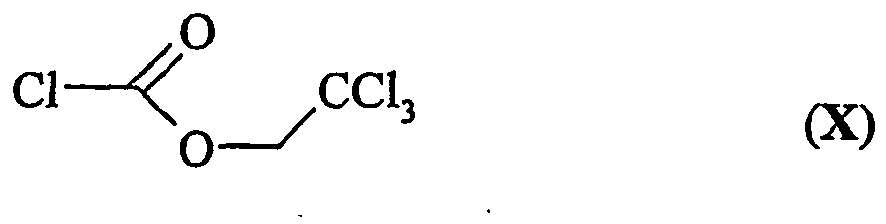
- Although there are a few examples in the art for the conversion of the N-benzyl group of the aliphatic amines into the corresponding carbamate by reacting said amines with chlorocarbonic acid esters, the chemical literature is silent about the transformation of the substituted piperazine derivatives into carbamates. The literature is also silent about the exchange of benzyl group for the alkoxycarbonyl group. It is very surprising that in this reaction, the cleveage of the 4-chlorobenzhydryl-group occurs in much less degree and the product of the side reaction is precipitated from the reaction mixture and it can be easily removed. Using optically active 1-(4-chlorophenyl)-methylphenyl-amine of the Formula (VI) as starting material, no racemization occur either during the preparation of 1-[(4-chlorophenyl)-phenylmethyl]-4-benzyl-piperazine of the Formula (III) or during the preparation of 1-[(4-chlorophenyl)-phenylmethyl]-4-(2,2,2-trichloroethoxy-carbonyl)-piperazine of the Formula (IV).
- The product 1-[(4-chlorophenyl)-phenylmethyl]-4-(2,2,2-trichloroethoxycarbonyl)-piperazine of the Formula (IV) thus obtained can be transformed into 1-[(4-chlorophenyl)-phenylmethyl])-piperazine of the Formula (I) without the danger of racemization by removing the protecting 2,2,2-trichloroethoxycarbonyl group, which is carried out by treating the compound of the Formula (IV) with zinc and acetic acid in water-free enviroment in toluene solvent. After deprotection, 1-[(4-chlorophenyl)-phenylmethyl])-piperazine of the Formula (I) is isolated in the form of its fumarate salt of the Formula (XI).

- 1-[(4-chlorophenyl)-phenylmethyl]-piperazine of the Formula (XI) fumarate is new.
- According to the first aspect of the present invention, there is provided a process for the preparation of the racemic and the optically active forms of 1-(4-chlorophenyl)-phenylmethyl-piperazine of the Formula (I), which comprises reacting the racemic or the corresponding optically active form of 1-(4-chlorophenyl)-methylphenyl-amine of the Formula (VI) with N,N-(bis-2-chloroethyl)-benzylamine of the Formula (VIII) and converting the product racemic or optically active 1-(4-chlorophenyl)-phenylmethyl-4-benzyl-piperazine of the Formula (III) into 1-(4-chlorophenyl)-phenylmethyl-4-(2,2,2-trichloroethoxycarbonyl)-piperazine of the Formula (IV) by treating the compound of the Formula (III) with 2,2,2-trichloroethoxychloroformate, removing the protecting group and isolating the product 1-(4-chlorophenyl)-phenylmethyl-piperazine of the Formula (I) in the form of its fumarate salt. 1-(4-chlorophenyl)-phenylmethyl-piperazine fumarate (1:1) of the Formula (XI) is new.
- In the present description, under the expression "acid addition salts" are meant the salts of the compound in question formed with organic or inorganic acids. Acids suitable for salt formation include inorganic acids, such as hydrochloric acid, hydrogen bromide, phosphoric acid, nitric acid and sulphuric acid; and organic acids, e.g. formic acid, acetic acid, propionic acid, maleic acid, fumaric acid, succinic acid, lactic acid, malic acid, tartaric acid, citric acid, ascorbic acid, malonic acid, oxalic acid, mandelic acid, picric acid, glycolic acid, phtalic acid, benzenesulphonic acid, p-toluenesulphonic acid, naphtalenesulphonic acid or methanesulphonic acid. Carbonates, hydrogen-carbonates, sulphides, hydrogen-sulphites and sulphites are also considered an acid addition salt formed with an inorganic acid.
- There are described the optically active forms of 1-[(4-chlorophenyl)-phenylmethyl]-4-benzyl-piperazine of the Formula (III) and the acid addition salts thereof.
- There is described a process for the preparation of the optically active forms of 1-[(4-chlorophenyl)-phenylmethyl]-4-benzyl-piperazine of the Formula (III) and the acid addition salts thereof. Enantiomers of the compound of the Formula (III) are prepared by reacting an optically active form of (4-chlorophenyl)-phenylmethyl-amine of the Formula (VI) with N,N-bis-(2-chloroethyl)-benzylamine of the Formula (VIII).
- The (4-chlorophenyl)-phenylmethylamine of the Formula (VI) can be used as free base or as hydrochloride. The N,N-bis-(2-chloroethyl)-benzylamine of the Formula (VIII) is used in 1.0 to 1.5-fold, preferably 1.1-fold molar amount calculated on the basis of the amount of the compound of the Formula (VI).
- The acid-binding agents suitable for use in the reaction include inorganic bases, e.g. alkali metal or alkali earth metal carbonates or hydrocarbonates or organic bases, e.g. pyridine or tributylamine. The acid-binding agent is used in the reaction in 3.0 to 5.0-fold molar amount calculated on the basis of the amount of N,N-bis-(2-chloroethyl)-benzylamine of the Formula (VIII). In the case when (4-chlorophenyl)-phenylmethylamine of the Formula (VI) is used in the form of a salt, the amount of the acid-binding agent is increased with the amount necessary for the neutralization.
- The reaction is preferably carried out in a high-boiling indifferent solvent, e.g. in methyl or ethyl cellosolve, ethylene glycol, 1-butanol, isobutanol, cyclohexanol; or in a bipolar aprotic solvent, e.g. N,N-dimethyl-formamide, dimethyl-sulphoxide. The reaction can also be carried out in a high-boiling ether type solvent, e.g. diisobutylether, dioxane or in an aromatic solvent, e.g. toluene.
- The reaction rate can be increased by using catalysts. The suitable type of catalysts include alkali metal halogenides and phase-transfer catalysts. As an alkali metal halogenide, sodium or potassium iodide or bromide, as a phase transfer catalyst, quaternary butylammonium halogenides can be used.
- The reaction is carried out at a temperature between 80 and 140 °C, preferably at a temperature between 100 to 110 °C. The reaction time, depending on the reaction temperature is approximately 1 to 8 hours, preferably 2 to 4 hours.
- According to a further aspect of the present invention, there is provided 1-[(4-chlorophenyl)-phenylinethyl]]-4-[(2,2,2-trichloroethyl)-oxy-carbonyl]-piperazine of the Formula (IV), its racemic and optically active forms and acid addition salts thereof.
- A further aspect of the present invention is related to a process for the preparation of 1-[(4-chlorophenyl)-phenylmethyl]]-4-[(2,2,2-trichloroethyl)-oxycarbonyl]-piperazine of the Formula (IV), which comprises reacting 1-[(4-chlorophenyl)-phenylmethyl]-4-benzyl-piperazine of the Formula (III) with 2,2,2-trichloroethylchlororoformate of the Formula (V).
- The reaction can be carried out by starting from racemic or optically active form essentially containing the single enantiomer of 1-[(4-chlorophenyl)-phenylmethyl]-4-benzyl-piperazine of the Formula (III), wherein either the racemic or the optically active product is obtained.
- In the reaction, the free base of 1-[(4-chlorophenyl)-phenylmethyl]-4-benzyl-piperazine of the Formula (III) is reacted preferably with 1.0 to 1.2 molar equivalent amount of 2,2,2-trichloroethylchloroformate of the Formula (V). Preferably, 1.05 - mole of the compound of the Formula (V) is used for each mole of the compound of the Formula (III).
- It is not necessary to use an acid binding agent during the reaction, since the product of the Formula (IV) forms salt with the hydrochloric acid formed in the reaction; however, if desired, an acid binding agent can be used. Compounds useful as acid-binding agents can be selected from inorganic bases, e.g. sodium carbonate, potassium carbonate or from organic bases, e.g. pyridine, tributylamine of triethylamine.
- The reaction is carried out in an indifferent solvent, preferably of an aromatic type, e.g. toluene, benzene. Dipolar aprotic or ether-type solvents can also be used, e.g. N,N-dimethyl-formamide, dimethyl-sulphoxide, diisobutylether, diethylether, tetrahydrofurane or dioxane.
- In the reaction of 1-[(4-chlorophenyl)-phenylmethyl]-4-benzyl-piperazine of the Formula (III) and 2,2,2-trichloroethylchloroformate of the Formula (X), the side product 1-benzyl-4-(2,2,2-trichloroethoxycarbonyl)-piperazine of the Formula (XII).

- The reaction is performed at a temperature between -20 and 40 °C, preferably at a temperature between 15 and 20 °C. The reaction time depending on the solvent and reaction temperature is usually 1 to 4 hours.
- According to a further aspect of the present invention, there is provided a method for the preparation of 1-[(4-chlorophenyl)-phenylmethyl]-piperazine of the Formula (I) and fumarate salt thereof, which comprises removing the trichloroethoxycarbonyl protecting group from 1-[(4-chlorophenyl)-phenylmethyl]]-4-[(2,2,2-trichloroethyl)-oxycarbonyl]-piperazine of the Formula (IV) by reduction which comprises treating said compound with zinc and an acid.
- The zinc is used in the reaction in 1 to 5 molar equivalent, preferably 1.5 to 2.5 molar equivalent amount calculated on the basis of the molar amount of the compound of the Formula (IV).
- 1-[(4-chlorophenyl)-phenylmethyl]]-4-[(2,2,2-trichloroethyl)-oxycarbonyl]-piperazine of the Formula (IV) can be used as free base or in the form of its hydrochloride salt. The use of the hydrochloride salt of the compound of the Formula (IV) is generally preferred.
- The reaction is carried out in a solvent selected from water, aqueous hydrochloric acid or aqueous acetic acid solution or from organic solvents, i.e. ethers or aromatic solvents or the mixtures of the above.
- The reaction temperature is between 0 and 50 °C, preferably a temperature of 20 to 25 °C. The reaction time is several hours.
- During any of the above-mentioned processes, either racemic or the optically active forms of the starting substance can be used. Consequently either the corresponding racemic or the optically active intermediates are obtained as product.
- According to a preferable embodiment of the process, the optically active 1-[(4-chlorophenyl)-phenylmethyl]-4-benzyl-piperazine of the Formula (III) is transformed in the optically active 1-[(4-chlorophenyl)-phenylmethyl]-piperazine of the Formula (I) or the fumarate salt thereof without the isolation of 1-[(4-chlorophenyl)-phenylmethyl]-4-(2,2,2-trichloroethyl) - piperazine of the Formula (IV) intermediate in a so-called "one-post" process.
- Further details of the invention are disclosed in the following examples without limiting the scope of the invention to said examples.
- To 200 ml of n-butanol are added 21.8 g (0,10 mol) of (R )-(-)-(4-chlorophenyl)-phenylmethylamine, 33.6 g (0,40 mol) of sodium hydrogencarbonate, 25.6 g (0,11 mol) ofN,N-bis-(2-chloroethyl)-benzylamine hydrochloride and 1.0 g of sodium iodide with stirring. The mixture is stirred at the temperature of 110 °C for two hours, then cooled and stirred at the temperature of 0 °C for further two hours and the sodium chloride formed in the reaction was filtered.
- The filtrate is evaporated in vacuo and the residue is dissolved in threefold volume of isopropanol. This solution is added dropwise to the mixture of 250 ml of isopropanol and 30 ml of concentrated aqueous hydrochloric acid solution. The crystalline product is filtered at 0 °C, washed and dried.
- Yield,: 38.5 g (85.5 %) off-white crystals.
Melting temperature, 245-246 °C.Elemental analysis {calculated on the basis of the Formula C24H25ClN2.2HCl (449.9)}: Calculated: C: 64.07 H: 6.05 Cl: 23.65 N: 6.23 Measured: C: 63.85 H: 6.12 Cl: 23.44 N: 6.28 - Optical purity by chiral high performance liquid chromatograph, 99.5%.
- The procedure of Example 1 is followed with the difference that after filtering the inorganic salts off, the filtrate is concentrated in vacuo, the residue is dissolved in 250 ml of ethylacetate, the ethylacetate solution is washed with water, dried and the solvent is evaporated.
- The yellow oily evaporation residue is dissolved in 150 ml of methanol at the product is crystallized at the temperature of -20 °C for 24 hours, the product base is filtered off, washed with methanol and dried.
- Yield, 38.5 g (65.0 %) off-while crystals.
- Melting temperature, 76-78 °C.
Elemental analysis {calculated on the basis of the Formula C24H25ClN2 (376,9)}: Calculated: C: 76.48 H: 6.69 Cl: 9.41 N: 7.43 Measured: C: 76.12 H: 6.82 Cl: 9.30 N: 7.51 - Optical purity (chiral high performance liquid chromatography): 99.9 %
- The procedure described in Example 1 is followed with the difference that instead of R (-)-(4-chlorophenyl)-phenylmethylamine, 21.8 g (0.1 mole) (S)-(+)-(4-chlorophenyl)-phenylmethylamine, instead of the solvent n-butanol, the same amount of methyl cellosolve (2-methoxyethanol) are used.
- Yield,: 33.1 g (73.7. %), off-white crystals
Melting point, 245-246 °C.Elemental Analysis {calculated on the basis of the Formula C24H25ClN2.2HCl (449.9)}: Calculated: C: 64.07 H: 6.05 Cl: 23.65 N: 6.23 Measured: C: 64.04 H: 6.16 Cl: 23.74 N: 6.12 - Optical purity (chiral high performance liquid chromatography): 99.4%
- The procedure of Example 1 is carried out with the differences that instead of sodium hydrogencarbonate, 27.4 g (0.20 mol) of potassium carbonate and instead of n-butanol solvent, methyl cellosolve are used.
- Yield, 38.5 g (85.5 %) off-white crystals
Melting point, 245-246 °C.Elemental Analysis {calculated on the basis of the Formula C24H25ClN2.2HCl (449.9)}: Calculated: C: 64.07 H: 6.05 Cl: 23.65 N: 6.23 Measured: C: 63.72 H: 6,22 Cl: 23.51 N: 6.32 - Optical purity (chiral high performance liquid chromatography): 99.4%
- The procedure of Example 1 is carried out with the difference that instead of sodium hydrogencarbonate, 40.4 g (0.40 mol) of triethylamine, instead of n-butanol, equal volume of dioxane solvent are used.
- Yield,: 35.4 g (75.6 %) off-while crystals
Melting point, 245-246 °C.Elemental Analysis {calculated on the basis of the Formula C24H25ClN2.2HCl (449.9)}: Calculated: C: 64.07 H: 6.05 Cl: 23.65 N: 6.23 Measured: C: 63.94 H: 6.19 Cl: 23.85 N: 6.34 - Optical purity (chiral high performance liquid chromatography): 98.9%
- 37.7 g (0.1 mol) of (R)-(-)-1-[(4-chlorophenyl)-phenylmethyl]-4-benzyl-piperazine free base are dissolved in 300 ml of toluene and to this solution, the solution of 23.3 g (0.11 mol) 2,2,2-trichloroethylchloroformate prepared in 50 ml of toluene is added dropwise. The turbid suspension is stirred at room temperature for two hours, the pH of the reaction mixture is adjusted to pH 1.0-1.5 with 10 % by weight hydrochloric acid solution prepared in ethylacetate, the crystalline (1-benzyl-piperazine-4-(2,2,2-trichloroethyl)-carbamate by-product is filtered off, the filtrate is washed with aqueous sodium hydrocarbonate solution, the toluene layer is dried over sodium carbonate and after filtration, the filtrate is evaporated.
- The yellow oily evaporation residue weighing approximately 53.5 g are dissolved in 160 ml of isopropylalcohol and at the temperature of 40-55 °C, 37 ml of 15 g/100 ml isopropanolic hydrochloric acid solution (hydrochloric acid content 5.5 g, 0.15 mol) are added dropwise in 30 minutes under stirring. After the addition of the hydrochloric acid, the suspension is cooled to the temperature of -5 °C in one hour, the crystals are filtered after two hours stirring, filtered, washed with isopropanol and dried.
- Yield, 37.1 g (74.5 %) white crystals
Melting temperature, 244-246 °C.Elemental Analysis {calculated on the basis of the Formula C20H20Cl4N2O2.HCl (498.7)} Calculated: C: 48.17 H: 4.24 Cl: 35.55 N: 5.62 Measured: C: 48.05 H: 4.32 Cl: 35.85 N: 5.71 - Optical purity (chiral high-performance liquid chromatography): 99.2 %
- 5.0 g (10 mmol) of the hydrochloride prepared according to the procedure of Example 6 are added to the mixture of 50 ml of water and 50 ml of ethylacetate and the pH of the mixture is adjusted to pH 14 by addition of 10 % by weight sodium hydroxide solution under stirring. The two layers are separated, the ethylacetate layer is dried over potassium carbonate, filtered and the solvent is evaporated. The evaporation residue is dissolved in 20 ml of isopropanol and the product is crystallized.
- Yield: 3.89 g (84.2 %) white crystals
Melting temperature,: 96-97 °C.Elemental Analysis {calculated on the basis of the Formula C20H20Cl4N2O2 (462.2)}: Calculated: C: 51.97 H: 4.36 Cl: 30.68 N: 6.06 Measured: C: 51.84 H: 4.52 Cl: 30.85 N: 5.97 - Optical purity (chiral high performance liquid chromatography): 99.8 %
- The procedure of the Example 6 is carried out with the difference that (S)-(-)-1-(4-chlorophenyl)-phenylmethyl-4-benzyl-piperazine dihydrochloride (compound of the Example 3) is used as starting material.
- Yield: 33.1 g (66.4 %) white crystals
Melting temperature, 242-246 °C.Elemental Analysis {calculated on the basis of the Formula C20H20Cl4N2O2-HCl (498.7)} Calculated: C: 48.17 H: 4.24 Cl: 35.55 N: 5.62 Measured: C: 48.22 H: 4.38 Cl: 35.14 N: 5.79 - Optical purity (chiral high performance liquid chromatography): 98.5%
- The procedure according to Example 6 is carried out with the difference that the reaction is performed in N,N-dimethyl formamide solvent instead of toluene at the temperature of 15 °C and at the beginning of the reaction, 15.1 g (0.15 mol) triethylamine are added to the reaction mixture. After the reaction, the reaction mixture is poured into 300 ml of ice-water mixture, the product is extracted with ethylacetate, the organic layer is dried over sodium sulphate and the solvent is evaporated.
- The thus obtained oily residue is dissolved in the 1:1 (v/v) hexane-diethylether solvent mixture, the product is crystallized, filtered, dried.
- Yield, 28.9 g (62.6 %) white crystals
Melting temperature, 96-97 °C.Elemental Analysis {calculated on the basis of the Formula C20H20Cl4N2O2 (462.2)}: Calculated: C: 51.97 H: 4.36 Cl: 30.68 N: 6.06 Measured: C: 51.89 H: 4.42 Cl: 30.85 N: 5.96 - Optical purity (chiral high performance liquid chromatography): 99.0 %
- A vessel is charged with 250 ml of tetrahydrofurane, 25 ml of methanol and 5.0 ml (60 mmol) concentrated hydrochloric acid (37% by weight). The mixture is cooled to the temperature of 15 °C and under intense stirring, 5.5 g ( 84 mmol) pulverized zinc are added. Subsequently at a temperature between 5 to10 °C, 1-2.5 g (25.1 mmol) (R)-(+)-4-(4-chlorophenyl)-phenylmethyl-piperazine-1-carboxylic acid 2,2,2-trichloroethylester hydrochloride (compound of the Example 6) are added in several portions. The suspension is stirred for one hour at room temperature. At the end of the reaction, the unreacted zinc is filtered off, the filtrate is mixed with 150 ml of water and 150 ml of ethylacetate, the organic layer is separated, washed with aqueous 5 % by weight sodium hydrogen carbonate solution, dried and the solvent is evaporated.
- The residue is dissolved in 100 ml of ethylacetate and is added dropwise with stirring to 80 ml of 10 g/100 ml hydrochloric acid solution prepared in ethylacetate. The suspension containing the crystalline salt, which starts precipitating almost instantly after the addition, is cooled, the product is filtered off, washed with diethylether and dried.
- Yield: 7.7 g (85.4 %) white crystals
Melting temperature, 198-202 °C.Elemental Analysis {calculated on the basis of the Formula C17H19ClN2.2HCl (359.7)}: Calculated: C: 56.76 H: 5.88 Cl: 29.57 N: 7.79 Measured: C: 56.45 H: 5.74 Cl: 29.25 N: 7.61 - Optical purity (chiral high performance liquid chromatography): 98.7 %
- 13.0 g (0.2 mol) pulverized zinc are added to the mixture of 300 ml of toluene, 30 ml (0,52 mol) of glacial acetic acid (96% by weight) and 30 ml of methanol with stirring. Subsequently, in three equal portions during 15 minutes, 50.0 g (0.10 mol) (R)-(+)-4-(4-chlorophenyl)-phenylmethyl-piperazine-1-(2,2,2-trichloroethyl-carbamate) hydrochloride (compound of the Example 6) are added. The temperature of the greyish suspension is raising to approximately 41 to 45 °C in 10 minutes and intense evolution of carbon dioxide occurs.
- After one hour, the suspension is filtered, the filtrate is mixed with 40 ml of water and 38.5 ml of 25 % by weight ammonium hydroxide solution. The layers are separated, the toluene layer is dried over potassium carbonate and the solvent is evaporated.
- The thus obtained yellow, oily evaporation residue (approx. 42 g) having the content of 75.5 % calculated as free base, is dissolved in 500 ml of acetone and 12.8 g (0.11 mol) fumaric acid are added. The product, which initially separates in an oily form, is stirred for three hours at the temperature of 25 °C. The crystalline product is filtered and dried until constant weight.
- Yield, 31.3 g (77.8%) off-white crystals
Melting temperature, 146-148 °C.Elemental Analysis {calculated on the basis of the Formula C21H23ClN2O4 (402.9)}: Calculated: C: 62.61 H: 5.75 Cl: 8.80 N: 6.95 Measured: C: 62.27 H: 5.72 Cl: 8.79 N: 6.84 - Optical purity (chiral high performance liquid chromatography): 99.8 %
- The procedure of the Example 11 is carried out with the difference that instead of using (R )-(+)-4-(4-chlorophenyl)-phenylmethyl-piperazine-1-(2,2,2-trichloroethyl)-carbamate hydrochloride salt, (S)-(-)-4-(4-chlorophenyl)-phenylmethyl-piperazine-1-(2,2,2-trichloroethyl)-carbamate hydrochloride salt (compound of Example 8) is used.
- Yield: 24.2 g (60.0 %) off-white crystals
Melting temperature, 145-148 °C. - Optical purity (chiral high performance liquid chromatography): 99.2 %
- Melting temperature of the (S)-(+)-1-(4-chlorophenyl)-phenylmethyl piperazine base, 94-96 °C (hexane).
- 45.0 g (0,10 mol) of (R)-(+)-1-[(4-chlorophenyl)-phenylmethyl]-4-benzyl-piperazine dihydrochloride are suspended in 300 ml of toluene, and during intense stirring, 50 g of ice, 50 ml of water and 25 ml of aqueous ammonium hydroxide solution are added. The layers are separated, the upper toluene layer is dried over potassium carbonate while stirring and filtered. To the filtrate, solution of 23.3 g (0.11 mol) 2,2,2-lxichloroethylchloroformate prepared in 50 ml toluene are added dropwise. The turbid suspension is stirred for two hours at room temperature, the crystalline by-product is filtered off.
- The filtrate is mixed with 30 ml of concentrated acetic acid (96% by weight), 30 ml of methanol and during intense stirring, 13.0 g (0.2 mol) of pulverized zinc are added. During the reaction, intense carbon dioxide evolution takes place. After one hour, the suspension is filtered, the filtrate is mixed with 40 ml of water and 38.5 ml 25 % by weight ammonium hydroxide solution. The two layers are separated, the upper toluene layer is dried over potassium carbonate and the solvent is evaporated.
- The residual yellow oil (approximately 35.2 g) is dissolved in 350 ml of acetone and while stirring, 11.6 g (0.1 mol) fumaric acid are added. The mixture is boiled until dissolution. The product is precipitated upon cooling. The suspension of the product is stirred for three hours at room temperature, the crystals are filtered, washed with diethylether and dried.
- Yield, 27.9 g (65.8 %) off-white crystals
Melting temperature, 146-148 °C. - Optical purity (chiral high performance liquid chromatography): 99.6 %
Claims (14)
- Process for the preparation of 1-[(4-chlorophenyl)-methylphenyl]-piperazine of the Formula (I)


- Process for the preparation of 1-[(4-chlorophenyl)-phenylmethyl]-4-(2,2,2-trichloroethoxycarbonyl)-piperazine of the Formula (IV), enantiomers and acid addition salts thereof, which comprises reacting racemic or an optically active form of 1-[(4-chlorophenyl)-phenylmethyl]-4-benzyl-piperazine of the Formula (III) with 2,2,2-trichloroethylchloroformate of the Formula (X) and converting the thus obtained 1-[(4-chlorophenyl)-phenylmethyl]-4-(2,2,2-trichloroethoxycarbonyl)-piperazine of the Formula (IV) into its acid addition salt.
- 1-[(4-chlorophenyl)-phenylmethyl]-4-(2,2,2-trichloroethoxy-carbonyl)-piperazine of the Formula (IV), enantiomers and acid addition salts thereof.
- Process according to any of claims 1 to 2, characterized in that 1-[(4-chlorophenyl)-phenylmethyl]-4-benzyl-piperazine of the Formula (III) is reacted with 1.0 to 1.2 molar equivalent, preferably 1.05 molar equivalent amount of 2,2,2-trichloroethylformate of the Formula (X).
- Process according to any of claims 1 to 2 or claim 4, characterized in that the reaction of 1-[(4-chlorophenyl)-phenylmethyl]-4-benzyl-piperazine of the Formula (III) and 2,2,2-trichloroethylchloroformate of the Formula (X) is carried out in the presence of an inorganic or organic base constituting the acid binding reagent.
- Process according to claim 5, characterized in that as inorganic base, an alkali metal or alkali earth metal hydrocarbonate or -carbonate, or as organic base, triethylamine, tributylamine or pyridine is used.
- Process according to any of claims 1 to 2 and 4 to 6, characterized in that the reaction of 1-[(4-chlorophenyl)-phenylmethyl]-4-benzyl-piperazine of the Formula (III) and 2,2,2-trichloroethylchloroformate of the Formula (X) are carried out in a solvent selected from aromatic, polar aprotic or ether-type organic solvent.
- Any of the processes according to any of claims 1 to 2 or according to any of claims 4 to 7, characterized in that the reaction is carried out at the temperature between -20 and 40 °C, preferably between 15 and 20 °C.
- Process according to claim 1 or claim 2, characterized in that the conversion of 1-[(4-chlorophenyl)-phenylmethyl]-4-(2,2,2-trichloroethoxycarbonyl)-piperazine of the Formula (IV) into 1-[(4-chlorophenyl)-methylphenyl]-piperazine of the Formula (I) is carried out by reduction.
- Process according to claim 9 characterized in that the reduction is carried out by zinc in an acidic solution.
- Process according to claim 10 characterized in that 1 to 4, preferably 1.5 to 2.5 molar equivalents amount of zinc are used calculated on the basis of the molar amount of 1-[(4-chlorophenyl)-phenylmethyl]-4-(2,2,2-trichloroethoxy-carbonyl)-piperazine of the Formula (IV).
- Process according to any of claim 1, claim 2 and claims 9 to 11 characterized in that in the transformation of 1-[(4-chlorophenyl)-phenylmethyl]-4-(2,2,2-trichloroethoxycarbonyl)-piperazine of the Formula (IV) into 1-[(4-chlorophenyl)-methylphenyl]-piperazine of the Formula (I), a solvent selected from water, aqeuous acid solution, for example, aqueous acetic acid or hydrochloric acid solution, an aromatic solvent, for example toluene or mixtures thereof are used.
- Processes according to claim 1 or claim 2 or any of claims 9 to 11, characterized in that after the conversion of 1-[(4-chlorophenyl)-phenylmethyl]-4-(2,2,2-trichloroethoxycarbonyl)-piperazine of the Formula (IV) into 1-[(4-chlorophenyl)-methylphenyl]-piperazine of the Formula (I), the product of the Formula (I) is obtained in the form of fumarate salt thereof.
- The processes according to claim 1 or claim 2, characterized in that (R)-(+)-1-[(4-chlorophenyl)-phenylmethyl]-4-benzyl-piperazine of the Formula (III) is used as starting material.
Applications Claiming Priority (2)
| Application Number | Priority Date | Filing Date | Title |
|---|---|---|---|
| HU0501139A HU227074B1 (en) | 2005-12-08 | 2005-12-08 | An optically active carbamic acid derivative, method for producing the same and use as a pharmaceutical intermediate |
| PCT/HU2006/000109 WO2007066163A2 (en) | 2005-12-08 | 2006-12-08 | Optically active carbamates, process for preparation thereof and use thereof as pharmaceutical intermediates |
Publications (2)
| Publication Number | Publication Date |
|---|---|
| EP1963296A2 EP1963296A2 (en) | 2008-09-03 |
| EP1963296B1 true EP1963296B1 (en) | 2012-02-15 |
Family
ID=89986439
Family Applications (1)
| Application Number | Title | Priority Date | Filing Date |
|---|---|---|---|
| EP06831510A Active EP1963296B1 (en) | 2005-12-08 | 2006-12-08 | Optically active carbamates, process for preparation thereof and use thereof as pharmaceutical intermediates |
Country Status (10)
| Country | Link |
|---|---|
| US (1) | US7851627B2 (en) |
| EP (1) | EP1963296B1 (en) |
| JP (1) | JP2009518379A (en) |
| CN (1) | CN101356162A (en) |
| AT (1) | ATE545638T1 (en) |
| EA (1) | EA015801B1 (en) |
| HU (1) | HU227074B1 (en) |
| NO (1) | NO20083068L (en) |
| UA (1) | UA92195C2 (en) |
| WO (1) | WO2007066163A2 (en) |
Families Citing this family (10)
| Publication number | Priority date | Publication date | Assignee | Title |
|---|---|---|---|---|
| KR100928776B1 (en) * | 2007-09-07 | 2009-11-25 | 한미약품 주식회사 | (R) -1-[(4-chlorophenyl) phenylmethyl] piperazine or a salt thereof |
| KR101427100B1 (en) | 2007-10-23 | 2014-08-08 | 주식회사 씨트리 | Method for Preparing an Optically Active 1-[(4-chlorophenyl)phenylmethyl] -piperazine |
| US7989623B2 (en) * | 2007-11-21 | 2011-08-02 | Synthon Bv | Process for making n-(diphenylmethyl)piperazines |
| DE602007012725D1 (en) * | 2007-11-21 | 2011-04-07 | Synthon Bv | Process for the preparation of N- (diphenylmethyl) piperazines |
| AU2009254959B2 (en) * | 2008-06-02 | 2014-01-30 | Cipla Limited | Processes for the synthesis of levocetirizine and intermediates for use therein |
| WO2010057515A1 (en) * | 2008-11-21 | 2010-05-27 | Synthon B.V. | Levocetirizine by menthyl intermediate |
| US20100145049A1 (en) * | 2008-11-21 | 2010-06-10 | Jie Zhu | Process for making n-(diphenylmethyl)piperazines |
| WO2012101475A1 (en) | 2011-01-27 | 2012-08-02 | Jubilant Life Sciences Limited | An improved process for the preparation of antihistaminic drugs via a novel carbamate intermediate |
| US8580886B2 (en) | 2011-09-20 | 2013-11-12 | Dow Corning Corporation | Method for the preparation and use of bis (alkoxysilylorgano)-dicarboxylates |
| CN104024265B (en) | 2011-12-02 | 2017-03-01 | 道康宁公司 | Ester functional silane and its preparation and use;And group with imine moiety is as the purposes of phase transfer catalyst |
Family Cites Families (6)
| Publication number | Priority date | Publication date | Assignee | Title |
|---|---|---|---|---|
| US2709169A (en) * | 1955-05-24 | X c chs | ||
| BE508650A (en) * | ||||
| BE501277A (en) * | 1951-02-15 | 1952-05-09 | H Morren | PROCESS FOR PREPARING 1,4-ARALCOYL-PIPERAZINES. |
| IT1140978B (en) * | 1980-05-23 | 1986-10-10 | Selvi & C Spa | 1- (4-CHLOROBENZIDRIL) -4- (2,3-DIIDROS SIPROPIL) -PIPERAZINE, METHODS FOR ITS PREPARATION AND RELATED PHARMACEUTICAL COMPOSITION |
| GB9305282D0 (en) * | 1993-03-15 | 1993-05-05 | Ucb Sa | Enantiomers of 1-(4-chlorophenyl)phenylmethyl)-4-(4-methylphenyl)sulphonyl)piperazine |
| JP2002249487A (en) * | 2001-02-22 | 2002-09-06 | Sumitomo Chem Co Ltd | A 4- (tert-butoxycarbonyl) piperazine derivative, an optically active acid addition salt thereof, a method for producing them, and a method for producing optically active 1-[(substituted phenyl) phenylmethyl] piperazine using the same. |
-
2005
- 2005-12-08 HU HU0501139A patent/HU227074B1/en not_active IP Right Cessation
-
2006
- 2006-08-12 UA UAA200808116A patent/UA92195C2/en unknown
- 2006-12-08 JP JP2008543923A patent/JP2009518379A/en active Pending
- 2006-12-08 CN CNA2006800462042A patent/CN101356162A/en active Pending
- 2006-12-08 WO PCT/HU2006/000109 patent/WO2007066163A2/en not_active Ceased
- 2006-12-08 AT AT06831510T patent/ATE545638T1/en active
- 2006-12-08 US US12/096,636 patent/US7851627B2/en not_active Expired - Fee Related
- 2006-12-08 EA EA200801507A patent/EA015801B1/en not_active IP Right Cessation
- 2006-12-08 EP EP06831510A patent/EP1963296B1/en active Active
-
2008
- 2008-07-08 NO NO20083068A patent/NO20083068L/en not_active Application Discontinuation
Also Published As
| Publication number | Publication date |
|---|---|
| CN101356162A (en) | 2009-01-28 |
| HU0501139D0 (en) | 2006-02-28 |
| EA200801507A1 (en) | 2008-10-30 |
| WO2007066163A2 (en) | 2007-06-14 |
| US7851627B2 (en) | 2010-12-14 |
| NO20083068L (en) | 2008-07-08 |
| ATE545638T1 (en) | 2012-03-15 |
| US20090221823A1 (en) | 2009-09-03 |
| HUP0501139A2 (en) | 2007-08-28 |
| WO2007066163A3 (en) | 2007-08-02 |
| UA92195C2 (en) | 2010-10-11 |
| JP2009518379A (en) | 2009-05-07 |
| EA015801B1 (en) | 2011-12-30 |
| EP1963296A2 (en) | 2008-09-03 |
| HU227074B1 (en) | 2010-06-28 |
Similar Documents
| Publication | Publication Date | Title |
|---|---|---|
| US6436942B1 (en) | Enantiomers of 1[(4-chloro-phenyl) phenylmethyl]-4-[(4-methylphenyl) sulfony]piperazine | |
| AU701420B2 (en) | Novel piperazides derived from arylpiperazine, processes for their preparation, their use as medicaments and pharmaceutical compositions comprising them | |
| EP2358691B1 (en) | Process for the preparation of piperazine compounds and hydrochloride salts thereof | |
| CZ20022463A3 (en) | Process for preparing quetiapine and intermediates therefor | |
| US7851627B2 (en) | Optically active carbamates, process for preparation thereof and use thereof as pharmaceutical intermediates | |
| US7538111B2 (en) | Benzenesulphonamide derivatives, method for production and use thereof for treatment of pain | |
| JP3269574B2 (en) | Methananoanthracene compounds, pharmaceutical compositions containing the same for treating neuropsychiatric disorders, and methods and intermediates for producing the compounds | |
| EP2062881B1 (en) | Process for making N-(diphenylmethyl)piperazines | |
| SI22489A (en) | New procedure for preparation of levocetirizine and its intermediates | |
| WO2011073705A1 (en) | Novel process for the preparation of piperazine compounds and hydrochloride salts thereof | |
| US7989623B2 (en) | Process for making n-(diphenylmethyl)piperazines | |
| US4166852A (en) | Piperazino-pyrimidines and their use as spasmolytic agents | |
| EP2121643B1 (en) | New process for the preparation of levocetirizine and intermediates thereof | |
| KR20090025830A (en) | (R) -1-[(4-chlorophenyl) phenylmethyl] piperazine or a salt thereof | |
| EP0223124B1 (en) | Substituted aminosulfonyl 6-nitrobenzoic-esters or amides, processes for their preparation and pharmaceutical compositions containing them | |
| WO2012101475A1 (en) | An improved process for the preparation of antihistaminic drugs via a novel carbamate intermediate | |
| WO2010057515A1 (en) | Levocetirizine by menthyl intermediate |
Legal Events
| Date | Code | Title | Description |
|---|---|---|---|
| PUAI | Public reference made under article 153(3) epc to a published international application that has entered the european phase |
Free format text: ORIGINAL CODE: 0009012 |
|
| 17P | Request for examination filed |
Effective date: 20080708 |
|
| AK | Designated contracting states |
Kind code of ref document: A2 Designated state(s): AT BE BG CH CY CZ DE DK EE ES FI FR GB GR HU IE IS IT LI LT LU LV MC NL PL PT RO SE SI SK TR |
|
| AX | Request for extension of the european patent |
Extension state: AL BA HR MK RS |
|
| 17Q | First examination report despatched |
Effective date: 20091126 |
|
| GRAP | Despatch of communication of intention to grant a patent |
Free format text: ORIGINAL CODE: EPIDOSNIGR1 |
|
| GRAS | Grant fee paid |
Free format text: ORIGINAL CODE: EPIDOSNIGR3 |
|
| GRAA | (expected) grant |
Free format text: ORIGINAL CODE: 0009210 |
|
| AK | Designated contracting states |
Kind code of ref document: B1 Designated state(s): AT BE BG CH CY CZ DE DK EE ES FI FR GB GR HU IE IS IT LI LT LU LV MC NL PL PT RO SE SI SK TR |
|
| AX | Request for extension of the european patent |
Extension state: AL BA HR MK RS |
|
| REG | Reference to a national code |
Ref country code: CH Ref legal event code: EP Ref country code: GB Ref legal event code: FG4D |
|
| REG | Reference to a national code |
Ref country code: IE Ref legal event code: FG4D |
|
| REG | Reference to a national code |
Ref country code: AT Ref legal event code: REF Ref document number: 545638 Country of ref document: AT Kind code of ref document: T Effective date: 20120315 |
|
| REG | Reference to a national code |
Ref country code: DE Ref legal event code: R096 Ref document number: 602006027675 Country of ref document: DE Effective date: 20120412 |
|
| REG | Reference to a national code |
Ref country code: NL Ref legal event code: VDEP Effective date: 20120215 |
|
| LTIE | Lt: invalidation of european patent or patent extension |
Effective date: 20120215 |
|
| PG25 | Lapsed in a contracting state [announced via postgrant information from national office to epo] |
Ref country code: LT Free format text: LAPSE BECAUSE OF FAILURE TO SUBMIT A TRANSLATION OF THE DESCRIPTION OR TO PAY THE FEE WITHIN THE PRESCRIBED TIME-LIMIT Effective date: 20120215 Ref country code: NL Free format text: LAPSE BECAUSE OF FAILURE TO SUBMIT A TRANSLATION OF THE DESCRIPTION OR TO PAY THE FEE WITHIN THE PRESCRIBED TIME-LIMIT Effective date: 20120215 Ref country code: IS Free format text: LAPSE BECAUSE OF FAILURE TO SUBMIT A TRANSLATION OF THE DESCRIPTION OR TO PAY THE FEE WITHIN THE PRESCRIBED TIME-LIMIT Effective date: 20120615 |
|
| PG25 | Lapsed in a contracting state [announced via postgrant information from national office to epo] |
Ref country code: LV Free format text: LAPSE BECAUSE OF FAILURE TO SUBMIT A TRANSLATION OF THE DESCRIPTION OR TO PAY THE FEE WITHIN THE PRESCRIBED TIME-LIMIT Effective date: 20120215 Ref country code: PT Free format text: LAPSE BECAUSE OF FAILURE TO SUBMIT A TRANSLATION OF THE DESCRIPTION OR TO PAY THE FEE WITHIN THE PRESCRIBED TIME-LIMIT Effective date: 20120615 Ref country code: FI Free format text: LAPSE BECAUSE OF FAILURE TO SUBMIT A TRANSLATION OF THE DESCRIPTION OR TO PAY THE FEE WITHIN THE PRESCRIBED TIME-LIMIT Effective date: 20120215 Ref country code: PL Free format text: LAPSE BECAUSE OF FAILURE TO SUBMIT A TRANSLATION OF THE DESCRIPTION OR TO PAY THE FEE WITHIN THE PRESCRIBED TIME-LIMIT Effective date: 20120215 Ref country code: GR Free format text: LAPSE BECAUSE OF FAILURE TO SUBMIT A TRANSLATION OF THE DESCRIPTION OR TO PAY THE FEE WITHIN THE PRESCRIBED TIME-LIMIT Effective date: 20120516 Ref country code: BE Free format text: LAPSE BECAUSE OF FAILURE TO SUBMIT A TRANSLATION OF THE DESCRIPTION OR TO PAY THE FEE WITHIN THE PRESCRIBED TIME-LIMIT Effective date: 20120215 |
|
| REG | Reference to a national code |
Ref country code: AT Ref legal event code: MK05 Ref document number: 545638 Country of ref document: AT Kind code of ref document: T Effective date: 20120215 |
|
| PG25 | Lapsed in a contracting state [announced via postgrant information from national office to epo] |
Ref country code: CY Free format text: LAPSE BECAUSE OF FAILURE TO SUBMIT A TRANSLATION OF THE DESCRIPTION OR TO PAY THE FEE WITHIN THE PRESCRIBED TIME-LIMIT Effective date: 20120215 |
|
| PG25 | Lapsed in a contracting state [announced via postgrant information from national office to epo] |
Ref country code: RO Free format text: LAPSE BECAUSE OF FAILURE TO SUBMIT A TRANSLATION OF THE DESCRIPTION OR TO PAY THE FEE WITHIN THE PRESCRIBED TIME-LIMIT Effective date: 20120215 Ref country code: DK Free format text: LAPSE BECAUSE OF FAILURE TO SUBMIT A TRANSLATION OF THE DESCRIPTION OR TO PAY THE FEE WITHIN THE PRESCRIBED TIME-LIMIT Effective date: 20120215 Ref country code: CZ Free format text: LAPSE BECAUSE OF FAILURE TO SUBMIT A TRANSLATION OF THE DESCRIPTION OR TO PAY THE FEE WITHIN THE PRESCRIBED TIME-LIMIT Effective date: 20120215 Ref country code: SE Free format text: LAPSE BECAUSE OF FAILURE TO SUBMIT A TRANSLATION OF THE DESCRIPTION OR TO PAY THE FEE WITHIN THE PRESCRIBED TIME-LIMIT Effective date: 20120215 Ref country code: SI Free format text: LAPSE BECAUSE OF FAILURE TO SUBMIT A TRANSLATION OF THE DESCRIPTION OR TO PAY THE FEE WITHIN THE PRESCRIBED TIME-LIMIT Effective date: 20120215 Ref country code: EE Free format text: LAPSE BECAUSE OF FAILURE TO SUBMIT A TRANSLATION OF THE DESCRIPTION OR TO PAY THE FEE WITHIN THE PRESCRIBED TIME-LIMIT Effective date: 20120215 |
|
| PG25 | Lapsed in a contracting state [announced via postgrant information from national office to epo] |
Ref country code: SK Free format text: LAPSE BECAUSE OF FAILURE TO SUBMIT A TRANSLATION OF THE DESCRIPTION OR TO PAY THE FEE WITHIN THE PRESCRIBED TIME-LIMIT Effective date: 20120215 Ref country code: IT Free format text: LAPSE BECAUSE OF FAILURE TO SUBMIT A TRANSLATION OF THE DESCRIPTION OR TO PAY THE FEE WITHIN THE PRESCRIBED TIME-LIMIT Effective date: 20120215 |
|
| PLBE | No opposition filed within time limit |
Free format text: ORIGINAL CODE: 0009261 |
|
| STAA | Information on the status of an ep patent application or granted ep patent |
Free format text: STATUS: NO OPPOSITION FILED WITHIN TIME LIMIT |
|
| 26N | No opposition filed |
Effective date: 20121116 |
|
| PG25 | Lapsed in a contracting state [announced via postgrant information from national office to epo] |
Ref country code: AT Free format text: LAPSE BECAUSE OF FAILURE TO SUBMIT A TRANSLATION OF THE DESCRIPTION OR TO PAY THE FEE WITHIN THE PRESCRIBED TIME-LIMIT Effective date: 20120215 |
|
| REG | Reference to a national code |
Ref country code: DE Ref legal event code: R097 Ref document number: 602006027675 Country of ref document: DE Effective date: 20121116 |
|
| PG25 | Lapsed in a contracting state [announced via postgrant information from national office to epo] |
Ref country code: ES Free format text: LAPSE BECAUSE OF FAILURE TO SUBMIT A TRANSLATION OF THE DESCRIPTION OR TO PAY THE FEE WITHIN THE PRESCRIBED TIME-LIMIT Effective date: 20120526 |
|
| PG25 | Lapsed in a contracting state [announced via postgrant information from national office to epo] |
Ref country code: BG Free format text: LAPSE BECAUSE OF FAILURE TO SUBMIT A TRANSLATION OF THE DESCRIPTION OR TO PAY THE FEE WITHIN THE PRESCRIBED TIME-LIMIT Effective date: 20120515 Ref country code: MC Free format text: LAPSE BECAUSE OF NON-PAYMENT OF DUE FEES Effective date: 20121231 |
|
| REG | Reference to a national code |
Ref country code: CH Ref legal event code: PL |
|
| GBPC | Gb: european patent ceased through non-payment of renewal fee |
Effective date: 20121208 |
|
| REG | Reference to a national code |
Ref country code: IE Ref legal event code: MM4A |
|
| REG | Reference to a national code |
Ref country code: FR Ref legal event code: ST Effective date: 20130830 |
|
| REG | Reference to a national code |
Ref country code: DE Ref legal event code: R119 Ref document number: 602006027675 Country of ref document: DE Effective date: 20130702 |
|
| PG25 | Lapsed in a contracting state [announced via postgrant information from national office to epo] |
Ref country code: DE Free format text: LAPSE BECAUSE OF NON-PAYMENT OF DUE FEES Effective date: 20130702 Ref country code: LI Free format text: LAPSE BECAUSE OF NON-PAYMENT OF DUE FEES Effective date: 20121231 Ref country code: IE Free format text: LAPSE BECAUSE OF NON-PAYMENT OF DUE FEES Effective date: 20121208 Ref country code: CH Free format text: LAPSE BECAUSE OF NON-PAYMENT OF DUE FEES Effective date: 20121231 |
|
| PG25 | Lapsed in a contracting state [announced via postgrant information from national office to epo] |
Ref country code: GB Free format text: LAPSE BECAUSE OF NON-PAYMENT OF DUE FEES Effective date: 20121208 Ref country code: FR Free format text: LAPSE BECAUSE OF NON-PAYMENT OF DUE FEES Effective date: 20130102 |
|
| PG25 | Lapsed in a contracting state [announced via postgrant information from national office to epo] |
Ref country code: TR Free format text: LAPSE BECAUSE OF FAILURE TO SUBMIT A TRANSLATION OF THE DESCRIPTION OR TO PAY THE FEE WITHIN THE PRESCRIBED TIME-LIMIT Effective date: 20120215 |
|
| PG25 | Lapsed in a contracting state [announced via postgrant information from national office to epo] |
Ref country code: LU Free format text: LAPSE BECAUSE OF NON-PAYMENT OF DUE FEES Effective date: 20121208 |
|
| PG25 | Lapsed in a contracting state [announced via postgrant information from national office to epo] |
Ref country code: HU Free format text: LAPSE BECAUSE OF FAILURE TO SUBMIT A TRANSLATION OF THE DESCRIPTION OR TO PAY THE FEE WITHIN THE PRESCRIBED TIME-LIMIT Effective date: 20061208 |