EP1962866B1 - Poly(urea-urethane) compositions useful as topical medicaments and methods of using the same - Google Patents
Poly(urea-urethane) compositions useful as topical medicaments and methods of using the same Download PDFInfo
- Publication number
- EP1962866B1 EP1962866B1 EP06839991.4A EP06839991A EP1962866B1 EP 1962866 B1 EP1962866 B1 EP 1962866B1 EP 06839991 A EP06839991 A EP 06839991A EP 1962866 B1 EP1962866 B1 EP 1962866B1
- Authority
- EP
- European Patent Office
- Prior art keywords
- diisocyanate
- onychomycosis
- urushiol
- composition
- contact dermatitis
- Prior art date
- Legal status (The legal status is an assumption and is not a legal conclusion. Google has not performed a legal analysis and makes no representation as to the accuracy of the status listed.)
- Not-in-force
Links
- 239000000203 mixture Substances 0.000 title claims description 81
- -1 Poly(urea-urethane) Polymers 0.000 title claims description 27
- 230000000699 topical effect Effects 0.000 title claims description 23
- 238000000034 method Methods 0.000 title description 15
- 239000003814 drug Substances 0.000 title description 5
- CSCPPACGZOOCGX-UHFFFAOYSA-N Acetone Chemical compound CC(C)=O CSCPPACGZOOCGX-UHFFFAOYSA-N 0.000 claims description 77
- UPMLOUAZCHDJJD-UHFFFAOYSA-N 4,4'-Diphenylmethane Diisocyanate Chemical compound C1=CC(N=C=O)=CC=C1CC1=CC=C(N=C=O)C=C1 UPMLOUAZCHDJJD-UHFFFAOYSA-N 0.000 claims description 58
- 239000002904 solvent Substances 0.000 claims description 56
- 239000005056 polyisocyanate Substances 0.000 claims description 45
- 229920001228 polyisocyanate Polymers 0.000 claims description 45
- 208000010195 Onychomycosis Diseases 0.000 claims description 42
- DNIAPMSPPWPWGF-UHFFFAOYSA-N Propylene glycol Chemical compound CC(O)CO DNIAPMSPPWPWGF-UHFFFAOYSA-N 0.000 claims description 42
- LYCAIKOWRPUZTN-UHFFFAOYSA-N Ethylene glycol Chemical compound OCCO LYCAIKOWRPUZTN-UHFFFAOYSA-N 0.000 claims description 39
- 238000011282 treatment Methods 0.000 claims description 39
- 201000005882 tinea unguium Diseases 0.000 claims description 37
- RMTXUPIIESNLPW-UHFFFAOYSA-N 1,2-dihydroxy-3-(pentadeca-8,11-dienyl)benzene Natural products CCCC=CCC=CCCCCCCCC1=CC=CC(O)=C1O RMTXUPIIESNLPW-UHFFFAOYSA-N 0.000 claims description 34
- IYROWZYPEIMDDN-UHFFFAOYSA-N 3-n-pentadec-8,11,13-trienyl catechol Natural products CC=CC=CCC=CCCCCCCCC1=CC=CC(O)=C1O IYROWZYPEIMDDN-UHFFFAOYSA-N 0.000 claims description 34
- DQTMTQZSOJMZSF-UHFFFAOYSA-N urushiol Natural products CCCCCCCCCCCCCCCC1=CC=CC(O)=C1O DQTMTQZSOJMZSF-UHFFFAOYSA-N 0.000 claims description 34
- QARRXYBJLBIVAK-UEMSJJPVSA-N 3-[(8e,11e)-pentadeca-8,11-dienyl]benzene-1,2-diol;3-[(8e,11e)-pentadeca-8,11,14-trienyl]benzene-1,2-diol;3-[(8e,11e,13e)-pentadeca-8,11,13-trienyl]benzene-1,2-diol;3-[(e)-pentadec-8-enyl]benzene-1,2-diol;3-pentadecylbenzene-1,2-diol Chemical compound CCCCCCCCCCCCCCCC1=CC=CC(O)=C1O.CCCCCC\C=C\CCCCCCCC1=CC=CC(O)=C1O.CCC\C=C\C\C=C\CCCCCCCC1=CC=CC(O)=C1O.C\C=C\C=C\C\C=C\CCCCCCCC1=CC=CC(O)=C1O.OC1=CC=CC(CCCCCCC\C=C\C\C=C\CC=C)=C1O QARRXYBJLBIVAK-UEMSJJPVSA-N 0.000 claims description 33
- 206010012442 Dermatitis contact Diseases 0.000 claims description 28
- 229920005862 polyol Polymers 0.000 claims description 23
- 150000003077 polyols Chemical class 0.000 claims description 20
- 230000000087 stabilizing effect Effects 0.000 claims description 20
- 125000005442 diisocyanate group Chemical group 0.000 claims description 15
- ZWEHNKRNPOVVGH-UHFFFAOYSA-N 2-Butanone Chemical compound CCC(C)=O ZWEHNKRNPOVVGH-UHFFFAOYSA-N 0.000 claims description 13
- 208000010247 contact dermatitis Diseases 0.000 claims description 13
- 239000003153 chemical reaction reagent Substances 0.000 claims description 8
- RTWNYYOXLSILQN-UHFFFAOYSA-N methanediamine Chemical compound NCN RTWNYYOXLSILQN-UHFFFAOYSA-N 0.000 claims description 8
- RRAMGCGOFNQTLD-UHFFFAOYSA-N hexamethylene diisocyanate Chemical compound O=C=NCCCCCCN=C=O RRAMGCGOFNQTLD-UHFFFAOYSA-N 0.000 claims description 7
- 229920005989 resin Polymers 0.000 claims description 7
- 239000011347 resin Substances 0.000 claims description 7
- XEKOWRVHYACXOJ-UHFFFAOYSA-N Ethyl acetate Chemical compound CCOC(C)=O XEKOWRVHYACXOJ-UHFFFAOYSA-N 0.000 claims description 6
- 239000005057 Hexamethylene diisocyanate Substances 0.000 claims description 6
- 125000004432 carbon atom Chemical group C* 0.000 claims description 6
- OVBFMUAFNIIQAL-UHFFFAOYSA-N 1,4-diisocyanatobutane Chemical compound O=C=NCCCCN=C=O OVBFMUAFNIIQAL-UHFFFAOYSA-N 0.000 claims description 5
- ALQLPWJFHRMHIU-UHFFFAOYSA-N 1,4-diisocyanatobenzene Chemical compound O=C=NC1=CC=C(N=C=O)C=C1 ALQLPWJFHRMHIU-UHFFFAOYSA-N 0.000 claims description 4
- SBJCUZQNHOLYMD-UHFFFAOYSA-N 1,5-Naphthalene diisocyanate Chemical compound C1=CC=C2C(N=C=O)=CC=CC2=C1N=C=O SBJCUZQNHOLYMD-UHFFFAOYSA-N 0.000 claims description 4
- AMIMRNSIRUDHCM-UHFFFAOYSA-N Isopropylaldehyde Chemical compound CC(C)C=O AMIMRNSIRUDHCM-UHFFFAOYSA-N 0.000 claims description 4
- NBBJYMSMWIIQGU-UHFFFAOYSA-N Propionic aldehyde Chemical compound CCC=O NBBJYMSMWIIQGU-UHFFFAOYSA-N 0.000 claims description 4
- ZTQSAGDEMFDKMZ-UHFFFAOYSA-N butyric aldehyde Natural products CCCC=O ZTQSAGDEMFDKMZ-UHFFFAOYSA-N 0.000 claims description 4
- 239000003086 colorant Substances 0.000 claims description 4
- DVKJHBMWWAPEIU-UHFFFAOYSA-N toluene 2,4-diisocyanate Chemical compound CC1=CC=C(N=C=O)C=C1N=C=O DVKJHBMWWAPEIU-UHFFFAOYSA-N 0.000 claims description 4
- RUELTTOHQODFPA-UHFFFAOYSA-N toluene 2,6-diisocyanate Chemical compound CC1=C(N=C=O)C=CC=C1N=C=O RUELTTOHQODFPA-UHFFFAOYSA-N 0.000 claims description 4
- FKTHNVSLHLHISI-UHFFFAOYSA-N 1,2-bis(isocyanatomethyl)benzene Chemical compound O=C=NCC1=CC=CC=C1CN=C=O FKTHNVSLHLHISI-UHFFFAOYSA-N 0.000 claims description 3
- ZTNJGMFHJYGMDR-UHFFFAOYSA-N 1,2-diisocyanatoethane Chemical compound O=C=NCCN=C=O ZTNJGMFHJYGMDR-UHFFFAOYSA-N 0.000 claims description 3
- 230000015572 biosynthetic process Effects 0.000 claims description 3
- WERYXYBDKMZEQL-UHFFFAOYSA-N butane-1,4-diol Chemical compound OCCCCO WERYXYBDKMZEQL-UHFFFAOYSA-N 0.000 claims description 3
- 239000000049 pigment Substances 0.000 claims description 3
- 239000007787 solid Substances 0.000 claims description 3
- XXMCAWSEVMOGLO-UHFFFAOYSA-N 1,1-dichloro-1,6-diisocyanatohexane Chemical compound O=C=NC(Cl)(Cl)CCCCCN=C=O XXMCAWSEVMOGLO-UHFFFAOYSA-N 0.000 claims description 2
- WOGVOIWHWZWYOZ-UHFFFAOYSA-N 1,1-diisocyanatoethane Chemical compound O=C=NC(C)N=C=O WOGVOIWHWZWYOZ-UHFFFAOYSA-N 0.000 claims description 2
- ZGDSDWSIFQBAJS-UHFFFAOYSA-N 1,2-diisocyanatopropane Chemical compound O=C=NC(C)CN=C=O ZGDSDWSIFQBAJS-UHFFFAOYSA-N 0.000 claims description 2
- DFPJRUKWEPYFJT-UHFFFAOYSA-N 1,5-diisocyanatopentane Chemical compound O=C=NCCCCCN=C=O DFPJRUKWEPYFJT-UHFFFAOYSA-N 0.000 claims description 2
- DKPFZGUDAPQIHT-UHFFFAOYSA-N Butyl acetate Natural products CCCCOC(C)=O DKPFZGUDAPQIHT-UHFFFAOYSA-N 0.000 claims description 2
- NTIZESTWPVYFNL-UHFFFAOYSA-N Methyl isobutyl ketone Chemical compound CC(C)CC(C)=O NTIZESTWPVYFNL-UHFFFAOYSA-N 0.000 claims description 2
- UIHCLUNTQKBZGK-UHFFFAOYSA-N Methyl isobutyl ketone Natural products CCC(C)C(C)=O UIHCLUNTQKBZGK-UHFFFAOYSA-N 0.000 claims description 2
- QORUGOXNWQUALA-UHFFFAOYSA-N N=C=O.N=C=O.N=C=O.C1=CC=C(C(C2=CC=CC=C2)C2=CC=CC=C2)C=C1 Chemical compound N=C=O.N=C=O.N=C=O.C1=CC=C(C(C2=CC=CC=C2)C2=CC=CC=C2)C=C1 QORUGOXNWQUALA-UHFFFAOYSA-N 0.000 claims description 2
- XBDQKXXYIPTUBI-UHFFFAOYSA-M Propionate Chemical compound CCC([O-])=O XBDQKXXYIPTUBI-UHFFFAOYSA-M 0.000 claims description 2
- IKHGUXGNUITLKF-XPULMUKRSA-N acetaldehyde Chemical compound [14CH]([14CH3])=O IKHGUXGNUITLKF-XPULMUKRSA-N 0.000 claims description 2
- KXKVLQRXCPHEJC-UHFFFAOYSA-N acetic acid trimethyl ester Natural products COC(C)=O KXKVLQRXCPHEJC-UHFFFAOYSA-N 0.000 claims description 2
- 229940043265 methyl isobutyl ketone Drugs 0.000 claims description 2
- YZZTZUHVGICSCS-UHFFFAOYSA-N n-butan-2-yl-4-[[4-(butan-2-ylamino)phenyl]methyl]aniline Chemical compound C1=CC(NC(C)CC)=CC=C1CC1=CC=C(NC(C)CC)C=C1 YZZTZUHVGICSCS-UHFFFAOYSA-N 0.000 claims description 2
- 229940113115 polyethylene glycol 200 Drugs 0.000 claims description 2
- 229940068918 polyethylene glycol 400 Drugs 0.000 claims description 2
- 229940057847 polyethylene glycol 600 Drugs 0.000 claims description 2
- 230000003019 stabilising effect Effects 0.000 claims description 2
- 125000004427 diamine group Chemical group 0.000 claims 4
- PUPZLCDOIYMWBV-UHFFFAOYSA-N (+/-)-1,3-Butanediol Chemical compound CC(O)CCO PUPZLCDOIYMWBV-UHFFFAOYSA-N 0.000 claims 2
- 229940058015 1,3-butylene glycol Drugs 0.000 claims 1
- VGHSXKTVMPXHNG-UHFFFAOYSA-N 1,3-diisocyanatobenzene Chemical compound O=C=NC1=CC=CC(N=C=O)=C1 VGHSXKTVMPXHNG-UHFFFAOYSA-N 0.000 claims 1
- 235000019437 butane-1,3-diol Nutrition 0.000 claims 1
- OWBTYPJTUOEWEK-UHFFFAOYSA-N butane-2,3-diol Chemical compound CC(O)C(C)O OWBTYPJTUOEWEK-UHFFFAOYSA-N 0.000 claims 1
- FUZZWVXGSFPDMH-UHFFFAOYSA-N hexanoic acid Chemical compound CCCCCC(O)=O FUZZWVXGSFPDMH-UHFFFAOYSA-N 0.000 claims 1
- YKYONYBAUNKHLG-UHFFFAOYSA-N n-Propyl acetate Natural products CCCOC(C)=O YKYONYBAUNKHLG-UHFFFAOYSA-N 0.000 claims 1
- 229940090181 propyl acetate Drugs 0.000 claims 1
- HGBOYTHUEUWSSQ-UHFFFAOYSA-N valeric aldehyde Natural products CCCCC=O HGBOYTHUEUWSSQ-UHFFFAOYSA-N 0.000 claims 1
- 239000000126 substance Substances 0.000 description 49
- 229920000642 polymer Polymers 0.000 description 39
- 238000009472 formulation Methods 0.000 description 33
- 210000000282 nail Anatomy 0.000 description 33
- 238000006243 chemical reaction Methods 0.000 description 32
- 239000000376 reactant Substances 0.000 description 25
- 150000004985 diamines Chemical group 0.000 description 23
- 239000000243 solution Substances 0.000 description 23
- 239000012948 isocyanate Substances 0.000 description 20
- 150000002513 isocyanates Chemical class 0.000 description 18
- 208000002029 allergic contact dermatitis Diseases 0.000 description 15
- 239000000047 product Substances 0.000 description 14
- 235000013772 propylene glycol Nutrition 0.000 description 13
- 210000003491 skin Anatomy 0.000 description 13
- 229920002396 Polyurea Polymers 0.000 description 12
- 238000000576 coating method Methods 0.000 description 12
- 239000000463 material Substances 0.000 description 11
- XSQUKJJJFZCRTK-UHFFFAOYSA-N Urea Chemical compound NC(N)=O XSQUKJJJFZCRTK-UHFFFAOYSA-N 0.000 description 10
- 208000015181 infectious disease Diseases 0.000 description 10
- 239000007788 liquid Substances 0.000 description 10
- 229920001451 polypropylene glycol Polymers 0.000 description 9
- 230000009257 reactivity Effects 0.000 description 9
- 239000011248 coating agent Substances 0.000 description 8
- 229920001971 elastomer Polymers 0.000 description 8
- 239000000806 elastomer Substances 0.000 description 8
- 230000008569 process Effects 0.000 description 8
- XLYOFNOQVPJJNP-UHFFFAOYSA-N water Substances O XLYOFNOQVPJJNP-UHFFFAOYSA-N 0.000 description 8
- 238000002156 mixing Methods 0.000 description 7
- 238000006116 polymerization reaction Methods 0.000 description 7
- 125000001424 substituent group Chemical group 0.000 description 7
- DOMXUEMWDBAQBQ-WEVVVXLNSA-N terbinafine Chemical compound C1=CC=C2C(CN(C\C=C\C#CC(C)(C)C)C)=CC=CC2=C1 DOMXUEMWDBAQBQ-WEVVVXLNSA-N 0.000 description 7
- WSFSSNUMVMOOMR-UHFFFAOYSA-N Formaldehyde Chemical compound O=C WSFSSNUMVMOOMR-UHFFFAOYSA-N 0.000 description 6
- 241000233866 Fungi Species 0.000 description 6
- 208000003251 Pruritus Diseases 0.000 description 6
- 241000159243 Toxicodendron radicans Species 0.000 description 6
- 239000000654 additive Substances 0.000 description 6
- 239000003795 chemical substances by application Substances 0.000 description 6
- 210000004905 finger nail Anatomy 0.000 description 6
- 229920002635 polyurethane Polymers 0.000 description 6
- 239000004814 polyurethane Substances 0.000 description 6
- 229960002722 terbinafine Drugs 0.000 description 6
- 241001480043 Arthrodermataceae Species 0.000 description 5
- 239000004202 carbamide Substances 0.000 description 5
- 230000037304 dermatophytes Effects 0.000 description 5
- 238000001035 drying Methods 0.000 description 5
- 150000002148 esters Chemical class 0.000 description 5
- 230000002209 hydrophobic effect Effects 0.000 description 5
- 150000002500 ions Chemical class 0.000 description 5
- IQPQWNKOIGAROB-UHFFFAOYSA-N isocyanate group Chemical group [N-]=C=O IQPQWNKOIGAROB-UHFFFAOYSA-N 0.000 description 5
- 230000007803 itching Effects 0.000 description 5
- 238000004519 manufacturing process Methods 0.000 description 5
- 150000003254 radicals Chemical class 0.000 description 5
- 210000003371 toe Anatomy 0.000 description 5
- 239000002023 wood Substances 0.000 description 5
- QTBSBXVTEAMEQO-UHFFFAOYSA-M Acetate Chemical compound CC([O-])=O QTBSBXVTEAMEQO-UHFFFAOYSA-M 0.000 description 4
- PAYRUJLWNCNPSJ-UHFFFAOYSA-N Aniline Chemical compound NC1=CC=CC=C1 PAYRUJLWNCNPSJ-UHFFFAOYSA-N 0.000 description 4
- 101100434045 Danio rerio acp7 gene Proteins 0.000 description 4
- RTZKZFJDLAIYFH-UHFFFAOYSA-N Diethyl ether Chemical compound CCOCC RTZKZFJDLAIYFH-UHFFFAOYSA-N 0.000 description 4
- 101100434047 Mus musculus Acp7 gene Proteins 0.000 description 4
- 241000871311 Toxicodendron vernix Species 0.000 description 4
- 230000009471 action Effects 0.000 description 4
- 150000001299 aldehydes Chemical class 0.000 description 4
- 125000000217 alkyl group Chemical group 0.000 description 4
- 239000003963 antioxidant agent Substances 0.000 description 4
- 150000004984 aromatic diamines Chemical class 0.000 description 4
- HIFVAOIJYDXIJG-UHFFFAOYSA-N benzylbenzene;isocyanic acid Chemical class N=C=O.N=C=O.C=1C=CC=CC=1CC1=CC=CC=C1 HIFVAOIJYDXIJG-UHFFFAOYSA-N 0.000 description 4
- 239000007795 chemical reaction product Substances 0.000 description 4
- 239000000470 constituent Substances 0.000 description 4
- 229940079593 drug Drugs 0.000 description 4
- 230000000694 effects Effects 0.000 description 4
- 238000001704 evaporation Methods 0.000 description 4
- 230000008020 evaporation Effects 0.000 description 4
- 239000004615 ingredient Substances 0.000 description 4
- 229910052500 inorganic mineral Inorganic materials 0.000 description 4
- 230000003993 interaction Effects 0.000 description 4
- 150000002576 ketones Chemical class 0.000 description 4
- 239000011707 mineral Substances 0.000 description 4
- 235000010755 mineral Nutrition 0.000 description 4
- 150000003141 primary amines Chemical group 0.000 description 4
- 235000015096 spirit Nutrition 0.000 description 4
- 229920001187 thermosetting polymer Polymers 0.000 description 4
- 210000004906 toe nail Anatomy 0.000 description 4
- ZNQVEEAIQZEUHB-UHFFFAOYSA-N 2-ethoxyethanol Chemical compound CCOCCO ZNQVEEAIQZEUHB-UHFFFAOYSA-N 0.000 description 3
- QTBSBXVTEAMEQO-UHFFFAOYSA-N Acetic acid Chemical compound CC(O)=O QTBSBXVTEAMEQO-UHFFFAOYSA-N 0.000 description 3
- UHOVQNZJYSORNB-UHFFFAOYSA-N Benzene Chemical compound C1=CC=CC=C1 UHOVQNZJYSORNB-UHFFFAOYSA-N 0.000 description 3
- JOYRKODLDBILNP-UHFFFAOYSA-N Ethyl urethane Chemical compound CCOC(N)=O JOYRKODLDBILNP-UHFFFAOYSA-N 0.000 description 3
- KFZMGEQAYNKOFK-UHFFFAOYSA-N Isopropanol Chemical compound CC(C)O KFZMGEQAYNKOFK-UHFFFAOYSA-N 0.000 description 3
- 239000004721 Polyphenylene oxide Substances 0.000 description 3
- 241000159241 Toxicodendron Species 0.000 description 3
- 125000001931 aliphatic group Chemical group 0.000 description 3
- 230000000172 allergic effect Effects 0.000 description 3
- 125000003277 amino group Chemical group 0.000 description 3
- 230000003078 antioxidant effect Effects 0.000 description 3
- 125000003118 aryl group Chemical group 0.000 description 3
- 208000010668 atopic eczema Diseases 0.000 description 3
- 150000001565 benzotriazoles Chemical class 0.000 description 3
- 230000002939 deleterious effect Effects 0.000 description 3
- 230000007613 environmental effect Effects 0.000 description 3
- DDUHZTYCFQRHIY-RBHXEPJQSA-N griseofulvin Chemical compound COC1=CC(=O)C[C@@H](C)[C@@]11C(=O)C(C(OC)=CC(OC)=C2Cl)=C2O1 DDUHZTYCFQRHIY-RBHXEPJQSA-N 0.000 description 3
- 238000011065 in-situ storage Methods 0.000 description 3
- ZFSLODLOARCGLH-UHFFFAOYSA-N isocyanuric acid Chemical compound OC1=NC(O)=NC(O)=N1 ZFSLODLOARCGLH-UHFFFAOYSA-N 0.000 description 3
- NIMLQBUJDJZYEJ-UHFFFAOYSA-N isophorone diisocyanate Chemical compound CC1(C)CC(N=C=O)CC(C)(CN=C=O)C1 NIMLQBUJDJZYEJ-UHFFFAOYSA-N 0.000 description 3
- 230000007774 longterm Effects 0.000 description 3
- 210000004379 membrane Anatomy 0.000 description 3
- 239000012528 membrane Substances 0.000 description 3
- 231100000252 nontoxic Toxicity 0.000 description 3
- 230000003000 nontoxic effect Effects 0.000 description 3
- 229920000570 polyether Polymers 0.000 description 3
- 239000011541 reaction mixture Substances 0.000 description 3
- 210000004927 skin cell Anatomy 0.000 description 3
- 239000000758 substrate Substances 0.000 description 3
- JCZPOYAMKJFOLA-IMJSIDKUSA-N (3s,4s)-pyrrolidine-3,4-diol Chemical compound O[C@H]1CNC[C@@H]1O JCZPOYAMKJFOLA-IMJSIDKUSA-N 0.000 description 2
- 229940008841 1,6-hexamethylene diisocyanate Drugs 0.000 description 2
- IJGRMHOSHXDMSA-UHFFFAOYSA-N Atomic nitrogen Chemical compound N#N IJGRMHOSHXDMSA-UHFFFAOYSA-N 0.000 description 2
- 239000004970 Chain extender Substances 0.000 description 2
- 201000004624 Dermatitis Diseases 0.000 description 2
- 241000196324 Embryophyta Species 0.000 description 2
- OWYWGLHRNBIFJP-UHFFFAOYSA-N Ipazine Chemical compound CCN(CC)C1=NC(Cl)=NC(NC(C)C)=N1 OWYWGLHRNBIFJP-UHFFFAOYSA-N 0.000 description 2
- 239000005058 Isophorone diisocyanate Substances 0.000 description 2
- 102000011782 Keratins Human genes 0.000 description 2
- 108010076876 Keratins Proteins 0.000 description 2
- DDUHZTYCFQRHIY-UHFFFAOYSA-N Negwer: 6874 Natural products COC1=CC(=O)CC(C)C11C(=O)C(C(OC)=CC(OC)=C2Cl)=C2O1 DDUHZTYCFQRHIY-UHFFFAOYSA-N 0.000 description 2
- 229930182558 Sterol Natural products 0.000 description 2
- 241000858129 Toxicodendron diversilobum Species 0.000 description 2
- 239000012963 UV stabilizer Substances 0.000 description 2
- 239000006096 absorbing agent Substances 0.000 description 2
- 230000000996 additive effect Effects 0.000 description 2
- 150000001298 alcohols Chemical class 0.000 description 2
- 125000002947 alkylene group Chemical group 0.000 description 2
- 150000001408 amides Chemical class 0.000 description 2
- 230000000844 anti-bacterial effect Effects 0.000 description 2
- 229940121375 antifungal agent Drugs 0.000 description 2
- 239000003429 antifungal agent Substances 0.000 description 2
- 230000008901 benefit Effects 0.000 description 2
- CIWBQSYVNNPZIQ-XYWKZLDCSA-N betamethasone dipropionate Chemical compound C1CC2=CC(=O)C=C[C@]2(C)[C@]2(F)[C@@H]1[C@@H]1C[C@H](C)[C@@](C(=O)COC(=O)CC)(OC(=O)CC)[C@@]1(C)C[C@@H]2O CIWBQSYVNNPZIQ-XYWKZLDCSA-N 0.000 description 2
- OHJMTUPIZMNBFR-UHFFFAOYSA-N biuret Chemical compound NC(=O)NC(N)=O OHJMTUPIZMNBFR-UHFFFAOYSA-N 0.000 description 2
- 229910052799 carbon Inorganic materials 0.000 description 2
- 239000003054 catalyst Substances 0.000 description 2
- 210000004027 cell Anatomy 0.000 description 2
- 230000001684 chronic effect Effects 0.000 description 2
- 229920001577 copolymer Polymers 0.000 description 2
- 230000007423 decrease Effects 0.000 description 2
- GYZLOYUZLJXAJU-UHFFFAOYSA-N diglycidyl ether Chemical compound C1OC1COCC1CO1 GYZLOYUZLJXAJU-UHFFFAOYSA-N 0.000 description 2
- 150000002170 ethers Chemical class 0.000 description 2
- 210000004904 fingernail bed Anatomy 0.000 description 2
- 230000002538 fungal effect Effects 0.000 description 2
- 150000002334 glycols Chemical class 0.000 description 2
- 230000005484 gravity Effects 0.000 description 2
- 210000001255 hallux Anatomy 0.000 description 2
- JYGXADMDTFJGBT-VWUMJDOOSA-N hydrocortisone Chemical compound O=C1CC[C@]2(C)[C@H]3[C@@H](O)C[C@](C)([C@@](CC4)(O)C(=O)CO)[C@@H]4[C@@H]3CCC2=C1 JYGXADMDTFJGBT-VWUMJDOOSA-N 0.000 description 2
- 239000001257 hydrogen Substances 0.000 description 2
- 229910052739 hydrogen Inorganic materials 0.000 description 2
- 125000002887 hydroxy group Chemical group [H]O* 0.000 description 2
- 230000002401 inhibitory effect Effects 0.000 description 2
- 230000007246 mechanism Effects 0.000 description 2
- 230000001404 mediated effect Effects 0.000 description 2
- 229910052757 nitrogen Inorganic materials 0.000 description 2
- 231100001223 noncarcinogenic Toxicity 0.000 description 2
- 239000003921 oil Substances 0.000 description 2
- 150000002894 organic compounds Chemical class 0.000 description 2
- QQWAKSKPSOFJFF-UHFFFAOYSA-N oxiran-2-ylmethyl 2,2-dimethyloctanoate Chemical compound CCCCCCC(C)(C)C(=O)OCC1CO1 QQWAKSKPSOFJFF-UHFFFAOYSA-N 0.000 description 2
- 230000035515 penetration Effects 0.000 description 2
- 239000000955 prescription drug Substances 0.000 description 2
- 238000004321 preservation Methods 0.000 description 2
- 239000000344 soap Substances 0.000 description 2
- 150000003432 sterols Chemical class 0.000 description 2
- 235000003702 sterols Nutrition 0.000 description 2
- 238000012360 testing method Methods 0.000 description 2
- 238000011269 treatment regimen Methods 0.000 description 2
- AVWRKZWQTYIKIY-UHFFFAOYSA-N urea-1-carboxylic acid Chemical compound NC(=O)NC(O)=O AVWRKZWQTYIKIY-UHFFFAOYSA-N 0.000 description 2
- DNIAPMSPPWPWGF-GSVOUGTGSA-N (R)-(-)-Propylene glycol Chemical compound C[C@@H](O)CO DNIAPMSPPWPWGF-GSVOUGTGSA-N 0.000 description 1
- KVUYSIIZYQUVMT-UHFFFAOYSA-N 1,2-diisothiocyanatoethane Chemical compound S=C=NCCN=C=S KVUYSIIZYQUVMT-UHFFFAOYSA-N 0.000 description 1
- XXNMTDJPGAIKPD-UHFFFAOYSA-N 1,3-diazetidin-2-one Chemical compound O=C1NCN1 XXNMTDJPGAIKPD-UHFFFAOYSA-N 0.000 description 1
- IKYNWXNXXHWHLL-UHFFFAOYSA-N 1,3-diisocyanatopropane Chemical compound O=C=NCCCN=C=O IKYNWXNXXHWHLL-UHFFFAOYSA-N 0.000 description 1
- 125000001989 1,3-phenylene group Chemical group [H]C1=C([H])C([*:1])=C([H])C([*:2])=C1[H] 0.000 description 1
- ROHUXHMNZLHBSF-UHFFFAOYSA-N 1,4-bis(isocyanatomethyl)cyclohexane Chemical compound O=C=NCC1CCC(CN=C=O)CC1 ROHUXHMNZLHBSF-UHFFFAOYSA-N 0.000 description 1
- DKJBREHOVWISMR-UHFFFAOYSA-N 1-chloro-2,3-diisocyanatobenzene Chemical compound ClC1=CC=CC(N=C=O)=C1N=C=O DKJBREHOVWISMR-UHFFFAOYSA-N 0.000 description 1
- AFVMPODRAIDZQC-UHFFFAOYSA-N 1-isocyanato-2-(isocyanatomethyl)cyclopentane Chemical compound O=C=NCC1CCCC1N=C=O AFVMPODRAIDZQC-UHFFFAOYSA-N 0.000 description 1
- ICLCCFKUSALICQ-UHFFFAOYSA-N 1-isocyanato-4-(4-isocyanato-3-methylphenyl)-2-methylbenzene Chemical compound C1=C(N=C=O)C(C)=CC(C=2C=C(C)C(N=C=O)=CC=2)=C1 ICLCCFKUSALICQ-UHFFFAOYSA-N 0.000 description 1
- VLNDSAWYJSNKOU-UHFFFAOYSA-N 1-isocyanato-4-[(4-isocyanato-3-methylcyclohexyl)methyl]-2-methylcyclohexane Chemical compound C1CC(N=C=O)C(C)CC1CC1CC(C)C(N=C=O)CC1 VLNDSAWYJSNKOU-UHFFFAOYSA-N 0.000 description 1
- XNWFRZJHXBZDAG-UHFFFAOYSA-N 2-METHOXYETHANOL Chemical compound COCCO XNWFRZJHXBZDAG-UHFFFAOYSA-N 0.000 description 1
- WNISWKAEAPQCJQ-UHFFFAOYSA-N 2-[(2-nonylphenoxy)methyl]oxirane Chemical compound CCCCCCCCCC1=CC=CC=C1OCC1OC1 WNISWKAEAPQCJQ-UHFFFAOYSA-N 0.000 description 1
- VHVPQPYKVGDNFY-DFMJLFEVSA-N 2-[(2r)-butan-2-yl]-4-[4-[4-[4-[[(2r,4s)-2-(2,4-dichlorophenyl)-2-(1,2,4-triazol-1-ylmethyl)-1,3-dioxolan-4-yl]methoxy]phenyl]piperazin-1-yl]phenyl]-1,2,4-triazol-3-one Chemical compound O=C1N([C@H](C)CC)N=CN1C1=CC=C(N2CCN(CC2)C=2C=CC(OC[C@@H]3O[C@](CN4N=CN=C4)(OC3)C=3C(=CC(Cl)=CC=3)Cl)=CC=2)C=C1 VHVPQPYKVGDNFY-DFMJLFEVSA-N 0.000 description 1
- AOTZXMPWMZRUQK-UHFFFAOYSA-N 3-(3,5-ditert-butylphenyl)-2-hydroxyprop-2-enoic acid Chemical group CC(C)(C)C1=CC(C=C(O)C(O)=O)=CC(C(C)(C)C)=C1 AOTZXMPWMZRUQK-UHFFFAOYSA-N 0.000 description 1
- WXSRRNYRGPTTNP-UHFFFAOYSA-N 3-(hydroxymethyl)pentane-1,5-diol Chemical compound OCCC(CO)CCO WXSRRNYRGPTTNP-UHFFFAOYSA-N 0.000 description 1
- CCTFMNIEFHGTDU-UHFFFAOYSA-N 3-methoxypropyl acetate Chemical compound COCCCOC(C)=O CCTFMNIEFHGTDU-UHFFFAOYSA-N 0.000 description 1
- UHPMCKVQTMMPCG-UHFFFAOYSA-N 5,8-dihydroxy-2-methoxy-6-methyl-7-(2-oxopropyl)naphthalene-1,4-dione Chemical compound CC1=C(CC(C)=O)C(O)=C2C(=O)C(OC)=CC(=O)C2=C1O UHPMCKVQTMMPCG-UHFFFAOYSA-N 0.000 description 1
- 241001019659 Acremonium <Plectosphaerellaceae> Species 0.000 description 1
- 239000004604 Blowing Agent Substances 0.000 description 1
- 230000005653 Brownian motion process Effects 0.000 description 1
- 241000222122 Candida albicans Species 0.000 description 1
- OKTJSMMVPCPJKN-UHFFFAOYSA-N Carbon Chemical compound [C] OKTJSMMVPCPJKN-UHFFFAOYSA-N 0.000 description 1
- 239000004971 Cross linker Substances 0.000 description 1
- IIUZTXTZRGLYTI-UHFFFAOYSA-N Dihydrogriseofulvin Natural products COC1CC(=O)CC(C)C11C(=O)C(C(OC)=CC(OC)=C2Cl)=C2O1 IIUZTXTZRGLYTI-UHFFFAOYSA-N 0.000 description 1
- OTMSDBZUPAUEDD-UHFFFAOYSA-N Ethane Chemical compound CC OTMSDBZUPAUEDD-UHFFFAOYSA-N 0.000 description 1
- 239000005977 Ethylene Substances 0.000 description 1
- 206010017533 Fungal infection Diseases 0.000 description 1
- 241000223218 Fusarium Species 0.000 description 1
- UXWOXTQWVMFRSE-UHFFFAOYSA-N Griseoviridin Natural products O=C1OC(C)CC=C(C(NCC=CC=CC(O)CC(O)C2)=O)SCC1NC(=O)C1=COC2=N1 UXWOXTQWVMFRSE-UHFFFAOYSA-N 0.000 description 1
- UFHFLCQGNIYNRP-UHFFFAOYSA-N Hydrogen Chemical compound [H][H] UFHFLCQGNIYNRP-UHFFFAOYSA-N 0.000 description 1
- 206010020751 Hypersensitivity Diseases 0.000 description 1
- 229920001730 Moisture cure polyurethane Polymers 0.000 description 1
- 208000031888 Mycoses Diseases 0.000 description 1
- SECXISVLQFMRJM-UHFFFAOYSA-N N-Methylpyrrolidone Chemical compound CN1CCCC1=O SECXISVLQFMRJM-UHFFFAOYSA-N 0.000 description 1
- 206010033733 Papule Diseases 0.000 description 1
- FQYUMYWMJTYZTK-UHFFFAOYSA-N Phenyl glycidyl ether Chemical compound C1OC1COC1=CC=CC=C1 FQYUMYWMJTYZTK-UHFFFAOYSA-N 0.000 description 1
- 239000004952 Polyamide Substances 0.000 description 1
- 239000002202 Polyethylene glycol Substances 0.000 description 1
- 235000014220 Rhus chinensis Nutrition 0.000 description 1
- 102100030852 Run domain Beclin-1-interacting and cysteine-rich domain-containing protein Human genes 0.000 description 1
- 101710179516 Run domain Beclin-1-interacting and cysteine-rich domain-containing protein Proteins 0.000 description 1
- 240000004808 Saccharomyces cerevisiae Species 0.000 description 1
- 241000122799 Scopulariopsis Species 0.000 description 1
- 241000223255 Scytalidium Species 0.000 description 1
- 210000001744 T-lymphocyte Anatomy 0.000 description 1
- 241001045770 Trichophyton mentagrophytes Species 0.000 description 1
- 241000223229 Trichophyton rubrum Species 0.000 description 1
- ZJCCRDAZUWHFQH-UHFFFAOYSA-N Trimethylolpropane Chemical compound CCC(CO)(CO)CO ZJCCRDAZUWHFQH-UHFFFAOYSA-N 0.000 description 1
- KXBFLNPZHXDQLV-UHFFFAOYSA-N [cyclohexyl(diisocyanato)methyl]cyclohexane Chemical compound C1CCCCC1C(N=C=O)(N=C=O)C1CCCCC1 KXBFLNPZHXDQLV-UHFFFAOYSA-N 0.000 description 1
- 238000010521 absorption reaction Methods 0.000 description 1
- 239000002253 acid Substances 0.000 description 1
- 150000007513 acids Chemical class 0.000 description 1
- 125000003545 alkoxy group Chemical group 0.000 description 1
- 239000013566 allergen Substances 0.000 description 1
- 230000004075 alteration Effects 0.000 description 1
- 150000005415 aminobenzoic acids Chemical class 0.000 description 1
- 238000004458 analytical method Methods 0.000 description 1
- 150000001448 anilines Chemical class 0.000 description 1
- 150000001450 anions Chemical class 0.000 description 1
- 229940125715 antihistaminic agent Drugs 0.000 description 1
- 239000000739 antihistaminic agent Substances 0.000 description 1
- QVGXLLKOCUKJST-UHFFFAOYSA-N atomic oxygen Chemical compound [O] QVGXLLKOCUKJST-UHFFFAOYSA-N 0.000 description 1
- 230000001580 bacterial effect Effects 0.000 description 1
- BJFLSHMHTPAZHO-UHFFFAOYSA-N benzotriazole Chemical compound [CH]1C=CC=C2N=NN=C21 BJFLSHMHTPAZHO-UHFFFAOYSA-N 0.000 description 1
- 239000012964 benzotriazole Substances 0.000 description 1
- 229960001102 betamethasone dipropionate Drugs 0.000 description 1
- 230000005540 biological transmission Effects 0.000 description 1
- 239000002981 blocking agent Substances 0.000 description 1
- 238000005537 brownian motion Methods 0.000 description 1
- 239000006227 byproduct Substances 0.000 description 1
- 239000008338 calamine lotion Substances 0.000 description 1
- 230000000711 cancerogenic effect Effects 0.000 description 1
- 229940095731 candida albicans Drugs 0.000 description 1
- 150000001718 carbodiimides Chemical class 0.000 description 1
- 231100000315 carcinogenic Toxicity 0.000 description 1
- 238000005266 casting Methods 0.000 description 1
- 239000004359 castor oil Substances 0.000 description 1
- 235000019438 castor oil Nutrition 0.000 description 1
- 230000015556 catabolic process Effects 0.000 description 1
- 210000000170 cell membrane Anatomy 0.000 description 1
- 230000008859 change Effects 0.000 description 1
- 239000013043 chemical agent Substances 0.000 description 1
- 238000007385 chemical modification Methods 0.000 description 1
- 239000013065 commercial product Substances 0.000 description 1
- 150000001875 compounds Chemical class 0.000 description 1
- 238000009833 condensation Methods 0.000 description 1
- 230000005494 condensation Effects 0.000 description 1
- 230000008602 contraction Effects 0.000 description 1
- 230000007797 corrosion Effects 0.000 description 1
- 238000005260 corrosion Methods 0.000 description 1
- 239000003246 corticosteroid Substances 0.000 description 1
- 229960001334 corticosteroids Drugs 0.000 description 1
- 238000005336 cracking Methods 0.000 description 1
- 238000012864 cross contamination Methods 0.000 description 1
- 229920006037 cross link polymer Polymers 0.000 description 1
- 238000004132 cross linking Methods 0.000 description 1
- 230000001186 cumulative effect Effects 0.000 description 1
- 238000006352 cycloaddition reaction Methods 0.000 description 1
- 230000006378 damage Effects 0.000 description 1
- 238000006731 degradation reaction Methods 0.000 description 1
- 230000003111 delayed effect Effects 0.000 description 1
- 230000001419 dependent effect Effects 0.000 description 1
- 238000011161 development Methods 0.000 description 1
- KORSJDCBLAPZEQ-UHFFFAOYSA-N dicyclohexylmethane-4,4'-diisocyanate Chemical compound C1CC(N=C=O)CCC1CC1CCC(N=C=O)CC1 KORSJDCBLAPZEQ-UHFFFAOYSA-N 0.000 description 1
- 238000010790 dilution Methods 0.000 description 1
- 239000012895 dilution Substances 0.000 description 1
- 239000000539 dimer Substances 0.000 description 1
- 150000002009 diols Chemical class 0.000 description 1
- 229940074639 diprolene Drugs 0.000 description 1
- 238000002845 discoloration Methods 0.000 description 1
- 238000004821 distillation Methods 0.000 description 1
- MCPKSFINULVDNX-UHFFFAOYSA-N drometrizole Chemical compound CC1=CC=C(O)C(N2N=C3C=CC=CC3=N2)=C1 MCPKSFINULVDNX-UHFFFAOYSA-N 0.000 description 1
- 239000000975 dye Substances 0.000 description 1
- 238000007345 electrophilic aromatic substitution reaction Methods 0.000 description 1
- 238000007336 electrophilic substitution reaction Methods 0.000 description 1
- 230000008030 elimination Effects 0.000 description 1
- 238000003379 elimination reaction Methods 0.000 description 1
- 238000005516 engineering process Methods 0.000 description 1
- ACOTYZCHRLPBKW-UHFFFAOYSA-N ethane-1,2-diol;propan-2-one Chemical compound CC(C)=O.OCCO ACOTYZCHRLPBKW-UHFFFAOYSA-N 0.000 description 1
- XYIBRDXRRQCHLP-UHFFFAOYSA-N ethyl acetoacetate Chemical compound CCOC(=O)CC(C)=O XYIBRDXRRQCHLP-UHFFFAOYSA-N 0.000 description 1
- 229940093858 ethyl acetoacetate Drugs 0.000 description 1
- UKFXDFUAPNAMPJ-UHFFFAOYSA-N ethylmalonic acid Chemical compound CCC(C(O)=O)C(O)=O UKFXDFUAPNAMPJ-UHFFFAOYSA-N 0.000 description 1
- 230000001747 exhibiting effect Effects 0.000 description 1
- 239000000945 filler Substances 0.000 description 1
- 210000003811 finger Anatomy 0.000 description 1
- 235000013305 food Nutrition 0.000 description 1
- 239000006221 furniture coating Substances 0.000 description 1
- 239000011521 glass Substances 0.000 description 1
- ZEMPKEQAKRGZGQ-XOQCFJPHSA-N glycerol triricinoleate Natural products CCCCCC[C@@H](O)CC=CCCCCCCCC(=O)OC[C@@H](COC(=O)CCCCCCCC=CC[C@@H](O)CCCCCC)OC(=O)CCCCCCCC=CC[C@H](O)CCCCCC ZEMPKEQAKRGZGQ-XOQCFJPHSA-N 0.000 description 1
- 229940089931 gris-peg Drugs 0.000 description 1
- 229960002867 griseofulvin Drugs 0.000 description 1
- 231100001261 hazardous Toxicity 0.000 description 1
- 238000010438 heat treatment Methods 0.000 description 1
- 229910001385 heavy metal Inorganic materials 0.000 description 1
- FUZZWVXGSFPDMH-UHFFFAOYSA-M hexanoate Chemical compound CCCCCC([O-])=O FUZZWVXGSFPDMH-UHFFFAOYSA-M 0.000 description 1
- 229920001519 homopolymer Polymers 0.000 description 1
- 229960000890 hydrocortisone Drugs 0.000 description 1
- GPRLSGONYQIRFK-UHFFFAOYSA-N hydron Chemical compound [H+] GPRLSGONYQIRFK-UHFFFAOYSA-N 0.000 description 1
- 238000007654 immersion Methods 0.000 description 1
- 230000028993 immune response Effects 0.000 description 1
- 210000000987 immune system Anatomy 0.000 description 1
- 238000000338 in vitro Methods 0.000 description 1
- 230000005764 inhibitory process Effects 0.000 description 1
- 230000000977 initiatory effect Effects 0.000 description 1
- 230000010354 integration Effects 0.000 description 1
- 230000002452 interceptive effect Effects 0.000 description 1
- 230000008863 intramolecular interaction Effects 0.000 description 1
- 150000002540 isothiocyanates Chemical class 0.000 description 1
- VHVPQPYKVGDNFY-ZPGVKDDISA-N itraconazole Chemical compound O=C1N(C(C)CC)N=CN1C1=CC=C(N2CCN(CC2)C=2C=CC(OC[C@@H]3O[C@](CN4N=CN=C4)(OC3)C=3C(=CC(Cl)=CC=3)Cl)=CC=2)C=C1 VHVPQPYKVGDNFY-ZPGVKDDISA-N 0.000 description 1
- 229960004130 itraconazole Drugs 0.000 description 1
- 150000002596 lactones Chemical class 0.000 description 1
- 229940089474 lamisil Drugs 0.000 description 1
- 150000002605 large molecules Chemical class 0.000 description 1
- 230000000670 limiting effect Effects 0.000 description 1
- 239000007791 liquid phase Substances 0.000 description 1
- 229920002521 macromolecule Polymers 0.000 description 1
- 238000012423 maintenance Methods 0.000 description 1
- 239000011159 matrix material Substances 0.000 description 1
- 238000002483 medication Methods 0.000 description 1
- 230000008018 melting Effects 0.000 description 1
- 238000002844 melting Methods 0.000 description 1
- 230000000116 mitigating effect Effects 0.000 description 1
- 230000004048 modification Effects 0.000 description 1
- 238000012986 modification Methods 0.000 description 1
- 238000013365 molecular weight analysis method Methods 0.000 description 1
- 238000000465 moulding Methods 0.000 description 1
- 210000004400 mucous membrane Anatomy 0.000 description 1
- SLCVBVWXLSEKPL-UHFFFAOYSA-N neopentyl glycol Chemical compound OCC(C)(C)CO SLCVBVWXLSEKPL-UHFFFAOYSA-N 0.000 description 1
- 231100000957 no side effect Toxicity 0.000 description 1
- 231100000065 noncytotoxic Toxicity 0.000 description 1
- 230000002020 noncytotoxic effect Effects 0.000 description 1
- CTQNGGLPUBDAKN-UHFFFAOYSA-N o-dimethylbenzene Natural products CC1=CC=CC=C1C CTQNGGLPUBDAKN-UHFFFAOYSA-N 0.000 description 1
- 239000002674 ointment Substances 0.000 description 1
- 239000007935 oral tablet Substances 0.000 description 1
- HXSACZWWBYWLIS-UHFFFAOYSA-N oxadiazine-4,5,6-trione Chemical group O=C1ON=NC(=O)C1=O HXSACZWWBYWLIS-UHFFFAOYSA-N 0.000 description 1
- 150000002923 oximes Chemical class 0.000 description 1
- 229910052760 oxygen Inorganic materials 0.000 description 1
- 239000001301 oxygen Substances 0.000 description 1
- 239000003973 paint Substances 0.000 description 1
- 239000003209 petroleum derivative Substances 0.000 description 1
- 125000001997 phenyl group Chemical group [H]C1=C([H])C([H])=C(*)C([H])=C1[H] 0.000 description 1
- DGTNSSLYPYDJGL-UHFFFAOYSA-N phenyl isocyanate Chemical compound O=C=NC1=CC=CC=C1 DGTNSSLYPYDJGL-UHFFFAOYSA-N 0.000 description 1
- 230000000704 physical effect Effects 0.000 description 1
- 230000001766 physiological effect Effects 0.000 description 1
- 239000004014 plasticizer Substances 0.000 description 1
- 238000009428 plumbing Methods 0.000 description 1
- 229920002647 polyamide Polymers 0.000 description 1
- 229920000768 polyamine Polymers 0.000 description 1
- 229920000515 polycarbonate Polymers 0.000 description 1
- 239000004417 polycarbonate Substances 0.000 description 1
- 229920000728 polyester Polymers 0.000 description 1
- 229920001223 polyethylene glycol Polymers 0.000 description 1
- 229920000151 polyglycol Polymers 0.000 description 1
- 239000010695 polyglycol Substances 0.000 description 1
- 229920003225 polyurethane elastomer Polymers 0.000 description 1
- 238000001556 precipitation Methods 0.000 description 1
- XOFYZVNMUHMLCC-ZPOLXVRWSA-N prednisone Chemical compound O=C1C=C[C@]2(C)[C@H]3C(=O)C[C@](C)([C@@](CC4)(O)C(=O)CO)[C@@H]4[C@@H]3CCC2=C1 XOFYZVNMUHMLCC-ZPOLXVRWSA-N 0.000 description 1
- 229960004618 prednisone Drugs 0.000 description 1
- 238000002360 preparation method Methods 0.000 description 1
- 125000002924 primary amino group Chemical group [H]N([H])* 0.000 description 1
- QQONPFPTGQHPMA-UHFFFAOYSA-N propylene Natural products CC=C QQONPFPTGQHPMA-UHFFFAOYSA-N 0.000 description 1
- 125000004805 propylene group Chemical group [H]C([H])([H])C([H])([*:1])C([H])([H])[*:2] 0.000 description 1
- 108090000623 proteins and genes Proteins 0.000 description 1
- 102000004169 proteins and genes Human genes 0.000 description 1
- 230000009467 reduction Effects 0.000 description 1
- 230000002829 reductive effect Effects 0.000 description 1
- 230000004044 response Effects 0.000 description 1
- WBHHMMIMDMUBKC-XLNAKTSKSA-N ricinelaidic acid Chemical compound CCCCCC[C@@H](O)C\C=C\CCCCCCCC(O)=O WBHHMMIMDMUBKC-XLNAKTSKSA-N 0.000 description 1
- 229960003656 ricinoleic acid Drugs 0.000 description 1
- FEUQNCSVHBHROZ-UHFFFAOYSA-N ricinoleic acid Natural products CCCCCCC(O[Si](C)(C)C)CC=CCCCCCCCC(=O)OC FEUQNCSVHBHROZ-UHFFFAOYSA-N 0.000 description 1
- 210000004935 right thumb Anatomy 0.000 description 1
- 150000003839 salts Chemical class 0.000 description 1
- 239000004576 sand Substances 0.000 description 1
- 238000006748 scratching Methods 0.000 description 1
- 230000002393 scratching effect Effects 0.000 description 1
- 239000000565 sealant Substances 0.000 description 1
- 230000035945 sensitivity Effects 0.000 description 1
- 150000003384 small molecules Chemical class 0.000 description 1
- 230000003997 social interaction Effects 0.000 description 1
- 239000002689 soil Substances 0.000 description 1
- 238000007711 solidification Methods 0.000 description 1
- 230000008023 solidification Effects 0.000 description 1
- 241000894007 species Species 0.000 description 1
- 229940063138 sporanox Drugs 0.000 description 1
- 238000005507 spraying Methods 0.000 description 1
- 230000007480 spreading Effects 0.000 description 1
- 238000003892 spreading Methods 0.000 description 1
- 238000007619 statistical method Methods 0.000 description 1
- 238000003860 storage Methods 0.000 description 1
- 210000004243 sweat Anatomy 0.000 description 1
- 230000008961 swelling Effects 0.000 description 1
- 208000024891 symptom Diseases 0.000 description 1
- 238000003786 synthesis reaction Methods 0.000 description 1
- 229920001059 synthetic polymer Polymers 0.000 description 1
- 125000003718 tetrahydrofuranyl group Chemical group 0.000 description 1
- 230000001225 therapeutic effect Effects 0.000 description 1
- 230000008646 thermal stress Effects 0.000 description 1
- 210000003813 thumb Anatomy 0.000 description 1
- 210000001519 tissue Anatomy 0.000 description 1
- 239000003860 topical agent Substances 0.000 description 1
- DQWPFSLDHJDLRL-UHFFFAOYSA-N triethyl phosphate Chemical compound CCOP(=O)(OCC)OCC DQWPFSLDHJDLRL-UHFFFAOYSA-N 0.000 description 1
- 238000007738 vacuum evaporation Methods 0.000 description 1
- 239000008096 xylene Substances 0.000 description 1
- CPYIZQLXMGRKSW-UHFFFAOYSA-N zinc;iron(3+);oxygen(2-) Chemical compound [O-2].[O-2].[O-2].[O-2].[Fe+3].[Fe+3].[Zn+2] CPYIZQLXMGRKSW-UHFFFAOYSA-N 0.000 description 1
Images

Classifications
-
- A—HUMAN NECESSITIES
- A61—MEDICAL OR VETERINARY SCIENCE; HYGIENE
- A61K—PREPARATIONS FOR MEDICAL, DENTAL OR TOILETRY PURPOSES
- A61K31/00—Medicinal preparations containing organic active ingredients
- A61K31/74—Synthetic polymeric materials
- A61K31/785—Polymers containing nitrogen
-
- A—HUMAN NECESSITIES
- A61—MEDICAL OR VETERINARY SCIENCE; HYGIENE
- A61K—PREPARATIONS FOR MEDICAL, DENTAL OR TOILETRY PURPOSES
- A61K9/00—Medicinal preparations characterised by special physical form
- A61K9/0012—Galenical forms characterised by the site of application
- A61K9/0014—Skin, i.e. galenical aspects of topical compositions
-
- A—HUMAN NECESSITIES
- A61—MEDICAL OR VETERINARY SCIENCE; HYGIENE
- A61K—PREPARATIONS FOR MEDICAL, DENTAL OR TOILETRY PURPOSES
- A61K9/00—Medicinal preparations characterised by special physical form
- A61K9/70—Web, sheet or filament bases ; Films; Fibres of the matrix type containing drug
- A61K9/7015—Drug-containing film-forming compositions, e.g. spray-on
-
- A—HUMAN NECESSITIES
- A61—MEDICAL OR VETERINARY SCIENCE; HYGIENE
- A61P—SPECIFIC THERAPEUTIC ACTIVITY OF CHEMICAL COMPOUNDS OR MEDICINAL PREPARATIONS
- A61P17/00—Drugs for dermatological disorders
-
- A—HUMAN NECESSITIES
- A61—MEDICAL OR VETERINARY SCIENCE; HYGIENE
- A61P—SPECIFIC THERAPEUTIC ACTIVITY OF CHEMICAL COMPOUNDS OR MEDICINAL PREPARATIONS
- A61P31/00—Antiinfectives, i.e. antibiotics, antiseptics, chemotherapeutics
-
- B—PERFORMING OPERATIONS; TRANSPORTING
- B27—WORKING OR PRESERVING WOOD OR SIMILAR MATERIAL; NAILING OR STAPLING MACHINES IN GENERAL
- B27K—PROCESSES, APPARATUS OR SELECTION OF SUBSTANCES FOR IMPREGNATING, STAINING, DYEING, BLEACHING OF WOOD OR SIMILAR MATERIALS, OR TREATING OF WOOD OR SIMILAR MATERIALS WITH PERMEANT LIQUIDS, NOT OTHERWISE PROVIDED FOR; CHEMICAL OR PHYSICAL TREATMENT OF CORK, CANE, REED, STRAW OR SIMILAR MATERIALS
- B27K3/00—Impregnating wood, e.g. impregnation pretreatment, for example puncturing; Wood impregnation aids not directly involved in the impregnation process
- B27K3/02—Processes; Apparatus
- B27K3/15—Impregnating involving polymerisation including use of polymer-containing impregnating agents
-
- B—PERFORMING OPERATIONS; TRANSPORTING
- B27—WORKING OR PRESERVING WOOD OR SIMILAR MATERIAL; NAILING OR STAPLING MACHINES IN GENERAL
- B27K—PROCESSES, APPARATUS OR SELECTION OF SUBSTANCES FOR IMPREGNATING, STAINING, DYEING, BLEACHING OF WOOD OR SIMILAR MATERIALS, OR TREATING OF WOOD OR SIMILAR MATERIALS WITH PERMEANT LIQUIDS, NOT OTHERWISE PROVIDED FOR; CHEMICAL OR PHYSICAL TREATMENT OF CORK, CANE, REED, STRAW OR SIMILAR MATERIALS
- B27K3/00—Impregnating wood, e.g. impregnation pretreatment, for example puncturing; Wood impregnation aids not directly involved in the impregnation process
- B27K3/16—Inorganic impregnating agents
- B27K3/22—Compounds of zinc or copper
-
- B—PERFORMING OPERATIONS; TRANSPORTING
- B27—WORKING OR PRESERVING WOOD OR SIMILAR MATERIAL; NAILING OR STAPLING MACHINES IN GENERAL
- B27K—PROCESSES, APPARATUS OR SELECTION OF SUBSTANCES FOR IMPREGNATING, STAINING, DYEING, BLEACHING OF WOOD OR SIMILAR MATERIALS, OR TREATING OF WOOD OR SIMILAR MATERIALS WITH PERMEANT LIQUIDS, NOT OTHERWISE PROVIDED FOR; CHEMICAL OR PHYSICAL TREATMENT OF CORK, CANE, REED, STRAW OR SIMILAR MATERIALS
- B27K3/00—Impregnating wood, e.g. impregnation pretreatment, for example puncturing; Wood impregnation aids not directly involved in the impregnation process
- B27K3/16—Inorganic impregnating agents
- B27K3/26—Compounds of iron, aluminium, or chromium
-
- B—PERFORMING OPERATIONS; TRANSPORTING
- B27—WORKING OR PRESERVING WOOD OR SIMILAR MATERIAL; NAILING OR STAPLING MACHINES IN GENERAL
- B27K—PROCESSES, APPARATUS OR SELECTION OF SUBSTANCES FOR IMPREGNATING, STAINING, DYEING, BLEACHING OF WOOD OR SIMILAR MATERIALS, OR TREATING OF WOOD OR SIMILAR MATERIALS WITH PERMEANT LIQUIDS, NOT OTHERWISE PROVIDED FOR; CHEMICAL OR PHYSICAL TREATMENT OF CORK, CANE, REED, STRAW OR SIMILAR MATERIALS
- B27K3/00—Impregnating wood, e.g. impregnation pretreatment, for example puncturing; Wood impregnation aids not directly involved in the impregnation process
- B27K3/16—Inorganic impregnating agents
- B27K3/28—Compounds of arsenic or antimony
Definitions
- the present invention relates generally to a system and method of inhibiting the growth of onychomycosis (toe fungus) and skin conditions such as urushiol-induced allergic contact dermatitis (poison ivy, oak and sumao reactions), and in particular to a polymer chemistry device that provides a hydrophobic, elastomeric topical agent for inhibiting the growth of these conditions and for mitigating of the deleterious effects thereof.
- onychomycosis toe fungus
- skin conditions such as urushiol-induced allergic contact dermatitis (poison ivy, oak and sumao reactions)
- a polymer chemistry device that provides a hydrophobic, elastomeric topical agent for inhibiting the growth of these conditions and for mitigating of the deleterious effects thereof.
- Onychomycosis is a fungal infection of the nails commonly known as toe fungus, although it also attacks fingernails. Onychomycosis is caused primarily by dermatophytes, a type of fungi, such as Trichophyton rubrum and Trichophyton mentagrophytes. Yeasts such as Candida albicans cause a small number of cases, usually fingernail infections, and molds such as Scopulariopsis, Scytalidium, Acremonium, and Fusarium cause additional cases. Dermatophytes grow in the nail bed beneath the nail, and live off keratin, the protein in the nail. The condition usually begins towards the far end of the nail and may start with patches of white or yellow discoloration.
- the condition If the condition is left untreated, it will proceed to the base of the nail. It will attack the nail root (matrix) and cause the nail to grow very thick and deformed.
- the big toe is usually the first nail to be affected with the condition spreading to adjacent nails. In rare cases this condition can also affect the skin surrounding the nails. Debris may. collect under the nail, causing a foul smell. The nail may thicken and become flaky. Thick toenails, In particular, may cause discomfort in shoes and may even make standing and walking painful for the affected individual. Onychomycosis of the fingernails may restrict typing, writing, and computer work; dressing; manual dexterity, fine touch, and sensitivity; and social interaction.
- Distal and/or lateral subungual onychomycosis affects the nail bed and nail plate.
- Proximal subungual onychomycosis affects the proximal nail fold, with infection extending distally under the nail plate.
- Superficial white onychomycosis affects the top of the nail plate.
- Candidal onychomycosis affects the nail, skin, and mucous membranes.
- Onychomycosis is often treated with terbinafine, an oral or topical antifungal agent (brand name: Lamisil ® ).
- Terbinafine is attracted to keratin, the food source of dermatophytes. Terbinafine acts by interfering with the ability of fungi to make sterols, which are an important part of the membrane that surrounds fungal cells and holds them together. Depriving the fungi of sterols weakens the cell membrane. Terbinafine is prescription medication.
- Topical terbinafine was approved by the FDA in 1993, and terbinafine oral tablets were approved in 1996.
- Other antifungal agents used the treatment of onychomycosis are griseofulvin (Fulvicin ® ; Gris-Peg ® ) and itraconazole (Sporanox ® ).
- Poison ivy, oak, and sumac belong to a family of plants that produce urushiol, an oil that causes one of the most common allergic reactions in the United States. Experts estimate that up to 70% of the U.S. population is allergic to urushiol. The American Academy of Dermatology estimates that there are up to 50 million cases of urushiol-induced dermatitis annually in the United States alone. It accounts for 10% of all lost-time injuries in the United States Forest Service.
- the allergen urushiol attaches to the skin within five minutes to two hours after exposure, most commonly by physical contact with the leaves or sap of plants such as poison ivy ( Toxicodendron radicans or Rhus toxicodendron ), poison oak ( Toxicodendron diversilobum or Rhus diversiloba ), or poison sumac ( Toxicodendron vernix or Rhus vernix ).
- poison ivy Toxicodendron radicans or Rhus toxicodendron
- poison oak Toxicodendron diversilobum or Rhus diversiloba
- poison sumac Toxicodendron vernix or Rhus vernix
- urushiol is harmless to humans. However, it binds to skin cell membranes and initiates a T-cell mediated immune response. That is, urushiol changes the configuration of skin cell membranes, so that the body's immune system no longer recognizes these cells as belonging to the body and attacks them as foreign.
- the result is an
- Zanfel ® and Tecnu ® are commercial preparations that remove urushiol from the skin, if applied immediately following exposure. However, they are less effective once an outbreak has occurred.
- Calamine lotion, antihistamines, and hydrocortisone ointment are over-the-counter treatments commonly used to abate the symptoms of urushiol-induced allergic contact dermatitis once an outbreak develops.
- a dermatologist may prescribe a course of corticosteroids to neutralize the itch.
- Commonly prescribed drugs are prednisone and betamethasone dipropionate (Diprolene ® ). These drugs require the.inconvenience and expense of an examination and prescription by a dermatologist.
- a variety of home remedies are known (or alleged); most are ineffective.
- U.S. Patent Application Publication No. 2004/0147649 is directed to a system and method for wood preservation comprising treating wood products with conventional pressure treating mechanics of sequential vacuum and pressure with a solution comprising an oligomeric, stoichiometrically balanced blend of primary and secondary diamines with modified diphenylmethane diisocyanates and a carrier solvent/reactant.
- U.S. Patent No. 6,403,063 is directed to a method of treating nail fungus comprising applying a therapeutic polyurea composition to an affected nail.
- the present inventors developed various non-toxic, non-carcinogenic, hydrophobic, elastomeric, polymer-based chemistry formulations for wood preservation, as an alternative to the common practice of treating wood using heavy metals and environmentally hazardous ingredients.
- the inventors have made the surprising discovery that these chemistry formulations have efficacy as topical treatments for conditions such as onychomycosis and urushiol-induced allergic contact dermatitis.
- the present invention therefore provides a composition for use in the topical treatment of onychomycosis and/or urushiol-induced contact dermatitis as claimed in the appended claims.
- the present disclosure provides a method for treating onychomycosis or urushiol-induced allergic contact dermatitis by making a polymerizable, elastomeric, hydrophobic thermoset material, by combining at least a primary diamine with modified diphenylmethane diisocyanates and one or more carrier solvent/reactant(s) to form a solution; topically applying the solution to toe nail or fingernail infected with onychomycosis or skin experiencing an outbreak of urushiol-induced allergic contact dermatitis; and drying the solution to form a polyureathane linked copolymer coating that inhibits growth of the onychomycosis or urushiol-induced allergic contact dermatitis, and/or mitigates the deleterious effects thereof.
- the primary diamine may be mixed with a secondary diamines in an oligomeric, stoichiometrically balanced blend.
- the formulations for topical treatments for onychomycosis and urushiol-induced allergic contact dermatitis are essentially developed as a single, sequential step mixing process wherein the desirable properties of the formulations are obtained by blending the desired reactants in a single sequential step procedure.
- the following blend/mixture of components has been determined effective in treating onychomycosis or urushiol-induced allergic contact dermatitis:
- Suitable materials for each of these classifications are discussed below, followed by a description of the suspected mechanics underlying the delayed polymerization exhibited by the present invention. Following a discussion of the mechanics of the present invention as a device for treating onychomycosis and skin conditions such as urushiol-induced allergic contact dermatitis, specific examples of commercially available suitable components are listed, as are examples detailing actual experimental results.
- an oligomeric blend of diamines developed for the present invention consists of a primary diamine and a secondary diamine.
- the amine functionality is capped onto the ends of the soft segment.
- Chain extension, or polymerization is accomplished by using MDI, modified forms of monomeric MDI, or MDI containing resins as the hard segments.
- Elastomers prepared from such generic formulations exhibit the best overall physical properties of liquid-phase cast elastomers, although other soft segments can be used polyether, polyester, polycarbonate, or polypropylene glycol.
- TDI-amine elastomers contain urethane and urea linkages, while MDI-polyol elastomer contain only urethane linkages.
- MDI-amine elastomers contain only polyureathane/urea linkages.
- a suitable polyisocyanate for use in the polymer chemistry system of the present invention is one that is conventionally employed in the production of polyurethanes.
- PAPI-1 a polyaryl polyisocyanate as defined in U.S. Patent No. 2,683,730
- PAPI-1 a polyaryl polyisocyanate as defined in U.S. Patent No. 2,683,730
- TTI tolylene diisocyanate
- TDI triphenylmethane-4,4'4"-triisocyanate
- benzene-1,3,5-triisocyanate toluene-2,4,6-triisocyanate
- diphenyl-2,4,4'-triisocyanate hexamethylene diisocyanate
- xylylene diisocyanate chlorophenylene diisocyanate
- diphenylmethane-4,4'-diisocyanate naphthalene-1,5-diisocyanate
- xylene-alpha alpha'-diisothiocyanate
- 3'-dimethyl-4,4'biphenylene diisocyanate 3-3
- mixtures of TDI such as a mixture (80/20 by weight) of 2.4-toluene diisocyanate and 2,6 toluene diisocyanate or a mixture (65/35 by weight) of 2,4-toluene diisocyanate and 2,6-toluene diisocyanate; tetramethylene diisocyanate; hexamethylene diisocyanate; xylene diisocyanate; 1,5-napththylene-diisocyanate; 1,4-phenylene diisocyanate; 4,4'-'diphenylmethane diisocyanate (MDI) (Upjohn's ISONATE® 125M); 4,4'4"-triphenylmethane triisocyanate; and 3,3'-dimethyl-4,4'-diphenylmethane diisocyanate.
- MDI 4,4'-'diphenylmethane diisocyanate
- Aliphatic diisocyanates such as the C 36 aliphatic diisocyanate derived from the dimer of ricinoleic acid can be suitably employed and are commercially available, for example, as DDI-1410 (Henkel Corporation, Resin Division, Minneapolis. Minn.).
- the polyisocyanates hereof are known polyisocyanates in the field of polyurethane technology and can be employed singly or in admixture. Other examples of such polyisocyanates can be found, for example, in The Development and Use of Polyurethane Products, E. N. Doyle, McGraw-Hili Book Company, page 27 (1971 ) and Polyurethane Handbook, Gunter Oertel Hauser. Gardner Press (1994 ).
- Preferred polyisocyanates for employment in the process of the present invention are polyisocyanate materials in a liquid form at ambient temperatures, e.g., a liquid MDI product as disclosed in U.S. Patent No. 3.394,164 . These materials facilitate the production of polymeric products from normally liquid oligomeric aminobenzoic acid esters or amides and obviate the requirement of melting a solid polyisocyanate as a prerequisite to providing a suitable reaction mixture.
- Suitable liquid polyisocyanate materials are known and include, for example, polymeric MDI (4,4'-diphenylmethane diisocyanate) products obtained as by-products from the synthesis of MDI.
- polymeric aniline derivatives which are in turn converted to isocyanates.
- polymeric derivatives will have a functionality of from about 4 to about 15, for example, about 10 isocyanate groups per molecule.
- Products containing such polymeric polyiscocyanates in the form of a pot residue after removal of pure MDI by distillation can be utilized.
- polyisocyanate products comprising such polymeric polyisocyanate species in admixture with pure MDI, i.e., the undistilled reaction mixture, can be employed.
- Polymeric MDI products can be employed herein to advantage and are commercially available under such trade designations as RURBINATE ® M, RURBINATE ® LF-168 and RURBINATE ® LF-209 (available from Rubicon Chemicals Inc.. Geisman. La.) and PaPl 27, PaPl 135, PaPl 580 and PaPl 901 (available from the Upjohn Company, Kalamazoo, Mich.).
- Another liquid polyisocyanate material which can be employed where crosslinking is desirably introduced into the polymeric products hereof comprises an admixture of MDI and a tri-functional cycloaddition product of MDI.
- any suitable organic diisocyanate may be used in the process of this invention such as, for example, aliphatic diisocyanates, aromatic diisocyanates, alicyclic diisocyanates, and heterocyclic diisocyanates including such as, for example, ethylene diisocyanate, ethylidene diisocyanate, propylene diisocyanate, butylene diisocyanate, cyclopentylene-1,3-diisocyanate, cyclohexylene-1,4-dilsocyanate, cyclohexylene-1,2-diisocyanate, 2,4-tolylene diisocyanate, 2,6-tolylene diisocyanate, 4,4'-diphenylmethane diisocyanate, 2,2-diphenylpropane-4,4'-diisocyanate, p-phenylene diisocyanate
- organic diisocyanates include 1,4-tetramethylene diisocyanate, 1,6-hexamethylene diisocyanate, 2,2,4-trimethyl-1.5-hexamethylene diisocyanate, 1,12-dodecamethylene diisocyanate, cyclohexane-1,3-and-1,4-diisocyanate, 1-isocyanato-2-isocyanatomethyl cyclopentane, 1-isocyanato-3-isocyanatomethyl-3,5,5- trimethyl-cyclohexane (isophorone diisocyanate or IPDI), bis-(4-isocyanatocyclohexyl)-methane, 2,4'dicyclohexyl-methane diisocyanate, 1,3- and 1,4-bis(isocyanatomethyl)-cyclohexane, bis-(4-isocyanato-3-methyl-cyclohexyl)-methane, ⁇ , ⁇ , ⁇
- the polyisocyanate component can be in the form of an NCO prepolymer or a polyisocyanate adduct, more preferably a polyisocyanate adduct.
- Suitable polyisocyanate adducts are those containing, isocyanurate, uretidone, biuret, urethane, allophanate, carbodiimide and/or oxadiazinetrione groups.
- the polyisocyanates adducts have an average functionality of 2 to 6 and an NCO content of 5 to 30% by weight.
- the isocyanato-isocyanurateg generally have an average NCO functionality of 3 to 3.5 and an NCO content of 5 to 30%, preferably 10 to 25% and most preferably 15 to 25% by weight.
- Preferred polyisocyanate adducts are the polyisocyanates containing isocyanurate groups, biuret groups or mixtures of isocyanurate and allophanate groups.
- the NCO prepolymers which may also be used as the polyisocyanate component in accordance with the present invention, are prepared from the previously described monomeric polyisocyanates or polyisocyanate adducts, preferably monomeric diisocyanates, and organic compounds containing at least two isocyanate-reactive groups, preferably at least two hydroxy groups.
- organic compounds include high molecular weight compounds having molecular weights of 400 to about 6,000, preferably 800 to about 3,000, and optionally low molecular weight compounds with molecular weights below 400.
- the molecular weights are number average molecular weights (Mn) and are determined by end group analysis (OH number).
- a suitable stabilizing carrier is one which will completely dissolve the selected aromatic diamine derivative and the selected polyisocyanate when they are combined to form a reaction solution but which will prevent the resultant polymeric reaction product, i.e. the polyurea, from solidifying or gelling out of the reaction solution.
- the stabilizing carrier either prevents the normally near Instantaneous reaction between the isocyanate group and the amino group or prevents the resultant reaction product, e.g. , polyurea, from solidifying or gelling until such time as a portion of the stabilizing carrier or solvent is removed from the resultant solution, e.g. , as by evaporation.
- a suitable stabilizing carrier comprises a stabilizing solvent selected from:
- aldehydes and ketones include acetone, methyl ethyl ketone, methylisobutylketone, N-methylcyclohexanone, acetaldehyde, propionaldehyde, butryaldehyde and isobutyraldehyde.
- suitable solvents of formula (b) include methyl acetate, ethyl acetate, butyl acetate, and methoxy propyl acetate.
- polyglyols include, for example, polyglyols of the formula where p is an integer equal to 1 to 14, as for example when p is equal to 1 to 3, such compounds as ethylene glycol, propylene glycol, butylene glycols, such as 1,3-, 1,4-, and 2-3-butylene glycol, and alkylene glycols having 5 to 9 carbon atoms; when n is 4 or greater, polyglycols of an average molecular weight of about 600, such as polyethylene glycol 200, polyethylene glycol 400 and polyethylene glycol 600.
- a mixture of the stabilizing solvents e.g . aldehydes and ketones, can be employed, as well as a mixture of polyols, e.g., a mixture of ethylene glycol and propylene glycol.
- the selected aromatic diamine derivative and the selected polyisocyanate components are added to the stabilizing carrier solution to form a reaction solution.
- these reaction components are combined in the stabilizing carrier in solution in substantially equivalent proportions, that is in amount of the polyisocyanate of about 0.9 to 1.2 equivalents per equivalent of the first component of oligomeric aromatic diamine derivative, based upon the isocyanate groups and amino groups, respectively, of the polyisocyanate and oligomeric diamine derivative reactants.
- from about 1.0 to about 1.15 equivalent of polyisocyanate material per equivalent of the first component e.g. , diamine derivative is employed.
- the primary reactants e.g. oligometrice diamine derivative
- the polyisocyanate are combined in a volume ratio whereby the isocyanate is in excess to the ester or amide or diamine and is expressed in the following manner: 100 0.95 x 1 Total Equivalent Weight of the first component e . g . the oligomeric primary diamine x percent volume of the polyisocyanate second component which gives the parts of the polyisocyanate per 100 parts of the first reactant e.g, the oligomeric diamine derivatives.
- the amount of carrier agent employed is one which is sufficient to dissolve the first reactants e.g. the oligomeric diamine derivatives, and the polyisocyanate second reactant and maintain the reaction product thereof, i.e. , the polyurea, in solution without the precipitation out or gelling of the polyurea product.
- the amount of stabilizing carrier employed is about 10 to 80% of the total reaction solution volume.
- the amount of the stabilising solvent, e.g. aldehyde and/or ketone, employed with at least one polyol is in the ratio of 10 to 80 parts of solvent to one part of polyol.
- the amount of stabilizing solvent, e.g . acetone is adjusted depending upon the viscosity desired for specific application requirements, e.g.
- reaction product viscosity will range from about 3.5 centipoise to about 1800 centipoise at room temperature.
- the oligomeric diamines in the stabilizing carrier typically react with the polyisocyanate at room temperature; however, the reaction solution can be heated to affect reaction.
- the resultant reaction solution is a 'single pot' polyurea composition that can be stored for a long period of time, e.g. 6-9 months at 25°C without exhibiting any instability or gelling out of the polyurea.
- this single pot composition can be applied in any manner for a synthetic polymer process, e.g., casting, molding, spraying, etc., where, after application, the single pot composition is treated, e.g . by heating, vacuum evaporation, etc., to remove at least a portion of the stabilizing carrier, leading to the formation of a solid, cured polyurea material.
- While the process and the single pot formulation permits the production of polymeric materials without the use of blocking agents, end-capping chemical modifications or thermally activated catalysts, e.g. caprolactum, B-carbonyl compounds (such as ethyl aceto acetate, ethyl malonate), alcohols and oximes; polymerization additives of various types employed in the manufacture of polymeric products can desirably be employed.
- polymerization agents as catalysts, ultraviolet absorbers, fillers, plasticizers, blowing agents, etc., can be employed where desired.
- a flow and leveling agent polymerization additive is employed.
- such additive comprises a glycidyl-ester of neo decanoic acid, of the formula where the R 10 , R 11 , R 12 are independently of each other H and lower alkyl where the sum of each alkyl group of R 10 , R 11 , and R 12 does not exceed 8 carbon atoms.
- Other flow and leveling agents include the diglycidyl either of 1.4-butane diol, the diglycidyl ether of neopentyl glycol, the poliglycidyl ether of aliphatic polyols, phenyl glycidyl ether, nonyl phenyl glycidyl ether, C 9 -C 18 glycidyl ether of castor oil, trimethyol ethane of triglycidyl ether and the ester forms of the aforementioned ethers.
- These ethers and esters are commercially available from the Shell Chemical Company and are designated as HELOXY ® .
- the glycidyl neodecanoate is commercially available from Exxon Chemical Company and is known as GLYDEXX N ® -10.
- an ultraviolet (UV) light absorber such as benzotriazoles, e . g . benzotriazoles disclosed in U.S. patents 3,004,896 and 3,189,615 .
- benzotriazoles are commercially available from Ciba Geigy as Tinuyin ® products, such as Tinuvin ® P, (2-(2H-benzotriazol-2yl))-4-methylphenol); Tinuvin ® 1130, comprising about fifty-two weight percent of poly ⁇ oxy-1,2-ethanediyl), ⁇ -(3-(3-(2H-benzotriazol-2-yl)-5-(1,1-dimethylethyl)-4-hydroxyphenyl)-oxopropyl)- ⁇ -hydroxy, of the formula having an average molecular weight of 637, about thirty-five weight percent of poly(oxy-1,2-ethanedlyl), ⁇ -(3-(3-(2H-benzotriazol-2-yl
- antioxidant is employed.
- a preferred antioxidant is 3,5-di-tert-butyl-hydroxycinnamate, known as IRGANOX ® 1076, commercially available from Ciba Geigy.
- a preferred UV stabilizer/antioxidant additive composition comprises about 70-75 weight percent of Tinuvin ® 1130, 10-15 weight percent IRGANOX ® 1076 and 10-20 weight percent of Tinuvin ® 328.
- the concentration of the additives, e.g. UV stabilizer, antioxidant, leveling agent, etc. of the total formulation will, of course, depend upon the desired use of the formulation and will be varied accordingly in a manner well known to those skilled in the art.
- the carrier solvent is acetone and the leveling agent GLYDDEX ® N-10 is employed
- the polyol component of the stabilizing carrier in the reaction solution is present in an amount which is in the ratio of the oligomeric diamine derivatives to the polyol of 5 to 2.66 to 1, preferably between 4.25 and 1.75 to 1, and, most preferably 4.0 to 1.
- each polyol preferably should be present in equal amounts. If each polyol of the mixture of polyols is not present in equal amounts in making up the ratio of diamine to polyol, then the cure time and storage time will vary. For example, where a mixture of ethylene glycol (“EG”) and propylene glycol (“PPG”) is employed and the ratio of EG/ISONATE ® 2143L to PPG/ISONATE ® 2143L (“RATIO”) is greater than 1, then the following cure times are obtained: RATIO CURE TIME (25°) 1.0 1.5-2 hours 1.25 6-7 hours 2.0 28-32 hours
- the ratio of N-10/218 is equal to or less than the ratio of EG + PPG/218. If it is greater, then the dry times of the coatings resulting from the reaction solution are lengthened. When the ratio is less than 1, the flow and spreadability of the reaction solution is reduced.
- the ratio range is typically 0.72 to 1.3, preferably 0.85 to 1.15, and most preferably 1.0 for N-10/218 to EG + PPG/218.
- the ratio of EG + N-10/2143L to PPG + N-10/2143L is typically 1, whereby an optimum drying time of about 45 minutes to one hour and fifteen minutes at 25°C is obtained. Ratios of less than or more than 1 typically produce reaction solutions with proportionate increases in drying times.
- ratio of EG/N-10 and PPG/N-I 0 which typically are equal to each other as well as equal to twice that of (EG + PPG)/2143L.
- the ratio of EG/N-10 to PPG/N-10 is 0.8 to 1.42, preferably 0.92 to 1.2 and most preferably 1.0.
- the resultant single pot polyurea formulation having a very long shelf life without any solidification or gelling of the polyurea, e.g., 9 to 12 months at a temperature of 5 to 45°C is due to an in situ ionic shielding action.
- This ionic shielding action is only a hypothesis and is not to be a limiting factor of the subject invention.
- the in situ ionic shielding action is hypothesized to be obtained by the reaction of the stabilizing solvent, e.g., acetone, and the polyol, e.g., a mixture of ethylene glycol and propylene glycol.
- reaction rate depends on electrophilic (i.e., electron seeking) attack on the aromatic ring
- substituents that withdraw electrons from the ring will decrease electron density in the ring - and therefore slow down the reaction.
- substituents that donate electrons will speed up the reaction. This reactivity pattern is observed with all electrophilic aromatic substitution reactions.
- Alcohols are weak acids.
- the hydroxyl group can act as a proton donor:
- donating protons is equivalent to withdrawing electrons, corresponding to reactivity reduction.
- Acetone-ethylene glycol ketal can be presented as a cyclic aromatic hydrocarbon.
- the positive charge at the C-atom becomes obvious if one looks at the resonance structure, which also indicates how substituents at the radical which bears the NCO group can influence this reactivity.
- the negative charge can be delocalized, or transferred in R, if R stands for an aromatic radical.
- Substituents on the aromatic ring show the known influences on the positive character of the NCO group. To wit, electron-withdrawing substituents in PARA- or ORTHO-positions increase the reactivity of the NCO-group, and electron-donating substituents lower the reactivity of the NCO group.
- the R radical of P-1000 (also P-250 and P-650) is the primary amine located at both ends of the oligomeric backbone diamine. See Figure 2 . Note that electrophilic substitution (and resonant replacement) is a predominant feature of reactions with benzene and delocalized ⁇ (pi) electrons on the benzene ring.
- a negative charge can be delocalized or transferred in an aromatic radical.
- the primary amine being an aromatic radical, bears a delocalized negative (-).change, which in terms of the order of magnitude (x3) of the glycols-acetone reaction, effectively neutralizes the negative (-) charged radicals in a manner so effective as to virtually reduce to zero the positive charge affinity of the carbon atom in the NCO group to react with the delocalized negative charge on the aromatic radical, the primary amine, principally because of the vast difference in solvent mobility.
- the highly mobile H + ions literally "lock-up" the amine radicals well before the virtually immobile NCO-group molecules can find any un-neutralized negative (-) radicals.
- Hydrodynamic volume-solvent effects and molecular weight analysis Once a polymer-solvent system has been selected, another consideration is how the polymer molecules behave in that solvent. Particularly important from the standpoint of molecular weight determinations is the resultant size, or hydrodynamic volume, of the polymer molecules in solution.
- hydrodynamic volume will depend on a variety of factors, including
- Figure 2 illustrates the meaning of r and s from the perspective of a coiled structure of an individual polymer molecule having its center of gravity at the origin.
- the average shape of the coiled molecule is spherical.
- solvent-polymer integration decreases, intramolecular interactions become more important, leading to hydrodynamic volume contraction.
- the unperturbed dimensions, r o and s o refer to the size of the macromolecule, exclusive of solvent effects. It is established from a combination of free rotation and intramolecular xxxx and polar interaction.
- the expansion factor ⁇ is defined in terms of interactions between solvent and polymer.
- solubility properties vary with temperature in a given solvent, ⁇ is temperature dependent.
- the polymer is said to be in a theta state. It is usual to define the theta of a polymer as that state in which the polymer is on the brink of becoming insoluble.
- the Present Invention as a Treatment Device for Onychomycosis and Urushiol-Induced Allergic Contact Dermatitis
- the polymer chemistry-based formulations of the present invention exhibit many properties and characteristics that make them suitable as a topically applied device for the treatment of onychomycosis and skin conditions such as urushiol-induced allergic contact. They are non-toxic; non-human carcinogenic; hydrophilic in a liquid state and hydrophobic in a cured state; and elastomeric.
- the formulations are non-water based; resistant to solar ultraviolet exposure degradation; and exhibit a non-degraded, long-term effective elastomeric thermal stress response over a tested range of -80 degrees F to +225 degrees F.
- the polymer chemistry-based formulations are chemically classified as a polyureathane/urea cross-linked polymer. They exhibit physical and chemical properties of a thermoset polymer; exhibit uniform structural characteristics, i.e . isotropic with uniform tensile strength and elastomeric properties in both longitudinal and radial directions; and are chemically inert to a large number of corrosive chemical agents.
- the formulations are biologically inert; long term (one year) immersion of wood treated with the formulations in both water and soil produced no detectable alterations in either physical or chemical properties.
- a particular property of the formulations believed to be responsible for their efficacy as topical devices for the treatment for onychomycosis and skin conditions such as urushiol-induced allergic contact dermatitis, is that when applied as a surface coating of approximately .003-.007 inches thick, the formulations allow transmission of water vapor, but not water liquid. That is, thin topical coatings of the formulations are "water proof,” or impervious to moisture. It is believed that this property "seals off" dermatophytes beneath a nail from, e.g., the moisture of sweat when trapped in socks and shoes, or from showers, humidity, and other environmental exposure to moisture.
- the elastomeric polymer device itself is nonsupportive of fungal or bacterial growth, and by preventing the absorption of environmental moisture, may preclude the growth of fungi such as dermatophytes.
- a coating of the formulations over an outbreak of urushiol-induced allergic contact dermatitis seals off urushiol- impregnated skin cells from environmental moisture, while allowing water vapor, such as perspiration, to pass.
- the topical device also dramatically reduces itching associated with urushiol-induced allergic contact dermatitis, although the precise mechanism of this benefit is not thoroughly understood.
- the formulations exhibit very fast drying times, and form a tough yet pliable watertight seal.
- the elastomeric property of the coatings prevents them from cracking and peeling as the skin (or nail) is deformed.
- the formulations are exceptionally amenable to blending with a large variety of organic based dyes and colorants; most notable are the colorants manufactured by HULS AMERICA, INC., known as the 844 Colorant System.
- the formulations may be died and used in lieu of fingernail and toe nail paint.
- the formulations may be used without pigments, in which case they dry to a clear or translucent tone, or they may be mixed with various pigments to blend to skin tones.
- the preferred elastomers for the practice of the present invention are obtained by formula ratio variations (i.e., stoichiometrically balanced) of the presently used components; these components, their chemical descriptions, and commercial product information are described below. Those of skill in the art will readily recognize that other components may advantageously be used, and the present invention is not limited to use of any of these particular components.
- thermosetting, hydrophobic, elastomeric, non-toxic polymer solution treatment devices were prepared by adding the reactants in the sequence given. The stoichiometrically determined volume amounts are expressed in milliliters. Solutions were stir-blended constantly at 20 paddle revolutions per minute during the sequential addition of the ingredients, and for 15-20 minutes after addition of the last ingredient. These parameters of the stir-blending process, in terms of revolutions and time, are the most optimum for obtaining maximum sequential reactivity of the ingredients during blending. The sequential mixing process was done at ambient conditions of 70-80° Fahrenheit, about 750-760 mm Hg, and relative humidity of 50-65%.
- the treatment devices were applied according to the following recommended regimens.
- Treatment Device Formulation #1 Working Identifier: PMS-1 P-1000
- the medical device formulations of the present invention have the following physiological properties.
Landscapes
- Health & Medical Sciences (AREA)
- General Health & Medical Sciences (AREA)
- Chemical & Material Sciences (AREA)
- Medicinal Chemistry (AREA)
- Veterinary Medicine (AREA)
- Public Health (AREA)
- Pharmacology & Pharmacy (AREA)
- Life Sciences & Earth Sciences (AREA)
- Animal Behavior & Ethology (AREA)
- Epidemiology (AREA)
- Bioinformatics & Cheminformatics (AREA)
- Engineering & Computer Science (AREA)
- Dermatology (AREA)
- Organic Chemistry (AREA)
- Nuclear Medicine, Radiotherapy & Molecular Imaging (AREA)
- General Chemical & Material Sciences (AREA)
- Chemical Kinetics & Catalysis (AREA)
- Oncology (AREA)
- Communicable Diseases (AREA)
- Polyurethanes Or Polyureas (AREA)
- Pharmaceuticals Containing Other Organic And Inorganic Compounds (AREA)
- Acyclic And Carbocyclic Compounds In Medicinal Compositions (AREA)
Description
- The present invention relates generally to a system and method of inhibiting the growth of onychomycosis (toe fungus) and skin conditions such as urushiol-induced allergic contact dermatitis (poison ivy, oak and sumao reactions), and in particular to a polymer chemistry device that provides a hydrophobic, elastomeric topical agent for inhibiting the growth of these conditions and for mitigating of the deleterious effects thereof.
- Onychomycosis is a fungal infection of the nails commonly known as toe fungus, although it also attacks fingernails. Onychomycosis is caused primarily by dermatophytes, a type of fungi, such as Trichophyton rubrum and Trichophyton mentagrophytes. Yeasts such as Candida albicans cause a small number of cases, usually fingernail infections, and molds such as Scopulariopsis, Scytalidium, Acremonium, and Fusarium cause additional cases. Dermatophytes grow in the nail bed beneath the nail, and live off keratin, the protein in the nail. The condition usually begins towards the far end of the nail and may start with patches of white or yellow discoloration.
- If the condition is left untreated, it will proceed to the base of the nail. It will attack the nail root (matrix) and cause the nail to grow very thick and deformed. The big toe is usually the first nail to be affected with the condition spreading to adjacent nails. In rare cases this condition can also affect the skin surrounding the nails. Debris may. collect under the nail, causing a foul smell. The nail may thicken and become flaky. Thick toenails, In particular, may cause discomfort in shoes and may even make standing and walking painful for the affected individual. Onychomycosis of the fingernails may restrict typing, writing, and computer work; dressing; manual dexterity, fine touch, and sensitivity; and social interaction.
- There are four types of onychomycosis. Distal and/or lateral subungual onychomycosis affects the nail bed and nail plate. Proximal subungual onychomycosis affects the proximal nail fold, with infection extending distally under the nail plate. Superficial white onychomycosis affects the top of the nail plate. Candidal onychomycosis affects the nail, skin, and mucous membranes.
- Onychomycosis is often treated with terbinafine, an oral or topical antifungal agent (brand name: Lamisil®). Terbinafine is attracted to keratin, the food source of dermatophytes. Terbinafine acts by interfering with the ability of fungi to make sterols, which are an important part of the membrane that surrounds fungal cells and holds them together. Depriving the fungi of sterols weakens the cell membrane. Terbinafine is prescription medication. Topical terbinafine was approved by the FDA in 1993, and terbinafine oral tablets were approved in 1996. Other antifungal agents used the treatment of onychomycosis are griseofulvin (Fulvicin®; Gris-Peg®) and itraconazole (Sporanox®).
- While medications for treating onychomycosis are readily available, they are prescription drugs that must be dispensed by a licensed medical professional. This usually requires that an individual suffering from onychomycosis be examined by a doctor, an expense many people cannot afford. Additionally, the prescription drugs themselves are expensive, and must be taken according to a dosing regimen, often for several months.
- Poison ivy, oak, and sumac belong to a family of plants that produce urushiol, an oil that causes one of the most common allergic reactions in the United States. Experts estimate that up to 70% of the U.S. population is allergic to urushiol. The American Academy of Dermatology estimates that there are up to 50 million cases of urushiol-induced dermatitis annually in the United States alone. It accounts for 10% of all lost-time injuries in the United States Forest Service.
- The allergen urushiol attaches to the skin within five minutes to two hours after exposure, most commonly by physical contact with the leaves or sap of plants such as poison ivy (Toxicodendron radicans or Rhus toxicodendron), poison oak (Toxicodendron diversilobum or Rhus diversiloba), or poison sumac (Toxicodendron vernix or Rhus vernix). Chemically, urushiol is harmless to humans. However, it binds to skin cell membranes and initiates a T-cell mediated immune response. That is, urushiol changes the configuration of skin cell membranes, so that the body's immune system no longer recognizes these cells as belonging to the body and attacks them as foreign. The result is an allergic eczematous contact dermatitis characterized by redness, swelling, papules, vesicles, bullac, and streaking. The dermatitis causes itching, and excessive scratching may lead to infection.
- Zanfel® and Tecnu® are commercial preparations that remove urushiol from the skin, if applied immediately following exposure. However, they are less effective once an outbreak has occurred. Calamine lotion, antihistamines, and hydrocortisone ointment are over-the-counter treatments commonly used to abate the symptoms of urushiol-induced allergic contact dermatitis once an outbreak develops. A dermatologist may prescribe a course of corticosteroids to neutralize the itch. Commonly prescribed drugs are prednisone and betamethasone dipropionate (Diprolene®). These drugs require the.inconvenience and expense of an examination and prescription by a dermatologist. A variety of home remedies are known (or alleged); most are ineffective.
-
U.S. Patent Application Publication No. 2004/0147649 is directed to a system and method for wood preservation comprising treating wood products with conventional pressure treating mechanics of sequential vacuum and pressure with a solution comprising an oligomeric, stoichiometrically balanced blend of primary and secondary diamines with modified diphenylmethane diisocyanates and a carrier solvent/reactant. -
U.S. Patent No. 6,403,063 is directed to a method of treating nail fungus comprising applying a therapeutic polyurea composition to an affected nail. - A need exists in the art for an inexpensive, non-prescription, safe, easily applied device that inhibits the growth of onychomycosis and urushiol-induced allergic contact dermatitis, and that alleviates or at least mitigates the deleterious effects of these conditions.
- As described in one or more parent application, the present inventors developed various non-toxic, non-carcinogenic, hydrophobic, elastomeric, polymer-based chemistry formulations for wood preservation, as an alternative to the common practice of treating wood using heavy metals and environmentally hazardous ingredients. The inventors have made the surprising discovery that these chemistry formulations have efficacy as topical treatments for conditions such as onychomycosis and urushiol-induced allergic contact dermatitis.
- The present invention therefore provides a composition for use in the topical treatment of onychomycosis and/or urushiol-induced contact dermatitis as claimed in the appended claims.
- The present disclosure provides a method for treating onychomycosis or urushiol-induced allergic contact dermatitis by making a polymerizable, elastomeric, hydrophobic thermoset material, by combining at least a primary diamine with modified diphenylmethane diisocyanates and one or more carrier solvent/reactant(s) to form a solution; topically applying the solution to toe nail or fingernail infected with onychomycosis or skin experiencing an outbreak of urushiol-induced allergic contact dermatitis; and drying the solution to form a polyureathane linked copolymer coating that inhibits growth of the onychomycosis or urushiol-induced allergic contact dermatitis, and/or mitigates the deleterious effects thereof. The primary diamine may be mixed with a secondary diamines in an oligomeric, stoichiometrically balanced blend.
- The formulations for topical treatments for onychomycosis and urushiol-induced allergic contact dermatitis are essentially developed as a single, sequential step mixing process wherein the desirable properties of the formulations are obtained by blending the desired reactants in a single sequential step procedure. For example, the following blend/mixture of components has been determined effective in treating onychomycosis or urushiol-induced allergic contact dermatitis:
- 1) A primary diamine, or an oligomeric, stoichiometrically balanced blend of primary and secondary diamines, as a pre-polymer.
- 2) Specific modified diphenylmethane diisocyanates used for polymer chain extension in order to obtain a cured polyureathane/urea polymer.
- 3) A primary carrier solvent/reactant, such as for example acetone aka propanone.
- 4) Optionally, a secondary carrier solvent/reactant, such as for example mineral spirits.
- 5) Optionally, additives, such as a polyether oxyalkylene polyol to reactively support the carrier solvent/reactant(s), and/or an amine-f unctipnal reactive partner (resin) to crosslink with aliphatic polyisocyanates for polymer chain extension.
- These components, in stoichiometrically balanced volume ratios, provide treatment devices with a range of material characteristics ably suited for various application requirements. The sequential mixing process is normally done at ambient conditions of 70-80 Fahrenheit, about 750-760 mm Hg, and relative humidity of 50-65%.
- The mixture of these components to obtain a urea-linked polyureathane co-polymer is governed by the well-principled science of stoichiometric chemistry. Stoichiometric chemistry mix requirements for compatible polymeter components of various average molecular weight and various NCO % content are well known and practiced by those skilled in the science of polymer chemistry.
- Suitable materials for each of these classifications are discussed below, followed by a description of the suspected mechanics underlying the delayed polymerization exhibited by the present invention. Following a discussion of the mechanics of the present invention as a device for treating onychomycosis and skin conditions such as urushiol-induced allergic contact dermatitis, specific examples of commercially available suitable components are listed, as are examples detailing actual experimental results.
- In one or more embodiments, an oligomeric blend of diamines developed for the present invention consists of a primary diamine and a secondary diamine. The amine functionality is capped onto the ends of the soft segment. Chain extension, or polymerization, is accomplished by using MDI, modified forms of monomeric MDI, or MDI containing resins as the hard segments. Elastomers prepared from such generic formulations exhibit the best overall physical properties of liquid-phase cast elastomers, although other soft segments can be used polyether, polyester, polycarbonate, or polypropylene glycol. TDI-amine elastomers contain urethane and urea linkages, while MDI-polyol elastomer contain only urethane linkages. MDI-amine elastomers contain only polyureathane/urea linkages.
- A suitable polyisocyanate for use in the polymer chemistry system of the present invention is one that is conventionally employed in the production of polyurethanes.
- Examples of monomeric polyisocyanates useful herein include polyisocyanates and polyisothiocyanates which are PAPI-1 (a polyaryl polyisocyanate as defined in
U.S. Patent No. 2,683,730 ), tolylene diisocyanate "TDI", triphenylmethane-4,4'4"-triisocyanate, benzene-1,3,5-triisocyanate, toluene-2,4,6-triisocyanate, diphenyl-2,4,4'-triisocyanate, hexamethylene diisocyanate, xylylene diisocyanate, chlorophenylene diisocyanate, diphenylmethane-4,4'-diisocyanate, naphthalene-1,5-diisocyanate, xylene-alpha, alpha'-diisothiocyanate, 3,3'-dimethyl-4,4'biphenylene diisocyanate, 3-3'dimethoxy-4,4'-biphenylene diisocyanate, 2',3,3'-dimethyl-4,4'-biphenyJene diisocyanate, 5,5'-tetramethyl-4,4'biphenylene diisocyanate, 2,2',5,5'-tetramethyl-4,4'biphenylene diisocyanate, 4,4'methylenebis(phenylisocyanate), 4,4'-sulfonylbis (phenylisocyanate), 4,4'-methylene di-orthototylisocy anate, ethylene diisocyanate, ethylene diisothiocyanate, trimethylenediisocyanate and the like. Mixtures of any one or more of the above mentioned organic isothiocyanates or isocyanates may be used as desired. - Additionally suitable are mixtures of TDI such as a mixture (80/20 by weight) of 2.4-toluene diisocyanate and 2,6 toluene diisocyanate or a mixture (65/35 by weight) of 2,4-toluene diisocyanate and 2,6-toluene diisocyanate; tetramethylene diisocyanate; hexamethylene diisocyanate; xylene diisocyanate; 1,5-napththylene-diisocyanate; 1,4-phenylene diisocyanate; 4,4'-'diphenylmethane diisocyanate (MDI) (Upjohn's ISONATE® 125M); 4,4'4"-triphenylmethane triisocyanate; and 3,3'-dimethyl-4,4'-diphenylmethane diisocyanate. Aliphatic diisocyanates such as the C36 aliphatic diisocyanate derived from the dimer of ricinoleic acid can be suitably employed and are commercially available, for example, as DDI-1410 (Henkel Corporation, Resin Division, Minneapolis. Minn.). The polyisocyanates hereof are known polyisocyanates in the field of polyurethane technology and can be employed singly or in admixture. Other examples of such polyisocyanates can be found, for example, in The Development and Use of Polyurethane Products, E. N. Doyle, McGraw-Hili Book Company, page 27 (1971) and Polyurethane Handbook, Gunter Oertel Hauser. Gardner Press (1994).
- Preferred polyisocyanates for employment in the process of the present invention are polyisocyanate materials in a liquid form at ambient temperatures, e.g., a liquid MDI product as disclosed in
U.S. Patent No. 3.394,164 . These materials facilitate the production of polymeric products from normally liquid oligomeric aminobenzoic acid esters or amides and obviate the requirement of melting a solid polyisocyanate as a prerequisite to providing a suitable reaction mixture. Suitable liquid polyisocyanate materials are known and include, for example, polymeric MDI (4,4'-diphenylmethane diisocyanate) products obtained as by-products from the synthesis of MDI. - In the production of MDI by the condensation of aniline with formaldehyde and the conversion of amino to corresponding isocyanate groups, a content of the initially formed bis-adduct of aniline and formaldehyde reacts further with the reaction mixture to form polymeric aniline derivatives which are in turn converted to isocyanates. Typically, such polymeric derivatives will have a functionality of from about 4 to about 15, for example, about 10 isocyanate groups per molecule. Products containing such polymeric polyiscocyanates in the form of a pot residue after removal of pure MDI by distillation can be utilized. Similarly, polyisocyanate products comprising such polymeric polyisocyanate species in admixture with pure MDI, i.e., the undistilled reaction mixture, can be employed. Polymeric MDI products can be employed herein to advantage and are commercially available under such trade designations as RURBINATE® M, RURBINATE® LF-168 and RURBINATE® LF-209 (available from Rubicon Chemicals Inc.. Geisman. La.) and PaPl 27, PaPl 135, PaPl 580 and PaPl 901 (available from the Upjohn Company, Kalamazoo, Mich.).
- Another liquid polyisocyanate material which can be employed where crosslinking is desirably introduced into the polymeric products hereof comprises an admixture of MDI and a tri-functional cycloaddition product of MDI. An admixture of MDI and a trifunctional cycloadduct having the following structure, where R is


- Such an admixture is available under the designation "Liquid MDI, isonate 143L" (The Upjohn Company, Kalamazoo, Michigan).
- To reiterate, in addition to the preferred MDI, modified forms of monomeric MDI or MDI-containing resins, any suitable organic diisocyanate may be used in the process of this invention such as, for example, aliphatic diisocyanates, aromatic diisocyanates, alicyclic diisocyanates, and heterocyclic diisocyanates including such as, for example, ethylene diisocyanate, ethylidene diisocyanate, propylene diisocyanate, butylene diisocyanate, cyclopentylene-1,3-diisocyanate, cyclohexylene-1,4-dilsocyanate, cyclohexylene-1,2-diisocyanate, 2,4-tolylene diisocyanate, 2,6-tolylene diisocyanate, 4,4'-diphenylmethane diisocyanate, 2,2-diphenylpropane-4,4'-diisocyanate, p-phenylene diisocyanate, m-phenylene 15 diisocyanate, xylylene diisocyanate, 1,4-napthylene diisocyanate, 1,5-naphthylene diisocyanate, diphenyl-4,4' diisocyanate, azobenzene-4,4'-diisocyanate, diphenylsulfone-4,4'-diisocyanate, dichlorohexamethylene diisocyanate, tetramethylene diisocyanate, pentametylene diisocyanate, hexamethylene diisocyanate, 1-chlorobenzene-2,4-diisocyanate, furfurylidene diisocyanate, triphenyl methane triisocyanate and the like.
- Other examples of suitable organic diisocyanates include 1,4-tetramethylene diisocyanate, 1,6-hexamethylene diisocyanate, 2,2,4-trimethyl-1.5-hexamethylene diisocyanate, 1,12-dodecamethylene diisocyanate, cyclohexane-1,3-and-1,4-diisocyanate, 1-isocyanato-2-isocyanatomethyl cyclopentane, 1-isocyanato-3-isocyanatomethyl-3,5,5- trimethyl-cyclohexane (isophorone diisocyanate or IPDI), bis-(4-isocyanatocyclohexyl)-methane, 2,4'dicyclohexyl-methane diisocyanate, 1,3- and 1,4-bis(isocyanatomethyl)-cyclohexane, bis-(4-isocyanato-3-methyl-cyclohexyl)-methane,α,α,α'α'-tetramethyl-1,3-1-isocyanato-1-methyl-4(3)-isocyanatomethyl cyclohexane, 2,4-, 1,3- and/or 1,4-phenylene diisocyanate, 2,4- and/or 2,6-toluylene diisocyanate, 2,4- and/or 4,4-diphenyl-methane diisocyanate, 1,5-diisocyanato naphthalene and mixtures thereof. Aromatic polyisocyanates containing 3 or more isocyanate groups such as 4,4',4"-triphenylmethane diisocyanate.
- In accordance with the present invention, the polyisocyanate component can be in the form of an NCO prepolymer or a polyisocyanate adduct, more preferably a polyisocyanate adduct. Suitable polyisocyanate adducts are those containing, isocyanurate, uretidone, biuret, urethane, allophanate, carbodiimide and/or oxadiazinetrione groups. The polyisocyanates adducts have an average functionality of 2 to 6 and an NCO content of 5 to 30% by weight. The isocyanato-isocyanurateg generally have an average NCO functionality of 3 to 3.5 and an NCO content of 5 to 30%, preferably 10 to 25% and most preferably 15 to 25% by weight.
- Preferred polyisocyanate adducts are the polyisocyanates containing isocyanurate groups, biuret groups or mixtures of isocyanurate and allophanate groups.
- The NCO prepolymers, which may also be used as the polyisocyanate component in accordance with the present invention, are prepared from the previously described monomeric polyisocyanates or polyisocyanate adducts, preferably monomeric diisocyanates, and organic compounds containing at least two isocyanate-reactive groups, preferably at least two hydroxy groups. These organic compounds include high molecular weight compounds having molecular weights of 400 to about 6,000, preferably 800 to about 3,000, and optionally low molecular weight compounds with molecular weights below 400. The molecular weights are number average molecular weights (Mn) and are determined by end group analysis (OH number).
- With regard to the organic diisocyanates, the prepolymers and the polyisocyanate adducts, reference is made to
U.S. Patent No. 5,516,873 . - A suitable stabilizing carrier is one which will completely dissolve the selected aromatic diamine derivative and the selected polyisocyanate when they are combined to form a reaction solution but which will prevent the resultant polymeric reaction product, i.e. the polyurea, from solidifying or gelling out of the reaction solution. In other words, the stabilizing carrier either prevents the normally near Instantaneous reaction between the isocyanate group and the amino group or prevents the resultant reaction product, e.g., polyurea, from solidifying or gelling until such time as a portion of the stabilizing carrier or solvent is removed from the resultant solution, e.g., as by evaporation.
- A suitable stabilizing carrier comprises a stabilizing solvent selected from:
- (a) an aldehyde or ketone of the formula

- (b) an ester having the formula

- (c) ortho, meta- or para- dimethylbenzene;
- (d) N-methylpyrrolidone;
- (e) Solvesso solvent;
- (f) a petroleum hydrocarbon;
- (g) a lactone of the formula

a mixture of any of the foregeoing solvents; combined with at least one polyol of the formula
HO-loweralkylene-OH
where "lower" and "alkylene" is as previously defined. - Some suitable aldehydes and ketones, for example, include acetone, methyl ethyl ketone, methylisobutylketone, N-methylcyclohexanone, acetaldehyde, propionaldehyde, butryaldehyde and isobutyraldehyde. Some suitable solvents of formula (b) include methyl acetate, ethyl acetate, butyl acetate, and methoxy propyl acetate. Some suitable polyols include, for example, polyglyols of the formula

- The selected aromatic diamine derivative and the selected polyisocyanate components are added to the stabilizing carrier solution to form a reaction solution. Conventionally, these reaction components are combined in the stabilizing carrier in solution in substantially equivalent proportions, that is in amount of the polyisocyanate of about 0.9 to 1.2 equivalents per equivalent of the first component of oligomeric aromatic diamine derivative, based upon the isocyanate groups and amino groups, respectively, of the polyisocyanate and oligomeric diamine derivative reactants. Typically, from about 1.0 to about 1.15 equivalent of polyisocyanate material per equivalent of the first component e.g., diamine derivative is employed.
- Preferably, the primary reactants, e.g. oligometrice diamine derivative, and the polyisocyanate are combined in a volume ratio whereby the isocyanate is in excess to the ester or amide or diamine and is expressed in the following manner:

which gives the parts of the polyisocyanate per 100 parts of the first reactant e.g, the oligomeric diamine derivatives. - The amount of carrier agent employed is one which is sufficient to dissolve the first reactants e.g. the oligomeric diamine derivatives, and the polyisocyanate second reactant and maintain the reaction product thereof, i.e., the polyurea, in solution without the precipitation out or gelling of the polyurea product. Typically, the amount of stabilizing carrier employed is about 10 to 80% of the total reaction solution volume. Typically the amount of the stabilising solvent, e.g. aldehyde and/or ketone, employed with at least one polyol is in the ratio of 10 to 80 parts of solvent to one part of polyol. The amount of stabilizing solvent, e.g. acetone, is adjusted depending upon the viscosity desired for specific application requirements, e.g. for maximum penetration and an ultrathin coating thickness for glass, plumbing fixtures, furniture coatings, to a heavy gauge coating thickness for substrates having heavy chemical or environmental corrosion exposure. Typically, the reaction product viscosity will range from about 3.5 centipoise to about 1800 centipoise at room temperature.
- The oligomeric diamines in the stabilizing carrier typically react with the polyisocyanate at room temperature; however, the reaction solution can be heated to affect reaction.
- The resultant reaction solution is a 'single pot' polyurea composition that can be stored for a long period of time, e.g. 6-9 months at 25°C without exhibiting any instability or gelling out of the polyurea. Accordingly, this single pot composition can be applied in any manner for a synthetic polymer process, e.g., casting, molding, spraying, etc., where, after application, the single pot composition is treated, e.g. by heating, vacuum evaporation, etc., to remove at least a portion of the stabilizing carrier, leading to the formation of a solid, cured polyurea material.
- While the process and the single pot formulation permits the production of polymeric materials without the use of blocking agents, end-capping chemical modifications or thermally activated catalysts, e.g. caprolactum, B-carbonyl compounds (such as ethyl aceto acetate, ethyl malonate), alcohols and oximes; polymerization additives of various types employed in the manufacture of polymeric products can desirably be employed. For example, such polymerization agents as catalysts, ultraviolet absorbers, fillers, plasticizers, blowing agents, etc., can be employed where desired.
- Typically a flow and leveling agent polymerization additive is employed. Preferably such additive comprises a glycidyl-ester of neo decanoic acid, of the formula

- Other flow and leveling agents include the diglycidyl either of 1.4-butane diol, the diglycidyl ether of neopentyl glycol, the poliglycidyl ether of aliphatic polyols, phenyl glycidyl ether, nonyl phenyl glycidyl ether, C9-C18 glycidyl ether of castor oil, trimethyol ethane of triglycidyl ether and the ester forms of the aforementioned ethers. These ethers and esters are commercially available from the Shell Chemical Company and are designated as HELOXY®. The glycidyl neodecanoate is commercially available from Exxon Chemical Company and is known as GLYDEXX N®-10.
- Additionally, employed is an ultraviolet (UV) light absorber such as benzotriazoles, e.g. benzotriazoles disclosed in
U.S. patents 3,004,896 and3,189,615 . Such benzotriazoles are commercially available from Ciba Geigy as Tinuyin® products, such as Tinuvin® P, (2-(2H-benzotriazol-2yl))-4-methylphenol); Tinuvin® 1130, comprising about fifty-two weight percent of poly{oxy-1,2-ethanediyl), α-(3-(3-(2H-benzotriazol-2-yl)-5-(1,1-dimethylethyl)-4-hydroxyphenyl)-oxopropyl)-ω-hydroxy, of the formula
- of the formula

- Finally, an antioxidant is employed. A preferred antioxidant is 3,5-di-tert-butyl-hydroxycinnamate, known as IRGANOX® 1076, commercially available from Ciba Geigy.
- A preferred UV stabilizer/antioxidant additive composition comprises about 70-75 weight percent of Tinuvin® 1130, 10-15 weight percent IRGANOX® 1076 and 10-20 weight percent of Tinuvin® 328.
- The concentration of the additives, e.g. UV stabilizer, antioxidant, leveling agent, etc. of the total formulation will, of course, depend upon the desired use of the formulation and will be varied accordingly in a manner well known to those skilled in the art. Typically, where the reactants are HUNTSMAN D-2000 and ISOLATE® 2143L or BAS7 218, the carrier solvent is acetone and the leveling agent GLYDDEX® N-10 is employed, the polyol component of the stabilizing carrier in the reaction solution is present in an amount which is in the ratio of the oligomeric diamine derivatives to the polyol of 5 to 2.66 to 1, preferably between 4.25 and 1.75 to 1, and, most preferably 4.0 to 1.
- If a mixture of polyols is employed, e.g., ethylene glycol and propylene glycol, each polyol preferably should be present in equal amounts. If each polyol of the mixture of polyols is not present in equal amounts in making up the ratio of diamine to polyol, then the cure time and storage time will vary. For example, where a mixture of ethylene glycol ("EG") and propylene glycol ("PPG") is employed and the ratio of EG/ISONATE® 2143L to PPG/ISONATE® 2143L ("RATIO") is greater than 1, then the following cure times are obtained:
RATIO CURE TIME (25°) 1.0 1.5-2 hours 1.25 6-7 hours 2.0 28-32 hours - Additionally, typically, the ratio of N-10/218 is equal to or less than the ratio of EG + PPG/218. If it is greater, then the dry times of the coatings resulting from the reaction solution are lengthened. When the ratio is less than 1, the flow and spreadability of the reaction solution is reduced. The ratio range is typically 0.72 to 1.3, preferably 0.85 to 1.15, and most preferably 1.0 for N-10/218 to EG + PPG/218.
- Finally, the ratio of EG + N-10/2143L to PPG + N-10/2143L is typically 1, whereby an optimum drying time of about 45 minutes to one hour and fifteen minutes at 25°C is obtained. Ratios of less than or more than 1 typically produce reaction solutions with proportionate increases in drying times.
- Another ratio which is considered is the ratio of EG/N-10 and PPG/N-I 0 which typically are equal to each other as well as equal to twice that of (EG + PPG)/2143L. Typically, the ratio of EG/N-10 to PPG/N-10 is 0.8 to 1.42, preferably 0.92 to 1.2 and most preferably 1.0.
- It is hypothesized that the resultant single pot polyurea formulation having a very long shelf life without any solidification or gelling of the polyurea, e.g., 9 to 12 months at a temperature of 5 to 45°C, is due to an in situ ionic shielding action. This ionic shielding action is only a hypothesis and is not to be a limiting factor of the subject invention. The in situ ionic shielding action is hypothesized to be obtained by the reaction of the stabilizing solvent, e.g., acetone, and the polyol, e.g., a mixture of ethylene glycol and propylene glycol. This in situ reaction and its continued maintenance while in a sealed and lidded container is believed to be the electrochemical basis for being able to provide a single pot, polyurea based, elastomer polymer composition having long term shelf life, with constant clarity, fluidity and drying time factors. It is hypothesized that the reaction between the stabilizing solvent, e.g. acetone, and the polyol, e.g., a mixture of ethylene glycol and propylene glycol, produces an excess of hydrogen ions which interact with the primary amine groups of the oligomeric aromatic diamine derivative, thereby preventing reaction thereof with the polyisocyanate until a portion of the stabilizing carrier is removed, e.g., by evaporation. The basis of this belief is presented below.
- If the reaction rate depends on electrophilic (i.e., electron seeking) attack on the aromatic ring, then substituents that withdraw electrons from the ring will decrease electron density in the ring - and therefore slow down the reaction. Conversely, substituents that donate electrons will speed up the reaction. This reactivity pattern is observed with all electrophilic aromatic substitution reactions.
-
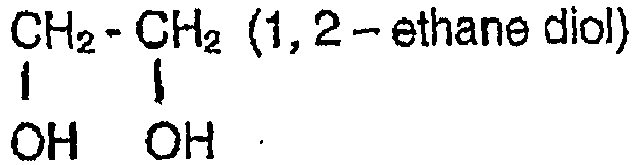
- Alcohols are weak acids. The hydroxyl group can act as a proton donor:

- Essentially, donating protons is equivalent to withdrawing electrons, corresponding to reactivity reduction.

- The portion of the formula to the right-hand side of the dashed line represents the elimination of the C=O double bond in the acetone molecule. Acetone-ethylene glycol ketal can be presented as a cyclic aromatic hydrocarbon.
- In reactions in which a constituent is a particular solvent (primarily for viscosity purposes) substrates (solvents) that donate electrons are called donor solvents, while substrates that extract electrons are called acceptor solvents. Resonance effects being equal, the reactivity of a donor radical will always be greater with an acceptor solvent than with a donor solvent. Acetone is classified as an acceptor solvent
- If one applies the action of donor and acceptor solvents, one can understand the cause of the reaction between ethylene glycol:


- The reactivity of the -N=C=O- group is mainly determined by the pronounced positive (+) character of the C-atom in the cumulative double-bond sequence consisting of nitrogen, carbon, and oxygen. The positive charge at the C-atom becomes obvious if one looks at the resonance structure, which also indicates how substituents at the radical which bears the NCO group can influence this reactivity.

- The negative charge can be delocalized, or transferred in R, if R stands for an aromatic radical.
- Substituents on the aromatic ring show the known influences on the positive character of the NCO group. To wit, electron-withdrawing substituents in PARA- or ORTHO-positions increase the reactivity of the NCO-group, and electron-donating substituents lower the reactivity of the NCO group.
- At this point, the following possible inhibition mechanism, or equilibrium reaction, is to be considered as a likely - and most reasonable - explanation, based on all previous stated facts.
- Fact 1. The reaction of the solvent acetone with both ethylene glycol


- Fact 2. The mobility of these reaction H+ ions is approximately 103 x greater than the mobility of the NCO groups in the same common solvent - acetone.
-
Fact 3. The R radical of P-1000 (also P-250 and P-650) is the primary amine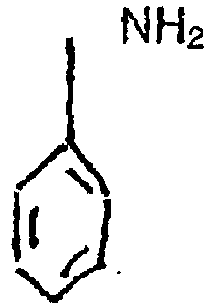
Figure 2 . Note that electrophilic substitution (and resonant replacement) is a predominant feature of reactions with benzene and delocalized π (pi) electrons on the benzene ring. - Fact 4. As discussed above, a negative charge can be delocalized or transferred in an aromatic radical. The primary amine, being an aromatic radical, bears a delocalized negative (-).change, which in terms of the order of magnitude (x3) of the glycols-acetone reaction, effectively neutralizes the negative (-) charged radicals in a manner so effective as to virtually reduce to zero the positive charge affinity of the carbon atom in the NCO group to react with the delocalized negative charge on the aromatic radical, the primary amine, principally because of the vast difference in solvent mobility. In other words, the highly mobile H+ ions literally "lock-up" the amine radicals well before the virtually immobile NCO-group molecules can find any un-neutralized negative (-) radicals.
- Fact 5. When the 1-part mix is applied as a coating or sealant, e.g., over a toe nail, fingernail, or skin, the rapid evaporation of the acetone terminates the H+ ion reaction of the liquid acetone/glycols, leaving in solution primarily the oligomeric diamine/NCO reactants. In this condition - acetone removed by evaporation - the NCO/oligomeric diamine constituents experience initiation of polymerization, and continue until completely polymerized into a polyurea elastomer.
- Fact 6. Hydrodynamic volume-solvent effects and molecular weight analysis: Once a polymer-solvent system has been selected, another consideration is how the polymer molecules behave in that solvent. Particularly important from the standpoint of molecular weight determinations is the resultant size, or hydrodynamic volume, of the polymer molecules in solution.
- Assuming that polymer molecules of a given molecular weight are fully separated from one another by solvent, the hydrodynamic volume will depend on a variety of factors, including
- A) Interactions between solvent and polymer molecules;
- B) chain branching;
- C) conformation effects arising from the polarity and steric bulk of the substituent groups; and
- D) restricted rotation caused by resonance, for example, of the type common to polyamides and polyamines:

- Because of Brownian motion, molecules are changing shape continuously. Therefore, any method of trying to predict molecular size (and subsequently molecular weight) must necessarily be based on statistical methods and average dimensions. If a molecule were fully extended, its size could easily be computed from knowledge of bond lengths and bond angles. Such is not the case, however, with most polymers. Because of this lack of exact knowledge of bond lengths and bond angles, size is generally expressed in terms of the following. For a linear polymer,
r 2 = mean square average distance between chain ends. For a branched polymer,s 2= square average radius of gyration about the center of gravity. -
Figure 2 illustrates the meaning of r and s from the perspective of a coiled structure of an individual polymer molecule having its center of gravity at the origin. The average shape of the coiled molecule is spherical. The greater the affinity of solvent for polymer, the greater the size of the sphere, or, in corollary fashion, the greater the value of s. That is, the greater the affinity of solvent for polymer, the greater the size of the sphere, i.e., the hydrodynamic volume. When solvent-polymer integration decreases, intramolecular interactions become more important, leading to hydrodynamic volume contraction. - In order to discuss the quantitative aspects of hydrodynamic volume parameters as related to solvent-polymer interaction, it is appropriate to define terms. Both r and s must be defined in terms of two factors:
- A) ro and so: an unperturbed dimension; and
- B) α: a volume expansion factor.
- These definition permit the following relations:


- The unperturbed dimensions, ro and so, refer to the size of the macromolecule, exclusive of solvent effects. It is established from a combination of free rotation and intramolecular xxxx and polar interaction. The expansion factor α is defined in terms of interactions between solvent and polymer. For a linear polymer,
r 2 = 6s 2.
Since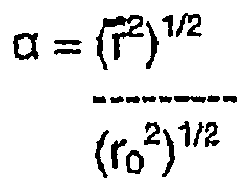
it is a conclusion that α will be > 1 in a "good solvent" and the actual perturbed dimensions, r and s, will both have larger values than their corresponding "unperturbed" dimension values. The greater the value of α for a particular solvent-polymer combination, the "better" the solvent. For the special case where a = 1, the polymer assumes its "unperturbed" dimensions, and behaves as an "ideal" statistical coil. - Since solubility properties vary with temperature in a given solvent, α is temperature dependent. For a specific polymer in a specific solvent, the lowest temperature at which a = 1 is coiled the theta (Θ) temperature, (or flory temp.) and that solvent is then called a theta solvent. Additionally the polymer is said to be in a theta state. It is usual to define the theta of a polymer as that state in which the polymer is on the brink of becoming insoluble.
- The polymer chemistry-based formulations of the present invention exhibit many properties and characteristics that make them suitable as a topically applied device for the treatment of onychomycosis and skin conditions such as urushiol-induced allergic contact. They are non-toxic; non-human carcinogenic; hydrophilic in a liquid state and hydrophobic in a cured state; and elastomeric. The formulations are non-water based; resistant to solar ultraviolet exposure degradation; and exhibit a non-degraded, long-term effective elastomeric thermal stress response over a tested range of -80 degrees F to +225 degrees F.
- The polymer chemistry-based formulations are chemically classified as a polyureathane/urea cross-linked polymer. They exhibit physical and chemical properties of a thermoset polymer; exhibit uniform structural characteristics, i.e. isotropic with uniform tensile strength and elastomeric properties in both longitudinal and radial directions; and are chemically inert to a large number of corrosive chemical agents. The formulations are biologically inert; long term (one year) immersion of wood treated with the formulations in both water and soil produced no detectable alterations in either physical or chemical properties.
- A particular property of the formulations, believed to be responsible for their efficacy as topical devices for the treatment for onychomycosis and skin conditions such as urushiol-induced allergic contact dermatitis, is that when applied as a surface coating of approximately .003-.007 inches thick, the formulations allow transmission of water vapor, but not water liquid. That is, thin topical coatings of the formulations are "water proof," or impervious to moisture. It is believed that this property "seals off" dermatophytes beneath a nail from, e.g., the moisture of sweat when trapped in socks and shoes, or from showers, humidity, and other environmental exposure to moisture. The elastomeric polymer device itself is nonsupportive of fungal or bacterial growth, and by preventing the absorption of environmental moisture, may preclude the growth of fungi such as dermatophytes.
- Similarly, a coating of the formulations over an outbreak of urushiol-induced allergic contact dermatitis seals off urushiol- impregnated skin cells from environmental moisture, while allowing water vapor, such as perspiration, to pass. The topical device also dramatically reduces itching associated with urushiol-induced allergic contact dermatitis, although the precise mechanism of this benefit is not thoroughly understood.
- In thin coatings on nails and skin, the formulations exhibit very fast drying times, and form a tough yet pliable watertight seal. The elastomeric property of the coatings prevents them from cracking and peeling as the skin (or nail) is deformed. The formulations are exceptionally amenable to blending with a large variety of organic based dyes and colorants; most notable are the colorants manufactured by HULS AMERICA, INC., known as the 844 Colorant System. Thus, in the case of treading onychomycosis, the formulations may be died and used in lieu of fingernail and toe nail paint. In the case of urushiol-induced allergic contact dermatitis, the formulations may be used without pigments, in which case they dry to a clear or translucent tone, or they may be mixed with various pigments to blend to skin tones.
- The preferred elastomers for the practice of the present invention are obtained by formula ratio variations (i.e., stoichiometrically balanced) of the presently used components; these components, their chemical descriptions, and commercial product information are described below. Those of skill in the art will readily recognize that other components may advantageously be used, and the present invention is not limited to use of any of these particular components.
- 1) First Diamine
- a) Manufactured by Huntsman Petrochemical Corp., Houston, TX
- b) Chemical family. CAS #9046-10-0 - Polyoxypropylenediamine
- c) Description/Use: Chemical Intermediate
- d) Chemical name: Poly[oxy(methyl-1,2-ethanediyl)], alpha - (2-aminomethylethyl) - omega- (2-aminomethylethoxy)-
- e) Commercial name: Jeffamine® D-2000
- 2) Second Diamine
- a) Manufactured by Arch Chemicals, Inc., Norwalk CT
- b) Chemical family. CAS #9046-10-0 - Polyoxypropylenediamine
- c) Description/Use: Chemical Intermediate
- d) Formula: (C3H6O)nC6H12N2O
- e) Chemical name: Poly[oxy(methyl-1,2-ethanediyl)], alpha - (2-aminomethylethyl) - omega - (2-aminomethylethoxy)-
- f) Commercial name: POLY-A® 27-2000
- 3) Third Diamine
- a) Manufactured by Dorf Ketal Chemicals LLC, Stafford, TX
- b) Chemical family. CAS #5285-60-9 Aromatic Diamine
- c) Description/Use: Chain extender for polyurethane elastomers
- d) Chemical name: N,N'-dialkylamino-diphenylmethane; 4,4'-Bis(sec-butylamino)diphenylmethane
- e) Commercial name; Unilink 4200
- 4) Fourth Diamine
- a) Manufactured by Air Products and Chemicals, Inc., Allentown, PA
- b) Chemical family. CAS #54667-43-5 Oligomeric diamine
- c) Description/Use: Polymer-chain Extender
- d) Chemical name: Polytetramethyleneoxide-di-p-aminobenzoate;
- e) Commercial name; Versalink® P-1000
- 5) First Isocyanate
- a) Source: Huntsman Chemicals, Houston, TX
- b) Chemical family: CAS. No. 26447-40-5
- d) Description/Use: Polymer chain extension
- e) Formula description: Modified MDI
- c) Commercial name: Rubinate® 9433
- 6) Second Isocyanate
- a) Source: Huntsman Polyurethanes, West Deptford, NJ
- b) Chemical family: Modified Diisocyanate
- c) Description/Use: Water-Emulsifiable MDI
- d) Formula description: Polymeric Diphenylmethane Diisocyanate and Modified MDI.
- e) Commercial name: Rubinate® 9259
- 7) Third Isocyanate
- a) Source: Huntsman Polyurethanes, West Deptford, NJ
- b) Chemical family: Modified Diisocyanate
- c) Description/Use: Water-Emulsifiable Crosslinker
- d) Formula description: Polymeric Diphenylmethane Diisocyanate and Modified MDI
- e) Commercial name: Rubinate® 9236
- 8) Fourth Isocyanate
- a) Source: Dow Chemical Company, Midland, MI
- b) Chemical family: Polycarbodiimide-modified Diphenylmethane Diisocyanate
- c) Description/Use: Polymer chain extension
- d) Formula description: Diphenylmethane Diisocyanate (MDI) containing Methylene Bisphenyl isocyanate, Diphenylmethane Diisocyanate (homopolymer) and Triethyl Phosphate
- e) Commercial name: Isonate® 143L Modified MDI
- 9) Fifth Isocyanate
- a) Source: BASF Corporation, Mount Olive, NJ
- b) Chemical family: Aromatic isocyanate
- c) Description/Use: Polymer chain extension
- d) Formula description: Diphenylmethane-4,4'-diisocyanate (MDI), Modified MDI, and MDI Mixed Isomers
- e) Chemical name: Modified MDI
- f) Commercial name: Lupranate® 81 Isocyanate
- 10) Sixth Isocyanate
- a) Source: BASF Corporation, Mount Olive, NJ
- b) Chemical family: Aromatic Isocyanate
- c) Description/Use: Polymer chain extension
- d) Formula description: 4,4' Diphenylmethane Diisocyanate (MDI), Modified MDI, and MDI Mixed Isomers
- e) Chemical name: Carbodiimide Modified MDI
- f) Commercial name: No. 218 Isocyanate
- 11) Seventh Isocyanate
- a) Source: Bayer Corp., Pittsburgh, PA
- b) Chemical family: Aliphatic Polyisocyanate
- c) Description/Use: Polymer chain extension
- d) Formula description: 1,6-Hexamethylene Diisocyanate Based Polyisocyanate
- e) Chemical name: Polymeric Hexamethylene Diisocyanate
- f) Commercial name: Desmodur® N 3200
- 12) Amine-Functional Resin
- a) Source: Bayer Corp, Pittsburgh, PA
- b) Chemical family: amine-functional reactive partner for polyisocyanates.
- c) Description/use: Crosslink with aliphatic polyisocyanate for polymer chain extension
- d) Formula: [trade secret]
- d) Commercial name: Desmophen® NH 1420
- 13) Modified Polyether Polyol
- a) Source: Bayer Corp, Pittsburgh, PA
- b) Chemical family: CAS. No.25723-16-4 - Propylene oxide adduct of trimethylol propane
- c) Description/use: MDI-activated thermoset - polymer converter
- d) Formula: 1,2,3-tris (hydroxymethyl) propane.
- 14) Ethyl Glycol. Polyol component of stabilizing carrier
- a) Available from numerous chemical distributors
- b) Chemical family: CAS # 107-21-1
- c) Description/use: Solvent carrier/reactant
- d) Chemical Name: 1,2-dihydroxyethane, 1,2-ethanediol, ethane-1,2-diol
- 15) Propylene Glycol. Polyol component of stabilizing carrier
- a) Available from numerous chemical distributors
- b) Chemical family: CAS # 57-55-6
- c) Description/use: Solvent carrier/reactant
- d) Chemical name: 1,2-propanediol; 1,2-dihdroxypropane; methyl glycol; methylethylene glycol
- e) Formula: C3H8O2
- 16) Acetone, aka Propanone - Solvent Carrier/Reactant
- a) Available from numerous chemical distributors
- b) Chemical family: CAS. # 67-64-1
Propanone, Acetone, - c) Description/use: Solvent carrier/reactant
- 17) Acetate, aka Ethanoate, - Solvent Carrier/Reactant
- a) Available from numerous chemical distributors
- b) Chemical family: Anion of a salt or ester of acetic acid
- c) Description/use: Solvent carrier/reactant
- d) Formula: CH3CO2-
- 18) Mineral Spirits. Solvent Carrier/Reactant
- a) Available from numerous chemical distributors
- b) Chemical family: CAS # 8052-41-3
- c) Description/use: Solvent carrier/reactant
- d) Formula: Stoddard Standard
- 19) Methyl Ethyl Ketone. Solvent Carrier/Reactant
- a) Available from numerous chemical distributors
- b) Chemical family: CAS #78-93-3
- c) Description/use: Solvent carrier/reactant
- d) Chemical name: Ethyl Methyl Ketone
- e) Formula: C4H8O
- The following representative formulations of the treatment devices are provided. All component amounts are identified in terms of stoichiometrically balanced volume amounts expressed as milliliters.
- Liquid thermosetting, hydrophobic, elastomeric, non-toxic polymer solution treatment devices were prepared by adding the reactants in the sequence given. The stoichiometrically determined volume amounts are expressed in milliliters. Solutions were stir-blended constantly at 20 paddle revolutions per minute during the sequential addition of the ingredients, and for 15-20 minutes after addition of the last ingredient. These parameters of the stir-blending process, in terms of revolutions and time, are the most optimum for obtaining maximum sequential reactivity of the ingredients during blending. The sequential mixing process was done at ambient conditions of 70-80° Fahrenheit, about 750-760 mm Hg, and relative humidity of 50-65%.
- The treatment devices were applied according to the following recommended regimens. For nail fungus:
- 1) Cut affected nail(s) as even with tip of toe(s) or finger(s) as possible.
- 2) File or sand nail(s) down to at least 10-15 mils thickness (But closer to normal nail thickness should yield better effectiveness) Discard file after use and replace to avoid cross contamination of other nails and re-exposure after treatment.
- 3) Use nail pick or scraper to remove any dead and/or infected loose tissue from underneath the tip of the nail(s). Discard and replace after use.
- 4) Wash nail(s) and surrounding area with anti-bacteria soap and water, then dry thoroughly.
- 5) Using a Q-tip applicator, swab nail and surrounding area, with 70% Isopropyl alcohol or nali polish remover to remove excess moisture, oils, and debris that could inhibit penetration and bonding. DO NOT place applicator back into solution after contact with infected nail(s). Discard and replace applicator.
- 6) Apply a light topical coating of the treatment device over the prepared nail(s), the surrounding nail cuticle(s) and underneath the nail tip(s).
- 7) Allow to cure to a tack-free state exposed to room air. Dry-time may be accelerated by using a blow dryer on cool setting, ten minutes after application.
- 8) Apply next topical treatment in 24 hours, following Steps #4 thorough #7.
- 9) Following treatments are at 72-hour intervals.
- 10) Record application details, results, and condition status.
- For poison ivy infections, the following regimen was observed:
- 1) Wash affected are with anti-bacterial soap and water, then dry.
- 2) Apply a light topical coating of treatment device and allow to cure to tack-free state at ambient temperature. Record any noticeable immediate reactions or changes in condition.
- These treatment regimens were observed for the following formulations, with the results indicated.
-
Reagent Volume [ml] Stoichiometric Volume Ratio Acetone 240 0.505 Acetate 126.75 0.267 Versalink® P-1000 55.5 0.117 Ethyl Glycol 7.5 0.016 Propylene Glycol 7.5 0.016 Rubinate® 9259 or 2143 37.5 0.079 Total: 474.75 1.000 - Treatment 1: Poison Ivy infection covering 6 sq. in. of left arm of adult male. Itching stopped in less than a second. Condition cleared in two days. No side effects.
- Treatment 2: Poison Ivy infection covering 4 sq. in. on right heel of adult male. Itching stopped in less than a second. Cool to the touch; no burning.
- Treatment 3: Six-month nail fungus infection of adult male. Cleared up and has not recurred.
-
Reagent Volume [ml] Stoichiometric Volume Ratio Acetone 2888 0.752 Acetate 228 0.059 Jeffamine® D-2000 304 0.080 Unilink® 4200 76 0.020 4012 144 0.038 No. 218 Isocyanate 198 0.051 Total: 3838 1.000 - Treatment 1: Poison Ivy infection covering 6 sq. in. of right back of adult male. Itching stopped in less than a.second. Condition cleared in two days. No sting. Cool to the touch.
- Treatment 2: Twenty-five year chronic nail fungus infection in both big toes and right thumb of adult male. Thumb cleared and significant progress in both toes over 10-week treatment regimen.
-
Reagent Volume [ml] Stoichiometric Volume Ratio Acetone 132 0.697 Mineral Spirits 44 0.232 4012 2.2 0.012 Jeffamine® D-2000 8.8 0.046 No. 218 Isocyanate 2.4 0.013 Total: 189.4 1.000 - Treatment 1: One-year chronic nail fungus infection of left big toe of adult male. Condition 60% cleared in sixteen days, when subject ran out of treatment device. Treatment regiment resumed upon re-supply, and condition 100% cleared in two months.
- Additional formulations of the medical device of the present invention are presented below.
-
Reagent Volume [ml] Volume Ratio Volume [ml] Volume Ratio Volume [ml] Volume Ratio Acetone 106.8 0.702 132.0 0.697 132.0 0.705 Mineral Spirits 35.6 0.234 44.0 0.232 44.0 0.235 Jeffamine® D-2000 6.6 0.043 8.8 0.046 8.8 0.047 Unilink® 4200 1.2 0.008 --- --- --- --- 4012 --- --- 2.2 0.012 --- --- No. 218 Isocyanate or Lupranate® 81 Isocyanate 2.0 0.013 2.4 0.013 2.4 0.013 Total 152.2 1.000 189.4 1.000 137.2 1.000 -
Reagent Volume [ml] Volume Ratio Volume [ml] Volume Ratio Acetone 650.0 0.776 850.0 0.782 MEK 50.0 0.059 100.0 0.092 Jeffamine® D-2000 60.0 0.071 60.0 0.055 Unilink® 4200 15.0 0.020 15.0 0.014 4012 20.0 0.024 20.0 0.018 Ethyl Glycol 5.0 0.006 5.0 0.005 Propylene Glycol 5.0 0.006 5.0 0.005 Lupranate® 81 Isocyanate 32.0 0.038 32.0 0.029 Total 837 1.000 1087 1.000 - The medical device formulations of the present invention have the following physiological properties.
- 1. Non-Cytotoxic, MEM Elusion - MG 023 - 0 Dilution
- 2. Non-Hemolytic - In Vitro
- 3. Non-Pyrogenic - Test T10, Material Mediated
- 4. Non-Carcinogenic - Standard Ames Salmonena Tests
- Although the present invention has been described herein with respect to particular features, aspects and embodiments thereof, it will be apparent that numerous variations, modifications, and other embodiments are possible within the broad scope of the present invention. The present embodiments are therefore to be construed in all aspects as illustrative and not restrictive and all changes coming within the meaning and equivalency range of the appended claims are intended to be embraced therein.
Claims (11)
- A composition for use in the topical treatment of onychomycosis and/or urushiol-induced contact dermatitis, the composition comprising a mixture of:a primary diamine in a volume ratio ranging from 3.6% to 12.2% v/v of the total solution;a secondary diamine in a volume ratio ranging from 0.6% to 6.8% v/v, based on the total volume of the composition; wherein the secondary diamine comprises 4,4'-bis(sec-butylamino)diphenylmethane;a chain extension reagent in a volume ratio ranging from 2.0% to 6.2% v/v of the composition; anda stabilizing carrier in an amount sufficient to prevent formation of a gel or solid prior to removal of a portion of the stabilizing carrier; optionally wherein the stabilising carrier comprises a polyol.
- The composition of claim 1 for use in the topical treatment of onychomycosis and/or urushiol-induced contact dermatitis, wherein the chain extension reagent is a polyisocyanate.
- The composition of claim 2 for use in the topical treatment of onychomycosis and/or urushiol-induced contact dermatitis, wherein the polyisocyanate comprises at least one of diphenymethanediisocyanate (MDI), a modified form of monomeric MDI, MDI containing resin, aliphatic diisocyanates, aromatic diisocyanates, alicyclic diisocyanates, ethylene diisocyanate, ethylidene diisocyanate, propylene diisocyanate, butylene diisocyanate, cyclopentylene-1,3-diisocyanate, cyclohexylene-1,4,diisocyanate, cyclohexylene-1,2-diisocyanate, 2,4-tolylene diisocyanate, 2,6-tolylene diisocyanate, 4,4'-diphenylmethane diisocyanate, 2,2-diphenylpropane-4,4'-diisocyanate, p-phenylene diisocyanate, m-phenylene diisocyanate, xylylene diisocyanate, 1,4-naphthylene diisocyanate, 1,5-naphthylene diisocyanate, diphenyl-4,4'-diisocyanate, azobenzene-4,4'diisocyanate, diphenylsulfone-4,4'diisocyanate, dichlorohexamethylene diisocyanate, tetramethylene diisocyanate, pentamethylene diisocyanate, hexamethylene diisocyanate, 1-chlorobenzene-2,4-diisocyanate, furfurylidene diisocyanate and triphenylmethane triisocyanate.
- The composition of claim 3 for use in the topical treatment of onychomycosis and/or urushiol-induced contact dermatitis, wherein the polyisocyanate comprises MDI, a modified form of monomeric MDI and/or a MDI containing resin.
- The composition of any preceding claim for use in the topical treatment of onychomycosis and/or urushiol-induced contact dermatitis, wherein the polyol comprises at least one of ethylene glycol, propylene glycol, 1,3-butylene glycol, 1,4-butylene glycol, 2,3-butylene glycol, alkylene glycols having 5 to 9 carbon atoms, polyethylene glycol 200, polyethylene glycol 400 and polyethylene glycol 600.
- The composition of any preceding claim for use in the topical treatment of onychomycosis and/or urushiol-induced contact dermatitis, wherein the polyol comprises a mixture of ethylene glycol and propylene glycol.
- The composition of any preceding claim for use in the topical treatment of onychomycosis and/or urushiol-induced contact dermatitis, further comprising at least one solvent selected from the group consisting of acetone, methyl ethyl ketone, methylisobutylketone, N-methylcyclohexanone, acetaldehyde, propionaldehyde, butyraldehyde, isobutyraldehyde, methyl acetate, ethyl acetate, butyl acetate, and methyl propyl acetate.
- The composition of any preceding claim for use in the topical treatment of onychomycosis and/or urushiol-induced contact dermatitis, wherein the primary diamine and the secondary diamine are stoichiometrically balanced.
- The composition of any preceding claim for use in the topical treatment of onychomycosis and/or urushiol-induced contact dermatitis, further comprising a colorant and/or pigment.
- The composition of claim 1 for use in the topical treatment of onychomycosis and/or urushiol-induced contact dermatitis, wherein the ratio of the primary and secondary diamine to the chain extension reagent is from 2.8:1 to 3.8:1 by volume.
- The composition of claim 1 for use in the topical treatment of onychomycosis and/or urushiol-induced contact dermatitis, wherein the primary diamine comprises polyoxypropylenediamine.
Applications Claiming Priority (2)
| Application Number | Priority Date | Filing Date | Title |
|---|---|---|---|
| US11/284,649 US20060216267A1 (en) | 2002-08-20 | 2005-11-22 | Hydrophobic elastomeric polymer chemistry device for inhibiting the growth of onychomycosis and urushiol-induced allergic contact dermatitis |
| PCT/US2006/061179 WO2007062381A2 (en) | 2005-11-22 | 2006-11-22 | Hydrophobic elastomeric polymer chemistry device for inhibiting the growth of onychomycosis and urushiol-induced allergic contact dermatitis |
Publications (3)
| Publication Number | Publication Date |
|---|---|
| EP1962866A2 EP1962866A2 (en) | 2008-09-03 |
| EP1962866A4 EP1962866A4 (en) | 2012-11-14 |
| EP1962866B1 true EP1962866B1 (en) | 2015-03-18 |
Family
ID=38068043
Family Applications (1)
| Application Number | Title | Priority Date | Filing Date |
|---|---|---|---|
| EP06839991.4A Not-in-force EP1962866B1 (en) | 2005-11-22 | 2006-11-22 | Poly(urea-urethane) compositions useful as topical medicaments and methods of using the same |
Country Status (5)
| Country | Link |
|---|---|
| US (2) | US20060216267A1 (en) |
| EP (1) | EP1962866B1 (en) |
| CN (1) | CN101378765B (en) |
| CA (1) | CA2633549C (en) |
| WO (1) | WO2007062381A2 (en) |
Families Citing this family (17)
| Publication number | Priority date | Publication date | Assignee | Title |
|---|---|---|---|---|
| US20060216267A1 (en) * | 2002-08-20 | 2006-09-28 | Kovacs Stephen G | Hydrophobic elastomeric polymer chemistry device for inhibiting the growth of onychomycosis and urushiol-induced allergic contact dermatitis |
| US20070203040A1 (en) * | 2006-02-24 | 2007-08-30 | Harry Reicherz | Bar soap |
| US8771725B2 (en) * | 2007-10-12 | 2014-07-08 | Chesson Laboratory Associates, Inc. | Poly(urea-urethane) compositions useful as topical medicaments and methods of using the same |
| US8980210B2 (en) * | 2008-01-28 | 2015-03-17 | Battelle Memorial Institute | Capture and release of acid-gasses with acid-gas binding organic compounds |
| US8480724B2 (en) * | 2009-05-06 | 2013-07-09 | Deborah C Bly | Assembly and method for treating and preventing moisture related skin dermatitis |
| GB201221329D0 (en) * | 2012-11-27 | 2013-01-09 | Avexxin As | Dermatitis treatment |
| HK1217458A1 (en) | 2013-05-17 | 2017-01-13 | 切逊实验室联合公司 | Method of treating and/or preventing nail conditions and/or improving the appearance of nails |
| CA3058624A1 (en) | 2017-03-31 | 2018-10-04 | Dow Global Technologies Llc | Wood preservatives |
| CN107457857A (en) * | 2017-09-11 | 2017-12-12 | 阜南县大自然工艺品有限公司 | A kind of method of thin plate Wood craft anticracking |
| CN109079940B (en) * | 2018-08-09 | 2020-06-19 | 广东木之源家具有限公司 | Method for repairing and reinforcing wooden products |
| WO2020068749A1 (en) | 2018-09-28 | 2020-04-02 | Rohm And Haas Company | Wood preservatives |
| CA3114101A1 (en) | 2018-09-28 | 2020-04-02 | Rohm And Haas Company | Wood preservatives |
| BR112021005973A2 (en) | 2018-09-28 | 2021-06-29 | Rohm And Haas Company | method for preserving wood, and composition for preserving wood. |
| CN114901718B (en) | 2018-09-28 | 2024-12-06 | 营养与生物科技美国第二有限公司 | Wood preservatives |
| CN110672750A (en) * | 2019-10-25 | 2020-01-10 | 皖西学院 | Method for determining urushiol in rhus chinensis fruit oil by using UPLC-MS (ultra performance liquid chromatography-mass spectrometry) |
| CN113429893A (en) * | 2021-07-22 | 2021-09-24 | 南京海配新材料有限公司 | Nonpolar rubber and plastic material surface treatment agent and surface treatment method |
| WO2023096709A1 (en) | 2021-11-29 | 2023-06-01 | X Development Llc | Molecular structure transformers for property prediction |
Citations (1)
| Publication number | Priority date | Publication date | Assignee | Title |
|---|---|---|---|---|
| US3194793A (en) * | 1961-12-13 | 1965-07-13 | Du Pont | Polyurethanes cured with mixtures of aromatic primary and secondary diamines |
Family Cites Families (79)
| Publication number | Priority date | Publication date | Assignee | Title |
|---|---|---|---|---|
| US3438374A (en) * | 1966-02-28 | 1969-04-15 | Us Health Education & Welfare | Method of bonding tissue surfaces and controlling hemorrhaging thereof using a tissue adhesive and hemostatic composition |
| US3892696A (en) | 1972-05-12 | 1975-07-01 | Grace W R & Co | Polyureas and preparation thereof |
| US3893969A (en) * | 1974-03-29 | 1975-07-08 | Gen Motors Corp | Reinforced polyamide molding composition |
| DE2921163A1 (en) | 1979-05-25 | 1980-12-04 | Bayer Ag | SELF-HARDENING MATERIAL FOR PRODUCING A WEATHER-RESISTANT, NON-YELLOWING SUPPORT ASSEMBLY |
| US4328322A (en) * | 1979-12-03 | 1982-05-04 | Polaroid Corporation | Synthetic polymers by polyisocyanate polyaddition process |
| US4542012A (en) * | 1982-07-02 | 1985-09-17 | Minnesota Mining And Manufacturing Company | Film-forming composition containing an antimicrobial agent and methods |
| IT1153909B (en) * | 1982-12-17 | 1987-01-21 | Sogimi Srl | REACTIVE POLYMERS FOR THE TREATMENT OF SKIN DISEASES |
| US4474900A (en) * | 1983-06-08 | 1984-10-02 | Texaco Inc. | Reaction injection molded elastomers |
| DE3343124A1 (en) * | 1983-11-29 | 1985-06-05 | Basf Ag, 6700 Ludwigshafen | AT ROOM TEMPERATURE STABLE, HEAT-CURABLE MATERIAL MIXTURES BASED ON COMPOUNDS WITH REACTIVE HYDROGEN ATOMS AND POLYISOCYANATES, METHOD FOR THE PRODUCTION THEREOF AND THEIR USE FOR THE PRODUCTION THEREOF |
| US4584192A (en) * | 1984-06-04 | 1986-04-22 | Minnesota Mining & Manufacturing Company | Film-forming composition containing an antimicrobial agent and methods of use |
| US4653493A (en) * | 1985-02-08 | 1987-03-31 | Hoppough John M | Ventilator unit exhalation contamination control device |
| EP0215072A4 (en) | 1985-03-13 | 1990-01-08 | Gluck Bruno A | Antiseptic fluids. |
| US4733659A (en) | 1986-01-17 | 1988-03-29 | Seton Company | Foam bandage |
| US4655210A (en) * | 1986-01-17 | 1987-04-07 | Seton Company | Foam bandage |
| DE3607996A1 (en) * | 1986-03-11 | 1987-09-17 | Basf Ag | MOISTURE-HARDENING, STORAGE-STABLE, 1-COMPONENT POLYURETHANE SYSTEMS AND THEIR USE |
| JP2577900B2 (en) * | 1987-02-18 | 1997-02-05 | イハラケミカル工業 株式会社 | Method for producing polyurea resin |
| US4806615A (en) * | 1987-06-01 | 1989-02-21 | Texaco Inc. | Reaction injection molded elastomers prepared from amine terminated polyethers, a blend of an aromatic amine terminated chain extender, a substituted acyclic aliphatic amine terminated chain extender and an aromatic polyisocyanate |
| US4913897A (en) * | 1987-12-28 | 1990-04-03 | Bio-Products, Inc. | Use of hydrogel solutions to form a hydrophilic protective film on the skin against toxic substances, pollutants, infections and skin secretions |
| US4960620A (en) * | 1988-06-17 | 1990-10-02 | Uop | Coating method for room-temperature-cured polyurethanes and polyureas |
| US5103812A (en) | 1988-10-12 | 1992-04-14 | Rochal Industries, Inc. | Conformable bandage and coating material |
| IN172390B (en) | 1989-07-18 | 1993-07-10 | Ethicon Inc | |
| DE3940273A1 (en) * | 1989-12-06 | 1991-06-13 | Bayer Ag | TAILABLE POLYETHER POLYESTER POLYURETHANESE |
| US5013813A (en) * | 1989-12-18 | 1991-05-07 | Texaco Chemical Company | Polyurea elastomer with rapid dry time |
| US5104930A (en) * | 1990-02-27 | 1992-04-14 | Raychem Corporation | Polyurea gel compositions and articles therefrom |
| US5192536A (en) * | 1990-10-26 | 1993-03-09 | Huprich Carl A | Method and composition for coating a wound with polyether polyurethane |
| US5160328A (en) * | 1991-08-07 | 1992-11-03 | Ndm Acquisition Corp. | Hydrogel bandage |
| US5259835A (en) * | 1991-08-29 | 1993-11-09 | Tri-Point Medical L.P. | Wound closure means and method using flowable adhesive |
| US5319058A (en) * | 1991-10-22 | 1994-06-07 | Ihara Chemical Industry Co., Ltd. | Method for the preparation of a polyurea resin |
| DK5492A (en) | 1992-01-17 | 1993-07-18 | Coloplast As | A dressing |
| DE4212105A1 (en) * | 1992-04-10 | 1993-10-14 | Roehm Pharma Gmbh | Nail polish for the treatment of onychomycoses |
| DE4315173A1 (en) * | 1992-12-23 | 1994-06-30 | Bayer Ag | Pure, especially catalyst-free polyurethanes |
| DE69412242T2 (en) | 1993-04-16 | 1999-03-25 | Minnesota Mining And Mfg. Co., Saint Paul, Minn. | ORTHOPEDIC CASTING MATERIAL |
| BR9408514A (en) | 1994-01-21 | 1997-08-19 | Minnesota Mining & Mfg | Composite article composite splint article water curable modeling tape molding and production process of a lightweight orthopedic molding tape |
| CA2151672C (en) * | 1994-06-24 | 2007-05-29 | Dudley Joseph Ii Primeaux | Preparation of sprayable aliphatic polyurea elastomers having improved properties |
| US5738627A (en) * | 1994-08-18 | 1998-04-14 | Duke University | Bi-ventricular cardiac assist device |
| US5981621A (en) | 1996-02-29 | 1999-11-09 | Closure Medical Corporation | Monomeric compositions effective as wound closure devices |
| US5763734A (en) * | 1995-10-19 | 1998-06-09 | Nachtman; Thomas J. | Method for containing or removing contaminants from a substrate |
| US6833408B2 (en) * | 1995-12-18 | 2004-12-21 | Cohesion Technologies, Inc. | Methods for tissue repair using adhesive materials |
| IL118848A0 (en) | 1996-07-14 | 1996-10-31 | Univ Bar Ilan | Method for preparing bioactive polymers |
| AU751848B2 (en) * | 1998-01-28 | 2002-08-29 | Bristol-Myers Squibb Company | Methods of preparing polyurethane adhesives, adhesives produced thereby and medical devices employing the same |
| US20040137067A1 (en) * | 1998-04-30 | 2004-07-15 | Closure Medical Corporation | Adhesive applicator tip with a polymerization initiator, polymerization rate modifier, and/or bioactive material |
| WO1999064491A1 (en) * | 1998-06-05 | 1999-12-16 | Polyganics B.V. | Biomedical polyurethane, its preparation and use |
| ATE343379T1 (en) * | 1998-08-20 | 2006-11-15 | 3M Innovative Properties Co | SPRAY DRESSING AND ACTIVE DELIVERY SYSTEM |
| FR2782635B1 (en) * | 1998-08-27 | 2001-09-14 | Oreal | AEROSOL DEVICE CONTAINING A POLYCONDENSATE COMPRISING AT LEAST ONE POLYURETHANE AND / OR POLYUREA PATTERN |
| PT1049446E (en) * | 1998-08-27 | 2004-08-31 | Oreal | A capillary composition comprising a polycondensate comprising at least one polyurethane and / or polyurea and a polypropylene moiety. |
| US20030080151A1 (en) * | 1998-10-22 | 2003-05-01 | Closure Medical Corporation | Applicator with protective barrier |
| US20050033251A1 (en) * | 1998-12-08 | 2005-02-10 | Quick-Med Technologies, Inc. | Controlled release of biologically active substances from select substrates |
| IL129583A (en) * | 1999-04-25 | 2005-05-17 | Kenneth I Sawyer | Diesters of oligobutyleneglycol and amidine benzoic acid and their use for preparation of moisture-curable, storage-stable, one-part polyurethane/urea compositions |
| US6403063B1 (en) * | 1999-07-26 | 2002-06-11 | Kenneth I. Sawyer | Method of treating nail fungus |
| DE60012026T2 (en) * | 1999-08-26 | 2004-12-30 | Ganeden Biotech, Inc., San Diego | USE OF EMU OIL AS A CARRIER FOR FUNGICIDES, ANTIBACTERIAL AND ANTIVIRAL MEDICINES |
| US6620846B1 (en) * | 2000-08-02 | 2003-09-16 | Closure Medical Corporation | Absorbable adhesive compositions |
| CA2421638A1 (en) * | 2000-09-11 | 2002-03-21 | Closure Medical Corporation | Bronchial occlusion method and apparatus |
| US6358503B1 (en) * | 2000-09-26 | 2002-03-19 | Coloplast Corp. | Protectant film for skin |
| CA2449369C (en) * | 2001-06-15 | 2011-08-23 | Huntsman Petrochemical Corporation | Synergistic amine chain-extenders in polyurea spray elastomers |
| IL159156A0 (en) * | 2001-06-22 | 2004-06-01 | Millard Marsden Mershon | A gel forming composition containing a polyacrylic acid |
| US6585967B2 (en) * | 2001-07-05 | 2003-07-01 | Closure Medical Corporation | Adhesive treatment for tinea cruris |
| US6746667B2 (en) * | 2001-07-05 | 2004-06-08 | Closure Medical Corporation | Adhesive treatment for tinea pedis |
| US6602496B2 (en) * | 2001-07-05 | 2003-08-05 | Closure Medical Corporation | Adhesive treatment for tinea corporis |
| US6942875B2 (en) * | 2001-07-05 | 2005-09-13 | Closure Medical Corporation | Adhesive treatment for skin yeast infections |
| US6767552B2 (en) * | 2001-07-05 | 2004-07-27 | Closure Medical Corporation | Adhesive treatment for oral fungal infection |
| WO2003075968A2 (en) * | 2002-03-04 | 2003-09-18 | Georgia Tech Research Corporation | Biocompatible hydrophilic films from polymeric mini-emulsions for application to skin |
| ATE547218T1 (en) * | 2002-08-20 | 2012-03-15 | Roof Matrix Inc | NON-TOXIC, HYDROPHOBIC, ELASTOMERIC POLYMER CHEMICAL SYSTEM FOR WOOD PRESERVATION |
| US20060216267A1 (en) * | 2002-08-20 | 2006-09-28 | Kovacs Stephen G | Hydrophobic elastomeric polymer chemistry device for inhibiting the growth of onychomycosis and urushiol-induced allergic contact dermatitis |
| US20040241130A1 (en) * | 2002-09-13 | 2004-12-02 | Krishnan Tamareselvy | Multi-purpose polymers, methods and compositions |
| US7378479B2 (en) | 2002-09-13 | 2008-05-27 | Lubrizol Advanced Materials, Inc. | Multi-purpose polymers, methods and compositions |
| US7135194B2 (en) * | 2002-09-27 | 2006-11-14 | Birnbaum Jay E | Subunguicide, and method for treating onychomycosis |
| US20070225631A1 (en) | 2002-10-04 | 2007-09-27 | Bowlin Gary L | Sealants for Skin and Other Tissues |
| DE10316014A1 (en) * | 2003-04-07 | 2004-10-21 | Dähne, Philipp | Device and method for flow-enhancing flooding of biological liquids by means of a self-propelled, rotatable pipe adapter |
| WO2004093786A2 (en) * | 2003-04-16 | 2004-11-04 | Corium International | Covalent and non-covalent crosslinking of hydrophilic polymers and adhesive compositions prepared therewith |
| US20040223932A1 (en) * | 2003-05-05 | 2004-11-11 | Closure Medical Corporation | Adhesive treatment for acne |
| AU2004291062A1 (en) * | 2003-11-10 | 2005-06-02 | Angiotech International Ag | Medical implants and anti-scarring agents |
| US20050273146A1 (en) | 2003-12-24 | 2005-12-08 | Synecor, Llc | Liquid perfluoropolymers and medical applications incorporating same |
| US20050271794A1 (en) * | 2003-12-24 | 2005-12-08 | Synecor, Llc | Liquid perfluoropolymers and medical and cosmetic applications incorporating same |
| KR100810947B1 (en) | 2005-01-28 | 2008-03-10 | 롬 앤드 하아스 컴패니 | Medical films and articles prepared from emulsion polymers |
| US7318937B2 (en) | 2005-03-18 | 2008-01-15 | Closure Medical Corporation | Liquid coating compositions |
| EP1945231B1 (en) * | 2005-08-17 | 2021-11-10 | Rochal Partners, LLP | Conformable solvent-based bandage and coating material |
| WO2007025293A2 (en) | 2005-08-26 | 2007-03-01 | The University Of North Carolina At Chapel Hill | Use of acid derivatives of fluoropolymers for fouling-resistant surfaces |
| US20070048355A1 (en) * | 2005-08-26 | 2007-03-01 | Daniel Perlman | Non-irritating solvent-borne polymeric coatings for application to the skin |
| US8771725B2 (en) * | 2007-10-12 | 2014-07-08 | Chesson Laboratory Associates, Inc. | Poly(urea-urethane) compositions useful as topical medicaments and methods of using the same |
-
2005
- 2005-11-22 US US11/284,649 patent/US20060216267A1/en not_active Abandoned
-
2006
- 2006-11-22 WO PCT/US2006/061179 patent/WO2007062381A2/en not_active Ceased
- 2006-11-22 EP EP06839991.4A patent/EP1962866B1/en not_active Not-in-force
- 2006-11-22 CN CN2006800509744A patent/CN101378765B/en not_active Expired - Fee Related
- 2006-11-22 CA CA2633549A patent/CA2633549C/en active Active
-
2008
- 2008-04-15 US US12/103,353 patent/US9402860B2/en not_active Expired - Lifetime
Patent Citations (1)
| Publication number | Priority date | Publication date | Assignee | Title |
|---|---|---|---|---|
| US3194793A (en) * | 1961-12-13 | 1965-07-13 | Du Pont | Polyurethanes cured with mixtures of aromatic primary and secondary diamines |
Also Published As
| Publication number | Publication date |
|---|---|
| CA2633549C (en) | 2014-06-03 |
| EP1962866A2 (en) | 2008-09-03 |
| EP1962866A4 (en) | 2012-11-14 |
| US9402860B2 (en) | 2016-08-02 |
| CN101378765A (en) | 2009-03-04 |
| CN101378765B (en) | 2013-07-17 |
| US20080253984A1 (en) | 2008-10-16 |
| WO2007062381A2 (en) | 2007-05-31 |
| US20060216267A1 (en) | 2006-09-28 |
| CA2633549A1 (en) | 2007-05-31 |
| WO2007062381A3 (en) | 2007-11-08 |
Similar Documents
| Publication | Publication Date | Title |
|---|---|---|
| US9402860B2 (en) | Methods of inhibiting the growth of onychomycosis and urushiol-induced allergic contact dermatitis | |
| EP1542842B1 (en) | Non-toxic hydrophobic elastomeric polymer chemistry system for wood preservation | |
| US6403063B1 (en) | Method of treating nail fungus | |
| AU2006339841B2 (en) | Pharmaceutical composition for external use | |
| US9259436B2 (en) | Poly(urea-urethane) compositions useful as topical medicaments and methods of using the same | |
| JPH0323529B2 (en) | ||
| CN113930150B (en) | Preparation method of water-based polymer-based leather finishing agent with double antibacterial functions | |
| TW201026762A (en) | Process for producing shaped polyurethane foam wound dressings | |
| US20050238672A1 (en) | Antifungal drug delivery | |
| US10987376B2 (en) | Methods of treating and/or preventing nail disorders and/or improving the appearance of a nail | |
| US6401724B1 (en) | Method of applying a cosmetic nail lacquer or polish to a nail | |
| EP0064830B1 (en) | Pharmaceutical compositions for treating nail infections | |
| BE1025004B1 (en) | PELTABLE NAIL POLISH | |
| US20140271513A1 (en) | Foot odor reduction composition and system and method of use of same | |
| JPH0725738A (en) | Moisture-retaining composition for skin | |
| Valdés | New polyurethane nail lacquers for the delivery of antifungal drugs | |
| FR3142671A1 (en) | COMPOSITION WITH INCREASED STABILITY | |
| CN109953902A (en) | A kind of maintenance process of the skin of face of non-treatment purpose |
Legal Events
| Date | Code | Title | Description |
|---|---|---|---|
| PUAI | Public reference made under article 153(3) epc to a published international application that has entered the european phase |
Free format text: ORIGINAL CODE: 0009012 |
|
| 17P | Request for examination filed |
Effective date: 20080617 |
|
| AK | Designated contracting states |
Kind code of ref document: A2 Designated state(s): AT BE BG CH CY CZ DE DK EE ES FI FR GB GR HU IE IS IT LI LT LU LV MC NL PL PT RO SE SI SK TR |
|
| RIN1 | Information on inventor provided before grant (corrected) |
Inventor name: CHESSON, JERRY, S. Inventor name: KOVACS, STEPHEN, G. |
|
| DAX | Request for extension of the european patent (deleted) | ||
| A4 | Supplementary search report drawn up and despatched |
Effective date: 20121016 |
|
| RIC1 | Information provided on ipc code assigned before grant |
Ipc: A61P 17/00 20060101ALI20121010BHEP Ipc: A61K 9/00 20060101ALI20121010BHEP Ipc: A61P 31/00 20060101ALI20121010BHEP Ipc: A61K 9/70 20060101ALI20121010BHEP Ipc: A61K 31/785 20060101AFI20121010BHEP |
|
| 17Q | First examination report despatched |
Effective date: 20140325 |
|
| REG | Reference to a national code |
Ref country code: DE Ref legal event code: R079 Ref document number: 602006044857 Country of ref document: DE Free format text: PREVIOUS MAIN CLASS: A61K0031740000 Ipc: A61K0031785000 |
|
| RIC1 | Information provided on ipc code assigned before grant |
Ipc: A61P 17/00 20060101ALI20140813BHEP Ipc: A61P 31/00 20060101ALI20140813BHEP Ipc: A61K 31/785 20060101AFI20140813BHEP Ipc: A61K 9/70 20060101ALI20140813BHEP Ipc: A61K 9/00 20060101ALI20140813BHEP |
|
| GRAP | Despatch of communication of intention to grant a patent |
Free format text: ORIGINAL CODE: EPIDOSNIGR1 |
|
| INTG | Intention to grant announced |
Effective date: 20141107 |
|
| GRAS | Grant fee paid |
Free format text: ORIGINAL CODE: EPIDOSNIGR3 |
|
| GRAA | (expected) grant |
Free format text: ORIGINAL CODE: 0009210 |
|
| AK | Designated contracting states |
Kind code of ref document: B1 Designated state(s): AT BE BG CH CY CZ DE DK EE ES FI FR GB GR HU IE IS IT LI LT LU LV MC NL PL PT RO SE SI SK TR |
|
| REG | Reference to a national code |
Ref country code: GB Ref legal event code: FG4D |
|
| REG | Reference to a national code |
Ref country code: CH Ref legal event code: EP |
|
| REG | Reference to a national code |
Ref country code: IE Ref legal event code: FG4D |
|
| REG | Reference to a national code |
Ref country code: AT Ref legal event code: REF Ref document number: 716090 Country of ref document: AT Kind code of ref document: T Effective date: 20150415 |
|
| REG | Reference to a national code |
Ref country code: DE Ref legal event code: R096 Ref document number: 602006044857 Country of ref document: DE Effective date: 20150430 |
|
| REG | Reference to a national code |
Ref country code: NL Ref legal event code: VDEP Effective date: 20150318 |
|
| REG | Reference to a national code |
Ref country code: NL Ref legal event code: VDEP Effective date: 20150318 |
|
| PG25 | Lapsed in a contracting state [announced via postgrant information from national office to epo] |
Ref country code: FI Free format text: LAPSE BECAUSE OF FAILURE TO SUBMIT A TRANSLATION OF THE DESCRIPTION OR TO PAY THE FEE WITHIN THE PRESCRIBED TIME-LIMIT Effective date: 20150318 Ref country code: SE Free format text: LAPSE BECAUSE OF FAILURE TO SUBMIT A TRANSLATION OF THE DESCRIPTION OR TO PAY THE FEE WITHIN THE PRESCRIBED TIME-LIMIT Effective date: 20150318 Ref country code: LT Free format text: LAPSE BECAUSE OF FAILURE TO SUBMIT A TRANSLATION OF THE DESCRIPTION OR TO PAY THE FEE WITHIN THE PRESCRIBED TIME-LIMIT Effective date: 20150318 |
|
| REG | Reference to a national code |
Ref country code: AT Ref legal event code: MK05 Ref document number: 716090 Country of ref document: AT Kind code of ref document: T Effective date: 20150318 |
|
| REG | Reference to a national code |
Ref country code: LT Ref legal event code: MG4D |
|
| PG25 | Lapsed in a contracting state [announced via postgrant information from national office to epo] |
Ref country code: LV Free format text: LAPSE BECAUSE OF FAILURE TO SUBMIT A TRANSLATION OF THE DESCRIPTION OR TO PAY THE FEE WITHIN THE PRESCRIBED TIME-LIMIT Effective date: 20150318 Ref country code: GR Free format text: LAPSE BECAUSE OF FAILURE TO SUBMIT A TRANSLATION OF THE DESCRIPTION OR TO PAY THE FEE WITHIN THE PRESCRIBED TIME-LIMIT Effective date: 20150619 |
|
| PG25 | Lapsed in a contracting state [announced via postgrant information from national office to epo] |
Ref country code: NL Free format text: LAPSE BECAUSE OF FAILURE TO SUBMIT A TRANSLATION OF THE DESCRIPTION OR TO PAY THE FEE WITHIN THE PRESCRIBED TIME-LIMIT Effective date: 20150318 |
|
| PG25 | Lapsed in a contracting state [announced via postgrant information from national office to epo] |
Ref country code: RO Free format text: LAPSE BECAUSE OF FAILURE TO SUBMIT A TRANSLATION OF THE DESCRIPTION OR TO PAY THE FEE WITHIN THE PRESCRIBED TIME-LIMIT Effective date: 20150318 Ref country code: CZ Free format text: LAPSE BECAUSE OF FAILURE TO SUBMIT A TRANSLATION OF THE DESCRIPTION OR TO PAY THE FEE WITHIN THE PRESCRIBED TIME-LIMIT Effective date: 20150318 Ref country code: SK Free format text: LAPSE BECAUSE OF FAILURE TO SUBMIT A TRANSLATION OF THE DESCRIPTION OR TO PAY THE FEE WITHIN THE PRESCRIBED TIME-LIMIT Effective date: 20150318 Ref country code: ES Free format text: LAPSE BECAUSE OF FAILURE TO SUBMIT A TRANSLATION OF THE DESCRIPTION OR TO PAY THE FEE WITHIN THE PRESCRIBED TIME-LIMIT Effective date: 20150318 Ref country code: PT Free format text: LAPSE BECAUSE OF FAILURE TO SUBMIT A TRANSLATION OF THE DESCRIPTION OR TO PAY THE FEE WITHIN THE PRESCRIBED TIME-LIMIT Effective date: 20150720 Ref country code: EE Free format text: LAPSE BECAUSE OF FAILURE TO SUBMIT A TRANSLATION OF THE DESCRIPTION OR TO PAY THE FEE WITHIN THE PRESCRIBED TIME-LIMIT Effective date: 20150318 |
|
| REG | Reference to a national code |
Ref country code: FR Ref legal event code: PLFP Year of fee payment: 10 |
|
| PG25 | Lapsed in a contracting state [announced via postgrant information from national office to epo] |
Ref country code: PL Free format text: LAPSE BECAUSE OF FAILURE TO SUBMIT A TRANSLATION OF THE DESCRIPTION OR TO PAY THE FEE WITHIN THE PRESCRIBED TIME-LIMIT Effective date: 20150318 Ref country code: IS Free format text: LAPSE BECAUSE OF FAILURE TO SUBMIT A TRANSLATION OF THE DESCRIPTION OR TO PAY THE FEE WITHIN THE PRESCRIBED TIME-LIMIT Effective date: 20150718 Ref country code: AT Free format text: LAPSE BECAUSE OF FAILURE TO SUBMIT A TRANSLATION OF THE DESCRIPTION OR TO PAY THE FEE WITHIN THE PRESCRIBED TIME-LIMIT Effective date: 20150318 |
|
| REG | Reference to a national code |
Ref country code: DE Ref legal event code: R097 Ref document number: 602006044857 Country of ref document: DE |
|
| PG25 | Lapsed in a contracting state [announced via postgrant information from national office to epo] |
Ref country code: IT Free format text: LAPSE BECAUSE OF FAILURE TO SUBMIT A TRANSLATION OF THE DESCRIPTION OR TO PAY THE FEE WITHIN THE PRESCRIBED TIME-LIMIT Effective date: 20150318 |
|
| PLBE | No opposition filed within time limit |
Free format text: ORIGINAL CODE: 0009261 |
|
| STAA | Information on the status of an ep patent application or granted ep patent |
Free format text: STATUS: NO OPPOSITION FILED WITHIN TIME LIMIT |
|
| PG25 | Lapsed in a contracting state [announced via postgrant information from national office to epo] |
Ref country code: DK Free format text: LAPSE BECAUSE OF FAILURE TO SUBMIT A TRANSLATION OF THE DESCRIPTION OR TO PAY THE FEE WITHIN THE PRESCRIBED TIME-LIMIT Effective date: 20150318 |
|
| 26N | No opposition filed |
Effective date: 20151221 |
|
| PG25 | Lapsed in a contracting state [announced via postgrant information from national office to epo] |
Ref country code: SI Free format text: LAPSE BECAUSE OF FAILURE TO SUBMIT A TRANSLATION OF THE DESCRIPTION OR TO PAY THE FEE WITHIN THE PRESCRIBED TIME-LIMIT Effective date: 20150318 |
|
| PG25 | Lapsed in a contracting state [announced via postgrant information from national office to epo] |
Ref country code: LU Free format text: LAPSE BECAUSE OF FAILURE TO SUBMIT A TRANSLATION OF THE DESCRIPTION OR TO PAY THE FEE WITHIN THE PRESCRIBED TIME-LIMIT Effective date: 20151122 Ref country code: MC Free format text: LAPSE BECAUSE OF FAILURE TO SUBMIT A TRANSLATION OF THE DESCRIPTION OR TO PAY THE FEE WITHIN THE PRESCRIBED TIME-LIMIT Effective date: 20150318 |
|
| REG | Reference to a national code |
Ref country code: CH Ref legal event code: PL |
|
| PG25 | Lapsed in a contracting state [announced via postgrant information from national office to epo] |
Ref country code: CH Free format text: LAPSE BECAUSE OF NON-PAYMENT OF DUE FEES Effective date: 20151130 Ref country code: LI Free format text: LAPSE BECAUSE OF NON-PAYMENT OF DUE FEES Effective date: 20151130 |
|
| REG | Reference to a national code |
Ref country code: IE Ref legal event code: MM4A |
|
| PG25 | Lapsed in a contracting state [announced via postgrant information from national office to epo] |
Ref country code: BE Free format text: LAPSE BECAUSE OF FAILURE TO SUBMIT A TRANSLATION OF THE DESCRIPTION OR TO PAY THE FEE WITHIN THE PRESCRIBED TIME-LIMIT Effective date: 20150318 |
|
| PG25 | Lapsed in a contracting state [announced via postgrant information from national office to epo] |
Ref country code: IE Free format text: LAPSE BECAUSE OF NON-PAYMENT OF DUE FEES Effective date: 20151122 |
|
| REG | Reference to a national code |
Ref country code: FR Ref legal event code: PLFP Year of fee payment: 11 |
|
| PG25 | Lapsed in a contracting state [announced via postgrant information from national office to epo] |
Ref country code: BG Free format text: LAPSE BECAUSE OF FAILURE TO SUBMIT A TRANSLATION OF THE DESCRIPTION OR TO PAY THE FEE WITHIN THE PRESCRIBED TIME-LIMIT Effective date: 20150318 Ref country code: HU Free format text: LAPSE BECAUSE OF FAILURE TO SUBMIT A TRANSLATION OF THE DESCRIPTION OR TO PAY THE FEE WITHIN THE PRESCRIBED TIME-LIMIT; INVALID AB INITIO Effective date: 20061122 |
|
| PG25 | Lapsed in a contracting state [announced via postgrant information from national office to epo] |
Ref country code: CY Free format text: LAPSE BECAUSE OF FAILURE TO SUBMIT A TRANSLATION OF THE DESCRIPTION OR TO PAY THE FEE WITHIN THE PRESCRIBED TIME-LIMIT Effective date: 20150318 |
|
| PG25 | Lapsed in a contracting state [announced via postgrant information from national office to epo] |
Ref country code: TR Free format text: LAPSE BECAUSE OF FAILURE TO SUBMIT A TRANSLATION OF THE DESCRIPTION OR TO PAY THE FEE WITHIN THE PRESCRIBED TIME-LIMIT Effective date: 20150318 |
|
| REG | Reference to a national code |
Ref country code: FR Ref legal event code: PLFP Year of fee payment: 12 |
|
| PGFP | Annual fee paid to national office [announced via postgrant information from national office to epo] |
Ref country code: DE Payment date: 20190227 Year of fee payment: 13 |
|
| PGFP | Annual fee paid to national office [announced via postgrant information from national office to epo] |
Ref country code: FR Payment date: 20190225 Year of fee payment: 13 Ref country code: DE Payment date: 20190227 Year of fee payment: 13 |
|
| REG | Reference to a national code |
Ref country code: DE Ref legal event code: R119 Ref document number: 602006044857 Country of ref document: DE |
|
| PGFP | Annual fee paid to national office [announced via postgrant information from national office to epo] |
Ref country code: GB Payment date: 20200527 Year of fee payment: 14 |
|
| PG25 | Lapsed in a contracting state [announced via postgrant information from national office to epo] |
Ref country code: DE Free format text: LAPSE BECAUSE OF NON-PAYMENT OF DUE FEES Effective date: 20200603 |
|
| GBPC | Gb: european patent ceased through non-payment of renewal fee |
Effective date: 20201122 |
|
| PG25 | Lapsed in a contracting state [announced via postgrant information from national office to epo] |
Ref country code: FR Free format text: LAPSE BECAUSE OF NON-PAYMENT OF DUE FEES Effective date: 20191202 |
|
| PG25 | Lapsed in a contracting state [announced via postgrant information from national office to epo] |
Ref country code: GB Free format text: LAPSE BECAUSE OF NON-PAYMENT OF DUE FEES Effective date: 20201122 |