EP1962543A1 - Method and system for deactivating a service account - Google Patents
Method and system for deactivating a service account Download PDFInfo
- Publication number
- EP1962543A1 EP1962543A1 EP08011181A EP08011181A EP1962543A1 EP 1962543 A1 EP1962543 A1 EP 1962543A1 EP 08011181 A EP08011181 A EP 08011181A EP 08011181 A EP08011181 A EP 08011181A EP 1962543 A1 EP1962543 A1 EP 1962543A1
- Authority
- EP
- European Patent Office
- Prior art keywords
- registration
- subscriber
- request
- barring
- server
- Prior art date
- Legal status (The legal status is an assumption and is not a legal conclusion. Google has not performed a legal analysis and makes no representation as to the accuracy of the status listed.)
- Withdrawn
Links
- 238000000034 method Methods 0.000 title claims abstract description 23
- 230000004044 response Effects 0.000 claims abstract description 13
- 230000011664 signaling Effects 0.000 claims abstract description 12
- 230000008878 coupling Effects 0.000 claims abstract description 5
- 238000010168 coupling process Methods 0.000 claims abstract description 5
- 238000005859 coupling reaction Methods 0.000 claims abstract description 5
- 230000008859 change Effects 0.000 claims description 5
- 238000012544 monitoring process Methods 0.000 claims description 3
- 238000010586 diagram Methods 0.000 description 5
- 230000007246 mechanism Effects 0.000 description 4
- 238000012545 processing Methods 0.000 description 2
- 230000002159 abnormal effect Effects 0.000 description 1
- 230000009471 action Effects 0.000 description 1
- 230000004913 activation Effects 0.000 description 1
- 230000008901 benefit Effects 0.000 description 1
- 230000001413 cellular effect Effects 0.000 description 1
- 238000006243 chemical reaction Methods 0.000 description 1
- 230000001419 dependent effect Effects 0.000 description 1
- 238000011161 development Methods 0.000 description 1
- 230000018109 developmental process Effects 0.000 description 1
- 238000005516 engineering process Methods 0.000 description 1
- 238000010295 mobile communication Methods 0.000 description 1
- 238000012986 modification Methods 0.000 description 1
- 230000004048 modification Effects 0.000 description 1
- 238000013519 translation Methods 0.000 description 1
Images


Classifications
-
- H—ELECTRICITY
- H04—ELECTRIC COMMUNICATION TECHNIQUE
- H04L—TRANSMISSION OF DIGITAL INFORMATION, e.g. TELEGRAPHIC COMMUNICATION
- H04L67/00—Network arrangements or protocols for supporting network services or applications
- H04L67/50—Network services
- H04L67/51—Discovery or management thereof, e.g. service location protocol [SLP] or web services
-
- H—ELECTRICITY
- H04—ELECTRIC COMMUNICATION TECHNIQUE
- H04L—TRANSMISSION OF DIGITAL INFORMATION, e.g. TELEGRAPHIC COMMUNICATION
- H04L65/00—Network arrangements, protocols or services for supporting real-time applications in data packet communication
- H04L65/1066—Session management
- H04L65/1073—Registration or de-registration
-
- H—ELECTRICITY
- H04—ELECTRIC COMMUNICATION TECHNIQUE
- H04L—TRANSMISSION OF DIGITAL INFORMATION, e.g. TELEGRAPHIC COMMUNICATION
- H04L67/00—Network arrangements or protocols for supporting network services or applications
- H04L67/2866—Architectures; Arrangements
- H04L67/30—Profiles
- H04L67/306—User profiles
-
- H—ELECTRICITY
- H04—ELECTRIC COMMUNICATION TECHNIQUE
- H04L—TRANSMISSION OF DIGITAL INFORMATION, e.g. TELEGRAPHIC COMMUNICATION
- H04L12/00—Data switching networks
- H04L12/02—Details
- H04L12/12—Arrangements for remote connection or disconnection of substations or of equipment thereof
-
- H—ELECTRICITY
- H04—ELECTRIC COMMUNICATION TECHNIQUE
- H04L—TRANSMISSION OF DIGITAL INFORMATION, e.g. TELEGRAPHIC COMMUNICATION
- H04L65/00—Network arrangements, protocols or services for supporting real-time applications in data packet communication
- H04L65/10—Architectures or entities
- H04L65/1016—IP multimedia subsystem [IMS]
-
- H—ELECTRICITY
- H04—ELECTRIC COMMUNICATION TECHNIQUE
- H04W—WIRELESS COMMUNICATION NETWORKS
- H04W4/00—Services specially adapted for wireless communication networks; Facilities therefor
- H04W4/24—Accounting or billing
-
- H—ELECTRICITY
- H04—ELECTRIC COMMUNICATION TECHNIQUE
- H04W—WIRELESS COMMUNICATION NETWORKS
- H04W60/00—Affiliation to network, e.g. registration; Terminating affiliation with the network, e.g. de-registration
- H04W60/06—De-registration or detaching
-
- H—ELECTRICITY
- H04—ELECTRIC COMMUNICATION TECHNIQUE
- H04W—WIRELESS COMMUNICATION NETWORKS
- H04W8/00—Network data management
- H04W8/02—Processing of mobility data, e.g. registration information at HLR [Home Location Register] or VLR [Visitor Location Register]; Transfer of mobility data, e.g. between HLR, VLR or external networks
- H04W8/06—Registration at serving network Location Register, VLR or user mobility server
Definitions
- the present invention relates to a method and system for deactivating a service account, e.g., a service account of an application server of a subscriber in an Internet Protocol Multimedia Subsystem (IMS).
- a service account e.g., a service account of an application server of a subscriber in an Internet Protocol Multimedia Subsystem (IMS).
- IMS Internet Protocol Multimedia Subsystem
- the IMS In order to achieve access independence and to maintain a smooth interoperation with wired terminals across the Internet, the IMS as specified e.g. in the 3GPP specifications TS 23.228, 24.228, 24.229 and 23.218 has been developed to be conformant to IETF (Internet Engineering Task Force) "Internet Standards".
- the IP multimedia core network (IM CN) subsystem enables network operators of mobile or cellular networks to offer their subscribers multimedia services based on and built upon Internet applications, services and protocols. The intention is to develop such services by mobile network operators and other 3 rd party suppliers including those in the Internet space using the mechanisms provided by the Internet and the IM CN subsystem.
- the IMS thus enables conversions of, and access to, voice, video, messaging, data and web-based technologies for wireless users, and combines the growth of the Internet with the growth in mobile communications.
- Fig. 1 shows an architecture of an IMS network according to the above 3GPP (3 rd Generation Partnership Project) specification.
- the architecture is based on the principle that the service control for home subscribed services for a roaming subscriber is in the home network HN, e.g. a Serving Call State Control Function (S-CSCF) is located in the home network HN.
- S-CSCF Serving Call State Control Function
- an S-CSCF 10 is shown, which currently controls or serves a terminal device or user equipment (UE) 40 according to the subscriber profile or network coverage of the UE 40.
- UE user equipment
- an S-CSCF performs the session control service for the served UEs. It maintains a session state as needed by the network operator for support of the services which may be provided by an application server (AS) 60 which may be located in an external network or in the home network HN or a visited network VN of the UE 40.
- AS application server
- S-CSCFs may have different functionalities. The functions performed by the S-CSCF during a respective session are e.g. registration, session flow management, charging and resource utilization management.
- the visited network VN When a subscriber roams to the visited network VN, the visited network VN supports a Proxy-CSCF (P-CSCF) 30 which enables the session control to be passed to the respective S-CSCF located at the home network HN and providing the service control. Furthermore, an Interrogating-CSCF (I-CSCF) 50 is provided in the home network HN as a contact point within the operator's network for all connections destined to a subscriber of that network operator, or a roaming subscriber currently located within that network operator's service area. There may be multiple I-CSCFs within an operator's network.
- P-CSCF Proxy-CSCF
- I-CSCF Interrogating-CSCF
- the functions performed by the I-CSCF 50 include assigning an S-CSCF to a user performing a registration procedure, routing a request received from another network towards the assigned S-CSCF, maintaining the address of an S-CSCF from a subscriber database, e.g. a Home Subscriber Server (HSS) 20 as shown in Fig. 1 , and/or forwarding requests or responses to the S-CSCF determined based on the address of change from the HSS 20.
- a subscriber database e.g. a Home Subscriber Server (HSS) 20 as shown in Fig. 1
- HSS Home Subscriber Server
- the P-CSCF 30 is the first contact point within the IMS. Its address is discovered by the UE 40 following a PDP (Packet Data Protocol) context activation.
- the P-CSCF 30 behaves like a proxy, i.e. it accepts requests and services them internally or forwards them on, possibly after translation.
- the P-CSCF 30 may also behave as a User Agent, i.e. in abnormal conditions it may terminate and independently generate transactions.
- the functions performed by the P-CSCF 30 are forwarding register requests received from the UE 40 to an I-CSCF, e.g. the I-CSCF 50, determined using the home domain name as provided by the UE 40, and forwarding requests or responses to the UE 40.
- IMS will provide the AS's capabilities that can be used to implement services to the subscribers. These capabilities include e.g. 3 rd party registration from IMS towards the AS.
- 3 rd party registration which is specified in the above 3GPP specifications, the registration towards the AS basically is just a notification that the registration in IMS has happened.
- the AS it is not possible for the AS to start de-registration of the subscriber or even a specific Public User Identity allocated to the subscriber.
- the AS can deny the 3 rd party registration. If the AS is then classified as critical, this should lead to the deregistration. Nevertheless, this requires that the registration is passed to the AS. It cannot actively start the deregistration procedure.
- This object is achieved by a method of deactivating a service account associated with an application server of a registered subscriber within a signaling network supporting IP based services, the method comprising the steps of:
- a system for deactivating a service account of a registered subscriber within a signaling network supporting IP based services comprising:
- barring or de-registration can be done via the direct interface between the application server and the registration server. There is thus no need to introduce procedures to the interface between the application server and a call state control functionality of an IP based network. Moreover, the proposed mechanism does not require any action by the UE or terminal device and does not require any new registration package. I.e., when the de-registration occurs, the application server sends the request to the registration server which may then use standardized means for de-registering the concerned user. Even a misbehaving user can thus be de-registered properly. In practice, this de-registration may be done via Sh, Cx and/or Gm reference points.
- the registration server may comprise a Home Subscriber Server of an IP Multimedia Subsystem. Then, the request may be forwarded over the Sh interface. In particular, the request may be forwarded in a profile update request command. On one hand, de-registration may be requested by setting an updated registration status to a predetermined value. On the other hand, barring may be requested by adding a barring indication to a definition of a public identity.
- the IMS architecture shown in Fig. 1 refers to a set of core network entities using the services provided by the packet-switched domain to offer multimedia services.
- the HSS 20 is the master database for a given user and includes the functions of conventional home location registers (HLRs) as well as new functionalities specified to IP networks, such as the IMS.
- the HSS 20 is the entity containing the subscription-related information to support the network entities actually handling calls and/or sessions.
- Possible service configurations could comprise the Presence server assigned to the user, the MRFC (Media Resource Function Control) assigned to the user for conference purposes, other ASs which the user specifically might need to contact, e.g. by means of event subscriptions, specific URIs the user needs to register if the user wants to get the benefit of a specific service, e.g. a PTT or POC service.
- MRFC Media Resource Function Control
- a mechanism for deactivating a service account associated with the AS 60 of a registered subscriber within an signaling network supporting IP multimedia services, e.g. the IMS network, where registration status of a subscriber is maintained in a registration server, e.g. the HSS 20, and implementation of the application service is controlled through a call state control server within the IMS network.
- a registration server e.g. the HSS 20
- implementation of the application service is controlled through a call state control server within the IMS network.
- an account status is monitored within the AS 60, and a deregistration or barring request is forwarded to the HSS 20 over an interface, e.g. the Sh interface, directly coupling the AS 60 and the HSS 20 upon determining that disruption or termination of service is required.
- the de-registration or barring request is received at the HSS 20, and the de-registration or barring request is implemented by changing the registration status within a subscribers profile.
- the AS 60 can request the HSS 20 to bar and/or de-register a user's public identity or identities via the Sh interface.
- Fig. 2 shows a schematic signaling diagram according to the first preferred embodiment where the AS 60 can initiate de-registration of a service account of a user.
- updating of user's registration status can be enabled via Sh interface and the AS 60 will send a Profile-Update-Request (PUR) Sh Diameter command to the HSS 20 (step 1).
- PUR contains User-Data AVP in XML format, which contains the updated registration status, e.g. IMS User State XML tag, with a value "NOT_REGISTERED". This is interpreted by the HSS 20 as a de-registration of the corresponding IMS user.
- the de-registration covers the whole implicitly registered public identity set to which the public identity included in the PUR command belongs to.
- the HSS 20 When the HSS 20 has successfully updated the registration status of the user (step 2), it acknowledges the updating with command Profile-Update-Answer (PUA) to the AS 60 (step 3). If necessary, the HSS 20 may initiate a de-registration procedure (e.g., RTR command) towards the S-CSCF 10 via the Cx interface.
- a de-registration procedure e.g., RTR command
- Fig. 3 shows a schematic signaling diagram according to the second preferred embodiment where the AS 60 can initiate barring of a service account of a user.
- the updating of barring indication in the HSS 20 can be enabled within the PUR command and an XML tag "Barring Indication” is added to the definition of IMS Public Identity tag (step 1).
- the "Barring Indication” can use the same definition, which is used in the Cx interface and it can have values "0" (false) and "1" (true).
- the AS 60 wants to bar a public identity it sends a PUR command to the HSS 20.
- the PUR contains the public identities to be barred and their corresponding barring indications.
- the HSS 20 will update its data according the PUR (step 2) and after successful updating it will acknowledge updating to the AS 60 with a PUA command (step 3). If necessary, the HSS 20 may initiate a profile update procedure (PPR) towards the S-CSCF 10 via the Cx interface.
- PPR profile update procedure
- the present invention is not restricted to the preferred embodiments described above.
- the present invention may be implemented in any data network, where a barring or de-registration procedure can be initiated via an interface between an application server and a subscriber server or database.
- the de-registration may be performed via other interfaces, such as for example Gm reference points.
- the embodiments may thus vary within the scope of the attached claims.
Landscapes
- Engineering & Computer Science (AREA)
- Computer Networks & Wireless Communication (AREA)
- Signal Processing (AREA)
- Business, Economics & Management (AREA)
- General Business, Economics & Management (AREA)
- Multimedia (AREA)
- Mobile Radio Communication Systems (AREA)
- Devices For Checking Fares Or Tickets At Control Points (AREA)
- Data Exchanges In Wide-Area Networks (AREA)
Abstract
Description
- The present invention relates to a method and system for deactivating a service account, e.g., a service account of an application server of a subscriber in an Internet Protocol Multimedia Subsystem (IMS).
- In order to achieve access independence and to maintain a smooth interoperation with wired terminals across the Internet, the IMS as specified e.g. in the 3GPP specifications TS 23.228, 24.228, 24.229 and 23.218 has been developed to be conformant to IETF (Internet Engineering Task Force) "Internet Standards". The IP multimedia core network (IM CN) subsystem enables network operators of mobile or cellular networks to offer their subscribers multimedia services based on and built upon Internet applications, services and protocols. The intention is to develop such services by mobile network operators and other 3rd party suppliers including those in the Internet space using the mechanisms provided by the Internet and the IM CN subsystem. The IMS thus enables conversions of, and access to, voice, video, messaging, data and web-based technologies for wireless users, and combines the growth of the Internet with the growth in mobile communications.
-
Fig. 1 shows an architecture of an IMS network according to the above 3GPP (3rd Generation Partnership Project) specification. The architecture is based on the principle that the service control for home subscribed services for a roaming subscriber is in the home network HN, e.g. a Serving Call State Control Function (S-CSCF) is located in the home network HN. InFig. 1 , an S-CSCF 10 is shown, which currently controls or serves a terminal device or user equipment (UE) 40 according to the subscriber profile or network coverage of the UE 40. - In general, an S-CSCF performs the session control service for the served UEs. It maintains a session state as needed by the network operator for support of the services which may be provided by an application server (AS) 60 which may be located in an external network or in the home network HN or a visited network VN of the UE 40. Within an operator's network, different S-CSCFs may have different functionalities. The functions performed by the S-CSCF during a respective session are e.g. registration, session flow management, charging and resource utilization management. When a subscriber roams to the visited network VN, the visited network VN supports a Proxy-CSCF (P-CSCF) 30 which enables the session control to be passed to the respective S-CSCF located at the home network HN and providing the service control. Furthermore, an Interrogating-CSCF (I-CSCF) 50 is provided in the home network HN as a contact point within the operator's network for all connections destined to a subscriber of that network operator, or a roaming subscriber currently located within that network operator's service area. There may be multiple I-CSCFs within an operator's network. The functions performed by the I-
CSCF 50 include assigning an S-CSCF to a user performing a registration procedure, routing a request received from another network towards the assigned S-CSCF, maintaining the address of an S-CSCF from a subscriber database, e.g. a Home Subscriber Server (HSS) 20 as shown inFig. 1 , and/or forwarding requests or responses to the S-CSCF determined based on the address of change from theHSS 20. - The P-CSCF 30 is the first contact point within the IMS. Its address is discovered by the UE 40 following a PDP (Packet Data Protocol) context activation. The P-CSCF 30 behaves like a proxy, i.e. it accepts requests and services them internally or forwards them on, possibly after translation. The P-CSCF 30 may also behave as a User Agent, i.e. in abnormal conditions it may terminate and independently generate transactions. The functions performed by the P-CSCF 30 are forwarding register requests received from the UE 40 to an I-CSCF, e.g. the I-
CSCF 50, determined using the home domain name as provided by the UE 40, and forwarding requests or responses to the UE 40. - Further details regarding the functions of the different CSCF elements shown in
Fig. 1 can be gathered from the above mentioned 3GPP-specifications. - It is expected that there will be many types of ASs connected to the IMS system, one example being a Push-To-Talk (PTT) or Push-over-Cellular (POC) AS. IMS will provide the AS's capabilities that can be used to implement services to the subscribers. These capabilities include e.g. 3rd party registration from IMS towards the AS. In the 3rd party registration, which is specified in the above 3GPP specifications, the registration towards the AS basically is just a notification that the registration in IMS has happened. However, it is not possible for the AS to start de-registration of the subscriber or even a specific Public User Identity allocated to the subscriber. There is no mechanism provided, by which the external AS can ask or request the UE to deregister. The AS can deny the 3rd party registration. If the AS is then classified as critical, this should lead to the deregistration. Nevertheless, this requires that the registration is passed to the AS. It cannot actively start the deregistration procedure.
- Furthermore, in release 6 specifications of 3GPP2 specification it has been determined that there will be a need in which an AS can de-register or bar a subscriber account, e.g. the AS takes care of controlling a user's prepaid account and when the account becomes empty, the AS should deny/restrict the user's access to the IMS system. As already mentioned, in the current release 5 specifications, there is no procedure in place within the IMS network that allows an AS to force de-registration or barring. For example, a service offered through the IMS by an AS, either residing within the IMS network or within another network, may require disruption or termination of the service for reasons such as deliquency or timely expiration of service.
- It is therefore an object of the present invention to provide a method and system, by means of which an AS is enabled to bar and/or de-register a user.
- This object is achieved by a method of deactivating a service account associated with an application server of a registered subscriber within a signaling network supporting IP based services, the method comprising the steps of:
- monitoring a status of the service account;
- forwarding a request for de-registration or barring to a registration server, which maintains a registration status of the subscriber, over an interface directly coupling the application server and the registration server upon determining that disruption or termination of service is required; and
- changing the registration status of the subscriber so as to de-register or ,respectively, bar the subscriber at said registration server by changing the registration status in response to the de-registration or barring request.
- Additionally, the above object is achieved by a system for deactivating a service account of a registered subscriber within a signaling network supporting IP based services, the system comprising:
- a registration server for maintaining a registration status of the subscriber; and
- an application server, two which said service account is associated, for monitoring a status of the service account and forwarding a request for de-registration or barring to the registration server over an interface directly coupling the application server and the registration server, upon determining that disruption or termination of service is required;
- wherein the registration server is configured to change the registration status of the subscriber so as to de-register or, respectively, bar the subscriber in response to the de-registration or barring request.
- Accordingly, barring or de-registration can be done via the direct interface between the application server and the registration server. There is thus no need to introduce procedures to the interface between the application server and a call state control functionality of an IP based network. Moreover, the proposed mechanism does not require any action by the UE or terminal device and does not require any new registration package. I.e., when the de-registration occurs, the application server sends the request to the registration server which may then use standardized means for de-registering the concerned user. Even a misbehaving user can thus be de-registered properly. In practice, this de-registration may be done via Sh, Cx and/or Gm reference points.
- The registration server may comprise a Home Subscriber Server of an IP Multimedia Subsystem. Then, the request may be forwarded over the Sh interface. In particular, the request may be forwarded in a profile update request command. On one hand, de-registration may be requested by setting an updated registration status to a predetermined value. On the other hand, barring may be requested by adding a barring indication to a definition of a public identity.
- Further advantageous modifications or developments are defined in the dependent claims.
- In the following, the present invention will be described in greater detail based on preferred embodiments with reference to the accompanying drawings, in which:
-
Fig. 1 shows a schematic block diagram of a network architecture in which the preferred embodiments of the present invention can be implemented; -
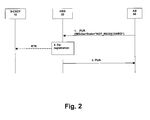
Fig. 2 shows a message signaling and processing diagram indicating a de-registration procedure according to a first preferred embodiment; and -
Fig. 3 shows a message signaling and processing diagram indicating a barring procedure according to a second preferred embodiment. - The preferred embodiments will now be described on the basis of an event package subscription in an IMS network architecture as shown in
Fig. 1 . - The IMS architecture shown in
Fig. 1 refers to a set of core network entities using the services provided by the packet-switched domain to offer multimedia services. TheHSS 20 is the master database for a given user and includes the functions of conventional home location registers (HLRs) as well as new functionalities specified to IP networks, such as the IMS. TheHSS 20 is the entity containing the subscription-related information to support the network entities actually handling calls and/or sessions. - Possible service configurations could comprise the Presence server assigned to the user, the MRFC (Media Resource Function Control) assigned to the user for conference purposes, other ASs which the user specifically might need to contact, e.g. by means of event subscriptions, specific URIs the user needs to register if the user wants to get the benefit of a specific service, e.g. a PTT or POC service.
- According to the preferred embodiments, a mechanism is provided for deactivating a service account associated with the
AS 60 of a registered subscriber within an signaling network supporting IP multimedia services, e.g. the IMS network, where registration status of a subscriber is maintained in a registration server, e.g. theHSS 20, and implementation of the application service is controlled through a call state control server within the IMS network. To achieve this, an account status is monitored within theAS 60, and a deregistration or barring request is forwarded to theHSS 20 over an interface, e.g. the Sh interface, directly coupling theAS 60 and theHSS 20 upon determining that disruption or termination of service is required. The de-registration or barring request is received at theHSS 20, and the de-registration or barring request is implemented by changing the registration status within a subscribers profile. Hence, theAS 60 can request theHSS 20 to bar and/or de-register a user's public identity or identities via the Sh interface. -
Fig. 2 shows a schematic signaling diagram according to the first preferred embodiment where theAS 60 can initiate de-registration of a service account of a user. In case of de-registration, updating of user's registration status can be enabled via Sh interface and theAS 60 will send a Profile-Update-Request (PUR) Sh Diameter command to the HSS 20 (step 1). The PUR contains User-Data AVP in XML format, which contains the updated registration status, e.g. IMS User State XML tag, with a value "NOT_REGISTERED". This is interpreted by theHSS 20 as a de-registration of the corresponding IMS user. The de-registration covers the whole implicitly registered public identity set to which the public identity included in the PUR command belongs to. When theHSS 20 has successfully updated the registration status of the user (step 2), it acknowledges the updating with command Profile-Update-Answer (PUA) to the AS 60 (step 3). If necessary, theHSS 20 may initiate a de-registration procedure (e.g., RTR command) towards the S-CSCF 10 via the Cx interface. -
Fig. 3 shows a schematic signaling diagram according to the second preferred embodiment where theAS 60 can initiate barring of a service account of a user. In case of barring, the updating of barring indication in theHSS 20 can be enabled within the PUR command and an XML tag "Barring Indication" is added to the definition of IMS Public Identity tag (step 1). The "Barring Indication" can use the same definition, which is used in the Cx interface and it can have values "0" (false) and "1" (true). When theAS 60 wants to bar a public identity it sends a PUR command to theHSS 20. The PUR contains the public identities to be barred and their corresponding barring indications. TheHSS 20 will update its data according the PUR (step 2) and after successful updating it will acknowledge updating to theAS 60 with a PUA command (step 3). If necessary, theHSS 20 may initiate a profile update procedure (PPR) towards the S-CSCF 10 via the Cx interface. - It is noted that the present invention is not restricted to the preferred embodiments described above. The present invention may be implemented in any data network, where a barring or de-registration procedure can be initiated via an interface between an application server and a subscriber server or database. In particular, the de-registration may be performed via other interfaces, such as for example Gm reference points. The embodiments may thus vary within the scope of the attached claims.
Claims (12)
- A method comprising:a) receiving at a registration server (20) via a direct interface from an application server (60) a request for de-registration or barring, said registration server (20) maintaining a registration status of a subscriber within a signaling network supporting IP based services; andb) changing the registration status of said subscriber so as to de-register said subscriber at said registration server in response to said de-registration request, or, respectively, changing the barring indication of said subscriber so as to bar said subscriber at said registration server in response to said barring request.
- A method comprising:a) monitoring a status of a service account associated with an application server (60) of a registered subscriber within a signaling network supporting IP based services;b) forwarding a request for de-registration or barring from said application server (60) via a direct interface to a registration server (20), which maintains a registration status of said subscriber, upon determining that disruption or termination of service is required, so as to de-register said subscriber at said registration server in response to said de-registration request, or, respectively, to change the barring indication of said subscriber so as to bar said subscriber at said registration server (20) in response to said barring request.
- A method according to claim 2, wherein said forwarding step comprises forwarding said de-registration or barring request over an interface directly coupling said application server (60) and said registration server (20).
- A method according to claim 2 or 3, wherein said forwarding step comprises forwarding said request to said registration server comprising a Home Subscriber Server (20) of an IP Multimedia Subsystem.
- A method according to claim 4, wherein said forwarding step comprises forwarding said request over said interface comprising an Sh reference point.
- A method according to claim 4 or 5, wherein said forwarding step comprises forwarding said request in a profile update request command.
- A method according to claim 6, further comprising the step of indicating de-registration by setting an updated registration status to a predetermined value.
- A method according to claim 6 or 7, further comprising the step of indicating barring by adding a barring indication to a definition of a public identity.
- An apparatus configured to receive via a direct interface from an application server (60) a request for de-registration or barring, said apparatus (20) maintaining a registration status of a subscriber within a signaling network supporting IP based services, and being further configured to change the registration status of said subscriber so as to de-register said subscriber in response to said de-registration request, or, respectively, changing the barring indication of said subscriber so as to bar said subscriber at said registration server in response to said barring request.
- An apparatus according to claim 9, wherein said apparatus is a home subscriber server (20).
- An apparatus configured to monitor a status of an associated service account of a registered subscriber within a signaling network supporting IP based services, and to forward a request for de-registration or barring from said apparatus (60) via a direct interface to a registration server (20), which maintains a registration status of said subscriber, upon determining that disruption or termination of service is required, so as to de-register said subscriber at said registration server in response to said de-registration request, or, respectively, to change the barring indication of said subscriber so as to bar said subscriber at said registration server (20) in response to said barring request.
- An apparatus according to claim 11, wherein said apparatus is an application server (60).
Priority Applications (1)
| Application Number | Priority Date | Filing Date | Title |
|---|---|---|---|
| EP08011181A EP1962543A1 (en) | 2003-03-31 | 2004-03-11 | Method and system for deactivating a service account |
Applications Claiming Priority (6)
| Application Number | Priority Date | Filing Date | Title |
|---|---|---|---|
| EP03007278 | 2003-03-31 | ||
| EP03027494 | 2003-12-01 | ||
| US10/776,513 US20040234060A1 (en) | 2003-03-31 | 2004-02-12 | Method and system for deactivating a service account |
| US10/787,974 US20040205212A1 (en) | 2003-03-31 | 2004-02-27 | Method and system for forwarding a service-related information to a network user |
| EP08011181A EP1962543A1 (en) | 2003-03-31 | 2004-03-11 | Method and system for deactivating a service account |
| EP04719540A EP1611761B1 (en) | 2003-03-31 | 2004-03-11 | Method and system for deactivating a service account |
Related Parent Applications (1)
| Application Number | Title | Priority Date | Filing Date |
|---|---|---|---|
| EP04719540A Division EP1611761B1 (en) | 2003-03-31 | 2004-03-11 | Method and system for deactivating a service account |
Publications (1)
| Publication Number | Publication Date |
|---|---|
| EP1962543A1 true EP1962543A1 (en) | 2008-08-27 |
Family
ID=33454319
Family Applications (2)
| Application Number | Title | Priority Date | Filing Date |
|---|---|---|---|
| EP04719540A Expired - Lifetime EP1611761B1 (en) | 2003-03-31 | 2004-03-11 | Method and system for deactivating a service account |
| EP08011181A Withdrawn EP1962543A1 (en) | 2003-03-31 | 2004-03-11 | Method and system for deactivating a service account |
Family Applications Before (1)
| Application Number | Title | Priority Date | Filing Date |
|---|---|---|---|
| EP04719540A Expired - Lifetime EP1611761B1 (en) | 2003-03-31 | 2004-03-11 | Method and system for deactivating a service account |
Country Status (5)
| Country | Link |
|---|---|
| US (1) | US20040234060A1 (en) |
| EP (2) | EP1611761B1 (en) |
| AT (1) | ATE403360T1 (en) |
| DE (1) | DE602004015436D1 (en) |
| WO (1) | WO2004089023A1 (en) |
Families Citing this family (25)
| Publication number | Priority date | Publication date | Assignee | Title |
|---|---|---|---|---|
| US20060003762A1 (en) * | 2004-06-22 | 2006-01-05 | General Motors Corporation | Method and system for telematically deactivating satellite radio systems |
| US7453876B2 (en) * | 2004-09-30 | 2008-11-18 | Lucent Technologies Inc. | Method and apparatus for providing distributed SLF routing capability in an internet multimedia subsystem (IMS) network |
| CN100461953C (en) * | 2004-12-10 | 2009-02-11 | 华为技术有限公司 | Method and system for determining when to initiate a deregistration process |
| EP1846832B1 (en) * | 2004-12-17 | 2012-04-11 | Tekelec | Methods, systems, and computer program products for clustering and communicating between internet protocol multimedia subsystem (IMS) entities |
| CN100382503C (en) * | 2005-06-20 | 2008-04-16 | 华为技术有限公司 | A method for handling exceptions during user registration |
| CN1905472B (en) * | 2005-07-27 | 2010-05-05 | 华为技术有限公司 | A Method for Realizing IMS Network Reliability |
| US8799490B2 (en) * | 2005-08-26 | 2014-08-05 | Hewlett-Packard Development Company, L.P. | Automated application server (AS) permissions provisioning |
| US8213411B2 (en) * | 2005-08-26 | 2012-07-03 | Hewlett-Packard Development Company, L.P. | Charging database with class of service (COS) |
| US7783618B2 (en) | 2005-08-26 | 2010-08-24 | Hewlett-Packard Development Company, L.P. | Application server (AS) database with class of service (COS) |
| CN100581286C (en) * | 2005-10-19 | 2010-01-13 | 华为技术有限公司 | Method and system for implementing mobile internet protocol de-registration of mobile user equipment |
| CN101031139B (en) * | 2006-03-03 | 2010-09-29 | 华为技术有限公司 | Method for call control entity to release session |
| EP2096823B1 (en) * | 2006-03-21 | 2015-02-25 | TELEFONAKTIEBOLAGET LM ERICSSON (publ) | Methods and apparatus for registering a user to an IMS on the user's behalf by a SIP Application Server |
| US20080014961A1 (en) * | 2006-07-12 | 2008-01-17 | Tekelec | Methods, systems, and computer program products for providing geographically diverse IP multimedia subsystem (IMS) instances |
| US8149725B2 (en) * | 2006-07-31 | 2012-04-03 | Tekelec | Methods, systems, and computer program products for a hierarchical, redundant OAM&P architecture for use in an IP multimedia subsystem (IMS) network |
| CN101132556B (en) * | 2007-09-24 | 2011-05-25 | 中兴通讯股份有限公司 | Registration method used for IP multimedia subsystem |
| CN101577634B (en) * | 2008-05-07 | 2012-01-25 | 华为技术有限公司 | Network-quitting method, network side management device and network system of multi-host system |
| US20110117914A1 (en) * | 2009-11-12 | 2011-05-19 | Electronics And Telecommunications Research Institute | Method and apparatus for deregistration of personal network element(pne) in 3gpp personal network(pn) |
| CN101820674A (en) * | 2010-05-10 | 2010-09-01 | 中兴通讯股份有限公司 | Method and system for logging off users |
| US9021069B2 (en) * | 2012-06-27 | 2015-04-28 | Amazon Technologies, Inc. | Preventing deregistration from fleet accounts |
| US8494488B1 (en) | 2012-10-19 | 2013-07-23 | Research In Motion Limited | System and method for managing access to a service for communication device |
| EP2733905B1 (en) * | 2012-11-16 | 2018-08-22 | Vodafone Group PLC | Method, system and devices for managing user registration of a service in an IMS network |
| ES2862908T3 (en) * | 2012-11-16 | 2021-10-08 | Vodafone Espana Sau | Method, system and devices for user provisioning management of a service in an IMS network |
| US20140162644A1 (en) * | 2012-12-11 | 2014-06-12 | Innovative Sonic Corporation | Method and apparatus for proximity service enhancement in a wireless communication system |
| WO2017108116A1 (en) * | 2015-12-22 | 2017-06-29 | Telefonaktiebolaget Lm Ericsson (Publ) | Controlling implentation of services in a mobile telecommunications network |
| GB2630674A (en) * | 2023-05-11 | 2024-12-04 | Samsung Electronics Co Ltd | Improvements in and relating to a telecommunication system |
Family Cites Families (15)
| Publication number | Priority date | Publication date | Assignee | Title |
|---|---|---|---|---|
| US6535493B1 (en) * | 1998-01-15 | 2003-03-18 | Symbol Technologies, Inc. | Mobile internet communication protocol |
| EP1120979A1 (en) * | 2000-01-24 | 2001-08-01 | BRITISH TELECOMMUNICATIONS public limited company | Communications network |
| WO2001086492A1 (en) * | 2000-05-05 | 2001-11-15 | Abm Industries Pty. Ltd. | End user to mobile service provider message exchange system based on proximity |
| US6456234B1 (en) * | 2000-06-07 | 2002-09-24 | William J. Johnson | System and method for proactive content delivery by situation location |
| US20020037723A1 (en) * | 2000-06-08 | 2002-03-28 | Adam Roach | Refreshing service profile information using third-party SIP register messages |
| US6950650B2 (en) * | 2001-02-12 | 2005-09-27 | Siemens Ag | System and method for call forwarding synchronization in a communication system |
| US6920318B2 (en) * | 2001-03-22 | 2005-07-19 | Siemens Communications, Inc. | Method and system for providing message services in a communication system |
| DE10116547A1 (en) * | 2001-04-03 | 2002-10-10 | Nokia Corp | Registration of a terminal in a data network |
| US6810243B2 (en) * | 2001-04-30 | 2004-10-26 | Lucent Technologies Inc. | Surrogate service attendant |
| EP1391097A1 (en) * | 2001-05-28 | 2004-02-25 | Nokia Corporation | Charging in telecommunications network |
| US7028089B2 (en) * | 2001-09-21 | 2006-04-11 | International Business Machines Corporation | Method and apparatus for caching subscribed and non-subscribed content in a network data processing system |
| US7987270B2 (en) * | 2001-11-05 | 2011-07-26 | Spyder Navigations L.L.C. | Apparatus, and associated method, for facilitating QoS and bearer setup in an IP-based communication system |
| US7818409B2 (en) * | 2002-01-22 | 2010-10-19 | Alcatel-Lucent Usa Inc. | Dynamic virtual private network system and methods |
| US6868282B2 (en) * | 2002-03-26 | 2005-03-15 | Ericsson, Inc. | Method and apparatus for accessing a network using remote subscriber identity information |
| US8121597B2 (en) * | 2002-03-27 | 2012-02-21 | Nokia Siemens Networks Oy | Method of registering and deregistering a user |
-
2004
- 2004-02-12 US US10/776,513 patent/US20040234060A1/en not_active Abandoned
- 2004-03-11 WO PCT/IB2004/000693 patent/WO2004089023A1/en not_active Ceased
- 2004-03-11 AT AT04719540T patent/ATE403360T1/en not_active IP Right Cessation
- 2004-03-11 DE DE602004015436T patent/DE602004015436D1/en not_active Expired - Lifetime
- 2004-03-11 EP EP04719540A patent/EP1611761B1/en not_active Expired - Lifetime
- 2004-03-11 EP EP08011181A patent/EP1962543A1/en not_active Withdrawn
Non-Patent Citations (2)
| Title |
|---|
| "3rd Generation Partnership Project; Technical Specification Group Services and System Aspects; IP Multimedia Subsystem (IMS); Stage 2 (Release 5)", 3GPP TS 23.228 V6.0.0, January 2003 (2003-01-01), pages 1 - 128, XP002279519 * |
| "Digital cellular telecommunications system (Phase 2+); Universal Mobile Telecommunications System (UMTS); IP Multimedia Subsystem (IMS) Sh interface signalling flows and message contents (3GPP TS 29.328 version 5.2.1 Release 5", ETSI TS 129 328 V5.2.1, January 2003 (2003-01-01), XP014009665 * |
Also Published As
| Publication number | Publication date |
|---|---|
| ATE403360T1 (en) | 2008-08-15 |
| WO2004089023A1 (en) | 2004-10-14 |
| EP1611761B1 (en) | 2008-07-30 |
| DE602004015436D1 (en) | 2008-09-11 |
| US20040234060A1 (en) | 2004-11-25 |
| EP1611761A1 (en) | 2006-01-04 |
Similar Documents
| Publication | Publication Date | Title |
|---|---|---|
| EP1611761B1 (en) | Method and system for deactivating a service account | |
| EP1606913B1 (en) | Method, system and network device for routing a message to a temporarily unavailable network user | |
| EP1470684B1 (en) | Method and system for changing a subscription | |
| US7853697B2 (en) | Handling suspended network state of a terminal device | |
| US20040205212A1 (en) | Method and system for forwarding a service-related information to a network user | |
| US7650149B2 (en) | User registration in a communication system | |
| CN101297531B (en) | Providing IMS service through circuit switching access | |
| EP1388270B1 (en) | Indicating a user equipment that it must register | |
| US20050227685A1 (en) | Sip based call setup | |
| US8768259B2 (en) | Method and apparatus for collecting user activity in a telecommunications system | |
| EP1873980B1 (en) | Interrogating network element for an IMS data network | |
| CN100586110C (en) | Method, system and network device for routing a message to a temporarily unavailable network user | |
| CN101765102B (en) | Method for changing subscription and system | |
| HK1097129B (en) | Method, system and network device for routing a message to a temporality unavailable network user |
Legal Events
| Date | Code | Title | Description |
|---|---|---|---|
| PUAI | Public reference made under article 153(3) epc to a published international application that has entered the european phase |
Free format text: ORIGINAL CODE: 0009012 |
|
| AC | Divisional application: reference to earlier application |
Ref document number: 1611761 Country of ref document: EP Kind code of ref document: P |
|
| AK | Designated contracting states |
Kind code of ref document: A1 Designated state(s): AT BE BG CH CY CZ DE DK EE ES FI FR GB GR HU IE IT LI LU MC NL PL PT RO SE SI SK TR |
|
| 17P | Request for examination filed |
Effective date: 20090227 |
|
| AKX | Designation fees paid |
Designated state(s): AT BE BG CH CY CZ DE DK EE ES FI FR GB GR HU IE IT LI LU MC NL PL PT RO SE SI SK TR |
|
| 17Q | First examination report despatched |
Effective date: 20111110 |
|
| STAA | Information on the status of an ep patent application or granted ep patent |
Free format text: STATUS: THE APPLICATION IS DEEMED TO BE WITHDRAWN |
|
| 18D | Application deemed to be withdrawn |
Effective date: 20120321 |