EP1962293A1 - Conductive Materials - Google Patents
Conductive Materials Download PDFInfo
- Publication number
- EP1962293A1 EP1962293A1 EP08002978A EP08002978A EP1962293A1 EP 1962293 A1 EP1962293 A1 EP 1962293A1 EP 08002978 A EP08002978 A EP 08002978A EP 08002978 A EP08002978 A EP 08002978A EP 1962293 A1 EP1962293 A1 EP 1962293A1
- Authority
- EP
- European Patent Office
- Prior art keywords
- electrically conductive
- particles
- silver
- polymer
- conductive filler
- Prior art date
- Legal status (The legal status is an assumption and is not a legal conclusion. Google has not performed a legal analysis and makes no representation as to the accuracy of the status listed.)
- Granted
Links
- 239000004020 conductor Substances 0.000 title claims abstract description 7
- 239000002245 particle Substances 0.000 claims abstract description 92
- 239000000203 mixture Substances 0.000 claims abstract description 75
- 229920000642 polymer Polymers 0.000 claims abstract description 70
- 239000011231 conductive filler Substances 0.000 claims abstract description 47
- 239000006185 dispersion Substances 0.000 claims abstract description 13
- 239000007788 liquid Substances 0.000 claims abstract description 8
- 239000000945 filler Substances 0.000 claims abstract description 7
- 238000010438 heat treatment Methods 0.000 claims abstract description 7
- BQCADISMDOOEFD-UHFFFAOYSA-N Silver Chemical compound [Ag] BQCADISMDOOEFD-UHFFFAOYSA-N 0.000 claims description 58
- 229910052709 silver Inorganic materials 0.000 claims description 45
- 239000004332 silver Substances 0.000 claims description 45
- 239000000839 emulsion Substances 0.000 claims description 18
- 238000000034 method Methods 0.000 claims description 12
- 238000000576 coating method Methods 0.000 claims description 11
- PXHVJJICTQNCMI-UHFFFAOYSA-N Nickel Chemical compound [Ni] PXHVJJICTQNCMI-UHFFFAOYSA-N 0.000 claims description 10
- 229920000126 latex Polymers 0.000 claims description 8
- 229920002689 polyvinyl acetate Polymers 0.000 claims description 7
- 239000011118 polyvinyl acetate Substances 0.000 claims description 7
- 239000000843 powder Substances 0.000 claims description 7
- RYGMFSIKBFXOCR-UHFFFAOYSA-N Copper Chemical compound [Cu] RYGMFSIKBFXOCR-UHFFFAOYSA-N 0.000 claims description 6
- 229910052782 aluminium Inorganic materials 0.000 claims description 6
- XAGFODPZIPBFFR-UHFFFAOYSA-N aluminium Chemical compound [Al] XAGFODPZIPBFFR-UHFFFAOYSA-N 0.000 claims description 6
- 229910052802 copper Inorganic materials 0.000 claims description 6
- 239000010949 copper Substances 0.000 claims description 6
- 238000001035 drying Methods 0.000 claims description 6
- 239000004816 latex Substances 0.000 claims description 5
- OKTJSMMVPCPJKN-UHFFFAOYSA-N Carbon Chemical compound [C] OKTJSMMVPCPJKN-UHFFFAOYSA-N 0.000 claims description 4
- KDLHZDBZIXYQEI-UHFFFAOYSA-N Palladium Chemical compound [Pd] KDLHZDBZIXYQEI-UHFFFAOYSA-N 0.000 claims description 4
- PPBRXRYQALVLMV-UHFFFAOYSA-N Styrene Chemical compound C=CC1=CC=CC=C1 PPBRXRYQALVLMV-UHFFFAOYSA-N 0.000 claims description 4
- 229920001577 copolymer Polymers 0.000 claims description 4
- PCHJSUWPFVWCPO-UHFFFAOYSA-N gold Chemical compound [Au] PCHJSUWPFVWCPO-UHFFFAOYSA-N 0.000 claims description 4
- 229910052737 gold Inorganic materials 0.000 claims description 4
- 239000010931 gold Substances 0.000 claims description 4
- 229910052759 nickel Inorganic materials 0.000 claims description 4
- BASFCYQUMIYNBI-UHFFFAOYSA-N platinum Chemical compound [Pt] BASFCYQUMIYNBI-UHFFFAOYSA-N 0.000 claims description 4
- NDVLTYZPCACLMA-UHFFFAOYSA-N silver oxide Chemical compound [O-2].[Ag+].[Ag+] NDVLTYZPCACLMA-UHFFFAOYSA-N 0.000 claims description 4
- 229920003048 styrene butadiene rubber Polymers 0.000 claims description 4
- NIXOWILDQLNWCW-UHFFFAOYSA-M Acrylate Chemical compound [O-]C(=O)C=C NIXOWILDQLNWCW-UHFFFAOYSA-M 0.000 claims description 3
- 239000011248 coating agent Substances 0.000 claims description 3
- 239000000758 substrate Substances 0.000 claims description 3
- 229920000049 Carbon (fiber) Polymers 0.000 claims description 2
- 244000043261 Hevea brasiliensis Species 0.000 claims description 2
- HCHKCACWOHOZIP-UHFFFAOYSA-N Zinc Chemical compound [Zn] HCHKCACWOHOZIP-UHFFFAOYSA-N 0.000 claims description 2
- 229910052787 antimony Inorganic materials 0.000 claims description 2
- WATWJIUSRGPENY-UHFFFAOYSA-N antimony atom Chemical compound [Sb] WATWJIUSRGPENY-UHFFFAOYSA-N 0.000 claims description 2
- 229920005549 butyl rubber Polymers 0.000 claims description 2
- QXJJQWWVWRCVQT-UHFFFAOYSA-K calcium;sodium;phosphate Chemical compound [Na+].[Ca+2].[O-]P([O-])([O-])=O QXJJQWWVWRCVQT-UHFFFAOYSA-K 0.000 claims description 2
- 239000006229 carbon black Substances 0.000 claims description 2
- 239000004917 carbon fiber Substances 0.000 claims description 2
- 239000002041 carbon nanotube Substances 0.000 claims description 2
- 229910021393 carbon nanotube Inorganic materials 0.000 claims description 2
- 239000000835 fiber Substances 0.000 claims description 2
- 229910002804 graphite Inorganic materials 0.000 claims description 2
- 239000010439 graphite Substances 0.000 claims description 2
- AMGQUBHHOARCQH-UHFFFAOYSA-N indium;oxotin Chemical compound [In].[Sn]=O AMGQUBHHOARCQH-UHFFFAOYSA-N 0.000 claims description 2
- 239000011133 lead Substances 0.000 claims description 2
- 229910001092 metal group alloy Inorganic materials 0.000 claims description 2
- VNWKTOKETHGBQD-UHFFFAOYSA-N methane Chemical compound C VNWKTOKETHGBQD-UHFFFAOYSA-N 0.000 claims description 2
- 239000002077 nanosphere Substances 0.000 claims description 2
- 229920003052 natural elastomer Polymers 0.000 claims description 2
- 229920001194 natural rubber Polymers 0.000 claims description 2
- 239000003960 organic solvent Substances 0.000 claims description 2
- 229910052763 palladium Inorganic materials 0.000 claims description 2
- 229910052697 platinum Inorganic materials 0.000 claims description 2
- 229920001200 poly(ethylene-vinyl acetate) Polymers 0.000 claims description 2
- 229920002635 polyurethane Polymers 0.000 claims description 2
- 239000004814 polyurethane Substances 0.000 claims description 2
- 229910001923 silver oxide Inorganic materials 0.000 claims description 2
- XOLBLPGZBRYERU-UHFFFAOYSA-N tin dioxide Chemical compound O=[Sn]=O XOLBLPGZBRYERU-UHFFFAOYSA-N 0.000 claims description 2
- 229910001887 tin oxide Inorganic materials 0.000 claims description 2
- 229910052725 zinc Inorganic materials 0.000 claims description 2
- 239000011701 zinc Substances 0.000 claims description 2
- 239000012799 electrically-conductive coating Substances 0.000 claims 3
- 239000000463 material Substances 0.000 abstract description 16
- 238000005325 percolation Methods 0.000 abstract description 9
- 229910052751 metal Inorganic materials 0.000 abstract description 7
- 239000002184 metal Substances 0.000 abstract description 7
- 239000011159 matrix material Substances 0.000 abstract description 3
- 238000009472 formulation Methods 0.000 description 21
- 238000000137 annealing Methods 0.000 description 18
- XLYOFNOQVPJJNP-UHFFFAOYSA-N water Substances O XLYOFNOQVPJJNP-UHFFFAOYSA-N 0.000 description 9
- 238000002411 thermogravimetry Methods 0.000 description 7
- KFZMGEQAYNKOFK-UHFFFAOYSA-N Isopropanol Chemical compound CC(C)O KFZMGEQAYNKOFK-UHFFFAOYSA-N 0.000 description 4
- 239000004615 ingredient Substances 0.000 description 4
- VVQNEPGJFQJSBK-UHFFFAOYSA-N Methyl methacrylate Chemical compound COC(=O)C(C)=C VVQNEPGJFQJSBK-UHFFFAOYSA-N 0.000 description 3
- 230000000052 comparative effect Effects 0.000 description 3
- 239000011521 glass Substances 0.000 description 3
- 238000011068 loading method Methods 0.000 description 3
- 238000005245 sintering Methods 0.000 description 3
- 239000002904 solvent Substances 0.000 description 3
- QGZKDVFQNNGYKY-UHFFFAOYSA-N Ammonia Chemical compound N QGZKDVFQNNGYKY-UHFFFAOYSA-N 0.000 description 2
- RTZKZFJDLAIYFH-UHFFFAOYSA-N Diethyl ether Chemical compound CCOCC RTZKZFJDLAIYFH-UHFFFAOYSA-N 0.000 description 2
- LYCAIKOWRPUZTN-UHFFFAOYSA-N Ethylene glycol Chemical compound OCCO LYCAIKOWRPUZTN-UHFFFAOYSA-N 0.000 description 2
- FOIXSVOLVBLSDH-UHFFFAOYSA-N Silver ion Chemical compound [Ag+] FOIXSVOLVBLSDH-UHFFFAOYSA-N 0.000 description 2
- MCMNRKCIXSYSNV-UHFFFAOYSA-N Zirconium dioxide Chemical compound O=[Zr]=O MCMNRKCIXSYSNV-UHFFFAOYSA-N 0.000 description 2
- 239000000853 adhesive Substances 0.000 description 2
- 230000001070 adhesive effect Effects 0.000 description 2
- CQEYYJKEWSMYFG-UHFFFAOYSA-N butyl acrylate Chemical compound CCCCOC(=O)C=C CQEYYJKEWSMYFG-UHFFFAOYSA-N 0.000 description 2
- 150000002739 metals Chemical group 0.000 description 2
- 239000007787 solid Substances 0.000 description 2
- NJVOHKFLBKQLIZ-UHFFFAOYSA-N (2-ethenylphenyl) prop-2-enoate Chemical compound C=CC(=O)OC1=CC=CC=C1C=C NJVOHKFLBKQLIZ-UHFFFAOYSA-N 0.000 description 1
- GOXQRTZXKQZDDN-UHFFFAOYSA-N 2-Ethylhexyl acrylate Chemical compound CCCCC(CC)COC(=O)C=C GOXQRTZXKQZDDN-UHFFFAOYSA-N 0.000 description 1
- 229920013683 Celanese Polymers 0.000 description 1
- LFQSCWFLJHTTHZ-UHFFFAOYSA-N Ethanol Chemical compound CCO LFQSCWFLJHTTHZ-UHFFFAOYSA-N 0.000 description 1
- CERQOIWHTDAKMF-UHFFFAOYSA-N Methacrylic acid Chemical compound CC(=C)C(O)=O CERQOIWHTDAKMF-UHFFFAOYSA-N 0.000 description 1
- 239000004698 Polyethylene Substances 0.000 description 1
- 229910021529 ammonia Inorganic materials 0.000 description 1
- 239000011324 bead Substances 0.000 description 1
- 230000015572 biosynthetic process Effects 0.000 description 1
- 229940045348 brown mixture Drugs 0.000 description 1
- 230000003247 decreasing effect Effects 0.000 description 1
- 239000008367 deionised water Substances 0.000 description 1
- 229910021641 deionized water Inorganic materials 0.000 description 1
- 150000002334 glycols Chemical class 0.000 description 1
- WGCNASOHLSPBMP-UHFFFAOYSA-N hydroxyacetaldehyde Natural products OCC=O WGCNASOHLSPBMP-UHFFFAOYSA-N 0.000 description 1
- 239000000976 ink Substances 0.000 description 1
- 238000002844 melting Methods 0.000 description 1
- 230000008018 melting Effects 0.000 description 1
- 239000002923 metal particle Substances 0.000 description 1
- 238000003801 milling Methods 0.000 description 1
- 238000002156 mixing Methods 0.000 description 1
- 238000012986 modification Methods 0.000 description 1
- 230000004048 modification Effects 0.000 description 1
- 239000002105 nanoparticle Substances 0.000 description 1
- 239000011368 organic material Substances 0.000 description 1
- 238000012856 packing Methods 0.000 description 1
- 125000001997 phenyl group Chemical group [H]C1=C([H])C([H])=C(*)C([H])=C1[H] 0.000 description 1
- -1 polyethylene Polymers 0.000 description 1
- 229920000573 polyethylene Polymers 0.000 description 1
- 239000002861 polymer material Substances 0.000 description 1
- 238000012545 processing Methods 0.000 description 1
- 230000031070 response to heat Effects 0.000 description 1
- 239000000523 sample Substances 0.000 description 1
- 239000000126 substance Substances 0.000 description 1
- 238000012360 testing method Methods 0.000 description 1
Images


Classifications
-
- H—ELECTRICITY
- H01—ELECTRIC ELEMENTS
- H01B—CABLES; CONDUCTORS; INSULATORS; SELECTION OF MATERIALS FOR THEIR CONDUCTIVE, INSULATING OR DIELECTRIC PROPERTIES
- H01B1/00—Conductors or conductive bodies characterised by the conductive materials; Selection of materials as conductors
- H01B1/02—Conductors or conductive bodies characterised by the conductive materials; Selection of materials as conductors mainly consisting of metals or alloys
-
- H—ELECTRICITY
- H01—ELECTRIC ELEMENTS
- H01B—CABLES; CONDUCTORS; INSULATORS; SELECTION OF MATERIALS FOR THEIR CONDUCTIVE, INSULATING OR DIELECTRIC PROPERTIES
- H01B1/00—Conductors or conductive bodies characterised by the conductive materials; Selection of materials as conductors
- H01B1/20—Conductive material dispersed in non-conductive organic material
- H01B1/22—Conductive material dispersed in non-conductive organic material the conductive material comprising metals or alloys
Definitions
- the present invention relates to conductive materials for use in electronic devices.
- the materials comprise polymer particles, conductive particles and a liquid medium which dissipates upon curing to provide a conductive film.
- Conductive materials are utilized in many different electronics applications. Such materials are commonly polymer-based and contain metal conductive fillers such as silver powder or silver flakes. After application and curing, the conductive metals form a percolated network within the polymer matrix, which provides the electrical conducting channels.
- Typical electronic coatings and conductive adhesives require conductive filler loadings which are very high, with the conductive filler often comprising about 70 - 85 weight percent of the composition due to a high percolation threshold.
- Such coatings and adhesive are frequently very expensive due to the high cost of conductive metals, which are usually the most expensive component in conductive compositions, as opposed to the relatively low cost of polymers. Consequently, it would be advantageous to provide a lower cost conductive composition with a reduced volume of metal conductive filler material.
- the present invention is directed to a material for producing a conductive composition
- a material for producing a conductive composition comprising polymer particles, conductive particles and a liquid medium.
- the material is in a liquid/emulsion form until it is cured at which time it forms an electrically conductive composition.
- the composition contains larger-sized polymer particles along with smaller metal or other conductive filler particles such as nanoparticle-sized filler particles.
- the larger polymer particles create excluded volume in the material matrix and reduce the percolation threshold of the conductive filler particles to provide a conductive material with a reduced volume fraction of electrically conductive filler.
- the electrical conductivity of the material is further increased after heat treatment which causes the metal conductive filler particles to sinter together to form a highly conductive network.
- Percolated filler networks containing polymer materials in combination with conductive filler particles are commonly utilized in applications requiring electrical conductivity.
- the conductive filler materials are substantially more expensive than the polymer filler materials.
- the percolation threshold of the smaller particles is significantly reduced.
- the use of larger sized polymer particles to create excluded volume between the particles reduces the amount of smaller sized conductive filler material needed to form a conductive network
- conductive filler particles are used along with polymer emulsions containing polymer particles that are larger in size than the conductive filler particles.
- the average size of the conductive filler particles may vary and may be in the range of about 5 nanometers to about 5 microns in diameter.
- the size of the conductive particles must be such that they are smaller than the polymer particles and also capable of gathering together upon the application of heat, usually at a temperature greater than about 100°C, to form a conductive network.
- the conductive filler particles are less than about 500 nm in size and sinter together upon sufficient heating. Small metal particles, such as those in the nanoparticle range, have much lower sintering temperatures than micron-sized or bulk metal.
- the sintering temperature of the composition varies depending upon the type, size and surface chemistry of the filler. Any sintering that occurs generally enhances the conductivity of the network.
- the average size of the polymer particles should be at least about 1.5 times larger than the size of the conductive filler particles so that the conductive filler/polymer particle size ratio is at least 1.5:1. Further embodiments have ratios of 5:1 and 20:1. Larger ratios may also be employed as desired.
- One or more conductive fillers are utilized in the composition.
- Exemplary conductive fillers include, but are not limited to, silver, copper, gold, palladium, platinum, nickel, gold or silver-coated nickel, carbon black, lead, zinc, metal alloys, carbon fiber, graphite, aluminum, indium tin oxide, silver coated copper, silver oxide, silver coated aluminum, metallic coated glass spheres, metallic coated filler, metallic coated polymers, silver coated fiber, silver coated spheres, antimony doped tin oxide, conductive nanospheres, nano silver, nano aluminum, nano copper, nano nickel, carbon nanotubes and mixtures thereof.
- the polymer particle portion of the composition may comprise aqueous polymer emulsions or polymer particles dispersed in organic solvents.
- Preferred polymer particles are polymer latexes which decrease the percolation threshold of the conductive filler by deforming in response to heat and/or pressure to reduce the size of the interstitial spaces between the polymer particles.
- One or more different polymers may be used in the composition.
- Exemplary polymers that may be utilized include polyvinyl acetate, ethylene vinyl acetate copolymers, acrylate, acrylic ester copolymers, styrene, styrene acrylate copolymers, polyurethane, rubber latexes, including natural rubber, butyl rubber and styrene butadiene rubber, and copolymers and mixtures thereof.
- the polymer particles are preferably in the form of an emulsion or dispersion which is compatible with the conductive fillers.
- the conductive filler is in a dispersion which, depending upon the carrier, is either directly added to the emulsion or dispersion or dried to produce a dry conductive filler powder that is added to the polymer emulsion or dispersion.
- the curable mixture is then coated on a substrate and cured via drying. During the drying process, the soft polymer emulsion particles coalesce to form a continuous film which initially provides poor electrical conductivity. Upon the application of heat to the film, the conductive filler particles form an electrically conductive network within the film.
- the heating temperature should be such that it is compatible with the processing temperature of the polymer that is used in the network.
- the conductive filler should be in a dispersion with a solvent such as for example water, alcohol, or glycol.
- Figure 1 illustrates an uncured emulsion network containing larger polymer particles 10 and smaller conductive filler particles 12 and a liquid medium. Interstitial areas 11 surround the larger polymer particles. As shown, the interstitial areas contain many smaller conductive filler particles.
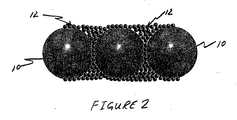
- Figure 2 illustrates the polymer and conductive filler network after drying and film formation. The large polymer particles 10 force the smaller conductive filler particles 12 into a percolated structure that will provide electrical conductivity.
- Figure 3 is a scanning electron microscope photograph of the top surface of the cured film showing the conductive filler network 20 surrounding the polymer particles 21.
- composition of the present invention has utility in many different and varied electronics applications. Such applications include, but are not limited to, conductive inks for conductive tracks, electronic circuitry, radio frequency identification systems, and conductive coatings such as electromagnetic interference shielding and anti-static coatings.
- the composition of the present invention may provide transparent coatings in the situation where the size of the polymer particles before heating or polymer regions after heating are larger than the wavelength of visible light. Such transparent coatings would be advantageous in applications such as for electrodes in electroluminescent lamps and displays.
- Example 1 Compositions 1-4 were made by blending nanosilver, having an average particle size of about 60 nm, dispersions in isopropanol solvent with polyvinyl acetate emulsion having a solid content of 56% and a number average particle size of about 1.4 ⁇ m and a volume mean diameter 2.5 ⁇ m. The size ratio between the polymer number average particle size and silver particle size is about 23:1. The ingredients of each composition are shown in Table 1. Table 1.
- the nanosilver is first dried in a vacuum oven at room temperature to remove the isopropanol solvent and obtain a dry powder.
- the dried nanosilver powder is mixed with the polyvinyl acetate emulsion along with small amounts of deionized water to lower the viscosity.
- Ten grams of Zirconia milling beads (3 mm in diameter) were added to the mixture and the mixture was mixed with a FlackTek Speedmixer at 2700 rpm for two one-minute periods to obtain a smooth dark brown mixture.
- the mixture was then coated on 2 inch x 3 inch glass slides using a drawdown bar with a 2 mil. gap. The coating was dried overnight at room temperature.
- the glass slides containing the dried coating were annealed in air at various temperatures for thirty minutes using convection ovens.
- the resistivity of the coatings after annealing was measured using the 4-point probe method and the silver content was measured using thermogravimetric analysis (TGA).
- TGA thermogravimetric analysis
- a small amount of annealed film was removed from the glass slide and scanned in TGA at temperatures ranging from room temperature to 550°C in air. Organic materials are burnt and removed during the TGA scan. The residual weight at 550°C corresponds to the amount of silver in the film.
- Table 2 shows the annealing conditions, silver content and resistivity for samples 1 - 4 after annealing.
- the silver volume fraction was calculated by using the measured silver weight fraction and the density of silver (10.5 g/cm 3) and the density of the polymer (1.05 g/cm 3 ).
- Example 2 Three compositions were made according to the method of Example 1. Silver particles were utilized with an average particle size in the range of about 0.4 ⁇ m to about 1 ⁇ m resulting in a polymer particle/nanosilver particle size ratio of about 1.5:1 to about 3.5:1. The ingredients of each composition are shown in Table 3. Table 3. Formulation of Compositions 5 - 7 Formulation 5 6 7 Micro silver Powder 1 (g) 2.56 1.36 2.02 Polyvinyl Acetate Emulsion 2 (g) 6.94 2.42 2.45 Water(g) 5.16 3.43 2.09 Calculated Silver Content (%) 39.8 50.0 59.6 1 Silsphere 514, commercially available from Technic, Inc. 2 Dur-O-Set C-325
- Formulations 5 - 7 were coated, dried, heated, and measured according to the procedure of Example 1. Table 4 shows the annealing conditions, silver content, and resistivity for samples 5 - 7 after annealing. Table 4. Properties of Formulations 5 - 7after Annealing Formulation Annealing Conditions Silver Volume Fraction (%) Resistivity ( ⁇ cm) 5 150°C 6.2 Nonconductive 5 170°C 6.2 Nonconductive 6 150°C 9.1 Nonconductive 6 170°C 9.1 10 -2 - 10 0 7 150°C 12.9 5.4x10 -3 7 170°C 12.9 3.2x10 -3
- Table 4 illustrates that when the silver particles are only slightly smaller than the polymer particles the percolation threshold of the silver particles is at least 50% by weight or about 9.1 % by volume. This level is lower than the calculated value for neat spherical conductive particles dispersed in a uniform media.
- Formulations 8 - 10 were coated, dried, heated, and measured according to the procedure of Example 1.
- Table 7 shows the annealing conditions, silver content, and resistivity for samples 8 - 10 after annealing. Table 7. Properties of Formulations 8 - 10 after Annealing Formulation Annealing Conditions Silver Content by TGA (%) Silver Volume Fraction (%) Resistivity ( ⁇ cm) 8 170°C 50.9 9.4 Nonconductive 9 170°C 50.8 9.3 7.3x10 2 10 170°C 45.7 7.8 1.8x10 2
- Table 7 illustrates that the higher the size ratio between the polymer particles and the conductive particles the better the electrical conductivity after annealing with the same silver loading.
- Comparative Example Two compositions were made according to the method of Example 1. A micro silver was utilized with an average particle size in the range of about 1.3 to about 3.2 ⁇ m resulting in a polymer particle/nanosilver particle size ratio of less than one. The ingredients of each composition are shown in Table 8. Table 8. Formulation of Comparative Compositions Formulation 11 12 Microsilver Powder 1 (g) 2.2 3.3 Polyvinyl Acetate Emulsion 2 (g) 4.0 4.0 Water(g) 2.0 2.5 Calculated Silver Content (%) 49.5 59.6 1 Silsphere 519, commercially available from Technic, Inc. 2 Dur-O-Set C-325
- Formulations 11 - 12 were coated, dried, heated and measured according to the procedure of Example 1.
- Table 9 shows the annealing conditions, silver content, and resistivity for samples 11 - 12 after annealing.
- Table 9 shows the annealing conditions, silver content, and resistivity for samples 11 - 12 after annealing.
- Table 9 shows the annealing conditions, silver content, and resistivity for samples 11 - 12 after annealing.
- Table 9 shows the annealing conditions, silver content, and resistivity for samples 11 - 12 after annealing.
- Table 9 shows the annealing conditions, silver content, and resistivity for samples 11 - 12 after annealing.
- Table 9 shows the annealing conditions, silver content, and resistivity for samples 11 - 12 after annealing.
- Table 9 shows the annealing conditions, silver content, and resistivity for samples 11 - 12 after annealing.
- Table 9 shows the annealing conditions, silver content, and resistivity for samples 11 -
Landscapes
- Physics & Mathematics (AREA)
- Chemical & Material Sciences (AREA)
- Dispersion Chemistry (AREA)
- Spectroscopy & Molecular Physics (AREA)
- Conductive Materials (AREA)
- Compositions Of Macromolecular Compounds (AREA)
- Paints Or Removers (AREA)
Abstract
Description
- The present invention relates to conductive materials for use in electronic devices. The materials comprise polymer particles, conductive particles and a liquid medium which dissipates upon curing to provide a conductive film.
- Conductive materials are utilized in many different electronics applications. Such materials are commonly polymer-based and contain metal conductive fillers such as silver powder or silver flakes. After application and curing, the conductive metals form a percolated network within the polymer matrix, which provides the electrical conducting channels. Typical electronic coatings and conductive adhesives require conductive filler loadings which are very high, with the conductive filler often comprising about 70 - 85 weight percent of the composition due to a high percolation threshold. Such coatings and adhesive are frequently very expensive due to the high cost of conductive metals, which are usually the most expensive component in conductive compositions, as opposed to the relatively low cost of polymers. Consequently, it would be advantageous to provide a lower cost conductive composition with a reduced volume of metal conductive filler material.
- The present invention is directed to a material for producing a conductive composition comprising polymer particles, conductive particles and a liquid medium. The material is in a liquid/emulsion form until it is cured at which time it forms an electrically conductive composition. The composition contains larger-sized polymer particles along with smaller metal or other conductive filler particles such as nanoparticle-sized filler particles. The larger polymer particles create excluded volume in the material matrix and reduce the percolation threshold of the conductive filler particles to provide a conductive material with a reduced volume fraction of electrically conductive filler. The electrical conductivity of the material is further increased after heat treatment which causes the metal conductive filler particles to sinter together to form a highly conductive network.
-
-
Figure 1 is a schematic drawing of the packing of polymer particles and conductive filler particles in a liquid medium. -
Figure 2 is a schematic drawing of polymer particles and conductive filler particles after drying. -
Figure 3 is a scanning electron microscope photograph of a film formed according to the present invention - Percolated filler networks containing polymer materials in combination with conductive filler particles are commonly utilized in applications requiring electrical conductivity. Generally, the conductive filler materials are substantially more expensive than the polymer filler materials. Thus, for cost reasons, it is advantageous to minimize the amount of conductive filler material that is utilized in the network. In the situation where two particles of very different sizes are packed together, the percolation threshold of the smaller particles is significantly reduced. Thus, the use of larger sized polymer particles to create excluded volume between the particles reduces the amount of smaller sized conductive filler material needed to form a conductive network
- To form the network, conductive filler particles are used along with polymer emulsions containing polymer particles that are larger in size than the conductive filler particles. The average size of the conductive filler particles may vary and may be in the range of about 5 nanometers to about 5 microns in diameter. The size of the conductive particles must be such that they are smaller than the polymer particles and also capable of gathering together upon the application of heat, usually at a temperature greater than about 100°C, to form a conductive network. Preferably the conductive filler particles are less than about 500 nm in size and sinter together upon sufficient heating. Small metal particles, such as those in the nanoparticle range, have much lower sintering temperatures than micron-sized or bulk metal. For example, silver nanoparticles with a size of less than 500nm sinter at a temperature of around 150°C, which enhances conductivity, while the bulk melting point of silver is 960 °C. The sintering temperature of the composition varies depending upon the type, size and surface chemistry of the filler. Any sintering that occurs generally enhances the conductivity of the network. The average size of the polymer particles should be at least about 1.5 times larger than the size of the conductive filler particles so that the conductive filler/polymer particle size ratio is at least 1.5:1. Further embodiments have ratios of 5:1 and 20:1. Larger ratios may also be employed as desired.
- One or more conductive fillers are utilized in the composition. Exemplary conductive fillers include, but are not limited to, silver, copper, gold, palladium, platinum, nickel, gold or silver-coated nickel, carbon black, lead, zinc, metal alloys, carbon fiber, graphite, aluminum, indium tin oxide, silver coated copper, silver oxide, silver coated aluminum, metallic coated glass spheres, metallic coated filler, metallic coated polymers, silver coated fiber, silver coated spheres, antimony doped tin oxide, conductive nanospheres, nano silver, nano aluminum, nano copper, nano nickel, carbon nanotubes and mixtures thereof. The polymer particle portion of the composition may comprise aqueous polymer emulsions or polymer particles dispersed in organic solvents. Preferred polymer particles are polymer latexes which decrease the percolation threshold of the conductive filler by deforming in response to heat and/or pressure to reduce the size of the interstitial spaces between the polymer particles.
- One or more different polymers may be used in the composition. Exemplary polymers that may be utilized include polyvinyl acetate, ethylene vinyl acetate copolymers, acrylate, acrylic ester copolymers, styrene, styrene acrylate copolymers, polyurethane, rubber latexes, including natural rubber, butyl rubber and styrene butadiene rubber, and copolymers and mixtures thereof.
- To produce a conductive network, the polymer particles are preferably in the form of an emulsion or dispersion which is compatible with the conductive fillers. In a preferred embodiment, the conductive filler is in a dispersion which, depending upon the carrier, is either directly added to the emulsion or dispersion or dried to produce a dry conductive filler powder that is added to the polymer emulsion or dispersion. The curable mixture is then coated on a substrate and cured via drying. During the drying process, the soft polymer emulsion particles coalesce to form a continuous film which initially provides poor electrical conductivity. Upon the application of heat to the film, the conductive filler particles form an electrically conductive network within the film. The heating temperature should be such that it is compatible with the processing temperature of the polymer that is used in the network. In order to maximize the compatibility of the conductive filler with the polymer which may be in emulsion form, the conductive filler should be in a dispersion with a solvent such as for example water, alcohol, or glycol.
-
Figure 1 illustrates an uncured emulsion network containinglarger polymer particles 10 and smallerconductive filler particles 12 and a liquid medium. Interstitial areas 11 surround the larger polymer particles. As shown, the interstitial areas contain many smaller conductive filler particles.Figure 2 illustrates the polymer and conductive filler network after drying and film formation. Thelarge polymer particles 10 force the smallerconductive filler particles 12 into a percolated structure that will provide electrical conductivity.Figure 3 is a scanning electron microscope photograph of the top surface of the cured film showing theconductive filler network 20 surrounding thepolymer particles 21. - The composition of the present invention has utility in many different and varied electronics applications. Such applications include, but are not limited to, conductive inks for conductive tracks, electronic circuitry, radio frequency identification systems, and conductive coatings such as electromagnetic interference shielding and anti-static coatings. The composition of the present invention may provide transparent coatings in the situation where the size of the polymer particles before heating or polymer regions after heating are larger than the wavelength of visible light. Such transparent coatings would be advantageous in applications such as for electrodes in electroluminescent lamps and displays.
- The invention can be further described by the following non-limiting examples.
- Example 1. Compositions 1-4 were made by blending nanosilver, having an average particle size of about 60 nm, dispersions in isopropanol solvent with polyvinyl acetate emulsion having a solid content of 56% and a number average particle size of about 1.4 µm and a volume mean diameter 2.5 µm. The size ratio between the polymer number average particle size and silver particle size is about 23:1. The ingredients of each composition are shown in Table 1.
Table 1. Formulation of Compositions A - D Formulation 1 2 3 4 Nanosilver powder1(g) 0.97 1.22 2.03 2.36 Polyvinyl Acetate Emulsion2(g) 4.17 3.28 3.61 2.87 Water (g) 1.88 1.20 2.60 3.20 Calculated Silver Content (%) 29.4 39.9 50.1 59.5 17000-95 Nanosilver, commercially available from Ferro Corporation
2Dur-O-Set C-325, commercially available from Celanese Corporation - To produce the coatings, the nanosilver is first dried in a vacuum oven at room temperature to remove the isopropanol solvent and obtain a dry powder. The dried nanosilver powder is mixed with the polyvinyl acetate emulsion along with small amounts of deionized water to lower the viscosity. Ten grams of Zirconia milling beads (3 mm in diameter) were added to the mixture and the mixture was mixed with a FlackTek Speedmixer at 2700 rpm for two one-minute periods to obtain a smooth dark brown mixture. The mixture was then coated on 2 inch x 3 inch glass slides using a drawdown bar with a 2 mil. gap. The coating was dried overnight at room temperature. The glass slides containing the dried coating were annealed in air at various temperatures for thirty minutes using convection ovens. The resistivity of the coatings after annealing was measured using the 4-point probe method and the silver content was measured using thermogravimetric analysis (TGA). To measure the silver content via TGA, a small amount of annealed film was removed from the glass slide and scanned in TGA at temperatures ranging from room temperature to 550°C in air. Organic materials are burnt and removed during the TGA scan. The residual weight at 550°C corresponds to the amount of silver in the film. Table 2 shows the annealing conditions, silver content and resistivity for samples 1 - 4 after annealing. The silver volume fraction was calculated by using the measured silver weight fraction and the density of silver (10.5 g/cm3) and the density of the polymer (1.05 g/cm3).
Table 2. Properties of Formulations A - D after Annealing Formulation Annealing Conditions Silver Content by TGA (%) Silver Volume Fraction (%) Resistivity (Ω·cm) 1 150°C 27.2 3.60 1.6x10⁴ 1 170°C 27.2 3.60 9.2 x10 -12 150°C 37.7 5.71 8.94 x10 -22 170 37.7 5.71 2.85 x10 -22 200°C 39.3 6.08 1.54 x10 -32 230°C 45.4 7.68 6.51x10⁻⁴ 3 150°C 47.5 8.30 8.72x10⁻³ 3 170°C 47.5 8.30 1.97x10⁻³ 4 150°C 57.8 12.06 4.74x10⁻³ 4 170°C (20 minutes) 57.8 12.06 9.54x10⁻⁴ - As shown in Table 2, the combination of small silver particles and large polymer latex particles provides a material with good electrical conductivity, even with very low silver loading. Formulation 1 illustrates that measurable conductivity is achieved with only 27 weight percent silver which is 3.6 volume percent silver. Thus, the percolation threshold of the silver particles in this Example has been decreased to less than 3.6 volume percent of the composition. In contrast, calculated values utilizing various mathematical modeling procedures show the percolation threshold of spherical models in uniform media at about 15-30 volume percent.
- Example 2. Three compositions were made according to the method of Example 1. Silver particles were utilized with an average particle size in the range of about 0.4 µm to about 1 µm resulting in a polymer particle/nanosilver particle size ratio of about 1.5:1 to about 3.5:1. The ingredients of each composition are shown in Table 3.
Table 3. Formulation of Compositions 5 - 7 Formulation 5 6 7 Micro silver Powder1(g) 2.56 1.36 2.02 Polyvinyl Acetate Emulsion2(g) 6.94 2.42 2.45 Water(g) 5.16 3.43 2.09 Calculated Silver Content (%) 39.8 50.0 59.6 1Silsphere 514, commercially available from Technic, Inc.
2Dur-O-Set C-325 - Formulations 5 - 7 were coated, dried, heated, and measured according to the procedure of Example 1. Table 4 shows the annealing conditions, silver content, and resistivity for samples 5 - 7 after annealing.
Table 4. Properties of Formulations 5 - 7after Annealing Formulation Annealing Conditions Silver Volume Fraction (%) Resistivity (Ω·cm) 5 150°C 6.2 Nonconductive 5 170°C 6.2 Nonconductive 6 150°C 9.1 Nonconductive 6 170°C 9.1 10-2 - 100 7 150°C 12.9 5.4x10⁻³ 7 170°C 12.9 3.2x10⁻³ - Table 4 illustrates that when the silver particles are only slightly smaller than the polymer particles the percolation threshold of the silver particles is at least 50% by weight or about 9.1 % by volume. This level is lower than the calculated value for neat spherical conductive particles dispersed in a uniform media.
- Example 3. Compositions 8 - 10 were made according to the method of Example 1. Different polymer latices, each commercially available from Dow Chemical Company having different polymer sizes were utilized in each composition. The compositions and properties of the polymers are illustrated in Table 5.
Table 5. Polymer Compositions and Properties Polymer Composition Solid Content (%) Average Particle Size (µm) Size Ratio with Silver Nanoparticles UCAR Latex 627 Butyl acrylate, methyl methacrylate polymer; 2-ethylhexyl acrylate, methyl methacrylate polymer; water 43 0.11 1.8 UCAR Latex 452 Acrylate based polymer; styrene-acrylate based polymer; water 50-60% 44 0.25 4.2 UCAR Latex 651 Butyl acrylate, methyl methacrylate polymer; methacrylic acid polymer; glycols, polyethylene, mono [(1,1,3,3-tetramethyl)phenyl] ether <=2%; ammonia 0.2%; water 35% 65 0.45 7.5 - The ingredients of each composition are shown in Table 6.
Table 6. Formulation of Compositions 8 - 10 Formulation 8 9 10 Nanosilver Powder1(g) 1.72 1.76 1.63 UCAR 627(g) 4.0 -- -- UCAR 452(g) -- 4.0 -- UCAR 751 (g) -- -- 2.5 Water 1.5 1.6 2.7 Calculated Silver Content (%) 50 50 50 1Ferro Nanosilver 7000-95 - Formulations 8 - 10 were coated, dried, heated, and measured according to the procedure of Example 1. Table 7 shows the annealing conditions, silver content, and resistivity for samples 8 - 10 after annealing.
Table 7. Properties of Formulations 8 - 10 after Annealing Formulation Annealing Conditions Silver Content by TGA (%) Silver Volume Fraction (%) Resistivity (Ω·cm) 8 170°C 50.9 9.4 Nonconductive 9 170°C 50.8 9.3 7.3 x10 210 170°C 45.7 7.8 1.8x10² - Table 7 illustrates that the higher the size ratio between the polymer particles and the conductive particles the better the electrical conductivity after annealing with the same silver loading.
- Comparative Example. Two compositions were made according to the method of Example 1. A micro silver was utilized with an average particle size in the range of about 1.3 to about 3.2 µm resulting in a polymer particle/nanosilver particle size ratio of less than one. The ingredients of each composition are shown in Table 8.
Table 8. Formulation of Comparative Compositions Formulation 11 12 Microsilver Powder1(g) 2.2 3.3 Polyvinyl Acetate Emulsion2(g) 4.0 4.0 Water(g) 2.0 2.5 Calculated Silver Content (%) 49.5 59.6 1Silsphere 519, commercially available from Technic, Inc.
2Dur-O-Set C-325 - Formulations 11 - 12 were coated, dried, heated and measured according to the procedure of Example 1. Table 9 shows the annealing conditions, silver content, and resistivity for samples 11 - 12 after annealing.
Table 9. Properties of Formulations 11 - 12 after Annealing Formulation Annealing Conditions Silver Volume Fraction (%) Resistivity (Ω/cm) 11 150°C 8.9 Nonconductive 11 170°C 8.9 Nonconductive 12 150°C 12.9 Nonconductive 12 170°C 12.9 Nonconductive - The results of testing on the comparative formulations show that the percolation threshold of the conductive particles remains high when the conductive particles are larger than the polymer particles.
- Many modifications and variations of this invention can be made without departing from its sprit and scope, as will be apparent to those skilled in the art. The specific embodiments described herein are offered by way of examples only, and the invention is to be limited only by the terms of the appended claims, along with the full scope and equivalents to which such claims are entitled.
Claims (16)
- A curable composition comprising polymer particles, electrically conductive filler particles and a liquid medium, wherein the average polymer particle size is larger than the average electrically conductive filler particle size.
- The curable composition of claim 1, wherein the average polymer size is greater than 1.5 times larger than the average electrically conductive filler particle size.
- The curable composition of claim 1, wherein the polymer particles are in the state of an aqueous polymer emulsion or dispersion in organic solvent.
- The curable composition of claim 3, wherein the polymer particles are latex particles.
- The curable composition of claim 1, wherein the polymer particles are selected from the group consisting of polyvinyl acetate, ethylene vinyl acetate copolymers, acrylate, acrylic ester copolymers, styrene, styrene acrylate copolymers, polyurethane, rubber latexes, natural rubber, butyl rubber, styrene butadiene rubber, and copolymers and mixtures thereof.
- The curable composition of claim 1, wherein the electrically conductive filler is selected from the group consisting of, silver, copper, gold, palladium, platinum, nickel, gold or silver-coated nickel, carbon black, lead, zinc, metal alloys, carbon fiber, graphite, aluminum, indium tin oxide, silver coated copper, silver oxide, silver coated aluminum, metallic coated glass spheres, metallic coated filler, metallic coated polymers, silver coated fiber, silver coated spheres, antimony doped tin oxide, conductive nanospheres, nano silver, nano aluminum, nano copper, nano nickel, carbon nanotubes, and mixtures thereof.
- The curable composition of claim 6, wherein the average size of the electrically conductive filler particles is in the range of about 5 nm to about 5 µm.
- The curable composition of claim 7, wherein the electrically conductive particles have an average size of less than about 500 nm.
- An electrically conductive material formed from the curable composition of claim 1.
- An electrically conductive network structure formed from the composition of claim 1.
- An electronic device comprising the electrically conductive composition of claim 1.
- A method for forming an electrically conductive coating comprising the steps of: providing a polymer emulsion or dispersion, adding one or more electrically conductive filler particles to the emulsion or dispersion to form a mixture, coating the mixture on a substrate, drying the mixture and heating the coated substrate to form a conductive network, wherein the polymer emulsion or dispersion consists of polymer particles that have an average size larger than the average particle size of the electrically conductive filler particles.
- The method of claim 12, further comprising the steps of providing the electrically conductive filler particles in a dispersion and drying the dispersion to form electrically conductive filler powder.
- An electrically conductive coating formed according to the method of claim 12.
- An electronic device comprising an electrically conductive coating formed according to the method of claim 12.
- A transparent conductive material formed according to claim 1.
Applications Claiming Priority (1)
| Application Number | Priority Date | Filing Date | Title |
|---|---|---|---|
| US11/678,140 US7722786B2 (en) | 2007-02-23 | 2007-02-23 | Conductive materials |
Publications (2)
| Publication Number | Publication Date |
|---|---|
| EP1962293A1 true EP1962293A1 (en) | 2008-08-27 |
| EP1962293B1 EP1962293B1 (en) | 2011-02-02 |
Family
ID=39423153
Family Applications (1)
| Application Number | Title | Priority Date | Filing Date |
|---|---|---|---|
| EP08002978A Not-in-force EP1962293B1 (en) | 2007-02-23 | 2008-02-18 | Conductive materials |
Country Status (12)
| Country | Link |
|---|---|
| US (1) | US7722786B2 (en) |
| EP (1) | EP1962293B1 (en) |
| JP (1) | JP2008208370A (en) |
| KR (1) | KR20080078589A (en) |
| CN (1) | CN101308710A (en) |
| CA (1) | CA2621788A1 (en) |
| DE (1) | DE602008004795D1 (en) |
| MX (1) | MX2008002344A (en) |
| PT (1) | PT1962293E (en) |
| RU (1) | RU2008106906A (en) |
| SG (1) | SG145658A1 (en) |
| TW (1) | TW200910381A (en) |
Cited By (2)
| Publication number | Priority date | Publication date | Assignee | Title |
|---|---|---|---|---|
| RU2524516C1 (en) * | 2012-01-19 | 2014-07-27 | Федеральное государственное бюджетное учреждение науки Институт неорганической химии Сибирского отделения Российской академии наук (ИНХ СО РАН) | Electroconductive heat-resistant phosphate composite material |
| CN105440817A (en) * | 2014-09-01 | 2016-03-30 | 广东华隆涂料实业有限公司 | Preparation method of unlimited-color multifunctional antistatic aqueous coating |
Families Citing this family (41)
| Publication number | Priority date | Publication date | Assignee | Title |
|---|---|---|---|---|
| US20080272344A1 (en) * | 2007-03-23 | 2008-11-06 | Georgia Tech Research Corporation | Conductive polymer composites |
| JP5245087B2 (en) * | 2008-03-24 | 2013-07-24 | 独立行政法人物質・材料研究機構 | Nanocarbon material composite paste and pattern forming method using the same |
| US8685284B2 (en) * | 2010-09-17 | 2014-04-01 | Endicott Interconnect Technologies, Inc. | Conducting paste for device level interconnects |
| ES2833274T3 (en) * | 2010-11-03 | 2021-06-14 | Alpha Assembly Solutions Inc | Sintering materials and fixing methods by using them |
| KR101225534B1 (en) | 2010-11-10 | 2013-01-25 | 박은수 | Preparation of nano porous polymeric electro conductive nano composite filler and inorganic waterproof silicate water-born coating agent with electro-magnetic Silicate shielding properties there in and a manufacturing method |
| KR101259746B1 (en) * | 2011-01-17 | 2013-04-30 | 대한전선 주식회사 | Semiconducting Composition and Sheet for Nuclear Power High Voltage Cable, Semiconducting Sheet for Nuclear Power High Voltage Cables, Nuclear Power High Voltage Cable Having the same, and Method of Manufacturing the Same |
| DE102011080724A1 (en) * | 2011-08-10 | 2013-02-14 | Tesa Se | Electrically conductive heat-activatable adhesive |
| CN102717062A (en) * | 2012-05-29 | 2012-10-10 | 金悦通电子(翁源)有限公司 | High-reliability nanometer material for repairing PCB |
| CN103258596B (en) * | 2013-04-27 | 2016-12-28 | 苏州诺菲纳米科技有限公司 | The image method that disappears of conductive film |
| US10000670B2 (en) | 2012-07-30 | 2018-06-19 | Henkel IP & Holding GmbH | Silver sintering compositions with fluxing or reducing agents for metal adhesion |
| CN103073973B (en) * | 2012-11-23 | 2015-09-09 | 高凡 | The preparation method of Novel carbon nanotube/vinyl ester emulsion conductive paint |
| CN103045052B (en) * | 2012-11-23 | 2015-09-23 | 高凡 | Novel carbon nanotube/vinyl ester emulsion conductive paint |
| KR102201099B1 (en) * | 2012-12-18 | 2021-01-11 | 란세스 부틸 피티이. 리미티드 | Electronic devices comprising butyl rubber |
| CN102993552A (en) * | 2012-12-19 | 2013-03-27 | 上海邦中新材料有限公司 | Anti-static adhesive resin on aluminum surface |
| CN103897503A (en) * | 2012-12-31 | 2014-07-02 | 中原工学院 | EVA (ethylene-vinyl acetate) paint for flexible or thin-paint solar cells and preparation method thereof |
| CN103897251B (en) * | 2012-12-31 | 2016-07-06 | 中原工学院 | A kind of flexibility or thin-film solar cells photocuring EVA film and preparation method thereof |
| TWI571889B (en) * | 2013-02-07 | 2017-02-21 | 同和電子科技有限公司 | An RFID tag antenna, a method of manufacturing the same, and an RFID tag provided with an antenna for the RFID tag |
| CN103112231B (en) * | 2013-03-01 | 2015-09-02 | 南京倍立达新材料系统工程股份有限公司 | A kind of self-cleaning coat and production method thereof with photocatalysis and antistatic complex function |
| US9368248B2 (en) | 2013-04-05 | 2016-06-14 | Nuovo Film, Inc. | Transparent conductive electrodes comprising metal nanowires, their structure design, and method of making such structures |
| CN104426416B (en) * | 2013-08-30 | 2016-12-28 | 纳米新能源(唐山)有限责任公司 | The friction generator of application semiconductor composite |
| US9587132B2 (en) * | 2014-03-20 | 2017-03-07 | E I Du Pont De Nemours And Company | Thermoformable polymer thick film transparent conductor and its use in capacitive switch circuits |
| US20150293065A1 (en) * | 2014-04-11 | 2015-10-15 | Kyle R. Kissell | Coatings with nanomaterials |
| CN103865309B (en) * | 2014-04-14 | 2016-05-11 | 苏州斯迪克新材料科技股份有限公司 | A kind of waterborne conductive coating fluid |
| CN104449086B (en) * | 2014-11-24 | 2017-05-03 | 江苏斯迪克新材料科技股份有限公司 | Heat-dissipation superconducting coating liquid and manufacturing process thereof |
| US20180254549A1 (en) * | 2014-12-04 | 2018-09-06 | Chung-Ping Lai | Wireless antenna made from binder-free conductive carbon-based inks |
| CN107709418B (en) * | 2015-05-08 | 2021-04-27 | 汉高知识产权控股有限责任公司 | Sinterable films and pastes and methods of using the same |
| CN104877188A (en) * | 2015-06-04 | 2015-09-02 | 苏州市湘园特种精细化工有限公司 | Conductive rubber |
| WO2017112628A1 (en) * | 2015-12-23 | 2017-06-29 | Henkel IP & Holding GmbH | Polymer emulsion as binder for conductive composition |
| CN105484033B (en) * | 2015-12-30 | 2019-01-11 | 无锡腾华电缆材料科技有限公司 | A kind of preparation method of conductive coating cloth |
| CN107383250B (en) | 2016-05-17 | 2020-12-15 | 鹏鼎控股(深圳)股份有限公司 | Conductive polymer and circuit board and their corresponding production method and composite material |
| EP3463772B1 (en) * | 2016-05-31 | 2024-02-28 | SawStop Holding LLC | Detection systems for power tools with active injury mitigation technology |
| KR102024263B1 (en) * | 2016-07-07 | 2019-09-23 | 주식회사 엘지화학 | Conductive Particles, Point Electrodes comprising the Conductive Particles, and Method for Preparing the Same |
| KR102040529B1 (en) * | 2016-08-19 | 2019-11-06 | 스미또모 베이크라이트 가부시키가이샤 | Die attach pastes and semiconductor devices |
| CN107022210A (en) * | 2017-05-16 | 2017-08-08 | 福建泉州市铭源通电子有限公司 | Intercommunication casing external coating with high temperature protection and anti-electromagnetic-radiation |
| CN107622814B (en) * | 2017-09-30 | 2019-05-28 | 无锡厚发自动化设备有限公司 | A kind of composite mortar of carbon nano-fiber load copper powder |
| CN109461514B (en) * | 2018-10-17 | 2020-04-10 | 宁波职业技术学院 | Conductive phase compound, thick film resistor paste and preparation method thereof |
| CN109403152B (en) * | 2018-11-22 | 2022-07-01 | 宁波依森纸制品有限公司 | Corrugated board with electromagnetic shielding effect |
| CN109637832B (en) * | 2018-12-29 | 2021-01-29 | 苏州大学 | Flat carbon electrode with high energy density |
| CN111876007A (en) * | 2020-07-07 | 2020-11-03 | 北京环境特性研究所 | Light high-performance conductive coating and preparation method thereof |
| CN113284642A (en) * | 2021-03-31 | 2021-08-20 | 浙江中科玖源新材料有限公司 | Preparation of nano-silver copper-clad conductive ink and transparent conductive film |
| US12394690B2 (en) | 2022-01-04 | 2025-08-19 | Corning Research & Development Corporation | Systems and methods of nano-particle bonding for electronics cooling |
Citations (1)
| Publication number | Priority date | Publication date | Assignee | Title |
|---|---|---|---|---|
| WO2004097853A1 (en) * | 2003-04-24 | 2004-11-11 | Carbon Nanotechnologies, Inc. | Conductive carbon nanotube-polymer composite |
Family Cites Families (11)
| Publication number | Priority date | Publication date | Assignee | Title |
|---|---|---|---|---|
| US5565143A (en) * | 1995-05-05 | 1996-10-15 | E. I. Du Pont De Nemours And Company | Water-based silver-silver chloride compositions |
| US5672297A (en) * | 1995-10-27 | 1997-09-30 | The Dow Chemical Company | Conductive composite articles based on expandable and contractible particulate matrices |
| US6645629B2 (en) * | 2001-03-15 | 2003-11-11 | Mikuni Color, Ltd. | Conductive antioxidant paint and graphite electrode |
| US6811724B2 (en) * | 2001-12-26 | 2004-11-02 | Eastman Kodak Company | Composition for antistat layer |
| JP4019254B2 (en) * | 2002-04-24 | 2007-12-12 | 信越化学工業株式会社 | Conductive resin composition |
| JP4014446B2 (en) * | 2002-05-22 | 2007-11-28 | ユニチカ株式会社 | Aqueous dispersion and method for producing the same, UV shielding film |
| US7601406B2 (en) * | 2002-06-13 | 2009-10-13 | Cima Nanotech Israel Ltd. | Nano-powder-based coating and ink compositions |
| US7736693B2 (en) * | 2002-06-13 | 2010-06-15 | Cima Nanotech Israel Ltd. | Nano-powder-based coating and ink compositions |
| US7566360B2 (en) * | 2002-06-13 | 2009-07-28 | Cima Nanotech Israel Ltd. | Nano-powder-based coating and ink compositions |
| KR20060012545A (en) | 2002-07-03 | 2006-02-08 | 나노파우더스 인더스트리어스 리미티드. | Low temperature sintered conductive nano ink and its manufacturing method |
| JP2008513565A (en) | 2004-09-14 | 2008-05-01 | シーマ ナノ テック イスラエル リミティド | Composition capable of inkjet printing |
-
2007
- 2007-02-23 US US11/678,140 patent/US7722786B2/en not_active Expired - Fee Related
-
2008
- 2008-02-18 EP EP08002978A patent/EP1962293B1/en not_active Not-in-force
- 2008-02-18 PT PT08002978T patent/PT1962293E/en unknown
- 2008-02-18 DE DE602008004795T patent/DE602008004795D1/en active Active
- 2008-02-18 MX MX2008002344A patent/MX2008002344A/en unknown
- 2008-02-19 SG SG200801383-1A patent/SG145658A1/en unknown
- 2008-02-19 CA CA002621788A patent/CA2621788A1/en not_active Abandoned
- 2008-02-19 CN CNA200810080798XA patent/CN101308710A/en active Pending
- 2008-02-22 TW TW097106162A patent/TW200910381A/en unknown
- 2008-02-22 RU RU2008106906/04A patent/RU2008106906A/en not_active Application Discontinuation
- 2008-02-22 KR KR1020080016103A patent/KR20080078589A/en not_active Withdrawn
- 2008-02-22 JP JP2008041551A patent/JP2008208370A/en active Pending
Patent Citations (1)
| Publication number | Priority date | Publication date | Assignee | Title |
|---|---|---|---|---|
| WO2004097853A1 (en) * | 2003-04-24 | 2004-11-11 | Carbon Nanotechnologies, Inc. | Conductive carbon nanotube-polymer composite |
Non-Patent Citations (3)
| Title |
|---|
| BRIDGE, FOLKES, WOOD: "Investigation into DC conductivity of colloidally dispersed gold/polymer composites", JOURNAL OF PHYSICS D: APPLIED PHYSICS, vol. 23, 1990, XP002482482 * |
| DUFRESNE A ET AL: "Processing and characterization of carbon nanotube/poly(styrene-co-b utyl acrylate) nanocomposites", JOURNAL OF MATERIALS SCIENCE, SPRINGER / BUSINESS MEDIA, DORDRECHT, NL, vol. 37, no. 18, 1 January 2002 (2002-01-01), pages 3915 - 3923, XP002237221, ISSN: 0022-2461 * |
| GABRIELSON L ET AL: "Manufacture of colloidal polymer ellipsoids for anisotropic conducting nano-composites", JOURNAL OF MATERIALS SCIENCE, KLUWER ACADEMIC PUBLISHERS, BO, vol. 36, no. 1, 1 January 2001 (2001-01-01), pages 1 - 6, XP019209386, ISSN: 1573-4803 * |
Cited By (3)
| Publication number | Priority date | Publication date | Assignee | Title |
|---|---|---|---|---|
| RU2524516C1 (en) * | 2012-01-19 | 2014-07-27 | Федеральное государственное бюджетное учреждение науки Институт неорганической химии Сибирского отделения Российской академии наук (ИНХ СО РАН) | Electroconductive heat-resistant phosphate composite material |
| CN105440817A (en) * | 2014-09-01 | 2016-03-30 | 广东华隆涂料实业有限公司 | Preparation method of unlimited-color multifunctional antistatic aqueous coating |
| CN105440817B (en) * | 2014-09-01 | 2017-11-21 | 广东华隆涂料实业有限公司 | A kind of preparation method of the multi-functional antistatic water paint of unlimited color |
Also Published As
| Publication number | Publication date |
|---|---|
| RU2008106906A (en) | 2009-08-27 |
| DE602008004795D1 (en) | 2011-03-17 |
| EP1962293B1 (en) | 2011-02-02 |
| MX2008002344A (en) | 2009-02-25 |
| SG145658A1 (en) | 2008-09-29 |
| TW200910381A (en) | 2009-03-01 |
| JP2008208370A (en) | 2008-09-11 |
| US7722786B2 (en) | 2010-05-25 |
| CA2621788A1 (en) | 2008-08-23 |
| US20080202380A1 (en) | 2008-08-28 |
| KR20080078589A (en) | 2008-08-27 |
| PT1962293E (en) | 2011-02-25 |
| CN101308710A (en) | 2008-11-19 |
Similar Documents
| Publication | Publication Date | Title |
|---|---|---|
| EP1962293B1 (en) | Conductive materials | |
| EP2191482B1 (en) | Electrically conductive composition | |
| CN101853711B (en) | Electroconductive paste composition and the method of producing the same | |
| JP4973830B2 (en) | Conductive composition, conductive paste and conductive film | |
| JP6371824B2 (en) | Dielectric coatings and articles | |
| US10049781B2 (en) | Low firing silver conductor | |
| JP5405935B2 (en) | Transparent conductive sheet | |
| CN111050958B (en) | Silver microparticle dispersion | |
| JP2017084587A (en) | Silver oxide slurry, and conductive paste and method for producing the same | |
| EP2151832B1 (en) | Process for producing ptc ink composition and ptc ink composition | |
| JP5754090B2 (en) | Glass frit, conductive paste using the same, and electronic device | |
| Bao et al. | Conductive coating formulations with low silver content | |
| JP5193810B2 (en) | Dispersion, metal oxide-containing film, and method for producing substrate with metal oxide film | |
| JP2017084588A (en) | Silver oxide slurry, and conductive paste and method for producing the same | |
| KR101946159B1 (en) | Paste composition for electrode material | |
| KR200365309Y1 (en) | Silver nano particles coated silver powder and manufacturing method thereof | |
| KR100303845B1 (en) | Method of manufacturing transparent electrode for flat display device | |
| CN112951480A (en) | Sintered conductive paste, radio frequency filter, electronic component, and wireless communication device | |
| JP2010040397A (en) | Conductive particulate and its manufacturing method | |
| JP2010235352A (en) | Surface-modified transparent conductive antimony tin oxide powder and method for producing the same | |
| JP2009302020A (en) | Conductive particle and its manufacturing method |
Legal Events
| Date | Code | Title | Description |
|---|---|---|---|
| PUAI | Public reference made under article 153(3) epc to a published international application that has entered the european phase |
Free format text: ORIGINAL CODE: 0009012 |
|
| AK | Designated contracting states |
Kind code of ref document: A1 Designated state(s): AT BE BG CH CY CZ DE DK EE ES FI FR GB GR HR HU IE IS IT LI LT LU LV MC MT NL NO PL PT RO SE SI SK TR |
|
| AX | Request for extension of the european patent |
Extension state: AL BA MK RS |
|
| 17P | Request for examination filed |
Effective date: 20090225 |
|
| AKX | Designation fees paid |
Designated state(s): DE FI FR GB IT PT |
|
| RAP1 | Party data changed (applicant data changed or rights of an application transferred) |
Owner name: HENKEL AG & CO. KGAA |
|
| 17Q | First examination report despatched |
Effective date: 20090428 |
|
| GRAP | Despatch of communication of intention to grant a patent |
Free format text: ORIGINAL CODE: EPIDOSNIGR1 |
|
| RTI1 | Title (correction) |
Free format text: CONDUCTIVE MATERIALS |
|
| GRAS | Grant fee paid |
Free format text: ORIGINAL CODE: EPIDOSNIGR3 |
|
| GRAA | (expected) grant |
Free format text: ORIGINAL CODE: 0009210 |
|
| AK | Designated contracting states |
Kind code of ref document: B1 Designated state(s): DE FI FR GB IT PT |
|
| REG | Reference to a national code |
Ref country code: GB Ref legal event code: FG4D |
|
| REG | Reference to a national code |
Ref country code: PT Ref legal event code: SC4A Free format text: AVAILABILITY OF NATIONAL TRANSLATION Effective date: 20110217 |
|
| REF | Corresponds to: |
Ref document number: 602008004795 Country of ref document: DE Date of ref document: 20110317 Kind code of ref document: P |
|
| REG | Reference to a national code |
Ref country code: DE Ref legal event code: R096 Ref document number: 602008004795 Country of ref document: DE Effective date: 20110317 |
|
| PGFP | Annual fee paid to national office [announced via postgrant information from national office to epo] |
Ref country code: PT Payment date: 20110223 Year of fee payment: 4 Ref country code: DE Payment date: 20110216 Year of fee payment: 4 Ref country code: FR Payment date: 20110311 Year of fee payment: 4 Ref country code: FI Payment date: 20110225 Year of fee payment: 4 |
|
| PLBE | No opposition filed within time limit |
Free format text: ORIGINAL CODE: 0009261 |
|
| STAA | Information on the status of an ep patent application or granted ep patent |
Free format text: STATUS: NO OPPOSITION FILED WITHIN TIME LIMIT |
|
| PGFP | Annual fee paid to national office [announced via postgrant information from national office to epo] |
Ref country code: IT Payment date: 20110228 Year of fee payment: 4 |
|
| 26N | No opposition filed |
Effective date: 20111103 |
|
| REG | Reference to a national code |
Ref country code: DE Ref legal event code: R097 Ref document number: 602008004795 Country of ref document: DE Effective date: 20111103 |
|
| GBPC | Gb: european patent ceased through non-payment of renewal fee |
Effective date: 20120218 |
|
| PG25 | Lapsed in a contracting state [announced via postgrant information from national office to epo] |
Ref country code: FI Free format text: LAPSE BECAUSE OF NON-PAYMENT OF DUE FEES Effective date: 20120218 |
|
| REG | Reference to a national code |
Ref country code: FR Ref legal event code: ST Effective date: 20121031 |
|
| REG | Reference to a national code |
Ref country code: PT Ref legal event code: MM4A Free format text: LAPSE DUE TO NON-PAYMENT OF FEES Effective date: 20121119 |
|
| PG25 | Lapsed in a contracting state [announced via postgrant information from national office to epo] |
Ref country code: IT Free format text: LAPSE BECAUSE OF NON-PAYMENT OF DUE FEES Effective date: 20120218 |
|
| REG | Reference to a national code |
Ref country code: DE Ref legal event code: R119 Ref document number: 602008004795 Country of ref document: DE Effective date: 20120901 |
|
| PG25 | Lapsed in a contracting state [announced via postgrant information from national office to epo] |
Ref country code: GB Free format text: LAPSE BECAUSE OF NON-PAYMENT OF DUE FEES Effective date: 20120218 Ref country code: FR Free format text: LAPSE BECAUSE OF NON-PAYMENT OF DUE FEES Effective date: 20120229 |
|
| PG25 | Lapsed in a contracting state [announced via postgrant information from national office to epo] |
Ref country code: PT Free format text: LAPSE BECAUSE OF NON-PAYMENT OF DUE FEES Effective date: 20121119 |
|
| PG25 | Lapsed in a contracting state [announced via postgrant information from national office to epo] |
Ref country code: DE Free format text: LAPSE BECAUSE OF NON-PAYMENT OF DUE FEES Effective date: 20120901 |