EP1962202A2 - System and method for annotating documents - Google Patents
System and method for annotating documents Download PDFInfo
- Publication number
- EP1962202A2 EP1962202A2 EP08151426A EP08151426A EP1962202A2 EP 1962202 A2 EP1962202 A2 EP 1962202A2 EP 08151426 A EP08151426 A EP 08151426A EP 08151426 A EP08151426 A EP 08151426A EP 1962202 A2 EP1962202 A2 EP 1962202A2
- Authority
- EP
- European Patent Office
- Prior art keywords
- document
- sub
- document elements
- user
- web page
- Prior art date
- Legal status (The legal status is an assumption and is not a legal conclusion. Google has not performed a legal analysis and makes no representation as to the accuracy of the status listed.)
- Ceased
Links
Images





Classifications
-
- G—PHYSICS
- G06—COMPUTING OR CALCULATING; COUNTING
- G06F—ELECTRIC DIGITAL DATA PROCESSING
- G06F40/00—Handling natural language data
- G06F40/10—Text processing
- G06F40/166—Editing, e.g. inserting or deleting
- G06F40/169—Annotation, e.g. comment data or footnotes
Definitions
- the following relates generally to methods, apparatus and articles of manufacture therefor, for annotating documents, and subsequently sharing such annotations and searching annotated document collections.
- Web-based services are available on the Internet today that enable social tagging of web pages, such as Yahoo's MyWeb and del.icio.us. Such web-based services, allow users to tag web documents (such as web pages) of interest for sharing or later recalling the web documents by allowing users to bookmark a web document and attach a set of freely chosen tags (or keywords) to the web document. Also, users may elect to share their bookmarks or tags with other users, which may subsequently be searched and browsed by the other users.
- data from social tagging can also be used to enhance document search.
- Social tagging systems are limited as they do not account for the nature of the content of tagged web pages (e.g., that the content of web pages may be dynamic, or that the content of one web page may be similar to that of another web page). For example, unless a user reviews and updates tags to web documents previously defined and shared with other users, each user-specified tag associated with a URL (universal resource locator) remains the same, even as a sub-document element of the underlying content of the web page pointed to by the URL changes in a way that less accurately or no longer reflects reason why the tag was applied to the document.
- URL universal resource locator
- available social tagging systems do not account for the similarity between published web documents. For example, different web sites may publish the same or a very similar news story. Because available social tagging systems do not account for the similarity between published content in different web documents, they are not adapted to propagate tags to similar content. Such propagation of tagged information would advantageously simplify a user's effort to tag similarly published content. Also, available social tagging systems are not integrated within a web browser (or reader). Instead, available social tagging systems require users to access a web page that is independent of the web document that is being read. Such lack of interoperability encumbers the user's ability to refer to the content of a web document at the same time a tag is created or reviewed for the web document.
- a solution for tagging sub-document elements of web documents that is integral to web browsers would advantageously reduce the amount of cognitive and interaction overhead that is required to annotate web pages. Further, by providing an integral solution that facilitates social tagging of web pages, users would advantageously be more likely to collaborate and share tagged data. Also, by propagating tags to web pages with similar content and accounting for the dynamicity of web pages, the integrity of the association between tags and sub-document elements of a web page is maintained.
- said augmenting associates each annotation of the structural elements with a name label.
- the name labels is one or more of the user and a co-user.
- the processor in executing instructions for augmenting further comprises instructions for associating each annotation of the structural elements with a name label comprising one or more of the user or a co-user.
- the document is a web page.
- the processor in executing the processing instructions further comprises defining bounding boxes for each word in the web page.
- the processor in executing the processing instructions further comprises:
- Figure 1 illustrates an embodiment of an annotation server and annotation client(s) in an example operating environment
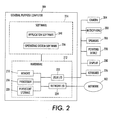
- Figure 2 illustrates a general purpose computer for carrying out embodiments disclosed herein, such as the embodiment shown in Figure 1 ;
- Figure 3 is a flow diagram setting forth the operations performed by the annotation server and annotation client(s) in the example operating environment shown in Figure 1 ;
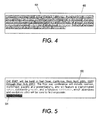
- Figure 4 illustrates an example of textual content in which words of a sub-document element have been made individually selectable using bounding box rectangles
- Figure 5 illustrates a sub-document element with a user name label inserted thereafter
- Figure 6 illustrates a series of image frames as tagging is performed by a user to a web page displayed in a viewer
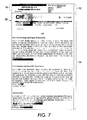
- Figure 7 illustrates an example user interface for creating and sharing annotations to a web document
- Figure 8 is a flow diagram setting forth operations performed by a tag-based search service
- Figure 9 illustrates an example bookmark collection processed in the manner outline in Figure 8 ;
- Figure 10 illustrates an example of spreading activation with "n" equal to 4 steps
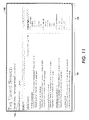
- Figure 11 illustrates a tag-based search interface that may be made available through a web browser.
- Document or “web document” is used herein to mean a collection of electronic data that may define a variable number of pages depending on how the collection of electronic data is formatted when viewed, such as documents that may be viewed using a web browser (e.g., web pages, images, word documents, and documents in a portable document format (pdf)).
- the electronic data making up a document may consist of static and/or dynamic content.
- Sub-document element is used herein to mean an element of a document's structure that when taken on its own is less than the whole of the document, which sub-document element may be of a type selected from the set of words, images, phrases, sentences, paragraphs, pages, sections, and chapters.
- Co-user is used herein to mean any user (e.g., an individual or alias of an individual) or group of users (e.g., a distribution list of individuals within a group or organization) that may be identified to or known to a "user" of a general purpose computer (as may be permitted using access controls and/or blocking), which may be known or made known to the user of the general purpose computer by, for example, using an identifier such as a user or login name.
- FIG. 1 illustrates an example operating environment 100 for performing embodiments disclosed herein.
- general purpose computers 104 which may communicate together over a network 102 such as the Internet, are programmed to perform either client-side or server-side operations.
- client-server arrangements such as a central terminal-based arrangements, or combinations thereof.
- the client-side operations are performed by general purpose computers 104 loaded with client-side application module 106, which includes annotation plug-in 108 and web browser 110 (such as Internet Explorer, Firefox, or Safari).
- server-side operations are performed by general purpose computers loaded with one or more server-side application module 112, which includes either one or a combination of one or more of annotation module 114, page-tagging module 116, web page (or web document) servers 118, and tag-based search server 120.
- server-side application module 112 includes either one or a combination of one or more of annotation module 114, page-tagging module 116, web page (or web document) servers 118, and tag-based search server 120.
- FIG. 2 illustrates a general purpose computer 104 for carrying out embodiments disclosed herein, such as the embodiment shown in Figure 1 .
- the general purpose computer 104 includes hardware 212 and software 214.
- the hardware 212 is made up of a processor (i.e., CPU) 216, memory 218 (ROM, RAM, etc.), persistent storage 220 (e.g., CD-ROM, hard drive, floppy drive, tape drive, etc.), user I/O 222, and network I/O 224.
- the user I/O 222 can include a camera 204, a microphone 208, speakers 206, a keyboard 226, a pointing device 228 (e.g., pointing stick, mouse, etc.), and the display 230.
- the network I/O 224 may for example be coupled to a network 102 such as the Internet.
- the software 214 of the general purpose computer 104 includes operating system software 236 and application software 240, which may include the instructions of the client-side application module 106 or the server side application module 108.
- the software 214 is generally read into the memory 218 to cause the processor 216 to perform specified operations, including the application software 240 with the instructions of the client-side application module 106 or the server side application module 108.
- Figure 3 is a flow diagram setting forth the operations performed by annotation server 113 and annotation client(s) 111 shown in the example operating environment 100 in Figure 1 .
- the annotation server 113 and annotation client(s) 111 enable dynamic annotation of sub-document elements.
- the examples described herein relate to the annotation of paragraph sub-document elements of web pages.
- different sub-document elements and documents, or combinations thereof may alternatively be used when carrying out the operations of dynamic annotation enabled herein.
- the web browser 110 of the client-side application module 106 is initialized with an annotation plug-in 108, which includes operations for communicating with server-side application module 112 and operations for augmenting documents for enabling both (a) user specification of annotations of a document displayed using web browser 110, and (b) display of user-annotated and co-user annotated data.
- operations performed on the client-side between 304 and 306 and on the server-side between 305 and 307 concern the augmentation of web pages with annotations and in preparation for user annotation
- operations on the client-side between 306 and 308 and on the server side between 307 and 309 concern user annotation of augmented web pages.
- the functions of the annotation plug-in 108 can be provided by a proxy server (operating on the network 102) that augments documents with annotation functions before passing the documents to the user.
- the web browser 110 receives a user request to load a web page for display.
- the requested web page is accessed using, for example, a URL (universal resource locator) that identifies a location on the network 102 of a server such as a web page server 118 storing the web page.
- the annotation plug-in 108 in response to the web page request at 312, communicates the requested web page (e.g., by sending its URL) with annotation servlet 126 through web server 128 to request a service be performed by the server-side annotation module 114 to identify annotations made by the user and any identified co-users to content similar to that of the requested web page.
- the server-side annotation module 114 retrieves a copy of the subject web page (e.g., using the URL provided at 314) from the web page server 118. Alternatively, a copy of the web-page retrieved at 312 may be provided by the client-side application module 106 along with the service request at 314.
- the server-side annotation module 114 identifies in the retrieved web page one or more web page sub-document elements, which may be of a single type, such as a paragraph, or a combination of types, such as paragraphs and sections.
- a similarity measurement is computed for those sub-document elements identified at 318 that are associated with the user and selected co-users using similarity measure calculator 124.
- the similarity measure may be computed based on any one or more factors (that act as a unique identifier or fingerprint), such as for example: (a) the length of the words appearing in the sub-document element, (b) the first characters of the first n words that appear in the sub-document element, (c) the frequency of similar non-stop words appearing in the sub-document element, and (d) MD5 (Message-Digest algorithm 5), a cryptographic hash function.
- each measure of similarity (or fingerprint) is a hash value of the associated sub-document element for which it is computed. Once computed, the fingerprint of annotated sub-document elements stored at the annotation server 113 may be compared against the fingerprint of the sub-document elements of the retrieved web page identified at 318.
- web page sub-document elements having associated annotations and similarity measures
- similarity measures comparable i.e., are likely to be the same or similar fingerprints
- the web page is augmented for display and (further) annotation by: making, at 326(A), each word on the web page separately selectable; inserting, at 326(B), user name labels at the end of a sub-document element and associated stored user's annotation data of the sub-document element identified at 322, including textual annotations (such as tags, keywords, or comments), graphical annotations (such as graphical icons), or audio/video annotations (such as links to audio or video clips); and inserting, at 326(C), annotations (such as highlighting, which may include text, graphics, audio, or video) made to the content of sub-document elements of the web page associated with the stored annotated data identified at 322.
- textual annotations such as tags, keywords, or comments
- graphical annotations such as graphical icons
- audio/video annotations such as links to audio or video clips
- annotations inserted in the web page at 326(B) and 326(C), respectively, may be made to sub-document elements (or to a combination of sub-document elements, such as a chapter of a document defined by a combination of sub-document elements) of the retrieved web page identified at 318 when the sub-document elements are similar to (or have matching fingerprints of) the sub-document elements of annotated data stored at 322 in database 122.
- the annotation plug-in 108 makes each word on a web page selectable by augmenting HTML content of the web page (using, for example, AJAX) by: (a) altering, at 326(A), the Document Object Model (DOM) tree of a web page by enclosing each word of the web page with an HTML (HyperText Markup Language) tag ⁇ span> before it is loaded by web browser 110; and (b) attaching, at 326(D), an event listener, such as a mouse event listener, to each sub-document element for detecting word selections performed by the user in the web page.
- AJAX Document Object Model
- Figure 4 illustrates an example of textual content 402 in which words of a sub-document element have been made individually selectable (and/or annotatable) using bounding box rectangles.
- a user selecting (and/or annotating) with a pointing device such as a mouse within bounding box 404 is determined to have selected the word "San".
- dynamic operations that are already associated with words may be set to have priority over selection (and/or annotation) operations. For example, in the event the word "San" was associated with a hyperlink, when a higher priority is given to the hyperlink then the link is followed; otherwise, when a higher priority is given to operations associated with the annotation plug-in then selection (and/or annotation) operations are performed.
- higher level constructs such as phrase and sentences are made selectable (and/or annotatable) within a bounding box (which may take on any number of different shapes) when enclosing a phase or sentence.
- the web page is displayed at 330 and made available to the user for (a) viewing annotations previously applied to similar content by the user or identified co-users and (b) further annotation.
- an event handler in the annotation plug-in receives and responds to events associated with input received from the user directed at the displayed web page.
- An event that indicates portions of a sub-document element to be annotated causes the event handler to transmit, at 334, and store, at 342, the annotations in the database 122 (together with the similarity measure (or fingerprint) of the sub-document element associated with the annotations), respectively, and present them for display on the web page to the user at 340.
- Figure 5 illustrates a sub-document element 502 with a user name label 504 inserted thereafter.
- the user annotated the document by highlighting the underlined text by first pointing the mouse to the beginning of the text (i.e., "CHI"), then pressing and holding the left mouse button until the mouse is moved to the end of the text sentence (i.e., "2007").
- An event that indicates a word selection by the user causes the event handler to open a tagging comment field on the web page and the selected word to be inserted therein as a tag (and in one embodiment cause the name label field to be inserted).
- An event that indicates the selected tags or keywords to be saved causes the event handler to transmit the saved tags and/or keywords to the server-side annotation module 114 to be checked for errors (which may include correcting spelling and/or punctuation errors, formatting inconsistencies, and/or eliminating stop-words in a specified annotation) at 336 and subsequently stored (together with the similarity measure (or fingerprint) of the sub-document element associated with the word selection) at 342.
- Figure 6 illustrates the sub-document element 602 followed by user name label 604 (as shown in Figure 5 ) during which a word selection is performed for tagging the sub-document element 602.
- Figure 6 there is illustrated a series of image frames as tagging is performed by a user of a web page displayed in a viewer.
- the sub-document element 602 is augmented with a user name label 604 inserted after it, and by making each word of the sub-document element 602 selectable.
- the displayed document is further augmented by inserting the selected word "San" in a tagging comment field 607 following the user name label 604 (i.e., following, or associated with, the sub-document element associated with the selected word).
- the displayed document is further augmented with selected words: "Jose,”; “April”; “28th,”; “2007”; “May”; and “3rd,”.
- the selected (or typed) annotations are corrected at 336 in Figure 3 (e.g., commas that were originally considered part of a word are removed) in one embodiment by the annotation server 113 (or in an alternate embodiment, not shown, by the annotation plug-in 108) before finalizing the selected words that follow the user name label 604 as shown at frame 610.
- lists of keywords associated with co-users and selectable lists of most frequently and/or most recently used keywords may be similarly made selectable to add to the tagging comment field 607.
- selected words are not placed in the tagging comment field 607 before being finalized, but instead are immediately placed in the form illustrated in frame 610.
- annotations propagate when the annotation server 113 provides the annotation client 111 with stored annotations to add to any document that contains content similar to that of the stored content.
- annotation server 113 does not propagate stored annotations to the annotation client 111 that fail to match the fingerprint of the content of a sub-document element, even if the content may have previously existed on the web page being viewed when the annotations and the fingerprints of sub-document elements of the web page were originally recorded.
- Figure 7 illustrates an example user interface 700 for creating and sharing annotations.
- a control area 702 which includes "remove” and “add” commands, allows a user to specify those co-users whose annotations the user would like to see displayed in documents that the user is viewing.
- the area 702 enables a user to specify page-level tagging of the user and view the page-level tags of specified co-users.
- Page-level tagging as opposed to tagging at sub-document levels, simply associates tags, keywords, or comments with a web page (or URL). Similar to tagging of sub-document elements, page-level tagging is recorded at 706, which in one embodiment includes using commands "Save Page Tag” and "Update Page Tags" in the area 702 and accessing the database 140 through web server 136 by page-tag servlet 138 (which may in an alternate embodiment be integrated with or operate together with server side annotation module 114).
- web page content is augmented, which includes in this example annotations associated with a user ("lichan_hong”) and selected co-users ("edhchi” and "kooltag”).
- users are given the ability to bookmark web documents and attach a set of tags or keywords to (or more generally annotate, by for example highlighting or attaching comments to) the document bookmark at the page level (and in an alternate embodiment to document elements at the sub-document element level). Subsequently, the user may search and retrieve the document from the user's personal bookmark collection using the set of tags of the user. Additionally, users may elect to share, either publicly to all users or semi-publicly to selected co-users, their bookmarks (and associated tags or keywords), which may then be browsed and searched by other users. This collaborative sharing of user cultivated document bookmark collections enables users to benefit by allowing bookmarked documents to be discovered using the shared user (i.e., collaboratively developed) bookmark collection.
- collaboratively shared bookmark collections stored in databases 122 and 140 may be searched using tag-based search server 120 through a user interface running on web browser 110.
- a bookmark collection associated with a group of users is processed and cached to identify tag profiles and document profiles for bookmarked documents in the bookmark collection.
- tag profiles and document profiles for a selected tag object e.g., TAG2
- selected document object e.g., URL1
- FIG. 8 is a flow diagram setting forth operations performed by the tag-based search service for identifying tag and document profiles (at 802, 804, 806, 808, 810, and 812) and providing results for tag-based queries (at 814, 816, 818, and 820).
- a bookmark collection is identified, which in one embodiment may be a list of document identifiers (such as URLs), where each bookmark in the bookmark collection identifies a document with a URL that has associated therewith a set of tags (e.g., [URL1, TAG2, TAG6, ..., TAGN]).
- the bookmark collection is decomposed (i.e., transformed) into a set of URL/TAG pairs (e.g., [URL1, TAG2], [URL1, TAG6], ... [URL1, TAGN]).
- a bigraph or two-dimensional graph of URLs to tags is constructed at 806. Once a bigraph is constructed, the bigraph is expressed as a matrix (at 808). Alternatively, the bigraph may be represented using, for example, adjacency lists.
- Figure 9 illustrates an example bookmark collection at 902 that has been identified (as specified at 802 in Figure 8 ) and processed at 904 into a set of URL/TAG pairs (as specified at 804 in Figure 8 ), at 906 into a bigraph (as specified at 806 in Figure 8 ), and at 908 into a matrix form with columns identifying URLs and row identifying tags for the bigraph shown at 906 (as specified at 808 in Figure 8 ).
- the bigraph matrix (or more generally any n-dimensional matrix) is used to compute tag profiles and document profiles over the nodes of the bigraph by computing the profiles using spreading activation iteratively as vectors A as follows:
- a 1 E ;
- a 2 ⁇ M * A 1 + ⁇ E ;
- ⁇ A n ⁇ M * A [ n - 1 ] + ⁇ E ;
- FIG. 10 illustrates an example of spreading activation with "n” equal to 4 steps and with document 1 (i.e., URL1) as the entry node E, with the parameter ⁇ equal to one and the ⁇ parameter equal to zero, and with resulting tag profile vector A[4] TAG and the resulting document profile vector A[3] DOC for the document D1.
- document 1 i.e., URL1
- the resulting document and tag profile vectors identify the most interesting tags or documents for an initial entry vector where the user expressed an interest in document DOC 1
- Figure 10 illustrates that DOC 1 is associated with TAG 1 , TAG 2 , and TAG 3 .
- tag profiles and document profiles are in one embodiment cached for subsequent retrieval and search (at 812).
- tag and document profiles are computed in real-time on demand.
- Users may search on a document collection using a search interface 1100 as illustrated in Figure 11 that may be made available through web browser 110.
- the search interface 1100 enables users to specify key words and/or tags (at 1102) that are then used to identify (at 1106) related tags and documents (at 1104). This is accomplished by taking the keywords and/or tags at 1102 and looking up in the cached spreading activation computation (at 812 in Figure 8 ), what other documents and tags are related and interesting.
- the spreading activated documents specified in the document profile vectors are displayed in 1104, and the spreading activated tags specified in the tag profile vectors are displayed in 1106. These are displayed in ranked order of their similarity according to the spreading activation weights.
- the search results may then be refined further by the user by specifying which documents in 1104 are relevant, using, for example, methods known in the art as "relevance feedback".
- users indicate their interest by clicking on a selection box.
- Documents that are selected may be looked up in the cached computation results (at 812 in Figure 8 ), and their corresponding related tags and documents in the profile vectors may be used to inform future searches.
- users may also specify related tags, and the corresponding cached computation results (at 812) for those tags may be looked up and added to the current interest profile, which may then be used to inform future searches.
- the tag profiles and document profiles form the basis of different similarity computations and lookups for retrieval, search, and recommendations. For example, in the embodiment shown in Figure 8 , upon receipt of a search request to identify related tags or documents of a selected tag or document (at 814), the tag profile or document profile that correspond to the selected tag or document (at 816) is retrieved from cache. Alternatively at 816, if the selected tag or document does not exist in the spreading activation computation profiles cached at 812, then the profiles of a tag and/or document in the data cached at 812 are selected that are most similar to the missing tag or document. At step 816, the similarity between documents (and tags) may, for example, be determined using cosine similarity computations of document word vectors, or other similarity computations such as Euclidean distance or other vector distance metrics.
- the identified tag profile and/or document profile are sorted to rank related tags and/or documents by importance. These most similar tags and/or documents arranged by rank are returned for presentation in for example the user interface 1100 illustrated in Figure 11 , which includes with each document link (e.g., "Dive Into Greasemonkey"), a list of those tags most frequently applied to the document (e.g., greasemonkey 65, firefox 33, programming 27, reference 18, and web 18).
- each document link e.g., "Dive Into Greasemonkey”
- the tag profile or document profile identified at 816 are compared against all other document or tag profiles in the system to find similar profiles at 818, thereby identifying at 820 similar tags or documents in addition to or as an alternative to those identified at 816 using the identified tag and/or document profiles corresponding or similar to the selected tags and/or documents.
- the tag-based search server may: (a) lookup the corresponding document profile, assuming the document already exists in its cached spreading activation computation profiles (at 812), and select and return for display selected documents in that profile arranged by relevance, for example, from highest to lowest weight (which arrangement of documents may in addition be filtered to retain only those weighted above a threshold value); (b) use the corresponding document profile to compare it against all other document profiles in the system to find similar document profiles, and thereafter select and return for display selected documents in those profiles arranged by relevance; and/or (c) use information retrieval techniques, such as computing the traditional cosine similarity measure of document word vectors, to find those most similar documents in the URL/TAG bigraph when the user specified document does not already exist in the cached spreading activation computation profiles (at 812), and thereafter use either (a) or (b) to select and return related documents.
- the tag-based search server may: (a) lookup the corresponding document profile, assuming the document already exists in its cached spreading activation computation profiles (at 812
- keyword searches may be used to identify documents or tags cached in the spreading activation computation profiles (at 812), their profiles of which are subsequently used to identify related documents and tags.
- the profile vectors associated with the tags and documents corresponding to the multiple keywords are summed together, ranked and subsequently used to identify documents and tags of interest.
- profile vectors corresponding to different keywords are weighted differently before being summed together, ranked and subsequently used to identify documents and tags of interest.
- Such summation of profile vectors may in addition be used to further refine results by adding additional keywords and/or documents into the set of profile vectors that is ultimately summed together, ranked and subsequently used to identify documents and tags of interest.
- the exemplary embodiments set forth herein may be extended beyond a two variable relationships between documents and tags.
- graphs may be for example defined between two different variables (e.g., such as between documents and users) or between three or more variables (e.g., such as between documents, tags, and users). The technique works for three or more variables since the spreading activation technique can be performed and cached for these different variables (e.g. resulting in tag profiles, document profiles, and user profiles).
- bookmark collections are discussed in the forgoing embodiments, those skilled in the art will appreciate that bookmark collections may alternatively be substituted for shared collections of documents with metadata recording individual bookmark preferences with each document.
- an embodiment for annotating web pages may be performed by the method of: retrieving a document selected for display by a user; locating sub-document elements in content of the retrieved document; computing a similarity measure for each of the located sub-document elements; identifying similarity measures of annotated sub-document elements and the located sub-document elements that indicate a correspondence there between; augmenting the located sub-document elements of the retrieved document with annotations of those annotated sub-document elements that have comparable similarity measures; displaying the retrieved document augmented with annotations.
- the forgoing embodiment includes the following features wherein: the one or more sub-document elements may be selected from the group consisting of words, images, phrases, sentences, paragraphs, pages, sections, and chapters; the augmenting may associate each annotation of the structural elements with a name label; the name labels may be that of the user or a co-user; the document may be a web page; bounding boxes for each word may be defined in the web page; a user input event indicating a word selection in the web page may be identified, and the web page may be automatically tagged with the identified word selection; a user input event may be automatically identified indicating highlighting of one or more words in the web page; and the similarity measure may be a unique identifier that uniquely identifies sub-document elements.
- the embodiments disclosed herein may be implemented as a machine (or system), process (or method), or article of manufacture by using standard programming and/or engineering techniques to produce programming software, firmware, hardware, or any combination thereof. It will be appreciated by those skilled in the art that the flow diagrams described in the specification are meant to provide an understanding of different possible embodiments. As such, alternative ordering of the steps, performing one or more steps in parallel, and/or performing additional or fewer steps may be done in alternative embodiments.
- Any resulting program(s), having computer-readable program code, may be embodied within one or more computer-usable media such as memory devices or transmitting devices, thereby making a computer program product or article of manufacture according to the disclosed embodiments.
- the terms "article of manufacture” and “computer program product” as used herein are intended to encompass a computer program existent (permanently, temporarily, or transitorily) on any computer-usable medium such as on any memory device or in any transmitting device.
- a machine embodying the disclosed embodiments may involve one or more processing systems including, but not limited to, CPU, memory/storage devices, communication links, communication/transmitting devices, servers, I/O devices, or any subcomponents or individual parts of one or more processing systems, including software, firmware, hardware, or any combination or subcombination thereof, which embody the disclosed embodiments as set forth in the claims.
- processing systems including, but are not limited to, CPU, memory/storage devices, communication links, communication/transmitting devices, servers, I/O devices, or any subcomponents or individual parts of one or more processing systems, including software, firmware, hardware, or any combination or subcombination thereof, which embody the disclosed embodiments as set forth in the claims.
- memory devices include, but are not limited to, fixed (hard) disk drives, floppy disks (or diskettes), optical disks, magnetic tape, semiconductor memories such as RAM, ROM, Proms, etc.
- Transmitting devices include, but are not limited to, the Internet, intranets, electronic bulletin board and message/note exchanges, telephone/modem based network communication, hard-wired/cabled communication network, cellular communication, radio wave communication, satellite communication, and other stationary or mobile network systems/communication links.
Landscapes
- Engineering & Computer Science (AREA)
- Theoretical Computer Science (AREA)
- Health & Medical Sciences (AREA)
- Artificial Intelligence (AREA)
- Audiology, Speech & Language Pathology (AREA)
- Computational Linguistics (AREA)
- General Health & Medical Sciences (AREA)
- Physics & Mathematics (AREA)
- General Engineering & Computer Science (AREA)
- General Physics & Mathematics (AREA)
- Document Processing Apparatus (AREA)
- Information Retrieval, Db Structures And Fs Structures Therefor (AREA)
Abstract
Description
- The following relates generally to methods, apparatus and articles of manufacture therefor, for annotating documents, and subsequently sharing such annotations and searching annotated document collections.
- Web-based services are available on the Internet today that enable social tagging of web pages, such as Yahoo's MyWeb and del.icio.us. Such web-based services, allow users to tag web documents (such as web pages) of interest for sharing or later recalling the web documents by allowing users to bookmark a web document and attach a set of freely chosen tags (or keywords) to the web document. Also, users may elect to share their bookmarks or tags with other users, which may subsequently be searched and browsed by the other users.
- In addition to allowing users to discover bookmarked pages via tags defined and shared by other users, data from social tagging can also be used to enhance document search. Social tagging systems, however, are limited as they do not account for the nature of the content of tagged web pages (e.g., that the content of web pages may be dynamic, or that the content of one web page may be similar to that of another web page). For example, unless a user reviews and updates tags to web documents previously defined and shared with other users, each user-specified tag associated with a URL (universal resource locator) remains the same, even as a sub-document element of the underlying content of the web page pointed to by the URL changes in a way that less accurately or no longer reflects reason why the tag was applied to the document.
- Further, available social tagging systems do not account for the similarity between published web documents. For example, different web sites may publish the same or a very similar news story. Because available social tagging systems do not account for the similarity between published content in different web documents, they are not adapted to propagate tags to similar content. Such propagation of tagged information would advantageously simplify a user's effort to tag similarly published content. Also, available social tagging systems are not integrated within a web browser (or reader). Instead, available social tagging systems require users to access a web page that is independent of the web document that is being read. Such lack of interoperability encumbers the user's ability to refer to the content of a web document at the same time a tag is created or reviewed for the web document.
- Accordingly, there continues to be a need for systems and methods for supporting in situ tagging of sub-document elements (such as paragraphs of web documents) and the sharing of such tagged data (or more generally annotated data). A solution for tagging sub-document elements of web documents that is integral to web browsers would advantageously reduce the amount of cognitive and interaction overhead that is required to annotate web pages. Further, by providing an integral solution that facilitates social tagging of web pages, users would advantageously be more likely to collaborate and share tagged data. Also, by propagating tags to web pages with similar content and accounting for the dynamicity of web pages, the integrity of the association between tags and sub-document elements of a web page is maintained.
- Further, there continues to be a need for improved systems and methods for searching collections of documents that have been tagged (or more generally annotated) through collaborative tagging (or more generally collaborative annotation). It would therefore be advantageous to provide improved systems and methods for searching tag-based collections of documents to increase the accuracy and/or precision of searching such document collections.
In one embodiment of the method according toclaim 1, said augmenting associates each annotation of the structural elements with a name label.
In a further embodiment the name labels is one or more of the user and a co-user.
In one embodiment of the apparatus according to claim 9, the processor in executing instructions for augmenting further comprises instructions for associating each annotation of the structural elements with a name label comprising one or more of the user or a co-user.
In a further embodiment the document is a web page.
In a further embodiment the processor in executing the processing instructions further comprises defining bounding boxes for each word in the web page.
In a further embodiment the processor in executing the processing instructions further comprises: - identifying a user input event indicating a word selection in the web page; and
- automatically tagging the web page with the identified word selection.
- identifying a user input event indicating highlighting of one or more words in the web page; and
- automatically highlighting the one or more words in the web page.
- means for identifying a user input event indicating a word selection in the web page; and
- means for automatically tagging the web page with the identified word selection.
- means for identifying a user input event indicating highlighting of one or more words in the web page; and
- means for automatically highlighting the one or more words in the web page.
- These and other aspects of the disclosure will become apparent from the following description read in conjunction with the accompanying drawings wherein the same reference numerals have been applied to like parts and in which:
-
Figure 1 illustrates an embodiment of an annotation server and annotation client(s) in an example operating environment; -
Figure 2 illustrates a general purpose computer for carrying out embodiments disclosed herein, such as the embodiment shown inFigure 1 ; -
Figure 3 is a flow diagram setting forth the operations performed by the annotation server and annotation client(s) in the example operating environment shown inFigure 1 ; -
Figure 4 illustrates an example of textual content in which words of a sub-document element have been made individually selectable using bounding box rectangles; -
Figure 5 illustrates a sub-document element with a user name label inserted thereafter; -
Figure 6 illustrates a series of image frames as tagging is performed by a user to a web page displayed in a viewer; -
Figure 7 illustrates an example user interface for creating and sharing annotations to a web document; -
Figure 8 is a flow diagram setting forth operations performed by a tag-based search service; -
Figure 9 illustrates an example bookmark collection processed in the manner outline inFigure 8 ; -
Figure 10 illustrates an example of spreading activation with "n" equal to 4 steps; -
Figure 11 illustrates a tag-based search interface that may be made available through a web browser. - The terms defined below have the indicated meanings throughout this application, including the claims and the figures:
- "Document" or "web document" is used herein to mean a collection of electronic data that may define a variable number of pages depending on how the collection of electronic data is formatted when viewed, such as documents that may be viewed using a web browser (e.g., web pages, images, word documents, and documents in a portable document format (pdf)). The electronic data making up a document may consist of static and/or dynamic content.
- "Sub-document element" is used herein to mean an element of a document's structure that when taken on its own is less than the whole of the document, which sub-document element may be of a type selected from the set of words, images, phrases, sentences, paragraphs, pages, sections, and chapters.
- "Co-user" is used herein to mean any user (e.g., an individual or alias of an individual) or group of users (e.g., a distribution list of individuals within a group or organization) that may be identified to or known to a "user" of a general purpose computer (as may be permitted using access controls and/or blocking), which may be known or made known to the user of the general purpose computer by, for example, using an identifier such as a user or login name.
-
Figure 1 illustrates anexample operating environment 100 for performing embodiments disclosed herein. In the example operating environment,general purpose computers 104, which may communicate together over anetwork 102 such as the Internet, are programmed to perform either client-side or server-side operations. Those skilled in the art will appreciate that alternatives to client-server arrangements exist such as a central terminal-based arrangements, or combinations thereof. The client-side operations are performed bygeneral purpose computers 104 loaded with client-side application module 106, which includes annotation plug-in 108 and web browser 110 (such as Internet Explorer, Firefox, or Safari). The server-side operations are performed by general purpose computers loaded with one or more server-side application module 112, which includes either one or a combination of one or more ofannotation module 114, page-taggingmodule 116, web page (or web document)servers 118, and tag-basedsearch server 120. -
Figure 2 illustrates ageneral purpose computer 104 for carrying out embodiments disclosed herein, such as the embodiment shown inFigure 1 . Thegeneral purpose computer 104 includeshardware 212 andsoftware 214. Thehardware 212 is made up of a processor (i.e., CPU) 216, memory 218 (ROM, RAM, etc.), persistent storage 220 (e.g., CD-ROM, hard drive, floppy drive, tape drive, etc.), user I/O 222, and network I/O 224. The user I/O 222 can include acamera 204, amicrophone 208,speakers 206, akeyboard 226, a pointing device 228 (e.g., pointing stick, mouse, etc.), and thedisplay 230. The network I/O 224 may for example be coupled to anetwork 102 such as the Internet. Thesoftware 214 of thegeneral purpose computer 104 includesoperating system software 236 andapplication software 240, which may include the instructions of the client-side application module 106 or the serverside application module 108. Thesoftware 214 is generally read into thememory 218 to cause theprocessor 216 to perform specified operations, including theapplication software 240 with the instructions of the client-side application module 106 or the serverside application module 108. -
Figure 3 is a flow diagram setting forth the operations performed byannotation server 113 and annotation client(s) 111 shown in theexample operating environment 100 inFigure 1 . Theannotation server 113 and annotation client(s) 111 enable dynamic annotation of sub-document elements. By way of example and not limitation, the examples described herein relate to the annotation of paragraph sub-document elements of web pages. As will be appreciated by those skilled in the art, different sub-document elements and documents, or combinations thereof, may alternatively be used when carrying out the operations of dynamic annotation enabled herein. - Initially at 302, the
web browser 110 of the client-side application module 106 is initialized with an annotation plug-in 108, which includes operations for communicating with server-side application module 112 and operations for augmenting documents for enabling both (a) user specification of annotations of a document displayed usingweb browser 110, and (b) display of user-annotated and co-user annotated data. Generally, operations performed on the client-side between 304 and 306 and on the server-side between 305 and 307 concern the augmentation of web pages with annotations and in preparation for user annotation, while operations on the client-side between 306 and 308 and on the server side between 307 and 309 concern user annotation of augmented web pages. In another embodiment, the functions of the annotation plug-in 108 can be provided by a proxy server (operating on the network 102) that augments documents with annotation functions before passing the documents to the user. - At 310, the
web browser 110 receives a user request to load a web page for display. At 312, the requested web page is accessed using, for example, a URL (universal resource locator) that identifies a location on thenetwork 102 of a server such as aweb page server 118 storing the web page. At 314, the annotation plug-in 108 in response to the web page request at 312, communicates the requested web page (e.g., by sending its URL) withannotation servlet 126 throughweb server 128 to request a service be performed by the server-side annotation module 114 to identify annotations made by the user and any identified co-users to content similar to that of the requested web page. - At 316, the server-
side annotation module 114 retrieves a copy of the subject web page (e.g., using the URL provided at 314) from theweb page server 118. Alternatively, a copy of the web-page retrieved at 312 may be provided by the client-side application module 106 along with the service request at 314. At 318, the server-side annotation module 114 identifies in the retrieved web page one or more web page sub-document elements, which may be of a single type, such as a paragraph, or a combination of types, such as paragraphs and sections. At 320, a similarity measurement is computed for those sub-document elements identified at 318 that are associated with the user and selected co-users usingsimilarity measure calculator 124. The similarity measure may be computed based on any one or more factors (that act as a unique identifier or fingerprint), such as for example: (a) the length of the words appearing in the sub-document element, (b) the first characters of the first n words that appear in the sub-document element, (c) the frequency of similar non-stop words appearing in the sub-document element, and (d) MD5 (Message-Digest algorithm 5), a cryptographic hash function. In one embodiment, each measure of similarity (or fingerprint) is a hash value of the associated sub-document element for which it is computed. Once computed, the fingerprint of annotated sub-document elements stored at theannotation server 113 may be compared against the fingerprint of the sub-document elements of the retrieved web page identified at 318. - At 322, web page sub-document elements (having associated annotations and similarity measures) previously annotated either by the user or co-users that are recorded in
database 122 with similarity measures comparable (i.e., are likely to be the same or similar fingerprints) to the similarity measures computed at 320 are identified. At 324, the stored annotated data of the sub-document elements identified at 322 is provided to the client-side application module 106. - At 326, the web page is augmented for display and (further) annotation by: making, at 326(A), each word on the web page separately selectable; inserting, at 326(B), user name labels at the end of a sub-document element and associated stored user's annotation data of the sub-document element identified at 322, including textual annotations (such as tags, keywords, or comments), graphical annotations (such as graphical icons), or audio/video annotations (such as links to audio or video clips); and inserting, at 326(C), annotations (such as highlighting, which may include text, graphics, audio, or video) made to the content of sub-document elements of the web page associated with the stored annotated data identified at 322. The annotations inserted in the web page at 326(B) and 326(C), respectively, may be made to sub-document elements (or to a combination of sub-document elements, such as a chapter of a document defined by a combination of sub-document elements) of the retrieved web page identified at 318 when the sub-document elements are similar to (or have matching fingerprints of) the sub-document elements of annotated data stored at 322 in
database 122. - In one embodiment at 326, the annotation plug-in 108 makes each word on a web page selectable by augmenting HTML content of the web page (using, for example, AJAX) by: (a) altering, at 326(A), the Document Object Model (DOM) tree of a web page by enclosing each word of the web page with an HTML (HyperText Markup Language) tag <span> before it is loaded by
web browser 110; and (b) attaching, at 326(D), an event listener, such as a mouse event listener, to each sub-document element for detecting word selections performed by the user in the web page. -
Figure 4 illustrates an example oftextual content 402 in which words of a sub-document element have been made individually selectable (and/or annotatable) using bounding box rectangles. For example, a user selecting (and/or annotating) with a pointing device such as a mouse withinbounding box 404 is determined to have selected the word "San". Depending on a user's preferences, dynamic operations that are already associated with words may be set to have priority over selection (and/or annotation) operations. For example, in the event the word "San" was associated with a hyperlink, when a higher priority is given to the hyperlink then the link is followed; otherwise, when a higher priority is given to operations associated with the annotation plug-in then selection (and/or annotation) operations are performed. In an alternate embodiment, higher level constructs such as phrase and sentences are made selectable (and/or annotatable) within a bounding box (which may take on any number of different shapes) when enclosing a phase or sentence. - Subsequent to augmenting the web page at 326, the web page is displayed at 330 and made available to the user for (a) viewing annotations previously applied to similar content by the user or identified co-users and (b) further annotation. At 332, an event handler in the annotation plug-in receives and responds to events associated with input received from the user directed at the displayed web page. An event that indicates portions of a sub-document element to be annotated, causes the event handler to transmit, at 334, and store, at 342, the annotations in the database 122 (together with the similarity measure (or fingerprint) of the sub-document element associated with the annotations), respectively, and present them for display on the web page to the user at 340. For example,
Figure 5 illustrates asub-document element 502 with auser name label 504 inserted thereafter. In this example, the user annotated the document by highlighting the underlined text by first pointing the mouse to the beginning of the text (i.e., "CHI"), then pressing and holding the left mouse button until the mouse is moved to the end of the text sentence (i.e., "2007"). - An event that indicates a word selection by the user, causes the event handler to open a tagging comment field on the web page and the selected word to be inserted therein as a tag (and in one embodiment cause the name label field to be inserted). An event that indicates the selected tags or keywords to be saved, causes the event handler to transmit the saved tags and/or keywords to the server-
side annotation module 114 to be checked for errors (which may include correcting spelling and/or punctuation errors, formatting inconsistencies, and/or eliminating stop-words in a specified annotation) at 336 and subsequently stored (together with the similarity measure (or fingerprint) of the sub-document element associated with the word selection) at 342. Annotations that are corrected at 336 are transmitted back at 338 to theannotation client 111 for subsequent display at 340. For example,Figure 6 illustrates thesub-document element 602 followed by user name label 604 (as shown inFigure 5 ) during which a word selection is performed for tagging thesub-document element 602. - More specifically, in
Figure 6 there is illustrated a series of image frames as tagging is performed by a user of a web page displayed in a viewer. Atframe 600, thesub-document element 602 is augmented with auser name label 604 inserted after it, and by making each word of thesub-document element 602 selectable. Atframe 606, responsive to user input selecting the word "San", the displayed document is further augmented by inserting the selected word "San" in a taggingcomment field 607 following the user name label 604 (i.e., following, or associated with, the sub-document element associated with the selected word). Atframe 608, the displayed document is further augmented with selected words: "Jose,"; "April"; "28th,"; "2007"; "May"; and "3rd,". Once the "save"button 605 is clicked the selected (or typed) annotations are corrected at 336 inFigure 3 (e.g., commas that were originally considered part of a word are removed) in one embodiment by the annotation server 113 (or in an alternate embodiment, not shown, by the annotation plug-in 108) before finalizing the selected words that follow theuser name label 604 as shown at frame 610. In alternate embodiments (not shown), lists of keywords associated with co-users and selectable lists of most frequently and/or most recently used keywords (added to the web page, for example, following the user and co-user keywords), may be similarly made selectable to add to the taggingcomment field 607. In yet another embodiment, selected words are not placed in the taggingcomment field 607 before being finalized, but instead are immediately placed in the form illustrated in frame 610. - Advantageously, after annotating a web page the user's annotations are stored by the
annotation server 113 indatabase 122 to enable propagation of annotations to web pages with similar content. In other words, annotations propagate when theannotation server 113 provides theannotation client 111 with stored annotations to add to any document that contains content similar to that of the stored content. In addition, theannotation server 113 does not propagate stored annotations to theannotation client 111 that fail to match the fingerprint of the content of a sub-document element, even if the content may have previously existed on the web page being viewed when the annotations and the fingerprints of sub-document elements of the web page were originally recorded. -
Figure 7 illustrates anexample user interface 700 for creating and sharing annotations. At the top of theuser interface 700, acontrol area 702, which includes "remove" and "add" commands, allows a user to specify those co-users whose annotations the user would like to see displayed in documents that the user is viewing. - Further, the
area 702 enables a user to specify page-level tagging of the user and view the page-level tags of specified co-users. Page-level tagging, as opposed to tagging at sub-document levels, simply associates tags, keywords, or comments with a web page (or URL). Similar to tagging of sub-document elements, page-level tagging is recorded at 706, which in one embodiment includes using commands "Save Page Tag" and "Update Page Tags" in thearea 702 and accessing thedatabase 140 throughweb server 136 by page-tag servlet 138 (which may in an alternate embodiment be integrated with or operate together with server side annotation module 114). - Below the
control area 702 is thedocument area 704. In thedocument area 704, web page content is augmented, which includes in this example annotations associated with a user ("lichan_hong") and selected co-users ("edhchi" and "kooltag"). Thus, by examining thecontrol area 702 and thedocument area 704, a user is able to see whether the displayed document is annotated at a page level and/or sub-document level. - Using a web-based annotations service such as that made available by the client-
side annotation module 106, users are given the ability to bookmark web documents and attach a set of tags or keywords to (or more generally annotate, by for example highlighting or attaching comments to) the document bookmark at the page level (and in an alternate embodiment to document elements at the sub-document element level). Subsequently, the user may search and retrieve the document from the user's personal bookmark collection using the set of tags of the user. Additionally, users may elect to share, either publicly to all users or semi-publicly to selected co-users, their bookmarks (and associated tags or keywords), which may then be browsed and searched by other users. This collaborative sharing of user cultivated document bookmark collections enables users to benefit by allowing bookmarked documents to be discovered using the shared user (i.e., collaboratively developed) bookmark collection. - In one embodiment shown in
Figure 1 , collaboratively shared bookmark collections stored indatabases search server 120 through a user interface running onweb browser 110. Before queries may be performed by users to discover bookmarked documents, a bookmark collection associated with a group of users is processed and cached to identify tag profiles and document profiles for bookmarked documents in the bookmark collection. Generally, tag profiles and document profiles for a selected tag object (e.g., TAG2) and selected document object (e.g., URL1) are constructed by performing a spreading activation using that selected tag or document object in a bigraph as an entry node. -
Figure 8 is a flow diagram setting forth operations performed by the tag-based search service for identifying tag and document profiles (at 802, 804, 806, 808, 810, and 812) and providing results for tag-based queries (at 814, 816, 818, and 820). Initially at 802, a bookmark collection is identified, which in one embodiment may be a list of document identifiers (such as URLs), where each bookmark in the bookmark collection identifies a document with a URL that has associated therewith a set of tags (e.g., [URL1, TAG2, TAG6, ..., TAGN]). At 804, the bookmark collection is decomposed (i.e., transformed) into a set of URL/TAG pairs (e.g., [URL1, TAG2], [URL1, TAG6], ... [URL1, TAGN]). Given URL/TAG pairs in the form of [URL, TAG] tuples, a bigraph (or two-dimensional graph) of URLs to tags is constructed at 806. Once a bigraph is constructed, the bigraph is expressed as a matrix (at 808). Alternatively, the bigraph may be represented using, for example, adjacency lists. -
Figure 9 illustrates an example bookmark collection at 902 that has been identified (as specified at 802 inFigure 8 ) and processed at 904 into a set of URL/TAG pairs (as specified at 804 inFigure 8 ), at 906 into a bigraph (as specified at 806 inFigure 8 ), and at 908 into a matrix form with columns identifying URLs and row identifying tags for the bigraph shown at 906 (as specified at 808 inFigure 8 ). - At 810, the bigraph matrix (or more generally any n-dimensional matrix) is used to compute tag profiles and document profiles over the nodes of the bigraph by computing the profiles using spreading activation iteratively as vectors A as follows:

- A[1], A[2], ... A[n] are iteratively computed profile vectors of URLs and tags;
- E is a unit vector representing a tag or document entry node;
- M is a matrix representation of the bigraph (or more generally any n-dimensional graph) arranged by column or row according to the selected entry node;
- α and β are parameters for adjusting spreading activation.
- After iteratively performing spreading activation for "n" steps (which number of steps "n" may vary depending on accuracy and/or performance), spreading activation is stopped on the tag side of the bigraph or document side of the bigraph, thereby providing a tag profile vector or document profile vector for the tag or document entry node E. The resulting pattern of weights in the tag profile vector and document profile vector define "tag profiles" and "document profiles", respectively.
Figure 10 illustrates an example of spreading activation with "n" equal to 4 steps and with document 1 (i.e., URL1) as the entry node E, with the parameter α equal to one and the β parameter equal to zero, and with resulting tag profile vector A[4]TAG and the resulting document profile vector A[3]DOC for the document D1. - As shown in
Figure 10 , after each iteration (i.e., n=2, n=3, and n=4) the resulting document and tag profile vectors identify the most interesting tags or documents for an initial entry vector where the user expressed an interest in document DOC1 The initial entry vector assigned DOC1 a weight of 1. At step n=2,Figure 10 illustrates that DOC1 is associated with TAG1, TAG2, and TAG3.Figure 10 further illustrates at step n=3, the spreading activation computation identifies interesting documents DOC1, DOC2, DOC3, and DOC4, where each is associated with theinterestingness weight - Once the tag profiles and document profiles are computed at 810, they are in one embodiment cached for subsequent retrieval and search (at 812). In an alternate embodiment, such tag and document profiles are computed in real-time on demand. Users may search on a document collection using a
search interface 1100 as illustrated inFigure 11 that may be made available throughweb browser 110. Thesearch interface 1100 enables users to specify key words and/or tags (at 1102) that are then used to identify (at 1106) related tags and documents (at 1104). This is accomplished by taking the keywords and/or tags at 1102 and looking up in the cached spreading activation computation (at 812 inFigure 8 ), what other documents and tags are related and interesting. The spreading activated documents specified in the document profile vectors are displayed in 1104, and the spreading activated tags specified in the tag profile vectors are displayed in 1106. These are displayed in ranked order of their similarity according to the spreading activation weights. - The search results may then be refined further by the user by specifying which documents in 1104 are relevant, using, for example, methods known in the art as "relevance feedback". In one embodiment, users indicate their interest by clicking on a selection box. Documents that are selected may be looked up in the cached computation results (at 812 in
Figure 8 ), and their corresponding related tags and documents in the profile vectors may be used to inform future searches. Alternatively, users may also specify related tags, and the corresponding cached computation results (at 812) for those tags may be looked up and added to the current interest profile, which may then be used to inform future searches. - More generally once cached (at 812), the tag profiles and document profiles form the basis of different similarity computations and lookups for retrieval, search, and recommendations. For example, in the embodiment shown in
Figure 8 , upon receipt of a search request to identify related tags or documents of a selected tag or document (at 814), the tag profile or document profile that correspond to the selected tag or document (at 816) is retrieved from cache. Alternatively at 816, if the selected tag or document does not exist in the spreading activation computation profiles cached at 812, then the profiles of a tag and/or document in the data cached at 812 are selected that are most similar to the missing tag or document. Atstep 816, the similarity between documents (and tags) may, for example, be determined using cosine similarity computations of document word vectors, or other similarity computations such as Euclidean distance or other vector distance metrics. - At 820, the identified tag profile and/or document profile are sorted to rank related tags and/or documents by importance. These most similar tags and/or documents arranged by rank are returned for presentation in for example the
user interface 1100 illustrated inFigure 11 , which includes with each document link (e.g., "Dive Into Greasemonkey"), a list of those tags most frequently applied to the document (e.g., greasemonkey 65, firefox 33, programming 27, reference 18, and web 18). In an alternate embodiment, the tag profile or document profile identified at 816 are compared against all other document or tag profiles in the system to find similar profiles at 818, thereby identifying at 820 similar tags or documents in addition to or as an alternative to those identified at 816 using the identified tag and/or document profiles corresponding or similar to the selected tags and/or documents. - In other words at 814, 816, 818, and 820, if a user would like to find information related to a document, the tag-based search server may: (a) lookup the corresponding document profile, assuming the document already exists in its cached spreading activation computation profiles (at 812), and select and return for display selected documents in that profile arranged by relevance, for example, from highest to lowest weight (which arrangement of documents may in addition be filtered to retain only those weighted above a threshold value); (b) use the corresponding document profile to compare it against all other document profiles in the system to find similar document profiles, and thereafter select and return for display selected documents in those profiles arranged by relevance; and/or (c) use information retrieval techniques, such as computing the traditional cosine similarity measure of document word vectors, to find those most similar documents in the URL/TAG bigraph when the user specified document does not already exist in the cached spreading activation computation profiles (at 812), and thereafter use either (a) or (b) to select and return related documents. Alternatively, at 814, 816, 818, and 820, if a user would like to find information related to a tag, similar operations performed for a document are performed instead for the tag and the corresponding tag profiles.
- In an alternate embodiment, keyword searches may be used to identify documents or tags cached in the spreading activation computation profiles (at 812), their profiles of which are subsequently used to identify related documents and tags. In yet other embodiments, when multiple keywords are provided as search criteria, the profile vectors associated with the tags and documents corresponding to the multiple keywords are summed together, ranked and subsequently used to identify documents and tags of interest. Alternatively, profile vectors corresponding to different keywords are weighted differently before being summed together, ranked and subsequently used to identify documents and tags of interest. Such summation of profile vectors may in addition be used to further refine results by adding additional keywords and/or documents into the set of profile vectors that is ultimately summed together, ranked and subsequently used to identify documents and tags of interest.
- In yet further embodiments, the exemplary embodiments set forth herein may be extended beyond a two variable relationships between documents and tags. In such alternative embodiment, graphs may be for example defined between two different variables (e.g., such as between documents and users) or between three or more variables (e.g., such as between documents, tags, and users). The technique works for three or more variables since the spreading activation technique can be performed and cached for these different variables (e.g. resulting in tag profiles, document profiles, and user profiles).
- Further, while shared bookmark collections are discussed in the forgoing embodiments, those skilled in the art will appreciate that bookmark collections may alternatively be substituted for shared collections of documents with metadata recording individual bookmark preferences with each document.
- In view of the above description, an embodiment for annotating web pages may be performed by the method of: retrieving a document selected for display by a user; locating sub-document elements in content of the retrieved document; computing a similarity measure for each of the located sub-document elements; identifying similarity measures of annotated sub-document elements and the located sub-document elements that indicate a correspondence there between; augmenting the located sub-document elements of the retrieved document with annotations of those annotated sub-document elements that have comparable similarity measures; displaying the retrieved document augmented with annotations.
- Further in view of the above description, the forgoing embodiment includes the following features wherein: the one or more sub-document elements may be selected from the group consisting of words, images, phrases, sentences, paragraphs, pages, sections, and chapters; the augmenting may associate each annotation of the structural elements with a name label; the name labels may be that of the user or a co-user; the document may be a web page; bounding boxes for each word may be defined in the web page; a user input event indicating a word selection in the web page may be identified, and the web page may be automatically tagged with the identified word selection; a user input event may be automatically identified indicating highlighting of one or more words in the web page; and the similarity measure may be a unique identifier that uniquely identifies sub-document elements.
- Using the foregoing specification, the embodiments disclosed herein may be implemented as a machine (or system), process (or method), or article of manufacture by using standard programming and/or engineering techniques to produce programming software, firmware, hardware, or any combination thereof. It will be appreciated by those skilled in the art that the flow diagrams described in the specification are meant to provide an understanding of different possible embodiments. As such, alternative ordering of the steps, performing one or more steps in parallel, and/or performing additional or fewer steps may be done in alternative embodiments.
- Any resulting program(s), having computer-readable program code, may be embodied within one or more computer-usable media such as memory devices or transmitting devices, thereby making a computer program product or article of manufacture according to the disclosed embodiments. As such, the terms "article of manufacture" and "computer program product" as used herein are intended to encompass a computer program existent (permanently, temporarily, or transitorily) on any computer-usable medium such as on any memory device or in any transmitting device.
- A machine embodying the disclosed embodiments may involve one or more processing systems including, but not limited to, CPU, memory/storage devices, communication links, communication/transmitting devices, servers, I/O devices, or any subcomponents or individual parts of one or more processing systems, including software, firmware, hardware, or any combination or subcombination thereof, which embody the disclosed embodiments as set forth in the claims. Those skilled in the art will recognize that memory devices include, but are not limited to, fixed (hard) disk drives, floppy disks (or diskettes), optical disks, magnetic tape, semiconductor memories such as RAM, ROM, Proms, etc. Transmitting devices include, but are not limited to, the Internet, intranets, electronic bulletin board and message/note exchanges, telephone/modem based network communication, hard-wired/cabled communication network, cellular communication, radio wave communication, satellite communication, and other stationary or mobile network systems/communication links.
In one embodiment of the apparatus of claim 10 said augmenting means associates each annotation of the structural elements with a name label comprising one or more of the user or a co-user.
In a further embodiment the document is a web page.
In a further embodiment the apparatus further comprises means for defining bounding boxes for each word in the web page.
In a further embodiment the processor in executing the processing instructions further comprises:
Claims (10)
- A method for annotating documents, comprising:retrieving a document selected for display by a user;locating sub-document elements in content of the retrieved document;computing a similarity measure for each of the located sub-document elements;identifying similarity measures of annotated sub-document elements and the located sub-document elements that indicate a correspondence there between;augmenting the located sub-document elements of the retrieved document with annotations of those annotated sub-document elements that have comparable similarity measures;displaying the retrieved document augmented with annotations.
- The method according to claim 1, wherein the sub-document elements are a type selected from the group consisting of words, images, phrases, sentences, paragraphs, pages, sections, and chapters.
- The method according to claim 1, wherein the sub-document elements are a plurality of types selected from the group consisting of words, images, phrases, sentences, paragraphs, pages, sections, and chapters.
- The method according to claim 1, wherein the document is a web page.
- The method according to claim 4, further comprising defining bounding boxes for each word in the web page.
- The method according to claim 5, further comprising:identifying a user input event indicating a word selection in the web page; andautomatically tagging the web page with the identified word selection.
- The method according to claim 5, further comprising:identifying a user input event indicating highlighting of one or more words in the web page; andautomatically highlighting the one or more words in the web page.
- The method according to claim 1, wherein the similarity measure is a unique identifier that uniquely identifies sub-document elements.
- An apparatus for annotating documents, comprising:a memory for storing processing instructions of the apparatus; anda processor coupled to the memory for executing the processing instructions of the apparatus; the processor in executing the processing instructions:retrieving a document selected for display by a user;locating sub-document elements in content of the retrieved document;computing a similarity measure for each of the located sub-document elements;identifying similarity measures of annotated sub-document elements and the located sub-document elements that indicate a correspondence there between;augmenting the located sub-document elements of the retrieved document with annotations of those annotated sub-document elements that have comparable similarity measures;displaying the retrieved document augmented with annotations.
- An apparatus for annotating documents, comprising:means for retrieving a document selected for display by a user;means for locating sub-document elements in content of the retrieved document;means for computing a similarity measure for each of the located sub-document elements;means for identifying similarity measures of annotated sub-document elements and the located sub-document elements that indicate a correspondence there between;means for augmenting the located sub-document elements of the retrieved document with annotations of those annotated sub-document elements that have comparable similarity measures;means for displaying the retrieved document augmented with annotations.
Applications Claiming Priority (2)
| Application Number | Priority Date | Filing Date | Title |
|---|---|---|---|
| US89046407P | 2007-02-16 | 2007-02-16 | |
| US11/837,837 US20080201632A1 (en) | 2007-02-16 | 2007-08-13 | System and method for annotating documents |
Publications (2)
| Publication Number | Publication Date |
|---|---|
| EP1962202A2 true EP1962202A2 (en) | 2008-08-27 |
| EP1962202A3 EP1962202A3 (en) | 2009-01-07 |
Family
ID=39627634
Family Applications (1)
| Application Number | Title | Priority Date | Filing Date |
|---|---|---|---|
| EP08151426A Ceased EP1962202A3 (en) | 2007-02-16 | 2008-02-14 | System and method for annotating documents |
Country Status (1)
| Country | Link |
|---|---|
| EP (1) | EP1962202A3 (en) |
Cited By (7)
| Publication number | Priority date | Publication date | Assignee | Title |
|---|---|---|---|---|
| EP1962201A3 (en) * | 2007-02-16 | 2009-04-01 | Palo Alto Research Center Incorporated | System and method for annotating documents using a viewer |
| WO2010039193A3 (en) * | 2008-10-01 | 2010-08-26 | Entourage Systems, Inc. | Multi-display handheld device and supporting system |
| WO2013146394A1 (en) * | 2012-03-27 | 2013-10-03 | Kabushiki Kaisha Toshiba | Information processing terminal and method, and information management apparatus and method |
| US8866698B2 (en) | 2008-10-01 | 2014-10-21 | Pleiades Publishing Ltd. | Multi-display handheld device and supporting system |
| US9116894B2 (en) | 2013-03-14 | 2015-08-25 | Xerox Corporation | Method and system for tagging objects comprising tag recommendation based on query-based ranking and annotation relationships between objects and tags |
| CN117251571A (en) * | 2016-08-08 | 2023-12-19 | 中国科学院文献情报中心 | Mapping method and device for patent data and industrial data |
| WO2026045944A1 (en) * | 2024-08-31 | 2026-03-05 | 华为技术有限公司 | Search engine knowledge index generation method and related device |
Family Cites Families (1)
| Publication number | Priority date | Publication date | Assignee | Title |
|---|---|---|---|---|
| US20070118794A1 (en) * | 2004-09-08 | 2007-05-24 | Josef Hollander | Shared annotation system and method |
-
2008
- 2008-02-14 EP EP08151426A patent/EP1962202A3/en not_active Ceased
Non-Patent Citations (2)
| Title |
|---|
| SCHILIT B N ET AL.: "BEYOND PAPER: SUPPORTING ACTIVE READING WITH FREE FORM DIGITAL INK ANNOTATIONS", CHI '98. HUMAN FACTORS IN COMPUTING SYSTEMS. CONFERENCE PROCEEDINGS. LOS ANGELES, CA, APRIL 18 - 23, 1998, 18 April 1998 (1998-04-18), pages 249 - 256 |
| YEE K P: "CritLink: Advanced Hyperlinks Enable Public Annotation on the Web", CSCW 2002 CONFERENCE, NEW ORLEANS, DECEMBER, 2002,, 1 December 2002 (2002-12-01), pages 1 - 4, XP002504841, Retrieved from the Internet <URL:http://lfw.org/ping/pubs/cscw-2002-crit.pdf> [retrieved on 20081118] * |
Cited By (8)
| Publication number | Priority date | Publication date | Assignee | Title |
|---|---|---|---|---|
| EP1962201A3 (en) * | 2007-02-16 | 2009-04-01 | Palo Alto Research Center Incorporated | System and method for annotating documents using a viewer |
| WO2010039193A3 (en) * | 2008-10-01 | 2010-08-26 | Entourage Systems, Inc. | Multi-display handheld device and supporting system |
| US8866698B2 (en) | 2008-10-01 | 2014-10-21 | Pleiades Publishing Ltd. | Multi-display handheld device and supporting system |
| WO2013146394A1 (en) * | 2012-03-27 | 2013-10-03 | Kabushiki Kaisha Toshiba | Information processing terminal and method, and information management apparatus and method |
| US10417267B2 (en) | 2012-03-27 | 2019-09-17 | Kabushiki Kaisha Toshiba | Information processing terminal and method, and information management apparatus and method |
| US9116894B2 (en) | 2013-03-14 | 2015-08-25 | Xerox Corporation | Method and system for tagging objects comprising tag recommendation based on query-based ranking and annotation relationships between objects and tags |
| CN117251571A (en) * | 2016-08-08 | 2023-12-19 | 中国科学院文献情报中心 | Mapping method and device for patent data and industrial data |
| WO2026045944A1 (en) * | 2024-08-31 | 2026-03-05 | 华为技术有限公司 | Search engine knowledge index generation method and related device |
Also Published As
| Publication number | Publication date |
|---|---|
| EP1962202A3 (en) | 2009-01-07 |
Similar Documents
| Publication | Publication Date | Title |
|---|---|---|
| US8276060B2 (en) | System and method for annotating documents using a viewer | |
| US8166056B2 (en) | System and method for searching annotated document collections | |
| US8631004B2 (en) | Search suggestion clustering and presentation | |
| US8745039B2 (en) | Method and system for user guided search navigation | |
| JP4837040B2 (en) | Ranking blog documents | |
| US8819003B2 (en) | Query refinement based on user selections | |
| KR101361182B1 (en) | Systems for and methods of finding relevant documents by analyzing tags | |
| US8538989B1 (en) | Assigning weights to parts of a document | |
| US7818324B1 (en) | Searching indexed and non-indexed resources for content | |
| US8661049B2 (en) | Weight-based stemming for improving search quality | |
| US20100005061A1 (en) | Information processing with integrated semantic contexts | |
| CN102722501B (en) | Search engine and realization method thereof | |
| CN102722499B (en) | Search engine and implementation method thereof | |
| US11361036B2 (en) | Using historical information to improve search across heterogeneous indices | |
| US11100181B2 (en) | Providing continued searching and associated indicators | |
| US20200159765A1 (en) | Performing image search using content labels | |
| US20100010982A1 (en) | Web content characterization based on semantic folksonomies associated with user generated content | |
| EP3485394B1 (en) | Contextual based image search results | |
| EP1962201A2 (en) | System and method for annotating documents using a viewer | |
| JP5525424B2 (en) | Document search apparatus, document search method, and document search program | |
| HK1175271B (en) | Search suggestion clustering and presentation |
Legal Events
| Date | Code | Title | Description |
|---|---|---|---|
| PUAI | Public reference made under article 153(3) epc to a published international application that has entered the european phase |
Free format text: ORIGINAL CODE: 0009012 |
|
| AK | Designated contracting states |
Kind code of ref document: A2 Designated state(s): AT BE BG CH CY CZ DE DK EE ES FI FR GB GR HR HU IE IS IT LI LT LU LV MC MT NL NO PL PT RO SE SI SK TR |
|
| AX | Request for extension of the european patent |
Extension state: AL BA MK RS |
|
| PUAL | Search report despatched |
Free format text: ORIGINAL CODE: 0009013 |
|
| AK | Designated contracting states |
Kind code of ref document: A3 Designated state(s): AT BE BG CH CY CZ DE DK EE ES FI FR GB GR HR HU IE IS IT LI LT LU LV MC MT NL NO PL PT RO SE SI SK TR |
|
| AX | Request for extension of the european patent |
Extension state: AL BA MK RS |
|
| RIC1 | Information provided on ipc code assigned before grant |
Ipc: G06F 17/24 20060101AFI20080724BHEP Ipc: G06F 17/30 20060101ALI20081128BHEP |
|
| 17P | Request for examination filed |
Effective date: 20090707 |
|
| 17Q | First examination report despatched |
Effective date: 20090804 |
|
| AKX | Designation fees paid |
Designated state(s): DE FR GB |
|
| STAA | Information on the status of an ep patent application or granted ep patent |
Free format text: STATUS: THE APPLICATION HAS BEEN REFUSED |
|
| 18R | Application refused |
Effective date: 20170531 |