EP1954678B1 - Novel nk1 and nk2 antagonists - Google Patents
Novel nk1 and nk2 antagonists Download PDFInfo
- Publication number
- EP1954678B1 EP1954678B1 EP06830200A EP06830200A EP1954678B1 EP 1954678 B1 EP1954678 B1 EP 1954678B1 EP 06830200 A EP06830200 A EP 06830200A EP 06830200 A EP06830200 A EP 06830200A EP 1954678 B1 EP1954678 B1 EP 1954678B1
- Authority
- EP
- European Patent Office
- Prior art keywords
- group
- methyl
- thiophene
- cyano
- butyl
- Prior art date
- Legal status (The legal status is an assumption and is not a legal conclusion. Google has not performed a legal analysis and makes no representation as to the accuracy of the status listed.)
- Not-in-force
Links
- 239000005557 antagonist Substances 0.000 title description 6
- 150000001875 compounds Chemical class 0.000 claims abstract description 179
- 238000002360 preparation method Methods 0.000 claims abstract description 30
- 238000000034 method Methods 0.000 claims abstract description 25
- 230000008569 process Effects 0.000 claims abstract description 23
- 108010072901 Tachykinin Receptors Proteins 0.000 claims abstract description 11
- 102000007124 Tachykinin Receptors Human genes 0.000 claims abstract description 11
- 239000008194 pharmaceutical composition Substances 0.000 claims abstract description 6
- -1 3-thiophene Chemical group 0.000 claims description 43
- 239000001257 hydrogen Substances 0.000 claims description 34
- 229910052739 hydrogen Inorganic materials 0.000 claims description 34
- 125000002496 methyl group Chemical group [H]C([H])([H])* 0.000 claims description 33
- UFHFLCQGNIYNRP-UHFFFAOYSA-N Hydrogen Chemical compound [H][H] UFHFLCQGNIYNRP-UHFFFAOYSA-N 0.000 claims description 31
- 102000005962 receptors Human genes 0.000 claims description 29
- 108020003175 receptors Proteins 0.000 claims description 29
- 239000002253 acid Substances 0.000 claims description 25
- 125000000217 alkyl group Chemical group 0.000 claims description 23
- 125000002915 carbonyl group Chemical group [*:2]C([*:1])=O 0.000 claims description 20
- 125000001424 substituent group Chemical group 0.000 claims description 20
- 208000037265 diseases, disorders, signs and symptoms Diseases 0.000 claims description 19
- 125000000325 methylidene group Chemical group [H]C([H])=* 0.000 claims description 18
- 125000002941 2-furyl group Chemical group O1C([*])=C([H])C([H])=C1[H] 0.000 claims description 17
- 125000004194 piperazin-1-yl group Chemical group [H]N1C([H])([H])C([H])([H])N(*)C([H])([H])C1([H])[H] 0.000 claims description 16
- 125000001589 carboacyl group Chemical group 0.000 claims description 15
- 125000002947 alkylene group Chemical group 0.000 claims description 13
- 229910052736 halogen Inorganic materials 0.000 claims description 13
- 150000002367 halogens Chemical group 0.000 claims description 13
- 150000003839 salts Chemical class 0.000 claims description 13
- 230000000694 effects Effects 0.000 claims description 12
- BZDSEPXAPCNTBO-OBYHSKRASA-N 3-cyano-n-[(2s)-2-(3,4-dichlorophenyl)-4-[4-[(1r,2s)-1-(furan-2-yl)-2,3-dihydroxypropyl]piperazin-1-yl]butyl]-n-methylnaphthalene-1-carboxamide Chemical compound C1([C@@H]([C@H](O)CO)N2CCN(CC2)CC[C@H](CN(C)C(=O)C=2C3=CC=CC=C3C=C(C=2)C#N)C=2C=C(Cl)C(Cl)=CC=2)=CC=CO1 BZDSEPXAPCNTBO-OBYHSKRASA-N 0.000 claims description 11
- YTPLMLYBLZKORZ-UHFFFAOYSA-N Thiophene Chemical compound C=1C=CSC=1 YTPLMLYBLZKORZ-UHFFFAOYSA-N 0.000 claims description 11
- 208000001953 Hypotension Diseases 0.000 claims description 10
- 102000003141 Tachykinin Human genes 0.000 claims description 10
- 208000035475 disorder Diseases 0.000 claims description 10
- 210000001035 gastrointestinal tract Anatomy 0.000 claims description 10
- 230000036543 hypotension Effects 0.000 claims description 10
- 108060008037 tachykinin Proteins 0.000 claims description 10
- 125000001997 phenyl group Chemical group [H]C1=C([H])C([H])=C(*)C([H])=C1[H] 0.000 claims description 9
- 125000003682 3-furyl group Chemical group O1C([H])=C([*])C([H])=C1[H] 0.000 claims description 8
- 208000027866 inflammatory disease Diseases 0.000 claims description 8
- 238000011282 treatment Methods 0.000 claims description 8
- ZAMOUSCENKQFHK-UHFFFAOYSA-N Chlorine atom Chemical compound [Cl] ZAMOUSCENKQFHK-UHFFFAOYSA-N 0.000 claims description 7
- 125000001797 benzyl group Chemical group [H]C1=C([H])C([H])=C(C([H])=C1[H])C([H])([H])* 0.000 claims description 7
- 239000000460 chlorine Substances 0.000 claims description 7
- 229910052801 chlorine Inorganic materials 0.000 claims description 7
- 125000004204 2-methoxyphenyl group Chemical group [H]C1=C([H])C(*)=C(OC([H])([H])[H])C([H])=C1[H] 0.000 claims description 6
- 125000004172 4-methoxyphenyl group Chemical group [H]C1=C([H])C(OC([H])([H])[H])=C([H])C([H])=C1* 0.000 claims description 6
- 206010012735 Diarrhoea Diseases 0.000 claims description 6
- 208000012659 Joint disease Diseases 0.000 claims description 6
- 241000124008 Mammalia Species 0.000 claims description 6
- 208000006673 asthma Diseases 0.000 claims description 6
- 239000000969 carrier Substances 0.000 claims description 6
- 230000002757 inflammatory effect Effects 0.000 claims description 6
- 206010006482 Bronchospasm Diseases 0.000 claims description 5
- 230000007885 bronchoconstriction Effects 0.000 claims description 5
- 210000001072 colon Anatomy 0.000 claims description 5
- 208000036487 Arthropathies Diseases 0.000 claims description 4
- 206010009657 Clostridium difficile colitis Diseases 0.000 claims description 4
- 206010011224 Cough Diseases 0.000 claims description 4
- 206010012434 Dermatitis allergic Diseases 0.000 claims description 4
- 208000005615 Interstitial Cystitis Diseases 0.000 claims description 4
- 208000019695 Migraine disease Diseases 0.000 claims description 4
- 208000002193 Pain Diseases 0.000 claims description 4
- 208000003100 Pseudomembranous Enterocolitis Diseases 0.000 claims description 4
- 206010037128 Pseudomembranous colitis Diseases 0.000 claims description 4
- 201000004681 Psoriasis Diseases 0.000 claims description 4
- 206010040914 Skin reaction Diseases 0.000 claims description 4
- 206010047112 Vasculitides Diseases 0.000 claims description 4
- 206010047115 Vasculitis Diseases 0.000 claims description 4
- 208000002352 blister Diseases 0.000 claims description 4
- 206010006451 bronchitis Diseases 0.000 claims description 4
- 125000000484 butyl group Chemical group [H]C([*])([H])C([H])([H])C([H])([H])C([H])([H])[H] 0.000 claims description 4
- 201000003146 cystitis Diseases 0.000 claims description 4
- 229910052740 iodine Inorganic materials 0.000 claims description 4
- 230000001404 mediated effect Effects 0.000 claims description 4
- 206010027599 migraine Diseases 0.000 claims description 4
- 230000036407 pain Effects 0.000 claims description 4
- 238000011321 prophylaxis Methods 0.000 claims description 4
- 208000023504 respiratory system disease Diseases 0.000 claims description 4
- 206010039083 rhinitis Diseases 0.000 claims description 4
- 208000017520 skin disease Diseases 0.000 claims description 4
- 231100000430 skin reaction Toxicity 0.000 claims description 4
- 230000035483 skin reaction Effects 0.000 claims description 4
- 201000000596 systemic lupus erythematosus Diseases 0.000 claims description 4
- FHOBLUNRRLMKBK-HHHXNRCGSA-N 3-cyano-n-[(2s)-2-(3,4-dichlorophenyl)-4-[4-[2-(furan-2-yl)-1,3-dihydroxypropan-2-yl]piperazin-1-yl]butyl]-n-methylnaphthalene-1-carboxamide Chemical compound C([C@H](CN(C)C(=O)C=1C2=CC=CC=C2C=C(C=1)C#N)C=1C=C(Cl)C(Cl)=CC=1)CN(CC1)CCN1C(CO)(CO)C1=CC=CO1 FHOBLUNRRLMKBK-HHHXNRCGSA-N 0.000 claims description 3
- KPCZJLGGXRGYIE-UHFFFAOYSA-N [C]1=CC=CN=C1 Chemical group [C]1=CC=CN=C1 KPCZJLGGXRGYIE-UHFFFAOYSA-N 0.000 claims description 3
- 230000004600 colonic motility Effects 0.000 claims description 3
- 125000001436 propyl group Chemical group [H]C([*])([H])C([H])([H])C([H])([H])[H] 0.000 claims description 3
- LSRAKAVFHCWGFZ-NBXJCQFVSA-N 3-cyano-n-[(2s)-2-(3,4-dichlorophenyl)-4-[4-[(1r,2s,3r,4r)-1-(furan-2-yl)-2,3,4,5-tetrahydroxypentyl]piperazin-1-yl]butyl]-n-methylnaphthalene-1-carboxamide Chemical compound C1([C@@H]([C@H](O)[C@@H](O)[C@H](O)CO)N2CCN(CC2)CC[C@H](CN(C)C(=O)C=2C3=CC=CC=C3C=C(C=2)C#N)C=2C=C(Cl)C(Cl)=CC=2)=CC=CO1 LSRAKAVFHCWGFZ-NBXJCQFVSA-N 0.000 claims description 2
- WUMMBCLKDYWWJR-ZAMZPHDNSA-N 3-cyano-n-[(2s)-2-(3,4-dichlorophenyl)-4-[4-[(1s,2s)-2,3-dihydroxy-1-phenylpropyl]piperazin-1-yl]butyl]-n-methylnaphthalene-1-carboxamide Chemical compound C1([C@@H]([C@H](O)CO)N2CCN(CC2)CC[C@H](CN(C)C(=O)C=2C3=CC=CC=C3C=C(C=2)C#N)C=2C=C(Cl)C(Cl)=CC=2)=CC=CC=C1 WUMMBCLKDYWWJR-ZAMZPHDNSA-N 0.000 claims description 2
- VJXJCPWVVASSOY-DJBQJLJGSA-N 3-cyano-n-[(2s)-2-(3,4-dichlorophenyl)-4-[4-[(1s,2s)-2,3-dihydroxy-1-thiophen-3-ylpropyl]piperazin-1-yl]butyl]-n-methylnaphthalene-1-carboxamide Chemical compound C=1([C@@H]([C@H](O)CO)N2CCN(CC2)CC[C@H](CN(C)C(=O)C=2C3=CC=CC=C3C=C(C=2)C#N)C=2C=C(Cl)C(Cl)=CC=2)C=CSC=1 VJXJCPWVVASSOY-DJBQJLJGSA-N 0.000 claims description 2
- RYODIJNSEGWEOV-BISFRQDBSA-N 3-cyano-n-[(2s)-2-(3,4-dichlorophenyl)-4-[4-[(1s,2s,3s,4r)-2,3,4,5-tetrahydroxy-1-thiophen-3-ylpentyl]piperazin-1-yl]butyl]-n-methylnaphthalene-1-carboxamide Chemical compound C=1([C@@H]([C@H](O)[C@H](O)[C@H](O)CO)N2CCN(CC2)CC[C@H](CN(C)C(=O)C=2C3=CC=CC=C3C=C(C=2)C#N)C=2C=C(Cl)C(Cl)=CC=2)C=CSC=1 RYODIJNSEGWEOV-BISFRQDBSA-N 0.000 claims description 2
- BDJKKZPPRVGTRH-DJBQJLJGSA-N 3-cyano-n-[(2s)-2-(3,4-dichlorophenyl)-4-[4-[(s)-[(4s)-2-oxo-1,3-dioxolan-4-yl]-thiophen-3-ylmethyl]piperazin-1-yl]butyl]-n-methylnaphthalene-1-carboxamide Chemical compound C([C@@H]1[C@@H](N2CCN(CC2)CC[C@H](CN(C)C(=O)C=2C3=CC=CC=C3C=C(C=2)C#N)C=2C=C(Cl)C(Cl)=CC=2)C2=CSC=C2)OC(=O)O1 BDJKKZPPRVGTRH-DJBQJLJGSA-N 0.000 claims description 2
- BZDSEPXAPCNTBO-ZPZFUZIPSA-N 3-cyano-n-[(2s)-2-(3,4-dichlorophenyl)-4-[4-[1-(furan-2-yl)-2,3-dihydroxypropyl]piperazin-1-yl]butyl]-n-methylnaphthalene-1-carboxamide Chemical compound C([C@H](CN(C)C(=O)C=1C2=CC=CC=C2C=C(C=1)C#N)C=1C=C(Cl)C(Cl)=CC=1)CN(CC1)CCN1C(C(O)CO)C1=CC=CO1 BZDSEPXAPCNTBO-ZPZFUZIPSA-N 0.000 claims description 2
- 206010003246 arthritis Diseases 0.000 claims description 2
- 125000004435 hydrogen atom Chemical group [H]* 0.000 claims description 2
- 230000001771 impaired effect Effects 0.000 claims description 2
- 230000002401 inhibitory effect Effects 0.000 claims description 2
- FRHPKDLIONTTSX-VQWYHCMXSA-N n-[(2s)-4-[4-[(1r,2s)-1-(5-chlorothiophen-2-yl)-2,3-dihydroxypropyl]piperazin-1-yl]-2-(3,4-dichlorophenyl)butyl]-3-cyano-n-methylnaphthalene-1-carboxamide Chemical compound C1([C@@H]([C@H](O)CO)N2CCN(CC2)CC[C@H](CN(C)C(=O)C=2C3=CC=CC=C3C=C(C=2)C#N)C=2C=C(Cl)C(Cl)=CC=2)=CC=C(Cl)S1 FRHPKDLIONTTSX-VQWYHCMXSA-N 0.000 claims description 2
- VLEDYLWMZYYDRW-FOVGZEDFSA-N n-[(2s)-4-[4-[(1s,2s)-1-(1,3-benzodioxol-5-yl)-2,3-dihydroxypropyl]piperazin-1-yl]-2-(3,4-dichlorophenyl)butyl]-3-cyano-n-methylnaphthalene-1-carboxamide Chemical compound C1([C@H](CCN2CCN(CC2)[C@H]([C@H](O)CO)C=2C=C3OCOC3=CC=2)CN(C)C(=O)C=2C3=CC=CC=C3C=C(C=2)C#N)=CC=C(Cl)C(Cl)=C1 VLEDYLWMZYYDRW-FOVGZEDFSA-N 0.000 claims description 2
- 125000002924 primary amino group Chemical group [H]N([H])* 0.000 claims description 2
- 230000035945 sensitivity Effects 0.000 claims description 2
- 125000000590 4-methylphenyl group Chemical group [H]C1=C([H])C(=C([H])C([H])=C1*)C([H])([H])[H] 0.000 claims 3
- 229930192474 thiophene Natural products 0.000 claims 2
- XMYXPXTXFLAJPL-DJBQJLJGSA-N 3-cyano-n-[(2s)-2-(3,4-dichlorophenyl)-4-[4-[(r)-furan-2-yl-[(4s)-2-oxo-1,3-dioxolan-4-yl]methyl]piperazin-1-yl]butyl]-n-methylnaphthalene-1-carboxamide Chemical compound C([C@@H]1[C@@H](N2CCN(CC2)CC[C@H](CN(C)C(=O)C=2C3=CC=CC=C3C=C(C=2)C#N)C=2C=C(Cl)C(Cl)=CC=2)C=2OC=CC=2)OC(=O)O1 XMYXPXTXFLAJPL-DJBQJLJGSA-N 0.000 claims 1
- XKTYXVDYIKIYJP-UHFFFAOYSA-N 3h-dioxole Chemical compound C1OOC=C1 XKTYXVDYIKIYJP-UHFFFAOYSA-N 0.000 claims 1
- 125000001495 ethyl group Chemical group [H]C([H])([H])C([H])([H])* 0.000 claims 1
- 125000001147 pentyl group Chemical group C(CCCC)* 0.000 claims 1
- UZINDHOUKODBOO-UHFFFAOYSA-N 3-cyanonaphthalene-1-carboxylic acid Chemical compound C1=CC=C2C(C(=O)O)=CC(C#N)=CC2=C1 UZINDHOUKODBOO-UHFFFAOYSA-N 0.000 abstract description 17
- 230000003042 antagnostic effect Effects 0.000 abstract description 13
- 239000013067 intermediate product Substances 0.000 abstract description 4
- 238000012360 testing method Methods 0.000 description 76
- YMWUJEATGCHHMB-UHFFFAOYSA-N Dichloromethane Chemical compound ClCCl YMWUJEATGCHHMB-UHFFFAOYSA-N 0.000 description 63
- XEKOWRVHYACXOJ-UHFFFAOYSA-N Ethyl acetate Chemical compound CCOC(C)=O XEKOWRVHYACXOJ-UHFFFAOYSA-N 0.000 description 60
- 239000000126 substance Substances 0.000 description 58
- XLYOFNOQVPJJNP-UHFFFAOYSA-N water Substances O XLYOFNOQVPJJNP-UHFFFAOYSA-N 0.000 description 38
- 239000000203 mixture Substances 0.000 description 36
- 238000006243 chemical reaction Methods 0.000 description 35
- LFQSCWFLJHTTHZ-UHFFFAOYSA-N Ethanol Chemical compound CCO LFQSCWFLJHTTHZ-UHFFFAOYSA-N 0.000 description 33
- WYURNTSHIVDZCO-UHFFFAOYSA-N Tetrahydrofuran Chemical compound C1CCOC1 WYURNTSHIVDZCO-UHFFFAOYSA-N 0.000 description 28
- ZMANZCXQSJIPKH-UHFFFAOYSA-N Triethylamine Chemical compound CCN(CC)CC ZMANZCXQSJIPKH-UHFFFAOYSA-N 0.000 description 27
- 239000000243 solution Substances 0.000 description 24
- 101800000399 Neurokinin A Proteins 0.000 description 19
- 102100024304 Protachykinin-1 Human genes 0.000 description 17
- PMZURENOXWZQFD-UHFFFAOYSA-L Sodium Sulfate Chemical compound [Na+].[Na+].[O-]S([O-])(=O)=O PMZURENOXWZQFD-UHFFFAOYSA-L 0.000 description 17
- 238000007792 addition Methods 0.000 description 16
- 229910052938 sodium sulfate Inorganic materials 0.000 description 16
- 235000011152 sodium sulphate Nutrition 0.000 description 16
- 239000002904 solvent Substances 0.000 description 16
- 238000003756 stirring Methods 0.000 description 16
- OKKJLVBELUTLKV-UHFFFAOYSA-N Methanol Chemical compound OC OKKJLVBELUTLKV-UHFFFAOYSA-N 0.000 description 15
- YXFVVABEGXRONW-UHFFFAOYSA-N Toluene Chemical compound CC1=CC=CC=C1 YXFVVABEGXRONW-UHFFFAOYSA-N 0.000 description 15
- BZLVMXJERCGZMT-UHFFFAOYSA-N Methyl tert-butyl ether Chemical compound COC(C)(C)C BZLVMXJERCGZMT-UHFFFAOYSA-N 0.000 description 13
- 239000003446 ligand Substances 0.000 description 13
- 239000012074 organic phase Substances 0.000 description 13
- CTSLXHKWHWQRSH-UHFFFAOYSA-N oxalyl chloride Chemical compound ClC(=O)C(Cl)=O CTSLXHKWHWQRSH-UHFFFAOYSA-N 0.000 description 12
- IAZDPXIOMUYVGZ-UHFFFAOYSA-N Dimethylsulphoxide Chemical compound CS(C)=O IAZDPXIOMUYVGZ-UHFFFAOYSA-N 0.000 description 11
- 210000004027 cell Anatomy 0.000 description 11
- 230000005764 inhibitory process Effects 0.000 description 11
- 239000011541 reaction mixture Substances 0.000 description 11
- 239000000725 suspension Substances 0.000 description 11
- IJGRMHOSHXDMSA-UHFFFAOYSA-N Atomic nitrogen Chemical compound N#N IJGRMHOSHXDMSA-UHFFFAOYSA-N 0.000 description 10
- CSCPPACGZOOCGX-UHFFFAOYSA-N Acetone Chemical compound CC(C)=O CSCPPACGZOOCGX-UHFFFAOYSA-N 0.000 description 9
- UIIMBOGNXHQVGW-UHFFFAOYSA-M Sodium bicarbonate Chemical compound [Na+].OC([O-])=O UIIMBOGNXHQVGW-UHFFFAOYSA-M 0.000 description 9
- 239000003960 organic solvent Substances 0.000 description 9
- 238000000746 purification Methods 0.000 description 9
- KFZMGEQAYNKOFK-UHFFFAOYSA-N Isopropanol Chemical compound CC(C)O KFZMGEQAYNKOFK-UHFFFAOYSA-N 0.000 description 8
- 230000009471 action Effects 0.000 description 8
- 239000013543 active substance Substances 0.000 description 8
- 125000004432 carbon atom Chemical group C* 0.000 description 8
- 239000012047 saturated solution Substances 0.000 description 8
- 108010040722 Neurokinin-2 Receptors Proteins 0.000 description 7
- 102100037342 Substance-K receptor Human genes 0.000 description 7
- 239000002775 capsule Substances 0.000 description 7
- 230000008602 contraction Effects 0.000 description 7
- 125000002887 hydroxy group Chemical group [H]O* 0.000 description 7
- 238000000338 in vitro Methods 0.000 description 7
- 238000005259 measurement Methods 0.000 description 7
- 229910052757 nitrogen Inorganic materials 0.000 description 7
- 125000006239 protecting group Chemical group 0.000 description 7
- 239000007787 solid Substances 0.000 description 7
- QTBSBXVTEAMEQO-UHFFFAOYSA-N Acetic acid Chemical compound CC(O)=O QTBSBXVTEAMEQO-UHFFFAOYSA-N 0.000 description 6
- 241000700198 Cavia Species 0.000 description 6
- VEXZGXHMUGYJMC-UHFFFAOYSA-N Hydrochloric acid Chemical compound Cl VEXZGXHMUGYJMC-UHFFFAOYSA-N 0.000 description 6
- 241001465754 Metazoa Species 0.000 description 6
- 102400000097 Neurokinin A Human genes 0.000 description 6
- HEAUFJZALFKPBA-YRVBCFNBSA-N Neurokinin A Chemical compound C([C@@H](C(=O)N[C@H](C(=O)NCC(=O)N[C@@H](CC(C)C)C(=O)N[C@@H](CCSC)C(N)=O)C(C)C)NC(=O)[C@H](CO)NC(=O)[C@H](CC(O)=O)NC(=O)[C@@H](NC(=O)[C@H](CCCCN)NC(=O)[C@@H](N)CC=1NC=NC=1)C(C)O)C1=CC=CC=C1 HEAUFJZALFKPBA-YRVBCFNBSA-N 0.000 description 6
- CDBYLPFSWZWCQE-UHFFFAOYSA-L Sodium Carbonate Chemical compound [Na+].[Na+].[O-]C([O-])=O CDBYLPFSWZWCQE-UHFFFAOYSA-L 0.000 description 6
- 150000007513 acids Chemical class 0.000 description 6
- 230000008485 antagonism Effects 0.000 description 6
- 239000011575 calcium Substances 0.000 description 6
- 235000014633 carbohydrates Nutrition 0.000 description 6
- 239000003795 chemical substances by application Substances 0.000 description 6
- 208000002551 irritable bowel syndrome Diseases 0.000 description 6
- 239000012071 phase Substances 0.000 description 6
- DCEPKMPBTBJAFQ-UHFFFAOYSA-N 3-cyanonaphthalene-1-carbonyl chloride Chemical compound C1=CC=C2C(C(=O)Cl)=CC(C#N)=CC2=C1 DCEPKMPBTBJAFQ-UHFFFAOYSA-N 0.000 description 5
- OYPRJOBELJOOCE-UHFFFAOYSA-N Calcium Chemical compound [Ca] OYPRJOBELJOOCE-UHFFFAOYSA-N 0.000 description 5
- 241000699802 Cricetulus griseus Species 0.000 description 5
- 239000012359 Methanesulfonyl chloride Substances 0.000 description 5
- JUJWROOIHBZHMG-UHFFFAOYSA-N Pyridine Chemical compound C1=CC=NC=C1 JUJWROOIHBZHMG-UHFFFAOYSA-N 0.000 description 5
- VYPSYNLAJGMNEJ-UHFFFAOYSA-N Silicium dioxide Chemical compound O=[Si]=O VYPSYNLAJGMNEJ-UHFFFAOYSA-N 0.000 description 5
- 230000036772 blood pressure Effects 0.000 description 5
- 229910052791 calcium Inorganic materials 0.000 description 5
- 229910052799 carbon Inorganic materials 0.000 description 5
- 239000003153 chemical reaction reagent Substances 0.000 description 5
- 238000004895 liquid chromatography mass spectrometry Methods 0.000 description 5
- 239000002609 medium Substances 0.000 description 5
- QARBMVPHQWIHKH-UHFFFAOYSA-N methanesulfonyl chloride Chemical compound CS(Cl)(=O)=O QARBMVPHQWIHKH-UHFFFAOYSA-N 0.000 description 5
- 239000000047 product Substances 0.000 description 5
- 238000003786 synthesis reaction Methods 0.000 description 5
- QDZOEBFLNHCSSF-PFFBOGFISA-N (2S)-2-[[(2R)-2-[[(2S)-1-[(2S)-6-amino-2-[[(2S)-1-[(2R)-2-amino-5-carbamimidamidopentanoyl]pyrrolidine-2-carbonyl]amino]hexanoyl]pyrrolidine-2-carbonyl]amino]-3-(1H-indol-3-yl)propanoyl]amino]-N-[(2R)-1-[[(2S)-1-[[(2R)-1-[[(2S)-1-[[(2S)-1-amino-4-methyl-1-oxopentan-2-yl]amino]-4-methyl-1-oxopentan-2-yl]amino]-3-(1H-indol-3-yl)-1-oxopropan-2-yl]amino]-1-oxo-3-phenylpropan-2-yl]amino]-3-(1H-indol-3-yl)-1-oxopropan-2-yl]pentanediamide Chemical compound C([C@@H](C(=O)N[C@H](CC=1C2=CC=CC=C2NC=1)C(=O)N[C@@H](CC(C)C)C(=O)N[C@@H](CC(C)C)C(N)=O)NC(=O)[C@@H](CC=1C2=CC=CC=C2NC=1)NC(=O)[C@H](CCC(N)=O)NC(=O)[C@@H](CC=1C2=CC=CC=C2NC=1)NC(=O)[C@H]1N(CCC1)C(=O)[C@H](CCCCN)NC(=O)[C@H]1N(CCC1)C(=O)[C@H](N)CCCNC(N)=N)C1=CC=CC=C1 QDZOEBFLNHCSSF-PFFBOGFISA-N 0.000 description 4
- SMLVLYFGEMVUMO-QRCPBGLYSA-N (2s)-1-(furan-2-yl)-1-piperazin-1-ylbutan-2-ol;dihydrochloride Chemical compound Cl.Cl.C=1C=COC=1C([C@@H](O)CC)N1CCNCC1 SMLVLYFGEMVUMO-QRCPBGLYSA-N 0.000 description 4
- 0 CC(CN(CCC(CN*)/C(/C=C/[C@]1(C)*)=C\C=*\C1S)CC1)N1C(C)(*)* Chemical compound CC(CN(CCC(CN*)/C(/C=C/[C@]1(C)*)=C\C=*\C1S)CC1)N1C(C)(*)* 0.000 description 4
- 241000700199 Cavia porcellus Species 0.000 description 4
- 241000282412 Homo Species 0.000 description 4
- 108010040718 Neurokinin-1 Receptors Proteins 0.000 description 4
- 102000002002 Neurokinin-1 Receptors Human genes 0.000 description 4
- FAPWRFPIFSIZLT-UHFFFAOYSA-M Sodium chloride Chemical compound [Na+].[Cl-] FAPWRFPIFSIZLT-UHFFFAOYSA-M 0.000 description 4
- 101800003906 Substance P Proteins 0.000 description 4
- 230000010933 acylation Effects 0.000 description 4
- 238000005917 acylation reaction Methods 0.000 description 4
- 239000000556 agonist Substances 0.000 description 4
- 239000002585 base Substances 0.000 description 4
- 230000015572 biosynthetic process Effects 0.000 description 4
- 150000001720 carbohydrates Chemical class 0.000 description 4
- 230000001186 cumulative effect Effects 0.000 description 4
- 238000001035 drying Methods 0.000 description 4
- 239000008187 granular material Substances 0.000 description 4
- 238000001727 in vivo Methods 0.000 description 4
- 238000011068 loading method Methods 0.000 description 4
- 238000002844 melting Methods 0.000 description 4
- 230000008018 melting Effects 0.000 description 4
- 230000003287 optical effect Effects 0.000 description 4
- 230000002093 peripheral effect Effects 0.000 description 4
- 150000004885 piperazines Chemical class 0.000 description 4
- 239000002464 receptor antagonist Substances 0.000 description 4
- 229940044551 receptor antagonist Drugs 0.000 description 4
- 238000010992 reflux Methods 0.000 description 4
- 230000000241 respiratory effect Effects 0.000 description 4
- 235000017557 sodium bicarbonate Nutrition 0.000 description 4
- 229910000030 sodium bicarbonate Inorganic materials 0.000 description 4
- 239000003826 tablet Substances 0.000 description 4
- 210000001519 tissue Anatomy 0.000 description 4
- UHOVQNZJYSORNB-UHFFFAOYSA-N Benzene Chemical compound C1=CC=CC=C1 UHOVQNZJYSORNB-UHFFFAOYSA-N 0.000 description 3
- 229920002261 Corn starch Polymers 0.000 description 3
- RTZKZFJDLAIYFH-UHFFFAOYSA-N Diethyl ether Chemical compound CCOCC RTZKZFJDLAIYFH-UHFFFAOYSA-N 0.000 description 3
- DGAQECJNVWCQMB-PUAWFVPOSA-M Ilexoside XXIX Chemical compound C[C@@H]1CC[C@@]2(CC[C@@]3(C(=CC[C@H]4[C@]3(CC[C@@H]5[C@@]4(CC[C@@H](C5(C)C)OS(=O)(=O)[O-])C)C)[C@@H]2[C@]1(C)O)C)C(=O)O[C@H]6[C@@H]([C@H]([C@@H]([C@H](O6)CO)O)O)O.[Na+] DGAQECJNVWCQMB-PUAWFVPOSA-M 0.000 description 3
- GUBGYTABKSRVRQ-QKKXKWKRSA-N Lactose Natural products OC[C@H]1O[C@@H](O[C@H]2[C@H](O)[C@@H](O)C(O)O[C@@H]2CO)[C@H](O)[C@@H](O)[C@H]1O GUBGYTABKSRVRQ-QKKXKWKRSA-N 0.000 description 3
- AFVFQIVMOAPDHO-UHFFFAOYSA-N Methanesulfonic acid Chemical compound CS(O)(=O)=O AFVFQIVMOAPDHO-UHFFFAOYSA-N 0.000 description 3
- 230000002378 acidificating effect Effects 0.000 description 3
- 229910052783 alkali metal Inorganic materials 0.000 description 3
- 229910001508 alkali metal halide Inorganic materials 0.000 description 3
- 150000008045 alkali metal halides Chemical class 0.000 description 3
- 150000001340 alkali metals Chemical class 0.000 description 3
- 150000001412 amines Chemical class 0.000 description 3
- 210000000709 aorta Anatomy 0.000 description 3
- 230000009286 beneficial effect Effects 0.000 description 3
- FFBHFFJDDLITSX-UHFFFAOYSA-N benzyl N-[2-hydroxy-4-(3-oxomorpholin-4-yl)phenyl]carbamate Chemical compound OC1=C(NC(=O)OCC2=CC=CC=C2)C=CC(=C1)N1CCOCC1=O FFBHFFJDDLITSX-UHFFFAOYSA-N 0.000 description 3
- SRBFZHDQGSBBOR-UHFFFAOYSA-N beta-D-Pyranose-Lyxose Natural products OC1COC(O)C(O)C1O SRBFZHDQGSBBOR-UHFFFAOYSA-N 0.000 description 3
- 210000004978 chinese hamster ovary cell Anatomy 0.000 description 3
- KRKNYBCHXYNGOX-UHFFFAOYSA-N citric acid Chemical compound OC(=O)CC(O)(C(O)=O)CC(O)=O KRKNYBCHXYNGOX-UHFFFAOYSA-N 0.000 description 3
- 230000000112 colonic effect Effects 0.000 description 3
- 238000004440 column chromatography Methods 0.000 description 3
- 238000001816 cooling Methods 0.000 description 3
- 239000008120 corn starch Substances 0.000 description 3
- 238000001914 filtration Methods 0.000 description 3
- 239000006260 foam Substances 0.000 description 3
- XMBWDFGMSWQBCA-UHFFFAOYSA-N hydrogen iodide Chemical compound I XMBWDFGMSWQBCA-UHFFFAOYSA-N 0.000 description 3
- 238000011534 incubation Methods 0.000 description 3
- 230000003834 intracellular effect Effects 0.000 description 3
- 238000001990 intravenous administration Methods 0.000 description 3
- 239000008101 lactose Substances 0.000 description 3
- 239000007788 liquid Substances 0.000 description 3
- 239000000463 material Substances 0.000 description 3
- 239000012528 membrane Substances 0.000 description 3
- CWWARWOPSKGELM-SARDKLJWSA-N methyl (2s)-2-[[(2s)-2-[[2-[[(2s)-2-[[(2s)-2-[[(2s)-5-amino-2-[[(2s)-5-amino-2-[[(2s)-1-[(2s)-6-amino-2-[[(2s)-1-[(2s)-2-amino-5-(diaminomethylideneamino)pentanoyl]pyrrolidine-2-carbonyl]amino]hexanoyl]pyrrolidine-2-carbonyl]amino]-5-oxopentanoyl]amino]-5 Chemical compound C([C@@H](C(=O)NCC(=O)N[C@@H](CC(C)C)C(=O)N[C@@H](CCSC)C(=O)OC)NC(=O)[C@H](CC=1C=CC=CC=1)NC(=O)[C@H](CCC(N)=O)NC(=O)[C@H](CCC(N)=O)NC(=O)[C@H]1N(CCC1)C(=O)[C@H](CCCCN)NC(=O)[C@H]1N(CCC1)C(=O)[C@@H](N)CCCN=C(N)N)C1=CC=CC=C1 CWWARWOPSKGELM-SARDKLJWSA-N 0.000 description 3
- 235000015097 nutrients Nutrition 0.000 description 3
- 125000001037 p-tolyl group Chemical group [H]C1=C([H])C(=C([H])C([H])=C1*)C([H])([H])[H] 0.000 description 3
- NLKNQRATVPKPDG-UHFFFAOYSA-M potassium iodide Chemical compound [K+].[I-] NLKNQRATVPKPDG-UHFFFAOYSA-M 0.000 description 3
- DBABZHXKTCFAPX-UHFFFAOYSA-N probenecid Chemical compound CCCN(CCC)S(=O)(=O)C1=CC=C(C(O)=O)C=C1 DBABZHXKTCFAPX-UHFFFAOYSA-N 0.000 description 3
- 229960003081 probenecid Drugs 0.000 description 3
- 239000011734 sodium Substances 0.000 description 3
- 229910052708 sodium Inorganic materials 0.000 description 3
- 229910000029 sodium carbonate Inorganic materials 0.000 description 3
- FVAUCKIRQBBSSJ-UHFFFAOYSA-M sodium iodide Chemical compound [Na+].[I-] FVAUCKIRQBBSSJ-UHFFFAOYSA-M 0.000 description 3
- 239000011550 stock solution Substances 0.000 description 3
- 229940066771 systemic antihistamines piperazine derivative Drugs 0.000 description 3
- 229940015849 thiophene Drugs 0.000 description 3
- 238000012546 transfer Methods 0.000 description 3
- OXJKVUSINSKJIO-SECBINFHSA-N (3S)-3-(3,4-dichlorophenyl)-4-(methylamino)butanal Chemical compound CNC[C@@H](CC=O)C1=CC=C(Cl)C(Cl)=C1 OXJKVUSINSKJIO-SECBINFHSA-N 0.000 description 2
- JKMHFZQWWAIEOD-UHFFFAOYSA-N 2-[4-(2-hydroxyethyl)piperazin-1-yl]ethanesulfonic acid Chemical compound OCC[NH+]1CCN(CCS([O-])(=O)=O)CC1 JKMHFZQWWAIEOD-UHFFFAOYSA-N 0.000 description 2
- VHYFNPMBLIVWCW-UHFFFAOYSA-N 4-Dimethylaminopyridine Chemical compound CN(C)C1=CC=NC=C1 VHYFNPMBLIVWCW-UHFFFAOYSA-N 0.000 description 2
- QDGDSTIWXLBLNR-UHFFFAOYSA-N 7-cyanonaphthalene-2-carboxylic acid Chemical compound C1=CC(C#N)=CC2=CC(C(=O)O)=CC=C21 QDGDSTIWXLBLNR-UHFFFAOYSA-N 0.000 description 2
- 206010010774 Constipation Diseases 0.000 description 2
- 206010063057 Cystitis noninfective Diseases 0.000 description 2
- MNQZXJOMYWMBOU-VKHMYHEASA-N D-glyceraldehyde Chemical compound OC[C@@H](O)C=O MNQZXJOMYWMBOU-VKHMYHEASA-N 0.000 description 2
- FEWJPZIEWOKRBE-JCYAYHJZSA-N Dextrotartaric acid Chemical compound OC(=O)[C@H](O)[C@@H](O)C(O)=O FEWJPZIEWOKRBE-JCYAYHJZSA-N 0.000 description 2
- OUVXYXNWSVIOSJ-UHFFFAOYSA-N Fluo-4 Chemical compound CC1=CC=C(N(CC(O)=O)CC(O)=O)C(OCCOC=2C(=CC=C(C=2)C2=C3C=C(F)C(=O)C=C3OC3=CC(O)=C(F)C=C32)N(CC(O)=O)CC(O)=O)=C1 OUVXYXNWSVIOSJ-UHFFFAOYSA-N 0.000 description 2
- VZCYOOQTPOCHFL-OWOJBTEDSA-N Fumaric acid Chemical compound OC(=O)\C=C\C(O)=O VZCYOOQTPOCHFL-OWOJBTEDSA-N 0.000 description 2
- 239000007995 HEPES buffer Substances 0.000 description 2
- 239000012981 Hank's balanced salt solution Substances 0.000 description 2
- 101000600903 Homo sapiens Substance-P receptor Proteins 0.000 description 2
- 208000022559 Inflammatory bowel disease Diseases 0.000 description 2
- 102000043136 MAP kinase family Human genes 0.000 description 2
- 108091054455 MAP kinase family Proteins 0.000 description 2
- 208000007920 Neurogenic Inflammation Diseases 0.000 description 2
- YGYAWVDWMABLBF-UHFFFAOYSA-N Phosgene Chemical compound ClC(Cl)=O YGYAWVDWMABLBF-UHFFFAOYSA-N 0.000 description 2
- FEWJPZIEWOKRBE-UHFFFAOYSA-N Tartaric acid Natural products [H+].[H+].[O-]C(=O)C(O)C(O)C([O-])=O FEWJPZIEWOKRBE-UHFFFAOYSA-N 0.000 description 2
- WETWJCDKMRHUPV-UHFFFAOYSA-N acetyl chloride Chemical compound CC(Cl)=O WETWJCDKMRHUPV-UHFFFAOYSA-N 0.000 description 2
- 239000012346 acetyl chloride Substances 0.000 description 2
- 150000008065 acid anhydrides Chemical class 0.000 description 2
- 150000005215 alkyl ethers Chemical class 0.000 description 2
- PYMYPHUHKUWMLA-UHFFFAOYSA-N arabinose Natural products OCC(O)C(O)C(O)C=O PYMYPHUHKUWMLA-UHFFFAOYSA-N 0.000 description 2
- 150000004945 aromatic hydrocarbons Chemical class 0.000 description 2
- 125000003118 aryl group Chemical group 0.000 description 2
- 230000008901 benefit Effects 0.000 description 2
- ZADPBFCGQRWHPN-UHFFFAOYSA-N boronic acid Chemical compound OBO ZADPBFCGQRWHPN-UHFFFAOYSA-N 0.000 description 2
- 239000007853 buffer solution Substances 0.000 description 2
- 230000001413 cellular effect Effects 0.000 description 2
- 229910052681 coesite Inorganic materials 0.000 description 2
- 229910052906 cristobalite Inorganic materials 0.000 description 2
- 125000004122 cyclic group Chemical group 0.000 description 2
- JHIVVAPYMSGYDF-UHFFFAOYSA-N cyclohexanone Chemical compound O=C1CCCCC1 JHIVVAPYMSGYDF-UHFFFAOYSA-N 0.000 description 2
- BGTOWKSIORTVQH-UHFFFAOYSA-N cyclopentanone Chemical compound O=C1CCCC1 BGTOWKSIORTVQH-UHFFFAOYSA-N 0.000 description 2
- HCUYBXPSSCRKRF-UHFFFAOYSA-N diphosgene Chemical compound ClC(=O)OC(Cl)(Cl)Cl HCUYBXPSSCRKRF-UHFFFAOYSA-N 0.000 description 2
- 238000006073 displacement reaction Methods 0.000 description 2
- 239000003814 drug Substances 0.000 description 2
- 238000001704 evaporation Methods 0.000 description 2
- 230000008020 evaporation Effects 0.000 description 2
- 238000002474 experimental method Methods 0.000 description 2
- PZJSZBJLOWMDRG-UHFFFAOYSA-N furan-2-ylboronic acid Chemical compound OB(O)C1=CC=CO1 PZJSZBJLOWMDRG-UHFFFAOYSA-N 0.000 description 2
- 210000000232 gallbladder Anatomy 0.000 description 2
- 150000004820 halides Chemical class 0.000 description 2
- 238000004128 high performance liquid chromatography Methods 0.000 description 2
- JVTAAEKCZFNVCJ-UHFFFAOYSA-N lactic acid Chemical compound CC(O)C(O)=O JVTAAEKCZFNVCJ-UHFFFAOYSA-N 0.000 description 2
- 239000010410 layer Substances 0.000 description 2
- HQKMJHAJHXVSDF-UHFFFAOYSA-L magnesium stearate Chemical compound [Mg+2].CCCCCCCCCCCCCCCCCC([O-])=O.CCCCCCCCCCCCCCCCCC([O-])=O HQKMJHAJHXVSDF-UHFFFAOYSA-L 0.000 description 2
- 230000004899 motility Effects 0.000 description 2
- 239000002743 neurokinin 1 receptor agonist Substances 0.000 description 2
- 230000000269 nucleophilic effect Effects 0.000 description 2
- 210000000287 oocyte Anatomy 0.000 description 2
- 150000007530 organic bases Chemical class 0.000 description 2
- 230000003647 oxidation Effects 0.000 description 2
- 238000007254 oxidation reaction Methods 0.000 description 2
- 239000000825 pharmaceutical preparation Substances 0.000 description 2
- 230000000144 pharmacologic effect Effects 0.000 description 2
- 230000026731 phosphorylation Effects 0.000 description 2
- 238000006366 phosphorylation reaction Methods 0.000 description 2
- 229920001983 poloxamer Polymers 0.000 description 2
- 230000036515 potency Effects 0.000 description 2
- 239000000843 powder Substances 0.000 description 2
- 239000002244 precipitate Substances 0.000 description 2
- 102000004169 proteins and genes Human genes 0.000 description 2
- 108090000623 proteins and genes Proteins 0.000 description 2
- UMJSCPRVCHMLSP-UHFFFAOYSA-N pyridine Natural products COC1=CC=CN=C1 UMJSCPRVCHMLSP-UHFFFAOYSA-N 0.000 description 2
- PGKXDIMONUAMFR-AREMUKBSSA-N saredutant Chemical compound C([C@H](CN(C)C(=O)C=1C=CC=CC=1)C=1C=C(Cl)C(Cl)=CC=1)CN(CC1)CCC1(NC(C)=O)C1=CC=CC=C1 PGKXDIMONUAMFR-AREMUKBSSA-N 0.000 description 2
- 238000000926 separation method Methods 0.000 description 2
- 239000000377 silicon dioxide Substances 0.000 description 2
- 239000011780 sodium chloride Substances 0.000 description 2
- 239000012321 sodium triacetoxyborohydride Substances 0.000 description 2
- 239000007858 starting material Substances 0.000 description 2
- 229910052682 stishovite Inorganic materials 0.000 description 2
- 208000024891 symptom Diseases 0.000 description 2
- 239000000454 talc Substances 0.000 description 2
- 235000012222 talc Nutrition 0.000 description 2
- 229910052623 talc Inorganic materials 0.000 description 2
- 239000011975 tartaric acid Substances 0.000 description 2
- 235000002906 tartaric acid Nutrition 0.000 description 2
- YFYMTLICGRDKIK-NBFOIZRFSA-N tert-butyl 4-[(2s)-1-(furan-2-yl)-2-hydroxypropyl]piperazine-1-carboxylate Chemical compound C=1C=COC=1C([C@@H](O)C)N1CCN(C(=O)OC(C)(C)C)CC1 YFYMTLICGRDKIK-NBFOIZRFSA-N 0.000 description 2
- GKWHADZLLZJSEA-GFCCVEGCSA-N tert-butyl n-[(2s)-2-(3,4-dichlorophenyl)-4-hydroxybutyl]-n-methylcarbamate Chemical compound CC(C)(C)OC(=O)N(C)C[C@@H](CCO)C1=CC=C(Cl)C(Cl)=C1 GKWHADZLLZJSEA-GFCCVEGCSA-N 0.000 description 2
- GSMZNCBRWLMEGC-GFCCVEGCSA-N tert-butyl n-[(2s)-2-(3,4-dichlorophenyl)-4-iodobutyl]-n-methylcarbamate Chemical compound CC(C)(C)OC(=O)N(C)C[C@@H](CCI)C1=CC=C(Cl)C(Cl)=C1 GSMZNCBRWLMEGC-GFCCVEGCSA-N 0.000 description 2
- VZCYOOQTPOCHFL-UHFFFAOYSA-N trans-butenedioic acid Natural products OC(=O)C=CC(O)=O VZCYOOQTPOCHFL-UHFFFAOYSA-N 0.000 description 2
- 229910052905 tridymite Inorganic materials 0.000 description 2
- UCPYLLCMEDAXFR-UHFFFAOYSA-N triphosgene Chemical compound ClC(Cl)(Cl)OC(=O)OC(Cl)(Cl)Cl UCPYLLCMEDAXFR-UHFFFAOYSA-N 0.000 description 2
- 239000011534 wash buffer Substances 0.000 description 2
- NWUYHJFMYQTDRP-UHFFFAOYSA-N 1,2-bis(ethenyl)benzene;1-ethenyl-2-ethylbenzene;styrene Chemical compound C=CC1=CC=CC=C1.CCC1=CC=CC=C1C=C.C=CC1=CC=CC=C1C=C NWUYHJFMYQTDRP-UHFFFAOYSA-N 0.000 description 1
- RYHBNJHYFVUHQT-UHFFFAOYSA-N 1,4-Dioxane Chemical compound C1COCCO1 RYHBNJHYFVUHQT-UHFFFAOYSA-N 0.000 description 1
- BQQPIONIYIGABN-OBYHSKRASA-N 3-cyano-n-[(2s)-2-(3,4-dichlorophenyl)-4-[4-[(1r,2s)-2,3-dihydroxy-1-thiophen-2-ylpropyl]piperazin-1-yl]butyl]-n-methylnaphthalene-1-carboxamide Chemical compound C1([C@@H]([C@H](O)CO)N2CCN(CC2)CC[C@H](CN(C)C(=O)C=2C3=CC=CC=C3C=C(C=2)C#N)C=2C=C(Cl)C(Cl)=CC=2)=CC=CS1 BQQPIONIYIGABN-OBYHSKRASA-N 0.000 description 1
- LSRAKAVFHCWGFZ-NHLWALQISA-N 3-cyano-n-[(2s)-2-(3,4-dichlorophenyl)-4-[4-[(1r,2s,3s,4r)-1-(furan-2-yl)-2,3,4,5-tetrahydroxypentyl]piperazin-1-yl]butyl]-n-methylnaphthalene-1-carboxamide Chemical compound C1([C@@H]([C@H](O)[C@H](O)[C@H](O)CO)N2CCN(CC2)CC[C@H](CN(C)C(=O)C=2C3=CC=CC=C3C=C(C=2)C#N)C=2C=C(Cl)C(Cl)=CC=2)=CC=CO1 LSRAKAVFHCWGFZ-NHLWALQISA-N 0.000 description 1
- XYWPSJJLTNPYKG-DJBQJLJGSA-N 3-cyano-n-[(2s)-2-(3,4-dichlorophenyl)-4-[4-[(1s,2s)-1-(furan-3-yl)-2,3-dihydroxypropyl]piperazin-1-yl]butyl]-n-methylnaphthalene-1-carboxamide Chemical compound C=1([C@@H]([C@H](O)CO)N2CCN(CC2)CC[C@H](CN(C)C(=O)C=2C3=CC=CC=C3C=C(C=2)C#N)C=2C=C(Cl)C(Cl)=CC=2)C=COC=1 XYWPSJJLTNPYKG-DJBQJLJGSA-N 0.000 description 1
- RYODIJNSEGWEOV-KCQSIARCSA-N 3-cyano-n-[(2s)-2-(3,4-dichlorophenyl)-4-[4-[(1s,2s,3r,4r)-2,3,4,5-tetrahydroxy-1-thiophen-3-ylpentyl]piperazin-1-yl]butyl]-n-methylnaphthalene-1-carboxamide Chemical compound C=1([C@@H]([C@H](O)[C@@H](O)[C@H](O)CO)N2CCN(CC2)CC[C@H](CN(C)C(=O)C=2C3=CC=CC=C3C=C(C=2)C#N)C=2C=C(Cl)C(Cl)=CC=2)C=CSC=1 RYODIJNSEGWEOV-KCQSIARCSA-N 0.000 description 1
- PSGXFSVQYJSFGE-SYQKMTEESA-N 3-cyano-n-[(2s)-2-(3,4-dichlorophenyl)-4-[4-[1-(furan-2-yl)-2-hydroxyethyl]piperazin-1-yl]butyl]-n-methylnaphthalene-1-carboxamide Chemical compound C([C@H](CN(C)C(=O)C=1C2=CC=CC=C2C=C(C=1)C#N)C=1C=C(Cl)C(Cl)=CC=1)CN(CC1)CCN1C(CO)C1=CC=CO1 PSGXFSVQYJSFGE-SYQKMTEESA-N 0.000 description 1
- FCXQEYJNFDTTTF-LJQANCHMSA-N 3-cyano-n-[(2s)-2-(3,4-dichlorophenyl)-4-methylsulfonylbutyl]-n-methylnaphthalene-1-carboxamide Chemical compound C1([C@H](CCS(C)(=O)=O)CN(C)C(=O)C=2C3=CC=CC=C3C=C(C=2)C#N)=CC=C(Cl)C(Cl)=C1 FCXQEYJNFDTTTF-LJQANCHMSA-N 0.000 description 1
- QTBSBXVTEAMEQO-UHFFFAOYSA-M Acetate Chemical compound CC([O-])=O QTBSBXVTEAMEQO-UHFFFAOYSA-M 0.000 description 1
- WEVYAHXRMPXWCK-UHFFFAOYSA-N Acetonitrile Chemical compound CC#N WEVYAHXRMPXWCK-UHFFFAOYSA-N 0.000 description 1
- 206010005746 Blood pressure fluctuation Diseases 0.000 description 1
- WKBOTKDWSSQWDR-UHFFFAOYSA-N Bromine atom Chemical compound [Br] WKBOTKDWSSQWDR-UHFFFAOYSA-N 0.000 description 1
- 206010009900 Colitis ulcerative Diseases 0.000 description 1
- 208000011231 Crohn disease Diseases 0.000 description 1
- YTBSYETUWUMLBZ-UHFFFAOYSA-N D-Erythrose Natural products OCC(O)C(O)C=O YTBSYETUWUMLBZ-UHFFFAOYSA-N 0.000 description 1
- YTBSYETUWUMLBZ-IUYQGCFVSA-N D-erythrose Chemical compound OC[C@@H](O)[C@@H](O)C=O YTBSYETUWUMLBZ-IUYQGCFVSA-N 0.000 description 1
- YTBSYETUWUMLBZ-QWWZWVQMSA-N D-threose Chemical compound OC[C@@H](O)[C@H](O)C=O YTBSYETUWUMLBZ-QWWZWVQMSA-N 0.000 description 1
- SRBFZHDQGSBBOR-IOVATXLUSA-N D-xylopyranose Chemical compound O[C@@H]1COC(O)[C@H](O)[C@H]1O SRBFZHDQGSBBOR-IOVATXLUSA-N 0.000 description 1
- PXGOKWXKJXAPGV-UHFFFAOYSA-N Fluorine Chemical compound FF PXGOKWXKJXAPGV-UHFFFAOYSA-N 0.000 description 1
- 102100021260 Galactosylgalactosylxylosylprotein 3-beta-glucuronosyltransferase 1 Human genes 0.000 description 1
- 101000894906 Homo sapiens Galactosylgalactosylxylosylprotein 3-beta-glucuronosyltransferase 1 Proteins 0.000 description 1
- 101001125071 Homo sapiens Neuromedin-K receptor Proteins 0.000 description 1
- 206010020751 Hypersensitivity Diseases 0.000 description 1
- YQEZLKZALYSWHR-UHFFFAOYSA-N Ketamine Chemical compound C=1C=CC=C(Cl)C=1C1(NC)CCCCC1=O YQEZLKZALYSWHR-UHFFFAOYSA-N 0.000 description 1
- MNQZXJOMYWMBOU-GSVOUGTGSA-N L-(-)-glyceraldehyde Chemical compound OC[C@H](O)C=O MNQZXJOMYWMBOU-GSVOUGTGSA-N 0.000 description 1
- SRBFZHDQGSBBOR-OWMBCFKOSA-N L-ribopyranose Chemical compound O[C@H]1COC(O)[C@@H](O)[C@H]1O SRBFZHDQGSBBOR-OWMBCFKOSA-N 0.000 description 1
- 238000006683 Mannich reaction Methods 0.000 description 1
- 102000046798 Neurokinin B Human genes 0.000 description 1
- NHXYSAFTNPANFK-HDMCBQFHSA-N Neurokinin B Chemical compound C([C@@H](C(=O)N[C@H](C(=O)NCC(=O)N[C@@H](CC(C)C)C(=O)N[C@@H](CCSC)C(N)=O)C(C)C)NC(=O)[C@H](CC=1C=CC=CC=1)NC(=O)[C@H](CC(O)=O)NC(=O)[C@H](CC=1N=CNC=1)NC(=O)[C@H](CCSC)NC(=O)[C@@H](N)CC(O)=O)C1=CC=CC=C1 NHXYSAFTNPANFK-HDMCBQFHSA-N 0.000 description 1
- 101800002813 Neurokinin-B Proteins 0.000 description 1
- 102100029409 Neuromedin-K receptor Human genes 0.000 description 1
- 108090000189 Neuropeptides Proteins 0.000 description 1
- 108091028043 Nucleic acid sequence Proteins 0.000 description 1
- OFOBLEOULBTSOW-UHFFFAOYSA-N Propanedioic acid Natural products OC(=O)CC(O)=O OFOBLEOULBTSOW-UHFFFAOYSA-N 0.000 description 1
- VMHLLURERBWHNL-UHFFFAOYSA-M Sodium acetate Chemical compound [Na+].CC([O-])=O VMHLLURERBWHNL-UHFFFAOYSA-M 0.000 description 1
- 229920002472 Starch Polymers 0.000 description 1
- QAOWNCQODCNURD-UHFFFAOYSA-N Sulfuric acid Chemical compound OS(O)(=O)=O QAOWNCQODCNURD-UHFFFAOYSA-N 0.000 description 1
- 201000006704 Ulcerative Colitis Diseases 0.000 description 1
- 206010047700 Vomiting Diseases 0.000 description 1
- 210000001015 abdomen Anatomy 0.000 description 1
- VGZSUPCWNCWDAN-UHFFFAOYSA-N acetohexamide Chemical compound C1=CC(C(=O)C)=CC=C1S(=O)(=O)NC(=O)NC1CCCCC1 VGZSUPCWNCWDAN-UHFFFAOYSA-N 0.000 description 1
- 230000004913 activation Effects 0.000 description 1
- 150000001299 aldehydes Chemical group 0.000 description 1
- 150000003973 alkyl amines Chemical class 0.000 description 1
- 150000001350 alkyl halides Chemical class 0.000 description 1
- 208000026935 allergic disease Diseases 0.000 description 1
- 230000000172 allergic effect Effects 0.000 description 1
- SRBFZHDQGSBBOR-STGXQOJASA-N alpha-D-lyxopyranose Chemical compound O[C@@H]1CO[C@H](O)[C@@H](O)[C@H]1O SRBFZHDQGSBBOR-STGXQOJASA-N 0.000 description 1
- 238000005349 anion exchange Methods 0.000 description 1
- 239000000010 aprotic solvent Substances 0.000 description 1
- 239000008346 aqueous phase Substances 0.000 description 1
- 208000010668 atopic eczema Diseases 0.000 description 1
- 150000008107 benzenesulfonic acids Chemical class 0.000 description 1
- 230000005540 biological transmission Effects 0.000 description 1
- 230000002051 biphasic effect Effects 0.000 description 1
- 230000037396 body weight Effects 0.000 description 1
- 238000009835 boiling Methods 0.000 description 1
- GDTBXPJZTBHREO-UHFFFAOYSA-N bromine Substances BrBr GDTBXPJZTBHREO-UHFFFAOYSA-N 0.000 description 1
- 229910052794 bromium Inorganic materials 0.000 description 1
- 239000000872 buffer Substances 0.000 description 1
- AILAQOYFPLQIFN-UHFFFAOYSA-N butyl piperazine-1-carboxylate Chemical compound CCCCOC(=O)N1CCNCC1 AILAQOYFPLQIFN-UHFFFAOYSA-N 0.000 description 1
- 125000004744 butyloxycarbonyl group Chemical group 0.000 description 1
- MIOPJNTWMNEORI-UHFFFAOYSA-N camphorsulfonic acid Chemical compound C1CC2(CS(O)(=O)=O)C(=O)CC1C2(C)C MIOPJNTWMNEORI-UHFFFAOYSA-N 0.000 description 1
- PFKFTWBEEFSNDU-UHFFFAOYSA-N carbonyldiimidazole Chemical compound C1=CN=CN1C(=O)N1C=CN=C1 PFKFTWBEEFSNDU-UHFFFAOYSA-N 0.000 description 1
- 150000001735 carboxylic acids Chemical class 0.000 description 1
- 238000013375 chromatographic separation Methods 0.000 description 1
- 235000015165 citric acid Nutrition 0.000 description 1
- 238000004891 communication Methods 0.000 description 1
- 239000012141 concentrate Substances 0.000 description 1
- 238000005859 coupling reaction Methods 0.000 description 1
- 239000013078 crystal Substances 0.000 description 1
- 150000005676 cyclic carbonates Chemical class 0.000 description 1
- 230000003111 delayed effect Effects 0.000 description 1
- 238000001514 detection method Methods 0.000 description 1
- 238000003745 diagnosis Methods 0.000 description 1
- 150000001991 dicarboxylic acids Chemical class 0.000 description 1
- 150000005690 diesters Chemical class 0.000 description 1
- 239000003085 diluting agent Substances 0.000 description 1
- 201000010099 disease Diseases 0.000 description 1
- 210000004921 distal colon Anatomy 0.000 description 1
- 231100000673 dose–response relationship Toxicity 0.000 description 1
- 201000006549 dyspepsia Diseases 0.000 description 1
- 239000003480 eluent Substances 0.000 description 1
- 239000000839 emulsion Substances 0.000 description 1
- 150000002148 esters Chemical class 0.000 description 1
- 210000002950 fibroblast Anatomy 0.000 description 1
- 239000012530 fluid Substances 0.000 description 1
- 229910052731 fluorine Inorganic materials 0.000 description 1
- 239000011737 fluorine Substances 0.000 description 1
- 238000001640 fractional crystallisation Methods 0.000 description 1
- 239000001530 fumaric acid Substances 0.000 description 1
- 235000011087 fumaric acid Nutrition 0.000 description 1
- 230000005714 functional activity Effects 0.000 description 1
- 239000007789 gas Substances 0.000 description 1
- 239000003365 glass fiber Substances 0.000 description 1
- 239000001963 growth medium Substances 0.000 description 1
- 125000005842 heteroatom Chemical group 0.000 description 1
- 229930195733 hydrocarbon Natural products 0.000 description 1
- 150000002430 hydrocarbons Chemical class 0.000 description 1
- 150000002431 hydrogen Chemical class 0.000 description 1
- 230000009610 hypersensitivity Effects 0.000 description 1
- 230000003832 immune regulation Effects 0.000 description 1
- 239000003112 inhibitor Substances 0.000 description 1
- 238000001361 intraarterial administration Methods 0.000 description 1
- 238000011835 investigation Methods 0.000 description 1
- 239000003456 ion exchange resin Substances 0.000 description 1
- 229920003303 ion-exchange polymer Polymers 0.000 description 1
- 150000002500 ions Chemical class 0.000 description 1
- 229960003299 ketamine Drugs 0.000 description 1
- 150000002576 ketones Chemical class 0.000 description 1
- 239000004310 lactic acid Substances 0.000 description 1
- 235000014655 lactic acid Nutrition 0.000 description 1
- 210000002429 large intestine Anatomy 0.000 description 1
- 230000000670 limiting effect Effects 0.000 description 1
- 239000000314 lubricant Substances 0.000 description 1
- 235000019359 magnesium stearate Nutrition 0.000 description 1
- 230000014759 maintenance of location Effects 0.000 description 1
- VZCYOOQTPOCHFL-UPHRSURJSA-N maleic acid Chemical compound OC(=O)\C=C/C(O)=O VZCYOOQTPOCHFL-UPHRSURJSA-N 0.000 description 1
- 239000011976 maleic acid Substances 0.000 description 1
- 238000004519 manufacturing process Methods 0.000 description 1
- 238000004949 mass spectrometry Methods 0.000 description 1
- 230000007246 mechanism Effects 0.000 description 1
- 150000007522 mineralic acids Chemical class 0.000 description 1
- 238000002156 mixing Methods 0.000 description 1
- 239000003068 molecular probe Substances 0.000 description 1
- 210000003205 muscle Anatomy 0.000 description 1
- KLOQUKFUOBMYBT-LJQANCHMSA-N n-[(2s)-2-(3,4-dichlorophenyl)-4-piperazin-1-ylbutyl]-n-methylbenzamide Chemical compound C([C@H](CN(C)C(=O)C=1C=CC=CC=1)C=1C=C(Cl)C(Cl)=CC=1)CN1CCNCC1 KLOQUKFUOBMYBT-LJQANCHMSA-N 0.000 description 1
- NSIJZWWVWWPMEE-IHRPBNRPSA-N n-[(2s)-4-[4-[(1r,2s)-1-(1-benzofuran-2-yl)-2,3-dihydroxypropyl]piperazin-1-yl]-2-(3,4-dichlorophenyl)butyl]-3-cyano-n-methylnaphthalene-1-carboxamide Chemical compound C1([C@H](CCN2CCN(CC2)[C@H]([C@H](O)CO)C=2OC3=CC=CC=C3C=2)CN(C)C(=O)C=2C3=CC=CC=C3C=C(C=2)C#N)=CC=C(Cl)C(Cl)=C1 NSIJZWWVWWPMEE-IHRPBNRPSA-N 0.000 description 1
- KEBOXYVVHDOHDB-IHRPBNRPSA-N n-[(2s)-4-[4-[(1r,2s)-1-(1-benzothiophen-2-yl)-2,3-dihydroxypropyl]piperazin-1-yl]-2-(3,4-dichlorophenyl)butyl]-3-cyano-n-methylnaphthalene-1-carboxamide Chemical compound C1([C@H](CCN2CCN(CC2)[C@H]([C@H](O)CO)C=2SC3=CC=CC=C3C=2)CN(C)C(=O)C=2C3=CC=CC=C3C=C(C=2)C#N)=CC=C(Cl)C(Cl)=C1 KEBOXYVVHDOHDB-IHRPBNRPSA-N 0.000 description 1
- 239000002744 neurokinin 2 receptor agonist Substances 0.000 description 1
- 125000004433 nitrogen atom Chemical group N* 0.000 description 1
- 150000007523 nucleic acids Chemical group 0.000 description 1
- 239000003921 oil Substances 0.000 description 1
- 238000005580 one pot reaction Methods 0.000 description 1
- 210000000056 organ Anatomy 0.000 description 1
- 210000004789 organ system Anatomy 0.000 description 1
- 150000007524 organic acids Chemical class 0.000 description 1
- 235000005985 organic acids Nutrition 0.000 description 1
- 239000012044 organic layer Substances 0.000 description 1
- 125000001477 organic nitrogen group Chemical group 0.000 description 1
- 210000001672 ovary Anatomy 0.000 description 1
- 235000011837 pasties Nutrition 0.000 description 1
- 230000001575 pathological effect Effects 0.000 description 1
- SONNWYBIRXJNDC-VIFPVBQESA-N phenylephrine Chemical compound CNC[C@H](O)C1=CC=CC(O)=C1 SONNWYBIRXJNDC-VIFPVBQESA-N 0.000 description 1
- 229960001802 phenylephrine Drugs 0.000 description 1
- 235000011007 phosphoric acid Nutrition 0.000 description 1
- 150000003016 phosphoric acids Chemical class 0.000 description 1
- 230000035790 physiological processes and functions Effects 0.000 description 1
- 125000004193 piperazinyl group Chemical group 0.000 description 1
- 229920001223 polyethylene glycol Polymers 0.000 description 1
- 239000003755 preservative agent Substances 0.000 description 1
- 150000003138 primary alcohols Chemical class 0.000 description 1
- 238000012545 processing Methods 0.000 description 1
- 150000003254 radicals Chemical class 0.000 description 1
- 239000000018 receptor agonist Substances 0.000 description 1
- 229940044601 receptor agonist Drugs 0.000 description 1
- 230000002829 reductive effect Effects 0.000 description 1
- 238000011160 research Methods 0.000 description 1
- 210000002345 respiratory system Anatomy 0.000 description 1
- 230000004044 response Effects 0.000 description 1
- 201000003068 rheumatic fever Diseases 0.000 description 1
- 229950004387 saredutant Drugs 0.000 description 1
- 229920006395 saturated elastomer Polymers 0.000 description 1
- 238000012216 screening Methods 0.000 description 1
- 239000000741 silica gel Substances 0.000 description 1
- 229910002027 silica gel Inorganic materials 0.000 description 1
- 210000000813 small intestine Anatomy 0.000 description 1
- 239000001632 sodium acetate Substances 0.000 description 1
- 235000017281 sodium acetate Nutrition 0.000 description 1
- 235000009518 sodium iodide Nutrition 0.000 description 1
- MWNQXXOSWHCCOZ-UHFFFAOYSA-M sodium percarbonate Chemical compound [Na+].OOC([O-])=O MWNQXXOSWHCCOZ-UHFFFAOYSA-M 0.000 description 1
- PODWXQQNRWNDGD-UHFFFAOYSA-L sodium thiosulfate pentahydrate Chemical compound O.O.O.O.O.[Na+].[Na+].[O-]S([S-])(=O)=O PODWXQQNRWNDGD-UHFFFAOYSA-L 0.000 description 1
- 239000011877 solvent mixture Substances 0.000 description 1
- 235000019698 starch Nutrition 0.000 description 1
- 239000008107 starch Substances 0.000 description 1
- 230000000638 stimulation Effects 0.000 description 1
- ADNPLDHMAVUMIW-CUZNLEPHSA-N substance P Chemical compound C([C@@H](C(=O)NCC(=O)N[C@@H](CC(C)C)C(=O)N[C@@H](CCSC)C(N)=O)NC(=O)[C@H](CC=1C=CC=CC=1)NC(=O)[C@H](CCC(N)=O)NC(=O)[C@H](CCC(N)=O)NC(=O)[C@H]1N(CCC1)C(=O)[C@H](CCCCN)NC(=O)[C@H]1N(CCC1)C(=O)[C@@H](N)CCCN=C(N)N)C1=CC=CC=C1 ADNPLDHMAVUMIW-CUZNLEPHSA-N 0.000 description 1
- 239000001117 sulphuric acid Substances 0.000 description 1
- 235000011149 sulphuric acid Nutrition 0.000 description 1
- 239000000829 suppository Substances 0.000 description 1
- 239000000375 suspending agent Substances 0.000 description 1
- 230000002195 synergetic effect Effects 0.000 description 1
- LMBFAGIMSUYTBN-MPZNNTNKSA-N teixobactin Chemical compound C([C@H](C(=O)N[C@@H]([C@@H](C)CC)C(=O)N[C@@H](CO)C(=O)N[C@H](CCC(N)=O)C(=O)N[C@H]([C@@H](C)CC)C(=O)N[C@@H]([C@@H](C)CC)C(=O)N[C@@H](CO)C(=O)N[C@H]1C(N[C@@H](C)C(=O)N[C@@H](C[C@@H]2NC(=N)NC2)C(=O)N[C@H](C(=O)O[C@H]1C)[C@@H](C)CC)=O)NC)C1=CC=CC=C1 LMBFAGIMSUYTBN-MPZNNTNKSA-N 0.000 description 1
- RUPAXCPQAAOIPB-UHFFFAOYSA-N tert-butyl formate Chemical group CC(C)(C)OC=O RUPAXCPQAAOIPB-UHFFFAOYSA-N 0.000 description 1
- CWXPZXBSDSIRCS-UHFFFAOYSA-N tert-butyl piperazine-1-carboxylate Chemical compound CC(C)(C)OC(=O)N1CCNCC1 CWXPZXBSDSIRCS-UHFFFAOYSA-N 0.000 description 1
- 238000010998 test method Methods 0.000 description 1
- YLQBMQCUIZJEEH-UHFFFAOYSA-N tetrahydrofuran Natural products C=1C=COC=1 YLQBMQCUIZJEEH-UHFFFAOYSA-N 0.000 description 1
- JOXIMZWYDAKGHI-UHFFFAOYSA-N toluene-4-sulfonic acid Chemical compound CC1=CC=C(S(O)(=O)=O)C=C1 JOXIMZWYDAKGHI-UHFFFAOYSA-N 0.000 description 1
- 150000003628 tricarboxylic acids Chemical class 0.000 description 1
- ITMCEJHCFYSIIV-UHFFFAOYSA-N triflic acid Chemical compound OS(=O)(=O)C(F)(F)F ITMCEJHCFYSIIV-UHFFFAOYSA-N 0.000 description 1
- 210000004760 visceral afferent Anatomy 0.000 description 1
- 238000005406 washing Methods 0.000 description 1
- BPICBUSOMSTKRF-UHFFFAOYSA-N xylazine Chemical compound CC1=CC=CC(C)=C1NC1=NCCCS1 BPICBUSOMSTKRF-UHFFFAOYSA-N 0.000 description 1
- 229960001600 xylazine Drugs 0.000 description 1
Images

Classifications
-
- C—CHEMISTRY; METALLURGY
- C07—ORGANIC CHEMISTRY
- C07D—HETEROCYCLIC COMPOUNDS
- C07D295/00—Heterocyclic compounds containing polymethylene-imine rings with at least five ring members, 3-azabicyclo [3.2.2] nonane, piperazine, morpholine or thiomorpholine rings, having only hydrogen atoms directly attached to the ring carbon atoms
- C07D295/04—Heterocyclic compounds containing polymethylene-imine rings with at least five ring members, 3-azabicyclo [3.2.2] nonane, piperazine, morpholine or thiomorpholine rings, having only hydrogen atoms directly attached to the ring carbon atoms with substituted hydrocarbon radicals attached to ring nitrogen atoms
- C07D295/12—Heterocyclic compounds containing polymethylene-imine rings with at least five ring members, 3-azabicyclo [3.2.2] nonane, piperazine, morpholine or thiomorpholine rings, having only hydrogen atoms directly attached to the ring carbon atoms with substituted hydrocarbon radicals attached to ring nitrogen atoms substituted by singly or doubly bound nitrogen atoms
- C07D295/125—Heterocyclic compounds containing polymethylene-imine rings with at least five ring members, 3-azabicyclo [3.2.2] nonane, piperazine, morpholine or thiomorpholine rings, having only hydrogen atoms directly attached to the ring carbon atoms with substituted hydrocarbon radicals attached to ring nitrogen atoms substituted by singly or doubly bound nitrogen atoms with the ring nitrogen atoms and the substituent nitrogen atoms attached to the same carbon chain, which is not interrupted by carbocyclic rings
- C07D295/13—Heterocyclic compounds containing polymethylene-imine rings with at least five ring members, 3-azabicyclo [3.2.2] nonane, piperazine, morpholine or thiomorpholine rings, having only hydrogen atoms directly attached to the ring carbon atoms with substituted hydrocarbon radicals attached to ring nitrogen atoms substituted by singly or doubly bound nitrogen atoms with the ring nitrogen atoms and the substituent nitrogen atoms attached to the same carbon chain, which is not interrupted by carbocyclic rings to an acyclic saturated chain
-
- A—HUMAN NECESSITIES
- A61—MEDICAL OR VETERINARY SCIENCE; HYGIENE
- A61P—SPECIFIC THERAPEUTIC ACTIVITY OF CHEMICAL COMPOUNDS OR MEDICINAL PREPARATIONS
- A61P1/00—Drugs for disorders of the alimentary tract or the digestive system
-
- A—HUMAN NECESSITIES
- A61—MEDICAL OR VETERINARY SCIENCE; HYGIENE
- A61P—SPECIFIC THERAPEUTIC ACTIVITY OF CHEMICAL COMPOUNDS OR MEDICINAL PREPARATIONS
- A61P1/00—Drugs for disorders of the alimentary tract or the digestive system
- A61P1/04—Drugs for disorders of the alimentary tract or the digestive system for ulcers, gastritis or reflux esophagitis, e.g. antacids, inhibitors of acid secretion, mucosal protectants
-
- A—HUMAN NECESSITIES
- A61—MEDICAL OR VETERINARY SCIENCE; HYGIENE
- A61P—SPECIFIC THERAPEUTIC ACTIVITY OF CHEMICAL COMPOUNDS OR MEDICINAL PREPARATIONS
- A61P1/00—Drugs for disorders of the alimentary tract or the digestive system
- A61P1/12—Antidiarrhoeals
-
- A—HUMAN NECESSITIES
- A61—MEDICAL OR VETERINARY SCIENCE; HYGIENE
- A61P—SPECIFIC THERAPEUTIC ACTIVITY OF CHEMICAL COMPOUNDS OR MEDICINAL PREPARATIONS
- A61P11/00—Drugs for disorders of the respiratory system
-
- A—HUMAN NECESSITIES
- A61—MEDICAL OR VETERINARY SCIENCE; HYGIENE
- A61P—SPECIFIC THERAPEUTIC ACTIVITY OF CHEMICAL COMPOUNDS OR MEDICINAL PREPARATIONS
- A61P11/00—Drugs for disorders of the respiratory system
- A61P11/02—Nasal agents, e.g. decongestants
-
- A—HUMAN NECESSITIES
- A61—MEDICAL OR VETERINARY SCIENCE; HYGIENE
- A61P—SPECIFIC THERAPEUTIC ACTIVITY OF CHEMICAL COMPOUNDS OR MEDICINAL PREPARATIONS
- A61P11/00—Drugs for disorders of the respiratory system
- A61P11/04—Drugs for disorders of the respiratory system for throat disorders
-
- A—HUMAN NECESSITIES
- A61—MEDICAL OR VETERINARY SCIENCE; HYGIENE
- A61P—SPECIFIC THERAPEUTIC ACTIVITY OF CHEMICAL COMPOUNDS OR MEDICINAL PREPARATIONS
- A61P11/00—Drugs for disorders of the respiratory system
- A61P11/06—Antiasthmatics
-
- A—HUMAN NECESSITIES
- A61—MEDICAL OR VETERINARY SCIENCE; HYGIENE
- A61P—SPECIFIC THERAPEUTIC ACTIVITY OF CHEMICAL COMPOUNDS OR MEDICINAL PREPARATIONS
- A61P11/00—Drugs for disorders of the respiratory system
- A61P11/08—Bronchodilators
-
- A—HUMAN NECESSITIES
- A61—MEDICAL OR VETERINARY SCIENCE; HYGIENE
- A61P—SPECIFIC THERAPEUTIC ACTIVITY OF CHEMICAL COMPOUNDS OR MEDICINAL PREPARATIONS
- A61P13/00—Drugs for disorders of the urinary system
- A61P13/10—Drugs for disorders of the urinary system of the bladder
-
- A—HUMAN NECESSITIES
- A61—MEDICAL OR VETERINARY SCIENCE; HYGIENE
- A61P—SPECIFIC THERAPEUTIC ACTIVITY OF CHEMICAL COMPOUNDS OR MEDICINAL PREPARATIONS
- A61P17/00—Drugs for dermatological disorders
-
- A—HUMAN NECESSITIES
- A61—MEDICAL OR VETERINARY SCIENCE; HYGIENE
- A61P—SPECIFIC THERAPEUTIC ACTIVITY OF CHEMICAL COMPOUNDS OR MEDICINAL PREPARATIONS
- A61P17/00—Drugs for dermatological disorders
- A61P17/02—Drugs for dermatological disorders for treating wounds, ulcers, burns, scars, keloids, or the like
-
- A—HUMAN NECESSITIES
- A61—MEDICAL OR VETERINARY SCIENCE; HYGIENE
- A61P—SPECIFIC THERAPEUTIC ACTIVITY OF CHEMICAL COMPOUNDS OR MEDICINAL PREPARATIONS
- A61P17/00—Drugs for dermatological disorders
- A61P17/06—Antipsoriatics
-
- A—HUMAN NECESSITIES
- A61—MEDICAL OR VETERINARY SCIENCE; HYGIENE
- A61P—SPECIFIC THERAPEUTIC ACTIVITY OF CHEMICAL COMPOUNDS OR MEDICINAL PREPARATIONS
- A61P19/00—Drugs for skeletal disorders
- A61P19/02—Drugs for skeletal disorders for joint disorders, e.g. arthritis, arthrosis
-
- A—HUMAN NECESSITIES
- A61—MEDICAL OR VETERINARY SCIENCE; HYGIENE
- A61P—SPECIFIC THERAPEUTIC ACTIVITY OF CHEMICAL COMPOUNDS OR MEDICINAL PREPARATIONS
- A61P25/00—Drugs for disorders of the nervous system
- A61P25/06—Antimigraine agents
-
- A—HUMAN NECESSITIES
- A61—MEDICAL OR VETERINARY SCIENCE; HYGIENE
- A61P—SPECIFIC THERAPEUTIC ACTIVITY OF CHEMICAL COMPOUNDS OR MEDICINAL PREPARATIONS
- A61P37/00—Drugs for immunological or allergic disorders
- A61P37/08—Antiallergic agents
-
- A—HUMAN NECESSITIES
- A61—MEDICAL OR VETERINARY SCIENCE; HYGIENE
- A61P—SPECIFIC THERAPEUTIC ACTIVITY OF CHEMICAL COMPOUNDS OR MEDICINAL PREPARATIONS
- A61P43/00—Drugs for specific purposes, not provided for in groups A61P1/00-A61P41/00
-
- A—HUMAN NECESSITIES
- A61—MEDICAL OR VETERINARY SCIENCE; HYGIENE
- A61P—SPECIFIC THERAPEUTIC ACTIVITY OF CHEMICAL COMPOUNDS OR MEDICINAL PREPARATIONS
- A61P7/00—Drugs for disorders of the blood or the extracellular fluid
- A61P7/06—Antianaemics
-
- A—HUMAN NECESSITIES
- A61—MEDICAL OR VETERINARY SCIENCE; HYGIENE
- A61P—SPECIFIC THERAPEUTIC ACTIVITY OF CHEMICAL COMPOUNDS OR MEDICINAL PREPARATIONS
- A61P9/00—Drugs for disorders of the cardiovascular system
- A61P9/14—Vasoprotectives; Antihaemorrhoidals; Drugs for varicose therapy; Capillary stabilisers
-
- C—CHEMISTRY; METALLURGY
- C07—ORGANIC CHEMISTRY
- C07D—HETEROCYCLIC COMPOUNDS
- C07D213/00—Heterocyclic compounds containing six-membered rings, not condensed with other rings, with one nitrogen atom as the only ring hetero atom and three or more double bonds between ring members or between ring members and non-ring members
- C07D213/02—Heterocyclic compounds containing six-membered rings, not condensed with other rings, with one nitrogen atom as the only ring hetero atom and three or more double bonds between ring members or between ring members and non-ring members having three double bonds between ring members or between ring members and non-ring members
- C07D213/04—Heterocyclic compounds containing six-membered rings, not condensed with other rings, with one nitrogen atom as the only ring hetero atom and three or more double bonds between ring members or between ring members and non-ring members having three double bonds between ring members or between ring members and non-ring members having no bond between the ring nitrogen atom and a non-ring member or having only hydrogen or carbon atoms directly attached to the ring nitrogen atom
- C07D213/24—Heterocyclic compounds containing six-membered rings, not condensed with other rings, with one nitrogen atom as the only ring hetero atom and three or more double bonds between ring members or between ring members and non-ring members having three double bonds between ring members or between ring members and non-ring members having no bond between the ring nitrogen atom and a non-ring member or having only hydrogen or carbon atoms directly attached to the ring nitrogen atom with substituted hydrocarbon radicals attached to ring carbon atoms
- C07D213/36—Radicals substituted by singly-bound nitrogen atoms
- C07D213/38—Radicals substituted by singly-bound nitrogen atoms having only hydrogen or hydrocarbon radicals attached to the substituent nitrogen atom
-
- C—CHEMISTRY; METALLURGY
- C07—ORGANIC CHEMISTRY
- C07D—HETEROCYCLIC COMPOUNDS
- C07D295/00—Heterocyclic compounds containing polymethylene-imine rings with at least five ring members, 3-azabicyclo [3.2.2] nonane, piperazine, morpholine or thiomorpholine rings, having only hydrogen atoms directly attached to the ring carbon atoms
- C07D295/04—Heterocyclic compounds containing polymethylene-imine rings with at least five ring members, 3-azabicyclo [3.2.2] nonane, piperazine, morpholine or thiomorpholine rings, having only hydrogen atoms directly attached to the ring carbon atoms with substituted hydrocarbon radicals attached to ring nitrogen atoms
- C07D295/12—Heterocyclic compounds containing polymethylene-imine rings with at least five ring members, 3-azabicyclo [3.2.2] nonane, piperazine, morpholine or thiomorpholine rings, having only hydrogen atoms directly attached to the ring carbon atoms with substituted hydrocarbon radicals attached to ring nitrogen atoms substituted by singly or doubly bound nitrogen atoms
- C07D295/125—Heterocyclic compounds containing polymethylene-imine rings with at least five ring members, 3-azabicyclo [3.2.2] nonane, piperazine, morpholine or thiomorpholine rings, having only hydrogen atoms directly attached to the ring carbon atoms with substituted hydrocarbon radicals attached to ring nitrogen atoms substituted by singly or doubly bound nitrogen atoms with the ring nitrogen atoms and the substituent nitrogen atoms attached to the same carbon chain, which is not interrupted by carbocyclic rings
-
- C—CHEMISTRY; METALLURGY
- C07—ORGANIC CHEMISTRY
- C07D—HETEROCYCLIC COMPOUNDS
- C07D307/00—Heterocyclic compounds containing five-membered rings having one oxygen atom as the only ring hetero atom
- C07D307/02—Heterocyclic compounds containing five-membered rings having one oxygen atom as the only ring hetero atom not condensed with other rings
- C07D307/34—Heterocyclic compounds containing five-membered rings having one oxygen atom as the only ring hetero atom not condensed with other rings having two or three double bonds between ring members or between ring members and non-ring members
- C07D307/38—Heterocyclic compounds containing five-membered rings having one oxygen atom as the only ring hetero atom not condensed with other rings having two or three double bonds between ring members or between ring members and non-ring members with substituted hydrocarbon radicals attached to ring carbon atoms
- C07D307/52—Radicals substituted by nitrogen atoms not forming part of a nitro radical
-
- C—CHEMISTRY; METALLURGY
- C07—ORGANIC CHEMISTRY
- C07D—HETEROCYCLIC COMPOUNDS
- C07D307/00—Heterocyclic compounds containing five-membered rings having one oxygen atom as the only ring hetero atom
- C07D307/77—Heterocyclic compounds containing five-membered rings having one oxygen atom as the only ring hetero atom ortho- or peri-condensed with carbocyclic rings or ring systems
- C07D307/78—Benzo [b] furans; Hydrogenated benzo [b] furans
- C07D307/79—Benzo [b] furans; Hydrogenated benzo [b] furans with only hydrogen atoms, hydrocarbon or substituted hydrocarbon radicals, directly attached to carbon atoms of the hetero ring
- C07D307/81—Radicals substituted by nitrogen atoms not forming part of a nitro radical
-
- C—CHEMISTRY; METALLURGY
- C07—ORGANIC CHEMISTRY
- C07D—HETEROCYCLIC COMPOUNDS
- C07D317/00—Heterocyclic compounds containing five-membered rings having two oxygen atoms as the only ring hetero atoms
- C07D317/08—Heterocyclic compounds containing five-membered rings having two oxygen atoms as the only ring hetero atoms having the hetero atoms in positions 1 and 3
- C07D317/44—Heterocyclic compounds containing five-membered rings having two oxygen atoms as the only ring hetero atoms having the hetero atoms in positions 1 and 3 ortho- or peri-condensed with carbocyclic rings or ring systems
- C07D317/46—Heterocyclic compounds containing five-membered rings having two oxygen atoms as the only ring hetero atoms having the hetero atoms in positions 1 and 3 ortho- or peri-condensed with carbocyclic rings or ring systems condensed with one six-membered ring
- C07D317/48—Methylenedioxybenzenes or hydrogenated methylenedioxybenzenes, unsubstituted on the hetero ring
- C07D317/50—Methylenedioxybenzenes or hydrogenated methylenedioxybenzenes, unsubstituted on the hetero ring with only hydrogen atoms, hydrocarbon or substituted hydrocarbon radicals, directly attached to atoms of the carbocyclic ring
- C07D317/58—Radicals substituted by nitrogen atoms
-
- C—CHEMISTRY; METALLURGY
- C07—ORGANIC CHEMISTRY
- C07D—HETEROCYCLIC COMPOUNDS
- C07D333/00—Heterocyclic compounds containing five-membered rings having one sulfur atom as the only ring hetero atom
- C07D333/02—Heterocyclic compounds containing five-membered rings having one sulfur atom as the only ring hetero atom not condensed with other rings
- C07D333/04—Heterocyclic compounds containing five-membered rings having one sulfur atom as the only ring hetero atom not condensed with other rings not substituted on the ring sulphur atom
- C07D333/06—Heterocyclic compounds containing five-membered rings having one sulfur atom as the only ring hetero atom not condensed with other rings not substituted on the ring sulphur atom with only hydrogen atoms, hydrocarbon or substituted hydrocarbon radicals, directly attached to the ring carbon atoms
- C07D333/14—Radicals substituted by singly bound hetero atoms other than halogen
- C07D333/20—Radicals substituted by singly bound hetero atoms other than halogen by nitrogen atoms
-
- C—CHEMISTRY; METALLURGY
- C07—ORGANIC CHEMISTRY
- C07D—HETEROCYCLIC COMPOUNDS
- C07D333/00—Heterocyclic compounds containing five-membered rings having one sulfur atom as the only ring hetero atom
- C07D333/02—Heterocyclic compounds containing five-membered rings having one sulfur atom as the only ring hetero atom not condensed with other rings
- C07D333/04—Heterocyclic compounds containing five-membered rings having one sulfur atom as the only ring hetero atom not condensed with other rings not substituted on the ring sulphur atom
- C07D333/26—Heterocyclic compounds containing five-membered rings having one sulfur atom as the only ring hetero atom not condensed with other rings not substituted on the ring sulphur atom with hetero atoms or with carbon atoms having three bonds to hetero atoms with at the most one bond to halogen, e.g. ester or nitrile radicals, directly attached to ring carbon atoms
- C07D333/28—Halogen atoms
-
- C—CHEMISTRY; METALLURGY
- C07—ORGANIC CHEMISTRY
- C07D—HETEROCYCLIC COMPOUNDS
- C07D333/00—Heterocyclic compounds containing five-membered rings having one sulfur atom as the only ring hetero atom
- C07D333/50—Heterocyclic compounds containing five-membered rings having one sulfur atom as the only ring hetero atom condensed with carbocyclic rings or ring systems
- C07D333/52—Benzo[b]thiophenes; Hydrogenated benzo[b]thiophenes
- C07D333/54—Benzo[b]thiophenes; Hydrogenated benzo[b]thiophenes with only hydrogen atoms, hydrocarbon or substituted hydrocarbon radicals, directly attached to carbon atoms of the hetero ring
- C07D333/58—Radicals substituted by nitrogen atoms
-
- C—CHEMISTRY; METALLURGY
- C07—ORGANIC CHEMISTRY
- C07D—HETEROCYCLIC COMPOUNDS
- C07D407/00—Heterocyclic compounds containing two or more hetero rings, at least one ring having oxygen atoms as the only ring hetero atoms, not provided for by group C07D405/00
- C07D407/02—Heterocyclic compounds containing two or more hetero rings, at least one ring having oxygen atoms as the only ring hetero atoms, not provided for by group C07D405/00 containing two hetero rings
- C07D407/06—Heterocyclic compounds containing two or more hetero rings, at least one ring having oxygen atoms as the only ring hetero atoms, not provided for by group C07D405/00 containing two hetero rings linked by a carbon chain containing only aliphatic carbon atoms
-
- C—CHEMISTRY; METALLURGY
- C07—ORGANIC CHEMISTRY
- C07D—HETEROCYCLIC COMPOUNDS
- C07D409/00—Heterocyclic compounds containing two or more hetero rings, at least one ring having sulfur atoms as the only ring hetero atoms
- C07D409/02—Heterocyclic compounds containing two or more hetero rings, at least one ring having sulfur atoms as the only ring hetero atoms containing two hetero rings
- C07D409/06—Heterocyclic compounds containing two or more hetero rings, at least one ring having sulfur atoms as the only ring hetero atoms containing two hetero rings linked by a carbon chain containing only aliphatic carbon atoms
Definitions
- the present invention relates to novel 3-cyano-naphthalene-1-carboxylic acid perhydroxyalkylmethyl-piperazine compounds of formula I which are antagonistic to tachykinin receptors.
- the present invention is further directed to pharmaceuticals compositions comprising such compounds, to processes for the preparation of such compounds and to intermediate products of these processes.
- the tachykinins include the naturally-occurring neuropeptides substance P, neurokinin A and neurokinin B.
- Artificially prepared compounds which are antagonistic to tachykinin receptors are usually classified according to their relative ability to bind to one or more of the aforementioned three receptor subtypes. In the physiological process the tachykinins play e.g. an important part in the transmission of pain, emesis, neurogenic inflammations, bladder inflammation, inflammatory joint diseases or asthmatic complaints.
- piperazine derivatives which act as antagonists to the NK 1 receptor are already known from WO 2004/033 428 A1 .
- piperazine derivatives which can act as antagonists to tachykinin receptors are known from WO 96/10 568 .
- the compounds of the present invention are particular suitable for the treatment of peripheral disorders such as functional and inflammatory disorders of the gastrointestinal tract, such as IBS.
- a group of novel 3-cyano-naphthalene-1-carboxylic acid perhydroxyalkylmethyl-piperazine compounds is distinguished by properties antagonistic to tachykinin receptors, in particular to and NK 1 - and NK 2 receptors, and has a marked action component directed at the peripheral region.
- the group of compounds according to the invention appears particularly suitable for the treatment of peripheral disorders in which tachykinins, in particular neurokinin A, participate as transfer agents, for example for the treatment and/or prophylaxis of respiratory diseases, in particular asthma, bronchitis, cough, and rhinitis; skin diseases, in particular inflammatory skin reactions, allergic skin reactions, and psoriasis; arthropathy diseases, in particular arthritis, vasculitides and systemic lupus erythematosus; functional or inflammatory disorders in the gastrointestinal tract, in particular pseudomembranous colitis and diarrhoe; bleb diseases such as cystitis and interstitial cystitis; and migraine.
- respiratory diseases in particular asthma, bronchitis, cough, and rhinitis
- skin diseases in particular inflammatory skin reactions, allergic skin reactions, and psoriasis
- arthropathy diseases in particular arthritis, vasculitides and systemic lupus erythematosus
- Another advantage of the compounds of the present invention is their very balanced combined NK 1 - and NK 2 -profile.
- Another advantage of the compounds of the present invention is the synergistic effect between the NK 1 - and NK 2 -profile.
- subjects of the invention are pharmaceutical compositions comprising the compounds of formula I. Furthermore, subjects of the invention are processes for the preparation of the compounds of formula I and intermediate products of these processes.
- compositions as used in the present invention means pharmaceutical compositions comprising a pharmacologically effective quantity of a compound of the present invention and pharmaceutical auxiliaries and/or carriers conventional in pharmaceutical compositions.
- the subject of the invention are novel 3-cyano-naphthalene-1-carboxylic acid perhydroxyalkylmethyl-piperazine compounds of the general formula I as described above. Where substituents in compounds of formula I stand for halogen, fluorine, chlorine or bromine are suitable. Chlorine is preferred.
- the designation (hetero)aryl is to be understood within the scope of the present invention as possibly comprising both aryl and heteroaryl radicals.
- R1 represents methyl
- R2 and R3 each represent chlorine.
- R4 is selected from the group consisting of: 2-furanyl, 3-furanyl, 2-thiophene, 3-thiophene, phenyl, benzyl, 2-benzofuranyl, 5-chloro-2-thiophene, 4-methylphenyl, 3,4-methylenedioxyphenyl, 2-methoxyphenyl and 4-methoxyphenyl.
- R4 is selected from the group consisting of: 2-furanyl, 3-furanyl, 2-thiophene, and 3-thiophene.
- R5 represents hydrogen
- R7 and R11 each represent hydrogen; k represents 1; and I, m, n are each 0.
- R7, R8 and R11 each represent hydrogen; k and I are each 1; and m and n are each 0.
- R7, R8, R9 and R11 each represent hydrogen; k, I and m are each 1; and n is 0.
- R7 to R11 each represent hydrogen; k, I and m are each 1; and n is 0.
- the chiral centre *C is in the S configuration.
- substituent covered by the subgroup R 6 from the group consisting of R 7 , R 8 , R 9 , R 10 and R 11 together with another substituent selected from this group stands for a 5- or 6-ring bridged by methylene optionally substituted by C 1 to C 4 alkyl or C 4 to C 5 alkylene, in particular 5- or 6-rings bridged by methylene, 1,1-dimethylmethylene, 1,1- spiro -tetramethylene-methylene or 1,1- spiro -pentamethylene-methylene are suitable.
- Corresponding 5- or 6-rings bridged by carbonyl are to be regarded as cyclic carbonates.
- k preferably stands for 1.
- n preferably stands for 0.
- R 6 thus preferably represents an optionally substituted 1,2-diol radical, a 1,2,3-triol radical or a 1,2,3,4-tetrol radical.
- the carbon atoms bearing the substituents R 8 , R 9 , R 10 and R 11 are asymmetric and may each occur in two different configurations. Due to this, R 7 may occur in several stereoisomeric forms.
- the present invention also covers, in addition to the compounds of formula I which contain mixtures of stereoisomeric forms of the subgroup R 7 , compounds of formula I in which isomerically pure subgroups R 7 are contained.
- Preferred subgroups R 7 are xylo -1,2,3,4-tetrahydroxybutyl, lyxo- 1,2,3,4-tetrahydroxybutyl, arabino -1,2,3,4-tetrahydroxybutyl, threo -1,2,3-trihydroxypropyl, erythro -1,2,3-trihydroxypropyl and glycero -1,2-dihydroxyethyl.
- the carbohydrates selected from the D-series of the carbohydrates on which the subgroups R 7 are based mostly produce the most beneficial results. Diastereomerically pure subgroups R 7 are preferred.
- Particularly preferred compounds of formula I are selected from the group consisting of:
- the compounds of the present invention may be prepared by reacting a compound of formula II with a chlorine source, preferably oxalyl dichloride, to give a compound of formula III,
- the compound of formula III is reacted with a compound of the general formula IV, to give a compound of the general formula V wherein R 1 , R 2 and R 3 have the meaning as defined above.
- the compound of general formula V is reacted with methanesulfonyl chloride to give a compound of the general formula VI, wherein R 1 , R 2 and R 3 have the meaning as defined above.
- the compound of general formula VI is first reacted with an alkali metal halide MX wherein M stands for an alkali metal, preferably sodium and wherein X stands for halogen, preferably iodide, and subsequently reacted with a compound of general formula XIX wherein SG stands for a cleavable protective group, preferably tertiary butoxycarbonyl, to give a compound of the general formula VIa, wherein R 1 , R 2 and R 3 have the meaning as defined above.
- the compound of general formula VIa is hydrolyzed in an acidic medium to give a compound of the general formula VII wherein R 1 , R 2 and R 3 have the meaning as defined above.
- the compound of general formula VII is reacted with a compound of the general formula VIII R4 - B(OH) 2 VIII and a compound of the general formula IX, to result in a compound of general formula I which is optionally converted into its physiologically compatible acid addition salt, wherein R 1 , R 2 , R 3 , R 4 , R 5 and R 6 have the meaning as defined above.
- the compounds of the present invention may be also prepared by reacting a compound of the general formula X with a compound of the general formula VIII R4 - B(OH) 2 VIII and a compound of the general formula IX, to give a compound of general formula XI wherein R 4 , R 5 and R 6 have the meaning as defined above.
- the compound of general formula XI is then hydrolyzed in an acidic medium to give a compound of the general formula XII, wherein R 4 , R 5 and R 6 have the meaning as defined above.
- the compound of general formula XII is reacted with a compound of general formula XIII, to give a compound of general formula XIV, wherein R 1 , R 2 , R 3 , R 4 , R 5 and R 6 have the meaning as defined above.
- the compound of general formula XIV is reacted then hydrolyzed in an acidic medium to give a compound of general formula XV, wherein R 1 , R 2 , R 3 , R 4 , R 5 and R 6 have the meaning as defined above.
- Process 2 may be modified in such a way that the compound of general formula XII, is reacted with a compound of general formula XVI to give a compound of the general formula XIV wherein R 1 , R 2 , R 3 , R 4 , R 5 and R 6 have the meaning as defined above.
- the compound of the general formula XVI is then further reacted as previously described.
- Process 3 The compounds of the present invention may be also prepared by reacting a compound of the general formula II with a chlorine source to give a compound of formula III,
- the compound of general formula XVII is reacted with a compound of general formula XII to result in a compound of general formula I which is optionally converted into its physiologically compatible acid addition salt.
- a compound of formula VII or X can be reacted in the manner of a one-pot reaction with a boronic acid of formula VIII and a carbohydrate of formula IX which is optionally protected by suitable protective groups in a solvent which is inert under the reaction conditions.
- suitable protective groups for carbohydrates are known per se, for example, from J.A.W. McOmie, "Protective Groups in Organic Chemistry", Plenum Press, 1973 , or from T.W. Green, P.G. Wuts, "Protective Groups in Organic Synthesis", Wiley and Sons, 1999 .
- Suitable solvents are dipolar-protic organic solvents such as lower alkanols, for example straight-chain or branched C 1-4 -alkanols, preferably ethanol, or mixtures of these aforementioned solvents with water or with dipolar-aprotic solvents such as lower haloalkanes, preferably dichloromethane, are suitable.
- Suitable reaction temperatures are between room temperature and the boiling point of the solvent or of the solvent mixture.
- the compounds of formulae VII, X, VIII and IX may preferably be combined in succession in this given sequence.
- the chiral centre bearing the subgroups R4, R5 and R6 newly produced by this coupling reaction in compounds of formula I is usually formed with a very high degree of diastereo-control as an "anti" product.
- the compounds of formula I which bear at least one free hydroxyl group in the subgroup R 6 may if desired then also be reacted with carboxylic acids R 12 COOH of formula XVII, wherein R 12 has the meaning of straight-chain or branched alkyl with 1 to 3 carbon atoms, whereby the free hydroxyl groups of the subgroup R 6 are acylated. Usually under these circumstances peracylation of the free hydroxyl groups of the subgroup R 6 takes place.
- the acids of formula XVII or their reactive derivatives may be used as acylation agents. In particular acid anhydrides and acid halides are suitable reactive derivatives.
- the acylation may be carried out in an organic solvent which is inert under the reaction conditions, preferably at temperatures between -20°C and room temperature.
- aromatic hydrocarbons such as benzene or toluene
- THF tetrahydrofuran
- dioxane dioxane
- partially halogenated lower hydrocarbons such as dichloromethane or mixtures of these solvents.
- Suitable acid-binding reagents are non-nucleophilic organic bases soluble in the reaction mixture, such as pyridine, triethylamine or 4-dimethylaminopyridine. Organic bases used in excess can simultaneously also be used as solvents.
- the compounds of formula I which bear at least two free hydroxyl groups in the subgroup R 6 may if desired, after their preparation described above, also be reacted with a reactive carbonyl-synthesis equivalent, instead of a reaction with compounds of formula XVII, whereby the subgroup R 6 can be carbonylated.
- the reaction can take place in known manner.
- a compound of formula I can be reacted in an organic solvent which is inert under the reaction conditions.
- an acid-binding reagent may be added to the reaction mixture.
- Suitable acid-binding reagents are the acid-binding reagents given above for the reaction of compounds of formula I with compounds of formula XVII.
- Suitable reaction temperatures are between about - 20°C and room temperature.
- the compounds of formula I which bear at least two free hydroxyl groups in the subgroup R 6 may if desired, after their preparation described above, instead of a reaction with compounds of formula XVII or instead of a reaction with reactive carbonyl synthesis equivalents, also be reacted with a di-lower alkyl ketone or a C 5-6 -cycloalkyl ketone in the subgroup R 6 , to produce a 5- or 6-ring derivative bridged [by] methylene optionally substituted by lower alkyl or C 4-5 -alkylene.
- acetone is suitable as di-lower alkyl ketone.
- cyclopentanone and cyclohexanone are suitable as C 5-6 -cycloalkyl ketones.
- the point of departure is preferably carbohydrate compounds of Formula IX which contain free hydroxyl groups at least in alpha-position to the aldehyde function. It is beneficial to start with compounds of formula IX wherein R 7 , R 8 , R 9 , R 10 and R 11 are hydrogen.
- the free hydroxyl groups may if desired then be acylated, carbonylated or reacted with a suitable ketone in the above manner.
- the compounds of formula VII are novel compounds which are advantageously suitable as intermediate products for the preparation of novel active substances, for example for the preparation of the compounds of formula I, which are antagonistic to tachykinin receptors.
- the compounds of formula VII can be prepared by reacting a compound of the general formula VI, wherein R 2 and R 3 have the above meanings, with an alkali metal halide MX wherein M stands for an alkali metal, preferably sodium, and wherein X stands for halogen, preferably iodide, and a protected piperazine derivative of the general formula XIX, wherein SG stands for a cleavable protective group, in particular for tert. butoxycarbonyl, to give compounds of the general formula VIa and subsequently cleaving off the protective group SG again in known manner to give compounds of general formula VII.
- MX stands for an alkali metal, preferably sodium
- X stands for halogen, preferably iodide
- SG stands for a cleavable protective group, in particular for tert. butoxycarbonyl
- the reaction can be carried out in an organic solvent which is inert under the reaction conditions, such as an aromatic hydrocarbon, in particular toluene, or in a cyclic or open-chain di-lower alkyl ether, in particular THF, or preferably in a mixture of the aforementioned solvents and in the presence of a base.
- organic solvent which is inert under the reaction conditions
- Suitable bases are non-nucleophilic organic nitrogen bases such as tertiary lower alkylamines, for example triethylamine.
- Suitable reaction temperatures are between 50° and 100°C, preferably approximately 70° to 90°C.
- Compounds of formula VI can be prepared by reacting compounds of the general formula V, wherein R 1 , R 2 and R 3 have the above meanings, in known manner with methanesulfonyl chloride.
- Compounds of formula VI and their stereoisomeric forms are known per se, for example from EP 0 474 561 A1 , and can be prepared according to the processes described in this specification or according to analogous processes.
- Compounds of formula XIII can be prepared by reacting compounds of the general formula IV, with tertiary butyloxycarbonyl anhydride to give a compound of general formula XX, wherein R 1 , R 2 arid R 3 have the above meanings.
- the compounds of the general formula XX are further reacted with methanesulfonyl chloride to give compounds of general formula XXI wherein R 1 , R 2 and R 3 have the above meanings.
- the compound of the general formula XVI can be prepared by oxidation of compound XX in any manner known from the art, e.g, by dimethylsulfoxide activated with oxalyl chloride (Swem oxidation).
- the compounds of formulae VIII, IX and XIX are known per se or can be prepared by the person skilled in the art from known compounds in known manner.
- Compounds of formula IX which are preferentially used comprise D-xylose, D-lyxose, D-arabinose, D-threose, D-erythrose and D- and L-glyceraldehyde.
- the compounds of formula I may be isolated from the reaction mixture and purified in known manner. Acid addition salts may be converted into the free bases in conventional manner, and these may if desired be converted in known manner into physiologically compatible acid addition salts.
- Physiologically compatible salts of compounds of formula I are their conventional salts with inorganic acids, for example sulphuric acid, phosphoric acids or hydrohalic acids, preferably hydrochloric acid, or with organic acids, for example lower aliphatic monocarboxylic, dicarboxylic or tricarboxylic acids such as maleic acid, fumaric acid, lactic acid, tartaric acid, citric acid, or with sulphonic acids, for example lower alkanesulphonic acids such as methanesulphonic acid or trifluoromethanesulphonic acid, or benzenesulphonic acids optionally substituted in the benzene ring by halogen or lower alkyl, such as p-toluenesulphonic acid.
- the compounds of formula I contain in the alpha-position to the ring nitrogen atom in the 4-position of the piperazine ring an asymmetrical carbon atom, namely the carbon atom *C bearing the phenyl ring substituted by R 2 and R 3 .
- an asymmetrical carbon atom namely the carbon atom *C bearing the phenyl ring substituted by R 2 and R 3 .
- the compounds of formula I may be present in several stereoisomeric forms.
- the present invention covers both the mixtures of optical isomers and the isomerically pure compounds of formula I.
- stereochemically uniform compounds of formula I can be obtained from the mixtures of optical isomers in known manner, for example by chromatographic separation on chiral separating materials or by reaction with suitable optically active acids, for example tartaric acid or 10-camphorsulphonic acid, and subsequent separation into their optically active antipodes by fractional crystallisation of the diastereomeric salts obtained.
- suitable optically active acids for example tartaric acid or 10-camphorsulphonic acid
- the compounds of formula I and their acid addition salts have properties which are antagonistic to tachykinin receptors and are therefore suitable for the treatment of pathological conditions in larger mammals, particularly humans, in which tachykinins are involved as transfer agents.
- the group of compounds according to the invention is distinguished by a particularly beneficial action profile which is characterised by a high selective affinity to NK 1 - and NK 2 receptors. Furthermore, the group of compounds according to the invention is distinguished by good compatibility even over prolonged periods of administration, and by comparatively good oral availability. Owing to their action profile, the compounds of formula I are suitable in particular for inhibiting processes in which tachykinins, such as neurokinin A, which bind to NK 1 and to NK 2 receptors are involved.
- the compounds of formula I are suitable in particular for the treatment and/or prophylaxis of respiratory diseases, in particular asthma, bronchitis, cough, and rhinitis; skin diseases, in particular inflammatory skin reactions, allergic skin reactions, and psoriasis; arthropathy diseases, in particular arthtitis, vasculitides and systemic lupus erythematosus; functional or inflammatory disorders in the gastrointestinal tract, in particular pseudomembranous colitis and diarrhoe; bleb diseases such as cystitis and interstitial cystitis; and migraine, of larger mammals, particularly humans, of both sexes, also including diseases which involve increased sensitivity to pain and/or impaired stool passage in the colon region.
- respiratory diseases in particular asthma, bronchitis, cough, and rhinitis
- skin diseases in particular inflammatory skin reactions, allergic skin reactions, and psoriasis
- arthropathy diseases in particular arthtitis, vasculitides and systemic lupus
- IBS irritable bowel syndrome
- Typical symptoms for the diagnosis of IBS are described, for example, in W.G. Thompson et al., Gastroenterology International 2 (1989) 92-95 or in W.G. Thompson et al., GUT 45/II (1999) II43-II47 , and are generally known among experts by the term "Rome Criteria”.
- the essential symptoms of IBS accordingly include pains in the lower abdomen, which appear to be due to hypersensitivity of the visceral afferent nervous system, and anomalies in bowel movement, such as constipation, diarrhoea or alternating constipation and diarrhoea.
- IBD inflammatory bowel disease
- the compounds according to the invention furthermore appear suitable for the treatment of other disorders in which tachykinins and in particular neurokinin A are involved as transfer agents.
- These disorders include for example neurogenic inflammations, inflammatory joint diseases such as rheumatic arthritis, asthmatic complaints, allergic disorders, disorders of immune regulation, bladder inflammation or also functional dyspepsia.
- test substances exhibited pKi values of at least 7,0 in this test model.
- the compounds of Examples 1 to 14 exhibited pKi values of at least 7,9.
- the fraction remaining in the filter was washed several times with buffer solution, before its radioactivity was measured using a liquid scintillation counter. That concentration which effects half-maximum displacement of the bound reference ligand was determined as IC 50 of the respective test substance.
- the inhibition constant (Ki value) of the test substance was calculated from the respective IC 50 value, and was stated as the negative logarithmised value thereof (pKi).
- the affinity to human NK 2 receptors was determined in each case by at least three measurements of the test substances in concentration series of 10 -6 to 10 -10 mol/l. If several measurements were performed, the average thereof was listed each time.
- the pK i value is a measurement of the affinity of the test substances to human NK 2 receptors. In this test model, the test substances set forth in table 2 below exhibited the given pK i values: Table 2: Affinity of the test substances to human NK 2 receptors Compound No.
- test substances exhibited pKi values of at least 7,0 in this test model.
- the compounds of Examples 1 to 14 exhibited pKi values of at least 6,9.
- the action antagonistic to NK 1 receptors of the test substances was measured in vitro on isolated ring preparations, kept in an oxygenated nutrient solution, of the aortas of Pirbright-White guinea pigs.
- the preparations were fixed to a hook, joined by a thread to a force measuring apparatus and the contractions were recorded in each case on a plotter.
- the aorta preparations were tonicised with phenylephrine.
- the NK 1 receptors of the preparations were stimulated with 0.01 ⁇ mol Substance P, which caused relaxation of the tone.
- the relaxations before and after the administration of the test substance were quantified in percent.
- the pEC 50 value is a measurement of the functional effectiveness of the test substances on NK 1 receptors.
- the test substances set forth in Table 3 below exhibited the given pEC 50 values: Table 3: Functional NK 1 antagonism of the test substances on isolated guinea pig tissue Example No. pEC 50 1 9,4 2 9,5 5 10,0 6 9,4 11 8,9
- the NK 2 receptor-antagonising action of the test substances was determined on isolated gall-bladder preparations from Pirbright-White guinea pigs, held in an oxygen-saturated nutrient solution. To this end, the preparations were fastened on one hand in the nutrient solution to organ holders and on the other hand on a force meter by a thread.
- NKA natural NK 2 receptor agonist neurokinin A
- the concentration of the test substances was increased iteratively in the subsequent experiments as a function of the result in logarithmic whole or half steps, until at least one concentration above or below 50% inhibition of contraction was determined (up to at most 10 -5 mol/l).
- the average value of inhibition of contraction was calculated from 2 to 4 preparations.
- the concentration of half-maximum inhibition (IC 50 ) per test substance was calculated as characteristic variable.
- the logarithmised value of the IC 50 per test substance is given as pIC 50 in (mol/l].
- Table 4 Functional NK 2 antagonism of the test substances on isolated guinea pig tissue
- Functional cellular tests of the antagonistic effect of the compounds of the present invention on the human tachykinin receptors were performed in CHO cells expressing the recombinant human NK 1 or NK2 receptor. In these tests the inhibition of ligand induced increase in mobilization of intracellular calcium and inhibition of ligand induced phosphorylation of MAPK were determined, which can be used as a measure of functional activity of tachykinin-antagonists. Additionally, the antagonistic properties of reference compounds on the different tachykinin receptors were characterized for comparison.
- test compounds were assessed using Chinese hamster ovary (CHO) fibroblast cells, stably expressing cloned human NK 1 or NK2 receptors.
- the NK receptor is coupled to G q .
- the activation of the G q protein by ligand binding to the receptor leads to a mobilization of intracellular calcium and phosphorylation of MAPK. Both systems were used to determine functional effects of the test compounds.
- the growth-medium was aspirated out of the well without disturbing the confluent cell layer and 100 ⁇ l loading medium (HBSS, 4 ⁇ M FLUO-4, 0.005% (w/v) pluronic acid, 2.5mM probenecid, 20 mM HEPES, pH 7.4) was dispensed into each well using an automatic pipettor system (Multidrop, Labsystems). Pluronic acid was added to increase dye solubility and dye uptake into the cells, whereas probenecid, an anion exchange inhibitor, was added to the loading medium to increase dye retention in the cells. The cells were incubated in a 5% CO 2 incubator at 37°C for 40 minutes.
- the cells were washed three times with wash-buffer (HBSS, 2.5 mM probenecid, 20 mM HEPES, pH 7.4) to reduce basal fluorescence.
- wash-buffer HBSS, 2.5 mM probenecid, 20 mM HEPES, pH 7.4
- the buffer was aspirated and replaced with 100 ⁇ l washing buffer.
- 50 ⁇ l of the compound (final concentration ranges from 10 ⁇ M to 1.4 nM) were applied 7 min prior to addition of substance P (final concentration:10 -8 M; NK 1 agonist) or NKA (final concentration: 10 -7 M; NK2 agonist).
- the FLIPR setup parameters were set to 0.4 sec exposure length, filter 1, 50 ⁇ l fluid addition, pipettor height at 125 ⁇ l, dispense speed 40 ⁇ l/sec without mixing. Maximal fluorescence changes were obtained using the statistic function of the FLIPR software, and data plotted using GraphPad Prism 4. All points were expressed as a percentage inhibition of the control agonist. IC 50 values were determined using sigmoidal dose-response curve fitting.
- Table 5 Table 5: pA 2 data for NK 1 and NK2: Compound No.
- i.v. intravenous
- NK-2-antagonistic effects in three different organ systems (respiratory tracts, colon and circulation) and NK-1-antagonistic effects (rapid drop in blood pressure) in an animal simultaneously.
- Pirbright-White guinea pigs of a body weight of 500-700 g were anaesthetised with ketamine/xylazine (67/13 mg/kg subcutaneously, initial dose, further doses administered as required).
- the animals were provided with an intravenous catheter in order to administer the substance and an intra-arterial catheter to measure the blood pressure.
- the animals were artificially ventilated via a tracheal cannula and the respiratory pressure was recorded by means of a pressure transducer.
- a balloon was introduced into the distal colon of the animals for manometric recording of colon motility by means of a pressure transducer.
- NKA neurokinin A
- An addition of NKA of this type results in a great increase in respiratory pressure (bronchoconstriction) and colonic pressure, and in a biphasic drop in blood pressure.
- the doses of the test substances are given as ED 50 values which each result in a response to the NKA test stimulus which is reduced to 50% of the initial value, as characteristic variables for the individual measurement parameters bronchoconstriction, colonic pressure and change in blood pressure mediated by NK-1 or NK-2.
- the measured values plotted in table 6 above show, inter alia, that the substances of structures 1, 2 and 6 to 11 after cumulative administration i.v. (detection of the antagonism 1 min. after the administration of test substance had ended) caused a marked NK-1-receptor-antagonistic activity on the early hypotension as well as NK-2-receptor-antagonistic activity of colon motility, late drop in blood pressure and respiratory resistance.
- the action of the NKA test stimulus was determined at different times (1, 30, 60, 90, 120, 150 and 180 min.) after oral administration of the test substances.
- the antagonistic effects of the test substances were then determined as "area under the curve" ("AUC") over the investigation period after administration of the test substances (1 - 180 min after administration) and the ED 50 values after oral administration obtained therefrom were plotted in table 7.
- the compounds according to the invention are furthermore active orally on the NK2 as well as NK1 receptor antagonists.
- the compounds of formula I may be administered in conventional pharmaceutical preparations.
- the doses to be used may vary individually and will naturally vary according to the type of condition to be treated and the substance used. In general, however, medicinal forms with an active substance content of 0.2 to 200 mg, in particular 1 to 50 mg, active substance per individual dose are suitable for administration to humans and larger mammals.
- the compounds may be contained according to the invention, together with conventional pharmaceutical auxiliaries and/or carriers, in solid or liquid pharmaceutical preparations. Examples of solid preparations are preparations which can be administered orally, such as tablets, coated tablets, capsules, powders or granules, or alternatively suppositories.
- preparations may contain conventional pharmaceutical inorganic and/or organic carriers, such as talcum, lactose or starch, in addition to conventional pharmaceutical auxiliaries, for example lubricants or tablet disintegrating agents.
- Liquid preparations such as suspensions or emulsions of the active substances may contain the usual diluents such as water, oils and/or suspension agents such as polyethylene glycols and the like.
- auxiliaries may additionally be added, such as preservatives, taste correctives and the like.
- the active substances may be mixed and formulated with the pharmaceutical auxiliaries and/or carriers in known manner.
- the active substances may for example be mixed with the auxiliaries and/or carriers in conventional manner and may be wet or dry granulated.
- the granules or powder can be poured directly into capsules or be pressed into tablet cores in conventional manner. These may be coated in known manner if desired.
- the reaction mixture was stirred further for 3 hours at room temperature and washed with 50 ml of a saturated solution of sodium carbonate in water and five times with 30 ml of water. After drying with sodium sulfate, the solution was concentrated to dryness to deliver 342 mg of a mixture which contains mainly monoacetic ester of the primary alcohol as seen in LC-MS and NMR.
- the mixture was purified by column chromatography on 10 g of SiO 2 with ethyl acetate/ethanol as mixture of eluents to deliver 136 mg of the monoacetate which was characterized in LC/MS and NMR.
- N-[(2 S )-2-(3,4-dichlorophenyl)-4-(1-piperazinyl)butyl]-N-methylbenzamide of formula VII and 200 ⁇ l of a 0.25 N ethanolic stock solution of the corresponding boronic acid ( dihydroxyborane compound) of formula VIII was added to this initial solution.
- the reaction mixture was first heated to 80°C for 2 h and then cooled to room temperature and 1 ml ethanol was added thereto. Then 100 mg basic Amberjet® ion exchange resin was added and the reaction vessel was shaken for 2 h.
- HPLC high-performance liquid chromatography
- Capsules with the following composition per capsule were produced: 3-cyano- N -[(2 S )-2-(3,4-dichlorophenyl)-4- ⁇ 4-[(1 R ,2 S )-1-(2-furyl)-2,3-dihydroxypropyl]piperazin-1-yl ⁇ butyl]- N -methyl-1-naphthamide 20 mg Corn starch 60 mg Lactose 300 mg Ethyl acetate q.s.
- the active substance, the corn starch and the lactose were processed into a homogenous pasty mixture using EE.
- the paste was ground and the resulting granules were placed on a suitable tray and dried at 45°C in order to remove the solvent.
Landscapes
- Health & Medical Sciences (AREA)
- Chemical & Material Sciences (AREA)
- Organic Chemistry (AREA)
- Engineering & Computer Science (AREA)
- Bioinformatics & Cheminformatics (AREA)
- Nuclear Medicine, Radiotherapy & Molecular Imaging (AREA)
- General Chemical & Material Sciences (AREA)
- Medicinal Chemistry (AREA)
- Chemical Kinetics & Catalysis (AREA)
- Pharmacology & Pharmacy (AREA)
- Life Sciences & Earth Sciences (AREA)
- Animal Behavior & Ethology (AREA)
- General Health & Medical Sciences (AREA)
- Public Health (AREA)
- Veterinary Medicine (AREA)
- Pulmonology (AREA)
- Dermatology (AREA)
- Immunology (AREA)
- Otolaryngology (AREA)
- Diabetes (AREA)
- Orthopedic Medicine & Surgery (AREA)
- Rheumatology (AREA)
- Physical Education & Sports Medicine (AREA)
- Pain & Pain Management (AREA)
- Biomedical Technology (AREA)
- Neurology (AREA)
- Neurosurgery (AREA)
- Urology & Nephrology (AREA)
- Hematology (AREA)
- Vascular Medicine (AREA)
- Cardiology (AREA)
- Heart & Thoracic Surgery (AREA)
- Pharmaceuticals Containing Other Organic And Inorganic Compounds (AREA)
- Plural Heterocyclic Compounds (AREA)
- Furan Compounds (AREA)
- Medicines Containing Material From Animals Or Micro-Organisms (AREA)
- Medicines That Contain Protein Lipid Enzymes And Other Medicines (AREA)
Abstract
Description
- The present invention relates to novel 3-cyano-naphthalene-1-carboxylic acid perhydroxyalkylmethyl-piperazine compounds of formula I which are antagonistic to tachykinin receptors. The present invention is further directed to pharmaceuticals compositions comprising such compounds, to processes for the preparation of such compounds and to intermediate products of these processes.
- The tachykinins include the naturally-occurring neuropeptides substance P, neurokinin A and neurokinin B. The tachykinins act as agonists of receptors occurring in larger mammals and humans, such as the neurokinin (= NK)1 receptor, the NK2 receptor and the NK3 receptor. Artificially prepared compounds which are antagonistic to tachykinin receptors are usually classified according to their relative ability to bind to one or more of the aforementioned three receptor subtypes. In the physiological process the tachykinins play e.g. an important part in the transmission of pain, emesis, neurogenic inflammations, bladder inflammation, inflammatory joint diseases or asthmatic complaints.
- Inter alia, piperazine derivatives which act as antagonists to the NK1 receptor are already known from
WO 2004/033 428 A1 . - Inter alia, piperazine derivatives which act as antagonists to the NK2 receptor are already known from
EP 1 293 506 A1 - Further piperazine derivatives which can act as antagonists to tachykinin receptors are known from
WO 96/10 568 - It was an object of the present invention to provide novel active substances having properties antagonistic to tachykinin receptors NK1 and NK2 and an improved action profile, which are suitable in particular for the treatment and/or prophylaxis of respiratory diseases, in particular asthma, bronchitis, cough, and rhinitis; skin diseases, in particular inflammatory skin reactions, allergic skin reactions, and psoriasis; arthropathy diseases, in particular arthtitis, vasculitides and systemic lupus erythematosus; functional or inflammatory disorders in the gastrointestinal tract, in particular pseudomembranous colitis and diarrhoe; bleb diseases such as cystitis and interstitial cystitis; and migraine. The compounds of the present invention are particular suitable for the treatment of peripheral disorders such as functional and inflammatory disorders of the gastrointestinal tract, such as IBS.
- It has now been found, surprisingly, that a group of novel 3-cyano-naphthalene-1-carboxylic acid perhydroxyalkylmethyl-piperazine compounds is distinguished by properties antagonistic to tachykinin receptors, in particular to and NK1- and NK2 receptors, and has a marked action component directed at the peripheral region. Accordingly, the group of compounds according to the invention appears particularly suitable for the treatment of peripheral disorders in which tachykinins, in particular neurokinin A, participate as transfer agents, for example for the treatment and/or prophylaxis of respiratory diseases, in particular asthma, bronchitis, cough, and rhinitis; skin diseases, in particular inflammatory skin reactions, allergic skin reactions, and psoriasis; arthropathy diseases, in particular arthritis, vasculitides and systemic lupus erythematosus; functional or inflammatory disorders in the gastrointestinal tract, in particular pseudomembranous colitis and diarrhoe; bleb diseases such as cystitis and interstitial cystitis; and migraine.
- Another advantage of the compounds of the present invention is their very balanced combined NK1- and NK2-profile.
- Another advantage of the compounds of the present invention is the synergistic effect between the NK1- and NK2-profile.
- The subject of the invention are novel 3-cyano-naphthalene-1-carboxylic acid perhydroxyalkylmethyl-piperazine compounds of the general formula I,

- R1
- is selected from the group consisting of: hydrogen and C1 to C4 alkyl,
- R2
- is halogen,
- R3
- is halogen,
- R4
- is selected from the group consisting of: 2-furanyl, 3-furanyl, 2-thiophene, 3-thiophene, phenyl, benzyl, 2-benzofuranyl, 3-benzofuranyl, 5-chloro-2-thiophene, 4-methylphenyl, 3,4-methylenedioxyphenyl, 2-methoxyphenyl, 4-methoxyphenyl, 2-pyridinyl, 3-pyridinyl, 1-benzo[c]thiophene, 4-benzo[c]thiophene, 5-benzo[c]thiophene, 2-benzo[b]thiophene, 3-benzo[b]thiophene, 4-benzo[b]thiophene, 5-benzo[b]thiophene, 6-benzo[b]thiophene, 7-benzo[b]thiophene, 1-benzo[1,3]dioxole, 4-benzo[1,3]dioxole, and 5-benzo[1,3]dioxole,
- R5
- is selected from the group consisting of: hydrogen and R6,
- R6
- represents a subgroup of the general formula

- R7
- is selected from the group consisting of: hydrogen or C1 to C4 alkanoyl, or together with another substituent, selected from the group consisting of R8, R9, R10 and R11, may form a 5- or 6-ring bridged by carbonyl, or by methylene optionally substituted by C1 to C4 alkyl or C4 to C5 alkylene,
- R8
- is selected from the group consisting of: hydrogen or C1 to C4 alkanoyl, or together with another substituent, selected from the group consisting of R7, R9, R10 and R11, may form a 5- or 6-ring bridged by carbonyl, or by methylene optionally substituted by C1 to C4 alkyl or C4 to C5alkylene,
- R9
- is selected from the group consisting of: hydrogen or C1 to C4 alkanoyl, or together with another substituent, selected from the group consisting of R7, R8, R10 and R11, may form a 5- or 6-ring bridged by carbonyl, or by methylene optionally substituted by C1 to C4 alkyl or C4 to C5 alkylene,
- R10
- is selected from the group consisting of: hydrogen or C1 to C4 alkanoyl, or together with another substituent, selected from the group consisting of R7, R8, R9 and R11, may form a 5- or 6-ring bridged by carbonyl, or by methylene optionally substituted by C1 to C4 alkyl or C4 to C5 alkylene,
- R11
- is selected from the group consisting of: hydrogen or C1 to C4 alkanoyl, or together with another substituent, selected from the group consisting of R7, R8, R9 and R10, may form a 5- or 6-ring bridged by carbonyl, or by methylene optionally substituted by C1 to C4 alkyl or C4 to C5 alkylene,
- k
- is 0 or 1,
- l
- is 0 or 1,
- m
- is 0 or 1,
- n
- is 0 or 1,
- Furthermore, subjects of the invention are pharmaceutical compositions comprising the compounds of formula I. Furthermore, subjects of the invention are processes for the preparation of the compounds of formula I and intermediate products of these processes.
- The term pharmaceutical compositions as used in the present invention means pharmaceutical compositions comprising a pharmacologically effective quantity of a compound of the present invention and pharmaceutical auxiliaries and/or carriers conventional in pharmaceutical compositions.
- The subject of the invention are novel 3-cyano-naphthalene-1-carboxylic acid perhydroxyalkylmethyl-piperazine compounds of the general formula I as described above. Where substituents in compounds of formula I stand for halogen, fluorine, chlorine or bromine are suitable. Chlorine is preferred. The designation (hetero)aryl is to be understood within the scope of the present invention as possibly comprising both aryl and heteroaryl radicals.
- In a preferred embodiment of the present invention, R1 represents methyl.
- In another preferred embodiment of the present invention, R2 and R3 each represent chlorine.
- In another preferred embodiment of the present invention, R4 is selected from the group consisting of: 2-furanyl, 3-furanyl, 2-thiophene, 3-thiophene, phenyl, benzyl, 2-benzofuranyl, 5-chloro-2-thiophene, 4-methylphenyl, 3,4-methylenedioxyphenyl, 2-methoxyphenyl and 4-methoxyphenyl.
- In another preferred embodiment of the present invention, R4 is selected from the group consisting of: 2-furanyl, 3-furanyl, 2-thiophene, and 3-thiophene.
- In another preferred embodiment of the present invention, R5 represents hydrogen.
- In another preferred embodiment of the present invention, R7 and R11 each represent hydrogen; k represents 1; and I, m, n are each 0.
- In another preferred embodiment of the present invention, R7, R8 and R11 each represent hydrogen; k and I are each 1; and m and n are each 0.
- In another preferred embodiment of the present invention, R7, R8, R9 and R11 each represent hydrogen; k, I and m are each 1; and n is 0.
- In another preferred embodiment of the present invention, R7 to R11 each represent hydrogen; k, I and m are each 1; and n is 0.
- In another preferred embodiment of the present invention, the chiral centre *C is in the S configuration.
- Where a substituent covered by the subgroup R6 from the group consisting of R7, R8, R9, R10 and R11 together with another substituent selected from this group stands for a 5- or 6-ring bridged by methylene optionally substituted by C1 to C4 alkyl or C4 to C5 alkylene, in particular 5- or 6-rings bridged by methylene, 1,1-dimethylmethylene, 1,1-spiro-tetramethylene-methylene or 1,1-spiro-pentamethylene-methylene are suitable. Corresponding 5- or 6-rings bridged by carbonyl are to be regarded as cyclic carbonates. k preferably stands for 1. n preferably stands for 0. R6 thus preferably represents an optionally substituted 1,2-diol radical, a 1,2,3-triol radical or a 1,2,3,4-tetrol radical. The carbon atoms bearing the substituents R8, R9, R10 and R11 are asymmetric and may each occur in two different configurations. Due to this, R7 may occur in several stereoisomeric forms. The present invention also covers, in addition to the compounds of formula I which contain mixtures of stereoisomeric forms of the subgroup R7, compounds of formula I in which isomerically pure subgroups R7 are contained. Preferred subgroups R7 are xylo-1,2,3,4-tetrahydroxybutyl, lyxo-1,2,3,4-tetrahydroxybutyl, arabino-1,2,3,4-tetrahydroxybutyl, threo-1,2,3-trihydroxypropyl, erythro-1,2,3-trihydroxypropyl and glycero-1,2-dihydroxyethyl. The carbohydrates selected from the D-series of the carbohydrates on which the subgroups R7 are based mostly produce the most beneficial results. Diastereomerically pure subgroups R7 are preferred.
- Particularly preferred compounds of formula I are selected from the group consisting of:
- 3-cyano-N-[(2S)-2-(3,4-dichlorophenyl)-4-{4-[(1R,2S)-1-(2-furyl)-2,3-dihydroxypropyl]piperazin-1-yl}butyl]-N-methyl-1-naphthamide;
- (2S,3R)-2-(acetyloxy)-3-{4-[(3S)-4-[3-cyano-1-naphthoyl)(methyl)amino]-3-(3,4-dichlorophenyl)butyl]piperazin-1-yl}-3-(2-furyl)propyl acetate;
- 3-cyano-N-[(2S)-2-(3,4-dichlorophenyl)-4-{4-[1-(2-furyl)-2-hydroxyethyl]piperazin-1-yl}butyl]-N-methyl-1-naphthamide;
- 3-cyano-N-[(2S)-2-(3,4-dichlorophenyl)-4-{4-[(1R,2S,3R,4R)-1-(2-furyl)-2,3,4,5-tetrahydroxypentyl]piperazin-1-yl}butyl]-N-methyl-1-naphthamide;
- 3-cyano-N-[(2S)-2-(3,4-dichlorophenyl)-4-{4-[(1R,2S,3S,4R)-1-(2-furyl)-2,3,4,5-tetrahydroxypentyl]piperazin-1-yl}butyl]-N-methyl-1-naphthamide;
- 3-cyano-N-[(2S)-2-(3,4-dichlorophenyl)-4-{4-[(1S,2S,3S,4R)-2,3,4,5-tetrahydroxy-1-(3-thienyl)pentyl]piperazin-1-yl}butyl]-N-methyl-1-naphthamide;
- 3-cyano-N-[(2S)-2-(3,4-dichlorophenyl)-4-{4-[(1S,2S,3R,4R)-2,3,4,5-tetrahydroxy-1-(3-thienyl)pentyl]piperazin-1-yl}butyl]-N-methyl-1-naphthamide;
- 3-cyano-N-[(2S)-2-(3,4-dichlorophenyl)-4-{4-[1-(2-furyl)-2-hydroxy-1-(hydroxymethyl)ethyl]piperazin-1-yl}butyl]-N-methyl-1-naphthamide;
- 3-cyano-N-[(2S)-2-(3,4-dichlorophenyl)-4-{4-[1-(2-furyl)-2-hydroxy-1-(hydroxymethyl)ethyl]piperazin-1-yl}butyl]-N-methyl-1-naphthamide;
- 3-cyano-N-[(2S)-2-(3,4-dichlorophenyl)-4-{4-[(1S,2S)-2,3-dihydroxy-1-(3-thienyl)propyl]piperazin-1-yl}butyl]-N-methyl-1-naphthamide;
- 3-cyano-N-[(2S)-2-(3,4-dichlorophenyl)-4-{4-[(1R,2S)-2,3-dihydroxy-1-(2-thienyl)propyl]piperazin-1-yl}butyl]-N-methyl-1-naphthamide;
- 3-cyano-N-[(2S)-2-(3,4-dichlorophenyl)-4-{4-[(S)-[(4S)-2-oxo-1,3-dioxolan-4-yl](3-thienyl)methyl]piperazin-1-yl}butyl]-N-methyl-1-naphthamide;
- 3-cya no-N-[(2S)-2-(3,4-dichlorophenyl)-4-(4-{(R)-2-furyl[(4S)-2-oxo-1,3-dioxolan-4-yl]methyl}piperazin-1-yl)butyl]-N-methyl-1-naphthamide;
- 3-cyano-N-[(2S)-2-(3,4-dichlorophenyl)-4-{4-[(1S,2S)-1-(3-furyl)-2,3-dihydroxypropyl]piperazin-1-yl}butyl]-N-methyl-1-naphthamide;
- 3-cyano-N-[(2S)-2-(3,4-dichlorophenyl)-4-{4-[1-(2-furyl)-2,3-dihydroxypropyl]piperazin-1-yl}butyl]-N-methyl-1-naphthamide;
- 3-cyano-N-[(2S)-2-(3,4-dichlorophenyl)-4-{4-[(1S,2S)-2,3-dihydroxy-1-phenylpropyl]piperazin-1-yl)butyl]-N-methyl-1-naphthamide;
- 3-cyano-N-[(2)-2-(3,4-dichlorophenyl)-4-{4-[(1S,2S)-2,3-dihydroxy-1-(4-methoxyohenyl)propyl]piperazin-1-yl}butyl]-N-methyl-1-naphthamide;
- N-[(2S)-4-{4-[(1R,2S)-1-(1-benzofuran-2-yl)-2,3-dihydroxypropyl]piperazin-1-yl}-2-(3,4-dichlorophenyl)butyl]-3-cyano-N-methyl-1-naphthamide;
- N-[(2S)-4-{4-[(1R,2S)-1-(5-chloro-2-thienyl)-2,3-dihydroxypropyl]piperazin-1-yl}-2-(3,4-dichlorophenyl)butyl]-3-cyano-N-methyl-1-naphthamide;
- N-[(2S)-4-{4-[(1S,2S)-1-(1,3-benzodioxol-5-yl)-2,3-dihydroxypropyl]piperazin-1-yl}-2-(3,4-dichlorophenyl)butyl]-3-cyano-N-methyl-1-naphthamide; and
- N-[(2S)-4-{4-[(1R,2S)-1-(1-benzothien-2-yl)-2,3-dihydroxypropyl]piperazin-1-yl}-2-(3,4-dichlorophenyl)butyl]-3-cyano-N-methyl-1-naphthamide.
- Process 1: The compounds of the present invention may be prepared by reacting a compound of formula II
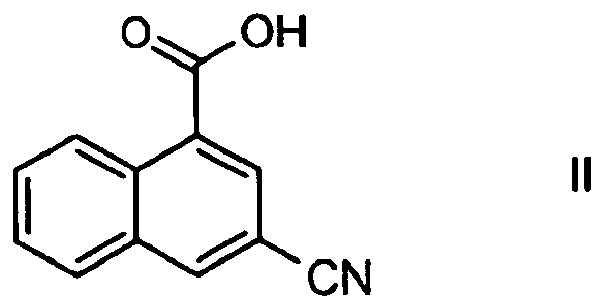

- The compound of formula III is reacted with a compound of the general formula IV,


R4 - B(OH)2 VIII
and a compound of the general formula IX,
- Process 2: The compounds of the present invention may be also prepared by reacting a compound of the general formula X

R4 - B(OH)2 VIII
and a compound of the general formula IX,


- Process 2 may be modified in such a way that the compound of general formula XII,


- Process 3: The compounds of the present invention may be also prepared by reacting a compound of the general formula II


- The compound of formula III is then reacted with a compound of the general formula IV,


- The compound of general formula V is oxidized to give a compound of the general formula VI,
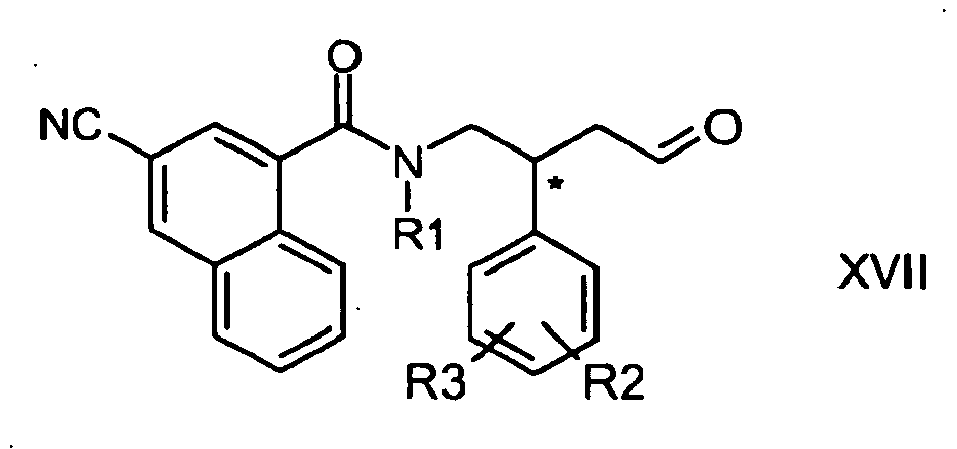
- The compound of general formula XVII is reacted with a compound of general formula XII

- The reaction of processes I and III, respectively, in which a compound of general formula VII or X, respectively, is reacted with compounds of general formulae VIII and IX to result in the formation of a compound of general I, can be carried out in known manner under the conditions of a boronic Mannich reaction (cf. e.g. N.A. Petasis et al., Journal of the American Chemical Society 120 (1998) 11798-11799,
WO 98/00398 WO 00/24510 - The compounds of formula I which bear at least one free hydroxyl group in the subgroup R6 may if desired then also be reacted with carboxylic acids R12COOH of formula XVII, wherein R12 has the meaning of straight-chain or branched alkyl with 1 to 3 carbon atoms, whereby the free hydroxyl groups of the subgroup R6 are acylated. Usually under these circumstances peracylation of the free hydroxyl groups of the subgroup R6 takes place. The acids of formula XVII or their reactive derivatives may be used as acylation agents. In particular acid anhydrides and acid halides are suitable reactive derivatives. The acylation may be carried out in an organic solvent which is inert under the reaction conditions, preferably at temperatures between -20°C and room temperature. Suitable solvents are in particular aromatic hydrocarbons such as benzene or toluene, cyclic or open-chain di-lower alkyl ethers such as diethyl ether, tetrahydrofuran (= THF) or dioxane, partially halogenated lower hydrocarbons such as dichloromethane or mixtures of these solvents. Where an acid anhydride or an acid halide of the acids of formula XVII is used as acylation agent, the acylation may expediently take place in the presence of an acid-binding reagent. Suitable acid-binding reagents are non-nucleophilic organic bases soluble in the reaction mixture, such as pyridine, triethylamine or 4-dimethylaminopyridine. Organic bases used in excess can simultaneously also be used as solvents.
- The compounds of formula I which bear at least two free hydroxyl groups in the subgroup R6 may if desired, after their preparation described above, also be reacted with a reactive carbonyl-synthesis equivalent, instead of a reaction with compounds of formula XVII, whereby the subgroup R6 can be carbonylated. The reaction can take place in known manner. For example, a compound of formula I can be reacted in an organic solvent which is inert under the reaction conditions. Suitable reactive carbonyl synthesis equivalents are for example phosgene or substances which react like phosgene, such as bis-(trichloromethyl)carbonate (= triphosgene), trichloromethyl chloroformate (= diphosgene) or in particular carbonyldiimidazole. Expediently an acid-binding reagent may be added to the reaction mixture. Suitable acid-binding reagents are the acid-binding reagents given above for the reaction of compounds of formula I with compounds of formula XVII. Suitable reaction temperatures are between about - 20°C and room temperature.
- The compounds of formula I which bear at least two free hydroxyl groups in the subgroup R6 may if desired, after their preparation described above, instead of a reaction with compounds of formula XVII or instead of a reaction with reactive carbonyl synthesis equivalents, also be reacted with a di-lower alkyl ketone or a C5-6-cycloalkyl ketone in the subgroup R6, to produce a 5- or 6-ring derivative bridged [by] methylene optionally substituted by lower alkyl or C4-5-alkylene. Preferably acetone is suitable as di-lower alkyl ketone. Preferably cyclopentanone and cyclohexanone are suitable as C5-6-cycloalkyl ketones.
- Where compounds of formula I are to be prepared in which the substituents contained in the subgroup R6, R7, R8, R9, R10 and/or R11 have meanings other than hydrogen, the point of departure is preferably carbohydrate compounds of Formula IX which contain free hydroxyl groups at least in alpha-position to the aldehyde function. It is beneficial to start with compounds of formula IX wherein R7, R8, R9, R10 and R11 are hydrogen. The free hydroxyl groups may if desired then be acylated, carbonylated or reacted with a suitable ketone in the above manner.
- The compounds of formula VII are novel compounds which are advantageously suitable as intermediate products for the preparation of novel active substances, for example for the preparation of the compounds of formula I, which are antagonistic to tachykinin receptors.
- The compounds of formula VII can be prepared by reacting a compound of the general formula VI,


- Compounds of formula VI can be prepared by reacting compounds of the general formula V,

EP 0 474 561 A1 , and can be prepared according to the processes described in this specification or according to analogous processes. - Compounds of formula XIII can be prepared by reacting compounds of the general formula IV,


- The compound of the general formula XVI can be prepared by oxidation of compound XX in any manner known from the art, e.g, by dimethylsulfoxide activated with oxalyl chloride (Swem oxidation).
- The compounds of formulae VIII, IX and XIX are known per se or can be prepared by the person skilled in the art from known compounds in known manner. Compounds of formula IX which are preferentially used, comprise D-xylose, D-lyxose, D-arabinose, D-threose, D-erythrose and D- and L-glyceraldehyde.
- The compounds of formula I may be isolated from the reaction mixture and purified in known manner. Acid addition salts may be converted into the free bases in conventional manner, and these may if desired be converted in known manner into physiologically compatible acid addition salts. Physiologically compatible salts of compounds of formula I are their conventional salts with inorganic acids, for example sulphuric acid, phosphoric acids or hydrohalic acids, preferably hydrochloric acid, or with organic acids, for example lower aliphatic monocarboxylic, dicarboxylic or tricarboxylic acids such as maleic acid, fumaric acid, lactic acid, tartaric acid, citric acid, or with sulphonic acids, for example lower alkanesulphonic acids such as methanesulphonic acid or trifluoromethanesulphonic acid, or benzenesulphonic acids optionally substituted in the benzene ring by halogen or lower alkyl, such as p-toluenesulphonic acid.
- The compounds of formula I contain in the alpha-position to the ring nitrogen atom in the 4-position of the piperazine ring an asymmetrical carbon atom, namely the carbon atom *C bearing the phenyl ring substituted by R2 and R3. Owing to this asymmetrical carbon atom and to the asymmetrical carbon atom bearing the subgroups R4, R5 and R6 and optionally also owing to the asymmetrical carbon atoms contained in the subgroup R6, the compounds of formula I may be present in several stereoisomeric forms. The present invention covers both the mixtures of optical isomers and the isomerically pure compounds of formula I. Preferred are compounds of formula I in which the carbon atom *C bearing the phenyl ring substituted by R2 and R3 is in the S-configuration. If mixtures of optical isomers of the starting compound, for example of the compounds of formula VII or the compounds of formula IX, are used in the synthesis of the compounds of formula I, the compounds of formula I are also obtained in the form of mixtures of optical isomers. Departing from stereochemically uniform forms of the starting compound, stereochemically uniform compounds of formula I can also be obtained. The stereochemically uniform compounds of formula I can be obtained from the mixtures of optical isomers in known manner, for example by chromatographic separation on chiral separating materials or by reaction with suitable optically active acids, for example tartaric acid or 10-camphorsulphonic acid, and subsequent separation into their optically active antipodes by fractional crystallisation of the diastereomeric salts obtained.
- The compounds of formula I and their acid addition salts have properties which are antagonistic to tachykinin receptors and are therefore suitable for the treatment of pathological conditions in larger mammals, particularly humans, in which tachykinins are involved as transfer agents. The group of compounds according to the invention is distinguished by a particularly beneficial action profile which is characterised by a high selective affinity to NK1- and NK2 receptors. Furthermore, the group of compounds according to the invention is distinguished by good compatibility even over prolonged periods of administration, and by comparatively good oral availability. Owing to their action profile, the compounds of formula I are suitable in particular for inhibiting processes in which tachykinins, such as neurokinin A, which bind to NK1 and to NK2 receptors are involved. Owing to the action which is advantageously directed at the peripheral region, the compounds of formula I are suitable in particular for the treatment and/or prophylaxis of respiratory diseases, in particular asthma, bronchitis, cough, and rhinitis; skin diseases, in particular inflammatory skin reactions, allergic skin reactions, and psoriasis; arthropathy diseases, in particular arthtitis, vasculitides and systemic lupus erythematosus; functional or inflammatory disorders in the gastrointestinal tract, in particular pseudomembranous colitis and diarrhoe; bleb diseases such as cystitis and interstitial cystitis; and migraine, of larger mammals, particularly humans, of both sexes, also including diseases which involve increased sensitivity to pain and/or impaired stool passage in the colon region. The functional disorders in the gastrointestinal tract which can be treated by the compounds according to the invention include in particular the disorders of the lower intestinal tracts known under the name "irritable bowel syndrome" (= IBS). Typical symptoms for the diagnosis of IBS are described, for example, in W.G. Thompson et al., Gastroenterology International 2 (1989) 92-95 or in W.G. Thompson et al., GUT 45/II (1999) II43-II47, and are generally known among experts by the term "Rome Criteria". The essential symptoms of IBS accordingly include pains in the lower abdomen, which appear to be due to hypersensitivity of the visceral afferent nervous system, and anomalies in bowel movement, such as constipation, diarrhoea or alternating constipation and diarrhoea. Further inflammatory disorders in the gastrointestinal tract which can be beneficially influenced by the group of compounds according to the invention are for example the inflammatory disorders in the small intestine and large intestine regions usually covered by the term "inflammatory bowel disease" (= IBD), for example ulcerative colitis or Crohn's disease. Owing to their action mechanism, the compounds according to the invention furthermore appear suitable for the treatment of other disorders in which tachykinins and in particular neurokinin A are involved as transfer agents. These disorders include for example neurogenic inflammations, inflammatory joint diseases such as rheumatic arthritis, asthmatic complaints, allergic disorders, disorders of immune regulation, bladder inflammation or also functional dyspepsia.
- The example numbers given for the compounds of formula I used as test substances in the pharmacological tests given below relate to the preparation examples described below.
- In The Netherlands, the affinity of the test substances to human NK1 receptors was measured in vitro. The inhibition of the binding of the physiological neurokinin (Substance P) to neurokinin-1 receptors was determined in The Netherlands.
- The receptor binding studies were performed with [3H]-Substance P as ligand. For the binding test, different samples of a membrane preparation of CHO cells (= egg cells of the Chinese hamster, Chinese hamster oocytes), which express the human NK1 receptor ("Accession Number" of the associated nucleic acid sequence = M74290; "Accession Number" of the associated protein sequence = P25103; cf. Takeda, Y.; Chou, K. B., Takeda, J.; Sachais, B.S. and Krause, J. E; Biochemical and Biophysical Research Communications, 179(3) (1991) 1232 - 1240), were incubated with a solution of the marked ligand, with the incubation mixtures containing no test substance or additions of different concentrations of test substance. Then, separation of bound and free ligands was performed in each of the samples with the aid of glass-fibre filtration. The fraction remaining in the filter was washed several times with buffer solution and then the radioactivity of the fraction remaining in the filter was measured using a beta scintillation counter.
- For the compounds of Examples 1 to 14, that concentration which effects half maximum displacement of the bound ligand was determined as IC50 of the respective test substance. From this, the corresponding inhibition constant (Ki value) of the test substance was calculated, and was stated as the negative common logarithm of the Ki value (= pKi value). The pKi value is a measurement of the affinity of the test substances to human NK1 receptors. In this test model, the test substances set forth in Table 1 below exhibited the given pKi values:
Table 1: Affinity of the test substances to human NK1 receptors Compound No. pKi (NK1) 1 8,4 2 8,5 3 8,8 4 8,6 5 8,9 6 8,3 7 8,3 8 8,1 9 8,0 10 8,0 11 8,1 12 8,0 13 8,1 14 8,3 16 9,0 17 7,5 18 8,5 21 8,7 22 8,4 24 8,0 25 8,1 26 8,1 27 8,2 28 7,9 - All the aforementioned test substances exhibited pKi values of at least 7,0 in this test model. The compounds of Examples 1 to 14 exhibited pKi values of at least 7,9.
- The affinity of the test substances to human NK2 receptors was measured in vitro. The ability of the test substances to displace the selective NK2 receptor antagonist SR 48968 (= saredutant) used as reference ligand from its corresponding bond was determined.
- The receptor binding studies were carried out with radioactively marked [3H]-SR 48968 (from Amersham) as ligand. For the binding test, different samples of a membrane preparation of CHO cells (= egg cells of the Chinese hamster, Chinese hamster oocytes), which express the human NK2 receptor (for preparation, see N.P. Gerard et al., Journal of Biological Chemistry 265/33 (1990) 20455-20462), were incubated for 90 minutes (= min.) with a solution of the marked ligand, with the incubation mixtures containing no test substance or additions of different concentrations of test substance. Then in each case the membrane-bound ligands in the samples were separated from free ligands by filtration. The fraction remaining in the filter was washed several times with buffer solution, before its radioactivity was measured using a liquid scintillation counter. That concentration which effects half-maximum displacement of the bound reference ligand was determined as IC50 of the respective test substance. The inhibition constant (Ki value) of the test substance was calculated from the respective IC50 value, and was stated as the negative logarithmised value thereof (pKi).
- For the compounds of Examples 1 to 14, the affinity to human NK2 receptors was determined in each case by at least three measurements of the test substances in concentration series of 10-6 to 10-10 mol/l. If several measurements were performed, the average thereof was listed each time. The pKi value is a measurement of the affinity of the test substances to human NK2 receptors. In this test model, the test substances set forth in table 2 below exhibited the given pKi values:
Table 2: Affinity of the test substances to human NK2 receptors Compound No. pKi (NK2) 1 8,1 2 7,1 3 7,2 4 6,9 5 7,3 6 7,4 7 7,4 8 7,5 9 7,2 10 7,0 11 7,6 12 7,0 13 7,7 14 7,9 16 6,1 17 5,5 18 6,8 21 6,4 22 6,0 24 7,5 25 7,4 26 7,0 27 7,6 28 7,3 - All the aforementioned test substances exhibited pKi values of at least 7,0 in this test model. The compounds of Examples 1 to 14 exhibited pKi values of at least 6,9.
- In The Netherlands, the action antagonistic to NK1 receptors of the test substances was measured in vitro on isolated ring preparations, kept in an oxygenated nutrient solution, of the aortas of Pirbright-White guinea pigs. The inhibition by the test substances of the relaxation of tone of the aorta preparations, caused after stimulation with the NK1 agonist Substance P, was determined.
- In order to measure the contraction of the vessel muscles, the preparations were fixed to a hook, joined by a thread to a force measuring apparatus and the contractions were recorded in each case on a plotter. The aorta preparations were tonicised with phenylephrine. Then before and after the administration of the test substance the NK1 receptors of the preparations were stimulated with 0.01 µmol Substance P, which caused relaxation of the tone. The relaxations before and after the administration of the test substance were quantified in percent. The effective concentration of the half maximum inhibition of the relaxation of the tone (= EC50) was calculated. The negative common logarithm of the EC50 value (= pEC50) was given as characteristic variable. The pEC50 value is a measurement of the functional effectiveness of the test substances on NK1 receptors. In this test model, the test substances set forth in Table 3 below exhibited the given pEC50 values:
Table 3: Functional NK1 antagonism of the test substances on isolated guinea pig tissue Example No. pEC 50 1 9,4 2 9,5 5 10,0 6 9,4 11 8,9 - The NK2 receptor-antagonising action of the test substances was determined on isolated gall-bladder preparations from Pirbright-White guinea pigs, held in an oxygen-saturated nutrient solution. To this end, the preparations were fastened on one hand in the nutrient solution to organ holders and on the other hand on a force meter by a thread.
- In this test the NK2 receptors present in the gall-bladder preparations were stimulated with the natural NK2 receptor agonist neurokinin A (= NKA; 0.1 µmol/l) and the contractions of the preparations caused thereby were measured as contractility in mN (= preliminary value) measured. Then NKA was rinsed out of the preparations with NKA-free solution and the test substances were added in a concentration of 10-7 mol/l. After two hours' incubation of the preparations with the test substances, the contractions of the preparations then still caused by renewed NKA addition were again measured and the results were given as percentages, relative to the contractions initially measured, caused solely by NKA addition. The concentration of the test substances was increased iteratively in the subsequent experiments as a function of the result in logarithmic whole or half steps, until at least one concentration above or below 50% inhibition of contraction was determined (up to at most 10-5 mol/l). For each concentration, the average value of inhibition of contraction was calculated from 2 to 4 preparations. In each case, the concentration of half-maximum inhibition (IC50) per test substance was calculated as characteristic variable. In each case the logarithmised value of the IC50 per test substance is given as pIC50 in (mol/l]. In this test model, the test substances set forth in Table 4 below exhibited the pIC50 values given below.
Table 4: Functional NK2 antagonism of the test substances on isolated guinea pig tissue Example No. pIC 50 1 8,7 2 7,7 5 7,5 6 7,4 11 7,8 - Functional cellular tests of the antagonistic effect of the compounds of the present invention on the human tachykinin receptors were performed in CHO cells expressing the recombinant human NK1 or NK2 receptor. In these tests the inhibition of ligand induced increase in mobilization of intracellular calcium and inhibition of ligand induced phosphorylation of MAPK were determined, which can be used as a measure of functional activity of tachykinin-antagonists. Additionally, the antagonistic properties of reference compounds on the different tachykinin receptors were characterized for comparison.
- The effects of test compounds were assessed using Chinese hamster ovary (CHO) fibroblast cells, stably expressing cloned human NK1 or NK2 receptors. The NK receptor is coupled to Gq. The activation of the Gq protein by ligand binding to the receptor leads to a mobilization of intracellular calcium and phosphorylation of MAPK. Both systems were used to determine functional effects of the test compounds.
- For tests, cells were seeded 24 hours prior to the experiment into black 96-well microplates. The cell density was 2.2×10⁴ cells/well. All steps were done under sterile conditions. In order to observe changes in intracellular calcium levels, cells were loaded with a calcium-sensitive dye. This dye (FLUO-4, from Molecular Probes) excites at 488 nm, and emits in the 500 nm to 560 nm range, only if a complex with calcium is formed. For the dye loading the growth-medium was aspirated out of the well without disturbing the confluent cell layer and 100 µl loading medium (HBSS, 4 µM FLUO-4, 0.005% (w/v) pluronic acid, 2.5mM probenecid, 20 mM HEPES, pH 7.4) was dispensed into each well using an automatic pipettor system (Multidrop, Labsystems). Pluronic acid was added to increase dye solubility and dye uptake into the cells, whereas probenecid, an anion exchange inhibitor, was added to the loading medium to increase dye retention in the cells. The cells were incubated in a 5% CO2 incubator at 37°C for 40 minutes. After dye loading, the cells were washed three times with wash-buffer (HBSS, 2.5 mM probenecid, 20 mM HEPES, pH 7.4) to reduce basal fluorescence. In the last washing step the buffer was aspirated and replaced with 100 µl washing buffer. For the antagonism screening mode 50 µl of the compound (final concentration ranges from 10 µM to 1.4 nM) were applied 7 min prior to addition of substance P (final concentration:10-8 M; NK1 agonist) or NKA (final concentration: 10-7 M; NK2 agonist). The FLIPR setup parameters were set to 0.4 sec exposure length,
filter 1, 50 µl fluid addition, pipettor height at 125 µl, dispense speed 40 µl/sec without mixing. Maximal fluorescence changes were obtained using the statistic function of the FLIPR software, and data plotted using GraphPad Prism 4. All points were expressed as a percentage inhibition of the control agonist. IC50 values were determined using sigmoidal dose-response curve fitting. Antagonist potencies (pA2) values were calculated using equation:
in which the IC50 of the test compound was obtained from concentration-effect relationships, [L] is the concentration of the agonist (substance P for NK1 test, NKA for NK2 test), and the EC50 is the potency of the agonist at the respective human cloned NK receptor (EC50 substance P: 10-9.6 M; EC50 NKA: 10-8.8 M). The results are summarized in table 5:Table 5: pA2 data for NK1 and NK2: Compound No. pA2 (NK1) pA2 (NK2) 1 8,9 8,0 7 8,8 8,1 8 9,2 8,9 9 8,5 8, 13 8,3 7,7 14 9,4 8,5 16 9,3 9,1 17 7,7 7,7 18 8,2 8,6 21 9,1 9,5 22 8,1 8,5 24 8,1 7,8 25 8,5 9,0 26 8,0 7,4 27 9,2 8,1 28 8,7 7,6 - The NK-1- and NK-2-antagonistic activities of the test substances were investigated in anaesthetised guinea pigs in each case after intravenous (= i.v.) and oral (= p.o.) administration in vivo. With the present test model it is possible to detect both NK-2-antagonistic effects in three different organ systems (respiratory tracts, colon and circulation) and NK-1-antagonistic effects (rapid drop in blood pressure) in an animal simultaneously.
- Pirbright-White guinea pigs of a body weight of 500-700 g were anaesthetised with ketamine/xylazine (67/13 mg/kg subcutaneously, initial dose, further doses administered as required). The animals were provided with an intravenous catheter in order to administer the substance and an intra-arterial catheter to measure the blood pressure. The animals were artificially ventilated via a tracheal cannula and the respiratory pressure was recorded by means of a pressure transducer. A balloon was introduced into the distal colon of the animals for manometric recording of colon motility by means of a pressure transducer. Blood pressure, heart rate, respiratory pressure and colonic pressure were measured continuously for each animal and plotted on a recorder and by means of a digital data-processing system. Neurokinin A (= NKA; 200 pmol/animal) was administered i.v. as a bolus as a test stimulus to stimulate the NK-1-and the NK-2 receptors. An addition of NKA of this type results in a great increase in respiratory pressure (bronchoconstriction) and colonic pressure, and in a biphasic drop in blood pressure. The first phase of hypotension (= phase of maximum hypotension within the first minute after administration of NKA) is mediated via NK-1 receptors, since they can be blocked completely by specific NK-1 receptor antagonists. The second phase of delayed hypotension (= phase of maximum hypotension after 2-5 min.) on the other hand is mediated via NK-2 receptors, since they can be blocked by specific NK-2 receptor antagonists. The doses of the test substances are given as ED50 values which each result in a response to the NKA test stimulus which is reduced to 50% of the initial value, as characteristic variables for the individual measurement parameters bronchoconstriction, colonic pressure and change in blood pressure mediated by NK-1 or NK-2.
Table 6: NK-1- and NK-2-receptor-antagonistic effective-ness of the test substances of Formula I on guinea pigs in vivo after intravenous administration ED50 iv [µmol/kg] after 1 min (cumulative) Structure NK1 (early hypotension) NK2 (late hypotension) NK2 (broncho-constriction) NK2 (colonic motility) 1 0.077 0.643 0.321 0.027 2 <0.010 0.106 <0.010 0.085 6 0.071 0.282 0.595 0.050 7 0.052 0.338 0.207 0.309 8 0.070 0.803 1.126 0.135 9 0.099 1.044 0.943 0.287 10 0.041 0.040 0.045 0.109 11 0.093 0.145 0.130 0.132 23 0.029 1.165 0.725 0.961 - The antagonistic effects of the test substances were first investigated in cumulative form, the time of the NKA test stimulus being 1 min after the administration of the respective doses of the test substances had ended. These ED50 values obtained from cumulative dose effect curves are plotted in table 6.
- The measured values plotted in table 6 above show, inter alia, that the substances of
structures 1, 2 and 6 to 11 after cumulative administration i.v. (detection of theantagonism 1 min. after the administration of test substance had ended) caused a marked NK-1-receptor-antagonistic activity on the early hypotension as well as NK-2-receptor-antagonistic activity of colon motility, late drop in blood pressure and respiratory resistance. - In order additionally to detect the variation over time of the antagonistic effects of the test substances, the action of the NKA test stimulus was determined at different times (1, 30, 60, 90, 120, 150 and 180 min.) after oral administration of the test substances. The antagonistic effects of the test substances were then determined as "area under the curve" ("AUC") over the investigation period after administration of the test substances (1 - 180 min after administration) and the ED50 values after oral administration obtained therefrom were plotted in table 7.
Table 7: NK-1- and NK-2-receptor-antagonistic effective-ness of the test substances of Formula I on guinea pigs in vivo after oral administration ED50 AUC1-180 min oral [µmol/kg] Structure NK1 (early hypotension) NK2 (late hypotension) NK2 (broncho-constriction) NK2 (colonic motility) 1 22.9 3.1 3.1 5.5 2 15.2 14.8 11.7 6.0 - The compounds according to the invention, in particular the substance of
structures 1 and 2 as shown in table 7, are furthermore active orally on the NK2 as well as NK1 receptor antagonists. - The compounds of formula I may be administered in conventional pharmaceutical preparations. The doses to be used may vary individually and will naturally vary according to the type of condition to be treated and the substance used. In general, however, medicinal forms with an active substance content of 0.2 to 200 mg, in particular 1 to 50 mg, active substance per individual dose are suitable for administration to humans and larger mammals. The compounds may be contained according to the invention, together with conventional pharmaceutical auxiliaries and/or carriers, in solid or liquid pharmaceutical preparations. Examples of solid preparations are preparations which can be administered orally, such as tablets, coated tablets, capsules, powders or granules, or alternatively suppositories. These preparations may contain conventional pharmaceutical inorganic and/or organic carriers, such as talcum, lactose or starch, in addition to conventional pharmaceutical auxiliaries, for example lubricants or tablet disintegrating agents. Liquid preparations such as suspensions or emulsions of the active substances may contain the usual diluents such as water, oils and/or suspension agents such as polyethylene glycols and the like. Other auxiliaries may additionally be added, such as preservatives, taste correctives and the like.
- The active substances may be mixed and formulated with the pharmaceutical auxiliaries and/or carriers in known manner. For the production of solid medicament forms, the active substances may for example be mixed with the auxiliaries and/or carriers in conventional manner and may be wet or dry granulated. The granules or powder can be poured directly into capsules or be pressed into tablet cores in conventional manner. These may be coated in known manner if desired.
- The following examples are intended to explain the invention further, without limiting its scope.
-
- A) 58.0 g 3-cyano-naphthalene-1-carboxylic acid (formula II) was suspended in 600 ml of dichloromethane. 2 ml of DMF were added successively under stirring. To this initial suspension, 35 ml of oxalyl dichloride in 65 ml dichloromethane were added slowly. The mixture was stirred for 4 hours at 30 °C to 40 °C. The obtained solution was concentrated to dryness and 67 g of 3-cyano-naphthalene-1-carbonyl chloride (formula III) was isolated, stored in a refrigerator and used without further purification.
- B) 20 g of 3S-(3,4-Dichloro-phenyl)-4-methylamino-butan-1-ol (formula IV) were suspended in 200 ml of THF under stirring at room temperature. 12 g of KOH dissolved in 100 ml of water were added leading to a solution. 17.2 g of 3-cyano-naphthalene-1-carbonyl chloride (formula III, from reaction step A)) were added and stirred for 3 hours. The organic solvents were eliminated and the remaining mixture was supplemented with ethyl acetate and methyl-tert.-butylether. The water phase was eliminated while the organic phase was washed four times with 50 ml of water and dried over sodium sulfate. The organic phase was concentrated to dryness, providing 31.8 g of a yellowish solid (3-cyano-naphthalene-1-carboxylic acid [2S-(3,4-dichloro-phenyl)-4-hydroxybutyl]-methyl-amide; formula V) which was used without further purification.
- C) 5.8 g of 3-cyano-naphthalene-1-carboxylic acid [2S-(3,4-dichloro-phenyl)-4-hydroxy-butyl]-methyl-amide (formula V, from reaction step B)) were dissolved in 100 ml dichloromethane. 2.2 ml of triethylamine and 1.16 ml of methanesulfonyl chloride were added at room temperature. The reaction mixture was stirred for 5 hours and left for 2.5 days. Water was added and the organic part was dried over sodium sulfate and concentrated to dryness. 6.65 g of a foamy product (3-cyano-naphthalene-1-carboxylic acid [(2S)-2-(3,4-dichloro-phenyl)-4-methylsulfonyl-butyl]-methyl-amide, formula VI) were isolated and used without further purification.
- D) 6.65 g of 3-Cyano-naphthalene-1-carboxylic acid [2S-(3,4-dichloro-phenyl)-4-methylsulfonyl-butyl]-methyl-amide (formula VI, from reaction step C)) were dissolved in 150 ml of acetonitril. 1.84 g of potassium iodide, 2.44 g N-tert. butoxycarbonyl-piperazine (formula XIX) and 2.2 ml triethylamine were added and the mixtures was heated to reflux for three hours. After cooling down to room temperature, the reaction mixture was left over night before adding water and ethyl acetate. The organic phase was washed with water and a saturated solution of sodium bicarbonate. Drying of the organic phase over sodium sulphate and evaporation of the solvent in a vacuum yielded 7.8 g 3-cyano-naphthalene-1-carboxylic acid {2S-(3,4-dichloro-phenyl)-4-[4-(2,2-dimethyl-propionyl)-piperazin-1-yl]-butyl}-methyl-amide (formula VIa), which was used directly for further reactions without further purification.
- E) 6.6 g 3-cyano-naphthalene-1-carboxylic acid {2S-(3,4-dichloro-phenyl)-4-[4-(2,2-dimethyl-propionyl)-piperazin-1-yl]-butyl}-methyl-amide (formula VIa, from reaction step D)) were dissolved in 150 ml ethanol and 20 ml of 5N HCl were added. The mixtures was stirred for 2 days and neutralized with sodium carbonate. Ethanol was distilled off and the product was extracted with ethyl acetate and water. The ethyl acetate layer was dried over sodium sulfate and concentrate to dryness, providing 5.2 g of amorphous 3-cyano-naphthalene-1-carboxylic acid [2S-(3,4-dichloro-phenyl)-4-piperazin-1-yl-butyl]-amide (formula VII).
- F) 3.0 g of 3-cyano-naphthalene-1-carboxylic acid [2S-(3,4-dichloro-phenyl)-4-piperazin-1-yl-butyl]-amide (formula VII, from reaction step E)), 806 mg of 2-furanboronic acid (formula VIII) and 945 mg of 80% pure (D)-glyceraldehyde (formula IX) in ethanol were heated to reflux for 5 hours. The mixture was kept at room temperature over night before distilling off the organic solvent. The product obtained was purified by column chromatography (ethyl acetate till ethanol) to deliver 1.3 g of pure crystalline 3-cyano-N-[(2S)-2-(3,4-dichlorophenyl)-4-{4-[(1R,2S)-1-(2-furyl)-2,3-dihydroxypropyl]piperazin-1-yl}butyl]-N-methyl-1-naphthamide (formula I).
[α]D 20 = -27,6° (c = 1, methanol).
MS-data (ES+): M+ bei m/z = 635
Melting point = 140-142 °C -
- A) 23.0 g of tert. butoxycarbonyl-piperazine (formula X) were dissolved in 600 ml ethanol under nitrogen at 30 °C. 25 g of 2-furanboronic acid (formula VIII) and 22.0 g of 80% pure (D)-glyceraldehyde (formula IX) in 400 ml ethanol were heated to reflux for 7 hours. The mixture was cooled down to room temperature and concentrated to dryness. The residue was dissolved in 200 ml ethyl acetate and 50 ml methyl-tert.-butylether and successively washed with a solution of 20 g of KOH in 200 ml water. The residue was further washed with six portions of 150 ml water before drying over sodium sulfate. After evaporation of the solvent, 54.7 g of 4-((2S)-1-furan-2-yl-2-hydroxy-propyl)-piperazine-1-carboxylic acid tert-butyl ester (formula XI) was obtained.
[α]D 20 = +34.6° (c = 1, methanol).
Melting point: 92 to 93°C. - B) 16.3 g of 4-((2S)1-furan-2-yl-2-hydroxy-propyl)-piperazine-1-carboxylic acid tert-butyl ester (formula XI, from reaction step A)) were dissolved in 50 ml methyl-tert.-butylether under stirring. 160 ml of 5 N HCl were added to give a solution and a strong gas evolution. After stirring for 24 hours, the solution was poured in 200 ml methyl-tert.-butylether and further stirred. A solid precipitate which was filtered and washed with 20 ml of methyl-tert.-butylether. After drying under vacuum at 60 °C 13.5 g of (2S)-1-furan-2-yl-1-piperazin-1-yl-butan-2-ol dihydrochlorid (formula XII) were isolated.
Specific rotation: +14.0° (c = 1, methanol). - C) 28.4 g of sodium hydrogen carbonate in 150 ml water were added to a suspension of 25 g of 2S-(3,4-Dichloro-phenyl)-4-methylamino-butan-1-ol (formula IV) hydrochlorid in 500 ml of THF under stirring. A solution of 21.1 g of tertiary butyloxycarbonyl anhydride in 200 ml THF was added and the combined reaction mixture was stirred for four hours. The THF was distilled off under vacuum and 500 ml of ethyl acetate was added to the residue. 100 ml of a saturated solution of sodium hydroxyl carbonate was added, followed by the addition of 300 ml water. The organic phase was removed and dried over sodium sulfate. The organic solvent was removed to deliver an oily material which was purified in column chromatographie on Silica gel to give 29.5 g of [(2S)-2--(3,4-dichloro-phenyl)-4-hydroxy-butyl]-methyl-carbamic acid tert-butyl ester (formula XX) as a colorless oily pure material which slowly crystallizes. 20 g of [(2S)-2--(3,4-dichloro-phenyl)-4-hydroxy-butyl]-methyl-carbamic acid tert-butyl ester (formula XX) were dissolved under stirring in 150 ml of dichloromethane at room temperature under nitrogen to which 6 ml of triethylamine and 3 ml methanesulfonyl chloride were added dropwise. The solution was stirred for three days at room temperature and finally concentrated. 200 ml of ethyl acetate and toluene were added and the organic layer was washed with 100 ml water, with a saturated solution of sodium hydrogen carbonate until pH 8 to 9 was reached and finally washed with 100 ml water. The organic phase was dried over sodium sulfate and evaporated to dryness to give 13.3 g of the corresponding mesylate (formulae XXI). 13.3 g of the mesylate were dissolved under stirring in 200 ml of acetone at room temperature under nitrogen and 22 g of sodium iodide were added. The mixture was stirred until completion of the reaction (three days). Acetone was distilled off and 200 ml ethyl acetate were added as well as 33 g of sodium thiosulfate pentahydrate dissolved in 200 ml water. The aqueous phase was then separated and the organic phase was successively washed with 100 ml of an saturated solution of sodium hydrogen carbonate followed by three times of 100 ml water. The organic phase was dried over sodium sulfate and concentrated to dryness to give 15.1 g of [(2S)-2-(3,4-dichloro-phenyl)-4-iodo-butyl]-methyl-carbamic acid tert-butyl ester (formulae XIII).
- D) A 10 ml solution of 200 mg of [(2S)-2-(3,4-dichloro-phenyl)-4-iodo-butyl]-methyl-carbamic acid tert-butyl ester (formulae XIII, from reaction step C)) in 10 ml THF were added to a suspension of 450 mg of (2S)-1-furan-2-yl-1-piperazin-1-yl-butan-2-ol dihydrochlorid (formula XII, from reactions step B)) and 1ml of triethylamine in 50 ml THF under stirring at room temperature. About 100 mg of Na2CO3 were added and the mixture was boiled to reflux for 15 hours. After cooling to room temperature, the suspension was concentrated in vacuum and the residue was dissolved in 50 ml of ethyl acetate and 200 mg of KOH in 10 ml of water. The organic phase was washed 4 times with 20 ml of water, dried on sodium sulfate and evaporated to dryness to deliver 203 mg of a yellowish compound identified in LC-MS as the expected amine XIV.
- E) 3 ml of HCl (5N) in isopropanol were added to 460 mg of the amine XIV from reaction step D) dissolved at 30°C in 2 ml methylene chloride under stirring at room temperature. After 1 hour, a precipitate appeared and 50 ml of methyl-tert.-butylether were added and the mixture was stirred for 15 hours. The white solid was isolated by filtration; washed 3 times with 10 ml methyl-tert.-butylether and dried in vacuum at 80°C. The remaining amount of methyl-tert.-butylether was eliminated by dissolving the compound in methanol and distilling off the solvents to deliver 407 mg (yield: 85%) of a foam used without further purification.
- F) A suspension of 168 mg 3-cyano-naphthalene-1-carbonyl chloride (formula III, from reaction step A) of process 1) in 20 ml of methylene chloride were added dropwise to 367 mg of the amine from reaction step E) dissolved in 10 ml of THF, 10 ml of water and 200 mg of KOH. After stirring for 15 hour at room temperature, the reaction mixture was concentrated in vacuum and redissolved in a mixture of 30 ml of ethyl acetate and 30 ml methyl-tert.-butylether. The organic phase was washed 4 times with 20 ml of water, dried on sodium sulfate and concentrated to dryness under vacuum to deliver 420 mg of 3-cyano-N-[(2S)-2-(3,4-dichlorophenyl)-4-{4-[(1R,2S)-1-(2-furyl)-2,3-dihydroxypropyl]-pipera-zin-1-yl}butyl]-N-methyl-1-naphthamide (formula I) identified in LC-MS and NMR.
[α]D 20 = -27,6° (c = 1, methanol).
MS-data (ES+): M+ bei m/z = 635
Melting point = 140-142 °C -
- A) 12.2 g DMSO in 100 ml dichloromethane are added dropwise to 7.3 g oxalyl chloride in 100 ml dichloromethane unter nitrogen at - 70 °C unter stirring. The resulting mixture was stirred for another 15 minutes before 20 g of [2S-(3,4-dichloro-phenyl)-4-hydroxy-butyl]-methyl-carbamic acid tert-butyl ester in 200 ml dichloromethane were added. The mixture was stirred at - 70°C for one hour before 40.3 ml of triethylamine in 50 ml dichloromethane were added dropwise. The solution was stirred at - 70°C for 15 minutes and then allowed to warm up to room temperature. The solvent was removed and the residue was dissolved in 300 ml of toluene and 200 ml of ethyl acetate. The resulting solution was washed six times with 200 ml of a saturated solution of NaCl in water, dried over sodium sulfate and concentrated to dryness to deliver 19.7 g of [(2S)-2-(3,4-dichloro-phenyl)-4-oxo-butyl]-methyl-carbamic acid tert-butyl ester aldehyde (formula XVI).
- B) A mixture of 300 mg of (2S)-1-furan-2-yl-1-piperazin-1-yl-butan-2-ol dihydrochlorid (formula XII, from reaction step B) of Process 2), 200 mg of sodium acetate in 50 ml THF and 100 µl of acetic acid were added to a suspension of 280 mg of [(2S)-2-(3,4-dichloro-phenyl)-4-oxo-butyl]-methyl-carbamic acid tert-butyl ester aldehyde (formula XVI, from reaction step A)) in 20 ml THF. The resulting mixture was stirred for 5 hours at room temperature. Subsequently, 240 mg of sodium triacetoxyboro-hydride were added and the suspension was stirred for 15 hours at room temperature. The suspension was then concentrated in vacuum, and the residue was dissolved in 30 ml of ethyl acetate, 30 ml of methyl-tert.-butylether and 600 mg of KOH in water. The organic phase was washed 4 times with 20 ml of water. The organic solvents were dried over sodium sulfate and distilled off to give 463 mg of a glassy compound used without further purification in accordance with process steps E) and F) of process 2.
-
- A) 58.0 g 3-cyano-naphthalene-1-carboxylic acid (formula II) was suspended in 600 ml of dichloromethane. 2 ml of DMF were added successively under stirring. To this initial suspension, 35 ml of oxalyl dichloride in 65 ml dichloromethane were added slowly. The mixture was stirred for 4 hours at 30°C to 40 °C. The obtained solution was concentrated to dryness and 67 g of 3-cyano-naphthalene-1-carbonyl chloride (formula III) was isolated, stored in a refrigerator and used without further purification.
- B) 20 g of 3S-(3,4-Dichloro-phenyl)-4-methylamino-butan-1-ol (formula IV) were suspended in 200 ml of THF under stirring at room temperature. 12 g of KOH dissolved in 100 ml of water were added leading to a solution. 17.2 g of 3-cyano-naphthalene-1-carbonyl chloride (formula III, from reaction step A) were added and stirred for 3 hours. The organic solvents were eliminated and the remaining mixture was supplemented with ethyl acetate and methyl-tert.-butylether. The water phase was eliminated while the organic phase was washed four times with 50 ml of water and dried over sodium sulfate. The organic phase was concentrated to dryness, providing 31.8 g of a yellowish solid (3-cyano-naphthalene-1-carboxylic acid [2S-(3,4-dichloro-phenyl)-4-hydroxy-butyl]-methyl-amide; formula V) which was used without further purification.
- C) 25 ml DMSO in 100 ml dichloromethane are added dropwise to 9.7 g oxalyl chloride in 100 ml dichloromethane unter nitrogen at - 70 °C unter stirring. The resulting was stired for another 15 minutes before 31.7 g of (3-cyano-naphthalene-1-carboxylic acid [2S-(3,4-dichloro-phenyl)-4-hydroxy-butyl]-methyl-amide (formula V, from reaction step B) in 200 ml dichloromethane and 6 ml DMSO were added. The mixture was stirred for another hour at - 70 °C. 52 ml of triethylamine in 50 ml dichloromethane were added dropwise. The solution was stirred at - 70 °C for 15 minutes and then allowed to warm up to room temperature. The solvent was removed and the residue was dissolved in 300 ml of toluene and 200 ml of ethyl acetate. The resulting solution was washed six times with 200 ml of a saturated solution of NaCl in water, dried over sodium sulfate and concentrated to dryness to deliver 31.0 g of [7-Cyano-naphthalene-2-carboxylic acid [(2S)-2-(3,4-dichloro-phenyl)-4-oxo-butyl]-methylamide (formula XVII).
- D) 860 mg of (2S)-1-furan-2-yl-1-piperazin-1-yl-butan-2-ol dihydrochlorid (formula XII, from reaction step B) of Process 2), 860 mg of [7-Cyano-naphthalene-2-carboxylic acid [(2S)-2-(3,4-dichloro-phenyl)-4-oxo-butyl]-methyl-amide (formula XVII, from reaction step C)), 200 µl acetic acid and 0.1 ml water were put in suspension in 150 ml THF and stirred for four hours. 1.49 g sodium triacetoxyborohydride were added and the reaction mixture was stirred for 15 hours at room temperature. The solution was concentrated and 0.4 g KOH in 1 ml water as well as 10 ml methyl-tert.-butylether and 50 ml ethyl acetate were added. Water was eliminated and the organic pages was wash four times with 20 ml water, dried over sodium sulfate and concenteated to dryness to deliver 1.32 g of a foam. This foam was dissolved in 9 ml isopropyl alcohol, and heated to 60°C. A product crystallizes which was redissolved by adding 28 ml isopropyl alcohol (added in three portions) at 75°C. After cooling down to room temperature, crystals were obtained which were washed three times with 20 ml methyl-tert.-butylether to deliver 1.15 g 3-cyano-N-[(2S)-2-(3,4-dichlorophenyl)-4-{4-[(1R,2S)-1-(2-furyl)-2,3-dihydroxypropyl]piperazin-1-yl}butyl]-N-methyl-1-naphthamide monoisopropylate (formula I).
Melting point: 165 - 166 °C. -

- 650 mg 3-cyano-N-[(2S)-2-(3,4-dichlorophenyl)-4-{4-[(1R,2S)-1-(2-furyl)-2,3-dihydroxypropyl]piperazin-1-yl}butyl]-N-methyl-1-naphthamide from any of the above processes were suspended in 50 ml dichloromethane at room temperature. 216 mg of N,N'-carbonydiimidazole in 60 ml dichloromethane were added over a period of 70 minutes. The solution was stirred for 5 hours at room temperature before being washed with 50 ml of a saturated solution of sodium hydrogencarbonat. The mixture was then washed with water until a pH of 6 was reached. Removal of the solvents in vacuum lead to 634 mg of 3-cyano-N-[(2S)-2-(3,4-dichlorophenyl)-4-{4-[(1R,2S)-1-(2-furyl)-2-oxo[1,3]dioxolan-4-yl]piperazin-1-yl}methyl]-N-methyl-1-naphthamide.
- 350 mg 3-cyano-N-[(2S)-2-(3,4-dichlorophenyl)-4-{4-[(1R,2S)-1-(2-furyl)-2-oxo[1,3]dioxolan-4-yl]piperazin-1-yl}methyl]-N-methyl-1-naphthamide monoethanolate were dissolved under stirring in 50 ml ethyl acetate at room temperature under stirring. 120 µl of acetyl chloride and 250 µl of triethylamine were added successively. The reaction mixture was stirred further for 3 hours at room temperature and washed with 50 ml of a saturated solution of sodium carbonate in water and five times with 30 ml of water. After drying with sodium sulfate, the solution was concentrated to dryness to deliver 342 mg of a mixture which contains mainly monoacetic ester of the primary alcohol as seen in LC-MS and NMR. The mixture was purified by column chromatography on 10 g of SiO2 with ethyl acetate/ethanol as mixture of eluents to deliver 136 mg of the monoacetate which was characterized in LC/MS and NMR.
- 230 mg 3-cyano-N-[(2S)-2-(3,4-dichlorophenyl)-4-{4-[(1R,2S)-1-(2-furyl)-2-oxo[1,3]dioxolan-4-yl]piperazin-1-yl}methyl]-N-methyl-1-naphthamide monoethanolate were dissolved in 10 ml of pyridine at room temperature. 150 µl of acetyl chloride in 10 ml of methylene chloride were added dropwise. The reaction mixture was stirred for 4 hours at room temperature and after addition of 10 ml of water, concentrated in vacuum. The residue was dissolved in 50 ml ethyl acetate and was washed 6 times with 20 ml water. LC-MS and NMR show the presence of diacetate as the main compound in the raw mixture. 150 mg of the mixture were fractionated by column chromatography on 10 g of SiO2 to deliver 84 mg of the expected diester as confirmed by NMR and MS.
- The compounds of formula I listed in table 8 below may be prepared according to the process described in the above examples or according to processes analogous thereto.
Table 8: Examples of compounds of formula I. Structure R1 R2 R3 R4 R5 R7 R8 R9 R10 R11 k l m n 1 CH3 CI CI 2-furanyl H H - - - H 1 0 0 0 2 CH3 CI CI 2-furanyl H H H H - H 1 1 1 0 3 CH3 CI CI 2-furanyl H H H H - H 1 1 1 0 4 CH3 CI CI 3-thiophen H H H - H H 1 1 0 1 5 CH3 CI CI 3-thiophen H H H - H H 1 1 0 1 6 CH3 CI CI 2-furanyl CH2OH from R6 - - - - H 0 0 0 0 7 CH3 CI CI 2-furanyl H H H H - H 1 1 0 0 8 CH3 CI CI 3-thiophen H H - - - H 1 0 0 0 9 CH3 CI CI 2-thiophen H H - - - H 1 0 0 0 10 CH3 CI CI 3-thiophen H 5-ring carbonyl - - - - 11 CH3 CI CI 2-furanyl H 5-ring carbonyl - - - - 12 CH3 CI CI 3-furanyl H H - - - H 1 0 0 0 13 CH3 CI CI 2-furanyl 5-ring methylene - - - - 14 CH3 CI CI 2-furanyl H H - - - H 1 0 0 0 15 CH3 CI CI 4-methyl-phenyl H H - - - H 1 0 0 0 16 CH3 CI CI 4-methoxy-phenyl H H - - - H 1 0 0 0 17 CH3 CI CI 2-benzo[b]furan H H - - - H 1 0 0 0 18 CH3 CI CI 5-chloro-2-thiophene H H - - - H 1 0 0 0 19 CH3 CI CI 2-methoxy-phenyl H H - - - H 1 0 0 0 20 CH3 CI CI 3-pyridine H H - - - H 1 0 0 0 21 CH3 CI CI 3,4-methylene-dioxyphenyl H H - - - H 1 0 0 0 22 CH3 CI CI 2-benzo[b]thio phene H H - - - H 1 0 0 0 23 CH3 CI CI phenyl H H - - - H 1 0 0 0 24 CH3 CI CI benzyl H H - - - H 1 0 0 0 25 CH3 CI CI 2-furanyl H - - - - H 0 0 0 0 26 CH3 CI CI benzyl H H - - - COCH3 1 0 0 0 27 CH3 CI CI 2-furanyl H COCH3 - - - COCH3 0 0 0 0 28 CH3 CI CI 2-furanyl H - - - - H 0 0 0 0 - The compounds of Examples 15 to 22 listed' in table 8 above were also prepared using an automated preparation process. For this, per batch in each case 200 µl of a 0.25 N aqueous stock solution of the corresponding carbohydrate compound of formula IX was measured in a microreaction vessel and evaporated in a vacuum to largely remove the water. The residue was taken up in 200 µl ethanol. In each case 200 µl of a 0.25 mol/l ethanolic stock solution of racemic or enantiomerically pure (cf. in each case the corresponding particulars in table 7) N-[(2S)-2-(3,4-dichlorophenyl)-4-(1-piperazinyl)butyl]-N-methylbenzamide of formula VII and 200 µl of a 0.25 N ethanolic stock solution of the corresponding boronic acid (= dihydroxyborane compound) of formula VIII was added to this initial solution. The reaction mixture was first heated to 80°C for 2 h and then cooled to room temperature and 1 ml ethanol was added thereto. Then 100 mg basic Amberjet® ion exchange resin was added and the reaction vessel was shaken for 2 h. The ion exchanger was filtered off, was subsequently washed twice with 500 µl ethanol each time and the solvent was evaporated to dryness in a vacuum. Samples were taken from the residue without further purification in each case for high-performance liquid chromatography (= HPLC) and for automatic mass spectroscopy to determine the purity and to confirm the structure.
- Capsules with the following composition per capsule were produced:
3-cyano-N-[(2S)-2-(3,4-dichlorophenyl)-4-{4-[(1R,2S)-1-(2-furyl)-2,3-dihydroxypropyl]piperazin-1-yl}butyl]-N-methyl-1-naphthamide 20 mg Corn starch 60 mg Lactose 300 mg Ethyl acetate q.s. - The active substance, the corn starch and the lactose were processed into a homogenous pasty mixture using EE. The paste was ground and the resulting granules were placed on a suitable tray and dried at 45°C in order to remove the solvent. The dried granules were passed through a crusher and mixed in a mixer with the further following auxiliaries:
Talcum 5 mg Magnesium stearate 5 mg Corn starch 9 mg
Claims (22)
- Compounds of general formula I
 R1 is selected from the group consisting of: hydrogen and C1 to C4 alkyl,R2 is halogen,R3 is halogen,R4 is selected from the group consisting of: 2-furanyl, 3-furanyl, 2-thiophene, 3-thiophene, phenyl, benzyl, 2-benzofuranyl, 3-benzofuranyl, 5-chloro-2-thiophene, 4-methylphenyl, 3,4-methylenedioxyphenyl, 2-methoxyphenyl, 4-methoxyphenyl, 2-pyridinyl, 3-pyridinyl, 1-benio[c]thiophene, 4-benzo[c]thiophene, 5-benzo[c]thiophene, 2-benzo[b]thiophene, 3-benzo[b]thiophene, 4-benzo[b]thiophene, 5-benzo[b]thiophene, 6-benzo[b]thiophene, 7-benzo[b]thiophene, 1-benzo[1,3]dioxole, 4-benzo[1,3]dioxole, and 5-benzo[1,3]dioxole, R5 is selected from the group consisting of: hydrogen and R6,R6 represents a subgroup of the general formulawherein
 R7 is selected from the group consisting of: hydrogen or C1 to C4 alkanoyl, or together with another substituent, selected from the group consisting of R8, R9, R10 and R11, may form a 5- or 6-ring bridged by carbonyl, or by methylene optionally substituted by C1 to C4 alkyl or C4 to C5 alkylene,R8 is selected from the group consisting of: hydrogen or C1 to C4 alkanoyl, or together with another substituent, selected from the group consisting of R7, R9, R10 and R11, may form a 5- or 6-ring bridged by carbonyl, or by methylene optionally substituted by C1 to C4 alkyl or C4 to C5alkylene,R9 is selected from the group consisting of: hydrogen or C1 to C4 alkanoyl, or together with another substituent, selected from the group consisting of R7, R8, R10 and R11, may form a 5- or 6-ring bridged by carbonyl, or by methylene optionally substituted by C1 to C4 alkyl or C4 to C5 alkylene,R10 is selected from the group consisting of: hydrogen or C1 to C4 alkanoyl, or together with another substituent, selected from the group consisting of R7, R8, R9 and R11, may form a 5- or 6-ring bridged by carbonyl, or by methylene optionally substituted by C1 to C4 alkyl or C4 to C5 alkylene,R11 is selected from the group consisting of: hydrogen or C1 to C4 alkanoyl, or together with another substituent, selected from the group consisting of R7, R8, R9 and R10, may form a 5- or 6-ring bridged by carbonyl, or by methylene optionally substituted by C1 to C4 alkyl or C4 to C5 alkylene,k is 0 or 1,l is 0 or 1,m is 0 or 1,n is 0 or 1,or physiologically compatible acid addition salts thereof.
 - Compounds according to Claim 1 wherein R1 represents methyl.
- Compounds according to Claims 1 or 2 wherein R2 and R3 each represent chlorine.
- Compounds according to any of the preceding claims wherein R4 is selected from the group consisting of: 2-furanyl, 3-furanyl, 2-thiophene, 3-thiophene, phenyl, benzyl, 2-benzofuranyl, 5-chloro-2-thiophene, 4-methylphenyl, 3,4-methylenedioxyphenyl, 2-methoxyphenyl and 4-methoxyphenyl.
- Compounds according to any of the preceding claims wherein R4 is selected from the group consisting of: 2-furanyl, 3-furanyl, 2-thiophene, and 3-thiophene.
- Compounds according to any of the preceding claims wherein R5 represents hydrogen.
- Compounds according to any of the preceding claims wherein R7 and R11 each represent hydrogen; k represents 1; and I, m, n are each 0.
- Compounds according to claim 1-6 wherein R7, R8 and R11 each represent hydrogen; k and I are each 1; and m and n are each 0.
- Compounds according to claims 1-6 wherein R7, R8, R9 and R11 each represent hydrogen; k, l and m are each 1; and n is 0.
- Compounds according claims 1-6 wherein R7 to R11 each represent hydrogen; k, l and m are each 1; and n is 0.
- Compounds according to any of the preceding claims wherein the chiral centre *C is in the S configuration.
- Compounds according to any of Claims 1 to 4 which are selected from the group consisting of:3-cyano-N-[(2S)-2-(3,4-dichlorophenyl)-4-{4-[(1R,2S)-1-(2-furyl)-2,3-dihydroxypropyl]piperazin-1-yl}butyl]-N-methyl-1-naphthamide;(2S,3R)-2-(acetyloxy)-3-{4-[(3S)-4-[3-cyano-1-naphthoyl)(methyl)amino]-3-(3,4-dichlorophenyl)butyl]piperazin-1-yl}-3-(2-furyl)propyl acetate;3-cyano-N-[(2S)-2-(3,4-dichlorophenyl)-4-{4-[1-(2-furyl)-2-hydroxyethyl]piperazin-1-yl}butyt]-N-methyl-1-naphthamide;3-cyano-N-[(2S)-2-(3,4-dichlorophenyl)-4-{4-[(1R,2S,3R,4R)-1-(2-furyl)-2,3,4,5-tetrahydroxypentyl]piperazin-1-yl}butyl]-N-methyl-1-naphthamide;3-cyano-N-[(2S)-2-(3,4-dichiorophenyl)-4-{4-[(1R,2S,3S,4R)-1-(2-furyl)-2,3,4,5-tetrahydroxypentyl]piperazin-1-yl}butyl]-N-methyl-1-naphthamide;3-cyano-N-[(2S)-2-(3,4-dichlorophenyl)-4-{4-[(1S,2S,3S,4R)-2,3,4,5-tetrahydroxy-1-(3-thienyl)pentyl]piperazin-1-yl}butyl]-N-methyl-1-naphthamide;3-cyano-N-[(2S)-2-(3,4-dichlorophenyl)-4-{4-[(1S,2S,3R,4R)-2,3,4,5-tetrahydroxy-1-(3-thienyl)pentyl]piperazin-1-yl}butyl]-N-Mmethyl-1-naphthamide;3-cyano-N-[(2S)-2-(3,4-dichlorophenyl)-4-{4-[1-(2-furyl)-2-hydroxy-1-(hydroxymethyl)ethyl]piperazin-1-yl}butyl]-N-methyl-1-naphthamide;3-cyano-N-[(2S)-2-(3,4-dichlorophenyl)-4-{4-[1-(2-furyl)-2-hydroxy-1-(hydroxymethyl)ethyl]piperazln-1-yl}butyl]-N-methyl-1-naphthamide;3-cyano-N-[(2S)-2-(3,4-dichlorophenyl)-4-{4-[(1S,2S)-2,3-dihydroxy-1-(3-thienyl)propyl]piperazin-1-yl}butyl]-N-methyl-1-naphthamide;3-cyano-N-[(2S)-2-(3,4-dichlorophenyl)-4-14-[(1R,2S)-2,3-dihydroxy-1-(2-thienyl)propyl]piperazin-1-yl}butyl]-N-methyl-1-naphthamide;3-cyano-N-[(2S)-2-(3,4-dichlorophenyl)-4-{4-[(S)-[(4S)-2-oxo-1,3-dioxolan-4-yl](3-thienyl) methyl]piperazin-1-yl}butyl]-N-methyl-1-naphthamide;3-cyano-N-[(2S)-2-(3,4-dichlorophenyl)-4-(4-{(R)-2-furyl[(4S)-2-oxo-1,3-dioxolan-4-yl]methyl}piperazin-1-yl)butyl]-N-methyl-1-naphthamide;3-'cyano-N-(2S)-2-(3,4-dichlorophenyl)-4-{4-[(1S,2S)-1-(3-furyl)-2,3-dihydroxypropyl]piperazln-1-yl}butyl]-N-methyl-1-naphthamlde:3-cyano-N-[(2S)-2-(3,4-dichlorophenyl)-4-{4-[1-(2-furyl)-2,3-dihydroxypropyl]piperazin-1-yl}butyl]-N-methyl-1-naphthamide;3-cyano-N-[(2S)-2-(3,4-dichlorophenyl)-4-{4-[(1S,2S)-2,3-dihydroxyl-1-phenylpropyl]piperazin-1-yl}butyl]-N-methyl-1-naphthamide;3-cyano-N-[(2)-2-(3,4-dichlorophenyl)-4-{4-[(1S,2S)-2,3-dihydroxy-1-(4-methoxyphenyl)propyl]piperazin-1-yl}butyl]-N-methyl-1-naphthamide;N-[(2S)-4-{4-[(1R,2S)-1-(1-benzofuran-2-yl)-2,3-dihydroxypropyl]piperazin-1-yl}-2-(3,4-dichlorophenyl)butyl]-3-cyano-N-methy-1-naphthamide;N-[(2S)-4-{4-[(1R,2S)-1-(5-chloro-2-thienyl)-2,3-dihydroxypropyl]piperazin-1-yl}-2-(3,4-dichlorophenyl)butyl]-3-cyano-N-methyl-1-naphthamide;N-[(2S)-4-{4-[(1S,2S)-1-(1,3-benzodioxol-5-yl)-2,3-dihydroxypropyl]piperazin-1-yl}-2-(3,4-dichlorophenyl)butyl]-3-cyano-N-methyl-1-naphthamide; andN-[(2S)-4-{4-[(1R,2S)-1-(1-benzothien-2-yl)-2,3-dihydroxypropy]piperazin-1-yl}-2-(3,4-dichlorophenyl)butyl]-3-cyano-N-methyl-1-naphthamide.
- Pharmaceutical composition comprising a compound according to any of Claims 1 to 12 and conventional pharmaceutical auxiliaries and/or carriers.
- Compounds according to any of Claims 1 to 12 for use in the treatment and/or prophylaxis of respiratory diseases, in particular asthma, bronchitis, cough, and rhinitis; skin diseases, in particular inflammatory skin reactions, allergic skin reactions, and psoriasis; arthropathy diseases, in particular arthritis, vasculitides and systemic lupus erythematosus; functional or inflammatory disorders in the gastrointestinal tract, in particular pseudomembranous colitis and diarrhoe; bleb diseases such as cystitis and interstitial cystitis: and migraine.
- Compounds according to Claim 14 wherein the disorders are functional or inflammatory disorders in the lower intestinal tracts in mammals and humans which involve increased sensitivity to pain and/or impaired stool passage in the colon region.
- Compounds according to Claim 14 wherein the disorder is IBS.
- A process for the preparation of compounds of general formula I
 R1 is selected from the group consisting of: hydrogen and C1 to C4 alkyl,R2 is halogen,R3 is halogen,R4 is selected from the group consisting of: 2-furanyl, 3-furanyl, 2-thiophene, 3-thiophene, phenyl, benzyl, 2-benzofuranyl, 3-benzofuranyl, 5-chloro-2-thiophene, 4-methylphenyl, 3,4-methylenedioxyphenyl, 2-methoxyphenyl, 4-methoxyphenyl, 2-pyridinyl, 3-pyridinyl, 1-benzo[c]thiophene, 4-benzo[c]thiophene, 5-benzo[c]thiophene, 2-benzo[b]thiophene, 3-benzo[b]thiophene, 4-benzo[b]thiophene, 5-benzo[b]thiophene, 6-kienzo[b]thiophene, 7-benzo[b]thiophene; 1-benzo[1,3]dioxole, 4-benzo[1,3]dioxole, and 5-benzo[1.3]dioxole,R5 is selected from the group consisting of: hydrogen and R6,R6 represents a subgroup of the general formulawherein
 R7 is selected from the group consisting of: hydrogen or C1 to C4 alkanoyl, or together with another substituent, selected from the group consisting of R8, R9, R10 and R11, may form a 5- or 6- ring bridged by carbonyl, or by methylene optionally substituted by C1 to C4 alkyl or C4 to C5 alkylene,R8 is selected from the group consisting of: hydrogen or C1 to C4 alkanoyl, or together with another substituent, selected from the group consisting of R7, R9, R10 and R11, may form a 5- or 6-ring bridged by carbonyl, or by methylene optionally substituted by C1 to C4 alkyl or C4 to C5alkylene,R9 is selected from the group consisting of: hydrogen or C1 to C4 alkanoyl, or together with another substituent, selected from the group consisting of R7, R8, R10 and R11, may form a 5- or 6-ring bridged by carbonyl, or by methylene optionally substituted by C1 to C4 alkyl or C4 to C5 alkylene,R10 Is selected from the group consisting of: hydrogen or C1 to C4 alkanoyl, or together with another substituent, selected from the group consisting of R7, R8, R9 and R11, may form a 5- or 6-ring bridged by carbonyl, or by methylene optionally substituted by C1 to C4 alkyl or C4 to C5 alkylene,R11 is selected from the group consisting of: hydrogen or C1 to C4 alkanoyl, or together with another substituent, selected from the group consisting of R7, R8, R9 and R10, may form a 5- or 6-ring bridged by carbonyl, or by methylene optionally substituted by C1 to C4 alkyl or C4 to C5 alkylene,k is 0 or 1,l is 0 or 1,m is 0 or 1,n is 0 or 1,or physiologically compatible acid addition salts thereof
characterized in that:(a) a compound of the general formula VII
R4 - B(OH)2 VIII
and a compound of the general formula IX, (b) a compound of general formula XV,
 (c) a compound of general formula XVIIwhich is optionally converted into its physiologically compatible acid addition salt.

- Compounds of general formula VII
 R1 is selected from the group consisting of: hydrogen and C1 to C4 alkyl,R2 is halogen andR3 is halogen.
 - Compounds according to Claim 18 wherein R1 is methyl and wherein R2 and R3 each represent chlorine.
- A compound according to any of claims 1 to 12 for use in a method of inhibiting a tachykinin mediate effect in a mammal.
- Compound according to Claim 20 wherein the tachykinin is a neurokinin and the tachykinin receptor is an NK1 or NK2 receptor.
- Compound according to Claim 20 wherein the tachykinin mediated effect is selected from the group consisting of hypotension, bronchoconstriction and colonic motility.
Priority Applications (1)
| Application Number | Priority Date | Filing Date | Title |
|---|---|---|---|
| EP06830200A EP1954678B1 (en) | 2005-11-30 | 2006-11-30 | Novel nk1 and nk2 antagonists |
Applications Claiming Priority (3)
| Application Number | Priority Date | Filing Date | Title |
|---|---|---|---|
| EP05111490 | 2005-11-30 | ||
| PCT/EP2006/069087 WO2007063086A1 (en) | 2005-11-30 | 2006-11-30 | Novel nk1 and nk2 antagonists |
| EP06830200A EP1954678B1 (en) | 2005-11-30 | 2006-11-30 | Novel nk1 and nk2 antagonists |
Publications (2)
| Publication Number | Publication Date |
|---|---|
| EP1954678A1 EP1954678A1 (en) | 2008-08-13 |
| EP1954678B1 true EP1954678B1 (en) | 2012-03-21 |
Family
ID=35822775
Family Applications (1)
| Application Number | Title | Priority Date | Filing Date |
|---|---|---|---|
| EP06830200A Not-in-force EP1954678B1 (en) | 2005-11-30 | 2006-11-30 | Novel nk1 and nk2 antagonists |
Country Status (7)
| Country | Link |
|---|---|
| EP (1) | EP1954678B1 (en) |
| JP (1) | JP2009517443A (en) |
| CN (1) | CN101282933B (en) |
| AT (1) | ATE550324T1 (en) |
| CA (1) | CA2631693A1 (en) |
| RU (1) | RU2419609C2 (en) |
| WO (1) | WO2007063086A1 (en) |
Families Citing this family (1)
| Publication number | Priority date | Publication date | Assignee | Title |
|---|---|---|---|---|
| RU2565958C1 (en) * | 2014-07-24 | 2015-10-20 | Магомед Эминович Ахмедов | Tangerine compote production method |
Family Cites Families (3)
| Publication number | Priority date | Publication date | Assignee | Title |
|---|---|---|---|---|
| IE903957A1 (en) * | 1989-11-06 | 1991-05-08 | Sanofi Sa | Aromatic amine compounds, their method of preparation and¹pharmaceutical compositions in which they are present |
| EP1157005B1 (en) * | 1999-02-24 | 2004-10-20 | F. Hoffmann-La Roche Ag | 3-phenylpyridine derivatives and their use as nk-1 receptor antagonists |
| DZ3292A1 (en) * | 2001-09-13 | 2005-05-14 | Solvay Pharm Gmbh | Novel 1-[1-(hetero)aryl-1-perhydroxyalkylmethyl]-piperazine compounds, process for their preparation and medicaments containing these compounds |
-
2006
- 2006-11-30 RU RU2008126390/04A patent/RU2419609C2/en not_active IP Right Cessation
- 2006-11-30 CN CN2006800375260A patent/CN101282933B/en not_active Expired - Fee Related
- 2006-11-30 JP JP2008542756A patent/JP2009517443A/en not_active Withdrawn
- 2006-11-30 AT AT06830200T patent/ATE550324T1/en active
- 2006-11-30 WO PCT/EP2006/069087 patent/WO2007063086A1/en not_active Ceased
- 2006-11-30 EP EP06830200A patent/EP1954678B1/en not_active Not-in-force
- 2006-11-30 CA CA002631693A patent/CA2631693A1/en not_active Abandoned
Also Published As
| Publication number | Publication date |
|---|---|
| CN101282933A (en) | 2008-10-08 |
| RU2008126390A (en) | 2010-01-10 |
| HK1121138A1 (en) | 2009-04-17 |
| EP1954678A1 (en) | 2008-08-13 |
| JP2009517443A (en) | 2009-04-30 |
| RU2419609C2 (en) | 2011-05-27 |
| CA2631693A1 (en) | 2007-06-07 |
| WO2007063086A1 (en) | 2007-06-07 |
| ATE550324T1 (en) | 2012-04-15 |
| CN101282933B (en) | 2011-05-18 |
Similar Documents
| Publication | Publication Date | Title |
|---|---|---|
| KR100413150B1 (en) | Dihydrobenzodioxine carboxamide and ketone derivatives as 5-ht4 receptor antagonists | |
| US8134015B2 (en) | Compound inhibiting in vivo phosphorous transport and medicine containing the same | |
| EA034171B1 (en) | Anti-fibrotic pyridinones | |
| JP4402175B2 (en) | Oxazolidines as 5-HT2A antagonists | |
| EA001217B1 (en) | SELECTIVE b3 ADRENERGIC AGONISTS | |
| US6770649B2 (en) | 1-[1-(hetero)aryl-1-perhydroxyalkylmethyl]-piperazine compounds, process for their preparation and pharmaceutical compositions containing them | |
| US7592344B2 (en) | NK1 and NK2-antagonists and compositions and methods of using the same | |
| RU2419609C2 (en) | New antagonists nk1 and nk2 | |
| HK1121138B (en) | Nk1 and nk2 antagonists | |
| WO2007088181A1 (en) | Novel dual nk2/nk3-antagonists, pharmaceutical compositions comprising them and processes for their preparations | |
| JP2011506298A (en) | Novel compound IV | |
| US20070219214A1 (en) | Dual NK2/NK3-antagonists, pharmaceutical compositions comprising them, and processes for their preparation | |
| JP2011522007A (en) | New pyridine derivatives as leptin receptor modulator mimetics | |
| HK1053648B (en) | Novel 1-(1-(hetero)aryl-1-perhydroxyalkylmethyl)-piperazine compounds, process for their preparation and medicaments containing these compounds | |
| MX2008006784A (en) | Novel dual nk2/nk3-antagonists, pharmaceutical compositions comprising them and processes for their preparations |
Legal Events
| Date | Code | Title | Description |
|---|---|---|---|
| PUAI | Public reference made under article 153(3) epc to a published international application that has entered the european phase |
Free format text: ORIGINAL CODE: 0009012 |
|
| 17P | Request for examination filed |
Effective date: 20080529 |
|
| AK | Designated contracting states |
Kind code of ref document: A1 Designated state(s): AT BE BG CH CY CZ DE DK EE ES FI FR GB GR HU IE IS IT LI LT LU LV MC NL PL PT RO SE SI SK TR |
|
| DAX | Request for extension of the european patent (deleted) | ||
| RAP1 | Party data changed (applicant data changed or rights of an application transferred) |
Owner name: ABBOTT PRODUCTS GMBH |
|
| GRAP | Despatch of communication of intention to grant a patent |
Free format text: ORIGINAL CODE: EPIDOSNIGR1 |
|
| GRAS | Grant fee paid |
Free format text: ORIGINAL CODE: EPIDOSNIGR3 |
|
| GRAA | (expected) grant |
Free format text: ORIGINAL CODE: 0009210 |
|
| AK | Designated contracting states |
Kind code of ref document: B1 Designated state(s): AT BE BG CH CY CZ DE DK EE ES FI FR GB GR HU IE IS IT LI LT LU LV MC NL PL PT RO SE SI SK TR |
|
| REG | Reference to a national code |
Ref country code: GB Ref legal event code: FG4D |
|
| REG | Reference to a national code |
Ref country code: CH Ref legal event code: EP |
|
| REG | Reference to a national code |
Ref country code: IE Ref legal event code: FG4D |
|
| REG | Reference to a national code |
Ref country code: AT Ref legal event code: REF Ref document number: 550324 Country of ref document: AT Kind code of ref document: T Effective date: 20120415 |
|
| REG | Reference to a national code |
Ref country code: DE Ref legal event code: R096 Ref document number: 602006028376 Country of ref document: DE Effective date: 20120516 |
|
| REG | Reference to a national code |
Ref country code: NL Ref legal event code: VDEP Effective date: 20120321 |
|
| PG25 | Lapsed in a contracting state [announced via postgrant information from national office to epo] |
Ref country code: LT Free format text: LAPSE BECAUSE OF FAILURE TO SUBMIT A TRANSLATION OF THE DESCRIPTION OR TO PAY THE FEE WITHIN THE PRESCRIBED TIME-LIMIT Effective date: 20120321 |
|
| LTIE | Lt: invalidation of european patent or patent extension |
Effective date: 20120321 |
|
| PG25 | Lapsed in a contracting state [announced via postgrant information from national office to epo] |
Ref country code: GR Free format text: LAPSE BECAUSE OF FAILURE TO SUBMIT A TRANSLATION OF THE DESCRIPTION OR TO PAY THE FEE WITHIN THE PRESCRIBED TIME-LIMIT Effective date: 20120622 Ref country code: LV Free format text: LAPSE BECAUSE OF FAILURE TO SUBMIT A TRANSLATION OF THE DESCRIPTION OR TO PAY THE FEE WITHIN THE PRESCRIBED TIME-LIMIT Effective date: 20120321 Ref country code: FI Free format text: LAPSE BECAUSE OF FAILURE TO SUBMIT A TRANSLATION OF THE DESCRIPTION OR TO PAY THE FEE WITHIN THE PRESCRIBED TIME-LIMIT Effective date: 20120321 |
|
| REG | Reference to a national code |
Ref country code: AT Ref legal event code: MK05 Ref document number: 550324 Country of ref document: AT Kind code of ref document: T Effective date: 20120321 |
|
| PG25 | Lapsed in a contracting state [announced via postgrant information from national office to epo] |
Ref country code: CY Free format text: LAPSE BECAUSE OF FAILURE TO SUBMIT A TRANSLATION OF THE DESCRIPTION OR TO PAY THE FEE WITHIN THE PRESCRIBED TIME-LIMIT Effective date: 20120321 |
|
| PG25 | Lapsed in a contracting state [announced via postgrant information from national office to epo] |
Ref country code: IS Free format text: LAPSE BECAUSE OF FAILURE TO SUBMIT A TRANSLATION OF THE DESCRIPTION OR TO PAY THE FEE WITHIN THE PRESCRIBED TIME-LIMIT Effective date: 20120721 Ref country code: PL Free format text: LAPSE BECAUSE OF FAILURE TO SUBMIT A TRANSLATION OF THE DESCRIPTION OR TO PAY THE FEE WITHIN THE PRESCRIBED TIME-LIMIT Effective date: 20120321 Ref country code: EE Free format text: LAPSE BECAUSE OF FAILURE TO SUBMIT A TRANSLATION OF THE DESCRIPTION OR TO PAY THE FEE WITHIN THE PRESCRIBED TIME-LIMIT Effective date: 20120321 Ref country code: SE Free format text: LAPSE BECAUSE OF FAILURE TO SUBMIT A TRANSLATION OF THE DESCRIPTION OR TO PAY THE FEE WITHIN THE PRESCRIBED TIME-LIMIT Effective date: 20120321 Ref country code: BE Free format text: LAPSE BECAUSE OF FAILURE TO SUBMIT A TRANSLATION OF THE DESCRIPTION OR TO PAY THE FEE WITHIN THE PRESCRIBED TIME-LIMIT Effective date: 20120321 Ref country code: SI Free format text: LAPSE BECAUSE OF FAILURE TO SUBMIT A TRANSLATION OF THE DESCRIPTION OR TO PAY THE FEE WITHIN THE PRESCRIBED TIME-LIMIT Effective date: 20120321 Ref country code: RO Free format text: LAPSE BECAUSE OF FAILURE TO SUBMIT A TRANSLATION OF THE DESCRIPTION OR TO PAY THE FEE WITHIN THE PRESCRIBED TIME-LIMIT Effective date: 20120321 Ref country code: CZ Free format text: LAPSE BECAUSE OF FAILURE TO SUBMIT A TRANSLATION OF THE DESCRIPTION OR TO PAY THE FEE WITHIN THE PRESCRIBED TIME-LIMIT Effective date: 20120321 |
|
| PG25 | Lapsed in a contracting state [announced via postgrant information from national office to epo] |
Ref country code: PT Free format text: LAPSE BECAUSE OF FAILURE TO SUBMIT A TRANSLATION OF THE DESCRIPTION OR TO PAY THE FEE WITHIN THE PRESCRIBED TIME-LIMIT Effective date: 20120723 Ref country code: SK Free format text: LAPSE BECAUSE OF FAILURE TO SUBMIT A TRANSLATION OF THE DESCRIPTION OR TO PAY THE FEE WITHIN THE PRESCRIBED TIME-LIMIT Effective date: 20120321 |
|
| PLBE | No opposition filed within time limit |
Free format text: ORIGINAL CODE: 0009261 |
|
| STAA | Information on the status of an ep patent application or granted ep patent |
Free format text: STATUS: NO OPPOSITION FILED WITHIN TIME LIMIT |
|
| PG25 | Lapsed in a contracting state [announced via postgrant information from national office to epo] |
Ref country code: DK Free format text: LAPSE BECAUSE OF FAILURE TO SUBMIT A TRANSLATION OF THE DESCRIPTION OR TO PAY THE FEE WITHIN THE PRESCRIBED TIME-LIMIT Effective date: 20120321 Ref country code: AT Free format text: LAPSE BECAUSE OF FAILURE TO SUBMIT A TRANSLATION OF THE DESCRIPTION OR TO PAY THE FEE WITHIN THE PRESCRIBED TIME-LIMIT Effective date: 20120321 Ref country code: NL Free format text: LAPSE BECAUSE OF FAILURE TO SUBMIT A TRANSLATION OF THE DESCRIPTION OR TO PAY THE FEE WITHIN THE PRESCRIBED TIME-LIMIT Effective date: 20120321 |
|
| 26N | No opposition filed |
Effective date: 20130102 |
|
| PG25 | Lapsed in a contracting state [announced via postgrant information from national office to epo] |
Ref country code: IT Free format text: LAPSE BECAUSE OF FAILURE TO SUBMIT A TRANSLATION OF THE DESCRIPTION OR TO PAY THE FEE WITHIN THE PRESCRIBED TIME-LIMIT Effective date: 20120321 |
|
| REG | Reference to a national code |
Ref country code: DE Ref legal event code: R097 Ref document number: 602006028376 Country of ref document: DE Effective date: 20130102 |
|
| PG25 | Lapsed in a contracting state [announced via postgrant information from national office to epo] |
Ref country code: ES Free format text: LAPSE BECAUSE OF FAILURE TO SUBMIT A TRANSLATION OF THE DESCRIPTION OR TO PAY THE FEE WITHIN THE PRESCRIBED TIME-LIMIT Effective date: 20120702 |
|
| REG | Reference to a national code |
Ref country code: CH Ref legal event code: PL |
|
| GBPC | Gb: european patent ceased through non-payment of renewal fee |
Effective date: 20121130 |
|
| PG25 | Lapsed in a contracting state [announced via postgrant information from national office to epo] |
Ref country code: BG Free format text: LAPSE BECAUSE OF FAILURE TO SUBMIT A TRANSLATION OF THE DESCRIPTION OR TO PAY THE FEE WITHIN THE PRESCRIBED TIME-LIMIT Effective date: 20120621 Ref country code: LI Free format text: LAPSE BECAUSE OF NON-PAYMENT OF DUE FEES Effective date: 20121130 Ref country code: CH Free format text: LAPSE BECAUSE OF NON-PAYMENT OF DUE FEES Effective date: 20121130 |
|
| REG | Reference to a national code |
Ref country code: FR Ref legal event code: ST Effective date: 20130731 |
|
| REG | Reference to a national code |
Ref country code: IE Ref legal event code: MM4A |
|
| REG | Reference to a national code |
Ref country code: DE Ref legal event code: R119 Ref document number: 602006028376 Country of ref document: DE Effective date: 20130601 |
|
| PG25 | Lapsed in a contracting state [announced via postgrant information from national office to epo] |
Ref country code: DE Free format text: LAPSE BECAUSE OF NON-PAYMENT OF DUE FEES Effective date: 20130601 Ref country code: IE Free format text: LAPSE BECAUSE OF NON-PAYMENT OF DUE FEES Effective date: 20121130 |
|
| PG25 | Lapsed in a contracting state [announced via postgrant information from national office to epo] |
Ref country code: FR Free format text: LAPSE BECAUSE OF NON-PAYMENT OF DUE FEES Effective date: 20121130 Ref country code: GB Free format text: LAPSE BECAUSE OF NON-PAYMENT OF DUE FEES Effective date: 20121130 |
|
| PG25 | Lapsed in a contracting state [announced via postgrant information from national office to epo] |
Ref country code: TR Free format text: LAPSE BECAUSE OF FAILURE TO SUBMIT A TRANSLATION OF THE DESCRIPTION OR TO PAY THE FEE WITHIN THE PRESCRIBED TIME-LIMIT Effective date: 20120321 Ref country code: MC Free format text: LAPSE BECAUSE OF NON-PAYMENT OF DUE FEES Effective date: 20121130 |
|
| PG25 | Lapsed in a contracting state [announced via postgrant information from national office to epo] |
Ref country code: LU Free format text: LAPSE BECAUSE OF NON-PAYMENT OF DUE FEES Effective date: 20121130 |
|
| PG25 | Lapsed in a contracting state [announced via postgrant information from national office to epo] |
Ref country code: HU Free format text: LAPSE BECAUSE OF FAILURE TO SUBMIT A TRANSLATION OF THE DESCRIPTION OR TO PAY THE FEE WITHIN THE PRESCRIBED TIME-LIMIT Effective date: 20061130 |