EP1953996A2 - Method and apparatus for handling packets in a wireless communications system - Google Patents
Method and apparatus for handling packets in a wireless communications system Download PDFInfo
- Publication number
- EP1953996A2 EP1953996A2 EP08001728A EP08001728A EP1953996A2 EP 1953996 A2 EP1953996 A2 EP 1953996A2 EP 08001728 A EP08001728 A EP 08001728A EP 08001728 A EP08001728 A EP 08001728A EP 1953996 A2 EP1953996 A2 EP 1953996A2
- Authority
- EP
- European Patent Office
- Prior art keywords
- message
- concatenated
- indication field
- nas
- rrc
- Prior art date
- Legal status (The legal status is an assumption and is not a legal conclusion. Google has not performed a legal analysis and makes no representation as to the accuracy of the status listed.)
- Withdrawn
Links
- 238000000034 method Methods 0.000 title claims abstract description 64
- 238000004891 communication Methods 0.000 title claims abstract description 41
- 230000006870 function Effects 0.000 claims description 7
- 230000008569 process Effects 0.000 description 20
- 238000010586 diagram Methods 0.000 description 11
- 230000005540 biological transmission Effects 0.000 description 4
- 238000012986 modification Methods 0.000 description 3
- 230000004048 modification Effects 0.000 description 3
- 230000008901 benefit Effects 0.000 description 1
- 230000003247 decreasing effect Effects 0.000 description 1
- 230000001419 dependent effect Effects 0.000 description 1
- 238000001514 detection method Methods 0.000 description 1
- 238000011161 development Methods 0.000 description 1
- 230000018109 developmental process Effects 0.000 description 1
- 230000007774 longterm Effects 0.000 description 1
- 238000010295 mobile communication Methods 0.000 description 1
- 238000012545 processing Methods 0.000 description 1
- 238000011084 recovery Methods 0.000 description 1
- 238000001228 spectrum Methods 0.000 description 1
Images




Classifications
-
- H—ELECTRICITY
- H04—ELECTRIC COMMUNICATION TECHNIQUE
- H04L—TRANSMISSION OF DIGITAL INFORMATION, e.g. TELEGRAPHIC COMMUNICATION
- H04L63/00—Network architectures or network communication protocols for network security
- H04L63/04—Network architectures or network communication protocols for network security for providing a confidential data exchange among entities communicating through data packet networks
- H04L63/0428—Network architectures or network communication protocols for network security for providing a confidential data exchange among entities communicating through data packet networks wherein the data content is protected, e.g. by encrypting or encapsulating the payload
-
- H—ELECTRICITY
- H04—ELECTRIC COMMUNICATION TECHNIQUE
- H04W—WIRELESS COMMUNICATION NETWORKS
- H04W12/00—Security arrangements; Authentication; Protecting privacy or anonymity
- H04W12/03—Protecting confidentiality, e.g. by encryption
-
- H—ELECTRICITY
- H04—ELECTRIC COMMUNICATION TECHNIQUE
- H04W—WIRELESS COMMUNICATION NETWORKS
- H04W12/00—Security arrangements; Authentication; Protecting privacy or anonymity
- H04W12/03—Protecting confidentiality, e.g. by encryption
- H04W12/037—Protecting confidentiality, e.g. by encryption of the control plane, e.g. signalling traffic
Definitions
- the present invention relates to a method and apparatus for handling packets in a wireless communications system according to the pre-characterizing clauses of claims 1, 6, 11 and 19.
- the third generation (3G) mobile telecommunications system provides high frequency spectrum utilization, universal coverage, and high quality, high-speed multimedia data transmission, and also meets all kinds of QoS requirements simultaneously, providing diverse, flexible, two-way transmission services and better communication quality to reduce transmission interruption rates.
- LTE system Long Term Evolution wireless communications system
- MAC Medium Access Control
- RLC Radio Link Control
- NAS messages can be concatenated with RRC messages (as mentioned in "5"), and ciphering for NAS messages in concatenated messages can be done in PDCP or its upper layer (as mentioned in "4").
- a concatenated message must comprise sufficient information to discriminate NAS and RRC messages thereof.
- the prior art does not specify the format of the concatenated message.
- the present invention aims at providing a method and apparatus for handling packets in a wireless communications system, for discriminating NAS and RRC messages in a concatenated message, so as to maintain system functions.
- the claimed method for handling packets in a wireless communications system comprises receiving a NAS message and an RRC message, combining the NAS message, the RRC message, a header, and an indication field indicating position information of the NAS message and the RRC message to get a first concatenated message, performing a ciphering procedure on the first concatenated message except the header to get a second concatenated message, and outputting the second concatenated message.
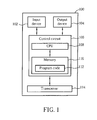
- FIG. 1 is a functional block diagram of a communications device 100 in a wireless communications system.
- the wireless communications system is preferably the LTE system.
- Fig. 1 only shows an input device 102, an output device 104, a control circuit 106, a central processing unit (CPU) 108, a memory 110, a program code 112, and a transceiver 114 of the communications device 100.
- the control circuit 106 executes the program code 112 in the memory 110 through the CPU 108, thereby controlling an operation of the communications device 100.
- the communications device 100 can receive signals input by a user through the input device 102, such as a keyboard, and can output images and sounds through the output device 104, such as a monitor or speakers.
- the transceiver 114 is used to receive and transmit wireless signals, delivering received signals to the control circuit 106, and outputting signals generated by the control circuit 106 wirelessly. From a perspective of a communications protocol framework, the transceiver 114 can be seen as a portion of Layer 1, and the control circuit 106 can be utilized to realize functions of Layer 2 and Layer 3.
- the communications device 100 is utilized in a third generation (3G) mobile communications system.
- 3G third generation
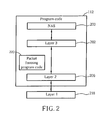
- Fig. 2 is a diagram of the program code 112 shown in Fig. 1 .
- the program code 112 includes a Non Access Stratum (NAS) 200, a Layer 3 202, and a Layer 2 206, and is coupled to a Layer 1 218.
- the NAS 200 can generate NAS messages for realizing NAS applications.
- the Layer 3 202 is composed of an RRC layer, for performing radio resource control.
- the Layer 2 206 performs link control, and the Layer 1 218 performs physical connections. Whether a PDCP layer belongs to the Layer 3 202 or the Layer 2 206 is not relevant to this invention.
- NAS messages generated by the NAS 200 can be concatenated with RRC messages generated by the RRC layer, and ciphering for the NAS messages is performed in a layer higher than RRC.
- the embodiment of the present invention provides a packet forming program code 220 for forming sufficient information in concatenated messages, so as to discriminate NAS and RRC messages in the concatenated messages.
- FIG. 3 illustrates a schematic diagram of a process 30 according to an embodiment of the present invention.
- the process 30 is utilized for accurately forming concatenated messages in a wireless communications system, and can be compiled into the packet forming program code 220.
- the process 30 comprises the following steps:
- the embodiment of the present invention when forming a concatenated message composed of a NAS message and an RRC message, not only adds a header, but also forms an indication field to indicate position information of the NAS message and the RRC message.
- the embodiment of the present invention performs ciphering on the concatenated message except the header, that is, on the NAS message, the RRC message, and the indication field. Therefore, via the embodiment of the present invention, the concatenated message comprises information to discriminate the NAS message and the RRC message, so that the receiver can accurately determine positions of the NAS message and the RRC message the concatenated message, and perform corresponding procedures.
- the embodiment of the present invention uses the indication field to indicate position information of the NAS message and the RRC message, so that the receiver can accurately determine positions of the NAS message and the RRC message in the concatenated message.
- the indication field is utilized for indicating position information of the NAS message and the RRC message, and those skilled in the art can make modifications on features of the indication field, such as position, format, size, etc., according to different requirements.
- Fig. 4 illustrates a schematic diagram of forming a concatenated message according to the process 30.
- Fig. 4 illustrates a schematic diagram of forming a concatenated message according to the process 30.
- the embodiment of the present invention concatenates the NAS message 402 to the end of the RRC message 400.
- the embodiment of the present invention adds a header 404 in front of the RRC message 400, and adds an indication field 406 between the RRC message 400 and the NAS message 402, to form a first concatenated message 410.
- the indication field 406 can indicate the start position of the NAS message 402 in the first concatenated message 410, or indicate the end position of the RRC message 400 in the first concatenated message 410.
- the indication field 406 can also be added in front of the RRC message 400, which is different from what is shown in Fig.
- the embodiment of the present invention performs ciphering on the RRC message 400, the indication field 406, and the NAS message 402 to get ciphered data 408, and forms a second concatenated message 412.
- the receiver can decipher the ciphered data 408 to get the RRC message 400, the indication field 406, and the NAS message 402.
- the receiver can determine positions of the NAS message 402 and the RRC message 400, so as to recover the NAS message 402 and the RRC message 400.
- the embodiment of the present invention performs ciphering on the first concatenated message 410 except the header 404, so as to form the second concatenated message 412. Since the upper layer has performed ciphering on the NAS message 402, the NAS message 402 is performed ciphering for at least two times. In such a situation, the present invention further provides another embodiment to overcome the aforementioned problem.
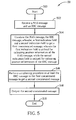
- FIG. 5 illustrates a schematic diagram of a process 50 according to another embodiment of the present invention.
- the process 50 is utilized for accurately forming concatenated messages in a wireless communications system, and can be compiled into the packet forming program code 220.
- the process 50 comprises the following steps:
- the embodiment of the present invention when forming a concatenated message composed of a NAS message and an RRC message, not only adds a header, but also forms a first indication field and a second indication field to indicate position information of the NAS message and the RRC message respectively.
- the embodiment of the present invention performs ciphering on at least the RRC message in the first concatenated message. That is, the embodiment of the present invention can perform ciphering only on the RRC message. Therefore, via the embodiment of the present invention, the concatenated message comprises information to discriminate the NAS message and the RRC message, and only the RRC message needs to be ciphered, so as to decrease complexity of ciphering and deciphering. As a result, the receiver can accurately determine positions of the NAS message and the RRC message in the concatenated message, and perform corresponding procedures.
- the embodiment of the present invention uses the first indication field and the second indication field to indicate position information of the NAS message and the RRC message, so that the receiver can accurately determine positions of the NAS message and the RRC message in the concatenated message, and data to be ciphered can be decreased.
- the first indication field and the second indication field are utilized for indicating position information of the NAS message and the RRC message, and those skilled in the art can make modifications on features of the first and second indication fields, such as position, format, size, etc., according to different requirements.
- Fig. 6 illustrates a schematic diagram of forming a concatenated message according to the process 50.
- Fig. 6 illustrates a schematic diagram of forming a concatenated message according to the process 50.
- the embodiment of the present invention concatenates the RRC message 600 to the end of the NAS message 602.
- the embodiment of the present invention adds a header 604, a second indication field 608 and a first indication field 606 in front of the NAS message 602 and the RRC message 600, to get a first concatenated message 612.
- the first indication field 606 indicates a start position of the NAS message 602 in the first concatenated message 612
- the second indication field 608 indicates a start position of the RRC message 600 in the first concatenated message 612.
- the embodiment of the present invention ciphers the RRC message 600 to get ciphered data 610, and forms a second concatenated message 614.
- the receiver can decipher the ciphered data 610 to get the RRC message 600.
- the receiver can determine positions of the NAS message 602 and the RRC message 600, so as to recover the NAS message 602 and the RRC message 600.
- the embodiment of the present invention since the upper layer has performed another ciphering procedure on the NAS message 602, the embodiment of the present invention does not need to perform ciphering on the NAS message 602 again. In such a situation, the embodiment of the present invention can decrease the data amount of the ciphering procedure. Certainly, except the RRC message 600, the embodiment of the present invention can further perform ciphering on the NAS message 602 or the first indication field 606 and the second indication field 608.
- Fig. 7 illustrates a schematic diagram of forming a concatenated message according to the process 50.
- the embodiment of the present invention adds a header 704 and a second indication field 708 in front of the RRC message 700, and adds a first indication field 706 in front of the NAS message 702, to get a first concatenated message 712.
- the first indication field 706 indicates a start position of the NAS message 702 in the first concatenated message 712
- the second indication field 708 indicates an end position of the RRC message 700 in the first concatenated message 712.
- the embodiment of the present invention ciphers the RRC message 700 to get ciphered data 710, and forms a second concatenated message 714.
- receiver can decipher the ciphered data 710 to get the RRC message 700.
- the receiver can determine positions of the NAS message 702 and the RRC message 700, so as to recover the NAS message 702 and the RRC message 700.
- Fig. 6 and Fig. 7 are exemplary embodiments of the process 50, and those skilled in the art can make modifications accordingly. Note that, via the process 50, since the upper layer has performed another ciphering procedure on the NAS message, the embodiment of the present invention does not need to perform ciphering on the NAS message. Certainly, the embodiment of the present invention can further perform ciphering on the NAS message or the first indication field and the second indication field.
- the concatenated message comprises information for discriminating the NAS message and the RRC message, and only the RRC message needs to be ciphered.
- the receiver can accurately determine positions of the NAS message and the RRC message in the concatenated message, and can decrease complexity of ciphering and deciphering.
- the embodiment of the present invention provides different formats of the concatenated message, so as to accurately discriminate the NAS message and the RRC message in the concatenated message, and maintain system functions.
Landscapes
- Engineering & Computer Science (AREA)
- Computer Security & Cryptography (AREA)
- Computer Networks & Wireless Communication (AREA)
- Signal Processing (AREA)
- Computer Hardware Design (AREA)
- Computing Systems (AREA)
- General Engineering & Computer Science (AREA)
- Mobile Radio Communication Systems (AREA)
- Data Exchanges In Wide-Area Networks (AREA)
- Telephonic Communication Services (AREA)
Abstract
Description
- This application claims the benefit of
U.S. Provisional Application No. 60/887,336, filed on Jan 30, 2007 - The present invention relates to a method and apparatus for handling packets in a wireless communications system according to the pre-characterizing clauses of
claims 1, 6, 11 and 19. - The third generation (3G) mobile telecommunications system provides high frequency spectrum utilization, universal coverage, and high quality, high-speed multimedia data transmission, and also meets all kinds of QoS requirements simultaneously, providing diverse, flexible, two-way transmission services and better communication quality to reduce transmission interruption rates.
- Long Term Evolution wireless communications system (LTE system), an advanced high-speed wireless communications system established upon the 3G mobile telecommunications system, supports only packet-switched transmission, and tends to implement both Medium Access Control (MAC) layer and Radio Link Control (RLC) layer in one single communication site, such as in Node B alone rather than in Node B and RNC (Radio Network Controller) respectively, so that the system structure becomes simpler.
- According to the current system structure of the LTE system, the following can be summarized:
- 1. For User Plane, the layer structure is, from low to high, PHY (Physical layer), MAC, RLC, and PDCP (Packet Data Convergence Protocol).
- 2. For Control Plane, the layer structure is, from low to high, PHY, MAC, RLC, RRC (Radio Resource Control), and NAS (Non-Access Stratum).
- 3. For User Plane, ciphering is performed in PDCP.
- 4. For Control Plane, ciphering and IP (Integrity Protection) for RRC messages are done in RRC and ciphering and IP for NAS messages are done in a layer higher than RRC.
- 5. NAS messages may or may not be concatenated with RRC messages.
- 6. No IP from RRC for non-concatenated messages.
- 7. IP from RRC for concatenated NAS messages is FFS (For Further Study).
- 8. Protocol error detection and recovery function is performed in RLC.
- Therefore, NAS messages can be concatenated with RRC messages (as mentioned in "5"), and ciphering for NAS messages in concatenated messages can be done in PDCP or its upper layer (as mentioned in "4"). In such a situation, a concatenated message must comprise sufficient information to discriminate NAS and RRC messages thereof. However, the prior art does not specify the format of the concatenated message.
- This in mind, the present invention aims at providing a method and apparatus for handling packets in a wireless communications system, for discriminating NAS and RRC messages in a concatenated message, so as to maintain system functions.
- This is achieved by a method and apparatus for handling packets in a wireless communications system according to
claims 1, 6, 11 and 19. The dependent claims pertain to corresponding further developments and improvements. - As will be seen more clearly from the detailed description following below, the claimed method for handling packets in a wireless communications system comprises receiving a NAS message and an RRC message, combining the NAS message, the RRC message, a header, and an indication field indicating position information of the NAS message and the RRC message to get a first concatenated message, performing a ciphering procedure on the first concatenated message except the header to get a second concatenated message, and outputting the second concatenated message.
-
-
Fig. 1 is a function block diagram of a wireless communications device. -
Fig. 2 is a diagram of program code ofFig. 1 . -
Fig. 3 is a flowchart of a process according to an embodiment of the present invention. -
Fig. 4 is a schematic diagram of forming a concatenated message according to the process shown inFig. 3 . -
Fig. 5 is a flowchart of a process according to another embodiment of the present invention. -
Fig. 6 andFig. 7 are schematic diagrams of forming concatenated messages according to the process shown inFig. 5 . - Please refer to
Fig. 1 , which is a functional block diagram of acommunications device 100 in a wireless communications system. The wireless communications system is preferably the LTE system. For the sake of brevity,Fig. 1 only shows aninput device 102, anoutput device 104, acontrol circuit 106, a central processing unit (CPU) 108, amemory 110, aprogram code 112, and atransceiver 114 of thecommunications device 100. In thecommunications device 100, thecontrol circuit 106 executes theprogram code 112 in thememory 110 through the CPU 108, thereby controlling an operation of thecommunications device 100. Thecommunications device 100 can receive signals input by a user through theinput device 102, such as a keyboard, and can output images and sounds through theoutput device 104, such as a monitor or speakers. Thetransceiver 114 is used to receive and transmit wireless signals, delivering received signals to thecontrol circuit 106, and outputting signals generated by thecontrol circuit 106 wirelessly. From a perspective of a communications protocol framework, thetransceiver 114 can be seen as a portion ofLayer 1, and thecontrol circuit 106 can be utilized to realize functions ofLayer 2 andLayer 3. Preferably, thecommunications device 100 is utilized in a third generation (3G) mobile communications system. - Please continue to refer to
Fig. 2. Fig. 2 is a diagram of theprogram code 112 shown inFig. 1 . Theprogram code 112 includes a Non Access Stratum (NAS) 200, aLayer 3 202, and aLayer 2 206, and is coupled to aLayer 1 218. The NAS 200 can generate NAS messages for realizing NAS applications. TheLayer 3 202 is composed of an RRC layer, for performing radio resource control. TheLayer 2 206 performs link control, and theLayer 1 218 performs physical connections. Whether a PDCP layer belongs to theLayer 3 202 or theLayer 2 206 is not relevant to this invention. - In the
Layer 3 202, NAS messages generated by the NAS 200 can be concatenated with RRC messages generated by the RRC layer, and ciphering for the NAS messages is performed in a layer higher than RRC. In such a situation, the embodiment of the present invention provides a packet formingprogram code 220 for forming sufficient information in concatenated messages, so as to discriminate NAS and RRC messages in the concatenated messages. - Please refer to
Fig. 3 , which illustrates a schematic diagram of aprocess 30 according to an embodiment of the present invention. Theprocess 30 is utilized for accurately forming concatenated messages in a wireless communications system, and can be compiled into the packet formingprogram code 220. Theprocess 30 comprises the following steps: - Step 300:
- Start.
- Step 302:
- Receive a NAS message and an RRC message.
- Step 304:
- Combine the NAS message, the RRC message, a header, and an indication field to get a first concatenated message, wherein the indication field is utilized for indicating position information of the NAS message and the RRC message.
- Step 306:
- Perform a ciphering procedure on the first concatenated message except the header to get a second concatenated message.
- Step 308:
- Output the second concatenated message.
- Step 310:
- End.
- According to the
process 30, when forming a concatenated message composed of a NAS message and an RRC message, the embodiment of the present invention not only adds a header, but also forms an indication field to indicate position information of the NAS message and the RRC message. In addition, the embodiment of the present invention performs ciphering on the concatenated message except the header, that is, on the NAS message, the RRC message, and the indication field. Therefore, via the embodiment of the present invention, the concatenated message comprises information to discriminate the NAS message and the RRC message, so that the receiver can accurately determine positions of the NAS message and the RRC message the concatenated message, and perform corresponding procedures. - Via the
process 30, the embodiment of the present invention uses the indication field to indicate position information of the NAS message and the RRC message, so that the receiver can accurately determine positions of the NAS message and the RRC message in the concatenated message. Note that, in the embodiment of the present invention, the indication field is utilized for indicating position information of the NAS message and the RRC message, and those skilled in the art can make modifications on features of the indication field, such as position, format, size, etc., according to different requirements. For example, please refer toFig. 4 , which illustrates a schematic diagram of forming a concatenated message according to theprocess 30. InFig. 4 , after receiving anRRC message 400 and aNAS message 402, the embodiment of the present invention concatenates theNAS message 402 to the end of theRRC message 400. Preferably, the embodiment of the present invention adds aheader 404 in front of theRRC message 400, and adds anindication field 406 between theRRC message 400 and theNAS message 402, to form a firstconcatenated message 410. Preferably, theindication field 406 can indicate the start position of theNAS message 402 in the firstconcatenated message 410, or indicate the end position of theRRC message 400 in the firstconcatenated message 410. In addition, theindication field 406 can also be added in front of theRRC message 400, which is different from what is shown inFig. 4 . In the next, the embodiment of the present invention performs ciphering on theRRC message 400, theindication field 406, and theNAS message 402 to get ciphereddata 408, and forms a secondconcatenated message 412. After the receiver receives the secondconcatenated message 412, the receiver can decipher the ciphereddata 408 to get theRRC message 400, theindication field 406, and theNAS message 402. Then, according to theindication field 406, the receiver can determine positions of theNAS message 402 and theRRC message 400, so as to recover theNAS message 402 and theRRC message 400. - As shown in
Fig. 4 , the embodiment of the present invention performs ciphering on the firstconcatenated message 410 except theheader 404, so as to form the secondconcatenated message 412. Since the upper layer has performed ciphering on theNAS message 402, theNAS message 402 is performed ciphering for at least two times. In such a situation, the present invention further provides another embodiment to overcome the aforementioned problem. - Please refer to
Fig. 5 , which illustrates a schematic diagram of aprocess 50 according to another embodiment of the present invention. Theprocess 50 is utilized for accurately forming concatenated messages in a wireless communications system, and can be compiled into the packet formingprogram code 220. Theprocess 50 comprises the following steps: - Step 500:
- Start.
- Step 502:
- Receive a NAS message and an RRC message.
- Step 504:
- Combine the NAS message, the RRC message, a header, a first indication field and a second indication field to get a first concatenated message, wherein the first indication field is utilized for indicating position information of the NAS message, while the second indication field is utilized for indicating position information of the RRC message.
- Step 506:
- Perform a ciphering procedure on at least the RRC message in the first concatenated message to get a second concatenated message.
- Step 508:
- Output the second concatenated message.
- Step 510:
- End.
- According to the
process 50, when forming a concatenated message composed of a NAS message and an RRC message, the embodiment of the present invention not only adds a header, but also forms a first indication field and a second indication field to indicate position information of the NAS message and the RRC message respectively. In addition, the embodiment of the present invention performs ciphering on at least the RRC message in the first concatenated message. That is, the embodiment of the present invention can perform ciphering only on the RRC message. Therefore, via the embodiment of the present invention, the concatenated message comprises information to discriminate the NAS message and the RRC message, and only the RRC message needs to be ciphered, so as to decrease complexity of ciphering and deciphering. As a result, the receiver can accurately determine positions of the NAS message and the RRC message in the concatenated message, and perform corresponding procedures. - Via the
process 50, the embodiment of the present invention uses the first indication field and the second indication field to indicate position information of the NAS message and the RRC message, so that the receiver can accurately determine positions of the NAS message and the RRC message in the concatenated message, and data to be ciphered can be decreased. Note that, in the embodiment of the present invention, the first indication field and the second indication field are utilized for indicating position information of the NAS message and the RRC message, and those skilled in the art can make modifications on features of the first and second indication fields, such as position, format, size, etc., according to different requirements. For example, please refer toFig. 6 , which illustrates a schematic diagram of forming a concatenated message according to theprocess 50. InFig. 6 , after receiving anRRC message 600 and aNAS message 602, the embodiment of the present invention concatenates theRRC message 600 to the end of theNAS message 602. Preferably, the embodiment of the present invention adds aheader 604, asecond indication field 608 and afirst indication field 606 in front of theNAS message 602 and theRRC message 600, to get a firstconcatenated message 612. Preferably, thefirst indication field 606 indicates a start position of theNAS message 602 in the firstconcatenated message 612, while thesecond indication field 608 indicates a start position of theRRC message 600 in the firstconcatenated message 612. Then, the embodiment of the present invention ciphers theRRC message 600 to get ciphereddata 610, and forms a secondconcatenated message 614. After the receiver receives the secondconcatenated message 614, the receiver can decipher the ciphereddata 610 to get theRRC message 600. Then, according to thefirst indication field 606 and thesecond indication field 608, the receiver can determine positions of theNAS message 602 and theRRC message 600, so as to recover theNAS message 602 and theRRC message 600. - In
Fig. 6 , since the upper layer has performed another ciphering procedure on theNAS message 602, the embodiment of the present invention does not need to perform ciphering on theNAS message 602 again. In such a situation, the embodiment of the present invention can decrease the data amount of the ciphering procedure. Certainly, except theRRC message 600, the embodiment of the present invention can further perform ciphering on theNAS message 602 or thefirst indication field 606 and thesecond indication field 608. - Please refer to
Fig. 7 , which illustrates a schematic diagram of forming a concatenated message according to theprocess 50. InFig. 7 , after receiving anRRC message 700 and aNAS message 702, the embodiment of the present invention adds aheader 704 and asecond indication field 708 in front of theRRC message 700, and adds afirst indication field 706 in front of theNAS message 702, to get a firstconcatenated message 712. Preferably, thefirst indication field 706 indicates a start position of theNAS message 702 in the firstconcatenated message 712, while thesecond indication field 708 indicates an end position of theRRC message 700 in the firstconcatenated message 712. Then, the embodiment of the present invention ciphers theRRC message 700 to get ciphereddata 710, and forms a second concatenated message 714. After the receiver receives the second concatenated message 714, receiver can decipher the ciphereddata 710 to get theRRC message 700. Then, according to thefirst indication field 706 and thesecond indication field 708, the receiver can determine positions of theNAS message 702 and theRRC message 700, so as to recover theNAS message 702 and theRRC message 700. -
Fig. 6 andFig. 7 are exemplary embodiments of theprocess 50, and those skilled in the art can make modifications accordingly. Note that, via theprocess 50, since the upper layer has performed another ciphering procedure on the NAS message, the embodiment of the present invention does not need to perform ciphering on the NAS message. Certainly, the embodiment of the present invention can further perform ciphering on the NAS message or the first indication field and the second indication field. - Therefore, via the
process 50, the concatenated message comprises information for discriminating the NAS message and the RRC message, and only the RRC message needs to be ciphered. As a result, the receiver can accurately determine positions of the NAS message and the RRC message in the concatenated message, and can decrease complexity of ciphering and deciphering. - In summary, the embodiment of the present invention provides different formats of the concatenated message, so as to accurately discriminate the NAS message and the RRC message in the concatenated message, and maintain system functions.
Claims (26)
- A method for handling packets in a wireless communications system comprising:receiving a non-access stratum, called NAS hereinafter, message and a radio resource control, called RRC hereinafter, message (302);characterized by combining the NAS message, the RRC message, a header, and an indication field indicating position information of the NAS message and the RRC message to get a first concatenated message (304); performing a ciphering procedure on the first concatenated message except the header to get a second concatenated message (306); and outputting the second concatenated message (308).
- The method of claim 1, characterized in that an upper layer performs another ciphering procedure on the NAS message.
- The method of claim 1, characterized in that combining the NAS message, the RRC message, the header, and the indication field to get the first concatenated message comprises concatenating the NAS message to the end of the RRC message.
- The method of claim 3, characterized in that the indication field indicates a start position of the NAS message in the first concatenated message, so as to indicate position information of the NAS message and the RRC message.
- The method of claim 3, characterized in that the indication field indicates an end position of the RRC message in the first concatenated message, so as to indicate position information of the NAS message and the RRC message.
- A communications device (100) for accurately handling packets in a wireless communications system comprising:a control circuit (106) for realizing functions of the communications device (100);a processor (108) installed in the control circuit (106), for executing a program code (112) to command the control circuit (106); anda memory (110) installed in the control circuit (106) and coupled to the processor (108) for storing the program code (112) ;characterized by combining the NAS message, the RRC message, a header, and an indication field indicating position information of the NAS message and the RRC message to get a first concatenated message (304);
wherein the program code (112) comprises:receiving a non-access stratum, called NAS hereinafter,message and a radio resource control, called RRChereinafter, message (302);
performing a ciphering procedure on the first concatenated message except the header to get a second concatenated message (306); and
outputting the second concatenated message (308). - The communications device of claim 6, characterized in that an upper layer performs another ciphering procedure on the NAS message.
- The communications device of claim 6, characterized in that combining the NAS message, the RRC message, the header, and the indication field to get the first concatenated message in the program code comprises concatenating the NAS message to the end of the RRC message.
- The communications device of claim 8, characterized in that the indication field indicates a start position of the NAS message in the first concatenated message, so as to indicate position information of the NAS message and the RRC message.
- The communications device of claim 8, characterized in that the indication field indicates an end position of the RRC message in the first concatenated message, so as to indicate position information of the NAS message and the RRC message.
- A method for handling packets in a wireless communications system comprising:receiving a non-access stratum, called NAS hereinafter, message and a radio resource control, called RRC hereinafter, message (502);characterized by combining the NAS message, the RRC message, a header, a first indication field and a second indication field to get a first concatenated message, the first indication field indicating position information of the NAS message, the second indication field indicating position information of the RRC message (504);
performing a ciphering procedure on at least the RRC message in the first concatenated message to get a second concatenated message (506); and
outputting the second concatenated message (508). - The method of claim 11, characterized in that an upper layer performs another ciphering procedure on the NAS message.
- The method of claim 11, characterized in that combining the NAS message, the RRC message, the header, the first indication field and the second indication field to get the first concatenated message comprises concatenating the RRC message to the end of the NAS message.
- The method of claim 13, characterized in that the first indication field indicates a start position of the NAS message in the first concatenated message so as to indicate position information of the NAS message, and the second indication field indicates a start position of the RRC message in the first concatenated message so as to indicate position information of the RRC message.
- The method of claim 13, characterized in that performing the ciphering procedure on at least the RRC message in the first concatenated message comprises performing the ciphering procedure on the RRC message and the NAS message in the first concatenated message.
- The method of claim 13, characterized in that performing a ciphering procedure on at least the RRC message in the first concatenated message comprises performing the ciphering procedure on the RRC message, the NAS message, the first indication field, and the second indication field in the first concatenated message.
- The method of claim 11, characterized in that combining the NAS message, the RRC message, the header, the first indication field and the second indication field to get the first concatenated message is concatenating the second indication field to the end of the header, concatenating the RRC message to the end of the second indication field, concatenating the first indication field to the end of the RRC message, and concatenating the NAS message to the end of the first indication field get the first concatenated message.
- The method of claim 17, characterized in that the first indication field indicates a start position of the NAS message in the first concatenated message so as to indicate position information of the NAS message, and the second indication field indicates an end position of the RRC message in the first concatenated message so as to indicate position information of the RRC message.
- A communications device (100) for accurately handling packets in a wireless communications system comprising:a control circuit (106) for realizing functions of the communications device (100);a processor (108) installed in the control circuit (106), for executing a program code (112) to command the control circuit (106); anda memory (110) installed in the control circuit (106) and coupled to the processor (108) for storing the program code (112);characterized by combining the NAS message, the RRC message, a header, a first indication field and a second indication field to get a first concatenated message, the first indication field indicating position information of the NAS message, the second indication field indicating position information of the RRC message (504);
wherein the program code (112) comprises:receiving a non-access stratum, called NAS hereinafter, message and a radio resource control, called RRC hereinafter, message (502);
performing a ciphering procedure on at least the RRC message in the first concatenated message to get a second concatenated message (506); and
outputting the second concatenated message (508). - The communications device of claim 19, characterized in that an upper layer performs another ciphering procedure on the NAS message.
- The communications device of claim 19, characterized in that combining the NAS message, the RRC message, the header, the first indication field and the second indication field to get the first concatenated message in the program code comprises concatenating the RRC message to the end of the NAS message.
- The communications device of claim 21, characterized in that the first indication field indicates a start position of the NAS message in the first concatenated message so as to indicate position information of the NAS message, and the second indication field indicates a start position of the RRC message in the first concatenated message so as to indicate position information of the RRC message.
- The communications device of claim 21, characterized in that performing the ciphering procedure on at least the RRC message in the first concatenated message in the program code comprises performing the ciphering procedure on the RRC message and the NAS message in the first concatenated message.
- The communications device of claim 21, characterized in that performing a ciphering procedure on at least the RRC message in the first concatenated message in the program code comprises performing the ciphering procedure on the RRC message, the NAS message, the first indication field, and the second indication field in the first concatenated message.
- The communications device of claim 19, characterized in that combining the NAS message, the RRC message, the header, the first indication field and the second indication field to get the first concatenated message in the program code is concatenating the second indication field to the end of the header, concatenating the RRC message to the end of the second indication field, concatenating the first indication field to the end of the RRC message, and concatenating the NAS message to the end of the first indication field get the first concatenated message.
- The communications device of claim 25, characterized in that the first indication field indicates a start position of the NAS message in the first concatenated message so as to indicate position information of the NAS message, and the second indication field indicates an end position of the RRC message in the first concatenated message so as to indicate position information of the RRC message.
Applications Claiming Priority (1)
| Application Number | Priority Date | Filing Date | Title |
|---|---|---|---|
| US88733607P | 2007-01-30 | 2007-01-30 |
Publications (2)
| Publication Number | Publication Date |
|---|---|
| EP1953996A2 true EP1953996A2 (en) | 2008-08-06 |
| EP1953996A3 EP1953996A3 (en) | 2009-09-09 |
Family
ID=39381958
Family Applications (1)
| Application Number | Title | Priority Date | Filing Date |
|---|---|---|---|
| EP08001728A Withdrawn EP1953996A3 (en) | 2007-01-30 | 2008-01-30 | Method and apparatus for handling packets in a wireless communications system |
Country Status (6)
| Country | Link |
|---|---|
| US (1) | US20080181149A1 (en) |
| EP (1) | EP1953996A3 (en) |
| JP (1) | JP2008187719A (en) |
| KR (1) | KR20080071500A (en) |
| CN (1) | CN101237450A (en) |
| TW (1) | TW200935827A (en) |
Families Citing this family (7)
| Publication number | Priority date | Publication date | Assignee | Title |
|---|---|---|---|---|
| EP1806943A2 (en) * | 2006-01-04 | 2007-07-11 | Innovative Sonic Limited | Method and apparatus of modifying integrity protection configuration in a mobile user equipment of a wireless communications system |
| BRPI0807398A2 (en) * | 2007-03-22 | 2014-05-27 | Ericsson Telefon Ab L M | METHOD FOR CONFIGURING THE MAXIMUM LINK TRANSMISSION UNIT ON A USER EQUIPMENT, USER EQUIPMENT, AND Node IN A LONG-TERM SYSTEM / EVOLUTION EVOLUTION RADIO NETWORK. |
| US8532614B2 (en) | 2007-10-25 | 2013-09-10 | Interdigital Patent Holdings, Inc. | Non-access stratum architecture and protocol enhancements for long term evolution mobile units |
| US8699997B2 (en) | 2007-12-06 | 2014-04-15 | Telefonaktiebolaget L M Ericsson (Publ) | Method for updating UE capability information in a mobile telecommunications network |
| CN102740287A (en) * | 2012-07-06 | 2012-10-17 | 大唐移动通信设备有限公司 | Non-access stratum (NAS) message coding and decoding method and device |
| CN107396384B (en) * | 2017-08-15 | 2020-06-19 | 北京小米移动软件有限公司 | Wireless connection establishing method and device |
| EP4009574B1 (en) * | 2017-12-06 | 2025-09-10 | Guangdong Oppo Mobile Telecommunications Corp., Ltd. | Wireless communication method and device |
Family Cites Families (7)
| Publication number | Priority date | Publication date | Assignee | Title |
|---|---|---|---|---|
| GB2386513B (en) * | 2002-02-07 | 2004-08-25 | Samsung Electronics Co Ltd | Apparatus and method for transmitting/receiving serving hs-scch set information in an hsdpa communication system |
| RU2406236C2 (en) * | 2005-12-22 | 2010-12-10 | Интердиджитал Текнолоджи Корпорейшн | Method and device for protecting data and implementing automatic repeat request in wireless communication system |
| MX2008016258A (en) * | 2006-06-19 | 2009-02-03 | Interdigital Tech Corp | Method and apparatus for security protection of an original user identity in an initial signaling message. |
| US20080049662A1 (en) * | 2006-08-25 | 2008-02-28 | Research In Motion Limited | Apparatus, and associated method, for releasing a data-service radio resource allocated to a data-service-capable mobile node |
| US9237441B2 (en) * | 2006-11-21 | 2016-01-12 | Innovative Sonic Limited | Method and apparatus for configuring signaling radio bearer in a wireless communications system |
| US20080118067A1 (en) * | 2006-11-21 | 2008-05-22 | Innovative Sonic Limited | Method and apparatus for performing ciphering in a wireless communications system |
| US20080120728A1 (en) * | 2006-11-21 | 2008-05-22 | Innovative Sonic Limited | Method and apparatus for performing integrity protection in a wireless communications system |
-
2008
- 2008-01-28 KR KR1020080008687A patent/KR20080071500A/en not_active Abandoned
- 2008-01-30 JP JP2008019817A patent/JP2008187719A/en not_active Withdrawn
- 2008-01-30 CN CNA2008100084389A patent/CN101237450A/en active Pending
- 2008-01-30 EP EP08001728A patent/EP1953996A3/en not_active Withdrawn
- 2008-01-30 US US12/010,886 patent/US20080181149A1/en not_active Abandoned
- 2008-01-30 TW TW097103431A patent/TW200935827A/en unknown
Non-Patent Citations (4)
| Title |
|---|
| "3rd Generation Partnership Project; Technical Specification Group Radio Access Network; Evolved Universal Terrestrial Radio Access (E-UTRA) and Evolved Universal Terrestrial Radio Access Network (E-UTRAN) Radio interface protocol aspects (Release 7) V7.1.0" 3RD GENERATION PARTNERSHIP PROJECT (3GPP); TECHNICAL REPORT (TR), XX, XX, vol. TR 25.813 V7.1.0, 1 September 2006 (2006-09-01), pages 1-41, XP003012351 * |
| ERICSSON: "RRC security handling, Tdoc R2-063231" 3GPP TSG-RAN WG2-56, [Online] vol. r2-063231, no. 56, pages 1-2, XP002481433 Retrieved from the Internet: URL:http://www.3gpp.org/ftp/tsg_ran/WG2_RL2/TSGR2_56/Documents/R2-063231.zip> [retrieved on 2006-11-06] * |
| HOLMA AND A TOSKALA H: "WCDMA for UMTS - Chapter 7 Radio Interface Protocols" WCDMA FOR UMTS: RADIO ACCESS FOR THIRD GENERATION MOBILECOMMUNICATIONS, XX, XX, 1 January 2000 (2000-01-01), pages 121-142, XP002266796 * |
| NEC: "Integrity Protection on NAS Transfer, R2-061975" TSG-RAN WORKING GROUP 2 - 53BIS,, [Online] vol. R2-061975, no. 53, 27 June 2006 (2006-06-27), pages 1-2, XP002481434 Retrieved from the Internet: URL:http://www.3gpp.org/ftp/tsg_ran/WG2_RL 2/TSGR2_AHs/2006_06_LTE/Docs/R2 061975.zip> [retrieved on 2006-11-06] * |
Also Published As
| Publication number | Publication date |
|---|---|
| EP1953996A3 (en) | 2009-09-09 |
| CN101237450A (en) | 2008-08-06 |
| KR20080071500A (en) | 2008-08-04 |
| JP2008187719A (en) | 2008-08-14 |
| TW200935827A (en) | 2009-08-16 |
| US20080181149A1 (en) | 2008-07-31 |
Similar Documents
| Publication | Publication Date | Title |
|---|---|---|
| EP2122862B1 (en) | Method for processing radio protocol in mobile telecommunications system and transmitter of mobile telecommunications | |
| EP3809637B1 (en) | Method for transmitting status report of pdcp layer in mobile telecommunications system and receiver of mobile telecommunications | |
| AU2008346232B2 (en) | Dummy padding sub-header in MAC Protocol Data Units | |
| EP2077691A2 (en) | Method and apparatus for performing buffer status reporting | |
| EP1871138A2 (en) | Method and apparatus for security sequence numbering in a wireless communications system | |
| EP1806943A2 (en) | Method and apparatus of modifying integrity protection configuration in a mobile user equipment of a wireless communications system | |
| US11297493B2 (en) | Data transmission method, related device, and communications system | |
| EP2203990B1 (en) | Method of providing circuit switched (cs) service using high-speed downlink packet access (hsdpa) or high-speed uplink packet access (hsupa) | |
| US20080181149A1 (en) | Method and apparatus for handling packets in a wireless communications system | |
| US20080120728A1 (en) | Method and apparatus for performing integrity protection in a wireless communications system | |
| CN101406024A (en) | Security considerations for LTE of UMTS | |
| EP1942625B1 (en) | Method and apparatus for performing ciphering in a wireless communications system | |
| CN101150866A (en) | Parameter synchronization method and device | |
| EP1936914A1 (en) | Method and apparatus for recovering protocol error in a wireless communications system | |
| US20080119164A1 (en) | Method and apparatus for performing security error recovery in a wireless communications system | |
| EP2053828A2 (en) | Method and apparatus of decryption for a packet data convergence protocol layer in a wireless communication system | |
| JP2008118649A (en) | Method and device for processing protocol error in wireless communication system | |
| EP2040498A1 (en) | Method for setting headers for RLC PDU segments | |
| US9237441B2 (en) | Method and apparatus for configuring signaling radio bearer in a wireless communications system | |
| US20080118067A1 (en) | Method and apparatus for performing ciphering in a wireless communications system | |
| EP1947871A1 (en) | Method and apparatus for reordering of packets in PDCP layer of a wireless communications system | |
| US20080137687A1 (en) | Method and apparatus for handling reordering in a wireless communications system | |
| EP4664958A1 (en) | Data processing method and apparatus, network side device and terminal device | |
| EP1956769A2 (en) | Method and related apparatus for enhancing resource utility rate in a wireless communications system | |
| WO2007026583A1 (en) | Mobile station, wireless access network apparatus, and mobile communication system |
Legal Events
| Date | Code | Title | Description |
|---|---|---|---|
| PUAI | Public reference made under article 153(3) epc to a published international application that has entered the european phase |
Free format text: ORIGINAL CODE: 0009012 |
|
| 17P | Request for examination filed |
Effective date: 20080130 |
|
| AK | Designated contracting states |
Kind code of ref document: A2 Designated state(s): AT BE BG CH CY CZ DE DK EE ES FI FR GB GR HR HU IE IS IT LI LT LU LV MC MT NL NO PL PT RO SE SI SK TR |
|
| AX | Request for extension of the european patent |
Extension state: AL BA MK RS |
|
| PUAL | Search report despatched |
Free format text: ORIGINAL CODE: 0009013 |
|
| AK | Designated contracting states |
Kind code of ref document: A3 Designated state(s): AT BE BG CH CY CZ DE DK EE ES FI FR GB GR HR HU IE IS IT LI LT LU LV MC MT NL NO PL PT RO SE SI SK TR |
|
| AX | Request for extension of the european patent |
Extension state: AL BA MK RS |
|
| STAA | Information on the status of an ep patent application or granted ep patent |
Free format text: STATUS: THE APPLICATION HAS BEEN WITHDRAWN |
|
| 18W | Application withdrawn |
Effective date: 20091016 |