EP1953921A1 - A method for interleaving bits, a base station, a user terminal and a communication network therefor - Google Patents
A method for interleaving bits, a base station, a user terminal and a communication network therefor Download PDFInfo
- Publication number
- EP1953921A1 EP1953921A1 EP07300772A EP07300772A EP1953921A1 EP 1953921 A1 EP1953921 A1 EP 1953921A1 EP 07300772 A EP07300772 A EP 07300772A EP 07300772 A EP07300772 A EP 07300772A EP 1953921 A1 EP1953921 A1 EP 1953921A1
- Authority
- EP
- European Patent Office
- Prior art keywords
- bits
- blocks
- dimension
- interleaving
- block
- Prior art date
- Legal status (The legal status is an assumption and is not a legal conclusion. Google has not performed a legal analysis and makes no representation as to the accuracy of the status listed.)
- Granted
Links
- 238000000034 method Methods 0.000 title claims abstract description 23
- 238000004891 communication Methods 0.000 title claims abstract description 12
- 239000011159 matrix material Substances 0.000 claims abstract description 26
- 238000012545 processing Methods 0.000 claims description 5
- 108091006146 Channels Proteins 0.000 description 23
- 230000005540 biological transmission Effects 0.000 description 7
- 238000005562 fading Methods 0.000 description 3
- 230000010363 phase shift Effects 0.000 description 3
- 238000004364 calculation method Methods 0.000 description 2
- 238000010586 diagram Methods 0.000 description 2
- 238000010295 mobile communication Methods 0.000 description 2
- 230000011664 signaling Effects 0.000 description 2
- ZIIRLFNUZROIBX-UHFFFAOYSA-N 2,3,5-trichlorobenzene-1,4-diol Chemical compound OC1=CC(Cl)=C(O)C(Cl)=C1Cl ZIIRLFNUZROIBX-UHFFFAOYSA-N 0.000 description 1
- FFBHFFJDDLITSX-UHFFFAOYSA-N benzyl N-[2-hydroxy-4-(3-oxomorpholin-4-yl)phenyl]carbamate Chemical compound OC1=C(NC(=O)OCC2=CC=CC=C2)C=CC(=C1)N1CCOCC1=O FFBHFFJDDLITSX-UHFFFAOYSA-N 0.000 description 1
- 230000001413 cellular effect Effects 0.000 description 1
- 239000002131 composite material Substances 0.000 description 1
- 238000012937 correction Methods 0.000 description 1
- 230000001186 cumulative effect Effects 0.000 description 1
- 230000001419 dependent effect Effects 0.000 description 1
- 238000011161 development Methods 0.000 description 1
- 230000018109 developmental process Effects 0.000 description 1
- 230000000694 effects Effects 0.000 description 1
- 230000007774 longterm Effects 0.000 description 1
- 238000013507 mapping Methods 0.000 description 1
- 238000012986 modification Methods 0.000 description 1
- 230000004048 modification Effects 0.000 description 1
- 238000013138 pruning Methods 0.000 description 1
- 230000008707 rearrangement Effects 0.000 description 1
- 230000011218 segmentation Effects 0.000 description 1
Images


Classifications
-
- H—ELECTRICITY
- H03—ELECTRONIC CIRCUITRY
- H03M—CODING; DECODING; CODE CONVERSION IN GENERAL
- H03M13/00—Coding, decoding or code conversion, for error detection or error correction; Coding theory basic assumptions; Coding bounds; Error probability evaluation methods; Channel models; Simulation or testing of codes
- H03M13/27—Coding, decoding or code conversion, for error detection or error correction; Coding theory basic assumptions; Coding bounds; Error probability evaluation methods; Channel models; Simulation or testing of codes using interleaving techniques
- H03M13/2789—Interleaver providing variable interleaving, e.g. variable block sizes
-
- H—ELECTRICITY
- H03—ELECTRONIC CIRCUITRY
- H03M—CODING; DECODING; CODE CONVERSION IN GENERAL
- H03M13/00—Coding, decoding or code conversion, for error detection or error correction; Coding theory basic assumptions; Coding bounds; Error probability evaluation methods; Channel models; Simulation or testing of codes
- H03M13/27—Coding, decoding or code conversion, for error detection or error correction; Coding theory basic assumptions; Coding bounds; Error probability evaluation methods; Channel models; Simulation or testing of codes using interleaving techniques
- H03M13/2703—Coding, decoding or code conversion, for error detection or error correction; Coding theory basic assumptions; Coding bounds; Error probability evaluation methods; Channel models; Simulation or testing of codes using interleaving techniques the interleaver involving at least two directions
- H03M13/2707—Simple row-column interleaver, i.e. pure block interleaving
Definitions
- the invention relates to a method for interleaving bits according to the preamble of claim 1, a base station according to the preamble of claim 6, a user terminal according to the preamble of claim 7 and a communication network according to the preamble of claim 8.
- bits that have to be transmitted over a communication channel are preferably interleaved in a so-called interleaver in order to achieve a statistical distribution of bit errors.
- an interleaver After the channel encoding at the transmitter by e.g. a Turbo encoder, an interleaver is used to rearrange the bits within the transmitted codewords.
- a deinterleaver On the receiver side, a deinterleaver performs the inverse rearrangement on the received codewords before the actual channel decoding. This procedure transforms channel induced burst errors into statistically independent errors and is vital in mobile radio communication systems with fading channels.
- a codeword that has to be transmitted over a communication channel is first segmented into k ⁇ 1 blocks.
- Each of the blocks is interleaved separately in an interleaver, i.e. the number of blocks corresponds to the number of interleaving cycles that have to be performed.
- An interleaver basically comprises a matrix into which the information bits are written column-wise and then read out row-wise. The number of columns N of the individual interleavers is fixed. Between writing and reading, the columns may be permuted according to a given permutation rule.
- the number of blocks k is fixed or takes on one of only a few predefined values. In the latter case it is usually found by table look-up.
- N ⁇ R i i.e. the number of rows should be approximately equal to the number of columns.
- burst errors within a codeword introduced by e.g. a fading channel are transformed into statistically independent errors in the best possible way. This is very important because forward error correction channel encoding, e.g. Turbo encoding, usually requires statistically distributed errors to leverage its full potentials.
- the deinterleaver performs the inverse operation, it follows directly from the interleaver.
- the number of data symbols within the codewords transmitted from a so-called NodeB, i.e. a base station, to the so-called user equipment (UE), i.e. a user terminal, may change with a granularity of 1 symbol from codeword to codeword, depending on cell traffic, signaling overhead, radio conditions, etc.
- UE user equipment
- An interleaver that is appropriate for usage within 3GPP Evolved UTRAN must offer a high flexibility towards the codeword size.
- UMTS Universal Mobile Telecommunication System
- HSDPA High Speed Downlink Packet Access
- a restricted interleaver parameter set as e.g. used for the UMTS HSDPA interleaver described above, will lead with a high probability to individual interleavers that are not close to the desirable square form (N ⁇ R i ), but exhibit a rather large difference between the number of columns N and rows R i .
- the object of the invention is thus to propose a method for interleaving bits that is appropriate for a scenario with a high codeword size flexibility and a fine codeword size granularity by means of using individual interleavers that are close to the square form (N ⁇ R i ) .
- Fig. 1 schematically shows a communication network in which the invention can be implemented.
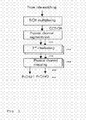
- Fig. 2 schematically shows exemplarily a transport channel multiplexing and interleaving procedure for uplink that can make use of a method for interleaving according to the invention.
- Fig. 3 schematically shows the number of rows of an interleaver depicted over the number of bits calculated for two strategies of the method for interleaving according to the invention.
- a communication network in which the invention can be implemented comprises at least one base station and user terminals.
- Fig. 1 shows as an example for such a communication network a cellular mobile communication network CN that comprises base stations BS1-BS8 and user terminals T1-T4.
- Each of said user terminals T1-T4 is connected to one or multiple of said base stations BS1-BS8, which is symbolized by double arrows in fig. 1 .
- the base stations BS1-BS8 are in turn connected to a core network, which is not shown in fig. 1 for the sake of simplicity.
- the user terminals T1-T4 comprise the functionality of a user terminal for transmission and reception of signaling and data messages in a network using radio transmission.
- the base stations BS1-BS8 comprise the functionality of a base station of a network using radio transmission, i.e. they provide the possibility for user terminals to get connected to said network and for data exchange of said user terminals by means of radio transmission.
- Fig. 2 shows a part of a transport channel multiplexing and interleaving procedure for uplink that can make use of a method for interleaving according to the invention and that can be implemented in a transmitter comprised e.g. in a user terminal T1-T4.
- transport channels TrCH are multiplexed into a coded composite transport channel CCTrCH.
- a 2 nd interleaving is performed for the different physical channels PhCH#1, PhCH#2 by block interleavers and comprises bits input to a interleaver matrix with padding, the inter-column permutation for the interleaver matrix and bits output from the interleaver matrix with pruning.
- An interleaver according to the invention can e.g. be used for the 2 nd interleaving.
- Such an exemplary transport channel multiplexing and interleaving procedure for uplink is described in more detail in the technical specification 3GPP TS 25.212, V7.2.0 (2006-09) in chapter 4.2 and the related chapters.
- a channel multiplexing and interleaving procedure for downlink is described that can also make use of a method for interleaving according to the invention and that can be implemented in a transmitter comprised e.g. in a base station BS1-BS8.
- interleaver matrices with the lowest possible number of rows have the desirable square form
- interleaver matrices with the average number of rows have the desirable square form
- the first strategy will be described first with its necessary calculations. Afterwards, the changes to the first strategy in order to arrive at the second strategy will be presented.
- An input of L bits from a channel encoder or a rate matching module is split into m bit streams each with a number of b bits, as e.g. described in the technical specification 3GPP TS 25.212, V7.2.0 (2006-09).
- each of said m bit streams is processed in a separate interleaver, with the number of columns and rows of the respective interleaver matrices preferably being identical.
- the input is divided two by two between the m interleavers, i.e.
- the 1 st and the 2 nd bit go to the first interleaver, the 3 rd and the 4 th to the second interleaver, et cetera, so that the (2*m-1) th bit and the (2*m) th bit go to the m th interleaver.
- N ⁇ N interleaver matrices when N is the predefined number of columns.
- the interleaving bits are split on the several interleaving cycles. They are only used as a placeholder and are not transmitted. They have to be skipped when reading out the interleaver matrix.
- f min floor f ges / m * k * 2 * 2
- the second strategy comprises the steps of the first strategy with the following modifications:
- the number of columns N are set to a fixed value for all interleaver runs.
- the interleaver matrix size is roughly matched to the codeword size by defining an appropriate number of columns which should neither exceed an upper bound N MAX , nor fall below a lower bound N MIN of the related processing platform.
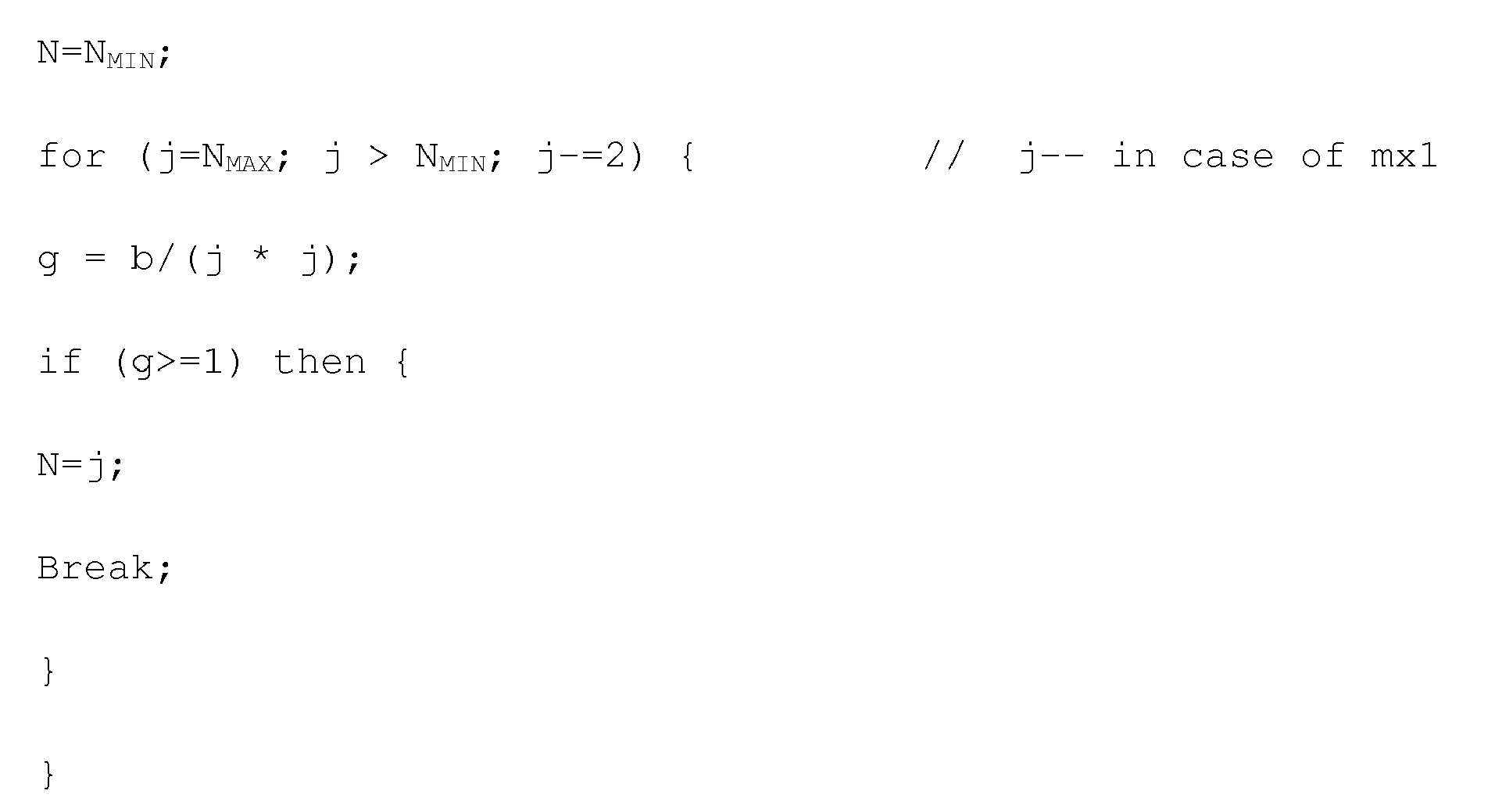
- the actual number of columns N can be calculated before each interleaver run e.g. by the following algorithm expressed in the programming language C:
- the number of rows R is calculated according to the first strategy for 24 and 34 columns. It can be seen, that for higher number of bits b, the lowest number of rows that can occur is 24 and 34 respectively, and that there is an upper limit for the number of rows R.
- the number of rows R is calculated according to the second strategy for 24 and 34 columns. It can be seen, that for higher number of bits b, number of rows is oscillating around a value of 24 and 34 respectively.
- an interleaver matrix according to the invention has a first predefined dimension and a second calculated dimension.
Landscapes
- Physics & Mathematics (AREA)
- Probability & Statistics with Applications (AREA)
- Engineering & Computer Science (AREA)
- Theoretical Computer Science (AREA)
- Error Detection And Correction (AREA)
- Detection And Prevention Of Errors In Transmission (AREA)
Abstract
Description
- The invention relates to a method for interleaving bits according to the preamble of
claim 1, a base station according to the preamble of claim 6, a user terminal according to the preamble of claim 7 and a communication network according to the preamble of claim 8. - The transmission of data over communication channels, especially over radio channels in a mobile communication system or in a wireless data system, is often error-prone, as such effects like interference, fading, shadowing or noise deteriorate the transmission signal and thus lead to bit errors.
- As such bit errors tend to have a cumulative occurrence e.g. over transmission time or bandwidth, bits that have to be transmitted over a communication channel are preferably interleaved in a so-called interleaver in order to achieve a statistical distribution of bit errors.
- After the channel encoding at the transmitter by e.g. a Turbo encoder, an interleaver is used to rearrange the bits within the transmitted codewords. On the receiver side, a deinterleaver performs the inverse rearrangement on the received codewords before the actual channel decoding. This procedure transforms channel induced burst errors into statistically independent errors and is vital in mobile radio communication systems with fading channels.
- In common interleaver implementations, a codeword that has to be transmitted over a communication channel is first segmented into k≥1 blocks. Each of the blocks is interleaved separately in an interleaver, i.e. the number of blocks corresponds to the number of interleaving cycles that have to be performed. An interleaver basically comprises a matrix into which the information bits are written column-wise and then read out row-wise. The number of columns N of the individual interleavers is fixed. Between writing and reading, the columns may be permuted according to a given permutation rule. The number of blocks k and the number of matrix rows Ri, i=1...k, must be adjusted to the codeword size. The number of blocks k is fixed or takes on one of only a few predefined values. In the latter case it is usually found by table look-up. For performance reasons it is desirable to have individual interleavers with N≈Ri, i.e. the number of rows should be approximately equal to the number of columns. With these individual interleaver dimensions, burst errors within a codeword introduced by e.g. a fading channel are transformed into statistically independent errors in the best possible way. This is very important because forward error correction channel encoding, e.g. Turbo encoding, usually requires statistically distributed errors to leverage its full potentials.
- As the deinterleaver performs the inverse operation, it follows directly from the interleaver.
- In the 3GPP Evolved UTRAN (3GPP = Third Generation Partnership Project, UTRAN = Universal Mobile Telecommunication System Radio Access Network), also known as Long Term Evolution (LTE), the number of data symbols within the codewords transmitted from a so-called NodeB, i.e. a base station, to the so-called user equipment (UE), i.e. a user terminal, may change with a granularity of 1 symbol from codeword to codeword, depending on cell traffic, signaling overhead, radio conditions, etc. As each data symbol represents a number M of information bits, the granularity of the information bits within a codeword is M, e.g. M=2 for QPSK modulation (QPSK = Quadrature Phase Shift Keying).
- An interleaver that is appropriate for usage within 3GPP Evolved UTRAN must offer a high flexibility towards the codeword size.
- One solution for a 3GPP Evolved UTRAN compliant interleaver could be the UMTS (UMTS = Universal Mobile Telecommunication System) HSDPA (HSDPA = High Speed Downlink Packet Access) interleaver defined in the technical specification 3GPP TS 25.212, V7.2.0 (2006-09) in chapter 4.5.6 with the restriction to only few codeword sizes, as the interleavers work with a fixed number of columns N=30, a fixed number of rows Ri=R=32 and a number of blocks ke{1, ... , 15}.
- For a high codeword size flexibility and a fine codeword size granularity, as used in the 3GPP Evolved UTRAN, a restricted interleaver parameter set, as e.g. used for the UMTS HSDPA interleaver described above, will lead with a high probability to individual interleavers that are not close to the desirable square form (N≈Ri), but exhibit a rather large difference between the number of columns N and rows Ri.
- The object of the invention is thus to propose a method for interleaving bits that is appropriate for a scenario with a high codeword size flexibility and a fine codeword size granularity by means of using individual interleavers that are close to the square form (N≈Ri) .
- This object is achieved by a method according to the teaching of
claim 1, a base station according to the teaching of claim 6, a user terminal according to the teaching of claim 7, and a communication network according to the teaching of claim 8. - The main idea of the invention is that the invented interleaver calculates for each codeword size the number of required blocks k, such that all individual interleavers have approximately the desirable square form, i.e. the number of rows Ri=R is approximately equal to the predefined number of columns N. In other words, the number of required blocks k is calculated in such a way, that the number of rows Ri=R lies within a dedicated range.
- Further developments of the invention can be gathered from the dependent claims and the following description.
- In the following, the invention will be explained further making reference to the attached drawings.
-
Fig. 1 schematically shows a communication network in which the invention can be implemented. -
Fig. 2 schematically shows exemplarily a transport channel multiplexing and interleaving procedure for uplink that can make use of a method for interleaving according to the invention. -
Fig. 3 schematically shows the number of rows of an interleaver depicted over the number of bits calculated for two strategies of the method for interleaving according to the invention. - A communication network in which the invention can be implemented comprises at least one base station and user terminals.
-
Fig. 1 shows as an example for such a communication network a cellular mobile communication network CN that comprises base stations BS1-BS8 and user terminals T1-T4. - Each of said user terminals T1-T4 is connected to one or multiple of said base stations BS1-BS8, which is symbolized by double arrows in
fig. 1 . The base stations BS1-BS8 are in turn connected to a core network, which is not shown infig. 1 for the sake of simplicity. - The user terminals T1-T4 comprise the functionality of a user terminal for transmission and reception of signaling and data messages in a network using radio transmission.
- The base stations BS1-BS8 comprise the functionality of a base station of a network using radio transmission, i.e. they provide the possibility for user terminals to get connected to said network and for data exchange of said user terminals by means of radio transmission.
-
Fig. 2 shows a part of a transport channel multiplexing and interleaving procedure for uplink that can make use of a method for interleaving according to the invention and that can be implemented in a transmitter comprised e.g. in a user terminal T1-T4. - After channel coding and rate matching, transport channels TrCH are multiplexed into a coded composite transport channel CCTrCH.
- Then, physical channel segmentation divides the bits among the different physical
channels PhCH# 1,PhCH# 2. - Afterwards, a 2nd interleaving is performed for the different physical
channels PhCH# 1,PhCH# 2 by block interleavers and comprises bits input to a interleaver matrix with padding, the inter-column permutation for the interleaver matrix and bits output from the interleaver matrix with pruning. An interleaver according to the invention can e.g. be used for the 2nd interleaving. - Finally, during physical channel mapping, the bits are mapped to the different physical
channels PhCH# 1,PhCH# 2 and transmitted over the air. - Such an exemplary transport channel multiplexing and interleaving procedure for uplink is described in more detail in the technical specification 3GPP TS 25.212, V7.2.0 (2006-09) in chapter 4.2 and the related chapters. Here, in an analogue way a channel multiplexing and interleaving procedure for downlink is described that can also make use of a method for interleaving according to the invention and that can be implemented in a transmitter comprised e.g. in a base station BS1-BS8.
- The invented interleaver calculates for each codeword size the number of required blocks k, such that all individual interleaver matrices have approximately the desirable square form, i.e. the number of rows Ri=R is approximately equal to the predefined number of columns N.
- In the following, exemplarily two different strategies are described for achieving approximately the desirable square form for the interleaver matrices:
- According to the first strategy, the number of blocks k is estimated based on the choice that the lowest value for the number of rows Rmin that is allowed to occur for the number of bits being higher than a certain limit is equal to the predefined number of columns N, i.e. Rmin=N. With this strategy, the average number of rows is Ravg=(3/2)N, and the maximum number of rows is Rmax=2N for the number of bits being higher than a certain limit.
- According to the second strategy, the number of blocks k is estimated based on the choice that the lowest value for the number of rows Rmin that is allowed to occur for the number of bits being higher than a certain limit is equal to two third of the fixed number of columns N, i.e. Rmin=(2/3)N. With this second strategy, the average number of rows is Ravg=N, and the maximum number of rows is Rmax=(4/3)N for the number of bits being higher than a certain limit.
- In other words, according to the first strategy, interleaver matrices with the lowest possible number of rows have the desirable square form, whereas according to the second strategy, interleaver matrices with the average number of rows have the desirable square form.
- The first strategy will be described first with its necessary calculations. Afterwards, the changes to the first strategy in order to arrive at the second strategy will be presented.
- An input of L bits from a channel encoder or a rate matching module is split into m bit streams each with a number of b bits, as e.g. described in the technical specification 3GPP TS 25.212, V7.2.0 (2006-09). Preferably, each of said m bit streams is processed in a separate interleaver, with the number of columns and rows of the respective interleaver matrices preferably being identical. The input is divided two by two between the m interleavers, i.e. the 1st and the 2nd bit go to the first interleaver, the 3rd and the 4th to the second interleaver, et cetera, so that the (2*m-1)th bit and the (2*m)th bit go to the mth interleaver.
- Thus, the number of bits b in each of said m bit streams can be calculated according to the following formula:

- According to the technical specification 3GPP TS 25.212, V7.2.0 (2006-09), the value for the m bit streams depends on the modulation scheme. For example, for QPSK modulation (QPSK = Quadrature Phase Shift Keying), the value for m = 1, for 16-QAM modulation (QAM = Quadrature Phase Shift Keying), the value for m = 2, and for 64-QAM modulation, the value for m = 3.
- The procedure is described in 3GPP TS 25.212 V7.2.0 (2006-09) in more detail for 16-QAM modulation. For 64-QAM modulation or higher order modulation schemes, it follows analogously. Note that the step of dividing the bit streams is 3GPP specific and is not necessarily required for the invented interleaver.
- In the following only one out of the m interleavers is considered, as the calculated values are valid for all m streams and interleavers, respectively.
- The highest interleaving performance is reached with N×N interleaver matrices, when N is the predefined number of columns. In order to approximate this square form by RxN interleaver matrices with R≈N, k interleaving cycles, i.e. blocks, with k being an integer number, are needed to process the b bits:


- In this calculation for the number of blocks k, it is taken into account that there must be at least one interleaving cycle.
- Due to the fact that the number of bits b is normally no multiple of N×N, there are some bits left. The number of these remaining 1 bits per bit stream with a number of bits b after k interleaving cycles with an NXN interleaver matrix results from the following formula:

- To
process 1 additional bits in the k interleaving cycles, a variation of the number of rows R is needed taking into account that the number of rows R should be near the number of columns N according to the following formula:

- In the majority of cases the number of bits b is not a multiple of N×R. So the interleaver matrix must be padded with fill bits. The number of fill bits fges in k interleaving cycles is determined according to the following formula:

- Accordingly, the number of fill bits per bit stream in k interleaving cycles fges,s is determined according to the following formula:

- The interleaving bits are split on the several interleaving cycles. They are only used as a placeholder and are not transmitted. They have to be skipped when reading out the interleaver matrix.
- The minimum number of fill bits per bit stream and per interleaving cycle fmin is consequently determined according to the following formula:

- Alternatively, the minimum number of fill bits per bit stream and per interleaving cycle fmin is determined according to the following formula based on fges,s:

- To fulfill the input width of 2 bits per bit stream in the symbol processing chain, there must be p interleaving cycles with fmin + 2 fill bits determined according to the following formula:

- Alternatively, the p interleaving cycles with fmin + 2 fill bits are determined according to the following formula based on fges,s:

- For the other q = k - p interleaving cycles, fmin fill bits are needed to pad the interleaver matrix.
- Because of the two by two distribution of the input bits, the algorithm described above only works with
N mod 2 = 0. If the input is divided one by one to the interleaver matrices, all column widths are allowed, but the equations for the minimum number of fill bits per bit stream and per interleaving cycle fmin and for the p interleaving cycles with fmin + 2 fill bits have to be modified according to the following formulae:

- The second strategy comprises the steps of the first strategy with the following modifications:
- The k interleaving cycles, i.e. blocks, are calculated according to the following formula:


- The number of the remaining 1 bits per bit stream with a number of bits b after k interleaving cycles with an NX(2/3)N interleaver matrix results from the following formula:

- To process the 1 additional bits in the k interleaving cycles, a variation of the number of rows R is needed taking into account that the number of rows R should be near the number of columns N according to the following formula:


- In a preferred embodiment of the invention, the number of columns N are set to a fixed value for all interleaver runs.
- In another embodiment of the invention, the interleaver matrix size is roughly matched to the codeword size by defining an appropriate number of columns which should neither exceed an upper bound NMAX, nor fall below a lower bound NMIN of the related processing platform. The actual number of columns N can be calculated before each interleaver run e.g. by the following algorithm expressed in the programming language C:
- In
fig. 3 , the calculated number of rows R is plotted against the number of bits b per stream for illustration of the first and the second strategy. - In the upper diagram, the number of rows R is calculated according to the first strategy for 24 and 34 columns. It can be seen, that for higher number of bits b, the lowest number of rows that can occur is 24 and 34 respectively, and that there is an upper limit for the number of rows R.
- In the lower diagram, the number of rows R is calculated according to the second strategy for 24 and 34 columns. It can be seen, that for higher number of bits b, number of rows is oscillating around a value of 24 and 34 respectively.
- The invented interleaver has been described above for the case of a predefined number of columns and a number of rows that is calculated according to a certain procedure. Of course, the invented interleaver can also be described for the case of exchanged roles of columns and rows, so that in a more general description, an interleaver matrix according to the invention has a first predefined dimension and a second calculated dimension.
Claims (8)
- A method for interleaving a dedicated set of bits that is divided in an appropriate number of blocks using for each block an interleaver matrix with a predefined first dimension for interleaving the bits within each block, characterized in, that said appropriate number of blocks is chosen so that a value of a second dimension of the interleaver matrix that is needed to interleave the bits within each block lies within a dedicated range.
- A method according to claim 1, characterized in, that• said appropriate number of blocks is estimated based on a defined lowest value of the second dimension of the interleaver matrix that is allowed to occur for the number of bits of the dedicated set of bits being higher than the value of the first dimension multiplied with the lowest value of the second dimension,• the highest possible number of blocks for which an auxiliary matrix has no vacant array element when interleaving the bits within each block is estimated using said auxiliary matrix with said predefined first dimension and said lowest value as a value for the second dimension,• if said highest possible number of blocks is at least one, said appropriate number of blocks is equal to said highest possible number of blocks,• if said highest possible number of blocks is zero, said appropriate number of blocks is one.
- A method according to claim 2, characterized in, that a lowest limit for the second dimension of the interleaver matrix is estimated that allows for an interleaving of the dedicated set of bits in said appropriate number of blocks.
- A method according to claim 3, characterized in, that the dedicated set of bits is divided in the appropriate number of blocks in such a way, that the difference between the number bits in each block is as low as possible.
- A method according to claim 1, characterized in, that the predefined first dimension of said interleaver matrix is calculated or chosen based on the number of bits of the dedicated set of bits.
- A base station (BS1-BS8) for interleaving a dedicated set of bits that is divided in an appropriate number of blocks using for each block an interleaver matrix with a predefined first dimension for interleaving the bits within each block, characterized in, that said base station comprises at least one processing means adapted to perform a choice of said appropriate number of blocks in such a way that a value of a second dimension of the interleaver matrix that is needed to interleave the bits within each block lies within a dedicated range.
- A user terminal (T1-T4) for interleaving a dedicated set of bits that is divided in an appropriate number of blocks using for each block an interleaver matrix with a predefined first dimension for interleaving the bits within each block, characterized in, that said user terminal comprises at least one processing means adapted to perform a choice of said appropriate number of blocks in such a way that a value of a second dimension of the interleaver matrix that is needed to interleave the bits within each block lies within a dedicated range.
- A communication network (CN) comprising base stations (BS1-BS8) and user terminals (T1-T4) characterized in, that at least one of said base stations or one of said user terminals comprises at least one processing means adapted to perform a choice of said appropriate number of blocks in such a way that a value of a second dimension of the interleaver matrix that is needed to interleave the bits within each block lies within a dedicated range.
Priority Applications (4)
| Application Number | Priority Date | Filing Date | Title |
|---|---|---|---|
| EP07300772A EP1953921B1 (en) | 2007-02-05 | 2007-02-05 | A method for interleaving bits, a base station, a user terminal and a communication network therefor |
| PCT/EP2008/051196 WO2008095857A1 (en) | 2007-02-05 | 2008-01-31 | A method for interleaving bits, a base station, a user terminal and a communication network therefor |
| CN2008100856473A CN101247131B (en) | 2007-02-05 | 2008-02-04 | Method for interleaving bits, base station, user terminal and communication network |
| US12/025,384 US8311017B2 (en) | 2007-02-05 | 2008-02-04 | Method for interleaving bits, a base station, a user terminal and a communication network therefor |
Applications Claiming Priority (1)
| Application Number | Priority Date | Filing Date | Title |
|---|---|---|---|
| EP07300772A EP1953921B1 (en) | 2007-02-05 | 2007-02-05 | A method for interleaving bits, a base station, a user terminal and a communication network therefor |
Publications (2)
| Publication Number | Publication Date |
|---|---|
| EP1953921A1 true EP1953921A1 (en) | 2008-08-06 |
| EP1953921B1 EP1953921B1 (en) | 2012-11-21 |
Family
ID=38510938
Family Applications (1)
| Application Number | Title | Priority Date | Filing Date |
|---|---|---|---|
| EP07300772A Active EP1953921B1 (en) | 2007-02-05 | 2007-02-05 | A method for interleaving bits, a base station, a user terminal and a communication network therefor |
Country Status (4)
| Country | Link |
|---|---|
| US (1) | US8311017B2 (en) |
| EP (1) | EP1953921B1 (en) |
| CN (1) | CN101247131B (en) |
| WO (1) | WO2008095857A1 (en) |
Families Citing this family (3)
| Publication number | Priority date | Publication date | Assignee | Title |
|---|---|---|---|---|
| US9094696B2 (en) * | 2012-02-06 | 2015-07-28 | Ittiam Systems (P) Ltd. | System and method to ensure buffer compliance in a MPEG2 transport stream system |
| WO2015089741A1 (en) | 2013-12-17 | 2015-06-25 | 华为技术有限公司 | Data reception method and device, and data sending method and device |
| CN109639400B (en) * | 2018-12-21 | 2021-04-09 | 深圳职业技术学院 | Method for sending combined data in Internet of things |
Citations (2)
| Publication number | Priority date | Publication date | Assignee | Title |
|---|---|---|---|---|
| EP1113581A2 (en) * | 1999-12-28 | 2001-07-04 | Texas Instruments Incorporated | Method of efficient interleaving of variable-length packets |
| US6848036B1 (en) * | 2000-08-23 | 2005-01-25 | Terayon Communication Systems, Inc. | Method and apparatus for faster block size calculations for interleaving |
Family Cites Families (1)
| Publication number | Priority date | Publication date | Assignee | Title |
|---|---|---|---|---|
| US6845482B2 (en) * | 2001-02-28 | 2005-01-18 | Qualcomm Incorporated | Interleaver for turbo decoder |
-
2007
- 2007-02-05 EP EP07300772A patent/EP1953921B1/en active Active
-
2008
- 2008-01-31 WO PCT/EP2008/051196 patent/WO2008095857A1/en not_active Ceased
- 2008-02-04 CN CN2008100856473A patent/CN101247131B/en not_active Expired - Fee Related
- 2008-02-04 US US12/025,384 patent/US8311017B2/en not_active Expired - Fee Related
Patent Citations (2)
| Publication number | Priority date | Publication date | Assignee | Title |
|---|---|---|---|---|
| EP1113581A2 (en) * | 1999-12-28 | 2001-07-04 | Texas Instruments Incorporated | Method of efficient interleaving of variable-length packets |
| US6848036B1 (en) * | 2000-08-23 | 2005-01-25 | Terayon Communication Systems, Inc. | Method and apparatus for faster block size calculations for interleaving |
Non-Patent Citations (1)
| Title |
|---|
| ERICSSON, QUALCOMM, MOTOROLA, PHILIPS: "DRAFT Introduction of 16QAM for HSUPA", TDOC R1-070590 OF TSG RAN WG 1 MEETING #47BIS, 15 January 2007 (2007-01-15) - 19 January 2007 (2007-01-19), Sorrento, Italy, pages 1 - 7, XP002461047, Retrieved from the Internet <URL:http://www.3gpp.org/ftp/tsg_ran/WG1_RL1/TSGR1_47bis/Docs/> [retrieved on 20071204] * |
Also Published As
| Publication number | Publication date |
|---|---|
| EP1953921B1 (en) | 2012-11-21 |
| US20080187055A1 (en) | 2008-08-07 |
| CN101247131A (en) | 2008-08-20 |
| WO2008095857A1 (en) | 2008-08-14 |
| CN101247131B (en) | 2012-11-28 |
| US8311017B2 (en) | 2012-11-13 |
Similar Documents
| Publication | Publication Date | Title |
|---|---|---|
| US8788920B2 (en) | Detection, avoidance and/or correction of problematic puncturing patterns in parity bit streams used when implementing turbo codes | |
| EP2086143B1 (en) | Method for determining transport block size and signal transmission method using the same | |
| KR101608573B1 (en) | Wireless transceiver device, communication system and channel-coding processing method used in same device and system | |
| CN101572588B (en) | Transmitting apparatus with bit arrangement method | |
| US7272191B2 (en) | Method and apparatus for producing and processing sequences of modulation symbols | |
| US7178089B1 (en) | Two stage date packet processing scheme | |
| JP2011504038A (en) | Transport block size determination method and signal transmission method using the same | |
| EP1436933B1 (en) | Transmission method | |
| EP1554866B1 (en) | Method for rate matching to support incremental redundancy with flexible layer one | |
| EP1953921B1 (en) | A method for interleaving bits, a base station, a user terminal and a communication network therefor | |
| AU2004250807B2 (en) | Bit swapping for different interleaving depths | |
| EP1091517A1 (en) | Communication method and apparatus using punctured or repeated data | |
| KR101411079B1 (en) | Method and apparatus for transmitting and receiving data in mobile communication system | |
| WO2008153330A1 (en) | Method and apparatus for transmitting/receiving data in mobile communication system | |
| HK1091625A (en) | Bit swapping for different interleaving depths | |
| HK1085852B (en) | Detection, avoidance and/or correction of problematic puncturing patterns in parity bit streams used when implementing turbo codes | |
| HK1133336B (en) | Detection, avoidance and/or correction of problematic puncturing patterns in parity bit streams used when implementing turbo codes |
Legal Events
| Date | Code | Title | Description |
|---|---|---|---|
| PUAI | Public reference made under article 153(3) epc to a published international application that has entered the european phase |
Free format text: ORIGINAL CODE: 0009012 |
|
| AK | Designated contracting states |
Kind code of ref document: A1 Designated state(s): AT BE BG CH CY CZ DE DK EE ES FI FR GB GR HU IE IS IT LI LT LU LV MC NL PL PT RO SE SI SK TR |
|
| AX | Request for extension of the european patent |
Extension state: AL BA HR MK RS |
|
| 17P | Request for examination filed |
Effective date: 20081014 |
|
| AKX | Designation fees paid |
Designated state(s): AT BE BG CH CY CZ DE DK EE ES FI FR GB GR HU IE IS IT LI LT LU LV MC NL PL PT RO SE SI SK TR |
|
| AXX | Extension fees paid |
Extension state: AL Payment date: 20090206 Extension state: MK Payment date: 20090206 Extension state: BA Payment date: 20090206 Extension state: HR Payment date: 20090206 Extension state: RS Payment date: 20090206 |
|
| 17Q | First examination report despatched |
Effective date: 20100608 |
|
| RAP1 | Party data changed (applicant data changed or rights of an application transferred) |
Owner name: ALCATEL LUCENT |
|
| GRAP | Despatch of communication of intention to grant a patent |
Free format text: ORIGINAL CODE: EPIDOSNIGR1 |
|
| GRAS | Grant fee paid |
Free format text: ORIGINAL CODE: EPIDOSNIGR3 |
|
| GRAA | (expected) grant |
Free format text: ORIGINAL CODE: 0009210 |
|
| AK | Designated contracting states |
Kind code of ref document: B1 Designated state(s): AT BE BG CH CY CZ DE DK EE ES FI FR GB GR HU IE IS IT LI LT LU LV MC NL PL PT RO SE SI SK TR |
|
| AX | Request for extension of the european patent |
Extension state: AL BA HR MK RS |
|
| REG | Reference to a national code |
Ref country code: GB Ref legal event code: FG4D |
|
| REG | Reference to a national code |
Ref country code: CH Ref legal event code: EP |
|
| REG | Reference to a national code |
Ref country code: AT Ref legal event code: REF Ref document number: 585515 Country of ref document: AT Kind code of ref document: T Effective date: 20121215 |
|
| REG | Reference to a national code |
Ref country code: IE Ref legal event code: FG4D |
|
| REG | Reference to a national code |
Ref country code: DE Ref legal event code: R096 Ref document number: 602007026807 Country of ref document: DE Effective date: 20130117 |
|
| REG | Reference to a national code |
Ref country code: NL Ref legal event code: VDEP Effective date: 20121121 |
|
| REG | Reference to a national code |
Ref country code: AT Ref legal event code: MK05 Ref document number: 585515 Country of ref document: AT Kind code of ref document: T Effective date: 20121121 |
|
| REG | Reference to a national code |
Ref country code: LT Ref legal event code: MG4D |
|
| PG25 | Lapsed in a contracting state [announced via postgrant information from national office to epo] |
Ref country code: ES Free format text: LAPSE BECAUSE OF FAILURE TO SUBMIT A TRANSLATION OF THE DESCRIPTION OR TO PAY THE FEE WITHIN THE PRESCRIBED TIME-LIMIT Effective date: 20130304 Ref country code: SE Free format text: LAPSE BECAUSE OF FAILURE TO SUBMIT A TRANSLATION OF THE DESCRIPTION OR TO PAY THE FEE WITHIN THE PRESCRIBED TIME-LIMIT Effective date: 20121121 Ref country code: LT Free format text: LAPSE BECAUSE OF FAILURE TO SUBMIT A TRANSLATION OF THE DESCRIPTION OR TO PAY THE FEE WITHIN THE PRESCRIBED TIME-LIMIT Effective date: 20121121 Ref country code: FI Free format text: LAPSE BECAUSE OF FAILURE TO SUBMIT A TRANSLATION OF THE DESCRIPTION OR TO PAY THE FEE WITHIN THE PRESCRIBED TIME-LIMIT Effective date: 20121121 |
|
| PG25 | Lapsed in a contracting state [announced via postgrant information from national office to epo] |
Ref country code: LV Free format text: LAPSE BECAUSE OF FAILURE TO SUBMIT A TRANSLATION OF THE DESCRIPTION OR TO PAY THE FEE WITHIN THE PRESCRIBED TIME-LIMIT Effective date: 20121121 Ref country code: PT Free format text: LAPSE BECAUSE OF FAILURE TO SUBMIT A TRANSLATION OF THE DESCRIPTION OR TO PAY THE FEE WITHIN THE PRESCRIBED TIME-LIMIT Effective date: 20130321 Ref country code: BE Free format text: LAPSE BECAUSE OF FAILURE TO SUBMIT A TRANSLATION OF THE DESCRIPTION OR TO PAY THE FEE WITHIN THE PRESCRIBED TIME-LIMIT Effective date: 20121121 Ref country code: PL Free format text: LAPSE BECAUSE OF FAILURE TO SUBMIT A TRANSLATION OF THE DESCRIPTION OR TO PAY THE FEE WITHIN THE PRESCRIBED TIME-LIMIT Effective date: 20121121 Ref country code: SI Free format text: LAPSE BECAUSE OF FAILURE TO SUBMIT A TRANSLATION OF THE DESCRIPTION OR TO PAY THE FEE WITHIN THE PRESCRIBED TIME-LIMIT Effective date: 20121121 Ref country code: GR Free format text: LAPSE BECAUSE OF FAILURE TO SUBMIT A TRANSLATION OF THE DESCRIPTION OR TO PAY THE FEE WITHIN THE PRESCRIBED TIME-LIMIT Effective date: 20130222 |
|
| PG25 | Lapsed in a contracting state [announced via postgrant information from national office to epo] |
Ref country code: AT Free format text: LAPSE BECAUSE OF FAILURE TO SUBMIT A TRANSLATION OF THE DESCRIPTION OR TO PAY THE FEE WITHIN THE PRESCRIBED TIME-LIMIT Effective date: 20121121 |
|
| PG25 | Lapsed in a contracting state [announced via postgrant information from national office to epo] |
Ref country code: CZ Free format text: LAPSE BECAUSE OF FAILURE TO SUBMIT A TRANSLATION OF THE DESCRIPTION OR TO PAY THE FEE WITHIN THE PRESCRIBED TIME-LIMIT Effective date: 20121121 Ref country code: BG Free format text: LAPSE BECAUSE OF FAILURE TO SUBMIT A TRANSLATION OF THE DESCRIPTION OR TO PAY THE FEE WITHIN THE PRESCRIBED TIME-LIMIT Effective date: 20130221 Ref country code: EE Free format text: LAPSE BECAUSE OF FAILURE TO SUBMIT A TRANSLATION OF THE DESCRIPTION OR TO PAY THE FEE WITHIN THE PRESCRIBED TIME-LIMIT Effective date: 20121121 Ref country code: SK Free format text: LAPSE BECAUSE OF FAILURE TO SUBMIT A TRANSLATION OF THE DESCRIPTION OR TO PAY THE FEE WITHIN THE PRESCRIBED TIME-LIMIT Effective date: 20121121 Ref country code: DK Free format text: LAPSE BECAUSE OF FAILURE TO SUBMIT A TRANSLATION OF THE DESCRIPTION OR TO PAY THE FEE WITHIN THE PRESCRIBED TIME-LIMIT Effective date: 20121121 |
|
| PG25 | Lapsed in a contracting state [announced via postgrant information from national office to epo] |
Ref country code: NL Free format text: LAPSE BECAUSE OF FAILURE TO SUBMIT A TRANSLATION OF THE DESCRIPTION OR TO PAY THE FEE WITHIN THE PRESCRIBED TIME-LIMIT Effective date: 20121121 Ref country code: RO Free format text: LAPSE BECAUSE OF FAILURE TO SUBMIT A TRANSLATION OF THE DESCRIPTION OR TO PAY THE FEE WITHIN THE PRESCRIBED TIME-LIMIT Effective date: 20121121 Ref country code: IT Free format text: LAPSE BECAUSE OF FAILURE TO SUBMIT A TRANSLATION OF THE DESCRIPTION OR TO PAY THE FEE WITHIN THE PRESCRIBED TIME-LIMIT Effective date: 20121121 |
|
| PLBE | No opposition filed within time limit |
Free format text: ORIGINAL CODE: 0009261 |
|
| STAA | Information on the status of an ep patent application or granted ep patent |
Free format text: STATUS: NO OPPOSITION FILED WITHIN TIME LIMIT |
|
| PG25 | Lapsed in a contracting state [announced via postgrant information from national office to epo] |
Ref country code: MC Free format text: LAPSE BECAUSE OF NON-PAYMENT OF DUE FEES Effective date: 20130228 |
|
| REG | Reference to a national code |
Ref country code: CH Ref legal event code: PL |
|
| 26N | No opposition filed |
Effective date: 20130822 |
|
| PG25 | Lapsed in a contracting state [announced via postgrant information from national office to epo] |
Ref country code: LI Free format text: LAPSE BECAUSE OF NON-PAYMENT OF DUE FEES Effective date: 20130228 Ref country code: CH Free format text: LAPSE BECAUSE OF NON-PAYMENT OF DUE FEES Effective date: 20130228 |
|
| REG | Reference to a national code |
Ref country code: FR Ref legal event code: GC Effective date: 20131018 |
|
| REG | Reference to a national code |
Ref country code: IE Ref legal event code: MM4A |
|
| REG | Reference to a national code |
Ref country code: DE Ref legal event code: R097 Ref document number: 602007026807 Country of ref document: DE Effective date: 20130822 |
|
| PG25 | Lapsed in a contracting state [announced via postgrant information from national office to epo] |
Ref country code: IE Free format text: LAPSE BECAUSE OF NON-PAYMENT OF DUE FEES Effective date: 20130205 |
|
| REG | Reference to a national code |
Ref country code: FR Ref legal event code: RG Effective date: 20141016 |
|
| REG | Reference to a national code |
Ref country code: FR Ref legal event code: PLFP Year of fee payment: 9 |
|
| PG25 | Lapsed in a contracting state [announced via postgrant information from national office to epo] |
Ref country code: CY Free format text: LAPSE BECAUSE OF FAILURE TO SUBMIT A TRANSLATION OF THE DESCRIPTION OR TO PAY THE FEE WITHIN THE PRESCRIBED TIME-LIMIT Effective date: 20121121 Ref country code: TR Free format text: LAPSE BECAUSE OF FAILURE TO SUBMIT A TRANSLATION OF THE DESCRIPTION OR TO PAY THE FEE WITHIN THE PRESCRIBED TIME-LIMIT Effective date: 20121121 |
|
| PG25 | Lapsed in a contracting state [announced via postgrant information from national office to epo] |
Ref country code: HU Free format text: LAPSE BECAUSE OF FAILURE TO SUBMIT A TRANSLATION OF THE DESCRIPTION OR TO PAY THE FEE WITHIN THE PRESCRIBED TIME-LIMIT; INVALID AB INITIO Effective date: 20070205 Ref country code: LU Free format text: LAPSE BECAUSE OF NON-PAYMENT OF DUE FEES Effective date: 20130205 |
|
| REG | Reference to a national code |
Ref country code: FR Ref legal event code: PLFP Year of fee payment: 10 |
|
| PG25 | Lapsed in a contracting state [announced via postgrant information from national office to epo] |
Ref country code: IS Free format text: LAPSE BECAUSE OF FAILURE TO SUBMIT A TRANSLATION OF THE DESCRIPTION OR TO PAY THE FEE WITHIN THE PRESCRIBED TIME-LIMIT Effective date: 20121121 |
|
| REG | Reference to a national code |
Ref country code: FR Ref legal event code: PLFP Year of fee payment: 11 |
|
| PGFP | Annual fee paid to national office [announced via postgrant information from national office to epo] |
Ref country code: DE Payment date: 20170217 Year of fee payment: 11 Ref country code: FR Payment date: 20170217 Year of fee payment: 11 |
|
| PGFP | Annual fee paid to national office [announced via postgrant information from national office to epo] |
Ref country code: GB Payment date: 20170216 Year of fee payment: 11 |
|
| REG | Reference to a national code |
Ref country code: DE Ref legal event code: R119 Ref document number: 602007026807 Country of ref document: DE |
|
| GBPC | Gb: european patent ceased through non-payment of renewal fee |
Effective date: 20180205 |
|
| REG | Reference to a national code |
Ref country code: FR Ref legal event code: ST Effective date: 20181031 |
|
| PG25 | Lapsed in a contracting state [announced via postgrant information from national office to epo] |
Ref country code: DE Free format text: LAPSE BECAUSE OF NON-PAYMENT OF DUE FEES Effective date: 20180901 |
|
| PG25 | Lapsed in a contracting state [announced via postgrant information from national office to epo] |
Ref country code: GB Free format text: LAPSE BECAUSE OF NON-PAYMENT OF DUE FEES Effective date: 20180205 Ref country code: FR Free format text: LAPSE BECAUSE OF NON-PAYMENT OF DUE FEES Effective date: 20180228 |