EP1953157A1 - New crystal form of cabergoline - Google Patents
New crystal form of cabergoline Download PDFInfo
- Publication number
- EP1953157A1 EP1953157A1 EP07101512A EP07101512A EP1953157A1 EP 1953157 A1 EP1953157 A1 EP 1953157A1 EP 07101512 A EP07101512 A EP 07101512A EP 07101512 A EP07101512 A EP 07101512A EP 1953157 A1 EP1953157 A1 EP 1953157A1
- Authority
- EP
- European Patent Office
- Prior art keywords
- cabergoline
- preparation
- solvent
- solution
- pharmaceutical composition
- Prior art date
- Legal status (The legal status is an assumption and is not a legal conclusion. Google has not performed a legal analysis and makes no representation as to the accuracy of the status listed.)
- Ceased
Links
- KORNTPPJEAJQIU-KJXAQDMKSA-N Cabaser Chemical compound C1=CC([C@H]2C[C@H](CN(CC=C)[C@@H]2C2)C(=O)N(CCCN(C)C)C(=O)NCC)=C3C2=CNC3=C1 KORNTPPJEAJQIU-KJXAQDMKSA-N 0.000 title claims abstract description 154
- 229960004596 cabergoline Drugs 0.000 title claims description 85
- 239000013078 crystal Substances 0.000 title claims description 19
- 238000002360 preparation method Methods 0.000 claims abstract description 43
- 239000003849 aromatic solvent Substances 0.000 claims abstract description 26
- 125000003118 aryl group Chemical group 0.000 claims abstract description 15
- 239000008194 pharmaceutical composition Substances 0.000 claims abstract description 13
- 150000001338 aliphatic hydrocarbons Chemical class 0.000 claims abstract description 9
- IMNFDUFMRHMDMM-UHFFFAOYSA-N N-Heptane Chemical group CCCCCCC IMNFDUFMRHMDMM-UHFFFAOYSA-N 0.000 claims description 64
- 238000000034 method Methods 0.000 claims description 43
- 239000002904 solvent Substances 0.000 claims description 33
- WEVYAHXRMPXWCK-UHFFFAOYSA-N Acetonitrile Chemical compound CC#N WEVYAHXRMPXWCK-UHFFFAOYSA-N 0.000 claims description 30
- 239000012453 solvate Substances 0.000 claims description 27
- 239000007787 solid Substances 0.000 claims description 23
- YMWUJEATGCHHMB-UHFFFAOYSA-N Dichloromethane Chemical compound ClCCl YMWUJEATGCHHMB-UHFFFAOYSA-N 0.000 claims description 21
- IBSQPLPBRSHTTG-UHFFFAOYSA-N 1-chloro-2-methylbenzene Chemical compound CC1=CC=CC=C1Cl IBSQPLPBRSHTTG-UHFFFAOYSA-N 0.000 claims description 20
- 239000000203 mixture Substances 0.000 claims description 20
- 239000012296 anti-solvent Substances 0.000 claims description 17
- XLYOFNOQVPJJNP-UHFFFAOYSA-N water Substances O XLYOFNOQVPJJNP-UHFFFAOYSA-N 0.000 claims description 13
- 239000000725 suspension Substances 0.000 claims description 12
- 239000006184 cosolvent Substances 0.000 claims description 10
- 125000001309 chloro group Chemical group Cl* 0.000 claims description 8
- 238000001816 cooling Methods 0.000 claims description 8
- MVPPADPHJFYWMZ-UHFFFAOYSA-N chlorobenzene Chemical compound ClC1=CC=CC=C1 MVPPADPHJFYWMZ-UHFFFAOYSA-N 0.000 claims description 6
- 238000001704 evaporation Methods 0.000 claims description 6
- 230000008020 evaporation Effects 0.000 claims description 6
- 238000002441 X-ray diffraction Methods 0.000 claims description 5
- 238000002329 infrared spectrum Methods 0.000 claims description 5
- 206010003694 Atrophy Diseases 0.000 claims description 4
- 208000018737 Parkinson disease Diseases 0.000 claims description 4
- 208000005793 Restless legs syndrome Diseases 0.000 claims description 4
- 150000001335 aliphatic alkanes Chemical class 0.000 claims description 4
- 230000037444 atrophy Effects 0.000 claims description 4
- 208000037265 diseases, disorders, signs and symptoms Diseases 0.000 claims description 4
- 238000000605 extraction Methods 0.000 claims description 4
- 239000012074 organic phase Substances 0.000 claims description 4
- 239000003960 organic solvent Substances 0.000 claims description 4
- 238000010792 warming Methods 0.000 claims description 4
- 101150049660 DRD2 gene Proteins 0.000 claims description 3
- 208000035475 disorder Diseases 0.000 claims description 3
- 150000001491 aromatic compounds Chemical class 0.000 claims 3
- 238000010521 absorption reaction Methods 0.000 claims 1
- 230000000750 progressive effect Effects 0.000 claims 1
- 238000003756 stirring Methods 0.000 description 20
- 239000000243 solution Substances 0.000 description 17
- VLKZOEOYAKHREP-UHFFFAOYSA-N n-Hexane Chemical compound CCCCCC VLKZOEOYAKHREP-UHFFFAOYSA-N 0.000 description 13
- YXFVVABEGXRONW-UHFFFAOYSA-N Toluene Chemical compound CC1=CC=CC=C1 YXFVVABEGXRONW-UHFFFAOYSA-N 0.000 description 12
- 239000000463 material Substances 0.000 description 12
- OFBQJSOFQDEBGM-UHFFFAOYSA-N Pentane Chemical compound CCCCC OFBQJSOFQDEBGM-UHFFFAOYSA-N 0.000 description 10
- CSCPPACGZOOCGX-UHFFFAOYSA-N Acetone Chemical compound CC(C)=O CSCPPACGZOOCGX-UHFFFAOYSA-N 0.000 description 8
- UHOVQNZJYSORNB-UHFFFAOYSA-N monobenzene Natural products C1=CC=CC=C1 UHOVQNZJYSORNB-UHFFFAOYSA-N 0.000 description 8
- 239000000047 product Substances 0.000 description 8
- 239000002244 precipitate Substances 0.000 description 7
- 239000000126 substance Substances 0.000 description 7
- 239000012535 impurity Substances 0.000 description 6
- 238000003801 milling Methods 0.000 description 6
- 239000002245 particle Substances 0.000 description 6
- 238000000634 powder X-ray diffraction Methods 0.000 description 6
- 238000000113 differential scanning calorimetry Methods 0.000 description 5
- RGSFGYAAUTVSQA-UHFFFAOYSA-N Cyclopentane Chemical compound C1CCCC1 RGSFGYAAUTVSQA-UHFFFAOYSA-N 0.000 description 4
- YNQLUTRBYVCPMQ-UHFFFAOYSA-N Ethylbenzene Chemical compound CCC1=CC=CC=C1 YNQLUTRBYVCPMQ-UHFFFAOYSA-N 0.000 description 4
- BZLVMXJERCGZMT-UHFFFAOYSA-N Methyl tert-butyl ether Chemical compound COC(C)(C)C BZLVMXJERCGZMT-UHFFFAOYSA-N 0.000 description 4
- 150000001555 benzenes Chemical class 0.000 description 4
- 238000001914 filtration Methods 0.000 description 4
- UAEPNZWRGJTJPN-UHFFFAOYSA-N methylcyclohexane Chemical compound CC1CCCCC1 UAEPNZWRGJTJPN-UHFFFAOYSA-N 0.000 description 4
- XDTMQSROBMDMFD-UHFFFAOYSA-N Cyclohexane Chemical compound C1CCCCC1 XDTMQSROBMDMFD-UHFFFAOYSA-N 0.000 description 3
- RTZKZFJDLAIYFH-UHFFFAOYSA-N Diethyl ether Chemical compound CCOCC RTZKZFJDLAIYFH-UHFFFAOYSA-N 0.000 description 3
- LFQSCWFLJHTTHZ-UHFFFAOYSA-N Ethanol Chemical compound CCO LFQSCWFLJHTTHZ-UHFFFAOYSA-N 0.000 description 3
- ZMXDDKWLCZADIW-UHFFFAOYSA-N N,N-Dimethylformamide Chemical compound CN(C)C=O ZMXDDKWLCZADIW-UHFFFAOYSA-N 0.000 description 3
- CTQNGGLPUBDAKN-UHFFFAOYSA-N O-Xylene Chemical compound CC1=CC=CC=C1C CTQNGGLPUBDAKN-UHFFFAOYSA-N 0.000 description 3
- 238000006243 chemical reaction Methods 0.000 description 3
- 238000009826 distribution Methods 0.000 description 3
- 238000001556 precipitation Methods 0.000 description 3
- 201000002212 progressive supranuclear palsy Diseases 0.000 description 3
- 239000013557 residual solvent Substances 0.000 description 3
- GWHJZXXIDMPWGX-UHFFFAOYSA-N 1,2,4-trimethylbenzene Chemical compound CC1=CC=C(C)C(C)=C1 GWHJZXXIDMPWGX-UHFFFAOYSA-N 0.000 description 2
- QGZKDVFQNNGYKY-UHFFFAOYSA-N Ammonia Chemical compound N QGZKDVFQNNGYKY-UHFFFAOYSA-N 0.000 description 2
- 238000005033 Fourier transform infrared spectroscopy Methods 0.000 description 2
- URLKBWYHVLBVBO-UHFFFAOYSA-N Para-Xylene Chemical group CC1=CC=C(C)C=C1 URLKBWYHVLBVBO-UHFFFAOYSA-N 0.000 description 2
- FAPWRFPIFSIZLT-UHFFFAOYSA-M Sodium chloride Chemical compound [Na+].[Cl-] FAPWRFPIFSIZLT-UHFFFAOYSA-M 0.000 description 2
- 239000004480 active ingredient Substances 0.000 description 2
- 239000000010 aprotic solvent Substances 0.000 description 2
- 238000005119 centrifugation Methods 0.000 description 2
- 238000004587 chromatography analysis Methods 0.000 description 2
- 150000001875 compounds Chemical class 0.000 description 2
- 238000010908 decantation Methods 0.000 description 2
- 238000004090 dissolution Methods 0.000 description 2
- 239000002552 dosage form Substances 0.000 description 2
- 238000001035 drying Methods 0.000 description 2
- 150000002170 ethers Chemical class 0.000 description 2
- 229940052303 ethers for general anesthesia Drugs 0.000 description 2
- 125000001153 fluoro group Chemical group F* 0.000 description 2
- DMEGYFMYUHOHGS-UHFFFAOYSA-N heptamethylene Natural products C1CCCCCC1 DMEGYFMYUHOHGS-UHFFFAOYSA-N 0.000 description 2
- 230000001788 irregular Effects 0.000 description 2
- 238000002955 isolation Methods 0.000 description 2
- 150000002576 ketones Chemical class 0.000 description 2
- GYNNXHKOJHMOHS-UHFFFAOYSA-N methyl-cycloheptane Natural products CC1CCCCCC1 GYNNXHKOJHMOHS-UHFFFAOYSA-N 0.000 description 2
- PQIOSYKVBBWRRI-UHFFFAOYSA-N methylphosphonyl difluoride Chemical group CP(F)(F)=O PQIOSYKVBBWRRI-UHFFFAOYSA-N 0.000 description 2
- 239000012071 phase Substances 0.000 description 2
- 230000001376 precipitating effect Effects 0.000 description 2
- 239000012056 semi-solid material Substances 0.000 description 2
- 239000011343 solid material Substances 0.000 description 2
- 238000001228 spectrum Methods 0.000 description 2
- 238000005406 washing Methods 0.000 description 2
- PNOWLZBCBZYWPA-UHFFFAOYSA-N 1-chloro-2-methylbenzene;heptane Chemical compound CCCCCCC.CC1=CC=CC=C1Cl PNOWLZBCBZYWPA-UHFFFAOYSA-N 0.000 description 1
- FPQQSJJWHUJYPU-UHFFFAOYSA-N 3-(dimethylamino)propyliminomethylidene-ethylazanium;chloride Chemical compound Cl.CCN=C=NCCCN(C)C FPQQSJJWHUJYPU-UHFFFAOYSA-N 0.000 description 1
- 230000005526 G1 to G0 transition Effects 0.000 description 1
- 238000004566 IR spectroscopy Methods 0.000 description 1
- ROHFNLRQFUQHCH-YFKPBYRVSA-N L-leucine Chemical compound CC(C)C[C@H](N)C(O)=O ROHFNLRQFUQHCH-YFKPBYRVSA-N 0.000 description 1
- GUBGYTABKSRVRQ-QKKXKWKRSA-N Lactose Natural products OC[C@H]1O[C@@H](O[C@H]2[C@H](O)[C@@H](O)C(O)O[C@@H]2CO)[C@H](O)[C@@H](O)[C@H]1O GUBGYTABKSRVRQ-QKKXKWKRSA-N 0.000 description 1
- ROHFNLRQFUQHCH-UHFFFAOYSA-N Leucine Natural products CC(C)CC(N)C(O)=O ROHFNLRQFUQHCH-UHFFFAOYSA-N 0.000 description 1
- JGFZNNIVVJXRND-UHFFFAOYSA-N N,N-Diisopropylethylamine (DIPEA) Chemical compound CCN(C(C)C)C(C)C JGFZNNIVVJXRND-UHFFFAOYSA-N 0.000 description 1
- VYPSYNLAJGMNEJ-UHFFFAOYSA-N Silicium dioxide Chemical compound O=[Si]=O VYPSYNLAJGMNEJ-UHFFFAOYSA-N 0.000 description 1
- DHXVGJBLRPWPCS-UHFFFAOYSA-N Tetrahydropyran Chemical compound C1CCOCC1 DHXVGJBLRPWPCS-UHFFFAOYSA-N 0.000 description 1
- 239000008186 active pharmaceutical agent Substances 0.000 description 1
- 150000001298 alcohols Chemical class 0.000 description 1
- 239000012670 alkaline solution Substances 0.000 description 1
- XAGFODPZIPBFFR-UHFFFAOYSA-N aluminium Chemical compound [Al] XAGFODPZIPBFFR-UHFFFAOYSA-N 0.000 description 1
- 229910052782 aluminium Inorganic materials 0.000 description 1
- 239000004411 aluminium Substances 0.000 description 1
- 229910021529 ammonia Inorganic materials 0.000 description 1
- 150000004945 aromatic hydrocarbons Chemical class 0.000 description 1
- 230000015572 biosynthetic process Effects 0.000 description 1
- 230000015556 catabolic process Effects 0.000 description 1
- 238000012512 characterization method Methods 0.000 description 1
- 238000006731 degradation reaction Methods 0.000 description 1
- 229960004132 diethyl ether Drugs 0.000 description 1
- 238000001938 differential scanning calorimetry curve Methods 0.000 description 1
- 201000010099 disease Diseases 0.000 description 1
- 230000003028 elevating effect Effects 0.000 description 1
- 150000002148 esters Chemical class 0.000 description 1
- 229930195733 hydrocarbon Natural products 0.000 description 1
- 150000002430 hydrocarbons Chemical class 0.000 description 1
- 239000004615 ingredient Substances 0.000 description 1
- 239000000543 intermediate Substances 0.000 description 1
- 239000008101 lactose Substances 0.000 description 1
- 230000007774 longterm Effects 0.000 description 1
- 238000005259 measurement Methods 0.000 description 1
- 238000002844 melting Methods 0.000 description 1
- 230000008018 melting Effects 0.000 description 1
- 239000012452 mother liquor Substances 0.000 description 1
- 150000002825 nitriles Chemical class 0.000 description 1
- 229940078552 o-xylene Drugs 0.000 description 1
- 239000003921 oil Substances 0.000 description 1
- 239000008177 pharmaceutical agent Substances 0.000 description 1
- 239000000546 pharmaceutical excipient Substances 0.000 description 1
- 238000002953 preparative HPLC Methods 0.000 description 1
- 230000005855 radiation Effects 0.000 description 1
- 229920006395 saturated elastomer Polymers 0.000 description 1
- 238000004904 shortening Methods 0.000 description 1
- 239000000741 silica gel Substances 0.000 description 1
- 229910002027 silica gel Inorganic materials 0.000 description 1
- 238000004467 single crystal X-ray diffraction Methods 0.000 description 1
- 239000002002 slurry Substances 0.000 description 1
- 239000011780 sodium chloride Substances 0.000 description 1
- 239000011877 solvent mixture Substances 0.000 description 1
- 239000007858 starting material Substances 0.000 description 1
- 238000003860 storage Methods 0.000 description 1
- 238000003786 synthesis reaction Methods 0.000 description 1
- 238000001757 thermogravimetry curve Methods 0.000 description 1
- 239000008096 xylene Substances 0.000 description 1
Images


Classifications
-
- C—CHEMISTRY; METALLURGY
- C07—ORGANIC CHEMISTRY
- C07D—HETEROCYCLIC COMPOUNDS
- C07D457/00—Heterocyclic compounds containing indolo [4, 3-f, g] quinoline ring systems, e.g. derivatives of ergoline, of the formula:, e.g. lysergic acid
- C07D457/04—Heterocyclic compounds containing indolo [4, 3-f, g] quinoline ring systems, e.g. derivatives of ergoline, of the formula:, e.g. lysergic acid with carbon atoms having three bonds to hetero atoms with at the most one bond to halogen, e.g. ester or nitrile radicals, directly attached in position 8
- C07D457/06—Lysergic acid amides
-
- A—HUMAN NECESSITIES
- A61—MEDICAL OR VETERINARY SCIENCE; HYGIENE
- A61P—SPECIFIC THERAPEUTIC ACTIVITY OF CHEMICAL COMPOUNDS OR MEDICINAL PREPARATIONS
- A61P25/00—Drugs for disorders of the nervous system
-
- A—HUMAN NECESSITIES
- A61—MEDICAL OR VETERINARY SCIENCE; HYGIENE
- A61P—SPECIFIC THERAPEUTIC ACTIVITY OF CHEMICAL COMPOUNDS OR MEDICINAL PREPARATIONS
- A61P25/00—Drugs for disorders of the nervous system
- A61P25/14—Drugs for disorders of the nervous system for treating abnormal movements, e.g. chorea, dyskinesia
- A61P25/16—Anti-Parkinson drugs
-
- A—HUMAN NECESSITIES
- A61—MEDICAL OR VETERINARY SCIENCE; HYGIENE
- A61P—SPECIFIC THERAPEUTIC ACTIVITY OF CHEMICAL COMPOUNDS OR MEDICINAL PREPARATIONS
- A61P25/00—Drugs for disorders of the nervous system
- A61P25/28—Drugs for disorders of the nervous system for treating neurodegenerative disorders of the central nervous system, e.g. nootropic agents, cognition enhancers, drugs for treating Alzheimer's disease or other forms of dementia
Definitions
- the present invention relates to the novel crystalline form of cabergoline, to the processes for preparing of new form and to pharmaceutical compositions containing it.
- Cabergoline is the generic name of the compound 1-((6-allylergolin-8 ⁇ -yl)-carbonyl)-1-(3-dimethylaminopropyl)-3-ethylurea (Formula 1), which belongs to the field of pharmaceutical agents for treatment of Parkinson's disease, restless legs syndrome, treatment of diseases like progressive supranuclear palsy and multisystematic atrophy.
- the compound was firstly described in the U.S. Patent No. 4,526,892 , Eur.J.Med.Chem., 24, 421 and GB-2,103,603-B reported the synthesis of cabergoline as well.
- cabergoline form I which is unsolvated crystal form and was prepared as monocrystal from diethylether. Cabergoline was later described in several crystalline forms.
- the patent application WO 01/70740 describes form V as a toluene solvate and the process of its desolvatation into form I
- WO 03/078392 describes form X as another toluene solvate and the process of conversion into form I.
- WO 01/72747 describes form 11 and its preparation.
- WO 01/72746 describes form VII and the process of preparing it.
- WO 04/101510 discloses amorphous cabergoline and several new crystalline forms of cabergoline such as form VIII (methyl tert-butyl ether solvate), form XI (xylene solvate), form XII (o-xylene solvate), form XIV (tetrahydropyrane solvate), form XV (cyclohexane solvate), form XVI (p-xylene solvate), form XVII (1,2,4-trimethylbenzene solvate), form XVIII (ethylbenzene solvate) and their preparation.
- form VIII methyl tert-butyl ether solvate
- form XI xylene solvate
- form XII o-xylene solvate
- form XIV tetrahydropyrane solvate
- form XV cyclohexane solvate
- form XVI p-xylene solv
- WO 04/094368 discloses a new form of cabergoline (solvate form A (methyl tert-butyl ether solvate) and an amorphous form, free of crystalline cabergoline.
- solvate form A methyl tert-butyl ether solvate
- WO 05/105796 describes an ethylbenzene solvate and WO 06/100492 several solvates with para disubstituted aromatic solvents as intermediates for preparation of form I.
- Powdered and not agglomerated cabergoline is very suitable for preparation of the final dosage forms because it can be homogeneously incorporated into excipients what guarantees repeatable dissolution profile.
- the subject of the invention is a new form of cabergoline, crystalline cabergoline in the form of needles, named cabergoline form L.
- Another aspect of the invention is a process for the preparation of cabergoline form L comprising the following steps:
- Another aspect of the invention is a process for the preparation of cabergoline form L comprising the following steps:
- cabergoline form L used for the preparation of pharmaceutical composition.
- Another aspect of the invention is a method for preparing a pharmaceutical composition
- a method for preparing a pharmaceutical composition comprising combining an amount of cabergoline form L and at least one pharmaceutical acceptable carrier.
- Another aspect of the invention is a pharmaceutical composition
- cabergoline form L used for a treatment of Parkinson's disease, restless legs syndrome and treatment of progressive supranuclear palsy and multisystematic atrophy and for treating D2 dopamine receptor associated disorders.
- the subject of the invention is a new, well defined and for a long term stable crystal form of cabergoline, namely cabergoline form L. It is surprisingly shown not to be a solvate and it exhibits great thermodynamical stability.
- Cabergoline form L is the first known cabergoline form that appears in the shape of needles.
- the present invention also provides a simple and efficient process for the preparation of cabergoline form L with high yields and low contain of impurities.
- Cabergoline form L is prepared by precipitation from a mixture of aromatic solvents preferably halogenated aromatic solvents, and aliphatic hydrocarbons as anti-solvents.
- Starting semi-solid cabergoline is prepared by the known procedure disclosed in the literature ( Eur. J. Med. Chem. 24 (1989), 421 ) and can be additionally purified by chromatography followed by evaporation of the eluting solvents to obtain, amorphous material, semi-solid or oil or mixture thereof.
- Halogenated aromatic solvent is selected from a group of fluoro, difluoro or chloro substituted benzene, preferably chloro substituted benzene and toluene, preferably chlorobenzene and 2-chlorotoluene, most preferably 2-chlorotoluene.
- said halogenated aromatic solvents can be combined with low amounts of a water miscible aprotic solvent such as acetonitrile or acetone as co-solvents.
- aliphatic hydrocarbons such as pentane, heptane or hexane (C5 -C7 alkanes) can be used, which cause lowering the solubility of cabergoline in abovementioned aromatic solvents with optionally addition of the co-solvent, at ambient temperatures.
- a process for the preparation of pure cabergoline form L according to the present invention comprises the steps of:
- Another process for the preparation of cabergoline form L according to the present invention comprises the steps of:
- cabergoline in step (a) means solid cabergoline selected from a group of solvates with aromatic solvents, above mentioned known crystal forms I, II and VII or also from amorphous form of cabergoline.
- Starting crude cabergoline is prepared by any known process, preferably as described in Example 1.
- Cabergoline is isolated by extraction and further purified by chromatography, e. g. in silica gel column with mobile phase of ketones, preferably acetone or lower alcohols preferably ethanol. The obtained solution was evaporated to the oily, foamy or semi-solid material of amorphous cabergoline by evaporation.
- crude cabergoline can be purified by preparative HPLC on the reverse stationary phase to yield acetonitrile/water or alcohol/water solution of cabergoline preferably acetonitrile/water which was concentrated and extracted with organic solvent, preferably dichloromethane.
- Starting material for the process of invention is isolated by evaporation as semi-solid amorphous material.
- Aromatic solvent in which the starting semi-solid cabergoline is dissolved is preferably halogenated aromatic solvent.
- Halogenated aromatic solvent is selected from a group of fluoro, difluoro or chloro substituted benzene, preferably chloro substituted benzene and toluene, preferably chlorobenzene and 2-chlorotoluene, most preferably 2-chlorotoluene.
- Said halogenated aromatic solvent can be optionally mixed with co-solvent.
- the co-solvent is selected from water immiscible solvents such as esters, ethers and aromatic hydrocarbons or water miscible aprotic solvents such as ketones and nitriles, preferably acetone and acetonitrile.
- An amount of the halogenated aromatic solvent used is from 2 to 5 ml of solvent per gram of cabergoline.
- An amount of the additional solvents is between 0 and 10 w/w % per total mass of solvents, preferably between 0 and 5 %.
- the obtained solution is cooled down bellow -10 oC, preferably to -15 to -30 oC, more preferably to -25 oC and let stand or stirred for at least 1 hour. During this period a precipitation occurs.
- the mixture can be diluted by an anti-solvent which lowers the solubility of cabergoline in a previously used aromatic preferably chloro substituted aromatic solvents.
- This anti-solvent is selected from aliphatic hydrocarbons preferably used are selected from the group of from solvents such as n-heptane, n-hexane, n-pentane, cyclopentane, cyclohexane or methylcyclohexane, most preferably from n-heptane and used amount of anti-solvent is 20 ml per gram of cabergoline. After the anti-solvent is added the mixture is further stirred for 2 to 12 hours, preferably 2 hours at the temperature -10 to -30 oC, preferably at -15 to -25 oC, more preferably at -20 oC.
- the obtained suspension is afterwards heated to 5 to 30 oC, preferably to 10 oC and let stirred for 1-24 hours, preferably 6 hours at said temperature.
- the obtained crystals are isolated by removing of the solvents preferably by filtration, decantation or centrifugation, most preferably by filtration at ambient temperature are finally washed with said aliphatic hydrocarbons.
- the obtained solid cabergoline substance is identified as cabergoline form L.
- any solid form of cabergoline is dissolved in the aromatic solvent preferably halogenated aromatic solvent more preferably chloroaromatic solvent, most preferably 2-chlorotoluene in a volume of 2 to 5 ml of solvent per gram of cabergoline.
- Solid cabergoline is selected from solvates with ethers and aromatic solvents, non solvated forms I, II and VII and solid amorphous form.
- the same co-solvents can be used as described within previous procedure.
- An amount of co-solvent is between 0 and 10 w/w % per total mass of solvents, preferably between 0 and 5 %, the temperature of dissolving process is high enough to dissolve the solid cabergoline and is between 0 and 80 oC, preferably between 10 and 30 oC. Afterwards the obtained solution is cooled down bellow -10 oC, preferably to -15 to -30 oC, more preferably to -25 oC and let stand or stirred for at least 1 hour at said temperature. During this period a precipitation occurs. The mixture can be diluted by an anti-solvent which lowers the solubility of cabergoline in a previously mentioned chloroaromatic solvent.
- This anti-solvent is selected from aliphatic hydrocarbons preferably from solvents such as n-heptane, n-hexane, n-pentane, cyclopentane, cyclohexane or methylcyclohexane, preferably from n-heptane in amount of 20 ml per gram of cabergoline.
- solvents such as n-heptane, n-hexane, n-pentane, cyclopentane, cyclohexane or methylcyclohexane, preferably from n-heptane in amount of 20 ml per gram of cabergoline.
- the mixture is further stirred for 2 to 12 hours, preferably 2 hours at the temperature -10 to -30 oC, preferably to -15 to -25 oC, more preferably to -20 oC.
- the obtained suspension is further heated to 5 to 30 oC, preferably 10 oC and let stirred
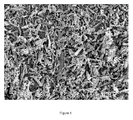
- cabergoline form L is isolated in a form of fine needles what is shown in the SEM picture. Average shorter axis of the needles is bellow 10 ⁇ m. Milling of cabergoline form L isolated by the process of the invention by a hammer mill gives particle size distribution d 0,9 bellow 10 ⁇ m.
- Cabergoline from L isolated by the process of the invention can be washed by cold aliphatic hydrocarbons or digesting previously isolated material in a suspension of aliphatic hydrocarbons preferably heptane to remove impurities and finally dried in vacuo at temperature from 20 to 80 oC, preferably from 30 to 50 oC, preferably 30 to 40 oC to remove residual solvents.
- Table 1 shows containment of residual solvents of heptane and 2-chlorotoluene after comparable drying of form L and form I at 35 oC at 5 mBar for 48 h.
- Form L and form I are isolated from the same solvent mixture, but form I is captured as an early precipitate as described in Example B and contains bellow 5 % of form L.
- the melting point of cabergoline form L is determined with DSC method with endothermic peak with onset between 105 and 111 oC, preferably between 105 and 107 oC.
- Example 2 using apparatus described bellow the product showed onset at 106,4 oC and enthalpy of 57,1 J/g.
- Cabergoline form L prepared according to this invention can be used for the preparation of pharmaceutical composition.
- a pharmaceutical composition can be prepared from cabergoline form L and at least one pharmaceutical acceptable carrier.
- Pharmaceutical composition comprising cabergoline form L prepared according to this invention can be used for a treatment of Parkinson's disease, restless legs syndrome and treatment of progressive supranuclear palsy and multisystematic atrophy and for treating D2 dopamine receptor associated disorders.
- the embodiment of the invention is characterized but not limited by the following experimental examples.
- the obtained dense suspension was filtered and washed with 50 ml of n-heptane and dried at 40 oC and 5 mbar for 24 hours.
- the obtained needle-like product (5,5 g) was identified as cabergoline form L.
- Needle-like single crystals of cabergoline form L were grown in the mother liquor (with cabergoline saturated solvent (exchanged) in Example 2), which stand at ambient temperature for 24 hours.
- the structure of new cabergoline form L was solved with single-crystal X-ray diffraction.
- cabergoline form I 3,0 g was dissolved in 6 ml of 2-chlorotoluene by agitating at room temperature. The solution was cooled down to -30 oC while stirring. The gel-like material was formed after 60 minutes. Furthermore 70 ml of n-heptane were added and let stirring 1 hour at -20 oC. Further the solvent was exchanged with 50 ml of fresh cold n-heptane and let stirring 1 hour at -20 oC. Afterwards the temperature was raised to 10 oC (0,5 K/min) and further stirred for 1 hour. The temperature was raised to 20 oC followed by stirring for 5 hour. The obtained dense suspension was filtered and washed with 20 ml of n-heptane and dried at 40 oC and 5 mbar for 24 hours. To obtain about 2,6 g cabergoline form L.
- composition components Cabergoline form L 0,5 mg Lactose 75,9 mg Leucine 3,6 mg
- the ingredients were mixed, sieved (0,7 mm) and compressed into a tablet of the prescribed tablet weight of 80 mg.
- DSC analysis showed gradual disappearing of 2-chlorotoluene solvate and appearing of form I and later at higher temperature appearing of form L.
- the captured precipitate between -5 - 0 oC after 30 min of gradual temperature elevating and later dried at 35 oC at 5 mBar for 48 h shows mainly form I with less than 5 % of form L according to DSC analysis.
- Particle size distribution was measured by the Malvern method.
- XRD powder X-ray diffraction
- the powder x-ray diffraction patterns were obtained by methods known in the art using Philips X'Pert PRO diffractometer with X'Celerator detector using CuK ⁇ radiation (tube operating at 45 kV and 40 mA) in the Bragg-Brentano (reflection) geometry. Data were recorded from 2 to 40 °2 ⁇ in steps of 0.033 °2 ⁇ and the measurement time of 50 seconds per step. Variable divergence and antiscatter slits were used to maintain 12 mm of sample length irradiated.
- FTIR Fourier transform infrared
Landscapes
- Health & Medical Sciences (AREA)
- Chemical & Material Sciences (AREA)
- Organic Chemistry (AREA)
- Engineering & Computer Science (AREA)
- Bioinformatics & Cheminformatics (AREA)
- Biomedical Technology (AREA)
- Neurology (AREA)
- Neurosurgery (AREA)
- Nuclear Medicine, Radiotherapy & Molecular Imaging (AREA)
- General Health & Medical Sciences (AREA)
- General Chemical & Material Sciences (AREA)
- Chemical Kinetics & Catalysis (AREA)
- Pharmacology & Pharmacy (AREA)
- Life Sciences & Earth Sciences (AREA)
- Animal Behavior & Ethology (AREA)
- Medicinal Chemistry (AREA)
- Public Health (AREA)
- Veterinary Medicine (AREA)
- Psychology (AREA)
- Hospice & Palliative Care (AREA)
- Psychiatry (AREA)
- Pharmaceuticals Containing Other Organic And Inorganic Compounds (AREA)
- Nitrogen Condensed Heterocyclic Rings (AREA)
Abstract
Description
- The present invention relates to the novel crystalline form of cabergoline, to the processes for preparing of new form and to pharmaceutical compositions containing it.
- Cabergoline is the generic name of the compound 1-((6-allylergolin-8β-yl)-carbonyl)-1-(3-dimethylaminopropyl)-3-ethylurea (Formula 1),

U.S. Patent No. 4,526,892 , Eur.J.Med.Chem., 24, 421 andGB-2,103,603-B WO 01/70740 WO 03/078392 WO 01/72747 WO 01/72746 WO 04/101510 WO 04/094368 WO 05/105796 WO 06/100492 - According to above mentioned literature cabergoline form I is in the form of plates, while repeating literature procedures for preparing form II and form VII gives agglomerates and thicker crystals. Crushing of hard thick crystals can lead to elevated temperatures which can decompose unstable material. Milling of softer material like the amorphous cabergoline often cause sticking of particles what lead to agglomerates and non-homogeneous material. On the other hand milling of the crystalline substance in the form of the needles using mechanical mills easily gives very fine material. Therefore, when low power is used for milling the temperature of the substance during milling stays low and that prevents degradation of the product. There is no need for micronisation, furthermore in when crystalline substance in the form of the needles is used this even means no milling in general, because the surface is not much enhanced by breaking needles as the longer side of the crystal possesses crucial part of the whole surface of needles. The surface of particles is responsible for physical contact in reaction environment what influences on the rate of dissolving and consequently on the dissolution profile and the kinetic parameters of a final dosage form.
- It is generally known that the phenomena of agglomerates rarely appear in the case of crystal form where crystals are in the form of needles. Agglomerates include cavities which keep residual solvents and impurities from mother liquors. Removal of solvents and impurities from needles by washing and drying is easier and faster than from irregular particles and agglomerates what ensures better chemical quality.
- Powdered and not agglomerated cabergoline is very suitable for preparation of the final dosage forms because it can be homogeneously incorporated into excipients what guarantees repeatable dissolution profile.
- For pharmaceutical use there is a permanent need for preparation of active ingredients as much as possible free of impurities and solvents which are stable during technological operations of final dosage preparation and during storage up to its use for treatment in patients. Therefore the solvates with body unfriendly solvents are not suitable for pharmaceutical use, but only form I, form II and form VII are not characterized as solvates in literature. Thermodynamically stable crystal form is the most desirable form of active pharmaceutical ingredient from stability point of view. There is constant need for preparation of thermodynamically stable cabergoline with low content of solvents. Said problem is solved within present invention disclosure.
- The subject of the invention is a new form of cabergoline, crystalline cabergoline in the form of needles, named cabergoline form L.
- Another aspect of the invention is a process for the preparation of cabergoline form L comprising the following steps:
- (a) dissolving cabergoline in an aromatic solvent and optionally in a co-solvent
- (b) cooling of the solution bellow 0 ºC to obtain suspension
- (c) adding an anti-solvent
- (d) re-warming the solution above 0 ºC
- (e) isolating the precipitated product
- Another aspect of the invention is a process for the preparation of cabergoline form L comprising the following steps:
- (a) preparation of semi-solid cabergoline via extraction of crude cabergoline, first dissolved in the water/acetonitrile mixture from said mixture into dichloromethane organic phase and evaporation of organic solvents to obtain semi-solid cabergoline
- (b) dissolving semi-solid cabergoline in a halogenated aromatic solvent and optionally a co-solvent
- (c) cooling of the solution bellow 0 ºC to obtain suspension
- (d) adding an anti-solvent
- (e) rewarming the solution above 0 ºC
- (f) isolating the precipitated product
- Another aspect of the invention is cabergoline form L used for the preparation of pharmaceutical composition.
- Another aspect of the invention is a method for preparing a pharmaceutical composition comprising combining an amount of cabergoline form L and at least one pharmaceutical acceptable carrier.
- Another aspect of the invention is a pharmaceutical composition comprising cabergoline form L used for a treatment of Parkinson's disease, restless legs syndrome and treatment of progressive supranuclear palsy and multisystematic atrophy and for treating D2 dopamine receptor associated disorders.
-
-
Figure 1 : SEM Picture of cabergoline form L prepared by Example 2 -
Figure 2 : X-ray powder diffraction pattern of cabergoline form L prepared by Example 2 -
Figure 3 : Infrared spectrum of cabergoline form L prepared by Example 2 -
Figure 4 : Differential scanning calorimetry pattern of cabergoline form L prepared by Example 2 -
Figure 5 : X-ray powder diffraction pattern of cabergoline form I prepared by Example B -
Figure 6 : X-ray powder diffraction pattern of cabergoline 2-chlorotoluene solvate prepared by Example A -
Figure 7 : Differential scanning calorimetry pattern of precipitate of Example B -
Figure 8 : Characteristic peak of cabergoline form L at 3377 cm-1 (prepared by Example 2) in IR spectrum compared with form I (prepared by Example B) - The subject of the invention is a new, well defined and for a long term stable crystal form of cabergoline, namely cabergoline form L. It is surprisingly shown not to be a solvate and it exhibits great thermodynamical stability. Cabergoline form L is the first known cabergoline form that appears in the shape of needles.
- The present invention also provides a simple and efficient process for the preparation of cabergoline form L with high yields and low contain of impurities. Cabergoline form L is prepared by precipitation from a mixture of aromatic solvents preferably halogenated aromatic solvents, and aliphatic hydrocarbons as anti-solvents. Starting semi-solid cabergoline is prepared by the known procedure disclosed in the literature (Eur. J. Med. Chem. 24 (1989), 421) and can be additionally purified by chromatography followed by evaporation of the eluting solvents to obtain, amorphous material, semi-solid or oil or mixture thereof.
- Halogenated aromatic solvent is selected from a group of fluoro, difluoro or chloro substituted benzene, preferably chloro substituted benzene and toluene, preferably chlorobenzene and 2-chlorotoluene, most preferably 2-chlorotoluene.
- Optionally, said halogenated aromatic solvents can be combined with low amounts of a water miscible aprotic solvent such as acetonitrile or acetone as co-solvents.
- As an anti-solvents aliphatic hydrocarbons such as pentane, heptane or hexane (C5 -C7 alkanes) can be used, which cause lowering the solubility of cabergoline in abovementioned aromatic solvents with optionally addition of the co-solvent, at ambient temperatures.
- A process for the preparation of pure cabergoline form L according to the present invention comprises the steps of:
- (a) preparation of semi-solid cabergoline via extraction of crude cabergoline, first dissolved in the water/acetonitrile mixture from said mixture into dichloromethane organic phase and evaporation of organic solvents to obtain semi-solid cabergoline,
- (b) dissolving of semi-solid cabergoline in aromatic solvent, preferably chloroaromatic solvent e.g. 2-chlorotoluene or in the mixture of aromatic and chloroaromatic solvents and lowering the temperature below -25 °C precipitating solid material to obtain suspension,
- (c) addition of alkane such as pentane, heptane or hexane for lowering the solubility of cabergoline in solvents used in step (b) at low temperature followed by gradual warming the mixture to room temperature,
- (d) isolating of cabergoline form L at ambient temperature.
- Another process for the preparation of cabergoline form L according to the present invention comprises the steps of:
- (a) dissolving solid cabergoline of any form in aromatic solvent, or in a mixture of aromatic solvent and small amount of co-solvent such as acetonitrile or acetone and lowering the temperature below -25 °C and precipitating out solid material to obtain suspension
- (b) addition of alkane such as pentane, heptane or hexane for lowering the solubility of cabergoline in solvents used in step (a) at low temperature followed by gradual warming the mixture to room temperature
- (c) isolating of cabergoline form L at ambient temperature.
- Any form of cabergoline in step (a) means solid cabergoline selected from a group of solvates with aromatic solvents, above mentioned known crystal forms I, II and VII or also from amorphous form of cabergoline.
- Starting crude cabergoline is prepared by any known process, preferably as described in Example 1. Cabergoline is isolated by extraction and further purified by chromatography, e. g. in silica gel column with mobile phase of ketones, preferably acetone or lower alcohols preferably ethanol. The obtained solution was evaporated to the oily, foamy or semi-solid material of amorphous cabergoline by evaporation. Alternatively crude cabergoline can be purified by preparative HPLC on the reverse stationary phase to yield acetonitrile/water or alcohol/water solution of cabergoline preferably acetonitrile/water which was concentrated and extracted with organic solvent, preferably dichloromethane. Starting material for the process of invention is isolated by evaporation as semi-solid amorphous material.
- Starting semi-solid cabergoline must be dissolved in the aromatic solvent as quick as possible after the preparation due to instability of amorphous material.
- Aromatic solvent in which the starting semi-solid cabergoline is dissolved is preferably halogenated aromatic solvent. Halogenated aromatic solvent is selected from a group of fluoro, difluoro or chloro substituted benzene, preferably chloro substituted benzene and toluene, preferably chlorobenzene and 2-chlorotoluene, most preferably 2-chlorotoluene. Said halogenated aromatic solvent can be optionally mixed with co-solvent. The co-solvent is selected from water immiscible solvents such as esters, ethers and aromatic hydrocarbons or water miscible aprotic solvents such as ketones and nitriles, preferably acetone and acetonitrile. An amount of the halogenated aromatic solvent used is from 2 to 5 ml of solvent per gram of cabergoline. An amount of the additional solvents is between 0 and 10 w/w % per total mass of solvents, preferably between 0 and 5 %. Afterwards the obtained solution is cooled down bellow -10 ºC, preferably to -15 to -30 ºC, more preferably to -25 ºC and let stand or stirred for at least 1 hour. During this period a precipitation occurs. The mixture can be diluted by an anti-solvent which lowers the solubility of cabergoline in a previously used aromatic preferably chloro substituted aromatic solvents. This anti-solvent is selected from aliphatic hydrocarbons preferably used are selected from the group of from solvents such as n-heptane, n-hexane, n-pentane, cyclopentane, cyclohexane or methylcyclohexane, most preferably from n-heptane and used amount of anti-solvent is 20 ml per gram of cabergoline. After the anti-solvent is added the mixture is further stirred for 2 to 12 hours, preferably 2 hours at the temperature -10 to -30 ºC, preferably at -15 to -25 ºC, more preferably at -20 ºC. The obtained suspension is afterwards heated to 5 to 30 ºC, preferably to 10 ºC and let stirred for 1-24 hours, preferably 6 hours at said temperature. The obtained crystals are isolated by removing of the solvents preferably by filtration, decantation or centrifugation, most preferably by filtration at ambient temperature are finally washed with said aliphatic hydrocarbons. The obtained solid cabergoline substance is identified as cabergoline form L.
- In another process for the preparation of cabergoline form L any solid form of cabergoline is dissolved in the aromatic solvent preferably halogenated aromatic solvent more preferably chloroaromatic solvent, most preferably 2-chlorotoluene in a volume of 2 to 5 ml of solvent per gram of cabergoline. Solid cabergoline is selected from solvates with ethers and aromatic solvents, non solvated forms I, II and VII and solid amorphous form. Optionally, the same co-solvents can be used as described within previous procedure. An amount of co-solvent is between 0 and 10 w/w % per total mass of solvents, preferably between 0 and 5 %, the temperature of dissolving process is high enough to dissolve the solid cabergoline and is between 0 and 80 ºC, preferably between 10 and 30 ºC. Afterwards the obtained solution is cooled down bellow -10 ºC, preferably to -15 to -30 ºC, more preferably to -25 ºC and let stand or stirred for at least 1 hour at said temperature. During this period a precipitation occurs. The mixture can be diluted by an anti-solvent which lowers the solubility of cabergoline in a previously mentioned chloroaromatic solvent. This anti-solvent is selected from aliphatic hydrocarbons preferably from solvents such as n-heptane, n-hexane, n-pentane, cyclopentane, cyclohexane or methylcyclohexane, preferably from n-heptane in amount of 20 ml per gram of cabergoline. After the anti-solvent is added the mixture is further stirred for 2 to 12 hours, preferably 2 hours at the temperature -10 to -30 ºC, preferably to -15 to -25 ºC, more preferably to -20 ºC. The obtained suspension is further heated to 5 to 30 ºC, preferably 10 ºC and let stirred for 1-24 hours, preferably 6 hours. The obtained crystals are isolated by removing of the solvents preferably by filtration, decantation or centrifugation, most preferably by filtration at ambient temperature with washing with hydrocarbons. The obtained solid cabergoline substance is identified as cabergoline form L.
- Following the described procedure of the invention physically pure form L was isolated. Shortening of the stirring period at temperature above 0 ºC or isolation of solids at temperatures bellow 5 ºC or considerable changing solvent/anti-solvent ratio may cause mixtures of various forms or other forms. Differential Example A describes isolation of a precipitate at -25 °-C which is proved to be cabergoline 2-chlorotoluene solvate. Differential Example B describes capturing of a precipitate between 5 - 10 ºC optionally after quick recooling to between -15 and -30 ºC in which various mixtures of form I and form L were isolated in which the contain of form I in form L is from 0 to 100 %.
- Physically pure cabergoline form L is isolated in a form of fine needles what is shown in the SEM picture. Average shorter axis of the needles is bellow 10 µm. Milling of cabergoline form L isolated by the process of the invention by a hammer mill gives particle size distribution d 0,9
bellow 10 µm. - Cabergoline from L isolated by the process of the invention can be washed by cold aliphatic hydrocarbons or digesting previously isolated material in a suspension of aliphatic hydrocarbons preferably heptane to remove impurities and finally dried in vacuo at temperature from 20 to 80 ºC, preferably from 30 to 50 ºC, preferably 30 to 40 ºC to remove residual solvents. Table 1 shows containment of residual solvents of heptane and 2-chlorotoluene after comparable drying of form L and form I at 35 ºC at 5 mBar for 48 h. Form L and form I are isolated from the same solvent mixture, but form I is captured as an early precipitate as described in Example B and contains bellow 5 % of form L. Solvents are easier removed if cabergoline is in the form of needles.
Table 1 Heptane 2-Chlorotoluene Cabergoline form L (needles) 186 ppm 236 ppm Cabergoline form I (irregular) 764 ppm 333 ppm - In Table 2 the characterization of Cabergoline form L by the following characteristic peaks in XRD diffractogram (
Figure 2 ) with values is shown.Table 2 °2θ d (Å) Rel. Int. (%) 7.17 12.33 100 10.53 8.40 33 11.26 7.86 14 11.50 7.70 14 12.03 7.36 26 12.81 6.91 2 13.87 6.39 6 14.52 6.10 41 14.98 5.92 29 16.13 5.50 8 17.53 5.06 20 17.89 4.96 16 18.76 4.73 15 19.18 4.63 9 20.54 4.32 6 21.20 4.19 27 21.64 4.11 88 21.80 4.08 98 22.07 4.03 55 22.55 3.94 9 23.13 3.85 18 23.85 3.73 17 24.62 3.62 23 25.89 3.44 11 - These values are more exactly confirmed by analyzing a monocrystal isolated from longer standing mother liquors and are shown in Table 3.
Table 3 °2θ d (Å) 7.20 12.27 10.58 8.36 11.31 7.83 11.56 7.65 12.06 7.34 12.88 6.88 13.93 6.36 14.57 6.08 15.04 5.89 16.20 5.47 17.58 5.04 17.95 4.94 18.81 4.72 19.23 4.62 20.60 4.31 21.24 4.18 21.66 4.10 21.88 4.06 22.16 4.01 22.61 3.93 23.23 3.83 23.93 3.72 24.68 3.61 25.98 3.43 - The melting point of cabergoline form L is determined with DSC method with endothermic peak with onset between 105 and 111 ºC, preferably between 105 and 107 ºC. In a specific example Example 2 using apparatus described bellow the product showed onset at 106,4 ºC and enthalpy of 57,1 J/g.
- The characteristic peak of cabergoline form L in IR spectrum appeared at 3377 cm-1.
- Cabergoline form L prepared according to this invention can be used for the preparation of pharmaceutical composition. A pharmaceutical composition can be prepared from cabergoline form L and at least one pharmaceutical acceptable carrier. Pharmaceutical composition comprising cabergoline form L prepared according to this invention can be used for a treatment of Parkinson's disease, restless legs syndrome and treatment of progressive supranuclear palsy and multisystematic atrophy and for treating D2 dopamine receptor associated disorders.
- The embodiment of the invention is characterized but not limited by the following experimental examples.
- 17 g of (9R)-7-allyl-4,6,6a,7,8,9,10,10a-octahydroindolo[4,3-fg]quinoline-9-carboxylic acid were suspended in 300 ml of dimethylformamide. 20,6 g of N-(3-dimethylaminopropyl)-N'-ethylcarbodiimide hydrochloride were added and 18,2 ml of ethyldiisopropylamine were slowly added drop wise in the reactor vessel. The mixture was stirred for 30 hours at room temperature. The solvent was evaporated when the reaction was finished. Further 60 ml of dichloromethane was added and the obtained solution was washed with 2 portions of 40 ml of 2 % water solution of ammonia, 2 portions of 40 ml of water and 40 ml of 10 % water solution of NaCl. First two alkaline solutions are extracted again with another 30 ml of dichloromethane and evaporated. The obtained crude cabergoline was purified on the RP-18 column with mobile phase of acetonitrile/water. The obtained solution was extracted with dichloromethane at pH=7. Organic phase was evaporated to the oily, foamy or semi-solid material of amorphous cabergoline with 0,2 % (wlw) of total impurities.
- 6,1 g of cabergoline obtained in Example 1 were dissolved in 12 ml of 2-chlorotoluene by agitating at room temperature. The solution was cooled down to -30 ºC while stirring. The gel-like material was formed after 60 minutes. Furthermore 150 ml of n-heptane were added and let stirring 1 hour at -20 ºC. Further the solvent was exchanged with 100 ml of fresh n-heptane, precooled to -20 ºC and let stirring 1 hour at -20 ºC. Afterwards the temperature was raised to 10 ºC (0,5 K/min) and further stirred for 1 hour. The temperature was raised to 20 ºC (0,5 K/min) followed by stirring for 5 hour. The obtained dense suspension was filtered and washed with 50 ml of n-heptane and dried at 40 ºC and 5 mbar for 24 hours. The obtained needle-like product (5,5 g) was identified as cabergoline form L. Particle size distribution of the product of Example 2 is the following:
d 0,1= 0,4 um; d 0,5 = 4,2 um; d 0,9 = 33 um. - Needle-like single crystals of cabergoline form L were grown in the mother liquor (with cabergoline saturated solvent (exchanged) in Example 2), which stand at ambient temperature for 24 hours. The structure of new cabergoline form L was solved with single-crystal X-ray diffraction.
- 3,0 g of cabergoline form I was dissolved in 6 ml of 2-chlorotoluene by agitating at room temperature. The solution was cooled down to -30 ºC while stirring. The gel-like material was formed after 60 minutes. Furthermore 70 ml of n-heptane were added and let stirring 1 hour at -20 ºC. Further the solvent was exchanged with 50 ml of fresh cold n-heptane and let stirring 1 hour at -20 ºC. Afterwards the temperature was raised to 10 ºC (0,5 K/min) and further stirred for 1 hour. The temperature was raised to 20 ºC followed by stirring for 5 hour. The obtained dense suspension was filtered and washed with 20 ml of n-heptane and dried at 40 ºC and 5 mbar for 24 hours. To obtain about 2,6 g cabergoline form L.
- 8 g of cabergoline 2-chlorotoluene solvate was dissolved in 12 ml of 2-chlorotoluene by agitating at room temperature. The solution was cooled down to -27 °C while stirring. The gel-like material was formed after 35 minutes then 160 ml of n-heptane were added and let stirring 1 hour at -20 ºC. Further the solvent was exchanged with 100 ml of fresh n-heptane, precooled to -20 ºC and let stirring 1 hour at -20 ºC. Afterwards the temperature was raised to 10 ºC (0,5 K/min) and further stirred for 1 hour. The temperature was raised to 10 ºC (0,5 K/min) followed by stirring for 5 hour. The obtained dense suspension was filtered and washed with 50 ml of n-heptane and dried at 40 ºC and 5 mbar for 24 hours. The obtained needle-like product 5,3 g has identical physico-chemical properties as in Example 2.
-
Composition components: Cabergoline form L 0,5 mg Lactose 75,9 mg Leucine 3,6 mg - The ingredients were mixed, sieved (0,7 mm) and compressed into a tablet of the prescribed tablet weight of 80 mg.
- 6,1 g of cabergoline obtained in example 1 were dissolved in 12 ml of 2-chlorotoluene by agitating at room temperature. The solution was cooled down to -30 ºC while stirring. After 60 minutes of stirring crystalline slurry was obtained and 150 ml of n-heptane was added and let stirring 1 hour at -20 ºC. Further the solvent was exchanged with 100 ml of fresh n-heptane, precooled to -20 ºC and let stirring 1 hour at -20 ºC. The obtained precipitate was filtered and 2-chlorotoluene solvate of cabergoline was obtained which was identified by XRD data.
- 6,1 g of cabergoline obtained in example 1 were dissolved in 12 ml of 2-chlorotoluene by agitating at room temperature. The solution was cooled down to -30 ºC while stirring. The gel-like material was formed after 60 minutes. Furthermore 150 ml of n-heptane were added and let stirring 1 hour at -20 ºC. Further the solvent was exchanged with 100 ml of fresh n-heptane, precooled to -20 ºC and let stirring 1 hour at -20 ºC. Afterwards the temperature was slowly raising to 0 ºC (0,5 K/min) and small samples were analyzed. DSC analysis showed gradual disappearing of 2-chlorotoluene solvate and appearing of form I and later at higher temperature appearing of form L. The captured precipitate between -5 - 0 ºC after 30 min of gradual temperature elevating and later dried at 35 ºC at 5 mBar for 48 h shows mainly form I with less than 5 % of form L according to DSC analysis.
- The products were analyzed by following methods:
- Particle size distribution was measured by the Malvern method.
- Conditions for obtaining powder X-ray diffraction (XRD) patterns: The powder x-ray diffraction patterns were obtained by methods known in the art using Philips X'Pert PRO diffractometer with X'Celerator detector using CuKα radiation (tube operating at 45 kV and 40 mA) in the Bragg-Brentano (reflection) geometry. Data were recorded from 2 to 40 °2θ in steps of 0.033 °2θ and the measurement time of 50 seconds per step. Variable divergence and antiscatter slits were used to maintain 12 mm of sample length irradiated.
- Conditions for obtaining infrared spectra: Fourier transform infrared (FTIR) spectra were recorded with a Nicolet Nexus spectrometer. Spectra over a range of 4000 to 400 cm-1 with a resolution of 2 cm-1 (16 scans) were recorded on KBr tablets.
- Conditions for obtaining DSC thermograms: Thermograms were obtained with Mettler Toledo DSC822e differential scanning calorimeter. The sample (4-6 mg) was placed in an unsealed aluminium pan with a hole and heated at 5 °C/min in the temperature range from 30 °C to 200 °C.
Claims (27)
- Crystalline cabergoline in the form of needles.
- Cabergoline in the crystal form L.
- Cabergoline in the crystal form L which is characterized by endothermic peak with onset between 105 and 107 ºC
- Cabergoline in the crystal form L which is characterized by an X-Ray diffraction pattern shown in Figure 2
- Cabergoline in the crystal form L which is characterized by d-values 4,1; 5,9; 6,1; 7,4; 8,4; 12,3 in X-Ray diffraction pattern
- Cabergoline in the crystal form L which is characterized by the following d-values 4,1; 8,4; 12,3 and absorption peak in IR spectrum at 3377 cm-1
- A process for the preparation of cabergoline form L comprising the following steps:(a) dissolving cabergoline in an aromatic solvent and optionally in a co-solvent(b) cooling of the solution bellow 0 ºC to obtain suspension(c) adding an anti-solvent(d) re-warming the solution above 0 ºC(e) isolating the precipitated product
- A process for the preparation of cabergoline form L comprising the following steps:(a) preparation of semi-solid cabergoline via extraction of crude cabergoline, first dissolved in the water/acetonitrile mixture from said mixture into dichloromethane organic phase and evaporation of organic solvents to obtain semi-solid cabergoline(b) dissolving semi-solid cabergoline in a halogenated aromatic solvent and optionally a co-solvent(c) cooling of the solution bellow 0 ºC to obtain suspension(d) adding an anti-solvent(e) rewarming the solution above 0 ºC(f) isolating the precipitated product
- The process for the preparation of cabergoline form L according to claim 7 wherein cabergoline from step (a) is cabergoline solvate.
- The process for the preparation of cabergoline form L according to claim 7 wherein cabergoline from step (a) is amorphous cabergoline.
- The process for the preparation of cabergoline form L according to claim 7 wherein cabergoline from step (a) cabergoline form 1.
- The process for the preparation of cabergoline form L according to claims 7 and 8 wherein halogenated aromatic solvent is a chloro substituted aromatic compound.
- The process for the preparation of cabergoline form L according to claim 12 wherein chloro substituted aromatic compound is chlorobenzene.
- The process for the preparation of cabergoline form L according to claim 12 wherein chloro substituted aromatic compound is o-chlorotoluene
- The process for the preparation of cabergoline form L according to claims 7 and 8 in which co-solvent is acetonitrile in the volume of 0-10 % (w/w) of total solvent mass.
- The process for the preparation of cabergoline form L according to claims 7 and 8 wherein cooling the solution below 0 ºC means cooling bellow -10 ºC.
- The process for the preparation of cabergoline form L according to claims 7 and 8 wherein cooling the solution below 0 ºC means cooling bellow -20 ºC
- The process for the preparation of cabergoline form L according to claims 7 and 8 wherein anti-solvent is aliphatic hydrocarbon.
- The process for the preparation of cabergoline form L according to claims 7 and 8 wherein anti-solvent is C5 to C7 alkane.
- The process for the preparation of cabergoline form L according to claims 7 and 8 in which anti-solvent is n-heptane.
- The process for the preparation of cabergoline form L according to claims 7-8 wherein the solution in step (e) is re-warmed to 5 - 30 ºC
- The process for the preparation of cabergoline form L according to claims 7-8 wherein the solution in step (e) is re-warmed to 10 - 20 ºC
- Pharmaceutical composition comprising cabergoline in the form of needles.
- Pharmaceutical composition comprising cabergoline form L.
- Pharmaceutical composition comprising cabergoline defined in claim 5.
- Pharmaceutical composition comprising cabergoline form L prepared by the process according to claims 7 and 8.
- Pharmaceutical composition comprising cabergoline according to claims 1-6 for treatment of Parkinson disease, restless legs syndrome and treatment of progressive supranuclear and multisystematic atrophy and for treating D2 dopamine receptor disorder.
Priority Applications (6)
| Application Number | Priority Date | Filing Date | Title |
|---|---|---|---|
| EP07101512A EP1953157A1 (en) | 2007-01-31 | 2007-01-31 | New crystal form of cabergoline |
| JP2009547679A JP2010516799A (en) | 2007-01-31 | 2008-01-30 | A new crystal form of cabergoline. |
| EP08708408.3A EP2114939B1 (en) | 2007-01-31 | 2008-01-30 | New crystal form of cabergoline |
| ES08708408T ES2436287T3 (en) | 2007-01-31 | 2008-01-30 | New form of cabergoline crystal |
| PCT/EP2008/051093 WO2008092881A1 (en) | 2007-01-31 | 2008-01-30 | New crystal form of cabergoline |
| US12/525,240 US8338445B2 (en) | 2007-01-31 | 2008-01-30 | Crystal form of cabergoline |
Applications Claiming Priority (1)
| Application Number | Priority Date | Filing Date | Title |
|---|---|---|---|
| EP07101512A EP1953157A1 (en) | 2007-01-31 | 2007-01-31 | New crystal form of cabergoline |
Publications (1)
| Publication Number | Publication Date |
|---|---|
| EP1953157A1 true EP1953157A1 (en) | 2008-08-06 |
Family
ID=38137719
Family Applications (2)
| Application Number | Title | Priority Date | Filing Date |
|---|---|---|---|
| EP07101512A Ceased EP1953157A1 (en) | 2007-01-31 | 2007-01-31 | New crystal form of cabergoline |
| EP08708408.3A Not-in-force EP2114939B1 (en) | 2007-01-31 | 2008-01-30 | New crystal form of cabergoline |
Family Applications After (1)
| Application Number | Title | Priority Date | Filing Date |
|---|---|---|---|
| EP08708408.3A Not-in-force EP2114939B1 (en) | 2007-01-31 | 2008-01-30 | New crystal form of cabergoline |
Country Status (5)
| Country | Link |
|---|---|
| US (1) | US8338445B2 (en) |
| EP (2) | EP1953157A1 (en) |
| JP (1) | JP2010516799A (en) |
| ES (1) | ES2436287T3 (en) |
| WO (1) | WO2008092881A1 (en) |
Citations (6)
| Publication number | Priority date | Publication date | Assignee | Title |
|---|---|---|---|---|
| US4526892A (en) * | 1981-03-03 | 1985-07-02 | Farmitalia Carlo Erba, S.P.A. | Dimethylaminoalkyl-3-(ergoline-8'βcarbonyl)-ureas |
| WO2001072747A1 (en) * | 2000-03-24 | 2001-10-04 | Pharmacia Italia S.P.A. | Crystalline form ii of cabergoline |
| WO2001072746A1 (en) * | 2000-03-24 | 2001-10-04 | Pharmacia Italia S.P.A. | Crystalline form vii of cabergoline |
| WO2003078392A2 (en) * | 2002-03-15 | 2003-09-25 | Pharmacia Corporation | Process for preparing crystalline form i of cabergoline |
| WO2003078433A1 (en) * | 2002-03-15 | 2003-09-25 | Pharmacia Corporation | Process for preparing crystalline form i of cabergoline |
| WO2004101510A2 (en) * | 2003-05-08 | 2004-11-25 | Ivax Corporation | Polymorphs of cabergoline |
Family Cites Families (6)
| Publication number | Priority date | Publication date | Assignee | Title |
|---|---|---|---|---|
| GB2103603B (en) | 1981-08-11 | 1985-04-11 | Erba Farmitalia | Ergoline derivatives |
| GB0007308D0 (en) | 2000-03-24 | 2000-05-17 | Pharmacia & Upjohn Spa | Process for preparing crystalline form | of cabergoline |
| GB0008540D0 (en) | 2000-04-06 | 2000-05-24 | Nokia Networks Oy | Provision of location service apparatus |
| IL155545A (en) | 2003-04-21 | 2009-12-24 | Finetech Pharmaceutical Ltd | Solvate form of cabergoline |
| GB0409785D0 (en) | 2004-04-30 | 2004-06-09 | Resolution Chemicals Ltd | Preparation of cabergoline |
| US7339060B2 (en) | 2005-03-23 | 2008-03-04 | Resolution Chemicals, Ltd. | Preparation of cabergoline |
-
2007
- 2007-01-31 EP EP07101512A patent/EP1953157A1/en not_active Ceased
-
2008
- 2008-01-30 ES ES08708408T patent/ES2436287T3/en active Active
- 2008-01-30 EP EP08708408.3A patent/EP2114939B1/en not_active Not-in-force
- 2008-01-30 WO PCT/EP2008/051093 patent/WO2008092881A1/en not_active Ceased
- 2008-01-30 US US12/525,240 patent/US8338445B2/en not_active Expired - Fee Related
- 2008-01-30 JP JP2009547679A patent/JP2010516799A/en active Pending
Patent Citations (6)
| Publication number | Priority date | Publication date | Assignee | Title |
|---|---|---|---|---|
| US4526892A (en) * | 1981-03-03 | 1985-07-02 | Farmitalia Carlo Erba, S.P.A. | Dimethylaminoalkyl-3-(ergoline-8'βcarbonyl)-ureas |
| WO2001072747A1 (en) * | 2000-03-24 | 2001-10-04 | Pharmacia Italia S.P.A. | Crystalline form ii of cabergoline |
| WO2001072746A1 (en) * | 2000-03-24 | 2001-10-04 | Pharmacia Italia S.P.A. | Crystalline form vii of cabergoline |
| WO2003078392A2 (en) * | 2002-03-15 | 2003-09-25 | Pharmacia Corporation | Process for preparing crystalline form i of cabergoline |
| WO2003078433A1 (en) * | 2002-03-15 | 2003-09-25 | Pharmacia Corporation | Process for preparing crystalline form i of cabergoline |
| WO2004101510A2 (en) * | 2003-05-08 | 2004-11-25 | Ivax Corporation | Polymorphs of cabergoline |
Also Published As
| Publication number | Publication date |
|---|---|
| US20100152223A1 (en) | 2010-06-17 |
| WO2008092881A1 (en) | 2008-08-07 |
| EP2114939B1 (en) | 2013-08-21 |
| EP2114939A1 (en) | 2009-11-11 |
| US8338445B2 (en) | 2012-12-25 |
| ES2436287T3 (en) | 2013-12-30 |
| JP2010516799A (en) | 2010-05-20 |
Similar Documents
| Publication | Publication Date | Title |
|---|---|---|
| RU2417986C2 (en) | Synthesis of n-(4-fluorobenzyl)-n-(1-methylpiperidin-4-yl)-n'-(4-(2-methylpropyloxy)phenylmethyl)carbamide, as well as tartrate and crystalline forms thereof | |
| WO2019030711A1 (en) | Polymorphs and co-crystals of roxadustat | |
| MXPA02009284A (en) | Crystalline form ii of cabergoline. | |
| WO2009102771A1 (en) | Methods of converting polymorphic form b of bazedoxifene acetate to polymorphic form a of bazedoxifene acetate | |
| CA2464961A1 (en) | Polymorphous forms of rosiglitazone maleate | |
| EP2114939B1 (en) | New crystal form of cabergoline | |
| US20060281777A1 (en) | Process for preparing crystalline form I of cabergoline | |
| CA2478149A1 (en) | Process for preparing crystalline form i of cabergoline | |
| JP2007535526A (en) | Preparation of cabergoline | |
| EP1925616A1 (en) | Process for the preparation of crystal forms of cabergoline via stable solvates of cabergoline | |
| Zhou et al. | Crystal modification of rifapentine using different solvents | |
| ZA200406588B (en) | Process for preparing crystalline form I of cabergoline | |
| US7238810B2 (en) | Preparation of cabergoline | |
| CN101384589A (en) | Production method of cabergoline and its novel polymorphs | |
| EP2135869A1 (en) | Preparation of a crystalline form of cabergoline | |
| CN112533894A (en) | 4, 5-dihydroxy-2- (4-methylbenzyl) isophthalonitrile solvate and crystalline form thereof | |
| EP1912984A1 (en) | Solvate of cabergoline and preparations of cabergoline form i | |
| EP1632473A1 (en) | Sertraline hydrochloride polymorphs | |
| WO2004007484A1 (en) | Fumarate salts | |
| WO2004007485A1 (en) | Besylate salts |
Legal Events
| Date | Code | Title | Description |
|---|---|---|---|
| PUAI | Public reference made under article 153(3) epc to a published international application that has entered the european phase |
Free format text: ORIGINAL CODE: 0009012 |
|
| AK | Designated contracting states |
Kind code of ref document: A1 Designated state(s): AT BE BG CH CY CZ DE DK EE ES FI FR GB GR HU IE IS IT LI LT LU LV MC NL PL PT RO SE SI SK TR |
|
| AX | Request for extension of the european patent |
Extension state: AL BA HR MK RS |
|
| 17P | Request for examination filed |
Effective date: 20090206 |
|
| AKX | Designation fees paid |
Designated state(s): AT BE BG CH CY CZ DE DK EE ES FI FR GB GR HU IE IS IT LI LT LU LV MC NL PL PT RO SE SI SK TR |
|
| AXX | Extension fees paid |
Extension state: RS Payment date: 20090206 Extension state: MK Payment date: 20090206 Extension state: HR Payment date: 20090206 Extension state: BA Payment date: 20090206 Extension state: AL Payment date: 20090206 |
|
| STAA | Information on the status of an ep patent application or granted ep patent |
Free format text: STATUS: THE APPLICATION HAS BEEN REFUSED |
|
| 18R | Application refused |
Effective date: 20090419 |