EP1953152A1 - Process for preparing quinazoline RHO-kinase inhibitors and intermediates thereof - Google Patents
Process for preparing quinazoline RHO-kinase inhibitors and intermediates thereof Download PDFInfo
- Publication number
- EP1953152A1 EP1953152A1 EP08103780A EP08103780A EP1953152A1 EP 1953152 A1 EP1953152 A1 EP 1953152A1 EP 08103780 A EP08103780 A EP 08103780A EP 08103780 A EP08103780 A EP 08103780A EP 1953152 A1 EP1953152 A1 EP 1953152A1
- Authority
- EP
- European Patent Office
- Prior art keywords
- alkyl
- halogen
- heteroaryl
- compound
- formula
- Prior art date
- Legal status (The legal status is an assumption and is not a legal conclusion. Google has not performed a legal analysis and makes no representation as to the accuracy of the status listed.)
- Withdrawn
Links
- 239000003590 rho kinase inhibitor Substances 0.000 title abstract description 8
- 239000000543 intermediate Substances 0.000 title abstract description 5
- JWVCLYRUEFBMGU-UHFFFAOYSA-N quinazoline Chemical compound N1=CN=CC2=CC=CC=C21 JWVCLYRUEFBMGU-UHFFFAOYSA-N 0.000 title description 4
- 238000004519 manufacturing process Methods 0.000 title description 3
- 238000000034 method Methods 0.000 claims abstract description 25
- 150000001875 compounds Chemical class 0.000 claims description 83
- -1 R13 is H Chemical group 0.000 claims description 76
- 229910052736 halogen Inorganic materials 0.000 claims description 62
- 125000003118 aryl group Chemical group 0.000 claims description 59
- 150000002367 halogens Chemical group 0.000 claims description 43
- 125000004169 (C1-C6) alkyl group Chemical group 0.000 claims description 40
- 125000003282 alkyl amino group Chemical group 0.000 claims description 36
- 125000004093 cyano group Chemical group *C#N 0.000 claims description 33
- 239000000203 mixture Substances 0.000 claims description 31
- 125000001072 heteroaryl group Chemical group 0.000 claims description 30
- 238000002360 preparation method Methods 0.000 claims description 30
- 125000000008 (C1-C10) alkyl group Chemical group 0.000 claims description 23
- 125000000217 alkyl group Chemical group 0.000 claims description 21
- 125000000449 nitro group Chemical group [O-][N+](*)=O 0.000 claims description 21
- 125000006374 C2-C10 alkenyl group Chemical group 0.000 claims description 20
- 125000000753 cycloalkyl group Chemical group 0.000 claims description 20
- 125000004122 cyclic group Chemical group 0.000 claims description 19
- 229910052760 oxygen Inorganic materials 0.000 claims description 19
- 125000002924 primary amino group Chemical group [H]N([H])* 0.000 claims description 19
- 125000001313 C5-C10 heteroaryl group Chemical group 0.000 claims description 18
- 125000005236 alkanoylamino group Chemical group 0.000 claims description 18
- 125000003367 polycyclic group Chemical group 0.000 claims description 18
- 125000004432 carbon atom Chemical group C* 0.000 claims description 17
- 125000001997 phenyl group Chemical group [H]C1=C([H])C([H])=C(*)C([H])=C1[H] 0.000 claims description 16
- 125000002887 hydroxy group Chemical group [H]O* 0.000 claims description 13
- 239000001257 hydrogen Substances 0.000 claims description 12
- 229910052739 hydrogen Inorganic materials 0.000 claims description 12
- 150000003839 salts Chemical class 0.000 claims description 12
- 229910052757 nitrogen Inorganic materials 0.000 claims description 11
- 230000008569 process Effects 0.000 claims description 11
- 125000004191 (C1-C6) alkoxy group Chemical group 0.000 claims description 10
- 239000002253 acid Substances 0.000 claims description 10
- 125000004429 atom Chemical group 0.000 claims description 10
- 238000010438 heat treatment Methods 0.000 claims description 10
- 125000004435 hydrogen atom Chemical group [H]* 0.000 claims description 10
- 125000004430 oxygen atom Chemical group O* 0.000 claims description 10
- 125000004434 sulfur atom Chemical group 0.000 claims description 10
- 125000006717 (C3-C10) cycloalkenyl group Chemical group 0.000 claims description 9
- 125000000172 C5-C10 aryl group Chemical group 0.000 claims description 9
- 125000003739 carbamimidoyl group Chemical group C(N)(=N)* 0.000 claims description 9
- 125000004433 nitrogen atom Chemical group N* 0.000 claims description 9
- 125000000020 sulfo group Chemical group O=S(=O)([*])O[H] 0.000 claims description 9
- 229910052717 sulfur Inorganic materials 0.000 claims description 9
- 125000002795 guanidino group Chemical group C(N)(=N)N* 0.000 claims description 8
- MHAJPDPJQMAIIY-UHFFFAOYSA-N Hydrogen peroxide Chemical compound OO MHAJPDPJQMAIIY-UHFFFAOYSA-N 0.000 claims description 6
- XLYOFNOQVPJJNP-UHFFFAOYSA-M hydroxide Chemical compound [OH-] XLYOFNOQVPJJNP-UHFFFAOYSA-M 0.000 claims description 5
- 229910052500 inorganic mineral Inorganic materials 0.000 claims description 4
- 239000011707 mineral Substances 0.000 claims description 4
- 238000002156 mixing Methods 0.000 claims description 4
- 230000003287 optical effect Effects 0.000 claims description 4
- 108010041788 rho-Associated Kinases Proteins 0.000 abstract description 12
- 102000000568 rho-Associated Kinases Human genes 0.000 abstract description 12
- 208000010228 Erectile Dysfunction Diseases 0.000 abstract description 7
- 201000001881 impotence Diseases 0.000 abstract description 7
- 230000001404 mediated effect Effects 0.000 abstract description 4
- 208000029078 coronary artery disease Diseases 0.000 abstract description 2
- 230000002401 inhibitory effect Effects 0.000 abstract description 2
- 230000004614 tumor growth Effects 0.000 abstract description 2
- 125000002294 quinazolinyl group Chemical class N1=C(N=CC2=CC=CC=C12)* 0.000 abstract 1
- YMWUJEATGCHHMB-UHFFFAOYSA-N Dichloromethane Chemical compound ClCCl YMWUJEATGCHHMB-UHFFFAOYSA-N 0.000 description 45
- OKKJLVBELUTLKV-UHFFFAOYSA-N Methanol Chemical compound OC OKKJLVBELUTLKV-UHFFFAOYSA-N 0.000 description 45
- ZMXDDKWLCZADIW-UHFFFAOYSA-N N,N-Dimethylformamide Chemical compound CN(C)C=O ZMXDDKWLCZADIW-UHFFFAOYSA-N 0.000 description 38
- 239000007787 solid Substances 0.000 description 29
- HEMHJVSKTPXQMS-UHFFFAOYSA-M Sodium hydroxide Chemical compound [OH-].[Na+] HEMHJVSKTPXQMS-UHFFFAOYSA-M 0.000 description 24
- 239000000047 product Substances 0.000 description 24
- 239000000243 solution Substances 0.000 description 23
- XLYOFNOQVPJJNP-UHFFFAOYSA-N water Substances O XLYOFNOQVPJJNP-UHFFFAOYSA-N 0.000 description 23
- XEKOWRVHYACXOJ-UHFFFAOYSA-N Ethyl acetate Chemical compound CCOC(C)=O XEKOWRVHYACXOJ-UHFFFAOYSA-N 0.000 description 22
- WYURNTSHIVDZCO-UHFFFAOYSA-N Tetrahydrofuran Chemical compound C1CCOC1 WYURNTSHIVDZCO-UHFFFAOYSA-N 0.000 description 22
- 238000006243 chemical reaction Methods 0.000 description 21
- 125000005843 halogen group Chemical group 0.000 description 21
- VLKZOEOYAKHREP-UHFFFAOYSA-N n-Hexane Chemical compound CCCCCC VLKZOEOYAKHREP-UHFFFAOYSA-N 0.000 description 21
- VEXZGXHMUGYJMC-UHFFFAOYSA-N Hydrochloric acid Chemical compound Cl VEXZGXHMUGYJMC-UHFFFAOYSA-N 0.000 description 18
- YXFVVABEGXRONW-UHFFFAOYSA-N Toluene Chemical compound CC1=CC=CC=C1 YXFVVABEGXRONW-UHFFFAOYSA-N 0.000 description 18
- 238000004128 high performance liquid chromatography Methods 0.000 description 18
- LFQSCWFLJHTTHZ-UHFFFAOYSA-N Ethanol Chemical compound CCO LFQSCWFLJHTTHZ-UHFFFAOYSA-N 0.000 description 15
- JUJWROOIHBZHMG-UHFFFAOYSA-N Pyridine Chemical compound C1=CC=NC=C1 JUJWROOIHBZHMG-UHFFFAOYSA-N 0.000 description 12
- 210000004027 cell Anatomy 0.000 description 12
- 239000002244 precipitate Substances 0.000 description 12
- 239000000725 suspension Substances 0.000 description 12
- 230000000694 effects Effects 0.000 description 11
- XHXFXVLFKHQFAL-UHFFFAOYSA-N phosphoryl trichloride Chemical compound ClP(Cl)(Cl)=O XHXFXVLFKHQFAL-UHFFFAOYSA-N 0.000 description 11
- YLQBMQCUIZJEEH-UHFFFAOYSA-N tetrahydrofuran Natural products C=1C=COC=1 YLQBMQCUIZJEEH-UHFFFAOYSA-N 0.000 description 11
- 238000004809 thin layer chromatography Methods 0.000 description 11
- 238000005160 1H NMR spectroscopy Methods 0.000 description 10
- CTSLXHKWHWQRSH-UHFFFAOYSA-N oxalyl chloride Chemical compound ClC(=O)C(Cl)=O CTSLXHKWHWQRSH-UHFFFAOYSA-N 0.000 description 10
- IJKVHSBPTUYDLN-UHFFFAOYSA-N dihydroxy(oxo)silane Chemical compound O[Si](O)=O IJKVHSBPTUYDLN-UHFFFAOYSA-N 0.000 description 9
- 235000019439 ethyl acetate Nutrition 0.000 description 9
- 238000001819 mass spectrum Methods 0.000 description 9
- 125000001424 substituent group Chemical group 0.000 description 9
- 238000000825 ultraviolet detection Methods 0.000 description 9
- PXBFMLJZNCDSMP-UHFFFAOYSA-N 2-Aminobenzamide Chemical compound NC(=O)C1=CC=CC=C1N PXBFMLJZNCDSMP-UHFFFAOYSA-N 0.000 description 8
- XTHFKEDIFFGKHM-UHFFFAOYSA-N Dimethoxyethane Chemical compound COCCOC XTHFKEDIFFGKHM-UHFFFAOYSA-N 0.000 description 8
- JGFZNNIVVJXRND-UHFFFAOYSA-N N,N-Diisopropylethylamine (DIPEA) Chemical compound CCN(C(C)C)C(C)C JGFZNNIVVJXRND-UHFFFAOYSA-N 0.000 description 8
- 238000004458 analytical method Methods 0.000 description 8
- 239000011541 reaction mixture Substances 0.000 description 8
- 238000010992 reflux Methods 0.000 description 8
- FYSNRJHAOHDILO-UHFFFAOYSA-N thionyl chloride Chemical compound ClS(Cl)=O FYSNRJHAOHDILO-UHFFFAOYSA-N 0.000 description 8
- 0 *C(Nc1ccccc1*)=O Chemical compound *C(Nc1ccccc1*)=O 0.000 description 7
- QTBSBXVTEAMEQO-UHFFFAOYSA-N Acetic acid Chemical compound CC(O)=O QTBSBXVTEAMEQO-UHFFFAOYSA-N 0.000 description 7
- 102000007469 Actins Human genes 0.000 description 7
- 108010085238 Actins Proteins 0.000 description 7
- 150000001732 carboxylic acid derivatives Chemical class 0.000 description 7
- 125000001309 chloro group Chemical group Cl* 0.000 description 7
- 239000002904 solvent Substances 0.000 description 7
- XBTOSRUBOXQWBO-UHFFFAOYSA-N 1h-indazol-5-amine Chemical compound NC1=CC=C2NN=CC2=C1 XBTOSRUBOXQWBO-UHFFFAOYSA-N 0.000 description 6
- VHYFNPMBLIVWCW-UHFFFAOYSA-N 4-Dimethylaminopyridine Chemical compound CN(C)C1=CC=NC=C1 VHYFNPMBLIVWCW-UHFFFAOYSA-N 0.000 description 6
- RTZKZFJDLAIYFH-UHFFFAOYSA-N Diethyl ether Chemical compound CCOCC RTZKZFJDLAIYFH-UHFFFAOYSA-N 0.000 description 6
- IAZDPXIOMUYVGZ-UHFFFAOYSA-N Dimethylsulphoxide Chemical compound CS(C)=O IAZDPXIOMUYVGZ-UHFFFAOYSA-N 0.000 description 6
- 230000015572 biosynthetic process Effects 0.000 description 6
- 239000012267 brine Substances 0.000 description 6
- SCVFZCLFOSHCOH-UHFFFAOYSA-M potassium acetate Chemical compound [K+].CC([O-])=O SCVFZCLFOSHCOH-UHFFFAOYSA-M 0.000 description 6
- 108090000623 proteins and genes Proteins 0.000 description 6
- UMJSCPRVCHMLSP-UHFFFAOYSA-N pyridine Natural products COC1=CC=CN=C1 UMJSCPRVCHMLSP-UHFFFAOYSA-N 0.000 description 6
- HPALAKNZSZLMCH-UHFFFAOYSA-M sodium;chloride;hydrate Chemical compound O.[Na+].[Cl-] HPALAKNZSZLMCH-UHFFFAOYSA-M 0.000 description 6
- WFDIJRYMOXRFFG-UHFFFAOYSA-N Acetic anhydride Chemical compound CC(=O)OC(C)=O WFDIJRYMOXRFFG-UHFFFAOYSA-N 0.000 description 5
- 101100356682 Caenorhabditis elegans rho-1 gene Proteins 0.000 description 5
- LRHPLDYGYMQRHN-UHFFFAOYSA-N N-Butanol Chemical compound CCCCO LRHPLDYGYMQRHN-UHFFFAOYSA-N 0.000 description 5
- 101150111584 RHOA gene Proteins 0.000 description 5
- 102100027609 Rho-related GTP-binding protein RhoD Human genes 0.000 description 5
- 210000004292 cytoskeleton Anatomy 0.000 description 5
- 238000001914 filtration Methods 0.000 description 5
- 238000004895 liquid chromatography mass spectrometry Methods 0.000 description 5
- 239000000843 powder Substances 0.000 description 5
- 102000004169 proteins and genes Human genes 0.000 description 5
- 210000000329 smooth muscle myocyte Anatomy 0.000 description 5
- 239000007858 starting material Substances 0.000 description 5
- RYHBNJHYFVUHQT-UHFFFAOYSA-N 1,4-Dioxane Chemical compound C1COCCO1 RYHBNJHYFVUHQT-UHFFFAOYSA-N 0.000 description 4
- GQHTUMJGOHRCHB-UHFFFAOYSA-N 2,3,4,6,7,8,9,10-octahydropyrimido[1,2-a]azepine Chemical compound C1CCCCN2CCCN=C21 GQHTUMJGOHRCHB-UHFFFAOYSA-N 0.000 description 4
- XKRFYHLGVUSROY-UHFFFAOYSA-N Argon Chemical compound [Ar] XKRFYHLGVUSROY-UHFFFAOYSA-N 0.000 description 4
- HEDRZPFGACZZDS-UHFFFAOYSA-N Chloroform Chemical compound ClC(Cl)Cl HEDRZPFGACZZDS-UHFFFAOYSA-N 0.000 description 4
- IAZDPXIOMUYVGZ-WFGJKAKNSA-N Dimethyl sulfoxide Chemical compound [2H]C([2H])([2H])S(=O)C([2H])([2H])[2H] IAZDPXIOMUYVGZ-WFGJKAKNSA-N 0.000 description 4
- 206010028980 Neoplasm Diseases 0.000 description 4
- VYPSYNLAJGMNEJ-UHFFFAOYSA-N Silicium dioxide Chemical compound O=[Si]=O VYPSYNLAJGMNEJ-UHFFFAOYSA-N 0.000 description 4
- PMZURENOXWZQFD-UHFFFAOYSA-L Sodium Sulfate Chemical compound [Na+].[Na+].[O-]S([O-])(=O)=O PMZURENOXWZQFD-UHFFFAOYSA-L 0.000 description 4
- DKGAVHZHDRPRBM-UHFFFAOYSA-N Tert-Butanol Chemical compound CC(C)(C)O DKGAVHZHDRPRBM-UHFFFAOYSA-N 0.000 description 4
- DTQVDTLACAAQTR-UHFFFAOYSA-N Trifluoroacetic acid Chemical compound OC(=O)C(F)(F)F DTQVDTLACAAQTR-UHFFFAOYSA-N 0.000 description 4
- 150000001412 amines Chemical class 0.000 description 4
- 229910052799 carbon Inorganic materials 0.000 description 4
- 239000012320 chlorinating reagent Substances 0.000 description 4
- 230000005764 inhibitory process Effects 0.000 description 4
- 239000000463 material Substances 0.000 description 4
- 239000003960 organic solvent Substances 0.000 description 4
- BWHMMNNQKKPAPP-UHFFFAOYSA-L potassium carbonate Chemical compound [K+].[K+].[O-]C([O-])=O BWHMMNNQKKPAPP-UHFFFAOYSA-L 0.000 description 4
- 239000003586 protic polar solvent Substances 0.000 description 4
- 229910052938 sodium sulfate Inorganic materials 0.000 description 4
- 235000011152 sodium sulphate Nutrition 0.000 description 4
- 239000003039 volatile agent Substances 0.000 description 4
- PFKITESTTSWHMP-UHFFFAOYSA-N 3-fluoro-4-phenylbenzoic acid Chemical compound FC1=CC(C(=O)O)=CC=C1C1=CC=CC=C1 PFKITESTTSWHMP-UHFFFAOYSA-N 0.000 description 3
- HTRNHWBOBYFTQF-UHFFFAOYSA-N 4-bromo-2-fluoro-1-phenylbenzene Chemical group FC1=CC(Br)=CC=C1C1=CC=CC=C1 HTRNHWBOBYFTQF-UHFFFAOYSA-N 0.000 description 3
- UHOVQNZJYSORNB-UHFFFAOYSA-N Benzene Chemical compound C1=CC=CC=C1 UHOVQNZJYSORNB-UHFFFAOYSA-N 0.000 description 3
- 201000006474 Brain Ischemia Diseases 0.000 description 3
- CURLTUGMZLYLDI-UHFFFAOYSA-N Carbon dioxide Chemical compound O=C=O CURLTUGMZLYLDI-UHFFFAOYSA-N 0.000 description 3
- 206010008120 Cerebral ischaemia Diseases 0.000 description 3
- OKKJLVBELUTLKV-MZCSYVLQSA-N Deuterated methanol Chemical compound [2H]OC([2H])([2H])[2H] OKKJLVBELUTLKV-MZCSYVLQSA-N 0.000 description 3
- UFHFLCQGNIYNRP-UHFFFAOYSA-N Hydrogen Chemical compound [H][H] UFHFLCQGNIYNRP-UHFFFAOYSA-N 0.000 description 3
- 206010020772 Hypertension Diseases 0.000 description 3
- SJRJJKPEHAURKC-UHFFFAOYSA-N N-Methylmorpholine Chemical compound CN1CCOCC1 SJRJJKPEHAURKC-UHFFFAOYSA-N 0.000 description 3
- MUBZPKHOEPUJKR-UHFFFAOYSA-N Oxalic acid Chemical compound OC(=O)C(O)=O MUBZPKHOEPUJKR-UHFFFAOYSA-N 0.000 description 3
- 229910019213 POCl3 Inorganic materials 0.000 description 3
- KDLHZDBZIXYQEI-UHFFFAOYSA-N Palladium Chemical compound [Pd] KDLHZDBZIXYQEI-UHFFFAOYSA-N 0.000 description 3
- NFHFRUOZVGFOOS-UHFFFAOYSA-N Pd(PPh3)4 Substances [Pd].C1=CC=CC=C1P(C=1C=CC=CC=1)C1=CC=CC=C1.C1=CC=CC=C1P(C=1C=CC=CC=1)C1=CC=CC=C1.C1=CC=CC=C1P(C=1C=CC=CC=1)C1=CC=CC=C1.C1=CC=CC=C1P(C=1C=CC=CC=1)C1=CC=CC=C1 NFHFRUOZVGFOOS-UHFFFAOYSA-N 0.000 description 3
- QAOWNCQODCNURD-UHFFFAOYSA-N Sulfuric acid Chemical compound OS(O)(=O)=O QAOWNCQODCNURD-UHFFFAOYSA-N 0.000 description 3
- ZMANZCXQSJIPKH-UHFFFAOYSA-N Triethylamine Chemical compound CCN(CC)CC ZMANZCXQSJIPKH-UHFFFAOYSA-N 0.000 description 3
- 239000000556 agonist Substances 0.000 description 3
- 150000001408 amides Chemical class 0.000 description 3
- RWZYAGGXGHYGMB-UHFFFAOYSA-N anthranilic acid Chemical compound NC1=CC=CC=C1C(O)=O RWZYAGGXGHYGMB-UHFFFAOYSA-N 0.000 description 3
- 239000008346 aqueous phase Substances 0.000 description 3
- WPYMKLBDIGXBTP-UHFFFAOYSA-N benzoic acid Chemical compound OC(=O)C1=CC=CC=C1 WPYMKLBDIGXBTP-UHFFFAOYSA-N 0.000 description 3
- 229910052794 bromium Inorganic materials 0.000 description 3
- 125000001246 bromo group Chemical group Br* 0.000 description 3
- 239000011575 calcium Substances 0.000 description 3
- 125000003178 carboxy group Chemical group [H]OC(*)=O 0.000 description 3
- 230000003197 catalytic effect Effects 0.000 description 3
- 206010008118 cerebral infarction Diseases 0.000 description 3
- KRKNYBCHXYNGOX-UHFFFAOYSA-N citric acid Chemical compound OC(=O)CC(O)(C(O)=O)CC(O)=O KRKNYBCHXYNGOX-UHFFFAOYSA-N 0.000 description 3
- 125000001495 ethyl group Chemical group [H]C([H])([H])C([H])([H])* 0.000 description 3
- 125000001153 fluoro group Chemical group F* 0.000 description 3
- 239000007789 gas Substances 0.000 description 3
- 208000001286 intracranial vasospasm Diseases 0.000 description 3
- 239000011777 magnesium Substances 0.000 description 3
- 235000010755 mineral Nutrition 0.000 description 3
- 150000002825 nitriles Chemical class 0.000 description 3
- 230000000269 nucleophilic effect Effects 0.000 description 3
- 239000012044 organic layer Substances 0.000 description 3
- 235000011056 potassium acetate Nutrition 0.000 description 3
- 238000000746 purification Methods 0.000 description 3
- 230000016160 smooth muscle contraction Effects 0.000 description 3
- 238000003756 stirring Methods 0.000 description 3
- 210000003518 stress fiber Anatomy 0.000 description 3
- RIOQSEWOXXDEQQ-UHFFFAOYSA-N triphenylphosphine Chemical compound C1=CC=CC=C1P(C=1C=CC=CC=1)C1=CC=CC=C1 RIOQSEWOXXDEQQ-UHFFFAOYSA-N 0.000 description 3
- 125000006376 (C3-C10) cycloalkyl group Chemical group 0.000 description 2
- SGUVLZREKBPKCE-UHFFFAOYSA-N 1,5-diazabicyclo[4.3.0]-non-5-ene Chemical compound C1CCN=C2CCCN21 SGUVLZREKBPKCE-UHFFFAOYSA-N 0.000 description 2
- WRGQSWVCFNIUNZ-GDCKJWNLSA-N 1-oleoyl-sn-glycerol 3-phosphate Chemical compound CCCCCCCC\C=C/CCCCCCCC(=O)OC[C@@H](O)COP(O)(O)=O WRGQSWVCFNIUNZ-GDCKJWNLSA-N 0.000 description 2
- YDTDKKULPWTHRV-UHFFFAOYSA-N 1H-indazol-3-amine Chemical compound C1=CC=C2C(N)=NNC2=C1 YDTDKKULPWTHRV-UHFFFAOYSA-N 0.000 description 2
- NGNBDVOYPDDBFK-UHFFFAOYSA-N 2-[2,4-di(pentan-2-yl)phenoxy]acetyl chloride Chemical compound CCCC(C)C1=CC=C(OCC(Cl)=O)C(C(C)CCC)=C1 NGNBDVOYPDDBFK-UHFFFAOYSA-N 0.000 description 2
- HLCPWBZNUKCSBN-UHFFFAOYSA-N 2-aminobenzonitrile Chemical compound NC1=CC=CC=C1C#N HLCPWBZNUKCSBN-UHFFFAOYSA-N 0.000 description 2
- 125000000175 2-thienyl group Chemical group S1C([*])=C([H])C([H])=C1[H] 0.000 description 2
- 125000001541 3-thienyl group Chemical group S1C([H])=C([*])C([H])=C1[H] 0.000 description 2
- 229960000549 4-dimethylaminophenol Drugs 0.000 description 2
- CWDWFSXUQODZGW-UHFFFAOYSA-N 5-thiazolyl Chemical group [C]1=CN=CS1 CWDWFSXUQODZGW-UHFFFAOYSA-N 0.000 description 2
- 201000001320 Atherosclerosis Diseases 0.000 description 2
- IJGRMHOSHXDMSA-UHFFFAOYSA-N Atomic nitrogen Chemical compound N#N IJGRMHOSHXDMSA-UHFFFAOYSA-N 0.000 description 2
- KXDAEFPNCMNJSK-UHFFFAOYSA-N Benzamide Chemical compound NC(=O)C1=CC=CC=C1 KXDAEFPNCMNJSK-UHFFFAOYSA-N 0.000 description 2
- OYPRJOBELJOOCE-UHFFFAOYSA-N Calcium Chemical compound [Ca] OYPRJOBELJOOCE-UHFFFAOYSA-N 0.000 description 2
- ROSDSFDQCJNGOL-UHFFFAOYSA-N Dimethylamine Chemical compound CNC ROSDSFDQCJNGOL-UHFFFAOYSA-N 0.000 description 2
- VZCYOOQTPOCHFL-OWOJBTEDSA-N Fumaric acid Chemical compound OC(=O)\C=C\C(O)=O VZCYOOQTPOCHFL-OWOJBTEDSA-N 0.000 description 2
- 102000013446 GTP Phosphohydrolases Human genes 0.000 description 2
- 108091006109 GTPases Proteins 0.000 description 2
- ZRALSGWEFCBTJO-UHFFFAOYSA-N Guanidine Chemical compound NC(N)=N ZRALSGWEFCBTJO-UHFFFAOYSA-N 0.000 description 2
- KFZMGEQAYNKOFK-UHFFFAOYSA-N Isopropanol Chemical compound CC(C)O KFZMGEQAYNKOFK-UHFFFAOYSA-N 0.000 description 2
- FYYHWMGAXLPEAU-UHFFFAOYSA-N Magnesium Chemical compound [Mg] FYYHWMGAXLPEAU-UHFFFAOYSA-N 0.000 description 2
- 206010027476 Metastases Diseases 0.000 description 2
- 238000005481 NMR spectroscopy Methods 0.000 description 2
- NBIIXXVUZAFLBC-UHFFFAOYSA-N Phosphoric acid Chemical compound OP(O)(O)=O NBIIXXVUZAFLBC-UHFFFAOYSA-N 0.000 description 2
- 102000001708 Protein Isoforms Human genes 0.000 description 2
- 108010029485 Protein Isoforms Proteins 0.000 description 2
- 229910006124 SOCl2 Inorganic materials 0.000 description 2
- 206010070834 Sensitisation Diseases 0.000 description 2
- CDBYLPFSWZWCQE-UHFFFAOYSA-L Sodium Carbonate Chemical compound [Na+].[Na+].[O-]C([O-])=O CDBYLPFSWZWCQE-UHFFFAOYSA-L 0.000 description 2
- UIIMBOGNXHQVGW-UHFFFAOYSA-M Sodium bicarbonate Chemical compound [Na+].OC([O-])=O UIIMBOGNXHQVGW-UHFFFAOYSA-M 0.000 description 2
- 208000007536 Thrombosis Diseases 0.000 description 2
- 230000004913 activation Effects 0.000 description 2
- 125000001931 aliphatic group Chemical group 0.000 description 2
- 125000003545 alkoxy group Chemical group 0.000 description 2
- AWUCVROLDVIAJX-UHFFFAOYSA-N alpha-glycerophosphate Natural products OCC(O)COP(O)(O)=O AWUCVROLDVIAJX-UHFFFAOYSA-N 0.000 description 2
- 238000010171 animal model Methods 0.000 description 2
- 239000007900 aqueous suspension Substances 0.000 description 2
- 229910052786 argon Inorganic materials 0.000 description 2
- 208000006673 asthma Diseases 0.000 description 2
- 230000008901 benefit Effects 0.000 description 2
- 210000004556 brain Anatomy 0.000 description 2
- 229910052791 calcium Inorganic materials 0.000 description 2
- 201000011510 cancer Diseases 0.000 description 2
- 125000006297 carbonyl amino group Chemical group [H]N([*:2])C([*:1])=O 0.000 description 2
- 150000001768 cations Chemical class 0.000 description 2
- 230000003915 cell function Effects 0.000 description 2
- 230000009087 cell motility Effects 0.000 description 2
- 238000000262 chemical ionisation mass spectrometry Methods 0.000 description 2
- 239000006184 cosolvent Substances 0.000 description 2
- 125000000113 cyclohexyl group Chemical group [H]C1([H])C([H])([H])C([H])([H])C([H])(*)C([H])([H])C1([H])[H] 0.000 description 2
- NXQGGXCHGDYOHB-UHFFFAOYSA-L cyclopenta-1,4-dien-1-yl(diphenyl)phosphane;dichloropalladium;iron(2+) Chemical compound [Fe+2].Cl[Pd]Cl.[CH-]1C=CC(P(C=2C=CC=CC=2)C=2C=CC=CC=2)=C1.[CH-]1C=CC(P(C=2C=CC=CC=2)C=2C=CC=CC=2)=C1 NXQGGXCHGDYOHB-UHFFFAOYSA-L 0.000 description 2
- 230000021953 cytokinesis Effects 0.000 description 2
- UXGNZZKBCMGWAZ-UHFFFAOYSA-N dimethylformamide dmf Chemical compound CN(C)C=O.CN(C)C=O UXGNZZKBCMGWAZ-UHFFFAOYSA-N 0.000 description 2
- 201000010099 disease Diseases 0.000 description 2
- 208000037265 diseases, disorders, signs and symptoms Diseases 0.000 description 2
- 238000004090 dissolution Methods 0.000 description 2
- 238000001704 evaporation Methods 0.000 description 2
- 230000008020 evaporation Effects 0.000 description 2
- 238000000105 evaporative light scattering detection Methods 0.000 description 2
- 238000004401 flow injection analysis Methods 0.000 description 2
- 238000002955 isolation Methods 0.000 description 2
- JVTAAEKCZFNVCJ-UHFFFAOYSA-N lactic acid Chemical compound CC(O)C(O)=O JVTAAEKCZFNVCJ-UHFFFAOYSA-N 0.000 description 2
- 229910052749 magnesium Inorganic materials 0.000 description 2
- 238000004949 mass spectrometry Methods 0.000 description 2
- 125000002496 methyl group Chemical group [H]C([H])([H])* 0.000 description 2
- 210000003632 microfilament Anatomy 0.000 description 2
- 125000002950 monocyclic group Chemical group 0.000 description 2
- 230000004770 neurodegeneration Effects 0.000 description 2
- KJIFKLIQANRMOU-UHFFFAOYSA-N oxidanium;4-methylbenzenesulfonate Chemical compound O.CC1=CC=C(S(O)(=O)=O)C=C1 KJIFKLIQANRMOU-UHFFFAOYSA-N 0.000 description 2
- YJVFFLUZDVXJQI-UHFFFAOYSA-L palladium(ii) acetate Chemical compound [Pd+2].CC([O-])=O.CC([O-])=O YJVFFLUZDVXJQI-UHFFFAOYSA-L 0.000 description 2
- UHZYTMXLRWXGPK-UHFFFAOYSA-N phosphorus pentachloride Chemical compound ClP(Cl)(Cl)(Cl)Cl UHZYTMXLRWXGPK-UHFFFAOYSA-N 0.000 description 2
- 229910000027 potassium carbonate Inorganic materials 0.000 description 2
- 235000011181 potassium carbonates Nutrition 0.000 description 2
- 125000006239 protecting group Chemical group 0.000 description 2
- 125000003373 pyrazinyl group Chemical group 0.000 description 2
- 125000004076 pyridyl group Chemical group 0.000 description 2
- 125000000714 pyrimidinyl group Chemical group 0.000 description 2
- 102000005962 receptors Human genes 0.000 description 2
- 108020003175 receptors Proteins 0.000 description 2
- 208000037803 restenosis Diseases 0.000 description 2
- 108010033674 rho GTP-Binding Proteins Proteins 0.000 description 2
- 102000007268 rho GTP-Binding Proteins Human genes 0.000 description 2
- 238000002390 rotary evaporation Methods 0.000 description 2
- 230000008313 sensitization Effects 0.000 description 2
- 239000012265 solid product Substances 0.000 description 2
- 208000020431 spinal cord injury Diseases 0.000 description 2
- VZCYOOQTPOCHFL-UHFFFAOYSA-N trans-butenedioic acid Natural products OC(=O)C=CC(O)=O VZCYOOQTPOCHFL-UHFFFAOYSA-N 0.000 description 2
- QBYIENPQHBMVBV-HFEGYEGKSA-N (2R)-2-hydroxy-2-phenylacetic acid Chemical compound O[C@@H](C(O)=O)c1ccccc1.O[C@@H](C(O)=O)c1ccccc1 QBYIENPQHBMVBV-HFEGYEGKSA-N 0.000 description 1
- 125000000027 (C1-C10) alkoxy group Chemical group 0.000 description 1
- 125000006552 (C3-C8) cycloalkyl group Chemical group 0.000 description 1
- BJEPYKJPYRNKOW-REOHCLBHSA-N (S)-malic acid Chemical compound OC(=O)[C@@H](O)CC(O)=O BJEPYKJPYRNKOW-REOHCLBHSA-N 0.000 description 1
- KZPYGQFFRCFCPP-UHFFFAOYSA-N 1,1'-bis(diphenylphosphino)ferrocene Chemical compound [Fe+2].C1=CC=C[C-]1P(C=1C=CC=CC=1)C1=CC=CC=C1.C1=CC=C[C-]1P(C=1C=CC=CC=1)C1=CC=CC=C1 KZPYGQFFRCFCPP-UHFFFAOYSA-N 0.000 description 1
- 125000004520 1,3,4-thiadiazolyl group Chemical group 0.000 description 1
- VZAWCLCJGSBATP-UHFFFAOYSA-N 1-cycloundecyl-1,2-diazacycloundecane Chemical compound C1CCCCCCCCCC1N1NCCCCCCCCC1 VZAWCLCJGSBATP-UHFFFAOYSA-N 0.000 description 1
- 125000001462 1-pyrrolyl group Chemical group [*]N1C([H])=C([H])C([H])=C1[H] 0.000 description 1
- YXYOLVAXVPOIMA-UHFFFAOYSA-N 2,3-dihydro-1-benzofuran-5-carboxylic acid Chemical compound OC(=O)C1=CC=C2OCCC2=C1 YXYOLVAXVPOIMA-UHFFFAOYSA-N 0.000 description 1
- POSBXDQRDNDJCE-UHFFFAOYSA-N 2-(2-fluoro-4-phenylphenyl)-1h-quinazolin-4-one Chemical compound C=1C=C(C=2NC(=O)C3=CC=CC=C3N=2)C(F)=CC=1C1=CC=CC=C1 POSBXDQRDNDJCE-UHFFFAOYSA-N 0.000 description 1
- WZUWNFYLXPTPAN-UHFFFAOYSA-N 2-(3-fluoro-4-phenylphenyl)-n-(1h-indazol-5-yl)quinazolin-4-amine Chemical compound FC1=CC(C=2N=C3C=CC=CC3=C(NC=3C=C4C=NNC4=CC=3)N=2)=CC=C1C1=CC=CC=C1 WZUWNFYLXPTPAN-UHFFFAOYSA-N 0.000 description 1
- XNWFRZJHXBZDAG-UHFFFAOYSA-N 2-METHOXYETHANOL Chemical compound COCCO XNWFRZJHXBZDAG-UHFFFAOYSA-N 0.000 description 1
- FAHVRFGAGJMXHW-UHFFFAOYSA-N 2-amino-3-chlorobenzonitrile Chemical compound NC1=C(Cl)C=CC=C1C#N FAHVRFGAGJMXHW-UHFFFAOYSA-N 0.000 description 1
- IQUNZGOZUJITBJ-UHFFFAOYSA-N 2-amino-6-fluorobenzonitrile Chemical compound NC1=CC=CC(F)=C1C#N IQUNZGOZUJITBJ-UHFFFAOYSA-N 0.000 description 1
- 125000004182 2-chlorophenyl group Chemical group [H]C1=C([H])C(Cl)=C(*)C([H])=C1[H] 0.000 description 1
- WMPTYRGXBUYONY-UHFFFAOYSA-N 2-chloroquinazoline Chemical compound C1=CC=CC2=NC(Cl)=NC=C21 WMPTYRGXBUYONY-UHFFFAOYSA-N 0.000 description 1
- 125000002941 2-furyl group Chemical group O1C([*])=C([H])C([H])=C1[H] 0.000 description 1
- GPZXFICWCMCQPF-UHFFFAOYSA-N 2-methylbenzoyl chloride Chemical compound CC1=CC=CC=C1C(Cl)=O GPZXFICWCMCQPF-UHFFFAOYSA-N 0.000 description 1
- WLJVXDMOQOGPHL-PPJXEINESA-N 2-phenylacetic acid Chemical compound O[14C](=O)CC1=CC=CC=C1 WLJVXDMOQOGPHL-PPJXEINESA-N 0.000 description 1
- 125000004105 2-pyridyl group Chemical group N1=C([*])C([H])=C([H])C([H])=C1[H] 0.000 description 1
- 125000000389 2-pyrrolyl group Chemical group [H]N1C([*])=C([H])C([H])=C1[H] 0.000 description 1
- BMYNFMYTOJXKLE-UHFFFAOYSA-N 3-azaniumyl-2-hydroxypropanoate Chemical compound NCC(O)C(O)=O BMYNFMYTOJXKLE-UHFFFAOYSA-N 0.000 description 1
- 125000006275 3-bromophenyl group Chemical group [H]C1=C([H])C(Br)=C([H])C(*)=C1[H] 0.000 description 1
- 125000004179 3-chlorophenyl group Chemical group [H]C1=C([H])C(*)=C([H])C(Cl)=C1[H] 0.000 description 1
- 125000004180 3-fluorophenyl group Chemical group [H]C1=C([H])C(*)=C([H])C(F)=C1[H] 0.000 description 1
- 125000003682 3-furyl group Chemical group O1C([H])=C([*])C([H])=C1[H] 0.000 description 1
- 125000004207 3-methoxyphenyl group Chemical group [H]C1=C([H])C(*)=C([H])C(OC([H])([H])[H])=C1[H] 0.000 description 1
- 125000003349 3-pyridyl group Chemical group N1=C([H])C([*])=C([H])C([H])=C1[H] 0.000 description 1
- 125000001397 3-pyrrolyl group Chemical group [H]N1C([H])=C([*])C([H])=C1[H] 0.000 description 1
- 125000004800 4-bromophenyl group Chemical group [H]C1=C([H])C(*)=C([H])C([H])=C1Br 0.000 description 1
- BUBGTMQCWXAOGM-UHFFFAOYSA-N 4-chloro-2-(2,3-dihydro-1-benzofuran-5-yl)quinazoline Chemical compound C1=C2OCCC2=CC(C=2N=C(C3=CC=CC=C3N=2)Cl)=C1 BUBGTMQCWXAOGM-UHFFFAOYSA-N 0.000 description 1
- GVRRXASZZAKBMN-UHFFFAOYSA-N 4-chloroquinazoline Chemical compound C1=CC=C2C(Cl)=NC=NC2=C1 GVRRXASZZAKBMN-UHFFFAOYSA-N 0.000 description 1
- VMZXOCGBDFQPCU-UHFFFAOYSA-N 4-ethylsulfanyl-2-(3-fluoro-4-phenylphenyl)quinazoline Chemical compound N=1C2=CC=CC=C2C(SCC)=NC=1C(C=C1F)=CC=C1C1=CC=CC=C1 VMZXOCGBDFQPCU-UHFFFAOYSA-N 0.000 description 1
- 125000001255 4-fluorophenyl group Chemical group [H]C1=C([H])C(*)=C([H])C([H])=C1F 0.000 description 1
- 125000004172 4-methoxyphenyl group Chemical group [H]C1=C([H])C(OC([H])([H])[H])=C([H])C([H])=C1* 0.000 description 1
- BNNMDMGPZUOOOE-UHFFFAOYSA-N 4-methylbenzenesulfonic acid Chemical compound CC1=CC=C(S(O)(=O)=O)C=C1.CC1=CC=C(S(O)(=O)=O)C=C1 BNNMDMGPZUOOOE-UHFFFAOYSA-N 0.000 description 1
- 125000000339 4-pyridyl group Chemical group N1=C([H])C([H])=C([*])C([H])=C1[H] 0.000 description 1
- KDDQRKBRJSGMQE-UHFFFAOYSA-N 4-thiazolyl Chemical compound [C]1=CSC=N1 KDDQRKBRJSGMQE-UHFFFAOYSA-N 0.000 description 1
- 125000004539 5-benzimidazolyl group Chemical group N1=CNC2=C1C=CC(=C2)* 0.000 description 1
- LXFAJUIJLJTFLE-UHFFFAOYSA-N 5-fluoro-n-(1h-indazol-5-yl)-2-(2-methylphenyl)quinazolin-4-amine Chemical compound CC1=CC=CC=C1C1=NC(NC=2C=C3C=NNC3=CC=2)=C(C(F)=CC=C2)C2=N1 LXFAJUIJLJTFLE-UHFFFAOYSA-N 0.000 description 1
- ZCYVEMRRCGMTRW-UHFFFAOYSA-N 7553-56-2 Chemical compound [I] ZCYVEMRRCGMTRW-UHFFFAOYSA-N 0.000 description 1
- WEVYAHXRMPXWCK-UHFFFAOYSA-N Acetonitrile Chemical group CC#N WEVYAHXRMPXWCK-UHFFFAOYSA-N 0.000 description 1
- QGZKDVFQNNGYKY-UHFFFAOYSA-O Ammonium Chemical class [NH4+] QGZKDVFQNNGYKY-UHFFFAOYSA-O 0.000 description 1
- 208000031295 Animal disease Diseases 0.000 description 1
- 239000005711 Benzoic acid Substances 0.000 description 1
- 208000006386 Bone Resorption Diseases 0.000 description 1
- 241000283690 Bos taurus Species 0.000 description 1
- OKTJSMMVPCPJKN-UHFFFAOYSA-N Carbon Chemical compound [C] OKTJSMMVPCPJKN-UHFFFAOYSA-N 0.000 description 1
- 208000024172 Cardiovascular disease Diseases 0.000 description 1
- 102000014914 Carrier Proteins Human genes 0.000 description 1
- 102000011068 Cdc42 Human genes 0.000 description 1
- 108050001278 Cdc42 Proteins 0.000 description 1
- 102100025051 Cell division control protein 42 homolog Human genes 0.000 description 1
- FEWJPZIEWOKRBE-JCYAYHJZSA-N Dextrotartaric acid Chemical compound OC(=O)[C@H](O)[C@@H](O)C(O)=O FEWJPZIEWOKRBE-JCYAYHJZSA-N 0.000 description 1
- XBPCUCUWBYBCDP-UHFFFAOYSA-N Dicyclohexylamine Chemical compound C1CCCCC1NC1CCCCC1 XBPCUCUWBYBCDP-UHFFFAOYSA-N 0.000 description 1
- 208000010412 Glaucoma Diseases 0.000 description 1
- 239000007818 Grignard reagent Substances 0.000 description 1
- 101001110286 Homo sapiens Ras-related C3 botulinum toxin substrate 1 Proteins 0.000 description 1
- 101000666657 Homo sapiens Rho-related GTP-binding protein RhoQ Proteins 0.000 description 1
- 101001059454 Homo sapiens Serine/threonine-protein kinase MARK2 Proteins 0.000 description 1
- 101001129076 Homo sapiens Serine/threonine-protein kinase N1 Proteins 0.000 description 1
- OAKJQQAXSVQMHS-UHFFFAOYSA-N Hydrazine Chemical compound NN OAKJQQAXSVQMHS-UHFFFAOYSA-N 0.000 description 1
- DGAQECJNVWCQMB-PUAWFVPOSA-M Ilexoside XXIX Chemical compound C[C@@H]1CC[C@@]2(CC[C@@]3(C(=CC[C@H]4[C@]3(CC[C@@H]5[C@@]4(CC[C@@H](C5(C)C)OS(=O)(=O)[O-])C)C)[C@@H]2[C@]1(C)O)C)C(=O)O[C@H]6[C@@H]([C@H]([C@@H]([C@H](O6)CO)O)O)O.[Na+] DGAQECJNVWCQMB-PUAWFVPOSA-M 0.000 description 1
- 239000005909 Kieselgur Substances 0.000 description 1
- 108010089704 Lim Kinases Proteins 0.000 description 1
- 102000008020 Lim Kinases Human genes 0.000 description 1
- AFVFQIVMOAPDHO-UHFFFAOYSA-N Methanesulfonic acid Chemical compound CS(O)(=O)=O AFVFQIVMOAPDHO-UHFFFAOYSA-N 0.000 description 1
- 102000002151 Microfilament Proteins Human genes 0.000 description 1
- 102000016349 Myosin Light Chains Human genes 0.000 description 1
- 108010067385 Myosin Light Chains Proteins 0.000 description 1
- 102000011131 Myosin-Light-Chain Phosphatase Human genes 0.000 description 1
- 108010037801 Myosin-Light-Chain Phosphatase Proteins 0.000 description 1
- 206010068871 Myotonic dystrophy Diseases 0.000 description 1
- CHJJGSNFBQVOTG-UHFFFAOYSA-N N-methyl-guanidine Natural products CNC(N)=N CHJJGSNFBQVOTG-UHFFFAOYSA-N 0.000 description 1
- GRYLNZFGIOXLOG-UHFFFAOYSA-N Nitric acid Chemical compound O[N+]([O-])=O GRYLNZFGIOXLOG-UHFFFAOYSA-N 0.000 description 1
- BLQHLDXMMWHXIT-MJTRLZPVSA-N O.Cl.Cl.C1C[C@@H](C(N)C)CC[C@@H]1C(=O)NC1=CC=NC=C1 Chemical compound O.Cl.Cl.C1C[C@@H](C(N)C)CC[C@@H]1C(=O)NC1=CC=NC=C1 BLQHLDXMMWHXIT-MJTRLZPVSA-N 0.000 description 1
- 208000001132 Osteoporosis Diseases 0.000 description 1
- 229910004600 P2S5 Inorganic materials 0.000 description 1
- 229910019201 POBr3 Inorganic materials 0.000 description 1
- 206010057249 Phagocytosis Diseases 0.000 description 1
- YGYAWVDWMABLBF-UHFFFAOYSA-N Phosgene Chemical compound ClC(Cl)=O YGYAWVDWMABLBF-UHFFFAOYSA-N 0.000 description 1
- 108091000080 Phosphotransferase Proteins 0.000 description 1
- OFOBLEOULBTSOW-UHFFFAOYSA-N Propanedioic acid Natural products OC(=O)CC(O)=O OFOBLEOULBTSOW-UHFFFAOYSA-N 0.000 description 1
- 102000001253 Protein Kinase Human genes 0.000 description 1
- IWYDHOAUDWTVEP-UHFFFAOYSA-N R-2-phenyl-2-hydroxyacetic acid Natural products OC(=O)C(O)C1=CC=CC=C1 IWYDHOAUDWTVEP-UHFFFAOYSA-N 0.000 description 1
- 102100022122 Ras-related C3 botulinum toxin substrate 1 Human genes 0.000 description 1
- 101000729528 Rattus norvegicus Rho-associated protein kinase 2 Proteins 0.000 description 1
- 102100038339 Rho-related GTP-binding protein RhoQ Human genes 0.000 description 1
- 229910006069 SO3H Inorganic materials 0.000 description 1
- 102100028904 Serine/threonine-protein kinase MARK2 Human genes 0.000 description 1
- 208000006011 Stroke Diseases 0.000 description 1
- 208000032851 Subarachnoid Hemorrhage Diseases 0.000 description 1
- KDYFGRWQOYBRFD-UHFFFAOYSA-N Succinic acid Natural products OC(=O)CCC(O)=O KDYFGRWQOYBRFD-UHFFFAOYSA-N 0.000 description 1
- FEWJPZIEWOKRBE-UHFFFAOYSA-N Tartaric acid Natural products [H+].[H+].[O-]C(=O)C(O)C(O)C([O-])=O FEWJPZIEWOKRBE-UHFFFAOYSA-N 0.000 description 1
- 108090000190 Thrombin Proteins 0.000 description 1
- 108091000387 actin binding proteins Proteins 0.000 description 1
- 230000003213 activating effect Effects 0.000 description 1
- 230000002776 aggregation Effects 0.000 description 1
- 238000004220 aggregation Methods 0.000 description 1
- 150000001298 alcohols Chemical class 0.000 description 1
- 150000001447 alkali salts Chemical class 0.000 description 1
- 125000003342 alkenyl group Chemical group 0.000 description 1
- BJEPYKJPYRNKOW-UHFFFAOYSA-N alpha-hydroxysuccinic acid Natural products OC(=O)C(O)CC(O)=O BJEPYKJPYRNKOW-UHFFFAOYSA-N 0.000 description 1
- 229910000147 aluminium phosphate Inorganic materials 0.000 description 1
- 150000003863 ammonium salts Chemical class 0.000 description 1
- 230000033115 angiogenesis Effects 0.000 description 1
- 239000007864 aqueous solution Substances 0.000 description 1
- 150000001543 aryl boronic acids Chemical class 0.000 description 1
- QVGXLLKOCUKJST-UHFFFAOYSA-N atomic oxygen Chemical compound [O] QVGXLLKOCUKJST-UHFFFAOYSA-N 0.000 description 1
- 230000003376 axonal effect Effects 0.000 description 1
- 125000005605 benzo group Chemical group 0.000 description 1
- 235000010233 benzoic acid Nutrition 0.000 description 1
- PASDCCFISLVPSO-UHFFFAOYSA-N benzoyl chloride Chemical class ClC(=O)C1=CC=CC=C1 PASDCCFISLVPSO-UHFFFAOYSA-N 0.000 description 1
- 125000001797 benzyl group Chemical group [H]C1=C([H])C([H])=C(C([H])=C1[H])C([H])([H])* 0.000 description 1
- 108091008324 binding proteins Proteins 0.000 description 1
- 230000033228 biological regulation Effects 0.000 description 1
- 230000008512 biological response Effects 0.000 description 1
- 238000009835 boiling Methods 0.000 description 1
- 230000024279 bone resorption Effects 0.000 description 1
- 210000000481 breast Anatomy 0.000 description 1
- KDYFGRWQOYBRFD-NUQCWPJISA-N butanedioic acid Chemical compound O[14C](=O)CC[14C](O)=O KDYFGRWQOYBRFD-NUQCWPJISA-N 0.000 description 1
- 210000004899 c-terminal region Anatomy 0.000 description 1
- 125000003917 carbamoyl group Chemical group [H]N([H])C(*)=O 0.000 description 1
- 239000001569 carbon dioxide Substances 0.000 description 1
- 229910002092 carbon dioxide Inorganic materials 0.000 description 1
- 235000011089 carbon dioxide Nutrition 0.000 description 1
- 125000002915 carbonyl group Chemical group [*:2]C([*:1])=O 0.000 description 1
- 150000003857 carboxamides Chemical class 0.000 description 1
- 230000021523 carboxylation Effects 0.000 description 1
- 238000006473 carboxylation reaction Methods 0.000 description 1
- 150000001735 carboxylic acids Chemical class 0.000 description 1
- 108010051348 cdc42 GTP-Binding Protein Proteins 0.000 description 1
- 230000021164 cell adhesion Effects 0.000 description 1
- 230000001413 cellular effect Effects 0.000 description 1
- 230000036755 cellular response Effects 0.000 description 1
- 208000015114 central nervous system disease Diseases 0.000 description 1
- 230000002490 cerebral effect Effects 0.000 description 1
- 239000003153 chemical reaction reagent Substances 0.000 description 1
- 239000003795 chemical substances by application Substances 0.000 description 1
- 150000001805 chlorine compounds Chemical class 0.000 description 1
- 235000015165 citric acid Nutrition 0.000 description 1
- 210000001072 colon Anatomy 0.000 description 1
- 230000001276 controlling effect Effects 0.000 description 1
- 238000007796 conventional method Methods 0.000 description 1
- 239000013078 crystal Substances 0.000 description 1
- 125000001511 cyclopentyl group Chemical group [H]C1([H])C([H])([H])C([H])([H])C([H])(*)C1([H])[H] 0.000 description 1
- 125000001559 cyclopropyl group Chemical group [H]C1([H])C([H])([H])C1([H])* 0.000 description 1
- 238000000354 decomposition reaction Methods 0.000 description 1
- 230000006735 deficit Effects 0.000 description 1
- 125000005265 dialkylamine group Chemical group 0.000 description 1
- 239000012973 diazabicyclooctane Substances 0.000 description 1
- HPNMFZURTQLUMO-UHFFFAOYSA-N diethylamine Chemical compound CCNCC HPNMFZURTQLUMO-UHFFFAOYSA-N 0.000 description 1
- SBZXBUIDTXKZTM-UHFFFAOYSA-N diglyme Chemical compound COCCOCCOC SBZXBUIDTXKZTM-UHFFFAOYSA-N 0.000 description 1
- SWSQBOPZIKWTGO-UHFFFAOYSA-N dimethylaminoamidine Natural products CN(C)C(N)=N SWSQBOPZIKWTGO-UHFFFAOYSA-N 0.000 description 1
- 239000001177 diphosphate Substances 0.000 description 1
- 235000011180 diphosphates Nutrition 0.000 description 1
- UZZWBUYVTBPQIV-UHFFFAOYSA-N dme dimethoxyethane Chemical compound COCCOC.COCCOC UZZWBUYVTBPQIV-UHFFFAOYSA-N 0.000 description 1
- CETRZFQIITUQQL-UHFFFAOYSA-N dmso dimethylsulfoxide Chemical compound CS(C)=O.CS(C)=O CETRZFQIITUQQL-UHFFFAOYSA-N 0.000 description 1
- 239000012636 effector Substances 0.000 description 1
- 238000002330 electrospray ionisation mass spectrometry Methods 0.000 description 1
- OLAMWIPURJGSKE-UHFFFAOYSA-N et2o diethylether Chemical compound CCOCC.CCOCC OLAMWIPURJGSKE-UHFFFAOYSA-N 0.000 description 1
- LHWWETDBWVTKJO-UHFFFAOYSA-N et3n triethylamine Chemical compound CCN(CC)CC.CCN(CC)CC LHWWETDBWVTKJO-UHFFFAOYSA-N 0.000 description 1
- OCLXJTCGWSSVOE-UHFFFAOYSA-N ethanol etoh Chemical compound CCO.CCO OCLXJTCGWSSVOE-UHFFFAOYSA-N 0.000 description 1
- 150000002170 ethers Chemical class 0.000 description 1
- OJCSPXHYDFONPU-UHFFFAOYSA-N etoac etoac Chemical compound CCOC(C)=O.CCOC(C)=O OJCSPXHYDFONPU-UHFFFAOYSA-N 0.000 description 1
- 210000003527 eukaryotic cell Anatomy 0.000 description 1
- 239000000706 filtrate Substances 0.000 description 1
- 210000001650 focal adhesion Anatomy 0.000 description 1
- 239000001530 fumaric acid Substances 0.000 description 1
- 235000011087 fumaric acid Nutrition 0.000 description 1
- 230000006870 function Effects 0.000 description 1
- 125000002541 furyl group Chemical group 0.000 description 1
- 238000007429 general method Methods 0.000 description 1
- 238000010353 genetic engineering Methods 0.000 description 1
- 150000004795 grignard reagents Chemical class 0.000 description 1
- 125000000623 heterocyclic group Chemical group 0.000 description 1
- 102000034345 heterotrimeric G proteins Human genes 0.000 description 1
- 108091006093 heterotrimeric G proteins Proteins 0.000 description 1
- 230000007062 hydrolysis Effects 0.000 description 1
- 238000006460 hydrolysis reaction Methods 0.000 description 1
- 125000002883 imidazolyl group Chemical group 0.000 description 1
- 238000011065 in-situ storage Methods 0.000 description 1
- 150000007529 inorganic bases Chemical class 0.000 description 1
- 102000006495 integrins Human genes 0.000 description 1
- 108010044426 integrins Proteins 0.000 description 1
- 230000003993 interaction Effects 0.000 description 1
- 229910052740 iodine Inorganic materials 0.000 description 1
- 239000011630 iodine Substances 0.000 description 1
- 125000002346 iodo group Chemical group I* 0.000 description 1
- HVTICUPFWKNHNG-UHFFFAOYSA-N iodoethane Chemical compound CCI HVTICUPFWKNHNG-UHFFFAOYSA-N 0.000 description 1
- 150000002500 ions Chemical class 0.000 description 1
- 125000000959 isobutyl group Chemical group [H]C([H])([H])C([H])(C([H])([H])[H])C([H])([H])* 0.000 description 1
- 125000001449 isopropyl group Chemical group [H]C([H])([H])C([H])(*)C([H])([H])[H] 0.000 description 1
- 125000000842 isoxazolyl group Chemical group 0.000 description 1
- 239000004310 lactic acid Substances 0.000 description 1
- 235000014655 lactic acid Nutrition 0.000 description 1
- 239000010410 layer Substances 0.000 description 1
- 210000000265 leukocyte Anatomy 0.000 description 1
- 239000007788 liquid Substances 0.000 description 1
- 210000004072 lung Anatomy 0.000 description 1
- 125000000040 m-tolyl group Chemical group [H]C1=C([H])C(*)=C([H])C(=C1[H])C([H])([H])[H] 0.000 description 1
- 230000014759 maintenance of location Effects 0.000 description 1
- VZCYOOQTPOCHFL-UPHRSURJSA-N maleic acid Chemical compound OC(=O)\C=C/C(O)=O VZCYOOQTPOCHFL-UPHRSURJSA-N 0.000 description 1
- 239000011976 maleic acid Substances 0.000 description 1
- 239000001630 malic acid Substances 0.000 description 1
- 235000011090 malic acid Nutrition 0.000 description 1
- 229960002510 mandelic acid Drugs 0.000 description 1
- 239000012528 membrane Substances 0.000 description 1
- 230000009401 metastasis Effects 0.000 description 1
- 150000007522 mineralic acids Chemical class 0.000 description 1
- 230000004048 modification Effects 0.000 description 1
- 238000012986 modification Methods 0.000 description 1
- 210000000663 muscle cell Anatomy 0.000 description 1
- 230000004118 muscle contraction Effects 0.000 description 1
- OKDQKPLMQBXTNH-UHFFFAOYSA-N n,n-dimethyl-2h-pyridin-1-amine Chemical compound CN(C)N1CC=CC=C1 OKDQKPLMQBXTNH-UHFFFAOYSA-N 0.000 description 1
- PSHKMPUSSFXUIA-UHFFFAOYSA-N n,n-dimethylpyridin-2-amine Chemical compound CN(C)C1=CC=CC=N1 PSHKMPUSSFXUIA-UHFFFAOYSA-N 0.000 description 1
- IFYPLSLRGXDDIF-UHFFFAOYSA-N n-(1h-indazol-5-yl)-2-quinoxalin-2-ylquinazolin-4-amine Chemical compound C1=CC=CC2=NC(C=3N=C(C4=CC=CC=C4N=3)NC=3C=C4C=NNC4=CC=3)=CN=C21 IFYPLSLRGXDDIF-UHFFFAOYSA-N 0.000 description 1
- HIPILSORDYKYCL-UHFFFAOYSA-N n-(2-carbamoylphenyl)-2,3-dihydro-1-benzofuran-5-carboxamide Chemical compound NC(=O)C1=CC=CC=C1NC(=O)C1=CC=C(OCC2)C2=C1 HIPILSORDYKYCL-UHFFFAOYSA-N 0.000 description 1
- 125000004108 n-butyl group Chemical group [H]C([H])([H])C([H])([H])C([H])([H])C([H])([H])* 0.000 description 1
- 125000001280 n-hexyl group Chemical group C(CCCCC)* 0.000 description 1
- 125000000740 n-pentyl group Chemical group [H]C([H])([H])C([H])([H])C([H])([H])C([H])([H])C([H])([H])* 0.000 description 1
- 125000004123 n-propyl group Chemical group [H]C([H])([H])C([H])([H])C([H])([H])* 0.000 description 1
- 125000001624 naphthyl group Chemical group 0.000 description 1
- 125000001971 neopentyl group Chemical group [H]C([*])([H])C(C([H])([H])[H])(C([H])([H])[H])C([H])([H])[H] 0.000 description 1
- 230000009826 neoplastic cell growth Effects 0.000 description 1
- 210000002241 neurite Anatomy 0.000 description 1
- 208000015122 neurodegenerative disease Diseases 0.000 description 1
- 230000003472 neutralizing effect Effects 0.000 description 1
- 229910017604 nitric acid Inorganic materials 0.000 description 1
- 238000010534 nucleophilic substitution reaction Methods 0.000 description 1
- 125000003261 o-tolyl group Chemical group [H]C1=C([H])C(*)=C(C([H])=C1[H])C([H])([H])[H] 0.000 description 1
- TVMXDCGIABBOFY-UHFFFAOYSA-N octane Chemical compound CCCCCCCC TVMXDCGIABBOFY-UHFFFAOYSA-N 0.000 description 1
- 238000005580 one pot reaction Methods 0.000 description 1
- 150000007524 organic acids Chemical class 0.000 description 1
- 235000005985 organic acids Nutrition 0.000 description 1
- 150000007530 organic bases Chemical class 0.000 description 1
- 239000012074 organic phase Substances 0.000 description 1
- 210000001672 ovary Anatomy 0.000 description 1
- 235000006408 oxalic acid Nutrition 0.000 description 1
- 125000002971 oxazolyl group Chemical group 0.000 description 1
- 230000003647 oxidation Effects 0.000 description 1
- 238000007254 oxidation reaction Methods 0.000 description 1
- 239000001301 oxygen Substances 0.000 description 1
- 125000001037 p-tolyl group Chemical group [H]C1=C([H])C(=C([H])C([H])=C1*)C([H])([H])[H] 0.000 description 1
- 229910052763 palladium Inorganic materials 0.000 description 1
- 230000007170 pathology Effects 0.000 description 1
- 230000008782 phagocytosis Effects 0.000 description 1
- SONNWYBIRXJNDC-VIFPVBQESA-N phenylephrine Chemical compound CNC[C@H](O)C1=CC=CC(O)=C1 SONNWYBIRXJNDC-VIFPVBQESA-N 0.000 description 1
- 229960001802 phenylephrine Drugs 0.000 description 1
- UXCDUFKZSUBXGM-UHFFFAOYSA-N phosphoric tribromide Chemical compound BrP(Br)(Br)=O UXCDUFKZSUBXGM-UHFFFAOYSA-N 0.000 description 1
- CYQAYERJWZKYML-UHFFFAOYSA-N phosphorus pentasulfide Chemical compound S1P(S2)(=S)SP3(=S)SP1(=S)SP2(=S)S3 CYQAYERJWZKYML-UHFFFAOYSA-N 0.000 description 1
- 230000026731 phosphorylation Effects 0.000 description 1
- 238000006366 phosphorylation reaction Methods 0.000 description 1
- 102000020233 phosphotransferase Human genes 0.000 description 1
- LPNYRYFBWFDTMA-UHFFFAOYSA-N potassium tert-butoxide Chemical compound [K+].CC(C)(C)[O-] LPNYRYFBWFDTMA-UHFFFAOYSA-N 0.000 description 1
- 239000002243 precursor Substances 0.000 description 1
- 210000002307 prostate Anatomy 0.000 description 1
- 108060006633 protein kinase Proteins 0.000 description 1
- 230000005588 protonation Effects 0.000 description 1
- 125000002206 pyridazin-3-yl group Chemical group [H]C1=C([H])C([H])=C(*)N=N1 0.000 description 1
- 125000004940 pyridazin-4-yl group Chemical group N1=NC=C(C=C1)* 0.000 description 1
- 125000000246 pyrimidin-2-yl group Chemical group [H]C1=NC(*)=NC([H])=C1[H] 0.000 description 1
- 125000004527 pyrimidin-4-yl group Chemical group N1=CN=C(C=C1)* 0.000 description 1
- 125000004528 pyrimidin-5-yl group Chemical group N1=CN=CC(=C1)* 0.000 description 1
- 125000004943 pyrimidin-6-yl group Chemical group N1=CN=CC=C1* 0.000 description 1
- 125000000168 pyrrolyl group Chemical group 0.000 description 1
- 238000010791 quenching Methods 0.000 description 1
- 230000000171 quenching effect Effects 0.000 description 1
- 150000003246 quinazolines Chemical class 0.000 description 1
- SOPDQKNXOCUBSR-UHFFFAOYSA-N quinoxaline-2-carbonyl chloride Chemical compound C1=CC=CC2=NC(C(=O)Cl)=CN=C21 SOPDQKNXOCUBSR-UHFFFAOYSA-N 0.000 description 1
- 108010092883 rac GTP-Binding Proteins Proteins 0.000 description 1
- 102000016731 rac GTP-Binding Proteins Human genes 0.000 description 1
- 239000000376 reactant Substances 0.000 description 1
- 230000008707 rearrangement Effects 0.000 description 1
- 230000001105 regulatory effect Effects 0.000 description 1
- 230000004648 relaxation of smooth muscle Effects 0.000 description 1
- 230000004044 response Effects 0.000 description 1
- 108010026977 rhophilin Proteins 0.000 description 1
- 238000007363 ring formation reaction Methods 0.000 description 1
- YGSDEFSMJLZEOE-UHFFFAOYSA-N salicylic acid Chemical compound OC(=O)C1=CC=CC=C1O YGSDEFSMJLZEOE-UHFFFAOYSA-N 0.000 description 1
- 125000002914 sec-butyl group Chemical group [H]C([H])([H])C([H])([H])C([H])(*)C([H])([H])[H] 0.000 description 1
- 238000007086 side reaction Methods 0.000 description 1
- 239000000741 silica gel Substances 0.000 description 1
- 229910002027 silica gel Inorganic materials 0.000 description 1
- 238000010898 silica gel chromatography Methods 0.000 description 1
- 229910052708 sodium Inorganic materials 0.000 description 1
- 239000001632 sodium acetate Substances 0.000 description 1
- 235000017281 sodium acetate Nutrition 0.000 description 1
- 229910000030 sodium bicarbonate Inorganic materials 0.000 description 1
- 235000017557 sodium bicarbonate Nutrition 0.000 description 1
- 229910000029 sodium carbonate Inorganic materials 0.000 description 1
- 208000010110 spontaneous platelet aggregation Diseases 0.000 description 1
- 238000010561 standard procedure Methods 0.000 description 1
- 238000006467 substitution reaction Methods 0.000 description 1
- BDHFUVZGWQCTTF-UHFFFAOYSA-N sulfonic acid Chemical compound OS(=O)=O BDHFUVZGWQCTTF-UHFFFAOYSA-N 0.000 description 1
- 239000001117 sulphuric acid Substances 0.000 description 1
- 235000011149 sulphuric acid Nutrition 0.000 description 1
- 238000003786 synthesis reaction Methods 0.000 description 1
- 239000011975 tartaric acid Substances 0.000 description 1
- 235000002906 tartaric acid Nutrition 0.000 description 1
- LMBFAGIMSUYTBN-MPZNNTNKSA-N teixobactin Chemical compound C([C@H](C(=O)N[C@@H]([C@@H](C)CC)C(=O)N[C@@H](CO)C(=O)N[C@H](CCC(N)=O)C(=O)N[C@H]([C@@H](C)CC)C(=O)N[C@@H]([C@@H](C)CC)C(=O)N[C@@H](CO)C(=O)N[C@H]1C(N[C@@H](C)C(=O)N[C@@H](C[C@@H]2NC(=N)NC2)C(=O)N[C@H](C(=O)O[C@H]1C)[C@@H](C)CC)=O)NC)C1=CC=CC=C1 LMBFAGIMSUYTBN-MPZNNTNKSA-N 0.000 description 1
- 125000000999 tert-butyl group Chemical group [H]C([H])([H])C(*)(C([H])([H])[H])C([H])([H])[H] 0.000 description 1
- WHRNULOCNSKMGB-UHFFFAOYSA-N tetrahydrofuran thf Chemical compound C1CCOC1.C1CCOC1 WHRNULOCNSKMGB-UHFFFAOYSA-N 0.000 description 1
- WROMPOXWARCANT-UHFFFAOYSA-N tfa trifluoroacetic acid Chemical compound OC(=O)C(F)(F)F.OC(=O)C(F)(F)F WROMPOXWARCANT-UHFFFAOYSA-N 0.000 description 1
- 125000001544 thienyl group Chemical group 0.000 description 1
- 229960004072 thrombin Drugs 0.000 description 1
- DSNBHJFQCNUKMA-SCKDECHMSA-N thromboxane A2 Chemical compound OC(=O)CCC\C=C/C[C@@H]1[C@@H](/C=C/[C@@H](O)CCCCC)O[C@@H]2O[C@H]1C2 DSNBHJFQCNUKMA-SCKDECHMSA-N 0.000 description 1
- 125000005490 tosylate group Chemical class 0.000 description 1
- 230000009466 transformation Effects 0.000 description 1
- IMNIMPAHZVJRPE-UHFFFAOYSA-N triethylenediamine Chemical compound C1CN2CCN1CC2 IMNIMPAHZVJRPE-UHFFFAOYSA-N 0.000 description 1
- 239000001226 triphosphate Substances 0.000 description 1
- 235000011178 triphosphate Nutrition 0.000 description 1
- 230000004565 tumor cell growth Effects 0.000 description 1
Classifications
-
- C—CHEMISTRY; METALLURGY
- C07—ORGANIC CHEMISTRY
- C07D—HETEROCYCLIC COMPOUNDS
- C07D307/00—Heterocyclic compounds containing five-membered rings having one oxygen atom as the only ring hetero atom
- C07D307/77—Heterocyclic compounds containing five-membered rings having one oxygen atom as the only ring hetero atom ortho- or peri-condensed with carbocyclic rings or ring systems
- C07D307/78—Benzo [b] furans; Hydrogenated benzo [b] furans
- C07D307/79—Benzo [b] furans; Hydrogenated benzo [b] furans with only hydrogen atoms, hydrocarbon or substituted hydrocarbon radicals, directly attached to carbon atoms of the hetero ring
-
- A—HUMAN NECESSITIES
- A61—MEDICAL OR VETERINARY SCIENCE; HYGIENE
- A61P—SPECIFIC THERAPEUTIC ACTIVITY OF CHEMICAL COMPOUNDS OR MEDICINAL PREPARATIONS
- A61P11/00—Drugs for disorders of the respiratory system
- A61P11/06—Antiasthmatics
-
- A—HUMAN NECESSITIES
- A61—MEDICAL OR VETERINARY SCIENCE; HYGIENE
- A61P—SPECIFIC THERAPEUTIC ACTIVITY OF CHEMICAL COMPOUNDS OR MEDICINAL PREPARATIONS
- A61P15/00—Drugs for genital or sexual disorders; Contraceptives
- A61P15/10—Drugs for genital or sexual disorders; Contraceptives for impotence
-
- A—HUMAN NECESSITIES
- A61—MEDICAL OR VETERINARY SCIENCE; HYGIENE
- A61P—SPECIFIC THERAPEUTIC ACTIVITY OF CHEMICAL COMPOUNDS OR MEDICINAL PREPARATIONS
- A61P19/00—Drugs for skeletal disorders
- A61P19/08—Drugs for skeletal disorders for bone diseases, e.g. rachitism, Paget's disease
- A61P19/10—Drugs for skeletal disorders for bone diseases, e.g. rachitism, Paget's disease for osteoporosis
-
- A—HUMAN NECESSITIES
- A61—MEDICAL OR VETERINARY SCIENCE; HYGIENE
- A61P—SPECIFIC THERAPEUTIC ACTIVITY OF CHEMICAL COMPOUNDS OR MEDICINAL PREPARATIONS
- A61P27/00—Drugs for disorders of the senses
- A61P27/02—Ophthalmic agents
- A61P27/06—Antiglaucoma agents or miotics
-
- A—HUMAN NECESSITIES
- A61—MEDICAL OR VETERINARY SCIENCE; HYGIENE
- A61P—SPECIFIC THERAPEUTIC ACTIVITY OF CHEMICAL COMPOUNDS OR MEDICINAL PREPARATIONS
- A61P35/00—Antineoplastic agents
-
- A—HUMAN NECESSITIES
- A61—MEDICAL OR VETERINARY SCIENCE; HYGIENE
- A61P—SPECIFIC THERAPEUTIC ACTIVITY OF CHEMICAL COMPOUNDS OR MEDICINAL PREPARATIONS
- A61P35/00—Antineoplastic agents
- A61P35/04—Antineoplastic agents specific for metastasis
-
- A—HUMAN NECESSITIES
- A61—MEDICAL OR VETERINARY SCIENCE; HYGIENE
- A61P—SPECIFIC THERAPEUTIC ACTIVITY OF CHEMICAL COMPOUNDS OR MEDICINAL PREPARATIONS
- A61P43/00—Drugs for specific purposes, not provided for in groups A61P1/00-A61P41/00
-
- A—HUMAN NECESSITIES
- A61—MEDICAL OR VETERINARY SCIENCE; HYGIENE
- A61P—SPECIFIC THERAPEUTIC ACTIVITY OF CHEMICAL COMPOUNDS OR MEDICINAL PREPARATIONS
- A61P7/00—Drugs for disorders of the blood or the extracellular fluid
- A61P7/02—Antithrombotic agents; Anticoagulants; Platelet aggregation inhibitors
-
- A—HUMAN NECESSITIES
- A61—MEDICAL OR VETERINARY SCIENCE; HYGIENE
- A61P—SPECIFIC THERAPEUTIC ACTIVITY OF CHEMICAL COMPOUNDS OR MEDICINAL PREPARATIONS
- A61P9/00—Drugs for disorders of the cardiovascular system
- A61P9/10—Drugs for disorders of the cardiovascular system for treating ischaemic or atherosclerotic diseases, e.g. antianginal drugs, coronary vasodilators, drugs for myocardial infarction, retinopathy, cerebrovascula insufficiency, renal arteriosclerosis
-
- A—HUMAN NECESSITIES
- A61—MEDICAL OR VETERINARY SCIENCE; HYGIENE
- A61P—SPECIFIC THERAPEUTIC ACTIVITY OF CHEMICAL COMPOUNDS OR MEDICINAL PREPARATIONS
- A61P9/00—Drugs for disorders of the cardiovascular system
- A61P9/12—Antihypertensives
-
- C—CHEMISTRY; METALLURGY
- C07—ORGANIC CHEMISTRY
- C07D—HETEROCYCLIC COMPOUNDS
- C07D239/00—Heterocyclic compounds containing 1,3-diazine or hydrogenated 1,3-diazine rings
- C07D239/70—Heterocyclic compounds containing 1,3-diazine or hydrogenated 1,3-diazine rings condensed with carbocyclic rings or ring systems
- C07D239/72—Quinazolines; Hydrogenated quinazolines
- C07D239/86—Quinazolines; Hydrogenated quinazolines with hetero atoms directly attached in position 4
-
- C—CHEMISTRY; METALLURGY
- C07—ORGANIC CHEMISTRY
- C07D—HETEROCYCLIC COMPOUNDS
- C07D239/00—Heterocyclic compounds containing 1,3-diazine or hydrogenated 1,3-diazine rings
- C07D239/70—Heterocyclic compounds containing 1,3-diazine or hydrogenated 1,3-diazine rings condensed with carbocyclic rings or ring systems
- C07D239/72—Quinazolines; Hydrogenated quinazolines
- C07D239/86—Quinazolines; Hydrogenated quinazolines with hetero atoms directly attached in position 4
- C07D239/88—Oxygen atoms
- C07D239/91—Oxygen atoms with aryl or aralkyl radicals attached in position 2 or 3
-
- C—CHEMISTRY; METALLURGY
- C07—ORGANIC CHEMISTRY
- C07D—HETEROCYCLIC COMPOUNDS
- C07D239/00—Heterocyclic compounds containing 1,3-diazine or hydrogenated 1,3-diazine rings
- C07D239/70—Heterocyclic compounds containing 1,3-diazine or hydrogenated 1,3-diazine rings condensed with carbocyclic rings or ring systems
- C07D239/72—Quinazolines; Hydrogenated quinazolines
- C07D239/86—Quinazolines; Hydrogenated quinazolines with hetero atoms directly attached in position 4
- C07D239/93—Sulfur atoms
-
- C—CHEMISTRY; METALLURGY
- C07—ORGANIC CHEMISTRY
- C07D—HETEROCYCLIC COMPOUNDS
- C07D403/00—Heterocyclic compounds containing two or more hetero rings, having nitrogen atoms as the only ring hetero atoms, not provided for by group C07D401/00
- C07D403/02—Heterocyclic compounds containing two or more hetero rings, having nitrogen atoms as the only ring hetero atoms, not provided for by group C07D401/00 containing two hetero rings
- C07D403/12—Heterocyclic compounds containing two or more hetero rings, having nitrogen atoms as the only ring hetero atoms, not provided for by group C07D401/00 containing two hetero rings linked by a chain containing hetero atoms as chain links
-
- C—CHEMISTRY; METALLURGY
- C07—ORGANIC CHEMISTRY
- C07D—HETEROCYCLIC COMPOUNDS
- C07D403/00—Heterocyclic compounds containing two or more hetero rings, having nitrogen atoms as the only ring hetero atoms, not provided for by group C07D401/00
- C07D403/14—Heterocyclic compounds containing two or more hetero rings, having nitrogen atoms as the only ring hetero atoms, not provided for by group C07D401/00 containing three or more hetero rings
-
- C—CHEMISTRY; METALLURGY
- C07—ORGANIC CHEMISTRY
- C07D—HETEROCYCLIC COMPOUNDS
- C07D405/00—Heterocyclic compounds containing both one or more hetero rings having oxygen atoms as the only ring hetero atoms, and one or more rings having nitrogen as the only ring hetero atom
- C07D405/02—Heterocyclic compounds containing both one or more hetero rings having oxygen atoms as the only ring hetero atoms, and one or more rings having nitrogen as the only ring hetero atom containing two hetero rings
- C07D405/04—Heterocyclic compounds containing both one or more hetero rings having oxygen atoms as the only ring hetero atoms, and one or more rings having nitrogen as the only ring hetero atom containing two hetero rings directly linked by a ring-member-to-ring-member bond
-
- C—CHEMISTRY; METALLURGY
- C07—ORGANIC CHEMISTRY
- C07D—HETEROCYCLIC COMPOUNDS
- C07D405/00—Heterocyclic compounds containing both one or more hetero rings having oxygen atoms as the only ring hetero atoms, and one or more rings having nitrogen as the only ring hetero atom
- C07D405/14—Heterocyclic compounds containing both one or more hetero rings having oxygen atoms as the only ring hetero atoms, and one or more rings having nitrogen as the only ring hetero atom containing three or more hetero rings
Definitions
- the present invention relates to methods of producing quinazoline compounds and derivatives thereof which are useful as Rho-kinase Inhibitors or intermediates thereof.
- Rho-kinase inhibitors are useful for inhibiting tumor growth, treating erectile dysfunction, and treating other indications mediated by Rho-kinase, e.g., coronary heart disease.
- the pathology of a number of human and animal diseases including hypertension, erectile dysfunction, coronary cerebral circulatory impairments, neurodegenerative disorders and cancer can be linked directly to changes in the actin cytoskeleton. These diseases pose a serious unmet medical need.
- the actin cytoskeleton is composed of a meshwork of actin filaments and actin-binding proteins found in all eukaryotic cells. In smooth muscle cells the assembly and disassembly of the actin cytoskeleton is the primary motor force responsible for smooth muscle contraction and relaxation.
- the actin cytoskeleton is controlled by a family of proteins that are a subset of the Ras superfamily of GTPases. This subset currently consists of RhoA through E and RhoG (refereed to collectively as Rho), Rac 1 and 2, Cdc42Hs and G25K and TC10 isoforms ( Mackay, et al. J Biol Chem 1998, 273, 20685 ). These proteins are GTP (guanine nucleotide triphosphate) binding proteins with intrinsic GTPase activity. They act as molecular switches and cycles between inactive GDP (guanine nucleotide diphosphate) bound and active GTP bound states. Using biochemical and genetic manipulations, it has been possible to assign functions to each family member.
- Rho proteins controls the formation of actin stress fibers, thick bundles of actin filaments, and the clustering of integrins at focal adhesion complexes.
- Rac proteins control the formation of lamellopodia or membrane ruffles on the cell surface and Cdc42 controls filopodia formation.
- This family of proteins plays a critical part in the control of key cellular functions including cell movement, axonal guidance, cytokinesis, and changes in cell morphology, shape and polarity.
- Rho proteins can control different biological responses.
- Rho proteins are responsible for the calcium sensitization during smooth muscle contraction.
- the Rho GTPases are responsible for the cellular responses to agonist such as lysophosphatidic acid (LPA), thrombin and thromboxane A 2 ( Fukata, et al. Trends Pharcol Sci 2001, 22, 32 ).
- LPA lysophosphatidic acid
- thrombin thrombin
- thromboxane A 2 Fukata, et al. Trends Pharcol Sci 2001, 22, 32 .
- Agonist response is coupled through heterotrimeric G proteins G alpna12 or G alpha13 ( Goetzl, et al. Cancer Res 1999, 59, 4732 ; Buhl, et al.
- Rho GTPases activate a number of downstream effectors including PIP5-kinase, Rhothekin, Rhophilin, PKN and Rho kinase isoforms ROCK-1/ROKbeta and ROCK-1/ROKalpha ( Mackay and Hall J Biol Chem 1998, 273, 20685 ; Aspenstrom Curr Opin Cell Biol 1999, 11, 95 ; Amano, et al. Exp Cell Res 2000, 261, 44 ).
- Rho kinase was identified as a RhoA interacting protein isolated from bovine brain ( Matsui, et al. Embo J 1996, 15, 2208 ). It is a member of the myotonic dystrophy family of protein kinase and contains a serine/threonine kinase domain at the amino terminus, a coiled-coil domain in the central region and a Rho interaction domain at the carboxy terminus ( Amano, et al. Exp Cell Res 2000, 261, 44 ). Its kinase activity is enhanced upon binding to GTP-bound RhoA and when introduced into cells, it can reproduce many of the activities of activated RhoA.
- Rho kinase mediates calcium sensitization and smooth muscle contraction and inhibition of Rho kinase blocks 5-HT and phenylephrine agonist induced muscle contraction.
- Rho kinase When introduced into non-smooth muscle cells, Rho kinase induces stress fiber formation and is required for the cellular transformation mediated by RhoA ( Sahai, et al. Curr Biol 1999, 9, 136 ).
- Rho kinase regulates a number of downstream proteins through phosphorylation, including myosin light chain ( Somlyo, et al. JPhysiol (Lond) 2000, 522 Pt 2, 177 ), the myosin light chain phosphatase binding subunit ( Fukata, et al. J Cell Biol 1998, 141, 409 ) and LIM-kinase 2 ( Sumi, et al. J Bio Chem 2001, 276, 670 ).
- Rho kinase inhibitors for the treatment of human diseases.
- Several patents have appeared claiming (+)-trans-4-(1-aminoethyl)-1-(pyridin-4-ylaminocarbonyl)cyclohexane dihydrochloride monohydrate ( WO-00078351 , WO-00057913 ) and substituted isoquinolinesulfonyl ( EP-00187371 ) compounds as Rho kinase inhibitors with activity in animal models.
- cardiovascular diseases such as hypertension ( Uehata, et al.
- Rho kinase activity has benefits for controlling cerebral vasospasms and ischemia following subarachnoid hemorrhage ( Pharma Japan 1995, 1470, 16 ).
- the present invention provides methods of producing compounds useful as Rho Kinase inhibitors and thus having utilities in the treatment of hypertension, atherosclerosis, restenosis, cerebral ischemia, cerebral vasospasm, neuronal degeneration, spinal cord injury, cancers of the breast, colon, prostate, ovaries, brain and lung and their metastases, thrombotic disorders, asthma, glaucoma and osteoporosis, as well as erectile dysfunction, i.e., erectile dysfunction mediated by Rho-kinase.
- Erectile dysfunction can be defined as an inability to obtain or sustain an erection adequate for intercourse, WO 94/28902 , U.S.P. 6,103,765 and U.S.P. 6,124,461 .
- the invention also pertains to a process for the preparation of a compound of Formula 3 from a compound of Formula 2 comprising mixing said compound of Formula 2 , where Q is -CO-NH 2 , with about 0.1 N to about 10 N aqueous hydroxide, and heating from a temperature of about 30°C to about 120°C; wherein A is a 3-20 atom, cyclic or polycyclic moiety, e.g., containing 1-4 rings, which optionally contain 1-3 N, O or S atoms per ring, and may optionally be aryl or heteroaryl, which cyclic or polycyclic moiety may optionally be substituted up to 3 times by (i) C 1 -C 10 alkyl or C 2 -C 10 -alkenyl, each optionally substituted with halogen up to perhalo; (ii) C 3 -C 10 cycloalkyl; (iii) aryl; (iv) heteroaryl; (v) halogen; (vi) -CO
- the invention also pertains to a process for the preparation of a compound of Formula 3, from a carboxylic acid of Formula A-CO 2 H and a compound of Formula 1, comprising, in a single vessel, treating said carboxylic acid with a chlorinating agent, with optional addition of a catalytic amount of DMF, to form an acid chloride of Formula A-CO-Cl; adding a non-nucleophilic amine base and a non-protic solvent with stirring at room temperature to form a compound of Formula 2; and adding of a base and heating the mixture up to about 50°C; for a sufficient time to effect reaction; wherein Q is CO-NH 2 , A is a 3-20 atom, cyclic or polycyclic moiety, e.g., containing 1-4 rings, which optionally contain 1-3 N, O or S atoms per ring, and may optionally be aryl or heteroaryl, which cyclic or polycyclic moiety may optionally be substituted up to 3 times by (i) C 1 -C
- the invention also pertains to a process for preparing comprising reacting 3-fluoro-4-phenylbenzoic acid with 4-bromo-2-fluorobiphenyl to produce 2[(3-fluoro-4-phenylphenyl)carbonylamino]-benzamide cyclizing to produce 2-(3-fluoro-1,1'-biphenyl-4-yl)4-(3 H )-quinazolinone reacting to produce 4-chloro-2-(3-flouro-4-phenylphenyl)quinazoline and then reacting with aminoindazole to produce
- the invention also pertains to a method of preparation of a compound of Formula (I) from the above described compounds of Formula 3 comprising the steps of
- the present invention pertains to a method of preparation of a compound of Formula 3 from a compound of Formula 2 comprising the steps of
- the invention also pertains to a method of preparation of a compound of Formula 3, from a carboxylic acid of Formula A-CO 2 H and a compound of Formula 1, comprising the steps of
- nitrile or amide 1 a mixture of nitrile or amide 1 and an aliphatic or aromatic acid chloride (A-CO-Cl, commercially available, prepared beforehand from the carboxylic acid A-CO 2 H, or prepared from the carboxylic acid in situ) are coupled, in the presence of a base such as a dialkylamine, DMAP, pyridine and the like.
- A-CO-Cl an aliphatic or aromatic acid chloride
- the acid chlorides, A-CO-Cl starting materials, where not readily available commercially may be by standard preparatory methods from the corresponding carboxylic acids(using chlorinating reagents such as SOCl 2 , phosgene or oxalyl chloride, with the optional addition of DMF ( Hamuro et al. J. Am. Chem. Soc. 1996, 118(32), 7529-41 ).
- chlorinating reagents such as SOCl 2 , phosgene or oxalyl chloride
- DMF Hamuro et al. J. Am. Chem. Soc. 1996, 118(32), 7529-41
- the carboxylic acid may be prepared by standard methods ( Buerstinghaus et al. EP 203607 , December 3, 1986 ; Cai et al J. Chem Soc. Perkin Trans. I 1997, 16, 2273-74 ; von Geldem et al J. Med.
- Chem.1999, 42(18), 3668-78 such as oxidation of a suitable precursor, such as the corresponding hydroxymethyl-, or methyl-substituted compound (i.e., A-CH 2 OH or A-CH 3 ), carboxylation of the corresponding halo compound (i.e., A-Cl, A-Br, or A-I) using palladium catalaysts, or quenching of a Grignard reagent (prepared from the corresponding halo compound (A-Cl, A-Br, or A-I) with carbon dioxide.
- a suitable precursor such as the corresponding hydroxymethyl-, or methyl-substituted compound (i.e., A-CH 2 OH or A-CH 3 )
- carboxylation of the corresponding halo compound i.e., A-Cl, A-Br, or A-I
- a Grignard reagent prepared from the corresponding halo compound (A-Cl, A-
- the Formula 2 product of may then be cyclized to the heterocycle of Formula 3 in the presence of a base such as aqueous sodium hydroxide, and is facilitated by heating to a temperature sufficient to effect the cyclization, typically, 40 - 95°C.
- a base such as aqueous sodium hydroxide
- the reaction mixture also contains H 2 O 2 (usually in about 3-30% concentration), or alternatively, is conducted in 0.1 to 3.0 N mineral acid.
- the compound of Formula 3 is then converted to a compound of Formula 4 by treatment with a reagent such as SOCl 2 , POCl 3 /PCl 5 , POCl 3 , POBr 3 or P 2 S 5 / Et I (two steps) and is facilitated by the addition of a catalytic amount of DMF and heating.
- a reagent such as SOCl 2 , POCl 3 /PCl 5 , POCl 3 , POBr 3 or P 2 S 5 / Et I (two steps) and is facilitated by the addition of a catalytic amount of DMF and heating.
- the compound of Formula 4 is then allowed to react in a water-miscible solvent such as DME, THF or DMF, with the amino heterocycle of Formula 5 , in the presence of a base such as sodium or potassium acetate, potassium carbonate; or in dilute (O.1M) hydrochloride acid, and water and with heating sufficient to effect reaction.
- a base such as sodium or potassium
- suitable aryl or heteroaryl groups include, but are not limited to, 5-12 carbon-atom aromatic rings or ring systems containing 1-3 rings, at least one of which is aromatic, in which one or more, e.g., 1-4 carbon atoms in one or more of the rings can be replaced by oxygen, nitrogen or sulfur atoms.
- Each ring typically has 3-7 atoms.
- aryl or heteroaryl can be 2- or 3-furyl, 2- or 3-thienyl, 2- or 4-triazinyl, 1-, 2- or 3-pyrrolyl, 1-, 2-, 4- or 5-imidazolyl, 1-, 3-, 4- or 5-pyrazolyl, 2-, 4- or 5-oxazolyl, 3-, 4- or 5-isoxazolyl, 2-, 4- or 5-thiazolyl, 3-, 4- or 5-isothiazolyl, 2-, 3- or 4-pyridyl, 2-, 4-, 5- or 6-pyrimidinyl, 1,2,3-triazol-1-, -4- or 5-yl, 1,2,4-triazol-1-, -3- or B5-yl, 1- or 5-tetrazolyl, 1,2,3-oxadiazol-4- or 5-yl, 1,2,4-oxadiazol-3- or 5-yl, 1,3,4-thiadiazol-2- or 5-yl, 1,2,4-oxadiazol-3- or 5-yl, 1,3,4-thiadiazol-2- or
- Preferred moieties A include cyclohexyl; or C 5-12 -aryl or C 5-12 -heteroaryl each independently optionally substituted up to three times by (i) C 1 -C 10 -alkyl or C 2-10 -alkenyl each optionally substituted with halogen up to perhalo; (ii) C 3 -C 10 cycloalkyl; (iii) C 5-12 -aryl optionally substituted by 1-3 halogen atoms; (iv) C 5-12 -heteroaryl; (v) halogen; (vi) - CO-OR 8 ; (vii) -CO-R 8 ; (viii) cyano; (ix) -OR 8 ; (x) -NR 8 R 13 ; (xi) nitro; (xii) -CO-NR 8 R 9 ; (xiii) -C 1-10 -alkyl-NR 8 R 9 ; (xiv) -NR 8
- moieties A include phenyl, pyridyl, pyrimidinyl, oxazolyl, furyl, thienyl, pyrrolyl, imidazolyl, isoxazolyl and pyrazinyl, each independently substituted up to three times by halogen, C 1-10 -alkyl, C 1-10 -alkoxyphenyl, naphthyl, -OR 10 , wherein each Z independently is halogen, hydroxy, hydroxy-C 1-10 -alkyl, -CN, -NO 2 , C 1-10 -alkoxycarboxyl, -NR 10 -CO-R 11 , or -NR 10 -CO-OR 11 , y is 1-3, and R 4 is as described above.
- Preferred moieties A additionally include wherein R 15 is H; phenyl optionally substituted by C 1-10 -alkyl, C 1-10 -alkoxy, C 1-10 -alkylcarboxyl, or halogen; benzyl; pyrimidyl or pyridyl; and R 16 is H, phenyl, -COOR 10 ,
- alkyl, cycloalkyl, alkenyl, or alkoxy group When an alkyl, cycloalkyl, alkenyl, or alkoxy group is described as being substituted with fluoro, it may be substituted with one or more fluorine atoms at any available carbon atom up to the perfluoro level.
- any moiety when any moiety is described as being substituted, it can have one or more of the indicated substituents that can be located at any available position on the moiety. When there are two or more substituents on any moiety, each substituent is defined independently of any other substituent and can, accordingly, be the same or different.
- “Aqueous hydroxide” means an aqueous solution containing OH - , usually prepared from al
- Water-miscible cosolvent means an organic solvent which is at least partially miscible with water at a temperature in which the reaction is carried out.
- Non-nucleophilic amine base means a base capable of reacting with or neutralizing an acid, without the tendency to undergo nucleophilic substitution reactions.
- Non-protic solvent means a solvent that does not readily dissociate to provide a H + ion, i.e. contains no H atoms with a pKa of less than about 20.
- solvents include dimethylformamide DMF, THF, ether, toluene, benzene, dimethoxyethane (DME), diglyme, dioxane, Sensitive or reactive substituents, on the compounds of Formulas 1, 2, 3, 4, 5 or (I) may need to be protected and deprotected during any of the above methods of preparation.
- Suitable pharmaceutically acceptable salts are well known to those skilled in the art and include basic salts of inorganic and organic acids, such as hydrochloric acid, hydrobromic acid, sulphuric acid, phosphoric acid, methanesulphonic acid, sulphonic acid, acetic acid, trifluoroacetic acid, malic acid, tartaric acid, citric acid, lactic acid, oxalic acid, succinic acid, fumaric acid, maleic acid, benzoic acid, salicyclic acid, phenylacetic acid, and mandelic acid.
- basic salts of inorganic and organic acids such as hydrochloric acid, hydrobromic acid, sulphuric acid, phosphoric acid, methanesulphonic acid, sulphonic acid, acetic acid, trifluoroacetic acid, malic acid, tartaric acid, citric acid, lactic acid, oxalic acid, succinic acid, fumaric acid, maleic acid, benzoic acid, salicyclic
- pharmaceutically acceptable salts include acid salts of inorganic bases, such as salts containing alkaline cations (e.g., Li + , Na + or K + ), alkaline earth cations (e.g., Mg + , Ca + or Ba + ), the ammonium cation, as well as acid salts of organic bases, including aliphatic and aromatic substituted ammonium, and quaternary ammonium cations, such as those arising from protonation or peralkylation of triethylamine, N,N -diethylamine, N , N -dicyclohexylamine, pyridine, N , N -dimethylaminopyridine (DMAP), 1,4-diazabiclo[2.2.2]octane (DABCO), 1,5-diazabicyclo[4.3.0]non-5-ene (DBN) and 1,8-diazabicyclo[5.4.0]undec-7-ene (DBU)
- the reaction mixture was quenched with 20% aqueous hydrochloric acid (50 mL), and the layers were separated.
- the aqueous phase was extracted with ethyl acetate (2 x 20 mL), and the combined organic layer was washed with brine (30 mL), dried over anhyd sodium sulfate and concentrated to about 1/3 of its original volume.
- the contents were treated with hexane (200 mL), and the precipitate was filtered and dried under high vacuum to afford 3-fluoro-4-phenylbenzoic acid (6.37 g, 74%) as a white, crystalline solid.
- the mixture was treated with aqueous 1.0 N sodium hydroxide (10.0 mL, 10.0 mmol). The contents were heated to 50°C (complete dissolution occurred when the internal temperature reached 44°C) for 90 min and the organic solvent was removed by rotary evaporation.
- the aqueous suspension was treated with dropwise addition of aqueous 2.0 N hydrochloric acid (about 5 mL) until the pH was adjusted to about 2.
- the precipitate was filtered and the cake was washed with water (4 x 30 mL) and dried under high vacuum at 40°C for 18 h to provide the product (0.67 g, 2.12 mmol, 92%) as a white powder.
- Example 2 A suspension of the product of Example 1 (0.5 g, 2.31 mmol) in oxalyl chloride (5 mL) was treated with one drop of DMF and the mixture was heated to 60°C for 60 min. The resulting clear yellow solution was concentrated to a yellow solid, which was dried under high vacuum for 60 min. This solid and anthranilamide (0.314 g, 2.31 mmol) were suspended in dry toluene (5 mL), treated with diisopropylethylamine (0.5 ml, 0.371 g, 2.87 mmol) and the contents were stirred at room temperature for 2 h, at which time TLC (silica gel 60, 10% methanol/dichloromethane, UV detection) analysis suggested complete reaction.
- TLC sica gel 60, 10% methanol/dichloromethane, UV detection
- the mixture was filtered and dried under high vacuum for 2 h.
- the off-white solid was then dissolved in methanol (10 mL) and THF (5 mL), and the solution was treated with aqueous 1.0 N sodium hydroxide (10.0 mL, 10.0 mmol).
- the contents were heated to 45°C for 2 h and the organic solvents were removed by rotary evaporation.
- the aqueous suspension was treated with dropwise addition of aqueous 2.0 N hydrochloric acid until the pH was adjusted to about 2 (5 mL).
- Step 2 A sample of the product of step 1 (0.050 g, 0.158 mmol) was stirred in 1.5 M hydrochloric acid in ethanol (5 mL) at 40 °C for 60 minutes, at which time. TLC (silica gel 60, 20% EtOAc/hexane, UV detection) analysis indicated complete reaction. The contents were concentrated and then taken up in absolute ethanol (5 mL). The suspension was stirred, concentrated and the process was repeated two additional times. The material was dried under high vacuum at 45 °C for 2 hours to afford the product (0.047g, 0.149 mmol, 94%) as a white powder. NMR analysis (see above) suggested that the compound was pure.
- step 4 To a suspension of the product of step 4 (1.00 g, 2.99 mmol) and 5-aminoindazole (0.44 g, 3.29 mmol) in ethylene glycol dimethyl ether(DME, 10 mL) was added a solution of potassium acetate (0.44 g, 4.48 mmol) in water (2 mL). The contents were allowed to reflux for 16 h and then cooled to room temperature. The mixture was poured into water (200 mL) and the precipitate was filtered, washed with water (2 x 50 mL) and air-dried for 60 min. The solid was dissolved in THF (30 mL), and the solution was slowly poured into hexane (500 mL).
- DME ethylene glycol dimethyl ether
- Step 3 compound 100 mg, 0.35 mmol
- 5-aminoindazole 47.1 mg, 0.35 mmol
- 0.1 M aqueous HCl 350 L heated at reflux temperature16 h.
- the reaction cooled to room temperature and the solvent is evaporated in vacuo.
- the residue is triturated with MeOH and dried under vacuum to afford the product (43.4 mg, 0.11 mmol; 32% yield);
- Step 3 The quinazoline (10.9 mmol) is suspended in phosphorous oxychloride (214.6 mmol) containing PCl 5 (10.9 mmol) and stirred at 115 °C for 18 h. The resulting yellow solution is poured into 300 mL of ice and stirred. A gray precipitate formed and filtered and washed with cold water. The product is used in the next step without further purification.
- Step 1 To a solution of 6-fluoro-2-amino-benzonitrile (2 mmol, 1 equivalent.) in pyridine (3 mL) and CH 2 Cl 2 (1 mL) containing N -dimethylaminopyridine (3 mg) is added 2-toluoyl chloride (316 mL, 1.2 equivalent). The reaction mixture is shaken at room temperature for 48 h and poured into cold water (3 mL) and shaken for 1 h. The resulting solid is filtered and washed with water to afford a white solid (90%). The LC-MS is consistent with the desired compound.
- Step 3 The product (assumed to be 2 mmol), 5-aminoindazole (3 mmol, 1.5 equiv), and potassium carbonate (2 mmol) were suspended in DMF (5 mL) containing and shaken at 90 °C for 24 h.
- Example 3 A mixture of Example 3 (2.0 g, 6.32 mmol) and phosphorous pentasulfide (0.560 g, 2.53 mmol) in pyridine (20 mL) was heated to 114 °C for 5 h, at which time TLC (silica gel 60, 10% MeOH/dichloromethane, UV detection) analysis indicated complete reaction. The contents were cooled to 60 °C and slowly added to vigorously-stirred water (50 mL) at 40°C.
- TLC sica gel 60, 10% MeOH/dichloromethane, UV detection
Landscapes
- Chemical & Material Sciences (AREA)
- Organic Chemistry (AREA)
- Health & Medical Sciences (AREA)
- General Health & Medical Sciences (AREA)
- Veterinary Medicine (AREA)
- Public Health (AREA)
- Chemical Kinetics & Catalysis (AREA)
- General Chemical & Material Sciences (AREA)
- Medicinal Chemistry (AREA)
- Nuclear Medicine, Radiotherapy & Molecular Imaging (AREA)
- Pharmacology & Pharmacy (AREA)
- Life Sciences & Earth Sciences (AREA)
- Animal Behavior & Ethology (AREA)
- Engineering & Computer Science (AREA)
- Bioinformatics & Cheminformatics (AREA)
- Physical Education & Sports Medicine (AREA)
- Ophthalmology & Optometry (AREA)
- Heart & Thoracic Surgery (AREA)
- Rheumatology (AREA)
- Cardiology (AREA)
- Orthopedic Medicine & Surgery (AREA)
- Pulmonology (AREA)
- Hematology (AREA)
- Gynecology & Obstetrics (AREA)
- Endocrinology (AREA)
- Reproductive Health (AREA)
- Oncology (AREA)
- Vascular Medicine (AREA)
- Urology & Nephrology (AREA)
- Diabetes (AREA)
- Pharmaceuticals Containing Other Organic And Inorganic Compounds (AREA)
- Plural Heterocyclic Compounds (AREA)
Abstract
Description
- The present invention relates to methods of producing quinazoline compounds and derivatives thereof which are useful as Rho-kinase Inhibitors or intermediates thereof. Rho-kinase inhibitors are useful for inhibiting tumor growth, treating erectile dysfunction, and treating other indications mediated by Rho-kinase, e.g., coronary heart disease.
- The pathology of a number of human and animal diseases including hypertension, erectile dysfunction, coronary cerebral circulatory impairments, neurodegenerative disorders and cancer can be linked directly to changes in the actin cytoskeleton. These diseases pose a serious unmet medical need. The actin cytoskeleton is composed of a meshwork of actin filaments and actin-binding proteins found in all eukaryotic cells. In smooth muscle cells the assembly and disassembly of the actin cytoskeleton is the primary motor force responsible for smooth muscle contraction and relaxation. In non-muscle cells, dynamic rearrangements of the actin cytoskeleton are responsible for regulating cell morphology, cell motility, actin stress fiber formation, cell adhesion and specialized cellular functions such as neurite retraction, phagocytosis or cytokinesis (Van Aelst, et al. Genes Dev 1997, 11, 2295).
- The actin cytoskeleton is controlled by a family of proteins that are a subset of the Ras superfamily of GTPases. This subset currently consists of RhoA through E and RhoG (refereed to collectively as Rho), Rac 1 and 2, Cdc42Hs and G25K and TC10 isoforms (Mackay, et al. J Biol Chem 1998, 273, 20685). These proteins are GTP (guanine nucleotide triphosphate) binding proteins with intrinsic GTPase activity. They act as molecular switches and cycles between inactive GDP (guanine nucleotide diphosphate) bound and active GTP bound states. Using biochemical and genetic manipulations, it has been possible to assign functions to each family member. Upon activation the Rho proteins controls the formation of actin stress fibers, thick bundles of actin filaments, and the clustering of integrins at focal adhesion complexes. When activated the Rac proteins control the formation of lamellopodia or membrane ruffles on the cell surface and Cdc42 controls filopodia formation. Together this family of proteins plays a critical part in the control of key cellular functions including cell movement, axonal guidance, cytokinesis, and changes in cell morphology, shape and polarity.
- Depending on the cell type and the activating receptor, the Rho proteins can control different biological responses. In smooth muscle cells, Rho proteins are responsible for the calcium sensitization during smooth muscle contraction. In non-smooth muscle cells the Rho GTPases are responsible for the cellular responses to agonist such as lysophosphatidic acid (LPA), thrombin and thromboxane A2 (Fukata, et al. Trends Pharcol Sci 2001, 22, 32). Agonist response is coupled through heterotrimeric G proteins Galpna12 or Galpha13 (Goetzl, et al. Cancer Res 1999, 59, 4732; Buhl, et al. J Biol Chem 1995, 270, 24631) though other receptors may be involved. Upon activation Rho GTPases activate a number of downstream effectors including PIP5-kinase, Rhothekin, Rhophilin, PKN and Rho kinase isoforms ROCK-1/ROKbeta and ROCK-1/ROKalpha (Mackay and Hall J Biol Chem 1998, 273, 20685; Aspenstrom Curr Opin Cell Biol 1999, 11, 95; Amano, et al. Exp Cell Res 2000, 261, 44).
- Rho kinase was identified as a RhoA interacting protein isolated from bovine brain (Matsui, et al. Embo J 1996, 15, 2208). It is a member of the myotonic dystrophy family of protein kinase and contains a serine/threonine kinase domain at the amino terminus, a coiled-coil domain in the central region and a Rho interaction domain at the carboxy terminus (Amano, et al. Exp Cell Res 2000, 261, 44). Its kinase activity is enhanced upon binding to GTP-bound RhoA and when introduced into cells, it can reproduce many of the activities of activated RhoA. In smooth muscle cells Rho kinase mediates calcium sensitization and smooth muscle contraction and inhibition of Rho kinase blocks 5-HT and phenylephrine agonist induced muscle contraction. When introduced into non-smooth muscle cells, Rho kinase induces stress fiber formation and is required for the cellular transformation mediated by RhoA (Sahai, et al. Curr Biol 1999, 9, 136). Rho kinase regulates a number of downstream proteins through phosphorylation, including myosin light chain (Somlyo, et al. JPhysiol (Lond) 2000, 522 Pt 2, 177), the myosin light chain phosphatase binding subunit (Fukata, et al. J Cell Biol 1998, 141, 409) and LIM-kinase 2 ( Sumi, et al. J Bio Chem 2001, 276, 670).
- Inhibition of Rho kinase activity in animal models has demonstrated a number of benefits of Rho kinase inhibitors for the treatment of human diseases. Several patents have appeared claiming (+)-trans-4-(1-aminoethyl)-1-(pyridin-4-ylaminocarbonyl)cyclohexane dihydrochloride monohydrate (
WO-00078351 WO-00057913 EP-00187371 - The inhibition of Rho kinase activity in patients has benefits for controlling cerebral vasospasms and ischemia following subarachnoid hemorrhage ( Pharma Japan 1995, 1470, 16).
- The present invention provides methods of producing compounds useful as Rho Kinase inhibitors and thus having utilities in the treatment of hypertension, atherosclerosis, restenosis, cerebral ischemia, cerebral vasospasm, neuronal degeneration, spinal cord injury, cancers of the breast, colon, prostate, ovaries, brain and lung and their metastases, thrombotic disorders, asthma, glaucoma and osteoporosis, as well as erectile dysfunction, i.e., erectile dysfunction mediated by Rho-kinase. Erectile dysfunction can be defined as an inability to obtain or sustain an erection adequate for intercourse,
WO 94/28902 U.S.P. 6,103,765 andU.S.P. 6,124,461 . - The invention pertains to a process for the preparation of a compound of Formula (I)


isolating said compound of Formula (I);
wherein in Formulae 3, 4, 5 and (I)
a and c are each independently -CR5=, -N=, or -NR6-, wherein one of a or c is -NR6-; b is -CR5= or -N=;
A is a 3-20 atom, cyclic or polycyclic moiety, e.g., containing 1-4 rings, which optionally contain 1-3 N, O or S atoms per ring, and may optionally be aryl or heteroaryl, which cyclic or polycyclic moiety may optionally be substituted up to 3 times by (i) C1-C10 alkyl or C2-C10-alkenyl, each optionally substituted with halogen up to perhalo; (ii) C3-C10 cycloalkyl; (iii) aryl; (iv) heteroaryl; (v) halogen; (vi) -CO-OR8; (vii) -CO-R8; (viii) cyano; (ix) -OR8, (x) -NR8R13; (xi) nitro; (xii) -CO-NR8R9; (xiii) -C1-10-alkyl-NR8R9; (xiv) -NR8-CO-R12; (xv) -NR8-CO-OR9; (xvi) - NR8-SO2-R9; (xvii) -SR8; (xviii) -SO2-R8; (xix) -SO2-NR8R9; or (xx) NR8-CO-NHR9;
R1, R6 and R8 -R11 are each independently H or C1-6 alkyl;
R2-R5 are each independently (i) C1-10 alkyl or C2-10-alkenyl each optionally substituted by amino, N-lower alkylamino, N,N-dilower alkylamino, N-lower alkanoylamino, hydroxy, cyano, -COOR10, -COR14, -OCOR14, -OR10, C5-10-heteroaryl, C5-10-heteroaryloxy, or C5-10-heteroaryl-C1-10-alkoxy, halogen up to perhalo; (ii) C3-C10 cycloalkyl, in which 1-3 carbon atoms are optionally independently replaced by O, N or S; (iii) C3-10-cycloalkenyl; (iv) partially unsaturated C5-10-heterocyclyl; (v) aryl; (vi) heteroaryl; (vii) halogen; (viii) -CO-OR10; (ix) -OCOR10; (x) -OCO2R10; (xi) -CHO; (xii) cyano; (xiii) -OR16; (xiv) -NR10R15; (xv) nitro; (xvi) -CO-NR10R11; (xvii) -NR10-CO-R12; (xviii) -NR10-CO-OR11; (xix) -NR10-SO2-R12; (xx) -SR16; (xxi) -SOR16; (xxii) -SO2-R16; (xxiii) -SO2-NR10R11; (xxiv) NR10-CO-NHR11; (xxv) amidino; (xxvi) guanidino; (xxvii) sulfo; (xxviii) -B(OH)2; (xxix) - OCON(R10)2; or (xxx) -NR10CON(R10)2;
R12 is H, C1-6-alkyl or C5-10-aryl,
R13 is H, C1-6-alkyl or C1-6-alkoxy,
R14 is lower alkyl or phenyl;
R15 is lower alkyl, halogen, amino, N-lower alkyl amino, N,N-dilower alkylamino, N-lower alkanoylamino, OH, CN, COOR10, -COR14 or -OCOR14;
R16 is hydrogen, C1-6-alkyl optionally substituted by halogen, up to perhalo, or C5-10-heteroaryl;
p = 0,1,2 or 3;
LG is Br or S-alkyl; and
Q is CONH2;
with the proviso that A is not phenyl. - Moreover, the invention pertains to a process for the preparation of a compound of Formula (I)


a and c are each independently -CR5=, -N=, or -NR6-, wherein one of a or c is -NR6-;
b is -CR5= or -N=;
A is a 3-20 atom, cyclic or polycyclic moiety, e.g., containing 1-4 rings, which optionally contain 1-3 N, O or S atoms per ring, and may optionally be aryl or heteroaryl, which cyclic or polycyclic moiety may optionally be substituted up to 3 times by (i) C1-C10 alkyl or C2-C10-alkenyl, each optionally substituted with halogen up to perhalo; (ii) C3-C10 cycloalkyl; (iii) aryl; (iv) heteroaryl; (v) halogen; (vi) -CO-OR8; (vii) -CO-R8; (viii) cyano; (ix) -OR8, (x) -NR8R13; (xi) nitro; (xii) -CO-NR8R9; (xiii) -C1-10-alkyl-NR8R9; (xiv) -NR8-CO-R12; (xv) -NR8-CO-OR9; (xvi) - NR8-SO2-R9; (xvii) -SR8; (xviii) -SO2-R8; (xix) -SO2-NR8R9; or (xx) NR8-CO-NHR9;
R1, R6 and R8 -R11 are each independently H or C1-6 alkyl;
R2-R5 are each independently (i) C1-10 alkyl or C2-10-alkenyl each optionally substituted by amino, N-lower alkylamino, N,N-dilower alkylamino, N-lower alkanoylamino, hydroxy, cyano, -COOR10, -COR14, -OCOR14, -OR10, C5-10-heteroaryl, C5-10-heteroaryloxy, or C5-10-heteroaryl-C1-10-alkoxy, halogen up to perhalo; (ii) C3-C10 cycloalkyl, in which 1-3 carbon atoms are optionally independently replaced by O, N or S; (iii) C3-10-cycloalkenyl; (iv) partially unsaturated C5-10-heterocyclyl; (v) aryl; (vi) heteroaryl; (vii) halogen; (viii) -CO-OR10; (ix) -OCOR10; (x) -OCO2R10; (xi) -CHO; (xii) cyano; (xiii) -OR16; (xiv) -NR10R15; (xv) nitro; (xvi) -CO-NR10R11; (xvii) -NR10-CO-R12; (xviii) -NR10-CO-OR11; (xix) -NR10-SO2-R12; (xx) -SR16; (xxi) -SOR16; (xxii) -SO2-R16; (xxiii) -SO2-NR10R11; (xxiv) NR10-CO-NHR11; (xxv) amidino; (xxvi) guanidino; (xxvii) sulfo; (xxviii) -B(OH)2; (xxix)-OCON(R10)2; or (xxx) -NR10CON(R10)2;
R12 is H, C1-6-alkyl or C5-10-aryl,
R13 is H, C1-6-alkyl or C1-6-alkoxy,
R14 is lower alkyl or phenyl;
R15 is lower alkyl, halogen, amino, N-lower alkyl amino, N,N-dilower alkylamino, N-lower alkanoylamino, OH, CN, COOR10, -COR14 or -OCOR14;
R16 is hydrogen, C1-6-alkyl optionally substituted by halogen, up to perhalo, or C5-10-heteroaryl;
p = 0,1,2 or 3; and
LG is Br or S-alkyl;
with the proviso that A is not phenyl. - The invention also pertains to a process for the preparation of a compound of Formula 3


mixing said compound of Formula 2, where Q is -CO-NH2, with about 0.1 N to about 10 N aqueous hydroxide, and
heating from a temperature of about 30°C to about 120°C;
wherein
A is a 3-20 atom, cyclic or polycyclic moiety, e.g., containing 1-4 rings, which optionally contain 1-3 N, O or S atoms per ring, and may optionally be aryl or heteroaryl, which cyclic or polycyclic moiety may optionally be substituted up to 3 times by (i) C1-C10 alkyl or C2-C10-alkenyl, each optionally substituted with halogen up to perhalo; (ii) C3-C10 cycloalkyl; (iii) aryl; (iv) heteroaryl; (v) halogen; (vi) -CO-OR8; (vii) -CO-R8; (viii) cyano; (ix) -OR8, (x) -NR8R13; (xi) nitro; (xii) -CO-NR8R9; (xiii) -C1-10-alkyl-NR8R9; (xiv) -NR8-CO-R12; (xv) -NR8-CO-OR9; (xvi) - NR8-SO2-R9; (xvii) -SR8; (xviii) -SO2-R8; (xix) -SO2-NR8R9; or (xx) NR8-CO-NHR9;
R5 is (i) C1-10 alkyl or C2-10-alkenyl each optionally substituted by amino, N-lower alkylamino, N,N-dilower alkylamino, N-lower alkanoylamino, hydroxy, cyano, -COOR10, -COR14, -OCOR14, -OR10, C5-10-heteroaryl, C5-10-heteroaryloxy, or C5-10-heteroaryl-C1-10-alkoxy, halogen up to perhalo; (ii) C3-C10 cycloalkyl, in which 1-3 carbon atoms are optionally independently replaced by O, N or S; (iii) C3-10-cycloalkenyl; (iv) partially unsaturated C5-10-heterocyclyl; (v) aryl; (vi) heteroaryl; (vii) halogen; (viii) -CO-OR10; (ix) -OCOR10; (x) -OCO2R10; (xi) -CHO; (xii) cyano; (xiii) - OR16; (xiv) -NR10R15; (xv) nitro; (xvi) -CO-NR10R11; (xvii) -NR10-CO-R12; (xviii) -NR10-CO-OR11; (xix) -NR10-SO2-R12; (xx) -SR16; (xxi) -SOR16; (xxii) -SO2-R16; (xxiii) -SO2-NR10R11; (xxiv) NR10-CO-NHR11; (xxv) amidino; (xxvi) guanidino; (xxvii) sulfo; (xxviii) -B(OH)2; (xxix) -OCON(R10)2; or (xxx) -NR10CON(R10)2;
p = 0,1,2,or 3
R8-R11 are each independently H or C1-6 alkyl
R12 is H, C1-6-alkyl or C5-10-aryl,
R13 is H, C1-6-alkyl or C1-6-alkoxy,
R14 is lower alkyl or phenyl;
R15 is lower alkyl, halogen, amino, N-lower alkyl amino, N,N-dilower alkylamino, N-lower alkanoylamino, OH, CN, COOR10, -COR14 or -OCOR14;
R16 is hydrogen, C1-6-alkyl optionally substituted by halogen, up to perhalo, or C5-10-heteroaryl,
and wherein Formulas 2 and 3 encompass tautomers, optical isomers, or salts thereof. - The invention also pertains to a process for the preparation of a compound of Formula 3,


treating said carboxylic acid with a chlorinating agent, with optional addition of a catalytic amount of DMF, to form an acid chloride of Formula A-CO-Cl;
adding a non-nucleophilic amine base and a non-protic solvent with stirring at room temperature to form a compound of Formula 2;
adding of a base and heating the mixture up to about 50°C; for a sufficient time to effect reaction;
wherein Q is CO-NH2,
A is a 3-20 atom, cyclic or polycyclic moiety, e.g., containing 1-4 rings, which optionally contain 1-3 N, O or S atoms per ring, and may optionally be aryl or heteroaryl, which cyclic or polycyclic moiety may optionally be substituted up to 3 times by (i) C1-C10 alkyl or C2-C10-alkenyl, each optionally substituted with halogen up to perhalo; (ii) C3-C10 cycloalkyl; (iii) aryl; (iv) heteroaryl; (v) halogen; (vi) -CO-OR8; (vii) -CO-R8; (viii) cyano; (ix) -OR8, (x) -NR8R13; (xi) nitro; (xii) -CO-NR8R9; (xiii) -C1-10-alkyl-NR8R9; (xiv) -NR8-CO-R12; (xv) -NR8-CO-OR9; (xvi) - NR8-SO2-R9; (xvii) -SR8; (xviii) -SO2-R8; (xix) -SO2-NR8R9; or (xx) NR8-CO-NHR9;
R5 is (i) C1-10 alkyl or C2-10-alkenyl each optionally substituted by amino, N-lower alkylamino, N,N-dilower alkylamino, N-lower alkanoylamino, hydroxy, cyano, -COOR10, -COR14, -OCOR14, -OR10, C5-10-heteroaryl, C5-10-heteroaryloxy, or C5-10-heteroaryl-C1-10-alkoxy, halogen up to perhalo; (ii) C3-C10 cycloalkyl, in which 1-3 carbon atoms are optionally independently replaced by O, N or S; (iii) C3-10-cycloalkenyl; (iv) partially unsaturated C5-10-heterocyclyl; (v) aryl; (vi) heteroaryl; (vii) halogen; (viii) -CO-OR10; (ix) -OCOR10; (x) -OCO2R10; (xi) -CHO; (xii) cyano; (xiii) - OR16; (xiv) -NR10R15; (xv) nitro; (xvi) -CO-NR10R11; (xvii) -NR10-CO-R12; (xviii) -NR10-CO-OR11; (xix) -NR10-SO2-R12; (xx) -SR16; (xxi) -SOR16; (xxii) -SO2-R16; (xxiii) -SO2-NR10R11; (xxiv) NR10-CO-NHR11; (xxv) amidino; (xxvi) guanidino; (xxvii) sulfo; (xxviii) -B(OH)2; (xxix) -OCON(R10)2; or (xxx) -NR10CON(R10)2;
p = 0,1,2,or 3
R8-R11 are each independently H or C1-6 alkyl
R12 is H, C1-6-alkyl or C5-10-aryl,
R13 is H, C1-6-alkyl or C1-6-alkoxy,
R14 is lower alkyl or phenyl;
R15 is lower alkyl, halogen, amino, N-lower alkyl amino, N,N-dilower alkylamino, N-lower alkanoylamino, OH, CN, COOR10, -COR14 or -OCOR14;
R16 is hydrogen, C1-6-alkyl optionally substituted by halogen, up to perhalo, or C5-10-heteroaryl,
and wherein Formulas 2 and 3 encompass tautomers, optical isomers, or salts thereof. - The invention also pertains to a process for the preparation of a compound of Formula (I)


to form a compound of Formula 4

isolating said compound of Formula (I);
wherein in Formulae 3, 4, 5 and (I)
a and c are each independently -CR5=, -N=, or -NR6-, wherein one of a or c is -NR6-;
b is -CR5= or -N=;
A is a 3-20 atom, cyclic or polycyclic moiety, e.g., containing 1-4 rings, which optionally contain 1-3 N, O or S atoms per ring, and may optionally be aryl or heteroaryl, which cyclic or polycyclic moiety may optionally be substituted up to 3 times by (i) C1-C10 alkyl or C2-C10-alkenyl, each optionally substituted with halogen up to perhalo; (ii) C3-C10 cycloalkyl; (iii) aryl; (iv) heteroaryl; (v) halogen; (vi) -CO-OR8; (vii) -CO-R8; (viii) cyano; (ix) -OR8, (x) -NR8R13; (xi) nitro; (xii) -CO-NR8R9; (xiii) -C1-10-alkyl-NR8R9; (xiv) -NR8-CO-R12; (xv) -NR8-CO-OR9; (xvi) - NR8-SO2-R9; (xvii) -SR8; (xviii) -SO2-R8; (xix) -SO2-NR8R9; or (xx) NR8-CO-NHR9;
R1, R6 and R8 -R11 are each independently H or C1-6 alkyl;
R2-R5 are each independently (i) C1-10alkyl or C2-10-alkenyl each optionally substituted by amino, N-lower alkylamino, N,N-dilower alkylamino, N-lower alkanoylamino, hydroxy, cyano, -COOR10, -COR14, -OCOR14, -OR10, C5-10-heteroaryl, C5-10-heteroaryloxy, or C5-10-heteroaryl-C1-10-alkoxy, halogen up to perhalo; (ii) C3-C10 cycloalkyl, in which 1-3 carbon atoms are optionally independently replaced by O, N or S; (iii) C3-10-cycloalkenyl; (iv) partially unsaturated C5-10-heterocyclyl; (v) aryl; (vi) heteroaryl; (vii) halogen; (viii) -CO-OR10; (ix) -OCOR10; (x) -OCO2R10; (xi) -CHO; (xii) cyano; (xiii) -OR16; (xiv) -NR10R15; (xv) nitro; (xvi) -CO-NR10R11; (xvii) -NR10-CO-R12; (xviii) -NR10-CO-OR11; (xix) -NR10-SO2-R12; (xx) -SR16; (xxi) -SOR16; (xxii) -SO2-R16; (xxiii) -SO2-NR10R11; (xxiv) NR10-CO-NHR11; (xxv) amidino; (xxvi) guanidino; (xxvii) sulfo; (xxviii) -B(OH)2; (xxix) - OCON(R10)2; or (xxx) -NR10CON(R10)2;
R12 is H, C1-6-alkyl or C5-10-aryl,
R13 is H, C1-6-alkyl or C1-6-alkoxy,
R14 is lower alkyl or phenyl;
R15 is lower alkyl, halogen, amino, N-lower alkyl amino, N,N-dilower alkylamino, N-lower alkanoylamino, OH, CN, COOR10, -COR14 or -OCOR14;
R16 is hydrogen, C1-6-alkyl optionally substituted by halogen, up to perhalo, or C5-10-heteroaryl;
p = 0,1,2 or 3; and
LG is Br or S-alkyl
with the proviso that A is not phenyl. - The invention also pertains to a process for the preparation of a compound of Formula (I)


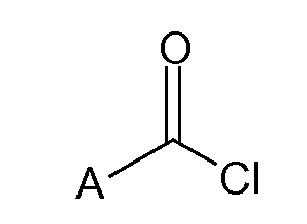

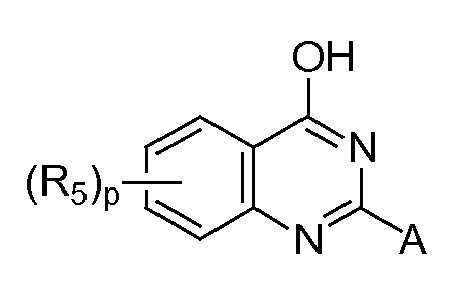


a and c are each independently -CR5=, -N=, or -NR6-, wherein one of a or c is -NR6-;
b is -CR5= or -N=;
A is a 3-20 atom, cyclic or polycyclic moiety, e.g., containing 1-4 rings, which optionally contain 1-3 N, O or S atoms per ring, and may optionally be aryl or heteroaryl, which cyclic or polycyclic moiety may optionally be substituted up to 3 times by (i) C1-C10 alkyl or C2-C10-alkenyl, each optionally substituted with halogen up to perhalo; (ii) C3-C10 cycloalkyl; (iii) aryl; (iv) heteroaryl; (v) halogen; (vi) -CO-OR8; (vii) -CO-R8; (viii) cyano; (ix) -OR8, (x) -NR8R13; (xi) nitro; (xii) -CO-NR8R9; (xiii) -C1-10-alkyl-NR8R9; (xiv) -NR8-CO-R12; (xv) -NR8-CO-OR9; (xvi) - NR8-SO2-R9; (xvii) -SR8; (xviii) -SO2-R8; (xix) -SO2-NR8R9; or (xx) NR8-CO-NHR9;
R1, R6 and R8 -R11 are each independently H or C1-6 alkyl;
R2-R5 are each independently (i) C1-10 alkyl or C2-10-alkenyl each optionally substituted by amino, N-lower alkylamino, N,N-dilower alkylamino, N-lower alkanoylamino, hydroxy, cyano, -COOR10, -COR14, -OCOR14, -OR10, C5-10-heteroaryl, C5-10-heteroaryloxy, or C5-10-heteroaryl-C1-10-alkoxy, halogen up to perhalo; (ii) C3-C10 cycloalkyl, in which 1-3 carbon atoms are optionally independently replaced by O, N or S; (iii) C3-10-cycloalkenyl; (iv) partially unsaturated C5-10-heterocyclyl; (v) aryl; (vi) heteroaryl; (vii) halogen; (viii) -CO-OR10; (ix) -OCOR10; (x) -OCO2R10; (xi) -CHO; (xii) cyano; (xiii) -OR16; (xiv) -NR10R15; (xv) nitro; (xvi) -CO-NR10R11; (xvii) -NR10-CO-R12; (xviii) -NR10-CO-OR11; (xix) -NR10-SO2-R12; (xx) -SR16; (xxi) -SOR16; (xxii) -SO2-R16; (xxiii) -SO2-NR10R11; (xxiv) NR10-CO-NHR11; (xxv) amidino; (xxvi) guanidino; (xxvii) sulfo; (xxviii) -B(OH)2; (xxix) - OCON(R10)2; or (xxx) -NR10CON(R10)2;
R12 is H, C1-6-alkyl or C5-10-aryl,
R13 is H, C1-6-alkyl or C1-6-alkoxy,
R14 is lower alkyl or phenyl; R15 is lower alkyl, halogen, amino, N-lower alkyl amino, N,N-dilower alkylamino, N-lower alkanoylamino, OH, CN, COOR10, -COR14 or -OCOR14;
R16 is hydrogen, C1-6-alkyl optionally substituted by halogen, up to perhalo, or C5-10-heteroaryl; and
p = 0,1,2 or 3;
LG is Cl, and
Q is CN,
with the proviso that compound I is not


a and c are each independently -CR5=, -N=, or -NR6-, wherein one of a or c is -NR6-;
b is -CR5= or -N=;
A is a 3-20 atom, cyclic or polycyclic moiety, e.g., containing 1-4 rings, which optionally contain 1-3 N, O or S atoms per ring, and may optionally be aryl or heteroaryl, which cyclic or polycyclic moiety may optionally be substituted up to 3 times by (i) C1-C10 alkyl or C2-C10-alkenyl, each optionally substituted with halogen up to perhalo; (ii) C3-C10 cycloalkyl; (iii) aryl; (iv) heteroaryl; (v) halogen; (vi) -CO-OR8; (vii) -CO-R8; (viii) cyano; (ix) -OR8, (x) -NR8R13; (xi) nitro; (xii) -CO-NR8R9; (xiii) -C1-10-alkyl-NR8R9; (xiv) -NR8-CO-R12; (xv) -NR8-CO-OR9; (xvi) - NR8-SO2-R9; (xvii) -SR8; (xviii) -SO2-R8; (xix) -SO2-NR8R9; or (xx) NR8-CO-NHR9;
R1, R6 and R8 -R11 are each independently H or C1-6 alkyl;
R2-R5 are each independently (i) C1-10 alkyl or C2-10-alkenyl each optionally substituted by amino, N-lower alkylamino, N,N-dilower alkylamino, N-lower alkanoylamino, hydroxy, cyano, -COOR10, -COR14, -OCOR14, -OR10, C5-10-heteroaryl, C5-10-heteroaryloxy, or C5-10-heteroaryl-C1-10-alkoxy, halogen up to perhalo; (ii) C3-C10 cycloalkyl, in which 1-3 carbon atoms are optionally independently replaced by O, N or S; (iii) C3-10-cycloalkenyl; (iv) partially unsaturated C5-10-heterocyclyl; (v) aryl; (vi) heteroaryl; (vii) halogen; (viii) -CO-OR10; (ix) -OCOR10; (x) -OCO2R10; (xi) -CHO; (xii) cyano; (xiii) -OR16; (xiv) -NR10R15; (xv) nitro; (xvi) -CO-NR10R11; (xvii) -NR10-CO-R12; (xviii) -NR10-CO-OR11; (xix) -NR10-SO2-R12; (xx) -SR16; (xxi) -SOR16; (xxii) -SO2-R16; (xxiii) -SO2-NR10R11; (xxiv) NR10-CO-NHR11; (xxv) amidino; (xxvi) guanidino; (xxvii) sulfo; (xxviii) -B(OH)2; (xxix) - OCON(R10)2; or (xxx) -NR10CON(R10)2;
R12 is H, C1-6-alkyl or C5-10-aryl,
R13 is H, C1-6-alkyl or C1-6-alkoxy,
R14 is lower alkyl or phenyl; R15 is lower alkyl, halogen, amino, N-lower alkyl amino, N,N-dilower alkylamino, N-lower alkanoylamino, OH, CN, COOR10, -COR14 or -OCOR14;
R16 is hydrogen, C1-6-alkyl optionally substituted by halogen, up to perhalo, or C5-10-heteroaryl; and
p = 0,1,2 or 3; with the proviso that compound I is not
- The invention also pertains to a process for the preparation of a compound of Formula I'
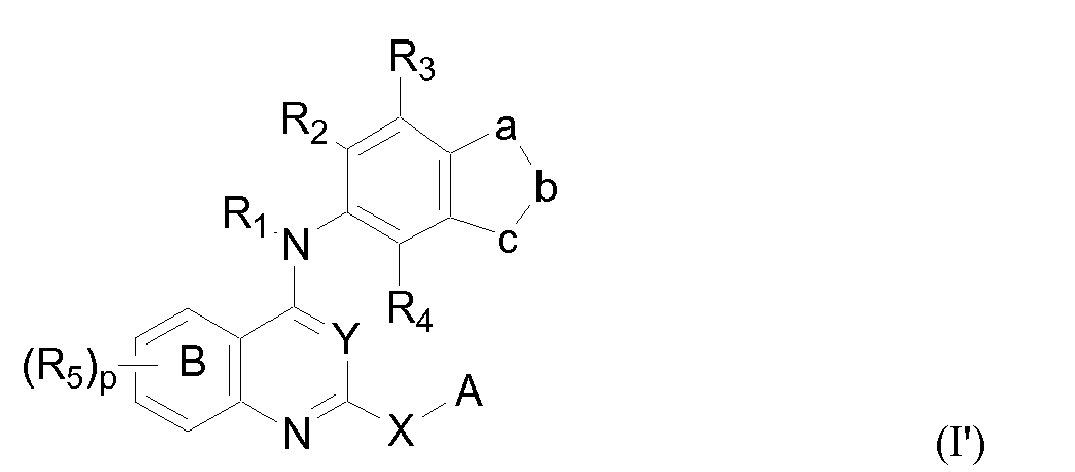
X is -(CH2)x-, -O-(CH2)n-, -S-(CH2)n-, -NR7-CO-(CH2)n-,
-NR7-SO2-(CH2)n-, -NR7-(CH2)n-, or - (O)C-NR7-,
each n is an integer which is independently 0, 1, 2 or 3,
x is 0-3
p is 0-3
a and c are each independently -CR5=, -N=, or -NR6-, wherein one of a or c is -NR6-, and b is -CR5= or -N=;
A is H, halogen, -CO-OR8, -CO-R8, cyano, -OR8, -NR8R9, -CO-NR8R9, -NR8-CO-R9, - NR8- CO-OR9, -NR8-SO2-R9, -SR8, -SO2-R8, -SO2-NR8R9, NR8-CO-NHR9,
or
A is a 3-20 atom, cyclic or polycyclic moiety, containing 1-4 rings, which optionally contain 1-3 N, O or S atoms per ring, and may optionally be aryl or heteroaryl, which cyclic or polycyclic moiety may optionally be substituted up to 3 times by (i) C1-C10 alkyl or C2-C10- alkenyl, each optionally substituted with halogen up to perhalo; (ii) C3-C10 cycloalkyl; (iii) aryl; (iv) heteroaryl; (v) halogen; (vi) -CO-OR8; (vii) -CO-R8; (viii) cyano; (ix) -OR8; (x)(x) -NR8R13; (xi) nitro; (xii) -CO-NR8R9; (xiii) -C1-10-alkyl-NR8R9; (xiv) -NR8-CO-R12; (xv) - NR8CO-OR9; (xvi) -NR8-SO2-R9; (xvii) -SR8; (xviii) -SO2-R8; (xix) -SO2-NR8R9; or (xx) NR8-CO-NHR9;
Ring B is optionally independently substituted up to 3 times in any position by R5,
R1 and R6-11 are each independently hydrogen or C1-6alkyl,
R2-R5 are each independently (i) hydrogen, (ii) C1-10 alkyl or C2-10-alkenyl each optionally substituted by amino, N-lower alkylamino, N,N-dilower alkylamino, N-lower alkanoylamino, hydroxy, cyano, -COOR10, -COR14, -OCOR14, -OR10, C5-10-heteroaryl, C5-10-heteroaryloxy, or C5-10-heteroaryl-C1-10-akoxy, halogen up to perhalo; (iii) C3-10 cycloalkyl, in which 1-3 carbon atoms are optionally independently replaced by O, N or S; (iv) C3-10-cycloalkenyl; (v) partially unsaturated C5-10-heterocyclyl; (vi) aryl; (vii) heteroaryl; (viii) halogen; (ix) -CO-OR10; (x) -OCOR10; (xi) -OCO2R10; (xii) -CHO; (xiii) cyano; (xiv) -OR16; (xv) -NR10R15; (xvi) nitro; (xvii) -CO-NR10R11; (xviii) -NR10-CO-R12; (xix) -NR10-CO-OR11; (xx) -NR10-SO2R12; (xxi) -SR16; (xxii) -SOR16; (xxiii) - SO2-R16; (xxiv) -SO2-NR10R11; (xxv) NR10-CO-NHR11; (xxvi) amidino; (xxvii) guanidine; (xxviii) sulfo; (xxix) -B(OH)2; (xxx) -OCON(R10)2; or (xxxi) - NR10CON(R10)2;
R12 is H, C1-6-alkyl or C5-10-aryl,
R13 is H, C1-6-alkyl or C1-6-alkoxy,
R14 is C1-6 alkyl or phenyl;
R15 is C1-6 alkyl, halogen, amino, N-lower alkyl amino, N,N dilower alkylamino, N-lower alkanoylamino, OH, CN, COOR10, -COR14 or -OCOR14;
R16 is hydrogen, C1-6-alkyl optionally substituted by halogen, up to perhalo, or C5-10-heteroaryl; and
R17 is H, C1-6 alkyl or CN,
or a pharmaceutically acceptable salt thereof,
with the provisos that A is not hydrogen when x is 0, and that Formula I is not


- (a) reacting a compound of Formula II

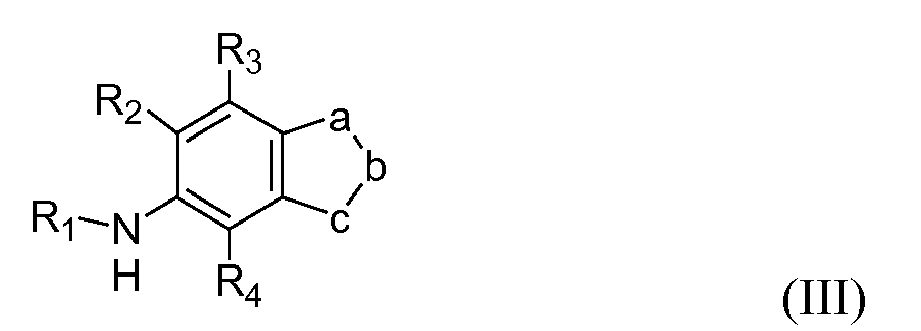

- (b) reacting a substituted benzoyl chloride with dimethylamine to produce a compound of Formula V

reacting V with chloro-2-amino-benzonitrile to produce a compound of Formula VI
- The invention also pertains to a process for preparing


- In particular, the invention also pertains to a method of preparation of a compound of Formula (I)

- (1) heating of said Formula 3 compound with a chlorinating agent, (with the optional addition of DMF), to form a compound of Formula 4'

- (2) isolation of said compound of Formula 4';
- (3) addition of a non-nucleophilic base to a mixture of said compound of Formula 4' and a compound of Formula 5

- (4) heating said mixture at reflux (up from 5 to about 20 hours) for a time sufficient to effect reaction; and
- (5) isolation of said compound of Formula (I).
- Moreover, the present invention pertains to a method of preparation of a compound of Formula 3


- (1) (a) mixing said compound of Formula 2, where Q is -CO-NH2, with about 0.1 N to about 10 N (or 20%) aqueous hydroxide, or
- (1) (b) mixing said compound of Formula 2, where Q is -CN,-with about 0.1 N to about 10 N (or 20%) aqueous hydroxide and about 3- to about 30% H2O2, or with about 0.5 to 2.5 M mineral acid,
- (2) heating the mixture from a temperature of about 30°C to about 120°C.
- The invention also pertains to a method of preparation of a compound of Formula 3, from a carboxylic acid of Formula A-CO2H and a compound of Formula 1,

- (1) treatment of the said carboxylic acid with a chlorinating agent, with the optional addition of a catalytic amount of DMF, to form an acid chloride of Formula A-CO-Cl;
- (2) addition of a non-nucleophilic amine base and a non-protic solvent with stirring at room temperature to form the compound of Formula 2; and
- (3) addition of a base and heating the mixture up to about 50°C (for about 90 minutes); for a sufficient time to effect reaction;
- A schematic representation of the methods of preparation encompassed by this invention is summarized in Reaction Scheme 1 below. In the structures depicted, A, R1-R5, a, b, c and p have the meanings described above.

- In this embodiment, a mixture of nitrile or amide 1 and an aliphatic or aromatic acid chloride (A-CO-Cl, commercially available, prepared beforehand from the carboxylic acid A-CO2H, or prepared from the carboxylic acid in situ) are coupled, in the presence of a base such as a dialkylamine, DMAP, pyridine and the like. The nitriles and amides are readily available commercially, or if necessary, prepared from the corresponding anthranilic acid or anthranilic acid ester by straightforward means. The acid chlorides, A-CO-Cl starting materials, where not readily available commercially may be by standard preparatory methods from the corresponding carboxylic acids(using chlorinating reagents such as SOCl2, phosgene or oxalyl chloride, with the optional addition of DMF (Hamuro et al. J. Am. Chem. Soc. 1996, 118(32), 7529-41). In instances where the carboxylic acid is not commercially available, it may be prepared by standard methods (
Buerstinghaus et al. EP 203607 , December 3, 1986 - The Formula 2 product of may then be cyclized to the heterocycle of Formula 3 in the presence of a base such as aqueous sodium hydroxide, and is facilitated by heating to a temperature sufficient to effect the cyclization, typically, 40 - 95°C. In the instance where compound is a nitrile, the reaction mixture also contains H2O2 (usually in about 3-30% concentration), or alternatively, is conducted in 0.1 to 3.0 N mineral acid. The compound of Formula 3 is then converted to a compound of Formula 4 by treatment with a reagent such as SOCl2, POCl3/PCl5, POCl3, POBr3 or P2S5 / Et I (two steps) and is facilitated by the addition of a catalytic amount of DMF and heating. The compound of Formula 4 is then allowed to react in a water-miscible solvent such as DME, THF or DMF, with the amino heterocycle of Formula 5 , in the presence of a base such as sodium or potassium acetate, potassium carbonate; or in dilute (O.1M) hydrochloride acid, and water and with heating sufficient to effect reaction. In cases where the starting material 4 is especially labile, undesired side reactions (e.g., hydrolysis of 4 to 3 are minimized by reducing the amount of water added to water-miscible cosolvent to the minimum amount required to achieve dissolution and reaction.
- It is to be understood that the specific conditions selected from this General Method will depend on the particular structures of the starting materials chosen, in order to optimize the yield of the products desired.
- In Formula I, suitable aryl or heteroaryl groups, e.g., for A, include, but are not limited to, 5-12 carbon-atom aromatic rings or ring systems containing 1-3 rings, at least one of which is aromatic, in which one or more, e.g., 1-4 carbon atoms in one or more of the rings can be replaced by oxygen, nitrogen or sulfur atoms. Each ring typically has 3-7 atoms. For example, aryl or heteroaryl can be 2- or 3-furyl, 2- or 3-thienyl, 2- or 4-triazinyl, 1-, 2- or 3-pyrrolyl, 1-, 2-, 4- or 5-imidazolyl, 1-, 3-, 4- or 5-pyrazolyl, 2-, 4- or 5-oxazolyl, 3-, 4- or 5-isoxazolyl, 2-, 4- or 5-thiazolyl, 3-, 4- or 5-isothiazolyl, 2-, 3- or 4-pyridyl, 2-, 4-, 5- or 6-pyrimidinyl, 1,2,3-triazol-1-, -4- or 5-yl, 1,2,4-triazol-1-, -3- or B5-yl, 1- or 5-tetrazolyl, 1,2,3-oxadiazol-4- or 5-yl, 1,2,4-oxadiazol-3- or 5-yl, 1,3,4-thiadiazol-2- or 5-yl, 1,2,4-oxadiazol-3- or 5-yl, 1,3,4-thiadiazol-2- or 5-yl, 1,3,4-thiadiazol-3- or 5-yl, 1,2,3-thiadiazol-4- or 5-yl, 2-, 3-, 4-, 5- or 6-2H-thiopyranyl, 2-, 3- or 4-4H-thiopyranyl, 3- or 4-pyridazinyl, pyrazinyl, 2-, 3-, 4-, 5-, 6- or 7-benzofuryl, 2-, 3-, 4-, 5-, 6- or 7-benzothienyl, 1-, 2-, 3-, 4-, 5-, 6- or 7-indolyl, 1-, 2-, 4- or 5-benzimidazolyl, 1-, 3-, 4-, 5-, 6- or 7-benzopyrazolyl, 2-, 4-, 5-, 6- or 7-benzoxazolyl, 3-, 4-, 5- 6- or 7-benzisoxazolyl, 1-, 3-, 4-, 5-, 6- or 7-benzothiazolyl, 2-, 4-, 5-, 6- or 7-benzisothiazolyl, 2-, 4-, 5-, 6- or 7-benz-1,3-oxadiazolyl, 2-, 3-, 4-, 5-, 6-, 7- or 8-quinolinyl, 1-, 3-, 4-, 5-, 6-, 7-, 8- isoquinolinyl, 1-, 2-, 3-, 4- or 9-carbazolyl, 1-, 2-, 3-, 4-, 5-, 6-, 7-, 8- or 9-acridinyl, or 2-, 4-, 5-, 6-, 7- or 8-quinazolinyl, or additionally optionally substituted phenyl, 2- or 3-thienyl, 1,3,4-thiadiazolyl, 3-pyrryl, 3-pyrazolyl, 2-thiazolyl or 5-thiazolyl, etc.
- Preferred moieties A include cyclohexyl; or C5-12-aryl or C5-12-heteroaryl each independently optionally substituted up to three times by (i) C1-C10-alkyl or C2-10-alkenyl each optionally substituted with halogen up to perhalo; (ii) C3-C10 cycloalkyl; (iii) C5-12-aryl optionally substituted by 1-3 halogen atoms; (iv) C5-12-heteroaryl; (v) halogen; (vi) - CO-OR8; (vii) -CO-R8; (viii) cyano; (ix) -OR8; (x) -NR8R13; (xi) nitro; (xii) -CO-NR8R9; (xiii) -C1-10-alkyl-NR8R9; (xiv) -NR8-CO-R12; (xv) -NR8-CO-OR9; (xvi) -NR8-SO2-R9; (xvii) -SR8; (xviii) -SO2-R8; (xix) -SO2-NR8R9, or (xx) NR8-CO-NHR9.
- Further preferred moieties A include phenyl, pyridyl, pyrimidinyl, oxazolyl, furyl, thienyl, pyrrolyl, imidazolyl, isoxazolyl and pyrazinyl, each independently substituted up to three times by halogen, C1-10-alkyl, C1-10-alkoxyphenyl, naphthyl, -OR10,


y is 1-3,
and R4 is as described above. - Preferred moieties A additionally include


- The terms identified above have the following meaning throughout:
- "C1-6 alkyl" means straight or branched chain alkyl groups having from one to about six carbons. Such groups include methyl, ethyl, n-propyl, isopropyl, n-butyl, isobutyl, sec-butyl, tert-butyl, n-pentyl, neo-pentyl, 2-pentyl, n-hexyl, 2-hexyl, 3-hexyl, 2,3-dimethylbutyl, and the like.
- "C1-10 alkyl" means straight or branched chain alkyl groups having from one to about ten carbon atoms.
- "C3-8 cycloalkyl" means saturated monocyclic alkyl groups of from 3 to about 8 carbon atoms and includes such groups as cyclopropyl, cyclopentyl, cyclohexyl, and the like.
- "C3-10 cycloalkyl" means saturated monocyclic alkyl groups of from 3 to about 10 carbon atoms.
- "C1-6 alkoxy" means straight or branched chain alkoxy groups having from one to about six carbon atoms and includes such groups as methoxy, ethoxy, n-propoxy, isopropoxy, n-butoxy, isobutoxy, sec-butoxy, tert-butoxy, and the like.
- "Halo" means fluoro, chloro, bromo, or iodo.
- "Mineral Acid" means hydrochlorine acid, sulfuric acid, nitric acid, and the like.
- When an alkyl, cycloalkyl, alkenyl, or alkoxy group is described as being substituted with fluoro, it may be substituted with one or more fluorine atoms at any available carbon atom up to the perfluoro level.
- When an alkyl substituent is described as being substituted by oxo, it means substitution by a doubly bonded oxygen atom, which forms together with the carbon to which it is attached, a carbonyl group -(C=O)-.
- When any moiety is described as being substituted, it can have one or more of the indicated substituents that can be located at any available position on the moiety. When there are two or more substituents on any moiety, each substituent is defined independently of any other substituent and can, accordingly, be the same or different.
- The term "optionally substituted" means that the moiety so modified may be unsubstituted or substituted with the identified substituent(s).
- R5 may be attached to the benzo moiety of the compounds of Formulas 1, 2, 3, 4, or (I), at any available carbon atom and when there are two or more R5 substituents (i.e., p = 2 or 3), each substituent is defined independently of other substituents and can, accordingly be the same or different.
"Aqueous hydroxide" means an aqueous solution containing OH-, usually prepared from al
"Water-miscible cosolvent" means an organic solvent which is at least partially miscible with water at a temperature in which the reaction is carried out. Such solvents include but are not limited to alcohols such as methanol, ethanol, isopropanol, butanol, methoxyethanol and the like, ethers such as dimethoxyethane (DME), tetrahydrofuran (THF), dioxane and the like, non-protic solvents such as N,N-dimethylformamide (DMF), and dimethylsulfoxide (DMSO), and solvents which may form an azeotrope with water such as toluene.
"Non-nucleophilic amine base" means a base capable of reacting with or neutralizing an acid, without the tendency to undergo nucleophilic substitution reactions. Such bases include diazabicycloundecane, 4-dimethylaminopyridine,
"Non-protic solvent" means a solvent that does not readily dissociate to provide a H+ ion, i.e. contains no H atoms with a pKa of less than about 20. Examples of such solvents include dimethylformamide DMF, THF, ether, toluene, benzene, dimethoxyethane (DME), diglyme, dioxane,
Sensitive or reactive substituents, on the compounds of Formulas 1, 2, 3, 4, 5 or (I) may need to be protected and deprotected during any of the above methods of preparation. Protecting groups in general may be added and removed by conventional methods well known in the art (see, e.g., T. W. Greene and P.G.M. Wuts, Protective Groups in Organic Synthesis; Wiley: New York, (1999)). - The present invention is also directed to the production of pharmaceutically acceptable salts of compounds of Formula I. Suitable pharmaceutically acceptable salts are well known to those skilled in the art and include basic salts of inorganic and organic acids, such as hydrochloric acid, hydrobromic acid, sulphuric acid, phosphoric acid, methanesulphonic acid, sulphonic acid, acetic acid, trifluoroacetic acid, malic acid, tartaric acid, citric acid, lactic acid, oxalic acid, succinic acid, fumaric acid, maleic acid, benzoic acid, salicyclic acid, phenylacetic acid, and mandelic acid. In addition, pharmaceutically acceptable salts include acid salts of inorganic bases, such as salts containing alkaline cations (e.g., Li+, Na+ or K+), alkaline earth cations (e.g., Mg+, Ca+ or Ba+), the ammonium cation, as well as acid salts of organic bases, including aliphatic and aromatic substituted ammonium, and quaternary ammonium cations, such as those arising from protonation or peralkylation of triethylamine, N,N-diethylamine, N,N-dicyclohexylamine, pyridine, N,N-dimethylaminopyridine (DMAP), 1,4-diazabiclo[2.2.2]octane (DABCO), 1,5-diazabicyclo[4.3.0]non-5-ene (DBN) and 1,8-diazabicyclo[5.4.0]undec-7-ene (DBU). Preparation of such salts can proceed via a final conventional step using a compound of Formula I, subsequent to the above preparation process.
- When the following abbreviations are used herein, they have the following meaning:
- Ac2O
- acetic anhydride
- anhy
- anhydrous
- n-BuOH
- n-butanol
- t-BuOH
- t-butanol
- CD3OD
- methanol-d4
- Celite®
- diatomaceous earth filter agent, ® Celite Corp.
- CH2Cl2
- methylene chloride
- CI-MS
- chemical ionization mass spectroscopy
- conc
- concentrated
- dec
- decomposition
- DME
- dimethoxyethane
- DMF
- N,N-dimethylformamide
- DMSO
- dimethylsulfoxide
- ELSD
- evaporative light scattering detector
- EtOAc
- ethyl acetate
- EtOH
- ethanol (100%)
- Et2O
- diethyl ether
- Et3N
- triethylamine
- HPLC ES-MS
- high performance liquid chromatography-electrospray mass spectroscopy
- NMM
- 4-methylmorpholine
- Ph3P
- triphenylphosphine
- Pd(dppf)C12
- [1,1'-bis(diphenylphosphino)ferrocene]dichloropalladium(II)
- Pd(PPh3)4
- tetrakis(triphenylphosphine)palladium(0)
- Pd(OAc)2
- palladium acetate
- P(O)Cl3
- phosphorous oxychloride
- RT
- retention time (HPLC)
- rt
- room temperature
- THF
- tetrahydrofuran
- TFA
- trifluoroacetic acid
- TLC
- thin layer chromatography
- Without further elaboration, it is believed that one skilled in the art can, using the preceding description, utilize the present invention to its fullest extent. The following preferred specific embodiments are, therefore, to be construed as merely illustrative, and not limitative of the remainder of the disclosure in any way whatsoever.
- In the foregoing and in the following examples, all temperatures are set forth uncorrected in degrees Celsius and, all parts and percentages are by weight, unless otherwise indicated.
- The entire disclosure of all applications, patents and publications, cited above or below, and of
U.S. Provisional Application No. 60/315,341, filed August 29, 2001 U.S. Patent Application No. 10/103,566, filed March 22, 2002 U.S. Patent Application No. 10/103,565, filed March 22, 2002 PCT/US02/08659, filed March 22, 2002 , and PCT Application No.PCT/US02/08660, filed March 22, 2002 , are hereby incorporated by reference. -

- A suspension of magnesium (0.968 g, 3.98 mmol) and a few crystals of iodine in anhyd THF (200 mL) were treated with dropwise addition of 10 mL of a solution of 4-bromo-2-fluorobiphenyl (10.0 g, 3.98 mmol) in THF (100 mL). The mixture was heated to gentle reflux and a reaction ensued. At that time, the remaining solution of 4-bromo-2-fluorobiphenyl was added dropwise to the flask over a 3-minute period. The contents were then stirred at reflux under argon until no magnesium consumption was observed. The reaction mixture was subsequently cooled to -10°C and treated with dry ice (-70 g). The reaction mixture was quenched with 20% aqueous hydrochloric acid (50 mL), and the layers were separated. The aqueous phase was extracted with ethyl acetate (2 x 20 mL), and the combined organic layer was washed with brine (30 mL), dried over anhyd sodium sulfate and concentrated to about 1/3 of its original volume. The contents were treated with hexane (200 mL), and the precipitate was filtered and dried under high vacuum to afford 3-fluoro-4-phenylbenzoic acid (6.37 g, 74%) as a white, crystalline solid. 1H-NMR (DMSO-d 6): δ 7.48 (m, 3H); 7.59 (m, 2H); 7.66 (dd, J = 8.1, 8.1 Hz, 1H); 7.76 (dd, J = 1.5, 11.6 Hz, 1H); 7.85 (dd, J = 1.5, 8.1 Hz, 1H); 13.30 (br s, 1H). Anal. Calcd for C13H9FO2: C, 72.22; H, 4.20; F, 8.79. Found: C, 71.95; H, 4.11; F, 9.07.
-

- A suspension of the product of step 1 (0.5 g, 2.31 mmol) in oxalyl chloride (5 mL) was treated with one drop of DMF and the mixture was heated to 60°C for 45 min. The resulting, clear-yellow solution was concentrated to a yellow solid, which was dried under high vacuum for 60 min. The solid and anthranilamide (0.314 g, 2.31 mmol) were suspended in dry toluene (5 mL), treated with diisopropylethylamine (0.5 ml, 0.371 g, 2.87 mmol) and the contents were stirred at room temperature for 2 h, at which time TLC (silica gel 60, 10% methanol/dichloromethane, UV detection) analysis suggested complete reaction. The mixture was filtered, and the off-white solid was dissolved in ethyl acetate (50 mL). The organics were washed with brine (25 mL), 0.1 N aqueous hydrochloric acid (25 mL), and again with brine (25 mL). The organic layer was dried over anhyd sodium sulfate, concentrated and dried under high vacuum for 4 h to afford the product (0.59 g, 1.76 mmol, 76%) as an off-white solid. 1H-NMR (DMSO-d 6): δ 7.22 (ddd, J = 1.2, 7.4, 7.8 Hz, 1H); 7.52 (m, 6H); 7.78 (m, 3H); 7.89 (m, 1H); 7.89, 8.47 (br s, 2H); 8.69 (dd, J = 1.2, 8.3 Hz, 1H); 13.12 (s, 1H). Anal. Calcd for C20H15N2FO2: C, 71.85; H, 4.52; N, 8.38. Found: C, 71.67; H, 4.47; N, 8.35. Mass spectrum (HPLC/ES, flow injection): m/e = 335 (M + 1).
-

- A suspension of the product of Example 1 (0.5 g, 2.31 mmol) in oxalyl chloride (5 mL) was treated with one drop of DMF and the mixture was heated to 60°C for 60 min. The resulting clear yellow solution was concentrated to a yellow solid, which was dried under high vacuum for 2 h. This solid and anthranilamide (0.314 g, 2.31 mmol) were dissolved in dry THF (5 mL), treated with diisopropylethylamine (0.5 ml, 0.371 g, 2.87 mmol) and the contents were stirred at room temperature for 90 min, at which time TLC (silica gel 60, 5% methanol/dichloromethane, UV detection) analysis suggested complete reaction. The mixture was treated with aqueous 1.0 N sodium hydroxide (10.0 mL, 10.0 mmol). The contents were heated to 50°C (complete dissolution occurred when the internal temperature reached 44°C) for 90 min and the organic solvent was removed by rotary evaporation. The aqueous suspension was treated with dropwise addition of aqueous 2.0 N hydrochloric acid (about 5 mL) until the pH was adjusted to about 2. The precipitate was filtered and the cake was washed with water (4 x 30 mL) and dried under high vacuum at 40°C for 18 h to provide the product (0.67 g, 2.12 mmol, 92%) as a white powder. 1H-NMR (DMSO-d 6): δ 7.52 (m, 4H); 7.64 (m, 2H); 7.75 (m, 2H); 7.86 (ddd, J = 1.4, 6.9, 8.0 Hz, 1H); 8.16 (m, 3H); 12.63 (br s, 1H). Anal. Calcd for C20H13N2FO: C, 75.94; H, 4.14; N, 8.86. Found: C, 75.66; H, 4.29; N, 8.77. Mass spectrum (HPLC/ES): m/e = 317 (M + 1).
- A suspension of the product of Example 1 (0.5 g, 2.31 mmol) in oxalyl chloride (5 mL) was treated with one drop of DMF and the mixture was heated to 60°C for 60 min. The resulting clear yellow solution was concentrated to a yellow solid, which was dried under high vacuum for 60 min. This solid and anthranilamide (0.314 g, 2.31 mmol) were suspended in dry toluene (5 mL), treated with diisopropylethylamine (0.5 ml, 0.371 g, 2.87 mmol) and the contents were stirred at room temperature for 2 h, at which time TLC (silica gel 60, 10% methanol/dichloromethane, UV detection) analysis suggested complete reaction. The mixture was filtered and dried under high vacuum for 2 h. The off-white solid was then dissolved in methanol (10 mL) and THF (5 mL), and the solution was treated with aqueous 1.0 N sodium hydroxide (10.0 mL, 10.0 mmol). The contents were heated to 45°C for 2 h and the organic solvents were removed by rotary evaporation. The aqueous suspension was treated with dropwise addition of aqueous 2.0 N hydrochloric acid until the pH was adjusted to about 2 (5 mL). The precipitate was filtered and the cake was washed with water (4 x 30 mL) and dried under high vacuum at 40°C for 3 h to provide product (0.66 g, 2.09 mmol, 90%) as a white powder. 1H-NMR (DMSO-d6 ): δ 7.52 (m, 4H, aromatic); 7.64 (m, 2H, aromatic); 7.75 (m, 2H); 7.86 (ddd, J = 1.4, 6.9, 8.0 Hz, 1H, aromatic); 8.16 (m, 3H, aromatic); 12.63 (br s, 1H, -NH). Anal. Calcd for C20H13N2FO • 0.20 H2O: C, 75.08; H, 4.22; N, 8.76. Found: C, 75.08; H, 4.03; N, 8.67. Mass spectrum (HPLC/ES): m/e = 317 (M + 1).
- A solution of the compound of Example 2 (24.10 g, 72.08 mmol) in methanol (100 mL) and tetrahydrofuran 200 mL) was treated with aqueous 1.0 N sodium hydroxide (240 mL, 240 mmol), and the contents were stirred at 40 °C for 60 minutes, at which time TLC (silica gel 60, 10% methanol/dichloromethane, UV detection) analysis suggested complete reaction. The organic solvents were rotary evaporated and the aqueous phase was treated with dropwise addition of concentrated hydrochloric acid until the pH was adjusted to 7. The resultant white precipitate was filtered, washed with water (2 x 200 mL) and dried under high vacuum at room temperature for 2 days and at 45°C for 2 hours to afford the product (21.60 g, 68.28 mmol, 95%) as a white powder. 1H-NMR (DMSO-d6 ): δ 7.50 (m, 4H, aromatic); 7.64 (m, 2H, aromatic); 7.74 (m, 2H); 7.86 (ddd, J = 1.4, 6.9, 8.0 Hz, 1H, aromatic); 8.16 (m, 3H, aromatic); 12.63 (br s, 1H, -NH). Mass spectrum (HPLC/ES): m/e = 317 (M + 1).
-

- A suspension of the compound of Example 1 (0.5 g, 2.31 mmol) in oxalyl chloride (5 mL) was treated with one drop of N,N-dimethylformamide and the mixture was heated to 60 °C for 45 minutes. The resultant, clear-yellow solution was concentrated to a yellow solid, which was dried under high vacuum for 60 minutes. The solid and anthranilonitrile (13, 0.273 g, 2.31 mmol) were suspended in dry toluene (5 mL), treated with diisopropylethylamine (0.5 mL, 0.371 g, 2.87 mmol) and the contents were stirred at room temperature for 6 hours, at which time TLC (silica gel 60, 10% methanol/dichloromethane, UV detection) analysis suggested complete reaction. The mixture was filtered, and the white, crystalline solid was dissolved in 20% ethyl acetate/dichloromethane (25 mL). The organics were washed with 0.1 N aqueous hydrochloric acid (10 mL) and then with brine (2 x 25 mL). The organic layer was dried over sodium sulfate, concentrated and dried under high vacuum at 35 °C for 16 hours to afford 22 (0.49 g, 1.55 mmol, 67%) as a fluffy, white solid. 1H-NMR (DMSO-d 6): δ 7.50 (m, 4H, aromatic); 7.62 (m, 3H, aromatic); 7.76 (m, 2H, aromatic); 7.92 (m, 3H, aromatic); 10.76 (s, 1H, -NH). Anal. Calcd for C20H13N2FO: C, 75.94; H, 4.14; N, 8.86. Found: C, 75.71; H, 4.20; N, 8.92. Mass spectrum (HPLC/ES, flow injection): m/e = 317 (M + 1).
- Step 2. A sample of the product of step 1 (0.050 g, 0.158 mmol) was stirred in 1.5 M hydrochloric acid in ethanol (5 mL) at 40 °C for 60 minutes, at which time. TLC (silica gel 60, 20% EtOAc/hexane, UV detection) analysis indicated complete reaction. The contents were concentrated and then taken up in absolute ethanol (5 mL). The suspension was stirred, concentrated and the process was repeated two additional times. The material was dried under high vacuum at 45 °C for 2 hours to afford the product (0.047g, 0.149 mmol, 94%) as a white powder. NMR analysis (see above) suggested that the compound was pure.
-

- A solution of phosphorous oxychloride (3.0 mL) and anhyd DMF (2 mL) was stirred for 10 min before it was added to a flask containing the product of step 3 (0.300 g, 0.948 mmol). The resulting suspension was heated to gentle reflux under argon for 12 h. The dark solution was then cooled to 70°C and slowly added to vigorously-stirred water (100 mL) at 0°C. A solid precipitated, which was stirred for 10 min and filtered. The cake was washed with water (2 x 25 mL) and dried under high vacuum at 35°C for 2 h to provide product (0.285 g, 0.851 mmol, 90%) as a yellow solid. Part of this solid (0.125 g) was passed through a short plug of silica gel using 20% dichloromethane/hexane as eluant to afford the title compound (0.09 g) as white needles. 1H-NMR (DMSO-d 6): δ 7.47 (m, 1H); 7.54 (m, 2H); 7.65 (m, 2H); 7.76 (dd, J = 8.4, 8.4 Hz, 1H); 7.87 (ddd, J = 2.9, 5.3, 8.3 Hz, 1H); 8.15 (m, 2H); 8.26 (m, 1H); 8.28 (m, 1H); 8.38 (dd, J = 1.9, 8.4 Hz, 1H). Anal. Calcd for C20H12N2ClF: C, 71.75; H, 3.61; N, 8.37; Cl, 10.59. Found: C, 71.54; H, 3.48; N, 8.29; Cl, 10.61. Mass spectrum (HPLC/ES): m/e = 335 (M+1). TLC (silica gel 60, 40% dichloromethane/hexane, UV detection): one spot, R f = 0.50.
-

- To a suspension of the product of step 4 (1.00 g, 2.99 mmol) and 5-aminoindazole (0.44 g, 3.29 mmol) in ethylene glycol dimethyl ether(DME, 10 mL) was added a solution of potassium acetate (0.44 g, 4.48 mmol) in water (2 mL). The contents were allowed to reflux for 16 h and then cooled to room temperature. The mixture was poured into water (200 mL) and the precipitate was filtered, washed with water (2 x 50 mL) and air-dried for 60 min. The solid was dissolved in THF (30 mL), and the solution was slowly poured into hexane (500 mL). The resulting precipitate was filtered and dried under high vacuum at 60°C for 18 h to afford the product (1.02 g, 2.36 mmol, 79%) as a yellow solid. 1H-NMR (DMSO-d 6): δ 7.46 (m, 3H, aromatic); 7.63 (m, 5H, aromatic); 7.83 (dd, J = 1.9, 9.0 Hz, 1H, aromatic); 7.87 (m, 2H, aromatic); 8.13 (br s, 1H, -N=CH-); 8.17 (dd, J = 1.6, 12.5 Hz, 1H, aromatic); 8.22 (d, J = 1. 9 Hz, 1H, aromatic); 8.30 (dd, J = 1.6, 8.0 Hz, 1H, aromatic); 8.5 (br d, J = 8.5 Hz, 1H, aromatic); 10.04 (s, 1H, -NH); 13.13 (br s, 1 H, - NH). Mass spectrum (HPLC/ES): m/e = 432 (M + 1).
- In order to prepare the p-toluene sulfonic acid (tosylate) salt, a suspension of the product (0.60 g, 1.39 mmol) in anhyd ethanol (12 mL) was treated with a solution of p-toluenesulfonic acid monohydrate (0.39 g, 2.09 mmol) in ethanol (8.5 mL) in one portion. The contents were stirred at 40°C for 60 min and the precipitate was filtered. The cake was washed with ethanol (3 x 15 mL) and dried under high vacuum at 40°C for 18 h to give the tosylate salt (0.71 g, 85%) as a pale-orange, crystalline solid. 1H-NMR (DMSO-d 6): δ 2.27 (s, 3H); 7.09, 7.47 (AA'BB' quartet, J = 8.6 Hz, 4H); 7.48 (m, 2H); 7.52 (m, 2H); 7.62 (m, 2H); 7.73 (m, 2H); 7.84 (m, 2H); 8.10 (m, 5H); 8.20 (s, 1H); 8.74 (br d, J = 8.4 Hz, 1H); 11.50 (br s, 1H). Anal. Calcd for C27H18N5F•CH3C6H4SO3H: C, 67.65; H, 4.34; N, 11.60. Found: C, 67.35; H, 4.46; N, 11.49. Mass spectrum (HPLC/ES): m/e = 432 (M + 1).
-

- A mixture of 2,3-dihydrobenzo[b]furan-5-carboxylic acid (1.0 g, 6.1 mmol) in thionyl chloride (2.2 mL, 30.5 mmol) is stirred at room temperature for 4 h. The volatiles were removed by evaporation. To a solution of the residue and anthranilamide (750 mg, 5.5 mmol) in CHCl3 (30 mL) is added pyridine (670 L, 8.3 mmol) and the mixture stirred at room temperature for 18 h. The volatiles were removed by evaporation and the residue is partitioned between EtOAc and 1 N sodium carbonate. The resulting precipitate that formed between the aqueous and organic phases is collected by filtration and dried under vacuum to afford the desired intermediate (1.5 g, 5.3 mmol; 87% yield);); Rf = 0.31 (EtOAc/hexanes, 95/5); mp = 230 - 235 °C; ES MS (M+H)+= 283
-

- To a solution of diamide from Step 1 (1.0 g, 3.5 mmol) in EtOH (25 mL) is added 10 N NaOH (1.06 mL, 10.6 mmol). The reaction heated to reflux for 16 h, the mixture is cooled to room temperature and the volatiles were evaporated. The aqueous mixture is adjusted to pH = 5 with conc HC1. The resulting precipitate is collected by filtration and dried under vacuum to afford the desired product: Rf = 0.45 (EtOAc/hexanes, 95/5); (856 mg, 3.2 mmol; 91% yield); mp = 289 - 294 °C; ES MS (M+H)+= 265.
-

- To a suspension of material from Step 2 (300 mg, 1.1 mmol) in CHCl3 (12 mL) is added thionyl chloride (990 L, 13.6 mmol) and DMF (20 L, 0.3 mmol). The mixture heated to reflux for 4 h, cooled to room temperature, and the volatiles were evaporated. The residue is dried under vacuum to afford the desired intermediate (285 mg, 1.0 mmol; 89% yield); Rf = 0.52 (EtOAc/hexanes, 80/20); mp = 186 - 192 °C; ES MS (M+H)+= 283.
-

- A mixture of Step 3 compound (100 mg, 0.35 mmol), 5-aminoindazole (47.1 mg, 0.35 mmol) and 0.1 M aqueous HCl (350 L) heated at reflux temperature16 h. The reaction cooled to room temperature and the solvent is evaporated in vacuo. The residue is triturated with MeOH and dried under vacuum to afford the product (43.4 mg, 0.11 mmol; 32% yield); Rf = 0.57 (CH2Cl2/MeOH, 90/10); mp = 267 - 272 °C; ES MS (M+H)+= 380.
- By following a procedure analogous to that described for Example 6-9 and using the appropriate chloroquinazoline and 5-aminoindazole as starting materials, the compounds described in Table 1 were similarly prepared:
Table 1 
Ex. No. A Weight obtained (mg) Yield % Note 10 cyc-Pr 104.6 71 25 11 CF3 44.2 31 26 Notes:
25) Rf= 0.46 (CH2Cl2/MeOH, 90/10); mp = 272 - 277 °C; ES MS (M+H)+= 302.
26) Rf = 0.62 (CH2Cl2/MeOH, 90/10); mp = 311 - 319 °C; ES MS (M+H)+= 330. -

- Step 1: To a solution of anthranilonitrile (7.58 mmol) in dry pyridine (30 mL) is added 2-quinoxaloyl chloride (9.11 mmol, 1.2 equivalent). The reaction mixture stirred at room temperature overnight and sodium hydroxide solution (2%, 50 mL) is added. The mixture is cooled and stirred for 30 min. The resulting white solid is collected by filtration, washed with brine and cold ether. A white solid product is obtained (1.51 g, 73%). HPLC/MS: (M+H)+=275, RT (HPLC/MS)=3.0 min.
- Step 2: The amide prepared in Step 1(9.5 mmol, 1 equiv) is suspended in dioxane (10 mL). NaOH solution (20%, 60 mL) and hydrogen peroxide solution (30%, 30 mL) is added in three portions. A vigorous release of gas is observed. The reaction mixture continued to stir and is cooled when necessary until the evolution of gas ceased. The reaction is brought to 120 °C (oil bath) and stirred overnight at this temperature. The reaction is neutralized with concentrated HCl to pH=7. A precipitate formed and is collected on a funnel, washed with water and dried in vacuo. A yellow solid is obtained and used in the next step without further purification. HPLC/MS: (M+H)+= 275, RT (HPLC/MS)=3.28.
- Step 3: The quinazoline (10.9 mmol) is suspended in phosphorous oxychloride (214.6 mmol) containing PCl5 (10.9 mmol) and stirred at 115 °C for 18 h. The resulting yellow solution is poured into 300 mL of ice and stirred. A gray precipitate formed and filtered and washed with cold water. The product is used in the next step without further purification. HPLC/MS: (M+H)+=293, RT (LC-MS)=3.40.
- Step 4: A mixture of 4-chloroquinazoline, potassium acetate (14.25 mmol), and 5-aminoindazole (10.96 mmol) in THF/H2O (70 mL/25 mL) is stirred at room temperature for 17 h. The resulting solid is collected by filtration and purified by silica gel column chromatography (gradient, 5-10% MeOH/CH2Cl2) to afford the product (1.19 g, 32%, 3 steps) as yellow powder. HPLC/MS: (M+H)+=390, RT (LC-MS)= 2.41.
-

- Step 1: To a solution of 6-fluoro-2-amino-benzonitrile (2 mmol, 1 equivalent.) in pyridine (3 mL) and CH2Cl2 (1 mL) containing N-dimethylaminopyridine (3 mg) is added 2-toluoyl chloride (316 mL, 1.2 equivalent). The reaction mixture is shaken at room temperature for 48 h and poured into cold water (3 mL) and shaken for 1 h. The resulting solid is filtered and washed with water to afford a white solid (90%). The LC-MS is consistent with the desired compound.
- Step 2: The product is suspended in aqueous NaOH (20%, 2 mL) and dioxane (1 mL). Hydrogen peroxide (30%, 1 mL) is added in potions to avoid vigorous formation of gas. The reaction is shaken at 85 °C for 20 h and then is neutralized with acetic acid to pH=7. The resulting precipitate is collected by filtration, washed with water and ether, and dried over P2O5 for two days. The product is suspended in P(O)Cl3 (4 mL) and shaken at 90 °C overnight. The POCl3 is removed in vacuo and co-evaporated with toluene. The resulting yellow solid residue is dried in vacuo overnight and used in the next step without further purification
- Step 3: The product (assumed to be 2 mmol), 5-aminoindazole (3 mmol, 1.5 equiv), and potassium carbonate (2 mmol) were suspended in DMF (5 mL) containing and shaken at 90 °C for 24 h. The reaction suspension is filtered and the filtrate is purified by HPLC, under the following conditions: Column: YMC C18 Pro, 20x150m/m; Gradient: A= H2O, 0.1% TFA, B=CH3CN, 0.1%TFA; Gradient over 10 min, flow: 30 mL/min. A pale yellow solid product is obtained. (M+H)+= 370, RT (LC-MS)=2.19 min.
- Using the method described above for Example 13 and substituting the appropriate starting materials, the compounds listed in Table 2 were also synthesized.
-

Table 2 Example No (Rs) A LC-MS RT (min) Mass Spec 14 5-F 4-fluorophenyl 2.67 374 15 5-F 3-chlorophenyl 3.14 350 16 5-F 4-bromophenyl 3.09 434 17 5-F 3-methylphenyl 2.56 370 18 5-F 3-bromophenyl 3.18 434 19 5-F 2-chlorophenyl 2.52 390 20 5-F 3-methoxyphenyl 2.52 386 21 5-F 2-quinoxalinyl 2.48 408 22 5-F 1-naphthyl 2.48 406 23 5-F 2-naphthyl 2.96 406 24 5-F 4-pyridinyl 2.3 357 25 7-methyl 2-quinoxalinyl 2.37 404 26 7-methyl 3-chlorophenyl 2.56 386 27 7-methyl 4-fluorophenyl 2.30 370 28 7-methyl 4-methylphenyl 2.41 366 29 7-methyl 4-bromophenyl 2.59 430 30 7-methyl 4-methoxyphenyl 2.30 382 31 7-methyl 2-methylphenyl 2.26 366 32 7-methyl 3-methylphenyl 2.41 366 33 7-methyl 3-fluorophenyl 2.48 370 34 7-methyl 3-bromophenyl 2.70 430 35 7-methyl 2-chlorophenyl 2.37 386 36 7-methyl 3-methoxyphenyl 2.44 382 -

- A mixture of Example 3 (2.0 g, 6.32 mmol) and phosphorous pentasulfide (0.560 g, 2.53 mmol) in pyridine (20 mL) was heated to 114 °C for 5 h, at which time TLC (silica gel 60, 10% MeOH/dichloromethane, UV detection) analysis indicated complete reaction. The contents were cooled to 60 °C and slowly added to vigorously-stirred water (50 mL) at 40°C. The mixture was stirred for 20 minutes, filtered and dried under high vacuum to provide 2-(3-fluoro-1,1'-biphenyl-4-yl)-4(3H)-quinazoHnethione, 2.05 g, 6.17 mmol, 98%) as a yellow solid. A suspension of this material (0.500 g, 1.50 mmol) in dimethyl sulfoxide (4 mL) was treated with iodoethane (0.26 mL, 0.0507 g, 3.25 mmol) in one portion, followed by dropwise addition of aqueous sodium bicarbonate (1.6 mL). The mixture was stirred at room temperature for 16 hours, slowly poured into vigorously-stirred water (30 mL) and filtered. The resultant cake was dried under high vacuum at 40 °C for 15 hours to afford 4-ethylthio-2-(3-Ruoro-4-phenylphenyl)qumazoline (0.471 g, 1.31 mmol, 87%) as a pale-yellow solid. 1H-NMR (DMSO-d 6): δ 1.48 (t, J = 7.4 Hz, 3H, -CH2CH3); 3.51 (q, J = 7.4 Hz, 2H, -CH2CH3); 7.50 (m, 3H, aromatic); 7.69 (m, 4H, aromatic); 7.99 (m, 2H, aromatic); 8.09 (m, 1H aromatic); 8.33 (dd, J = 1.7, 12.3 Hz, 1H, aromatic); 8.45 (dd, 1H J= 1.7, 8,0 Hz, aromatic). Mass spectrum (HPLC/ES); m/e = 361 (M + 1).
-

- A solution of 5-aminoindazole (0.020 g, 0.15 mmol) in dry N,N-dimethylfonnamide (4 mL) was added dropwise to a solution of potassium t-butoxide (0.017 g, 0.15 mmol) in dry N,N-dimethylformamide (1 mL). The reaction mixture went from green to red within a 20-minute period, and the contents were stirred at room temperature for 1 hour before the flask was treated with a solution of the compound of Example 37 (0,050 g, 0.14 mmol) in dry N,N-dimethylformamide (2 mL). The contents were stirred at room temperature for 2 hours, at which time TLC (silica gel 60, 5% methanol/dichloromethane, UV detection) analysis indicated complete consumption of starting quinazoline. The reaction mixture was poured into ethyl acetate (20 mL), and the organics were washed with brine (20 mL, 3x30 mL), dried over sodium sulfate and concentrated. The material was air-dried for 2 hours to give the product (0.031 g, 51%) as a pale-green solid. The NMR data was identical to that obtained in Example 5.
- The entire disclosure of all applications, patents and publications, cited above or below, corresponding
U.S. Provisional Application Serial No. 60/277,974, filed March 23, 2001 U.S. Provisional Applications 60/315,341, filed August 29, 2001 U.S. Provisional Application Serial No. 60/315,388, filed August 29, 2001 U.S. Application Serial No. 10/103,565, filed March 22, 2002 U.S. Application Serial No. 10/103,566, filed March 22, 2002 PCT/US02/08659 filed March 22, 2002 , and International Patent Application No.PCT/US02/08660 filed March 22, 2002 , are hereby incorporated by reference. - The preceding examples can be repeated with similar success by substituting the generically or specifically described reactants and/or operating conditions of this invention for those used in the preceding examples.
- From the foregoing description, one skilled in the art can easily ascertain the essential characteristics of this invention and, without departing from the spirit and scope thereof, can make various changes and modifications of the invention to adapt it to various usages and conditions.
and in Formulas 1, 2 and 3
Q is CO-NH2;
and R5, A, and p are as defined above;
and the tautomers, optical isomers and salts thereof.
Claims (1)
- (former 9) A process for the preparation of a compound of Formula 3


mixing said compound of Formula 2, where Q is -CN,-with about 0.1 N to about 10 N (or 20%) aqueous hydroxide and about 3 to about 30% H2O2, or with about 0.5 to 2.5 M mineral acid,
heating the mixture from a temperature of about 30°C to about 120°C;
wherein A is a 3-20 atom, cyclic or polycyclic moiety, e.g., containing 1-4 rings, which optionally contain 1-3 N, O or S atoms per ring, and may optionally be aryl or heteroaryl, which cyclic or polycyclic moiety may optionally be substituted up to 3 times by (i) C1-C10 alkyl or C2-C10-alkenyl, each optionally substituted with halogen up to perhalo; (ii) C3-C10 cycloalkyl; (iii) aryl; (iv) heteroaryl; (v) halogen; (vi) -CO-OR8; (vii) -CO-R8; (viii) cyano; (ix) -OR8, (x) -NR8R13; (xi) nitro; (xii) -CO-NR8R9; (xiii) -C1-10-alkyl-NR8R9; (xiv) -NR8-CO-R12; (xv) -NR8-CO-OR9; (xvi) -NR8-SO2-R9; (xvii) -SR8; (xviii) -SO2-R8; (xix) -SO2-NR8R9; or (xx) NR8-CO-NHR9;
R5 is (i) C1-10 alkyl or C2-10-alkenyl each optionally substituted by amino, N-lower alkylamino, N,N-dilower alkylamino, N-lower alkanoylamino, hydroxy, cyano, - COOR10, -COR14, -OCOR14, -OR10, C5-10-heteroaryl, C5-10-heteroaryloxy, or C5-10-heteroaryl-C1-10-alkoxy, halogen up to perhalo; (ii) C3-C10 cycloalkyl, in which 1-3 carbon atoms are optionally independently replaced by O, N or S; (iii) C3-10-cycloalkenyl; (iv) partially unsaturated C5-10-heterocyclyl; (v) aryl; (vi) heteroaryl; (vii) halogen; (viii) -CO-OR10; (ix) -OCOR10; (x) -OCO2R10; (xi) -CHO; (xii) cyano; (xiii) -OR16; (xiv) -NR10R15; (xv) nitro; (xvi) -CO-NR10R11; (xvii) -NR10-CO-R12; (xviii) -NR10-CO-OR11; (xix) -NR10-SO2-R12; (xx) -SR16; (xxi) -SOR16; (xxii) -SO2-R16; (xxiii) -SO2-NR10R11; (xxiv) NR10-CO-NHR11; (xxv) amidino; (xxvi) guanidino; (xxvii) sulfo; (xxviii) -B(OH)2; (xxix) -OCON(R10)2; or (xxx) - NR10CON(R10)2;
p = 0,1,2,or 3
R8-R11 are each independently H or C1-6 alkyl
R12 is H, C1-6-alkyl or C5-10-aryl,
R13 is H, C1-6-alkyl or C1-6-alkoxy,
R14 is lower alkyl or phenyl;
R15 is lower alkyl, halogen, amino, N-lower alkyl amino, N,N-dilower alkylamino, N-lower alkanoylamino, OH, CN, COOR10, -COR14 or -OCOR14;
R16 is hydrogen, C1-6-alkyl optionally substituted by halogen, up to perhalo, or C5-10-heteroaryl,
and wherein Formulas 2 and 3 encompass tautomers, optical isomers, or salts thereof.
Applications Claiming Priority (2)
| Application Number | Priority Date | Filing Date | Title |
|---|---|---|---|
| US10/252,369 US7645878B2 (en) | 2002-03-22 | 2002-09-24 | Process for preparing quinazoline Rho-kinase inhibitors and intermediates thereof |
| EP03752497A EP1542992A2 (en) | 2002-09-24 | 2003-09-24 | Process for preparing quinazoline rho-kinase inhibitors and intermediates thereof |
Related Parent Applications (1)
| Application Number | Title | Priority Date | Filing Date |
|---|---|---|---|
| EP03752497A Division EP1542992A2 (en) | 2002-09-24 | 2003-09-24 | Process for preparing quinazoline rho-kinase inhibitors and intermediates thereof |
Publications (1)
| Publication Number | Publication Date |
|---|---|
| EP1953152A1 true EP1953152A1 (en) | 2008-08-06 |
Family
ID=29549713
Family Applications (2)
| Application Number | Title | Priority Date | Filing Date |
|---|---|---|---|
| EP03752497A Withdrawn EP1542992A2 (en) | 2002-09-24 | 2003-09-24 | Process for preparing quinazoline rho-kinase inhibitors and intermediates thereof |
| EP08103780A Withdrawn EP1953152A1 (en) | 2002-09-24 | 2003-09-24 | Process for preparing quinazoline RHO-kinase inhibitors and intermediates thereof |
Family Applications Before (1)
| Application Number | Title | Priority Date | Filing Date |
|---|---|---|---|
| EP03752497A Withdrawn EP1542992A2 (en) | 2002-09-24 | 2003-09-24 | Process for preparing quinazoline rho-kinase inhibitors and intermediates thereof |
Country Status (7)
| Country | Link |
|---|---|
| US (2) | US7645878B2 (en) |
| EP (2) | EP1542992A2 (en) |
| JP (2) | JP4624791B2 (en) |
| AU (1) | AU2003270785A1 (en) |
| CA (2) | CA2507381C (en) |
| MX (1) | MXPA05003273A (en) |
| WO (1) | WO2004029045A2 (en) |
Families Citing this family (45)
| Publication number | Priority date | Publication date | Assignee | Title |
|---|---|---|---|---|
| EP1636585B2 (en) * | 2003-05-20 | 2012-06-13 | Bayer HealthCare LLC | Diaryl ureas with kinase inhibiting activity |
| EP1663978B1 (en) * | 2003-07-23 | 2007-11-28 | Bayer Pharmaceuticals Corporation | Fluoro substituted omega-carboxyaryl diphenyl urea for the treatment and prevention of diseases and conditions |
| EP1660486A4 (en) * | 2003-08-08 | 2006-12-13 | Ulysses Pharmaceutical Product | Halogenated quinazolinyl nitrofurans as antibacterial agents |
| US20080146562A1 (en) * | 2003-08-08 | 2008-06-19 | Ulysses Pharmaceutical Products Inc., | Halogenated quinazolinyl nitrofurans as antibacterial agents |
| JP2007518823A (en) | 2004-01-23 | 2007-07-12 | アムゲン インコーポレイテッド | Quinoline, quinazoline, pyridine, and pyrimidine compounds and their use in the treatment of inflammation, angiogenesis, and cancer |
| GEP20084439B (en) | 2004-01-23 | 2008-07-25 | Amgen Inc | Nitrogen-containing heterocyclic derivatives and pharmaceutical use thereof |
| KR20080095915A (en) | 2004-05-06 | 2008-10-29 | 워너-램버트 캄파니 엘엘씨 | 4-phenylamino-quinazolin-6-yl-amide |
| JP2008501696A (en) * | 2004-06-04 | 2008-01-24 | アンフォラ ディスカバリー コーポレーション | Quinoline and isoquinoline compounds exhibiting ATP-utilizing enzyme inhibitory activity, and compositions and uses thereof |
| JP2008521900A (en) | 2004-11-30 | 2008-06-26 | アムジエン・インコーポレーテツド | Quinolines and quinazoline analogues and their use as medicaments for the treatment of cancer |
| CR9465A (en) | 2005-03-25 | 2008-06-19 | Surface Logix Inc | PHARMACOCINETICALLY IMPROVED COMPOUNDS |
| JO2787B1 (en) | 2005-04-27 | 2014-03-15 | امجين إنك, | Substituted Amid derivatives & methods of use |
| ES2729424T3 (en) | 2006-09-20 | 2019-11-04 | Aerie Pharmaceuticals Inc | Rho kinase inhibitors |
| WO2008054599A2 (en) * | 2006-09-27 | 2008-05-08 | Surface Logix, Inc. | Rho kinase inhibitors |
| CL2007003158A1 (en) | 2006-11-02 | 2008-05-16 | Astrazeneca Ab | PROCEDURE FOR PREPARATION OF COMPOUNDS DERIVED FROM QUINAZOLINA OR ITS PHARMACEUTICALLY ACCEPTABLE SALTS; INTERMEDIARY COMPOUNDS; PREPARATION PROCEDURE |
| US8455513B2 (en) | 2007-01-10 | 2013-06-04 | Aerie Pharmaceuticals, Inc. | 6-aminoisoquinoline compounds |
| CA2703257C (en) * | 2007-10-29 | 2013-02-19 | Amgen Inc. | Benzomorpholine derivatives and methods of use |
| US8455514B2 (en) | 2008-01-17 | 2013-06-04 | Aerie Pharmaceuticals, Inc. | 6-and 7-amino isoquinoline compounds and methods for making and using the same |
| US8450344B2 (en) | 2008-07-25 | 2013-05-28 | Aerie Pharmaceuticals, Inc. | Beta- and gamma-amino-isoquinoline amide compounds and substituted benzamide compounds |
| EP3828172A1 (en) | 2009-05-01 | 2021-06-02 | Aerie Pharmaceuticals, Inc. | Dual mechanism inhibitors for the treatment of disease |
| EA021113B1 (en) | 2009-09-03 | 2015-04-30 | Бристол-Майерс Сквибб Кампани | Quinazolines as potassium ion channel inhibitors |
| EP2638149B1 (en) | 2010-11-12 | 2019-05-15 | Georgetown University | Immortalization of epithelial cells and methods of use |
| US9604963B2 (en) | 2011-03-04 | 2017-03-28 | Glaxosmithkline Intellectual Property Development Limited | Amino-quinolines as kinase inhibitors |
| TWI547494B (en) | 2011-08-18 | 2016-09-01 | 葛蘭素史克智慧財產發展有限公司 | Aminoquinazolines as kinase inhibitors |
| AR092529A1 (en) | 2012-09-13 | 2015-04-22 | Glaxosmithkline Llc | AMINOQUINAZOLINE COMPOUND, PHARMACEUTICAL COMPOSITION THAT INCLUDES IT AND USE OF THIS COMPOSITE FOR THE PREPARATION OF A MEDICINAL PRODUCT |
| CA2902132C (en) | 2013-02-21 | 2020-09-22 | Glaxosmithkline Intellectual Property Development Limited | Quinazolines as kinase inhibitors |
| ES2852377T3 (en) | 2013-03-15 | 2021-09-13 | Aerie Pharmaceuticals Inc | Dimesylate salts of 4- (3-amino-1- (isoquinolin-6-ylamino) -1-oxopropan-2-yl) benzyl, their combinations with prostaglandins and their use in the treatment of eye disorders |
| US9629851B2 (en) | 2013-09-20 | 2017-04-25 | Stitching Het Nederlands Kanker Institut—Antoni Van Leeuwenhoek Ziekenhuis | ROCK in combination with MAPK pathway |
| CN107075469A (en) | 2014-06-27 | 2017-08-18 | 加利福尼亚大学董事会 | Mammal limbal stem cell, its production method and its purposes of culture |
| US10100285B2 (en) | 2015-04-03 | 2018-10-16 | Propagenix Inc. | Ex vivo proliferation of epithelial cells |
| WO2016161192A1 (en) | 2015-04-03 | 2016-10-06 | Propagenix Inc. | Ex vivo proliferation of epithelial cells |
| WO2017044454A1 (en) | 2015-09-11 | 2017-03-16 | Propagenix Inc. | Ex vivo proliferation of epithelial cells |
| KR102579582B1 (en) | 2015-11-17 | 2023-09-15 | 에어리 파마슈티컬즈, 인코포레이티드 | Methods for Preparing Kinase Inhibitors and Intermediates Thereof |
| US9643927B1 (en) | 2015-11-17 | 2017-05-09 | Aerie Pharmaceuticals, Inc. | Process for the preparation of kinase inhibitors and intermediates thereof |
| KR102568079B1 (en) | 2016-08-31 | 2023-08-17 | 에어리 파마슈티컬즈, 인코포레이티드 | Ophthalmic compositions |
| CN108239071B (en) * | 2016-12-27 | 2020-12-04 | 沈阳药科大学 | Amide and thioamide derivatives and preparation method and application thereof |
| AU2018243687C1 (en) | 2017-03-31 | 2020-12-24 | Alcon Inc. | Aryl cyclopropyl-amino-isoquinolinyl amide compounds |
| JP7311228B2 (en) * | 2017-06-30 | 2023-07-19 | ベイジン タイド ファーマシューティカル カンパニー リミテッド | RHO-related protein kinase inhibitors, pharmaceutical compositions containing same and methods for preparation and use thereof |
| WO2020041065A1 (en) | 2018-08-20 | 2020-02-27 | Propagenix Inc. | Epithelial cell spheroids |
| CA3110661A1 (en) | 2018-08-29 | 2020-03-05 | University Of Massachusetts | Inhibition of protein kinases to treat friedreich ataxia |
| CA3112391A1 (en) | 2018-09-14 | 2020-03-19 | Aerie Pharmaceuticals, Inc. | Aryl cyclopropyl-amino-isoquinolinyl amide compounds |
| UY38427A (en) | 2018-10-26 | 2020-05-29 | Novartis Ag | METHODS AND COMPOSITIONS FOR EYE CELL THERAPY |
| WO2020214537A1 (en) * | 2019-04-15 | 2020-10-22 | Tosk, Inc. | Modulators of ras gtpase |
| JP2023522784A (en) | 2020-04-27 | 2023-05-31 | ノバルティス アーゲー | Methods and compositions for ocular cell therapy |
| CN118159645A (en) | 2021-10-18 | 2024-06-07 | 埃维亚生命科学有限公司 | Composition and method of using the same to treat liver fibrosis |
| EP4419120A2 (en) | 2021-10-22 | 2024-08-28 | Evia Life Sciences Inc. | Methods for making extracellular vesicles, and compositions and methods of use thereof |
Citations (10)
| Publication number | Priority date | Publication date | Assignee | Title |
|---|---|---|---|---|
| EP0187371A2 (en) | 1984-12-27 | 1986-07-16 | Asahi Kasei Kogyo Kabushiki Kaisha | Substituted isoquinolinesulfonyl compounds |
| EP0203607A1 (en) | 1985-05-30 | 1986-12-03 | BASF Aktiengesellschaft | Benzoic-acid esters, processes for their preparation and their use in the control of parasites |
| WO1994028902A1 (en) | 1993-06-09 | 1994-12-22 | Pfizer Limited | Pyrazolopyrimidinones for the treatment of impotence |
| US6103765A (en) | 1997-07-09 | 2000-08-15 | Androsolutions, Inc. | Methods for treating male erectile dysfunction |
| US6124461A (en) | 1998-05-26 | 2000-09-26 | Saint Louis University, Health Services Center, Research Administration | Compounds, compositions, and methods for treating erectile dysfunction |
| WO2000057913A1 (en) | 1999-03-25 | 2000-10-05 | Welfide Corporation | Preventives/remedies for interstitial pneumonia and pulmonary fibrosis |
| WO2000078351A1 (en) | 1999-06-18 | 2000-12-28 | Mitsubishi Pharma Corporation | Osteogenesis promoters |
| WO2002024667A1 (en) * | 2000-09-20 | 2002-03-28 | Merck Patent Gmbh | 4-amino-quinazolines |
| WO2002076976A2 (en) | 2001-03-23 | 2002-10-03 | Bayer Corporation | Rho-kinase inhibitors |
| WO2002076977A2 (en) | 2001-03-23 | 2002-10-03 | Bayer Corporation | Rho-kinase inhibitors |
Family Cites Families (12)
| Publication number | Priority date | Publication date | Assignee | Title |
|---|---|---|---|---|
| US5714493A (en) * | 1991-05-10 | 1998-02-03 | Rhone-Poulenc Rorer Pharmaceuticals, Inc. | Aryl and heteroaryl quinazoline compounds which inhibit CSF-1R receptor tyrosine kinase |
| GB9514265D0 (en) * | 1995-07-13 | 1995-09-13 | Wellcome Found | Hetrocyclic compounds |
| AR007857A1 (en) * | 1996-07-13 | 1999-11-24 | Glaxo Group Ltd | HETERO-CYCLIC COMPOUNDS FUSED AS PROTEIN INHIBITORS, THYROSINE KINASE, THEIR PREPARATION METHODS, INTERMEDIARY USE IN MEDICINE AND PHARMACEUTICAL COMPOSITIONS CONTAINING THEM. |
| BR9711154A (en) * | 1996-08-12 | 1999-08-17 | Yoshitomi Pharmaceutical | Pharmaceutical agent containing rho kinase inhibitor |
| CA2307285C (en) | 1998-08-17 | 2009-03-31 | Senju Pharmaceutical Co., Ltd. | Agent for prophylaxis and treatment of glaucoma |
| KR20010089171A (en) * | 1998-08-21 | 2001-09-29 | 추후제출 | Quinazoline derivatives |
| US6184226B1 (en) * | 1998-08-28 | 2001-02-06 | Scios Inc. | Quinazoline derivatives as inhibitors of P-38 α |
| US6080747A (en) * | 1999-03-05 | 2000-06-27 | Hughes Institute | JAK-3 inhibitors for treating allergic disorders |
| AU3987800A (en) | 1999-04-22 | 2000-11-10 | Mitsubishi Pharma Corporation | Preventives/remedies for angiostenosis |
| EP1177796B1 (en) | 1999-04-27 | 2011-04-27 | Mitsubishi Tanabe Pharma Corporation | Medicament for prevention or therapeutic treatment of liver disease |
| EP1326892A2 (en) | 2000-10-12 | 2003-07-16 | University of Rochester | Compositions that inhibit proliferation of cancer cells |
| US20020132832A1 (en) | 2001-01-05 | 2002-09-19 | Mills Thomas M. | Treatment of erectile dysfunction |
-
2002
- 2002-09-24 US US10/252,369 patent/US7645878B2/en not_active Expired - Fee Related
-
2003
- 2003-09-24 EP EP03752497A patent/EP1542992A2/en not_active Withdrawn
- 2003-09-24 MX MXPA05003273A patent/MXPA05003273A/en unknown
- 2003-09-24 CA CA2507381A patent/CA2507381C/en not_active Expired - Fee Related
- 2003-09-24 EP EP08103780A patent/EP1953152A1/en not_active Withdrawn
- 2003-09-24 AU AU2003270785A patent/AU2003270785A1/en not_active Abandoned
- 2003-09-24 CA CA2751086A patent/CA2751086A1/en not_active Abandoned
- 2003-09-24 JP JP2004540124A patent/JP4624791B2/en not_active Expired - Fee Related
- 2003-09-24 WO PCT/US2003/029538 patent/WO2004029045A2/en not_active Ceased
-
2009
- 2009-11-17 US US12/619,884 patent/US20100125139A1/en not_active Abandoned
-
2010
- 2010-09-28 JP JP2010216425A patent/JP2011021027A/en active Pending
Patent Citations (12)
| Publication number | Priority date | Publication date | Assignee | Title |
|---|---|---|---|---|
| EP0187371A2 (en) | 1984-12-27 | 1986-07-16 | Asahi Kasei Kogyo Kabushiki Kaisha | Substituted isoquinolinesulfonyl compounds |
| EP0203607A1 (en) | 1985-05-30 | 1986-12-03 | BASF Aktiengesellschaft | Benzoic-acid esters, processes for their preparation and their use in the control of parasites |
| WO1994028902A1 (en) | 1993-06-09 | 1994-12-22 | Pfizer Limited | Pyrazolopyrimidinones for the treatment of impotence |
| US6103765A (en) | 1997-07-09 | 2000-08-15 | Androsolutions, Inc. | Methods for treating male erectile dysfunction |
| US6124461A (en) | 1998-05-26 | 2000-09-26 | Saint Louis University, Health Services Center, Research Administration | Compounds, compositions, and methods for treating erectile dysfunction |
| WO2000057913A1 (en) | 1999-03-25 | 2000-10-05 | Welfide Corporation | Preventives/remedies for interstitial pneumonia and pulmonary fibrosis |
| WO2000078351A1 (en) | 1999-06-18 | 2000-12-28 | Mitsubishi Pharma Corporation | Osteogenesis promoters |
| WO2002024667A1 (en) * | 2000-09-20 | 2002-03-28 | Merck Patent Gmbh | 4-amino-quinazolines |
| WO2002076976A2 (en) | 2001-03-23 | 2002-10-03 | Bayer Corporation | Rho-kinase inhibitors |
| WO2002076977A2 (en) | 2001-03-23 | 2002-10-03 | Bayer Corporation | Rho-kinase inhibitors |
| US20030087919A1 (en) | 2001-03-23 | 2003-05-08 | Bayer Corporation | Rho-kinase inhibitors |
| US20030125344A1 (en) | 2001-03-23 | 2003-07-03 | Bayer Corporation | Rho-kinase inhibitors |
Non-Patent Citations (48)
| Title |
|---|
| AMANO ET AL., EXP CELL RES, vol. 261, 2000, pages 44 |
| ASPENSTROM CURR OPIN CELL BIOL, vol. 11, 1999, pages 95 |
| BOGERT, MARSTON TAYLOR ET AL: "Some acyl derivatives of homoanthranilic nitrile, and the 7-Methyl-4-Ketodihydroquinazolines prepared therefrom", JOURNAL OF THE AMERICAN CHEMICAL SOCIETY ( 1905 ), 27(10), 1293-301 CODEN: JACSAT; ISSN: 0002-7863, 1905, XP002483220 * |
| BUHL ET AL., JBIOL CHEM, vol. 270, 1995, pages 24631 |
| CAI ET AL., J. CHEM SOC. PERKIN TRANS. I, vol. 16, 1997, pages 2273 - 74 |
| CHELLAIAH ET AL., J BIOL CHEM, vol. 275, 2000, pages 11993 |
| CHITALEY ET AL., NAT MED, vol. 7, 2001, pages 119 |
| ETO ET AL., AM J PHYSIOL HEART CIRC PHYSIOL, vol. 278, 2000, pages H1744 |
| FUKATA ET AL., J CELL BIOL, vol. 141, 1998, pages 409 |
| FUKATA ET AL., TRENDS PHARCOL SCI, vol. 22, 2001, pages 32 |
| GINGRAS ET AL., BIOCHEM J, vol. 348, no. 2, 2000, pages 273 |
| GOETZL ET AL., CANCER RES, vol. 59, 1999, pages 4732 |
| HAMURO ET AL., J. AM. CHEM. SOC., vol. 118, no. 32, 1996, pages 7529 - 41 |
| HARA ET AL., J NEURSOSURG, vol. 93, 2000, pages 94 |
| HITOMI ET AL., LIFE SCI, vol. 67, 2000, pages 1929 |
| HONJO ET AL., INVEST OPHTHALMOL VIS SCI, vol. 42, 2001, pages 137 |
| ITOH ET AL., NAT MED, vol. 5, 1999, pages 221 |
| KAWAGUCHI ET AL., EUR JPHARMACOL, vol. 403, 2000, pages 203 |
| KIM ET AL., NEUROSURGERY, vol. 46, 2000, pages 440 |
| KLAGES ET AL., J CELL BIOL, vol. 144, 1999, pages 745 |
| MACKAY ET AL., JBIOL CHEM, vol. 273, 1998, pages 20685 |
| MACKAY; HALL, J BIOL CHEM, vol. 273, 1998, pages 20685 |
| MATSUI ET AL., EMBO J, vol. I5, 1996, pages 2208 |
| NAKAHARA ET AL., EUR JPHARMACOL, vol. 389, 2000, pages 103 |
| NEGORO ET AL., BIOCHEM BIOPHYS RES COMMUN, vol. 262, 1999, pages 211 |
| PHARMA JAPAN, vol. 1470, 1995, pages 16 |
| RETZER ET AL., CELL SIGNAL, vol. 12, 2000, pages 645 |
| RETZER ET AL., FEBS LETT, vol. 466, 2000, pages 70 |
| SAHAI ET AL., CURR BIOL, vol. 9, 1999, pages 136 |
| SANCHEZ-MADRID ET AL., EMBO J, vol. 18, 1999, pages 501 |
| SATO ET AL., CIRC RES, vol. 87, 2000, pages 195 |
| SCHAUMANN E (ED.): "Methods of Organic Chemistry (Houben-Weyl), Hetarenes IV", vol. E9b, part 2 29 December 1997, GEORG THIEME VERLAG, Stuttgart, ISBN: 3-13-111924-1, article KIKELJ D: "A.6.3.1.1.1.1.1.", pages: 12 - 17 * |
| SEASHOLTZ ET AL., CIRC RES, vol. 84, 1999, pages 1186 |
| SETOGUCHI ET AL., BR J PHARMACOL, vol. 132, 2001, pages 111 |
| SHOWELL, GRAHAM A.: "A facile synthesis of 2-substituted-4(3H)-quinazolinones", SYNTHETIC COMMUNICATIONS , 10(3), 241-3 CODEN: SYNCAV; ISSN: 0039-7911, 1980, XP009030673 * |
| SMYTH R M ET AL: "ANCHIMERIC ASSISTANCE IN THE SPECIFIC ACID-CATALYSED HYDRATION OF BENZONITRILES", JOURNAL OF THE CHEMICAL SOCIETY, PERKIN TRANSACTIONS 2, CHEMICAL SOCIETY. LETCHWORTH, GB, 1 January 1993 (1993-01-01), pages 2171 - 2174, XP001189455, ISSN: 1472-779X * |
| SOMLYO ET AL., BIOCHEM BIOPHYS RES COMMUN, vol. 269, 2000, pages 652 |
| SOMLYO ET AL., JPHYSIOL (LOND, vol. 522, no. 2, 2000, pages 177 |
| SUMI ET AL., J BIO CHEM, vol. 276, 2001, pages 670 |
| T. W. GREENE; P.G.M. WUTS: "Protective Groups in Organic Synthesis", 1999, WILEY |
| TOSHIMA ET AL., STROKE, vol. 31, 2000, pages 2245 |
| UCHIDA ET AL., BIOCHEM BIOPHYS RES COMMUN, vol. 269, 2000, pages 633 |
| UEHATA ET AL., NATURE, vol. 389, 1997, pages 990 |
| VAN AELST ET AL., GENES DEV, vol. 11, 1997, pages 2295 |
| VON GELDEM ET AL., J. MED. CHEM., vol. 42, no. 18, 1999, pages 3668 - 78 |
| XIA YI ET AL: "Antitumor agents. Part 204:1 synthesis and biological evaluation of substituted 2-aryl quinazolinones", BIOORGANIC AND MEDICINAL CHEMISTRY LETTERS, vol. 11, no. 9, 7 May 2001 (2001-05-07), pages 1193 - 1196, XP002279440, ISSN: 0960-894X * |
| YAMAMOTO ET AL., J CARDIOVASC PHARMACOL, vol. 35, 2000, pages 203 |
| ZHANG ET AL., J CELL SCI, vol. 108, 1995, pages 2285 |
Also Published As
| Publication number | Publication date |
|---|---|
| CA2507381A1 (en) | 2004-04-08 |
| US20030220357A1 (en) | 2003-11-27 |
| CA2751086A1 (en) | 2004-04-08 |
| JP2011021027A (en) | 2011-02-03 |
| AU2003270785A1 (en) | 2004-04-19 |
| WO2004029045A3 (en) | 2004-07-22 |
| JP2006508068A (en) | 2006-03-09 |
| EP1542992A2 (en) | 2005-06-22 |
| US7645878B2 (en) | 2010-01-12 |
| MXPA05003273A (en) | 2005-10-18 |
| CA2507381C (en) | 2012-07-10 |
| WO2004029045A2 (en) | 2004-04-08 |
| US20100125139A1 (en) | 2010-05-20 |
| JP4624791B2 (en) | 2011-02-02 |
Similar Documents
| Publication | Publication Date | Title |
|---|---|---|
| US7645878B2 (en) | Process for preparing quinazoline Rho-kinase inhibitors and intermediates thereof | |
| CA2441492C (en) | Rho-kinase inhibitors | |
| CN102202737B (en) | Disubstituted 2,3-phthalazine hedgehog pathway antagonists | |
| EP2410855B1 (en) | Process for the preparation of alogliptin | |
| CA2473910C (en) | Pyrimidine derivatives as rho-kinase inhibitors | |
| KR101342184B1 (en) | Tetrasubstituted pyridazine hedgehog pathway antagonists | |
| US20040002508A1 (en) | Rho-kinase inhibitors | |
| SG177289A1 (en) | Disubstituted phthalazine hedgehog pathway antagonists | |
| CA2472619A1 (en) | Fused pyrimidine derivates as rho-kinase inhibitors | |
| ES2446307T3 (en) | Tetrasubstituted pyridazines antagonists of the Hedgehog route | |
| MX2010011948A (en) | Disubstituted phthalazine hedgehog pathway antagonists. | |
| CA2660489A1 (en) | 6-substituted isoquinoline derivatives as rock-1 inhibitors | |
| JP2007511570A (en) | 1-amino-isoquinoline derivatives for treating diseases associated with inappropriate ALK5 | |
| CN101921238B (en) | Preparation and pharmacological application of substituted benzazeterocyclic derivatives | |
| JP2025143418A (en) | Process for the preparation of pyrimidino-diazepine derivatives | |
| HK1061030B (en) | Rho-kinase inhibitors |
Legal Events
| Date | Code | Title | Description |
|---|---|---|---|
| PUAI | Public reference made under article 153(3) epc to a published international application that has entered the european phase |
Free format text: ORIGINAL CODE: 0009012 |
|
| 17P | Request for examination filed |
Effective date: 20080430 |
|
| AC | Divisional application: reference to earlier application |
Ref document number: 1542992 Country of ref document: EP Kind code of ref document: P |
|
| AK | Designated contracting states |
Kind code of ref document: A1 Designated state(s): AT BE BG CH CY CZ DE DK EE ES FI FR GB GR HU IE IT LI LU MC NL PT RO SE SI SK TR |
|
| AX | Request for extension of the european patent |
Extension state: AL LT LV MK |
|
| 17Q | First examination report despatched |
Effective date: 20080915 |
|
| AKX | Designation fees paid |
Designated state(s): AT BE BG CH CY CZ DE DK EE ES FI FR GB GR HU IE IT LI LU MC NL PT RO SE SI SK TR |
|
| AXX | Extension fees paid |
Extension state: MK Payment date: 20080430 Extension state: LV Payment date: 20080430 Extension state: LT Payment date: 20080430 Extension state: AL Payment date: 20080430 |
|
| RAP1 | Party data changed (applicant data changed or rights of an application transferred) |
Owner name: BAYER HEALTHCARE LLC |
|
| APBK | Appeal reference recorded |
Free format text: ORIGINAL CODE: EPIDOSNREFNE |
|
| APBN | Date of receipt of notice of appeal recorded |
Free format text: ORIGINAL CODE: EPIDOSNNOA2E |
|
| APBR | Date of receipt of statement of grounds of appeal recorded |
Free format text: ORIGINAL CODE: EPIDOSNNOA3E |
|
| APAF | Appeal reference modified |
Free format text: ORIGINAL CODE: EPIDOSCREFNE |
|
| APBT | Appeal procedure closed |
Free format text: ORIGINAL CODE: EPIDOSNNOA9E |
|
| STAA | Information on the status of an ep patent application or granted ep patent |
Free format text: STATUS: THE APPLICATION HAS BEEN WITHDRAWN |
|
| 18W | Application withdrawn |
Effective date: 20121012 |