EP1953151A1 - Salts of cynnamide compound or solvates thereof - Google Patents
Salts of cynnamide compound or solvates thereof Download PDFInfo
- Publication number
- EP1953151A1 EP1953151A1 EP06832860A EP06832860A EP1953151A1 EP 1953151 A1 EP1953151 A1 EP 1953151A1 EP 06832860 A EP06832860 A EP 06832860A EP 06832860 A EP06832860 A EP 06832860A EP 1953151 A1 EP1953151 A1 EP 1953151A1
- Authority
- EP
- European Patent Office
- Prior art keywords
- acid
- compound
- diffraction
- diffraction peak
- diffraction angle
- Prior art date
- Legal status (The legal status is an assumption and is not a legal conclusion. Google has not performed a legal analysis and makes no representation as to the accuracy of the status listed.)
- Withdrawn
Links
- 150000003839 salts Chemical class 0.000 title claims abstract description 63
- 239000012453 solvate Substances 0.000 title claims description 51
- 150000001875 compounds Chemical class 0.000 title abstract description 235
- 239000013078 crystal Substances 0.000 claims abstract description 199
- 238000000634 powder X-ray diffraction Methods 0.000 claims abstract description 34
- GVLRLFRWGGFWNW-LHJHXVSMSA-N (3e)-1-[(1s)-1-(4-fluorophenyl)ethyl]-3-[[3-methoxy-4-(4-methylimidazol-1-yl)phenyl]methylidene]piperidin-2-one;hydrate;dihydrochloride Chemical compound O.Cl.Cl.C1([C@H](C)N2CCC\C(C2=O)=C/C=2C=C(C(=CC=2)N2C=C(C)N=C2)OC)=CC=C(F)C=C1 GVLRLFRWGGFWNW-LHJHXVSMSA-N 0.000 claims description 159
- 239000002253 acid Substances 0.000 claims description 27
- VLTRZXGMWDSKGL-UHFFFAOYSA-N perchloric acid Chemical compound OCl(=O)(=O)=O VLTRZXGMWDSKGL-UHFFFAOYSA-N 0.000 claims description 27
- PUOAETJYKQITMO-LANLRWRYSA-N (3e)-1-[(1s)-1-(4-fluorophenyl)ethyl]-3-[[3-methoxy-4-(4-methylimidazol-1-yl)phenyl]methylidene]piperidin-2-one Chemical compound C1([C@H](C)N2CCC\C(C2=O)=C/C=2C=C(C(=CC=2)N2C=C(C)N=C2)OC)=CC=C(F)C=C1 PUOAETJYKQITMO-LANLRWRYSA-N 0.000 claims description 21
- VEXZGXHMUGYJMC-UHFFFAOYSA-N Hydrochloric acid Chemical compound Cl VEXZGXHMUGYJMC-UHFFFAOYSA-N 0.000 claims description 20
- 150000007522 mineralic acids Chemical class 0.000 claims description 15
- NBIIXXVUZAFLBC-UHFFFAOYSA-N Phosphoric acid Chemical compound OP(O)(O)=O NBIIXXVUZAFLBC-UHFFFAOYSA-N 0.000 claims description 14
- QTBSBXVTEAMEQO-UHFFFAOYSA-N Acetic acid Chemical compound CC(O)=O QTBSBXVTEAMEQO-UHFFFAOYSA-N 0.000 claims description 9
- LSNNMFCWUKXFEE-UHFFFAOYSA-M Bisulfite Chemical compound OS([O-])=O LSNNMFCWUKXFEE-UHFFFAOYSA-M 0.000 claims description 9
- KRHYYFGTRYWZRS-UHFFFAOYSA-N Fluorane Chemical compound F KRHYYFGTRYWZRS-UHFFFAOYSA-N 0.000 claims description 9
- 150000001732 carboxylic acid derivatives Chemical class 0.000 claims description 9
- GWBVMARUNBRGCO-LHJHXVSMSA-N (3e)-1-[(1s)-1-(4-fluorophenyl)ethyl]-3-[[3-methoxy-4-(4-methylimidazol-1-yl)phenyl]methylidene]piperidin-2-one;hydrate;dihydrobromide Chemical compound O.Br.Br.C1([C@H](C)N2CCC\C(C2=O)=C/C=2C=C(C(=CC=2)N2C=C(C)N=C2)OC)=CC=C(F)C=C1 GWBVMARUNBRGCO-LHJHXVSMSA-N 0.000 claims description 8
- BMYNFMYTOJXKLE-UHFFFAOYSA-N 3-azaniumyl-2-hydroxypropanoate Chemical compound NCC(O)C(O)=O BMYNFMYTOJXKLE-UHFFFAOYSA-N 0.000 claims description 7
- 229910000147 aluminium phosphate Inorganic materials 0.000 claims description 7
- VZCYOOQTPOCHFL-OWOJBTEDSA-N Fumaric acid Chemical compound OC(=O)\C=C\C(O)=O VZCYOOQTPOCHFL-OWOJBTEDSA-N 0.000 claims description 6
- AFVFQIVMOAPDHO-UHFFFAOYSA-N Methanesulfonic acid Chemical compound CS(O)(=O)=O AFVFQIVMOAPDHO-UHFFFAOYSA-N 0.000 claims description 6
- MUBZPKHOEPUJKR-UHFFFAOYSA-N Oxalic acid Chemical compound OC(=O)C(O)=O MUBZPKHOEPUJKR-UHFFFAOYSA-N 0.000 claims description 6
- OFOBLEOULBTSOW-UHFFFAOYSA-N Propanedioic acid Natural products OC(=O)CC(O)=O OFOBLEOULBTSOW-UHFFFAOYSA-N 0.000 claims description 6
- KRKNYBCHXYNGOX-UHFFFAOYSA-N citric acid Chemical compound OC(=O)CC(O)(C(O)=O)CC(O)=O KRKNYBCHXYNGOX-UHFFFAOYSA-N 0.000 claims description 6
- QAOWNCQODCNURD-UHFFFAOYSA-N Sulfuric acid Chemical compound OS(O)(=O)=O QAOWNCQODCNURD-UHFFFAOYSA-N 0.000 claims description 5
- VZCYOOQTPOCHFL-UHFFFAOYSA-N trans-butenedioic acid Natural products OC(=O)C=CC(O)=O VZCYOOQTPOCHFL-UHFFFAOYSA-N 0.000 claims description 5
- XMBWDFGMSWQBCA-UHFFFAOYSA-N hydrogen iodide Chemical compound I XMBWDFGMSWQBCA-UHFFFAOYSA-N 0.000 claims description 4
- ZNMYRGPUPIAJDZ-BAABETEDSA-N (3E)-1-[(1S)-1-(4-fluorophenyl)ethyl]-3-[[3-methoxy-4-(4-methylimidazol-1-yl)phenyl]methylidene]piperidin-2-one phosphoric acid propan-1-ol Chemical compound CCCO.OP(O)(O)=O.C1([C@H](C)N2CCC\C(C2=O)=C/C=2C=C(C(=CC=2)N2C=C(C)N=C2)OC)=CC=C(F)C=C1 ZNMYRGPUPIAJDZ-BAABETEDSA-N 0.000 claims description 3
- FEWJPZIEWOKRBE-JCYAYHJZSA-N Dextrotartaric acid Chemical compound OC(=O)[C@H](O)[C@@H](O)C(O)=O FEWJPZIEWOKRBE-JCYAYHJZSA-N 0.000 claims description 3
- FCSWRUDDFKWIOK-IKTDRSEOSA-N OC(=O)C(O)C(O)C(O)=O.C1([C@H](C)N2CCC\C(C2=O)=C/C=2C=C(C(=CC=2)N2C=C(C)N=C2)OC)=CC=C(F)C=C1 Chemical compound OC(=O)C(O)C(O)C(O)=O.C1([C@H](C)N2CCC\C(C2=O)=C/C=2C=C(C(=CC=2)N2C=C(C)N=C2)OC)=CC=C(F)C=C1 FCSWRUDDFKWIOK-IKTDRSEOSA-N 0.000 claims description 3
- FEWJPZIEWOKRBE-UHFFFAOYSA-N Tartaric acid Natural products [H+].[H+].[O-]C(=O)C(O)C(O)C([O-])=O FEWJPZIEWOKRBE-UHFFFAOYSA-N 0.000 claims description 3
- SRSXLGNVWSONIS-UHFFFAOYSA-N benzenesulfonic acid Chemical compound OS(=O)(=O)C1=CC=CC=C1 SRSXLGNVWSONIS-UHFFFAOYSA-N 0.000 claims description 3
- 239000001530 fumaric acid Substances 0.000 claims description 3
- 229940098779 methanesulfonic acid Drugs 0.000 claims description 3
- IKNCGYCHMGNBCP-UHFFFAOYSA-N propan-1-olate Chemical compound CCC[O-] IKNCGYCHMGNBCP-UHFFFAOYSA-N 0.000 claims description 3
- GNWCLRNBJYNLTF-IKTDRSEOSA-N (3e)-1-[(1s)-1-(4-fluorophenyl)ethyl]-3-[[3-methoxy-4-(4-methylimidazol-1-yl)phenyl]methylidene]piperidin-2-one;phosphoric acid Chemical compound OP(O)(O)=O.C1([C@H](C)N2CCC\C(C2=O)=C/C=2C=C(C(=CC=2)N2C=C(C)N=C2)OC)=CC=C(F)C=C1 GNWCLRNBJYNLTF-IKTDRSEOSA-N 0.000 claims description 2
- MIOPJNTWMNEORI-GMSGAONNSA-N (S)-camphorsulfonic acid Chemical compound C1C[C@@]2(CS(O)(=O)=O)C(=O)C[C@@H]1C2(C)C MIOPJNTWMNEORI-GMSGAONNSA-N 0.000 claims description 2
- LBLYYCQCTBFVLH-UHFFFAOYSA-N 2-Methylbenzenesulfonic acid Chemical compound CC1=CC=CC=C1S(O)(=O)=O LBLYYCQCTBFVLH-UHFFFAOYSA-N 0.000 claims description 2
- GRYLNZFGIOXLOG-UHFFFAOYSA-N Nitric acid Chemical compound O[N+]([O-])=O GRYLNZFGIOXLOG-UHFFFAOYSA-N 0.000 claims description 2
- 229940092714 benzenesulfonic acid Drugs 0.000 claims description 2
- BVKZGUZCCUSVTD-UHFFFAOYSA-N carbonic acid Chemical compound OC(O)=O BVKZGUZCCUSVTD-UHFFFAOYSA-N 0.000 claims description 2
- CCIVGXIOQKPBKL-UHFFFAOYSA-M ethanesulfonate Chemical compound CCS([O-])(=O)=O CCIVGXIOQKPBKL-UHFFFAOYSA-M 0.000 claims description 2
- VZCYOOQTPOCHFL-UPHRSURJSA-N maleic acid Chemical compound OC(=O)\C=C/C(O)=O VZCYOOQTPOCHFL-UPHRSURJSA-N 0.000 claims description 2
- 239000011976 maleic acid Substances 0.000 claims description 2
- 229910017604 nitric acid Inorganic materials 0.000 claims description 2
- 235000006408 oxalic acid Nutrition 0.000 claims description 2
- 239000011975 tartaric acid Substances 0.000 claims description 2
- 235000002906 tartaric acid Nutrition 0.000 claims description 2
- ITMCEJHCFYSIIV-UHFFFAOYSA-N triflic acid Chemical compound OS(=O)(=O)C(F)(F)F ITMCEJHCFYSIIV-UHFFFAOYSA-N 0.000 claims description 2
- QMEZUZOCLYUADC-UHFFFAOYSA-N hydrate;dihydrochloride Chemical compound O.Cl.Cl QMEZUZOCLYUADC-UHFFFAOYSA-N 0.000 abstract description 17
- 238000004519 manufacturing process Methods 0.000 abstract description 17
- 239000003814 drug Substances 0.000 abstract description 10
- 229940079593 drug Drugs 0.000 abstract description 4
- 238000011161 development Methods 0.000 abstract description 2
- 230000001747 exhibiting effect Effects 0.000 abstract 1
- 230000002401 inhibitory effect Effects 0.000 abstract 1
- XEKOWRVHYACXOJ-UHFFFAOYSA-N Ethyl acetate Chemical compound CCOC(C)=O XEKOWRVHYACXOJ-UHFFFAOYSA-N 0.000 description 157
- 239000002904 solvent Substances 0.000 description 131
- 239000000243 solution Substances 0.000 description 101
- WEVYAHXRMPXWCK-UHFFFAOYSA-N Acetonitrile Chemical compound CC#N WEVYAHXRMPXWCK-UHFFFAOYSA-N 0.000 description 66
- 238000002425 crystallisation Methods 0.000 description 51
- 230000008025 crystallization Effects 0.000 description 47
- 239000000203 mixture Substances 0.000 description 42
- 238000006243 chemical reaction Methods 0.000 description 41
- BDERNNFJNOPAEC-UHFFFAOYSA-N propan-1-ol Chemical compound CCCO BDERNNFJNOPAEC-UHFFFAOYSA-N 0.000 description 38
- LFQSCWFLJHTTHZ-UHFFFAOYSA-N Ethanol Chemical compound CCO LFQSCWFLJHTTHZ-UHFFFAOYSA-N 0.000 description 36
- 238000001953 recrystallisation Methods 0.000 description 30
- 239000007787 solid Substances 0.000 description 30
- 230000015572 biosynthetic process Effects 0.000 description 27
- 238000001914 filtration Methods 0.000 description 26
- 238000003786 synthesis reaction Methods 0.000 description 26
- ZMXDDKWLCZADIW-UHFFFAOYSA-N N,N-Dimethylformamide Chemical compound CN(C)C=O ZMXDDKWLCZADIW-UHFFFAOYSA-N 0.000 description 24
- WYURNTSHIVDZCO-UHFFFAOYSA-N Tetrahydrofuran Chemical compound C1CCOC1 WYURNTSHIVDZCO-UHFFFAOYSA-N 0.000 description 24
- 238000001035 drying Methods 0.000 description 23
- 238000001816 cooling Methods 0.000 description 22
- 238000005160 1H NMR spectroscopy Methods 0.000 description 21
- -1 cinnamide compound Chemical class 0.000 description 20
- 238000000034 method Methods 0.000 description 20
- XLYOFNOQVPJJNP-UHFFFAOYSA-N water Substances O XLYOFNOQVPJJNP-UHFFFAOYSA-N 0.000 description 20
- 239000012044 organic layer Substances 0.000 description 19
- CSCPPACGZOOCGX-UHFFFAOYSA-N Acetone Chemical compound CC(C)=O CSCPPACGZOOCGX-UHFFFAOYSA-N 0.000 description 18
- 238000010438 heat treatment Methods 0.000 description 17
- XDYHDLLKHFVVSE-UHFFFAOYSA-N hydrate;dihydrobromide Chemical compound O.Br.Br XDYHDLLKHFVVSE-UHFFFAOYSA-N 0.000 description 17
- HEDRZPFGACZZDS-MICDWDOJSA-N Trichloro(2H)methane Chemical compound [2H]C(Cl)(Cl)Cl HEDRZPFGACZZDS-MICDWDOJSA-N 0.000 description 16
- 235000019441 ethanol Nutrition 0.000 description 16
- WNOMFECKQBISOX-UHFFFAOYSA-N phosphoric acid;propan-1-ol Chemical compound CCCO.OP(O)(O)=O WNOMFECKQBISOX-UHFFFAOYSA-N 0.000 description 16
- 238000001308 synthesis method Methods 0.000 description 15
- KFZMGEQAYNKOFK-UHFFFAOYSA-N Isopropanol Chemical compound CC(C)O KFZMGEQAYNKOFK-UHFFFAOYSA-N 0.000 description 14
- 239000012046 mixed solvent Substances 0.000 description 14
- XTLNYNMNUCLWEZ-UHFFFAOYSA-N ethanol;propan-2-one Chemical compound CCO.CC(C)=O XTLNYNMNUCLWEZ-UHFFFAOYSA-N 0.000 description 13
- VLTRZXGMWDSKGL-UHFFFAOYSA-M perchlorate Inorganic materials [O-]Cl(=O)(=O)=O VLTRZXGMWDSKGL-UHFFFAOYSA-M 0.000 description 13
- 208000024827 Alzheimer disease Diseases 0.000 description 12
- IMNFDUFMRHMDMM-UHFFFAOYSA-N N-Heptane Chemical compound CCCCCCC IMNFDUFMRHMDMM-UHFFFAOYSA-N 0.000 description 12
- IAZDPXIOMUYVGZ-WFGJKAKNSA-N Dimethyl sulfoxide Chemical compound [2H]C([2H])([2H])S(=O)C([2H])([2H])[2H] IAZDPXIOMUYVGZ-WFGJKAKNSA-N 0.000 description 10
- 239000000843 powder Substances 0.000 description 10
- 239000000725 suspension Substances 0.000 description 10
- 238000005406 washing Methods 0.000 description 10
- OKKJLVBELUTLKV-UHFFFAOYSA-N Methanol Chemical compound OC OKKJLVBELUTLKV-UHFFFAOYSA-N 0.000 description 9
- MYBBMMORFOKMMQ-UHFFFAOYSA-N acetonitrile;hexane Chemical compound CC#N.CCCCCC MYBBMMORFOKMMQ-UHFFFAOYSA-N 0.000 description 9
- JFVVHGLWMZEUQM-UHFFFAOYSA-N butan-2-one;propan-1-ol Chemical compound CCCO.CCC(C)=O JFVVHGLWMZEUQM-UHFFFAOYSA-N 0.000 description 9
- VLKZOEOYAKHREP-UHFFFAOYSA-N n-Hexane Chemical compound CCCCCC VLKZOEOYAKHREP-UHFFFAOYSA-N 0.000 description 9
- OKKJLVBELUTLKV-MZCSYVLQSA-N Deuterated methanol Chemical compound [2H]OC([2H])([2H])[2H] OKKJLVBELUTLKV-MZCSYVLQSA-N 0.000 description 8
- CSNNHWWHGAXBCP-UHFFFAOYSA-L Magnesium sulfate Chemical compound [Mg+2].[O-][S+2]([O-])([O-])[O-] CSNNHWWHGAXBCP-UHFFFAOYSA-L 0.000 description 8
- LJQKCYFTNDAAPC-UHFFFAOYSA-N ethanol;ethyl acetate Chemical compound CCO.CCOC(C)=O LJQKCYFTNDAAPC-UHFFFAOYSA-N 0.000 description 8
- 125000001495 ethyl group Chemical group [H]C([H])([H])C([H])([H])* 0.000 description 8
- ZWEHNKRNPOVVGH-UHFFFAOYSA-N 2-Butanone Chemical compound CCC(C)=O ZWEHNKRNPOVVGH-UHFFFAOYSA-N 0.000 description 7
- ZPKLQDKQGVSJST-UHFFFAOYSA-N 3-methoxy-4-(4-methylimidazol-1-yl)benzaldehyde Chemical compound COC1=CC(C=O)=CC=C1N1C=C(C)N=C1 ZPKLQDKQGVSJST-UHFFFAOYSA-N 0.000 description 7
- VYPSYNLAJGMNEJ-UHFFFAOYSA-N Silicium dioxide Chemical compound O=[Si]=O VYPSYNLAJGMNEJ-UHFFFAOYSA-N 0.000 description 7
- 125000000649 benzylidene group Chemical group [H]C(=[*])C1=C([H])C([H])=C([H])C([H])=C1[H] 0.000 description 7
- 238000010992 reflux Methods 0.000 description 7
- RTZKZFJDLAIYFH-UHFFFAOYSA-N Diethyl ether Chemical compound CCOCC RTZKZFJDLAIYFH-UHFFFAOYSA-N 0.000 description 6
- CPELXLSAUQHCOX-UHFFFAOYSA-N Hydrogen bromide Chemical class Br CPELXLSAUQHCOX-UHFFFAOYSA-N 0.000 description 6
- 229910019142 PO4 Inorganic materials 0.000 description 6
- YXFVVABEGXRONW-UHFFFAOYSA-N Toluene Chemical compound CC1=CC=CC=C1 YXFVVABEGXRONW-UHFFFAOYSA-N 0.000 description 6
- 239000012267 brine Substances 0.000 description 6
- OAYLNYINCPYISS-UHFFFAOYSA-N ethyl acetate;hexane Chemical compound CCCCCC.CCOC(C)=O OAYLNYINCPYISS-UHFFFAOYSA-N 0.000 description 6
- 238000005259 measurement Methods 0.000 description 6
- 235000021317 phosphate Nutrition 0.000 description 6
- XUWHAWMETYGRKB-UHFFFAOYSA-N piperidin-2-one Chemical compound O=C1CCCCN1 XUWHAWMETYGRKB-UHFFFAOYSA-N 0.000 description 6
- 238000010898 silica gel chromatography Methods 0.000 description 6
- HPALAKNZSZLMCH-UHFFFAOYSA-M sodium;chloride;hydrate Chemical compound O.[Na+].[Cl-] HPALAKNZSZLMCH-UHFFFAOYSA-M 0.000 description 6
- 108010064539 amyloid beta-protein (1-42) Proteins 0.000 description 5
- 239000003795 chemical substances by application Substances 0.000 description 5
- 239000012156 elution solvent Substances 0.000 description 5
- 238000003756 stirring Methods 0.000 description 5
- 208000037259 Amyloid Plaque Diseases 0.000 description 4
- 108010090849 Amyloid beta-Peptides Proteins 0.000 description 4
- 102000013455 Amyloid beta-Peptides Human genes 0.000 description 4
- IAZDPXIOMUYVGZ-UHFFFAOYSA-N Dimethylsulphoxide Chemical compound CS(C)=O IAZDPXIOMUYVGZ-UHFFFAOYSA-N 0.000 description 4
- 201000010374 Down Syndrome Diseases 0.000 description 4
- BZLVMXJERCGZMT-UHFFFAOYSA-N Methyl tert-butyl ether Chemical compound COC(C)(C)C BZLVMXJERCGZMT-UHFFFAOYSA-N 0.000 description 4
- JGFZNNIVVJXRND-UHFFFAOYSA-N N,N-Diisopropylethylamine (DIPEA) Chemical compound CCN(C(C)C)C(C)C JGFZNNIVVJXRND-UHFFFAOYSA-N 0.000 description 4
- 108010064397 amyloid beta-protein (1-40) Proteins 0.000 description 4
- 238000007796 conventional method Methods 0.000 description 4
- 230000008034 disappearance Effects 0.000 description 4
- 229940088679 drug related substance Drugs 0.000 description 4
- CHDFNIZLAAFFPX-UHFFFAOYSA-N ethoxyethane;oxolane Chemical compound CCOCC.C1CCOC1 CHDFNIZLAAFFPX-UHFFFAOYSA-N 0.000 description 4
- 238000009472 formulation Methods 0.000 description 4
- 210000002569 neuron Anatomy 0.000 description 4
- NBIIXXVUZAFLBC-UHFFFAOYSA-K phosphate Chemical compound [O-]P([O-])([O-])=O NBIIXXVUZAFLBC-UHFFFAOYSA-K 0.000 description 4
- 239000010452 phosphate Substances 0.000 description 4
- BWHMMNNQKKPAPP-UHFFFAOYSA-L potassium carbonate Chemical compound [K+].[K+].[O-]C([O-])=O BWHMMNNQKKPAPP-UHFFFAOYSA-L 0.000 description 4
- 239000002994 raw material Substances 0.000 description 4
- NQPDZGIKBAWPEJ-UHFFFAOYSA-N valeric acid Chemical compound CCCCC(O)=O NQPDZGIKBAWPEJ-UHFFFAOYSA-N 0.000 description 4
- QGCLEUGNYRXBMZ-LURJTMIESA-N (1s)-1-(4-fluorophenyl)ethanamine Chemical compound C[C@H](N)C1=CC=C(F)C=C1 QGCLEUGNYRXBMZ-LURJTMIESA-N 0.000 description 3
- LMDZBCPBFSXMTL-UHFFFAOYSA-N 1-Ethyl-3-(3-dimethylaminopropyl)carbodiimide Substances CCN=C=NCCCN(C)C LMDZBCPBFSXMTL-UHFFFAOYSA-N 0.000 description 3
- GYRKBRJYOMJTKY-UHFFFAOYSA-N 3-methoxy-4-(5-methylimidazol-1-yl)benzaldehyde Chemical compound COC1=CC(C=O)=CC=C1N1C(C)=CN=C1 GYRKBRJYOMJTKY-UHFFFAOYSA-N 0.000 description 3
- WFDIJRYMOXRFFG-UHFFFAOYSA-N Acetic anhydride Chemical compound CC(=O)OC(C)=O WFDIJRYMOXRFFG-UHFFFAOYSA-N 0.000 description 3
- NLXLAEXVIDQMFP-UHFFFAOYSA-N Ammonia chloride Chemical compound [NH4+].[Cl-] NLXLAEXVIDQMFP-UHFFFAOYSA-N 0.000 description 3
- YMWUJEATGCHHMB-UHFFFAOYSA-N Dichloromethane Chemical compound ClCCl YMWUJEATGCHHMB-UHFFFAOYSA-N 0.000 description 3
- RWRDLPDLKQPQOW-UHFFFAOYSA-N Pyrrolidine Chemical compound C1CCNC1 RWRDLPDLKQPQOW-UHFFFAOYSA-N 0.000 description 3
- KEAYESYHFKHZAL-UHFFFAOYSA-N Sodium Chemical compound [Na] KEAYESYHFKHZAL-UHFFFAOYSA-N 0.000 description 3
- HEMHJVSKTPXQMS-UHFFFAOYSA-M Sodium hydroxide Chemical compound [OH-].[Na+] HEMHJVSKTPXQMS-UHFFFAOYSA-M 0.000 description 3
- 206010044688 Trisomy 21 Diseases 0.000 description 3
- 230000007850 degeneration Effects 0.000 description 3
- 201000010099 disease Diseases 0.000 description 3
- 208000037265 diseases, disorders, signs and symptoms Diseases 0.000 description 3
- 230000000694 effects Effects 0.000 description 3
- 239000000706 filtrate Substances 0.000 description 3
- 239000008187 granular material Substances 0.000 description 3
- 239000005457 ice water Substances 0.000 description 3
- PVVFEPFLFHDHHK-UHFFFAOYSA-N methyl 3-methoxy-4-nitrobenzoate Chemical compound COC(=O)C1=CC=C([N+]([O-])=O)C(OC)=C1 PVVFEPFLFHDHHK-UHFFFAOYSA-N 0.000 description 3
- DJLFOMMCQBAMAA-UHFFFAOYSA-N methyl 4-amino-3-methoxybenzoate Chemical compound COC(=O)C1=CC=C(N)C(OC)=C1 DJLFOMMCQBAMAA-UHFFFAOYSA-N 0.000 description 3
- GBCVHNFCUTULQV-UHFFFAOYSA-N methyl 4-formamido-3-methoxybenzoate Chemical compound COC(=O)C1=CC=C(NC=O)C(OC)=C1 GBCVHNFCUTULQV-UHFFFAOYSA-N 0.000 description 3
- 238000002156 mixing Methods 0.000 description 3
- 230000004770 neurodegeneration Effects 0.000 description 3
- 208000015122 neurodegenerative disease Diseases 0.000 description 3
- 239000000825 pharmaceutical preparation Substances 0.000 description 3
- NLKNQRATVPKPDG-UHFFFAOYSA-M potassium iodide Chemical compound [K+].[I-] NLKNQRATVPKPDG-UHFFFAOYSA-M 0.000 description 3
- 239000012312 sodium hydride Substances 0.000 description 3
- 229910000104 sodium hydride Inorganic materials 0.000 description 3
- 208000024891 symptom Diseases 0.000 description 3
- YEDUAINPPJYDJZ-UHFFFAOYSA-N 2-hydroxybenzothiazole Chemical compound C1=CC=C2SC(O)=NC2=C1 YEDUAINPPJYDJZ-UHFFFAOYSA-N 0.000 description 2
- XLSZMDLNRCVEIJ-UHFFFAOYSA-N 4-methylimidazole Chemical compound CC1=CNC=N1 XLSZMDLNRCVEIJ-UHFFFAOYSA-N 0.000 description 2
- 244000215068 Acacia senegal Species 0.000 description 2
- 101710137189 Amyloid-beta A4 protein Proteins 0.000 description 2
- 101710151993 Amyloid-beta precursor protein Proteins 0.000 description 2
- 102100022704 Amyloid-beta precursor protein Human genes 0.000 description 2
- 229920000084 Gum arabic Polymers 0.000 description 2
- DTQVDTLACAAQTR-UHFFFAOYSA-N Trifluoroacetic acid Chemical compound OC(=O)C(F)(F)F DTQVDTLACAAQTR-UHFFFAOYSA-N 0.000 description 2
- 235000010489 acacia gum Nutrition 0.000 description 2
- 239000000205 acacia gum Substances 0.000 description 2
- 239000004480 active ingredient Substances 0.000 description 2
- 150000001413 amino acids Chemical class 0.000 description 2
- 239000011230 binding agent Substances 0.000 description 2
- 210000004556 brain Anatomy 0.000 description 2
- 210000004899 c-terminal region Anatomy 0.000 description 2
- FJDQFPXHSGXQBY-UHFFFAOYSA-L caesium carbonate Chemical compound [Cs+].[Cs+].[O-]C([O-])=O FJDQFPXHSGXQBY-UHFFFAOYSA-L 0.000 description 2
- 229910000024 caesium carbonate Inorganic materials 0.000 description 2
- 150000007942 carboxylates Chemical class 0.000 description 2
- BULLHNJGPPOUOX-UHFFFAOYSA-N chloroacetone Chemical compound CC(=O)CCl BULLHNJGPPOUOX-UHFFFAOYSA-N 0.000 description 2
- 239000003086 colorant Substances 0.000 description 2
- JHIVVAPYMSGYDF-UHFFFAOYSA-N cyclohexanone Chemical compound O=C1CCCCC1 JHIVVAPYMSGYDF-UHFFFAOYSA-N 0.000 description 2
- 208000025688 early-onset autosomal dominant Alzheimer disease Diseases 0.000 description 2
- 238000001704 evaporation Methods 0.000 description 2
- 208000015756 familial Alzheimer disease Diseases 0.000 description 2
- VZCYOOQTPOCHFL-OWOJBTEDSA-L fumarate(2-) Chemical class [O-]C(=O)\C=C\C([O-])=O VZCYOOQTPOCHFL-OWOJBTEDSA-L 0.000 description 2
- 150000003840 hydrochlorides Chemical class 0.000 description 2
- 229910000042 hydrogen bromide Inorganic materials 0.000 description 2
- NPZTUJOABDZTLV-UHFFFAOYSA-N hydroxybenzotriazole Substances O=C1C=CC=C2NNN=C12 NPZTUJOABDZTLV-UHFFFAOYSA-N 0.000 description 2
- 238000002347 injection Methods 0.000 description 2
- 239000007924 injection Substances 0.000 description 2
- INQOMBQAUSQDDS-UHFFFAOYSA-N iodomethane Chemical compound IC INQOMBQAUSQDDS-UHFFFAOYSA-N 0.000 description 2
- 239000000314 lubricant Substances 0.000 description 2
- HQKMJHAJHXVSDF-UHFFFAOYSA-L magnesium stearate Chemical compound [Mg+2].CCCCCCCCCCCCCCCCCC([O-])=O.CCCCCCCCCCCCCCCCCC([O-])=O HQKMJHAJHXVSDF-UHFFFAOYSA-L 0.000 description 2
- 150000002688 maleic acid derivatives Chemical class 0.000 description 2
- 150000002690 malonic acid derivatives Chemical class 0.000 description 2
- AFVFQIVMOAPDHO-UHFFFAOYSA-M methanesulfonate group Chemical class CS(=O)(=O)[O-] AFVFQIVMOAPDHO-UHFFFAOYSA-M 0.000 description 2
- BDAGIHXWWSANSR-UHFFFAOYSA-N methanoic acid Natural products OC=O BDAGIHXWWSANSR-UHFFFAOYSA-N 0.000 description 2
- WENZUEPDJZOIQA-UHFFFAOYSA-N methyl 3-methoxy-4-(4-methylimidazol-1-yl)benzoate Chemical compound COC1=CC(C(=O)OC)=CC=C1N1C=C(C)N=C1 WENZUEPDJZOIQA-UHFFFAOYSA-N 0.000 description 2
- RRTWIFWJKPILNZ-UHFFFAOYSA-N methyl 4-[formyl(2-oxopropyl)amino]-3-methoxybenzoate Chemical compound COC(=O)C1=CC=C(N(CC(C)=O)C=O)C(OC)=C1 RRTWIFWJKPILNZ-UHFFFAOYSA-N 0.000 description 2
- 229920000609 methyl cellulose Polymers 0.000 description 2
- 239000001923 methylcellulose Substances 0.000 description 2
- 235000010981 methylcellulose Nutrition 0.000 description 2
- 239000002480 mineral oil Substances 0.000 description 2
- 235000010446 mineral oil Nutrition 0.000 description 2
- 239000012452 mother liquor Substances 0.000 description 2
- 230000035772 mutation Effects 0.000 description 2
- 230000007170 pathology Effects 0.000 description 2
- 150000003013 phosphoric acid derivatives Chemical class 0.000 description 2
- 229910000027 potassium carbonate Inorganic materials 0.000 description 2
- 238000001556 precipitation Methods 0.000 description 2
- 238000002360 preparation method Methods 0.000 description 2
- 239000011541 reaction mixture Substances 0.000 description 2
- 238000011160 research Methods 0.000 description 2
- 239000013557 residual solvent Substances 0.000 description 2
- 239000000741 silica gel Substances 0.000 description 2
- 229910002027 silica gel Inorganic materials 0.000 description 2
- 239000000377 silicon dioxide Substances 0.000 description 2
- 238000000935 solvent evaporation Methods 0.000 description 2
- BDHFUVZGWQCTTF-UHFFFAOYSA-M sulfonate Chemical compound [O-]S(=O)=O BDHFUVZGWQCTTF-UHFFFAOYSA-M 0.000 description 2
- 150000003467 sulfuric acid derivatives Chemical class 0.000 description 2
- 239000000375 suspending agent Substances 0.000 description 2
- 150000003892 tartrate salts Chemical class 0.000 description 2
- DZDINQRIIOTRRL-UHFFFAOYSA-N tert-butyl 5-chloro-2-diethoxyphosphorylpentanoate Chemical compound CCOP(=O)(OCC)C(CCCCl)C(=O)OC(C)(C)C DZDINQRIIOTRRL-UHFFFAOYSA-N 0.000 description 2
- SCSLUABEVMLYEA-UHFFFAOYSA-N tert-butyl pentanoate Chemical compound CCCCC(=O)OC(C)(C)C SCSLUABEVMLYEA-UHFFFAOYSA-N 0.000 description 2
- 229940124597 therapeutic agent Drugs 0.000 description 2
- JOXIMZWYDAKGHI-UHFFFAOYSA-M toluene-4-sulfonate Chemical compound CC1=CC=C(S([O-])(=O)=O)C=C1 JOXIMZWYDAKGHI-UHFFFAOYSA-M 0.000 description 2
- JOXIMZWYDAKGHI-UHFFFAOYSA-N toluene-4-sulfonic acid Chemical compound CC1=CC=C(S(O)(=O)=O)C=C1 JOXIMZWYDAKGHI-UHFFFAOYSA-N 0.000 description 2
- LBLYYCQCTBFVLH-UHFFFAOYSA-M toluenesulfonate group Chemical group C=1(C(=CC=CC1)S(=O)(=O)[O-])C LBLYYCQCTBFVLH-UHFFFAOYSA-M 0.000 description 2
- 229940005605 valeric acid Drugs 0.000 description 2
- 238000009423 ventilation Methods 0.000 description 2
- NOOLISFMXDJSKH-UTLUCORTSA-N (+)-Neomenthol Chemical compound CC(C)[C@@H]1CC[C@@H](C)C[C@@H]1O NOOLISFMXDJSKH-UTLUCORTSA-N 0.000 description 1
- DTGKSKDOIYIVQL-WEDXCCLWSA-N (+)-borneol Chemical compound C1C[C@@]2(C)[C@@H](O)C[C@@H]1C2(C)C DTGKSKDOIYIVQL-WEDXCCLWSA-N 0.000 description 1
- REPVLJRCJUVQFA-UHFFFAOYSA-N (-)-isopinocampheol Natural products C1C(O)C(C)C2C(C)(C)C1C2 REPVLJRCJUVQFA-UHFFFAOYSA-N 0.000 description 1
- LNAZSHAWQACDHT-XIYTZBAFSA-N (2r,3r,4s,5r,6s)-4,5-dimethoxy-2-(methoxymethyl)-3-[(2s,3r,4s,5r,6r)-3,4,5-trimethoxy-6-(methoxymethyl)oxan-2-yl]oxy-6-[(2r,3r,4s,5r,6r)-4,5,6-trimethoxy-2-(methoxymethyl)oxan-3-yl]oxyoxane Chemical compound CO[C@@H]1[C@@H](OC)[C@H](OC)[C@@H](COC)O[C@H]1O[C@H]1[C@H](OC)[C@@H](OC)[C@H](O[C@H]2[C@@H]([C@@H](OC)[C@H](OC)O[C@@H]2COC)OC)O[C@@H]1COC LNAZSHAWQACDHT-XIYTZBAFSA-N 0.000 description 1
- TXKKYEWQTDSMBJ-IKTDRSEOSA-N (3e)-1-[(1s)-1-(4-fluorophenyl)ethyl]-3-[[3-methoxy-4-(4-methylimidazol-1-yl)phenyl]methylidene]piperidin-2-one;4-methylbenzenesulfonic acid Chemical compound CC1=CC=C(S(O)(=O)=O)C=C1.C1([C@H](C)N2CCC\C(C2=O)=C/C=2C=C(C(=CC=2)N2C=C(C)N=C2)OC)=CC=C(F)C=C1 TXKKYEWQTDSMBJ-IKTDRSEOSA-N 0.000 description 1
- YWUINQFWWIDLDW-IKTDRSEOSA-N (3e)-1-[(1s)-1-(4-fluorophenyl)ethyl]-3-[[3-methoxy-4-(4-methylimidazol-1-yl)phenyl]methylidene]piperidin-2-one;methanesulfonic acid Chemical compound CS(O)(=O)=O.C1([C@H](C)N2CCC\C(C2=O)=C/C=2C=C(C(=CC=2)N2C=C(C)N=C2)OC)=CC=C(F)C=C1 YWUINQFWWIDLDW-IKTDRSEOSA-N 0.000 description 1
- XWGWRXJEQMGTIW-IKTDRSEOSA-N (3e)-1-[(1s)-1-(4-fluorophenyl)ethyl]-3-[[3-methoxy-4-(4-methylimidazol-1-yl)phenyl]methylidene]piperidin-2-one;perchloric acid Chemical compound OCl(=O)(=O)=O.C1([C@H](C)N2CCC\C(C2=O)=C/C=2C=C(C(=CC=2)N2C=C(C)N=C2)OC)=CC=C(F)C=C1 XWGWRXJEQMGTIW-IKTDRSEOSA-N 0.000 description 1
- UNIGNLGULUPEBT-IKTDRSEOSA-N (3e)-1-[(1s)-1-(4-fluorophenyl)ethyl]-3-[[3-methoxy-4-(4-methylimidazol-1-yl)phenyl]methylidene]piperidin-2-one;tetrafluoroborate Chemical compound F[B-](F)(F)F.C1([C@H](C)N2CCC\C(C2=O)=C/C=2C=C(C(=CC=2)N2C=C(C)N=C2)OC)=CC=C(F)C=C1 UNIGNLGULUPEBT-IKTDRSEOSA-N 0.000 description 1
- FUCKNDDCNKOILT-RTGXXOAYSA-N (e)-but-2-enedioic acid;(3e)-1-[(1s)-1-(4-fluorophenyl)ethyl]-3-[[3-methoxy-4-(4-methylimidazol-1-yl)phenyl]methylidene]piperidin-2-one Chemical compound OC(=O)\C=C\C(O)=O.C1([C@H](C)N2CCC\C(C2=O)=C/C=2C=C(C(=CC=2)N2C=C(C)N=C2)OC)=CC=C(F)C=C1 FUCKNDDCNKOILT-RTGXXOAYSA-N 0.000 description 1
- ASOKPJOREAFHNY-UHFFFAOYSA-N 1-Hydroxybenzotriazole Chemical compound C1=CC=C2N(O)N=NC2=C1 ASOKPJOREAFHNY-UHFFFAOYSA-N 0.000 description 1
- SDTMFDGELKWGFT-UHFFFAOYSA-N 2-methylpropan-2-olate Chemical compound CC(C)(C)[O-] SDTMFDGELKWGFT-UHFFFAOYSA-N 0.000 description 1
- FPQQSJJWHUJYPU-UHFFFAOYSA-N 3-(dimethylamino)propyliminomethylidene-ethylazanium;chloride Chemical compound Cl.CCN=C=NCCCN(C)C FPQQSJJWHUJYPU-UHFFFAOYSA-N 0.000 description 1
- XLDLRRGZWIEEHT-UHFFFAOYSA-N 3-hydroxy-4-nitrobenzoic acid Chemical compound OC(=O)C1=CC=C([N+]([O-])=O)C(O)=C1 XLDLRRGZWIEEHT-UHFFFAOYSA-N 0.000 description 1
- OSWFIVFLDKOXQC-UHFFFAOYSA-N 4-(3-methoxyphenyl)aniline Chemical compound COC1=CC=CC(C=2C=CC(N)=CC=2)=C1 OSWFIVFLDKOXQC-UHFFFAOYSA-N 0.000 description 1
- NALVGTOMKSKFFV-UHFFFAOYSA-N 4-fluoro-3-methoxybenzaldehyde Chemical compound COC1=CC(C=O)=CC=C1F NALVGTOMKSKFFV-UHFFFAOYSA-N 0.000 description 1
- 229940100578 Acetylcholinesterase inhibitor Drugs 0.000 description 1
- USFZMSVCRYTOJT-UHFFFAOYSA-N Ammonium acetate Chemical compound N.CC(O)=O USFZMSVCRYTOJT-UHFFFAOYSA-N 0.000 description 1
- 239000005695 Ammonium acetate Substances 0.000 description 1
- VHUUQVKOLVNVRT-UHFFFAOYSA-N Ammonium hydroxide Chemical compound [NH4+].[OH-] VHUUQVKOLVNVRT-UHFFFAOYSA-N 0.000 description 1
- 208000000044 Amnesia Diseases 0.000 description 1
- 108010048112 Amyloidogenic Proteins Proteins 0.000 description 1
- 102000009091 Amyloidogenic Proteins Human genes 0.000 description 1
- 101000878595 Arabidopsis thaliana Squalene synthase 1 Proteins 0.000 description 1
- 241000416162 Astragalus gummifer Species 0.000 description 1
- 230000007082 Aβ accumulation Effects 0.000 description 1
- 230000007466 Aβ secretion Effects 0.000 description 1
- BVKZGUZCCUSVTD-UHFFFAOYSA-M Bicarbonate Chemical class OC([O-])=O BVKZGUZCCUSVTD-UHFFFAOYSA-M 0.000 description 1
- BMMMIWNRTYHNAI-HZVFFHROSA-N C[C@@H](c(cc1)ccc1F)N(CC(C/C1=C\C(/C=C\C(\[n]2cnc(C)c2)=C(/C)\OC)=C)O[C@H]([C@H](C(O)=O)O)C(O)=O)C1=O Chemical compound C[C@@H](c(cc1)ccc1F)N(CC(C/C1=C\C(/C=C\C(\[n]2cnc(C)c2)=C(/C)\OC)=C)O[C@H]([C@H](C(O)=O)O)C(O)=O)C1=O BMMMIWNRTYHNAI-HZVFFHROSA-N 0.000 description 1
- 101710132601 Capsid protein Proteins 0.000 description 1
- 244000223760 Cinnamomum zeylanicum Species 0.000 description 1
- RYGMFSIKBFXOCR-UHFFFAOYSA-N Copper Chemical compound [Cu] RYGMFSIKBFXOCR-UHFFFAOYSA-N 0.000 description 1
- 229920002261 Corn starch Polymers 0.000 description 1
- FBPFZTCFMRRESA-FSIIMWSLSA-N D-Glucitol Natural products OC[C@H](O)[C@H](O)[C@@H](O)[C@H](O)CO FBPFZTCFMRRESA-FSIIMWSLSA-N 0.000 description 1
- FBPFZTCFMRRESA-JGWLITMVSA-N D-glucitol Chemical compound OC[C@H](O)[C@@H](O)[C@H](O)[C@H](O)CO FBPFZTCFMRRESA-JGWLITMVSA-N 0.000 description 1
- NOOLISFMXDJSKH-UHFFFAOYSA-N DL-menthol Natural products CC(C)C1CCC(C)CC1O NOOLISFMXDJSKH-UHFFFAOYSA-N 0.000 description 1
- 206010012289 Dementia Diseases 0.000 description 1
- 239000001856 Ethyl cellulose Substances 0.000 description 1
- ZZSNKZQZMQGXPY-UHFFFAOYSA-N Ethyl cellulose Chemical compound CCOCC1OC(OC)C(OCC)C(OCC)C1OC1C(O)C(O)C(OC)C(CO)O1 ZZSNKZQZMQGXPY-UHFFFAOYSA-N 0.000 description 1
- 108010010803 Gelatin Proteins 0.000 description 1
- WQZGKKKJIJFFOK-GASJEMHNSA-N Glucose Natural products OC[C@H]1OC(O)[C@H](O)[C@@H](O)[C@@H]1O WQZGKKKJIJFFOK-GASJEMHNSA-N 0.000 description 1
- UFHFLCQGNIYNRP-UHFFFAOYSA-N Hydrogen Chemical compound [H][H] UFHFLCQGNIYNRP-UHFFFAOYSA-N 0.000 description 1
- 239000004354 Hydroxyethyl cellulose Substances 0.000 description 1
- 229920000663 Hydroxyethyl cellulose Polymers 0.000 description 1
- 229920002153 Hydroxypropyl cellulose Polymers 0.000 description 1
- MFESCIUQSIBMSM-UHFFFAOYSA-N I-BCP Chemical compound ClCCCBr MFESCIUQSIBMSM-UHFFFAOYSA-N 0.000 description 1
- 239000001358 L(+)-tartaric acid Substances 0.000 description 1
- 235000011002 L(+)-tartaric acid Nutrition 0.000 description 1
- FEWJPZIEWOKRBE-LWMBPPNESA-N L-(+)-Tartaric acid Natural products OC(=O)[C@@H](O)[C@H](O)C(O)=O FEWJPZIEWOKRBE-LWMBPPNESA-N 0.000 description 1
- GUBGYTABKSRVRQ-QKKXKWKRSA-N Lactose Natural products OC[C@H]1O[C@@H](O[C@H]2[C@H](O)[C@@H](O)C(O)O[C@@H]2CO)[C@H](O)[C@@H](O)[C@H]1O GUBGYTABKSRVRQ-QKKXKWKRSA-N 0.000 description 1
- 208000026139 Memory disease Diseases 0.000 description 1
- SECXISVLQFMRJM-UHFFFAOYSA-N N-Methylpyrrolidone Chemical compound CN1CCCC1=O SECXISVLQFMRJM-UHFFFAOYSA-N 0.000 description 1
- FUCKNDDCNKOILT-PPOVEAAASA-N OC(=O)\C=C/C(O)=O.C1([C@H](C)N2CCC\C(C2=O)=C/C=2C=C(C(=CC=2)N2C=C(C)N=C2)OC)=CC=C(F)C=C1 Chemical compound OC(=O)\C=C/C(O)=O.C1([C@H](C)N2CCC\C(C2=O)=C/C=2C=C(C(=CC=2)N2C=C(C)N=C2)OC)=CC=C(F)C=C1 FUCKNDDCNKOILT-PPOVEAAASA-N 0.000 description 1
- 229920001213 Polysorbate 20 Polymers 0.000 description 1
- 239000004372 Polyvinyl alcohol Substances 0.000 description 1
- 102000012412 Presenilin-1 Human genes 0.000 description 1
- 108010036933 Presenilin-1 Proteins 0.000 description 1
- 102000012419 Presenilin-2 Human genes 0.000 description 1
- 108010036908 Presenilin-2 Proteins 0.000 description 1
- 108010050254 Presenilins Proteins 0.000 description 1
- XBDQKXXYIPTUBI-UHFFFAOYSA-M Propionate Chemical compound CCC([O-])=O XBDQKXXYIPTUBI-UHFFFAOYSA-M 0.000 description 1
- 229930006000 Sucrose Natural products 0.000 description 1
- CZMRCDWAGMRECN-UGDNZRGBSA-N Sucrose Chemical compound O[C@H]1[C@H](O)[C@@H](CO)O[C@@]1(CO)O[C@@H]1[C@H](O)[C@@H](O)[C@H](O)[C@@H](CO)O1 CZMRCDWAGMRECN-UGDNZRGBSA-N 0.000 description 1
- 244000299461 Theobroma cacao Species 0.000 description 1
- 235000005764 Theobroma cacao ssp. cacao Nutrition 0.000 description 1
- 235000005767 Theobroma cacao ssp. sphaerocarpum Nutrition 0.000 description 1
- 229920001615 Tragacanth Polymers 0.000 description 1
- DTQVDTLACAAQTR-UHFFFAOYSA-M Trifluoroacetate Chemical compound [O-]C(=O)C(F)(F)F DTQVDTLACAAQTR-UHFFFAOYSA-M 0.000 description 1
- JEDZLBFUGJTJGQ-UHFFFAOYSA-N [Na].COCCO[AlH]OCCOC Chemical compound [Na].COCCO[AlH]OCCOC JEDZLBFUGJTJGQ-UHFFFAOYSA-N 0.000 description 1
- 238000009825 accumulation Methods 0.000 description 1
- 150000001242 acetic acid derivatives Chemical class 0.000 description 1
- KXKVLQRXCPHEJC-UHFFFAOYSA-N acetic acid trimethyl ester Natural products COC(C)=O KXKVLQRXCPHEJC-UHFFFAOYSA-N 0.000 description 1
- DPXJVFZANSGRMM-UHFFFAOYSA-N acetic acid;2,3,4,5,6-pentahydroxyhexanal;sodium Chemical compound [Na].CC(O)=O.OCC(O)C(O)C(O)C(O)C=O DPXJVFZANSGRMM-UHFFFAOYSA-N 0.000 description 1
- FKCBLVCOSCZFHV-UHFFFAOYSA-N acetonitrile;ethanol Chemical compound CCO.CC#N FKCBLVCOSCZFHV-UHFFFAOYSA-N 0.000 description 1
- QGZKDVFQNNGYKY-UHFFFAOYSA-N ammonia Natural products N QGZKDVFQNNGYKY-UHFFFAOYSA-N 0.000 description 1
- 229940043376 ammonium acetate Drugs 0.000 description 1
- 235000019257 ammonium acetate Nutrition 0.000 description 1
- 235000019270 ammonium chloride Nutrition 0.000 description 1
- DZHSAHHDTRWUTF-SIQRNXPUSA-N amyloid-beta polypeptide 42 Chemical compound C([C@@H](C(=O)N[C@@H](C)C(=O)N[C@@H](CCC(O)=O)C(=O)N[C@@H](CC(O)=O)C(=O)N[C@H](C(=O)NCC(=O)N[C@@H](CO)C(=O)N[C@@H](CC(N)=O)C(=O)N[C@@H](CCCCN)C(=O)NCC(=O)N[C@@H](C)C(=O)N[C@H](C(=O)N[C@@H]([C@@H](C)CC)C(=O)NCC(=O)N[C@@H](CC(C)C)C(=O)N[C@@H](CCSC)C(=O)N[C@@H](C(C)C)C(=O)NCC(=O)NCC(=O)N[C@@H](C(C)C)C(=O)N[C@@H](C(C)C)C(=O)N[C@@H]([C@@H](C)CC)C(=O)N[C@@H](C)C(O)=O)[C@@H](C)CC)C(C)C)NC(=O)[C@H](CC=1C=CC=CC=1)NC(=O)[C@@H](NC(=O)[C@H](CC(C)C)NC(=O)[C@H](CCCCN)NC(=O)[C@H](CCC(N)=O)NC(=O)[C@H](CC=1N=CNC=1)NC(=O)[C@H](CC=1N=CNC=1)NC(=O)[C@@H](NC(=O)[C@H](CCC(O)=O)NC(=O)[C@H](CC=1C=CC(O)=CC=1)NC(=O)CNC(=O)[C@H](CO)NC(=O)[C@H](CC(O)=O)NC(=O)[C@H](CC=1N=CNC=1)NC(=O)[C@H](CCCNC(N)=N)NC(=O)[C@H](CC=1C=CC=CC=1)NC(=O)[C@H](CCC(O)=O)NC(=O)[C@H](C)NC(=O)[C@@H](N)CC(O)=O)C(C)C)C(C)C)C1=CC=CC=C1 DZHSAHHDTRWUTF-SIQRNXPUSA-N 0.000 description 1
- 230000003941 amyloidogenesis Effects 0.000 description 1
- 150000008064 anhydrides Chemical class 0.000 description 1
- WPYMKLBDIGXBTP-UHFFFAOYSA-N benzoic acid Chemical compound OC(=O)C1=CC=CC=C1 WPYMKLBDIGXBTP-UHFFFAOYSA-N 0.000 description 1
- WQZGKKKJIJFFOK-VFUOTHLCSA-N beta-D-glucose Chemical compound OC[C@H]1O[C@@H](O)[C@H](O)[C@@H](O)[C@@H]1O WQZGKKKJIJFFOK-VFUOTHLCSA-N 0.000 description 1
- 229940116229 borneol Drugs 0.000 description 1
- CKDOCTFBFTVPSN-UHFFFAOYSA-N borneol Natural products C1CC2(C)C(C)CC1C2(C)C CKDOCTFBFTVPSN-UHFFFAOYSA-N 0.000 description 1
- 150000001642 boronic acid derivatives Chemical class 0.000 description 1
- 235000001046 cacaotero Nutrition 0.000 description 1
- MIOPJNTWMNEORI-UHFFFAOYSA-N camphorsulfonic acid Chemical class C1CC2(CS(O)(=O)=O)C(=O)CC1C2(C)C MIOPJNTWMNEORI-UHFFFAOYSA-N 0.000 description 1
- 239000002775 capsule Substances 0.000 description 1
- 150000004649 carbonic acid derivatives Chemical class 0.000 description 1
- 239000001768 carboxy methyl cellulose Substances 0.000 description 1
- 210000004027 cell Anatomy 0.000 description 1
- 239000001913 cellulose Substances 0.000 description 1
- 229920002678 cellulose Polymers 0.000 description 1
- 238000012512 characterization method Methods 0.000 description 1
- 239000000544 cholinesterase inhibitor Substances 0.000 description 1
- 235000017803 cinnamon Nutrition 0.000 description 1
- 150000001860 citric acid derivatives Chemical class 0.000 description 1
- 238000000576 coating method Methods 0.000 description 1
- 230000006999 cognitive decline Effects 0.000 description 1
- 208000010877 cognitive disease Diseases 0.000 description 1
- 229910052802 copper Inorganic materials 0.000 description 1
- 239000010949 copper Substances 0.000 description 1
- 239000008120 corn starch Substances 0.000 description 1
- 230000009699 differential effect Effects 0.000 description 1
- 239000007884 disintegrant Substances 0.000 description 1
- DTGKSKDOIYIVQL-UHFFFAOYSA-N dl-isoborneol Natural products C1CC2(C)C(O)CC1C2(C)C DTGKSKDOIYIVQL-UHFFFAOYSA-N 0.000 description 1
- 239000003480 eluent Substances 0.000 description 1
- CCIVGXIOQKPBKL-UHFFFAOYSA-N ethanesulfonic acid Chemical class CCS(O)(=O)=O CCIVGXIOQKPBKL-UHFFFAOYSA-N 0.000 description 1
- DEQYTNZJHKPYEZ-UHFFFAOYSA-N ethyl acetate;heptane Chemical compound CCOC(C)=O.CCCCCCC DEQYTNZJHKPYEZ-UHFFFAOYSA-N 0.000 description 1
- SKIIDHFNLOSZBT-UHFFFAOYSA-N ethyl acetate;heptane;propan-2-ol Chemical compound CC(C)O.CCOC(C)=O.CCCCCCC SKIIDHFNLOSZBT-UHFFFAOYSA-N 0.000 description 1
- 235000019325 ethyl cellulose Nutrition 0.000 description 1
- 229920001249 ethyl cellulose Polymers 0.000 description 1
- JBTWLSYIZRCDFO-UHFFFAOYSA-N ethyl methyl carbonate Chemical compound CCOC(=O)OC JBTWLSYIZRCDFO-UHFFFAOYSA-N 0.000 description 1
- PQVSTLUFSYVLTO-UHFFFAOYSA-N ethyl n-ethoxycarbonylcarbamate Chemical compound CCOC(=O)NC(=O)OCC PQVSTLUFSYVLTO-UHFFFAOYSA-N 0.000 description 1
- 235000019253 formic acid Nutrition 0.000 description 1
- 238000004108 freeze drying Methods 0.000 description 1
- 239000008273 gelatin Substances 0.000 description 1
- 229920000159 gelatin Polymers 0.000 description 1
- 235000019322 gelatine Nutrition 0.000 description 1
- 235000011852 gelatine desserts Nutrition 0.000 description 1
- 238000007429 general method Methods 0.000 description 1
- 239000011521 glass Substances 0.000 description 1
- 239000008103 glucose Substances 0.000 description 1
- 229910052739 hydrogen Inorganic materials 0.000 description 1
- 239000001257 hydrogen Substances 0.000 description 1
- 235000019447 hydroxyethyl cellulose Nutrition 0.000 description 1
- 239000001863 hydroxypropyl cellulose Substances 0.000 description 1
- 235000010977 hydroxypropyl cellulose Nutrition 0.000 description 1
- 239000001866 hydroxypropyl methyl cellulose Substances 0.000 description 1
- 235000010979 hydroxypropyl methyl cellulose Nutrition 0.000 description 1
- 229920003088 hydroxypropyl methyl cellulose Polymers 0.000 description 1
- UFVKGYZPFZQRLF-UHFFFAOYSA-N hydroxypropyl methyl cellulose Chemical compound OC1C(O)C(OC)OC(CO)C1OC1C(O)C(O)C(OC2C(C(O)C(OC3C(C(O)C(O)C(CO)O3)O)C(CO)O2)O)C(CO)O1 UFVKGYZPFZQRLF-UHFFFAOYSA-N 0.000 description 1
- 238000001727 in vivo Methods 0.000 description 1
- 239000003112 inhibitor Substances 0.000 description 1
- 238000010255 intramuscular injection Methods 0.000 description 1
- 239000007927 intramuscular injection Substances 0.000 description 1
- 238000010253 intravenous injection Methods 0.000 description 1
- 150000002576 ketones Chemical class 0.000 description 1
- 239000008101 lactose Substances 0.000 description 1
- 239000010410 layer Substances 0.000 description 1
- 239000003446 ligand Substances 0.000 description 1
- 229940040692 lithium hydroxide monohydrate Drugs 0.000 description 1
- GLXDVVHUTZTUQK-UHFFFAOYSA-M lithium hydroxide monohydrate Substances [Li+].O.[OH-] GLXDVVHUTZTUQK-UHFFFAOYSA-M 0.000 description 1
- 235000019359 magnesium stearate Nutrition 0.000 description 1
- 230000006984 memory degeneration Effects 0.000 description 1
- 208000023060 memory loss Diseases 0.000 description 1
- 239000001525 mentha piperita l. herb oil Substances 0.000 description 1
- 229940041616 menthol Drugs 0.000 description 1
- 239000002207 metabolite Substances 0.000 description 1
- UKVIEHSSVKSQBA-UHFFFAOYSA-N methane;palladium Chemical compound C.[Pd] UKVIEHSSVKSQBA-UHFFFAOYSA-N 0.000 description 1
- 239000011259 mixed solution Substances 0.000 description 1
- 150000002823 nitrates Chemical class 0.000 description 1
- 238000010899 nucleation Methods 0.000 description 1
- 239000003921 oil Substances 0.000 description 1
- 235000019198 oils Nutrition 0.000 description 1
- 150000003891 oxalate salts Chemical class 0.000 description 1
- 239000003002 pH adjusting agent Substances 0.000 description 1
- 230000008506 pathogenesis Effects 0.000 description 1
- 235000019477 peppermint oil Nutrition 0.000 description 1
- 239000000546 pharmaceutical excipient Substances 0.000 description 1
- 239000002798 polar solvent Substances 0.000 description 1
- 239000000256 polyoxyethylene sorbitan monolaurate Substances 0.000 description 1
- 235000010486 polyoxyethylene sorbitan monolaurate Nutrition 0.000 description 1
- 229920002451 polyvinyl alcohol Polymers 0.000 description 1
- 235000019422 polyvinyl alcohol Nutrition 0.000 description 1
- 239000003755 preservative agent Substances 0.000 description 1
- 230000002335 preservative effect Effects 0.000 description 1
- 239000000047 product Substances 0.000 description 1
- 230000000069 prophylactic effect Effects 0.000 description 1
- 238000000746 purification Methods 0.000 description 1
- 230000002441 reversible effect Effects 0.000 description 1
- 238000005070 sampling Methods 0.000 description 1
- 229920006395 saturated elastomer Polymers 0.000 description 1
- 230000035945 sensitivity Effects 0.000 description 1
- 235000012239 silicon dioxide Nutrition 0.000 description 1
- 239000012419 sodium bis(2-methoxyethoxy)aluminum hydride Substances 0.000 description 1
- 235000019812 sodium carboxymethyl cellulose Nutrition 0.000 description 1
- 229920001027 sodium carboxymethylcellulose Polymers 0.000 description 1
- 239000000600 sorbitol Substances 0.000 description 1
- 239000003381 stabilizer Substances 0.000 description 1
- 238000010254 subcutaneous injection Methods 0.000 description 1
- 239000007929 subcutaneous injection Substances 0.000 description 1
- 239000005720 sucrose Substances 0.000 description 1
- 238000002636 symptomatic treatment Methods 0.000 description 1
- 239000000454 talc Substances 0.000 description 1
- 229910052623 talc Inorganic materials 0.000 description 1
- NFEGNISFSSLEGU-UHFFFAOYSA-N tert-butyl 2-diethoxyphosphorylacetate Chemical compound CCOP(=O)(OCC)CC(=O)OC(C)(C)C NFEGNISFSSLEGU-UHFFFAOYSA-N 0.000 description 1
- YLQBMQCUIZJEEH-UHFFFAOYSA-N tetrahydrofuran Natural products C=1C=COC=1 YLQBMQCUIZJEEH-UHFFFAOYSA-N 0.000 description 1
- 235000010487 tragacanth Nutrition 0.000 description 1
- 239000000196 tragacanth Substances 0.000 description 1
- 229940116362 tragacanth Drugs 0.000 description 1
- 125000002827 triflate group Chemical class FC(S(=O)(=O)O*)(F)F 0.000 description 1
Images


Classifications
-
- C—CHEMISTRY; METALLURGY
- C07—ORGANIC CHEMISTRY
- C07D—HETEROCYCLIC COMPOUNDS
- C07D401/00—Heterocyclic compounds containing two or more hetero rings, having nitrogen atoms as the only ring hetero atoms, at least one ring being a six-membered ring with only one nitrogen atom
- C07D401/02—Heterocyclic compounds containing two or more hetero rings, having nitrogen atoms as the only ring hetero atoms, at least one ring being a six-membered ring with only one nitrogen atom containing two hetero rings
- C07D401/10—Heterocyclic compounds containing two or more hetero rings, having nitrogen atoms as the only ring hetero atoms, at least one ring being a six-membered ring with only one nitrogen atom containing two hetero rings linked by a carbon chain containing aromatic rings
-
- A—HUMAN NECESSITIES
- A61—MEDICAL OR VETERINARY SCIENCE; HYGIENE
- A61P—SPECIFIC THERAPEUTIC ACTIVITY OF CHEMICAL COMPOUNDS OR MEDICINAL PREPARATIONS
- A61P25/00—Drugs for disorders of the nervous system
- A61P25/28—Drugs for disorders of the nervous system for treating neurodegenerative disorders of the central nervous system, e.g. nootropic agents, cognition enhancers, drugs for treating Alzheimer's disease or other forms of dementia
Definitions
- the present invention relates to a salt of a cinnamide compound having an effect of reducing amyloid- ⁇ production, or a solvate thereof.
- Alzheimer's disease is a disease characterized by degeneration and loss of neurons as well as formation of senile plaques and neurofibrillary degeneration.
- a symptom improving agent typified by an acetylcholinesterase inhibitor
- APP amyloid precursor proteins
- An A ⁇ -protein has, as main components, A ⁇ 40 consisting of 40 amino acids and A ⁇ 42 with two amino acids added at the C-terminal.
- the A ⁇ 40 and A ⁇ 42 are known to have high aggregability (see Non-Patent Document 3, for example) and to be main components of senile plaques (see Non-Patent Documents 4 and 5, for example). Further, it is known that the A ⁇ 40 and A ⁇ 42 are increased by mutation in APP and presenilin genes which is observed in familial Alzheimer's disease (see Non-Patent Documents 6, 7 and 8, for example). Accordingly, a compound that reduces production of A ⁇ 40 and A ⁇ 42 is expected as a progression inhibitor or prophylactic agent for Alzheimer's disease.
- the present inventors have found that (3E)-1-[(1S)-1-(4-fluorophenyl)ethyl]-3-[3-methoxy-4-(4-methyl-1H-imidazol-1-yl)benzylidene]piperidin-2-one represented by the following formula: (hereinafter sometimes referred to as compound (1)) has an effect of reducing A ⁇ production and is effective for treatment of a neurodegenerative disease caused by A ⁇ such as Alzheimer's disease or Down's syndrome ( PCT/JP2005/009537 ).
- the present inventors have isolated various salts, crystal forms and amorphous forms of the compound (1), understood their properties and morphology and made extensive studies. As a result, the inventors have found salts for drug substances having excellent properties, solvates thereof, crystals thereof, amorphous forms thereof and the like. This finding has led to the completion of the present invention.
- the present invention relates to:
- the compound (1) of the present invention can be produced by the synthesis method described in Reference Examples 1 and 2 described later.
- the "salt" of the compound (1) represents a salt comprising one acid selected from the group consisting of an inorganic acid, an organic carboxylic acid and an organic sulfonic acid and the compound (1).
- the “salt” refers to a compound generated by reaction of the compound (1) with a chemically possible number of equivalents of the aforementioned acid and formed of a base positive moiety in the molecule of the compound (1) and an acid negative moiety.
- Preferable examples of the inorganic acid salt include hydrofluorides, hydrochlorides, hydrobromides, hydriodides, sulfates, nitrates, perchlorates, phosphates, carbonates, bicarbonates, borates and tetrafluoroborates. More preferable examples of the inorganic acid salt include hydrochlorides, hydrobromides, sulfates, phosphates, perchlorates and tetrafluoroborates.
- Preferable examples of the organic carboxylate include acetates, oxalates, maleates, tartrates, fumarates, citrates and malonates.
- organic carboxylate include maleates, tartrates, fumarates and malonates.
- organic sulfonate include methanesulfonates, trifluoromethanesulfonates, ethanesulfonates, benzenesulfonates, toluenesulfonates and camphorsulfonates. More preferable examples of the organic sulfonate include methanesulfonates and toluenesulfonates.
- the solvate of the salt of the compound (1) refers to a solid formed by the salt of the compound (1) together with a solvent molecule.
- the solvate include a hydrate formed by the salt of the compound (1) and a water molecule; an alcoholate formed by the salt of the compound (1) and an alcohol molecule such as methanol, ethanol, 1-propanol or isopropanol; a solvate formed by the salt of the compound (1) and a polar solvent such as 1-methyl-2-pyrrolidone, N,N-dimethylformamide or dimethyl sulfoxide; a solvate formed by the salt of the compound (1) and an ester solvent such as ethyl acetate or methyl acetate; and a solvate formed by the salt of the compound (1) and a ketone solvent such as acetone, butanone or cyclohexanone.
- a hydrate and an alcoholate are preferable, and a 1-propanolate is particularly preferable.
- the salt of the compound (1) or the solvate thereof according to the present invention may be either a crystalline form or an amorphous form.
- Preferable specific examples of the salt of the compound (1) or the solvate thereof in the present invention include compound (1) dihydrochloride monohydrate, compound (1) dihydrobromide monohydrate, compound (1) hemisulfate, compound (1) phosphate, compound (1) phosphate 1-propanolate, compound (1) perchlorate, compound (1) tetrafluoroborate, compound (1) monomaleate, compound (1) monotosylate and compound (1) monomesylate.
- the aforementioned characteristic peaks in powder X-ray diffractometry are specific to crystals of compound (1) dihydrochloride monohydrate, compound (1) dihydrobromide monohydrate and crystals of compound (1) phosphate 1-propanolate.
- a diffraction angle (2 ⁇ ) in powder X-ray diffractometry may have an error in the range of ⁇ 0.2°. Therefore, the aforementioned diffraction angle values should be understood as including values in the range of about ⁇ 0.2°. Accordingly, the present invention includes not only crystals whose peak diffraction angles in powder X-ray diffractometry completely coincide with each other, but also crystals whose peak diffraction angles coincide with each other with an error of about ⁇ 0.2°.
- the phrase “having a diffraction peak at a diffraction angle (2 ⁇ ⁇ 0.2°) of 10.9°” means “having a diffraction peak at a diffraction angle (2 ⁇ ) of 10.7° to 11.1°”; the phrase “having a diffraction peak at a diffraction angle (2 ⁇ ⁇ 0.2°) of 11.1°” means “having a diffraction peak at a diffraction angle (2 ⁇ ) of 10.9° to 11.3°”; the phrase “having a diffraction peak at a diffraction angle (2 ⁇ ⁇ 0.2°) of 12.7°” means “having a diffraction peak at a diffraction angle (2 ⁇ ) of 12.5° to 12.9°”; the phrase “having a diffraction peak at a diffraction angle (2 ⁇ ⁇ 0.2°) of 13.0°” means “having a diffraction peak at a diffraction angle (2 ⁇ ⁇ 0.2°
- the salt of the compound (1) can be obtained by a conventional method for producing a salt.
- the salt can be produced by dissolving the compound (1) in a solvent with heating as necessary; then adding one acid selected from the group consisting of an inorganic acid, an organic carboxylic acid and an organic sulfonic acid to the resulting solution; and stirring the mixture for several minutes to several hours at room temperature or with cooling in an ice bath or leaving the mixture to stand for several minutes to several hours at room temperature or with cooling in an ice bath.
- the salt of the compound (1) can be obtained as a crystalline form or an amorphous form by this production method.
- the solvent used herein may be one solvent selected from the group consisting of an alkylketone solvent such as acetone or 2-butanone; ethyl acetate; hexane; acetonitrile; an alcohol solvent such as ethanol, 1-propanol or isopropanol; and water, or a mixed solvent of two or more such solvents, for example. More preferable examples of the solvent include ethyl acetate, acetonitrile, acetone-ethanol, 2-butanone-1-propanol and hexane-acetonitrile.
- the solvate of the salt of the compound (1) can be produced by dissolving the compound (1) in a solvent with heating as necessary; then adding an acid with further addition of a solvent of the solvate to be obtained; and stirring the mixture for several minutes to several hours at room temperature or with cooling in an ice bath or leaving the mixture to stand for several minutes to several hours at room temperature or with cooling in an ice bath in the aforementioned method for producing the salt of the compound (1), for example.
- the target solvate can be obtained by stirring the mixture or leaving the mixture to stand as is.
- the solvate of the salt of the compound (1) can be obtained as a crystalline or amorphous form by this production method.
- the crystals of compound (1) dihydrochloride monohydrate of the present invention can be produced by producing the compound (1) according to the synthesis method described in Reference Example 1 and Reference Example 2; dissolving the compound (1) in a predetermined solvent; adding a hydrochloric acid solution to the solution; leaving the mixture to stand at room temperature; and crystallizing the crystals.
- the crystals can be produced by similarly producing the compound (1); dissolving the compound (1) in a predetermined solvent; adding a hydrochloric acid solution to the solution; and leaving the mixture to stand at room temperature to once obtain compound (1) dihydrochloride monohydrate; and then dissolving this in a recrystallization solvent to crystallize the crystals.
- Compound (1) dihydrochloride used for crystallization may be an amorphous form, a crystalline form (including a crystalline form formed of a plurality of crystal polymorphs) or a mixture of these forms.
- the solvent used for crystallization may be one solvent selected from the group consisting of an alkylketone solvent such as acetone or 2-butanone; ethyl acetate; hexane; acetonitrile; an alcohol solvent such as ethanol, 1-propanol or isopropanol; and water, or a mixed solvent of two or more such solvents, for example. More preferable examples of the solvent include ethyl acetate, acetonitrile, acetone-ethanol, 2-butanone-1-propanol and hexane-acetonitrile.
- compound (1) dihydrochloride used for crystallization is an anhydride, it is necessary to add water to the solvent used for crystallization.
- the mixing ratio (by volume) is preferably 20:1 to 1:20, for example, more preferably 10:1 to 1:10, for example, and still more preferably 5:1 to 1:5, for example.
- the mixed solvent is the most suitably a mixed solvent of acetonitrile-ethanol (5:1), 2-butanone-1-propanol (5:1), acetone-ethanol (10:1) or hexane-acetonitrile (1:1).
- the amount of the recrystallization solvent used may be appropriately selected between an amount that allows compound (1) dihydrochloride monohydrate to be dissolved by heating as a lower limit and an amount that does not significantly reduce the yield of the crystals as an upper limit.
- the amount of the recrystallization solvent used is, based on the volume-to-weight ratio, preferably 5 to 150 times (v/w) the amount of the compound (1), for example, more preferably 5 to 125 times (v/w) the amount of the compound (1), for example, and the most preferably about 100 times the amount of the compound (1) when ethyl acetate is used as the recrystallization solvent, about 10 times the amount of the compound (1) when acetonitrile is used as the solvent, about 10 times the amount of the compound (1) when acetone-ethanol (5:1) is used as the solvent, about 15 times the amount of the compound (1) when 2-butanone-1-propanol (5:1) is used as the solvent, about 10 times the amount of the compound (1) when acetone-ethanol (10:1) is
- the temperature for dissolving compound (1) dihydrochloride monohydrate by heating may be appropriately selected according to the solvent.
- the temperature is preferably the reflux temperature of the recrystallization solvent to 15°C, and more preferably 100 to 60°C.
- Crystals (polymorphs) having different forms may be provided by changing the cooling rate during crystallization. Therefore, it is preferable to carry out crystallization with the cooling rate appropriately controlled taking an influence on the quality, the grain size and the like of the crystals into consideration.
- the crystals are preferably cooled at a rate of preferably 40 to 5°C/hour, for example, and more preferably 25 to 15°C/hour, for example.
- the final crystallization temperature may be appropriately selected according to the yield, the quality and the like of the crystals and is preferably 30 to -25°C, for example.
- Seed crystals may or may not be added in crystallization of the crystals.
- the temperature for addition of the seed crystals is not particularly limited and is preferably 60°C or less, for example, more preferably 55°C to 0°C, for example, still more preferably 55°C to 15°C, for example, and the most preferably about 25°C.
- the target crystals can be obtained by separating the crystallized crystals by a conventional filtration operation, washing the separated crystals with a solvent as necessary and further drying the crystals.
- the solvent used for washing the crystals is the same as the crystallization solvent. Examples of the solvent include ethyl acetate, acetonitrile, 2-butanone-1-propanol (5:1), acetone-ethanol (10:1) and hexane-acetonitrile (1:1).
- the crystals of compound (1) dihydrochloride monohydrate can be produced by dissolving the compound (1) in a predetermined solvent; adding a hydrochloric acid solution to the solution; and crystallizing the crystals from the mixture.
- the crystals of compound (1) dihydrobromide monohydrate of the present invention can be produced by producing the compound (1) according to the synthesis method described in Reference Example 1 and Reference Example 2; dissolving the compound (1) in a predetermined solvent; adding a hydrogen bromide solution to the solution; leaving the mixture to stand at room temperature; and crystallizing the crystals.
- the crystals can be produced by similarly producing the compound (1); dissolving the compound (1) in a predetermined solvent; adding a hydrobromic acid solution to the solution; and leaving the mixture to stand at room temperature to once obtain compound (1) dihydrobromide monohydrate; and then dissolving this in a recrystallization solvent to crystallize the crystals.
- Compound (1) dihydrobromide used for crystallization may be an amorphous form, a crystalline form (including a crystalline form formed of a plurality of crystal polymorphs) or a mixture of these forms.
- the solvent used for crystallization may be preferably one solvent selected from the group consisting of ethyl acetate, hexane, acetonitrile, ethanol, 1-propanol, isopropanol and water, or a mixed solvent of two or more such solvents, for example. More preferable examples of the solvent include ethyl acetate, acetonitrile and ethyl acetate-ethanol.
- a mixed solvent such as ethyl acetate-ethanol
- the mixing ratio is preferably 20:1 to 1:20, for example, and more preferably 5:1 to 1:5, for example.
- the solvent is the most suitably a mixed solvent of ethyl acetate-ethanol (4.4:1.2).
- the amount of the solvent used may be appropriately selected between an amount that allows compound (1) dihydrobromide monohydrate to be dissolved by heating as a lower limit and an amount that does not significantly reduce the yield of the crystals as an upper limit.
- the amount is, based on the volume-to-weight ratio, preferably 5 to 200 times (v/w) the amount of the compound (1), for example.
- the amount of the recrystallization solvent is preferably 5 to 150 times (v/w) the amount of the compound (1), for example, and more preferably about 100 times the amount of the compound (1), for example, when ethyl acetate is used as the recrystallization solvent, about 15 times the amount of the compound (1), for example, when acetonitrile is used as the solvent, or about 24.5 times the amount of the compound (1), for example, when ethyl acetate-ethanol (4.4:1.0) is used as the solvent.
- the temperature for dissolving compound (1) dihydrobromide monohydrate by heating may be appropriately selected according to the solvent.
- the temperature is preferably the reflux temperature of the recrystallization solvent to 15°C, and more preferably 100 to 60°C.
- Crystals (polymorphs) having different forms may be provided by changing the cooling rate during crystallization. Therefore, it is preferable to carry out crystallization with the cooling rate appropriately controlled taking an influence on the quality, the grain size and the like of the crystals into consideration.
- the crystals are preferably cooled at a rate of preferably 40 to 5°C/hour, for example, and more preferably 25 to 15°C/hour, for example.
- the final crystallization temperature may be appropriately selected according to the yield, the quality and the like of the crystals and is preferably 30 to -25°C, for example.
- Seed crystals may or may not be added in crystallization of the crystals.
- the temperature for addition of the seed crystals is not particularly limited and is preferably 60°C or less, for example, more preferably 55°C to 0°C, for example, still more preferably 55°C to 15°C, for example, and the most preferably about 25°C.
- the target crystals can be obtained by separating the crystallized crystals by a conventional filtration operation, washing the separated crystals with a solvent as necessary and further drying the crystals.
- the solvent used for washing the crystals is the same as the crystallization solvent.
- the solvent include ethyl acetate, acetonitrile and ethyl acetate-ethanol (4.4:1.0).
- the crystals of compound (1) phosphate 1-propanolate of the present invention can be produced by producing the compound (1) according to the synthesis method described in Reference Example 1 and Reference Example 2; dissolving the compound (1) in propan-1-ol; adding a phosphoric acid solution to the solution; leaving the mixture to stand at room temperature; and crystallizing the crystals.
- the crystals can be produced by similarly producing the compound (1); dissolving the compound (1) in a predetermined solvent; adding a phosphoric acid solution to the solution; and leaving the mixture to stand at room temperature to once obtain compound (1) phosphate 1-propanolate; and then dissolving this in a recrystallization solvent to crystallize the crystals.
- Compound (1) phosphate 1-propanolate used for crystallization may be an amorphous form, a crystalline form (including a crystalline form formed of a plurality of crystal polymorphs) or a mixture of these forms.
- the solvent used for crystallization may be 1-propanol, for example.
- the amount of the recrystallization solvent used may be appropriately selected between an amount that allows compound (1) phosphate 1-propanolate to be dissolved by heating as a lower limit and an amount that does not significantly reduce the yield of the crystals as an upper limit.
- the amount of the recrystallization solvent used is, based on the volume-to-weight ratio, preferably 5 to 150 times (v/w) the amount of the compound (1), for example, more preferably 5 to 125 times (v/w) the amount of the compound (1), for example, and the most preferably about 20 times the amount of the compound (1), for example.
- the temperature for dissolving compound (1) phosphate 1-propanolate by heating may be appropriately selected according to the solvent.
- the temperature is preferably the reflux temperature of the recrystallization solvent to 15°C, and more preferably 100 to 20°C.
- Crystals (polymorphs) having different forms may be provided by changing the cooling rate during crystallization. Therefore, it is preferable to carry out crystallization with the cooling rate appropriately controlled taking an influence on the quality, the grain size and the like of the crystals into consideration.
- the crystals are preferably cooled at a rate of preferably 40 to 5°C/hour, for example, and more preferably 25 to 15°C/hour, for example.
- the final crystallization temperature may be appropriately selected according to the yield, the quality and the like of the crystals and is preferably 30 to -25°C, for example.
- Seed crystals may or may not be added in crystallization of the crystals.
- the temperature for addition of the seed crystals is not particularly limited and is preferably 60°C or less, for example, more preferably 55°C to 0°C, for example, still more preferably 55°C to 15°C, for example, and the most preferably about 25°C.
- the target crystals can be obtained by separating the crystallized crystals by a conventional filtration operation, washing the separated crystals with a solvent as necessary and further drying the crystals.
- the solvent used for washing the crystals is the same as the crystallization solvent and is preferably 1-propanol, for example.
- the crystals of compound (1) phosphate 1-propanolate can be produced by dissolving the compound (1) in a predetermined solvent; adding a phosphoric acid solution to the solution; and crystallizing the crystals from the mixture.
- the crystals of compound (1) tetrafluoroborate of the present invention can be produced by producing the compound (1) according to the synthesis method described in Reference Example 1 and Reference Example 2; dissolving the compound (1) in a predetermined solvent; adding tetrafluoroboric acid to the solution; cooling the mixture in an ice bath; and crystallizing the crystals.
- the crystals can be produced by similarly producing the compound (1); dissolving the compound (1) in a predetermined solvent; adding tetrafluoroboric acid to the solution; and cooling the mixture in an ice bath to once obtain compound (1) tetrafluoroborate; and then dissolving this in a recrystallization solvent to crystallize the crystals.
- Compound (1) tetrafluoroborate used for crystallization may be an amorphous form, a crystalline form (including a crystalline form formed of a plurality of crystal polymorphs) or a mixture of these forms.
- the solvent used for crystallization may be one solvent selected from the group consisting of an alkylketone solvent such as acetone or 2-butanone; ethyl acetate; hexane; acetonitrile; an alcohol solvent such as ethanol, 1-propanol or isopropanol; and water, or a mixed solvent of two or more such solvents, for example.
- the solvent is more preferably ethyl acetate, for example. Solvent evaporation using a mixed solvent may be used.
- the amount of the recrystallization solvent used may be appropriately selected between an amount that allows compound (1) tetrafluoroborate to be dissolved by heating as a lower limit and an amount that does not significantly reduce the yield of the crystals as an upper limit.
- the amount of the recrystallization solvent used is, based on the volume-to-weight ratio, preferably 5 to 150 times (v/w) the amount of the compound (1), for example, more preferably 5 to 125 times (v/w) the amount of the compound (1), for example, and the most preferably about 25 times the amount of the compound (1), for example, when ethyl acetate is used as the recrystallization solvent.
- the temperature for dissolving compound (1) tetrafluoroborate by heating may be appropriately selected according to the solvent.
- the temperature is preferably the reflux temperature of the recrystallization solvent to 15°C, and more preferably 100 to 20°C.
- Crystals (polymorphs) having different forms may be provided by changing the cooling rate during crystallization. Therefore, it is preferable to carry out crystallization with the cooling rate appropriately controlled taking an influence on the quality, the grain size and the like of the crystals into consideration.
- the crystals are preferably cooled at a rate of preferably 40 to 5°C/hour, for example, and more preferably 25 to 15°C/hour, for example.
- the final crystallization temperature may be appropriately selected according to the yield, the quality and the like of the crystals and is preferably 30 to -25°C, for example.
- Seed crystals may or may not be added in crystallization of the crystals.
- the temperature for addition of the seed crystals is not particularly limited. The temperature is preferably 60°C or less, for example, more preferably 55°C to 0°C, for example, still more preferably 55°C to 15°C, for example, and the most preferably about 25°C.
- the target crystals can be obtained by separating the crystallized crystals by a conventional filtration operation, washing the separated crystals with a solvent as necessary and further drying the crystals.
- the solvent used for washing the crystals is the same as the crystallization solvent and is preferably ethyl acetate, for example.
- the crystals of compound (1) tetrafluoroborate can be produced by dissolving the compound (1) in a predetermined solvent; adding tetrafluoroboric acid to the solution; and crystallizing the crystals from the mixture.
- the crystals of compound (1) perchlorate of the present invention can be produced by producing the compound (1) according to the synthesis method described in Reference Example 1 and Reference Example 2; dissolving the compound (1) in a predetermined solvent; adding perchloric acid to the solution; cooling the mixture in an ice bath; and crystallizing the crystals.
- the crystals can be produced by similarly producing the compound (1); dissolving the compound (1) in a predetermined solvent; adding perchloric acid to the solution; and cooling the mixture in an ice bath to once obtain compound (1) perchlorate; and then dissolving this in a recrystallization solvent to crystallize the crystals.
- Compound (1) perchlorate used for crystallization may be an amorphous form, a crystalline form (including a crystalline form formed of a plurality of crystal polymorphs) or a mixture of these forms.
- the solvent used for crystallization may be one solvent selected from the group consisting of an alkylketone solvent such as acetone or 2-butanone; ethyl acetate; hexane; acetonitrile; an alcohol solvent such as ethanol, 1-propanol or isopropanol; and water, or a mixed solvent of two or more such solvents, for example.
- the solvent is more preferably ethyl acetate, for example. Solvent evaporation using a mixed solvent may be used.
- the amount of the recrystallization solvent used may be appropriately selected between an amount that allows compound (1) perchlorate to be dissolved by heating as a lower limit and an amount that does not significantly reduce the yield of the crystals as an upper limit.
- the amount of the recrystallization solvent used is, based on the volume-to-weight ratio, preferably 5 to 150 times (v/w) the amount of the compound (1), for example, more preferably 5 to 125 times (v/w) the amount of the compound (1), for example, and the most preferably about 20 times the amount of the compound (1), for example, when ethyl acetate is used as the recrystallization solvent.
- the temperature for dissolving compound (1) perchlorate by heating may be appropriately selected according to the solvent.
- the temperature is preferably the reflux temperature of the recrystallization solvent to 15°C, and more preferably 100 to 20°C.
- Crystals (polymorphs) having different forms may be provided by changing the cooling rate during crystallization. Therefore, it is preferable to carry out crystallization with the cooling rate appropriately controlled taking an influence on the quality, the grain size and the like of the crystals into consideration.
- the crystals are preferably cooled at a rate of preferably 40 to 5°C/hour, for example, and more preferably 25 to 15°C/hour, for example.
- the final crystallization temperature may be appropriately selected according to the yield, the quality and the like of the crystals and is preferably 30 to -25°C, for example.
- Seed crystals may or may not be added in crystallization of the crystals.
- the temperature for addition of the seed crystals is not particularly limited and is preferably 60°C or less, for example, more preferably 55°C to 0°C, for example, still more preferably 55°C to 15°C, for example, and the most preferably about 25°C.
- the target crystals can be obtained by separating the crystallized crystals by a conventional filtration operation, washing the separated crystals with a solvent as necessary and further drying the crystals.
- the solvent used for washing the crystals is the same as the crystallization solvent and is preferably ethyl acetate, for example.
- the crystals of compound (1) perchlorate can be produced by dissolving the compound (1) in a predetermined solvent; adding perchloric acid to the solution; and crystallizing the crystals from the mixture.
- the crystals separated by a filtration operation as described above can be appropriately dried by leaving the crystals to stand in the air or heating the crystals.
- the drying time may be appropriately selected as a time until the amount of the residual solvent is below a predetermined amount according to the production amount, the drying device, the drying temperature and the like.
- the drying can be carried out under ventilation or under reduced pressure.
- the degree of pressure reduction may be appropriately selected according to the production amount, the drying device, the drying temperature and the like.
- the resulting crystals may be left to stand in the air as necessary after drying.
- the crystals of compound (1) dihydrochloride monohydrate, compound (1) dihydrobromide monohydrate, compound (1) phosphate 1-propanolate, compound (1) tetrafluoroborate or compound (1) perchlorate obtained by the aforementioned method are formed of a single crystal form.
- the crystal form is stable, is not easily transformed into another crystal form or amorphous form, has excellent properties and is also suitable for formulation.
- the amorphous form of the salt of the compound (1) with one acid selected from the group consisting of an inorganic acid, an organic carboxylic acid and an organic sulfonic acid according to the present invention is produced using a general method for producing an amorphous form.
- the amorphous form can be produced by dissolving the compound (1) produced according to the synthesis method described in Reference Example 1 and Reference Example 2 in a solvent with heating as necessary; then adding the aforementioned acid to the solution; stirring the mixture for several minutes to several hours at room temperature or with cooling in an ice bath or leaving the mixture to stand for several minutes to several hours at room temperature or with cooling in an ice bath; and thereafter evaporating the solvent under reduced pressure.
- the solvent used may be one solvent selected from the group consisting of an alkylketone solvent such as acetone or 2-butanone; ethyl acetate; hexane; acetonitrile; an alcohol solvent such as ethanol, 1-propanol or isopropanol; N,N-dimethylformamide; and water, or a mixed solvent of two or more such solvents, for example. More preferable examples of the solvent include ethyl acetate, acetonitrile, methanol and ethanol.
- the amount of the solvent used may be appropriately selected with an amount that allows the compound (1) to be dissolved by heating as a lower limit and is preferably, based on the volume-to-weight ratio, 5 to 100 times (v/w) the amount of the compound (1), for example.
- the amount of the solvent used is preferably 5 to 60 times (v/w) the amount of the compound (1), for example, and more preferably about 50 times the amount of the compound (1), for example, when ethyl acetate is used as the solvent.
- the temperature for dissolving the compound (1) by heating may be appropriately selected according to the solvent and is preferably 15°C to the reflux temperature of the solvent, for example, and more preferably room temperature to 60°C, for example.
- the amorphous form of the salt of the compound (1) which has excellent solubility, is not easily transformed into a crystal form and has excellent properties can be obtained by lyophilization using one solvent selected from the group consisting of dimethylformamide, dimethyl sulfoxide and water or a mixed solvent of two or more such solvents, for example.
- the amorphous form obtained as described above can be appropriately dried by leaving the amorphous form to stand in the air or heating the amorphous form.
- the drying time may be appropriately selected as a time until the amount of the residual solvent is below a predetermined amount according to the production amount, the drying device, the drying temperature and the like.
- the drying can be carried out under ventilation or under reduced pressure.
- the degree of pressure reduction may be appropriately selected according to the production amount, the drying device, the drying temperature and the like.
- the resulting amorphous form may be left to stand in the air as necessary after drying.
- the amorphous form of the salt of the compound (1) obtained by the aforementioned method is stable, is not easily transformed into a crystal form, has excellent properties and is also suitable for formulation.
- the compound (1) has an effect of reducing A ⁇ production and can be used as an active ingredient in a therapeutic agent for a neurodegenerative disease caused by A ⁇ such as Alzheimer's disease or Down's syndrome.
- the salt of the compound (1) or the solvate thereof according to the present invention used as a drug is orally or parenterally administered as a therapeutic agent for a neurodegenerative disease caused by A ⁇ such as Alzheimer's disease or Down's syndrome, for example.
- the dose varies according to the degree of symptom, the age, sex and weight of the patient, the difference in sensitivity among the patients, the administration method, the administration period, the administration interval, the character of the pharmaceutical preparation, the formulation, the type, and the type of the active ingredient, for example, and is not particularly limited.
- the dose is usually 100 to 6000 mg per adult per day, preferably about 50 to 4000 mg per adult per day, and still more preferably about 100 to 3000 mg per adult per day, for example, and is usually administered in one to three divided doses per day.
- An oral solid preparation is prepared by adding an excipient and, as necessary, a binder, a disintegrant, a lubricant, a colorant, a corrective and the like to the principal agent, and then formulating tablets, coated tablets, granules, fine granules, powder or capsules, for example, by a conventional method.
- the expicient used include lactose, corn starch, sucrose, glucose, sorbitol, crystalline cellulose and silicon dioxide.
- the binder used include polyvinyl alcohol, ethylcellulose, methylcellulose, gum arabic, hydroxypropylcellulose and hydroxypropylmethylcellulose.
- the lubricant used include magnesium stearate, talc and silica.
- Examples of the colorant used include those permitted to be added to pharmaceuticals.
- Examples of the corrective used include cacao powder, menthol, aromatic acid, peppermint oil, borneol and cinnamon powder. These tablets or granules may be appropriately coated with sugar, gelatin or other coatings as necessary, obviously.
- An injection is prepared by adding a pH adjuster, a buffer, a suspending agent, a solubilizer, a stabilizer, an isotonizing agent and a preservative, for example, to the principal agent as necessary and formulating an intravenous, subcutaneous or intramuscular injection, for example, by a conventional method.
- the injection may be formulated as a lyophilized product by a conventional method.
- Examples of the suspending agent include methylcellulose, polysolvate 80, hydroxyethylcellulose, gum arabic, tragacanth powder, sodium carboxymethylcellulose and polyoxyethylene sorbitan monolaurate.
- crystals of compound (1) dihydrochloride monohydrate can be obtained as a single crystal form using acetonitrile, acetone-ethanol (5:1), 2-butanone-1-propanol (5:1), acetone-ethanol (10:1) or hexane-acetonitrile (1:1) as a recrystallization solvent.
- crystals of compound (1) dihydrobromide monohydrate can be obtained as a single crystal form using ethyl acetate, acetonitrile or ethyl acetate-ethanol (4.4:1.0) as a recrystallization solvent.
- crystals of compound (1) phosphate 1-propanolate, crystals of compound (1) tetrafluoroborate and crystals of compound (1) perchlorate can be obtained as single crystal forms.
- amorphous forms of compound (1) monofumarate, compound (1) monotartrate, compound (1) monomaleate, compound (1) hemisulfate, compound (1) monotosylate and compound (1) monomesylate can be obtained by mixing the compound (1) with an acid in an appropriate solvent and then evaporating the solvent, respectively.
- salts of the compound (1) suitable for pharmaceutical preparations, solvates thereof, crystal polymorphs thereof and amorphous forms thereof are salts of the compound (1) suitable for pharmaceutical preparations, solvates thereof, crystal polymorphs thereof and amorphous forms thereof.
- Trifluoroacetic acid (10 mL) was added to a solution of (3E)-5-chloro-2-[3-methoxy-4-(4-methyl-1H-imidazol-1-yl)benzylidene]valeric acid tert-butyl ester (5 g) in methylene chloride (20 mL).
- the reaction solution was stirred at room temperature for two hours. After confirming disappearance of the raw materials, the reaction solution was concentrated under reduced pressure. The resulting solid was collected by filtration and washed with ethyl acetate to provide 5.7 g of the title compound.
- the property values of the compound are as follows.
- Methyl iodide (463 g) was added dropwise to a mixture of 3-hydroxy-4-nitrobenzoic acid (199 g) and potassium carbonate (450 g) in DMF (1 L) at room temperature. The reaction solution was stirred at room temperature overnight and then methyl iodide (230 g) was added to the reaction solution. The reaction solution was further stirred at room temperature for six hours. The reaction solution was added to ice water and the precipitated solid was collected by filtration. The resulting solid was dried at 50°C overnight to provide 178 g of the title compound. The property values corresponded to the reported values (CAS #5081-37-8).
- Acetic anhydride (268 mL) was added dropwise to formic acid (401 mL) at room temperature and the reaction solution was stirred at room temperature for 40 minutes.
- a solution of 4-amino-3-methoxybenzoic acid methyl ester (134 g) in THF (600 mL) was added dropwise to the reaction solution at room temperature and the reaction solution was stirred for one hour.
- To the reaction solution was added 3.8 L of ice water, and the precipitated solid was filtered and further washed with water (2 L). The resulting solid was dried at 50°C overnight to provide 111 g of the title compound.
- the property values corresponded to the reported values (CAS #700834-18-0).
- Chloroacetone (84.5 mL) was added dropwise to a mixture of 4-formylamino-3-methoxybenzic acid methyl ester (111 g), cesium carbonate (346 g) and potassium iodide (8.78 g) in DMF (497 mL) at room temperature and the reaction solution was stirred for three hours.
- Cesium carbonate (173 g) and chloroacetone (42.0 mL) were added to the reaction solution, which was then stirred at room temperature for two hours. Ice water and ethyl acetate were added to the reaction solution and the organic layer was separated. Ethyl acetate was added to the aqueous layer and the organic layer was separated. The organic layers were combined and washed with water and brine in this order.
- the precipitated solid was collected by filtration and washed with a solution of 50% tert-butyl methyl ether in heptane. The resulting solid was air-dried overnight to provide 68.4 g of the title compound. Further, the crystallization mother liquor was concentrated under reduced pressure. The residue was purified by silica gel column chromatography (elution solvent: heptane-ethyl acetate system) to provide 22.3 g of the title compound.
- the residue was diluted with ethyl acetate and the precipitated solid was collected by filtration. The resulting solid was air-dried overnight to provide 7.10 g of the title compound. Further, the crystallization mother liquor was concentrated under reduced pressure. The residue was purified by silica gel column chromatography (elution solvent: heptane-ethyl acetate-2-propanol system) to provide 2.65 g of the title compound.
- the crystals obtained by the above crystallization method were placed on a sample stage of a powder X-ray diffractometer and analyzed under the conditions shown in Table 1.
- the powder X-ray diffraction pattern of the resulting crystals is shown in Fig. 1 .
- the amorphous form obtained by the above synthesis method was placed on a sample stage of a powder X-ray diffractometer and analyzed under the measurement conditions described in Table 1 of Example 3.
- the powder X-ray diffraction pattern of the resulting amorphous form is shown in Fig. 3 .
- the amorphous form obtained by the above synthesis method was placed on a sample stage of a powder X-ray diffractometer and analyzed under the measurement conditions described in Table 1 of Example 3.
- the powder X-ray diffraction pattern of the resulting amorphous form is shown in Fig. 4 .
- the crystals obtained by the above synthesis method were placed on a sample stage of a powder X-ray diffractometer and analyzed under the measurement conditions described in Table 1 of Example 3.
- the powder X-ray diffraction pattern of the resulting crystals is shown in Fig. 5 .
- Tetrafluoroboric acid (20.9 ⁇ L, 0.238 mmol) was added to a solution of (3E)-1-[(1S)-1-(4-fluorophenyl)ethyl]-3-[3-methoxy-4-(4-methyl-1H-imidazol-1-yl)benzylidene]piperidin-2-one (100 mg, 0.248 mmol) in ethyl acetate (2.5 mL) at room temperature. Then, the mixture was cooled in an ice bath. After stirring for 15 minutes, the crystals were collected by filtration and dried under reduced pressure to provide the title compound as white crystals (55.7 mg, 0.110 mmol, 46.1% yield).
- Phosphoric acid (13.9 ⁇ L, 0.238 mmol) was added to a solution of (3E)-1-[(1S)-1-(4-fluorophenyl)ethyl]-3-[3-methoxy-4-(4-methyl-1H-imidazol-1-yl)benzylidenelpiperidin-2-one (100 mg, 0.248 mmol) in ethyl acetate (2.0 mL) at room temperature. The mixture was stirred for two hours. After confirming precipitation of the solid, the mixture was cooled in an ice bath and stirred for five minutes.
- the amorphous form obtained by the above synthesis method was placed on a sample stage of a powder X-ray diffractometer and analyzed under the measurement conditions described in Table 1 of Example 3.
- the powder X-ray diffraction pattern of the resulting amorphous form is shown in Fig. 6 .
- the present invention can provide crystals of various salts of the compound (1) or solvates thereof which can be used as drug substances, including (3E)-1-[(1S)-1-(4-fluorophenyl)ethyl]-3-[3-methoxy-4-(4-methyl-1H-imidazol-1-yl)benzylidene]piperidin-2-one dihydrochloride monohydrate and (3E)-1-[(1S)-1-(4-fluorophenyl)ethyl]-3-[3-methoxy-4-(4-methyl-1H-imidazol-1-yl)benzylidene]piperidin-2-one dihydrobromide monohydrate.
- the present invention can also provide amorphous forms of various salts of the compound (1) or solvates thereof, including (3E)-1-[(1S)-1-(4-fluorophenyl)ethyl]-3-[3-methoxy-4-(4-methyl-1H-imidazol-1-yl)benzylidene]piperidin-2-one monotartrate and (3E)-1-[(1S)-1-(4-fluorophenyl)ethyl]-3-[3-methoxy-4-(4-methyl-1H-imidazol-1-yl)benzylidene]piperidin-2-one hemisulfate.
Landscapes
- Organic Chemistry (AREA)
- Chemical & Material Sciences (AREA)
- Health & Medical Sciences (AREA)
- Neurosurgery (AREA)
- Engineering & Computer Science (AREA)
- Bioinformatics & Cheminformatics (AREA)
- Biomedical Technology (AREA)
- Neurology (AREA)
- Chemical Kinetics & Catalysis (AREA)
- Life Sciences & Earth Sciences (AREA)
- Hospice & Palliative Care (AREA)
- General Chemical & Material Sciences (AREA)
- Medicinal Chemistry (AREA)
- Nuclear Medicine, Radiotherapy & Molecular Imaging (AREA)
- Pharmacology & Pharmacy (AREA)
- Psychiatry (AREA)
- Animal Behavior & Ethology (AREA)
- General Health & Medical Sciences (AREA)
- Public Health (AREA)
- Veterinary Medicine (AREA)
- Pharmaceuticals Containing Other Organic And Inorganic Compounds (AREA)
- Plural Heterocyclic Compounds (AREA)
Abstract
The invention provides crystals of dihydrochloride monohydrate of the compound of the following formula having an Aβ production inhibiting effect which crystals are characterized by exhibiting a diffraction peak at an angle of diffraction (2θ ± 0.2°) of 10.9° in powder X-ray diffractometry. Further, the invention also provides the compound in the form of various salts, crystal forms and amorphous forms which are suitable for the development of drugs.
Description
- The present invention relates to a salt of a cinnamide compound having an effect of reducing amyloid-β production, or a solvate thereof.
- Alzheimer's disease is a disease characterized by degeneration and loss of neurons as well as formation of senile plaques and neurofibrillary degeneration. Currently, Alzheimer's disease is treated only with symptomatic treatment using a symptom improving agent typified by an acetylcholinesterase inhibitor, and a fundamental remedy to inhibit progression of the disease has not yet been developed. It is necessary to develop a method for controlling the cause of the onset of pathology in order to create a fundamental remedy for Alzheimer's disease.
It is assumed that Aβ-proteins as metabolites of amyloid precursor proteins (hereinafter referred to as APP) are highly involved in degeneration and loss of neurons and onset of symptoms of dementia (see Non-Patent Documents 1 and 2, for example). An Aβ-protein has, as main components, Aβ40 consisting of 40 amino acids and Aβ42 with two amino acids added at the C-terminal. The Aβ40 and Aβ42 are known to have high aggregability (see Non-Patent Document 3, for example) and to be main components of senile plaques (see Non-Patent Documents 4 and 5, for example). Further, it is known that the Aβ40 and Aβ42 are increased by mutation in APP and presenilin genes which is observed in familial Alzheimer's disease (see Non-Patent Documents 6, 7 and 8, for example). Accordingly, a compound that reduces production of Aβ40 and Aβ42 is expected as a progression inhibitor or prophylactic agent for Alzheimer's disease. - Non-Patent Document 1: Klein WL, and seven others, Alzheimer's disease-affected brain: Presence of oligomeric Aβ ligands (ADDLs) suggests a molecular basis for reversible memory loss, Proceding National Academy of Science USA 2003, Sep 2; 100(18), p.10417-10422.
- Non-Patent Document 2: Nitsch RM, and 16 others, Antibodies against β-amyloid slow cognitive decline in Alzheimer's disease, Neuron, 2003, May 22; 38, p.547-554.
- Non-Patent Document 3: Jarrett JT, and two others, The carboxy terminus of the β amyloid protein is critical for the seeding of amyloid formation: Implications for the pathogenesis of Alzheimers' disease, Biochemistry, 1993, 32(18), p.4693-4697.
- Non-Patent Document 4: Glenner GG, and one other, Alzheimer's disease: initial report of the purification and characterization of a novel cerebrovascular amyloid protein, Biochemical and biophysical research communications, 1984, May 16, 120(3), p.885-890.
- Non-Patent Document 5: Masters CL, and five others, Amyloid plaque core protein in Alzheimer disease and Down syndrome, Proceding National Academy of Science USA, 1985, Jun, 82(12), p.4245-4249.
- Non-Patent Document 6: Gouras GK, and 11 others, Intraneuronal Aβ42 accumulation in human brain, American Journal of Pathology, 2000, Jan, 156(1), p.15-20.
- Non-Patent Document 7: Scheuner D, and 20 others, Secreted amyloid β-protein similar to that in the senile plaques of Alzheimer's disease is increased in vivo by the presenilin 1 and 2 and APP mutations linked to familial Alzheimer's disease, Nature Medicine, 1996, Aug, 2(8), p.864-870.
- Non-Patent Document 8: Forman MS, and four others, Differential effects of the swedish mutant amyloid precursor protein on β-amyloid accumulation and secretion in neurons and nonneuronal cells, The Journal of Biological Chemistry, 1997, Dec 19, 272(51), p.32247-32253.
- Properties of compounds useful as pharmaceuticals and salts thereof and crystal forms and amorphous forms thereof greatly affect bioavailability of drugs, purity of drug substances, formulation of preparations and the like. Therefore, in development of pharmaceuticals, it is necessary to research which salts, crystal forms and amorphous forms of the compounds are the most excellent as pharmaceuticals. Specifically, since their properties depend on the attribution of the individual compounds, it is generally difficult to estimate salts, crystal forms and amorphous forms for drug substances having excellent properties and it is demanded to make various studies for each compound, actually.
- The present inventors have found that (3E)-1-[(1S)-1-(4-fluorophenyl)ethyl]-3-[3-methoxy-4-(4-methyl-1H-imidazol-1-yl)benzylidene]piperidin-2-one represented by the following formula:

PCT/JP2005/009537 - Specifically, the present invention relates to:
- [1]. A salt comprising one acid selected from the group consisting of an inorganic acid, an organic carboxylic acid and an organic sulfonic acid and (3E)-1-[(1S)-1-(4-fluorophenyl)ethyl]-3-[3-methoxy-4-(4-methyl-1H-imidazol-1-yl)benzylidene]piperidin-2-one, or a solvate thereof;
- [2]. The salt or the solvate thereof according to [1] above, wherein the acid is an organic carboxylic acid;
- [3]. The salt or the solvate thereof according to [1] or [2] above, wherein the organic carboxylic acid is acetic acid, oxalic acid, maleic acid, tartaric acid, malonic acid, fumaric acid or citric acid;
- [4]. The salt or the solvate thereof according to [1] above, wherein the acid is an organic sulfonic acid;
- [5]. The salt or the solvate thereof according to [1] or [4] above, wherein the organic sulfonic acid is methanesulfonic acid, trifluoromethanesulfonic acid, ethanesulfonic acid, benzenesulfonic acid, toluenesulfonic acid or camphorsulfonic acid;
- [6]. The salt or the solvate thereof according to [1] above, wherein the acid is an inorganic acid;
- [7]. The salt or the solvate thereof according to [1] or [6] above, wherein the inorganic acid is tetrafluoroboric acid, hydrofluoric acid, hydrochloric acid, hydrobromic acid, hydriodic acid, sulfuric acid, nitric acid, perchloric acid, phosphoric acid, carbonic acid or bicarbonic acid;
- [8]. The salt or the solvate thereof according to [1], [6] or [7] above, wherein the inorganic acid is tetrafluoroboric acid, hydrofluoric acid, hydrochloric acid, hydrobromic acid or hydriodic acid;
- [9]. The salt or the solvate thereof according to [1], [6], [7] or [8] above, wherein the inorganic acid is hydrochloric acid;
- [10]. The salt or the solvate thereof according to [1], [6], [7] or [8] above, wherein the inorganic acid is hydrobromic acid;
- [11]. The solvate according to any one of [1] to [10] above, wherein the solvate is a hydrate or an alcoholate;
- [12]. The solvate according to [11] above, wherein the alcoholate is a 1-propanolate;
- [13]. The salt or the solvate thereof according to any one of [1] to [12] above, which is a crystalline form or an amorphous form;
- [14]. A crystal of (3E)-1-[(1S)-1-(4-fluorophenyl)ethyl]-3-[3-methoxy-4-(4-methyl-1H-imidazol-1-yl)benzylidene]piperidin-2-one dihydrochloride monohydrate having a diffraction peak at a diffraction angle (2θ ± 0.2°) of 10.9° in powder X-ray diffractometry;
- [15]. The crystal according to [14] above, further having a diffraction peak at a diffraction angle (2θ ± 0.2°) of 11.1°;
- [16]. The crystal according to [14] or [15] above, further having a diffraction peak at a diffraction angle (2θ ± 0.2°) of 12.7°;
- [17]. The crystal according to any one of [14] to [16] above, further having a diffraction peak at a diffraction angle (2θ ± 0.2°) of 13.0°;
- [18]. The crystal according to any one of [14] to [17] above, further having a diffraction peak at a diffraction angle (2θ ± 0.2°) of 17.2°;
- [19]. The crystal according to any one of [14] to [18] above, further having a diffraction peak at a diffraction angle (2θ ± 0.2°) of 20.7°;
- [20]. The crystal according to any one of [14] to [19] above, further having a diffraction peak at a diffraction angle (2θ ± 0.2°) of 24.5°;
- [21]. The crystal according to any one of [14] to [20] above, further having a diffraction peak at a diffraction angle (2θ ± 0.2°) of 25.6°;
- [22]. A crystal of (3E)-1-[(1S)-1-(4-fluorophenyl)ethyl]-3-[3-methoxy-4-(4-methyl-1H-imidazol-1-yl)benzylidene]piperidin-2-one dihydrobromide monohydrate having a diffraction peak at a diffraction angle (2θ ± 0.2°) of 10.5° in powder X-ray diffractometry;
- [23]. The crystal according to [22] above, further having a diffraction peak at a diffraction angle (2θ ± 0.2°) of 13.2°;
- [24]. The crystal according to [22] or [23] above, further having a diffraction peak at a diffraction angle (2θ ± 0.2°) of 17.7°;
- [25]. The crystal according to [23] or [24] above, further having a diffraction peak at a diffraction angle (2θ ± 0.2°) of 21.4°;
- [26]. The crystal according to any one of [23] to [25] above, further having a diffraction peak at a diffraction angle (2θ ± 0.2°) of 22.3°;
- [27]. The crystal according to any one of [23] to [26] above, further having a diffraction peak at a diffraction angle (2θ ± 0.2°) of 39.4°;
- [28]. A crystal of (3E)-1-[(1S)-1-(4-fluorophenyl)ethyl]-3-[3-methoxy-4-(4-methyl-1H-imidazol-1-yl)benzylidene]piperidin-2-one phosphate 1-propanolate having a diffraction peak at a diffraction angle (2θ ± 0.2°) of 8.4°;
- [29]. The crystal according to [28] above, further having a diffraction peak at a diffraction angle (2θ ± 0.2°) of 14.3°;
- [30]. The crystal according to [28] or [29] above, further having a diffraction peak at a diffraction angle (2θ ± 0.2°) of 19.3°;
- [31]. The crystal according to any one of [28] to [30] above, further having a diffraction peak at a diffraction angle (2θ ± 0.2°) of 21.1°;
- [32]. The crystal according to any one of [28] to [30] above, further having a diffraction peak at a diffraction angle (2θ ± 0.2°) of 29.6°;
- [33]. (3E)-1-[(1S)-1-(4-fluorophenyl)ethyl]-3-[3-methoxy-4-(4-methyl-1H-imidazol-1-yl)benzylidene]piperidin-2-one phosphate which is an amorphous form;
- [34]. (3E)-1-[(1S)-1-(4-fluorophenyl)ethyl]-3-[3-methoxy-4-(4-methyl-1H-imidazol-1-yl)benzylidene]piperidin-2-one monotartrate which is an amorphous form;
- [35]. (3E)-1-[(1S)-1-(4-fluorophenyl)ethyl]-3-[3-methoxy-4-(4-methyl-1H-imidazol-1-yl)benzylidene]piperidin-2-one hemisulfate which is an amorphous form;
- [36]. The amorphous compound according to any one of [33] to [35] above, not comprising a crystalline form; and
- [37]. The amorphous form according to any one of [33] to [35] above, not having a diffraction peak in powder X-ray diffractometry.
- The compound (1) of the present invention can be produced by the synthesis method described in Reference Examples 1 and 2 described later.
In the present invention, the "salt" of the compound (1) represents a salt comprising one acid selected from the group consisting of an inorganic acid, an organic carboxylic acid and an organic sulfonic acid and the compound (1). Here, the "salt" refers to a compound generated by reaction of the compound (1) with a chemically possible number of equivalents of the aforementioned acid and formed of a base positive moiety in the molecule of the compound (1) and an acid negative moiety. - Preferable examples of the inorganic acid salt include hydrofluorides, hydrochlorides, hydrobromides, hydriodides, sulfates, nitrates, perchlorates, phosphates, carbonates, bicarbonates, borates and tetrafluoroborates. More preferable examples of the inorganic acid salt include hydrochlorides, hydrobromides, sulfates, phosphates, perchlorates and tetrafluoroborates.
Preferable examples of the organic carboxylate include acetates, oxalates, maleates, tartrates, fumarates, citrates and malonates. More preferable examples of the organic carboxylate include maleates, tartrates, fumarates and malonates.
Preferable examples of the organic sulfonate include methanesulfonates, trifluoromethanesulfonates, ethanesulfonates, benzenesulfonates, toluenesulfonates and camphorsulfonates. More preferable examples of the organic sulfonate include methanesulfonates and toluenesulfonates. - In the present invention, the solvate of the salt of the compound (1) refers to a solid formed by the salt of the compound (1) together with a solvent molecule. Examples of the solvate include a hydrate formed by the salt of the compound (1) and a water molecule; an alcoholate formed by the salt of the compound (1) and an alcohol molecule such as methanol, ethanol, 1-propanol or isopropanol; a solvate formed by the salt of the compound (1) and a polar solvent such as 1-methyl-2-pyrrolidone, N,N-dimethylformamide or dimethyl sulfoxide; a solvate formed by the salt of the compound (1) and an ester solvent such as ethyl acetate or methyl acetate; and a solvate formed by the salt of the compound (1) and a ketone solvent such as acetone, butanone or cyclohexanone. Among these, a hydrate and an alcoholate are preferable, and a 1-propanolate is particularly preferable.
- The salt of the compound (1) or the solvate thereof according to the present invention may be either a crystalline form or an amorphous form.
Preferable specific examples of the salt of the compound (1) or the solvate thereof in the present invention include compound (1) dihydrochloride monohydrate, compound (1) dihydrobromide monohydrate, compound (1) hemisulfate, compound (1) phosphate, compound (1) phosphate 1-propanolate, compound (1) perchlorate, compound (1) tetrafluoroborate, compound (1) monomaleate, compound (1) monotosylate and compound (1) monomesylate. - More specifically, the followings are preferable in the present invention:
- crystals of compound (1) dihydrochloride monohydrate having, in powder X-ray diffractometry [diffraction angle (2θ)], a diffraction peak at:
- (1) 10.9°,
- (2) 11.1°,
- (3) 12.7°,
- (4) 13.0°,
- (5) 17.2°,
- (6) 20.7°,
- (7) 24.5° or
- (8) 25.6°, for example;
- crystals of compound (1) dihydrobromide monohydrate having, in powder X-ray diffractometry [diffraction angle (2θ)], a diffraction peak at:
- (1) 10.5°,
- (2) 13.2°,
- (3) 17.7°,
- (4) 21.4°,
- (5) 22.3° or
- (6) 39.4°, for example; and
- crystals of compound (1) phosphate 1-propanolate having, in powder X-ray diffractometry [diffraction angle (2θ)], a diffraction peak at:
- (1) 8.4°,
- (2) 14.3°,
- (3) 19.3°,
- (4) 21.1° or
- (5) 29.6°, for example,
- The aforementioned characteristic peaks in powder X-ray diffractometry are specific to crystals of compound (1) dihydrochloride monohydrate, compound (1) dihydrobromide monohydrate and crystals of compound (1) phosphate 1-propanolate.
Generally, a diffraction angle (2θ) in powder X-ray diffractometry may have an error in the range of ±0.2°. Therefore, the aforementioned diffraction angle values should be understood as including values in the range of about ±0.2°. Accordingly, the present invention includes not only crystals whose peak diffraction angles in powder X-ray diffractometry completely coincide with each other, but also crystals whose peak diffraction angles coincide with each other with an error of about ±0.2°.
Therefore, in the present specification, the phrase "having a diffraction peak at a diffraction angle (2θ ± 0.2°) of 10.9°" means "having a diffraction peak at a diffraction angle (2θ) of 10.7° to 11.1°"; the phrase "having a diffraction peak at a diffraction angle (2θ ± 0.2°) of 11.1°" means "having a diffraction peak at a diffraction angle (2θ) of 10.9° to 11.3°"; the phrase "having a diffraction peak at a diffraction angle (2θ ± 0.2°) of 12.7°" means "having a diffraction peak at a diffraction angle (2θ) of 12.5° to 12.9°"; the phrase "having a diffraction peak at a diffraction angle (2θ ± 0.2°) of 13.0°" means "having a diffraction peak at a diffraction angle (2θ) of 12.8° to 13.2°"; the phrase "having a diffraction peak at a diffraction angle (2θ± 0.2°) of 17.2°" means "having a diffraction peak at a diffraction angle (2θ) of 17.0° to 17.4°"; the phrase "having a diffraction peak at a diffraction angle (2θ ± 0.2°) of 20.7°" means "having a diffraction peak at a diffraction angle (2θ) of 20.5° to 20.9°"; the phrase "having a diffraction peak at a diffraction angle (2θ ± 0.2°) of 24.5°" means "having a diffraction peak at a diffraction angle (2θ) of 24.3° to 24.7°"; the phrase "having a diffraction peak at a diffraction angle (2θ ± 0.2°) of 25.6°" means "having a diffraction peak at a diffraction angle (2θ) of 25.4° to 25.8°"; the phrase "having a diffraction peak at a diffraction angle (2θ ± 0.2°) of 10.5°" means "having a diffraction peak at a diffraction angle (2θ) of 10.3° to 10.7°"; the phrase "having a diffraction peak at a diffraction angle (2θ ± 0.2°) of 13.2°" means "having a diffraction peak at a diffraction angle (2θ) of 13.0° to 13.4°"; the phrase "having a diffraction peak at a diffraction angle (2θ ± 0.2°) of 17.7°" means "having a diffraction peak at a diffraction angle (2θ) of 17.5° to 17.9°"; the phrase "having a diffraction peak at a diffraction angle (2θ ± 0.2°) of 21.4°" means "having a diffraction peak at a diffraction angle (2θ) of 21.2° to 21.6°"; the phrase "having a diffraction peak at a diffraction angle (2θ ± 0.2°) of 22.3°" means "having a diffraction peak at a diffraction angle (2θ) of 22.1° to 22.5°"; the phrase "having a diffraction peak at a diffraction angle (2θ ± 0.2°) of 39.4°" means "having a diffraction peak at a diffraction angle (2θ) of 39.2° to 39.6°"; the phrase "having a diffraction peak at a diffraction angle (2θ ± 0.2°) of 8.4°" means "having a diffraction peak at a diffraction angle (2θ) of 8.2° to 8.6°"; the phrase "having a diffraction peak at a diffraction angle (2θ ± 0.2°) of 14.3°" means "having a diffraction peak at a diffraction angle (2θ) of 14.1° to 14.5°"; the phrase "having a diffraction peak at a diffraction angle (2θ ± 0.2°) of 19.3°" means "having a diffraction peak at a diffraction angle (2θ) of 19.1° to 19.5°"; the phrase "having a diffraction peak at a diffraction angle (2θ ± 0.2°) of 21.1°" means "having a diffraction peak at a diffraction angle (2θ) of 20.9° to 21.3°"; and the phrase "having a diffraction peak at a diffraction angle (2θ ± 0.2°) of 29.6°" means "having a diffraction peak at a diffraction angle (2θ) of 29.4° to 29.8°" . - Next, the method for producing the salt of the compound (1) or the solvate thereof according to the present invention will be described in detail.
- The salt of the compound (1) can be obtained by a conventional method for producing a salt. Specifically, for example, the salt can be produced by dissolving the compound (1) in a solvent with heating as necessary; then adding one acid selected from the group consisting of an inorganic acid, an organic carboxylic acid and an organic sulfonic acid to the resulting solution; and stirring the mixture for several minutes to several hours at room temperature or with cooling in an ice bath or leaving the mixture to stand for several minutes to several hours at room temperature or with cooling in an ice bath. The salt of the compound (1) can be obtained as a crystalline form or an amorphous form by this production method. The solvent used herein may be one solvent selected from the group consisting of an alkylketone solvent such as acetone or 2-butanone; ethyl acetate; hexane; acetonitrile; an alcohol solvent such as ethanol, 1-propanol or isopropanol; and water, or a mixed solvent of two or more such solvents, for example. More preferable examples of the solvent include ethyl acetate, acetonitrile, acetone-ethanol, 2-butanone-1-propanol and hexane-acetonitrile.
- The solvate of the salt of the compound (1) can be produced by dissolving the compound (1) in a solvent with heating as necessary; then adding an acid with further addition of a solvent of the solvate to be obtained; and stirring the mixture for several minutes to several hours at room temperature or with cooling in an ice bath or leaving the mixture to stand for several minutes to several hours at room temperature or with cooling in an ice bath in the aforementioned method for producing the salt of the compound (1), for example. In order to obtain a solvate of the solvent first used for dissolving the compound (1), it is not necessary to further add another solvent. The target solvate can be obtained by stirring the mixture or leaving the mixture to stand as is. The solvate of the salt of the compound (1) can be obtained as a crystalline or amorphous form by this production method.
- Next, there will be described in detail the methods for producing crystalline forms of compound (1) dihydrochloride monohydrate, compound (1) dihydrobromide monohydrate, compound (1) phosphate 1-propanolate, compound (1) tetrafluoroborate and compound (1) perchlorate as examples and the method for drying the crystalline forms. Crystalline forms other than these can also be produced and dried by the methods described below in detail.
- The crystals of compound (1) dihydrochloride monohydrate of the present invention can be produced by producing the compound (1) according to the synthesis method described in Reference Example 1 and Reference Example 2; dissolving the compound (1) in a predetermined solvent; adding a hydrochloric acid solution to the solution; leaving the mixture to stand at room temperature; and crystallizing the crystals. Alternatively, the crystals can be produced by similarly producing the compound (1); dissolving the compound (1) in a predetermined solvent; adding a hydrochloric acid solution to the solution; and leaving the mixture to stand at room temperature to once obtain compound (1) dihydrochloride monohydrate; and then dissolving this in a recrystallization solvent to crystallize the crystals.
- The method for recrystallizing compound (1) dihydrochloride monohydrate will be described in detail below.
Compound (1) dihydrochloride used for crystallization may be an amorphous form, a crystalline form (including a crystalline form formed of a plurality of crystal polymorphs) or a mixture of these forms. - The solvent used for crystallization may be one solvent selected from the group consisting of an alkylketone solvent such as acetone or 2-butanone; ethyl acetate; hexane; acetonitrile; an alcohol solvent such as ethanol, 1-propanol or isopropanol; and water, or a mixed solvent of two or more such solvents, for example. More preferable examples of the solvent include ethyl acetate, acetonitrile, acetone-ethanol, 2-butanone-1-propanol and hexane-acetonitrile. When compound (1) dihydrochloride used for crystallization is an anhydride, it is necessary to add water to the solvent used for crystallization.
When a mixed solvent such as acetone-ethanol, 2-butanone-1-propanol or hexane-acetonitrile is used, the mixing ratio (by volume) is preferably 20:1 to 1:20, for example, more preferably 10:1 to 1:10, for example, and still more preferably 5:1 to 1:5, for example. The mixed solvent is the most suitably a mixed solvent of acetonitrile-ethanol (5:1), 2-butanone-1-propanol (5:1), acetone-ethanol (10:1) or hexane-acetonitrile (1:1). - The amount of the recrystallization solvent used may be appropriately selected between an amount that allows compound (1) dihydrochloride monohydrate to be dissolved by heating as a lower limit and an amount that does not significantly reduce the yield of the crystals as an upper limit. The amount of the recrystallization solvent used is, based on the volume-to-weight ratio, preferably 5 to 150 times (v/w) the amount of the compound (1), for example, more preferably 5 to 125 times (v/w) the amount of the compound (1), for example, and the most preferably about 100 times the amount of the compound (1) when ethyl acetate is used as the recrystallization solvent, about 10 times the amount of the compound (1) when acetonitrile is used as the solvent, about 10 times the amount of the compound (1) when acetone-ethanol (5:1) is used as the solvent, about 15 times the amount of the compound (1) when 2-butanone-1-propanol (5:1) is used as the solvent, about 10 times the amount of the compound (1) when acetone-ethanol (10:1) is used as the solvent, or about 10 times the amount of the compound (1) when hexane-acetonitrile (1:1) is used as the solvent.
- The temperature for dissolving compound (1) dihydrochloride monohydrate by heating may be appropriately selected according to the solvent. The temperature is preferably the reflux temperature of the recrystallization solvent to 15°C, and more preferably 100 to 60°C.
Crystals (polymorphs) having different forms may be provided by changing the cooling rate during crystallization. Therefore, it is preferable to carry out crystallization with the cooling rate appropriately controlled taking an influence on the quality, the grain size and the like of the crystals into consideration. The crystals are preferably cooled at a rate of preferably 40 to 5°C/hour, for example, and more preferably 25 to 15°C/hour, for example.
The final crystallization temperature may be appropriately selected according to the yield, the quality and the like of the crystals and is preferably 30 to -25°C, for example. - Seed crystals (crystals of compound (1) dihydrochloride monohydrate) may or may not be added in crystallization of the crystals. The temperature for addition of the seed crystals is not particularly limited and is preferably 60°C or less, for example, more preferably 55°C to 0°C, for example, still more preferably 55°C to 15°C, for example, and the most preferably about 25°C.
- The target crystals can be obtained by separating the crystallized crystals by a conventional filtration operation, washing the separated crystals with a solvent as necessary and further drying the crystals. The solvent used for washing the crystals is the same as the crystallization solvent. Examples of the solvent include ethyl acetate, acetonitrile, 2-butanone-1-propanol (5:1), acetone-ethanol (10:1) and hexane-acetonitrile (1:1).
- Similarly, the crystals of compound (1) dihydrochloride monohydrate can be produced by dissolving the compound (1) in a predetermined solvent; adding a hydrochloric acid solution to the solution; and crystallizing the crystals from the mixture.
- The crystals of compound (1) dihydrobromide monohydrate of the present invention can be produced by producing the compound (1) according to the synthesis method described in Reference Example 1 and Reference Example 2; dissolving the compound (1) in a predetermined solvent; adding a hydrogen bromide solution to the solution; leaving the mixture to stand at room temperature; and crystallizing the crystals. Alternatively, the crystals can be produced by similarly producing the compound (1); dissolving the compound (1) in a predetermined solvent; adding a hydrobromic acid solution to the solution; and leaving the mixture to stand at room temperature to once obtain compound (1) dihydrobromide monohydrate; and then dissolving this in a recrystallization solvent to crystallize the crystals.
- The method for recrystallizing compound (1) dihydrobromide monohydrate will be described in detail below.
Compound (1) dihydrobromide used for crystallization may be an amorphous form, a crystalline form (including a crystalline form formed of a plurality of crystal polymorphs) or a mixture of these forms. - The solvent used for crystallization may be preferably one solvent selected from the group consisting of ethyl acetate, hexane, acetonitrile, ethanol, 1-propanol, isopropanol and water, or a mixed solvent of two or more such solvents, for example. More preferable examples of the solvent include ethyl acetate, acetonitrile and ethyl acetate-ethanol.
When a mixed solvent such as ethyl acetate-ethanol is used, the mixing ratio (by volume) is preferably 20:1 to 1:20, for example, and more preferably 5:1 to 1:5, for example. The solvent is the most suitably a mixed solvent of ethyl acetate-ethanol (4.4:1.2). - The amount of the solvent used may be appropriately selected between an amount that allows compound (1) dihydrobromide monohydrate to be dissolved by heating as a lower limit and an amount that does not significantly reduce the yield of the crystals as an upper limit. The amount is, based on the volume-to-weight ratio, preferably 5 to 200 times (v/w) the amount of the compound (1), for example. The amount of the recrystallization solvent is preferably 5 to 150 times (v/w) the amount of the compound (1), for example, and more preferably about 100 times the amount of the compound (1), for example, when ethyl acetate is used as the recrystallization solvent, about 15 times the amount of the compound (1), for example, when acetonitrile is used as the solvent, or about 24.5 times the amount of the compound (1), for example, when ethyl acetate-ethanol (4.4:1.0) is used as the solvent.
- The temperature for dissolving compound (1) dihydrobromide monohydrate by heating may be appropriately selected according to the solvent. The temperature is preferably the reflux temperature of the recrystallization solvent to 15°C, and more preferably 100 to 60°C.
Crystals (polymorphs) having different forms may be provided by changing the cooling rate during crystallization. Therefore, it is preferable to carry out crystallization with the cooling rate appropriately controlled taking an influence on the quality, the grain size and the like of the crystals into consideration. The crystals are preferably cooled at a rate of preferably 40 to 5°C/hour, for example, and more preferably 25 to 15°C/hour, for example.
The final crystallization temperature may be appropriately selected according to the yield, the quality and the like of the crystals and is preferably 30 to -25°C, for example. - Seed crystals (crystals of compound (1) dihydrobromide monohydrate) may or may not be added in crystallization of the crystals. The temperature for addition of the seed crystals is not particularly limited and is preferably 60°C or less, for example, more preferably 55°C to 0°C, for example, still more preferably 55°C to 15°C, for example, and the most preferably about 25°C.
- The target crystals can be obtained by separating the crystallized crystals by a conventional filtration operation, washing the separated crystals with a solvent as necessary and further drying the crystals. The solvent used for washing the crystals is the same as the crystallization solvent. Preferable examples of the solvent include ethyl acetate, acetonitrile and ethyl acetate-ethanol (4.4:1.0).
- The crystals of compound (1) phosphate 1-propanolate of the present invention can be produced by producing the compound (1) according to the synthesis method described in Reference Example 1 and Reference Example 2; dissolving the compound (1) in propan-1-ol; adding a phosphoric acid solution to the solution; leaving the mixture to stand at room temperature; and crystallizing the crystals. Alternatively, the crystals can be produced by similarly producing the compound (1); dissolving the compound (1) in a predetermined solvent; adding a phosphoric acid solution to the solution; and leaving the mixture to stand at room temperature to once obtain compound (1) phosphate 1-propanolate; and then dissolving this in a recrystallization solvent to crystallize the crystals.
- The method for recrystallizing compound (1) phosphate 1-propanolate will be described in detail below.
Compound (1) phosphate 1-propanolate used for crystallization may be an amorphous form, a crystalline form (including a crystalline form formed of a plurality of crystal polymorphs) or a mixture of these forms. - The solvent used for crystallization may be 1-propanol, for example.
The amount of the recrystallization solvent used may be appropriately selected between an amount that allows compound (1) phosphate 1-propanolate to be dissolved by heating as a lower limit and an amount that does not significantly reduce the yield of the crystals as an upper limit. The amount of the recrystallization solvent used is, based on the volume-to-weight ratio, preferably 5 to 150 times (v/w) the amount of the compound (1), for example, more preferably 5 to 125 times (v/w) the amount of the compound (1), for example, and the most preferably about 20 times the amount of the compound (1), for example. - The temperature for dissolving compound (1) phosphate 1-propanolate by heating may be appropriately selected according to the solvent. The temperature is preferably the reflux temperature of the recrystallization solvent to 15°C, and more preferably 100 to 20°C.
Crystals (polymorphs) having different forms may be provided by changing the cooling rate during crystallization. Therefore, it is preferable to carry out crystallization with the cooling rate appropriately controlled taking an influence on the quality, the grain size and the like of the crystals into consideration. The crystals are preferably cooled at a rate of preferably 40 to 5°C/hour, for example, and more preferably 25 to 15°C/hour, for example.
The final crystallization temperature may be appropriately selected according to the yield, the quality and the like of the crystals and is preferably 30 to -25°C, for example. - Seed crystals (crystals of compound (1) phosphate 1-propanolate) may or may not be added in crystallization of the crystals. The temperature for addition of the seed crystals is not particularly limited and is preferably 60°C or less, for example, more preferably 55°C to 0°C, for example, still more preferably 55°C to 15°C, for example, and the most preferably about 25°C.
- The target crystals can be obtained by separating the crystallized crystals by a conventional filtration operation, washing the separated crystals with a solvent as necessary and further drying the crystals. The solvent used for washing the crystals is the same as the crystallization solvent and is preferably 1-propanol, for example.
Similarly, the crystals of compound (1) phosphate 1-propanolate can be produced by dissolving the compound (1) in a predetermined solvent; adding a phosphoric acid solution to the solution; and crystallizing the crystals from the mixture. - The crystals of compound (1) tetrafluoroborate of the present invention can be produced by producing the compound (1) according to the synthesis method described in Reference Example 1 and Reference Example 2; dissolving the compound (1) in a predetermined solvent; adding tetrafluoroboric acid to the solution; cooling the mixture in an ice bath; and crystallizing the crystals. Alternatively, the crystals can be produced by similarly producing the compound (1); dissolving the compound (1) in a predetermined solvent; adding tetrafluoroboric acid to the solution; and cooling the mixture in an ice bath to once obtain compound (1) tetrafluoroborate; and then dissolving this in a recrystallization solvent to crystallize the crystals.
- The method for recrystallizing compound (1) tetrafluoroborate will be described in detail below.
Compound (1) tetrafluoroborate used for crystallization may be an amorphous form, a crystalline form (including a crystalline form formed of a plurality of crystal polymorphs) or a mixture of these forms. - The solvent used for crystallization may be one solvent selected from the group consisting of an alkylketone solvent such as acetone or 2-butanone; ethyl acetate; hexane; acetonitrile; an alcohol solvent such as ethanol, 1-propanol or isopropanol; and water, or a mixed solvent of two or more such solvents, for example. The solvent is more preferably ethyl acetate, for example.
Solvent evaporation using a mixed solvent may be used. - The amount of the recrystallization solvent used may be appropriately selected between an amount that allows compound (1) tetrafluoroborate to be dissolved by heating as a lower limit and an amount that does not significantly reduce the yield of the crystals as an upper limit. The amount of the recrystallization solvent used is, based on the volume-to-weight ratio, preferably 5 to 150 times (v/w) the amount of the compound (1), for example, more preferably 5 to 125 times (v/w) the amount of the compound (1), for example, and the most preferably about 25 times the amount of the compound (1), for example, when ethyl acetate is used as the recrystallization solvent.
- The temperature for dissolving compound (1) tetrafluoroborate by heating may be appropriately selected according to the solvent. The temperature is preferably the reflux temperature of the recrystallization solvent to 15°C, and more preferably 100 to 20°C.
Crystals (polymorphs) having different forms may be provided by changing the cooling rate during crystallization. Therefore, it is preferable to carry out crystallization with the cooling rate appropriately controlled taking an influence on the quality, the grain size and the like of the crystals into consideration. The crystals are preferably cooled at a rate of preferably 40 to 5°C/hour, for example, and more preferably 25 to 15°C/hour, for example.
The final crystallization temperature may be appropriately selected according to the yield, the quality and the like of the crystals and is preferably 30 to -25°C, for example. - Seed crystals (crystals of compound (1) tetrafluoroborate) may or may not be added in crystallization of the crystals. The temperature for addition of the seed crystals is not particularly limited. The temperature is preferably 60°C or less, for example, more preferably 55°C to 0°C, for example, still more preferably 55°C to 15°C, for example, and the most preferably about 25°C.
- The target crystals can be obtained by separating the crystallized crystals by a conventional filtration operation, washing the separated crystals with a solvent as necessary and further drying the crystals. The solvent used for washing the crystals is the same as the crystallization solvent and is preferably ethyl acetate, for example.
- Similarly, the crystals of compound (1) tetrafluoroborate can be produced by dissolving the compound (1) in a predetermined solvent; adding tetrafluoroboric acid to the solution; and crystallizing the crystals from the mixture.
- The crystals of compound (1) perchlorate of the present invention can be produced by producing the compound (1) according to the synthesis method described in Reference Example 1 and Reference Example 2; dissolving the compound (1) in a predetermined solvent; adding perchloric acid to the solution; cooling the mixture in an ice bath; and crystallizing the crystals. Alternatively, the crystals can be produced by similarly producing the compound (1); dissolving the compound (1) in a predetermined solvent; adding perchloric acid to the solution; and cooling the mixture in an ice bath to once obtain compound (1) perchlorate; and then dissolving this in a recrystallization solvent to crystallize the crystals.
- The method for recrystallizing compound (1) perchlorate will be described in detail below.
Compound (1) perchlorate used for crystallization may be an amorphous form, a crystalline form (including a crystalline form formed of a plurality of crystal polymorphs) or a mixture of these forms. - The solvent used for crystallization may be one solvent selected from the group consisting of an alkylketone solvent such as acetone or 2-butanone; ethyl acetate; hexane; acetonitrile; an alcohol solvent such as ethanol, 1-propanol or isopropanol; and water, or a mixed solvent of two or more such solvents, for example. The solvent is more preferably ethyl acetate, for example.
Solvent evaporation using a mixed solvent may be used. - The amount of the recrystallization solvent used may be appropriately selected between an amount that allows compound (1) perchlorate to be dissolved by heating as a lower limit and an amount that does not significantly reduce the yield of the crystals as an upper limit. The amount of the recrystallization solvent used is, based on the volume-to-weight ratio, preferably 5 to 150 times (v/w) the amount of the compound (1), for example, more preferably 5 to 125 times (v/w) the amount of the compound (1), for example, and the most preferably about 20 times the amount of the compound (1), for example, when ethyl acetate is used as the recrystallization solvent.
- The temperature for dissolving compound (1) perchlorate by heating may be appropriately selected according to the solvent. The temperature is preferably the reflux temperature of the recrystallization solvent to 15°C, and more preferably 100 to 20°C.
Crystals (polymorphs) having different forms may be provided by changing the cooling rate during crystallization. Therefore, it is preferable to carry out crystallization with the cooling rate appropriately controlled taking an influence on the quality, the grain size and the like of the crystals into consideration. The crystals are preferably cooled at a rate of preferably 40 to 5°C/hour, for example, and more preferably 25 to 15°C/hour, for example.
The final crystallization temperature may be appropriately selected according to the yield, the quality and the like of the crystals and is preferably 30 to -25°C, for example. - Seed crystals (crystals of compound (1) perchlorate) may or may not be added in crystallization of the crystals. The temperature for addition of the seed crystals is not particularly limited and is preferably 60°C or less, for example, more preferably 55°C to 0°C, for example, still more preferably 55°C to 15°C, for example, and the most preferably about 25°C.
- The target crystals can be obtained by separating the crystallized crystals by a conventional filtration operation, washing the separated crystals with a solvent as necessary and further drying the crystals. The solvent used for washing the crystals is the same as the crystallization solvent and is preferably ethyl acetate, for example.
- Similarly, the crystals of compound (1) perchlorate can be produced by dissolving the compound (1) in a predetermined solvent; adding perchloric acid to the solution; and crystallizing the crystals from the mixture.
- The crystals separated by a filtration operation as described above can be appropriately dried by leaving the crystals to stand in the air or heating the crystals.
The drying time may be appropriately selected as a time until the amount of the residual solvent is below a predetermined amount according to the production amount, the drying device, the drying temperature and the like. The drying can be carried out under ventilation or under reduced pressure.
The degree of pressure reduction may be appropriately selected according to the production amount, the drying device, the drying temperature and the like. The resulting crystals may be left to stand in the air as necessary after drying. - The crystals of compound (1) dihydrochloride monohydrate, compound (1) dihydrobromide monohydrate, compound (1) phosphate 1-propanolate, compound (1) tetrafluoroborate or compound (1) perchlorate obtained by the aforementioned method are formed of a single crystal form. The crystal form is stable, is not easily transformed into another crystal form or amorphous form, has excellent properties and is also suitable for formulation.
- Next, the production method and the drying method for the amorphous form of the salt of the compound (1) or the solvate thereof according to the present invention will be described in detail.
- The amorphous form of the salt of the compound (1) with one acid selected from the group consisting of an inorganic acid, an organic carboxylic acid and an organic sulfonic acid according to the present invention is produced using a general method for producing an amorphous form. Specifically, the amorphous form can be produced by dissolving the compound (1) produced according to the synthesis method described in Reference Example 1 and Reference Example 2 in a solvent with heating as necessary; then adding the aforementioned acid to the solution; stirring the mixture for several minutes to several hours at room temperature or with cooling in an ice bath or leaving the mixture to stand for several minutes to several hours at room temperature or with cooling in an ice bath; and thereafter evaporating the solvent under reduced pressure.
- The solvent used may be one solvent selected from the group consisting of an alkylketone solvent such as acetone or 2-butanone; ethyl acetate; hexane; acetonitrile; an alcohol solvent such as ethanol, 1-propanol or isopropanol; N,N-dimethylformamide; and water, or a mixed solvent of two or more such solvents, for example. More preferable examples of the solvent include ethyl acetate, acetonitrile, methanol and ethanol.
- The amount of the solvent used may be appropriately selected with an amount that allows the compound (1) to be dissolved by heating as a lower limit and is preferably, based on the volume-to-weight ratio, 5 to 100 times (v/w) the amount of the compound (1), for example. The amount of the solvent used is preferably 5 to 60 times (v/w) the amount of the compound (1), for example, and more preferably about 50 times the amount of the compound (1), for example, when ethyl acetate is used as the solvent.
- The temperature for dissolving the compound (1) by heating may be appropriately selected according to the solvent and is preferably 15°C to the reflux temperature of the solvent, for example, and more preferably room temperature to 60°C, for example.
- Similarly, the amorphous form of the salt of the compound (1) which has excellent solubility, is not easily transformed into a crystal form and has excellent properties can be obtained by lyophilization using one solvent selected from the group consisting of dimethylformamide, dimethyl sulfoxide and water or a mixed solvent of two or more such solvents, for example.
- The amorphous form obtained as described above can be appropriately dried by leaving the amorphous form to stand in the air or heating the amorphous form.
The drying time may be appropriately selected as a time until the amount of the residual solvent is below a predetermined amount according to the production amount, the drying device, the drying temperature and the like. The drying can be carried out under ventilation or under reduced pressure.
The degree of pressure reduction may be appropriately selected according to the production amount, the drying device, the drying temperature and the like. The resulting amorphous form may be left to stand in the air as necessary after drying. - The amorphous form of the salt of the compound (1) obtained by the aforementioned method is stable, is not easily transformed into a crystal form, has excellent properties and is also suitable for formulation.
- The compound (1) has an effect of reducing Aβ production and can be used as an active ingredient in a therapeutic agent for a neurodegenerative disease caused by Aβ such as Alzheimer's disease or Down's syndrome.
- The salt of the compound (1) or the solvate thereof according to the present invention used as a drug is orally or parenterally administered as a therapeutic agent for a neurodegenerative disease caused by Aβ such as Alzheimer's disease or Down's syndrome, for example. The dose varies according to the degree of symptom, the age, sex and weight of the patient, the difference in sensitivity among the patients, the administration method, the administration period, the administration interval, the character of the pharmaceutical preparation, the formulation, the type, and the type of the active ingredient, for example, and is not particularly limited. The dose is usually 100 to 6000 mg per adult per day, preferably about 50 to 4000 mg per adult per day, and still more preferably about 100 to 3000 mg per adult per day, for example, and is usually administered in one to three divided doses per day.
- An oral solid preparation is prepared by adding an excipient and, as necessary, a binder, a disintegrant, a lubricant, a colorant, a corrective and the like to the principal agent, and then formulating tablets, coated tablets, granules, fine granules, powder or capsules, for example, by a conventional method. Examples of the expicient used include lactose, corn starch, sucrose, glucose, sorbitol, crystalline cellulose and silicon dioxide. Examples of the binder used include polyvinyl alcohol, ethylcellulose, methylcellulose, gum arabic, hydroxypropylcellulose and hydroxypropylmethylcellulose. Examples of the lubricant used include magnesium stearate, talc and silica. Examples of the colorant used include those permitted to be added to pharmaceuticals. Examples of the corrective used include cacao powder, menthol, aromatic acid, peppermint oil, borneol and cinnamon powder. These tablets or granules may be appropriately coated with sugar, gelatin or other coatings as necessary, obviously. An injection is prepared by adding a pH adjuster, a buffer, a suspending agent, a solubilizer, a stabilizer, an isotonizing agent and a preservative, for example, to the principal agent as necessary and formulating an intravenous, subcutaneous or intramuscular injection, for example, by a conventional method. In this case, the injection may be formulated as a lyophilized product by a conventional method. Examples of the suspending agent include methylcellulose, polysolvate 80, hydroxyethylcellulose, gum arabic, tragacanth powder, sodium carboxymethylcellulose and polyoxyethylene sorbitan monolaurate.
- According to the present invention, crystals of compound (1) dihydrochloride monohydrate can be obtained as a single crystal form using acetonitrile, acetone-ethanol (5:1), 2-butanone-1-propanol (5:1), acetone-ethanol (10:1) or hexane-acetonitrile (1:1) as a recrystallization solvent. Further, crystals of compound (1) dihydrobromide monohydrate can be obtained as a single crystal form using ethyl acetate, acetonitrile or ethyl acetate-ethanol (4.4:1.0) as a recrystallization solvent. Similarly, crystals of compound (1) phosphate 1-propanolate, crystals of compound (1) tetrafluoroborate and crystals of compound (1) perchlorate can be obtained as single crystal forms.
Further, amorphous forms of compound (1) monofumarate, compound (1) monotartrate, compound (1) monomaleate, compound (1) hemisulfate, compound (1) monotosylate and compound (1) monomesylate can be obtained by mixing the compound (1) with an acid in an appropriate solvent and then evaporating the solvent, respectively.
These are salts of the compound (1) suitable for pharmaceutical preparations, solvates thereof, crystal polymorphs thereof and amorphous forms thereof. - The present invention will be described in detail below with reference to reference examples and examples; however, the present invention is not limited to these examples.
- The following abbreviations are used in the following examples.
- DMF: N,N-Dimethylformamide
- THF: Tetrahydrofuran
- EDC: 1-Ethyl-3-(3-dimethylaminopropyl)carbodiimide hydrochloride
- HOBT: 1-Hydroxybenzotriazole
- IPEA: Diisopropylethylamine
-

- Sodium hydride (containing 40% mineral oil, 17.4 g) was washed with hexane (100 mL) three times to remove the oil. A solution of diethylphosphonoacetic acid tert-butyl ester (100 g) in THF (100 mL) was added dropwise to a suspension of the sodium hydride in THF (500 mL) at 0°C over 30 minutes. Then, the reaction solution was heated to room temperature and further stirred for one hour. A solution of 1-bromo-3-chloropropane (125 g) in THF (100 mL) was added dropwise to the reaction solution over 30 minutes. After completion of the dropwise addition, the reaction solution was heated under reflux for 15 hours. The reaction solution was allowed to cool to room temperature. Ethyl acetate (1 L) and saturated aqueous ammonium chloride (1 L) were added and the organic layer was separated. The resulting organic layer was dried over anhydrous magnesium sulfate and concentrated under reduced pressure to provide 113.4 g of the title compound. The property values of the compound are as follows.
1H-NMR (CDCl3) δ(ppm): 1.31-1.48 (m, 6H), 1.48 (s, 9H), 1.79-2.14 (m, 4H), 2.73-2.91 (m, 1H), 3.55 (t, J = 6.4 Hz, 2H), 4.10-4.19 (m, 4H). - 5-Chloro-2-(diethoxyphosphoryl)valeric acid tert-butyl ester (83.5 g) and lithium hydroxide monohydrate (29.1 g) were sequentially added to a solution of 3-methoxy-4-(4-methyl-1H-imidazol-1-yl)benzaldehyde obtained in Reference Example 2 (50 g) in THF (600 mL) and ethanol (200 mL). The reaction solution was stirred at room temperature overnight. After confirming disappearance of the raw materials, water and ethyl acetate were added to the reaction solution and the organic layer was separated. The resulting organic layer was washed with brine and then dried over anhydrous magnesium sulfate and concentrated under reduced pressure. The residue was purified by silica gel chromatography (elution solvent: heptane:ethyl acetate = 1:1) and the resulting solid was recrystallized from a mixed solution of ethyl acetate and hexane to provide 54.9 g of the title compound. The property values of the compound are as follows.
1H-NMR (CDCl3) δ(ppm): 1.55 (s, 9H), 1.99-2.08 (m, 2H), 2.30 (s, 3H), 2.63-2.71 (m, 2H), 3.59 (t, J = 6.4 Hz, 2H), 3.87 (s, 3H), 6.93 (m, 1H), 7.00 (d, J = 1.2 Hz, 1H), 7.09 (dd, J = 8.4, 1.2 Hz, 1H), 7.27 (d, J = 8.4 Hz, 1H), 7.58 (s, 1H), 7.72 (m, 1H). - Trifluoroacetic acid (10 mL) was added to a solution of (3E)-5-chloro-2-[3-methoxy-4-(4-methyl-1H-imidazol-1-yl)benzylidene]valeric acid tert-butyl ester (5 g) in methylene chloride (20 mL). The reaction solution was stirred at room temperature for two hours. After confirming disappearance of the raw materials, the reaction solution was concentrated under reduced pressure. The resulting solid was collected by filtration and washed with ethyl acetate to provide 5.7 g of the title compound. The property values of the compound are as follows.
1H-NMR (DMSO-d6) δ(ppm): 1.93-2.03 (m, 2H), 2.35 (s, 3H), 2.58-2.66 (m, 2H), 3.70 (t, J = 6.4 Hz, 2H), 3.91 (s, 3H), 7.24 (dd, J = 8.4, 1.2 Hz, 1H), 7.37 (d, J = 1.2 Hz, 1H), 7.64 (d, J = 8.4, 1H), 7.66 (m, 1H), 7.76 (s, 1H), 9.36 (m, 1H). - IPEA (12.4 mL), EDC (6.82 g) and HOBT (4.81 g) were sequentially added to a solution of the resulting (3E)-5-chloro-2-[3-methoxy-4-(4-methyl-1H-imidazol-1-yl)benzylidene]valeric acid trifluoroacetate (8.00 g) and (S)-1-(4-fluorophenyl)ethylamine (2.60 g) in DMF (50 mL). The reaction solution was stirred at room temperature overnight. After confirming disappearance of the raw materials, the solvent was concentrated under reduced pressure. Water and ethyl acetate were added to the residue and the organic layer was separated. The organic layer was washed with brine and then dried over anhydrous magnesium sulfate and concentrated under reduced pressure. The resulting residue was purified by silica gel chromatography (eluent solvent: heptane:ethyl acetate = 2:3 -> 1:1 -> ethyl acetate) to provide 3.90 g of the title compound. The property values of the compound are as follows.
1H-NMR (CDCl3) δ(ppm): 1.56 (d, J = 6.8 Hz, 3H), 1.95-2.02 (m, 2H), 2.30 (s, 3H), 2.70-2.74 (m, 2H), 3.58 (t, J = 6.0 Hz, 2H), 3.85 (s, 3H), 5.17-5.24 (m, 1H), 6.15 (d, J = 6.8 Hz, 1H), 6.92-6.96 (m, 3H), 7.02-7.07 (m, 2H), 7.17 (s, 1H), 7.23-7.25 (m, 1H), 7.32-7.36 (m, 2H), 7.70-7.71 (s, 1H). - Sodium hydride (containing 40% mineral oil, 410 mg) was added to a solution of (3E)-5-chloro-2-[3-methoxy-4-(4-methyl-1H-imidazol-1-yl)benzylidene]valeric acid [(S)-1-(4-fluorophenyl)ethyl]amide (3.90 g) in DMF (30 mL) at 0°C. Then, the reaction solution was heated to room temperature and stirred overnight. After confirming disappearance of the raw materials, the reaction solution was cooled to 0°C. Water and ethyl acetate were added to the reaction solution and the organic layer was separated. The resulting organic layer was washed with brine and then dried over anhydrous magnesium sulfate and concentrated under reduced pressure. The residue was purified by silica gel chromatography (elution solvent: ethyl acetate -> ethyl acetate:ethanol 10:1). The resulting solid was washed with diethyl ether and further recrystallized from ethyl acetate to provide 2.60 g of the title compound. The property values of the compound are as follows. 1H-NMR (CDCl3) δ(ppm): 1.50 (d, J = 7.2 Hz, 3H), 1.65-1.74 (m, 1H), 1.78-1.87 (m, 1H), 2.30 (s, 3H), 2.71-2.85 (m, 2H), 2.91-2.97 (m, 1H), 3.24 (ddd, J = 3.6, 8.8, 12.0 Hz, 1H), 3.86 (s, 3H), 6.23 (q, J = 7.2 Hz, 1H), 6.93 (t, J = 1.2 Hz, 1H), 7.00-7.06 (m, 4H), 7.24-7.26 (m, 1H), 7.31-7.34 (m, 2H), 7.72 (d, J = 1.2 Hz, 1H), 7.89 (s, 1H).
- Potassium carbonate (4.05 g) was added to a solution of 4-fluoro-3-methoxybenzaldehyde (3.00 g) and 4-methylimidazole (3.307 g) in DMF (50 mL) and the reaction solution was stirred at 100°C overnight. The resulting reaction mixture was concentrated under reduced pressure. Water and ethyl acetate were added to the residue and the organic layer was separated. The organic layer was washed with brine and then dried over anhydrous magnesium sulfate and concentrated under reduced pressure. The residue was purified by silica gel column chromatography (elution solvent: hexane-ethyl acetate system) to provide 3-methoxy-4-(4-methyl-1H-imidazol-1-yl)benzaldehyde (856 mg) and 3-methoxy-4-(5-methyl-1H-imidazol-1-yl)benzaldehyde (44 mg).
The property values of 3-methoxy-4-(4-methyl-1H-imidazol-1-yl)benzaldehyde are as follows.
1H-NMR (CDCl3) δ(ppm): 2.31 (s, 3H), 3.97 (s, 3H), 7.02 (brs, 1H), 7.44 (d, J = 8.0 Hz, 1H), 7.55 (dd, J = 1.6 Hz, 8.0 Hz, 1H), 7.58 (d, J = 1.6 Hz, 1H), 7.84 (brs, 1H), 10.00 (s, 1H),
The property values of 3-methoxy-4-(5-methyl-1H-imidazol-1-yl)benzaldehyde are as follows.
1H-NMR (CDCl3 ) δ(ppm) : 2.10 (s, 3H), 3.90 (s, 3H), 6.91 (brs, 1H), 7.40 (d, J = 8.0 Hz, 1H), 7.50 (d, J = 1.2 Hz, 1H), 7.57-7.59 (m, 1H), 7.84 (s, 1H), 10.05 (s, 1H),
3-Methoxy-4-(4-methyl-1H-imidazol-1-yl)benzaldehyde can also be separately synthesized by the following method. - Methyl iodide (463 g) was added dropwise to a mixture of 3-hydroxy-4-nitrobenzoic acid (199 g) and potassium carbonate (450 g) in DMF (1 L) at room temperature. The reaction solution was stirred at room temperature overnight and then methyl iodide (230 g) was added to the reaction solution. The reaction solution was further stirred at room temperature for six hours. The reaction solution was added to ice water and the precipitated solid was collected by filtration. The resulting solid was dried at 50°C overnight to provide 178 g of the title compound. The property values corresponded to the reported values (CAS #5081-37-8).
- 10% palladium-carbon (containing 50% water, 15 g) was added to a solution of 3-methoxy-4-nitrobenzoic acid methyl ester (150 g) in methanol (600 mL) and THF (300 mL) and the reaction solution was stirred at a hydrogen pressure of 0.9 MPa at 50°C to 64°C for 6.5 hours. The reaction solution was allowed to cool to room temperature and then filtered through celite. The resulting filtrate was concentrated under reduced pressure to provide 134 g of the title compound. The property values corresponded to the reported values (CAS #41608-64-4).
- Acetic anhydride (268 mL) was added dropwise to formic acid (401 mL) at room temperature and the reaction solution was stirred at room temperature for 40 minutes. A solution of 4-amino-3-methoxybenzoic acid methyl ester (134 g) in THF (600 mL) was added dropwise to the reaction solution at room temperature and the reaction solution was stirred for one hour. To the reaction solution was added 3.8 L of ice water, and the precipitated solid was filtered and further washed with water (2 L). The resulting solid was dried at 50°C overnight to provide 111 g of the title compound. The property values corresponded to the reported values (CAS #700834-18-0).
- Chloroacetone (84.5 mL) was added dropwise to a mixture of 4-formylamino-3-methoxybenzic acid methyl ester (111 g), cesium carbonate (346 g) and potassium iodide (8.78 g) in DMF (497 mL) at room temperature and the reaction solution was stirred for three hours. Cesium carbonate (173 g) and chloroacetone (42.0 mL) were added to the reaction solution, which was then stirred at room temperature for two hours. Ice water and ethyl acetate were added to the reaction solution and the organic layer was separated.
Ethyl acetate was added to the aqueous layer and the organic layer was separated. The organic layers were combined and washed with water and brine in this order. The resulting organic layers were dried over anhydrous magnesium sulfate and then concentrated under reduced pressure. The residue was diluted with toluene and the solution was concentrated under reduced pressure. tert-Butyl methyl ether and heptane were added to the resulting residue. The precipitated solid was collected by filtration and washed with a solution of 50% tert-butyl methyl ether in heptane. The resulting solid was air-dried overnight to provide 118 g of the title compound.
1H-NMR (CDCl3) δ(ppm): 2.19 (s, 3H), 3.91 (s, 3H), 3.94 (s, 3H), 4.49 (s, 2H), 7.31 (d, J = 8.0 Hz, 1H), 7.63 (d, J = 2.0 Hz, 1H), 7.69 (dd, J = 8.0, 2.0 Hz, 1H), 8.33 (s, 1H). - A solution of 4-[formyl-(2-oxopropyl)amino]-3-methoxybenzoic acid methyl ester (118 g) and ammonium acetate (172 g) in acetic acid (255 mL) was heated and stirred at 140°C for one hour. After completion of the reaction, the reaction solution was neutralized with aqueous ammonia under ice-cooling. Ethyl acetate was added to the reaction solution and the organic layer was separated. The resulting organic layer was dried over anhydrous magnesium sulfate and then filtered on a silica gel pad. The filtrate was concentrated under reduced pressure. tert-Butyl methyl ether and heptane were added to the residue. The precipitated solid was collected by filtration and washed with a solution of 50% tert-butyl methyl ether in heptane. The resulting solid was air-dried overnight to provide 68.4 g of the title compound. Further, the crystallization mother liquor was concentrated under reduced pressure. The residue was purified by silica gel column chromatography (elution solvent: heptane-ethyl acetate system) to provide 22.3 g of the title compound.
1H-NMR (CDCl3 ) δ (ppm): 2.30 (s, 3H), 3.94 (s, 3H), 3.96 (s, 3H), 6.98 (brs, 1H), 7.32 (d, J = 8.4 Hz, 1H), 7.71-7.73 (m, 2H), 7.79 (brs, 1H). - A solution of pyrrolidine (18 mL) in THF (45 mL) was added dropwise to a solution of sodium bis(2-methoxyethoxy)aluminum hydride (65% solution in toluene, 56 mL) in THF (60 mL) at -5°C or less over 15 minutes. The reaction solution was stirred at room temperature for one hour. Then, a suspension of tert-butoxide (2.10 g) in THF (15 mL) was added dropwise to the reaction solution at room temperature and the reaction solution was stirred for 15 minutes. The above reaction solution was added dropwise to a solution of 3-methoxy-4-(4-methyl-1H-imidazol-1-yl)benzoic acid methyl ester (20 g) in THF (50 mL) under ice-cooling over 30 minutes. The reaction solution was stirred at room temperature for two hours and then a 5 N sodium hydroxide solution (150 mL) was added dropwise to the reaction solution. Ethyl acetate was added to the reaction solution and the organic layer was separated. The organic layer was washed with a saturated ammonium chloride solution and brine in this order.
The organic layer was dried over anhydrous magnesium sulfate and filtered on a silica gel pad. Then, the filtrate was concentrated under reduced pressure. The residue was diluted with ethyl acetate and the precipitated solid was collected by filtration. The resulting solid was air-dried overnight to provide 7.10 g of the title compound. Further, the crystallization mother liquor was concentrated under reduced pressure. The residue was purified by silica gel column chromatography (elution solvent: heptane-ethyl acetate-2-propanol system) to provide 2.65 g of the title compound. -

- Hydrochloric acid (37%, 11.8 µL) dissolved in ethyl acetate (1 mL) was added to a solution of (3E)-1-[(1S)-1-(4-fluorophenyl)ethyl]-3-[3-methoxy-4-(4-methyl-1H-imidazol-1-yl)benzylidene]piperidin-2-one (20 mg) in ethyl acetate (1 mL). The reaction mixture was stirred at room temperature. The precipitated solid was separated by filtration and washed with ethyl acetate to provide 20 mg of the title compound. The property values of the compound are as follows.
- 1H-NMR (CD3OD δ(ppm) : 1.58 (d, J = 7.2 Hz, 3H), 1.65-1.74 (m, 1H), 1.80-1.89 (m, 1H), 2.43 (d, J = 0.8 Hz, 3H), 2.80-2.84 (m, 2H), 2.99 (ddd, J = 4.4, 6.4, 12.4 Hz, 1H), 3.37 (ddd, J = 12.4, 8.4, 3.6 Hz, 1H), 3.95 (s, 3H), 6.09 (q, J = 7.2 Hz, 1H), 7.07-7.12 (m, 2H), 7.21 (dd, J = 8.0, 1.2 Hz, 1H), 7.31 (d, J = 1.2 Hz, 1H), 7.36-7.40 (m, 2H), 7.57 (d, J = 8.0 Hz, 1H), 7.60 (t, J = 1.2 Hz, 1H), 7.79-7.81 (m, 1H) , 9. 17 (d, J = 1.2 Hz, 1H) .
- A suspension of (3E)-1-[(1S)-1-(4-fluorophenyl)ethyl]-3-[3-methoxy-4-(4-methyl-1H-imidazol-1-yl)benzylidene]piperidin-2-one dihydrochloride monohydrate (100 mg) in acetonitrile (1 mL) was heated to 80°C and the compound was completely dissolved. Then, the solution was gradually cooled overnight. The precipitated solid was separated by filtration and washed with acetonitrile to provide 47 mg of a crystalline form.
- A suspension of (3E)-1-[(1S)-1-(4-fluorophenyl)ethyl]-3-[3-methoxy-4-(4-methyl-1H-imidazol-1-yl)benzylidene]piperidin-2-one dihydrochloride monohydrate (534 mg) in acetone-ethanol (5:1, 5 mL) was refluxed and the compound was completely dissolved. Then, the solution was gradually cooled overnight. The precipitated solid was separated by filtration and washed with acetone-ethanol (5:1) to provide 280 mg of a crystalline form.
- The crystals obtained by the above crystallization method were placed on a sample stage of a powder X-ray diffractometer and analyzed under the conditions shown in Table 1. The powder X-ray diffraction pattern of the resulting crystals is shown in
Fig. 1 . -
[Table 1] Measurement conditions Sample holder Glass Target Copper Detector Scintillation counter Tube voltage 40 KV Tube current 200 mA Slit DS 1/2°, RS 0.3mm, SS 1/2° Scanning speed 5°/min Sampling interval 0.02° Scanning range 5 to 40° Goniometer Vertical goniometer - A suspension of (3E)-1-[(1S)-1-(4-fluorophenyl)ethyl]-3-[3-methoxy-4-(4-methyl-1H-imidazol-1-yl)benzylidene]piperidin-2-one dihydrochloride monohydrate (50 mg) in 2-butanone-1-propanol (5:1,750 µL) was heated to 80°C and the compound was completely dissolved. Then, the solution was gradually cooled overnight. The precipitated solid was separated by filtration and washed with 2-butanone-1-propanol (5:1) to provide 27 mg of a crystalline form.
- A suspension of (3E)-1-[(1S)-1-(4-fluorophenyl)ethyl]-3-[3-methoxy-4-(4-methyl-1H-imidazol-1-yl)benzylidene]piperidin-2-one dihydrochloride monohydrate (50 mg) in acetone-ethanol (10:1, 500 µl) was refluxed and the compound was completely dissolved. Then, the solution was gradually cooled overnight. The precipitated solid was separated by filtration and washed with acetone-ethanol (10:1) to provide 30 mg of a crystalline form.
- A suspension of (3E)-1-[(1S)-1-(4-fluorophenyl)ethyl]-3-[3-methoxy-4-(4-methyl-1H-imidazol-1-yl)benzylidene]piperidin-2-one dihydrochloride monohydrate (50 mg) in hexane-acetonitrile (1:1, 500 µL) was refluxed and the compound was completely dissolved. Then, the solution was gradually cooled overnight. The precipitated solid was separated by filtration and washed with hexane-acetonitrile (1:1) to provide 22 mg of a crystalline form.
-

- Aqueous hydrogen bromide (48%, 16.2 µL) dissolved in ethyl acetate (1 mL) was added to a solution of (3E)-1-[(1S)-1-(4-fluorophenyl)ethyl]-3-[3-methoxy-4-(4-methyl-1H-imidazol-1-yl)benzylidene]piperidin-2-one (20 mg) in ethyl acetate (1 mL). The mixture was stirred at room temperature. The precipitated solid was separated by filtration and washed with ethyl acetate to provide 8.0 mg of the title compound. The property values of the compound are as follows.
1 H-NMR (CD3 OD) δ (ppm) : 1.59 (d, J = 7.2 Hz, 3H), 1.64-1.74 (m, 1H), 1.80-1.87 (m, 1H), 2.43 (d, J = 1.2 Hz, 3H), 2.80-2.84 (m, 2H), 2.99 (ddd, J = 4.0, 6.4, 12.8 Hz, 1H), 3.37 (ddd, J = 4.0, 8.8, 12.8 Hz, 1H), 3.95 (s, 3H), 6.10 (q, J = 7.2 Hz, 1H), 7.07-7.13 (m, 2H), 7.21 (dd, J = 1.2, 8.0 Hz, 1H), 7. 31 (d, J = 1.2 Hz, 1H), 7.36-7.40 (m, 2H), 7.57 (d, J = 8.0 Hz, 1H), 7.60 (t, J = 1.2 Hz, 1H), 7.79-7.81 (m, 1H) 9.16 (d, J = 1.2 Hz, 1H). - A suspension of (3E)-1-[(1S)-1-(4-fluorophenyl)ethyl]-3-[3-methoxy-4-(4-methyl-1H-imidazol-1-yl)benzylidene]piperidin-2-one dihydrobromide monohydrate (100 mg) in ethyl acetate-ethanol (4.4:1.0, 2.45 mL) was refluxed and the compound was completely dissolved. Then, the solution was left to stand at room temperature overnight. The precipitated solid was separated by filtration and washed with ethyl acetate-ethanol (4.4:1) to provide 35 mg of a crystalline form.
- A suspension of (3E)-1-[(1S)-1-(4-fluorophenyl)ethyl]-3-[3-methoxy-4-(4-methyl-1H-imidazol-1-yl)benzylidene]piperidin-2-one dihydrobromide monohydrate (100 mg) in acetonitrile (2 mL) was heated to 80°C and the compound was completely dissolved. Then, the solution was gradually cooled overnight. The precipitated solid was separated by filtration and washed with acetonitrile to provide 27 mg of a crystalline form.
- A suspension of (3E)-1-[(1S)-1-(4-fluorophenyl)ethyl]-3-[3-methoxy-4-(4-methyl-1H-imidazol-1-yl)benzylidene]piperidin-2-one dihydrobromide monohydrate (100 mg) in acetonitrile (1.5 mL) was heated to 80°C and the compound was completely dissolved. Then, the solution was gradually cooled overnight. The precipitated solid was separated by filtration and washed with acetonitrile to provide 20 mg of a crystalline form.
- The crystals of (3E)-1-[(1S)-1-(4-fluorophenyl)ethyl]-3-[3-methoxy-4-(4-methyl-1H-imidazol-1-yl)benzylidenelpiperidin-2-one dihydrobromide monohydrate obtained by the above crystallization method were placed on a sample stage of a powder X-ray diffractometer and analyzed under the measurement conditions described in Table 1 of Example 3. The powder X-ray diffraction pattern of the resulting crystals is shown in
Fig. 2 . -

- Fumaric acid (13.8 mg) dissolved in THF-diethyl ether (1:1; 2 mL) was added to a solution of (3E)-1-[(1S)-1-(4-fluorophenyl)ethyl]-3-[3-methoxy-4-(4-methyl-1H-imidazol-1-yl)benzylidene]piperidin-2-one (50 mg) in THF-diethyl ether (1:1; 2 mL) at room temperature. The reaction solution was concentrated under reduced pressure to provide 64 mg of the title compound. The property values of the compound are as follows.
1H-NMR (CD3 OD) δ (ppm) : 1.58 (d, J = 7.2 Hz, 3H), 1.63-1.90 (m, 2H), 2.30 (s, 3H), 2.76-2.90 (m, 2H), 2.94-3.02 (m, 1H), 3.31-3.40 (m, 1H), 3.92 (s, 3H), 6.10 (q, J = 7.2 Hz, 1H), 6.72 (s, 2H), 7.06-7.18 (m, 3H), 7.23-7.28 (m, 2H), 7.34-7.41 (m, 2H), 7.45 (d, J = 8.0 Hz, 1H), 7.79 (s, 1H), 8.28 (s, 1H). -

- L-(+)-tartaric acid (17.9 mg) dissolved in THF-diethyl ether (1:10; 11 mL) was added to a solution of (3E)-1-[(1S)-1-(4-fluorophenyl)ethyl]-3-[3-methoxy-4-(4-methyl-1H-imidazol-1-yl)benzylidene]piperidin-2-one (50 mg) in THF-diethyl ether (1:10; 11 mL) at room temperature. The precipitated solid was separated by filtration and washed with diethyl ether to provide 28 mg of the title compound. The property values of the compound are as follows.
1 H-NMR (CD3 OD) δ (ppm) : 1.58 (d, J = 6.4 Hz, 3H), 1.63-1.74 (m, 1H), 1.78-1.89 (m, 1H), 2.30 (s, 3H), 2.79-2.86 (m, 2H), 2.94-3.02 (m, 1H), 3.30-3.40 (m, 1H), 3.92 (s, 3H), 4.48 (s, 2H), 6.10 (q, J = 6.4 Hz, 1H), 7.06-7.18 (m, 3H), 7.22-7.27 (m, 2H), 7.35-7.47 (m, 3H), 7.79 (s, 1H), 8.22 (s, 1H). - The amorphous form obtained by the above synthesis method was placed on a sample stage of a powder X-ray diffractometer and analyzed under the measurement conditions described in Table 1 of Example 3. The powder X-ray diffraction pattern of the resulting amorphous form is shown in
Fig. 3 . -

- The title compound was synthesized in the same manner as in Example 11.
1H-NMR (CD3OD) δ (ppm) : 1.59 (d, J = 6.8 Hz, 3H), 1.65-1.75 (m, 1H), 1.80-1.90 (m, 1H), 2.41 (s, 3H), 2.80-2.86 (m, 2H), 2.95-3.03 (m, 1H), 3.32-3.40 (m, 1H), 3.94 (s, 3H), 6.09 (q, J = 6.8 Hz, 1H), 6.24 (s, 2H), 7.06-7.12 (m, 2H), 7.19 (dd, J = 8.4, 1.6 Hz, 1H), 7.29 (d, J = 1.6 Hz, 1H), 7.35-7.41 (m, 2H), 7.52 (d, J = 1.6 Hz, 1H), 7.35 (d, J = 8.4 Hz, 1H), 7.79 (s, 1H), 8.97 (d, J = 1.6 Hz, 1H) . -

- Concentrated sulfuric acid (1.25 µL) and water (5 µL) dissolved in ethyl acetate (0.5 mL) were added to a solution of (3E)-1-[(1S)-1-(4-fluorophenyl)ethyl]-3-[3-methoxy-4-(4-methyl-1H-imidazol-1-yl)benzylidene]piperidin-2-one (20 mg) in ethyl acetate (0.5 mL). The mixture was stirred at room temperature. The reaction solution was concentrated under reduced pressure to provide 22.3 mg of the title compound. The property values of the compound are as follows.
1H-NMR (CD3 OD) δ (ppm) : 1.60 (d, J = 7.2 Hz, 3H), 1.65-1.75 (m, 1H), 1.81-1.90 (m, 1H), 2.44 (d, J = 1.2 Hz, 3H), 2.81-2.85 (m, 2H), 2.96-3.02 (m, 1H), 3.37 (ddd, J = 12.4, 8.4, 4.0 Hz, 1H), 3.95 (s, 3H), 6.10 (q, J = 7.2 Hz, 1H), 7.07-7.12 (m, 2H), 7.21 (d, J = 8.0 Hz, 1H), 7.30-7.31 (brs, 1H), 7.36-7.40 (m, 2H), 7.56-7.59 (m, 2H), 7.79-7.81 (m, 1H), 9. 15 (brs, 1H). - The amorphous form obtained by the above synthesis method was placed on a sample stage of a powder X-ray diffractometer and analyzed under the measurement conditions described in Table 1 of Example 3. The powder X-ray diffraction pattern of the resulting amorphous form is shown in
Fig. 4 . -

- p-Toluenesulfonic acid (8.9 mg) and water (5 µL) dissolved in ethyl acetate (0.5 mL) were added to a solution of (3E)-1-[(1S)-1-(4-fluorophenyl)ethyl]-3-[3-methoxy-4-(4-methyl-1H-imidazol-1-yl)benzylidene]piperidin-2-one (20 mg) in ethyl acetate (0.5 mL). The mixture was stirred at room temperature. The reaction solution was concentrated under reduced pressure to provide 28.9 mg of the title compound. The property values of the compound are as follows.
1 H-NMR (CD3OD) δ(ppm) : 1.59 (d, J = 7.2 Hz, 3H), 1.66-1.74 (m, 1H), 1.80-1.87 (m, 1H), 2.36 (s, 3H), 2.41 (s, 3H), 2.80-2.84 (m, 2H), 2.96-3.02 (m, 1H), 3.36 (ddd, J = 3.6, 8.4, 12 Hz, 1H), 3.94 (s, 3H), 6.09 (q, J = 7.2 Hz, 1H), 7.07-7.12 (m, 2H), 7.19-7.22 (m, 3H), 7.29 (m, 1H), 7.36-7.39 (m, 2H), 7.54-7.55 (m, 1H), 7.55 (d, J = 8.0 Hz, 1H), 7.68 (d, J = 8.0 Hz, 2H), 7.79-7.81 (m, 1H), 9.04 (d, J = 1.6 Hz, 1H). -
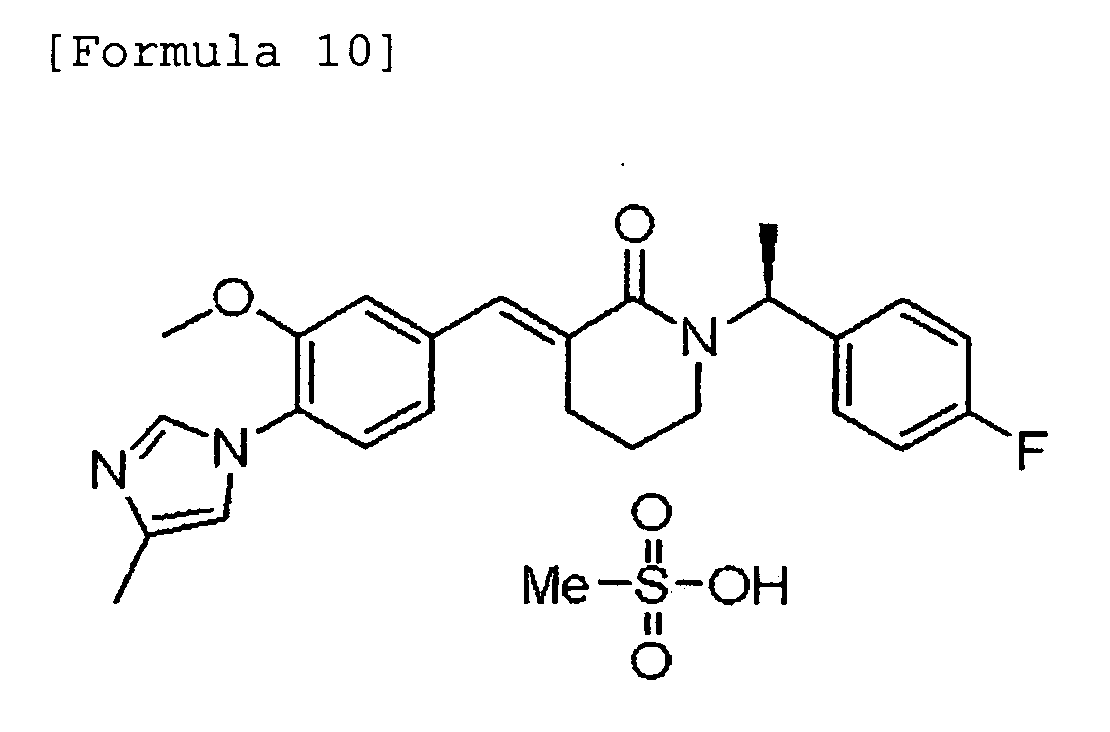
1H-NMR (CD3OD) δ(ppm): 1.59 (d, J = 7.2 Hz, 3H), 1.65-1.75 (m, 1H), 1.81-1.90 (m, 1H), 2.44 (d, J = 0.8 Hz, 3H), 2.70 (s, 3H), 2.81-2.85 (m, 2H), 2.96-3.02 (m, 1H), 3.37 (ddd, J = 4.0, 8.4, 12.4 Hz, 1H), 3.86 (s, 3H), 6.09 (q, J = 7.2 Hz, 1H), 7.08-7.12 (m, 2H), 7.21 (dd, J = 1.2, 8.4 Hz, 1H), 7.31 (d, J = 0.8 Hz, 1H), 7.36-7.40 (m, 2H), 7.56 (d, J = 8.4 Hz, 1H), 7.59 (t, J = 1.2 Hz, 1H), 7.80 (s, 1H), 9.15 (d, J = 1.6 Hz, 1H). -

- Phosphoric acid (13.9 µL, 0.238 mmol) was added to a solution of (3E)-1-[(1S)-1-(4-fluorophenyl)ethyl]-3-[3-methoxy-4-(4-methyl-1H-imidazol-1-yl)benzylidenelpiperidin-2-one (100 mg, 0.248 mmol) in 1-propanol (1.0 mL) at room temperature. After confirming precipitation of the crystals, 1-propanol (1.0 mL) was further added and the mixture was stirred for 15 minutes. Thereafter, the crystals were collected by filtration. The crystals were washed with 1-propanol and then dried under reduced pressure to provide the title compound as white crystals (113.3 mg, 0.196 mmol, 82.3% yield).
1H-NMR (400M Hz, DMSO-d6) δ(ppm) : 0.82 (3H, t, J = 7 Hz), 1.40 (2H, tq, J = 7, 7 Hz), 1.49 (3H, d, J = 7 Hz), 1.55-1.66 (1H, m), 1.71-1.81 (1H, m), 2.15 (3H, s), 2.73-2.80 (2H, m), 2.81 (1H, ddd, J = 12, 6, 4 Hz), 3.29 (1H, ddd, J = 12, 9, 4 Hz), 3.32 (2H, t, J = 7 Hz), 3.84 (3H, s), 5.97 (1H, q, J = 7 Hz), 7.11 (1H, dd, J = 8, 2 Hz), 7.15-7.20 (3H, m), 7.26 (1H, d, J = 2 Hz), 7.32-7.36 (2H, m), 7.39 (1H, d, J = 8 Hz), 7.70 (1H, s), 7.84 (1H, d, J = 1 Hz) - The crystals obtained by the above synthesis method were placed on a sample stage of a powder X-ray diffractometer and analyzed under the measurement conditions described in Table 1 of Example 3. The powder X-ray diffraction pattern of the resulting crystals is shown in
Fig. 5 . -

- Tetrafluoroboric acid (20.9 µL, 0.238 mmol) was added to a solution of (3E)-1-[(1S)-1-(4-fluorophenyl)ethyl]-3-[3-methoxy-4-(4-methyl-1H-imidazol-1-yl)benzylidene]piperidin-2-one (100 mg, 0.248 mmol) in ethyl acetate (2.5 mL) at room temperature. Then, the mixture was cooled in an ice bath. After stirring for 15 minutes, the crystals were collected by filtration and dried under reduced pressure to provide the title compound as white crystals (55.7 mg, 0.110 mmol, 46.1% yield).
1H-NMR (400M Hz, DMSO-d6) δ(ppm) : 1.50 (3H, d, J = 7 Hz), 1.56-1.66 (1H, m), 1.72-1.82 (1H, m), 2.33 (3H, d, J = 1 Hz), 2.75-2.78 (2H, m), 2.89 (1H, ddd, J = 12, 6, 4 Hz), 3.30 (1H, ddd, J = 12, 9, 4 Hz), 3.88 (3H, s), 5.97 (1H, q, J = 7 Hz), 7.14-7.22 (3H, m), 7.33-7.38 (3H, m), 7.59 (1H, d, J = 8 Hz), 7.71 (1H, t, J = 1 Hz), 7.73 (1H, s), 9.27 (1H, d, J = 2 Hz) - Phosphoric acid (13.9 µL, 0.238 mmol) was added to a solution of (3E)-1-[(1S)-1-(4-fluorophenyl)ethyl]-3-[3-methoxy-4-(4-methyl-1H-imidazol-1-yl)benzylidenelpiperidin-2-one (100 mg, 0.248 mmol) in ethyl acetate (2.0 mL) at room temperature. The mixture was stirred for two hours. After confirming precipitation of the solid, the mixture was cooled in an ice bath and stirred for five minutes. The solid was collected by filtration, washed with ethyl acetate and then dried under reduced pressure to provide the title compound as a white solid (63.3 mg, 0.122 mmol, 51.3% yield).
1H-NMR (400M Hz, DMSO-d6) δ(ppm) : 1.49 (3H, d, J = 7 Hz), 1.55-1.65 (1H, m), 1.70-1.81 (1H, m), 2.16 (3H, s), 2.72-2.81 (2H, m), 2.87 (1H, ddd, J = 4, 6, 12 Hz), 3.29 (1H, ddd, J = 12, 9, 4 Hz), 3.85 (3H, s), 5.97 (1H, q, J = 7 Hz), 7.10-7.20 (4H, m), 7.27 (1H, d, J = 1 Hz), 7.32-7.36 (2H, m), 7.41 (1H, d, J = 8 Hz), 7.70 (1H, s), 7 . 92 (1H, d, J = 1 Hz) - The amorphous form obtained by the above synthesis method was placed on a sample stage of a powder X-ray diffractometer and analyzed under the measurement conditions described in Table 1 of Example 3. The powder X-ray diffraction pattern of the resulting amorphous form is shown in
Fig. 6 . -

- Perchloric acid (60% in water, 39.9 µL, 0.238 mmol) was added to a solution of (3E)-1-[(1S)-1-(4-fluorophenyl)ethyl]-3-[3-methoxy-4-(4-methyl-1H-imidazol-1-yl)benzylidene]piperidin-2-one (100 mg, 0.248 mmol) in ethyl acetate (2.0 mL) at room temperature. Then, the mixture was stirred in an ice bath for five minutes. The crystals were collected by filtration, washed with ethyl acetate and then dried under reduced pressure to provide the title compound as a white solid (121.9 mg, 0.234 mmol, 98.3% yield).
1H-NMR (400M Hz, DMSO-d6) δ(ppm) : 1.50 (3H, d, J = 7 Hz), 1.56-1.65 (1H, m), 1.72-1.82 (1H, m), 2.34 (3H, s), 2.75-2.78 (2H, m), 2.86-2.92 (1H, m), 3.30 (1H, ddd, J = 12, 9, 4 Hz), 3.88 (3H, s), 5.97 (1H, q, J = 7 Hz), 7.16-7.22 (3H, m), 7.32-7.38 (3H, m), 7.60 (1H, d, J = 8 Hz), 7.73 (2H, s), 9.34 (1H, s) - The present invention can provide crystals of various salts of the compound (1) or solvates thereof which can be used as drug substances, including (3E)-1-[(1S)-1-(4-fluorophenyl)ethyl]-3-[3-methoxy-4-(4-methyl-1H-imidazol-1-yl)benzylidene]piperidin-2-one dihydrochloride monohydrate and (3E)-1-[(1S)-1-(4-fluorophenyl)ethyl]-3-[3-methoxy-4-(4-methyl-1H-imidazol-1-yl)benzylidene]piperidin-2-one dihydrobromide monohydrate. The present invention can also provide amorphous forms of various salts of the compound (1) or solvates thereof, including (3E)-1-[(1S)-1-(4-fluorophenyl)ethyl]-3-[3-methoxy-4-(4-methyl-1H-imidazol-1-yl)benzylidene]piperidin-2-one monotartrate and (3E)-1-[(1S)-1-(4-fluorophenyl)ethyl]-3-[3-methoxy-4-(4-methyl-1H-imidazol-1-yl)benzylidene]piperidin-2-one hemisulfate. These are crystal polymorphs or amorphous forms of salts of (3E)-1-[(1S)-1-(4-fluorophenyl)ethyl]-3-[3-methoxy-4-(4-methyl-1H-imidazol-1-yl)benzylidene]piperidin-2-one or solvates thereof which are suitable for pharmaceutical preparations.
-
- [
Fig. 1] Fig. 1 is the powder X-ray diffraction pattern of a crystal of compound (1) dihydrochloride monohydrate. The horizontal axis shows a diffraction angle (2θ), and the vertical line shows a peak intensity. - [
Fig. 2] Fig. 2 is the powder X-ray diffraction pattern of a crystal of compound (1) dihydrobromide monohydrate. The horizontal axis shows a diffraction angle (2θ), and the vertical line shows a peak intensity. - [
Fig. 3] Fig. 3 is the powder X-ray diffraction pattern of an amorphous form of compound (1) monotartrate. The horizontal axis shows a diffraction angle (2θ), and the vertical line shows a peak intensity. - [
Fig. 4] Fig. 4 is the powder X-ray diffraction pattern of an amorphous form of compound (1) hemisulfate. The horizontal axis shows a diffraction angle (2θ), and the vertical line shows a peak intensity. - [
Fig. 5] Fig. 5 is the powder X-ray diffraction pattern of compound (1) phosphate 1-propanolate. The horizontal axis shows a diffraction angle (2θ), and the vertical line shows a peak intensity. - [
Fig. 6] Fig. 6 is the powder X-ray diffraction pattern of an amorphous form of compound (1) phosphate. The horizontal axis shows a diffraction angle (2θ), and the vertical line shows a peak intensity.
Preferable specific examples also include an amorphous form of compound (1) phosphate not having a diffraction peak in powder X-ray diffractometry; an amorphous form of compound (1) monotartrate not having a diffraction peak in powder X-ray diffractometry; an amorphous form of compound (1) hemisulfate not having a diffraction peak in powder X-ray diffractometry; and various other salt amorphous forms.
Claims (37)
- A salt comprising one acid selected from the group consisting of an inorganic acid, an organic carboxylic acid and an organic sulfonic acid and (3E)-1-[(1S)-1-(4-fluorophenyl)ethyl]-3-[3-methoxy-4-(4-methyl-1H-imidazol-1-yl)benzylidene]piperidin-2-one, or a solvate thereof.
- The salt or the solvate thereof according to claim 1, wherein the acid is an organic carboxylic acid.
- The salt or the solvate thereof according to claim 1 or 2, wherein the organic carboxylic acid is acetic acid, oxalic acid, maleic acid, tartaric acid, malonic acid, fumaric acid or citric acid.
- The salt or the solvate thereof according to claim 1, wherein the acid is an organic sulfonic acid.
- The salt or the solvate thereof according to claim 1 or 4, wherein the organic sulfonic acid is methanesulfonic acid, trifluoromethanesulfonic acid, ethanesulfonic acid, benzenesulfonic acid, toluenesulfonic acid or camphorsulfonic acid.
- The salt or the solvate thereof according to claim 1, wherein the acid is an inorganic acid.
- The salt or the solvate thereof according to claim 1 or 6, wherein the inorganic acid is tetrafluoroboric acid, hydrofluoric acid, hydrochloric acid, hydrobromic acid, hydriodic acid, sulfuric acid, nitric acid, perchloric acid, phosphoric acid, carbonic acid or bicarbonic acid.
- The salt or the solvate thereof according to claim 1, 6 or 7, wherein the inorganic acid is tetrafluoroboric acid, hydrofluoric acid, hydrochloric acid, hydrobromic acid or hydriodic acid.
- The salt or the solvate thereof according to claim 1, 6, 7 or 8, wherein the inorganic acid is hydrochloric acid.
- The salt or the solvate thereof according to claim 1, 6, 7 or 8, wherein the inorganic acid is hydrobromic acid.
- The solvate according to any one of claims 1 to 10, wherein the solvate is a hydrate or an alcoholate.
- The solvate according to claim 11, wherein the alcoholate is a 1-propanolate.
- The salt or the solvate thereof according to any one of claims 1 to 12, which is a crystalline form or an amorphous form.
- A crystal of (3E)-1-[(1S)-1-(4-fluorophenyl)ethyl]-3-[3-methoxy-4-(4-methyl-1H-imidazol-1-yl)benzylidene]piperidin-2-one dihydrochloride monohydrate having a diffraction peak at a diffraction angle (2θ ± 0.2°) of 10.9° in powder X-ray diffractometry.
- The crystal according to claim 14, further having a diffraction peak at a diffraction angle (2θ ± 0.2°) of 11.1°.
- The crystal according to claim 14 or 15, further having a diffraction peak at a diffraction angle (2θ ± 0.2°) of 12.7°.
- The crystal according to any one of claims 14 to 16, further having a diffraction peak at a diffraction angle (2θ ± 0.2°) of 13.0°.
- The crystal according to any one of claims 14 to 17, further having a diffraction peak at a diffraction angle (2θ ± 0.2°) of 17.2°.
- The crystal according to any one of claims 14 to 18, further having a diffraction peak at a diffraction angle (2θ ± 0.2°) of 20.7°.
- The crystal according to any one of claims 14 to 19, further having a diffraction peak at a diffraction angle (2θ ± 0.2°) of 24.5°.
- The crystal according to any one of claims 14 to 20, further having a diffraction peak at a diffraction angle (2θ ± 0.2°) of 25.6°.
- A crystal of (3E)-1-[(1S)-1-(4-fluorophenyl)ethyl]-3-[3-methoxy-4-(4-methyl-1H-imidazol-1-yl)benzylidene]piperidin-2-one dihydrobromide monohydrate having a diffraction peak at a diffraction angle (2θ ± 0.2°) of 10.5° in powder X-ray diffractometry.
- The crystal according to claim 22, further having a diffraction peak at a diffraction angle (2θ ± 0.2°) of 13.2°.
- The crystal according to claim 22 or 23, further having a diffraction peak at a diffraction angle (2θ ± 0.2°) of 17.7°.
- The crystal according to claim 23 or 24, further having a diffraction peak at a diffraction angle (2θ ± 0.2°) of 21.4°.
- The crystal according to any one of claims 23 to 25, further having a diffraction peak at a diffraction angle (2θ ± 0.2°) of 22.3°.
- The crystal according to any one of claims 23 to 26, further having a diffraction peak at a diffraction angle (2θ ± 0.2°) of 39.4°.
- A crystal of (3E)-1-[(1S)-1-(4-fluorophenyl)ethyl]-3-[3-methoxy-4-(4-methyl-1H-imidazol-1-yl)benzylidene]piperidin-2-one phosphate 1-propanolate having a diffraction peak at a diffraction angle (2θ ± 0.2°) of 8.4°.
- The crystal according to claim 28, further having a diffraction peak at a diffraction angle (2θ ± 0.2°) of 14.3°.
- The crystal according to claim 28 or 29, further having a diffraction peak at a diffraction angle (2θ ± 0.2°) of 19.3°.
- The crystal according to any one of claims 28 to 30, further having a diffraction peak at a diffraction angle (2θ ± 0.2°) of 21.1°.
- The crystal according to any one of claims 28 to 30, further having a diffraction peak at a diffraction angle (2θ ± 0.2°) of 29.6°.
- (3E)-1-[(1S)-1-(4-fluorophenyl)ethyl]-3-[3-methoxy-4-(4-methyl-1H-imidazol-1-yl)benzylidene]piperidin-2-one phosphate which is an amorphous form.
- (3E)-1-[(1S)-1-(4-fluorophenyl)ethyl]-3-[3-methoxy-4-(4-methyl-1H-imidazol-1-yl)benzylidene]piperidin-2-one monotartrate which is an amorphous form.
- (3E)-1-[(1S)-1-(4-fluorophenyl)ethyl]-3-[3-methoxy-4-(4-methyl-1H-imidazol-1-yl)benzylidene]piperidin-2-one hemisulfate which is an amorphous form.
- The amorphous form according to any one of claims 33 to 35, not comprising a crystalline form.
- The amorphous form according to any one of claims 33 to 35, not having a diffraction peak in powder X-ray diffractometry.
Applications Claiming Priority (2)
| Application Number | Priority Date | Filing Date | Title |
|---|---|---|---|
| JP2005333718 | 2005-11-18 | ||
| PCT/JP2006/322981 WO2007058304A1 (en) | 2005-11-18 | 2006-11-17 | Salts of cynnamide compound or solvates thereof |
Publications (2)
| Publication Number | Publication Date |
|---|---|
| EP1953151A1 true EP1953151A1 (en) | 2008-08-06 |
| EP1953151A4 EP1953151A4 (en) | 2010-06-02 |
Family
ID=38048687
Family Applications (1)
| Application Number | Title | Priority Date | Filing Date |
|---|---|---|---|
| EP06832860A Withdrawn EP1953151A4 (en) | 2005-11-18 | 2006-11-17 | Salts of cynnamide compound or solvates thereof |
Country Status (4)
| Country | Link |
|---|---|
| US (1) | US20090048448A1 (en) |
| EP (1) | EP1953151A4 (en) |
| JP (1) | JPWO2007058304A1 (en) |
| WO (1) | WO2007058304A1 (en) |
Cited By (8)
| Publication number | Priority date | Publication date | Assignee | Title |
|---|---|---|---|---|
| EP1808432A4 (en) * | 2004-10-26 | 2009-05-27 | Eisai R&D Man Co Ltd | Amorphous object of cinnamide compound |
| US7667041B2 (en) | 2004-05-26 | 2010-02-23 | Eisai R&D Management Co., Ltd. | Cinnamide compound |
| US7713993B2 (en) | 2006-03-09 | 2010-05-11 | Eisai R&D Management Co., Ltd. | Multi-cycle cinnamide derivatives |
| US7737141B2 (en) | 2006-07-28 | 2010-06-15 | Eisai R&D Management Co., Ltd. | Prodrug of cinnamide compound |
| US7935815B2 (en) | 2007-08-31 | 2011-05-03 | Eisai R&D Management Co., Ltd. | Imidazoyl pyridine compounds and salts thereof |
| US8008293B2 (en) | 2007-02-28 | 2011-08-30 | Eisai R&D Management Co., Ltd. | Bicyclic oxomorpholine derivative |
| US8048878B2 (en) | 2005-11-24 | 2011-11-01 | Eisai R&D Management Co., Ltd. | Two cyclic cinnamide compound |
| US9453000B2 (en) | 2007-08-31 | 2016-09-27 | Eisai R&D Management Co., Ltd. | Polycyclic compound |
Families Citing this family (17)
| Publication number | Priority date | Publication date | Assignee | Title |
|---|---|---|---|---|
| AU2006316005A1 (en) * | 2005-11-18 | 2007-05-24 | Eisai R & D Management Co., Ltd. | Process for production of cinnamamide derivative |
| MY144960A (en) * | 2005-11-24 | 2011-11-30 | Eisai R&D Man Co Ltd | Morpholine type cinnamide compound |
| JPWO2007135969A1 (en) * | 2006-05-19 | 2009-10-01 | エーザイ・アール・アンド・ディー・マネジメント株式会社 | Urea-cinnamide derivatives |
| KR20090016591A (en) * | 2006-05-19 | 2009-02-16 | 에자이 알앤드디 매니지먼트 가부시키가이샤 | Cinnamid derivatives of heterocycle type |
| DE102007009810A1 (en) * | 2007-02-28 | 2008-09-04 | Man Roland Druckmaschinen Ag | Rubber blanket plate for a web-fed printing press comprises a film formed on a side of a plate-like support so that one surface of the support covered by the film on the side is smaller than one surface of the support covered by the blanket |
| US20100130537A1 (en) * | 2007-04-26 | 2010-05-27 | Eisai R&D Management Co., Ltd | Cinnamide compounds for dementia |
| AU2008250436B2 (en) | 2007-05-11 | 2013-03-28 | F. Hoffmann-La Roche Ag | Hetarylanilines as modulators for amyloid beta |
| CN101679360A (en) * | 2007-05-16 | 2010-03-24 | 卫材R&D管理有限公司 | One-step method for producing cinnamamide derivative |
| RU2527177C2 (en) | 2007-12-20 | 2014-08-27 | Энвиво Фармасьютикалз, Инк. | Tetrasubstituted benzenes |
| CA2705411A1 (en) | 2007-12-21 | 2009-07-02 | F. Hoffmann-La Roche Ag | Heteroaryl derivatives as orexin receptor antagonists |
| KR101244517B1 (en) | 2008-01-11 | 2013-03-18 | 에프. 호프만-라 로슈 아게 | Modulators for amyloid beta |
| US20100317860A1 (en) * | 2008-01-28 | 2010-12-16 | Ikuo Kushida | Crystalline cinnamide compounds or salts thereof |
| AU2009216851B2 (en) | 2008-02-22 | 2013-11-07 | F. Hoffmann-La Roche Ag | Modulators for amyloid beta |
| WO2010040661A1 (en) | 2008-10-09 | 2010-04-15 | F. Hoffmann-La Roche Ag | Modulators for amyloid beta |
| AU2009312856A1 (en) | 2008-11-10 | 2010-05-14 | F. Hoffmann-La Roche Ag | Heterocyclic gamma secretase modulators |
| US8486967B2 (en) | 2010-02-17 | 2013-07-16 | Hoffmann-La Roche Inc. | Heteroaryl substituted piperidines |
| CN103003253A (en) * | 2010-08-05 | 2013-03-27 | 贝林格尔.英格海姆国际有限公司 | Acid addition salts of the 2-[2-[[(4-methoxy-2,6-dimethylphenyl) sulfonyl]-(methyl)amino]ethoxy]-n-methyl-n-[3- (4-methylpiperazin-1-yl)cyclohexyl] acetamide and the use thereof as bradykinin b1 receptor antagonists |
Family Cites Families (38)
| Publication number | Priority date | Publication date | Assignee | Title |
|---|---|---|---|---|
| GB1101156A (en) * | 1965-09-22 | 1968-01-31 | Hickson & Welch Ltd | Triazole derivatives and their use as optical whitening agents |
| US3989816A (en) * | 1975-06-19 | 1976-11-02 | Nelson Research & Development Company | Vehicle composition containing 1-substituted azacycloheptan-2-ones |
| DE3689506D1 (en) * | 1985-10-09 | 1994-02-17 | Shell Int Research | New acrylic acid amides. |
| IT1205834B (en) * | 1987-04-22 | 1989-03-31 | Elbart | THIODIOSOLANIC DERIVATIVES FOR MUCOLYTIC ACTIVITY PROCEDURE FOR THEIR PREPARATION |
| EP0468054B1 (en) * | 1990-02-08 | 1997-05-28 | Eisai Co., Ltd. | Benzenesulfonamide derivative |
| AU680870B2 (en) * | 1993-04-28 | 1997-08-14 | Astellas Pharma Inc. | New heterocyclic compounds |
| JPH08283219A (en) * | 1995-04-07 | 1996-10-29 | Eisai Co Ltd | Aralkylaminoalkylamide derivative |
| US5804577A (en) * | 1995-09-12 | 1998-09-08 | Hoffmann-La Roche Inc. | Cephalosporin derivatives |
| PL329875A1 (en) * | 1996-05-10 | 1999-04-12 | Icos Corp | Derivatives of carbolin |
| US5985856A (en) * | 1997-12-31 | 1999-11-16 | University Of Kansas | Water soluble prodrugs of secondary and tertiary amine containing drugs and methods of making thereof |
| US6235728B1 (en) * | 1999-02-19 | 2001-05-22 | Bristol-Myers Squibb Company | Water-soluble prodrugs of azole compounds |
| US7053087B1 (en) * | 1999-03-04 | 2006-05-30 | Cardiome Pharma Corp. | Aminocycloalkyl cinnamide compounds for arrhythmia and analgesics and anesthetics |
| AU2001241128A1 (en) * | 2000-03-14 | 2001-09-24 | Fujisawa Pharmaceutical Co. Ltd. | Novel amide compounds |
| US20010051642A1 (en) * | 2000-04-17 | 2001-12-13 | Kyunghye Ahn | Method for treating Alzheimer's disease |
| US6710058B2 (en) * | 2000-11-06 | 2004-03-23 | Bristol-Myers Squibb Pharma Company | Monocyclic or bicyclic carbocycles and heterocycles as factor Xa inhibitors |
| ATE288898T1 (en) * | 2000-12-04 | 2005-02-15 | Hoffmann La Roche | PHENYLETHENYL OR PHENYLETHINYL DERIVATIVES AS GLUTAMA RECEPTOR ANTAGONISTS |
| GB0108770D0 (en) * | 2001-04-06 | 2001-05-30 | Eisai London Res Lab Ltd | Inhibitors |
| CA2468544A1 (en) * | 2001-12-10 | 2003-06-19 | Amgen Inc. | Vanilloid receptor ligands |
| ES2325205T3 (en) * | 2001-12-20 | 2009-08-28 | Bristol-Myers Squibb Company | DERIVATIVES OF ALPHA- (N-SULFONAMIDE) ACETAMIDE AS BETA-AMYLOID INHIBITORS. |
| JP2003206280A (en) * | 2001-12-28 | 2003-07-22 | Takeda Chem Ind Ltd | Biaryl compound and use thereof |
| TW200307667A (en) * | 2002-05-06 | 2003-12-16 | Bristol Myers Squibb Co | Sulfonylaminovalerolactams and derivatives thereof as factor Xa inhibitors |
| PL375552A1 (en) * | 2002-05-22 | 2005-11-28 | Amgen Inc. | Vanilloid receptor ligands and their medical applications |
| WO2003101927A1 (en) * | 2002-05-31 | 2003-12-11 | Proteotech, Inc. | Compounds, compositions and methods for the treatment of amyloid diseases and synucleinopathies such as alzheimer's disease, type 2 diabetes, and parkinson's disease |
| ATE452879T1 (en) * | 2002-07-12 | 2010-01-15 | Sanofi Aventis Deutschland | HETEROCYCLIC SUBSTITUTED BENZOYL UREASES, METHOD FOR THEIR PRODUCTION AND THEIR USE AS MEDICINAL PRODUCTS |
| US6900354B2 (en) * | 2002-07-15 | 2005-05-31 | Hoffman-La Roche Inc. | 3-phenyl-propionamido, 3-phenyl-acrylamido and 3-phenyl-propynamido derivatives |
| JP2006518738A (en) * | 2003-02-12 | 2006-08-17 | トランス テック ファーマ,インコーポレイテッド | Substituted azole derivatives as therapeutic agents |
| EP1628666B1 (en) * | 2003-05-14 | 2015-09-23 | NeuroGenetic Pharmaceuticals, Inc. | Compouds and uses thereof in modulating amyloid beta |
| WO2005020921A2 (en) * | 2003-08-29 | 2005-03-10 | Exelixis, Inc. | C-kit modulators and methods of use |
| US20050187277A1 (en) * | 2004-02-12 | 2005-08-25 | Mjalli Adnan M. | Substituted azole derivatives, compositions, and methods of use |
| DE102004009039A1 (en) * | 2004-02-23 | 2005-09-08 | Boehringer Ingelheim Pharma Gmbh & Co. Kg | 8- [3-Amino-piperidin-1-yl] xanthines, their preparation and use as pharmaceuticals |
| BRPI0511504A (en) * | 2004-05-26 | 2008-01-22 | Eisai R&D Man Co Ltd | compound or a pharmaceutically acceptable salt thereof, and preventive or therapeutic agent for a disease resulting from beta-amyloids |
| ATE458729T1 (en) * | 2004-10-26 | 2010-03-15 | Eisai R&D Man Co Ltd | AMORPHOUS FORM OF A cinnamic acid amide compound |
| AU2006316005A1 (en) * | 2005-11-18 | 2007-05-24 | Eisai R & D Management Co., Ltd. | Process for production of cinnamamide derivative |
| US20070117839A1 (en) * | 2005-11-24 | 2007-05-24 | Eisai R&D Management Co., Ltd. | Two cyclic cinnamide compound |
| MY144960A (en) * | 2005-11-24 | 2011-11-30 | Eisai R&D Man Co Ltd | Morpholine type cinnamide compound |
| TWI378091B (en) * | 2006-03-09 | 2012-12-01 | Eisai R&D Man Co Ltd | Multi-cyclic cinnamide derivatives |
| US7737141B2 (en) * | 2006-07-28 | 2010-06-15 | Eisai R&D Management Co., Ltd. | Prodrug of cinnamide compound |
| AU2008250436B2 (en) * | 2007-05-11 | 2013-03-28 | F. Hoffmann-La Roche Ag | Hetarylanilines as modulators for amyloid beta |
-
2006
- 2006-11-17 JP JP2007545313A patent/JPWO2007058304A1/en not_active Abandoned
- 2006-11-17 WO PCT/JP2006/322981 patent/WO2007058304A1/en not_active Ceased
- 2006-11-17 EP EP06832860A patent/EP1953151A4/en not_active Withdrawn
- 2006-11-17 US US12/093,929 patent/US20090048448A1/en not_active Abandoned
Non-Patent Citations (2)
| Title |
|---|
| No further relevant documents disclosed * |
| See also references of WO2007058304A1 * |
Cited By (13)
| Publication number | Priority date | Publication date | Assignee | Title |
|---|---|---|---|---|
| US7667041B2 (en) | 2004-05-26 | 2010-02-23 | Eisai R&D Management Co., Ltd. | Cinnamide compound |
| US7687640B2 (en) | 2004-05-26 | 2010-03-30 | Eisai R&D Management Co., Ltd. | Cinnamide compound |
| US7880009B2 (en) | 2004-05-26 | 2011-02-01 | Eisai R&D Management Co., Ltd. | Cinnamide compound |
| EP1808432A4 (en) * | 2004-10-26 | 2009-05-27 | Eisai R&D Man Co Ltd | Amorphous object of cinnamide compound |
| US7923563B2 (en) | 2004-10-26 | 2011-04-12 | Eisai R&D Management Co., Ltd. | Amorphous object of cinnamide compound |
| US8048878B2 (en) | 2005-11-24 | 2011-11-01 | Eisai R&D Management Co., Ltd. | Two cyclic cinnamide compound |
| US7897632B2 (en) | 2006-03-09 | 2011-03-01 | Eisai R&D Management Co., Ltd. | Multi-cyclic cinnamide derivatives |
| US7973033B2 (en) | 2006-03-09 | 2011-07-05 | Eisai R&D Management Co., Ltd. | Multi-cyclic cinnamide derivatives |
| US7713993B2 (en) | 2006-03-09 | 2010-05-11 | Eisai R&D Management Co., Ltd. | Multi-cycle cinnamide derivatives |
| US7737141B2 (en) | 2006-07-28 | 2010-06-15 | Eisai R&D Management Co., Ltd. | Prodrug of cinnamide compound |
| US8008293B2 (en) | 2007-02-28 | 2011-08-30 | Eisai R&D Management Co., Ltd. | Bicyclic oxomorpholine derivative |
| US7935815B2 (en) | 2007-08-31 | 2011-05-03 | Eisai R&D Management Co., Ltd. | Imidazoyl pyridine compounds and salts thereof |
| US9453000B2 (en) | 2007-08-31 | 2016-09-27 | Eisai R&D Management Co., Ltd. | Polycyclic compound |
Also Published As
| Publication number | Publication date |
|---|---|
| EP1953151A4 (en) | 2010-06-02 |
| JPWO2007058304A1 (en) | 2009-05-07 |
| WO2007058304A1 (en) | 2007-05-24 |
| US20090048448A1 (en) | 2009-02-19 |
Similar Documents
| Publication | Publication Date | Title |
|---|---|---|
| US20090048448A1 (en) | Salts of cynnamide compound or solvates thereof | |
| AU2005297966B2 (en) | Amorphous object of cinnamide compound | |
| US8343984B2 (en) | Crystalline forms of 4-methyl-N-[3-(4-methyl-imidazol-1-yl)-5-trifluoromethyl-phenyl]-3-(4-pyridin-3-yl-pyrimidin-2-ylamino)-benzamide | |
| JP6738970B2 (en) | N-[4-Fluoro-5-[[(2S,4S)-2-methyl-4-[(5-methyl-1,2,4-oxadiazol-3-yl)methoxy] as OGA inhibitors -1-Piperidyl]methyl]thiazol-2-yl]acetamide | |
| US20220024924A1 (en) | Solid state forms of lumateperone salts and processes for preparation of lumateperone and salts thereof | |
| KR20230021075A (en) | Forms and Compositions of Beta Adrenergic Agonists | |
| US8703954B2 (en) | Salt of tetrahydrotriazolopyridine derivative and crystal thereof | |
| JP2023536911A (en) | Crystal forms of O-glycoprotein-2-acetamido-2-deoxy-3-D-glucopyranosidase inhibitors | |
| TW201742866A (en) | A pharmaceutically acceptable salt of renal outer medullary potassium channel inhibitor | |
| KR101865868B1 (en) | Process for large scale production of 1-isopropyl-3-[5-[1-(3-methoxypropyl) piperidin-4-yl]-[1,3,4]oxadiazol-2-yl]-1h-indazole oxalate | |
| EP2239265A1 (en) | Crystalline cinnamide compounds or salts thereof | |
| TW202440125A (en) | Novel crystalline form of autotaxin inhibitor compounds and pharmaceutical composition comprising the same |
Legal Events
| Date | Code | Title | Description |
|---|---|---|---|
| PUAI | Public reference made under article 153(3) epc to a published international application that has entered the european phase |
Free format text: ORIGINAL CODE: 0009012 |
|
| 17P | Request for examination filed |
Effective date: 20080516 |
|
| AK | Designated contracting states |
Kind code of ref document: A1 Designated state(s): AT BE BG CH CY CZ DE DK EE ES FI FR GB GR HU IE IS IT LI LT LU LV MC NL PL PT RO SE SI SK TR |
|
| AX | Request for extension of the european patent |
Extension state: AL BA HR MK RS |
|
| A4 | Supplementary search report drawn up and despatched |
Effective date: 20100504 |
|
| STAA | Information on the status of an ep patent application or granted ep patent |
Free format text: STATUS: THE APPLICATION HAS BEEN WITHDRAWN |
|
| 18W | Application withdrawn |
Effective date: 20110713 |