EP1953148A1 - Heterocyclic amide compound and use thereof - Google Patents
Heterocyclic amide compound and use thereof Download PDFInfo
- Publication number
- EP1953148A1 EP1953148A1 EP06822961A EP06822961A EP1953148A1 EP 1953148 A1 EP1953148 A1 EP 1953148A1 EP 06822961 A EP06822961 A EP 06822961A EP 06822961 A EP06822961 A EP 06822961A EP 1953148 A1 EP1953148 A1 EP 1953148A1
- Authority
- EP
- European Patent Office
- Prior art keywords
- substituent
- group
- group optionally
- atom
- optionally
- Prior art date
- Legal status (The legal status is an assumption and is not a legal conclusion. Google has not performed a legal analysis and makes no representation as to the accuracy of the status listed.)
- Granted
Links
- -1 Heterocyclic amide compound Chemical class 0.000 title abstract description 167
- 102000002274 Matrix Metalloproteinases Human genes 0.000 claims abstract description 15
- 108010000684 Matrix Metalloproteinases Proteins 0.000 claims abstract description 15
- 239000008177 pharmaceutical agent Substances 0.000 claims abstract description 10
- 230000002401 inhibitory effect Effects 0.000 claims abstract description 9
- 125000001424 substituent group Chemical group 0.000 claims description 677
- 150000001875 compounds Chemical class 0.000 claims description 302
- 238000000034 method Methods 0.000 claims description 143
- 125000004432 carbon atom Chemical group C* 0.000 claims description 131
- 125000004430 oxygen atom Chemical group O* 0.000 claims description 129
- 229910052717 sulfur Inorganic materials 0.000 claims description 129
- 125000004434 sulfur atom Chemical group 0.000 claims description 129
- 125000005842 heteroatom Chemical group 0.000 claims description 128
- 229910052757 nitrogen Inorganic materials 0.000 claims description 128
- 125000004433 nitrogen atom Chemical group N* 0.000 claims description 128
- 125000006615 aromatic heterocyclic group Chemical group 0.000 claims description 88
- 125000003118 aryl group Chemical group 0.000 claims description 84
- 125000004435 hydrogen atom Chemical group [H]* 0.000 claims description 82
- 125000005843 halogen group Chemical group 0.000 claims description 81
- 150000003839 salts Chemical class 0.000 claims description 69
- 125000003178 carboxy group Chemical group [H]OC(*)=O 0.000 claims description 68
- 125000000217 alkyl group Chemical group 0.000 claims description 63
- 125000004093 cyano group Chemical group *C#N 0.000 claims description 63
- 125000003277 amino group Chemical group 0.000 claims description 56
- 125000002102 aryl alkyloxo group Chemical group 0.000 claims description 48
- 125000002887 hydroxy group Chemical group [H]O* 0.000 claims description 44
- 125000003917 carbamoyl group Chemical group [H]N([H])C(*)=O 0.000 claims description 43
- 125000003545 alkoxy group Chemical group 0.000 claims description 41
- 125000004659 aryl alkyl thio group Chemical group 0.000 claims description 41
- 125000005140 aralkylsulfonyl group Chemical group 0.000 claims description 40
- 125000004391 aryl sulfonyl group Chemical group 0.000 claims description 40
- 125000000449 nitro group Chemical group [O-][N+](*)=O 0.000 claims description 39
- 125000003396 thiol group Chemical group [H]S* 0.000 claims description 39
- 125000004468 heterocyclylthio group Chemical group 0.000 claims description 38
- 125000003342 alkenyl group Chemical group 0.000 claims description 37
- 125000004453 alkoxycarbonyl group Chemical group 0.000 claims description 37
- 125000004390 alkyl sulfonyl group Chemical group 0.000 claims description 37
- 125000004414 alkyl thio group Chemical group 0.000 claims description 37
- 125000000304 alkynyl group Chemical group 0.000 claims description 37
- 125000004104 aryloxy group Chemical group 0.000 claims description 37
- 125000002496 methyl group Chemical group [H]C([H])([H])* 0.000 claims description 33
- 125000001997 phenyl group Chemical group [H]C1=C([H])C([H])=C(*)C([H])=C1[H] 0.000 claims description 26
- 125000006850 spacer group Chemical group 0.000 claims description 26
- NQPDZGIKBAWPEJ-UHFFFAOYSA-N valeric acid Chemical compound CCCCC(O)=O NQPDZGIKBAWPEJ-UHFFFAOYSA-N 0.000 claims description 22
- 125000004429 atom Chemical group 0.000 claims description 20
- 230000004572 zinc-binding Effects 0.000 claims description 15
- FGBGICACEWJGMP-UHFFFAOYSA-N 4-[3-[[(4-oxo-1h-quinazoline-2-carbonyl)amino]methyl]phenoxy]butanoic acid Chemical compound OC(=O)CCCOC1=CC=CC(CNC(=O)C=2NC(=O)C3=CC=CC=C3N=2)=C1 FGBGICACEWJGMP-UHFFFAOYSA-N 0.000 claims description 14
- 229940002612 prodrug Drugs 0.000 claims description 13
- 239000000651 prodrug Substances 0.000 claims description 13
- GFXBYTUTBBOIER-UHFFFAOYSA-N 5-[3-[[(4-oxo-1h-quinazoline-2-carbonyl)amino]methyl]phenoxy]pentanoic acid Chemical compound OC(=O)CCCCOC1=CC=CC(CNC(=O)C=2NC(=O)C3=CC=CC=C3N=2)=C1 GFXBYTUTBBOIER-UHFFFAOYSA-N 0.000 claims description 11
- 125000002915 carbonyl group Chemical group [*:2]C([*:1])=O 0.000 claims description 11
- PVHMRWQEFVSALR-UHFFFAOYSA-N n-[[2-[(3,5-dimethyl-1,2-oxazol-4-yl)methoxy]pyridin-4-yl]methyl]-4-oxo-1h-quinazoline-2-carboxamide Chemical compound CC1=NOC(C)=C1COC1=CC(CNC(=O)C=2NC(=O)C3=CC=CC=C3N=2)=CC=N1 PVHMRWQEFVSALR-UHFFFAOYSA-N 0.000 claims description 11
- QTBSBXVTEAMEQO-UHFFFAOYSA-N Acetic acid Natural products CC(O)=O QTBSBXVTEAMEQO-UHFFFAOYSA-N 0.000 claims description 10
- 239000003795 chemical substances by application Substances 0.000 claims description 10
- BLFXDXGYYCDGJV-UHFFFAOYSA-N n-[[2-[(5-methyl-1,2-oxazol-3-yl)methoxy]pyridin-4-yl]methyl]-4-oxo-1h-quinazoline-2-carboxamide Chemical compound O1C(C)=CC(COC=2N=CC=C(CNC(=O)C=3NC(=O)C4=CC=CC=C4N=3)C=2)=N1 BLFXDXGYYCDGJV-UHFFFAOYSA-N 0.000 claims description 10
- 125000001425 triazolyl group Chemical group 0.000 claims description 10
- WYRHKDBEXRDIIV-UHFFFAOYSA-N 2-[3-[[(4-oxo-1h-quinazoline-2-carbonyl)amino]methyl]phenoxy]acetic acid Chemical compound OC(=O)COC1=CC=CC(CNC(=O)C=2NC(=O)C3=CC=CC=C3N=2)=C1 WYRHKDBEXRDIIV-UHFFFAOYSA-N 0.000 claims description 9
- 108010076503 Matrix Metalloproteinase 13 Proteins 0.000 claims description 9
- 125000003831 tetrazolyl group Chemical group 0.000 claims description 9
- 201000008482 osteoarthritis Diseases 0.000 claims description 8
- 206010039073 rheumatoid arthritis Diseases 0.000 claims description 8
- 125000002883 imidazolyl group Chemical group 0.000 claims description 7
- 125000003226 pyrazolyl group Chemical group 0.000 claims description 7
- 238000004519 manufacturing process Methods 0.000 claims description 6
- 238000011321 prophylaxis Methods 0.000 claims description 6
- 125000000168 pyrrolyl group Chemical group 0.000 claims description 6
- 238000011282 treatment Methods 0.000 claims description 6
- 241000124008 Mammalia Species 0.000 claims description 5
- SKVJNFZVNCSCEW-UHFFFAOYSA-N 4-oxo-5-phenyl-n-[[3-[2-(1h-1,2,4-triazol-5-yloxy)ethoxy]phenyl]methyl]-3h-thieno[2,3-d]pyrimidine-2-carboxamide Chemical compound N=1C=2SC=C(C=3C=CC=CC=3)C=2C(=O)NC=1C(=O)NCC(C=1)=CC=CC=1OCCOC=1N=CNN=1 SKVJNFZVNCSCEW-UHFFFAOYSA-N 0.000 claims description 4
- HYPFCLOTXYNWMW-UHFFFAOYSA-N 5-(2-chlorophenyl)-4-oxo-n-[[3-[2-(1h-1,2,4-triazol-5-yloxy)ethoxy]phenyl]methyl]-3h-thieno[2,3-d]pyrimidine-2-carboxamide Chemical compound ClC1=CC=CC=C1C1=CSC2=C1C(=O)NC(C(=O)NCC=1C=C(OCCOC3=NNC=N3)C=CC=1)=N2 HYPFCLOTXYNWMW-UHFFFAOYSA-N 0.000 claims description 4
- FJBDBEKSWTXDSH-UHFFFAOYSA-N 5-(2-fluorophenyl)-4-oxo-n-[[3-[2-(1h-1,2,4-triazol-5-yloxy)ethoxy]phenyl]methyl]-3h-thieno[2,3-d]pyrimidine-2-carboxamide Chemical compound FC1=CC=CC=C1C1=CSC2=C1C(=O)NC(C(=O)NCC=1C=C(OCCOC3=NNC=N3)C=CC=1)=N2 FJBDBEKSWTXDSH-UHFFFAOYSA-N 0.000 claims description 4
- MLUCCAMJMIYYED-UHFFFAOYSA-N 5-(3-fluorophenyl)-4-oxo-n-[[3-[2-(1h-1,2,4-triazol-5-yloxy)ethoxy]phenyl]methyl]-3h-thieno[2,3-d]pyrimidine-2-carboxamide Chemical compound FC1=CC=CC(C=2C=3C(=O)NC(=NC=3SC=2)C(=O)NCC=2C=C(OCCOC3=NNC=N3)C=CC=2)=C1 MLUCCAMJMIYYED-UHFFFAOYSA-N 0.000 claims description 4
- MGJMKQSWTURURF-UHFFFAOYSA-N 5-(3-fluorophenyl)-4-oxo-n-[[3-[3-(1h-1,2,4-triazol-5-yloxy)propoxy]phenyl]methyl]-3h-thieno[2,3-d]pyrimidine-2-carboxamide Chemical compound FC1=CC=CC(C=2C=3C(=O)NC(=NC=3SC=2)C(=O)NCC=2C=C(OCCCOC3=NNC=N3)C=CC=2)=C1 MGJMKQSWTURURF-UHFFFAOYSA-N 0.000 claims description 4
- MOINMUZRUZJZKV-UHFFFAOYSA-N 5-(3-methylphenyl)-4-oxo-n-[[3-[2-(1h-1,2,4-triazol-5-yloxy)ethoxy]phenyl]methyl]-3h-thieno[2,3-d]pyrimidine-2-carboxamide Chemical compound CC1=CC=CC(C=2C=3C(=O)NC(=NC=3SC=2)C(=O)NCC=2C=C(OCCOC3=NNC=N3)C=CC=2)=C1 MOINMUZRUZJZKV-UHFFFAOYSA-N 0.000 claims description 4
- 229940121386 matrix metalloproteinase inhibitor Drugs 0.000 claims description 4
- 239000003771 matrix metalloproteinase inhibitor Substances 0.000 claims description 4
- FIZRUYONINBMGK-UHFFFAOYSA-N 5-(2-fluorophenyl)-4-oxo-n-[[3-[3-(1h-1,2,4-triazol-5-yloxy)propoxy]phenyl]methyl]-3h-thieno[2,3-d]pyrimidine-2-carboxamide Chemical compound FC1=CC=CC=C1C1=CSC2=C1C(=O)NC(C(=O)NCC=1C=C(OCCCOC3=NNC=N3)C=CC=1)=N2 FIZRUYONINBMGK-UHFFFAOYSA-N 0.000 claims description 3
- 102000011722 Matrix Metalloproteinase 13 Human genes 0.000 claims 2
- XEKOWRVHYACXOJ-UHFFFAOYSA-N Ethyl acetate Chemical compound CCOC(C)=O XEKOWRVHYACXOJ-UHFFFAOYSA-N 0.000 description 222
- LFQSCWFLJHTTHZ-UHFFFAOYSA-N Ethanol Chemical compound CCO LFQSCWFLJHTTHZ-UHFFFAOYSA-N 0.000 description 203
- 239000000843 powder Substances 0.000 description 190
- 239000000203 mixture Substances 0.000 description 127
- WYURNTSHIVDZCO-UHFFFAOYSA-N Tetrahydrofuran Chemical compound C1CCOC1 WYURNTSHIVDZCO-UHFFFAOYSA-N 0.000 description 124
- IAZDPXIOMUYVGZ-WFGJKAKNSA-N Dimethyl sulfoxide Chemical compound [2H]C([2H])([2H])S(=O)C([2H])([2H])[2H] IAZDPXIOMUYVGZ-WFGJKAKNSA-N 0.000 description 113
- 238000002844 melting Methods 0.000 description 112
- 230000008018 melting Effects 0.000 description 112
- 239000000243 solution Substances 0.000 description 92
- 230000002829 reductive effect Effects 0.000 description 88
- XLYOFNOQVPJJNP-UHFFFAOYSA-N water Chemical compound O XLYOFNOQVPJJNP-UHFFFAOYSA-N 0.000 description 86
- VEXZGXHMUGYJMC-UHFFFAOYSA-N Hydrochloric acid Chemical compound Cl VEXZGXHMUGYJMC-UHFFFAOYSA-N 0.000 description 73
- 238000005160 1H NMR spectroscopy Methods 0.000 description 69
- 239000011541 reaction mixture Substances 0.000 description 65
- OKKJLVBELUTLKV-UHFFFAOYSA-N Methanol Chemical compound OC OKKJLVBELUTLKV-UHFFFAOYSA-N 0.000 description 64
- WEVYAHXRMPXWCK-UHFFFAOYSA-N Acetonitrile Chemical compound CC#N WEVYAHXRMPXWCK-UHFFFAOYSA-N 0.000 description 60
- ZMANZCXQSJIPKH-UHFFFAOYSA-N Triethylamine Chemical compound CCN(CC)CC ZMANZCXQSJIPKH-UHFFFAOYSA-N 0.000 description 60
- 239000000725 suspension Substances 0.000 description 51
- ZMXDDKWLCZADIW-UHFFFAOYSA-N N,N-Dimethylformamide Chemical compound CN(C)C=O ZMXDDKWLCZADIW-UHFFFAOYSA-N 0.000 description 50
- DTQVDTLACAAQTR-UHFFFAOYSA-N Trifluoroacetic acid Chemical compound OC(=O)C(F)(F)F DTQVDTLACAAQTR-UHFFFAOYSA-N 0.000 description 50
- VLKZOEOYAKHREP-UHFFFAOYSA-N n-Hexane Chemical compound CCCCCC VLKZOEOYAKHREP-UHFFFAOYSA-N 0.000 description 45
- 125000004169 (C1-C6) alkyl group Chemical group 0.000 description 42
- YMWUJEATGCHHMB-UHFFFAOYSA-N Dichloromethane Chemical compound ClCCl YMWUJEATGCHHMB-UHFFFAOYSA-N 0.000 description 42
- PMZURENOXWZQFD-UHFFFAOYSA-L Sodium Sulfate Chemical compound [Na+].[Na+].[O-]S([O-])(=O)=O PMZURENOXWZQFD-UHFFFAOYSA-L 0.000 description 42
- HPALAKNZSZLMCH-UHFFFAOYSA-M sodium;chloride;hydrate Chemical class O.[Na+].[Cl-] HPALAKNZSZLMCH-UHFFFAOYSA-M 0.000 description 42
- RTZKZFJDLAIYFH-UHFFFAOYSA-N Diethyl ether Chemical compound CCOCC RTZKZFJDLAIYFH-UHFFFAOYSA-N 0.000 description 39
- 229910052938 sodium sulfate Inorganic materials 0.000 description 38
- 235000011152 sodium sulphate Nutrition 0.000 description 38
- BMCAWNQKVVTNFP-UHFFFAOYSA-N ethyl 4-oxo-1h-quinazoline-2-carboxylate Chemical compound C1=CC=C2NC(C(=O)OCC)=NC(=O)C2=C1 BMCAWNQKVVTNFP-UHFFFAOYSA-N 0.000 description 37
- 239000012044 organic layer Substances 0.000 description 37
- HEMHJVSKTPXQMS-UHFFFAOYSA-M Sodium hydroxide Chemical compound [OH-].[Na+] HEMHJVSKTPXQMS-UHFFFAOYSA-M 0.000 description 36
- 238000001914 filtration Methods 0.000 description 34
- 238000006243 chemical reaction Methods 0.000 description 33
- GFONMZQQZXWJQV-UHFFFAOYSA-N [2-[3-(1-trityl-1,2,4-triazol-3-yl)propoxy]pyridin-4-yl]methanamine Chemical compound NCC1=CC=NC(OCCCC2=NN(C=N2)C(C=2C=CC=CC=2)(C=2C=CC=CC=2)C=2C=CC=CC=2)=C1 GFONMZQQZXWJQV-UHFFFAOYSA-N 0.000 description 30
- 239000003814 drug Substances 0.000 description 30
- UYOCZSLBUZAFPZ-UHFFFAOYSA-N [3-[2-[(1-trityl-1,2,4-triazol-3-yl)oxy]ethoxy]phenyl]methanamine Chemical compound NCC1=CC=CC(OCCOC2=NN(C=N2)C(C=2C=CC=CC=2)(C=2C=CC=CC=2)C=2C=CC=CC=2)=C1 UYOCZSLBUZAFPZ-UHFFFAOYSA-N 0.000 description 29
- 239000002198 insoluble material Substances 0.000 description 29
- HEDRZPFGACZZDS-MICDWDOJSA-N Trichloro(2H)methane Chemical compound [2H]C(Cl)(Cl)Cl HEDRZPFGACZZDS-MICDWDOJSA-N 0.000 description 28
- 238000002360 preparation method Methods 0.000 description 28
- 239000007787 solid Substances 0.000 description 27
- 125000004454 (C1-C6) alkoxycarbonyl group Chemical group 0.000 description 26
- JGFZNNIVVJXRND-UHFFFAOYSA-N N,N-Diisopropylethylamine (DIPEA) Chemical compound CCN(C(C)C)C(C)C JGFZNNIVVJXRND-UHFFFAOYSA-N 0.000 description 26
- 229940079593 drug Drugs 0.000 description 26
- YXFVVABEGXRONW-UHFFFAOYSA-N Toluene Chemical compound CC1=CC=CC=C1 YXFVVABEGXRONW-UHFFFAOYSA-N 0.000 description 24
- 238000001816 cooling Methods 0.000 description 23
- 125000004191 (C1-C6) alkoxy group Chemical group 0.000 description 22
- 125000001495 ethyl group Chemical group [H]C([H])([H])C([H])([H])* 0.000 description 21
- 239000013078 crystal Substances 0.000 description 19
- 125000005915 C6-C14 aryl group Chemical group 0.000 description 18
- 239000002904 solvent Substances 0.000 description 18
- AQRLNPVMDITEJU-UHFFFAOYSA-N triethylsilane Chemical compound CC[SiH](CC)CC AQRLNPVMDITEJU-UHFFFAOYSA-N 0.000 description 18
- 239000000706 filtrate Substances 0.000 description 17
- 239000003921 oil Substances 0.000 description 17
- 235000019198 oils Nutrition 0.000 description 17
- JUJWROOIHBZHMG-UHFFFAOYSA-N Pyridine Chemical compound C1=CC=NC=C1 JUJWROOIHBZHMG-UHFFFAOYSA-N 0.000 description 16
- UIIMBOGNXHQVGW-UHFFFAOYSA-M Sodium bicarbonate Chemical compound [Na+].OC([O-])=O UIIMBOGNXHQVGW-UHFFFAOYSA-M 0.000 description 16
- 239000012153 distilled water Substances 0.000 description 16
- 238000010898 silica gel chromatography Methods 0.000 description 15
- UHOVQNZJYSORNB-UHFFFAOYSA-N Benzene Chemical compound C1=CC=CC=C1 UHOVQNZJYSORNB-UHFFFAOYSA-N 0.000 description 14
- 238000010438 heat treatment Methods 0.000 description 14
- 239000008194 pharmaceutical composition Substances 0.000 description 14
- KZTYQJNIVKKDCO-UHFFFAOYSA-N ethyl 6-fluoro-4-oxo-1h-quinazoline-2-carboxylate Chemical compound C1=C(F)C=C2C(=O)NC(C(=O)OCC)=NC2=C1 KZTYQJNIVKKDCO-UHFFFAOYSA-N 0.000 description 13
- 229920006395 saturated elastomer Polymers 0.000 description 13
- NLXLAEXVIDQMFP-UHFFFAOYSA-N Ammonia chloride Chemical compound [NH4+].[Cl-] NLXLAEXVIDQMFP-UHFFFAOYSA-N 0.000 description 12
- KWYUFKZDYYNOTN-UHFFFAOYSA-M Potassium hydroxide Chemical compound [OH-].[K+] KWYUFKZDYYNOTN-UHFFFAOYSA-M 0.000 description 12
- 239000002585 base Substances 0.000 description 12
- 201000010099 disease Diseases 0.000 description 12
- 208000037265 diseases, disorders, signs and symptoms Diseases 0.000 description 12
- RJFMPBYVOZUSGR-UHFFFAOYSA-N ethyl 6-cyano-4-oxo-1h-quinazoline-2-carboxylate Chemical compound C1=C(C#N)C=C2C(=O)NC(C(=O)OCC)=NC2=C1 RJFMPBYVOZUSGR-UHFFFAOYSA-N 0.000 description 12
- 238000009472 formulation Methods 0.000 description 12
- CTSLXHKWHWQRSH-UHFFFAOYSA-N oxalyl chloride Chemical compound ClC(=O)C(Cl)=O CTSLXHKWHWQRSH-UHFFFAOYSA-N 0.000 description 12
- QDRKDTQENPPHOJ-UHFFFAOYSA-N sodium ethoxide Chemical compound [Na+].CC[O-] QDRKDTQENPPHOJ-UHFFFAOYSA-N 0.000 description 12
- COPPXSKHTAHKTA-UHFFFAOYSA-N ethyl 5-methyl-4-oxo-3h-thieno[2,3-d]pyrimidine-2-carboxylate Chemical compound O=C1NC(C(=O)OCC)=NC2=C1C(C)=CS2 COPPXSKHTAHKTA-UHFFFAOYSA-N 0.000 description 11
- ZAFNJMIOTHYJRJ-UHFFFAOYSA-N Diisopropyl ether Chemical compound CC(C)OC(C)C ZAFNJMIOTHYJRJ-UHFFFAOYSA-N 0.000 description 10
- KEAYESYHFKHZAL-UHFFFAOYSA-N Sodium Chemical compound [Na] KEAYESYHFKHZAL-UHFFFAOYSA-N 0.000 description 10
- CDBYLPFSWZWCQE-UHFFFAOYSA-L Sodium Carbonate Chemical compound [Na+].[Na+].[O-]C([O-])=O CDBYLPFSWZWCQE-UHFFFAOYSA-L 0.000 description 10
- 238000005886 esterification reaction Methods 0.000 description 10
- BWHMMNNQKKPAPP-UHFFFAOYSA-L potassium carbonate Chemical compound [K+].[K+].[O-]C([O-])=O BWHMMNNQKKPAPP-UHFFFAOYSA-L 0.000 description 10
- 239000012312 sodium hydride Substances 0.000 description 10
- 229910000104 sodium hydride Inorganic materials 0.000 description 10
- FPQQSJJWHUJYPU-UHFFFAOYSA-N 3-(dimethylamino)propyliminomethylidene-ethylazanium;chloride Chemical compound Cl.CCN=C=NCCCN(C)C FPQQSJJWHUJYPU-UHFFFAOYSA-N 0.000 description 9
- FXHOOIRPVKKKFG-UHFFFAOYSA-N N,N-Dimethylacetamide Chemical compound CN(C)C(C)=O FXHOOIRPVKKKFG-UHFFFAOYSA-N 0.000 description 9
- 229910052783 alkali metal Inorganic materials 0.000 description 9
- QGZKDVFQNNGYKY-UHFFFAOYSA-N ammonia Natural products N QGZKDVFQNNGYKY-UHFFFAOYSA-N 0.000 description 9
- KRKNYBCHXYNGOX-UHFFFAOYSA-N citric acid Chemical compound OC(=O)CC(O)(C(O)=O)CC(O)=O KRKNYBCHXYNGOX-UHFFFAOYSA-N 0.000 description 9
- 238000001514 detection method Methods 0.000 description 9
- 238000002347 injection Methods 0.000 description 9
- 239000007924 injection Substances 0.000 description 9
- 206010028980 Neoplasm Diseases 0.000 description 8
- NBIIXXVUZAFLBC-UHFFFAOYSA-N Phosphoric acid Chemical compound OP(O)(O)=O NBIIXXVUZAFLBC-UHFFFAOYSA-N 0.000 description 8
- 125000001691 aryl alkyl amino group Chemical group 0.000 description 8
- 210000000692 cap cell Anatomy 0.000 description 8
- 239000012230 colorless oil Substances 0.000 description 8
- OWZFULPEVHKEKS-UHFFFAOYSA-N ethyl 2-chloro-2-oxoacetate Chemical compound CCOC(=O)C(Cl)=O OWZFULPEVHKEKS-UHFFFAOYSA-N 0.000 description 8
- 239000000825 pharmaceutical preparation Substances 0.000 description 8
- 238000002953 preparative HPLC Methods 0.000 description 8
- UMJSCPRVCHMLSP-UHFFFAOYSA-N pyridine Natural products COC1=CC=CN=C1 UMJSCPRVCHMLSP-UHFFFAOYSA-N 0.000 description 8
- 229910000030 sodium bicarbonate Inorganic materials 0.000 description 8
- 235000017557 sodium bicarbonate Nutrition 0.000 description 8
- GETQZCLCWQTVFV-UHFFFAOYSA-N trimethylamine Chemical compound CN(C)C GETQZCLCWQTVFV-UHFFFAOYSA-N 0.000 description 8
- 102100027995 Collagenase 3 Human genes 0.000 description 7
- 125000003754 ethoxycarbonyl group Chemical group C(=O)(OCC)* 0.000 description 7
- 229910052739 hydrogen Inorganic materials 0.000 description 7
- 125000001160 methoxycarbonyl group Chemical group [H]C([H])([H])OC(*)=O 0.000 description 7
- 239000004533 oil dispersion Substances 0.000 description 7
- 125000004742 propyloxycarbonyl group Chemical group 0.000 description 7
- YLQBMQCUIZJEEH-UHFFFAOYSA-N tetrahydrofuran Natural products C=1C=COC=1 YLQBMQCUIZJEEH-UHFFFAOYSA-N 0.000 description 7
- KIUKXJAPPMFGSW-DNGZLQJQSA-N (2S,3S,4S,5R,6R)-6-[(2S,3R,4R,5S,6R)-3-Acetamido-2-[(2S,3S,4R,5R,6R)-6-[(2R,3R,4R,5S,6R)-3-acetamido-2,5-dihydroxy-6-(hydroxymethyl)oxan-4-yl]oxy-2-carboxy-4,5-dihydroxyoxan-3-yl]oxy-5-hydroxy-6-(hydroxymethyl)oxan-4-yl]oxy-3,4,5-trihydroxyoxane-2-carboxylic acid Chemical compound CC(=O)N[C@H]1[C@H](O)O[C@H](CO)[C@@H](O)[C@@H]1O[C@H]1[C@H](O)[C@@H](O)[C@H](O[C@H]2[C@@H]([C@@H](O[C@H]3[C@@H]([C@@H](O)[C@H](O)[C@H](O3)C(O)=O)O)[C@H](O)[C@@H](CO)O2)NC(C)=O)[C@@H](C(O)=O)O1 KIUKXJAPPMFGSW-DNGZLQJQSA-N 0.000 description 6
- KXRTUKKKBSPDRD-UHFFFAOYSA-N 1-trityl-1,2,4-triazole-3-carboxylic acid Chemical compound N1=C(C(=O)O)N=CN1C(C=1C=CC=CC=1)(C=1C=CC=CC=1)C1=CC=CC=C1 KXRTUKKKBSPDRD-UHFFFAOYSA-N 0.000 description 6
- KVCQTKNUUQOELD-UHFFFAOYSA-N 4-amino-n-[1-(3-chloro-2-fluoroanilino)-6-methylisoquinolin-5-yl]thieno[3,2-d]pyrimidine-7-carboxamide Chemical compound N=1C=CC2=C(NC(=O)C=3C4=NC=NC(N)=C4SC=3)C(C)=CC=C2C=1NC1=CC=CC(Cl)=C1F KVCQTKNUUQOELD-UHFFFAOYSA-N 0.000 description 6
- WFDIJRYMOXRFFG-UHFFFAOYSA-N Acetic anhydride Chemical compound CC(=O)OC(C)=O WFDIJRYMOXRFFG-UHFFFAOYSA-N 0.000 description 6
- 125000005914 C6-C14 aryloxy group Chemical group 0.000 description 6
- VTYYLEPIZMXCLO-UHFFFAOYSA-L Calcium carbonate Chemical compound [Ca+2].[O-]C([O-])=O VTYYLEPIZMXCLO-UHFFFAOYSA-L 0.000 description 6
- HEDRZPFGACZZDS-UHFFFAOYSA-N Chloroform Chemical compound ClC(Cl)Cl HEDRZPFGACZZDS-UHFFFAOYSA-N 0.000 description 6
- IAZDPXIOMUYVGZ-UHFFFAOYSA-N Dimethylsulphoxide Chemical compound CS(C)=O IAZDPXIOMUYVGZ-UHFFFAOYSA-N 0.000 description 6
- UFHFLCQGNIYNRP-UHFFFAOYSA-N Hydrogen Chemical compound [H][H] UFHFLCQGNIYNRP-UHFFFAOYSA-N 0.000 description 6
- FAPWRFPIFSIZLT-UHFFFAOYSA-M Sodium chloride Chemical compound [Na+].[Cl-] FAPWRFPIFSIZLT-UHFFFAOYSA-M 0.000 description 6
- WQDUMFSSJAZKTM-UHFFFAOYSA-N Sodium methoxide Chemical compound [Na+].[O-]C WQDUMFSSJAZKTM-UHFFFAOYSA-N 0.000 description 6
- QAOWNCQODCNURD-UHFFFAOYSA-N Sulfuric acid Chemical compound OS(O)(=O)=O QAOWNCQODCNURD-UHFFFAOYSA-N 0.000 description 6
- 235000019270 ammonium chloride Nutrition 0.000 description 6
- 239000012298 atmosphere Substances 0.000 description 6
- 229920002674 hyaluronan Polymers 0.000 description 6
- 229960003160 hyaluronic acid Drugs 0.000 description 6
- 239000001257 hydrogen Substances 0.000 description 6
- BDAGIHXWWSANSR-UHFFFAOYSA-N methanoic acid Natural products OC=O BDAGIHXWWSANSR-UHFFFAOYSA-N 0.000 description 6
- LWIHDJKSTIGBAC-UHFFFAOYSA-K tripotassium phosphate Chemical compound [K+].[K+].[K+].[O-]P([O-])([O-])=O LWIHDJKSTIGBAC-UHFFFAOYSA-K 0.000 description 6
- ASOKPJOREAFHNY-UHFFFAOYSA-N 1-Hydroxybenzotriazole Chemical compound C1=CC=C2N(O)N=NC2=C1 ASOKPJOREAFHNY-UHFFFAOYSA-N 0.000 description 5
- VXLUMTMOGDHBDV-UHFFFAOYSA-N 2-[2-[(1-trityl-1,2,4-triazol-3-yl)sulfanyl]ethoxy]pyridine-4-carbonitrile Chemical compound N#CC1=CC=NC(OCCSC2=NN(C=N2)C(C=2C=CC=CC=2)(C=2C=CC=CC=2)C=2C=CC=CC=2)=C1 VXLUMTMOGDHBDV-UHFFFAOYSA-N 0.000 description 5
- NZEOKUXXTXUCDW-UHFFFAOYSA-N 4-oxo-n-[(3-piperazin-1-ylphenyl)methyl]-1h-quinazoline-2-carboxamide;dihydrochloride Chemical compound Cl.Cl.N=1C2=CC=CC=C2C(=O)NC=1C(=O)NCC(C=1)=CC=CC=1N1CCNCC1 NZEOKUXXTXUCDW-UHFFFAOYSA-N 0.000 description 5
- ZCYVEMRRCGMTRW-UHFFFAOYSA-N 7553-56-2 Chemical group [I] ZCYVEMRRCGMTRW-UHFFFAOYSA-N 0.000 description 5
- VHUUQVKOLVNVRT-UHFFFAOYSA-N Ammonium hydroxide Chemical compound [NH4+].[OH-] VHUUQVKOLVNVRT-UHFFFAOYSA-N 0.000 description 5
- WKBOTKDWSSQWDR-UHFFFAOYSA-N Bromine atom Chemical group [Br] WKBOTKDWSSQWDR-UHFFFAOYSA-N 0.000 description 5
- 208000012659 Joint disease Diseases 0.000 description 5
- NRJODCOJGREDDX-UHFFFAOYSA-N [3-[2-(1h-1,2,4-triazol-5-ylsulfanyl)ethoxy]phenyl]methanamine Chemical compound NCC1=CC=CC(OCCSC2=NNC=N2)=C1 NRJODCOJGREDDX-UHFFFAOYSA-N 0.000 description 5
- JFDZBHWFFUWGJE-UHFFFAOYSA-N benzenecarbonitrile Natural products N#CC1=CC=CC=C1 JFDZBHWFFUWGJE-UHFFFAOYSA-N 0.000 description 5
- 229910052801 chlorine Inorganic materials 0.000 description 5
- 125000001309 chloro group Chemical group Cl* 0.000 description 5
- 229910052731 fluorine Inorganic materials 0.000 description 5
- 125000001153 fluoro group Chemical group F* 0.000 description 5
- 239000003112 inhibitor Substances 0.000 description 5
- 229910052740 iodine Inorganic materials 0.000 description 5
- 150000007530 organic bases Chemical class 0.000 description 5
- HXEACLLIILLPRG-UHFFFAOYSA-N pipecolic acid Chemical compound OC(=O)C1CCCCN1 HXEACLLIILLPRG-UHFFFAOYSA-N 0.000 description 5
- 229910000027 potassium carbonate Inorganic materials 0.000 description 5
- 235000011181 potassium carbonates Nutrition 0.000 description 5
- 125000001436 propyl group Chemical group [H]C([*])([H])C([H])([H])C([H])([H])[H] 0.000 description 5
- 235000018102 proteins Nutrition 0.000 description 5
- 102000004169 proteins and genes Human genes 0.000 description 5
- 108090000623 proteins and genes Proteins 0.000 description 5
- FUXJMHXHGDAHPD-UHFFFAOYSA-N pyrimidine-2-carboxamide Chemical compound NC(=O)C1=NC=CC=N1 FUXJMHXHGDAHPD-UHFFFAOYSA-N 0.000 description 5
- 229910000029 sodium carbonate Inorganic materials 0.000 description 5
- 125000000472 sulfonyl group Chemical group *S(*)(=O)=O 0.000 description 5
- 125000003718 tetrahydrofuranyl group Chemical group 0.000 description 5
- 125000004739 (C1-C6) alkylsulfonyl group Chemical group 0.000 description 4
- 125000006700 (C1-C6) alkylthio group Chemical group 0.000 description 4
- BUOSAFNJURLEMX-UHFFFAOYSA-N 2-(1h-1,2,4-triazol-5-yl)acetic acid Chemical compound OC(=O)CC=1N=CNN=1 BUOSAFNJURLEMX-UHFFFAOYSA-N 0.000 description 4
- IYWYLHUQGUIKHO-UHFFFAOYSA-N 3-(2-chloroethoxy)benzonitrile Chemical compound ClCCOC1=CC=CC(C#N)=C1 IYWYLHUQGUIKHO-UHFFFAOYSA-N 0.000 description 4
- SGHBRHKBCLLVCI-UHFFFAOYSA-N 3-hydroxybenzonitrile Chemical compound OC1=CC=CC(C#N)=C1 SGHBRHKBCLLVCI-UHFFFAOYSA-N 0.000 description 4
- 208000020084 Bone disease Diseases 0.000 description 4
- QOSSAOTZNIDXMA-UHFFFAOYSA-N Dicylcohexylcarbodiimide Chemical compound C1CCCCC1N=C=NC1CCCCC1 QOSSAOTZNIDXMA-UHFFFAOYSA-N 0.000 description 4
- DHMQDGOQFOQNFH-UHFFFAOYSA-N Glycine Chemical compound NCC(O)=O DHMQDGOQFOQNFH-UHFFFAOYSA-N 0.000 description 4
- CTQNGGLPUBDAKN-UHFFFAOYSA-N O-Xylene Chemical compound CC1=CC=CC=C1C CTQNGGLPUBDAKN-UHFFFAOYSA-N 0.000 description 4
- 208000001132 Osteoporosis Diseases 0.000 description 4
- RJJMKYOQSYJODV-UHFFFAOYSA-N [3-[3-[(1-trityl-1,2,4-triazol-3-yl)sulfanyl]propoxy]phenyl]methanamine Chemical compound NCC1=CC=CC(OCCCSC2=NN(C=N2)C(C=2C=CC=CC=2)(C=2C=CC=CC=2)C=2C=CC=CC=2)=C1 RJJMKYOQSYJODV-UHFFFAOYSA-N 0.000 description 4
- FFTDWIWVBISYQS-UHFFFAOYSA-N [3-[3-[[5-(trifluoromethyl)-1h-1,2,4-triazol-3-yl]sulfanyl]propoxy]phenyl]methanamine;hydrochloride Chemical compound Cl.NCC1=CC=CC(OCCCSC=2N=C(NN=2)C(F)(F)F)=C1 FFTDWIWVBISYQS-UHFFFAOYSA-N 0.000 description 4
- 230000002378 acidificating effect Effects 0.000 description 4
- 229910000147 aluminium phosphate Inorganic materials 0.000 description 4
- 125000000484 butyl group Chemical group [H]C([*])([H])C([H])([H])C([H])([H])C([H])([H])[H] 0.000 description 4
- 201000011510 cancer Diseases 0.000 description 4
- 239000003054 catalyst Substances 0.000 description 4
- 230000000694 effects Effects 0.000 description 4
- QWKGDUKXNRZJDH-UHFFFAOYSA-N ethyl 2-(1h-1,2,4-triazol-5-yl)acetate Chemical compound CCOC(=O)CC1=NC=NN1 QWKGDUKXNRZJDH-UHFFFAOYSA-N 0.000 description 4
- RJJMFCVZNNJCKN-UHFFFAOYSA-N ethyl 3-(1-trityl-1,2,4-triazol-3-yl)propanoate Chemical compound N1=C(CCC(=O)OCC)N=CN1C(C=1C=CC=CC=1)(C=1C=CC=CC=1)C1=CC=CC=C1 RJJMFCVZNNJCKN-UHFFFAOYSA-N 0.000 description 4
- KOQKDEBHWKTLHU-UHFFFAOYSA-N ethyl 4-[[4-oxo-2-[[2-[3-(1h-1,2,4-triazol-5-yl)propoxy]pyridin-4-yl]methylcarbamoyl]-3h-thieno[2,3-d]pyrimidin-5-yl]methoxymethyl]benzoate Chemical compound C1=CC(C(=O)OCC)=CC=C1COCC1=CSC2=C1C(=O)NC(C(=O)NCC=1C=C(OCCCC3=NNC=N3)N=CC=1)=N2 KOQKDEBHWKTLHU-UHFFFAOYSA-N 0.000 description 4
- QAPGMCFYDWTTKL-UHFFFAOYSA-N ethyl 5,6-difluoro-4-oxo-1h-quinazoline-2-carboxylate Chemical compound C1=C(F)C(F)=C2C(=O)NC(C(=O)OCC)=NC2=C1 QAPGMCFYDWTTKL-UHFFFAOYSA-N 0.000 description 4
- 125000000524 functional group Chemical group 0.000 description 4
- 125000004051 hexyl group Chemical group [H]C([H])([H])C([H])([H])C([H])([H])C([H])([H])C([H])([H])C([H])([H])* 0.000 description 4
- IXCSERBJSXMMFS-UHFFFAOYSA-N hydrogen chloride Substances Cl.Cl IXCSERBJSXMMFS-UHFFFAOYSA-N 0.000 description 4
- 229910000041 hydrogen chloride Inorganic materials 0.000 description 4
- 125000000959 isobutyl group Chemical group [H]C([H])([H])C([H])(C([H])([H])[H])C([H])([H])* 0.000 description 4
- 125000001449 isopropyl group Chemical group [H]C([H])([H])C([H])(*)C([H])([H])[H] 0.000 description 4
- 239000007951 isotonicity adjuster Substances 0.000 description 4
- 239000007788 liquid Substances 0.000 description 4
- UKVIEHSSVKSQBA-UHFFFAOYSA-N methane;palladium Chemical compound C.[Pd] UKVIEHSSVKSQBA-UHFFFAOYSA-N 0.000 description 4
- 239000012046 mixed solvent Substances 0.000 description 4
- DUZQVWWZRIYUKA-UHFFFAOYSA-N n-[(3-aminophenyl)methyl]-6-cyano-4-oxo-1h-quinazoline-2-carboxamide Chemical compound NC1=CC=CC(CNC(=O)C=2NC(=O)C3=CC(=CC=C3N=2)C#N)=C1 DUZQVWWZRIYUKA-UHFFFAOYSA-N 0.000 description 4
- KJIFKLIQANRMOU-UHFFFAOYSA-N oxidanium;4-methylbenzenesulfonate Chemical compound O.CC1=CC=C(S(O)(=O)=O)C=C1 KJIFKLIQANRMOU-UHFFFAOYSA-N 0.000 description 4
- 125000001147 pentyl group Chemical group C(CCCC)* 0.000 description 4
- 125000006239 protecting group Chemical group 0.000 description 4
- 125000002914 sec-butyl group Chemical group [H]C([H])([H])C([H])([H])C([H])(*)C([H])([H])[H] 0.000 description 4
- 125000000999 tert-butyl group Chemical group [H]C([H])([H])C(*)(C([H])([H])[H])C([H])([H])[H] 0.000 description 4
- 229940124597 therapeutic agent Drugs 0.000 description 4
- UCPYLLCMEDAXFR-UHFFFAOYSA-N triphosgene Chemical compound ClC(Cl)(Cl)OC(=O)OC(Cl)(Cl)Cl UCPYLLCMEDAXFR-UHFFFAOYSA-N 0.000 description 4
- 239000008096 xylene Substances 0.000 description 4
- 125000006624 (C1-C6) alkoxycarbonylamino group Chemical group 0.000 description 3
- 125000004502 1,2,3-oxadiazolyl group Chemical group 0.000 description 3
- 125000004511 1,2,3-thiadiazolyl group Chemical group 0.000 description 3
- 125000001399 1,2,3-triazolyl group Chemical group N1N=NC(=C1)* 0.000 description 3
- 125000004504 1,2,4-oxadiazolyl group Chemical group 0.000 description 3
- 125000004514 1,2,4-thiadiazolyl group Chemical group 0.000 description 3
- 125000001376 1,2,4-triazolyl group Chemical group N1N=C(N=C1)* 0.000 description 3
- 125000001781 1,3,4-oxadiazolyl group Chemical group 0.000 description 3
- 125000004520 1,3,4-thiadiazolyl group Chemical group 0.000 description 3
- RYHBNJHYFVUHQT-UHFFFAOYSA-N 1,4-Dioxane Chemical compound C1COCCO1 RYHBNJHYFVUHQT-UHFFFAOYSA-N 0.000 description 3
- 125000001637 1-naphthyl group Chemical group [H]C1=C([H])C([H])=C2C(*)=C([H])C([H])=C([H])C2=C1[H] 0.000 description 3
- OISVCGZHLKNMSJ-UHFFFAOYSA-N 2,6-dimethylpyridine Chemical compound CC1=CC=CC(C)=N1 OISVCGZHLKNMSJ-UHFFFAOYSA-N 0.000 description 3
- AAUDDEVGIAWLCV-UHFFFAOYSA-N 2-(1h-1,2,4-triazol-5-ylsulfanyl)ethanol Chemical compound OCCSC=1N=CNN=1 AAUDDEVGIAWLCV-UHFFFAOYSA-N 0.000 description 3
- VEZUDRKSBZDXNN-UHFFFAOYSA-N 2-[2-(1h-1,2,4-triazol-5-ylsulfanyl)ethoxy]pyridine-4-carbonitrile Chemical compound N#CC1=CC=NC(OCCSC2=NNC=N2)=C1 VEZUDRKSBZDXNN-UHFFFAOYSA-N 0.000 description 3
- 125000001622 2-naphthyl group Chemical group [H]C1=C([H])C([H])=C2C([H])=C(*)C([H])=C([H])C2=C1[H] 0.000 description 3
- DGDNTBRTYQWNJR-UHFFFAOYSA-N 3-(1-trityl-1,2,4-triazol-3-yl)propanoic acid Chemical compound N1=C(CCC(=O)O)N=CN1C(C=1C=CC=CC=1)(C=1C=CC=CC=1)C1=CC=CC=C1 DGDNTBRTYQWNJR-UHFFFAOYSA-N 0.000 description 3
- ZDBWYUOUYNQZBM-UHFFFAOYSA-N 3-(aminomethyl)aniline Chemical compound NCC1=CC=CC(N)=C1 ZDBWYUOUYNQZBM-UHFFFAOYSA-N 0.000 description 3
- WDKCOTAAACWNJQ-UHFFFAOYSA-N 3-[3-(1h-1,2,4-triazol-5-ylsulfanyl)propoxy]benzonitrile Chemical compound N#CC1=CC=CC(OCCCSC2=NNC=N2)=C1 WDKCOTAAACWNJQ-UHFFFAOYSA-N 0.000 description 3
- OSWFIVFLDKOXQC-UHFFFAOYSA-N 4-(3-methoxyphenyl)aniline Chemical compound COC1=CC=CC(C=2C=CC(N)=CC=2)=C1 OSWFIVFLDKOXQC-UHFFFAOYSA-N 0.000 description 3
- VJUCDWUVDQOPBO-UHFFFAOYSA-N 5,6-difluoro-4-oxo-n-[[3-[2-[(1-trityl-1,2,4-triazol-3-yl)oxy]ethoxy]phenyl]methyl]-1h-quinazoline-2-carboxamide Chemical compound N1C(=O)C2=C(F)C(F)=CC=C2N=C1C(=O)NCC(C=1)=CC=CC=1OCCOC(=N1)N=CN1C(C=1C=CC=CC=1)(C=1C=CC=CC=1)C1=CC=CC=C1 VJUCDWUVDQOPBO-UHFFFAOYSA-N 0.000 description 3
- RJCMLWMHNXICLW-UHFFFAOYSA-N 6-cyano-4-oxo-n-[[3-[3-(1-trityl-1,2,4-triazol-3-yl)propanoylamino]phenyl]methyl]-1h-quinazoline-2-carboxamide Chemical compound C=1C=CC(CNC(=O)C=2NC(=O)C3=CC(=CC=C3N=2)C#N)=CC=1NC(=O)CCC(=N1)N=CN1C(C=1C=CC=CC=1)(C=1C=CC=CC=1)C1=CC=CC=C1 RJCMLWMHNXICLW-UHFFFAOYSA-N 0.000 description 3
- OYPRJOBELJOOCE-UHFFFAOYSA-N Calcium Chemical compound [Ca] OYPRJOBELJOOCE-UHFFFAOYSA-N 0.000 description 3
- OKTJSMMVPCPJKN-UHFFFAOYSA-N Carbon Chemical group [C] OKTJSMMVPCPJKN-UHFFFAOYSA-N 0.000 description 3
- 229920002134 Carboxymethyl cellulose Polymers 0.000 description 3
- 102000029816 Collagenase Human genes 0.000 description 3
- 108060005980 Collagenase Proteins 0.000 description 3
- FBPFZTCFMRRESA-FSIIMWSLSA-N D-Glucitol Natural products OC[C@H](O)[C@H](O)[C@@H](O)[C@H](O)CO FBPFZTCFMRRESA-FSIIMWSLSA-N 0.000 description 3
- FBPFZTCFMRRESA-KVTDHHQDSA-N D-Mannitol Chemical compound OC[C@@H](O)[C@@H](O)[C@H](O)[C@H](O)CO FBPFZTCFMRRESA-KVTDHHQDSA-N 0.000 description 3
- FBPFZTCFMRRESA-JGWLITMVSA-N D-glucitol Chemical compound OC[C@H](O)[C@@H](O)[C@H](O)[C@H](O)CO FBPFZTCFMRRESA-JGWLITMVSA-N 0.000 description 3
- 102000004190 Enzymes Human genes 0.000 description 3
- 108090000790 Enzymes Proteins 0.000 description 3
- 229940124761 MMP inhibitor Drugs 0.000 description 3
- 229930195725 Mannitol Natural products 0.000 description 3
- GRYLNZFGIOXLOG-UHFFFAOYSA-N Nitric acid Chemical compound O[N+]([O-])=O GRYLNZFGIOXLOG-UHFFFAOYSA-N 0.000 description 3
- MUBZPKHOEPUJKR-UHFFFAOYSA-N Oxalic acid Chemical compound OC(=O)C(O)=O MUBZPKHOEPUJKR-UHFFFAOYSA-N 0.000 description 3
- RWRDLPDLKQPQOW-UHFFFAOYSA-N Pyrrolidine Chemical compound C1CCNC1 RWRDLPDLKQPQOW-UHFFFAOYSA-N 0.000 description 3
- 239000007868 Raney catalyst Substances 0.000 description 3
- NPXOKRUENSOPAO-UHFFFAOYSA-N Raney nickel Chemical compound [Al].[Ni] NPXOKRUENSOPAO-UHFFFAOYSA-N 0.000 description 3
- 229910000564 Raney nickel Inorganic materials 0.000 description 3
- 206010064996 Ulcerative keratitis Diseases 0.000 description 3
- WEEBOSJXFXIKQX-UHFFFAOYSA-N [3-[(1-trityl-1,2,4-triazol-3-yl)methoxymethyl]phenyl]methanamine Chemical compound NCC1=CC=CC(COCC2=NN(C=N2)C(C=2C=CC=CC=2)(C=2C=CC=CC=2)C=2C=CC=CC=2)=C1 WEEBOSJXFXIKQX-UHFFFAOYSA-N 0.000 description 3
- ZEEIPMRKUOHDCY-UHFFFAOYSA-N [3-[4-[(1-trityl-1,2,4-triazol-3-yl)sulfanyl]butoxy]phenyl]methanamine Chemical compound NCC1=CC=CC(OCCCCSC2=NN(C=N2)C(C=2C=CC=CC=2)(C=2C=CC=CC=2)C=2C=CC=CC=2)=C1 ZEEIPMRKUOHDCY-UHFFFAOYSA-N 0.000 description 3
- 239000002253 acid Substances 0.000 description 3
- 238000005917 acylation reaction Methods 0.000 description 3
- 150000001298 alcohols Chemical class 0.000 description 3
- 125000001931 aliphatic group Chemical group 0.000 description 3
- 229910000288 alkali metal carbonate Inorganic materials 0.000 description 3
- 150000008041 alkali metal carbonates Chemical class 0.000 description 3
- 229910000102 alkali metal hydride Inorganic materials 0.000 description 3
- 150000008046 alkali metal hydrides Chemical class 0.000 description 3
- 150000008044 alkali metal hydroxides Chemical class 0.000 description 3
- 229910052784 alkaline earth metal Inorganic materials 0.000 description 3
- 150000004703 alkoxides Chemical class 0.000 description 3
- 125000005115 alkyl carbamoyl group Chemical group 0.000 description 3
- 125000003806 alkyl carbonyl amino group Chemical group 0.000 description 3
- 125000005281 alkyl ureido group Chemical group 0.000 description 3
- 238000005804 alkylation reaction Methods 0.000 description 3
- 150000001408 amides Chemical class 0.000 description 3
- 235000001014 amino acid Nutrition 0.000 description 3
- 150000001413 amino acids Chemical class 0.000 description 3
- 230000000202 analgesic effect Effects 0.000 description 3
- 150000004945 aromatic hydrocarbons Chemical class 0.000 description 3
- 125000001797 benzyl group Chemical group [H]C1=C([H])C([H])=C(C([H])=C1[H])C([H])([H])* 0.000 description 3
- 230000037396 body weight Effects 0.000 description 3
- 210000000988 bone and bone Anatomy 0.000 description 3
- 239000000872 buffer Substances 0.000 description 3
- FJDQFPXHSGXQBY-UHFFFAOYSA-L caesium carbonate Chemical compound [Cs+].[Cs+].[O-]C([O-])=O FJDQFPXHSGXQBY-UHFFFAOYSA-L 0.000 description 3
- 229910000024 caesium carbonate Inorganic materials 0.000 description 3
- 229910052791 calcium Inorganic materials 0.000 description 3
- 239000011575 calcium Substances 0.000 description 3
- 229910000019 calcium carbonate Inorganic materials 0.000 description 3
- 125000001951 carbamoylamino group Chemical group C(N)(=O)N* 0.000 description 3
- 239000001768 carboxy methyl cellulose Substances 0.000 description 3
- 235000010948 carboxy methyl cellulose Nutrition 0.000 description 3
- 239000008112 carboxymethyl-cellulose Substances 0.000 description 3
- 229940105329 carboxymethylcellulose Drugs 0.000 description 3
- 239000007810 chemical reaction solvent Substances 0.000 description 3
- 238000007796 conventional method Methods 0.000 description 3
- 201000007717 corneal ulcer Diseases 0.000 description 3
- 229940088598 enzyme Drugs 0.000 description 3
- 150000002148 esters Chemical class 0.000 description 3
- PSLIMVZEAPALCD-UHFFFAOYSA-N ethanol;ethoxyethane Chemical compound CCO.CCOCC PSLIMVZEAPALCD-UHFFFAOYSA-N 0.000 description 3
- 150000002170 ethers Chemical class 0.000 description 3
- ONFZJYKDBISTEO-UHFFFAOYSA-N ethyl 5-(bromomethyl)-4-oxo-3h-thieno[2,3-d]pyrimidine-2-carboxylate Chemical compound O=C1NC(C(=O)OCC)=NC2=C1C(CBr)=CS2 ONFZJYKDBISTEO-UHFFFAOYSA-N 0.000 description 3
- URFCRPXPCVHXQM-UHFFFAOYSA-N ethyl 5-[(4-ethoxycarbonylphenyl)methoxymethyl]-4-oxo-3h-thieno[2,3-d]pyrimidine-2-carboxylate Chemical compound C1=CC(C(=O)OCC)=CC=C1COCC1=CSC2=C1C(=O)NC(C(=O)OCC)=N2 URFCRPXPCVHXQM-UHFFFAOYSA-N 0.000 description 3
- WHQLQYRFIHPMNA-UHFFFAOYSA-N ethyl acetate;oxolane Chemical compound C1CCOC1.CCOC(C)=O WHQLQYRFIHPMNA-UHFFFAOYSA-N 0.000 description 3
- 125000006125 ethylsulfonyl group Chemical group 0.000 description 3
- 235000019253 formic acid Nutrition 0.000 description 3
- 125000003838 furazanyl group Chemical group 0.000 description 3
- 125000002541 furyl group Chemical group 0.000 description 3
- 239000008187 granular material Substances 0.000 description 3
- 150000008282 halocarbons Chemical class 0.000 description 3
- DMEGYFMYUHOHGS-UHFFFAOYSA-N heptamethylene Natural products C1CCCCCC1 DMEGYFMYUHOHGS-UHFFFAOYSA-N 0.000 description 3
- 238000006460 hydrolysis reaction Methods 0.000 description 3
- RAXXELZNTBOGNW-UHFFFAOYSA-N imidazole Natural products C1=CNC=N1 RAXXELZNTBOGNW-UHFFFAOYSA-N 0.000 description 3
- 150000007529 inorganic bases Chemical class 0.000 description 3
- 125000001786 isothiazolyl group Chemical group 0.000 description 3
- 125000000842 isoxazolyl group Chemical group 0.000 description 3
- HXEACLLIILLPRG-RXMQYKEDSA-N l-pipecolic acid Natural products OC(=O)[C@H]1CCCCN1 HXEACLLIILLPRG-RXMQYKEDSA-N 0.000 description 3
- 239000010410 layer Substances 0.000 description 3
- 239000012280 lithium aluminium hydride Substances 0.000 description 3
- 239000000594 mannitol Substances 0.000 description 3
- 235000010355 mannitol Nutrition 0.000 description 3
- YQUUIBWHCXBFDE-UHFFFAOYSA-N methyl 1-trityl-1,2,4-triazole-3-carboxylate Chemical compound N1=C(C(=O)OC)N=CN1C(C=1C=CC=CC=1)(C=1C=CC=CC=1)C1=CC=CC=C1 YQUUIBWHCXBFDE-UHFFFAOYSA-N 0.000 description 3
- NQMRYBIKMRVZLB-UHFFFAOYSA-N methylamine hydrochloride Chemical compound [Cl-].[NH3+]C NQMRYBIKMRVZLB-UHFFFAOYSA-N 0.000 description 3
- 125000004170 methylsulfonyl group Chemical group [H]C([H])([H])S(*)(=O)=O 0.000 description 3
- 150000007522 mineralic acids Chemical class 0.000 description 3
- 239000011259 mixed solution Substances 0.000 description 3
- 238000002156 mixing Methods 0.000 description 3
- 125000002757 morpholinyl group Chemical group 0.000 description 3
- RJORRDJDUBZBMI-UHFFFAOYSA-N n-[[3-(aminomethyl)phenyl]methyl]-5-methyl-4-oxo-3h-thieno[2,3-d]pyrimidine-2-carboxamide;hydrochloride Chemical compound Cl.N1C(=O)C=2C(C)=CSC=2N=C1C(=O)NCC1=CC=CC(CN)=C1 RJORRDJDUBZBMI-UHFFFAOYSA-N 0.000 description 3
- CDOLTKDLPSVBRI-UHFFFAOYSA-N n-[[3-(aminomethyl)phenyl]methyl]-6-cyano-4-oxo-1h-quinazoline-2-carboxamide;hydrochloride Chemical compound Cl.NCC1=CC=CC(CNC(=O)C=2NC(=O)C3=CC(=CC=C3N=2)C#N)=C1 CDOLTKDLPSVBRI-UHFFFAOYSA-N 0.000 description 3
- NQMOTKUIMTWERF-UHFFFAOYSA-N n-[[3-[4-[2-(hydroxyamino)-3-methylbutyl]sulfonylphenyl]phenyl]methyl]-4-oxo-1h-quinazoline-2-carboxamide Chemical compound C1=CC(S(=O)(=O)CC(C(C)C)NO)=CC=C1C1=CC=CC(CNC(=O)C=2NC(=O)C3=CC=CC=C3N=2)=C1 NQMOTKUIMTWERF-UHFFFAOYSA-N 0.000 description 3
- 229910017604 nitric acid Inorganic materials 0.000 description 3
- 150000002825 nitriles Chemical class 0.000 description 3
- LYGJENNIWJXYER-UHFFFAOYSA-N nitromethane Chemical compound C[N+]([O-])=O LYGJENNIWJXYER-UHFFFAOYSA-N 0.000 description 3
- 125000002971 oxazolyl group Chemical group 0.000 description 3
- 239000003002 pH adjusting agent Substances 0.000 description 3
- 208000028169 periodontal disease Diseases 0.000 description 3
- 125000003170 phenylsulfonyl group Chemical group C1(=CC=CC=C1)S(=O)(=O)* 0.000 description 3
- 125000004193 piperazinyl group Chemical group 0.000 description 3
- 125000005936 piperidyl group Chemical group 0.000 description 3
- 229920001282 polysaccharide Polymers 0.000 description 3
- 239000005017 polysaccharide Substances 0.000 description 3
- 150000004804 polysaccharides Chemical class 0.000 description 3
- 229910000028 potassium bicarbonate Inorganic materials 0.000 description 3
- 235000015497 potassium bicarbonate Nutrition 0.000 description 3
- 239000011736 potassium bicarbonate Substances 0.000 description 3
- NTTOTNSKUYCDAV-UHFFFAOYSA-N potassium hydride Chemical compound [KH] NTTOTNSKUYCDAV-UHFFFAOYSA-N 0.000 description 3
- 229910000105 potassium hydride Inorganic materials 0.000 description 3
- TYJJADVDDVDEDZ-UHFFFAOYSA-M potassium hydrogencarbonate Chemical compound [K+].OC([O-])=O TYJJADVDDVDEDZ-UHFFFAOYSA-M 0.000 description 3
- 229940086066 potassium hydrogencarbonate Drugs 0.000 description 3
- 229910000160 potassium phosphate Inorganic materials 0.000 description 3
- 235000011009 potassium phosphates Nutrition 0.000 description 3
- 239000002244 precipitate Substances 0.000 description 3
- 239000003755 preservative agent Substances 0.000 description 3
- 230000002335 preservative effect Effects 0.000 description 3
- 125000003373 pyrazinyl group Chemical group 0.000 description 3
- 125000002098 pyridazinyl group Chemical group 0.000 description 3
- 125000004076 pyridyl group Chemical group 0.000 description 3
- ZFCHNZDUMIOWFV-UHFFFAOYSA-M pyrimidine-2-carboxylate Chemical compound [O-]C(=O)C1=NC=CC=N1 ZFCHNZDUMIOWFV-UHFFFAOYSA-M 0.000 description 3
- 125000000714 pyrimidinyl group Chemical group 0.000 description 3
- 125000000719 pyrrolidinyl group Chemical group 0.000 description 3
- 230000035484 reaction time Effects 0.000 description 3
- 238000010992 reflux Methods 0.000 description 3
- ODZPKZBBUMBTMG-UHFFFAOYSA-N sodium amide Chemical compound [NH2-].[Na+] ODZPKZBBUMBTMG-UHFFFAOYSA-N 0.000 description 3
- 239000011780 sodium chloride Substances 0.000 description 3
- 239000001488 sodium phosphate Substances 0.000 description 3
- 229910000162 sodium phosphate Inorganic materials 0.000 description 3
- 159000000000 sodium salts Chemical class 0.000 description 3
- 239000000600 sorbitol Substances 0.000 description 3
- 230000001954 sterilising effect Effects 0.000 description 3
- 239000000126 substance Substances 0.000 description 3
- 150000003462 sulfoxides Chemical class 0.000 description 3
- HTYCGEUNIKJLIH-UHFFFAOYSA-N tert-butyl n-[[3-[[(6-cyano-4-oxo-1h-quinazoline-2-carbonyl)amino]methyl]phenyl]methyl]carbamate Chemical compound CC(C)(C)OC(=O)NCC1=CC=CC(CNC(=O)C=2NC(=O)C3=CC(=CC=C3N=2)C#N)=C1 HTYCGEUNIKJLIH-UHFFFAOYSA-N 0.000 description 3
- 125000001412 tetrahydropyranyl group Chemical group 0.000 description 3
- 125000005958 tetrahydrothienyl group Chemical group 0.000 description 3
- 125000000335 thiazolyl group Chemical group 0.000 description 3
- 125000001544 thienyl group Chemical group 0.000 description 3
- 238000004809 thin layer chromatography Methods 0.000 description 3
- 125000004149 thio group Chemical group *S* 0.000 description 3
- 125000004568 thiomorpholinyl group Chemical group 0.000 description 3
- 125000004306 triazinyl group Chemical group 0.000 description 3
- JBWKIWSBJXDJDT-UHFFFAOYSA-N triphenylmethyl chloride Chemical compound C=1C=CC=CC=1C(C=1C=CC=CC=1)(Cl)C1=CC=CC=C1 JBWKIWSBJXDJDT-UHFFFAOYSA-N 0.000 description 3
- RYFMWSXOAZQYPI-UHFFFAOYSA-K trisodium phosphate Chemical compound [Na+].[Na+].[Na+].[O-]P([O-])([O-])=O RYFMWSXOAZQYPI-UHFFFAOYSA-K 0.000 description 3
- VCIHOFOPRYYZRD-UHFFFAOYSA-N (1-trityl-1,2,4-triazol-3-yl)methanol Chemical compound N1=C(CO)N=CN1C(C=1C=CC=CC=1)(C=1C=CC=CC=1)C1=CC=CC=C1 VCIHOFOPRYYZRD-UHFFFAOYSA-N 0.000 description 2
- CUKATAAPVFYVIL-QHCPKHFHSA-N (2s)-3-methyl-2-[[4-[3-[[(4-oxo-1h-quinazoline-2-carbonyl)amino]methyl]phenyl]phenyl]sulfonylamino]butanoic acid Chemical compound C1=CC(S(=O)(=O)N[C@@H](C(C)C)C(O)=O)=CC=C1C1=CC=CC(CNC(=O)C=2NC(=O)C3=CC=CC=C3N=2)=C1 CUKATAAPVFYVIL-QHCPKHFHSA-N 0.000 description 2
- CBWUWRJGJWUACY-NRFANRHFSA-N (2s)-3-methyl-2-[[4-[3-[[(5-methyl-4-oxo-3h-thieno[2,3-d]pyrimidine-2-carbonyl)amino]methyl]phenyl]phenyl]sulfonylamino]butanoic acid Chemical compound C1=CC(S(=O)(=O)N[C@@H](C(C)C)C(O)=O)=CC=C1C1=CC=CC(CNC(=O)C=2NC(=O)C=3C(C)=CSC=3N=2)=C1 CBWUWRJGJWUACY-NRFANRHFSA-N 0.000 description 2
- 125000004916 (C1-C6) alkylcarbonyl group Chemical group 0.000 description 2
- 125000004845 (C1-C6) alkylsulfonylamino group Chemical group 0.000 description 2
- 125000006552 (C3-C8) cycloalkyl group Chemical group 0.000 description 2
- 125000006636 (C3-C8) cycloalkylcarbonyl group Chemical group 0.000 description 2
- LMDZBCPBFSXMTL-UHFFFAOYSA-N 1-Ethyl-3-(3-dimethylaminopropyl)carbodiimide Substances CCN=C=NCCCN(C)C LMDZBCPBFSXMTL-UHFFFAOYSA-N 0.000 description 2
- IBYHHJPAARCAIE-UHFFFAOYSA-N 1-bromo-2-chloroethane Chemical compound ClCCBr IBYHHJPAARCAIE-UHFFFAOYSA-N 0.000 description 2
- AFBBKYQYNPNMAT-UHFFFAOYSA-N 1h-1,2,4-triazol-1-ium-3-thiolate Chemical compound SC=1N=CNN=1 AFBBKYQYNPNMAT-UHFFFAOYSA-N 0.000 description 2
- OZAIFHULBGXAKX-UHFFFAOYSA-N 2-(2-cyanopropan-2-yldiazenyl)-2-methylpropanenitrile Chemical compound N#CC(C)(C)N=NC(C)(C)C#N OZAIFHULBGXAKX-UHFFFAOYSA-N 0.000 description 2
- HZAXFHJVJLSVMW-UHFFFAOYSA-N 2-Aminoethan-1-ol Chemical compound NCCO HZAXFHJVJLSVMW-UHFFFAOYSA-N 0.000 description 2
- GDVUWDPTHPPBMF-UHFFFAOYSA-N 2-[3-(1-trityl-1,2,4-triazol-3-yl)propoxy]pyridine-4-carbonitrile Chemical compound N#CC1=CC=NC(OCCCC2=NN(C=N2)C(C=2C=CC=CC=2)(C=2C=CC=CC=2)C=2C=CC=CC=2)=C1 GDVUWDPTHPPBMF-UHFFFAOYSA-N 0.000 description 2
- ZUFQMRDGVYDVAF-UHFFFAOYSA-N 2-amino-5-iodobenzamide Chemical compound NC(=O)C1=CC(I)=CC=C1N ZUFQMRDGVYDVAF-UHFFFAOYSA-N 0.000 description 2
- NWZIAOBMRQYTTD-UHFFFAOYSA-N 2-amino-5-methoxybenzamide Chemical compound COC1=CC=C(N)C(C(N)=O)=C1 NWZIAOBMRQYTTD-UHFFFAOYSA-N 0.000 description 2
- LLSGVPKOCZZLTF-UHFFFAOYSA-N 2-amino-5-methylbenzamide Chemical compound CC1=CC=C(N)C(C(N)=O)=C1 LLSGVPKOCZZLTF-UHFFFAOYSA-N 0.000 description 2
- SOBQOVZAFJDEJI-UHFFFAOYSA-N 2-amino-5-nitrobenzamide Chemical compound NC(=O)C1=CC([N+]([O-])=O)=CC=C1N SOBQOVZAFJDEJI-UHFFFAOYSA-N 0.000 description 2
- IYKKLCLIASEVDG-UHFFFAOYSA-N 2-amino-6-methylbenzamide Chemical compound CC1=CC=CC(N)=C1C(N)=O IYKKLCLIASEVDG-UHFFFAOYSA-N 0.000 description 2
- WHZIZZOTISTHCT-UHFFFAOYSA-N 2-aminothiophene-3-carboxamide Chemical compound NC(=O)C=1C=CSC=1N WHZIZZOTISTHCT-UHFFFAOYSA-N 0.000 description 2
- WZRQWDRIKYVBTR-UHFFFAOYSA-N 3-(1-trityl-1,2,4-triazol-3-yl)propan-1-ol Chemical compound N1=C(CCCO)N=CN1C(C=1C=CC=CC=1)(C=1C=CC=CC=1)C1=CC=CC=C1 WZRQWDRIKYVBTR-UHFFFAOYSA-N 0.000 description 2
- SIEANLUVCPATRT-UHFFFAOYSA-N 3-(1h-1,2,4-triazol-5-yl)propanoic acid Chemical compound OC(=O)CCC=1N=CNN=1 SIEANLUVCPATRT-UHFFFAOYSA-N 0.000 description 2
- GHPUMGIECCOLLL-UHFFFAOYSA-N 3-(2-hydroxyethoxy)benzonitrile Chemical compound OCCOC1=CC=CC(C#N)=C1 GHPUMGIECCOLLL-UHFFFAOYSA-N 0.000 description 2
- GIXDBNKGYVVAHG-UHFFFAOYSA-N 3-(3-chloropropoxy)benzonitrile Chemical compound ClCCCOC1=CC=CC(C#N)=C1 GIXDBNKGYVVAHG-UHFFFAOYSA-N 0.000 description 2
- HBVCNJBQRKXWMC-UHFFFAOYSA-N 3-(4-chlorobutoxy)benzonitrile Chemical compound ClCCCCOC1=CC=CC(C#N)=C1 HBVCNJBQRKXWMC-UHFFFAOYSA-N 0.000 description 2
- PFCHZLGMHLSKKV-UHFFFAOYSA-N 3-[(1-trityl-1,2,4-triazol-3-yl)methoxymethyl]benzonitrile Chemical compound N#CC1=CC=CC(COCC2=NN(C=N2)C(C=2C=CC=CC=2)(C=2C=CC=CC=2)C=2C=CC=CC=2)=C1 PFCHZLGMHLSKKV-UHFFFAOYSA-N 0.000 description 2
- ALVPSODDOIGUCL-UHFFFAOYSA-N 3-[2-(1h-1,2,4-triazol-5-ylsulfanyl)ethoxy]benzonitrile Chemical compound N#CC1=CC=CC(OCCSC2=NNC=N2)=C1 ALVPSODDOIGUCL-UHFFFAOYSA-N 0.000 description 2
- UHCIVNUYUPLVQU-UHFFFAOYSA-N 3-[2-[(1-trityl-1,2,4-triazol-3-yl)oxy]ethoxy]benzonitrile Chemical compound N#CC1=CC=CC(OCCOC2=NN(C=N2)C(C=2C=CC=CC=2)(C=2C=CC=CC=2)C=2C=CC=CC=2)=C1 UHCIVNUYUPLVQU-UHFFFAOYSA-N 0.000 description 2
- MIJPHGRGDKREPD-UHFFFAOYSA-N 3-[3-[(1-trityl-1,2,4-triazol-3-yl)sulfanyl]propoxy]benzonitrile Chemical compound N#CC1=CC=CC(OCCCSC2=NN(C=N2)C(C=2C=CC=CC=2)(C=2C=CC=CC=2)C=2C=CC=CC=2)=C1 MIJPHGRGDKREPD-UHFFFAOYSA-N 0.000 description 2
- UJWLAJJSNLGQDZ-UHFFFAOYSA-N 3-[4-(1h-1,2,4-triazol-5-ylsulfanyl)butoxy]benzonitrile Chemical compound N#CC1=CC=CC(OCCCCSC2=NNC=N2)=C1 UJWLAJJSNLGQDZ-UHFFFAOYSA-N 0.000 description 2
- VLZFZWIFTWTXOE-UHFFFAOYSA-N 3-[4-[(1-trityl-1,2,4-triazol-3-yl)sulfanyl]butoxy]benzonitrile Chemical compound N#CC1=CC=CC(OCCCCSC2=NN(C=N2)C(C=2C=CC=CC=2)(C=2C=CC=CC=2)C=2C=CC=CC=2)=C1 VLZFZWIFTWTXOE-UHFFFAOYSA-N 0.000 description 2
- BMYNFMYTOJXKLE-UHFFFAOYSA-N 3-azaniumyl-2-hydroxypropanoate Chemical compound NCC(O)C(O)=O BMYNFMYTOJXKLE-UHFFFAOYSA-N 0.000 description 2
- GYCQEPVOBNGPAQ-UHFFFAOYSA-N 3-nitro-1-trityl-1,2,4-triazole Chemical compound N1=C([N+](=O)[O-])N=CN1C(C=1C=CC=CC=1)(C=1C=CC=CC=1)C1=CC=CC=C1 GYCQEPVOBNGPAQ-UHFFFAOYSA-N 0.000 description 2
- CHKHASWKOUPHFC-UHFFFAOYSA-N 5-[(4-carboxyphenyl)methoxymethyl]-4-oxo-3h-thieno[2,3-d]pyrimidine-2-carboxylic acid Chemical compound C1=CC(C(=O)O)=CC=C1COCC1=CSC2=C1C(=O)NC(C(O)=O)=N2 CHKHASWKOUPHFC-UHFFFAOYSA-N 0.000 description 2
- OIIVARACAFYUPI-UHFFFAOYSA-N 5-[[4-[3-(aminomethyl)phenyl]phenyl]methylsulfonylmethyl]-1,2-dihydro-1,2,4-triazol-3-one Chemical compound NCC1=CC=CC(C=2C=CC(CS(=O)(=O)CC=3NC(=O)NN=3)=CC=2)=C1 OIIVARACAFYUPI-UHFFFAOYSA-N 0.000 description 2
- DUADCWAGDHAQRI-UHFFFAOYSA-N 5-methoxy-2-nitrobenzamide Chemical compound COC1=CC=C([N+]([O-])=O)C(C(N)=O)=C1 DUADCWAGDHAQRI-UHFFFAOYSA-N 0.000 description 2
- KNJDDEARUYAGMA-UHFFFAOYSA-N 5-methyl-2-nitrobenzamide Chemical compound CC1=CC=C([N+]([O-])=O)C(C(N)=O)=C1 KNJDDEARUYAGMA-UHFFFAOYSA-N 0.000 description 2
- ATCFNTUTBLBXCD-UHFFFAOYSA-N 5-methyl-4-oxo-n-[[2-[2-[(1-trityl-1,2,4-triazol-3-yl)sulfanyl]ethoxy]pyridin-4-yl]methyl]-3h-thieno[2,3-d]pyrimidine-2-carboxamide Chemical compound N1C(=O)C=2C(C)=CSC=2N=C1C(=O)NCC(C=1)=CC=NC=1OCCSC(=N1)N=CN1C(C=1C=CC=CC=1)(C=1C=CC=CC=1)C1=CC=CC=C1 ATCFNTUTBLBXCD-UHFFFAOYSA-N 0.000 description 2
- DEIBTZHSKJSBFR-UHFFFAOYSA-N 5-methyl-4-oxo-n-[[3-[(1-trityl-1,2,4-triazole-3-carbonyl)amino]phenyl]methyl]-3h-thieno[2,3-d]pyrimidine-2-carboxamide Chemical compound N1C(=O)C=2C(C)=CSC=2N=C1C(=O)NCC(C=1)=CC=CC=1NC(=O)C(=N1)N=CN1C(C=1C=CC=CC=1)(C=1C=CC=CC=1)C1=CC=CC=C1 DEIBTZHSKJSBFR-UHFFFAOYSA-N 0.000 description 2
- ICIWFQAKUYYFCM-UHFFFAOYSA-N 5-methyl-4-oxo-n-[[3-[2-(1h-1,2,4-triazol-5-ylsulfanyl)ethoxy]phenyl]methyl]-1h-quinazoline-2-carboxamide Chemical compound N1C(=O)C=2C(C)=CC=CC=2N=C1C(=O)NCC(C=1)=CC=CC=1OCCSC=1N=CNN=1 ICIWFQAKUYYFCM-UHFFFAOYSA-N 0.000 description 2
- IILIMAVMXPWNQK-UHFFFAOYSA-N 5-methyl-4-oxo-n-[[3-[[(1-trityl-1,2,4-triazole-3-carbonyl)amino]methyl]phenyl]methyl]-3h-thieno[2,3-d]pyrimidine-2-carboxamide Chemical compound N1C(=O)C=2C(C)=CSC=2N=C1C(=O)NCC(C=1)=CC=CC=1CNC(=O)C(=N1)N=CN1C(C=1C=CC=CC=1)(C=1C=CC=CC=1)C1=CC=CC=C1 IILIMAVMXPWNQK-UHFFFAOYSA-N 0.000 description 2
- KUEFXPHXHHANKS-UHFFFAOYSA-N 5-nitro-1h-1,2,4-triazole Chemical compound [O-][N+](=O)C1=NC=NN1 KUEFXPHXHHANKS-UHFFFAOYSA-N 0.000 description 2
- ORVZDGKWIPVEMF-UHFFFAOYSA-N 6-cyano-4-oxo-n-[[3-[[(1-trityl-1,2,4-triazole-3-carbonyl)amino]methyl]phenyl]methyl]-1h-quinazoline-2-carboxamide Chemical compound C=1C=CC(CNC(=O)C=2NC(=O)C3=CC(=CC=C3N=2)C#N)=CC=1CNC(=O)C(=N1)N=CN1C(C=1C=CC=CC=1)(C=1C=CC=CC=1)C1=CC=CC=C1 ORVZDGKWIPVEMF-UHFFFAOYSA-N 0.000 description 2
- QTBSBXVTEAMEQO-UHFFFAOYSA-M Acetate Chemical compound CC([O-])=O QTBSBXVTEAMEQO-UHFFFAOYSA-M 0.000 description 2
- USFZMSVCRYTOJT-UHFFFAOYSA-N Ammonium acetate Chemical compound N.CC(O)=O USFZMSVCRYTOJT-UHFFFAOYSA-N 0.000 description 2
- 239000005695 Ammonium acetate Substances 0.000 description 2
- 241000283690 Bos taurus Species 0.000 description 2
- ZYUZLEUJKZZXNN-UHFFFAOYSA-N C1=CC(CC(N)C(O)=O)=CC=C1OS(=O)(=O)C1=CC=C(C=CC=C2)C2=C1 Chemical group C1=CC(CC(N)C(O)=O)=CC=C1OS(=O)(=O)C1=CC=C(C=CC=C2)C2=C1 ZYUZLEUJKZZXNN-UHFFFAOYSA-N 0.000 description 2
- 125000000882 C2-C6 alkenyl group Chemical group 0.000 description 2
- 125000003601 C2-C6 alkynyl group Chemical group 0.000 description 2
- 241000700199 Cavia porcellus Species 0.000 description 2
- 241000282693 Cercopithecidae Species 0.000 description 2
- 206010009944 Colon cancer Diseases 0.000 description 2
- 241000699800 Cricetinae Species 0.000 description 2
- 229940122204 Cyclooxygenase inhibitor Drugs 0.000 description 2
- RGSFGYAAUTVSQA-UHFFFAOYSA-N Cyclopentane Chemical compound C1CCCC1 RGSFGYAAUTVSQA-UHFFFAOYSA-N 0.000 description 2
- UHDGCWIWMRVCDJ-CCXZUQQUSA-N Cytarabine Chemical compound O=C1N=C(N)C=CN1[C@H]1[C@@H](O)[C@H](O)[C@@H](CO)O1 UHDGCWIWMRVCDJ-CCXZUQQUSA-N 0.000 description 2
- AOJJSUZBOXZQNB-TZSSRYMLSA-N Doxorubicin Chemical compound O([C@H]1C[C@@](O)(CC=2C(O)=C3C(=O)C=4C=CC=C(C=4C(=O)C3=C(O)C=21)OC)C(=O)CO)[C@H]1C[C@H](N)[C@H](O)[C@H](C)O1 AOJJSUZBOXZQNB-TZSSRYMLSA-N 0.000 description 2
- 241000283073 Equus caballus Species 0.000 description 2
- 241000282326 Felis catus Species 0.000 description 2
- 108050007372 Fibroblast Growth Factor Proteins 0.000 description 2
- 102000018233 Fibroblast Growth Factor Human genes 0.000 description 2
- VZCYOOQTPOCHFL-OWOJBTEDSA-N Fumaric acid Chemical compound OC(=O)\C=C\C(O)=O VZCYOOQTPOCHFL-OWOJBTEDSA-N 0.000 description 2
- 108010010803 Gelatin Proteins 0.000 description 2
- PEDCQBHIVMGVHV-UHFFFAOYSA-N Glycerine Chemical compound OCC(O)CO PEDCQBHIVMGVHV-UHFFFAOYSA-N 0.000 description 2
- 239000004471 Glycine Substances 0.000 description 2
- 229920002683 Glycosaminoglycan Polymers 0.000 description 2
- 241000282414 Homo sapiens Species 0.000 description 2
- MFESCIUQSIBMSM-UHFFFAOYSA-N I-BCP Chemical compound ClCCCBr MFESCIUQSIBMSM-UHFFFAOYSA-N 0.000 description 2
- 208000022559 Inflammatory bowel disease Diseases 0.000 description 2
- 108010055717 JNK Mitogen-Activated Protein Kinases Proteins 0.000 description 2
- 208000007766 Kaposi sarcoma Diseases 0.000 description 2
- FBOZXECLQNJBKD-ZDUSSCGKSA-N L-methotrexate Chemical compound C=1N=C2N=C(N)N=C(N)C2=NC=1CN(C)C1=CC=C(C(=O)N[C@@H](CCC(O)=O)C(O)=O)C=C1 FBOZXECLQNJBKD-ZDUSSCGKSA-N 0.000 description 2
- 229940122696 MAP kinase inhibitor Drugs 0.000 description 2
- 206010027476 Metastases Diseases 0.000 description 2
- AFVFQIVMOAPDHO-UHFFFAOYSA-N Methanesulfonic acid Chemical compound CS(O)(=O)=O AFVFQIVMOAPDHO-UHFFFAOYSA-N 0.000 description 2
- YNAVUWVOSKDBBP-UHFFFAOYSA-N Morpholine Chemical compound C1COCCN1 YNAVUWVOSKDBBP-UHFFFAOYSA-N 0.000 description 2
- 241000699666 Mus <mouse, genus> Species 0.000 description 2
- NWIBSHFKIJFRCO-WUDYKRTCSA-N Mytomycin Chemical compound C1N2C(C(C(C)=C(N)C3=O)=O)=C3[C@@H](COC(N)=O)[C@@]2(OC)[C@@H]2[C@H]1N2 NWIBSHFKIJFRCO-WUDYKRTCSA-N 0.000 description 2
- MZRVEZGGRBJDDB-UHFFFAOYSA-N N-Butyllithium Chemical compound [Li]CCCC MZRVEZGGRBJDDB-UHFFFAOYSA-N 0.000 description 2
- PCLIMKBDDGJMGD-UHFFFAOYSA-N N-bromosuccinimide Chemical compound BrN1C(=O)CCC1=O PCLIMKBDDGJMGD-UHFFFAOYSA-N 0.000 description 2
- UFWIBTONFRDIAS-UHFFFAOYSA-N Naphthalene Chemical compound C1=CC=CC2=CC=CC=C21 UFWIBTONFRDIAS-UHFFFAOYSA-N 0.000 description 2
- 241000283973 Oryctolagus cuniculus Species 0.000 description 2
- 208000010191 Osteitis Deformans Diseases 0.000 description 2
- 208000027868 Paget disease Diseases 0.000 description 2
- KDLHZDBZIXYQEI-UHFFFAOYSA-N Palladium Chemical compound [Pd] KDLHZDBZIXYQEI-UHFFFAOYSA-N 0.000 description 2
- 102000003982 Parathyroid hormone Human genes 0.000 description 2
- 108090000445 Parathyroid hormone Proteins 0.000 description 2
- 241001494479 Pecora Species 0.000 description 2
- 241000009328 Perro Species 0.000 description 2
- GLUUGHFHXGJENI-UHFFFAOYSA-N Piperazine Chemical compound C1CNCCN1 GLUUGHFHXGJENI-UHFFFAOYSA-N 0.000 description 2
- NQRYJNQNLNOLGT-UHFFFAOYSA-N Piperidine Chemical compound C1CCNCC1 NQRYJNQNLNOLGT-UHFFFAOYSA-N 0.000 description 2
- 108010038512 Platelet-Derived Growth Factor Proteins 0.000 description 2
- 102000010780 Platelet-Derived Growth Factor Human genes 0.000 description 2
- 239000004365 Protease Substances 0.000 description 2
- KYQCOXFCLRTKLS-UHFFFAOYSA-N Pyrazine Chemical compound C1=CN=CC=N1 KYQCOXFCLRTKLS-UHFFFAOYSA-N 0.000 description 2
- KAESVJOAVNADME-UHFFFAOYSA-N Pyrrole Chemical compound C=1C=CNC=1 KAESVJOAVNADME-UHFFFAOYSA-N 0.000 description 2
- 241000700159 Rattus Species 0.000 description 2
- 229920002472 Starch Polymers 0.000 description 2
- 241000282898 Sus scrofa Species 0.000 description 2
- DKGAVHZHDRPRBM-UHFFFAOYSA-N Tert-Butanol Chemical compound CC(C)(C)O DKGAVHZHDRPRBM-UHFFFAOYSA-N 0.000 description 2
- MUMGGOZAMZWBJJ-DYKIIFRCSA-N Testostosterone Chemical compound O=C1CC[C@]2(C)[C@H]3CC[C@](C)([C@H](CC4)O)[C@@H]4[C@@H]3CCC2=C1 MUMGGOZAMZWBJJ-DYKIIFRCSA-N 0.000 description 2
- YTPLMLYBLZKORZ-UHFFFAOYSA-N Thiophene Chemical compound C=1C=CSC=1 YTPLMLYBLZKORZ-UHFFFAOYSA-N 0.000 description 2
- NOQPRLCGVSTPCZ-UHFFFAOYSA-N [2-[2-(1h-1,2,4-triazol-5-ylsulfanyl)ethoxy]pyridin-4-yl]methanamine;hydrochloride Chemical compound Cl.NCC1=CC=NC(OCCSC2=NNC=N2)=C1 NOQPRLCGVSTPCZ-UHFFFAOYSA-N 0.000 description 2
- WJGAPUXHSQQWQF-UHFFFAOYSA-N acetic acid;hydrochloride Chemical compound Cl.CC(O)=O WJGAPUXHSQQWQF-UHFFFAOYSA-N 0.000 description 2
- 125000002777 acetyl group Chemical group [H]C([H])([H])C(*)=O 0.000 description 2
- RJURFGZVJUQBHK-UHFFFAOYSA-N actinomycin D Natural products CC1OC(=O)C(C(C)C)N(C)C(=O)CN(C)C(=O)C2CCCN2C(=O)C(C(C)C)NC(=O)C1NC(=O)C1=C(N)C(=O)C(C)=C2OC(C(C)=CC=C3C(=O)NC4C(=O)NC(C(N5CCCC5C(=O)N(C)CC(=O)N(C)C(C(C)C)C(=O)OC4C)=O)C(C)C)=C3N=C21 RJURFGZVJUQBHK-UHFFFAOYSA-N 0.000 description 2
- 239000004480 active ingredient Substances 0.000 description 2
- 230000010933 acylation Effects 0.000 description 2
- 239000000654 additive Substances 0.000 description 2
- 230000029936 alkylation Effects 0.000 description 2
- HSFWRNGVRCDJHI-UHFFFAOYSA-N alpha-acetylene Natural products C#C HSFWRNGVRCDJHI-UHFFFAOYSA-N 0.000 description 2
- 125000003368 amide group Chemical group 0.000 description 2
- 229910021529 ammonia Inorganic materials 0.000 description 2
- 235000019257 ammonium acetate Nutrition 0.000 description 2
- 229940043376 ammonium acetate Drugs 0.000 description 2
- 150000003863 ammonium salts Chemical class 0.000 description 2
- 239000000730 antalgic agent Substances 0.000 description 2
- 229940121363 anti-inflammatory agent Drugs 0.000 description 2
- 239000002260 anti-inflammatory agent Substances 0.000 description 2
- 239000002246 antineoplastic agent Substances 0.000 description 2
- 239000003435 antirheumatic agent Substances 0.000 description 2
- 239000007864 aqueous solution Substances 0.000 description 2
- 125000005098 aryl alkoxy carbonyl group Chemical group 0.000 description 2
- 125000005099 aryl alkyl carbonyl group Chemical group 0.000 description 2
- 125000001769 aryl amino group Chemical group 0.000 description 2
- 125000005161 aryl oxy carbonyl group Chemical group 0.000 description 2
- 159000000009 barium salts Chemical class 0.000 description 2
- 125000000051 benzyloxy group Chemical group [H]C1=C([H])C([H])=C(C([H])=C1[H])C([H])([H])O* 0.000 description 2
- 125000001584 benzyloxycarbonyl group Chemical group C(=O)(OCC1=CC=CC=C1)* 0.000 description 2
- 229960000074 biopharmaceutical Drugs 0.000 description 2
- OYVAGSVQBOHSSS-UAPAGMARSA-O bleomycin A2 Chemical compound N([C@H](C(=O)N[C@H](C)[C@@H](O)[C@H](C)C(=O)N[C@@H]([C@H](O)C)C(=O)NCCC=1SC=C(N=1)C=1SC=C(N=1)C(=O)NCCC[S+](C)C)[C@@H](O[C@H]1[C@H]([C@@H](O)[C@H](O)[C@H](CO)O1)O[C@@H]1[C@H]([C@@H](OC(N)=O)[C@H](O)[C@@H](CO)O1)O)C=1N=CNC=1)C(=O)C1=NC([C@H](CC(N)=O)NC[C@H](N)C(N)=O)=NC(N)=C1C OYVAGSVQBOHSSS-UAPAGMARSA-O 0.000 description 2
- 159000000007 calcium salts Chemical class 0.000 description 2
- 239000002775 capsule Substances 0.000 description 2
- 150000001721 carbon Chemical group 0.000 description 2
- 229910052799 carbon Inorganic materials 0.000 description 2
- OSASVXMJTNOKOY-UHFFFAOYSA-N chlorobutanol Chemical compound CC(C)(O)C(Cl)(Cl)Cl OSASVXMJTNOKOY-UHFFFAOYSA-N 0.000 description 2
- OEYIOHPDSNJKLS-UHFFFAOYSA-N choline Chemical compound C[N+](C)(C)CCO OEYIOHPDSNJKLS-UHFFFAOYSA-N 0.000 description 2
- 229960001231 choline Drugs 0.000 description 2
- 238000004587 chromatography analysis Methods 0.000 description 2
- 230000001684 chronic effect Effects 0.000 description 2
- 229960002424 collagenase Drugs 0.000 description 2
- 238000004440 column chromatography Methods 0.000 description 2
- 125000004122 cyclic group Chemical group 0.000 description 2
- 125000006310 cycloalkyl amino group Chemical group 0.000 description 2
- 125000005144 cycloalkylsulfonyl group Chemical group 0.000 description 2
- 125000006637 cyclobutyl carbonyl group Chemical group 0.000 description 2
- 125000001995 cyclobutyl group Chemical group [H]C1([H])C([H])([H])C([H])(*)C1([H])[H] 0.000 description 2
- 125000006639 cyclohexyl carbonyl group Chemical group 0.000 description 2
- 125000000113 cyclohexyl group Chemical group [H]C1([H])C([H])([H])C([H])([H])C([H])(*)C([H])([H])C1([H])[H] 0.000 description 2
- PAFZNILMFXTMIY-UHFFFAOYSA-N cyclohexylamine Chemical compound NC1CCCCC1 PAFZNILMFXTMIY-UHFFFAOYSA-N 0.000 description 2
- 125000006638 cyclopentyl carbonyl group Chemical group 0.000 description 2
- 125000001511 cyclopentyl group Chemical group [H]C1([H])C([H])([H])C([H])([H])C([H])(*)C1([H])[H] 0.000 description 2
- 125000006255 cyclopropyl carbonyl group Chemical group [H]C1([H])C([H])([H])C1([H])C(*)=O 0.000 description 2
- 125000001559 cyclopropyl group Chemical group [H]C1([H])C([H])([H])C1([H])* 0.000 description 2
- 239000003405 delayed action preparation Substances 0.000 description 2
- 238000011161 development Methods 0.000 description 2
- XBDQKXXYIPTUBI-UHFFFAOYSA-N dimethylselenoniopropionate Natural products CCC(O)=O XBDQKXXYIPTUBI-UHFFFAOYSA-N 0.000 description 2
- OYJXTOVLKZDGFK-UHFFFAOYSA-N ethanol;2-propan-2-yloxypropane Chemical compound CCO.CC(C)OC(C)C OYJXTOVLKZDGFK-UHFFFAOYSA-N 0.000 description 2
- DQYBDCGIPTYXML-UHFFFAOYSA-N ethoxyethane;hydrate Chemical compound O.CCOCC DQYBDCGIPTYXML-UHFFFAOYSA-N 0.000 description 2
- MDKXBBPLEGPIRI-UHFFFAOYSA-N ethoxyethane;methanol Chemical compound OC.CCOCC MDKXBBPLEGPIRI-UHFFFAOYSA-N 0.000 description 2
- LLJJXMDVTCVZSA-UHFFFAOYSA-N ethyl 1-[2-(4-methoxycarbonylphenoxy)ethyl]-7-oxo-4h-pyrazolo[4,3-d]pyrimidine-5-carboxylate Chemical compound C1=2C(=O)NC(C(=O)OCC)=NC=2C=NN1CCOC1=CC=C(C(=O)OC)C=C1 LLJJXMDVTCVZSA-UHFFFAOYSA-N 0.000 description 2
- FOWXZPMMRKRBQQ-UHFFFAOYSA-N ethyl 2-(2-carbamoyl-3-fluoroanilino)-2-oxoacetate Chemical compound CCOC(=O)C(=O)NC1=CC=CC(F)=C1C(N)=O FOWXZPMMRKRBQQ-UHFFFAOYSA-N 0.000 description 2
- ZIDMTIXGURLNMC-UHFFFAOYSA-N ethyl 2-(2-carbamoyl-4-fluoroanilino)-2-oxoacetate Chemical compound CCOC(=O)C(=O)NC1=CC=C(F)C=C1C(N)=O ZIDMTIXGURLNMC-UHFFFAOYSA-N 0.000 description 2
- AHUJEYSQWKOWIM-UHFFFAOYSA-N ethyl 2-(2-carbamoyl-4-iodoanilino)-2-oxoacetate Chemical compound CCOC(=O)C(=O)NC1=CC=C(I)C=C1C(N)=O AHUJEYSQWKOWIM-UHFFFAOYSA-N 0.000 description 2
- OOZDXIJQLMDBLH-UHFFFAOYSA-N ethyl 2-(2-carbamoyl-4-methoxyanilino)-2-oxoacetate Chemical compound CCOC(=O)C(=O)NC1=CC=C(OC)C=C1C(N)=O OOZDXIJQLMDBLH-UHFFFAOYSA-N 0.000 description 2
- ZLMQYZUGRFWBLR-UHFFFAOYSA-N ethyl 2-(2-carbamoyl-4-methylanilino)-2-oxoacetate Chemical compound CCOC(=O)C(=O)NC1=CC=C(C)C=C1C(N)=O ZLMQYZUGRFWBLR-UHFFFAOYSA-N 0.000 description 2
- REUHEAANSBSMFW-UHFFFAOYSA-N ethyl 2-(2-carbamoyl-4-nitroanilino)-2-oxoacetate Chemical compound CCOC(=O)C(=O)NC1=CC=C([N+]([O-])=O)C=C1C(N)=O REUHEAANSBSMFW-UHFFFAOYSA-N 0.000 description 2
- ISWSRQNCRDFATO-UHFFFAOYSA-N ethyl 2-(3-cyanophenoxy)acetate Chemical compound CCOC(=O)COC1=CC=CC(C#N)=C1 ISWSRQNCRDFATO-UHFFFAOYSA-N 0.000 description 2
- YPPFQPBJPSXMRS-UHFFFAOYSA-N ethyl 2-(4-amino-2-carbamoylanilino)-2-oxoacetate Chemical compound CCOC(=O)C(=O)NC1=CC=C(N)C=C1C(N)=O YPPFQPBJPSXMRS-UHFFFAOYSA-N 0.000 description 2
- PXOFTWCQYHLJBY-UHFFFAOYSA-N ethyl 2-(5-sulfanylidene-1,2-dihydro-1,2,4-triazol-3-yl)acetate Chemical compound CCOC(=O)CC1=NNC(S)=N1 PXOFTWCQYHLJBY-UHFFFAOYSA-N 0.000 description 2
- AKFDBWIUWIWHRK-UHFFFAOYSA-N ethyl 2-amino-4-thiophen-2-ylthiophene-3-carboxylate Chemical compound CCOC(=O)C1=C(N)SC=C1C1=CC=CS1 AKFDBWIUWIWHRK-UHFFFAOYSA-N 0.000 description 2
- KERPZGQNKCMLIP-UHFFFAOYSA-N ethyl 3-(1h-1,2,4-triazol-5-yl)propanoate Chemical compound CCOC(=O)CCC=1N=CNN=1 KERPZGQNKCMLIP-UHFFFAOYSA-N 0.000 description 2
- DHRDOATXCLEHPW-UHFFFAOYSA-N ethyl 3-(2-carbamothioylhydrazinyl)-3-oxopropanoate Chemical compound CCOC(=O)CC(=O)NNC(N)=S DHRDOATXCLEHPW-UHFFFAOYSA-N 0.000 description 2
- NODPVOZTCGADCG-UHFFFAOYSA-N ethyl 3-(5-sulfanylidene-1,2-dihydro-1,2,4-triazol-3-yl)propanoate Chemical compound CCOC(=O)CCC1=NNC(S)=N1 NODPVOZTCGADCG-UHFFFAOYSA-N 0.000 description 2
- IJBQRNRROXGIBI-UHFFFAOYSA-N ethyl 3-[4-oxo-2-[[3-[2-(1h-1,2,4-triazol-5-yloxy)ethoxy]phenyl]methylcarbamoyl]-3h-thieno[2,3-d]pyrimidin-5-yl]benzoate Chemical compound CCOC(=O)C1=CC=CC(C=2C=3C(=O)NC(=NC=3SC=2)C(=O)NCC=2C=C(OCCOC3=NNC=N3)C=CC=2)=C1 IJBQRNRROXGIBI-UHFFFAOYSA-N 0.000 description 2
- KWFADUNOPOSMIJ-UHFFFAOYSA-N ethyl 3-chloro-3-oxopropanoate Chemical compound CCOC(=O)CC(Cl)=O KWFADUNOPOSMIJ-UHFFFAOYSA-N 0.000 description 2
- ADXKSPBRBRKSST-UHFFFAOYSA-N ethyl 4-(2-carbamothioylhydrazinyl)-4-oxobutanoate Chemical compound CCOC(=O)CCC(=O)NNC(N)=S ADXKSPBRBRKSST-UHFFFAOYSA-N 0.000 description 2
- ZUIHASLDQFSNFD-UHFFFAOYSA-N ethyl 4-(3-cyanophenoxy)butanoate Chemical compound CCOC(=O)CCCOC1=CC=CC(C#N)=C1 ZUIHASLDQFSNFD-UHFFFAOYSA-N 0.000 description 2
- ZOPYAWDTBNVMEP-UHFFFAOYSA-N ethyl 4-[3-(aminomethyl)phenoxy]butanoate;hydrochloride Chemical compound Cl.CCOC(=O)CCCOC1=CC=CC(CN)=C1 ZOPYAWDTBNVMEP-UHFFFAOYSA-N 0.000 description 2
- GQKMHHYTBOAOQI-UHFFFAOYSA-N ethyl 4-[3-[[(4-oxo-1h-quinazoline-2-carbonyl)amino]methyl]phenoxy]butanoate Chemical compound CCOC(=O)CCCOC1=CC=CC(CNC(=O)C=2NC(=O)C3=CC=CC=C3N=2)=C1 GQKMHHYTBOAOQI-UHFFFAOYSA-N 0.000 description 2
- USHXBQHDCVXWRM-UHFFFAOYSA-N ethyl 4-[[4-oxo-2-[[2-[3-(1-trityl-1,2,4-triazol-3-yl)propoxy]pyridin-4-yl]methylcarbamoyl]-3h-thieno[2,3-d]pyrimidin-5-yl]methoxymethyl]benzoate Chemical compound C1=CC(C(=O)OCC)=CC=C1COCC1=CSC2=C1C(=O)NC(C(=O)NCC=1C=C(OCCCC3=NN(C=N3)C(C=3C=CC=CC=3)(C=3C=CC=CC=3)C=3C=CC=CC=3)N=CC=1)=N2 USHXBQHDCVXWRM-UHFFFAOYSA-N 0.000 description 2
- TZOJXOVRWNNIPC-UHFFFAOYSA-N ethyl 4-[[4-oxo-2-[[3-[2-(1h-1,2,4-triazol-5-yloxy)ethoxy]phenyl]methylcarbamoyl]-3h-thieno[2,3-d]pyrimidin-5-yl]methoxymethyl]benzoate Chemical compound C1=CC(C(=O)OCC)=CC=C1COCC1=CSC2=C1C(=O)NC(C(=O)NCC=1C=C(OCCOC3=NNC=N3)C=CC=1)=N2 TZOJXOVRWNNIPC-UHFFFAOYSA-N 0.000 description 2
- XBPOBCXHALHJFP-UHFFFAOYSA-N ethyl 4-bromobutanoate Chemical compound CCOC(=O)CCCBr XBPOBCXHALHJFP-UHFFFAOYSA-N 0.000 description 2
- NFLUMBMPCNKWAD-UHFFFAOYSA-N ethyl 4-oxo-3h-thieno[2,3-d]pyrimidine-2-carboxylate Chemical compound O=C1NC(C(=O)OCC)=NC2=C1C=CS2 NFLUMBMPCNKWAD-UHFFFAOYSA-N 0.000 description 2
- WAJIMDMOUSUJRD-UHFFFAOYSA-N ethyl 4-oxo-5-thiophen-2-yl-3h-thieno[2,3-d]pyrimidine-2-carboxylate Chemical compound C1=2C(=O)NC(C(=O)OCC)=NC=2SC=C1C1=CC=CS1 WAJIMDMOUSUJRD-UHFFFAOYSA-N 0.000 description 2
- NXBUGQWDAXURND-UHFFFAOYSA-N ethyl 5-(3-chlorophenyl)-4-oxo-3h-thieno[2,3-d]pyrimidine-2-carboxylate Chemical compound C1=2C(=O)NC(C(=O)OCC)=NC=2SC=C1C1=CC=CC(Cl)=C1 NXBUGQWDAXURND-UHFFFAOYSA-N 0.000 description 2
- LYUKPFLVMBRMCW-UHFFFAOYSA-N ethyl 5-(cyanomethyl)-4-oxo-3h-thieno[2,3-d]pyrimidine-2-carboxylate Chemical compound O=C1NC(C(=O)OCC)=NC2=C1C(CC#N)=CS2 LYUKPFLVMBRMCW-UHFFFAOYSA-N 0.000 description 2
- PRDAUBIXQZISLT-UHFFFAOYSA-N ethyl 5-(furan-2-yl)-4-oxo-3h-thieno[2,3-d]pyrimidine-2-carboxylate Chemical compound C1=2C(=O)NC(C(=O)OCC)=NC=2SC=C1C1=CC=CO1 PRDAUBIXQZISLT-UHFFFAOYSA-N 0.000 description 2
- IYCLELFIFIQDAW-UHFFFAOYSA-N ethyl 5-fluoro-4-oxo-1h-quinazoline-2-carboxylate Chemical compound C1=CC(F)=C2C(=O)NC(C(=O)OCC)=NC2=C1 IYCLELFIFIQDAW-UHFFFAOYSA-N 0.000 description 2
- LRAHGLVJGQVXFF-UHFFFAOYSA-N ethyl 5-methyl-4-oxo-1h-quinazoline-2-carboxylate Chemical compound C1=CC(C)=C2C(=O)NC(C(=O)OCC)=NC2=C1 LRAHGLVJGQVXFF-UHFFFAOYSA-N 0.000 description 2
- RQKJDJYVCLATHL-UHFFFAOYSA-N ethyl 6-amino-2,3-difluorobenzoate;hydrochloride Chemical compound Cl.CCOC(=O)C1=C(N)C=CC(F)=C1F RQKJDJYVCLATHL-UHFFFAOYSA-N 0.000 description 2
- IPVHISZSJPWKOU-UHFFFAOYSA-N ethyl 6-amino-4-oxo-1h-quinazoline-2-carboxylate Chemical compound C1=C(N)C=C2C(=O)NC(C(=O)OCC)=NC2=C1 IPVHISZSJPWKOU-UHFFFAOYSA-N 0.000 description 2
- CJQDJIANPJTXRZ-UHFFFAOYSA-N ethyl 6-chloro-4-oxo-1h-quinazoline-2-carboxylate Chemical compound C1=C(Cl)C=C2C(=O)NC(C(=O)OCC)=NC2=C1 CJQDJIANPJTXRZ-UHFFFAOYSA-N 0.000 description 2
- CKTSVMSWKNLEKO-UHFFFAOYSA-N ethyl 6-iodo-4-oxo-1h-quinazoline-2-carboxylate Chemical compound C1=C(I)C=C2C(=O)NC(C(=O)OCC)=NC2=C1 CKTSVMSWKNLEKO-UHFFFAOYSA-N 0.000 description 2
- WVPZCXAALBGNEQ-UHFFFAOYSA-N ethyl 6-methoxy-4-oxo-1h-quinazoline-2-carboxylate Chemical compound C1=C(OC)C=C2C(=O)NC(C(=O)OCC)=NC2=C1 WVPZCXAALBGNEQ-UHFFFAOYSA-N 0.000 description 2
- OAEOHDNFONCPDO-UHFFFAOYSA-N ethyl 6-methyl-4-oxo-1h-quinazoline-2-carboxylate Chemical compound C1=C(C)C=C2C(=O)NC(C(=O)OCC)=NC2=C1 OAEOHDNFONCPDO-UHFFFAOYSA-N 0.000 description 2
- MSMGXWFHBSCQFB-UHFFFAOYSA-N ethyl cyanoformate Chemical compound CCOC(=O)C#N MSMGXWFHBSCQFB-UHFFFAOYSA-N 0.000 description 2
- 125000002534 ethynyl group Chemical group [H]C#C* 0.000 description 2
- 229940126864 fibroblast growth factor Drugs 0.000 description 2
- 125000002485 formyl group Chemical group [H]C(*)=O 0.000 description 2
- 210000004211 gastric acid Anatomy 0.000 description 2
- 239000008273 gelatin Substances 0.000 description 2
- 229920000159 gelatin Polymers 0.000 description 2
- 235000019322 gelatine Nutrition 0.000 description 2
- 235000011852 gelatine desserts Nutrition 0.000 description 2
- 150000004677 hydrates Chemical class 0.000 description 2
- JYGXADMDTFJGBT-VWUMJDOOSA-N hydrocortisone Chemical compound O=C1CC[C@]2(C)[C@H]3[C@@H](O)C[C@](C)([C@@](CC4)(O)C(=O)CO)[C@@H]4[C@@H]3CCC2=C1 JYGXADMDTFJGBT-VWUMJDOOSA-N 0.000 description 2
- 230000007062 hydrolysis Effects 0.000 description 2
- 239000003018 immunosuppressive agent Substances 0.000 description 2
- CGIGDMFJXJATDK-UHFFFAOYSA-N indomethacin Chemical compound CC1=C(CC(O)=O)C2=CC(OC)=CC=C2N1C(=O)C1=CC=C(Cl)C=C1 CGIGDMFJXJATDK-UHFFFAOYSA-N 0.000 description 2
- 230000008595 infiltration Effects 0.000 description 2
- 238000001764 infiltration Methods 0.000 description 2
- 239000003589 local anesthetic agent Substances 0.000 description 2
- 159000000003 magnesium salts Chemical class 0.000 description 2
- HQKMJHAJHXVSDF-UHFFFAOYSA-L magnesium stearate Chemical compound [Mg+2].CCCCCCCCCCCCCCCCCC([O-])=O.CCCCCCCCCCCCCCCCCC([O-])=O HQKMJHAJHXVSDF-UHFFFAOYSA-L 0.000 description 2
- 208000027202 mammary Paget disease Diseases 0.000 description 2
- 229910052751 metal Inorganic materials 0.000 description 2
- 239000002184 metal Substances 0.000 description 2
- 230000009401 metastasis Effects 0.000 description 2
- 229960000485 methotrexate Drugs 0.000 description 2
- HRPIRPOQAYCXRW-UHFFFAOYSA-N methyl 4-[2-[7-oxo-5-[[3-[2-(1h-1,2,4-triazol-5-yloxy)ethoxy]phenyl]methylcarbamoyl]-4h-pyrazolo[4,3-d]pyrimidin-1-yl]ethoxy]benzoate Chemical compound C1=CC(C(=O)OC)=CC=C1OCCN1C(C(=O)NC(=N2)C(=O)NCC=3C=C(OCCOC4=NNC=N4)C=CC=3)=C2C=N1 HRPIRPOQAYCXRW-UHFFFAOYSA-N 0.000 description 2
- SZKRBTFXRTVICM-UHFFFAOYSA-N methyl 4-[2-[7-oxo-5-[[3-[2-[(1-trityl-1,2,4-triazol-3-yl)oxy]ethoxy]phenyl]methylcarbamoyl]-4h-pyrazolo[4,3-d]pyrimidin-1-yl]ethoxy]benzoate Chemical compound C1=CC(C(=O)OC)=CC=C1OCCN1C(C(=O)NC(=N2)C(=O)NCC=3C=C(OCCOC4=NN(C=N4)C(C=4C=CC=CC=4)(C=4C=CC=CC=4)C=4C=CC=CC=4)C=CC=3)=C2C=N1 SZKRBTFXRTVICM-UHFFFAOYSA-N 0.000 description 2
- LXCFILQKKLGQFO-UHFFFAOYSA-N methylparaben Chemical compound COC(=O)C1=CC=C(O)C=C1 LXCFILQKKLGQFO-UHFFFAOYSA-N 0.000 description 2
- 239000002829 mitogen activated protein kinase inhibitor Substances 0.000 description 2
- BQJCRHHNABKAKU-KBQPJGBKSA-N morphine Chemical compound O([C@H]1[C@H](C=C[C@H]23)O)C4=C5[C@@]12CCN(C)[C@@H]3CC5=CC=C4O BQJCRHHNABKAKU-KBQPJGBKSA-N 0.000 description 2
- OZBMXXKFKWPJBE-UHFFFAOYSA-N n-[(3-aminophenyl)methyl]-5-methyl-4-oxo-3h-thieno[2,3-d]pyrimidine-2-carboxamide Chemical compound N1C(=O)C=2C(C)=CSC=2N=C1C(=O)NCC1=CC=CC(N)=C1 OZBMXXKFKWPJBE-UHFFFAOYSA-N 0.000 description 2
- 231100000252 nontoxic Toxicity 0.000 description 2
- 230000003000 nontoxic effect Effects 0.000 description 2
- 150000007524 organic acids Chemical class 0.000 description 2
- 238000007254 oxidation reaction Methods 0.000 description 2
- 102000002574 p38 Mitogen-Activated Protein Kinases Human genes 0.000 description 2
- 108010068338 p38 Mitogen-Activated Protein Kinases Proteins 0.000 description 2
- 239000000199 parathyroid hormone Substances 0.000 description 2
- 229960001319 parathyroid hormone Drugs 0.000 description 2
- UYWQUFXKFGHYNT-UHFFFAOYSA-N phenylmethyl ester of formic acid Natural products O=COCC1=CC=CC=C1 UYWQUFXKFGHYNT-UHFFFAOYSA-N 0.000 description 2
- 230000026731 phosphorylation Effects 0.000 description 2
- 238000006366 phosphorylation reaction Methods 0.000 description 2
- XNGIFLGASWRNHJ-UHFFFAOYSA-N phthalic acid Chemical compound OC(=O)C1=CC=CC=C1C(O)=O XNGIFLGASWRNHJ-UHFFFAOYSA-N 0.000 description 2
- 230000004962 physiological condition Effects 0.000 description 2
- 239000002504 physiological saline solution Substances 0.000 description 2
- 235000010482 polyoxyethylene sorbitan monooleate Nutrition 0.000 description 2
- 229920000053 polysorbate 80 Polymers 0.000 description 2
- XAEFZNCEHLXOMS-UHFFFAOYSA-M potassium benzoate Chemical compound [K+].[O-]C(=O)C1=CC=CC=C1 XAEFZNCEHLXOMS-UHFFFAOYSA-M 0.000 description 2
- 239000000047 product Substances 0.000 description 2
- 125000002572 propoxy group Chemical group [*]OC([H])([H])C(C([H])([H])[H])([H])[H] 0.000 description 2
- QELSKZZBTMNZEB-UHFFFAOYSA-N propylparaben Chemical compound CCCOC(=O)C1=CC=C(O)C=C1 QELSKZZBTMNZEB-UHFFFAOYSA-N 0.000 description 2
- 239000002599 prostaglandin synthase inhibitor Substances 0.000 description 2
- 125000004528 pyrimidin-5-yl group Chemical group N1=CN=CC(=C1)* 0.000 description 2
- 102000005962 receptors Human genes 0.000 description 2
- 108020003175 receptors Proteins 0.000 description 2
- 238000001953 recrystallisation Methods 0.000 description 2
- PUZPDOWCWNUUKD-UHFFFAOYSA-M sodium fluoride Chemical compound [F-].[Na+] PUZPDOWCWNUUKD-UHFFFAOYSA-M 0.000 description 2
- LPXPTNMVRIOKMN-UHFFFAOYSA-M sodium nitrite Chemical compound [Na+].[O-]N=O LPXPTNMVRIOKMN-UHFFFAOYSA-M 0.000 description 2
- 239000012453 solvate Substances 0.000 description 2
- 238000001179 sorption measurement Methods 0.000 description 2
- 235000019698 starch Nutrition 0.000 description 2
- 239000008107 starch Substances 0.000 description 2
- 239000007858 starting material Substances 0.000 description 2
- 238000004659 sterilization and disinfection Methods 0.000 description 2
- 208000024891 symptom Diseases 0.000 description 2
- 239000003826 tablet Substances 0.000 description 2
- 239000000454 talc Substances 0.000 description 2
- 229910052623 talc Inorganic materials 0.000 description 2
- 235000012222 talc Nutrition 0.000 description 2
- GQAUPTTUSSLXPS-UHFFFAOYSA-N tert-butyl n-[[3-(aminomethyl)phenyl]methyl]carbamate Chemical compound CC(C)(C)OC(=O)NCC1=CC=CC(CN)=C1 GQAUPTTUSSLXPS-UHFFFAOYSA-N 0.000 description 2
- FCYAKXVWYVOTMF-UHFFFAOYSA-N tert-butyl n-[[3-[[(5-methyl-4-oxo-3h-thieno[2,3-d]pyrimidine-2-carbonyl)amino]methyl]phenyl]methyl]carbamate Chemical compound N1C(=O)C=2C(C)=CSC=2N=C1C(=O)NCC1=CC=CC(CNC(=O)OC(C)(C)C)=C1 FCYAKXVWYVOTMF-UHFFFAOYSA-N 0.000 description 2
- VZGDMQKNWNREIO-UHFFFAOYSA-N tetrachloromethane Chemical compound ClC(Cl)(Cl)Cl VZGDMQKNWNREIO-UHFFFAOYSA-N 0.000 description 2
- 125000001113 thiadiazolyl group Chemical group 0.000 description 2
- FYSNRJHAOHDILO-UHFFFAOYSA-N thionyl chloride Chemical compound ClS(Cl)=O FYSNRJHAOHDILO-UHFFFAOYSA-N 0.000 description 2
- JOXIMZWYDAKGHI-UHFFFAOYSA-N toluene-4-sulfonic acid Chemical compound CC1=CC=C(S(O)(=O)=O)C=C1 JOXIMZWYDAKGHI-UHFFFAOYSA-N 0.000 description 2
- VZCYOOQTPOCHFL-UHFFFAOYSA-N trans-butenedioic acid Natural products OC(=O)C=CC(O)=O VZCYOOQTPOCHFL-UHFFFAOYSA-N 0.000 description 2
- 230000006433 tumor necrosis factor production Effects 0.000 description 2
- 125000000391 vinyl group Chemical group [H]C([*])=C([H])[H] 0.000 description 2
- 239000001677 (2R,5R)-1,4-dithiane-2,5-diol Substances 0.000 description 1
- WRRSFOZOETZUPG-FFHNEAJVSA-N (4r,4ar,7s,7ar,12bs)-9-methoxy-3-methyl-2,4,4a,7,7a,13-hexahydro-1h-4,12-methanobenzofuro[3,2-e]isoquinoline-7-ol;hydrate Chemical compound O.C([C@H]1[C@H](N(CC[C@@]112)C)C3)=C[C@H](O)[C@@H]1OC1=C2C3=CC=C1OC WRRSFOZOETZUPG-FFHNEAJVSA-N 0.000 description 1
- 125000006272 (C3-C7) cycloalkyl group Chemical group 0.000 description 1
- MOWXJLUYGFNTAL-DEOSSOPVSA-N (s)-[2-chloro-4-fluoro-5-(7-morpholin-4-ylquinazolin-4-yl)phenyl]-(6-methoxypyridazin-3-yl)methanol Chemical compound N1=NC(OC)=CC=C1[C@@H](O)C1=CC(C=2C3=CC=C(C=C3N=CN=2)N2CCOCC2)=C(F)C=C1Cl MOWXJLUYGFNTAL-DEOSSOPVSA-N 0.000 description 1
- UGUHFDPGDQDVGX-UHFFFAOYSA-N 1,2,3-thiadiazole Chemical compound C1=CSN=N1 UGUHFDPGDQDVGX-UHFFFAOYSA-N 0.000 description 1
- JYEUMXHLPRZUAT-UHFFFAOYSA-N 1,2,3-triazine Chemical compound C1=CN=NN=C1 JYEUMXHLPRZUAT-UHFFFAOYSA-N 0.000 description 1
- BBVIDBNAYOIXOE-UHFFFAOYSA-N 1,2,4-oxadiazole Chemical compound C=1N=CON=1 BBVIDBNAYOIXOE-UHFFFAOYSA-N 0.000 description 1
- YGTAZGSLCXNBQL-UHFFFAOYSA-N 1,2,4-thiadiazole Chemical compound C=1N=CSN=1 YGTAZGSLCXNBQL-UHFFFAOYSA-N 0.000 description 1
- FKASFBLJDCHBNZ-UHFFFAOYSA-N 1,3,4-oxadiazole Chemical compound C1=NN=CO1 FKASFBLJDCHBNZ-UHFFFAOYSA-N 0.000 description 1
- MBIZXFATKUQOOA-UHFFFAOYSA-N 1,3,4-thiadiazole Chemical compound C1=NN=CS1 MBIZXFATKUQOOA-UHFFFAOYSA-N 0.000 description 1
- YUIOPHXTILULQC-UHFFFAOYSA-N 1,4-Dithiane-2,5-diol Chemical compound OC1CSC(O)CS1 YUIOPHXTILULQC-UHFFFAOYSA-N 0.000 description 1
- RPZOFMHRRHHDPZ-UHFFFAOYSA-N 1-[2-(2-cyanoaziridin-1-yl)propan-2-yl]aziridine-2-carboxamide Chemical compound C1C(C(N)=O)N1C(C)(C)N1CC1C#N RPZOFMHRRHHDPZ-UHFFFAOYSA-N 0.000 description 1
- NIDSRGCVYOEDFW-UHFFFAOYSA-N 1-bromo-4-chlorobutane Chemical compound ClCCCCBr NIDSRGCVYOEDFW-UHFFFAOYSA-N 0.000 description 1
- 125000004973 1-butenyl group Chemical group C(=CCC)* 0.000 description 1
- 125000004972 1-butynyl group Chemical group [H]C([H])([H])C([H])([H])C#C* 0.000 description 1
- 125000006039 1-hexenyl group Chemical group 0.000 description 1
- IXPNQXFRVYWDDI-UHFFFAOYSA-N 1-methyl-2,4-dioxo-1,3-diazinane-5-carboximidamide Chemical compound CN1CC(C(N)=N)C(=O)NC1=O IXPNQXFRVYWDDI-UHFFFAOYSA-N 0.000 description 1
- IIZPXYDJLKNOIY-JXPKJXOSSA-N 1-palmitoyl-2-arachidonoyl-sn-glycero-3-phosphocholine Chemical compound CCCCCCCCCCCCCCCC(=O)OC[C@H](COP([O-])(=O)OCC[N+](C)(C)C)OC(=O)CCC\C=C/C\C=C/C\C=C/C\C=C/CCCCC IIZPXYDJLKNOIY-JXPKJXOSSA-N 0.000 description 1
- 125000006023 1-pentenyl group Chemical group 0.000 description 1
- 125000006017 1-propenyl group Chemical group 0.000 description 1
- 125000000530 1-propynyl group Chemical group [H]C([H])([H])C#C* 0.000 description 1
- GCKMFJBGXUYNAG-UHFFFAOYSA-N 17alpha-methyltestosterone Natural products C1CC2=CC(=O)CCC2(C)C2C1C1CCC(C)(O)C1(C)CC2 GCKMFJBGXUYNAG-UHFFFAOYSA-N 0.000 description 1
- VOXZDWNPVJITMN-ZBRFXRBCSA-N 17β-estradiol Chemical compound OC1=CC=C2[C@H]3CC[C@](C)([C@H](CC4)O)[C@@H]4[C@@H]3CCC2=C1 VOXZDWNPVJITMN-ZBRFXRBCSA-N 0.000 description 1
- QWENRTYMTSOGBR-UHFFFAOYSA-N 1H-1,2,3-Triazole Chemical compound C=1C=NNN=1 QWENRTYMTSOGBR-UHFFFAOYSA-N 0.000 description 1
- DQQLZADYSWBCOX-UHFFFAOYSA-N 2-(2,5-dioxoimidazolidin-4-yl)acetic acid Chemical compound OC(=O)CC1NC(=O)NC1=O DQQLZADYSWBCOX-UHFFFAOYSA-N 0.000 description 1
- JUNAPQMUUHSYOV-UHFFFAOYSA-N 2-(2h-tetrazol-5-yl)acetic acid Chemical compound OC(=O)CC=1N=NNN=1 JUNAPQMUUHSYOV-UHFFFAOYSA-N 0.000 description 1
- AWGDAHKJDXJEOJ-UHFFFAOYSA-N 2-(5-oxo-1,2-dihydro-1,2,4-triazol-3-yl)acetic acid Chemical compound OC(=O)CC1=NNC(=O)N1 AWGDAHKJDXJEOJ-UHFFFAOYSA-N 0.000 description 1
- DHLQFUWTFNGJBB-UHFFFAOYSA-N 2-(5-oxo-1,2-dihydropyrazol-3-yl)acetic acid Chemical compound OC(=O)CC1=CC(=O)NN1 DHLQFUWTFNGJBB-UHFFFAOYSA-N 0.000 description 1
- VKUYLANQOAKALN-UHFFFAOYSA-N 2-[benzyl-(4-methoxyphenyl)sulfonylamino]-n-hydroxy-4-methylpentanamide Chemical compound C1=CC(OC)=CC=C1S(=O)(=O)N(C(CC(C)C)C(=O)NO)CC1=CC=CC=C1 VKUYLANQOAKALN-UHFFFAOYSA-N 0.000 description 1
- JMLBJOYPNPOBKV-UHFFFAOYSA-N 2-amino-4-(2-furanyl)-3-thiophenecarboxylic acid ethyl ester Chemical compound CCOC(=O)C1=C(N)SC=C1C1=CC=CO1 JMLBJOYPNPOBKV-UHFFFAOYSA-N 0.000 description 1
- DNRVZOZGQHHDAT-UHFFFAOYSA-N 2-amino-5-chlorobenzamide Chemical compound NC(=O)C1=CC(Cl)=CC=C1N DNRVZOZGQHHDAT-UHFFFAOYSA-N 0.000 description 1
- RHJMYIPLYKQZJM-UHFFFAOYSA-N 2-amino-5-fluorobenzamide Chemical compound NC(=O)C1=CC(F)=CC=C1N RHJMYIPLYKQZJM-UHFFFAOYSA-N 0.000 description 1
- GOLGILSVWFKZRQ-UHFFFAOYSA-N 2-amino-5-iodobenzoic acid Chemical compound NC1=CC=C(I)C=C1C(O)=O GOLGILSVWFKZRQ-UHFFFAOYSA-N 0.000 description 1
- MGCGMYPNXAFGFA-UHFFFAOYSA-N 2-amino-5-nitrobenzonitrile Chemical compound NC1=CC=C([N+]([O-])=O)C=C1C#N MGCGMYPNXAFGFA-UHFFFAOYSA-N 0.000 description 1
- REPZELLBLWMUAB-UHFFFAOYSA-N 2-amino-6-fluorobenzamide Chemical compound NC(=O)C1=C(N)C=CC=C1F REPZELLBLWMUAB-UHFFFAOYSA-N 0.000 description 1
- XHYVBIXKORFHFM-UHFFFAOYSA-N 2-amino-6-methylbenzoic acid Chemical compound CC1=CC=CC(N)=C1C(O)=O XHYVBIXKORFHFM-UHFFFAOYSA-N 0.000 description 1
- 125000004974 2-butenyl group Chemical group C(C=CC)* 0.000 description 1
- 125000000069 2-butynyl group Chemical group [H]C([H])([H])C#CC([H])([H])* 0.000 description 1
- QRXBTPFMCTXCRD-UHFFFAOYSA-N 2-chloropyridine-4-carbonitrile Chemical compound ClC1=CC(C#N)=CC=N1 QRXBTPFMCTXCRD-UHFFFAOYSA-N 0.000 description 1
- 125000006076 2-ethyl-1-butenyl group Chemical group 0.000 description 1
- 125000006040 2-hexenyl group Chemical group 0.000 description 1
- NEAQRZUHTPSBBM-UHFFFAOYSA-N 2-hydroxy-3,3-dimethyl-7-nitro-4h-isoquinolin-1-one Chemical compound C1=C([N+]([O-])=O)C=C2C(=O)N(O)C(C)(C)CC2=C1 NEAQRZUHTPSBBM-UHFFFAOYSA-N 0.000 description 1
- QSECPQCFCWVBKM-UHFFFAOYSA-N 2-iodoethanol Chemical compound OCCI QSECPQCFCWVBKM-UHFFFAOYSA-N 0.000 description 1
- 125000006020 2-methyl-1-propenyl group Chemical group 0.000 description 1
- 125000006029 2-methyl-2-butenyl group Chemical group 0.000 description 1
- XWKFPIODWVPXLX-UHFFFAOYSA-N 2-methyl-5-methylpyridine Natural products CC1=CC=C(C)N=C1 XWKFPIODWVPXLX-UHFFFAOYSA-N 0.000 description 1
- BSKHPKMHTQYZBB-UHFFFAOYSA-N 2-methylpyridine Chemical compound CC1=CC=CC=N1 BSKHPKMHTQYZBB-UHFFFAOYSA-N 0.000 description 1
- 125000006024 2-pentenyl group Chemical group 0.000 description 1
- 125000003903 2-propenyl group Chemical group [H]C([*])([H])C([H])=C([H])[H] 0.000 description 1
- 125000001494 2-propynyl group Chemical group [H]C#CC([H])([H])* 0.000 description 1
- HCDMJFOHIXMBOV-UHFFFAOYSA-N 3-(2,6-difluoro-3,5-dimethoxyphenyl)-1-ethyl-8-(morpholin-4-ylmethyl)-4,7-dihydropyrrolo[4,5]pyrido[1,2-d]pyrimidin-2-one Chemical compound C=1C2=C3N(CC)C(=O)N(C=4C(=C(OC)C=C(OC)C=4F)F)CC3=CN=C2NC=1CN1CCOCC1 HCDMJFOHIXMBOV-UHFFFAOYSA-N 0.000 description 1
- CVKOOKPNCVYHNY-UHFFFAOYSA-N 3-(bromomethyl)benzonitrile Chemical compound BrCC1=CC=CC(C#N)=C1 CVKOOKPNCVYHNY-UHFFFAOYSA-N 0.000 description 1
- WNEODWDFDXWOLU-QHCPKHFHSA-N 3-[3-(hydroxymethyl)-4-[1-methyl-5-[[5-[(2s)-2-methyl-4-(oxetan-3-yl)piperazin-1-yl]pyridin-2-yl]amino]-6-oxopyridin-3-yl]pyridin-2-yl]-7,7-dimethyl-1,2,6,8-tetrahydrocyclopenta[3,4]pyrrolo[3,5-b]pyrazin-4-one Chemical compound C([C@@H](N(CC1)C=2C=NC(NC=3C(N(C)C=C(C=3)C=3C(=C(N4C(C5=CC=6CC(C)(C)CC=6N5CC4)=O)N=CC=3)CO)=O)=CC=2)C)N1C1COC1 WNEODWDFDXWOLU-QHCPKHFHSA-N 0.000 description 1
- RKTCCGWWMKZJBI-UHFFFAOYSA-N 3-[4-oxo-2-[[3-[2-(1h-1,2,4-triazol-5-yloxy)ethoxy]phenyl]methylcarbamoyl]-3h-thieno[2,3-d]pyrimidin-5-yl]benzoic acid Chemical compound OC(=O)C1=CC=CC(C=2C=3C(=O)NC(=NC=3SC=2)C(=O)NCC=2C=C(OCCOC3=NNC=N3)C=CC=2)=C1 RKTCCGWWMKZJBI-UHFFFAOYSA-N 0.000 description 1
- 125000004975 3-butenyl group Chemical group C(CC=C)* 0.000 description 1
- 125000000474 3-butynyl group Chemical group [H]C#CC([H])([H])C([H])([H])* 0.000 description 1
- 125000006041 3-hexenyl group Chemical group 0.000 description 1
- FUWHCTSQIAULAK-UHFFFAOYSA-N 4-(2-hydroxyethyl)benzoic acid Chemical compound OCCC1=CC=C(C(O)=O)C=C1 FUWHCTSQIAULAK-UHFFFAOYSA-N 0.000 description 1
- TWHDVUZOCJGRLC-UHFFFAOYSA-N 4-[2-[7-oxo-5-[[3-[2-(1h-1,2,4-triazol-5-yloxy)ethoxy]phenyl]methylcarbamoyl]-4h-pyrazolo[4,3-d]pyrimidin-1-yl]ethoxy]benzoic acid Chemical compound C1=CC(C(=O)O)=CC=C1OCCN1C(C(=O)NC(=N2)C(=O)NCC=3C=C(OCCOC4=NNC=N4)C=CC=3)=C2C=N1 TWHDVUZOCJGRLC-UHFFFAOYSA-N 0.000 description 1
- QRSYWFPJTWWLJJ-UHFFFAOYSA-N 4-[2-[[6-fluoro-4-oxo-2-[[3-[2-(1h-1,2,4-triazol-5-yloxy)ethoxy]phenyl]methylcarbamoyl]-1h-quinazolin-5-yl]oxy]ethyl]benzoic acid Chemical compound C1=CC(C(=O)O)=CC=C1CCOC1=C(F)C=CC2=C1C(=O)NC(C(=O)NCC=1C=C(OCCOC3=NNC=N3)C=CC=1)=N2 QRSYWFPJTWWLJJ-UHFFFAOYSA-N 0.000 description 1
- HZPCLJZIIZFVID-UHFFFAOYSA-N 4-[3-[[(5-methyl-4-oxo-3h-thieno[2,3-d]pyrimidine-2-carbonyl)amino]methyl]phenoxy]butanoic acid Chemical compound N1C(=O)C=2C(C)=CSC=2N=C1C(=O)NCC1=CC=CC(OCCCC(O)=O)=C1 HZPCLJZIIZFVID-UHFFFAOYSA-N 0.000 description 1
- HBAAUKPMRRJBMP-UHFFFAOYSA-N 4-[[4-oxo-2-[[2-[3-(1h-1,2,4-triazol-5-yl)propoxy]pyridin-4-yl]methylcarbamoyl]-3h-thieno[2,3-d]pyrimidin-5-yl]methoxymethyl]benzoic acid Chemical compound C1=CC(C(=O)O)=CC=C1COCC1=CSC2=C1C(=O)NC(C(=O)NCC=1C=C(OCCCC3=NNC=N3)N=CC=1)=N2 HBAAUKPMRRJBMP-UHFFFAOYSA-N 0.000 description 1
- GRHQDJDRGZFIPO-UHFFFAOYSA-N 4-bromobutanoic acid Chemical compound OC(=O)CCCBr GRHQDJDRGZFIPO-UHFFFAOYSA-N 0.000 description 1
- 125000006042 4-hexenyl group Chemical group 0.000 description 1
- 125000003119 4-methyl-3-pentenyl group Chemical group [H]\C(=C(/C([H])([H])[H])C([H])([H])[H])C([H])([H])C([H])([H])* 0.000 description 1
- WPHAUUCFOOZGEC-UHFFFAOYSA-N 4-oxo-5-(4-phenylphenyl)-n-[[3-[2-(1h-1,2,4-triazol-5-yloxy)ethoxy]phenyl]methyl]-3h-thieno[2,3-d]pyrimidine-2-carboxamide Chemical compound N=1C=2SC=C(C=3C=CC(=CC=3)C=3C=CC=CC=3)C=2C(=O)NC=1C(=O)NCC(C=1)=CC=CC=1OCCOC=1N=CNN=1 WPHAUUCFOOZGEC-UHFFFAOYSA-N 0.000 description 1
- KHRBMIPZOBMUGG-UHFFFAOYSA-N 4-oxo-5-propan-2-yl-n-[[3-[2-(1h-1,2,4-triazol-5-yloxy)ethoxy]phenyl]methyl]-3h-thieno[2,3-d]pyrimidine-2-carboxamide Chemical compound N1C(=O)C=2C(C(C)C)=CSC=2N=C1C(=O)NCC(C=1)=CC=CC=1OCCOC=1N=CNN=1 KHRBMIPZOBMUGG-UHFFFAOYSA-N 0.000 description 1
- XRNANFWYYRGCFM-UHFFFAOYSA-N 4-oxo-5-pyridin-3-yl-n-[[3-[2-(1h-1,2,4-triazol-5-yloxy)ethoxy]phenyl]methyl]-3h-thieno[2,3-d]pyrimidine-2-carboxamide Chemical compound N=1C=2SC=C(C=3C=NC=CC=3)C=2C(=O)NC=1C(=O)NCC(C=1)=CC=CC=1OCCOC=1N=CNN=1 XRNANFWYYRGCFM-UHFFFAOYSA-N 0.000 description 1
- PAMGXLZITBHMFD-UHFFFAOYSA-N 4-oxo-5-pyridin-4-yl-n-[[3-[2-(1h-1,2,4-triazol-5-yloxy)ethoxy]phenyl]methyl]-3h-thieno[2,3-d]pyrimidine-2-carboxamide Chemical compound N=1C=2SC=C(C=3C=CN=CC=3)C=2C(=O)NC=1C(=O)NCC(C=1)=CC=CC=1OCCOC=1N=CNN=1 PAMGXLZITBHMFD-UHFFFAOYSA-N 0.000 description 1
- WFPGYUCYJRBHPK-UHFFFAOYSA-N 4-oxo-5-thiophen-2-yl-n-[[3-[2-(1h-1,2,4-triazol-5-yloxy)ethoxy]phenyl]methyl]-3h-thieno[2,3-d]pyrimidine-2-carboxamide Chemical compound N=1C=2SC=C(C=3SC=CC=3)C=2C(=O)NC=1C(=O)NCC(C=1)=CC=CC=1OCCOC=1N=CNN=1 WFPGYUCYJRBHPK-UHFFFAOYSA-N 0.000 description 1
- JIGTYQYUFDNDAW-UHFFFAOYSA-N 4-oxo-5-thiophen-3-yl-n-[[3-[2-(1h-1,2,4-triazol-5-yloxy)ethoxy]phenyl]methyl]-3h-thieno[2,3-d]pyrimidine-2-carboxamide Chemical compound N=1C=2SC=C(C3=CSC=C3)C=2C(=O)NC=1C(=O)NCC(C=1)=CC=CC=1OCCOC=1N=CNN=1 JIGTYQYUFDNDAW-UHFFFAOYSA-N 0.000 description 1
- OXXXDAMQBOPDPU-UHFFFAOYSA-N 4-oxo-n-[[2-[2-(1h-1,2,4-triazol-5-ylsulfanyl)ethoxy]pyridin-4-yl]methyl]-1h-quinazoline-2-carboxamide Chemical compound N=1C2=CC=CC=C2C(=O)NC=1C(=O)NCC(C=1)=CC=NC=1OCCSC=1N=CNN=1 OXXXDAMQBOPDPU-UHFFFAOYSA-N 0.000 description 1
- WNZHGISZHFDUKR-UHFFFAOYSA-N 4-oxo-n-[[2-[3-(1h-1,2,4-triazol-5-yl)propoxy]pyridin-4-yl]methyl]-1h-quinazoline-2-carboxamide Chemical compound N=1C2=CC=CC=C2C(=O)NC=1C(=O)NCC(C=1)=CC=NC=1OCCCC=1N=CNN=1 WNZHGISZHFDUKR-UHFFFAOYSA-N 0.000 description 1
- LCYLVVQMSZGFKH-UHFFFAOYSA-N 4-oxo-n-[[3-(1h-1,2,4-triazol-5-ylmethoxymethyl)phenyl]methyl]-1h-quinazoline-2-carboxamide Chemical compound N=1C2=CC=CC=C2C(=O)NC=1C(=O)NCC(C=1)=CC=CC=1COCC=1N=CNN=1 LCYLVVQMSZGFKH-UHFFFAOYSA-N 0.000 description 1
- LJWIKWWXDFABIT-UHFFFAOYSA-N 4-oxo-n-[[3-[2-(1h-1,2,4-triazol-5-ylsulfanyl)ethoxy]phenyl]methyl]-3h-thieno[2,3-d]pyrimidine-2-carboxamide Chemical compound N=1C=2SC=CC=2C(=O)NC=1C(=O)NCC(C=1)=CC=CC=1OCCSC=1N=CNN=1 LJWIKWWXDFABIT-UHFFFAOYSA-N 0.000 description 1
- MFNVPUYZKNRAKT-UHFFFAOYSA-N 4-oxo-n-[[3-[3-(1h-1,2,4-triazol-5-yloxy)propoxy]phenyl]methyl]-1h-quinazoline-2-carboxamide Chemical compound N=1C2=CC=CC=C2C(=O)NC=1C(=O)NCC(C=1)=CC=CC=1OCCCOC=1N=CNN=1 MFNVPUYZKNRAKT-UHFFFAOYSA-N 0.000 description 1
- CJHOSOIWFAATJJ-UHFFFAOYSA-N 4-oxo-n-[[3-[3-[(1-trityl-1,2,4-triazol-3-yl)oxy]propoxy]phenyl]methyl]-1h-quinazoline-2-carboxamide Chemical compound N=1C2=CC=CC=C2C(=O)NC=1C(=O)NCC(C=1)=CC=CC=1OCCCOC(=N1)N=CN1C(C=1C=CC=CC=1)(C=1C=CC=CC=1)C1=CC=CC=C1 CJHOSOIWFAATJJ-UHFFFAOYSA-N 0.000 description 1
- GTZKIGXVCZWIAR-UHFFFAOYSA-N 4-oxo-n-[[3-[4-[(5-oxo-1,2-dihydro-1,2,4-triazol-3-yl)methylsulfonylmethyl]phenyl]phenyl]methyl]-1h-quinazoline-2-carboxamide Chemical compound N=1C2=CC=CC=C2C(=O)NC=1C(=O)NCC(C=1)=CC=CC=1C(C=C1)=CC=C1CS(=O)(=O)CC1=NNC(=O)N1 GTZKIGXVCZWIAR-UHFFFAOYSA-N 0.000 description 1
- BBMXXNQSDJPWKT-UHFFFAOYSA-N 4-oxo-n-[[3-[4-[2-(2h-tetrazol-5-yl)acetyl]piperazin-1-yl]phenyl]methyl]-1h-quinazoline-2-carboxamide Chemical compound C1CN(C=2C=C(CNC(=O)C=3NC(=O)C4=CC=CC=C4N=3)C=CC=2)CCN1C(=O)CC1=NN=NN1 BBMXXNQSDJPWKT-UHFFFAOYSA-N 0.000 description 1
- FMEMUXYNXWETSE-UHFFFAOYSA-N 4-oxo-n-[[3-[4-[2-(5-oxo-1,2-dihydro-1,2,4-triazol-3-yl)acetyl]piperazin-1-yl]phenyl]methyl]-1h-quinazoline-2-carboxamide Chemical compound C1CN(C=2C=C(CNC(=O)C=3NC(=O)C4=CC=CC=C4N=3)C=CC=2)CCN1C(=O)CC1=NNC(=O)N1 FMEMUXYNXWETSE-UHFFFAOYSA-N 0.000 description 1
- QGZCKOOWAAFVIA-UHFFFAOYSA-N 4-oxo-n-[[3-[4-oxo-4-(1h-1,2,4-triazol-5-ylamino)butoxy]phenyl]methyl]-1h-quinazoline-2-carboxamide Chemical compound C=1C=CC(CNC(=O)C=2NC(=O)C3=CC=CC=C3N=2)=CC=1OCCCC(=O)NC=1N=CNN=1 QGZCKOOWAAFVIA-UHFFFAOYSA-N 0.000 description 1
- NSPMIYGKQJPBQR-UHFFFAOYSA-N 4H-1,2,4-triazole Chemical compound C=1N=CNN=1 NSPMIYGKQJPBQR-UHFFFAOYSA-N 0.000 description 1
- NLEZRUOPSOUQQG-UHFFFAOYSA-N 5,6-difluoro-4-oxo-n-[[3-[2-(1h-1,2,4-triazol-5-yloxy)ethoxy]phenyl]methyl]-1h-quinazoline-2-carboxamide Chemical compound N1C(=O)C2=C(F)C(F)=CC=C2N=C1C(=O)NCC(C=1)=CC=CC=1OCCOC=1N=CNN=1 NLEZRUOPSOUQQG-UHFFFAOYSA-N 0.000 description 1
- MSDBLHYBUYPKBB-UHFFFAOYSA-N 5,6-difluoro-4-oxo-n-[[3-[2-(1h-1,2,4-triazol-5-ylsulfanyl)ethoxy]phenyl]methyl]-1h-quinazoline-2-carboxamide Chemical compound N1C(=O)C2=C(F)C(F)=CC=C2N=C1C(=O)NCC(C=1)=CC=CC=1OCCSC=1N=CNN=1 MSDBLHYBUYPKBB-UHFFFAOYSA-N 0.000 description 1
- QRAMJTQJDPCCDY-UHFFFAOYSA-N 5,6-dimethyl-4-oxo-n-[[3-[2-(1h-1,2,4-triazol-5-ylsulfanyl)ethoxy]phenyl]methyl]-3h-thieno[2,3-d]pyrimidine-2-carboxamide Chemical compound N1C(=O)C=2C(C)=C(C)SC=2N=C1C(=O)NCC(C=1)=CC=CC=1OCCSC=1N=CNN=1 QRAMJTQJDPCCDY-UHFFFAOYSA-N 0.000 description 1
- RTEFXESUXNDNOP-UHFFFAOYSA-N 5-(2-chlorophenyl)-4-oxo-n-[[3-[3-(1h-1,2,4-triazol-5-yloxy)propoxy]phenyl]methyl]-3h-thieno[2,3-d]pyrimidine-2-carboxamide Chemical compound ClC1=CC=CC=C1C1=CSC2=C1C(=O)NC(C(=O)NCC=1C=C(OCCCOC3=NNC=N3)C=CC=1)=N2 RTEFXESUXNDNOP-UHFFFAOYSA-N 0.000 description 1
- WIIRNNBCNLFBDC-UHFFFAOYSA-N 5-(2-chlorophenyl)-4-oxo-n-[[3-[3-[(1-trityl-1,2,4-triazol-3-yl)oxy]propoxy]phenyl]methyl]-3h-thieno[2,3-d]pyrimidine-2-carboxamide Chemical compound ClC1=CC=CC=C1C1=CSC2=C1C(=O)NC(C(=O)NCC=1C=C(OCCCOC3=NN(C=N3)C(C=3C=CC=CC=3)(C=3C=CC=CC=3)C=3C=CC=CC=3)C=CC=1)=N2 WIIRNNBCNLFBDC-UHFFFAOYSA-N 0.000 description 1
- KLVDJGRLPFWWEA-UHFFFAOYSA-N 5-(2-fluorophenyl)-4-oxo-n-[[3-[3-[(1-trityl-1,2,4-triazol-3-yl)oxy]propoxy]phenyl]methyl]-3h-thieno[2,3-d]pyrimidine-2-carboxamide Chemical compound FC1=CC=CC=C1C1=CSC2=C1C(=O)NC(C(=O)NCC=1C=C(OCCCOC3=NN(C=N3)C(C=3C=CC=CC=3)(C=3C=CC=CC=3)C=3C=CC=CC=3)C=CC=1)=N2 KLVDJGRLPFWWEA-UHFFFAOYSA-N 0.000 description 1
- JVFIJUHYLYHQLF-UHFFFAOYSA-N 5-(2-methoxyphenyl)-4-oxo-n-[[3-[2-(1h-1,2,4-triazol-5-yloxy)ethoxy]phenyl]methyl]-3h-thieno[2,3-d]pyrimidine-2-carboxamide Chemical compound COC1=CC=CC=C1C1=CSC2=C1C(=O)NC(C(=O)NCC=1C=C(OCCOC3=NNC=N3)C=CC=1)=N2 JVFIJUHYLYHQLF-UHFFFAOYSA-N 0.000 description 1
- HGIQOJBAAOIVPC-UHFFFAOYSA-N 5-(3-chlorophenyl)-4-oxo-n-[[3-[2-(1h-1,2,4-triazol-5-yloxy)ethoxy]phenyl]methyl]-3h-thieno[2,3-d]pyrimidine-2-carboxamide Chemical compound ClC1=CC=CC(C=2C=3C(=O)NC(=NC=3SC=2)C(=O)NCC=2C=C(OCCOC3=NNC=N3)C=CC=2)=C1 HGIQOJBAAOIVPC-UHFFFAOYSA-N 0.000 description 1
- KLSPLBHGNYWPLX-UHFFFAOYSA-N 5-(3-chlorophenyl)-4-oxo-n-[[3-[3-(1h-1,2,4-triazol-5-yloxy)propoxy]phenyl]methyl]-3h-thieno[2,3-d]pyrimidine-2-carboxamide Chemical compound ClC1=CC=CC(C=2C=3C(=O)NC(=NC=3SC=2)C(=O)NCC=2C=C(OCCCOC3=NNC=N3)C=CC=2)=C1 KLSPLBHGNYWPLX-UHFFFAOYSA-N 0.000 description 1
- YODNUMFMNFIPKH-UHFFFAOYSA-N 5-(3-chlorophenyl)-4-oxo-n-[[3-[3-[(1-trityl-1,2,4-triazol-3-yl)oxy]propoxy]phenyl]methyl]-3h-thieno[2,3-d]pyrimidine-2-carboxamide Chemical compound ClC1=CC=CC(C=2C=3C(=O)NC(=NC=3SC=2)C(=O)NCC=2C=C(OCCCOC3=NN(C=N3)C(C=3C=CC=CC=3)(C=3C=CC=CC=3)C=3C=CC=CC=3)C=CC=2)=C1 YODNUMFMNFIPKH-UHFFFAOYSA-N 0.000 description 1
- LCEALPDYSKGMBV-UHFFFAOYSA-N 5-(3-cyanophenyl)-4-oxo-n-[[3-[2-(1h-1,2,4-triazol-5-yloxy)ethoxy]phenyl]methyl]-3h-thieno[2,3-d]pyrimidine-2-carboxamide Chemical compound N=1C=2SC=C(C=3C=C(C=CC=3)C#N)C=2C(=O)NC=1C(=O)NCC(C=1)=CC=CC=1OCCOC=1N=CNN=1 LCEALPDYSKGMBV-UHFFFAOYSA-N 0.000 description 1
- QZLPKRDFYAZMKT-UHFFFAOYSA-N 5-(3-fluorophenyl)-4-oxo-n-[[3-[3-[(1-trityl-1,2,4-triazol-3-yl)oxy]propoxy]phenyl]methyl]-3h-thieno[2,3-d]pyrimidine-2-carboxamide Chemical compound FC1=CC=CC(C=2C=3C(=O)NC(=NC=3SC=2)C(=O)NCC=2C=C(OCCCOC3=NN(C=N3)C(C=3C=CC=CC=3)(C=3C=CC=CC=3)C=3C=CC=CC=3)C=CC=2)=C1 QZLPKRDFYAZMKT-UHFFFAOYSA-N 0.000 description 1
- UIAVJVYRIHXLAO-UHFFFAOYSA-N 5-(3-methoxyphenyl)-4-oxo-n-[[3-[2-(1h-1,2,4-triazol-5-yloxy)ethoxy]phenyl]methyl]-3h-thieno[2,3-d]pyrimidine-2-carboxamide Chemical compound COC1=CC=CC(C=2C=3C(=O)NC(=NC=3SC=2)C(=O)NCC=2C=C(OCCOC3=NNC=N3)C=CC=2)=C1 UIAVJVYRIHXLAO-UHFFFAOYSA-N 0.000 description 1
- FEZKEKDXAJOBPO-UHFFFAOYSA-N 5-(4-bromophenyl)-4-oxo-n-[[3-[2-(1h-1,2,4-triazol-5-yloxy)ethoxy]phenyl]methyl]-3h-thieno[2,3-d]pyrimidine-2-carboxamide Chemical compound C1=CC(Br)=CC=C1C1=CSC2=C1C(=O)NC(C(=O)NCC=1C=C(OCCOC3=NNC=N3)C=CC=1)=N2 FEZKEKDXAJOBPO-UHFFFAOYSA-N 0.000 description 1
- FYSMODJPCPTLTO-UHFFFAOYSA-N 5-(4-chlorophenyl)-4-oxo-n-[[3-[2-(1h-1,2,4-triazol-5-yloxy)ethoxy]phenyl]methyl]-3h-thieno[2,3-d]pyrimidine-2-carboxamide Chemical compound C1=CC(Cl)=CC=C1C1=CSC2=C1C(=O)NC(C(=O)NCC=1C=C(OCCOC3=NNC=N3)C=CC=1)=N2 FYSMODJPCPTLTO-UHFFFAOYSA-N 0.000 description 1
- GOHPECNXVXBRSI-UHFFFAOYSA-N 5-(4-fluorophenyl)-4-oxo-n-[[3-[2-(1h-1,2,4-triazol-5-yloxy)ethoxy]phenyl]methyl]-3h-thieno[2,3-d]pyrimidine-2-carboxamide Chemical compound C1=CC(F)=CC=C1C1=CSC2=C1C(=O)NC(C(=O)NCC=1C=C(OCCOC3=NNC=N3)C=CC=1)=N2 GOHPECNXVXBRSI-UHFFFAOYSA-N 0.000 description 1
- NFEBFHMXKRKCSL-UHFFFAOYSA-N 5-(4-fluorophenyl)-4-oxo-n-[[3-[3-(1h-1,2,4-triazol-5-yloxy)propoxy]phenyl]methyl]-3h-thieno[2,3-d]pyrimidine-2-carboxamide Chemical compound C1=CC(F)=CC=C1C1=CSC2=C1C(=O)NC(C(=O)NCC=1C=C(OCCCOC3=NNC=N3)C=CC=1)=N2 NFEBFHMXKRKCSL-UHFFFAOYSA-N 0.000 description 1
- ZUBFMNLRBKNTAP-UHFFFAOYSA-N 5-(4-fluorophenyl)-4-oxo-n-[[3-[3-[(1-trityl-1,2,4-triazol-3-yl)oxy]propoxy]phenyl]methyl]-3h-thieno[2,3-d]pyrimidine-2-carboxamide Chemical compound C1=CC(F)=CC=C1C1=CSC2=C1C(=O)NC(C(=O)NCC=1C=C(OCCCOC3=NN(C=N3)C(C=3C=CC=CC=3)(C=3C=CC=CC=3)C=3C=CC=CC=3)C=CC=1)=N2 ZUBFMNLRBKNTAP-UHFFFAOYSA-N 0.000 description 1
- NVAWHTYSJAOPRL-UHFFFAOYSA-N 5-(4-methoxyphenyl)-4-oxo-n-[[3-[2-(1h-1,2,4-triazol-5-yloxy)ethoxy]phenyl]methyl]-3h-thieno[2,3-d]pyrimidine-2-carboxamide Chemical compound C1=CC(OC)=CC=C1C1=CSC2=C1C(=O)NC(C(=O)NCC=1C=C(OCCOC3=NNC=N3)C=CC=1)=N2 NVAWHTYSJAOPRL-UHFFFAOYSA-N 0.000 description 1
- MZHXMSORXHIYKA-UHFFFAOYSA-N 5-(4-methylphenyl)-4-oxo-n-[[3-[2-(1h-1,2,4-triazol-5-yloxy)ethoxy]phenyl]methyl]-3h-thieno[2,3-d]pyrimidine-2-carboxamide Chemical compound C1=CC(C)=CC=C1C1=CSC2=C1C(=O)NC(C(=O)NCC=1C=C(OCCOC3=NNC=N3)C=CC=1)=N2 MZHXMSORXHIYKA-UHFFFAOYSA-N 0.000 description 1
- GSZUXVCKRWSOTC-UHFFFAOYSA-N 5-(cyanomethyl)-4-oxo-n-[[3-[2-(1h-1,2,4-triazol-5-yloxy)ethoxy]phenyl]methyl]-3h-thieno[2,3-d]pyrimidine-2-carboxamide Chemical compound N=1C=2SC=C(CC#N)C=2C(=O)NC=1C(=O)NCC(C=1)=CC=CC=1OCCOC=1N=CNN=1 GSZUXVCKRWSOTC-UHFFFAOYSA-N 0.000 description 1
- WBFRONNOMMRTMO-UHFFFAOYSA-N 5-(furan-2-yl)-4-oxo-n-[[3-[2-(1h-1,2,4-triazol-5-yloxy)ethoxy]phenyl]methyl]-3h-thieno[2,3-d]pyrimidine-2-carboxamide Chemical compound N=1C=2SC=C(C=3OC=CC=3)C=2C(=O)NC=1C(=O)NCC(C=1)=CC=CC=1OCCOC=1N=CNN=1 WBFRONNOMMRTMO-UHFFFAOYSA-N 0.000 description 1
- GDGIVSREGUOIJZ-UHFFFAOYSA-N 5-amino-3h-1,3,4-thiadiazole-2-thione Chemical compound NC1=NN=C(S)S1 GDGIVSREGUOIJZ-UHFFFAOYSA-N 0.000 description 1
- SQDAZGGFXASXDW-UHFFFAOYSA-N 5-bromo-2-(trifluoromethoxy)pyridine Chemical compound FC(F)(F)OC1=CC=C(Br)C=N1 SQDAZGGFXASXDW-UHFFFAOYSA-N 0.000 description 1
- IGRXBOAVFBJTER-UHFFFAOYSA-N 5-bromo-5-(2-ethoxyethyl)-1,3-diazinane-2,4,6-trione Chemical compound CCOCCC1(Br)C(=O)NC(=O)NC1=O IGRXBOAVFBJTER-UHFFFAOYSA-N 0.000 description 1
- ZHGMXYDHQOKWMC-UHFFFAOYSA-N 5-fluoro-4-oxo-n-[[3-[2-(1h-1,2,4-triazol-5-ylsulfanyl)ethoxy]phenyl]methyl]-1h-quinazoline-2-carboxamide Chemical compound N1C(=O)C=2C(F)=CC=CC=2N=C1C(=O)NCC(C=1)=CC=CC=1OCCSC=1N=CNN=1 ZHGMXYDHQOKWMC-UHFFFAOYSA-N 0.000 description 1
- TYWVHIPSNSXVJG-UHFFFAOYSA-N 5-fluoro-6-(oxolan-2-yl)-1h-pyrimidine-2,4-dione Chemical compound N1C(=O)NC(=O)C(F)=C1C1OCCC1 TYWVHIPSNSXVJG-UHFFFAOYSA-N 0.000 description 1
- 125000006043 5-hexenyl group Chemical group 0.000 description 1
- URADKXVAIGMTEG-UHFFFAOYSA-N 5-methoxy-2-nitrobenzoic acid Chemical compound COC1=CC=C([N+]([O-])=O)C(C(O)=O)=C1 URADKXVAIGMTEG-UHFFFAOYSA-N 0.000 description 1
- QRRSIFNWHCKMSW-UHFFFAOYSA-N 5-methyl-2-nitrobenzoic acid Chemical compound CC1=CC=C([N+]([O-])=O)C(C(O)=O)=C1 QRRSIFNWHCKMSW-UHFFFAOYSA-N 0.000 description 1
- CAEGXJUBRJXGGK-UHFFFAOYSA-N 5-methyl-4-oxo-n-[[2-[3-(1h-1,2,4-triazol-5-yl)propoxy]pyridin-4-yl]methyl]-3h-thieno[2,3-d]pyrimidine-2-carboxamide Chemical compound N1C(=O)C=2C(C)=CSC=2N=C1C(=O)NCC(C=1)=CC=NC=1OCCCC=1N=CNN=1 CAEGXJUBRJXGGK-UHFFFAOYSA-N 0.000 description 1
- DSIWAHGIEFNACM-UHFFFAOYSA-N 5-methyl-4-oxo-n-[[3-(1h-1,2,4-triazole-5-carbonylamino)phenyl]methyl]-3h-thieno[2,3-d]pyrimidine-2-carboxamide Chemical compound N1C(=O)C=2C(C)=CSC=2N=C1C(=O)NCC(C=1)=CC=CC=1NC(=O)C=1N=CNN=1 DSIWAHGIEFNACM-UHFFFAOYSA-N 0.000 description 1
- RDMHVXDIUPIFCJ-UHFFFAOYSA-N 5-methyl-4-oxo-n-[[3-[(1h-1,2,4-triazole-5-carbonylamino)methyl]phenyl]methyl]-3h-thieno[2,3-d]pyrimidine-2-carboxamide Chemical compound N1C(=O)C=2C(C)=CSC=2N=C1C(=O)NCC(C=1)=CC=CC=1CNC(=O)C=1N=CNN=1 RDMHVXDIUPIFCJ-UHFFFAOYSA-N 0.000 description 1
- UFKJDXKTPYNZRZ-UHFFFAOYSA-N 5-methyl-4-oxo-n-[[3-[2-(1h-1,2,4-triazol-5-yloxy)ethoxy]phenyl]methyl]-3h-thieno[2,3-d]pyrimidine-2-carboxamide Chemical compound N1C(=O)C=2C(C)=CSC=2N=C1C(=O)NCC(C=1)=CC=CC=1OCCOC=1N=CNN=1 UFKJDXKTPYNZRZ-UHFFFAOYSA-N 0.000 description 1
- ZUCMOTKPGCFZAT-UHFFFAOYSA-N 5-methyl-4-oxo-n-[[3-[2-(1h-1,2,4-triazol-5-ylsulfanyl)ethoxy]phenyl]methyl]-3h-thieno[2,3-d]pyrimidine-2-carboxamide Chemical compound N1C(=O)C=2C(C)=CSC=2N=C1C(=O)NCC(C=1)=CC=CC=1OCCSC=1N=CNN=1 ZUCMOTKPGCFZAT-UHFFFAOYSA-N 0.000 description 1
- RUSVCCLUMZJCSN-UHFFFAOYSA-N 5-methyl-4-oxo-n-[[3-[3-(1,2,4-triazol-1-yl)propoxy]phenyl]methyl]-3h-thieno[2,3-d]pyrimidine-2-carboxamide Chemical compound N1C(=O)C=2C(C)=CSC=2N=C1C(=O)NCC(C=1)=CC=CC=1OCCCN1C=NC=N1 RUSVCCLUMZJCSN-UHFFFAOYSA-N 0.000 description 1
- FOVJQTLLPOZKTJ-UHFFFAOYSA-N 5-methyl-4-oxo-n-[[3-[3-(1h-1,2,4-triazol-5-yl)propanoylamino]phenyl]methyl]-3h-thieno[2,3-d]pyrimidine-2-carboxamide Chemical compound N1C(=O)C=2C(C)=CSC=2N=C1C(=O)NCC(C=1)=CC=CC=1NC(=O)CCC=1N=CNN=1 FOVJQTLLPOZKTJ-UHFFFAOYSA-N 0.000 description 1
- WKCXJCWLLVZKQN-UHFFFAOYSA-N 5-methyl-4-oxo-n-[[3-[3-(1h-1,2,4-triazol-5-yloxymethyl)phenyl]phenyl]methyl]-3h-thieno[2,3-d]pyrimidine-2-carboxamide Chemical compound N1C(=O)C=2C(C)=CSC=2N=C1C(=O)NCC(C=1)=CC=CC=1C(C=1)=CC=CC=1COC=1N=CNN=1 WKCXJCWLLVZKQN-UHFFFAOYSA-N 0.000 description 1
- WPZMNBVWWODJJH-UHFFFAOYSA-N 5-methyl-4-oxo-n-[[3-[3-(1h-1,2,4-triazol-5-ylsulfanyl)propoxy]phenyl]methyl]-3h-thieno[2,3-d]pyrimidine-2-carboxamide Chemical compound N1C(=O)C=2C(C)=CSC=2N=C1C(=O)NCC(C=1)=CC=CC=1OCCCSC=1N=CNN=1 WPZMNBVWWODJJH-UHFFFAOYSA-N 0.000 description 1
- NZDKYSZPCRTWCW-UHFFFAOYSA-N 5-methyl-4-oxo-n-[[3-[3-[[5-(trifluoromethyl)-1h-1,2,4-triazol-3-yl]sulfanyl]propoxy]phenyl]methyl]-3h-thieno[2,3-d]pyrimidine-2-carboxamide Chemical compound N1C(=O)C=2C(C)=CSC=2N=C1C(=O)NCC(C=1)=CC=CC=1OCCCSC1=NNC(C(F)(F)F)=N1 NZDKYSZPCRTWCW-UHFFFAOYSA-N 0.000 description 1
- LAKHOBKATJRZPC-UHFFFAOYSA-N 5-methyl-4-oxo-n-[[3-[4-[(5-oxo-1,2-dihydro-1,2,4-triazol-3-yl)methylsulfonylmethyl]phenyl]phenyl]methyl]-3h-thieno[2,3-d]pyrimidine-2-carboxamide Chemical compound N1C(=O)C=2C(C)=CSC=2N=C1C(=O)NCC(C=1)=CC=CC=1C(C=C1)=CC=C1CS(=O)(=O)CC1=NNC(=O)N1 LAKHOBKATJRZPC-UHFFFAOYSA-N 0.000 description 1
- JRBXTZBABOIXPG-UHFFFAOYSA-N 5-methyl-4-oxo-n-[[3-[[[2-(1h-1,2,4-triazol-5-yl)acetyl]amino]methyl]phenyl]methyl]-3h-thieno[2,3-d]pyrimidine-2-carboxamide Chemical compound N1C(=O)C=2C(C)=CSC=2N=C1C(=O)NCC(C=1)=CC=CC=1CNC(=O)CC=1N=CNN=1 JRBXTZBABOIXPG-UHFFFAOYSA-N 0.000 description 1
- NCNGCSCAQRFZSN-UHFFFAOYSA-N 5-methyl-n-[[3-[3-[(5-methyl-1h-1,2,4-triazol-3-yl)sulfanyl]propoxy]phenyl]methyl]-4-oxo-3h-thieno[2,3-d]pyrimidine-2-carboxamide Chemical compound N1C(C)=NC(SCCCOC=2C=C(CNC(=O)C=3NC(=O)C=4C(C)=CSC=4N=3)C=CC=2)=N1 NCNGCSCAQRFZSN-UHFFFAOYSA-N 0.000 description 1
- ZMAXXOYJWZZQBK-UHFFFAOYSA-N 5334-40-7 Chemical compound OC(=O)C1=NNC=C1[N+]([O-])=O ZMAXXOYJWZZQBK-UHFFFAOYSA-N 0.000 description 1
- DFGKGUXTPFWHIX-UHFFFAOYSA-N 6-[2-[4-[2-(2,3-dihydro-1H-inden-2-ylamino)pyrimidin-5-yl]piperazin-1-yl]acetyl]-3H-1,3-benzoxazol-2-one Chemical compound C1C(CC2=CC=CC=C12)NC1=NC=C(C=N1)N1CCN(CC1)CC(=O)C1=CC2=C(NC(O2)=O)C=C1 DFGKGUXTPFWHIX-UHFFFAOYSA-N 0.000 description 1
- RKSSOPNKIZHLIK-UHFFFAOYSA-N 6-amino-4-oxo-n-[[3-[2-(1h-1,2,4-triazol-5-ylsulfanyl)ethoxy]phenyl]methyl]-1h-quinazoline-2-carboxamide Chemical compound N1C(=O)C2=CC(N)=CC=C2N=C1C(=O)NCC(C=1)=CC=CC=1OCCSC=1N=CNN=1 RKSSOPNKIZHLIK-UHFFFAOYSA-N 0.000 description 1
- BFPSXEMEZAAANL-UHFFFAOYSA-N 6-chloro-4-oxo-n-[[3-[2-(1h-1,2,4-triazol-5-ylsulfanyl)ethoxy]phenyl]methyl]-1h-quinazoline-2-carboxamide Chemical compound N1C(=O)C2=CC(Cl)=CC=C2N=C1C(=O)NCC(C=1)=CC=CC=1OCCSC=1N=CNN=1 BFPSXEMEZAAANL-UHFFFAOYSA-N 0.000 description 1
- HGHOQFXFTXEALO-UHFFFAOYSA-N 6-cyano-4-oxo-n-[[2-[3-(1h-1,2,4-triazol-5-yl)propoxy]pyridin-4-yl]methyl]-1h-quinazoline-2-carboxamide Chemical compound N=1C2=CC=C(C#N)C=C2C(=O)NC=1C(=O)NCC(C=1)=CC=NC=1OCCCC=1N=CNN=1 HGHOQFXFTXEALO-UHFFFAOYSA-N 0.000 description 1
- GQOTWQVXEPCUQY-UHFFFAOYSA-N 6-cyano-4-oxo-n-[[3-(1h-1,2,4-triazol-5-ylmethoxymethyl)phenyl]methyl]-1h-quinazoline-2-carboxamide Chemical compound N=1C2=CC=C(C#N)C=C2C(=O)NC=1C(=O)NCC(C=1)=CC=CC=1COCC=1N=CNN=1 GQOTWQVXEPCUQY-UHFFFAOYSA-N 0.000 description 1
- SUCVDUMCOLAJRM-UHFFFAOYSA-N 6-cyano-4-oxo-n-[[3-(1h-1,2,4-triazole-5-carbonylamino)phenyl]methyl]-1h-quinazoline-2-carboxamide Chemical compound C=1C=CC(CNC(=O)C=2NC(=O)C3=CC(=CC=C3N=2)C#N)=CC=1NC(=O)C=1N=CNN=1 SUCVDUMCOLAJRM-UHFFFAOYSA-N 0.000 description 1
- MUXWFNUEVJNWDY-UHFFFAOYSA-N 6-cyano-4-oxo-n-[[3-[(1-trityl-1,2,4-triazole-3-carbonyl)amino]phenyl]methyl]-1h-quinazoline-2-carboxamide Chemical compound C=1C=CC(CNC(=O)C=2NC(=O)C3=CC(=CC=C3N=2)C#N)=CC=1NC(=O)C(=N1)N=CN1C(C=1C=CC=CC=1)(C=1C=CC=CC=1)C1=CC=CC=C1 MUXWFNUEVJNWDY-UHFFFAOYSA-N 0.000 description 1
- MSBOFDUSEKXBLU-UHFFFAOYSA-N 6-cyano-4-oxo-n-[[3-[(1h-1,2,4-triazole-5-carbonylamino)methyl]phenyl]methyl]-1h-quinazoline-2-carboxamide Chemical compound C=1C=CC(CNC(=O)C=2NC(=O)C3=CC(=CC=C3N=2)C#N)=CC=1CNC(=O)C=1N=CNN=1 MSBOFDUSEKXBLU-UHFFFAOYSA-N 0.000 description 1
- CWEGVRABVSHNSG-UHFFFAOYSA-N 6-cyano-4-oxo-n-[[3-[2-(1h-1,2,4-triazol-5-yloxy)ethoxy]phenyl]methyl]-1h-quinazoline-2-carboxamide Chemical compound N=1C2=CC=C(C#N)C=C2C(=O)NC=1C(=O)NCC(C=1)=CC=CC=1OCCOC=1N=CNN=1 CWEGVRABVSHNSG-UHFFFAOYSA-N 0.000 description 1
- LMEJXHXHKYDFAJ-UHFFFAOYSA-N 6-cyano-4-oxo-n-[[3-[2-(1h-1,2,4-triazol-5-ylsulfanyl)ethoxy]phenyl]methyl]-1h-quinazoline-2-carboxamide Chemical compound N=1C2=CC=C(C#N)C=C2C(=O)NC=1C(=O)NCC(C=1)=CC=CC=1OCCSC=1N=CNN=1 LMEJXHXHKYDFAJ-UHFFFAOYSA-N 0.000 description 1
- ACJCKEQWDGJGLS-UHFFFAOYSA-N 6-cyano-4-oxo-n-[[3-[3-(1h-1,2,4-triazol-5-yl)propanoylamino]phenyl]methyl]-1h-quinazoline-2-carboxamide Chemical compound C=1C=CC(CNC(=O)C=2NC(=O)C3=CC(=CC=C3N=2)C#N)=CC=1NC(=O)CCC=1N=CNN=1 ACJCKEQWDGJGLS-UHFFFAOYSA-N 0.000 description 1
- NQWKYEPUQCNTJZ-UHFFFAOYSA-N 6-cyano-4-oxo-n-[[3-[3-(1h-1,2,4-triazol-5-ylsulfanyl)propoxy]phenyl]methyl]-1h-quinazoline-2-carboxamide Chemical compound N=1C2=CC=C(C#N)C=C2C(=O)NC=1C(=O)NCC(C=1)=CC=CC=1OCCCSC=1N=CNN=1 NQWKYEPUQCNTJZ-UHFFFAOYSA-N 0.000 description 1
- ASXTWEKTASJLDZ-UHFFFAOYSA-N 6-cyano-4-oxo-n-[[3-[4-(1h-1,2,4-triazol-5-ylsulfanyl)butoxy]phenyl]methyl]-1h-quinazoline-2-carboxamide Chemical compound N=1C2=CC=C(C#N)C=C2C(=O)NC=1C(=O)NCC(C=1)=CC=CC=1OCCCCSC=1N=CNN=1 ASXTWEKTASJLDZ-UHFFFAOYSA-N 0.000 description 1
- LULCNIWTLSYUBF-UHFFFAOYSA-N 6-cyano-4-oxo-n-[[3-[[[2-(1h-1,2,4-triazol-5-yl)acetyl]amino]methyl]phenyl]methyl]-1h-quinazoline-2-carboxamide Chemical compound C=1C=CC(CNC(=O)C=2NC(=O)C3=CC(=CC=C3N=2)C#N)=CC=1CNC(=O)CC=1N=CNN=1 LULCNIWTLSYUBF-UHFFFAOYSA-N 0.000 description 1
- PGVDWTSZAZNPBL-UHFFFAOYSA-N 6-fluoro-4-oxo-n-[[3-[2-(1h-1,2,4-triazol-5-ylsulfanyl)ethoxy]phenyl]methyl]-1h-quinazoline-2-carboxamide Chemical compound N1C(=O)C2=CC(F)=CC=C2N=C1C(=O)NCC(C=1)=CC=CC=1OCCSC=1N=CNN=1 PGVDWTSZAZNPBL-UHFFFAOYSA-N 0.000 description 1
- PENGMSFEQVXBDO-UHFFFAOYSA-N 6-methoxy-4-oxo-n-[[3-[2-(1h-1,2,4-triazol-5-ylsulfanyl)ethoxy]phenyl]methyl]-8h-quinazoline-2-carboxamide Chemical compound N=1C(=O)C2=CC(OC)=CCC2=NC=1C(=O)NCC(C=1)=CC=CC=1OCCSC1=NC=NN1 PENGMSFEQVXBDO-UHFFFAOYSA-N 0.000 description 1
- JVAQHLPRRNMAHG-UHFFFAOYSA-N 6-methyl-4-oxo-n-[[3-[2-(1h-1,2,4-triazol-5-ylsulfanyl)ethoxy]phenyl]methyl]-3h-thieno[2,3-d]pyrimidine-2-carboxamide Chemical compound S1C(C)=CC(C(N2)=O)=C1N=C2C(=O)NCC(C=1)=CC=CC=1OCCSC=1N=CNN=1 JVAQHLPRRNMAHG-UHFFFAOYSA-N 0.000 description 1
- STQGQHZAVUOBTE-UHFFFAOYSA-N 7-Cyan-hept-2t-en-4,6-diinsaeure Natural products C1=2C(O)=C3C(=O)C=4C(OC)=CC=CC=4C(=O)C3=C(O)C=2CC(O)(C(C)=O)CC1OC1CC(N)C(O)C(C)O1 STQGQHZAVUOBTE-UHFFFAOYSA-N 0.000 description 1
- 102100026802 72 kDa type IV collagenase Human genes 0.000 description 1
- 101710151806 72 kDa type IV collagenase Proteins 0.000 description 1
- 208000030507 AIDS Diseases 0.000 description 1
- 244000215068 Acacia senegal Species 0.000 description 1
- GUBGYTABKSRVRQ-XLOQQCSPSA-N Alpha-Lactose Chemical compound O[C@@H]1[C@@H](O)[C@@H](O)[C@@H](CO)O[C@H]1O[C@@H]1[C@@H](CO)O[C@H](O)[C@H](O)[C@H]1O GUBGYTABKSRVRQ-XLOQQCSPSA-N 0.000 description 1
- KLSJWNVTNUYHDU-UHFFFAOYSA-N Amitrole Chemical compound NC1=NC=NN1 KLSJWNVTNUYHDU-UHFFFAOYSA-N 0.000 description 1
- 206010061424 Anal cancer Diseases 0.000 description 1
- 206010002329 Aneurysm Diseases 0.000 description 1
- 208000003120 Angiofibroma Diseases 0.000 description 1
- 208000007860 Anus Neoplasms Diseases 0.000 description 1
- 239000004475 Arginine Substances 0.000 description 1
- BMFMQGXDDJALKQ-BYPYZUCNSA-N Argininic acid Chemical compound NC(N)=NCCC[C@H](O)C(O)=O BMFMQGXDDJALKQ-BYPYZUCNSA-N 0.000 description 1
- 206010003210 Arteriosclerosis Diseases 0.000 description 1
- BSYNRYMUTXBXSQ-UHFFFAOYSA-N Aspirin Chemical compound CC(=O)OC1=CC=CC=C1C(O)=O BSYNRYMUTXBXSQ-UHFFFAOYSA-N 0.000 description 1
- 201000001320 Atherosclerosis Diseases 0.000 description 1
- 208000023275 Autoimmune disease Diseases 0.000 description 1
- VGGGPCQERPFHOB-MCIONIFRSA-N Bestatin Chemical compound CC(C)C[C@H](C(O)=O)NC(=O)[C@@H](O)[C@H](N)CC1=CC=CC=C1 VGGGPCQERPFHOB-MCIONIFRSA-N 0.000 description 1
- VGGGPCQERPFHOB-UHFFFAOYSA-N Bestatin Natural products CC(C)CC(C(O)=O)NC(=O)C(O)C(N)CC1=CC=CC=C1 VGGGPCQERPFHOB-UHFFFAOYSA-N 0.000 description 1
- 206010005003 Bladder cancer Diseases 0.000 description 1
- 108010006654 Bleomycin Proteins 0.000 description 1
- 208000006386 Bone Resorption Diseases 0.000 description 1
- 206010006187 Breast cancer Diseases 0.000 description 1
- 208000026310 Breast neoplasm Diseases 0.000 description 1
- 108010004032 Bromelains Proteins 0.000 description 1
- 108010037003 Buserelin Proteins 0.000 description 1
- PYMDEDHDQYLBRT-DRIHCAFSSA-N Buserelin acetate Chemical compound CC(O)=O.CCNC(=O)[C@@H]1CCCN1C(=O)[C@H](CCCN=C(N)N)NC(=O)[C@H](CC(C)C)NC(=O)[C@@H](COC(C)(C)C)NC(=O)[C@@H](NC(=O)[C@H](CO)NC(=O)[C@H](CC=1C2=CC=CC=C2NC=1)NC(=O)[C@H](CC=1NC=NC=1)NC(=O)[C@H]1NC(=O)CC1)CC1=CC=C(O)C=C1 PYMDEDHDQYLBRT-DRIHCAFSSA-N 0.000 description 1
- COVZYZSDYWQREU-UHFFFAOYSA-N Busulfan Chemical compound CS(=O)(=O)OCCCCOS(C)(=O)=O COVZYZSDYWQREU-UHFFFAOYSA-N 0.000 description 1
- 125000005974 C6-C14 arylcarbonyl group Chemical group 0.000 description 1
- 102000055006 Calcitonin Human genes 0.000 description 1
- 108060001064 Calcitonin Proteins 0.000 description 1
- CURLTUGMZLYLDI-UHFFFAOYSA-N Carbon dioxide Chemical compound O=C=O CURLTUGMZLYLDI-UHFFFAOYSA-N 0.000 description 1
- AOCCBINRVIKJHY-UHFFFAOYSA-N Carmofur Chemical compound CCCCCCNC(=O)N1C=C(F)C(=O)NC1=O AOCCBINRVIKJHY-UHFFFAOYSA-N 0.000 description 1
- 206010007710 Cartilage injury Diseases 0.000 description 1
- 206010008342 Cervix carcinoma Diseases 0.000 description 1
- QMBJSIBWORFWQT-DFXBJWIESA-N Chlormadinone acetate Chemical compound C1=C(Cl)C2=CC(=O)CC[C@]2(C)[C@@H]2[C@@H]1[C@@H]1CC[C@@](C(C)=O)(OC(=O)C)[C@@]1(C)CC2 QMBJSIBWORFWQT-DFXBJWIESA-N 0.000 description 1
- 229920002567 Chondroitin Polymers 0.000 description 1
- 229920001287 Chondroitin sulfate Polymers 0.000 description 1
- 208000005243 Chondrosarcoma Diseases 0.000 description 1
- 208000006545 Chronic Obstructive Pulmonary Disease Diseases 0.000 description 1
- 102000008186 Collagen Human genes 0.000 description 1
- 108010035532 Collagen Proteins 0.000 description 1
- 208000001333 Colorectal Neoplasms Diseases 0.000 description 1
- 208000011231 Crohn disease Diseases 0.000 description 1
- PMPVIKIVABFJJI-UHFFFAOYSA-N Cyclobutane Chemical compound C1CCC1 PMPVIKIVABFJJI-UHFFFAOYSA-N 0.000 description 1
- XDTMQSROBMDMFD-UHFFFAOYSA-N Cyclohexane Chemical compound C1CCCCC1 XDTMQSROBMDMFD-UHFFFAOYSA-N 0.000 description 1
- CMSMOCZEIVJLDB-UHFFFAOYSA-N Cyclophosphamide Chemical compound ClCCN(CCCl)P1(=O)NCCCO1 CMSMOCZEIVJLDB-UHFFFAOYSA-N 0.000 description 1
- LVZWSLJZHVFIQJ-UHFFFAOYSA-N Cyclopropane Chemical compound C1CC1 LVZWSLJZHVFIQJ-UHFFFAOYSA-N 0.000 description 1
- VVNCNSJFMMFHPL-VKHMYHEASA-N D-penicillamine Chemical compound CC(C)(S)[C@@H](N)C(O)=O VVNCNSJFMMFHPL-VKHMYHEASA-N 0.000 description 1
- 108010092160 Dactinomycin Proteins 0.000 description 1
- 229920000045 Dermatan sulfate Polymers 0.000 description 1
- FEWJPZIEWOKRBE-JCYAYHJZSA-N Dextrotartaric acid Chemical compound OC(=O)[C@H](O)[C@@H](O)C(O)=O FEWJPZIEWOKRBE-JCYAYHJZSA-N 0.000 description 1
- XBPCUCUWBYBCDP-UHFFFAOYSA-N Dicyclohexylamine Chemical compound C1CCCCC1NC1CCCCC1 XBPCUCUWBYBCDP-UHFFFAOYSA-N 0.000 description 1
- MWWSFMDVAYGXBV-RUELKSSGSA-N Doxorubicin hydrochloride Chemical compound Cl.O([C@H]1C[C@@](O)(CC=2C(O)=C3C(=O)C=4C=CC=C(C=4C(=O)C3=C(O)C=21)OC)C(=O)CO)[C@H]1C[C@H](N)[C@H](O)[C@H](C)O1 MWWSFMDVAYGXBV-RUELKSSGSA-N 0.000 description 1
- 206010061825 Duodenal neoplasm Diseases 0.000 description 1
- 241000196324 Embryophyta Species 0.000 description 1
- 206010014561 Emphysema Diseases 0.000 description 1
- 206010014733 Endometrial cancer Diseases 0.000 description 1
- 206010014759 Endometrial neoplasm Diseases 0.000 description 1
- 201000009273 Endometriosis Diseases 0.000 description 1
- 102000005593 Endopeptidases Human genes 0.000 description 1
- 108010059378 Endopeptidases Proteins 0.000 description 1
- 108010037362 Extracellular Matrix Proteins Proteins 0.000 description 1
- 102000010834 Extracellular Matrix Proteins Human genes 0.000 description 1
- 201000008808 Fibrosarcoma Diseases 0.000 description 1
- 206010053717 Fibrous histiocytoma Diseases 0.000 description 1
- GHASVSINZRGABV-UHFFFAOYSA-N Fluorouracil Chemical compound FC1=CNC(=O)NC1=O GHASVSINZRGABV-UHFFFAOYSA-N 0.000 description 1
- CEVCTNCUIVEQOY-UHFFFAOYSA-N Fumagillol Natural products O1C(CC=C(C)C)C1(C)C1C(OC)C(O)CCC21CO2 CEVCTNCUIVEQOY-UHFFFAOYSA-N 0.000 description 1
- 108010026132 Gelatinases Proteins 0.000 description 1
- 102000013382 Gelatinases Human genes 0.000 description 1
- CEAZRRDELHUEMR-URQXQFDESA-N Gentamicin Chemical compound O1[C@H](C(C)NC)CC[C@@H](N)[C@H]1O[C@H]1[C@H](O)[C@@H](O[C@@H]2[C@@H]([C@@H](NC)[C@@](C)(O)CO2)O)[C@H](N)C[C@@H]1N CEAZRRDELHUEMR-URQXQFDESA-N 0.000 description 1
- 229930182566 Gentamicin Natural products 0.000 description 1
- WQZGKKKJIJFFOK-GASJEMHNSA-N Glucose Natural products OC[C@H]1OC(O)[C@H](O)[C@@H](O)[C@@H]1O WQZGKKKJIJFFOK-GASJEMHNSA-N 0.000 description 1
- WHUUTDBJXJRKMK-UHFFFAOYSA-N Glutamic acid Natural products OC(=O)C(N)CCC(O)=O WHUUTDBJXJRKMK-UHFFFAOYSA-N 0.000 description 1
- 229920000084 Gum arabic Polymers 0.000 description 1
- 229920002971 Heparan sulfate Polymers 0.000 description 1
- HTTJABKRGRZYRN-UHFFFAOYSA-N Heparin Chemical compound OC1C(NC(=O)C)C(O)OC(COS(O)(=O)=O)C1OC1C(OS(O)(=O)=O)C(O)C(OC2C(C(OS(O)(=O)=O)C(OC3C(C(O)C(O)C(O3)C(O)=O)OS(O)(=O)=O)C(CO)O2)NS(O)(=O)=O)C(C(O)=O)O1 HTTJABKRGRZYRN-UHFFFAOYSA-N 0.000 description 1
- 241000282412 Homo Species 0.000 description 1
- 101000599951 Homo sapiens Insulin-like growth factor I Proteins 0.000 description 1
- 101001076292 Homo sapiens Insulin-like growth factor II Proteins 0.000 description 1
- 102000008100 Human Serum Albumin Human genes 0.000 description 1
- 108091006905 Human Serum Albumin Proteins 0.000 description 1
- AVXURJPOCDRRFD-UHFFFAOYSA-N Hydroxylamine Chemical compound ON AVXURJPOCDRRFD-UHFFFAOYSA-N 0.000 description 1
- 229920002153 Hydroxypropyl cellulose Polymers 0.000 description 1
- DGAQECJNVWCQMB-PUAWFVPOSA-M Ilexoside XXIX Chemical compound C[C@@H]1CC[C@@]2(CC[C@@]3(C(=CC[C@H]4[C@]3(CC[C@@H]5[C@@]4(CC[C@@H](C5(C)C)OS(=O)(=O)[O-])C)C)[C@@H]2[C@]1(C)O)C)C(=O)O[C@H]6[C@@H]([C@H]([C@@H]([C@H](O6)CO)O)O)O.[Na+] DGAQECJNVWCQMB-PUAWFVPOSA-M 0.000 description 1
- 108090000723 Insulin-Like Growth Factor I Proteins 0.000 description 1
- 102000004218 Insulin-Like Growth Factor I Human genes 0.000 description 1
- 102100037852 Insulin-like growth factor I Human genes 0.000 description 1
- 102100025947 Insulin-like growth factor II Human genes 0.000 description 1
- 102100026018 Interleukin-1 receptor antagonist protein Human genes 0.000 description 1
- 101710144554 Interleukin-1 receptor antagonist protein Proteins 0.000 description 1
- 239000012825 JNK inhibitor Substances 0.000 description 1
- 229940118135 JNK inhibitor Drugs 0.000 description 1
- UETNIIAIRMUTSM-UHFFFAOYSA-N Jacareubin Natural products CC1(C)OC2=CC3Oc4c(O)c(O)ccc4C(=O)C3C(=C2C=C1)O UETNIIAIRMUTSM-UHFFFAOYSA-N 0.000 description 1
- 229920000288 Keratan sulfate Polymers 0.000 description 1
- 208000008839 Kidney Neoplasms Diseases 0.000 description 1
- AHLPHDHHMVZTML-BYPYZUCNSA-N L-Ornithine Chemical compound NCCC[C@H](N)C(O)=O AHLPHDHHMVZTML-BYPYZUCNSA-N 0.000 description 1
- ODKSFYDXXFIFQN-BYPYZUCNSA-P L-argininium(2+) Chemical compound NC(=[NH2+])NCCC[C@H]([NH3+])C(O)=O ODKSFYDXXFIFQN-BYPYZUCNSA-P 0.000 description 1
- CKLJMWTZIZZHCS-REOHCLBHSA-N L-aspartic acid Chemical compound OC(=O)[C@@H](N)CC(O)=O CKLJMWTZIZZHCS-REOHCLBHSA-N 0.000 description 1
- WHUUTDBJXJRKMK-VKHMYHEASA-N L-glutamic acid Chemical compound OC(=O)[C@@H](N)CCC(O)=O WHUUTDBJXJRKMK-VKHMYHEASA-N 0.000 description 1
- KDXKERNSBIXSRK-YFKPBYRVSA-N L-lysine Chemical compound NCCCC[C@H](N)C(O)=O KDXKERNSBIXSRK-YFKPBYRVSA-N 0.000 description 1
- GUBGYTABKSRVRQ-QKKXKWKRSA-N Lactose Natural products OC[C@H]1O[C@@H](O[C@H]2[C@H](O)[C@@H](O)C(O)O[C@@H]2CO)[C@H](O)[C@@H](O)[C@H]1O GUBGYTABKSRVRQ-QKKXKWKRSA-N 0.000 description 1
- 206010023825 Laryngeal cancer Diseases 0.000 description 1
- 208000018142 Leiomyosarcoma Diseases 0.000 description 1
- 229920001491 Lentinan Polymers 0.000 description 1
- HLFSDGLLUJUHTE-SNVBAGLBSA-N Levamisole Chemical compound C1([C@H]2CN3CCSC3=N2)=CC=CC=C1 HLFSDGLLUJUHTE-SNVBAGLBSA-N 0.000 description 1
- 206010058467 Lung neoplasm malignant Diseases 0.000 description 1
- 206010025323 Lymphomas Diseases 0.000 description 1
- KDXKERNSBIXSRK-UHFFFAOYSA-N Lysine Natural products NCCCCC(N)C(O)=O KDXKERNSBIXSRK-UHFFFAOYSA-N 0.000 description 1
- FYYHWMGAXLPEAU-UHFFFAOYSA-N Magnesium Chemical compound [Mg] FYYHWMGAXLPEAU-UHFFFAOYSA-N 0.000 description 1
- 208000032271 Malignant tumor of penis Diseases 0.000 description 1
- 102100030417 Matrilysin Human genes 0.000 description 1
- 108090000855 Matrilysin Proteins 0.000 description 1
- 102000000380 Matrix Metalloproteinase 1 Human genes 0.000 description 1
- 108010016113 Matrix Metalloproteinase 1 Proteins 0.000 description 1
- 108010076557 Matrix Metalloproteinase 14 Proteins 0.000 description 1
- 102000000422 Matrix Metalloproteinase 3 Human genes 0.000 description 1
- 102100030216 Matrix metalloproteinase-14 Human genes 0.000 description 1
- 208000005450 Maxillary Sinus Neoplasms Diseases 0.000 description 1
- 206010027406 Mesothelioma Diseases 0.000 description 1
- 208000029725 Metabolic bone disease Diseases 0.000 description 1
- 241001465754 Metazoa Species 0.000 description 1
- FQISKWAFAHGMGT-SGJOWKDISA-M Methylprednisolone sodium succinate Chemical compound [Na+].C([C@@]12C)=CC(=O)C=C1[C@@H](C)C[C@@H]1[C@@H]2[C@@H](O)C[C@]2(C)[C@@](O)(C(=O)COC(=O)CCC([O-])=O)CC[C@H]21 FQISKWAFAHGMGT-SGJOWKDISA-M 0.000 description 1
- GCKMFJBGXUYNAG-HLXURNFRSA-N Methyltestosterone Chemical compound C1CC2=CC(=O)CC[C@]2(C)[C@@H]2[C@@H]1[C@@H]1CC[C@](C)(O)[C@@]1(C)CC2 GCKMFJBGXUYNAG-HLXURNFRSA-N 0.000 description 1
- 102000016943 Muramidase Human genes 0.000 description 1
- 108010014251 Muramidase Proteins 0.000 description 1
- 208000000112 Myalgia Diseases 0.000 description 1
- 208000003926 Myelitis Diseases 0.000 description 1
- 108010062010 N-Acetylmuramoyl-L-alanine Amidase Proteins 0.000 description 1
- 238000005481 NMR spectroscopy Methods 0.000 description 1
- AHLPHDHHMVZTML-UHFFFAOYSA-N Orn-delta-NH2 Natural products NCCCC(N)C(O)=O AHLPHDHHMVZTML-UHFFFAOYSA-N 0.000 description 1
- UTJLXEIPEHZYQJ-UHFFFAOYSA-N Ornithine Natural products OC(=O)C(C)CCCN UTJLXEIPEHZYQJ-UHFFFAOYSA-N 0.000 description 1
- 208000001715 Osteoblastoma Diseases 0.000 description 1
- 206010049088 Osteopenia Diseases 0.000 description 1
- 206010033128 Ovarian cancer Diseases 0.000 description 1
- 206010061535 Ovarian neoplasm Diseases 0.000 description 1
- ZCQWOFVYLHDMMC-UHFFFAOYSA-N Oxazole Chemical compound C1=COC=N1 ZCQWOFVYLHDMMC-UHFFFAOYSA-N 0.000 description 1
- 206010061902 Pancreatic neoplasm Diseases 0.000 description 1
- 208000002471 Penile Neoplasms Diseases 0.000 description 1
- 206010034299 Penile cancer Diseases 0.000 description 1
- 102000035195 Peptidases Human genes 0.000 description 1
- 108091005804 Peptidases Proteins 0.000 description 1
- 208000009565 Pharyngeal Neoplasms Diseases 0.000 description 1
- 206010034811 Pharyngeal cancer Diseases 0.000 description 1
- PCNDJXKNXGMECE-UHFFFAOYSA-N Phenazine Natural products C1=CC=CC2=NC3=CC=CC=C3N=C21 PCNDJXKNXGMECE-UHFFFAOYSA-N 0.000 description 1
- ZLMJMSJWJFRBEC-UHFFFAOYSA-N Potassium Chemical compound [K] ZLMJMSJWJFRBEC-UHFFFAOYSA-N 0.000 description 1
- OFOBLEOULBTSOW-UHFFFAOYSA-N Propanedioic acid Natural products OC(=O)CC(O)=O OFOBLEOULBTSOW-UHFFFAOYSA-N 0.000 description 1
- 206010060862 Prostate cancer Diseases 0.000 description 1
- 208000000236 Prostatic Neoplasms Diseases 0.000 description 1
- WTKZEGDFNFYCGP-UHFFFAOYSA-N Pyrazole Chemical compound C=1C=NNC=1 WTKZEGDFNFYCGP-UHFFFAOYSA-N 0.000 description 1
- CZPWVGJYEJSRLH-UHFFFAOYSA-N Pyrimidine Chemical compound C1=CN=CN=C1 CZPWVGJYEJSRLH-UHFFFAOYSA-N 0.000 description 1
- 208000015634 Rectal Neoplasms Diseases 0.000 description 1
- 206010038389 Renal cancer Diseases 0.000 description 1
- 206010039491 Sarcoma Diseases 0.000 description 1
- 108010045362 Serum Globulins Proteins 0.000 description 1
- 102000005686 Serum Globulins Human genes 0.000 description 1
- VYPSYNLAJGMNEJ-UHFFFAOYSA-N Silicium dioxide Chemical compound O=[Si]=O VYPSYNLAJGMNEJ-UHFFFAOYSA-N 0.000 description 1
- 208000021386 Sjogren Syndrome Diseases 0.000 description 1
- 208000000453 Skin Neoplasms Diseases 0.000 description 1
- 206010040943 Skin Ulcer Diseases 0.000 description 1
- 206010054184 Small intestine carcinoma Diseases 0.000 description 1
- 229920002385 Sodium hyaluronate Polymers 0.000 description 1
- 208000006045 Spondylarthropathies Diseases 0.000 description 1
- 235000021355 Stearic acid Nutrition 0.000 description 1
- 208000005718 Stomach Neoplasms Diseases 0.000 description 1
- 102100030416 Stromelysin-1 Human genes 0.000 description 1
- 101710108790 Stromelysin-1 Proteins 0.000 description 1
- KDYFGRWQOYBRFD-UHFFFAOYSA-N Succinic acid Natural products OC(=O)CCC(O)=O KDYFGRWQOYBRFD-UHFFFAOYSA-N 0.000 description 1
- 229930006000 Sucrose Natural products 0.000 description 1
- CZMRCDWAGMRECN-UGDNZRGBSA-N Sucrose Chemical compound O[C@H]1[C@H](O)[C@@H](CO)O[C@@]1(CO)O[C@@H]1[C@H](O)[C@@H](O)[C@H](O)[C@@H](CO)O1 CZMRCDWAGMRECN-UGDNZRGBSA-N 0.000 description 1
- QAOWNCQODCNURD-UHFFFAOYSA-L Sulfate Chemical compound [O-]S([O-])(=O)=O QAOWNCQODCNURD-UHFFFAOYSA-L 0.000 description 1
- 210000001744 T-lymphocyte Anatomy 0.000 description 1
- FEWJPZIEWOKRBE-UHFFFAOYSA-N Tartaric acid Natural products [H+].[H+].[O-]C(=O)C(O)C(O)C([O-])=O FEWJPZIEWOKRBE-UHFFFAOYSA-N 0.000 description 1
- 208000000491 Tendinopathy Diseases 0.000 description 1
- 206010043255 Tendonitis Diseases 0.000 description 1
- DHXVGJBLRPWPCS-UHFFFAOYSA-N Tetrahydropyran Chemical compound C1CCOCC1 DHXVGJBLRPWPCS-UHFFFAOYSA-N 0.000 description 1
- FZWLAAWBMGSTSO-UHFFFAOYSA-N Thiazole Chemical compound C1=CSC=N1 FZWLAAWBMGSTSO-UHFFFAOYSA-N 0.000 description 1
- FOCVUCIESVLUNU-UHFFFAOYSA-N Thiotepa Chemical compound C1CN1P(N1CC1)(=S)N1CC1 FOCVUCIESVLUNU-UHFFFAOYSA-N 0.000 description 1
- 208000024770 Thyroid neoplasm Diseases 0.000 description 1
- 102000004887 Transforming Growth Factor beta Human genes 0.000 description 1
- 108090001012 Transforming Growth Factor beta Proteins 0.000 description 1
- 108010009583 Transforming Growth Factors Proteins 0.000 description 1
- 102000009618 Transforming Growth Factors Human genes 0.000 description 1
- GSEJCLTVZPLZKY-UHFFFAOYSA-N Triethanolamine Chemical compound OCCN(CCO)CCO GSEJCLTVZPLZKY-UHFFFAOYSA-N 0.000 description 1
- 108060008682 Tumor Necrosis Factor Proteins 0.000 description 1
- 102000000852 Tumor Necrosis Factor-alpha Human genes 0.000 description 1
- 208000025865 Ulcer Diseases 0.000 description 1
- 208000007097 Urinary Bladder Neoplasms Diseases 0.000 description 1
- 208000006105 Uterine Cervical Neoplasms Diseases 0.000 description 1
- 208000002495 Uterine Neoplasms Diseases 0.000 description 1
- 206010046798 Uterine leiomyoma Diseases 0.000 description 1
- JXLYSJRDGCGARV-WWYNWVTFSA-N Vinblastine Natural products O=C(O[C@H]1[C@](O)(C(=O)OC)[C@@H]2N(C)c3c(cc(c(OC)c3)[C@]3(C(=O)OC)c4[nH]c5c(c4CCN4C[C@](O)(CC)C[C@H](C3)C4)cccc5)[C@@]32[C@H]2[C@@]1(CC)C=CCN2CC3)C JXLYSJRDGCGARV-WWYNWVTFSA-N 0.000 description 1
- 229930003316 Vitamin D Natural products 0.000 description 1
- QYSXJUFSXHHAJI-XFEUOLMDSA-N Vitamin D3 Natural products C1(/[C@@H]2CC[C@@H]([C@]2(CCC1)C)[C@H](C)CCCC(C)C)=C/C=C1\C[C@@H](O)CCC1=C QYSXJUFSXHHAJI-XFEUOLMDSA-N 0.000 description 1
- PTFCDOFLOPIGGS-UHFFFAOYSA-N Zinc dication Chemical compound [Zn+2] PTFCDOFLOPIGGS-UHFFFAOYSA-N 0.000 description 1
- JHGHKCSSDQUXEB-UHFFFAOYSA-N [2-[2-[(1-trityl-1,2,4-triazol-3-yl)sulfanyl]ethoxy]pyridin-4-yl]methanamine Chemical compound NCC1=CC=NC(OCCSC2=NN(C=N2)C(C=2C=CC=CC=2)(C=2C=CC=CC=2)C=2C=CC=CC=2)=C1 JHGHKCSSDQUXEB-UHFFFAOYSA-N 0.000 description 1
- YSFDFCAWLFHLRM-UHFFFAOYSA-N [3-(3-pyrazol-1-ylpropoxy)phenyl]methanamine;hydrochloride Chemical compound Cl.NCC1=CC=CC(OCCCN2N=CC=C2)=C1 YSFDFCAWLFHLRM-UHFFFAOYSA-N 0.000 description 1
- HRLFAFXWEXMURY-UHFFFAOYSA-N [3-[3-[(1-trityl-1,2,4-triazol-3-yl)oxymethyl]phenyl]phenyl]methanamine Chemical compound NCC1=CC=CC(C=2C=C(COC3=NN(C=N3)C(C=3C=CC=CC=3)(C=3C=CC=CC=3)C=3C=CC=CC=3)C=CC=2)=C1 HRLFAFXWEXMURY-UHFFFAOYSA-N 0.000 description 1
- VVKZLFAOUFOQEL-UHFFFAOYSA-N [3-[3-[(5-methyl-1h-1,2,4-triazol-3-yl)sulfanyl]propoxy]phenyl]methanamine;hydrochloride Chemical compound Cl.N1C(C)=NC(SCCCOC=2C=C(CN)C=CC=2)=N1 VVKZLFAOUFOQEL-UHFFFAOYSA-N 0.000 description 1
- UBRUCJRKNXNTQU-UHFFFAOYSA-N [3-[3-[(5-phenyl-1h-1,2,4-triazol-3-yl)sulfanyl]propoxy]phenyl]methanamine;hydrochloride Chemical compound Cl.NCC1=CC=CC(OCCCSC=2N=C(NN=2)C=2C=CC=CC=2)=C1 UBRUCJRKNXNTQU-UHFFFAOYSA-N 0.000 description 1
- 208000002223 abdominal aortic aneurysm Diseases 0.000 description 1
- 230000002159 abnormal effect Effects 0.000 description 1
- 235000010489 acacia gum Nutrition 0.000 description 1
- 239000000205 acacia gum Substances 0.000 description 1
- 230000021736 acetylation Effects 0.000 description 1
- 238000006640 acetylation reaction Methods 0.000 description 1
- 229960001138 acetylsalicylic acid Drugs 0.000 description 1
- 229920001284 acidic polysaccharide Polymers 0.000 description 1
- 150000004805 acidic polysaccharides Chemical class 0.000 description 1
- 150000007513 acids Chemical class 0.000 description 1
- RJURFGZVJUQBHK-IIXSONLDSA-N actinomycin D Chemical compound C[C@H]1OC(=O)[C@H](C(C)C)N(C)C(=O)CN(C)C(=O)[C@@H]2CCCN2C(=O)[C@@H](C(C)C)NC(=O)[C@H]1NC(=O)C1=C(N)C(=O)C(C)=C2OC(C(C)=CC=C3C(=O)N[C@@H]4C(=O)N[C@@H](C(N5CCC[C@H]5C(=O)N(C)CC(=O)N(C)[C@@H](C(C)C)C(=O)O[C@@H]4C)=O)C(C)C)=C3N=C21 RJURFGZVJUQBHK-IIXSONLDSA-N 0.000 description 1
- 230000009471 action Effects 0.000 description 1
- 125000002015 acyclic group Chemical group 0.000 description 1
- 230000000996 additive effect Effects 0.000 description 1
- 229940009456 adriamycin Drugs 0.000 description 1
- 206010064930 age-related macular degeneration Diseases 0.000 description 1
- OFHCOWSQAMBJIW-AVJTYSNKSA-N alfacalcidol Chemical compound C1(/[C@@H]2CC[C@@H]([C@]2(CCC1)C)[C@H](C)CCCC(C)C)=C\C=C1\C[C@@H](O)C[C@H](O)C1=C OFHCOWSQAMBJIW-AVJTYSNKSA-N 0.000 description 1
- 229960002535 alfacalcidol Drugs 0.000 description 1
- 235000010443 alginic acid Nutrition 0.000 description 1
- 239000000783 alginic acid Substances 0.000 description 1
- 229920000615 alginic acid Polymers 0.000 description 1
- 229960001126 alginic acid Drugs 0.000 description 1
- 150000004781 alginic acids Chemical class 0.000 description 1
- 125000002947 alkylene group Chemical group 0.000 description 1
- AZDRQVAHHNSJOQ-UHFFFAOYSA-N alumane Chemical class [AlH3] AZDRQVAHHNSJOQ-UHFFFAOYSA-N 0.000 description 1
- 230000002862 amidating effect Effects 0.000 description 1
- 230000009435 amidation Effects 0.000 description 1
- 238000007112 amidation reaction Methods 0.000 description 1
- 230000033115 angiogenesis Effects 0.000 description 1
- 208000000252 angiomatosis Diseases 0.000 description 1
- 239000003242 anti bacterial agent Substances 0.000 description 1
- 230000003110 anti-inflammatory effect Effects 0.000 description 1
- 229940088710 antibiotic agent Drugs 0.000 description 1
- 201000011165 anus cancer Diseases 0.000 description 1
- 208000007474 aortic aneurysm Diseases 0.000 description 1
- 239000007900 aqueous suspension Substances 0.000 description 1
- ODKSFYDXXFIFQN-UHFFFAOYSA-N arginine Natural products OC(=O)C(N)CCCNC(N)=N ODKSFYDXXFIFQN-UHFFFAOYSA-N 0.000 description 1
- 239000012300 argon atmosphere Substances 0.000 description 1
- 125000002029 aromatic hydrocarbon group Chemical group 0.000 description 1
- 208000011775 arteriosclerosis disease Diseases 0.000 description 1
- 206010003246 arthritis Diseases 0.000 description 1
- 125000005126 aryl alkyl carbonyl amino group Chemical group 0.000 description 1
- 125000003710 aryl alkyl group Chemical group 0.000 description 1
- 125000005116 aryl carbamoyl group Chemical group 0.000 description 1
- 125000004658 aryl carbonyl amino group Chemical group 0.000 description 1
- 125000005162 aryl oxy carbonyl amino group Chemical group 0.000 description 1
- 125000004657 aryl sulfonyl amino group Chemical group 0.000 description 1
- 125000005110 aryl thio group Chemical group 0.000 description 1
- 235000003704 aspartic acid Nutrition 0.000 description 1
- 208000006673 asthma Diseases 0.000 description 1
- LMEKQMALGUDUQG-UHFFFAOYSA-N azathioprine Chemical compound CN1C=NC([N+]([O-])=O)=C1SC1=NC=NC2=C1NC=N2 LMEKQMALGUDUQG-UHFFFAOYSA-N 0.000 description 1
- 229960002170 azathioprine Drugs 0.000 description 1
- 208000001119 benign fibrous histiocytoma Diseases 0.000 description 1
- JUHORIMYRDESRB-UHFFFAOYSA-N benzathine Chemical compound C=1C=CC=CC=1CNCCNCC1=CC=CC=C1 JUHORIMYRDESRB-UHFFFAOYSA-N 0.000 description 1
- WPYMKLBDIGXBTP-UHFFFAOYSA-N benzoic acid Chemical compound OC(=O)C1=CC=CC=C1 WPYMKLBDIGXBTP-UHFFFAOYSA-N 0.000 description 1
- 125000003236 benzoyl group Chemical group [H]C1=C([H])C([H])=C(C([H])=C1[H])C(*)=O 0.000 description 1
- MMIMIFULGMZVPO-UHFFFAOYSA-N benzyl 3-bromo-2,6-dinitro-5-phenylmethoxybenzoate Chemical compound [O-][N+](=O)C1=C(C(=O)OCC=2C=CC=CC=2)C([N+](=O)[O-])=C(Br)C=C1OCC1=CC=CC=C1 MMIMIFULGMZVPO-UHFFFAOYSA-N 0.000 description 1
- 125000000440 benzylamino group Chemical group [H]N(*)C([H])([H])C1=C([H])C([H])=C([H])C([H])=C1[H] 0.000 description 1
- WQZGKKKJIJFFOK-VFUOTHLCSA-N beta-D-glucose Chemical compound OC[C@H]1O[C@@H](O)[C@H](O)[C@@H](O)[C@@H]1O WQZGKKKJIJFFOK-VFUOTHLCSA-N 0.000 description 1
- OQFSQFPPLPISGP-UHFFFAOYSA-N beta-carboxyaspartic acid Natural products OC(=O)C(N)C(C(O)=O)C(O)=O OQFSQFPPLPISGP-UHFFFAOYSA-N 0.000 description 1
- 229960002537 betamethasone Drugs 0.000 description 1
- UREBDLICKHMUKA-DVTGEIKXSA-N betamethasone Chemical compound C1CC2=CC(=O)C=C[C@]2(C)[C@]2(F)[C@@H]1[C@@H]1C[C@H](C)[C@@](C(=O)CO)(O)[C@@]1(C)C[C@@H]2O UREBDLICKHMUKA-DVTGEIKXSA-N 0.000 description 1
- 125000002619 bicyclic group Chemical group 0.000 description 1
- 201000009036 biliary tract cancer Diseases 0.000 description 1
- 208000020790 biliary tract neoplasm Diseases 0.000 description 1
- 239000011230 binding agent Substances 0.000 description 1
- 230000003115 biocidal effect Effects 0.000 description 1
- 229920002988 biodegradable polymer Polymers 0.000 description 1
- 239000004621 biodegradable polymer Substances 0.000 description 1
- 230000015572 biosynthetic process Effects 0.000 description 1
- 125000006268 biphenyl-3-yl group Chemical group [H]C1=C([H])C([H])=C(C([H])=C1[H])C1=C([H])C(*)=C([H])C([H])=C1[H] 0.000 description 1
- 229960001561 bleomycin Drugs 0.000 description 1
- 210000001124 body fluid Anatomy 0.000 description 1
- 239000010839 body fluid Substances 0.000 description 1
- 230000024279 bone resorption Effects 0.000 description 1
- 238000005885 boration reaction Methods 0.000 description 1
- 235000019835 bromelain Nutrition 0.000 description 1
- 229960005064 buserelin acetate Drugs 0.000 description 1
- 229960002092 busulfan Drugs 0.000 description 1
- KDYFGRWQOYBRFD-NUQCWPJISA-N butanedioic acid Chemical compound O[14C](=O)CC[14C](O)=O KDYFGRWQOYBRFD-NUQCWPJISA-N 0.000 description 1
- 125000004744 butyloxycarbonyl group Chemical group 0.000 description 1
- BBBFJLBPOGFECG-VJVYQDLKSA-N calcitonin Chemical compound N([C@H](C(=O)N[C@@H](CC(C)C)C(=O)NCC(=O)N[C@@H](CCCCN)C(=O)N[C@@H](CC(C)C)C(=O)N[C@@H](CO)C(=O)N[C@@H](CCC(N)=O)C(=O)N[C@@H](CCC(O)=O)C(=O)N[C@@H](CC(C)C)C(=O)N[C@@H](CC=1NC=NC=1)C(=O)N[C@@H](CCCCN)C(=O)N[C@@H](CC(C)C)C(=O)N[C@@H](CCC(N)=O)C(=O)N[C@@H]([C@@H](C)O)C(=O)N[C@@H](CC=1C=CC(O)=CC=1)C(=O)N1[C@@H](CCC1)C(=O)N[C@@H](CCCNC(N)=N)C(=O)N[C@@H]([C@@H](C)O)C(=O)N[C@@H](CC(N)=O)C(=O)N[C@@H]([C@@H](C)O)C(=O)NCC(=O)N[C@@H](CO)C(=O)NCC(=O)N[C@@H]([C@@H](C)O)C(=O)N1[C@@H](CCC1)C(N)=O)C(C)C)C(=O)[C@@H]1CSSC[C@H](N)C(=O)N[C@@H](CO)C(=O)N[C@@H](CC(N)=O)C(=O)N[C@@H](CC(C)C)C(=O)N[C@@H](CO)C(=O)N[C@@H]([C@@H](C)O)C(=O)N1 BBBFJLBPOGFECG-VJVYQDLKSA-N 0.000 description 1
- 229960004015 calcitonin Drugs 0.000 description 1
- 239000001506 calcium phosphate Substances 0.000 description 1
- 229910000389 calcium phosphate Inorganic materials 0.000 description 1
- 235000011010 calcium phosphates Nutrition 0.000 description 1
- CJZGTCYPCWQAJB-UHFFFAOYSA-L calcium stearate Chemical compound [Ca+2].CCCCCCCCCCCCCCCCCC([O-])=O.CCCCCCCCCCCCCCCCCC([O-])=O CJZGTCYPCWQAJB-UHFFFAOYSA-L 0.000 description 1
- 239000008116 calcium stearate Substances 0.000 description 1
- 235000013539 calcium stearate Nutrition 0.000 description 1
- 235000011089 carbon dioxide Nutrition 0.000 description 1
- 150000001732 carboxylic acid derivatives Chemical class 0.000 description 1
- 229960003261 carmofur Drugs 0.000 description 1
- 210000000845 cartilage Anatomy 0.000 description 1
- 230000015556 catabolic process Effects 0.000 description 1
- 238000010531 catalytic reduction reaction Methods 0.000 description 1
- 229960000590 celecoxib Drugs 0.000 description 1
- RZEKVGVHFLEQIL-UHFFFAOYSA-N celecoxib Chemical compound C1=CC(C)=CC=C1C1=CC(C(F)(F)F)=NN1C1=CC=C(S(N)(=O)=O)C=C1 RZEKVGVHFLEQIL-UHFFFAOYSA-N 0.000 description 1
- 239000001913 cellulose Substances 0.000 description 1
- 229920002678 cellulose Polymers 0.000 description 1
- 235000010980 cellulose Nutrition 0.000 description 1
- 208000015114 central nervous system disease Diseases 0.000 description 1
- 206010008118 cerebral infarction Diseases 0.000 description 1
- 208000026106 cerebrovascular disease Diseases 0.000 description 1
- 201000010881 cervical cancer Diseases 0.000 description 1
- KXZJHVJKXJLBKO-UHFFFAOYSA-N chembl1408157 Chemical compound N=1C2=CC=CC=C2C(C(=O)O)=CC=1C1=CC=C(O)C=C1 KXZJHVJKXJLBKO-UHFFFAOYSA-N 0.000 description 1
- 239000003153 chemical reaction reagent Substances 0.000 description 1
- 229960001616 chlormadinone acetate Drugs 0.000 description 1
- 229960004926 chlorobutanol Drugs 0.000 description 1
- DLGJWSVWTWEWBJ-HGGSSLSASA-N chondroitin Chemical compound CC(O)=N[C@@H]1[C@H](O)O[C@H](CO)[C@H](O)[C@@H]1OC1[C@H](O)[C@H](O)C=C(C(O)=O)O1 DLGJWSVWTWEWBJ-HGGSSLSASA-N 0.000 description 1
- KXKPYJOVDUMHGS-OSRGNVMNSA-N chondroitin sulfate Chemical compound CC(=O)N[C@H]1[C@H](O)O[C@H](OS(O)(=O)=O)[C@H](O)[C@@H]1O[C@H]1[C@H](O)[C@@H](O)[C@H](O)[C@@H](C(O)=O)O1 KXKPYJOVDUMHGS-OSRGNVMNSA-N 0.000 description 1
- 229940059329 chondroitin sulfate Drugs 0.000 description 1
- 208000019425 cirrhosis of liver Diseases 0.000 description 1
- DQLATGHUWYMOKM-UHFFFAOYSA-L cisplatin Chemical compound N[Pt](N)(Cl)Cl DQLATGHUWYMOKM-UHFFFAOYSA-L 0.000 description 1
- 229960004316 cisplatin Drugs 0.000 description 1
- 239000011248 coating agent Substances 0.000 description 1
- 238000000576 coating method Methods 0.000 description 1
- OROGSEYTTFOCAN-DNJOTXNNSA-N codeine Natural products C([C@H]1[C@H](N(CC[C@@]112)C)C3)=C[C@H](O)[C@@H]1OC1=C2C3=CC=C1OC OROGSEYTTFOCAN-DNJOTXNNSA-N 0.000 description 1
- 229960004126 codeine Drugs 0.000 description 1
- 229920001436 collagen Polymers 0.000 description 1
- 230000011382 collagen catabolic process Effects 0.000 description 1
- 208000029742 colonic neoplasm Diseases 0.000 description 1
- 239000003086 colorant Substances 0.000 description 1
- 229940000425 combination drug Drugs 0.000 description 1
- 239000012141 concentrate Substances 0.000 description 1
- 235000008504 concentrate Nutrition 0.000 description 1
- 239000003433 contraceptive agent Substances 0.000 description 1
- 230000002254 contraceptive effect Effects 0.000 description 1
- 239000002285 corn oil Substances 0.000 description 1
- 235000005687 corn oil Nutrition 0.000 description 1
- 230000008878 coupling Effects 0.000 description 1
- 238000010168 coupling process Methods 0.000 description 1
- 238000005859 coupling reaction Methods 0.000 description 1
- 239000012043 crude product Substances 0.000 description 1
- 238000002425 crystallisation Methods 0.000 description 1
- 230000008025 crystallization Effects 0.000 description 1
- 208000035250 cutaneous malignant susceptibility to 1 melanoma Diseases 0.000 description 1
- DGJMPUGMZIKDRO-UHFFFAOYSA-N cyanoacetamide Chemical compound NC(=O)CC#N DGJMPUGMZIKDRO-UHFFFAOYSA-N 0.000 description 1
- 125000000000 cycloalkoxy group Chemical group 0.000 description 1
- 125000000753 cycloalkyl group Chemical group 0.000 description 1
- 125000005169 cycloalkylcarbonylamino group Chemical group 0.000 description 1
- 125000005170 cycloalkyloxycarbonyl group Chemical group 0.000 description 1
- 125000005366 cycloalkylthio group Chemical group 0.000 description 1
- YPHMISFOHDHNIV-FSZOTQKASA-N cycloheximide Chemical compound C1[C@@H](C)C[C@H](C)C(=O)[C@@H]1[C@H](O)CC1CC(=O)NC(=O)C1 YPHMISFOHDHNIV-FSZOTQKASA-N 0.000 description 1
- 125000004956 cyclohexylene group Chemical group 0.000 description 1
- 229960004397 cyclophosphamide Drugs 0.000 description 1
- 229960000684 cytarabine Drugs 0.000 description 1
- 229960000640 dactinomycin Drugs 0.000 description 1
- 230000006378 damage Effects 0.000 description 1
- STQGQHZAVUOBTE-VGBVRHCVSA-N daunorubicin Chemical compound O([C@H]1C[C@@](O)(CC=2C(O)=C3C(=O)C=4C=CC=C(C=4C(=O)C3=C(O)C=21)OC)C(C)=O)[C@H]1C[C@H](N)[C@H](O)[C@H](C)O1 STQGQHZAVUOBTE-VGBVRHCVSA-N 0.000 description 1
- 229960000975 daunorubicin Drugs 0.000 description 1
- 238000006731 degradation reaction Methods 0.000 description 1
- 238000010511 deprotection reaction Methods 0.000 description 1
- AVJBPWGFOQAPRH-FWMKGIEWSA-L dermatan sulfate Chemical compound CC(=O)N[C@H]1[C@H](O)O[C@H](CO)[C@H](OS([O-])(=O)=O)[C@@H]1O[C@H]1[C@H](O)[C@@H](O)[C@H](O)[C@H](C([O-])=O)O1 AVJBPWGFOQAPRH-FWMKGIEWSA-L 0.000 description 1
- 229940051593 dermatan sulfate Drugs 0.000 description 1
- 229960003957 dexamethasone Drugs 0.000 description 1
- UREBDLICKHMUKA-CXSFZGCWSA-N dexamethasone Chemical compound C1CC2=CC(=O)C=C[C@]2(C)[C@]2(F)[C@@H]1[C@@H]1C[C@@H](C)[C@@](C(=O)CO)(O)[C@@]1(C)C[C@@H]2O UREBDLICKHMUKA-CXSFZGCWSA-N 0.000 description 1
- 206010012601 diabetes mellitus Diseases 0.000 description 1
- DCOPUUMXTXDBNB-UHFFFAOYSA-N diclofenac Chemical compound OC(=O)CC1=CC=CC=C1NC1=C(Cl)C=CC=C1Cl DCOPUUMXTXDBNB-UHFFFAOYSA-N 0.000 description 1
- 229960001259 diclofenac Drugs 0.000 description 1
- ZBCBWPMODOFKDW-UHFFFAOYSA-N diethanolamine Chemical compound OCCNCCO ZBCBWPMODOFKDW-UHFFFAOYSA-N 0.000 description 1
- WYACBZDAHNBPPB-UHFFFAOYSA-N diethyl oxalate Chemical compound CCOC(=O)C(=O)OCC WYACBZDAHNBPPB-UHFFFAOYSA-N 0.000 description 1
- NLORYLAYLIXTID-ISLYRVAYSA-N diethylstilbestrol diphosphate Chemical compound C=1C=C(OP(O)(O)=O)C=CC=1C(/CC)=C(\CC)C1=CC=C(OP(O)(O)=O)C=C1 NLORYLAYLIXTID-ISLYRVAYSA-N 0.000 description 1
- 230000004069 differentiation Effects 0.000 description 1
- 125000001028 difluoromethyl group Chemical group [H]C(F)(F)* 0.000 description 1
- IJKVHSBPTUYDLN-UHFFFAOYSA-N dihydroxy(oxo)silane Chemical compound O[Si](O)=O IJKVHSBPTUYDLN-UHFFFAOYSA-N 0.000 description 1
- 239000003085 diluting agent Substances 0.000 description 1
- FOBPTJZYDGNHLR-UHFFFAOYSA-N diphosphorus Chemical compound P#P FOBPTJZYDGNHLR-UHFFFAOYSA-N 0.000 description 1
- 239000007884 disintegrant Substances 0.000 description 1
- 239000002270 dispersing agent Substances 0.000 description 1
- 239000006185 dispersion Substances 0.000 description 1
- 238000004090 dissolution Methods 0.000 description 1
- 238000004821 distillation Methods 0.000 description 1
- 229960002918 doxorubicin hydrochloride Drugs 0.000 description 1
- 238000009510 drug design Methods 0.000 description 1
- 201000000312 duodenum cancer Diseases 0.000 description 1
- 238000010828 elution Methods 0.000 description 1
- 238000004945 emulsification Methods 0.000 description 1
- 239000003995 emulsifying agent Substances 0.000 description 1
- 239000000839 emulsion Substances 0.000 description 1
- 230000032050 esterification Effects 0.000 description 1
- 229960005309 estradiol Drugs 0.000 description 1
- 229930182833 estradiol Natural products 0.000 description 1
- 229940011871 estrogen Drugs 0.000 description 1
- 239000000262 estrogen Substances 0.000 description 1
- IDGUHHHQCWSQLU-UHFFFAOYSA-N ethanol;hydrate Chemical compound O.CCO IDGUHHHQCWSQLU-UHFFFAOYSA-N 0.000 description 1
- NJSUFZNXBBXAAC-UHFFFAOYSA-N ethanol;toluene Chemical compound CCO.CC1=CC=CC=C1 NJSUFZNXBBXAAC-UHFFFAOYSA-N 0.000 description 1
- 125000001301 ethoxy group Chemical group [H]C([H])([H])C([H])([H])O* 0.000 description 1
- 125000006232 ethoxy propyl group Chemical group [H]C([H])([H])C([H])([H])OC([H])([H])C([H])([H])C([H])([H])* 0.000 description 1
- 125000005448 ethoxyethyl group Chemical group [H]C([H])([H])C([H])([H])OC([H])([H])C([H])([H])* 0.000 description 1
- 125000005745 ethoxymethyl group Chemical group [H]C([H])([H])C([H])([H])OC([H])([H])* 0.000 description 1
- CIZZRHZLZPGCBQ-UHFFFAOYSA-N ethyl 2-(2-carbamoyl-3-methylanilino)-2-oxoacetate Chemical compound CCOC(=O)C(=O)NC1=CC=CC(C)=C1C(N)=O CIZZRHZLZPGCBQ-UHFFFAOYSA-N 0.000 description 1
- WDRMYEIJNGIRAM-UHFFFAOYSA-N ethyl 4-(hydroxymethyl)benzoate Chemical compound CCOC(=O)C1=CC=C(CO)C=C1 WDRMYEIJNGIRAM-UHFFFAOYSA-N 0.000 description 1
- YOMJJRVQCIVNDT-UHFFFAOYSA-N ethyl 4-[3-[[(5-methyl-4-oxo-3h-thieno[2,3-d]pyrimidine-2-carbonyl)amino]methyl]phenoxy]butanoate Chemical compound CCOC(=O)CCCOC1=CC=CC(CNC(=O)C=2NC(=O)C=3C(C)=CSC=3N=2)=C1 YOMJJRVQCIVNDT-UHFFFAOYSA-N 0.000 description 1
- IXZFDJXHLQQSGQ-UHFFFAOYSA-N ethyl 4-chloro-4-oxobutanoate Chemical compound CCOC(=O)CCC(Cl)=O IXZFDJXHLQQSGQ-UHFFFAOYSA-N 0.000 description 1
- MSVNARAWRGKGBA-UHFFFAOYSA-N ethyl 4-oxo-5-phenyl-3h-thieno[2,3-d]pyrimidine-2-carboxylate Chemical compound C1=2C(=O)NC(C(=O)OCC)=NC=2SC=C1C1=CC=CC=C1 MSVNARAWRGKGBA-UHFFFAOYSA-N 0.000 description 1
- VFYYYGIKNQVQIE-UHFFFAOYSA-N ethyl 4-oxo-5-propan-2-yl-3h-thieno[2,3-d]pyrimidine-2-carboxylate Chemical compound O=C1NC(C(=O)OCC)=NC2=C1C(C(C)C)=CS2 VFYYYGIKNQVQIE-UHFFFAOYSA-N 0.000 description 1
- VZQQUVHHBSAIGX-UHFFFAOYSA-N ethyl 4-oxo-5-pyridin-3-yl-3h-thieno[2,3-d]pyrimidine-2-carboxylate Chemical compound C1=2C(=O)NC(C(=O)OCC)=NC=2SC=C1C1=CC=CN=C1 VZQQUVHHBSAIGX-UHFFFAOYSA-N 0.000 description 1
- VWSOLXGNRMGHQJ-UHFFFAOYSA-N ethyl 4-oxo-5-pyridin-4-yl-3h-thieno[2,3-d]pyrimidine-2-carboxylate Chemical compound C1=2C(=O)NC(C(=O)OCC)=NC=2SC=C1C1=CC=NC=C1 VWSOLXGNRMGHQJ-UHFFFAOYSA-N 0.000 description 1
- ZCQGZIVDJISXSB-UHFFFAOYSA-N ethyl 4-oxo-5-thiophen-3-yl-3h-thieno[2,3-d]pyrimidine-2-carboxylate Chemical compound C1=2C(=O)NC(C(=O)OCC)=NC=2SC=C1C=1C=CSC=1 ZCQGZIVDJISXSB-UHFFFAOYSA-N 0.000 description 1
- UPTDWOFJWHJJDL-UHFFFAOYSA-N ethyl 5,6-dimethyl-4-oxo-3h-thieno[2,3-d]pyrimidine-2-carboxylate Chemical compound O=C1NC(C(=O)OCC)=NC2=C1C(C)=C(C)S2 UPTDWOFJWHJJDL-UHFFFAOYSA-N 0.000 description 1
- SWYCKOPULMRLIU-UHFFFAOYSA-N ethyl 5-(2-chlorophenyl)-4-oxo-3h-thieno[2,3-d]pyrimidine-2-carboxylate Chemical compound C1=2C(=O)NC(C(=O)OCC)=NC=2SC=C1C1=CC=CC=C1Cl SWYCKOPULMRLIU-UHFFFAOYSA-N 0.000 description 1
- FPZQSKJAEFBNOQ-UHFFFAOYSA-N ethyl 5-(2-fluorophenyl)-4-oxo-3h-thieno[2,3-d]pyrimidine-2-carboxylate Chemical compound C1=2C(=O)NC(C(=O)OCC)=NC=2SC=C1C1=CC=CC=C1F FPZQSKJAEFBNOQ-UHFFFAOYSA-N 0.000 description 1
- OZXYELJMPGCGRO-UHFFFAOYSA-N ethyl 5-(2-methoxyphenyl)-4-oxo-3h-thieno[2,3-d]pyrimidine-2-carboxylate Chemical compound C1=2C(=O)NC(C(=O)OCC)=NC=2SC=C1C1=CC=CC=C1OC OZXYELJMPGCGRO-UHFFFAOYSA-N 0.000 description 1
- JSYGISUKRRWUKA-UHFFFAOYSA-N ethyl 5-(3-ethoxycarbonylphenyl)-4-oxo-3h-thieno[2,3-d]pyrimidine-2-carboxylate Chemical compound CCOC(=O)C1=CC=CC(C=2C=3C(=O)NC(=NC=3SC=2)C(=O)OCC)=C1 JSYGISUKRRWUKA-UHFFFAOYSA-N 0.000 description 1
- FDUBBJCAEGZXTA-UHFFFAOYSA-N ethyl 5-(3-fluorophenyl)-4-oxo-3h-thieno[2,3-d]pyrimidine-2-carboxylate Chemical compound C1=2C(=O)NC(C(=O)OCC)=NC=2SC=C1C1=CC=CC(F)=C1 FDUBBJCAEGZXTA-UHFFFAOYSA-N 0.000 description 1
- HIRJQYLTQOQDLS-UHFFFAOYSA-N ethyl 5-(3-methoxyphenyl)-4-oxo-3h-thieno[2,3-d]pyrimidine-2-carboxylate Chemical compound C1=2C(=O)NC(C(=O)OCC)=NC=2SC=C1C1=CC=CC(OC)=C1 HIRJQYLTQOQDLS-UHFFFAOYSA-N 0.000 description 1
- LYTPSZKRVQBHNP-UHFFFAOYSA-N ethyl 5-(3-methylphenyl)-4-oxo-3h-thieno[2,3-d]pyrimidine-2-carboxylate Chemical compound C1=2C(=O)NC(C(=O)OCC)=NC=2SC=C1C1=CC=CC(C)=C1 LYTPSZKRVQBHNP-UHFFFAOYSA-N 0.000 description 1
- NAVWQCXLUBTFTM-UHFFFAOYSA-N ethyl 5-(4-bromophenyl)-4-oxo-3h-thieno[2,3-d]pyrimidine-2-carboxylate Chemical compound C1=2C(=O)NC(C(=O)OCC)=NC=2SC=C1C1=CC=C(Br)C=C1 NAVWQCXLUBTFTM-UHFFFAOYSA-N 0.000 description 1
- MVPIIEMEJNDCMB-UHFFFAOYSA-N ethyl 5-(4-chlorophenyl)-4-oxo-3h-thieno[2,3-d]pyrimidine-2-carboxylate Chemical compound C1=2C(=O)NC(C(=O)OCC)=NC=2SC=C1C1=CC=C(Cl)C=C1 MVPIIEMEJNDCMB-UHFFFAOYSA-N 0.000 description 1
- JMQZGIDFWJEOAV-UHFFFAOYSA-N ethyl 5-(4-fluorophenyl)-4-oxo-3h-thieno[2,3-d]pyrimidine-2-carboxylate Chemical compound C1=2C(=O)NC(C(=O)OCC)=NC=2SC=C1C1=CC=C(F)C=C1 JMQZGIDFWJEOAV-UHFFFAOYSA-N 0.000 description 1
- DKCGLXQRGXWYLQ-UHFFFAOYSA-N ethyl 5-(4-methoxyphenyl)-4-oxo-3h-thieno[2,3-d]pyrimidine-2-carboxylate Chemical compound C1=2C(=O)NC(C(=O)OCC)=NC=2SC=C1C1=CC=C(OC)C=C1 DKCGLXQRGXWYLQ-UHFFFAOYSA-N 0.000 description 1
- NOYBKVDVOMWFFT-UHFFFAOYSA-N ethyl 5-(4-methylphenyl)-4-oxo-3h-thieno[2,3-d]pyrimidine-2-carboxylate Chemical compound C1=2C(=O)NC(C(=O)OCC)=NC=2SC=C1C1=CC=C(C)C=C1 NOYBKVDVOMWFFT-UHFFFAOYSA-N 0.000 description 1
- QZIWKVPANDVSQC-UHFFFAOYSA-N ethyl 6-methyl-4-oxo-3h-thieno[2,3-d]pyrimidine-2-carboxylate Chemical compound O=C1NC(C(=O)OCC)=NC2=C1C=C(C)S2 QZIWKVPANDVSQC-UHFFFAOYSA-N 0.000 description 1
- OAYLNYINCPYISS-UHFFFAOYSA-N ethyl acetate;hexane Chemical compound CCCCCC.CCOC(C)=O OAYLNYINCPYISS-UHFFFAOYSA-N 0.000 description 1
- MVEAAGBEUOMFRX-UHFFFAOYSA-N ethyl acetate;hydrochloride Chemical compound Cl.CCOC(C)=O MVEAAGBEUOMFRX-UHFFFAOYSA-N 0.000 description 1
- PQJJJMRNHATNKG-UHFFFAOYSA-N ethyl bromoacetate Chemical compound CCOC(=O)CBr PQJJJMRNHATNKG-UHFFFAOYSA-N 0.000 description 1
- RIFGWPKJUGCATF-UHFFFAOYSA-N ethyl chloroformate Chemical compound CCOC(Cl)=O RIFGWPKJUGCATF-UHFFFAOYSA-N 0.000 description 1
- 125000004672 ethylcarbonyl group Chemical group [H]C([H])([H])C([H])([H])C(*)=O 0.000 description 1
- 230000001747 exhibiting effect Effects 0.000 description 1
- 210000002744 extracellular matrix Anatomy 0.000 description 1
- 239000004503 fine granule Substances 0.000 description 1
- 150000002222 fluorine compounds Chemical class 0.000 description 1
- 125000004216 fluoromethyl group Chemical group [H]C([H])(F)* 0.000 description 1
- 229960002949 fluorouracil Drugs 0.000 description 1
- 229960000297 fosfestrol Drugs 0.000 description 1
- 238000005194 fractionation Methods 0.000 description 1
- 239000003205 fragrance Substances 0.000 description 1
- CEVCTNCUIVEQOY-STXHBLNNSA-N fumagillol Chemical compound C([C@@H](O)[C@H](C1[C@]2(C)[C@H](O2)CC=C(C)C)OC)C[C@@]21CO2 CEVCTNCUIVEQOY-STXHBLNNSA-N 0.000 description 1
- 239000001530 fumaric acid Substances 0.000 description 1
- 235000011087 fumaric acid Nutrition 0.000 description 1
- JKFAIQOWCVVSKC-UHFFFAOYSA-N furazan Chemical compound C=1C=NON=1 JKFAIQOWCVVSKC-UHFFFAOYSA-N 0.000 description 1
- 206010017758 gastric cancer Diseases 0.000 description 1
- 229960002518 gentamicin Drugs 0.000 description 1
- 239000011521 glass Substances 0.000 description 1
- 239000008103 glucose Substances 0.000 description 1
- 239000004220 glutamic acid Substances 0.000 description 1
- 235000013922 glutamic acid Nutrition 0.000 description 1
- 235000011187 glycerol Nutrition 0.000 description 1
- HHLFWLYXYJOTON-UHFFFAOYSA-N glyoxylic acid Chemical compound OC(=O)C=O HHLFWLYXYJOTON-UHFFFAOYSA-N 0.000 description 1
- PCHJSUWPFVWCPO-UHFFFAOYSA-N gold Chemical compound [Au] PCHJSUWPFVWCPO-UHFFFAOYSA-N 0.000 description 1
- 239000010931 gold Substances 0.000 description 1
- 229910052737 gold Inorganic materials 0.000 description 1
- 239000003163 gonadal steroid hormone Substances 0.000 description 1
- 208000024908 graft versus host disease Diseases 0.000 description 1
- 238000005469 granulation Methods 0.000 description 1
- 230000003179 granulation Effects 0.000 description 1
- 229910052736 halogen Inorganic materials 0.000 description 1
- 150000002367 halogens Chemical class 0.000 description 1
- 201000010536 head and neck cancer Diseases 0.000 description 1
- 208000014829 head and neck neoplasm Diseases 0.000 description 1
- 229920000669 heparin Polymers 0.000 description 1
- 229960002897 heparin Drugs 0.000 description 1
- 208000006454 hepatitis Diseases 0.000 description 1
- 231100000283 hepatitis Toxicity 0.000 description 1
- 125000000623 heterocyclic group Chemical group 0.000 description 1
- BRWIZMBXBAOCCF-UHFFFAOYSA-N hydrazinecarbothioamide Chemical compound NNC(N)=S BRWIZMBXBAOCCF-UHFFFAOYSA-N 0.000 description 1
- OROGSEYTTFOCAN-UHFFFAOYSA-N hydrocodone Natural products C1C(N(CCC234)C)C2C=CC(O)C3OC2=C4C1=CC=C2OC OROGSEYTTFOCAN-UHFFFAOYSA-N 0.000 description 1
- 229960000890 hydrocortisone Drugs 0.000 description 1
- MWHLCFYPFGFBQO-UHFFFAOYSA-N hydron;2-(1h-imidazol-5-yl)acetic acid;chloride Chemical compound Cl.OC(=O)CC1=CN=CN1 MWHLCFYPFGFBQO-UHFFFAOYSA-N 0.000 description 1
- 239000001863 hydroxypropyl cellulose Substances 0.000 description 1
- 235000010977 hydroxypropyl cellulose Nutrition 0.000 description 1
- 239000005457 ice water Substances 0.000 description 1
- 239000007943 implant Substances 0.000 description 1
- 238000001727 in vivo Methods 0.000 description 1
- 229960000905 indomethacin Drugs 0.000 description 1
- 238000007918 intramuscular administration Methods 0.000 description 1
- 229960000779 irinotecan hydrochloride Drugs 0.000 description 1
- GURKHSYORGJETM-WAQYZQTGSA-N irinotecan hydrochloride (anhydrous) Chemical compound Cl.C1=C2C(CC)=C3CN(C(C4=C([C@@](C(=O)OC4)(O)CC)C=4)=O)C=4C3=NC2=CC=C1OC(=O)N(CC1)CCC1N1CCCCC1 GURKHSYORGJETM-WAQYZQTGSA-N 0.000 description 1
- 125000005929 isobutyloxycarbonyl group Chemical group [H]C([H])([H])C([H])(C([H])([H])[H])C([H])([H])OC(*)=O 0.000 description 1
- 125000000555 isopropenyl group Chemical group [H]\C([H])=C(\*)C([H])([H])[H] 0.000 description 1
- 125000005928 isopropyloxycarbonyl group Chemical group [H]C([H])([H])C([H])(OC(*)=O)C([H])([H])[H] 0.000 description 1
- ZLTPDFXIESTBQG-UHFFFAOYSA-N isothiazole Chemical compound C=1C=NSC=1 ZLTPDFXIESTBQG-UHFFFAOYSA-N 0.000 description 1
- CTAPFRYPJLPFDF-UHFFFAOYSA-N isoxazole Chemical compound C=1C=NOC=1 CTAPFRYPJLPFDF-UHFFFAOYSA-N 0.000 description 1
- KXCLCNHUUKTANI-RBIYJLQWSA-N keratan Chemical compound CC(=O)N[C@@H]1[C@@H](O)C[C@@H](COS(O)(=O)=O)O[C@H]1O[C@@H]1[C@@H](O)[C@H](O[C@@H]2[C@H](O[C@@H](O[C@H]3[C@H]([C@@H](COS(O)(=O)=O)O[C@@H](O)[C@@H]3O)O)[C@H](NC(C)=O)[C@H]2O)COS(O)(=O)=O)O[C@H](COS(O)(=O)=O)[C@@H]1O KXCLCNHUUKTANI-RBIYJLQWSA-N 0.000 description 1
- 201000010982 kidney cancer Diseases 0.000 description 1
- 238000004898 kneading Methods 0.000 description 1
- 239000008101 lactose Substances 0.000 description 1
- 206010023841 laryngeal neoplasm Diseases 0.000 description 1
- 239000000787 lecithin Substances 0.000 description 1
- 235000010445 lecithin Nutrition 0.000 description 1
- 229940067606 lecithin Drugs 0.000 description 1
- 229940115286 lentinan Drugs 0.000 description 1
- 208000032839 leukemia Diseases 0.000 description 1
- GFIJNRVAKGFPGQ-LIJARHBVSA-N leuprolide Chemical compound CCNC(=O)[C@@H]1CCCN1C(=O)[C@H](CCCNC(N)=N)NC(=O)[C@H](CC(C)C)NC(=O)[C@@H](CC(C)C)NC(=O)[C@@H](NC(=O)[C@H](CO)NC(=O)[C@H](CC=1C2=CC=CC=C2NC=1)NC(=O)[C@H](CC=1N=CNC=1)NC(=O)[C@H]1NC(=O)CC1)CC1=CC=C(O)C=C1 GFIJNRVAKGFPGQ-LIJARHBVSA-N 0.000 description 1
- 229960004338 leuprorelin Drugs 0.000 description 1
- 229960001614 levamisole Drugs 0.000 description 1
- YECIFGHRMFEPJK-UHFFFAOYSA-N lidocaine hydrochloride monohydrate Chemical compound O.[Cl-].CC[NH+](CC)CC(=O)NC1=C(C)C=CC=C1C YECIFGHRMFEPJK-UHFFFAOYSA-N 0.000 description 1
- 239000003446 ligand Substances 0.000 description 1
- 125000005647 linker group Chemical group 0.000 description 1
- 206010024627 liposarcoma Diseases 0.000 description 1
- 201000007270 liver cancer Diseases 0.000 description 1
- 208000014018 liver neoplasm Diseases 0.000 description 1
- 231100000053 low toxicity Toxicity 0.000 description 1
- 229960002373 loxoprofen Drugs 0.000 description 1
- BAZQYVYVKYOAGO-UHFFFAOYSA-M loxoprofen sodium hydrate Chemical compound O.O.[Na+].C1=CC(C(C([O-])=O)C)=CC=C1CC1C(=O)CCC1 BAZQYVYVKYOAGO-UHFFFAOYSA-M 0.000 description 1
- 239000000314 lubricant Substances 0.000 description 1
- 201000005202 lung cancer Diseases 0.000 description 1
- 208000020816 lung neoplasm Diseases 0.000 description 1
- 201000001142 lung small cell carcinoma Diseases 0.000 description 1
- 239000004325 lysozyme Substances 0.000 description 1
- 235000010335 lysozyme Nutrition 0.000 description 1
- 229960000274 lysozyme Drugs 0.000 description 1
- 208000002780 macular degeneration Diseases 0.000 description 1
- 229910052749 magnesium Inorganic materials 0.000 description 1
- 239000011777 magnesium Substances 0.000 description 1
- 235000019359 magnesium stearate Nutrition 0.000 description 1
- VZCYOOQTPOCHFL-UPHRSURJSA-N maleic acid Chemical compound OC(=O)\C=C/C(O)=O VZCYOOQTPOCHFL-UPHRSURJSA-N 0.000 description 1
- 239000011976 maleic acid Substances 0.000 description 1
- 208000015486 malignant pancreatic neoplasm Diseases 0.000 description 1
- 201000001441 melanoma Diseases 0.000 description 1
- SGDBTWWWUNNDEQ-LBPRGKRZSA-N melphalan Chemical compound OC(=O)[C@@H](N)CC1=CC=C(N(CCCl)CCCl)C=C1 SGDBTWWWUNNDEQ-LBPRGKRZSA-N 0.000 description 1
- 229960001924 melphalan Drugs 0.000 description 1
- 239000012528 membrane Substances 0.000 description 1
- DKHGMERMDICWDU-GHDNBGIDSA-N menaquinone-4 Chemical compound C1=CC=C2C(=O)C(C/C=C(C)/CC/C=C(C)/CC/C=C(C)/CCC=C(C)C)=C(C)C(=O)C2=C1 DKHGMERMDICWDU-GHDNBGIDSA-N 0.000 description 1
- GLVAUDGFNGKCSF-UHFFFAOYSA-N mercaptopurine Chemical compound S=C1NC=NC2=C1NC=N2 GLVAUDGFNGKCSF-UHFFFAOYSA-N 0.000 description 1
- 229960001428 mercaptopurine Drugs 0.000 description 1
- 230000001394 metastastic effect Effects 0.000 description 1
- 206010061289 metastatic neoplasm Diseases 0.000 description 1
- 125000005394 methallyl group Chemical group 0.000 description 1
- 229940098779 methanesulfonic acid Drugs 0.000 description 1
- BUTPBERGMJVRBM-UHFFFAOYSA-N methanol;methylsulfinylmethane Chemical compound OC.CS(C)=O BUTPBERGMJVRBM-UHFFFAOYSA-N 0.000 description 1
- GRWIABMEEKERFV-UHFFFAOYSA-N methanol;oxolane Chemical compound OC.C1CCOC1 GRWIABMEEKERFV-UHFFFAOYSA-N 0.000 description 1
- 125000000956 methoxy group Chemical group [H]C([H])([H])O* 0.000 description 1
- 238000006063 methoxycarbonylation reaction Methods 0.000 description 1
- 125000004184 methoxymethyl group Chemical group [H]C([H])([H])OC([H])([H])* 0.000 description 1
- LFYSNPWBIAYRFM-DEOSSOPVSA-N methyl (2s)-3-methyl-2-[[4-[3-[[(4-oxo-1h-quinazoline-2-carbonyl)amino]methyl]phenyl]phenyl]sulfonylamino]butanoate Chemical compound C1=CC(S(=O)(=O)N[C@H](C(=O)OC)C(C)C)=CC=C1C1=CC=CC(CNC(=O)C=2NC(=O)C3=CC=CC=C3N=2)=C1 LFYSNPWBIAYRFM-DEOSSOPVSA-N 0.000 description 1
- IAFQTKRCWKTICN-QFIPXVFZSA-N methyl (2s)-3-methyl-2-[[4-[3-[[(5-methyl-4-oxo-3h-thieno[2,3-d]pyrimidine-2-carbonyl)amino]methyl]phenyl]phenyl]sulfanylamino]butanoate Chemical compound C1=CC(SN[C@H](C(=O)OC)C(C)C)=CC=C1C1=CC=CC(CNC(=O)C=2NC(=O)C=3C(C)=CSC=3N=2)=C1 IAFQTKRCWKTICN-QFIPXVFZSA-N 0.000 description 1
- QMPFMODFBNEYJH-UHFFFAOYSA-N methyl 1h-1,2,4-triazole-5-carboxylate Chemical compound COC(=O)C1=NC=NN1 QMPFMODFBNEYJH-UHFFFAOYSA-N 0.000 description 1
- ARAFBUCGMOKZMI-UHFFFAOYSA-N methyl 4-nitro-1h-pyrazole-5-carboxylate Chemical compound COC(=O)C=1NN=CC=1[N+]([O-])=O ARAFBUCGMOKZMI-UHFFFAOYSA-N 0.000 description 1
- 239000004292 methyl p-hydroxybenzoate Substances 0.000 description 1
- 235000010270 methyl p-hydroxybenzoate Nutrition 0.000 description 1
- 125000004674 methylcarbonyl group Chemical group CC(=O)* 0.000 description 1
- 229960002216 methylparaben Drugs 0.000 description 1
- 229960004584 methylprednisolone Drugs 0.000 description 1
- 229960001566 methyltestosterone Drugs 0.000 description 1
- 229960004857 mitomycin Drugs 0.000 description 1
- 125000002950 monocyclic group Chemical group 0.000 description 1
- 229960005181 morphine Drugs 0.000 description 1
- 230000000921 morphogenic effect Effects 0.000 description 1
- 201000006417 multiple sclerosis Diseases 0.000 description 1
- 208000010125 myocardial infarction Diseases 0.000 description 1
- AFOFRRYZVISITC-UHFFFAOYSA-N n-[(3-aminophenyl)methyl]-5-methyl-4-oxo-5,6-dihydro-3h-thieno[2,3-d]pyrimidine-2-carboxamide Chemical compound N1C(=O)C=2C(C)CSC=2N=C1C(=O)NCC1=CC=CC(N)=C1 AFOFRRYZVISITC-UHFFFAOYSA-N 0.000 description 1
- GDEULKXSCVOGAJ-UHFFFAOYSA-N n-[[3-(3-imidazol-1-ylpropoxy)phenyl]methyl]-5-methyl-4-oxo-3h-thieno[2,3-d]pyrimidine-2-carboxamide Chemical compound N1C(=O)C=2C(C)=CSC=2N=C1C(=O)NCC(C=1)=CC=CC=1OCCCN1C=CN=C1 GDEULKXSCVOGAJ-UHFFFAOYSA-N 0.000 description 1
- JHZVRPPCZUZJBX-UHFFFAOYSA-N n-[[3-(4-hydroxyphenyl)phenyl]methyl]-4-oxo-1h-quinazoline-2-carboxamide Chemical compound C1=CC(O)=CC=C1C1=CC=CC(CNC(=O)C=2NC(=O)C3=CC=CC=C3N=2)=C1 JHZVRPPCZUZJBX-UHFFFAOYSA-N 0.000 description 1
- JGWTVBVOISUVJD-UHFFFAOYSA-N n-[[3-[3-[2-(hydroxycarbamoyl)piperidin-1-yl]sulfonylpropoxy]phenyl]methyl]-4-oxo-1h-quinazoline-2-carboxamide Chemical compound ONC(=O)C1CCCCN1S(=O)(=O)CCCOC1=CC=CC(CNC(=O)C=2NC(=O)C3=CC=CC=C3N=2)=C1 JGWTVBVOISUVJD-UHFFFAOYSA-N 0.000 description 1
- KQFHNFAHZNOHBU-UHFFFAOYSA-N n-[[3-[4-(hydroxyamino)-4-oxobutoxy]phenyl]methyl]-4-oxo-1h-quinazoline-2-carboxamide Chemical compound ONC(=O)CCCOC1=CC=CC(CNC(=O)C=2NC(=O)C3=CC=CC=C3N=2)=C1 KQFHNFAHZNOHBU-UHFFFAOYSA-N 0.000 description 1
- OFYJZXKLPFQAAQ-UHFFFAOYSA-N n-[[3-[4-[2-(1h-imidazol-5-yl)acetyl]piperazin-1-yl]phenyl]methyl]-4-oxo-1h-quinazoline-2-carboxamide;2,2,2-trifluoroacetic acid Chemical compound OC(=O)C(F)(F)F.C1CN(C=2C=C(CNC(=O)C=3NC4=CC=CC=C4C(=O)N=3)C=CC=2)CCN1C(=O)CC1=CN=CN1 OFYJZXKLPFQAAQ-UHFFFAOYSA-N 0.000 description 1
- VWBKACQMUXNUJT-UHFFFAOYSA-N n-[[3-[4-[2-(2,5-dioxoimidazolidin-4-yl)acetyl]piperazin-1-yl]phenyl]methyl]-4-oxo-1h-quinazoline-2-carboxamide Chemical compound C1CN(C=2C=C(CNC(=O)C=3NC(=O)C4=CC=CC=C4N=3)C=CC=2)CCN1C(=O)CC1NC(=O)NC1=O VWBKACQMUXNUJT-UHFFFAOYSA-N 0.000 description 1
- YXPTXTBBPCLWPQ-UHFFFAOYSA-N n-[[3-[4-[2-[acetyl(hydroxy)amino]-3-methylbutyl]sulfonylphenyl]phenyl]methyl]-4-oxo-1h-quinazoline-2-carboxamide Chemical compound C1=CC(S(=O)(=O)CC(C(C)C)N(O)C(C)=O)=CC=C1C1=CC=CC(CNC(=O)C=2NC(=O)C3=CC=CC=C3N=2)=C1 YXPTXTBBPCLWPQ-UHFFFAOYSA-N 0.000 description 1
- VKESMHHXVWGWQQ-UHFFFAOYSA-N n-[[3-[4-[2-[carbamoyl(hydroxy)amino]-3-methylbutyl]sulfonylphenyl]phenyl]methyl]-4-oxo-1h-quinazoline-2-carboxamide Chemical compound C1=CC(S(=O)(=O)CC(C(C)C)N(O)C(N)=O)=CC=C1C1=CC=CC(CNC(=O)C=2NC(=O)C3=CC=CC=C3N=2)=C1 VKESMHHXVWGWQQ-UHFFFAOYSA-N 0.000 description 1
- HXZPYZWICHZKRL-UHFFFAOYSA-N n-[[3-[4-[2-[formyl(hydroxy)amino]-3-methylbutyl]sulfonylphenyl]phenyl]methyl]-4-oxo-1h-quinazoline-2-carboxamide Chemical compound C1=CC(S(=O)(=O)CC(C(C)C)N(O)C=O)=CC=C1C1=CC=CC(CNC(=O)C=2NC(=O)C3=CC=CC=C3N=2)=C1 HXZPYZWICHZKRL-UHFFFAOYSA-N 0.000 description 1
- IWQSGINKBSWILJ-UHFFFAOYSA-N n-[[3-[4-[[1-(hydroxyamino)-3-methyl-1-oxobutan-2-yl]sulfamoyl]phenyl]phenyl]methyl]-4-oxo-1h-quinazoline-2-carboxamide Chemical compound C1=CC(S(=O)(=O)NC(C(C)C)C(=O)NO)=CC=C1C1=CC=CC(CNC(=O)C=2NC(=O)C3=CC=CC=C3N=2)=C1 IWQSGINKBSWILJ-UHFFFAOYSA-N 0.000 description 1
- XGEFOQUSLLXYOH-UHFFFAOYSA-N n-[[3-[4-[[1-(hydroxyamino)-3-methyl-1-oxobutan-2-yl]sulfamoyl]phenyl]phenyl]methyl]-5-methyl-4-oxo-3h-thieno[2,3-d]pyrimidine-2-carboxamide Chemical compound C1=CC(S(=O)(=O)NC(C(C)C)C(=O)NO)=CC=C1C1=CC=CC(CNC(=O)C=2NC(=O)C=3C(C)=CSC=3N=2)=C1 XGEFOQUSLLXYOH-UHFFFAOYSA-N 0.000 description 1
- UGWWPGUNBPZMDD-UHFFFAOYSA-N n-[[3-[4-[[5-(2-ethoxyethyl)-2,4,6-trioxo-1,3-diazinan-5-yl]oxy]phenyl]phenyl]methyl]-4-oxo-1h-quinazoline-2-carboxamide Chemical compound C=1C=C(C=2C=C(CNC(=O)C=3NC(=O)C4=CC=CC=C4N=3)C=CC=2)C=CC=1OC1(CCOCC)C(=O)NC(=O)NC1=O UGWWPGUNBPZMDD-UHFFFAOYSA-N 0.000 description 1
- 208000018389 neoplasm of cerebral hemisphere Diseases 0.000 description 1
- 201000008383 nephritis Diseases 0.000 description 1
- 208000007538 neurilemmoma Diseases 0.000 description 1
- FEMOMIGRRWSMCU-UHFFFAOYSA-N ninhydrin Chemical compound C1=CC=C2C(=O)C(O)(O)C(=O)C2=C1 FEMOMIGRRWSMCU-UHFFFAOYSA-N 0.000 description 1
- 208000002154 non-small cell lung carcinoma Diseases 0.000 description 1
- AEKHNNJSMVVESS-UHFFFAOYSA-N o-trimethylsilylhydroxylamine Chemical compound C[Si](C)(C)ON AEKHNNJSMVVESS-UHFFFAOYSA-N 0.000 description 1
- QIQXTHQIDYTFRH-UHFFFAOYSA-N octadecanoic acid Chemical compound CCCCCCCCCCCCCCCCCC(O)=O QIQXTHQIDYTFRH-UHFFFAOYSA-N 0.000 description 1
- OQCDKBAXFALNLD-UHFFFAOYSA-N octadecanoic acid Natural products CCCCCCCC(C)CCCCCCCCC(O)=O OQCDKBAXFALNLD-UHFFFAOYSA-N 0.000 description 1
- 239000002674 ointment Substances 0.000 description 1
- 230000008520 organization Effects 0.000 description 1
- 229960003104 ornithine Drugs 0.000 description 1
- 208000005368 osteomalacia Diseases 0.000 description 1
- 201000008968 osteosarcoma Diseases 0.000 description 1
- 229940127084 other anti-cancer agent Drugs 0.000 description 1
- WCPAKWJPBJAGKN-UHFFFAOYSA-N oxadiazole Chemical compound C1=CON=N1 WCPAKWJPBJAGKN-UHFFFAOYSA-N 0.000 description 1
- 235000006408 oxalic acid Nutrition 0.000 description 1
- 230000003647 oxidation Effects 0.000 description 1
- 229910052763 palladium Inorganic materials 0.000 description 1
- NFHFRUOZVGFOOS-UHFFFAOYSA-N palladium;triphenylphosphane Chemical compound [Pd].C1=CC=CC=C1P(C=1C=CC=CC=1)C1=CC=CC=C1.C1=CC=CC=C1P(C=1C=CC=CC=1)C1=CC=CC=C1.C1=CC=CC=C1P(C=1C=CC=CC=1)C1=CC=CC=C1.C1=CC=CC=C1P(C=1C=CC=CC=1)C1=CC=CC=C1 NFHFRUOZVGFOOS-UHFFFAOYSA-N 0.000 description 1
- 230000026792 palmitoylation Effects 0.000 description 1
- 201000002528 pancreatic cancer Diseases 0.000 description 1
- 208000008443 pancreatic carcinoma Diseases 0.000 description 1
- 238000007911 parenteral administration Methods 0.000 description 1
- 230000036961 partial effect Effects 0.000 description 1
- 230000001575 pathological effect Effects 0.000 description 1
- 229960001639 penicillamine Drugs 0.000 description 1
- VOKSWYLNZZRQPF-GDIGMMSISA-N pentazocine Chemical compound C1C2=CC=C(O)C=C2[C@@]2(C)[C@@H](C)[C@@H]1N(CC=C(C)C)CC2 VOKSWYLNZZRQPF-GDIGMMSISA-N 0.000 description 1
- 229960005301 pentazocine Drugs 0.000 description 1
- 239000000546 pharmaceutical excipient Substances 0.000 description 1
- 230000000144 pharmacologic effect Effects 0.000 description 1
- 125000000843 phenylene group Chemical group C1(=C(C=CC=C1)*)* 0.000 description 1
- 125000003356 phenylsulfanyl group Chemical group [*]SC1=C([H])C([H])=C([H])C([H])=C1[H] 0.000 description 1
- 150000003904 phospholipids Chemical class 0.000 description 1
- DHRLEVQXOMLTIM-UHFFFAOYSA-N phosphoric acid;trioxomolybdenum Chemical compound O=[Mo](=O)=O.O=[Mo](=O)=O.O=[Mo](=O)=O.O=[Mo](=O)=O.O=[Mo](=O)=O.O=[Mo](=O)=O.O=[Mo](=O)=O.O=[Mo](=O)=O.O=[Mo](=O)=O.O=[Mo](=O)=O.O=[Mo](=O)=O.O=[Mo](=O)=O.OP(O)(O)=O DHRLEVQXOMLTIM-UHFFFAOYSA-N 0.000 description 1
- 229940068918 polyethylene glycol 400 Drugs 0.000 description 1
- 239000000244 polyoxyethylene sorbitan monooleate Substances 0.000 description 1
- 229920000136 polysorbate Polymers 0.000 description 1
- 229950008882 polysorbate Drugs 0.000 description 1
- 235000013855 polyvinylpyrrolidone Nutrition 0.000 description 1
- 239000001267 polyvinylpyrrolidone Substances 0.000 description 1
- 229920000036 polyvinylpyrrolidone Polymers 0.000 description 1
- 229960003975 potassium Drugs 0.000 description 1
- 229910052700 potassium Inorganic materials 0.000 description 1
- 239000011591 potassium Substances 0.000 description 1
- 230000003389 potentiating effect Effects 0.000 description 1
- 229960005205 prednisolone Drugs 0.000 description 1
- OIGNJSKKLXVSLS-VWUMJDOOSA-N prednisolone Chemical compound O=C1C=C[C@]2(C)[C@H]3[C@@H](O)C[C@](C)([C@@](CC4)(O)C(=O)CO)[C@@H]4[C@@H]3CCC2=C1 OIGNJSKKLXVSLS-VWUMJDOOSA-N 0.000 description 1
- 125000001844 prenyl group Chemical group [H]C([*])([H])C([H])=C(C([H])([H])[H])C([H])([H])[H] 0.000 description 1
- 238000012746 preparative thin layer chromatography Methods 0.000 description 1
- 125000002924 primary amino group Chemical group [H]N([H])* 0.000 description 1
- 229960001586 procarbazine hydrochloride Drugs 0.000 description 1
- 108090000765 processed proteins & peptides Proteins 0.000 description 1
- 229940072288 prograf Drugs 0.000 description 1
- 125000004368 propenyl group Chemical group C(=CC)* 0.000 description 1
- 230000000069 prophylactic effect Effects 0.000 description 1
- 235000019260 propionic acid Nutrition 0.000 description 1
- 229940095574 propionic acid Drugs 0.000 description 1
- 125000006233 propoxy propyl group Chemical group [H]C([H])([H])C([H])([H])C([H])([H])OC([H])([H])C([H])([H])C([H])([H])* 0.000 description 1
- 125000006225 propoxyethyl group Chemical group [H]C([H])([H])C([H])([H])C([H])([H])OC([H])([H])C([H])([H])* 0.000 description 1
- 125000005767 propoxymethyl group Chemical group [H]C([H])([H])C([H])([H])C([H])([H])[#8]C([H])([H])* 0.000 description 1
- 239000004405 propyl p-hydroxybenzoate Substances 0.000 description 1
- 235000010232 propyl p-hydroxybenzoate Nutrition 0.000 description 1
- 125000004673 propylcarbonyl group Chemical group 0.000 description 1
- 229960003415 propylparaben Drugs 0.000 description 1
- 125000002568 propynyl group Chemical group [*]C#CC([H])([H])[H] 0.000 description 1
- BGKHCLZFGPIKKU-LDDQNKHRSA-N prostaglandin A1 Chemical compound CCCCC[C@H](O)\C=C\[C@H]1C=CC(=O)[C@@H]1CCCCCCC(O)=O BGKHCLZFGPIKKU-LDDQNKHRSA-N 0.000 description 1
- 235000019419 proteases Nutrition 0.000 description 1
- PBMFSQRYOILNGV-UHFFFAOYSA-N pyridazine Chemical compound C1=CC=NN=C1 PBMFSQRYOILNGV-UHFFFAOYSA-N 0.000 description 1
- IUVKMZGDUIUOCP-BTNSXGMBSA-N quinbolone Chemical compound O([C@H]1CC[C@H]2[C@H]3[C@@H]([C@]4(C=CC(=O)C=C4CC3)C)CC[C@@]21C)C1=CCCC1 IUVKMZGDUIUOCP-BTNSXGMBSA-N 0.000 description 1
- 206010038038 rectal cancer Diseases 0.000 description 1
- 201000001275 rectum cancer Diseases 0.000 description 1
- 230000000306 recurrent effect Effects 0.000 description 1
- 230000009467 reduction Effects 0.000 description 1
- 238000006722 reduction reaction Methods 0.000 description 1
- 238000012827 research and development Methods 0.000 description 1
- 239000011347 resin Substances 0.000 description 1
- 229920005989 resin Polymers 0.000 description 1
- 208000037803 restenosis Diseases 0.000 description 1
- 210000001525 retina Anatomy 0.000 description 1
- 230000002441 reversible effect Effects 0.000 description 1
- 238000012552 review Methods 0.000 description 1
- 201000009410 rhabdomyosarcoma Diseases 0.000 description 1
- 238000007363 ring formation reaction Methods 0.000 description 1
- RZJQGNCSTQAWON-UHFFFAOYSA-N rofecoxib Chemical compound C1=CC(S(=O)(=O)C)=CC=C1C1=C(C=2C=CC=CC=2)C(=O)OC1 RZJQGNCSTQAWON-UHFFFAOYSA-N 0.000 description 1
- 229960000371 rofecoxib Drugs 0.000 description 1
- 150000003872 salicylic acid derivatives Chemical class 0.000 description 1
- 206010039667 schwannoma Diseases 0.000 description 1
- 230000035945 sensitivity Effects 0.000 description 1
- 238000000926 separation method Methods 0.000 description 1
- 239000008159 sesame oil Substances 0.000 description 1
- 235000011803 sesame oil Nutrition 0.000 description 1
- 230000035939 shock Effects 0.000 description 1
- 239000000741 silica gel Substances 0.000 description 1
- 229910002027 silica gel Inorganic materials 0.000 description 1
- 201000000849 skin cancer Diseases 0.000 description 1
- 231100000019 skin ulcer Toxicity 0.000 description 1
- 208000000587 small cell lung carcinoma Diseases 0.000 description 1
- 239000011734 sodium Substances 0.000 description 1
- 229910052708 sodium Inorganic materials 0.000 description 1
- 235000010413 sodium alginate Nutrition 0.000 description 1
- 239000000661 sodium alginate Substances 0.000 description 1
- 229940005550 sodium alginate Drugs 0.000 description 1
- WBHQBSYUUJJSRZ-UHFFFAOYSA-M sodium bisulfate Chemical compound [Na+].OS([O-])(=O)=O WBHQBSYUUJJSRZ-UHFFFAOYSA-M 0.000 description 1
- 229910000342 sodium bisulfate Inorganic materials 0.000 description 1
- 239000012279 sodium borohydride Substances 0.000 description 1
- 229910000033 sodium borohydride Inorganic materials 0.000 description 1
- 239000011775 sodium fluoride Substances 0.000 description 1
- 235000013024 sodium fluoride Nutrition 0.000 description 1
- 229940010747 sodium hyaluronate Drugs 0.000 description 1
- 235000010288 sodium nitrite Nutrition 0.000 description 1
- YWIVKILSMZOHHF-QJZPQSOGSA-N sodium;(2s,3s,4s,5r,6r)-6-[(2s,3r,4r,5s,6r)-3-acetamido-2-[(2s,3s,4r,5r,6r)-6-[(2r,3r,4r,5s,6r)-3-acetamido-2,5-dihydroxy-6-(hydroxymethyl)oxan-4-yl]oxy-2-carboxy-4,5-dihydroxyoxan-3-yl]oxy-5-hydroxy-6-(hydroxymethyl)oxan-4-yl]oxy-3,4,5-trihydroxyoxane-2- Chemical compound [Na+].CC(=O)N[C@H]1[C@H](O)O[C@H](CO)[C@@H](O)[C@@H]1O[C@H]1[C@H](O)[C@@H](O)[C@H](O[C@H]2[C@@H]([C@@H](O[C@H]3[C@@H]([C@@H](O)[C@H](O)[C@H](O3)C(O)=O)O)[C@H](O)[C@@H](CO)O2)NC(C)=O)[C@@H](C(O)=O)O1 YWIVKILSMZOHHF-QJZPQSOGSA-N 0.000 description 1
- 238000000638 solvent extraction Methods 0.000 description 1
- 230000001148 spastic effect Effects 0.000 description 1
- 238000001228 spectrum Methods 0.000 description 1
- 201000005671 spondyloarthropathy Diseases 0.000 description 1
- 239000003381 stabilizer Substances 0.000 description 1
- 239000008117 stearic acid Substances 0.000 description 1
- 150000003431 steroids Chemical class 0.000 description 1
- 201000011549 stomach cancer Diseases 0.000 description 1
- 108091007196 stromelysin Proteins 0.000 description 1
- 238000007920 subcutaneous administration Methods 0.000 description 1
- 239000000758 substrate Substances 0.000 description 1
- 230000035322 succinylation Effects 0.000 description 1
- 238000010613 succinylation reaction Methods 0.000 description 1
- 239000005720 sucrose Substances 0.000 description 1
- NCEXYHBECQHGNR-QZQOTICOSA-N sulfasalazine Chemical compound C1=C(O)C(C(=O)O)=CC(\N=N\C=2C=CC(=CC=2)S(=O)(=O)NC=2N=CC=CC=2)=C1 NCEXYHBECQHGNR-QZQOTICOSA-N 0.000 description 1
- 229960001940 sulfasalazine Drugs 0.000 description 1
- NCEXYHBECQHGNR-UHFFFAOYSA-N sulfasalazine Natural products C1=C(O)C(C(=O)O)=CC(N=NC=2C=CC(=CC=2)S(=O)(=O)NC=2N=CC=CC=2)=C1 NCEXYHBECQHGNR-UHFFFAOYSA-N 0.000 description 1
- 239000004094 surface-active agent Substances 0.000 description 1
- 238000013268 sustained release Methods 0.000 description 1
- 239000012730 sustained-release form Substances 0.000 description 1
- 238000003786 synthesis reaction Methods 0.000 description 1
- 239000006188 syrup Substances 0.000 description 1
- 235000020357 syrup Nutrition 0.000 description 1
- NWJQLQGQZSIBAF-MLAUYUEBSA-N tacrolimus hydrate Chemical compound O.C1C[C@@H](O)[C@H](OC)C[C@@H]1\C=C(/C)[C@@H]1[C@H](C)[C@@H](O)CC(=O)[C@H](CC=C)/C=C(C)/C[C@H](C)C[C@H](OC)[C@H]([C@H](C[C@H]2C)OC)O[C@@]2(O)C(=O)C(=O)N2CCCC[C@H]2C(=O)O1 NWJQLQGQZSIBAF-MLAUYUEBSA-N 0.000 description 1
- 239000011975 tartaric acid Substances 0.000 description 1
- 235000002906 tartaric acid Nutrition 0.000 description 1
- 229960001674 tegafur Drugs 0.000 description 1
- WFWLQNSHRPWKFK-ZCFIWIBFSA-N tegafur Chemical compound O=C1NC(=O)C(F)=CN1[C@@H]1OCCC1 WFWLQNSHRPWKFK-ZCFIWIBFSA-N 0.000 description 1
- 201000004415 tendinitis Diseases 0.000 description 1
- WIUZQRIAAKGULG-UHFFFAOYSA-N tert-butyl n-(3,4-difluorophenyl)carbamate Chemical compound CC(C)(C)OC(=O)NC1=CC=C(F)C(F)=C1 WIUZQRIAAKGULG-UHFFFAOYSA-N 0.000 description 1
- 230000006209 tert-butylation Effects 0.000 description 1
- 125000005931 tert-butyloxycarbonyl group Chemical group [H]C([H])([H])C(OC(*)=O)(C([H])([H])[H])C([H])([H])[H] 0.000 description 1
- 229960003604 testosterone Drugs 0.000 description 1
- 229960003484 testosterone enanthate Drugs 0.000 description 1
- VOCBWIIFXDYGNZ-IXKNJLPQSA-N testosterone enanthate Chemical compound C1CC2=CC(=O)CC[C@]2(C)[C@@H]2[C@@H]1[C@@H]1CC[C@H](OC(=O)CCCCCC)[C@@]1(C)CC2 VOCBWIIFXDYGNZ-IXKNJLPQSA-N 0.000 description 1
- RAOIDOHSFRTOEL-UHFFFAOYSA-N tetrahydrothiophene Chemical compound C1CCSC1 RAOIDOHSFRTOEL-UHFFFAOYSA-N 0.000 description 1
- CZDYPVPMEAXLPK-UHFFFAOYSA-N tetramethylsilane Chemical compound C[Si](C)(C)C CZDYPVPMEAXLPK-UHFFFAOYSA-N 0.000 description 1
- 150000003536 tetrazoles Chemical class 0.000 description 1
- ZRKFYGHZFMAOKI-QMGMOQQFSA-N tgfbeta Chemical compound C([C@H](NC(=O)[C@H](C(C)C)NC(=O)CNC(=O)[C@H](CCC(O)=O)NC(=O)[C@H](CCCNC(N)=N)NC(=O)[C@H](CC(N)=O)NC(=O)[C@H](CC(C)C)NC(=O)[C@H]([C@@H](C)O)NC(=O)[C@H](CCC(O)=O)NC(=O)[C@H]([C@@H](C)O)NC(=O)[C@H](CC(C)C)NC(=O)CNC(=O)[C@H](C)NC(=O)[C@H](CO)NC(=O)[C@H](CCC(N)=O)NC(=O)[C@@H](NC(=O)[C@H](C)NC(=O)[C@H](C)NC(=O)[C@@H](NC(=O)[C@H](CC(C)C)NC(=O)[C@@H](N)CCSC)C(C)C)[C@@H](C)CC)C(=O)N[C@@H]([C@@H](C)O)C(=O)N[C@@H](C(C)C)C(=O)N[C@@H](CC=1C=CC=CC=1)C(=O)N[C@@H](C)C(=O)N1[C@@H](CCC1)C(=O)N[C@@H]([C@@H](C)O)C(=O)N[C@@H](CC(N)=O)C(=O)N[C@@H](CCC(O)=O)C(=O)N[C@@H](C)C(=O)N[C@@H](CC=1C=CC=CC=1)C(=O)N[C@@H](CCCNC(N)=N)C(=O)N[C@@H](C)C(=O)N[C@@H](CC(C)C)C(=O)N1[C@@H](CCC1)C(=O)N1[C@@H](CCC1)C(=O)N[C@@H](CCCNC(N)=N)C(=O)N[C@@H](CCC(O)=O)C(=O)N[C@@H](CCCNC(N)=N)C(=O)N[C@@H](CO)C(=O)N[C@@H](CCCNC(N)=N)C(=O)N[C@@H](CC(C)C)C(=O)N[C@@H](CC(C)C)C(O)=O)C1=CC=C(O)C=C1 ZRKFYGHZFMAOKI-QMGMOQQFSA-N 0.000 description 1
- 230000001225 therapeutic effect Effects 0.000 description 1
- 150000003573 thiols Chemical class 0.000 description 1
- BRNULMACUQOKMR-UHFFFAOYSA-N thiomorpholine Chemical compound C1CSCCN1 BRNULMACUQOKMR-UHFFFAOYSA-N 0.000 description 1
- 229930192474 thiophene Natural products 0.000 description 1
- 229960001196 thiotepa Drugs 0.000 description 1
- 201000002510 thyroid cancer Diseases 0.000 description 1
- 210000001519 tissue Anatomy 0.000 description 1
- 230000007838 tissue remodeling Effects 0.000 description 1
- 231100000419 toxicity Toxicity 0.000 description 1
- 230000001988 toxicity Effects 0.000 description 1
- 238000012546 transfer Methods 0.000 description 1
- QORWJWZARLRLPR-UHFFFAOYSA-H tricalcium bis(phosphate) Chemical compound [Ca+2].[Ca+2].[Ca+2].[O-]P([O-])([O-])=O.[O-]P([O-])([O-])=O QORWJWZARLRLPR-UHFFFAOYSA-H 0.000 description 1
- 125000002023 trifluoromethyl group Chemical group FC(F)(F)* 0.000 description 1
- UFTFJSFQGQCHQW-UHFFFAOYSA-N triformin Chemical compound O=COCC(OC=O)COC=O UFTFJSFQGQCHQW-UHFFFAOYSA-N 0.000 description 1
- RIOQSEWOXXDEQQ-UHFFFAOYSA-N triphenylphosphine Chemical compound C1=CC=CC=C1P(C=1C=CC=CC=1)C1=CC=CC=C1 RIOQSEWOXXDEQQ-UHFFFAOYSA-N 0.000 description 1
- 125000002221 trityl group Chemical group [H]C1=C([H])C([H])=C([H])C([H])=C1C([*])(C1=C(C(=C(C(=C1[H])[H])[H])[H])[H])C1=C([H])C([H])=C([H])C([H])=C1[H] 0.000 description 1
- 208000029729 tumor suppressor gene on chromosome 11 Diseases 0.000 description 1
- 229950009811 ubenimex Drugs 0.000 description 1
- 231100000397 ulcer Toxicity 0.000 description 1
- 201000005112 urinary bladder cancer Diseases 0.000 description 1
- 206010046766 uterine cancer Diseases 0.000 description 1
- KDQAABAKXDWYSZ-PNYVAJAMSA-N vinblastine sulfate Chemical compound OS(O)(=O)=O.C([C@H](C[C@]1(C(=O)OC)C=2C(=CC3=C([C@]45[C@H]([C@@]([C@H](OC(C)=O)[C@]6(CC)C=CCN([C@H]56)CC4)(O)C(=O)OC)N3C)C=2)OC)C[C@@](C2)(O)CC)N2CCC2=C1NC1=CC=CC=C21 KDQAABAKXDWYSZ-PNYVAJAMSA-N 0.000 description 1
- 229960004982 vinblastine sulfate Drugs 0.000 description 1
- AQTQHPDCURKLKT-JKDPCDLQSA-N vincristine sulfate Chemical compound OS(O)(=O)=O.C([C@@H](C[C@]1(C(=O)OC)C=2C(=CC3=C([C@]45[C@H]([C@@]([C@H](OC(C)=O)[C@]6(CC)C=CCN([C@H]56)CC4)(O)C(=O)OC)N3C=O)C=2)OC)C[C@@](C2)(O)CC)N2CCC2=C1NC1=CC=CC=C21 AQTQHPDCURKLKT-JKDPCDLQSA-N 0.000 description 1
- 229960002110 vincristine sulfate Drugs 0.000 description 1
- 229920002554 vinyl polymer Polymers 0.000 description 1
- 235000019166 vitamin D Nutrition 0.000 description 1
- 239000011710 vitamin D Substances 0.000 description 1
- 150000003710 vitamin D derivatives Chemical class 0.000 description 1
- 239000011728 vitamin K2 Substances 0.000 description 1
- 229940046008 vitamin d Drugs 0.000 description 1
- 239000008215 water for injection Substances 0.000 description 1
- 230000029663 wound healing Effects 0.000 description 1
- GTLDTDOJJJZVBW-UHFFFAOYSA-N zinc cyanide Chemical compound [Zn+2].N#[C-].N#[C-] GTLDTDOJJJZVBW-UHFFFAOYSA-N 0.000 description 1
Classifications
-
- C—CHEMISTRY; METALLURGY
- C07—ORGANIC CHEMISTRY
- C07D—HETEROCYCLIC COMPOUNDS
- C07D239/00—Heterocyclic compounds containing 1,3-diazine or hydrogenated 1,3-diazine rings
- C07D239/70—Heterocyclic compounds containing 1,3-diazine or hydrogenated 1,3-diazine rings condensed with carbocyclic rings or ring systems
- C07D239/72—Quinazolines; Hydrogenated quinazolines
- C07D239/86—Quinazolines; Hydrogenated quinazolines with hetero atoms directly attached in position 4
- C07D239/88—Oxygen atoms
- C07D239/90—Oxygen atoms with acyclic radicals attached in position 2 or 3
-
- A—HUMAN NECESSITIES
- A61—MEDICAL OR VETERINARY SCIENCE; HYGIENE
- A61P—SPECIFIC THERAPEUTIC ACTIVITY OF CHEMICAL COMPOUNDS OR MEDICINAL PREPARATIONS
- A61P1/00—Drugs for disorders of the alimentary tract or the digestive system
-
- A—HUMAN NECESSITIES
- A61—MEDICAL OR VETERINARY SCIENCE; HYGIENE
- A61P—SPECIFIC THERAPEUTIC ACTIVITY OF CHEMICAL COMPOUNDS OR MEDICINAL PREPARATIONS
- A61P1/00—Drugs for disorders of the alimentary tract or the digestive system
- A61P1/02—Stomatological preparations, e.g. drugs for caries, aphtae, periodontitis
-
- A—HUMAN NECESSITIES
- A61—MEDICAL OR VETERINARY SCIENCE; HYGIENE
- A61P—SPECIFIC THERAPEUTIC ACTIVITY OF CHEMICAL COMPOUNDS OR MEDICINAL PREPARATIONS
- A61P1/00—Drugs for disorders of the alimentary tract or the digestive system
- A61P1/16—Drugs for disorders of the alimentary tract or the digestive system for liver or gallbladder disorders, e.g. hepatoprotective agents, cholagogues, litholytics
-
- A—HUMAN NECESSITIES
- A61—MEDICAL OR VETERINARY SCIENCE; HYGIENE
- A61P—SPECIFIC THERAPEUTIC ACTIVITY OF CHEMICAL COMPOUNDS OR MEDICINAL PREPARATIONS
- A61P11/00—Drugs for disorders of the respiratory system
- A61P11/06—Antiasthmatics
-
- A—HUMAN NECESSITIES
- A61—MEDICAL OR VETERINARY SCIENCE; HYGIENE
- A61P—SPECIFIC THERAPEUTIC ACTIVITY OF CHEMICAL COMPOUNDS OR MEDICINAL PREPARATIONS
- A61P11/00—Drugs for disorders of the respiratory system
- A61P11/08—Bronchodilators
-
- A—HUMAN NECESSITIES
- A61—MEDICAL OR VETERINARY SCIENCE; HYGIENE
- A61P—SPECIFIC THERAPEUTIC ACTIVITY OF CHEMICAL COMPOUNDS OR MEDICINAL PREPARATIONS
- A61P13/00—Drugs for disorders of the urinary system
- A61P13/12—Drugs for disorders of the urinary system of the kidneys
-
- A—HUMAN NECESSITIES
- A61—MEDICAL OR VETERINARY SCIENCE; HYGIENE
- A61P—SPECIFIC THERAPEUTIC ACTIVITY OF CHEMICAL COMPOUNDS OR MEDICINAL PREPARATIONS
- A61P17/00—Drugs for dermatological disorders
- A61P17/02—Drugs for dermatological disorders for treating wounds, ulcers, burns, scars, keloids, or the like
-
- A—HUMAN NECESSITIES
- A61—MEDICAL OR VETERINARY SCIENCE; HYGIENE
- A61P—SPECIFIC THERAPEUTIC ACTIVITY OF CHEMICAL COMPOUNDS OR MEDICINAL PREPARATIONS
- A61P19/00—Drugs for skeletal disorders
-
- A—HUMAN NECESSITIES
- A61—MEDICAL OR VETERINARY SCIENCE; HYGIENE
- A61P—SPECIFIC THERAPEUTIC ACTIVITY OF CHEMICAL COMPOUNDS OR MEDICINAL PREPARATIONS
- A61P19/00—Drugs for skeletal disorders
- A61P19/02—Drugs for skeletal disorders for joint disorders, e.g. arthritis, arthrosis
-
- A—HUMAN NECESSITIES
- A61—MEDICAL OR VETERINARY SCIENCE; HYGIENE
- A61P—SPECIFIC THERAPEUTIC ACTIVITY OF CHEMICAL COMPOUNDS OR MEDICINAL PREPARATIONS
- A61P19/00—Drugs for skeletal disorders
- A61P19/08—Drugs for skeletal disorders for bone diseases, e.g. rachitism, Paget's disease
-
- A—HUMAN NECESSITIES
- A61—MEDICAL OR VETERINARY SCIENCE; HYGIENE
- A61P—SPECIFIC THERAPEUTIC ACTIVITY OF CHEMICAL COMPOUNDS OR MEDICINAL PREPARATIONS
- A61P19/00—Drugs for skeletal disorders
- A61P19/08—Drugs for skeletal disorders for bone diseases, e.g. rachitism, Paget's disease
- A61P19/10—Drugs for skeletal disorders for bone diseases, e.g. rachitism, Paget's disease for osteoporosis
-
- A—HUMAN NECESSITIES
- A61—MEDICAL OR VETERINARY SCIENCE; HYGIENE
- A61P—SPECIFIC THERAPEUTIC ACTIVITY OF CHEMICAL COMPOUNDS OR MEDICINAL PREPARATIONS
- A61P21/00—Drugs for disorders of the muscular or neuromuscular system
-
- A—HUMAN NECESSITIES
- A61—MEDICAL OR VETERINARY SCIENCE; HYGIENE
- A61P—SPECIFIC THERAPEUTIC ACTIVITY OF CHEMICAL COMPOUNDS OR MEDICINAL PREPARATIONS
- A61P25/00—Drugs for disorders of the nervous system
-
- A—HUMAN NECESSITIES
- A61—MEDICAL OR VETERINARY SCIENCE; HYGIENE
- A61P—SPECIFIC THERAPEUTIC ACTIVITY OF CHEMICAL COMPOUNDS OR MEDICINAL PREPARATIONS
- A61P27/00—Drugs for disorders of the senses
- A61P27/02—Ophthalmic agents
-
- A—HUMAN NECESSITIES
- A61—MEDICAL OR VETERINARY SCIENCE; HYGIENE
- A61P—SPECIFIC THERAPEUTIC ACTIVITY OF CHEMICAL COMPOUNDS OR MEDICINAL PREPARATIONS
- A61P29/00—Non-central analgesic, antipyretic or antiinflammatory agents, e.g. antirheumatic agents; Non-steroidal antiinflammatory drugs [NSAID]
-
- A—HUMAN NECESSITIES
- A61—MEDICAL OR VETERINARY SCIENCE; HYGIENE
- A61P—SPECIFIC THERAPEUTIC ACTIVITY OF CHEMICAL COMPOUNDS OR MEDICINAL PREPARATIONS
- A61P3/00—Drugs for disorders of the metabolism
- A61P3/08—Drugs for disorders of the metabolism for glucose homeostasis
- A61P3/10—Drugs for disorders of the metabolism for glucose homeostasis for hyperglycaemia, e.g. antidiabetics
-
- A—HUMAN NECESSITIES
- A61—MEDICAL OR VETERINARY SCIENCE; HYGIENE
- A61P—SPECIFIC THERAPEUTIC ACTIVITY OF CHEMICAL COMPOUNDS OR MEDICINAL PREPARATIONS
- A61P35/00—Antineoplastic agents
-
- A—HUMAN NECESSITIES
- A61—MEDICAL OR VETERINARY SCIENCE; HYGIENE
- A61P—SPECIFIC THERAPEUTIC ACTIVITY OF CHEMICAL COMPOUNDS OR MEDICINAL PREPARATIONS
- A61P37/00—Drugs for immunological or allergic disorders
- A61P37/02—Immunomodulators
-
- A—HUMAN NECESSITIES
- A61—MEDICAL OR VETERINARY SCIENCE; HYGIENE
- A61P—SPECIFIC THERAPEUTIC ACTIVITY OF CHEMICAL COMPOUNDS OR MEDICINAL PREPARATIONS
- A61P37/00—Drugs for immunological or allergic disorders
- A61P37/02—Immunomodulators
- A61P37/06—Immunosuppressants, e.g. drugs for graft rejection
-
- A—HUMAN NECESSITIES
- A61—MEDICAL OR VETERINARY SCIENCE; HYGIENE
- A61P—SPECIFIC THERAPEUTIC ACTIVITY OF CHEMICAL COMPOUNDS OR MEDICINAL PREPARATIONS
- A61P43/00—Drugs for specific purposes, not provided for in groups A61P1/00-A61P41/00
-
- A—HUMAN NECESSITIES
- A61—MEDICAL OR VETERINARY SCIENCE; HYGIENE
- A61P—SPECIFIC THERAPEUTIC ACTIVITY OF CHEMICAL COMPOUNDS OR MEDICINAL PREPARATIONS
- A61P9/00—Drugs for disorders of the cardiovascular system
-
- A—HUMAN NECESSITIES
- A61—MEDICAL OR VETERINARY SCIENCE; HYGIENE
- A61P—SPECIFIC THERAPEUTIC ACTIVITY OF CHEMICAL COMPOUNDS OR MEDICINAL PREPARATIONS
- A61P9/00—Drugs for disorders of the cardiovascular system
- A61P9/10—Drugs for disorders of the cardiovascular system for treating ischaemic or atherosclerotic diseases, e.g. antianginal drugs, coronary vasodilators, drugs for myocardial infarction, retinopathy, cerebrovascula insufficiency, renal arteriosclerosis
-
- C—CHEMISTRY; METALLURGY
- C07—ORGANIC CHEMISTRY
- C07D—HETEROCYCLIC COMPOUNDS
- C07D401/00—Heterocyclic compounds containing two or more hetero rings, having nitrogen atoms as the only ring hetero atoms, at least one ring being a six-membered ring with only one nitrogen atom
- C07D401/14—Heterocyclic compounds containing two or more hetero rings, having nitrogen atoms as the only ring hetero atoms, at least one ring being a six-membered ring with only one nitrogen atom containing three or more hetero rings
-
- C—CHEMISTRY; METALLURGY
- C07—ORGANIC CHEMISTRY
- C07D—HETEROCYCLIC COMPOUNDS
- C07D403/00—Heterocyclic compounds containing two or more hetero rings, having nitrogen atoms as the only ring hetero atoms, not provided for by group C07D401/00
- C07D403/02—Heterocyclic compounds containing two or more hetero rings, having nitrogen atoms as the only ring hetero atoms, not provided for by group C07D401/00 containing two hetero rings
- C07D403/12—Heterocyclic compounds containing two or more hetero rings, having nitrogen atoms as the only ring hetero atoms, not provided for by group C07D401/00 containing two hetero rings linked by a chain containing hetero atoms as chain links
-
- C—CHEMISTRY; METALLURGY
- C07—ORGANIC CHEMISTRY
- C07D—HETEROCYCLIC COMPOUNDS
- C07D403/00—Heterocyclic compounds containing two or more hetero rings, having nitrogen atoms as the only ring hetero atoms, not provided for by group C07D401/00
- C07D403/14—Heterocyclic compounds containing two or more hetero rings, having nitrogen atoms as the only ring hetero atoms, not provided for by group C07D401/00 containing three or more hetero rings
-
- C—CHEMISTRY; METALLURGY
- C07—ORGANIC CHEMISTRY
- C07D—HETEROCYCLIC COMPOUNDS
- C07D417/00—Heterocyclic compounds containing two or more hetero rings, at least one ring having nitrogen and sulfur atoms as the only ring hetero atoms, not provided for by group C07D415/00
- C07D417/02—Heterocyclic compounds containing two or more hetero rings, at least one ring having nitrogen and sulfur atoms as the only ring hetero atoms, not provided for by group C07D415/00 containing two hetero rings
- C07D417/12—Heterocyclic compounds containing two or more hetero rings, at least one ring having nitrogen and sulfur atoms as the only ring hetero atoms, not provided for by group C07D415/00 containing two hetero rings linked by a chain containing hetero atoms as chain links
-
- C—CHEMISTRY; METALLURGY
- C07—ORGANIC CHEMISTRY
- C07D—HETEROCYCLIC COMPOUNDS
- C07D487/00—Heterocyclic compounds containing nitrogen atoms as the only ring hetero atoms in the condensed system, not provided for by groups C07D451/00 - C07D477/00
- C07D487/02—Heterocyclic compounds containing nitrogen atoms as the only ring hetero atoms in the condensed system, not provided for by groups C07D451/00 - C07D477/00 in which the condensed system contains two hetero rings
- C07D487/04—Ortho-condensed systems
-
- C—CHEMISTRY; METALLURGY
- C07—ORGANIC CHEMISTRY
- C07D—HETEROCYCLIC COMPOUNDS
- C07D495/00—Heterocyclic compounds containing in the condensed system at least one hetero ring having sulfur atoms as the only ring hetero atoms
- C07D495/02—Heterocyclic compounds containing in the condensed system at least one hetero ring having sulfur atoms as the only ring hetero atoms in which the condensed system contains two hetero rings
- C07D495/04—Ortho-condensed systems
Definitions
- the present invention relates to a heterocyclic amide compound having a superior matrix metalloproteinase inhibitory activity and useful as a drug for the prophylaxis or treatment of osteoarthritis, rheumatoid arthritis and the like, and the like.
- Matrix metalloproteinase is an endopeptidase that physiologically plays a key role in the tissue remodeling, wherein its protease activity is strictly controlled. In the diseased state, however, the control is disrupted, and the disruption induces excess degradation of extracellular matrix, which in turn is deeply involved in the etiology of many diseases including joint diseases such as osteoarthritis, rheumatoid arthritis and the like, bone diseases such as osteoporosis and the like, periodontal disease, infiltration and metastasis of tumor, corneal ulcer formation and the like ( Expert Opinion on Therapeutic Patents, vol. 12, pp. 665-705 (2002 )).
- joint diseases such as osteoarthritis, rheumatoid arthritis and the like
- bone diseases such as osteoporosis and the like
- periodontal disease infiltration and metastasis of tumor, corneal ulcer formation and the like
- MMP is known to include at least 26 different enzymes, which are divided into five groups based on the variation in the primary structure and substrate specificity: collagenase group (MMP-1, 8, 13, 18), gelatinase group (MMP-2, 9), stromelysin group (MMP-3, 10, 11), membrane MMP group (MMP-14, 15, 16, 17), and other group (MMP-7, 12).
- MMP-1 collagenase group
- MMP-2 gelatinase group
- MMP-3 stromelysin group
- MMP-14 membrane MMP group
- MMP-7 membrane MMP-7
- MMP-13 shows a potent collagen degradation activity as compared to other collagenases, it is considered to be deeply involved in the bone and joint diseases.
- MMP inhibitors there are many MMP inhibitors so far reported (see, for example, Chemical Reviews, vol. 99, pp. 2735-2776 (1999 ), Current Medicinal Chemistry, vol. 8, pp. 425-474 (2001 )), and a number of reports have also been documented on the compounds showing MMP-13 inhibitory activity. They are largely divided into (i) hydroxamic acid derivatives (see, for example, Journal of Medicinal Chemistry, vol. 46, pp. 2361-2375 (2003 ), Journal of Medicinal Chemistry, vol. 46, pp.
- WO03/091224 describes a compound represented by wherein R 1 is a hydrogen atom or alkyl; ring Q is a cyclohexylene group or a phenylene group; A 1 and A 2 are the same or different and each is a single bond or an alkylene group; E is -NHCO- or -CON(R 2 )- wherein R 2 is a hydrogen atom or alkyl; A 3 is A 31 -A 32 -A 33 , A 31 and A 33 are the same or different and each is a single bond, or the same or different 1 or 2 saturated or unsaturated aliphatic hydrocarbon groups at substitutable position(s), which, when one carbon atom has two branched chains, may form a divalent cycloalkyl together with the carbon atom, A 32 is a single bond, an
- A is a zinc-binding group
- X is CZ wherein Z is a hydrogen atom or a halogen atom, or N
- Y is a spacer having 2 to 10 atoms and optionally having substituent(s); and
- a group represented by the formula is a group represented by the formula wherein R 1 , R 2 , R 3 and R 4 are each
- the present invention relates to
- compound (I) and a salt thereof produce tautomers
- any tautomer is encompassed in the present invention
- compound (I) and a salt thereof may be any of solvates, hydrates, non-solvates and non-hydrates.
- halogen atom for R 1 , R 2 , R 3 , R 4 , R 5 , R 6 , R 7 , R 8 , R 3a , R 4a , R 5a , R 6a , R 3 b, R 4 b, R 6b , , R 3c R 4c or R 6c , a fluorine atom, a chlorine atom, a bromine atom and an iodine atom can be mentioned.
- alkoxycarbonyl group optionally having substituent (s) for R 1 , R 2 , R 3 , R 4 , R 5 , R 6 , R 7 , R 8 , R 3a or R 4a , a C 1-6 alkoxy-carbonyl group (e.g., methoxycarbonyl, ethoxycarbonyl, propoxycarbonyl, isopropoxycarbonyl, butoxycarbonyl, isobutoxycarbonyl, tert-butoxycarbonyl etc.) optionally having substituent(s) similar to the substituent(s) of the below-mentioned "alkyl group optionally having substituent (s) " for R 1 , R 2 , R 3 , R 4 , R 5 , R 6 , R 7 , R 8 , R 3a , R 4a , R 5a or R 6a , can be mentioned.
- alkyl group optionally having substituent(s) for R 1 , R 2 , R 3 , R 4 , R 5 , R 6 , R 7 , R 8 , R 3a , R 4a , R 5a , R 6a or R 8a , for example, a C 1-6 alkyl group (e.g., methyl, ethyl, propyl, isopropyl, butyl, isobutyl, sec-butyl, tert-butyl, pentyl, hexyl etc.) optionally having substituent(s) selected from
- alkenyl group optionally having substituent (s) " for R 1 , R 2 , R 3 , R 4 , R 5 , R 6 , R 7 or R 8 a C 2-6 alkenyl group (e.g., vinyl, allyl, isopropenyl, 2-methylallyl, 1-propenyl, 2-methyl-1-propenyl, 1-butenyl, 2-butenyl, 3-butenyl, 2-ethyl-1-butenyl, 2-methyl-2-butenyl, 3-methyl-2-butenyl, 1-pentenyl, 2-pentenyl, 3-pentenyl, 4-pentenyl, 4-methyl-3-pentenyl, 1-hexenyl, 2-hexenyl, 3-hexenyl, 4-hexenyl, 5-hexenyl etc.) optionally having substituent(s) similar to the substituent(s) of the above-mentioned "alkyl group optionally having substituent(s)" for
- alkynyl group optionally having substituent(s) for R 1 , R 2 , R 3 , R 4 , R 5 , R 6 , R 7 or R 8 , a C 2-6 alkynyl group (e.g., ethynyl, 1-propynyl, 2-propynyl, 1-butynyl, 2-butynyl, 3-butynyl, 1-pentynyl, 2-pentynyl, 3-pentynyl, 4-pentynyl, 1-hexynyl, 2-hexynyl, 3-hexynyl, 4-hexynyl, 5-hexynyl etc.) optionally having substituent(s) similar to the substituent(s) of the above-mentioned "alkyl group optionally having substituent (s) " for R 1 , R 2 , R 3 , R 4 , R 5 , R 6 , R 7 , R 8 ,
- aryl group optionally having substituent(s) for R 1 , R 2 , R 3 , R 4 , R 5 , R 6 , R 7 , R 8 , R 5a or R 6a
- a C 6-14 aryl group e.g., phenyl, 1-naphthyl, 2-naphthyl etc.
- alkyl group optionally having substituent(s) for R 1 , R 2 , R 3 , R 4 , R 5 , R 6 , R 7 , R 8 , R 3a , R 4a , R 5a or R 6a
- R 1 , R 2 , R 3 , R 4 , R 5 , R 6 , R 7 , R 8 , R 3a , R 4a , R 5a or R 6a can be mentioned.
- R 1 , R 2 , R 3 , R 4 , R 5 , R 6 , R 7 or R 8 a mono- or di-C 1-6 alkylcarbamoyl-thio group (e.g., methylcarbamoylthio, ethylcarbamoylthio, propylcarbamoylthio, butylcarbamoylthio, pentylcarbamoylthio, hexylcarbamoylthio, dimethylcarbamoylthio, diethylcarbamoylthio etc.) optionally having substituent(s) similar to the substituent(s) of the above-mentioned "alkyl group optionally having substituent (s)", for R 1 , R 2 , R 3 , R 4 , R 5 , R 6 , R 7 , R 8
- alkylsulfonyl group optionally having substituent (s) " for R 1 , R 2 , R 3 , R 4 , R 5 , R 6 , R 7 or R 8 , a C 1-6 alkylsulfonyl group (e.g., methylsulfonyl, ethylsulfonyl, propylsulfonyl etc.) optionally having substituent(s) similar to the substituent(s) of the above-mentioned "alkyl group optionally having substituent(s)" for R 1 , R 2 , R 3 , R 4 , R 5 , R 6 , R 7 , R 8 , R 3a , R 4a , R 5a or R 6a , and the like can be mentioned.
- arylsulfonyl group optionally having substituent (s) " for R 1 , R 2 , R 3 , R 4 , R 5 , R 6 , R 7 or R 8
- a C 6-14 arylsulfonyl group e.g., phenylsulfonyl etc.
- R 1 , R 2 , R 3 , R 4 , R 5 , R 6 , R 7 , R 8 , R 3a , R 4a , R 5a or R 6a and the like
- R 1 , R 2 , R 3 , R 4 , R 5 , R 6 , R 7 or R 8 for example, a carbamoyl, a mono- or di-C 1-6 alkyl-carbamoyl group (e.g., methylcarbamoyl, ethylcarbamoyl, propylcarbamoyl, dimethylcarbamoyl, diethylcarbamoyl, dipropylcarbamoyl etc.), a mono- or di-C 7-16 aralkyl-carbamoyl group (e.g., benzylcarbamoyl, dibenzylcarbamoyl etc.) and the like can be mentioned.
- a carbamoyl e.g., methylcarbamoyl, ethylcarbamoyl, propylcarbamoyl, dimethylcarbamoyl, diethylcarbamo
- R 1 , R 2 , R 3 , R 4 , R 5 , R 6 , R 7 or R 8 for example, a mono- or di-C 1-6 alkylamino-thiocarbonyloxy group (e.g., methylaminothiocarbonyloxy, ethylaminothiocarbonyloxy, propylaminothiocarbonyloxy, butylaminothiocarbonyloxy, dimethylaminothiocarbonyloxy, diethylaminothiocarbonyloxy etc.) and the like can be mentioned.
- a mono- or di-C 1-6 alkylamino-thiocarbonyloxy group e.g., methylaminothiocarbonyloxy, ethylaminothiocarbonyloxy, propylaminothiocarbonyloxy, butylaminothiocarbonyloxy, dimethylaminothiocarbonyloxy, diethylaminothiocarbonyloxy etc.
- R 1 , R 2 , R 3 , R 4 , R 5 , R 6 , R 7 or R 8 for example, pyrrolidinyl, tetrahydrofuryl, tetrahydrothienyl, piperidyl, tetrahydropyranyl, morpholinyl, thiomorpholinyl, piperazinyl and the like can be mentioned.
- Compound (I) is preferably a compound wherein A is a triazolyl group; X is CH or N; Y is - (CH 2 ) 3 O-, -S (CH 2 ) 2 O-, -S(CH 2 ) 3 O-, -S (CH 2 ) 4 O- , -O (CH 2 ) 2 O-, -CH 2 OCH 2 -,-(CH 2 ) 2 -C(O)-NH-,-C(O)-NH-CH 2 -,-NH-C(O)-(CH 2 ) 3 -O-, -CH 2 -C(O)-NH-CH 2 - or -C(O)-NH-; and a group represented by the formula is a group represented by the formula wherein R 3b is (i) a hydrogen atom, (ii) a halogen atom, (iii) a cyano group, (iv) an amino group, (v) a C 1-6 alkyl
- compound (I) is particularly preferably 4-oxo-5-phenyl-N- ⁇ 3-[2-(1H-1,2,4-triazol-3-yloxy)ethoxy]benzyl ⁇ -3,4-dihydrothieno[2,3-d]pyrimidine-2-carboxamide, 5-(2-fluorophenyl)-4-oxo-N- ⁇ 3-[2-(1H-1,2,4-triazol-3-yloxy)ethoxy]benzyl ⁇ -3,4-dihydrothieno[2,3-d]pyrimidine-2-carboxamide, 5-(2-chlorophenyl)-4-oxo-N- ⁇ 3-[2-(1H-1,2,4-triazol-3-yloxy)ethoxy]benzyl ⁇ -3,4-dihydrothieno[2,3-d]pyrimidine-2-carboxamide, 5-(3-fluorophenyl)-4-oxo-N- ⁇ 3-[2-(1H-1,2,
- Compound (I) or a salt thereof and a starting compound thereof can be produced by a method known per se, for example, a method shown in the following schemes and the like.
- room temperature generally means 0 to 30°C and each symbol in the chemical structural formulas described in the schemes means as defined above unless otherwise specified.
- the compounds in the formulas include embodiments forming a salt, and as such salt, for example, those similar to the salt of compound (I) and the like can be mentioned.
- the compounds obtained in respective steps can be used in the form of a reaction mixture or as a crude product for the next reaction. They can also be isolated from the reaction mixture by conventional methods, and can be easily purified by separation means such as recrystallization, distillation, chromatography and the like.
- Compound (I) is obtained by reacting compound (II) or a salt thereof with compound (III) or a salt thereof.
- the C 1-6 alkyl group for R a means methyl, ethyl, propyl, isopropyl, butyl, isobutyl, sec-butyl, tert-butyl, pentyl, hexyl or the like.
- the compound represented by the formula (III) or a salt thereof is used in an amount of 0.1 to 10 mol, preferably 0.2 to 5 mol, per 1 mol of the compound represented by the formula (II) or a salt thereof.
- alcohols such as methanol, ethanol and the like
- ethers such as dioxane, tetrahydrofuran and the like
- aromatic hydrocarbons such as benzene, toluene, xylene and the like
- esters such as ethyl acetate and the like
- halogenated hydrocarbons such as chloroform, dichloromethane and the like
- nitriles such as acetonitrile and the like
- amides such as N,N-dimethylformamide, N,N-dimethylacetamide and the like
- sulfoxides such as dimethyl sulfoxide and the like, and the like
- the like can be used alone or in combination of two or more.
- this reaction can be advantageously carried out by adding a base.
- a base for example, inorganic bases (alkali metal hydroxides such as sodium hydroxide, potassium hydroxide and the like, alkali metal hydrogencarbonates such as sodium hydrogencarbonate, potassium hydrogencarbonate and the like, alkali metal carbonates such as sodium carbonate, potassium carbonate, cesium carbonate and the like, alkali metal hydrides such as sodium hydride, potassium hydride and the like, alkali metal amides such as sodium amide and the like, alkoxides such as sodium methoxide, sodium ethoxide and the like, and the like), organic bases (aliphatic amines such as trimethylamine, triethylamine, diisopropylethylamine and the like, aromatic bases such as pyridine and the like, and the like) and the like can be used.
- inorganic bases alkali metal hydroxides such as sodium hydroxide, potassium hydroxide and the like, alkali metal hydrogencarbonates such
- the amount of the base to be used may vary depending on the kind of the compound and solvent to be used, and other reaction conditions, it is generally 0.1 to 10 mol, preferably 0.2 to 5 mol, per 1 mol of the compound represented by the formula (II) or a salt thereof.
- the reaction is carried out within a temperature range of generally from -50°C to 200°C, preferably from -20°C to 150°C.
- the reaction time may vary depending on the kind of the compound, the reaction temperature and the like, it is about 1 hr to 96 hr, preferably about 1 hr to 48 hr.
- this reaction is advantageously carried out under microwave irradiation.
- the electric power for the microwave irradiation is 50 to 1200 watt, preferably 50 to 250 watt.
- the irradiation is performed using microwave having a frequency within the range of 850 to 25000MHz, preferably within the range of 896 ⁇ 10MHz, 915 ⁇ 25MHz, 2375 ⁇ 50MHz, 2450 ⁇ 50MHz, 5800 ⁇ 75MHz or 24125 ⁇ 125MHz.
- the compounds represented by the formula (II) and the formula (III) or salts thereof can be easily produced according to a method known per se or a method analogous thereto.
- Compound (I') is obtained by amidating compound (V) with compound (IV).
- the halogen atom for R b means a fluorine atom, a chlorine atom, a bromine atom or an iodine atom
- the C 1-6 alkoxy group means methoxy, ethoxy, propoxy, isopropoxy, butoxy, sec-butoxy, tert-butoxy, pentoxy, propoxy or the like.
- the compound represented by the formula (V) or a salt thereof is used in an amount of 0.1 to 10 mol, preferably 0.2 to 5 mol, per 1 mol of the compound represented by the formula (IV) or a salt thereof.
- alcohols such as methanol, ethanol and the like
- ethers such as dioxane, tetrahydrofuran and the like
- aromatic hydrocarbons such as benzene, toluene, xylene and the like
- esters such as ethyl acetate and the like
- halogenated hydrocarbons such as chloroform, dichloromethane and the like
- nitriles such as acetonitrile and the like
- amides such as N,N-dimethylformamide, N,N-dimethylacetamide and the like
- sulfoxides such as dimethyl sulfoxide and the like, and the like
- the like can be used alone or in combination of two or more.
- This reaction can be advantageously carried out by adding a condensing agent (e.g., 1-ethyl-3-(3-dimethylaminopropyl)carbodiimide hydrochloride (WSC), dicyclohexylcarbodiimide (DCC) etc.).
- a condensing agent e.g., 1-ethyl-3-(3-dimethylaminopropyl)carbodiimide hydrochloride (WSC), dicyclohexylcarbodiimide (DCC) etc.
- this reaction can be advantageously carried out by adding a base.
- a base for example, inorganic bases (alkali metal hydroxides such as sodium hydroxide, potassium hydroxide and the like, alkali metal hydrogencarbonates such as sodium hydrogencarbonate, potassium hydrogencarbonate and the like, alkali metal carbonates such as sodium carbonate, potassium carbonate, cesium carbonate and the like, alkali metal hydrides such as sodium hydride, potassium hydride and the like, alkali metal amides such as sodium amide and the like, alkoxides such as sodium methoxide, sodium ethoxide and the like, and the like), organic bases (aliphatic amines such as trimethylamine, triethylamine, diisopropylethylamine and the like, aromatic bases such as pyridine and the like, and the like) and the like can be used.
- inorganic bases alkali metal hydroxides such as sodium hydroxide, potassium hydroxide and the like, alkali metal hydrogencarbonates such
- the amount of the base to be used may vary depending on the kind of the compound and solvent to be used, and other reaction conditions, it is generally 0.1 to 10 mol, preferably 0.2 to 5 mol, per 1 mol of the compound represented by the formula (IV) or a salt thereof.
- the reaction is carried out within a temperature range of generally from -50°C to 200°C, preferably from -20°C to 150°C.
- the reaction time may vary depending on the kind of the compound, the reaction temperature and the like, it is about 1 hr to 96 hr, preferably about 1 hr to 48 hr.
- R c is a hydroxy group, a halogen atom or a C 1-6 alkoxy group
- Y 3 C(O)NHY 4 is a spacer represented by Y, which contains an amide structure, and the other symbols are as defined above.
- the compound represented by the formula (VII) or a salt thereof is used in an amount of 0.1 to 10 mol, preferably 0.2 to 5 mol, per 1 mol of the compound represented by the formula (VI) or a salt thereof.
- alcohols such as methanol, ethanol and the like
- ethers such as dioxane, tetrahydrofuran and the like
- aromatic hydrocarbons such as benzene, toluene, xylene and the like
- esters such as ethyl acetate and the like
- halogenated hydrocarbons such as chloroform, dichloromethane and the like
- nitriles such as acetonitrile and the like
- amides such as N,N-dimethylformamide, N,N-dimethylacetamide and the like
- sulfoxides such as dimethyl sulfoxide and the like, and the like
- the like can be used alone or in combination of two or more.
- This reaction can be advantageously carried out by adding a condensing agent (e.g., 1-ethyl-3-(3-dimethylaminopropyl)carbodiimide hydrochloride (WSC), dicyclohexylcarbodiimide (DCC) etc.).
- a condensing agent e.g., 1-ethyl-3-(3-dimethylaminopropyl)carbodiimide hydrochloride (WSC), dicyclohexylcarbodiimide (DCC) etc.
- this reaction can be advantageously carried out by adding a base.
- a base for example, inorganic bases (alkali metal hydroxides such as sodium hydroxide, potassium hydroxide and the like, alkali metal hydrogencarbonates such as sodium hydrogencarbonate, potassium hydrogencarbonate and the like, alkali metal carbonates such as sodium carbonate, potassium carbonate, cesium carbonate and the like, alkali metal hydrides such as sodium hydride, potassium hydride and the like, alkali metal amides such as sodium amide and the like, alkoxides such as sodium methoxide, sodium ethoxide and the like, and the like), organic bases (aliphatic amines such as trimethylamine, triethylamine, diisopropylethylamine and the like, aromatic bases such as pyridine and the like, and the like) and the like can be used.
- inorganic bases alkali metal hydroxides such as sodium hydroxide, potassium hydroxide and the like, alkali metal hydrogencarbonates such
- the amount of the base to be used may vary depending on the kind of the compound and solvent to be used, and other reaction conditions, it is generally 0.1 to 10 mol, preferably 0.2 to 5 mol, per 1 mol of the compound represented by the formula (VI) or a salt thereof.
- the reaction is carried out within a temperature range of generally from -50°C to 200°C, preferably from -20°C to 150°C.
- the reaction time may vary depending on the kind of the compound, the reaction temperature and the like, it is about 1 hr to 96 hr, preferably about 1 hr to 48 hr.
- the starting compounds when the starting compounds have a reactive functional group (e.g., an amino group, a carboxyl group, a hydroxy group etc.) as a substituent, such groups may be protected with the protecting groups which are generally used in peptide chemistry and the like. In such case, if necessary, such protecting groups can be removed to obtain the objective compounds after the reactions.
- protecting groups can be introduced or removed by methods known per se, such as the method described in Protective Groups in Organic Synthesis, 3rd Ed. (1999), edited by Theodara W. Greene, Peter G. M. Wuts, published by Wiley-Interscience , or an analogous method thereto.
- the above-mentioned reactions may be further combined with one or more of known hydrolysis reaction, deprotection reaction, acylation reaction, alkylation reaction, oxidization reaction, cyclization reaction, carbon chain elongation reaction and substituent exchange reaction on demand, whereby compound (I) can also be produced.
- the compound (I) can be isolated and purified by a known means, such as phase transfer, concentration, solvent extraction, fractionation, liquid conversion, crystallization, recrystallization, chromatography and the like.
- compound (I) When compound (I) is obtained as a free compound, it can be converted to an objective salt by a method known per se or a method analogous thereto, and when it is conversely obtained as a salt, it can be converted to a free form or different objective salt by a method known per se or a method analogous thereto.
- salt of compound (I) for example, metal salt, ammonium salt, salts with organic base, salts with inorganic acid, salts with organic acid, salts with basic or acidic amino acid and the like can be mentioned.
- metal salt for example, alkali metal salts such as sodium salt, potassium salt and the like, alkaline earth metal salts such as calcium salt, magnesium salt, barium salt and the like; aluminum salt and the like can be mentioned.
- salts with organic base for example, salts with trimethylamine, triethylamine, pyridine, picoline, 2,6-lutidine, ethanolamine, diethanolamine, triethanolamine, cyclohexylamine, dicyclohexylamine, N,N'-dibenzylethylenediamine, choline and the like can be mentioned.
- salts with inorganic acid for example, salts with hydrochloric acid, hydrobromic acid, nitric acid, sulfuric acid, phosphoric acid and the like can be mentioned.
- salts with basic amino acid for example, salts with arginine, lysin, ornithine and the like can be mentioned.
- salts with acidic amino acid for example, salts with aspartic acid, glutamic acid and the like can be mentioned.
- pharmaceutically acceptable salts are preferable.
- inorganic salts such as alkali metal salts (e.g., sodium salt, potassium salt etc.), alkaline earth metal salts (e.g., calcium salt, magnesium salt, barium salt etc.) and the like, ammonium salt (e.g., choline etc.) and the like
- salts with inorganic acid such as hydrochloric acid, hydrobromic acid, nitric acid, sulfuric acid, phosphoric acid and the like
- salts with organic acid such as acetic acid, phthalic acid, fumaric acid, oxalic acid, tartaric acid, maleic acid, citric acid, succinic acid, methanesulfonic acid, p-tol
- the compound (I) of the present invention may be used as a prodrug, and such prodrug means a compound which is converted to compound (I) as a result of a reaction with an enzyme, gastric acid etc. under physiological conditions in vivo.
- the compound is converted into compound (I) by enzymatical oxidation, reduction, hydrolysis etc., or by hydrolysis due to gastric acid etc.
- a compound obtained by subjecting an amino group of compound (I) to an acylation, alkylation or phosphorylation e.g., a compound obtained by subjecting an amino group of compound (I) to an eicosanoylation, alanylation, pentylaminocarbonylation, (5-methyl-2-oxo-1,3-diaxolen-4-yl)methoxycarbonylation, tetrahydrofuranylation, pyrrolidylmethylation, pivaloyloxymethylation or tert-butylation, etc.); a compound obtained by subjecting a hydroxy group in compound (I) to an acylation, alkylation, phosphorylation or boration (e.g., a compound obtained by subjecting a hydroxy group of compound (I) to an acetylation, palmitoylation, propanoylation, pivaloylation, succinylation, fumarylation, alanylation or dimethyl
- the prodrug of compound (I) may be a compound, which is converted to compound (I) under the physiological conditions, as described in Pharmaceutical Research and Development, Vol. 7 (Drug Design), pp. 163-198 (1990), published by Hirokawa Publishing Co.
- the compound (I) or a salt thereof or a prodrug thereof of present invention has a superior MMP inhibitory activity, particularly an MMP-13 inhibitory activity.
- the compound (I) of the present invention shows low toxicity and is safe.
- the compound (I) of the present invention having superior MMP inhibitory action, particularly MMP-13 inhibitory action is useful as a safe drug for the prophylaxis or treatment of all MMP associated diseases, such as joint disease (e.g., osteoarthritis, spondyloarthropathy, rheumatoid arthritis (articular rheumatism) and the like), degenerated intervertebral discs, cartilage injury, tendonitis, arthritide, muscular pain, osteoporosis, cancer (e.g., tumor and the like such as primary, metastatic or recurrent tumors such as breast cancer, prostate cancer, pancreatic cancer, stomach cancer, lung cancer, colorectal cancer (colon cancer, rectal cancer, anal cancer), cancer of esophangus, duodenal cancer, head and neck cancer (lingual cancer, pharyngeal cancer, laryngeal cancer), cerebral tumor, schwannoma, non-small-cell lung cancer, lung small cell carcinoma, liver cancer, kidney
- the pharmaceutical preparations comprising compound (I) of the present invention may be in any solid preparations of powders, granules, tablets, capsules and the like, and in any liquid forms of syrups, emulsions, injections and the like.
- the pharmaceutical preparations of the present invention can be produced by any conventional methods, for example, blending, kneading, granulation, tabletting, coating, sterilization, emulsification, etc., in accordance with the forms of the preparations to be produced.
- any conventional methods for example, blending, kneading, granulation, tabletting, coating, sterilization, emulsification, etc.
- each of the items in General Principles for pharmaceutical preparations in the Japanese Pharmacopoeia can be made reference to.
- the pharmaceutical preparations of the present invention may be formulated into a sustained release preparation containing active ingredients and biodegradable polymer compounds.
- the sustained release preparation can be produced according to the method described in JP-A-9-263545 .
- the content of compound (I) varies depending on the form of the preparation, but is generally in about 0.01 to 100% by weight, preferably about 0.1 to 50% by weight, more preferably 0.5 to 20% by weight, of the total weight of the preparation.
- compound (I) of the present invention when used as the above-mentioned pharmaceutical preparations, it may be used alone, or in admixture with a suitable, pharmacologically acceptable carrier, such as excipients (e.g., starch, lactose, sucrose, calcium carbonate, calcium phosphate, etc.), binders (e.g., starch, gum arabic, carboxymethyl cellulose, hydroxypropyl cellulose, crystalline cellulose, alginic acid, gelatin, polyvinyl pyrrolidone, etc.), lubricants (e.g., stearic acid, magnesium stearate, calcium stearate, talc, etc.), disintegrants (e.g., calcium carboxymethylcellulose, talc, etc.), diluents (e.g., water for injection, physiological saline, etc.) and, if desired, with the additives (e.g., stabilizer, preservative, colorant, fragrance, dissolution aid,
- the compound can be formulated into solid preparations such as powder, fine granule, granule, tablet, capsule, etc., or into the liquid preparations such as injection, etc., and can be administered orally or parenterally.
- compound (I) can be administered in the form of a formulation for local administration or directly on the diseased part having an articular disease. In the latter case, injection is preferred.
- the compound (I) can also be administrated as a parenteral formulation for local administration (e.g., a formulation for injection for intramuscular, subcutaneous, intraorgan and on-site (in the vicinity of a joint) routes, a solid form such as implant, granule, powder, a liquid form such as suspension, an ointment, etc.).
- a practical formulation for injection can be obtained by mixing compound (I) with a dispersant (e.g., surfactant such as Tween 80, HCO-60, etc., carboxymethyl cellulose, sodium alginate, polysaccharide such as hyaluronic acid, polysorbate, etc.), a preservative (e.g., methylparaben, propylparaben, etc.), an isotonic agent (e.g., sodium chloride, mannitol, sorbitol, glucose, etc.), a buffer (e.g., calcium carbonate, etc.), a pH adjusting agent (e.g., sodium phosphate, potassium phosphate, etc.) and the like, into an aqueous suspension.
- a dispersant e.g., surfactant such as Tween 80, HCO-60, etc., carboxymethyl cellulose, sodium alginate, polysaccharide such as hyaluronic acid, polysorbate, etc.
- formulation is made into a practically usable formulation for injection by dispersing it with an oil of plant origin such as sesame oil or corn oil, or with a mixture thereof with phospholipids such as lecithin, or with medium chain triglyceride (e.g., Miglyol 812, etc.) as in a suspension in oil.
- an oil of plant origin such as sesame oil or corn oil
- phospholipids such as lecithin
- medium chain triglyceride e.g., Miglyol 812, etc.
- the formulation when such formulation is administered directly into the joint cavity of a patient suffering from an articular disease for local administration, the formulation can be produced by dispersing compound (I) in a hyaluronic acid preparation for injection (for example, product by Kaken Pharmaceutical Co., Ltd.; ARTZ) as dispersing medium.
- the hyaluronic acid used in the dispersing medium may be a non-toxic salt thereof, and examples include an alkali metal salt such as sodium, potassium and the like, or an alkali earth metal salt such as magnesium, calcium and the like, a sodium salt being particularly preferred.
- the molecular weight of hyaluronic acid or a non-toxic salt thereof is about 200,000 to about 5,000,000 (measured by the viscosity method), preferably about 500,000 to about 3,000,000, and more preferably about 700,000 to 2,500,000.
- the final concentration of hyaluronic acid or sodium hyaluronate in this dispersion is suitably less than 1% (W/V) for viscosity from the aspects of easiness of various handling and administration and the like, preferably from about 0.02 to less than 1%, and even more preferably from about 0.1 to 1% (W/V).
- the dispersing medium may contain a pH adjusting agent, local anesthetic, antibiotics, a solubilizing agent, an isotonic agent, anti-adsorption agent, glycosaminoglycan, polysaccharides and the like by a method known per se.
- Preferred examples include mannitol, sorbitol, sodium chloride, glycine, ammonium acetate, or an aqueous protein that can be administered into body fluid without exhibiting any substantial pharmacological activity.
- the glycosaminoglycan include hyaluronic acid, chondroitin, chondroitin sulfate A, chondroitin sulfate C, dermatan sulfate, heparin, heparan sulfate, keratan sulfate and the like.
- the polysaccharide includes an acidic polysaccharide such as arginic acid.
- the above-mentioned aqueous protein may be anything that is soluble in water, a physiological saline or a buffer, and examples include human serum albumin, human serum globulin, collagen, gelatin and the like.
- the pH adjusting agent includes, for example, glycine, ammonium acetate, citric acid, hydrochloric acid, sodium hydroxide and the like.
- the local anesthetic includes, for example, chlorobutanol, xylocaine hydrochloride and the like.
- the antibiotic includes, for example, gentamicin and the like.
- the solubilizing agent includes, for example, glycerin, polyethylene glycol 400 and the like.
- the isotonic agent includes, for example, mannitol, sorbitol, sodium chloride and the like.
- the anti-adsorption agent includes, for example, polyoxyethylenesorbitan monooleate and the like.
- the content of the aqueous protein in the preparation for a single dose is preferably 0.05 to 50 mg, more preferably 0.5 to 20 mg, and even more preferably 0.75 to 10 mg.
- Such preparation may contain phosphoric acid or a salt thereof (e.g., sodium phosphate, potassium phosphate, etc.).
- the concentration of sodium phosphate or potassium phosphate in the preparation for injection is about 0.1 mM to 500 mM, and preferably about 1 mM to 100 mM.
- Sterilization of a preparation may be carried out by operating the entire production process under aseptic conditions, sterilizing with ⁇ -rays, adding a preservative, and the like, without being particularly limited.
- the prophylactic and therapeutic agent of the invention can be used in combination with other agents.
- compound (I) when compound (I) is used as a therapeutic agent for articular diseases, it can be used in combination with (i) a cyclooxygenase inhibitor (Cox-I or Cox-II inhibitor), (ii) a disease-modified anti-rheumatic drug and immune suppressant, (iii) a biologics, (iv) an analgesic and anti-inflammatory agent, (v) a therapeutic agent for bone diseases, (vi) p38 MAP kinase inhibitor and/or TNF- ⁇ production inhibitor, or (vii) c-JUN N-terminal kinase (JNK) inhibitor.
- compound (I) when compound (I) is used as an anticancer agent, it can be used in combination with (viii) other anticancer agents.
- the administration interval for compound (I) and the combination drug is not particularly limited.
- Compound (I) or a pharmaceutical composition thereof, and the drug for combination or a pharmaceutical composition thereof, may be administered to a subject of administration either simultaneously or with a time interval.
- the dose of the drug for combination may be determined to be in accordance with the clinically used dose, and can be suitably selected according to the subject of administration, administration route, type of disease, organization and the like.
- the form of administration for combination is not particularly limited, and compound (I) and the drug for combination may be combined at the time of administration.
- Such form of administration include, for example, (1) administration of a single preparation which can be obtained by simultaneously formulating compound (I) or a pharmaceutical composition thereof with the drug for combination or a pharmaceutical composition thereof; (2) simultaneous administration by an identical route of administration, of two preparations which can be obtained by separately formulating compound (I) or a pharmaceutical composition thereof and the drug for combination or a pharmaceutical composition thereof; (3) administration with a time interval by an identical route of administration, of two preparations which can be obtained by separately formulating compound (I) or a pharmaceutical composition thereof with the drug for combination or a pharmaceutical composition thereof; (4) simultaneous administration by different routes of administration, of two preparations which can be obtained by separately formulating compound (I) or a pharmaceutical composition thereof with the drug for combination or a pharmaceutical composition thereof; (5) administration with a time interval by different routes of administration, of two preparations which can be obtained by separately formulating compound (I) or a pharmaceutical composition thereof with the drug for
- the mixing ratio for compound (I) with the drug for combination in the combination of the present invention can be appropriately selected according to the subject of administration, the administration route, type of disease and the like.
- the content of compound (I) present in the combination of the present invention may vary depending on the type of preparation, but it is typically about 0.01 to 100% by weight, preferably about 0.1 to about 50% by weight, and more preferably about 0.5 to about 20% by weight, with respect to the whole preparation.
- the content of the drug for combination present in the combination of the present invention may vary depending on the type of preparation, but it is typically about 0.01 to 100% by weight, preferably about 0.1 to about 50% by weight, and more preferably about 0.5 to about 20% by weight, with respect to the whole preparation.
- the content of an additive such as carrier present in the combination of the present invention may vary depending on the type of preparation, but it is typically about 1 to 99.99% by weight, and preferably about 10 to 90% by weight, with respect to the whole preparation.
- the dose may vary depending on the type of compound (I) or a pharmaceutically acceptable salt thereof, the administration route, symptoms, age of the patient, but in the case of administering orally to an adult patient having osteoarthritis, for example, the daily dose of compound (I) per kg body weight is about 0.005 to 50 mg, preferably about 0.05 to 10 mg, and more preferably about 0.2 to 4 mg, which can be administered in portions in 1 to 3 times.
- the dose may vary depending on the type and content of compound (I), type of formulation, the duration of drug release, the animal subject of administration (e.g., mammals such as mouse, rat, hamster, guinea pig, rabbit, cat, dog, bovine, horse, pig, sheep, monkey, human etc.) and purpose of administration, but in the case of parenteral administration, the release amount from the preparation is preferably from about 0.1 mg to about 100 mg of compound (I) per week.
- the animal subject of administration e.g., mammals such as mouse, rat, hamster, guinea pig, rabbit, cat, dog, bovine, horse, pig, sheep, monkey, human etc.
- the release amount from the preparation is preferably from about 0.1 mg to about 100 mg of compound (I) per week.
- the dose can be set to any level within the scope that side-effects do not occur.
- the daily dose for a drug for combination may vary depending on the extent of symptoms, the age, sex, body weight, and sensitivity of the subject of administration, the time and interval of administration, the properties, formulation, type of the pharmaceutical preparation, type of the active ingredient, and the like and may not be particularly limited.
- the dose of the drug for example, in oral administration to a mammal is typically about 0.001 to 2000 mg, preferably about 0.01 to 500 mg, and more preferably about 0.1 to 100 mg per kg of body weight, which is typically administered in portions in 1 to 4 times.
- compound (I) and a drug for combination may be administered simultaneously; a drug for combination may be first administered, followed by compound (I); or compound (I) may be administered first, followed by a drug for combination.
- the time interval may vary depending on the effective component to be administered, formulation, route of administration and the like.
- compound (I) can be administered within 1 minute to 3 days from the point of administration of the drug for combination, preferably within 10 minutes to 1 day, and more preferably within 15 minutes to 1 hour.
- a drug for combination can be administered within 1 minute to 1 day from the point of administration of compound (I), preferably within 10 minutes to 6 hours, and more preferably within 15 minutes to 1 hour.
- the pharmaceutical composition of the present invention is low in toxicity and thus can be used safely.
- the compounds of the Examples shown below exhibit excellent absorbability when administered orally, and thus can be used advantageously as an oral preparation.
- TLC Thin Layer Chromatography
- NMR (Nuclear Magnetic Resonance) spectra were measured using a VARIAN model Gemini-200 spectrometer ( 1 H-NMR: 200 MHz or 300 MHz) or a BRUKER model DPX300 ( 1 H-NMR: 300 MHz).
- An internal standard was tetramethylsilane and all ⁇ values are represented in ppm. Abbreviations employed here are described below.
- Trifluoroacetic acid 0.52 mL
- triethylsilane 0.042 mL, 0.263 mmol
- the reaction mixture was concentrated under reduced pressure, and the residue was purified by preparative HPLC (GILSON 215LIQUD HANDLER, 322PUMP, UV/VIS-156, SHISEIDO CAPCELL PACK C-18 UG120 S-5 (20 mm ⁇ ⁇ 50 mm)
- reaction mixture was diluted with ethyl acetate, and washed successively with 0.05N hydrochloric acid, aqueous sodium hydrogencarbonate solution, water and saturated brine, and dried over sodium sulfate.
- the solvent was evaporated under reduced pressure, and the residue was crystallized from methanol-diethyl ether to give the title compound as a white powder (0.058 g, 71%). melting point: 153-155°C
- Example 79 By a method similar to that in Example 78 and using N- ⁇ [3'-( ⁇ [(5-methyl-4-oxo-3,4-dihydrothieno[2,3-d]pyrimidin-2-yl)carbonyl]amino ⁇ methyl)biphenyl-4-yl]sulfonyl ⁇ valine obtained in Example 79, the title compound was obtained as a pale-yellow powder (0.046 g, 61%). melting point: 162-164°C
- Example 81 By a method similar to that in Example 78 and using 1-[(3- ⁇ [3-( ⁇ [(4-oxo-3,4-dihydroquinazolin-2-yl)carbonyl]amino ⁇ methyl)phenyl]oxy ⁇ propyl)sulfonyl]piperid ine-2-carboxylic acid obtained in Example 81, the title compound was obtained as a white powder (0.120 g, 78%). melting point: 106-108°C
- Triethylamine (0.139 mL, 1.00 mmol) was added thereto, and the mixture was stirred at room temperature for 12 hr.
- Tr triphenylmethyl, which is the same as in the other formulas in the present specification.
- Ethyl 5'-amino-2,3'-bithiophene-4'-carboxylate (3.00 g, 11.842 mmol) was suspended in 1N hydrogen chloride-acetic acid solution (30 mL), ethyl cyanoformate (1.29 g, 13.026 mmol) was added, and the mixture was stirred under heating at 90°C for 2 hr. The reaction mixture was allowed to cool to room temperature, and concentrated under reduced pressure. The residue was suspended in diethyl ether, and the insoluble material was collected by filtration, washed with water to give the title compound as a brown powder (3.21 g, 88%).
- Me is methyl, which is the same as in the other formulas in the present specification.
- Ethyl 5,6-difluoroanthranilate hydrochloride (2.50 g, 10.5 mmol) was suspended in 1N hydrogen chloride-acetic acid solution (50 mL), ethyl cyanoformate (1.14 g, 11.6 mmol) was added thereto, and the mixture was stirred under heating at 80°C for 3 hr. The reaction mixture allowed to cool to room temperature, and concentrated under reduced pressure. The residue was suspended in ethanol, and the insoluble material was collected by filtration to give the title compound as a white powder (2.18 g, 82%).
- reaction mixture was stirred for 1 hr, and added dropwise to a mixture of 2N hydrochloric acid (210 mL), ethyl acetate (70 mL) and dry ice. After adding dropwise, the mixture was added to ethyl acetate (700 mL), washed with saturated brine, dried over anhydrous sodium sulfate, and concentrated under reduced pressure. Diethyl ether was added to the residue, and the precipitated solid was collected by filtration. To a solution of the obtained solid in THF (58 mL) were added oxalyl chloride (1.51 mL, 17.3 mmol) and DMF (one drop), and the mixture was stirred at room temperature for 20 min, and concentrated under reduced pressure.
- Methyl 4-nitro-1H-pyrazole-5-carboxylate (5.37 g, 31.4 mmol), methyl 4-[(2-bromoethyl) oxy]benzoate (8.15 g, 31.5 mmol) and potassium carbonate (4.37 g, 31.6 mmol) were added to acetone (150 mL), and the reaction mixture was heated under reflux for 4 hr. After the mixture was allowed to cool, a mixed solution of water and ethyl acetate/THF, and the organic layer was separated. The organic layer was washed with saturated brine, dried, and concentrated under reduced pressure.
- Step 2 By a method similar to that in Step 1 of Reference Example 69 and using, instead of 2-fluoroacetophenone, 3-acetylthiophene, ethyl 5-amino-3,3'-bithiophene-4-carboxylate was obtained as a yellow powder (3.30 g, 33%). Step 2
Landscapes
- Health & Medical Sciences (AREA)
- Chemical & Material Sciences (AREA)
- Organic Chemistry (AREA)
- Life Sciences & Earth Sciences (AREA)
- General Health & Medical Sciences (AREA)
- General Chemical & Material Sciences (AREA)
- Medicinal Chemistry (AREA)
- Nuclear Medicine, Radiotherapy & Molecular Imaging (AREA)
- Bioinformatics & Cheminformatics (AREA)
- Pharmacology & Pharmacy (AREA)
- Engineering & Computer Science (AREA)
- Animal Behavior & Ethology (AREA)
- Chemical Kinetics & Catalysis (AREA)
- Public Health (AREA)
- Veterinary Medicine (AREA)
- Physical Education & Sports Medicine (AREA)
- Immunology (AREA)
- Orthopedic Medicine & Surgery (AREA)
- Rheumatology (AREA)
- Pulmonology (AREA)
- Diabetes (AREA)
- Neurology (AREA)
- Cardiology (AREA)
- Heart & Thoracic Surgery (AREA)
- Urology & Nephrology (AREA)
- Emergency Medicine (AREA)
- Endocrinology (AREA)
- Hematology (AREA)
- Obesity (AREA)
- Biomedical Technology (AREA)
- Vascular Medicine (AREA)
- Neurosurgery (AREA)
- Dermatology (AREA)
- Ophthalmology & Optometry (AREA)
- Pain & Pain Management (AREA)
- Transplantation (AREA)
- Gastroenterology & Hepatology (AREA)
- Pharmaceuticals Containing Other Organic And Inorganic Compounds (AREA)
- Plural Heterocyclic Compounds (AREA)
- Nitrogen Condensed Heterocyclic Rings (AREA)
Abstract
Description
- The present invention relates to a heterocyclic amide compound having a superior matrix metalloproteinase inhibitory activity and useful as a drug for the prophylaxis or treatment of osteoarthritis, rheumatoid arthritis and the like, and the like.
- Matrix metalloproteinase (MMP) is an endopeptidase that physiologically plays a key role in the tissue remodeling, wherein its protease activity is strictly controlled. In the diseased state, however, the control is disrupted, and the disruption induces excess degradation of extracellular matrix, which in turn is deeply involved in the etiology of many diseases including joint diseases such as osteoarthritis, rheumatoid arthritis and the like, bone diseases such as osteoporosis and the like, periodontal disease, infiltration and metastasis of tumor, corneal ulcer formation and the like (Expert Opinion on Therapeutic Patents, vol. 12, pp. 665-705 (2002)).
- At present, MMP is known to include at least 26 different enzymes, which are divided into five groups based on the variation in the primary structure and substrate specificity: collagenase group (MMP-1, 8, 13, 18), gelatinase group (MMP-2, 9), stromelysin group (MMP-3, 10, 11), membrane MMP group (MMP-14, 15, 16, 17), and other group (MMP-7, 12). Of these, MMP-13 belonging to the collagenase group has been reported to almost always express in cartilage and bone tissue, and to show increased production amount in joint disease and the like.
- Moreover, since MMP-13 shows a potent collagen degradation activity as compared to other collagenases, it is considered to be deeply involved in the bone and joint diseases.
- There are many MMP inhibitors so far reported (see, for example, Chemical Reviews, vol. 99, pp. 2735-2776 (1999), Current Medicinal Chemistry, vol. 8, pp. 425-474 (2001)), and a number of reports have also been documented on the compounds showing MMP-13 inhibitory activity. They are largely divided into (i) hydroxamic acid derivatives (see, for example, Journal of Medicinal Chemistry, vol. 46, pp. 2361-2375 (2003), Journal of Medicinal Chemistry, vol. 46, pp. 2376-2396 (2003),
W02004/000811 ,WO03/09124 WO03/055851 WO03/35610 WO03/091242 WO98/1764 WO2004/014909 ), based on the contents thereof. - Meanwhile, as a compound having a heterocyclic amide skeleton, Bulletin of The Chemical Society of Japan, 1990, pp. 72-83 describes a compound represented by the formula

WO03/091224 
- There is a demand for the development of a novel compound superior in action effect, durability, safety, oral absorbability, selectivity and the like as compared to conventional MMP inhibitors and the like, and useful as a drug for the prophylaxis or treatment of joint diseases (osteoarthritis, rheumatoid arthritis and the like), osteoporosis, periodontal diseases, corneal ulcer and other MMP associated diseases.
- The present inventors have conducted intensive studies and first succeeded in the creation of a novel compound represented by the formula

A is a zinc-binding group;
X is CZ wherein Z is a hydrogen atom or a halogen atom, or N;
Y is a spacer having 2 to 10 atoms and optionally having substituent(s); and
a group represented by the formula

R1, R2, R3 and R4 are each - (i) a hydrogen atom,
- (ii) a halogen atom,
- (iii) a cyano group,
- (iv) a hydroxy group,
- (v) a nitro group,
- (vi) a carboxyl group,
- (vii) an alkoxycarbonyl group optionally having substituent(s),
- (viii) an amino group optionally having substituent(s),
- (ix) an alkyl group optionally having substituent(s),
- (x) an alkenyl group optionally having substituent(s),
- (xi) an alkynyl group optionally having substituent(s),
- (xii) an aryl group optionally having substituent(s),
- (xiii) an alkoxy group optionally having substituent(s),
- (xiv) an aralkyloxy group optionally having substituent(s).
- (xv) an aryloxy group optionally having substituent(s),
- (xvi) a thiol group,
- (xvii) an alkylthio group optionally having substituent (s),
- (xviii) an aralkylthio group optionally having substituent(s).
- (xix) a 5- to 8-membered aromatic heterocyclyl-thio group containing, besides carbon atoms, 1 to 4 heteroatoms selected from a nitrogen atom, an oxygen atom and a sulfur atom,
- (xx) a mono- or di-alkylcarbamoyl-thio group,
- (xxi) an alkylsulfonyl group optionally having substituent(s),
- (xxii) an arylsulfonyl group optionally having substituent(s),
- (xxiii) an aralkylsulfonyl group optionally having substituent(s),
- (xxiv) a carbamoyl group optionally having substituent(s),
- (xxv) a mono- or di-alkylamino-thiocarbonyloxy group,
- (xxvi) a 5- to 8-membered non-aromatic heterocyclic group containing, besides carbon atoms, 1 to 4 heteroatoms selected from a nitrogen atom, a sulfur atom and an oxygen atom, or
- (xxvii) a 5- to 8-membered aromatic heterocyclic group containing, besides carbon atoms, 1 to 4 heteroatoms selected from a nitrogen atom, a sulfur atom and an oxygen atom,
- (i) a hydrogen atom,
- (ii) a halogen atom,
- (iii) a cyano group,
- (iv) a hydroxy group,
- (v) a nitro group,
- (vi) a carboxyl group,
- (vii) an alkoxycarbonyl group optionally having substituent(s),
- (viii) an amino group optionally having substituent(s),
- (ix) an alkyl group optionally having substituent(s),
- (x) an alkenyl group optionally having substituent(s),
- (xi) an alkynyl group optionally having substituent(s),
- (xii) an aryl group optionally having substituent(s),
- (xiii) an alkoxy group optionally having substituent(s),
- (xiv) an aralkyloxy group optionally having substituent(s),
- (xv) an aryloxy group optionally having substituent(s),
- (xvi) a thiol group,
- (xvii) an alkylthio group optionally having substituent(s),
- (xviii) an aralkylthio group optionally having substituent (s),
- (xix) a 5- to 8-membered aromatic heterocyclyl-thio group containing, besides carbon atoms, 1 to 4 heteroatoms selected from a nitrogen atom, an oxygen atom and a sulfur atom,
- (xx) a mono- or di-alkylcarbamoyl-thio group,
- (xxi) an alkylsulfonyl group optionally having substituent(s),
- (xxii) an arylsulfonyl group optionally having substituent(s),
- (xxiii) an aralkylsulfonyl group optionally having substituent(s),
- (xxiv) a carbamoyl group optionally having substituent(s),
- (xxv) a mono- or di-alkylamino-thiocarbonyloxy group,
- (xxvi) a 5- to 8-membered non-aromatic heterocyclic group containing, besides carbon atoms, 1 to 4 heteroatoms selected from a nitrogen atom, a sulfur atom and an oxygen atom, or
- (xxvii) a 5- to 8-membered aromatic heterocyclic group containing, besides carbon atoms, 1 to 4 heteroatoms selected from a nitrogen atom, a sulfur atom and an oxygen atom, or
- (i) a hydrogen atom,
- (ii) a halogen atom,
- (iii) a cyano group,
- (iv) a hydroxy group,
- (v) a nitro group,
- (vi) a carboxyl group,
- (vii) an alkoxycarbonyl group optionally having substituent(s),
- (viii) an amino group optionally having substituent(s),
- (ix) an alkyl group optionally having substituent(s),
- (x) an alkenyl group optionally having substituent(s),
- (xi) an alkynyl group optionally having substituent(s),
- (xii) an aryl group optionally having substituent(s),
- (xiii) an alkoxy group optionally having substituent(s),
- (xiv) an aralkyloxy group optionally having substituent(s),
- (xv) an aryloxy group optionally having substituent(s),
- (xvi) a thiol group,
- (xvii) an alkylthio group optionally having substituent(s),
- (xviii) an aralkylthio group optionally having substituent(s).
- (xix) a 5- to 8-membered aromatic heterocyclyl-thio group containing, besides carbon atoms, 1 to 4 heteroatoms selected from a nitrogen atom, an oxygen atom and a sulfur atom,
- (xx) a mono- or di-alkylcarbamoyl-thio group,
- (xxi) an alkylsulfonyl group optionally having substituent (s),
- (xxii) an arylsulfonyl group optionally having substituent(s),
- (xxiii) an aralkylsulfonyl group optionally having substituent(s),
- (xxiv) a carbamoyl group optionally having substituent(s),
- (xxv) a mono- or di-alkylamino-thiocarbonyloxy group,
- (xxvi) a 5- to 8-membered non-aromatic heterocyclic group containing, besides carbon atoms, 1 to 4 heteroatoms selected from a nitrogen atom, a sulfur atom and an oxygen atom, or
- (xxvii) a 5- to 8-membered aromatic heterocyclic group containing, besides carbon atoms, 1 to 4 heteroatoms selected from a nitrogen atom, a sulfur atom and an oxygen atom,
- Accordingly, the present invention relates to
- [1] a compound represented by the formula

A is a zinc-binding group;
X is CZ wherein Z is a hydrogen atom or a halogen atom, or N;
Y is a spacer having 2 to 10 atoms and optionally having substituent(s); and
a group represented by the formula

R1, R2, R3 and R4 are each- (i) a hydrogen atom,
- (ii) a halogen atom,
- (iii) a cyano group,
- (iv) a hydroxy group,
- (v) a nitro group,
- (vi) a carboxyl group,
- (vii) an alkoxycarbonyl group optionally having substituent(s),
- (viii) an amino group optionally having substituent(s),
- (ix) an alkyl group optionally having substituent(s),
- (x) an alkenyl group optionally having substituent(s),
- (xi) an alkynyl group optionally having substituent(s),
- (xii) an aryl group optionally having substituent(s),
- (xiii) an alkoxy group optionally having substituent(s),
- (xiv) an aralkyloxy group optionally having substituent(s),
- (xv) an aryloxy group optionally having substituent(s),
- (xvi) a thiol group,
- (xvii) an alkylthio group optionally having substituent(s),
- (xviii) an aralkylthio group optionally having substituent(s).
- (xix) a 5- to 8-membered aromatic heterocyclyl-thio group containing, besides carbon atoms, 1 to 4 heteroatoms selected from a nitrogen atom, an oxygen atom and a sulfur atom,
- (xx) a mono- or di-alkylcarbamoyl-thio group,
- (xxi) an alkylsulfonyl group optionally having substituent(s),
- (xxii) an arylsulfonyl group optionally having substituent(s),
- (xxiii) an aralkylsulfonyl group optionally having substituent (s),
- (xxiv) a carbamoyl group optionally having substituent(s),
- (xxv) a mono- or di-alkylamino-thiocarbonyloxy group,
- (xxvi) a 5- to 8-membered non-aromatic heterocyclic group containing, besides carbon atoms, 1 to 4 heteroatoms selected from a nitrogen atom, a sulfur atom and an oxygen atom, or
- (xxvii) a 5- to 8-membered aromatic heterocyclic group containing, besides carbon atoms, 1 to 4 heteroatoms selected from a nitrogen atom, a sulfur atom and an oxygen atom,
a group represented by the formula
R5 and R6 are each- (i) a hydrogen atom,
- (ii) a halogen atom,
- (iii) a cyano group,
- (iv) a hydroxy group,
- (v) a nitro group,
- (vi) a carboxyl group,
- (vii) an alkoxycarbonyl group optionally having substituent(s),
- (viii) an amino group optionally having substituent(s),
- (ix) an alkyl group optionally having substituent(s),
- (x) an alkenyl group optionally having substituent(s),
- (xi) an alkynyl group optionally having substituent(s),
- (xii) an aryl group optionally having substituent(s),
- (xiii) an alkoxy group optionally having substituent(s),
- (xiv) an aralkyloxy group optionally having substituent(s),
- (xv) an aryloxy group optionally having substituent(s),
- (xvi) a thiol group,
- (xvii) an alkylthio group optionally having substituent(s),
- (xviii) an aralkylthio group optionally having substituent(s),
- (xix) a 5- to 8-membered aromatic heterocyclyl-thio group containing, besides carbon atoms, 1 to 4 heteroatoms selected from a nitrogen atom, an oxygen atom and a sulfur atom,
- (xx) a mono- or di-alkylcarbamoyl-thio group,
- (xxi) an alkylsulfonyl group optionally having substituent(s),
- (xxii) an arylsulfonyl group optionally having substituent (s),
- (xxiii) an aralkylsulfonyl group optionally having substituent(s),
- (xxiv) a carbamoyl group optionally having substituent(s),
- (xxv) a mono- or di-alkylamino-thiocarbonyloxy group,
- (xxvi) a 5- to 8-membered non-aromatic heterocyclic group containing, besides carbon atoms, 1 to 4 heteroatoms selected from a nitrogen atom, a sulfur atom and an oxygen atom, or
- (xxvii) a 5- to 8-membered aromatic heterocyclic group containing, besides carbon atoms, 1 to 4 heteroatoms selected from a nitrogen atom, a sulfur atom and an oxygen atom, or
a group represented by the formula
R7and R8 are each- (i) a hydrogen atom,
- (ii) a halogen atom,
- (iii) a cyano group,
- (iv) a hydroxy group,
- (v) a nitro group,
- (vi) a carboxyl group,
- (vii) an alkoxycarbonyl group optionally having substituent(s),
- (viii) an amino group optionally having substituent(s),
- (ix) an alkyl group optionally having substituent(s),
- (x) an alkenyl group optionally having substituent(s),
- (xi) an alkynyl group optionally having substituent(s),
- (xii) an aryl group optionally having substituent(s),
- (xiii) an alkoxy group optionally having substituent(s),
- (xiv) an aralkyloxy group optionally having substituent(s),
- (xv) an aryloxy group optionally having substituent(s),
- (xvi) a thiol group,
- (xvii) an alkylthio group optionally having substituent (s),
- (xviii) an aralkylthio group optionally having substituent(s),
- (xix) a 5- to 8-membered aromatic heterocyclyl-thio group containing, besides carbon atoms, 1 to 4 heteroatoms selected from a nitrogen atom, an oxygen atom and a sulfur atom,
- (xx) a mono- or di-alkylcarbamoyl-thio group,
- (xxi) an alkylsulfonyl group optionally having substituent(s),
- (xxii) an arylsulfonyl group optionally having substituent(s),
- (xxiii) an aralkylsulfonyl group optionally having substituent (s),
- (xxiv) a carbamoyl group optionally having substituent (s),
- (xxv) a mono- or di-alkylamino-thiocarbonyloxy group,
- (xxvi) a 5- to 8-membered non-aromatic heterocyclic group containing, besides carbon atoms, 1 to 4 heteroatoms selected from a nitrogen atom, a sulfur atom and an oxygen atom, or
- (xxvii) a 5- to 8-membered aromatic heterocyclic group containing, besides carbon atoms, 1 to 4 heteroatoms selected from a nitrogen atom, a sulfur atom and an oxygen atom,
provided that
{[3-({[(4-oxo-3,4-dihydroquinazolin-2-yl)carbonyl]amino}methyl)phenyl]oxy}acetic acid,
5-{[3-({[(4-oxo-3,4-dihydroquinazolin-2-yl)carbonyl]amino}methyl)phenyl]oxy}pentanoic acid,
5-({3-[({[6-(methyloxy)-4-oxy-dihydroquinazolin-2-yl]carbonyl}amino}methyl]phenyl}oxy)pentanoic acid,
4-{[3-({[(4-oxo-3,4-dihydroquinazolin-2-yl)carbonyl]amino}methyl)phenyl]oxy}butanoic acid,
N-[(2-{[(5-methylisoxazol-3-yl)methyl]oxy}pyridin-4-yl)methyl]-4-oxo-3,4-dihydroquinazoline-2-carboxamide, and
N-[(2-{[(3,5-dimethylisoxazol-4-yl)methyl]oxy}pyridin-4-yl)methyl]-4-oxo-3,4-dihydroquinazoline-2-carboxamide are excluded,
or a salt thereof,
- [2] the compound of [1], wherein A is a pyrrolyl group optionally having substituent(s), an imidazolyl group optionally having substituent(s), a pyrazolyl group optionally having substituent(s), a triazolyl group optionally having substituent(s), a tetrazolyl group optionally having substituent(s) or a group represented by the formula -C(O)NHOH, or a salt thereof,
- [3] the compound of [1], wherein Y is a spacer having 2 to 7 atoms and optionally having substituent(s), or a salt thereof,
- [4] the compound of [1], wherein the group represented by the formula

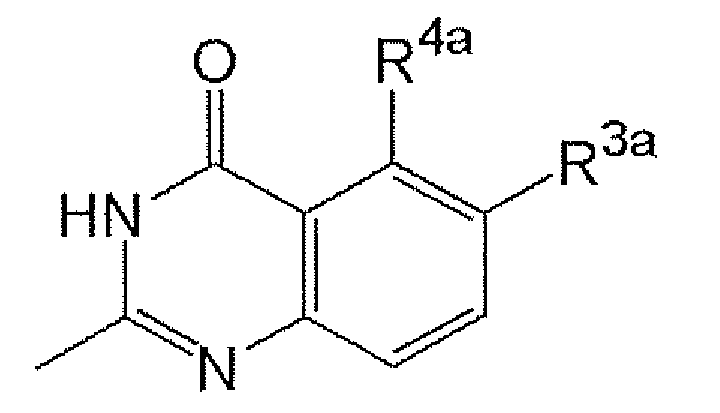
R3a and R4a are each- (i) a hydrogen atom,
- (ii) a halogen atom,
- (iii) a cyano group,
- (iv) an amino group optionally having substituent(s),
- (v) an alkyl group optionally having substituent(s), or
- (vi) an alkoxy group optionally having substituent(s), a group represented by the formula

R5a and R6a are each- (i) a hydrogen atom,
- (ii) an alkyl group optionally having substituent(s),
- (iii) a cyano group,
- (iv) a halogen atom,
- (v) an aryl group optionally having substituent(s), or
- (vi) a 5- to 8-membered aromatic heterocyclic group containing, besides carbon atoms, 1 to 4 heteroatoms selected from a nitrogen atom, a sulfur atom and an oxygen atom, or
a group represented by the formula
R8a is- (i) an alkyl group optionally having substituent(s), or
- (ii) an aryl group optionally having substituent(s), or a salt thereof,
- [5] a compound which is selected from the group consisting of the following, or a salt thereof:
- 4-oxo-5-phenyl-N-{3-[2-(1H-1,2,4-triazol-3-yloxy)ethoxy]benzyl}-3,4-dihydrothieno[2,3-d]pyrimidine-2-carboxamide,
- 5-(2-fluorophenyl)-4-oxo-N-{3-[2-(1H-1,2,4-triazol-3-yloxy)ethoxy]benzyl}-3,4-dihydrothieno[2,3-d]pyrimidine-2-carboxamide,
- 5-(2-chlorophenyl)-4-oxo-N-{3-[2-(1H-1,2,4-triazol-3-yloxy)ethoxy]benzyl}-3,4-dihydrothieno[2,3-d]pyrimidine-2-carboxamide,
- 5-(3-fluorophenyl)-4-oxo-N-{3-[2-(1H-1,2,4-triazol-3-yloxy)ethoxy]benzyl}-3,4-dihydrothieno[2,3-d]pyrimidine-2-carboxamide,
- 5-(3-methylphenyl)-4-oxo-N-{3-[2-(1H-1,2,4-triazol-3-yloxy)ethoxy]benzyl}-3,4-dihydrothieno[2,3-d]pyrimidine-2-carboxamide,
- 5-(3-fluorophenyl)-4-oxo-N-[(3-{[3-(1H-1,2,4-triazol-3-yloxy)propyl]oxy}phenyl)methyl]-3,4-dihydrothieno[2,3-d]pyrimidine-2-carboxamide, and
- 5-(2-fluorophenyl)-4-oxo-N-[(3-{[3-(1H-1,2,4-triazol-3-yloxy)propyl]oxy}phenyl)methyl]-3,4-dihydrothieno[2,3-d]pyrimidine-2-carboxamide,
- [6] a prodrug of a compound represented by the formula

A is a zinc-binding group;
X is CZ wherein Z is a hydrogen atom or a halogen atom, or N;
Y is a spacer having 2 to 10 atoms and optionally having substituent(s); and
a group represented by the formula

R1, R2, R3 and R4 are each- (i) a hydrogen atom,
- (ii) a halogen atom,
- (iii) a cyano group,
- (iv) a hydroxy group,
- (v) a nitro group,
- (vi) a carboxyl group,
- (vii) an alkoxycarbonyl group optionally having substituent (s),
- (viii) an amino group optionally having substituent (s),
- (ix) an alkyl group optionally having substituent(s),
- (x) an alkenyl group optionally having substituent(s),
- (xi) an alkynyl group optionally having substituent(s),
- (xii) an aryl group optionally having substituent(s),
- (xiii) an alkoxy group optionally having substituent(s),
- (xiv) an aralkyloxy group optionally having substituent (s),
- (xv) an aryloxy group optionally having substituent(s),
- (xvi) a thiol group,
- (xvii) an alkylthio group optionally having substituent(s),
- (xviii) an aralkylthio group optionally having substituent(s),
- (xix) a 5- to 8-membered aromatic heterocyclyl-thio group containing, besides carbon atoms, 1 to 4 heteroatoms selected from a nitrogen atom, an oxygen atom and a sulfur atom,
- (xx) a mono- or di-alkylcarbamoyl-thio group,
- (xxi) an alkylsulfonyl group optionally having substituent(s),
- (xxii) an arylsulfonyl group optionally having substituent(s),
- (xxiii) an aralkylsulfonyl group optionally having substituent(s),
- (xxiv) a carbamoyl group optionally having substituent(s),
- (xxv) a mono- or di-alkylamino-thiocarbonyloxy group,
- (xxvi) a 5- to 8-membered non-aromatic heterocyclic group containing, besides carbon atoms, 1 to 4 heteroatoms selected from a nitrogen atom, a sulfur atom and an oxygen atom, or
- (xxvii) a 5- to 8-membered aromatic heterocyclic group containing, besides carbon atoms, 1 to 4 heteroatoms selected from a nitrogen atom, a sulfur atom and an oxygen atom,

R5 and R6 are each- (i) a hydrogen atom,
- (ii) a halogen atom,
- (iii) a cyano group,
- (iv) a hydroxy group,
- (v) a nitro group,
- (vi) a carboxyl group,
- (vii) an alkoxycarbonyl group optionally having substituent(s),
- (viii) an amino group optionally having substituent(s),
- (ix) an alkyl group optionally having substituent(s),
- (x) an alkenyl group optionally having substituent(s),
- (xi) an alkynyl group optionally having substituent(s),
- (xii) an aryl group optionally having substituent(s),
- (xiii) an alkoxy group optionally having substituent(s),
- (xiv) an aralkyloxy group optionally having substituent(s),
- (xv) an aryloxy group optionally having substituent(s),
- (xvi) a thiol group,
- (xvii) an alkylthio group optionally having substituent(s),
- (xviii) an aralkylthio group optionally having substituent(s),
- (xix) a 5- to 8-membered aromatic heterocyclyl-thio group containing, besides carbon atoms, 1 to 4 heteroatoms selected from a nitrogen atom, an oxygen atom and a sulfur atom,
- (xx) a mono- or di-alkylcarbamoyl-thio group,
- (xxi) an alkylsulfonyl group optionally having substituent(s),
- (xxii) an arylsulfonyl group optionally having substituent(s),
- (xxiii) an aralkylsulfonyl group optionally having substituent (s),
- (xxiv) a carbamoyl group optionally having substituent(s),
- (xxv) a mono- or di-alkylamino-thiocarbonyloxy group,
- (xxvi) a 5- to 8-membered non-aromatic heterocyclic group containing, besides carbon atoms, 1 to 4 heteroatoms selected from a nitrogen atom, a sulfur atom and an oxygen atom, or
- (xxvii) a 5- to 8-membered aromatic heterocyclic group containing, besides carbon atoms, 1 to 4 heteroatoms selected from a nitrogen atom, a sulfur atom and an oxygen atom, or
a group represented by the formula
R7 and R8 are each- (i) a hydrogen atom,
- (ii) a halogen atom,
- (iii) a cyano group,
- (iv) a hydroxy group,
- (v) a nitro group,
- (vi) a carboxyl group,
- (vii) an alkoxycarbonyl group optionally having substituent(s),
- (viii) an amino group optionally having substituent(s),
- (ix) an alkyl group optionally having substituent(s),
- (x) an alkenyl group optionally having substituent(s),
- (xi) an alkynyl group optionally having substituent(s),
- (xii) an aryl group optionally having substituent(s),
- (xiii) an alkoxy group optionally having substituent(s),
- (xiv) an aralkyloxy group optionally having substituent (s),
- (xv) an aryloxy group optionally having substituent(s),
- (xvi) a thiol group,
- (xvii) an alkylthio group optionally having substituent(s),
- (xviii) an aralkylthio group optionally having substituent(s),
- (xix) a 5- to 8-membered aromatic heterocyclyl-thio group containing, besides carbon atoms, 1 to 4 heteroatoms selected from a nitrogen atom, an oxygen atom and a sulfur atom,
- (xx) a mono- or di-alkylcarbamoyl-thio group,
- (xxi) an alkylsulfonyl group optionally having substituent(s),
- (xxii) an arylsulfonyl group optionally having substituent(s),
- (xxiii) an aralkylsulfonyl group optionally having substituent(s),
- (xxiv) a carbamoyl group optionally having substituent(s),
- (xxv) a mono- or di-alkylamino-thiocarbonyloxy group,
- (xxvi) a 5- to 8-membered non-aromatic heterocyclic group containing, besides carbon atoms, 1 to 4 heteroatoms selected from a nitrogen atom, a sulfur atom and an oxygen atom, or
- (xxvii) a 5- to 8-membered aromatic heterocyclic group containing, besides carbon atoms, 1 to 4 heteroatoms selected from a nitrogen atom, a sulfur atom and an oxygen atom,
provided that
{[3-({[(4-oxo-3,4-dihydroquinazolin-2-yl)carbonyl]amino}methyl)phenyl]oxy}acetic acid,
5-{[3-({[(4-oxo-3,4-dihydroquinazolin-2-yl)carbonyl]amino}methyl)phenyl]oxy}pentanoic acid,
5-({3-[({[6-(methyloxy)-4-oxy-dihydroquinazolin-2-yl]carbonyl}amino)methyl]phenyl}oxy)pentanoic acid,
4-{[3-({[(4-oxo-3,4-dihydroquinazolin-2-yl)carbonyl]amino}methyl)phenyl]oxy}butanoic acid,
N-[(2-{[(5-methylisoxazol-3-yl)methyl]oxy}pyridin-4-yl)methyl]-4-oxo-3,4-dihydroquinazoline-2-carboxamide, and
N-[(2-{[(3,5-dimethylisoxazol-4-yl)methyl]oxy}pyridin-4-yl)methyl]-4-oxo-3,4-dihydroquinazoline-2-carboxamide are excluded, or a salt thereof,
- [7] a pharmaceutical agent comprising a compound represented by the formula

A is a zinc-binding group;
X is CZ wherein Z is a hydrogen atom or a halogen atom, or N;
Y is a spacer having 2 to 10 atoms and optionally having substituent(s); and
a group represented by the formula

R1, R2, R3 and R4 are each- (i) a hydrogen atom,
- (ii) a halogen atom,
- (iii) a cyano group,
- (iv) a hydroxy group,
- (v) a nitro group,
- (vi) a carboxyl group,
- (vii) an alkoxycarbonyl group optionally having substituent (s),
- (viii) an amino group optionally having substituent(s),
- (ix) an alkyl group optionally having substituent(s),
- (x) an alkenyl group optionally having substituent(s),
- (xi) an alkynyl group optionally having substituent(s),
- (xii) an aryl group optionally having substituent(s),
- (xiii) an alkoxy group optionally having substituent(s),
- (xiv) an aralkyloxy group optionally having substituent(s),
- (xv) an aryloxy group optionally having substituent(s),
- (xvi) a thiol group,
- (xvii) an alkylthio group optionally having substituent(s),
- (xviii) an aralkylthio group optionally having substituent(s),
- (xix) a 5- to 8-membered aromatic heterocyclyl-thio group containing, besides carbon atoms, 1 to 4 heteroatoms selected from a nitrogen atom, an oxygen atom and a sulfur atom,
- (xx) a mono- or di-alkylcarbamoyl-thio group,
- (xxi) an alkylsulfonyl group optionally having substituent(s),
- (xxii) an arylsulfonyl group optionally having substituent(s),
- (xxiii) an aralkylsulfonyl group optionally having substituent(s),
- (xxiv) a carbamoyl group optionally having substituent(s),
- (xxv) a mono- or di-alkylamino-thiocarbonyloxy group,
- (xxvi) a 5- to 8-membered non-aromatic heterocyclic group containing, besides carbon atoms, 1 to 4 heteroatoms selected from a nitrogen atom, a sulfur atom and an oxygen atom, or
- (xxvii) a 5- to 8-membered aromatic heterocyclic group containing, besides carbon atoms, 1 to 4 heteroatoms selected from a nitrogen atom, a sulfur atom and an oxygen atom,
a group represented by the formula
R5 and R6are each- (i) a hydrogen atom,
- (ii) a halogen atom,
- (iii) a cyano group,
- (iv) a hydroxy group,
- (v) a nitro group,
- (vi) a carboxyl group,
- (vii) an alkoxycarbonyl group optionally having substituent(s),
- (viii) an amino group optionally having substituent(s),
- (ix) an alkyl group optionally having substituent(s),
- (x) an alkenyl group optionally having substituent(s),
- (xi) an alkynyl group optionally having substituent(s),
- (xii) an aryl group optionally having substituent(s),
- (xiii) an alkoxy group optionally having substituent(s),
- (xiv) an aralkyloxy group optionally having substituent(s),
- (xv) an aryloxy group optionally having substituent(s),
- (xvi) a thiol group,
- (xvii) an alkylthio group optionally having substituent(s),
- (xviii) an aralkylthio group optionally having substituent(s),
- (xix) a 5- to 8-membered aromatic heterocyclyl-thio group containing, besides carbon atoms, 1 to 4 heteroatoms selected from a nitrogen atom, an oxygen atom and a sulfur atom,
- (xx) a mono- or di-alkylcarbamoyl-thio group,
- (xxi) an alkylsulfonyl group optionally having substituent(s),
- (xxii) an arylsulfonyl group optionally having substituent(s),
- (xxiii) an aralkylsulfonyl group optionally having substituent(s),
- (xxiv) a carbamoyl group optionally having substituent(s),
- (xxv) a mono- or di-alkylamino-thiocarbonyloxy group,
- (xxvi) a 5- to 8-membered non-aromatic heterocyclic group containing, besides carbon atoms, 1 to 4 heteroatoms selected from a nitrogen atom, a sulfur atom and an oxygen atom, or
- (xxvii) a 5- to 8-membered aromatic heterocyclic group containing, besides carbon atoms, 1 to 4 heteroatoms selected from a nitrogen atom, a sulfur atom and an oxygen atom, or
a group represented by the formula
R7 and R8 are each- (i) a hydrogen atom,
- (ii) a halogen atom,
- (iii) a cyano group,
- (iv) a hydroxy group,
- (v) a nitro group,
- (vi) a carboxyl group,
- (vii) an alkoxycarbonyl group optionally having substituent(s),
- (viii) an amino group optionally having substituent(s),
- (ix) an alkyl group optionally having substituent(s),
- (x) an alkenyl group optionally having substituent(s),
- (xi) an alkynyl group optionally having substituent(s),
- (xii) an aryl group optionally having substituent(s),
- (xiii) an alkoxy group optionally having substituent(s),
- (xiv) an aralkyloxy group optionally having substituent(s),
- (xv) an aryloxy group optionally having substituent(s),
- (xvi) a thiol group,
- (xvii) an alkylthio group optionally having substituent (s),
- (xviii) an aralkylthio group optionally having substituent (s),
- (xix) a 5- to 8-membered aromatic heterocyclyl-thio group containing, besides carbon atoms, 1 to 4 heteroatoms selected from a nitrogen atom, an oxygen atom and a sulfur atom,
- (xx) a mono- or di-alkylcarbamoyl-thio group,
- (xxi) an alkylsulfonyl group optionally having substituent(s),
- (xxii) an arylsulfonyl group optionally having substituent(s),
- (xxiii) an aralkylsulfonyl group optionally having substituent(s),
- (xxiv) a carbamoyl group optionally having substituent(s),
- (xxv) a mono- or di-alkylamino-thiocarbonyloxy group,
- (xxvi) a 5- to 8-membered non-aromatic heterocyclic group containing, besides carbon atoms, 1 to 4 heteroatoms selected from a nitrogen atom, a sulfur atom and an oxygen atom, or
- (xxvii) a 5- to 8-membered aromatic heterocyclic group containing, besides carbon atoms, 1 to 4 heteroatoms selected from a nitrogen atom, a sulfur atom and an oxygen atom,
provided that
{(3-({[(4-oxo-3,4-dihydroquinazolin-2-yl)carbonyl]amino}methyl)phenyl]oxy}acetic acid,
5-{[3-({[(4-oxo-3,4-dihydroquinazolin-2-yl)carbonyl]amino}methyl)phenyl]oxy}pentanoic acid,
5-({3-[({[6-(methyloxy)-4-oxy-dihydroquinazolin-2-yl]carbonyl}amino)methyl]phenyl}oxy)pentanoic acid,
4-{[3-({[(4-oxo-3,4-dihydroquinazolin-2-yl)carbonyl]amino}methyl)phenyl]oxy}butanoic acid,
N-[(2-{[(5-methylisoxazol-3-yl)methyl]oxy}pyridin-4-yl)methyl]-4-oxo-3,4-dihydroquinazoline-2-carboxamide, and
N-[(2-{[(3,5-dimethylisoxazol-4-yl)methyl]oxy}pyridin-4-yl)methyl]-4-oxo-3,4-dihydroquinazoline-2-carboxamide are excluded,
or a salt thereof, or a prodrug thereof,
- [8] the pharmaceutical agent of [7], which is a matrix metalloproteinase inhibitor,
- [9] the pharmaceutical agent of [8], wherein the matrix metalloproteinase is a matrix metalloproteinase-13 (MMP-13),
- [10] the pharmaceutical agent of [7], which is an agent for the prophylaxis or treatment of osteoarthritis or rheumatoid arthritis,
- [11] a method of inhibiting a matrix metalloproteinase, which comprises administering, to a mammal, an effective amount of a compound represented by the formula

A is a zinc-binding group;
X is CZ wherein Z is a hydrogen atom or a halogen atom, or N;
Y is a spacer having 2 to 10 atoms and optionally having substituent(s); and
a group represented by the formula

R1, R2, R3 and R4 are each- (i) a hydrogen atom,
- (ii) a halogen atom,
- (iii) a cyano group,
- (iv) a hydroxy group,
- (v) a nitro group,
- (vi) a carboxyl group,
- (vii) an alkoxycarbonyl group optionally having substituent(s),
- (viii) an amino group optionally having substituent(s),
- (ix) an alkyl group optionally having substituent(s),
- (x) an alkenyl group optionally having substituent(s),
- (xi) an alkynyl group optionally having substituent(s),
- (xii) an aryl group optionally having substituent(s),
- (xiii) an alkoxy group optionally having substituent(s),
- (xiv) an aralkyloxy group optionally having substituent(s),
- (xv) an aryloxy group optionally having substituent(s),
- (xvi) a thiol group,
- (xvii) an alkylthio group optionally having substituent(s),
- (xviii) an aralkylthio group optionally having substituent(s),
- (xix) a 5- to 8-membered aromatic heterocyclyl-thio group containing, besides carbon atoms, 1 to 4 heteroatoms selected from a nitrogen atom, an oxygen atom and a sulfur atom,
- (xx) a mono- or di-alkylcarbamoyl-thio group,
- (xxi) an alkylsulfonyl group optionally having substituent(s),
- (xxii) an arylsulfonyl group optionally having substituent(s),
- (xxiii) an aralkylsulfonyl group optionally having substituent(s),
- (xxiv) a carbamoyl group optionally having substituent(s),
- (xxv) a mono- or di-alkylamino-thiocarbonyloxy group,
- (xxvi) a 5- to 8-membered non-aromatic heterocyclic group containing, besides carbon atoms, 1 to 4 heteroatoms selected from a nitrogen atom, a sulfur atom and an oxygen atom, or
- (xxvii) a 5- to 8-membered aromatic heterocyclic group containing, besides carbon atoms, 1 to 4 heteroatoms selected from a nitrogen atom, a sulfur atom and an oxygen atom,
a group represented by the formula
R5and R6 are each- (i) a hydrogen atom,
- (ii) a halogen atom,
- (iii) a cyano group,
- (iv) a hydroxy group,
- (v) a nitro group,
- (vi) a carboxyl group,
- (vii) an alkoxycarbonyl group optionally having substituent(s),
- (viii) an amino group optionally having substituent(s),
- (ix) an alkyl group optionally having substituent(s),
- (x) an alkenyl group optionally having substituent(s),
- (xi) an alkynyl group optionally having substituent(s),
- (xii) an aryl group optionally having substituent(s),
- (xiii) an alkoxy group optionally having substituent(s),
- (xiv) an aralkyloxy group optionally having substatuent(s),
- (xv) an aryloxy group optionally having substituent(s),
- (xvi) a thiol group,
- (xvii) an alkylthio group optionally having substituent(s),
- (xviii) an aralkylthio group optionally having substituent(s),
- (xix) a 5- to 8-membered aromatic heterocyclyl-thio group containing, besides carbon atoms, 1 to 4 heteroatoms selected from a nitrogen atom, an oxygen atom and a sulfur atom,
- (xx) a mono- or di-alkylcarbamoyl-thio group,
- (xxi) an alkylsulfonyl group optionally having substituent(s),
- (xxii) an arylsulfonyl group optionally having substituent(s),
- (xxiii) an aralkylsulfonyl group optionally having substituent(s),
- (xxiv) a carbamoyl group optionally having substituent(s),
- (xxv) a mono- or di-alkylamino-thiocarbonyloxy group,
- (xxvi) a 5- to 8-membered non-aromatic heterocyclic group containing, besides carbon atoms, 1 to 4 heteroatoms selected from a nitrogen atom, a sulfur atom and an oxygen atom, or
- (xxvii) a 5- to 8-membered aromatic heterocyclic group containing, besides carbon atoms, 1 to 4 heteroatoms selected from a nitrogen atom, a sulfur atom and an oxygen atom, or
a group represented by the formula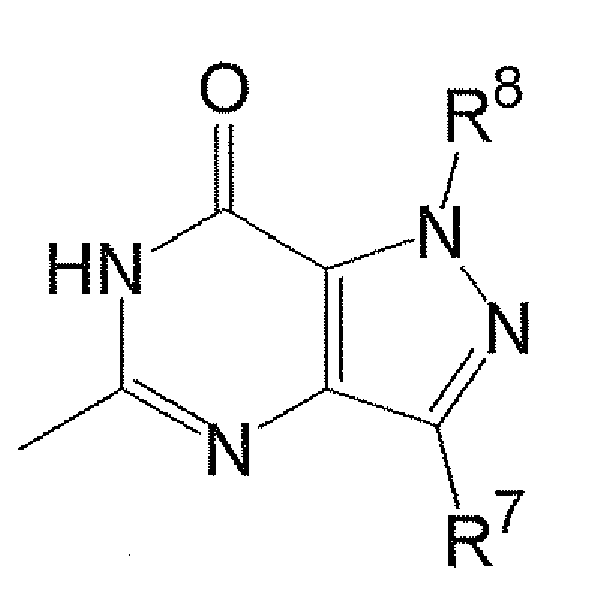
R7and R8 are each- (i) a hydrogen atom,
- (ii) a halogen atom,
- (iii) a cyano group,
- (iv) a hydroxy group,
- (v) a nitro group,
- (vi) a carboxyl group,
- (vii) an alkoxycarbonyl group optionally having substituent(s),
- (viii) an amino group optionally having substituent(s),
- (ix) an alkyl group optionally having substituent(s),
- (x) an alkenyl group optionally having substituent(s),
- (xi) an alkynyl group optionally having substituent(s),
- (xii) an aryl group optionally having substituent(s),
- (xiii) an alkoxy group optionally having substituent(s),
- (xiv) an aralkyloxy group optionally having substituent(s),
- (xv) an aryloxy group optionally having substituent(s),
- (xvi) a thiol group,
- (xvii) an alkylthio group optionally having substituent(s),
- (xviii) an aralkylthio group optionally having substituent(s),
- (xix) a 5- to 8-membered aromatic heterocyclyl-thio group containing, besides carbon atoms, 1 to 4 heteroatoms selected from a nitrogen atom, an oxygen atom and a sulfur atom,
- (xx) a mono- or di-alkylcarbamoyl-thio group,
- (xxi) an alkylsulfonyl group optionally having substituent(s),
- (xxii) an arylsulfonyl group optionally having substituent (s),
- (xxiii) an aralkylsulfonyl group optionally having substituent(s),
- (xxiv) a carbamoyl group optionally having substituent(s),
- (xxv) a mono- or di-alkylamino-thiocarbonyloxy group,
- (xxvi) a 5- to 8-membered non-aromatic heterocyclic group containing, besides carbon atoms, 1 to 4 heteroatoms selected from a nitrogen atom, a sulfur atom and an oxygen atom, or
- (xxvii) a 5- to 8-membered aromatic heterocyclic group containing, besides carbon atoms, 1 to 4 heteroatoms selected from a nitrogen atom, a sulfur atom and an oxygen atom,
provided that
{[3- ({[(4-oxo-3,4-dihydroquinazolin-2-yl)carbonyl]amino}methyl)phenyl]oxy}acetic acid,
5-{[3-({[(4-oxo-3,4-dihydroquinazolin-2-yl)carbonyl]amino}methyl)phenyl]oxy}pentanoic acid,
5-({3-[({[6-(methyloxy)-4-oxy-dihydroquinazolin-2-yl]carbonyl}amino)methyl]phenyl}oxy)pentanoic acid,
4-{[3-({[(4-oxo-3,4-dihydroquinazolin-2-yl)carbonyl]amino}methyl)phenyl]oxy}butanoic acid,
N-[(2-{[(5-methylisoxazol-3-yl)methyl)oxy}pyridin-4-yl)methyl]-4-oxo-3,4-dihydroquinazoline-carboxamide, and
N-[(2-{[(3,5-dimethylisoxazol-4-yl)methyl]oxy}pyridin-4-yl)methyl]-4-oxo-3,4-dihydroquinazoline-2-carboxamide are excluded,
or a salt thereof, or a prodrug thereof,
- [12] use of a compound represented by the formula

A is a zinc-binding group;
X is CZ wherein Z is a hydrogen atom or a halogen atom, or N;
Y is a spacer having 2 to 10 atoms and optionally having substituent(s); and
a group represented by the formula

R1, R2, R3 and R4 are each- (i) a hydrogen atom,
- (ii) a halogen atom,
- (iii) a cyano group,
- (iv) a hydroxy group,
- (v) a nitro group,
- (vi) a carboxyl group,
- (vii) an alkoxycarbonyl group optionally having substituent(s),
- (viii) an amino group optionally having substituent(s),
- (ix) an alkyl group optionally having substituent(s),
- (x) an alkenyl group optionally having substituent(s),
- (xi) an alkynyl group optionally having substituent(s),
- (xii) an aryl group optionally having substituent(s),
- (xiii) an alkoxy group optionally having substituent(s),
- (xiv) an aralkyloxy group optionally having substituent(s),
- (xv) an aryloxy group optionally having substituent(s),
- (xvi) a thiol group,
- (xvii) an alkylthio group optionally having substituent(s),
- (xviii) an aralkylthio group optionally having substituent(s),
- (xix) a 5- to 8-membered aromatic heterocyclyl-thio group containing, besides carbon atoms, 1 to 4 heteroatoms selected from a nitrogen atom, an oxygen atom and a sulfur atom,
- (xx) a mono- or di-alkylcarbamoyl-thio group,
- (xxi) an alkylsulfonyl group optionally having substituent(s),
- (xxii) an arylsulfonyl group optionally having substituent(s),
- (xxiii) an aralkylsulfonyl group optionally having substituent(s),
- (xxiv) a carbamoyl group optionally having substituent(s),
- (xxv) a mono- or di-alkylamino-thiocarbonyloxy group,
- (xxvi) a 5- to 8-membered non-aromatic heterocyclic group containing, besides carbon atoms, 1 to 4 heteroatoms selected from a nitrogen atom, a sulfur atom and an oxygen atom, or
- (xxvii) a 5- to 8-membered aromatic heterocyclic group containing, besides carbon atoms, 1 to 4 heteroatoms selected from a nitrogen atom, a sulfur atom and an oxygen atom,
a group represented by the formula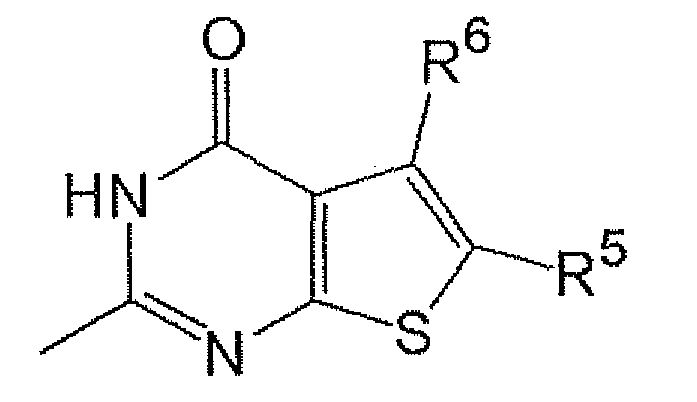
R5 and R6 are each- (i) a hydrogen atom,
- (ii) a halogen atom,
- (iii) a cyano group,
- (iv) a hydroxy group,
- (v) a nitro group,
- (vi) a carboxyl group,
- (vii) an alkoxycarbonyl group optionally having substituent(s),
- (viii) an amino group optionally having substituent(s),
- (ix) an alkyl group optionally having substituent(s),
- (x) an alkenyl group optionally having substituent(s),
- (xi) an alkynyl group optionally having substituent(s),
- (xii) an aryl group optionally having substituent(s),
- (xiii) an alkoxy group optionally having substituent(s),
- (xiv) an aralkyloxy group optionally having substituent(s),
- (xv) an aryloxy group optionally having substituent(s),
- (xvi) a thiol group,
- (xvii) an alkylthio group optionally having substituent(s),
- (xviii) an aralkylthio group optionally having substituent(s),
- (xix) a 5- to 8-membered aromatic heterocyclyl-thio group containing, besides carbon atoms, 1 to 4 heteroatoms selected from a nitrogen atom, an oxygen atom and a sulfur atom,
- (xx) a mono- or di-alkylcarbamoyl-thio group,
- (xxi) an alkylsulfonyl group optionally having substituent(s),
- (xxii) an arylsulfonyl group optionally having substituent(s),
- (xxiii) an aralkylsulfonyl group optionally having substituent(s),
- (xxiv) a carbamoyl group optionally having substituent(s),
- (xxv) a mono- or di-alkylamino-thiocarbonyloxy group,
- (xxvi) a 5- to 8-membered non-aromatic heterocyclic group containing, besides carbon atoms, 1 to 4 heteroatoms selected from a nitrogen atom, a sulfur atom and an oxygen atom, or
- (xxvii) a 5- to 8-membered aromatic heterocyclic group containing, besides carbon atoms, 1 to 4 heteroatoms selected from a nitrogen atom, a sulfur atom and an oxygen atom, or
a group represented by the formula
R7 and R8 are each- (i) a hydrogen atom,
- (ii) a halogen atom,
- (iii) a cyano group,
- (iv) a hydroxy group,
- (v) a nitro group,
- (vi) a carboxyl group,
- (vii) an alkoxycarbonyl group optionally having substituent (s),
- (viii) an amino group optionally having substituent(s),
- (ix) an alkyl group optionally having substituent(s),
- (x) an alkenyl group optionally having substituent(s),
- (xi) an alkynyl group optionally having substituent(s),
- (xii) an aryl group optionally having substituent(s),
- (xiii) an alkoxy group optionally having substituent(s),
- (xiv) an aralkyloxy group optionally having substituent(s),
- (xv) an aryloxy group optionally having substituent(s),
- (xvi) a thiol group,
- (xvii) an alkylthio group optionally having substituent(s),
- (xviii) an aralkylthio group optionally having substituent(s),
- (xix) a 5- to 8-membered aromatic heterocyclyl-thio group containing, besides carbon atoms, 1 to 4 heteroatoms selected from a nitrogen atom, an oxygen atom and a sulfur atom,
- (xx) a mono- or di-alkylcarbamoyl-thio group,
- (xxi) an alkylsulfonyl group optionally having substituent(s),
- (xxii) an arylsulfonyl group optionally having substituent(s),
- (xxiii) an aralkylsulfonyl group optionally having substituent(s),
- (xxiv) a carbamoyl group optionally having substituent(s),
- (xxv) a mono- or di-alkylamino-thiocarbonyloxy group,
- (xxvi) a 5- to 8-membered non-aromatic heterocyclic group containing, besides carbon atoms, 1 to 4 heteroatoms selected from a nitrogen atom, a sulfur atom and an oxygen atom, or
- (xxvii) a 5- to 8-membered aromatic heterocyclic group containing, besides carbon atoms, 1 to 4 heteroatoms selected from a nitrogen atom, a sulfur atom and an oxygen atom,
provided that
{[3-({[(4-oxo-3,4-dihydroquinazolin-2-yl)carbonyl]amino}methyl)phenyl]oxy}acetic acid,
5-{[3-({[(4-oxo-3,4-dihydroquinazolin-2-yl)carbonyl]amino}methyl)phenyl]oxy}pentanoic acid,
5-({3-[({[6-(methyloxy)-4-oxy-dihydroquinazolin-2-yl]carbonyl}amino)methyl]phenyl}oxy)pentanoic acid,
4-{[3-({[(4-oxo-3,4-dihydroquinazolin-2-yl)carbonyl]amino}methyl)phenyl]oxy}butanoic acid,
N-[(2-{[(5-methylisoxazol-3-yl)methyl]oxy}pyridin-4-yl)methyl]-4-oxo-3,4-dihydroquinazoline-2-carboxamide, and
N-[(2-{[(3,5-dimethylisoxazol-4-yl)methyl]oxy}pyridin-4-yl)methyl]-4-oxo-3,4-dihydroquinazoline-2-carboxamide are excluded,
or a salt thereof, or a prodrug thereof, for the production of a matrix metalloproteinase inhibitor, and the like.
Moreover, the present invention also relates to - [13] the compound of [1], wherein A is a triazolyl group or a group represented by the formula -C(D)NHOH;
X is CH or N;
Y is - (CH2) 3O-, -S (CH2) 2O-, -S (CH2) 3O-, -S(CH2)4O-, -O (CH2) 2O-, -O (CH2) 3O-, -CH2OCH2-, -(CH2)2-C(O)-NH-, -C (O) -NH-CH2-, -NH-C(O)-(CH2)3-O-, -CH2-C(O)-NH-CH2-, -C (O) -NH-,


a group represented by the formula

R3b is (i) a hydrogen atom, (ii) a halogen atom, (iii) a cyano group, (iv) an amino group, (v) a C1-6 alkyl group, or (vi) a C1-6 alkoxy group; and
R4b is (i) a hydrogen atom, (it) a halogen atom, (iii) a C1-6 alkyl group optionally having a C7-16 aralkyloxy group optionally having substituent(s) selected from (a) a C1-6 alkoxy-carbonyl group and (b) a carboxyl group, (iv) a C7-16 aralkylamino group optionally having a triazolyloxy-C1-6 alkoxy group, or (v) a C1-6 alkoxy group optionally having a C6-14 aryl group optionally having substituent(s) selected from (a) a C1-6 alkoxy-carbonyl group and (b) a carboxyl group,
a group represented by the formula
R5b - is (i) a hydrogen atom, or (ii) a C1-6 alkyl group;
and
R6b is- (i) a hydrogen atom,
- (ii) a cyano group,
- (iii) a halogen atom,
- (iv) a C6-14 aryl group optionally having substituent(s) selected from a cyano group, a halogen atom, a C1-6 alkyl group, a C1-6 alkoxy group, a carboxyl group, a C1-6 alkoxycarbonyl group and a C6-14 aryl group,
- (v) a C1-6 alkyl group optionally having substituent(s) selected from (a) a C7-14 aralkyloxy group optionally having a C1-6 alkoxycarbonyl group or a carboxyl group and (b) a cyano group, or
- (vi) a 5-membered aromatic heterocyclic group containing, besides carbon atoms, 1 to 4 heteroatoms selected from a nitrogen atom, a sulfur atom and an oxygen atom, or
a group represented by the formula
R8b is a C1-6 alkyl group optionally having a C6-14 aryloxy group optionally having substituent(s) selected from (a) a C1-6 alkoxy-carbonyl group and (b) a carboxyl group,
or a salt thereof, and - [14] the compound of [1], wherein
A is a triazolyl group;
X is CH or N;
Y is -(CH2) 3O-, -S(CH2)2O-, -S(CH2)3O- or -O(CH2)2O-, - O (CH2)3O-,


- (i) a hydrogen atom,
- (ii) a C6-14 aryl group optionally having substituent(s) selected from a cyano group, a halogen atom, a C1-6 alkyl group, a C1-6 alkoxy group, a carboxyl group, a C1-6 alkoxycarbonyl group and a C6-14 aryl group,
- (iii) a C1-6 alkyl group optionally having substituent(s) selected from (a) a C7-14 aralkyloxy group optionally having a C1-6 alkoxycarbonyl group or a carboxyl group and (b) a cyano group, or
- (iv) a 5-membered aromatic heterocyclic group containing, besides carbon atoms, 1 to 4 heteroatoms selected from a nitrogen atom, a sulfur atom and an oxygen atom, or
a group represented by the formula
- Furthermore, while compound (I) and a salt thereof produce tautomers, any tautomer is encompassed in the present invention, and compound (I) and a salt thereof may be any of solvates, hydrates, non-solvates and non-hydrates.
- The present invention is described in detail in the following.
- (1) A
A is a zinc-binding group. The "zinc-binding group" means a functional group capable of bonding to a zinc (II) ion in the active site of MMP. As the "zinc-binding group", for example, groups shown below and tautomers thereof and the like can be mentioned.



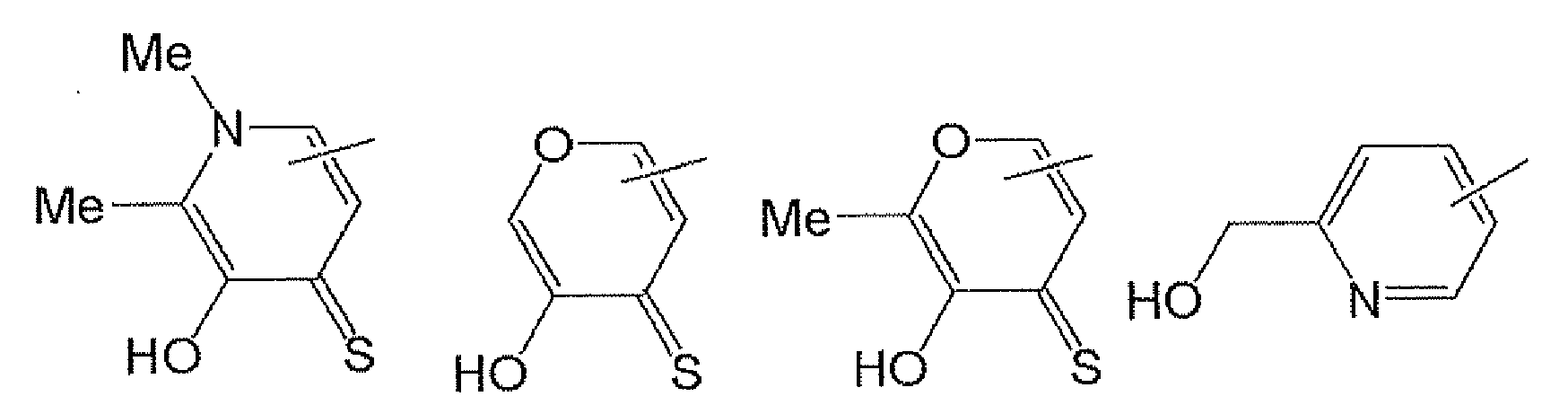


- (i) a halogen atom (e.g., a fluorine atom, chlorine atom, a bromine atom, an iodine atom),
- (ii) a cyano group,
- (iii) a hydroxy group,
- (iv) a nitro group,
- (v) a formyl group,
- (vi) an amino group,
- (vii) a mono- or di-C1-6 alkylamino group (e.g., methylamino, ethylamino, propylamino, dimethylamino, diethylamino, dipropylamino etc.),
- (viii) a C1-6 alkyl-carbonylamino group (e.g., methylcarbonylamino, ethylcarbonylamino, propylcarbonylamino etc.),
- (ix) a C1-6 alkoxy-carbonylamino group (e.g., methoxycarbonylamino, ethoxycarbonylamino, propoxycarbonylamino etc.),
- (x) a C1-6 alkyl group (e.g., methyl, ethyl, propyl, isopropyl, butyl, isobutyl, sec-butyl, tert-butyl, pentyl, hexyl etc.),
- (xi) a C3-8 cycloalkyl group (e.g., cyclopropyl, cyclobutyl, cyclopentyl, cyclohexyl etc.),
- (xii) a C6-14 aryl group (e.g., phenyl, 1-naphthyl, 2-naphthyl etc.),
- (xiii) a C1-6 alkoxy group (e.g., methoxy, ethoxy, propoxy, isopropoxy, butoxy, isobutoxy, sec-butoxy, tert-butoxy etc.),
- (xiv) a carboxyl group,
- (xv) a C1-6 alkoxy-carbonyl group (e.g., methoxycarbonyl, ethoxycarbonyl, propoxycarbonyl etc.),
- (xvi) a C7-16 aralkyloxy-carbonyl group (e.g., benzyloxycarbonyl etc.),
- (xvii) a C6-14 aryloxy-carbonyl group (e.g., phenyloxycarbonyl etc.),
- (xviii) a C3-8 cycloalkyl-carbonyl group (e.g., cyclopropylcarbonyl, cyclobutylcarbonyl, cyclopentylcarbonyl, cyclohexylcarbonyl etc.),
- (xix) a C7-16 aralkyl-carbonyl group (e.g., benzylcarbonyl etc.),
- (xx) a carbamoyl group,
- (xxi) a thiocarbamoyl group,
- (xxii) a mono- or di-C1-6 alkyl-carbamoyl group (e.g., methylcarbamoyl, ethylcarbamoyl, propylcarbamoyl, dimethylcarbamoyl, diethylcarbamoyl, dipropylcarbamoyl etc.),
- (xxiii) a mono- or di-C7-16 aralkyl-carbamoyl group (e.g., benzylcarbamoyl, dibenzylcarbamoyl etc.),
- (xxiv) a thiol group,
- (xxv) a C1-6 alkylthio group (e.g., methylthio, ethylthio, propylthio etc.),
- (xxvi) a C7-16 aralkylthio group (e.g., benzylthio etc.),
- (xxvii) a C1-6 alkylsulfonyl group (e.g., methylsulfonyl, ethylsulfonyl, propylsulfonyl etc.),
- (xxviii) a C3-8 cycloalkylsulfonyl group (e.g., cyclopropylsulfonyl, cyclobutylsulfonyl, cyclopentylsulfonyl etc.),
- (xxix) a C6-14 arylsulfonyl group (e.g., phenylsulfonyl, 1-naphthylsulfonyl, 2-naphthylsulfonyl etc.),
- (xxx) a C7-15 aralkylsulfonyl group (e.g., benzylsulfonyl etc.),
- (xxxi) a 5- to 8-membered non-aromatic heterocyclic group containing, besides carbon atoms, 1 to 4 heteroatoms selected from a nitrogen atom, a sulfur atom and an oxygen atom (e.g., pyrrolidinyl, tetrahydrofuryl, tetrahydrothienyl, piperidyl, tetrahydropyranyl, morpholinyl, thiomorpholinyl, piperazinyl etc.),
- (xxxii) a 5- to 8-membered aromatic heterocyclic group containing, besides carbon atoms, 1 to 4 heteroatoms selected from a nitrogen atom, a sulfur atom and an oxygen atom (e.g., furyl, thienyl, pyrrolyl, oxazolyl, isoxazolyl, thiazolyl, isothiazolyl, imidazolyl, pyrazolyl, 1,2,3-oxadiazolyl, 1,2,4-oxadiazolyl, 1,3,4-oxadiazolyl, furazanyl, 1,2,3-thiadiazolyl, 1,2,4-thiadiazolyl, 1,3,4-thiadiazolyl, 1,2,3-triazolyl, 1,2,4-triazolyl, tetrazolyl, pyridyl, pyridazinyl, pyrimidinyl, pyrazinyl, triazinyl etc.),
- (xxxiii) an ureido group,
- (xxxiv) a C1-6 alkylureido group (e.g., methylureido, ethylureido, propylureido etc.)
- (xxxv) a C6-14 arylureido group (e.g., phenylureido, 1-naphthylureido, 2-naphthylureido etc.) and
- (xxxvi) a C1-6 alkoxy-C1-6 alkyl group (e.g., methoxymethyl, ethoxymethyl, propoxymethyl, methoxyethyl, ethoxyethyl, propoxyethyl, methoxypropyl, ethoxypropyl, propoxypropyl etc.),
- (xxxvii) a mono-, di- or tri-halogenated C1-6 alkyl group (e.g., fluoromethyl, difluoromethyl, trifluoromethyl etc.) and the like can be mentioned. Any number of these substituents may be used at any substitutable position(s).
A is preferably a pyrrolyl group optionally having substituent(s), an imidazolyl group optionally having substituent(s), a pyrazolyl group optionally having substituent(s), a triazolyl group optionally having substituent(s), a tetrazolyl group optionally having substituent(s), an unsubstituted tetrazolyl group, a thiadiazolyl group optionally having an amino group, a trioxohexahydropyrimidinyl group optionally having a C1-6 alkoxy-C1-6 alkyl group, a carboxyl group, a group represented by the formula -N(OH)C(O)H, a group represented by the formula -N(OH)C(O)CH3, a group represented by the formula -N(OH)C(O)NH2, a group represented by the formula - C(O)NHOH, or a group represented by the following structure:

- (2) X
X is CZ wherein Z is a hydrogen atom or a halogen atom, or N. As the halogen atom for Z, a fluorine atom, chlorine atom, a bromine atom and an iodine atom can be mentioned.
X is preferably CF, CH or N, more preferably CH or N. - (3) Y
Y is a spacer having 2 to 10 atoms and optionally having substituent(s). As the "spacer having 2 to 10 atoms",
-(CH2)n1- (n1 is an integer of 2 to 10),
-(CH2)n2-NH-(CH2)n3- (wherein n2 and n3 are each an integer of 0 to 9, and the sum of n2 and n3 is an integer of 1 to 9),
- (CH2) n4-O- (CH2) n5- (wherein n4 and n5 are each an integer of 0 to 9, and the sum of n4 and n5 is an integer of 1 to 9),
-(CH2)n6-S(O)ml-(CH2)n7- (wherein n6 and n7 are each an integer of 0 to 9, the sum of n6 and n7 is an integer of 1 to 9, and ml is 0 or 2),
-(CH2)n8-NHC(O)-(CH2)n9- (wherein n8 and n9 are each an integer of 0 to 8, and the sum of n8 and n9 is an integer of 0 to 8),
-(CH2)n10-C(O)NH-(CH2)n11 (wherein n10 and n11 are each an integer of 0 to 8, and the sum of n10 and n11 is an integer of 0 to 8),
-(CH2)n12-NHS(O)2-(CH2)n13- (wherein n12 and n13 are each an integer of 0 to 8, and the sum of n12 and n13 is an integer of 0 to 8),
- (CH2)n14-S (O) 2NH- (CH2) n15- (wherein n14 and n15 are each an integer of 0 to 8, and the sum of n14 and n15 is an integer of 0 to 8),
-(CH2)n16-NH-(CH2)n17-NH-(CH2)n18- (wherein n16 and n18 are each an integer of 0 to 7, n17 is an integer of 1 to 8, and the sum of n16, n17 and n18 is an integer of 1 to 8).
-(CH2)n19-NH-(CH2) n20-O- (CH2)n21- (where in n19 and n21 are each an integer of 0 to 7, n20 is an integer of 1 to 8, and the sum of n19, n20 and n21 is an integer of 1 to 8),
-(CH2)n22-NH-(CH2)n23-S(O)m2-(CH2)n24- (wherein n22 and n24 are each an integer of 0 to 7, n23 is an integer of 1 to 8, the sum of n22, n23 and n24 is an integer of 1 to 8, and m2 is 0 or 2).
- (CH2)n25-O- (CH2) n26NH- (CH2) n27- (wherein n25 and n27 are each an integer of 0 to 7, n26 is an integer of 1 to 8, and the sum of n25, n26 and n27 is an integer of 1 to 8),
-(CH2)n28-O-(CH2)n29-O-(CH2)n30- (wherein n28 and n30 are each an integer of 0 to 7, n29 is an integer of 1 to 8, and the sum of n28, n29 and n30 is an integer of 1 to 8),
- (CH2) n51-O- (CH2) n32-S- (O) m3- (CH2) n33- (wherein n31 and n33 are each an integer of 0 to 7, n32 is an integer of 1 to 8, the sum of n31, n32 and n33 is an integer of 1 to 8, and m3 is 0 or 2).
- (CH2) n34-S (O) m4 (CH2)n35-NH-(CH2)n36- (wherein n34 and n36 are each an integer of 0 to 7, n35 is an integer of 1 to 8, the sum of n34, n35 and n36 is an integer of 1 to 8, and m4 is 0 or 2),
-(CH2)n37-S(O)m5-(CH2)n38-O-(CH2)n39- (wherein n37 and n39 are each an integer of 0 to 7, n38 is an integer of 1 to 8, the sum of n37, n38 and n39 is an integer of 1 to 8, and m5 is 0 or 2),
-(CH2)n40-S(O)m6-(CH2)n41-S(O)m7-(CH2)n42- (wherein n40 and n42 are each an integer of 0 to 7, n41 is an integer of 1 to 8, the sum of n40, n41 and n42 is an integer of 1 to 8, and m6 and m7 are each 0 or 2),
-(CH2)n43-NH-(CH2)n44-NHC(O)-(CH2)n45- (wherein n43 and n45 are each an integer of 0 to 6, n44 is an integer of 1 to 7, and the sum of n43, n44 and n45 is an integer of 1 to 7),
-(CH2)n46-NH-(CH2)n47-C(O)NH-(CH2)n48- (wherein n46 and n48 are each an integer of 0 to 6, n47 is an integer of 1 to 7, and the sum of n46, n47 and n48 is an integer of 1 to 7),
-(CH2)n49)-NH-(CH2)n50-NHS(O)2-(CH2)n51- (wherein n49 and n51 are each an integer of 0 to 6, n50 is an integer of 1 to 7, and the sum of n49, n50 and n51 is an integer of 1 to 7),
-(CH2)n52-NH-(CH2)n53-S(O)2NH-(CH2)n54- (wherein n52 and n54 are each an integer of 0 to 6, n53 is an integer of 1 to 7, and the sum of n52, n53 and n54 is an integer of 1 to 7),
- (CH2) n55-O- (CH2) n56-NHC (O) - (CH2)n57- (wherein n55 and n57 are each an integer of 0 to 6, n56 is an integer of 1 to 7, and the sum of n55, n56 and n57 is an integer of 1 to 7),
-(CH2)n58-O-(CH2)n59-C(O)NH-(CH2)n60- (wherein n58 and n60 are each an integer of 0 to 6, n59 is an integer of 1 to 7, and the sum of n58, n59 and n60 is an integer of 1 to 7),
- (CH2) n61-O- (CH2) n62-NHS (O) 2- (CH2) n63- (wherein n61 and n63 are each an integer of 0 to 6, n62 is an integer of 1 to 7, and the sum of n61, n62 and n63 is an integer of 1 to 7),
-(CH2)n64-O- (CH2)n65 -S(O)2NH- (CH2) n66- (wherein n64 and n66 are each an integer of 0 to 6, n65 is an integer of 1 to 7, and the sum of n64, n65 and n66 is an integer of 1 to 7),
- (CH2) n67-S (O) m8- (CH2) n68-NHC (O)- (CH2) n69- (wherein n67 and n69 are each an integer of 0 to 6, n68 is an integer of 1 to 7, the sum of n67, n68 and n69 is an integer of 1 to 7, and m8 is 0 or 2),
-(CH2)n70-S(O)m9-(CH2)n71-C(O)NH-(CH2)n72- (wherein n70 and n72 are each an integer of 0 to 6, n71 is an integer of 1 to 7, the sum of n70, n71 and n72 is an integer of 1 to 7, and m9 is 0 or 2),
-(CH2)n73-S(O)m10-(CH2)n74-NHS(O)2-(CH2)n75- (wherein n73 and n75 are each an integer of 0 to 6, n74 is an integer of 1 to 7, the sum of n73, n74 and n75 is an integer of 1 to 7, and m10 is 0 or 2) ,
- (CH2)n76-S (O) m11- (CH2) n77-S (O) 2NH- (CH2) n78- (wherein n76 and n78 are each an integer of 0 to 6, n77 is an integer of 1 to 7, the sum of n76, n77 and n78 is an integer of 1 to 7, and m11 is 0 or 2),
-(CH2)n79-NHC(O)-(CH2)n80-NH-(CH2)n81- (wherein n79 and n81 are each an integer of 0 to 6, n80 is an integer of 1 to 7, and the sum of n79, n80 and n81 is an integer of 1 to 7),
- (CH2)n82-C (O) NH- (CH2) n83 -NH- (CH2) n84- (wherein n82 and n84 are each an integer of 0 to 6, n83 is an integer of 1 to 7, and the sum of n82, n83 and n84 is an integer of 1 to 7),
-(CH2)n85-NHS(O)2-(CH2)n86-NH-(CH2)n87- (wherein n85 and n87 are each an integer of 0 to 6, n86 is an integer of 1 to 7, and the sum of n85, n86 and n87 is an integer of 1 to 7),
-(CH2)n88-S(O)2NH-(CH2)n89-NH-(CH2)n90- (wherein n88 and n90 are each an integer of 0 to 6, n89 is an integer of 1 to 7, and the sum of n88, n89 and n90 is an integer of 1 to 7),
-(CH2)n91-NHC(O)-(CH2)n92-O-(CH2)n93- (wherein n91 and n93 are each an integer of 0 to 6, n92 is an integer of 1 to 7, and the sum of n91, n92 and n93 is an integer of 1 to 7),
-(CH2)n94-C(O)NH-(CH2)n95-O-(CH2)n96- (wherein n94 and n96 are each an integer of 0 to 6, n95 is an integer of 1 to 7, and the sum of n94, n95 and n96 is an integer of 1 to 7),
-(CH2)n97-NHS(O)2-(CH2)n98-O-(CH2)n99- (wherein n97 and n99 are each an integer of 0 to 6, n98 is an integer of 1 to 7, and the sum of n97, n98 and n99 is an integer of 1 to 7),
-(CH2)n100-S(O)2NH-(CH2)n101-O-(CH2)n102- (wherein n100 and n102 are each an integer of 0 to 6, n101 is an integer of 1 to 7, and the sum of n100, n101 and n102 is an integer of 1 to 7),
-(CH2)n103-NHC(O)-(CH2)n104-S(O)n12-(CH2)n105- (wherein n103 and n105 are each an integer of 0 to 6, n104 is an integer of 1 to 7, the sum of n103, n104 and n105 is an integer of 1 to 7, and m12 is 0 or 2),
(CH2) n106-C (O) NH- (CH2) n107-S(O) m13- (CH2) n108- (wherein n106 and n108 are each an integer of 0 to 6, n107 is an integer of 1 to 7, the sum of n106, n107 and n108 is an integer of 1 to 7, and m13 is 0 or 2),
- (CH2) n109-NHS (O) 2- (CH2) n110-S (O) m14- (CH2) n111- (wherein n109 and n111 are each an integer of 0 to 6, n110 is an integer of 1 to 7, the sum of n109, n110 and n111 is an integer of 1 to 7, and m14 is 0 or 2),
-(CH2)n112-S(O)2NH-(CH2)n113-S(O)m15-(CH2)n114- (wherein n112 and n114 are each an integer of 0 to 6, n113 is an integer of 1 to 7, the sum of n112, n113 and n114 is an integer of 1 to 7, and m15 is 0 or 2),
- (CH2)n11.5-S(O)2NH- (CH2)n116-NR- (CH2)n117- (wherein n115 and n117 are each an integer of 0 to 6, n116 is an integer of 1 to 7, and the sum of n115, n116 and n117 is an integer of 1 to 7),
and the like can be mentioned.
The "spacer having 2 to 10 atoms" optionally has substituent(s) at substitutable position(s), and as the substituents, (i) a halogen atom, (ii) a cyano group, (iii) a hydroxy group, (iv) an amino group, (v) a mono- or di-C1-6 alkylamino group, (vi) a C7-16 aralkylamino group, (vii) a C1-6 alkyl-carbonylamino group, (viii) a C1-6 alkylsulfonylamino group, (ix) a C1-6 alkyl group optionally substituted by substituent(s) selected from a halogen atom, a C1-6 alkoxy group and a 5- to 8-membered non-aromatic heterocyclic group containing, besides carbon atoms, 1 to 4 heteroatom selected from a nitrogen atom, an oxygen atom and a sulfur atom, and the like, (x) a C7-16 aralkyloxy group, (xi) a C6-14 aryl group, (xii) a C1-6 alkoxy group, (xiii) a thiol group, (xiv) a C1-6 alkylthio group, (xv) a C7-16 aralkylthio group, (xvi) a 5- to 8-membered aromatic heterocyclyl-thio group containing, besides carbon atoms, 1 to 4 heteroatoms selected from a nitrogen atom, an oxygen atom and a sulfur atom, (xvii) a C1-6 alkylsulfonyl group, (xviii) a carbamoyl group, (xix) a mono- or di-C1-6 alkylamino-thiocarbonyloxy group, (xx) a mono- or di-C1-6 alkylcarbamoyl-thio group, (xxi) a nitro group, (xxii) a carboxyl group, (xxiii) a C1-6 alkoxy-carbonyl group, (xxiv) a C1-6 alkyl-carbonyl group and the like can be mentioned.
In addition, when the partial structure of the "spacer having 2 to 10 atoms" contains -CH2-CH2-, the -CH2-CH2- may be replaced by a double bond or a triple bond.
Moreover, the substituents of the "spacer having 2 to 10 atoms" are optionally bonded to each other to form a ring (a C3-7 cycloalkyl ring (cyclopropane, cyclobutane, cyclopentane, cyclohexane, cycloheptane), a C6-14 aryl ring (benzene, naphthalene etc.), a 5- to 8-membered non-aromatic heterocycle containing, besides carbon atoms, 1 to 4 heteroatom selected from a nitrogen atom, an oxygen atom and a sulfur atom (pyrrolidine, tetrahydrofuran, tetrahydrothiophene, piperidine, tetrahydropyran, morpholine, thiomorpholine, piperazine etc.), a 5- to 8-membered aromatic heterocycle containing, besides carbon atoms, 1 to 4 heteroatom selected from a nitrogen atom, an oxygen atom and a sulfur atom (furan, thiophene, pyrrole, oxazole, isoxazole, thiazole, isothiazole, imidazole, pyrazole, 1,2,3-oxadiazole, 1,2,4-oxadiazole, 1,3,4-oxadiazole, furazan, 1,2,3-thiadiazole, 1,2,4-thiadiazole, 1,3,4-thiadiazole, 1,2,3-triazole, 1,2,4-triazole, tetrazole, pyridine, pyridazine, pyrimidine, pyrazine, triazine etc.) etc.). As a preferable spacer wherein the substituents are optionally bonded to each other to form a ring, those shown below can be mentioned.


Y is preferably a spacer having 2 to 7 atoms and optionally having substituent(s), more preferably a spacer having 2 to 6 atoms and optionally having substituent(s).
Y is further more preferably the above-mentioned preferable spacer wherein the substituents are optionally bonded to each other to form a ring, or a spacer shown below.
-(CH2)3O-, -S(CH2)2O-, -S(CH2)3O-, -S(CH2)4O-, -O(CH2)2O-, - O(CH2)3O-, -CH2OCH2-, (CH2)2 -C (O) -NH-, -C(O)-NH-CH2-, -NH-C (O) -(CH2)3-O-, -CH2-C (O) -NH-CH2- or -C (O) -NH-
Y is particularly preferably a spacer shown below. -(CH2)3O-, -S(CH2)2O-, -S(CH2)3O- or -O(CH2)2O- - (4) the group represented by the formula


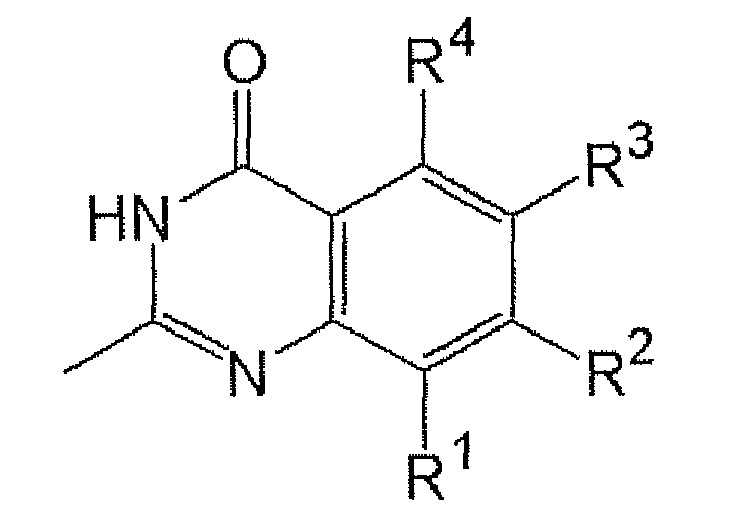
R1, R2, R3 and R4 are each- (i) a hydrogen atom,
- (ii) a halogen atom,
- (iii) a cyano group,
- (iv) a hydroxy group,
- (v) a nitro group,
- (vi) a carboxyl group,
- (vii) an alkoxycarbonyl group optionally having substituent(s),
- (viii) an amino group optionally having substituent(s),
- (ix) an alkyl group optionally having substituent(s),
- (x) an alkenyl group optionally having substituent(s),
- (xi) an alkynyl group optionally having substituent(s),
- (xii) an aryl group optionally having substituent(s),
- (xiii) an alkoxy group optionally having substituent(s),
- (xiv) an aralkyloxy group optionally having substituent(s),
- (xv) an aryloxy group optionally having substituent(s),
- (xvi) a thiol group,
- (xvii) an alkylthio group optionally having substituent(s),
- (xviii) an aralkylthio group optionally having substituent(s),
- (xix) a 5- to 8-membered aromatic heterocyclyl-thio group containing, besides carbon atoms, 1 to 4 heteroatoms selected from a nitrogen atom, an oxygen atom and a sulfur atom,
- (xx) a mono- or di-alkylcarbamoyl-thio group,
- (xxi) an alkylsulfonyl group optionally having substituent(s),
- (xxii) an arylsulfonyl group optionally having substituent(s),
- (xxiii) an aralkylsulfonyl group optionally having substituent(s),
- (xxiv) a carbamoyl group optionally having substituent(s),
- (xxv) a mono- or di-alkylamino-thiocarbonyloxy group,
- (xxvi) a 5- to 8-membered non-aromatic heterocyclic group containing, besides carbon atoms, 1 to 4 heteroatoms selected from a nitrogen atom, a sulfur atom and an oxygen atom, or
- (xxvii) a 5- to 8-membered aromatic heterocyclic group containing, besides carbon atoms, 1 to 4 heteroatoms selected from a nitrogen atom, a sulfur atom and an oxygen atom,
a group represented by the formula
R5 and R6 are each- (i) a hydrogen atom,
- (ii) a halogen atom,
- (iii) a cyano group,
- (iv) a hydroxy group,
- (v) a nitro group,
- (vi) a carboxyl group,
- (vii) an alkoxycarbonyl group optionally having substituent(s),
- (viii) an amino group optionally having substituent(s),
- (ix) an alkyl group optionally having substituent(s),
- (x) an alkenyl group optionally having substituent(s),
- (xi) an alkynyl group optionally having substituent(s),
- (xii) an aryl group optionally having substituent(s),
- (xiii) an alkoxy group optionally having substituent(s),
- (xiv) an aralkyloxy group optionally having substituent(s),
- (xv) an aryloxy group optionally having substituent(s),
- (xvi) a thiol group,
- (xvii) an alkylthio group optionally having substituent(s),
- (xviii) an aralkylthio group optionally having substituent(s),
- (xix) a 5- to 8-membered aromatic heterocyclyl-thio group containing, besides carbon atoms, 1 to 4 heteroatoms selected from a nitrogen atom, an oxygen atom and a sulfur atom,
- (xx) a mono- or di-alkylcarbamoyl-thio group,
- (xxi) an alkylsulfonyl group optionally having substituent(s),
- (xxii) an arylsulfonyl group optionally having substituent(s),
- (xxiii) an aralkylsulfonyl group optionally having substituent(s),
- (xxiv) a carbamoyl group optionally having substituent(s),
- (xxv) a mono- or di-alkylamino-thiocarbonyloxy group,
- (xxvi) a 5- to 8-membered non-aromatic heterocyclic group containing, besides carbon atoms, 1 to 4 heteroatoms selected from a nitrogen atom, a sulfur atom and an oxygen atom, or
- (xxvii) a 5- to 8-membered aromatic heterocyclic group containing, besides carbon atoms, 1 to 4 heteroatoms selected from a nitrogen atom, a sulfur atom and an oxygen atom, or
a group represented by the formula
R7 and R8 are each- (i) a hydrogen atom,
- (ii) a halogen atom,
- (iii) a cyano group,
- (iv) a hydroxy group,
- (v) a nitro group,
- (vi) a carboxyl group,
- (vii) an alkoxycarbonyl group optionally having substituent (s),
- (viii) an amino group optionally having substituent(s),
- (ix) an alkyl group optionally having substituent(s),
- (x) an alkenyl group optionally having substituent(s),
- (xi) an alkynyl group optionally having substituent(s),
- (xii) an aryl group optionally having substituent(s),
- (xiii) an alkoxy group optionally having substituent(s),
- (xiv) an aralkyloxy group optionally having substituent(s),
- (xv) an aryloxy group optionally having substituent(s),
- (xvi) a thiol group,
- (xvii) an alkylthio group optionally having substituent(s),
- (xviii) an aralkylthio group optionally having substituent(s),
- (xix) a 5- to 8-membered aromatic heterocyclyl-thio group containing, besides carbon atoms, 1 to 4 heteroatoms selected from a nitrogen atom, an oxygen atom and a sulfur atom,
- (xx) a mono- or di-alkylcarbamoyl-thio group,
- (xxi) an alkylsulfonyl group optionally having substituent(s),
- (xxii) an arylsulfonyl group optionally having substituent(s),
- (xxiii) an aralkylsulfonyl group optionally having substituent(s),
- (xxiv) a carbamoyl group optionally having substituent(s),
- (xxv) a mono- or di-alkylamino-thiocarbonyloxy group,
- (xxvi) a 5- to 8-membered non-aromatic heterocyclic group containing, besides carbon atoms, 1 to 4 heteroatoms selected from a nitrogen atom, a sulfur atom and an oxygen atom, or
- (xxvii) a 5- to 8-membered aromatic heterocyclic group containing, besides carbon atoms, 1 to 4 heteroatoms selected from a nitrogen atom, a sulfur atom and an oxygen atom.
As the group represented by the formula

R3a and R4a are each- (i) a hydrogen atom,
- (ii) a halogen atom,
- (iii) a cyano group,
- (iv) an amino group optionally having substituent(s),
- (v) an alkyl group optionally having substituent(s), or
- (vi) an alkoxy group optionally having substituent(s), a group represented by the formula

R5a and R6a are each- (i) a hydrogen atom,
- (ii) an alkyl group optionally having substituent(s),
- (iii) a cyano group,
- (iv) a halogen atom,
- (v) an aryl group optionally having substituent(s), or
- (vi) a 5- to 8-membered aromatic heterocyclic group containing, besides carbon atoms, 1 to 4 heteroatoms selected from a nitrogen atom, a sulfur atom and an oxygen atom, and
a group represented by the formula
R8a is- (i) an alkyl group optionally having substituent(s), or
- (ii) an aryl optionally having substituent (s), are preferable. Of these, a group represented by the formula

R3b is (i) a hydrogen atom, (ii) a halogen atom, (iii) a cyano group, (iv) an amino group, (v) a C1-6 alkyl group, or (vi) a C1-6 alkoxy group; and
R4b is (i) a hydrogen atom, (ii) a halogen atom, (iii) a C1-6 alkyl group optionally having a C7-16 aralkyloxy group optionally having substituent(s) selected from (a) a C1-6 alkoxy-carbonyl group and (b) a carboxyl group, - (iv) a C7-16 aralkylamino group optionally having a triazolyloxy-C1-6 alkoxy group, or (v) a C1-6 alkoxy group optionally having a C6-14 aryl group optionally having substituent(s) selected from (a) a C1-6 alkoxy-carbonyl group and (b) a carboxyl group,
a group represented by the formula
R5b is (i) a hydrogen atom, or (ii) a C1-6 alkyl group;
and
R6b is- (i) a hydrogen atom,
- (ii) a cyano group,
- (iii) a halogen atom,
- (iv) a C6-14 aryl group optionally having substituent(s) selected from a cyano group, a halogen atom, a C1-6 alkyl group, a C1-6 alkoxy group, a carboxyl group, a C1-6 alkoxycarbonyl group and a C6-14 aryl group,
- (v) a C1-6 alkyl group optionally having substituent(s) selected from (a) a C7-14 aralkyloxy group optionally having a C1-6 alkoxycarbonyl group or a carboxyl group and (b) a cyano group, or
- (vi) a 5-membered aromatic heterocyclic group containing, besides carbon atoms, 1 to 4 heteroatoms selected from a nitrogen atom, a sulfur atom and an oxygen atom, and
a group represented by the formula
R8b is a C1-6 alkyl group optionally having a C6-14 aryloxy group optionally having substituent(s) selected from (a) a C1-6 alkoxy-carbonyl group and (b) a carboxyl group, are particularly preferable. Especially, a group represented by the formula
R3c is (i) a hydrogen atom, (ii) a halogen atom, (iii) a cyano group, (iv) an amino group, (v) a C1-6 alkyl group, or (vi) a C1-6 alkoxy group; and
R4c is (i) a hydrogen atom, (ii) a halogen atom, (iii) a C7-16 aralkylamino group optionally having a triazolyloxy-C1-6 alkoxy group, or (iv) a C1-6 alkoxy group optionally having a C6-14 aryl group optionally having a carboxyl group,
a group represented by the formula
R5c is (i) a hydrogen atom, or (ii) a C1-6 alkyl group;
and
R6c is- (i) a hydrogen atom,
- (ii) a C6-14 aryl group optionally having substituent(s) selected from a cyano group, a halogen atom, a C1-6 alkyl group, a C1-6 alkoxy group, a carboxyl group, a C1-6 alkoxycarbonyl group and a C6-14 aryl group,
- (iii) a C1-6 alkyl group optionally having substituent(s) selected from (a) a C7-14 aralkyloxy group optionally having a C1-6 alkoxycarbonyl group or a carboxyl group and (b) a cyano group, or
- (iv) a 5-membered aromatic heterocyclic group containing, besides carbon atoms, 1 to 4 heteroatoms selected from a nitrogen atom, a sulfur atom and an oxygen atom, and
a group represented by the formula
R8c is a C1-6 alkyl group optionally having a C6-14 aryloxy group optionally having substituent(s) selected from (a) a C1-6 alkoxy-carbonyl group and (b) a carboxyl group,
are preferable. - As the "halogen atom" for R1, R2, R3, R4, R5, R6, R7, R8, R3a, R4a, R5a, R6a, R3b, R4b, R6b, , R3c R4c or R6c, a fluorine atom, a chlorine atom, a bromine atom and an iodine atom can be mentioned.
- As the "alkoxycarbonyl group optionally having substituent (s)" for R1, R2, R3, R4, R5, R6, R7, R8, R3a or R4a, a C1-6 alkoxy-carbonyl group (e.g., methoxycarbonyl, ethoxycarbonyl, propoxycarbonyl, isopropoxycarbonyl, butoxycarbonyl, isobutoxycarbonyl, tert-butoxycarbonyl etc.) optionally having substituent(s) similar to the substituent(s) of the below-mentioned "alkyl group optionally having substituent (s) " for R1, R2, R3, R4, R5, R6, R7, R8, R3a, R4a, R5a or R6a, can be mentioned.
- As the "amino group optionally having substituent(s)" for R1, R2, R3, R4, R5, R6, R7, R8, R3a or R4a, for example,
- (i) an amino group,
- (ii) a mono- or di-C1-6 alkylamino group (e.g., methylamino, ethylamino, propylamino, dimethylamino, diethylamino, dipropylamino etc.),
- (iii) a C3-7 cycloalkylamino group (e.g., cyclopropylamino, cyclobutylamino, cyclopentylamino, cyclohexylamino, cycloheptylamino etc.),
- (iv) a C6-14 arylamino group (e.g., phenylamino, 1-naphthylamino, 2-naphthylamino etc.),
- (v) a C7-16 aralkyl-amino group (e.g., benzylamino etc.),
- (vi) a C1-6 alkyl-carbonylamino group (e.g., methylcarbonylamino, ethylcarbonylamino, propylcarbonylamino etc.),
- (vii) a C3-7 cycloalkyl-carbonylamino group (e.g., cyclopropylcarbonylamino, cyclobutylcarbonylamino, cyclopentylcarbonylamino, cyclohexylcarbonylamino etc.),
- (viii) a C6-14 aryl-carbonylamino group (e.g., phenylcarbonylamino etc.),
- (ix) a C7-16 aralkyl-carbonylamino group (e.g., benzylcarbonylamino etc.),
- (x) a C1-6 alkyl-sulfonylamino group (e.g., methylsulfonylamino, ethylsulfonylamino etc.)
- (xi) a C3-7 cycloalkyl-sulfonylamino group (e.g., cyclopropylsulfonylamino, cyclobutylsulfonylamino, cyclopentylsulfonylamino, cyclohexylsulfonylamino etc.),
- (xii) a C6-14 aryl-sulfonylamino group (e.g., phenylsulfonylamino etc.),
- (xiii) a C7-16 aralkyl-sulfonylamino group (e.g., benzylsulfonylamino etc.),
- (xiv) a C1-6 alkoxy-carbonylamino group (e.g., methoxycarbonylamino, ethoxycarbonylamino, propoxycarbonylamino etc.),
- (xv) a C3-7 cycloalkyloxy-carbonylamino group (e.g., cyclopropyloxycarbonylamino, cyclobutyloxycarbonylamino, cyclopentyloxycarbonylamino, cyclohexyloxycarbonylamino etc.),
- (xvi) a C6-14 aryloxy-carbonylamino group (e.g., phenyloxycarbonylamino etc.),
- (xvii) a C7-16 aralkyloxy-carbonylamino group (e.g., benzyloxycarbonylamino etc.),
- (xviii) an ureido group,
- (xix) a mono- or di-C1-6 alkyl-ureido group (e.g., methylureido, ethylureido, dimethylureido, diethylureido etc.)
- (xx) a C3-7 cycloalkyl-ureido group (e.g., cyclopropylureido, cyclobutylureido etc.),
- (xxi) a C6-14 aryl-ureido group (e.g., phenylureido etc.),
- (xxii) a C7-16 aralkyl-ureida group (e.g., benzylureido etc.)
and the like can be mentioned. The "C7-16 aralkylamino groups optionally has substituent(s), and as the substituents, a triazolyloxy-C1-6 alkoxy group and the like can be mentioned. - As the "alkyl group optionally having substituent(s)" for R1, R2, R3, R4, R5, R6, R7, R8, R3a, R4a, R5a, R6a or R8a, for example, a C1-6 alkyl group (e.g., methyl, ethyl, propyl, isopropyl, butyl, isobutyl, sec-butyl, tert-butyl, pentyl, hexyl etc.) optionally having substituent(s) selected from
- (1) a halogen atom (e.g., a fluorine atom, a chlorine atom, a bromine atom, an iodine atom),
- (2) a cyano group,
- (3) a hydroxy group,
- (4) a nitro group,
- (5) a formyl group,
- (6) an amino group,
- (7) a mono- or di-C1-6 alkylamino group (e.g., methylamino, ethylamino, propylamino, dimethylamino, diethylamino, dipropylamino etc.),
- (8) a mono- or di-C3-7 cycloalkyl-amino group (e.g., cyclopropylamino, cyclobutylamino, dicyclopropylamino, dicyclobutylamino etc.),
- (9) a mono- or di-C6-14 aryl-amino group (e.g., phenylamino, diphenylamino etc.),
- (10) a mono- or di-C7-16 aralkyl-amino group (e.g., benzylamino, dibenzylamino etc.),
- (11) a C1-6 alkoxy-carbonylamino group (e.g., methoxycarbonylamino, ethoxycarbonylamino, propoxycarbonylamino etc.),
- (12) a C1-6 alkyl group (e.g., methyl, ethyl, propyl, isopropyl, butyl, isobutyl, sec-butyl, tert-butyl, pentyl, hexyl etc.),
- (13) a C2-6 alkynyl group (e.g., ethynyl, propynyl etc.),
- (14) a C2-6 alkenyl group (e.g., ethenyl, propenyl etc.),
- (15) a C3-8 cycloalkyl group (e.g., cyclopropyl, cyclobutyl, cyclopentyl, cyclohexyl etc.),
- (16) a C6-14 aryl group (e.g., phenyl, 1-naphthyl, 2-naphthyl etc.) optionally having (a) a C1-6 alkoxycarbonyl group (e.g., methoxycarbonyl, ethoxycarbonyl, propoxycarbonyl etc.) or (b) a carboxyl group,
- (17) a C7-16 aralkyl group (e.g., benzyl etc.) optionally having (a) a C1-6 alkoxycarbonyl group (e.g., methoxycarbonyl, ethoxycarbonyl, propoxycarbonyl etc.) or (b) a carboxyl group,
- (18) a C1-6 alkoxy group (e.g., methoxy, ethoxy, propoxy, isopropoxy, butoxy, isobutoxy, sec-butoxy, tert-butoxy etc.),
- (19) a C3-7 cycloalkyloxy (e.g., cyclopropyloxy, cyclobutyloxy etc.),
- (20) a C6-14 aryloxy (e.g., phenyloxy etc.) optionally having (a) a C1-6 alkoxycarbonyl group (e.g., methoxycarbonyl, ethoxycarbonyl, propoxycarbonyl etc.) or (b) a carboxyl group,
- (21) a C7-16 aralkyloxy group (e.g., benzyloxy etc.) optionally having (a) a C1-6 alkoxycarbonyl group (e.g., methoxycarbonyl, ethoxycarbonyl, propoxycarbonyl etc.) or (b) a carboxyl group,
- (22) a carboxyl group,
- (23) a C1-6 alkoxy-carbonyl group (e.g., methoxycarbonyl, ethoxycarbonyl, propoxycarbonyl etc.),
- (24) a C3-7 cycloalkyloxy-carbonyl group (e.g., cyclopropyloxycarbonyl, cyclobutyloxycarbonyl etc.),
- (25) a C7-16 aralkyloxy-carbonyl group (e.g., benzyloxycarbonyl etc.),
- (26) a C6-14 aryloxy-carbonyl group (e.g., phenyloxycarbonyl etc.),
- (27) a C1-6 alkyl-carbonyl (e.g., methylcarbonyl, ethylcarbonyl, propylcarbonyl etc.),
- (28) a C3-8 cycloalkyl-carbonyl group (e.g., cyclopropylcarbonyl, cyclobutylcarbonyl, cyclopentylcarbonyl, cyclohexylcarbonyl etc.),
- (29) a C6-14 aryl-carbonyl (e.g., phenylcarbonyl etc.),
- (30) a C7-16 aralkyl-carbonyl group (e.g., benzyl carbonyl etc.),
- (31) a carbamoyl group,
- (32) a thiocarbamoyl group,
- (33) a mono- or di-C1-6 alkyl-carbamoyl group (e.g., methylcarbamoyl, ethylcarbamoyl, propylcarbamoyl, dimethylcarbamoyl, diethylcarbamoyl, dipropylcarbamoyl etc.),
- (34) a C3-7 cycloalkyl-carbamoyl (e.g., cyclopropylcarbamoyl, cyclobutylcarbamoyl etc.),
- (35) a C6-14 aryl-carbamoyl (e.g., phenylcarbamoyl etc.),
- (36) a mono- or di-C7-16 aralkyl-carbamoyl group (e.g., benzylcarbamoyl, dibenzylcarbamoyl etc.),
- (37) a thiol group,
- (38) a C1-6 alkylthio group (e.g., methylthio, ethylthio, propylthio etc.),
- (39) a C3-7 cycloalkylthio (e.g., cyclopropylthio, cyclobutylthio etc.),
- (40) a C6-14 arylthio (e.g., phenylthio etc.),
- (41) a C7-16 aralkylthio group (e.g., benzylthio etc.),
- (42) a C1-6 alkylsulfonyl group (e.g., methylsulfonyl, ethylsulfonyl, propylsulfonyl etc.),
- (43) a C3-8 cycloalkylsulfonyl group (e.g., cyclopropylsulfonyl, cyclobutylsulfonyl, cyclopentylsulfonyl etc.),
- (44) a C6-14 arylsulfonyl group (e.g., phenylsulfonyl, 1-naphthylsulfonyl, 2-naphthylsulfonyl etc.),
- (45) a C7-15 aralkylsulfonyl group (e.g., benzylsulfonyl etc.),
- (46) a 5- to 8-membered non-aromatic heterocyclic group containing, besides carbon atoms, 1 to 4 heteroatoms selected from a nitrogen atom, a sulfur atom and an oxygen atom (e.g., pyrrolidinyl, tetrahydrofuryl, tetrahydrothienyl, piperidyl, tetrahydropyranyl, morpholinyl, thiomorpholinyl, piperazinyl etc.),
- (47) a 5- to 8-membered aromatic heterocyclic group containing, besides carbon atoms, 1 to 4 heteroatoms selected from a nitrogen atom, a sulfur atom and an oxygen atom (e.g., furyl, thienyl, pyrrolyl, oxazolyl, isoxazolyl, thiazolyl, isothiazolyl, imidazolyl, pyrazolyl, 1,2,3-oxadiazolyl, 1,2,4-oxadiazolyl, 1,3,4-oxadiazolyl, furazanyl, 1,2,3-thiadiazolyl, 1,2,4-thiadiazolyl, 1,3,4-thiadiazolyl, 1,2,3-triazolyl, 1,2,4-triazolyl, tetrazolyl, pyridyl, pyridazinyl, pyrimidinyl, pyrazinyl, triazinyl etc.),
- (48) an ureido group,
- (49) a C1-6 alkylureido group (e.g., methylureido, ethylureido, propylureido etc.) and
- (50) a C3-7 cycloalkyl-ureido group (e.g., cyclopropylureido, cyclobutylureido etc.),
- (51) a C6-14 aryl-ureido group (e.g., phenylureido, 1-naphthylureido, 2-naphthylureido etc.),
- (52) a C7-16 aralkyl-ureido group (e.g., benzylureido etc.) and the like, can be mentioned.
- As the "alkenyl group optionally having substituent (s) " for R1, R2, R3, R4, R5, R6, R7 or R8, a C2-6 alkenyl group (e.g., vinyl, allyl, isopropenyl, 2-methylallyl, 1-propenyl, 2-methyl-1-propenyl, 1-butenyl, 2-butenyl, 3-butenyl, 2-ethyl-1-butenyl, 2-methyl-2-butenyl, 3-methyl-2-butenyl, 1-pentenyl, 2-pentenyl, 3-pentenyl, 4-pentenyl, 4-methyl-3-pentenyl, 1-hexenyl, 2-hexenyl, 3-hexenyl, 4-hexenyl, 5-hexenyl etc.) optionally having substituent(s) similar to the substituent(s) of the above-mentioned "alkyl group optionally having substituent(s)" for R1, R2 R3, R4, R5, R6, R7 , R8 R3a, R4a, R5a or R6a, can be mentioned.
- As the "alkynyl group optionally having substituent(s)" for R1, R2, R3, R4, R5, R6, R7 or R8, a C2-6 alkynyl group (e.g., ethynyl, 1-propynyl, 2-propynyl, 1-butynyl, 2-butynyl, 3-butynyl, 1-pentynyl, 2-pentynyl, 3-pentynyl, 4-pentynyl, 1-hexynyl, 2-hexynyl, 3-hexynyl, 4-hexynyl, 5-hexynyl etc.) optionally having substituent(s) similar to the substituent(s) of the above-mentioned "alkyl group optionally having substituent (s) " for R1, R2, R3, R4, R5, R6, R7, R8, R3a, R4a, R5a or R6a , can be mentioned.
- As the "aryl group optionally having substituent(s)" for R1, R2 , R3, R4, R5, R6, R7, R8, R5a or R6a, a C6-14 aryl group (e.g., phenyl, 1-naphthyl, 2-naphthyl etc.) optionally having substituent(s) similar to the substituent(s) of the above-mentioned "alkyl group optionally having substituent(s)" for R1, R2, R3, R4, R5, R6, R7, R8, R3a, R4a, R5a or R6a, can be mentioned.
- As the "alkoxy group optionally having substituent (s) " for R1, R2 , R3, R4, R5, R6, R7, R8, R3a or R4a, a C1-6 alkoxy group (e.g., methoxy, ethoxy, propoxy, isopropoxy, butoxy, isobutoxy, sec-butoxy, tert-butoxy, pentoxy, hexyloxy etc.) optionally having substituent(s) similar to the substituent(s) of the above-mentioned "alkyl group optionally having substituent (s)" for R1, R2, R3, R4, R5, R6, R7, R8,R3a, R4a , R5a or R6a , and the like can be mentioned.
- As the "aralkyloxy group optionally having substituent (s) " for R1, R2, R3, R4, R5, R6, R7 or R8, a C7-16 aralkyloxy group (e.g., benzyloxy etc.) optionally having substituent(s) similar to the substituent(s) of the above-mentioned "alkyl group optionally having substituent (s)" for R1 R2, R3, R4, R5, R6, R7, R8, R3a, R4a, R5a or R6a and the like can be mentioned.
- As the "aryloxy group optionally having substituent(s)" for R1, R2, R3, R4, R5, R6, R7 or R8, a C6-14 aryloxy group (e.g., phenoxy, 1-naphthyloxy, 2-naphthyloxy etc.) optionally having substituent(s) similar to the substituent(s) of the above-mentioned "alkyl group optionally having substituent (s)" for R1, R2, R3, R4, R5, R6, R7 , R8, R3a, R4a, R5a or R6a, and the like can be mentioned.
- As the "alkylthio group optionally having substituent(s)" for R1, R2, R3, R4, R5, R6 , R7 or R8, a C1-6 alkylthio (e.g., methylthio, ethylthio, propylthio, isopropylthio, butylthio, isobutylthio, sec-butylthio, tert-butylthio, pentylthio, hexylthio etc.) optionally having substituent(s) similar to the substituent(s) of the above-mentioned "alkyl group optionally having substituent(s)" for R1, R2, R3, R4, R5, R6, R7, R8, R3a, R4a, R5a or R6a, and the like can be mentioned.
- As the "aralkylthio group optionally having substituent(s)" for R1, R2, R3, R4, R5, R6, R7 or R8, a C7-16 aralkylthio group (e.g., benzylthio etc.) optionally having substituent(s) similar to the substituent(s) of the above-mentioned "alkyl group optionally having substituent(s)" for R1, R2, R3, R4, R5, R6, R7, R8, R3a, R4a, R5a or R6a, and the like can be mentioned.
- As the "5- to 8-membered aromatic heterocyclyl-thio group containing, besides carbon atoms, 1 to 4 heteroatom selected from a nitrogen atom, an oxygen atom and a sulfur atom" for R1, R2, R3, R4, R5, R6, R7 or R8, for example, furylthio, thienylthio, pyrrolylthio, oxazolylthio, isoxazolylthio, thiazolylthio, isothiazolylthio, imidazolylthio, pyrazolylthio, 1,2,3-oxadiazolylthio, 1,2,4-oxadiazolylthio, 1,3,4-oxadiazolylthio, furazanylthio, 1,2,3-thiadiazolylthio, 1,2,4-thiadiazolylthio, 1,3,4-thiadiazolylthio, 1,2,3-triazolylthio, 1,2,4-triazolylthio, tetrazolylthio, pyridylthio, pyridazinylthio, pyrimidinylthio, pyrazinylthio, triazinylthio and the like can be mentioned.
- As the "mono- or di-alkylcarbamoyl-thio group" for R1, R2, R3, R4, R5, R6, R7 or R8, a mono- or di-C1-6 alkylcarbamoyl-thio group (e.g., methylcarbamoylthio, ethylcarbamoylthio, propylcarbamoylthio, butylcarbamoylthio, pentylcarbamoylthio, hexylcarbamoylthio, dimethylcarbamoylthio, diethylcarbamoylthio etc.) optionally having substituent(s) similar to the substituent(s) of the above-mentioned "alkyl group optionally having substituent (s)", for R1, R2, R3, R4, R5, R6, R7, R8, R3a, R4a, R5a or R6a, and the like can be mentioned.
- As the "alkylsulfonyl group optionally having substituent (s) " for R1, R2, R3, R4, R5, R6 , R7 or R8, a C1-6 alkylsulfonyl group (e.g., methylsulfonyl, ethylsulfonyl, propylsulfonyl etc.) optionally having substituent(s) similar to the substituent(s) of the above-mentioned "alkyl group optionally having substituent(s)" for R1, R2, R3, R4, R5, R6, R7, R8, R3a, R4a, R5a or R6a, and the like can be mentioned.
- As the "arylsulfonyl group optionally having substituent (s) " for R1, R2, R3, R4, R5, R6, R7 or R8, a C6-14 arylsulfonyl group (e.g., phenylsulfonyl etc.) optionally having substituent(s) similar to the substituent(s) of the above-mentioned "alkyl group optionally having substituent (s) " for R1, R2, R3, R4, R5, R6, R7, R8, R3a, R4a, R5a or R6a, and the like can be mentioned.
- As the "aralkylsulfonyl group optionally having substituent (s)" for R1, R2, R3, R4, R5, R6, R7 or R8, a C7-16 aralkylsulfonyl group (e.g., benzylsulfonyl etc.) optionally having substituent(s) similar to the substituent(s) of the above-mentioned "alkyl group optionally having substituent (s)" for R1, R2, R3, R4, R5, R6, R7, R8, R3a, R4a, R5a or R6a, and the like can be mentioned.
- As the "carbamoyl group optionally having substituent (s)" for R1, R2, R3, R4, R5, R6, R7 or R8, for example, a carbamoyl, a mono- or di-C1-6 alkyl-carbamoyl group (e.g., methylcarbamoyl, ethylcarbamoyl, propylcarbamoyl, dimethylcarbamoyl, diethylcarbamoyl, dipropylcarbamoyl etc.), a mono- or di-C7-16 aralkyl-carbamoyl group (e.g., benzylcarbamoyl, dibenzylcarbamoyl etc.) and the like can be mentioned.
- As the "mono- or di-alkylamino-thiocarbonyloxy group" for R1, R2, R3, R4, R5, R6, R7 or R8, for example, a mono- or di-C1-6 alkylamino-thiocarbonyloxy group (e.g., methylaminothiocarbonyloxy, ethylaminothiocarbonyloxy, propylaminothiocarbonyloxy, butylaminothiocarbonyloxy, dimethylaminothiocarbonyloxy, diethylaminothiocarbonyloxy etc.) and the like can be mentioned.
- As the "5- to 8-membered non-aromatic heterocyclic group containing, besides carbon atoms, 1 to 4 heteroatom selected from a nitrogen atom, a sulfur atom and an oxygen atom" for R1, R2, R3, R4, R5, R6, R7 or R8, for example, pyrrolidinyl, tetrahydrofuryl, tetrahydrothienyl, piperidyl, tetrahydropyranyl, morpholinyl, thiomorpholinyl, piperazinyl and the like can be mentioned.
- As the "5- to 8-membered aromatic heterocyclic group containing, besides carbon atoms, 1 to 4 heteroatom selected from a nitrogen atom, a sulfur atom and an oxygen atom" for R1, R2, R3, R4, R5, R6, R7, R8, R5a, R6a or R6b, for example, furyl, thienyl, pyrrolyl, oxazolyl, isoxazolyl, thiazolyl, isothiazolyl, imidazolyl, pyrazolyl, 1,2,3-oxadiazolyl, 1,2,4-oxadiazolyl, 1,3,4-oxadiazolyl, furazanyl, 1,2,3-thiadiazolyl, 1,2,4-thiadiazolyl, 1,3,4-thiadiazolyl, 1,2,3-triazolyl, 1,2,4-triazolyl, tetrazolyl, pyridyl, pyridazinyl, pyrimidinyl, pyrazinyl, triazinyl and the like can be mentioned.
- Compound (I) is preferably a compound wherein
A is a triazolyl group;
X is CH or N;
Y is - (CH2) 3O-, -S (CH2)2O-, -S(CH2)3O-, -S (CH2) 4O- , -O (CH2)2O-, -CH2OCH2-,-(CH2)2-C(O)-NH-,-C(O)-NH-CH2-,-NH-C(O)-(CH2)3-O-, -CH2-C(O)-NH-CH2- or -C(O)-NH-; and
a group represented by the formula

R3b is (i) a hydrogen atom, (ii) a halogen atom, (iii) a cyano group, (iv) an amino group, (v) a C1-6 alkyl group, or (vi) a C1-6 alkoxy group; and
R4b is (i) a hydrogen atom, (ii) a halogen atom, or (iii) a C1-6 alkyl group, or
a group represented by the formula
R5b is (i) a hydrogen atom, or (ii) a C1-6 alkyl group;
and
R6b is - (i) a hydrogen atom,
- (ii) a C1-6 alkyl group optionally having (a) a C7-16 aralkyloxy group optionally having a C1-6 alkoxycarbonyl group or a carboxyl group or (b) a cyano group, or
- (iii) a 5-membered aromatic heterocyclic group containing, besides carbon atoms, 1 to 4 heteroatoms selected from a nitrogen atom, a sulfur atom and an oxygen atom, particularly preferably a compound wherein
A is a triazolyl group;
X is CH or N;
Y is -(CH2)3O-, -S(CH2)2O-, -S(CH2)3O- or -O(CH2)2O-; and
a group represented by the formula

R3b is (i) a hydrogen atom, (ii) a halogen atom, (iii) a cyano group, (iv) an amino group, (v) a C1-6 alkyl group, or (vi) a C1-6 alkoxy group; and
R4b is (i) a hydrogen atom, (ii) a halogen atom, or (iii) a C1-6 alkyl group, or - (i) a hydrogen atom,
- (ii) a C1-6 alkyl group optionally having (a) a C7-16 aralkyloxy group optionally having a C1-6 alkoxycarbonyl group or a carboxyl group or (b) a cyano group,
- (iii) a 5-membered aromatic heterocyclic group containing, besides carbon atoms, 1 to 4 heteroatoms selected from a nitrogen atom, a sulfur atom and an oxygen atom.
- To be specific, compound (I) is particularly preferably
4-oxo-5-phenyl-N-{3-[2-(1H-1,2,4-triazol-3-yloxy)ethoxy]benzyl}-3,4-dihydrothieno[2,3-d]pyrimidine-2-carboxamide,
5-(2-fluorophenyl)-4-oxo-N-{3-[2-(1H-1,2,4-triazol-3-yloxy)ethoxy]benzyl}-3,4-dihydrothieno[2,3-d]pyrimidine-2-carboxamide,
5-(2-chlorophenyl)-4-oxo-N-{3-[2-(1H-1,2,4-triazol-3-yloxy)ethoxy]benzyl}-3,4-dihydrothieno[2,3-d]pyrimidine-2-carboxamide,
5-(3-fluorophenyl)-4-oxo-N-{3-[2-(1H-1,2,4-triazol-3-yloxy)ethoxy]benzyl}-3,4-dihydrothieno[2,3-d]pyrimidine-2-carboxamide,
5-(3-methylphenyl)-4-oxo-N-{3-[2-(1H-1,2,4-triazol-3-yloxy)ethoxy]benzyl}-3,4-dihydrothieno[2,3-d]pyrimidine-2-carboxamide,
5-(3-fluorophenyl)-4-oxo-N-[(3-{[3-(1H-1,2,4-triazol-3-yloxy)propyl]oxy}phenyl)methyl]-3,4-dihydrothieno[2,3-d]pyrimidine-2-carboxamide, or
5-(2-fluorophenyl)-4-oxo-N-[(3-{[3-(1H-1,2,4-triazol-3-yloxy)propyl]oxy}phenyl)methyl]-3,4-dihydrothieno[2,3-d]pyrimidine-2-carbaxamide,
or a salt thereof. - The production methods of the compound of the present invention are shown in the following.
- Compound (I) or a salt thereof and a starting compound thereof can be produced by a method known per se, for example, a method shown in the following schemes and the like. In the following, "room temperature" generally means 0 to 30°C and each symbol in the chemical structural formulas described in the schemes means as defined above unless otherwise specified. The compounds in the formulas include embodiments forming a salt, and as such salt, for example, those similar to the salt of compound (I) and the like can be mentioned.
- The compounds obtained in respective steps can be used in the form of a reaction mixture or as a crude product for the next reaction. They can also be isolated from the reaction mixture by conventional methods, and can be easily purified by separation means such as recrystallization, distillation, chromatography and the like.
- The reaction schemes are shown in the following. When a compound in the formulas is commercially available, the commercially available product may be used as it is.

- Compound (I) is obtained by reacting compound (II) or a salt thereof with compound (III) or a salt thereof.
- As used herein, the C1-6 alkyl group for Ra means methyl, ethyl, propyl, isopropyl, butyl, isobutyl, sec-butyl, tert-butyl, pentyl, hexyl or the like.
- In this reaction, the compound represented by the formula (III) or a salt thereof is used in an amount of 0.1 to 10 mol, preferably 0.2 to 5 mol, per 1 mol of the compound represented by the formula (II) or a salt thereof.
- As the solvent for this reaction, for example, alcohols such as methanol, ethanol and the like, ethers such as dioxane, tetrahydrofuran and the like, aromatic hydrocarbons such as benzene, toluene, xylene and the like, esters such as ethyl acetate and the like, halogenated hydrocarbons such as chloroform, dichloromethane and the like, nitriles such as acetonitrile and the like, amides such as N,N-dimethylformamide, N,N-dimethylacetamide and the like, sulfoxides such as dimethyl sulfoxide and the like, and the like can be used alone or in combination of two or more.
- In addition, this reaction can be advantageously carried out by adding a base. As such base, for example, inorganic bases (alkali metal hydroxides such as sodium hydroxide, potassium hydroxide and the like, alkali metal hydrogencarbonates such as sodium hydrogencarbonate, potassium hydrogencarbonate and the like, alkali metal carbonates such as sodium carbonate, potassium carbonate, cesium carbonate and the like, alkali metal hydrides such as sodium hydride, potassium hydride and the like, alkali metal amides such as sodium amide and the like, alkoxides such as sodium methoxide, sodium ethoxide and the like, and the like), organic bases (aliphatic amines such as trimethylamine, triethylamine, diisopropylethylamine and the like, aromatic bases such as pyridine and the like, and the like) and the like can be used. While the amount of the base to be used may vary depending on the kind of the compound and solvent to be used, and other reaction conditions, it is generally 0.1 to 10 mol, preferably 0.2 to 5 mol, per 1 mol of the compound represented by the formula (II) or a salt thereof. The reaction is carried out within a temperature range of generally from -50°C to 200°C, preferably from -20°C to 150°C. While the reaction time may vary depending on the kind of the compound, the reaction temperature and the like, it is about 1 hr to 96 hr, preferably about 1 hr to 48 hr.
- Moreover, this reaction is advantageously carried out under microwave irradiation. The electric power for the microwave irradiation is 50 to 1200 watt, preferably 50 to 250 watt. The irradiation is performed using microwave having a frequency within the range of 850 to 25000MHz, preferably within the range of 896±10MHz, 915±25MHz, 2375±50MHz, 2450±50MHz, 5800±75MHz or 24125±125MHz.
- The compounds represented by the formula (II) and the formula (III) or salts thereof can be easily produced according to a method known per se or a method analogous thereto.
- Compound (I') and compound (I"), in both of which Y is a linker containing an amide bond, can also be produced according to Scheme 2 and Scheme 3.

- Compound (I') is obtained by amidating compound (V) with compound (IV). As used herein, the halogen atom for Rb means a fluorine atom, a chlorine atom, a bromine atom or an iodine atom, and the C1-6 alkoxy group means methoxy, ethoxy, propoxy, isopropoxy, butoxy, sec-butoxy, tert-butoxy, pentoxy, propoxy or the like.
- In this reaction, the compound represented by the formula (V) or a salt thereof is used in an amount of 0.1 to 10 mol, preferably 0.2 to 5 mol, per 1 mol of the compound represented by the formula (IV) or a salt thereof.
- As the solvent for this reaction, for example, alcohols such as methanol, ethanol and the like, ethers such as dioxane, tetrahydrofuran and the like, aromatic hydrocarbons such as benzene, toluene, xylene and the like, esters such as ethyl acetate and the like, halogenated hydrocarbons such as chloroform, dichloromethane and the like, nitriles such as acetonitrile and the like, amides such as N,N-dimethylformamide, N,N-dimethylacetamide and the like, sulfoxides such as dimethyl sulfoxide and the like, and the like can be used alone or in combination of two or more.
- This reaction can be advantageously carried out by adding a condensing agent (e.g., 1-ethyl-3-(3-dimethylaminopropyl)carbodiimide hydrochloride (WSC), dicyclohexylcarbodiimide (DCC) etc.).
- In addition, this reaction can be advantageously carried out by adding a base. As such base, for example, inorganic bases (alkali metal hydroxides such as sodium hydroxide, potassium hydroxide and the like, alkali metal hydrogencarbonates such as sodium hydrogencarbonate, potassium hydrogencarbonate and the like, alkali metal carbonates such as sodium carbonate, potassium carbonate, cesium carbonate and the like, alkali metal hydrides such as sodium hydride, potassium hydride and the like, alkali metal amides such as sodium amide and the like, alkoxides such as sodium methoxide, sodium ethoxide and the like, and the like), organic bases (aliphatic amines such as trimethylamine, triethylamine, diisopropylethylamine and the like, aromatic bases such as pyridine and the like, and the like) and the like can be used. While the amount of the base to be used may vary depending on the kind of the compound and solvent to be used, and other reaction conditions, it is generally 0.1 to 10 mol, preferably 0.2 to 5 mol, per 1 mol of the compound represented by the formula (IV) or a salt thereof. The reaction is carried out within a temperature range of generally from -50°C to 200°C, preferably from -20°C to 150°C. While the reaction time may vary depending on the kind of the compound, the reaction temperature and the like, it is about 1 hr to 96 hr, preferably about 1 hr to 48 hr.

- In this reaction, the compound represented by the formula (VII) or a salt thereof is used in an amount of 0.1 to 10 mol, preferably 0.2 to 5 mol, per 1 mol of the compound represented by the formula (VI) or a salt thereof.
- As the solvent for this reaction, for example, alcohols such as methanol, ethanol and the like, ethers such as dioxane, tetrahydrofuran and the like, aromatic hydrocarbons such as benzene, toluene, xylene and the like, esters such as ethyl acetate and the like, halogenated hydrocarbons such as chloroform, dichloromethane and the like, nitriles such as acetonitrile and the like, amides such as N,N-dimethylformamide, N,N-dimethylacetamide and the like, sulfoxides such as dimethyl sulfoxide and the like, and the like can be used alone or in combination of two or more.
- This reaction can be advantageously carried out by adding a condensing agent (e.g., 1-ethyl-3-(3-dimethylaminopropyl)carbodiimide hydrochloride (WSC), dicyclohexylcarbodiimide (DCC) etc.).
- In addition, this reaction can be advantageously carried out by adding a base. As such base, for example, inorganic bases (alkali metal hydroxides such as sodium hydroxide, potassium hydroxide and the like, alkali metal hydrogencarbonates such as sodium hydrogencarbonate, potassium hydrogencarbonate and the like, alkali metal carbonates such as sodium carbonate, potassium carbonate, cesium carbonate and the like, alkali metal hydrides such as sodium hydride, potassium hydride and the like, alkali metal amides such as sodium amide and the like, alkoxides such as sodium methoxide, sodium ethoxide and the like, and the like), organic bases (aliphatic amines such as trimethylamine, triethylamine, diisopropylethylamine and the like, aromatic bases such as pyridine and the like, and the like) and the like can be used. While the amount of the base to be used may vary depending on the kind of the compound and solvent to be used, and other reaction conditions, it is generally 0.1 to 10 mol, preferably 0.2 to 5 mol, per 1 mol of the compound represented by the formula (VI) or a salt thereof. The reaction is carried out within a temperature range of generally from -50°C to 200°C, preferably from -20°C to 150°C. While the reaction time may vary depending on the kind of the compound, the reaction temperature and the like, it is about 1 hr to 96 hr, preferably about 1 hr to 48 hr.
- In each of the reactions mentioned above, when the starting compounds have a reactive functional group (e.g., an amino group, a carboxyl group, a hydroxy group etc.) as a substituent, such groups may be protected with the protecting groups which are generally used in peptide chemistry and the like. In such case, if necessary, such protecting groups can be removed to obtain the objective compounds after the reactions. Such protecting groups can be introduced or removed by methods known per se, such as the method described in Protective Groups in Organic Synthesis, 3rd Ed. (1999), edited by Theodara W. Greene, Peter G. M. Wuts, published by Wiley-Interscience, or an analogous method thereto.
- The above-mentioned reactions may be further combined with one or more of known hydrolysis reaction, deprotection reaction, acylation reaction, alkylation reaction, oxidization reaction, cyclization reaction, carbon chain elongation reaction and substituent exchange reaction on demand, whereby compound (I) can also be produced.
- The compound (I) can be isolated and purified by a known means, such as phase transfer, concentration, solvent extraction, fractionation, liquid conversion, crystallization, recrystallization, chromatography and the like.
- When compound (I) is obtained as a free compound, it can be converted to an objective salt by a method known per se or a method analogous thereto, and when it is conversely obtained as a salt, it can be converted to a free form or different objective salt by a method known per se or a method analogous thereto.
- As the salt of compound (I), for example, metal salt, ammonium salt, salts with organic base, salts with inorganic acid, salts with organic acid, salts with basic or acidic amino acid and the like can be mentioned. As preferable examples of metal salt, for example, alkali metal salts such as sodium salt, potassium salt and the like, alkaline earth metal salts such as calcium salt, magnesium salt, barium salt and the like; aluminum salt and the like can be mentioned. As preferable examples of salts with organic base, for example, salts with trimethylamine, triethylamine, pyridine, picoline, 2,6-lutidine, ethanolamine, diethanolamine, triethanolamine, cyclohexylamine, dicyclohexylamine, N,N'-dibenzylethylenediamine, choline and the like can be mentioned. As preferable examples of salts with inorganic acid, for example, salts with hydrochloric acid, hydrobromic acid, nitric acid, sulfuric acid, phosphoric acid and the like can be mentioned. As preferable examples of salts with basic amino acid, for example, salts with arginine, lysin, ornithine and the like can be mentioned. As preferable examples of salts with acidic amino acid, for example, salts with aspartic acid, glutamic acid and the like can be mentioned. Of these, pharmaceutically acceptable salts are preferable. When, for example, the compound has an acidic functional group therein, inorganic salts such as alkali metal salts (e.g., sodium salt, potassium salt etc.), alkaline earth metal salts (e.g., calcium salt, magnesium salt, barium salt etc.) and the like, ammonium salt (e.g., choline etc.) and the like, and when the compound has a basic functional group therein, for example, salts with inorganic acid such as hydrochloric acid, hydrobromic acid, nitric acid, sulfuric acid, phosphoric acid and the like, and salts with organic acid such as acetic acid, phthalic acid, fumaric acid, oxalic acid, tartaric acid, maleic acid, citric acid, succinic acid, methanesulfonic acid, p-toluenesulfonic acid and the like can be mentioned.
- The compound (I) of the present invention may be used as a prodrug, and such prodrug means a compound which is converted to compound (I) as a result of a reaction with an enzyme, gastric acid etc. under physiological conditions in vivo. Thus, the compound is converted into compound (I) by enzymatical oxidation, reduction, hydrolysis etc., or by hydrolysis due to gastric acid etc.
- As a prodrug of compound (I), a compound obtained by subjecting an amino group of compound (I) to an acylation, alkylation or phosphorylation (e.g., a compound obtained by subjecting an amino group of compound (I) to an eicosanoylation, alanylation, pentylaminocarbonylation, (5-methyl-2-oxo-1,3-diaxolen-4-yl)methoxycarbonylation, tetrahydrofuranylation, pyrrolidylmethylation, pivaloyloxymethylation or tert-butylation, etc.); a compound obtained by subjecting a hydroxy group in compound (I) to an acylation, alkylation, phosphorylation or boration (e.g., a compound obtained by subjecting a hydroxy group of compound (I) to an acetylation, palmitoylation, propanoylation, pivaloylation, succinylation, fumarylation, alanylation or dimethylaminomethylcarbonylation, etc.); a compound obtained by subjecting a carboxyl group of compound (I) to an esterification or amidation (e.g., a compound obtained by subjecting a carboxyl group of compound (I) to an ethyl-esterification, phenyl-esterification, carboxymethyl-esterification, dimethylaminomethyl-esterification, pivaloyloxymethyl-esterification, ethoxycarbonyloxyethyl-esterification, phthalidyl-esterification, (5-methyl-2-oxo-1,3-dioxolen-4-yl)methyl-esterification, cyclohexyloxycarbonylethyl-esterification or methylamidation, etc.) and the like. These compounds can be produced from compound (I) by a method known per se.
- In addition, the prodrug of compound (I) may be a compound, which is converted to compound (I) under the physiological conditions, as described in Pharmaceutical Research and Development, Vol. 7 (Drug Design), pp. 163-198 (1990), published by Hirokawa Publishing Co.
- The compound (I) or a salt thereof or a prodrug thereof of present invention has a superior MMP inhibitory activity, particularly an MMP-13 inhibitory activity.
- Moreover, the compound (I) of the present invention shows low toxicity and is safe.
- Accordingly, the compound (I) of the present invention having superior MMP inhibitory action, particularly MMP-13 inhibitory action, is useful as a safe drug for the prophylaxis or treatment of all MMP associated diseases, such as joint disease (e.g., osteoarthritis, spondyloarthropathy, rheumatoid arthritis (articular rheumatism) and the like), degenerated intervertebral discs, cartilage injury, tendonitis, arthritide, muscular pain, osteoporosis, cancer (e.g., tumor and the like such as primary, metastatic or recurrent tumors such as breast cancer, prostate cancer, pancreatic cancer, stomach cancer, lung cancer, colorectal cancer (colon cancer, rectal cancer, anal cancer), cancer of esophangus, duodenal cancer, head and neck cancer (lingual cancer, pharyngeal cancer, laryngeal cancer), cerebral tumor, schwannoma, non-small-cell lung cancer, lung small cell carcinoma, liver cancer, kidney cancer, biliary tract cancer, uterine cancer (endometrial cancer, cervical cancer), ovarian cancer, bladder cancer, skin cancer, angioma, malignant lymphoma, malignant melanoma, thyroid cancer, osteoncus, angiomatosis, angiofibroma, retina sarcoma, penile cancer, pediatric solid tumor, Kaposi's sarcoma, Kaposi's sarcoma caused by AIDS, tumor of the maxillary sinus, fibrosarcoma, fibrous histiocytoma, leiomyosarcoma, rhabdomyosarcoma, liposarcoma, hysteromyoma, osteoblastoma, osteosarcoma, chondrosarcoma, cancerous mesothelioma, leukemia and the like, and the like), periodontal disease, corneal ulcer, age-related macular degeneration, other ocularis disease , chronic ulcer, skin ulcer, abnormal wound healing, pathologic bone resorption (Paget's disease and the like), osteopenia, nephritis, angiogenesis, restenosis, atherosclerosis, aneurysm (abdominal aortic aneurysm etc), arteriosclerosis, myocardial infarction, cerebral infarction, asthma, emphysema, chronic obstructive pulmonary disease (COPD), liver cirrhosis, hepatitis, diabetes, central nervous system disease, multiple sclerosis, endometriosis, autoimmune disease (Crohn's disease, Sjogren's disease and the like), shock, inflammatory bowel disease (IBD), graft versus host reaction, infiltration or metastasis of cancer and the like, in mammals (e.g., mouse, rat, hamster, guinea pig, rabbit, cat, dog, bovine, horse, pig, sheep, monkey, humans, etc.), or as a contraceptive, particularly as a drug for the prophylaxis or treatment of osteoarthritis or rheumatoid arthritis.
- The pharmaceutical preparations comprising compound (I) of the present invention may be in any solid preparations of powders, granules, tablets, capsules and the like, and in any liquid forms of syrups, emulsions, injections and the like.
- The pharmaceutical preparations of the present invention can be produced by any conventional methods, for example, blending, kneading, granulation, tabletting, coating, sterilization, emulsification, etc., in accordance with the forms of the preparations to be produced. For the production of such pharmaceutical preparations, for example, each of the items in General Principles for pharmaceutical preparations in the Japanese Pharmacopoeia, can be made reference to. In addition, the pharmaceutical preparations of the present invention may be formulated into a sustained release preparation containing active ingredients and biodegradable polymer compounds. The sustained release preparation can be produced according to the method described in
JP-A-9-263545 - In the pharmaceutical preparations of the present invention, the content of compound (I) varies depending on the form of the preparation, but is generally in about 0.01 to 100% by weight, preferably about 0.1 to 50% by weight, more preferably 0.5 to 20% by weight, of the total weight of the preparation.
- When compound (I) of the present invention is used as the above-mentioned pharmaceutical preparations, it may be used alone, or in admixture with a suitable, pharmacologically acceptable carrier, such as excipients (e.g., starch, lactose, sucrose, calcium carbonate, calcium phosphate, etc.), binders (e.g., starch, gum arabic, carboxymethyl cellulose, hydroxypropyl cellulose, crystalline cellulose, alginic acid, gelatin, polyvinyl pyrrolidone, etc.), lubricants (e.g., stearic acid, magnesium stearate, calcium stearate, talc, etc.), disintegrants (e.g., calcium carboxymethylcellulose, talc, etc.), diluents (e.g., water for injection, physiological saline, etc.) and, if desired, with the additives (e.g., stabilizer, preservative, colorant, fragrance, dissolution aid, emulsifier, buffer, isotonic agent, etc.) and the like by conventional methods. The compound can be formulated into solid preparations such as powder, fine granule, granule, tablet, capsule, etc., or into the liquid preparations such as injection, etc., and can be administered orally or parenterally. Further, compound (I) can be administered in the form of a formulation for local administration or directly on the diseased part having an articular disease. In the latter case, injection is preferred. The compound (I) can also be administrated as a parenteral formulation for local administration (e.g., a formulation for injection for intramuscular, subcutaneous, intraorgan and on-site (in the vicinity of a joint) routes, a solid form such as implant, granule, powder, a liquid form such as suspension, an ointment, etc.).
- For example, a practical formulation for injection can be obtained by mixing compound (I) with a dispersant (e.g., surfactant such as Tween 80, HCO-60, etc., carboxymethyl cellulose, sodium alginate, polysaccharide such as hyaluronic acid, polysorbate, etc.), a preservative (e.g., methylparaben, propylparaben, etc.), an isotonic agent (e.g., sodium chloride, mannitol, sorbitol, glucose, etc.), a buffer (e.g., calcium carbonate, etc.), a pH adjusting agent (e.g., sodium phosphate, potassium phosphate, etc.) and the like, into an aqueous suspension. Further, thus obtained formulation is made into a practically usable formulation for injection by dispersing it with an oil of plant origin such as sesame oil or corn oil, or with a mixture thereof with phospholipids such as lecithin, or with medium chain triglyceride (e.g., Miglyol 812, etc.) as in a suspension in oil.
- In particular, when such formulation is administered directly into the joint cavity of a patient suffering from an articular disease for local administration, the formulation can be produced by dispersing compound (I) in a hyaluronic acid preparation for injection (for example, product by Kaken Pharmaceutical Co., Ltd.; ARTZ) as dispersing medium. The hyaluronic acid used in the dispersing medium may be a non-toxic salt thereof, and examples include an alkali metal salt such as sodium, potassium and the like, or an alkali earth metal salt such as magnesium, calcium and the like, a sodium salt being particularly preferred. The molecular weight of hyaluronic acid or a non-toxic salt thereof is about 200,000 to about 5,000,000 (measured by the viscosity method), preferably about 500,000 to about 3,000,000, and more preferably about 700,000 to 2,500,000.
- The final concentration of hyaluronic acid or sodium hyaluronate in this dispersion is suitably less than 1% (W/V) for viscosity from the aspects of easiness of various handling and administration and the like, preferably from about 0.02 to less than 1%, and even more preferably from about 0.1 to 1% (W/V).
- The dispersing medium may contain a pH adjusting agent, local anesthetic, antibiotics, a solubilizing agent, an isotonic agent, anti-adsorption agent, glycosaminoglycan, polysaccharides and the like by a method known per se. Preferred examples include mannitol, sorbitol, sodium chloride, glycine, ammonium acetate, or an aqueous protein that can be administered into body fluid without exhibiting any substantial pharmacological activity. The glycosaminoglycan include hyaluronic acid, chondroitin, chondroitin sulfate A, chondroitin sulfate C, dermatan sulfate, heparin, heparan sulfate, keratan sulfate and the like. The polysaccharide includes an acidic polysaccharide such as arginic acid.
- The above-mentioned aqueous protein may be anything that is soluble in water, a physiological saline or a buffer, and examples include human serum albumin, human serum globulin, collagen, gelatin and the like. The pH adjusting agent includes, for example, glycine, ammonium acetate, citric acid, hydrochloric acid, sodium hydroxide and the like. The local anesthetic includes, for example, chlorobutanol, xylocaine hydrochloride and the like. The antibiotic includes, for example, gentamicin and the like. The solubilizing agent includes, for example, glycerin, polyethylene glycol 400 and the like. The isotonic agent includes, for example, mannitol, sorbitol, sodium chloride and the like. The anti-adsorption agent includes, for example, polyoxyethylenesorbitan monooleate and the like.
- Furthermore, when the dispersing medium contains an aqueous protein, the content of the aqueous protein in the preparation for a single dose is preferably 0.05 to 50 mg, more preferably 0.5 to 20 mg, and even more preferably 0.75 to 10 mg. Such preparation may contain phosphoric acid or a salt thereof (e.g., sodium phosphate, potassium phosphate, etc.).
- When a preparation for injection contains phosphoric acid or a salt thereof, the concentration of sodium phosphate or potassium phosphate in the preparation for injection is about 0.1 mM to 500 mM, and preferably about 1 mM to 100 mM.
- Sterilization of a preparation may be carried out by operating the entire production process under aseptic conditions, sterilizing with γ-rays, adding a preservative, and the like, without being particularly limited.
- The prophylactic and therapeutic agent of the invention can be used in combination with other agents. For example, when compound (I) is used as a therapeutic agent for articular diseases, it can be used in combination with (i) a cyclooxygenase inhibitor (Cox-I or Cox-II inhibitor), (ii) a disease-modified anti-rheumatic drug and immune suppressant, (iii) a biologics, (iv) an analgesic and anti-inflammatory agent, (v) a therapeutic agent for bone diseases, (vi) p38 MAP kinase inhibitor and/or TNF-α production inhibitor, or (vii) c-JUN N-terminal kinase (JNK) inhibitor. Further, when compound (I) is used as an anticancer agent, it can be used in combination with (viii) other anticancer agents.
- (i) A cyclooxygenase inhibitor (Cox-I or Cox-II inhibitor) includes, for example, Celecoxib, Rofecoxib, a salicylic acid derivative such as aspirin and the like, Diclofenac, Indomethacin, Loxoprofen and the like.
- (ii) A disease-modified anti-rheumatic drug and immune suppressant includes, for example, methotrexate, Leflunomid, Prograf, sulfasalazine, D-penicillamine, oral gold agent, T-cell differentiation controlling agent and the like.
- (iii) A biologics includes, for example, a monoclonal antibody (e.g., anti-TNF-α antibody, anti-IL-12 antibody, anti-IL-6 antibody, anti-ICAM-I antibody, anti-CD4 antibody, etc.), soluble receptor (e.g., soluble TNF-α receptor, etc.), proteinaceous ligand (IL-1 receptor antagonist, etc.) and the like.
- (iv) An analgesic and anti-inflammatory agent includes, for example, centrally active analgesic (e.g., morphine, codeine, pentazocine, etc.), steroids (e.g., prednisolone, hydrocortisone, methylprednisolone, dexamethasone, betamethasone, etc.), anti-inflammatory enzymes (e.g., bromelain, lysozyme, proctase, etc.) and the like.
- (v) A therapeutic agent for bone diseases (e.g., fracture, refracture, osteoporosis, osteomalacia, Paget's disease, spastic myelitis, chronic rheumatoid arthritis, destruction of articular tissues in osteoarthritisand its analogous diseases, etc.) includes, for example, a calcium preparation (e.g., calcium carbonate, etc.), a calcitonin preparation, a vitamin D preparation (e.g., alpha-calcidol, etc.), sex hormones (e.g., estrogen, estradiol, etc.), prostaglandin A1, bisphosphonic acids, ipriflavones, fluorine compounds (e.g., sodium fluoride, etc.), vitamin K2, bone morphogenic proteins (BMP), fibroblast growth factor (FGF), platelet-derived growth factor (PDGF), transforming growth factor (TGF-β), insulin-like growth factor-1 and -2 (IGF-1 and -2), parathyroid hormone (PTH) and the like.
- (vi) A p38 MAP kinase inhibitor and/or TNF-α production inhibitor include compounds described in the publications of, for example,
WO98/5796 W098/56377 WO98/25619 WO98/07425 W098/06715 US5739143 ,W097/35855 WO97/33883 WO97/32583 WO97/25048 WO97/25046 WO96/10143 WO96/21654 WO95/07922 WO00/09525 WO99/17776 WO99/01131 WO98/28292 WO97/25047 WO97/25045 US5658903 ,WO96/21452 WO99/18942 US5756499 ,US5864036 ,US6046208 ,US5716955 ,US5811549 ,US5670527 ,US5969184 ,WO00/31072 WO00/31063 WO00/20402 WO00/18738 WO00/17175 WO00/12497 WO00/12074 WO00/07991 WO00/07980 WO00/02561 US6096711 ,WO99/64400 WO99/61440 WO99/59959 WO99/58523 WO99/58502 WO99/57101 WO99/3211 WO99/32110 WO99/26657 WO99/20624 WO99/18942 WO99/151 WO99/00357 WO98/52940 WO98/52937 WO98/52558 WO98/06715 WO97/22256 WO96/21452 WO00/43366 WO00/42003 WO00/42002 WO00/41698 WO00/41505 WO00/40243 WO00/34303 WO00/25791 WO00/17204 WO00/10563 US6080546 ,WO99/61426 WO99/32463 WO99/32121 WO99/17776 WO98/28292 WO98/27098 WO98/25619 WO98/20868 WO97/35855 WO97/32583 WO97/25048 WO97/25047 WO97/25046 WO97/25045 US5658903 ,WO96/40143 WO96/21654 WO00/55153 WO00/55120 WO00/26209 US6046208 ,US5756499 ,US5864036 ,JP-A-2000-86657 WO99/59960 WO99/21859 WO99/03837 WO99/0144 WO99/01136 WO99/0113 US5905089 ,WO98/57966 WO98/52941 WO98/47899 WO98/07425 WO97/33883 WO00/42213 WO99/58128 WO00/04025 WO00/40235 WO00/31106 WO97/46228 WO00/59904 WO00/42003 WO00/42002 WO00/41698 WO00/10563 WO00/64894 WO99/61426 WO99/32463 US6002008 ,WO98/43960 WO98/27098 WO97/35856 WO97/35855 WO96/22985 JP-A-61-145167 - (vii) A JNK inhibitor includes compounds described in the publications of, for example,
WO00/359 WO00/35909 WO00/35921 WO00/64872 WO00/75118 WO02/62792 - (viii) An anticancer agent include, for example, 6-O-(N-chloroacetylcarbamoyl)fumagillol, bleomycin, methotrexate, actinomycin D, mitomycin C, daunorubicin, adriamycin, neocartinostatin, cytosine arabinoside, fluorouracil, tetrahydrofuryl-5-fluorouracil, picibanil, lentinan, levamisole, bestatin, azimexone, glytilitin, doxorubicin hydrochloride, acrarubicin hydrochloride, bleomycin hydrochloride, hepromycin sulfate, vincristine sulfate, vinblastine sulfate, irinotecan hydrochloride, cyclophosphamide, melphalan, busulphan, thiotepa, procarbazine hydrochloride, cisplatin, azathioprine, mercaptopurine, tegafur, carmofur, cytarabine, methyl testosterone, propionic acid testosterone, testosterone enanthate, mepitiostan, fosfestrol, chlormadinone acetate, leuprorelin acetate, buserelin acetate and the like.
- When used in combination, the administration interval for compound (I) and the combination drug is not particularly limited. Compound (I) or a pharmaceutical composition thereof, and the drug for combination or a pharmaceutical composition thereof, may be administered to a subject of administration either simultaneously or with a time interval. The dose of the drug for combination may be determined to be in accordance with the clinically used dose, and can be suitably selected according to the subject of administration, administration route, type of disease, organization and the like.
- The form of administration for combination is not particularly limited, and compound (I) and the drug for combination may be combined at the time of administration. Such form of administration include, for example, (1) administration of a single preparation which can be obtained by simultaneously formulating compound (I) or a pharmaceutical composition thereof with the drug for combination or a pharmaceutical composition thereof; (2) simultaneous administration by an identical route of administration, of two preparations which can be obtained by separately formulating compound (I) or a pharmaceutical composition thereof and the drug for combination or a pharmaceutical composition thereof; (3) administration with a time interval by an identical route of administration, of two preparations which can be obtained by separately formulating compound (I) or a pharmaceutical composition thereof with the drug for combination or a pharmaceutical composition thereof; (4) simultaneous administration by different routes of administration, of two preparations which can be obtained by separately formulating compound (I) or a pharmaceutical composition thereof with the drug for combination or a pharmaceutical composition thereof; (5) administration with a time interval by different routes of administration, of two preparations which can be obtained by separately formulating compound (I) or a pharmaceutical composition thereof with the drug for combination or a pharmaceutical composition thereof (for example, administration in the order of compound (I) or a pharmaceutical thereof and then the drug for combination or a pharmaceutical thereof, or administration in the reverse order), and the like.
- The mixing ratio for compound (I) with the drug for combination in the combination of the present invention can be appropriately selected according to the subject of administration, the administration route, type of disease and the like.
- For example, the content of compound (I) present in the combination of the present invention may vary depending on the type of preparation, but it is typically about 0.01 to 100% by weight, preferably about 0.1 to about 50% by weight, and more preferably about 0.5 to about 20% by weight, with respect to the whole preparation.
- The content of the drug for combination present in the combination of the present invention may vary depending on the type of preparation, but it is typically about 0.01 to 100% by weight, preferably about 0.1 to about 50% by weight, and more preferably about 0.5 to about 20% by weight, with respect to the whole preparation.
- The content of an additive such as carrier present in the combination of the present invention may vary depending on the type of preparation, but it is typically about 1 to 99.99% by weight, and preferably about 10 to 90% by weight, with respect to the whole preparation.
- When compound (I) and the drug for combination are each separately formulated, the same contents may be used.
- The dose may vary depending on the type of compound (I) or a pharmaceutically acceptable salt thereof, the administration route, symptoms, age of the patient, but in the case of administering orally to an adult patient having osteoarthritis, for example, the daily dose of compound (I) per kg body weight is about 0.005 to 50 mg, preferably about 0.05 to 10 mg, and more preferably about 0.2 to 4 mg, which can be administered in portions in 1 to 3 times.
- When the pharmaceutical composition of the present invention is a sustained-release formulation, the dose may vary depending on the type and content of compound (I), type of formulation, the duration of drug release, the animal subject of administration (e.g., mammals such as mouse, rat, hamster, guinea pig, rabbit, cat, dog, bovine, horse, pig, sheep, monkey, human etc.) and purpose of administration, but in the case of parenteral administration, the release amount from the preparation is preferably from about 0.1 mg to about 100 mg of compound (I) per week.
- For a drug for combination, the dose can be set to any level within the scope that side-effects do not occur. The daily dose for a drug for combination may vary depending on the extent of symptoms, the age, sex, body weight, and sensitivity of the subject of administration, the time and interval of administration, the properties, formulation, type of the pharmaceutical preparation, type of the active ingredient, and the like and may not be particularly limited. However, the dose of the drug, for example, in oral administration to a mammal is typically about 0.001 to 2000 mg, preferably about 0.01 to 500 mg, and more preferably about 0.1 to 100 mg per kg of body weight, which is typically administered in portions in 1 to 4 times.
- When an agent for combination of the invention is administered, compound (I) and a drug for combination may be administered simultaneously; a drug for combination may be first administered, followed by compound (I); or compound (I) may be administered first, followed by a drug for combination. When the administration is carried out with a time interval, the time interval may vary depending on the effective component to be administered, formulation, route of administration and the like. For example, when a drug for combination is first administered, compound (I) can be administered within 1 minute to 3 days from the point of administration of the drug for combination, preferably within 10 minutes to 1 day, and more preferably within 15 minutes to 1 hour. When compound (I) is administered first, a drug for combination can be administered within 1 minute to 1 day from the point of administration of compound (I), preferably within 10 minutes to 6 hours, and more preferably within 15 minutes to 1 hour.
- The pharmaceutical composition of the present invention is low in toxicity and thus can be used safely. In particular, the compounds of the Examples shown below exhibit excellent absorbability when administered orally, and thus can be used advantageously as an oral preparation.
- The present invention is explained in detail in the following by referring to Examples and Reference Examples. The present invention is not limited in any way by the examples and may be changed without departing from the scope of the present invention.
- An elution in column chromatography in each Example was performed under the observation by a TLC (Thin Layer Chromatography), unless otherwise specified. TLC was performed using a 60F254 manufactured by Merck as a TLC plate. Detection was made by an UV detector or by means of a color development with a phosphomolybdic acid or a ninhydrin reagent. Silica gel 60 (70 to 230 mesh size) manufactured by Merck was employed as silica gel for column chromatography. A 60F254 plate manufactured by Merck was employed as preparative TLC plate. A room temperature referred herein typically means a temperature from about 10°C to 35°C.
- NMR (Nuclear Magnetic Resonance) spectra were measured using a VARIAN model Gemini-200 spectrometer (1H-NMR: 200 MHz or 300 MHz) or a BRUKER model DPX300 (1H-NMR: 300 MHz). An internal standard was tetramethylsilane and all δ values are represented in ppm. Abbreviations employed here are described below.
DMF: N,N-dimethylformamide, THF: tetrahydrofuran, EtOH: ethanol, DMA: N,N-dimethylacetamide, IPE: diisopropyl ether, CDCl3: deuterated chloroform, DMSO-d6:deuterated dimethyl sulfoxide, Hz: hertz, J: coupling constant, m: multiplet, q: quartet, t: triplet, d: doublet, s: singlet, br: broad, dd: double doublet, dq: double quartet. -

- A suspension of ethyl 4-oxo-3,4-dihydro-2-quinazolinecarboxylate obtained according to the methods described in Journal of Organic Chemistry (1978), 43(23), 4485-7 and the like (200 mg, 0.917 mmol), 1-(3-{[2-(1H-1,2,4-triazol-3-ylthio)ethyl]oxy}phenyl)methanamine obtained in Reference Example 3 (298 mg, 1.19 mmol) and diisopropylethylamine (237 mg, 1.83 mmol) in ethanol (10 mL) was stirred at 90°C for 15 hr. The reaction solvent was evaporated under reduced pressure, and the residue was extracted with ethyl acetate and water. The organic layer was washed with saturated brine, dried over sodium sulfate, and concentrated. The residue was purified by preparative HPLC (GILSON 215LIQUD HANDLER, 322PUMP, UV/VIS-156, SHISEIDO CAPCELL PACK C-18 UG120 S-5 (20 mmφ ×50 mm), mobile phase: distilled water (containing 0.1% trifluoroacetic acid)/acetonitrile (containing 0.1% trifluoroacetic acid), gradient: distilled water/acetonitrile=90/10→0/100, time: 10 min, flow rate: 25 mL/min, detection wavelength: 220 nm), and the obtained crude crystals were recrystallized from ethanol to give the title compound as a white powder (29.2 mg, 8%).
melting point: 177-179°C -

- A suspension of 1-(3-{[2-(1H-1,2,4-triazol-3-ylthio)ethyl]oxy}phenyl)methanamine obtained in Reference Example 3 (300 mg, 0.999 mmol), ethyl 6-cyano-4-oxo-3,4-dihydroquinazoline-2-carboxylate obtained in Reference Example 51 (200 mg, 0.822 mmol) and diisopropylethylamine (0.180 mL, 1.05 mmol) in ethanol (2 mL) was stirred at 90°C for 2 days. The reaction solvent was evaporated under reduced pressure, and the residue was purified by preparative HPLC (GILSON 215LIQUD HANDLER, 322PUMP, UV/VIS-156, SHISEIDO CAPCELL PACK C-18 UG120 S-5 (20 mmφ ×50 mm), mobile phase: distilled water (containing 0.1% trifluoroacetic acid)/acetonitrile (containing 0.1% trifluoroacetic acid), gradient: distilled water/acetonitrile=90/10→0/100, time: 10 min, flow rate: 25 mL/min, detection wavelength: 220 nm), and the obtained crude crystals were recrystallized from ethanol to give the title compound as a white powder (97.4 mg, 26%). melting point: 195-198°C
-

- A suspension of 1-(3-{[2-(1H-1,2,4-triazol-3-ylthio)ethyl]oxy}phenyl)methanamine obtained in Reference Example 3 (318 mg, 1.27 mmol), ethyl 6-fluoro-4-oxo-3,4-dihydroquinazoline-2-carboxylate obtained in Reference Example 52 (100 mg, 0.423 mmol) and diisopropylethylamine (0.442 mL, 2.54 mmol) in THF (9 mL)-ethanol (3 mL) was stirred at 90°C for 2 days. The reaction solvent was evaporated under reduced pressure, and the residue was extracted with 0.1N hydrochloric acid and THF-ethyl acetate. The organic layer was washed with saturated brine, dried over sodium sulfate, and concentrated. The residue was crystallized from toluene-ethanol, and the obtained crude crystals were recrystallized from THF-IPE to give the title compound as a white powder (45.7 mg, 25%). melting point: 180-182°C
-

- By a method similar to that in Example 3 and using, instead of ethyl 6-fluoro-4-oxo-3,4-dihydroquinazoline-2-carboxylate, ethyl 6-(methyloxy)-4-oxo-3,4-dihydroquinazoline-2-carboxylate obtained in Reference Example 53, the title compound was obtained as a yellow powder (85.6 mg, 47%). melting point: 142-143°C
-

- By a method similar to that in Example 3 and using, instead of ethyl 6-fluoro-4-oxo-3,4-dihydroquinazoline-2-carboxylate, ethyl 6-chloro-4-oxo-3,4-dihydro-2-quinazolinecarboxylate obtained in Reference Example 54, the title compound was obtained as a white powder (78.1 mg, 22%).
melting point: 168-171°C -

- By a method similar to that in Example 3 and using, instead of ethyl 6-fluoro-4-oxo-3,4-dihydroquinazoline-2-carboxylate, ethyl 6-methyl-4-oxo-3,4-dihydroquinazoline-2-carboxylate obtained in Reference Example 55, the title compound was obtained as a yellow powder (51.6 mg, 27%). melting point: 184-185°C
-

- By a method similar to that in Example 3 and using, instead of ethyl 6-fluoro-4-oxo-3,4-dihydroquinazoline-2-carboxylate, ethyl 6-amino-4-oxo-3,4-dihydro-2-quinazolinecarboxylate obtained in Reference Example 56, the title compound was obtained as a yellow powder (180 mg, 48%).
melting point: 164-167°C -
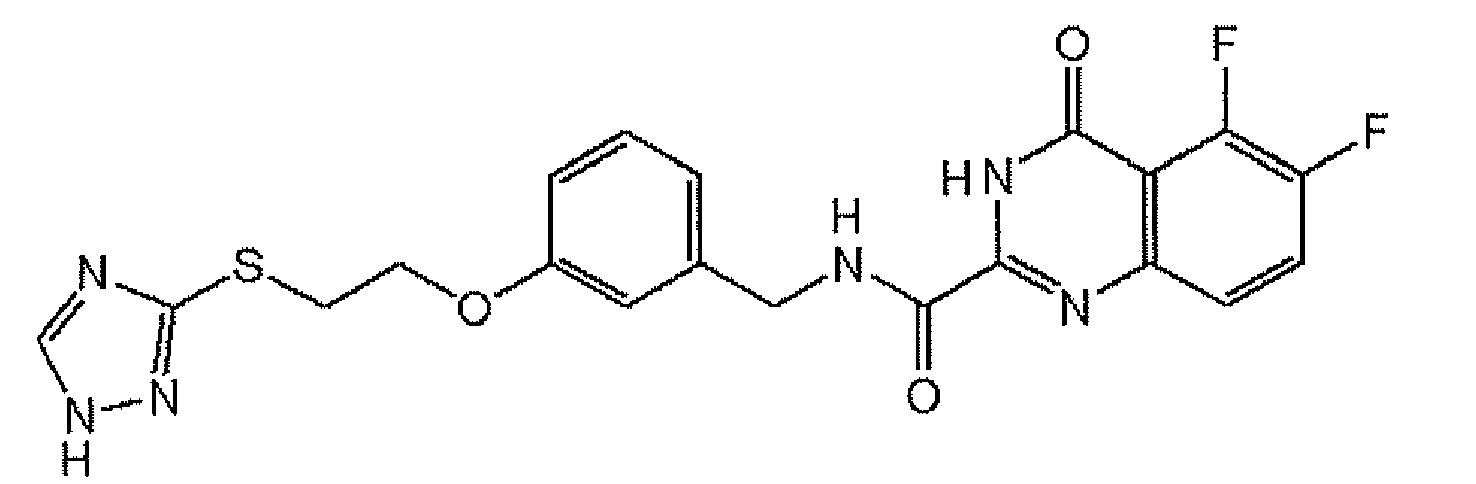
- By a method similar to that in Example 3 and using, instead of ethyl 6-fluoro-4-oxo-3,4-dihydroquinazoline-2-carboxylate, ethyl 5,6-difluoro-4-oxo-3,4-dihydroquinazoline-2-carboxylate obtained in Reference Example 57, the title compound was obtained as a yellow powder (59.0 mg, 33%). melting point: 165-168°C
-

- By a method similar to that in Example 3 and using, instead of ethyl 6-fluoro-4-oxo-3,4-dihydroquinazoline-2-carboxylate, ethyl 5-methyl-4-oxo-3,4-dihydroquinazoline-2-carboxylate obtained in Reference Example 58, the title compound was obtained as a yellow powder (75.0 mg, 40%). melting point: 137-139°C
-

- By a method similar to that in Example 3 and using, instead of ethyl 6-fluoro-4-oxo-3,4-dihydroquinazoline-2-carboxylate, ethyl 5-fluoro-4-oxo-3,4-dihydroquinazoline-2-carboxylate obtained in Reference Example 59, the title compound was obtained as a yellow powder (110 mg, 59%). melting point: 164-167°C
-

- By a method similar to that in Example 3 and using, instead of ethyl 6-fluoro-4-oxo-3,4-dihydroquinazoline-2-carboxylate, ethyl 4-oxo-3,4-dihydrothieno[2,3-d]pyrimidine-2-carboxylate obtained in Reference Example 60, the title compound was obtained as a white powder (102 mg, 27%).
melting point: 216-219°C -

- By a method similar to that in Example 3 and using, instead of ethyl 6-fluoro-4-oxo-3,4-dihydroquinazoline-2-carboxylate, ethyl 5-methyl-4-oxo-3,4-dihydrothieno[2,5-d]pyrimidine-2-carboxylate obtained according to the method described in
US4054656 , the title compound was obtained as a white powder (82.7 mg, 44%).
melting point: 178-179°C -

- By a method similar to that in Example 3 and using, instead of ethyl 6-fluoro-4-oxo-3,4-dihydroquinazoline-2-carboxylate, ethyl 6-methyl-4-oxo-3,4-dihydrothieno[2,3-d]pyrimidine-2-carboxylate obtained according to the methods described in
BE859818
melting point: 202-205°C -

- By a method similar to that in Example 3 and using, instead of ethyl 6-fluoro-4-oxo-3,4-dihydroquinazoline-2-carboxylate, ethyl 5,6-dimethyl-4-oxo-3,4-dihydrothieno[2,3-d]pyrimidine-2-carboxylate obtained according to the methods described in
US4054656 and the like, the title compound was obtained as a white powder (30.3 mg, 8%).
melting point: 198-200°C -
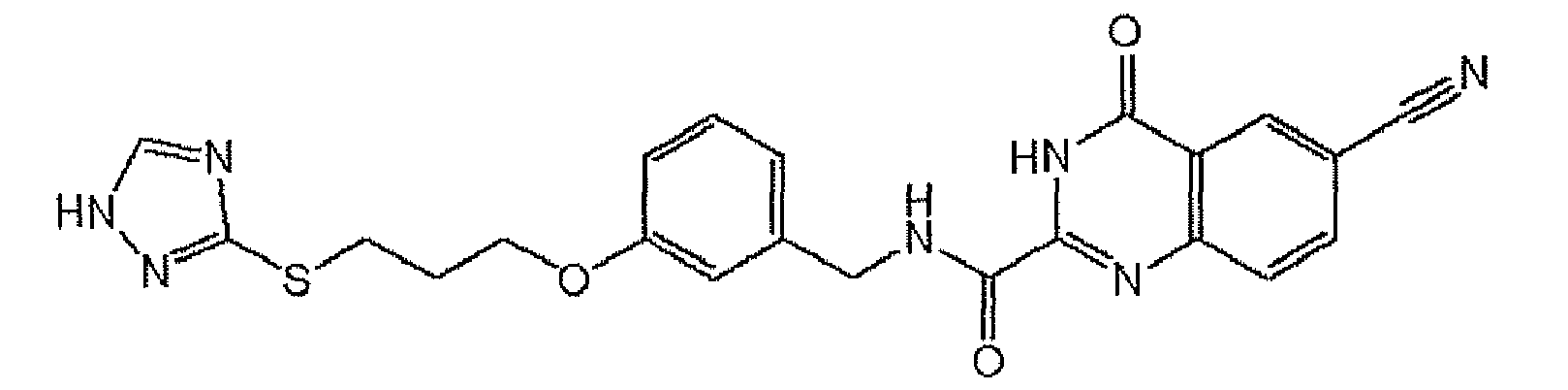
- A solution of ethyl 6-cyano-4-oxo-3,4-dihydroquinazoline-2-carboxylate obtained in Reference Example 51 (200 mg, 0.822 mmol) and 1-{3-[(3-{[1-(triphenylmethyl)-1H-1,2,4-triazol-3-yl]thio}propyl)oxy]phenyl}methanamine obtained in Reference Example 7 (708 mg, 1.40 mmol) in DMA (10 mL) was stirred at 100°C for 12 hr. The reaction mixture was evaporated under reduced pressure, and a solution of the residue in dichloromethane was treated with acidic resin (MP-TsOH: 100 mg) to give a brown oil (1.05 g). The oil was dissolved in dichloromethane (10 mL), and trifluoroacetic acid (3 mL) and triethylsilane (0.138 mL, 0.863 mmol) were added thereto at room temperature. The mixture was stirred for 1 hr, and concentrated under reduced pressure. The residue was purified by silica gel column chromatography (30% - 100% ethyl acetate/hexane). The obtained powder was suspended in ethyl acetate, and the mixture was stirred under heating at 90°C for 1 hr to give the title compound as a white powder (189 mg, 50%). melting point: 196-197°C
-
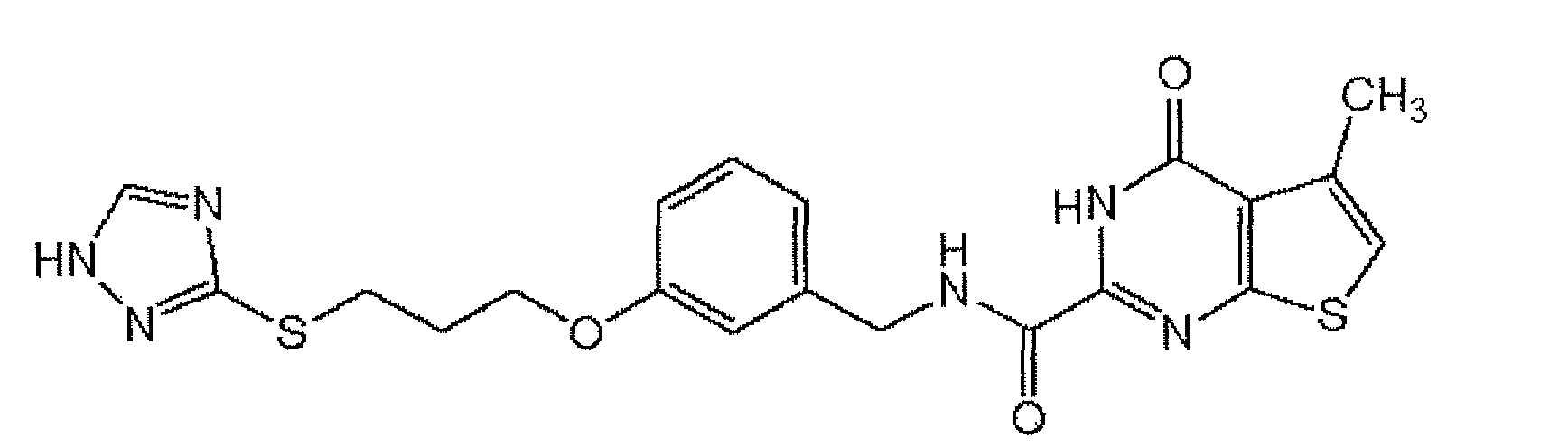
- By a method similar to that in Example 15 and using, instead of ethyl 6-cyano-4-oxo-3,4-dihydroquinazoline-2-carboxylate, ethyl 5-methyl-4-oxo-3,4-dihydrothieno[2,3-d]pyrimidine-2-carboxylate obtained according to the method described in
US4054656 , the title compound was obtained as a white powder (171 mg, 45%). melting point: 178-179°C -

- By a method similar to that in Example 15 and using, instead of 1-{3-[(3-{[1-(triphenylmethyl)-1H-1,2,4-triazol-3-yl]thio}propyl)oxy]phenyl}methaneamine, 1-{3-[(4-{[1-(triphenylmethyl)-1H-1,2,4-triazol-3-yl]thio}butyl)oxy]phenyl}methanamine obtained in Reference Example 11, the title compound was obtained as a pale-yellow powder (244 mg, 64%).
melting point: 173-177°C -

- By a method similar to that in Example 15, and using, instead of ethyl 6-cyano-4-oxo-3,4-dihydroquinazoline-2-carboxylate, ethyl 5-methyl-4-oxo-3,4-dihydrothieno[2, 3-d]pyrimidine-2-carboxylate obtained according to the method described in
US4054656 and using, instead of 1-{3-[(3-{[1-(triphenylmethyl)-1H-1,2,4-triazol-3-yl]thio)propyl)oxy]phenyl}methaneamine, 1-{3-[(4-{[1-(triphenylmethyl)-1H-1,2,4-triazol-3-yl]thio}butyl)oxy]phenyl}methanamine obtained in Reference Example 11, the title compound was obtained as a pale-yellow powder (232 mg, 48%).
melting point: 161-163°C -

- A suspension of ethyl 4-oxo-3,4-dihydro-2-quinazolinecarboxylate obtained according to the methods described in Journal of Organic Chemistry (1978), 43(23), 4485-7 and the like (200 mg, 0.917 mmol), 1-(2-{[2-(1H-1,2,4-triazol-3-ylthio)ethyl]oxylpyridin-4-yl)methanamine hydrochloride obtained in Reference Example 18 (343 mg, 1.19 mmol) and diisopropylethylamine (462 mg, 3.57 mmol) in DMA (5 mL) was stirred at 90°C for 15 hr. After cooling the mixture to room temperature, the resulting solid was collected by filtration, and washed with ethanol. The obtained crude powder was recrystallized from ethanol to give the title compound as a white powder (135 mg, 35%). melting point: 187-189°C
-

- By a method similar to that in Example 19 and using, instead of ethyl 4-oxo-3,4-dihydro-2-quinazolinecarboxylate, ethyl 6-cyano-4-oxo-3,4-dihydroquinazoline-2-carboxylate obtained in Reference Example 51, the title compound was obtained as a white powder (21.9 mg, 6%).
melting point: 225-230°C -

- By a method similar to that in Example 19, and using, instead of ethyl 4-oxo-3,4-dihydro-2-quinazolinecarboxylate, ethyl 5-methyl-4-oxo-3,4-dihydrothieno[2,3-d]pyrimidine-2-carboxylate obtained according to the method described in
US4054656 and using, instead of 1-(2-{[2-(1H-1,2,4-triazol-3-ylthio)ethyl]oxy}pyridin-4-yl)methanamine hydrochloride, 1-{2-[(2-{[1-(triphenylmethyl)-1H-1,2,4-triazol-3-yl]thio}ethyl)oxy]pyridin-4-yl}methanamine obtained in Reference Example 20, 5-methyl-4-oxo-N-({2-[(2-{[1-(triphenylmethyl)-1H-1,2,4-triazol-3-yl]thio}ethyl)oxy]pyridin-4-yl}methyl)-3,4-dihydrothieno[2,3-d]pyrimidine-2-carboxamide was obtained as a white powder (85 mg, 20%). - A solution of 5-methyl-4-oxo-N-({2-[(2-{[1-(triphenylmethyl)-1H-1,2,4-triazol-3-yl]thio}ethyl)oxy]pyridin-4-yl}methyl)-3,4-dihydrothieno[2,3-d]pyrimidine-2-carboxamide (395.0 mg, 0.576 mmol), triethylsilane (0.097 mL, 0.605 mmol) and trifluoroacetic acid (3.0 mL) in dichloromethane (10 mL) was stirred at room temperature for 2 hr. The reaction mixture was concentrated under reduced pressure, and the residue was crystallized from ethyl acetate-IPE to give the title compound as a white powder (53.6 mg, 21%).
melting point: 163-165°C -
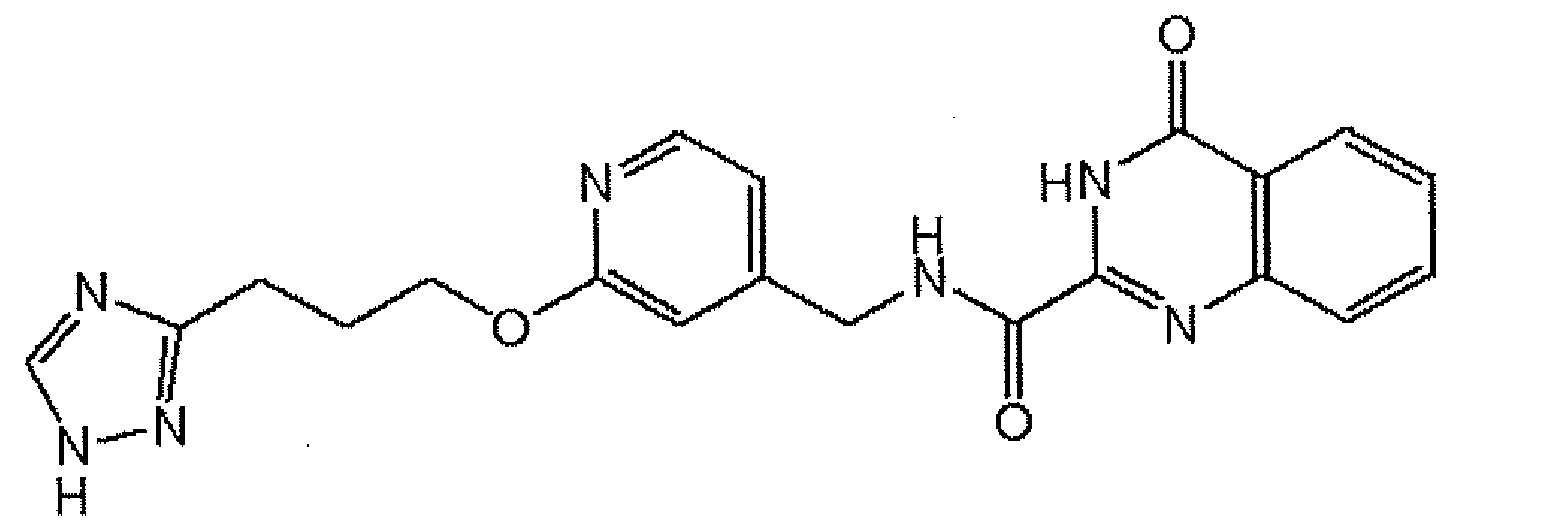
- A suspension of ethyl 4-oxo-3,4-dihydro-2-quinazolinecarboxylate obtained according to the methods described in Journal of Organic Chemistry (1978), 43(23), 4485-7 and the like (25.0 mg, 0.11 mmol), 1-[2-({3-[1-(triphenylmethyl)-1H-1,2,4-triazol-3-yl]propyl}oxy)pyridin-4-yl]methanamine obtained in Reference Example 28 (28.0 mg, 0.069 mmol) and diisopropylethylamine (159 mg, 1.20 mmol) in ethanol (3 mL) was stirred at 80°C for 15 hr. After cooling the mixture to room temperature, the resulting solid was collected by filtration, and washed with ethanol. 4N Hydrochloric acid and ethyl acetate were added to the crude crystals, and the mixture was stirred at room temperature for 2 hr. Water was added to the mixture, and the aqueous layer was weakly acidified with saturated aqueous sodium hydrogencarbonate, and extracted with ethyl acetate. The organic layer was washed with saturated brine, dried over sodium sulfate, and concentrated. The obtained crude crystals were recrystallized from ethanol to give the title compound as a white powder (28.0 mg, 60%).
melting point: 209-212°C -
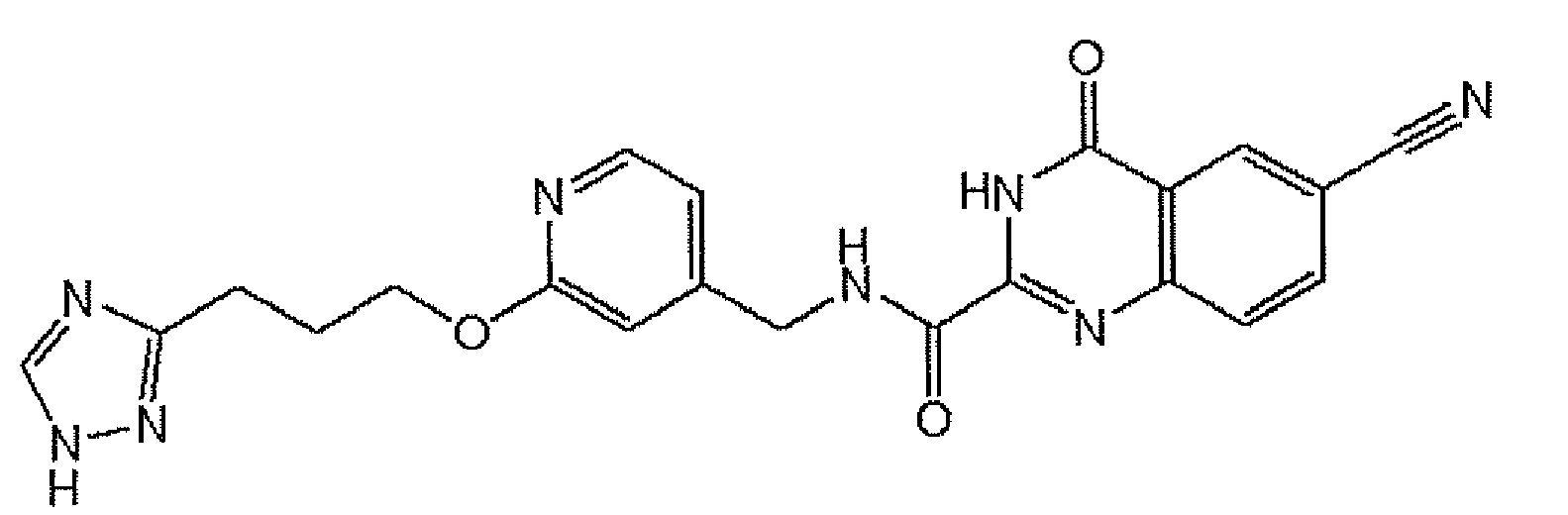
- By a method similar to that in Example 22 and using, instead of ethyl 4-oxo-3,4-dihydro-2-quinazolinecarboxylate, ethyl 6-cyano-4-oxo-3,4-dihydroquinazoline-2-carboxylate obtained in Reference Example 51, the title compound was obtained as a white powder (87.0 mg, 32%). melting point: 214-218°C
-

- By a method similar to that in Example 22 and using, instead of ethyl 4-oxo-3,4-dihydro-2-quinazolinecarboxylate, ethyl 5-methyl-4-oxo-3,4-dihydrothieno[2,3-d]pyrimidine-2-carboxylate obtained according to the method described in
US4054656 , the title compound was obtained as a white powder (75.3 mg, 33%).
melting point: 200-203°C -

- By a method similar to that in Example 22, and using, instead of ethyl 4-oxo-3,4-dihydro-2-quinazolinecarboxylate, ethyl 6-cyano-4-oxo-3,4-dihydroquinazoline-2-carboxylate obtained in Reference Example 51 and using, instead of 1-[2-({3-[1-(triphenylmethyl)-1H-1,2,4-triazol-3-yl]propyl}oxy)pyridin-4-yl]methaneamine, 1-{3-[(2-{[1-(triphenylmethyl)-1H-1,2,4-triazol-3-yl]oxy}ethyl)oxy]phenyl}methanamine obtained in Reference Example 32, the title compound was obtained as a yellow powder (31.7 mg, 12%).
melting point: 184-189°C -
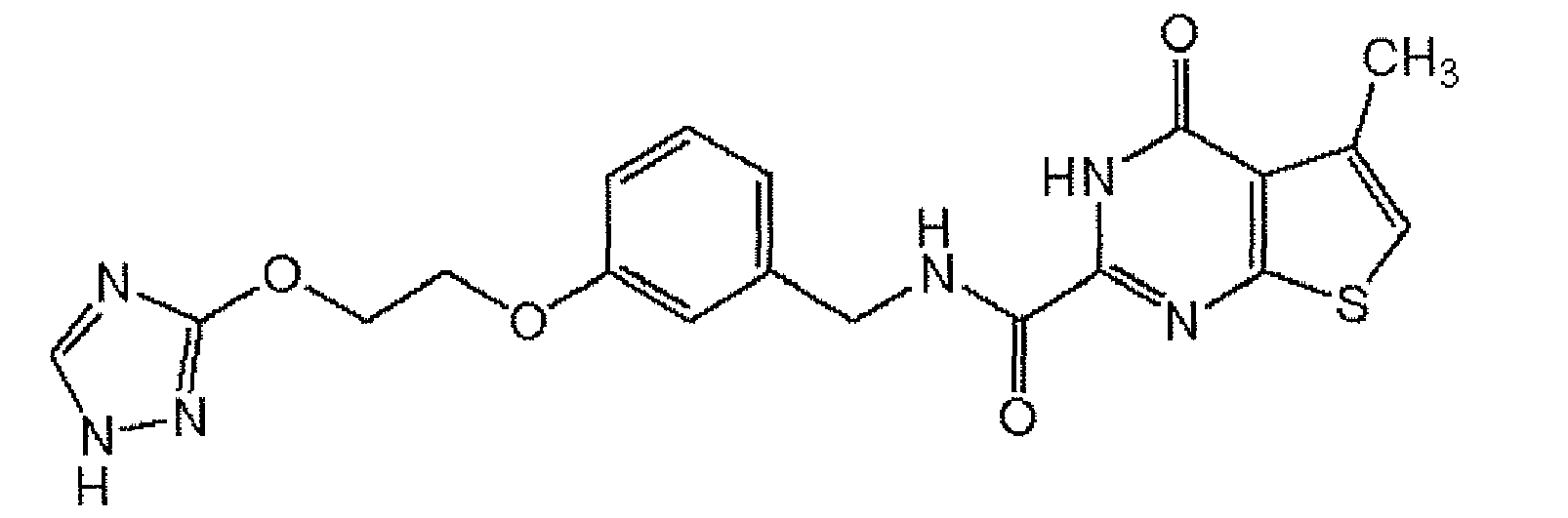
- By a method similar to that in Example 22, and using, instead of ethyl 4-oxo-3,4-dihydro-2-quinazolinecarboxylate, ethyl 5-methyl-4-oxo-3,4-dihydrothieno[2,3-d]pyrimidine-2-carboxylate obtained according to the method described in
US4054656 and using, instead of 1-[2-({3-[1-(triphenylmethyl)-1H-1,2,4-triazol-3-yl]propyl}oxy)pyridin-4-ylamethaneamine, 1-{3-[(2-{[1-(triphenylmethyl)-1H-1,2,4-triazol-3-yl]oxy}ethyl)oxy]phenyl}methanamine obtained in Reference Example 32, the title compound was obtained as a white powder (126 mg, 79%).
melting point: 225-227°C -
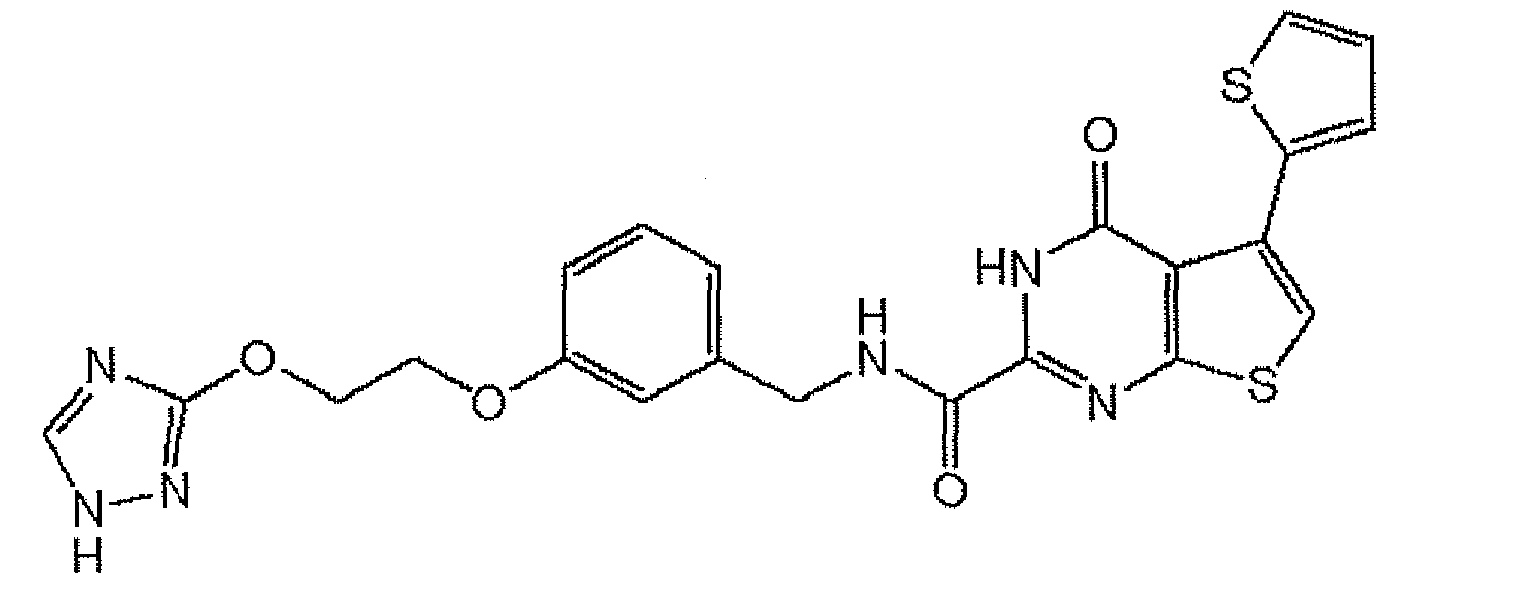
- By a method similar to that in Example 22, and using, instead of ethyl 4-oxo-3,4-dihydro-2-quinazolinecarboxylate, ethyl 4-oxo-5-(2-thienyl)-3,4-dihydrothieno[2,3-d]pyrimidine-2-carboxylate obtained in Reference Example 39 and using, instead of 1-[2-({3-[1-(triphenylmethyl)-1H-1,2,4-triazol-3-yl]propyl}oxy)pyridin-4-yl]methaneamine, 1-{3-[(2-{[1-(triphenylmethyl)-1H-1,2,4-triazol-3-yl]oxy}ethyl)oxy]phenyl}methanamine obtained in Reference Example 32, the title compound was obtained as a white powder (149 mg, 46%).
melting point: 162-164°C -
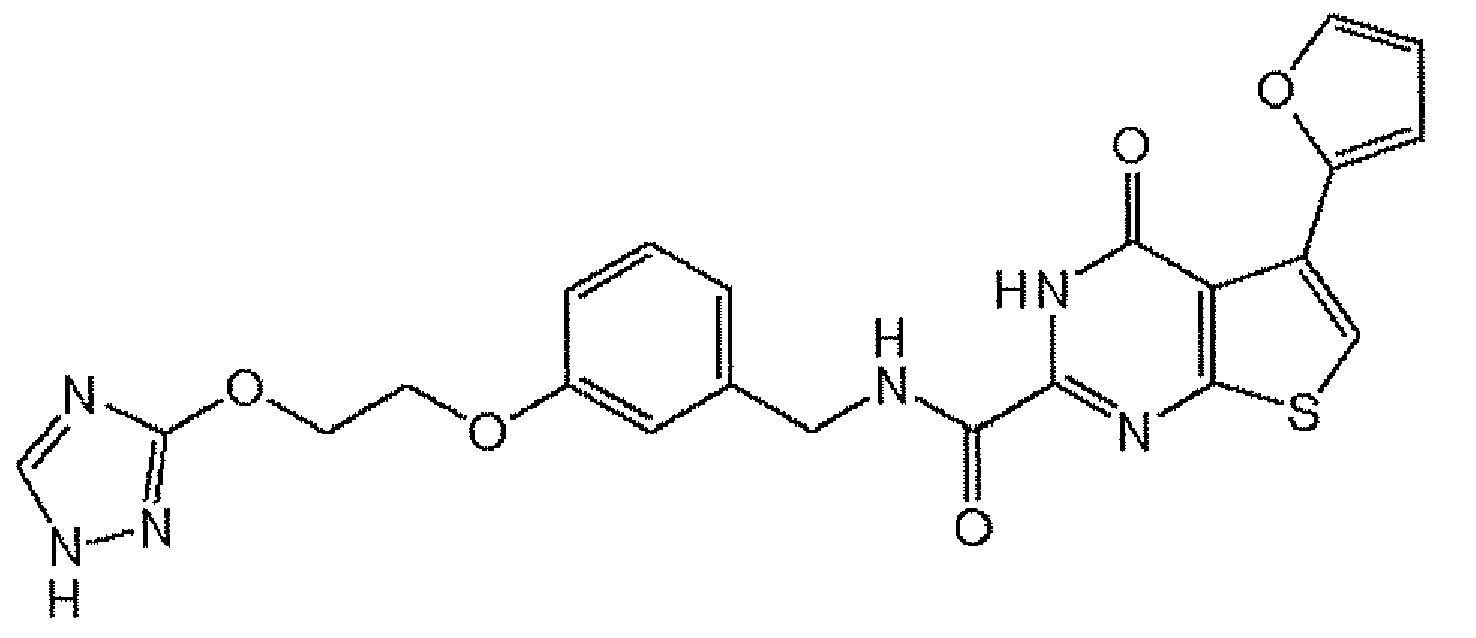
- By a method similar to that in Example 22, and using, instead of ethyl 4-oxo-3,4-dihydro-2-quinazolinecarboxylate, ethyl 5-furan-2-yl-4-oxo-3,4-dihydrothieno[2,3-d]pyrimidine-2-carboxylate obtained in Reference Example 40 and using, instead of 1-[2-({3-[1-(triphenylmethyl)-1H-1,2,4-triazol-3-yl]propyl}oxy)pyridin-4-yl]methaneamine, 1-{3-[(2-{[1-(triphenylmethyl)-1H-1,2,4-triazol-3-yl]oxy}ethyl)oxy]phenyl}methanamine obtained in Reference Example 32, the title compound was obtained as a white powder (2 3.0 mg, 7%).
melting point: 142-143°C -

- By a method similar to that in Example 22, and using, instead of ethyl 4-oxo-3,4-dihydro-2-quinazolinecarboxylate, ethyl 5-cyanomethyl-4-oxo-3,4-dihydrothieno[2,3-d]pyrimidine-2-carboxylate obtained in Reference Example 61 and using, instead of 1-[2-({3-[1-(triphenylmethyl)-1H-1,2,4-triazol-3-yl]propyl}oxy)pyridin-4-yl]methaneamine, 1-{3-[(2-{[1-(triphenylmethyl)-1H-1,2,4-triazol-3-yl]oxy}ethyl)oxy]phenyl}methanamine obtained in Reference Example 32, the title compound was obtained as a white powder (85.4 mg, 38%).
melting point: 262-263°C -
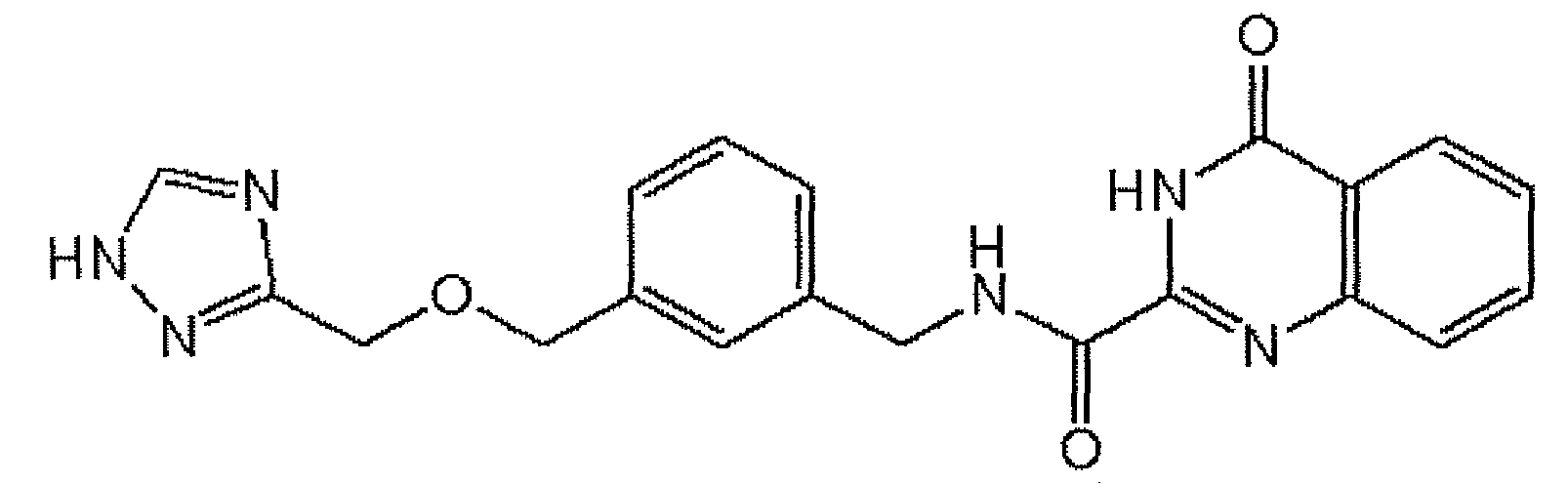
- By a method similar to that in Example 22 and using, instead of 1-[2-({3-[1-(triphenylmethyl)-1H-1,2,4-triazol-3-yl]propyl}oxy)pyridin-4-yl]methaneamine, 1-{3-[({[1-(triphenylmethyl)-1H-1,2,4-triazol-3-yl]methyl}oxy)methyl]phenyl}methanamine obtained in Reference Example 38, the title compound was obtained as a white powder (66.0 mg, 18%).
melting point: 194-197°C -

- By a method similar to that in Example 22, and using, instead of ethyl 4-oxo-3,4-dihydro-2-quinazolinecarboxylate, ethyl 6-cyano-4-oxo-3,4-dihydroquinazoline-2-carboxylate obtained in Reference Example 51 and using, instead of 1-[2-({3-[1-(triphenylmethyl)-1H-1,2,4-triazol-3-yl]propyl}oxy)pyridin-4-yl]methaneamine, 1-{3-[({[1-(triphenylmethyl)-1H-1,2,4-triazol-3-yl]methyl}oxy)methyl]phenyl}methanamine obtained in Reference Example 38, the title compound was obtained as a white powder (20 mg, 6%).
melting point: 203-205°C -

- A solution of N-[(3-aminophenyl)methyl]-6-cyano-4-oxo-3,4-dihydroquinazoline-2-carboxamide obtained in Reference Example 45 (120 mg, 0.376 mmol), 3-[1-(triphenylmethyl)-1H-1,2,4-triazol-3-yl]propanoic acid obtained in Reference Example 25 (152 mg, 0.396 mmol), 1-[3-(dimethylamino)propyl]-3-ethyl-carbodiimide hydrochloride (106 mg, 0.554 mmol) and 1-hydroxybenzotriazole (74.9 mg, 0.554 mmol) in DMF (5 mL) was stirred at 40°C for 15 hr. The reaction mixture was concentrated under reduced pressure, and water was added to residue. The resulting solid was collected by filtration, washed with water and IPE, and dried to give 6-cyano-4-oxoN-{[3-({3-[1-(triphenylmethyl)-1H-1,2,4-triazol-3-yl]propanoyl}amino)phenyl]methyl}-3,4-dihydraquinazoline-2-carboxamide as a white powder (232.0 mg, 86%).
- A solution of 6-cyano-4-oxo-N-{[3-({3-[1-(triphenylmethyl)-1H-1,2,4-triazol-3-yl]propanoyl}amino)phenyl]methyl}-3,4-dihydroquinazoline-2-carboxamide (215 mg, 0.314 mmol), triethylsilane (0.053 mL, 0.330 mmol) and trifluoroacetic acid (2 mL) in dichloromethane (3 mL) was stirred at room temperature for 2 hr. The reaction mixture was concentrated under reduced pressure, and the residue was crystallized from IPE. The resulting powder was recrystallized from ethanol to give the title compound as a white powder (98.6 mg, 71%).
melting point: 298-301°C -
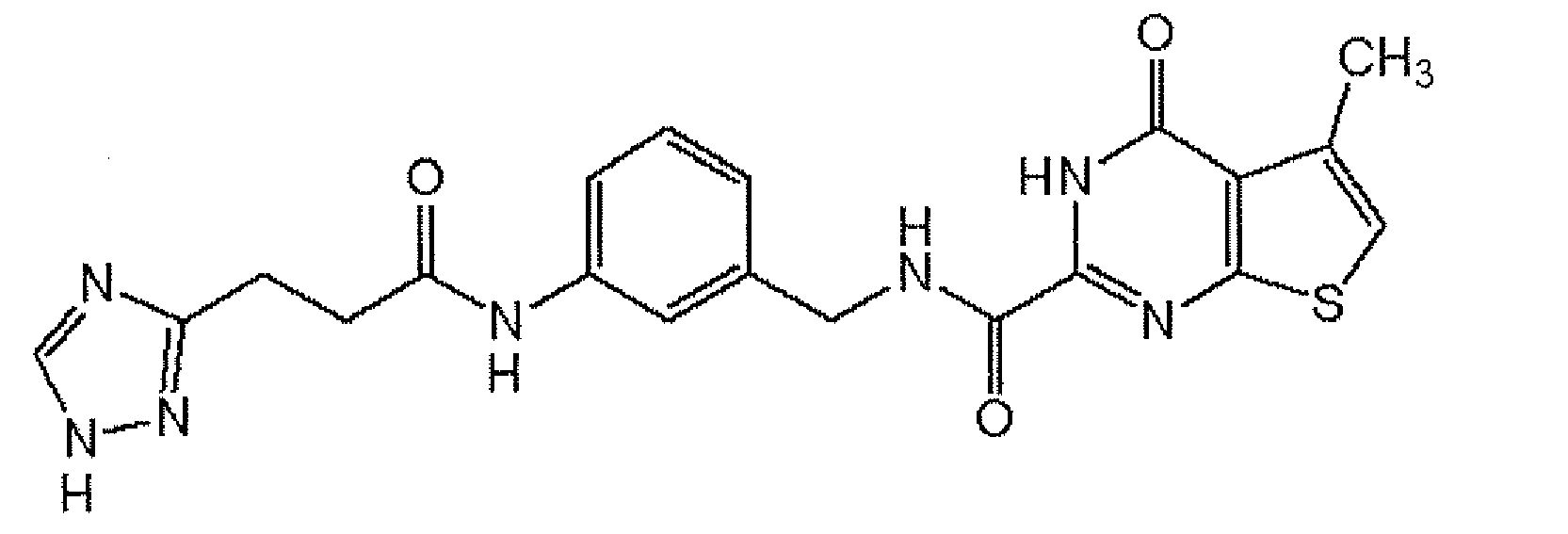
- By a method similar to that in Example 32 and using, instead of N-[(3-aminophenyl)methyl]-6-cyano-4-oxo-3,4-dihydroquinazoline-2-carboxamide, N-[(3-aminophenyl)methyl]-5-methyl-4-oxo-3,4-dihydrothieno[2,3-d]pyrimidine-2-carboxamide obtained in Reference Example 48, the title compound was obtained as a white powder (63.0 mg, 43%). melting point: 248-250°C
-

- A solution of N-{[3-(aminomethyl)phenyl]methyl}-6-cyano-4-oxo-3,4-dihydroquinazoline-2-carboxamide hydrochloride obtained in Reference Example 47 (170 mg, 0.460 mmol), 1H-1,2,4-triazol-3-ylacetic acid obtained in Reference Example 15 (70.0 mg, 0.551 mmol), diisopropylethylamine (0.079 mL, 0.460 mmol), 1-[3-(dimethylamino)propyl]-3-ethyl-carbodiimide hydrochloride (106 mg, 0.550 mmol) and 1-hydroxybenzotriazole (74.0 mg, 0.550 mmol) in DMF (10 mL) was stirred at 40°C for 15 hr. The reaction mixture was concentrated under reduced pressure, and water was added to the residue. The resulting solid was collected by filtration, washed with water and IPE, and dried. The obtained crude crystals were recrystallized from ethyl acetate-IPE to give the title compound as a white powder (49.4 mg, 24%).
melting point: 207-208°C -

- By a method similar to that in Example 34 and using, instead of N-{[3-(aminomethyl)phenyl]methyl}-6-cyano-4-oxo-3,4-dihydroquanazoline-2-carboxamide hydrochloride, N-{[3-(aminomethyl)phenyl]methyl}-5-methyl-4-oxo-3,4-dihydrothieno[2,3-d]pyrimidine-2-carboxamide hydrochloride obtained in Reference Example 50, the title compound was obtained as a white powder (151 mg, 53%). melting point: 251-253°C
-

- By a method similar to that in Example 34 and using, instead of 1H-1,2,4-triazol-3-ylacetic acid, 1-(triphenylmethyl)-1H-1,2,4-triazole-3-carboxylic acid obtained in Reference Example 35, 6-cyano-4-oxo-N-({3-[({[1-(triphenylmethyl)-1H-1,2,4-triazol-3-yl]carbonyl}amino)methyl]phenyl}methyl)-3,4-dihydroquinazoline-2-carboxamide was obtained as a white powder (450 mg, 67%).
1H-NMR (300MHz, DMSO-d6) δ: 4.40 (2H, d, J=6.2Hz), 4.46 (2H, d, J=6.4Hz), 7.02-7.12 (6H, m), 7.18-7.32 (4H, m), 7.36-7.44 (9H, m), 7.86 (1H, d, J=8.5Hz), 8.21 (1H, d, J=8.5Hz), 8.27 (1H, s), 8.53 (1H, s), 9.11 (1H, t, J=6. 3Hz), 9.64 (1H, t, J=6.1Hz), 12.76 (1H, s). Step 2 - A solutionof 6-cyano-4-oxo-N-({3-[({[1-(triphenylmethyl)-1H-1,2,4-triazol-3-yl]carbonyl}amino)methyl]phenyl}methyl)-3,4-dihydroquinazoline-2-carboxamide (420 mg, 0.626 mmol), triethylsilane (0.105 mL, 0.657 mmol) and trifluoroacetic acid (3 mL) in dichloromethane (10 mL) was stirred at room temperature for 30 min. The reaction mixture was concentrated under reduced pressure, and the residue was crystallized from IPE. The obtained powder was suspended in ethanol, and the suspension was stirred under heating for 2 hr to give the title compound as a white powder (113 mg, 42%).
melting point: 218-219°C -

- By a method similar to that in Example 34, and using, instead of N-{[3-(aminomethyl)phenyl]methyl}-6-cyano-4-oxo-3,4-dihydroquinazoline-2-carboxamide hydrochloride, N-{[3-(aminomethyl)phenyl]methyl}-5-methyl-4-oxo-3,4-dihydrothieno[2,3-d]pyrimidine-2-carboxamide hydrochloride obtained in Reference Example 50 and using, instead of 1H-1,2,4-triazol-3-ylacetic acid, 1-(triphenylmethyl)-1H-1,2,4-triazole-3-carboxylic acid obtained in Reference Example 35, 5-methyl-4-oxo-N-({3-[({[1-(triphenylmethyl)-1H-1,2,4-triazol-3-yl]carbonyl}amino)methyl]phenyl}methyl)-3,4-dihydrothieno[2,3-d]pyrimidine-2-carboxamide was obtained as a white powder (597 mg, 90%).
1H-NMR (300MHz, DMSO-d6) δ: 4.30-4.50 (4H, m), 7.03-7.12 (6H, m), 7.16-7.31 (5H, m), 7.35-7.45 (9H, m), 8.28 (1H, s), 9.11 (1H, t, J=6.2Hz), 9.60 (1H, t, J=6.2Hz), 12.26 (1H, s). Step 2 - A solutionof 5-methyl-4-oxo-N-({3-[({[1-(triphenylmethyl)-1H-1,2,4-triazol-3-yl]carbonyl}amino)methyl]phenyl}methyl)-3,4-dihydrothieno[2,3-d]pyrimidine-2-carboxamide (565.0 mg, 0.849 mmol), triethylsilane (0.142 mL, 0.891 mmol) and trifluoroacetic acid (3 mL) in dichloromethane (10 mL) was stirred at room temperature for 30 min. The reaction mixture was concentrated under reduced pressure, and the residue was crystallized from IPE. The obtained powder was suspended in ethanol, and the suspension was stirred under heating for 2 hr to give the title compound as a white powder (359 mg, 99%).
melting point: 290-291°C -

- By a method similar to that in Step 1 of Example 32 and using, instead of 3-[1-(triphenylmethyl)-1H-1,2,4-triazol-3-yl]propanoic acid, 1-(triphenylmethyl)-1H-1,2,4-triazole-3-carboxylic acid obtained in Reference Example 35, 6-cyano-4-oxn-N-{[3-({[1-(triphenylmethyl)-1H-1,2,4-triazol-3-yl]carbonyl}amino)phenyl]methyl}-3,4-dihydroquinazoline-2-carboxamide was obtained as a white powder (627 mg, 95%.).
- By a method similar to that in Step 2 of Example 32 and using, instead of 6-cyano-4-oxo-N-{[3-({3-[1-(triphenylmethyl)-1H-1,2,4-triazol-3-yl]propanoyl}amino)phenyl]methyl}-3,4-dihydroquinazoline-2-carboxamide, 6-cyano-4-oxo-N-{[3-({[1-(triphenylmethyl)-1H-1,2,4-triazol-3-yl]carbonyl}amino)phenyl]methyl}-3,4-dihydroquinazoline-2-carboxamide, the title compound was obtained as a white powder (355 mg, 95%). melting point: 321-322°C
-

- By a method similar to that in Step 1 of Example 32, and using, instead of N-[(3-aminophenyl)methyl]-6-cyano-4-oxo-3,4-dihydroquinazoline-2-carboxamide, N-[(3-aminophenyl)methyl]-5-methyl-4-oxo-5,4-dihydrothieno[2,3-d]pyrimidine-2-carboxamide obtained in Reference Example 48 and using, instead of 1-(triphenylmethyl)-1H-1,2,4-triazole-3-carboxylic acid, 1-(triphenylmethyl)-1H-1,2,4-triazole-3-carboxylic acid obtained in Reference Example 35, 5-methyl-4-oxo-N-{[3-({[1-(triphenylmethyl)-1H-1,2,4-triazol-3-yl]carbonyl}amino)phenyl]methyl}-3,4-dihydrothieno[2,3-d]pyrimidine-2-carboxamide was obtained as a white powder (575 mg, 88%).
- By a method similar to that in Step 2 of Example 32 and using, instead of 6-cyano-4-oxo-N-{[3-({3-[1-(triphenylmethyl)-1H-1,2,4-triazol-3-yl]propanoyl}amino)phenyl]methyl}-5,4-dihydroquinazoline-2-carboxamide, 5-methyl-4-oxo-N-{[3-({[1-(triphenylmethyl)-1H-1,2,4-triazol-3-yl]carbonyl}amino)phenyl]methyl}-3,4-dihydrothieno[2,3-d]pyrimidine-2-carboxamide, the title compound was obtained as a white powder (339 mg, 99%).
melting point: 301-302°C -
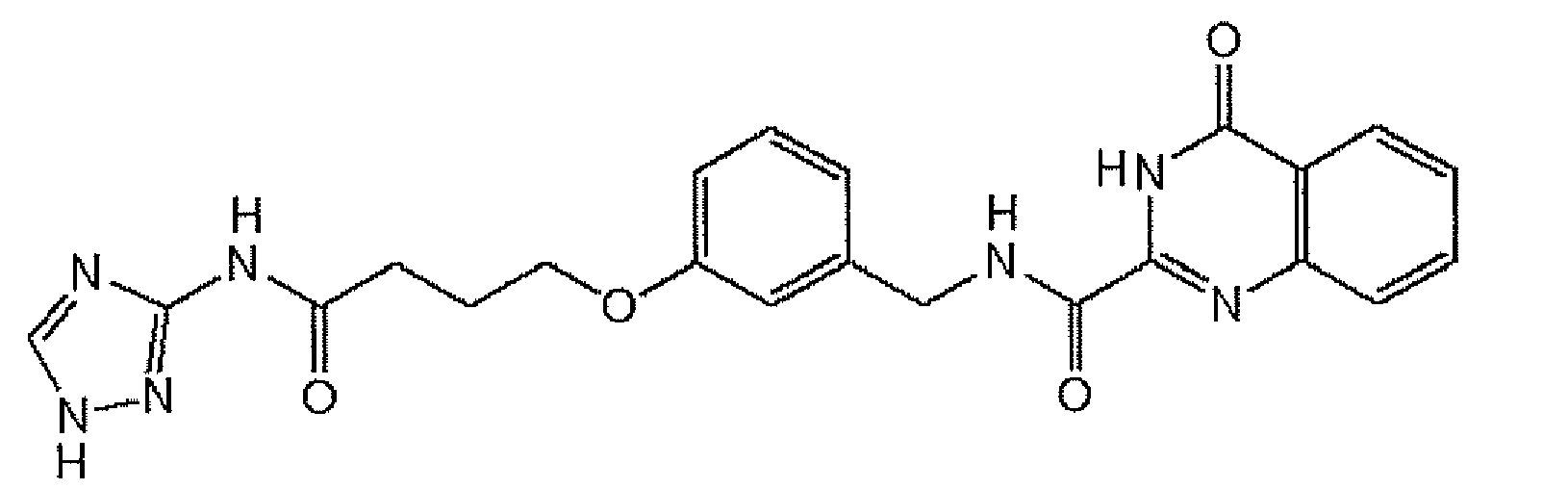
- A solution of 4-{[3-({[(4-oxo-3,4-dihydroquinazolin-2-yl)carbonyl]amino}methyl)phenyl]oxy}butanoic acid obtained in Reference Example 44 (100 mg, 0.262 mmol), 1H-1, 2, 4-triazol-3-amine (26.4 mg, 0.314 mmol), 1-[3-(dimethylamino)propyl]-3-ethyl-carbodiimide hydrochloride (60.3 mg, 0.314 mmol) and 1-hydroxybenzotriazole (42.5 mg, 0.314 mmol) in DMF (5 mL) was stirred at 40°C for 5 hr. Water was added to the reaction mixture, and the resulting solid was collected by filtration, washed with water and IPE, and dried to give the title compound as a white powder (85.0 mg, 73%).
melting point: 189-190°C -

- By a method similar to that in Example 22 and using, instead of ethyl 4-oxo-3,4-dihydro-2-quinazolinecarboxylate, ethyl 5-{[({4-[(ethyloxy)carbonyl]phenyl}methyl)oxy]methyl}-4-oxo-3,4-dihydrothieno[2,3-d]pyrimidine-2-carboxylate obtained in Reference Example 62, ethyl 4-{[({4-oxo-2-[({[2-({3-[1-(triphenylmethyl)-1H-1,2,4-triazol-3-yl]propyl}oxy)pyridin-4-yl]methyl}amino)carbonyl]-3,4-dihydrothieno[2,3-d]pyrimidin-5-yl}methyl}oxy]methyl}benzoate was obtained as a white powder (701 mg, 86%).
1H-NMR (300MHz, DMSO-d6) δ: 1.32 (3H, t, J=7.1Hz), 2.05 (2H, tt, J=6.9, 6.9Hz), 2.76 (2H, t, J=7.2Hz), 4.22 (2H, t, J=6.4Hz) , 4.31 (2H, q, J=7.1Hz), 4.41 (2H, d, J=6.0Hz), 4.75 (2H, s), 4.90 (2H, s), 6.69 (1H, s), 6.92 (1H, dd, J=5.3,1.3Hz), 7.00-7.07 (6H, m), 7.32-7.38 (9H, m), 7.54 (2H, d, J=8.3Hz), 7.63 (1H, s), 7.93-7.98 (3H, m), 8.07 (1H, d, J=5.5Hz), 9.69 (1H, t, J=6.2Hz), 12.43 (1H, s). Step 2 - By a method similar to that in Step 2 of Example 32 and using, instead of 6-cyano-4-oxo-N-{[3-({3-[1-(triphenylmethyl)-1H-1,2,4-triazol-3-yl]propanoyl}amino)phenyl]methyl}-3,4-dihydroquinazoline-2-carboxamide, ethyl 4-{[({4-oxo-2-[({[2-({3-[1-(triphenylmethyl)-1H-1,2,4-triazol-3-yl]propyl}oxy)pyridin-4-yl]methyl}amino)carbonyl]-3,4-dihydrothieno[2,3-d]pyrimidin-5-yl}methyl)oxy]methyl}benzoate, the title compound was obtained as a white powder (20.0 mg, 93%). melting point: 235-238°C
-

- A mixture of ethyl 4-[({[4-oxo-2-({[(2-{[3-(1H-1,2,4-triazol-3-yl)propyl]oxy}pyridin-4-yl)methyl]amino}carbonyl)-3,4-dihydrothieno[2,3-d]pyrimidin-5-yl]methyl}oxy)methyl]benzoate obtained in Example 41 (309 mg, 0.512 mmol), 4N aqueous sodium hydroxide solution (0.64 mL, 2.6 mmol), THF (6 mL), methanol (6 mL) and water (6 mL) was stirred at 100°C for 2 hr. The reaction mixture was concentrated under reduced pressure, and 1N hydrochloric acid and methanol were added to the residue. The resulting crystals were recrystallized from ethyl acetate to give the title compound as a white powder (221 mg, 75%).
melting point: 206-209°C -

- To a solution of 4-{[3-({[(4-oxo-3,4-dihydroquinazolin-2-yl)carbonyl]amino}methyl)phenyl]oxy}butanoic acid obtained in Reference Example 44 (90.0 mg, 0.236 mmol) in THF (2 mL) were added DMF (0.02 mL) and oxalyl chloride (59.9 mg, 0.472 mmol) at 0°C, and the mixture was stirred at room temperature for 2 hr. To the reaction mixture was added a mixed solution of 50% aqueous hydroxylamine solution (0.5 mL), tert-butanol (0.5 mL) and THF (0.5 mL) at 0°C, and the mixture was stirred for 15 min. The mixture was concentrated under reduced pressure, and the residue was purified by preparative HPLC (GILSON 215LIQUD HANDLER, 322PUMP, UV/VIS-156, SHISEIDO CAPCELL PACK C-18 UG120 S-5 (20 mmφ×50 mm), mobile phase: distilled water (containing 0.1% trifluoroacetic acid)/acetonitrile (containing 0.1% trifluoroacetic acid), gradient: distilled water/acetonitrile=90/10→0/100, time: 10 min, flow rate: 25 mL/min, detection wavelength: 220 nm) to give a yellow powder. The obtained powder was recrystallized from ethyl acetate-hexane to give the title compound as a pale-yellow powder (8.0 mg, 9%).
melting point: 164-168°C -

- A suspension of 1-{3-[(2-{[1-(triphenylmethyl)-1H-1,2,4-triazol-3-yl]oxy}ethyl)oxy]phenyl}methanamine obtained in Reference Example 32 (300 mg, 1.18 mmol) and ethyl 5,6-difluoro-4-oxo-3,4-dihydroquinazoline-2-carboxylate obtained in Reference Example 57 (562 mg, 1.18 mmol) in ethanol (10 mL) was stirred at 80°C for 12 hr. The insoluble material was filtered off hot, and the filtrate was allowed to cool to room temperature. The precipitated solid was collected by filtration using glass filter, and the obtained solid was washed with diethyl ether to give 5,6-difluoro-4-oxo-N-({3-[(2-{[1-(triphenylmethyl)-1H-1,2,4-triazol-3-yl]oxy}ethyl)oxy]phenyl}methyl)-3,4-dihydroquinazoline-2-carboxamide as a pale-yellow powder (330 mg, 41%).
- To a solution of 5,6-difluoro-4-oxo-N-({3-[(2-{[1-(triphenylmethyl)-1H-1,2,4-triazol-3-yl]oxy}ethyl)oxy]phenyl}methyl)-3,4-dihydroquinazoline-2-carboxamide obtained in Step 1 (70 mg, 0.102 mmol) in dichloromethane (1 mL) were added trifluoroacetic acid (0.30 mL) and triethylsilane (0.020 mL, 0.123 mmol) at room temperature, and the mixture was stirred for 1 hr. The reaction mixture was concentrated under reduced pressure, and the residue was crystallized from diethyl ether to give the title compound as a pale-yellow powder (38 mg, 84%).
melting point: 205-207°C -

- A suspension of 1-{3-[(2-{[1-(triphenylmethyl)-1H-1,2,4-triazol-3-yl]oxy}ethyl)oxy]phenyl}methanamine obtained in Reference Example 32 (300 mg, 1.18 mmol) and ethyl 5,6-difluoro-4-oxo-3,4-dihydroquinazoline-2-carboxylate obtained in Reference Example 57 (562 mg, 1.18 mmol) in ethanol (10 mL) was stirred at 80°C for 12 hr. The precipitated solid was collected by filtering hot, and the obtained solid was dissolved in dichloromethane (2 mL). Trifluoroacetic acid (0.52 mL) and triethylsilane (0.042 mL, 0.263 mmol) were added to this solution at room temperature, and the mixture was stirred for 1 hr. The reaction mixture was concentrated under reduced pressure, and the residue was purified by preparative HPLC (GILSON 215LIQUD HANDLER, 322PUMP, UV/VIS-156, SHISEIDO CAPCELL PACK C-18 UG120 S-5 (20 mmφ ×50 mm), mobile phase: distilled water (containing 0.1% trifluoroacetic acid)/acetonitrile (containing 0.1% trifluoroacetic acid), gradient: distilled water/acetonitrile=90/10→0/100, time: 10 min, flow rate: 25 mL/min, detection wavelength: 220 nm), and crystallized from ethanol-diethyl ether to give the title compound as a yellow powder (36 mg, 5% in two steps).
melting point: 195-197°C -

- A solution of 5,6-difluoro-4-oxo-N-({3-[(2-{[1-(triphenylmethyl)-1H-1,2,4-triazol-3-yl]oxy}ethyl)oxy]phenyl}methyl)-3,4-dihydroquinazoline-2-carboxamide obtained in Step 1 of Example 44 (150 mg, 0.219 mmol) and 4-(2-hydroxyethyl)benzoic acid (40 mg, 0.241 mmol) in DMA (4 mL) was added dropwise to a suspension of 60% sodium hydride (oil dispersion, 0.031 mg, 0.767 mmol) in DMA (2 mL) at room temperature, and the mixture was stirred at room temperature for 20 min, and then stirred at 80°C under heating for 3 hr. After the reaction mixture was allowed to cool to room temperature, water (50 mL) was added thereto, and the mixture was washed with ethyl acetate (50mL×2). The aqueous layer was neutralized with 0.1N hydrochloric acid, and the objective compound was extracted with ethyl acetate (80 mL). The organic layer was washed with saturated brine, dried over sodium sulfate, and concentrated under reduced pressure. To a solution of the residue in dichloromethane (2 mL) were added trifluoroacetic acid (0.47 mL) and triethylsilane (0.037 mL, 0.235 mmol) at room temperature, and the mixture was stirred for 1 hr. The reaction mixture was concentrated under reduced pressure, and the residue was purified by preparative HPLC (GILSON 215LIQUD HANDLER, 322PUMP, UV/VIS-156, SHISEIDO CAPCELL PACK C-18 UG120 S-5 (20 mm φ ×50 mm), mobile phase: distilled water (containing 0.1% trifluoroacetic acid)/acetonitrile (containing 0.1% trifluoroacetic acid), gradient: distilled water/acetonitrile=90/10 → 0/100, time: 10 min, flow rate: 25 mL/min, detection wavelength: 220 nm), and crystallized from ethanol-diethyl ether to give the title compound as a yellow powder (36 mg, 28% in two steps).
melting point: 122-124°C -

- By a method similar to that in Step 1 of Example 44 and using 1-{3-[(2-{[1-(triphenylmethyl)-1H-1,2,4-triazol-3-yl]oxy}ethyl)oxy]phenyl}methanamine obtained in Reference Example 32 and ethyl 1-[2-({4-[(methyloxy)carbonyl]phenyl}oxy)ethyl]-7-oxo-6,7-dihydro-1H-pyrazolo[4,3-d]pyrimidine-5-carboxylate obtained in Reference Example 63, methyl 4-{[2-(7-oxo-5-{[({3-[(2-{[1-(triphenylmethyl)-1H-1,2,4-triazol-3-yl]oxy}ethyl)oxy]phenyl}methyl)amino]carbonyl}-6,7-dihydro-1H-pyrazolo[4,3-d]pyrimidin-1-yl)ethyl]oxy}benzoate was obtained as a white powder (316 mg, 75%).
- By a method similar to that in Step 2 of Example 44 and using methyl 4-{[2-(7-oxo-5-{[({3-[(2-{[1-(triphenylmethyl)-1H-1,2,4-triazol-3-yl]oxy}ethyl)oxy]phenyl}methyl)amino]carbonyl}-6,7-dihydro-1H-pyrazolo[4,3-d]pyrimidin-1-yl)ethyl]oxy}benzoate obtained in Step 1, the title compound was obtained as a white powder (194 mg, 98%).
melting point: 180-182°C -
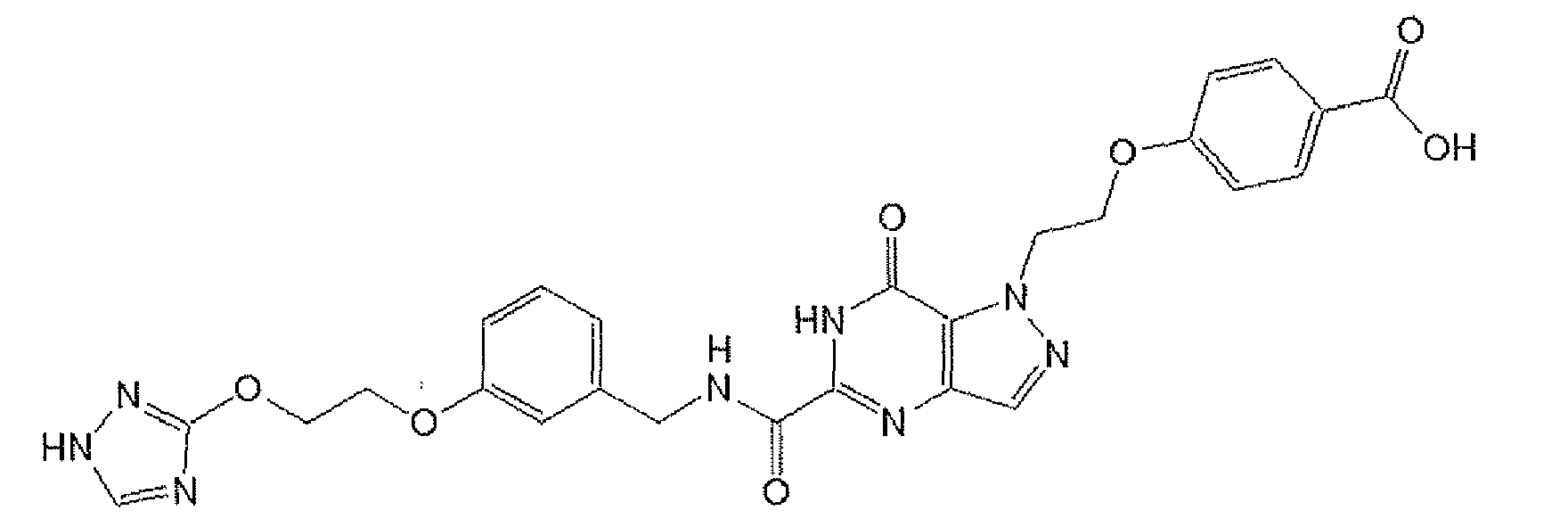
- A mixture of methyl 4-({2-[7-oxo-5-({[(3-{[2-(1H-1,2,4-triazol-3-yloxy)ethyl]oxy}phenyl)methyl]amino}carbonyl)-6,7-dihydro-1H-pyrazolo[4,3-d]pyrimidin-1-yl]ethyl}oxy)benzoate obtained in Example 47 (164 mg, 0.285 mmol), 4N aqueous sodium hydroxide solution (0.250 mL), THF (2 mL), methanol (2 mL) and water (2 mL) was stirred at 90°C for 2 hr. The solvent was evaporated under reduced pressure, and the residue was diluted with water (20 mL), and acidified with 1N hydrochloric acid (1.5 mL). The precipitated solid was collected by filtration, and washed with water (4 mL×2) and methanol (4 mL). The obtained solid was recrystallized from methanol to give the title compound as a white powder (120 mg, 75%).
melting point: 176-178°C -

- By a method similar to that in Example 22, and using, instead of ethyl 4-oxo-3,4-dihydro-2-quinazolinecarboxylate, ethyl 5-{[({4-[(ethyloxy)carbonyl]phenyl}methyl)oxy]methyl}-4-oxo-3,4-dihydrothieno [2,3-d] pyrimidine-2-carboxylate obtained in Reference Example 62 and using, instead of 1-[2-({3-[1-(triphenylmethyl)-1H-1,2,4-triazol-3-yl]propyl}oxy)pyridin-4-yl]methaneamine, 1-{3-[(2-{[1-(triphenylmethyl)-1H-1,2,4-triazol-3-yl]oxy}ethyl)oxy]phenyl}methanamine obtained in Reference Example 32, the title compound was obtained as a white powder (627.0 mg, 94%).
melting point: 230-231°C -

- By a method similar to that in Example 42 and using, instead of ethyl 4-[({[4-oxo-2-({[(2-{[3-(1H-1,2,4-triazol-3-yl)propyl]oxy}pyridin-4-yl)methyl]amino}carbonyl)-3,4-dihydrothieno[2,3-d]pyrimidin-5-yl]methyl}oxy)methyl]benzoate, ethyl 4-({[4-oxo-2-({3-[2-(1H-1,2,4-triazol-3-yloxy)ethoxy]benzyl}carbamoyl)-3,4-dihydrothieno[2,3-d]pyrimidin-5-yl]methoxy}methyl)benzoate obtained in Example 49, the title compound was obtained as a white powder (419.2 mg, 80%).
melting point: 149-152°C -

- By a method similar to that in Example 22, and using, instead of ethyl 4-oxo-3,4-dihydro-2-quinazolinecarboxylate, ethyl 4-oxo-5-phenyl-3,4-dihydrothieno[2,3-d]pyrimidine-2-carboxylate obtained in Reference Example 64 and using, instead of 1-[2-({3-[1-(triphenylmethyl)-1H-1,2,4-triazol-3-yl]propyl}oxy)pyridin-4-yl]methaneamine, 1-{3-[{2-{[1-(triphenylmethyl)-1H-1,2,9-triazol-3-yl]oxy}ethyl)oxy]phenyl}methanamine obtained in Reference Example 32, the title compound was obtained as a white powder (208.4 mg, 72%).
melting point: 183-185°C -

- By a method similar to that in Example 22, and using, instead of ethyl 4-oxo-3,4-dihydro-2-quinazolinecarboxylate, ethyl 4-oxo-5-(3-thienyl)-3,4-dihydrothieno[2,3-d]pyrimidine-2-carboxylate obtained in Reference Example 65 and using, instead of 1-[2-({3-[1-(triphenylmethyl)-1H-1,2,4-triazol-3-yl]propyl}oxy)pyridin-4-yl]methaneamine, 1-{3-[(2-{[1-(triphenylmethyl)-1H-1,2,4-triazol-3-yl]oxy}ethyl)oxy]phenyl}methanamine obtained in Reference Example 32, the title compound was obtained as a white powder (48.0 mg, 34%).
melting point: 186-189°C -

- By a method similar to that in Example 22, and using, instead of ethyl 4-oxo-3,4-dihydro-2-quinazolinecarboxylate, ethyl 4-oxo-5-pyridin-4-yl-3,4-dihydrothieno[2,3-d]pyrimidine-2-carboxylate obtained in Reference Example 66 and using, instead of 1-[2-({3-[1-(triphenylmethyl)-1H-1,2,4-triazol-3-yl]propyl}oxy)pyridin-4-yl]methaneamine, 1-{3-[(2-{[1-(triphenylmethyl)-1H-1,2,4-triazol-3-yl]oxy}ethyl)oxy]phenyl}methanamine obtained in Reference Example 32, the title compound was obtained as a white powder (142.0 mg, 59%).
melting point: 233-236°C -

- By a method similar to that in Example 22, and using, instead of ethyl 4-oxo-3,4-dihydro-2-quinazolinecarboxylate, ethyl 4-oxo-5-pyridin-3-yl-3,4-dihydrothieno[2,3-d]pyrimidine-2-carboxylate obtained in Reference Example 67 and using, instead of 1-[2-({3-[1-(triphenylmethyl)-1H-1,2,4-triazol-3-yl]propyl}oxy)pyridin-4-yl]methaneamine, 1-{3-[(2-{[1-(triphenylmethyl)-1H-1,2,4-triazol-3-yl]oxy}ethyl)oxy]phenyl}methanamine obtained in Reference Example 32, the title compound was obtained as a white powder (41.1 mg, 17%).
melting point: 191-195°C -

- By a method similar to that in Example 22, and using, instead of ethyl 4-oxo-3,4-dihydro-2-quinazolinecarboxylate, ethyl 5-isopropyl-4-oxo-3,4-dihydrothieno[2,3-d]pyrimidine-2-carboxylate obtained in Reference Example 68 and using, instead of 1-[2-({3-[1-(triphenylmethyl)-1H-1,2,4-triazol-3-yl]propyl}oxy)pyridin-4-yl]methaneamine, 1-{3-[(2-{[1-(triphenylmethyl)-1H-1,2,4-triazol-3-yl]oxy}ethyl)oxy]phenyl}methanamine obtained in Reference Example 32, the title compound was obtained as a white powder (161.3 mg, 65%).
melting point: 220-221°C -
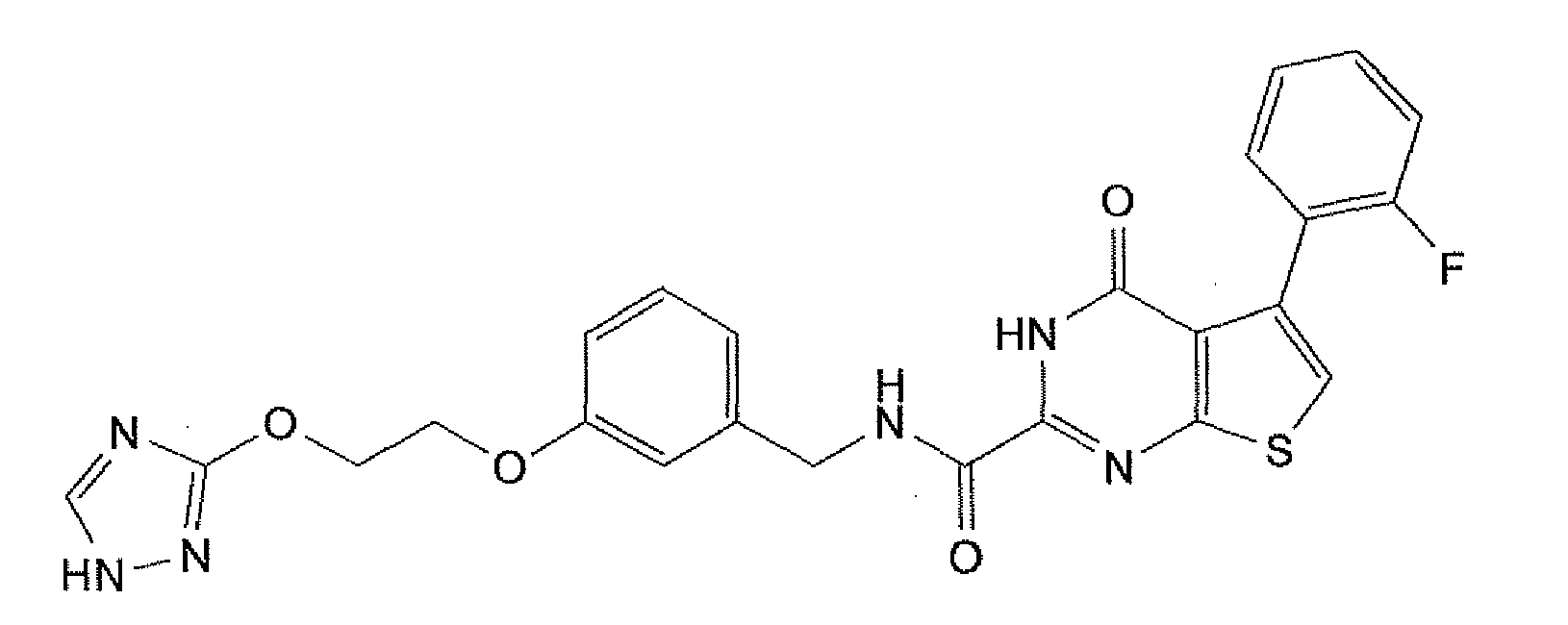
- By a method similar to that in Example 22, and using, instead of ethyl 4-oxo-3,4-dihydro-2-quinazolinecarboxylate, ethyl 5-(2-fluorophenyl)-4-oxo-3,4-dihydrothieno[2,3-d]pyrimidine-2-carboxylate obtained in Reference Example 69 and using, instead of 1-[2-({3-[1-(triphenylmethyl)-1H-1,2,4-triazol-3-yl]propyl}oxy)pyridin-4-yl]methaneamine, 1-{3-[(2-{[1-(triphenylmethyl)-1H-1,2,4-triazol-3-yl]oxy}ethyl)oxy]phenyl}methanamine obtained in Reference Example 32, the title compound was obtained as a white powder (59.0 mg, 46%).
melting point: 178-179°C -

- By a method similar to that in Example 22, and using, instead of ethyl 4-oxo-3,4-dihydro-2-quinazolinecarboxylate, ethyl 5-(2-chlorophenyl)-4-oxo-3,4-dihydrothieno[2,3-d]pyrimidine-2-carboxylate obtained in Reference Example 70 and using, instead of 1-[2-({3-[1-(triphenylmethyl)-1H-1,2,4-triazol-3-yl]propyl]oxy)pyridin-4-yl]methaneamine, 1-{3-[(2-{[1-(triphenylmethyl)-1H-1,2,4-triazol-3-yl]oxy}ethyl)oxy]phenyl}methanamine obtained in Reference Example 32, the title compound was obtained as a white powder (68.2 mg, 44%).
melting point: 169-171°C -

- By a method similar to that in Example 22, and using, instead of ethyl 4-oxo-3,4-dihydro-2-quinazolinecarboxylate, ethyl 5-(2-methoxyphenyl)-4-oxo-3,4-dihydrothieno[2,3-d]pyrimidine-2-carboxylate obtained in Reference Example 71 and using, instead of 1-[2-({3-[1-(triphenylmethyl)-1H-1,2,4-triazol-3-yl]propyl}oxy)pyridin-4-yl]methaneamine, 1-{3-[(2-{[1-(triphenylmethyl)-1H-1,2,4-triazol-3-yl]oxy}ethyl)oxy]phenyl}methanamine obtained in Reference Example 32, the title compound was obtained as a white powder (114.4 mg, 49%).
melting point: 211-213°C -

- By a method similar to that in Example 22, and using, instead of ethyl 4-oxo-3,4-dihydro-2-quinazolinecarboxylate, ethyl 5-(3-fluorophenyl)-4-oxo-3,4-dihydrothieno[2,3-d]pyrimidine-2-carboxylate obtained in Reference Example 72 and using, instead of 1-[2-({3-[1-(triphenylmethyl)-1H-1,2,4-triazol-3-yl]propyl}oxy)pyridin-4-yl]methaneamine, 1-{3-[(2-{[1-(triphenylmethyl)-1H-1,2,4-triazol-3-yl]oxy}ethyl)oxy]phenyl}methanamine obtained in Reference Example 32, the title compound was obtained as a white powder (131.0 mg, 55%).
melting point: 158-161°C -

- By a method similar to that in Example 22, and using, instead of ethyl 4-oxo-3,4-dihydro-2-quinazolinecarboxylate, ethyl 5-(3-chlorophenyl)-4-oxo-3,4-dihydrothieno[2,3-d]pyrimidine-2-carboxylate obtained in Reference Example 73 and using, instead of 1-[2-({3-[1-(triphenylmethyl)-1H-1,2,4-triazol-3-yl]propyl}oxy)pyridin-4-yl]methaneamine, 1-{3-[(2-{[1-(triphenylmethyl)-1H-1,2,4-triazol-3-yl]oxy}ethyl)oxy]phenyl}methanamine obtained in Reference Example 32, the title compound was obtained as a white powder (100.0 mg, 45%).
melting point: 153-154°C -

- By a method similar to that in Example 22, and using, instead of ethyl 4-oxo-3,4-dihydro-2-quinazolinecarboxylate, ethyl 5-(3-methoxyphenyl)-4-oxo-3,4-dihydrothieno[2,3-d]pyrimidine-2-carboxylate obtained in Reference Example 74 and using, instead of 1-[2-({3-[1-(triphenylmethyl)-1H-1,2,4-triazol-3-yl]propyl}oxy)pyridin-4-yl]methaneamine, 1-{3-[(2-{[1-(triphenylmethyl)-1H-1,2,4-triazol-3-yl]oxy}ethyl)oxy]phenyl}methanamine obtained in Reference Example 32, the title compound was obtained as a white powder (117.5 mg, 50%).
melting point: 163-165°C -

- By a method similar to that in Example 22, and using, instead of ethyl 4-oxo-3,4-dihydro-2-quinazolinecarboxylate, ethyl 5-(3-cyanophenyl)-4-oxo-3,4-dihydrothieno[2,8-d]pyrimidine-2-carboxylate obtained in Reference Example 75 and using, instead of 1-[2-({3-[1-(triphenylmethyl)-1H-1,2,4-triazol-3-yl]propyl}oxy)pyridin-4-yl]methaneamine, 1-{3-[(2-{[1-(triphenylmethyl)-1H-1,2,4-triazol-3-yl]oxy}ethyl)oxy]phenyl}methanamine obtained in Reference Example 32, the title compound was obtained as a white powder (124.4 mg, 61%).
melting point: 180-182°C -

- By a method similar to that in Example 22, and using, instead of ethyl 4-oxo-3,4-dihydro-2-quinazolinecarboxylate, ethyl 5-(3-methylphenyl)-4-oxo-3,4-dihydrothieno[2,3-d]pyrimidine-2-carboxylate obtained in Reference Example 76 and using, instead of 1-[2-({3-[1-(triphenylmethyl)-1H-1,2,4-triazol-3-yl]propyl}oxy)pyridin-4-yl]methaneamine, 1-{3-[(2-{[1-(triphenylmethyl)-1H-1,2,4-triazol-3-yl]oxy}ethyl)oxy]phenyl}methanamine obtained in Reference Example 32, the title compound was obtained as a white powder (150.0 mg, 74%).
melting point: 123-125°C -
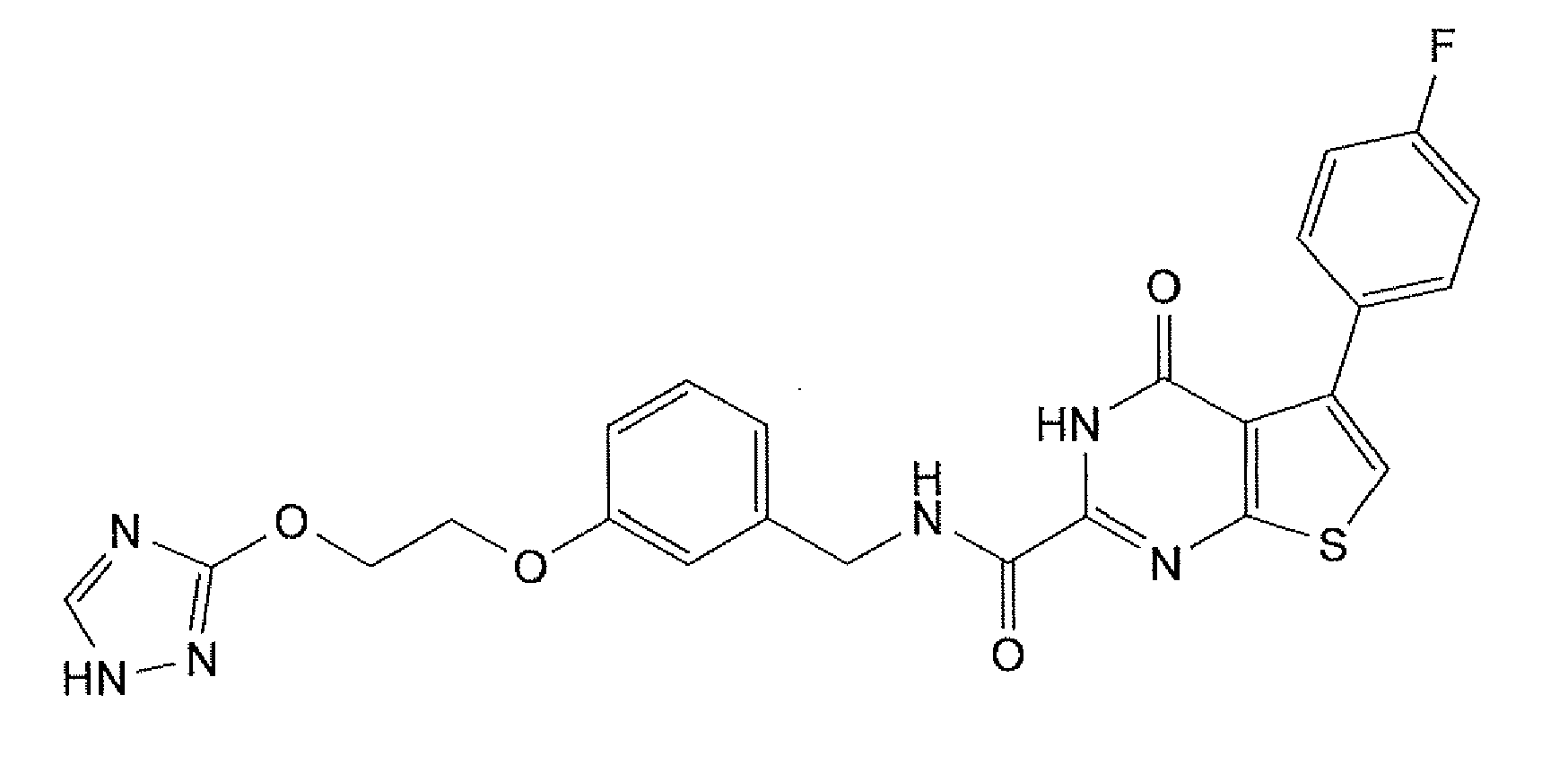
- By a method similar to that in Example 22, and using, instead of ethyl 4-oxo-3,4-dihydro-2-quinazolinecarboxylate, ethyl 5-(4-fluorophenyl)-4-oxo-3,4-dihydrothieno[2,3-d]pyrimidine-2-carboxylate obtained in Reference Example 77 and using, instead of 1-[2-({3-[1-(triphenylmethyl)-1H-1,2,4-triazol-3-yl]propyl}oxy)pyridin-4-yl]methaneamine, 1-{3-[(2-{[1-(triphenylmethyl)-1H-1,2,4-triazol-3-yl]oxy}ethyl)oxy]phenyl}methanamine obtained in Reference Example 32, the title compound was obtained as a white powder (187.2 mg, 69%).
melting point: 188-190°C -

- By a method similar to that in Example 22, and using, instead of ethyl 4-oxo-3,4-dihydro-2-quinazolinecarboxylate, ethyl 5-(4-chlorophenyl)-4-oxo-3,4-dihydrothieno[2,3-d]pyrimidine-2-carboxylate obtained in Reference Example 78 and using, instead of 1-[2-({3-[1-(triphenylmethyl)-1H-1,2,4-triazol-3-yl]propyl}oxy)pyridin-4-yl]methaneamine, 1-{3-[(2-{[1-(triphenylmethyl)-1H-1,2,4-triazol-3-yl]oxy}ethyl)oxy]phenyl}methanamine obtained in Reference Example 32, the title compound was obtained as a white powder (180.0 mg, 80%).
melting point: 160-164°C -

- By a method similar to that in Example 22, and using, instead of ethyl 4-oxo-3,4-dihydro-2-quinazolinecarboxylate, ethyl 5-(4-bromophenyl)-4-oxo-3,4-dihydrothieno[2,3-d]pyrimidine-2-carboxylate obtained in Reference Example 79 and using, instead of 1-[2-({3-[1-(triphenylmethyl)-1H-1,2,4-triazol-3-yl]propyl}oxy)pyridin-4-yl]methaneamine, 1-{3-[(2-{[1-(triphenylmethyl)-1H-1,2,4-triazol-3-yl]oxy}ethyl)oxy]phenyl}methanamine obtained in Reference Example 32, the title compound was obtained as a white powder (147.7 mg, 71%).
melting point: 189-192°C -
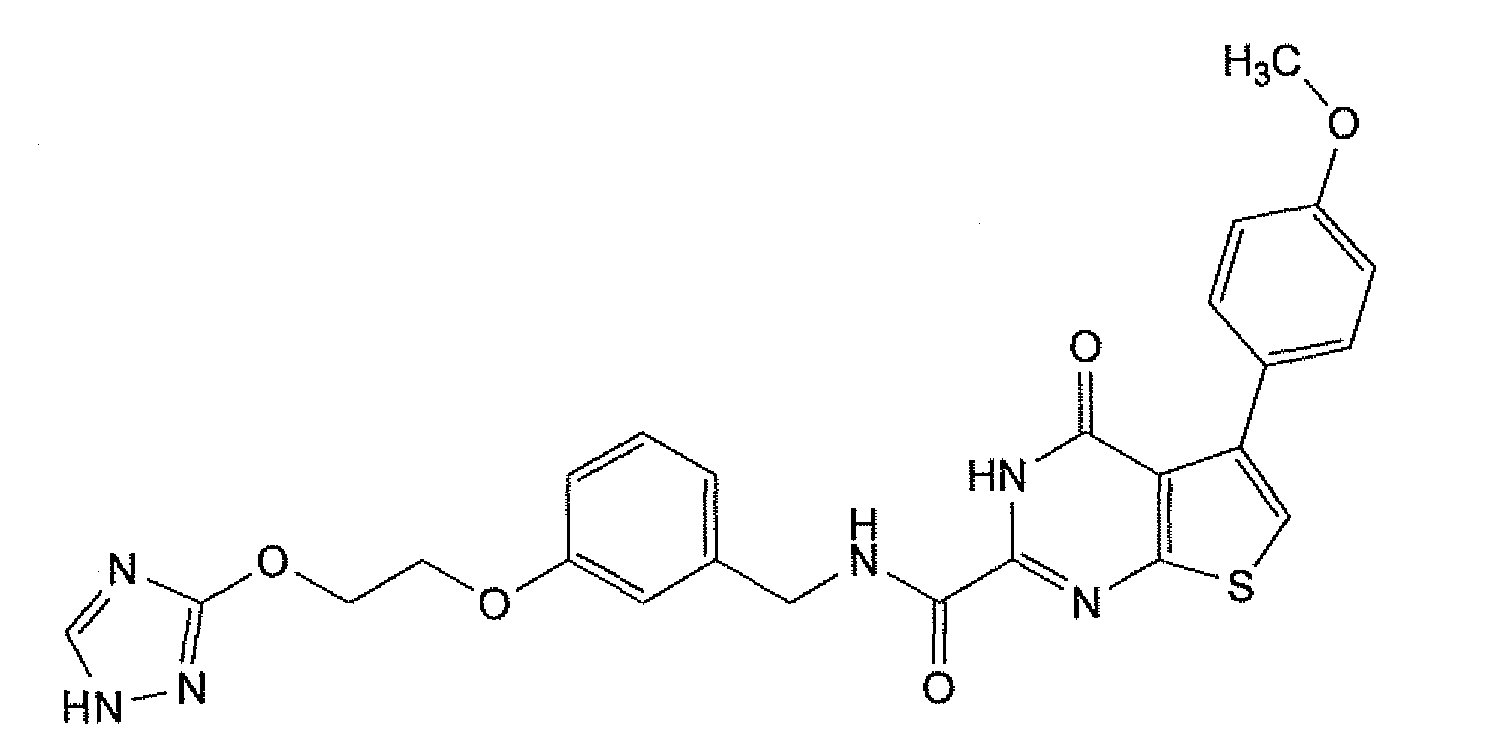
- By a method similar to that in Example 22, and using, instead of ethyl 4-oxo-3,4-dihydro-2-quinazolinecarboxylate, ethyl 5-(4-methoxyphenyl)-4-oxo-3,4-dihydrothieno[2,3-d]pyrimidine-2-carboxylate obtained in Reference Example 80 and using, instead of 1-[2-({3-[1-(triphenylmethyl)-1H-1,2,4-triazol-3-yl]propyl}oxy)pyridin-4-yl]methaneamine, 1-{3-[(2-{[1-(triphenylmethyl)-1H-1,2,4-triazol-3-yl]oxy}ethyl)oxy]phenyl}methanamine obtained in Reference Example 32, the title compound was obtained as a white powder (123.6 mg, 50%).
melting point: 93-98°C -

- By a method similar to that in Example 22, and using, instead of ethyl 4-oxo-3,4-dihydro-2-quinazolinecarboxylate, ethyl 5-(4-methylphenyl)-4-oxo-3,4-dihydrothieno[2,3-d]pyrimidine-2-carboxylate obtained in Reference Example 81 and using, instead of 1-[2-({3-[1-(triphenylmethyl)-1H-1,2,4-triazol-3-yl]propyl}oxy)pyridin-4-yl]methaneamine, 1-{3-[(2-{[1-(triphenylmethyl)-1H-1,2,4-triazol-3-yl]oxy}ethyl)oxy]phenyl}methanamine obtained in Reference Example 32, the title compound was obtained as a white powder (162.0 mg, 68%).
melting point: 122-125°C -

- By a method similar to that in Example 22, and using, instead of ethyl 4-oxo-3,4-dihydro-2-quinazolinecarboxylate, ethyl 5-[3-(ethoxycarbonyl)phenyl]-4-oxo-3,4-dihydrothieno[2,3-d]pyrimidine-2-carboxylate obtained in Reference Example 82 and using, instead of 1-[2-({3-[1-(triphenylmethyl)-1H-1,2,4-triazol-3-yl]propyl}oxy)pyridin-4-yl]methaneamine, 1-{3-[(2-{ [1-(triphenylmethyl)-1H-1,2,4-triazol-3-yl]oxy}ethyl)oxy]phenyl}methanamine obtained in Reference Example 32, the title compound was obtained as a white powder (132.7 mg, 58%).
melting point: 151-153°C -

- By a method similar to that in Example 42 and using, instead of ethyl 4- [({[4-oxo-2-({[(2-{[3- (1H-1,2,4-triazol-3-yl)propyl]oxy}pyridin-4-yl)methyl]amino}carbonyl)-3,4-dihydxothieno[2,3-d]pyrimidin-5-yl]methyl}oxy)methyl]benzoate, ethyl 3-[4-oxo-2-({3-[2(1H-1,2,4-triazol-3-yloxy)ethoxy]benzyl}carbamoyl)-3,4-dihydrothieno[2,3-d]pyrimidin-5-yl]benzoate obtained in Example 69, the title compound was obtained as a white powder (80.0 mg, 73%).
melting point: 230-232°C -
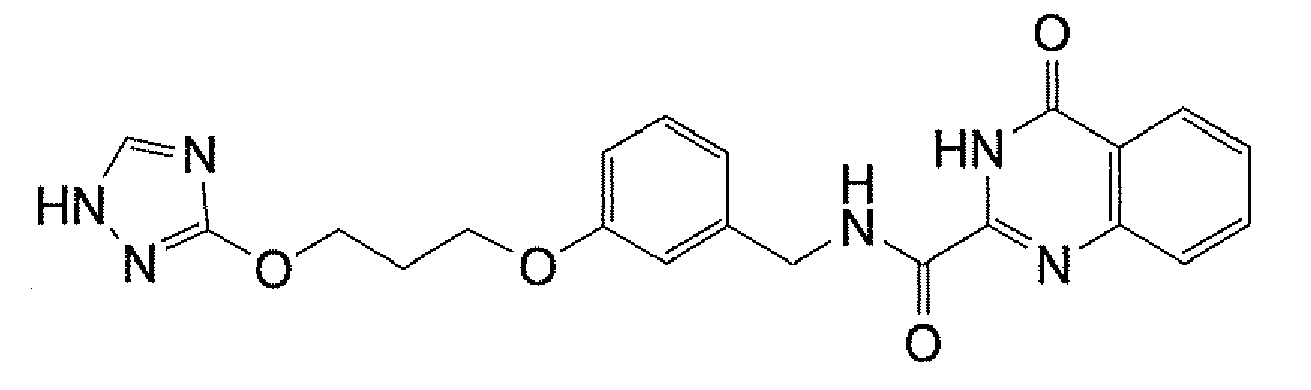
- To a suspension of 4-oxo-N-({3-[(3-{[1-(triphenylmethyl)-1H-1,2,4-triazol-3-yl]oxy}propyl)oxy]phenyl}methyl)-3,4-dihydroquinazoline-2-carboxamide obtained in Reference Example 86 (0.285 g, 0.430 mmol) in acetonitrile (6 mL) were added trifluoroacetic acid (1.27 mL) and triethylsilane (0.082 mL, 0.516 mmol) at room temperature, and the mixture was stirred at room temperature for 12 hr. The reaction mixture was concentrated under reduced pressure, and the residue was crystallized from diethyl ether-EtOH to give the title compound as a white powder (0.173 g, 96%). melting point: 190-192°C
-

- By a method similar to that in Example 71 and using 5-(3-chlorophenyl)-4-oxo-N-({3-[(3-{[1-(triphenylmethyl)-1H-1,2,4-triazol-3-yl]oxy}propyl)oxy]phenyl}methyl)-3,4-dihydrothieno[2,3-d]pyrimidine-2-carboxamide obtained in Reference Example 87, the title compound was obtained as a white powder (0.200 g, 97%).
melting point: 167-169°C -

- By a method similar to that in Example 71 and using 5-(3-fluorophenyl)-4-oxo-N-({3-[(3-{[1-(triphenylmethyl)-1H-1,2,4-triazol-3-yl]oxy}propyl)oxy]phenyl}methyl)-3,4-dihydrothieno[2,3-d]pyrimidine-2-carboxamide obtained in Reference Example 88, the title compound was obtained as a pale-yellow powder (0.155 g, 95%).
melting point: 130-132°C -

- By a method similar to that in Example 71 and using 5-(2-chlorophenyl) -4-oxo-N-({3-[(3-{[1-(triphenylmethyl) - 1H-1,2,4-triazol-3-yl]oxy}propyl)oxy]phenyl)methyl)-3,4-dihydrothieno[2,3-d]pyrimidine-2-carboxamide obtained in Reference Example 89, the title compound was obtained as a pale-yellow powder (0.165 g, 96%).
melting point: 165-167°C -

- By a method similar to that in Example 71 and using 5-(2-fluorophenyl)-4-oxo-N-({3-[(3-{[1-(triphenylmethyl)-1H-1,2,4-triazol-3-yl]oxy}propyl)oxy]phenyl}methyl)-3,4-dihydrothieno[2,3-d]pyrimidine-2-carboxamide obtained in Reference Example 90, the title compound was obtained as a pale-yellow powder (0.145 g, 97%).
melting point: 159-161°C -

- By a method similar to that in Example 71 and using 5-(4-fluorophenyl)-4-oxo-N-({3-[(3-[1-(triphenylmethyl)-1H-1,2,4-triazol-3-yl]oxylpropyl)oxy]phenyl}methyl)-3,4-dihydrothieno[2,3-d]pyrimidine-2-carboxamide obtained in Reference Example 91, the title compound was obtained as a white powder (0.172 g, 97%).
melting point: 186-188°C -

- To a suspension of methyl N-{[3'-({[(4-oxo-3,4-dihydroquinazolin-2-yl)carbonyl]amino}methyl)biphenyl-4-yl]sulfonyl}valinate obtained in Reference Example 95 (0.250 g, 0.456 mmol) in THF (3 mL) -methanol (3 mL)-water (3 mL) was added 4N aqueous sodium hydroxide solution (0.399 mL, 1.60 mmol) at room temperature, and the mixture was stirred under heating at 80°C for 15 hr. The reaction mixture was allowed to cool to room temperature, and concentrated under reduced pressure, and the residue was diluted with water. The mixture was acidified with 1N hydrochloric acid, and partitioned between ethyl acetate and water. The organic layer was washed with saturated brine, and dried over sodium sulfate. The solvent was evaporated under reduced pressure, and the residue was crystallized from methanol to give the title compound as a white powder (0.202 g, 83%).
melting point: 141-143°C -

- A suspension of N-{[3'-({[(4-oxo-3,4-dihydroquinazolin-2-yl)carbonyl]amino}methyl)biphenyl-4-yl]sulfonyl}valine obtained in Example 77 (0.080 g, 0.150 mmol), O-(trimethylsilyl)hydroxylamine (0.055 mL, 0.449 mmol), 1-[3-(dimethylamino)propyl]-3-ethyl-carbodiimide hydrochloride (0.086 g, 0.449 mmol) and 1-hydroxybenzotriazole (0.061 g, 0.449 mmol) in DMF (5 mL) was stirred at room temperature for 12 hr. The reaction mixture was diluted with ethyl acetate, and washed successively with 0.05N hydrochloric acid, aqueous sodium hydrogencarbonate solution, water and saturated brine, and dried over sodium sulfate. The solvent was evaporated under reduced pressure, and the residue was crystallized from methanol-diethyl ether to give the title compound as a white powder (0.058 g, 71%).
melting point: 153-155°C -
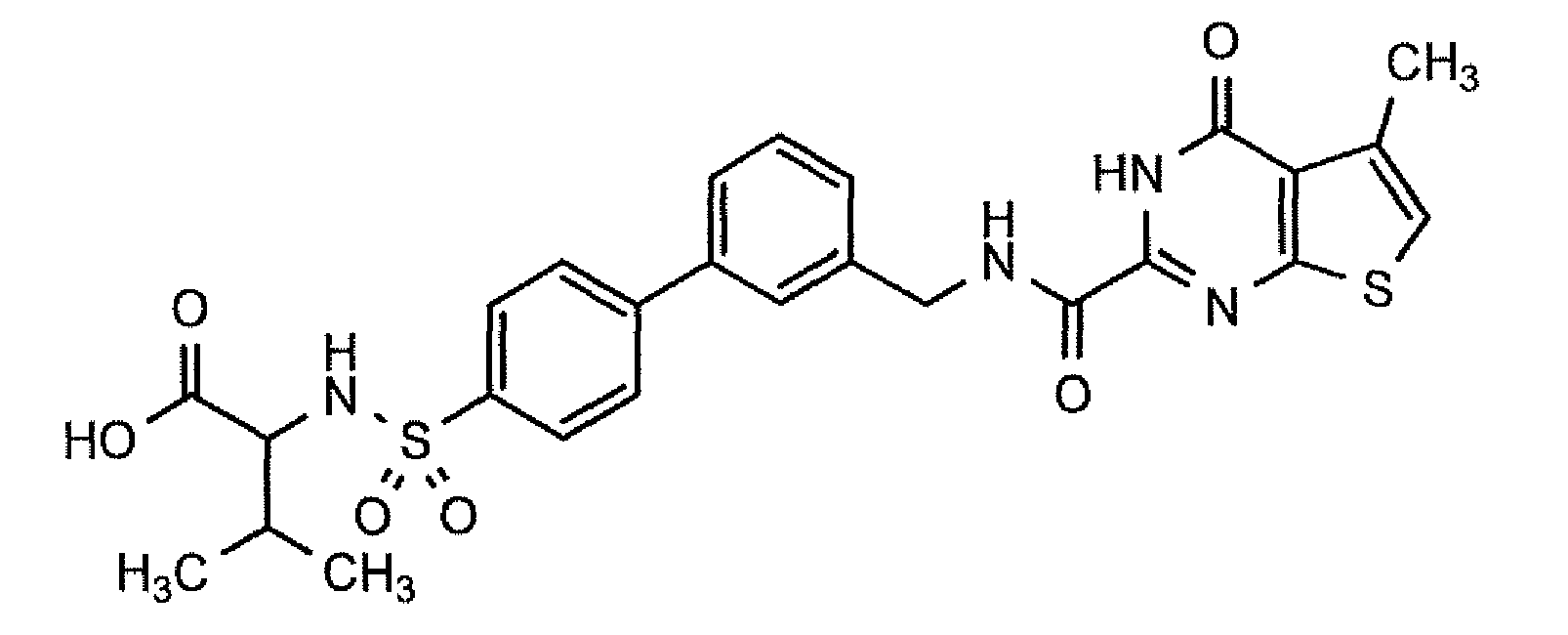
- By a method similar to that in Example 77 and using methyl N-{[3'-({[(5-methyl-4-oxo-3,4-dihydrothieno[2,3-d]pyrimidin-2-yl)carbonyl]amino}methyl)biphenyl-4-yl]sulfanyl}valinate obtained in Reference Example 96, the title compound was obtained as a pale-yellow powder (0.133 g, 52%).
melting point: 154-156°C -

- By a method similar to that in Example 78 and using N-{[3'-({[(5-methyl-4-oxo-3,4-dihydrothieno[2,3-d]pyrimidin-2-yl)carbonyl]amino}methyl)biphenyl-4-yl]sulfonyl}valine obtained in Example 79, the title compound was obtained as a pale-yellow powder (0.046 g, 61%).
melting point: 162-164°C -

- By a method similar to that in Example 77 and using ethyl 1-[(3-{[3-({[(4-oxo-3,4-dihydroquinazolin-2-yl)carbonyl]amino}methyl)phenyl]oxy}propyl)sulfonyl]piperid ine-2-carboxylate obtained in Reference Example 100, the title compound was obtained as a white powder (0.332 g, 97%).
melting point: 204-206°C -

- By a method similar to that in Example 78 and using 1-[(3-{[3-({[(4-oxo-3,4-dihydroquinazolin-2-yl)carbonyl]amino}methyl)phenyl]oxy}propyl)sulfonyl]piperid ine-2-carboxylic acid obtained in Example 81, the title compound was obtained as a white powder (0.120 g, 78%). melting point: 106-108°C
-

- By a method similar to that in Example 77 and using ethyl 1-[(3-{[3-({[(5-methyl-4-oxo-3,4-dihydrothieno[2,3-d]pyrimidin-2-yl)carbonyl]amino}methyl)phenyl]oxy}propyl)sulfonyl]piperid ine-2-carboxylate obtained in Reference Example 101, the title compound was obtained as a yellow powder (0.170 g, 66%).
melting point: 209-211°C -

- To formic acid (0.217 mL) was added acetic anhydride (0.054 mL, 0.576 mmol) at room temperature, and the mixture was stirred at room temperature for 2 hr. This solution was added to a suspension of N-[(4'-{[2-(hydroxyamino)-3-methylbutyl]sulfonyl}biphenyl-3-yl)methyl]-4-oxo-3,4-dihydroquinazoline-2-carboxamide obtained in Reference Example 107 (0.285 g, 0.430 mmol) and formic acid (2 mL) in THF (20 mL), and the mixture was stirred at room temperature for 4 hr. The reaction mixture was concentrated under reduced pressure, and the residue was purified by preparative HPLC (GILSON 215LIQUD HANDLER, 322PUMP, UV/V1S-156, SHISEIDO CAPCELL PACK C-18 UG120 S-5 (20 mm φ ×50 mm), mobile phase: distilled water (containing 0.1% trifluoroacetic acid)/acetonitrile (containing 0.1% trifluoroacetic acid), gradient: distilled water/acetonitrile=90/10→0/100, time: 10 min, flow rate: 25 mL/min, detection wavelength: 220 nm), and crystallized from EtOH-ethyl acetate-diethyl ether to give the title compound as a pale-yellow powder (0.077 g, 37%).
melting point: 153-155°C -

- To a suspension of N-[(4'-{[2-(hydroxyamino)-3-methylbutyl]sulfonyl}biphenyl-3-yl)methyl]-4-oxo-3,4-dihydroquinazoline-2-carboxamide obtained in Reference Example 107 (0.100 g, 0.192 mmol) and acetic acid (2 mL) in THF (20 mL) was added acetic anhydride (0.018 mL, 0.192 mmol) at room temperature, and the mixture was stirred at room temperature for 2 hr. The reaction mixture was concentrated under reduced pressure, and the residue was crystallized from EtOH-ethyl acetate-diethyl ether-hexane to give the title compound as a white powder (0.085 g, 79%). melting point: 167-169°C
-

- A suspension of N-[(4'-{[2-(hydroxyamino)-3-methylbutyl]sulfonyl}biphenyl-3-yl)methyl]-4-oxo-3,4-dihydroquinazoline-2-carboxamide obtained in Reference Example 107 (0.050 g, 0.096 mmol) and N,N-diisopropylethylamine (0.017 mL, 0.096 mmol) in THF (10 mL) was added dropwise to a suspension of triphosgene (0.0094 g, 0.032 mmol) in THF (2 mL) at 0°C, and the mixture was stirred at room temperature for 2 hr. 28% Aqueous ammonia (0.065 mL, 0.960 mmol) was added thereto, and the mixture was stirred at room temperature for 2 hr. The reaction mixture was concentrated under reduced pressure, and the residue was crystallized from EtOH-water to give the title compound as a white powder (0.045 g, 83%).
melting point: 193-195°C -
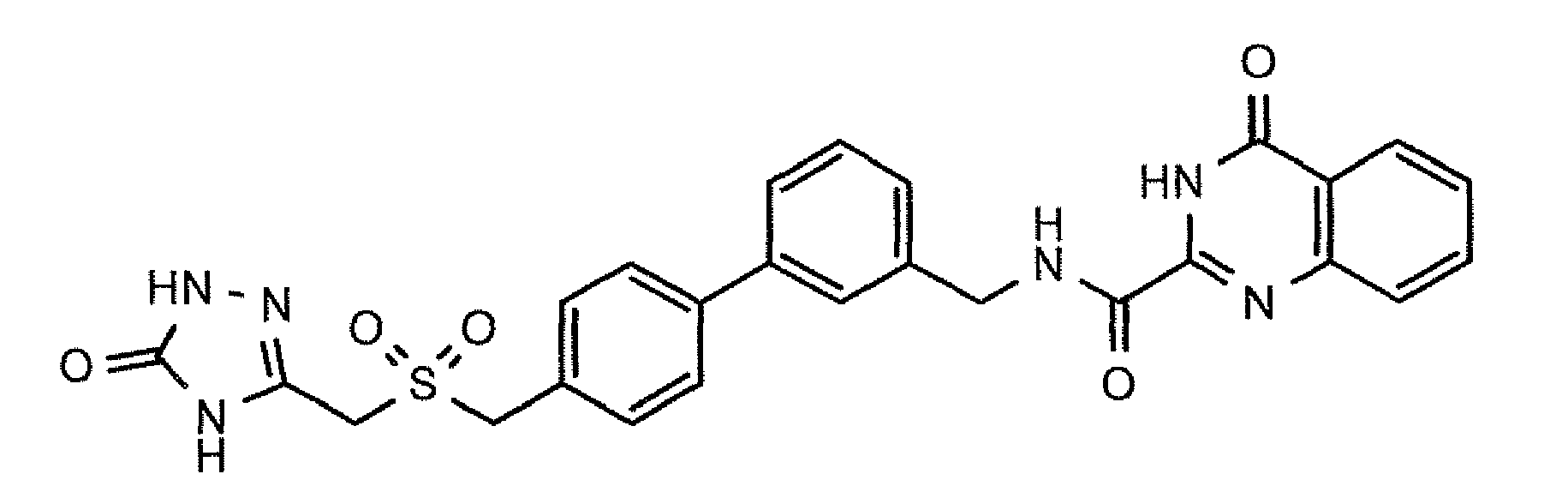
- A solution of 5-[({ [3'-(aminomethyl)biphenyl-4-yl]methyl}sulfonyl)methyl]-2,4-dihydxo-3H-1,2,4-triazol-3-one obtained in Reference Example 111 (0.060 g, 0.167 mmol), ethyl 4-oxo-3,4-dihydro-2-quinazolinecarboxylate obtained according to the methods described in Journal of Organic Chemistry (1978), 43(23), 4485-7 and the like (0.024 g, 0.112 mmol) and triethylamine (0.389 mL, 1.12 mmol) in EtOH (3 mL)-DMA (3 mL) was stirred at 90°C for 24 hr. The reaction mixture was diluted with ethyl acetate, washed with 0.1N hydrochloric acid and saturated brine, and dried over sodium sulfate. The solvent was evaporated under reduced pressure, and the residue was crystallized from EtOH-diethyl ether to give the title compound as a pale-yellow powder (0.032 g, 55%).
melting point: 245-247°C -
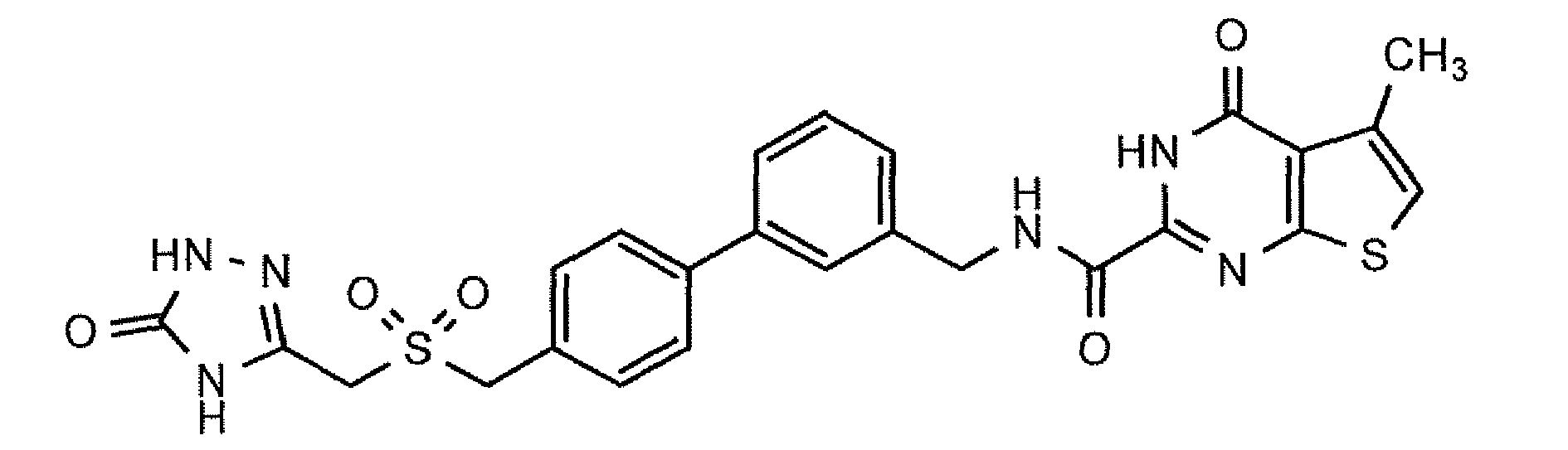
- By a method similar to that in Example 87 and using 5-[({[3'-(aminomethyl)biphenyl-4-yl]methyl}sulfonyl)methyl]-2,4-dihydro-3H-1,2,4-triazol-3-one obtained in Reference Example 111 and ethyl 5-methyl-4-oxo-3,4-dihydrothieno[2,3-d]pyrimidine-2-carboxylate obtained according to the methods described in
US4054656 and the like, the title compound was obtained as a pale-yellow powder (0.043 g, 34%).
melting point: 273-275°C -

- By a method similar to that in Example 87 and using 5-[({[3'-(aminomethyl)biphenyl-4-yl]methyl}sulfonyl)methyl]-2,4-dihydro-3H-1,2,4-triazol-3-one obtained in Reference Example 111 and ethyl 5-(3-chlorophenyl)-4-oxo-3,4-dihydrothieno[2, 3-d]pyrimidine-2-carboxylate obtained in Reference Example 73, the title compound was obtained as a pale-yellow powder (0.067 g, 45%).
melting point: 276-278°C -

- A suspension of 4-oxo-N-[(3-piperazin-1-ylphenyl)methyl]-3,4-dihydroquinazoline-2-carboxamide dihydrochloride obtained in Reference Example 116 (0.109 g, 0.250 mmol), (2,5-dioxoimidazolidin-4-yl)acetic acid (0.047 g, 0.300 mmol), 1-[3-(dimethylamino)propyl]-3-ethylcarbodiimide hydrochloride (0.096 g, 0.500 mmol) and 1-hydroxybenzotriazole (0.068 g, 0.500 mmol) in DMF (5 mL) was stirred at room temperature for 1 hr. Triethylamine (0.139 mL, 1.00 mmol) was added thereto, and the mixture was stirred at room temperature for 12 hr. The reaction mixture was concentrated under reduced pressure, and the residue was purified by preparative HPLC (GILSON 215LIQUD HANDLER, 322PUMP, UV/VIS-156, SHISEIDO CAPCELL PACK C-18 UG120 S-5 (20 mm φ ×50 mm), mobile phase: distilled water (containing 0.1% trifluoroacetic acid)/acetonitrile (containing 0.1% trifluoroacetic acid), gradient: distilled water/acetonitrile=90/10→0/100, time: 10 min, flow rate: 25 mL/min, detection wavelength: 220 nm), and crystallized from methanol-diethyl ether to give the title compound as a pale-yellow powder (0.078 g, 62%).
melting point: 280-282°C -

- By a method similar to that in Example 90 and using 4-oxo-N-[(3-piperazin-1-ylphenyl)methyl]-3,4-dihydroquinazoline-2-carboxamide dihydrochloride obtained in Reference Example 116 and (5-oxo-4,5-dihydro-1H-1,2,4-triazol-3-yl)acetic acid obtained according to the methods described in Australian Journal of Chemistry, 1979, 32, 161-165 and the like, the title compound was obtained as a pale-yellow powder (0.077 g, 63%).
melting point: 311-313°C -

- By a method similar to that in Example 90 and using 4-oxo-N-[(3-piperazin-1-ylphenyl)methyl]-3,4-dihydroquinazoline-2-carboxamide dihydrochloride obtained in Reference Example 116 and (5-oxo-2,5-dihydro-1H-pyrazol-3-yl)acetic acid obtained in Reference Example 118, the title compound was obtained as a pale-yellow powder (0.040 g, 33%).
melting point: 183-185°C -

- By a method similar to that in Example 90 and using 4-oxo-N-[(3-piperazin-1-ylphenyl)methyl]-3,4-dihydroquinazoline-2-carboxamide dihydrochloride obtained in Reference Example 116 and 1H-imidazol-4-ylacetic acid hydrochloride, the title compound was obtained as a pale-yellow powder (0.093 g, 79%).
melting point: 202-204°C -

- By a method similar to that in Example 90 and using 4-oxo-N-[(3-piperazin-1-ylphenyl)methyl]-3,4-dihydroquinazoline-2-carboxamide dihydrochloride obtained in Reference Example 116 and 1H-tetrazol-5-ylacetic acid, the title compound was obtained as a pale-yellow powder (0.038 g, 32%).
melting point: 163-165°C -

- A suspension of 4-oxo-N-[(3-piperazin-1-ylphenyl)methyl]-3,4-dihydroquinozoline-2-carboxamide dihydrochloride obtained in Reference Example 116 (0.100 g, 0.229 mmol) and N,N-diisopropylethylamine (0.120 mL, 0.688 mmol) in nitromethane (10 mL) was added dropwise to a solution of triphosgene (0.024 g, 0.080 mmol) in nitromethane (2 mL) at 0°C, and the mixture was stirred at room temperature for 2 hr. A suspension of 5-amino-1,3,4-thiadiazol-2-thiol (0.061 g, 0.458 mmol) and N,N-diisopropylethylamine (0.040 mL, 0.229 mmol) in nitromethane (5 mL) was added to this mixture at room temperature, and the mixture was stirred at room temperature for 4 hr, and then at 50°C for 2 hr. The reaction mixture was concentrated under reduced pressure, and water was added to the residue. The precipitated solid was collected by filtration, and washed with water, a mixed solution of dimethyl sulfoxide-methanol (1:1(v/v)) and methanol to give the title compound as a white powder (0.066 g, 55%). melting point: 212-214°C
-

- A suspension of N-[(4'-hydroxybiphenyl-3-yl)methyl]-4-oxo-3,4-dihydroquinazoline-2-carboxamide obtained in Reference Example 119 (0.100 g, 0.269 mmol), 5-bromo-5-[2-(ethyloxy)ethyl]pyrimidine-2,4,6(1H,3H,5H)-trione obtained according to the methods described in
WO02/34726
melting point: 163-165°C -

- A solution of ethyl 5-methyl-4-oxo-3,4-dihydrothieno[2,3-d]pyrimidine-2-carboxylate obtained according to the method described in US4054656 (150 mg, 0.630 mmol), 1-[3-{3-1[5-(trifluoromethyl)-1H-1,2,4-triazol-3-yl]thio}propoxy)phenyl]methanamine hydrochloride obtained in Reference Example 121 (243.80 mg, 0.661 mmol) and triethylamine (0.263 mL, 1.889 mmol) in a mixed solvent of EtOH (10 mL)-DMA (2 mL) was stirred at 90°C for 3 days. The solvent was evaporated under reduced pressure, and ethyl acetate-THF and 1N hydrochloric acid were added to the residue. The organic layer was washed with 1N hydrochloric acid and saturated brine, dried over sodium sulfate, and concentrated. The residue was purified by preparative HPLC (GILSON 215LIQUD HANDLER, 322PUMP, UV/VIS-156, SHISEIDO CAPCELL PACK C-18 UG120 S-5 (20 mm φ×50 mm), mobile phase: distilled water (containing 0.1% trifluoroacetic acid)/acetonitrile (containing 0.1% trifluoroacetic acid), gradient: distilled water/acetonitrile=95/5→0/100, time: 10 min, flow rate: 25 mL/min, detection wavelength: 220 nm), and crystallized from EtOH to give the title compound as a white powder (83.8 mg, 25%).
melting point: 170-172°C -
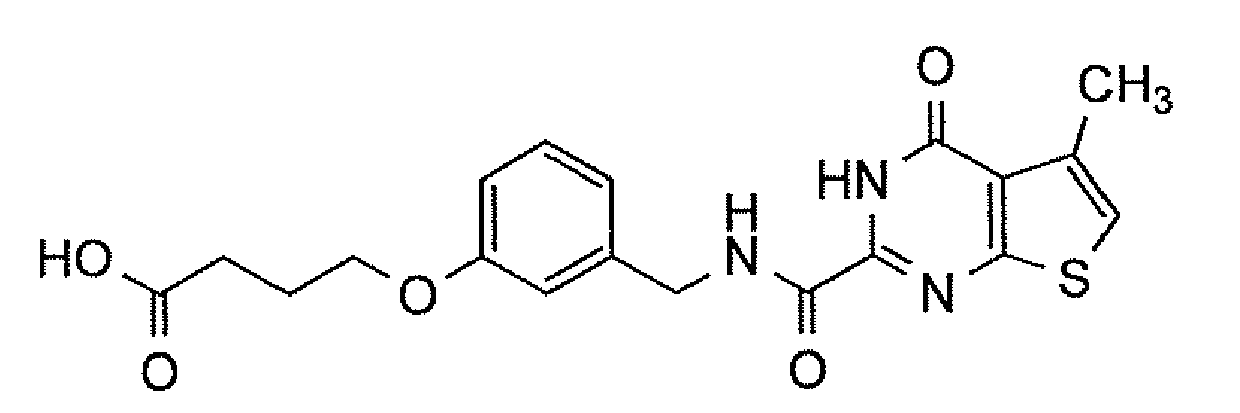
- By a method similar to that in Example 42 and using, instead of ethyl 4-[({[4-oxo-2-({[(2-{[3-(1H-1,2,4-triazol-3-yl)propyl]oxy}pyridin-4-yl)methyl]amino}carbonyl)-3,4-dihydrothieno[2,3-d]pyrimidin-5-yl]methyl}oxy)methyl]benzoate, ethyl 4-[3-({[(5-methyl-4-oxo-3,4-dihydrothieno[2,3-d]pyrimidin-2-yl)carbonyl]amino}methyl)phenoxy]butanoate obtained in Reference Example 122, the title compound was obtained as a white powder (465.7 mg, 91%).
melting point: 179-181°C -

- By a method similar to that in Example 97 and using, instead of 1-[3-(3-{[5-(trifluoromethyl)-1H-1,2,4-triazol-3-yl]thio}propoxy)phenyl]methanamine hydrochloride, 1-(3-{3-[(5-methyl-1H-1,2,4-triazol-3-yl)thio]propoxy}phenyl)methanamine hydrochloride obtained in Reference Example 124, the title compound was obtained as a white powder (31.2 mg, 11%). melting point: 170-171°C
-

- By a method similar to that in Example 97 and using, instead of 1-[3-{3-1[5-(trifluoromethyl)-1H-1,2,4-triazol-3-yl]thio}propoxy)phenyl]methanamine hydrochloride, 1-{3-[5-(1H-imidazol-1-yl)propoxy]phenyl}methanamine hydrochloride obtained in Reference Example 126, the title compound was obtained as a white powder (186.6 mg, 68%). melting point: 222-225°C
-

- By a method similar to that in Example 97 and using, instead of 1-[3-(3-{[5-(trifluoromethyl)-1H-1,2,4-triazol-3-yl]thio}propoxy)phenyl]methanamine hydrochloride, 1-{3-[3-(1H-1,2,4-triazol-1-yl)propoxylphenyl}methanamine hydrochloride obtained in Reference Example 128, the title compound was obtained as a white powder (177.7 mg, 59%). melting point: 180-182°C
-

- By a method similar to that in Example 22, and using, instead of ethyl 4-oxo-3,4-dihydro-2-quinazolinecarboxylate, ethyl 5-biphenyl-9-yl-oxo-3,4-dihydrothieno[2,3-d]pyrimidine-2-carboxylate obtained in Reference Example 136 and using, instead of 1-[2-({3-[1-(triphenylmethyl)-1H-1,2,4-triazol-3-yl]propyl}oxy)pyridin-4-yl]methaneamine, 1-{3-[(2-{[1-(triphenylmethyl)-1H-1,2,4-triazol-3-yl]oxy}ethyl)oxy]phenyl}methanamine obtained in Reference Example 32, the title compound was obtained as a white powder (155.4 mg, 85%).
melting point: 185-187°C -

- By a method similar to that in Example 97 and using, instead of 1-[3-(3-{[5-(trifluoromethyl)-1H-1,2,4-triazol-3-yl]thio}propoxy)phenyl]methanamine hydrochloride, 1-{3-[3-(1H-pyrazol-1-yl)propoxy]phenyl}methanamine hydrochloride obtained in Reference Example 130, the title compound was obtained as a white powder (163.0 mg, 61%). melting point: 162-163°C
-

- By a method similar to that in Example 97 and using, instead of 1-[3-(3-{[5-(trifluoromethyl)-1H-1,2,4-triazol-3-yl]thio}propoxy)phenyl]methanamine hydrochloride, 1-(3-{3-[(5-phenyl-1H-1,2,4-triazol-3-yl)thio]propoxy}phenyl)methanamine hydrochloride obtained in Reference Example 132, the title compound was obtained as a white powder (42.0 mg, 13%).
melting point: 119-121°C -

- By a method similar to that in Example 22, and using, instead of ethyl 4-oxo-3,4-dihydro-2-quinazolinecarboxylate, ethyl 5-methyl-4-oxo-3,4-dihydrothieno[2,3-d]pyrimidine-2-carboxylate obtained according to the method described in
US4054656 and using, instead of 1-[2-({3-[1-(triphenylmethyl)-1H-1,2,4-triazol-3-yl]propyl}oxy)pyridin-4-yl]methaneamine, 1-(3'-{[(1-trityl-1H-1,2,4-triazol-3-yl)oxy]methyl}biphenyl-3-yl)methanamine obtained in Reference Example 135, the title compound was obtained as a white powder (4.7 mg, 2%).
melting point: 152-154°C -

- A suspension of 3-hydroxybenzonitrile (5.00 g, 42.0 mmol), 1-bromo-2-chloroethane (9.00 g, 62.8 mmol) and potassium hydroxide (2.5 g, 44.6 mmol) in ethanol (100 mL) was stirred at 90°C for 24 hr. The reaction mixture was evaporated under reduced pressure, and the residue was extracted with diethyl ether and water. The organic layer was washed with saturated brine, dried over sodium sulfate, and concentrated. The obtained oil was purified by silica gel column chromatography (2% - 50% ethyl acetate/hexane) to give the title compound as a colorless oil (1.39 g, 18%). 1H-NMR (300MHz, CDCl3) δ: 3.83 (2H, t, J = 5.7 Hz), 4.25 (2H, t, J = 5.7 Hz), 7.14-7.19 (2H, m), 7.29 (1H, dt, J = 7.6, 1.3 Hz), 7.37-7.43 (1H, m).
-

- A solution of 3-[(2-chloroethyl)oxy]benzonitrile obtained in Reference Example 1 (11.3 g, 62.3 mmol), 1H-1,2,4-triazole-3-thiol (6.00 g, 59.3 mmol) and triethylamine (8.40 mL, 62.3 mmol) in ethanol (50 mL) was stirred at 80°C for 15 hr. The reaction mixture was concentrated under reduced pressure, and ethyl acetate and water were added to the residue. The organic layer was washed with saturated brine, dried over sodium sulfate, and concentrated to give the title compound as a white powder (14.4 g, 98%).
1H-NMR (300MHz, DMSO-d6) δ: 3.48 (2H, t, J = 6.7 Hz), 4,32 (2H, t, J = 6.6 Hz), 7.29-7.36 (1H, m), 7.38-7.43 (1H, m), 7.44-7.54 (2H, m), 8.46 (1H, s), 14.09 (1H, s). -

- A solution of 3-{[2-(1H-1,2,4-triazol-3-ylthio)ethyl]oxy}benzonitrile obtained in Reference Example 2 (9.00 g, 35.5 mmol) and Raney-nickel (5.00 g) in 5N ammonia/methanol (300 mL) was stirred at room temperature overnight under hydrogen atmosphere (1 atm). The catalyst was filtered off, and the filtrate was concentrate. The obtained residue was crystallized from toluene to give the title compound as a pale-blue powder (6.45 g, 71%).
melting point: not less than 300°C -

- A suspension of 1-bromo-3-chloropropane (13.9 g, 88.1 mmol) and 60% sodium hydride (oil dispersion, 3.02 g, 126 mmol) in ethanol(50 mL) was stirred at room temperature for 30 min. 3-Hydroxybenzonitrile (10.0 g, 83.9 mmol) was added to the reaction mixture at 0°C, and the mixture was stirred at 60°C for 15 hr. The reaction mixture was evaporated under reduced pressure, and the residue was extracted with ethyl acetate and water. The organic layer was washed with saturated brine, dried over sodium sulfate, and concentrated. The obtained oil was purified by silica gel column chromatography (5% - 15% ethyl acetate/hexane) to give the title compound as a colorless oil (14.2 g, 86%). 1H-NMR (300MHz, CDCl3) δ: 2.26 (2H, tt, J = 6.0, 6.0 Hz), 3.75 (2H, t, J = 6.2 Hz), 4.14 (2H, t, J = 5.8 Hz), 7.11-7.18 (2H, m), 7.23-7.28 (1H, m), 7.34-7.41 (1H, m).
-

- By a method similar to that in Reference Example 2 and using, instead of 3-[(2-chloroethyl)oxy]benzonitrile, 3-[(3-chloropropyl)oxy]benzonitrile obtained in Reference Example 4, the title compound was obtained as a white powder (7.87 g, 100%).
1H-NMR (300MHz, DMSO-d6) δ: 2.11 (2H, tt, J = 6.8, 6.6 Hz), 3.22 (2H, t, J = 7.1 Hz), 4.14 (2H, t, J = 6.2 Hz), 7.26-7.53 (4H, m), 8.42 (1H, s), 14.03 (1H, s). -

- A solution of 3-{[3-(1H-1,2,4-triazol-3-ylthio)propyl]oxy}benzonitrile obtained in Reference Example 5 (4.00 g, 15.4 mmol), trityl chloride (6.43 g, 23.0 mmol) and triethylamine (2.33 g, 23.0 mmol) in THF (50 mL) was stirred at room temperature for 48 hr. The reaction mixture was concentrated under reduced pressure, and ethyl acetate and water were added to the residue. The organic layer was washed with saturated brine, dried over sodium sulfate, and concentrated. The obtained oil was purified by silica gel column chromatography (5% - 40% ethyl acetate/hexane) to give the title compound as a white powder (3.52 g, 46%).
1H-NMR (300MHz, DMSO-d6) δ: 2.00-2.09 (H, m), 3.16 (2H, t, J = 7.1 Hz), 4.02-4.09 (2H, m), 7.01-7.11 (6H, m), 7.19-7.49 (13H, m), 8.13 (1H, s). -
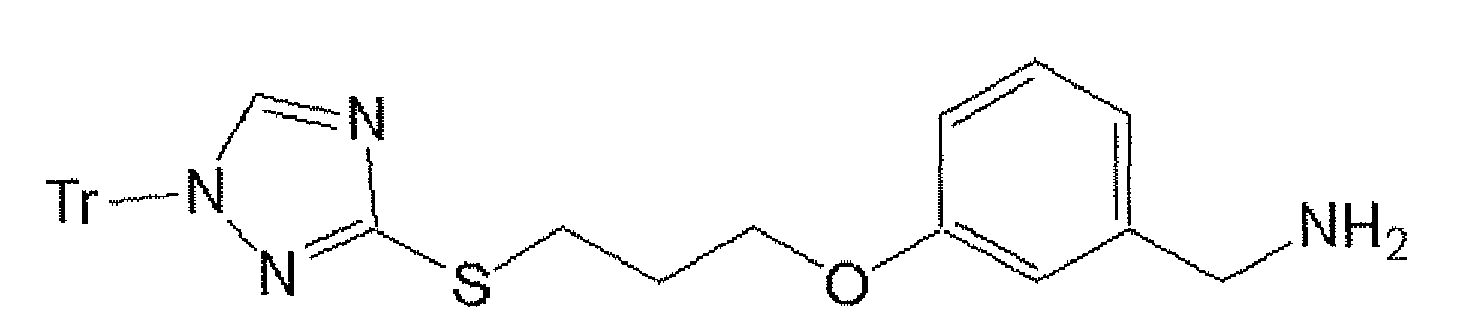
- A solution of 3-[(3-{[1-(triphenylmethyl)-1H-1,2,4-triazol-3-yl]thio}propyl)oxy]benzonitrile obtained in Reference Example 6 (2.00 g, 3.98 mmol) in THF (15 mL) was added slowly to a suspension of lithium aluminum hydride (1.51 g, 39.8 mmol) in THF (45 mL) at room temperature, and the mixture was stirred at room temperature for 4 hr. Sodium hydrogensulfate 10 hydrate (5.13 g, 15.9 mmol) was added to the reaction mixture at 0°C, and mixture was stirred at room temperature for 30 min. The insoluble material was filtered off, and the filtrate was concentrated under reduced pressure. Toluene and ethanol were added to the residue, and the mixture was concentrated under reduced pressure to give the title compound as a pale-yellow oil (1.91 g, 95%).
1H-NMR (300MHz, DMSO-d6) δ: 1.94-2.08 (2H, m), 3.16 (2H, t, J = 7.1 Hz), 3.62-3.67 (2H, m), 3.97 (2H, t, J = 6.1 Hz), 6.60-6.74 (1H, m), 6.82-6.92 (2H, m), 6.98-7.11 (6H, m), 7.12-7.45 (12H, m), 8.14 (1H, s). -

- By a method similar to that in Reference Example 4 and using, instead of 1-bromo-3-chloropropane, 1-bromo-4-chlorobutane, the title compound was obtained as a colorless oil (8.33 g, 95%).
1H-NMR (300MHz, CDCl3) δ: 1.94-2.02 (4H, m), 3.60-3.66 (2H, m), 4.02 (2H, t, J = 5.4 Hz), 7.08-7.15 (2H, m), 7.21-7.27 (1H, m), 7.33-7.41 (1H, m). -

- By a method similar to that in Reference Example 2 and using, instead of 3-[(2-chloroethyl)oxy]benzonitrile, 3-[(4-chlorobutyl)oxy]benzonitrile, the title compound was obtained as a white powder (7.25 g, 100%).
1H-NMR (300MHz, CDCl3) δ: 1.87-2.02 (5H, m), 3.20-3.31 (2H, m), 3.96-4.05 (2H, m), 7.06-7.16 (2H, m), 7.20-7.27 (1H, m), 7.32-7.40 (1H, m), 8.13 (1H, s). -

- By a method similar to that in Reference Example 6 and using, instead of 3-{[3-(1H-1,2,4-triazol-3-ylthio)propyl]oxy}benzonitrile, 3-{[4-(1H-1,2,4-triazol-3-ylthio)butyl]oxy}benzonitrile obtained in Reference Example 9, the title compound was obtained as a white powder (10.7 g, 78%).
1H-NMR (300MHz, CDCl3) δ: 1.81-1.89 (4H, m), 3.07-3.16 (2H, m), 3.83-3.90 (2H, m), 7.01-7.06 (2H, m), 7.11-7.17 (6H, m), 7.19-7.24 (1H, m), 7.28-7.36 (10H, m), 7.87 (1H, s). -
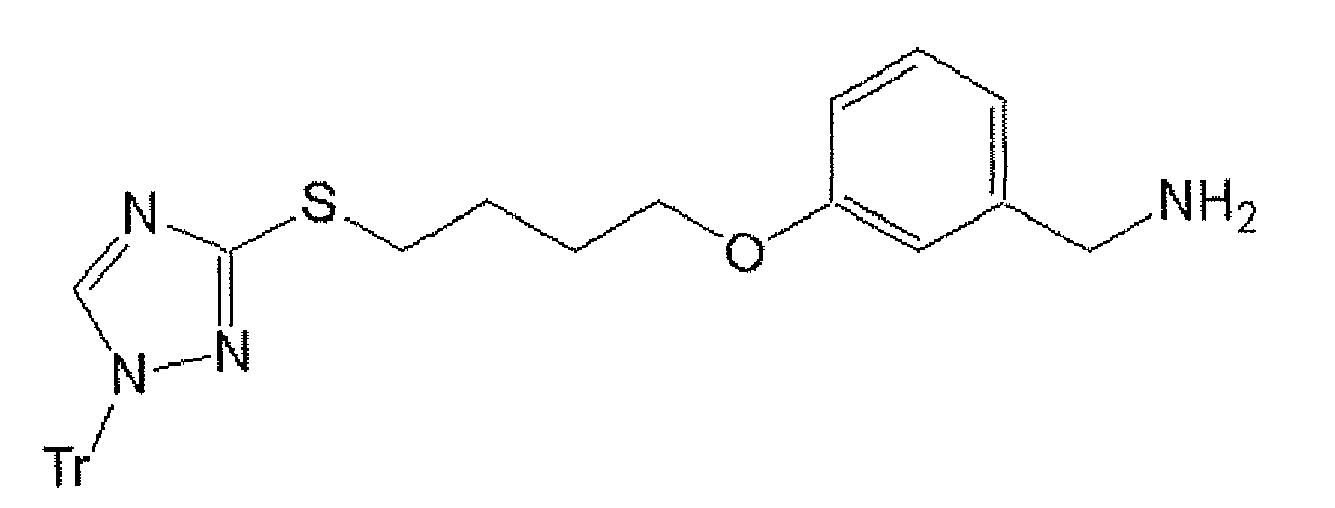
- By a method similar to that in Reference Example 7 and using, instead of 3-(3-{[1-(triphenylmethyl)-1H-1,2,4-triazol-3-yl]thio}propyl)oxy]benzonitrile, 3-[(4-{[1-(triphenylmethyl)-1H-1,2,4-triazol-3-yl]thio}butyl)oxy]benzonitrile obtained in Reference Example 10, the title compound was obtained as a yellow oil (8.65 g, 86%).
1H-NMR (300MHz, CDCl3) δ: 1.79-1.89 (4H, m), 2.35 (2H, s), 3.09-3.16 (2H, m), 3.81 (2H, s), 3.85-3.93 (2H, m), 6.71 (1H, dd, J = 8.1, 2.3 Hz), 6.81 (1H, s), 6.87 (1H, d, J = 7.0 Hz), 7.08-7.37 (16H, m), 7.86 (1H, s). -

- To a suspension of hydrazinecarbothioamide (15.0 g, 165 mmol) in pyridine (100 mL) was added dropwise ethyl 3-chloro-3-oxopropanoate (24.8 g, 165 mmol) over 30 min at 0°C, and the reaction solution was stirred at room temperature for 2 days. The reaction mixture was concentrated under reduced pressure, and methanol was added to the residue. The resulting solid was filtered off, the filtrate was concentrated under reduced pressure, and the residue was extracted with ethyl acetate, THF and saturated aqueous ammonium chloride solution. The organic layer was washed with saturated aqueous ammonium chloride solution, dried over sodium sulfate, and concentrated. The residue was crystallized from ethyl acetate and isopropyl ether, and the obtained crystals were washed with isopropyl ether, and dried to give the title compound (14.2 g, 42%).
1H-NMR (300MHz, DMSO-d6) δ: 1.10-1.27 (3H, m), 3.28 (2H, s), 4.09 (2H, q, J = 7.2 Hz), 7.36 (1H, s), 7.98 (1H, s), 9.38 (1H, s), 10.02 (1H, s). -

- A suspension of ethyl 3-[2-(aminocarbonothioyl)hydrazino]-3-oxopropanoate (14.0 g, 68.2 mmol) and sodium ethoxide (9.52 g, 140 mmol) in ethanol (200 mL) was stirred at 80°C for 15 hr. The mixture was concentrated under reduced pressure, and the residue was acidified with 1N hydrochloric acid, and extracted with ethyl acetate. The organic layer was washed with saturated brine, dried over sodium sulfate, and concentrated to give the title compound as an orange powder (12.2 g, 96%).
1H-NMR (300MHz, DMSO-d6) δ: 1.20 (3H, t, J = 7.1 Hz), 3.74 (2H, s), 4.12 (2H, q, J = 7.0 Hz). -

- A suspension of ethyl (5-mercapto-1H-1,2,4-triazol-3-yl) acetate obtained in Reference Example 13 (2.00 g, 10.7 mmol) and Raney-nickel (5.00 g) in ethanol (20 mL) was stirred at 80°C for 15 hr. The catalyst was filtered off, and the filtrate was concentrated under reduced pressure. To a suspension of the residue in ethyl acetate was added activated carbon, and the mixture was filtered. the filtrate was concentrated under reduced pressure to give the title compound as a pale-green powder (900 mg, 54%). 1H-NMR (300MHz, CDCl3) δ: 1.32 (3H, t, J = 6.8 Hz), 3.96 (2H, s), 4.26 (2H, q, J = 6.5 Hz), 8.83 (1H, s), 11.53 (1H, brs).
-

- A mixture of ethyl 1H-1,2,4-triazol-3-ylacetate obtained in Reference Example 14 (900 mg, 5.80 mmol), 4N aqueous sodium hydroxide solution (7.25 mL, 29.0 mmol), water (10 mL), methanol (10 mL) and THF (10 mL) was stirred at 100°C for 2 hr. The reaction mixture was concentrated under reduced pressure, the residue was acidified with 1N hydrochloric acid, and the mixture was concentrated under reduced pressure. Ethanol was added to the residue, and the insoluble material was filtered off, and the filtrate was concentrated. The residue was crystallized from toluene to give the title compound as a white powder (369 mg, 50%).
1H-NMR (300MHz, DMSO-d6) δ: 3.49 (2H, s), 7.92 (1H, s). -

- A solution of 1H-1,2,4-triazole-3-thiol (14.7 g, 145 mmol), 2-iodoethanol (25.0 g, 145 mmol) and triethylamine (14.7 g, 145 mmol) in ethanol (400 mL) was stirred at 80°C for 15 hr. The reaction mixture was concentrated under reduced pressure, and the residue was acidified with water and 1N hydrochloric acid, and extracted with ethyl acetate. The organic layer was washed with saturated brine, dried over sodium sulfate, and concentrated. The obtained oil was purified by silica gel column chromatography (10% - 100% ethyl acetate/hexane) to give the title compound as a colorless oil (7.30 g, 35%).
1H-NMR (300MHz, DMSO-d6) δ: 3.08-3.26 (2H, m), 3.62 (2H, t, J = 6.7 Hz), 8.38 (1H, s). -

- A solution of 2-(1H-1,2,4-triazol-3-ylthio)ethanol obtained in Reference Example 16 (7.34 g, 50.6 mmol) in DMF (50 mL) was added to a solution of 60% sodium hydride (oil dispersion, 4.91 g, 123 mmol) in DMF (50 mL) at 0°C. The mixture was stirred at 0°C for 15 min, and then at room temperature for 30 min. A solution of 2-chloropyridine-4-carbonitrile (6.80 g, 49.1 mmol) in DMF (50 mL) was added at 0°C, and the mixture was stirred at 0°C for 15 min, and then at room temperature for 2 hr. The mixture was neutralized with 1N hydrochloric acid, and extracted with ethyl acetate. The organic layer was washed with saturated brine, dried over sodium sulfate, and concentrated. The residue was purified by silica gel column chromatography (10% - 80% ethyl acetate/hexane) to give the title compound as a white powder (4.01 g, 33%).
1H-NMR (300MHz, DMSO-d6) δ: 3.48 (2H, t, J = 6.5 Hz), 4.56 (2H, t, J = 6.5 Hz), 7.38 (1H, s), 7.42 (1H, dd, J = 5.3, 1.3 Hz), 8.38 (1H, dd, J = 5.3, 0.8 Hz), 8.46 (1H, brs), 14.08 (1H, brs). -

- A suspension of 2-{[2-(1H-1,2,4-triazol-3-ylthio) ethyl]oxy} pyridine-4-carbonitrile obtained in Reference Example 17 (3.80 g, 15.4 mmol) and Raney-nickel (19.0 g) in 7N ammonia/methanol (100 mL) was stirred at room temperature for 5 hr under hydrogen atmosphere (1 atm). The catalyst was filtered off, and the filtrate was concentrated under reduced pressure. 2N Hydrogen chloride/ethanol solution (20 mL) was added to the residue, and the mixture was stirred at room temperature for 2 hr, and concentrated under reduced pressure. The obtained solid was stirred under heating in ethanol at 90°C for 2 hr to give the title compound as a white powder (1.27 g, 33%). 1H-NMR (300MHz, DMSO-d6) δ: 3.51 (2H, t, J = 6.3 Hz), 4.03 (2H, q, J = 5.7 Hz), 4.52 (2H, t, J = 6.4 Hz), 7.00 (1H, s), 7.15 (1H, dd, J = 5.3, 1.1 Hz), 8.16 (1H, d, J = 5.3 Hz), 8.61 (1H, s), 8.75 (3H, s).
-

- A solution of 2-{[2-(1H-1,2,4-triazol-3-ylthio)ethyl]oxy}pyridine-4-carbonitrile obtained in Reference Example 17 (3.40 g, 13.7 mmol), trityl chloride (5.73 g, 20.6 mmol) and triethylamine (2.87 mL, 20.6 mmol) in THF (30 mL) was stirred at room temperature for 15 hr. The mixture was concentrated under reduced pressure, and the residue was extracted with ethyl acetate and water. The organic layer was washed with saturated brine, dried over sodium sulfate, and concentrated. The obtained oil was purified by silica gel column chromatography (20% - 40% ethyl acetate/hexane) to give the title compound as a white powder (5.37 g, 80%).
1H-NMR (300MHz, DMSO-d6) δ: 3.22-3.31 (1H, m), 3.42 (1H, t, J = 6.5 Hz), 4.18 (1H, t, J = 6.4 Hz), 4.48 (1H, t, J = 6.4 Hz), 7.06 (7H, dd, J = 6.6, 2.8 Hz), 7.25-7.45 (11H, m), 8.15 (1H, s). -

- A solution of 2-[(2-{[1-(triphenylmethyl)-1H-1,2,4-triazol-3-yl]thio}ethyl)oxy]pyridine-4-carbonitrile obtained in Reference Example 19 (5.00 g, 10.2 mmol) in THF (40 mL) was added to a suspension of lithium aluminum hydride (0.775 g, 20.4 mmol) in THF (60 mL) at 0°C, and the mixture was stirred at room temperature for 7 hr. The mixture was cooled to 0°C, water and 1N aqueous sodium hydroxide solution were added, and the insoluble material was filtered off. The filtrate was dried over sodium sulfate, and concentrated. The obtained oil was purified by silica gel column chromatography (0 - 20% methanol/ethyl acetate) to give the title compound as a yellow oil (2.06 g, 41%).
1H-NMR (300MHz, DMSO-d6) δ: 3.10 (2H, t, J = 6.6 Hz), 3.51-3.64 (2H, m), 4.94 (2H, t, J = 5.6 Hz), 6.95-7.48 (20H, m), 8.12 (1H, s). -

- By a method similar to that in Reference Example 12 and using, instead of ethyl 3-chloro-3-oxopropanoate, ethyl 4-chloro-4-oxobutanoate, ethyl 4-[2-(aminocarbonothioyl)hydrazino]-4-oxobutanoate was obtained as a white powder (16.8 g, 35%).
- A suspension of ethyl 4-[2-(aminocarbonothioyl)hydrazino]-4-oxobutanoate (16.8 g, 76.7 mmol) and sodium ethoxide (10.4 g, 153 mmol) in ethanol (200 mL) was stirred at 80°C for 15 hr. The mixture was concentrated under reduced pressure, and the residue was acidified with 1N hydrochloric acid, and extracted with ethyl acetate. The organic layer was washed with saturated brine, dried over sodium sulfate, and concentrated to give the title compound as a white powder (14.0 g, 91%).
1H-NMR (300MHz, DMSO-d6) δ: 1.01-1.28 (3H, m), 2.64-2.83 (4H, m), 4.05 (2H, q, J = 7.2 Hz), 13.10 (1H, brs), 13.21 (1H, brs). -

1H-NMR (300MHz, DMSO-d6) δ: 2.24 (2H, t, J = 7.5 Hz), 2.80 (2H, t, J = 7.5 Hz), 7.82 (1H, s). -

- A suspension of 3-(1H-1,2,4-triazol-3-yl)propanoic acid obtained in Reference Example 22 (11.6 g, 3.54 mmol) and 2N hydrogen chloride/ethanol (100 mL) in ethanol (100 mL) was stirred at 90°C for 15 hr. The insoluble material was filtered off, and the filtrate was concentrated under reduced pressure. The residue was extracted with ethyl acetate and water. The aqueous layer was neutralized with saturated aqueous sodium carbonate solution, and the organic layer was washed with saturated brine, dried over sodium sulfate, and concentrated to give the title compound as a yellow powder (4.36 g, 33%).
1H-NMR (300MHz, DMSO-d6) δ: 1.11-1.20 (3H, m), 2.72 (2H, d, J = 1.7 Hz), 2.92 (2H, s), 4.00-4.08 (2H, m), 7.79 (1H, s), 13.59 (1H, brs). -

- By a method similar to that in Reference Example 6 and using, instead of 3-{[3-(1H-1,2,4-triazol-3-ylthio)propyl]oxy}benzonitrile, ethyl 3-(1H-1,2,4-triazol-3-yl)propanoate obtained in Reference Example 23, the title compound was obtained as a white powder (773 mg, 32%). 1H-NMR (300MHz, DMSO-d6) δ: 1.10 (3H, t, J = 7.2 Hz), 2.67 (2H, t, J = 7.1 Hz), 2.90 (2H, t, J = 7.0 Hz), 3.98 (2H, q, J = 6.9 Hz), 6.99-7.08 (6H, m), 7.34-7.40 (9H, m), 7.95 (1H, s) .
-

- By a method similar to that in Reference Example 15 and using, instead of ethyl 1H-1,2,4-triazol-3-ylacetate, ethyl 3-[1-(triphenylmethyl)-1H-1,2,4-triazol-3-yl]propanoate obtained in Reference Example 24, the title compound was obtained as a white powder (175 mg, 85%).
1H-NMR (300MHz, DMSO-d6) δ: 2.59 (2H, t, J = 7.3 Hz), 2.86 (2H, t, J = 7.3 Hz), 7.04 (6H, dd, J = 6.7, 2.9 Hz), 7.33-7.45 (9H, m), 7.93 (1H, s), 12.17 (1H, brs). -

- A solution of ethyl 3-[1-(triphenylmethyl)-1H-1,2,4-triazol-3-yl]propanoate obtained in Reference Example 24 (700 mg, 1.70 mmol) in THF (5 mL) was added to a suspension of lithium aluminum hydride (84.0 mg, 2.21 mmol) in THF (5 mL) at 0°C, and the mixture was stirred at 0°C for 5 hr, and then at room temperature for 15 hr. Water and 1N aqueous sodium hydroxide solution were added to the mixture, and the insoluble material was filtered off. The filtrate was concentrated under reduced pressure, and the residue was purified by silica gel column chromatography (0 - 80% ethyl acetate/hexane) to give the title compound as a white powder (289 mg, 46%).
1H-NMR (300MHz, DMSO-d6) δ: 1.70-1.83 (2H, m), 2.65 (2H, t, J = 7.5 Hz), 3.36-3.45 (2H, m), 4.44 (1H, t, J = 5.2 Hz), 7.00-7.09 (6H, m), 7.33-7.41 (9H, m), 7.95 (1H, s). -

- By a method similar to that in Reference Example 17 and using, instead of 2-(1H-1,2,4-triazol-3-ylthio)ethanol, 3-[1-(triphenylmethyl)-1H-1,2,4-triazol-3-yl]propan-1-ol obtained in Reference Example 26, the title compound was obtained as a white powder (314 mg, 88%).
1H-NMR (300MHz, DMSO-d6) δ: 2.03-2.14 (2H, m), 2.79 (2H, t, J = 7.3 Hz), 4.30 (2H, t, J = 6.4 Hz), 7.04 (6H, dd, J = 6.4, 3.2 Hz), 7.31-7.41 (11H, m), 7.99 (1H, s), 8.38 (1H, d, J = 5.1 Hz). -

- By a method similar to that in Reference Example 20 and using, instead of 2-[{2-{[1-(triphenylmethyl)-1H-1,2,4-triazol-3-yl]thio}ethyl)oxy]pyridine-4-carbonitrile, 2-({3-[1-(triphenylmethyl)-1H-1,2,4-triazol-3-yl]propyl}oxy)pyridine-4-carbonitrile obtained in Reference Example 27, the title compound was obtained as a yellow oil (67 mg, 27%).
1H-NMR (300MHz, DMSO-d6) δ: 2.00-2.12 (2H, m), 2.77 (2H, t, J = 7.3 Hz), 3.67 (2H, s), 4.23 (2H, t, J = 6.5 Hz), 6.75 (1H, s), 6.91 (1H, dd, J = 5.2, 1.0 Hz), 6.99-7.08 (6H, m), 7.29-7.40 (9H, m), 7.97 (1H, s), 8.02 (1H, d, J = 5.3 Hz). -

- Ethyl bromoacetate (14.7 g, 88.1 mmol) was added dropwise to a suspension of potassium carbonate (12.8 g, 92.3 mmol) and 3-hydroxybenzonitrile (10.0 g, 83.9 mmol) in THF (50 mL) at room temperature, and the mixture was stirred at 50°C for 24 hr. The mixture was extracted with ethyl acetate and saturated aqueous ammonium chloride solution, and the organic layer was washed with saturated brine, dried over sodium sulfate, and concentrated to give the title compound as a pale-yellow powder (17.5 g, 99%). 1H-NMR (300MHz, CDCl3) δ: 1.31 (3H, t, J = 7.2 Hz), 4.29 (2H, q, J = 7.1 Hz), 4.65 (2H, s), 7.13-7.18 (2H, m), 7.28-7.32 (1H, m), 7.36-7.44 (1H, m).
-

- A suspension of ethyl [(3-cyanophenyl)oxy]acetate obtained in Reference Example 29 (8.00 g, 39.0 mmol) and sodium borohydride (1.47 g, 39.0 mmol) in ethanol (120 mL) was stirred at 50°C for 15 hr, and the mixture was concentrated under reduced pressure. The residue was extracted with ethyl acetate and water, and the organic layer was washed with saturated brine, dried over sodium sulfate, and concentrated to give the title compound as a white powder (5.85 g, 92%).
1H-NMR (300MHz, CDCl3) δ: 1.67 (1H, brs), 3.97-4.02 (2H, m), 4.08-4.13 (2H, m), 7.13-7.20 (2H, m), 7.24-7.30 (1H, m), 7.35-7.43 (1H, m). -

- A solution of 3-[(2-hydroxyethyl)oxy]benzonitrile obtained in Reference Example 30 (19.2 g, 118 mmol) in THF (100 mL) was added dropwise to a suspension of 3-nitro-1-(triphenylmethyl)-1H-1,2,4-triazole obtained in Reference Example 33 (40.0 g, 112 mmol) and 60% sodium hydride (oil dispersion, 6.06 g, 151.52 mmol) in THF (300 mL), and the mixture was stirred at room temperature for 12 hr. The mixture was cooled to 0°C, and extracted with water and ethyl acetate. The organic layer was washed with saturated brine, dried over sodium sulfate, and concentrated. The residue was purified by silica gel column chromatography (0 - 30% ethyl acetate/hexane) to give the title compound as a white powder (25.0 g, 46%).
1H-NMR (300MHz, CDCl3) δ: 4.23-4.29 (2H, m), 4.56-4.63 (2H, m), 7.07-7.41 (19H, m), 7.67 (1H, s). -

- By a method similar to that in Reference Example 20 and using, instead of 2-[(2-{[1-(triphenylmethyl)-1H-1,2,4-triazol-3-yl]thio}ethyl)oxy]pyridine-4-carbonitrile, 3-[(2-{[1-(triphenylmethyl)-1H-1,2,4-triazol-3-yl]oxy}ethyl)oxy]benzonitrile obtained in Reference Example 31, the title compound was obtained as a colorless oil (504 mg, 99%).
1H-NMR (300MHz, DMSO-d6) δ: 1.58-2.00 (2H, m), 3.66 (2H, s), 4.20-4.27 (2H, m), 4.45 (2H, dd, J = 5.5, 3.4 Hz), 6.75 (1H, dd, J = 8.1, 2.1 Hz), 6.86-6.96 (2H, m), 7.06-7.14 (6H, m), 7.19 (1H, t, J = 7.8 Hz), 7.34-7.44 (9H, m), 7.86 (1H, s). -

- A solution of 3-nitro-1H-1,2,4-triazole (1.00 g, 8.77 mmol), trityl chloride (4.89 g, 17.5 mmol) and diisopropylethylamine (3.05 mL, 17.5 mmol) in THF (50 mL) was stirred at room temperature for 15 hr. The mixture was concentrated under reduced pressure, and the residue was extracted with ethyl acetate and water. The organic layer was washed with saturated brine, dried over sodium sulfate, and concentrated. The residue was purified by silica gel column chromatography (15 - 30% ethyl acetate/hexane) to give the title compound as a white powder (2.90 g, 93%).
1H-NMR (300MHz, CDCl3) δ: 7.08-7.17 (6H, m), 7.33-7.47 (9H, m), 8.04 (1H, s). -

- By a method similar to that in Reference Example 33 and using, instead of 3-nitro-1H-1,2,4-triazole, methyl 1H-1,2,4-triazole-3-carboxylate, the title compound was obtained as a white powder (17.0 g, 59%).
1H-NMR (300MHz, DMSO-d6) δ: 3.84 (3H, s), 7.07 (6H, dd, J = 6.8, 2.8 Hz), 7.34-7.46 (9H, m), 8.39 (1H, s). -

- By a method similar to that in Reference Example 15 and using, instead of ethyl 1H-1,2,4-triazol-3-ylacetate, methyl 1-(triphenylmethyl)-1H-1,2,4-triazole-3-carboxylate obtained in Reference Example 34, the title compound was obtained as a white powder (2.82 g, 98%).
1H-NMR (300MHz, DMSO-d6) δ: 7.07 (6H, dd, J = 6.9, 2.9 Hz), 7.30-7.56 (9H, m), 8.31 (1H, s), 13.49 (1H, s). -

- By a method similar to that in Reference Example 26 and using, instead of ethyl 3-[1-(triphenylmethyl)-1H-1,2,4-triazol-3-yl]propanoate, methyl 1-(triphenylmethyl)-1H-1,2,4-triazole-3-carboxylate obtained in Reference Example 34, the title compound was obtained as a white powder (5.35 g, 58%).
1H-NMR (300MHz, DMSO-d6) δ: 4.44 (2H, d, J = 6.0 Hz), 5.29-5.35 (1H, m), 7.03-7.10 (6H, m), 7.36-7.42 (9H, m), 8.04 (1H, s). -

- A suspension of [1-(triphenylmethyl)-1H-1,2,4-triazol-3-yl]methanol obtained in Reference Example 36 (3.00 g, 8.79 mmol), 3-(bromomethyl)benzonitrile (1.89 g, 9.67 mmol) and 60% sodium hydride (oil dispersion, 0.316 g, 13.2 mmol) in THF (100 mL) was stirred at 70°C for 15 hr. The reaction mixture was cooled to room temperature, and extracted with water and ethyl acetate. The organic layer was washed with saturated brine, dried over sodium sulfate, and concentrated. The residue was purified by silica gel column chromatography (10 - 30% ethyl acetate/hexane) to give the title compound as a colorless oil (3.50 g, 87%). 1H-NMR (300MHz, DMSO-d6) δ: 4.54 (2H, s), 4.57 (2H, s), 7.04-7.11 (6H, m), 7.35-7.43 (9H, m), 7.51-7.64 (2H, m), 7.68 (1H, s), 7.76 (1H, d, J = 7.3 Hz), 8.16 (1H, s).
-

- By a method similar to that in Reference Example 20 and using, instead of 2-[(2-{[1-(triphenylmethyl)-1H-1,2,4-triazol-3-yl]thio}ethyl)oxy]pyridine-4-carbonitrile, 3-[({[1-(triphenylmethyl)-1H-1,2,4-triazol-3-yl]methyl}oxy)methyl]benzonitrile obtained in Reference Example 37, the title compound was obtained as a pale-yellow oil (1.96 g, 67%).
1H-NMR (300MHz, DMSO-d6) δ: 1.96 (2H ,brs), 3.68 (2H, s), 4.46 (2H, s), 4.52 (2H, s), 6.97-7.17 (7H, m), 7.16-7.31 (3H, m), 7.33-7.47 (9H, m), 8.14 (1H, s). -

- Ethyl 5'-amino-2,3'-bithiophene-4'-carboxylate (3.00 g, 11.842 mmol) was suspended in 1N hydrogen chloride-acetic acid solution (30 mL), ethyl cyanoformate (1.29 g, 13.026 mmol) was added, and the mixture was stirred under heating at 90°C for 2 hr. The reaction mixture was allowed to cool to room temperature, and concentrated under reduced pressure. The residue was suspended in diethyl ether, and the insoluble material was collected by filtration, washed with water to give the title compound as a brown powder (3.21 g, 88%).
1H-NMR (300MHz, DMSO-d6) δ: 1.36 (3H, t, J = 7.1 Hz), 4.39 (2H, q, J = 7.2 Hz), 7.12 (1H, dd, J = 5.1, 3.6 Hz), 7.57 (1H, dd, J = 5.1, 1.3 Hz), 7.65 (1H, dd, J = 3.6, 1.3 Hz), 7.87 (1H, s), 12.89 (1H, brs). -

- By a method similar to that in Reference Example 39 and using, instead of ethyl 5'-amino-2,3'-bithiophene-4'-carboxylate, ethyl 2-amino-4-furan-2-ylthiophene-3-carboxylate, the title compound was obtained as a brown powder (2.85 g, 47%).
1H-NMR (300MHz, DMSO-d6) δ: 1.36 (3H, t, J = 7.1 Hz), 4.38 (2H, q, J = 7.1Hz), 6.60 (1H, dd, J = 3.4, 1.9 Hz), 7.57 (1H, d, J = 3.2 Hz), 7.76 (7.H, d, J = 1.1 Hz), 7.95 (1H, s), 12.93 (1H, brs). -

- A solution of 4-bromobutanoic acid (25.0 g, 150 mmol), DMF (5 drops) and oxalyl chloride (17.0 mL, 195.0 mmol) in dichloromethane (250 mL) was stirred at room temperature for 5 hr. The reaction mixture was concentrated under reduced pressure, dichloromethane (200 mL) and ethanol (9.0 mL, 170 mmol) were added to the residue, and the mixture was stirred at room temperature for 15 hr. The reaction mixture was washed with saturated aqueous sodium hydrogencarbonate and saturated brine, and the organic layer was dried over sodium sulfate, and concentrated. The residue was purified by silica gel column chromatography (0 - 5% ethyl acetate/hexane) to give ethyl 4-bromobutanoate as a colorless oil (24.5 g, 84%).
- A suspension of 3-hydroxybenzonitrile (5.00 g, 42.0 mmol) and 60% sodium hydride (oil dispersion, 2.01 g, 50.3 mmol) in DMF (200 mL) was stirred at room temperature for 30 min, ethyl 4-bromobutanoate (9.82 g, 50.3 mmol) was added thereto, and the mixture was stirred at room temperature for 15 hr. The mixture was allowed to cool to room temperature, and concentrated under reduced pressure. The residue was extracted with ethyl acetate and saturated aqueous ammonium chloride solution. The organic layer was washed with saturated aqueous ammonium chloride solution and saturated brine, dried over sodium sulfate, and concentrated. The obtained residue was purified by silica gel column chromatography (0 - 10% ethyl acetate/hexane) to give the title compound as a colorless oil (10.2 g, 100%). 1H-NMR (300MHz, CDCl3) δ: 1.27 (3H, t, J = 7.2 Hz), 2.13 (2H, tt, J = 6.7, 6.7 Hz), 2.52 (2H, t, J = 7.2Hz), 4.03 (2H, t, J = 6.1 Hz), 4.16 (2H, q, J = 7.2 Hz), 7.08-7.16 (2H, m), 7.21-7.26 (1H, m), 7.32-7.40 (1H, m).
-

- A mixture of ethyl 4-[(3-cyanophenyl)oxy]butanoate obtained in Reference Example 41 (8.50 g, 36.4 mmol), 10% palladium carbon (containing 50% water)(12.8 g), formic acid (98 mL) and methanol (80 mL) was stirred at room temperature for 5 hr under hydrogen atmosphere (1 atm). The precipitate was filtered off, and the filtrate was concentrated under reduced pressure. 4N Hydrogen chloride/ethyl acetate solution (15.0 mL, 60.0 mmol) was added to the obtained residue, and the mixture was stirred, and concentrated under reduced pressure. The residue was crystallized from toluene, and the crude crystals were recrystallized from diethyl ether to give the title compound as a white powder (7.79 g, 78%).
1H-NMR (300MHz, DMSO-d6) δ: 1.18 (3H, t, J = 7.2 Hz), 1.98 (2H, tt, J = 6.8, 6.8 Hz), 2.46 (2H, t, J = 7.3 Hz), 3.95-4.03 (4H, m), 4.07 (2H, q, J = 7.1 Hz), 6.92 (1H, dd, J = 8.2, 2.2 Hz), 7.04 (1H, d, J = 7.3 Hz), 7.12 (1H, s), 7.31 (1H, t, J = 7.9 Hz), 8.26 (3H, s). -
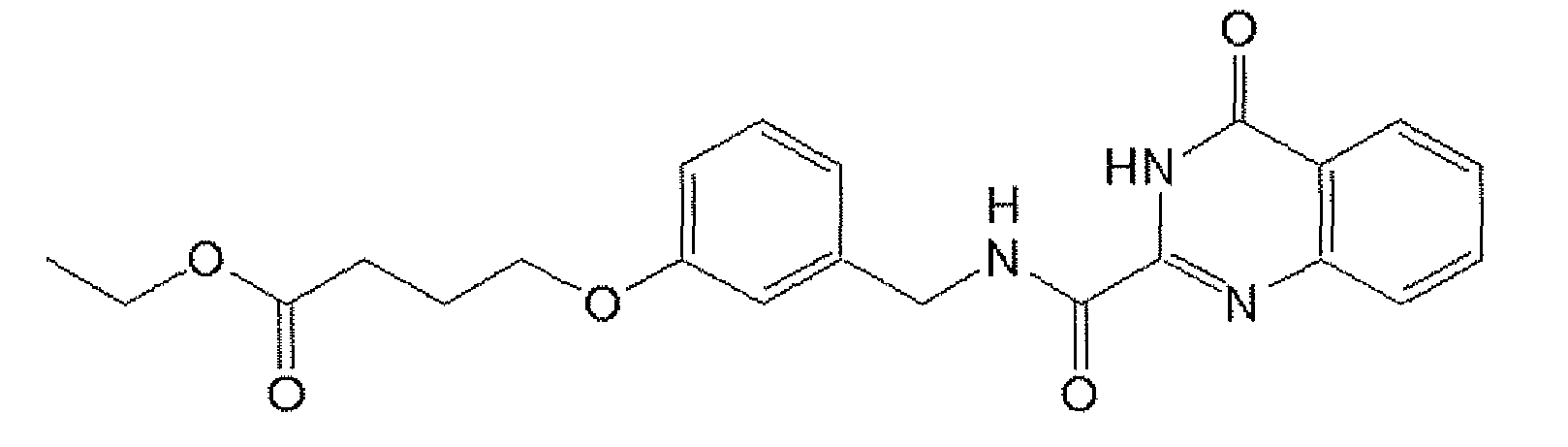
- By a method similar to that in Example 1 and using, instead of 1-(3-{[2-(1H-1,2,4-triazol-3-ylthio)ethyl]oxy}phenyl)methaneamine, ethyl 4-{[3-(aminomethyl)phenyl]oxy}butanoate hydrochloride obtained in Reference Example 42, the title compound was obtained as a white powder (807 mg, 86%).
1H-NMR (300MHz, DMSO-d6) δ: 1.15 (3H, t, J = 7.1 Hz), 1.89-2.01 (2H, m), 2.44 (2H, t, J = 7.3 Hz), 3.96 (2H, t, J = 6.3 Hz), 4.04 (2H, q, J = 7.0 Hz), 4.45 (2H, d, J = 6.2 Hz), 6.77-6.84 (1H, m), 6.88-6.94 (2H, m), 7.19-7.27 (1H, m), 7.57-7.65 (1H, m), 7.75-7.81 (1H, m), 7.84-7.94 (1H, m), 8.17 (1H, dd, J = 7.9, 1.1 Hz), 9.54 (1H, t, J = 6.3 Hz), 12.29 (1H, brs). -

- A mixture of ethyl 4-{[3({[(4-oxo-3,4-dihydroquinazolin-2-yl)carbonyl]amino}methyl)phenyl]oxy}butanoate obtained in Reference Example 43 (525 mg, 1.28 mmol), 4N aqueous sodium hydroxide solution (1.6 mL), THF (10 mL), methanol (10 mL) and water (10 mL) was stirred at 1.00°C for 2 hr. The mixture was allowed to cool to room temperature, and the solvent was evaporated under reduced pressure. Water and 1N hydrochloric acid (6.41 mL) were added to the residue, and the resulting precipitate was collected by filtration, washed with water, and dried. The obtained crude crystals were recrystallized from ethanol to give the title compound as a white powder (339 mg, 69%).
1H-NMR (300MHz, DMSO-d6) δ: 1.85-1.99 (2H, m), 2.37 (2H, t, J = 7.3 Hz), 3.96 (2H, t, J = 6.4 Hz), 4.45 (2H, d, J = 6.4 Hz), 6.76-6.86 (1H, m), 6.88-6.96 (2H, m), 7.23 (1H, t, J = 8.1 Hz), 7.56-7.67 (1H, m), 7.75-7.82 (1H, m), 7.83-7.93 (1H, m), 8.18 (1H, dd, J = 7.9, 1.1 Hz), 9.55 (1H, t, J = 6.3 Hz), 12.21 (2H,s). -

- A suspension of ethyl 6-cyano-4-oxo-3,4-dihydroquinazoline-2-carboxylate obtained in Reference Example 51 (1.00 g, 4.11 mmol) and 3-(aminomethyl) aniline (0.753 g, 6.17 mmol) in THF (15 mL) was stirred at 80°C for 15 hr. The reaction mixture was cooled to room temperature, IPE was added, and the insoluble material was filtered off. The filtrate was concentrated under reduced pressure, and the obtained crude crystals were recrystallized from ethyl acetate-IPE to give the title compound as a white powder (899 mg, 69%).
1H-NMR (300MHz, DMSO-d6) δ: 4.34 (2H, d, J = 6.2 Hz), 5.11 (2H, s), 6.40-6.56 (3H, m), 6.95 (1H, t, J = 7.6 Hz), 7.88 (1H, d, J = 8.5 Hz), 8.23 (1H, dd, J = 8.5, 1.9 Hz), 8.55 (1H, d, J = 1.5 Hz), 9.50 (1H, t, J = 6.2 Hz), 12.48 (1H, s) . -

- By a method similar to that in Reference Example 45 and using, instead of 3-(aminomethyl)aniline, 1,1-dimethylethyl {[3-(aminomethyl)phenyl]methyl}carbamate, the title compound was obtained as a white powder (2.36 g, 88%). 1H-NMR (300MHz, DMSO-d6) δ: 1.34 (9H, s), 4.10 (2H, d, J = 6.0 Hz), 4.97 (2H, d, J = 5.8 Hz), 7.07-7.42 (5H, m), 7.85 (1H, d, J = 8.9 Hz), 8.22 (1H, d, J = 9.4 Hz), 8.54 (1H, s), 9.65 (1H, s), 12.65 (1H, s).
-

- To a suspension of 1,1-dimethylethyl {[3-({[(6-cyano-4-oxo-3,4-dihydroquinazolin-2-yl)carbonyl]amino}methyl)phenyl]methyl}carbamate obtained in Reference Example 46 (2.14 g, 4.94 mmol) in ethyl acetate (5 mL) was added 4N hydrogen chloride/ethyl acetate (60 mL), and the mixture was stirred at room temperature for 15 hr. The reaction mixture was concentrated under reduced pressure, and the residue was crystallized from toluene. The obtained crude crystals were suspended in ethyl acetate, and the suspension was stirred under heating for 3 hr to give the title compound as a white powder (1.86 g, 99%).
1H-NMR (300MHz, DMSO-d6) δ: 3.91-4.09 (2H, m), 4.51 (2H, d, J = 6.4 Hz), 7.31-7.46 (4H, m), 7.90 (1H, d, J = 8.7 Hz), 8.25 (1H, dd, J= 8.5, 2.1 Hz), 8.36 (3H, brs), 8.54-8.58 (1H, m), 9.63-9.75 (1H, m), 12.73 (1H, brs). -

- By a method similar to that in Reference Example 45 and using, instead of ethyl 6-cyano-4-oxo-3,4-dihydroquinazoline-2-carboxylate, ethyl 5-methyl-4-oxo-3,4-dihydrothieno[2,3-d]pyrimidine--2-carboxylate obtained according to the method described in
US4054656 , the title compound was obtained as a yellow powder (1.92 g, 97%). 1H-NMR (300MHz, DMSO-d6) δ: 3.33 (3H, s), 4.30 (2H, d, J = 6.2 Hz), 5.03 (2H, s), 6.40-6.52 (3H, m), 6.94 (1H, t, J = 7.7 Hz), 7.31 (1H, d, J = 1.3 Hz), 9.48 (1H, t, J = 6.3 Hz), 12.20 (1H, s). -

- By a method similar to that in Reference Example 45, and using, instead of ethyl 6-cyano-4-oxo-3,4-dihydroquinazoline-2-carboxylate, ethyl 5-methyl-4-oxo-3,4-dihydrothieno[2,3-d]pyrimidine-2-carboxylate obtained according to the method described in
US4054656 and using, instead of 3-(aminomethyl)aniline, 1,1-dimethylethyl {[3-(aminomethyl)phenyl]methyl}carbamate, the title compound was obtained as a white powder (2.11 g, 82%).
1H-NMR (300MHz, DMSO-d6) δ: 1.35 (9H, s), 2.47-2.53 (3H, m), 4.10 (2H, d, J = 6.2 Hz), 4.43 (2H, d, J = 6.4 Hz), 7.08-7.41 (6H, m), 9.62 (1H, t, J = 6.3 Hz), 12.25 (1H, s). -

- By a method similar to that in Reference Example 47 and using, instead of 1,1-dimethylethyl {[3-({[(6-cyano-4-oxo-3,4-dihydroquinazolin-2-yl)carbonyl]amino}methyl)phenyl]methyl}carbamate, 1,1-dimethylethyl {[3-({[(5-methyl-4-oxo-3,4-dihydrothieno[2,3-d]pyrimidin-2-yl)carbonyl]amino}methyl)phenyl]methyl}carbamate obtained in Reference Example 49, the title compound was obtained as a white powder (1.39 g, 3.80 mmol).
1H-NMR (300MHz, DMSO-d6) δ: 2.47-2.53 (3H, m), 3.99 (2H, s), 4.46 (2H, d, J = 6.4 Hz), 7.25-7.52 (5H, m), 9.58 (3H, brs), 9.67 (1H, t, J= 6.4 Hz). -

- To a solution of 5-iodoanthranilic acid (25.0 g, 95.0 mmol) in THF (400 mL) was added bis(trichloromethyl) carbonate (9.40 g, 31.7 mmol), and the mixture was stirred under heating at 60°C for 15 hr. The reaction mixture was concentrated under reduced pressure, and 2N aqueous ammonia (235 mL) was added thereto. The mixture was stirred under heating at 60°C for 2 hr, and extracted with ethyl acetate. The organic layer was washed with saturated brine, dried over sodium sulfate, and concentrated under reduced pressure. The residue was suspended in diisopropyl ether, and the insoluble material was collected by filtration to give 2-amino-5-iodobenzamide as a white powder (15.9 g, 64%).
- To a solution of 2-amino-5-iodobenzamide (15.8 g, 60.3 mmol) and triethylamine (7.32 g, 72.4 mmol) in THF (300 mL) was added dropwise ethyl chloroglyoxylate (9.05 g, 66.3 mmol) under ice-cooling, and the mixture was stirred at room temperature for 2 hr. Water was added to the reaction mixture, and the precipitated insoluble material was collected by filtration. The solid was washed with water to give ethyl ((2-(aminocarbonyl)-4-iodophenyl)amino)(oxo)acetate as a white powder (20.9 g, 96%).
- To a suspension of ethyl ((2-(aminocarbonyl)-4-iodophenyl)amino)(oxo)acetate (20.9 g, 57.7 mmol) in ethanol (300 mL) was added dropwise sodium ethylate (20% ethanol solution, 21.6 g, 63.5 mmol) under ice-cooling, and the mixture was stirred at room temperature for 1 hr. The reaction mixture was poured into 0.3N hydrochloric acid (600 mL) under ice-cooling, and the precipitated insoluble material was collected by filtration. The filtered cake was washed with water and ethanol to give ethyl 6-iodo-4-oxo-3,4-dihydroquinazoline-2-carboxylate as a pale-pink powder (17.0 g, 86%).
1H-NMR (200MHz, DMSO-d6) δ: 1.35 (3H, t, J = 7.0 Hz), 4.38 (2H, q, J = 7.0 Hz), 7.61 (1H, d, J = 8.5 Hz), 8.18 (1H, dd, J = 8.5, 2.0 Hz), 8.44 (1H, d, J = 2.0 Hz). - A suspension of ethyl 6-iodo-4-oxo-3,4-dihydroquinazoline-2-carboxylate (2.00 g, 5.81 mmol), zinc cyanide (375 mg, 3.19 mmol) and tetrakis(triphenylphophine)palladium (336 mg, 0.29 mmol) in DMF (10 mL) was stirred at 80°C for 5 hr under argon atmosphere. After cooling to room temperature, ethyl acetate was added to the reaction mixture. The precipitated solid was collected by filtration, washed with ethyl acetate, diisopropyl ether and water, dried over diphosphorus pentaoxide under reduced pressure to give the title compound as a pale-yellow powder (965 mg, 68%).
1H-NMR (200MHz, DMSO-d6) δ: 1.35 (3H, t, J = 6.8 Hz), 4.39 (2H, q, J = 6.8Hz), 7.96 (1H, d, J = 8.4 Hz), 8.23 (1H, dd, J = 8.4, 1.8 Hz), 8.55 (1H, d, J = 1.8 Hz). -

- To a solution of 2-amino-5-fluorobenzamide (2.00 g, 13.0 mmol) and triethylamine (1.45 g, 14.3 mmol) in THF (40 mL) was added dropwise ethyl chloroglyoxylate (1.95 g, 14.3 mmol) under ice-cooling, and the mixture was stirred at room temperature for 2 hr. The reaction mixture was diluted with ethyl acetate, washed with water and saturated brine, dried over sodium sulfate, and concentrated under reduced pressure. The residue was washed with ethanol to give ethyl ((2-(aminocarbonyl)-4-fluorophenyl)amino)(oxo)acetate as a white powder (2.88 g, 87%).
- To a suspension of ethyl ((2-(aminocarbonyl)-4-fluorophenyl)amino)(oxo)acetate (1.50 g, 5.90 mmol) in ethanol (30 mL) was added dropwise sodium ethylate (20% ethanol solution, 2.40 g, 7.08 mmol) under ice-cooling, and the mixture was stirred for 2 hr. The reaction mixture was adjusted to pH 3-4 with 1N hydrochloric acid, and the precipitated insoluble material was collected by filtration. The filtered cake was washed with water and ethanol to give the title compound as a white powder (1.05 g, 75%).
1H-NMR (200MHz, DMSO-d6) δ: 1.36 (3H, t, J = 7.2 Hz), 4.39 (2H, q, J = 7.2 Hz), 7.77-7.97 (3H, m). -

- To a solution of 5-methoxy-2-nitrobenzoic acid (18.0 g, 91.3 mmol) and DMF (0.1mL) in THF (150 mL) was added dropwise oxalyl chloride (12.7 g, 100 mmol) under ice-cooling, and the mixture was stirred at 0°C for 1 hr, and then at room temperature for 3 hr. This solution was added dropwise to aqueous ammonia (7% aqueous solution, 200 mL) under ice-cooling. The reaction solution was concentrated under reduced pressure to evaporated THF, and the precipitated insoluble material was collected by filtration. The filtered cake was washed with water to give 5-methoxy-2-nitrobenzamide as a pale-yellow powder (10.0 g, 56%).
- To a solution of 5-methoxy-2-nitrobenzamide (9.70 g, 49.4 mmol) in methanol (250 mL) was added 10% palladium carbon (2.00 g), and the mixture was stirred under hydrogen atmosphere (1 atm) at room temperature for 6 hr. The insoluble material was filtered off, and the filtrate was concentrated to give 2-amino-5-methoxybenzamide as a pale-yellow powder (8.20 g, 99%).
- To a solution of 2-amino-5-methoxybenzamide (1.50 g, 9.03 mmol) and triethylamine (1.00 g, 9.93 mmol) in THF (40 mL) was added dropwise ethyl chloroglyoxylate (1.36 g, 9.93 mmol) under ice-cooling, and the mixture was stirred at room temperature for 2 hr. Water was added to the reaction mixture, and the precipitated insoluble material was collected by filtration. The filtered cake was washed with water and ethanol to give ethyl ((2-(aminocarbonyl)-4-methoxyphenyl)amino)(oxo)acetate as a pale-yellow powder (2.42 g, 100%).
- To a suspension of ethyl ((2-(aminocarbonyl)-4-methoxyphenyl)amino)(oxo)acetate (1.50 g, 5.63 mmol) in ethanol (30 mL) was added dropwise sodium ethylate (20% ethanol solution, 2.30 g, 6.76 mmol) under ice-cooling, and the mixture was stirred for 2 hr. The reaction mixture was adjusted to pH 3-4 with 1N hydrochloric acid, and the precipitated insoluble material was collected by filtration. The filtered cake was washed with water and ethanol to give the title compound as a white powder (1.04 g, 74%).
1H-NMR (200MHz, DMSO-d6) δ: 1.35 (3H, t, J = 7.2 Hz), 3.91 (3H, s), 4.38 (2H, q, J = 7.2 Hz), 7.49 (1H, dd, J = 8.8, 3.0 Hz), 7.57 (1H, d, J = 3.0 Hz), 7.79 (1H, d, J = 8.8 Hz). -

- 2-Amino-5-chlorobenzamide (2.387 g) and diethyl oxalate were stirred at 175°C for 6 hr. The mixture was allowed to cool, and the obtained crude crystals were washed with hot ethanol to give the title compound (2.051 g, 58%).
melting point: 249-251°C -

- To a solution of 5-methyl-2-nitrobenzoic acid (17.0 g, 93.8 mmol) and DMF (0.1mL) in THF (150 mL) was added dropwise oxalyl chloride (13.1 g, 103 mmol) under ice-cooling, and the mixture was stirred at room temperature for 3 hr. This solution was added dropwise to aqueous ammonia (8% aqueous solution, 210 mL) under ice-cooling. The reaction solution was concentrated under reduced pressure to evaporated THF, and the precipitated insoluble material was collected by filtration. The filtered cake was washed with water to give 5-methyl-2-nitrobenzamide as a pale-yellow powder (15.3 g, 90%).
- To a solution of 5-methyl-2-nitrobenzamide (15.0 g, 83.3 mmol) in methanol (300 mL) was added 10% palladium carbon (2.50 g), and the mixture was stirred at room temperature for 12 hr under hydrogen atmosphere (1 atm). The insoluble material was filtered off, and the filtrate was concentrated to give 2-amino-5-methylbenzamide as a white powder (12.4 g, 99%).
- To a solution of 2-amino-5-methylbenzamide (5.80 g, 38.6 mmol) and triethylamine (4.69 g, 46.3 mmol) in THF (200 mL) was added dropwise ethyl chloroglyoxylate (5.80 g, 42.5 mmol) under ice-cooling, and the mixture was stirred at room temperature for 3 hr. The reaction mixture was diluted with ethyl acetate, washed with water and saturated brine, dried over sodium sulfate, and concentrated under reduced pressure. The residue was washed with ethanol to give ethyl ((2-(aminocarbonyl)-4-methylphenyl)amino)(oxo)acetate as a white powder (9.83 g, 100%).
- To a suspension of ethyl ((2-(aminocarbonyl)-4-methylphenyl)amino)(oxo)acetate (4.90 g, 19.6 mmol) in ethanol (100 mL) was added dropwise sodium ethylate (20% ethanol solution, 7.33 g, 21.5 mmol) under ice-cooling, and the mixture was stirred at room temperature for 2 hr. The reaction mixture was poured into 0.25N hydrochloric acid (200 mL) under ice-cooling, and the precipitated insoluble material was collected by filtration. The filtered cake was washed with water and ethanol to give the title compound as a pale-orange powder (2.90 g, 64%).
1H-NMR (200MHz, DMSO-d6) δ: 1.36 (3H, t, J = 7.2 Hz), 2.48 (3H, s), 4.39 (2H, q, J = 7.2 Hz), 7.69-7.79 (2H, m), 7.98 (1H, s). -

- A mixture of 2-amino-5-nitrobenzonitrile (25.4 g) and sulfuric acid (70 mL) was stirred at 130°C for 40 min. The reaction mixture was added slowly to ice water, and the precipitate was collected by filtration, washed with water, ethanol and diethyl ether to give 2-amino-5-nitrobenzamide (24.6 g).
- To a solution of 2-amino-5-nitrobenzamide (18.1 g) and triethylamine (15 mL) in THF (100 mL) was added dropwise a solution of ethyl chloroglyoxylate (14.4 g) in THF (20 mL) under ice-cooling, and the mixture was stirred at 0°C for 1hr. 1N Hydrochloric acid was added to the reaction mixture, and the mixture was extracted with ethyl acetate. The organic layer was washed with water, saturated aqueous sodium hydrogencarbonate and saturated brine, dried, and concentrated. The obtained crude crystals were washed with diisopropyl ether to give ethyl {[2-(aminocarbonyl)-4-nitrophenyl]amino}(oxo)acetate (8.1 g).
1H-NMR (300MHz, DMSO-d6) δ: 1.37 (3H, t, J = 7.1 Hz), 3.33 (3H, s), 4.41 (2H, q, J = 7.1 Hz), 8.03 (1H, d, J = 8.8 Hz), 8.59 (1H, dd, J = 8.8, 2.7 Hz), 8.83 (1H, d, J = 2.2 Hz). Step 3 - To a solution of ethyl {[2-(aminocarbonyl)-4-nitrophenyl]amino}(oxo)acetate (2.292 g) in a mixed solvent of THF (100 mL)-ethanol (50 mL) was added 10% palladium carbon (405 mg), and the mixture was subjected to catalytic reduction under hydrogen atmosphere at room temperature for 8 hr. The catalyst was filtered off, and the filtrate was concentrated. The obtained crude crystals were washed with diisopropyl ether to give ethyl {[4-amino-2-(aminocarbonyl)phenyl]amino}(oxo)acetate (1.96 g, 96%). Step 4
- To a solution of ethyl {[4-amino-2-(aminocarbonyl)phenyl]amino}(oxo)acetate (1.96 g) in a mixed solvent of THF (60 mL)-ethanol (30 mL) was added dropwise sodium ethylate (20% ethanol solution, 2.82 g), and the mixture was stirred at room temperature for 12 hr. 10% Aqueous citric acid solution was added to the reaction mixture, and the mixture was extracted with ethyl acetate. The organic layer was dried and concentrated, and the obtained crude crystals were washed with diisopropyl ether to give the title compound (738 mg).
melting point: 233-235°C -

- To a solution of tert-butyl (3,4-difluorophenyl)carbamate synthesized according to the method described in document (Tetrahedron, 1992, 48, 7373) (5.00 g, 21.8 mmol) in THF (50 mL) was added dropwise n-butyllithium (1.6M hexane solution, 30 mL, 48.0 mmol) at - 78°C, and the mixture was stirred at -78°C for 3 hr. A solution of ethyl chlorocarbonate (2.60 g, 24.0 mmol) in THF (15 mL) was added to the reaction mixture, and the mixture was stirred at -78°C for 1 hr. Saturated aqueous ammonium chloride solution (50 mL) was added, and the mixture was partitioned between ethyl acetate and water. The organic layer was washed with saturated brine, dried over sodium sulfate, and concentrated under reduced pressure to give a yellow oil (7.14 g). The obtained oil was dissolved in ethyl acetate (10 mL), 4N hydrogen chloride-ethyl acetate solution (40 mL) was added thereto, and the mixture was stirred at room temperature for 3 hr. Diethyl ether (20 mL) was added to the reaction mixture, and the insoluble material was collected by filtration. The solid was washed with ethanol and ether to give ethyl 5,6-difluoroanthranilate hydrochloride as a white powder (2.91 g, 70% in two steps).
- Ethyl 5,6-difluoroanthranilate hydrochloride (2.50 g, 10.5 mmol) was suspended in 1N hydrogen chloride-acetic acid solution (50 mL), ethyl cyanoformate (1.14 g, 11.6 mmol) was added thereto, and the mixture was stirred under heating at 80°C for 3 hr. The reaction mixture allowed to cool to room temperature, and concentrated under reduced pressure. The residue was suspended in ethanol, and the insoluble material was collected by filtration to give the title compound as a white powder (2.18 g, 82%).
1H-NMR (300MHz, DMSO-d6) δ: 1.35 (3H, t, J = 7.2 Hz), 4.38 (2H, q, J = 7.2 Hz), 7.70 (1H, ddd, J = 9.0, 7.5, 2.1 Hz), 7.92-8.02 (1H, m), 12.78 (1H, brs). -

- To a solution of 6-methylanthranilic acid (10.2 g, 67.5 mmol) in THF (100 mL) was added bis(trichloromethyl) carbonate (6.67 g, 22.5 mmol), and the mixture was stirred under heating at 50°C for 15 hr, and the reaction mixture was concentrated under reduced pressure. 6N Aqueous ammonia (100 mL) was added thereto, and the mixture was stirred under heating at 60°C for 3 hr, and extracted with ethyl acetate. The organic layer was washed with saturated brine, dried over sodium sulfate, and concentrated under reduced pressure. The residue was suspended in diisopropyl ether, and the insoluble material was collected by filtration to give 2-amino-6-methylbenzamide as a pale-yellow powder (1.35 g, 13%).
- To a solution of 2-amino-6-methylbenzamide (1.28 g, 8.52 mmol) and triethylamine (1.03 g, 10.2 mmol) in THF (30 mL) was added dropwise ethyl chloroglyoxylate (1.28 g, 9.38 mmol) under ice-cooling, and the mixture was stirred at room temperature for 3 hr, and extracted with ethyl acetate. The organic layer was washed with saturated brine, dried over sodium sulfate, and concentrated under reduced pressure. The residue was suspended in diisopropyl ether-ethanol, and the insoluble material was collected by filtration to give ethyl ((2-(aminocarbonyl)-3-methylphenyl)amino3(axo)acetate as a white powder (1.85 g, 87%) .
- To a suspension of ethyl ((2-(aminocarbonyl)-3-methylphenyl)amino)(oxo)acetate (760 mg, 3.04 mmol) in ethanol (15 mL) was added dropwise sodium ethylate (20% ethanol solution, 1.14 g, 3.34 mmol) under ice-cooling, and the mixture was stirred at room temperature for 2 hr. 1N Hydrochloric acid (5 mL) was added to the reaction mixture, and the mixture was extracted with ethyl acetate. The organic layer was washed with saturated brine, dried over sodium sulfate, and concentrated under reduced pressure. The residue was suspended in diisopropyl ether-ethanol, and the insoluble material was collected by filtration to give the title compound as a white powder (450 mg, 64%).
1H-NMR (200MHz, DMSO-d6) δ: 1.36 (3H, t, J = 7.2 Hz), 2.79 (3H, s), 4.37 (2H, q, J=7.2 Hz), 7.37 (1H, d, J=7.5 Hz), 7.61 (1H, d, J = 7.5 Hz), 7.70 (1H t, J = 7.5 Hz), 12.35 (1H, brs). -

- To a solution of 2-amino-6-fluorobenzamide (3.80 g, 24.7 mmol) and triethylamine (2.99 g, 29.6 mmol) in THF (50 mL) was added dropwise ethyl chloroglyoxylate (3.70 g, 27.1 mmol) under ice-cooling, and the mixture was stirred at room temperature for 3 hr. The mixture was partitioned between ethyl acetate and water, and the organic layer was washed with saturated brine, dried over sodium sulfate, and concentrated under reduced pressure. The residue was suspended in ethanol, and the insoluble material was collected by filtration to give ethyl ((2-(aminocarbonyl)-3-fluorophenyl)amino)(oxo)acetate as a white powder (4.95 g, 79%).
- To a suspension of ethyl ((2-(aminocarbonyl)-3-fluorophenyl)amino)(oxo)acetate (2.45 g, 9.64 mmol) in ethanol (50 mL) was added dropwise sodium ethylate (20% ethanol solution, 3.61 g, 10.6 mmol) under ice-cooling, and the mixture was stirred at room temperature for 1 hr. 1N Hydrochloric acid (20 mL) was added to the reaction mixture, and the insoluble material was collected by filtration. The solid was washed with water and diethyl ether to give the title compound as a pale-yellow powder (1.29 g, 57%).
1H-NMR (200MHz, DMSO-d6) δ: 1.35 (3H, t, J = 7.2 Hz), 4.37 (2H, q, J = 7.2 Hz), 7.34-7.41 (1H, m), 7.62 (1H, d, J = 8.1 Hz), 7.81-7.89 (1H, m), 12.64 (1H, brs). -

- A solution of 2,5-dihydroxy-1,4-dithiane (11.8 g, 155 mmol), cyanoacetamide (17.0 g, 202 mmol) and triethylamine (20 mL) in ethanol (100 mL) was stirred under heating at 70°C for 4 hr. The reaction mixture was cooled to room temperature, and concentrated under reduced pressure to an about half volume. Water was added to the residue, the precipitated insoluble material was collected by filtration, and the solid was washed with water to give 2-amino-3-thiophenecarboxamide as a brown powder (15.3 g, 69%).
1H-NMR (200MHz, DMSO-d6) δ: 6.22 (1H, d, J = 6.0 Hz), 7.04 (1H, d, J = 6.0 Hz), 7.21 (2H, brs). - To a solution of 2-amino-3-thiophenecarboxamide (5.00 g, 35.2 mmol) and triethylamine (5.39 mL, 38.7 mmol) in THF (200 mL) was added dropwise ethyl chloroglyoxylate (4.81 g, 35.2 mmol) under ice-cooling, and the mixture was stirred at room temperature for 1 hr. The mixture was partitioned between ethyl acetate and water, and the organic layer was washed with saturated brine, dried over sodium sulfate, and concentrated under reduced pressure. The residue was suspended in ethanol, and the insoluble material was collected by filtration to give ethyl (3-(aminocarbonyl)-2-thiopheneamino) (oxo)acetate as a pale-yellow powder (8.32 g, 97%) .
1H-NMR (200MHz, DMSO-d6) δ: 1.32 (3H, t, J = 7.0 Hz), 4.33 (2H, q, J = 7.0 Hz), 7.15 (1H, d, J = 6.0 Hz), 7.50 (1H, d, J = 6.0 Hz), 7.67 (1H, bs), 8.03 (1H, brs). - To a suspension of ethyl (3-(aminocarbonyl)-2-thiopheneamino)(oxo)acetate (2.00 g, 8.26 mmol) in xylene (50 mL) was added p-toluenesulfonic acid monohydrate (314 mg, 1.65 mmol), and the mixture was heated under reflux for 3 hr. p-Toluenesulfonic acid monohydrate (200 mg, 1.05 mmol) was added again, and the mixture was heated under reflux for 8 hr. The reaction mixture was diluted with ethyl acetate, washed with water and saturated brine, dried over sodium sulfate, and concentrated under reduced pressure. The residue was purified by silica gel column chromatography (67% ethyl acetate/hexane) to give the title compound as a pale-yellow powder (531 mg, 29%).
1H-NMR (200MHz, DMSO-d6) δ: 1.35 (3H, t, J = 7.2 Hz), 4.38 (2H, q, J = 7.2 Hz), 7.49 (1H, d, J = 5.6 Hz), 7.81 (1H, d, J = 5.6 Hz). -

- A mixture of ethyl 5-methyl-4-oxo-3,4-dihydrothieno[2,3-d]pyrimidine-2-carboxylate obtained according to the method described in
US4054656 (1.00 g, 4.20 mmol), N-bromosuccinimide (784 mg, 4.41 mmol), 2,2'-azo-bis-isobutyronitrile (68.9 mg, 0.420 mmol) and carbon tetrachloride (30 mL) was heated under reflux for 3 hr. The solvent was evaporated under reduced pressure, and the obtained residue was extracted with ethyl acetate. The organic layer was washed with water (x3) and saturated brine, and dried over anhydrous sodium sulfate. The solvent was evaporated, and the obtained crude crystals were recrystallized from ethyl acetate to give ethyl 5-(bromomethyl)-4-oxo-3,4-dihydrothieno[2,3-d]-pyrimidine-2-carboxylate (662 mg, 50%) as a pale-yellow powder.
melting point: 176°C - To a mixture of ethyl 5-(bromomethyl)-4-oxo-3,4-dihydrothieno[2,3-d]pyrimidine-2-carboxylate (2000 mg, 6.31 mmol) in DMF (10 mL) was added sodium cyanide (649 mg, 13.2 mmol) at room temperature, and the mixture was stirred for 12 hr. The reaction mixture was acidified with 1N hydrochloric acid, and extracted with ethyl acetate. The organic layer was washed with water and saturated brine, dried over anhydrous sodium sulfate, and concentrated under reduced pressure. The residue was crystallized from ethyl acetate to give the title compound as a pale-brown powder (300 mg, 18%).
melting point: 183°C
1H-NMR (300MHz, DMSO-d6) δ: 1.35 (3H, t, J = 7.2 Hz), 4.27 (2H, d, J = 1.1 Hz), 4.37 (2H, q, J = 7.0 Hz), 7.75 (1H, s), 13.00 (1H, s). -

- To a mixture of 60% sodium hydride (oil dispersion, 1.39 g, 36.4 mmol) and THF (43 mL) was added dropwise a solution of ethyl 5-(bromomethyl)-4-oxo-3,4-dihydrothieno[2,3-d]pyrimidine-2-carboxylate obtained in Step 1 of Reference Example 61 (5.49 g, 17.3 mmol) and ethyl 4-(hydroxymethyl)benzoate (3.27 g, 18.2 mmol) obtained according to the methods described in J. Am. Chem. Soc. (2004), 126(23), 7186-7187 and the like in THF (72 mL) at 0°C. The reaction mixture was stirred for 1 hr, and added dropwise to a mixture of 2N hydrochloric acid (210 mL), ethyl acetate (70 mL) and dry ice. After adding dropwise, the mixture was added to ethyl acetate (700 mL), washed with saturated brine, dried over anhydrous sodium sulfate, and concentrated under reduced pressure. Diethyl ether was added to the residue, and the precipitated solid was collected by filtration. To a solution of the obtained solid in THF (58 mL) were added oxalyl chloride (1.51 mL, 17.3 mmol) and DMF (one drop), and the mixture was stirred at room temperature for 20 min, and concentrated under reduced pressure. THF (30 mL), ethanol (30 mL) and pyridine (3.50 mL, 43.3 mmol) were added to the residue, and the mixture was stirred at room temperature for 30 min, and concentrated under reduced pressure. Diethyl ether and 1N hydrochloric acid were added to the residue, and the precipitated solid was collected by filtration, washed with 1N hydrochloric acid (x3), water (x4) and diethyl ether (x3), and dried to give a pale-yellow powder (5.17 g). The obtained solid (3.52 g) and 4N aqueous sodium hydroxide solution (10.6 mL, 42.3 mmol) were suspended in water (45 mL), methanol (45 mL) and THF (45 mL), and the mixture was stirred at 90°C for 1 hr, and concentrated under reduced pressure. The residue was acidified with 1N hydrochloric acid (10.6 mL), and extracted with THF (1000 mL). The organic layer was washed with 1N hydrochloric acid and saturated brine, dried over anhydrous sodium sulfate, and concentrated under reduced pressure. The residue was crystallized from a mixed solvent of methanol-THF to give 5-({[(4-carboxyphenyl)methyl]oxy}methyl)-4-oxo-3,4-dihydrothieno[2,3-d]pyrimidine-2-carboxylic acid as a pale-yellow powder (2.88 g, 46%).
melting point: 248°C
1H-NMR (300MHz, DMSO-d6) δ: 4.74 (2H, s), 4.89 (2H, d, J = 0.9 Hz), 7.51 (2H, d, J = 8.3 Hz), 7.67 (1H, s), 7.94 (2H, d, J = 8.1 Hz), 12.61 (1H, s), 12.94 (1H, s). - To a mixture of 5-({[(4-carboxyphenyl)methyl]oxy}methyl)-4-oxo-3,4-dihydrothieno[2,3-d]pyrimidine-2-carboxylic acid (2.88 g, 7.99 mmol) and THF (30 mL) were added oxalyl chloride (4.60 mL, 52.7 mmol) and DMF (one drop), and the mixture was stirred at room temperature for 1 hr, and concentrated. THF (15 mL) and ethanol (15 mL) were added to the residue. Pyridine (5.69 mL, 70.3 mmol) was added to the mixture, and the mixture was stirred at room temperature for 12 hr, and concentrated under reduced pressure. Ethyl acetate and 1N hydrochloric acid were added to the residue, and the precipitated solid was collected by filtration, and washed with 1N hydrochloric acid (x2), water (x4) and diethyl ether (x1). The obtained crude crystals were recrystallized from THF-ethyl acetate to give the title compound as a white powder (1.87 g, 56%).
melting point: 181°C
1H-NMR (300MHz, DMSO-d6) δ: 1.29-1.36 (3H, m), 1.35 (3H, t, J = 6.7 Hz), 4.25-4.44 (4H, m), 4.76 (2H, s), 4.90 (2H, s), 7.54 (2H, d, J = 8.1Hz), 7.70 (1H, s), 7.89-8.01 (2H, m), 12.87 (1H, s). -

- Thionyl chloride (9.2 mL) was added dropwise to a solution of 4-nitro-1H-pyrazole-3-carboxylic acid (19.77 g, 125.9 mmol) in methanol (200 mL) at 0°C. The reaction mixture was stirred at room temperature overnight, and the solvent was evaporated under reduced pressure. Water was added to the residue, and the mixture was extracted with ethyl acetate. The organic layer was washed with saturated aqueous sodium hydrogencarbonate solution and saturated brine, dried and concentrated. The obtained crude crystals were washed with diisopropyl ether to give methyl 4-nitro-1H-pyrazole-5-carboxylate (17.8 g, 82%).
1H-NMR (300MHz, CDCl3) δ: 4.06 (3H, s), 8.50 (1H, s). - Methyl 4-nitro-1H-pyrazole-5-carboxylate (5.37 g, 31.4 mmol), methyl 4-[(2-bromoethyl) oxy]benzoate (8.15 g, 31.5 mmol) and potassium carbonate (4.37 g, 31.6 mmol) were added to acetone (150 mL), and the reaction mixture was heated under reflux for 4 hr. After the mixture was allowed to cool, a mixed solution of water and ethyl acetate/THF, and the organic layer was separated. The organic layer was washed with saturated brine, dried, and concentrated under reduced pressure. The obtained solid was washed with hexane to give a mixture of methyl 1-[2-({4-[(methyloxy)carbonyl]phenyl}oxy)ethyl]-4-nitro-1H-pyrazole-5-carboxylate and methyl 1-[2-({4-[(methyloxy)carbonyl]phenyl}oxy)ethyl]-4-nitro-1H-pyrazole-3-carboxylate (7.42 g).
- To a solution of a mixture of methyl 1-[2-({4-[(methyloxy)carbonyl]phenyl}oxy)ethyl]-4-nitro-1H-pyrazole-5-carboxylate and methyl 1-[2-({4-[(methylaxy)carbonyl]phenyl}oxy)ethyl]-4-nitro-1H-pyrazole-3-carboxylate (7.42 g) in a mixed solvent of THF (200 mL)-methanol (100 mL) was added 10% palladium carbon (1.17 g), and the mixture was subjected to catalytic reduction under hydrogen atmosphere (1 atm) at room temperature overnight. The catalyst was filtered off, and the filtrate was concentrated. The precipitated methyl 4-amino-1-[2-({4-[(methyloxy)carbonyl]phenyl}oxy)ethyl]-1H-pyrazole-3-carboxylate (3.62 g) was filtered off, and the filtrate was concentrated. The residue was purified by silica gel column chromatography to give methyl 4-amino-1-[2-({4-[(methyloxy)carbonyl]phenyl}oxy)ethyl]-1H-pyrazole-5-carboxylate (2.18 g).
1H-NMR (300MHz, CDCl3) δ: 3.88 (3H, s), 3.93 (3H, s), 4.33-4.40 (2H, m), 4.44-4.51 (2H, m), 6.85-6.91 (2H, m), 7.15 (1H, s), 7.95-8.01 (2H, m). - Methyl 4-amino-1-[2-({4-[(methyloxy)carbonyl]phenyl}oxy)ethyl]-1H-pyrazole-5-carboxylate (2.18 g, 6.83 mmol) and ethyl cyanoformate (811 mg, 8.18 mmol) were added to 1N hydrogen chloride-acetic acid (40 mL), and the mixture was stirred under heating at 90°C for 4 hr. After the mixture was allowed to cool, diethyl ether was added, and the precipitated crude crystals were collected by filtration, and washed with diethyl ether to give the title compound (1.79 g).
melting point: 194-196°C
1H-NMR (300MHz, CDCl3) δ: 1.48 (3H, t, J = 7.1 Hz), 3.87 (3H, s), 4.49-4.59 (4H, m), 5.09 (2H, t, J = 5.5 Hz), 6.85 (2H, d, J = 9.0 Hz), 7.94 (2H, d, J = 9.0 Hz), 8.13 (1H, s), 9.99 (1H, s). -

- By a method similar to that in Reference Example 39 and using, instead of ethyl 5'-amino-2,3'-bithiophene-4'-carboxylate, methyl 2-amino-4-phenylthiophene-3-carboxylate, the title compound was obtained as a brown powder (5.73 g, 80%).
1H-NMR (300MHz, DMSO-d6) δ: 1.36 (3H, t, J = 7.2 Hz), 4.39 (2H, q, J = 7.2 Hz), 7.32-7.45 (3H, m), 7.51-7.57 (2H, m), 7.74 (1H, s), 12.80 (1H, br). -

- By a method similar to that in Step 1 of Reference Example 69 and using, instead of 2-fluoroacetophenone, 3-acetylthiophene, ethyl 5-amino-3,3'-bithiophene-4-carboxylate was obtained as a yellow powder (3.30 g, 33%). Step 2
- By a method similar to that in Reference Example 39 and using, instead of ethyl 5'-amino-2,3'-bithiophene-4'-carboxylate, ethyl 5-amino-3,3'-bithiophene-4-carboxylate obtained in Step 1 of Reference Example 65, the title compound was obtained as a green powder (2.02 g, 56%).
1H-NMR (300MHz, DMSO-D6) δ: 1.35 (3H, t, J = 7.0 Hz), 4.38 (2H, q, J = 6.9 Hz), 7.46-7.50 (1H, m), 7.56 (1H, dd, J = 3.0, 4.9 Hz), 7.86 (1H, s), 8.01 (1H, d, J = 1.9 Hz), 12.86 (1H, br). -

- A solution of 4-acetylpyridine (5.00 g, 41.275 mmol), ethyl cyanoacetate (4.67 mg, 41.275 mmol), morpholine (3.60 g, 41.275 mmol) and sulfur (1.32 g, 41.275 mmol) in toluene (40 mL) was stirred at 120°C for 10 hr. The reaction mixture was concentrated under reduced pressure, and ethyl acetate was added to the residue. The insoluble material was collected by filtration, and the filtrate was purified by silica gel column chromatography (hexane/ethyl acetate=10/1→4/1) to give an orange powder. The obtained solids were combined, and recrystallized from ethyl acetate to give ethyl 2-amino-4-pyridin-4-ylthiophene-3-carboxylate as a yellow powder (4.00 g, 39%).
1H-NMR (300MHz, DMSO-d6) δ: 0.93 (3H, t, J = 7.1 Hz), 3.98 (2H, q, J = 7.0 Hz), 6.37 (1H, s), 7.22-7.28 (2H, m), 7.46 (2H, br), 8.45-8.52 (2H, m). - By a method similar to that in Reference Example 39 and using, instead of ethyl 5'-amino-2,3'-bithiophene-4'-carboxylate, ethyl 2-amino-4-pyridin-4-ylthiophene-3-carboxylate obtained in Step 1 of Reference Example 66, the title compound was obtained as an orange powder (3.08 g, 67%).
1H-NMR (300MHz, DMSO-d6) δ: 1.36 (3H, t, J = 7.0 Hz), 4.40 (2H, q, J = 7.1 Hz), 7.94 (2H, d, J = 5.3 Hz), 8.19 (1H, s), 8.80 (2H, d, J = 5.3 Hz) , 13.11 (1H, br). -

- By a method similar to that in Step 1 of Reference Example 66 and using, instead of 4-acetylpyridine, 3-acetylpyridine, ethyl 2-amino-4-pyridin-3-ylthiophene-3-carboxylate was obtained as a yellow powder (1.95 g, 19%). 1H-NMR (300MHz, DMSO-d6) δ: 0.90 (3H, t, J = 7.0 Hz), 3.96 (2H, q, J = 7.1 Hz), 6.31 (1H, s), 7.33 (1H, dd, J = 4.9, 8. 0 Hz), 7.47 (2H, br), 7.66 (1H, d, J = 7.6 Hz), 8.42-8.49 (2H, m).
- By a method similar to that in Reference Example 39 and using, instead of ethyl 5'-amino-2,3-bithiophene-4'-carboxylate, ethyl 2-amino-4-pyridin-3-ylthiophene-3-carboxylate obtained in Step 1 of Reference Example 67, the title compound was obtained as a yellow powder (1.09 g, 47%).
1H-NMR (300MHz, DMSC)-d6) δ: 1.36 (3H, t, J = 7.2 Hz) , 4.39 (2H, q, J = 7.2 Hz), 7.63 (1H, dd, J = 5.1, 7.7 Hz), 7.99 (1H, s), 8.17 (1H, d, J = 7.9 Hz), 8.66 (1H, d, J = 4.1 Hz), 8.85 (1H, s), 13.00 (1H, br). -

- By a method similar to that in Reference Example 39 and using, instead of ethyl 5'-amino-2,3'-bithiophene-4'-carboxylate, ethyl 2-amino-4-isopropylthiophene-3-carboxylate, the title compound was obtained as a pale-yellow powder (301.0 mg, 24%).
1H-NMR (300MHz, DMSO-d6) δ: 1.23 (3H, s), 1.25 (3H, s), 1.34 (3H, t, J = 7.0 Hz), 3.59-3.70 (1H, m), 4.36 (2H, q, J = 7.2 Hz), 7.41 (1H, s), 12.72 (1H, br). -

- A solution of 2-fluoroacetophenone (5.00 g, 36.195 mmol), ethyl cyanoacetate (4.09 mg, 36.195 mmol) and morpholine (3.15 g, 36.195 mmol) in toluene (40 mL) was stirred at 120°C for 10 hr. Sulfur (1.16 g, 36.195 mmol) and EtOH (40 mL) were added to the reaction mixture, and the mixture was stirred at 70°C for 10 hr, and concentrated under reduced pressure. The residue was purified by silica gel column chromatography (hexane/ethyl acetate=10/1→4/1) to give ethyl 2-amino-4-(2-fluorophenyl)thiophene-3-carboxylate as a yellow powder (2.52 g, 26%).
- By a method similar to that in Reference Example 39 and using, instead of ethyl 5'-amino-2,3'-bithiophene-4'-carboxylate, ethyl 2-amino-4-(2-fluorophenyl)thiophene-3-carboxylate obtained in Step 1 of Reference Example 69, the title compound was obtained as a pale-yellow powder (1.43 g, 60%).
1H-NMR (300MHz, DMSO-d6) δ: 1.35 (3H, t, J = 7.2 Hz), 4.38 (2H, q, J = 7.0 Hz), 7.19-7.30 (2H, m), 7.38-7.50 (2H, m), 7.79 (1H, s), 12.83 (1H, br). -

- By a method similar to that in Step 1 of Reference Example 66 and using, instead of 4-acetylpyridine, 2-chloroacetophenone, ethyl 2-amino-4-(2-chlorophenyl)thiophene-3-carboxylate was obtained as a brown powder (2.5 g, 27%).
- By a method similar to that in Reference Example 39 and using, instead of ethyl 5'-amino-2,3'-bithiophene-4'-carboxylate, ethyl 2-amino-4-(2-chlorophenyl)thiophene-3-carboxylate obtained in Step 1 of Reference Example 70, the title compound was obtained as a pale-yellow powder (141.0 mg, 5%).
1H-NMR (300MHz, DMSO-d6) δ: 1.35 (3H, t, J = 7.1 Hz), 4.37 (2H, q, J = 7.0 Hz), 7.33-7.55 (4H, m), 7.70 (1H, s), 12.82 (1H, s). -

- By a method similar to that in Step 1 of Reference Example 66 and using, instead of 4-acetylpyridine, 2-methoxyacetophenone, ethyl 2-amino-4-(2-methoxyphenyl)thiophene-3-carboxylate was obtained as a yellow oil (3.28 g, 36%).
- By a method similar to that in Reference Example 39 and using, instead of ethyl 5'-amino-2,3'-bithiophene-4'-carboxylate, ethyl 2-amino-4-(2-methoxyphenyl)thiophene-3-carboxylate obtained in Step 1 of Reference Example 71, the title compound was obtained as a brown powder (180.3 mg, 5%) .
1H-NMR (300MHz, DMSO-d6) δ: 1.36 (3H, t, J = 7.2 Hz), 3.97 (3H, s), 4.38 (2H, q, J = 7.1 Hz), 7.08 (1H, t, J = 7.4 Hz), 7.22 (1H, d, J = 8.0 Hz), 7.37-7.45 (1H, m), 7.89-7.97 (2H, m), 12.87 (1H, br). -

- By a method similar to that in Step 1 of Reference Example 66 and using, instead of 4-acetylpyridine, 3-fluoroacetophenone, ethyl 2-amino-4-(3-fluorophenyl)thiophene-3-carboxylate was obtained as a brown oil (1.77 g, 18%).
- By a method similar to that in Reference Example 39 and using, instead of ethyl 5'-amino-2,3'-bithiophene-4'-carboxylate, ethyl 2-amino-4-(3-fluorophenyl)thiophene-3-carboxylate obtained in Step 1 of Reference Example 72, the title compound was obtained as a brown powder (180.3 mg, 5%).
1H-NMR (300MHz, DMSO-d6) δ: 1.36 (3H, t, J = 7.2 Hz), 4.38 (2H, q, J = 7.1 Hz), 7.16-7.27 (1H, m), 7.36-7.51 (3H, m), 7.84 (1H, s), 12.91 (1H, br). -

- By a method similar to that in Step 1 of Reference Example 66 and using, instead of 4-acetylpyridine, 3-chloroacetophenone, ethyl 2-amino-4-(3-chlorophenyl)thiophene-3-carboxylate was obtained as a brown oil (4.12 g, 51%).
- By a method similar to that in Reference Example 39 and using, instead of ethyl 3'-amino-2,3'-bithiophene-4'-carboxylate, ethyl 2-amino-4-(3-chlorophenyl)thiophene-3-carboxylate obtained in Step 1 of Reference Example 73, the title compound was obtained as a pale-yellow powder (1.74 g, 36%).
1H-NMR (300MHz, DMSO-d6) δ: 1.36 (3H, t, J = 7.2 Hz), 4.39 (2H, q, J = 7.2 Hz), 7.41-7.47 (2H, m), 7.48-7.54 (7.H, m), 7.62 (1H, d, J = 0.8 Hz), 7.85 (1H, s), 12.88 (1H, s). -

- By a method similar to that in Step 1 of Reference Example 66 and using, instead of 4-acetylpyridine, 3-methoxyacetophenone, ethyl 2-amino-4-(3-methoxyphenyl)thiophene-3-carboxylate was obtained as a brown oil (10.0 g, 77%).
- By a method similar to that in Reference Example 39 and using, instead of ethyl 5'-amino-2,3'-bithiophene-4'-carboxylate, ethyl 2-amino-4-(3-methoxyphenyl)thiophene-3-carboxylate obtained in Step 1 of Reference Example 74, the title compound was obtained as a brown powder (4.99 g, 32%). 1H-NMR (300MHz, DMSO-d6) δ: 1.36 (3H, t, J = 7.2 Hz), 3.78 (3H, s), 4.38 (2H, q, J = 7.2 Hz), 6.94 (1H, dd, J = 2.1, 7.8 Hz), 7.08-7.16 (2H, m), 7.31 (1H, t, J = 7.8 Hz), 7.76 (1H, s), 12.82 (1H, br).
-
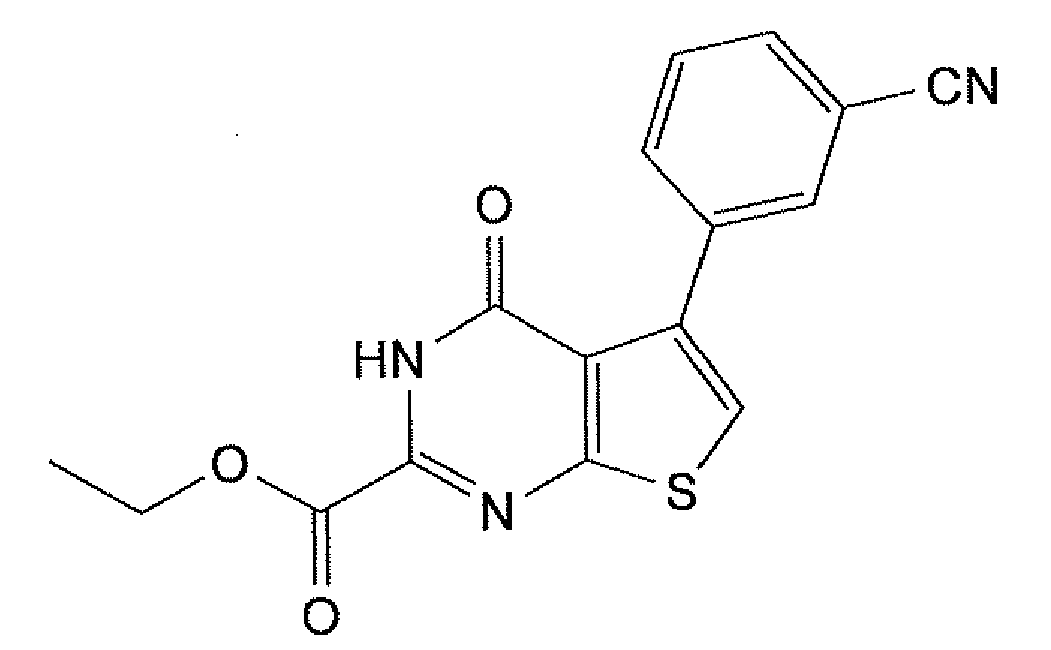
- By a method similar to that in Step 1 of Reference Example 66 and using, instead of 4-acetylpyridine, 3-cyanoacetophenone, ethyl 2-amino-4-(3-cyanophenyl)thiophene-3-carboxylate was obtained as a yellow powder (9.37 g, 59%).
- By a method similar to that in Reference Example 39 and using, instead of ethyl 5'-amino-2,3'-bithiophene-4'-carboxylate, ethyl 2-amino-4-(3-cyanophenyl) thiophene-3-carboxylate obtained in Step 1 of Reference Example 75, the title compound was obtained as a brown powder (6.33 g, 57%). 1H-NMR (300MHz, DMSO-d6) δ: 1.36 (3H, t, J = 7.2 Hz), 4.39 (2H, q, J = 7.0 Hz), 7.63 (1H, t, J = 7.8 Hz), 7.82-7.94 (3H, m), 8.02 (1H, t, J = 1.5 Hz), 12.94 (1H, br).
-

- By a method similar to that in Step 1 of Reference Example 66 and using, instead of 4-acetylpyridine, 3-methylacetophenone, ethyl 2-amino-4-(3-methylphenyl)thiophene-3-carboxylate was obtained as a yellow powder (18.9 g, 64%).
- By a method similar to that in Reference Example 39 and using, instead of ethyl 5'-amino-2,3'-bithiophene-4'-carboxylate, ethyl 2-amino-4- (3-methylphenyl) thiophene-3-carboxylate obtained in Step 1 of Reference Example 76, the title compound was obtained as a brown powder (7.90 g, 35%). 1H-NMR (300MHz, DMSO-d6) δ: 1.36 (3H, t, J = 7.1 Hz), 2.35 (3H, s), 4.39 (2H, q, J = 7.0 Hz), 7.15-7.21 (1H, m), 7.23-7.39 (3H, m), 7.72 (1H, s), 12.79 (1H, br).
-

- By a method similar to that in Reference Example 39 and using, instead of ethyl 5'-amino-2,3'-bithiophene-4'-carboxylate, ethyl 2-amino-4-(4-fluorophenyl)thiophene-3-carboxylate, the title compound was obtained as a brown powder (1.77 g, 78%).
1H-NMR (300MHz, DMSO-d6) δ: 1.36 (3H, t, J = 7.2 Hz), 4.39 (2H, q, J = 7.1 Hz), 7.18-7.28 (2H, m), 7.52-7.63 (2H, m), 7.72-7.77 (1H, m), 12.81 (1H, br). -

- By a method similar to that in Reference Example 39 and using, instead of ethyl 5'-amino-2,8'-bithiophene-4'-carboxylate, ethyl 2-amino-4-(4-chlorophenyl)thiophene-5-carboxylate, the title compound was obtained as a pale-yellow powder (2.04 g, 86%).
1H-NMR (300MHz, DMSO-d6) δ: 1.35 (3H, t, J = 7.2 Hz), 4.38 (2H, q, J = 7.0 Hz), 7.42-7.51 (2H, m), 7.53-7.60 (2H, m), 7.78 (1H, s), 12.89 (1H, br). -

- By a method similar to that in Reference Example 39 and using, instead of ethyl 5'-amino-2,3'-bithiophene-4'-carboxylate, ethyl 2-amino-4-(4-bromophenyl)thiophene-3-carboxylate, the title compound was obtained as a pale-yellow powder (1.77 g, 76%).
1H-NMR (300MHz, DMSO-d6) δ: 1.35 (3H, t, J = 7.0 Hz), 4.37 (2H, q, J = 7.1 Hz), 7.45-7.55 (2H, m), 7.57-7.63 (2H, m), 7.77 (1H, s), 12.89 (1H, br). -

- By a method similar to that in Reference Example 39 and using, instead of ethyl 5'-amino-2,3'-bithiophene-4'-carboxylate, ethyl 2-amino-4-(4-methoxyphenyl)thiophene-3-carboxylate, the title compound was obtained as a pale-yellow powder (1.88 g, 79%).
1H-NMR (300MHz, DMSO-d6) δ: 1.35 (3H, t, J = 7.1 Hz), 3.80 (3H, s), 4.38 (2H, q, J = 7.0 Hz), 6.96 (2H, d, J = 8.7 Hz), 7.49 (2H, d, J = 8.5 Hz), 7.65 (1H, s), 12.79 (1H, br). -

- By a method similar to that in Step 1 of Reference Example 66 and using, instead of 4-acetylpyridine, 4-methylacetophenone, ethyl 2-amino-4-(4-methylphenyl)thiophene-3-carboxylate was obtained as an orange powder (3.52 g, 30%).
- By a method similar to that in Reference Example 39 and using, instead of ethyl 5'-amino-2,3'-bithiophene-4'-carboxylate, ethyl 2-amino-4-(4-methylphenyl)thiophene-3-carboxylate obtained in Step 1 of Reference Example 81, the title compound was obtained as a yellow powder (3.40 g, 80%).
1H-NMR (300MHz, DMSO-d6) δ: 1.35 (3H, t, J = 7.2 Hz), 2.35 (3H, s), 4.38 (2H, q, J = 7.0 Hz), 7.21 (2H, d, J = 7.9 Hz), 7.43 (2H, d, J = 8.1 Hz), 7.68 (1H, s), 12.82 (1H, br). -
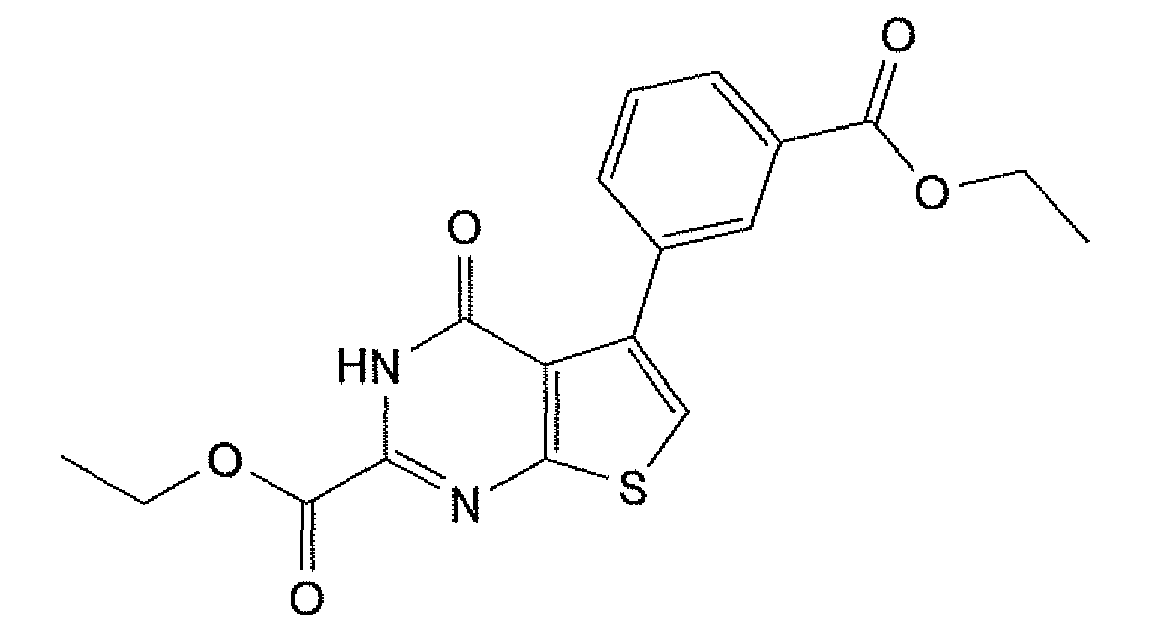
- A solution of 3-acetylbenzoic acid (4.00 g, 24.366 mmol) and concentrated sulfuric acid (0.078 mL, 1.462 mmol) in ethanol (100 mL) was stirred at 80°C for 3 days. The reaction mixture was concentrated under reduced pressure, and ethyl acetate was added to the residue. The organic layer was washed with saturated brine, dried over sodium sulfate, and concentrated to give ethyl 3-acetylbenzoate as a brown powder (4.59 g, 98%).
1H-NMR (300MHz, CDCl3)δ: 1.43 (3H, t, J = 7.2 Hz), 4.42 (2H, q, J = 7.2 Hz), 7.56 (1H, dd, J = 7.7, 7.7 Hz), 8.13-8.18 (1H, m), 8.22-8.27 (1H, m), 8.60 (1H, dd, J = 1.6, 1.6 Hz). Step 2 - By a method similar to that in Step 1 of Reference Example 66 and using, instead of 4-acetylpyridine, ethyl 3-acetylbenzoate obtained in Step 1 of Reference Example 82, ethyl 2-amino-4-[3-(ethoxycarbonyl)phenyl]thiophene-3-carboxylate was obtained as an orange powder (3.51 g, 53%). Step 3
- By a method similar to that in Reference Example 39 and using, instead of ethyl 5'-amino-2,3'-bithiophene-4'-carboxylate, ethyl 2-amino-4- [3-(ethoxycarbonyl)phenyl]thiophene-3-carboxylate obtained in Step 2 of Reference Example 82, the title compound was obtained as an orange powder (1.55 g, 38%).
1H-NMR (300MHz, DMSO-d6) δ: 1.28-1.40 (6H, m), 4.28-4.45 (4H, m), 7.57 (1H, t, J = 7.8 Hz), 7.80-7.84 (1H, m), 7.87 (1H, s), 7.94-8.00 (1H, m), 8.12 (1H, t, J = 1.5 Hz), 12.87 (1H, br). -

- By a method similar to that in Reference Example 31 and using 3-[(3-hydroxypropyl)oxy]benzonitrile obtained according to the methods described in Bioorganic & Medicinal Chemistry Letters (2001), 11, 2279 and the like and 3-nitro-1-(triphenylmethyl)-1H-1,2,4-triazole obtained in Reference Example 33, the title compound was obtained as a pale-yellow solid (14.0 g, 100%).
1H-NMR (300MHz, DMSO-d6) δ: 2.08-2.19 (2H, m), 4.14 (2H, t, J = 6.2 Hz), 4.30 (2H, t, J = 6.2 Hz), 7.04-7.12 (6H, m), 7.24-7.30 (1H, m), 7.34-7.43 (11H, m), 7.47 (1H, t, J = 7.9 Hz), 7.82 (1H, s). -

- By a method similar to that in Reference Example 20 and using 3-[(3-{[1-(triphenylmethyl)-1H-1,2,4-triazol-3-yl]oxy}propyl)oxy]benzonitrile obtained in Reference Example 84, the title compound was obtained as a yellow oil (1.74 g, 91%).
1H-NMR (300MHz, DMSO-d6) δ: 2.06-2.17 (2H, m), 3.65 (2H, s), 3.99-4.09 (2H, m), 4.29 (2H, t, J = 6.3 Hz), 6.70-6.76 (1H, m), 6.84-6.89 (1H, m), 6.90-6.93 (1H, m), 7.05-7.11 (6H, m), 7.12-7.32 (1H, m), 7.34-7.41 (9H, m), 7.82 (1H, s), 2H hidden. -

- A suspension of 1-{3-[(3-{[1-(triphenylmethyl)-1H-1,2,4-triazol-3-yl]oxy}propyl)oxy]phenyl}methanamine obtained in Reference Example 85 (0.300 g, 0.611 mmol), ethyl 4-oxo-3,4-dihydro-2-quinazolinecarboxylate obtained according to the methods described in Journal of Organic Chemistry (1978), 43(23), 4485-7 and the like (0.133 g, 0.611 mmol) and N,N-diisopropylethylamine (0.213 mL, 1.22 mmol) in EtOH (4.5 mL) was stirred under microwave irradiation at 100°C for 1.5 hr (Discover (trademark; CEM Corp), 50W, run time: 5 min, hold time: 1.5 hr). After the reaction mixture was allowed to cool to room temperature, the precipitated solid was collected by filtration, and washed with EtOH to give the title compound as a white powder (0.315 g, 78%).
1H-NMR (300MHz, DMSO-d6) δ: 2.05-2.17 (2H, m), 4.06 (2H, t, J = 6.1 Hz), 4.29 (2H, t, J = 6.1 Hz), 4.44 (2H, d, J = 6.4 Hz), 6.78-6.85 (1H, m), 6.88-6.96 (2H, m), 7.02-7.11 (6H, m), 7.23 (1H, t, J = 8.0 Hz), 7.30-7.42 (9H, m), 7.60 (1H, t, J = 7.6 Hz), 7.74-7.82 (2H, m), 7.87 (1H, t, J = 7.6 Hz), 8.17 (1H, d, J = 7.2 Hz), 9.51 (1H, t, J = 6.2 Hz), 11.86 (1H, br). -

- By a method similar to that in Reference Example 86 and using 1-{3-[(3-{[1-(triphenylmethyl)-1H-1,2,4-triazol-3-yl]oxy}propyl)oxy]phenyl}methanamine obtained in Reference Example 85 and ethyl 5-(3-chlorophenyl)-4-oxo-3,4-dihydrothieno[2,3-d]pyrimidine-2-carboxylate obtained in Reference Example 73, the title compound was obtained as a white powder (0.320 g, 69%).
1H-NMR (300MHz, DMSO-d6) δ: 2.06-2.17 (2H, m), 4.03-4.10 (2H, m), 4.29 (2H, t, J = 6.3 Hz), 4.42 (2H, d, J = 6.4 Hz), 6.79-6.84 (1H, m), 6.89-6.94 (2H, m), 7.04-7.11 (6H, m), 7.23 (1H, t, J = 8.0 Hz), 7.34-7.40 (9H, m), 7.40-7.45 (2H, m), 7.47-7.54 (1H, m), 7.59-7.63 (1H, m), 7.79 (1H, s), 7.81 (1H, s), 9.67 (1H, t, J = 6.7 Hz), 12.45 (1H, br). -

- By a method similar to that in Reference Example 86 and using 1-{3-[(3-{[1-(triphenylmethyl)-1H-1,2,4-triazol-3-yl]oxy}propyl)oxy]phenyl}methanamine obtained in Reference Example 85 and ethyl 5-(3-fluorophenyl)-4-oxo-3,4-dihydrothieno[2,3-d]pyrimidine-2-carboxylate obtained in Reference Example 72, the title compound was obtained as a white powder (0.275 g, 62%).
1H-NMR (300MHz, DMSO-d6) δ: 2.07-2.18 (2H, m), 4.02-4.10 (2H, m), 4.29 (2H, t, J = 6.2 Hz), 4.42 (2H, d, J = 6.2 Hz), 6.78-6.84 (1H, m), 6.88-6.94 (2H, m), 7.03-7.12 (6H, m), 7.16-7.26 (2H, m), 7.32-7.49 (12H, m), 7.77 (1H, s), 7.81 (1H, s), 9.66 (1H, t, J = 6.7 Hz), 12.44 (1H, br). -

- By a method similar to that in Reference Example 86 and using 1-{3-[(3-{[1-(triphenylmethyl)-1H-1,2,4-triazol-3-yl]oxy}propyl)oxy]phenyl}methanamine obtained in Reference Example 85 and ethyl 5-(2-chlorophenyl)-4-oxo-3,4-dihydrothieno[2,3-d]pyrimidine-2-carboxylate obtained in Reference Example 70, the title compound was obtained as a white powder (0.156 g, 66%).
1H-NMR (300MHz, DMSO-d6) δ: 2. 05-2. 18 (2H, m), 4.06 (2H, t, J = 6.2 Hz), 4.29 (2H, t, J = 6.3 Hz), 4.42 (2H, d, J = 6.2 Hz), 6.78-6.83 (1H, m), 6.88-6.94 (2H, m), 7.03-7.12 (6H, m), 7.22 (1H, t, J = 7.9 Hz), 7.32-7.45 (12H, m), 7.47-7.54 (1H, m), 7.63 (1H, s), 7.81 (1H, s), 9.63 (1H, t, J = 6.2 Hz), 12.03 (1H, br). -

- By a method similar to that in Reference Example 86 and using 1-{3-[(3-{[1-(triphenylmethyl)-1H-1,2,4-triazol-3-yl]oxy}propyl)oxy]phenyl}methanamine obtained in Reference Example 85 and ethyl 5-(2-fluorophenyl)-4-oxo-3,4-dihydrothieno[2,3-d]pyrimidine-2-carboxylate obtained in Reference Example 69, the title compound was obtained as a white powder (0.245 g, 57%).
1H-NMR (300MHz, DMSO-d6) δ: 2.07-2.17 (2H, m), 4.03-4.09 (2H, m), 4.29 (2H, t, J = 6.2 Hz), 4.42 (2H, d, J = 6.2 Hz), 6.78-6.84 (1H, m), 6.88-6.95 (2H, m), 7.04-7.12 (6H, m), 7.19-7.28 (3H, m), 7.33-7.48 (11H, m), 7.71 (1H, s), 7.81 (1H, s), 9.65 (1H, t, J = 5.9 Hz), 12.39 (1H, br). -

- By a method similar to that in Reference Example 86 and using 1-{3-[(3-{[1-(triphenylmethyl)-1H-1,2,4-triazol-3-yl]oxy}propyl)oxy]phenyl}methanamine obtained in Reference Example 85 and ethyl 5-(4-fluorophenyl)-4-oxo-3,4-dihydrothieno [2,3-d] pyrimidine-2-carboxylate obtained in Reference Example 77, the title compound was obtained as a white powder (0.274 g, 62%).
1H-NMR (300MHz, DMSO-d6) δ: 2.07-2.18 (2H, m), 4.06 (2H, t, J = 6.3 Hz), 4.29 (2H, t, J = 6.3 Hz), 4.42 (2H, d, J = 6.4 Hz), 6.81 (1H, dd, J = 8.9, 1.8 Hz), 6. 88-6.95 (2H, m), 7.04-7.11 (6H, m), 7.18-7.27 (3H, m), 7.33-7.42 (9H, m), 7.54-7.62 (2H, m), 7.68 (1H, s), 7.81 (1H, s), 9.65 (1H, t, J = 6.5 Hz), 12.39 (1H, br). -

- To a suspension of methyl valinate hydrochloride (10.0 g, 59.7 mmol) and sodium carbonate (15.8 g, 149 mmol) in acetone (200 mL)-water (100 mL) was added 4-bromobenzenesulfonyl chloride (12.7 g, 49.7 mmol) at 0°C, and the mixture was stirred at room temperature for 12 hr after addition. The reaction mixture was concentrated under reduced pressure, and the residue was diluted with ethyl acetate, washed with 0.1N hydrochloric acid, water and saturated brine, and dried over sodium sulfate. The solvent was evaporated under reduced pressure, and the residue was crystallized from hexane-ethyl acetate to give the title compound as a white powder (14.7 g, 84%).
1H-NMR (300MHz, DMSO-d6) δ: 0.76-0.85 (6H, m), 1.84-1.98 (1H, m), 3.37 (3H, s), 3.57 (1H, d, J = 7.2 Hz), 7.63-7.71 (2H, m), 7.76-7.83 (2H, m), 8.39 (1H, s). -

- A suspension of methyl N-[(4-bromophenyl)sulfonyl]valinate obtained in Reference Example 92 (5.00 g, 14.3 mmol), (3-cyanophenyl)boronic acid (2.52 g, 1.7.1 mmol), tetrakis(triphenylphosphine)palladium (0.330 g, 0.286 mmol) and 2N aqueous sodium carbonate solution (8.57 mL, 17.1 mmol) in EtOH (15 mL)-toluene (50 mL) was heated under reflux for 8 hr under nitrogen atmosphere. The reaction mixture was diluted with ethyl acetate, washed with water and saturated brine, and dried over sodium sulfate. The solvent was evaporated under reduced pressure, and the residue was crystallized from hexane-ethyl acetate to give the title compound as a yellow powder (5.18 g, 97%). 1H-NMR (300MHz, DMSO-d6) δ: 0.81 (3H, d, J = 6.8 Hz), 0.84 (3H, d, J = 6.8 Hz), 1.86-1.98 (1H, m), 3.34 (3H, s), 3.55-3.64 (1H, m), 7.72 (1H, t, J = 7.8 Hz), 7.81-7.86 (2H, m), 7.91 (1H, d, J = 7.6 Hz), 7.94-8.00 (2H, m), 8.10 (1H, d, J = 8.0 Hz), 8.27 (1H, s), 8.32-8.40 (1H, m, J = 3.0 Hz).
-

- A suspension of methyl N-[(3'-cyanobiphenyl-4-yl)sulfonyl]valinate obtained in Reference Example 93 (5.00 g, 13.4 mmol), Raney-nickel (5.00 g) and 28% aqueous ammonia (50 mL) in THF (50 mL)-methanol (50 mL) was stirred at room temperature for 15 hr under hydrogen atmosphere (1 atm). The catalyst was filtered off, and the filtrate was concentrated under reduced pressure. A mixed solvent of ethyl acetate-hexane was added to the residue, and the precipitated insoluble material was filtered off. The filtrate was washed with saturated brine, and dried over sodium sulfate. The solvent was evaporated under reduced pressure, and diethyl ether was added to the residue. The precipitated solid was collected by filtration to give the title compound as a white powder (3.84 g, 76%).
1H-NMR (300MHz, DMSO-d6) δ: 0.80 (3H, d, J = 6.8 Hz), 0.84 (3H, d, J = 6.8 Hz), 1.85-1.98 (1H, m), 3.34 (3H, s), 3.58 (1H, d, J = 7.2 Hz), 3.80 (2H, s), 7.35-7.48 (2H, m), 7.56 (1H, d, J = 7.2 Hz), 7.71 (1H, s), 7.78-7.84 (2H, m), 7.84-7.91 (2H, m), 3H hidden. -

- A suspension of methyl N-{[3'-(aminomethyl)biphenyl-4-yl]sulfonyl}valinate obtained in Reference Example 94 (0.300 g, 0.797 mmol) and ethyl 4-oxo-3,4-dihydro-2-quinazolinecarboxylate obtained according to the methods described in Journal of Organic Chemistry (1978), 43(23), 4485-7 and the like (0.145 g, 0.664 mmol) in EtOH (9 mL) was stirred at 90°C for 5 hr. The reaction mixture was concentrated under reduced pressure, and the residue was diluted with ethyl acetate, washed with 0.1N hydrochloric acid and saturated brine, and dried over sodium sulfate. The solvent was evaporated under reduced pressure to give the title compound as a colorless oil (0.375 g, 86%).
1H-NMR (300MHz, DMSO-d6) δ: 0.76-0.86 (6H, m, J = 6.8, 10.8 Hz), 1.84-1.97 (1H, m), 3.33 (3H, s), 3.57 (1H, d, J = 7.0 Hz), 4.58 (2H, d, J = 6.2 Hz), 7.38-7.52 (2H, m), 7.57-7.67 (2H, m, J = 7.5, 7.5 Hz), 7.71-7.94 (7H, m), 8.13-8.21 (1H, m), 8.32 (1H, s), 9.65 (1H, t, J = 6.2 Hz), 11.95 (1H, s). -

- By a method similar to that in Reference Example 95 and using methyl M-{[3'-(aminomethyl)biphenyl-4-yl]sulfonyl}valinate obtained in Reference Example 94 (0.800 g, 0.797 mmol) and ethyl 5-methyl-4-oxo-3,4-dihydrothieno[2,3-d]pyrimidine-2-carboxylate obtained according to the methods described in
US4054656 and the like, the title compound was obtained as a pale-yellow powder (0.255 g, 56%).
1H-NMR (300MHz, DMSO-d6) δ: 0.75-0.87 (6H, m, J = 6.6, 10.5 Hz), 1.83-1.98 (1H, m), 2.44-2.55 (3H, m, J = 2.1 Hz), 3.33 (3H, s), 3.52-3.63 (1H, m), 4.53 (2H, d, J = 6.2 Hz), 7.31 (1H, s), 7.37-7.52 (2H, m), 7.63 (1H, d, J = 7.5 Hz), 7.72 (1H, s), 7.78-7.89 (4H, m), 8.25-8.37 (1H, m), 9.70 (1H, t, J = 6.3 Hz), 12.21 (1H, s). -

- To a solution of 3-chloropropane-1-sulfonyl chloride (4.72 g, 26.7 mmol) in THF (100 mL) were added successively ethyl piperidine-2-carboxylate (4.19 g, 26.7 mmol) and triethylamine (3.72 mL, 26.7 mmol) at 0°C, and the mixture was stirred at room temperature for 12 hr after addition. The reaction mixture was concentrated under reduced pressure, and the residue was diluted with ethyl acetate, washed with water, 0.1N hydrochloric acid and saturated brine, and dried over sodium sulfate. The solvent was evaporated under reduced pressure to give the title compound as a yellow oil (6.44 g, 81%).
1H-NMR (300MHz, DMSO-d6) δ: 1.13-1.27 (1H, m), 1.22 (3H, t, J = 7.0 Hz), 1.33-1.50 (1H, m), 1.59-1.72 (3H, m), 2.05-2.17 (3H, m), 3.06-3.27 (3H, m), 3.54-3.63 (1H, m), 3.70-3.77 (2H, m), 4.12-4.22 (2H, m), 4.52-4.59 (1H, m). -

- A suspension of ethyl 1-[(3-chloropropyl)sulfonyl]piperidine-2-carboxylate obtained in Reference Example 97 (2.00 g, 6.72 mmol), 3-hydroxybenzonitrile (0.800 g, 6.72 mmol), potassium carbonate (0.928 g, 6.72 mmol) and sodium iodide (0.101 g, 0.672 mmol) in DMF (20 mL) was stirred at 100°C for 51 hr. The reaction mixture was diluted with ethyl acetate, washed with water, 0.5N aqueous sodium hydroxide solution, 0.1N aqueous sodium hydroxide solution and saturated brine, and dried over sodium sulfate. The solvent was evaporated under reduced pressure, and the residue was crystallized from methanol to give the title compound as a pale-yellow powder (1.34 g, 52%).
1H-NMR (300MHz, DMSO-d6) δ: 1.13-1.27 (1H, m), 1.21 (3H, t, J = 7.2 Hz), 1.30-1.47 (1H, m), 1.59-1.73 (3H, m), 2.04-2.16 (3H, m), 3.08-3.20 (1H, m), 3.21-3.31 (2H, m), 3.56-3.66 (1H, m), 4.10-4.21 (4H, m), 4.53-4.59 (1H, m), 7.27-7.33 (1H, m), 7.38-7.46 (2H, m), 7.50 (1H, t, J = 8.0 Hz). -

- By a method similar to that in Reference Example 94 and using ethyl 1-({3-[(3-cyanophenyl)oxy]propyl}sulfonyl)piperidine-2-carboxylate obtained in Reference Example 98, the title compound was obtained as a pale-green oil (1.21 g, 100%).
1H-NMR (300MHz, DMSO-d6) δ: 1.13-1.28 (4H, m), 1.31-1.48 (1H, m), 1.59-1.75 (3H, m), 2.03-2.15 (3H, m), 3.07-3.38 (5H, m), 3.61 (1H, d, J = 13.0 Hz), 3.98-4.09 (2H, m), 4.11-4.22 (2H, m), 4.51-4.63 (1H, m), 6.69-6.79 (1H, m), 6.80-6.96 (2H, m), 7.22 (1H, br), 2H hidden. -

- By a method similar to that in Example 87 and using ethyl 1-[(3-{[3-(aminomethyl)phenyl]oxy}propyl)sulfonyl]piperidine-2-carboxylate obtained in Reference Example 99 and ethyl 4-oxo-3,4-dihydro-2-quinazolinecarboxylate obtained according to the methods described in Journal of Organic Chemistry (1978), 43(23), 4485-7 and the like, the title compound was obtained as a white powder (0.464 g, 59%).
1H-NMR (300MHz, DMSO-d6) δ: 1.08-1.25 (1H, m), 1.19 (3H, t, J = 7.2 Hz), 1.27-1.45 (1H, m), 1.55-1.71 (3H, m), 2.00-2.15 (3H, m), 3.05-3.18 (1H, m), 3.19-3.29 (2H, m), 3. 54-3.63 (1H, m), 4.05 (2H, t, J = 6.2 Hz), 4.09-4.18 (2H, m), 4.45 (2H, d, J = 6.4 Hz), 4.51-4.60 (1H, m), 6.83 (1H, d, J=8.3Hz), 6.90-6.97 (2H, m), 7.25 (1H, t, J = 8.0 Hz), 7.61 (1H, t, J = 7.6 Hz), 7.74-7.82 (1H, m), 7.84-7.93 (1H, m), 8.17 (1H, d, J = 8.0 Hz), 9.54 (1H, t, J = 6.2 Hz), 12.25 (1H, br). -

- By a method similar to that in Example 87 and using ethyl 1-[(3-{[3-(aminomethyl)phenyl]oxy}propyl)sulfonyl]piperidine-2-carboxylate obtained in Reference Example 99 and ethyl 5-methyl-4-oxo-3,4-dihydrothieno[2,3-d]pyrimidine-2-carboxylate obtained according to the methods described in
US4054656 and the like, the title compound was obtained as a yellow powder (0.270 g, 99%).
1H-NMR (300MHz, DMSO-d6) δ: 1.14-1.25 (4H, m), 1.30-1.43 (1H, m), 1.55-1.73 (3H, m), 2.02-2.15 (3H, m), 2.48-2.52 (3H, m), 3.06-3.29 (3H, m), 3.54-3.64 (1H, m), 3.97-4.21 (4H, m), 4.41 (2H, d, J = 6.8 Hz), 4.52-4.60 (1H, m), 6.79-6.86 (1H, m), 6.87-6.95 (2H, m), 7.24 (1H, t, J = 8.0 Hz), 7.32 (1H, d, J = 1.1 Hz), 9.62 (1H, t, J = 6.3 Hz), 12.20 (1H, br). -

- By a method similar to that in Example 81 and using 1-bromo-4-(methylsulfonyl)benzene and (3-cyanophenyl)boronic acid, the title compound was obtained as a pale-yellow powder (10.4 g, 95%).
1H-NMR (300MHz, DMSO-d6) δ: 3.28 (3H, s), 7.73 (1H, t, J = 8.0 Hz), 7.89-7.95 (1H, m), 7.99-8.06 (4H, m), 8.09-8.15 (1H, m), 8.29 (1H, t). -

- To a solution of 4'-(methylsulfonyl)biphenyl-3-carbonitrile obtained in Reference Example 102 (2.00 g, 7.77 mmol) in THF (40 mL) was added dropwise n-butyllithium (1.6M hexane solution, 5.34 mL, 8.55 mmol) at -78°C, and the mixture was stirred at -78°C for 1 hr. Isobutyraldehyde (1.06 mL, 11.7 mmol) was added to this solution at -78°C, and the mixture was further stirred at - 78°C for 3 hr. Saturated aqueous ammonium chloride solution was added to the reaction mixture, and the mixture was extracted with ethyl acetate, and washed with saturated sodium chloride aqueous solution. The organic layer was dried over sodium sulfate, and the solvent was evaporated under reduced pressure. The residue was purified by silica gel chromatography (25% - 50% ethyl acetate/hexane) to give the title compound as a pale-yellow oil (1.66 g, 65%).
1H-NMR (300MHz, DMSO-d6) δ: 0.78 (3H, d, J = 6.8 Hz), 0.82 (3H, d, J = 6.8 Hz), 1.57-1.70 (1H, m), 3.39 (2H, d, J = 6.1 Hz), 3.74-3.82 (1H, m), 4.84 (1H, d, J = 5.7 Hz), 7.73 (1H, t, J = 8.0 Hz), 7.90-7.95 (1H, m), 7.98-8.05 (4H, m), 8.10-8.15 (1H, m), 8.29 (1H, t, J = 1.5 Hz). -

- A suspension of 4'-[(2-hydroxy-3-methylbutyl)sulfonyl]biphenyl-3-carbonitrile obtained in Reference Example 103 (1.60 g, 4.86 mmol), Raney-nickel (1.60 g) and 28% aqueous ammonia (16 mL) in THF (32 mL)-methanol (16 mL) was stirred at room temperature for 12 hr under hydrogen atmosphere (1 atm). The insoluble material was filtered off, and the filtrate was concentrated under reduced pressure. The residue was dissolved in a mixed solvent of ethyl acetate-diethyl ether-methanol, and 4N hydrogen chloride-ethyl acetate (1.82 mL) was added thereto. The precipitated solid was collected by filtration, and the solid was washed with diethyl ether to give the title compound as a white powder (1.44 g, 80%).
1H-NMR (300MHz, DMSO-d6) δ: 0.77 (3H, d, J = 6.8 Hz), 0.81 (3H, d, J = 6.8 Hz), 1.58-1.71 (1H, m), 3.35-3.40 (2H, m), 3.73-3.82 (1H, m), 4.12 (2H, br), 4.84 (1H, d, J = 5.7 Hz), 7.53-7.60 (2H, m), 7.76-7.81 (1H, m), 7.92-8.04 (5H, m), 8.47 (3H, br). -

- By a method similar to that in Example 87 and using 1-{[3'-(aminomethyl)biphenyl-4-yl]sulfonyl}-3-methylbutan-2-ol hydrochloride obtained in Reference Example 104 and ethyl 4-oxo-3,4-dihydro-2-quinazolinecarboxylate obtained according to the methods described in Journal of Organic Chemistry (1978), 43(23), 4485-7 and the like, the title compound was obtained as a white powder (0.774 g, 78%).
1H-NMR (300MHz, DMSO-d6) δ: 0.76 (3H, d, J = 6.8 Hz), 0.81 (3H, d, J = 6.8 Hz), 1.56-1.69 (1H, m), 3.34-3.38 (2H, m), 3.72-3.81 (1H, m), 4.58 (2H, d, J = 6.4 Hz), 4.81 (1H, d, J = 5.8 Hz), 7.42-7.53 (2H, m), 7.57-7.68 (2H, m), 7.74-7.81 (2H, m), 7.85-7.92 (3H, m), 7.95-8.01 (2H, m), 8.17 (1H, dd, J = 1.3, 7.9 Hz), 9.65 (1H, t, J = 6.4 Hz), 12.03 (1H, br). -

- To a suspension of N-({4'-[(2-hydroxy-3-methylbutyl)sulfonyl]biphenyl-3-yl}methyl)-4-oxo-3,4-dihydroquinazoline-2-carboxamide obtained in Reference Example 105 (0.300 g, 0.593 mmol) and triethylamine (0.579 mL, 4.15 mmol) in THF (6 mL) was added dropwise methanesulfonyl chloride (0.083 mL, 1.07 mmol) at 0°C, and the reaction mixture was stirred at room temperature for 12 hr. The reaction mixture was diluted with ethyl acetate, washed with 0.1N hydrochloric acid and saturated brine, and dried over sodium sulfate. The solvent was evaporated under reduced pressure, and the residue was crystallized from ethyl acetate-diethyl ether to give the title compound as a pale-yellow powder (0.220 g, 76%).
1H-NMR (300MHz, DMSO-d6) δ: 1.02 (6H, d, J = 6.8 Hz), 2.44-2.59 (1H, m), 4.58 (2H, d, J = 6.1 Hz), 6.71-6.80 (1H, m), 6.86-6.96 (1H, m), 7.37-7.54 (2H, m), 7.55-7.68 (2H, m), 7.70-7.83 (2H, m), 7.82-7.98 (5H, m), 8.17 (1H, d, J = 7.6 Hz), 9.65 (1H, t, J = 5.9 Hz), 12.29 (1H, br). -

- To a solution of N-[(4'-{[(1E)-3-methylbut-1-en-1-yl]sulfonyl}biphenyl-3-yl)methyl]-4-oxo-3,4-dihydroquinazoline-2-carboxamide obtained in Reference Example 106 (0.180 g, 0.369 mmol) in THF (4 mL) was added O-(trimethylsilyl)hydroxylamine (0.271 mL, 2.22 mmol) at room temperature, and the mixture was stirred at room temperature for 12 hr. The reaction mixture was concentrated under reduced pressure, and the residue was crystallized from ethyl acetate-diethyl ether to give the title compound as a white powder (0.125 g, 65%).
1H-NMR (300MHz, DMSO-d6) δ: 0.76 (3H, d, J = 6.8 Hz), 0.80 (3H, d, J = 6.8 Hz), 1.87-2.03 (1H, m), 2.86-2.96 (1H, m), 3.25-3.43 (2H, m), 4.58 (2H, d, J = 6.2 Hz), 5.52 (1H, br), 7.31 (1H, s), 7.41-7.55 (2H, m), 7.57-7.70 (2H, m), 7.74-7.83 (2H, m), 7.84-8.05 (5H, m), 8.14-8.21 (1H, m), 9.66 (1H, t, J = 6.4 Hz), 12.26 (1H, br). -

- To a solution of 5-(chloromethyl) -2,4-dihydro-3H-1,2,4-triazol-3-one obtained according to the methods described in Tetrahedron Letter, 2000, 41, 8661 and the like (2.00 g, 15.0 mmol), (4-bromophenyl)methanethiol (3.04 g, 15.0 mmol) and potassium carbonate (2.48 g, 0.369 mmol) in THF (4 mL) was added a suspension of O-(trimethylsilyl)hydroxylamine (0.271 mL, 18.0 mmol) in DMF (40 mL) at room temperature, and the mixture was stirred at room temperature for 12 hr. Water was added to the reaction mixture, and the precipitated solid was collected by filtration. The solid was washed with water and diethyl ether to give the title compound as a white powder (3.97 g, 88%).
1H-NMR (300MHz, DMSO-d6) δ: 3.36 (2H, s), 3.70 (2H, s), 7.28 (2H, d, J = 8.3 Hz), 7.52 (2H, d, J = 8.3 Hz), 11.29 (1H, br), 11.39 (1H, br). -

- To a solution of 5-({[(4-bromophenyl)methyl]thio}methyl)-2,4-dihydro-3H-1,2,4-triazol-3-one obtained in Reference Example 108 (0.500 g, 1.67 mmol) in DMF (5 mL) was added m-chloroperbenzoic acid (0.903 g, 3.67 mmol) at room temperature, and the mixture was stirred for 12 hr. Water and saturated aqueous sodium hydrogencarbonate solution were added to the reaction mixture, and the precipitated solid was collected by filtration. The solid was washed with water and diethyl ether to give the title compound as a white powder (0.508 g, 92%).
1H-NMR (300MHz, DMSO-d6) δ: 4.32 (2H, s), 4.60 (2H, s), 7.38 (2H, d, J = 8.3 Hz), 7.63 (2H, d, J = 8.3 Hz), 11.62 (1H, br), 11.68 (1H, br). -

- By a method similar to that in Reference Example 93 and using 5-({[(4-bromophenyl)methyl]sulfonyl}methyl)-2,4-dihydro-3H-1,2,4-triazol-3-one obtained in Reference Example 109, the title compound was obtained as a pale-yellow powder (0.308 g, 60%).
1H-NMR (300MHz, DMSO-d6) δ: 4.36 (2H, s), 4.57 (2H, s), 7.56 (2H, d, J = 8.3 Hz), 7.69 (1H, t, J = 7.8 Hz), 7.79-7.89 (3H, m), 8.06 (1H, d, J = 8.0 Hz), 8.20 (1H, s), 11.65 (1H, br), 11.70 (1H, br). -

- A suspension of 4'-({[(5-oxo-4,5-dihydro-1H-1,2,4-triazol-3-yl)methyl]sulfonylmethyl)biphenyl-3-carbonitrile obtained in Reference Example 110 (0.250 g, 0.705 mmol), Raney-nickel (0.250 g) and 28% aqueous ammonia (5 mL) in THF (5 mL)-methanol (5 mL) was stirred at room temperature for 4 hr under hydrogen atmosphere (1 atm). The insoluble material was filtered off, and the filtrate was concentrated under reduced pressure. Diethyl ether was added to the residue, and the precipitated solid was collected by filtration to give the title compound as a pale-blue powder (0.250 g, 99%).
ESI-MS:m/z 359.1 [M+H]+ -

- To a solution of 1-(3-bromophenyl)piperazine (6.97 g, 27.4 mmol) and triethylamine (3.82 mL, 27.4 mmol) in THF (60 mL) was added bis(1,1-dimethylethyl) dicarbonate (5.97 g, 27.4 mmol) at room temperature, and the mixture was stirred for 3 hr. The reaction mixture was concentrated under reduced pressure, and the residue was diluted with ethyl acetate and water, and neutralized with 1N hydrochloric acid. The organic layer was separated, washed with saturated brine, and dried over sodium sulfate. The solvent was evaporated under reduced pressure, and the residue was crystallized from hexane to give the title compound as a white powder (5.39 g, 64%).
1H-NMR (300MHz, DMSO-d6) δ: 1.42 (9H, s), 3.09-3.17 (4H, m), 3.39-3.47 (4H, m), 6.91-6.97 (2H, m), 7.09 (1H, t, J = 2.1 Hz), 7.12-7.19 (1H, m). -

- A suspension of 1,1-dimethylethyl 4-(3-bromophenyl)piperazine-1-carboxylate obtained in Reference Example 112 (3.10 g, 9.09 mmol), zinc cyanide (0.587 g, 5.00 mmol) and tetrakis(triphenylphosphine)palladium (0.525 g, 0.454 mmol) in DMF (30 mL) was stirred at 80°C for 12 hr under nitrogen atmosphere. The reaction mixture was diluted with ethyl acetate, washed with water and saturated brine, and dried over sodium sulfate. The solvent was evaporated under reduced pressure, and the residue was purified by silica gel chromatography (25% - 40% ethyl acetate/hexane), and crystallized from hexane to give the title compound as a white powder (2.10 g, 80%).
1H-NMR (300MHz, DMSO-d6) δ: 1.42 (9H, s), 3.16-3.24 (4H, m), 3.40-3.48 (4H, m), 7.16-7.21 (1H, m), 7.25-7.31 (1H, m), 7.33-7.36 (1H, m), 7.36-7.43 (1H, m). -

- By a method similar to that in Reference Example 94 and using 1,1-dimethylethyl 4-(3-cyanophenyl)piperazine-1-carboxylate obtained in Reference Example 113, the title compound was obtained as a pale-blue oil (2.03 g, 100%).
1H-NMR (300MHz, DMSO-d6) δ: 1.42 (9H, s), 3.04-3.13 (4H, m), 3.17-3.51 (6H, m), 3.50-3.82 (2H, m), 6.71-6.80 (2H, m), 6.92 (1H, br), 7.16 (1H, t, J = 7.2 Hz). -

- By a method similar to that in Example 87 and using 1,1-dimethylethyl 4-[3-(aminomethyl)phenyl]piperazine-1-carboxylate obtained in Reference Example 114 and ethyl 4-oxo-3,4-dihydro-2-quinazolinecarboxylate obtained according to the methods described in Journal of Organic Chemistry (1978), 43(23), 4485-7 and the like, the title compound was obtained as a white powder (2.44 g, 92%).
1H-NMR (300MHz, DMSO-d6) δ: 1.41 (9H, s), 3.03-3.14 (4H, m), 3.39-3.50 (4H, m), 4.43 (2H, d, J = 6.4 Hz), 6.76-6.88 (2H, m), 6.97 (1H, s), 7.18 (1H, t, J = 7.8 Hz), 7.56-7.66 (1H, m), 7.74-7.82 (1H, m), 7.84-7.94 (1H, m), 8.17 (1H, dd, J = 1.1, 7.9 Hz), 9.48 (1H, t, J = 6.4 Hz), 12.27 (1H, br). -

- To a suspension of 1,1-dimethylethyl 4-[3-({[(4-oxo-3,4-dihydroquinazolin-2-yl)carbonyl]amino}methyl)phenyl]piperazine-1-carboxylate obtained in Reference Example 115 (2.40 g, 6.86 mmol) in ethyl acetate (10 mL)-THF (50 mL)-methanol (40 mL) was added 4N hydrogen chloride-ethyl acetate (10.4 mL), and the mixture was stirred at room temperature for 4 hr, and then at 50°C for 2 hr. Diethyl ether (about 100 mL) was added to the reaction mixture, and the precipitated solid was collected by filtration to give the title compound as a white powder (2.18 g, 97%).
1H-NMR (300MHz, DMSO-d6) δ: 3.14-3.26 (4H, m), 3.31-3.42 (4H, m), 4.45 (2H, d, J = 6.4 Hz), 6.83-6.93 (2H, m), 7.00 (1H, br), 7.22 (1H, t, J = 7.8 Hz), 7.62 (1H, t, J = 7.6 Hz), 7.75-7.83 (1H, m), 7.90 (1H, t, J = 7.6 Hz), 8.18 (1H, d, J = 8.0 Hz), 9.25-9.40 (2H, m), 9.52 (1H, t, J = 6.4 Hz), 2H hidden. -

- To a solution of diethyl 3-oxopentanedioate (26.0 g, 129 mmol) in EtOH (250 mL) was added hydrazine (4.38 g, 129 mmol) at room temperature, and the mixture was stirred at 80°C for 3 hr. The reaction mixture was concentrated under reduced pressure, and the residue was crystallized from diethyl ether-hexane to give the title compound as a white powder (9.79 g, 45%).
1H-NMR (300MHz, DMSO-d6) δ: 1.19 (3H, t, J = 7.0 Hz), 3.53 (2H, s), 4.08 (2H, q, J = 6.9 Hz), 5.34 (1H s), 9.53 (1H, br), 11.39 (1H, br). -

- To a suspension of ethyl (5-oxo-2,5-dihydro-1H-pyrazol-3-yl)acetate obtained in Reference Example 117 (5.00 g, 29.4 mmol) in THF (20 mL)-methanol (20 mL)-water (20 mL) was added 8N aqueous sodium hydroxide solution (11.0 mL, 88.0 mmol) at room temperature, and the mixture was stirred under heating at 80°C for 3 hr. The reaction mixture allowed to cool to room temperature, and concentrated under reduced pressure, and the residue was diluted with water, and acidified with 6N hydrochloric acid. The precipitated solid was collected by filtration, and washed with water, and dried under nitrogen stream to give the title compound as a white powder (3.43 g, 82%).
1H-NMR (300MHz, DMSO-d6) δ: 3.45 (2H, s), 5.33 (1H, s), 10.52-12.13 (3H, m). -

- A suspension of 4'-hydroxybiphenyl-3-carbonitrile obtained according to the methods described in Bioorganic & Medicinal Chemistry, 2003, 11, 3457 and the like (1.40 g, 7.17 mmol), 5-bromo-5-[2-(ethyloxy)ethyl]pyrimidine-2,4,6(1H,3H,5H)-trione obtained according to the methods described in
WO02/3472 -

- By a method similar to that in Reference Example 2, and using, instead of 3-[(2-chloroethyl)oxy]benzonitrile, 3-[(3-chloropropyl)oxy]benzonitrile obtained in Reference Example 4 and using, instead of 1H-1,2,4-triazole-3-thiol, 5-(trifluoromethyl)-1H-1,2,4-triazole-3-thiol, the title compound was obtained as a yellow oil (1.25 g, 64%).
1H-NMR (300MHz, DMSO-d6) δ: 2.07-2.19 (2H, m), 3.31-3.43 (2H, m), 4.14 (2H, t, J = 6.0 Hz), 7.25-7.30 (1H, m), 7.37-7.42 (2H, m), 7.48 (1H, t, J = 8.1 Hz), 14.94 (1H, br). -

- A solution of 3-(3-{[5-(trifluoromethyl)-1H-1,2,4-triazol-3-yl]thio}propoxy)benzonitrile obtained in Reference Example 120 (1.10 g, 3.350 mmol) and Raney-nickel (1.0 g) in 7N ammonia/methanol (50 mL) was stirred at room temperature for 5 hr under hydrogen atmosphere (1 atm). The catalyst was filtered off, and a 2N hydrogen chloride /methanol solution was added to the filtrate. The mixture was concentrated, and the obtained residue was crystallized from EtOH/toluene to give the title compound as a red powder (1.39 g, quant).
1H-NMR (300MHz, DMSO-d6) δ: 2.08-2.19 (2H, m), 3.38 (2H, t, J = 7.0 Hz), 3.89-4.05 (2H, m), 4.11 (2H, t, J = 5.9 Hz), 6.89-6.97 (1H, m), 7.00-7.09 (1H, m), 7.17 (1H, s), 7.30 (1H, t, J = 7.8 Hz), 8.57 (3H, br), 15.31 (1H, br). -

- By a method similar to that in Example 97 and using, instead of 1-[8-(3-{[5-(trifluoromethyl)-1H-1,2,4-triazol-3-yl]thio}propoxy)phenyl]methanamine hydrochloride, ethyl 4-{[3-(aminomethyl)phenyl]oxy}butanoate hydrochloride obtained in Reference Example 42, the title compound was obtained as a pale-yellow powder (580.0 mg, 64%).
1H-NMR (300MHz, DMSO-d6) δ: 1.15 (3H, t, J = 7.2 Hz), 1.89-2.01 (2H, m), 2.44 (2H, t, J = 7.3 Hz), 3.96 (2H, t, J = 6.3 Hz), 4.05 (2H, q, J = 7.2 Hz), 4.40 (2H, d, J = 6.4 Hz), 6.76-6.83 (1H, m), 6.85-6.94 (2H, m), 7.22 (1H, t, J = 8.1 Hz), 7. 51 (1H, d, J = 1.1 Hz), 9.60 (1H, t, J = 6. 3 Hz), 12.06 (1H, s), 3H hidden. -

- By a method similar to that in Reference Example 2, and using, instead of 3-[(2-chloroethyl)oxy]benzonitrile, 3-[(3-chloropropyl)oxy]benzonitrile obtained in Reference Example 4 and using, instead of 1H-1,2,4-triazole-3-thiol, 5-methyl-1H-1,2,4-triazole-3-thiol, the title compound was obtained as a yellow oil (643.0 mg, 46%).
1H-NMR (300MHz, CDCl3) δ: 2.17-2.29 (2H, m), 2.45 (3H, s), 3.30 (2H, t, J = 6.8 Hz), 4.12 (2H, t, J = 6.1 Hz), 7.08-7.17 (2H, m), 7.21-7.29 (1H, m), 7.36 (1H, t, J = 8.1 Hz), 1H hidden. -

- By a method similar to that in Reference Example 121 and using, instead of 3-(3-{[5-(trifluoromethyl)-1H-1,2,4-triazol-3-yl]thio}propoxy)benzonitrile, 3-{3-[(5-methyl-1H-1,2,4-triazol-3-yl)thio]propoxy}benzonitrile obtained in Reference Example 123, the title compound was obtained as a blue powder (366.4 mg, 68%).
1H-NMR (300MHz, DMSO-d6) δ: 2.04-2.15 (2H, m), 2.30 (3H, s), 3.13-3.21 (2H, m), 3.99 (2H, q, J = 6.0 Hz), 4.08 (2H, t, J = 6.3 Hz), 6.92-6.97 (1H, m), 7.00-7.05 (1H, m, J = 7.5 Hz), 7.08-7.11 (1H, m, J = 1.5 Hz), 7.28-7.36 (1H, m), 8.24 (3H, br), 1H hidden. -

- By a method similar to that in Reference Example 2, and using, instead of 3-[(2-chloroethyl)oxy]benzonitrile, 3-[(3-chloropropyl)oxy]benzonitrile obtained in Reference Example 4 and using, instead of 1H-1,2,4-triazole-3-thiol, 1H-imidazole, the title compound was obtained as a colorless oil (1.65 g, 71%).
1H-NMR (300MHz, CDCl3) δ: 2.21-2.31 (2H, m), 3.92 (2H, t, J = 5.7 Hz), 4.20 (2H, t, J = 6.8 Hz), 6.90-6.93 (1H, m), 7.07-7.14 (3H, m), 7.25-7.29 (1H, m), 7.39 (1H, t, J = 7.8 Hz), 7.47 (1H, s). -
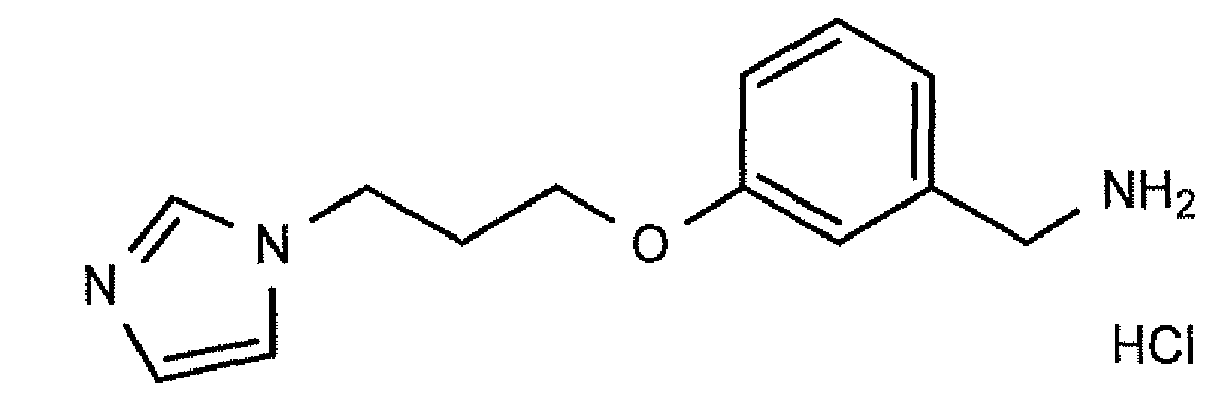
- By a method similar to that in Reference Example 121 and using, instead of 3-(3-{[5-(trifluoxomethyl)-1H-1,2,4-triazol-3-yl]thio}propoxy)benzonitrile, 3-[3-(1H-imidazol-1-yl)propoxy]benzonitrile obtained in Reference Example 125, the title compound was obtained as a white powder (1.25 g, 66%).
1H-NMR (300MHz, DMSO-d6) δ: 2.19-2.30 (2H, m), 3.89-4.05 (4H, m), 4.26 (2H, t, J = 6.7 Hz), 6.92 (1H, d, J = 10.0 Hz), 7.04 (1H, d, J = 7.2 Hz), 7.11 (1H, br), 7.27-7.36 (2H, m), 7.53 (1H, s), 8.25-8.61(4H,m). -
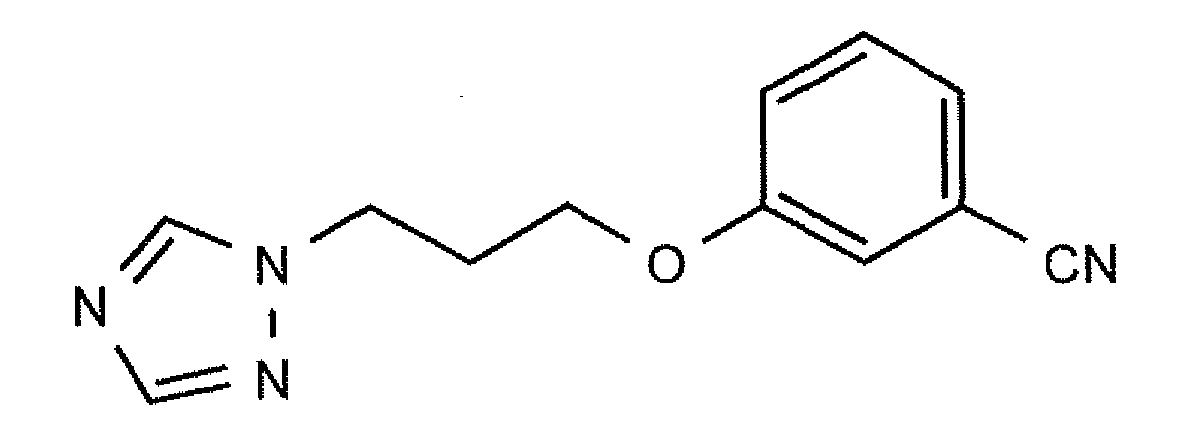
- By a method similar to that in Reference Example 2, and using, instead of 3-[(2-chloroethyl)oxy]benzonitrile, 3-[(3-chloropropyl)oxy]benzonitrile obtained in Reference Example 4 and using, instead of 1H-1,2,4-triazole-3-thiol, 1H-1,2,4-triazole, the title compound was obtained as a colorless oil (750.0 mg, 32%).
1H-NMR (300MHz, CDCl3) δ: 2.35-2.45 (2H, m), 3.96 (2H, t, J = 5.7 Hz), 4.42 (2H, t, J = 6.7 Hz), 7.07-7.14 (2H, m), 7.24-7.29 (1H, m), 7.34-7.42 (1H, m), 7.97 (1H, s), 8.06 (1H, s). -

- By a method similar to that in Reference Example 121 and using, instead of 3-(3-{[5-(trifluoromethyl)-1H-1,2,4-triazol-3-yl]thio}propoxy)benzonitrile, 3-[3-(1H-1,2,4-triazol-1-yl)propoxy]benzonitrile obtained in Reference Example 127, the title compound was obtained as a white powder (545.0 mg, 73%).
1H-NMR (300MHz, DMSO-d6) δ: 2.20-2.31 (2H, m), 3.93-4.03 (4H, m), 4.38 (2H, t, J = 6.9 Hz), 6.92 (1H, dd, J = 1.9, 8.3 Hz), 7.04 (1H, d, J = 7.5 Hz), 7.10 (1H, s), 7.32 (1H, t, J = 7.8 Hz), 8.07 (1H, s), 8.36 (3H, br), 8.66 (1H, s). -

- By a method similar to that in Reference Example 2, and using, instead of instead of 3-[(2-chloroethyl)oxy]benzonitrile, 3-[(3-chloropropyl)oxy]benzonitrile obtained in Reference Example 4 and using, instead of 1H-1,2,4-triazole-3-thiol, 1H-pyrazole, the title compound was obtained as a colorless oil (2.05 g, 88%).
1H-NMR (300MHz, CDCl3) δ: 2.31-2.42 (2H, m), 3.92 (2H, t, J = 5.9 Hz), 4.36 (2H, t, J = 6.6 Hz), 6.24 (1H, t, J = 2.1 Hz), 7.07-7.13 (2H, m), 7.20-7.29 (1H, m), 7.32-7.41 (2H, m), 7.53 (1H, d, J = 1.5 Hz). -

- By a method similar to that in Reference Example 121 and using, instead of 3-(3-{[5-(trifluoromethyl)-1H-1,2,4-triazol-3-yl]thio}propoxy)benzonitrile, 3-[3-(1H-pyrazol-1-yl)propoxy]benzonitrile obtained in Reference Example 129, the title compound was obtained as a white powder (1.88 g, 80%).
1H-NMR (300MHz, DMSO-d6) δ: 2.22 (2H, tt, J = 6.5, 6.5 Hz) , 3.90-4.02 (4H, m), 4.28 (2H, t, J = 6.9 Hz), 6.23 (1H, t, J = 2.1 Hz), 6.92 (1H, dd, J = 1.9, 8.1 Hz), 7.04 (1H, d, J = 7.7 Hz), 7.11 (1H, s), 7.31 (1H, t, J = 7.9 Hz), 7.44 (1H, d, J = 1.3 Hz), 7.73 (1H, d, J = 1.9 Hz), 8.39 (3H, br). -

- By a method similar to that in Reference Example 2, and using, instead of 3-[(2-chloroethyl)oxy]benzonitrile, 3-[(3-chloropropyl)oxy]benzonitrile obtained in Reference Example 4 and using, instead of 1H-1,2,4-triazole-3-thiol, 5-phenyl-1H-1,2,4-triazole-3-thiol, the title compound was obtained as a white powder (1.01 g, 59%).
1H-NMR (300MHz, DMSO-d6) δ: 2.12-2.22 (2H, m), 3.30 (2H, t, J= 7.1 Hz), 4.17 (2H, t, J = 6.1 Hz), 7.26-7.32 (1H, m), 7.36-7.54 (6H, m), 7.88-7.97 (2H, m), 14.32 (1H, br). -

- By a method similar to that in Reference Example 121 and using, instead of 3-(3-{[5-(trifluoromethyl)-1H-1,2,4-triazol-3-yl]thio}propoxy)benzonitrile, 3-{3-[(5-phenyl-1H-1,2,4-triazol-3-yl)thio]propoxy}benzonitrile obtained in Reference Example 131, the title compound was obtained as a green powder (859.7 mg, 77%).
1H-NMR (300MHz, DMSO-d6) δ: 2.11-2.23 (2H, m), 3.31 (2H, t, J = 7.0 Hz), 3.96 (2H, d, J = 5.1 Hz), 4.13 (2H, t, J = 6.0 Hz), 6.95 (1H, dd, J = 2.0, 8.2 Hz), 7.05 (1H, d, J = 7.3 Hz), 7.16 (1H, s), 7.30 (1H, t, J = 7.8 Hz), 7.44-7.57 (3H, m), 7.99 (2H, dd, J=1.6, 7.6 Hz), 8.50 (3H, br). -

- To a solution of 3-bromobenzonitrile (1.20 g, 6.58 mmol) in toluene (40 mL) was added a solution of tetrakistriphenylphosphinepalladium (0.38 g, 0.33 mmol), 2N aqueous sodium carbonate solution (21 mL) and [3-(hydroxymethyl)phenyl]boronic acid (1.00 g, 6.58 mmol) in EtOH (19 mL), and the mixture was heated under reflux for 10 hr under nitrogen atmosphere. The reaction mixture was cooled to room temperature, water was added, and the mixture was extracted with ethyl acetate. The organic layer was dried over sodium sulfate, and concentrated. The residue was purified by silica gel column chromatography (hexane/ethyl acetate=1/9→1/1) to give the title compound as a yellow oil (1.28 g, 93%).
1H-NMR (300MHz, CDCl3) δ: 4.79 (2H, d, J = 5.3 Hz), 7.39-7.67 (6H, m), 7.82 (1H, d, J = 7.6 Hz), 7.87 (1H, s), 1H hidden. -

- By a method similar to that in Reference Example 31 and using, instead of 3-[(2-hydroxyethyl)oxy]benzonitrile, 3'-(hydroxymethyl)biphenyl-3-carbonitrile obtained in Reference Example 133, the title compound was obtained as a colorless oil (1.62 g, 69%).
1H-NMR (300MHz, DMSO-d6) δ: 5.30 (2H, s), 7.03-7.11 (6H, m), 7.32-7.40 (9H, m), 7.42-7.53 (2H, m), 7.63-7.70 (1H, m), 7.70-7.75 (1H, m), 7.78 (1H, br), 7.81-7.87 (2H, m), 7.97-8.02 (1H, m), 8.12-8.14 (1H, m). -

- By a method similar to that in Reference Example 20 and using, instead of 2-[(2-{[1-(triphenylmethyl)-1H-1,2,4-triazol-3-yl]thio}ethyl)oxy]pyridine-4-carbonitrile, 3'-{[(1-trityl-1H-1,2,4-triazol-3-yl)oxylmethyl}biphenyl-3-carbonitrile obtained in Reference Example 134, the title compound was obtained as a colorless oil (1.12 mg, 74%).
1H-NMR (300MHz, DMSO-d6) δ: 2.30 (2H, s), 3.73-3.79 (2H, m), 5.30 (2H, s), 6.95-7.55 (20H, m), 7.62 (2H, s), 7.70 (1H, s), 7.84 (1H, s). -

- By a method similar to that in Reference Example 39 and using, instead of ethyl 5'-amino-2,3'-bithiophene-4'-carboxylate, ethyl 2-amino-4-biphenyl-4-ylthiophene-3-carboxylate, the title compound was obtained as a pale-yellow powder (1.97 g, 85%).
1H-NMR (300MHz, DMSO-d6) δ- 1.36 (3H, t, J = 7.1 Hz), 4.38 (2H, q, J = 7.2 Hz), 7.40 (1H, d, J = 7.3 Hz), 7.50 (2H, t, J = 7. 5 Hz), 7.61-7.78 (7H, m), 12.86 (1H, br). -
(1) Compound of Example 1 50 mg (2) Lactose 34 mg (3) Cornstarch 10.6 mg (4) Cornstarch (paste) 5 mg (5) Magnesium stearate 0.4 mg (6) Carboxymethylcellulose calcium total 20 120 mg - The above-mentioned (1) - (6) are mixed by a conventional method and compressed by a tableting machine to give tablets.
-
(1) Compound of Example 2 10.0 mg (2) Lactose 60.0 mg (3) Cornstarch 35.0 mg (4) Gelatin 5 mg (5) Magnesium stearate 2.0 mg - A mixture of the compound of Example 2 (10.0 mg), lactose (60.0 mg) and cornstarch (35.0 mg) is granulated using 10% aqueous gelatin solution (0.03 ml, 3.0 mg as gelatin) and passing through a 1 mm mesh sieve, dried at 40°C and passed through a sieve again. The granules thus obtained are mixed with magnesium stearate (2.0 mg) and compressed. The obtained core tablet is sugar-coated with an aqueous suspension of sucrose, titanium dioxide, talc and gum arabic. The coated tablet is polished with bee wax to give a coated tablet.
-
(1) Compound of Example 3 10.0 mg (2) Lactose 70.0 mg (3) Cornstarch 50.0 mg (4) Soluble starch 7.0 mg (5) Magnesium stearate 3.0 mg - The compound of Example 3 (10.0 mg) and magnesium stearate (3.0 mg) are granulated with an aqueous solution (0.07 ml) of soluble starch (7.0 mg as soluble starch), dried and mixed with lactose (70.0 mg) and cornstarch (50.0 mg). The mixture is compressed to give tablets. Experimental Example 1 MMP-13 inhibitory activity
- To 10 µg of MMP-13 precursor (GenzymeTechne) was added 1 ml of assay buffer (50 mM Tris-HCl (pH 7.5), 10 mM CaCl2, 150 mM NaCl, 0.05% Brij-35), and 4-aminophenylmercuric acid (Sigma) was added to the final concentration of 1 mM. The MMP-13 precursor was activated by incubating at 37°C for 2 hr.
- In a 96 well black plate (Corning), to 6.3 ng/ml of MMP-13 solution (49 µl) diluted with assay buffer was added the test compound (1 µl) diluted with dimethyl sulfoxide (DMSO) and 620 nM Cy3-PLGLK(Cy5Q) AR-NH2 (50 µl, synthesized by Amersham Biosciences) in assay buffer was added to start the enzyme reaction. After incubation at 37°C for 40 min, 500 mM EDTA solution (6 µl) was added to stop the reaction. For measurement, Farcyte (Amersham Biosciences) was used to measure at excitation wavelength 535 nm and measurement wavelength 595 nm. The enzyme inhibitory activity was calculated in inhibitory rate (% inhibition) by the following formula:

T: value of well with addition of DMSO instead of test compound
C: value of well with addition of DMSO instead of test compound and addition of EDTA solution before addition of substrate solution
X: value of well with addition of test compound - The MMP-13 activity inhibitory rates of the compound (1 µM) are described below.
Table 1 Example No. MMP-13 inhibitory rate (%) at 1 µM Example No. MMP-13 inhibitory rate (%) at 1 µM 1 91 25 97 2 97 26 95 3 98 27 98 4 99 28 96 5 97 29 98 6 97 30 96 7 97 31 97 8 99 32 98 9 98 33 98 10 98 34 90 11 97 35 89 12 99 36 97 13 97 37 96 14 98 38 85 15 98 39 81 16 98 40 94 17 97 41 96 18 94 42 98 19 93 43 99 20 89 44 98 21 100 45 97 22 95 46 100 23 96 47 98 24 93 48 99 - Since compound (I), a salt thereof and a prodrug thereof of the present invention have a superior MMP inhibitory action, particularly an MMP-13 inhibitory action, they are useful as safe drugs for the prophylaxis or treatment of all MMP associated diseases, such as joint disease (e.g., osteoarthritis, rheumatoid arthritis and the like), osteoporosis, cancer, periodontal disease, cornea ulcer, chronic ulcer, pathologic bone resorption (Paget's disease and the like), nephritis, angiogenesis, aneurysm, arteriosclerosis, emphysema, chronic obstructive pulmonary disease (COPD), liver cirrhosis, autoimmune disease (Crohn's disease, Sjogren's disease and the like), infiltration or metastasis of cancer and the like, or as contraceptives.
- While some of the embodiments of the present invention have been described in detail in the above, it will, however, be evident for those of ordinary skill in the art that various modifications and changes may be made to the particular embodiments shown without substantially departing from the novel teaching and advantages of the present invention. Such modifications and changes are encompassed in the spirit and scope of the present invention as set forth in the appended claims.
- This application is based on patent application No.
2005-315267

R5 and R6 are each

R7 and R8 are each
{[3-({[(4-oxo-3,4-dihydroquinazolin-2-yl)carbonyl]amino}methyl)phenyl]oxy}acetic acid,
5-{[3-({[(4-oxo-3,4-dihydroquinazolin-2-yl)carbonyl]amino}methyl)phenyl]oxy}pentanoic acid,
5-({3-[({[6-(methyloxy)-4-oxy-dihydroquinazolin-2-yl]carbonyl}amino)methyl]phenyl}oxy)pentanoic acid,
4-{[3-({[(4-oxo-3,4-dihydroquinazolin-2-yl)carbonyl]amino}methyl)phenyl]oxy}butanoic acid,
N-[(2-{[(5-methylisoxazol-3-yl)methyl]oxy}pyridin-4-yl)methyl]-4-oxo-3,4-dihydroquinazoline-2-carboxamide, and
N-[(2-{[(3,5-dimethylisoxazol-4-yl)methyl]oxy}pyridin-4-yl)methyl]-4-oxo-3,4-dihydroquinazoline-2-carboxamide are excluded,
or a salt thereof [hereinafter to be abbreviated as compound (I)], and found that this compound (I) unexpectedly has superior properties as an MMP inhibitor and is highly satisfactory as a pharmaceutical agent, which resulted in the completion of the present invention.
R3c is (i) a hydrogen atom, (ii) a halogen atom, (iii) a cyano group, (iv) an amino group, (v) a C1-6 alkyl group, or (vi) a C1-6 alkoxy group; and
R4c is (i) a hydrogen atom, (ii) a halogen atom, (iii) a C7-16 aralkylamino group optionally having a triazolyloxy-C1-6 alkoxy group , or (iv) a C1-6 alkoxy group optionally having a C6-14 aryl group optionally having a carboxyl group,
a group represented by the formula

R5c is (i) a hydrogen atom, or (ii) a C1-6 alkyl group;
and
R6c is
R8c is a C1-6 alkyl group optionally having a C6-14 aryloxy group optionally having substituent(s) selected from (a) a C1-6 alkoxy-carbonyl group and (b) a carboxyl group,
or a salt thereof.

R5b is (i) a hydrogen atom, or (ii) a C1-6 alkyl group;
and
R6b is
Claims (12)
- A compound represented by the formula

A is a zinc-binding group;
X is CZ wherein Z is a hydrogen atom or a halogen atom, or N;
Y is a spacer having 2 to 10 atoms and optionally having substituent(s); and
a group represented by the formula

R1, R2, R3 and R4 are each(i) a hydrogen atom,(ii) a halogen atom,(iii) a cyano group,(iv) a hydroxy group,(v) a nitro group,(vi) a carboxyl group,(vii) an alkoxycarbonyl group optionally having substituent(s),(viii) an amino group optionally having substituent(s),(ix) an alkyl group optionally having substituent(s),(x) an alkenyl group optionally having substituent(s),(xi) an alkynyl group optionally having substituent(s),(xii) an aryl group optionally having substituent(s),(xiii) an alkoxy group optionally having substituent(s),(xiv) an aralkyloxy group optionally having substituent(s),(xv) an aryloxy group optionally having substituent(s),(xvi) a thiol group,(xvii) an alkylthio group optionally having substituent(s),(xviii) an aralkylthio group optionally having substituent(s),(xix) a 5- to 8-membered aromatic heterocyclyl-thio group containing, besides carbon atoms, 1 to 4 heteroatoms selected from a nitrogen atom, an oxygen atom and a sulfur atom,(xx) a mono- or di-alkylcarbamoyl-thio group,(xxi) an alkylsulfonyl group optionally having substituent(s),(xxii) an arylsulfonyl group optionally having substituent(s),(xxiii) an aralkylsulfonyl group optionally having substituent(s),(xxiv) a carbamoyl group optionally having substituent(s),(xxv) a mono- or di-alkylamino-thiocarbonyloxy group,(xxvi) a 5- to 8-membered non-aromatic heterocyclic group containing, besides carbon atoms, 1 to 4 heteroatoms selected from a nitrogen atom, a sulfur atom and an oxygen atom, or(xxvii) a 5- to 8-membered aromatic heterocyclic group containing, besides carbon atoms, 1 to 4 heteroatoms selected from a nitrogen atom, a sulfur atom and an oxygen atom,a group represented by the formula
R5 and R6 are each(i) a hydrogen atom,(ii) a halogen atom,(iii) a cyano group,(iv) a hydroxy group,(v) a nitro group,(vi) a carboxyl group,(vii) an alkoxycarbonyl group optionally having substituent(s),(viii) an amino group optionally having substituent(s),(ix) an alkyl group optionally having substituent(s),(x) an alkenyl group optionally having substituent(s),(xi) an alkynyl group optionally having substituent(s),(xii) an aryl group optionally having substituent(s),(xiii) an alkoxy group optionally having substituent(s),(xiv) an aralkyloxy group optionally having substituent (s),(xv) an aryloxy group optionally having substituent(s),(xvi) a thiol group,(xvii) an alkylthio group optionally having substituent(s),(xviii) an aralkylthio group optionally having substituent(s),(xix) a 5- to 8-membered aromatic heterocyclyl-thio group containing, besides carbon atoms, 1 to 4 heteroatoms selected from a nitrogen atom, an oxygen atom and a sulfur atom,(xx) a mono- or di-alkylcarbamoyl-thio group,(xxi) an alkylsulfonyl group optionally having substituent(s),(xxii) an arylsulfonyl group optionally having substituent(s),(xxiii) an aralkylsulfonyl group optionally having substituent(s),(xxiv) a carbamoyl group optionally having substituent(s),(xxv) a mono- or di-alkylamino-thiocarbonyloxy group,(xxvi) a 5- to 8-membered non-aromatic heterocyclic group containing, besides carbon atoms, 1 to 4 heteroatoms selected from a nitrogen atom, a sulfur atom and an oxygen atom, or(xxvii) a 5- to 8-membered aromatic heterocyclic group containing, besides carbon atoms, 1 to 4 heteroatoms selected from a nitrogen atom, a sulfur atom and an oxygen atom, ora group represented by the formula
R7 and R8 are each(i) a hydrogen atom,(ii) a halogen atom,(iii) a cyano group,(iv) a hydroxy group,(v) a nitro group,(vi) a carboxyl group,(vii) an alkoxycarbonyl group optionally having substituent(s),(viii) an amino group optionally having substituent(s),(ix) an alkyl group optionally having substituent(s),(x) an alkenyl group optionally having substituent(s),(xi) an alkynyl group optionally having substituent(s),(xii) an aryl group optionally having substituent(s),(xiii) an alkoxy group optionally having substituent(s),(xiv) an aralkyloxy group optionally having substituent(s),(xv) an aryloxy group optionally having substituent(s),(xvi) a thiol group,(xvii) an alkylthio group optionally having substituent(s),(xviii) an aralkylthio group optionally having substituent(s),(xix) a 5- to 8-membered aromatic heterocyclyl-thio group containing, besides carbon atoms, 1 to 4 heteroatoms selected from a nitrogen atom, an oxygen atom and a sulfur atom,(xx) a mono- or di-alkylcarbamoyl-thio group,(xxi) an alkylsulfonyl group optionally having substituent(s),(xxii) an arylsulfonyl group optionally having substituent(s),(xxiii) an aralkylsulfonyl group optionally having substituent(s),(xxiv) a carbamoyl group optionally having substituent(s),(xxv) a mono- or di-alkylamino-thiocarbonyloxy group,(xxvi) a 5- to 8-membered non-aromatic heterocyclic group containing, besides carbon atoms, 1 to 4 heteroatoms selected from a nitrogen atom, a sulfur atom and an oxygen atom, or(xxvii) a 5- to 8-membered aromatic heterocyclic group containing, besides carbon atoms, 1 to 4 heteroatoms selected from a nitrogen atom, a sulfur atom and an oxygen atom,provided that
{[3-({[(4-oxo-3,4-dihydroquinazolin-2-yl)carbonyl]amino}methyl)phenyl]oxy}acetic acid,
5-{[3-({[(4-oxo-3,4-dihydroquinazolin-2-yl)carbonyl]amino}methyl)phenyl]oxy}pentanoic acid,
5-({3-[({[6-(methyloxy)-4-oxy-dihydroquinazolin-2-yl]carbonyl}amino)methyl]phenyl}oxy)pentanoic acid,
4-{[3-({[(4-oxo-3, 4--dihydroquinazolin-2-yl)carbonyl]amino}methyl)phenyl]oxy}butanoic acid,
N-[(2-{[(5-methylisoxazol-3-yl)methyl]oxy}pyridin-4-yl)methyl]-4-oxo-3,4-dihydroquinazoline-2-carboxamide, and
N-[(2-{[(3,5-dimethylisoxazol-4-yl)methyl]oxy}pyridin-4-yl)methyl]-4-oxo-3,4-dihydroquinazoline-2-carboxamide are excluded,
or a salt thereof. - The compound of claim 1, wherein A is a pyrrolyl group optionally having substituent(s), an imidazolyl group optionally having substituent(s), a pyrazolyl group optionally having substituent(s), a triazolyl group optionally having substituent(s), a tetrazolyl group optionally having substituent(s) or a group represented by the formula -C(O)NHOH, or a salt thereof.
- The compound of claim 1, wherein Y is a spacer having 2 to 7 atoms and optionally having substituent(s), or a salt thereof.
- The compound of claim 1, wherein the group represented by the formula


R3a and R4a are each(i) a hydrogen atom,(ii) a halogen atom,(iii) a cyano group,(iv) an amino group optionally having substituent(s),(v) an alkyl group optionally having substituent(s), or(vi) an alkoxy group optionally having substituent(s), a group represented by the formulawherein
R5a and R6a are each(i) a hydrogen atom,(ii) an alkyl group optionally having substituent(s),(iii) a cyano group,(iv) a halogen atom,(v) an aryl group optionally having substituent(s), or(vi) a 5- to 8-membered aromatic heterocyclic group containing, besides carbon atoms, 1 to 4 heteroatoms selected from a nitrogen atom, a sulfur atom and an oxygen atom, ora group represented by the formula
R8a is(i) an alkyl group optionally having substituent(s), or(ii) an aryl group optionally having substituent(s), or a salt thereof. - A compound which is selected from the group consisting of the following, or a salt thereof:4-oxo-5-phenyl-N-{3-[2-(1H-1,2,4-triazol-3-yloxy)ethoxy]benzyl}-3,4-dihydrothieno[2,3-d]pyrimidine-2-carboxamide,5-(2-fluorophenyl)-4-oxo-N-{3-[2-(1H-1,2,4-triazol-3-yloxy) ethoxy] benzyl}-3,4-dihydrothieno [2,3-d] pyrimidine-2-carboxamide,5-(2-chlorophenyl)-4-oxo-N-{3-[2-(1H-1,2,4-triazol-3-yloxy)ethoxy]benzyl}-3,4-dihydrothieno[2,3-d]pyrimidine-2-carboxamide,5-(3-fluorophenyl)-4-oxo-N-{3-[2-(1H-1,2,4-triazol-3-yloxy)ethoxy]benzyl}-3,4-dihydrothieno[2,3-d]pyrimidine-2-carboxamide,5-(3-methylphenyl)-4-oxo-N-{3-[2-(1H-1,2,4-triazol-3-yloxy)ethoxy]benzyl}-3,4-dihydrothieno[2,3-d]pyrimidine-2-carboxamide,5-(3-fluorophenyl)-4-oxo-N-[(3-{[3-(1H-1,2,4-triazol-3-yloxy)propyl]oxy}phenyl)methyl]-3,4-dihydrothieno[2,3-d]pyrimidine-2-carboxamide, and5-(2-fluorophenyl)-4-oxo-N-[(3-{[3-(1H-1,2,4-triazol-3-yloxy)propyl]oxy}phenyl)methyl]-3,4-dihydrothieno[2,3-d]pyrimidine-2-carboxamide.
- A prodrug of a compound represented by the formula

A is a zinc-binding group;
X is CZ wherein Z is a hydrogen atom or a halogen atom, or N;
Y is a spacer having 2 to 10 atoms and optionally having substituent(s); and
a group represented by the formula

R1, R2, R3 and R4 are each(i) a hydrogen atom,(ii) a halogen atom,(iii) a cyano group,(iv) a hydroxy group,(v) a nitro group,(vi) a carboxyl group,(vii) an alkoxycarbonyl group optionally having substituent(s),(viii) an amino group optionally having substituent(s),(ix) an alkyl group optionally having substituent(s),(x) an alkenyl group optionally having substituent(s),(xi) an alkynyl group optionally having substituent(s),(xii) an aryl group optionally having substituent(s),(xiii) an alkoxy group optionally having substituent(s),(xiv) an aralkyloxy group optionally having substituent(s),(xv) an aryloxy group optionally having substituent(s),(xvi) a thiol group,(xvii) an alkylthio group optionally having substituent(s).(xviii) an aralkylthio group optionally having substituent(s),(xix) a 5- to 8-membered aromatic heterocyclyl-thio group containing, besides carbon atoms, 1 to 4 heteroatoms selected from a nitrogen atom, an oxygen atom and a sulfur atom,(xx) a mono- or di-alkylcarbamoyl-thio group,(xxi) an alkylsulfonyl group optionally having substituent (s),(xxii) an arylsulfonyl group optionally having substituent(s),(xxiii) an aralkylsulfonyl group optionally having substituent(s),(xxiv) a carbamoyl group optionally having substituent(s),(xxv) a mono- or di-alkylamino-thiocarbonyloxy group,(xxvi) a 5- to 8-membered non-aromatic heterocyclic group containing, besides carbon atoms, 1 to 4 heteroatoms selected from a nitrogen atom, a sulfur atom and an oxygen atom, or(xxvii) a 5- to 8-membered aromatic heterocyclic group containing, besides carbon atoms, 1 to 4 heteroatoms selected from a nitrogen atom, a sulfur atom and an oxygen atom,a group represented by the formula
R5 and R6 are each(i) a hydrogen atom,(ii) a halogen atom,(iii) a cyano group,(iv) a hydroxy group,(v) a nitro group,(vi) a carboxyl group,(vii) an alkoxycarbonyl group optionally having substituent (s),(viii) an amino group optionally having substituent(s),(ix) an alkyl group optionally having substituent(s),(x) an alkenyl group optionally having substituent(s),(xi) an alkynyl group optionally having substituent(s),(xii) an aryl group optionally having substituent(s),(xiii) an alkoxy group optionally having substituent(s),(xiv) an aralkyloxy group optionally having substituent(s),(xv) an aryloxy group optionally having substituent(s),(xvi) a thiol group,(xvii) an alkylthio group optionally having substituent(s),(xviii) an aralkylthio group optionally having substituent(s),(xix) a 5- to 8-membered aromatic heterocyclyl-thio group containing, besides carbon atoms, 1 to 4 heteroatoms selected from a nitrogen atom, an oxygen atom and a sulfur atom,(xx) a mono- or di-alkylcarbamoyl-thio group,(xxi) an alkylsulfonyl group optionally having substituent(s),(xxii) an arylsulfonyl group optionally having substituent(s),(xxiii) an aralkylsulfonyl group optionally having substituent(s),(xxiv) a carbamoyl group optionally having substituent(s),(xxv) a mono- or di-alkylamino-thiocarbonyloxy group,(xxvi) a 5- to 8-membered non-aromatic heterocyclic group containing, besides carbon atoms, 1 to 4 heteroatoms selected from a nitrogen atom, a sulfur atom and an oxygen atom, or(xxvii) a 5- to 8-membered aromatic heterocyclic group containing, besides carbon atoms, 1 to 4 heteroatoms selected from a nitrogen atom, a sulfur atom and an oxygen atom, orwherein
a group represented by the formula
R7 and R8 are each(i) a hydrogen atom,(ii) a halogen atom,(iii) a cyano group,(iv) a hydroxy group,(v) a nitro group,(vi) a carboxyl group,(vii) an alkoxycarbonyl group optionally having substituent(s),(viii) an amino group optionally having substituent(s),(ix) an alkyl group optionally having substituent(s),(x) an alkenyl group optionally having substituent(s),(xi) an alkynyl group optionally having substituent(s),(xii) an aryl group optionally having substituent(s),(xiii) an alkoxy group optionally having substituent(s),(xiv) an aralkyloxy group optionally having substituent (s),(xv) an aryloxy group optionally having substituent(s),(xvi) a thiol group,(xvii) an alkylthio group optionally having substituent(s),(xviii) an aralkylthio group optionally having substituent(s),(xix) a 5- to 8-membered aromatic heterocyclyl-thio group containing, besides carbon atoms, 1 to 4 heteroatoms selected from a nitrogen atom, an oxygen atom and a sulfur atom,(xx) a mono- or di-alkylcarbamoyl-thio group,(xxi) an alkylsulfonyl group optionally having substituent(s),(xxii) an arylsulfonyl group optionally having substituent (s),(xxiii) an aralkylsulfonyl group optionally having substituent(s),(xxiv) a carbamoyl group optionally having substituent(s),(xxv) a mono- or di-alkylamino-thiocarbonyloxy group,(xxvi) a 5- to 8-membered non-aromatic heterocyclic group containing, besides carbon atoms, 1 to 4 heteroatoms selected from a nitrogen atom, a sulfur atom and an oxygen atom, or(xxvii) a 5- to 8-membered aromatic heterocyclic group containing, besides carbon atoms, 1 to 4 heteroatoms selected from a nitrogen atom, a sulfur atom and an oxygen atom,
provided that
([3-({[(4-oxo-3,4-dihydroquinazolin-2-yl)carbonyl]amino}methyl)phenyl]oxy}acetic acid,
5-{[3-({[(4-oxo-3,4-dihydroquinazolin-2-yl)carbonyl]amino}methyl)phenyl]oxy}pentanoic acid,
5-({3-[({[6-(methyloxy)-4-oxy-dihydroquinazolin-2-yl]carbonyl}amino)methyl]phenyl}oxy)pentanoic acid,
4-([3-({[(4-oxo-3,4-dihydroquinazolin-2-yl)carbonyl]amino}methyl)phenyl]oxy}butanoic acid,
N-[(2-{[(5-methylisoxazol-3-yl)methyl]oxy}pyridin-4-yl)methyl]-4-oxo-3,4-dihydroquinazoline-2-carboxamide, and
N-[(2-{[(3,5-dimethylisoxazol-4-yl)methyl]oxy}pyridin-4-yl)methyl]-4-oxo-3,4-dihydroquinazoline-2-carboxamide are excluded,
or a salt thereof. - A pharmaceutical agent comprising a compound represented by the formula

A is a zinc-binding group;
X is CZ wherein Z is a hydrogen atom or a halogen atom, or N;
Y is a spacer having 2 to 10 atoms and optionally having substituent(s); and
a group represented by the formula

R1, R2, R3 and R4 are each(i) a hydrogen atom,(ii) a halogen atom,(iii) a cyano group,(iv) a hydroxy group,(v) a nitro group,(vi) a carboxyl group,(vii) an alkoxycarbonyl group optionally having substituent(s),(viii) an amino group optionally having substituent(s),(ix) an alkyl group optionally having substituent(s),(x) an alkenyl group optionally having substituent(s),(xi) an alkynyl group optionally having substituent(s),(xii) an aryl group optionally having substituent(s),(xiii) an alkoxy group optionally having substituent(s),(xiv) an aralkyloxy group optionally having substituent(s),(xv) an aryloxy group optionally having substituent(s),(xvi) a thiol group,(xvii) an alkylthio group optionally having substituent(s),(xviii) an aralkylthio group optionally having substituent(s),(xix) a 5- to 8-membered aromatic heterocyclyl-thio group containing, besides carbon atoms, 1 to 4 heteroatoms selected from a nitrogen atom, an oxygen atom and a sulfur atom,(xx) a mono- or di-alkylcarbamoyl-thio group,(xxi) an alkylsulfonyl group optionally having substituent (s),(xxii) an arylsulfonyl group optionally having substituent(s),(xxiii) an aralkylsulfonyl group optionally having substituent (s),(xxiv) a carbamoyl group optionally having substituent(s),(xxv) a mono- or di-alkylamino-thiocarbonyloxy group,(xxvi) a 5- to 8-membered non-aromatic heterocyclic group containing, besides carbon atoms, 1 to 4 heteroatoms selected from a nitrogen atom, a sulfur atom and an oxygen atom, or(xxvii) a 5- to 8-membered aromatic heterocyclic group containing, besides carbon atoms, 1 to 4 heteroatoms selected from a nitrogen atom, a sulfur atom and an oxygen atom,a group represented by the formula
R5 and R6 are each(i) a hydrogen atom,(ii) a halogen atom,(iii) a cyano group,(iv) a hydroxy group,(v) a nitro group,(vi) a carboxyl group,(vii) an alkoxycarbonyl group optionally having substituent(s),(viii) an amino group optionally having substituent(s),(ix) an alkyl group optionally having substituent(s),(x) an alkenyl group optionally having substituent(s),(xi) an alkynyl group optionally having substituent(s),(xii) an aryl group optionally having substituent(s),(xiii) an alkoxy group optionally having substituent(s),(xiv) an aralkyloxy group optionally having substituent(s),(xv) an aryloxy group optionally having substituent(s),(xvi) a thiol group,(xvii) an alkylthio group optionally having substituent(s),(xviii) an aralkylthio group optionally having substituent(s),(xix) a 5- to 8-membered aromatic heterocyclyl-thio group containing, besides carbon atoms, 1 to 4 heteroatoms selected from a nitrogen atom, an oxygen atom and a sulfur atom,(xx) a mono- or di-alkylcarbamoyl-thio group,(xxi) an alkylsulfonyl group optionally having substituent(s),(xxii) an arylsulfonyl group optionally having substituent (s),(xxiii) an aralkylsulfonyl group optionally having substituent(s),(xxiv) a carbamoyl group optionally having substituent (s),(xxv) a mono- or di-alkylamino-thiocarbonyloxy group,(xxvi) a 5- to 8-membered non-aromatic heterocyclic group containing, besides carbon atoms, 1 to 4 heteroatoms selected from a nitrogen atom, a sulfur atom and an oxygen atom, or(xxvii) a 5- to 8-membered aromatic heterocyclic group containing, besides carbon atoms, 1 to 4 heteroatoms selected from a nitrogen atom, a sulfur atom and an oxygen atom, ora group represented by the formula
R7 and R8 are each(i) a hydrogen atom,(ii) a halogen atom,(iii) a cyano group,(iv) a hydroxy group,(v) a nitro group,(vi) a carboxyl group,(vii) an alkoxycarbonyl group optionally having substituent(s),(viii) an amino group optionally having substituent(s),(ix) an alkyl group optionally having substituent(s),(x) an alkenyl group optionally having substituent(s),(xi) an alkynyl group optionally having substituent(s),(xii) an aryl group optionally having substituent(s),(xiii) an alkoxy group optionally having substituent(s),(xiv) an aralkyloxy group optionally having substituent(s),(xv) an aryloxy group optionally having substituent(s),(xvi) a thiol group,(xvii) an alkylthio group optionally having substituent(s),(xviii) an aralkylthio group optionally having substituent(s),(xix) a 5- to 8-membered aromatic heterocyclyl-thio group containing, besides carbon atoms, 1 to 4 heteroatoms selected from a nitrogen atom, an oxygen atom and a sulfur atom,(xx) a mono- or di-alkylcarbamoyl-thio group,(xxi) an alkylsulfonyl group optionally having substituent(s),(xxii) an arylsulfonyl group optionally having substituent(s),(xxiii) an aralkylsulfonyl group optionally having substituent (s),(xxiv) a carbamoyl group optionally having substituent(s),(xxv) a mono- or di-alkylamino-thiocarbonyloxy group,(xxvi) a 5- to 8-membered non-aromatic heterocyclic group containing, besides carbon atoms, 1 to 4 heteroatoms selected from a nitrogen atom, a sulfur atom and an oxygen atom, or(xxvii) a 5- to 8-membered aromatic heterocyclic group containing, besides carbon atoms, 1 to 4 heteroatoms selected from a nitrogen atom, a sulfur atom and an oxygen atom,provided that
{[3-({[(4-oxo-3,4-dihydroquinazolin-2-yl}carbonyl]amino}methyl)phenyl]oxy}acetic acid,
5-{[3-({[(4-oxo-3,4-dihydroquinazolin-2-yl)carbonyl]amino}methyl)phenyl]oxy}pentanoic acid,
5-({3-[({[6-(methyloxy)-4-oxy-dihydroquinazolin-2-yl]carbonyl}amino)methyl]phenyl}oxy)pentanoic acid,
4-{[3-({[(4-oxo-3,4-dihydroquinazolin-2-yl)carbonyl]amino}methyl)phenyl]oxy}butanoic acid,
N-[(2-{[(5-methylisoxazol-3-yl)methyl]oxy}pyridin-4-yl)methyl]-4-oxo-3,4-dihydroquinazoline-2-carboxamide, and
N-[(2-{[(3,5-dimethylisoxazol-4-yl) methyl]oxy}pyridin-4-yl)methyl]-4-oxo-3,4-dihydroquinazoline-2-carboxamide are excluded,
or a salt thereof, or a prodrug thereof. - The pharmaceutical agent of claim 7, which is a matrix metalloproteinase inhibitor.
- The pharmaceutical agent of claim 8, wherein the matrix metalloproteinase is a matrix metalloproteinase-13 (MMP-13).
- The pharmaceutical agent of claim 7, which is an agent for the prophylaxis or treatment of osteoarthritis or rheumatoid arthritis.
- A method of inhibiting a matrix metalloproteinase, which comprises administering, to a mammal, an effective amount of a compound represented by the formula

A is a zinc-binding group;
X is CZ wherein Z is a hydrogen atom or a halogen atom, or N;
Y is a spacer having 2 to 10 atoms and optionally having substituent(s); and
a group represented by the formula

R1 , R2, R3 and R4 are each(i) a hydrogen atom,(ii) a halogen atom,(iii) a cyano group,(iv) a hydroxy group,(v) a nitro group,(vi) a carboxyl group,(vii) an alkoxycarbonyl group optionally having substituent(s),(viii) an amino group optionally having substituent(s),(ix) an alkyl group optionally having substituent(s),(x) an alkenyl group optionally having substituent(s),(xi) an alkynyl group optionally having substituent(s),(xii) an aryl group optionally having substituent(s),(xiii) an alkoxy group optionally having substituent(s),(xiv) an aralkyloxy group optionally having substituent(s),(xv) an aryloxy group optionally having substituent(s),(xvi) a thiol group,(xvii) an alkylthio group optionally having substituent (s),(xviii) an aralkylthio group optionally having substituent(s),(xix) a 5- to 8-membered aromatic heterocyclyl-thio group containing, besides carbon atoms, 1 to 4 heteroatoms selected from a nitrogen atom, an oxygen atom and a sulfur atom,(xx) a mono- or di-alkylcarbamoyl-thio group,(xxi) an alkylsulfonyl group optionally having substituent(s),(xxii) an arylsulfonyl group optionally having substituent (s),(xxiii) an aralkylsulfonyl group optionally having substituent(s),(xxiv) a carbamoyl group optionally having substituent(s),(xxv) a mono- or di-alkylamino-thiocarbonyloxy group,(xxvi) a 5- to 8-membered non-aromatic heterocyclic group containing, besides carbon atoms, 1 to 4 heteroatoms selected from a nitrogen atom, a sulfur atom and an oxygen atom, or(xxvii) a 5- to 8-membered aromatic heterocyclic group containing, besides carbon atoms, 1 to 4 heteroatoms selected from a nitrogen atom, a sulfur atom and an oxygen atom,wherein
a group represented by the formula
R5 and R6 are each(i) a hydrogen atom,(ii) a halogen atom,(iii) a cyano group,(iv) a hydroxy group,(v) a nitro group,(vi) a carboxyl group,(vii) an alkoxycarbonyl group optionally having substituent(s),(viii) an amino group optionally having substituent(s),(ix) an alkyl group optionally having substituent(s),(x) an alkenyl group optionally having substituent(s),(xi) an alkynyl group optionally having substituent(s),(xii) an aryl group optionally having substituent(s),(xiii) an alkoxy group optionally having substituent(s),(xiv) an aralkyloxy group optionally having substituent(s),(xv) an aryloxy group optionally having substituent (s)(xvi) a thiol group,(xvii) an alkylthio group optionally having substituent (s),(xviii) an aralkylthio group optionally having substituent(s),(xix) a 5- to 8-membered aromatic heterocyclyl-thio group containing, besides carbon atoms, 1 to 4 heteroatoms selected from a nitrogen atom, an oxygen atom and a sulfur atom,(xx) a mono- or di-alkylcarbamoyl-thio group,(xxi) an alkylsulfonyl group optionally having substituent (s),(xxii) an arylsulfonyl group optionally having substituent(s),(xxiii) an aralkylsulfonyl group optionally having substituent(s),(xxiv) a carbamoyl group optionally having substituent(s),(xxv) a mono- or di-alkylamino-thiocarbonyloxy group,(xxvi) a 5- to 8-membered non-aromatic heterocyclic group containing, besides carbon atoms, 1 to 4 heteroatoms selected from a nitrogen atom, a sulfur atom and an oxygen atom, or(xxvii) a 5- to 8-membered aromatic heterocyclic group containing, besides carbon atoms, 1 to 4 heteroatoms selected from a nitrogen atom, a sulfur atom and an oxygen atom, ora group represented by the formula
R7 and R8 are each(i) a hydrogen atom,(ii) a halogen atom,(iii) a cyano group,(iv) a hydroxy group,(v) a nitro group,(vi) a carboxyl group,(vii) an alkoxycarbonyl group optionally having substituent(s),(viii) an amino group optionally having substituent(s),(ix) an alkyl group optionally having substituent(s),(x) an alkenyl group optionally having substituent(s),(xi) an alkynyl group optionally having substituent(s),(xii) an aryl group optionally having substituent(s),(xiii) an alkoxy group optionally having substituent(s),(xiv) an aralkyloxy group optionally having substituent (s),(xv) an aryloxy group optionally having substituent(s),(xvi) a thiol group,(xvii) an alkylthio group optionally having substituent(s),(xviii) an aralkylthio group optionally having substituent(s),(xix) a 5- to 8-membered aromatic heterocyclyl-thio group containing, besides carbon atoms, 1 to 4 heteroatoms selected from a nitrogen atom, an oxygen atom and a sulfur atom,(xx) a mono- or di-alkylcarbamoyl-thio group,(xxi) an alkylsulfonyl group optionally having substituent(s),(xxii) an arylsulfonyl group optionally having substituent(s),(xxiii) an aralkylsulfonyl group optionally having substituent(s),(xxiv) a carbamoyl group optionally having substituent(s),(xxv) a mono- or di-alkylamino-thiocarbonyloxy group,(xxvi) a 5- to 8-membered non-aromatic heterocyclic group containing, besides carbon atoms, 1 to 4 heteroatoms selected from a nitrogen atom, a sulfur atom and an oxygen atom, or(xxvii) a 5- to 8-membered aromatic heterocyclic group containing, besides carbon atoms, 1 to 4 heteroatoms selected from a nitrogen atom, a sulfur atom and an oxygen atom,
provided that
{[3-({[(4-oxo-3,4-dihydroquinazolin-2-yl)carbonyl]amino}methyl)phenyl]oxy}acetic acid,
5-{[3-({[(4-oxo-3,4-dihydroquinazolin-2-yl)carbonyl]amino}methyl}phenyl]oxy}pentanoic acid,
5-({3-[({[6-(methyloxy)-4-oxy-dihydroquinazolin-2-yl]carbonyl}amino)methyl]phenyl}oxy)pentanoic acid,
4-{[3-({[(4-oxo-3,4-dihydroquinazolin-2-yl)carbonyl]amino}methyl)phenyl]oxy}butanoic acid,
N-[(2-{[(5-methylisoxazol-3-yl)methyl]oxy}pyridin-4-yl)methyl]-4-oxo-3,4-dihydroquinazoline-2-carboxamide, and
N-[(2-{[(3,5-dimethylisoxazol-4-yl)methyl]oxy}pyridin-4-yl)methyl]-4-oxo-3,4-dihydroquinazoline-2-carboxamide are excluded,
or a salt thereof, or a prodrug thereof. - Use of a compound represented by the formula
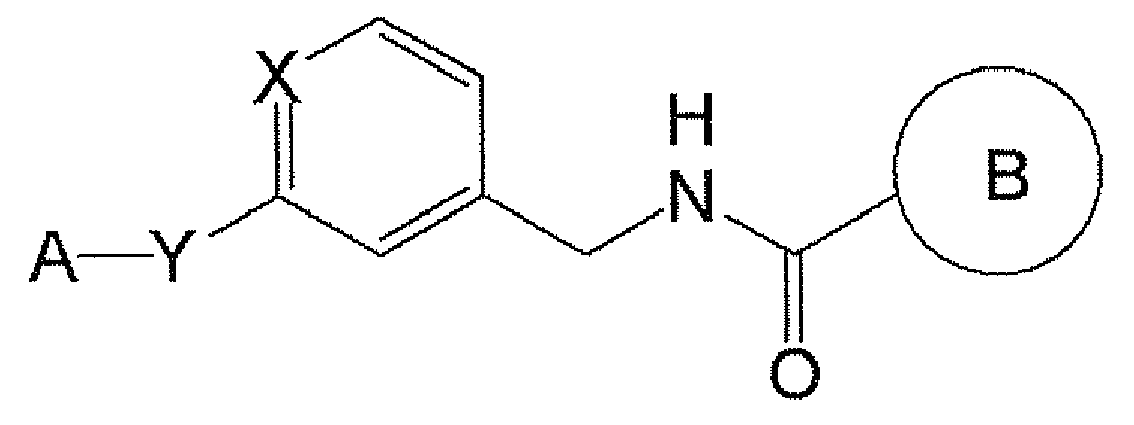
A is a zinc-binding group;
X is CZ wherein Z is a hydrogen atom or a halogen atom, or N;
Y is a spacer having 2 to 10 atoms and optionally having substituent(s); and
a group represented by the formula

R1, R2, R3 and R4 are each(i) a hydrogen atom,(ii) a halogen atom,(iii) a cyano group,(iv) a hydroxy group,(v) a nitro group,(vi) a carboxyl group,(vii) an alkoxycarbonyl group optionally having substituent(s),(viii) an amino group optionally having substituent(s),(ix) an alkyl group optionally having substituent(s),(x) an alkenyl group optionally having substituent(s),(xi) an alkynyl group optionally having substituent(s),(xii) an aryl group optionally having substituent(s),(xiii) an alkoxy group optionally having substituent(s),(xiv) an aralkyloxy group optionally having substituent (s),(xv) an aryloxy group optionally having substituent(s),(xvi) a thiol group,(xvii) an alkylthio group optionally having substituent(s),(xviii) an aralkylthio group optionally having substituent(s),(xix) a 5- to 8-membered aromatic heterocyclyl-thio group containing, besides carbon atoms, 1 to 4 heteroatoms selected from a nitrogen atom, an oxygen atom and a sulfur atom,(xx) a mono- or di-alkylcarbamoyl-thio group,(xxi) an alkylsulfonyl group optionally having substituent(s),(xxii) an arylsulfonyl group optionally having substituent(s),(xxiii) an aralkylsulfonyl group optionally having substituent(s),(xxiv) a carbamoyl group optionally having substituent(s),(xxv) a mono- or di-alkylamino-thiocarbonyloxy group,(xxvi) a 5- to 8-membered non-aromatic heterocyclic group containing, besides carbon atoms, 1 to 4 heteroatoms selected from a nitrogen atom, a sulfur atom and an oxygen atom, or(xxvii) a 5- to 8-membered aromatic heterocyclic group containing, besides carbon atoms, 1 to 4 heteroatoms selected from a nitrogen atom, a sulfur atom and an oxygen atom,a group represented by the formula
R5 and R6 are each(i) a hydrogen atom,(ii) a halogen atom,(iii) a cyano group,(iv) a hydroxy group,(v) a nitro group,(vi) a carboxyl group,(vii) an alkoxycarbonyl group optionally having substituent (s),(viii) an amino group optionally having substituent(s),(ix) an alkyl group optionally having substituent(s),(x) an alkenyl group optionally having substituent(s),(xi) an alkynyl group optionally having substituent(s),(xii) an aryl group optionally having substituent(s),(xiii) an alkoxy group optionally having substituent(s),(xiv) an aralkyloxy group optionally having substituent(s),(xv) an aryloxy group optionally having substituent(s),(xvi) a thiol group,(xvii) an alkylthio group optionally having substituent(s),(xviii) an aralkylthio group optionally having substituent(s),(xix) a 5- to 8-membered aromatic heterocyclyl-thio group containing, besides carbon atoms, 1 to 4 heteroatoms selected from a nitrogen atom, an oxygen atom and a sulfur atom,(xx) a mono- or di-alkylcarbamoyl-thio group,(xxi) an alkylsulfonyl group optionally having substituent(s),(xxii) an arylsulfonyl group optionally having substituent(s),(xxiii) an aralkylsulfonyl group optionally having substituent (s),(xxiv) a carbamoyl group optionally having substituent(s),(xxv) a mono- or di-alkylamino-thiocarbonyloxy group,(xxvi) a 5- to 8-membered non-aromatic heterocyclic group containing, besides carbon atoms, 1 to 4 heteroatoms selected from a nitrogen atom, a sulfur atom and an oxygen atom, or(xxvii) a 5- to 8-membered aromatic heterocyclic group containing, besides carbon atoms, 1 to 4 heteroatoms selected from a nitrogen atom, a sulfur atom and an oxygen atom, ora group represented by the formula
R7and R8 are each(i) a hydrogen atom,(ii) a halogen atom,(iii) a cyano group,(iv) a hydroxy group,(v) a nitro group,(vi) a carboxyl group,(vii) an alkoxycarbonyl group optionally having substituent(s),(viii) an amino group optionally having substituent(s),(ix) an alkyl group optionally having substituent(s),(x) an alkenyl group optionally having substituent(s),(xi) an alkynyl group optionally having substituent(s),(xii) an aryl group optionally having substituent(s),(xiii) an alkoxy group optionally having substituent(s),(xiv) an aralkyloxy group optionally having substituent(s),(xv) an aryloxy group optionally having substituent(s),(xvi) a thiol group,(xvii) an alkylthio group optionally having substituent(s),(xviii) an aralkylthio group optionally having substituent (s),(xix) a 5- to 8-membered aromatic heterocyclyl-thio group containing, besides carbon atoms, 1 to 4 heteroatoms selected from a nitrogen atom, an oxygen atom and a sulfur atom,(xx) a mono- or di-alkylcarbamoyl-thio group,(xxi) an alkylsulfonyl group optionally having substituent (s) ,(xxii) an arylsulfonyl group optionally having substituent (s),(xxiii) an aralkylsulfonyl group optionally having substituent (s),(xxiv) a carbamoyl group optionally having substituent (s) ,(xxv) a mono- or di-alkylamino-thiocarbonyloxy group,(xxvi) a 5- to 8-membered non-aromatic heterocyclic group containing, besides carbon atoms, 1 to 4 heteroatoms selected from a nitrogen atom, a sulfur atom and an oxygen atom, or(xxvii) a 5- to 8-membered aromatic heterocyclic group containing, besides carbon atoms, 1 to 4 heteroatoms selected from a nitrogen atom, a sulfur atom and an oxygen atom,provided that
{[3-({[(4-oxo-3, 4-dihydroquinazolin-2-yl)carbonyl]amino}methyl)phenyl]oxy}acetic acid,
5-{[3-({[(4-oxo-3,4-dihydroquinazolin-2-yl)carbonyl]amino}methyl)phenyl]oxy}pentanoic acid,
5-({3-[({[6-(methyloxy) -4-oxy-dihydroquinazolin-2-yl]carbonyl}amino)methyl]phenyl}oxy)pentanoic acid,
4-{[3-({[(4-oxo-3,4-dihydroquinazolin-2-yl)carbonyl]amino}methyl)phenyl]oxy}butanoic acid,
N-[(2-{[(5-methylisoxazol-3-yl)methyl]oxy}pyridin-4-yl)methyl]-4-oxo-3,4-dihydroquinazoline-2-carboxamide, and
N-[(2-{[(3,5-dimethylisoxazol-4-yl)methyl]oxy}pyridin-4-yl)methyl]-4-oxo-3,4-dihydroquinazoline-2-carboxamide are excluded,
or a salt thereof, or a prodrug thereof, for the production of a matrix metalloproteinase inhibitor.
Applications Claiming Priority (2)
| Application Number | Priority Date | Filing Date | Title |
|---|---|---|---|
| JP2005315267 | 2005-10-28 | ||
| PCT/JP2006/322043 WO2007049820A1 (en) | 2005-10-28 | 2006-10-27 | Heterocyclic amide compound and use thereof |
Publications (3)
| Publication Number | Publication Date |
|---|---|
| EP1953148A1 true EP1953148A1 (en) | 2008-08-06 |
| EP1953148A4 EP1953148A4 (en) | 2009-04-08 |
| EP1953148B1 EP1953148B1 (en) | 2012-02-29 |
Family
ID=39680973
Family Applications (1)
| Application Number | Title | Priority Date | Filing Date |
|---|---|---|---|
| EP06822961A Active EP1953148B1 (en) | 2005-10-28 | 2006-10-27 | Heterocyclic amide compound and use thereof |
Country Status (10)
| Country | Link |
|---|---|
| US (1) | US7915267B2 (en) |
| EP (1) | EP1953148B1 (en) |
| JP (1) | JP5324785B2 (en) |
| AR (1) | AR060701A1 (en) |
| AU (1) | AU2006306991A1 (en) |
| BR (1) | BRPI0617948A2 (en) |
| CA (1) | CA2627497C (en) |
| ES (1) | ES2380236T3 (en) |
| NO (1) | NO20082411L (en) |
| WO (1) | WO2007049820A1 (en) |
Families Citing this family (9)
| Publication number | Priority date | Publication date | Assignee | Title |
|---|---|---|---|---|
| US20110009435A1 (en) * | 2007-06-05 | 2011-01-13 | Pfizer, Inc. | Hetero bicyclic carboxamide derivatives and their pharmaceutical use and compositions |
| WO2013097052A1 (en) | 2011-12-30 | 2013-07-04 | Abbott Laboratories | Bromodomain inhibitors |
| EP2822931B1 (en) * | 2012-03-09 | 2017-05-03 | Inception 2, Inc. | Triazolone compounds and uses thereof |
| ES2660249T3 (en) | 2012-12-20 | 2018-03-21 | Inception 2, Inc. | Triazolone type compounds and their uses |
| JP2016529311A (en) | 2013-09-06 | 2016-09-23 | インセプション 2、 インコーポレイテッド | Triazolone compounds and their use |
| ES2793239T3 (en) | 2016-04-15 | 2020-11-13 | Abbvie Inc | Bromodomain inhibitors |
| GB201610055D0 (en) * | 2016-06-09 | 2016-07-27 | Galapagos Nv And Laboratoires Servier Les | Novel compounds and pharmaceutical compositions thereof for the treatment of inflammatory disorders and osteoarthritis |
| CN116496224B (en) * | 2022-01-19 | 2024-11-01 | 武汉思瓴生物科技有限公司 | 4-Quinazolinone hydroxamic acid derivative, pharmaceutical composition and application thereof |
| US12234205B1 (en) | 2024-05-22 | 2025-02-25 | King Saud University | Sulfonylhydrazide derivatives as anticancer agents |
Family Cites Families (38)
| Publication number | Priority date | Publication date | Assignee | Title |
|---|---|---|---|---|
| JPS61145167A (en) | 1984-12-18 | 1986-07-02 | Sagami Chem Res Center | 1,3-disubstituted-5-fluoro-6-chlorouracil derivative and antitumor agent |
| US5525625A (en) | 1995-01-24 | 1996-06-11 | Warner-Lambert Company | 2-(2-Amino-3-methoxyphenyl)-4-oxo-4H-[1]benzopyran for treating proliferative disorders |
| TR199801361T2 (en) | 1996-01-11 | 1998-10-21 | Smithkline Beecham Corporation | New substituted imidazole compounds. |
| WO1997033883A1 (en) | 1996-03-13 | 1997-09-18 | Smithkline Beecham Corporation | Novel pyrimidine compounds useful in treating cytokine mediated diseases |
| WO1997035856A1 (en) | 1996-03-25 | 1997-10-02 | Smithkline Beecham Corporation | Novel treatment for cns injuries |
| WO1997035855A1 (en) | 1996-03-25 | 1997-10-02 | Smithkline Beecham Corporation | Novel treatment for cns injuries |
| US6017958A (en) | 1996-06-04 | 2000-01-25 | Octamer, Inc. | Method of treating malignant tumors with thyroxine analogues having no significant hormonal activity |
| WO1998007425A1 (en) | 1996-08-21 | 1998-02-26 | Smithkline Beecham Corporation | Imidazole compounds, compositions and use |
| US6147080A (en) | 1996-12-18 | 2000-11-14 | Vertex Pharmaceuticals Incorporated | Inhibitors of p38 |
| ES2234103T3 (en) | 1997-03-04 | 2005-06-16 | Pharmacia Corporation | THIOARILSULPHONAMID HYDROXAMIC ACID COMPOUNDS. |
| UA73073C2 (en) | 1997-04-03 | 2005-06-15 | Уайт Холдінгз Корпорейшн | Substituted 3-cyan chinolines |
| US6002008A (en) | 1997-04-03 | 1999-12-14 | American Cyanamid Company | Substituted 3-cyano quinolines |
| US5905089A (en) | 1997-04-14 | 1999-05-18 | Board Of Supervisors Of Louisiana State University And Agricultural And Mechanical College | Use of sesquiterpene lactones for treatment of severe inflammatory disorders |
| WO1998047899A1 (en) | 1997-04-24 | 1998-10-29 | Ortho-Mcneil Corporation, Inc. | Substituted pyrrolopyridines useful in the treatment of inflammatory diseases |
| JP2002502380A (en) | 1997-05-22 | 2002-01-22 | ジー.ディー.サール アンド カンパニー | Pyrazole derivatives as p38 kinase inhibitors |
| WO1998057966A1 (en) | 1997-06-19 | 1998-12-23 | Smithkline Beecham Corporation | Novel aryloxy substituted pyrimidine imidazole compounds |
| US6040320A (en) | 1997-06-30 | 2000-03-21 | Ortho-Mcneil Pharmaceutical, Inc. | 2-substituted imidazoles useful in the treatment of inflammatory diseases |
| GB9713726D0 (en) | 1997-06-30 | 1997-09-03 | Ciba Geigy Ag | Organic compounds |
| AR016294A1 (en) | 1997-07-02 | 2001-07-04 | Smithkline Beecham Corp | IMIDAZOL SUBSTITUTE COMPOSITE, PHARMACEUTICAL COMPOSITION CONTAINING IT, ITS USE IN THE MANUFACTURE OF A MEDICINAL PRODUCT AND PROCEDURE FOR SUPREPARATION |
| TW517055B (en) | 1997-07-02 | 2003-01-11 | Smithkline Beecham Corp | Novel substituted imidazole compounds |
| GB9721437D0 (en) | 1997-10-10 | 1997-12-10 | Glaxo Group Ltd | Heteroaromatic compounds and their use in medicine |
| WO1999032463A1 (en) | 1997-12-22 | 1999-07-01 | Bayer Corporation | INHIBITION OF p38 KINASE USING SYMMETRICAL AND UNSYMMETRICAL DIPHENYL UREAS |
| GB9809869D0 (en) | 1998-05-09 | 1998-07-08 | Medical Res Council | Inhibition of protein kinases |
| CN1188389C (en) | 1998-05-15 | 2005-02-09 | 阿斯特拉曾尼卡有限公司 | Benzamide derivatives for the treatment of diseases caused by cytokines |
| KR100605140B1 (en) | 1998-05-22 | 2006-07-28 | 싸이오스 인크 | Heterocyclic compounds for the treatment of heart disease and other diseases and methods of treating the same |
| US6589954B1 (en) | 1998-05-22 | 2003-07-08 | Scios, Inc. | Compounds and methods to treat cardiac failure and other disorders |
| WO2000004025A1 (en) | 1998-07-14 | 2000-01-27 | The Hong Kong University Of Science & Technology | Antiparasitic artemisinin derivatives (endoperoxides) |
| EP1112070B1 (en) | 1998-08-20 | 2004-05-12 | Smithkline Beecham Corporation | Novel substituted triazole compounds |
| JP4191825B2 (en) | 1998-09-10 | 2008-12-03 | あすか製薬株式会社 | 5-aminoisoxazole derivatives |
| US6096543A (en) | 1998-11-20 | 2000-08-01 | Isis Pharmaceuticals Inc. | Antisense inhibition of human mek1 expression |
| DE69924641D1 (en) | 1999-01-07 | 2005-05-12 | Warner Lambert Company Llc Mor | TREATMENT OF ASTHMA ON THE BASIS OF MEK INHIBITORS |
| AU2201500A (en) | 1999-01-13 | 2000-08-01 | Warner-Lambert Company | Benzenesulfonamide derivatives and their use as mek inhibitors |
| CA2359244C (en) | 1999-01-13 | 2013-10-08 | Bayer Healthcare Llc | .omega.-carboxy aryl substituted diphenyl ureas as p38 kinase inhibitors |
| CA2349467A1 (en) | 1999-01-13 | 2000-07-20 | Warner-Lambert Company | Sulphohydroxamic acids and sulphohydroxamates and their use as mek inhibitors |
| PL351148A1 (en) | 1999-04-23 | 2003-03-24 | Takeda Chemical Industries Ltd | 5-pyridyl-1,3-azole compounds, process for producing the same and use thereof |
| PA8539301A1 (en) * | 2001-02-14 | 2002-09-30 | Warner Lambert Co | INHIBITORS OF THE METALOPROTEINASE OF THE MATRIX |
| US7718663B2 (en) * | 2002-04-26 | 2010-05-18 | Nippon Shinyaku Co., Ltd. | Quinazoline derivatives and medicaments |
| CN1976907A (en) * | 2004-04-30 | 2007-06-06 | 武田药品工业株式会社 | Heterocyclic amide compound and use thereof as an MMP-13 inhibitor |
-
2006
- 2006-10-27 CA CA2627497A patent/CA2627497C/en not_active Expired - Fee Related
- 2006-10-27 WO PCT/JP2006/322043 patent/WO2007049820A1/en not_active Ceased
- 2006-10-27 US US12/091,773 patent/US7915267B2/en not_active Expired - Fee Related
- 2006-10-27 ES ES06822961T patent/ES2380236T3/en active Active
- 2006-10-27 JP JP2007542824A patent/JP5324785B2/en not_active Expired - Fee Related
- 2006-10-27 AU AU2006306991A patent/AU2006306991A1/en not_active Abandoned
- 2006-10-27 EP EP06822961A patent/EP1953148B1/en active Active
- 2006-10-27 BR BRPI0617948-7A patent/BRPI0617948A2/en not_active IP Right Cessation
-
2007
- 2007-04-27 AR ARP070101836A patent/AR060701A1/en unknown
-
2008
- 2008-05-28 NO NO20082411A patent/NO20082411L/en not_active Application Discontinuation
Also Published As
| Publication number | Publication date |
|---|---|
| CA2627497C (en) | 2014-10-14 |
| US7915267B2 (en) | 2011-03-29 |
| AR060701A1 (en) | 2008-07-10 |
| EP1953148B1 (en) | 2012-02-29 |
| US20090137603A1 (en) | 2009-05-28 |
| BRPI0617948A2 (en) | 2011-08-09 |
| JPWO2007049820A1 (en) | 2009-04-30 |
| JP5324785B2 (en) | 2013-10-23 |
| ES2380236T3 (en) | 2012-05-09 |
| NO20082411L (en) | 2008-07-28 |
| EP1953148A4 (en) | 2009-04-08 |
| WO2007049820A1 (en) | 2007-05-03 |
| CA2627497A1 (en) | 2007-05-03 |
| AU2006306991A1 (en) | 2007-05-03 |
Similar Documents
| Publication | Publication Date | Title |
|---|---|---|
| ES2239779T3 (en) | PIRIMIDINE DERIVATIVES AND PROCEDURES FOR THE PREPARATION OF THE SAME. | |
| CA2996316C (en) | Heteroaryl compounds as irak inhibitors and uses thereof | |
| EP3056485B1 (en) | Androgen receptor modulating compounds | |
| CA2702647C (en) | Thiopyrimidine-based compounds and uses thereof | |
| CN104540831B (en) | The difluoro dioxolanes aminobenzimidazole kinase inhibitor disorderly for treating cancer, autoimmune inflammation and CNS | |
| EP2007767B1 (en) | Pyrrolopyrimidine derivatives used as hsp90 inhibitors | |
| US20080269238A1 (en) | Thiazolopyrimidine Derivative | |
| WO2004067535A1 (en) | Thienopyrimidine compounds and use thereof | |
| CZ2003616A3 (en) | Bicyclic pyrrolyl amides functioning as glycogen phosphorylase inhibitors and pharmaceutical composition containing thereof | |
| EA028991B1 (en) | Heterocyclic amides as kinase inhibitors | |
| JP2017522346A (en) | Compounds active against bromodomain | |
| CZ20024120A3 (en) | Substituted quinazoline derivatives and their use as inhibitors | |
| JP2013510122A (en) | Condensed azepine derivatives as bromodomain inhibitors | |
| US10125121B2 (en) | FYN kinase inhibitors | |
| WO2005019188A1 (en) | Fused pyrimidine derivative and use thereof | |
| EP1847541A1 (en) | Fused pyrimidine derivative and uses thereof | |
| EP1953148B1 (en) | Heterocyclic amide compound and use thereof | |
| EP1719771A1 (en) | Pyrazoloquinolone derivative and use thereof | |
| CN101351453A (en) | Heterocyclic amide compounds and uses thereof | |
| JP2003292492A (en) | Thienopyrimidine compound, method for producing the same and use thereof | |
| HK1124312A (en) | Heterocyclic amide compound and use thereof | |
| ES2439918T3 (en) | 1H-thieno [2,3-c] -pyrazole compounds useful as kinase inhibitors | |
| CN121735914A (en) | PARP7 inhibitor for cancer immunotherapy | |
| TW200819429A (en) | Heterocyclic amide compounds and use thereof | |
| JP2008094846A (en) | Thienopyrimidine compound and application thereof |
Legal Events
| Date | Code | Title | Description |
|---|---|---|---|
| PUAI | Public reference made under article 153(3) epc to a published international application that has entered the european phase |
Free format text: ORIGINAL CODE: 0009012 |
|
| 17P | Request for examination filed |
Effective date: 20080428 |
|
| AK | Designated contracting states |
Kind code of ref document: A1 Designated state(s): AT BE BG CH CY CZ DE DK EE ES FI FR GB GR HU IE IS IT LI LT LU LV MC NL PL PT RO SE SI SK TR |
|
| AX | Request for extension of the european patent |
Extension state: AL BA HR MK RS |
|
| A4 | Supplementary search report drawn up and despatched |
Effective date: 20090311 |
|
| REG | Reference to a national code |
Ref country code: HK Ref legal event code: DE Ref document number: 1124312 Country of ref document: HK |
|
| 17Q | First examination report despatched |
Effective date: 20090928 |
|
| GRAP | Despatch of communication of intention to grant a patent |
Free format text: ORIGINAL CODE: EPIDOSNIGR1 |
|
| GRAS | Grant fee paid |
Free format text: ORIGINAL CODE: EPIDOSNIGR3 |
|
| RIN1 | Information on inventor provided before grant (corrected) |
Inventor name: SATO, KENJIRO Inventor name: NARA, HIROSHI Inventor name: KAIEDA, AKIRA Inventor name: TERAUCHI, JUN |
|
| GRAA | (expected) grant |
Free format text: ORIGINAL CODE: 0009210 |
|
| AK | Designated contracting states |
Kind code of ref document: B1 Designated state(s): AT BE BG CH CY CZ DE DK EE ES FI FR GB GR HU IE IS IT LI LT LU LV MC NL PL PT RO SE SI SK TR |
|
| AX | Request for extension of the european patent |
Extension state: AL BA HR MK RS |
|
| REG | Reference to a national code |
Ref country code: GB Ref legal event code: FG4D Ref country code: CH Ref legal event code: EP |
|
| REG | Reference to a national code |
Ref country code: CH Ref legal event code: NV Representative=s name: BOHEST AG Ref country code: AT Ref legal event code: REF Ref document number: 547408 Country of ref document: AT Kind code of ref document: T Effective date: 20120315 |
|
| REG | Reference to a national code |
Ref country code: IE Ref legal event code: FG4D |
|
| REG | Reference to a national code |
Ref country code: DE Ref legal event code: R096 Ref document number: 602006027960 Country of ref document: DE Effective date: 20120426 |
|
| REG | Reference to a national code |
Ref country code: ES Ref legal event code: FG2A Ref document number: 2380236 Country of ref document: ES Kind code of ref document: T3 Effective date: 20120509 |
|
| REG | Reference to a national code |
Ref country code: NL Ref legal event code: VDEP Effective date: 20120229 |
|
| LTIE | Lt: invalidation of european patent or patent extension |
Effective date: 20120229 |
|
| PG25 | Lapsed in a contracting state [announced via postgrant information from national office to epo] |
Ref country code: NL Free format text: LAPSE BECAUSE OF FAILURE TO SUBMIT A TRANSLATION OF THE DESCRIPTION OR TO PAY THE FEE WITHIN THE PRESCRIBED TIME-LIMIT Effective date: 20120229 Ref country code: IS Free format text: LAPSE BECAUSE OF FAILURE TO SUBMIT A TRANSLATION OF THE DESCRIPTION OR TO PAY THE FEE WITHIN THE PRESCRIBED TIME-LIMIT Effective date: 20120629 Ref country code: LT Free format text: LAPSE BECAUSE OF FAILURE TO SUBMIT A TRANSLATION OF THE DESCRIPTION OR TO PAY THE FEE WITHIN THE PRESCRIBED TIME-LIMIT Effective date: 20120229 |
|
| PG25 | Lapsed in a contracting state [announced via postgrant information from national office to epo] |
Ref country code: GR Free format text: LAPSE BECAUSE OF FAILURE TO SUBMIT A TRANSLATION OF THE DESCRIPTION OR TO PAY THE FEE WITHIN THE PRESCRIBED TIME-LIMIT Effective date: 20120530 Ref country code: FI Free format text: LAPSE BECAUSE OF FAILURE TO SUBMIT A TRANSLATION OF THE DESCRIPTION OR TO PAY THE FEE WITHIN THE PRESCRIBED TIME-LIMIT Effective date: 20120229 Ref country code: PT Free format text: LAPSE BECAUSE OF FAILURE TO SUBMIT A TRANSLATION OF THE DESCRIPTION OR TO PAY THE FEE WITHIN THE PRESCRIBED TIME-LIMIT Effective date: 20120629 Ref country code: LV Free format text: LAPSE BECAUSE OF FAILURE TO SUBMIT A TRANSLATION OF THE DESCRIPTION OR TO PAY THE FEE WITHIN THE PRESCRIBED TIME-LIMIT Effective date: 20120229 Ref country code: BE Free format text: LAPSE BECAUSE OF FAILURE TO SUBMIT A TRANSLATION OF THE DESCRIPTION OR TO PAY THE FEE WITHIN THE PRESCRIBED TIME-LIMIT Effective date: 20120229 |
|
| REG | Reference to a national code |
Ref country code: AT Ref legal event code: MK05 Ref document number: 547408 Country of ref document: AT Kind code of ref document: T Effective date: 20120229 |
|
| PG25 | Lapsed in a contracting state [announced via postgrant information from national office to epo] |
Ref country code: CY Free format text: LAPSE BECAUSE OF FAILURE TO SUBMIT A TRANSLATION OF THE DESCRIPTION OR TO PAY THE FEE WITHIN THE PRESCRIBED TIME-LIMIT Effective date: 20120229 |
|
| PG25 | Lapsed in a contracting state [announced via postgrant information from national office to epo] |
Ref country code: RO Free format text: LAPSE BECAUSE OF FAILURE TO SUBMIT A TRANSLATION OF THE DESCRIPTION OR TO PAY THE FEE WITHIN THE PRESCRIBED TIME-LIMIT Effective date: 20120229 Ref country code: EE Free format text: LAPSE BECAUSE OF FAILURE TO SUBMIT A TRANSLATION OF THE DESCRIPTION OR TO PAY THE FEE WITHIN THE PRESCRIBED TIME-LIMIT Effective date: 20120229 Ref country code: SE Free format text: LAPSE BECAUSE OF FAILURE TO SUBMIT A TRANSLATION OF THE DESCRIPTION OR TO PAY THE FEE WITHIN THE PRESCRIBED TIME-LIMIT Effective date: 20120229 Ref country code: DK Free format text: LAPSE BECAUSE OF FAILURE TO SUBMIT A TRANSLATION OF THE DESCRIPTION OR TO PAY THE FEE WITHIN THE PRESCRIBED TIME-LIMIT Effective date: 20120229 Ref country code: SI Free format text: LAPSE BECAUSE OF FAILURE TO SUBMIT A TRANSLATION OF THE DESCRIPTION OR TO PAY THE FEE WITHIN THE PRESCRIBED TIME-LIMIT Effective date: 20120229 Ref country code: CZ Free format text: LAPSE BECAUSE OF FAILURE TO SUBMIT A TRANSLATION OF THE DESCRIPTION OR TO PAY THE FEE WITHIN THE PRESCRIBED TIME-LIMIT Effective date: 20120229 Ref country code: PL Free format text: LAPSE BECAUSE OF FAILURE TO SUBMIT A TRANSLATION OF THE DESCRIPTION OR TO PAY THE FEE WITHIN THE PRESCRIBED TIME-LIMIT Effective date: 20120229 |
|
| PG25 | Lapsed in a contracting state [announced via postgrant information from national office to epo] |
Ref country code: SK Free format text: LAPSE BECAUSE OF FAILURE TO SUBMIT A TRANSLATION OF THE DESCRIPTION OR TO PAY THE FEE WITHIN THE PRESCRIBED TIME-LIMIT Effective date: 20120229 |
|
| PLBE | No opposition filed within time limit |
Free format text: ORIGINAL CODE: 0009261 |
|
| STAA | Information on the status of an ep patent application or granted ep patent |
Free format text: STATUS: NO OPPOSITION FILED WITHIN TIME LIMIT |
|
| PG25 | Lapsed in a contracting state [announced via postgrant information from national office to epo] |
Ref country code: AT Free format text: LAPSE BECAUSE OF FAILURE TO SUBMIT A TRANSLATION OF THE DESCRIPTION OR TO PAY THE FEE WITHIN THE PRESCRIBED TIME-LIMIT Effective date: 20120229 |
|
| 26N | No opposition filed |
Effective date: 20121130 |
|
| REG | Reference to a national code |
Ref country code: DE Ref legal event code: R097 Ref document number: 602006027960 Country of ref document: DE Effective date: 20121130 |
|
| PG25 | Lapsed in a contracting state [announced via postgrant information from national office to epo] |
Ref country code: MC Free format text: LAPSE BECAUSE OF NON-PAYMENT OF DUE FEES Effective date: 20121031 |
|
| PG25 | Lapsed in a contracting state [announced via postgrant information from national office to epo] |
Ref country code: BG Free format text: LAPSE BECAUSE OF FAILURE TO SUBMIT A TRANSLATION OF THE DESCRIPTION OR TO PAY THE FEE WITHIN THE PRESCRIBED TIME-LIMIT Effective date: 20120529 |
|
| REG | Reference to a national code |
Ref country code: IE Ref legal event code: MM4A |
|
| PG25 | Lapsed in a contracting state [announced via postgrant information from national office to epo] |
Ref country code: IE Free format text: LAPSE BECAUSE OF NON-PAYMENT OF DUE FEES Effective date: 20121027 |
|
| PG25 | Lapsed in a contracting state [announced via postgrant information from national office to epo] |
Ref country code: TR Free format text: LAPSE BECAUSE OF FAILURE TO SUBMIT A TRANSLATION OF THE DESCRIPTION OR TO PAY THE FEE WITHIN THE PRESCRIBED TIME-LIMIT Effective date: 20120229 |
|
| PG25 | Lapsed in a contracting state [announced via postgrant information from national office to epo] |
Ref country code: LU Free format text: LAPSE BECAUSE OF NON-PAYMENT OF DUE FEES Effective date: 20121027 |
|
| REG | Reference to a national code |
Ref country code: CH Ref legal event code: PCAR Free format text: NEW ADDRESS: HOLBEINSTRASSE 36-38, 4051 BASEL (CH) |
|
| PG25 | Lapsed in a contracting state [announced via postgrant information from national office to epo] |
Ref country code: HU Free format text: LAPSE BECAUSE OF FAILURE TO SUBMIT A TRANSLATION OF THE DESCRIPTION OR TO PAY THE FEE WITHIN THE PRESCRIBED TIME-LIMIT Effective date: 20061027 |
|
| REG | Reference to a national code |
Ref country code: HK Ref legal event code: WD Ref document number: 1124312 Country of ref document: HK |
|
| REG | Reference to a national code |
Ref country code: FR Ref legal event code: PLFP Year of fee payment: 11 |
|
| REG | Reference to a national code |
Ref country code: FR Ref legal event code: PLFP Year of fee payment: 12 |
|
| REG | Reference to a national code |
Ref country code: FR Ref legal event code: PLFP Year of fee payment: 13 |
|
| PGFP | Annual fee paid to national office [announced via postgrant information from national office to epo] |
Ref country code: FR Payment date: 20190913 Year of fee payment: 14 |
|
| PGFP | Annual fee paid to national office [announced via postgrant information from national office to epo] |
Ref country code: DE Payment date: 20191015 Year of fee payment: 14 |
|
| PGFP | Annual fee paid to national office [announced via postgrant information from national office to epo] |
Ref country code: ES Payment date: 20191104 Year of fee payment: 14 Ref country code: IT Payment date: 20191009 Year of fee payment: 14 |
|
| PGFP | Annual fee paid to national office [announced via postgrant information from national office to epo] |
Ref country code: CH Payment date: 20191015 Year of fee payment: 14 |
|
| PGFP | Annual fee paid to national office [announced via postgrant information from national office to epo] |
Ref country code: GB Payment date: 20191025 Year of fee payment: 14 |
|
| REG | Reference to a national code |
Ref country code: DE Ref legal event code: R119 Ref document number: 602006027960 Country of ref document: DE |
|
| REG | Reference to a national code |
Ref country code: CH Ref legal event code: PL |
|
| GBPC | Gb: european patent ceased through non-payment of renewal fee |
Effective date: 20201027 |
|
| PG25 | Lapsed in a contracting state [announced via postgrant information from national office to epo] |
Ref country code: DE Free format text: LAPSE BECAUSE OF NON-PAYMENT OF DUE FEES Effective date: 20210501 Ref country code: FR Free format text: LAPSE BECAUSE OF NON-PAYMENT OF DUE FEES Effective date: 20201031 |
|
| PG25 | Lapsed in a contracting state [announced via postgrant information from national office to epo] |
Ref country code: GB Free format text: LAPSE BECAUSE OF NON-PAYMENT OF DUE FEES Effective date: 20201027 Ref country code: LI Free format text: LAPSE BECAUSE OF NON-PAYMENT OF DUE FEES Effective date: 20201031 Ref country code: CH Free format text: LAPSE BECAUSE OF NON-PAYMENT OF DUE FEES Effective date: 20201031 |
|
| PG25 | Lapsed in a contracting state [announced via postgrant information from national office to epo] |
Ref country code: IT Free format text: LAPSE BECAUSE OF NON-PAYMENT OF DUE FEES Effective date: 20201027 |
|
| REG | Reference to a national code |
Ref country code: ES Ref legal event code: FD2A Effective date: 20220128 |
|
| PG25 | Lapsed in a contracting state [announced via postgrant information from national office to epo] |
Ref country code: ES Free format text: LAPSE BECAUSE OF NON-PAYMENT OF DUE FEES Effective date: 20201028 |