EP1953138A2 - Fenicol compounds and methods of synthesizing 2-trifluoracetamido-3-substituted propiophenone compounds - Google Patents
Fenicol compounds and methods of synthesizing 2-trifluoracetamido-3-substituted propiophenone compounds Download PDFInfo
- Publication number
- EP1953138A2 EP1953138A2 EP07006059A EP07006059A EP1953138A2 EP 1953138 A2 EP1953138 A2 EP 1953138A2 EP 07006059 A EP07006059 A EP 07006059A EP 07006059 A EP07006059 A EP 07006059A EP 1953138 A2 EP1953138 A2 EP 1953138A2
- Authority
- EP
- European Patent Office
- Prior art keywords
- formula
- compound
- nhr
- halogen
- independently
- Prior art date
- Legal status (The legal status is an assumption and is not a legal conclusion. Google has not performed a legal analysis and makes no representation as to the accuracy of the status listed.)
- Withdrawn
Links
- 238000000034 method Methods 0.000 title claims abstract description 111
- -1 2-trifluoracetamido-3-substituted propiophenone compounds Chemical class 0.000 title claims abstract description 96
- 230000002194 synthesizing effect Effects 0.000 title claims description 15
- WIIZWVCIJKGZOK-RKDXNWHRSA-N chloramphenicol Chemical class ClC(Cl)C(=O)N[C@H](CO)[C@H](O)C1=CC=C([N+]([O-])=O)C=C1 WIIZWVCIJKGZOK-RKDXNWHRSA-N 0.000 title abstract description 13
- 150000001875 compounds Chemical class 0.000 claims abstract description 314
- 125000002496 methyl group Chemical group [H]C([H])([H])* 0.000 claims description 102
- 229910006074 SO2NH2 Inorganic materials 0.000 claims description 79
- 241001465754 Metazoa Species 0.000 claims description 39
- 150000001413 amino acids Chemical class 0.000 claims description 35
- 229910052736 halogen Inorganic materials 0.000 claims description 35
- 125000002887 hydroxy group Chemical group [H]O* 0.000 claims description 35
- 150000002367 halogens Chemical class 0.000 claims description 27
- 125000001997 phenyl group Chemical group [H]C1=C([H])C([H])=C(*)C([H])=C1[H] 0.000 claims description 25
- OKKJLVBELUTLKV-UHFFFAOYSA-N Methanol Chemical compound OC OKKJLVBELUTLKV-UHFFFAOYSA-N 0.000 claims description 24
- 239000002904 solvent Substances 0.000 claims description 21
- 150000004820 halides Chemical group 0.000 claims description 19
- 239000003054 catalyst Substances 0.000 claims description 17
- 239000003638 chemical reducing agent Substances 0.000 claims description 14
- 229910052739 hydrogen Inorganic materials 0.000 claims description 14
- UFHFLCQGNIYNRP-UHFFFAOYSA-N Hydrogen Chemical compound [H][H] UFHFLCQGNIYNRP-UHFFFAOYSA-N 0.000 claims description 13
- 239000001257 hydrogen Substances 0.000 claims description 13
- 239000008194 pharmaceutical composition Substances 0.000 claims description 13
- 208000035143 Bacterial infection Diseases 0.000 claims description 10
- VSCWAEJMTAWNJL-UHFFFAOYSA-K aluminium trichloride Chemical compound Cl[Al](Cl)Cl VSCWAEJMTAWNJL-UHFFFAOYSA-K 0.000 claims description 10
- 208000022362 bacterial infectious disease Diseases 0.000 claims description 10
- 125000005843 halogen group Chemical group 0.000 claims description 9
- 238000005727 Friedel-Crafts reaction Methods 0.000 claims description 7
- 239000000546 pharmaceutical excipient Substances 0.000 claims description 7
- QAEDZJGFFMLHHQ-UHFFFAOYSA-N trifluoroacetic anhydride Chemical compound FC(F)(F)C(=O)OC(=O)C(F)(F)F QAEDZJGFFMLHHQ-UHFFFAOYSA-N 0.000 claims description 7
- BWHMMNNQKKPAPP-UHFFFAOYSA-L potassium carbonate Chemical compound [K+].[K+].[O-]C([O-])=O BWHMMNNQKKPAPP-UHFFFAOYSA-L 0.000 claims description 6
- 229910015844 BCl3 Inorganic materials 0.000 claims description 4
- 229910015900 BF3 Inorganic materials 0.000 claims description 4
- 229910005267 GaCl3 Inorganic materials 0.000 claims description 4
- 229910021578 Iron(III) chloride Inorganic materials 0.000 claims description 4
- CDBYLPFSWZWCQE-UHFFFAOYSA-L Sodium Carbonate Chemical compound [Na+].[Na+].[O-]C([O-])=O CDBYLPFSWZWCQE-UHFFFAOYSA-L 0.000 claims description 4
- 229910021627 Tin(IV) chloride Inorganic materials 0.000 claims description 4
- 229910007932 ZrCl4 Inorganic materials 0.000 claims description 4
- PQLAYKMGZDUDLQ-UHFFFAOYSA-K aluminium bromide Chemical compound Br[Al](Br)Br PQLAYKMGZDUDLQ-UHFFFAOYSA-K 0.000 claims description 4
- FAPDDOBMIUGHIN-UHFFFAOYSA-K antimony trichloride Chemical compound Cl[Sb](Cl)Cl FAPDDOBMIUGHIN-UHFFFAOYSA-K 0.000 claims description 4
- VMPVEPPRYRXYNP-UHFFFAOYSA-I antimony(5+);pentachloride Chemical compound Cl[Sb](Cl)(Cl)(Cl)Cl VMPVEPPRYRXYNP-UHFFFAOYSA-I 0.000 claims description 4
- WTEOIRVLGSZEPR-UHFFFAOYSA-N boron trifluoride Chemical compound FB(F)F WTEOIRVLGSZEPR-UHFFFAOYSA-N 0.000 claims description 4
- UPWPDUACHOATKO-UHFFFAOYSA-K gallium trichloride Chemical compound Cl[Ga](Cl)Cl UPWPDUACHOATKO-UHFFFAOYSA-K 0.000 claims description 4
- RBTARNINKXHZNM-UHFFFAOYSA-K iron trichloride Chemical compound Cl[Fe](Cl)Cl RBTARNINKXHZNM-UHFFFAOYSA-K 0.000 claims description 4
- HPGGPRDJHPYFRM-UHFFFAOYSA-J tin(iv) chloride Chemical compound Cl[Sn](Cl)(Cl)Cl HPGGPRDJHPYFRM-UHFFFAOYSA-J 0.000 claims description 4
- FAQYAMRNWDIXMY-UHFFFAOYSA-N trichloroborane Chemical compound ClB(Cl)Cl FAQYAMRNWDIXMY-UHFFFAOYSA-N 0.000 claims description 4
- 239000011592 zinc chloride Substances 0.000 claims description 4
- JIAARYAFYJHUJI-UHFFFAOYSA-L zinc dichloride Chemical compound [Cl-].[Cl-].[Zn+2] JIAARYAFYJHUJI-UHFFFAOYSA-L 0.000 claims description 4
- DUNKXUFBGCUVQW-UHFFFAOYSA-J zirconium tetrachloride Chemical compound Cl[Zr](Cl)(Cl)Cl DUNKXUFBGCUVQW-UHFFFAOYSA-J 0.000 claims description 4
- 206010029164 Nephrotic syndrome Diseases 0.000 claims description 3
- 229910000027 potassium carbonate Inorganic materials 0.000 claims description 3
- 206010060968 Arthritis infective Diseases 0.000 claims description 2
- 241000588919 Citrobacter freundii Species 0.000 claims description 2
- 241000588917 Citrobacter koseri Species 0.000 claims description 2
- 241000588697 Enterobacter cloacae Species 0.000 claims description 2
- 241000588724 Escherichia coli Species 0.000 claims description 2
- 241000606768 Haemophilus influenzae Species 0.000 claims description 2
- 241000588747 Klebsiella pneumoniae Species 0.000 claims description 2
- 241000588772 Morganella morganii Species 0.000 claims description 2
- 241000588652 Neisseria gonorrhoeae Species 0.000 claims description 2
- 206010031252 Osteomyelitis Diseases 0.000 claims description 2
- 208000005141 Otitis Diseases 0.000 claims description 2
- 206010036410 Postoperative wound infection Diseases 0.000 claims description 2
- 241000588770 Proteus mirabilis Species 0.000 claims description 2
- 241000588767 Proteus vulgaris Species 0.000 claims description 2
- 241000588778 Providencia stuartii Species 0.000 claims description 2
- 241000589517 Pseudomonas aeruginosa Species 0.000 claims description 2
- 206010057190 Respiratory tract infections Diseases 0.000 claims description 2
- 208000019802 Sexually transmitted disease Diseases 0.000 claims description 2
- 241000295644 Staphylococcaceae Species 0.000 claims description 2
- 241000191940 Staphylococcus Species 0.000 claims description 2
- 241000191967 Staphylococcus aureus Species 0.000 claims description 2
- 241000193998 Streptococcus pneumoniae Species 0.000 claims description 2
- 241000193996 Streptococcus pyogenes Species 0.000 claims description 2
- 208000031650 Surgical Wound Infection Diseases 0.000 claims description 2
- 210000000988 bone and bone Anatomy 0.000 claims description 2
- 208000019258 ear infection Diseases 0.000 claims description 2
- 210000002615 epidermis Anatomy 0.000 claims description 2
- 229940047650 haemophilus influenzae Drugs 0.000 claims description 2
- 230000003301 hydrolyzing effect Effects 0.000 claims description 2
- 229940076266 morganella morganii Drugs 0.000 claims description 2
- 229940007042 proteus vulgaris Drugs 0.000 claims description 2
- 206010040872 skin infection Diseases 0.000 claims description 2
- 229910000029 sodium carbonate Inorganic materials 0.000 claims description 2
- 229940031000 streptococcus pneumoniae Drugs 0.000 claims description 2
- PNQBEPDZQUOCNY-UHFFFAOYSA-N trifluoroacetyl chloride Chemical compound FC(F)(F)C(Cl)=O PNQBEPDZQUOCNY-UHFFFAOYSA-N 0.000 claims description 2
- 208000019206 urinary tract infection Diseases 0.000 claims description 2
- 125000001183 hydrocarbyl group Chemical group 0.000 claims 13
- XEKOWRVHYACXOJ-UHFFFAOYSA-N Ethyl acetate Chemical compound CCOC(C)=O XEKOWRVHYACXOJ-UHFFFAOYSA-N 0.000 description 81
- 229940024606 amino acid Drugs 0.000 description 48
- 235000001014 amino acid Nutrition 0.000 description 48
- 238000004519 manufacturing process Methods 0.000 description 36
- 239000000203 mixture Substances 0.000 description 30
- 239000000243 solution Substances 0.000 description 28
- 239000000460 chlorine Substances 0.000 description 27
- 238000006243 chemical reaction Methods 0.000 description 24
- YMWUJEATGCHHMB-UHFFFAOYSA-N Dichloromethane Chemical compound ClCCl YMWUJEATGCHHMB-UHFFFAOYSA-N 0.000 description 21
- YXFVVABEGXRONW-UHFFFAOYSA-N Toluene Chemical compound CC1=CC=CC=C1 YXFVVABEGXRONW-UHFFFAOYSA-N 0.000 description 21
- VLKZOEOYAKHREP-UHFFFAOYSA-N n-Hexane Chemical compound CCCCCC VLKZOEOYAKHREP-UHFFFAOYSA-N 0.000 description 20
- 150000002430 hydrocarbons Chemical group 0.000 description 16
- 239000002253 acid Substances 0.000 description 15
- 239000011541 reaction mixture Substances 0.000 description 15
- WYURNTSHIVDZCO-UHFFFAOYSA-N Tetrahydrofuran Chemical compound C1CCOC1 WYURNTSHIVDZCO-UHFFFAOYSA-N 0.000 description 14
- VEXZGXHMUGYJMC-UHFFFAOYSA-N Hydrochloric acid Chemical compound Cl VEXZGXHMUGYJMC-UHFFFAOYSA-N 0.000 description 13
- XLYOFNOQVPJJNP-UHFFFAOYSA-N water Substances O XLYOFNOQVPJJNP-UHFFFAOYSA-N 0.000 description 12
- 239000003242 anti bacterial agent Substances 0.000 description 11
- 125000006239 protecting group Chemical group 0.000 description 11
- 238000003756 stirring Methods 0.000 description 11
- MTCFGRXMJLQNBG-REOHCLBHSA-N (2S)-2-Amino-3-hydroxypropansäure Chemical compound OC[C@H](N)C(O)=O MTCFGRXMJLQNBG-REOHCLBHSA-N 0.000 description 10
- MTCFGRXMJLQNBG-UHFFFAOYSA-N Serine Natural products OCC(N)C(O)=O MTCFGRXMJLQNBG-UHFFFAOYSA-N 0.000 description 10
- 238000003786 synthesis reaction Methods 0.000 description 10
- AYIRNRDRBQJXIF-NXEZZACHSA-N (-)-Florfenicol Chemical compound CS(=O)(=O)C1=CC=C([C@@H](O)[C@@H](CF)NC(=O)C(Cl)Cl)C=C1 AYIRNRDRBQJXIF-NXEZZACHSA-N 0.000 description 9
- 229940088710 antibiotic agent Drugs 0.000 description 9
- QNAYBMKLOCPYGJ-UHFFFAOYSA-N D-alpha-Ala Natural products CC([NH3+])C([O-])=O QNAYBMKLOCPYGJ-UHFFFAOYSA-N 0.000 description 8
- QNAYBMKLOCPYGJ-REOHCLBHSA-N L-alanine Chemical compound C[C@H](N)C(O)=O QNAYBMKLOCPYGJ-REOHCLBHSA-N 0.000 description 8
- 239000007832 Na2SO4 Substances 0.000 description 8
- PMZURENOXWZQFD-UHFFFAOYSA-L Sodium Sulfate Chemical compound [Na+].[Na+].[O-]S([O-])(=O)=O PMZURENOXWZQFD-UHFFFAOYSA-L 0.000 description 8
- 125000002252 acyl group Chemical group 0.000 description 8
- 229960003760 florfenicol Drugs 0.000 description 8
- 229910052938 sodium sulfate Inorganic materials 0.000 description 8
- JOXIMZWYDAKGHI-UHFFFAOYSA-M toluene-4-sulfonate Chemical compound CC1=CC=C(S([O-])(=O)=O)C=C1 JOXIMZWYDAKGHI-UHFFFAOYSA-M 0.000 description 8
- VYPSYNLAJGMNEJ-UHFFFAOYSA-N Silicium dioxide Chemical compound O=[Si]=O VYPSYNLAJGMNEJ-UHFFFAOYSA-N 0.000 description 7
- 229960003767 alanine Drugs 0.000 description 7
- 230000015572 biosynthetic process Effects 0.000 description 7
- 239000012267 brine Substances 0.000 description 7
- HPALAKNZSZLMCH-UHFFFAOYSA-M sodium;chloride;hydrate Chemical compound O.[Na+].[Cl-] HPALAKNZSZLMCH-UHFFFAOYSA-M 0.000 description 7
- YLQBMQCUIZJEEH-UHFFFAOYSA-N tetrahydrofuran Natural products C=1C=COC=1 YLQBMQCUIZJEEH-UHFFFAOYSA-N 0.000 description 7
- HEMHJVSKTPXQMS-UHFFFAOYSA-M Sodium hydroxide Chemical compound [OH-].[Na+] HEMHJVSKTPXQMS-UHFFFAOYSA-M 0.000 description 6
- ZMANZCXQSJIPKH-UHFFFAOYSA-N Triethylamine Chemical compound CCN(CC)CC ZMANZCXQSJIPKH-UHFFFAOYSA-N 0.000 description 6
- LVTJOONKWUXEFR-FZRMHRINSA-N protoneodioscin Natural products O(C[C@@H](CC[C@]1(O)[C@H](C)[C@@H]2[C@]3(C)[C@H]([C@H]4[C@@H]([C@]5(C)C(=CC4)C[C@@H](O[C@@H]4[C@H](O[C@H]6[C@@H](O)[C@@H](O)[C@@H](O)[C@H](C)O6)[C@@H](O)[C@H](O[C@H]6[C@@H](O)[C@@H](O)[C@@H](O)[C@H](C)O6)[C@H](CO)O4)CC5)CC3)C[C@@H]2O1)C)[C@H]1[C@H](O)[C@H](O)[C@H](O)[C@@H](CO)O1 LVTJOONKWUXEFR-FZRMHRINSA-N 0.000 description 6
- OTVAEFIXJLOWRX-NXEZZACHSA-N thiamphenicol Chemical compound CS(=O)(=O)C1=CC=C([C@@H](O)[C@@H](CO)NC(=O)C(Cl)Cl)C=C1 OTVAEFIXJLOWRX-NXEZZACHSA-N 0.000 description 6
- 0 *c1ccccc1* Chemical compound *c1ccccc1* 0.000 description 5
- 241000283690 Bos taurus Species 0.000 description 5
- 239000002775 capsule Substances 0.000 description 5
- 125000002915 carbonyl group Chemical group [*:2]C([*:1])=O 0.000 description 5
- 238000004440 column chromatography Methods 0.000 description 5
- 125000004122 cyclic group Chemical group 0.000 description 5
- 229920000166 polytrimethylene carbonate Polymers 0.000 description 5
- JUJWROOIHBZHMG-UHFFFAOYSA-N pyridine Substances C1=CC=NC=C1 JUJWROOIHBZHMG-UHFFFAOYSA-N 0.000 description 5
- 239000000741 silica gel Substances 0.000 description 5
- 229910002027 silica gel Inorganic materials 0.000 description 5
- 238000013268 sustained release Methods 0.000 description 5
- 239000012730 sustained-release form Substances 0.000 description 5
- YPFDHNVEDLHUCE-UHFFFAOYSA-N 1,3-propanediol Substances OCCCO YPFDHNVEDLHUCE-UHFFFAOYSA-N 0.000 description 4
- 229940035437 1,3-propanediol Drugs 0.000 description 4
- VBICKXHEKHSIBG-UHFFFAOYSA-N 1-monostearoylglycerol Chemical compound CCCCCCCCCCCCCCCCCC(=O)OCC(O)CO VBICKXHEKHSIBG-UHFFFAOYSA-N 0.000 description 4
- BFOZLXPOYTVYDH-UHFFFAOYSA-N 2-amino-1-methylsulfonyl-1-phenylpropane-1,3-diol;hydrochloride Chemical compound Cl.OCC(N)C(O)(S(=O)(=O)C)C1=CC=CC=C1 BFOZLXPOYTVYDH-UHFFFAOYSA-N 0.000 description 4
- QNAYBMKLOCPYGJ-UWTATZPHSA-N D-alanine Chemical compound C[C@@H](N)C(O)=O QNAYBMKLOCPYGJ-UWTATZPHSA-N 0.000 description 4
- 241000283073 Equus caballus Species 0.000 description 4
- 235000004279 alanine Nutrition 0.000 description 4
- 150000001412 amines Chemical class 0.000 description 4
- 125000003178 carboxy group Chemical group [H]OC(*)=O 0.000 description 4
- 150000001732 carboxylic acid derivatives Chemical class 0.000 description 4
- 229960005091 chloramphenicol Drugs 0.000 description 4
- 238000013270 controlled release Methods 0.000 description 4
- CSJLBAMHHLJAAS-UHFFFAOYSA-N diethylaminosulfur trifluoride Chemical compound CCN(CC)S(F)(F)F CSJLBAMHHLJAAS-UHFFFAOYSA-N 0.000 description 4
- 125000001495 ethyl group Chemical group [H]C([H])([H])C([H])([H])* 0.000 description 4
- 238000003818 flash chromatography Methods 0.000 description 4
- 238000001802 infusion Methods 0.000 description 4
- 238000002347 injection Methods 0.000 description 4
- 239000007924 injection Substances 0.000 description 4
- 238000001990 intravenous administration Methods 0.000 description 4
- 230000007246 mechanism Effects 0.000 description 4
- KRIOVPPHQSLHCZ-UHFFFAOYSA-N propiophenone Chemical class CCC(=O)C1=CC=CC=C1 KRIOVPPHQSLHCZ-UHFFFAOYSA-N 0.000 description 4
- 239000000725 suspension Substances 0.000 description 4
- 239000003826 tablet Substances 0.000 description 4
- 229960003053 thiamphenicol Drugs 0.000 description 4
- 238000004809 thin layer chromatography Methods 0.000 description 4
- WLVJROFMCNWTBX-REOHCLBHSA-N (2s)-2-[(2,2,2-trifluoroacetyl)amino]propanoic acid Chemical compound OC(=O)[C@H](C)NC(=O)C(F)(F)F WLVJROFMCNWTBX-REOHCLBHSA-N 0.000 description 3
- BDERNNFJNOPAEC-UHFFFAOYSA-N 1-propanol Substances CCCO BDERNNFJNOPAEC-UHFFFAOYSA-N 0.000 description 3
- 238000005160 1H NMR spectroscopy Methods 0.000 description 3
- 241000282472 Canis lupus familiaris Species 0.000 description 3
- 241001494479 Pecora Species 0.000 description 3
- UIIMBOGNXHQVGW-UHFFFAOYSA-M Sodium bicarbonate Chemical class [Na+].OC([O-])=O UIIMBOGNXHQVGW-UHFFFAOYSA-M 0.000 description 3
- 150000001735 carboxylic acids Chemical class 0.000 description 3
- 239000002552 dosage form Substances 0.000 description 3
- 239000000839 emulsion Substances 0.000 description 3
- 150000002148 esters Chemical group 0.000 description 3
- 238000009472 formulation Methods 0.000 description 3
- 239000007788 liquid Substances 0.000 description 3
- 239000012044 organic layer Substances 0.000 description 3
- 238000001953 recrystallisation Methods 0.000 description 3
- 229920006395 saturated elastomer Polymers 0.000 description 3
- RQHMQURGSQBBJY-UHFFFAOYSA-N (2,2-dichloroacetyl) 2,2-dichloroacetate Chemical compound ClC(Cl)C(=O)OC(=O)C(Cl)Cl RQHMQURGSQBBJY-UHFFFAOYSA-N 0.000 description 2
- RYHBNJHYFVUHQT-UHFFFAOYSA-N 1,4-Dioxane Chemical compound C1COCCO1 RYHBNJHYFVUHQT-UHFFFAOYSA-N 0.000 description 2
- 238000001644 13C nuclear magnetic resonance spectroscopy Methods 0.000 description 2
- DPZDAIUYDWGMNE-UHFFFAOYSA-N 2,2,2-trifluoro-n-[1-(4-methylthiophen-2-yl)-1-oxopropan-2-yl]acetamide Chemical compound FC(F)(F)C(=O)NC(C)C(=O)C1=CC(C)=CS1 DPZDAIUYDWGMNE-UHFFFAOYSA-N 0.000 description 2
- NGNBDVOYPDDBFK-UHFFFAOYSA-N 2-[2,4-di(pentan-2-yl)phenoxy]acetyl chloride Chemical compound CCCC(C)C1=CC=C(OCC(Cl)=O)C(C(C)CCC)=C1 NGNBDVOYPDDBFK-UHFFFAOYSA-N 0.000 description 2
- DLFVBJFMPXGRIB-UHFFFAOYSA-N Acetamide Chemical compound CC(N)=O DLFVBJFMPXGRIB-UHFFFAOYSA-N 0.000 description 2
- IJGRMHOSHXDMSA-UHFFFAOYSA-N Atomic nitrogen Chemical compound N#N IJGRMHOSHXDMSA-UHFFFAOYSA-N 0.000 description 2
- CPELXLSAUQHCOX-UHFFFAOYSA-M Bromide Chemical compound [Br-] CPELXLSAUQHCOX-UHFFFAOYSA-M 0.000 description 2
- 241000282465 Canis Species 0.000 description 2
- 241000700199 Cavia porcellus Species 0.000 description 2
- 241000282693 Cercopithecidae Species 0.000 description 2
- VEXZGXHMUGYJMC-UHFFFAOYSA-M Chloride anion Chemical compound [Cl-] VEXZGXHMUGYJMC-UHFFFAOYSA-M 0.000 description 2
- HEDRZPFGACZZDS-UHFFFAOYSA-N Chloroform Chemical compound ClC(Cl)Cl HEDRZPFGACZZDS-UHFFFAOYSA-N 0.000 description 2
- 241000282324 Felis Species 0.000 description 2
- 241000282326 Felis catus Species 0.000 description 2
- KRHYYFGTRYWZRS-UHFFFAOYSA-M Fluoride anion Chemical compound [F-] KRHYYFGTRYWZRS-UHFFFAOYSA-M 0.000 description 2
- DHMQDGOQFOQNFH-UHFFFAOYSA-N Glycine Chemical compound NCC(O)=O DHMQDGOQFOQNFH-UHFFFAOYSA-N 0.000 description 2
- CSNNHWWHGAXBCP-UHFFFAOYSA-L Magnesium sulfate Chemical compound [Mg+2].[O-][S+2]([O-])([O-])[O-] CSNNHWWHGAXBCP-UHFFFAOYSA-L 0.000 description 2
- WYNCHZVNFNFDNH-UHFFFAOYSA-N Oxazolidine Chemical compound C1COCN1 WYNCHZVNFNFDNH-UHFFFAOYSA-N 0.000 description 2
- 241001504519 Papio ursinus Species 0.000 description 2
- QQONPFPTGQHPMA-UHFFFAOYSA-N Propene Chemical group CC=C QQONPFPTGQHPMA-UHFFFAOYSA-N 0.000 description 2
- FAPWRFPIFSIZLT-UHFFFAOYSA-M Sodium chloride Chemical compound [Na+].[Cl-] FAPWRFPIFSIZLT-UHFFFAOYSA-M 0.000 description 2
- HEDRZPFGACZZDS-MICDWDOJSA-N Trichloro(2H)methane Chemical compound [2H]C(Cl)(Cl)Cl HEDRZPFGACZZDS-MICDWDOJSA-N 0.000 description 2
- DTQVDTLACAAQTR-UHFFFAOYSA-N Trifluoroacetic acid Chemical compound OC(=O)C(F)(F)F DTQVDTLACAAQTR-UHFFFAOYSA-N 0.000 description 2
- 238000010521 absorption reaction Methods 0.000 description 2
- 239000013543 active substance Substances 0.000 description 2
- 125000003277 amino group Chemical group 0.000 description 2
- 239000003708 ampul Substances 0.000 description 2
- 238000004458 analytical method Methods 0.000 description 2
- 150000001491 aromatic compounds Chemical class 0.000 description 2
- 150000004945 aromatic hydrocarbons Chemical class 0.000 description 2
- 125000003118 aryl group Chemical group 0.000 description 2
- 125000004432 carbon atom Chemical group C* 0.000 description 2
- 239000003153 chemical reaction reagent Substances 0.000 description 2
- 150000001805 chlorine compounds Chemical class 0.000 description 2
- WCGGWVOVFQNRRS-UHFFFAOYSA-N dichloroacetamide Chemical compound NC(=O)C(Cl)Cl WCGGWVOVFQNRRS-UHFFFAOYSA-N 0.000 description 2
- 239000003480 eluent Substances 0.000 description 2
- 238000000605 extraction Methods 0.000 description 2
- 125000000524 functional group Chemical group 0.000 description 2
- 238000004817 gas chromatography Methods 0.000 description 2
- 238000004128 high performance liquid chromatography Methods 0.000 description 2
- 150000004678 hydrides Chemical class 0.000 description 2
- XMBWDFGMSWQBCA-UHFFFAOYSA-N hydrogen iodide Chemical compound I XMBWDFGMSWQBCA-UHFFFAOYSA-N 0.000 description 2
- 239000004615 ingredient Substances 0.000 description 2
- 239000012280 lithium aluminium hydride Substances 0.000 description 2
- HQKMJHAJHXVSDF-UHFFFAOYSA-L magnesium stearate Chemical compound [Mg+2].CCCCCCCCCCCCCCCCCC([O-])=O.CCCCCCCCCCCCCCCCCC([O-])=O HQKMJHAJHXVSDF-UHFFFAOYSA-L 0.000 description 2
- 239000012528 membrane Substances 0.000 description 2
- 210000004379 membrane Anatomy 0.000 description 2
- LQNUZADURLCDLV-UHFFFAOYSA-N nitrobenzene Chemical compound [O-][N+](=O)C1=CC=CC=C1 LQNUZADURLCDLV-UHFFFAOYSA-N 0.000 description 2
- CTSLXHKWHWQRSH-UHFFFAOYSA-N oxalyl chloride Chemical compound ClC(=O)C(Cl)=O CTSLXHKWHWQRSH-UHFFFAOYSA-N 0.000 description 2
- 238000007911 parenteral administration Methods 0.000 description 2
- 239000006187 pill Substances 0.000 description 2
- 239000000843 powder Substances 0.000 description 2
- 238000002360 preparation method Methods 0.000 description 2
- 238000002953 preparative HPLC Methods 0.000 description 2
- 230000008569 process Effects 0.000 description 2
- UMJSCPRVCHMLSP-UHFFFAOYSA-N pyridine Natural products COC1=CC=CN=C1 UMJSCPRVCHMLSP-UHFFFAOYSA-N 0.000 description 2
- 230000009467 reduction Effects 0.000 description 2
- 238000010992 reflux Methods 0.000 description 2
- CVHZOJJKTDOEJC-UHFFFAOYSA-N saccharin Chemical compound C1=CC=C2C(=O)NS(=O)(=O)C2=C1 CVHZOJJKTDOEJC-UHFFFAOYSA-N 0.000 description 2
- 239000011780 sodium chloride Substances 0.000 description 2
- 239000012258 stirred mixture Substances 0.000 description 2
- 125000001424 substituent group Chemical group 0.000 description 2
- 150000003457 sulfones Chemical class 0.000 description 2
- DYHSDKLCOJIUFX-UHFFFAOYSA-N tert-butoxycarbonyl anhydride Chemical compound CC(C)(C)OC(=O)OC(=O)OC(C)(C)C DYHSDKLCOJIUFX-UHFFFAOYSA-N 0.000 description 2
- VZGDMQKNWNREIO-UHFFFAOYSA-N tetrachloromethane Chemical compound ClC(Cl)(Cl)Cl VZGDMQKNWNREIO-UHFFFAOYSA-N 0.000 description 2
- HNKJADCVZUBCPG-UHFFFAOYSA-N thioanisole Chemical compound CSC1=CC=CC=C1 HNKJADCVZUBCPG-UHFFFAOYSA-N 0.000 description 2
- FYSNRJHAOHDILO-UHFFFAOYSA-N thionyl chloride Chemical compound ClS(Cl)=O FYSNRJHAOHDILO-UHFFFAOYSA-N 0.000 description 2
- 125000004044 trifluoroacetyl group Chemical group FC(C(=O)*)(F)F 0.000 description 2
- HIXDQWDOVZUNNA-UHFFFAOYSA-N 2-(3,4-dimethoxyphenyl)-5-hydroxy-7-methoxychromen-4-one Chemical group C=1C(OC)=CC(O)=C(C(C=2)=O)C=1OC=2C1=CC=C(OC)C(OC)=C1 HIXDQWDOVZUNNA-UHFFFAOYSA-N 0.000 description 1
- IMSODMZESSGVBE-UHFFFAOYSA-N 2-Oxazoline Chemical compound C1CN=CO1 IMSODMZESSGVBE-UHFFFAOYSA-N 0.000 description 1
- JUCGVCVPNPBJIG-UHFFFAOYSA-N 2-amino-1-phenylpropane-1,3-diol Chemical class OCC(N)C(O)C1=CC=CC=C1 JUCGVCVPNPBJIG-UHFFFAOYSA-N 0.000 description 1
- DGGHXJDQOSENNL-UHFFFAOYSA-N 2-amino-3-fluoro-1-phenylpropan-1-ol Chemical class FCC(N)C(O)C1=CC=CC=C1 DGGHXJDQOSENNL-UHFFFAOYSA-N 0.000 description 1
- QCQCHGYLTSGIGX-GHXANHINSA-N 4-[[(3ar,5ar,5br,7ar,9s,11ar,11br,13as)-5a,5b,8,8,11a-pentamethyl-3a-[(5-methylpyridine-3-carbonyl)amino]-2-oxo-1-propan-2-yl-4,5,6,7,7a,9,10,11,11b,12,13,13a-dodecahydro-3h-cyclopenta[a]chrysen-9-yl]oxy]-2,2-dimethyl-4-oxobutanoic acid Chemical compound N([C@@]12CC[C@@]3(C)[C@]4(C)CC[C@H]5C(C)(C)[C@@H](OC(=O)CC(C)(C)C(O)=O)CC[C@]5(C)[C@H]4CC[C@@H]3C1=C(C(C2)=O)C(C)C)C(=O)C1=CN=CC(C)=C1 QCQCHGYLTSGIGX-GHXANHINSA-N 0.000 description 1
- YYROPELSRYBVMQ-UHFFFAOYSA-N 4-toluenesulfonyl chloride Chemical compound CC1=CC=C(S(Cl)(=O)=O)C=C1 YYROPELSRYBVMQ-UHFFFAOYSA-N 0.000 description 1
- HBAQYPYDRFILMT-UHFFFAOYSA-N 8-[3-(1-cyclopropylpyrazol-4-yl)-1H-pyrazolo[4,3-d]pyrimidin-5-yl]-3-methyl-3,8-diazabicyclo[3.2.1]octan-2-one Chemical class C1(CC1)N1N=CC(=C1)C1=NNC2=C1N=C(N=C2)N1C2C(N(CC1CC2)C)=O HBAQYPYDRFILMT-UHFFFAOYSA-N 0.000 description 1
- FEJUGLKDZJDVFY-UHFFFAOYSA-N 9-borabicyclo[3.3.1]nonane Substances C1CCC2CCCC1B2 FEJUGLKDZJDVFY-UHFFFAOYSA-N 0.000 description 1
- QTBSBXVTEAMEQO-UHFFFAOYSA-N Acetic acid Chemical group CC(O)=O QTBSBXVTEAMEQO-UHFFFAOYSA-N 0.000 description 1
- GUBGYTABKSRVRQ-XLOQQCSPSA-N Alpha-Lactose Chemical compound O[C@@H]1[C@@H](O)[C@@H](O)[C@@H](CO)O[C@H]1O[C@@H]1[C@@H](CO)O[C@H](O)[C@H](O)[C@H]1O GUBGYTABKSRVRQ-XLOQQCSPSA-N 0.000 description 1
- 108010011485 Aspartame Proteins 0.000 description 1
- 241000271566 Aves Species 0.000 description 1
- 241000167854 Bourreria succulenta Species 0.000 description 1
- WKBOTKDWSSQWDR-UHFFFAOYSA-N Bromine atom Chemical compound [Br] WKBOTKDWSSQWDR-UHFFFAOYSA-N 0.000 description 1
- ASDKLYXUJIGHOW-MFKMUULPSA-N C[C@H]([C@@H](c(cc1)ccc1S(C)(=O)=O)O)NC(OC(C)(C)C)=O Chemical compound C[C@H]([C@@H](c(cc1)ccc1S(C)(=O)=O)O)NC(OC(C)(C)C)=O ASDKLYXUJIGHOW-MFKMUULPSA-N 0.000 description 1
- 239000004215 Carbon black (E152) Substances 0.000 description 1
- ZAMOUSCENKQFHK-UHFFFAOYSA-N Chlorine atom Chemical compound [Cl] ZAMOUSCENKQFHK-UHFFFAOYSA-N 0.000 description 1
- 241000938605 Crocodylia Species 0.000 description 1
- FBPFZTCFMRRESA-KVTDHHQDSA-N D-Mannitol Chemical compound OC[C@@H](O)[C@@H](O)[C@H](O)[C@H](O)CO FBPFZTCFMRRESA-KVTDHHQDSA-N 0.000 description 1
- MTCFGRXMJLQNBG-UWTATZPHSA-N D-Serine Chemical compound OC[C@@H](N)C(O)=O MTCFGRXMJLQNBG-UWTATZPHSA-N 0.000 description 1
- 229930195711 D-Serine Natural products 0.000 description 1
- 241000196324 Embryophyta Species 0.000 description 1
- 241000283086 Equidae Species 0.000 description 1
- VGGSQFUCUMXWEO-UHFFFAOYSA-N Ethene Chemical compound C=C VGGSQFUCUMXWEO-UHFFFAOYSA-N 0.000 description 1
- 239000005977 Ethylene Substances 0.000 description 1
- PXGOKWXKJXAPGV-UHFFFAOYSA-N Fluorine Chemical compound FF PXGOKWXKJXAPGV-UHFFFAOYSA-N 0.000 description 1
- 238000005863 Friedel-Crafts acylation reaction Methods 0.000 description 1
- 239000005715 Fructose Substances 0.000 description 1
- 229930091371 Fructose Natural products 0.000 description 1
- RFSUNEUAIZKAJO-ARQDHWQXSA-N Fructose Chemical compound OC[C@H]1O[C@](O)(CO)[C@@H](O)[C@@H]1O RFSUNEUAIZKAJO-ARQDHWQXSA-N 0.000 description 1
- 241000287828 Gallus gallus Species 0.000 description 1
- 239000004471 Glycine Substances 0.000 description 1
- 241000282412 Homo Species 0.000 description 1
- PMMYEEVYMWASQN-DMTCNVIQSA-N Hydroxyproline Chemical compound O[C@H]1CN[C@H](C(O)=O)C1 PMMYEEVYMWASQN-DMTCNVIQSA-N 0.000 description 1
- ONIBWKKTOPOVIA-BYPYZUCNSA-N L-Proline Chemical compound OC(=O)[C@@H]1CCCN1 ONIBWKKTOPOVIA-BYPYZUCNSA-N 0.000 description 1
- ROHFNLRQFUQHCH-YFKPBYRVSA-N L-leucine Chemical compound CC(C)C[C@H](N)C(O)=O ROHFNLRQFUQHCH-YFKPBYRVSA-N 0.000 description 1
- COLNVLDHVKWLRT-QMMMGPOBSA-N L-phenylalanine Chemical compound OC(=O)[C@@H](N)CC1=CC=CC=C1 COLNVLDHVKWLRT-QMMMGPOBSA-N 0.000 description 1
- AYFVYJQAPQTCCC-GBXIJSLDSA-N L-threonine Chemical compound C[C@@H](O)[C@H](N)C(O)=O AYFVYJQAPQTCCC-GBXIJSLDSA-N 0.000 description 1
- OUYCCCASQSFEME-QMMMGPOBSA-N L-tyrosine Chemical compound OC(=O)[C@@H](N)CC1=CC=C(O)C=C1 OUYCCCASQSFEME-QMMMGPOBSA-N 0.000 description 1
- KZSNJWFQEVHDMF-BYPYZUCNSA-N L-valine Chemical compound CC(C)[C@H](N)C(O)=O KZSNJWFQEVHDMF-BYPYZUCNSA-N 0.000 description 1
- GUBGYTABKSRVRQ-QKKXKWKRSA-N Lactose Natural products OC[C@H]1O[C@@H](O[C@H]2[C@H](O)[C@@H](O)C(O)O[C@@H]2CO)[C@H](O)[C@@H](O)[C@H]1O GUBGYTABKSRVRQ-QKKXKWKRSA-N 0.000 description 1
- ROHFNLRQFUQHCH-UHFFFAOYSA-N Leucine Natural products CC(C)CC(N)C(O)=O ROHFNLRQFUQHCH-UHFFFAOYSA-N 0.000 description 1
- NNJVILVZKWQKPM-UHFFFAOYSA-N Lidocaine Chemical compound CCN(CC)CC(=O)NC1=C(C)C=CC=C1C NNJVILVZKWQKPM-UHFFFAOYSA-N 0.000 description 1
- 241000124008 Mammalia Species 0.000 description 1
- 229930195725 Mannitol Natural products 0.000 description 1
- 244000246386 Mentha pulegium Species 0.000 description 1
- 235000016257 Mentha pulegium Nutrition 0.000 description 1
- 235000004357 Mentha x piperita Nutrition 0.000 description 1
- HSHXDCVZWHOWCS-UHFFFAOYSA-N N'-hexadecylthiophene-2-carbohydrazide Chemical compound CCCCCCCCCCCCCCCCNNC(=O)c1cccs1 HSHXDCVZWHOWCS-UHFFFAOYSA-N 0.000 description 1
- VZXPDPZARILFQX-BYPYZUCNSA-N O-acetyl-L-serine Chemical compound CC(=O)OC[C@H]([NH3+])C([O-])=O VZXPDPZARILFQX-BYPYZUCNSA-N 0.000 description 1
- 241000283973 Oryctolagus cuniculus Species 0.000 description 1
- 241000282577 Pan troglodytes Species 0.000 description 1
- ONIBWKKTOPOVIA-UHFFFAOYSA-N Proline Natural products OC(=O)C1CCCN1 ONIBWKKTOPOVIA-UHFFFAOYSA-N 0.000 description 1
- 229920002472 Starch Polymers 0.000 description 1
- 241000282887 Suidae Species 0.000 description 1
- STSCVKRWJPWALQ-UHFFFAOYSA-N TRIFLUOROACETIC ACID ETHYL ESTER Chemical compound CCOC(=O)C(F)(F)F STSCVKRWJPWALQ-UHFFFAOYSA-N 0.000 description 1
- AYFVYJQAPQTCCC-UHFFFAOYSA-N Threonine Natural products CC(O)C(N)C(O)=O AYFVYJQAPQTCCC-UHFFFAOYSA-N 0.000 description 1
- 239000004473 Threonine Substances 0.000 description 1
- KZSNJWFQEVHDMF-UHFFFAOYSA-N Valine Natural products CC(C)C(N)C(O)=O KZSNJWFQEVHDMF-UHFFFAOYSA-N 0.000 description 1
- WETWJCDKMRHUPV-UHFFFAOYSA-N acetyl chloride Chemical compound CC(Cl)=O WETWJCDKMRHUPV-UHFFFAOYSA-N 0.000 description 1
- 239000012346 acetyl chloride Substances 0.000 description 1
- 125000002777 acetyl group Chemical group [H]C([H])([H])C(*)=O 0.000 description 1
- 150000008065 acid anhydrides Chemical class 0.000 description 1
- 230000002378 acidificating effect Effects 0.000 description 1
- 239000004480 active ingredient Substances 0.000 description 1
- 239000000443 aerosol Substances 0.000 description 1
- 125000002714 alpha-linolenoyl group Chemical group O=C([*])C([H])([H])C([H])([H])C([H])([H])C([H])([H])C([H])([H])C([H])([H])C([H])([H])/C([H])=C([H])\C([H])([H])/C([H])=C([H])\C([H])([H])/C([H])=C([H])\C([H])([H])C([H])([H])[H] 0.000 description 1
- LDDQLRUQCUTJBB-UHFFFAOYSA-N ammonium fluoride Chemical compound [NH4+].[F-] LDDQLRUQCUTJBB-UHFFFAOYSA-N 0.000 description 1
- 230000000845 anti-microbial effect Effects 0.000 description 1
- 239000012062 aqueous buffer Substances 0.000 description 1
- 239000000605 aspartame Substances 0.000 description 1
- IAOZJIPTCAWIRG-QWRGUYRKSA-N aspartame Chemical compound OC(=O)C[C@H](N)C(=O)N[C@H](C(=O)OC)CC1=CC=CC=C1 IAOZJIPTCAWIRG-QWRGUYRKSA-N 0.000 description 1
- 235000010357 aspartame Nutrition 0.000 description 1
- 229960003438 aspartame Drugs 0.000 description 1
- QVGXLLKOCUKJST-UHFFFAOYSA-N atomic oxygen Chemical group [O] QVGXLLKOCUKJST-UHFFFAOYSA-N 0.000 description 1
- 230000008901 benefit Effects 0.000 description 1
- 125000003236 benzoyl group Chemical group [H]C1=C([H])C([H])=C(C([H])=C1[H])C(*)=O 0.000 description 1
- 230000003115 biocidal effect Effects 0.000 description 1
- 230000004071 biological effect Effects 0.000 description 1
- GDTBXPJZTBHREO-UHFFFAOYSA-N bromine Substances BrBr GDTBXPJZTBHREO-UHFFFAOYSA-N 0.000 description 1
- 229910052794 bromium Inorganic materials 0.000 description 1
- 150000001649 bromium compounds Chemical class 0.000 description 1
- IAQRGUVFOMOMEM-UHFFFAOYSA-N butene Natural products CC=CC IAQRGUVFOMOMEM-UHFFFAOYSA-N 0.000 description 1
- 125000004063 butyryl group Chemical group O=C([*])C([H])([H])C([H])([H])C([H])([H])[H] 0.000 description 1
- 239000007894 caplet Substances 0.000 description 1
- 239000001913 cellulose Substances 0.000 description 1
- 229920002678 cellulose Polymers 0.000 description 1
- 239000003795 chemical substances by application Substances 0.000 description 1
- 238000002512 chemotherapy Methods 0.000 description 1
- 235000019693 cherries Nutrition 0.000 description 1
- 229910052801 chlorine Inorganic materials 0.000 description 1
- 238000000576 coating method Methods 0.000 description 1
- 239000003086 colorant Substances 0.000 description 1
- 239000012141 concentrate Substances 0.000 description 1
- 235000008504 concentrate Nutrition 0.000 description 1
- 239000013058 crude material Substances 0.000 description 1
- 238000002425 crystallisation Methods 0.000 description 1
- 230000008025 crystallization Effects 0.000 description 1
- VMKJWLXVLHBJNK-UHFFFAOYSA-N cyanuric fluoride Chemical compound FC1=NC(F)=NC(F)=N1 VMKJWLXVLHBJNK-UHFFFAOYSA-N 0.000 description 1
- 125000001995 cyclobutyl group Chemical group [H]C1([H])C([H])([H])C([H])(*)C1([H])[H] 0.000 description 1
- 125000001559 cyclopropyl group Chemical group [H]C1([H])C([H])([H])C1([H])* 0.000 description 1
- 230000007123 defense Effects 0.000 description 1
- 208000037265 diseases, disorders, signs and symptoms Diseases 0.000 description 1
- 208000035475 disorder Diseases 0.000 description 1
- 238000004821 distillation Methods 0.000 description 1
- PMMYEEVYMWASQN-UHFFFAOYSA-N dl-hydroxyproline Natural products OC1C[NH2+]C(C([O-])=O)C1 PMMYEEVYMWASQN-UHFFFAOYSA-N 0.000 description 1
- 239000003937 drug carrier Substances 0.000 description 1
- 210000005069 ears Anatomy 0.000 description 1
- RTZKZFJDLAIYFH-UHFFFAOYSA-N ether Chemical group CCOCC RTZKZFJDLAIYFH-UHFFFAOYSA-N 0.000 description 1
- 150000002170 ethers Chemical group 0.000 description 1
- 239000002024 ethyl acetate extract Substances 0.000 description 1
- 238000013401 experimental design Methods 0.000 description 1
- 210000001508 eye Anatomy 0.000 description 1
- 239000000796 flavoring agent Substances 0.000 description 1
- NOOCSNJCXJYGPE-UHFFFAOYSA-N flunixin Chemical compound C1=CC=C(C(F)(F)F)C(C)=C1NC1=NC=CC=C1C(O)=O NOOCSNJCXJYGPE-UHFFFAOYSA-N 0.000 description 1
- 229960000588 flunixin Drugs 0.000 description 1
- 229910052731 fluorine Inorganic materials 0.000 description 1
- 239000011737 fluorine Substances 0.000 description 1
- 150000002222 fluorine compounds Chemical class 0.000 description 1
- 229940124307 fluoroquinolone Drugs 0.000 description 1
- 235000013355 food flavoring agent Nutrition 0.000 description 1
- 235000003599 food sweetener Nutrition 0.000 description 1
- 229960002737 fructose Drugs 0.000 description 1
- 210000001035 gastrointestinal tract Anatomy 0.000 description 1
- 239000000499 gel Substances 0.000 description 1
- 239000007897 gelcap Substances 0.000 description 1
- 125000003978 glutamoyl group Chemical group [H]N([H])[C@]([H])(C(=O)[*])C([H])([H])C([H])([H])C(N([H])[H])=O 0.000 description 1
- YQEMORVAKMFKLG-UHFFFAOYSA-N glycerine monostearate Natural products CCCCCCCCCCCCCCCCCC(=O)OC(CO)CO YQEMORVAKMFKLG-UHFFFAOYSA-N 0.000 description 1
- SVUQHVRAGMNPLW-UHFFFAOYSA-N glycerol monostearate Natural products CCCCCCCCCCCCCCCCC(=O)OCC(O)CO SVUQHVRAGMNPLW-UHFFFAOYSA-N 0.000 description 1
- 239000008187 granular material Substances 0.000 description 1
- 230000036541 health Effects 0.000 description 1
- 238000010438 heat treatment Methods 0.000 description 1
- 239000004009 herbicide Substances 0.000 description 1
- 125000003651 hexanedioyl group Chemical group C(CCCCC(=O)*)(=O)* 0.000 description 1
- 125000003104 hexanoyl group Chemical group O=C([*])C([H])([H])C([H])([H])C([H])([H])C([H])([H])C([H])([H])[H] 0.000 description 1
- 235000001050 hortel pimenta Nutrition 0.000 description 1
- 229930195733 hydrocarbon Natural products 0.000 description 1
- 238000006460 hydrolysis reaction Methods 0.000 description 1
- IKGLACJFEHSFNN-UHFFFAOYSA-N hydron;triethylazanium;trifluoride Chemical compound F.F.F.CCN(CC)CC IKGLACJFEHSFNN-UHFFFAOYSA-N 0.000 description 1
- 229960002591 hydroxyproline Drugs 0.000 description 1
- 239000001866 hydroxypropyl methyl cellulose Substances 0.000 description 1
- 229920003088 hydroxypropyl methyl cellulose Polymers 0.000 description 1
- 235000010979 hydroxypropyl methyl cellulose Nutrition 0.000 description 1
- 208000015181 infectious disease Diseases 0.000 description 1
- 229910001506 inorganic fluoride Inorganic materials 0.000 description 1
- 210000004347 intestinal mucosa Anatomy 0.000 description 1
- 238000007918 intramuscular administration Methods 0.000 description 1
- 238000007912 intraperitoneal administration Methods 0.000 description 1
- 125000000959 isobutyl group Chemical group [H]C([H])([H])C([H])(C([H])([H])[H])C([H])([H])* 0.000 description 1
- 125000001449 isopropyl group Chemical group [H]C([H])([H])C([H])(*)C([H])([H])[H] 0.000 description 1
- 239000008101 lactose Substances 0.000 description 1
- 239000010410 layer Substances 0.000 description 1
- 229960004194 lidocaine Drugs 0.000 description 1
- 125000002669 linoleoyl group Chemical group O=C([*])C([H])([H])C([H])([H])C([H])([H])C([H])([H])C([H])([H])C([H])([H])C([H])([H])/C([H])=C([H])\C([H])([H])/C([H])=C([H])\C([H])([H])C([H])([H])C([H])([H])C([H])([H])C([H])([H])[H] 0.000 description 1
- 239000002502 liposome Substances 0.000 description 1
- 244000144972 livestock Species 0.000 description 1
- 239000003589 local anesthetic agent Substances 0.000 description 1
- 239000007937 lozenge Substances 0.000 description 1
- 239000008176 lyophilized powder Substances 0.000 description 1
- ZLNQQNXFFQJAID-UHFFFAOYSA-L magnesium carbonate Chemical compound [Mg+2].[O-]C([O-])=O ZLNQQNXFFQJAID-UHFFFAOYSA-L 0.000 description 1
- 239000001095 magnesium carbonate Substances 0.000 description 1
- 229910000021 magnesium carbonate Inorganic materials 0.000 description 1
- 235000019359 magnesium stearate Nutrition 0.000 description 1
- 229910052943 magnesium sulfate Inorganic materials 0.000 description 1
- 239000000594 mannitol Substances 0.000 description 1
- 235000010355 mannitol Nutrition 0.000 description 1
- 239000000463 material Substances 0.000 description 1
- OSWPMRLSEDHDFF-UHFFFAOYSA-N methyl salicylate Chemical compound COC(=O)C1=CC=CC=C1O OSWPMRLSEDHDFF-UHFFFAOYSA-N 0.000 description 1
- 230000000813 microbial effect Effects 0.000 description 1
- 239000011859 microparticle Substances 0.000 description 1
- 239000004005 microsphere Substances 0.000 description 1
- 230000004048 modification Effects 0.000 description 1
- 238000012986 modification Methods 0.000 description 1
- 125000001419 myristoyl group Chemical group O=C([*])C([H])([H])C([H])([H])C([H])([H])C([H])([H])C([H])([H])C([H])([H])C([H])([H])C([H])([H])C([H])([H])C([H])([H])C([H])([H])C([H])([H])C([H])([H])[H] 0.000 description 1
- 125000004108 n-butyl group Chemical group [H]C([H])([H])C([H])([H])C([H])([H])C([H])([H])* 0.000 description 1
- 125000004123 n-propyl group Chemical group [H]C([H])([H])C([H])([H])C([H])([H])* 0.000 description 1
- 229910052757 nitrogen Inorganic materials 0.000 description 1
- 239000012299 nitrogen atmosphere Substances 0.000 description 1
- LYGJENNIWJXYER-UHFFFAOYSA-N nitromethane Chemical compound C[N+]([O-])=O LYGJENNIWJXYER-UHFFFAOYSA-N 0.000 description 1
- BKIMMITUMNQMOS-UHFFFAOYSA-N nonane Chemical compound CCCCCCCCC BKIMMITUMNQMOS-UHFFFAOYSA-N 0.000 description 1
- 210000001331 nose Anatomy 0.000 description 1
- 229940060568 nuflor Drugs 0.000 description 1
- 239000003921 oil Substances 0.000 description 1
- 125000002811 oleoyl group Chemical group O=C([*])C([H])([H])C([H])([H])C([H])([H])C([H])([H])C([H])([H])C([H])([H])C([H])([H])/C([H])=C([H])\C([H])([H])C([H])([H])C([H])([H])C([H])([H])C([H])([H])C([H])([H])C([H])([H])C([H])([H])[H] 0.000 description 1
- 210000000056 organ Anatomy 0.000 description 1
- 239000003960 organic solvent Substances 0.000 description 1
- 230000003204 osmotic effect Effects 0.000 description 1
- 230000003647 oxidation Effects 0.000 description 1
- 238000007254 oxidation reaction Methods 0.000 description 1
- 150000002924 oxiranes Chemical class 0.000 description 1
- 125000001312 palmitoyl group Chemical group O=C([*])C([H])([H])C([H])([H])C([H])([H])C([H])([H])C([H])([H])C([H])([H])C([H])([H])C([H])([H])C([H])([H])C([H])([H])C([H])([H])C([H])([H])C([H])([H])C([H])([H])C([H])([H])[H] 0.000 description 1
- 239000008188 pellet Substances 0.000 description 1
- LUYQYZLEHLTPBH-UHFFFAOYSA-N perfluorobutanesulfonyl fluoride Chemical compound FC(F)(F)C(F)(F)C(F)(F)C(F)(F)S(F)(=O)=O LUYQYZLEHLTPBH-UHFFFAOYSA-N 0.000 description 1
- 229940124531 pharmaceutical excipient Drugs 0.000 description 1
- COLNVLDHVKWLRT-UHFFFAOYSA-N phenylalanine Natural products OC(=O)C(N)CC1=CC=CC=C1 COLNVLDHVKWLRT-UHFFFAOYSA-N 0.000 description 1
- IPNPIHIZVLFAFP-UHFFFAOYSA-N phosphorus tribromide Chemical compound BrP(Br)Br IPNPIHIZVLFAFP-UHFFFAOYSA-N 0.000 description 1
- FAIAAWCVCHQXDN-UHFFFAOYSA-N phosphorus trichloride Chemical compound ClP(Cl)Cl FAIAAWCVCHQXDN-UHFFFAOYSA-N 0.000 description 1
- 229920000151 polyglycol Polymers 0.000 description 1
- 239000010695 polyglycol Substances 0.000 description 1
- 229920000642 polymer Polymers 0.000 description 1
- 239000003755 preservative agent Substances 0.000 description 1
- 230000002265 prevention Effects 0.000 description 1
- 125000002924 primary amino group Chemical group [H]N([H])* 0.000 description 1
- ULWHHBHJGPPBCO-UHFFFAOYSA-N propane-1,1-diol Chemical compound CCC(O)O ULWHHBHJGPPBCO-UHFFFAOYSA-N 0.000 description 1
- 125000001501 propionyl group Chemical group O=C([*])C([H])([H])C([H])([H])[H] 0.000 description 1
- 238000000746 purification Methods 0.000 description 1
- 210000002345 respiratory system Anatomy 0.000 description 1
- 235000019204 saccharin Nutrition 0.000 description 1
- 229940081974 saccharin Drugs 0.000 description 1
- 239000000901 saccharin and its Na,K and Ca salt Substances 0.000 description 1
- 125000002914 sec-butyl group Chemical group [H]C([H])([H])C([H])([H])C([H])(*)C([H])([H])[H] 0.000 description 1
- 239000000377 silicon dioxide Substances 0.000 description 1
- 210000003491 skin Anatomy 0.000 description 1
- 239000012279 sodium borohydride Substances 0.000 description 1
- 229910000033 sodium borohydride Inorganic materials 0.000 description 1
- 239000007787 solid Substances 0.000 description 1
- 239000007921 spray Substances 0.000 description 1
- 239000008107 starch Substances 0.000 description 1
- 235000019698 starch Nutrition 0.000 description 1
- 125000003696 stearoyl group Chemical group O=C([*])C([H])([H])C([H])([H])C([H])([H])C([H])([H])C([H])([H])C([H])([H])C([H])([H])C([H])([H])C([H])([H])C([H])([H])C([H])([H])C([H])([H])C([H])([H])C([H])([H])C([H])([H])C([H])([H])C([H])([H])[H] 0.000 description 1
- 230000000707 stereoselective effect Effects 0.000 description 1
- 239000008227 sterile water for injection Substances 0.000 description 1
- 238000007920 subcutaneous administration Methods 0.000 description 1
- 239000000126 substance Substances 0.000 description 1
- 238000006467 substitution reaction Methods 0.000 description 1
- 239000000829 suppository Substances 0.000 description 1
- 230000002459 sustained effect Effects 0.000 description 1
- 239000003765 sweetening agent Substances 0.000 description 1
- 239000006188 syrup Substances 0.000 description 1
- 235000020357 syrup Nutrition 0.000 description 1
- 230000009885 systemic effect Effects 0.000 description 1
- 125000000383 tetramethylene group Chemical group [H]C([H])([*:1])C([H])([H])C([H])([H])C([H])([H])[*:2] 0.000 description 1
- HODRFAVLXIFVTR-RKDXNWHRSA-N tevenel Chemical compound NS(=O)(=O)C1=CC=C([C@@H](O)[C@@H](CO)NC(=O)C(Cl)Cl)C=C1 HODRFAVLXIFVTR-RKDXNWHRSA-N 0.000 description 1
- 229950010877 tevenel Drugs 0.000 description 1
- 125000000101 thioether group Chemical group 0.000 description 1
- 230000000699 topical effect Effects 0.000 description 1
- FGMPLJWBKKVCDB-UHFFFAOYSA-N trans-L-hydroxy-proline Natural products ON1CCCC1C(O)=O FGMPLJWBKKVCDB-UHFFFAOYSA-N 0.000 description 1
- WBYWAXJHAXSJNI-VOTSOKGWSA-N trans-cinnamic acid Chemical class OC(=O)\C=C\C1=CC=CC=C1 WBYWAXJHAXSJNI-VOTSOKGWSA-N 0.000 description 1
- RIOQSEWOXXDEQQ-UHFFFAOYSA-N triphenylphosphine Chemical compound C1=CC=CC=C1P(C=1C=CC=CC=1)C1=CC=CC=C1 RIOQSEWOXXDEQQ-UHFFFAOYSA-N 0.000 description 1
- OUYCCCASQSFEME-UHFFFAOYSA-N tyrosine Natural products OC(=O)C(N)CC1=CC=C(O)C=C1 OUYCCCASQSFEME-UHFFFAOYSA-N 0.000 description 1
- 239000004474 valine Substances 0.000 description 1
- 239000009637 wintergreen oil Substances 0.000 description 1
Classifications
-
- C—CHEMISTRY; METALLURGY
- C07—ORGANIC CHEMISTRY
- C07C—ACYCLIC OR CARBOCYCLIC COMPOUNDS
- C07C315/00—Preparation of sulfones; Preparation of sulfoxides
- C07C315/04—Preparation of sulfones; Preparation of sulfoxides by reactions not involving the formation of sulfone or sulfoxide groups
-
- A—HUMAN NECESSITIES
- A61—MEDICAL OR VETERINARY SCIENCE; HYGIENE
- A61P—SPECIFIC THERAPEUTIC ACTIVITY OF CHEMICAL COMPOUNDS OR MEDICINAL PREPARATIONS
- A61P31/00—Antiinfectives, i.e. antibiotics, antiseptics, chemotherapeutics
- A61P31/04—Antibacterial agents
-
- C—CHEMISTRY; METALLURGY
- C07—ORGANIC CHEMISTRY
- C07C—ACYCLIC OR CARBOCYCLIC COMPOUNDS
- C07C317/00—Sulfones; Sulfoxides
- C07C317/26—Sulfones; Sulfoxides having sulfone or sulfoxide groups and nitrogen atoms, not being part of nitro or nitroso groups, bound to the same carbon skeleton
- C07C317/32—Sulfones; Sulfoxides having sulfone or sulfoxide groups and nitrogen atoms, not being part of nitro or nitroso groups, bound to the same carbon skeleton with sulfone or sulfoxide groups bound to carbon atoms of six-membered aromatic rings of the carbon skeleton
-
- C—CHEMISTRY; METALLURGY
- C07—ORGANIC CHEMISTRY
- C07C—ACYCLIC OR CARBOCYCLIC COMPOUNDS
- C07C319/00—Preparation of thiols, sulfides, hydropolysulfides or polysulfides
- C07C319/14—Preparation of thiols, sulfides, hydropolysulfides or polysulfides of sulfides
- C07C319/20—Preparation of thiols, sulfides, hydropolysulfides or polysulfides of sulfides by reactions not involving the formation of sulfide groups
Definitions
- the present invention is directed to methods of preparing 2-trifluoroacetamido-3-substitued propiophenone compounds and methods of preparing 1-aryl-2-acylamido-1-propanol compounds, 1-aryl-2-acylamido-3-fluoro-1-propanol compounds, and 1-aryl-2-acylamido-3-hydroxy-1-propanol compounds (collectively, "fenicol compounds”) from the 2-trifluoroacetamido-3-substitued propiophenone compounds.
- Bacterial infections are a major problem for production animals such as cattle, pigs, sheep, and other livestock. Bacterial infections are also a common problem with companion animals such as cats, dogs, and horses. Bacterial infections are typically treated using antibiotics.
- a class of broad spectrum antibiotics classified as D-(threo)-1-p-substituted phenyl-2-halogenoacetylamido-1,3-propanediols are known in the art.
- This class of antibiotics includes chloramphenicol (D-(threo)-1-p-nitrophenyl-2-dichloroacetamido-1,3-propanediol), thiamphenicol (D-(threo)-1-p-methylsulfonylphenyl-2-dichloroacetamido-1,3-propanediol), fluorthiamphenicol (D-(threo)-1-p-methylsulfonylphenyl-2-difluoroacetamido-1,3-propanediol) and tevenel (D-(threo)-1-p-aminosulfonylphenyl-2-dichloroacetamido-1
- United States published patent application no. US 2003/0216447 and United States published patent application no. US 2003/0220302 each disclose compositions comprising flunixin and a florfenicol or florfenicol-like compound that are allegedly useful for treating microbial infections in animals.
- US 2005/0075506 discloses a process for preparing florfenicol that involves forming an oxazolidine compound from a 1-phenyl-3-hydroxy-2-amino-1-propanol compound and fluorinating the oxazolidine compound.
- U.S. patent nos. 4,743,700 ; 5,332,835 ; 5,153,328 ; and 5,567,844 each disclose a method for replacing the fluorine of the primary hydroxy group of a 1-phenyl-2-amino-1,3-propanediol compounds by protecting the secondary hydroxy group and the amino group and fluorinating with inorganic fluoride in polyglycol.
- the secondary hydroxy group and the amino group can be protected as an oxazoline.
- U.S. patent no. 5,352,832 discloses a stereospecific process for preparing florfenicol, thiamphenicol, and chloramphenicol having the correct relative and absolute stereochemistry from achiral trans-cinnamic acid derivatives.
- U.S. published application no. US 2005/0075506 discloses a process to prepare florfenicol from (1R, 2R)-2-amino-1-[(4-methylsulfonyl)phenyl]-1,3, propanediol that involves forming an oxazolidine intermediate.
- U.S. patent no. 5,663,361 discloses a method for making an ozazoline intermediate useful for preparing florfenicol.
- U.S. patent no. 5,382,673 discloses a method for making florfenicol that involves formation of an ozazoline intermediate.
- U.S. patent nos. 5,105,009 ; 5,908,937 ; and 5,243,056 each disclose a method for preparing 1-(phenyl)-1-hydroxy-2-amino-3-fluoro-propane derivatives via an oxazolidine intermediate.
- U.S. patent no. 5,789,599 discloses N-sulfinyl-2-carboxyaziridine compounds and the synthesis of florfenicol, thiamphenicol, and chloramphenicol from the N-sulfinyl-2-carboxyaziridine compounds.
- U.S. patent no. 4,582,918 discloses the preparation of cis-1-aryl-2-(fluoromethyl)oxiranes and there use in preparing (threo)-1-aryl-2-acylamido-3-fluoro-1-propanols.
- U.S. Patent No. 5,556,829 discloses amide compounds that are useful in agriculture as herbicides in the defense of useful crops from weeds.
- the invention is directed to a method of synthesizing a 2-trifluoroacetamido-3-substitued propiophenone compounds of formula (I): comprising contacting a compound of formula (II): with a compound of formula (III): wherein:
- the invention further relates to a method of synthesizing a fenicol compound of formula (VI): wherein Y, Y 1 , and R 2 are defined above, R 3 is a -C 1 -C 4 hydrocarbon group, -CH 2 F, -CHF 2 , -CF 3 , -CH 2 Cl, -CHCl 2 , -CCl 3 , -CH 2 Br, -CHBr 2 , -CBr 3 , -CH 2 I, -CHI 2 , -CI 3 , -CH 2 CN, -CH 2 N 3 , -CH 2 SO 2 CH 3 , -CZ 2 CZ 3 , -CH(CH 3 )(CF 3 ),-CH(OH)(CH 3 ), -CH(CF 3 ) 2 , -CH(CF 3 )Z, and -CH(CF 3 )OH; and each Z is independently a hydrogen or halogen, comprising the steps of:
- the invention further relates to a method of synthesizing a fenicol compound of formula (VI): wherein Y, Y 1 , R 2 , and R 3 are defined above comprising the step of converting an amino acid of formula (V): to a N-trifluoroacetylated amino acid of formula (IV):
- the invention further relates to a method of synthesizing a fenicol compound of formula (VI): wherein Y, Y 1 , R 2 , and R 3 are defined above comprising the step of contacting a compound of formula (III): wherein X is a halide; with a compound of formula (II): to provide a compound of formula (I):
- the invention further relates to a method of synthesizing a fenicol compound of formula (VI): wherein Y, Y 1 , and R 2 , R 3 are defined above comprising the step of contacting a compound of formula (I): with a reducing agent to provide a compound of formula (VII):
- the invention further relates to a method of synthesizing a fenicol compound of formula (VI): wherein Y, Y 1 , R 2 , and R 3 are defined above, comprising the steps:
- the invention further relates to a compound of formula (I): wherein:
- the invention further relates to a compound of formula (VIa1):
- the invention further relates to a pharmaceutical composition comprising the compound of formula (VIa1) and a pharmaceutically acceptable excipient and to methods of treating or preventing a condition in an animal comprising administering to the animal the pharmaceutical composition.
- the invention is directed to a method of synthesizing 2-trifluoroacetamido-3-substitued propiophenone compounds, i.e ., compounds of formula (I)
- the compounds of formula (I) are useful for the preparing fenicol compounds. Accordingly, the invention further relates to a method of preparing fenicol compounds from the compounds of formula (I). In one embodiment, the compounds of formula (I) used to prepare the fenicol compound are obtained according to the method of the invention.
- R 2 is -CH 3 , -CH 2 OH, -CH 2 OP, or -CH 2 F; each Y and Y, is independently -H; -SO 2 R 1 ; -S(O)R 1 -SR 1 ; -S(O)NH 2 ; -SO 2 NH 2 ;-S(O)NHR 1 ; -S(O)NHR 1 ; -S(O)N(R 1 ) 2 ; -S(O)N(R 1 ) 2 ; -C(O)R 1 ; -C(O)OR 1 ; -OC(O)R 1 ; -OR 1 ; -R 1 ; -CN; halogen; -NO 2 ; -NH 2 ; -NHR 1 ; -NH(R 1 ) 2 ; -C(O)NH 2 ; -C
- diasteriomer (VIa) substantially free of diasteriomer (VIb) means a composition containing a compound of formula (VIa) wherein the amount of diasteriomer (VIb) in the composition is less than about 5 percent by weight of the combined amount of (VIa) and (VIb).
- C 1 -C 4 hydrocarbon group means a straight chain, saturated or unsaturated, cyclic or acylic hydrocarbon chain.
- Representative -C 1 -C 4 hydrocarbon groups include, but are not limited to, methyl, ethyl, n-propyl, iso-propyl, n-butyl, iso-butyl, sec-butyl, cyclopropyl, cyclobutyl, ethylene, 1-propylene, 2-propylene, 1-butylene, and 2-butylene.
- C 1 -C 18 hydrocarbon group means a straight or branched, saturated or unsaturated, cyclic or non-cyclic, aromatic or non-aromatic hydrocarbon having from 1 to 18 carbon atoms.
- an acyl group of formula -C(O)-R 4 wherein R 4 is a C 1 to C 18 hydrocarbon group that may optionally be substituted with a -NH 2 or -COOH
- R 4 of the acyl group of formula -C(O)-R 4 is a straight or branched, saturated or unsaturated, cyclic or non-cyclic, aromatic or non-aromatic hydrocarbon having from 1 to 18 carbon atoms that may optionally be substituted with a -NH 2 or -COOH.
- acyl group of formula -C(O)-R 4 wherein R 4 is an unsubstituted C 1 to C 18 hydrocarbon group include, but are not limited to, acetyl, propionyl, butanoyl, hexanoyl, caproyl, laurolyl, myristoyl, palmitoyl, stearoyl, palmioleoyl, oleoyl, linoleoyl, linolenoyl, and benzoyl.
- acyl groups of formula-C(O)-R 4 wherein R 4 is a C 1 to C 18 hydrocarbon group that is substituted with a -COOH, include but are not limited to, oxaloyl, malonoyl, succinoyl, glutamoyl, adipoyl, and pimeloyl.
- acyl groups of formula -C(O)-R 4 wherein R 4 is a C 1 to C 18 hydrocarbon group that is substituted with a -NH 2 , include but are not limited to, acyl groups derived from amino acids such as tyrosine, alanine, threonine, serine, hydroxyproline, proline, phenylalanine, leucine, valine, and glycine.
- hydroxyl protecting group means a group that can replace the hydrogen of a hydroxyl, i.e ., the hydrogen of an -OH group, and then be subsequently removed and replaced by a hydrogen to reform the hydroxyl group.
- the hydroxyl protecting group prevents the hydroxyl from reacting under a given set of conditions, which typically are necessary to perform a reaction at another part of a molecule. After reaction at the other part of the molecule, the hydroxyl protecting group can be removed to provide the hydroxyl group.
- Suitable hydroxyl protecting groups, P include those described in T. W. Greene, Protective Groups in Organic Synthesis, John Wiley-Interscience Publication, New York, (1981 ).
- Representative protecting groups include, but are not limited to, esters and ethers.
- the hydroxyl group is protected as an ester. In one embodiment, the hydroxyl group is protected as an acetate ester.
- treating include the amelioration or cessation of a specified condition.
- condition means an interruption, cessation, or disorder of a bodily function, system, or organ.
- animal includes, but is not limited to, humans, canines, felines, equines, bovines, ovines, porcines, amphibians, reptiles, and avians.
- Representative animals include, but are not limited to a cow, a horse, a sheep, a pig, an ungulate, a chimpanzee, a monkey, a baboon, a chicken, a turkey, a mouse, a rabbit, a rat, a guinea pig, a dog, a cat, and a human.
- an effective amount means an amount sufficient to treat or prevent a condition in an animal.
- the term "about,” as used herein to describe a range of values, applies to both the upper limit and the lower limit of the range.
- the phrase “the concentration of the compound of formula (II) in the solvent ranges from about 0.01 M to 5 M” has the same meaning as “the concentration of the compound of formula (II) in the solvent ranges from about 0.01 M to about 5 M.”
- the present invention is directed to a method of preparing compounds of formula (I): wherein:
- the process comprises contacting an aromatic compound of formula (II): wherein Y and Y 1 have the meaning described above; with an acid halide of an N-trifluoracetylated amino acid of formula (III): wherein R 2 has the meaning described above and X is a halogen.
- reaction between the compound of formula (II) and the acid halide of N-trifluoracetylated amino acid of formula (III) is not limited to amino acids that are N-protected with a trifluoroacetyl group. Indeed, the acid chloride of any N-protected amino acid could be used in the methods of the invention.
- the general structure for an N-protected amino acid is: wherein R 2 and X have the meaning described above and P 2 is a N-protecting groups.
- P 2 is a N-protecting groups.
- suitable N-protecting groups useful in the methods of the invention include, but are not limited to, those described in T. W.
- the compound of formula (II) is contacted with the compound of formula (III) in a solvent.
- a solvent Preferably, at least one of the compound of formula (II) or the compound of formula (III) are dissolved in the solvent. More preferably, both the compound of formula (II) and the compound of formula (III) are dissolved in the solvent.
- Suitable solvents for use in the methods of the invention include, but are not limited to, inert organic solvents such as nitrobenzene, nitromethane, dichloromethane, and chloroform.
- solvents that are useful for conducting a Friedel Crafts acylation.
- concentration of the compound of formula (II) in the solvent ranges from about 0.01 M to 5 M. In one embodiment, the concentration of the compound of formula (II) in the solvent ranges from about 0.05 M to 2.5 M. In one embodiment, the concentration of the compound of formula (II) in the solvent ranges from about 0.1 M to 1 M.
- the ratio of the compound of formula (II) to the compound of formula (III) generally ranges from about 1:1 to 5:1. In one embodiment, the ratio of the compound of formula (II) to the compound of formula (III) ranges from about 1.25:1 1 to 3.5:1. In one embodiment, the ratio of the compound of formula (II) to the compound of formula (III) ranges from about 2:1 to 3:1. In one embodiment, the ratio of the compound of formula (II) to the compound of formula (III) generally is greater than about 1:1. In one embodiment, the ratio of the compound of formula (II) to the compound of formula (III) generally is greater than about 2:1. In one embodiment, the ratio of the compound of formula (II) to the compound of formula (III) generally is greater than about 3:1. In one embodiment, the ratio of the compound of formula (II) to the compound of formula (III) generally is greater than about 5:1.
- the compound of formula (II) is contacted with the compound of formula (III) under neat conditions, i.e ., the compound of formula (II) is present in an excess and also acts as the solvent for the reaction.
- the compound of formula (II) is present in at least a 5 molar excess relative to the compound of formula (III).
- the compound of formula (II) is present in at least a 10 molar excess relative to the compound of formula (111).
- the compound of formula (II) is present in at least a 15 molar excess relative to the compound of formula (III).
- the compound of formula (II) is present in at least a 20 molar excess relative to the compound of formula (III).
- the compound of formula (II) is present in at least a 30 molar excess relative to the compound of formula (III).
- the compound of formula (II) and the compound of formula (III) are contacted for an amount of time sufficient to allow the compound of formula (II) and the compound of formula (III) to react and provide the compound of formula (I).
- the progress of the reaction can be monitored using typical analytical methods well known to those skilled in the art including, but not limited to, gas chromatography (GC), high performance liquid chromatography (HPLC), thin-layer chromatography (TLC), 1 H nuclear magnetic resonance spectroscopy ( 1 H-NMR), and 13 C nuclear magnetic resonance spectroscopy ( 13 C-NMR).
- the compound of formula (II) and the compound of formula (III) are contacted at a temperature of between about -15°C and 35°C. In one embodiment, the compound of formula (II) and the compound of formula (III) are contacted at a temperature of between about-10°C and 25°C. In one embodiment, the compound of formula (II) and the compound of formula (III) are contacted at a temperature of between about -5°C and 10°C. In one embodiment, the compound of formula (II) and the compound of formula (III) are contacted at a temperature of about 0°C. In one embodiment, after the compound of formula (II) and the compound of formula (III) are contacted, the temperature of the resulting reaction mixture is increased. In one embodiment, the temperature is increased by about 30°C. In one embodiment, the temperature is increased by about 20°C. In one embodiment, the temperature is increased by about 10°C. In one embodiment, the temperature is increased to about 25°C.
- reaction of the compound of formula (II) and the compound of formula (III) is allowed to proceed for more than 2 h. In one embodiment, the reaction is allowed to proceed for more than 5 h. In one embodiment, the reaction is allowed to proceed for more than 10 h. In one embodiment, the reaction is allowed to proceed for more than 15 h.
- the compound of formula (II) and the compound of formula (III) are contacted at a temperature of about 0°C and, after the compound of formula (II) and the compound of formula (III) are contacted, the temperature of the resulting reaction mixture is increased to about 25°C and the warmed reaction mixture allowed to stir between about 10 and 15 h.
- the compound of formula (II) is contacted with the compound of formula (III) in the presence of a Friedel-Crafts catalyst.
- Friedel-Crafts catalysts are well known to those skilled in the art. Any Friedel-Crafts catalyst can be used in the methods of the invention.
- Representative Friedel-Crafts catalysts include, but are not limited to, AlCl 3 , AlBr 3 , BF 3 , BCl 3 , GaCl 3 , FeCl 3 , SbCl 5 , ZrCl 4 , SnCl 4 , SbCl 3 , and ZnCl 2 .
- the catalyst is generally present in an amount ranging from about 0.1 molar equivalents to 5 molar equivalents relative to the compound of formula (III). In one embodiment, the catalyst is present in an amount ranging from about 0.1 molar equivalents to 3 molar equivalents relative to the compound of formula (III). In one embodiment, the catalyst is present in an amount ranging from about 0.1 molar equivalents to 1 molar equivalents relative to the compound of formula (III). In one embodiment, the catalyst is present in an amount ranging from about 1 molar equivalents to 3 molar equivalents relative to the compound of formula (III).
- the compound of formula (I) can be isolated and purified using methods well known to those skilled in the art including, but not limited to, TLC, column chromatography, preparative HPLC, extraction, and recrystallization.
- aromatic compounds of formula (II) are commercially available or can be prepared using methods well known to those of ordinary skill in the art.
- Y is -NO 2 and Y 1 is -H.
- Y is -SO 2 CH 3 and Y, is -H.
- Y is -SO 2 NH 2 and Y 1 is -H.
- X is -Cl
- X is -Br.
- X is -I.
- X is -F.
- R 2 is -CH 3 .
- R 2 is -CH 2 OH.
- R 2 is -CH 2 OP.
- R 2 is -CH 2 F.
- R 2 is -CH 3 and X is -Cl.
- R 2 is -CH 2 OH and X is -Cl.
- R 2 is -CH 2 OP and X is Cl.
- R 2 is -CH 2 F and X is Cl.
- reaction can form more than one compound, i.e ., a mixture of compounds resulting from different positions of the compound of formula (II) being acylated.
- mixtures can be separated by methods well known to those of ordinary skill in the art including, but not limited to, crystallization, distillation, column chromatography, thin layer chromatography, and HPLC.
- Y is -NO 2 and Y 1 is -H in the compound of formula (II) and R 2 in the compound of formula (III) is -CH 3 .
- Y is -NO 2 and Y, is -H in the compound of formula (II) and R 2 in the compound of formula (III) is -CH 2 OH.
- Y is -NO 2 and Y 1 is -H in the compound of formula (II) and R 2 in the compound of formula (III) is -CH 2 OP.
- Y is -NO 2 and Y 1 is -H in the compound of formula (II) and R 2 in the compound of formula (III) is -CH 2 F.
- Y is -SO 2 CH 3 and Y 1 is -H in the compound of formula (II) and R 2 in the compound of formula (III) is -CH 3 .
- Y is -SO 2 CH 3 and Y 1 is -H in the compound of formula (II) and R 2 in the compound of formula (III) is -CH 2 OH.
- Y is -SO 2 CH 3 and Y, is -H in the compound of formula (II) and R 2 in the compound of formula (III) is -CH 2 OP.
- Y is -SO 2 CH 3 and Y 1 is -H in the compound of formula (II) and R 2 in the compound of formula (III) is -CH 2 F.
- Y is -SO 2 NH 2 and Y 1 is -H in the compound of formula (II) and R 2 in the compound of formula (III) is -CH 3 .
- Y is -SO 2 NH 2 and Y 1 is -H in the compound of formula (II) and R 2 in the compound of formula (III) is -CH 2 OH.
- Y is -SO 2 NH 2 and Y 1 is -H in the compound of formula (II) and R 2 in the compound of formula (III) is -CH 2 OP.
- Y is -SO 2 NH 2 and Y 1 is -H in the compound of formula (II) and R 2 in the compound of formula (III) is -CH 2 F.
- the protecting group, P can be removed in the compound of formula (I) to provide the compound of formula (I) wherein R 2 is -CH 2 OH.
- the protecting group, P can be removed using methods well known to those skilled in the art ( See , e.g., T. W. Greene, Protective Groups in Organic Synthesis, John Wiley-Interscience Publication, New York, (1981 )).
- the protecting group is an ester or an ether.
- the protecting group is an acetate group.
- the compound of formula (III) can be obtained by converting an N-trifluoroacetyl amino acid of formula (IV): wherein R 2 is -CH 3 , -CH 2 F, or -CH 2 OP and P is a hydroxyl protecting group, to an acid halide.
- R 2 in the compound of formula (IV) is -CH 2 OP and -P is -C(O)CH 3 .
- Acid halides can be obtained from carboxylic acids using methods well known to those skilled in the art, such as those described in J. March, Advanced Organic Chemistry, Reaction Mechanism and Structure, 4th ed. John Wiley & Sons, NY 1992, pp. 437-8 .
- acid halides can be obtained by reacting carboxylic acids with thionyl chloride, bromide, or iodide.
- Acid chlorides or bromides can also be prepared by reacting a carboxylic acid with phosphorous trichloride or phosphorous tribromide, respectively.
- Acid chlorides can also be prepared by reacting a carboxylic acid with Ph 3 P in carbon tetrachloride.
- Acid fluorides can be prepared by reacting a carboxylic acid with cyanuric fluoride.
- N-trifluoroacetyl amino acid of formula (IV) can be obtained by reacting an (L) amino acid of formula (V): wherein R 2 has the meaning described above,
- trifluoracetyl halide preferably trifluoroacetyl chloride, or trifluoracetic anhydride
- a trifluoracetyl halide preferably trifluoroacetyl chloride, or trifluoracetic anhydride
- R 2 is -CH 3 .
- the amino acid of formula (V) is (L) alanine.
- (L) alanine is a naturally occurring amino acid and is commercially available.
- R 2 is -CH 2 OH.
- the amino acid of formula (V) is (L) serine.
- (L) serine is a naturally occurring amino acid and is commercially available.
- R 2 is -CH 2 F.
- the amino acid of formula (V), wherein R 2 is -CH 2 F can be readily obtained by fluorinating the hydroxyl of serine using methods well known to those skilled in the art (see, e.g., in J. March, Advanced Organic Chemistry, Reaction Mechanism and Structure, 4th ed. John Wiley & Sons, NY 1992, pp. 431-433 , see also, J. Yin et al., Organic Letters, 6:9 (2004) 1465-1468 ).
- Representative reagents for converting the hydroxyl of serine to a fluoride include, but are not limited to, diethylaminosulfur trifluoride ((CH 3 CH 2 ) 2 NSF 3 , DAST); NaF, KF, or NH 4 F in polyhydrogen-fluoride-pyridine solution; and triethylamine trihydrofluoride and perfluoro-1-butanesulfonyl fluoride.
- R 2 is -CH 2 OP.
- the amino acid of formula (V), wherein R 2 is-CH 2 OP can be readily obtained by simply protecting the hydroxyl of serine using methods well known to those skilled in the art (See, e.g., T. W. Greene, Protective Groups in Organic Synthesis, John Wiley-Interscience Publication, New York, (1981 )). As one of ordinary skill in the art would readily recognize it may be necessary to protect the nitrogen of serine before the hydroxyl of the serine is protected with the oxygen protecting group P.
- R 2 in the compound of formula (V) is -CH 2 OP and -P is -C(O)CH 3 .
- the compound of formula (V) wherein R 2 is -CH 2 OP and -P is -C(O)CH 3 can be obtained by simply reacting serine with acetyl chloride.
- the compound of formula (V) wherein R 2 is-CH 2 OP and -P is -C(O)CH 3 i.e., O-acetyl serine, is commercially available from Aldrich Chemical Co. of Milwaukee, Wis. as the hydrochloride salt.
- R 2 in the compound of formula (V) is -CH 2 OP and -P is -C(O)CF 3 .
- the compounds of formula (I) are useful for making fenicol antibiotics of general formula (VI): wherein Y, Y 1 , R 2 , and R 3 have the meaning provided above; R 3 is a -C 1 -C 4 hydrocarbon group, -CH 2 F, -CHF 2 , -CF 3 , -CH 2 Cl, -CHCl 2 , -CCl 3 , -CH 2 Br, -CHBr 2 , -CBr 3 , -CH 2 I, -CHI 2 , -CI 3 , -CH 2 CN, -CH 2 N 3 , -CH 2 SO 2 CH 3 , -CZ 2 CZ 3 , -CH(CH 3 )(CF 3 ),-CH(OH)(CH 3 ), -CH(CF 3 ) 2 , -CH(CF 3 )Z, and -CH(CF 3 )OH; and each Z is independently a hydrogen or halogen.
- the carbonyl of the compound of formula (I) can be reduced, i . e ., reaction (i), to provide the compound of formula (VII) using methods well known to those skilled in the art ( See, e.g., in J. March, Advanced Organic Chemistry, Reaction Mechanism and Structure, 4th ed. John Wiley & Sons, NY 1992, pp. 910-918 ).
- Suitable reagents for reducing the carbonyl group include, but are not limited to sodium borohydride, lithium aluminum hydride, and diborane.
- Reduction of the carbonyl of the compound of formula (I) to provide a compound of formula (VII) typically provides the compound of formula (VII) as a pair of diasteriomers, i.e., compounds of formula (VIIa) and (VIIb):
- diasteriomers (VIIa) and (VIIb) can be separated using methods well known to those skilled in the art including, but not limited to, recrystallization, column chromatography, preparative HPLC, and recrystallization to provide each diasteriomer substantially free of the other diasteriomer ( See, for example, Enantiomers, Racemates, and Resolution, J. Jacques and S. Lutio, John Wiley & Sons 1981 ).
- the diasteriomer (VIIa) (or (VIIb)) is obtained wherein the amount of diasteriomer (VIIb) (or (VIIa)) is less than about 3 percent by weight of the combined amount of diasteriomer (VIIa) and (VIIb).
- the diasteriomer (VIIa) (or (VIIb)) is obtained wherein the amount of diasteriomer (VIIb) (or (VIIa)) is less than about 2 percent by weight of the combined amount of diasteriomer (VIIa) and (VIIb).
- the diasteriomer (VIIa) (or (VIIb)) is obtained wherein the amount of diasteriomer (VIIb) (or (VIIa)) is less than about 1 percent by weight of the combined amount of diasteriomer (VIIa) and (VIIb).
- the diasteriomer (VIIa) (or (VIIb)) is obtained wherein the amount of diasteriomer (VIIb) (or (VIIa)) is less than about 0.5 percent by weight of the combined amount of diasteriomer (VIIa) and (VIIb).
- Each individual diasteriomer (VIIa) and (VIIb), substantially free of the other diasteriomer, can then be used in the subsequent step of the reaction to provide individual diasteriomers of formula (VIII), i . e ., (VIIIa) and (VIIIb): substantially free of the other diasteriomer.
- a mixture of diasteriomers (VIIa) and (VIIb) can be used in the subsequent step of the reaction to provide a mixture of diasteriomers of formula (VIIIa) and (VIIIb), which can then be separated using methods well known to those skilled in the art including, but not limited to, those described above to provide each diasteriomer substantially free of the other diasteriomer.
- the diasteriomer (VIIIa) (or (VIIIb)) is obtained wherein the amount of diasteriomer (VIIIb) (or (VIIIa)) is less than about 3 percent by weight of the combined amount of diasteriomer (VIIIa) and (VIIIb).
- the diasteriomer (VIIIa) (or (VIIIb)) is obtained wherein the amount of diasteriomer (VIIIb) (or (VIIIa)) is less than about 2 percent by weight of the combined amount of diasteriomer (VIIIa) and (VIIIb).
- the diasteriomer (VIIIa) (or (VIIIb)) is obtained wherein the amount of diasteriomer (VIIIb) (or (VIIIa)) is less than about 1 percent by weight of the combined amount of diasteriomer (VIIIa) and (VIIIb).
- the diasteriomer (VIIIa) (or (VIIIb)) is obtained wherein the amount of diasteriomer (VIIIb) (or (VIIIa)) is less than about 0.5 percent by weight of the combined amount of diasteriomer (VIIIa) and (VIIIb).
- Each individual diasteriomer (VIIIa) and (VIIIb), substantially free of the other diasteriomer, can then be used in the subsequent steps of the reaction to provide individual diasteriomers of formula (VI), i.e., (VIa) and (VIb): substantially free of the other diasteriomer.
- a mixture of diasteriomers (VIIIa) and (VIIIb) can be used in the subsequent step of the reaction to provide a mixture of diasteriomers of formula (VIa) and (VIb), which can then be separated using methods well known to those skilled in the art including, but not limited to, those described above to provide each diasteriomer substantially free of the other diasteriomer.
- the diasteriomer (Vla) (or (VIb)) is obtained wherein the amount of diasteriomer (VIb) (or (VIa)) is less than about 3 percent by weight of the combined amount of diasteriomer (VIa) and (VIb).
- the diasteriomer (VIa) (or (VIb)) is obtained wherein the amount of diasteriomer (VIb) (or (VIa)) is less than about 2 percent by weight of the combined amount of diasteriomer (VIa) and (VIb).
- the diasteriomer (VIa) (or (VIb)) is obtained wherein the amount of diasteriomer (VIb) (or (VIa)) is less than about 1 percent by weight of the combined amount of diasteriomer (VIa) and (VIb).
- the diasteriomer (VIa) (or (VIb)) is obtained wherein the amount of diasteriomer (VIb) (or (VIa)) is less than about 0.5 percent by weight of the combined amount of diasteriomer (VIa) and (VIb).
- the carbonyl of the compound of formula (I) is reduced using a chiral reducing agent.
- a chiral reducing agent known to one of ordinary skill in the art can be used in the methods of the invention.
- Representative chiral reducing agents include, but are not limited to, (R)- or (S)- ⁇ -isopinocampheyl-9-borabicyclo[3.3.1]nonane (Alpine-Borane) or (R)-or (S)- ⁇ -isopinocampheyl-9-borabicyclo[3.3.1]nonyl hydride (Alpine Hydride) (each commercially available from Aldrich Chemical Co., Milwaukee, Wis.) to provide a compound of formula (VII) as a single diasteriomer substantially free of the other diasteriomer, i.e., (VIIa) substantially free of (VIIb) or (VIIb) substantially free of (VIIa).
- the compound of formula (VII) or the individual diasteriomers of the compound of formula (VII), i.e., (VIIa) and (VIIb), can be hydrolyzed to the compound of formula (VIII) under acidic or basic conditions using methods well known to those skilled in the art.
- the compound of formula (VII) can be hydrolyzed to the compound of formula (VIII) by dissolving the compound of formula (VII) in methanol and water containing excess, typically between about 2 and 10 fold excess, Na 2 CO 3 or K 2 CO 3 and allowing the reaction mixture to reflux.
- the hydrolysis reaction is complete after between about 5 h and 18 h.
- the compounds of formula (VIII) or the individual diateriomers of the compound of formula (VIII), i.e., (VIIIa) and (VIIIb), can be converted to the fenicol compound of formula (VI) by simply reacting the compound of formula (VIII) with an acid halide, such as an acid chloride, of formula R 3 C(O)X, wherein R 3 and X have the meaning described above.
- an acid halide such as an acid chloride
- the acid halide of formula R 3 C(O)X can be obtained from a carboxylic acid of formula R 3 C(O)OH using methods well known to those skilled including, but not limited to, the methods of making acid halides described above.
- the carboxylic acids of formula R 3 C(O)OH are commercially available or can be made by methods well known to those skilled in the art.
- the invention is further directed to a method of making a fenicol compound of formula (VI) from a compound of formula (I).
- the compounds of formula (I) used to prepare the fenicol compound of formula (VI) is obtained according to the method of the invention.
- the invention is further directed to a method of making a fenicol compound of formula (VIa) from a compound of formula (I).
- the compounds of formula (I) used to prepare the fenicol compound of formula (VIa) is obtained according to the method of the invention.
- the invention is further directed to a method of making a fenicol compound of formula (VIb) from a compound of formula (I).
- the compounds of formula (I) used to prepare the fenicol compound of formula (VIb) is obtained according to the method of the invention.
- the hydroxyl group of the fenicol compound of formula (VI) can be acylated with an acyl group of formula -C(O)R 4 to provide a compound of formula (IX): wherein R 4 is a C 1 to C 18 hydrocarbon group that may be optionally substituted with a -NH 2 or a -COOH.
- the hydroxyl group of the individual diasteriomers of fenicol compound (VI), i . e ., (VIa) and (VIb) can be acylated with an acyl group of formula -C(O)R 4 to provide compounds of formula (IXa) and (IXb), respectively.
- the Fenicol Compounds of formula (IX) can be obtained by acylating the hydroxyl group of a Fenicol Compound of Formula (VI) using an acid halide of formula T-C(O)-R 4 , wherein T is a halide, preferably chloride, and R 4 is as defined above, using methods well known to those skilled in the art.
- the Fenicol Compounds of formula (IX) can also be obtained by acylating the hydroxyl group of the Fenicol Compound of Formula (VI) with an acid anhydride using methods well known to those of ordinary skill in the art. Acid halides can be obtained using methods well known to those skilled in the art such as those described.
- Illustrative Fenicol Compounds of Formula (VI) that can be prepared according to the method of the invention include, but are not limited to, those in Table I: Table I Y Y 1 R 2 R 3 -NO 2 -H -CH 3 -CH 3 -NO 2 -H -CH 3 -CHCl 2 -NO 2 -H -CH 3 -CHF 2 -NO 2 -H -CH 3 -CH(CH 3 )(CF 3 ) -NO 2 -H -CH 3 -CH(CF 3 ) 2 -NO 2 -H -CH 3 -CH(CH 3 )OH -NO 2 -H -CH 3 -CH(CF 3 )OH -NO 2 -H -CH 3 -CH(CF 3 )OH -NO 2 -H -CH 3 -CH(CH 3 )Cl -NO 2 -H -CH 3 -CH(CH 3 )Br -NO 2 -H -
- the invention further relates to a method of making a compound of formula (VIII) from a compound of formula (I).
- the compounds of formula (I) used to prepare the compound of formula (VIII) is obtained according to the method of the invention.
- the invention further relates to a method of making a compound of formula (VIIIa) from a compound of formula (I).
- the compounds of formula (I) used to prepare the compound of formula (VIlla) is obtained according to the method of the invention.
- the invention further relates to a method of making a compound of formula (VIIIb) from a compound of formula (I).
- the compounds of formula (I) used to prepare the compound of formula (VIIIb) is obtained according to the method of the invention.
- the invention further relates to a method of making a compound of formula (VII) from a compound of formula (I).
- the compounds of formula (I) used to prepare the compound of formula (VII) is obtained according to the method of the invention.
- the invention further relates to a method of making a compound of formula (VIIa) from a compound of formula (I).
- the compounds of formula (I) used to prepare the compound of formula (VIIa) is obtained according to the method of the invention.
- the invention further relates to a method of making a compound of formula (VIIb) from a compound of formula (I).
- the compounds of formula (I) used to prepare the compound of formula (VIIb) is obtained according to the method of the invention.
- the invention further relates to a method of making a Fenicol Compound of formula (VI) from an amino acid of formula (V).
- the invention further relates to a method of making a Fenicol Compound of formula (VIa) from an amino acid of formula (V).
- the invention further relates to a method of making a Fenicol Compound of formula (VIb) from an amino acid of formula (V).
- the invention further relates to a method of making a compound of formula (VII) from an amino acid of formula (V).
- the invention further relates to a method of making a compound of formula (VIIa) from an amino acid of formula (V).
- the invention further relates to a method of making a compound of formula (VIIb) from an amino acid of formula (V).
- the invention further relates to a method of making a compound of formula (VIII) from an amino acid of formula (V).
- the invention further relates to a method of making a compound of formula (VIIIa) from an amino acid of formula (V).
- the invention further relates to a method of making a compound of formula (VIIIb) from an amino acid of formula (V).
- the invention further relates to a method of making a fenicol compound of formula (VI) from an N-trifluoroacetyl amino acid of formula (IV).
- the invention further relates to a method of making a fenicol compound of formula (VIa) from an N-trifluoroacetyl amino acid of formula (IV).
- the invention further relates to a method of making a fenicol compound of formula (VIb) from an N-trifluoroacetyl amino acid of formula (IV).
- the invention further relates to a method of making a compound of formula (VII) from an N-trifluoroacetyl amino acid of formula (IV).
- the invention further relates to a method of making a compound of formula (VIIa) from an N-trifluoroacetyl amino acid of formula (IV).
- the invention further relates to a method of making a compound of formula (VIIb) from an N-trifluoroacetyl amino acid of formula (IV).
- the invention further relates to a method of making a compound of formula (VIII) from an N-trifluoroacetyl amino acid of formula (IV).
- the invention further relates to a method of making a compound of formula (VIIIa) from an N-trifluoroacetyl amino acid of formula (IV).
- the invention further relates to a method of making a compound of formula (VIIIb) from an N-trifluoroacetyl amino acid of formula (IV).
- the invention further relates to a method of making a compound of formula (VI) from an N-trifluoroacetyl amino acid of formula (VII).
- the compound of formula (VII) is prepared using the method of the invention.
- the invention further relates to a method of making a compound of formula (VIa) from an N-trifluoroacetyl amino acid of formula (VII).
- the compound of formula (VII) is prepared using the method of the invention.
- the invention further relates to a method of making a compound of formula (VIb) from an N-trifluoroacetyl amino acid of formula (VII).
- the compound of formula (VII) is prepared using the method of the invention.
- the invention further relates to a method of making a compound of formula (VI) from an N-trifluoroacetyl amino acid of formula (VIII).
- the compound of formula (VIII) is prepared using the method of the invention.
- the invention further relates to a method of making a compound of formula (VIa) from an N-trifluoroacetyl amino acid of formula (VIII).
- the compound of formula (VIII) is prepared using the method of the invention.
- the invention further relates to a method of making a compound of formula (VIb) from an N-trifluoroacetyl amino acid of formula (VIII).
- the compound of formula (VIII) is prepared using the method of the invention.
- the invention further relates to a compound of formula (I).
- the invention further relates to a compound of formula (VII).
- the invention further relates to a fenicol compound of formula (VIa1):
- the fenicol compound of formula (VIa1) can be made by the method of the invention starting with (L) alanine.
- the fenicol compound of formula (VIa1) is useful as an antibacterial agent.
- the invention further relates to a pharmaceutical composition comprising the fenicol compound of formula (VIa1) and a pharmaceutically acceptable excipient and to a method of preventing or treating a bacterial infection in an animal comprising administering to an animal in need thereof a fenicol compound of formula (VIal).
- the fenicol compound of formula (VIal) When administered to an animal, the fenicol compound of formula (VIal) is typically administered as a component of a composition that comprises a pharmaceutically acceptable carrier or excipient so as to provide the form for proper administration to the animal.
- the pharmaceutical compositions can take the form of solutions, suspensions, emulsion, tablets, pills, pellets, capsules, capsules containing liquids, powders, sustained-release formulations, suppositories, emulsions, aerosols, sprays, suspensions, or any other form suitable for use.
- the composition is in the form of a capsule.
- Suitable pharmaceutical excipients are described in Remington's Pharmaceutical Sciences 1447-1676 (Alfonso R. Gennaro ed., 19th ed. 1995 ), incorporated herein by reference.
- the fenicol compound of formula (VIa1) is formulated in accordance with routine procedures as a composition adapted for oral administration.
- Compositions for oral delivery can be in the form of tablets, lozenges, aqueous or oily suspensions, granules, powders, emulsions, capsules, syrups, or elixirs, for example.
- Oral compositions can include standard excipients such as mannitol, lactose, starch, magnesium stearate, sodium saccharin, cellulose, and magnesium carbonate. Typically, the excipients are of pharmaceutical grade.
- Orally administered compositions can also contain one or more agents, for example, sweetening agents such as fructose, aspartame or saccharin; flavoring agents such as peppermint, oil of wintergreen, or cherry; coloring agents; and preserving agents, to provide a pharmaceutically palatable preparation.
- the compositions when in tablet or pill form, can be coated to delay disintegration and absorption in the gastrointestinal tract thereby providing a sustained action over an extended period of time.
- Selectively permeable membranes surrounding an osmotically active driving compound are also suitable for orally administered compositions.
- a time-delay material such as glycerol monostearate or glycerol stearate can also be used.
- the fenicol compound of formula (VIaI) can also be administered by controlled-release or sustained-release means or by delivery devices that are well known to those of ordinary skill in the art. Examples include, but are not limited to, those described in U.S. Pat. Nos. 3,845,770 ; 3,916,899 ; 3,536,809 ; 3,598,123 ; 4,008,719 ; 5,674,533 ; 5,059,595 ; 5,591,767 ; 5,120,548 ; 5,073,543 ; 5,639,476 ; 5,354,556 ; and 5,733,566 , each of which is incorporated herein by reference.
- Such dosage forms can be used to provide controlled- or sustained-release of one or more active ingredients using, for example, hydroxypropylmethyl cellulose, other polymer matrices, gels, permeable membranes, osmotic systems, multilayer coatings, microparticles, liposomes, microspheres, or a combination thereof to provide the desired release profile in varying proportions.
- Suitable controlled- or sustained-release formulations known to those of ordinary skill in the art, including those described herein, can be readily selected for use with the fenicol compound of formula (VIal).
- the invention thus encompasses single unit dosage forms suitable for oral administration such as, but not limited to, tablets, capsules, gelcaps, and caplets that are adapted for controlled- or sustained-release.
- compositions for intravenous or parenteral administration comprise a suitable sterile solvent, which may be an isotonic aqueous buffer. Where necessary, the compositions can also include a solubilizing agent. Compositions for intravenous administration can optionally include a local anesthetic such as lidocaine to lessen pain at the site of the injection.
- the ingredients are supplied either separately or mixed together in unit dosage form, for example, as a dry lyophilized powder or water free concentrate in a hermetically sealed container such as an ampule or sachette indicating the quantity of active agent.
- the fenicol compound of formula (VIaI) is to be administered by infusion, it can be dispensed, for example, with an infusion bottle containing, for example, sterile pharmaceutical grade water or saline.
- an ampule of sterile water for injection, saline, or other solvent can be provided so that the ingredients can be mixed prior to administration.
- the invention relates to methods of treating or preventing a condition in an animal comprising administering to an animal in need thereof an effective amount of a pharmaceutical composition of the invention.
- the invention relates to methods of treating a condition in an animal comprising administering to an animal in need thereof an effective amount of a pharmaceutical composition of the invention.
- the invention relates to methods of preventing a condition in an animal comprising administering to an animal in need thereof an effective amount of a pharmaceutical composition of the invention.
- the fenicol compound of formula (VIaI) can be administered by any convenient route, for example, by infusion or bolus injection, topically, by absorption through epithelial or mucocutaneous linings ( e . g ., oral, rectal, and intestinal mucosa, etc .), and can be administered together with another biologically active agent. Administration can be systemic or local. Methods of administration include, but are not limited to, intradermal, intramuscular, intraperitoneal, intravenous, subcutaneous, intranasal, epidural, oral, sublingual, intracerebral, intravaginal, transdermal, rectal, by inhalation, or topical, particularly to the ears, nose, eyes, or skin. The mode of administration is left to the discretion of the practitioner. In most instances, administration will result in the release of the fenicol compound of formula (VIaI) into the bloodstream.
- the pharmaceutical composition is administered orally.
- the pharmaceutical composition is administered topically.
- the pharmaceutical composition is administered by infusion or bolus injection.
- the animal is a mammal.
- the animal is a canine, a feline, an equine, a bovine, an ovine, or a porcine.
- the animal is a human.
- the animal is a non-human animal.
- the animal is a dog.
- the animal is a cat.
- the animal is a cow.
- the animal is a pig.
- the animal is a horse.
- the animal is a sheep.
- the animal is a monkey.
- the animal is a baboon.
- the animal is a rat.
- the animal is a mouse.
- the animal is a guinea pig.
- Representative conditions that can be treated or prevented with the methods of the invention include, but are not limited to, bacterial infections and nephrotic syndromes (such as those disclosed in U.S. Patent No. 5,532,239 , the contents of which are expressly incorporated herein by reference thereto).
- the condition is a bacterial infection.
- the condition is a bacterial infection caused by Staphylococcus aureus, Streptococcus pneumoniae, coagulese-negative staphylococci, Streptococcus pyogenes, Staphylococcus epidermis, Pseudomonas aeruginosa, Escherichia coli, Klebsiella pneumoniae, Enterobacter cloacae, Proteus mirabilis, Proteus vulgaris, Providencia stuartii, Morganella morganii, Citrobacter diversus, Citrobacterfreundii, Haemophilus influenzae, or Neisseria gonorrhea.
- the condition is a respiratory tract infection, a urinary tract infection, a postoperative-wound infection, a bone or joint infection, a skin infection, an ear infection, or a sexually transmitted disease.
- the condition is a nephrotic syndrome.
- the effective amount administered to the animal depends on a variety of factors including, but not limited to the type of animal being treated, the condition being treated, the severity of the condition, and the specific fluoroquinolone being administered.
- One of ordinary skill in the art will readily know what is an effective amount of the pharmaceutical composition to treat a condition in an animal.
- Thiamphenicol (1) (10.0 g, 28 mmol) was suspended in water containing 4 mL of concentrated hydrochloric acid and the resulting reaction mixture heated at reflux temperature for about 4 h. After heating, the solvent was removed under reduced pressure to provide a residue. Toluene (15 mL) was added to the resultant residue and the toluene evaporated. Another 15 mL of toluene was then added to the residue and the toluene evaporated to provide a dry residue containing 1-para methyl sulfonylphenyl-2-amino-1, 3-propanediol hydrochloride (2).
- the 1-para methyl sulfonylphenyl-2-amino-1, 3-propanediol hydrochloride (2) was added to 150 mL of a 1:1 mixture of 1,4-dioxane and saturated sodium bicarbonate solution. Di-tert-butyldicarbonate (7.65 g, 35 mmol) was then added and the resulting mixture was stirred for 48 hrs. The 1,4-dioxane was then removed under reduced pressure and the remaining liquid extracted with ethyl acetate (about 150 mL).
- the compound of formula 3 (1.0g, 2.9 mmol) was dissolved in methylene chloride (15 ml) and pyridine (10 ml) was added to the solution. The solution was then cooled to 0° C. To the cooled solution was added a solution of p-toluene sulphonyl chloride in dichloromethane (5 mL) drop wise over a time period of about 15 min. The resulting reaction mixture was then allowed to stir at 0° C for about 15 min. and then allowed to warm to about 25° C over a time period of about 1 hr. The solvent was removed under reduced pressure to provide crude mono-tosylate ( 4 ) that was used for the next step without further purification.
- the mono-tosylate ( 4 ) was dissolved in tetrahydrofuran (15 mL) and the solution cooled to 0° C. To the cooled solution was added lithium aluminum hydride in 3 parts over a time period of about 15 min. The resulting reaction mixture was allowed to stir at 0°C for about 15 min. and then allowed to warm to about 25° C over a time period of about 1 hr. The reaction mixture was then cooled to 0° C and 2 mL of water added followed by sufficient 0.5 N aqueous hydrochloric acid to provide a pH of about 5. The tetrahydrofuran was then removed under reduced pressure and the resulting liquid extracted with ethyl acetate (50 mL).
- the compound of formula 5 (0.29 g, 0.88 mmol) was dissolved in methylene chloride (10 mL). To the resulting solution was then added 8 mL of trifluoroacetic acid at 25° C. The resulting solution was then stirred for about 2 hr. and the solvents removed under reduced pressure to provide a residue. The residue was dissolved in a 0.01 N aqueous sodium hydroxide solution (5 mL) and the resulting solution extracted twice with ethyl acetate (about 50 mL each extraction). The ethyl acetate solutions were combined, washed with brine (about 10 mL), dried (Na 2 SO 4 ), and concentrated to provide 0.2 g of amine ( 6 ).
- the amine ( 6 ) (0.2g, 0.88 mmol) was dissolved in methylene chloride. To the resulting solution was added dichloroacetic anhydride (0.16 mL, 1.05 mmol) followed by triethylamine (0.5 mL). The reaction mixture was allowed to stir for about 90 min. and then was diluted to 25 mL with methylene chloride. The resulting solution was washed with 1.0 N NaOH (about 10 mL), 1.0 N HCl (about 10 mL), and brine (about 10 mL); dried (Na 2 SO 4 ); and concentrated under reduced pressure to provide crude compound of formula 7.
- Crude compound of formula 7 was purified by column chromatography using a silica gel column eluted with ethyl acetate/hexane in a ratio of 1:9 to provide 0.2 g (67%) of purified 7 , i.e., fenicol compound (VIa1).
- N-trifluoroacetyl alanine can be prepared by suspending (2.0 g, 22 mmol) L-alanine in methanol (11 mL) and adding triethylamine (3.1 mL, 22 mmol) to the suspension with stirring. After stirring for about 5 min, ethyl trifluoroacetate (3.3 mL, 28 mmol) was added and the resulting mixture stirred for about 8 h at room temperature. The solvent was removed under reduced pressure and the resulting residue dissolved in water (50 mL), acidified with concentrated aqueous hydrochloric acid (4 mL), and stirred for about 15 min.
- Step 2 S (-)-2-[N-(Trifluoroacetyl)amino]-1-(4-methylthiophenyl)-1-propanone
- reaction mixture was poured into cold 1 N aqueous hydrochloric acid (200 mL) and the resulting mixture extracted with ethyl acetate (200 mL), the ethyl acetate dried (Na 2 SO 4 ), and the ethyl acetate removed under reduced pressure to provide a residue that was purified by flash chromatography using a silica gel column eluted with ethyl acetate/hexane in a ratio of 1:9 to provide S (-)-2-[N-(trifluoroacetyl)amino]-1-(4-methylthiophenyl)-1-propanone ( B ) (35 % yield).
- Step 3 Reduction of S (-)-2-[N-(Trifluoroacetyl)amino]-1-(4-methylthiophenyt)-1-propanone ( B ) to Provide Compound C
- Step 5 Oxidation of the Sulfide Group of Compound D to Provide Sulfone E.
Landscapes
- Chemical & Material Sciences (AREA)
- Organic Chemistry (AREA)
- Chemical Kinetics & Catalysis (AREA)
- Health & Medical Sciences (AREA)
- Nuclear Medicine, Radiotherapy & Molecular Imaging (AREA)
- Oncology (AREA)
- General Chemical & Material Sciences (AREA)
- Medicinal Chemistry (AREA)
- Communicable Diseases (AREA)
- Pharmacology & Pharmacy (AREA)
- Life Sciences & Earth Sciences (AREA)
- Animal Behavior & Ethology (AREA)
- General Health & Medical Sciences (AREA)
- Public Health (AREA)
- Veterinary Medicine (AREA)
- Organic Low-Molecular-Weight Compounds And Preparation Thereof (AREA)
Abstract
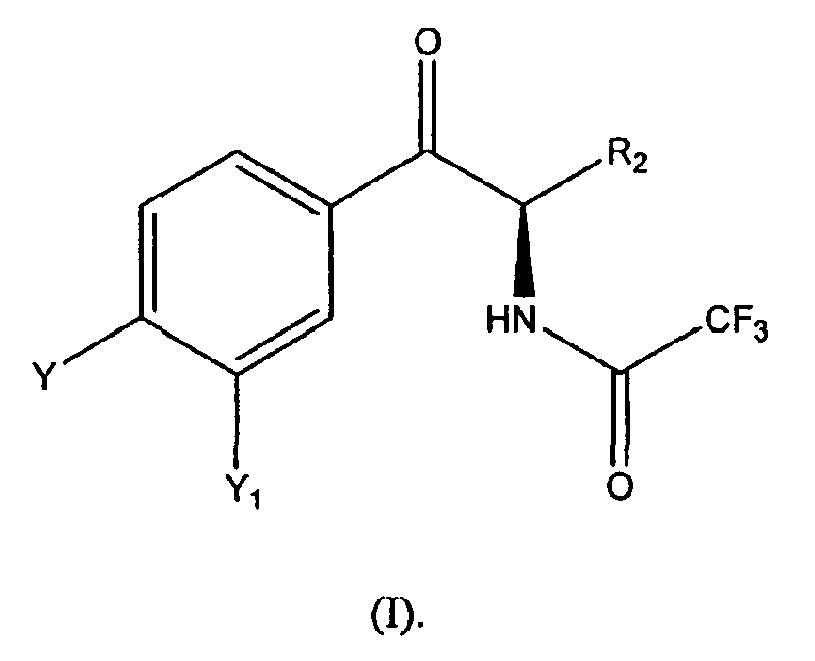
Description
- This application claims the benefit of
U.S. provisional application serial no. 60/774,270, filed February 17, 2006 - The present invention is directed to methods of preparing 2-trifluoroacetamido-3-substitued propiophenone compounds and methods of preparing 1-aryl-2-acylamido-1-propanol compounds, 1-aryl-2-acylamido-3-fluoro-1-propanol compounds, and 1-aryl-2-acylamido-3-hydroxy-1-propanol compounds (collectively, "fenicol compounds") from the 2-trifluoroacetamido-3-substitued propiophenone compounds.
- Bacterial infections, especially bacterial infections of the respiratory tract, are a major problem for production animals such as cattle, pigs, sheep, and other livestock. Bacterial infections are also a common problem with companion animals such as cats, dogs, and horses. Bacterial infections are typically treated using antibiotics.
- A class of broad spectrum antibiotics classified as D-(threo)-1-p-substituted phenyl-2-halogenoacetylamido-1,3-propanediols are known in the art. This class of antibiotics includes chloramphenicol (D-(threo)-1-p-nitrophenyl-2-dichloroacetamido-1,3-propanediol), thiamphenicol (D-(threo)-1-p-methylsulfonylphenyl-2-dichloroacetamido-1,3-propanediol), fluorthiamphenicol (D-(threo)-1-p-methylsulfonylphenyl-2-difluoroacetamido-1,3-propanediol) and tevenel (D-(threo)-1-p-aminosulfonylphenyl-2-dichloroacetamido-1,3-propanediol) (See,
U.S. patent no. 4,235,892 to Nagabhushan ). Replacing the primary hydroxyl group at C-3 of chloramphenicol by chlorine or bromine, however, destroys the biological activity thereof (F. E. Hahn, Antibiotics, Ed. Gottlieb and Shaw, Springer-Verlag, New York, (1967), p. 308; F. E. Hahn et al, Antibiotics and Chemotherapy, 6, No. 9, 531 (1956); L. Cima and A. Ilecto, II Farmaco, Ed. Sc. 12, No. 6, 535 (1957); S. Mitsuhasi et al, Jap. J Microbiol. 13, No. 2, 177-80 (1969); M. Kono et al, Jap. J. Microbiology 15 (3), 219-27 (1971); andU.S. patent no. 4,235,892 to Nagabhushan ). -
U.S. patent no. 4,235,892 ;4,311,857 ; and4,677,214 disclose D-(threo)-1-aryl-2-acylamido-3-fluoro-1-propanol compounds that are allegedly useful as antibiotics. Florfenicol, [(R-(R*, S*)]-2,2-dichloro-N-[1-fluoromethyl)-2-hydroxy-2-[4-(methylsulfonyl)phenyl] ethyl]acetamide or D-threo-2,2-dichloro-N-[1-(fluoromethyl)-2-hydroxy-2-[4-methylsulfonyl) phenyl]ethyl]-acetamide), commercially available from Schering-Plough Animal Health, New Jersey as NUFLOR®, is an example of an antibiotic in this class of compounds. - United States published patent application no.
US 2003/0216447 and United States published patent application no.US 2003/0220302 each disclose compositions comprising flunixin and a florfenicol or florfenicol-like compound that are allegedly useful for treating microbial infections in animals. - International publication
WO 03/077828 -
US 2005/0075506 discloses a process for preparing florfenicol that involves forming an oxazolidine compound from a 1-phenyl-3-hydroxy-2-amino-1-propanol compound and fluorinating the oxazolidine compound. -
U.S. patent nos. 4,743,700 ;5,332,835 ;5,153,328 ; and5,567,844 each disclose a method for replacing the fluorine of the primary hydroxy group of a 1-phenyl-2-amino-1,3-propanediol compounds by protecting the secondary hydroxy group and the amino group and fluorinating with inorganic fluoride in polyglycol. The secondary hydroxy group and the amino group can be protected as an oxazoline. -
U.S. patent no. 5,352,832 discloses a stereospecific process for preparing florfenicol, thiamphenicol, and chloramphenicol having the correct relative and absolute stereochemistry from achiral trans-cinnamic acid derivatives. - U.S. published application no.
US 2005/0075506 discloses a process to prepare florfenicol from (1R, 2R)-2-amino-1-[(4-methylsulfonyl)phenyl]-1,3, propanediol that involves forming an oxazolidine intermediate. -
U.S. patent no. 5,663,361 discloses a method for making an ozazoline intermediate useful for preparing florfenicol. -
U.S. patent no. 5,382,673 discloses a method for making florfenicol that involves formation of an ozazoline intermediate. -
U.S. patent nos. 5,105,009 ;5,908,937 ; and5,243,056 each disclose a method for preparing 1-(phenyl)-1-hydroxy-2-amino-3-fluoro-propane derivatives via an oxazolidine intermediate. -
U.S. patent no. 5,789,599 discloses N-sulfinyl-2-carboxyaziridine compounds and the synthesis of florfenicol, thiamphenicol, and chloramphenicol from the N-sulfinyl-2-carboxyaziridine compounds. -
U.S. patent no. 4,582,918 discloses the preparation of cis-1-aryl-2-(fluoromethyl)oxiranes and there use in preparing (threo)-1-aryl-2-acylamido-3-fluoro-1-propanols. -
U.S. Patent No. 5,556,829 discloses amide compounds that are useful in agriculture as herbicides in the defense of useful crops from weeds. - There is a need in the art, however, for improved methods of preparing this class of antibiotics, i.e., D-(threo)-1-aryl-2-acylwnido-1-propanol compounds, D-(threo)-1-aryl-2-acylamido-3-fluoro-1-propanol compounds, and D-(threo)-1-aryl-2- acylamido-3-hydroxy-1-propanol compounds. The present invention addresses this need.
- Citation of any reference in this section of this application is not to be construed that such reference is prior art to the present application.
- The invention is directed to a method of synthesizing a 2-trifluoroacetamido-3-substitued propiophenone compounds of formula (I):


- R2 is -CH3, -CH2OH, -CH2OP, or -CH2F;
- each Y and Y, is independently -H; -SO2R1; -S(O)R1 -SR1; -S(O)NH2; -SO2NH2;-S(O)NHR1; -S(O)NHR1; -S(O)N(R1)2; -S(O)N(R1)2; -C(O)R1; -C(O)OR1; -OC(O)R1; -OR1; -R1; -CN; halogen; -NO2; -NH2; -NHR1; -NH(R1)2; -C(O)NH2; -C(O)NHR1; -C(O)N(R1)2; phenyl; or phenyl substituted with halogen; -NO2, -SO2R1, -OR1, or -R1;
- each R1 is independently a C1-C4 hydrocarbon group;
- X is a halogen; and
- P is a hydroxyl protecting group.
- The invention further relates to a method of synthesizing a fenicol compound of formula (VI):

R3 is a -C1-C4 hydrocarbon group, -CH2F, -CHF2, -CF3, -CH2Cl, -CHCl2, -CCl3, -CH2Br, -CHBr2, -CBr3, -CH2I, -CHI2, -CI3, -CH2CN, -CH2N3, -CH2SO2CH3, -CZ2CZ3, -CH(CH3)(CF3),-CH(OH)(CH3), -CH(CF3)2, -CH(CF3)Z, and -CH(CF3)OH; and
each Z is independently a hydrogen or halogen,
comprising the steps of: - (i) contacting a compound of formula (III):

- X is a halide;
with a compound of formula (II):

- X is a halide;
- (ii) contacting the compound of formula (I) with a reducing agent to provide a compound of formula (VII):

- (ii) converting the compound of formula (VII) to a compound of formula (VIII):

- The invention further relates to a method of synthesizing a fenicol compound of formula (VI):
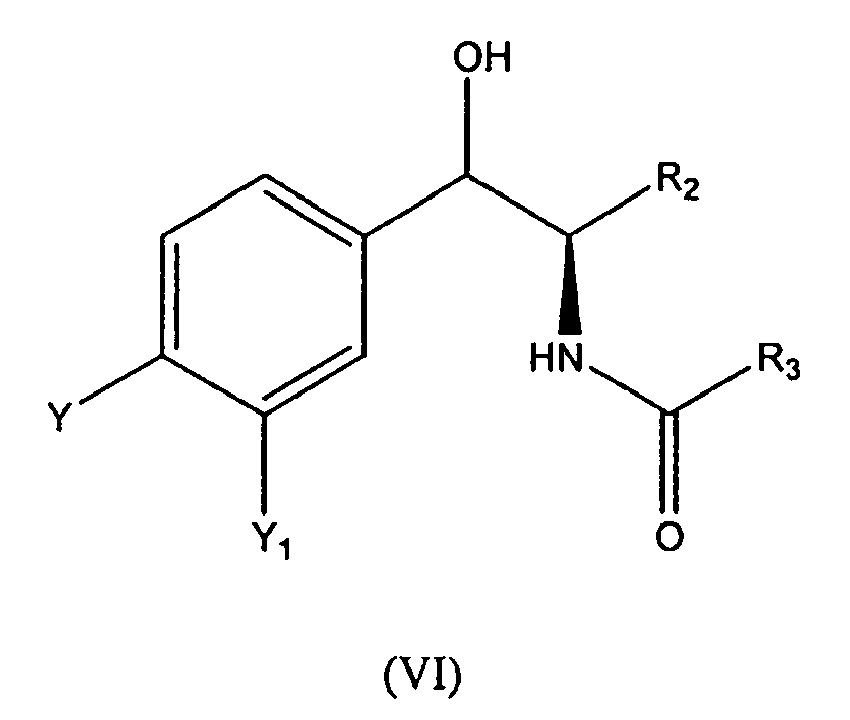
comprising the step of converting an amino acid of formula (V):

- The invention further relates to a method of synthesizing a fenicol compound of formula (VI):

comprising the step of contacting a compound of formula (III):
with a compound of formula (II):
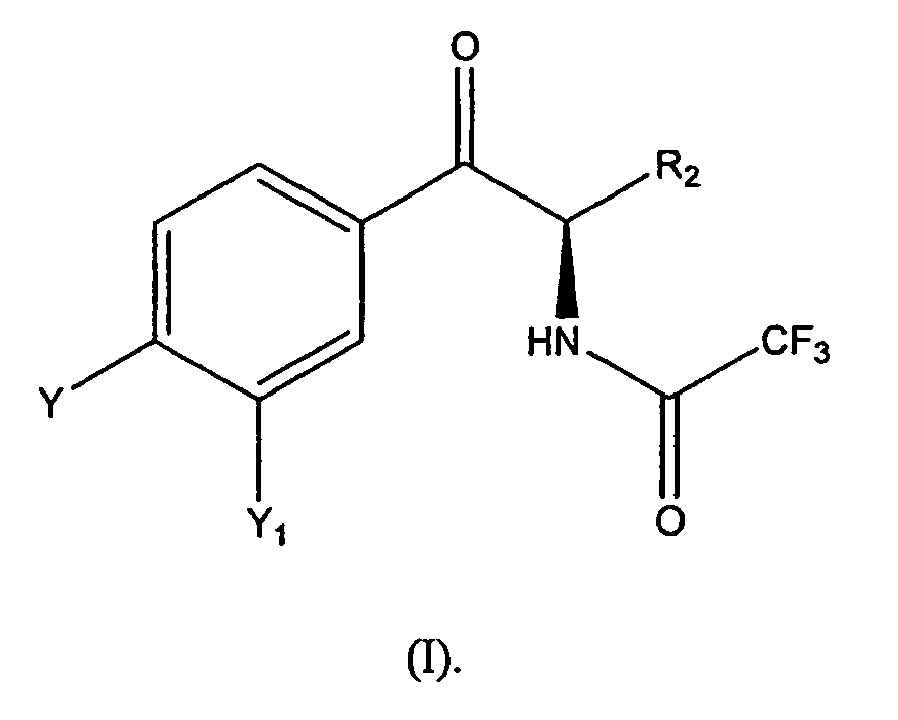
- The invention further relates to a method of synthesizing a fenicol compound of formula (VI):

comprising the step of contacting a compound of formula (I):

- The invention further relates to a method of synthesizing a fenicol compound of formula (VI):


comprising the steps: - (i) of converting a compound of formula (VII):


- (ii) converting the compound of formula (VIII) to the fenicol compound of formula (VI).
- The invention further relates to a compound of formula (I):
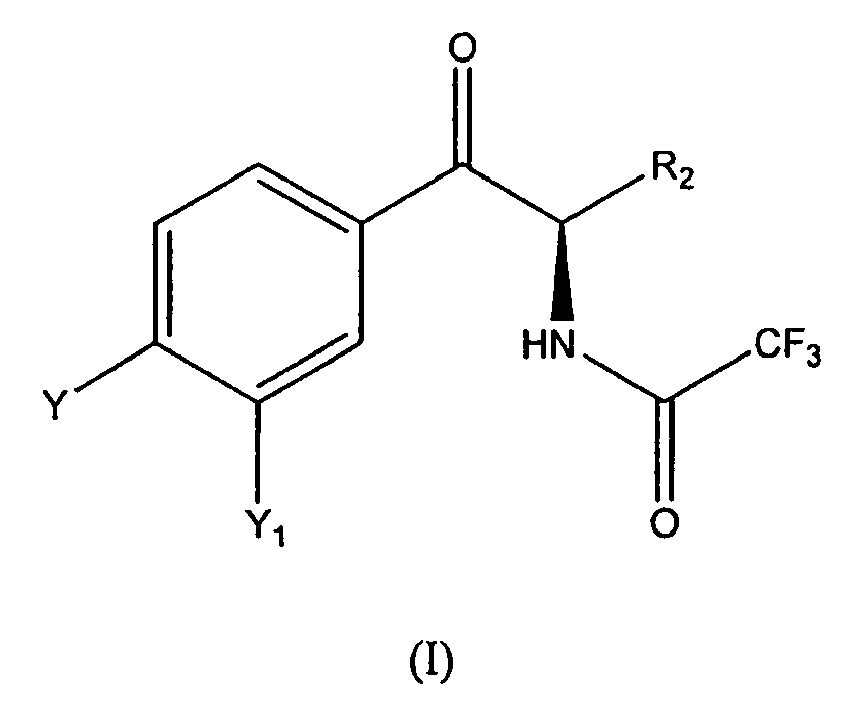
- R2 is -CH3, -CH2OH, -CH2OP, or -CH2F;
- each Y and Y1 is independently -H; -SO2R1; -SOR1 -SR1; -SONH2; -SO2NH2; -SONHR1; -SONHR1; -SON(R1)2; -SON(R1)2; -COR1; -COOR1; -OCR1; -OR1; -R1; -CN; halogen; -NO2;-NH2; -NHR1; -NH(R1)2; -CONH2; -CONHR1; -CON(R1)2; phenyl; or phenyl substituted with halogen; -NO2, -SO2R1, -OR1, or -R1;
- each R1 is independently a C1-C4 hydrocarbon group; and
- P is a hydroxyl protecting group.
- The invention further relates to a compound of formula (VIa1):

- The invention further relates to a pharmaceutical composition comprising the compound of formula (VIa1) and a pharmaceutically acceptable excipient and to methods of treating or preventing a condition in an animal comprising administering to the animal the pharmaceutical composition.
- The invention is directed to a method of synthesizing 2-trifluoroacetamido-3-substitued propiophenone compounds, i.e., compounds of formula (I)

- The compounds of formula (I) are useful for the preparing fenicol compounds. Accordingly, the invention further relates to a method of preparing fenicol compounds from the compounds of formula (I). In one embodiment, the compounds of formula (I) used to prepare the fenicol compound are obtained according to the method of the invention.
- The term "halo," and "halogen," as used herein, means chloride, bromide, iodide, and fluoride.
- The phrase "fenicol compound," as used herein, means a compound of general formula (VI):

R2 is -CH3, -CH2OH, -CH2OP, or -CH2F;
each Y and Y, is independently -H; -SO2R1; -S(O)R1 -SR1; -S(O)NH2; -SO2NH2;-S(O)NHR1; -S(O)NHR1; -S(O)N(R1)2; -S(O)N(R1)2; -C(O)R1; -C(O)OR1; -OC(O)R1; -OR1; -R1; -CN; halogen; -NO2; -NH2; -NHR1; -NH(R1)2; -C(O)NH2; -C(O)NHR1; -C(O)N(R1)2; phenyl; or phenyl substituted with halogen; -NO2, -SO2R1, -OR1, or -R1;
each R1 is independently a C1-C4 hydrocarbon group;
P is a hydroxyl protecting group;
R3 is a -C1-C4 hydrocarbon group, -CH2F, -CHF2, -CF3, -CH2Cl, -CHCl2, -CCl3, -CH2Br, -CHBr2, -CBr3, -CH2I, -CHI2, -CI3, -CH2CN, -CH2N3, -CH2SO2CH3, -CZ2CZ3, -CH(CH3)(CF3),-CH(OH)(CH3), -CH(CF3)2, -CH(CF3)Z, and -CH(CF3)OH; and
each Z is independently a hydrogen or halogen. - The phrase "substantially free," as used herein, means less than about 5 percent by weight. For example, the phrase "diasteriomer (VIa) substantially free of diasteriomer (VIb)" means a composition containing a compound of formula (VIa) wherein the amount of diasteriomer (VIb) in the composition is less than about 5 percent by weight of the combined amount of (VIa) and (VIb).
- The phrase "C1-C4 hydrocarbon group," as used herein, means a straight chain, saturated or unsaturated, cyclic or acylic hydrocarbon chain. Representative -C1-C4 hydrocarbon groups include, but are not limited to, methyl, ethyl, n-propyl, iso-propyl, n-butyl, iso-butyl, sec-butyl, cyclopropyl, cyclobutyl, ethylene, 1-propylene, 2-propylene, 1-butylene, and 2-butylene.
- The phrase "C1-C18 hydrocarbon group" means a straight or branched, saturated or unsaturated, cyclic or non-cyclic, aromatic or non-aromatic hydrocarbon having from 1 to 18 carbon atoms. Accordingly, the phrase "an acyl group of formula -C(O)-R4, wherein R4 is a C1 to C18 hydrocarbon group that may optionally be substituted with a -NH2 or -COOH" means R4 of the acyl group of formula -C(O)-R4 is a straight or branched, saturated or unsaturated, cyclic or non-cyclic, aromatic or non-aromatic hydrocarbon having from 1 to 18 carbon atoms that may optionally be substituted with a -NH2 or -COOH. Representative acyl group of formula -C(O)-R4, wherein R4 is an unsubstituted C1 to C18 hydrocarbon group include, but are not limited to, acetyl, propionyl, butanoyl, hexanoyl, caproyl, laurolyl, myristoyl, palmitoyl, stearoyl, palmioleoyl, oleoyl, linoleoyl, linolenoyl, and benzoyl. Representative acyl groups of formula-C(O)-R4, wherein R4 is a C1 to C18 hydrocarbon group that is substituted with a -COOH, include but are not limited to, oxaloyl, malonoyl, succinoyl, glutamoyl, adipoyl, and pimeloyl. Representative acyl groups of formula -C(O)-R4, wherein R4 is a C1 to C18 hydrocarbon group that is substituted with a -NH2, include but are not limited to, acyl groups derived from amino acids such as tyrosine, alanine, threonine, serine, hydroxyproline, proline, phenylalanine, leucine, valine, and glycine.
- The phrase "hydroxyl protecting group," as used herein, means a group that can replace the hydrogen of a hydroxyl, i.e., the hydrogen of an -OH group, and then be subsequently removed and replaced by a hydrogen to reform the hydroxyl group. The hydroxyl protecting group prevents the hydroxyl from reacting under a given set of conditions, which typically are necessary to perform a reaction at another part of a molecule. After reaction at the other part of the molecule, the hydroxyl protecting group can be removed to provide the hydroxyl group. Suitable hydroxyl protecting groups, P, include those described in T. W. Greene, Protective Groups in Organic Synthesis, John Wiley-Interscience Publication, New York, (1981). Representative protecting groups include, but are not limited to, esters and ethers. Preferably, the hydroxyl group is protected as an ester. In one embodiment, the hydroxyl group is protected as an acetate ester.
- The phrase "treating," "treatment of," and the like, as used herein, include the amelioration or cessation of a specified condition.
- The phrase "preventing," "prevention of," and the like, as used herein, include the avoidance of the onset of a condition.
- The term "condition," as used herein means an interruption, cessation, or disorder of a bodily function, system, or organ.
- The term "animal," as used herein, includes, but is not limited to, humans, canines, felines, equines, bovines, ovines, porcines, amphibians, reptiles, and avians. Representative animals include, but are not limited to a cow, a horse, a sheep, a pig, an ungulate, a chimpanzee, a monkey, a baboon, a chicken, a turkey, a mouse, a rabbit, a rat, a guinea pig, a dog, a cat, and a human.
- The term "effective amount," as used herein, means an amount sufficient to treat or prevent a condition in an animal.
- The term "about," as used herein to describe a range of values, applies to both the upper limit and the lower limit of the range. For example, the phrase "the concentration of the compound of formula (II) in the solvent ranges from about 0.01 M to 5 M" has the same meaning as "the concentration of the compound of formula (II) in the solvent ranges from about 0.01 M to about 5 M."
- The present invention is directed to a method of preparing compounds of formula (I):

- R2 is -CH3, -CH2OH, -CH2OP, or -CH2F;
- each Y and Y1 is independently -H; -SO2R1; -S(O)R1 -SR1; -S(O)NH2; -SO2NH2;-S(O)NHR1; -S(O)NHR1; -S(O)N(R1)2; -S(O)N(R1)2; -C(O)R1; -C(O)OR1; -OC(O)R1; -OR1; -R1; -CN; halogen; -NO2; -NH2; -NHR1; -NH(R1)2; -C(O)NH2; -C(O)NHR1; -C(O)N(R1)2; phenyl; or phenyl substituted with halogen; -NO2, -SO2R1, -OR1, or -R1;
- each R1 is independently a C1-C4 hydrocarbon group; and
- P is a hydroxyl protecting group.
- The process comprises contacting an aromatic compound of formula (II):

with an acid halide of an N-trifluoracetylated amino acid of formula (III):
- The general reaction is depicted below:

- One of ordinary skill in the art will readily recognize, however, that the reaction between the compound of formula (II) and the acid halide of N-trifluoracetylated amino acid of formula (III) is not limited to amino acids that are N-protected with a trifluoroacetyl group. Indeed, the acid chloride of any N-protected amino acid could be used in the methods of the invention. The general structure for an N-protected amino acid is:

- In one embodiment, the compound of formula (II) is contacted with the compound of formula (III) in a solvent. Preferably, at least one of the compound of formula (II) or the compound of formula (III) are dissolved in the solvent. More preferably, both the compound of formula (II) and the compound of formula (III) are dissolved in the solvent. Suitable solvents for use in the methods of the invention include, but are not limited to, inert organic solvents such as nitrobenzene, nitromethane, dichloromethane, and chloroform. One of ordinary skill in the art would readily recognize solvents that are useful for conducting a Friedel Crafts acylation.
- One of ordinary skill in the art would readily be able to determine a suitable concentration of the compound of formula (II) in the solvent. Typically, the concentration of the compound of formula (II) in the solvent ranges from about 0.01 M to 5 M. In one embodiment, the concentration of the compound of formula (II) in the solvent ranges from about 0.05 M to 2.5 M. In one embodiment, the concentration of the compound of formula (II) in the solvent ranges from about 0.1 M to 1 M.
- The ratio of the compound of formula (II) to the compound of formula (III) generally ranges from about 1:1 to 5:1. In one embodiment, the ratio of the compound of formula (II) to the compound of formula (III) ranges from about 1.25:1 1 to 3.5:1. In one embodiment, the ratio of the compound of formula (II) to the compound of formula (III) ranges from about 2:1 to 3:1. In one embodiment, the ratio of the compound of formula (II) to the compound of formula (III) generally is greater than about 1:1. In one embodiment, the ratio of the compound of formula (II) to the compound of formula (III) generally is greater than about 2:1. In one embodiment, the ratio of the compound of formula (II) to the compound of formula (III) generally is greater than about 3:1. In one embodiment, the ratio of the compound of formula (II) to the compound of formula (III) generally is greater than about 5:1.
- In one embodiment, the compound of formula (II) is contacted with the compound of formula (III) under neat conditions, i.e., the compound of formula (II) is present in an excess and also acts as the solvent for the reaction. Typically, the compound of formula (II) is present in at least a 5 molar excess relative to the compound of formula (III). In one embodiment, the compound of formula (II) is present in at least a 10 molar excess relative to the compound of formula (111). In one embodiment, the compound of formula (II) is present in at least a 15 molar excess relative to the compound of formula (III). In one embodiment, the compound of formula (II) is present in at least a 20 molar excess relative to the compound of formula (III). In one embodiment, the compound of formula (II) is present in at least a 30 molar excess relative to the compound of formula (III).
- The compound of formula (II) and the compound of formula (III) are contacted for an amount of time sufficient to allow the compound of formula (II) and the compound of formula (III) to react and provide the compound of formula (I). The progress of the reaction can be monitored using typical analytical methods well known to those skilled in the art including, but not limited to, gas chromatography (GC), high performance liquid chromatography (HPLC), thin-layer chromatography (TLC), 1H nuclear magnetic resonance spectroscopy (1H-NMR), and 13C nuclear magnetic resonance spectroscopy (13C-NMR).
- Typically, the compound of formula (II) and the compound of formula (III) are contacted at a temperature of between about -15°C and 35°C. In one embodiment, the compound of formula (II) and the compound of formula (III) are contacted at a temperature of between about-10°C and 25°C. In one embodiment, the compound of formula (II) and the compound of formula (III) are contacted at a temperature of between about -5°C and 10°C. In one embodiment, the compound of formula (II) and the compound of formula (III) are contacted at a temperature of about 0°C. In one embodiment, after the compound of formula (II) and the compound of formula (III) are contacted, the temperature of the resulting reaction mixture is increased. In one embodiment, the temperature is increased by about 30°C. In one embodiment, the temperature is increased by about 20°C. In one embodiment, the temperature is increased by about 10°C. In one embodiment, the temperature is increased to about 25°C.
- One of ordinary skill in the art will readily recognize that different compounds of formula (II), depending on the substituents Y and Y1, will react with the compound of formula (III) at different rates. As described above, however, the progress of the reaction can be monitored using typical analytical methods well known to those skilled in the art. Generally, however, the reaction of the compound of formula (II) and the compound of formula (III) is allowed to proceed for more than 2 h. In one embodiment, the reaction is allowed to proceed for more than 5 h. In one embodiment, the reaction is allowed to proceed for more than 10 h. In one embodiment, the reaction is allowed to proceed for more than 15 h.
- In a particular embodiment, the compound of formula (II) and the compound of formula (III) are contacted at a temperature of about 0°C and, after the compound of formula (II) and the compound of formula (III) are contacted, the temperature of the resulting reaction mixture is increased to about 25°C and the warmed reaction mixture allowed to stir between about 10 and 15 h.
- In one embodiment, the compound of formula (II) is contacted with the compound of formula (III) in the presence of a Friedel-Crafts catalyst. Friedel-Crafts catalysts are well known to those skilled in the art. Any Friedel-Crafts catalyst can be used in the methods of the invention. Representative Friedel-Crafts catalysts include, but are not limited to, AlCl3, AlBr3, BF3, BCl3, GaCl3, FeCl3, SbCl5, ZrCl4, SnCl4, SbCl3, and ZnCl2. The catalyst is generally present in an amount ranging from about 0.1 molar equivalents to 5 molar equivalents relative to the compound of formula (III). In one embodiment, the catalyst is present in an amount ranging from about 0.1 molar equivalents to 3 molar equivalents relative to the compound of formula (III). In one embodiment, the catalyst is present in an amount ranging from about 0.1 molar equivalents to 1 molar equivalents relative to the compound of formula (III). In one embodiment, the catalyst is present in an amount ranging from about 1 molar equivalents to 3 molar equivalents relative to the compound of formula (III).
- After the reaction is complete, the compound of formula (I) can be isolated and purified using methods well known to those skilled in the art including, but not limited to, TLC, column chromatography, preparative HPLC, extraction, and recrystallization.
- The aromatic compounds of formula (II) are commercially available or can be prepared using methods well known to those of ordinary skill in the art.
- In one embodiment, in the compound of formula (II) Y is -NO2 and Y1 is -H.
- In one embodiment, in the compound of formula (II) Y is -SO2CH3 and Y, is -H.
- In one embodiment, in the compound of formula (II) Y is -SO2NH2 and Y1 is -H.
- In one embodiment, in the compound of formula (III) X is -Cl.
- In one embodiment, in the compound of formula (III) X is -Br.
- In one embodiment, in the compound of formula (III) X is -I.
- In one embodiment, in the compound of formula (III) X is -F.
- In one embodiment, in the compound of formula (III) R2 is -CH3.
- In one embodiment, in the compound of formula (III) R2 is -CH2OH.
- In one embodiment, in the compound of formula (III) R2 is -CH2OP.
- In one embodiment, in the compound of formula (III) R2 is -CH2F.
- In one embodiment, in the compound of formula (III) R2 is -CH3 and X is -Cl.
- In one embodiment, in the compound of formula (III) R2 is -CH2OH and X is -Cl.
- In one embodiment, in the compound of formula (III) R2 is -CH2OP and X is Cl.
- In one embodiment, in the compound of formula (III) R2 is -CH2F and X is Cl.
- One of ordinary skill in the art will readily recognize that there are several available positions on the compound of formula (II) that can be acylated by the compound of formula (III) and that the position that is most reactive is determined by the substituents Y and Y1. Thus, the reaction can form more than one compound, i.e., a mixture of compounds resulting from different positions of the compound of formula (II) being acylated. These mixtures, however, can be separated by methods well known to those of ordinary skill in the art including, but not limited to, crystallization, distillation, column chromatography, thin layer chromatography, and HPLC. One of ordinary skill in the art would also readily recognize that it may be necessary to modify the compound of formula (II), for example, with a protecting group, before the compound of formula (II) is reacted with the compound of formula (III) to assure that the proper position on the compound of formula (II) is acylated. Methods for acylating compounds of formula (II) are well within the skill of one of ordinary skill in the art.
- In one embodiment, Y is -NO2 and Y1 is -H in the compound of formula (II) and R2 in the compound of formula (III) is -CH3.
- In one embodiment, Y is -NO2 and Y, is -H in the compound of formula (II) and R2 in the compound of formula (III) is -CH2OH.
- In one embodiment, Y is -NO2 and Y1 is -H in the compound of formula (II) and R2 in the compound of formula (III) is -CH2OP.
- In one embodiment, Y is -NO2 and Y1 is -H in the compound of formula (II) and R2 in the compound of formula (III) is -CH2F.
- In one embodiment, Y is -SO2CH3 and Y1 is -H in the compound of formula (II) and R2 in the compound of formula (III) is -CH3.
- In one embodiment, Y is -SO2CH3 and Y1 is -H in the compound of formula (II) and R2 in the compound of formula (III) is -CH2OH.
- In one embodiment, Y is -SO2CH3 and Y, is -H in the compound of formula (II) and R2 in the compound of formula (III) is -CH2OP.
- In one embodiment, Y is -SO2CH3 and Y1 is -H in the compound of formula (II) and R2 in the compound of formula (III) is -CH2F.
- In one embodiment, Y is -SO2NH2 and Y1 is -H in the compound of formula (II) and R2 in the compound of formula (III) is -CH3.
- In one embodiment, Y is -SO2NH2 and Y1 is -H in the compound of formula (II) and R2 in the compound of formula (III) is -CH2OH.
- In one embodiment, Y is -SO2NH2 and Y1 is -H in the compound of formula (II) and R2 in the compound of formula (III) is -CH2OP.
- In one embodiment, Y is -SO2NH2 and Y1 is -H in the compound of formula (II) and R2 in the compound of formula (III) is -CH2F.
- When R2 is -CH2OP, the protecting group, P, can be removed in the compound of formula (I) to provide the compound of formula (I) wherein R2 is -CH2OH. The protecting group, P, can be removed using methods well known to those skilled in the art (See, e.g., T. W. Greene, Protective Groups in Organic Synthesis, John Wiley-Interscience Publication, New York, (1981)). In one embodiment, the protecting group is an ester or an ether. In one embodiment, the protecting group is an acetate group.
- The compound of formula (III) can be obtained by converting an N-trifluoroacetyl amino acid of formula (IV):

to an acid halide. - In one embodiment, R2 in the compound of formula (IV) is -CH2OP and -P is -C(O)CH3.
- Acid halides can be obtained from carboxylic acids using methods well known to those skilled in the art, such as those described in J. March, Advanced Organic Chemistry, Reaction Mechanism and Structure, 4th ed. John Wiley & Sons, NY 1992, pp. 437-8. For example, acid halides can be obtained by reacting carboxylic acids with thionyl chloride, bromide, or iodide. Acid chlorides or bromides can also be prepared by reacting a carboxylic acid with phosphorous trichloride or phosphorous tribromide, respectively. Acid chlorides can also be prepared by reacting a carboxylic acid with Ph3P in carbon tetrachloride. Acid fluorides can be prepared by reacting a carboxylic acid with cyanuric fluoride.
- The N-trifluoroacetyl amino acid of formula (IV) can be obtained by reacting an (L) amino acid of formula (V):

- with a trifluoracetyl halide, preferably trifluoroacetyl chloride, or trifluoracetic anhydride to provide an N-trifluoracetylated amino acid of formula (IV) using methods well known to those skilled in the art (See, e.g., in J. March, Advanced Organic Chemistry, Reaction Mechanism and Structure, 4th ed. John Wiley & Sons, NY 1992, pp. 417-419).
- In one embodiment, R2 is -CH3. When R2 is -CH3, the amino acid of formula (V) is (L) alanine. (L) alanine is a naturally occurring amino acid and is commercially available.
- In one embodiment, R2 is -CH2OH. When R2 is -CH2OH, the amino acid of formula (V) is (L) serine. (L) serine is a naturally occurring amino acid and is commercially available.
- In one embodiment, R2 is -CH2F. The amino acid of formula (V), wherein R2 is -CH2F, can be readily obtained by fluorinating the hydroxyl of serine using methods well known to those skilled in the art (See, e.g., in J. March, Advanced Organic Chemistry, Reaction Mechanism and Structure, 4th ed. John Wiley & Sons, NY 1992, pp. 431-433, see also, J. Yin et al., Organic Letters, 6:9 (2004) 1465-1468). Representative reagents for converting the hydroxyl of serine to a fluoride include, but are not limited to, diethylaminosulfur trifluoride ((CH3CH2)2NSF3, DAST); NaF, KF, or NH4F in polyhydrogen-fluoride-pyridine solution; and triethylamine trihydrofluoride and perfluoro-1-butanesulfonyl fluoride.
- In one embodiment, R2 is -CH2OP. The amino acid of formula (V), wherein R2 is-CH2OP, can be readily obtained by simply protecting the hydroxyl of serine using methods well known to those skilled in the art (See, e.g., T. W. Greene, Protective Groups in Organic Synthesis, John Wiley-Interscience Publication, New York, (1981)). As one of ordinary skill in the art would readily recognize it may be necessary to protect the nitrogen of serine before the hydroxyl of the serine is protected with the oxygen protecting group P.
- In one embodiment, R2 in the compound of formula (V) is -CH2OP and -P is -C(O)CH3. The compound of formula (V) wherein R2 is -CH2OP and -P is -C(O)CH3 can be obtained by simply reacting serine with acetyl chloride. The compound of formula (V) wherein R2 is-CH2OP and -P is -C(O)CH3, i.e., O-acetyl serine, is commercially available from Aldrich Chemical Co. of Milwaukee, Wis. as the hydrochloride salt. In one embodiment, R2 in the compound of formula (V) is -CH2OP and -P is -C(O)CF3.
- Although (L) alanine and (L) serine are the preferred amino acids, one of ordinary skill in the art will readily recognize that the above method could use (D) alanine and (D) serine or, for that matter, any (L) amino acid or any (D) amino acid.
- One of ordinary skill in the art will readily recognize that functional groups in the compound of formula (II), i.e., Y and Y1, may have to be protected during the synthesis of the compounds of formula (I). The functional groups in the compound of formula (II) can be readily protected, when required, using methods well known to those skilled in the art (See, e.g., T. W. Greene, Protective Groups in Organic Synthesis, John Wiley-Interscience Publication, New York, (1981)).
- The compounds of formula (I) are useful for making fenicol antibiotics of general formula (VI):

Y, Y1, R2, and R3 have the meaning provided above;
R3 is a -C1-C4 hydrocarbon group, -CH2F, -CHF2, -CF3, -CH2Cl, -CHCl2, -CCl3, -CH2Br, -CHBr2, -CBr3, -CH2I, -CHI2, -CI3, -CH2CN, -CH2N3, -CH2SO2CH3, -CZ2CZ3, -CH(CH3)(CF3),-CH(OH)(CH3), -CH(CF3)2, -CH(CF3)Z, and -CH(CF3)OH; and
each Z is independently a hydrogen or halogen. - The fenicol compounds of formula (VI) are prepared by
- (i) reducing the carbonyl of the compound of formula (I) to provide a compound of formula (VII);
- (ii) hydrolyzing the compound of formula (VII) to provide a compound of formula (VIII); and
- (iii) converting the compound of formula (VIII) to the fenicol compound of formula (VI).
- The overall reaction scheme is depicted below:


- The carbonyl of the compound of formula (I) can be reduced, i.e., reaction (i), to provide the compound of formula (VII) using methods well known to those skilled in the art (See, e.g., in J. March, Advanced Organic Chemistry, Reaction Mechanism and Structure, 4th ed. John Wiley & Sons, NY 1992, pp. 910-918). Suitable reagents for reducing the carbonyl group include, but are not limited to sodium borohydride, lithium aluminum hydride, and diborane.
- Reduction of the carbonyl of the compound of formula (I) to provide a compound of formula (VII) typically provides the compound of formula (VII) as a pair of diasteriomers, i.e., compounds of formula (VIIa) and (VIIb):

- Optionally, diasteriomers (VIIa) and (VIIb) can be separated using methods well known to those skilled in the art including, but not limited to, recrystallization, column chromatography, preparative HPLC, and recrystallization to provide each diasteriomer substantially free of the other diasteriomer (See, for example, Enantiomers, Racemates, and Resolution, J. Jacques and S. Lutio, John Wiley & Sons 1981).
- In one embodiment, the diasteriomer (VIIa) (or (VIIb)) is obtained wherein the amount of diasteriomer (VIIb) (or (VIIa)) is less than about 3 percent by weight of the combined amount of diasteriomer (VIIa) and (VIIb).
- In one embodiment, the diasteriomer (VIIa) (or (VIIb)) is obtained wherein the amount of diasteriomer (VIIb) (or (VIIa)) is less than about 2 percent by weight of the combined amount of diasteriomer (VIIa) and (VIIb).
- In one embodiment, the diasteriomer (VIIa) (or (VIIb)) is obtained wherein the amount of diasteriomer (VIIb) (or (VIIa)) is less than about 1 percent by weight of the combined amount of diasteriomer (VIIa) and (VIIb).
- In one embodiment, the diasteriomer (VIIa) (or (VIIb)) is obtained wherein the amount of diasteriomer (VIIb) (or (VIIa)) is less than about 0.5 percent by weight of the combined amount of diasteriomer (VIIa) and (VIIb).
- Each individual diasteriomer (VIIa) and (VIIb), substantially free of the other diasteriomer, can then be used in the subsequent step of the reaction to provide individual diasteriomers of formula (VIII), i.e., (VIIIa) and (VIIIb):

- Alternatively, a mixture of diasteriomers (VIIa) and (VIIb) can be used in the subsequent step of the reaction to provide a mixture of diasteriomers of formula (VIIIa) and (VIIIb), which can then be separated using methods well known to those skilled in the art including, but not limited to, those described above to provide each diasteriomer substantially free of the other diasteriomer.
- In one embodiment, the diasteriomer (VIIIa) (or (VIIIb)) is obtained wherein the amount of diasteriomer (VIIIb) (or (VIIIa)) is less than about 3 percent by weight of the combined amount of diasteriomer (VIIIa) and (VIIIb).
- In one embodiment, the diasteriomer (VIIIa) (or (VIIIb)) is obtained wherein the amount of diasteriomer (VIIIb) (or (VIIIa)) is less than about 2 percent by weight of the combined amount of diasteriomer (VIIIa) and (VIIIb).
- In one embodiment, the diasteriomer (VIIIa) (or (VIIIb)) is obtained wherein the amount of diasteriomer (VIIIb) (or (VIIIa)) is less than about 1 percent by weight of the combined amount of diasteriomer (VIIIa) and (VIIIb).
- In one embodiment, the diasteriomer (VIIIa) (or (VIIIb)) is obtained wherein the amount of diasteriomer (VIIIb) (or (VIIIa)) is less than about 0.5 percent by weight of the combined amount of diasteriomer (VIIIa) and (VIIIb).
- Each individual diasteriomer (VIIIa) and (VIIIb), substantially free of the other diasteriomer, can then be used in the subsequent steps of the reaction to provide individual diasteriomers of formula (VI), i.e., (VIa) and (VIb):

- Alternatively, a mixture of diasteriomers (VIIIa) and (VIIIb) can be used in the subsequent step of the reaction to provide a mixture of diasteriomers of formula (VIa) and (VIb), which can then be separated using methods well known to those skilled in the art including, but not limited to, those described above to provide each diasteriomer substantially free of the other diasteriomer.
- In one embodiment, the diasteriomer (Vla) (or (VIb)) is obtained wherein the amount of diasteriomer (VIb) (or (VIa)) is less than about 3 percent by weight of the combined amount of diasteriomer (VIa) and (VIb).
- In one embodiment, the diasteriomer (VIa) (or (VIb)) is obtained wherein the amount of diasteriomer (VIb) (or (VIa)) is less than about 2 percent by weight of the combined amount of diasteriomer (VIa) and (VIb).
- In one embodiment, the diasteriomer (VIa) (or (VIb)) is obtained wherein the amount of diasteriomer (VIb) (or (VIa)) is less than about 1 percent by weight of the combined amount of diasteriomer (VIa) and (VIb).
- In one embodiment, the diasteriomer (VIa) (or (VIb)) is obtained wherein the amount of diasteriomer (VIb) (or (VIa)) is less than about 0.5 percent by weight of the combined amount of diasteriomer (VIa) and (VIb).
- In one embodiment, the carbonyl of the compound of formula (I) is reduced using a chiral reducing agent. Any chiral reducing agent known to one of ordinary skill in the art can be used in the methods of the invention. Representative chiral reducing agents include, but are not limited to, (R)- or (S)- β-isopinocampheyl-9-borabicyclo[3.3.1]nonane (Alpine-Borane) or (R)-or (S)- β-isopinocampheyl-9-borabicyclo[3.3.1]nonyl hydride (Alpine Hydride) (each commercially available from Aldrich Chemical Co., Milwaukee, Wis.) to provide a compound of formula (VII) as a single diasteriomer substantially free of the other diasteriomer, i.e., (VIIa) substantially free of (VIIb) or (VIIb) substantially free of (VIIa). Each individual diasteriomer (VIIIa) or (VIIIb) can then be used in the subsequent steps of the reaction to provide individual diasteriomers of formula (VI), i.e., (VIa) or (VIb).
- The compound of formula (VII) or the individual diasteriomers of the compound of formula (VII), i.e., (VIIa) and (VIIb), can be hydrolyzed to the compound of formula (VIII) under acidic or basic conditions using methods well known to those skilled in the art. For example, the compound of formula (VII) can be hydrolyzed to the compound of formula (VIII) by dissolving the compound of formula (VII) in methanol and water containing excess, typically between about 2 and 10 fold excess, Na2CO3 or K2CO3 and allowing the reaction mixture to reflux. Generally the hydrolysis reaction is complete after between about 5 h and 18 h.
- The compounds of formula (VIII) or the individual diateriomers of the compound of formula (VIII), i.e., (VIIIa) and (VIIIb), can be converted to the fenicol compound of formula (VI) by simply reacting the compound of formula (VIII) with an acid halide, such as an acid chloride, of formula R3C(O)X, wherein R3 and X have the meaning described above.
- The acid halide of formula R3C(O)X can be obtained from a carboxylic acid of formula R3C(O)OH using methods well known to those skilled including, but not limited to, the methods of making acid halides described above. The carboxylic acids of formula R3C(O)OH are commercially available or can be made by methods well known to those skilled in the art.
- Accordingly, the invention is further directed to a method of making a fenicol compound of formula (VI) from a compound of formula (I). In one embodiment, the compounds of formula (I) used to prepare the fenicol compound of formula (VI) is obtained according to the method of the invention.
- The invention is further directed to a method of making a fenicol compound of formula (VIa) from a compound of formula (I). In one embodiment, the compounds of formula (I) used to prepare the fenicol compound of formula (VIa) is obtained according to the method of the invention.
- The invention is further directed to a method of making a fenicol compound of formula (VIb) from a compound of formula (I). In one embodiment, the compounds of formula (I) used to prepare the fenicol compound of formula (VIb) is obtained according to the method of the invention.
- Optionally, the hydroxyl group of the fenicol compound of formula (VI) can be acylated with an acyl group of formula -C(O)R4 to provide a compound of formula (IX):

R4 is a C1 to C18 hydrocarbon group that may be optionally substituted with a -NH2 or a -COOH. - Similarly, the hydroxyl group of the individual diasteriomers of fenicol compound (VI), i.e., (VIa) and (VIb) can be acylated with an acyl group of formula -C(O)R4 to provide compounds of formula (IXa) and (IXb), respectively.
- The Fenicol Compounds of formula (IX) can be obtained by acylating the hydroxyl group of a Fenicol Compound of Formula (VI) using an acid halide of formula T-C(O)-R4, wherein T is a halide, preferably chloride, and R4 is as defined above, using methods well known to those skilled in the art. The Fenicol Compounds of formula (IX) can also be obtained by acylating the hydroxyl group of the Fenicol Compound of Formula (VI) with an acid anhydride using methods well known to those of ordinary skill in the art. Acid halides can be obtained using methods well known to those skilled in the art such as those described.
- Illustrative Fenicol Compounds of Formula (VI) that can be prepared according to the method of the invention include, but are not limited to, those in Table I:
Table I Y Y1 R2 R3 -NO2 -H -CH3 -CH3 -NO2 -H -CH3 -CHCl2 -NO2 -H -CH3 -CHF2 -NO2 -H -CH3 -CH(CH3)(CF3) -NO2 -H -CH3 -CH(CF3)2 -NO2 -H -CH3 -CH(CH3)OH -NO2 -H -CH3 -CH(CF3)OH -NO2 -H -CH3 -CH(CH3)Cl -NO2 -H -CH3 -CH(CH3)Br -NO2 -H -CH3 -CH(CH3)I -NO2 -H -CH3 -CH(CH3)F -NO2 -H -CH3 -CH(CF3)Cl -NO2 -H -CH3 -CH(CF3)Br -NO2 -H -CH3 -CH(CF3)I -NO2 -H -CH3 -CH(CF3)F -NO2 -H -CH2OH -CH3 -NO2 -H -CH2OH -CHCl2 -NO2 -H -CH2OH -CHF2 -NO2 -H -CH2OH -CH(CH3)(CF3) -NO2 -H -CH2OH -CH(CF3)2 -NO2 -H -CH2OH -CH(CH3)OH -NO2 -H -CH2OH -CH(CF3)OH -NO2 -H -CH2OH -CH(CH3)Cl -NO2 -H -CH2OH -CH(CH3)Br -NO2 -H -CH2OH -CH(CH3)I -NO2 -H -CH2OH -CH(CH3)F -NO2 -H -CH2OH -CH(CF3)Cl -NO2 -H -CH2OH -CH(CF3)Br -NO2 -H -CH2OH -CH(CF3)I -NO2 -H -CH2OH -CH(CF3)F -NO2 -H -CH2OP -CH3 -NO2 -H -CH2OP -CHCl2 -NO2 -H -CH2OP -CHF2 -NO2 -H -CH2OP -CH(CH3)(CF3) -NO2 -H -CH2OP -CH(CF3)2 -NO2 -H -CH2OP -CH(CH3)OH -NO2 -H -CH2OP -CH(CF3)OH -NO2 -H -CH2OP -CH(CH3)Cl -NO2 -H -CH2OP -CH(CH3)Br -NO2 -H -CH2OP -CH(CH3)I -NO2 -H -CH2OP -CH(CH3)F -NO2 -H -CH2OP -CH(CF3)Cl -NO2 -H -CH2OP -CH(CF3)Br -NO2 -H -CH2OP -CH(CF3)I -NO2 -H -CH2OP -CH(CF3)F -NO2 -H -CH2F -CH3 -NO2 -H -CH2F -CHCl2 -NO2 -H -CH2F -CHF2 -NO2 -H -CH2F -CH(CH3)(CF3) -NO2 -H -CH2F -CH(CF3)2 -NO2 -H -CH2F -CH(CH3)OH -NO2 -H -CH2F -CH(CF3)OH -NO2 -H -CH2F -CH(CH3)Cl -NO2 -H -CH2F -CH(CH3)Br -NO2 -H -CH2F -CH(CH3)I -NO2 -H -CH2F -CH(CH3)F -NO2 -H -CH2F -CH(CF3)Cl -NO2 -H -CH2F -CH(CF3)Br -NO2 -H -CH2F -CH(CF3)I -NO2 -H -CH2F -CH(CF3)F -SO2CH3 -H -CH3 -CH3 -SO2CH3 -H -CH3 -CHCl2 -SO2CH3 -H -CH3 -CHF2 -SO2CH3 -H -CH3 -CH(CH3)(CF3) -SO2CH3 -H -CH3 -CH(CF3)2 -SO2CH3 -H -CH3 -CH(CH3)OH -SO2CH3 -H -CH3 -CH(CF3)OH -SO2CH3 -H -CH3 -CH(CH3)Cl -SO2CH3 -H -CH3 -CH(CH3)Br -SO2CH3 -H -CH3 -CH(CH3)I -SO2CH3 -H -CH3 -CH(CH3)F -SO2CH3 -H -CH3 -CH(CF3)Cl -SO2CH3 -H -CH3 -CH(CF3)Br -SO2CH3 -H -CH3 -CH(CF3)I -SO2CH3 -H -CH3 -CH(CF3)F -SO2CH3 -H -CH2OH -CH3 -SO2CH3 -H -CH2OH -CHCl2 -SO2CH3 -H -CH2OH -CHF2 -SO2CH3 -H -CH2OH -CH(CH3)(CF3) -SO2CH3 -H -CH2OH -CH(CF3)2 -SO2CH3 -H -CH2OH -CH(CH3)OH -SO2CH3 -H -CH2OH -CH(CF3)OH -SO2CH3 -H -CH2OH -CH(CH3)Cl -SO2CH3 -H -CH2OH -CH(CH3)Br -SO2CH3 -H -CH2OH -CH(CH3)I -SO2CH3 -H -CH2OH -CH(CH3)F -SO2CH3 -H -CH2OH -CH(CF3)Cl -SO2CH3 -H -CH2OH -CH(CF3)Br -SO2CH3 -H -CH2OH -CH(CF3)I -SO2CH3 -H -CH2OH -CH(CF3)F -SO2CH3 -H -CH2OP -CH3 -SO2CH3 -H -CH2OP -CHCl2 -SO2CH3 -H -CH2OP -CHF2 -SO2CH3 -H -CH2OP -CH(CH3)(CF3) -SO2CH3 -H -CH2OP -CH(CF3)2 -SO2CH3 -H -CH2OP -CH(CH3)OH -SO2CH3 -H -CH2OP -CH(CF3)OH -SO2CH3 -H -CH2OP -CH(CH3)Cl -SO2CH3 -H -CH2OP -CH(CH3)Br -SO2CH3 -H -CH2OP -CH(CH3)I -SO2CH3 -H -CH2OP -CH(CH3)F -SO2CH3 -H -CH2OP -CH(CF3)Cl -SO2CH3 -H -CH2OP -CH(CF3)Br -SO2CH3 -H -CH2OP -CH(CF3)I -SO2CH3 -H -CH2OP -CH(CF3)F -SO2CH3 -H -CH2F -CH3 -SO2CH3 -H -CH2F -CHCl2 -SO2CH3 -H -CH2F -CHF2 -SO2CH3 -H -CH2F -CH(CH3)(CF3) -SO2CH3 -H -CH2F -CH(CF3)2 -SO2CH3 -H -CH2F -CH(CH3)OH -SO2CH3 -H -CH2F -CH(CF3)OH -SO2CH3 -H -CH2F -CH(CH3)Cl -SO2CH -H -CH2F -CH(CH3)Br -SO2CH3 -H -CH2F -CH(CH3)I -SO2CH3 -H -CH2F -CH(CH3)F -SO2CH3 -H -CH2F -CH(CF3)Cl -SO2CH3 -H -CH2F -CH(CF3)Br -SO2CH3 -H -CH2F -CH(CF3)I -SO2CH3 -H -CH2F -CH(CF3)F -SO2NH2 -H -CH3 -CH3 -SO2NH2 -H -CH3 -CHCl2 -SO2NH2 -H -CH3 -CHF2 -SO2NH2 -H -CH3 -CH(CH3)(CF3) -SO2NH2 -H -CH3 -CH(CF3)2 -SO2NH2 -H -CH3 -CH(CH3)OH -SO2NH2 -H -CH3 -CH(CF3)OH -SO2NH2 -H -CH3 -CH(CH3)Cl -SO2NH2 -H -CH3 -CH(CH3)Br -SO2NH2 -H -CH3 -CH(CH3)I -SO2NH2 -H -CH3 -CH(CH3)F -SO2NH2 -H -CH3 -CH(CF3)Cl -SO2NH2 -H -CH3 -CH(CF3)Br -SO2NH2 -H -CH3 -CH(CF3)I -SO2NH2 -H -CH3 -CH(CF3)F -SO2NH2 -H -CH2OH -CH3 -SO2NH2 -H -CH2OH -CHCl2 -SO2NH2 -H -CH2OH -CHF2 -SO2NH2 -H -CH2OH -CH(CH3)(CF3) -SO2NH2 -H -CH2OH -CH(CF3)2 -SO2NH2 -H -CH2OH -CH(CH3)OH -SO2NH2 -H -CH2OH -CH(CF3)OH -SO2NH2 -H -CH2OH -CH(CH3)Cl -SO2NH2 -H -CH2OH -CH(CH3)Br -SO2NH2 -H -CH2OH -CH(CH3)I -SO2NH2 -H -CH2OH -CH(CH3)F -SO2NH2 -H -CH2OH -CH(CF3)Cl -SO2NH2 -H -CH2OH -CH(CF3)Br -SO2NH2 -H -CH2OH -CH(CF3)I -SO2NH2 -H -CH2OH -CH(CF3)F -SO2NH2 -H -CH2OP -CH3 -SO2NH2 -H -CH2OP -CHCl2 -SO2NH2 -H -CH2OP -CHF2 -SO2NH2 -H -CH2OP -CH(CH3)(CF3) -SO2NH2 -H -CH2OP -CH(CF3)2 -SO2NH2 -H -CH2OP -CH(CH3)OH -SO2NH2 -H -CH2OP -CH(CF3)OH -SO2NH2 -H -CH2OP -CH(CH3)Cl -SO2NH2 -H -CH2OP -CH(CH3)Br -SO2NH2 -H -CH2OP -CH(CH3)I -SO2NH2 -H -CH2OP -CH(CH3)F -SO2NH2 -H -CH2OP -CH(CF3)Cl -SO2NH2 -H -CH2OP -CH(CF3)Br -SO2NH2 -H -CH2OP -CH(CF3)I -SO2NH2 -H -CH2OP -CH(CF3)F -SO2NH2 -H -CH2F -CH3 -SO2NH2 -H -CH2F -CHCl2 -SO2NH2 -H -CH2F -CHF2 -SO2NH2 -H -CH2F -CH(CH3)(CF3) -SO2NH2 -H -CH2F -CH(CF3)2 -SO2NH2 -H -CH2F -CH(CH3)OH -SO2NH2 -H -CH2F -CH(CF3)OH -SO2NH2 -H -CH2F -CH(CH3)Cl -SO2NH2 -H -CH2F -CH(CH3)Br -SO2NH2 -H -CH2F -CH(CH3)I -SO2NH2 -H -CH2F -CH(CH3)F -SO2NH2 -H -CH2F -CH(CF3)Cl -SO2NH2 -H -CH2F -CH(CF3)Br -SO2NH2 -H -CH2F -CH(CF3)I -SO2NH2 -H -CH2F -CH(CF3)F - The invention further relates to a method of making a compound of formula (VIII) from a compound of formula (I). In one embodiment, the compounds of formula (I) used to prepare the compound of formula (VIII) is obtained according to the method of the invention.
- The invention further relates to a method of making a compound of formula (VIIIa) from a compound of formula (I). In one embodiment, the compounds of formula (I) used to prepare the compound of formula (VIlla) is obtained according to the method of the invention.
- The invention further relates to a method of making a compound of formula (VIIIb) from a compound of formula (I). In one embodiment, the compounds of formula (I) used to prepare the compound of formula (VIIIb) is obtained according to the method of the invention.
- The invention further relates to a method of making a compound of formula (VII) from a compound of formula (I). In one embodiment, the compounds of formula (I) used to prepare the compound of formula (VII) is obtained according to the method of the invention.
- The invention further relates to a method of making a compound of formula (VIIa) from a compound of formula (I). In one embodiment, the compounds of formula (I) used to prepare the compound of formula (VIIa) is obtained according to the method of the invention.
- The invention further relates to a method of making a compound of formula (VIIb) from a compound of formula (I). In one embodiment, the compounds of formula (I) used to prepare the compound of formula (VIIb) is obtained according to the method of the invention.
- The invention further relates to a method of making a Fenicol Compound of formula (VI) from an amino acid of formula (V).
- The invention further relates to a method of making a Fenicol Compound of formula (VIa) from an amino acid of formula (V).
- The invention further relates to a method of making a Fenicol Compound of formula (VIb) from an amino acid of formula (V).
- The invention further relates to a method of making a compound of formula (VII) from an amino acid of formula (V).
- The invention further relates to a method of making a compound of formula (VIIa) from an amino acid of formula (V).
- The invention further relates to a method of making a compound of formula (VIIb) from an amino acid of formula (V).
- The invention further relates to a method of making a compound of formula (VIII) from an amino acid of formula (V).
- The invention further relates to a method of making a compound of formula (VIIIa) from an amino acid of formula (V).
- The invention further relates to a method of making a compound of formula (VIIIb) from an amino acid of formula (V).
- The invention further relates to a method of making a fenicol compound of formula (VI) from an N-trifluoroacetyl amino acid of formula (IV).
- The invention further relates to a method of making a fenicol compound of formula (VIa) from an N-trifluoroacetyl amino acid of formula (IV).
- The invention further relates to a method of making a fenicol compound of formula (VIb) from an N-trifluoroacetyl amino acid of formula (IV).
- The invention further relates to a method of making a compound of formula (VII) from an N-trifluoroacetyl amino acid of formula (IV).
- The invention further relates to a method of making a compound of formula (VIIa) from an N-trifluoroacetyl amino acid of formula (IV).
- The invention further relates to a method of making a compound of formula (VIIb) from an N-trifluoroacetyl amino acid of formula (IV).
- The invention further relates to a method of making a compound of formula (VIII) from an N-trifluoroacetyl amino acid of formula (IV).
- The invention further relates to a method of making a compound of formula (VIIIa) from an N-trifluoroacetyl amino acid of formula (IV).
- The invention further relates to a method of making a compound of formula (VIIIb) from an N-trifluoroacetyl amino acid of formula (IV).
- The invention further relates to a method of making a compound of formula (VI) from an N-trifluoroacetyl amino acid of formula (VII). In one embodiment, the compound of formula (VII) is prepared using the method of the invention.
- The invention further relates to a method of making a compound of formula (VIa) from an N-trifluoroacetyl amino acid of formula (VII). In one embodiment, the compound of formula (VII) is prepared using the method of the invention.
- The invention further relates to a method of making a compound of formula (VIb) from an N-trifluoroacetyl amino acid of formula (VII). In one embodiment, the compound of formula (VII) is prepared using the method of the invention.
- The invention further relates to a method of making a compound of formula (VI) from an N-trifluoroacetyl amino acid of formula (VIII). In one embodiment, the compound of formula (VIII) is prepared using the method of the invention.
- The invention further relates to a method of making a compound of formula (VIa) from an N-trifluoroacetyl amino acid of formula (VIII). In one embodiment, the compound of formula (VIII) is prepared using the method of the invention.
- The invention further relates to a method of making a compound of formula (VIb) from an N-trifluoroacetyl amino acid of formula (VIII). In one embodiment, the compound of formula (VIII) is prepared using the method of the invention.
- The invention further relates to a compound of formula (I).
- The invention further relates to a compound of formula (VII).
- The invention further relates to a fenicol compound of formula (VIa1):

- The fenicol compound of formula (VIa1) can be made by the method of the invention starting with (L) alanine. The fenicol compound of formula (VIa1) is useful as an antibacterial agent. Accordingly, the invention further relates to a pharmaceutical composition comprising the fenicol compound of formula (VIa1) and a pharmaceutically acceptable excipient and to a method of preventing or treating a bacterial infection in an animal comprising administering to an animal in need thereof a fenicol compound of formula (VIal).
- When administered to an animal, the fenicol compound of formula (VIal) is typically administered as a component of a composition that comprises a pharmaceutically acceptable carrier or excipient so as to provide the form for proper administration to the animal. The pharmaceutical compositions can take the form of solutions, suspensions, emulsion, tablets, pills, pellets, capsules, capsules containing liquids, powders, sustained-release formulations, suppositories, emulsions, aerosols, sprays, suspensions, or any other form suitable for use. In one embodiment, the composition is in the form of a capsule. Suitable pharmaceutical excipients are described in Remington's Pharmaceutical Sciences 1447-1676 (Alfonso R. Gennaro ed., 19th ed. 1995), incorporated herein by reference.
- In one embodiment, the fenicol compound of formula (VIa1) is formulated in accordance with routine procedures as a composition adapted for oral administration. Compositions for oral delivery can be in the form of tablets, lozenges, aqueous or oily suspensions, granules, powders, emulsions, capsules, syrups, or elixirs, for example. Oral compositions can include standard excipients such as mannitol, lactose, starch, magnesium stearate, sodium saccharin, cellulose, and magnesium carbonate. Typically, the excipients are of pharmaceutical grade. Orally administered compositions can also contain one or more agents, for example, sweetening agents such as fructose, aspartame or saccharin; flavoring agents such as peppermint, oil of wintergreen, or cherry; coloring agents; and preserving agents, to provide a pharmaceutically palatable preparation. Moreover, when in tablet or pill form, the compositions can be coated to delay disintegration and absorption in the gastrointestinal tract thereby providing a sustained action over an extended period of time. Selectively permeable membranes surrounding an osmotically active driving compound are also suitable for orally administered compositions. A time-delay material such as glycerol monostearate or glycerol stearate can also be used.
- The fenicol compound of formula (VIaI) can also be administered by controlled-release or sustained-release means or by delivery devices that are well known to those of ordinary skill in the art. Examples include, but are not limited to, those described in
U.S. Pat. Nos. 3,845,770 ;3,916,899 ;3,536,809 ;3,598,123 ;4,008,719 ;5,674,533 ;5,059,595 ;5,591,767 ;5,120,548 ;5,073,543 ;5,639,476 ;5,354,556 ; and5,733,566 , each of which is incorporated herein by reference. Such dosage forms can be used to provide controlled- or sustained-release of one or more active ingredients using, for example, hydroxypropylmethyl cellulose, other polymer matrices, gels, permeable membranes, osmotic systems, multilayer coatings, microparticles, liposomes, microspheres, or a combination thereof to provide the desired release profile in varying proportions. Suitable controlled- or sustained-release formulations known to those of ordinary skill in the art, including those described herein, can be readily selected for use with the fenicol compound of formula (VIal). - The invention thus encompasses single unit dosage forms suitable for oral administration such as, but not limited to, tablets, capsules, gelcaps, and caplets that are adapted for controlled- or sustained-release.
- In another embodiment, the fenicol compound of formula (VIaI) is formulated for intravenous or parenteral administration. Typically, compositions for intravenous or parenteral administration comprise a suitable sterile solvent, which may be an isotonic aqueous buffer. Where necessary, the compositions can also include a solubilizing agent. Compositions for intravenous administration can optionally include a local anesthetic such as lidocaine to lessen pain at the site of the injection. Generally, the ingredients are supplied either separately or mixed together in unit dosage form, for example, as a dry lyophilized powder or water free concentrate in a hermetically sealed container such as an ampule or sachette indicating the quantity of active agent. Where the fenicol compound of formula (VIaI) is to be administered by infusion, it can be dispensed, for example, with an infusion bottle containing, for example, sterile pharmaceutical grade water or saline. Where the fenicol compound of formula (VIal) is administered by injection, an ampule of sterile water for injection, saline, or other solvent can be provided so that the ingredients can be mixed prior to administration.
- In one embodiment, the invention relates to methods of treating or preventing a condition in an animal comprising administering to an animal in need thereof an effective amount of a pharmaceutical composition of the invention.
- In one embodiment, the invention relates to methods of treating a condition in an animal comprising administering to an animal in need thereof an effective amount of a pharmaceutical composition of the invention.
- In one embodiment, the invention relates to methods of preventing a condition in an animal comprising administering to an animal in need thereof an effective amount of a pharmaceutical composition of the invention.
- The fenicol compound of formula (VIaI) can be administered by any convenient route, for example, by infusion or bolus injection, topically, by absorption through epithelial or mucocutaneous linings (e.g., oral, rectal, and intestinal mucosa, etc.), and can be administered together with another biologically active agent. Administration can be systemic or local. Methods of administration include, but are not limited to, intradermal, intramuscular, intraperitoneal, intravenous, subcutaneous, intranasal, epidural, oral, sublingual, intracerebral, intravaginal, transdermal, rectal, by inhalation, or topical, particularly to the ears, nose, eyes, or skin. The mode of administration is left to the discretion of the practitioner. In most instances, administration will result in the release of the fenicol compound of formula (VIaI) into the bloodstream.
- In one embodiment, the pharmaceutical composition is administered orally.
- In one embodiment, the pharmaceutical composition is administered topically.
- In one embodiment, the pharmaceutical composition is administered by infusion or bolus injection.
- In one embodiment, the animal is a mammal.
- In one embodiment, the animal is a canine, a feline, an equine, a bovine, an ovine, or a porcine.
- In one embodiment the animal is a human.
- In one embodiment, the animal is a non-human animal.
- In one embodiment, the animal is a dog.
- In one embodiment, the animal is a cat.
- In one embodiment, the animal is a cow.
- In one embodiment, the animal is a pig.
- In one embodiment, the animal is a horse.
- In one embodiment, the animal is a sheep.
- In one embodiment, the animal is a monkey.
- In one embodiment, the animal is a baboon.
- In one embodiment, the animal is a rat.
- In one embodiment, the animal is a mouse.
- In one embodiment, the animal is a guinea pig.
- Representative conditions that can be treated or prevented with the methods of the invention include, but are not limited to, bacterial infections and nephrotic syndromes (such as those disclosed in
U.S. Patent No. 5,532,239 , the contents of which are expressly incorporated herein by reference thereto). - In one embodiment, the condition is a bacterial infection.
- In one embodiment, the condition is a bacterial infection caused by Staphylococcus aureus, Streptococcus pneumoniae, coagulese-negative staphylococci, Streptococcus pyogenes, Staphylococcus epidermis, Pseudomonas aeruginosa, Escherichia coli, Klebsiella pneumoniae, Enterobacter cloacae, Proteus mirabilis, Proteus vulgaris, Providencia stuartii, Morganella morganii, Citrobacter diversus, Citrobacterfreundii, Haemophilus influenzae, or Neisseria gonorrhea.
- In one embodiment, the condition is a respiratory tract infection, a urinary tract infection, a postoperative-wound infection, a bone or joint infection, a skin infection, an ear infection, or a sexually transmitted disease.
- In one embodiment, the condition is a nephrotic syndrome.
- The effective amount administered to the animal depends on a variety of factors including, but not limited to the type of animal being treated, the condition being treated, the severity of the condition, and the specific fluoroquinolone being administered. One of ordinary skill in the art will readily know what is an effective amount of the pharmaceutical composition to treat a condition in an animal.
- The following examples are set forth to assist in understanding the invention and should not be construed as specifically limiting the invention described and claimed herein. Such variations of the invention, including the substitution of all equivalents now known or later developed, which would be within the purview of those skilled in the art, and changes in formulation or minor changes in experimental design, are to be considered to fall within the scope of the invention incorporated herein.
- Thiamphenicol (1) (10.0 g, 28 mmol) was suspended in water containing 4 mL of concentrated hydrochloric acid and the resulting reaction mixture heated at reflux temperature for about 4 h. After heating, the solvent was removed under reduced pressure to provide a residue. Toluene (15 mL) was added to the resultant residue and the toluene evaporated. Another 15 mL of toluene was then added to the residue and the toluene evaporated to provide a dry residue containing 1-para methyl sulfonylphenyl-2-amino-1, 3-propanediol hydrochloride (2).

- The 1-para methyl sulfonylphenyl-2-amino-1, 3-propanediol hydrochloride (2) was added to 150 mL of a 1:1 mixture of 1,4-dioxane and saturated sodium bicarbonate solution. Di-tert-butyldicarbonate (7.65 g, 35 mmol) was then added and the resulting mixture was stirred for 48 hrs. The 1,4-dioxane was then removed under reduced pressure and the remaining liquid extracted with ethyl acetate (about 150 mL). The ethyl acetate layer was then washed with 0.1 N hydrochloric acid (about 10 mL), brine (about 10 mL), dried (Na2SO4), and concentrated to provide 8.63 g of a compound of formula 3.

- The compound of formula 3 (1.0g, 2.9 mmol) was dissolved in methylene chloride (15 ml) and pyridine (10 ml) was added to the solution. The solution was then cooled to 0° C. To the cooled solution was added a solution of p-toluene sulphonyl chloride in dichloromethane (5 mL) drop wise over a time period of about 15 min. The resulting reaction mixture was then allowed to stir at 0° C for about 15 min. and then allowed to warm to about 25° C over a time period of about 1 hr. The solvent was removed under reduced pressure to provide crude mono-tosylate (4) that was used for the next step without further purification.

- The mono-tosylate (4) was dissolved in tetrahydrofuran (15 mL) and the solution cooled to 0° C. To the cooled solution was added lithium aluminum hydride in 3 parts over a time period of about 15 min. The resulting reaction mixture was allowed to stir at 0°C for about 15 min. and then allowed to warm to about 25° C over a time period of about 1 hr. The reaction mixture was then cooled to 0° C and 2 mL of water added followed by sufficient 0.5 N aqueous hydrochloric acid to provide a pH of about 5. The tetrahydrofuran was then removed under reduced pressure and the resulting liquid extracted with ethyl acetate (50 mL). The ethyl acetate was removed under reduced pressure to provide crude compound of formula 5 that was purified by column chromatography using a silica column and ethyl acetate/hexane in a ratio of 1:9 as eluent to provide 0.8 g (83%) of purified compound of formula 5.

- The compound of formula 5 (0.29 g, 0.88 mmol) was dissolved in methylene chloride (10 mL). To the resulting solution was then added 8 mL of trifluoroacetic acid at 25° C. The resulting solution was then stirred for about 2 hr. and the solvents removed under reduced pressure to provide a residue. The residue was dissolved in a 0.01 N aqueous sodium hydroxide solution (5 mL) and the resulting solution extracted twice with ethyl acetate (about 50 mL each extraction). The ethyl acetate solutions were combined, washed with brine (about 10 mL), dried (Na2SO4), and concentrated to provide 0.2 g of amine (6).

- The amine (6) (0.2g, 0.88 mmol) was dissolved in methylene chloride. To the resulting solution was added dichloroacetic anhydride (0.16 mL, 1.05 mmol) followed by triethylamine (0.5 mL). The reaction mixture was allowed to stir for about 90 min. and then was diluted to 25 mL with methylene chloride. The resulting solution was washed with 1.0 N NaOH (about 10 mL), 1.0 N HCl (about 10 mL), and brine (about 10 mL); dried (Na2SO4); and concentrated under reduced pressure to provide crude compound of formula 7. Crude compound of formula 7 was purified by column chromatography using a silica gel column eluted with ethyl acetate/hexane in a ratio of 1:9 to provide 0.2 g (67%) of purified 7, i.e., fenicol compound (VIa1).

- Step 1: N-trifluoroacetyl Alanine
- L-Alanine (5.0 g, 5.6 mmol) was suspended in methylene chloride (20 mL) at 0° C. To the cooled solution was added trifluoroacetic anhydride (1.52 g, 7.3 mmol) with stirring. After the trifluoroacetic anhydride was added, the reaction mixture was allowed to warm to room temperature over a time period of about 30 min., with stirring, and stirring was continued for about 5 hrs. The solvent was then removed under reduced pressure and toluene (about 100 mL) was added. The toluene was distilled to remove water as an azeotrope and the remaining toluene removed under reduced pressure to provide N-(trifluoroacetyl)-L-alanine (90% yield).
- Alternatively, N-trifluoroacetyl alanine can be prepared by suspending (2.0 g, 22 mmol) L-alanine in methanol (11 mL) and adding triethylamine (3.1 mL, 22 mmol) to the suspension with stirring. After stirring for about 5 min, ethyl trifluoroacetate (3.3 mL, 28 mmol) was added and the resulting mixture stirred for about 8 h at room temperature. The solvent was removed under reduced pressure and the resulting residue dissolved in water (50 mL), acidified with concentrated aqueous hydrochloric acid (4 mL), and stirred for about 15 min. The mixture was then extracted with ethyl acetate (2X 30 mL) and the organic layers combined. The combined organic layers were then washed with brine (50 mL), dried (Na2SO4), and the ethyl acetate removed under reduced pressure to provide a solid which was washed with n-hexane and dried to provide N-trifluoroacetyl alanine. (2.7 g, 86%, mp 68° C; 1HNMR (CDCl3) δ 1.58 (d, 3H, J = 7.5 Hz), 4.68 (p, 1 H, J = 7.5 Hz), 6.87 (bs, 1 H, NH)).
- Step 2: S (-)-2-[N-(Trifluoroacetyl)amino]-1-(4-methylthiophenyl)-1-propanone
- To a stirred mixture of N-(trifluoroacetyl)-L-alanine (5.05 g, 27.3 mmol) and pyridine (0.3 mL) was added oxalyl chloride (7.62 g, 60 mmol) at 0° C under a nitrogen atmosphere. The reaction mixture was then allowed to warm to room temperature and stirred for an additional 2 hrs. The reaction mixture was then concentrated under reduced pressure to provide an oil that was combined with 8 mL of thioanisole. The resulting solution was then added a solution of AlCl3 (76 mmol, about 2. 8 eq. relative to the N-(trifluoroacetyl)-L-alanine, about 10 g) in thioanisole (7 mL) at 0° C. The resulting reaction mixture was then allowed to warm to room temperature and stirred for about 14 hrs. After stirring, the reaction mixture was poured into cold 1 N aqueous hydrochloric acid (200 mL) and the resulting mixture extracted with ethyl acetate (200 mL), the ethyl acetate dried (Na2SO4), and the ethyl acetate removed under reduced pressure to provide a residue that was purified by flash chromatography using a silica gel column eluted with ethyl acetate/hexane in a ratio of 1:9 to provide S (-)-2-[N-(trifluoroacetyl)amino]-1-(4-methylthiophenyl)-1-propanone (B) (35 % yield).

- Step 3: Reduction of S (-)-2-[N-(Trifluoroacetyl)amino]-1-(4-methylthiophenyt)-1-propanone (B) to Provide Compound C
- To a stirred mixture of compound B (1.00g, 3.44 mmol) in tetrahydrofuran (10 mL) was added 10.4 mL of 1.0M super hydride (lithium triethylborohydride in tetrahydrofuran, commercially available from Sigma-Aldrich of Milwaukee, WI) at -76°C. After 1 hr., 2 mL of water was added to the mixture followed by the slow addition of 30% H2O2 (5 mL) at -76° C. The tetrahydrofuran was then removed under reduced pressure and the resulting crude material was combined with ethyl acetate (100 mL). The resulting ethyl acetate solution was washed with IN aqueous hydrochloric acid (50 mL), saturated sodium bicarbonate (50 mL), and dried (MgSO4). The ethyl acetate was then removed under reduced pressure to provide crude compound C. Compound C was purified by flash chromatography using a silica gel column eluted with hexane/ethyl acetate in a ratio of 1:9 to provide 100 mg (10% yield) of compound C.
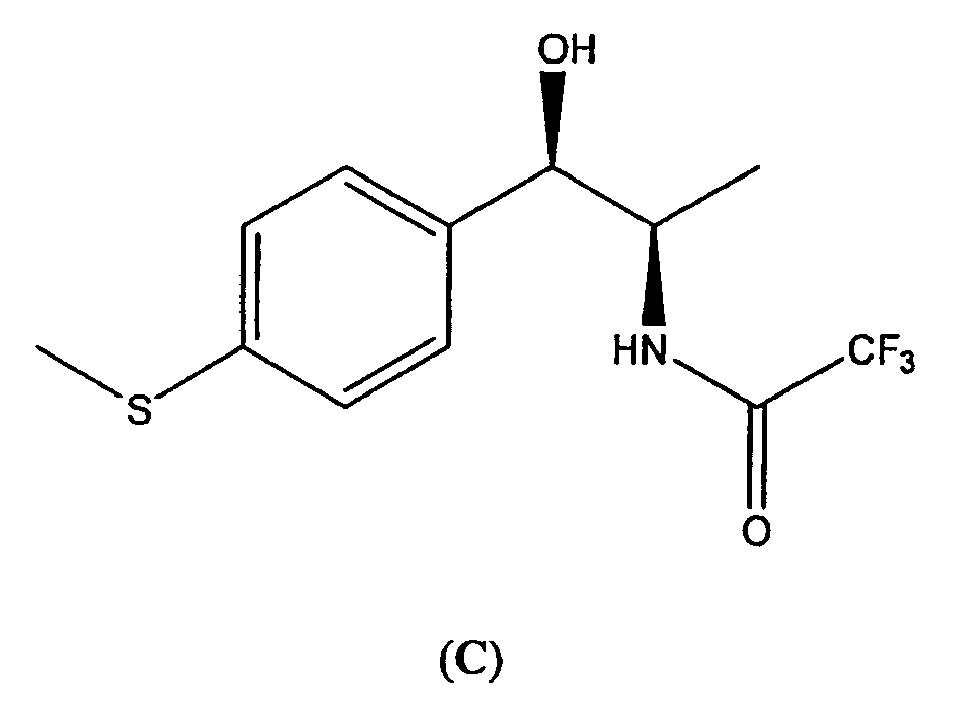
- Step 4: Removal of the Trifluoroacetyl Group on Compound C and Formation of Dichloroacetamide D
- Compound C (60 mg, 0.2 mmol) was dissolved in methanol (5 mL). To the resulting methanol solution was added K2CO3 (113 mg, 0.8 mmol) in 2 mL of water. The resulting reaction mixture was then warmed to 60° C for 18 hrs. The methanol was then removed under reduced pressure to provide a mixture that was extracted with ethyl acetate (about 25 mL). The ethyl acetate extract was washed with brine (about 5 mL), dried (Na2SO4), and the ethyl acetate removed under reduced pressure. The resulting residue was dissolved in anhydrous tetrahydrofuran (2 mL) and cooled to 0° C and dichloroacetic anhydride (60 mg, 0.25 mmol). was added to the cooled solution. The resulting solution was allowed to warm to room temperature and stirred for about 2 hrs. at room temperature. The tetrahydrofuran was removed under reduced pressure and the resulting residue dissolved in ethyl acetate (40 mL). The ethyl acetate solution was then washed with saturated sodium bicarbonate solution (about 5 mL) followed by brine (about 5 mL) and dried (Na2SO4). The ethyl acetate was then removed under reduced pressure to provide a residue that was purified using flash chromatography using silica gel and ethyl acetate/hexane in a ratio of 1:9 as eluent to provide compound D (yield 80%).

- Step 5: Oxidation of the Sulfide Group of Compound D to Provide Sulfone E.
- Compound D (43 mg, 0.14 mmol) was dissolved in methanol (2 mL). To the resulting solution was added Oxone® (189 mg, 0.307mmol) (commercially available from DuPont Specialty Chemicals of Wilmington, DE) in 2 mL of water with stirring. The resulting solution was warmed to 60° C and stirred for about 1 hr. The methanol was then removed under reduced pressure and ethyl acetate (50 mL) was added to the resulting residue. The resulting solution was then washed with water (about 5 mL) and brine (about 5 mL). The organic layer was then dried (Na2SO4) and the ethyl acetate removed under reduced pressure. The resulting residue was purified by flash chromatography using a silica gel column eluted with ethyl acetate/hexane in a ratio of 1:9 to provide D-(threo)-1-p-methylsulfonylphenyl-2-dichloroacetamido-1-propanol i.e., Fenicol Compound (VIa1) (90% yield).
- The present invention is not to be limited in scope by the specific embodiments disclosed in the examples which are intended as illustrations of a few aspects of the invention and any embodiments that are functionally equivalent are within the scope of this invention. Indeed, various modifications of the invention in addition to those shown and described herein will become apparent to those skilled in the art and are intended to fall within the scope of the appended claims.
- A number of references have been cited, the entire disclosure of which are incorporated herein by reference. Citation of any reference in this application, unless specifically identified as prior art, is not to be construed that such reference is prior art to the present application.
Claims (38)
- A method of synthesizing a fenicol compound of formula (VI):

each Y and Y, is independently -H; -SO2R1; -S(O)R1 -SR1; -S(O)NH2; -SO2NH2;-S(O)NHR1; -S(O)NHR1; -S(O)N(R1)2; -S(O)N(R1)2; -C(O)R1; -C(O)OR1; -OC(O)R1; -OR1; -R1; -CN; halogen; -NO2 -NH2; -NHR1; -NH(R1)2; -C(O)NH2; -C(O)NHR1; -C(O)N(R1)2; phenyl; or phenyl substituted with halogen; -NO2, -SO2R1, -OR1, or -R1,
each R1 is independently a C1-C4 hydrocarbon group,
R2 is -CH3, -CH2F, or -CH2OP,
P is a hydroxyl protecting group,
R3 is a -C1-C4 hydrocarbon group, -CH2F, -CHF2, -CF3, -CH2Cl, -CHCl2, -CCl3, -CH2Br, -CHBr2, -CBr3, -CH2I, -CHI2, -CI3, -CH2CN, -CH2N3, -CH2SO2CH3, -CZ2CZ3, -CH(CH3)(CF3),-CH(OH)(CH3), -CH(CF3)2, -CH(CF3)Z, and -CH(CF3)OH; and
each Z is independently a hydrogen or halogen,
comprising the steps of:(i) converting an amino acid of formula (V):
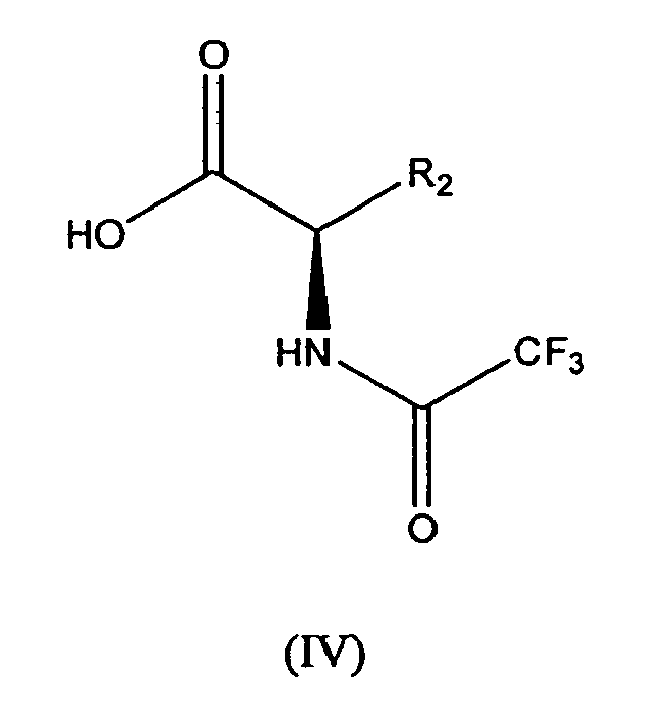 (ii) converting the N-trifluoroacetylated amino acid of formula (IV) to a compound of formula (III):
 (iii) contacting the compound of formula (III) with a compound of formula (II):
 (iv) contacting the compound of formula (I) with a reducing agent to provide a compound of formula (VII):
 (v) converting the compound of formula (VII) to a compound of formula (VIII):
- The method of claim 1, wherein converting the compound of formula (VII) to a compound of formula (VIII) involves hydrolyzing the compound of formula (VII) under basic conditions.
- The method of claim 2, wherein converting the compound of formula (VII) to a compound of formula (VIII) involves contacting the compound of formula (VII) an aqueous methanol solvent containing about a 2 to 10 fold molar excess of Na2CO3 or K2CO3 relative to the compound of formula (VII).
- The method of claim 1, wherein Y, is hydrogen and Y is selected from the group consisting of -NO2, -SO2CH3, and -SO2NH2.
- The method of claim 1, wherein the compound of formula (II) is contacted with a compound of formula (III) in the presence of a Friedel-Crafts catalyst.
- The method of claim 5, wherein the Friedel Crafts catalyst is selected from the group consisting of AlCl3, AlBr3, BF3, BCl3, GaCl3, FeCl3, SbCl5, ZrCl4, SnCl4, SbCl3, and ZnCl2.
- The method of claim 6, wherein the Friedel Crafts catalyst is present in an amount ranging from about 0.1 molar equivalents to 3 molar equivalents relative to the compound of formula (III).
- The method of claim 1, wherein the amino acid of formula (V) is converted to the N-trifluoroacetylated amino acid of formula (IV) by contacting the amino acid of formula (V) with trifluoroacetic anhydride or trifluoroacetyl chloride.
- The method of claim 1, wherein the reducing agent is a chiral reducing agent.
- The method of claim 1, wherein the fenicol compound of formula (VI) is a compound of formula (VIa):

- The method of claim 1, wherein the compound of formula (VII) is a compound of formula (VIIa):

- The method of claim 1, wherein the compound of formula (VIII) is a compound of formula (VIIIa):

- A method of synthesizing a fenicol compound of formula (VI):

each Y and Y, is independently -H; -SO2R1; -S(O)R1 -SR1; -S(O)NH2; -SO2NH2;-S(O)NHR1; -S(O)NHR1; -S(O)N(R1)2; -S(O)N(R1)2; -C(O)R1; -C(O)OR1; -OC(O)R1; -OR1; -R1; -CN; halogen; -NO2; -NH2; -NHR1; -NH(R1)2; -C(O)NH2; -C(O)NHR1; -C(O)N(R1)2; phenyl; or phenyl substituted with halogen; -NO2, -SO2R1, -OR1, or -R1,
each R1 is independently a C1-C4 hydrocarbon group,
R2 is -CH3, -CH2F, or -CH2OP,
P is a hydroxyl protecting group,
R3 is a -C1-C4 hydrocarbon group, -CH2F, -CHF2, -CF3, -CH2Cl, -CHCl2, -CCl3, -CH2Br, -CHBr2, -CBr3, -CH2I, -CHI2, -CI3, -CH2CN, -CH2N3, -CH2SO2CH3, -CZ2CZ3, -CH(CH3)(CF3),-CH(OH)(CH3), -CH(CF3)2, -CH(CF3)Z, and -CH(CF3)OH; and
each Z is independently a hydrogen or halogen,
comprising the steps of:(i) contacting a compound of formula (III):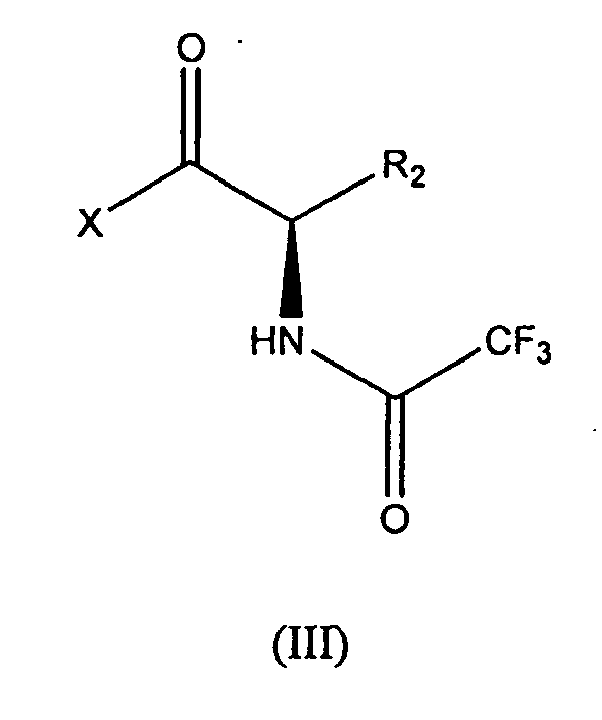 R2 is -CH3, -CH2F, or -CH2OP,P is a hydroxyl protecting group, andX is a halide;with a compound of formula (II):

 (ii) contacting the compound of formula (I) with a reducing agent to provide a compound of formula (VII):
 (ii) converting the compound of formula (VII) to a compound of formula (VIII):
- The method of claim 13, wherein Y is selected from the group consisting of -NO2, -SO2CH3, and -SO2NH2.
- The method of claim 13, wherein the compound of formula (III) is contacted with a compound of formula (II) in the presence of a Friedel-Crafts catalyst.
- The method of claim 15, wherein the Friedel Crafts catalyst is selected from the group consisting of AlCl3, AlBr3, BF3, BCl3, GaCl3, FeCl3, SbCl5, ZrCl4, SnCl4, SbCl3, and ZnCl2.
- The method of claim 16, wherein the Friedel Crafts catalyst is present in an amount ranging from about 0.1 molar equivalents to 3 molar equivalents relative to the compound of formula (III).
- The method of claim 13, wherein the reducing agent is a chiral reducing agent.
- The method of claim 13, wherein the fenicol compound of formula (VI) is a compound of formula (VIa):

- The method of claim 13, wherein the compound of formula (VII) is a compound of formula (VIIa):

- The method of claim 13, wherein the compound of formula (VIII) is a compound of formula (VIIIa):

- A method of synthesizing a fenicol compound of formula (VI):
 each Y and Y, is independently -H; -SO2R1; -S(O)R1 -SR1; -S(O)NH2; -SO2NH2;-S(O)NHR1; -S(O)NHR1; -S(O)N(R1)2; -S(O)N(R1)2; -C(O)R1; -C(O)OR1; -OC(O)R1; -OR1; -R1; -CN; halogen; -NO2; -NH2; -NHR1; -NH(R1)2; -C(O)NH2; -C(O)NHR1; -C(O)N(R1)2; phenyl; or phenyl substituted with halogen; -NO2 -SO2R1, -OR1, or -R1,each R1 is independently a C1-C4 hydrocarbon group,R2 is -CH3, -CH2F, or -CH2OP,P is a hydroxyl protecting group,R3 is a -C1-C4 hydrocarbon group, -CH2F, -CHF2, -CF3, -CH2Cl, -CHCl2, -CCl3, -CH2Br, -CHBr2, -CBr3, -CH2I, -CHI2, -CI3, -CH2CN, -CH2N3, -CH2SO2CH3, -CZ2CZ3, -CH(CH3)(CF3),-CH(OH)(CH3), -CH(CF3)2, -CH(CF3)Z, and -CH(CF3)OH; andeach Z is independently a hydrogen or halogen,comprising the step of converting an amino acid of formula (V):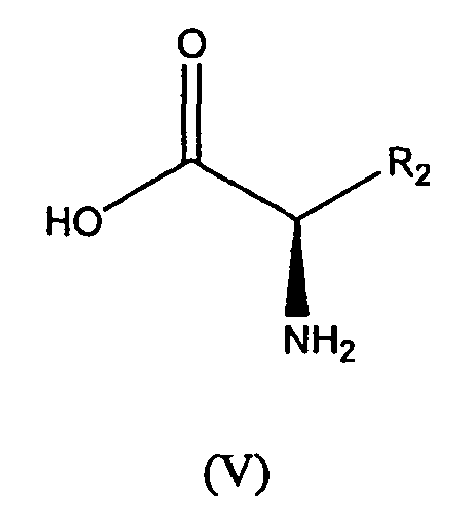

- A method of synthesizing a fenicol compound of formula (VI):
 each Y and Y, is independently -H; -SO2R1; -S(O)R1 -SR1; -S(O)NH2; -SO2NH2;-S(O)NHR1; -S(O)NHR1; -S(O)N(R1)2; -S(O)N(R1)2; -C(O)R1; -C(O)OR1; -OC(O)R1; -OR1; -R1; -CN; halogen; -NO2; -NH2; -NHR1; -NH(R1)2; -C(O)NH2; -C(O)NHR1; -C(O)N(R1)2; phenyl; or phenyl substituted with halogen; -NO2, -SO2R1, -OR1, or -R1,each R1 is independently a C1-C4 hydrocarbon group,R2 is -CH3, -CH2F, or -CH2OP,P is a hydroxyl protecting group,R3 is a -C1-C4 hydrocarbon group, -CH2F, -CHF2, -CF3, -CH2Cl, -CHCl2, -CCl3, -CH2Br, -CHBr2, -CBr3, -CH2I, -CHI2, -CI3, -CH2CN, -CH2N3, -CH2SO2CH3, -CZ2CZ3, -CH(CH3)(CF3),-CH(OH)(CH3), -CH(CF3)2, -CH(CF3)Z, and -CH(CF3)OH; andeach Z is independently a hydrogen or halogen,comprising the step of contacting a compound of formula (III):
with a compound of formula (II):

- A method of synthesizing a fenicol compound of formula (VI):
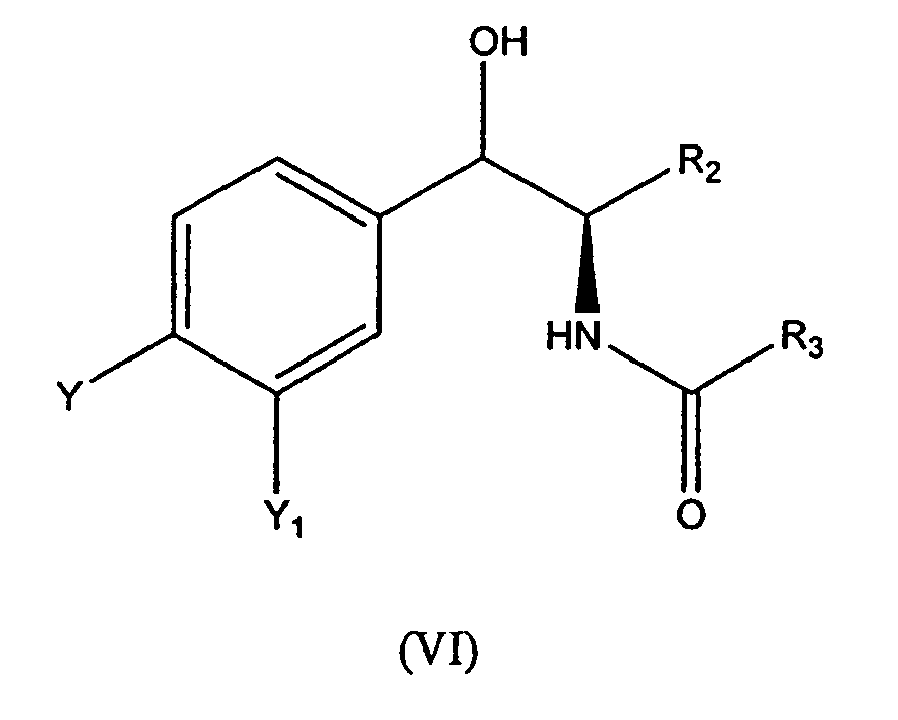 each Y and Y, is independently -H; -SO2R1; -S(O)R1 -SR1; -S(O)NH2; -SO2NH2;-S(O)NHR1; -S(O)NHR1; -S(O)N(R1)2; -S(O)N(R1)2; -C(O)R1; -C(O)OR1; -OC(O)R1; -OR1; -R1; -CN; halogen; -NO2; -NH2; -NHR1; -NH(R1)2; -C(O)NH2; -C(O)NHR1; -C(O)N(R1)2; phenyl; or phenyl substituted with halogen; -NO2, -SO2R1, -OR1, or -R1,each R1 is independently a C1-C4 hydrocarbon group,R2 is -CH3, -CH2F, or -CH2OP,P is a hydroxyl protecting group,R3 is a -C1-C4 hydrocarbon group, -CH2F, -CHF2, -CF3, -CH2Cl, -CHCl2, -CCl3, -CH2Br, -CHBr2, -CBr3, -CH2I, -CHI2, -CI3, -CH2CN, -CH2N3, -CH2SO2CH3, -CZ2CZ3, -CH(CH3)(CF3),-CH(OH)(CH3), -CH(CF3)2, -CH(CF3)Z, and -CH(CF3)OH; andeach Z is independently a hydrogen or halogen,comprising the step of contacting a compound of formula (I):

- The method of claim 24, wherein the reducing agent is a chiral reducing agent.
- A method of synthesizing a fenicol compound of formula (VI):
 each Y and Y1 is independently -H; -SO2R1; -S(O)R1 -SR1; -S(O)NH2; -SO2NH2;-S(O)NHR1; -S(O)NHR1; -S(O)N(R1)2; -S(O)N(R1)2; -C(O)R1; -C(O)OR1; -OC(O)R1; -OR1; -R1; -CN; halogen; -NO2; -NH2; -NHR1; -NH(R1)2; -C(O)NH2; -C(O)NHR1; -C(O)N(R1)2; phenyl; or phenyl substituted with halogen; -NO2, -SO2R1, -OR1, or -R1,each R1 is independently a C1-C4 hydrocarbon group,R2 is -CH3, -CH2F, or -CH2OP,P is a hydroxyl protecting group,R3 is a -C1-C4 hydrocarbon group, -CH2F, -CHF2, -CF3, -CH2Cl, -CHCl2, -CCl3, -CH2Br, -CHBr2, -CBr3, -CH2I, -CHI2, -CI3, -CH2CN, -CH2N3, -CH2SO2CH3, -CZ2CZ3, -CH(CH3)(CF3),-CH(OH)(CH3), -CH(CF3)2, -CH(CF3)Z, and -CH(CF3)OH; andeach Z is independently a hydrogen or halogen,comprising the steps:(i) of converting a compound of formula (VII):
 (ii) converting the compound of formula (VIII) to the fenicol compound of formula (VI).
 - The method of claim 26, wherein the compound of formula (VII) is a compound of formula (VIIa):


- A method of synthesizing a compound of formula (I):
 each Y and Y, is independently -H; -SO2R1; -S(O)R1 -SR1; -S(O)NH2; -SO2NH2;-S(O)NHR1; -S(O)NHR1; -S(O)N(R1)2; -S(O)N(R1)2; -C(O)R1; -C(O)OR1; -OC(O)R1; -OR1; -R1; -CN; halogen; -NO2; -NH2; -NHR1; -NH(R1)2; -C(O)NH2; -C(O)NHR1; -C(O)N(R1)2; phenyl; or phenyl substituted with halogen; -NO2, -SO2R1, -OR1, or -R1,each R1 is independently a C1-C4 hydrocarbon group,R2 is -CH3, -CH2F, or -CH2OP,P is a hydroxyl protecting group,comprising contacting a compound of formula (II):

- The method of claim 28,wherein Y is selected from the group consisting of -NO2, -SO2CH3, and -SO2NH2.
- The method of claim 28, wherein the compound of formula (I) is contacted with a compound of formula (II) in the presence of a Friedel-Crafts catalyst.
- The method of claim 30, wherein the Friedel Crafts catalyst is selected from the group consisting of AlCl3, AlBr3, BF3, BCl3, GaCl3, FeCl3, SbCl5, ZrCl4, SnCl4, SbCl3, and ZnCl2.
- The method of claim 30, wherein the Friedel Crafts catalyst is present in an amount ranging from about 0.1 molar equivalents to 3 molar equivalents relative to the compound of formula (III).
- A compound of formula (VIa1):

- A pharmaceutical composition comprising the compound of claim 33 and a pharmaceutically acceptable excipient.
- A method of treating or preventing a condition in an animal comprising administering to the animal the pharmaceutical composition of claim 34.
- The method of claim 35, wherein the condition is a bacterial infection or a nephrotic syndrome.
- The method of claim 36, wherein the condition is a bacterial infection caused by Staphylococcus aureus, Streptococcus pneumoniae, coagulese-negative staphylococci, Streptococcus pyogenes, Staphylococcus epidermis, Pseudomonas aeruginosa, Escherichia coli, Klebsiella pneumoniae, Enterobacter cloacae, Proteus mirabilis, Proteus vulgaris, Providencia stuartii, Morganella morganii, Citrobacter diversus, Citrobacter freundii, Haemophilus influenzae, or Neisseria gonorrhea.
- The method of claim 35, wherein the condition is a respiratory tract infection, a urinary tract infection, a postoperative-wound infection, a bone or joint infection, a skin infection, an ear infection, or a sexually transmitted disease.
Applications Claiming Priority (1)
| Application Number | Priority Date | Filing Date | Title |
|---|---|---|---|
| US11/700,073 US7518017B2 (en) | 2006-02-17 | 2007-01-31 | Fenicol compounds and methods synthesizing 2-trifluoroacetamido-3-substituted propiophenone compounds |
Publications (2)
| Publication Number | Publication Date |
|---|---|
| EP1953138A2 true EP1953138A2 (en) | 2008-08-06 |
| EP1953138A3 EP1953138A3 (en) | 2008-10-08 |
Family
ID=39366982
Family Applications (1)
| Application Number | Title | Priority Date | Filing Date |
|---|---|---|---|
| EP07006059A Withdrawn EP1953138A3 (en) | 2007-01-31 | 2007-03-23 | Fenicol compounds and methods of synthesizing 2-trifluoracetamido-3-substituted propiophenone compounds |
Country Status (2)
| Country | Link |
|---|---|
| US (1) | US7518017B2 (en) |
| EP (1) | EP1953138A3 (en) |
Families Citing this family (3)
| Publication number | Priority date | Publication date | Assignee | Title |
|---|---|---|---|---|
| CN103649097A (en) | 2011-05-02 | 2014-03-19 | 佐蒂斯有限责任公司 | Novel cephalosporins used as antibacterial agents |
| CN102491953A (en) * | 2011-12-05 | 2012-06-13 | 江西日上化工有限公司 | Method for synthesizing florfenicol midbody RT0131 |
| CN116574040B (en) * | 2023-05-16 | 2024-07-12 | 浙江知行药业有限公司 | Preparation method for efficiently recycling thiamphenicol amine |
Family Cites Families (41)
| Publication number | Priority date | Publication date | Assignee | Title |
|---|---|---|---|---|
| US3536809A (en) | 1969-02-17 | 1970-10-27 | Alza Corp | Medication method |
| US3598123A (en) | 1969-04-01 | 1971-08-10 | Alza Corp | Bandage for administering drugs |
| US3845123A (en) * | 1969-12-17 | 1974-10-29 | Pfizer | Phenoxypropanolamine therapeutic agents |
| US3845770A (en) | 1972-06-05 | 1974-11-05 | Alza Corp | Osmatic dispensing device for releasing beneficial agent |
| US3916899A (en) | 1973-04-25 | 1975-11-04 | Alza Corp | Osmotic dispensing device with maximum and minimum sizes for the passageway |
| US4008719A (en) | 1976-02-02 | 1977-02-22 | Alza Corporation | Osmotic system having laminar arrangement for programming delivery of active agent |
| US4235892A (en) | 1979-02-05 | 1980-11-25 | Schering Corporation, Patent Dept. | 1-Aryl-2-acylamido-3-fluoro-1-propanols, methods for their use as antibacterial agents and compositions useful therefor |
| ES8104203A1 (en) | 1979-02-05 | 1981-04-16 | Schering Corp | 1-Aryl-2-acylamido-3-fluoro-1-propanol acylates, methods for their manufacture and intermediates useful therein, methods for their use as antibacterial agents and compositions useful therefor |
| US5243056A (en) | 1983-06-02 | 1993-09-07 | Zambon S.P.A. | Intermediates for the preparation of 1-(phenyl)-1-hydroxy-2-amino-3-fluoro propane derivatives |
| US5105009A (en) | 1983-06-02 | 1992-04-14 | Zambon S.P.A. | Intermediates for the preparation of 1-(phenyl)-1-hydroxy-2-amino-3-fluoropropane derivatives |
| IT1173213B (en) | 1984-02-03 | 1987-06-18 | Zambon Spa | PROCEDURE TO FLUORINE SOME DERIVATIVES FROM 1L-FENYL-2-AMINO-1,3-PROPANDIOL AND THEIR INTERMEDIATES |
| US5332835A (en) | 1984-02-03 | 1994-07-26 | Zambon S.P.A. | Process for fluorinating 1-phenyl-2-amino-1,3-propanediol compounds and new oxazoline compounds useful in this process |
| US5153328A (en) | 1984-02-03 | 1992-10-06 | Zambon S.P.A. | 2 Hydrocarbyl-4 substituted methyl 5 (4 substituted phenyl)-oxazolines |
| US4677214A (en) | 1984-09-19 | 1987-06-30 | Schering Corporation | Intermediates for preparation of (threo)-1-aryl-2-acylamido-3-fluoro-1-propanols |
| US4973750A (en) | 1984-09-19 | 1990-11-27 | Schering Corporation | Preparation of (threo)-1-aryl-2-acylamido-3-fluoro-1-propanols |
| US4582918A (en) | 1984-09-19 | 1986-04-15 | Schering Corporation | Preparation of intermediates for (threo)-1-aryl-2-acylamido-3-fluoro-1-propanols |
| IE58110B1 (en) | 1984-10-30 | 1993-07-14 | Elan Corp Plc | Controlled release powder and process for its preparation |
| JPH0617342B2 (en) | 1986-03-11 | 1994-03-09 | 日本ケミフア株式会社 | Method for producing optically active β-amino alcohol |
| US5073543A (en) | 1988-07-21 | 1991-12-17 | G. D. Searle & Co. | Controlled release formulations of trophic factors in ganglioside-lipsome vehicle |
| US5227494A (en) | 1988-09-14 | 1993-07-13 | Schering Corporation | Process for preparing oxazoline compounds |
| US4876352A (en) | 1988-09-14 | 1989-10-24 | Schering Corporation | Pressurized fluorination of hydroxy alkyl groups |
| IT1229203B (en) | 1989-03-22 | 1991-07-25 | Bioresearch Spa | USE OF 5 METHYLTHETRAHYDROPHOLIC ACID, 5 FORMYLTHETRAHYDROPHOLIC ACID AND THEIR PHARMACEUTICALLY ACCEPTABLE SALTS FOR THE PREPARATION OF PHARMACEUTICAL COMPOSITIONS IN THE FORM OF CONTROLLED RELEASE ACTIVE IN THE THERAPY OF MENTAL AND ORGANIC DISORDERS. |
| IT1237798B (en) | 1989-10-20 | 1993-06-17 | Zambon Spa | STEREO-CHEMICAL REVERSAL PROCESS OF (2S, 3S) -2-AMINO-3-FENYL-1, 3-PROPANDIOLS IN THE CORRESPONDING ENANTIOMERS (2R, 3R). |
| US5120548A (en) | 1989-11-07 | 1992-06-09 | Merck & Co., Inc. | Swelling modulated polymeric drug delivery device |
| IT1240676B (en) | 1990-04-24 | 1993-12-17 | Agrimont Spa | COMPOSITIONS WITH HERBICIDE ACTIVITY |
| US5733566A (en) | 1990-05-15 | 1998-03-31 | Alkermes Controlled Therapeutics Inc. Ii | Controlled release of antiparasitic agents in animals |
| ATE115123T1 (en) | 1990-10-25 | 1994-12-15 | Schering Corp | PROCESS FOR THE MANUFACTURE OF FLORFENICOL, ITS ANALOGUES AND OXAZOLINE INTERMEDIATE PRODUCTS. |
| US5346828A (en) | 1991-03-27 | 1994-09-13 | Celgene Corporation | Stereoisomeric enrichment of 2-amino-3-hydroxy-3-phenylpropionic acids using d-threonine aldolase |
| US5580578A (en) | 1992-01-27 | 1996-12-03 | Euro-Celtique, S.A. | Controlled release formulations coated with aqueous dispersions of acrylic polymers |
| US5352832A (en) | 1992-12-18 | 1994-10-04 | Schering Corporation | Asymmetric process for preparing florfenicol, thiamphenicol chloramphenicol and oxazoline intermediates |
| US5591767A (en) | 1993-01-25 | 1997-01-07 | Pharmetrix Corporation | Liquid reservoir transdermal patch for the administration of ketorolac |
| US5789599A (en) | 1994-05-06 | 1998-08-04 | Drexel University | Aziridine compounds, methods of preparation and reactions thereof |
| IT1270594B (en) | 1994-07-07 | 1997-05-07 | Recordati Chem Pharm | CONTROLLED RELEASE PHARMACEUTICAL COMPOSITION OF LIQUID SUSPENSION MOGUISTEIN |
| DE4437932A1 (en) | 1994-10-24 | 1996-04-25 | Bayer Ag | Process for the preparation of alkyloxazoles fluorinated in a side chain and new alkyloxazoles fluorinated in a side chain |
| US5663361A (en) | 1996-08-19 | 1997-09-02 | Schering Corporation | Process for preparing intermediates to florfenicol |
| US6207860B1 (en) | 1997-09-29 | 2001-03-27 | Air Products And Chemicals, Inc. | Thermally stable aminosulfur trifluorides |
| US6080886A (en) | 1997-09-29 | 2000-06-27 | Air Products And Chemicals, Inc. | Fluorination with aminosulfur trifluorides |
| JP2005538937A (en) | 2002-03-08 | 2005-12-22 | シェーリング−プラウ, リミテッド | New florfenicol antibiotics |
| US6790867B2 (en) | 2002-05-20 | 2004-09-14 | Schering-Plough Animal Health Corporation | Compositions and method for treating infection in cattle and swine |
| US7126005B2 (en) | 2003-10-06 | 2006-10-24 | Aurobindo Pharma Limited | Process for preparing florfenicol |
| WO2005069930A2 (en) | 2004-01-15 | 2005-08-04 | The Penn State Research Foundation | Asymmetric hydrogenation of alpha-amino carbonyl compounds |
-
2007
- 2007-01-31 US US11/700,073 patent/US7518017B2/en not_active Expired - Fee Related
- 2007-03-23 EP EP07006059A patent/EP1953138A3/en not_active Withdrawn
Non-Patent Citations (6)
| Title |
|---|
| "The Merck index" 2006, MERCK RESEARCH LABORATORIES , XP002492649 * page 1599, column 2; compound 9301 * * |
| DATABASE WPI Week 198742 Thomson Scientific, London, GB; AN 1987-296431 XP002492650 & JP 62 209047 A (NIPPON CHEMIPHAR CO) 14 September 1987 (1987-09-14) & JP 62 209047 A (NIPPON CHEMIPHAR CO) 14 September 1987 (1987-09-14) * |
| FUJII I. ET AL: JOURNAL OF AMERICAN CHEMICAL SOCIETY, vol. 117, 1995, pages 6199-6209, XP002492648 * |
| MULLER ET AL: JOURNAL FUR PRAKTISCHE CHEMIE, vol. 315, no. 6, 1973, pages 1045-1056, XP002492647 * |
| NORDLANDER ET AL: JOURNAL OF ORGANIC CHEMISTRY, vol. 50, 1985, pages 3481-3484, XP002492716 * |
| OSORIO-OLIVARES M ET AL: "A two-step method for the preparation of homochiral cathinones" TETRAHEDRON ASYMMETRY, PERGAMON, OXFORD; GB, vol. 14, no. 11, 6 June 2003 (2003-06-06), pages 1473-1477, XP004427062 ISSN: 0957-4166 * |
Also Published As
| Publication number | Publication date |
|---|---|
| US7518017B2 (en) | 2009-04-14 |
| EP1953138A3 (en) | 2008-10-08 |
| US20070197823A1 (en) | 2007-08-23 |
Similar Documents
| Publication | Publication Date | Title |
|---|---|---|
| US4705799A (en) | Aminomethyl oxooxazolidinyl benzenes useful as antibacterial agents | |
| KR840001837B1 (en) | Method for preparing 1-aryl-2-acylamido-3-fluoro-1-propanol | |
| DK169103B1 (en) | Aminomethyl-oxooxazolidinyl benzene compounds, a process for their preparation and pharmaceutical compositions containing these compounds | |
| US12552824B2 (en) | C-mannoside compounds useful for the treatment of urinary tract infections | |
| CN102131772B (en) | Process for the preparation of *oxazoline-protected aminodiol compounds used as intermediates of florfenicol | |
| PL207158B1 (en) | Nitric oxide synthase inhibitor phosphate salt | |
| US20050182139A1 (en) | Antibacterial 1-(4-mono- and di-halomethylsulphonylphenyl)-2-acylamino-3-fluoroproponals and preparation thereof | |
| HU194194B (en) | Process for producing oxo-oxazolidinyl-benzene derivatives of antibakterial activity and pharmaceutical compositions containing them | |
| JP2003514793A (en) | Amino alcohol derivatives useful for the treatment of gastrointestinal disorders | |
| CN106163509A (en) | Substituted beta amino acids of β as chemotherapeutics and the like | |
| US5347037A (en) | (RR) and (RS stereoisomers of N-(7-ethoxycarbonylmethoxy-1,2,3,-tetrahydronaphth-2-yl)-2-(3-chlorophenyl)-2-hydroxyethanamine and their pharmaceutically acceptable salts | |
| TWI699372B (en) | Novel aminoglycoside antibiotics effective against multidrug resistant bacteria | |
| US7518017B2 (en) | Fenicol compounds and methods synthesizing 2-trifluoroacetamido-3-substituted propiophenone compounds | |
| FI65253B (en) | FOERFARANDE FOER FRAMSTAELLNING AV ANTIBAKTERIELLT VERKSAMMA 9-AMINODEOXI-CLAVULANSYRADERIVAT | |
| HK1000963B (en) | O-alkylation process for n-(hydroxy) aralkyl phenyl ethanol amines | |
| EP0272684B1 (en) | Derivatives of n-(methylsulphonylphenylethyl)-2-propenamides and their use as antibiotics | |
| US20210355086A1 (en) | Process for preparing a novel phenicol antibacterial agent | |
| US4694016A (en) | Phthalamide derivatives with anthelmintic activity | |
| JPS599558B2 (en) | Method for producing novel cephalosporin derivatives | |
| US7402697B2 (en) | Antibacterial agents | |
| FR2482108A1 (en) | NOVEL DERIVATIVES OF ISTAMYCINS A AND B AND PROCESS FOR THEIR PREPARATION AND PHARMACEUTICAL APPLICATION | |
| AU2006270914B2 (en) | Substituted propanamide derivative and pharmaceutical composition containing the same | |
| JP2010536780A (en) | Therapeutic compound | |
| EP4499610B1 (en) | INTERMEDIATE PRODUCTS FOR THE PRODUCTION OF AN LPXC ANALOGUE AND METHOD FOR THEIR PRODUCTION | |
| HU199146B (en) | Process for producing new cefemcarboxylic acid derivatives and pharmaceutical compositions comprising same |
Legal Events
| Date | Code | Title | Description |
|---|---|---|---|
| PUAI | Public reference made under article 153(3) epc to a published international application that has entered the european phase |
Free format text: ORIGINAL CODE: 0009012 |
|
| AK | Designated contracting states |
Kind code of ref document: A2 Designated state(s): AT BE BG CH CY CZ DE DK EE ES FI FR GB GR HU IE IS IT LI LT LU LV MC MT NL PL PT RO SE SI SK TR |
|
| AX | Request for extension of the european patent |
Extension state: AL BA HR MK RS |
|
| PUAL | Search report despatched |
Free format text: ORIGINAL CODE: 0009013 |
|
| AK | Designated contracting states |
Kind code of ref document: A3 Designated state(s): AT BE BG CH CY CZ DE DK EE ES FI FR GB GR HU IE IS IT LI LT LU LV MC MT NL PL PT RO SE SI SK TR |
|
| AX | Request for extension of the european patent |
Extension state: AL BA HR MK RS |
|
| STAA | Information on the status of an ep patent application or granted ep patent |
Free format text: STATUS: THE APPLICATION HAS BEEN WITHDRAWN |
|
| 18W | Application withdrawn |
Effective date: 20090203 |