EP1953134A1 - Process for preparing dienones - Google Patents
Process for preparing dienones Download PDFInfo
- Publication number
- EP1953134A1 EP1953134A1 EP07001946A EP07001946A EP1953134A1 EP 1953134 A1 EP1953134 A1 EP 1953134A1 EP 07001946 A EP07001946 A EP 07001946A EP 07001946 A EP07001946 A EP 07001946A EP 1953134 A1 EP1953134 A1 EP 1953134A1
- Authority
- EP
- European Patent Office
- Prior art keywords
- compound
- formula
- methyl
- process according
- dien
- Prior art date
- Legal status (The legal status is an assumption and is not a legal conclusion. Google has not performed a legal analysis and makes no representation as to the accuracy of the status listed.)
- Withdrawn
Links
- 238000004519 manufacturing process Methods 0.000 title abstract description 4
- 238000000034 method Methods 0.000 claims abstract description 40
- PXEWKHNDUAOIKO-UHFFFAOYSA-N 6-methylocta-4,5-dien-2-one Chemical compound CCC(C)=C=CCC(C)=O PXEWKHNDUAOIKO-UHFFFAOYSA-N 0.000 claims abstract description 30
- VVIAPRCFRQGEMB-UHFFFAOYSA-N 6-methylocta-3,5-dien-2-one Chemical compound CCC(C)=CC=CC(C)=O VVIAPRCFRQGEMB-UHFFFAOYSA-N 0.000 claims abstract description 11
- 150000001875 compounds Chemical class 0.000 claims description 39
- 238000006243 chemical reaction Methods 0.000 claims description 21
- 125000002496 methyl group Chemical group [H]C([H])([H])* 0.000 claims description 18
- 238000002360 preparation method Methods 0.000 claims description 15
- LMBFAGIMSUYTBN-MPZNNTNKSA-N teixobactin Chemical compound C([C@H](C(=O)N[C@@H]([C@@H](C)CC)C(=O)N[C@@H](CO)C(=O)N[C@H](CCC(N)=O)C(=O)N[C@H]([C@@H](C)CC)C(=O)N[C@@H]([C@@H](C)CC)C(=O)N[C@@H](CO)C(=O)N[C@H]1C(N[C@@H](C)C(=O)N[C@@H](C[C@@H]2NC(=N)NC2)C(=O)N[C@H](C(=O)O[C@H]1C)[C@@H](C)CC)=O)NC)C1=CC=CC=C1 LMBFAGIMSUYTBN-MPZNNTNKSA-N 0.000 claims description 12
- 229910052739 hydrogen Inorganic materials 0.000 claims description 11
- 125000001495 ethyl group Chemical group [H]C([H])([H])C([H])([H])* 0.000 claims description 10
- 238000006317 isomerization reaction Methods 0.000 claims description 10
- 239000001257 hydrogen Substances 0.000 claims description 8
- QAOWNCQODCNURD-UHFFFAOYSA-N Sulfuric acid Chemical compound OS(O)(=O)=O QAOWNCQODCNURD-UHFFFAOYSA-N 0.000 claims description 7
- 125000006239 protecting group Chemical group 0.000 claims description 7
- 239000002253 acid Substances 0.000 claims description 5
- NBIIXXVUZAFLBC-UHFFFAOYSA-N Phosphoric acid Chemical compound OP(O)(O)=O NBIIXXVUZAFLBC-UHFFFAOYSA-N 0.000 claims description 4
- 125000002887 hydroxy group Chemical group [H]O* 0.000 claims description 4
- 125000004435 hydrogen atom Chemical group [H]* 0.000 claims description 3
- 229910000147 aluminium phosphate Inorganic materials 0.000 claims description 2
- 238000000746 purification Methods 0.000 claims description 2
- 239000000543 intermediate Substances 0.000 abstract description 5
- OKKJLVBELUTLKV-UHFFFAOYSA-N Methanol Chemical compound OC OKKJLVBELUTLKV-UHFFFAOYSA-N 0.000 description 24
- BZLVMXJERCGZMT-UHFFFAOYSA-N Methyl tert-butyl ether Chemical compound COC(C)(C)C BZLVMXJERCGZMT-UHFFFAOYSA-N 0.000 description 18
- HEMHJVSKTPXQMS-UHFFFAOYSA-M Sodium hydroxide Chemical compound [OH-].[Na+] HEMHJVSKTPXQMS-UHFFFAOYSA-M 0.000 description 12
- XLYOFNOQVPJJNP-UHFFFAOYSA-N water Substances O XLYOFNOQVPJJNP-UHFFFAOYSA-N 0.000 description 11
- 239000000047 product Substances 0.000 description 9
- 239000011541 reaction mixture Substances 0.000 description 7
- 229910001220 stainless steel Inorganic materials 0.000 description 7
- 239000010935 stainless steel Substances 0.000 description 7
- LFQSCWFLJHTTHZ-UHFFFAOYSA-N Ethanol Chemical compound CCO LFQSCWFLJHTTHZ-UHFFFAOYSA-N 0.000 description 5
- 238000002474 experimental method Methods 0.000 description 5
- 239000000203 mixture Substances 0.000 description 5
- 239000012071 phase Substances 0.000 description 5
- 239000000523 sample Substances 0.000 description 5
- VVIAPRCFRQGEMB-KQQUZDAGSA-N (3e,5e)-6-methylocta-3,5-dien-2-one Chemical compound CC\C(C)=C\C=C\C(C)=O VVIAPRCFRQGEMB-KQQUZDAGSA-N 0.000 description 4
- XKRFYHLGVUSROY-UHFFFAOYSA-N Argon Chemical compound [Ar] XKRFYHLGVUSROY-UHFFFAOYSA-N 0.000 description 4
- 238000005481 NMR spectroscopy Methods 0.000 description 4
- 238000002290 gas chromatography-mass spectrometry Methods 0.000 description 4
- 238000000197 pyrolysis Methods 0.000 description 4
- 238000000926 separation method Methods 0.000 description 4
- 239000002904 solvent Substances 0.000 description 4
- QTBSBXVTEAMEQO-UHFFFAOYSA-N Acetic acid Chemical compound CC(O)=O QTBSBXVTEAMEQO-UHFFFAOYSA-N 0.000 description 3
- 239000007832 Na2SO4 Substances 0.000 description 3
- PMZURENOXWZQFD-UHFFFAOYSA-L Sodium Sulfate Chemical compound [Na+].[Na+].[O-]S([O-])(=O)=O PMZURENOXWZQFD-UHFFFAOYSA-L 0.000 description 3
- 150000004729 acetoacetic acid derivatives Chemical class 0.000 description 3
- 125000000217 alkyl group Chemical group 0.000 description 3
- 125000003118 aryl group Chemical group 0.000 description 3
- 239000003054 catalyst Substances 0.000 description 3
- 239000012043 crude product Substances 0.000 description 3
- 238000010438 heat treatment Methods 0.000 description 3
- 150000002431 hydrogen Chemical group 0.000 description 3
- 125000004123 n-propyl group Chemical group [H]C([H])([H])C([H])([H])C([H])([H])* 0.000 description 3
- 239000012074 organic phase Substances 0.000 description 3
- 230000035484 reaction time Effects 0.000 description 3
- 238000005070 sampling Methods 0.000 description 3
- 229910052938 sodium sulfate Inorganic materials 0.000 description 3
- HBAQYPYDRFILMT-UHFFFAOYSA-N 8-[3-(1-cyclopropylpyrazol-4-yl)-1H-pyrazolo[4,3-d]pyrimidin-5-yl]-3-methyl-3,8-diazabicyclo[3.2.1]octan-2-one Chemical class C1(CC1)N1N=CC(=C1)C1=NNC2=C1N=C(N=C2)N1C2C(N(CC1CC2)C)=O HBAQYPYDRFILMT-UHFFFAOYSA-N 0.000 description 2
- IJGRMHOSHXDMSA-UHFFFAOYSA-N Atomic nitrogen Chemical compound N#N IJGRMHOSHXDMSA-UHFFFAOYSA-N 0.000 description 2
- -1 C12 hydrocarbons Chemical class 0.000 description 2
- 125000000882 C2-C6 alkenyl group Chemical group 0.000 description 2
- CURLTUGMZLYLDI-UHFFFAOYSA-N Carbon dioxide Chemical compound O=C=O CURLTUGMZLYLDI-UHFFFAOYSA-N 0.000 description 2
- UFHFLCQGNIYNRP-UHFFFAOYSA-N Hydrogen Chemical compound [H][H] UFHFLCQGNIYNRP-UHFFFAOYSA-N 0.000 description 2
- VMHLLURERBWHNL-UHFFFAOYSA-M Sodium acetate Chemical compound [Na+].CC([O-])=O VMHLLURERBWHNL-UHFFFAOYSA-M 0.000 description 2
- HEDRZPFGACZZDS-MICDWDOJSA-N Trichloro(2H)methane Chemical compound [2H]C(Cl)(Cl)Cl HEDRZPFGACZZDS-MICDWDOJSA-N 0.000 description 2
- 125000003342 alkenyl group Chemical group 0.000 description 2
- 229910052786 argon Inorganic materials 0.000 description 2
- 239000012300 argon atmosphere Substances 0.000 description 2
- 239000012298 atmosphere Substances 0.000 description 2
- 230000015572 biosynthetic process Effects 0.000 description 2
- 229910052799 carbon Inorganic materials 0.000 description 2
- 229960004424 carbon dioxide Drugs 0.000 description 2
- 235000011089 carbon dioxide Nutrition 0.000 description 2
- 238000001816 cooling Methods 0.000 description 2
- 125000004122 cyclic group Chemical group 0.000 description 2
- 150000002148 esters Chemical class 0.000 description 2
- 239000007789 gas Substances 0.000 description 2
- 238000004817 gas chromatography Methods 0.000 description 2
- 125000001183 hydrocarbyl group Chemical group 0.000 description 2
- 125000000959 isobutyl group Chemical group [H]C([H])([H])C([H])(C([H])([H])[H])C([H])([H])* 0.000 description 2
- 125000001449 isopropyl group Chemical group [H]C([H])([H])C([H])(*)C([H])([H])[H] 0.000 description 2
- 125000004108 n-butyl group Chemical group [H]C([H])([H])C([H])([H])C([H])([H])C([H])([H])* 0.000 description 2
- 125000001280 n-hexyl group Chemical group C(CCCCC)* 0.000 description 2
- 125000000740 n-pentyl group Chemical group [H]C([H])([H])C([H])([H])C([H])([H])C([H])([H])C([H])([H])* 0.000 description 2
- 238000012585 nuclear overhauser effect spectroscopy experiment Methods 0.000 description 2
- 239000001632 sodium acetate Substances 0.000 description 2
- 229960004249 sodium acetate Drugs 0.000 description 2
- 235000017281 sodium acetate Nutrition 0.000 description 2
- 125000000999 tert-butyl group Chemical group [H]C([H])([H])C(*)(C([H])([H])[H])C([H])([H])[H] 0.000 description 2
- 238000010626 work up procedure Methods 0.000 description 2
- VVIAPRCFRQGEMB-YMBWGVAGSA-N (3e,5z)-6-methylocta-3,5-dien-2-one Chemical compound CC\C(C)=C/C=C/C(C)=O VVIAPRCFRQGEMB-YMBWGVAGSA-N 0.000 description 1
- 238000001644 13C nuclear magnetic resonance spectroscopy Methods 0.000 description 1
- 238000005160 1H NMR spectroscopy Methods 0.000 description 1
- BWLBGMIXKSTLSX-UHFFFAOYSA-N 2-hydroxyisobutyric acid Chemical compound CC(C)(O)C(O)=O BWLBGMIXKSTLSX-UHFFFAOYSA-N 0.000 description 1
- 238000012584 2D NMR experiment Methods 0.000 description 1
- NXZUVUIRPBTDFR-UHFFFAOYSA-N 6-methylocta-3,4-dien-2-one Chemical compound CCC(C)C=C=CC(C)=O NXZUVUIRPBTDFR-UHFFFAOYSA-N 0.000 description 1
- XEKOWRVHYACXOJ-UHFFFAOYSA-N Ethyl acetate Chemical compound CCOC(C)=O XEKOWRVHYACXOJ-UHFFFAOYSA-N 0.000 description 1
- 230000005526 G1 to G0 transition Effects 0.000 description 1
- VYPSYNLAJGMNEJ-UHFFFAOYSA-N Silicium dioxide Chemical compound O=[Si]=O VYPSYNLAJGMNEJ-UHFFFAOYSA-N 0.000 description 1
- 238000007171 acid catalysis Methods 0.000 description 1
- 230000002378 acidificating effect Effects 0.000 description 1
- 125000003046 allene group Chemical group 0.000 description 1
- 229910052782 aluminium Inorganic materials 0.000 description 1
- XAGFODPZIPBFFR-UHFFFAOYSA-N aluminium Chemical compound [Al] XAGFODPZIPBFFR-UHFFFAOYSA-N 0.000 description 1
- 150000001399 aluminium compounds Chemical class 0.000 description 1
- 229940077746 antacid containing aluminium compound Drugs 0.000 description 1
- 125000004432 carbon atom Chemical group C* 0.000 description 1
- 239000007795 chemical reaction product Substances 0.000 description 1
- 239000003795 chemical substances by application Substances 0.000 description 1
- 229940125904 compound 1 Drugs 0.000 description 1
- 229940125782 compound 2 Drugs 0.000 description 1
- 229940126214 compound 3 Drugs 0.000 description 1
- 230000008878 coupling Effects 0.000 description 1
- 238000010168 coupling process Methods 0.000 description 1
- 238000005859 coupling reaction Methods 0.000 description 1
- 125000000392 cycloalkenyl group Chemical group 0.000 description 1
- 125000000753 cycloalkyl group Chemical group 0.000 description 1
- 238000006114 decarboxylation reaction Methods 0.000 description 1
- 235000014113 dietary fatty acids Nutrition 0.000 description 1
- WASQWSOJHCZDFK-UHFFFAOYSA-N diketene Chemical compound C=C1CC(=O)O1 WASQWSOJHCZDFK-UHFFFAOYSA-N 0.000 description 1
- 238000002845 discoloration Methods 0.000 description 1
- 238000004821 distillation Methods 0.000 description 1
- 239000000194 fatty acid Substances 0.000 description 1
- 229930195729 fatty acid Natural products 0.000 description 1
- 150000004665 fatty acids Chemical class 0.000 description 1
- 239000000796 flavoring agent Substances 0.000 description 1
- 235000019634 flavors Nutrition 0.000 description 1
- 239000003205 fragrance Substances 0.000 description 1
- 239000005350 fused silica glass Substances 0.000 description 1
- 229910000856 hastalloy Inorganic materials 0.000 description 1
- 239000001307 helium Substances 0.000 description 1
- 229910052734 helium Inorganic materials 0.000 description 1
- SWQJXJOGLNCZEY-UHFFFAOYSA-N helium atom Chemical compound [He] SWQJXJOGLNCZEY-UHFFFAOYSA-N 0.000 description 1
- 238000003919 heteronuclear multiple bond coherence Methods 0.000 description 1
- 238000005570 heteronuclear single quantum coherence Methods 0.000 description 1
- 229930195733 hydrocarbon Natural products 0.000 description 1
- 238000002347 injection Methods 0.000 description 1
- 239000007924 injection Substances 0.000 description 1
- 150000002576 ketones Chemical class 0.000 description 1
- 239000000463 material Substances 0.000 description 1
- 238000005259 measurement Methods 0.000 description 1
- 239000012528 membrane Substances 0.000 description 1
- 150000007522 mineralic acids Chemical class 0.000 description 1
- 125000001624 naphthyl group Chemical group 0.000 description 1
- 229910052757 nitrogen Inorganic materials 0.000 description 1
- 238000000655 nuclear magnetic resonance spectrum Methods 0.000 description 1
- 239000003960 organic solvent Substances 0.000 description 1
- 125000001997 phenyl group Chemical group [H]C1=C([H])C([H])=C(*)C([H])=C1[H] 0.000 description 1
- 238000010992 reflux Methods 0.000 description 1
- 230000000630 rising effect Effects 0.000 description 1
- 239000000243 solution Substances 0.000 description 1
- 238000003756 stirring Methods 0.000 description 1
- 239000001117 sulphuric acid Substances 0.000 description 1
- 235000011149 sulphuric acid Nutrition 0.000 description 1
- 238000003786 synthesis reaction Methods 0.000 description 1
- 230000002194 synthesizing effect Effects 0.000 description 1
- 239000002699 waste material Substances 0.000 description 1
Classifications
-
- C—CHEMISTRY; METALLURGY
- C07—ORGANIC CHEMISTRY
- C07C—ACYCLIC OR CARBOCYCLIC COMPOUNDS
- C07C45/00—Preparation of compounds having >C = O groups bound only to carbon or hydrogen atoms; Preparation of chelates of such compounds
- C07C45/51—Preparation of compounds having >C = O groups bound only to carbon or hydrogen atoms; Preparation of chelates of such compounds by pyrolysis, rearrangement or decomposition
- C07C45/511—Preparation of compounds having >C = O groups bound only to carbon or hydrogen atoms; Preparation of chelates of such compounds by pyrolysis, rearrangement or decomposition involving transformation of singly bound oxygen functional groups to >C = O groups
- C07C45/513—Preparation of compounds having >C = O groups bound only to carbon or hydrogen atoms; Preparation of chelates of such compounds by pyrolysis, rearrangement or decomposition involving transformation of singly bound oxygen functional groups to >C = O groups the singly bound functional group being an etherified hydroxyl group
-
- C—CHEMISTRY; METALLURGY
- C07—ORGANIC CHEMISTRY
- C07C—ACYCLIC OR CARBOCYCLIC COMPOUNDS
- C07C43/00—Ethers; Compounds having groups, groups or groups
- C07C43/02—Ethers
- C07C43/03—Ethers having all ether-oxygen atoms bound to acyclic carbon atoms
- C07C43/14—Unsaturated ethers
-
- C—CHEMISTRY; METALLURGY
- C07—ORGANIC CHEMISTRY
- C07C—ACYCLIC OR CARBOCYCLIC COMPOUNDS
- C07C45/00—Preparation of compounds having >C = O groups bound only to carbon or hydrogen atoms; Preparation of chelates of such compounds
- C07C45/61—Preparation of compounds having >C = O groups bound only to carbon or hydrogen atoms; Preparation of chelates of such compounds by reactions not involving the formation of >C = O groups
- C07C45/67—Preparation of compounds having >C = O groups bound only to carbon or hydrogen atoms; Preparation of chelates of such compounds by reactions not involving the formation of >C = O groups by isomerisation; by change of size of the carbon skeleton
Definitions
- the present invention relates to a process for preparing dienones and intermediates useful in preparing dienones.
- Dienones in particular 6-methyl-octa-3,5-dien-2-on and 6-methyl-octa-4,5-dien-2-on are interesting compounds for the flavour and fragrances industry.
- Processes for the synthesis of dienones are known, which are based on pyrolysis of tertiary-acetylenic carbinyl acetoacetates.
- US 741,047 discloses a process for the production of a doubly unsaturated ketone which comprises pyrolysing a tertiary acetylenic carbinyl acetonate in the presence of an acidic catalyst.
- the acetoacetates are prepared by the reaction of the corresponding carbinols with diketen.
- DE 1 078 112 discloses a process for the preparation of dienones, wherein esters from the general formula of tertiary acetylenic carbinyl acetoacetates are pyrolized, wherein the pyrolysis is conducted in the presence of lower aluminiumtrialcoholates and a lower fatty acid.
- the advantage of this scheme is that the dienones (1) and (2) can be synthesized in excellent yield and purity, in particular as the high temperatures as needed for pyrolysis have not to be applied.
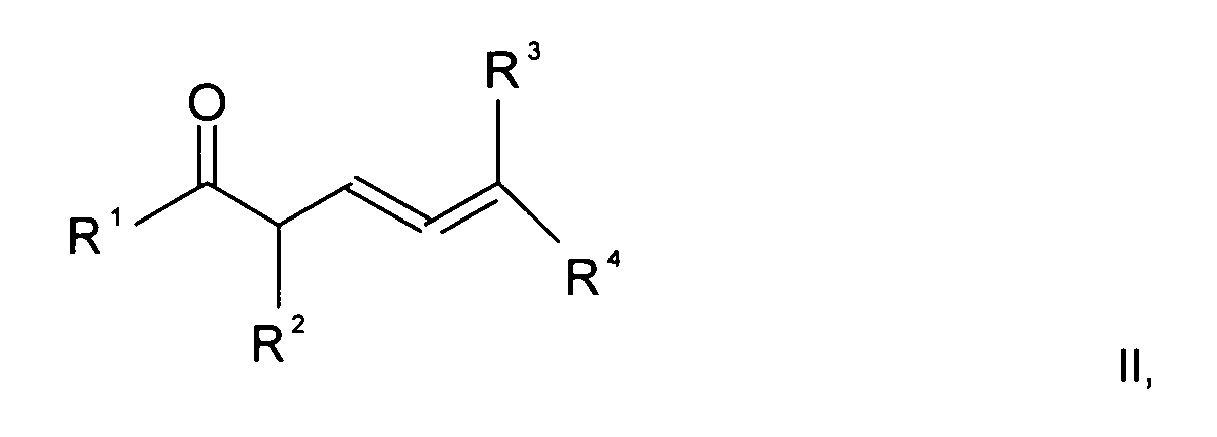
- the present invention relates to a process for the preparation of a compound of the formula II wherein R 1 is a C 1 - C 25 hydrocarbon moiety, and R 2 , R 3 and R 4 are independently from each other H or a C 1 - C 25 hydrocarbon moiety, which process comprises the step of reacting a compound of the formula III wherein R 3 and R 4 are defined as above and R 5 is H, with a compound of the formula IV wherein R 1 and R 2 are defined as above and R 6 is a hydroxy protecting group.
- R 1 , R 2 , R 3 and R 4 each branched or non branched alkyl, branched or nonbranched cyclo-alkyl, branched or nonbranched alkenyl, branched or nonbranched cyclo-alkenyl, or aryl group, which can optionally be substituted, can be present.
- the hydrocarbon moiety is a straight, branched or cyclic C 1 - C 16 alkyl or a straight, branched or cyclic C 2 - C 16 alkenyl or a C 6 - C 16 aryl, such as phenyl or naphtyl, which's aryl may optionally be substituted by an alkyl group.
- R 1 is a C 1 - C 6 alkyl or a C 2 - C 6 alkenyl, in particular methyl, ethyl, n-propyl, isopropyl, n-butyl, isobutyl, tertbutyl, n-pentyl and n-hexyl and R 2 , R 3 and R 4 are a hydrogen or a C 1 - C 6 alkyl or a C 2 - C 6 alkenyl, in particular methyl, ethyl, n-propyl, isopropyl, n-butyl, isobutyl, tertbutyl, n-pentyl and n-hexyl.
- R 1 is methyl or ethyl, in particular methyl
- R 2 is hydrogen, methyl or ethyl, in particular hydrogen
- R 3 is hydrogen or methyl, in particular methyl
- R 4 is methyl, ethyl or n-propyl, in particular ethyl.
- residues R 3 and R 4 are different hydrocarbon moieties and the doublebond including the carbon atom R 3 and R 4 are attached to is preferably in E-configuration. Most preferably, R 3 is methyl and R 4 is ethyl.
- R 5 is hydrogen and R 6 is a hydroxy protecting group.
- protecting groups for the protected hydroxy group usual protecting groups known to the person skilled in the art may be used. Suitable protecting groups are exemplified in WO 03/044011 , the content of which is incorporated by references herein.
- a preferred protecting group for R 6 is a methyl group.
- the reaction of the compound of the formula III with the compound of the formula IV of the process for the preparation of a compound of the formula II of the present invention can be carried out in any usual solvent, which preferably provides sufficient solubility to the reducts used, e.g. C 1 to C 12 hydrocarbons.
- the reaction of the compound of the formula III with the compound of the formula IV of the process for the preparation of a compound of the formula II of the present invention is preferably carried out without solvents.
- the reaction can be carried out under acid catalysis.
- suitable acid any preferably strong acid can be used, preferably a strong inorganic acid, e.g. phosphoric acid or sulforic acid, the latter being particularly preferred.
- the reaction is preferably carried out in a temperature range of 90°C to 150°C, more preferably 100°C to 130°C, in particular at about 105°C, depending on the specific educts used.
- the reaction can be carried out under inert atmosphere (e.g. argon atmosphere) and is preferably carried out under increased atmospheric pressure, e.g. in a pressure range of 2- 10 bar absolute, in particular 3 to 7 bar absolute.
- the compound of formula II which is preferably obtained by the process for the preparation of compound of formula II of the present invention, can advantageously be used to obtain a compound of the formula I by isomerisation.
- the process of the present invention preferably further comprises the step of isomerising a compound of formula II wherein R 1 , R 2 , R 3 and R 4 are defined as above to obtain a compound of formula I wherein R 1 , R 2 , R 3 and R 4 are defined as above.
- the isomerisation reaction for the preparation of a compound of formula I can be carried out in any suitable solvent, e.g. water, alcohol such as methanol or ethanol or esters such as ethylacetat.
- the preferred solvent is methanol.
- the isomerisation reaction is catalyzed by an alkaline compound.
- suitable alkaline compound hydroxide containing compounds such as NaOH, KOH or similar can be used, preferably NaOH is used.
- the isomerisation reaction is preferably carried out in a temperature range of -20°C to +20°C, e.g. at about 0°C.
- the isomerisation reaction can be carried out under inert atmosphere, such as argon atmosphere.
- the product i.e.
- the compound of the formula I can be purified according to methods known in the art, preferably the compound of the formula I is extracted from the raw reaction product with an organic solvent, e.g. methyltertbutylether (MTBE).
- MTBE methyltertbutylether
- the product can be further purified, e.g. by distillation.
- the compound of formula II is obtained as described above and isomerised to obtain a compound of formula I.
- the compound of formula II can be purified before the isomerisation reaction to obtain the compound of formula I is conducted.
- the compound of formula II is isomerised to obtain a compound of formula I without prior purification, i.e. the raw product from the process of the present invention to prepare the compound of formula II is subjected to an isomerisation reaction as described above to obtain the corresponding compound of formula I.
- R 1 is methyl
- R 2 is H
- R 3 is methyl
- R 4 is ethyl
- dienones in particular 6-methyl-octa-4,5-dien-2-on (2) and 6-methyl-octa-3,5-dien-2-on (1) can be advantageously obtained in excellent yields and in excellent purity.
- the present invention further relates to the compound of formula V wherein R 1 , R 2 , R 3 and R 4 are defined as above.
- the compounds of formula V are useful in the preparation of dienones.
- all educts, intermediates and products to be used in the process of the present invention can be used as racemates or enantiomerically enriched mixtures, e.g. mixtures which are enriched in one enantiomer or comprise only one substantially purified enantiomer.
- Each process of the present invention can further comprise one or more steps of separation or enrichment of enantiomers, e.g. steps of racemic separation.
- steps of separation or enrichment of enantiomers are known in the art.
- the stereoconfiguration of reducts, intermediates and products is chosen such that when used in processes for the present invention, the intermediates and products resulting from said processes show the stereoconfiguration suitable for the preparation of 6-methyl-octa-4,5-dien-2-on and 6-methyl-octa-3,5-dien-2-on.
- the jacket temperature (T J ) was first set to 60 °C and then within 30 minutes slowly increased (intense reflux) up to 70 °C. Within 8 hours the internal temperature increased from 50 °C up to 70 °C. During the 12 hour after reaction time the color of the reaction mixture turned from light yellow to amber. The reaction mixture was actively cooled down to room temperature. For the work-up 2 liters of MTBE were added to the reaction mixture and then extracted 3 times with 500 ml water deionized (total 1.5 liters). The MTBE is necessary to separate the phases, because the water is soluble in DMP. The water phase was not re-extracted with MTBE (results in a one phase system).
- the organic phase was dried with Na 2 SO 4 , filtered and concentrated under vacuum at 40°C and 10 mbar.
- the crude product was distilled in a 2 liter two-necked round-bottomed flask with an oil bath, magnetic stirrer, PT 100, 30 cm Vigreux-column, Liebig-condenser, two-way fraction-separator, cold trap, membrane vacuum-pump.
- the first product fraction was taken at T J 74 - 75°C, internal temperature (T I ) 64 - 66°C, distillate temperature (head) (T H ) 59 - 60°C and 8 mbar.
- the stirrer is a stainless steel four-propeller with a speed range from 0 to 1200 rpm, from Flender ATB-Loher, number EAFY63/2B-7/N12 (0.25 kW).
- the sampling was done via a stainless steel capillary and a thin spiralled stainless steel tube connected to the sampling flask.
- the reactor is also connected to a safety and a data control system.
- NMR spectra were recorded in CDCl 3 on a Bruker Avance 300 spectrometer equipped with 5 mm BBO BB-1 H probe head. NMR data are given relative to TMS: ⁇ C 0.0 ppm, ⁇ H 0.00 ppm, (Tables 1 and 2). Assignments were based on extensive 1 D and 2D NMR experiments, including NOESY, HSQC and HMBC.
Landscapes
- Chemical & Material Sciences (AREA)
- Organic Chemistry (AREA)
- Chemical Kinetics & Catalysis (AREA)
- Organic Low-Molecular-Weight Compounds And Preparation Thereof (AREA)
Abstract
The present invention relates to a process for preparing dienone, in particular 6-methyl-octa-4,5-dien-2-on and 6-methyl-octa-3,5-dien-2-on, and intermediates in this process.
Description
- The present invention relates to a process for preparing dienones and intermediates useful in preparing dienones.
- Dienones, in particular 6-methyl-octa-3,5-dien-2-on and 6-methyl-octa-4,5-dien-2-on are interesting compounds for the flavour and fragrances industry.
- Processes for the synthesis of dienones are known, which are based on pyrolysis of tertiary-acetylenic carbinyl acetoacetates.
-
US 741,047 discloses a process for the production of a doubly unsaturated ketone which comprises pyrolysing a tertiary acetylenic carbinyl acetonate in the presence of an acidic catalyst. The acetoacetates are prepared by the reaction of the corresponding carbinols with diketen. -
DE 1 078 112 discloses a process for the preparation of dienones, wherein esters from the general formula of tertiary acetylenic carbinyl acetoacetates are pyrolized, wherein the pyrolysis is conducted in the presence of lower aluminiumtrialcoholates and a lower fatty acid. - However, the known processes for the preparation of dienones have the disadvantages of low yields, complicated chemistry such as handling of the aluminium compounds, and the waste formation, such as decarboxylation during pyrolysis.
- Therefore, there is still a need for further methods of synthesizing dienones, in particular 6-methyl-octa-3,5-dien-2-on (1) and 6-methyl-octa-4,5-dien-2-on (2), which avoid these prior art problems. In particular there is a need for a process for the preparation of dienones, which provides dienones in high yield and high purity.
- It has now been found that dienones (1) and (2) can be advantageously synthesized according to the following reaction scheme 1:

- The advantage of this scheme is that the dienones (1) and (2) can be synthesized in excellent yield and purity, in particular as the high temperatures as needed for pyrolysis have not to be applied.
- Therefore, the present invention relates to a process for the preparation of a compound of the formula II


with a compound of the formula IV
- As C1 - C25 hydrocarbon moiety of residues R1, R2, R3 and R4 each branched or non branched alkyl, branched or nonbranched cyclo-alkyl, branched or nonbranched alkenyl, branched or nonbranched cyclo-alkenyl, or aryl group, which can optionally be substituted, can be present. Preferably, the hydrocarbon moiety is a straight, branched or cyclic C1 - C16 alkyl or a straight, branched or cyclic C2 - C16 alkenyl or a C6 - C16 aryl, such as phenyl or naphtyl, which's aryl may optionally be substituted by an alkyl group. More preferably, R1 is a C1 - C6 alkyl or a C2 - C6 alkenyl, in particular methyl, ethyl, n-propyl, isopropyl, n-butyl, isobutyl, tertbutyl, n-pentyl and n-hexyl and R2, R3 and R4 are a hydrogen or a C1 - C6 alkyl or a C2 - C6 alkenyl, in particular methyl, ethyl, n-propyl, isopropyl, n-butyl, isobutyl, tertbutyl, n-pentyl and n-hexyl. Most preferred, R1 is methyl or ethyl, in particular methyl, R2 is hydrogen, methyl or ethyl, in particular hydrogen, R3 is hydrogen or methyl, in particular methyl, and R4 is methyl, ethyl or n-propyl, in particular ethyl.
- In one preferred embodiment of the processes of the present invention, residues R3 and R4 are different hydrocarbon moieties and the doublebond including the carbon atom R3 and R4 are attached to is preferably in E-configuration. Most preferably, R3 is methyl and R4 is ethyl.
- R5 is hydrogen and R6 is a hydroxy protecting group. As protecting groups for the protected hydroxy group usual protecting groups known to the person skilled in the art may be used. Suitable protecting groups are exemplified in
WO 03/044011 - The reaction of the compound of the formula III with the compound of the formula IV of the process for the preparation of a compound of the formula II of the present invention can be carried out in any usual solvent, which preferably provides sufficient solubility to the reducts used, e.g. C1 to C12 hydrocarbons. However, the reaction of the compound of the formula III with the compound of the formula IV of the process for the preparation of a compound of the formula II of the present invention is preferably carried out without solvents. The reaction can be carried out under acid catalysis. As suitable acid any preferably strong acid can be used, preferably a strong inorganic acid, e.g. phosphoric acid or sulforic acid, the latter being particularly preferred. The reaction is preferably carried out in a temperature range of 90°C to 150°C, more preferably 100°C to 130°C, in particular at about 105°C, depending on the specific educts used. The reaction can be carried out under inert atmosphere (e.g. argon atmosphere) and is preferably carried out under increased atmospheric pressure, e.g. in a pressure range of 2- 10 bar absolute, in particular 3 to 7 bar absolute.
- The compound of formula II, which is preferably obtained by the process for the preparation of compound of formula II of the present invention, can advantageously be used to obtain a compound of the formula I by isomerisation.
- Therefore, the process of the present invention preferably further comprises the step of isomerising a compound of formula II


- The isomerisation reaction for the preparation of a compound of formula I can be carried out in any suitable solvent, e.g. water, alcohol such as methanol or ethanol or esters such as ethylacetat. The preferred solvent is methanol. Preferably the isomerisation reaction is catalyzed by an alkaline compound. As suitable alkaline compound hydroxide containing compounds such as NaOH, KOH or similar can be used, preferably NaOH is used. The isomerisation reaction is preferably carried out in a temperature range of -20°C to +20°C, e.g. at about 0°C. The isomerisation reaction can be carried out under inert atmosphere, such as argon atmosphere. The product, i.e. the compound of the formula I, can be purified according to methods known in the art, preferably the compound of the formula I is extracted from the raw reaction product with an organic solvent, e.g. methyltertbutylether (MTBE). The product can be further purified, e.g. by distillation.
- In one embodiment of the process of the present invention the compound of formula II is obtained as described above and isomerised to obtain a compound of formula I. The compound of formula II can be purified before the isomerisation reaction to obtain the compound of formula I is conducted. However, more preferred the compound of formula II is isomerised to obtain a compound of formula I without prior purification, i.e. the raw product from the process of the present invention to prepare the compound of formula II is subjected to an isomerisation reaction as described above to obtain the corresponding compound of formula I.
- In the most preferred embodiment of the process of the present invention R1 is methyl, R2 is H, R3 is methyl and R4 is ethyl, such that the compound of the formula II is 6-methyl-octa-4,5-dien-2-on (2) and the compound of the formula I is 6-methyl-octa-3,5-dien-2-on (1).
- According to the processes of the present invention dienones, in particular 6-methyl-octa-4,5-dien-2-on (2) and 6-methyl-octa-3,5-dien-2-on (1) can be advantageously obtained in excellent yields and in excellent purity.
- The present invention further relates to the compound of formula V

- The compounds of formula V are useful in the preparation of dienones.
- The compound of formula V wherein R1 is methyl, R2 is hydrogen, R3 is methyl and R4 is ethyl is useful in the preparation of 6-methyl-octa-4,5-dien-2-on (2) and in the preparation of 6-methyl-octa-3,5-dien-2-on (1).
- Within this application, all educts, intermediates and products to be used in the process of the present invention can be used as racemates or enantiomerically enriched mixtures, e.g. mixtures which are enriched in one enantiomer or comprise only one substantially purified enantiomer.
- Each process of the present invention can further comprise one or more steps of separation or enrichment of enantiomers, e.g. steps of racemic separation. Methods of separation or enrichment of enantiomers are known in the art.
- Preferably, the stereoconfiguration of reducts, intermediates and products is chosen such that when used in processes for the present invention, the intermediates and products resulting from said processes show the stereoconfiguration suitable for the preparation of 6-methyl-octa-4,5-dien-2-on and 6-methyl-octa-3,5-dien-2-on.
- The present invention will now be further illustrated by the following examples which are not intended to be limiting.
- 3.63 g EBI (99.5 area%), 36.8 mmol, and 51.7 mg H2SO4 (6.97 w% in methanol), = 0.1 mol%, are weighed in to a 33 ml Hastelloy C4 autoclave. 8.24 g IPM (96.5 area%), 110.3 mmol = 3 eq, are weighed to this mixture and then the reactor was immediately closed and placed in the aluminum heating block of the lab-shaker LSR/L-V (Adolf Kühner AG, Birsfelden). The same procedure was done for three other autoclaves.
The shaker frequency was set to 250 min-1, the reaction temperature was 105 °C, the reaction time was 120 minutes (incl. 15 minutes heating-up)
After reaction all the autoclaves were cooled down to room temperature in an ice-bath, opened and neutralized with sodium-acetate. The 4 reaction mixtures were united, solved in 200 ml MTBE and 3 times extracted with 30 ml water deionized (total 120 ml) to wash out the DMP. All water phases were rewashed with 30 ml MTBE. The united organic phases were dried with Na2SO4, filtered and concentrated under vacuum at 40°C and 10 mbar. The crude product was distilled bulb-to-bulb under vacuum. The product fraction was taken at TJ (Temperature Jacket) 105 °C and 8 mbar. Yield was 19.5 g of a yellowish oil, analyzed by GC area%, GC MS, IR, MA and NMR (NMR-data is shown below).
GC area: 93% (area%)
GC MS M+ = 138
IR peaks: 2967.44, 2934.18, 2904.98, 2877.57, 2853.32, 1964.94, 1714.51, 1622.79, 1572.04, 1454.78, 1421.74, 1397.39, 1355.56, 1329.85, 1308.55, 1269.86, 1231.31, 1218.02, 1155.48, 1065.23, 1051.75, 1004.47, 966.99, 924.6, 870.42, 821.96, 787.47, 752.95.
MA
Calcul. C: 78.21 H: 10.21
Found C: 77.41/77.08 H: 10.16/9.87 - 1100 g EBI (99.5 area%), 11.152 mol, and 15.69 g H2SO4 (6.97 w% in methanol), = 0.1 mol%, were mixed in a 5I double-walled reactor connected to a julabo thermostat F32 (filled with syltherm oil XLT) and equipped with a PT 100, 2 stainless steel intermig stirrers (Ekato) and two condensers each 30 cm long. The reactor system was overlaid with argon. At room temperature and stirring (250rpm) 2500 g IPM (96.5 area%), 33.457 mol = 3 eq were added to this mixture. The internal temperature was rising during this process up to 40 °C. The jacket temperature (TJ) was first set to 60 °C and then within 30 minutes slowly increased (intense reflux) up to 70 °C. Within 8 hours the internal temperature increased from 50 °C up to 70 °C. During the 12 hour after reaction time the color of the reaction mixture turned from light yellow to amber. The reaction mixture was actively cooled down to room temperature. For the work-up 2 liters of MTBE were added to the reaction mixture and then extracted 3 times with 500 ml water deionized (total 1.5 liters). The MTBE is necessary to separate the phases, because the water is soluble in DMP. The water phase was not re-extracted with MTBE (results in a one phase system). The organic phase was dried with Na2SO4, filtered and concentrated under vacuum at 40°C and 10 mbar. The crude product was distilled in a 2 liter two-necked round-bottomed flask with an oil bath, magnetic stirrer, PT 100, 30 cm Vigreux-column, Liebig-condenser, two-way fraction-separator, cold trap, membrane vacuum-pump. The first product fraction was taken at TJ 74 - 75°C, internal temperature (TI) 64 - 66°C, distillate temperature (head) (TH) 59 - 60°C and 8 mbar.
-
a) b) c) d) internal temperature [°C] TI 105 150 105 95 eq IPM 3 3 2,5 2,5 Mol-% H2SO4 (6,97 w% in MeOH) 0,1 0,1 0,1 0,1 - In experiments a) - d) a stainless steel batch reactor from Medimex - High Pressure, number 910470 MED. 243 (build 1995), with a nominal volume of 1.0 liter, a operative temperature up to 220 °C and a maximum pressure of 20 bar was used. The heating system of the reactor is provided by electrical heating spirals located in the jacket. Cooling is obtained by water flowing through the reactor jacket. The temperature control comprises three thermocouples for the measurement of the inner reactor, jacket and cooling temperatures, with precision of ± 0.05 °C. A sensor measures the pressure with a precision of ± 0.05 bar. The stirrer is a stainless steel four-propeller with a speed range from 0 to 1200 rpm, from Flender ATB-Loher, number EAFY63/2B-7/N12 (0.25 kW). The sampling was done via a stainless steel capillary and a thin spiralled stainless steel tube connected to the sampling flask. The reactor is also connected to a safety and a data control system.
- 1.7 g of the catalyst H2SO4 (6.97 w% in methanol), =0.1 mol% were solved in 120.9 g EBI (99.5 area%), 1.23 mol and poured in to the reactor. 274.7 g IPM (96.5 area%), 3.68 mol = 3 eq were added. Total volume in all experiments was 500 ml. The reactor was immediately closed and the stirrer was started (Set on 500 rpm). The reaction mixture was heated up to set temperature (TI) and then, the experiment was carried out at isothermal conditions. The sampling was done by using the stainless steel capillary connected to an ice cooled, thin-spiralled, stainless steel tube. The collected sample was directly neutralized with sodium acetate. The sample was analyzed by gas chromatography (area%). After the reaction time, the reaction mixture was cooled to 25 °C. A sample of the reaction mixture was collected through the sample valve and capillary by introducing low-pressure nitrogen in to the reactor. The conversion time, conversion rate and the obtained yields of examples a) to d) are summarized in the following table.
a) b) c) d) Time [Min] 115 60 150 210 Conversion 1%] 100 100 >95 >95 Yield [%] >95 >95 >95 >95 Conversion and yield based on area%. - A 25 ml two-necked round-bottomed flask equipped with magnetic stirrer, PT 100, dropping funnel, condenser with argon overlay and dry-ice/alcohol bath was used. Between 0 and 4 °C and over 45 minutes 8 g 6-methyl-octa-3,4-dien-2-on (2) (92.97 area% = 53 mmol) were drop wise added to a mixture of 86.5 mg NaOH (aq.) 24w% in water deionized = 0.52 mmol and 2.9 g methanol. The reaction was very exothermic and had to be controlled with the dry-ice/alcohol bath. There is a change in color from light yellow to amber. The solution was neutralized with 29 mg acetic acid (= 0.48 mmol) which caused a discoloration. For the work-up the low-boilers were evaporated at TJ40 ° and down to 10 mbar. The residue was solved in 50 ml MTBE and extracted once with 2.9 g water deionized. After separation the water phase was re-extracted with 10 ml MTBE. The united organic phases were dried with Na2SO4, filtered and concentrated under vacuum at 40°C and down to 10 mbar. The crude product was distilled bulb-to-bulb under vacuum. The product fraction was taken at TJ up to 105 °C and 9 mbar.
Yield :7.13 g of a yellowish oil, analyzed by GC area%, GC MS, IR, MA and NMR. (NMR-data is shown below).
GC 95.4% E/Z + E/E 6-methyl-octa-3,5-dien-2-on (1) (obtained E/Z to E/E ratio - 58:42)
GC MS: M+ = 138
IR peaks: 3042.89, 2968.65, 2936.45, 2877.12, 1683.97, 1667.13, 1627.47, 1586.08, 1445.58, 1428.33, 1377.39, 1359.20, 1309.04, 1272.26, 1252.62, 1207.9, 1165.83, 1142.38, 1062.58, 1015.36, 1000.53, 971.08, 884.87, 829.91, 790.42, 768.32, 622.47.
MA:
Calcul. C: 78.21 H: 10.21
Found C: 76.99/76.90 H: 10.11/10.16 - NMR spectra were recorded in CDCl3 on a Bruker Avance 300 spectrometer equipped with 5 mm BBO BB-1 H probe head. NMR data are given relative to TMS: δC 0.0 ppm, δH 0.00 ppm, (Tables 1 and 2). Assignments were based on extensive 1 D and 2D NMR experiments, including NOESY, HSQC and HMBC.
- Characteristic 5 J coupling constants in the order of 3 Hz between H-4 and both CH2-7 and CH3-6 indicating an allene moiety were observed.
- The large value of J H3-H4 (15.3 Hz) indicated the configuration at this double bond to be trans. This assignment was confirmed by a NOESY experiment showing a positive NOE between H-4 and CH 3-1. The configuration at Δ5,6 was shown by the same experiment to be also trans. A positive NOE between H-4 and CH 3-6, and between H-5 and CH 2-8 was observed.
- The large value of J H3-H4 (15.3 Hz) indicated the configuration at this double bond to be trans. This assignment was confirmed by a NOESY experiment showing a positive NOE between H-4 and CH 3-1. The configuration at Δ5,6 was shown by the same experiment to be cis. A positive NOE between H-5 and CH 3-6, and between H-4 and CH 2-7 was observed.
Table 1: 1H NMR data of compounds 1, 2 and 3 (δ in ppm, J in HZ)a. Position 1 2 3 1 2.11 (3H, s) 2.21 (3H, s) 2.20 (3H, s) 2 - - - 3 2.99 (2H, d, J = 7.3) 6.01 (1 H, d, J = 15.3) 6.00 (1 H, d, J = 15.3) 4 5.10 (1 H, ttq, J = 7.3, 3.2, 2.6) 7.37 (1H, dd, J = 15.3, 11.4) 7.35 (1 H, dd, J = 15.3, 11.6) 5 - 5.93 (1 H, brd, J = 11.4) 5.89 (1 H, d, J = 11.6) 6 - - - 7 1.88 (2H, dq, J = 7.4, 3.2) 2.08 (2H, q, J = 7.5) 2.26 (2H, q, J = 7.6) 8 0.92 (3H, t, J = 7.4) 1.00 (3H, t, J = 7.5) 1.00 (3H, t, J = 7.6) CH3-6 1.63 (3H, d, J = 2.6) 1.84 (3H, d, J = 0.8) 1.82 (3H, s) as: singlet, d doublet, t triplet, q quartet, br broad Table 2: 13C NMR data of compounds 1, 2 and 3 (δ in ppm). Position 1 2 3 1 28.1 (CH3) 26.5 (CH3) 26.6 (CH3) 2 206.0 (C) 197.8 (C) 197.8 (C) 3 43.7 (CH2) 127.4 (CH) 127.2 (CH) 4 82.8 (CH) 138.7 (CH) 138.0 (CH) 5 201.6 (C) 121.4 (CH) 122.6 (CH) 6 101.4 (C) 151.9 (C) 152.3 (C) 7 25.9 (CH2) 32.1 (CH2) 24.9 (CH2) 8 11.2 (CH3) 11.2 (CH3) 12.1 (CH3) CH3-6 17.8 (CH3) 16.4 (CH3) 23.0 (CH3) -
Instrument: HP 6890 gas chromatograph with split injector and FID HP 6890 auto sampler Data acquisition and reporting, HP ChemStation Inlet Split ratio 75 : 1 Injector temperature 250°C Injection volume 1µl Column Stationary phase Optima-1 Length x diameter 30m x 530µm; Film 3µm Column material Fused silica Producer Macherey Nagel Initial flow 3.6 ml/min Mode Constant flow Column 50°C (10 min) → 6°C/min → 120°C (0 min) 10°C/min → 300°C (0 min). temperature Total 40 min Front Detector Detector temperature: 300°C Makeup Gas type Helium 45 ml/min Hydrogen flow 40 ml/min Air flow 450 ml/min
Claims (16)
- Process for the preparation of a compound of formula II

which process comprises the step of reacting a compound of the formula III
with a compound of the formula IV
- Process according to claim 1, wherein the reaction is conducted in the presence of an acid.
- Process according to claim 2, wherein the acid is phosphoric acid or sulfuric acid.
- Process according to any of the preceding claims, wherein R1 is C2 - C6 alkyl and R2 is H.
- Process according to any of the preceding claims, wherein R3 is CH3 and R4 is C2 - C6 alkyl.
- Process according to any of the preceding claims, which further comprises the step of isomerising a compound of the formula II

- Process according to claim 6, wherein the compound of formula II is purified before isomerisation.
- Process according to claim 6, wherein the compound according to formula II is isomerised without prior purification.
- Process according to any of claims 6-8, wherein the isomerisation is conducted under alkaline conditions.
- Process according to any of claims 6-9, wherein R1 is C1 - C6 alkyl and R2 is H.
- Process according to any of the claims 6 - 10, wherein R3 is CH3 and R4 is C2 - C6 alkyl.
- Process according to any of the preceding claims, wherein the compound of the formula II is 6-methyl-octa-4,5-dien-2-on.
- Process according to any of the claims 6-12, wherein the compound of the formula I is 6-methyl-octa-3,5-dien-2-on.
- Compound of formula V

- Use of the compound of claim 14 for the preparation of dienones.
- Use of the compound of claim 14, wherein R1 is methyl, R2 is hydrogen, R3 is methyl and R4 is ethyl for the preparation of 6-methyl-octa-3,5-dien-2-on.
Priority Applications (3)
| Application Number | Priority Date | Filing Date | Title |
|---|---|---|---|
| EP07001946A EP1953134A1 (en) | 2007-01-30 | 2007-01-30 | Process for preparing dienones |
| EP08707406A EP2109597A1 (en) | 2007-01-30 | 2008-01-30 | Process for preparing dienones |
| PCT/EP2008/000709 WO2008092655A1 (en) | 2007-01-30 | 2008-01-30 | Process for preparing dienones |
Applications Claiming Priority (1)
| Application Number | Priority Date | Filing Date | Title |
|---|---|---|---|
| EP07001946A EP1953134A1 (en) | 2007-01-30 | 2007-01-30 | Process for preparing dienones |
Publications (1)
| Publication Number | Publication Date |
|---|---|
| EP1953134A1 true EP1953134A1 (en) | 2008-08-06 |
Family
ID=38256535
Family Applications (1)
| Application Number | Title | Priority Date | Filing Date |
|---|---|---|---|
| EP07001946A Withdrawn EP1953134A1 (en) | 2007-01-30 | 2007-01-30 | Process for preparing dienones |
Country Status (1)
| Country | Link |
|---|---|
| EP (1) | EP1953134A1 (en) |
Citations (3)
| Publication number | Priority date | Publication date | Assignee | Title |
|---|---|---|---|---|
| GB741047A (en) * | 1952-04-15 | 1955-11-23 | Distillers Co Yeast Ltd | Unsaturated ketones |
| US3632860A (en) * | 1964-02-25 | 1972-01-04 | Hoffmann La Roche | Acetylenic ketals |
| US6184420B1 (en) * | 1997-09-10 | 2001-02-06 | Basf Aktiengesellschaft | Preparation of unsaturated ketones |
-
2007
- 2007-01-30 EP EP07001946A patent/EP1953134A1/en not_active Withdrawn
Patent Citations (3)
| Publication number | Priority date | Publication date | Assignee | Title |
|---|---|---|---|---|
| GB741047A (en) * | 1952-04-15 | 1955-11-23 | Distillers Co Yeast Ltd | Unsaturated ketones |
| US3632860A (en) * | 1964-02-25 | 1972-01-04 | Hoffmann La Roche | Acetylenic ketals |
| US6184420B1 (en) * | 1997-09-10 | 2001-02-06 | Basf Aktiengesellschaft | Preparation of unsaturated ketones |
Non-Patent Citations (8)
| Title |
|---|
| BOWDEN, B. ET AL.: "Sequential Claisen and Cope rearrangements: the propenyl ether and acetate of 3-methylhept-6-en-1-yn-3-ol", J. CHEM. SOC. PERKIN TRANS., vol. 1, 1973, pages 2634 - 2637, XP009087145 * |
| JULIA, S. ET AL.: "N° 517. -Transposition homoallylique vinylogue d0alcools alpha,beta,gamma,delta-diéniques epsilon-cyclopropaniques", BULL. SOC. CHIM. FR., 1964, pages 3218 - 3226, XP009087142 * |
| MIROPOLSKAYA M A ET AL: "Synthetic investigations in the series of polyene compounds. XXXVIII. Role of acidic catalyst in reaction of dehydrolinalool with methyl isopropenyl ether", JOURNAL OF ORGANIC CHEMISTRY OF THE USSR, vol. 10, 1974, pages 1873 - 1876, XP009087104, ISSN: 0022-3271 * |
| RAUTENSTRAUCH, V. ET AL.: "38. On the stereochemistry of the irones", HELVETICA CHIMICA ACTA, vol. 67, no. 1, 1984, pages 325 - 331, XP002443755 * |
| SAUCY, G. ET AL: "Uber eine neuartige Synthese von beta-Ketoallenen durch Reaktion von tertiaren Acetylencarbinolen mit Vinyläthern. Eine ergiebige Methode zur Darstellung des Pseudojonons und verwandter Verbindungen", HELVETICA CHIMICA ACTA, VERLAG HELVETICA CHIMICA ACTA. BASEL, CH, vol. 50, no. 4, 1967, pages 1158 - 1167, XP002206288, ISSN: 0018-019X * |
| SHENG, S.-R. ET AL.: "Convenient one-pot synthesis of vinyl ethers from phenyl 2-hydroxyalkyl selenides", SYNTHETIC COMMUNICATIONS, vol. 35, no. 22, 2005, pages 2839 - 2845, XP009087144 * |
| ZAKHAROVA, N. I. ET AL.: "On the mechanism of the interaction of dehydrolinalool with isopropenyl ether", DOKLADY. CHEMISTRY, MAIK NAUKA/INTERNPERIODICA PUBLISHING, MOSCOW, RU, vol. 181, 1968, pages 654 - 657, XP009087105, ISSN: 0012-5008 * |
| ZAKHAROVA, P. I. ET AL.: "Synthetic studies in the field of polyene compounds. XXXIII. Preparation and rearrangement of acetone methyl 3-methylpent-1-en-4-yn-3-yl acetal", JOURNAL OF ORGANIC CHEMISTRY OF THE USSR, vol. 7, 1971, pages 1166 - 1169, XP009087103, ISSN: 0022-3271 * |
Similar Documents
| Publication | Publication Date | Title |
|---|---|---|
| US8664450B2 (en) | Manufacture of gamma-delta-unsaturated ketones | |
| JP2007511558A (en) | Production of vitamin B6 | |
| WO2008092655A1 (en) | Process for preparing dienones | |
| EP3245185B1 (en) | Intermediate compounds for producing perfuming ingredients | |
| CN105384615A (en) | Process for the preparation of (e, e)-farnesyl acetone | |
| CN110734376B (en) | Preparation method of 2-methyl-4-acetoxyl-2-butenal | |
| JP6836745B2 (en) | Method for producing hydroxypivalaldehyde | |
| JPS61134376A (en) | Manufacture of imidazole | |
| US4435585A (en) | Process for the preparation of dihydrocinnamaldehyde derivatives | |
| EP1953134A1 (en) | Process for preparing dienones | |
| US5874636A (en) | Process for the preparation of terpenic ketones | |
| CN112225655B (en) | A kind of preparation method of citral | |
| US10570072B2 (en) | Process for the preparation of alcohols from alfa, beta-unsaturated aldehydes and ketones | |
| EP1498407B1 (en) | Method of producing acetate derivative | |
| KR102958013B1 (en) | Process for Preparing Gossypetin | |
| US8563780B2 (en) | Allyl and propargyl ethers | |
| US4001336A (en) | 2,6,10-trimethyl-dodecan-1-al and 2,6,10-trimethyl-dodeca-4,8-dien-1-al | |
| JP2004131439A (en) | A method for producing a 2,5-disubstituted cyclopentanone compound and a 2,5-disubstituted cyclopentanol compound. | |
| US6987203B2 (en) | Process for the preparation of phytone | |
| JP4204921B2 (en) | Method for producing acetate derivative | |
| JP2838226B2 (en) | α- (4- (1-hydroxy-2-methylpropyl) phenyl) ethanol | |
| KR20230012705A (en) | Process for Preparing Gossypetin | |
| WO1999042424A1 (en) | Method for preparing aromatic ketone compounds | |
| WO2020189670A1 (en) | METHOD FOR PRODUCING α – ALLYLATED CYCLOALKANONE | |
| Alvarez et al. | Solvolytic fission of a carbon-fluorine bond induced by triethyl orthoformate in 6. beta.-fluoro-17. alpha.-acetoxyprogesterone |
Legal Events
| Date | Code | Title | Description |
|---|---|---|---|
| PUAI | Public reference made under article 153(3) epc to a published international application that has entered the european phase |
Free format text: ORIGINAL CODE: 0009012 |
|
| AK | Designated contracting states |
Kind code of ref document: A1 Designated state(s): AT BE BG CH CY CZ DE DK EE ES FI FR GB GR HU IE IS IT LI LT LU LV MC NL PL PT RO SE SI SK TR |
|
| AX | Request for extension of the european patent |
Extension state: AL BA HR MK RS |
|
| AKX | Designation fees paid | ||
| STAA | Information on the status of an ep patent application or granted ep patent |
Free format text: STATUS: THE APPLICATION IS DEEMED TO BE WITHDRAWN |
|
| 18D | Application deemed to be withdrawn |
Effective date: 20090207 |
|
| REG | Reference to a national code |
Ref country code: DE Ref legal event code: 8566 |