EP1950345A1 - Papermaking method and papermaking system - Google Patents
Papermaking method and papermaking system Download PDFInfo
- Publication number
- EP1950345A1 EP1950345A1 EP06822028A EP06822028A EP1950345A1 EP 1950345 A1 EP1950345 A1 EP 1950345A1 EP 06822028 A EP06822028 A EP 06822028A EP 06822028 A EP06822028 A EP 06822028A EP 1950345 A1 EP1950345 A1 EP 1950345A1
- Authority
- EP
- European Patent Office
- Prior art keywords
- viscous agent
- paper
- papermaking
- pulp slurry
- head box
- Prior art date
- Legal status (The legal status is an assumption and is not a legal conclusion. Google has not performed a legal analysis and makes no representation as to the accuracy of the status listed.)
- Granted
Links
Images


Classifications
-
- D—TEXTILES; PAPER
- D21—PAPER-MAKING; PRODUCTION OF CELLULOSE
- D21H—PULP COMPOSITIONS; PREPARATION THEREOF NOT COVERED BY SUBCLASSES D21C OR D21D; IMPREGNATING OR COATING OF PAPER; TREATMENT OF FINISHED PAPER NOT COVERED BY CLASS B31 OR SUBCLASS D21G; PAPER NOT OTHERWISE PROVIDED FOR
- D21H21/00—Non-fibrous material added to the pulp, characterised by its function, form or properties; Paper-impregnating or coating material, characterised by its function, form or properties
- D21H21/06—Paper forming aids
-
- D—TEXTILES; PAPER
- D21—PAPER-MAKING; PRODUCTION OF CELLULOSE
- D21H—PULP COMPOSITIONS; PREPARATION THEREOF NOT COVERED BY SUBCLASSES D21C OR D21D; IMPREGNATING OR COATING OF PAPER; TREATMENT OF FINISHED PAPER NOT COVERED BY CLASS B31 OR SUBCLASS D21G; PAPER NOT OTHERWISE PROVIDED FOR
- D21H17/00—Non-fibrous material added to the pulp, characterised by its constitution; Paper-impregnating material characterised by its constitution
- D21H17/20—Macromolecular organic compounds
- D21H17/33—Synthetic macromolecular compounds
- D21H17/46—Synthetic macromolecular compounds obtained otherwise than by reactions only involving carbon-to-carbon unsaturated bonds
- D21H17/53—Polyethers; Polyesters
-
- D—TEXTILES; PAPER
- D21—PAPER-MAKING; PRODUCTION OF CELLULOSE
- D21H—PULP COMPOSITIONS; PREPARATION THEREOF NOT COVERED BY SUBCLASSES D21C OR D21D; IMPREGNATING OR COATING OF PAPER; TREATMENT OF FINISHED PAPER NOT COVERED BY CLASS B31 OR SUBCLASS D21G; PAPER NOT OTHERWISE PROVIDED FOR
- D21H23/00—Processes or apparatus for adding material to the pulp or to the paper
- D21H23/02—Processes or apparatus for adding material to the pulp or to the paper characterised by the manner in which substances are added
- D21H23/04—Addition to the pulp; After-treatment of added substances in the pulp
Definitions
- the present invention relates to a method and a system for performing papermaking using a paper machine provided with a head box including a manifold having a cell-structure.
- a viscous agent for dispersing pulp is generally used.
- polyethylene oxide may be used as the viscous agent.
- an aqueous solution of polyethylene oxide having the concentration of not more than about 0.01 wt % and appropriate viscosity may be added to the material pulp slurry. Owing to the pulp dispersion effect of the viscous agent added in the papermaking process, paper in which pulp fibers is uniformly dispersed and which has excellent formation is obtained.
- Paper machines such as a Fourdrinier machine, a “tanmo” machine, a twin wire machine and a crescent former (hereinafter, these machines are referred to as "high-speed paper machines"), which have been developed to achieve a productivity higher than that of a cylinder machine and whose papermaking speed (wire traveling speed) is relatively high, include a manifold having a cell-structure and provided in a head box. In these machines, therefore, when the material pulp slurry passes through the manifold, a large shearing force is applied to the material pulp slurry, whereby the slurry is mechanically dispersed. Thus, by using a high-speed paper machine, low-basis-weight paper having excellent formation is obtained without using a viscous agent.
- Patent Document 1 JP-A 2000-290892
- An object of the present invention which is proposed in view of the above-described problems of the prior art, is to provide a papermaking method and a papermaking system capable of making paper having excellent formation even by the use of a high-speed paper machine by optimizing the concentration of a viscous agent solution to be added to the material pulp slurry.
- the inventors of the present invention have studied changes in viscosity of aqueous solution of polyethylene oxide caused by shearing to find that the viscosity is hardly degraded by shearing when the aqueous solution has a concentration higher than a predetermined value. By applying this result of the studies to papermaking, the inventors have found that paper having excellent formation is obtained even by the use of a high-speed paper machine and achieved the present invention.
- a method of making paper using a paper machine provided with a head box including a manifold having a cell-structure comprises the steps of adding an aqueous solution of a viscous agent having a concentration of 0.03 to 0.4 wt % to a material pulp slurry, and introducing a mixed pulp slurry containing the material pulp slurry and the aqueous solution of the viscous agent into the manifold.
- the use of a proper viscous agent reduces the defects such as the breakage of paper due to insufficient dispersion of pulp fibers, and hence, stable papermaking is possible.
- the yield of papermaking is enhanced, and the production efficiency is improved.
- the addition of the aqueous solution of the viscous agent is performed between the head box and a screen located closest to the head box.
- the pulp dispersion effect by the viscous agent is properly exhibited.
- the viscous agent is a polyethylene oxide-based viscous agent.
- the viscous agent may comprise solely of polyethylene oxide.
- a papermaking system comprising a screen for removing impurities from a material pulp slurry, a paper machine provided with a head box including a manifold having a cell-structure arranged on a downstream side of the screen, and viscous agent adding means for supplying an aqueous solution of viscous agent having a concentration of 0.03 to 0.4 wt % into a pipe connecting the screen and the head box to each other.
- the viscous agent is a polyethylene oxide-based viscous agent.
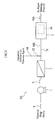
- Fig. 1 schematically shows a papermaking system X1 used for a papermaking method according to the present invention.
- the papermaking system X1 mainly comprises a pump 1, a screen 2, a head box 3 and a piping connecting these members to each other for making paper from a material pulp slurry S by the papermaking method.
- the pump 1 supplies the material pulp slurry S formed in a pulping step and containing pulp fibers to the screen 2 at a predetermined pressure.
- the screen 2 removes impurities from the material pulp slurry S and makes the thickness of the material pulp slurry S uniform.
- the material pulp slurry S passes through an extremely narrow space under a contact pressure from a non-illustrated roller. Thus, a relatively large shearing force is applied to the pulp fibers contained in the material pulp slurry S.
- the head box 3 which constitutes part of a paper machine, serves to eject a mixed pulp slurry MS onto a wire element 4 traveling endlessly.
- the mixed pulp slurry MS is obtained by adding a viscous agent P (which will be described later) to the material pulp slurry S.
- the head box 3 includes a manifold 30 having a cell-structure made up of a plurality of pipes 31. By causing the mixed pulp slurry MS to flow through the manifold 30, the pulp fibers contained in the mixed pulp slurry MS are dispersed.
- Each of the pipes 31 includes an introduction end 31a and a discharge end 31b, and the cross sectional area of each pipe increases stepwise as progressing from the introduction end 31a toward the discharge end 31b.
- Examples of paper machine including a manifold like the manifold 30 include a crescent former, a twin wire paper machine and a Fourdrinier machine, which are high-speed paper machines whose papermaking speed is relatively high.
- the head box 3 includes a discharge opening 3a on the downstream side of the manifold 30.
- the mixed pulp slurry MS discharged from the manifold 30 is ejected onto the wire element 4 through the discharge opening 3a.
- the discharge opening 3a is tapered toward the downstream side.
- the screen 2 and the head box 3 are connected to each other via a pipe 21.
- a pipe 22 for adding a viscous agent solution M is connected to the pipe 21.
- An example of viscous agent solution M to be added is polyethylene oxide-based aqueous solution.
- the material pulp slurry S having passed through the screen 2 is introduced into the pipe 21.
- An aqueous solution of polyethylene oxide as the viscous agent solution M is added to the material pulp slurry S through the pipe 22.
- the aqueous solution is prepared in advance to have a polyethylene oxide concentration in the range of 0.03 to 0.4 wt %.
- the aqueous solution of polyethylene oxide may be prepared by dissolving powder of polyethylene oxide in water contained in a bath made of stainless steel while stirring the water using a stirrer provided at the bath.
- the material pulp slurry S and the viscous agent solution M are mixed within the pipe 21 to form the mixed pulp slurry MS, and the mixed pulp slurry MS is supplied to the head box 3.
- the mixed pulp slurry MS is introduced into the manifold 30 (the pipes 31). Since the cross sectional area of each pipe 31 is relatively small at a portion adjacent to the introduction end 31a, the mixed pulp slurry MS flows through this portion at a relatively high speed. Since the cross sectional area of the pipe increases stepwise as progressing toward the discharge end 31b, the speed of the flow of the mixed pulp slurry MS decreases stepwise. As a result, an eddy is generated within the pipe 31, whereby a relatively large shearing force is applied to the mixed pulp slurry MS. By the effect of the shearing force, the pulp fibers contained in the mixed pulp slurry MS are dispersed effectively. The viscous agent solution M is dispersed and mixed into the material pulp slurry S without being considerably deteriorated by the eddy generated in the pipe 31.
- the mixed pulp slurry MS in which the pulp fibers are properly dispersed by passing through the manifold 30 (pipes 31), undergoes a proper decrease of viscosity due to the shearing and is ejected from the discharge ends 31b onto the running wire element 4 through the discharge opening 3a.
- the pulp fibers contained in the mixed pulp slurry MS are dispersed uniformly. Thereafter, the mixed pulp slurry MS is dewatered, and the process steps such as pressing and drying are performed to provide paper as a finished product.
- the use of a polyethylene oxide-based viscous agent has good effect even when a high-speed paper machine incorporating a manifold having a cell-structure is used.
- a polyethylene oxide-based viscous agent has been conventionally used for papermaking by a cylinder machine
- the use of a polyethylene oxide-based viscous agent for papermaking by a high-speed paper machine has been avoided because the reduction of viscosity is considerable and the pulp dispersion effect cannot be obtained.
- the concentration of the viscous agent solution M to be added to the material pulp slurry S is 0.03 to 0.4 wt %, and more preferably, 0.03 to 0.2 wt %.
- the concentration of the viscous agent solution M to be added is not more than 0.03 wt %, the pulp dispersion effect of the viscous agent solution is deteriorated due to the reduction of viscosity by the shearing in the head box 3, and hence, the formation of paper is hardly improved.
- the concentration of the viscous agent solution M to be added exceeds 0.4 wt %, the viscous agent solution M is not sufficiently mixed with the material pulp slurry S in the head box because of the high viscosity of the viscous agent solution M.
- the viscous agent solution partially agglomerates into a strip or a block, whereby the dispersion of the pulp fibers is hindered. In this case, failures such as paper breakage may occur, and stable papermaking may not be performed.
- the produced paper may include defects such as specks and/or holes, whereby the quality of paper deteriorates.
- the concentration of the viscous agent solution M to be added is 0.03 to 0.4 wt %, the pulp dispersion effect is properly exhibited, and the defects such as specks and/or holes are prevented.
- the papermaking method according to the present invention paper having excellent formation is obtained, and thus, the improvement of the quality is achieved.
- the use of a proper viscous agent reduces the failures such as paper breakage due to insufficient dispersion of pulp fibers, and hence, stable papermaking is possible.
- the yield of papermaking is enhanced, and the production efficiency is improved.
- the amount of the viscous agent to be used depends on the kind of paper and is not limited to a particular value, the amount of 0.001 to 1.0 %, and preferably 0.01 to 0.5 % relative to the dry weight of the paper to be produced is considered effective.
- the viscous agent solution M does not necessarily need to be added through the pipe 22 connected to the pipe 21 which connects the screen 2 and the head box 3 to each other.
- the viscous agent be added at a position between the screen 2 and the head box 3, i.e., at a position downstream from the screen 2 and upstream from the head box 3. This is because, when the viscous agent solution M is added at a position upstream from the screen 2, the viscosity decreases by the shearing in the screen 2, so that the pulp dispersion effect by the viscous agent may not be exhibited.
- the papermaking method according to the present invention is preferably applicable to the making of thin paper such as tissue paper or toilet paper having a basis weight of not more than about 60g/m 2 , but is not limited thereto.
- Paper was made from a material pulp slurry S using the papermaking system X1 according to the above-described embodiment.
- a crescent former was operated to run at a speed of 800m/min to form tissue paper having a basis weight of 13 g/m 2 .
- As the material pulp slurry S a slurry of 0.15 wt % was prepared from NBKP (conifer pulp) and LBKP (broadleaf pulp) of 640 mlcsf beating degree (Canadian Standard Freeness) mixed at the ratio of 40 to 60 (weight ratio).
- the viscous agent solution M use was made of an aqueous solution of polyethylene oxide having a concentration of 0.07 wt %, which was prepared by dissolving polyethylene oxide (Tradename:PEO-27,Viscosity average molecular weight:7500000, available from Sumitomo Seika Chemicals Co., Ltd.) in water while stirring.
- polyethylene oxide Tradename:PEO-27,Viscosity average molecular weight:7500000, available from Sumitomo Seika Chemicals Co., Ltd.
- the amount of the viscous agent used was 0.1 % relative to the dry weight of the paper produced.
- the paper made as above was examined for the improvement of formation.
- the formation was checked by visual inspection, and the result is given in Table 1.
- Table 1 the mark 0 indicates that the formation is considerably improved, i.e., the pulp fibers are uniformly dispersed and holes and/or agglomeration of pulp fibers are hardly found, the mark ⁇ indicates that the improvement of formation is hardly found, and the mark x indicates that the formation is poor, i.e. , holes and/or agglomeration of pulp fibers are found or a papermaking failure such as breakage of paper is caused.
- Example 2 paper was made under the same conditions as those of Example 1 except that the aqueous solution of polyethylene oxide used as the viscous agent solution M had the concentration of 0.03 wt %.
- the examination result of the formation of the paper obtained by this example is also given in Table 1.
- a Fourdrinier machine was used as the paper machine. Specifically, the Fourdrinier machine was operated to run at a speed of 1100m/min to form tissue paper having a basis weight of 17 g/m 2 .
- a slurry of 0.12 wt % was prepared from NBKP and LBKP of 660 mlcsf beating degree (Canadian Standard Freeness) mixed at the ratio of 60 to 40 (weight ratio).
- the viscous agent solution use was made of an aqueous solution of polyethylene oxide having a concentration of 0.06 wt %, which was prepared by dissolving polyethylene oxide (PEO-27) in water while stirring.
- the polyethylene oxide solution was supplied into the pipe 21 between the screen 2 and the head box 3.
- the amount of the viscous agent used was 0.15 % relative to the dry weight of the paper produced.
- the examination result of the formation of the paper obtained by this example is also given in Table 1.
- Example 3 The same paper machine as that of Example 3 was operated to run at a speed of 1000m/min to form tissue paper having a basis weight of 15 g/m 2 .
- material pulp slurry S a slurry of 0.12 wt % was prepared from NBKP and LBKP of 660 mlcsf beating degree (Canadian Standard Freeness) mixed at the ratio of 60 to 40 (weight ratio).
- the viscous agent solution use was made of an aqueous solution of polyethylene oxide having a concentration of 0.15 wt %, which was prepared by dissolving polyethylene oxide (PEO-27) in water while stirring. In the papermaking process, the polyethylene oxide solution was supplied into the pipe 21 between the screen 2 and the head box 3. The amount of the viscous agent used was 0.15 % relative to the dry weight of the paper produced.
- the examination result of the formation of the paper obtained by this example is also given in Table 1.
- the viscous agent solution M used in Examples 1-4 had a high concentration within a predetermined range, the formation of the paper was better than that of the paper formed using a viscous agent solution M of a lower concentration like Comparative Example 1.
- the concentration (0.01 wt %) of the viscous agent solution M used in the Comparative Example 1 is close to the upper limit of the concentration range (not more than about 0.01 wt %) of polyethylene oxide solution conventionally known as appropriate for use for papermaking (using a cylinder machine).
- the viscous agent solution M used in Comparative Example 2 had a concentration higher than the predetermined range, the viscous agent solution M agglomerated in the papermaking process due to the high viscosity to cause failures such as the breakage of the paper.
Landscapes
- Chemical & Material Sciences (AREA)
- Chemical Kinetics & Catalysis (AREA)
- Paper (AREA)
Abstract
Description
- The present invention relates to a method and a system for performing papermaking using a paper machine provided with a head box including a manifold having a cell-structure.
- Generally, a paper manufacturing process includes a pulp step for forming a material pulp slurry and a papermaking step for making paper from the pulp slurry. In the pulp step, a material pulp slurry is prepared by forming chips from wood and performing digestion, cleaning, picking, bleaching and so on. In the papermaking step, the material pulp slurry is supplied from a head box onto a wire element for dewatering, and then processes such as pressing and drying are performed to produce paper.
- Various kinds of paper machines are known such as a cylinder machine, a Fourdrinier machine, a "tanmo" machine, a twin wire machine and a crescent former.
- Generally, in the papermaking process using a cylinder machine, a large shearing force is not mechanically applied to the material pulp slurry in the head box, so that the pulp is not sufficiently dispersed. Thus, to produce paper having a relatively low basis weight such as tissue paper or toilet paper using a cylinder machine, a viscous agent for dispersing pulp is generally used. For instance, polyethylene oxide may be used as the viscous agent. Specifically, an aqueous solution of polyethylene oxide having the concentration of not more than about 0.01 wt % and appropriate viscosity may be added to the material pulp slurry. Owing to the pulp dispersion effect of the viscous agent added in the papermaking process, paper in which pulp fibers is uniformly dispersed and which has excellent formation is obtained.
- Paper machines such as a Fourdrinier machine, a "tanmo" machine, a twin wire machine and a crescent former (hereinafter, these machines are referred to as "high-speed paper machines"), which have been developed to achieve a productivity higher than that of a cylinder machine and whose papermaking speed (wire traveling speed) is relatively high, include a manifold having a cell-structure and provided in a head box. In these machines, therefore, when the material pulp slurry passes through the manifold, a large shearing force is applied to the material pulp slurry, whereby the slurry is mechanically dispersed. Thus, by using a high-speed paper machine, low-basis-weight paper having excellent formation is obtained without using a viscous agent. However, as compared with the papermaking process using a cylinder machine, the time taken for dewatering on the wire element in the papermaking process using a high-speed paper machine is shorter, because of the higher papermaking speed. Further, since a viscous agent is not used, the dispersion of pulp on the wire element in a high-speed paper machine is inferior to that in a cylinder machine. As a result, although the productivity of a high-speed paper machine is higher than that of a cylinder machine, the quality of the obtained paper in terms of the formation is lower.
- In recent years, competition for high quality paper is heating up in the field of papermaking, and a system capable of stably and easily making paper having excellent formation is demanded. Although improvement of paper machines is being carried out, studies of the addition of an agent for improving the pulp dispersion in a high-speed paper machine are not making much progress. A conceivable reason for this is that, even if such a viscous agent as a polyethylene oxide-based viscous agent, which is known to be relatively vulnerable to shearing, is used for a high-speed paper machine, the viscous agent is sheared due to a large shearing force applied within the head box. As a result, the viscosity is reduced, and hence, the effect of the viscous agent is reduced,' so that the improvement of the formation like that obtained in the case of a cylinder machine is not expected.
- Although the
Patent Document 1 described below discloses a viscous agent to replace polyethylene oxide, only a cylinder machine is disclosed as the application. - Patent Document 1:
JP-A 2000-290892 - An object of the present invention, which is proposed in view of the above-described problems of the prior art, is to provide a papermaking method and a papermaking system capable of making paper having excellent formation even by the use of a high-speed paper machine by optimizing the concentration of a viscous agent solution to be added to the material pulp slurry.
- To solve the above-described problems, the inventors of the present invention have studied changes in viscosity of aqueous solution of polyethylene oxide caused by shearing to find that the viscosity is hardly degraded by shearing when the aqueous solution has a concentration higher than a predetermined value. By applying this result of the studies to papermaking, the inventors have found that paper having excellent formation is obtained even by the use of a high-speed paper machine and achieved the present invention.
- According to a first aspect of the present invention, there is provided a method of making paper using a paper machine provided with a head box including a manifold having a cell-structure. The method comprises the steps of adding an aqueous solution of a viscous agent having a concentration of 0.03 to 0.4 wt % to a material pulp slurry, and introducing a mixed pulp slurry containing the material pulp slurry and the aqueous solution of the viscous agent into the manifold.
- With the above-described papermaking method, the pulp dispersion effect by a viscous agent is properly exhibited even in a paper machine which includes a cell-structure manifold in the head box. As a result, paper in which pulp fibers are uniformly dispersed and which has excellent formation is obtained. In this way, according to this papermaking method, a viscous agent is effectively used to improve the quality of paper.
- Further, with the papermaking method according to the present invention, the use of a proper viscous agent reduces the defects such as the breakage of paper due to insufficient dispersion of pulp fibers, and hence, stable papermaking is possible. Thus, the yield of papermaking is enhanced, and the production efficiency is improved.
- Preferably, the addition of the aqueous solution of the viscous agent is performed between the head box and a screen located closest to the head box. In this case, the pulp dispersion effect by the viscous agent is properly exhibited.
- Preferably, the viscous agent is a polyethylene oxide-based viscous agent. Preferably, in this case, the viscous agent may comprise solely of polyethylene oxide.
- According to a second aspect of the present invention, there is provided a papermaking system comprising a screen for removing impurities from a material pulp slurry, a paper machine provided with a head box including a manifold having a cell-structure arranged on a downstream side of the screen, and viscous agent adding means for supplying an aqueous solution of viscous agent having a concentration of 0.03 to 0.4 wt % into a pipe connecting the screen and the head box to each other.
- Preferably, the viscous agent is a polyethylene oxide-based viscous agent.
- Other features and advantages of the present invention will become more apparent from the detailed description given below with reference to the accompanying drawings.
-
-
Fig. 1 shows the schematic structure of an example of papermaking system used for a papermaking method according to the present invention. -
Fig. 2 is a longitudinal sectional view schematically showing a principal portion of a head box. -
Fig. 3 is a perspective view showing an example of manifold. -
Fig. 1 schematically shows a papermaking system X1 used for a papermaking method according to the present invention. The papermaking system X1 mainly comprises apump 1, ascreen 2, ahead box 3 and a piping connecting these members to each other for making paper from a material pulp slurry S by the papermaking method. - The
pump 1 supplies the material pulp slurry S formed in a pulping step and containing pulp fibers to thescreen 2 at a predetermined pressure. - The
screen 2 removes impurities from the material pulp slurry S and makes the thickness of the material pulp slurry S uniform. When the material pulp slurry S is supplied to thescreen 2, the material pulp slurry S passes through an extremely narrow space under a contact pressure from a non-illustrated roller. Thus, a relatively large shearing force is applied to the pulp fibers contained in the material pulp slurry S. - As shown in
Fig. 2 , thehead box 3, which constitutes part of a paper machine, serves to eject a mixed pulp slurry MS onto awire element 4 traveling endlessly. The mixed pulp slurry MS is obtained by adding a viscous agent P (which will be described later) to the material pulp slurry S. As shown inFig. 3 , thehead box 3 includes amanifold 30 having a cell-structure made up of a plurality ofpipes 31. By causing the mixed pulp slurry MS to flow through themanifold 30, the pulp fibers contained in the mixed pulp slurry MS are dispersed. Each of thepipes 31 includes anintroduction end 31a and adischarge end 31b, and the cross sectional area of each pipe increases stepwise as progressing from theintroduction end 31a toward thedischarge end 31b. Examples of paper machine including a manifold like themanifold 30 include a crescent former, a twin wire paper machine and a Fourdrinier machine, which are high-speed paper machines whose papermaking speed is relatively high. Thehead box 3 includes adischarge opening 3a on the downstream side of themanifold 30. The mixed pulp slurry MS discharged from themanifold 30 is ejected onto thewire element 4 through thedischarge opening 3a. In the illustrated embodiment, thedischarge opening 3a is tapered toward the downstream side. - The
screen 2 and thehead box 3 are connected to each other via apipe 21. Apipe 22 for adding a viscous agent solution M is connected to thepipe 21. An example of viscous agent solution M to be added is polyethylene oxide-based aqueous solution. - When the papermaking system X1 having the above-described structure is operated, the material pulp slurry S is supplied to the
screen 2 by the operation of thepump 1. - In the
screen 2, unnecessary components such as impurities are removed from the material pulp slurry S, and a relatively large shearing force is applied to the pulp fibers contained in the material pulp slurry S. Thus, the initially agglomerated pulp fibers are dispersed to some degree. - The material pulp slurry S having passed through the
screen 2 is introduced into thepipe 21. An aqueous solution of polyethylene oxide as the viscous agent solution M is added to the material pulp slurry S through thepipe 22. The aqueous solution is prepared in advance to have a polyethylene oxide concentration in the range of 0.03 to 0.4 wt %. For instance, the aqueous solution of polyethylene oxide may be prepared by dissolving powder of polyethylene oxide in water contained in a bath made of stainless steel while stirring the water using a stirrer provided at the bath. The material pulp slurry S and the viscous agent solution M are mixed within thepipe 21 to form the mixed pulp slurry MS, and the mixed pulp slurry MS is supplied to thehead box 3. - In the
head box 3, the mixed pulp slurry MS is introduced into the manifold 30 (the pipes 31). Since the cross sectional area of eachpipe 31 is relatively small at a portion adjacent to theintroduction end 31a, the mixed pulp slurry MS flows through this portion at a relatively high speed. Since the cross sectional area of the pipe increases stepwise as progressing toward thedischarge end 31b, the speed of the flow of the mixed pulp slurry MS decreases stepwise. As a result, an eddy is generated within thepipe 31, whereby a relatively large shearing force is applied to the mixed pulp slurry MS. By the effect of the shearing force, the pulp fibers contained in the mixed pulp slurry MS are dispersed effectively. The viscous agent solution M is dispersed and mixed into the material pulp slurry S without being considerably deteriorated by the eddy generated in thepipe 31. - The mixed pulp slurry MS, in which the pulp fibers are properly dispersed by passing through the manifold 30 (pipes 31), undergoes a proper decrease of viscosity due to the shearing and is ejected from the discharge ends 31b onto the
running wire element 4 through thedischarge opening 3a. On thewire element 4, by the pulp dispersion effect of the viscous agent, the pulp fibers contained in the mixed pulp slurry MS are dispersed uniformly. Thereafter, the mixed pulp slurry MS is dewatered, and the process steps such as pressing and drying are performed to provide paper as a finished product. - In the papermaking method by the papermaking system X1 according to the present invention, the use of a polyethylene oxide-based viscous agent has good effect even when a high-speed paper machine incorporating a manifold having a cell-structure is used. Specifically, although a polyethylene oxide-based viscous agent has been conventionally used for papermaking by a cylinder machine, the use of a polyethylene oxide-based viscous agent for papermaking by a high-speed paper machine has been avoided because the reduction of viscosity is considerable and the pulp dispersion effect cannot be obtained. Under such circumstances, the inventors of the present invention sought the way to effectively use polyethylene oxide, which is stably produced industrially and has been used as an effective viscous agent for a cylinder machine, for a high-speed paper machine. As a result, the inventors have found that, when a polyethylene oxide-based viscous agent solution has a concentration (0.03 to 0.4 wt %) which is considerably higher than that (not higher than about 0.01 wt %) of a solution used for a cylinder machine, proper pulp dispersion effect is exhibited, and paper having excellent formation is obtained.
- In the papermaking method of the present invention, it is preferable that the concentration of the viscous agent solution M to be added to the material pulp slurry S is 0.03 to 0.4 wt %, and more preferably, 0.03 to 0.2 wt %.
- When the concentration of the viscous agent solution M to be added is not more than 0.03 wt %, the pulp dispersion effect of the viscous agent solution is deteriorated due to the reduction of viscosity by the shearing in the
head box 3, and hence, the formation of paper is hardly improved. When the concentration of the viscous agent solution M to be added exceeds 0.4 wt %, the viscous agent solution M is not sufficiently mixed with the material pulp slurry S in the head box because of the high viscosity of the viscous agent solution M. As a result, the viscous agent solution partially agglomerates into a strip or a block, whereby the dispersion of the pulp fibers is hindered. In this case, failures such as paper breakage may occur, and stable papermaking may not be performed. Further, the produced paper may include defects such as specks and/or holes, whereby the quality of paper deteriorates. - However, when the concentration of the viscous agent solution M to be added is 0.03 to 0.4 wt %, the pulp dispersion effect is properly exhibited, and the defects such as specks and/or holes are prevented. Thus, with the papermaking method according to the present invention, paper having excellent formation is obtained, and thus, the improvement of the quality is achieved.
- Further, with the papermaking method according to the present invention, the use of a proper viscous agent reduces the failures such as paper breakage due to insufficient dispersion of pulp fibers, and hence, stable papermaking is possible. Thus, the yield of papermaking is enhanced, and the production efficiency is improved.
- In view of the pulp dispersion effect and the convenience in handling, it is preferable that the viscous agent (polyethylene oxide) used in the papermaking method according to the present invention has a viscosity average molecular weight of 3 million to 11 million, and preferably, 4 million to 9 million.
- Although the amount of the viscous agent to be used depends on the kind of paper and is not limited to a particular value, the amount of 0.001 to 1.0 %, and preferably 0.01 to 0.5 % relative to the dry weight of the paper to be produced is considered effective.
- The viscous agent solution M does not necessarily need to be added through the
pipe 22 connected to thepipe 21 which connects thescreen 2 and thehead box 3 to each other. However, to properly exhibit the pulp dispersion effect by the viscous agent, it is preferable that the viscous agent be added at a position between thescreen 2 and thehead box 3, i.e., at a position downstream from thescreen 2 and upstream from thehead box 3. This is because, when the viscous agent solution M is added at a position upstream from thescreen 2, the viscosity decreases by the shearing in thescreen 2, so that the pulp dispersion effect by the viscous agent may not be exhibited. - The papermaking method according to the present invention is preferably applicable to the making of thin paper such as tissue paper or toilet paper having a basis weight of not more than about 60g/m2, but is not limited thereto.
- Examples of the present invention will be described below together with comparative examples.
- Paper was made from a material pulp slurry S using the papermaking system X1 according to the above-described embodiment. As the paper machine, a crescent former was operated to run at a speed of 800m/min to form tissue paper having a basis weight of 13 g/m2. As the material pulp slurry S, a slurry of 0.15 wt % was prepared from NBKP (conifer pulp) and LBKP (broadleaf pulp) of 640 mlcsf beating degree (Canadian Standard Freeness) mixed at the ratio of 40 to 60 (weight ratio). As the viscous agent solution M, use was made of an aqueous solution of polyethylene oxide having a concentration of 0.07 wt %, which was prepared by dissolving polyethylene oxide (Tradename:PEO-27,Viscosity average molecular weight:7500000, available from Sumitomo Seika Chemicals Co., Ltd.) in water while stirring. In the papermaking process, the polyethylene oxide solution was supplied into the
pipe 21 between thescreen 2 and thehead box 3. The amount of the viscous agent used was 0.1 % relative to the dry weight of the paper produced. - The paper made as above was examined for the improvement of formation. The formation was checked by visual inspection, and the result is given in Table 1. In Table 1, the mark 0 indicates that the formation is considerably improved, i.e., the pulp fibers are uniformly dispersed and holes and/or agglomeration of pulp fibers are hardly found, the mark Δ indicates that the improvement of formation is hardly found, and the mark x indicates that the formation is poor, i.e. , holes and/or agglomeration of pulp fibers are found or a papermaking failure such as breakage of paper is caused.
- In Example 2, paper was made under the same conditions as those of Example 1 except that the aqueous solution of polyethylene oxide used as the viscous agent solution M had the concentration of 0.03 wt %. The examination result of the formation of the paper obtained by this example is also given in Table 1.
- In this example, a Fourdrinier machine was used as the paper machine. Specifically, the Fourdrinier machine was operated to run at a speed of 1100m/min to form tissue paper having a basis weight of 17 g/m2. As the material pulp slurry S, a slurry of 0.12 wt % was prepared from NBKP and LBKP of 660 mlcsf beating degree (Canadian Standard Freeness) mixed at the ratio of 60 to 40 (weight ratio). As the viscous agent solution, use was made of an aqueous solution of polyethylene oxide having a concentration of 0.06 wt %, which was prepared by dissolving polyethylene oxide (PEO-27) in water while stirring. In the papermaking process, the polyethylene oxide solution was supplied into the
pipe 21 between thescreen 2 and thehead box 3. The amount of the viscous agent used was 0.15 % relative to the dry weight of the paper produced. The examination result of the formation of the paper obtained by this example is also given in Table 1. - The same paper machine as that of Example 3 was operated to run at a speed of 1000m/min to form tissue paper having a basis weight of 15 g/m2. As the material pulp slurry S, a slurry of 0.12 wt % was prepared from NBKP and LBKP of 660 mlcsf beating degree (Canadian Standard Freeness) mixed at the ratio of 60 to 40 (weight ratio). As the viscous agent solution, use was made of an aqueous solution of polyethylene oxide having a concentration of 0.15 wt %, which was prepared by dissolving polyethylene oxide (PEO-27) in water while stirring. In the papermaking process, the polyethylene oxide solution was supplied into the
pipe 21 between thescreen 2 and thehead box 3. The amount of the viscous agent used was 0.15 % relative to the dry weight of the paper produced. The examination result of the formation of the paper obtained by this example is also given in Table 1. - In this comparative example, paper was made under the same conditions as those of Example 1 except that the aqueous solution of polyethylene oxide used as the viscous agent solution M had a concentration of 0.01 wt %. The examination result of the formation of the paper obtained by this comparative example is also given in Table 1.
- In this comparative example, paper was made under the same conditions as those of Example 3 except that the aqueous solution of polyethylene oxide used as the viscous agent solution M had a concentration of 0.5 wt %. The examination result of the formation of the paper obtained by this comparative example is also given in Table 1.
- In this comparative example, paper was made under the same conditions as those of Comparative Example 1 except that a cylinder machine was uses as the paper machine. The examination result of the formation of the paper obtained by this comparative example is also given in Table 1.
[Table 1] Example 1 Example 2 Example 3 Example 4 Comparative Example 1 Comparative Example 2 Comparative Example 3 Paper machine Crescent former Fourdrinier Crescent former Fourdrinier Cylinder machine Target Paper tissue paper Paper making speed (m/min) 800 800 1100 1000 800 1100 800 Basis weight (g/m2) 13 13 17 15 13 17 13 Viscous agent concentration (wt/%) 0.07 0.03 0.06 0.15 0.01 0.5 0.01 Viscous agent amount (relative to dry weight of paper:%) 0.1 0.1 0.15 0.15 0.1 0.15 0.1 Formation improvement ○ ○ ○ ○ Δ × ○ - Since the viscous agent solution M used in Examples 1-4 had a high concentration within a predetermined range, the formation of the paper was better than that of the paper formed using a viscous agent solution M of a lower concentration like Comparative Example 1. Herein, the concentration (0.01 wt %) of the viscous agent solution M used in the Comparative Example 1 is close to the upper limit of the concentration range (not more than about 0.01 wt %) of polyethylene oxide solution conventionally known as appropriate for use for papermaking (using a cylinder machine).
- Since the viscous agent solution M used in Comparative Example 2 had a concentration higher than the predetermined range, the viscous agent solution M agglomerated in the papermaking process due to the high viscosity to cause failures such as the breakage of the paper.
Claims (5)
- A method of making paper using a paper machine provided with a head box including a manifold having a cell-structure, the method comprising the steps of:adding an aqueous solution of a viscous agent having a concentration of 0.03 to 0.4 wt % to a material pulp slurry; andintroducing a mixed pulp slurry containing the material pulp slurry and the aqueous solution of viscous agent into the manifold.
- The papermaking method according to claim 1, wherein the addition of the aqueous solution of viscous agent is performed between the head box and a screen located closest to the head box.
- The papermaking method according to claim 1, wherein the viscous agent is a polyethylene oxide-based viscous agent.
- A papermaking system comprising:a screen for removing impurities from a material pulp slurry;a paper machine provided with a head box including a manifold having a cell-structure arranged downstream from the screen; anda viscous agent adder for supplying an aqueous solution of a viscous agent having a concentration of 0.03 to 0.4 wt % into a pipe connecting the screen and the head box to each other.
- The papermaking system according to claim 4, wherein the viscous agent is a polyethylene oxide-based viscous agent.
Applications Claiming Priority (2)
| Application Number | Priority Date | Filing Date | Title |
|---|---|---|---|
| JP2005309721 | 2005-10-25 | ||
| PCT/JP2006/321007 WO2007049528A1 (en) | 2005-10-25 | 2006-10-23 | Papermaking method and papermaking system |
Publications (3)
| Publication Number | Publication Date |
|---|---|
| EP1950345A1 true EP1950345A1 (en) | 2008-07-30 |
| EP1950345A4 EP1950345A4 (en) | 2012-03-07 |
| EP1950345B1 EP1950345B1 (en) | 2013-09-11 |
Family
ID=37967640
Family Applications (1)
| Application Number | Title | Priority Date | Filing Date |
|---|---|---|---|
| EP06822028.4A Ceased EP1950345B1 (en) | 2005-10-25 | 2006-10-23 | Papermaking method and papermaking system |
Country Status (11)
| Country | Link |
|---|---|
| US (1) | US20090250182A1 (en) |
| EP (1) | EP1950345B1 (en) |
| JP (1) | JP4839320B2 (en) |
| KR (1) | KR101321465B1 (en) |
| CN (1) | CN101297080B (en) |
| AU (1) | AU2006307310B2 (en) |
| BR (1) | BRPI0617919B1 (en) |
| CA (1) | CA2627471C (en) |
| RU (1) | RU2413810C2 (en) |
| TW (1) | TW200730697A (en) |
| WO (1) | WO2007049528A1 (en) |
Families Citing this family (1)
| Publication number | Priority date | Publication date | Assignee | Title |
|---|---|---|---|---|
| JP4977127B2 (en) * | 2006-03-16 | 2012-07-18 | 住友精化株式会社 | Papermaking method and papermaking machine |
Family Cites Families (18)
| Publication number | Priority date | Publication date | Assignee | Title |
|---|---|---|---|---|
| US3281312A (en) * | 1961-07-05 | 1966-10-25 | Mead Corp | Fibrous product containing resinous material and polyethylene oxide and process thereof |
| US5238534A (en) * | 1992-01-24 | 1993-08-24 | James River Corporation Of Virginia | Wetlaid nonwovens on high speed machines |
| JPH06146189A (en) * | 1992-10-29 | 1994-05-27 | Mitsubishi Heavy Ind Ltd | Head box of paper machine |
| CA2118771A1 (en) * | 1993-04-30 | 1994-10-31 | Charles L. Burdick | Aqueous suspensions of poly(ethylene oxide) useful as retention aid in paper manufacture |
| US5755930A (en) * | 1994-02-04 | 1998-05-26 | Allied Colloids Limited | Production of filled paper and compositions for use in this |
| US5560807A (en) * | 1995-03-29 | 1996-10-01 | Beloit Technologies, Inc. | Headbox additive injection system |
| US6210535B1 (en) * | 1995-06-01 | 2001-04-03 | Valmet Corporation | Stock feed system for a multi-layer headbox and method in the operation of a multi-layer headbox |
| JP3407029B2 (en) * | 1995-06-02 | 2003-05-19 | 独立行政法人産業技術総合研究所 | Papermaking adhesive and papermaking method using the same |
| FI115645B (en) * | 1997-01-14 | 2005-06-15 | Metso Paper Inc | Paper machine inlet box with edge feeding arrangement |
| CA2304709C (en) * | 1997-09-30 | 2007-03-13 | Nalco Chemical Company | Colloidal borosilicates and their use in the production of paper |
| US6117272A (en) * | 1998-09-03 | 2000-09-12 | Voith Sulzer Papiermaschinen | Device and process for metering auxiliary materials into the flow box of a paper machine |
| WO2001021885A1 (en) * | 1999-09-21 | 2001-03-29 | Metso Paper, Inc. | Regulation system for the short circulation and headbox of a paper machine or equivalent |
| FI115540B (en) * | 2000-12-29 | 2005-05-31 | Metso Paper Inc | Plant for conveying pulp to the inlet box of a paper machine or equivalent |
| JP3530499B2 (en) * | 2001-03-19 | 2004-05-24 | 三菱重工業株式会社 | Tube bank structure and flow tube manufacturing method |
| US7244339B2 (en) * | 2003-05-05 | 2007-07-17 | Vergara Lopez German | Retention and drainage system for the manufacturing of paper |
| JP4387828B2 (en) | 2003-08-01 | 2009-12-24 | 大王製紙株式会社 | Carrier tape mount base material and carrier tape |
| JP2005126880A (en) * | 2003-10-02 | 2005-05-19 | Daiyanitorikkusu Kk | Nonionic paper making adhesive |
| JP4522692B2 (en) * | 2003-11-28 | 2010-08-11 | ダイヤニトリックス株式会社 | Paper making adhesive |
-
2006
- 2006-10-23 BR BRPI0617919-3A patent/BRPI0617919B1/en not_active IP Right Cessation
- 2006-10-23 CA CA2627471A patent/CA2627471C/en not_active Expired - Fee Related
- 2006-10-23 JP JP2007542353A patent/JP4839320B2/en active Active
- 2006-10-23 AU AU2006307310A patent/AU2006307310B2/en not_active Ceased
- 2006-10-23 WO PCT/JP2006/321007 patent/WO2007049528A1/en not_active Ceased
- 2006-10-23 KR KR1020087012252A patent/KR101321465B1/en not_active Expired - Fee Related
- 2006-10-23 EP EP06822028.4A patent/EP1950345B1/en not_active Ceased
- 2006-10-23 US US12/084,087 patent/US20090250182A1/en not_active Abandoned
- 2006-10-23 CN CN2006800396093A patent/CN101297080B/en active Active
- 2006-10-23 RU RU2008120194/12A patent/RU2413810C2/en not_active IP Right Cessation
- 2006-10-24 TW TW095139131A patent/TW200730697A/en not_active IP Right Cessation
Also Published As
| Publication number | Publication date |
|---|---|
| US20090250182A1 (en) | 2009-10-08 |
| AU2006307310B2 (en) | 2010-09-23 |
| EP1950345B1 (en) | 2013-09-11 |
| CA2627471A1 (en) | 2007-05-03 |
| JP4839320B2 (en) | 2011-12-21 |
| TWI379931B (en) | 2012-12-21 |
| JPWO2007049528A1 (en) | 2009-04-30 |
| CN101297080A (en) | 2008-10-29 |
| EP1950345A4 (en) | 2012-03-07 |
| KR101321465B1 (en) | 2013-10-25 |
| AU2006307310A1 (en) | 2007-05-03 |
| BRPI0617919A2 (en) | 2011-08-09 |
| CN101297080B (en) | 2011-04-06 |
| CA2627471C (en) | 2013-12-10 |
| BRPI0617919B1 (en) | 2018-02-06 |
| KR20080068093A (en) | 2008-07-22 |
| RU2008120194A (en) | 2009-12-10 |
| WO2007049528A1 (en) | 2007-05-03 |
| TW200730697A (en) | 2007-08-16 |
| RU2413810C2 (en) | 2011-03-10 |
Similar Documents
| Publication | Publication Date | Title |
|---|---|---|
| EP1770209B1 (en) | Method and device for producing a tissue web | |
| JP5016015B2 (en) | Twin wire forming section | |
| FI75200B (en) | FOERFARANDE VID PAPPERSFRAMSTAELLNINGSPROCESS FOER FOERBAETTRING AV EGENSKAPER HOS PAPPERET, SAERSKILT DESS RETENTION. | |
| EP0281273A1 (en) | Cellulosic pulp | |
| EP2784213B1 (en) | Headbox structure for a fiber web machine | |
| EP1070171B1 (en) | Application of a layer of admixture in the web former unit of a board machine | |
| EP1950345B1 (en) | Papermaking method and papermaking system | |
| CN1214388A (en) | Paper production process which incorporates carbon dioxide | |
| US20200407916A1 (en) | Method of forming a three-layer board web and a forming section of forming a three-layer board web | |
| FI104503B (en) | Method for improving the drainage of cellulose pulp | |
| JP4977127B2 (en) | Papermaking method and papermaking machine | |
| FR2836938A1 (en) | IMPROVING PROCESSES FOR MAKING PAPER PRODUCTS BY IMPROVING THE PHYSICO-CHEMICAL BEHAVIOR OF PAPER PULP | |
| CA2531642A1 (en) | Method and arrangement for treating pulp | |
| EP3540117B1 (en) | Multilayer headbox structure for a fiber web machine for forming a fiber web and method for forming a fiber web in a forming section of a fiber web machine | |
| DE10341165A1 (en) | Web transfer | |
| DE102005031067A1 (en) | Press arrangement for pressing and draining e.g. paper web, has endless rotating draining belt that has strong edge regions, and that loops around press roller for draining water from fiber material web in recurring cleaning cycles |
Legal Events
| Date | Code | Title | Description |
|---|---|---|---|
| PUAI | Public reference made under article 153(3) epc to a published international application that has entered the european phase |
Free format text: ORIGINAL CODE: 0009012 |
|
| 17P | Request for examination filed |
Effective date: 20080502 |
|
| AK | Designated contracting states |
Kind code of ref document: A1 Designated state(s): DE FR GB IT |
|
| DAX | Request for extension of the european patent (deleted) | ||
| RBV | Designated contracting states (corrected) |
Designated state(s): DE FR GB IT |
|
| A4 | Supplementary search report drawn up and despatched |
Effective date: 20120208 |
|
| RIC1 | Information provided on ipc code assigned before grant |
Ipc: D21H 23/04 20060101ALI20120203BHEP Ipc: D21H 17/53 20060101ALI20120203BHEP Ipc: D21H 21/06 20060101AFI20120203BHEP |
|
| 17Q | First examination report despatched |
Effective date: 20120719 |
|
| GRAP | Despatch of communication of intention to grant a patent |
Free format text: ORIGINAL CODE: EPIDOSNIGR1 |
|
| INTG | Intention to grant announced |
Effective date: 20130424 |
|
| GRAS | Grant fee paid |
Free format text: ORIGINAL CODE: EPIDOSNIGR3 |
|
| GRAA | (expected) grant |
Free format text: ORIGINAL CODE: 0009210 |
|
| AK | Designated contracting states |
Kind code of ref document: B1 Designated state(s): DE FR GB IT |
|
| REG | Reference to a national code |
Ref country code: GB Ref legal event code: FG4D |
|
| REG | Reference to a national code |
Ref country code: DE Ref legal event code: R096 Ref document number: 602006038398 Country of ref document: DE Effective date: 20131107 |
|
| REG | Reference to a national code |
Ref country code: DE Ref legal event code: R097 Ref document number: 602006038398 Country of ref document: DE |
|
| PLBE | No opposition filed within time limit |
Free format text: ORIGINAL CODE: 0009261 |
|
| STAA | Information on the status of an ep patent application or granted ep patent |
Free format text: STATUS: NO OPPOSITION FILED WITHIN TIME LIMIT |
|
| 26N | No opposition filed |
Effective date: 20140612 |
|
| REG | Reference to a national code |
Ref country code: DE Ref legal event code: R097 Ref document number: 602006038398 Country of ref document: DE Effective date: 20140612 |
|
| REG | Reference to a national code |
Ref country code: FR Ref legal event code: PLFP Year of fee payment: 10 |
|
| REG | Reference to a national code |
Ref country code: FR Ref legal event code: PLFP Year of fee payment: 11 |
|
| REG | Reference to a national code |
Ref country code: FR Ref legal event code: PLFP Year of fee payment: 12 |
|
| REG | Reference to a national code |
Ref country code: FR Ref legal event code: PLFP Year of fee payment: 13 |
|
| PGFP | Annual fee paid to national office [announced via postgrant information from national office to epo] |
Ref country code: DE Payment date: 20201022 Year of fee payment: 15 Ref country code: IT Payment date: 20201026 Year of fee payment: 15 Ref country code: FR Payment date: 20201022 Year of fee payment: 15 Ref country code: GB Payment date: 20201022 Year of fee payment: 15 |
|
| REG | Reference to a national code |
Ref country code: DE Ref legal event code: R119 Ref document number: 602006038398 Country of ref document: DE |
|
| GBPC | Gb: european patent ceased through non-payment of renewal fee |
Effective date: 20211023 |
|
| PG25 | Lapsed in a contracting state [announced via postgrant information from national office to epo] |
Ref country code: GB Free format text: LAPSE BECAUSE OF NON-PAYMENT OF DUE FEES Effective date: 20211023 Ref country code: DE Free format text: LAPSE BECAUSE OF NON-PAYMENT OF DUE FEES Effective date: 20220503 |
|
| PG25 | Lapsed in a contracting state [announced via postgrant information from national office to epo] |
Ref country code: FR Free format text: LAPSE BECAUSE OF NON-PAYMENT OF DUE FEES Effective date: 20211031 |
|
| PG25 | Lapsed in a contracting state [announced via postgrant information from national office to epo] |
Ref country code: IT Free format text: LAPSE BECAUSE OF NON-PAYMENT OF DUE FEES Effective date: 20211023 |