EP1949896A2 - Linear dicationic terphenyls and their aza analogues as antiparasitic agents - Google Patents
Linear dicationic terphenyls and their aza analogues as antiparasitic agents Download PDFInfo
- Publication number
- EP1949896A2 EP1949896A2 EP08150205A EP08150205A EP1949896A2 EP 1949896 A2 EP1949896 A2 EP 1949896A2 EP 08150205 A EP08150205 A EP 08150205A EP 08150205 A EP08150205 A EP 08150205A EP 1949896 A2 EP1949896 A2 EP 1949896A2
- Authority
- EP
- European Patent Office
- Prior art keywords
- compound
- formula
- group
- alkyl
- bis
- Prior art date
- Legal status (The legal status is an assumption and is not a legal conclusion. Google has not performed a legal analysis and makes no representation as to the accuracy of the status listed.)
- Withdrawn
Links
- 0 Cc1cnc(*)cc1 Chemical compound Cc1cnc(*)cc1 0.000 description 21
- CEYZMDTUSWMVCO-UHFFFAOYSA-N Cc1ccc(N)[o]1 Chemical compound Cc1ccc(N)[o]1 CEYZMDTUSWMVCO-UHFFFAOYSA-N 0.000 description 2
- UCAXJTJOUVPKAU-PLNGDYQASA-N C/C(/N)=C(\C)/N=C Chemical compound C/C(/N)=C(\C)/N=C UCAXJTJOUVPKAU-PLNGDYQASA-N 0.000 description 1
- GGTSIZFYYBLXAW-UHFFFAOYSA-N CC1(C)C=C(C)OC(C)=C1 Chemical compound CC1(C)C=C(C)OC(C)=C1 GGTSIZFYYBLXAW-UHFFFAOYSA-N 0.000 description 1
- HJXTVSMDRJYGQX-UHFFFAOYSA-N CC1=C(C(C2)C2N)OC(C)=N[N]1 Chemical compound CC1=C(C(C2)C2N)OC(C)=N[N]1 HJXTVSMDRJYGQX-UHFFFAOYSA-N 0.000 description 1
Classifications
-
- C—CHEMISTRY; METALLURGY
- C07—ORGANIC CHEMISTRY
- C07C—ACYCLIC OR CARBOCYCLIC COMPOUNDS
- C07C257/00—Compounds containing carboxyl groups, the doubly-bound oxygen atom of a carboxyl group being replaced by a doubly-bound nitrogen atom, this nitrogen atom not being further bound to an oxygen atom, e.g. imino-ethers, amidines
- C07C257/10—Compounds containing carboxyl groups, the doubly-bound oxygen atom of a carboxyl group being replaced by a doubly-bound nitrogen atom, this nitrogen atom not being further bound to an oxygen atom, e.g. imino-ethers, amidines with replacement of the other oxygen atom of the carboxyl group by nitrogen atoms, e.g. amidines
- C07C257/18—Compounds containing carboxyl groups, the doubly-bound oxygen atom of a carboxyl group being replaced by a doubly-bound nitrogen atom, this nitrogen atom not being further bound to an oxygen atom, e.g. imino-ethers, amidines with replacement of the other oxygen atom of the carboxyl group by nitrogen atoms, e.g. amidines having carbon atoms of amidino groups bound to carbon atoms of six-membered aromatic rings
-
- A—HUMAN NECESSITIES
- A61—MEDICAL OR VETERINARY SCIENCE; HYGIENE
- A61P—SPECIFIC THERAPEUTIC ACTIVITY OF CHEMICAL COMPOUNDS OR MEDICINAL PREPARATIONS
- A61P31/00—Antiinfectives, i.e. antibiotics, antiseptics, chemotherapeutics
- A61P31/04—Antibacterial agents
-
- A—HUMAN NECESSITIES
- A61—MEDICAL OR VETERINARY SCIENCE; HYGIENE
- A61P—SPECIFIC THERAPEUTIC ACTIVITY OF CHEMICAL COMPOUNDS OR MEDICINAL PREPARATIONS
- A61P33/00—Antiparasitic agents
-
- A—HUMAN NECESSITIES
- A61—MEDICAL OR VETERINARY SCIENCE; HYGIENE
- A61P—SPECIFIC THERAPEUTIC ACTIVITY OF CHEMICAL COMPOUNDS OR MEDICINAL PREPARATIONS
- A61P33/00—Antiparasitic agents
- A61P33/02—Antiprotozoals, e.g. for leishmaniasis, trichomoniasis, toxoplasmosis
-
- A—HUMAN NECESSITIES
- A61—MEDICAL OR VETERINARY SCIENCE; HYGIENE
- A61P—SPECIFIC THERAPEUTIC ACTIVITY OF CHEMICAL COMPOUNDS OR MEDICINAL PREPARATIONS
- A61P33/00—Antiparasitic agents
- A61P33/02—Antiprotozoals, e.g. for leishmaniasis, trichomoniasis, toxoplasmosis
- A61P33/06—Antimalarials
-
- C—CHEMISTRY; METALLURGY
- C07—ORGANIC CHEMISTRY
- C07C—ACYCLIC OR CARBOCYCLIC COMPOUNDS
- C07C259/00—Compounds containing carboxyl groups, an oxygen atom of a carboxyl group being replaced by a nitrogen atom, this nitrogen atom being further bound to an oxygen atom and not being part of nitro or nitroso groups
- C07C259/12—Compounds containing carboxyl groups, an oxygen atom of a carboxyl group being replaced by a nitrogen atom, this nitrogen atom being further bound to an oxygen atom and not being part of nitro or nitroso groups with replacement of the other oxygen atom of the carboxyl group by nitrogen atoms, e.g. N-hydroxyamidines
- C07C259/18—Compounds containing carboxyl groups, an oxygen atom of a carboxyl group being replaced by a nitrogen atom, this nitrogen atom being further bound to an oxygen atom and not being part of nitro or nitroso groups with replacement of the other oxygen atom of the carboxyl group by nitrogen atoms, e.g. N-hydroxyamidines having carbon atoms of hydroxamidine groups bound to carbon atoms of six-membered aromatic rings
-
- C—CHEMISTRY; METALLURGY
- C07—ORGANIC CHEMISTRY
- C07C—ACYCLIC OR CARBOCYCLIC COMPOUNDS
- C07C279/00—Derivatives of guanidine, i.e. compounds containing the group, the singly-bound nitrogen atoms not being part of nitro or nitroso groups
- C07C279/18—Derivatives of guanidine, i.e. compounds containing the group, the singly-bound nitrogen atoms not being part of nitro or nitroso groups having nitrogen atoms of guanidine groups bound to carbon atoms of six-membered aromatic rings
-
- C—CHEMISTRY; METALLURGY
- C07—ORGANIC CHEMISTRY
- C07C—ACYCLIC OR CARBOCYCLIC COMPOUNDS
- C07C279/00—Derivatives of guanidine, i.e. compounds containing the group, the singly-bound nitrogen atoms not being part of nitro or nitroso groups
- C07C279/20—Derivatives of guanidine, i.e. compounds containing the group, the singly-bound nitrogen atoms not being part of nitro or nitroso groups containing any of the groups, X being a hetero atom, Y being any atom, e.g. acylguanidines
- C07C279/24—Y being a hetero atom
-
- C—CHEMISTRY; METALLURGY
- C07—ORGANIC CHEMISTRY
- C07D—HETEROCYCLIC COMPOUNDS
- C07D213/00—Heterocyclic compounds containing six-membered rings, not condensed with other rings, with one nitrogen atom as the only ring hetero atom and three or more double bonds between ring members or between ring members and non-ring members
- C07D213/02—Heterocyclic compounds containing six-membered rings, not condensed with other rings, with one nitrogen atom as the only ring hetero atom and three or more double bonds between ring members or between ring members and non-ring members having three double bonds between ring members or between ring members and non-ring members
- C07D213/04—Heterocyclic compounds containing six-membered rings, not condensed with other rings, with one nitrogen atom as the only ring hetero atom and three or more double bonds between ring members or between ring members and non-ring members having three double bonds between ring members or between ring members and non-ring members having no bond between the ring nitrogen atom and a non-ring member or having only hydrogen or carbon atoms directly attached to the ring nitrogen atom
- C07D213/24—Heterocyclic compounds containing six-membered rings, not condensed with other rings, with one nitrogen atom as the only ring hetero atom and three or more double bonds between ring members or between ring members and non-ring members having three double bonds between ring members or between ring members and non-ring members having no bond between the ring nitrogen atom and a non-ring member or having only hydrogen or carbon atoms directly attached to the ring nitrogen atom with substituted hydrocarbon radicals attached to ring carbon atoms
- C07D213/54—Radicals substituted by carbon atoms having three bonds to hetero atoms with at the most one bond to halogen, e.g. ester or nitrile radicals
- C07D213/58—Amidines
-
- C—CHEMISTRY; METALLURGY
- C07—ORGANIC CHEMISTRY
- C07D—HETEROCYCLIC COMPOUNDS
- C07D239/00—Heterocyclic compounds containing 1,3-diazine or hydrogenated 1,3-diazine rings
- C07D239/02—Heterocyclic compounds containing 1,3-diazine or hydrogenated 1,3-diazine rings not condensed with other rings
- C07D239/24—Heterocyclic compounds containing 1,3-diazine or hydrogenated 1,3-diazine rings not condensed with other rings having three or more double bonds between ring members or between ring members and non-ring members
- C07D239/26—Heterocyclic compounds containing 1,3-diazine or hydrogenated 1,3-diazine rings not condensed with other rings having three or more double bonds between ring members or between ring members and non-ring members with only hydrogen atoms, hydrocarbon or substituted hydrocarbon radicals, directly attached to ring carbon atoms
-
- C—CHEMISTRY; METALLURGY
- C07—ORGANIC CHEMISTRY
- C07D—HETEROCYCLIC COMPOUNDS
- C07D307/00—Heterocyclic compounds containing five-membered rings having one oxygen atom as the only ring hetero atom
- C07D307/02—Heterocyclic compounds containing five-membered rings having one oxygen atom as the only ring hetero atom not condensed with other rings
- C07D307/34—Heterocyclic compounds containing five-membered rings having one oxygen atom as the only ring hetero atom not condensed with other rings having two or three double bonds between ring members or between ring members and non-ring members
- C07D307/56—Heterocyclic compounds containing five-membered rings having one oxygen atom as the only ring hetero atom not condensed with other rings having two or three double bonds between ring members or between ring members and non-ring members with hetero atoms or with carbon atoms having three bonds to hetero atoms with at the most one bond to halogen, e.g. ester or nitrile radicals, directly attached to ring carbon atoms
- C07D307/68—Carbon atoms having three bonds to hetero atoms with at the most one bond to halogen
-
- C—CHEMISTRY; METALLURGY
- C07—ORGANIC CHEMISTRY
- C07D—HETEROCYCLIC COMPOUNDS
- C07D401/00—Heterocyclic compounds containing two or more hetero rings, having nitrogen atoms as the only ring hetero atoms, at least one ring being a six-membered ring with only one nitrogen atom
- C07D401/02—Heterocyclic compounds containing two or more hetero rings, having nitrogen atoms as the only ring hetero atoms, at least one ring being a six-membered ring with only one nitrogen atom containing two hetero rings
- C07D401/04—Heterocyclic compounds containing two or more hetero rings, having nitrogen atoms as the only ring hetero atoms, at least one ring being a six-membered ring with only one nitrogen atom containing two hetero rings directly linked by a ring-member-to-ring-member bond
-
- C—CHEMISTRY; METALLURGY
- C07—ORGANIC CHEMISTRY
- C07D—HETEROCYCLIC COMPOUNDS
- C07D401/00—Heterocyclic compounds containing two or more hetero rings, having nitrogen atoms as the only ring hetero atoms, at least one ring being a six-membered ring with only one nitrogen atom
- C07D401/14—Heterocyclic compounds containing two or more hetero rings, having nitrogen atoms as the only ring hetero atoms, at least one ring being a six-membered ring with only one nitrogen atom containing three or more hetero rings
-
- C—CHEMISTRY; METALLURGY
- C07—ORGANIC CHEMISTRY
- C07D—HETEROCYCLIC COMPOUNDS
- C07D405/00—Heterocyclic compounds containing both one or more hetero rings having oxygen atoms as the only ring hetero atoms, and one or more rings having nitrogen as the only ring hetero atom
- C07D405/02—Heterocyclic compounds containing both one or more hetero rings having oxygen atoms as the only ring hetero atoms, and one or more rings having nitrogen as the only ring hetero atom containing two hetero rings
- C07D405/04—Heterocyclic compounds containing both one or more hetero rings having oxygen atoms as the only ring hetero atoms, and one or more rings having nitrogen as the only ring hetero atom containing two hetero rings directly linked by a ring-member-to-ring-member bond
-
- C—CHEMISTRY; METALLURGY
- C07—ORGANIC CHEMISTRY
- C07D—HETEROCYCLIC COMPOUNDS
- C07D405/00—Heterocyclic compounds containing both one or more hetero rings having oxygen atoms as the only ring hetero atoms, and one or more rings having nitrogen as the only ring hetero atom
- C07D405/14—Heterocyclic compounds containing both one or more hetero rings having oxygen atoms as the only ring hetero atoms, and one or more rings having nitrogen as the only ring hetero atom containing three or more hetero rings
-
- Y—GENERAL TAGGING OF NEW TECHNOLOGICAL DEVELOPMENTS; GENERAL TAGGING OF CROSS-SECTIONAL TECHNOLOGIES SPANNING OVER SEVERAL SECTIONS OF THE IPC; TECHNICAL SUBJECTS COVERED BY FORMER USPC CROSS-REFERENCE ART COLLECTIONS [XRACs] AND DIGESTS
- Y02—TECHNOLOGIES OR APPLICATIONS FOR MITIGATION OR ADAPTATION AGAINST CLIMATE CHANGE
- Y02A—TECHNOLOGIES FOR ADAPTATION TO CLIMATE CHANGE
- Y02A50/00—TECHNOLOGIES FOR ADAPTATION TO CLIMATE CHANGE in human health protection, e.g. against extreme weather
- Y02A50/30—Against vector-borne diseases, e.g. mosquito-borne, fly-borne, tick-borne or waterborne diseases whose impact is exacerbated by climate change
Definitions
- the presently disclosed subject matter relates to methods for combating microbial infections with novel dicationic terphenyl compounds and their aza analogues, processes for synthesizing novel dicationic terphenyl compounds and their aza analogues, and the novel dicationic terphenyl compounds and their aza analogues themselves.
- Pentamidine is currently used against primary stage human African trypanosomiasis (HAT), antimony-resistant leishmaniasis and also as a secondary drug for AIDS-related P. carinii pneumonia (PCP). See Tidwell, R. R. and Boykin, D. W., Dicationic DNA Minor Groove Binders as Antimicrobial Agents, in Small Molecule DNA and RNA Binders: From Synthesis to Nucleic Acid Complexes, vol. 2, (M. Demeunynck, C. Bailly, and W. D. Wilson, ed., Wiley-VCH, New York, 2003), pp.
- Pentamidine must be administered parenterally, and causes potentially severe side effects. Further, drug resistance among parasites is emerging. Thus, there continues to be a need for improvement in the art for additional compounds having desirable antimicrobial activity, whether against the representative pathogens referenced above or against other pathogens.
- the presently disclosed subject matter provides a compound of Formula (I): L 1 -Ar 1 -(CH 2 ) p -Ar 2 -(CH 2 ) q -Ar 3 -L 2 (I) wherein:
- the compound is a compound of Formula (I) wherein at least one of Ar 1 and Ar 3 is and at least one of A, D, E, G, Y, or Z is nitrogen wherein at least one of L 1 or L 2 is ortho to the at least one nitrogen A, D, E, G, Y, or Z.
- the presently disclosed subject matter provides a method for treating a microbial infection in a subject in need of treatment thereof, the method comprising administering to the subject an effective amount of a compound of Formula (I).
- the infection is caused by one of the group selected from a Trypanosoma species, a Plasmodium species, and a Leishamania species.
- the infection is caused by one of the group selected from Trypanosoma brucei rhodesiense, Plasmodium falciparum, and Leishmania donovoni.
- the presently disclosed subject matter provides the use of an active compound as described hereinabove, i.e., a compound of Formula (I), for the preparation of a medicament for treating a microbial infection.
- the presently disclosed subject matter provides a pharmaceutical formulation comprising a compound of Formula (I).
- the presently disclosed subject matter provides a method for treating an infection caused by a Leishmania species in a subject in need of treatment thereof.
- the method comprises administering to the subject an effective amount of an aza teraryl compound, wherein the compound has a structure selected from the group consisting of Formula (IIe) and Formula (IIh): and wherein:
- the compound is selected from the group consisting of: and
- the Leishmania species is Leishmania donovani. In some embodiments, the Leishmania species is Leishmania mexicana amazonensis.
- microbial infections such as, but not limited to, those caused by Trypanosoma species (spp.), including, but not limited to, Trypanosoma brucei rhodesiense, Trypanosoma brucei gambiense, Trypanosoma brucei brucei, and Trypanosoma cruzi; Plasmodium spp., including but not limited to Plasmodium falciparum; and Leishmania spp., including but not limited to Leishmania donovani and Leishmania mexicana amazonensis, in a subject in need thereof.
- spp. Trypanosoma species
- Trypanosoma species including, but not limited to, Trypanosoma brucei rhodesiense, Trypanosoma brucei gambiense, Trypanosoma brucei brucei, and Trypanosoma cruzi
- Plasmodium spp. including but not limited to Plasmodium falcipa
- alkyl refers to C 1-20 inclusive, linear ( i.e ., "straight-chain"), branched, or cyclic, saturated or at least partially and in some cases fully unsaturated (i.e., alkenyl and alkynyl) hydrocarbon chains, including for example, methyl, ethyl, propyl, isopropyl, butyl, isobutyl, tert -butyl, pentyl, hexyl, octyl, ethenyl, propenyl, butenyl, pentenyl, hexenyl, octenyl, butadienyl, propynyl, butynyl, pentynyl, hexynyl, heptynyl, and allenyl groups.
- Branched refers to an alkyl group in which a lower alkyl group, such as methyl, ethyl or propyl, is attached to a linear alkyl chain.
- Lower alkyl refers to an alkyl group having 1 to about 8 carbon atoms (i.e., a C 1-8 alkyl), e.g., 1, 2, 3, 4, 5, 6, 7, or 8 carbon atoms.
- Higher alkyl refers to an alkyl group having about 10 to about 20 carbon atoms, e.g., 10, 11, 12, 13, 14, 15, 16, 17, 18, 19, or 20 carbon atoms.
- alkyl refers, in particular, to C 1-8 straight-chain alkyls. In other embodiments, “alkyl” refers, in particular, to C 1-8 branched-chain alkyls.
- Alkyl groups can optionally be substituted (a "substituted alkyl") with one or more alkyl group substituents, which can be the same or different.
- alkyl group substituent includes but is not limited to alkyl, substituted alkyl, halo, arylamino, acyl, hydroxyl, aryloxyl, alkoxyl, alkylthio, arylthio, aralkyloxyl, aralkylthio, carboxyl, alkoxycarbonyl, oxo, and cycloalkyl.
- alkyl chain There can be optionally inserted along the alkyl chain one or more oxygen, sulfur or substituted or unsubstituted nitrogen atoms, wherein the nitrogen substituent is hydrogen, lower alkyl (also referred to herein as "alkylaminoalkyl”), or aryl.
- substituted alkyl includes alkyl groups, as defined herein, in which one or more atoms or functional groups of the alkyl group are replaced with one or more atoms or functional groups, including for example, alkyl, substituted alkyl, halogen, e.g.,-CH 2 X, -CHX 2 , and -CX 3 , wherein X is a halogen selected from the group consisting of Cl, Br, F, and I, aryl, substituted aryl, alkoxyl, hydroxyl, nitro, amino, alkylamino, dialkylamino, sulfate, and mercapto.
- halogen e.g.,-CH 2 X, -CHX 2 , and -CX 3
- X is a halogen selected from the group consisting of Cl, Br, F, and I, aryl, substituted aryl, alkoxyl, hydroxyl, nitro, amino, alkylamino, dialkyla
- aryl is used herein to refer to an aromatic substituent that can be a single aromatic ring, or multiple aromatic rings that are fused together, linked covalently, or linked to a common group, such as, but not limited to, a methylene or ethylene moiety.
- the common linking group also can be a carbonyl, as in benzophenone, or oxygen, as in diphenylether, or nitrogen, as in diphenylamine.
- aryl specifically encompasses heterocyclic aromatic compounds.
- the aromatic ring(s) can comprise phenyl, naphthyl, biphenyl, diphenylether, diphenylamine and benzophenone, among others.
- aryl means a cyclic aromatic comprising about 5 to about 10 carbon atoms, e.g., 5, 6, 7, 8, 9, or 10 carbon atoms, and including 5- and 6-membered hydrocarbon and heterocyclic aromatic rings.
- the aryl group can be optionally substituted (a "substituted aryl") with one or more aryl group substituents, which can be the same or different, wherein "aryl group substituent" includes alkyl, substituted alkyl, aryl, substituted aryl, aralkyl, hydroxyl, alkoxyl, aryloxyl, aralkyloxyl, carboxyl, acyl, halo, nitro, alkoxycarbonyl, aryloxycarbonyl, aralkoxycarbonyl, acyloxyl, acylamino, aroylamino, carbamoyl, alkylcarbamoyl, dialkylcarbamoyl, arylthio, alkylthio, alkylene, and -NR'R", wherein R' and R" can each be independently hydrogen, alkyl, substituted alkyl, aryl, substituted aryl, and aralkyl.
- substituted aryl includes aryl groups, as defined herein, in which one or more atoms or functional groups of the aryl group are replaced with another atom or functional group, including for example, alkyl, substituted alkyl, halogen, aryl, substituted aryl, alkoxyl, hydroxyl, nitro, amino, alkylamino, dialkylamino, sulfate, and mercapto.
- aryl groups include, but are not limited to, cyclopentadienyl, phenyl, furan, thiophene, pyrrole, pyran, pyridine, imidazole, benzimidazole, isothiazole, isoxazole, pyrazole, pyrazine, triazine, pyrimidine, quinoline, isoquinoline, indole, carbazole, and the like.
- teraryl refers to a compound comprising at least three aryl groups. In some embodiments, the at least three aryl groups are directly attached to one another.
- terphenyl can refer to a compound comprising three benzene rings.
- aza refers to a heterocyclic ring structure containing at least one nitrogen atom.
- Specific examples of aza groups include, but are not limited to, pyrrolidine, piperidine, quinuclidine, pyridine, pyrrole, indole, purine, pyridazine, pyrimidine, and pyrazine.
- a structure represented generally by a formula such as: as used herein refers to a ring structure, for example, but not limited to a 3-carbon, a 4-carbon, a 5-carbon, a 6-carbon, and the like, aliphatic and/or aromatic cyclic compound comprising a substituent R group, wherein the R group can be present or absent, and when present, one or more R groups can each be substituted on one or more available carbon atoms of the ring structure, replacing an H atom that would be bonded to that carbon in the absence of the R group.
- the presence or absence of the R group and the number of R groups is determined by the value of the integer n.
- Each R group, if more than one, is substituted on an available carbon of the ring structure rather than on another R group.
- the structure: wherein n is an integer from 0 to 2 comprises compound groups including, but not limited to: and the like.
- the R group may be substituted on any otherwise unsubstituted carbon through the fused system.
- a napthyl group with the structure: already substituted at carbons 2 and 6 by substituents X and Y, wherein n is one (1) comprises compound groups including: wherein the one (1) R substituent can be attached at any carbon on the naphthyl parent structure not occupied by another designated substituent, as in this case carbon 6 is substituted by X and carbon 2 is substituted by Y.
- the compounds described by the presently disclosed subject matter contain a linking group.
- linking group comprises a chemical moiety, such as a alkylene, furanyl, phenylene, thienyl, and pyrrolyl radical, which is bonded to two or more other chemical moieties, in particular aryl groups, to form a stable structure.
- phenylene refers to a bivalent organic radical, C 6 H 4 , derived from benzene by removal of two hydrogen atoms and which, in some embodiments, has a structure selected from the group consisting of:
- phenylene can refer to "1,4-phenylene,” 1,3-phenylene,” and "1,2-phenylene,” respectively.
- furanyl refers to a bivalent organic radical, C 4 H 2 O, derived from furan by removal of two hydrogens and which, in some embodiments, has a structure selected from the group consisting of:
- furanyl can refer to "2,5-furanyl,” “2,4-furanyl,” and "2,3-furanyl,” respectively.
- naphthyl refers to a bivalent organic radical,C 10 H 6 , derived from naphthalene by removal of two hydrogens and which, in some embodiments, has a structure selected from the group consisting of:
- naphthyl can refer to "1,4-naphthyl,” “2,6-naphthyl,” and the like.
- ortho refers to an aryl substitutent that is attached to the aryl group at a position directly adjacent to the reference position.
- substituent R group can be referred to as ortho to the heteroaryl nitrogen atom in the pyrimidyl group:
- Alkylene refers to a straight or branched bivalent aliphatic hydrocarbon group having from 1 to about 20 carbon atoms, e.g., 1, 2, 3, 4, 5, 6, 7, 8, 9, 10, 11, 12, 13, 14, 15, 16, 17, 18, 19, or 20 carbon atoms.
- the alkylene group can be straight, branched or cyclic.
- the alkylene group also can be optionally unsaturated and/or substituted with one or more "alkyl group substituents.” There can be optionally inserted along the alkylene group one or more oxygen, sulfur or substituted or unsubstituted nitrogen atoms (also referred to herein as "alkylaminoalkyl”), wherein the nitrogen substituent is alkyl as previously described.
- An alkylene group can have about 2 to about 3 carbon atoms and can further have 6-20 carbons.
- acyl refers to an organic acid group wherein the -OH of the carboxyl group has been replaced with another substituent (i.e., as represented by RCO-, wherein R is an alkyl, substituted alkyl, aryl, or substituted aryl group as defined herein).
- RCO- substituent
- the term acyl can refer to the group RCO- wherein R is an amino-substituted alkyl group, an alkylamino-substituted alkyl group, a dialkylamino-substituted alkyl group, or a hydroxyl-substituted alkyl group.
- acyl can refer to groups such as H 2 NR 1 CO-, R 2 HNR 1 CO-, R 3 R 2 NR 1 CO-, and HOR 1 CO-, wherein R 1 is alkylene and R 2 and R 3 are lower alkyl.
- acyl also specifically includes arylacyl groups, such as an acetylfuran and a phenacyl group. Specific examples of acyl groups include acetyl and benzoyl.
- Cyclic and “cycloalkyl” refer to a non-aromatic mono- or multicyclic ring system of about 3 to about 10 carbon atoms, e.g., 3, 4, 5, 6, 7, 8, 9, or 10 carbon atoms.
- the cycloalkyl group can be optionally partially unsaturated.
- the cycloalkyl group also can be optionally substituted with an alkyl group substituent as defined herein, oxo, and/or alkylene.
- cyclic alkyl chain There can be optionally inserted along the cyclic alkyl chain one or more oxygen, sulfur or substituted or unsubstituted nitrogen atoms, wherein the nitrogen substituent is hydrogen, alkyl, substituted alkyl, aryl, or substituted aryl, thus providing a heterocyclic group.
- Representative monocyclic cycloalkyl rings include cyclopentyl, cyclohexyl, and cycloheptyl.
- Multicyclic cycloalkyl rings include adamantyl, octahydronaphthyl, decalin, camphor, camphane, and noradamantyl.
- alkoxyl or “alkoxyalkyl” refer to an alkyl-O- group wherein alkyl is as previously described.
- alkoxyl as used herein can refer to C 1-20 inclusive, linear, branched, or cyclic, saturated or unsaturated oxo-hydrocarbon chains, including, for example, methoxyl, ethoxyl, propoxyl, isopropoxyl, butoxyl, t-butoxyl, and pentoxyl.
- Aryloxyl refers to an aryl-O- group wherein the aryl group is as previously described, including a substituted aryl.
- aryloxyl as used herein can refer to phenyloxyl or hexyloxyl, and alkyl, substituted alkyl, halo, or alkoxyl substituted phenyloxyl or hexyloxyl.
- Alkyl refers to an aryl-alkyl- group wherein aryl and alkyl are as previously described, and included substituted aryl and substituted alkyl.
- exemplary aralkyl groups include benzyl, phenylethyl, and naphthylmethyl.
- Alkyloxyl refers to an aralkyl-O- group wherein the aralkyl group is as previously described.
- An exemplary aralkyloxyl group is benzyloxyl.
- Dialkylamino refers to an -NRR' group wherein each of R and R' is independently an alkyl group and/or a substituted alkyl group as previously described.
- Exemplary dialkylamino groups include ethylmethylamino, dimethylamino, and diethylamino.
- alkylamino refers to an -NHR group wherein R is an alkyl or substituted alkyl group.
- Alkoxycarbonyl refers to an alkyl-O-CO- group.
- exemplary alkoxycarbonyl groups include methoxycarbonyl, ethoxycarbonyl, butyloxycarbonyl, and t-butyloxycarbonyl.
- Aryloxycarbonyl refers to an aryl-O-CO- group.
- exemplary aryloxycarbonyl groups include phenoxy- and naphthoxy-carbonyl.
- Alkoxycarbonyl refers to an aralkyl-O-CO- group.
- An exemplary aralkoxycarbonyl group is benzyloxycarbonyl.
- Carbamoyl refers to an H 2 N-CO- group.
- Alkylcarbamoyl refers to a R'RN-CO- group wherein one of R and R' is hydrogen and the other of R and R' is alkyl and/or substituted alkyl as previously described.
- Dialkylcarbamoyl refers to a R'RN-CO- group wherein each of R and R' is independently alkyl and/or substituted alkyl as previously described.
- acyloxyl refers to an acyl-O- group wherein acyl is as previously described.
- acylamino refers to an acyl-NH- group wherein acyl is as previously described.
- Aroylamino refers to an aroyl-NH- group wherein aroyl is as previously described.
- amino refers to the -NH 2 group.
- halo refers to fluoro, chloro, bromo, and iodo groups.
- hydroxyl refers to the -OH group.
- hydroxyalkyl refers to an alkyl group substituted with an -OH group.
- mercapto refers to the -SH group.
- oxo refers to a compound described previously herein wherein a carbon atom is replaced by an oxygen atom.
- nitro refers to the -NO 2 group.
- thio refers to a compound described previously herein wherein a carbon or oxygen atom is replaced by a sulfur atom.
- R groups such as groups R 1 and R 2 , or groups X and Y
- R 1 and R 2 can be substituted alkyls, or R 1 can be hydrogen and R 2 can be a substituted alkyl, and the like.
- lux and grammatical derivations thereof refer to boiling a liquid, such as a solvent, in a container, such as a reaction flask, with which a condenser is associated, thereby facilitating continuous boiling without loss of liquid, due to the condensation of vapors on the interior walls of the condenser.
- aprotic solvent refers to a solvent molecule which can neither accept nor donate a proton.
- Typical aprotic solvents include, but are not limited to, acetone, acetonitrile, benzene, butanone, butyronitrile, carbon tetrachloride, chlorobenzene, chloroform, 1,2-dichloroethane, dichloromethane, diethyl ether, dimethylacetamide, N , N- dimethylformamide (DMF), dimethylsulfoxide (DMSO), 1,4-dioxane, ethyl acetate, ethylene glycol dimethyl ether, hexane, N -methylpyrrolidone, pyridine, tetrahydrofuran (THF), and toluene.
- Certain aprotic solvents are polar solvents.
- polar aprotic solvents include, but are not limited to, acetone, acetonitrile, butanone, N,N- dimethylformamide, and dimethylsulfoxide.
- Certain aprotic solvents are non-polar solvents. Examples of nonpolar, aprotic solvents include, but are not limited to, diethyl ether, aliphatic hydrocarbons, such as hexane, aromatic hydrocarbons, such as benzene and toluene, and symmetrical halogenated hydrocarbons, such as carbon tetrachloride.
- protic solvent refers to a solvent molecule which contains a hydrogen atom bonded to an electronegative atom, such as an oxygen atom or a nitrogen atom.
- Typical protic solvents include, but are not limited to, carboxylic acids, such as acetic acid, alcohols, such as methanol and ethanol, amines, amides, and water.
- metal alkyl refers to a compound of the general formula MR n , wherein M is a metal atom, including, but not limited to aluminum, boron, magnesium, zinc, gallium, indium, antimony and related metals, R is an alkyl group as defined herein, and n is an integer.
- M is a metal atom, including, but not limited to aluminum, boron, magnesium, zinc, gallium, indium, antimony and related metals
- R is an alkyl group as defined herein
- n is an integer.
- a representative metal alkyl is trimethylaluminum, abbreviated as Al(CH 3 ) 3 or AlMe 3 .
- alkali metal alcoholate refers to an alkali metal derivative of an alcohol having the general formula M a OR n , wherein M a is an alkali metal, such as lithium, sodium, or potassium, O is oxygen, R is an alkyl group as defined herein, and n is an integer.
- Representative alkali metal alcoholates include, but are not limited to, sodium methanolate, abbreviated as NaOCH 3 or NaOMe, and potassium butoxide, abbreviated as KOC(CH 3 ) 3 .
- Molecules that present too great or too small curvatures have difficulty in maximizing contacts with the minor groove and therefore typically exhibit reduced binding affinities. See Cory, M., et al., J. Med. Chem., 35,431-438 (1992 ).
- the presently disclosed subject matter provides linear linking systems based on the terphenyl scaffold.
- Provided herein is the synthesis of novel teraryl dications, amidines, guanidines, and guanyl hydrazone and their evaluation as potential as minor groove binders and anti-protozoan agents.
- Ar 2 is phenylene and the compound of Formula (I) has the following structure:
- Ar 1 is phenylene and Ar 3 is furanyl and the compound of Formula (II) has the following structure:
- Ar 1 and Ar 3 are each furanyl and the compound of Formula (II) has the following structure:
- Ar 1 and Ar 3 are each phenylene and the compound of Formula (II) has the following structure:
- Ar 1 and Ar 3 are each: wherein at least one A and one Y are N, and the compound of Formula (II) has the following structure:
- Ar 1 and Ar 3 are each: wherein at least one A and one Y are N, and the compound of Formula (II) has the following structure:
- Ar 1 is: and Ar 3 is: wherein the Ar 1 and Ar 3 aryl groups each comprise at least two nitrogen atoms.
- A, D, G, and Z are each N, and the compound of Formula (II) has the following structure:
- Ar 1 is: Ar 3 is: and D, E, Y and Z are each N, and the compound of Formula (II) has the following structure:
- Ar 1 is phenylene and Ar 3 is Y is N, and the compound of Formula (II) has the following structure:
- Ar 1 is phenylene and Ar 3 is A is N, and the compound of Formula (II) has the following structure:
- a compound of Formula (II) is selected from the group consisting of:
- Ar 2 is: wherein at least one of Z 1 , A 1 , and Y 1 is N, and the compound of Formula (I) has the following structure:
- a 1 is N and the compound of Formula (III) has the following structure:
- Ar 1 is phenylene
- Ar 3 is furanyl
- the compound of Formula (IIIa) has the following structure:
- Ar 1 and Ar 3 are each phenylene, p is 0, and q is 1, and the compound of Formula (IIIa) has the following structure:
- Ar 1 is phenylene and Ar 3 is: wherein A is N, and the compound of Formula (III) has the following structure:
- Ar 1 is phenylene and Ar 3 is: wherein Y is N, and the compound of Formula (III) has the following structure:
- Ar 1 is phenylene and Ar 3 is: wherein D and G are each N, and the compound of Formula (III) has the following structure:
- Y 1 is N and the compound of Formula (III) has the following structure:
- Ar 1 and Ar 3 are each phenylene and the compound of Formula (IIIb) has the following structure:
- Ar 1 is phenylene and Ar 3 is furanyl and the compound of Formula (IIIb) has the following structure:
- Z 1 and Y 1 are each N and the compound of Formula (I) has the following structure:
- Ar 1 and Ar 3 are each phenylene and the compound of Formula (IIIc) has the following structure:
- Ar 1 is: Ar 3 is: and E and Y are each N, and the compound of Formula (III) has the following structure:
- a 1 and Y 1 are each N and the compound of Formula (III) has the following formula:
- a 1 and Z 1 are each N and the compound of Formula (III) has the following formula:
- the compound of Formula (III) is selected from the group consisting of:
- Ar 2 is napthyl and the compound of Formula (I) has the following structure:
- Ar 1 and Ar 3 are each phenylene and the compound of Formula (IV) has the following structure:
- the naphthyl group is substituted in the 1 and 4 positions and the compound of Formula (IVa) has the following structure:
- the naphthyl group is substituted in the 2 and 6 positions and the compound of Formula (IVa) has the following structure:
- the compound of Formula (I) is selected from the group consisting of:
- Ar 2 is: and the compound of Formula (I) has the following formula:
- a 2 and Y 3 are each N and the compound of Formula (V) has the following formula:
- Ar 1 and Ar 3 are each phenylene and the compound of Formula (Va) has the following formula:
- L 1 and L 2 are each:
- L 1 and L 2 are each:
- L 1 and L 2 are each:
- the compound of Formula (I-V) comprises a pharmaceutically acceptable salt.
- the pharmaceutically acceptable salt comprises a hydrochloride salt.
- the pharmaceutically acceptable salt comprises an acetate salt.
- compounds disclosed herein are prodrugs.
- a prodrug means a compound that, upon administration to a recipient, is capable of providing (directly or indirectly) a compound of the presently disclosed subject matter or an inhibitorily active metabolite or residue thereof.
- Prodrugs can increase the bioavailability of the compounds of the presently disclosed subject matter when such compounds are administered to a subject (e.g., by allowing an orally administered compound to be more readily absorbed into the blood) or can enhance delivery of the parent compound to a biological compartment (e.g., the brain or lymphatic system) relative to a metabolite species, for example.
- a number of the compounds (e.g., Compounds 18, 21, 24a, 25a, 24b, 25b, 50a, 50b, 50c, 57b, 57c, 57a, 24c, 25c, 67, 68, 33, 29, 3, 4, 67, 68, 69, 90 and 91 ) disclosed herein are prodrugs.
- the active compounds as described herein can be administered as a pharmaceutically acceptable salt.
- pharmaceutically acceptable salts include the gluconate, lactate, acetate, tartarate, citrate, phosphate, borate, nitrate, sulfate, and hydrochloride salts.
- the salts of the compounds described herein can be prepared, for example, by reacting two equivalents of the base compound with the desired acid in solution. After the reaction is complete, the salts are crystallized from solution by the addition of an appropriate amount of solvent in which the salt is insoluble.
- the hydrochloride salt of an amidoxime compound is made by passing hydrogen chloride gas into an ethanolic solution of the free base.
- the acetate salt of the presently disclosed diamidine compounds and/or the corresponding N -methoxy analogues are made directly from the appropriate N -hydroxy analogue.
- the pharmaceutically acceptable salt is a hydrochloride salt.
- the pharmaceutically acceptable salt is an acetate salt.
- compositions comprising the aforementioned active compounds also are provided herein. These pharmaceutical formulations comprise active compounds as described herein, in a pharmaceutically acceptable carrier. Pharmaceutical formulations can be prepared for oral, intravenous, or aerosol administration as discussed in greater detail below. Also, the presently disclosed subject matter provides such active compounds that have been lyophilized and that can be reconstituted to form pharmaceutically acceptable formulations for administration, for example, as by intravenous or intramuscular injection.
- the therapeutically effective dosage of any specific active compound will vary somewhat from compound to compound, and patient to patient, and will depend upon the condition of the patient and the route of delivery.
- a dosage from about 0.1 to about 50 mg/kg will have therapeutic efficacy, with all weights being calculated based upon the weight of the active compound, including the cases where a salt is employed.
- Toxicity concerns at the higher level can restrict intravenous dosages to a lower level, such as up to about 10 mg/kg, with all weights being calculated based on the weight of the active base, including the cases where a salt is employed.
- a dosage from about 10 mg/kg to about 50 mg/kg can be employed for oral administration.
- a dosage from about 0.5 mg/kg to 5 mg/kg can be employed for intramuscular injection.
- Preferred dosages are 1 ⁇ mol/kg to 50 ⁇ mol/kg, and more preferably 22 ⁇ mol/kg and 33 ⁇ mol/kg of the compound for intravenous or oral administration.
- the duration of the treatment is usually once per day for a period of two to three weeks or until the condition is essentially controlled. Lower doses given less frequently can be used prophylactically to prevent or reduce the incidence of recurrence of the infection.
- pharmaceutically active compounds as described herein can be administered orally as a solid or as a liquid, or can be administered intramuscularly or intravenously as a solution, suspension, or emulsion.
- the compounds or salts also can be administered by inhalation, intravenously, or intramuscularly as a liposomal suspension.
- the active compound or salt should be in the form of a plurality of solid particles or droplets having a particle size from about 0.5 to about 5 microns, and preferably from about 1 to about 2 microns.
- compositions suitable for intravenous or intramuscular injection are further embodiments provided herein.
- the pharmaceutical formulations comprise a compound of Formula (I-V) described herein, a prodrug as described herein, or a pharmaceutically acceptable salt thereof, in any pharmaceutically acceptable carrier.
- water is the carrier of choice with respect to water-soluble compounds or salts.
- an organic vehicle such as glycerol, propylene glycol, polyethylene glycol, or mixtures thereof, can be suitable. In the latter instance, the organic vehicle can contain a substantial amount of water.
- the solution in either instance can then be sterilized in a suitable manner known to those in the art, and typically by filtration through a 0.22-micron filter.
- the solution can be dispensed into appropriate receptacles, such as depyrogenated glass vials.
- appropriate receptacles such as depyrogenated glass vials.
- the dispensing is preferably done by an aseptic method. Sterilized closures can then be placed on the vials and, if desired, the vial contents can be lyophilized.
- the pharmaceutical formulations can contain other additives, such as pH-adjusting additives.
- useful pH-adjusting agents include acids, such as hydrochloric acid, bases or buffers, such as sodium lactate, sodium acetate, sodium phosphate, sodium citrate, sodium borate, or sodium gluconate.
- the formulations can contain antimicrobial preservatives.
- Useful antimicrobial preservatives include methylparaben, propylparaben, and benzyl alcohol. The antimicrobial preservative is typically employed when the formulation is placed in a vial designed for multi-dose use.
- the pharmaceutical formulations described herein can be lyophilized using techniques well known in the art.
- an injectable, stable, sterile formulation comprising a compound of Formula (I-V), or a salt thereof, in a unit dosage form in a sealed container.
- the compound or salt is provided in the form of a lyophilizate, which is capable of being reconstituted with a suitable pharmaceutically acceptable carrier to form a liquid formulation suitable for injection thereof into a subject.
- the unit dosage form typically comprises from about 10 mg to about 10 grams of the compound salt.
- a sufficient amount of emulsifying agent which is physiologically acceptable, can be employed in sufficient quantity to emulsify the compound or salt in an aqueous carrier.
- emulsifying agent is phosphatidyl choline.
- compositions can be prepared from the water-insoluble compounds disclosed herein, or salts thereof, such as aqueous base emulsions.
- the formulation will contain a sufficient amount of pharmaceutically acceptable emulsifying agent to emulsify the desired amount of the compound or salt thereof.
- Particularly useful emulsifying agents include phosphatidyl cholines and lecithin.
- Additional embodiments provided herein include liposomal formulations of the active compounds disclosed herein.
- the technology for forming liposomal suspensions is well known in the art.
- the compound is an aqueous-soluble salt, using conventional liposome technology, the same can be incorporated into lipid vesicles. In such an instance, due to the water solubility of the active compound, the active compound will be substantially entrained within the hydrophilic center or core of the liposomes.
- the lipid layer employed can be of any conventional composition and can either contain cholesterol or can be cholesterol-free.
- the active compound of interest is water-insoluble, again employing conventional liposome formation technology, the salt can be substantially entrained within the hydrophobic lipid bilayer that forms the structure of the liposome. In either instance, the liposomes that are produced can be reduced in size, as through the use of standard sonication and homogenization techniques.
- the liposomal formulations comprising the active compounds disclosed herein can be lyophilized to produce a lyophilizate, which can be reconstituted with a pharmaceutically acceptable carrier, such as water, to regenerate a liposomal suspension.
- compositions which are suitable for administration as an aerosol by inhalation. These formulations comprise a solution or suspension of a desired compound described herein or a salt thereof, or a plurality of solid particles of the compound or salt.
- the desired formulation can be placed in a small chamber and nebulized. Nebulization can be accomplished by compressed air or by ultrasonic energy to form a plurality of liquid droplets or solid particles comprising the compounds or salts.
- the liquid droplets or solid particles should have a particle size in the range of about 0.5 to about 10 microns, more preferably from about 0.5 to about 5 microns.
- the solid particles can be obtained by processing the solid compound or a salt thereof, in any appropriate manner known in the art, such as by micronization.
- the size of the solid particles or droplets will be from about 1 to about 2 microns.
- commercial nebulizers are available to achieve this purpose.
- the compounds can be administered via an aerosol suspension of respirable particles in a manner set forth in U.S. Patent No. 5,628,984 , the disclosure of which is incorporated herein by reference in its entirety.
- the formulation When the pharmaceutical formulation suitable for administration as an aerosol is in the form of a liquid, the formulation will comprise a water-soluble active compound in a carrier that comprises water.
- a surfactant can be present, which lowers the surface tension of the formulation sufficiently to result in the formation of droplets within the desired size range when subjected to nebulization.
- water-soluble and water-insoluble active compounds are provided.
- water-soluble is meant to define any composition that is soluble in water in an amount of about 50 mg/mL, or greater.
- water-insoluble is meant to define any composition that has a solubility in water of less than about 20 mg/mL.
- water-soluble compounds or salts can be desirable whereas in other embodiments water-insoluble compounds or salts likewise can be desirable.
- Subjects with microbial infections can be treated by methods described herein. Such infections can be caused by a variety of microbes, including fungi, algae, protozoa, bacteria, and viruses. Exemplary microbial infections that can be treated by the method of the presently disclosed subject matter include, but are not limited to, infections caused by Trypanosoma spp. (e.g., Trypanosoma brucei rhodesiense, Trypanosoma brucei gambiense, Trypanosoma brucei brucei, and Trypanosoma cruzi), Plasmodium spp.
- Trypanosoma spp. e.g., Trypanosoma brucei rhodesiense, Trypanosoma brucei gambiense, Trypanosoma brucei brucei, and Trypanosoma cruzi
- Plasmodium spp e.g., Trypanosoma brucei rhodes
- Trypanosoma spp. Plasmodium falciparum
- Mycobacterium tuberculosis Pneumocystis carinii
- Giardia lamblia Cryptosporidium parvum
- Cryptococcus neoformans Candida albicans, Candida tropicalis
- Salmonella typhimurium Leishmania donovani
- Leishmania mexicana amazonensis As used herein the terms Trypanosoma spp., Plasmodium spp., and Leishmania spp. encompass microbes classified under the genera Trypanosoma, Plasmodium, and Leishmania respectively.
- the methods of the presently disclosed subject matter are useful for treating these conditions in that they inhibit the onset, growth, or spread of the condition, cause regression of the condition, cure the condition, or otherwise improve the general well-being of a subject afflicted with, or at risk of, contracting the condition.
- the terms “treat,” “treating,” and grammatical variations thereof, as well as the phrase “method of treating,” are meant to encompass any desired therapeutic intervention, including but not limited to a method for treating an existing infection in a subject, and a method for the prophylaxis (i.e., preventing) of infection, such as in a subject that has been exposed to a microbe as disclosed herein or that has an expectation of being exposed to a microbe as disclosed herein.
- the methods for treating microbial infections comprise administering to a subject in need thereof an active compound as described herein.
- active compounds include compounds of Formula (I-V), their corresponding prodrugs, and pharmaceutically acceptable salts of the compounds and prodrugs.
- compounds of Formula (I) can be defined as having a structure as follows: L 1 -Ar 1 -(CH 2 ) p -Ar 2 -(CH 2 ) q -Ar 3 -L 2 (I) wherein:
- Ar 2 is phenylene and the compound of Formula (I) has the following structure:
- Ar 1 is phenylene and Ar 3 is furanyl and the compound of Formula (II) has the following structure:
- Ar 1 and Ar 3 are each furanyl and the compound of Formula (II) has the following structure:
- Ar 1 and Ar 3 are each phenylene and the compound of Formula (II) has the following structure:
- Ar 1 and Ar 3 are each: wherein at least one A and one Y are N, and the compound of Formula (II) has the following structure:
- Ar 1 and Ar 3 are each: wherein at least one A and one Y are N, and the compound of Formula (II) has the following structure:
- Ar 1 is: and Ar 3 is: wherein the Ar 1 and Ar 3 aryl groups each comprise at least two nitrogen atoms.
- A, D, G, and Z are each N, and the compound of Formula (II) has the following structure:
- Ar 1 is: Ar 3 is: and D, E, Y and Z are each N, and the compound of Formula (II) has the following structure:
- Ar 1 is phenylene and Ar 3 is wherein Y is N, and the compound of Formula (II) has the following structure:
- Ar 1 is phenylene and Ar 3 is wherein A is N, and the compound of Formula (II) has the following structure:
- a compound of Formula (II) is selected from the group consisting of:
- Ar 2 is: wherein at least one of Z 1 , A 1 , and Y 1 is N, and the compound of Formula (I) has the following structure:
- a 1 is N and the compound of Formula (III) has the following structure:
- Ar 1 is phenylene
- Ar 3 is furanyl
- the compound of Formula (IIIa) has the following structure:
- Ar 1 and Ar 3 are each phenylene, p is 0, and q is 1, and the compound of Formula (IIIa) has the following structure:
- Ar 1 is phenylene and Ar 3 is: wherein A is N, and the compound of Formula (III) has the following structure:
- Ar 1 is phenylene and Ar 3 is: wherein Y is N, and the compound of Formula (III) has the following structure:
- Ar 1 is phenylene and Ar 3 is: wherein D and G are each N, and the compound of Formula (III) has the following structure:
- Y 1 is N and the compound of Formula (III) has the following structure:
- Ar 1 and Ar 3 are each phenylene and the compound of Formula (IIIb) has the following structure:
- Ar 1 is phenylene and Ar 3 is furanyl and the compound of Formula (IIIb) has the following structure:
- Z 1 and Y 1 are each N and the compound of Formula (I) has the following structure:
- Ar 1 and Ar 3 are each phenylene and the compound of Formula (IIIc) has the following structure:
- Ar 1 is: Ar 3 is: and E and Y are each N, and the compound of Formula (III) has the following structure:
- a 1 and Y 1 are each N and the compound of Formula (III) has the following formula:
- a 1 and Z 1 are each N and the compound of Formula (III) has the following formula:
- the compound of Formula (III) is selected from the group consisting of:
- Ar 2 is napthyl and the compound of Formula (I) has the following structure:
- Ar 1 and Ar 3 are each phenylene and the compound of Formula (IV) has the following structure:
- the naphthyl group is substituted in the 1 and 4 positions and the compound of Formula (IVa) has the following structure:
- the naphthyl group is substituted in the 2 and 6 positions and the compound of Formula (IVa) has the following structure:
- the compound of Formula (I) is selected from the group consisting of:
- Ar 2 is: and the compound of Formula (I) has the following formula:
- a 2 and Y 3 are each N and the compound of Formula (V) has the following formula:
- Ar 1 and Ar 3 are each phenylene and the compound of Formula (Va) has the following formula:
- L 1 and L 2 are each:
- L 1 and L 2 are each:
- L 1 and L 2 are each:
- the compound of Formula (I-V) comprises a pharmaceutically acceptable salt.
- the pharmaceutically acceptable salt comprises a hydrochloride salt.
- the pharmaceutically acceptable salt comprises an acetate salt.
- the compound of Formula (I-V) is administered in the form of a pharmaceutically acceptable salt.
- the pharmaceutically acceptable salt comprises a hydrochloride salt.
- the pharmaceutically acceptable salt comprises an acetate salt.
- the microbial infection comprises an infection caused by a Trypanosoma spp., including, but not limited to, Trypanosoma brucei rhodesiense, Trypanosoma brucei gambiense, Trypanosoma brucei brucei, and Trypanosoma cruzi.
- the microbial infection comprises a Plasmodium falciparum infection.
- the microbial infection comprises an infection caused by a Leishmania spp., including, but not limited to, Leishmania donovani and Leishmania mexicana amazonensis.
- the compound of Formula (I-V) is administered to a subject with an existing microbial infection. In some embodiments, the compound of Formula (I-V) is administered prophylactically to prevent a microbial infection or to prevent the recurrence of a microbial infection. Thus, in some embodiments, the compound of Formula (I-V) is administered prophylactically to prevent or reduce the incidence of one of: (a) a microbial infection in a subject at risk of infection; (b) a recurrence of the microbial infection; and (c) combinations thereof.
- the subject treated in the presently disclosed subject matter in its many embodiments is desirably a human subject, although it is to be understood the methods described herein are effective with respect to all vertebrate species, which are intended to be included in the term "subject.”
- the methods described herein are particularly useful in the treatment and/or prevention of infectious diseases in warm-blooded vertebrates. Thus, the methods can be used as treatment for mammals and birds.
- mammals such as humans, as well as those mammals of importance due to being endangered (such as Siberian tigers), of economical importance (animals raised on farms for consumption by humans) and/or social importance (animals kept as pets or in zoos) to humans, for instance, carnivores other than humans (such as cats and dogs), swine (pigs, hogs, and wild boars), ruminants (such as cattle, oxen, sheep, giraffes, deer, goats, bison, and camels), and horses.
- carnivores other than humans such as cats and dogs
- swine pigs, hogs, and wild boars
- ruminants such as cattle, oxen, sheep, giraffes, deer, goats, bison, and camels
- Also provided herein is the treatment of birds, including the treatment of those kinds of birds that are endangered, kept in zoos, as well as fowl, and more particularly domesticated fowl, i.e., poultry, such as turkeys, chickens, ducks, geese, guinea fowl, and the like, as they also are of economical importance to humans.
- embodiments of the methods described herein include the treatment of livestock, including, but not limited to, domesticated swine (pigs and hogs), ruminants, horses, poultry, and the like.
- the presently disclosed subject matter provides a method for preparing a compound of Formula (I) and pharmaceutically acceptable salts thereof, the method comprising:
- the method further comprises a step selected from the group consisting of:
- the method comprises forming a teraryl dialdehyde compound by one of:
- the method comprises forming a teraryl dihalide compound by:
- the halogenated aryl nitrile is selected from the group consisting of 4-bromobenzonitrile and 6-chloronicotinonitrile.
- the dihalogenated aryl compound is selected from the group consisting of: 2,5-dibromo-1-fluorobenzene; 1,4-dibromo-2trifluoromethylbenzene; 2,5-dibromopyridine, 2-chloro-5-bromopyrimidine; 2-chloro-5-(chloromethyl)pyridine), 1,4-dibromonaphthalene, and 2,6-dibromonaphthalene.
- the presently disclosed subject matter provides a method for preparing a dicationic teraryl compound of Formula (I), the method comprising:
- the teraryl diamine is formed by
- the presently disclosed subject matter provides a method for preparing a dicationic teraryl compound of Formula (I), the method comprising:
- Elemental analyses were obtained from Atlantic Microlab Inc. (Norcross, Georgia, United States of America) and are within ⁇ 0.4 of the theoretical values. The compounds reported as salts frequently analyzed correctly for fractional moles by water and/or ethanol of solvation. In each case, proton NMR showed the presence of indicated solvent (s). Aldrich Chemical Co. (St. Louis, Missouri, United States of America), Fisher Scientific (Fairlawn, New Jersey, United States of America), Frontier Scientific (Logan, Utah, United States of America) or Lancaster Synthesis, Inc. (Windham, New Hampshire, United States of America).
- Hydrochloride salt of 18 was prepared by suspending the free base in dry ethanol, cooling the mixture in an ice bath (5 °C), and passing HCl gas for about 10 min; mp >300 °C.
- 1 H NMR (DMSO- d 6 ): ⁇ 7.33 (dd, J 8.1, 2.1 Hz, 4H), 7.64 (br s, 8H), 7.77-7.80 (m, 8H), 10.21 (br s, 2H).
- Phenyl[1,1']pyridyl[4',1"]phenyl-4,4"-bis-carbonitrile (22c). 2,5-Dibromopyridine and p-cyanophenylboronic acid were reacted under the above mentioned Suzuki coupling conditions to give the target dinitrile, which was purified by column chromatography (EtOAc:Hexane, 80:20), yield 84% ; mp 270-272 °C.
- Phenyl[1,1']pyridyl[4',1"]phenyl-4,4"-bis-carboxamidine acetate salt (23c).
- the amidine was synthesized in two consecutive steps as described for compounds 5 and 10 , starting with compound 24c , first by acetylation of the amidoxime to give the acetoxime intermediate, followed by direct reductive hydrolysis; mp 273-275 °C.
- MS (ESI) m/e (rel.
- Phenyl[1,1']pyridyl[4',1"]phenyl-4,4"-bis- N -hydroxycarboxamidine (24c).
- the bisamidoxime was obtained from the corresponding bis-nitrile using the standard procedure in 97% yield; mp >300 °C.
- 1 H NMR (DMSO- d 6 ): ⁇ 5.89 (br s, 4H), 7.79-7.81 (m, 6H), 8.08-8.23 (m, 4 H), 9.03 (d, J 1.5 Hz, 1H), 9.74 (br s, 2H).
- the bisamidoxime was used to prepare the target compound using the standard procedure in 89% yield; mp 245-247 °C.
- 1 H NMR (DMSO- d 6 ): ⁇ 3.76 (s, 6H), 6.13 (br s, 4H), 7.78-7.84 (m, 6H), 8.08-8.23 (m, 4H), 9.03 (d, J 2.4 Hz, 1H).
- 1,4-Bis-(5'-cyanopyridin-2'-yl)phenylene (30).
- the same procedure described for 1 was used by employing 6-chloronicotinonitrile (2 equiv.) and 1,4-phenylenebisboronic acid (1 equiv.) to furnish 30 in 94% yield, mp >300 °C (DMF).
- the bis-cyano compound was prepared through the coupling of 1,4-dibromonaphthalene and p-cyanophenylboronic acid using the standard conditions.
- the crude reaction product was recrystallized from n-butanol to give the dinitrile 37a in 73% yield; mp 239-240 °C.
- 1,4-Bis-(5'-aminopyridin-2'-yl)phenylene (53).
- 52 10 mmol
- EtOH/EtOAc 200 mL, 1:1
- 10% palladium on carbon 1.2 g
- the mixture was placed on Parr hydrogenation apparatus at 50 psi for 8 h at room temperature.
- the mixture was filtered through hyflo and the filter pad.
- the filtrate was evaporated under reduced pressure and the precipitate was collected and washed with ether to give 53 in 77% yield, mp >250-251 °C.
- 1,4-Bis-(5'-guanidinopyridin-2'-yl)phenylene hydrochloride salt (55). Adopting the same procedure used for the preparation of 48 starting with compound 54 . Compound 54 was prepared by the same procedure described for 47 , starting with compound 53 . 55 hydrochloride salt: mp 271-273 °C.
- Reagents and conditions (i) Bis(tributyltin), Pd(PPh 3 ) 4 , toluene, 120 °C, 4 h; (ii) a) LiN(TMS) 2 , THF, r.t., overnight; b) HCl (gas), dry ethanol, r.t., overnight; (iii) NH 2 OH•HCl, KO- t -Bu, DMSO; (iv) (CH 3 O) 2 SO 2 , LiOH.
- mice The activities of compounds 20, 18, 21, 48, 23c, 24c, 5, 4 , and 10 against the STIB 900 strain of Trypanosoma brucei rhodesiense (T. b. r.) in a mouse model are shown in Table 3. These values are compared to those of pentamidine and furamidine. Groups of four mice were infected intraperitoneally with 2 x 10 5 bloodstream forms of T . b. r . STIB 900 which originates from a patient in Africa. On days 3, 4, 5, and 6 post-infection the experimental groups were treated with the indicated compound, either by the intraperitoneal route, or for prodrugs, by the oral route. Usually the highest tolerated dose was used. The highest tolerated dose was determined in a pretoxicological experiment.
- mice Parasitemia of the mice was checked daily up to day 14 post-infection and thereafter 2 times per week up to day 60. One group of mice was not treated and acted as control. Untreated control animals expire between day 7 and 8 post-infection. For relapsing mice, the day of death was recorded and the survival time determined. For the data shown in Table 3, cures reflect the number of mice that survive and are parasite free for 60 days. Survival reflects the average days of survival. Table 1. Linear Triaryl Dications. T. b. r. P. f. L. d.
- 1,4-Bis-(2'-cyanopyridin-5'-yl)phenylene (65).
- 5-bromo-2-pyridinecarbonitrile (6.60 g, 36.0 mmol)
- tetrakis(triphenylphosphine) palladium (1.80 g, 1.56 mmol)
- toluene 100 mL
- 1,4-phenylenebisboronic acid 3.90 g, 24.0 mmol
- 1,4-Bis-(2'-amidinopyridin-5'-yl)-phenylene hydrochloride salt (66). Dinitrile 65 (570 mg, 2.0 mmol), suspended in freshly distilled THF (30 mL), was treated with lithium trimethylsilylamide (1 M solution in THF, 15 mL, 15.0 mmol), and was allowed to stir overnight. The reaction mixture was then cooled to 0 °C and HCl saturated ethanol (15 mL) was added, whereupon a precipitate formed. The mixture was allowed to stand overnight, after which it was diluted with ether, and the resultant solid was collected by filtration. The diamidine was purified by neutralization with 1 N NaOH followed by filtration of the resultant solid and washing with water (3x).
- 1,4-Bis-[2'-( N -hydroxyamidinopyridin-5'-yl)]-phenylene hydrochloride salt (67).
- a mixture of hydroxylamine hydrochloride (6.03 g, 86.8 mmol) in anhydrous DMSO (100 mL) was cooled to 5 °C, and then potassium t -butoxide (9.73 g, 86.8 mmol) was added portion wise.
- To the mixture was added the above dinitrile 65 (2.45 mg, 8.68 mmol), and the mixture was stirred overnight at room temperature.
- the reaction mixture was poured onto ice/water, whereupon a white precipitate of the diamidoxime formed.
- 1,4-Bis-[2'-( N -methoxyamidinopyridin-5'-yl)]-phenylene hydrochloride salt (68).
- a suspension of the free base of 67 (560 mg, 1.6 mmol) in DMF (20 mL) was added LiOH ⁇ H 2 O (270 mg, 6.4 mmol, in 3 mL of H 2 O), which was followed by dimethyl sulfate (0.40 mL, 4.0 mmol).
- the reaction mixture was stirred overnight, after which it was poured onto ice/water, and the precipitate was filtered, washed with water, and dried to give the free base of 68 in 86% yield.
- 1,4-Bis-(2'-cyanopyrazin-5'-yl)phenylene 70.
- the same procedure described for 1,4-Bis-(2'-cyanopyridin-5'-yl)phenylene was used by employing 5-chloro-2-pyrazinecarbonitrile and 1,4-phenylenebisboronic acid to furnish 70 in 74% yield; mp >300 °C (DMF).
- the same procedure described for the preparation of 66 was used starting with the above dinitrile, 70; 55% yield; mp >300 °C.
- 1,4-Bis-(2'-cyanopyrimidin-5'-yl)-phenylene (72).
- the same procedure described for 1,4-Bis-(2'-cyanopyridin-5'-yl)phenylene was used by employing 5-bromo-2-pyrimidinecarbonitrile and 1,4-phenylenebisboronic acid to furnish 72 in 69% yield; mp >300 °C (DMF).
- 1,4-Bis-(2'-amidinopyrimidm-5-yl)-phenylene hydrochloride salt (73).
- the same procedure described for the preparation of 66 was used starting with the above dinitrile, 72 ; 68% yield; mp >300 °C.
- 2,5-Bis-(4'-cyanophenyl)-pyrazine (74).
- the same procedure described for 1,4-Bis-(2'-cyanopyridin-5'-yl)phenylene was used by employing 2,5-dibromopyrazine and 4-cyanophenylboronic acid to furnish 74 in 52% yield; mp > 300 °C (DMF).
- 2,5-Bis-(2'-cyanopyridin-5'-yl)-pyrimidine (76).
- the same procedure described for 1,4-Bis-(2'-cyanopyridin-5'-yl)phenylene was used by employing 5-bromo-2-chloropyrimidine and 2-cyanopyridine-5-boronic acid pinacol ester to furnish 76 in 78% yield; mp >300 °C.
- 5-(4'-Bromophenyl)-2-pyridinecarbonitrile (78).
- 5-Bromo-2-cyanopyridine and 4-bromophenylboronic acid were reacted under the above-mentioned Suzuki coupling conditions to give the target nitrile, 78 , which was purified by column chromatography (EtOAc/Hexane, 80:20); yield 82%; mp 138-140 °C.
- Phenyl[1,1']phenyl[4',5'']pyridinyl-4,2''-bis-carbonitrile (79).
- the above nitrile, 78, and 4-cyanophenylboronic acid were reacted under the above-mentioned Suzuki coupling conditions to give the target dinitrile; yield 84%; mp >300 °C.
- Phenyl[1,1']phenyl[4',5'']pyridinyl-4,2''-bis-amidine hydrochloride salt (80). The same procedure described for the preparation of 66 was used starting with the above dinitrile, 79 ; 65% yield; mp >300 °C.
- Phenyl[1,1']phenyl[4',2"]pyridinyl-4,5"-bis-carbonitrile (82).
- the above nitrile, 81, and 4-cyanophenylboronic acid were reacted under the above-mentioned Suzuki coupling conditions to give the target dinitrile, 82; yield 94%; mp >300 °C.
- 5-(4'-Bromophenyl)-2-pyrimidinecarbonitrile (84).
- the same procedure described for 5-(4'-bromophenyl)-2-pyridinecarbonitrile was used by employing 5-bromo-2-cyanopyrimidine and 4-bromophenylboronic acid to furnish 84 in 58% yield; mp 202-204 °C.
- Phenyl[1,1']phenyl[4',5"]pyrimidinyl-4,2"-bis-carbonitrile (85).
- the above nitrile, 84, and 4-cyanophenylboronic acid were reacted under the above-mentioned Suzuki coupling conditions to give the target dinitrile, 85; yield 74%; mp >300 °C.
- 1 H NMR (DMSO- d 6 ): ⁇ 7.95-8.01 (m, 6H), 8.08 (d, J 8.4 Hz, 2H), 9.47 (s, 2H).
- Phenyl[1,2']pyridinyl[5',5"]pyridinyl-4,2"-bis-carbonitrile (88).
- the above nitrile, 87, and 4-cyanophenylboronic acid were reacted under the above-mentioned Suzuki coupling conditions to give the target dinitrile, 88; yield 80%; mp 270-272 °C.
- Phenyl[1,2']pyridinyl[5',5"]pyridinyl-4,2"-bis-amidine hydrochloride salt (89). The same procedure described for the preparation of 66 was used starting with the above dinitrile, 88; 71% yield; mp >300 °C.
- Phenyl[1,2']pyridinyl[5',5"]pyridinyl-4,2"-bis- N -hydroxyamidine (90). The same procedure described for the preparation of 67 was used starting with the above dinitrile, 88; 90% yield; mp 240-242 °C.
- Phenyl[1,2']pyridinyl[5',2'']pyridinyl-4,5''-bis-carbonitrile (93).
- the above nitrile, 92, and 4-cyanophenylboronic acid were reacted under the above-mentioned Suzuki coupling conditions to give the target dinitrile, 93; yield 76%; mp >300 °C.
- Phenyl[1,2']pyridinyl[5',2"]pyridinyl-4,5"-bis-amidine hydrochloride salt (94). The same procedure described for the preparation of 66 was used starting with the above dinitrile, 93 ; 57% yield; mp >300 °C.
- Phenyl[1,2']pyridinyl[5',5"]pyrazinyl-4,2"-bis-carbonitrile (96).
- the above nitrile, 95, and 4-cyanophenylboronic acid were reacted under the above-mentioned Suzuki coupling conditions to give the target dinitrile, 96; yield 70%; mp >300 °C.
- Phenyl[1,2']pyridinyl[5',5"]pyrazinyl-4,2"-bis-amidine hydrochloride salt (97). The same procedure described for the preparation of 66 was used starting with the above dinitrile, 96 ; 75% yield; mp >300 °C.
- Phenyl[1,2']pyridinyl[5',5"]pyrimidinyl-4,2"-bis-carbonitrile (99).
- the above nitrile, 98, and 4-cyanophenylboronic acid were reacted under the above-mentioned Suzuki coupling conditions to give the target dinitrile, 99; yield 77%; mp 272-274 °C.
- Phenyl[1,2']pyridinyl[5',5"]pyrimidinyl-4,2"-bis-amidine hydrochloride salt (100). The same procedure described for the preparation of 66 was used starting with the above dinitrile, 99; 51% yield; mp >300 °C.
Landscapes
- Organic Chemistry (AREA)
- Chemical & Material Sciences (AREA)
- Health & Medical Sciences (AREA)
- Veterinary Medicine (AREA)
- Life Sciences & Earth Sciences (AREA)
- Animal Behavior & Ethology (AREA)
- General Chemical & Material Sciences (AREA)
- Medicinal Chemistry (AREA)
- Nuclear Medicine, Radiotherapy & Molecular Imaging (AREA)
- Pharmacology & Pharmacy (AREA)
- Tropical Medicine & Parasitology (AREA)
- Chemical Kinetics & Catalysis (AREA)
- General Health & Medical Sciences (AREA)
- Public Health (AREA)
- Communicable Diseases (AREA)
- Oncology (AREA)
- Pharmaceuticals Containing Other Organic And Inorganic Compounds (AREA)
- Pyridine Compounds (AREA)
- Plural Heterocyclic Compounds (AREA)
- Organic Low-Molecular-Weight Compounds And Preparation Thereof (AREA)
Abstract
L1-Ar1-(CH2)p-Ar2-(CH2)q-Ar3-L2 (I)
Description
- This application is a continuation-in-part of
U.S. Patent Application Serial No. 11/436,045, filed May 17, 2006 U.S. Provisional Patent Application Serial No. 60/687,092, filed June 3, 2005 - The presently disclosed subject matter relates to methods for combating microbial infections with novel dicationic terphenyl compounds and their aza analogues, processes for synthesizing novel dicationic terphenyl compounds and their aza analogues, and the novel dicationic terphenyl compounds and their aza analogues themselves.
-
- δ
- = chemical shift
- Ac
- = acetyl
- AcO
- = acetoxyl
- AcOH
- = acetic acid
- Ac2O
- = acetic anhydride
- Am
- = amidine
- AmOH
- = amidoxime
- Bu
- = butyl
- °C
- = degrees Celsius
- calcd
- = calculated
- cm
- = centimeters
- Cs2CO3
- = cesium carbonate
- CT
- = cytotoxicity
- dec
- = decomposition point
- DIBAL
- = diisobutylaluminium hydride
- DMF
- = dimethylformamide
- DMSO
- = dimethylsulfoxide
- D2O
- = deuterium oxide
- EtOAc
- = ethyl acetate
- EtOH
- = ethanol
- g
- = grams
- h
- = hours
- HAT
- = human African trypanosomiasis
- HCl
- = hydrogen chloride or hydrochloric acid
- HPLC
- = high-pressure liquid chromatography
- Hz
- = hertz
- ip
- = intraperitoneal
- kg
- = kilograms
- KO-t-Bu
- = potassium tert-butoxide
- L. d.
- = Leishmania donovani
- M
- = molar
- Me
- = methyl
- MeO
- = methoxyl
- MHz
- = megahertz
- mL
- = milliliters
- mm
- = millimeters
- mM
- = millimolar
- m.p.
- = melting point
- MS
- = mass spectroscopy
- Na2CO3
- = sodium carbonate
- Na2SO4
- = sodium sulfate
- NBS
- = N-bromosuccinimide
- NH2OH•HCl
- = hydroxylamine hydrochloride
- NMR
- = nuclear magnetic resonance
- p
- = para
- Pd-C
- = 10% palladium on carbon
- Pd(PPh3)4
- = tetrakis(triphenylphosphine)palladium
- P. f.
- = Plasmodium falciparum
- po
- = oral
- psi
- = pounds per square inch
- spp.
- = species
- T. b. r.
- = Trypanosoma brucei rhodesiense
- T. cruzi
- = Trypanosoma cruzi
- THF
- = tetrahydrofuran
- TLC
- = thin-layer chromatography
- TMS
- = trimethylsilyl
- UV
- = ultraviolet
- The antimicrobial activity of aromatic diamidines was first reported in the 1930's. See Tidwell, R. R. and Boykin, D. W., Dicationic DNA Minor Groove Binders as Antimicrobial Agents, in Small Molecule DNA and RNA Binders: From Synthesis to Nucleic Acid Complexes, vol. 2, (M. Demeunynck, C. Bailly, and W. D. Wilson, ed., Wiley-VCH, New York, 2003), pp. 416-460. Since that time dicationic molecules have received considerable attention as potential new therapeutic agents. Despite these efforts, pentamidine, first reported in 1942, see Ashley, J. N., et al., J. Chem. Soc., 103-106, (1942), is the only compound from this class of molecules for which there has been significant human use. Pentamidine is currently used against primary stage human African trypanosomiasis (HAT), antimony-resistant leishmaniasis and also as a secondary drug for AIDS-related P. carinii pneumonia (PCP). See Tidwell, R. R. and Boykin, D. W., Dicationic DNA Minor Groove Binders as Antimicrobial Agents, in Small Molecule DNA and RNA Binders: From Synthesis to Nucleic Acid Complexes, vol. 2, (M. Demeunynck, C. Bailly, and W. D. Wilson, ed., Wiley-VCH, New York, 2003), pp. 416-460. Pentamidine, however, must be administered parenterally, and causes potentially severe side effects. Further, drug resistance among parasites is emerging. Thus, there continues to be a need for improvement in the art for additional compounds having desirable antimicrobial activity, whether against the representative pathogens referenced above or against other pathogens.
- In some embodiments, the presently disclosed subject matter provides a compound of Formula (I):
L1-Ar1-(CH2)p-Ar2-(CH2)q-Ar3-L2 (I)
wherein: - p and q are each independently an integer from 0 to 8;
- Ar1 and Ar3 are independently selected from the group consisting of:

- each A, D, E, G, Y, and Z is independently selected from the group consisting of N and CR4, wherein R4 is selected from the group consisting of H, hydroxyl, halo, nitro, alkyl, substituted alkyl, alkoxyl, aryl, substituted aryl, and aryloxyl;
- X is selected from the group consisting of O, S, NH, and Se;
- each m is independently an integer from 0 to 4;
- each s is independently an integer from 0 to 2;
- each R1, R2, R3, and R21 is independently selected from the group consisting of H, hydroxyl, halo, nitro, alkyl, substituted alkyl, alkoxyl, aryl, substituted aryl, and aryloxyl;
- Ar2 is selected from the group consisting of:


- A1, A2, A3, A4, A5, E1, E2, G1, G2, Y1, Y2, Y3, Y4, Y5, Z1, Z2, and Z3 are independently selected from the group consisting of N and CR7, wherein R7 is selected from the group consisting of H, hydroxyl, halo, nitro, alkyl, substituted alkyl, alkoxyl, aryl, substituted aryl, and aryloxyl;
- n is an integer from 0 to 4;
- t is an integer from 0 to 6;
- each R5, R6, R8, R9, R10, R22, R23, R24, and R25 is independently selected from the group consisting of H, hydroxyl, halo, nitro, alkyl, substituted alkyl, alkoxyl, aryl, substituted aryl, aryloxyl; and
- R11, R12, R13, R14, R15, and R20 are each independently selected from the group consisting of H, alkyl, substituted alkyl, cycloalkyl, aryl, substituted aryl, aralkyl, hydroxyl, alkoxyl, hydroxyalkyl, hydroxycycloalkyl, alkoxycycloalkyl, aminoalkyl, acyloxyl, alkylaminoalkyl, and alkoxycarbonyl; or
- R11 and R12 together represent a C2 to C10 alkyl, C2 to C10hydroxyalkyl, or
a C2 to C10 alkylene; or - R11 and R12 together are:

- In some embodiments, the compound is a compound of Formula (I) wherein at least one of Ar1 and Ar3 is

at least one of A, D, E, G, Y, or Z is nitrogen wherein at least one of L1 or L2 is ortho to the at least one nitrogen A, D, E, G, Y, or Z. - In some embodiments, the presently disclosed subject matter provides a method for treating a microbial infection in a subject in need of treatment thereof, the method comprising administering to the subject an effective amount of a compound of Formula (I). In some embodiments, the infection is caused by one of the group selected from a Trypanosoma species, a Plasmodium species, and a Leishamania species. In some embodiments the infection is caused by one of the group selected from Trypanosoma brucei rhodesiense, Plasmodium falciparum, and Leishmania donovoni.
- In some embodiments, the presently disclosed subject matter provides the use of an active compound as described hereinabove, i.e., a compound of Formula (I), for the preparation of a medicament for treating a microbial infection.
- In some embodiments, the presently disclosed subject matter provides a pharmaceutical formulation comprising a compound of Formula (I).
- In some embodiments, the presently disclosed subject matter provides a method for treating an infection caused by a Leishmania species in a subject in need of treatment thereof. In some embodiments, the method comprises administering to the subject an effective amount of an aza teraryl compound, wherein the compound has a structure selected from the group consisting of Formula (IIe) and Formula (IIh):
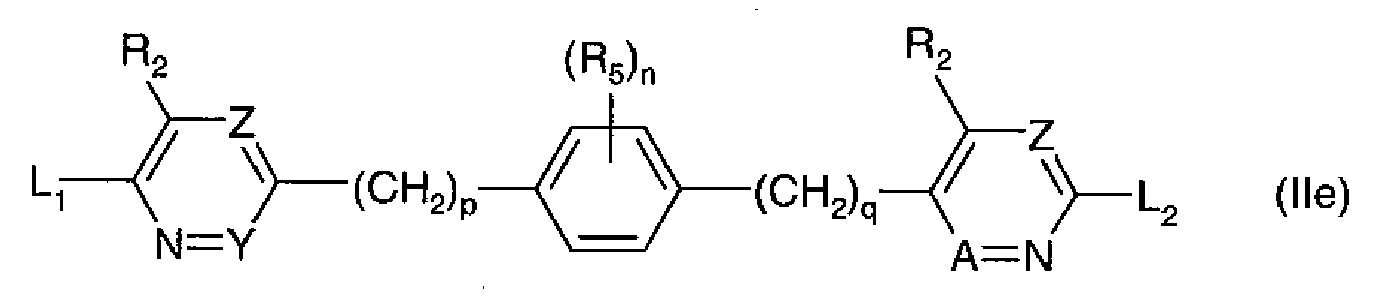

- p and q are each independently an integer from 0 to 8;
- m is an integer from 0 to 4;
- n is an integer from 0 to 4;
- each Z, A, and Y is independently selected from the group consisting of N and CR4, wherein R4 is selected from the group consisting of H, hydroxyl, halo, nitro, alkyl, substituted alkyl, alkoxyl, aryl, substituted aryl, and aryloxyl;
- each R1, R2 and R5 is independently selected from the group consisting of H, hydroxyl, halo, nitro, alkyl, substituted alkyl, alkoxyl, aryl, substituted aryl, and aryloxyl; and
- L1 and L2 are independently selected from the group consisting of:

- R11, R12, R13, R14, R15, and R20 are each independently selected from the group consisting of H, alkyl, substituted alkyl, cycloalkyl, aryl, substituted aryl, aralkyl, hydroxyl, alkoxyl, hydroxyalkyl, hydroxycycloalkyl, alkoxycycloalkyl, aminoalkyl, acyloxyl, alkylaminoalkyl, and alkoxycarbonyl; or
- R11 and R12 together represent a C2 to C10 alkyl, C2 to C10 hydroxyalkyl, or a C2 to C10 alkylene; or
- R11 and R12 together are:

- In some embodiments, the compound is selected from the group consisting of:


- In some embodiments, the Leishmania species is Leishmania donovani. In some embodiments, the Leishmania species is Leishmania mexicana amazonensis.
- It is accordingly an object of the presently disclosed subject matter to provide methods and compositions for treating microbial infections, such as, but not limited to, those caused by Trypanosoma species (spp.), including, but not limited to, Trypanosoma brucei rhodesiense, Trypanosoma brucei gambiense, Trypanosoma brucei brucei, and Trypanosoma cruzi; Plasmodium spp., including but not limited to Plasmodium falciparum; and Leishmania spp., including but not limited to Leishmania donovani and Leishmania mexicana amazonensis, in a subject in need thereof.
- An object of the presently disclosed subject matter having been stated hereinabove, which are addressed in whole or in part by the presently disclosed subject matter, other objects and aspects will become evident as the description proceeds when taken in connection with the accompanying Examples as best described herein below.
- The presently disclosed subject matter will now be described more fully hereinafter with reference to the accompanying Examples, in which representative embodiments are shown. The presently disclosed subject matter can, however, be embodied in different forms and should not be construed as limited to the embodiments set forth herein. Rather, these embodiments are provided so that this disclosure will be thorough and complete, and will fully convey the scope of the embodiments to those skilled in the art.
- Unless otherwise defined, all technical and scientific terms used herein have the same meaning as commonly understood by one of ordinary skill in the art to which this presently described subject matter belongs. All publications, patent applications, patents, and other references mentioned herein are incorporated by reference in their entirety.
- Throughout the specification and claims, a given chemical formula or name shall encompass all optical and stereoisomers, as well as racemic mixtures where such isomers and mixtures exist.
- As used herein the term "alkyl" refers to C1-20 inclusive, linear (i.e., "straight-chain"), branched, or cyclic, saturated or at least partially and in some cases fully unsaturated (i.e., alkenyl and alkynyl) hydrocarbon chains, including for example, methyl, ethyl, propyl, isopropyl, butyl, isobutyl, tert-butyl, pentyl, hexyl, octyl, ethenyl, propenyl, butenyl, pentenyl, hexenyl, octenyl, butadienyl, propynyl, butynyl, pentynyl, hexynyl, heptynyl, and allenyl groups. "Branched" refers to an alkyl group in which a lower alkyl group, such as methyl, ethyl or propyl, is attached to a linear alkyl chain. "Lower alkyl" refers to an alkyl group having 1 to about 8 carbon atoms (i.e., a C1-8 alkyl), e.g., 1, 2, 3, 4, 5, 6, 7, or 8 carbon atoms. "Higher alkyl" refers to an alkyl group having about 10 to about 20 carbon atoms, e.g., 10, 11, 12, 13, 14, 15, 16, 17, 18, 19, or 20 carbon atoms. In certain embodiments, "alkyl" refers, in particular, to C1-8 straight-chain alkyls. In other embodiments, "alkyl" refers, in particular, to C1-8 branched-chain alkyls.
- Alkyl groups can optionally be substituted (a "substituted alkyl") with one or more alkyl group substituents, which can be the same or different. The term "alkyl group substituent" includes but is not limited to alkyl, substituted alkyl, halo, arylamino, acyl, hydroxyl, aryloxyl, alkoxyl, alkylthio, arylthio, aralkyloxyl, aralkylthio, carboxyl, alkoxycarbonyl, oxo, and cycloalkyl. There can be optionally inserted along the alkyl chain one or more oxygen, sulfur or substituted or unsubstituted nitrogen atoms, wherein the nitrogen substituent is hydrogen, lower alkyl (also referred to herein as "alkylaminoalkyl"), or aryl.
- Thus, as used herein, the term "substituted alkyl" includes alkyl groups, as defined herein, in which one or more atoms or functional groups of the alkyl group are replaced with one or more atoms or functional groups, including for example, alkyl, substituted alkyl, halogen, e.g.,-CH2X, -CHX2, and -CX3, wherein X is a halogen selected from the group consisting of Cl, Br, F, and I, aryl, substituted aryl, alkoxyl, hydroxyl, nitro, amino, alkylamino, dialkylamino, sulfate, and mercapto.
- The term "aryl" is used herein to refer to an aromatic substituent that can be a single aromatic ring, or multiple aromatic rings that are fused together, linked covalently, or linked to a common group, such as, but not limited to, a methylene or ethylene moiety. The common linking group also can be a carbonyl, as in benzophenone, or oxygen, as in diphenylether, or nitrogen, as in diphenylamine. The term "aryl" specifically encompasses heterocyclic aromatic compounds. The aromatic ring(s) can comprise phenyl, naphthyl, biphenyl, diphenylether, diphenylamine and benzophenone, among others. In particular embodiments, the term "aryl" means a cyclic aromatic comprising about 5 to about 10 carbon atoms, e.g., 5, 6, 7, 8, 9, or 10 carbon atoms, and including 5- and 6-membered hydrocarbon and heterocyclic aromatic rings.
- The aryl group can be optionally substituted (a "substituted aryl") with one or more aryl group substituents, which can be the same or different, wherein "aryl group substituent" includes alkyl, substituted alkyl, aryl, substituted aryl, aralkyl, hydroxyl, alkoxyl, aryloxyl, aralkyloxyl, carboxyl, acyl, halo, nitro, alkoxycarbonyl, aryloxycarbonyl, aralkoxycarbonyl, acyloxyl, acylamino, aroylamino, carbamoyl, alkylcarbamoyl, dialkylcarbamoyl, arylthio, alkylthio, alkylene, and -NR'R", wherein R' and R" can each be independently hydrogen, alkyl, substituted alkyl, aryl, substituted aryl, and aralkyl.
- Thus, as used herein, the term "substituted aryl" includes aryl groups, as defined herein, in which one or more atoms or functional groups of the aryl group are replaced with another atom or functional group, including for example, alkyl, substituted alkyl, halogen, aryl, substituted aryl, alkoxyl, hydroxyl, nitro, amino, alkylamino, dialkylamino, sulfate, and mercapto.
- Specific examples of aryl groups include, but are not limited to, cyclopentadienyl, phenyl, furan, thiophene, pyrrole, pyran, pyridine, imidazole, benzimidazole, isothiazole, isoxazole, pyrazole, pyrazine, triazine, pyrimidine, quinoline, isoquinoline, indole, carbazole, and the like.
- As used herein, the term "teraryl" refers to a compound comprising at least three aryl groups. In some embodiments, the at least three aryl groups are directly attached to one another. The term "terphenyl" can refer to a compound comprising three benzene rings.
- As used herein, the term "aza" refers to a heterocyclic ring structure containing at least one nitrogen atom. Specific examples of aza groups include, but are not limited to, pyrrolidine, piperidine, quinuclidine, pyridine, pyrrole, indole, purine, pyridazine, pyrimidine, and pyrazine.
- A structure represented generally by a formula such as:


- In the case of a fused cyclic system, the R group may be substituted on any otherwise unsubstituted carbon through the fused system. Thus, the case of a napthyl group with the structure:


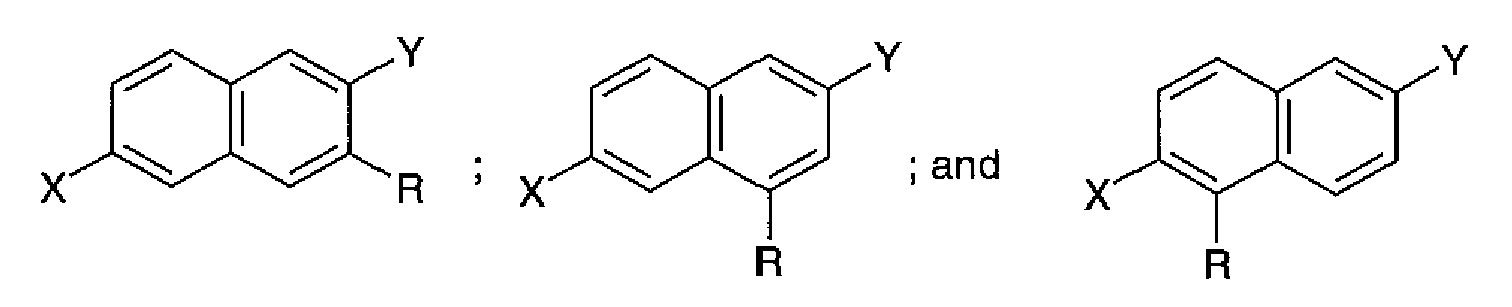
- In some embodiments, the compounds described by the presently disclosed subject matter contain a linking group. As used herein, the term "linking group" comprises a chemical moiety, such as a alkylene, furanyl, phenylene, thienyl, and pyrrolyl radical, which is bonded to two or more other chemical moieties, in particular aryl groups, to form a stable structure.
- The term "phenylene" refers to a bivalent organic radical, C6H4, derived from benzene by removal of two hydrogen atoms and which, in some embodiments, has a structure selected from the group consisting of:

- The term "furanyl" refers to a bivalent organic radical, C4H2O, derived from furan by removal of two hydrogens and which, in some embodiments, has a structure selected from the group consisting of:

- The term "naphthyl" refers to a bivalent organic radical,C10H6, derived from naphthalene by removal of two hydrogens and which, in some embodiments, has a structure selected from the group consisting of:

- The term "ortho" refers to an aryl substitutent that is attached to the aryl group at a position directly adjacent to the reference position. For example, substituent R group can be referred to as ortho to the heteroaryl nitrogen atom in the pyrimidyl group:

- When a named atom of an aromatic ring or a heterocyclic aromatic ring is defined as being "absent," the named atom is replaced by a direct bond. When the linking group or spacer group is defined as being absent, the linking group or spacer group is replaced by a direct bond.
- "Alkylene" refers to a straight or branched bivalent aliphatic hydrocarbon group having from 1 to about 20 carbon atoms, e.g., 1, 2, 3, 4, 5, 6, 7, 8, 9, 10, 11, 12, 13, 14, 15, 16, 17, 18, 19, or 20 carbon atoms. The alkylene group can be straight, branched or cyclic. The alkylene group also can be optionally unsaturated and/or substituted with one or more "alkyl group substituents." There can be optionally inserted along the alkylene group one or more oxygen, sulfur or substituted or unsubstituted nitrogen atoms (also referred to herein as "alkylaminoalkyl"), wherein the nitrogen substituent is alkyl as previously described. Exemplary alkylene groups include methylene (-CH2-); ethylene (-CH2-CH2-); propylene (-(CH2)3-); cyclohexylene (-C6H10-); -CH=CH-CH=CH-; - CH=CH-CH2-; -(CH2)q-N(R)-(CH2)r-, wherein each of q and r is independently an integer from 0 to about 20, e.g., 0, 1, 2, 3, 4, 5, 6, 7, 8, 9, 10, 11, 12, 13, 14, 15, 16, 17, 18, 19, or 20, and R is hydrogen or lower alkyl; methylenedioxyl (-O-CH2-O-); and ethylenedioxyl (-O-(CH2)2-O-). An alkylene group can have about 2 to about 3 carbon atoms and can further have 6-20 carbons.
- As used herein, the term "acyl" refers to an organic acid group wherein the -OH of the carboxyl group has been replaced with another substituent (i.e., as represented by RCO-, wherein R is an alkyl, substituted alkyl, aryl, or substituted aryl group as defined herein). In some embodiments, the term acyl can refer to the group RCO- wherein R is an amino-substituted alkyl group, an alkylamino-substituted alkyl group, a dialkylamino-substituted alkyl group, or a hydroxyl-substituted alkyl group. Thus, the term "acyl" can refer to groups such as H2NR1CO-, R2HNR1CO-, R3R2NR1CO-, and HOR1CO-, wherein R1 is alkylene and R2 and R3 are lower alkyl. The term "acyl" also specifically includes arylacyl groups, such as an acetylfuran and a phenacyl group. Specific examples of acyl groups include acetyl and benzoyl.
- "Cyclic" and "cycloalkyl" refer to a non-aromatic mono- or multicyclic ring system of about 3 to about 10 carbon atoms, e.g., 3, 4, 5, 6, 7, 8, 9, or 10 carbon atoms. The cycloalkyl group can be optionally partially unsaturated. The cycloalkyl group also can be optionally substituted with an alkyl group substituent as defined herein, oxo, and/or alkylene. There can be optionally inserted along the cyclic alkyl chain one or more oxygen, sulfur or substituted or unsubstituted nitrogen atoms, wherein the nitrogen substituent is hydrogen, alkyl, substituted alkyl, aryl, or substituted aryl, thus providing a heterocyclic group. Representative monocyclic cycloalkyl rings include cyclopentyl, cyclohexyl, and cycloheptyl. Multicyclic cycloalkyl rings include adamantyl, octahydronaphthyl, decalin, camphor, camphane, and noradamantyl.
- "Alkoxyl" or "alkoxyalkyl" refer to an alkyl-O- group wherein alkyl is as previously described. The term "alkoxyl" as used herein can refer to C1-20 inclusive, linear, branched, or cyclic, saturated or unsaturated oxo-hydrocarbon chains, including, for example, methoxyl, ethoxyl, propoxyl, isopropoxyl, butoxyl, t-butoxyl, and pentoxyl.
- "Aryloxyl" refers to an aryl-O- group wherein the aryl group is as previously described, including a substituted aryl. The term "aryloxyl" as used herein can refer to phenyloxyl or hexyloxyl, and alkyl, substituted alkyl, halo, or alkoxyl substituted phenyloxyl or hexyloxyl.
- "Aralkyl" refers to an aryl-alkyl- group wherein aryl and alkyl are as previously described, and included substituted aryl and substituted alkyl. Exemplary aralkyl groups include benzyl, phenylethyl, and naphthylmethyl.
- "Aralkyloxyl" refers to an aralkyl-O- group wherein the aralkyl group is as previously described. An exemplary aralkyloxyl group is benzyloxyl.
- "Dialkylamino" refers to an -NRR' group wherein each of R and R' is independently an alkyl group and/or a substituted alkyl group as previously described. Exemplary dialkylamino groups include ethylmethylamino, dimethylamino, and diethylamino. The term "alkylamino" refers to an -NHR group wherein R is an alkyl or substituted alkyl group.
- "Alkoxycarbonyl" refers to an alkyl-O-CO- group. Exemplary alkoxycarbonyl groups include methoxycarbonyl, ethoxycarbonyl, butyloxycarbonyl, and t-butyloxycarbonyl.
- "Aryloxycarbonyl" refers to an aryl-O-CO- group. Exemplary aryloxycarbonyl groups include phenoxy- and naphthoxy-carbonyl.
- "Aralkoxycarbonyl" refers to an aralkyl-O-CO- group. An exemplary aralkoxycarbonyl group is benzyloxycarbonyl.
- "Carbamoyl" refers to an H2N-CO- group.
- "Alkylcarbamoyl" refers to a R'RN-CO- group wherein one of R and R' is hydrogen and the other of R and R' is alkyl and/or substituted alkyl as previously described.
- "Dialkylcarbamoyl" refers to a R'RN-CO- group wherein each of R and R' is independently alkyl and/or substituted alkyl as previously described.
- "Acyloxyl" refers to an acyl-O- group wherein acyl is as previously described.
- "Acylamino" refers to an acyl-NH- group wherein acyl is as previously described.
- "Aroylamino" refers to an aroyl-NH- group wherein aroyl is as previously described.
- The term "amino" refers to the -NH2 group.
- The term "carbonyl" refers to the -(C=O)- group.
- The term "carboxyl" refers to the -COOH group.
- The terms "halo", "halide", or "halogen" as used herein refer to fluoro, chloro, bromo, and iodo groups.
- The term "hydroxyl" refers to the -OH group.
- The term "hydroxyalkyl" refers to an alkyl group substituted with an -OH group.
- The term "mercapto" refers to the -SH group.
- The term "oxo" refers to a compound described previously herein wherein a carbon atom is replaced by an oxygen atom.
- The term "nitro" refers to the -NO2 group.
- The term "thio" refers to a compound described previously herein wherein a carbon or oxygen atom is replaced by a sulfur atom.
- The term "sulfate" refers to the -SO4 group.
- When the term "independently selected" is used, the substituents being referred to (e.g., R groups, such as groups R1 and R2, or groups X and Y), can be identical or different. For example, both R1 and R2 can be substituted alkyls, or R1 can be hydrogen and R2 can be a substituted alkyl, and the like.
- A named "R", "R'," "X," "Y," "A," "D," "E," "G," "L," or "Z" group will generally have the structure that is recognized in the art as corresponding to a group having that name, unless specified otherwise herein. For the purposes of illustration, certain representative "R," "X," "Y", "D," "E," "G," "L," and "A" groups as set forth above are defined below. These definitions are intended to supplement and illustrate, not preclude, the definitions that would be apparent to one of ordinary skill in the art upon review of the present disclosure.
- The term "reflux" and grammatical derivations thereof refer to boiling a liquid, such as a solvent, in a container, such as a reaction flask, with which a condenser is associated, thereby facilitating continuous boiling without loss of liquid, due to the condensation of vapors on the interior walls of the condenser.
- The term "aprotic solvent" refers to a solvent molecule which can neither accept nor donate a proton. Typical aprotic solvents include, but are not limited to, acetone, acetonitrile, benzene, butanone, butyronitrile, carbon tetrachloride, chlorobenzene, chloroform, 1,2-dichloroethane, dichloromethane, diethyl ether, dimethylacetamide, N,N-dimethylformamide (DMF), dimethylsulfoxide (DMSO), 1,4-dioxane, ethyl acetate, ethylene glycol dimethyl ether, hexane, N-methylpyrrolidone, pyridine, tetrahydrofuran (THF), and toluene. Certain aprotic solvents are polar solvents. Examples of polar aprotic solvents include, but are not limited to, acetone, acetonitrile, butanone, N,N-dimethylformamide, and dimethylsulfoxide. Certain aprotic solvents are non-polar solvents. Examples of nonpolar, aprotic solvents include, but are not limited to, diethyl ether, aliphatic hydrocarbons, such as hexane, aromatic hydrocarbons, such as benzene and toluene, and symmetrical halogenated hydrocarbons, such as carbon tetrachloride.
- The term "protic solvent" refers to a solvent molecule which contains a hydrogen atom bonded to an electronegative atom, such as an oxygen atom or a nitrogen atom. Typical protic solvents include, but are not limited to, carboxylic acids, such as acetic acid, alcohols, such as methanol and ethanol, amines, amides, and water.
- The term "metal alkyl" refers to a compound of the general formula MRn, wherein M is a metal atom, including, but not limited to aluminum, boron, magnesium, zinc, gallium, indium, antimony and related metals, R is an alkyl group as defined herein, and n is an integer. A representative metal alkyl is trimethylaluminum, abbreviated as Al(CH3)3 or AlMe3.
- The term "alkali metal alcoholate" refers to an alkali metal derivative of an alcohol having the general formula MaORn, wherein Ma is an alkali metal, such as lithium, sodium, or potassium, O is oxygen, R is an alkyl group as defined herein, and n is an integer. Representative alkali metal alcoholates include, but are not limited to, sodium methanolate, abbreviated as NaOCH3 or NaOMe, and potassium butoxide, abbreviated as KOC(CH3)3.
- The term "acid anhydride" refers to an anhydride of an organic acid and includes, but is not limited to acetic anhydride ((CH3C=O)2O or Ac2O) and benzoic anhydride ((C6H5C=O)2O).
- The structures of pentamidine (a), furamidine (b), CGP 40215A (c), 3,5-bis[4-(4,5-dihydro-1H-imidazol-2-yl)phenyl]pyridine (d), bis-4,4'-amidinobiphenyl (e), and bis-4,4'-amidinophenylethyne (f) are shown in Scheme A.

- An orally effective prodrug of furamidine is currently in Phase II clinical trials against malaria, HAT and PCP. See Tidwell, R. R. and Boykin, D. W., Dicationic DNA Minor Groove Binders as Antimicrobial Agents, in Small Molecule DNA and RNA Binders: From Synthesis to Nucleic Acid Complexes, vol. 2, (M. Demeunynck, C. Bailly, and W. D. Wilson, ed., Wiley-VCH, New York, 2003), pp. 416-460; Fairlamb, A. H., Trends Parasitol., 19, 488-494 (2003); Bouteille, B., et al., Fundam. Clin. Pharmacol., 17, 171-181 (2003). This type of dicationic molecule is thought to act by binding in the minor groove of DNA at AT rich sites, leading to inhibition of DNA dependant enzymes or possibly direct inhibition of transcription. Further, it has been postulated that minor groove binding leads to inhibition of DNA dependent enzymes or possibly direct inhibition of transcription. See Tidwell, R. R. and Boykin, D. W., Dicationic DNA Minor Groove Binders as Antimicrobial Agents, in Small Molecule DNA and RNA Binders: From Synthesis to Nucleic Acid Complexes, vol. 2, (M. Demeunynck, C. Bailly, and W. D. Wilson, ed., Wiley-VCH, New York, 2003), pp. 416-460; Dykstra, C. C., et al., Antimicrob. Agents Chemother, 38, 1890-1898 (1994); Bailly, C., et al., Anti-Cancer Drug Design, 14, 47-60 (1999); Fitzgerald, D. J. and J. N. Anderson, J. Biol. Chem., 274, 27128-27138 (1999); Henderson, D. and L. H. Hurley, Nature Med., 1, 525-527 (1995). Without wishing to be bound to any one particular theory, it is suggested that the selectivity of these molecules, at least for trypanosomes, likely includes a cell entry component involving amidine transporters.
- An element in the design of new potential aromatic diamidine therapeutics has been that the molecular scaffold bearing the amidine units should present crescent shape geometry complimentary to the curve of the minor groove of DNA. See Corey, M., et al., J. Med. Chem., 35, 431-438 (1992). Van der Waals contacts with the walls of the groove have been shown to be an important contributor to binding affinity. See Czarny, A. D., et al., J. Am. Chem. Soc., 117, 4716 (1995); Mazur, S. F., et al., J. Mol. Bio., 300, 321-337 (2000); Wilson, W. D., et al., J. Am. Chem. Soc., 120, 10310-10321 (1998). A current theoretical analysis of the binding interactions of 25 minor groove binders shows that the small molecule curvature provides energetically favorable Van der Waals contacts. See Shaikh, S. A.,_ et al., Arch. Biochem. Biophys., 429, 81-99 (2004). Pentamidine, furamidine and many analogs meet this crescent shape profile. See Tidwell, R. R. and Boykin, D. W., Dicationic DNA Minor Groove Binders as Antimicrobial Agents, in Small Molecule DNA and RNA Binders: From Synthesis to Nucleic Acid Complexes, vol. 2, (M. Demeunynck, C. Bailly, and W. D. Wilson, ed., Wiley-VCH, New York, 2003), pp. 416-460; Cory, M., et al., J. Med. Chem., 35, 431-438 (1992); Boykin, D. W., et al., J. Med. Chem., 41, 124-129 (1998); Boykin, D. W., et al., J. Med. Chem., 38, 912 (1995); Das, B. P. and Boykin, D. W., J. Med. Chem., 20, 531 (1977). Further, it is thought that potent minor groove binders' solution structures either match the groove curve or easily assume low energy conformations that complement the groove on complex formation. Molecules that present too great or too small curvatures have difficulty in maximizing contacts with the minor groove and therefore typically exhibit reduced binding affinities. See Cory, M., et al., J. Med. Chem., 35,431-438 (1992).
- The presently disclosed subject matter provides linear linking systems based on the terphenyl scaffold. Provided herein is the synthesis of novel teraryl dications, amidines, guanidines, and guanyl hydrazone and their evaluation as potential as minor groove binders and anti-protozoan agents.
- Described herein is a compound of Formula (I):
- L1-Ar1-(CH2)p-Ar2-(CH2)q-Ar3-L2 (I)
- p and q are each independently an integer from 0 to 8;
- Ar1 and Ar3 are independently selected from the group consisting of:

- each A, D, E, G, Y, and Z is independently selected from the group consisting of N and CR4, wherein R4 is selected from the group consisting of H, hydroxyl, halo, nitro, alkyl, substituted alkyl, alkoxyl, aryl, substituted aryl, and aryloxyl;
- X is selected from the group consisting of O, S, NH, and Se;
- each m is independently an integer from 0 to 4;
- each s is independently an integer from 0 to 2;
- each R1, R2, R3, and R21 is independently selected from the group consisting of H, hydroxyl, halo, nitro, alkyl, substituted alkyl, alkoxyl, aryl, substituted aryl, and aryloxyl;
- Ar2 is selected from the group consisting of:


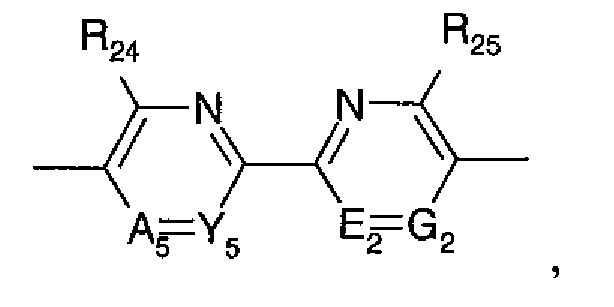
- A1, A2, A3, A4, A5, E1, E2, G1, G2, Y1, Y2, Y3, Y4, Y5, Z1, Z2, and Z3 are independently selected from the group consisting of N and CR7, wherein R7 is selected from the group consisting of H, hydroxyl, halo, nitro, alkyl, substituted alkyl, alkoxyl, aryl, substituted aryl, and aryloxyl;
- n is an integer from 0 to 4;
- t is an integer from 0 to 6;
- each R5, R6, R8, R9, R10, R22, R23, R24, and R25 is independently selected from the group consisting of H, hydroxyl, halo, nitro, alkyl, substituted alkyl, alkoxyl, aryl, substituted aryl, aryloxyl; and
- R11, R12, R13, R14, R15, and R20 are each independently selected from the group consisting of H, alkyl, substituted alkyl, cycloalkyl, aryl, substituted aryl, aralkyl, hydroxyl, alkoxyl, hydroxyalkyl, hydroxycycloalkyl, alkoxycycloalkyl, aminoalkyl, acyloxyl, alkylaminoalkyl, and alkoxycarbonyl; or
- R1 and R12 together represent a C2 to C10 alkyl, C2 to C10 hydroxyalkyl, or a C2 to C10 alkylene; or
- R11 and R12 together are:

- In some embodiments, Ar2 is phenylene and the compound of Formula (I) has the following structure:

- In some embodiments, Ar1 is phenylene and Ar3 is furanyl and the compound of Formula (II) has the following structure:

- In some embodiments, Ar1 and Ar3 are each furanyl and the compound of Formula (II) has the following structure:

- In some embodiments, Ar1 and Ar3 are each phenylene and the compound of Formula (II) has the following structure:

- In some embodiments, Ar1 and Ar3 are each:


- In some embodiments, Ar1 and Ar3 are each:


- In some embodiments, Ar1 is:


- In some embodiments, Ar1 is:


- In some embodiments, Ar1 is phenylene and Ar3 is


- In some embodiments, Ar1 is phenylene and Ar3 is

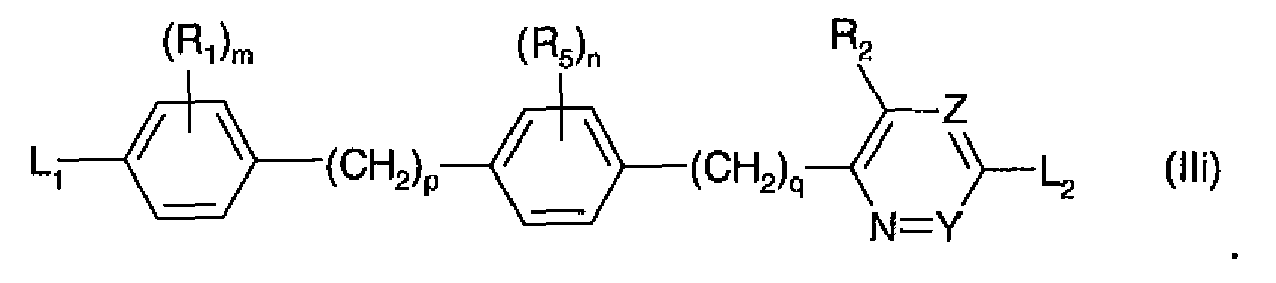
- In some embodiments, a compound of Formula (II) is selected from the group consisting of:
- N-Hydroxy-5-[4'-(N-hydroxyamidino)-biphenyl-4-yl]-furan-2-carboxamidine;
- N-Methoxy-5-[4'-(N-methoxyamidino)-biphenyl-4-yl]-furan-2-carboxamidine;
- 5-(4'-Amidinobiphenyl-4-yl]-furan-2-carboxamidine;
- N-Hydroxy-5-{4-[5-(N-hydroxyamidino)-furan-2-yl]-phenyl}-furan-2-carboxamidine;
- 5-[4-(5-amidinofuran-2-yl)-phenyl]-furan-2-carboxamidine;
- [1,1';4', 1"]Terphenyl-4,4" -bis-N-hydroxycarboxamidine;
- [1,1';4',1"]Terphenyl-4,4"-bis-N-acetoxycarboxamidine;
- [1,1';4',1"]Terphenyl-4,4"-bis-carboxamidine;
- [1,1';4',1"]Terphenyl-4,4"-bis-N-methoxycarboxamidine;
- 2'-Fluoro-[1,1';4',1"]terphenyl-4,4"-bis-amidine;
- 2'-Fluoro-[1,1';4',1"]terphenyl-4,4"-bis-N-hydroxycarboxamidine;
- 2'-Fluoro-[1,1';4',1"]terphenyl-4,4"-bis-methoxycarboxamidine;
- 2'-Trifluoromethyl- [1,1';4', 1"]terphenyl-4,4"-bis- amidine;
- 2'-Trifluoromethyl-[1,1';4' 1"]terphenyl-4,4"-bis-N-hydroxycarbox-amidine;
- 2'-Trifluoromethyl- [1,1';4' ,1"] terphenyl-4,4"-bis-methoxycarboxamidine;
- 1,4-Bis-(5'-amidinopyridin-2'-yl)-phenylene;
- 1,4-Bis- [5'-N-hydroxyamidinopyridin-2'-yl)]-phenylene;
- 1,4-Bis-[5'-N-methoxyamidinopyridin-2'-yl)]-phenylene;
- 5-[4'-(Hydrazono)-biphenyl-4-yl]-furan-2-hydrazone;
- 5-{4'-[2-(4,5-Dihydro-1H-imidazol-2-yl)-hydrazono]-biphenyl-4-yl}-furan-2-(4,5-dihydro-1H-imidazol-2-yl)-hydrazone;
- 5-[4-(2-Hydrazono)-furan-5-yl-phenyl]-furan-2-hydrazone;
- 5-{4-[2-(4,5-Dihydro-1H-imidazol-2-yl)-hydrazono]-furan-5-yl-phenyl}-furan-2-(4,5-dihydro-1H-imidazol-2-yl)-hydrazone;
- 4,4''-Bis-guanidino-[1,1';4',1'']terphenyl;
- 4,4''-Bis(N'-methyl)-guanidino-[1,1':4',1'']terphenyl;
- 4,4''-Bis(N'-isopropyl-guanidino-[1, 1';4',1'']terphenyl;
- 1,4-Bis-(5'-guanidinopyridin-2'-yl)phenylene;
- 1,4-B is- {5'-[(N'-isopropyl)-guanidino]-pyridin-2'yl}phenylene;
- 1,4-Bis[4-amidinophenyl]-2,5-bis[methoxy]benzene;
- 1,4-Bis[5-(N-ethoxycarbonylguanidino)pyridin-2-yl]benzene;
- 1,4-Bis[5-(N-ethoxycarbonyl-N'-methylguanidino)pyridin-2-yl]benzene;
- 1,4-Bis[5-(N-methylguanidino)pyridin-2-yl]benzene;
- 1-[4-amidinophenyl]-4-[4-amidinobenzyl]benzene;
- 1,4-Bis-(2'amidinopyridin-5'yl)phenylene;
- 1,4-Bis-[2'-(N-hydroxyamidinopyridin-5'yl)]phenylene;
- 1,4-Bis-[2'-(N-methoxyamidinopyridin-5'-yl)]phenylene;
- 1,4-Bis-{2'-[N-(N',N'-dimethylaminoacetoxy)amidinopyridin-5'-yl]} phenylene;
- 1,4-B is-(2' -amidinopyrazin-5' -yl)phenylene;
- 1,4-Bis-(2'-amidinopyrimidin-5'-yl)phenylene;
- Phenyl[1,1']phenyl[4,5"]pyridinyl-4,2"-bis-amidine;
- Phenyl[1,1']phenyl[4',5"]pyrimidinyl-4,2"-bis-amidine;
- Phenyl[1,1']phenyl[4',2"]pyridinyl-4,5"-bis-amidine; and a pharmaceutically acceptable salt thereof.
- In some embodiments of the compound of Formula (I), Ar2 is:


- In some embodiments, A1 is N and the compound of Formula (III) has the following structure:

- In some embodiments, Ar1 is phenylene, Ar3 is furanyl, and the compound of Formula (IIIa) has the following structure:

- In some embodiments, Ar1 and Ar3 are each phenylene, p is 0, and q is 1, and the compound of Formula (IIIa) has the following structure:

- In some embodiments, Ar1 is phenylene and Ar3 is:


- In some embodiments, Ar1 is phenylene and Ar3 is:
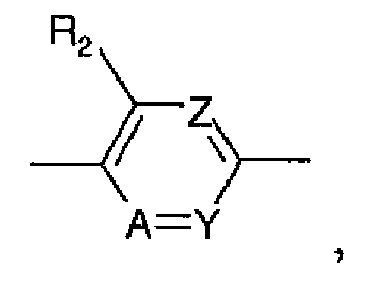

- In some embodiments, Ar1 is phenylene and Ar3 is:


- In some embodiments, Y1 is N and the compound of Formula (III) has the following structure:

- In some embodiments, Ar1 and Ar3 are each phenylene and the compound of Formula (IIIb) has the following structure:

- In some embodiments, Ar1 is phenylene and Ar3 is furanyl and the compound of Formula (IIIb) has the following structure:

- In some embodiments, Z1 and Y1 are each N and the compound of Formula (I) has the following structure:

- In some embodiments, Ar1 and Ar3 are each phenylene and the compound of Formula (IIIc) has the following structure:

- In some embodiments, Ar1 is:


- In some embodiments, A1 and Y1 are each N and the compound of Formula (III) has the following formula:

- In some embodiments, A1 and Z1 are each N and the compound of Formula (III) has the following formula:

- In some embodiments, the compound of Formula (III) is selected from the group consisting of:
- N-Hydroxy-5-{6-[4-(N-hydroxyamidino)-phenyl]-pyridin-3-yl}-furan-2-carboxamidine;
- 5-[6-(4-Amidinophenyl)-pyridin-3-yl]- furan-2-carboxamidine;
- Phenyl[1,1' pyridyl [4', 1 "]phenyl-4,4"-bis-carboxamidine;
- Phenyl [1,1']pyridyl [4', 1"]phenyl-4,4"-bis-N-hydroxycarbox-amidine;
- Phenyl [1,1']pyridyl[4',1"]phenyl-4,4"-bis-N-methoxycarbox-amidine;
- 2-[4-(N-Hydroxyamidino)phenyl]-5-[4"-(N-hydraxyamidino)-benzyl]pyridine;
- 2-(4-Amidinophenyl)-5-(4"-amidinobenzyl)pyridine;
- 5-[4-(2-Hydrazono)-pyridin-5-yl-phenyl]-furan-2-hydrazone;
- 5-{4-[2-(4,5-Dihydro-1H-imidazol-2-yl)-hydrazono]-pyridin-5-yl-phenyl }-furan-2-(4,5-dihydro-1H-imidazol-2-yl)-hydrazone;
- 5-{4-[5-(4,5-Dihydro-1H-imidazol-2-yl)-hydrazono]-pyridin-2-yl-phenyl}-furan-2-(4,5-dihydro-1H-imidazol-2-yl)-hydrazone;
- 2,5-Bis-(4'-amidinophenyl)-pyrimidine;
- 2,5-Bis-[4'-(N-hydroxyamidino)phenyl]-pyrimidine;
- 2,5-Bis-[4'-(N-methoxyamidino)phenyl]-pyrimidine;
- 3,6-Bis[4-amidinophenyl]pyridazine;
- 3,6-Bis[4-N-hydroxyamidinophenyl]pyridazine;
- 3,6-Bis[4-N-methoxyamidinophenyl]pyridazine;
- 2,5-Bis-(4'-amidinophenyl)pyrazine;
- 2,5-Bis-(2'-amidinopyridin-5'-yl)pyrimidine;
- Phenyl[1,2']pyridinyl[5',5"]pyridinyl-4,2"-bis-amidine;
- Phenyl[1,2']pyridinyl[5',5"]pyridinyl-4,2"-bis-N-hydroxyamidine;
- Phenyl[1,2']pyridinyl[5',5"]pyridinyl-4,2"-bis-N-methoxyamidine;
- Phenyl[1 ,2']pyridinyl[5',2"]pyridinyl-4,5"-bis-amidine;
- Phenyl[1,2']pyridinyl[5',5"]pyrazinyl-4,2"-bis-amidine;
- Phenyl[1,2']pyridinyl[5',5"]pyrimidinyl-4,2"-bis-amidine; and
- In some embodiments of the compound of Formula (I), Ar2 is napthyl and the compound of Formula (I) has the following structure:

- In some embodiments, Ar1 and Ar3 are each phenylene and the compound of Formula (IV) has the following structure:

- In some embodiments, the naphthyl group is substituted in the 1 and 4 positions and the compound of Formula (IVa) has the following structure:

- In some embodiments, the naphthyl group is substituted in the 2 and 6 positions and the compound of Formula (IVa) has the following structure:

- In some embodiments, the compound of Formula (I) is selected from the group consisting of:
- Phenyl[1,1']napthyl[4',1"]phenyl-4,4"-bis-amidine;
- Phenyl[1,1']napthyl[4',1"]phenyl-4,4"-bis-N-hydroxycarbox-amidine;
- Phenyl[1,1']napthyl[4',1"]phenyl-4,4"-bis-N-methoxycarbox-amidine,
- Phenyl[1,2']napthyl[6',1"]phenyl-4,4"-bis-amidine; and
- In some embodiments of the compound of Formula (I), Ar2 is:


- In some embodiments, A2 and Y3 are each N and the compound of Formula (V) has the following formula:

- In some embodiments, Ar1 and Ar3 are each phenylene and the compound of Formula (Va) has the following formula:

- In some embodiments of the compounds of Formula (I-V), L1 and L2 are each:

- In some embodiments of the compounds of Formula (I-V), L1 and L2 are each:

- In some embodiments of the compounds of Formula (I-V), L1 and L2 are each:

- In some embodiments, the compound of Formula (I-V) comprises a pharmaceutically acceptable salt. In some embodiments, the pharmaceutically acceptable salt comprises a hydrochloride salt. In some embodiments, the pharmaceutically acceptable salt comprises an acetate salt.
- In representative embodiments, compounds disclosed herein are prodrugs. A prodrug means a compound that, upon administration to a recipient, is capable of providing (directly or indirectly) a compound of the presently disclosed subject matter or an inhibitorily active metabolite or residue thereof. Prodrugs can increase the bioavailability of the compounds of the presently disclosed subject matter when such compounds are administered to a subject (e.g., by allowing an orally administered compound to be more readily absorbed into the blood) or can enhance delivery of the parent compound to a biological compartment (e.g., the brain or lymphatic system) relative to a metabolite species, for example. A number of the compounds (e.g., Compounds 18, 21, 24a, 25a, 24b, 25b, 50a, 50b, 50c, 57b, 57c, 57a, 24c, 25c, 67, 68, 33, 29, 3, 4, 67, 68, 69, 90 and 91) disclosed herein are prodrugs.
- Additionally, the active compounds as described herein can be administered as a pharmaceutically acceptable salt. Such pharmaceutically acceptable salts include the gluconate, lactate, acetate, tartarate, citrate, phosphate, borate, nitrate, sulfate, and hydrochloride salts. The salts of the compounds described herein can be prepared, for example, by reacting two equivalents of the base compound with the desired acid in solution. After the reaction is complete, the salts are crystallized from solution by the addition of an appropriate amount of solvent in which the salt is insoluble. In some embodiments, as described in more detail herein below, the hydrochloride salt of an amidoxime compound is made by passing hydrogen chloride gas into an ethanolic solution of the free base. In some embodiments, as described in more detail herein below, the acetate salt of the presently disclosed diamidine compounds and/or the corresponding N-methoxy analogues are made directly from the appropriate N-hydroxy analogue. Accordingly, in some embodiments, the pharmaceutically acceptable salt is a hydrochloride salt. In some embodiments, the pharmaceutically acceptable salt is an acetate salt.
- The compounds of Formula (I-V), the pharmaceutically acceptable salts thereof, prodrugs corresponding to compounds of Formula (I-V), and the pharmaceutically acceptable salts thereof, are all referred to herein as "active compounds." Pharmaceutical formulations comprising the aforementioned active compounds also are provided herein. These pharmaceutical formulations comprise active compounds as described herein, in a pharmaceutically acceptable carrier. Pharmaceutical formulations can be prepared for oral, intravenous, or aerosol administration as discussed in greater detail below. Also, the presently disclosed subject matter provides such active compounds that have been lyophilized and that can be reconstituted to form pharmaceutically acceptable formulations for administration, for example, as by intravenous or intramuscular injection.
- The therapeutically effective dosage of any specific active compound, the use of which is within the scope of embodiments described herein, will vary somewhat from compound to compound, and patient to patient, and will depend upon the condition of the patient and the route of delivery. As a general proposition, a dosage from about 0.1 to about 50 mg/kg will have therapeutic efficacy, with all weights being calculated based upon the weight of the active compound, including the cases where a salt is employed. Toxicity concerns at the higher level can restrict intravenous dosages to a lower level, such as up to about 10 mg/kg, with all weights being calculated based on the weight of the active base, including the cases where a salt is employed. A dosage from about 10 mg/kg to about 50 mg/kg can be employed for oral administration. Typically, a dosage from about 0.5 mg/kg to 5 mg/kg can be employed for intramuscular injection. Preferred dosages are 1 µmol/kg to 50 µmol/kg, and more preferably 22 µmol/kg and 33 µmol/kg of the compound for intravenous or oral administration. The duration of the treatment is usually once per day for a period of two to three weeks or until the condition is essentially controlled. Lower doses given less frequently can be used prophylactically to prevent or reduce the incidence of recurrence of the infection.
- In accordance with the present methods, pharmaceutically active compounds as described herein can be administered orally as a solid or as a liquid, or can be administered intramuscularly or intravenously as a solution, suspension, or emulsion. Alternatively, the compounds or salts also can be administered by inhalation, intravenously, or intramuscularly as a liposomal suspension. When administered through inhalation the active compound or salt should be in the form of a plurality of solid particles or droplets having a particle size from about 0.5 to about 5 microns, and preferably from about 1 to about 2 microns.
- Pharmaceutical formulations suitable for intravenous or intramuscular injection are further embodiments provided herein. The pharmaceutical formulations comprise a compound of Formula (I-V) described herein, a prodrug as described herein, or a pharmaceutically acceptable salt thereof, in any pharmaceutically acceptable carrier. If a solution is desired, water is the carrier of choice with respect to water-soluble compounds or salts. With respect to the water-soluble compounds or salts, an organic vehicle, such as glycerol, propylene glycol, polyethylene glycol, or mixtures thereof, can be suitable. In the latter instance, the organic vehicle can contain a substantial amount of water. The solution in either instance can then be sterilized in a suitable manner known to those in the art, and typically by filtration through a 0.22-micron filter. Subsequent to sterilization, the solution can be dispensed into appropriate receptacles, such as depyrogenated glass vials. The dispensing is preferably done by an aseptic method. Sterilized closures can then be placed on the vials and, if desired, the vial contents can be lyophilized.
- In addition to compounds of Formula (I-V) or their salts or prodrugs, the pharmaceutical formulations can contain other additives, such as pH-adjusting additives. In particular, useful pH-adjusting agents include acids, such as hydrochloric acid, bases or buffers, such as sodium lactate, sodium acetate, sodium phosphate, sodium citrate, sodium borate, or sodium gluconate. Further, the formulations can contain antimicrobial preservatives. Useful antimicrobial preservatives include methylparaben, propylparaben, and benzyl alcohol. The antimicrobial preservative is typically employed when the formulation is placed in a vial designed for multi-dose use. The pharmaceutical formulations described herein can be lyophilized using techniques well known in the art.
- In yet another embodiment of the subject matter described herein, there is provided an injectable, stable, sterile formulation comprising a compound of Formula (I-V), or a salt thereof, in a unit dosage form in a sealed container. The compound or salt is provided in the form of a lyophilizate, which is capable of being reconstituted with a suitable pharmaceutically acceptable carrier to form a liquid formulation suitable for injection thereof into a subject. The unit dosage form typically comprises from about 10 mg to about 10 grams of the compound salt. When the compound or salt is substantially water-insoluble, a sufficient amount of emulsifying agent, which is physiologically acceptable, can be employed in sufficient quantity to emulsify the compound or salt in an aqueous carrier. One such useful emulsifying agent is phosphatidyl choline.
- Other pharmaceutical formulations can be prepared from the water-insoluble compounds disclosed herein, or salts thereof, such as aqueous base emulsions. In such an instance, the formulation will contain a sufficient amount of pharmaceutically acceptable emulsifying agent to emulsify the desired amount of the compound or salt thereof. Particularly useful emulsifying agents include phosphatidyl cholines and lecithin.
- Additional embodiments provided herein include liposomal formulations of the active compounds disclosed herein. The technology for forming liposomal suspensions is well known in the art. When the compound is an aqueous-soluble salt, using conventional liposome technology, the same can be incorporated into lipid vesicles. In such an instance, due to the water solubility of the active compound, the active compound will be substantially entrained within the hydrophilic center or core of the liposomes. The lipid layer employed can be of any conventional composition and can either contain cholesterol or can be cholesterol-free. When the active compound of interest is water-insoluble, again employing conventional liposome formation technology, the salt can be substantially entrained within the hydrophobic lipid bilayer that forms the structure of the liposome. In either instance, the liposomes that are produced can be reduced in size, as through the use of standard sonication and homogenization techniques.
- The liposomal formulations comprising the active compounds disclosed herein can be lyophilized to produce a lyophilizate, which can be reconstituted with a pharmaceutically acceptable carrier, such as water, to regenerate a liposomal suspension.
- Pharmaceutical formulations also are provided which are suitable for administration as an aerosol by inhalation. These formulations comprise a solution or suspension of a desired compound described herein or a salt thereof, or a plurality of solid particles of the compound or salt. The desired formulation can be placed in a small chamber and nebulized. Nebulization can be accomplished by compressed air or by ultrasonic energy to form a plurality of liquid droplets or solid particles comprising the compounds or salts. The liquid droplets or solid particles should have a particle size in the range of about 0.5 to about 10 microns, more preferably from about 0.5 to about 5 microns. The solid particles can be obtained by processing the solid compound or a salt thereof, in any appropriate manner known in the art, such as by micronization. Most preferably, the size of the solid particles or droplets will be from about 1 to about 2 microns. In this respect, commercial nebulizers are available to achieve this purpose. The compounds can be administered via an aerosol suspension of respirable particles in a manner set forth in
U.S. Patent No. 5,628,984 , the disclosure of which is incorporated herein by reference in its entirety. - When the pharmaceutical formulation suitable for administration as an aerosol is in the form of a liquid, the formulation will comprise a water-soluble active compound in a carrier that comprises water. A surfactant can be present, which lowers the surface tension of the formulation sufficiently to result in the formation of droplets within the desired size range when subjected to nebulization.
- As indicated, both water-soluble and water-insoluble active compounds are provided. As used herein, the term "water-soluble" is meant to define any composition that is soluble in water in an amount of about 50 mg/mL, or greater. Also, as used herein, the term "water-insoluble" is meant to define any composition that has a solubility in water of less than about 20 mg/mL. In some embodiments, water-soluble compounds or salts can be desirable whereas in other embodiments water-insoluble compounds or salts likewise can be desirable.
- Subjects with microbial infections can be treated by methods described herein. Such infections can be caused by a variety of microbes, including fungi, algae, protozoa, bacteria, and viruses. Exemplary microbial infections that can be treated by the method of the presently disclosed subject matter include, but are not limited to, infections caused by Trypanosoma spp. (e.g., Trypanosoma brucei rhodesiense, Trypanosoma brucei gambiense, Trypanosoma brucei brucei, and Trypanosoma cruzi), Plasmodium spp. (e.g., Plasmodium falciparum), Mycobacterium tuberculosis, Pneumocystis carinii, Giardia lamblia, Cryptosporidium parvum, Cryptococcus neoformans, Candida albicans, Candida tropicalis, Salmonella typhimurium, Leishmania donovani, and Leishmania mexicana amazonensis. As used herein the terms Trypanosoma spp., Plasmodium spp., and Leishmania spp. encompass microbes classified under the genera Trypanosoma, Plasmodium, and Leishmania respectively.
- The methods of the presently disclosed subject matter are useful for treating these conditions in that they inhibit the onset, growth, or spread of the condition, cause regression of the condition, cure the condition, or otherwise improve the general well-being of a subject afflicted with, or at risk of, contracting the condition. Thus, in accordance with the presently disclosed subject matter, the terms "treat," "treating," and grammatical variations thereof, as well as the phrase "method of treating," are meant to encompass any desired therapeutic intervention, including but not limited to a method for treating an existing infection in a subject, and a method for the prophylaxis (i.e., preventing) of infection, such as in a subject that has been exposed to a microbe as disclosed herein or that has an expectation of being exposed to a microbe as disclosed herein.
- The methods for treating microbial infections comprise administering to a subject in need thereof an active compound as described herein. These active compounds, as set forth above, include compounds of Formula (I-V), their corresponding prodrugs, and pharmaceutically acceptable salts of the compounds and prodrugs.
- With regard to the presently described method embodiments, compounds of Formula (I) can be defined as having a structure as follows:
L1-Ar1-(CH2)p-Ar2-(CH2)q-Ar3-L2 (I)
wherein: - p and q are each independently an integer from 0 to 8;
- Ar1 and Ar3 are independently selected from the group consisting of:

- each A, D, E, G, Y, and Z is independently selected from the group consisting of N and CR4, wherein R4 is selected from the group consisting of H, hydroxyl, halo, nitro, alkyl, substituted alkyl, alkoxyl, aryl, substituted aryl, and aryloxyl;
- X is selected from the group consisting of O, S, NH, and Se;
- each m is independently an integer from 0 to 4;
- each s is independently an integer from 0 to 2;
- each R1, R2, R3, and R21 is independently selected from the group consisting of H, hydroxyl, halo, nitro, alkyl, substituted alkyl, alkoxyl, aryl, substituted aryl, and aryloxyl;
- Ar2 is selected from the group consisting of:

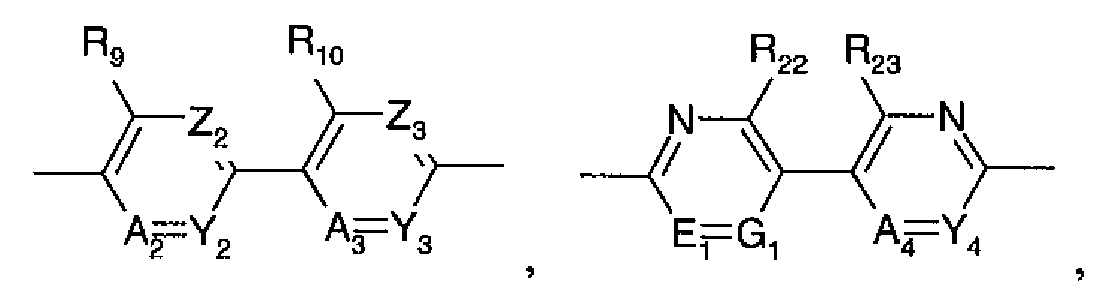

- A1, A2, A3, A4, A5, E1, E2, G1, G2, Y1, Y2, Y3, Y4, Y5, Z1, Z2, and Z3 are independently selected from the group consisting of N and CR7, wherein R7 is selected from the group consisting of H, hydroxyl, halo, nitro, alkyl, substituted alkyl, alkoxyl, aryl, substituted aryl, and aryloxyl;
- n is an integer from 0 to 4;
- t is an integer from 0 to 6;
- each R5, R6, R8, R9, R10, R22, R23, R24, and R25 is independently selected from the group consisting of H, hydroxyl, halo, nitro, alkyl, substituted alkyl, alkoxyl, aryl, substituted aryl, aryloxyl; and
- R11, R12, R13, R14, R15, and R20 are each independently selected from the group consisting of H, alkyl, substituted alkyl, cycloalkyl, aryl, substituted aryl, aralkyl, hydroxyl, alkoxyl, hydroxyalkyl, hydroxycycloalkyl, alkoxycycloalkyl, aminoalkyl, acyloxyl, alkylaminoalkyl, and alkoxycarbonyl; or
- R11 and R12 together represent a C2 to C10 alkyl, C2 to C10 hydroxyalkyl, or a C2 to C10 alkylene; or
- R11 and R12 together are:

- In some embodiments, Ar2 is phenylene and the compound of Formula (I) has the following structure:

- In some embodiments, Ar1 is phenylene and Ar3 is furanyl and the compound of Formula (II) has the following structure:

- In some embodiments, Ar1 and Ar3 are each furanyl and the compound of Formula (II) has the following structure:

- In some embodiments, Ar1 and Ar3 are each phenylene and the compound of Formula (II) has the following structure:

- In some embodiments, Ar1 and Ar3 are each:


- In some embodiments, Ar1 and Ar3 are each:


- In some embodiments, Ar1 is:


- In some embodiments, Ar1 is:


- In some embodiments, Ar1 is phenylene and Ar3 is


- In some embodiments, Ar1 is phenylene and Ar3 is


- In some embodiments, a compound of Formula (II) is selected from the group consisting of:
- N-Hydroxy-5-[4'-(N-hydroxyamidino)-biphenyl-4-yl]-furan-2-carboxamidine;
- N-Methoxy-5-[4'-(N-methoxyamidino)-biphenyl-4-yl]-furan-2-carboxamidine;
- 5-(4'-Amidinobiphenyl-4-yl]-furan-2-carboxamidine;
- N-Hydroxy-5-{4-[5-(N-hydroxyamidino)-furan-2-yl]-phenyl}-furan-2-carboxamidine;
- 5-[4-(5-amidinofuran-2-yl)-phenyl]-furan-2-carboxamidine;
- [1,1';4',1"]Terphenyl-4,4"-bis-N-hydroxycarboxamidine;
- [1,1';4',1"]Terphenyl-4,4"-bis-N-acetoxycarboxamidine;
- [1,1';4',1"]Terphenyl-4,4"-bis-carboxamidine;
- [1,1';4',1"]Terphenyl-4,4"-bis-N-methoxycarboxamidine;
- 2'-Fluoro-[1,1';4',1"]terphenyl-4,4"-bis-amidine;
- 2' -Fluoro-[1,1';4',1"]terphenyl-4,4"-bis-N-hydroxycarboxamidine;
- 2'-Fluoro-[1,1';4',1"]terphenyl-4,4"-bis-methoxycarboxamidine;
- 2'-Trifluoromethyl-[1,1';4',"]terphenyl-4,4"-bis-amidine;
- 2'-Trifluoromethyl-[1,1';4', 1"]terphenyl-4,4"-bis-N-hydroxycarbox-amidine;
- 2'-Trifluoromethyl-[1,1';4',1 "]terphenyl-4,4"-bis-methoxycarboxamidine;
- 1,4-Bis-(5'-amidinopyridin-2'-yl)-phenylene;
- 1,4-Bis-[5'-N-hydroxyamidinopyridin-2'-yl)]-phenylene;
- 1,4-Bis-[5'-N-methoxyamidinopyridin-2'-yl)]-phenylene;
- 5- [4'-(Hydrazono)-biphenyl-4-yl]-furan-2-hydrazone;
- 5-{4'-[2-(4,5-Dihydro-1H-imidazol-2-yl)-hydrazono]-biphenyl-4-yl} -furan-2-(4,5-dihydro-1H-imidazol-2-yl)-hydrazone;
- 5-[4-(2-Hydrazono)-furan-5-yl-phenyl]-furan-2-hydrazone;
- 5-{4-[2-(4,5-Dihydro-1H-imidazol-2-yl)-hydrazono]-furan-5-yl-phenyl}furan-2-(4, 5-dihydro-1 H-imidazol-2-yl)-hydrazone;
- 4,4"-Bis-guanidino-[1,1';4',1"]terphenyl;
- 4,4"-Bis(N'-methyl)-guanidino-[1,1':4',1"]terphenyl;
- 4,4"-Bis(N'-isopropyl-guanidino-[1,1';4',1"]terphenyl;
- 1,4-Bis-(5'-guanidinopyridin-2'-yl)phenylene;
- 1,4-Bis-{5'-[(N'-isopropyl)-guanidino]-pyridin-2' yl}phenylene;
- 1,4-Bis[4-amidinophenyl]-2,5-bis[methoxy]benzene;
- 1,4-Bis [5-(N-ethoxycarbonylguanidino)pyridin-2-yl]benzene;
- 1,4-Bis[5-(N-ethoxycarbonyl-N'-methylguanidino)pyridin-2-yl]benzelle;
- 1,4-Bis[5-(N-methylguanidino)pyridin-2-yl]benzene;
- 1-[4-amidinophenyl]-4-[4-amidinobenzyl]benzene;
- 1,4-Bis-(2'amidinopyridin-5'yl)phenylene;
- 1,4-Bis-[2'-(N-hydroxyamidinopyridin-5'yl)]phenylene;
- 1,4-Bis-[2'-(N-methoxyamidinopyridin-5'-yl)]phenylene;
- 1,4-Bis-{2'-[N-(N',N'-dimethylaminoacetoxy)amidinopyridin-5'-yl]}phenylene;
- 1,4-Bis-(2'-amidinopyrazin-5'-yl)phenylene;
- 1,4-Bis-(2'-amidinopyrimidin-5'-yl)phenylene;
- Phenyl[1,1' ]phenyl [4,5'']pyridinyl-4,2''-bis-amidine;
- Phenyl[1,1']phenyl[4',5'']pyrimidinyl-4,2''-bis-amidine;
- Phenyl[1,1']phenyl[4',2'']pyridinyl-4,5''-bis-amidine; and a pharmaceutically acceptable salt thereof.
- In some embodiments of the compound of Formula (I), Ar2 is:
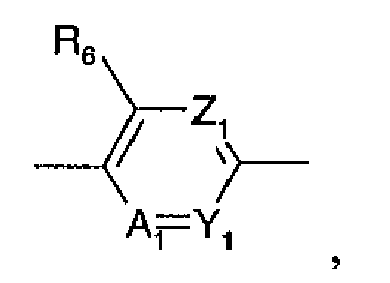
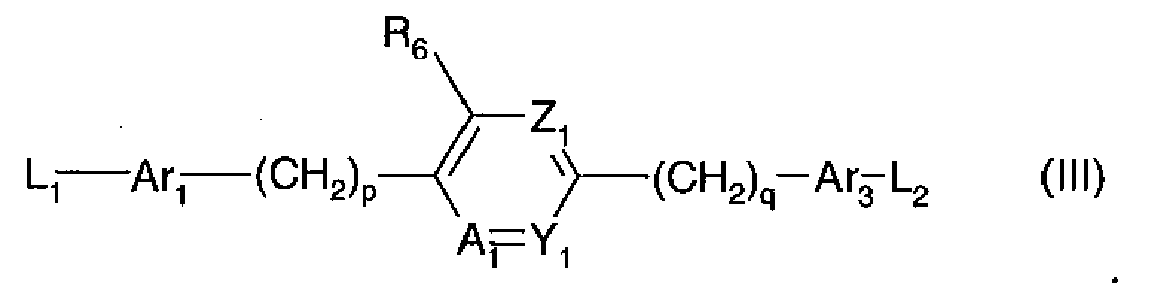
- In some embodiments. A1 is N and the compound of Formula (III) has the following structure:

- In some embodiments, Ar1 is phenylene, Ar3 is furanyl, and the compound of Formula (IIIa) has the following structure:

- In some embodiments, Ar1 and Ar3 are each phenylene, p is 0, and q is 1, and the compound of Formula (IIIa) has the following structure:

- In some embodiments, Ar1 is phenylene and Ar3 is:


- In some embodiments, Ar1 is phenylene and Ar3 is:


- In some embodiments, Ar1 is phenylene and Ar3 is:


- In some embodiments, Y1 is N and the compound of Formula (III) has the following structure:

- In some embodiments, Ar1 and Ar3 are each phenylene and the compound of Formula (IIIb) has the following structure:

- In some embodiments, Ar1 is phenylene and Ar3 is furanyl and the compound of Formula (IIIb) has the following structure:

- In some embodiments, Z1 and Y1 are each N and the compound of Formula (I) has the following structure:

- In some embodiments, Ar1 and Ar3 are each phenylene and the compound of Formula (IIIc) has the following structure:

- In some embodiments, Ar1 is:


- In some embodiments, A1 and Y1 are each N and the compound of Formula (III) has the following formula:

- In some embodiments, A1 and Z1 are each N and the compound of Formula (III) has the following formula:

- In some embodiments, the compound of Formula (III) is selected from the group consisting of:
- N-Hydroxy-5-{6-[4-(N-hydroxyamidino)-phenyl]-pyridin-3-yl}-furan-2-carboxamidine;
- 5-[6-(4-Amidinophenyl)-pyridin-3-yl]-furan-2-carboxamidine;
- Phenyl[1,1']pyridyl[4',1'']phenyl-4,4''-bis-carboxamidine;
- Phenyl[1,1']pyridyl[4',1'']phenyl-4,4''-bis-N-hydroxycarbox-amidine;
- Phenyl[1,1']pyridyl[4',1 '']phenyl-4,4''-bis-N-methoxycarbox-amidine;
- 2-[4-(N-Hydroxyamidino)phenyl]-5-[4''-(N-hydroxyamidino)-benzyl] pyridine;
- 2-(4-Amidinophenyl)-5-(4''-amidinobenzyl)pyridine;
- 5-[4-(2-Hydrazono)-pyridin-5-yl-phenyl]-furan-2-hydrazone;
- 5-{4-[2-(4,5-Dihydro-1H-imidazol-2-yl)-hydrazono]-pyridin-5-yl-phenyl}-furan-2-(4,5-dihydro-1H-imidazol-2-yl)-hydrazone;
- 5-{4-[5-(4,5-Dihydro-1H-imidazol-2-yl)-hydrazono]-pyridin-2-yl-phenyl} -furan-2-(4,5-dihydro-1H-imidazol-2-yl)-hydrazone;
- 2,5-Bis-(4'-amidinophenyl)-pyrimidine;
- 2,5-Bis-[4'-(N-hydroxyamidino)phenyl]-pyrimidine;
- 2,5-Bis-[4'-(N-methoxyamidino)phenyl]-pyrimidine;
- 3,6-Bis [4-amidinophenyl]pyridazine;
- 3,6-Bis[4-N-hydroxyaminophenyl]pyridazine;
- 3,6-Bis[4-N-methoxyamidinophenyl]pyridazine;
- 2,5-Bis-(4'-amidinophenyl)pyrazine;
- 2,5-Bis-(2'-amidinopyridin-5'-yl)pyrimidine;
- Phenyl[1,2']pyridinyl[5',5"]pyridinyl-4,2"-bis-amidine;
- Phenyl[1,2']pyridinyl[5',5"]pyridinyl-4,2"-bis-N-hydroxyamidine;
- Phenyl[1,2']pyridinyl[5',5"]pyridinyl-4,2"-bis-N-methoxyamidine;
- Phenyl[1,2']pyridinyl[5',2"]pyridinyl-4,5"-bis-amidine;
- Phenyl[1,2']pyridinyl[5',5"]pyrazinyl-4,2"-bis-amidine;
- Phenyl[1,2']pyridinyl[5',5"]pyrimidinyl-4,2"-bis-amidine; and
- In some embodiments of the compound of Formula (I), Ar2 is napthyl and the compound of Formula (I) has the following structure:

- In some embodiments, Ar1 and Ar3 are each phenylene and the compound of Formula (IV) has the following structure:

- In some embodiments, the naphthyl group is substituted in the 1 and 4 positions and the compound of Formula (IVa) has the following structure:

- In some embodiments, the naphthyl group is substituted in the 2 and 6 positions and the compound of Formula (IVa) has the following structure:
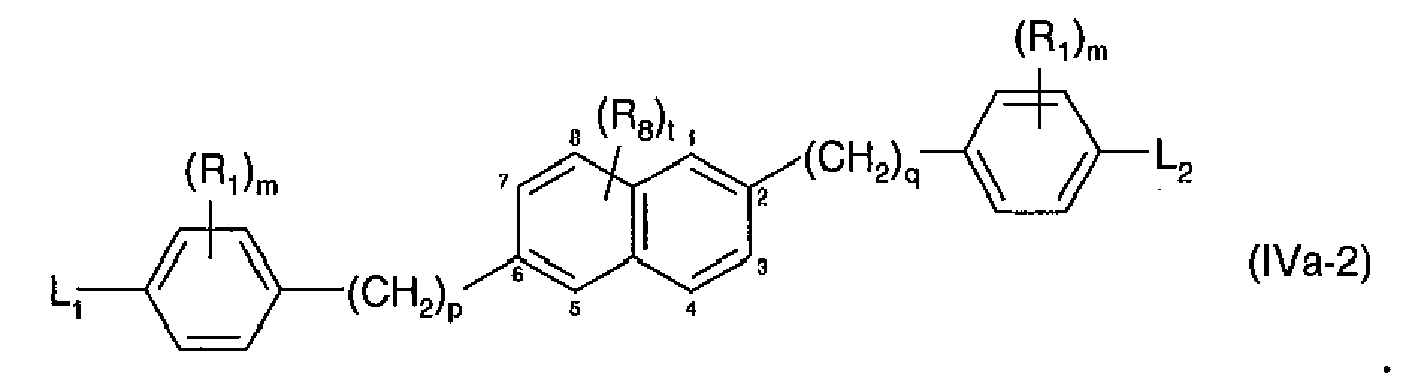
- In some embodiments, the compound of Formula (I) is selected from the group consisting of:
- Phenyl[1,1']napthyl[4',1"]phenyl-4,4"-bis-amidine;
- Phenyl[1,1']napthyl[4',1"]phenyl-4,4"-bis-N-hydroxycarbox-amidine;
- Phenyl[1,1']napthyl[4',1"]phenyl-4,4"-bis-N-methoxycarbox-amidine;
- Phenyl[1,2']napthyl[6',1"]phenyl-4,4"-bis-amidine; and
- In some embodiments of the compound of Formula (I), Ar2 is:


- In some embodiments, A2 and Y3 are each N and the compound of Formula (V) has the following formula:

- In some embodiments, Ar1 and Ar3 are each phenylene and the compound of Formula (Va) has the following formula:

- In some embodiments of the compounds of Formula (I-V), L1 and L2 are each:

- In some embodiments of the compounds of Formula (I-V), L1 and L2 are each:

- In some embodiments of the compounds of Formula (I-V), L1 and L2 are each:

- In some embodiments, the compound of Formula (I-V) comprises a pharmaceutically acceptable salt. In some embodiments, the pharmaceutically acceptable salt comprises a hydrochloride salt. In some embodiments, the pharmaceutically acceptable salt comprises an acetate salt.
- In some embodiments, the compound of Formula (I-V) is administered in the form of a pharmaceutically acceptable salt. In some embodiments, the pharmaceutically acceptable salt comprises a hydrochloride salt. In some embodiments, the pharmaceutically acceptable salt comprises an acetate salt.
- In some embodiments, the microbial infection comprises an infection caused by a Trypanosoma spp., including, but not limited to, Trypanosoma brucei rhodesiense, Trypanosoma brucei gambiense, Trypanosoma brucei brucei, and Trypanosoma cruzi. In some embodiments, the microbial infection comprises a Plasmodium falciparum infection. In some embodiments, the microbial infection comprises an infection caused by a Leishmania spp., including, but not limited to, Leishmania donovani and Leishmania mexicana amazonensis.
- In some embodiments, the compound of Formula (I-V) is administered to a subject with an existing microbial infection. In some embodiments, the compound of Formula (I-V) is administered prophylactically to prevent a microbial infection or to prevent the recurrence of a microbial infection. Thus, in some embodiments, the compound of Formula (I-V) is administered prophylactically to prevent or reduce the incidence of one of: (a) a microbial infection in a subject at risk of infection; (b) a recurrence of the microbial infection; and (c) combinations thereof.
- The subject treated in the presently disclosed subject matter in its many embodiments is desirably a human subject, although it is to be understood the methods described herein are effective with respect to all vertebrate species, which are intended to be included in the term "subject." The methods described herein are particularly useful in the treatment and/or prevention of infectious diseases in warm-blooded vertebrates. Thus, the methods can be used as treatment for mammals and birds.
- More particularly, provided herein is the treatment of mammals, such as humans, as well as those mammals of importance due to being endangered (such as Siberian tigers), of economical importance (animals raised on farms for consumption by humans) and/or social importance (animals kept as pets or in zoos) to humans, for instance, carnivores other than humans (such as cats and dogs), swine (pigs, hogs, and wild boars), ruminants (such as cattle, oxen, sheep, giraffes, deer, goats, bison, and camels), and horses. Also provided herein is the treatment of birds, including the treatment of those kinds of birds that are endangered, kept in zoos, as well as fowl, and more particularly domesticated fowl, i.e., poultry, such as turkeys, chickens, ducks, geese, guinea fowl, and the like, as they also are of economical importance to humans. Thus, embodiments of the methods described herein include the treatment of livestock, including, but not limited to, domesticated swine (pigs and hogs), ruminants, horses, poultry, and the like.
- The synthetic procedures provided herein below comprise representative novel methods of producing the presently disclosed compounds. The methods are outlined in Schemes 1-16 presented herein below and representative, non-limiting embodiments are described in the Examples.
- In some embodiments, the presently disclosed subject matter provides a method for preparing a compound of Formula (I) and pharmaceutically acceptable salts thereof, the method comprising:
- (a) forming a teraryl dinitrile compound by one of:
- (i) contacting a halogenated aryl nitrile and a 1,4-phenylenebisboronic acid in the presence of a palladium catalyst and a first base in a first aprotic solvent to form a teraryl dinitrile compound;
- (ii) contacting a dihalogenated aryl compound with p-cyanophenylboronic acid in the presence of a palladium catalyst and a first base in a first aprotic solvent to form a teraryl dinitrile compound;
- (iii) contacting a teraryl dialdehyde compound with hydroxylamine hydrochloride followed by refluxing in acetic anhydride for a period of time to form a teraryl dinitrile compound;
- (iv) contacting a teraryl dihalide compound with cuprous cyanide in a first aprotic solvent to form a teraryl dinitrile compound; and
- (v) contacting a halogenated diarylnitrile with a palladium catalyst and hexa-n-butylditin in a first aprotic solvent;
- (b) contacting the teraryl dinitrile compound with one of:
- (i) a mixture of hydroxyamine hydrochloride and a second base in a second aprotic solvent to form a dicationic teraryl compound of Formula (I), wherein the dicationic teraryl compound of Formula (I) comprises a diamidoxime teraryl compound of Formula (I); and
- (ii) a lithium trialkylsilylamide in an second aprotic solvent, followed by a strong acid to form a dicationic teraryl compound of Formula (I), wherein the dicationic teraryl compound of Formula (I) comprises a diamidino compound of Formula (I).
- In some embodiments, the method further comprises a step selected from the group consisting of:
- (a) contacting the diamidoxime teraryl compound of Formula (I) with a metal hydroxide hydrate followed by a dialkyl sulfate to form a dicationic teraryl compound of Formula (I), wherein the dicationic teraryl compound of Formula (I) comprises a dialkoxyamidino teraryl compound of Formula (I);
- (b) contacting the diamidoxime teraryl compound of Formula (I) with acetic acid and acetic anhydride followed by hydrogen and a palladium-on-carbon catalyst to form a dicationic teraryl compound of Formula (I), wherein the dicationic teraryl compound of Formula (I) comprises a diamidino teraryl compound of Formula (I); and
- (c) dissolving the diamidoxime teraryl compound of Formula (I) in glacial acetic acid and adding acetic anhydride to form a diacetoxyamidino teraryl compound of Formula (I).
- In some embodiments, the method comprises forming a teraryl dialdehyde compound by one of:
- (a) contacting 4-formylphenylboronic acid with a 5-(haloaryl)-furan-2-carboxaldehyde in the presence of a palladium catalyst and a third base to form a teraryl dialdehyde compound;
- (b) contacting 4-formylphenylboronic acid with a dihaloaryl compound in the presence of a palladium catalyst and a third base to form a halogenated diaryl aldehyde, followed by contacting the halogenated diaryl aldehyde with a palladium catalyst and 5-(diethoxymethyl-furan-2-yl)-trimethylstannane to form a teraryl dialdehyde compound;
- (c) contacting a 5-halofuran-2-carboxaldehyde and 1,4-phenylenebisboronic acid in the presence of a palladium catalyst and a third base to form a teraryl dialdehyde compound; and
- (d) contacting a dihaloaryl compound with (5-diethoxymethyl-furan-2-yl)-trimethyl-stannane and a palladium catalyst, followed by a strong acid to form a 2-haloaryl-5-formyl furan, followed by contacting the 2-haloaryl-5-formyl furan with 4-formylphenylboronic acid in the presence of a second palladium catalyst and a third base to form a teraryl dialdehyde compound.
- In some embodiments, the method comprises forming a teraryl dihalide compound by:
- (a) contacting 1,4-dibromobenzene and 2-tributylstannylfuran in the presence of a palladium catalyst to form 2-(4-furan-2-yl-phenyl)-furan; and
- (b) contacting 2-(4-furan-2-yl-phenyl)-furan with N-bromosuccinimide (NBS) in a third aprotic solvent to form a dibromide.
- In some embodiments, the halogenated aryl nitrile is selected from the group consisting of 4-bromobenzonitrile and 6-chloronicotinonitrile. In some embodiments, the dihalogenated aryl compound is selected from the group consisting of: 2,5-dibromo-1-fluorobenzene; 1,4-dibromo-2trifluoromethylbenzene; 2,5-dibromopyridine, 2-chloro-5-bromopyrimidine; 2-chloro-5-(chloromethyl)pyridine), 1,4-dibromonaphthalene, and 2,6-dibromonaphthalene.
- In some embodiments the presently disclosed subject matter provides a method for preparing a dicationic teraryl compound of Formula (I), the method comprising:
- (a) providing a teraryl diamine;
- (b) contacting the teraryl diamine with one of
- (i) a mixture of 1,3-bis(t-butoxycarbonyl)-2-methylthiopseudourea and a tertiary amine followed by mercury(II) chloride; and
- (ii) ethyl isothiocyanatoformate, a primary amine, a water-soluble carbodiimide, and a tertiary amine;
- (c) contacting the bis-(alkoxycarbonyl)-guanidino teraryl compound with one of an acid and a hydroxide to form a dicationic teraryl compound of Formula (I), wherein the dicationic teraryl compound of Formula (I) comprises a bis-guanidino teraryl compound of Formula (I).
- In some embodiments, the teraryl diamine is formed by
- (a) contacting a halogenated nitroaryl compound with 1,4-phenylenebisboronic acid in the presence of a palladium catalyst and a base to form a dinitro teraryl compound; and
- (b) contacting the dinitro teraryl compound with a palladium-on-carbon catalyst and hydrogen to form the teraryl diamine.
- In some embodiments, the presently disclosed subject matter provides a method for preparing a dicationic teraryl compound of Formula (I), the method comprising:
- (a) providing a teraryl dialdehyde; and
- (b) contacting the teraryl dialdehyde with one of
- (i) aminoguanidine and a base in a polar, protic solvent to form a dicationic teraryl compound of Formula (I), wherein the dicationic teraryl compound of Formula (I) comprises a bis-hydrazone teraryl compound of Formula (I); and
- (ii) 2-hydrazino-2-imidazoline and a base in a polar, protic solvent to form a dicationic teraryl compound of Formula (I), wherein the dicationic teraryl compound of Formula (I) comprises a bis-hydrazone teraryl compound of Formula (I).
- The following Examples have been included to provide guidance to one of ordinary skill in the art for practicing representative embodiments of the presently disclosed subject matter. In light of the present disclosure and the general level of skill in the art, those of skill can appreciate that the following Examples are intended to be exemplary only and that numerous changes, modifications, and alterations can be employed without departing from the scope of the presently disclosed subject matter.
- Melting points were recorded using a Thomas-Hoover (Uni-Melt) capillary melting point apparatus (Thomas Scientific, Swedesboro, New Jersey, United States of America) and are uncorrected. TLC analysis was carried out on silica gel 60 F254 precoated aluminum sheets and detected under UV light. 1H and 13C NMR spectra were recorded employing a Varian GX400 or Varian Unity Plus 300 spectrometer (Varian, Inc., Palo Alto, California, United States of America), and chemical shifts (δ) are in ppm relative to TMS as internal standard. Mass spectra were recorded on a VG analytical 70-SE spectrometer (VG Analytical, Ltd., Manchester, United Kingdom). Elemental analyses were obtained from Atlantic Microlab Inc. (Norcross, Georgia, United States of America) and are within ±0.4 of the theoretical values. The compounds reported as salts frequently analyzed correctly for fractional moles by water and/or ethanol of solvation. In each case, proton NMR showed the presence of indicated solvent (s). Aldrich Chemical Co. (St. Louis, Missouri, United States of America), Fisher Scientific (Fairlawn, New Jersey, United States of America), Frontier Scientific (Logan, Utah, United States of America) or Lancaster Synthesis, Inc. (Windham, New Hampshire, United States of America).
-

- 5-(4'-Formylbiphenyl-4-yl)-furan-2-carboxaldehyde (1). To a stirred solution of 5-(4-bromophenyl)-furan-2-carboxaldehyde (5 mmol), and tetrakis(triphenylphosphine) palladium (200 mg) in toluene (10 mL) under a nitrogen atmosphere was added 5 mL of a 2 M aqueous solution of Na2CO3 followed by 4-formylphenylboronic acid (6 mmol) in 5 mL of methanol. The vigorously stirred mixture was warmed to 80 °C for 12 h. The solvent was evaporated, the precipitate was partitioned between methylene chloride (200 mL) and 2 M aqueous Na2CO3 (15 mL) containing 3 mL of concentrated ammonia. The organic layer was dried (Na2SO4), and then concentrated to dryness under reduced pressure to afford 1 in 85% yield; mp 173-174 °C (SiO2, hexanes/EtOAc, 70:30). 1H NMR (DMSO-d 6); δ 7.42 (d, J = 3.6 Hz, 1H), 7.70 (d, J = 3.6 Hz, 1H), 7.93-8.01 (m, 8H), 9.64 (s, 1H), 10.07 (s, 1H). 13C NMR (DMSO-d 6); δ 192.7, 177.9, 157.6, 151.8, 144.6, 139.6, 135.3, 130.2, 128.6, 127.9, 127.3, 125.7, 109.5. MS (ESI) m/e (rel. int.): 276 (M+, 100), 247 (5), 219 (25), 189 (25). Anal. Calc. for C18H12O3: C% 78.24, H% 4.37; Found C% 77.99, H% 4.44.
- 5-(4'-Cyanobiphenyl-4-yl)-furan-2-carbonitrile (2). To a stirred solution of 1 (2 mmol) in 10 mL of methanol was slowly added an aqueous solution (8 mL) of hydroxylamine hydrochloride (4 mmol) and sodium carbonate (4 mmol). The reaction mixture was allowed to reflux for 6 h. The solvent was evaporated, the precipitate was partitioned between water and ethyl acetate (150 mL), the organic layer was dried (Na2SO4), and then concentrated to dryness under reduced pressure. The crude oxime was allowed to reflux in acetic anhydride (8 mL) for 4 h. The reaction mixture was poured slowly onto ice water and the precipitate was filtered and washed with water to afford 2 in 89% yield; mp 216-218 °C. 1H NMR (DMSO-d 6); δ 7.38 (d, J = 3.6 Hz, 1H), 7.75 (d, J = 3.6 Hz, 1H), 7.88-7.96 (m, 8H). 13C NMR ((DMSO-d6 ); δ 157.4, 143.4, 138.9, 132.9, 128.3, 127.8, 127.5, 125.8, 125.4, 124.3, 118.7, 112.0, 110.4, 108.3. MS (ESI) m/e (rel. int.): 270 (M+, 100), 241 (5), 214 (10). Anal. Calc. for C18H10N2O: C% 79.99, H% 3.73; Found C% 79.85, H% 3.91.
- N-Hydroxy-5-[4'-(N-hydroxyamidino)-biphenyl-4-yl]-furan-2-carboxamidine (3). A mixture of hydroxylamine hydrochloride (1.83 g, 26.3 mmol, 10 equiv) in anhydrous DMSO (30 mL) was cooled to 5 °C, and then potassium t-butoxide (2.95 g, 26.3 mmol, 10 equiv) was added portion wise. To the mixture was added the dinitrile 2 (2.6 mmol) and the reaction was kept stirring overnight at room temperature. The reaction mixture was poured onto ice/water whereupon a white precipitate of the bisamidoxime was formed. The product was collected by filtration and washed with water to afford 3 (free base) in 92% yield; mp 229-230 °C. 1H NMR (DMSO-d 6); δ 5.87 (s, 4H), 6.85 (d, J = 3.6 Hz, 1H), 7.06 (d, J = 3.6 Hz, 1H), 7.71-7.87 (m, 8H), 9.70 (s, 2H).
3 Hydrochloride salt. mp >300 °C. 1H NMR (DMSO-d 6); 7.38 (d, J = 3.9 Hz, 1H), 7.82(d, J = 3.9 Hz, 1H), 7.87(d, J = 8.4 Hz, 2H), 7.92 (d, J = 8.4 Hz, 2H), 8.01(d, J = 8.4 Hz, 2H), 8.15 (d, J = 8.4 Hz, 2H), 9.14 (br s, 4H), 11.36 (br s, 2H), 13.19 (br s, 2H). 13C NMR (DMSO-d6 ); δ 158.7, 158.5, 148.7, 143.5, 138.8, 138.4, 128.6, 128.5, 127.4, 126.9, 125.5, 124.6, 119.2, 108.8. MS (ESI) m/e (rel. int.): 337 (M+, 65), 322 (50), 307 (100), 272 (40). Anal. Calc. for C18H16N4O3-2.0HCl: C% 52.82, H% 4.43, N% 13.68; Found C% 52.60, H% 4.45, N% 13.30. - N-Methoxy-5-[4'-(N-methoxyamidino)-biphenyl-4-yl]-furan-2-carboxamidine (4). To a suspension of the amidoxime 3 (1 mmol) in DMF (15 mL) was added LiOH·H2O (6 mmol, in 3 mL H2O) followed by dimethyl sulfate (5 mmol). The reaction was kept stirring overnight after which it was poured onto ice/water and the precipitate was filtered, washed with water and dried to give the desired compound in 92% yield; mp 214-215 °C. 1H NMR (DMSO-d6 ); δ 3.75 (s, 6H), 6.12 (d, J = 3.6 Hz, 1H), 6.17 (d, J = 3.6 Hz, 1H), 7.76-8.00 (m, 8H).
4 Hydrochloride salt. mp 194-196 °C. 1H NMR (D2O/DMSO-d6 ); δ 3.88 (s, 6H), 7.20 (d, J = 3.6 Hz, 1H), 7.34 (d, J = 3.6 Hz, 1H), 7.77-8.13 (m, 8H). Anal. Calc. for C20H20N4O3-2.0HCl: C% 54.92, H% 5.07, N% 10.97; Found C% 54.88, H% 5.29, N% 10.99. - 5-(4'-Amidinobiphenyl-4-yl)-furan-2-carboxamidine acetate salt (5). To a solution of 3 (1 mmol) in glacial acetic acid (10 mL) was slowly added acetic anhydride (0.35 mL). After stirring for overnight TLC indicated complete acylation of the starting material, then was added 10% palladium on carbon (80 mg). The mixture was placed on Parr hydrogenation apparatus at 50 psi for 4 h at room temperature. The mixture was filtered through hyflo and the filter pad washed with water. The filtrate was evaporated under reduced pressure and the precipitate was collected and washed with ether to give 5 in 71% yield, mp 236-238 °C. 1H NMR (D2O/DMSO-d6 ); δ 1.78 (s, 2xCH3), 7.31 (d, J = 3.6 Hz, 1H), 7.61 (d, J = 3.6 Hz, 1H), 7.85-8.11 (m, 8H). EIMS m/e (rel. int.); 304 (M+, 20), 287 (100), 270 (50), 216 (30), 190 (10). High resolution Calc. for C18H16N4O ms 304.13241. Observed 304.13201. Anal. Calc. for C16H14N4O2-2.0AcOH-1.75H2O-0.25EtOH: C% 57.81, H% 6.25, N% 11.98; Found C% 58.18, H% 5.90, N% 11.56.
-

- 4-(5-Bromopyridin-2-yl)-benzaldehyde (6). The same procedure described for 1 was used by employing 2,5-dibromopyridine (1 equiv.) and 4-formylphenyl boronic acid (1 equiv.). Yield 71%, mp 120-121 °C. 1H NMR (DMSO-d6 ); δ 7.97 (d, J = 8.4 Hz, 2H), 8.04 (d, J = 8.7 Hz, 1H), 8.16 (dd, J = 2.4, 8.7 Hz, 1H), 8.26 (d, J = 8.4 Hz, 2H), 8.80 (d, J = 2.4 Hz, 1H), 10.08 (s, 1H). MS (ESI) m/e (rel. int.): 262 (M+, 100), 232 (30), 153 (55). Anal. Calc. for C12H8BrNO: C% 54.99, H% 3.08; Found C% 54.75, H% 3.14.
- 5-[6-(4-Formylphenyl)-pyridin-3-yl]-furan-2-carboxaldehyde (7). To a stirred solution of 6 (10 mmol) in 40 mL dry 1,4-dioxane was added palladium tetrakis-triphenylphosphine (400 mg), then 5-(diethoxymethyl-furan-2-yl)-trimethylstannane (10 mmol) was added and the reaction mixture was refluxed at 100 °C for 24 h. The solvent was then evaporated to dryness to give a dark brown residue that was suspended in water and extracted with CH2Cl2. The organic layer was passed over hyflo, dried (Na2SO4) and evaporated to dryness under reduced pressure, followed by acid hydrolysis with 2M HCl to furnish 7. Yield 79%; mp 204-206 °C (EtOH). 1H NMR (DMSO-d6 ); δ 7.55 (d, J = 3.6 Hz, 1H), 7.73 (d, J = 3.6 Hz, 1H), 8.06 (d, J = 8.4 Hz, 2H), 8.27 (d, J = 8.4 Hz, 1H), 8.37-8.41 (m, 3H), 9.24 (d, J = 2.1 Hz, 1H), 9.67 (s, 1H), 10.09 (s, 1H). 13C NMR (DMSO-d6 ); δ 192.8, 178.1, 155.2, 154.7, 152.3, 146.3, 142.9, 136.5, 133.3, 130.0, 127.2, 125.1, 124.3, 121.4, 110.6. Anal. Calc. for C17H11NO3: C% 73.63, H% 3.99; Found C% 73.75, H% 3.81.
- 5-[6-(4-Cyanophenyl)-pyridin-3-yl]-furan-2-carbonitrile (8). The same procedure described for 2 was used starting with 7. Yield 40%, mp 203-205 °C. 1H NMR (DMSO-d 6); δ 7.53 (d, J = 3.6 Hz, 1H), 7.82 (d, J = 3.6 Hz, 1H), 8.00 (d, J = 8.4 Hz, 2H), 8.27 (d, J = 8.4 Hz, 1H), 8.35-8.37 (m, 3H), 9.21 (d, J = 2.1 Hz, 1H). Anal. Calc. for C17H9N3O: C% 75.26, H% 3.34; Found C% 75.44, H% 3.54.
- N-Hydroxy-5-{6-[4-(N-hydroxyamidino)-phenyl]-pyridin-3-yl}-furan-2-carboxamidine (9). The same procedure described for 3 was used starting with 8. Yield 90%; mp 194-195 °C. 1H NMR (DMSO-d 6); δ 5.89 (s, 2H), 5.95 (s, 2H), 6.90 (d, J = 3.6 Hz, 1H), 7.22 (d, J = 3.6 Hz, 1H), 8.00 (d, J = 8.4 Hz, 2H), 8.07-8.26 (m, 4H), 9.11 (d, J = 2.1 Hz, 1H), 9.76 (s, 2H). Anal. Calc. for C17H15N5O3: C% 60.52, H% 4.48; Found C% 60.73, H% 4.22.
- 5-[6-(4-Amidinophenyl)-pyridin-3-yl]-furan-2-carboxamidine acetate salt (10). The same procedure described for 5 was used starting with 9. Yield 57%, mp 239-241 °C. 1H NMR (D2O/DMSO-d6 ); δ 1.93 (s, 3xCH3), 7.31 (d, J = 3.6 Hz, 1H), 7.42 (d, J = 3.6 Hz, 1H), 7.92 (d, J = 8.4 Hz, 2H), 8.15-8.37 (m, 4H), 9.24 (s, 1H). EIMS m/e (rel. int.); 305 (M++1 , 55), 289 (10), 273 (15), 237 (100). High resolution Calc. for C17H16N5O ms 306.1354. Observed 306.1349. Anal. Calc. for C17H15N5O-3.0AcOH-2.4H2O: C% 52.25, H% 6.02, N% 13.25; Found. C% 51.95, H% 5.70, N% 12.90.
-

- 5-[4-(5-Formylfuran-2-yl)-phenyl]-furan-2-carboxaldehyde (11). To a stirred solution of 5-bromofuran-2-carboxaldehyde (10 mmol), and tetrakis(triphenylphosphine) palladium (400 mg) in toluene (20 mL) under a nitrogen atmosphere was added 10 mL of a 2 M aqueous solution of Na2CO3 followed by 1,4-phenylenebisboronic acid (5 mmol) in 6 mL of methanol. The vigorously stirred mixture was warmed to 80 °C for 12 h. The solvent was evaporated, the precipitate was partitioned between methylene chloride (300 mL) and 2 M aqueous Na2CO3 (15 mL) containing 5 mL of concentrated ammonia. The organic layer was dried (Na2SO4), and then concentrated to dryness under reduced pressure to afford 11 in 93% yield; mp 233-234 °C (EtOH). 1H NMR (DMSO-d6 ); δ 9.64 (s, 2H), 8.01 (s, 4H), 7.70 (d, J = 3.6 Hz, 2H), 7.43 (d, J = 3.6 Hz, 2H). MS (ESI) m/e (rel. int.): 266 (M+, 100), 238 (5), 209 (25). Anal. Calc. for C16H10O4: C% 72.16; H% 3.78; Found C% 72.41; H% 3.93.
- 2-(4-Furan-2-yl-phenyl)-furan (15). To a stirred solution of 1,4-dibromobenzene (5 mmol) was added palladium tetrakis-triphenylphosphine (400 mg). The reaction mixture was kept stirring for 15 min after which 2-tributylstannylfuran (10 mmol) was added and the reaction mixture was refluxed at 100 °C for 24 h. The solvent was then evaporated to dryness to give a dark brown residue that was suspended in water and extracted with CH2Cl2. The organic layer was passed over hyflo, dried (Na2SO4) and evaporated to dryness under reduced pressure to give 15 in 91% yield; mp 149-150 °C. 1H NMR (DMSO-d6 ); δ 6.62 (d, 2H), 7.01 (d, 2H), 7.76-7.79 (m, 6H). MS (ESI) m/e (rel. int.): 210 (M+, 100), 181 (40), 153 (30). Anal. Calc. for C14H10O2· C% 79.98; H% 4.79; Found C% 80.12; H% 4.59.
- 2-Bromo-5-[4-(5-bromofuran-2-yl)-phenyl]-furan (16). To an ice bath cooled solution of 15 (5 mmol) in 20 mL DMF was added NBS (12 mmol) in portions. The reaction mixture was kept stirring at room temperature for overnight, after which it was poured onto ice/water. The precipitate formed was collected by filtration and washed with water then dried, yield 85%; mp 155-157 °C. 1H NMR (DMSO-d 6); δ 6.74 (d, J = 3.6 Hz, 2H), 7.10 (d, J = 3.6 Hz, 2H), 7.72 (dd, J = 4.2, 8.7 Hz, 4H). MS (ESI) m/e (rel. int.): 366, 368 (M+, 100:30), 339 (40), 259 (45). Anal. Calc. for C14H8Br2O2: C% 45.69, H% 2.19; Found C% 45.52, H% 2.32.
- 5-[4-(5-Cyanofuran-2-yl)-phenyl]-furan-2-carbonitrile (12).
- Method I: The same procedure described for 2 was used starting with 11, to afford 12 in 30% yield.
- Method II: To a solution of the dibromide 16 (6.25 g, 17 mmol) in dry DMF (40 mL), was added cuprous cyanide (4.58 g, 51 mmol). The reaction was heated under reflux for 24 h, poured onto ice/water, 5 mL concentrated ammonia solution was added to the mixture which was then extracted with methylene chloride (3X150 mL). The organic layer was dried (anhydrous Na2SO4) and evaporated to dryness to give 12 in 45% yield; mp 245-246 °C. 1H NMR (DMSO-d 6); δ 7.39 (d, J = 3.6 Hz, 2H), 7.75 (d, J = 3.6 Hz, 2H), 7.96 (s, 4H). MS (ESI) m/e (rel. int.): 260 (M+, 100), 206 (15), 177 (25). Anal. Calc. for C16H8N2O2: C% 73.82, H% 3.10; Found C% 73.50, H% 3.34.
- N-Hydroxy-5-{4-[5-(N-hydroxyamidino)-furan-2-yl]-phenyl}-furan-2-carboxamidine (13). The same procedure described for 3 was used starting with 12. Yield 93%; mp >300 °C. 1H NMR (DMSO-d6 ); δ 5.88 (br s, 4H), 6.86 (d, J = 3.6Hz, 2H), 7.06 (d, J = 3.6 Hz, 2H), 7.83 (s, 4H), 9.71 (br s, 2H). MS (ESI) m/e (rel. int.): 326 (M+, 100), 311 (15), 292 (15). Anal. Calc. for C16H14N4O4: C% 58.89, H% 4.32; Found C% 58.62, H% 4.50.
- 5-{4-[5-Amidinofuran-2-yl]-phenyl}-furan-2-carboxamidine acetate salt (14). The same procedure described for 4 was used starting with 13. Yield 73%, mp 228-230 °C. 1H NMR (D2O/DMSO-d 6); 1.90 (s, 3xCH3), 7.25 (d, J = 3.3 Hz, 2H), 7.55 (d, J = 3.3 Hz, 2H), 8.16 (s, 4H). EIMS m/e (rel. int.); 294 (M+, 35), 277 (100), 260 (50), 206 (20), 177 (10). High resolution calcd for C16H14N4O2 ms 294.11168. Observed 294.10975. Anal. Calc. for C16H14N4O2-3.0AcOH-2.5H2O-0.5EtOH: C% 50.92, H% 6.30, N% 10.32; Found C% 50.94, H% 6.00, N% 9.96.
-

- 4,4"-Bis-cyano[1,1';4',1"]terphenyl (17). The same procedure described for 1 was used by employing 4-bromobenzonitrile (2 equiv.) and 1,4-phenylenebisboronic acid (1 equiv.) to furnish 17 as a white solid in 73% yield; mp 299-300 °C. 1H NMR (DMSO-d 6): δ 7.89 (dd, J = 8.1, 2.1 Hz, 4H), 7.94-7.96 (m, 8H). MS (ESI) m/e (rel. int.): 280 (M+, 100). Anal. Calc. for C20H12N2: C% 85.69, H% 4.31; Found C% 85.41, H% 4.52.
- [1,1';4',1"]Terphenyl-4,4"-bis-N-hydroxycarboxamidine (18). The same procedure described for 3 was used starting with 17 to furnish 18 (free base) in 68% yield; mp >300 °C. 1H NMR (DMSO-d6 ): δ 5.67 (br s, 4H), 7.71-7.79 (m, 12H), 9.60 (br s, 2H). MS (ESI) m/e (rel. int.): 347 (M++1, 40), 279 (100).
- Hydrochloride salt of 18 was prepared by suspending the free base in dry ethanol, cooling the mixture in an ice bath (5 °C), and passing HCl gas for about 10 min; mp >300 °C. 1H NMR (DMSO-d6 ): δ 7.33 (dd, J = 8.1, 2.1 Hz, 4H), 7.64 (br s, 8H), 7.77-7.80 (m, 8H), 10.21 (br s, 2H). 13C NMR (DMSO-d6 ): δ 156.1, 138.3, 137.3, 134.9, 127.7, 127.1, 124.7. Anal. Calc. for C20H18N4O2-2.0HCl-0.25H2O-0.25C2H5OH: C% 56.56, H% 5.12, N% 12.55; Found C% 56.56, H% 5.09, N% 12.87.
- [1,1';4',1"]Terphenyl-4,4"-bis-N-acetoxycarboxamidine (19). The diamidoxime 18 (0.60 g, 1.73 mmol) was dissolved in glacial acetic acid (17.3 mL), and then acetic anhydride (0.61 mL) was added dropwise. After letting the reaction stir at room temperature overnight, the mixture was poured onto ice/water and the precipitate formed was collected by filtration, washed with water and dried to give 19 in 89% yield; mp 293-295 °C. 1H NMR (DMSO-d 6): δ 2.14 (s, 6H), 6.87 (br s, 4H), 7.82-7.84 (m, 12H). 13C NMR (DMSO-d 6): δ 168.4, 156.0, 141.2, 138.6, 130.7, 127.3, 126.4, 19.8. Anal. Calc. for C24H22N4O4-0.5CH3CO2H: C% 65.20, H% 5.25; Found C% 65.10, H% 4.99.
- [1,1';4',1"]Terphenyl-4,4"-bis-carboxamidine acetate salt (20). The same procedure described for 5 was used starting with 19; mp >300 °C. 1H NMR (D2O/DMSO-d 6): δ 1.78 (s, 2xCH3), 7.52-7.54 (m, 4H), 7.58-7.61 (d, J = 8.1 Hz, 2H), 7.76-7.79 (m, 4H), 7.90 (d, J = 8.1 Hz,2H). MS (ESI) m/e (rel. int.): 315 (M++1, 33), 158 (100), 121 (40). Anal. Calc. for C24H22N4O4-2.0CH3CO2H-0.5H2O: C% 64.99, H% 6.13, N% 12.63; Found C% 64.97, H% 6.01, N% 12.60.
- [1,1';4',1"]Terphenyr-4,4"-bis-N-methoxycarboxamidine (21). The same procedure described for 4 was used starting with 18 to give free base of 21 in 72% yield; mp 270-272 °C. 1H NMR (DMSO-d 6): δ 3.75 (s, 6H), 6.10 (br s, 4H), 7.75-7.80 (m, 12H).
- Hydrochloride salt of 21, mp 240-242 °C. 1H NMR (DMSO-d6 ): δ 3.86 (s, 6H), 7.95-7.90 (m, 12H), 8.45 (br s, 4H). Anal. Calc. for C20H18N4O2-2.0HCl: C% 59.07, H% 5.41, N% 12.52; Found C% 59.54, H% 5.44, N% 12.10.
-

- 2'-Fluoro-[1,1';4',1"]terphenyl-4,4"-bis-carbonitrile (22a). Adopting the same procedure used for the preparation of 17, a Suzuki coupling reaction was performed using 2,5-dibromo-1-flourobenzene (3.50 g, 13.78 mmol) and p-cyanophenyl boronic acid (4.45 g, 30.32 mmol) to yield the target bis-cyano derivative in 89% yield, mp 289-291 °C. 1H NMR (DMSO-d 6): δ 7.72-7.83 (m, 5H) 7.90-7.99 (m, 6H). Anal. Calc. for C20H11N2: C% 80.52, H% 3.71; Found C% 80.24, H% 3.95.
- 2'-Fluoro-[1,1';4',1"]terphenyl-4,4"-bis-amidine hydrochloride salt (23a). The dinitrile 22a (0.5 g, 1.67 mmol), suspended in freshly distilled THF (5 mL), was treated with lithium trimethylsilylamide (2% solution in THF, 3.67 mmol) and the reaction was kept stirring overnight. The reaction mixture was then cooled to 0 °C and four equivalents of 6N HCl saturated ethanol (100 mL) whereupon a precipitate started forming. The reaction was left to run overnight whereafter it was diluted with ether and the formed solid was filtered to give the diamidine salt; mp >300 °C. 1H NMR (DMSO-d6): δ 7.72-7.89 (m, 5H), 7.97-8.07 (m, 6H), 9.34 (br s, 4H), 9.54 (br s, 4H). MS (ESI) m/e (rel. int.): 333 (M+, 100), 316 (23), 299 (27). Anal. Calc. for C20H11N2-2.0HCl-0.5H2O: C% 57.35, H% 4.93, N% 13.37; Found C% 57.54, H% 4.88, H% 13.35.
- 2'-Fluoro-[1,1';4',1"]terphenyl-4,4"-bis-N-hydroxycarboxamidine (24a). The same procedure described for preparation of 3 was used starting with 22a. Yield % 96, mp >300 °C. 1H NMR (DMSO-d 6): δ 5.83 (br s, 4H), 7.62-7.73 (m, 5H), 7.79-7.81 (m, 6H), 9.60 (br s, 2H). MS (ESI) m/e (rel. int.): 364 (M+, 100), 183 (42).
24a hydrochloride salt: mp 282-284 °C. 1H NMR (DMSO-d 6): δ 7.74-7.86 (m, 9H), 8.02-8.05 (m, 2H), 9.10 (br s, 4H), 11.31 (br s, 2H). Anal. Calc for C20H17FN4O2-2.0HCl-0.75H2O: C% 53.82, H% 4.51, N% 12.55; Found C% 53.88, H% 4.43, N% 12.29. - 2'-Fluoro-[1,1';4',1"]terphenyl-4,4"-bis-methoxycarboxamidine (25a). The target compound was prepared adopting the same procedure mentioned for 4 starting with 24a, yield 74%; mp 172-174 °C. 1H NMR (DMSO-d6 ): δ 3.76 (s, 6H), 6.11 (br s, 4H), 7.60-7.78 (m, 11H). MS (ESI) m/e (rel. int.): 393 (M+, 100), 197 (28).
25a hydrochloride salt: mp 250-252 °C. Anal. Calc. for C22H21FN4O2-2.0HCl-0.25H2O-0.25C2H5OH: C% 56.14, H% 5.23, N% 11.63; Found C% 56.13, H% 4.93, N% 11.43. - 2'-Trifluoromethyl-[1,1';4',1"]terphenyl-4,4"-bis-carbonitrile (22b). Following the same synthetic procedure employed for 22a using 1,4-dibromo-2- trifluoromethylbenzene (3.33 g, 10 mmol) and p-cyanophenyl boronic acid (3.23 g, 22 mmol) to yield the dinitrile as a white solid (87 %); mp 181-183 °C. 1H NMR (DMSO-d6 ): δ 7.55-7.58 (m, 3H), 7.94-8.02 (m, 6H), 8.04-8.16 (m, 2H). MS (ESI) m/e (rel. int.): 298 (M+, 100), 149 (62), 122 (42). Anal. Calc. for C21H11F3N2: C% 72.41, H% 3,18; Found C% 72.68, H% 3.34.
- 2'-Trifluoromethyl-[1,1';4',1"]terphenyl-4,4"-bis-amidine hydrochloride salt (23b). The amidine was prepared following the procedure which used for 23a; mp >300 °C. 1H NMR (DMSO-d 6): δ 7.56-7.64 (m, 3H), 7.96 (dd, J = 1.5, 8.1 Hz, 2 H), 8.02 (dd, J = 1.5, 8.1 Hz, 2 H), 8.10 (dd, J = 1.5, 8.1 Hz, 2 H), 8.18 (dd, J = 1.5, 8.1 Hz, 2 H ), 9.36 (br s, 4H), 9.57 (br s, 4H). MS (ESI) m/e (rel. int.): 383 (M+, 23), 192 (100). Anal. Calc. for C21H17F3N4-2.0HCl-0.5H2O-0.1C2H5OH: C% 54.30, H% 4.42, N% 11.94; Found C% 54.11, H% 4.24, N% 11.66.
- 2'-Trifluoromethyl-[1,1';4',1'']terphenyl-4,4"-bis-N-hydroxycarboxamidine (24b). The same procedure described for preparation of 3 was used starting with 22b. Yield 94%; mp 204-206 °C. 1H NMR (DMSO-d 6): δ 5.96 (br s, 4H), 7.37 (dd, J = 1.8, 8.7 Hz, 2 H), 7.50 (d, J = 7.8 Hz, 1H), 7.75 (dd, J = 1.8, 8.7 Hz, 2 H), 7.80-7.82 (m, 4H), 8.03-8.07 (m, 2H), 9.76 (br s, 2H). MS (ESI) m/e (rel. int.): 415 (M+, 26), 208 (100).
24b hydrochloride salt: mp 229-231 °C. 1H NMR (DMSO-d 6): δ 7.55-7.61 (m, 3H), 7.84-7.92 (m, 4H), 8.07 (dd, J = 1.8, 8.7 Hz, 2 H), 8.14-8.18 (m, 2H), 9.11 (br s, 4H), 11.35 (br s, 2H). Anal. Calc. for C21H17N4O2-2.0HCl-1.25H2O-0.25C2H5OH: C% 49.53, H% 4.44, N% 10.74; Found C% 49.55, H% 4.40, N% 10.55. - 2'-Trifluoromethyl-[1,1';4',1"]terphenyl-4,4"-bis-methoxycarboxamidine (25b). The amidoxime 24b was used to prepare the corresponding methoxime using the above-mentioned method in 72% yield; mp 186-188 °C. 1H NMR (DMSO-d6 ): δ 3.75 (s, 3H), 3.76 (s, 3H), 6.14 (br s, 4H), 7.36 (dd, J = 1.8, 8.4 Hz, 2H), 7.50 (d, J = 8.1 Hz, 1H), 7.73 (dd, J = 1.8, 8.1 Hz), 7.80-7.82 (m, 4H), 8.03-8.07 (m, 2H). MS (ESI) m/e (rel. int.): 443 (M+, 59), 222 (100).
- 25b hydrochloride salt: mp 214-216 °C. Anal. Calc. for C23H21F3N4O2-2.0HCl-1.25H2O-0.5C2H5OH: C% 51.39, H% 5.12, N% 9.98; Found C% 51.54, H% 4.84, N% 9.94.
- Phenyl[1,1']pyridyl[4',1"]phenyl-4,4"-bis-carbonitrile (22c). 2,5-Dibromopyridine and p-cyanophenylboronic acid were reacted under the above mentioned Suzuki coupling conditions to give the target dinitrile, which was purified by column chromatography (EtOAc:Hexane, 80:20), yield 84% ; mp 270-272 °C. 1H NMR (DMSO-d 6): δ 7.97-8.00 (m, 4H), 8.05 (dd, J = 1.8, 8.4 Hz, 2 H), 8.25 (dd, J = 1.8, 8.1 Hz, 1H), 8.33-8.38 (m, 3H), 9.13 (d, J = 1.8 Hz, 1H). MS (ESI) m/e (rel. int.): 281 (M+, 100).
- Phenyl[1,1']pyridyl[4',1"]phenyl-4,4"-bis-carboxamidine acetate salt (23c). The amidine was synthesized in two consecutive steps as described for compounds 5 and 10, starting with compound 24c , first by acetylation of the amidoxime to give the acetoxime intermediate, followed by direct reductive hydrolysis; mp 273-275 °C. 1H NMR (D2O/DMSO-d 6): δ 1.70 (s, 2.8xCH3), 7.84-7.89 (m, 4H), 8.06-8.25 (m, 6H), 8.95 (s, 1H). MS (ESI) m/e (rel. int.): 316 (M+, 100), 158 (98). 13H NMR (D2O/DMSO-d6 , of hydrochloride salt): δ 165.9, 154.8, 148.4, 143.5, 142.2, 136.5, 134.2, 129.3, 129.0, 128.5, 127.9, 127.8, 127.7, 122.0. Anal. Calc. for C19H17N5-2.8CH3CO2H-0.75H2O: C% 59.44, H% 6.02, N% 14.09; Found C% 59.27, H% 5.92, N% 14.16.
- Phenyl[1,1']pyridyl[4',1"]phenyl-4,4"-bis-N-hydroxycarboxamidine (24c). The bisamidoxime was obtained from the corresponding bis-nitrile using the standard procedure in 97% yield; mp >300 °C. 1H NMR (DMSO-d 6): δ 5.89 (br s, 4H), 7.79-7.81 (m, 6H), 8.08-8.23 (m, 4 H), 9.03 (d, J = 1.5 Hz, 1H), 9.74 (br s, 2H). 13C NMR (DMSO-d 6): δ 154.3, 150.4, 150.3, 147.2, 138.3, 136.8, 134.6, 133.7, 133.4, 132.8, 126.1, 125.9, 125.8, 125.5, 119.9. MS (ESI) m/e (rel. int.): 348 (M+, 52), 174 (100).
24c hydrochloride salt: mp 292-294 °C. 1H NMR (DMSO-d6 ): δ 7.91 (dd, J = 1.8, 7.8 Hz, 4H), 8.09 (d, J = 8.7 Hz, 2 H), 8.27 (d, J = 8.4 Hz, 1 H), 8.36-8.40 (m, 3 H), 9.15 (d, J = 1.8 Hz, 1 H), 9.21 (br s, 4H), 11.42 (br s, 2H). Anal. Calc. for C19H17N5O2-3.0HCl-1.0H2O-0.3C2H5OH: C% 48.18, H% 4.90, N% 14.33; Found C% 48.18, H% 4.74, N% 14.18. - Phenyl[1,1']pyridyl[4',1"]phenyl-4,4",bis-N-methoxycarboxamidine (25c). The bisamidoxime was used to prepare the target compound using the standard procedure in 89% yield; mp 245-247 °C. 1H NMR (DMSO-d 6): δ 3.76 (s, 6H), 6.13 (br s, 4H), 7.78-7.84 (m, 6H), 8.08-8.23 (m, 4H), 9.03 (d, J = 2.4 Hz, 1H). 13C NMR (DMSO-d 6): δ 154.3, 150.6, 150.5, 147.5, 138.8, 137.4, 134.9, 133.5, 133.0, 132.2, 126.4, 126.3, 126.1, 126.0, 120.2, 60.6. MS (ESI) m/e (rel. int.): 376 (M+, 100).
- 25c hydrochloride salt: mp 241-242 °C. 1H NMR (DMSO-d 6): δ 3.88 (s, 6H), 7.94 (dd, J = 1.8, 8.7 Hz, 4H), 8.05 (dd, J = 1.8, 8.7 Hz, 2H), 8.27 (d, J = 8.7 Hz, 1H), 8.34-8.41 (m, 3H), 9.14 (d, J = 2.4 Hz, 1H). Anal. Calc. for C21H21N5O2-3.0HCl-1.75H2O-0.5C2H5OH: C% 48.88, H% 5.69, N% 12.98; Found C% 48.99, H% 5.56, N% 12.75.
-

- 2,5-Bis-(4'-cyanophenyl)-pyrimidine (26). 2-Chloro-5-bromopyrimidine and p-cyanophenylboronic acid were reacted under the above-mentioned Suzuki coupling conditions to give the target dinitrile. Yield 91 %, mp 305-306.5 °C (DMF). 1H NMR (DMSO-d 6): δ 7.98-8.07 (m, 6H), 8.58 (s, 2H), 9.34 (s, 2H). 13C NMR (DMSO-d 6): δ 161.1, 155.5, 140.4, 137.8, 132.6, 132.3, 129.9, 128.0, 127.4, 118.06, 118.00, 113.0, 111.3. MS (ESI) m/e (rel. int.): 282 (M+, 100), 141 (10), 127 (80).
- 2,5-Bis-(4'-amidinophenyl)-pyrimidine (27). The same procedure described for preparation of 23a was used starting with 26. Yield 86%, mp >300 °C. 1H NMR (D2O/DMSO-d 6): δ 7.91-8.00 (m, 6H), 8.54 (s, 2H), 9.26 (s, 2H). 13C NMR (D2O/DMSO-d 6): δ 166.09, 166.00, 162.4, 156.3, 142.0, 139.3, 131.1, 130.3, 129.4, 129.0, 128.5, 128.0, 122.2. MS (ESI) m/e (rel. int.): 317 (M+ + 1, 100), 159 (45). Anal. Calc. for C18H16N6-3.0HCl-0.25H2O): C% 50.24, H% 4.57, N% 19.53; Found C% 50.33, H% 4.80, N% 19.47.
- 2,5-Bis-[4'-(N-hydroxyamidino)phenyl]-pyrimidine (28). The same procedure described for preparation of 3 was used starting with 26. Yield 97%, mp 290-292 °C. 1H NMR (DMSO-d 6): δ 5.71 (s, 4H), 7.84-7.87 (m, 6H), 8.42 (s, 2H), 9.23 (s, 2H), 9.58 (s, 2H). 13C NMR (DMSO-d 6): δ 161.6, 154.7, 150.2, 150.1, 136.9, 135.2, 133.7, 133.4, 130.2, 127.0, 126.0, 125.8, 125.3. MS (ESI) m/e (rel. int.): 349 (M+ + 1, 100), 332 (15), 315 (10), 282 (60).
- 2,5-Bis-[4'-(N-methoxyamidino)phenyl]-pyrimidine (29). The same procedure described for preparation of 4 was used starting with 28. Free base yield 64%, mp 217-218 °C. 1H NMR (DMSO-d 6): δ 3.76 (s, 6H), 6.19 (s, 4H), 7.83-7.88 (m, 6H), 8.43 (s, 2H), 9.28 (s, 2H). 13C NMR (DMSO-d 6): δ 161.6, 155.0, 150.5, 150.4, 137.4, 134.5, 134.3, 132.6, 130.3, 127.2, 126.3, 126.2, 125.9, 60.5. MS (ESI) m/e (rel. int.): 377 (M+ + 1,100), 347 (30), 330 (25).
29 hydrochloride salt: mp 242-243 °C. Anal. Calc. for C20H20N6O2-2.6HCl-0.75C2H5OH): C% 51.18, H% 5.37, N% 16.66; Found C% 51.35, H% 5.46, N% 16.44. -

- 1,4-Bis-(5'-cyanopyridin-2'-yl)phenylene (30). The same procedure described for 1 was used by employing 6-chloronicotinonitrile (2 equiv.) and 1,4-phenylenebisboronic acid (1 equiv.) to furnish 30 in 94% yield, mp >300 °C (DMF). 1H NMR (DMSO-d6 ): δ 8.10-8.40 (m, 8H), 9.18 (s, 2H). MS (ESI) m/e (rel. int.): 282 (M+, 100), 254 (10), 179 (20).
- 1,4-Bis-(5'-amidinopyridin-2'-yl)-phenylene (31). The same procedure described for preparation of 23a was used starting with 30. Yield 90%, mp >300 °C. 1H NMR (D2O/DMSO-d6 ): δ 8.42 (m, 8H), 9.15 (s, 2H). 13C NMR (D2O/DMSO-d6 ): δ 164.5, 160.3, 149.1, 139.3, 138.0, 128.5, 123.6, 121.3. MS (ESI) m/e (rel. int.): 317 (M+ + 1, 100), 300 (70), 283 (50), 273 (15), 246 (35). Anal. Calc. for C18H16N6-4.0HCl): C% 46.77, H% 4.36, N% 18.18; Found C% 46.98, H% 4.55, N% 17.89.
- 1,4-Bis-[5'-(N-hydroxyamidinopyridin-2'-yl)]-phenylene (32). The same procedure described for preparation of 3 was used starting with 30. Yield 96%, mp >300 °C. 1H NMR (DMSO-d6 ): δ 5.88 (s, 4H), 8.03 (d, J = 8.1 Hz, 2H), 8.13 (d, J = 8.1 Hz, 2H), 8.23-8.36 (m, 4H), 8.99 (s, 2H), 9.75 (s, 2H). 13C NMR (DMSO-d6 ): δ 155.3, 148.7, 146.4, 138.6, 133.6, 127.6, 126.6, 119.3. MS (ESI) m/e (rel. int.): 349 (M+ + 1, 100), 334 (30), 282 (20).
- 1,4-Bis-[5'-(N-methoxyamidinopyridin-2'-yl)]-phenylene (33). The same procedure described for preparation of 4 was used starting with 32. Free base yield 70%, mp 218-219 °C. 1H NMR (DMSO-d6): δ 3.78 (s, 6H), 6.29 (s, 4H), 8.05-8.15 (m, 4H), 8.26 (s, 4H), 8.95 (s, 2H). 13C NMR (DMSO-d6): δ 155.7, 149.0, 146.8, 138.7, 134.3, 127.1, 126.9,119.7,60.8. MS (ESI) m/e (rel. int.): 377 (M+ + 1, 100), 330 (10), 189 (25).
Hydrochloride salt of 33. mp 251-253 °C. Anal. Calc. for C20H20N6O2-4.0HCl-2.0H2O-0.2C2H5OH): C% 43.17, H% 5.18, N% 14.80; Found C% 43.32, H% 5.04, N% 14.42. -

- 2-(4'-Cyanophenyl)-5-(4"-cyanobenzyl)pyridine (34a). 2-Chloro-5-(chloromethyl)-pyridine (1 equiv.) and p-cyanophenylboronic acid (2 equiv.) were reacted under the above-mentioned Suzuki coupling conditions to give the target dinitrile 34a. Yield 83%, mp 187-187.5 °C. 1H NMR (DMSO-d6 ): δ 4.13 (s, 2H), 7.50 (d, J = 8.4 Hz, 2H), 7.74-7.79 (m, 3H), 7.91 (d, J = 8.4 Hz, 2H), 7.99 (d, J = 7.8 Hz, 1H), 8.21-8.24 (m, 2H), 8.65 (s, 1H). 13C NMR (DMSO-d6 ): δ 152.2, 150.0, 146.2, 142.5, 137.6, 135.8, 132.7, 132.5, 129.7, 127.0, 121.0, 118.7, 111.2, 109.2, 37.5. MS (ESI) m/e (rel. int.): 296 (M+ + 1, 100).
- 2-[4-(N-Hydroxyaniidino)phenyl]-5-[4"-(N-hydroxyamidino)benzyl]pyridine (35a). The same procedure described for the preparation of 3 was used starting with 34a. Yield 99%, mp 205-206 °C. 1H NMR (DMSO-d 6): δ 4.01 (s, 2H), 5.77 (s, 2H), 5.85 (s, 2H), 7.28 (d, J = 8.4 Hz, 2H), 7.60 (d, J = 8.4 Hz, 2H), 7.68-7.78 (m, 3H), 7.90 (d, J = 8.1 Hz, 1H), 8.05 (d, J = 8.4 Hz, 2H), 8.59 (d, J = 1.8 Hz, 1H), 9.57 (s, 1H), 9.71 (s, 1H). 13C NMR (DMSO-d 6): δ 153.4, 150.7, 150.5, 149.6, 141.3, 138.8, 137.2, 135.6, 133.5, 131.3, 128.4, 126.0, 125.7, 125.6, 120.0, 37.4. MS (ESI) m/e (rel. int.): 362 (M+ + 1, 60), 181 (100).
- 2-(4'-Amidinophenyl)-5-(4"-amidinobenzyl)pyridine acetate salt (36a). The same procedure described for the preparation of 5 was used starting with 35a. Yield 80%, mp 258-259 °C. 1H NMR (D2O/DMSO-d 6): δ 1.80 (s, 3xCH3), 4.12 (s, 2H), 7.46 (d, J = 7.2 Hz, 2H), 7.72-7.78 (m, 3H), 7.87-7.98 (m, 3H), 8.18 (d, J = 7.8 Hz, 2H), 8.64 (s, 1H). MS (ESI) m/e (rel. int.): 330 (M+ + 1, 50), 165 (100). Anal. Calc. for C20H19N5-3.0CH3CO2H-0.45H2O): C% 60.32, H% 6.21, N% 13.53; Found C% 59.96, H% 6.24, N% 13.92.
- 1-(4'-Cyanophenyl)-4-(4''-cyanobenzyl)phenylene (34b). 1-Chloro-4-(chloromethyl)benzene (1 equiv.) and p-cyanophenylboronic acid (2 equiv.) were reacted under the above-mentioned Suzuki coupling conditions to give the target dinitrile 34b.
- 1-[4-(N-Hydroxyamidino)phenyl]-4-[4"-(N-hydroxyamidino)benzyl]phenylene (35b). The same procedure described for the preparation of 3 was used starting with 34b.
- 1-(4'-Amidinophenyl)-4-(4"-amidinobenzyl)phenylene acetate salt (36b). The same procedure described for the preparation of 5 was used starting with 35b.
-

- Phenyl[1,1']naphthyl [4',1'']phenyl-4,4''-bis-carbonitrile (37a). The bis-cyano compound was prepared through the coupling of 1,4-dibromonaphthalene and p-cyanophenylboronic acid using the standard conditions. The crude reaction product was recrystallized from n-butanol to give the dinitrile 37a in 73% yield; mp 239-240 °C. 1H NMR (DMSO-d6 ): δ 7.56-7.59 (m, 4H), 7.73 (d, J = 8.1 Hz, 4H), 7.79-7.82 (m, 2 H), 8.01-8.03 (d, J = 8.1 Hz, 4H). 13C NMR (DMSO-d6 ): δ 144.3, 138.0, 132.0, 130.4, 126.5, 127.4, 126.2, 125,1, 118.2, 110.2. MS (ESI) m/e (rel. int.): 330 (M+, 100). Anal. Calc. for C24H14N2: C% 87.24, H% 4.27; Found C% 87.41, H% 4.07.
- Phenyl[1,1']napthyl[4',1"]phenyl-4,4"-bis-amidine (38a). The same procedure described for the preparation of 23a was used starting with 37a. mp >300 °C. 1H NMR (DMSO-d6 ): δ 6.75 (br s, 6H), 7.51-7.57 (m, 8H), 7.85-7.88 (m, 2H), 7.94 (dd, J = 1.8, 8.4 Hz, 4H). MS (ESI) m/e (rel. int.): 365 (M+, 32), 183 (100). Anal. Calc. for C24H20N4-2.0HCl-0.25H2O: C% 65.23, H% 5.13, N% 12.76; Found C% 65.31, H% 5.19, N% 12.52.
- Phenyl[1,1']naphthyl-[4',1"]phenyl-4,4' -bis-N-hydroxycarboxamidine (39). The same procedure described for the preparation of 3 was used starting with 37a. Yield 94%; mp 216-217 °C. 1H NMR (DMSO-d6 ): δ 5.90 (br s, 4H), 7.51-7.54 (m, 10H), 7.83-7.90 (m, 4H), 9.72 (br s, 2H). MS (ESI) m/e (rel. int.): 397 (M+, 64), 199 (100).
39 hydrochloride salt: mp 175-176 °C. 1H NMR (DMSO-d6 ): δ 7.57-7.60 (m, 4H), 7.74-7.83 (m, 6H), 7.94-7.96 (m, 4H), 9.18 (br s, 4H), 11.40 (br s, 2H), 13.18 (br s, 2H). Anal. Calc. for C24H20N4O2-2.0HCl-0.75H2O-1.0C2H5OH: C% 59.03, H% 5.62, N% 10.59; Found C% 58.95, H% 5.37, N% 10.49. - Phenyl[1,1']naphthyl-[4',1"]phenyl-4,4"-bis-N-methoxycarboxamidine (40). The same procedure described for the preparation of 4 was used starting with 39. Yield 85%; mp 198-200 °C. 1H NMR (DMSO-d6 ): δ 3.77 (s, 6H), 6.16 (s, 4H), 7.51-7.54 (m, 8H), 7.81-7.89 (m, 6H). 13C NMR (DMSO-d6 ): δ 150.9, 140.9, 138.8, 131.8, 131.1, 129.7, 126.5, 126.0, 125.8, 60.7. MS (ESI) m/e (rel. int.): 425 (M+, 100).
40 hydrochloride salt: mp 226-228 °C. 1H NMR (DMSO-d6 ): δ 3.89 (s, 6H), 7.56-7.59 (m, 4H), 7.70 (dd, J = 1.8, 8.7 Hz, 4H), 7.80-7.84 (m, 2H), 7.96 (dd, J = 1.8, 8.7 Hz, 4H), 8.62 (br s, 4H). Anal. Calc. for C26H24N4O2-2.0HCl-0.5C2H5OH: C% 62.30, H% 5.61, N% 10.76; Found C% 62.15, H% 5.44, N% 10.54. - Phenyl[1,2']naphthyl [6',1'']phenyl-4,4''-bis-carbonitrile (37b). Adopting the same procedure used in the preparation of 37a starting with 2,6-dibromonaphthalene, the bisnitrile was obtained in 79% yield; mp 270-272 °C. 1H NMR (DMSO-d 6): δ 7.93-7.96 (m, 6H), 8.03-8.05 (m, 4H), 8.14 (d, J = 8.4 Hz, 2H), 8.37 (3, 2H). MS (ESI) m/e (rel. int.): 330 (M+, 100). Anal. Calc. for C24H14N2: C% 87.24, H% 4.27; Found C% 86.98, H% 4.53.
- Phenyl[1,2']naphthyl [6',1"]phenyl-4,4"-bis-amidine (38b). The same procedure described for the preparation of 23a was used starting with 37b, the target compound was obtained; mp >300 °C. 1H NMR (DMSO-d 6): δ 7.99-8.03 (m, 6H), 8.11-8.19 (m, 6H), 8.46 (s, 2H), 9.22 (br s, 4H), 9.48 (br s, 4H). MS (ESI) m/e (rel. ab.): 365 (M+, 100), 331 (24). Anal. Calc. for C24H20N4-2.0HCl-0.75H2O-0.3C2H5OH: C 63.58, H 5.48, N 12.05; Found C 73.70, H 5.16, N 11.75.
-


- 5-[4'-(Hydrazono)-biphenyl-4-yl]-furan-2-hydrazone (43a). A mixture of compound 1 (1 mmol), aminoguanidine hydrochloride (4 mmol), and triethylamine (4 mmol) in absolute ethanol (50 mL) was heated at reflux for overnight. The formed precipitate was filtered, washed with water, dried to give 43a in 66% yield, mp 294-295 °C. 1H NMR (DMSO-d6 ); δ 6.00 (br s, 4H), 6.60 (br s, 4H), 6.84 (d, J = 3.6 Hz, 1H), 7.12 (d, J = 3.6 Hz, 1H), 7.67-7.86 (m, 8H), 7.93 (s, 1H), 8.10 (s, 1H).
- (43a hydrochloride salt); mp 276-278 °C. 1H NMR (DMSO-d6 ); δ 7.18 (d, J = 3.6 Hz, 1H), 7.26 (d, J = 3.6 Hz, 1H), 7.70 (br s, 8H), 7.82-7.99 (m, 8H), 8.15 (s, 1H), 8.23 (s, 1H), 12.07 (s, 1H), 12.12 (s, 1H). MS (ESI) m/e (rel. int.): 389 (M++1, 100), 333 (20), 247 (10). Anal. Calc. for C20H20N8O-2.0HCl-1.1H2O-0.5EtOH: C% 50.10, H% 5.45, N% 22.27; Found C% 50.30, H% 5.17, N% 21.90.
- 5-{4'-[2-(4,5-Dihydro-1H-imidazol-2-yl)-hydrazono]-biphenyl-4-yl}-furan-2-(4,5-dihydro-1H-imidazol-2-yl)-hydrazone (44a). The same procedure described for the preparation of 43a was used by employing 2-hydrazino-2-imidazoline hydrobromide instead of aminoguanidine hydrochloride. Yield 93%, mp 299-301 °C. 1H NMR (DMSO-d6 ); δ 6.50 (br s, 2H), 6.70 (br s, 1H), 6.74 (d, J = 3.6 Hz, 1H), 6.87 (br s, 1H), 7.09 (d, J = 3.6 Hz, 1H), 7.69-7.85 (m, 8H), 7.89 (s, 1H), 8.02 (s, 1H). 13C NMR; δ 157.7, 157.4, 154.6, 148.0, 147.4, 140.9, 138.8, 137.5, 132.5, 128.6, 127.9, 127.0, 126.6, 124.5, 117.0, 108.6, 42.6.
- (44a hydrochloride salt); mp 302-304 °C. 1H NMR (DMSO-d6 ); δ 3.74 (s, 8H), 7.16 (d, J = 3.6 Hz, 1H), 7.27 (d, J = 3.6 Hz, 1H), 7.85-7.95 (m, 8H), 8.25 (s, 1H), 8.33 (s, 1H), 8.67 (br s, 4H), 12.84 (br s, 1H), 12.90 (br s, 1H). Anal. Calc. for C24H24N8O-2.0HCl-1.5H2O: C% 53.33, H% 5.40, N% 20.73; Found C% 53.35, H% 5.33, N% 20.37.
- 5-[4-(2-Hydrazono)-pyridin-5-yl-phenyl]-furan-2-hydrazone (43b). The same procedure described for the preparation of 43a was used starting with 7. Yield 83%, mp 253-255 °C. 1H NMR (DMSO-d 6); δ 5.65 (br s, 4H), 6.02 (br s, 4H), 6.79 (d, J = 3.6 Hz, 1H), 7.22 (d, J = 3.6 Hz, 1H), 7.79 (d, J = 8.4 Hz, 2H), 7.90 (s, 1H), 8.04-8.14 (m, 5H), 9.07 (s, 1H).
- (43b hydrochloride salt); mp 242-244 °C. 1H NMR (DMSO-d 6); δ 7.21 (d, J = 3.6 Hz, 1H), 7.41 (d, J = 3.6 Hz, 1H), 7.83 (br s, 8H), 8.04 (d, J = 8.4 Hz, 2H), 8.18 (s, 1H), 8.22-8.36 (m, 5H), 9.22 (s, 1H), 12.18 (s, 1H), 12.27 (s, 1H). 13C NMR (DMSO-d 6); δ 155.1, 155.0, 154.3, 152.5, 149.2, 146.9, 145.4, 139.5, 136.7, 134.5, 133.1, 128.5, 127.2, 124.9, 121.2, 117.5, 110.6, 99.9. Anal. Calc. for C19H19N9O-3.0HCl-1.5H2O-0.7EtOH: C% 43.90, H% 5.27, N% 22.58; Found C% 43.99, H% 4.95, N% 22.28.
- 5-{4-[2-(4,5-Dihydro-1H-imidazol-2-yl)-hydrazono]-pyridin-5-yl-phenyl}-furan-2-(4,5-dihydro-1H-imidazol-2-yl)-hydrazone (44b). The same procedure described for the preparation of 44a was used starting with 7. Yield 88%, mp 281-283 °C. 1H NMR (DMSO-d6 ); δ 3.42 (s, 8H), 6.58 (br s, 2H), 6.76 (d, J = 3.6 Hz, 1H), 6.78 (s, 1H), 6.92 (s, 1H), 7.23 (d, J = 3.6 Hz, 1H), 7.80 (d, J = 8.4 Hz, 2H), 7.90 (s, 1H), 8.04-8.18 (m, 5H), 9.09 (s, 1H). 13C NMR (DMSO-d6 ); δ 1166.0, 165.5, 152.6, 149.9, 144.7, 143.8, 137.6, 137.1, 134.0, 131.2, 126.6, 126.2, 124.5, 119.9, 116.5, 111.0, 109.5, 42.3, 41.7.
- (44b hydrochloride salt); mp 300-302 °C. 1H NMR (DMSO-d6 ); δ 3.78 (s, 8H), 7.20 (d, J = 3.6 Hz, 1H), 7.41 (d, J = 3.6 Hz, 1H), 7.99 (d, J = 8.4 Hz, 2H), 8.19-8.35 (m, 6H), 8.71 (br s, 4H), 9.22 (s, 1H), 12.89 (s, 1H), 13.0 (s, 1H). Anal. Calc. for C23H21N9O-3.0HCl-3.0H2O-0.25EtOH: C% 45.94, H% 5.17, N% 20.51; Found C% 45.94, H% 5.33, N% 20.17.
- 5-(4-Bromopyridin-2-yl)-furan-2-carbaldehyde (41). The same procedure employed for the preparation of 25 was adopted using 2,5-dibromopyridine and (5-diethoxymethyl-furan-2-yl)-trimethyl-stannane followed by acid hydrolysis with 2M HCl. Yield 58%; mp 105-106 °C. 1H NMR (DMSO-d6 ); δ 7.42 (d, J = 3.9 Hz, 1H), 7.69 (d, J = 3.9 Hz, 1H), 7.88 (d, J = 8.4 Hz, 2H), 8.22 (dd, J = 2.1, 8.4 Hz, 1H), 8.81 (d, J = 2.1 Hz, 1H), 9.68 (s, 1H). 13C NMR (DMSO-d6 ); δ 178.55, 156.27, 152.46, 150.81, 145.75, 140.10, 124.54, 121.59, 120.40, 111.71. Anal. Calc. for C10H6BrNO2; C% 47.65, H% 2.39; Found C% 47.79, H% 2.46.
5-[5-(4-Formylphenyl)-pyridin-2-yl]-furan-2-carboxaldehyde (42). The same procedure described for 12 was used by employing compound 41 (1 equiv.) and 4-formylphenyl boronic acid (1 equiv.). Yield 91%, mp 217-219 °C. 1H NMR (DMSO-d6 ); δ 7.46 (d, J = 3.6 Hz, 1H), 7.71 (d, J = 3.6 Hz, 1H), 8.03-8.05 (m, 5H), 8.37 (dd, J = 1.8, 8.4 Hz, 1H), 9.11 (d, J = 1.8 Hz, 1H), 9.69 (s, 1H), 10.07 (s, 1H). Anal. Calc. for C17H11NO3: C% 73.63, H% 3.99; Found C% 73.51, H% 4.23.
5-{4-[5-(4,5-Dihydro-1H-imidazol-2-yl)-hydrazono]-pyridin-2-yl-phenyl}-furan-2-(4,5-dihydro-1H-imidazol-2-yl)-hydrazone (44c). The same procedure described for the preparation of 44a was used starting with 42. Yield 75%, mp 262-264 °C.
(44c hydrochloride salt); mp 260-262 °C. 1H NMR (DMSO-d 6); δ 3.75 (s, 8H), 7.22 (d, J = 3.6 Hz, 1H), 7.39 (d, J = 3.6 Hz, 1H), 7.92-8.05 (m, 5H), 8.32-8.35 (m, 3H), 8.74 (br s, 4H), 9.04 (s, 1H), 12.95 (br s, 2H), 13.08 (br s, 1H). MS (ESI) m/e (rel. int.): 442 (M+ +1, 90), 332 (100), 221 (30). Anal. Calc. for C23H23N9O-3.0HCl-4.5H2O: C% 43.71, H% 5.58, N% 19.95; Found C% 43.50, H% 5.42, N% 20.07. -
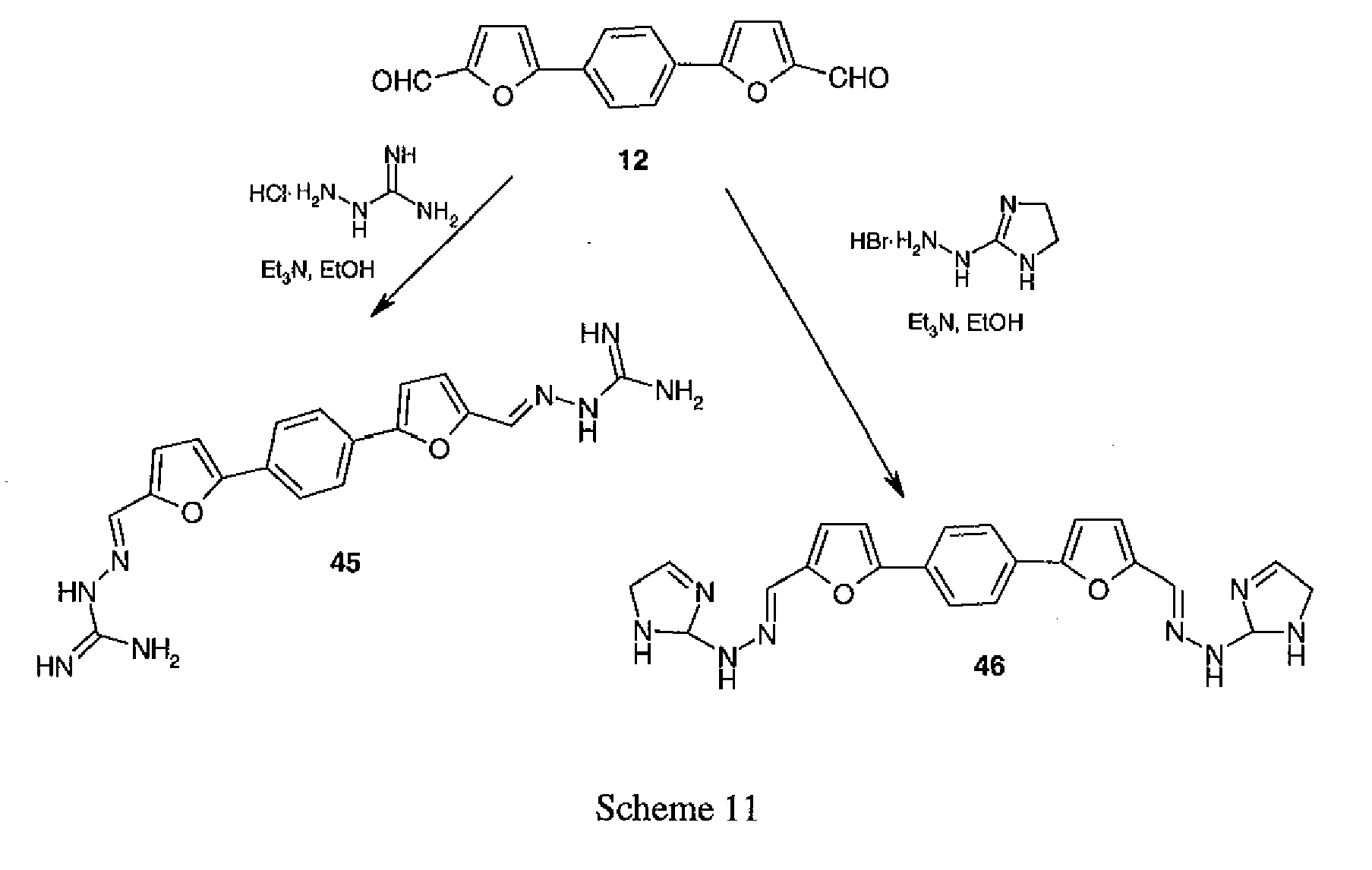
- 5-(4-(2-Hydrazono)-furan-5-yl-phenyl)-furan-2-hydrazone (45). Yield 89.7%, mp 273-275 °C. 1H NMR (DMSO-d 6); δ 7.90 (s, 2H), 7.78 (s, 4H), 7.07 (d, J = 3.6 Hz, 2H), 6.77 (d, J = 3.6 Hz, 2H), 5.95 (br s, 4H), 5.69 (br s, 4H). 13C NMR (DMSO-d 6); δ 159.7, 152.6, 151.6, 133.8, 128.8, 123.9, 111.7, 108.3.
- (45 hydrochloride salt); mp 278-280 °C. 1H NMR (DMSO-d 6); δ 12.05 (s, 2H), 8.14 (s, 2H), 7.93 (s, 4H), 7.76 (br s, 8H), 7.27 (d, J = 3.6 Hz, 2H), 7.18 (d, J = 3.6 Hz, 2H). MS (ESI) m/e (rel. int.): 379 (M++1, 100), 307 (5), 190 (70). Anal. Calc. for C18H18N8O2-2.0HCl-1.25H2O-0.7EtOH: C% 46.12, H% 5.29, N% 22.19. Found C% 45.90, H% 4.95, N% 21.90.
- 5-{4-[2-(4,5-Dihydro-1H-imidazol-2-yl)-hydrazono]-furan-5-yl-phenyl}-furan-2-(4,5-dihydro-1H-imidazol-2-yl)-hydrazone (46). Yield 90%, mp >300 °C. 1H NMR (DMSO-d 6); δ 7.88 (s, 2H), 7.78 (s, 4H), 7.07 (d, J = 3.6 Hz, 2H), 6.72 (d, J = 3.6 Hz, 2H), 6.63 (br s, 2H), 6.56 (br s, 2H), 3.42 (s, 8H). 13C NMR (DMSO-d 6); δ 164.3, 152.7, 151.5, 135.1, 128.8, 124.0, 116.8, 112.0, 108.4, 42.1.
(46 hydrochloride salt); mp 294-296 °C. 1H NMR (DMSO-d 6); δ 12.87 (s, 2H), 8.69 (br s, 4H), 8.24 (s, 2H), 7.93 (s, 4H), 7.28 (d, J = 3.6 Hz, 2H), 7.16 (d, J = 3.6 Hz, 2H), 3.73 (s, 8H). Anal. Calc. for C22H22N8O2-2.0HCl-2.25H2O-0.75EtOH: C% 48.87, H% 5.71, N% 19.41; Found C% 48.72, H% 5.36, N% 19.19. -

- 4,4"-Bis(N',N"-t-butoxycarbonyl)-guanidino-[1,1';4',1"]terphenyl (47). To a solution of 4,4"-diamino-[1,1';4',1"]terphenyl (0.30 g, 1.15 mmol) in anhydrous DMF (10 mL) was added 1,3-bis(tert-butoxycarbonyl)-2-methylthiopseudourea (0.71 g, 2.4 mmol), triethylamine (0.74 g, 7.2 mmol) and finally mercury(II)chloride (0.73 g, 2.6 mmol). The suspension was kept stirring at room temperature for 24 h. The reaction, diluted with CH2Cl2 and Na2CO3 solution, was filtered through a pad of Celite. The organic layer was washed with water (3X) followed by brine and then dried over anhydrous Na2SO4. After evaporating the solvent to dryness the obtained residue was recrystallized from CH2Cl2/MeOH giving a creamy white solid, yield % 79; mp >300 °C. 1H NMR (DMSO-d6 ): δ 1.50, 1.59 (2s, 36H), 7.56-7.70 (m, 12H), 10.39 (br s, 2H), 11.65 (br s, 2H). Anal. Calc. for C40H52N6O8: C% 64.49, H% 7.03; Found C% 64.31, H% 6.85.
- 4,4"-Bis-guanidino-[1,1';4',1"]terphenyl (48). The N',N"-di-BOCguanidine (0.45 g, 0.60 mmol) was dissolved in CH2Cl2 (10 mL), diluted with dry EtOH (15 mL) and the chilled solution was saturated with dry HCl. The reaction was then kept stirring at room temperature for 3 days (drying tube), when by the product started forming a precipitate over time. After evaporating the solvent to dryness, the residue was washed with ether multiple times and was dried under vacuum at 50-60 °C over night to give whitish yellow solid of the bis-guanidine dihydrochloride; mp >300 °C. 1H NMR (DMSO-d6 ): δ 7.85 (dd, J = 1.5, 8.4 Hz, 4H), 7.92 (d, J = 1.2 Hz, 4H), 8.00 (dd, J = 1.5, 8.4 Hz, 4H ), 9.09 (br s, 4H), 11.25 (br s, 2H). 13C NMR (DMSO-d6 ): δ 155.98, 138.35, 137.32, 135.00, 127.79, 127.22, 124.79. MS (ESI) m/e (rel. int.): 344 (M+, 6), 173 (100). Anal. Calc. for C20H20N6-2.0HCl-1.0H2O-0.2C2H5OH: C% 55.11, H% 5.71, N% 18.90; Found C% 55.39, H% 5.50, N% 18.71.
-
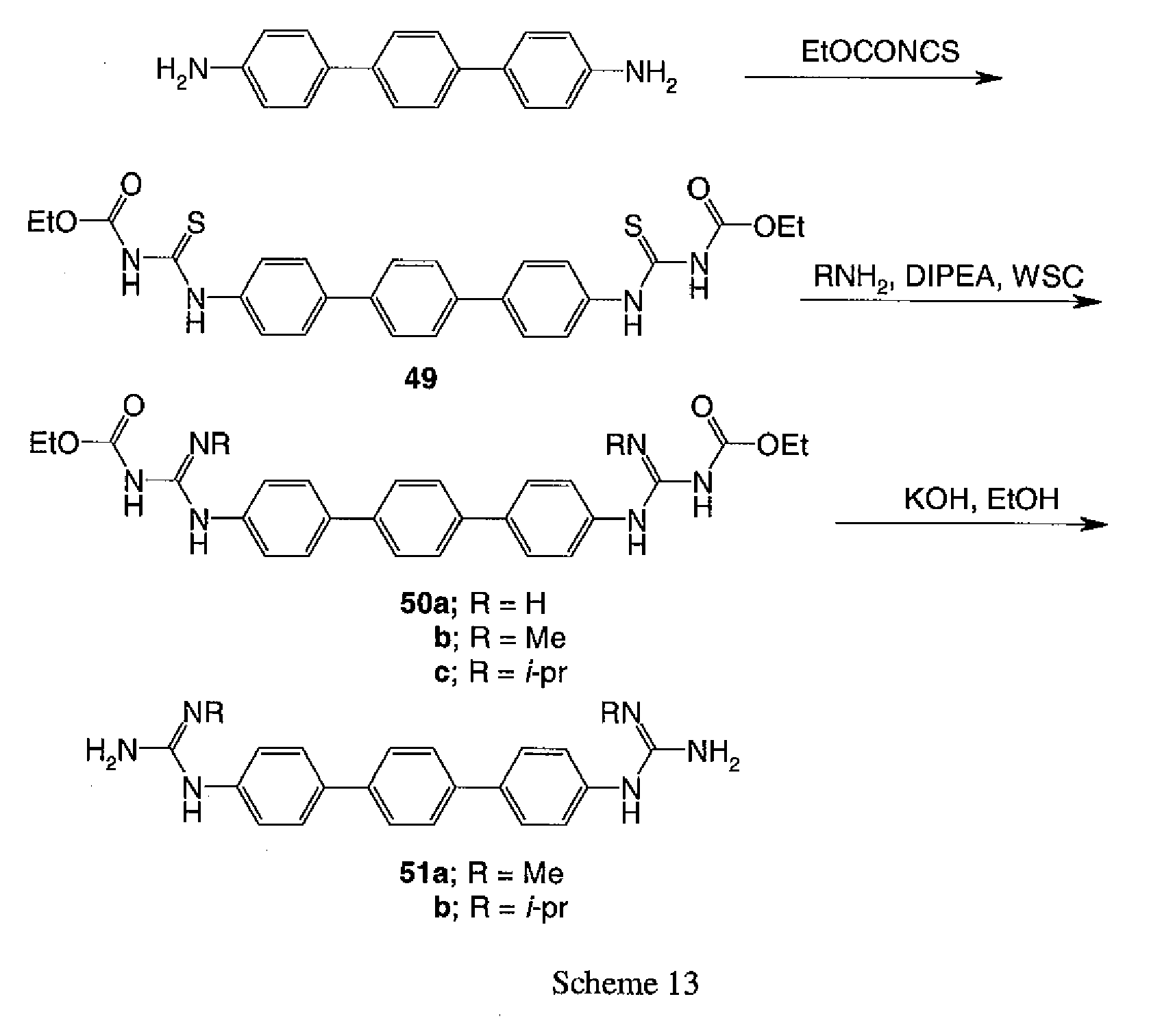
- 4,4"-Bis-(N'-ethoxycarbonylthiourea)-[1,1';4',1"]terphenyl (49). A solution of 4,4"-diamino-[1,1';4',1"]terphenyl (0.50 g, 1.92 mmol) in CH2Cl2 (10 mL), added to which ethyl isothiocyanatoformate (0.55 g, 4.22 mmol), was stirred at room temperature for 24 h. After flash chromatography, the reaction was diluted with hexane and the precipitate formed was collected and dried to yield the bis-carbamoylthiourea as a white solid yield % 89; mp >300 °C. 1H NMR (DMSO-d6 ): δ 1.26 (t, J = 7.2 Hz, 6H), 4.22 (q, J = 7.2 Hz, 4H), 7.70-7.79 (m, 12H), 11.29 (br s, 2H), 11.61 (br s, 2H). MS (ESI) m/e (rel, int.): 522 (M+, 13), 344 (100), 328 (63). Anal. Calc. for C26H26N4O4S2: C% 59.75, H% 5.01; Found C% 49.58, H% 5.23.
- 4,4"-Bis(N'-ethoxycarbonyl)-guanidino-[1,1';4',1"]terphenyl (50a). A stirred solution of carbamoyl thiourea (0.80 g, 1.53 mmol), 0.5 M ammonia solution in dioxane (11.7 mL, 6.12 mmol), and diisopropylethylamine (1.18 g, 9.18 mmol) in anhydrous DMF (10 mL) was cooled to 0 °C. EDCI (1.17 g, 6.12 mmol) was added, and the solution was stirred at room temperature over night. The reaction mixture poured onto ice/water, the solid collected by vacuum filtration. Finally, the carbamoylguanidine was crystallized from EtOH, yield % 67; mp >300 °C. 1H NMR (DMSO-d6 ): δ 1.17 (t, J = 6.9 Hz, 6H), 3.98 (q, J = 6.9 Hz, 4H), 7.53-7.71 (m, 16H), 9.05 (br s, 2H). Anal. Calc. for C26H28N6O4-0.2C2H5OH: C% 63.70, H% 5.91, N% 16.88; Found C% 63.66, H% 5.71, N% 16.65.
- 4,4"-Bis(N'-ethoxycarbonyl-N''-methyl)-guanidino-[1,1';4',1"]trephenyl (50b). A stirred solution of carbamoyl thiourea (1.00 g, 1.91 mmol), methylamine hydrochloride (0.51 mL, 7.65 mmol), and diisopropylethylamine (1.48 g, 11.48 mmol) in anhydrous CH2Cl2 (10 mL) was cooled to 0 °C. EDCI (1.46 g, 7.65 mmol) was added, and the solution was stirred at room temperature over night. The reaction mixture was washed with water (3X100 mL), followed by brine and dried over anhydrous Na2SO4. The residue remaining after removal of the solvent was crystallized from EtOH/water, yield % 82; mp 297-299 °C. 1H NMR (DMSO-d 6): δ 1.15 (t, J = 7.2 Hz, 6H), 3.32 (s, 6H), 3.95 (q, J = 7.2 Hz, 4H), 7.45 (br s, 4H), 7.68-7.75 (m, 12H). 13C NMR (DMSO-d 6): δ 163.01, 158.53, 138.25, 137.50, 135.41, 126.76, 126.66, 124.14, 59.60, 28.17, 14.54. MS (ESI) m/e (rel. int.): 517 (M+, 30), 259 (100). Anal. Calc. for C28H32N4O4-0.25C2H5OH: C% 64.81, H% 6.39, N% 15.91; Found C% 64.84, H% 6.20, N% 15.82.
- 4,4"-Bis(N'-methyl)-guanidino-[1,1';4',1"]terphenyl (51a). The substituted guanidine (0.5 g, 0.96 mmol) was suspended in EtOH (10 mL). 1N KOH 9.6 mL, 9.6 mmol) was then added and the reaction mixture was kept stirring over night maintaining the temperature at 55-60 °C. The reaction mixture was diluted with water and the solid formed was collected by filtration, washed multiple times with water and recrystallized from aqueous EtOH to give a tan white solid, yield % 75; mp 243-244 °C. 1H NMR (DMSO-d6): δ 2.67 (s, 6H), 5.35 (br s, 6H), 6.87 (d, J = 8.4 Hz, 4H), 7.53 (d, J = 8.4 Hz, 4H), 7.64 (s, 4H). 13C NMR (DMSO-d 6): δ 152.2, 149.8, 138.2, 131.3, 126.5, 126.0, 123.2,27.5. MS (ESI) m/e (rel. int.): 373 (M+, 6), 187 (100).
51a Hydrochloride salt. The free base was dissolved in dry EtOH (20 mL) and the solution was chilled in an ice-bath. After passing HCl gas for 10 min, the reaction was concentrated under reduced pressure and then diluted with ether. The precipitate formed was collected by filtration; mp 211-214 °C. 1H NMR (DMSO-d 6): δ 2.83, 2.85 (2 s, 6H), 7.33 (d, J = 8.4 Hz, 4H), 7.77-7.80 (m, 8H), 7.96 (br s, 4H), 10.02 (br s, 4H). Anal. Calc. for C22H24N6-2.0HCl-1.25H2O-0.3C2H5OH: C% 56.34, H% 6.33, N% 17.42; Found C% 56.69, H% 6.07, N% 17.05. - 4,4"-Bis(N'-ethoxycarbonyl-N"-isopropyl)-guanidino-[1,1';4',1"]terphenyl (50c). The same procedure described for the preparation of 50b was used by employing isopropylamine instead of methylamine. Yield % 89; mp >300 °C. 1H NMR (DMSO-d 6): δ 1.11-1.18 (m, 18H), 3.94 (q, J = 7.2 Hz, 4H), 4.01-4.14 (m, 2H), 7.45 (d, J = 7.8 Hz, 4H), 7.68-7.75 (m, 8H), 9.24 (br s, 4H). 13C NMR (DMSO-d6 ): δ 163.40, 157.15, 138.22, 137.49, 135.21, 126.72, 126.57, 123.95, 59.58, 42.40, 22.54, 14.53. MS (ESI) m/e (rel. int.): 573 (M+, 17), 287 (100). Anal. Calc. for C32H40N6O4: C% 67.11, H% 7.03, N% 14.67; Found C% 66.95, H% 7.16, N% 14.37.
- 4,4"-Bis(N'-isopropyl)-guanidino-[1,1';4',1"]terphenyl (51b). The same procedure described for the preparation of 51a was used starting with 50c. Yield % 73; mp 246-247 °C. 1H NMR (DMSO-d 6): δ 1.11 (d, J = 6.3 Hz, 18H), 3.81-3.89 (m, 2H), 5.38 (br s, 6H), 6.87 (d, J = 8.4 Hz, 4H), 7.53 (d, J = 8.4 Hz, 4H), 7.74 (s, 4H). 13C NMR (DMSO-d 6): δ 150.95, 149.36, 138.23, 131.47, 126.69, 126.14, 123.36, 41.56, 22.84. MS (ESI) m/e (rel. int.): 429 (M+, 8), 215 (100).
51b Hydrochloride salt. mp 275-277 °C. 1H NMR (DMSO-d 6): δ 1.19 (d, J = 6.6 Hz, 12H), 3.85-3.96 (m, 2H), 5.38 (br s, 6H), 7.31 (d, J = 8.4 Hz, 4H), 7.77-7.80 (m, 8H), 8.13 (br s, 2H), 9.91 (br s, 2H). Anal. Calc. for C26H32N6-2.0HCl-1.5H2O-0.25C2H5OH: C% 58.93, H% 7.18, N% 15.56; Found C% 59.00, H% 6.82, N% 15.33. -

- 1,4-Bis-(5'-nitropyridin-2'-yl)phenylene (52). Adopting the same procedure used for the preparation of 17, a Suzuki coupling reaction was performed using 2-chloro-5-nitropyridine (20 mmol) and 1,4-phenylenebisboronic acid (10 mmol) to yield the target compound 52 in 90% yield, mp >300 °C. 1H NMR (DMSO-d 6): δ 8.33-8.39 (m, 6H), 8.67 (dd, J = 8.4, 2.1 Hz, 2H), 9.46 (d, J = 2.1 Hz, 2H). MS (ESI) m/e (rel. int.): 323 (M+ +1,100), 307 (80), 287 (15).
- 1,4-Bis-(5'-aminopyridin-2'-yl)phenylene (53). To a solution of 52 (10 mmol) in EtOH/EtOAc (200 mL, 1:1) was added 10% palladium on carbon (1.2 g). The mixture was placed on Parr hydrogenation apparatus at 50 psi for 8 h at room temperature. The mixture was filtered through hyflo and the filter pad. The filtrate was evaporated under reduced pressure and the precipitate was collected and washed with ether to give 53 in 77% yield, mp >250-251 °C. 1H NMR (DMSO-d 6): δ 5.46 (br s, 4H), 6.98 (dd, J = 8.4, 2.4 Hz, 2H), 7.65 (d, J = 8.4 Hz, 2H), 7.93 (s, 4H), 8.02 (d, J = 2.4 Hz, 2H). 13C NMR (DMSO-d6 ): δ 144.0, 143.4, 137.8, 135.9, 125.0, 120.5, 120.0. MS (ESI) m/e (rel. int.): 263 (M+ +1, 100).
- 1,4-Bis-(5'-guanidinopyridin-2'-yl)phenylene hydrochloride salt (55). Adopting the same procedure used for the preparation of 48 starting with compound 54. Compound 54 was prepared by the same procedure described for 47, starting with compound 53.
55 hydrochloride salt: mp 271-273 °C. 1H NMR (D2O/DMSO-d 6):δ 8.15-8.25 (m, 8H), 8.62 (s, 2H). 13C NMR (DMSO-d 6): δ 156.4, 152.3, 144.7, 137.7, 133.7, 131.7, 126.9, 121.2. MS (ESI) m/e (rel. int.): 347 (M++1, 20), 305 (40), 288 (5), 263 (10), 174 (100). Anal. Calc. for C18H18N8-4.0HCl-1.1H2O-1.0C2H5OH: C% 43.04, H% 5.40, N% 20.07; Found C% 43.03, H% 5.00, N% 19.78. -

- 1,4-Bis-[5'-(N'-ethoxycarbonylthiourido)-pyridin-2'-yl]phenylene (56). The same procedure described for the preparation of 49 was used starting with 53. Yield % 89; mp >300 °C. 1H NMR (DMSO-d6 ): δ 1.29 (t, J = 6.9 Hz, 6H), 4.25 (q, J = 6.9 Hz, 4H), 8.03 (d, J = 8.7 Hz, 2H), 8.16-8.21 (m, 6H), 8.80 (s, 2H), 11.12 (br s, 2H), 11.51 (br s, 2H). 13C NMR (DMSO-d6 ): δ 179.3, 153.0, 152.4, 145.4, 138.1, 133.9, 132.6, 126.4, 119.3, 61.7, 13.6. MS (ESI) m/e (rel. int.): 525 (M+, 20), 409 (30), 241 (45), 163 (100).
- 1,4-Bis-{5'-[(N'-ethoxycarbonyl-N''-isopropyl)-guanidino]-pyridin-2'-yl}phenylene (57a). The same procedure described for the preparation of 50c was used starting with 56. Yield % 64; mp >300 °C. 1H NMR (DMSO-d 6): δ 1.13 (t, J = 7.2 Hz, 6H), 1.20 (d, J = 6 Hz, 12H), 3.95 (q, J = 7.2 Hz, 4H), 4.03-4.14 (m, 2H), 7.86 (s, 2H), 7.99 (d, J = 8.7 Hz, 2H), 8.17 (s, 4H), 8.64 (s, 2H), 9.20 (br s, 4H). MS (ESI) m/e (rel. int.): 575 (M++1, 100), 529 (20), 503 (5). Anal. Calc. for C30H38N8O4-0.5H2O: C% 61.73, H% 6.73, N% 19.19; Found C% 61.75, H% 6.55, N% 18.90.
- 1,4-Bis-{5'-[(N'-isopropyl)-guanidino]-pyridin-2'-yl}phenylene (58a). The same procedure described for the preparation of 51a was used starting with 57a. Yield % 59; mp 224-225 °C. 1H NMR (DMSO-d 6): δ 1.16 (d, J = 6.9 Hz, 12H), 3.86-3.98 (m, 2H), 6.30 (br s, 6H), 7.37 (dd, J = 8.4, 2.1 Hz, 2H), 7.85 (d, J = 8.4 Hz, 2H), 8.10 (s, 4H), 8.25 (d, J = 2.1 Hz, 2H). 13C NMR (DMSO-d 6): δ 182.9, 152.3, 148.3, 144.7, 138.1, 130.5, 125.7, 119.7, 42.0, 22.4. MS (ESI) m/e (rel. int.) 431 (M+ + 1, 100), 372 (5), 216 (65). 58a Hydrochloride salt. mp 278-280 °C. Anal. Calc. for C24H30N8-4.0HCl-0.75H2O: C% 48.90, H% 6.06, N% 18.99; Found C% 49.15, H% 6.09, N% 18.62.
- 1,4-Bis-{[5'-(N'-ethoxycarbonyl)-guanidino]-pyridin-2'-yl}phenylene (57b). The same procedure described for the preparation of 50a was used starting with 56.
- 1,4-Bis-[5'-(guanidino)-pyridin-2'-yl]phenylene (58b). The same procedure described for the preparation of 51a was used starting with 57b.
- 1,4-Bis-{5'-[(N'-ethoxycarbonyl-N"'-methyl)-guanidino]-pyridin-2'-yl}phenylene (57c). The same procedure described for the preparation of 50b was used starting with 56.
- 1,4-Bis-{5'-[(N'-methyl)-guanidino]-pyridin-2'-yl}phenylene (58c). The same procedure described for the preparation of 51a was used starting with 57c.
-

- Compound 59. 2,5-Dibromopyridine and p-cyanophenylboronic acid were reacted under the above-mentioned Suzuki coupling conditions. Yield 70%, mp 174-175 °C. 1H NMR (DMSO-d 6); δ 7.90-8.03 (m, 3H), 8.14-8.24 (m, 3H), 8.80 (s, 1H). 13C NMR; δ 152.6, 150.2, 141.4, 139.7, 132.4, 127.0, 122.5, 120.1, 118.3, 111.6. MS (m/z, rel.int.); 259 (M+, 100), 179 (70), 152 (55).
- Compound 60. Stille homocoupling starting with 59. Yield 77%, mp >300 °C. 1H NMR (DMSO-d 6); δ 7.96 (d, J = 8.1 Hz, 4H), 8.20-8.37 (m, 8H), 9.18 (s, 2H). 13C NMR; δ 153.4, 147.6, 142.0, 135.1, 132.3, 131.5, 126.9, 120.8, 118.2, 111.4. MS (m/z, rel.int.); 358 (M+, 100), 330 (5), 256 (10), 179 (70).
- Compound 61. Reduction of dinitrile 60 using LiN(TMS)2. Reduction of the cyano groups of 59 using LiN(TMS)2. Yield 81%, mp >300 °C. 1H NMR (D2O/DMSO-d6 ); δ 8.00 (s, 4H), 8.23-8.43 (m, 8H), 9.15 (s, 2H). 13C NMR; δ 165.8, 154.3, 147.7, 142.9, 136.8, 132.3, 129.0, 128.6, 127.8, 122.3. MS (m/z, rel.int.); 393 (M++1, 95), 376 (8), 359 (5), 197 (100). Calcd for C24H20N6-4.0HCl-2.5H2O: C, 49.41; H, 4.99; N, 14.40. Found C, 49.18; H, 4.67; N, 14.22.
- Compound 62. Direct conversion of the nitrile of 59 to an amidoxime using hydroxylamine in the presence of base. Yield 87%, mp 179-180 °C. 1H NMR (DMSO-d 6); δ 5.87 (s, 2H), 7.75 (d, J = 7.8 Hz, 2H), 7.92-8.09 (m, 4H), 8.73 (s, 1H), 9.73 (s, 1H). 13C NMR; δ 154.2, 150.4, 150.2, 139.7, 137.7, 134.1, 126.1, 125.7, 122.0, 119.2. MS (m/z, rel.int.); 291 (M+, 90), 276 (100), 259 (50).
- Compound 63. Methylation of the amidoxime of 62 using dimethyl sulfate. Yield 68%, mp 158-159 °C. 1H NMR (DMSO-d6 ); δ 3.76 (s, 3H), 6.13 (s, 2H), 7.76 (d, J = 7.8 Hz, 2H), 7.96-8.14 (m, 4H), 8.76 (s, 1H). 13C NMR; δ 154.1, 150.5, 150.2, 139.8, 138.0, 133.3, 126.2, 126.1, 122.0, 119.3, 60.6. MS (m/z, rel.int.); 305 (M+, 100), 290 (4), 274 (10), 259 (85).
- Compound 64. Stille homocoupling of 63. Free base yield 73%, mp 232-233.5 °C. 1H NMR (DMSO-d6 ); δ 3.77 (s, 6H), 6.13 (s, 4H), 7.82 (d, J = 8.4 Hz, 4H), 8.13-8.20 (m, 6H), 8.33 (dd, J = 8.4, 2.4 Hz, 2H), 9.14 (d, J = 2.4 Hz, 2H). 13C NMR; δ 154.7, 150.6, 147.6, 138.7, 135.1, 133.2, 131.1, 126.2, 126.1, 120.3, 60.66. MS (m/z, rel.int.); 452 (M+, 100), 421 (5), 405 (50), 374 (40).
64 salt: mp 279-281 °C. Calcd for C26H24N6O2-4.0HCl-4.25H2O: C, 46.26; H, 5.40; N, 12.44. Found C, 46.09; H, 5.10; N, 12.11. - In vitro antiprotozoal activities were measured following established protocols. See Ismail, M. A., et al., J. Med. Chem., 46, 4761-4769 (2003); Stephens, C. E., et al., Bioorg. Med. Chem. Lett., 13, 2065-2069 (2003) (in vitro assay against Leishmania donovani). The activities of the presently disclosed compounds against Trypanosoma brucei rhodesiense (T. b. r.), Plasmodium falciparum (P. f.), Leishmania donovani (L. d.), and L-6 rat mycoblast cells (as an assay for cell toxicity, CT) are shown in Tables 1 and 2 These values are compared to those of pentamidine and furamidine.
- The activities of compounds 20, 18, 21, 48, 23c, 24c, 5, 4, and 10 against the STIB 900 strain of Trypanosoma brucei rhodesiense (T. b. r.) in a mouse model are shown in Table 3. These values are compared to those of pentamidine and furamidine. Groups of four mice were infected intraperitoneally with 2 x 10⁵ bloodstream forms of T. b. r. STIB 900 which originates from a patient in Tanzania. On days 3, 4, 5, and 6 post-infection the experimental groups were treated with the indicated compound, either by the intraperitoneal route, or for prodrugs, by the oral route. Usually the highest tolerated dose was used. The highest tolerated dose was determined in a pretoxicological experiment.
- Parasitemia of the mice was checked daily up to day 14 post-infection and thereafter 2 times per week up to day 60. One group of mice was not treated and acted as control. Untreated control animals expire between day 7 and 8 post-infection. For relapsing mice, the day of death was recorded and the survival time determined. For the data shown in Table 3, cures reflect the number of mice that survive and are parasite free for 60 days. Survival reflects the average days of survival.
Table 1. Linear Triaryl Dications. 
T. b. r. P. f. L. d. CT Code A R R1 R2 M X Y Z ΔTm IC50 (nM) IC50 (nM) IC50 (µM) IC50 (µM) pentamidine NA NA NA NA NA NA NA 12.6 2.2 nt 2.2 11.4 furamidine NA NA NA NA NA NA NA 25 4.5 15.5 6.4 20 

H nil CH CH CH CH 19.1 5 1 22.1 18 

H nil CH CH CH CH 22.8k >118k >212 21 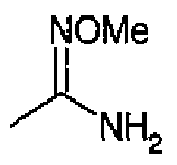

H nil CH CH CH CH 13.8k 371 118 23a 
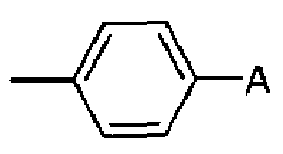
F nil CH CH CH CH 15.1 2 1 0.34 6.4 24a 
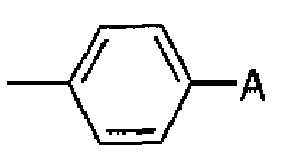
F nil CH CH CH CH >201k 925 29.1 25a 

F nil CH CH CH CH >51.5k 4.2k 23b 

CF3 nil CH CH CH CH 10.1 48 15 3.0 9.0 24b 

CF3 nil CH CH CH CH 29.9k 3.1k 13.3 25b 

CF3 nil CH CH CH CH 36.9k 3.8k 42.2 65 

OMe OMe CH CH CH CH 48 

H nil CH CH CH CH 12.2 18 27 1.2 25.4 50a 

H nil CH CH CH CH 142k 1.7k >181 51a 

H nil CH CH CH CH 18 7 65.1 50b 

H nil CH CH CH CH 7.5K 8.9K 5.7 51b 

H nil CH CH CH CH 530 14 7.2 21.9 50c 

H nil CH CH CH CH 14.2K 4.5K 5.3 55 

H nil N CH CH CH 169 151 152 57b 

H nil N CH CH CH 58c 
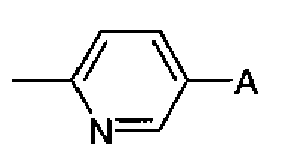
H nil N CH CH CH 57c 

H nil N CH CH CH 58a 

H nil N CH CH CH 57a 

H nil N CH CH CH 23c 

H nil CH CH N CH 18.7 2 10 49.9 24c 

H nil CH CH N CH 9.3K 7.6K >184 25c 

H nil CH CH N CH 34.7K 3.2K >166 36b 

H nil CH CH CH CH 36a 

H nil CH CH N CH 41 11 18.1 66 

H nil CH N N CH 16.1 14 1 0.72 31.3 67 

H nil CH N N CH 12K 2.4K 8.1 68 

H nil CH N N CH 141K 5.5K >194 31 

H nil N CH CH CH 47 10 >100 25.6 33 

H nil N CH CH CH 82.9K 1.2K >158 27 

H nil CH CH N N 16 0.5 40.9 29 

H nil CH CH N N 5 

H nil CH CH CH CH 5 1 2.0 3 

H nil CH CH CH CH 67K 6.6K 106. 4 

H nil CH CH CH CH 24K 1.6K >206 10 
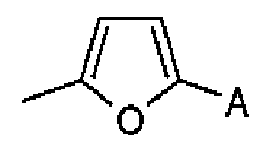
H nil CH N CH CH 2 5.2 20.5 30.9 Table 2. Linear Triaryl Dications In Vitro Results. 
T.b.r P. f. L. d. cytotoxicity (CT) Code A L ΔTm IC50 (nM) IC50 (nM) IC50 (µM ) IC50 (µM) 38a 

175 21 12.9 7.3 39 

13.4K 9.1K 9.4 40 
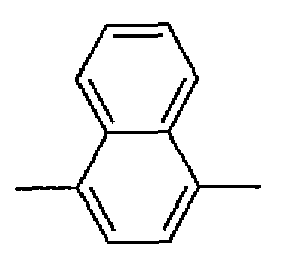
29.5K 3.9K 16.2 38b 

18.2 53 19 0.28 8 61 

16.7 8 5 40.9 Table 3. Linear Triaryl Dications In Vivo Results versus T. b. r. Code Dosage (mg/kg) Route Cures Survival (days) pentamidine 20 ip 0/4 42.7 furamidine 20 ip 2/4 >47.7 20 20 ip 0/4 52.5 18 100 po 0/4 24.75 21 100 po 0/4 20.75 48 20 ip 0/4 >60 23c 20 ip 4/4 >60 24c 100 po 1/4 >35.75 5 20 ip 0/4 21.25 4 100 po 0/4 29 10 20 ip 3/4 >53.5 -

- 1,4-Bis-(2'-cyanopyridin-5'-yl)phenylene (65). To a stirred solution of 5-bromo-2-pyridinecarbonitrile (6.60 g, 36.0 mmol), and tetrakis(triphenylphosphine) palladium (1.80 g, 1.56 mmol) in toluene (100 mL) under a nitrogen atmosphere was added 50 mL of a 2 M aqueous solution of Na2CO3 followed by 1,4-phenylenebisboronic acid (3.90 g, 24.0 mmol) in 50 mL of methanol. The vigorously stirred mixture was warmed to 80 °C overnight. After cooling, the solution was filtered, and the precipitate was washed with toluene, water, and ether to afford 65 as a white solid (4.70 g, 92% yield); mp >300 °C. 1H NMR (DMSO-d 6): δ7.99 (s, 4H), 8.08 (d, J=8.0Hz, 2H), 8.38 (dd, J=2.0, 8.0Hz, 2H), 9.14 (d, J=2.0Hz, 2H).
- 1,4-Bis-(2'-amidinopyridin-5'-yl)-phenylene hydrochloride salt (66). Dinitrile 65 (570 mg, 2.0 mmol), suspended in freshly distilled THF (30 mL), was treated with lithium trimethylsilylamide (1 M solution in THF, 15 mL, 15.0 mmol), and was allowed to stir overnight. The reaction mixture was then cooled to 0 °C and HCl saturated ethanol (15 mL) was added, whereupon a precipitate formed. The mixture was allowed to stand overnight, after which it was diluted with ether, and the resultant solid was collected by filtration. The diamidine was purified by neutralization with 1 N NaOH followed by filtration of the resultant solid and washing with water (3x). Finally, the free base was stirred with ethanolic HCl overnight and diluted with ether, and the solid formed was filtered and dried to give 66 as a hydrochloride salt in 68% yield; mp >300 °C. 1H NMR (D2O/DMSO-d6 ): δ8.11 (s, 4H), 8.47 (d, J=8.4Hz, 2H), 8.60 (dd, J = 2.0, 8.4 Hz, 2H), 9.24 (d, J = 2.0 Hz, 2H), 9.41 (s, 4H), 9.66 (s, 4H). Anal. Calc. for C18H16N6-2.0HCl-0.3H2O: C, 54.78; H, 4.75; N, 21.29. Found: C, 55.03; H, 4.60; N, 21.01.
- 1,4-Bis-[2'-(N-hydroxyamidinopyridin-5'-yl)]-phenylene hydrochloride salt (67). A mixture of hydroxylamine hydrochloride (6.03 g, 86.8 mmol) in anhydrous DMSO (100 mL) was cooled to 5 °C, and then potassium t-butoxide (9.73 g, 86.8 mmol) was added portion wise. To the mixture was added the above dinitrile 65 (2.45 mg, 8.68 mmol), and the mixture was stirred overnight at room temperature. The reaction mixture was poured onto ice/water, whereupon a white precipitate of the diamidoxime formed. The product was collected by filtration and washed with water to afford the free base of 67 in 96% yield. Finally, the free base was stirred with ethanolic HCl overnight and diluted with ether, and the solid formed was filtered and dried to give the hydrochloride salt; mp 231-233 °C. 1H NMR (DMSO-d 6): δ8.00 (s, 4H), 8.09 (d, J=8.4Hz, 2H), 8.39 (dd, J=2.0, 8.4Hz, 2H), 9.15 (d, J=2.0Hz, 2H). Anal. Calc. for C18H16N6O2-2.0HCl-1.5H2O: C, 48.23; H, 4.72; N, 18.74. Found: C, 48.57; H, 4.71; N, 18.34.
- 1,4-Bis-[2'-(N-methoxyamidinopyridin-5'-yl)]-phenylene hydrochloride salt (68). To a suspension of the free base of 67 (560 mg, 1.6 mmol) in DMF (20 mL) was added LiOH·H2O (270 mg, 6.4 mmol, in 3 mL of H2O), which was followed by dimethyl sulfate (0.40 mL, 4.0 mmol). The reaction mixture was stirred overnight, after which it was poured onto ice/water, and the precipitate was filtered, washed with water, and dried to give the free base of 68 in 86% yield. Finally, the free base was stirred with ethanolic HCl overnight and diluted with ether, and the solid formed was filtered and dried to give hydrochloride salt; mp 232-234 °C.
1H NMR (DMSO-d 6): δ3.82 (s, 6H), 6.17 (s, 4H), 7.90 (s, 4H), 7.94 (d, J=8.4Hz, 2H), 8.20 (dd, J=2.0, 8.4Hz, 2H), 8.97 (d, J=2.0Hz, 2H). Anal. Calc. for C20H20N6O2-2.0HCl-2.0H2O: C, 49.79; H, 5.40; N, 17.31. Found: C, 49.47; H, 5.35; N, 17.03. - 1,4-Bis-{2'-[N-(N',N'-dimethylaminoacetoxy)amidinopyridin-5'-yl]}-phenylene(69). A solution of the free base of 67 (350mg, 1.0 mmol) in 30 mL DMF at room temperature was added with dimethylaminoacetyl chloride hydrochloride (720 mg, 4.0 mmol) and triethylamine (1.40 mL, 8.0 mmol), stirred overnight, and filtered. The precipitate was washed with water, and dried to give 69 in 55% yield, mp 213-215 °C. 1H NMR (DMSO-d6 ): δ 2.31 (s, 12H), 3.38 (s, 4H), 6.97 (s, 4H), 7.98 (s, 4H), 8.04 (d, J=8.4Hz, 2H), 8.30 (dd, J=2.0, 8.1Hz), 9.05 (s, 2H). 13C NMR (DMSO-d6 ): δ 167.8, 154.2, 147.3, 146.7, 136.4, 135.1, 127.8, 123.4, 121.1, 58.2, 44.6. Anal. Calc. for C26H30N8O4-1.4H2O: C, 57.43; H, 6.08; N, 20.61. Found: C, 57.63; H, 5.94; N, 20.64.
-

- 1,4-Bis-(2'-cyanopyrazin-5'-yl)phenylene (70). The same procedure described for 1,4-Bis-(2'-cyanopyridin-5'-yl)phenylene was used by employing 5-chloro-2-pyrazinecarbonitrile and 1,4-phenylenebisboronic acid to furnish 70 in 74% yield; mp >300 °C (DMF). 1H NMR (DMSO-d 6): δ 8.39 (s, 4H), 9.22 (s, 2H), 9.69 (s, 2H).
- 1,4-Bis-(2'-amidinopyrazin-5'-yl)-phenylene hydrochloride salt (71). The same procedure described for the preparation of 66 was used starting with the above dinitrile, 70; 55% yield; mp >300 °C. 1H NMR (DMSO-d6 ): δ 8.64 (s, 4H), 9.47 (s, 2H), 9.71 (s, 4H), 9.78 (s, 2H), 9.92 (s, 4H). Anal. Calc. for C16H14N8-2.0HCl-0.65H2O: C, 47.69; H, 4.33; N, 27.81. Found: C, 48.04; H, 4.18; N, 27.52.
- 1,4-Bis-(2'-cyanopyrimidin-5'-yl)-phenylene (72). The same procedure described for 1,4-Bis-(2'-cyanopyridin-5'-yl)phenylene was used by employing 5-bromo-2-pyrimidinecarbonitrile and 1,4-phenylenebisboronic acid to furnish 72 in 69% yield; mp >300 °C (DMF). 1H NMR (DMSO-d 6): δ 8.16 (s, 4H), 9.50 (s, 4H).
- 1,4-Bis-(2'-amidinopyrimidm-5-yl)-phenylene hydrochloride salt (73). The same procedure described for the preparation of 66 was used starting with the above dinitrile, 72; 68% yield; mp >300 °C. 1H NMR (DMSO-d6): δ 8.24 (s, 4H), 9.57 (s, 4H), 9.60 (s, 4H), 9.76 (s, 4H). Anal. Calc. for C16H14N8-2.0HCl-2.5H2O: C, 44.05; H, 4.83; N, 25.68. Found: C, 44.39; H, 4.55; N, 25.28.
-

- 2,5-Bis-(4'-cyanophenyl)-pyrazine (74). The same procedure described for 1,4-Bis-(2'-cyanopyridin-5'-yl)phenylene was used by employing 2,5-dibromopyrazine and 4-cyanophenylboronic acid to furnish 74 in 52% yield; mp > 300 °C (DMF). 1H NMR (DMSO-d 6): δ 7.99 (d, J=8.4Hz, 4H), 8.39 (d, J=8.4Hz, 4H), 9.42 (s, 2H).
- 2,5-Bis-(4'-amidinophenyl)-pyrazine hydrochloride salt (75). The same procedure described for the preparation of 66 was used starting with the above dinitrile, 74; 76% yield; mp >300 °C. (1H NMR (DMSO-d6 ): δ 8.05 (d, J=8.4Hz, 4H), 8.45 (d, J=8.4Hz, 4H), 9.37 (s, 4H), 9.53 (s, 2H), 9.58 (s, 4H). 13C NMR (DMSO-d6 ): δ 165.1, 149.0, 142.1, 140.2, 129.2, 1.29.0, 127.0. Anal. Calc. for C18H16N6-2.0HCl-0.55H2O: C, 54.16; H, 4.82; N, 21.05. Found: C, 54.41; H, 4.75; N, 20.71.
-

- 2,5-Bis-(2'-cyanopyridin-5'-yl)-pyrimidine (76). The same procedure described for 1,4-Bis-(2'-cyanopyridin-5'-yl)phenylene was used by employing 5-bromo-2-chloropyrimidine and 2-cyanopyridine-5-boronic acid pinacol ester to furnish 76 in 78% yield; mp >300 °C. 1H NMR (DMSO-d6 ): δ 8.28 (d, J=8.4Hz, 1H), 8.30 (d, J=8.4Hz, 1H), 8.65 (dd, J = 2.0, 8.4 Hz, 1H), 8.97 (dd, J = 2.0, 8.4 Hz, 1H), 9.36 (d, J = 2.0 Hz, 1H), 9.55 (s, 2H), 9.71 (d, J = 2.0 Hz, 1H).
- 2,5-Bis-(2'-amidinopyridin-5'-yl)-pyrimidine hydrochloride salt (77). The same procedure described for the preparation of 66 was used starting with the above dinitrile, 76; 67% yield; mp >300 °C. 1H NMR (DMSO-d6 ): δ 8.51 (d, J=8.4Hz, 1H), 8.53 (d, J=8.4Hz, 1H), 8.77 (dd, J = 2.0, 8.4 Hz, 1H), 9.08 (dd, J = 2.0, 8.4 Hz, 1H), 9.40 (d, J = 2.0 Hz, 1H), 9.47 (s, 4H), 9.60 (s, 2H), 9.72 (d, J = 2.0 Hz, 1H), 9.75 (s, 2H), 9.44 (s, 2H), 9.76 (d, J = 2.0 Hz, 1H). Anal. Calc. for C16H14N8-2.0HCl-0.8H2O: C, 47.37; H, 4.37; N, 27.62. Found: C, 47.47; H, 4.14; N, 27.32.
-

- 5-(4'-Bromophenyl)-2-pyridinecarbonitrile (78). 5-Bromo-2-cyanopyridine and 4-bromophenylboronic acid were reacted under the above-mentioned Suzuki coupling conditions to give the target nitrile, 78, which was purified by column chromatography (EtOAc/Hexane, 80:20); yield 82%; mp 138-140 °C. 1H NMR (DMSO-d6 ): δ 7.73 (d, J=8.8Hz, 2H), 7.88 (d, J = 8.8 Hz, 2H), 8.10 (d, J=8.0Hz, 1H), 8.34 (dd, J=2.4, 8.0Hz, 1H), 9.08 (d, J=2.4Hz, 1H).
- Phenyl[1,1']phenyl[4',5'']pyridinyl-4,2''-bis-carbonitrile (79). The above nitrile, 78, and 4-cyanophenylboronic acid were reacted under the above-mentioned Suzuki coupling conditions to give the target dinitrile; yield 84%; mp >300 °C. 1H NMR (DMSO-d6 ): δ 7.90-7.97 (m, 8H), 8.08 (d, J = 8.4Hz, 1H). 8.38 (dd, J = 2.0, 8.4Hz, 1H), 9.13 (d, J = 2.0Hz, 1H).
- Phenyl[1,1']phenyl[4',5'']pyridinyl-4,2''-bis-amidine hydrochloride salt (80). The same procedure described for the preparation of 66 was used starting with the above dinitrile, 79; 65% yield; mp >300 °C. 1H NMR (DMSO-d6): δ 7.97 (d, J=8.4Hz, 2H), 7.99 (d, J=8.4Hz, 2H), 8.04 (d, J=8.4Hz, 2H), 8.06 (d, J=8.4Hz, 2H), 8.44 (d, J = 8.4Hz, 1H), 8.58 (dd, J = 2.0, 8.4Hz, 1H), 9.16 (s, 2H), 9.22 (d, J = 2.0Hz, 1H), 9.40 (s, 2H), 9.44 (s, 2H), 9.64 (s, 2H). Anal. Calc. for C19H17N5-2.0HCl-0.6H2O: C, 57.18; H, 5.10; N, 17.55. Found: C, 57.46; H, 5.08; N, 17.25.
-

- 2-(4'-Bromophenyl)-5-pyridinecarbonitrile (81). The same procedure described for 5-(4'-bromophenyl)-2-pyridinecarbonitrile was used by employing 2-bromo-5-cyanopyridine and 4-bromophenylboronic acid to furnish 81 in 78% yield; mp 157-159 °C. 1H NMR (DMSD-d 6): δ 7.74 (d, J=8.8Hz, 2H), 8.12 (d, J = 8.8 Hz, 2H), 8.22 (d, J=8.4Hz, 1H), 8.40 (dd, J=2.4, 8.4Hz, 1H), 9.09 (d, J=2.4Hz, 1H).
- Phenyl[1,1']phenyl[4',2"]pyridinyl-4,5"-bis-carbonitrile (82). The above nitrile, 81, and 4-cyanophenylboronic acid were reacted under the above-mentioned Suzuki coupling conditions to give the target dinitrile, 82; yield 94%; mp >300 °C. 1H NMR (DMSO-d 6): δ 7.68 (d, J=8.8Hz, 2H), 7.73 (d, J=8.8Hz, 2H), 7.86 (d, J=8.4Hz, 2H), 7.96 (d, J=8.4Hz,2H), 8.14 (d, J = 8.0Hz, 1H), 8.42 (dd, J = 2.0, 8.0Hz, 1H), 9.17 (d, J = 2.0 Hz, 1H).
Phenyl[1,1']phenyl[4',2"]pyridinyl-4,5"-bis-amidine hydrochloride salt (83). The same procedure described for the preparation of 66 was used starting with the above dinitrile, 82; 75% yield; mp >300 °C. 1H NMR (DMSO-d 6): δ 7.98 (d, J=8.4Hz, 4H), 8.04 (d, J=8.4Hz, 2H), 8.06 (d, J=8.4Hz, 2H), 8.33-8.37 (m, 4H), 9.11 (s, 1H), 9.26 (s, 2H), 9.38 (s, 2H), 9.49 (s, 2H), 9.66 (s, 2H). Anal. Calc. for C19H17N5-2.0HCl-0.9H2O: C, 56.42; H, 5.18; N, 17.30. Found: C, 56.74; H, 4.94; N, 16.90. -

- 5-(4'-Bromophenyl)-2-pyrimidinecarbonitrile (84). The same procedure described for 5-(4'-bromophenyl)-2-pyridinecarbonitrile was used by employing 5-bromo-2-cyanopyrimidine and 4-bromophenylboronic acid to furnish 84 in 58% yield; mp 202-204 °C. 1H NMR (DMSO-d6 ): δ 7.79 (d, J=8.4Hz, 2H), 7.88 (d, J = 8.4 Hz, 1H), 9.39 (s, 2H).
- Phenyl[1,1']phenyl[4',5"]pyrimidinyl-4,2"-bis-carbonitrile (85). The above nitrile, 84, and 4-cyanophenylboronic acid were reacted under the above-mentioned Suzuki coupling conditions to give the target dinitrile, 85; yield 74%; mp >300 °C. 1H NMR (DMSO-d 6): δ 7.95-8.01 (m, 6H), 8.08 (d, J = 8.4 Hz, 2H), 9.47 (s, 2H).
- Phenyl[1,1']phenyl[4',5"]pyrimidinyl-4,2"-bis-amidine hydrochloride salt (86). The same procedure described for the preparation of 66 was used starting with the above dinitrile, 85; 75% yield; mp >300 °C. 1H NMR (DMSO-d 6): δ 7.97 (d, J=8.4Hz, 2H), 8.03 (d, J=8.4Hz, 2H), 8.06 (d, J=8.4Hz, 2H), 9.13 (s, 2H), 9.44 (s, 2H), 9.54 (s, 2H), 9.57 (s, 2H), 9.76 (s, 2H). Anal. Calc. for C18H16N6-2.0HCl-0.6H2O: C, 54.04; H, 4.84; N, 21.00. Found: C, 54.29; H, 4.68; N, 20.86.
-

- 5-(2'-chloro-pyridin-5'-yl)-2-pyridinecarbonitrile (87). The same procedure described for 5-(4'-bromophenyl)-2-pyridinecarbonitrile was used by employing 5-bromo-2-cyanopyridine and 2-chloropyridine-5-boronic acid to furnish 87 in 98% yield; mp 220-224 °C. 1H NMR (DMSO-d 6): δ 7.72 (d, J=8.8Hz, 1H), 8.19 (d, J=8.4Hz, 1H), 8.34 (dd, J = 2.4, 8.4Hz, 1H), 8.46 (dd, J = 2.4, 8.4Hz, 1H), 8.90 (d, J = 2.0Hz, 1H), 9.17 (d, J = 2.4Hz, 1H).
- Phenyl[1,2']pyridinyl[5',5"]pyridinyl-4,2"-bis-carbonitrile (88). The above nitrile, 87, and 4-cyanophenylboronic acid were reacted under the above-mentioned Suzuki coupling conditions to give the target dinitrile, 88; yield 80%; mp 270-272 °C. 1H NMR (DMSO-d 6): δ 7.99 (d, J=8.4Hz, 2H), 8.07 (d, J=8.4Hz, 2H), 8.17 (d, J = 8.4Hz, 1H), 8.32 (d, J=8.4Hz, 1H), 8.36 (d, J=8.4Hz, 1H), 8.39 (dd, J = 2.0, 8.4Hz, 1H), 8.75 (dd, J = 2.0, 8.4Hz, 1H), 9.18 (d, J=1.6Hz, 1H), 9.52 (d, J=2.0Hz, 1H).
- Phenyl[1,2']pyridinyl[5',5"]pyridinyl-4,2"-bis-amidine hydrochloride salt (89). The same procedure described for the preparation of 66 was used starting with the above dinitrile, 88; 71% yield; mp >300 °C. 1H NMR (DMSO-d6 ): δ 8.00 (d, J=8.4Hz, 2H), 8.33 (d, J=8.4Hz, 1H), 8.43 (d, J=8.4Hz, 2H), 8.47-8.51 (m, 2H), 8.66 (dd, J = 2.0, 8.4 Hz, 1H), 9.18 (s, 2H), 9.26 (d, J=2.0Hz, 1H), 9.30 (d, J=2.OHz, 1H), 9.42 (s, 2H), 9.46 (s, 2H), 9.66 (s, 2H). Anal. Calc. for C18H16N6-2.0HCl-1.0H2O: C, 53.08; H, 4.95; N, 20.63. Found: C, 53.28; H, 4.59; N, 20.34.
- Phenyl[1,2']pyridinyl[5',5"]pyridinyl-4,2"-bis-N-hydroxyamidine (90). The same procedure described for the preparation of 67 was used starting with the above dinitrile, 88; 90% yield; mp 240-242 °C. 1H NMR (DMSO-d 6): δ 5.90 (s, 4H), 7.84 (d, J=8.4Hz, 2H), 7.98 (d, J=8.4Hz, 1H), 8.17 (d, J=8.4Hz, 1H), 8.19 (d, J=8.4Hz, 2H), 8.26 (d, J=8.4Hz, 1H), 8.31 (d, J=8.4Hz, 1H), 9.03 (s, 1H), 9.11 (s, 1H), 9.76 (s, 1H), 10.04 (s, 1H).
- Phenyl[1,2']pyridinyl[5',5"]pyridinyl-4,2"-bis-N-methoxyamidine hydrochloride salt (91). The same procedure described for the preparation of 68 was used starting with the free base of 90; 70% yield; mp 213-215 °C. 1H NMR (D2O/DMSO-d 6): 3.79 (s,3H), 3.84 (s, 3H), 6.15 (s, 2H), 6.17 (s, 2H), 7.83 (d, J=8.4Hz, 2H), 7.98 (d, J=8.4Hz, 1H), 8.17 (d, J= 8.4Hz, 1H), 8.20 (d, J=8.4Hz, 2H), 8.27 (dd, J = 2.0, 8.4 Hz, 1H), 8.31 (dd, J = 2.0, 8.4 Hz, 1H), 9.05 (s, 1H), 9.12 (s, 1H). Anal. Calc. for C20H20N6O2-3.0HCl-2.0H2O: C, 46.03; H, 5.22; N, 16.11. Found: C, 46.18; H, 5.22; N, 15.94.
-

- 2-(2'-chloro-pyridin-5'-yl)-5-pyridinecarbonitrile (92). The same procedure described for 5-(4'-bromophenyl)-2-pyridinecarbonitrile was used by employing 2-bromo-5-cyanopyridine and 2-chloropyridine-5-boronic acid to furnish 92 in 83% yield; mp 198-200 °C. 1H NMR (DMSO-d 6): δ 7.68 (d, J=8.8Hz, 1H), 8.29 (d, J=8.4Hz, 1H), 8.45 (dd, J = 2.4, 8.4Hz, 1H), 8.55 (dd, J = 2.4, 8.4Hz, 1H), 9.12 (d, J = 2.0Hz, 1H), 9.15 (d, J = 2.4Hz, 1H).
- Phenyl[1,2']pyridinyl[5',2'']pyridinyl-4,5''-bis-carbonitrile (93). The above nitrile, 92, and 4-cyanophenylboronic acid were reacted under the above-mentioned Suzuki coupling conditions to give the target dinitrile, 93; yield 76%; mp >300 °C. 1H NMR (DMSO-d 6): δ 8.00 (d, J=8.4Hz, 2H), 8.29 (d, J=8.4Hz, 1H), 8.39 (d, J = 8.4 Hz, 2H), 8.48 (dd, J = 2.0, 8.4Hz, 1H), 8.68 (dd, J = 2.0, 8.4Hz, 1H), 9.16 (d, J=1.6Hz, 1H), 9.48 (d, J=2.0Hz, 1H).
- Phenyl[1,2']pyridinyl[5',2"]pyridinyl-4,5"-bis-amidine hydrochloride salt (94). The same procedure described for the preparation of 66 was used starting with the above dinitrile, 93; 57% yield; mp >300 °C. 1H NMR (DMSO-d6 ): δ 8.00 (d, J=8.4Hz, 2H), 8.33 (d, J=8.4Hz, 1H), 8.42-8.44 (m, 4H), 8.71 (dd, J = 2.0, 8.4 Hz, 1H), 9.14 (d, J=2.0Hz, 1H), 9.21 (s, 2H), 9.35 (s, 2H), 9.48 (s, 2H), 9.52 (d, J=2.0Hz, 1H), 9.65 (s, 2H). Anal. Calc. for C18H16N6-2.5HCl-1.5H2O: C, 49.75; H, 4.99; N, 19.34. Found: C, 50.03; H, 4.73; N, 19.25.
-

- 5-(2'-chloro-pyridin-5'-yl)-2-pyrazinecarbonitrile (95). The same procedure described for 5-(4'-bromophenyl)-2-pyridinecarbonitrile was used by employing 2-chloro-5-cyanopyrazine and 2-chloropyridine-5-boronic acid to furnish 95 in 47% yield; mp 118-120 °C. 1H NMR (DMSO-d6 ): δ 7.71 (d, J=8.4Hz, 1H), 8.32 (d, J=8.4Hz, 1H), 8.48 (dd, J = 1.6, 8.4Hz, 1H), 8.58 (dd, J = 2.0, 8.4Hz, 1H), 9.14 (d, J = 1.6Hz, 1H), 9.17 (d, J = 2.0Hz, 1H).
- Phenyl[1,2']pyridinyl[5',5"]pyrazinyl-4,2"-bis-carbonitrile (96). The above nitrile, 95, and 4-cyanophenylboronic acid were reacted under the above-mentioned Suzuki coupling conditions to give the target dinitrile, 96; yield 70%; mp >300 °C. 1H NMR (DMSO-d 6): δ 8.01 (d, J=8.4Hz, 2H), 8.33 (d, J=8.4Hz, 1H), 8.39 (d, J = 8.4 Hz, 2H), 8.68 (dd, J = 2.0, 8.4 Hz, 1H), 9.25 (s, 1H), 9.47 (s, 1H), 9.72 (s, 1H).
- Phenyl[1,2']pyridinyl[5',5"]pyrazinyl-4,2"-bis-amidine hydrochloride salt (97). The same procedure described for the preparation of 66 was used starting with the above dinitrile, 96; 75% yield; mp >300 °C. 1H NMR (DMSO-d 6): δ 7.80 (d, J=8.4Hz, 2H), 8.38 (d, J=8.4Hz, 1H), 8.46 (d, J = 8.4 Hz, 2H), 8.97 (dd, J = 2.4, 8.4 Hz, 1H), 9.20 (s, 2H), 9.49 (m, 3H), 9.67 (s, 2H), 9.74 (d, J=2.0Hz, 1H), 9.79 (s, 1H), 9.91 (s, 2H). Anal. Calc. for C17H15N7-2,7HCl-2.0H2O: C, 45.19; H, 4.84; N, 21.70. Found: C, 45.52; H, 4.71; N, 21.34.
-

- 5-(2'-chloro-pyridin-5'-yl)-2-pyrimidinecarbonitrile (98). The same procedure described for 5-(4'-bromophenyl)-2-pyridinecarbonitrile was used by employing 5-bromo-2-cyanopyrimidine and 2-chloropyridine-5-boronic acid to furnish 98 in 27% yield; mp 158-160 °C. 1H NMR (DMSO-d 6): δ 7.77 (d, J=8.4Hz, 2H), 8.41 (dd, J = 2.4, 8.4Hz, 1H), 8.97 (d, J = 2.4Hz, 1H), 9.46 (s, 2H).
- Phenyl[1,2']pyridinyl[5',5"]pyrimidinyl-4,2"-bis-carbonitrile (99). The above nitrile, 98, and 4-cyanophenylboronic acid were reacted under the above-mentioned Suzuki coupling conditions to give the target dinitrile, 99; yield 77%; mp 272-274 °C. 1H NMR (DMSO-d6 ): δ 8.01 (d, J=8.4Hz, 2H), 8.34 (d, J=8.4Hz, 1H), 8.40 (d, J = 8.4 Hz, 2H), 8.53 (dd, J = 2.0, 8.4 Hz, 1H), 9.28 (d, J = 2.0 Hz, 1H), 9.55 (s, 2H).
- Phenyl[1,2']pyridinyl[5',5"]pyrimidinyl-4,2"-bis-amidine hydrochloride salt (100). The same procedure described for the preparation of 66 was used starting with the above dinitrile, 99; 51% yield; mp >300 °C. 1H NMR (DMSO-d 6): δ 7.99 (d, J=8.4Hz, 2H), 8.38 (d, J=8.4Hz, 1H), 8.44 (d, J = 8.4 Hz, 2H), 8.59 (dd, J = 2.0, 8.4 Hz, 1H), 9.16 (s, 2H), 9.34 (d, J = 2.0 Hz, 1H), 9.47 (s, 2H), 9.60 (s, 2H), 9.62 (s, 2H), 9.62 (s, 4H), 9.79 (s, 2H). Anal. Calc. for C17H15N7-2.0HCl-0.6H2O: C, 50.91; H, 4.57; N, 24.45. Found: C, 50.68; H, 4.49; N, 24.13.
- The in vitro and/or in vivo activities of compounds 66-69, 71, 73, 75, 77, 80, 83, 86, 89, 91, 94, 97, and 100 are described in Tables 4 and 5 below. Testing methods are as described above in Example 17.
Table 4. In Vitro Activity Code Compound Structure T.b. IC50 (nM) P.f. IC50 (nM) L.d. IC50 (nM) CT IC50 (µM) 66 
1 0.4 63 1.2 68 
4570 637 >193 80 
84 2.8 83 
11 1367 26.7 89 
6 1 510 19.9 91 
1980 2154 12.8 77 
1828 75 
18 562 42.5 71 
7131 5170 10000 46.5 94 
7 3 6815 28.3 100 
2641 73 
1722 97 
14 15568 93.4 86 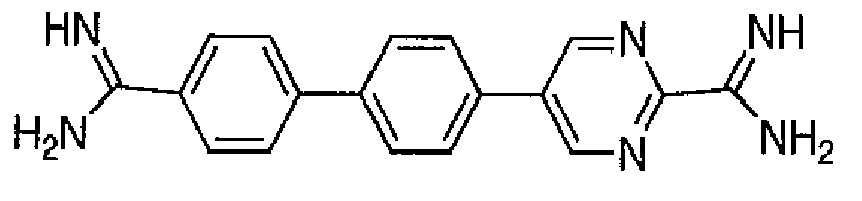
190 Table 5. In vivo Anti- T.b.r. Activity Code Compound Structure Dosage(mg/kg/route); Cures; Survival (days) 66 
5 mg/kg/ip;
0/4 cures;
> 51.5 d67 
25 mg/kg/po;
0/4 cures;
16.25 d69 
25 mg/kg/po;
0/4 cures;
28.25 d89 
5mg/kg/ip;
3/4 cures;
> 60 d91 
25 mg/kg/ip;
0/4 cures;
22.25 d94 
5 mg/kg/ip;
4/4 cures;
> 60 d - It will be understood that various details of the invention may be changed without departing from the scope of the invention. Furthermore, the foregoing description is for the purpose of illustration only, and not for the purpose of limitation.


Claims (28)
- An aza teraryl compound comprising a structure of Formula (I):
L1-Ar1-(CH2)p-Ar2-(CH2)q-Ar3-L2 (I)
wherein:p and q are each independently an integer from 0 to 8;Ar1 and Ar3 are independently selected from the group consisting of:wherein: each A, D, E, G, Y, and Z is independently selected from the group consisting of N and CR4, wherein R4 is selected from the group consisting of H, hydroxyl, halo, nitro, alkyl, substituted alkyl, alkoxyl, aryl, substituted aryl, and aryloxyl;X is selected from the group consisting of O, S, NH, and Se;each m is independently an integer from 0 to 4;each s is independently an integer from 0 to 2;each R1, R2, R3, and R21 is independently selected from the group consisting of H, hydroxyl, halo, nitro, alkyl, substituted alkyl, alkoxyl, aryl, substituted aryl, and aryloxyl;Ar2 is selected from the group consisting of: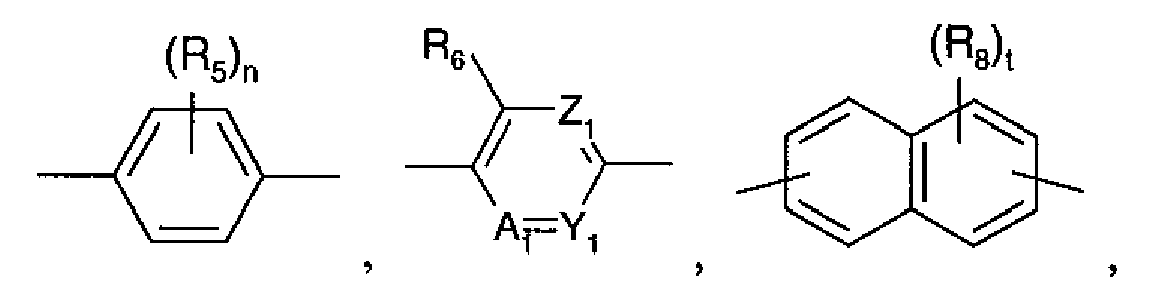

 A1, A2, A3, A4, A5, E1, E2, G1, G2, Y1, Y2, Y3, Y4, Y5, Z1, Z2, and Z3 are independently selected from the group consisting of N and CR7, wherein R7 is selected from the group consisting of H, hydroxyl, halo, nitro, alkyl, substituted alkyl, alkoxyl, aryl, substituted aryl, and aryloxyl;n is an integer from 0 to 4;t is an integer from 0 to 6;each R5, R6, R8, R9, R10, R22, R23, R24, and R25 is independently selected from the group consisting of H, hydroxyl, halo, nitro, alkyl, substituted alkyl, alkoxyl, aryl, substituted aryl, aryloxyl; andL1 and L2 are independently selected from the group consisting of:
 R11, R12, R13, R14, R15, and R20 are each independently selected from the group consisting of H, alkyl, substituted alkyl, cycloalkyl, aryl, substituted aryl, aralkyl, hydroxyl, alkoxyl, hydroxyalkyl, hydroxycycloalkyl, alkoxycycloalkyl, aminoalkyl, acyloxyl, alkylaminoalkyl, and alkoxycarbonyl; orR11 and R12 together represent a C2 to C10 alkyl, C2 to C10 hydroxyalkyl, or a C2 to C10 alkylene; orR11 and R12 together are:or a pharmaceutically acceptable salt thereof.
- The compound of claim 1, wherein at least one of Ar1 and Ar3 is

- The compound of claim 2, wherein:Ar1 and Ar3 are each:
 Ar2 is:the compound of Formula (I) has a structure of Formula (IIe):


- The compound of claim 2, wherein:Ar1 is:
 Ar2 is:
 Ar3 is:the compound of Formula (I) has a structure of Formula (IIf):


- The compound of claim 2, wherein:Ar1 is:
 Ar2 is:
 Ar3 is :and
the compound of Formula (I) has a structure of Formula (IIg):
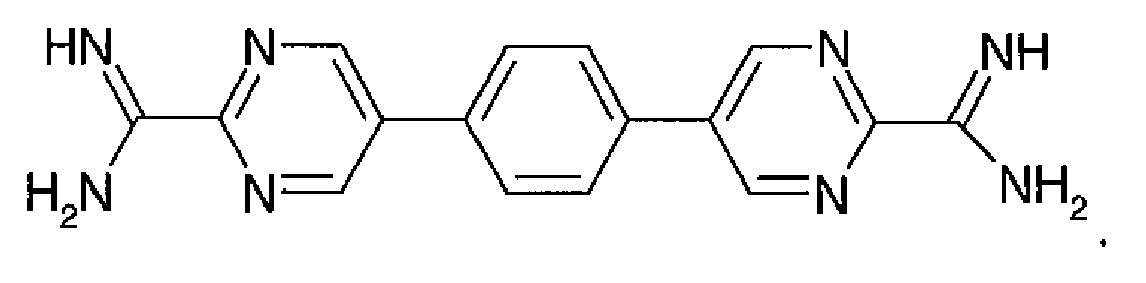
- The compound of claim 2, wherein:Ar1 is:
 Ar2 is:
 Ar3 is:and
the compound of Formula (I) has a structure of Formula (IIh):


- The compound of claim 2, wherein:Ar1 is:
 Ar2 is:
 Ar3 is:the compound of Formula (I) has a structure of Formula (IIIa-4):

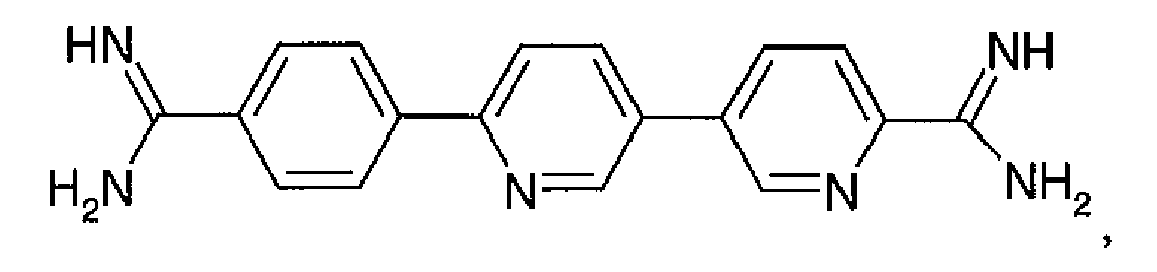


- The compound of claim 2, wherein:Ar1 is:
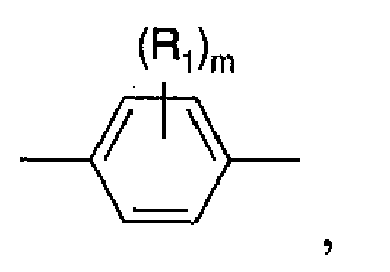 Ar2 is
 Ar3 is:the compound of Formula (I) has a structure of Formula (IIIa-5):


- The compound of claim 2, wherein:Ar1 is:
 Ar2 is:
 Ar3 is:the compound of Formula (I) has a structure of Formula (IIIc-2):


- The compound of claim 1, wherein:Ar1 is:
 Ar2 is:
 Ar3 is:the compound of Formula (I) has a structure of Formula (IIi):


- The compound of claim 1, wherein:Ar1 is:
 Ar2 is:
 Ar3 is:the compound of Formula (I) has a structure of Formula (IIIa-3):


- The compound of claim 1, wherein:Ar1 and Ar3 are each:
 Ar2 is:the compound of Formula (I) has a structure of Formula (IIIe):


- A pharmaceutical formulation comprising:(a) an aza teraryl compound of claim 1; and(b) a pharmaceutically acceptable carrier.
- An effective amount of an aza teraryl compound of Formula (I):
L1-Ar1-(CH2)p-Ar2-(CH2)q-Ar3-L2 (I)
wherein:p and q are each independently an integer from 0 to 8;Ar1 and Ar3 are independently selected from the group consisting of:wherein: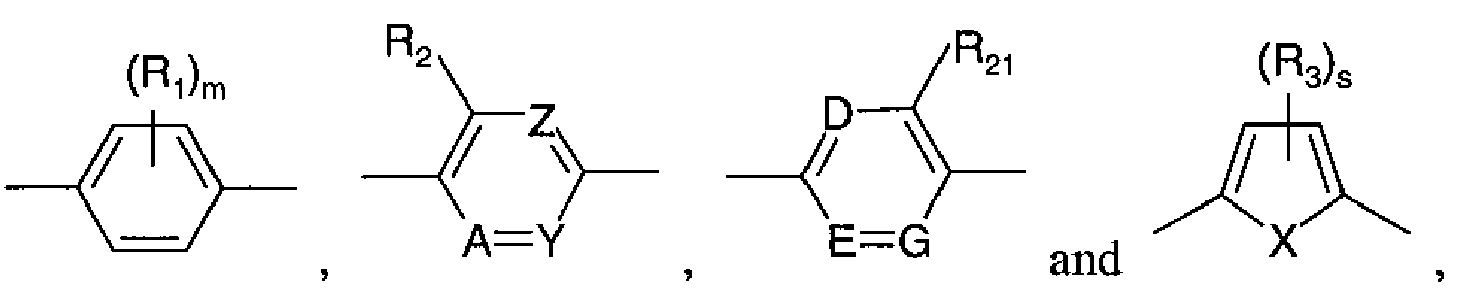 each A, D, E, G, Y, and Z is independently selected from the group consisting of N and CR4, wherein R4 is selected from the group consisting of H, hydroxyl, halo, nitro, alkyl, substituted alkyl, alkoxyl, aryl, substituted aryl, and aryloxyl;X is selected from the group consisting of O, S, NH, and Se;each m is independently an integer from 0 to 4;each s is independently an integer from 0 to 2;each R1, R2, R3, and R21 is independently selected from the group consisting of H, hydroxyl, halo, nitro, alkyl, substituted alkyl, alkoxyl, aryl, substituted aryl, and aryloxyl;Ar2 is selected from the group consisting of:

 A1, A2, A3, A4, A5, E1, E2, G1, G2, Y1, Y2, Y3, Y4, Y5, Z1, Z2, and Z3 are independently selected from the group consisting of N and CR7, wherein R7 is selected from the group consisting of H, hydroxyl, halo, nitro, alkyl, substituted alkyl, alkoxyl, aryl, substituted aryl, and aryloxyl;n is an integer from 0 to 4;t is an integer from 0 to 6;each R5, R6, R8, R9, R10, R22, R23, R24, and R25 is independently selected from the group consisting of H, hydroxyl, halo, nitro, alkyl, substituted alkyl, alkoxyl, aryl, substituted aryl, aryloxyl; andL1 and L2 are independently selected from the group consisting of:
 R11, R12, R13, R14, R15, and R20 are each independently selected from the group consisting of H, alkyl, substituted alkyl, cycloalkyl, aryl, substituted aryl, aralkyl, hydroxyl, alkoxyl, hydroxyalkyl, hydroxycycloalkyl, alkoxycycloalkyl, aminoalkyl, acyloxyl, alkylaminoalkyl, and alkoxycarbonyl; orR11 and R12 together represent a C2 to C10 alkyl, C2 to C10 hydroxyalkyl, or a C2 to C10 alkylene; orR11 and R12 together are:or a pharmaceutically acceptable salt thereof,
for use in a method of treating a microbial infection in a subject in need of treatment thereof, by administering to the subject said effective amount of said compound. - The compound of claim 14, wherein the microbial infection is selected from the group consisting of a Trypanosoma brucei rhodesiense infection, a Plasmodium falciparum infection, and a Leishmania donovoni infection.
- The compound of claim 14, wherein at least one of Ar1 and Ar3 is

- The compound of claim 16, wherein:Ar1 and Ar3 are each:
 Ar2 is:the compound of Formula (I) has a structure of Formula (IIe):


- The compound of claim 16, wherein:Ar1 is:
 Ar2 is:
 Ar3 is:the compound of Formula (I) has a structure of Formula (IIf):


- The compound of claim 16, wherein:Ar1 is:
 Ar2 is:
 Ar3 is:the compound of Formula (I) has a structure of Formula (IIg):


- The compound of claim 16, wherein:Ar1 is:
 Ar2 is:
 Ar3 is:the compound of Formula (I) has a structure of Formula (IIh):


- The compound of claim 16, wherein:Ar1 is:
 Ar2 is:
 Ar3 is:the compound of Formula (I) has a structure of Formula (IIIa-4):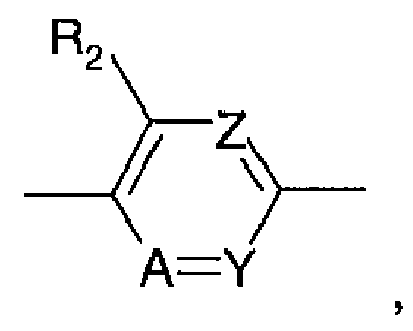


- The compound of claim 16, wherein:Ar1 is:
 Ar2 is
 Ar3 is:the compound of Formula (I) has a structure of Formula (IIIa-5):


- The compound of claim 16, wherein:Ar1 is:
 Ar2 is:
 Ar3 is:the compound of Formula (I) has a structure of Formula (IIIc-2):


- The compound of claim 14, wherein:Ar1 is:
 Ar2 is:
 Ar3 is:the compound of Formula (I) has a structure of Formula (IIi):


- The compound of claim 14, wherein:Ar1 is:
 Ar2 is:
 Ar3 is:the compound of Formula (I) has a structure of Formula (IIIa-3):


- The compound of claim 14, wherein:Ar1 and Ar3 are each:
 Ar2 is:the compound of Formula (I) has a structure of Formula (IIIe):


- An effective amount of an aza teraryl compound, wherein the compound is has a structure selected from the group consisting of Formula (IIe) and Formula (IIh):

 p and q are each independently an integer from 0 to 8;m is an integer from 0 to 4;n is an integer from 0 to 4;each Z, A, and Y is independently selected from the group consisting of N and CR4, wherein R4 is selected from the group consisting of H, hydroxyl, halo, nitro, alkyl, substituted alkyl, alkoxyl, aryl, substituted aryl, and aryloxyl;each R1, R2 and R5 is independently selected from the group consisting of H, hydroxyl, halo, nitro, alkyl, substituted alkyl, alkoxyl, aryl, substituted aryl, and aryloxyl; andL1 and L2 are independently selected from the group consisting of:for use in a method of treating an infection caused by a Leishmania species in a subject in need of treatment thereof by administering to the subject said effective amount of said compound.
 R11, R12, R13, R14, R15, and R20 are each independently selected from the group consisting of H, alkyl, substituted alkyl, cycloalkyl, aryl, substituted aryl, aralkyl, hydroxyl, alkoxyl, hydroxyalkyl, hydroxycycloalkyl, alkoxycycloalkyl, aminoalkyl, acyloxyl, alkylaminoalkyl, and alkoxycarbonyl; orR11 and R12 together represent a C2 to C10 alkyl, C2 to C10 hydroxyalkyl, or a C2 to C10 alkylene; orR11 and R12 together are:a pharmaceutically acceptable salt thereof,
- The compound of claim 27, wherein the compound is selected from the group consisting of:


wherein the Leishmania species is Leishmania donovani, or
wherein the Leishmania species is Leishmania mexicana amazonensis.
Applications Claiming Priority (1)
| Application Number | Priority Date | Filing Date | Title |
|---|---|---|---|
| US11/698,257 US7964619B2 (en) | 2005-06-03 | 2007-01-25 | Teraryl components as antiparasitic agents |
Publications (2)
| Publication Number | Publication Date |
|---|---|
| EP1949896A2 true EP1949896A2 (en) | 2008-07-30 |
| EP1949896A3 EP1949896A3 (en) | 2008-08-06 |
Family
ID=39327133
Family Applications (1)
| Application Number | Title | Priority Date | Filing Date |
|---|---|---|---|
| EP08150205A Withdrawn EP1949896A3 (en) | 2007-01-25 | 2008-01-14 | Linear dicationic terphenyls and their aza analogues as antiparasitic agents |
Country Status (6)
| Country | Link |
|---|---|
| US (2) | US7964619B2 (en) |
| EP (1) | EP1949896A3 (en) |
| JP (1) | JP2008231092A (en) |
| CN (1) | CN101270081A (en) |
| AU (1) | AU2008200076A1 (en) |
| CA (1) | CA2617463A1 (en) |
Families Citing this family (3)
| Publication number | Priority date | Publication date | Assignee | Title |
|---|---|---|---|---|
| US7964619B2 (en) | 2005-06-03 | 2011-06-21 | The University Of North Carolina At Chapel Hill | Teraryl components as antiparasitic agents |
| AU2006202083A1 (en) * | 2005-06-03 | 2006-12-21 | Reto Brun | Linear dicationic terphenyls and their aza analogues as antiparasitic agents |
| US20100331368A1 (en) * | 2007-10-17 | 2010-12-30 | Tidwell Richard R | 2,5-diaryl selenophene compounds, aza 2,5-diaryl thiophene compounds, and their prodrugs as antiprotozoal agents |
Family Cites Families (18)
| Publication number | Priority date | Publication date | Assignee | Title |
|---|---|---|---|---|
| US5521189A (en) | 1994-05-06 | 1996-05-28 | The University Of Nc At Ch | Methods of treating pneumocystis carinii pneumonia |
| US5550295A (en) | 1995-05-03 | 1996-08-27 | Cytec Technology Corp. | Preparation of arylalkyl phosphines, phosphine oxides or phosphine sulfides |
| WO1996040138A1 (en) | 1995-06-07 | 1996-12-19 | The Administrators Of The Tulane Educational Fund | Chloroquine analogs and methods of preventing and treating plasmodial disease |
| US5628984A (en) | 1995-07-31 | 1997-05-13 | University Of North Carolina At Chapel Hill | Method of detecting lung disease |
| TR200001645T2 (en) | 1997-12-11 | 2000-12-21 | Janssen Pharmaceutica N.V. | Retinoic acid imitation are anilures. |
| CN100488947C (en) | 1999-01-13 | 2009-05-20 | 杰南技术公司 | Serine protease inhibitors |
| EP1178038A1 (en) | 2000-08-04 | 2002-02-06 | Aventis Cropscience S.A. | Fungicidal phenylamidine derivatives |
| US6506786B2 (en) | 2001-02-13 | 2003-01-14 | Pharmacor Inc. | HIV protease inhibitors based on amino acid derivatives |
| DE10162114A1 (en) | 2001-12-12 | 2003-06-26 | Schering Ag | New N-phenyl (hetero)aryl-carboximidamides are potent nitrogen monoxide synthase inhibitors, useful e.g. for treating neurodegenerative, cardiovascular, autoimmune and/or inflammatory diseases |
| US7256203B2 (en) | 2002-11-27 | 2007-08-14 | The University Of North Carolina At Chapel Hill | Dicationic 2,5-diarylfuran aza-analogs as anti-protozoan agents |
| US7250447B2 (en) | 2003-05-20 | 2007-07-31 | Genentech, Inc. | Acylsulfamide inhibitors of factor VIIa |
| US20070088067A1 (en) | 2003-09-05 | 2007-04-19 | Tidwell Richards R | Novel amidine compounds for treating microbial infections |
| ITMI20031754A1 (en) | 2003-09-12 | 2005-03-13 | Fabrizio Marcucci | MICROBICIDE COMPOSITION. |
| JP2007509176A (en) | 2003-10-24 | 2007-04-12 | ザ ユニバーシティ オブ ノース カロライナ アット チャペル ヒル | Dicationic triaryl analogues as antiprotozoal agents |
| CN101845023A (en) | 2004-02-18 | 2010-09-29 | 阿斯利康(瑞典)有限公司 | Tetrazole compound and as the application of metabotropic glutamate receptor antagonists |
| JPWO2005103012A1 (en) | 2004-04-21 | 2008-03-13 | 小野薬品工業株式会社 | Hydrazinoheterocyclic nitrile compounds and uses thereof |
| US7964619B2 (en) | 2005-06-03 | 2011-06-21 | The University Of North Carolina At Chapel Hill | Teraryl components as antiparasitic agents |
| AU2006202083A1 (en) | 2005-06-03 | 2006-12-21 | Reto Brun | Linear dicationic terphenyls and their aza analogues as antiparasitic agents |
-
2007
- 2007-01-25 US US11/698,257 patent/US7964619B2/en not_active Expired - Fee Related
-
2008
- 2008-01-08 AU AU2008200076A patent/AU2008200076A1/en not_active Abandoned
- 2008-01-09 CA CA002617463A patent/CA2617463A1/en not_active Abandoned
- 2008-01-14 EP EP08150205A patent/EP1949896A3/en not_active Withdrawn
- 2008-01-16 JP JP2008006443A patent/JP2008231092A/en not_active Withdrawn
- 2008-01-23 CN CNA2008100085292A patent/CN101270081A/en active Pending
-
2011
- 2011-06-17 US US13/162,907 patent/US8188121B2/en not_active Expired - Fee Related
Also Published As
| Publication number | Publication date |
|---|---|
| US8188121B2 (en) | 2012-05-29 |
| JP2008231092A (en) | 2008-10-02 |
| AU2008200076A1 (en) | 2008-08-14 |
| US7964619B2 (en) | 2011-06-21 |
| US20110257199A1 (en) | 2011-10-20 |
| CN101270081A (en) | 2008-09-24 |
| US20070232621A1 (en) | 2007-10-04 |
| CA2617463A1 (en) | 2008-07-25 |
| EP1949896A3 (en) | 2008-08-06 |
Similar Documents
| Publication | Publication Date | Title |
|---|---|---|
| US7432278B2 (en) | Dicationic imidazo[1,2-a]pyridines and 5,6,7,8-tetrahydro-imidazo[1,2-a]pyridines as antiprotozoal agents | |
| US8101636B2 (en) | Linear dicationic terphenyls and their aza analogues as antiparasitic agents | |
| WO2005033065A1 (en) | Novel amidine compounds for treating microbial infections | |
| EP1726589B1 (en) | 5,5'-bis-(4-amidinophenyl)-2,2'-bifuran derivatives and related compounds as antiprotozoal agent and prodrugs thereof | |
| US8188121B2 (en) | Substituted pyridines as antiparasitic AZA teraryl compounds | |
| US20080114047A1 (en) | Cationic substituted benzofurans as antimicrobial agents | |
| US20100331368A1 (en) | 2,5-diaryl selenophene compounds, aza 2,5-diaryl thiophene compounds, and their prodrugs as antiprotozoal agents | |
| US20050148646A1 (en) | Dicationic triaryl analogs as anti-protozoan agents | |
| WO2005086754A2 (en) | Dicationic compounds for activity against trichomonas vaginalis | |
| EP1719767A1 (en) | Synthesis and antiprotozoal activity of dicationic 3,5-diphenylisoxazoles | |
| US7256203B2 (en) | Dicationic 2,5-diarylfuran aza-analogs as anti-protozoan agents | |
| JP2007513888A (en) | Fused ring dicationic antiprotozoal agents and their prodrugs |
Legal Events
| Date | Code | Title | Description |
|---|---|---|---|
| PUAI | Public reference made under article 153(3) epc to a published international application that has entered the european phase |
Free format text: ORIGINAL CODE: 0009012 |
|
| PUAL | Search report despatched |
Free format text: ORIGINAL CODE: 0009013 |
|
| AK | Designated contracting states |
Kind code of ref document: A2 Designated state(s): AT BE BG CH CY CZ DE DK EE ES FI FR GB GR HR HU IE IS IT LI LT LU LV MC MT NL NO PL PT RO SE SI SK TR |
|
| AX | Request for extension of the european patent |
Extension state: AL BA MK RS |
|
| AK | Designated contracting states |
Kind code of ref document: A3 Designated state(s): AT BE BG CH CY CZ DE DK EE ES FI FR GB GR HR HU IE IS IT LI LT LU LV MC MT NL NO PL PT RO SE SI SK TR |
|
| AX | Request for extension of the european patent |
Extension state: AL BA MK RS |
|
| RIN1 | Information on inventor provided before grant (corrected) |
Inventor name: HU, LAIXING Inventor name: ARAFA, REEM K. Inventor name: WILSON, W. DAVID Inventor name: ISMAIL, MOHAMED A. EL-MONSOURA UNIVERSITY Inventor name: BOYKIN, DAVID W. Inventor name: TIDWELL, RICHARD R. Inventor name: BRUN, RETO Inventor name: WERBOVETZ, KARL |
|
| 17P | Request for examination filed |
Effective date: 20081107 |
|
| 17Q | First examination report despatched |
Effective date: 20090130 |
|
| AKX | Designation fees paid |
Designated state(s): AT BE BG CH CY CZ DE DK EE ES FI FR GB GR HR HU IE IS IT LI LT LU LV MC MT NL NO PL PT RO SE SI SK TR |
|
| STAA | Information on the status of an ep patent application or granted ep patent |
Free format text: STATUS: THE APPLICATION IS DEEMED TO BE WITHDRAWN |
|
| 18D | Application deemed to be withdrawn |
Effective date: 20090610 |