EP1949688B1 - Atomic channel changes in a switched digital video system - Google Patents
Atomic channel changes in a switched digital video system Download PDFInfo
- Publication number
- EP1949688B1 EP1949688B1 EP06850128.7A EP06850128A EP1949688B1 EP 1949688 B1 EP1949688 B1 EP 1949688B1 EP 06850128 A EP06850128 A EP 06850128A EP 1949688 B1 EP1949688 B1 EP 1949688B1
- Authority
- EP
- European Patent Office
- Prior art keywords
- channel
- sdv
- bandwidth
- requested
- message
- Prior art date
- Legal status (The legal status is an assumption and is not a legal conclusion. Google has not performed a legal analysis and makes no representation as to the accuracy of the status listed.)
- Ceased
Links
- 230000005540 biological transmission Effects 0.000 claims description 15
- 238000000034 method Methods 0.000 claims description 14
- 238000012508 change request Methods 0.000 claims description 6
- 238000011156 evaluation Methods 0.000 claims description 5
- 239000000835 fiber Substances 0.000 description 12
- 238000007726 management method Methods 0.000 description 9
- 230000003287 optical effect Effects 0.000 description 9
- 238000004891 communication Methods 0.000 description 7
- 238000006243 chemical reaction Methods 0.000 description 5
- 238000011144 upstream manufacturing Methods 0.000 description 3
- 230000002596 correlated effect Effects 0.000 description 2
- 238000012986 modification Methods 0.000 description 2
- 230000004048 modification Effects 0.000 description 2
- 239000003795 chemical substances by application Substances 0.000 description 1
- 230000001143 conditioned effect Effects 0.000 description 1
- 230000003750 conditioning effect Effects 0.000 description 1
- 230000000875 corresponding effect Effects 0.000 description 1
- 238000012217 deletion Methods 0.000 description 1
- 230000037430 deletion Effects 0.000 description 1
- 230000003370 grooming effect Effects 0.000 description 1
- 230000002452 interceptive effect Effects 0.000 description 1
- 239000013307 optical fiber Substances 0.000 description 1
- 238000010200 validation analysis Methods 0.000 description 1
Images






Classifications
-
- H—ELECTRICITY
- H04—ELECTRIC COMMUNICATION TECHNIQUE
- H04N—PICTORIAL COMMUNICATION, e.g. TELEVISION
- H04N7/00—Television systems
- H04N7/16—Analogue secrecy systems; Analogue subscription systems
- H04N7/173—Analogue secrecy systems; Analogue subscription systems with two-way working, e.g. subscriber sending a programme selection signal
- H04N7/17309—Transmission or handling of upstream communications
-
- H—ELECTRICITY
- H04—ELECTRIC COMMUNICATION TECHNIQUE
- H04L—TRANSMISSION OF DIGITAL INFORMATION, e.g. TELEGRAPHIC COMMUNICATION
- H04L12/00—Data switching networks
- H04L12/02—Details
- H04L12/16—Arrangements for providing special services to substations
- H04L12/18—Arrangements for providing special services to substations for broadcast or conference, e.g. multicast
- H04L12/185—Arrangements for providing special services to substations for broadcast or conference, e.g. multicast with management of multicast group membership
-
- H—ELECTRICITY
- H04—ELECTRIC COMMUNICATION TECHNIQUE
- H04N—PICTORIAL COMMUNICATION, e.g. TELEVISION
- H04N21/00—Selective content distribution, e.g. interactive television or video on demand [VOD]
- H04N21/40—Client devices specifically adapted for the reception of or interaction with content, e.g. set-top-box [STB]; Operations thereof
- H04N21/43—Processing of content or additional data, e.g. demultiplexing additional data from a digital video stream; Elementary client operations, e.g. monitoring of home network or synchronising decoder's clock; Client middleware
- H04N21/436—Interfacing a local distribution network, e.g. communicating with another STB or one or more peripheral devices inside the home
- H04N21/43615—Interfacing a Home Network, e.g. for connecting the client to a plurality of peripherals
-
- H—ELECTRICITY
- H04—ELECTRIC COMMUNICATION TECHNIQUE
- H04N—PICTORIAL COMMUNICATION, e.g. TELEVISION
- H04N21/00—Selective content distribution, e.g. interactive television or video on demand [VOD]
- H04N21/40—Client devices specifically adapted for the reception of or interaction with content, e.g. set-top-box [STB]; Operations thereof
- H04N21/43—Processing of content or additional data, e.g. demultiplexing additional data from a digital video stream; Elementary client operations, e.g. monitoring of home network or synchronising decoder's clock; Client middleware
- H04N21/438—Interfacing the downstream path of the transmission network originating from a server, e.g. retrieving encoded video stream packets from an IP network
- H04N21/4383—Accessing a communication channel
-
- H—ELECTRICITY
- H04—ELECTRIC COMMUNICATION TECHNIQUE
- H04N—PICTORIAL COMMUNICATION, e.g. TELEVISION
- H04N21/00—Selective content distribution, e.g. interactive television or video on demand [VOD]
- H04N21/40—Client devices specifically adapted for the reception of or interaction with content, e.g. set-top-box [STB]; Operations thereof
- H04N21/47—End-user applications
- H04N21/472—End-user interface for requesting content, additional data or services; End-user interface for interacting with content, e.g. for content reservation or setting reminders, for requesting event notification, for manipulating displayed content
-
- H—ELECTRICITY
- H04—ELECTRIC COMMUNICATION TECHNIQUE
- H04N—PICTORIAL COMMUNICATION, e.g. TELEVISION
- H04N21/00—Selective content distribution, e.g. interactive television or video on demand [VOD]
- H04N21/60—Network structure or processes for video distribution between server and client or between remote clients; Control signalling between clients, server and network components; Transmission of management data between server and client, e.g. sending from server to client commands for recording incoming content stream; Communication details between server and client
- H04N21/63—Control signaling related to video distribution between client, server and network components; Network processes for video distribution between server and clients or between remote clients, e.g. transmitting basic layer and enhancement layers over different transmission paths, setting up a peer-to-peer communication via Internet between remote STB's; Communication protocols; Addressing
- H04N21/64—Addressing
- H04N21/6405—Multicasting
-
- H—ELECTRICITY
- H04—ELECTRIC COMMUNICATION TECHNIQUE
- H04N—PICTORIAL COMMUNICATION, e.g. TELEVISION
- H04N21/00—Selective content distribution, e.g. interactive television or video on demand [VOD]
- H04N21/60—Network structure or processes for video distribution between server and client or between remote clients; Control signalling between clients, server and network components; Transmission of management data between server and client, e.g. sending from server to client commands for recording incoming content stream; Communication details between server and client
- H04N21/63—Control signaling related to video distribution between client, server and network components; Network processes for video distribution between server and clients or between remote clients, e.g. transmitting basic layer and enhancement layers over different transmission paths, setting up a peer-to-peer communication via Internet between remote STB's; Communication protocols; Addressing
- H04N21/647—Control signaling between network components and server or clients; Network processes for video distribution between server and clients, e.g. controlling the quality of the video stream, by dropping packets, protecting content from unauthorised alteration within the network, monitoring of network load, bridging between two different networks, e.g. between IP and wireless
- H04N21/64723—Monitoring of network processes or resources, e.g. monitoring of network load
- H04N21/64738—Monitoring network characteristics, e.g. bandwidth, congestion level
-
- H—ELECTRICITY
- H04—ELECTRIC COMMUNICATION TECHNIQUE
- H04N—PICTORIAL COMMUNICATION, e.g. TELEVISION
- H04N21/00—Selective content distribution, e.g. interactive television or video on demand [VOD]
- H04N21/60—Network structure or processes for video distribution between server and client or between remote clients; Control signalling between clients, server and network components; Transmission of management data between server and client, e.g. sending from server to client commands for recording incoming content stream; Communication details between server and client
- H04N21/63—Control signaling related to video distribution between client, server and network components; Network processes for video distribution between server and clients or between remote clients, e.g. transmitting basic layer and enhancement layers over different transmission paths, setting up a peer-to-peer communication via Internet between remote STB's; Communication protocols; Addressing
- H04N21/647—Control signaling between network components and server or clients; Network processes for video distribution between server and clients, e.g. controlling the quality of the video stream, by dropping packets, protecting content from unauthorised alteration within the network, monitoring of network load, bridging between two different networks, e.g. between IP and wireless
- H04N21/64746—Control signals issued by the network directed to the server or the client
Definitions
- This invention relates in general to broadband communications systems, and more particularly, to the use of a switched digital video system to change between services with differing bandwidths in a local home network.
- a broadband communications system includes data sources, a broadcasting network, a headend unit, and edge devices.
- the data sources can be encoders and video sources that send data through an uplink to the broadcasting network.
- three common types of signals received at the headend include off-air signals, satellite signals, and local origination signals.
- the satellite signals include any signal transmitted from an earth station to an orbiting satellite which are then retransmitted back down to earth.
- the signals are transmitted from earth to the orbiting satellite on a path referred to as the uplink.
- These signals are then received by a transponder on the satellite and are retransmitted from the transponder to a receiving earth station over a downlink.
- the transponder amplifies the incoming signal and changes its frequency for the downlink journey to avoid interference with uplink signals.
- the headend (HE) or central office is where signals from multiple sources are received and are conditioned and prepared for transmission over an access network to subscribers. Once signals have been prepared for delivery, they are combined onto a medium to be sent over the access network to the customer premise devices. Conditioning may include conversion of analog to digital, digital bit-rate conversion, conversion from variable bit rate to constant or clamped bit rate, conversion of multiple-program transport streams to single-program transport streams or any other type of grooming or combination of these.
- the medium may include coaxial, twisted pair or other cable, optical fiber, or some form of wireless transmission.
- the preparation for transmission in edge devices may include generation of an RF carrier, modulation, conversion to optical, frequency division multiplexing, time division multiplexing, wavelength division multiplexing or any combination of these.
- Edge devices vary depending on the type of network, and include the headend output devices. These edge devices sometime overlap with or extend into an access network.
- the fiber access network can include an optical line terminal (OLT), an optical node terminal (ONT), and devices inside the home. Therefore, the OLT and ONT may be considered either an edge device or an access network device. However, the ONT may at times be considered a customer premises device.
- a hybrid fiber/coax (HFC) network typically uses modulator edge devices.
- An HFC access network can include RF to optical converters, optical to RF converters, optical and RF amplifiers, optical and RF combiners, splitters and taps.
- HFC customer premises devices include RF modems and set-top boxes.
- a digital subscriber line (DSL) network can include a digital subscriber line access multiplexer (DSLAM).
- DSL modems are usually located in customer premises.
- Customer premise devices can include modems, routers, personal computers, set-top boxes (STB), etc.
- FIG. 1 illustrates a satellite broadcast network 100.
- program content is stored on video servers controlled by a broadcast automation system.
- Any analog content at a network operations center (NOC) 120 is compressed using encoders and then multiplexed with the content delivered from the video file servers.
- NOC 120 is responsible for overall control and co-ordination of the uplink and the downlink sites.
- a headend (HE) 130 may include one or more server devices for providing broadband signals such as video, audio, and/or data signals.
- the headend 130 also has numerous decoders which preferably each have a mass storage device, such as a hard disk drive.
- a switched digital video (SDV) system is a technique that delivers selected services only to homes where and when users are actively requesting service.
- the switched digital video technique would be performed in SDV devices, which vary depending on the type of network.
- a common problem using the SDV technique is devices in a user's home requesting services requiring more bandwidth than can be provided. For example, this can occur when the request for one service to be stopped is not received by the SDV device, but the request for a new service to begin is received by the SDV device.
- EP-A-1335521 discloses a method for facilitating a multicast group switch via a single Internet Group Management Protocol message. An operation is performed for receiving multicast information associated with a first multicast group and an operation is performed for receiving a request for receiving multicast information associated with a second multicast group. In response to receiving the request, an operation is performed for preparing an Internet Group Management Protocol (IGMP) Group Switch message.
- IGMP Internet Group Management Protocol
- EP-A-1589706 discloses a multicast traffic control unit for use in a data communication system operable to transmit multicast traffic, and adapted to receive membership reports from at least one station.
- the control unit estimates a total amount of multicast traffic which the multicast router would supposedly forward towards the at least one station on account of at least one membership, and selects the at least one membership such that the so-estimated total amount does not exceed a configurable threshold. At least one membership out of said memberships is reported to a multicast router of the data communication system.
- IGMPv3 Internet Group Management Protocol, Version 3; rfc3376.text
- IETF Standard, Internet Engineering Task Force, 1 Oct 2002, XP 015009135 ISSN: 0000-0003 discloses Version 3 of the Internet Group Management Protocol, IGMPv3.
- IGMP is the protocol used by IPv4 systems to report their IP multicast group memberships to neighbouring multicast routers. It discloses that IGMP messages may contain both auxiliary data fields and additional data fields.
- the present invention provides a system for implementing IGMP-based channel changes within a broadcast system to prevent oversubscription, said system comprising a user device associated with a subscriber premises, the user device comprising means for receiving a user request for a change from a current channel to a requested channel; and means, responsive to the user request, for transmitting towards a switched digital video, SDV, device (830), an IGMP message requesting a channel change by leaving a current channel and joining a requested channel (920), the message comprising i) current channel data identifying the current channel; ii) requested channel data identifying the channel the user wishes to join; and, in addition iii) bandwidth data identifying a bandwidth requirement for the requested channel and a bandwidth requirement for the current channel.
- the system also comprises an SDV device comprising means for receiving the channel change request message transmitted by the user device; means for evaluating the received channel change request message by comparing the bandwidth requirement of the requested channel contained within the received message with a available bandwidth for the subscriber premises; and means for granting or denying the service in order to prevent oversubscription for the customer premises in dependence upon the evaluation made by said evaluating means wherein if the means for granting or denying the service of the SDV device grants the service, the SDV device is configured to terminate a current channel transmission from the SDV device and to transmit a requested channel transmission from the SDV device.
- the invention also provides a switched digital video, SDV, device comprising: means for receiving an IGMP message requesting a channel change transmitted by a first user device associated with the subscriber premises, the message comprising: current channel data identifying a current channel; requested channel data identifying a channel the user wishes to join; and, in addition iii) bandwidth data identifying a bandwidth requirement for the requested channel and a bandwidth requirement for the current channel; means for evaluating the received channel request message by comparing the bandwidth requirement of the requested channel contained within the received message with an available bandwidth for the subscriber premises; and means for granting or denying the service of the SVD device in order to prevent oversubscription for the customer premises in dependence upon the evaluation made by said evaluating means; and wherein if the means for granting or denying the service grants the service, the SDV device is configured to terminate a current channel transmission from the SDV device and to transmit a requested channel transmission from the SDV device.
- transmitted broadband signals may include at least one of video/audio, telephony, data, or Internet Protocol (IP) signals, to name but a few. All examples given herein, therefore, are intended to be non-limiting and are provided in order to help clarify the description of the invention.
- IP Internet Protocol
- a switched digital video system is a method of maximizing the number of services offered using a minimum of bandwidth.
- the switched digital video system allows chosen services from the HE 130 or central office to continually be sent to the subscriber premises, or the user's home, and other services to be switched in as requested by the user. For example, in a cable television system, a specified group of popular television channels is continually sent to every home in an access network subdivision regardless of what the user may want. When a user requests a channel not in this specified group, it is first checked to see if anyone else in the service group is watching the requested channel. If yes, then the requesting user is given access to the stream already carrying the requested channel. If not, the switch provides the requested stream to the required edge device and the system gives the requesting subscriber access to that stream.
- a switched digital video system can be used on many types of networks such as fiber, hybrid fiber/coax, and xDSL networks.
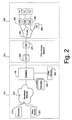
- FIG. 2 illustrates the satellite broadcast system 100 of FIG. 1 in combination with a fiber access network 200 and a customer premises network 280.
- Encoders 210 and video servers 220 are the data sources that feed a broadcast network 230 of the satellite broadcast system 100.
- Video servers 240 and encoders 250 located at the HE 130 are used to insert local programming.
- the HE 130 of the satellite broadcast system 100 receives signals from multiple sources, conditions them and prepares them for transmission over the access network 200. Once signals have been prepared for transmission from the HE 130, they are combined onto the access network media.
- an optical line terminal (OLT) 260 transmits downstream to optical network terminals (ONT) 270 which are located outside the customer premises network 280.
- OLT optical line terminal
- the OLT 260 is responsible for allocating necessary upstream bandwidths to the ONTs 270 by issuing data grants in an appropriate manner.
- the signals can be split and combined using a router 282, or other device, and then fed to various devices, such as one or more set-top boxes (STBs) 284 or personal computers (PCs) 286.
- STBs set-top boxes
- PCs personal computers
- FIG. 3 illustrates the satellite broadcast system 100 of FIG. 1 in combination with a hybrid fiber/coax (HFC) access network 300 and the customer premises network 280.
- the components used for the HFC access network 300 are similar to those used for the fiber access network 200.
- the hybrid fiber/coax network 300 uses an edge modulator 310.
- the signal is received by a cable modem 320 and sent to various devices, such as one or more STBs 284 or PCs 286.
- RF STBs may interface to the HFC access network 300 directly using internal modems.
- FIG. 4 illustrates the satellite broadcast system 100 of FIG. 1 in combination with a DSL access network 400 and the customer premises network 280.
- the components used for the DSL access network 400 are similar to those used in the fiber access network 200 and the HFC access network 300 except for the edge devices.
- the DSL access network 400 has a digital subscriber line access multiplexer (DSLAM) 410 that links numerous users to a single high-speed ATM line.
- DSLAM digital subscriber line access multiplexer
- the signal is received by a local network 420 possibly containing a modem and bridge router. The signal is split there and fed to various devices, such as one or more STBs 284 or PCs 286.
- the switched digital video technique would be performed in SDV devices, such as the OLT 260, DSLAM 410, modulator 310 or a router feeding the modulator 310, depending on the type of network.
- SDV devices such as the OLT 260, DSLAM 410, modulator 310 or a router feeding the modulator 310, depending on the type of network.
- a common problem using the SDV technique occurs when devices in a user's home request services requiring more aggregate bandwidth than can be provided. The SDV devices can not currently track the bandwidth being requested, so an attempt is made to honor all requests. This results in oversubscribing and a loss of packets.
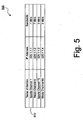
- the HE 130 can publish a services map 500, as shown in FIG. 5 , prepared by the system operator.
- the map will be put in a multicast group, which is a group of different services, and the STB in the home will know to join the multicast containing the services map first.
- the STB will then distribute the map to the other devices in the home.
- each SDV device and each device in the home will have an identifier, such as an IP address, which will allow them to differentiate themselves from one another.
- the devices in the home will use the information in the services map to provide the SDV devices with the requesting IP address and the required bandwidth.
- STB number 1 with reference number 610 is located at IP address 192.168.0.1 and is tuned to the service "Sports Channel 1" shown as reference number 510 at IP address 225.1.1.1 requiring 7 Mb/s of bandwidth.
- the SDV devices have the ability to evaluate the request from the devices in the home by comparing the requested bandwidth to the available bandwidth for the subscriber premises.
- the SDV devices can either grant or deny the service in order to prevent oversubscription and a loss of packets.
- the SDV devices and all the devices in the users' home can correlate a request for service to the bandwidth available to each home.
- a bandwidth management status is the required bandwidth of a request correlated to the available bandwidth in the home.
- Each device has its own upper limit or choke point.
- the SDV devices and the home devices parse the service request packets before sending them upstream and adding their bandwidth management status (the requested bandwidth correlated to the available bandwidth) to the request. If any device does not have adequate bandwidth, it sends a message to the requesting device indicating an error condition.
- IGMP Internet group management protocol
- IP host such as the SDV devices
- neighborhood multicast agents to support allocation of temporary group addresses and the addition and deletion of members of the group.
- the bandwidth can be managed by having a field in the IGMP request for adding the bandwidth management status at each intervening point, or at each device.
- IGMP endpoint is an active component. In this implementation, however, the IGMP endpoint, the SDV device, and any of the devices in the user's home can read and evaluate the incoming requests in order to deny or pass on the request upstream.
- QOS quality of service
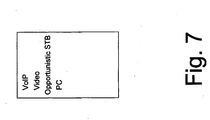
- This QOS priority status scheme is set up by the system operator. As the IGMP request passes from device to device, each device needs to be able to specify the required QOS for the requested stream. For example as shown in FIG. 7 , in a multicast group, voice over IP (VOIP) streams may require a higher priority than video which has a higher priority than web surfing, which is an opportunistic STB function.
- VOIP voice over IP
- FIG. 8 illustrates the current method of IGMP based channel changes in a broadcast system.
- Joining and leaving multicast groups are currently two independent transactions.
- the joining message is a request for a new channel and the leaving message is a request to terminate a current channel.
- a channel change must occur.
- a "leave channel 1" transaction 820 is sent to a SDV device 830.
- a "join channel 2" transaction 840 is also sent to the SDV device 830.
- Channel 2 shown in reference number 850, is now being sent to a STB 284 in the user's home 280. This is a correct channel change.
- a dropped transaction can lead to oversubscription. For example, if a user wants to change channels from channel 2 to channel 3, a "leave channel 2" transaction 860 is sent to the SDV device 830. If the transaction 860 is dropped, then channel 2 is still being sent to the STB 284. A "join channel 3" transaction 870 is also sent to the SDV device 830. The SDV device 830 will attempt to send both channels 2 and 3, as shown in reference number 880, which will cause an oversubscription.
- FIG. 9 illustrates a method of atomic channel change in a broadcast system according to the present invention.
- a new IGMP message is defined that explicitly lists the streams that the STB 284 wants to receive and simultaneously requests a join and leave transaction. For example, if a user is currently watching channel 1, shown in reference number 910, and decides to watch channel 2, then a channel change must occur.
- the STB 284 sends a message to the SDV device 830 that contains a "leave channel 1 and join channel 2" transaction 920.
- Channel 2 shown in reference number 930, is now being sent to the STB 284 in the user's home 280. This is a correct channel change.
- a "leave channel 2 and join channel 3" transaction 940 is sent to the SDV device 830. If the transaction 940 is dropped, then no change occurs and, because STB 284 never received channel 3, the STB 284 resends the "leave channel 2 and join channel 3" in transaction 950. The STB 284 may wait to receive channel 3 for a specified period of time before resending the "leave channel 2 and join channel 3" transaction 950. Alternately, if the user reiterates the channel change request, the STB 284 may resend the "leave channel 2 and join channel 3" transaction 950. The SDV device 830 is now sending channel 3, as shown in reference number 960, to the STB 284.
- IGMP messages such as join and leave messages
- channel 1 as shown in reference number 910, may require a bandwidth of 3 Mb/s and channel 2, as shown in reference number 930, may require a bandwidth of 6 Mb/s.
- the SDV device can compare the available bandwidth in the local network to the required bandwidth for channel 2 before performing the channel change. This would allow the SDV devices to more accurately determine which services can be sent to a user's home without oversubscription occurring and return an error message to the requesting device if service is not possible.
Landscapes
- Engineering & Computer Science (AREA)
- Signal Processing (AREA)
- Multimedia (AREA)
- Computer Networks & Wireless Communication (AREA)
- Computer Security & Cryptography (AREA)
- Databases & Information Systems (AREA)
- Human Computer Interaction (AREA)
- Two-Way Televisions, Distribution Of Moving Picture Or The Like (AREA)
- Data Exchanges In Wide-Area Networks (AREA)
Description
- This invention relates in general to broadband communications systems, and more particularly, to the use of a switched digital video system to change between services with differing bandwidths in a local home network.
- A broadband communications system includes data sources, a broadcasting network, a headend unit, and edge devices. The data sources can be encoders and video sources that send data through an uplink to the broadcasting network. In the broadcasting network, three common types of signals received at the headend include off-air signals, satellite signals, and local origination signals. The satellite signals include any signal transmitted from an earth station to an orbiting satellite which are then retransmitted back down to earth. The signals are transmitted from earth to the orbiting satellite on a path referred to as the uplink. These signals are then received by a transponder on the satellite and are retransmitted from the transponder to a receiving earth station over a downlink. The transponder amplifies the incoming signal and changes its frequency for the downlink journey to avoid interference with uplink signals.
- The headend (HE) or central office is where signals from multiple sources are received and are conditioned and prepared for transmission over an access network to subscribers. Once signals have been prepared for delivery, they are combined onto a medium to be sent over the access network to the customer premise devices.
Conditioning may include conversion of analog to digital, digital bit-rate conversion, conversion from variable bit rate to constant or clamped bit rate, conversion of multiple-program transport streams to single-program transport streams or any other type of grooming or combination of these. The medium may include coaxial, twisted pair or other cable, optical fiber, or some form of wireless transmission. The preparation for transmission in edge devices may include generation of an RF carrier, modulation, conversion to optical, frequency division multiplexing, time division multiplexing, wavelength division multiplexing or any combination of these. - Edge devices vary depending on the type of network, and include the headend output devices. These edge devices sometime overlap with or extend into an access network. The fiber access network can include an optical line terminal (OLT), an optical node terminal (ONT), and devices inside the home. Therefore, the OLT and ONT may be considered either an edge device or an access network device. However, the ONT may at times be considered a customer premises device. A hybrid fiber/coax (HFC) network typically uses modulator edge devices. An HFC access network can include RF to optical converters, optical to RF converters, optical and RF amplifiers, optical and RF combiners, splitters and taps. HFC customer premises devices include RF modems and set-top boxes. A digital subscriber line (DSL) network can include a digital subscriber line access multiplexer (DSLAM). DSL modems are usually located in customer premises. The OLTs, modulators, and DSLAMs, also known as edge devices, service numerous user homes, such as a neighborhood in a city. Customer premise devices can include modems, routers, personal computers, set-top boxes (STB), etc.
-
FIG. 1 illustrates asatellite broadcast network 100. At anuplink facility 110, program content is stored on video servers controlled by a broadcast automation system. Any analog content at a network operations center (NOC) 120 is compressed using encoders and then multiplexed with the content delivered from the video file servers. The NOC 120 is responsible for overall control and co-ordination of the uplink and the downlink sites. A headend (HE) 130 may include one or more server devices for providing broadband signals such as video, audio, and/or data signals. Theheadend 130 also has numerous decoders which preferably each have a mass storage device, such as a hard disk drive. - Broadband communications systems, such as satellite and cable television systems and DSL, are now capable of providing many services in addition to analog broadcast video, such as Video-on-Demand (VOD), personal video recording (PVR), HDTV, Interactive TV, Web TV, online gaming, telelearning, video conferencing, voice services, and high speed data services. With an increase in the number of services offered, the demand for bandwidth has drastically increased. A switched digital video (SDV) system is a technique that delivers selected services only to homes where and when users are actively requesting service. The switched digital video technique would be performed in SDV devices, which vary depending on the type of network. A common problem using the SDV technique is devices in a user's home requesting services requiring more bandwidth than can be provided. For example, this can occur when the request for one service to be stopped is not received by the SDV device, but the request for a new service to begin is received by the SDV device.
-
EP-A-1335521 discloses a method for facilitating a multicast group switch via a single Internet Group Management Protocol message. An operation is performed for receiving multicast information associated with a first multicast group and an operation is performed for receiving a request for receiving multicast information associated with a second multicast group. In response to receiving the request, an operation is performed for preparing an Internet Group Management Protocol (IGMP) Group Switch message. -
EP-A-1589706 discloses a multicast traffic control unit for use in a data communication system operable to transmit multicast traffic, and adapted to receive membership reports from at least one station. The control unit estimates a total amount of multicast traffic which the multicast router would supposedly forward towards the at least one station on account of at least one membership, and selects the at least one membership such that the so-estimated total amount does not exceed a configurable threshold. At least one membership out of said memberships is reported to a multicast router of the data communication system. - "Internet Group Management Protocol, , discloses
Version 3 of the Internet Group Management Protocol, IGMPv3. IGMP is the protocol used by IPv4 systems to report their IP multicast group memberships to neighbouring multicast routers. It discloses that IGMP messages may contain both auxiliary data fields and additional data fields. - The present invention provides a system for implementing IGMP-based channel changes within a broadcast system to prevent oversubscription, said system comprising a user device associated with a subscriber premises, the user device comprising means for receiving a user request for a change from a current channel to a requested channel; and means, responsive to the user request, for transmitting towards a switched digital video, SDV, device (830), an IGMP message requesting a channel change by leaving a current channel and joining a requested channel (920), the message comprising i) current channel data identifying the current channel; ii) requested channel data identifying the channel the user wishes to join; and, in addition iii) bandwidth data identifying a bandwidth requirement for the requested channel and a bandwidth requirement for the current channel. The system also comprises an SDV device comprising means for receiving the channel change request message transmitted by the user device; means for evaluating the received channel change request message by comparing the bandwidth requirement of the requested channel contained within the received message with a available bandwidth for the subscriber premises; and means for granting or denying the service in order to prevent oversubscription for the customer premises in dependence upon the evaluation made by said evaluating means wherein if the means for granting or denying the service of the SDV device grants the service, the SDV device is configured to terminate a current channel transmission from the SDV device and to transmit a requested channel transmission from the SDV device.
- The invention also provides a switched digital video, SDV, device comprising: means for receiving an IGMP message requesting a channel change transmitted by a first user device associated with the subscriber premises, the message comprising: current channel data identifying a current channel; requested channel data identifying a channel the user wishes to join; and, in addition iii) bandwidth data identifying a bandwidth requirement for the requested channel and a bandwidth requirement for the current channel; means for evaluating the received channel request message by comparing the bandwidth requirement of the requested channel contained within the received message with an available bandwidth for the subscriber premises; and means for granting or denying the service of the SVD device in order to prevent oversubscription for the customer premises in dependence upon the evaluation made by said evaluating means; and wherein if the means for granting or denying the service grants the service, the SDV device is configured to terminate a current channel transmission from the SDV device and to transmit a requested channel transmission from the SDV device.
- The invention can be better understood with reference to the following drawings.
- The components in the drawings are not necessarily drawn to scale, emphasis instead being placed upon clearly illustrating the principles of the invention. In the drawings, like reference numerals designate corresponding parts throughout the several views.
-
FIG. 1 illustrates a satellite broadcast system with an uplink, headend, and network operations center. -
FIG. 2 illustrates the system ofFIG. 1 in combination with a fiber access network and a customer premises network. -
FIG. 3 illustrates the system ofFIG. 1 in combination with a hybrid fiber/coax access network and a customer premises network. -
FIG. 4 illustrates the system ofFIG. 1 in combination with a DSL access network and a customer premises network. -
FIG. 5 illustrates a services map published by the headend. -
FIG. 6 illustrates a group of STBs and PCs in a home. -
FIG. 7 illustrates a quality of service priority table for services in a user's home. -
FIG. 8 illustrates the prior art method of IGMP based channel changes in a broadcast system, including an error condition. -
FIG. 9 illustrates a method of atomic channel change in a broadcast system according to the present invention. - The embodiments of the invention can be understood in the context of a broadband communications system. Note, however, that the invention may be embodied in many different forms and should not be construed as limited to the embodiments set forth herein. For example, transmitted broadband signals may include at least one of video/audio, telephony, data, or Internet Protocol (IP) signals, to name but a few. All examples given herein, therefore, are intended to be non-limiting and are provided in order to help clarify the description of the invention.
- A switched digital video system is a method of maximizing the number of services offered using a minimum of bandwidth. The switched digital video system allows chosen services from the
HE 130 or central office to continually be sent to the subscriber premises, or the user's home, and other services to be switched in as requested by the user. For example, in a cable television system, a specified group of popular television channels is continually sent to every home in an access network subdivision regardless of what the user may want. When a user requests a channel not in this specified group, it is first checked to see if anyone else in the service group is watching the requested channel. If yes, then the requesting user is given access to the stream already carrying the requested channel. If not, the switch provides the requested stream to the required edge device and the system gives the requesting subscriber access to that stream. A switched digital video system can be used on many types of networks such as fiber, hybrid fiber/coax, and xDSL networks. -
FIG. 2 illustrates thesatellite broadcast system 100 ofFIG. 1 in combination with afiber access network 200 and acustomer premises network 280.Encoders 210 andvideo servers 220 are the data sources that feed abroadcast network 230 of thesatellite broadcast system 100.Video servers 240 andencoders 250 located at theHE 130 are used to insert local programming. TheHE 130 of thesatellite broadcast system 100 receives signals from multiple sources, conditions them and prepares them for transmission over theaccess network 200. Once signals have been prepared for transmission from theHE 130, they are combined onto the access network media. In afiber access network 200 an optical line terminal (OLT) 260 transmits downstream to optical network terminals (ONT) 270 which are located outside thecustomer premises network 280. TheOLT 260 is responsible for allocating necessary upstream bandwidths to theONTs 270 by issuing data grants in an appropriate manner. Inside thecustomer premises network 280, the signals can be split and combined using arouter 282, or other device, and then fed to various devices, such as one or more set-top boxes (STBs) 284 or personal computers (PCs) 286. -
FIG. 3 illustrates thesatellite broadcast system 100 ofFIG. 1 in combination with a hybrid fiber/coax (HFC)access network 300 and thecustomer premises network 280. The components used for theHFC access network 300 are similar to those used for thefiber access network 200. However, instead of theOLT 260 and theONT 270, the hybrid fiber/coaxnetwork 300 uses anedge modulator 310. Inside thecustomer premises network 280, the signal is received by acable modem 320 and sent to various devices, such as one ormore STBs 284 orPCs 286. RF STBs may interface to theHFC access network 300 directly using internal modems. -
FIG. 4 illustrates thesatellite broadcast system 100 ofFIG. 1 in combination with aDSL access network 400 and thecustomer premises network 280. The components used for theDSL access network 400 are similar to those used in thefiber access network 200 and theHFC access network 300 except for the edge devices. Instead of theOLT 260 and theONT 270 or themodulator 310, theDSL access network 400 has a digital subscriber line access multiplexer (DSLAM) 410 that links numerous users to a single high-speed ATM line. Inside thecustomer premises network 280, the signal is received by alocal network 420 possibly containing a modem and bridge router. The signal is split there and fed to various devices, such as one ormore STBs 284 orPCs 286. - The switched digital video technique would be performed in SDV devices, such as the
OLT 260,DSLAM 410,modulator 310 or a router feeding themodulator 310, depending on the type of network. A common problem using the SDV technique occurs when devices in a user's home request services requiring more aggregate bandwidth than can be provided. The SDV devices can not currently track the bandwidth being requested, so an attempt is made to honor all requests. This results in oversubscribing and a loss of packets. - When a device in the user's home requests a change in service that will affect the bandwidth required, the change will be subject to a system resource management validation. For SDV devices to evaluate bandwidth requests and availability, the
HE 130 can publish aservices map 500, as shown inFIG. 5 , prepared by the system operator. The map will be put in a multicast group, which is a group of different services, and the STB in the home will know to join the multicast containing the services map first. The STB will then distribute the map to the other devices in the home. As shown inFIG. 6 , each SDV device and each device in the home will have an identifier, such as an IP address, which will allow them to differentiate themselves from one another. The devices in the home will use the information in the services map to provide the SDV devices with the requesting IP address and the required bandwidth. For example,STB number 1 withreference number 610 is located at IP address 192.168.0.1 and is tuned to the service "Sports Channel 1" shown asreference number 510 at IP address 225.1.1.1 requiring 7 Mb/s of bandwidth. The SDV devices have the ability to evaluate the request from the devices in the home by comparing the requested bandwidth to the available bandwidth for the subscriber premises. The SDV devices can either grant or deny the service in order to prevent oversubscription and a loss of packets. - In another implementation, the SDV devices and all the devices in the users' home can correlate a request for service to the bandwidth available to each home. A bandwidth management status is the required bandwidth of a request correlated to the available bandwidth in the home. Each device has its own upper limit or choke point. The SDV devices and the home devices parse the service request packets before sending them upstream and adding their bandwidth management status (the requested bandwidth correlated to the available bandwidth) to the request. If any device does not have adequate bandwidth, it sends a message to the requesting device indicating an error condition.
- Internet group management protocol (IGMP) is a standard used to communicate between an IP host, such as the SDV devices, and the neighborhood multicast agents to support allocation of temporary group addresses and the addition and deletion of members of the group. In this embodiment, the bandwidth can be managed by having a field in the IGMP request for adding the bandwidth management status at each intervening point, or at each device. In normal IGMP, only the IGMP endpoint is an active component. In this implementation, however, the IGMP endpoint, the SDV device, and any of the devices in the user's home can read and evaluate the incoming requests in order to deny or pass on the request upstream.
- In the event of oversubscription, it is possible to place a quality of service (QOS) priority status on each request. This QOS priority status scheme is set up by the system operator. As the IGMP request passes from device to device, each device needs to be able to specify the required QOS for the requested stream. For example as shown in
FIG. 7 , in a multicast group, voice over IP (VOIP) streams may require a higher priority than video which has a higher priority than web surfing, which is an opportunistic STB function. -
FIG. 8 illustrates the current method of IGMP based channel changes in a broadcast system. Joining and leaving multicast groups are currently two independent transactions. The joining message is a request for a new channel and the leaving message is a request to terminate a current channel. For example, if a user is currently watchingchannel 1, as shown inreference number 810, and wants to watchchannel 2, then a channel change must occur. First, a "leave channel 1"transaction 820 is sent to aSDV device 830. Then, a "join channel 2"transaction 840 is also sent to theSDV device 830.Channel 2, shown inreference number 850, is now being sent to aSTB 284 in the user'shome 280. This is a correct channel change. - Either of these transactions can be dropped by the network. A dropped transaction can lead to oversubscription. For example, if a user wants to change channels from
channel 2 tochannel 3, a "leave channel 2"transaction 860 is sent to theSDV device 830. If thetransaction 860 is dropped, thenchannel 2 is still being sent to theSTB 284. A "join channel 3"transaction 870 is also sent to theSDV device 830. TheSDV device 830 will attempt to send bothchannels reference number 880, which will cause an oversubscription. -
FIG. 9 illustrates a method of atomic channel change in a broadcast system according to the present invention. In this embodiment, a new IGMP message is defined that explicitly lists the streams that theSTB 284 wants to receive and simultaneously requests a join and leave transaction. For example, if a user is currently watchingchannel 1, shown inreference number 910, and decides to watchchannel 2, then a channel change must occur. TheSTB 284 sends a message to theSDV device 830 that contains a "leave channel 1 and joinchannel 2"transaction 920.Channel 2, shown inreference number 930, is now being sent to theSTB 284 in the user'shome 280. This is a correct channel change. Also, if a user wants to change channels fromchannel 2 tochannel 3, a "leave channel 2 and joinchannel 3"transaction 940 is sent to theSDV device 830. If thetransaction 940 is dropped, then no change occurs and, becauseSTB 284 never receivedchannel 3, theSTB 284 resends the "leave channel 2 and joinchannel 3" intransaction 950. TheSTB 284 may wait to receivechannel 3 for a specified period of time before resending the "leave channel 2 and joinchannel 3"transaction 950. Alternately, if the user reiterates the channel change request, theSTB 284 may resend the "leave channel 2 and joinchannel 3"transaction 950. TheSDV device 830 is now sendingchannel 3, as shown inreference number 960, to theSTB 284. - IGMP messages, such as join and leave messages, can be updated or modified to include bandwidth requirements of both the join and leave channels. For example,
channel 1, as shown inreference number 910, may require a bandwidth of 3 Mb/s andchannel 2, as shown inreference number 930, may require a bandwidth of 6 Mb/s. The SDV device can compare the available bandwidth in the local network to the required bandwidth forchannel 2 before performing the channel change. This would allow the SDV devices to more accurately determine which services can be sent to a user's home without oversubscription occurring and return an error message to the requesting device if service is not possible. - The numerous services offered by broadband communications systems continue to grow. With an increase in the number of services offered and the number of users subscribing, the demand for bandwidth has drastically increased. When more bandwidth is requested than can be provided, oversubscription occurs. One method to prevent this from happening is altering the IGMP messages used to request a channel change. Instead of two separate messages, a leave and join message, one message containing both the join and leave message is sent from the STB to the SDV device. This prevents a joining from occurring without a leave and, therefore, prevents oversubscription.
- It should be emphasized that the above-described embodiments of the invention are merely possible examples, among others, of the implementations, setting forth a clear understanding of the principles of the invention. Many variations and modifications may be made to the above-described embodiments of the invention without departing substantially from the principles of the invention. All such modifications and variations are intended to be included herein within the scope of the disclosure and invention and protected by the following claims. In addition, the scope of the invention includes embodying the functionality of the embodiments of the invention in logic embodied in hardware and/or software-configured mediums.
Claims (3)
- A system for implementing IGMP-based channel changes within a broadcast system to prevent oversubscription, said system comprising:a user device (284) associated with a subscriber premises, the user device comprising:means for receiving a user request for a change from a current channel to a requested channel; andmeans, responsive to the user request, for transmitting towards a switched digital video, SDV, device (830), an IGMP message requesting a channel change by leaving a current channel and joining a requested channel (920), the message comprising:i) current channel data identifying the current channel;ii) requested channel data identifying the channel the user wishes to join; and, in additioniii) bandwidth data identifying a bandwidth requirement for therequested channel and a bandwidth requirement for the current channel;an SDV device (830) comprising:means for receiving the channel change request message (920) transmitted by the user device (284);means for evaluating the received channel change request message by comparing the bandwidth requirement of the requested channel contained within the received message with a available bandwidth for the subscriber premises; andmeans for granting or denying the service in order to prevent oversubscription for the customer premises in dependence upon the evaluation made by said evaluating means;wherein if the means for granting or denying the service of the SDV device (830) grants the service, the SDV device (830) is configured to terminate a current channel transmission from the SDV device (830) and to transmit (960) a requested channel transmission from the SDV device (830).
- A switched digital video, SDV, device (830) comprising:means for receiving an IGMP message requesting a channel change (920) transmitted by a first user device (284) associated with the subscriber premises, the message comprising:i) current channel data identifying a current channel;ii) requested channel data identifying a channel the user wishes to join; and, in additioniii) bandwidth data identifying a bandwidth requirement for the requested channel and a bandwidth requirement for the current channel;means for evaluating the received channel request message by comparing the bandwidth requirement of the requested channel contained within the received message with an available bandwidth for the subscriber premises; andmeans for granting or denying the service of the SVD device (830) in order to prevent oversubscription for the customer premises in dependence upon the evaluation made by said evaluating means; andwherein if the means for granting or denying the service grants the service, the SDV device (830) is configured to terminate a current channel transmission from the SDV device (830) and to transmit (960) a requested channel transmission from the SDV device (830).
- A method performed by a switched digital video, SDV, device (830) for implementing IGMP-based channel changes in a broadcast system to prevent oversubscription, said method comprising the steps of:receiving a channel change request message (920) transmitted by a user device (284) associated with the subscriber premises, the message comprising:i) current channel data identifying a current channel;ii) requested channel data identifying a channel the user wishes to join; and, in additioniii) bandwidth data identifying a bandwidth requirement for the requested channel and a bandwidth requirement for the current channel;evaluating the received channel request message by comparing the bandwidth requirement of the requested channel contained within the received message with an available bandwidth for the subscriber premises; andgranting or denying the service in order to prevent oversubscription for the customer premises in dependence upon the evaluation made by said evaluating step; andwherein if the service is granted, terminating a current channel transmission from the SDV device and transmitting the requested channel transmission from the SDV device (960).
Applications Claiming Priority (2)
| Application Number | Priority Date | Filing Date | Title |
|---|---|---|---|
| US11/164,115 US20070107024A1 (en) | 2005-11-10 | 2005-11-10 | Atomic channel changes in a switched digital video system |
| PCT/US2006/060695 WO2007111693A2 (en) | 2005-11-10 | 2006-11-09 | Atomic channel changes in a switched digital video system |
Publications (2)
| Publication Number | Publication Date |
|---|---|
| EP1949688A2 EP1949688A2 (en) | 2008-07-30 |
| EP1949688B1 true EP1949688B1 (en) | 2013-05-15 |
Family
ID=38005268
Family Applications (1)
| Application Number | Title | Priority Date | Filing Date |
|---|---|---|---|
| EP06850128.7A Ceased EP1949688B1 (en) | 2005-11-10 | 2006-11-09 | Atomic channel changes in a switched digital video system |
Country Status (4)
| Country | Link |
|---|---|
| US (1) | US20070107024A1 (en) |
| EP (1) | EP1949688B1 (en) |
| CA (1) | CA2663907C (en) |
| WO (1) | WO2007111693A2 (en) |
Families Citing this family (35)
| Publication number | Priority date | Publication date | Assignee | Title |
|---|---|---|---|---|
| KR101223234B1 (en) * | 2005-05-04 | 2013-01-17 | 삼성전자주식회사 | Apparatus and method for changing channel in digital broadcasting system |
| US8099756B2 (en) * | 2005-11-10 | 2012-01-17 | Versteeg William C | Channel changes between services with differing bandwidth in a switched digital video system |
| US7742407B2 (en) * | 2005-11-10 | 2010-06-22 | Scientific-Atlanta, Llc | Quality of service management in a switched digital video environment |
| US20070106782A1 (en) * | 2005-11-10 | 2007-05-10 | Scientific-Atlanta, Inc. | Bandwidth management in each network device in a switched digital video environment |
| US7873760B2 (en) | 2005-11-11 | 2011-01-18 | Versteeg William C | Expedited digital signal decoding |
| US8077609B2 (en) * | 2005-12-15 | 2011-12-13 | At&T Intellectual Property I, L.P. | Method for providing quality-of-service based services in a packet network |
| US20080022320A1 (en) * | 2006-06-30 | 2008-01-24 | Scientific-Atlanta, Inc. | Systems and Methods of Synchronizing Media Streams |
| US7725797B2 (en) | 2006-07-07 | 2010-05-25 | Scientific-Atlanta, Llc | Buffer for storing data and forward error correction (FEC) |
| US7899046B2 (en) * | 2006-07-07 | 2011-03-01 | Ver Steeg William C | Determining strategy for multicast and/or unicast transmission to correct forward errors |
| US7877660B2 (en) * | 2006-07-07 | 2011-01-25 | Ver Steeg William C | Transmitting additional forward error correction (FEC) upon request |
| US7774672B2 (en) | 2006-07-07 | 2010-08-10 | Scientific-Atlanta, Llc | Requesting additional forward error correction |
| US8387090B2 (en) * | 2006-08-09 | 2013-02-26 | International Business Machines Corporation | Method and system for providing a regional channel in a digital broadcast environment |
| US7870465B2 (en) | 2006-10-18 | 2011-01-11 | Versteeg William C | Reducing channel-change time |
| US20080134267A1 (en) * | 2006-12-04 | 2008-06-05 | Alcatel Lucent | Remote Access to Internet Protocol Television by Enabling Place Shifting Utilizing a Telephone Company Network |
| US20080244667A1 (en) * | 2007-03-27 | 2008-10-02 | Osborne Jason C | Bandwidth sensitive switched digital video content delivery |
| US8370889B2 (en) * | 2007-03-28 | 2013-02-05 | Kanthimathi Gayatri Sukumar | Switched digital video client reverse channel traffic reduction |
| US20080271076A1 (en) * | 2007-04-27 | 2008-10-30 | General Instrument Corporation | Method and Apparatus for Switching Between Edge Device Resources in an SDV System |
| US20090022064A1 (en) * | 2007-07-18 | 2009-01-22 | Moshe Oron | Method and apparatus for monitoring multicast bandwidth to a user |
| US8832766B2 (en) | 2007-07-27 | 2014-09-09 | William C. Versteeg | Systems and methods of differentiated channel change behavior |
| US8776160B2 (en) * | 2007-07-27 | 2014-07-08 | William C. Versteeg | Systems and methods of differentiated requests for network access |
| JP5157351B2 (en) * | 2007-09-28 | 2013-03-06 | 日本電気株式会社 | Video distribution system, subscriber line termination device, video distribution method, video distribution program, and storage medium |
| US8528013B2 (en) * | 2007-11-20 | 2013-09-03 | General Instrument Corporation | Method and apparatus for limiting access to programming in a switched digital video system |
| FR2932347A1 (en) * | 2008-06-09 | 2009-12-11 | Thomson Licensing | METHOD FOR PROCESSING A CHANNEL CHANGE REQUEST IN AN IPTV SYSTEM |
| US7886073B2 (en) * | 2008-08-08 | 2011-02-08 | Cisco Technology, Inc. | Systems and methods of reducing media stream delay |
| US8015310B2 (en) * | 2008-08-08 | 2011-09-06 | Cisco Technology, Inc. | Systems and methods of adaptive playout of delayed media streams |
| US9166711B2 (en) * | 2008-11-19 | 2015-10-20 | Qurio Holdings, Inc. | Method and system to influence a viewer to select a feed |
| US8407733B2 (en) * | 2008-12-19 | 2013-03-26 | General Instrument Corporation | Method and apparatus for establishing individualized subscription plans in a switched digital video system |
| US8239739B2 (en) * | 2009-02-03 | 2012-08-07 | Cisco Technology, Inc. | Systems and methods of deferred error recovery |
| WO2010096965A1 (en) * | 2009-02-27 | 2010-09-02 | 华为技术有限公司 | Method, terminal device and channel switching server for processing abnormality in channel switching |
| WO2010096966A1 (en) * | 2009-02-27 | 2010-09-02 | 华为技术有限公司 | Method for switching channel, terminal equipment and channel switching server |
| CN101909196B (en) * | 2009-06-05 | 2013-04-17 | 华为技术有限公司 | Channel-switching handling method, system and related equipment |
| CN102598616B (en) * | 2010-06-24 | 2015-12-02 | 华为技术有限公司 | Method of realizing group broadcasting, device and system |
| CN102558948B (en) | 2010-12-10 | 2016-02-10 | 精工爱普生株式会社 | Ink composite, the ink jet recording method using it and record thing |
| CN102195889B (en) * | 2011-06-02 | 2014-09-17 | 杭州华三通信技术有限公司 | Method and equipment for relieving Internet group management protocol (IGMP) message processing stress |
| CN102271281B (en) * | 2011-08-08 | 2013-07-10 | 华为技术有限公司 | Method and device for implementing FCC (fast channel change) |
Family Cites Families (94)
| Publication number | Priority date | Publication date | Assignee | Title |
|---|---|---|---|---|
| US5594509A (en) * | 1993-06-22 | 1997-01-14 | Apple Computer, Inc. | Method and apparatus for audio-visual interface for the display of multiple levels of information on a display |
| US5485455A (en) * | 1994-01-28 | 1996-01-16 | Cabletron Systems, Inc. | Network having secure fast packet switching and guaranteed quality of service |
| AU686355B2 (en) * | 1994-04-15 | 1998-02-05 | Koninklijke Philips Electronics N.V. | Arrangement and method for transmitting and receiving video signals |
| US5600663A (en) * | 1994-11-16 | 1997-02-04 | Lucent Technologies Inc. | Adaptive forward error correction system |
| US5913031A (en) * | 1994-12-02 | 1999-06-15 | U.S. Philips Corporation | Encoder system level buffer management |
| US5815145A (en) * | 1995-08-21 | 1998-09-29 | Microsoft Corporation | System and method for displaying a program guide for an interactive televideo system |
| US5808662A (en) * | 1995-11-08 | 1998-09-15 | Silicon Graphics, Inc. | Synchronized, interactive playback of digital movies across a network |
| US5793436A (en) * | 1996-06-17 | 1998-08-11 | Samsung Electronics Co., Ltd. | Buffer occupancy control method for use in video buffering verifier |
| US5870087A (en) * | 1996-11-13 | 1999-02-09 | Lsi Logic Corporation | MPEG decoder system and method having a unified memory for transport decode and system controller functions |
| US6453471B1 (en) * | 1996-12-13 | 2002-09-17 | Starsight Telecast, Inc. | Electronic programming guide with movie preview |
| US5949795A (en) * | 1997-02-14 | 1999-09-07 | General Instrument Corporation | Processing asynchronous data within a set-top decoder |
| US6101221A (en) * | 1997-07-31 | 2000-08-08 | Lsi Logic Corporation | Video bitstream symbol extractor for use in decoding MPEG compliant video bitstreams meeting 2-frame and letterboxing requirements |
| US6118498A (en) * | 1997-09-26 | 2000-09-12 | Sarnoff Corporation | Channel scanning and channel change latency reduction in an ATSC television receiver |
| US6538992B1 (en) * | 1998-02-24 | 2003-03-25 | Nokia Telecommunications Oy | Adaptive scheduling method and apparatus to service multilevel QoS in AAL2 |
| US6278716B1 (en) * | 1998-03-23 | 2001-08-21 | University Of Massachusetts | Multicast with proactive forward error correction |
| US6119092A (en) * | 1998-06-26 | 2000-09-12 | Lsi Logic Corporation | Audio decoder bypass module for communicating compressed audio to external components |
| US6252849B1 (en) * | 1998-06-30 | 2001-06-26 | Sun Microsystems, Inc. | Flow control using output port buffer allocation |
| US6016166A (en) * | 1998-08-31 | 2000-01-18 | Lucent Technologies Inc. | Method and apparatus for adaptive synchronization of digital video and audio playback in a multimedia playback system |
| US6510553B1 (en) * | 1998-10-26 | 2003-01-21 | Intel Corporation | Method of streaming video from multiple sources over a network |
| US7185353B2 (en) * | 2000-08-31 | 2007-02-27 | Prime Research Alliance E., Inc. | System and method for delivering statistically scheduled advertisements |
| US6594798B1 (en) * | 1999-05-21 | 2003-07-15 | Microsoft Corporation | Receiver-driven layered error correction multicast over heterogeneous packet networks |
| US6986156B1 (en) * | 1999-06-11 | 2006-01-10 | Scientific Atlanta, Inc | Systems and methods for adaptive scheduling and dynamic bandwidth resource allocation management in a digital broadband delivery system |
| US7065779B1 (en) * | 1999-10-13 | 2006-06-20 | Cisco Technology, Inc. | Technique for synchronizing multiple access controllers at the head end of an access network |
| US6173115B1 (en) * | 1999-11-04 | 2001-01-09 | Thomson Licensing S.A. | Record during pause and playback with rewritable disk medium |
| US7096481B1 (en) * | 2000-01-04 | 2006-08-22 | Emc Corporation | Preparation of metadata for splicing of encoded MPEG video and audio |
| US6792047B1 (en) * | 2000-01-04 | 2004-09-14 | Emc Corporation | Real time processing and streaming of spliced encoded MPEG video and associated audio |
| US6678332B1 (en) * | 2000-01-04 | 2004-01-13 | Emc Corporation | Seamless splicing of encoded MPEG video and audio |
| US6701528B1 (en) * | 2000-01-26 | 2004-03-02 | Hughes Electronics Corporation | Virtual video on demand using multiple encrypted video segments |
| JP4035806B2 (en) * | 2000-01-31 | 2008-01-23 | 株式会社日立製作所 | Video distribution system |
| US20030007507A1 (en) * | 2000-08-01 | 2003-01-09 | Doron Rajwan | Data streaming |
| US6628301B1 (en) * | 2000-02-16 | 2003-09-30 | Microsoft Corporation | Extensible framework for tuning to programming sources |
| AU2001259075A1 (en) * | 2000-04-17 | 2001-10-30 | Circadence Corporation | System and method for web serving |
| US6629227B1 (en) * | 2000-05-04 | 2003-09-30 | Scientific-Atlanta, Inc. | System and method for a communication terminal to manage memory and maintain a current application version for multiple applications |
| US6871006B1 (en) * | 2000-06-30 | 2005-03-22 | Emc Corporation | Processing of MPEG encoded video for trick mode operation |
| FI20001570L (en) * | 2000-06-30 | 2001-12-31 | Nokia Corp | Synchronized service provision in the telecommunications network |
| US7490344B2 (en) * | 2000-09-29 | 2009-02-10 | Visible World, Inc. | System and method for seamless switching |
| GB0027812D0 (en) * | 2000-11-15 | 2000-12-27 | Pace Micro Tech Plc | Broadcast data receiver |
| US7246351B2 (en) * | 2001-02-20 | 2007-07-17 | Jargon Software | System and method for deploying and implementing software applications over a distributed network |
| US8291457B2 (en) * | 2001-05-24 | 2012-10-16 | Vixs Systems, Inc. | Channel selection in a multimedia system |
| US7200855B2 (en) * | 2001-05-24 | 2007-04-03 | Vixs Systems, Inc. | Method and apparatus of multiplexing a plurality of channels in a multimedia system |
| US7873972B2 (en) * | 2001-06-01 | 2011-01-18 | Jlb Ventures Llc | Method and apparatus for generating a mosaic style electronic program guide |
| US7114172B2 (en) * | 2001-06-28 | 2006-09-26 | Koninklijke Philips Electronics N.V. | Synchronized personal video recorders |
| US20030007508A1 (en) * | 2001-07-05 | 2003-01-09 | Broadcom Corporation | System and method for bandwidth management in ethernet-based fiber optic TDMA networks |
| ITRM20010525A1 (en) * | 2001-08-30 | 2003-02-28 | St Microelectronics Srl | EEPROM FLASH ERASABLE MEMORY FOR LINES. |
| US20030048808A1 (en) * | 2001-09-12 | 2003-03-13 | Stahl Thomas Anthony | Method and apparatus for changing received streaming content channels |
| KR100557167B1 (en) * | 2001-11-02 | 2006-03-03 | 삼성전자주식회사 | Retransmission device and method in mobile communication system |
| US7017102B1 (en) * | 2001-12-27 | 2006-03-21 | Network Equipment Technologies, Inc. | Forward Error Correction (FEC) for packetized data networks |
| JP3998983B2 (en) * | 2002-01-17 | 2007-10-31 | 松下電器産業株式会社 | Unicast-multicast converter and video surveillance system |
| AU2003212488B2 (en) * | 2002-02-04 | 2008-04-03 | Accenture Global Services Limited | Media transmission system and method |
| US7266127B2 (en) * | 2002-02-08 | 2007-09-04 | Lucent Technologies Inc. | Method and system to compensate for the effects of packet delays on speech quality in a Voice-over IP system |
| EP1335521A3 (en) | 2002-02-08 | 2004-03-10 | Alcatel | Method and device for managing multicast groups |
| US7054643B2 (en) * | 2002-02-20 | 2006-05-30 | Nokia Corporation | System for rate control of multicast data delivery in a wireless network |
| US7073117B1 (en) * | 2002-02-21 | 2006-07-04 | Ciena Corporation | Method and apparatus for generating bit errors in a forward error correction (FEC) system to estimate power dissipation characteristics of the system |
| US20030159143A1 (en) * | 2002-02-21 | 2003-08-21 | Peter Chan | Systems and methods for generating a real-time video program guide through video access of multiple channels |
| US6763019B2 (en) * | 2002-03-05 | 2004-07-13 | Nokia Corporation | Method and system for authenticated fast channel change of media provided over a DSL connection |
| US20090222875A1 (en) * | 2002-04-18 | 2009-09-03 | Cheng David J | Distributed tuner allocation and conflict resolution |
| US7359939B2 (en) * | 2002-12-06 | 2008-04-15 | Alcatel Canada, Inc. | Fast service restoration for lost IGMP leave requests |
| US7228356B2 (en) * | 2002-12-12 | 2007-06-05 | Alcatel Canada Inc. | IGMP expedited leave triggered by MAC address |
| US7584404B2 (en) * | 2002-12-19 | 2009-09-01 | Intel Corporation | Method and apparatus for multimedia communication over packet channels |
| JP4241066B2 (en) * | 2003-01-29 | 2009-03-18 | キヤノン株式会社 | Reservation device and control method thereof |
| WO2004091104A2 (en) * | 2003-03-31 | 2004-10-21 | Arris International, Inc. | Broadband multi-interface media module |
| JP4227509B2 (en) * | 2003-12-15 | 2009-02-18 | キヤノン株式会社 | Communication terminal device and control method thereof |
| AU2005215010A1 (en) * | 2004-02-18 | 2005-09-01 | Nielsen Media Research, Inc. Et Al. | Methods and apparatus to determine audience viewing of video-on-demand programs |
| US7430222B2 (en) * | 2004-02-27 | 2008-09-30 | Microsoft Corporation | Media stream splicer |
| EP1589706B1 (en) | 2004-04-19 | 2008-03-19 | Alcatel Lucent | Control of multicast traffic |
| US7672233B2 (en) * | 2004-07-15 | 2010-03-02 | Calix Networks, Inc. | Traffic management for a passive optical network terminal |
| US9031568B2 (en) * | 2004-07-28 | 2015-05-12 | Broadcom Corporation | Quality-of-service (QoS)-based association with a new network using background network scanning |
| US7729590B2 (en) * | 2004-08-03 | 2010-06-01 | Sony Corporation | Digital video stream trick play |
| US20060074968A1 (en) * | 2004-10-06 | 2006-04-06 | Gyetko Gregory E | Electronic content distribution management methods and systems |
| US7412149B2 (en) * | 2004-10-28 | 2008-08-12 | Bitband Technologies, Ltd. | Trick mode generation in video streaming |
| JP5425397B2 (en) * | 2004-12-02 | 2014-02-26 | トムソン ライセンシング | Apparatus and method for adaptive forward error correction |
| US7477653B2 (en) * | 2004-12-10 | 2009-01-13 | Microsoft Corporation | Accelerated channel change in rate-limited environments |
| US7567565B2 (en) * | 2005-02-01 | 2009-07-28 | Time Warner Cable Inc. | Method and apparatus for network bandwidth conservation |
| US8201205B2 (en) * | 2005-03-16 | 2012-06-12 | Tvworks, Llc | Upstream bandwidth management methods and apparatus |
| US8144724B2 (en) * | 2005-06-30 | 2012-03-27 | Qualcomm Incorporated | Apparatus and method for resolving request collision in a high bandwidth wireless network |
| US20070044130A1 (en) * | 2005-08-16 | 2007-02-22 | Alcatel | System and method for implementing channel change operations in internet protocol television systems |
| EP1780971A1 (en) * | 2005-10-28 | 2007-05-02 | Koninklijke KPN N.V. | Method and system for obtaining information by a bandwidth broker for admission control purposes |
| US8099756B2 (en) * | 2005-11-10 | 2012-01-17 | Versteeg William C | Channel changes between services with differing bandwidth in a switched digital video system |
| US7742407B2 (en) * | 2005-11-10 | 2010-06-22 | Scientific-Atlanta, Llc | Quality of service management in a switched digital video environment |
| US20070106782A1 (en) * | 2005-11-10 | 2007-05-10 | Scientific-Atlanta, Inc. | Bandwidth management in each network device in a switched digital video environment |
| US7873760B2 (en) * | 2005-11-11 | 2011-01-18 | Versteeg William C | Expedited digital signal decoding |
| US8713195B2 (en) * | 2006-02-10 | 2014-04-29 | Cisco Technology, Inc. | Method and system for streaming digital video content to a client in a digital video network |
| US20070220577A1 (en) * | 2006-03-15 | 2007-09-20 | Kongalath George P | Method and media manager client unit for optimising network resources usage |
| US20080022320A1 (en) * | 2006-06-30 | 2008-01-24 | Scientific-Atlanta, Inc. | Systems and Methods of Synchronizing Media Streams |
| US7774672B2 (en) * | 2006-07-07 | 2010-08-10 | Scientific-Atlanta, Llc | Requesting additional forward error correction |
| US7899046B2 (en) * | 2006-07-07 | 2011-03-01 | Ver Steeg William C | Determining strategy for multicast and/or unicast transmission to correct forward errors |
| US7725797B2 (en) * | 2006-07-07 | 2010-05-25 | Scientific-Atlanta, Llc | Buffer for storing data and forward error correction (FEC) |
| US7877660B2 (en) * | 2006-07-07 | 2011-01-25 | Ver Steeg William C | Transmitting additional forward error correction (FEC) upon request |
| US7870465B2 (en) * | 2006-10-18 | 2011-01-11 | Versteeg William C | Reducing channel-change time |
| US8750385B2 (en) * | 2006-12-20 | 2014-06-10 | Thomson Research Funding | Video data loss recovery using low bit rate stream in an IPTV system |
| US9270944B2 (en) * | 2007-02-14 | 2016-02-23 | Time Warner Cable Enterprises Llc | Methods and apparatus for content delivery notification and management |
| US7849490B2 (en) * | 2007-03-12 | 2010-12-07 | Cisco Technology, Inc. | Method and apparatus providing scalability for channel change requests in a switched digital video system |
| US8776160B2 (en) * | 2007-07-27 | 2014-07-08 | William C. Versteeg | Systems and methods of differentiated requests for network access |
| US8832766B2 (en) * | 2007-07-27 | 2014-09-09 | William C. Versteeg | Systems and methods of differentiated channel change behavior |
-
2005
- 2005-11-10 US US11/164,115 patent/US20070107024A1/en not_active Abandoned
-
2006
- 2006-11-09 CA CA2663907A patent/CA2663907C/en not_active Expired - Fee Related
- 2006-11-09 EP EP06850128.7A patent/EP1949688B1/en not_active Ceased
- 2006-11-09 WO PCT/US2006/060695 patent/WO2007111693A2/en not_active Ceased
Also Published As
| Publication number | Publication date |
|---|---|
| EP1949688A2 (en) | 2008-07-30 |
| CA2663907C (en) | 2014-08-12 |
| CA2663907A1 (en) | 2007-10-04 |
| WO2007111693A3 (en) | 2008-09-12 |
| WO2007111693A2 (en) | 2007-10-04 |
| US20070107024A1 (en) | 2007-05-10 |
Similar Documents
| Publication | Publication Date | Title |
|---|---|---|
| CA2663907C (en) | Atomic channel changes in a switched digital video system | |
| CA2629313C (en) | Channel changes between services with differing bandwidth in a switched digital video system | |
| CA2629310C (en) | Quality of service management in a switched digital video environment | |
| CA2663704C (en) | Bandwidth management in each network device in a switched digital video environment | |
| EP1131981B1 (en) | Logical node identification in an information transmission network | |
| EP2005745B1 (en) | Delivery of subscription services to roaming users through head end equipment | |
| US5793410A (en) | Video pedestal network | |
| US6909726B1 (en) | Adaptive bandwidth system and method for broadcast data | |
| US20120131633A1 (en) | System and method for distributing information via a communications network | |
| US20110247043A1 (en) | Real Time Bit Rate Switching for Internet Protocol Television | |
| US20080244679A1 (en) | Switched digital video client reverse channel traffic reduction | |
| US20100050215A1 (en) | System and method for bandwidth handling | |
| AU783202B2 (en) | Adaptive bandwidth system and method for broadcast data |
Legal Events
| Date | Code | Title | Description |
|---|---|---|---|
| PUAI | Public reference made under article 153(3) epc to a published international application that has entered the european phase |
Free format text: ORIGINAL CODE: 0009012 |
|
| 17P | Request for examination filed |
Effective date: 20080520 |
|
| AK | Designated contracting states |
Kind code of ref document: A2 Designated state(s): AT BE BG CH CY CZ DE DK EE ES FI FR GB GR HU IE IS IT LI LT LU LV MC NL PL PT RO SE SI SK TR |
|
| AX | Request for extension of the european patent |
Extension state: AL BA HR MK RS |
|
| R17D | Deferred search report published (corrected) |
Effective date: 20080912 |
|
| 17Q | First examination report despatched |
Effective date: 20090717 |
|
| DAX | Request for extension of the european patent (deleted) | ||
| RBV | Designated contracting states (corrected) |
Designated state(s): DE FR GB NL |
|
| APBK | Appeal reference recorded |
Free format text: ORIGINAL CODE: EPIDOSNREFNE |
|
| APBN | Date of receipt of notice of appeal recorded |
Free format text: ORIGINAL CODE: EPIDOSNNOA2E |
|
| APBR | Date of receipt of statement of grounds of appeal recorded |
Free format text: ORIGINAL CODE: EPIDOSNNOA3E |
|
| APBV | Interlocutory revision of appeal recorded |
Free format text: ORIGINAL CODE: EPIDOSNIRAPE |
|
| REG | Reference to a national code |
Ref country code: DE Ref legal event code: R079 Ref document number: 602006036344 Country of ref document: DE Free format text: PREVIOUS MAIN CLASS: H04N0007173000 Ipc: H04L0012180000 |
|
| GRAP | Despatch of communication of intention to grant a patent |
Free format text: ORIGINAL CODE: EPIDOSNIGR1 |
|
| RIC1 | Information provided on ipc code assigned before grant |
Ipc: H04L 12/18 20060101AFI20120917BHEP Ipc: H04N 7/173 20110101ALI20120917BHEP Ipc: H04N 21/436 20110101ALI20120917BHEP Ipc: H04N 21/472 20110101ALI20120917BHEP Ipc: H04N 21/647 20110101ALI20120917BHEP Ipc: H04N 21/6405 20110101ALI20120917BHEP Ipc: H04N 21/438 20110101ALI20120917BHEP |
|
| GRAS | Grant fee paid |
Free format text: ORIGINAL CODE: EPIDOSNIGR3 |
|
| RAP1 | Party data changed (applicant data changed or rights of an application transferred) |
Owner name: SCIENTIFIC ATLANTA, INC. |
|
| GRAA | (expected) grant |
Free format text: ORIGINAL CODE: 0009210 |
|
| RAP1 | Party data changed (applicant data changed or rights of an application transferred) |
Owner name: CISCO TECHNOLOGY, INC. |
|
| RAP1 | Party data changed (applicant data changed or rights of an application transferred) |
Owner name: CISCO TECHNOLOGY, INC. |
|
| AK | Designated contracting states |
Kind code of ref document: B1 Designated state(s): DE FR GB NL |
|
| REG | Reference to a national code |
Ref country code: GB Ref legal event code: FG4D |
|
| RIN1 | Information on inventor provided before grant (corrected) |
Inventor name: VERSTEEG, WILLIAM C. Inventor name: WALL, WILLIAM E. Inventor name: ROVIRA, LUIS A. Inventor name: MORSE, KEN |
|
| REG | Reference to a national code |
Ref country code: DE Ref legal event code: R096 Ref document number: 602006036344 Country of ref document: DE Effective date: 20130711 |
|
| REG | Reference to a national code |
Ref country code: NL Ref legal event code: VDEP Effective date: 20130515 |
|
| PG25 | Lapsed in a contracting state [announced via postgrant information from national office to epo] |
Ref country code: NL Free format text: LAPSE BECAUSE OF FAILURE TO SUBMIT A TRANSLATION OF THE DESCRIPTION OR TO PAY THE FEE WITHIN THE PRESCRIBED TIME-LIMIT Effective date: 20130515 |
|
| PLBE | No opposition filed within time limit |
Free format text: ORIGINAL CODE: 0009261 |
|
| STAA | Information on the status of an ep patent application or granted ep patent |
Free format text: STATUS: NO OPPOSITION FILED WITHIN TIME LIMIT |
|
| 26N | No opposition filed |
Effective date: 20140218 |
|
| REG | Reference to a national code |
Ref country code: DE Ref legal event code: R097 Ref document number: 602006036344 Country of ref document: DE Effective date: 20140218 |
|
| REG | Reference to a national code |
Ref country code: FR Ref legal event code: PLFP Year of fee payment: 10 |
|
| REG | Reference to a national code |
Ref country code: FR Ref legal event code: PLFP Year of fee payment: 11 |
|
| REG | Reference to a national code |
Ref country code: FR Ref legal event code: PLFP Year of fee payment: 12 |
|
| REG | Reference to a national code |
Ref country code: GB Ref legal event code: 732E Free format text: REGISTERED BETWEEN 20190307 AND 20190313 |
|
| REG | Reference to a national code |
Ref country code: DE Ref legal event code: R082 Ref document number: 602006036344 Country of ref document: DE Representative=s name: BOSCH JEHLE PATENTANWALTSGESELLSCHAFT MBH, DE Ref country code: DE Ref legal event code: R081 Ref document number: 602006036344 Country of ref document: DE Owner name: TRITON US VP ACQUISITION CO., NEW CASTLE COUNT, US Free format text: FORMER OWNER: CISCO TECHNOLOGIES, INC., SAN JOSE, CALIF., US |
|
| PGFP | Annual fee paid to national office [announced via postgrant information from national office to epo] |
Ref country code: FR Payment date: 20211124 Year of fee payment: 16 Ref country code: DE Payment date: 20211126 Year of fee payment: 16 |
|
| PGFP | Annual fee paid to national office [announced via postgrant information from national office to epo] |
Ref country code: GB Payment date: 20221128 Year of fee payment: 17 |
|
| REG | Reference to a national code |
Ref country code: DE Ref legal event code: R119 Ref document number: 602006036344 Country of ref document: DE |
|
| P01 | Opt-out of the competence of the unified patent court (upc) registered |
Effective date: 20230514 |
|
| PG25 | Lapsed in a contracting state [announced via postgrant information from national office to epo] |
Ref country code: DE Free format text: LAPSE BECAUSE OF NON-PAYMENT OF DUE FEES Effective date: 20230601 |
|
| PG25 | Lapsed in a contracting state [announced via postgrant information from national office to epo] |
Ref country code: FR Free format text: LAPSE BECAUSE OF NON-PAYMENT OF DUE FEES Effective date: 20221130 |
|
| GBPC | Gb: european patent ceased through non-payment of renewal fee |
Effective date: 20231109 |
|
| PG25 | Lapsed in a contracting state [announced via postgrant information from national office to epo] |
Ref country code: GB Free format text: LAPSE BECAUSE OF NON-PAYMENT OF DUE FEES Effective date: 20231109 |
|
| PG25 | Lapsed in a contracting state [announced via postgrant information from national office to epo] |
Ref country code: GB Free format text: LAPSE BECAUSE OF NON-PAYMENT OF DUE FEES Effective date: 20231109 |