-
The present invention relates to age-dependent relative weight indications. More in particular, the present invention relates to a device and method for providing a relative weight indication of a person based on the person's weight and height.
-
As the number of people having weight problems increases, it becomes more and more important to determine whether a person's weight is "normal". It is well known that a person's "normal" or desired weight strongly depends on his or her height. Accordingly, the Body Mass Index (BMI) has been developed to provide an indication of a person's weight relative to his or her height. The BMI and similar measures make it possible to determine relatively quickly whether a person is underweight, normal or overweight.
-
A BMI value is determined by dividing a person's weight (in kg) by the square of his or her height (in meters). A BMI value between 18.5 and 25 (kg/m2) is considered normal, values above 25 (kg/m2) are indicative of overweight, while values below 18.5 (kg/m2) indicate underweight. In addition to the three classes underweight, normal and overweight, further BMI classes may be distinguished, such as obese I, obese II and obese III, all defined by certain boundary BMI values.
-
Typically, a person's BMI value is calculated with the aid of an electronic calculator. This calculation typically involves squaring the weight, storing the result, and then dividing the height by the stored result to obtain the BMI value. This calculated BMI value may then be compared with a list showing the boundary values of the various BMI classes. This known method of determining a person's BMI class (or, in general, relative weight class) is cumbersome and often leads to errors and incorrect results.
-
In order to facilitate the determination of a person's BMI value or similar value, several solutions have been proposed. For example, wheel calculators have been designed which allow a person's BMI to be determined by rotating a weight scale relative to a height scale and aligning a person's weight and height. As a result of this rotation, the person's BMI can be read off another scale.
-
United States Patent Application
US 2006/0122470 discloses an Internet-based BMI meter. At the time of writing, this BMI meter was available on the Internet at
www.sageera.com/bmi-article. A user's weight and height may be entered using the keyboard of a computer. The program then calculates the user's BMI and shows his or her weight on a weight scale. The pointer indicating the weight also indicates a weight class (normal, overweight, obese I, ...). In the Internet version, different weight classes have different colors to allow an easy class identification.
-
Although this known Internet-based BMI meter is convenient, it can only be used when a computer is available. Often there is a need for a simple, relatively inexpensive device which the user can carry in his or her pocket, such as a wheel calculator. This problem could be solved by designing a wheel calculator that corresponds with the Internet-based BMI meter of
US 2006/0122470 . However, the known BMI meter has another, more serious drawback, in that it is designed specifically for adults.
-
It has been found that overweight or obesity during childhood significantly increases both the probability of obesity during a person's adult life and the risks of health problems associated with overweight, such as heart and coronary diseases. There is, therefore, a need to monitor the weight of children. Conventional BMI scales, however, are designed for adults and are not applicable to children, as the ratio of body height and weight of children is different from that of adults.
-
United States Patent US 3 572 585 discloses a wheel calculator for determining the number of days a patient should diet. A patient's age, sex, weight, height and physical activity as well as the caloric value of a desired diet are used as input variables to determine the caloric deficit of the diet, and subsequently the number of days required for a desired weight loss. Operating this wheel calculator is complicated as it requires a large number of steps involving at least six different scales located on both the top face and the bottom face of the device. Consequently, only trained users will be able to use this known device without making errors. In addition, the age scales start at 5 years and therefore it is not possible to obtain readings for younger children using this known device. Furthermore, this known device does not provide a single value indicative of a person's relative weight, such as a BMI value.
-
It is an object of the present invention to overcome these and other problems of the Prior Art and to provide a device and a method for providing a relative weight indication of a person which are easy to use yet take the person's age into account.
-
Accordingly, the present invention provides a device for providing a relative weight indication of a person based on the person's weight and height, the device comprising:
- a first scale representing weight,
- a second scale representing height,
- a third scale representing the age of the person, and
- a fourth scale representing the relative weight indication,
wherein the second scale is moveable relative to the first scale such that the weight and the height of the person can be matched, and wherein one of the third scale and the fourth scale is coupled to the first scale and the other one of the third scale and the fourth scale is coupled to the second scale, such that matching the weight and the height of the person allows the relative weight indication to be read from the fourth scale at the age indicated by the third scale.
-
By providing a third scale representing the age of the person, it is possible to take age into account when determining the person's relative weight indication. As a result, an age-adjusted relative weight indication can be used. This offers the significant advantage of being able to use the device for children or, preferably, for both adults and children.
-
By suitably coupling each of the third and fourth scales to one of the first and second scales, the step of aligning the person's weight and height automatically adjusts the third and fourth scales, such that the relative weight indication reading obtained from the fourth scale corresponds with the person's weight and height. As a result, the present invention provides a device which allows an age-adjusted relative weight indication to be obtained using only four scales and requiring only two operation steps:
- 1. aligning the weight and the height of the person,
- 2. reading the relative weight indication at the proper age. In fact, the device of the present invention allows the relative weight class to be determined without having to determine the relative weight value, thus effectively skipping one operation step. Accordingly, the device of the present invention is very simple to operate and is suitable for a wide range of users.
-
Although a universal age scale can be used for children, it has been found that some relative age indications require adjustment according to sex. In a particularly advantageous embodiment of the device according to the present invention, therefore, the third scale and the fourth scale each comprise a first part and a second part, the respective first parts being adapted for males (boys) and the respective second parts being adapted for females (girls). Such two-part scales allow the correct readings to be made for both sexes. Of course it is possible to provide two-part scales for adults too, but in practice this is typically not necessary, as the relative weight indications for 18-year olds can typically also be used for adults.
-
In a preferred embodiment, the first scale, the second scale, the third scale and the fourth scale are all arranged on one face of the device. This allows the device to be used without turning it over, thus facilitating the handling of the device. In addition, arranging all scales on the same face of the device allows the other (or "blank") face to be used for other purposes, for example advertising and/or operating instructions.
-
Moving the first and second scales relative to each other may, in some instances, result in an incorrect reading, for example when the reading is "off scale". In order to avoid any erroneous readings, the device of the present invention may further comprise a fifth and/or sixth scale indicative of a valid relative weight indication range and a marker allowing the range to be read from the said fifth and/or sixth scale, wherein one of the said scale and the marker is coupled to the first scale and the other one of the said scale and the marker is coupled to the second scale. The fifth and/or sixth scale may consist of color indications representing valid and invalid relative weight indication ranges. If a fifth and/or sixth scale are present, it is preferably arranged on the same face as the other scales.
-
The first, second and third scales are preferably each constituted by a series of markers and associated numbers, as in conventional wheel calculators and slide rule calculators. The fourth scale, however, preferably consists of color indications representing relative weight classes. By using color indications the relative weight class indicated by the device can be easily identified, thus allowing a quick read-out. In addition, the colors may be chosen such that they are indicative of the health of the person, for example green indicating a normal or desired relative weight class and red indicating overweight.
-
Various relative weight indications may be used, such as the weight/height p measure, where P is the waist to hip ratio. It is preferred, however, that the relative weight indication is indicative of a relative weight class according to the Body Mass Index (BMI). This is a very suitable index which is widely recognized.
-
An advantageous embodiment further comprises a pointer for pointing to the first scale, such that the weight value pointed at corresponds to the relative weight indicator value, preferably the Body Mass Index value. This allows a direct reading of the indicator value to be made, in addition to the relative weight class indicated by the fourth scale.
-
The device of the present invention is preferably essentially planar and may have a substantially oblong design resembling a slide rule calculator. In such embodiments, the first scale and the second scale are slideable relative to each other, and may for example be printed on separate longitudinal pieces of plastic, carton, paper, metal or wood. However, the device may also have a substantially round design resembling a wheel calculator. In those embodiments, the first scale and the second scale are rotatable relative to each other, and may for example be printed on separate circular pieces of plastic, carton, paper, metal or wood.
-
When a substantially circular design is used, at least one scale may be printed on a circular information carrier, such as a CD or a DVD.
-
The present invention also provides a method of providing a relative weight indication of a person based on the person's weight and height, the method comprising the steps of:
- providing a first scale representing weight,
- providing a second scale representing height,
- providing a third scale representing the age of the person, and
- providing a fourth scale representing the relative weight indication,
wherein the second scale is moveable relative to the first scale such that the weight and the height of the person can be matched, and wherein one of the third scale and the fourth scale is coupled to the first scale and the other one of the third scale and the fourth scale is coupled to the second scale, such that matching the weight and the height of the person allows the relative weight indication to be read from the fourth scale at the age indicated by the third scale.
-
Advantageously, the scales may be shown on the screen of a computer, mobile communication device, personal digital assistant, or other electronic device. The mobile communication device may be a mobile (cellular) telephone apparatus. The electronic device may be a portable, dedicated consumer device, arranged for providing a relative weight indication of a person based on the person's weight and height. If an electronic device is used instead of a (not electronic) device made of carton or sheet plastic, the scales are not tangible. In this case, the step of matching scales may be carried out automatically in response to weight and height values entered using a keypad, a touchpad or a speech recognition apparatus.
-
The present invention additionally provides a computer program product for carrying out the method as defined above. A computer program product may comprise a set of computer executable instructions stored on a data carrier, such as a CD or a DVD. The set of computer executable instructions, which allow a programmable computer to carry out the method as defined above, may also be available for downloading from a remote server, for example via the Internet.
-
The present invention will further be explained below with reference to exemplary embodiments illustrated in the accompanying drawings, in which:
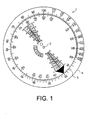
- Fig. 1 schematically shows a preferred embodiment of the device according to the present invention.
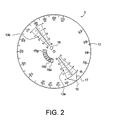
- Fig. 2 schematically shows a first part of the preferred embodiment of Fig. 1 in isolation.
- Fig. 3 schematically shows a second part of the preferred embodiment of Fig. 1 in isolation.
-
The embodiment of the inventive device 1 shown merely by way of nonlimiting example in Fig. 1 comprises a first or upper part 3 and a second or lower part 4. In the embodiment shown, both parts are circular but the invention is not so limited. The parts may be made of paper, carton, metal or any other suitable material, although plastic is preferred. The first or upper part 3 has a smaller diameter than the second or lower part 4, so as to leave an edge area of the second part free.
-
The circular parts 3, 4 are rotatably connected by a suitable connecting element 2, such as a rivet. In the embodiment shown, a first scale 11 representing weight is provided on the second or lower part 4 while a second scale 12 representing height is provided on the first or top part 3, as indicated in Figs. 2 & 3. In alternative embodiments this arrangement of the scales on the respective parts may be reversed.
-
The second (or height) scale 12 is arranged at the edge of the first part 3 so as to co-operate with the first (or weight) scale 11. Third scale sections 13a and 13b representing age are in the embodiment shown provided on the first part 3, while fourth scale sections 14a and 14b representing a relative age indication are provided on the second part 4.
-
In the embodiment of Figs. 1-3, the third scale sections 13a & 13b indicate an age range of 2 to 18 years. The Body Mass Index (BMI) is typically not used for children under the age of 2, while the generally accepted BMI classification is essentially constant for ages over 18. The readings at age 18 may therefore also be used for adults. Accordingly, the present invention may also be used for ages outside the range of 2-18 years.
-
The third scale additionally comprises a first section 13a which is used for boys and adult men, and a second section 13b which is used for girls and adult women. The scale sections 13a and 13b are essentially identical but have different locations on the first device part 3, so as to allow reading out different sections 14a and 14b respectively of the fourth scale.
-
The fourth scale, which represents various BMI classes, is in the embodiment shown constituted by properly shaped regions having different colors, each colored region indicating a particular BMI class, for example normal, underweight, severe underweight, overweight, etc.. Fig. 3 shows the fourth scale 14a, 14b in more detail. The embodiment shown distinguishes seven relative weight (e.g. BMI) classes, but other distinctions comprising more or fewer different classes, or other boundary values of the classes, may be used instead. A legend 18 (Figs. 1 and 2) to the fourth scale may be provided on the first part 3 of the device.
-
By turning the parts of the device relative to each other, a person's weight (e.g. 39 kg) on the first scale 11 can be aligned with his height (e.g. 125 cm) on the second scale 12. As mentioned above, the third scale sections13a & 13b are on the same part of the device as the first scale 11, while the second scale 12 is on the same part as the fourth scale sections 14a & 14b. Accordingly, matching the weight with the height by turning one part relative to the other will cause the third scale sections 13a & 13b to be properly positioned relative to the fourth scale sections 14a & 14b. That is, the position of the third scale sections 13a & 13b relative to the fourth scale sections 14a & 14b will take the weight relative to the height into account. Now the appropriate BMI class can be read from the fourth scale at the age indicated by the third scale. It is noted that the sections 13a & 13b are each at least partially open and/or transparent so as to allow the fourth scale to be visible, preferably through the third scale. It is further noted that embodiments can be envisaged in which the third and fourth scale each comprise a single section only, thus making no distinction between male and female. Alternatively, in some embodiments of the present invention the third and fourth scales may each comprise three or more sections (that is, scale parts), thus distinguishing between three or more different groups of people.
-
In the embodiment shown, the age axes of the third scale sections 13a & 13b extend along the radius of the circular first part 3. Embodiments can be envisaged in which these axes have a non-zero angle relative to the radius, in which these axes have a two-dimensional shape, and/or in which each axis is divided into separate components.
-
As mentioned above, the fourth scale sections 14a & 14b are constituted by colored regions. However, embodiments can be envisaged in which the fourth scale comprises markers and numbers, as in the first, second and third scales.
-
The embodiment shown further comprises a fifth scale 15 arranged on the second part 4. The fifth scale 15 essentially consists of a number of colored regions, in the present example two distinct regions, which indicate whether any indication read from the fourth scale is correct or incorrect ("off scale"). The respective regions of the fifth scale are advantageously green and red, and can be seen through an opening or transparent section 16 in the first or upper part 3 of the device.
-
A BMI indicator 17 is also arranged on the first part 3. In the embodiment shown, the scales are designed in such a way that the tip 10 of the BMI indicator 17 is located at a height equal to 1 m (100 cm). When a person's weight and height have been matched using the first and second scales, the tip 10 points to that person's BMI on the weight scale 11. That is, the "weight" reading on the first scale 11 then represents the BMI value, which can be used for comparison with a table, as in the Prior Art. It is noted that the device of the present invention can be used perfectly well without determining the BMI value.
-
The embodiment shown also comprises a sixth scale 19 arranged on the second part 4. This sixth scale 19 essentially consists of a number of colored regions, in the present example two distinct regions, which indicate whether any indication read from the "BMI scale" (first scale 11 when used for determining the BMI) is correct or incorrect ("off scale"). BMI values in the range of 60-100, for example, are extremely unlikely and may therefore be labeled "off scale". The respective regions of the sixth scale 19 are advantageously black and red, and can be seen through an opening or transparent section which preferably coincides with the BMI indicator section 17 in the first or upper part 3 of the device.
-
In an alternative embodiment, the area shown in Fig. 3 as the sixth scale 19 (or any other suitable area of the second part 4) is transparent, allowing the back of the first part 3 to be visible from the bottom face of the device. An additional scale could be provided on this back side of the first part 3, that is, on the side of the first part 3 not shown in Figs. 1 & 2. This additional scale could, for example, indicate a BMI value or any other suitable value.
-
In the preferred embodiment shown the values of the first scale 11 are arranged in such a way that each value has the same location on the scale as its multiple of ten. For example, the value "20 kg" has the same location on the first scale 11 as the value "200 kg". This "infinite scale" allows the device of the present invention to be compact yet very flexible.
-
As mentioned above, the parts 3 & 4 of the device can be made of e.g. plastic or carton. In one embodiment, one of the parts is constituted by an information carrier, such as a CD, a DVD or a similar carrier. The information stored on the carrier may comprise instructions for use, advice regarding dieting and/or exercise, and/or other information.
-
The device of the present invention may additionally comprise a third part mounted on the opposite or bottom face, that is, on the side of the second part 4 facing away from the first part 3. This third part (not shown) may comprise further scales, for example scales in other units. In a particularly advantageous embodiment, the scales of the bottom side of the device may be identical to those of the top side except for the units, the top side (upper face) having metric (cm, kg) scales and the bottom side (lower face) having US or UK scales (inches, pounds/stones). In such an embodiment, the bottom face of the second part 4 could also be provided with a fourth scale (14 in Fig. 3). In this way, a device is provided which can be used in various countries without any further adaptations.
-
The embodiment shown in Figs. 1-3 is circular, resembling a wheel calculator. Rectangular and/or longitudinal embodiments are also possible, for example embodiments resembling a slide rule. In such embodiments, turning the parts is substituted with sliding the parts.
-
Those skilled in the art will be able to adapt the device of the present invention to other units, such as pounds and feet, or pounds and stones, without requiring any inventive effort. Similarly, changing the shape or orientation of the third scale mechanically translates into an adaptation of the fourth scale. Although the relative weight indication mentioned above is the BMI, other relative weight indications can also be used, and the device can be similarly adapted.
-
The present invention also provides a computer program for carrying out the method steps, in particular the steps of matching the weight and the height of the person, thus allowing the relative weight indication to be read from the fourth scale sections 14a & 14b at the age indicated by the third scale sections 13a & 13b. Such a computer program may be carried out by a personal computer, a remote server, or a handheld device. A remote server may be accessed via the Internet. A handheld device may comprise a suitably programmable mobile telephone device, a PDA (Personal Digital Assistant), or a dedicated consumer device.
-
The present invention is based upon the insight that at least one age scale should be used when determining a relative weight indication, such as a BMI value. The present invention benefits from the further insight that it is not necessary to determine the value of the relative weight indication when determining a relative weight class.
-
It is noted that any terms used in this document should not be construed so as to limit the scope of the present invention. In particular, the words "comprise(s)" and "comprising" are not meant to exclude any elements not specifically stated. Single elements may be substituted with multiple elements or with their equivalents.
-
It will be understood by those skilled in the art that the present invention is not limited to the embodiments illustrated above and that many modifications and additions may be made without departing from the scope of the invention as defined in the appending claims.