EP1947103A1 - Aryloxypropanolamines, methods of preparation thereof and use of aryloxypropanolamines as medicaments - Google Patents
Aryloxypropanolamines, methods of preparation thereof and use of aryloxypropanolamines as medicaments Download PDFInfo
- Publication number
- EP1947103A1 EP1947103A1 EP07001347A EP07001347A EP1947103A1 EP 1947103 A1 EP1947103 A1 EP 1947103A1 EP 07001347 A EP07001347 A EP 07001347A EP 07001347 A EP07001347 A EP 07001347A EP 1947103 A1 EP1947103 A1 EP 1947103A1
- Authority
- EP
- European Patent Office
- Prior art keywords
- alkyl
- hydroxyl
- alkoxy
- piperidin
- pyrimidin
- Prior art date
- Legal status (The legal status is an assumption and is not a legal conclusion. Google has not performed a legal analysis and makes no representation as to the accuracy of the status listed.)
- Withdrawn
Links
- 238000000034 method Methods 0.000 title claims abstract description 19
- 238000002360 preparation method Methods 0.000 title claims abstract description 10
- 239000003814 drug Substances 0.000 title claims description 10
- 150000001875 compounds Chemical class 0.000 claims abstract description 136
- 238000011282 treatment Methods 0.000 claims abstract description 19
- 150000003839 salts Chemical class 0.000 claims abstract description 14
- 239000012453 solvate Substances 0.000 claims abstract description 11
- 102000016959 beta-3 Adrenergic Receptors Human genes 0.000 claims abstract description 8
- 108010014502 beta-3 Adrenergic Receptors Proteins 0.000 claims abstract description 8
- 230000004913 activation Effects 0.000 claims abstract description 3
- -1 carboxy, carbamoyl Chemical group 0.000 claims description 261
- 125000002887 hydroxy group Chemical group [H]O* 0.000 claims description 154
- 229910052739 hydrogen Inorganic materials 0.000 claims description 112
- 239000001257 hydrogen Substances 0.000 claims description 112
- 125000000217 alkyl group Chemical group 0.000 claims description 80
- 125000003178 carboxy group Chemical group [H]OC(*)=O 0.000 claims description 64
- 125000004435 hydrogen atom Chemical group [H]* 0.000 claims description 64
- 125000001153 fluoro group Chemical group F* 0.000 claims description 58
- 125000004453 alkoxycarbonyl group Chemical group 0.000 claims description 56
- 125000000449 nitro group Chemical group [O-][N+](*)=O 0.000 claims description 53
- 125000001072 heteroaryl group Chemical group 0.000 claims description 50
- 229910052736 halogen Inorganic materials 0.000 claims description 49
- 150000002367 halogens Chemical class 0.000 claims description 49
- 125000001997 phenyl group Chemical group [H]C1=C([H])C([H])=C(*)C([H])=C1[H] 0.000 claims description 49
- 125000004093 cyano group Chemical group *C#N 0.000 claims description 47
- 125000006273 (C1-C3) alkyl group Chemical group 0.000 claims description 46
- 125000002496 methyl group Chemical group [H]C([H])([H])* 0.000 claims description 43
- 125000004169 (C1-C6) alkyl group Chemical group 0.000 claims description 42
- 125000004457 alkyl amino carbonyl group Chemical group 0.000 claims description 36
- 125000000229 (C1-C4)alkoxy group Chemical group 0.000 claims description 34
- 125000003545 alkoxy group Chemical group 0.000 claims description 34
- 125000004448 alkyl carbonyl group Chemical group 0.000 claims description 32
- 125000003118 aryl group Chemical group 0.000 claims description 31
- 239000000203 mixture Substances 0.000 claims description 29
- 125000006274 (C1-C3)alkoxy group Chemical group 0.000 claims description 28
- 125000006574 non-aromatic ring group Chemical group 0.000 claims description 26
- 125000001544 thienyl group Chemical group 0.000 claims description 26
- 125000004029 hydroxymethyl group Chemical group [H]OC([H])([H])* 0.000 claims description 24
- 125000004191 (C1-C6) alkoxy group Chemical group 0.000 claims description 22
- 125000003342 alkenyl group Chemical group 0.000 claims description 22
- 125000004471 alkyl aminosulfonyl group Chemical group 0.000 claims description 22
- 125000004397 aminosulfonyl group Chemical group NS(=O)(=O)* 0.000 claims description 20
- 125000002950 monocyclic group Chemical group 0.000 claims description 20
- 125000001495 ethyl group Chemical group [H]C([H])([H])C([H])([H])* 0.000 claims description 17
- 125000006193 alkinyl group Chemical group 0.000 claims description 16
- 125000004076 pyridyl group Chemical group 0.000 claims description 16
- 208000037265 diseases, disorders, signs and symptoms Diseases 0.000 claims description 13
- UFHFLCQGNIYNRP-UHFFFAOYSA-N Hydrogen Chemical compound [H][H] UFHFLCQGNIYNRP-UHFFFAOYSA-N 0.000 claims description 12
- 125000004414 alkyl thio group Chemical group 0.000 claims description 12
- 125000003917 carbamoyl group Chemical group [H]N([H])C(*)=O 0.000 claims description 12
- 125000004769 (C1-C4) alkylsulfonyl group Chemical group 0.000 claims description 10
- 125000004390 alkyl sulfonyl group Chemical group 0.000 claims description 10
- 125000000714 pyrimidinyl group Chemical group 0.000 claims description 10
- 125000000020 sulfo group Chemical group O=S(=O)([*])O[H] 0.000 claims description 10
- 125000000175 2-thienyl group Chemical group S1C([*])=C([H])C([H])=C1[H] 0.000 claims description 9
- 125000001164 benzothiazolyl group Chemical group S1C(=NC2=C1C=CC=C2)* 0.000 claims description 9
- 125000002541 furyl group Chemical group 0.000 claims description 9
- 125000000623 heterocyclic group Chemical group 0.000 claims description 9
- 125000002943 quinolinyl group Chemical group N1=C(C=CC2=CC=CC=C12)* 0.000 claims description 9
- 125000001424 substituent group Chemical group 0.000 claims description 9
- 125000004768 (C1-C4) alkylsulfinyl group Chemical group 0.000 claims description 8
- 125000004454 (C1-C6) alkoxycarbonyl group Chemical group 0.000 claims description 8
- 125000000499 benzofuranyl group Chemical group O1C(=CC2=C1C=CC=C2)* 0.000 claims description 8
- 125000005872 benzooxazolyl group Chemical group 0.000 claims description 8
- 125000004196 benzothienyl group Chemical group S1C(=CC2=C1C=CC=C2)* 0.000 claims description 8
- 125000002883 imidazolyl group Chemical group 0.000 claims description 8
- 125000001041 indolyl group Chemical group 0.000 claims description 8
- 125000001786 isothiazolyl group Chemical group 0.000 claims description 8
- 125000000842 isoxazolyl group Chemical group 0.000 claims description 8
- 125000000956 methoxy group Chemical group [H]C([H])([H])O* 0.000 claims description 8
- 230000003287 optical effect Effects 0.000 claims description 8
- 125000002971 oxazolyl group Chemical group 0.000 claims description 8
- 125000004309 pyranyl group Chemical group O1C(C=CC=C1)* 0.000 claims description 8
- 125000003373 pyrazinyl group Chemical group 0.000 claims description 8
- 125000003226 pyrazolyl group Chemical group 0.000 claims description 8
- 125000002098 pyridazinyl group Chemical group 0.000 claims description 8
- 125000001567 quinoxalinyl group Chemical group N1=C(C=NC2=CC=CC=C12)* 0.000 claims description 8
- 125000005247 tetrazinyl group Chemical group N1=NN=NC(=C1)* 0.000 claims description 8
- 125000001113 thiadiazolyl group Chemical group 0.000 claims description 8
- 125000000335 thiazolyl group Chemical group 0.000 claims description 8
- 125000004306 triazinyl group Chemical group 0.000 claims description 8
- 125000001425 triazolyl group Chemical group 0.000 claims description 8
- 201000010099 disease Diseases 0.000 claims description 7
- 125000004916 (C1-C6) alkylcarbonyl group Chemical group 0.000 claims description 6
- 125000000882 C2-C6 alkenyl group Chemical group 0.000 claims description 6
- 208000008589 Obesity Diseases 0.000 claims description 6
- 125000003236 benzoyl group Chemical group [H]C1=C([H])C([H])=C(C([H])=C1[H])C(*)=O 0.000 claims description 6
- 125000001309 chloro group Chemical group Cl* 0.000 claims description 6
- 125000004472 dialkylaminosulfonyl group Chemical group 0.000 claims description 6
- 125000001160 methoxycarbonyl group Chemical group [H]C([H])([H])OC(*)=O 0.000 claims description 6
- 235000020824 obesity Nutrition 0.000 claims description 6
- 125000003170 phenylsulfonyl group Chemical group C1(=CC=CC=C1)S(=O)(=O)* 0.000 claims description 6
- 230000000638 stimulation Effects 0.000 claims description 6
- HPTKHKFFMSMJTM-UHFFFAOYSA-N 4-[2-hydroxy-3-[[1-(5-phenylthieno[2,3-d]pyrimidin-4-yl)piperidin-4-yl]amino]propoxy]-2-(methoxymethyl)phenol Chemical compound C1=C(O)C(COC)=CC(OCC(O)CNC2CCN(CC2)C=2C=3C(C=4C=CC=CC=4)=CSC=3N=CN=2)=C1 HPTKHKFFMSMJTM-UHFFFAOYSA-N 0.000 claims description 5
- 206010012601 diabetes mellitus Diseases 0.000 claims description 5
- 125000004527 pyrimidin-4-yl group Chemical group N1=CN=C(C=C1)* 0.000 claims description 5
- 125000006536 (C1-C2)alkoxy group Chemical group 0.000 claims description 4
- 125000004209 (C1-C8) alkyl group Chemical group 0.000 claims description 4
- DTOCXHSGGVEJTC-UHFFFAOYSA-N 1-[3-(hydroxymethyl)phenoxy]-3-[[1-(5-phenylthieno[2,3-d]pyrimidin-4-yl)piperidin-4-yl]amino]propan-2-ol Chemical compound OCC1=CC=CC(OCC(O)CNC2CCN(CC2)C=2C=3C(C=4C=CC=CC=4)=CSC=3N=CN=2)=C1 DTOCXHSGGVEJTC-UHFFFAOYSA-N 0.000 claims description 4
- QJXPGTMGNVMPNR-UHFFFAOYSA-N 2-(hydroxymethyl)-4-[2-hydroxy-3-[[1-(2-methylthieno[2,3-d]pyrimidin-4-yl)piperidin-4-yl]amino]propoxy]phenol Chemical compound C=12C=CSC2=NC(C)=NC=1N(CC1)CCC1NCC(O)COC1=CC=C(O)C(CO)=C1 QJXPGTMGNVMPNR-UHFFFAOYSA-N 0.000 claims description 4
- KWLVQTDQPNAUAP-UHFFFAOYSA-N 2-(hydroxymethyl)-4-[2-hydroxy-3-[[1-(5-methyl-6-phenylthieno[2,3-d]pyrimidin-4-yl)piperidin-4-yl]amino]propoxy]phenol Chemical compound C=12C(C)=C(C=3C=CC=CC=3)SC2=NC=NC=1N(CC1)CCC1NCC(O)COC1=CC=C(O)C(CO)=C1 KWLVQTDQPNAUAP-UHFFFAOYSA-N 0.000 claims description 4
- JOMRBIAUJPLIIS-UHFFFAOYSA-N 2-(hydroxymethyl)-4-[2-hydroxy-3-[[1-(5-methylthieno[2,3-d]pyrimidin-4-yl)piperidin-4-yl]amino]propoxy]phenol Chemical compound C=12C(C)=CSC2=NC=NC=1N(CC1)CCC1NCC(O)COC1=CC=C(O)C(CO)=C1 JOMRBIAUJPLIIS-UHFFFAOYSA-N 0.000 claims description 4
- AOXKWLQPKYTQAG-UHFFFAOYSA-N 2-(hydroxymethyl)-4-[2-hydroxy-3-[[1-(5-phenyl-1,2-dihydrothieno[2,3-d]pyrimidin-4-yl)piperidin-4-yl]amino]propoxy]phenol Chemical compound C1=C(O)C(CO)=CC(OCC(O)CNC2CCN(CC2)C=2C=3C(=CSC=3NCN=2)C=2C=CC=CC=2)=C1 AOXKWLQPKYTQAG-UHFFFAOYSA-N 0.000 claims description 4
- KYYMUHCVQBBYFP-UHFFFAOYSA-N 2-(hydroxymethyl)-4-[2-hydroxy-3-[[1-(5-phenylthieno[2,3-d]pyrimidin-4-yl)piperidin-4-yl]amino]propoxy]phenol Chemical compound C1=C(O)C(CO)=CC(OCC(O)CNC2CCN(CC2)C=2C=3C(C=4C=CC=CC=4)=CSC=3N=CN=2)=C1 KYYMUHCVQBBYFP-UHFFFAOYSA-N 0.000 claims description 4
- JAWXHDKXUFJTPJ-UHFFFAOYSA-N 2-(hydroxymethyl)-4-[2-hydroxy-3-[[1-(5-thiophen-2-ylthieno[2,3-d]pyrimidin-4-yl)piperidin-4-yl]amino]propoxy]phenol Chemical compound C1=C(O)C(CO)=CC(OCC(O)CNC2CCN(CC2)C=2C=3C(C=4SC=CC=4)=CSC=3N=CN=2)=C1 JAWXHDKXUFJTPJ-UHFFFAOYSA-N 0.000 claims description 4
- 208000019901 Anxiety disease Diseases 0.000 claims description 4
- 206010046543 Urinary incontinence Diseases 0.000 claims description 4
- 125000003806 alkyl carbonyl amino group Chemical group 0.000 claims description 4
- 125000004473 dialkylaminocarbonyl group Chemical group 0.000 claims description 4
- 125000003754 ethoxycarbonyl group Chemical group C(=O)(OCC)* 0.000 claims description 4
- 125000002534 ethynyl group Chemical group [H]C#C* 0.000 claims description 4
- 125000005059 halophenyl group Chemical group 0.000 claims description 4
- 230000002265 prevention Effects 0.000 claims description 4
- SKRCYMHONSSMQB-UHFFFAOYSA-N 1-[3-(hydroxymethyl)phenoxy]-3-[[1-(2-methylthieno[2,3-d]pyrimidin-4-yl)piperidin-4-yl]amino]propan-2-ol Chemical compound C=12C=CSC2=NC(C)=NC=1N(CC1)CCC1NCC(O)COC1=CC=CC(CO)=C1 SKRCYMHONSSMQB-UHFFFAOYSA-N 0.000 claims description 3
- NARWNILYIJQEFF-UHFFFAOYSA-N 1-[3-(hydroxymethyl)phenoxy]-3-[[1-(5-methyl-6-phenylthieno[2,3-d]pyrimidin-4-yl)piperidin-4-yl]amino]propan-2-ol Chemical compound C=12C(C)=C(C=3C=CC=CC=3)SC2=NC=NC=1N(CC1)CCC1NCC(O)COC1=CC=CC(CO)=C1 NARWNILYIJQEFF-UHFFFAOYSA-N 0.000 claims description 3
- VMDFCHNVVXTTMU-UHFFFAOYSA-N 1-[3-(hydroxymethyl)phenoxy]-3-[[1-(5-methylthieno[2,3-d]pyrimidin-4-yl)piperidin-4-yl]amino]propan-2-ol Chemical compound C=12C(C)=CSC2=NC=NC=1N(CC1)CCC1NCC(O)COC1=CC=CC(CO)=C1 VMDFCHNVVXTTMU-UHFFFAOYSA-N 0.000 claims description 3
- YVHUYFVEOALDDL-UHFFFAOYSA-N 1-[3-(hydroxymethyl)phenoxy]-3-[methyl-[1-(5-methyl-6-phenylthieno[2,3-d]pyrimidin-4-yl)piperidin-4-yl]amino]propan-2-ol Chemical compound C1CN(C=2C=3C(C)=C(SC=3N=CN=2)C=2C=CC=CC=2)CCC1N(C)CC(O)COC1=CC=CC(CO)=C1 YVHUYFVEOALDDL-UHFFFAOYSA-N 0.000 claims description 3
- UEQKSLMKDXKUGX-UHFFFAOYSA-N 1-[3-(hydroxymethyl)phenoxy]-3-[methyl-[1-(5-phenylthieno[2,3-d]pyrimidin-4-yl)piperidin-4-yl]amino]propan-2-ol Chemical compound C1CN(C=2C=3C(C=4C=CC=CC=4)=CSC=3N=CN=2)CCC1N(C)CC(O)COC1=CC=CC(CO)=C1 UEQKSLMKDXKUGX-UHFFFAOYSA-N 0.000 claims description 3
- PQCCZPSSXAMDOZ-UHFFFAOYSA-N 1-[[1-[5-(4-fluorophenyl)thieno[2,3-d]pyrimidin-4-yl]piperidin-4-yl]amino]-3-[3-(hydroxymethyl)phenoxy]propan-2-ol Chemical compound OCC1=CC=CC(OCC(O)CNC2CCN(CC2)C=2C=3C(C=4C=CC(F)=CC=4)=CSC=3N=CN=2)=C1 PQCCZPSSXAMDOZ-UHFFFAOYSA-N 0.000 claims description 3
- WBFTUDPFMMKOMZ-UHFFFAOYSA-N 2-(hydroxymethyl)-5-[2-hydroxy-3-[[1-(5-phenylthieno[2,3-d]pyrimidin-4-yl)piperidin-4-yl]amino]propoxy]phenol Chemical compound C1=C(O)C(CO)=CC=C1OCC(O)CNC1CCN(C=2C=3C(C=4C=CC=CC=4)=CSC=3N=CN=2)CC1 WBFTUDPFMMKOMZ-UHFFFAOYSA-N 0.000 claims description 3
- NPOJTLRAMYFXPE-UHFFFAOYSA-N 2-hydroxy-5-[2-hydroxy-3-[[1-(5-phenylthieno[2,3-d]pyrimidin-4-yl)piperidin-4-yl]amino]propoxy]benzoic acid Chemical compound C=1C=C(O)C(C(O)=O)=CC=1OCC(O)CNC(CC1)CCN1C(C1=2)=NC=NC=2SC=C1C1=CC=CC=C1 NPOJTLRAMYFXPE-UHFFFAOYSA-N 0.000 claims description 3
- OBNBHAGRBKUSPV-UHFFFAOYSA-N 3-[2-hydroxy-3-[[1-(5-phenylthieno[2,3-d]pyrimidin-4-yl)piperidin-4-yl]amino]propoxy]phenol Chemical compound C=1C=CC(O)=CC=1OCC(O)CNC(CC1)CCN1C(C1=2)=NC=NC=2SC=C1C1=CC=CC=C1 OBNBHAGRBKUSPV-UHFFFAOYSA-N 0.000 claims description 3
- ACSXYGCJGHWVJT-UHFFFAOYSA-N 4-[3-[[1-[5-(4-fluorophenyl)thieno[2,3-d]pyrimidin-4-yl]piperidin-4-yl]-methylamino]-2-hydroxypropoxy]phenol Chemical compound C1CN(C=2C=3C(C=4C=CC(F)=CC=4)=CSC=3N=CN=2)CCC1N(C)CC(O)COC1=CC=C(O)C=C1 ACSXYGCJGHWVJT-UHFFFAOYSA-N 0.000 claims description 3
- DXTVQMWUIHXZBC-UHFFFAOYSA-N 4-hydroxy-2-[2-hydroxy-3-[[1-(5-phenylthieno[2,3-d]pyrimidin-4-yl)piperidin-4-yl]amino]propoxy]benzoic acid Chemical compound C=1C(O)=CC=C(C(O)=O)C=1OCC(O)CNC(CC1)CCN1C(C1=2)=NC=NC=2SC=C1C1=CC=CC=C1 DXTVQMWUIHXZBC-UHFFFAOYSA-N 0.000 claims description 3
- 208000018522 Gastrointestinal disease Diseases 0.000 claims description 3
- KTVSYACLLVGWBA-UHFFFAOYSA-N ethyl 2-hydroxy-5-[2-hydroxy-3-[[1-(5-methyl-6-phenylthieno[2,3-d]pyrimidin-4-yl)piperidin-4-yl]amino]propoxy]benzoate Chemical compound C1=C(O)C(C(=O)OCC)=CC(OCC(O)CNC2CCN(CC2)C=2C=3C(C)=C(SC=3N=CN=2)C=2C=CC=CC=2)=C1 KTVSYACLLVGWBA-UHFFFAOYSA-N 0.000 claims description 3
- DUZRPUQFZFIACV-UHFFFAOYSA-N ethyl 2-hydroxy-5-[2-hydroxy-3-[[1-(5-methylthieno[2,3-d]pyrimidin-4-yl)piperidin-4-yl]amino]propoxy]benzoate Chemical compound C1=C(O)C(C(=O)OCC)=CC(OCC(O)CNC2CCN(CC2)C=2C=3C(C)=CSC=3N=CN=2)=C1 DUZRPUQFZFIACV-UHFFFAOYSA-N 0.000 claims description 3
- UQKOZYNJAINAFF-UHFFFAOYSA-N ethyl 2-hydroxy-5-[2-hydroxy-3-[[1-(5-phenylthieno[2,3-d]pyrimidin-4-yl)piperidin-4-yl]amino]propoxy]benzoate Chemical compound C1=C(O)C(C(=O)OCC)=CC(OCC(O)CNC2CCN(CC2)C=2C=3C(C=4C=CC=CC=4)=CSC=3N=CN=2)=C1 UQKOZYNJAINAFF-UHFFFAOYSA-N 0.000 claims description 3
- FYPGOBAEFQQAHO-UHFFFAOYSA-N ethyl 2-hydroxy-5-[2-hydroxy-3-[[1-(5-thiophen-2-ylthieno[2,3-d]pyrimidin-4-yl)piperidin-4-yl]amino]propoxy]benzoate Chemical compound C1=C(O)C(C(=O)OCC)=CC(OCC(O)CNC2CCN(CC2)C=2C=3C(C=4SC=CC=4)=CSC=3N=CN=2)=C1 FYPGOBAEFQQAHO-UHFFFAOYSA-N 0.000 claims description 3
- CBEJBKOQJBHRKA-UHFFFAOYSA-N ethyl 5-hydroxy-2-[2-hydroxy-3-[[1-(5-phenylthieno[2,3-d]pyrimidin-4-yl)piperidin-4-yl]amino]propoxy]benzoate Chemical compound CCOC(=O)C1=CC(O)=CC=C1OCC(O)CNC1CCN(C=2C=3C(C=4C=CC=CC=4)=CSC=3N=CN=2)CC1 CBEJBKOQJBHRKA-UHFFFAOYSA-N 0.000 claims description 3
- HVSPECWHVLOROP-UHFFFAOYSA-N methyl 2-hydroxy-4-[2-hydroxy-3-[[1-(5-phenylthieno[2,3-d]pyrimidin-4-yl)piperidin-4-yl]amino]propoxy]benzoate Chemical compound C1=C(O)C(C(=O)OC)=CC=C1OCC(O)CNC1CCN(C=2C=3C(C=4C=CC=CC=4)=CSC=3N=CN=2)CC1 HVSPECWHVLOROP-UHFFFAOYSA-N 0.000 claims description 3
- ZTTGIVDJUSIIQT-UHFFFAOYSA-N methyl 4-hydroxy-2-[2-hydroxy-3-[[1-(5-phenylthieno[2,3-d]pyrimidin-4-yl)piperidin-4-yl]amino]propoxy]benzoate Chemical compound COC(=O)C1=CC=C(O)C=C1OCC(O)CNC1CCN(C=2C=3C(C=4C=CC=CC=4)=CSC=3N=CN=2)CC1 ZTTGIVDJUSIIQT-UHFFFAOYSA-N 0.000 claims description 3
- 125000004178 (C1-C4) alkyl group Chemical group 0.000 claims description 2
- 125000004739 (C1-C6) alkylsulfonyl group Chemical group 0.000 claims description 2
- 125000001255 4-fluorophenyl group Chemical group [H]C1=C([H])C(*)=C([H])C([H])=C1F 0.000 claims description 2
- 208000020401 Depressive disease Diseases 0.000 claims description 2
- 206010021639 Incontinence Diseases 0.000 claims description 2
- 206010066218 Stress Urinary Incontinence Diseases 0.000 claims description 2
- 208000000921 Urge Urinary Incontinence Diseases 0.000 claims description 2
- 208000026723 Urinary tract disease Diseases 0.000 claims description 2
- 125000005085 alkoxycarbonylalkoxy group Chemical group 0.000 claims description 2
- 125000004644 alkyl sulfinyl group Chemical group 0.000 claims description 2
- 125000005100 aryl amino carbonyl group Chemical group 0.000 claims description 2
- 125000005129 aryl carbonyl group Chemical group 0.000 claims description 2
- 125000004391 aryl sulfonyl group Chemical group 0.000 claims description 2
- 230000003247 decreasing effect Effects 0.000 claims description 2
- 208000010643 digestive system disease Diseases 0.000 claims description 2
- 125000005053 dihydropyrimidinyl group Chemical group N1(CN=CC=C1)* 0.000 claims description 2
- 208000018685 gastrointestinal system disease Diseases 0.000 claims description 2
- 125000005222 heteroarylaminocarbonyl group Chemical group 0.000 claims description 2
- 125000005223 heteroarylcarbonyl group Chemical group 0.000 claims description 2
- 125000005143 heteroarylsulfonyl group Chemical group 0.000 claims description 2
- 230000006698 induction Effects 0.000 claims description 2
- 125000006518 morpholino carbonyl group Chemical group [H]C1([H])OC([H])([H])C([H])([H])N(C(*)=O)C1([H])[H] 0.000 claims description 2
- 239000008194 pharmaceutical composition Substances 0.000 claims description 2
- 239000000546 pharmaceutical excipient Substances 0.000 claims description 2
- 125000005400 pyridylcarbonyl group Chemical group N1=C(C=CC=C1)C(=O)* 0.000 claims description 2
- 208000014001 urinary system disease Diseases 0.000 claims description 2
- 150000002431 hydrogen Chemical class 0.000 claims 36
- NHADDZMCASKINP-HTRCEHHLSA-N decarboxydihydrocitrinin Natural products C1=C(O)C(C)=C2[C@H](C)[C@@H](C)OCC2=C1O NHADDZMCASKINP-HTRCEHHLSA-N 0.000 claims 1
- 230000015572 biosynthetic process Effects 0.000 abstract description 56
- 238000003786 synthesis reaction Methods 0.000 abstract description 56
- 239000000543 intermediate Substances 0.000 abstract description 23
- 230000001270 agonistic effect Effects 0.000 abstract description 6
- OKKJLVBELUTLKV-UHFFFAOYSA-N Methanol Chemical compound OC OKKJLVBELUTLKV-UHFFFAOYSA-N 0.000 description 134
- YMWUJEATGCHHMB-UHFFFAOYSA-N Dichloromethane Chemical compound ClCCl YMWUJEATGCHHMB-UHFFFAOYSA-N 0.000 description 104
- 238000000746 purification Methods 0.000 description 63
- VYPSYNLAJGMNEJ-UHFFFAOYSA-N Silicium dioxide Chemical compound O=[Si]=O VYPSYNLAJGMNEJ-UHFFFAOYSA-N 0.000 description 52
- 239000000741 silica gel Substances 0.000 description 52
- 229910002027 silica gel Inorganic materials 0.000 description 52
- XEKOWRVHYACXOJ-UHFFFAOYSA-N Ethyl acetate Chemical compound CCOC(C)=O XEKOWRVHYACXOJ-UHFFFAOYSA-N 0.000 description 47
- IAZDPXIOMUYVGZ-UHFFFAOYSA-N Dimethylsulphoxide Chemical compound CS(C)=O IAZDPXIOMUYVGZ-UHFFFAOYSA-N 0.000 description 42
- 238000004809 thin layer chromatography Methods 0.000 description 42
- 239000012071 phase Substances 0.000 description 34
- 239000000047 product Substances 0.000 description 33
- 238000004128 high performance liquid chromatography Methods 0.000 description 30
- XLYOFNOQVPJJNP-UHFFFAOYSA-N water Chemical compound O XLYOFNOQVPJJNP-UHFFFAOYSA-N 0.000 description 20
- 150000002148 esters Chemical class 0.000 description 18
- 235000019439 ethyl acetate Nutrition 0.000 description 16
- 239000003643 water by type Substances 0.000 description 16
- KFZMGEQAYNKOFK-UHFFFAOYSA-N Isopropanol Chemical compound CC(C)O KFZMGEQAYNKOFK-UHFFFAOYSA-N 0.000 description 15
- HEMHJVSKTPXQMS-UHFFFAOYSA-M Sodium hydroxide Chemical compound [OH-].[Na+] HEMHJVSKTPXQMS-UHFFFAOYSA-M 0.000 description 15
- UIIMBOGNXHQVGW-UHFFFAOYSA-M Sodium bicarbonate Chemical compound [Na+].OC([O-])=O UIIMBOGNXHQVGW-UHFFFAOYSA-M 0.000 description 14
- 210000004027 cell Anatomy 0.000 description 14
- HIRSDTQHJHCMSL-UHFFFAOYSA-N 1-(5-phenylthieno[2,3-d]pyrimidin-4-yl)piperidin-4-amine Chemical compound C1CC(N)CCN1C1=NC=NC2=C1C(C=1C=CC=CC=1)=CS2 HIRSDTQHJHCMSL-UHFFFAOYSA-N 0.000 description 13
- 102000012367 Beta 3 adrenoceptor Human genes 0.000 description 13
- 108040005346 beta3-adrenergic receptor activity proteins Proteins 0.000 description 13
- CSNNHWWHGAXBCP-UHFFFAOYSA-L Magnesium sulfate Chemical compound [Mg+2].[O-][S+2]([O-])([O-])[O-] CSNNHWWHGAXBCP-UHFFFAOYSA-L 0.000 description 12
- 238000003556 assay Methods 0.000 description 12
- 238000010511 deprotection reaction Methods 0.000 description 10
- 230000009467 reduction Effects 0.000 description 10
- LYCAIKOWRPUZTN-UHFFFAOYSA-N Ethylene glycol Chemical compound OCCO LYCAIKOWRPUZTN-UHFFFAOYSA-N 0.000 description 9
- 125000004432 carbon atom Chemical group C* 0.000 description 9
- XUXQPYCOHYDRSI-UHFFFAOYSA-N tert-butyl-dimethyl-[4-(oxiran-2-ylmethoxy)phenoxy]silane Chemical compound C1=CC(O[Si](C)(C)C(C)(C)C)=CC=C1OCC1OC1 XUXQPYCOHYDRSI-UHFFFAOYSA-N 0.000 description 9
- CSCPPACGZOOCGX-UHFFFAOYSA-N Acetone Chemical compound CC(C)=O CSCPPACGZOOCGX-UHFFFAOYSA-N 0.000 description 8
- HEDRZPFGACZZDS-UHFFFAOYSA-N Chloroform Chemical compound ClC(Cl)Cl HEDRZPFGACZZDS-UHFFFAOYSA-N 0.000 description 8
- JGFZNNIVVJXRND-UHFFFAOYSA-N N,N-Diisopropylethylamine (DIPEA) Chemical compound CCN(C(C)C)C(C)C JGFZNNIVVJXRND-UHFFFAOYSA-N 0.000 description 8
- RFOKYEDBNUTUJM-UHFFFAOYSA-N ethyl 2-hydroxy-5-(oxiran-2-ylmethoxy)benzoate Chemical compound C1=C(O)C(C(=O)OCC)=CC(OCC2OC2)=C1 RFOKYEDBNUTUJM-UHFFFAOYSA-N 0.000 description 8
- 125000001436 propyl group Chemical group [H]C([*])([H])C([H])([H])C([H])([H])[H] 0.000 description 8
- 239000000243 solution Substances 0.000 description 8
- 125000000391 vinyl group Chemical group [H]C([*])=C([H])[H] 0.000 description 8
- 239000000556 agonist Substances 0.000 description 7
- 239000011541 reaction mixture Substances 0.000 description 7
- 229910000030 sodium bicarbonate Inorganic materials 0.000 description 7
- ZWEHNKRNPOVVGH-UHFFFAOYSA-N 2-Butanone Chemical compound CCC(C)=O ZWEHNKRNPOVVGH-UHFFFAOYSA-N 0.000 description 6
- 125000006519 CCH3 Chemical group 0.000 description 6
- 229910010084 LiAlH4 Inorganic materials 0.000 description 6
- FAPWRFPIFSIZLT-UHFFFAOYSA-M Sodium chloride Chemical compound [Na+].[Cl-] FAPWRFPIFSIZLT-UHFFFAOYSA-M 0.000 description 6
- WOFJRZLKWHCFCL-UHFFFAOYSA-N [3-(oxiran-2-ylmethoxy)phenyl]methanol Chemical compound OCC1=CC=CC(OCC2OC2)=C1 WOFJRZLKWHCFCL-UHFFFAOYSA-N 0.000 description 6
- 239000012267 brine Substances 0.000 description 6
- FJDQFPXHSGXQBY-UHFFFAOYSA-L caesium carbonate Chemical compound [Cs+].[Cs+].[O-]C([O-])=O FJDQFPXHSGXQBY-UHFFFAOYSA-L 0.000 description 6
- 239000012280 lithium aluminium hydride Substances 0.000 description 6
- 229910052943 magnesium sulfate Inorganic materials 0.000 description 6
- 229910052760 oxygen Inorganic materials 0.000 description 6
- BWHMMNNQKKPAPP-UHFFFAOYSA-L potassium carbonate Chemical compound [K+].[K+].[O-]C([O-])=O BWHMMNNQKKPAPP-UHFFFAOYSA-L 0.000 description 6
- 239000000523 sample Substances 0.000 description 6
- HPALAKNZSZLMCH-UHFFFAOYSA-M sodium;chloride;hydrate Chemical compound O.[Na+].[Cl-] HPALAKNZSZLMCH-UHFFFAOYSA-M 0.000 description 6
- 229910052717 sulfur Inorganic materials 0.000 description 6
- ISWSIDIOOBJBQZ-UHFFFAOYSA-N Phenol Chemical compound OC1=CC=CC=C1 ISWSIDIOOBJBQZ-UHFFFAOYSA-N 0.000 description 5
- 150000001412 amines Chemical class 0.000 description 5
- 239000005557 antagonist Substances 0.000 description 5
- 230000000694 effects Effects 0.000 description 5
- GKIPXFAANLTWBM-UHFFFAOYSA-N epibromohydrin Chemical compound BrCC1CO1 GKIPXFAANLTWBM-UHFFFAOYSA-N 0.000 description 5
- 125000000654 isopropylidene group Chemical group C(C)(C)=* 0.000 description 5
- 239000012074 organic phase Substances 0.000 description 5
- 125000006238 prop-1-en-1-yl group Chemical group [H]\C(*)=C(/[H])C([H])([H])[H] 0.000 description 5
- 102000005962 receptors Human genes 0.000 description 5
- 108020003175 receptors Proteins 0.000 description 5
- 238000007127 saponification reaction Methods 0.000 description 5
- 238000012360 testing method Methods 0.000 description 5
- IUJWOGONHGRZQS-UHFFFAOYSA-N 1-(5-methyl-6-phenylthieno[2,3-d]pyrimidin-4-yl)piperidin-4-amine Chemical compound C=12C(C)=C(C=3C=CC=CC=3)SC2=NC=NC=1N1CCC(N)CC1 IUJWOGONHGRZQS-UHFFFAOYSA-N 0.000 description 4
- JLOIWHWGPIRXBQ-UHFFFAOYSA-N 1-(5-methylthieno[2,3-d]pyrimidin-4-yl)piperidin-4-amine Chemical compound C=12C(C)=CSC2=NC=NC=1N1CCC(N)CC1 JLOIWHWGPIRXBQ-UHFFFAOYSA-N 0.000 description 4
- WBXXCRJNZCCGHK-UHFFFAOYSA-N 1-[4-(hydroxymethyl)phenoxy]-3-[[1-(5-phenylthieno[2,3-d]pyrimidin-4-yl)piperidin-4-yl]amino]propan-2-ol Chemical compound C1=CC(CO)=CC=C1OCC(O)CNC1CCN(C=2C=3C(C=4C=CC=CC=4)=CSC=3N=CN=2)CC1 WBXXCRJNZCCGHK-UHFFFAOYSA-N 0.000 description 4
- MHVDKXRUEWWEET-UHFFFAOYSA-N 1-[5-(4-fluorophenyl)thieno[2,3-d]pyrimidin-4-yl]piperidin-4-amine Chemical compound C1CC(N)CCN1C1=NC=NC2=C1C(C=1C=CC(F)=CC=1)=CS2 MHVDKXRUEWWEET-UHFFFAOYSA-N 0.000 description 4
- WEVYAHXRMPXWCK-UHFFFAOYSA-N Acetonitrile Chemical compound CC#N WEVYAHXRMPXWCK-UHFFFAOYSA-N 0.000 description 4
- LFQSCWFLJHTTHZ-UHFFFAOYSA-N Ethanol Chemical compound CCO LFQSCWFLJHTTHZ-UHFFFAOYSA-N 0.000 description 4
- 125000002820 allylidene group Chemical group [H]C(=[*])C([H])=C([H])[H] 0.000 description 4
- 239000012148 binding buffer Substances 0.000 description 4
- 125000000484 butyl group Chemical group [H]C([*])([H])C([H])([H])C([H])([H])C([H])([H])[H] 0.000 description 4
- 238000006243 chemical reaction Methods 0.000 description 4
- 238000001816 cooling Methods 0.000 description 4
- 239000012043 crude product Substances 0.000 description 4
- 238000001035 drying Methods 0.000 description 4
- 239000003480 eluent Substances 0.000 description 4
- 238000002474 experimental method Methods 0.000 description 4
- 125000001188 haloalkyl group Chemical group 0.000 description 4
- 125000005842 heteroatom Chemical group 0.000 description 4
- 238000002868 homogeneous time resolved fluorescence Methods 0.000 description 4
- 125000001449 isopropyl group Chemical group [H]C([H])([H])C([H])(*)C([H])([H])[H] 0.000 description 4
- IIFCLXHRIYTHPV-UHFFFAOYSA-N methyl 2,4-dihydroxybenzoate Chemical compound COC(=O)C1=CC=C(O)C=C1O IIFCLXHRIYTHPV-UHFFFAOYSA-N 0.000 description 4
- 229910052757 nitrogen Inorganic materials 0.000 description 4
- 150000002989 phenols Chemical class 0.000 description 4
- 239000007787 solid Substances 0.000 description 4
- 239000002904 solvent Substances 0.000 description 4
- FYSNRJHAOHDILO-UHFFFAOYSA-N thionyl chloride Chemical compound ClS(Cl)=O FYSNRJHAOHDILO-UHFFFAOYSA-N 0.000 description 4
- HOTUFPNZASABCU-UHFFFAOYSA-N (3-ethyl-4-hydroxyphenyl) adamantane-1-carboxylate Chemical compound C1=C(O)C(CC)=CC(OC(=O)C23CC4CC(CC(C4)C2)C3)=C1 HOTUFPNZASABCU-UHFFFAOYSA-N 0.000 description 3
- RYHBNJHYFVUHQT-UHFFFAOYSA-N 1,4-Dioxane Chemical compound C1COCCO1 RYHBNJHYFVUHQT-UHFFFAOYSA-N 0.000 description 3
- DWPFDWXZPNBMHO-UHFFFAOYSA-N 1-(4,6-dimethylpyrimidin-2-yl)piperidin-4-amine Chemical compound CC1=CC(C)=NC(N2CCC(N)CC2)=N1 DWPFDWXZPNBMHO-UHFFFAOYSA-N 0.000 description 3
- FCFUTWPXXTXKGK-UHFFFAOYSA-N 1-(5-thiophen-2-ylthieno[2,3-d]pyrimidin-4-yl)piperidin-4-amine Chemical compound C1CC(N)CCN1C1=NC=NC2=C1C(C=1SC=CC=1)=CS2 FCFUTWPXXTXKGK-UHFFFAOYSA-N 0.000 description 3
- QMNUDYFKZYBWQX-UHFFFAOYSA-N 1H-quinazolin-4-one Chemical class C1=CC=C2C(=O)N=CNC2=C1 QMNUDYFKZYBWQX-UHFFFAOYSA-N 0.000 description 3
- JKMHFZQWWAIEOD-UHFFFAOYSA-N 2-[4-(2-hydroxyethyl)piperazin-1-yl]ethanesulfonic acid Chemical compound OCC[NH+]1CCN(CCS([O-])(=O)=O)CC1 JKMHFZQWWAIEOD-UHFFFAOYSA-N 0.000 description 3
- HNMSNLOAZLYBDB-UHFFFAOYSA-N 2-ethyl-4-[2-hydroxy-3-[[1-(5-phenylthieno[2,3-d]pyrimidin-4-yl)piperidin-4-yl]amino]propoxy]phenol Chemical compound C1=C(O)C(CC)=CC(OCC(O)CNC2CCN(CC2)C=2C=3C(C=4C=CC=CC=4)=CSC=3N=CN=2)=C1 HNMSNLOAZLYBDB-UHFFFAOYSA-N 0.000 description 3
- 125000003903 2-propenyl group Chemical group [H]C([*])([H])C([H])=C([H])[H] 0.000 description 3
- QVSWUTFRSIEPTP-UHFFFAOYSA-N 4-(methoxymethoxy)phenol Chemical compound COCOC1=CC=C(O)C=C1 QVSWUTFRSIEPTP-UHFFFAOYSA-N 0.000 description 3
- QXIUMMLTJVHILT-UHFFFAOYSA-N 4-[3-(tert-butylamino)-2-hydroxypropoxy]-1H-indole-2-carbonitrile Chemical compound CC(C)(C)NCC(O)COC1=CC=CC2=C1C=C(C#N)N2 QXIUMMLTJVHILT-UHFFFAOYSA-N 0.000 description 3
- ZBJGNOVNICKXGW-UHFFFAOYSA-N 4-[3-[[1-(4,6-dimethylpyrimidin-2-yl)piperidin-4-yl]amino]-2-hydroxypropoxy]-2-(hydroxymethyl)phenol Chemical compound CC1=CC(C)=NC(N2CCC(CC2)NCC(O)COC=2C=C(CO)C(O)=CC=2)=N1 ZBJGNOVNICKXGW-UHFFFAOYSA-N 0.000 description 3
- KDCGOANMDULRCW-UHFFFAOYSA-N 7H-purine Chemical compound N1=CNC2=NC=NC2=C1 KDCGOANMDULRCW-UHFFFAOYSA-N 0.000 description 3
- 108060003345 Adrenergic Receptor Proteins 0.000 description 3
- 102000017910 Adrenergic receptor Human genes 0.000 description 3
- 101100365087 Arabidopsis thaliana SCRA gene Proteins 0.000 description 3
- XJUZRXYOEPSWMB-UHFFFAOYSA-N Chloromethyl methyl ether Chemical compound COCCl XJUZRXYOEPSWMB-UHFFFAOYSA-N 0.000 description 3
- YXFVVABEGXRONW-UHFFFAOYSA-N Toluene Chemical compound CC1=CC=CC=C1 YXFVVABEGXRONW-UHFFFAOYSA-N 0.000 description 3
- WNGLADKBZOXLBI-UHFFFAOYSA-N [3-ethyl-4-(oxiran-2-ylmethoxy)phenyl] adamantane-1-carboxylate Chemical compound CCC1=CC(OC(=O)C23CC4CC(CC(C4)C2)C3)=CC=C1OCC1CO1 WNGLADKBZOXLBI-UHFFFAOYSA-N 0.000 description 3
- DABFNGAUUSLBNT-UHFFFAOYSA-N [4-(oxiran-2-ylmethoxy)phenyl]methanol Chemical compound C1=CC(CO)=CC=C1OCC1OC1 DABFNGAUUSLBNT-UHFFFAOYSA-N 0.000 description 3
- 239000003242 anti bacterial agent Substances 0.000 description 3
- 229940088710 antibiotic agent Drugs 0.000 description 3
- 102000016966 beta-2 Adrenergic Receptors Human genes 0.000 description 3
- 108010014499 beta-2 Adrenergic Receptors Proteins 0.000 description 3
- 229910052794 bromium Inorganic materials 0.000 description 3
- 229910000024 caesium carbonate Inorganic materials 0.000 description 3
- 239000003795 chemical substances by application Substances 0.000 description 3
- 229910052801 chlorine Inorganic materials 0.000 description 3
- 239000000460 chlorine Substances 0.000 description 3
- 125000000753 cycloalkyl group Chemical group 0.000 description 3
- 208000035475 disorder Diseases 0.000 description 3
- 229940093476 ethylene glycol Drugs 0.000 description 3
- 239000012065 filter cake Substances 0.000 description 3
- 239000000706 filtrate Substances 0.000 description 3
- 229910052731 fluorine Inorganic materials 0.000 description 3
- 239000007789 gas Substances 0.000 description 3
- BRZYSWJRSDMWLG-CAXSIQPQSA-N geneticin Chemical compound O1C[C@@](O)(C)[C@H](NC)[C@@H](O)[C@H]1O[C@@H]1[C@@H](O)[C@H](O[C@@H]2[C@@H]([C@@H](O)[C@H](O)[C@@H](C(C)O)O2)N)[C@@H](N)C[C@H]1N BRZYSWJRSDMWLG-CAXSIQPQSA-N 0.000 description 3
- 125000004438 haloalkoxy group Chemical group 0.000 description 3
- 125000005843 halogen group Chemical group 0.000 description 3
- 125000002768 hydroxyalkyl group Chemical group 0.000 description 3
- RAXXELZNTBOGNW-UHFFFAOYSA-N imidazole Natural products C1=CNC=N1 RAXXELZNTBOGNW-UHFFFAOYSA-N 0.000 description 3
- 238000011534 incubation Methods 0.000 description 3
- 230000005764 inhibitory process Effects 0.000 description 3
- 229910052740 iodine Inorganic materials 0.000 description 3
- 238000005259 measurement Methods 0.000 description 3
- 239000012528 membrane Substances 0.000 description 3
- 150000002924 oxiranes Chemical class 0.000 description 3
- 229910000027 potassium carbonate Inorganic materials 0.000 description 3
- 239000011780 sodium chloride Substances 0.000 description 3
- 238000003756 stirring Methods 0.000 description 3
- 125000000999 tert-butyl group Chemical group [H]C([H])([H])C(*)(C([H])([H])[H])C([H])([H])[H] 0.000 description 3
- XXZBTXNWDPSPTK-NSHDSACASA-N (2r)-2-[[4-(methoxymethoxy)phenoxy]methyl]oxirane Chemical compound C1=CC(OCOC)=CC=C1OC[C@@H]1OC1 XXZBTXNWDPSPTK-NSHDSACASA-N 0.000 description 2
- XXZBTXNWDPSPTK-LLVKDONJSA-N (2s)-2-[[4-(methoxymethoxy)phenoxy]methyl]oxirane Chemical compound C1=CC(OCOC)=CC=C1OC[C@H]1OC1 XXZBTXNWDPSPTK-LLVKDONJSA-N 0.000 description 2
- JFAXJRJMFOACBO-UHFFFAOYSA-N (4-hydroxyphenyl) benzoate Chemical compound C1=CC(O)=CC=C1OC(=O)C1=CC=CC=C1 JFAXJRJMFOACBO-UHFFFAOYSA-N 0.000 description 2
- 0 **(C1)CN(*)CCC1N(*)CC(COc1*(*)c(*)c(*)cc1)O Chemical compound **(C1)CN(*)CCC1N(*)CC(COc1*(*)c(*)c(*)cc1)O 0.000 description 2
- RPIGTPURKUERCC-UHFFFAOYSA-N 1-[[1-[5-(4-fluorophenyl)thieno[2,3-d]pyrimidin-4-yl]piperidin-4-yl]amino]-3-[4-(hydroxymethyl)phenoxy]propan-2-ol Chemical compound C1=CC(CO)=CC=C1OCC(O)CNC1CCN(C=2C=3C(C=4C=CC(F)=CC=4)=CSC=3N=CN=2)CC1 RPIGTPURKUERCC-UHFFFAOYSA-N 0.000 description 2
- QDRWSPZEWFBUHM-UHFFFAOYSA-N 2-(hydroxymethyl)-4-[2-hydroxy-3-[(1-thieno[3,2-d]pyrimidin-4-ylpiperidin-4-yl)amino]propoxy]phenol Chemical compound C1=C(O)C(CO)=CC(OCC(O)CNC2CCN(CC2)C=2C=3SC=CC=3N=CN=2)=C1 QDRWSPZEWFBUHM-UHFFFAOYSA-N 0.000 description 2
- VJIDDJAKLVOBSE-UHFFFAOYSA-N 2-ethylbenzene-1,4-diol Chemical compound CCC1=CC(O)=CC=C1O VJIDDJAKLVOBSE-UHFFFAOYSA-N 0.000 description 2
- 125000004105 2-pyridyl group Chemical group N1=C([*])C([H])=C([H])C([H])=C1[H] 0.000 description 2
- HEXJTFCXRZMDNT-UHFFFAOYSA-N 3-(hydroxymethyl)-4-[2-hydroxy-3-[[1-(5-phenylthieno[2,3-d]pyrimidin-4-yl)piperidin-4-yl]amino]propoxy]phenol Chemical compound OCC1=CC(O)=CC=C1OCC(O)CNC1CCN(C=2C=3C(C=4C=CC=CC=4)=CSC=3N=CN=2)CC1 HEXJTFCXRZMDNT-UHFFFAOYSA-N 0.000 description 2
- OKVJCVWFVRATSG-UHFFFAOYSA-N 3-hydroxybenzyl alcohol Chemical compound OCC1=CC=CC(O)=C1 OKVJCVWFVRATSG-UHFFFAOYSA-N 0.000 description 2
- 125000004917 3-methyl-2-butyl group Chemical group CC(C(C)*)C 0.000 description 2
- 125000003349 3-pyridyl group Chemical group N1=C([H])C([*])=C([H])C([H])=C1[H] 0.000 description 2
- AXDLDTSPXTUODG-NRFANRHFSA-N 4-[(2s)-2-hydroxy-3-[[1-(5-phenylthieno[2,3-d]pyrimidin-4-yl)piperidin-4-yl]amino]propoxy]phenol Chemical compound C([C@H](O)COC=1C=CC(O)=CC=1)NC(CC1)CCN1C(C1=2)=NC=NC=2SC=C1C1=CC=CC=C1 AXDLDTSPXTUODG-NRFANRHFSA-N 0.000 description 2
- AXDLDTSPXTUODG-UHFFFAOYSA-N 4-[2-hydroxy-3-[[1-(5-phenylthieno[2,3-d]pyrimidin-4-yl)piperidin-4-yl]amino]propoxy]phenol Chemical compound C=1C=C(O)C=CC=1OCC(O)CNC(CC1)CCN1C(C1=2)=NC=NC=2SC=C1C1=CC=CC=C1 AXDLDTSPXTUODG-UHFFFAOYSA-N 0.000 description 2
- KCUKXCZIYZBGMW-UHFFFAOYSA-N 4-[3-[[1-(4,6-dimethylpyrimidin-2-yl)piperidin-4-yl]amino]-2-hydroxypropoxy]phenol Chemical compound CC1=CC(C)=NC(N2CCC(CC2)NCC(O)COC=2C=CC(O)=CC=2)=N1 KCUKXCZIYZBGMW-UHFFFAOYSA-N 0.000 description 2
- JJOCETMXNTXDBF-UHFFFAOYSA-N 4-[3-[[1-[5-(4-fluorophenyl)thieno[2,3-d]pyrimidin-4-yl]piperidin-4-yl]amino]-2-hydroxypropoxy]phenol Chemical compound C=1C=C(O)C=CC=1OCC(O)CNC(CC1)CCN1C(C1=2)=NC=NC=2SC=C1C1=CC=C(F)C=C1 JJOCETMXNTXDBF-UHFFFAOYSA-N 0.000 description 2
- KZTVHIZALLBXMO-UHFFFAOYSA-N 4-[tert-butyl(dimethyl)silyl]oxyphenol Chemical compound CC(C)(C)[Si](C)(C)OC1=CC=C(O)C=C1 KZTVHIZALLBXMO-UHFFFAOYSA-N 0.000 description 2
- 125000000339 4-pyridyl group Chemical group N1=C([H])C([H])=C([*])C([H])=C1[H] 0.000 description 2
- 125000002373 5 membered heterocyclic group Chemical group 0.000 description 2
- OLGMRBGIXZANNV-UHFFFAOYSA-N 5-phenyl-3h-thieno[2,3-d]pyrimidin-4-one Chemical compound C1=2C(=O)NC=NC=2SC=C1C1=CC=CC=C1 OLGMRBGIXZANNV-UHFFFAOYSA-N 0.000 description 2
- 125000004070 6 membered heterocyclic group Chemical group 0.000 description 2
- QGZKDVFQNNGYKY-UHFFFAOYSA-N Ammonia Chemical compound N QGZKDVFQNNGYKY-UHFFFAOYSA-N 0.000 description 2
- NLXLAEXVIDQMFP-UHFFFAOYSA-N Ammonia chloride Chemical compound [NH4+].[Cl-] NLXLAEXVIDQMFP-UHFFFAOYSA-N 0.000 description 2
- CIWBSHSKHKDKBQ-JLAZNSOCSA-N Ascorbic acid Chemical compound OC[C@H](O)[C@H]1OC(=O)C(O)=C1O CIWBSHSKHKDKBQ-JLAZNSOCSA-N 0.000 description 2
- 125000003601 C2-C6 alkynyl group Chemical group 0.000 description 2
- IVOMOUWHDPKRLL-KQYNXXCUSA-N Cyclic adenosine monophosphate Chemical compound C([C@H]1O2)OP(O)(=O)O[C@H]1[C@@H](O)[C@@H]2N1C(N=CN=C2N)=C2N=C1 IVOMOUWHDPKRLL-KQYNXXCUSA-N 0.000 description 2
- IAYPIBMASNFSPL-UHFFFAOYSA-N Ethylene oxide Chemical compound C1CO1 IAYPIBMASNFSPL-UHFFFAOYSA-N 0.000 description 2
- BDAGIHXWWSANSR-UHFFFAOYSA-N Formic acid Chemical compound OC=O BDAGIHXWWSANSR-UHFFFAOYSA-N 0.000 description 2
- 239000007995 HEPES buffer Substances 0.000 description 2
- 101000610640 Homo sapiens U4/U6 small nuclear ribonucleoprotein Prp3 Proteins 0.000 description 2
- 206010020853 Hypertonic bladder Diseases 0.000 description 2
- WMFOQBRAJBCJND-UHFFFAOYSA-M Lithium hydroxide Chemical compound [Li+].[OH-] WMFOQBRAJBCJND-UHFFFAOYSA-M 0.000 description 2
- 208000009722 Overactive Urinary Bladder Diseases 0.000 description 2
- FQYUMYWMJTYZTK-UHFFFAOYSA-N Phenyl glycidyl ether Chemical class C1OC1COC1=CC=CC=C1 FQYUMYWMJTYZTK-UHFFFAOYSA-N 0.000 description 2
- JUJWROOIHBZHMG-UHFFFAOYSA-N Pyridine Chemical compound C1=CC=NC=C1 JUJWROOIHBZHMG-UHFFFAOYSA-N 0.000 description 2
- 101001110823 Saccharomyces cerevisiae (strain ATCC 204508 / S288c) 60S ribosomal protein L6-A Proteins 0.000 description 2
- 101000712176 Saccharomyces cerevisiae (strain ATCC 204508 / S288c) 60S ribosomal protein L6-B Proteins 0.000 description 2
- 108010072901 Tachykinin Receptors Proteins 0.000 description 2
- 102000007124 Tachykinin Receptors Human genes 0.000 description 2
- 102100033009 Tachykinin-3 Human genes 0.000 description 2
- 102100040374 U4/U6 small nuclear ribonucleoprotein Prp3 Human genes 0.000 description 2
- IVOMOUWHDPKRLL-UHFFFAOYSA-N UNPD107823 Natural products O1C2COP(O)(=O)OC2C(O)C1N1C(N=CN=C2N)=C2N=C1 IVOMOUWHDPKRLL-UHFFFAOYSA-N 0.000 description 2
- UJLYKSXQFXYHAF-VIFPVBQESA-N [(2s)-oxiran-2-yl] 4-methylbenzenesulfonate Chemical compound C1=CC(C)=CC=C1S(=O)(=O)O[C@@H]1OC1 UJLYKSXQFXYHAF-VIFPVBQESA-N 0.000 description 2
- ZECITKIWDNQNER-UHFFFAOYSA-N [3-(oxiran-2-ylmethoxy)phenyl] benzoate Chemical compound C=1C=CC=CC=1C(=O)OC(C=1)=CC=CC=1OCC1CO1 ZECITKIWDNQNER-UHFFFAOYSA-N 0.000 description 2
- 238000002835 absorbance Methods 0.000 description 2
- 125000003282 alkyl amino group Chemical group 0.000 description 2
- 125000000304 alkynyl group Chemical group 0.000 description 2
- 238000005576 amination reaction Methods 0.000 description 2
- 125000004103 aminoalkyl group Chemical group 0.000 description 2
- 239000002269 analeptic agent Substances 0.000 description 2
- 230000003042 antagnostic effect Effects 0.000 description 2
- 230000036506 anxiety Effects 0.000 description 2
- WPYMKLBDIGXBTP-UHFFFAOYSA-N benzoic acid group Chemical group C(C1=CC=CC=C1)(=O)O WPYMKLBDIGXBTP-UHFFFAOYSA-N 0.000 description 2
- YCIMNLLNPGFGHC-UHFFFAOYSA-N catechol Chemical class OC1=CC=CC=C1O YCIMNLLNPGFGHC-UHFFFAOYSA-N 0.000 description 2
- 239000003153 chemical reaction reagent Substances 0.000 description 2
- 238000004587 chromatography analysis Methods 0.000 description 2
- ARUVKPQLZAKDPS-UHFFFAOYSA-L copper(II) sulfate Chemical compound [Cu+2].[O-][S+2]([O-])([O-])[O-] ARUVKPQLZAKDPS-UHFFFAOYSA-L 0.000 description 2
- 229910000366 copper(II) sulfate Inorganic materials 0.000 description 2
- 229940095074 cyclic amp Drugs 0.000 description 2
- 238000004807 desolvation Methods 0.000 description 2
- 230000009977 dual effect Effects 0.000 description 2
- GCUPAENRSCPHBM-UHFFFAOYSA-N ethyl 2,5-dihydroxybenzoate Chemical compound CCOC(=O)C1=CC(O)=CC=C1O GCUPAENRSCPHBM-UHFFFAOYSA-N 0.000 description 2
- CPXBLKKFWCNWFW-UHFFFAOYSA-N ethyl 2-hydroxy-5-(methoxymethoxy)benzoate Chemical compound CCOC(=O)C1=CC(OCOC)=CC=C1O CPXBLKKFWCNWFW-UHFFFAOYSA-N 0.000 description 2
- RSGRNMRZFYSLFH-UHFFFAOYSA-N ethyl 5-(methoxymethoxy)-2-(oxiran-2-ylmethoxy)benzoate Chemical compound CCOC(=O)C1=CC(OCOC)=CC=C1OCC1OC1 RSGRNMRZFYSLFH-UHFFFAOYSA-N 0.000 description 2
- 125000000524 functional group Chemical group 0.000 description 2
- 238000010438 heat treatment Methods 0.000 description 2
- 150000003840 hydrochlorides Chemical class 0.000 description 2
- 125000005191 hydroxyalkylamino group Chemical group 0.000 description 2
- 150000002500 ions Chemical class 0.000 description 2
- 125000001793 isothiazol-3-yl group Chemical group [H]C1=C([H])C(*)=NS1 0.000 description 2
- 125000004500 isothiazol-4-yl group Chemical group S1N=CC(=C1)* 0.000 description 2
- 125000004501 isothiazol-5-yl group Chemical group S1N=CC=C1* 0.000 description 2
- 239000003446 ligand Substances 0.000 description 2
- YFGLREVHTOTATO-UHFFFAOYSA-N methyl 2-hydroxy-4-(methoxymethoxy)benzoate Chemical compound COCOC1=CC=C(C(=O)OC)C(O)=C1 YFGLREVHTOTATO-UHFFFAOYSA-N 0.000 description 2
- KLNFGBVROWWWHM-UHFFFAOYSA-N methyl 2-hydroxy-4-(oxiran-2-ylmethoxy)benzoate Chemical compound C1=C(O)C(C(=O)OC)=CC=C1OCC1OC1 KLNFGBVROWWWHM-UHFFFAOYSA-N 0.000 description 2
- FVESDEGLIFEPHX-UHFFFAOYSA-N methyl 4-(methoxymethoxy)-2-(oxiran-2-ylmethoxy)benzoate Chemical compound COCOC1=CC=C(C(=O)OC)C(OCC2OC2)=C1 FVESDEGLIFEPHX-UHFFFAOYSA-N 0.000 description 2
- 230000004048 modification Effects 0.000 description 2
- 238000012986 modification Methods 0.000 description 2
- 230000000269 nucleophilic effect Effects 0.000 description 2
- 208000020629 overactive bladder Diseases 0.000 description 2
- KJIFKLIQANRMOU-UHFFFAOYSA-N oxidanium;4-methylbenzenesulfonate Chemical compound O.CC1=CC=C(S(O)(=O)=O)C=C1 KJIFKLIQANRMOU-UHFFFAOYSA-N 0.000 description 2
- BVJSUAQZOZWCKN-UHFFFAOYSA-N p-hydroxybenzyl alcohol Chemical compound OCC1=CC=C(O)C=C1 BVJSUAQZOZWCKN-UHFFFAOYSA-N 0.000 description 2
- 238000005192 partition Methods 0.000 description 2
- 125000006239 protecting group Chemical group 0.000 description 2
- 238000000159 protein binding assay Methods 0.000 description 2
- 239000002287 radioligand Substances 0.000 description 2
- 238000003653 radioligand binding assay Methods 0.000 description 2
- 230000035484 reaction time Effects 0.000 description 2
- 238000007142 ring opening reaction Methods 0.000 description 2
- QZAYGJVTTNCVMB-UHFFFAOYSA-N serotonin Chemical compound C1=C(O)C=C2C(CCN)=CNC2=C1 QZAYGJVTTNCVMB-UHFFFAOYSA-N 0.000 description 2
- JHJLBTNAGRQEKS-UHFFFAOYSA-M sodium bromide Chemical compound [Na+].[Br-] JHJLBTNAGRQEKS-UHFFFAOYSA-M 0.000 description 2
- UCSJYZPVAKXKNQ-HZYVHMACSA-N streptomycin Chemical compound CN[C@H]1[C@H](O)[C@@H](O)[C@H](CO)O[C@H]1O[C@@H]1[C@](C=O)(O)[C@H](C)O[C@H]1O[C@@H]1[C@@H](NC(N)=N)[C@H](O)[C@@H](NC(N)=N)[C@H](O)[C@H]1O UCSJYZPVAKXKNQ-HZYVHMACSA-N 0.000 description 2
- CKXZPVPIDOJLLM-UHFFFAOYSA-N tert-butyl n-piperidin-4-ylcarbamate Chemical compound CC(C)(C)OC(=O)NC1CCNCC1 CKXZPVPIDOJLLM-UHFFFAOYSA-N 0.000 description 2
- JOXIMZWYDAKGHI-UHFFFAOYSA-N toluene-4-sulfonic acid Chemical compound CC1=CC=C(S(O)(=O)=O)C=C1 JOXIMZWYDAKGHI-UHFFFAOYSA-N 0.000 description 2
- 230000009466 transformation Effects 0.000 description 2
- 238000000844 transformation Methods 0.000 description 2
- 238000010626 work up procedure Methods 0.000 description 2
- 125000006552 (C3-C8) cycloalkyl group Chemical group 0.000 description 1
- OWQPOVKKUWUEKE-UHFFFAOYSA-N 1,2,3-benzotriazine Chemical compound N1=NN=CC2=CC=CC=C21 OWQPOVKKUWUEKE-UHFFFAOYSA-N 0.000 description 1
- 125000001359 1,2,3-triazol-4-yl group Chemical group [H]N1N=NC([*])=C1[H] 0.000 description 1
- 125000001506 1,2,3-triazol-5-yl group Chemical group [H]N1N=NC([H])=C1[*] 0.000 description 1
- 125000001766 1,2,4-oxadiazol-3-yl group Chemical group [H]C1=NC(*)=NO1 0.000 description 1
- 125000004505 1,2,4-oxadiazol-5-yl group Chemical group O1N=CN=C1* 0.000 description 1
- 125000004515 1,2,4-thiadiazol-3-yl group Chemical group S1N=C(N=C1)* 0.000 description 1
- 125000004516 1,2,4-thiadiazol-5-yl group Chemical group S1N=CN=C1* 0.000 description 1
- 125000001305 1,2,4-triazol-3-yl group Chemical group [H]N1N=C([*])N=C1[H] 0.000 description 1
- 125000001414 1,2,4-triazol-5-yl group Chemical group [H]N1N=C([H])N=C1[*] 0.000 description 1
- 125000004507 1,2,5-oxadiazol-3-yl group Chemical group O1N=C(C=N1)* 0.000 description 1
- 125000004508 1,2,5-oxadiazol-4-yl group Chemical group O1N=CC(=N1)* 0.000 description 1
- 125000004518 1,2,5-thiadiazol-3-yl group Chemical group S1N=C(C=N1)* 0.000 description 1
- 125000004519 1,2,5-thiadiazol-4-yl group Chemical group S1N=CC(=N1)* 0.000 description 1
- PGUPJEHGLXXCSX-UHFFFAOYSA-N 1,3,6,6a-tetrahydrothieno[3,4-d]imidazol-2-one Chemical compound C1SC=C2NC(=O)NC21 PGUPJEHGLXXCSX-UHFFFAOYSA-N 0.000 description 1
- VCNPWLONYGTGNP-UHFFFAOYSA-N 1-(2-methylthieno[2,3-d]pyrimidin-4-yl)piperidin-4-amine Chemical compound C=12C=CSC2=NC(C)=NC=1N1CCC(N)CC1 VCNPWLONYGTGNP-UHFFFAOYSA-N 0.000 description 1
- 125000001637 1-naphthyl group Chemical group [H]C1=C([H])C([H])=C2C(*)=C([H])C([H])=C([H])C2=C1[H] 0.000 description 1
- 125000001462 1-pyrrolyl group Chemical group [*]N1C([H])=C([H])C([H])=C1[H] 0.000 description 1
- HKGJXXQSKLNJKD-UHFFFAOYSA-N 1-thieno[3,2-d]pyrimidin-4-ylpiperidin-4-amine Chemical compound C1CC(N)CCN1C1=NC=NC2=C1SC=C2 HKGJXXQSKLNJKD-UHFFFAOYSA-N 0.000 description 1
- AWBOSXFRPFZLOP-UHFFFAOYSA-N 2,1,3-benzoxadiazole Chemical compound C1=CC=CC2=NON=C21 AWBOSXFRPFZLOP-UHFFFAOYSA-N 0.000 description 1
- PWDHLBXFZGHZRE-UHFFFAOYSA-N 2-[[3-ethyl-4-(methoxymethoxy)phenoxy]methyl]oxirane Chemical compound C1=C(OCOC)C(CC)=CC(OCC2OC2)=C1 PWDHLBXFZGHZRE-UHFFFAOYSA-N 0.000 description 1
- QKNYBSVHEMOAJP-UHFFFAOYSA-N 2-amino-2-(hydroxymethyl)propane-1,3-diol;hydron;chloride Chemical compound Cl.OCC(N)(CO)CO QKNYBSVHEMOAJP-UHFFFAOYSA-N 0.000 description 1
- 125000004174 2-benzimidazolyl group Chemical group [H]N1C(*)=NC2=C([H])C([H])=C([H])C([H])=C12 0.000 description 1
- 125000004974 2-butenyl group Chemical group C(C=CC)* 0.000 description 1
- RZVPFDOTMFYQHR-UHFFFAOYSA-N 2-chloro-4,6-dimethylpyrimidine Chemical compound CC1=CC(C)=NC(Cl)=N1 RZVPFDOTMFYQHR-UHFFFAOYSA-N 0.000 description 1
- 150000005716 2-chloropyrimidines Chemical class 0.000 description 1
- 125000002941 2-furyl group Chemical group O1C([*])=C([H])C([H])=C1[H] 0.000 description 1
- 125000001622 2-naphthyl group Chemical group [H]C1=C([H])C([H])=C2C([H])=C(*)C([H])=C([H])C2=C1[H] 0.000 description 1
- 125000000389 2-pyrrolyl group Chemical group [H]N1C([*])=C([H])C([H])=C1[H] 0.000 description 1
- CJGGKSPGRJHZNP-UHFFFAOYSA-N 2h-triazolo[4,5-b]pyrazine Chemical compound C1=CN=C2NN=NC2=N1 CJGGKSPGRJHZNP-UHFFFAOYSA-N 0.000 description 1
- CBHTTYDJRXOHHL-UHFFFAOYSA-N 2h-triazolo[4,5-c]pyridazine Chemical group N1=NC=CC2=C1N=NN2 CBHTTYDJRXOHHL-UHFFFAOYSA-N 0.000 description 1
- LIZOFKWBNVAHPD-UHFFFAOYSA-N 2h-triazolo[4,5-d]triazine Chemical compound C1=NN=NC2=C1NN=N2 LIZOFKWBNVAHPD-UHFFFAOYSA-N 0.000 description 1
- GLUWBSPUUGLXCW-UHFFFAOYSA-N 3-amino-5-phenyl-1,3-dihydro-1,4-benzodiazepin-2-one Chemical compound C12=CC=CC=C2NC(=O)C(N)N=C1C1=CC=CC=C1 GLUWBSPUUGLXCW-UHFFFAOYSA-N 0.000 description 1
- HZYKRQDICMJEKV-UHFFFAOYSA-N 3-ethyl-4-(methoxymethoxy)phenol Chemical compound CCC1=CC(O)=CC=C1OCOC HZYKRQDICMJEKV-UHFFFAOYSA-N 0.000 description 1
- NVFFYNVUDNEFQT-UHFFFAOYSA-N 3-ethyl-4-[2-hydroxy-3-[[1-(5-phenylthieno[2,3-d]pyrimidin-4-yl)piperidin-4-yl]amino]propoxy]phenol Chemical compound CCC1=CC(O)=CC=C1OCC(O)CNC1CCN(C=2C=3C(C=4C=CC=CC=4)=CSC=3N=CN=2)CC1 NVFFYNVUDNEFQT-UHFFFAOYSA-N 0.000 description 1
- 125000003682 3-furyl group Chemical group O1C([H])=C([*])C([H])=C1[H] 0.000 description 1
- 125000001397 3-pyrrolyl group Chemical group [H]N1C([H])=C([*])C([H])=C1[H] 0.000 description 1
- 125000001541 3-thienyl group Chemical group S1C([H])=C([*])C([H])=C1[H] 0.000 description 1
- AXDLDTSPXTUODG-OAQYLSRUSA-N 4-[(2r)-2-hydroxy-3-[[1-(5-phenylthieno[2,3-d]pyrimidin-4-yl)piperidin-4-yl]amino]propoxy]phenol Chemical compound C([C@@H](O)COC=1C=CC(O)=CC=1)NC(CC1)CCN1C(C1=2)=NC=NC=2SC=C1C1=CC=CC=C1 AXDLDTSPXTUODG-OAQYLSRUSA-N 0.000 description 1
- MJAPJSPPUBJLHZ-UHFFFAOYSA-N 4-[2-hydroxy-3-[(1-thieno[3,2-d]pyrimidin-4-ylpiperidin-4-yl)amino]propoxy]phenol Chemical compound C1CN(C=2C=3SC=CC=3N=CN=2)CCC1NCC(O)COC1=CC=C(O)C=C1 MJAPJSPPUBJLHZ-UHFFFAOYSA-N 0.000 description 1
- QRFFVKPKCMYTIC-UHFFFAOYSA-N 4-[2-hydroxy-3-[[1-(2-methylthieno[2,3-d]pyrimidin-4-yl)piperidin-4-yl]amino]propoxy]phenol Chemical compound C=12C=CSC2=NC(C)=NC=1N(CC1)CCC1NCC(O)COC1=CC=C(O)C=C1 QRFFVKPKCMYTIC-UHFFFAOYSA-N 0.000 description 1
- BHBSSMZKXOFWQY-UHFFFAOYSA-N 4-[2-hydroxy-3-[[1-(5-methyl-6-phenylthieno[2,3-d]pyrimidin-4-yl)piperidin-4-yl]amino]propoxy]phenol Chemical compound C=12C(C)=C(C=3C=CC=CC=3)SC2=NC=NC=1N(CC1)CCC1NCC(O)COC1=CC=C(O)C=C1 BHBSSMZKXOFWQY-UHFFFAOYSA-N 0.000 description 1
- UUQDFZFJDFMLHW-UHFFFAOYSA-N 4-[2-hydroxy-3-[[1-(5-methylthieno[2,3-d]pyrimidin-4-yl)piperidin-4-yl]amino]propoxy]phenol Chemical compound C=12C(C)=CSC2=NC=NC=1N(CC1)CCC1NCC(O)COC1=CC=C(O)C=C1 UUQDFZFJDFMLHW-UHFFFAOYSA-N 0.000 description 1
- CWZMHDVAIXMPTQ-UHFFFAOYSA-N 4-[2-hydroxy-3-[[1-(5-thiophen-2-ylthieno[2,3-d]pyrimidin-4-yl)piperidin-4-yl]amino]propoxy]phenol Chemical compound C=1C=C(O)C=CC=1OCC(O)CNC(CC1)CCN1C(C1=2)=NC=NC=2SC=C1C1=CC=CS1 CWZMHDVAIXMPTQ-UHFFFAOYSA-N 0.000 description 1
- GAMYYCRTACQSBR-UHFFFAOYSA-N 4-azabenzimidazole Chemical compound C1=CC=C2NC=NC2=N1 GAMYYCRTACQSBR-UHFFFAOYSA-N 0.000 description 1
- VYUDXHRVZLZWMP-UHFFFAOYSA-N 4-chloro-2-methylthieno[2,3-d]pyrimidine Chemical compound CC1=NC(Cl)=C2C=CSC2=N1 VYUDXHRVZLZWMP-UHFFFAOYSA-N 0.000 description 1
- CPLNBRLGQDLEKP-UHFFFAOYSA-N 4-chloro-5-(4-fluorophenyl)thieno[2,3-d]pyrimidine Chemical compound C1=CC(F)=CC=C1C1=CSC2=NC=NC(Cl)=C12 CPLNBRLGQDLEKP-UHFFFAOYSA-N 0.000 description 1
- LRTKDTZXCFGPEU-UHFFFAOYSA-N 4-chloro-5-methyl-6-phenylthieno[2,3-d]pyrimidine Chemical compound S1C2=NC=NC(Cl)=C2C(C)=C1C1=CC=CC=C1 LRTKDTZXCFGPEU-UHFFFAOYSA-N 0.000 description 1
- UAIXPCWTEUFSNI-UHFFFAOYSA-N 4-chloro-5-methylthieno[2,3-d]pyrimidine Chemical compound C1=NC(Cl)=C2C(C)=CSC2=N1 UAIXPCWTEUFSNI-UHFFFAOYSA-N 0.000 description 1
- VNWBUFWVNCUUKY-UHFFFAOYSA-N 4-chloro-5-thiophen-2-ylthieno[2,3-d]pyrimidine Chemical compound C1=2C(Cl)=NC=NC=2SC=C1C1=CC=CS1 VNWBUFWVNCUUKY-UHFFFAOYSA-N 0.000 description 1
- GVRRXASZZAKBMN-UHFFFAOYSA-N 4-chloroquinazoline Chemical class C1=CC=C2C(Cl)=NC=NC2=C1 GVRRXASZZAKBMN-UHFFFAOYSA-N 0.000 description 1
- TWTODSLDHCDLDR-UHFFFAOYSA-N 4-chlorothieno[3,2-d]pyrimidine Chemical compound ClC1=NC=NC2=C1SC=C2 TWTODSLDHCDLDR-UHFFFAOYSA-N 0.000 description 1
- 125000004920 4-methyl-2-pentyl group Chemical group CC(CC(C)*)C 0.000 description 1
- 239000002677 5-alpha reductase inhibitor Substances 0.000 description 1
- 125000004539 5-benzimidazolyl group Chemical group N1=CNC2=C1C=CC(=C2)* 0.000 description 1
- RXQZLSRIOOYKLF-UHFFFAOYSA-N 5H-pyrazolo[4,3-d]triazine Chemical compound N1=NN=C2C=NNC2=C1 RXQZLSRIOOYKLF-UHFFFAOYSA-N 0.000 description 1
- MJQSRSOTRPMVKB-UHFFFAOYSA-N 5h-imidazo[4,5-c]pyridazine Chemical compound C1=NNC2=NC=NC2=C1 MJQSRSOTRPMVKB-UHFFFAOYSA-N 0.000 description 1
- XZLIYCQRASOFQM-UHFFFAOYSA-N 5h-imidazo[4,5-d]triazine Chemical compound N1=NC=C2NC=NC2=N1 XZLIYCQRASOFQM-UHFFFAOYSA-N 0.000 description 1
- ZCYVEMRRCGMTRW-UHFFFAOYSA-N 7553-56-2 Chemical compound [I] ZCYVEMRRCGMTRW-UHFFFAOYSA-N 0.000 description 1
- 125000005330 8 membered heterocyclic group Chemical group 0.000 description 1
- 206010004446 Benign prostatic hyperplasia Diseases 0.000 description 1
- 206010069632 Bladder dysfunction Diseases 0.000 description 1
- 108091003079 Bovine Serum Albumin Proteins 0.000 description 1
- WKBOTKDWSSQWDR-UHFFFAOYSA-N Bromine atom Chemical compound [Br] WKBOTKDWSSQWDR-UHFFFAOYSA-N 0.000 description 1
- KGFGXQRGDVOKJV-UHFFFAOYSA-N CN(CC(COC1C=CC(O)=CC1)O)C(CC1)CCN1c1ncnc2c1c(C(CC1)=CC=C1F)c[s]2 Chemical compound CN(CC(COC1C=CC(O)=CC1)O)C(CC1)CCN1c1ncnc2c1c(C(CC1)=CC=C1F)c[s]2 KGFGXQRGDVOKJV-UHFFFAOYSA-N 0.000 description 1
- UXVMQQNJUSDDNG-UHFFFAOYSA-L Calcium chloride Chemical compound [Cl-].[Cl-].[Ca+2] UXVMQQNJUSDDNG-UHFFFAOYSA-L 0.000 description 1
- ZAMOUSCENKQFHK-UHFFFAOYSA-N Chlorine atom Chemical compound [Cl] ZAMOUSCENKQFHK-UHFFFAOYSA-N 0.000 description 1
- 102000003712 Complement factor B Human genes 0.000 description 1
- 108090000056 Complement factor B Proteins 0.000 description 1
- 206010013935 Dysmenorrhoea Diseases 0.000 description 1
- KCXVZYZYPLLWCC-UHFFFAOYSA-N EDTA Chemical compound OC(=O)CN(CC(O)=O)CCN(CC(O)=O)CC(O)=O KCXVZYZYPLLWCC-UHFFFAOYSA-N 0.000 description 1
- 241000282326 Felis catus Species 0.000 description 1
- PXGOKWXKJXAPGV-UHFFFAOYSA-N Fluorine Chemical compound FF PXGOKWXKJXAPGV-UHFFFAOYSA-N 0.000 description 1
- WQZGKKKJIJFFOK-GASJEMHNSA-N Glucose Natural products OC[C@H]1OC(O)[C@H](O)[C@@H](O)[C@@H]1O WQZGKKKJIJFFOK-GASJEMHNSA-N 0.000 description 1
- 239000012981 Hank's balanced salt solution Substances 0.000 description 1
- 101000892264 Homo sapiens Beta-1 adrenergic receptor Proteins 0.000 description 1
- 101001125071 Homo sapiens Neuromedin-K receptor Proteins 0.000 description 1
- 239000007836 KH2PO4 Substances 0.000 description 1
- 206010071289 Lower urinary tract symptoms Diseases 0.000 description 1
- 108010040718 Neurokinin-1 Receptors Proteins 0.000 description 1
- 102000002002 Neurokinin-1 Receptors Human genes 0.000 description 1
- 108010040722 Neurokinin-2 Receptors Proteins 0.000 description 1
- 102100029409 Neuromedin-K receptor Human genes 0.000 description 1
- 108090000189 Neuropeptides Proteins 0.000 description 1
- 229930182555 Penicillin Natural products 0.000 description 1
- JGSARLDLIJGVTE-MBNYWOFBSA-N Penicillin G Chemical compound N([C@H]1[C@H]2SC([C@@H](N2C1=O)C(O)=O)(C)C)C(=O)CC1=CC=CC=C1 JGSARLDLIJGVTE-MBNYWOFBSA-N 0.000 description 1
- 208000004403 Prostatic Hyperplasia Diseases 0.000 description 1
- 206010037211 Psychomotor hyperactivity Diseases 0.000 description 1
- 102100037342 Substance-K receptor Human genes 0.000 description 1
- 102000003141 Tachykinin Human genes 0.000 description 1
- ZMANZCXQSJIPKH-UHFFFAOYSA-N Triethylamine Chemical compound CCN(CC)CC ZMANZCXQSJIPKH-UHFFFAOYSA-N 0.000 description 1
- OKJPEAGHQZHRQV-UHFFFAOYSA-N Triiodomethane Natural products IC(I)I OKJPEAGHQZHRQV-UHFFFAOYSA-N 0.000 description 1
- 208000036029 Uterine contractions during pregnancy Diseases 0.000 description 1
- UJLYKSXQFXYHAF-SECBINFHSA-N [(2r)-oxiran-2-yl] 4-methylbenzenesulfonate Chemical compound C1=CC(C)=CC=C1S(=O)(=O)O[C@H]1OC1 UJLYKSXQFXYHAF-SECBINFHSA-N 0.000 description 1
- MBKUOPNOYAVQPZ-UHFFFAOYSA-N [1,2]thiazolo[3,4-b]pyrazine Chemical compound N1=CC=NC2=CSN=C21 MBKUOPNOYAVQPZ-UHFFFAOYSA-N 0.000 description 1
- MIBQYWIOHFTKHD-UHFFFAOYSA-N adamantane-1-carbonyl chloride Chemical compound C1C(C2)CC3CC2CC1(C(=O)Cl)C3 MIBQYWIOHFTKHD-UHFFFAOYSA-N 0.000 description 1
- 210000001789 adipocyte Anatomy 0.000 description 1
- 210000004079 adrenergic fiber Anatomy 0.000 description 1
- 150000001299 aldehydes Chemical class 0.000 description 1
- 102000015007 alpha-adrenergic receptor activity proteins Human genes 0.000 description 1
- 108040006816 alpha-adrenergic receptor activity proteins Proteins 0.000 description 1
- 229910021529 ammonia Inorganic materials 0.000 description 1
- 230000000049 anti-anxiety effect Effects 0.000 description 1
- 239000002249 anxiolytic agent Substances 0.000 description 1
- 125000003710 aryl alkyl group Chemical group 0.000 description 1
- 125000000732 arylene group Chemical group 0.000 description 1
- 235000010323 ascorbic acid Nutrition 0.000 description 1
- 229960005070 ascorbic acid Drugs 0.000 description 1
- 239000011668 ascorbic acid Substances 0.000 description 1
- 125000003785 benzimidazolyl group Chemical group N1=C(NC2=C1C=CC=C2)* 0.000 description 1
- XSCHRSMBECNVNS-UHFFFAOYSA-N benzopyrazine Natural products N1=CC=NC2=CC=CC=C21 XSCHRSMBECNVNS-UHFFFAOYSA-N 0.000 description 1
- 125000004238 benzotriazol-4-yl group Chemical group [H]N1N=NC2=C(*)C([H])=C([H])C([H])=C12 0.000 description 1
- 108010079452 beta Adrenergic Receptors Proteins 0.000 description 1
- 102000012740 beta Adrenergic Receptors Human genes 0.000 description 1
- 108010014494 beta-1 Adrenergic Receptors Proteins 0.000 description 1
- 102000016967 beta-1 Adrenergic Receptors Human genes 0.000 description 1
- 102000015005 beta-adrenergic receptor activity proteins Human genes 0.000 description 1
- 108040006818 beta-adrenergic receptor activity proteins Proteins 0.000 description 1
- 210000003445 biliary tract Anatomy 0.000 description 1
- 238000004166 bioassay Methods 0.000 description 1
- 210000004204 blood vessel Anatomy 0.000 description 1
- 210000004556 brain Anatomy 0.000 description 1
- GDTBXPJZTBHREO-UHFFFAOYSA-N bromine Substances BrBr GDTBXPJZTBHREO-UHFFFAOYSA-N 0.000 description 1
- 230000007883 bronchodilation Effects 0.000 description 1
- 239000000872 buffer Substances 0.000 description 1
- 230000001593 cAMP accumulation Effects 0.000 description 1
- 238000013262 cAMP assay Methods 0.000 description 1
- 239000001110 calcium chloride Substances 0.000 description 1
- 229910001628 calcium chloride Inorganic materials 0.000 description 1
- 125000000609 carbazolyl group Chemical group C1(=CC=CC=2C3=CC=CC=C3NC12)* 0.000 description 1
- 229910052799 carbon Inorganic materials 0.000 description 1
- 230000000747 cardiac effect Effects 0.000 description 1
- 230000003197 catalytic effect Effects 0.000 description 1
- 238000005119 centrifugation Methods 0.000 description 1
- PBAYDYUZOSNJGU-UHFFFAOYSA-N chelidonic acid Natural products OC(=O)C1=CC(=O)C=C(C(O)=O)O1 PBAYDYUZOSNJGU-UHFFFAOYSA-N 0.000 description 1
- OGEBRHQLRGFBNV-RZDIXWSQSA-N chembl2036808 Chemical compound C12=NC(NCCCC)=NC=C2C(C=2C=CC(F)=CC=2)=NN1C[C@H]1CC[C@H](N)CC1 OGEBRHQLRGFBNV-RZDIXWSQSA-N 0.000 description 1
- 150000005698 chloropyrimidines Chemical class 0.000 description 1
- WCZVZNOTHYJIEI-UHFFFAOYSA-N cinnoline Chemical compound N1=NC=CC2=CC=CC=C21 WCZVZNOTHYJIEI-UHFFFAOYSA-N 0.000 description 1
- 239000012230 colorless oil Substances 0.000 description 1
- 238000010276 construction Methods 0.000 description 1
- 125000004122 cyclic group Chemical group 0.000 description 1
- 125000002993 cycloalkylene group Chemical group 0.000 description 1
- IJKVHSBPTUYDLN-UHFFFAOYSA-N dihydroxy(oxo)silane Chemical compound O[Si](O)=O IJKVHSBPTUYDLN-UHFFFAOYSA-N 0.000 description 1
- 238000010790 dilution Methods 0.000 description 1
- 239000012895 dilution Substances 0.000 description 1
- 231100000673 dose–response relationship Toxicity 0.000 description 1
- 239000012636 effector Substances 0.000 description 1
- 238000002330 electrospray ionisation mass spectrometry Methods 0.000 description 1
- 238000005516 engineering process Methods 0.000 description 1
- VZDZUTLOWDGUQO-UHFFFAOYSA-N ethyl 2-hydroxy-5-[2-hydroxy-3-[(1-thieno[3,2-d]pyrimidin-4-ylpiperidin-4-yl)amino]propoxy]benzoate Chemical compound C1=C(O)C(C(=O)OCC)=CC(OCC(O)CNC2CCN(CC2)C=2C=3SC=CC=3N=CN=2)=C1 VZDZUTLOWDGUQO-UHFFFAOYSA-N 0.000 description 1
- 230000005284 excitation Effects 0.000 description 1
- 238000000605 extraction Methods 0.000 description 1
- 239000012091 fetal bovine serum Substances 0.000 description 1
- 238000003818 flash chromatography Methods 0.000 description 1
- 239000011737 fluorine Substances 0.000 description 1
- 238000011010 flushing procedure Methods 0.000 description 1
- 210000000232 gallbladder Anatomy 0.000 description 1
- 208000001130 gallstones Diseases 0.000 description 1
- 210000001035 gastrointestinal tract Anatomy 0.000 description 1
- 239000008103 glucose Substances 0.000 description 1
- 230000004190 glucose uptake Effects 0.000 description 1
- 125000005549 heteroarylene group Chemical group 0.000 description 1
- 125000004051 hexyl group Chemical group [H]C([H])([H])C([H])([H])C([H])([H])C([H])([H])C([H])([H])C([H])([H])* 0.000 description 1
- 238000000589 high-performance liquid chromatography-mass spectrometry Methods 0.000 description 1
- 201000001421 hyperglycemia Diseases 0.000 description 1
- HOBCFUWDNJPFHB-UHFFFAOYSA-N indolizine Chemical compound C1=CC=CN2C=CC=C21 HOBCFUWDNJPFHB-UHFFFAOYSA-N 0.000 description 1
- 238000002347 injection Methods 0.000 description 1
- 239000007924 injection Substances 0.000 description 1
- 230000010354 integration Effects 0.000 description 1
- 230000000968 intestinal effect Effects 0.000 description 1
- 230000008991 intestinal motility Effects 0.000 description 1
- 239000011630 iodine Substances 0.000 description 1
- JBLUMBNIBNHRSO-UHFFFAOYSA-N iodocyanopindolol Chemical compound CC(C)(C)NCC(O)COC1=CC=CC2=C1C(I)=C(C#N)N2 JBLUMBNIBNHRSO-UHFFFAOYSA-N 0.000 description 1
- INQOMBQAUSQDDS-UHFFFAOYSA-N iodomethane Chemical compound IC INQOMBQAUSQDDS-UHFFFAOYSA-N 0.000 description 1
- 238000002955 isolation Methods 0.000 description 1
- 125000002183 isoquinolinyl group Chemical group C1(=NC=CC2=CC=CC=C12)* 0.000 description 1
- 230000004130 lipolysis Effects 0.000 description 1
- 238000004895 liquid chromatography mass spectrometry Methods 0.000 description 1
- 210000004185 liver Anatomy 0.000 description 1
- 229940063718 lodine Drugs 0.000 description 1
- 239000012139 lysis buffer Substances 0.000 description 1
- 239000000463 material Substances 0.000 description 1
- 230000001404 mediated effect Effects 0.000 description 1
- 230000004060 metabolic process Effects 0.000 description 1
- 125000004184 methoxymethyl group Chemical group [H]C([H])([H])OC([H])([H])* 0.000 description 1
- 238000007069 methylation reaction Methods 0.000 description 1
- 229910000402 monopotassium phosphate Inorganic materials 0.000 description 1
- 230000001272 neurogenic effect Effects 0.000 description 1
- 239000002767 noradrenalin uptake inhibitor Substances 0.000 description 1
- 229940127221 norepinephrine reuptake inhibitor Drugs 0.000 description 1
- SYXUBXTYGFJFEH-UHFFFAOYSA-N oat triterpenoid saponin Chemical compound CNC1=CC=CC=C1C(=O)OC1C(C=O)(C)CC2C3(C(O3)CC3C4(CCC5C(C)(CO)C(OC6C(C(O)C(OC7C(C(O)C(O)C(CO)O7)O)CO6)OC6C(C(O)C(O)C(CO)O6)O)CCC53C)C)C4(C)CC(O)C2(C)C1 SYXUBXTYGFJFEH-UHFFFAOYSA-N 0.000 description 1
- 210000000056 organ Anatomy 0.000 description 1
- 125000004287 oxazol-2-yl group Chemical group [H]C1=C([H])N=C(*)O1 0.000 description 1
- 125000003145 oxazol-4-yl group Chemical group O1C=NC(=C1)* 0.000 description 1
- 125000004304 oxazol-5-yl group Chemical group O1C=NC=C1* 0.000 description 1
- 229940049954 penicillin Drugs 0.000 description 1
- 125000004115 pentoxy group Chemical group [*]OC([H])([H])C([H])([H])C([H])([H])C(C([H])([H])[H])([H])[H] 0.000 description 1
- 125000001147 pentyl group Chemical group C(CCCC)* 0.000 description 1
- 125000001791 phenazinyl group Chemical group C1(=CC=CC2=NC3=CC=CC=C3N=C12)* 0.000 description 1
- 125000001644 phenoxazinyl group Chemical group C1(=CC=CC=2OC3=CC=CC=C3NC12)* 0.000 description 1
- 125000002467 phosphate group Chemical group [H]OP(=O)(O[H])O[*] 0.000 description 1
- LFSXCDWNBUNEEM-UHFFFAOYSA-N phthalazine Chemical compound C1=NN=CC2=CC=CC=C21 LFSXCDWNBUNEEM-UHFFFAOYSA-N 0.000 description 1
- 125000004193 piperazinyl group Chemical group 0.000 description 1
- LWMPFIOTEAXAGV-UHFFFAOYSA-N piperidin-1-amine Chemical compound NN1CCCCC1 LWMPFIOTEAXAGV-UHFFFAOYSA-N 0.000 description 1
- 125000003386 piperidinyl group Chemical group 0.000 description 1
- GNSKLFRGEWLPPA-UHFFFAOYSA-M potassium dihydrogen phosphate Chemical compound [K+].OP(O)([O-])=O GNSKLFRGEWLPPA-UHFFFAOYSA-M 0.000 description 1
- 239000002244 precipitate Substances 0.000 description 1
- 238000011045 prefiltration Methods 0.000 description 1
- 238000012746 preparative thin layer chromatography Methods 0.000 description 1
- 238000011321 prophylaxis Methods 0.000 description 1
- 150000003180 prostaglandins Chemical class 0.000 description 1
- 210000002307 prostate Anatomy 0.000 description 1
- CPNGPNLZQNNVQM-UHFFFAOYSA-N pteridine Chemical compound N1=CN=CC2=NC=CN=C21 CPNGPNLZQNNVQM-UHFFFAOYSA-N 0.000 description 1
- 125000004307 pyrazin-2-yl group Chemical group [H]C1=C([H])N=C(*)C([H])=N1 0.000 description 1
- SRXDBMFVRUGWNJ-UHFFFAOYSA-N pyrazolo[5,1-c][1,2,4]triazine Chemical compound N1=NC=CN2N=CC=C21 SRXDBMFVRUGWNJ-UHFFFAOYSA-N 0.000 description 1
- 125000002206 pyridazin-3-yl group Chemical group [H]C1=C([H])C([H])=C(*)N=N1 0.000 description 1
- 125000004940 pyridazin-4-yl group Chemical group N1=NC=C(C=C1)* 0.000 description 1
- UMJSCPRVCHMLSP-UHFFFAOYSA-N pyridine Natural products COC1=CC=CN=C1 UMJSCPRVCHMLSP-UHFFFAOYSA-N 0.000 description 1
- 125000000246 pyrimidin-2-yl group Chemical group [H]C1=NC(*)=NC([H])=C1[H] 0.000 description 1
- 125000004528 pyrimidin-5-yl group Chemical group N1=CN=CC(=C1)* 0.000 description 1
- 125000004943 pyrimidin-6-yl group Chemical group N1=CN=CC=C1* 0.000 description 1
- 125000002294 quinazolinyl group Chemical group N1=C(N=CC2=CC=CC=C12)* 0.000 description 1
- 239000000376 reactant Substances 0.000 description 1
- GDESWOTWNNGOMW-UHFFFAOYSA-N resorcinol monobenzoate Chemical compound OC1=CC=CC(OC(=O)C=2C=CC=CC=2)=C1 GDESWOTWNNGOMW-UHFFFAOYSA-N 0.000 description 1
- 230000004044 response Effects 0.000 description 1
- 238000012552 review Methods 0.000 description 1
- 150000003335 secondary amines Chemical class 0.000 description 1
- 229940126570 serotonin reuptake inhibitor Drugs 0.000 description 1
- 239000003772 serotonin uptake inhibitor Substances 0.000 description 1
- 210000002460 smooth muscle Anatomy 0.000 description 1
- 239000012279 sodium borohydride Substances 0.000 description 1
- 229910000033 sodium borohydride Inorganic materials 0.000 description 1
- 229910001220 stainless steel Inorganic materials 0.000 description 1
- 239000010935 stainless steel Substances 0.000 description 1
- 239000007858 starting material Substances 0.000 description 1
- 230000004936 stimulating effect Effects 0.000 description 1
- 210000002784 stomach Anatomy 0.000 description 1
- 229960005322 streptomycin Drugs 0.000 description 1
- 239000000725 suspension Substances 0.000 description 1
- 210000002820 sympathetic nervous system Anatomy 0.000 description 1
- 108060008037 tachykinin Proteins 0.000 description 1
- 125000003039 tetrahydroisoquinolinyl group Chemical group C1(NCCC2=CC=CC=C12)* 0.000 description 1
- 125000000147 tetrahydroquinolinyl group Chemical group N1(CCCC2=CC=CC=C12)* 0.000 description 1
- 125000003831 tetrazolyl group Chemical group 0.000 description 1
- VLLMWSRANPNYQX-UHFFFAOYSA-N thiadiazole Chemical compound C1=CSN=N1.C1=CSN=N1 VLLMWSRANPNYQX-UHFFFAOYSA-N 0.000 description 1
- 125000000437 thiazol-2-yl group Chemical group [H]C1=C([H])N=C(*)S1 0.000 description 1
- 125000004495 thiazol-4-yl group Chemical group S1C=NC(=C1)* 0.000 description 1
- 125000004496 thiazol-5-yl group Chemical group S1C=NC=C1* 0.000 description 1
- 210000001519 tissue Anatomy 0.000 description 1
- 210000003437 trachea Anatomy 0.000 description 1
- OVCXRBARSPBVMC-UHFFFAOYSA-N triazolopyridine Chemical compound C=1N2C(C(C)C)=NN=C2C=CC=1C=1OC=NC=1C1=CC=C(F)C=C1 OVCXRBARSPBVMC-UHFFFAOYSA-N 0.000 description 1
- YWBFPKPWMSWWEA-UHFFFAOYSA-O triazolopyrimidine Chemical compound BrC1=CC=CC(C=2N=C3N=CN[N+]3=C(NCC=3C=CN=CC=3)C=2)=C1 YWBFPKPWMSWWEA-UHFFFAOYSA-O 0.000 description 1
- 230000001960 triggered effect Effects 0.000 description 1
- 210000004291 uterus Anatomy 0.000 description 1
- 230000024883 vasodilation Effects 0.000 description 1
Classifications
-
- C—CHEMISTRY; METALLURGY
- C07—ORGANIC CHEMISTRY
- C07D—HETEROCYCLIC COMPOUNDS
- C07D401/00—Heterocyclic compounds containing two or more hetero rings, having nitrogen atoms as the only ring hetero atoms, at least one ring being a six-membered ring with only one nitrogen atom
- C07D401/02—Heterocyclic compounds containing two or more hetero rings, having nitrogen atoms as the only ring hetero atoms, at least one ring being a six-membered ring with only one nitrogen atom containing two hetero rings
- C07D401/04—Heterocyclic compounds containing two or more hetero rings, having nitrogen atoms as the only ring hetero atoms, at least one ring being a six-membered ring with only one nitrogen atom containing two hetero rings directly linked by a ring-member-to-ring-member bond
-
- A—HUMAN NECESSITIES
- A61—MEDICAL OR VETERINARY SCIENCE; HYGIENE
- A61P—SPECIFIC THERAPEUTIC ACTIVITY OF CHEMICAL COMPOUNDS OR MEDICINAL PREPARATIONS
- A61P1/00—Drugs for disorders of the alimentary tract or the digestive system
-
- A—HUMAN NECESSITIES
- A61—MEDICAL OR VETERINARY SCIENCE; HYGIENE
- A61P—SPECIFIC THERAPEUTIC ACTIVITY OF CHEMICAL COMPOUNDS OR MEDICINAL PREPARATIONS
- A61P13/00—Drugs for disorders of the urinary system
-
- A—HUMAN NECESSITIES
- A61—MEDICAL OR VETERINARY SCIENCE; HYGIENE
- A61P—SPECIFIC THERAPEUTIC ACTIVITY OF CHEMICAL COMPOUNDS OR MEDICINAL PREPARATIONS
- A61P13/00—Drugs for disorders of the urinary system
- A61P13/02—Drugs for disorders of the urinary system of urine or of the urinary tract, e.g. urine acidifiers
-
- A—HUMAN NECESSITIES
- A61—MEDICAL OR VETERINARY SCIENCE; HYGIENE
- A61P—SPECIFIC THERAPEUTIC ACTIVITY OF CHEMICAL COMPOUNDS OR MEDICINAL PREPARATIONS
- A61P13/00—Drugs for disorders of the urinary system
- A61P13/10—Drugs for disorders of the urinary system of the bladder
-
- A—HUMAN NECESSITIES
- A61—MEDICAL OR VETERINARY SCIENCE; HYGIENE
- A61P—SPECIFIC THERAPEUTIC ACTIVITY OF CHEMICAL COMPOUNDS OR MEDICINAL PREPARATIONS
- A61P25/00—Drugs for disorders of the nervous system
-
- A—HUMAN NECESSITIES
- A61—MEDICAL OR VETERINARY SCIENCE; HYGIENE
- A61P—SPECIFIC THERAPEUTIC ACTIVITY OF CHEMICAL COMPOUNDS OR MEDICINAL PREPARATIONS
- A61P3/00—Drugs for disorders of the metabolism
- A61P3/04—Anorexiants; Antiobesity agents
-
- A—HUMAN NECESSITIES
- A61—MEDICAL OR VETERINARY SCIENCE; HYGIENE
- A61P—SPECIFIC THERAPEUTIC ACTIVITY OF CHEMICAL COMPOUNDS OR MEDICINAL PREPARATIONS
- A61P3/00—Drugs for disorders of the metabolism
- A61P3/08—Drugs for disorders of the metabolism for glucose homeostasis
- A61P3/10—Drugs for disorders of the metabolism for glucose homeostasis for hyperglycaemia, e.g. antidiabetics
-
- C—CHEMISTRY; METALLURGY
- C07—ORGANIC CHEMISTRY
- C07D—HETEROCYCLIC COMPOUNDS
- C07D239/00—Heterocyclic compounds containing 1,3-diazine or hydrogenated 1,3-diazine rings
- C07D239/02—Heterocyclic compounds containing 1,3-diazine or hydrogenated 1,3-diazine rings not condensed with other rings
- C07D239/24—Heterocyclic compounds containing 1,3-diazine or hydrogenated 1,3-diazine rings not condensed with other rings having three or more double bonds between ring members or between ring members and non-ring members
- C07D239/28—Heterocyclic compounds containing 1,3-diazine or hydrogenated 1,3-diazine rings not condensed with other rings having three or more double bonds between ring members or between ring members and non-ring members with hetero atoms or with carbon atoms having three bonds to hetero atoms with at the most one bond to halogen, directly attached to ring carbon atoms
- C07D239/32—One oxygen, sulfur or nitrogen atom
- C07D239/42—One nitrogen atom
-
- C—CHEMISTRY; METALLURGY
- C07—ORGANIC CHEMISTRY
- C07D—HETEROCYCLIC COMPOUNDS
- C07D495/00—Heterocyclic compounds containing in the condensed system at least one hetero ring having sulfur atoms as the only ring hetero atoms
- C07D495/02—Heterocyclic compounds containing in the condensed system at least one hetero ring having sulfur atoms as the only ring hetero atoms in which the condensed system contains two hetero rings
- C07D495/04—Ortho-condensed systems
Definitions
- the present invention relates to novel aryloxypropanolamines and pharmaceutically acceptable salts thereof which are useful as medicaments.
- the aryloxypropanolamines of the present invention have ⁇ 3-adrenoceptor agonistic activities and can be used for the treatment or prophylaxis of ailments associated with ⁇ 3-adrenoceptor activity such as overactive bladder, neurogenic detrusor overactivity, urinary incontinence, benign prostatic hyperplasia, lower urinary tract symptoms, gastrointestinal disorders, dysmenorrhoe, tocolysis, obesity, diabetes, anxiety and depression.
- Beta adrenergic receptors are sites on effector tissues or organs that are innervated by post-ganglionic adrenergic fibers of the sympathetic nervous system.
- the ⁇ -adrenoceptors ar subclassified in ⁇ 1-, ⁇ 2- and ⁇ 3-adrenoceptors.
- stimulation of ⁇ 1-adrenoceptors in the heart causes an increase in heart rate and cardiac contractility
- stimulation of ⁇ 2-adrenoceptors in the smooth muscles of the trachea, of blood vessels and of the uterus leads to bronchodilation, vasodilation and inhibition of uterine contraction.
- the ⁇ 3-adrenoceptor is mainly present in adipocytes, the gall bladder and in the intestinal tract, and it can also be found in the brain, liver, stomach and prostate. Stimulation of these receptors leads to an increase in lipolysis and glucose uptake, inhibition of intestinal motility and anti-depression and anti-anxiety.
- ⁇ 3-adrenoceptor is the predominant ⁇ -adrenoceptor in the human bladder and that the human bladder is relaxed by ⁇ 3-adrenoceptor stimulation.
- ⁇ 3-adrenoceptor stimulating agents are useful for the treatment or prevention of obesity, hyperglycemia, diseases caused by intestinal hypermobility, diseases caused by hypermobility of the biliary tract or by biliary calculi, depression and anxiety, overactive bladder and urinary incontinence, and so on. Efforts are ongoing to develop ⁇ 3-adrenoceptor stimulating agents for the treatment or prevention of such diseases but currently no such agent has been marketed yet.
- ⁇ 3-receptor construct The preparation of a certain ⁇ 3-receptor construct can be deduced from WO90008775 .
- ⁇ 3-adrenoceptor agonists were also combined with alpha-adrenoceptor and/or 5-alpha reductase inhibitors, with a serotonin and/or norepinephrine reuptake inhibitor or an agent intervening in the prostaglandin metabolism for treatment of bladder dysfunction ( US20050101607 , WO05042021 , WO04047830 , WO05060955 ).
- an alkyl group if not stated otherwise, denotes a linear or branched C 1 -C 6 -alkyl, preferably a linear or branched chain of one to six carbon atoms;
- an alkenyl group if not stated otherwise, denotes a linear or branched C 2 -C 6 -alkenyl;
- an alkynyl group if not stated otherwise, denotes a linear or branched C 2 -C 6 -alkynyl group, which may be substituted by one or more substituents R'.
- alkyl is to be understood to encompass alkyl, alkenyl and alkynyl.
- R9 is hydrogen, carboxy, NR6R7, C1-C6 alkyl and a mono- or bicyclic aromatic or heteroaromatic ring selected from phenyl, furanyl, thiophenyl, pyrollyl, thiazolyl, oxazolyl, imidazolyl, pyrazolyl, isoxazolyl, isothiazolyl, triazolyl, oxydiazolyl, thiadiazolyl, pyranyl, pyridinyl, pyridazinyl, pyrimidinyl, pyrazinyl, triazinyl and tetrazinyl, or a bicyclic aromatic or heteroaromatic ring selected from quinolinyl, quinoxalinyl, indolyl, benzofuranyl, benzothiophenyl, benzooxazolyl, benzothiazolyl and naphthalyl
- R9 is hydrogen, NR6R7, C1-C3 alkyl, phenyl, thiophen-2-yl, pyridinyl, wherein each alkyl may be unsubstituted or substituted with one or more residues selected from among hydroxyl, C1-C4 alkoxy, NR6R7, and carboxy; and wherein each monocyclic aromatic or heteroaromatic ring can be unsubstituted or substituted with one or more residues selected from among C1-C3 alkyl, hydroxyl, C1-C4 alkoxy, C1-C4 alkoxycarbonyl, carboxymethoxy, C0-C2 alkoxycarbonyl(C1-C2)alkoxy, preferably 2-alkoxy-2-oxoethoxy, fluoro, chloro, bromo, carboxy, NR6R7, cyano and nitro; and R10 is hydrogen or C1-C3 alkyl,
- R9 is hydrogen or C1-C6 alkyl, wherein the C1-C6 alkyl may be unsubstituted or substituted with one or more residues selected from among hydroxyl, C1-C3 alkoxy, or fluoro; and R10 is hydrogen, carboxy, NR6R7, C1-C6 alkyl and a mono- or bicyclic aromatic or heteroaromatic ring selected from phenyl, furanyl, thiophenyl, pyrollyl, thiazolyl, oxazolyl, imidazolyl, pyrazolyl, isoxazolyl, isothiazolyl, triazolyl, oxydiazolyl, thiadiazolyl, pyranyl, pyridinyl, pyridazinyl, pyrimidinyl, pyrazinyl, triazinyl and tetrazinyl, or a bi
- R9 is hydrogen or C1-C3 alkyl, wherein the C1-C3 alkyl may be unsubstituted or substituted with one or more residues selected from among hydroxyl, methoxy, or fluoro; and R10 is hydrogen, NR6R7, C1-C3 alkyl, phenyl, thiophen-2-yl, pyridinyl, wherein each alkyl may be unsubstituted or substituted with one or more residues selected from among hydroxyl, C1-C4 alkoxy, NR6R7, and carboxy; and wherein each monocyclic aromatic or heteroaromatic ring can be unsubstituted or substituted with one or more residues selected from among C1-C3 alkyl, hydroxyl, C1-C4 alkoxy, C1-C4 alkoxycarbonyl, carboxymethoxy, C0-C2 alkoxycarbonyl (C1-
- Another preferred embodiment of the present invention are compounds according to formula I and the pharmaceutically acceptable salt or solvate thereof, in the form of a racemate or as a substantially pure enantiomer or diastereomer or mixtures of the optical isomers, having the formula III wherein R1, R2, R3, R4, R5, R8, R11 and R12 are defined as above for formula I.
- R11 and R12 are hydrogen, carboxy, NR6R7, C1-C6 alkyl and a mono- or bicyclic aromatic or heteroaromatic ring selected from phenyl, furanyl, thiophenyl, pyrollyl, thiazolyl, oxazolyl, imidazolyl, pyrazolyl, isoxazolyl, isothiazolyl, triazolyl, oxydiazolyl, thiadiazolyl, pyranyl, pyridinyl, pyridazinyl, pyrimidinyl, pyrazinyl, triazinyl and tetrazinyl, or a bicyclic aromatic or heteroaromatic ring selected from quinolinyl, quinoxalinyl, indolyl, benzofuranyl, benzothiophenyl, benzooxazolyl, benzothiazolyl and na
- R11 and R12 is hydrogen, NR6R7, C1-C3 alkyl, phenyl, thiophen-2-yl, wherein alkyl may be unsubstituted or substituted with one or more residues selected from among hydroxyl, C1-C4 alkoxy, NR6R7, and carboxy; and wherein the phenyl or thiophen-2-yl may be unsubstituted or substituted with one or more residues selected from among C1-C3 alkyl, hydroxyl, C1-C4 alkoxy, C1-C4 alkoxycarbonyl, carboxymethoxy, C0-C2 alkoxycarbonyl (C1-C2)alkoxy, preferably 2-alkoxy-2-oxoethoxy, fluoro, chloro, bromo, carboxy, NR6R7, cyano and nitro; wherein two of these residues may form a
- a compound according to formula I especially preferred is a compound according to formula I, or the pharmaceutically acceptable salts or solvates thereof, in the form of a racemate or as a substantially pure enantiomer or diastereomer or mixtures of the optical isomers, and having the formula IV wherein R1, R2, R3, R4, R5, R13, R14 and R15 are defined as above for formula I.
- R13, R14 and R15 are selected from hydrogen and C1-C3 alkyl, which may be unsubstituted or substituted with one or more residues selected from among hydroxyl, methoxy, ethoxy or NR6R7.
- Another subject of the present invention is the use of the compounds according the present invention as a medicament.
- Another subject of the present invention is a pharmaceutical composition
- a pharmaceutical composition comprising a compound according to the present invention and a pharmaceutically acceptable excipient.
- a further subject of the present invention is the use of a compound according to the present invention for the preparation of a medicament for the treatment of a disease that is associated with the decreased activation and/or expression of adrenergic beta 3 receptors.
- a preferred subject of the present invention is the use of a compound according to the present invention for the preparation of a medicament for the treatment of an urinary tract disorder, the treatment of a gastrointestinal disorder, the prevention or treatment of dismenorrhoe, the induction and/or enhancement of tocolysis, or the treatment of depression or anxiety disorders.
- any of the compounds according to the present invention wherein the disorder is urinary incontinence.
- any of the compounds according to the present invention wherein the disorder is urinary stress incontinence.
- any of the compounds according to the present invention wherein the disorder is urinary urge incontinence.
- any of the compounds according to the present invention for the preparation of a medicament for the treatment of obesity or diabetes.
- Subject of the present invention is further a method of treating a patient suffering from a disease that improves on stimulation of the adrenergic beta 3 receptor, said method comprising the administration a compound according to the present invention to said patient.
- a preferred subject of the present invention is a method of treating a patient suffering from obesity, diabetes and/or incontinence, said method comprising the administration of a therapeutically effective amount of a compound according to the present invention to said patient.
- ⁇ 3-adrenoceptor agonists of the aryloxypropanolamine scaffold which combine high functional potency and decent selectivity over ⁇ 1 and ⁇ 2 adrenoceptors are still rare and thus required.
- Compounds according to the present invention exhibit high functional potency and decent selectivity over ⁇ 1 and ⁇ 2 adrenoceptors.
- Membrane preparations containing human ⁇ 1-, ⁇ 2- or ⁇ 3-adrenergic receptors were purchased from Euroscreen.
- the radioligand for all three receptor subtypes was [1251]-lodine cyanopindolol (1251-CYP).
- 0.1 ⁇ g/ ⁇ L ⁇ 3 membranes were pre-incubated with the respective compounds at r.t. for 10 minutes.
- the binding buffer consisted of 25 mM Hepes, 1 mM EDTA, 0.5% BSA pH 7.4. All incubation steps were done in a 96 well Masterblock PP/1mL (Greiner), the total assay volume was 100 ⁇ L. 1251-CYP (Amersham) was added to a final concentration of 1.5 nM to each well and the reaction mixture was incubated for 1.5 h at r.t. to reach equilibrium.
- reaction mixtures were transferred to a 96 well UnifilterGF/B filter plate (Millipore), pre-soaked in 0.5% BSA, using the PerkinElmer filtermate. Each well was washed with 8 x 1 mL ice cold binding buffer supplemented with 0.5M NaCl. The GF/B filter plates were dried for 5 min on the filtermate. To each well, 50 ⁇ L OptiPhase scintillation cocktail (PerkinElmer) was added and incubated at r.t. for 10 min.
- OptiPhase scintillation cocktail PerkinElmer
- Bound radioactivity was quantified in a Wallac-Microbeta plate reader (PerkinElmer). Each well was counted for 2 min in top-count mode.
- reaction mixtures were transferred to a 96 well UnifilterGF/B filter plate (Millipore), pre-soaked in 0.5% PEI, using the PerkinElmer filtermate. Each well was wash with 8 x 1 mL ice cold binding buffer. The GF/B filter plates were dried for 5 min on the filtermate. To each well 50 ⁇ L OptiPhase scintillation cocktail (PerkinElmer) was added and incubated at r.t. for 10 min.
- OptiPhase scintillation cocktail PerkinElmer
- Bound radioactivity was quantified in a Wallac-Microbeta plate reader (PerkinElmer). Each well was counted for 2 min in top-count mode
- cyclic AMP Functional response of cells (agonistic or antagonistic) to the test compounds was tested by measurement of cyclic AMP formation. Therefore cyclic AMP was quantitatively determined by HTRF® (Homogeneous Time-Resolved Fluorescence) technology (Cisbio International) using a stable cell line CHO-K1 ⁇ 3 expressing the human recombinant adrenergic ⁇ 3 receptor (Euroscreen).
- HTRF® Homogeneous Time-Resolved Fluorescence
- the CHO-K1 ⁇ 3 cell line was maintained in Ham's F12 medium containing 10 % fetal bovine serum, 400 ⁇ g/ml geneticin (G418), 100 U/mL penicillin and 100 ⁇ g/mL streptomycin (all PAA) at 37°C and 5% CO 2 .
- Cells were then counted, centrifuged in a 30 mL PP tube (Corning) at 2000 rpm for 1 min and resuspended in HBSS/20 mM HEPES/0.05% BSA buffer (all PAA) including 1 mM IBMX (Sigma). Cells were then dispensed at 3.2 x 10 5 - 3.6 x 10 5 cells/well in black 96-half well microtiter plates (Corning). After addition of the test compounds for dose response curves the plates were incubated for 10 min at room temperature.
- cAMP HTRF® Kit reagents were then added as recommended by the manufacturer and plates were sealed with plate sealer. After 1 hour of incubation the plates were read in a Tecan Ultra Reader using the "multilabeling" option of Tecan Xfluor4 software with the following parameters: excitation filter 320 nm, mirror dichroic2, lag time 150 ⁇ s, integration time 500 ⁇ s, number of flashes 10, optimal gain and z-position. For measurement 1 an emission filter at 620 nm and for measurement 2 an emission filter at 665 nm was chosen.
- Agonist and antagonist activities on the human recombinant ⁇ 1- and ⁇ 2-adrenergic receptors were determined at Euroscreen (Brussels, Belgium) using a HTRF-cAMP Assay (Catalog No.: ES-033-C and ES-034-C).
- Cells (Euroscreen cell lines expressing the recombinant ⁇ 1 or ⁇ 2) in mid-log phase and grown for 20 hours in media without antibiotics are detached with PBS-EDTA.
- KRH-IBMX 5 mM KCI, 1.25 mM MgSO 4 , 124 mM NaCl, 25 mM HEPES pH 7.4, 13.3 mM Glucose, 1.25 mM KH 2 PO 4 , 1.45 mM CaCl 2 , 0.5 g/L BSA supplemented with 1 mM IBMX).
- 96 well plates (Costar, cat.n° 3694) are then successively filled with KRH-IBMX, cells (5 x 10 3 cells/well) and increasing concentrations of agonistic test compound (diluted in KRH-IBMX).
- agonistic test compound diluted in KRH-IBMX
- cells are incubated with increasing concentrations of test compound for 10 min. before addition of the reference agonist at a concentration corresponding to the EC 80 .
- cAMP concentrations are estimated with an HTRF kit from Cis-Bio International (cat n°62AM2PEB).
- 3-ethyl-4-(methoxymethoxy)phenol was synthesized from 4-(adamantane-1-carbonyloxy)-2-ethyl-1-(methoxymethoxy)phenyl (0.75 mmol) by ester saponification according to SP10.
- the reaction was quenched with aq. satd NH 4 Cl solution and extracted with CH 2 Cl 2 (3x).
- Crude product was directly used in a conversion with epibromohydrine according to SP2 to give the title compound upon purification by prep.
- TLC (1 mm silica gel, PE/CH 2 Cl 2 /MeOH 20:4:1) with 15% yield.
- Oxirane (1.0 eq.) and amine (1.2 eq.) were dissolved in i PrOH (ca. 5 mL/mmol, if no solution was attained upon heating, DMSO was added dropwise until all material got dissolved) and heated to 80°C for 3-70 h.
- Silylated compound (1.0 eq.) was dissolved in DMF (ca. 10 mL/mmol) and treated with KF (3.0 eq.) at r.t. for 3 h.
- MOM-protected phenol (1.0 eq.) was dissolved in i PrOH (ca. 20 mL/mmol) and treated with p -toluenesulfonic acid monohydrate ( 1.1 eq.) at 60°C for 6 h. The mixture was partitioned between aq. satd NaHCO 3 and CH 2 Cl 2 (3x).
- Ester compound (1.0 eq.) was dissolved in abs. CH 2 Cl 2 (25 mL/mmol) and cooled to 0°C. LiAIH 4 (1.0 M in THF, 1.5 eq.) were added, and the solution stirred for 30 min at 0°C. If immediate LCMS-control indicated major amounts of starting material or intermediary aldehyde to be present, additional LiAIH 4 (1.0 M in THF, 1.0 eq.) was repeatedly added and stirring continued at 0°C for 30 min each time. Reaction mixtures were quenched at 0°C with H 2 O (0.5 mL/mmol), 15% aq. NaOH (0.5 mL/mmol) and again H 2 O (1.5 mL/mmol).
- Ester compound was dissolved in dioxane (10 mL/mmol) and treated with 3 N aq. NaOH (2.5 mL/mmol) at 110°C for 2 h. Product was purified by prep. HPLC (reversed phase).
- Analytical LC/ESI-MS Waters 2700 Autosampler. Waters 600 Multisolvent Delivery System, Waters 600 Controller. 20 ⁇ L sample loop. Column, Onyx Monolithic C18 (Phenomenex), 50 x 4.6 mm, with stainless steel 2 ⁇ m prefilter. Eluent A, H 2 O + 0.1% HCO 2 H; eluent B, MeCN. Gradient, 2 % B to 100 % B within 4 min (flow, 3 mL/min), then isocratic for 0.90 min (flow, 4 mL/min), then back to 2 % B within 0.15 min (flow, 4 mL/min), then isocratic for 0.50 min (flow, 4 mL/min).
- Micromass LCZ single quadrupol mass spectrometer with electrospray source MS method, MS5_30minPM-80-800-25V; positive/negative ion mode scanning, m/z 80 - 800 or 80 - 900 in 1.3 s; capillary, 3.5 kV; cone voltage, 25 V; multiplier voltage, 500 V; probe and desolvation gas temperature, 120° C and 350° C, respectively.
- Waters 2487 Dual ⁇ Absorbance Detector set to 254 nm.
- Software Waters Masslynx V 4.0.
- Preparative TLC Merck PLC plates, silica gel 60 F 254 , 0.5 mm, 1.0 mm or 2.0 mm.
- Flash chromatography Acros silica gel 60A, 0.035 - 0.070 mm. Flash Master Personal or Flash Master II, Jones Chromatography, UK.
- Preparative HPLC-MS Waters 2700 Autosampler, Waters 600 Multisolvent Delivery System with peparative pump heads, Waters 600 Controller, 5000 ⁇ L Sample loop. At-column dilution: Waters 600 Multisolvent Delivery System with analytical pump heads; Waters 600 Controller; solvent, MeCN - MeOH 80 : 20 (v/v); flow rate, 0.20 or 1 mL/min.
- Eluent A H 2 O containing 0.1 % (v/v) HCO 2 H or H 2 O containing 0.1 % (v/v) NEt 3 ; eluent B, MeCN.
- Injection volume 0.5 mL - 5 mL, depending on sample.
- Make-up solvent MeOH - MeCN - H 2 O - HCO 2 H 80 : 15: 4.95 : 0.05 (v/v/v/v).
- Make-up pump Waters Reagent Manager, flow rate 0.5 mL/min. Waters ZQ single quadrupol mass spectrometer with electrospray source.
- Example 13 (50 ⁇ mol) was dissolved in MeOH (1 mL) and treated with concd HCl (0.1 mL) at r.t. for 6 h. The mixture was partitioned between aq. satd NaHCO 3 and CH 2 Cl 2 (3x) and purified by prep. TLC (1 mm silica gel, PE/CH 2 Cl 2 /MeOH 2:6:2) to give the title compound with 15% yield.
Landscapes
- Chemical & Material Sciences (AREA)
- Organic Chemistry (AREA)
- Health & Medical Sciences (AREA)
- Veterinary Medicine (AREA)
- Life Sciences & Earth Sciences (AREA)
- Public Health (AREA)
- General Health & Medical Sciences (AREA)
- Bioinformatics & Cheminformatics (AREA)
- Chemical Kinetics & Catalysis (AREA)
- General Chemical & Material Sciences (AREA)
- Medicinal Chemistry (AREA)
- Nuclear Medicine, Radiotherapy & Molecular Imaging (AREA)
- Engineering & Computer Science (AREA)
- Pharmacology & Pharmacy (AREA)
- Animal Behavior & Ethology (AREA)
- Diabetes (AREA)
- Urology & Nephrology (AREA)
- Obesity (AREA)
- Hematology (AREA)
- Child & Adolescent Psychology (AREA)
- Emergency Medicine (AREA)
- Endocrinology (AREA)
- Biomedical Technology (AREA)
- Neurology (AREA)
- Neurosurgery (AREA)
- Pharmaceuticals Containing Other Organic And Inorganic Compounds (AREA)
Abstract
This invention relates to novel aryloxypropanolamines. The invention also relates to the pharmaceutically acceptable salts and solvates containing said compounds, methods for the preparation thereof and to respective synthesis intermediates. Said compounds have agonistic activity at β3 adrenergic receptors and are useful for treatment of ailments influenced by activation of β3 adrenergic receptors.
Description
- The present invention relates to novel aryloxypropanolamines and pharmaceutically acceptable salts thereof which are useful as medicaments. The aryloxypropanolamines of the present invention have β3-adrenoceptor agonistic activities and can be used for the treatment or prophylaxis of ailments associated with β3-adrenoceptor activity such as overactive bladder, neurogenic detrusor overactivity, urinary incontinence, benign prostatic hyperplasia, lower urinary tract symptoms, gastrointestinal disorders, dysmenorrhoe, tocolysis, obesity, diabetes, anxiety and depression.
- Beta adrenergic receptors, or β-adrenoceptors, are sites on effector tissues or organs that are innervated by post-ganglionic adrenergic fibers of the sympathetic nervous system. The β-adrenoceptors ar subclassified in β1-, β2- and β3-adrenoceptors. In general, stimulation of β1-adrenoceptors in the heart causes an increase in heart rate and cardiac contractility, whereas stimulation of β2-adrenoceptors in the smooth muscles of the trachea, of blood vessels and of the uterus leads to bronchodilation, vasodilation and inhibition of uterine contraction.
- The β3-adrenoceptor is mainly present in adipocytes, the gall bladder and in the intestinal tract, and it can also be found in the brain, liver, stomach and prostate. Stimulation of these receptors leads to an increase in lipolysis and glucose uptake, inhibition of intestinal motility and anti-depression and anti-anxiety.
- Moreover, is has recently been reported that the β3-adrenoceptor is the predominant β-adrenoceptor in the human bladder and that the human bladder is relaxed by β3-adrenoceptor stimulation.
- In consequence, it has been found that β3-adrenoceptor stimulating agents are useful for the treatment or prevention of obesity, hyperglycemia, diseases caused by intestinal hypermobility, diseases caused by hypermobility of the biliary tract or by biliary calculi, depression and anxiety, overactive bladder and urinary incontinence, and so on. Efforts are ongoing to develop β3-adrenoceptor stimulating agents for the treatment or prevention of such diseases but currently no such agent has been marketed yet.
- Therefore, it has been desired to develop novel agents with activity at the β3-adrenoceptor and especially with a stimulating effect at this receptor.
- Compounds of the aryloxypropanolamine scaffold have been reported as agonists of the β3-adrenoceptor (
WO02006221 WO02006230 WO02006235 WO02006255 WO02006258 WO-0100726 WO01036411 WO02094820 WO02006276 WO02038544 WO03024948 WO99051564 WO98041497 WO98037056 WO95004047 WO98022480 WO98007445 US05480908 ,US20050222247 ,US05451677 ) and also as antagonists of the tachykinin receptor NK1 (WO04014850 WO90008775 US20050101607 ,WO05042021 WO04047830 WO05060955 - For an overview of aryloxypropanolamines as β3-ligands, see also M. Sawa et al., Curr. Med. Chem. 2006, 13, 25.
- It has now been found that certain novel aryloxypropanolamines are effective as β3-adrenoceptor agonists and are useful in the treatment of medical conditions mediated by β3-adrenoceptors.
- According to the present invention compound are provided having the formula I

wherein - Q is a pyrimidinyl or dihydropyrimidinyl residue that may be unsubstituted or substituted with one or more residues R13, R14, or R15, or Q is a pyrimidin-4-yl or dihydropyrimidin-4-yl ring which is substituted with a group R8 and which may be anellated in the 5,6-position of the pyrimidin-4-yl or dihydropyrimidin-4-yl ring (resulting in a new ringsystem that is anellated in the 2,3-position according to IUPAC) to a five-membered heterocycle, preferably selected from among thiophenyl, furanyl and pyrollyl, which 5-membered heterocycle may be unsubstituted or substituted with one or two substituents selected from R9, R10, R11 or R12;
- R1 and R2 are selected from hydrogen, halogen, hydroxyl, carboxy, carbamoyl, sulfamoyl, cyano, nitro, NR6R7, alkyl, alkenyl, alkinyl, alkoxy, alkylcarbonyl, alkoxycarbonyl, alkylcarbonylamino, alkylaminocarbonyl, dialkylaminocarbonyl, arylsulfonylaminomethyl, heteroarylsulfonylaminomethyl, alkylaminosulfonyl, and dialkylaminosulfonyl wherein each alkyl, alkenyl or alkinyl may be unsubstituted or substituted with one or more residues selected from among hydroxyl, alkoxy, fluoro, and NR6R7; and wherein each aryl or heteroaryl is a monocyclic aromatic or heteroaromatic ring, respectively, which can be unsubstituted or substituted with one or more residues selected from among hydroxyl, alkoxy, halogen, alkyl, carboxy, NR6R7, cyano and nitro; provided that if R1 is different from hydroxyl or hydroxymethyl, then R2 must represent hydroxyl or hydroxymethyl;
- R3 is selected from hydrogen, halogen, hydroxyl, carboxy, carbamoyl, sulfamoyl, cyano, nitro, NR6R7, alkyl, alkenyl, alkinyl, alkoxy, alkylcarbonyl, and alkoxycarbonyl, wherein each alkyl, alkenyl or alkinyl may be unsubstituted or substituted with one or more residues selected from among hydroxyl, alkoxy, fluoro, and NR6R7;
- R4 is hydrogen, alkylcarbonyl, or alkyl;
- R5 is selected from hydrogen, alkyl, wherein alkyl may be unsubstituted or substituted with one or more residues selected from among hydroxyl, alkoxy, fluoro, and NR6R7;
- R6 and R7 are independently selected from hydrogen, alkyl, aryl, alkylsulfonyl, arylsulfonyl, heteroarylsulfonyl, alkylcarbonyl, alkoxycarbonyl, aminocarbonyl, alkylaminocarbonyl, arylcarbonyl, and heteroarylcarbonyl; wherein each alkyl may be unsubstituted or substituted with one or more residues selected from among hydroxyl, alkoxy, phenyl, fluoro, carboxy, and NR16R17; and wherein R6 and R7 may form a 5-7 membered cycle; and wherein each aryl or heteroaryl is a monocyclic aromatic or heteroaromatic ring, respectively, which can be unsubstituted or substituted with one or more residues selected from among hydroxyl, alkoxy, halogen, alkyl, carboxy, NR16R17, cyano and nitro;
- R8 is selected from among hydrogen, alkyl, hydroxyl, alkoxy
- R9, R10, R11 and R12 are independently selected from hydrogen, carboxy, NR6R7, alkyl and a mono- or bicyclic aromatic or heteroaromatic ring, wherein each alkyl may be unsubstituted or substituted with one or more residues selected from among hydroxyl, alkoxy, fluoro, NR6R7, and carboxy, and wherein each mono- or bicyclic aromatic or heteroaromatic ring can be unsubstituted or substituted with one or more residues selected from among alkyl, hydroxyl, alkoxy, alkylthio, alkylcarbonyl, alkylaminocarbonyl, dialkylaminocarbonyl, alkoxycarbonyl, carboxymethoxy, alkoxy-carbonylalkoxy, halogen, carboxy, carbamoyl, sulfamoyl, alkylaminosulfonyl, dialkylaminosulfonyl, alkylsulfonyl, sulfo; alkylsulfinyl, NR6R7, cyano and nitro, wherein two of these residues might form a 5-7 membered non-aromatic ring.
- R13, R14 and R15 are independently selected from hydrogen, alkyl, carboxy, NR6R7, aryl, heteroaryl, hydroxyl, alkoxy, alkoxycarbonyl, arylaminocarbonyl, heteroarylaminocarbonyl, halogen and nitro, wherein each alkyl may be unsubstituted or substituted with one or more residues selected from among hydroxyl, alkoxy, fluoro and aryl; and wherein two of these residues (selected from R13, R14, R15) might form a 5-7 membered non-aromatic or aromatic ring
- and wherein each aryl or heteroaryl is a monocyclic aromatic or heteroaromatic ring, respectively, which can be unsubstituted or substituted with one or more residues selected from among hydroxyl, alkoxy, halogen, carboxy, alkoxycarbonyl, NR6R7, cyano and nitro; wherein two of these residues might form a 5-7 membered non-aromatic ring.
- R16 and R17 are independently selected from among hydrogen, C1-C8 alkyl, phenyl, thiophenyl, pyridyl, C1-C8 alkylsulfonyl, phenylsulfonyl, thiophenylsulfonyl, pyridylsulfonyl, C1-C8 alkylcarbonyl, C1-C8 alkoxycarbonyl, aminocarbonyl, C1-C8 alkylaminocarbonyl, thiophenylcarbonyl, pyridylcarbonyl, and phenylcarbonyl and wherein R16 and R17 may form a 5-7 membered cycle.
- In the context of the present invention, an alkyl group, if not stated otherwise, denotes a linear or branched C1-C6-alkyl, preferably a linear or branched chain of one to six carbon atoms; an alkenyl group, if not stated otherwise, denotes a linear or branched C2-C6-alkenyl; and an alkynyl group, if not stated otherwise, denotes a linear or branched C2-C6-alkynyl group, which may be substituted by one or more substituents R'.
- The C1-C6-alkyl, C2-C6-alkenyl and C2-C6-alkynyl residue may be selected from the group consisting of -CH3, -C2H5, -CH=CH2, -C≡CH, -C3H7, -CH(CH3)2, -CH2-CH=CH2, -C(CH3)=CH2, -CH=CH-CH3, -C≡C-CH3, -CH2-C≡CH, -C4H9, -CH2-CH(CH3)2, -CH(CH3)-C2H5, -C(CH3)3, -C5H11, -C6H13, -C(R')3, -C2(R')5, -CH2-C(R')3, -C3(R')7, -C2H4-C(R')3, -C2H4-CH=CH2, -CH=CH-C2H5, -CH=C(CH3)2, -CH2-CH=CH-CH3, -CH=CH-CH=CH2, -C2H4-C≡CH, -C≡C-C2H5, -CH2-C≡C-CH3, -C≡C-CH=CH2, -CH=CH-C≡CH, -C≡C-C≡CH, -C2H4-CH(CH3)2, -CH(CH3)-C3H7, -CH2-CH(CH3)-C2H5, -CH(CH3)-CH(CH3)2, -C(CH3)2-C2H5, -CH2-C(CH3)3, -C3H6-CH=CH2, -CH=CH-C3H7, -C2H4-CH=CH-CH3, -CH2-CH=CH-C2H5, -CH2-CH=CH-CH=CH2, -CH=CH-CH=CH-CH3, -CH=CH-CH2-CH=CH2, -C(CH3)=CH-CH=CH2, -CH=C(CH3)-CH=CH2, -CH=CH-C(CH3)=CH2, -CH2-CH=C(CH3)2, C(CH3)=C(CH3)2, -C3H6-C≡CH, -C≡C-C3H7, -C2H4-C≡C-CH3, -CH2-C≡C-C2H5, -CH2-C≡C-CH=CH2, -CH2-CH=CH-C≡CH, -CH2-C≡C-C≡CH, -C≡C-CH=CH-CH3, -CH=CH-C≡C-CH3, -C≡C-C≡C-CH3, -C≡C-CH2-CH=CH2, -CH=CH-CH2-C≡CH, -C≡C-CH2-C≡CH, -C(CH3)=CH-CH=CH2, -CH=C(CH3)-CH=CH2, -CH=CH-C(CH3)=CH2, -C(CH3)=CH-C=CH, -CH=C(CH3)-C≡CH, -C≡C-C(CH3)=CH2, -C3H6-CH(CH3)2, -C2H4-CH(CH3)-C2H5, -CH(CH3)-C4H9, -CH2-CH(CH3)-C3H7, -CH(CH3)-CH2-CH(CH3)2, -CH(CH3)-CH(CH3)-C2H5, -CH2-CH(CH3)-CH(CH3)2, -CH2-C(CH3)2-C2H5, -C(CH3)2-C3H7, -C(CH3)2-CH(CH3)2, -C2H4-C(CH3)3, -CH(CH3)-C(CH3)3, -C4H8-CH=CH2, -CH=CH-C4H9, -C3H6-CH=CH-CH3, -CH2-CH=CH-C3H7, -C2H4-CH=CH-C2H5, -CH2-C(CH3)=C(CH3)2, -C2H4-CH=C(CH3)2, -C4H8-C≡CH, -C≡C-C4H9, -C3H6-C≡C-CH3, -CH2-C≡C-C3H7, and -C2H4-C≡C-C2H5;
- To keep the definitions as short as possible, in the following paragraphs "alkyl" is to be understood to encompass alkyl, alkenyl and alkynyl.
- R' independently represents H, -CO2R", -CONHR", -CR"O, -SO2NHR", -NR"-CO-haloalkyl, -NO2, -NR"-SO2-haloalkyl, -NR"-SO2-alkyl, -SO2-alkyl, -NR"-CO-alkyl, -CN, alkyl, cycloalkyl, aminoalkyl, alkylamino, alkoxy, -OH, -SH, alkylthio, hydroxyalkyl, hydroxyalkylamino, halogen, haloalkyl, haloalkoxy, aryl, arylalkyl or heteroaryl;
- R" independently represents H, haloalkyl, hydroxyalkyl, alkyl, cycloalkyl, aryl, heteroaryl or aminoalkyl; a cycloalkylene group denotes a divalent non-aromatic ring system containing three to eight carbon atoms, preferably four to eight carbon atoms, wherein one or more of the carbon atoms in the ring may be substituted by a group E, E being O, S, SO, SO2, N, or NR", R" being as defined above;
- a heterocyclylene group denotes a 3 to 8-membered divalent heterocyclic non-aromatic group which contains at least one heteroatom selected from O, N, and S, wherein the heterocyclylene group may be fused to another non-aromatic ring and may be substituted by one or more substituents R', wherein R' is as defined above;
- an arylene group denotes an aromatic divalent group having five to fifteen carbon atoms, which may be substituted by one or more substituents R', and may be fused to another aromatic ring, where R' is as defined above;
- a heteroarylene group denotes a divalent 5- or 6-membered heterocyclic group, which contains at least one heteroatom selected from O, N, and S, which may be fused to another aromatic ring, and which may be substituted by one or more substituents R', wherein R' is as defined above;
- a cycloalkyl group denotes a non-aromatic ring system containing three to eight carbon atoms, preferably four to eight carbon atoms, wherein one or more of the carbon atoms in the ring may be substituted by a group E, E being O, S, SO, SO2, N, or NR", R" being as defined above; the C3-C8-cycloalkyl residue may be selected from the group consisting of -cyclo-C3H5, -cyclo-C4H7, -cyclo-C5H9, -cyclo-C6H11, -cyclo-C7H13, -cyclo-C8H15, morpholine-4-yl, piperidinyl, piperazinyl, and 1-alkylpiperazine-4-yl;
- an alkoxy group denotes an O-alkyl group, the alkyl group being as defined above; the alkoxy group is preferably a methoxy, ethoxy, isopropoxy, t-butoxy or pentoxy group;
- an alkylthio group denotes a S-alkyl group, the alkyl group being as defined above;
- a haloalkyl group denotes an alkyl group which is substituted by one to five halogen atoms, the alkyl group being as defined above; the haloalkyl group is preferably a -C(R10)3, -CR10(R10')2, -CR10(R10')R10", -C2(R10)5, -CH2-C(R10)3, -CH2-CR10(R10')2, -CH2-CR10(R10')R10", -C3(R10)7, or -C2H4-C(R10)3, wherein R10, R10', R10" represent F, Cl, Br or I, preferably F;
- a hydroxyalkyl group denotes a HO-alkyl group, the alkyl group being as defined above;
- a haloalkoxy group denotes an alkoxy group which is substituted by one to five halogen atoms, the alkyl group being as defined above; the haloalkoxy group is preferably a -OC(R10)3, -OCR10(R10')2, -OCR10(R10')R10", -OC2(R10)5, -OCH2-C(R10)3, -OCH2-CR10(R10')2, -OCH2-CR10(R10')R10", -OC3(R10)7 or -OC2H4-C(R10)3, wherein R10, R10', R10" represent F, Cl, Br or I, preferably F;
- a hydroxyalkylamino group denotes a (HO-alkyl)2-N- group or HO-alkyl-NH- group, the alkyl group being as defined above;
- an alkylamino group denotes a HN-alkyl or N-dialkyl group, the alkyl group being as defined above;
- a halogen group is fluorine, chlorine, bromine, or iodine;
- an aryl group denotes an aromatic group having five to fifteen carbon atoms, which may be substituted by one or more substituents R', and may be fused to another aromatic ring, where R' is as defined above; the aryl group is preferably a phenyl group, -o-C6H4- R', -m-C6H4- R', -p-C6H4- R', 1-naphthyl, 2-naphthyl, 1-anthracenyl or 2-anthracenyl;
- a heteroaryl group denotes a 5- or 6-membered heterocyclic group which contains at least one heteroatom like O, N, S. This heterocyclic group can be fused to another aromatic ring. For example, this group can be selected from a thiadiazole, thiazol-2-yl, thiazol-4-yl, thiazol-5-yl, isothiazol-3-yl, isothiazol-4-yl, isothiazol-5-yl, oxazol-2-yl, oxazol-4-yl, oxazol-5-yl, isooxazol-3-yl, isooxazol-4-yl, isooxazol-5-yl, 1,2,4-oxadiazol-3-yl, 1,2,4-oxadiazol-5-yl, 1,2,5-oxadiazol-3-yl, benzooxazol-2-yl, benzooxazol-4-yl, benzooxazol-5-yl, benzoisooxazol-3-yl, benzoisooxazol-4-yl, benzoisooxazol-5-yl, 1,2,5-oxadiazol-4-yl, 1,2,4-thiadiazol-3-yl, 1,2,4-thiadiazol-5-yl, isothiazol-3-yl, isothiazol-4-yl, isothiazol-5-yl, benzoisothiazol-3-yl, benzoisothiazol-4-yl, benzoisothiazol-5-yl, 1,2,5-thiadiazol-3-yl, 1-imidazolyl, 2-imidazolyl, 1,2,5-thiadiazol-4-yl, 4-imidazolyl, benzoimidazol-4-yl, 1-pyrrolyl, 2-pyrrolyl, 3-pyrrolyl, 2-furanyl, 3-furanyl, 2-thienyl, 3-thienyl, 2-pyridyl, 3-pyridyl, 4-pyridyl, 2-pyranyl, 3-pyranyl, 4-pyranyl, 2-pyrimidinyl, 4-pyrimidinyl, 5-pyrimidinyl, pyrid-2-yl, pyrid-3-yl, pyrid-4-yl, pyrid-5-yl, pyrid-6-yl, 3-pyridazinyl, 4-pyridazinyl, 2-pyrazinyl, 1-pyrazolyl, 3-pyrazolyl, 4-pyrazolyl, 1,2,3-triazol-4-yl, 1,2,3-triazol-5-yl, 1,2,4-triazol-3-yl, 1,2,4-triazol-5-yl, 1H-tetrazol-2-yl, 1H-tetrazol-3-yl, tetrazolyl, acridyl, phenazinyl, carbazolyl, phenoxazinyl, indolizine, 2-indolyl, 3-indolyl, 4-indolyl, 5-indolyl, 6-indolyl, 7-indolyl, 1-isoindolyl, 3-isoindolyl, 4-isoindolyl, 5-isoindolyl, 6-isoindolyl, 7-isoindolyl, 2-indolinyl, 3-indolinyl, 4-indolinyl, 5-indolinyl, 6-indolinyl, 7-indolinyl, benzo[b]furanyl, benzofurazane, benzothiofurazane, benzotriazol-1-yl, benzotriazol-4-yl, benzotriazol-5-yl, benzotriazol-6-yl, benzotriazol-7-yl, benzotriazine, benzo[b]thiophenyl, benzimidazolyl, benzothiazolyl, quinazolinyl, quinoxazolinyl, cinnoline, quinolinyl, tetrahydroquinolinyl, isoquinolinyl, or tetrahydroisoquinolinyl, purine, phthalazine, pteridine, thiatetraazaindene, thiatriazaindene, isothiazolopyrazine, 6-pyrimidinyl, 2,4-dimethoxy-6-pyrimidinyl, benzimidazol-2-yl, 1H-benzimidazolyl, benzimidazol-4-yl, benz-imidazol-5-yl, benzimidazol-6-yl, benzimidazol-7-yl, tetrahydro-thieno[3,4-d]imidazol-2-one, pyrazolo[5,1-c][1,2,4]triazine, isothiazolbpyrimidine, pyrazolotriazine, pyrazolopyrimidine, imidazopyridazine, imidazopyrimidine, imidazopyridine, imidazolotriazine, triazolotriazine, triazolopyridine, triazolopyrazine, triazolopyrimidine, or triazolopyridazine group. This heterocyclic group can be substituted by one or more substituents R', wherein R' is as defined above;
- a heterocyclyl group denotes a 3 to 8-membered heterocyclic non-aromatic group which contains at least one heteroatom selected from O, N, and S, wherein the heterocyclyl group may be fused to another non-aromatic ring and may be substituted by one or more substituents R', wherein R' is as defined above;
- a phosphonooxy group is -O-P(=O)(OH)2 or a salt thereof;
- a phosphonooxyalkyl group denotes an -alkyl-O-P(=O)(OH)2 group or a salt thereof, alkyl being as defined above;
- NRING and CRING defines the N and the C as part of an aromatic ring;
- According to the present invention compounds are preferred according to formula I, wherein

- R1 and R2 are selected from hydrogen, halogen, hydroxyl, carboxy, carbamoyl, sulfamoyl, cyano, nitro, NR6R7, C1-C6 alkyl, C2-C6 alkenyl, C2-C6 alkinyl, C1-C6 alkoxy, C1-C6 alkylcarbonyl, C1-C6 alkoxycarbonyl, C1-C6 alkylcarbonylamino, C1-C6 alkylaminocarbonyl, di(C1-C6)alkylaminocarbonyl, phenylsulfonylaminomethyl, thiophenylsulfonylaminomethyl, alkylaminosulfonyl, and dialkylaminosulfonyl, wherein each alkyl, alkenyl or alkinyl may be unsubstituted or substituted with one or more residues selected from among hydroxyl, C1-C6 alkoxy, fluoro, and NR6R7; and wherein each phenyl or thiophenyl may be unsubstituted or substituted with one or more residues selected from among hydroxyl, C1-C6 alkoxy, halogen, C1-C6 alkyl, carboxy, NR6R7, cyano and nitro, provided that if R1 is different from hydroxyl or hydroxymethyl, then R2 must represent hydroxyl or hydroxymethyl;
- R3 is selected from hydrogen, halogen, hydroxyl, carboxy, carbamoyl, sulfamoyl, cyano, nitro, NR6R7, C1-C6 alkyl, C2-C6 alkenyl, C2-C6 alkinyl, C1-C6 alkoxy, C1-C6 alkylcarbonyl, and C1-C6 alkoxycarbonyl, wherein each alkyl, alkenyl or alkinyl may be unsubstituted or substituted with one or more residues selected from among hydroxyl, C1-C6 alkoxy, fluoro, and NR6R7;
- R4 is hydrogen, C1-C3 alkylcarbonyl, or C1-C3 alkyl;
- R5 is selected from hydrogen, C1-C3 alkyl, which may be unsubstituted or substituted with one or more residues selected from among hydroxyl, C1-C3 alkoxy, fluoro, and NR6R7;
- R6 and R7 are independently selected from hydrogen, C1-C8 alkyl, phenyl, C1-C8 alkylsulfonyl, phenylsulfonyl, thiophenylsulfonyl, C1-C8 alkylcarbonyl, C1-C6 alkoxycarbonyl, aminocarbonyl, C1-C8 alkylaminocarbonyl, phenylcarbonyl, and thiophenylcarbonyl; wherein each alkyl may be unsubstituted or substituted with one or more residues selected from among hydroxyl, C1-C6 alkoxy, phenyl, fluoro, carboxy, and NR16R17; and wherein R6 and R7 may form a 5-7 membered cycle; and wherein each phenyl or thiophenyl may be unsubstituted or substituted with one or more residues selected from among hydroxyl, C1-C6 alkoxy, halogen, C1-C6 alkyl, carboxy, NR16R17, cyano and nitro;
- R8 is selected from hydrogen, methyl, hydroxyl, and methoxy;
- R9, R10, R11 and R12 are independently selected from hydrogen, carboxy, NR6R7, C1-C6 alkyl and a mono- or bicyclic aromatic or heteroaromatic ring selected from phenyl, furanyl, thiophenyl, pyrollyl, thiazolyl, oxazolyl, imidazolyl, pyrazolyl, isoxazolyl, isothiazolyl, triazolyl, oxydiazolyl, thiadiazolyl, pyranyl, pyridinyl, pyridazinyl, pyrimidinyl, pyrazinyl, triazinyl and tetrazinyl, or a bicyclic aromatic or heteroaromatic ring selected from quinolinyl, quinoxalinyl, indolyl, benzofuranyl, benzothiophenyl, benzooxazolyl, benzothiazolyl and naphthalyl
- wherein each alkyl may be unsubstituted or substituted with one or more residues selected from among hydroxyl, C1-C6 alkoxy, fluoro, NR6R7, and carboxy; and wherein each mono- or bicyclic aromatic or heteroaromatic ring can be unsubstituted or substituted with one or more residues selected from among C1-C6 alkyl, hydroxyl, C1-C4 alkoxy, C1-C4 alkylthio, C1-C4 alkylcarbonyl, C1-C6 alkylaminocarbonyl, di(C1-C6)alkylaminocarbonyl, C1-C4 alkoxycarbonyl, carboxymethoxy, C1-C4 alkoxycarbonyl(C1-C4)alkoxy, halogen, carboxy, carbamoyl, sulfamoyl, C1-C4 alkylaminosulfonyl, di(C1-C4)alkylaminosulfonyl, C1-C4 alkylsulfonyl, sulfo, C1-C4 alkylsulfinyl, NR6R7, cyano and nitro; wherein two of these residues might form a 5-7 membered non-aromatic ring.
- R13, R14 and R15 are independently selected from hydrogen, C1-C4 alkyl, carboxy, NR6R7, phenyl, hydroxyl, C1-C4 alkoxy, C1-C4 alkoxycarbonyl, phenylaminocarbonyl, thiophenylaminocarbonyl, halogen and nitro, wherein each alkyl may be unsubstituted or substituted with one or more residues selected from among hydroxyl, C1-C4 alkoxy, fluoro and phenyl; wherein two of these residues selected from R13, R14 and R15 might form a 5-7 membered non-aromatic or aromatic ring.
- and wherein phenyl or thiophenyl can be unsubstituted or substituted with one or more residues selected from among hydroxyl, C1-C4 alkoxy, halogen, carboxy, C1-C4 alkoxycarbonyl, NR6R7, cyano and nitro; wherein two of these residues might form a 5-7 membered non-aromatic ring.
- R16 and R17 are independently selected from among from hydrogen, C1-C6 alkyl, phenyl, C1-C6 -alkylsulfonyl, phenylsulfonyl, thiophenylsulfonyl, C1-C6 alkylcarbonyl, C1-C6 alkoxycarbonyl, aminocarbonyl, C1-C6 alkylaminocarbonyl, phenylcarbonyl, and thiophenylcarbony wherein R16 and R17 may form a 5-7 membered cycle.
- Especially preferred are compound according to claim formula I , wherein

- R1 and R2 are selected from hydrogen, halogen, hydroxyl, carboxy, cyano, nitro, sulfamoyl, NR6R7, C1-C3 alkyl, C2-C3 alkenyl, ethinyl, C1-C3 alkoxy, C1-C3 alkylcarbonyl, C1-C3 alkoxycarbonyl, C1-C4 alkylaminocarbonyl, morpholinocarbonyl, thiophen-2-ylsulfonylaminomethyl, wherein each alkyl or alkenyl may be unsubstituted or substituted with one or more residues selected from among hydroxyl, C1-C3 alkoxy, fluoro, and NR6R7; and wherein the thiophenyl can be unsubstituted or substituted with one or more residues selected from among hydroxyl, C1-C3 alkoxy, halogen, C1-C3 alkyl, carboxy, NR6R7, cyano and nitro, provided that if R1 is different from hydroxyl or hydroxymethyl, then R2 must represent hydroxyl or hydroxymethyl;
- R3 is selected from hydrogen, halogen, hydroxyl, carboxy, carbamoyl, sulfamoyl, cyano, nitro, NR6R7, C1-C3 alkyl, C2-C3 alkenyl, ethinyl, C1-C3 alkoxy, C1-C3 alkylcarbonyl, and C1-C3 alkoxycarbonyl, wherein each alkyl or alkenyl may be unsubstituted or substituted with one or more residues selected from among hydroxyl, C1-C3 alkoxy, fluoro, and NR6R7;
- R4 is hydrogen or methyl;
- R5 is selected from hydrogen and methyl, wherein methyl may be unsubstituted or substituted with a residue selected from among hydroxyl, methoxy, ethoxy, fluoro, and NR6R7;
- R6 and R7 are independently selected from hydrogen, C1-C3 alkyl, C1-C8 alkylsulfonyl, thiophen-2-ylsulfonyl, C1-C8 alkylcarbonyl, C1-C4 alkoxycarbonyl, aminocarbonyl, and C1-C8 alkylaminocarbonyl; wherein each alkyl may be unsubstituted or substituted with one or more residues selected from among hydroxyl, alkoxy, carboxy, and NR16R17; and wherein R6 and R7 may form a 5-7 membered cycle; and wherein the thiophenyl may be unsubstituted or substituted with one or more residues selected from among hydroxyl, C1-C3 alkoxy, halogen, C1-C3 alkyl, carboxy, NR16R17, cyano and nitro;
- R8 is selected from hydrogen and methyl;
- R9, R10, R11 and R12 are independently selected from hydrogen, NR6R7, C1-C6 alkyl, phenyl, thiophenyl, pyridinyl, wherein each alkyl may be unsubstituted or substituted with one or more residues selected from among hydroxyl, C1-C3 alkoxy, fluoro, NR6R7, and carboxy; and wherein each monocyclic aromatic or heteroaromatic ring can be unsubstituted or substituted with one or more residues selected from among C1-C3 alkyl, hydroxyl, C1-C4 alkoxy, C1-C4 alkoxycarbonyl, carboxymethoxy, C0-C3 alkoxycarbonyl(C1-C2)alkoxy, preferably 2-alkoxy-2-oxoethoxy, halogen, carboxy, NR6R7, cyano and nitro; wherein two of these residues might form a 5-7 membered non-aromatic ring
- R13, R14 and R15 are independently selected from hydrogen, C1-C3 alkyl, carboxy, NR6R7, phenyl, hydroxyl, C1-C3 alkoxy, C1-C3 alkoxycarbonyl, phenylaminocarbonyl, halogen and nitro, wherein each alkyl may be unsubstituted or substituted with one or more residues selected from among hydroxyl, C1-C3 alkoxy, fluoro and phenyl; and wherein phenyl can be unsubstituted or substituted with one or more residues selected from among hydroxyl, C1-C3 alkoxy, halogen, carboxy, C1-C3 alkoxycarbonyl, NR6R7, cyano and nitro; wherein two of these residues might form a 5-7 membered non-aromatic ring.
- R16 and R17 are independently selected from among hydrogen, C1-C3 alkyl, C1-C4 alkylsulfonyl, thiophen-2-ylsulfonyl, C1-C4 alkylcarbonyl, C1-C4 alkoxycarbonyl, aminocarbonyl, and C1-C4 alkylaminocarbony wherein R16 and R17 may form a 5-7 membered cycle.
- Another preferred embodiment according to the present invention are compounds according to formula I, wherein
- R1 is selected from hydrogen, hydroxyl, hydroxymethyl, methoxycarbonyl, ethoxycarbonyl, methyl, ethyl, carboxy, and methoxymethyl;
- R2 is selected from hydrogen, hydroxyl, methoxycarbonyl, and hydroxymethyl;
- R3 is selected from hydrogen, methyl, ethyl, methoxycarbonyl, ethoxycarbonyl, carboxy, hydroxymethyl;
- R4 is hydrogen or methyl;
- R5 is hydrogen or methy ;
- R8 is hydrogen or methyl;
- R9, if present, is hydrogen, methyl, unsubstituted phenyl, halophenyl, preferably para-fluoro phenyl, or thiophenyl;
- R10, if present, is hydrogen, methyl, unsubstituted phenyl, or halophenyl;
- R11 and R12, if present, are both hydrogen;
- R13, R14 and R15, if present, are independently selected from hydrogen and methyl.
- According to the present invention compounds according to formula I are preferred, or the pharmaceutically acceptable salt or solvate thereof, in the form of a racemate or as a substantially pure enantiomer or diastereomer or mixtures of the optical isomers, and having the formula II

- Another preferred embodiment of the present invention encompass the above described compounds whereas
R9 is hydrogen, carboxy, NR6R7, C1-C6 alkyl and a mono- or bicyclic aromatic or heteroaromatic ring selected from phenyl, furanyl, thiophenyl, pyrollyl, thiazolyl, oxazolyl, imidazolyl, pyrazolyl, isoxazolyl, isothiazolyl, triazolyl, oxydiazolyl, thiadiazolyl, pyranyl, pyridinyl, pyridazinyl, pyrimidinyl, pyrazinyl, triazinyl and tetrazinyl, or a bicyclic aromatic or heteroaromatic ring selected from quinolinyl, quinoxalinyl, indolyl, benzofuranyl, benzothiophenyl, benzooxazolyl, benzothiazolyl and naphthalyl, wherein each alkyl may be unsubstituted or substituted with one or more residues selected from among hydroxyl, C1-C6 alkoxy, fluoro, NR6R7, and carboxy; and wherein each mono- or bicyclic aromatic or heteroaromatic ring can be unsubstituted or substituted with one or more residues selected from among C1-C6 alkyl, hydroxyl, C1-C4 alkoxy, C1-C4 alkylthio, C1-C4 alkylcarbonyl, C1-C6 alkylaminocarbonyl, di(C1-C6)alkylaminocarbonyl, C1-C4 alkoxycarbonyl, carboxymethoxy, C1-C4 alkoxycarbonyl(C1-C4)alkoxy, halogen, carboxy, carbamoyl, sulfamoyl, C1-C4 alkylaminosulfonyl, di(C1-C4)alkylaminosulfonyl, C1-C4 alkylsulfonyl, sulfo, C1-C4 alkylsulfinyl, NR6R7, cyano and nitro; wherein two of these residues might form a 5-7 membered non-aromatic ring; and
R10 is hydrogen or C1-C6 alkyl, wherein the C1-C6 alkyl may be unsubstituted or substituted with one or more residues selected from among hydroxyl, C1-C3 alkoxy, or fluoro; - Especially preferred are compounds according to the present invention, wherein
R9 is hydrogen, NR6R7, C1-C3 alkyl, phenyl, thiophen-2-yl, pyridinyl, wherein each alkyl may be unsubstituted or substituted with one or more residues selected from among hydroxyl, C1-C4 alkoxy, NR6R7, and carboxy; and
wherein each monocyclic aromatic or heteroaromatic ring can be unsubstituted or substituted with one or more residues selected from among C1-C3 alkyl, hydroxyl, C1-C4 alkoxy, C1-C4 alkoxycarbonyl, carboxymethoxy, C0-C2 alkoxycarbonyl(C1-C2)alkoxy, preferably 2-alkoxy-2-oxoethoxy, fluoro, chloro, bromo, carboxy, NR6R7, cyano and nitro; and
R10 is hydrogen or C1-C3 alkyl, wherein the C1-C3 alkyl may be unsubstituted or substituted with one or more residues selected from among hydroxyl, methoxy, or fluoro;
and the dotted bond represents a double bond. - Another preferred embodiment of the present invention are compounds according to formula II, wherein
R9 is hydrogen or C1-C6 alkyl, wherein the C1-C6 alkyl may be unsubstituted or substituted with one or more residues selected from among hydroxyl, C1-C3 alkoxy, or fluoro;
and
R10 is hydrogen, carboxy, NR6R7, C1-C6 alkyl and a mono- or bicyclic aromatic or heteroaromatic ring selected from phenyl, furanyl, thiophenyl, pyrollyl, thiazolyl, oxazolyl, imidazolyl, pyrazolyl, isoxazolyl, isothiazolyl, triazolyl, oxydiazolyl, thiadiazolyl, pyranyl, pyridinyl, pyridazinyl, pyrimidinyl, pyrazinyl, triazinyl and tetrazinyl, or a bicyclic aromatic or heteroaromatic ring selected from quinolinyl, quinoxalinyl, indolyl, benzofuranyl, benzothiophenyl, benzooxazolyl, benzothiazolyl and naphthalyl, wherein each alkyl may be unsubstituted or substituted with one or more residues selected from among hydroxyl, C1-C6 alkoxy, fluoro, NR6R7, and carboxy; and wherein each mono- or bicyclic aromatic or heteroaromatic ring can be unsubstituted or substituted with one or more residues selected from among C1-C6 alkyl, hydroxyl, C1-C4 alkoxy, C1-C4 alkylthio, C1-C4 alkylcarbonyl, C1-C6 alkylaminocarbonyl, di(C1-C6)alkylaminocarbonyl, C1-C4 alkoxycarbonyl, carboxymethoxy, C1-C4 alkoxycarbonyl (C1-C4)alkoxy, halogen, carboxy, carbamoyl, sulfamoyl, C1-C4 alkylaminosulfonyl, di(C1-C4)alkylaminosulfonyl, C1-C4 alkylsulfonyl, sulfo, C1-C4 alkylsulfinyl, NR6R7, cyano and nitro; wherein two of these residues might form a 5-7 membered non-aromatic ring. Another especially preferred embodiment of the present invention are compounds according to formula II, wherein
R9 is hydrogen or C1-C3 alkyl, wherein the C1-C3 alkyl may be unsubstituted or substituted with one or more residues selected from among hydroxyl, methoxy, or fluoro;
and
R10 is hydrogen, NR6R7, C1-C3 alkyl, phenyl, thiophen-2-yl, pyridinyl, wherein each alkyl may be unsubstituted or substituted with one or more residues selected from among hydroxyl, C1-C4 alkoxy, NR6R7, and carboxy; and wherein each monocyclic aromatic or heteroaromatic ring can be unsubstituted or substituted with one or more residues selected from among C1-C3 alkyl, hydroxyl, C1-C4 alkoxy, C1-C4 alkoxycarbonyl, carboxymethoxy, C0-C2 alkoxycarbonyl (C1-C2)alkoxy, preferably 2-alkoxy-2-oxoethoxy, fluoro, chloro, bromo, carboxy, NR6R7, cyano and nitro
and the dotted bond represents a double bond. - Another preferred embodiment of the present invention are compounds according to formula I and the pharmaceutically acceptable salt or solvate thereof, in the form of a racemate or as a substantially pure enantiomer or diastereomer or mixtures of the optical isomers, having the formula III

- Especially preferred are compounds according to formula III, wherein
one of R11 and R12 is hydrogen, carboxy, NR6R7, C1-C6 alkyl and a mono- or bicyclic aromatic or heteroaromatic ring selected from phenyl, furanyl, thiophenyl, pyrollyl, thiazolyl, oxazolyl, imidazolyl, pyrazolyl, isoxazolyl, isothiazolyl, triazolyl, oxydiazolyl, thiadiazolyl, pyranyl, pyridinyl, pyridazinyl, pyrimidinyl, pyrazinyl, triazinyl and tetrazinyl, or a bicyclic aromatic or heteroaromatic ring selected from quinolinyl, quinoxalinyl, indolyl, benzofuranyl, benzothiophenyl, benzooxazolyl, benzothiazolyl and naphthalyl; wherein each alkyl may be unsubstituted or substituted with one or more residues selected from among hydroxyl, C1-C6 alkoxy, fluoro, NR6R7, and carboxy; and wherein each mono- or bicyclic aromatic or heteroaromatic ring can be unsubstituted or substituted with one or more residues selected from among C1-C6 alkyl, hydroxyl, C1-C4 alkoxy, C1-C4 alkylthio, C1-C4 alkylcarbonyl, C1-C6 alkylaminocarbonyl, di(C1-C6)alkylaminocarbonyl, C1-C4 alkoxycarbonyl, carboxymethoxy, C1-C4 alkoxycarbonyl(C1-C4)alkoxy, halogen, carboxy, carbamoyl, sulfamoyl, C1-C4 alkylaminosulfonyl, di(C1-C4)alkylaminosulfonyl, C1-C4 alkylsulfonyl, sulfo, C1-C4 alkylsulfinyl, NR6R7, cyano and nitro; wherein two of these residues selected from R11 and R12 might form a 5-7 membered non-aromatic ring;
and the other one of R11 and R12 is hydrogen or C1-C6 alkyl; wherein the C1-C6 alkyl may be unsubstituted or substituted with one or more residues selected from among hydroxyl, C1-C3 alkoxy, or fluoro. - Another especially preferred embodiment of the present invention are compounds according to formula III, wherein
one of R11 and R12 is hydrogen, NR6R7, C1-C3 alkyl, phenyl, thiophen-2-yl, wherein alkyl may be unsubstituted or substituted with one or more residues selected from among hydroxyl, C1-C4 alkoxy, NR6R7, and carboxy; and wherein the phenyl or thiophen-2-yl may be unsubstituted or substituted with one or more residues selected from among C1-C3 alkyl, hydroxyl, C1-C4 alkoxy, C1-C4 alkoxycarbonyl, carboxymethoxy, C0-C2 alkoxycarbonyl (C1-C2)alkoxy, preferably 2-alkoxy-2-oxoethoxy, fluoro, chloro, bromo, carboxy, NR6R7, cyano and nitro; wherein two of these residues may form a 5-7 membered non-aromatic ring
the other one of R11 and R12 is hydrogen or C1-C3 alkyl, wherein the C1-C3 alkyl may be unsubstituted or substituted with one or more residues selected from among hydroxyl, methoxy, or fluoro;
and the dotted bond represents a double bond. - According to the present invention especially preferred is a compound according to formula I, or the pharmaceutically acceptable salts or solvates thereof, in the form of a racemate or as a substantially pure enantiomer or diastereomer or mixtures of the optical isomers, and having the formula IV

- Especially preferred are compounds according to the present invention according to formula IV, wherein R13, R14 and R15 are selected from hydrogen and C1-C3 alkyl, which may be unsubstituted or substituted with one or more residues selected from among hydroxyl, methoxy, ethoxy or NR6R7.
- Most preferred are compounds of formula I to IV, wherein R1 is hydroxyl or hydroxymethyl.
- Further most preferred compounds according to the present invention are compounds according formula I to IV, wherein R1 is hydroxyl or hydroxymethyl, and R2 is hydroxyl or hydrogen.
- Further most preferred compounds according to the present invention are compounds according formula I to IV, wherein R2 is hydroxyl.
- Further most preferred compounds according to the present invention are compounds according formula I to IV, wherein R2 is hydroxyl and R1 is hydroxymethyl, hydroxyl or hydrogen.
- Further most preferred compounds according to the present invention are compounds according formula I to IV, wherein R4 is hydrogen.
- Further most preferred compounds according to the present invention are compounds according formula I to IV, wherein R5 is hydrogen
- Further most preferred compounds according to the present invention are compounds according formula I to IV, wherein R1 is hydrogen, hydroxyl or hydroxymethyl, R2 is hydroxyl, and R4 and R5 are both hydrogen.
- Further most preferred compounds according to the present invention are compounds according formula I, wherein the dotted bond represents a double bond.
- Further most preferred compounds according to the present invention are compounds according formula I, and the pharmaceutically acceptable salts or solvates thereof, in the form of a racemate or as a substantially pure enantiomer or diastereomer or mixtures of the optical isomers, selected from the group comprising
4-(2-hydroxy-3-(1-(5-phenylthieno[2,3-d]pyrimidin-4-yl)piperidin-4-ylamino)propoxy)phenol
(R)-4-(2-hydroxy-3-(1-(5-phenylthieno[2,3-d]pyrimidin-4-yl)piperidin-4-ylamino)propoxy)phenol
(S)-4-(2-hydroxy-3-(1-(5-phenylthieno[2,3-d]pyrimidin-4-yl)piperidin-4-ylamino)propoxy)phenol
4-(2-hyd roxy-3-(1-(5-methylthieno[2,3-d]pyrimidin-4-yl)piperidin-4-ylamino)propoxy)phenol
4-(2-hydroxy-3-(1-(2-methylthieno[2,3-d]pyrimidin-4-yl)piperidin-4-ylamino)propoxy)phenol
4-(2-hydroxy-3-(1-(5-methyl-6-phenylthieno[2,3-d]pyrimidin-4-yl)piperidin-4-ylamino)propoxy)phenol
4-(2-hydroxy-3-(1-(5-(thiophen-2-yl)thieno[2,3-d]pyrimidin-4-yl)piperidin-4-ylamino)propoxy)phenol
4-(3-(1-(5-(4-fluorophenyl)thieno[2,3-d]pyrimidin-4-yl)piperidin-4-ylamino)-2-hydroxypropoxy)phenol
4-(3-((1-(5-(4-fluorophenyl)thieno[2,3-d]pyrimidin-4-yl)piperidin-4-yl)(methyl)amino)-2-hydroxypropoxy)phenol
Ethyl 2-hydroxy-5-(2-hydroxy-3-(1-(5-phenylthieno[2,3-d]pyrimidin-4-yl)piperidin-4-ylamino)propoxy)benzoate
4-(2-hydroxy-3-(1-(5-phenylthieno[2,3-d]pyrimidin-4-yl)piperidin-4-ylamino)propoxy)-2-(hydroxymethyl)phenol
2-hydroxy-5-(2-hydroxy-3-(1-(5-phenylthieno[2,3-d]pyrimidin-4-yl)piperidin-4-ylamino)propoxy)benzoic acid
Ethyl 2-hydroxy-5-(2-hydroxy-3-(1-(5-methylthieno[2,3-d]pyrimidin-4-yl)piperidin-4-ylamino)propoxy)benzoate
4-(2-hydroxy-3-(1-(5-methylthieno[2,3-d]pyrimidin-4-yl)piperidin-4-ylamino)propoxy)-2-(hydroxymethyl)phenol
4-(2-hydroxy-3-(1-(2-methylthieno[2,3-d]pyrimidin-4-yl)piperidin-4-ylamino)propoxy)-2-(hydroxymethyl)phenol
Ethyl 2-hydroxy-5-(2-hydroxy-3-(1-(5-methyl-6-phenylthieno[2,3-d]pyrimidin-4-yl)piperidin-4-ylamino)propoxy)benzoate
4-(2-hydroxy-3-(1-(5-methyl-6-phenylthieno[2,3-d]pyrimidin-4-yl)piperidin-4-ylamino)propoxy)-2-(hydroxymethyl)phenol
Ethyl 2-hydroxy-5-(2-hydroxy-3-(1-(5-(thiophen-2-yl)thieno[2,3-d]pyrimidin-4-yl)piperidin-4-ylamino)propoxy)benzoate
4-(2-hydroxy-3-(1-(5-(thiophen-2-yl)thieno[2,3-d]pyrimidin-4-yl)piperidin-4-ylamino)propoxy)-2-(hydroxymethyl)phenol
3-{2-Hydroxy-3-[1-(5-phenyl-thieno[2,3-d]pyrimidin-4-yl)-piperidin-4-ylamino]-propoxy}-phenol
Methyl 2-hydroxy-4-(2-hydroxy-3-(1-(5-phenylthieno[2,3-d]pyrimidin-4-yl)piperidin-4-ylamino)propoxy)benzoate
5-(2-hydroxy-3-(1-(5-phenylthieno[2,3-d]pyrimidin-4-yl)piperidin-4-ylamino)propoxy)-2-(hydroxymethyl)phenol
3-Ethyl-4-(2-hydroxy-3-(1-(5-phenylthieno[2,3-d]pyrimidin-4-yl)piperidin-4-ylamino)propoxy)phenol
2-Ethyl-4-(2-hydroxy-3-(1-(5-phenylthieno[2,3-d]pyrimidin-4-yl)piperidin-4-ylamino)propoxy)phenol
Ethyl 5-hydroxy-2-(2-hydroxy-3-(1-(5-phenylthieno[2,3-d]pyrimidin-4-yl)piperidin-4-ylamino)propoxy)benzoate
4-(2-hydroxy-3-(1-(5-phenylthieno[2,3-d]pyrimidin-4-yl)piperidin-4-ylamino)propoxy)-3-(hydroxymethyl)phenol
4-(2-hydroxy-3-(1-(thieno[3,2-d]pyrimidin-4-yl)piperidin-4-ylamino)propoxy)phenol
Ethyl 2-hydroxy-5-(2-hydroxy-3-(1-(thieno[3,2-d]pyrimidin-4-yl)piperidin-4-ylamino)propoxy)benzoate
4-(2-hydroxy-3-(1-(thieno[3,2-d]pyrimidin-4-yl)piperidin-4-ylamino)propoxy)-2-(hydroxymethyl)phenol
4-(3-(1-(4,6-dimethylpyrimidin-2-yl)piperidin-4-ylamino)-2-hydroxypropoxy)phenol
1-(4-(hydroxymethyl)phenoxy)-3-(1-(5-phenylthieno[2,3-d]pyrimidin-4-yl)piperidin-4-ylamino)propan-2-ol
1-(3-(hydroxymethyl)phenoxy)-3-(methyl(1-(5-methyl-6-phenylthieno[2,3-d]pyrimidin-4-yl)piperidin-4-yl)amino)propan-2-ol
1-(3-(hydroxymethyl)phenoxy)-3-(methyl(1-(5-phenylthieno[2,3-d]pyrimidin-4-yl)piperidin-4-yl)amino)propan-2-ol
1-(1-(5-(4-fluorophenyl)thieno[2,3-d]pyrimidin-4-yl)piperidin-4-ylamino)-3-(3-(hydroxymethyl)phenoxy)propan-2-ol
1-(3-(hydroxymethyl)phenoxy)-3-(1-(5-methyl-6-phenylthieno[2,3-d]pyrimidin-4-yl)piperidin-4-ylamino)propan-2-ol
1-(3-(hydroxymethyl)phenoxy)-3-(1-(2-methylthieno[2,3-d]pyrimidin-4-yl)piperidin-4-ylamino)propan-2-ol
1-(3-(hydroxymethyl)phenoxy)-3-(1-(5-methylthieno[2,3-d]pyrimidin-4-yl)piperidin-4-ylamino)propan-2-ol
1-(3-(hydroxymethyl)phenoxy)-3-(1-(5-phenylthieno[2,3-d]pyrimidin-4-yl)piperidin-4-ylamino)propan-2-ol
4-hydroxy-2-(2-hydroxy-3-(1-(5-phenylthieno[2,3-d]pyrimidin-4-yl)piperidin-4-ylamino)propoxy)benzoic acid
Methyl 4-hydroxy-2-(2-hydroxy-3-(1-(5-phenylthieno[2,3-d]pyrimidin-4-yl)piperidin-4-ylamino)propoxy)benzoate
4-(2-hydroxy-3-(1-(5-phenylthieno[2,3-d]pyrimidin-4-yl)piperidin-4-ylamino)propoxy)-2-(methoxymethyl)phenol
4-(2-hydroxy-3-(1-(5-phenyl-1,2-dihydrothieno[2,3-d]pyrimidin-4-yl)piperidin-4-ylamino)propoxy)-2-(hydroxymethyl)phenol
4-(3-(1-(4,6-dimethylpyrimid in-2-yl)piperidin-4-ylamino)-2-hydroxypropoxy)-2-(hydroxymethyl)phenol
1-(1-(5-(4-fluorophenyl)thieno[2,3-d]pyrimidin-4-yl)piperidin-4-ylamino)-3-(4-(hydroxymethyl)phenoxy)propan-2-ol - Another subject of the present invention is the use of the compounds according the present invention as a medicament.
- Another subject of the present invention is a pharmaceutical composition comprising a compound according to the present invention and a pharmaceutically acceptable excipient.
- A further subject of the present invention is the use of a compound according to the present invention for the preparation of a medicament for the treatment of a disease that is associated with the decreased activation and/or expression of adrenergic beta 3 receptors.
- A preferred subject of the present invention is the use of a compound according to the present invention for the preparation of a medicament for the treatment of an urinary tract disorder, the treatment of a gastrointestinal disorder, the prevention or treatment of dismenorrhoe, the induction and/or enhancement of tocolysis, or the treatment of depression or anxiety disorders.
- Especially preferred is the use of any of the compounds according to the present invention, wherein the disorder is urinary incontinence.
- Especially preferred is also the use of any of the compounds according to the present invention, wherein the disorder is urinary stress incontinence.
- Especially preferred is further the use of any of the compounds according to the present invention, wherein the disorder is urinary urge incontinence.
- Especially preferred is further the use of any of the compounds according to the present invention, for the preparation of a medicament for the treatment of obesity or diabetes.
- Subject of the present invention is further a method of treating a patient suffering from a disease that improves on stimulation of the adrenergic beta 3 receptor, said method comprising the administration a compound according to the present invention to said patient.
- A preferred subject of the present invention is a method of treating a patient suffering from obesity, diabetes and/or incontinence, said method comprising the administration of a therapeutically effective amount of a compound according to the present invention to said patient.
- β3-adrenoceptor agonists of the aryloxypropanolamine scaffold which combine high functional potency and decent selectivity over β1 and β2 adrenoceptors are still rare and thus required. Compounds according to the present invention exhibit high functional potency and decent selectivity over β1 and β2 adrenoceptors.
- Preferred are compounds according to the present invention having an EC50(β3) ≤ 100 nM.
- Also preferred are compounds according to the present invention having a selectivity of AxB > 100. Selectivity has been defined as outlined below.
- Most preferred are compounds according to the present invention with EC50(β3) ≤ 100 nM and selectivity A x B > 100.
- Further most preferred compounds according to the present invention exhibit EC50(β3) ≤ 10 nM.
- Further most preferred are compounds with EC50(β3) ≤ 10 nM and selectivity A x B > 100.
- Compounds were found to display agonistic activity at β3- and β1-adrenoceptors, but antagonistic activity at β2-receptors. Selectivity for β3 over the other two adrenoceptors was thus defined as:
- A) selectivity factor for β3 over β1 = Ki(β1)/Ki(β3);
- B) selectivity factor for β3 over β2 = Ki(β2)/EC50(β3);
- Assay systems are described below.
- Membrane preparations containing human β1-, β2- or β3-adrenergic receptors were purchased from Euroscreen. The radioligand for all three receptor subtypes was [1251]-lodine cyanopindolol (1251-CYP).
- Determination of IC50 deployed a competition binding experiment where an unlabeled test compound competes with the radioligand for the receptor's binding site.
- For competition binding experiments 0.1 µg/µL β3 membranes were pre-incubated with the respective compounds at r.t. for 10 minutes. The binding buffer consisted of 25 mM Hepes, 1 mM EDTA, 0.5% BSA pH 7.4. All incubation steps were done in a 96 well Masterblock PP/1mL (Greiner), the total assay volume was 100 µL. 1251-CYP (Amersham) was added to a final concentration of 1.5 nM to each well and the reaction mixture was incubated for 1.5 h at r.t. to reach equilibrium.
- The reaction mixtures were transferred to a 96 well UnifilterGF/B filter plate (Millipore), pre-soaked in 0.5% BSA, using the PerkinElmer filtermate. Each well was washed with 8 x 1 mL ice cold binding buffer supplemented with 0.5M NaCl. The GF/B filter plates were dried for 5 min on the filtermate. To each well, 50 µL OptiPhase scintillation cocktail (PerkinElmer) was added and incubated at r.t. for 10 min.
- Bound radioactivity was quantified in a Wallac-Microbeta plate reader (PerkinElmer). Each well was counted for 2 min in top-count mode.
- For competition binding experiments 0.25 µg/well β1 or 0.5 µg/well β2 membranes were pre-incubated with the respective compounds at r.t. for 10 minutes. The binding buffer consisted of 25 mM Tris-HCl pH 7.4, 154 mM NaCl, 1 mM ascorbic acid, 0.01% saponine. All incubation steps were done in a 96 well Masterblock PP/1mL (Greiner), the total assay volume was 250 µL. 125I-CYP (Amersham) was added to a final concentration of 0.05 nM to each well and the reaction mixture was incubated for 2 h at r.t. to reach equilibrium.
- The reaction mixtures were transferred to a 96 well UnifilterGF/B filter plate (Millipore), pre-soaked in 0.5% PEI, using the PerkinElmer filtermate. Each well was wash with 8 x 1 mL ice cold binding buffer. The GF/B filter plates were dried for 5 min on the filtermate. To each well 50 µL OptiPhase scintillation cocktail (PerkinElmer) was added and incubated at r.t. for 10 min.
- Bound radioactivity was quantified in a Wallac-Microbeta plate reader (PerkinElmer). Each well was counted for 2 min in top-count mode
- Functional response of cells (agonistic or antagonistic) to the test compounds was tested by measurement of cyclic AMP formation. Therefore cyclic AMP was quantitatively determined by HTRF® (Homogeneous Time-Resolved Fluorescence) technology (Cisbio International) using a stable cell line CHO-K1 β3 expressing the human recombinant adrenergic β3 receptor (Euroscreen).
- The CHO-K1 β3 cell line was maintained in Ham's F12 medium containing 10 % fetal bovine serum, 400 µg/ml geneticin (G418), 100 U/mL penicillin and 100 µg/mL streptomycin (all PAA) at 37°C and 5% CO2. Cells in mid-log phase, grown in media without antibiotics during 18 h prior to the experiment, were detached by gentle flushing with 2 ml PBS-EDTA pH 7.5 (Cambrex) and resuspended in 8 mL of medium without antibiotics. Cells were then counted, centrifuged in a 30 mL PP tube (Corning) at 2000 rpm for 1 min and resuspended in HBSS/20 mM HEPES/0.05% BSA buffer (all PAA) including 1 mM IBMX (Sigma). Cells were then dispensed at 3.2 x 10⁵ - 3.6 x 10⁵ cells/well in black 96-half well microtiter plates (Corning). After addition of the test compounds for dose response curves the plates were incubated for 10 min at room temperature.
- For the antagonist assay (-)-isoproterenol hydrochloride (Sigma) at a final concentration of 100 µM was added to the wells and incubated another 30 min.
- cAMP HTRF® Kit reagents were then added as recommended by the manufacturer and plates were sealed with plate sealer. After 1 hour of incubation the plates were read in a Tecan Ultra Reader using the "multilabeling" option of Tecan Xfluor4 software with the following parameters: excitation filter 320 nm, mirror dichroic2, lag time 150 µs, integration time 500 µs, number of flashes 10, optimal gain and z-position. For measurement 1 an emission filter at 620 nm and for measurement 2 an emission filter at 665 nm was chosen.
- EC50 value calculation for the agonist assay and IC50 value calculation for the antagonist assay, respectively, were performed with the MS Excel Solver function based on a four-parameter fit.
- Agonist and antagonist activities on the human recombinant β1- and β2-adrenergic receptors were determined at Euroscreen (Brussels, Belgium) using a HTRF-cAMP Assay (Catalog No.: ES-033-C and ES-034-C). Cells (Euroscreen cell lines expressing the recombinant β1 or β2) in mid-log phase and grown for 20 hours in media without antibiotics are detached with PBS-EDTA. After centrifugation, cells are resuspended in KRH-IBMX (5 mM KCI, 1.25 mM MgSO4, 124 mM NaCl, 25 mM HEPES pH 7.4, 13.3 mM Glucose, 1.25 mM KH2PO4, 1.45 mM CaCl2, 0.5 g/L BSA supplemented with 1 mM IBMX).
- 96 well plates (Costar, cat.n° 3694) are then successively filled with KRH-IBMX, cells (5 x 10³ cells/well) and increasing concentrations of agonistic test compound (diluted in KRH-IBMX). For antagonist assay, cells are incubated with increasing concentrations of test compound for 10 min. before addition of the reference agonist at a concentration corresponding to the EC80.
- The plate is then incubated for 30 min. at room temperature. After addition of the lysis buffer, cAMP concentrations are estimated with an HTRF kit from Cis-Bio International (cat n°62AM2PEB).
- The following compounds are especially preferred acording to the present invention:
- 4-(2-hydroxy-3-(1-(5-phenylthieno[2,3-d]pyrimidin-4-yl)piperidin-4-ylamino)propoxy)phenol;
- (S)-4-(2-hydroxy-3-(1-(5-phenylthieno[2,3-d]pyrimidin-4-yl)piperidin-4-ylamino)propoxy)phenol;
- 4-(3-(1-(5-(4-fluorophenyl)thieno[2,3-d]pyrimidin-4-yl)piperidin-4-ylamino)-2-hydroxypropoxy)phenol;
- 4-(2-hydroxy-3-(1-(5-phenylthieno[2,3-d]pyrimidin-4-yl)piperidin-4-ylamino)propoxy)-2-(hydroxymethyl)phenol;
- 4-(2-hydroxy-3-(1-(5-phenyl-1,2-dihydrothieno[2,3-d]pyrimidin-4-yl)piperidin-4-ylamino)propoxy)-2-(hydroxymethyl)phenol;
- 4-(2-hydroxy-3-(1-(5-phenylthieno[2,3-d]pyrimidin-4-yl)piperidin-4-ylamino)propoxy)-2-(methoxymethyl)phenol;
- 4-(2-hydroxy-3-(1-(5-methylthieno[2,3-d]pyrimidin-4-yl)piperidin-4-ylamino)propoxy)-2-(hydroxymethyl)phenol;
- 4-(2-hydroxy-3-(1-(2-methylthieno[2,3-d]pyrimidin-4-yl)piperidin-4-ylamino)propoxy)-2-(hydroxymethyl)phenol;
- 4-(2-hydroxy-3-(1-(5-methyl-6-phenylthieno[2,3-d]pyrimidin-4-yl)piperidin-4-ylamino)propoxy)-2-(hydroxymethyl)phenol;
- 4-(2-hydroxy-3-(1-(thieno[3,2-d]pyrimidin-4-yl)piperidin-4-ylamino)propoxy)-2-(hydroxymethyl)phenol;
- 4-(3-(1-(4,6-dimethylpyrimidin-2-yl)piperidin-4-ylamino)-2-hydroxypropoxy)-2-(hydroxymethyl)phenol;
- 4-(2-hydroxy-3-(1-(5-(thiophen-2-yl)thieno[2,3-d]pyrimidin-4-yl)piperidin-4-ylamino)propoxy)-2-(hydroxymethyl)phenol;
- 2-ethyl-4-(2-hydroxy-3-(1-(5-phenylthieno[2,3-d]pyrimidin-4-yl)piperidin-4-ylamino)propoxy)phenol;
- 4-(2-hydroxy-3-(1-(5-phenylthieno[2,3-d]pyrimidin-4-yl)piperidin-4-ylamino)propoxy)-3-(hydroxymethyl)phenol;
- 1-(4-(hydroxymethyl)phenoxy)-3-(1-(5-phenylthieno[2,3-d]pyrimidin-4-yl)piperidin-4-ylamino)propan-2-ol
- One representative example out of the above mentioned compounds was tested in a binding assay on tachykinin NK1, NK2 and NK3 receptors at a compound concentration of 10 µM and displayed inhibitions which would correlate into IC50 values of around or above 10 µM on each receptor. Comparing these affinities with those described in
WO2004014850 , compounds of the invention do not show sufficient affinity to qualify as NK1 ligands. Binding assays for affinity at tachykinin receptors NK1, NK2 and NK3 were performed at MDS Pharma Services (Bothell, USA), methods have been adapted from the following scientific literature: - NK1 (Catalog No. 255510) and NK2 (Catalog No. 255600): R. Patacchini et al., Arch. Int. Pharmacodyn. 1995, 329, 161.
- NK3 (Catalog No. 255710): J. E. Krause et al., Proc. Natl. Acad. Sci. USA 1997, 94, 310; S. Sadowski et al., Neuropeptides 1993, 24, 317.
- The present invention further comprises a method of producing a compound according to the present invention characterized by the following steps:
- Decisive procedure for the construction of compounds has been the nucleophilic ring opening of an oxirane with amines simply by heating the reactants in an appropriate solvent. Aryloxymethyloxiranes themselves were usually generated by treatment of an appropriately substituted and/or protected phenol derivative with epibromohydrine under basic conditions. The amine required for ring opening was prepared from chloropyrimidine derivatives, which were coupled with a protected aminopiperidine in ethyleneglycol under elevated temperature, followed by amine liberation by removal of the protective group. Final synthetic steps included removal of protective groups and/or functional group transformations. References of literature procedures are given below along with synthetic standard protocols.
- 4-Hydroxyphenyl benzoate (9.0 mmol) was dissolved in CH2Cl2 (9 mL/mmol), TBDMS-CI (1.5 eq., 13.5 mmol) and imidazole (2.0 eq., 18.0 mmol) were added and the mixture was stirred at r.t. overnight. The mixture was diluted with MeOH (4.5 mL/mmol), and NaBH4 (2.5 eq., 22.5 mmol) was added slowly over 5 min (attention: vigorous gas evolution). The mixture was concentrated by removing CH2Cl2 under reduced pressure and the suspension was heated to 65°C for 15 h.
- The reaction was quenched by adding satd aq. NH4Cl, diluted with brine and 1.3 N aq. HCl (1:1). Extraction was performed with CHCl3 (2x) and ethyl acetate (2x). Title compound was attained upon purification by Flash Master Personal (20 g silica gel cartridge, PE to PE/ethyl acetate 10:1) with 90% yield.
- 2-Ethylhydroquinone (1.85 mmol) and 1-adamantanecarbonyl chloride (1.4 eq.) were suspended in CH2Cl2 (3 mL/mmol), pyridine (1 mL/mmol) was added, and the mixture stirred at r.t. for 48 h.
- The mixture was diluted with ethyl acetate, which was extracted once with half satd aq. NaHCO3 and brine (4:1) and twice with aq. CuSO4 (6 g CuSO4*5H2O in 100 mL; 2x). Title compound was attained upon purification by prep. TLC (2 mm silica gel, PE/ethyl acetate 3:1) with 86% yield.
- To a mixture of 4-hydroxyphenyl benzoate (8.0 mmol) and DIEA(1.5 eq.) in CH2Cl2 (2 mL/mmol) was added chloromethoxymethane (Aldrich, 1.2 eq.). After stirring for 5 h at r.t., aq. ammonia was added and the organic phase was separated. The aq phase was extracted with CH2Cl2 (2 x), combined organic phases were washed with water, and dried over MgSO4 to give a colorless oil which solidified on standing overnight (90% yield).
- Crude product was dissolved in MeOH (2.5 mL/mmol) and H2O (1 mL/mmol) and was treated with LiOH x H2O (3.0 eq.) at refluxed for 3 h. The methanol was removed in vacuo, and the remaining aq. mixture was partitioned between half satd aq. NaHCO3 and EtOAc (3 x). The combined organic phases were washed with water and brine and dried over MgSO4 to give the title compound with 81% yield (second step).
- (2.5 eq.) and MOM-Cl (3.0 eq.) were added, and the mixture was stirred at 55°C for 50 h.
Cs2CO3 was filtered off, the filter cake was washed extensively with acetone and the filtrate was concentrated. Product isolation was performed by - Synthesis followed SP1a, using 1.2 mmol 4-(adamantane-1-carbonyloxy)-2-ethylphenol to give the title compound upon purification by prep. TLC (2x2 mm silica gel, PE/CH2Cl2/MeOH 20:4:1) with 64% yield.
- Synthesis followed SP1a, using 2.2 mmol ethyl 2,5-dihydroxybenzoate to give the title compound upon purification by prep. TLC (2x2 mm silica gel, PE/CH2Cl2/MeOH 20:4:1) with 60% yield.
- b) The respective phenol (1.0 eq.) was dissolved in butanone (10 mL/mmol), K2CO3 (2.2 eq.) and MOM-Cl (2.0 eq.) were added, and the mixture was stirred at 60°C for 48 h. Workup was in accordance to variant a).
- Synthesis followed SP1b, using 2.4 mmol methyl 2,4-dihydroxybenzoate to give the title compound upon purification by Flash Master Personal (20 g silica gel cartridge, PE/ethyl acetate 15:1 to 10:1) and prep. TLC (2 mm silica gel, PE/ethyl acetate 4:1) with 81% yield.
- (in analogy to, e.g., S. Wagner et al., Bioorg. Med. Chem. 2004, 12, 4117; E. Elzein et al., Bioorg. Med. Chem. Lett. 2004, 14, 973).
- The respective phenol (1.0 eq.) was dissolved in butanone (5 mL/mmol), K2CO3 (3.0 eq.) and epibromohydrine (2.5 eq.) were added and the mixture was heated to 80°C for 42 h.
- K2CO3 was filtered off, the filter cake was washed extensively with acetone and the filtrate was concentrated.
- Synthesis followed SP2, using 0.39 mmol 4-(adamantane-1-carbonyloxy)-2-ethylphenol to give the title compound upon purification by prep. TLC (1 mm silica gel, PE/CH2Cl2/MeOH 20:4:1) with 45% yield.
- 3-ethyl-4-(methoxymethoxy)phenol was synthesized from 4-(adamantane-1-carbonyloxy)-2-ethyl-1-(methoxymethoxy)phenyl (0.75 mmol) by ester saponification according to SP10. The reaction was quenched with aq. satd NH4Cl solution and extracted with CH2Cl2 (3x). Crude product was directly used in a conversion with epibromohydrine according to SP2 to give the title compound upon purification by prep. TLC (1 mm silica gel, PE/CH2Cl2/MeOH 20:4:1) with 15% yield.
- Synthesis followed SP2, using 8.0 mmol 3-hydroxyphenyl benzoate to give the title compound upon purification by Flash Master Personal (20 g silica gel cartridge, PE to PE/ethyl acetate 15:1) with 58% yield.
- Synthesis followed SP2 (reaction time 24 h), using 5.0 mmol 3-(hydroxymethyl)phenol to give the title compound upon purification by Flash Master Personal (20 g silica gel cartridge, PE/ethyl acetate 12:1 to 2:1) with 86% yield.
- Synthesis followed SP2 (reaction time 24 h), using 2.0 mmol 4-(hydroxymethyl)phenol to give the title compound upon purification by prep. TLC (2 mm silica gel, PE/CH2Cl2/MeOH 10:16:3) with 57% yield.
- Procedure in accordance to SP2, but acetone was used as solvent and mixtures were heated to 55°C for 42 h.
- Synthesis followed SP2a, using 1.4 mmol ethyl 2,5-dihydroxybenzoate to give the title compound upon purification by prep. TLC (2 mm silica gel, PE/CH2Cl2/MeOH 60:70:15) with 58% yield.
- Synthesis followed SP2a, using 4.0 mmol methyl 2,4-dihydroxybenzoate to give the title compound upon purification by Flash Master Personal (20 g silica gel cartridge, PE/ethyl acetate 12:1 to 9:1) with 73% yield.
- Procedure in accordance to SP2, but Cs2CO3 was used as base.
- Synthesis followed SP2b, using 0.85 mmol ethyl 2-hydroxy-5-(methoxymethoxy)benzoate to give the title compound upon purification by prep. TLC (1 mm silica gel, PE/CH2Cl2/MeOH 20:4:1) with 77% yield.
- Synthesis followed SP2b, using 1.5 mmol methyl 2-hydroxy-4-(methoxymethoxy)benzoate to give the title compound upon purification by prep. TLC (2 mm silica gel, PE/ethyl acetate 1:1) with 84% yield.
- (in analogy to, e.g., M. Satyanarayana et al., Bioorg. Med. Chem. 2004, 12, 883; L. G. Fisher et al., Bioorg. Med. Chem. Lett. 1996, 6,2253; A. E. Weber et al., Bioorg. Med. Chem. Lett. 1998, 8, 1101)
- NaH (1.1 eq.) was dissolved in abs. THF (3 mL/mmol) and cooled to 0°C. The respective phenol (1.0 eq.) was added at 0°C, and the solution was stirred at r.t. for 30 min. Abs. DMF (2 mL/mmol) and (R)- or (S)-oxiran-2-yl 4-methylbenzenesulfonate (1.0 eq.) was added at 0°C and the solution was stirred at r.t. for 22 h.
- The solution was diluted with aq. NaHCO3 (5%, 20 mL/mmol) and extracted with CH2Cl2 (2 x 20 mL/mmol) and ethyl acetate (1 x 20 ml/mmol). Combined org. phases were dried over MgSO4.
- Synthesis followed SP3, using 3.0 mmol 4-(methoxymethoxy)phenol and (R)-oxiran-2-yl 4-methylbenzenesulfonate to give the title compound upon purification by Flash Master Personal (20 g silica gel cartridge, PE/ethyl acetate 6:1 to 4:1) with 77% yield.
- Synthesis followed SP3, using 6.0 mmol 4-(methoxymethoxy)phenol and (S)-oxiran-2-yl 4-methylbenzenesulfonate to give the title compound upon purification by Flash Master Personal (20 g silica gel cartridge, PE/ethyl acetate 6:1 to 4:1) with 72% yield.
- NaBr was filtered off, the filter cake was washed vigorously with acetone, and the filtrate was fractionated by Flash Master Personal, 20 g silica gel cartridge.
- Synthesis followed SP3a, using 4.1 mmol 4-(tert-Butyl-dimethyl-silanyloxy)-phenol and racemic epibromohydrine to give the title compound upon purification by Flash Master Personal (20 g silica gel cartridge, PE to PE/ethyl acetate 15:1) with 21% yield.
- A mixture of the respective chloro-compound (1.0 eq.) and 4-(N-Boc-amino)piperidine (1.4 eq.) in ethylene glycol (2.5 mL/mmol) was heated to 110°C for 6 h.
- For Boc-removal, 4 M HCl/dioxane (2.5 mL/mmol) was added under cooling (ice bath) and the mixture was stirred at r.t. for 2 h.
- The solution was partitioned between 1.3 N aq. NaOH / brine (2:1, 20 mL/mmol) and CHCl3 (4x10 mL/mmol). Combined organic phases were dried over MgSO4 to give crude product.
- Synthesis followed SP4, using 1.4 mmol 4-Chloro-5-(2-thienyl)thieno[2,3-d]pyrimidine to give the title compound quantitatively, containing around 25% water even upon extensive drying in high vacuum.
- Synthesis followed SP4, using 2.0 mmol 4-chloro-5-(4-fluorophenyl)thieno[2,3-d]pyrimidine to give the title compound with 77% yield.
- Synthesis followed SP4, using 1.8 mmol 4-chloro-5-methyl-6-phenylthieno[2,3-d]pyrimidine to give the title compound quantitatively, containing around 20% water even upon extensive drying in high vacuum.
- Synthesis followed SP4, using 1.0 mmol 4-chloro-5-methylthieno[2,3-d]pyrimidine to give the title compound quantitatively, containing around 10% water even upon extensive drying in high vacuum.
- Synthesis followed SP4, using 1.8 mmol 2-chloro-4,6-dimethylpyrimidine to give the title compound upon purification by prep. HPLC (reversed phase) with 91% yield.
- Synthesis followed SP4, using 2.3 mmol 4-chlorothieno[3,2-d]pyrimidine. Upon cooling of the reaction mixture to 4°C, a solid formed which was filtered off and washed with EtOH to give the title compound as HCl-salt with 84% yield.
- Synthesis followed SP4, using 2.3 mmol 4-chloro-2-methylthieno[2,3-d]pyrimidine. Upon cooling of the reaction mixture to 4°C, a solid formed which was filtered off and washed with EtOH to give the title compound as HCl-salt with 90% yield.
- 4-Hydroxyquinazoline (1.0 eq.) was suspended in thionylchloride (2 mL/mmol), three catalytic drops of DMF were added and the mixture was heated to 80°C for 4 h.
- Thionylchloride was removed in vacuum, toluene (0.5 mL/mmol) was added and removed again under reduced pressure. The remaining solid was dried at high vacuum over night, taken up in ethylene glycol (3 mL/mmol) and treated with 4-(N-Boc-amino)piperidine (1.4 eq.) and DIEA (1.0 eq.). The mixture was heated to 110° for 3 h.
- For Boc-removal, 4 M HCl/dioxane (3 mL/mmol) was added under cooling (ice bath) and the mixture was stirred at r.t. for 2 h.
- The solution was partitioned between 1.3 N aq. NaOH / brine (2:1, 20 mL/mmol) and CHCl3 (4x10 mL/mmol). Combined organic phases were dried over MgSO4 to give a yellow-brownish oily solid as crude product.
- Synthesis followed SP5, using 2.3 mmol 5-phenyl-3H-thieno[2,3-d]pyrimidin-4-one or 5-phenyl-thieno[2,3-d]pyrimidin-4-ol to give the title compound quantitatively, containing around 25% water even upon extensive drying in high vacuum.
- Nucleophilic opening of oxiranes and final functional group transformations:
- Oxirane (1.0 eq.) and amine (1.2 eq.) were dissolved in iPrOH (ca. 5 mL/mmol, if no solution was attained upon heating, DMSO was added dropwise until all material got dissolved) and heated to 80°C for 3-70 h.
- Silylated compound (1.0 eq.) was dissolved in DMF (ca. 10 mL/mmol) and treated with KF (3.0 eq.) at r.t. for 3 h.
- MOM-protected phenol (1.0 eq.) was dissolved in iPrOH (ca. 20 mL/mmol) and treated with p-toluenesulfonic acid monohydrate (1.1 eq.) at 60°C for 6 h. The mixture was partitioned between aq. satd NaHCO3 and CH2Cl2 (3x).
- Ester compound (1.0 eq.) was dissolved in abs. CH2Cl2 (25 mL/mmol) and cooled to 0°C. LiAIH4 (1.0 M in THF, 1.5 eq.) were added, and the solution stirred for 30 min at 0°C. If immediate LCMS-control indicated major amounts of starting material or intermediary aldehyde to be present, additional LiAIH4 (1.0 M in THF, 1.0 eq.) was repeatedly added and stirring continued at 0°C for 30 min each time. Reaction mixtures were quenched at 0°C with H2O (0.5 mL/mmol), 15% aq. NaOH (0.5 mL/mmol) and again H2O (1.5 mL/mmol). The mixture was stirred for 15 min at r.t. and acidified with 1 N aq. HCl until any precipitate got dissolved. Product was isolated by prep. HPLC (reversed phase), partition of product fractions between half satd. NaHCO3 and CH2Cl2 (3x) and final chromatography by prep. TLC (silica gel, CH2Cl2/MeOH 85:15).
- Ester compound was dissolved in dioxane (10 mL/mmol) and treated with 3 N aq. NaOH (2.5 mL/mmol) at 110°C for 2 h. Product was purified by prep. HPLC (reversed phase).
- Secondary amine was dissolved in CH2Cl2 (0.1 mL/50 µmol), CH3CN (0.7 mL/50 µmol), DIEA (2.0 eq.) and iodomethane (2.0 eq) were added, and the mixture stirred at 85°C for 5-22 h. Purification was performed by prep. TLC (1 mm silica gel, PE/CH2Cl2/MeOH 4:6:1).
- Analytical LC/ESI-MS: Waters 2700 Autosampler. Waters 600 Multisolvent Delivery System, Waters 600 Controller. 20 µL sample loop. Column, Onyx Monolithic C18 (Phenomenex), 50 x 4.6 mm, with stainless steel 2 µm prefilter. Eluent A, H2O + 0.1% HCO2H; eluent B, MeCN. Gradient, 2 % B to 100 % B within 4 min (flow, 3 mL/min), then isocratic for 0.90 min (flow, 4 mL/min), then back to 2 % B within 0.15 min (flow, 4 mL/min), then isocratic for 0.50 min (flow, 4 mL/min). Micromass LCZ single quadrupol mass spectrometer with electrospray source. MS method, MS5_30minPM-80-800-25V; positive/negative ion mode scanning, m/z 80 - 800 or 80 - 900 in 1.3 s; capillary, 3.5 kV; cone voltage, 25 V; multiplier voltage, 500 V; probe and desolvation gas temperature, 120° C and 350° C, respectively. Waters 2487 Dual λ Absorbance Detector, set to 254 nm. Software, Waters Masslynx V 4.0.
- Preparative TLC: Merck PLC plates, silica gel 60 F254, 0.5 mm, 1.0 mm or 2.0 mm.
- Flash chromatography: Acros silica gel 60A, 0.035 - 0.070 mm. Flash Master Personal or Flash Master II, Jones Chromatography, UK.
- Preparative HPLC-MS: Waters 2700 Autosampler, Waters 600 Multisolvent Delivery System with peparative pump heads, Waters 600 Controller, 5000 µL Sample loop. At-column dilution: Waters 600 Multisolvent Delivery System with analytical pump heads; Waters 600 Controller; solvent, MeCN - MeOH 80 : 20 (v/v); flow rate, 0.20 or 1 mL/min. Column, Waters X-Terra RP18, 7 µm, 19 x 150 mm with X-Terra RP18 guard cartridge 7 µm, 19 x 10 mm, used at flow rate 20 mL/min. Eluent A, H2O containing 0.1 % (v/v) HCO2H or H2O containing 0.1 % (v/v) NEt3; eluent B, MeCN. Different linear gradients, individually adapted to sample. Injection volume, 0.5 mL - 5 mL, depending on sample. Make-up solvent, MeOH - MeCN - H2O - HCO2H 80 : 15: 4.95 : 0.05 (v/v/v/v). Make-up pump, Waters Reagent Manager, flow rate 0.5 mL/min. Waters ZQ single quadrupol mass spectrometer with electrospray source. Positive or negative ion mode scanning m/z 105 - 950 in 1 s; capillary, 4 kV; cone voltage, 20 V; multiplier voltage, 600 V; probe and desolvation gas temperature, 120° C and 250° C, respectively. Waters Fraction Collector II with mass-triggered fraction collection. Waters 2487 Dual λ Absorbance Detector, set to 254 nm. Software, Waters Masslynx V 4.0.
-

- Synthesis followed SP6 (3 h), using 220 µmol tert-butyldimethyl(4-(oxiran-2-ylmethoxy)phenoxy)silane and 1-(5-phenylthieno[2,3-d]pyrimidin-4-yl)piperidin-4-amine to give O-silylated intermediate upon purification by prep. HPLC (reversed phase) with 21% yield. Product was obtained by deprotection according to SP7 and purification by prep. HPLC (reversed phase) with 70% yield.
-

- Synthesis followed SP6 (4 h), using 250 µmol (R)-2-((4-(methoxymethoxy)phenoxy)methyl)oxirane and 1-(5-phenylthieno[2,3-d]pyrimidin-4-yl)piperidin-4-amine to give O-MOM intermediate upon purification by prep. TLC (2 mm silica gel, PE/CH2Cl2/MeOH 4:6:1) with 57% yield. Product was obtained by MOM removal according to SP8 (1.5 eq. TosOH, 10 h) and purification by prep. TLC (1 mm silica gel, CH2Cl2/MeOH 90:10) with 55% yield.
-

- Synthesis followed SP6 (4 h), using 250 µmol (S)-2-((4-(methoxymethoxy)phenoxy)methyl)oxirane and 1-(5-phenylthieno[2,3-d]pyrimidin-4-yl)piperidin-4-amine to give O-MOM intermediate upon purification by prep. TLC (2 mm silica gel, PE/CH2Cl2/MeOH 4:6:1) with 58% yield. Product was obtained by MOM removal according to SP8 (1.5 eq. TosOH, 10 h) and purification by prep. TLC (1 mm silica gel, CH2Cl2/MeOH 90:10) with 61% yield.
-

- Synthesis followed SP6 (3 h), using 150 µmol tert-butyldimethyl(4-(oxiran-2-ylmethoxy)phenoxy)silane and 1-(5-methylthieno[2,3-d]pyrimidin-4-yl)piperidin-4-amine to give O-silylated intermediate upon purification by prep. HPLC (reversed phase) with 11% yield. Product was obtained by deprotection according to SP7 and purification by prep. HPLC (reversed phase) with 76% yield.
-

- Synthesis followed SP6 (iPrOH:DMSO 1:1, 1.2 eq. DIEA, 120°C, 48 h), using 200 µmol tert-butyldimethyl(4-(oxiran-2-ylmethoxy)phenoxy)silane and 1-(2-methylthieno[2,3-d]pyrimidin-4-yl)piperidin-4-amine HCl-salt to give O-silylated intermediate upon purification by prep. HPLC (reversed phase) and prep. TLC (1 mm silica gel, PE/CH2Cl2/MeOH 6:4:1) with 22% yield. Product was obtained by deprotection according to SP7 and purification by prep. HPLC (reversed phase) and prep. TLC (1 mm silica gel, PE/CH2Cl2/MeOH 3:7:1.5) with 25% yield.
-

- Synthesis followed SP6 (3 h), using 150 µmol tert-butyldimethyl(4-(oxiran-2-ylmethoxy)phenoxy)silane and 1-(5-methyl-6-phenylthieno[2,3-d]pyrimidin-4-yl)piperidin-4-amine to give O-silylated intermediate upon purification by prep. HPLC (reversed phase) with 17% yield. Product was obtained by deprotection according to SP7 and purification by prep. HPLC (reversed phase) with 14% yield.
-

- Synthesis followed SP6 (iPrOH:DMSO 1:1, 1.2 eq. DIEA, 120°C, 48 h), using 200 µmol tert-butyldimethyl(4-(oxiran-2-ylmethoxy)phenoxy)silane and 1-(thieno[3,2-d]pyrimidin-4-yl)piperidin-4-amine HCl-salt to give O-silylated intermediate upon purification by prep. HPLC (reversed phase) and prep. TLC (1 mm silica gel, PE/CH2Cl2/MeOH 6:4:1) with 13% yield. Product was obtained by deprotection according to SP7 and purification by prep. HPLC (reversed phase) with 37% yield.
-

- Synthesis followed SP6 (iPrOH:DMSO 1:1, 120°C, 35 h), using 200 µmol tert-butyldimethyl(4-(oxiran-2-ylmethoxy)phenoxy)silane and 1-(4,6-dimethylpyrimidin-2-yl)piperidin-4-amine to give O-silylated intermediate upon purification by prep. HPLC (reversed phase) and prep. TLC (1 mm silica gel, PE/CH2Cl2/MeOH 6:4:1) with 64% yield. Product was obtained by deprotection according to SP7 and purification by prep. HPLC (reversed phase) and prep. TLC (1 mm silica gel, PE/CH2Cl2/MeOH 3:7:1.5) with 10% yield.
-
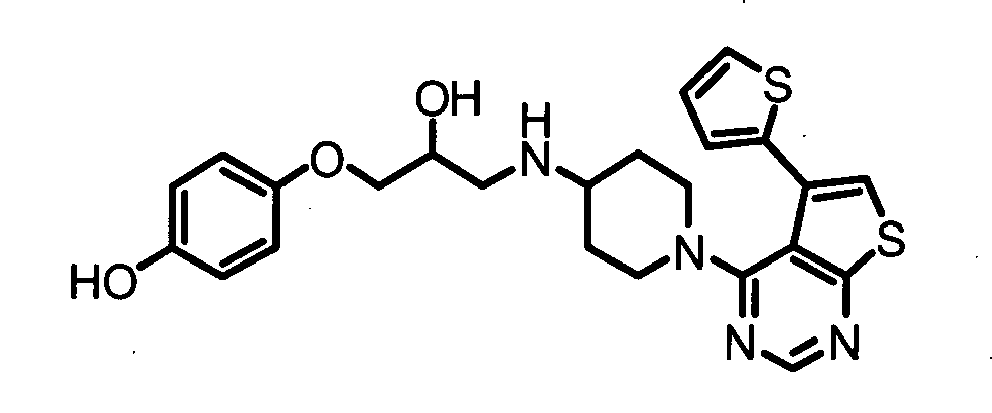
- Synthesis followed SP6 (5 h), using 150 µmol tert-butyldimethyl(4-(oxiran-2-ylmethoxy)phenoxy)silane and 1-(5-(2-thienyl)thieno[2,3-d]pyrimidin-4-yl)piperidin-4-amine to give O-silylated intermediate upon purification by prep. HPLC (reversed phase) and prep. TLC (1 mm silica gel, CH2Cl2/MeOH 95:5) with 27% yield. Product was obtained by deprotection according to SP7 and purification by prep. HPLC (reversed phase) with 27% yield.
-

- Synthesis followed SP6 (iPrOH:DMSO 1:1, 10 h), using 200 µmol tert-butyldimethyl(4-(oxiran-2-ylmethoxy)phenoxy)silane and 1-(5-(4-fluorophenyl)thieno[2,3-d]pyrimidin-4-yl)piperidin-4-amine to give O-silylated intermediate upon purification by prep. HPLC (reversed phase) with 45% yield. Product was obtained by deprotection according to SP7 and purification by prep. HPLC (reversed phase) with 74% yield.
-

- Product of example 10 (60 µmol) was converted into the title compound with 32% yield following SP11 (5 h).
-

- Synthesis followed SP6 (10 h), using 250 µmol ethyl 2-hydroxy-5-(oxiran-2-ylmethoxy)benzoate and 1-(5-phenylthieno[2,3-d]pyrimidin-4-yl)piperidin-4-amine to give benzoic ester intermediate upon purification by prep. TLC (2 mm silica gel, PE/CH2Cl2/MeOH 4:6:1) with 51% yield.
-

- Product was obtained by ester reduction of example 12 according to SP9 (1.5 eq. LiAIH4) with 39% yield.
-
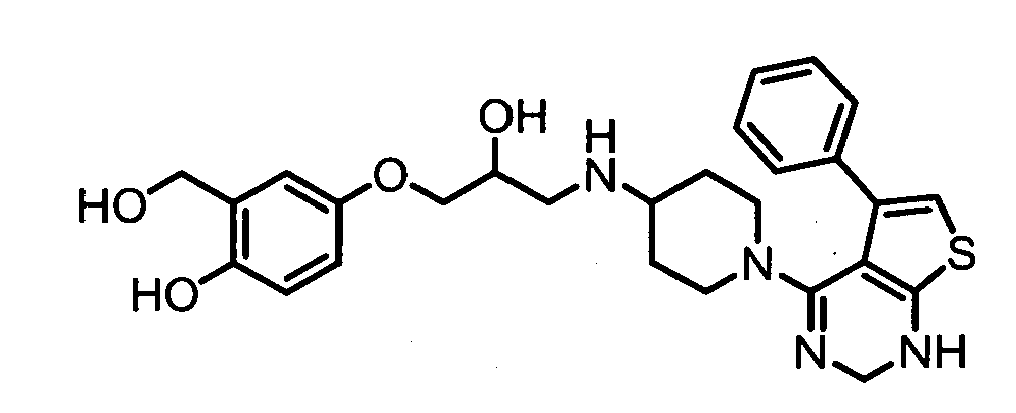
- Product was obtained by ester reduction of example 12 according to SP9 with 19% yield using a larger excess of LiAlH4 (4.0 eq.) and additional stirring at r.t. for 3 h.
-
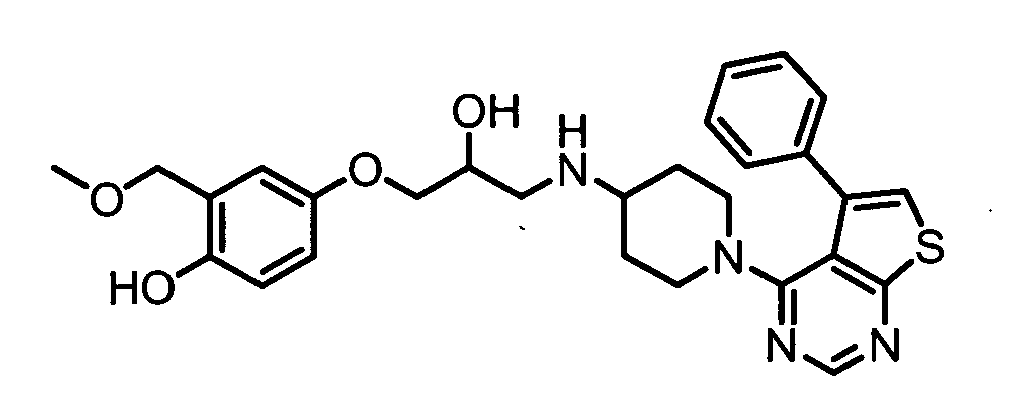
- Example 13 (50 µmol) was dissolved in MeOH (1 mL) and treated with concd HCl (0.1 mL) at r.t. for 6 h. The mixture was partitioned between aq. satd NaHCO3 and CH2Cl2 (3x) and purified by prep. TLC (1 mm silica gel, PE/CH2Cl2/MeOH 2:6:2) to give the title compound with 15% yield.
-

- Product was obtained by ester saponification of example 12 (30 µmol) according to SP10 with 68% yield.
-
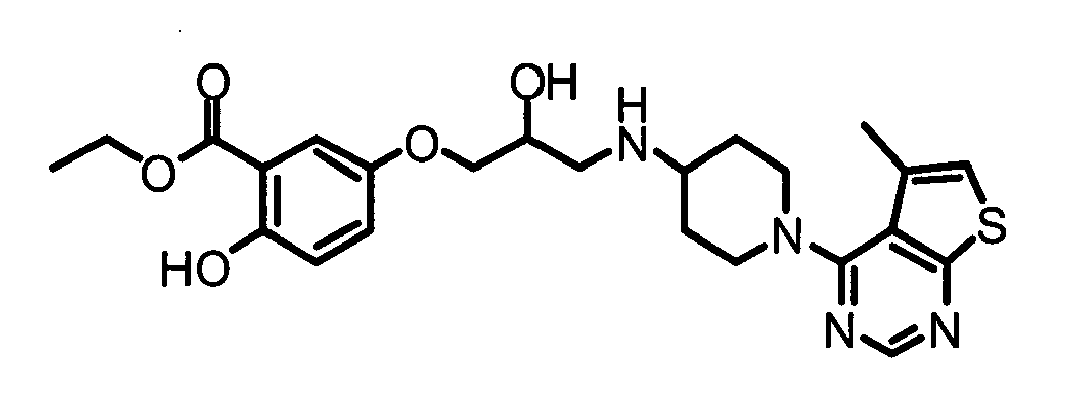
- Synthesis followed SP6 (6 h), using 170 µmol ethyl 2-hydroxy-5-(oxiran-2-ylmethoxy)benzoate and 1-(5-methylthieno[2,3-d]pyrimidin-4-yl)piperidin-4-amine to give benzoic ester intermediate upon purification by prep. HPLC (reversed phase) with 23% yield.
-

- Product was obtained by ester reduction of example 17 according to SP9 (total 3.5 eq. LiAIH4) with 25% yield.
-
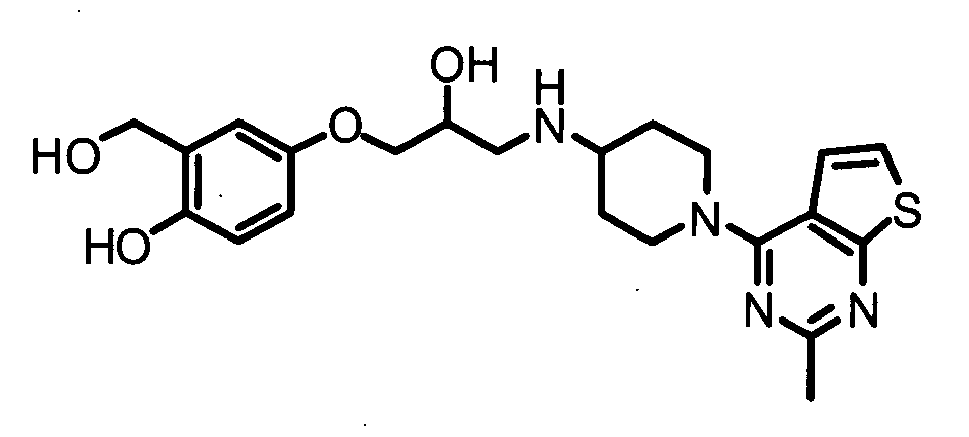
- Synthesis followed SP6 (iPrOH:DMSO:H2O 4:2:1, 1.2 eq. DIEA, 16 h), using 290 µmol ethyl 2-hydroxy-5-(oxiran-2-ylmethoxy)benzoate and 1-(2-methylthieno[2,3-d]pyrimidin-4-yl)piperidin-4-amine HCl-salt to give benzoic ester intermediate upon purification by prep. TLC (1 mm silica gel, PE/CH2Cl2/MeOH 4:6:1) with 20% yield. Product was obtained by ester reduction according to SP9 (total 2.5 eq. LiAlH4) with 16% yield.
-

- Synthesis followed SP6 (16 h), using 200 µmol ethyl 2-hydroxy-5-(oxiran-2-ylmethoxy)benzoate and 1-(5-methyl-6-phenylthieno[2,3-d]pyrimidin-4-yl)piperidin-4-amine to give benzoic ester intermediate upon purification by prep. TLC (1 mm silica gel, PE/CH2Cl2/MeOH 4:6:1) with 24% yield.
-

- Product was obtained by ester reduction of example 20 according to SP9 (total 2.5 eq. LiAlH4) with 5% yield.
-

- Synthesis followed SP6 (iPrOH:DMSO:H2O 4:2:1, 1.2 eq. DIEA, 70 h), using 330 µmol ethyl 2-hydroxy-5-(oxiran-2-ylmethoxy)benzoate and 1-(thieno[3,2-d]pyrimidin-4-yl)piperidin-4-amine HCl-salt to give benzoic ester intermediate upon purification by prep. HPLC (reversed phase) and prep. TLC (1 mm silica gel, PE/CH2Cl2/MeOH 4:6:1) with 30% yield.
-

- Product was obtained by ester reduction of example 22 according to SP9 (total 3.5 eq. LiAlH4) with 21% yield.
-

- Synthesis followed SP6 (iPrOH:DMSO:H2O 2:1:1, 24 h at 80°C, 24 h at 110°C), using 250 µmol ethyl 2-hydroxy-5-(oxiran-2-ylmethoxy)benzoate and 1-(4,6-dimethylpyrimidin-2-yl)piperidin-4-amine to give benzoic ester intermediate upon partition between half satd. aq. NaHCO3 and CH2Cl2 (3 x) and purification by prep. TLC (1 mm silica gel, PE/CH2Cl2/MeOH 4:6:1) with 54% yield. Product was obtained by ester reduction according to SP9 (total 3.0 eq. LiAlH4) with 8% yield.
-
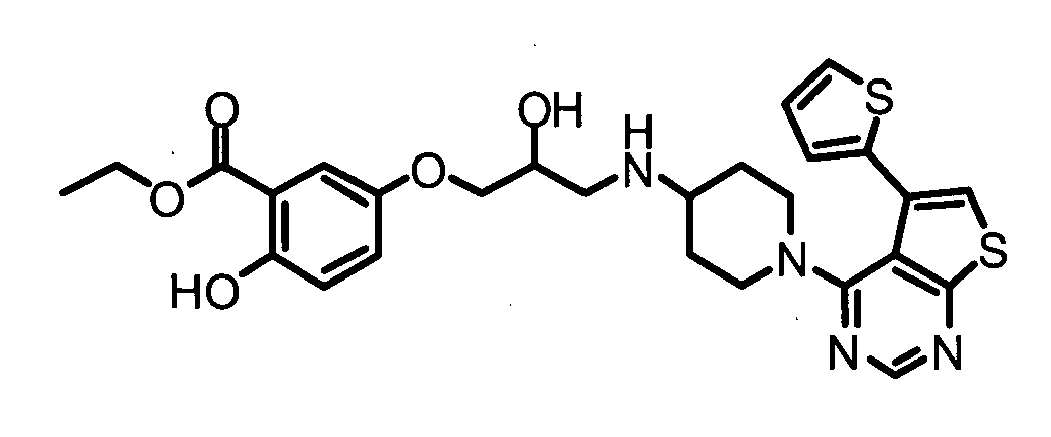
- Synthesis followed SP6 (16 h), using 290 µmol ethyl 2-hydroxy-5-(oxiran-2-ylmethoxy)benzoate and 1-(5-(2-thienyl)thieno[2,3-d]pyrimidin-4-yl)piperidin-4-amine to give benzoic ester intermediate upon purification by prep. TLC (1 mm silica gel, PE/CH2Cl2/MeOH 4:6:1) with 22% yield.
-

- Product was obtained by ester reduction of example 25 according to SP9 (total 2.5 eq. LiAIH4) with 10% yield.
-

- Synthesis followed SP6 (iPrOH:DMSO 3:1, 24 h), using 150 µmol 3-(oxiran-2-ylmethoxy)phenyl benzoate and 1-(5-phenylthieno[2,3-d]pyrimidin-4-yl)piperidin-4-amine. The benzoic acid moiety was already lost during purification by prep. TLC (1 mm silica gel, PE/CH2Cl2/MeOH 4:6:1) and subsequent prep. HPLC (reversed phase) to give the title compound with 20% yield.
-
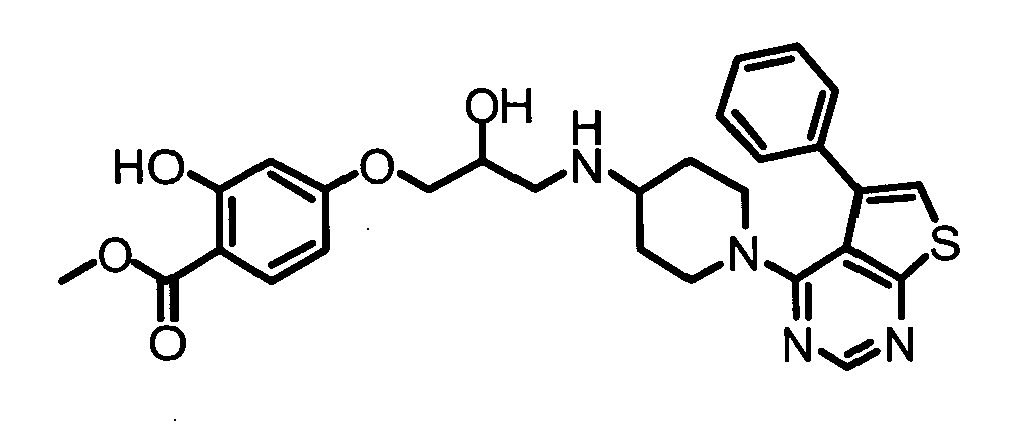
- Synthesis followed SP6 (4 h), using 220 µmol methyl 2-hydroxy-4-(oxiran-2-ylmethoxy)benzoate and 1-(5-phenylthieno[2,3-d]pyrimidin-4-yl)piperidin-4-amine to give benzoic ester intermediate upon purification by prep. TLC (1 mm silica gel, PE/CH2Cl2/MeOH 4:6:1) with 70% yield.
-

- Product was obtained by ester reduction of example 28 according to SP9 (total 4.5 eq. LiAlH4) with 11% yield.
-

- Synthesis followed SP6 (6 h), using 200 µmol 2-((4-(adamantane-1-carbonyloxy)-2-ethylphenoxy)methyl)oxirane and 1-(5-phenylthieno[2,3-d]pyrimidin-4-yl)piperidin-4-amine to give ester intermediate upon purification by prep. TLC (1 mm silica gel, PE/CH2Cl2/MeOH 60:70:15) with 48% yield. Product was obtained by ester saponification according to SP10 (3 h, 80°C) with 46% yield upon following workup: the mixture was partitioned between aq. 1.3 N NaOH / brine (1:1) and CHCl3 (2x) and ethyl acetate (1x). Purification was performed by prep. TLC (1 mm silica gel, PE/CH2Cl2/MeOH 60:90:15).
-

- Synthesis followed SP6 (10 h), using 200 µmol 2-((4-(adamantane-1-carbonyloxy)-2-ethylphenoxy)methyl)oxirane and 1-(5-phenylthieno[2,3-d]pyrimidin-4-yl)piperidin-4-amine to give MOM intermediate upon purification by prep. TLC (1 mm silica gel, PE/CH2Cl2/MeOH 4:6:1) with 10% yield. Product was obtained by MOM-removal according to SP8 with 54% yield upon purification by prep. TLC (1 mm silica gel, PE/CH2Cl2/MeOH 8:4:1).
-

- Synthesis followed SP6 (6 h), using 250 µmol ethyl 5-(methoxymethoxy)-2-(oxiran-2-ylmethoxy)benzoate and 1-(5-phenylthieno[2,3-d]pyrimidin-4-yl)piperidin-4-amine to give MOM intermediate upon purification by prep. TLC (2 mm silica gel, PE/CH2Cl2/MeOH 4:6:1) with 48% yield. Product was obtained by MOM-removal according to SP8 with 32% yield upon purification by prep. TLC (1 mm silica gel, PE/CH2Cl2/MeOH 2:5:1).
-

- Product was obtained by ester reduction of example 32 according to SP9 (1.5 eq. LiAIH4) with 17% yield.
-

- Synthesis followed SP6 (3 h), using 300 µmol methyl 4-(methoxymethoxy)-2-(oxiran-2-ylmethoxy)benzoate and 1-(5-phenylthieno[2,3-d]pyrimidin-4-yl)piperidin-4-amine to give MOM intermediate upon purification by prep. TLC (1 mm silica gel, PE/CH2Cl2/MeOH 10:6:1) with 51% yield. Product was obtained by MOM-removal according to SP8 with 32% yield upon purification by prep. TLC (1 mm silica gel, PE/CH2Cl2/MeOH 6:4:1) and subsequent prep. HPLC (reversed phase).
-

- Product was obtained by ester saponification of example 34 (100 µmol) according to SP10 with 72% yield.
-

- Synthesis followed SP6 (4 h), using 150 µmol (3-(oxiran-2-ylmethoxy)phenyl)methanol and 1-(5-phenylthieno[2,3-d]pyrimidin-4-yl)piperidin-4-amine to give the title compound with 64% yield upon purification by prep. HPLC (reversed phase).
-

- Synthesis followed SP6 (iPrOH:DMSO 1:1, 30 h at 80°C and 20 h at 100 °C), using 220 µmol (3-(oxiran-2-ylmethoxy)phenyl)methanol and 1-(5-methylthieno[2,3-d]pyrimidin-4-yl)piperidin-4-amine to give the title compound with 26% yield upon purification by prep. HPLC (reversed phase) and subsequent by prep. TLC (1 mm silica gel, PE/CH2Cl2/MeOH 4:6:1).
-

- Synthesis followed SP6 (iPrOH:DMSO 1:1, 1.2 eq. DIEA, 120°C, 90 h), using 150 µmol (3-(oxiran-2-ylmethoxy)phenyl)methanol and 1-(2-methylthieno[2,3-d]pyrimidin-4-yl)piperidin-4-amine HCl-salt to give the title compound with 20% yield upon purification by prep. HPLC (reversed phase) and subsequent by prep. TLC (1 mm silica gel, PE/CH2Cl2/MeOH 4:6:1).
-

- Synthesis followed SP6 (iPrOH:DMSO 1:1, 35 h), using 150 µmol (3-(oxiran-2-ylmethoxy)phenyl)methanol and 1-(5-methyl-6-phenylthieno[2,3-d]pyrimidin-4-yl)piperidin-4-amine to give the title compound with 36% yield upon purification by prep. HPLC (reversed phase).
-
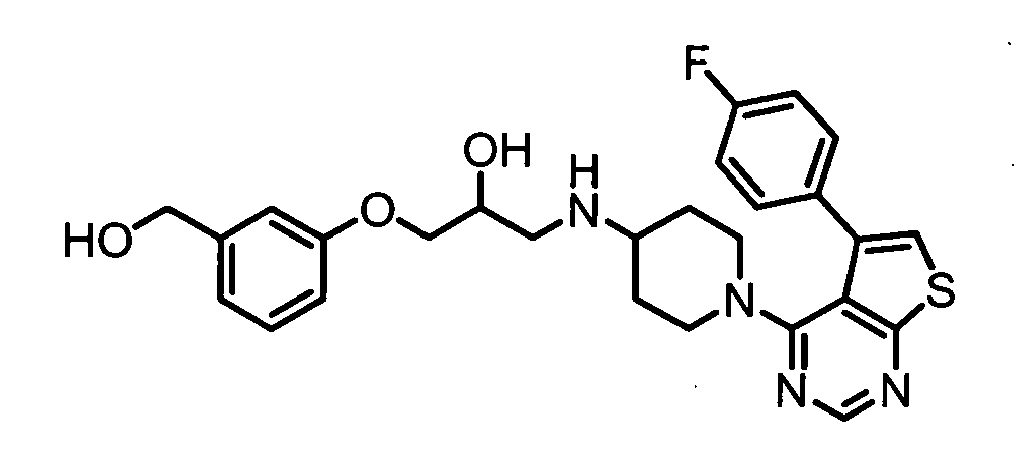
- Synthesis followed SP6 (iPrOH:DMSO 1:1, 14 h), using 150 µmol (3-(oxiran-2-ylmethoxy)phenyl)methanol and 1-(5-(4-fluorophenyl)thieno[2,3-d]pyrimidin-4-yl)piperidin-4-amine to give the title compound with 35% yield upon purification by prep. HPLC (reversed phase).
-

- Product of example 36 (80 µmol) was converted into the title compound with 18% yield following SP11 (10 h).
-

- Product of example 39 (50 µmol) was converted into the title compound with 34% yield following SP11 (22 h).
-

- Synthesis followed SP6 (4 h), using 120 µmol (4-(oxiran-2-ylmethoxy)phenyl)methanol and 1-(5-phenylthieno[2,3-d]pyrimidin-4-yl)piperidin-4-amine to give the title compound with 19% yield upon purification by prep. HPLC (reversed phase).
-

- Synthesis followed SP6 (iPrOH:DMSO 1:1, 12 h), using 150 µmol (4-(oxiran-2-ylmethoxy)phenyl)methanol and 1-(5-(4-fluorophenyl)thieno[2,3-d]pyrimidin-4-yl)piperidin-4-amine to give the title compound with 29% yield upon purification by prep. HPLC (reversed phase) and subsequent by prep. TLC (1 mm silica gel, PE/CH2Cl2/MeOH 4:6:1).
-
- ++++
- EC50 = 0.01-0.99 nM
- +++
- EC50 = 1-10 nM
- ++
- EC50 = 11-100 nM
- +
- EC50 = 101-1000 nM
- 0
- EC50 > 1000 nM
- for a definition of the criteria, see above
- +++
- A x B > 1000
- ++
- A x B = 101-1000
- +
- A x B = 10-100
- 0
- A x B < 10
| Example | [M+1] found (LCMS) | activity [EC50(β3)] | selectivity [A x B] |
| 1 | 477.2 | +++ | ++ |
| 2 | 477.2 | ++ | 0 |
| 3 | 477.2 | ++++ | ++ |
| 4 | 415.2 | ++ | ++ |
| 5 | 415.2 | ++ | ++ |
| 6 | 491.2 | +++ | + |
| 7 | 401.2 | ++ | ++ |
| 8 | 373.2 | ++ | 0 |
| 9 | 483.1 | +++ | + |
| 10 | 495.2 | +++ | ++ |
| 11 | 509.2 | + | 0 |
| 12 | 549.2 | + | 0 |
| 13 | 507.2 | ++++ | +++ |
| 14 | 509.2 | ++++ | +++ |
| 15 | 521.2 | ++++ | +++ |
| 16 | 521.2 | + | ++ |
| 17 | 487.2 | 0 | 0 |
| 18 | 445.2 | +++ | ++ |
| 19 | 445.2 | +++ | +++ |
| 20 | 563.2 | 0 | 0 |
| 21 | 521.2 | +++ | ++ |
| 22 | 473.2 | 0 | 0 |
| 23 | 431.2 | +++ | ++ |
| 24 | 403.2 | +++ | +++ |
| 25 | 555.2 | + | 0 |
| 26 | 513.2 | ++++ | ++ |
| 27 | 477.2 | ++++ | + |
| 28 | 535.2 | 0 | 0 |
| 29 | 507.2 | ++ | ++ |
| 30 | 505.2 | +++ | + |
| 31 | 505.2 | ++++ | +++ |
| 32 | 549.2 | +++ | + |
| 33 | 507.2 | +++ | ++ |
| 34 | 535.2 | + | 0 |
| 35 | 521.2 | + | + |
| 36 | 491.2 | ++ | ++ |
| 37 | 429.2 | ++ | 0 |
| 38 | 429.2 | + | 0 |
| 39 | 505.2 | + | 0 |
| 40 | 509.2 | ++ | + |
| 41 | 505.2 | + | + |
| 42 | 519.2 | + | 0 |
| 43 | 491.2 | +++ | ++ |
| 44 | 509.2 | + | + |
| some compounds displayed selectivities (A x B) even with a five digit selectivity factor; according to review M. Sawa et al., Curr. Med. Chem. 2006, 13, 25, one aryloxypropanolamine from Wyeth displayed a most promising selectivity profile for β3 over β1- and β2-adrenoceptors, which, however, could not be reproduced in our assay systems. Especially over β2, no selectivity was detectable. |
Claims (34)
- A compound having the formula I

whereinQ is a pyrimidinyl or dihydropyrimidinyl residue that may be unsubstituted or substituted with one or more residues R13, R14, or R15, or Q is a pyrimidin-4-yl or dihydropyrimidin-4-yl ring which is substituted with a group R8 and which may be anellated in the 5,6-position of the pyrimidin-4-yl or dihydropyrimidin-4-yl ring to a five-membered heterocycle, preferably selected from among thiophenyl and pyrollyl, which 5-membered heterocycle may be unsubstituted or substituted with one or two substituents selected from R9, R10, R11 or R12;R1 and R2 are selected from hydrogen, halogen, hydroxyl, carboxy, carbamoyl, sulfamoyl, cyano, nitro, NR6R7, alkyl, alkenyl, alkinyl, alkoxy, alkylcarbonyl, alkoxycarbonyl, alkylcarbonylamino, alkylaminocarbonyl, dialkylaminocarbonyl, arylsulfonylaminomethyl, heteroarylsulfonylaminomethyl, alkylaminosulfonyl, and dialkylaminosulfonyl wherein each alkyl, alkenyl or alkinyl may be unsubstituted or substituted with one or more residues selected from among hydroxyl, alkoxy, fluoro, and NR6R7; and wherein each aryl or heteroaryl is a monocyclic aromatic or heteroaromatic ring, respectively, which can be unsubstituted or substituted with one or more residues selected from among hydroxyl, alkoxy, halogen, alkyl, carboxy, NR6R7, cyano and nitro; provided that if R1 is different from hydroxyl or hydroxymethyl, then R2 must represent hydroxyl or hydroxymethyl;R3 is selected from hydrogen, halogen, hydroxyl, carboxy, carbamoyl, sulfamoyl, cyano, nitro, NR6R7, alkyl, alkenyl, alkinyl, alkoxy, alkylcarbonyl, and alkoxycarbonyl, wherein each alkyl, alkenyl or alkinyl may be unsubstituted or substituted with one or more residues selected from among hydroxyl, alkoxy, fluoro, and NR6R7;R4 is hydrogen, alkylcarbonyl, or alkyl;R5 is selected from hydrogen, alkyl, wherein alkyl may be unsubstituted or substituted with one or more residues selected from among hydroxyl, alkoxy, fluoro, and NR6R7;R6 and R7 are independently selected from hydrogen, alkyl, aryl, alkylsulfonyl, arylsulfonyl, heteroarylsulfonyl, alkylcarbonyl, alkoxycarbonyl, aminocarbonyl, alkylaminocarbonyl, arylcarbonyl, and heteroarylcarbonyl; wherein each alkyl may be unsubstituted or substituted with one or more residues selected from among hydroxyl, alkoxy, phenyl, fluoro, carboxy, and NR16R17; and wherein R6 and R7 may form a 5-7 membered cycle; and wherein each aryl or heteroaryl is a monocyclic aromatic or heteroaromatic ring, respectively, which can be unsubstituted or substituted with one or more residues selected from among hydroxyl, alkoxy, halogen, alkyl, carboxy, NR16R17, cyano and nitro;R8 is selected from among hydrogen, alkyl, hydroxyl, alkoxyR9; R10; R11 and R12 are independently selected from hydrogen, carboxy, NR6R7, alkyl and a mono- or bicyclic aromatic or heteroaromatic ring, wherein each alkyl may be unsubstituted or substituted with one or more residues selected from among hydroxyl, alkoxy, fluoro, NR6R7, and carboxy, and wherein each mono- or bicyclic aromatic or heteroaromatic ring can be unsubstituted or substituted with one or more residues selected from among alkyl, hydroxyl, alkoxy, alkylthio, alkylcarbonyl, alkylaminocarbonyl, dialkylaminocarbonyl, alkoxycarbonyl, carboxymethoxy, alkoxy-carbonylalkoxy, halogen, carboxy, carbamoyl, sulfamoyl, alkylaminosulfonyl, dialkylaminosulfonyl, alkylsulfonyl, sulfo, alkylsulfinyl, NR6R7, cyano and nitro, wherein two of these residues may form a 5-7 membered non-aromatic ring.R13, R14 and R15 are independently selected from hydrogen, alkyl, carboxy, NR6R7, aryl, hydroxyl, alkoxy, alkoxycarbonyl, arylaminocarbonyl, heteroarylaminocarbonyl, halogen and nitro, wherein each alkyl may be unsubstituted or substituted with one or more residues selected from among hydroxyl, alkoxy, fluoro and aryl; and wherein two of these residues may form a 5-7 membered non-aromatic or aromatic ring;and wherein each aryl or heteroaryl is a monocyclic aromatic or heteroaromatic ring, respectively, which can be unsubstituted or substituted with one or more residues selected from among hydroxyl, alkoxy, halogen, carboxy, alkoxycarbonyl, NR6R7, cyano and nitro; wherein two of these residues might form a 5-7 membered non-aromatic ring.R16 and R17 are independently selected from among hydrogen, C1-C8 alkyl, phenyl, thiophenyl, pyridyl, C1-C8 alkylsulfonyl, phenylsulfonyl, thiophenylsulfonyl, pyridylsulfonyl, C1-C8 alkylcarbonyl, C1-C8 alkoxycarbonyl, aminocarbonyl, C1-C8 alkylaminocarbonyl, thiophenylcarbonyl, pyridylcarbonyl, and phenylcarbonyl and wherein R16 and R17 may form a 5-7 membered cycle. - A compound according to claim 1, wherein
 wherein the dotted bond represents a single or a double bond;R1 and R2 are selected from hydrogen, halogen, hydroxyl, carboxy, carbamoyl, sulfamoyl, cyano, nitro, NR6R7, C1-C6 alkyl, C2-C6 alkenyl, C2-C6 alkinyl, C1-C6 alkoxy, C1-C6 alkylcarbonyl, C1-C6 alkoxycarbonyl, C1-C6 alkylcarbonylamino, C1-C6 alkylaminocarbonyl, di(C1-C6)alkylaminocarbonyl, phenylsulfonylaminomethyl, thiophenylsulfonylaminomethyl, alkylaminosulfonyl, and dialkylaminosulfonyl, wherein each alkyl, alkenyl or alkinyl may be unsubstituted or substituted with one or more residues selected from among hydroxyl, C1-C6 alkoxy, fluoro, and NR6R7; and wherein each phenyl or thiophenyl may be unsubstituted or substituted with one or more residues selected from among hydroxyl, C1-C6 alkoxy, halogen, C1-C6 alkyl, carboxy, NR6R7, cyano and nitro, provided that if R1 is different from hydroxyl or hydroxymethyl, then R2 must represent hydroxyl or hydroxymethyl;R3 is selected from hydrogen, halogen, hydroxyl, carboxy, carbamoyl, sulfamoyl, cyano, nitro, NR6R7, C1-C6 alkyl, C2-C6 alkenyl, C2-C6 alkinyl, C1-C6 alkoxy, C1-C6 alkylcarbonyl, and C1-C6 alkoxycarbonyl, wherein each alkyl, alkenyl or alkinyl may be unsubstituted or substituted with one or more residues selected from among hydroxyl, C1-C6 alkoxy, fluoro, and NR6R7;R4 is hydrogen, C1-C3 alkylcarbonyl, or C1-C3 alkyl;R5 is selected from hydrogen, C1-C3 alkyl, which may be unsubstituted or substituted with one or more residues selected from among hydroxyl, C1-C3 alkoxy, fluoro, and NR6R7;R6 and R7 are independently selected from hydrogen, C1-C8 alkyl, phenyl, C1-C8 alkylsulfonyl, phenylsulfonyl, thiophenylsulfonyl, C1-C8 alkylcarbonyl, C1-C6 alkoxycarbonyl, aminocarbonyl, C1-C8 alkylaminocarbonyl, phenylcarbonyl, and thiophenylcarbonyl; wherein each alkyl may be unsubstituted or substituted with one or more residues selected from among hydroxyl, C1-C6 alkoxy, phenyl, fluoro, carboxy, and NR16R17; and wherein R6 and R7 may form a 5-7 membered cycle; and wherein each phenyl or thiophenyl may be unsubstituted or substituted with one or more residues selected from among hydroxyl, C1-C6 alkoxy, halogen, C1-C6 alkyl, carboxy, NR16R17, cyano and nitro;R8 is selected from hydrogen, methyl, hydroxyl, and methoxy;R9, R10, R11 and R12 are independently selected from hydrogen, carboxy, NR6R7, C1-C6 alkyl and a mono- or bicyclic aromatic or heteroaromatic ring selected from phenyl, furanyl, thiophenyl, pyrollyl, thiazolyl, oxazolyl, imidazolyl, pyrazolyl, isoxazolyl, isothiazolyl, triazolyl, oxydiazolyl, thiadiazolyl, pyranyl, pyridinyl, pyridazinyl, pyrimidinyl, pyrazinyl, triazinyl and tetrazinyl, or a bicyclic aromatic or heteroaromatic ring selected from quinolinyl, quinoxalinyl, indolyl, benzofuranyl, benzothiophenyl, benzooxazolyl, benzothiazolyl and naphthalylwherein each alkyl may be unsubstituted or substituted with one or more residues selected from among hydroxyl, C1-C6 alkoxy, fluoro, NR6R7, and carboxy;and wherein each mono- or bicyclic aromatic or heteroaromatic ring can be unsubstituted or substituted with one or more residues selected from among C1-C6 alkyl, hydroxyl, C1-C4 alkoxy, C1-C4 alkylthio, C1-C4 alkylcarbonyl, C1-C6 alkylaminocarbonyl, di(C1-C6)alkylaminocarbonyl, C1-C4 alkoxycarbonyl, carboxymethoxy, C1-C4 alkoxycarbonyl(C1-C4)alkoxy, halogen, carboxy, carbamoyl, sulfamoyl, C1-C4 alkylaminosulfonyl, di(C1-C4)alkylaminosulfonyl, C1-C4 alkylsulfonyl, sulfo, C1-C4 alkylsulfinyl, NR6R7, cyano and nitro; wherein two of these residues may form a 5-7 membered non-aromatic ringR13, R14 and R15 are independently selected from hydrogen, C1-C4 alkyl, carboxy, NR6R7, phenyl, hydroxyl, C1-C4 alkoxy, C1-C4 alkoxycarbonyl, phenylaminocarbonyl, thiophenylaminocarbonyl, halogen and nitro, wherein each alkyl may be unsubstituted or substituted with one or more residues selected from among hydroxyl, C1-C4 alkoxy, fluoro and phenyl;wherein two of these residues selected from R13, R14 and R15, might form a 5-7 membered non-aromatic or aromatic ringand wherein phenyl or thiophenyl can be unsubstituted or substituted with one or more residues selected from among hydroxyl, C1-C4 alkoxy, halogen, carboxy, C1-C4 alkoxycarbonyl, NR6R7, cyano and nitro; wherein two of these residues might form a 5-7 membered aromatic ring.R16 and R17 are independently selected from among from hydrogen, C1-C6 alkyl, phenyl, C1-C6 alkylsulfonyl, phenylsulfonyl, thiophenylsulfonyl, C1-C6 alkylcarbonyl, C1-C6 alkoxycarbonyl, aminocarbonyl, C1-C6 alkylaminocarbonyl, phenylcarbonyl, and thiophenylcarbony wherein R16 and R17 may form a 5-7 membered cycle.
 - A compound according to claim 2, wherein
 wherein the dotted bond represents a single or a double bond;R1 and R2 are selected from hydrogen, halogen, hydroxyl, carboxy, cyano, nitro, sulfamoyl, NR6R7, C1-C3 alkyl, C2-C3 alkenyl, ethinyl, C1-C3 alkoxy, C1-C3 alkylcarbonyl, C1-C3 alkoxycarbonyl, C1-C4 alkylaminocarbonyl, morpholinocarbonyl, thiophen-2-ylsulfonylaminomethyl, wherein each alkyl or alkenyl may be unsubstituted or substituted with one or more residues selected from among hydroxyl, C1-C3 alkoxy, fluoro, and NR6R7; and wherein the thiophenyl can be unsubstituted or substituted with one or more residues selected from among hydroxyl, C1-C3 alkoxy, halogen, C1-C3 alkyl, carboxy, NR6R7, cyano and nitro, provided that if R1 is different from hydroxyl or hydroxymethyl, then R2 must represent hydroxyl or hydroxymethyl;R3 is selected from hydrogen, halogen, hydroxyl, carboxy, carbamoyl, sulfamoyl, cyano, nitro, NR6R7, C1-C3 alkyl, C2-C3 alkenyl, ethinyl, C1-C3 alkoxy, C1-C3 alkylcarbonyl, and C1-C3 alkoxycarbonyl, wherein each alkyl or alkenyl may be unsubstituted or substituted with one or more residues selected from among hydroxyl, C1-C3 alkoxy, fluoro, and NR6R7;R4 is hydrogen or methyl;R5 is selected from hydrogen and methyl, wherein methyl may be unsubstituted or substituted with a residue selected from among hydroxyl, methoxy, ethoxy, fluoro, and NR6R7;R6 and R7 are independently selected from hydrogen, C1-C3 alkyl, C1-C8 alkylsulfonyl, thiophen-2-ylsulfonyl, C1-C8 alkylcarbonyl, C1-C4 alkoxycarbonyl, aminocarbonyl, and C1-C8 alkylaminocarbonyl; wherein each alkyl may be unsubstituted or substituted with one or more residues selected from among hydroxyl, alkoxy, carboxy, and NR16R17; and wherein R6 and R7 may form a 5-7 membered cycle; and wherein the thiophenyl may be unsubstituted or substituted with one or more residues selected from among hydroxyl, C1-C3 alkoxy, halogen, C1-C3 alkyl, carboxy, NR16R17, cyano and nitro;R8 is selected from hydrogen and methyl;R9, R10, R11 and R12 are independently selected from hydrogen, NR6R7, C1-C6 alkyl, phenyl, thiophenyl, pyridinyl, wherein each alkyl may be unsubstituted or substituted with one or more residues selected from among hydroxyl, C1-C3 alkoxy, fluoro, NR6R7, and carboxy; and wherein each monocyclic aromatic or heteroaromatic ring can be unsubstituted or substituted with one or more residues selected from among C1-C3 alkyl, hydroxyl, C1-C4 alkoxy, C1-C4 alkoxycarbonyl, carboxymethoxy, C1-C3 alkoxycarbonyl(C1-C2)alkoxy, halogen, carboxy, NR6R7, cyano and nitro; wherein two of these residues might form a 5-7 membered non-aromatic ring;R13, R14 and R15 are independently selected from hydrogen, C1-C3 alkyl, carboxy, NR6R7, phenyl, hydroxyl, C1-C3 alkoxy, C1-C3 alkoxycarbonyl, phenylaminocarbonyl, halogen and nitro, wherein each alkyl may be unsubstituted or substituted with one or more residues selected from among hydroxyl, C1-C3 alkoxy, fluoro and phenyl; and wherein phenyl can be unsubstituted or substituted with one or more residues selected from among hydroxyl, C1-C3 alkoxy, halogen, carboxy, C1-C3 alkoxycarbonyl, NR6R7, cyano and nitro; wherein two of these residues might form a 5-7 membered non-aromatic ring.R16 and R17 are independently selected from among hydrogen, C1-C3 alkyl, C1-C4 alkylsulfonyl, thiophen-2-ylsulfonyl, C1-C4 alkylcarbonyl, C1-C4 alkoxycarbonyl, aminocarbonyl, and C1-C4 alkylaminocarbony wherein R16 and R17 may form a 5-7 membered cycle.
 - A compound according to anyone of the preceding claims, wherein
R1 is selected from hydrogen, hydroxyl, hydroxymethyl, methoxycarbonyl, ethoxycarbonyl, methyl, ethyl, carboxy, and methoxymethy);
R2 is selected from hydrogen, hydroxyl, methoxycarbonyl, and hydroxymethyl;
R3 is selected from hydrogen, methyl, ethyl, methoxycarbonyl, ethoxycarbonyl, carboxy, hydroxymethyl;
R4 is hydrogen or methyl;
R5 is hydrogen or methyl;
R8 is hydrogen or methyl;
R9, if present, is hydrogen, methyl, unsubstituted phenyl, halophenyl, preferably para-fluoro phenyl, or thiophenyl;
R10, if present, is hydrogen, methyl, unsubstituted phenyl, or halophenyl;
R11 and R12, if present, are both hydrogen;
R13, R14 and R15, if present, are independently selected from hydrogen and methyl. - A compound according to anyone of the preceding claims, or the pharmaceutically acceptable salt or solvate thereof, in the form of a racemate or as a substantially pure enantiomer or diastereomer or mixtures of the optical isomers, and having the formula II

- A compound according to claim 5, wherein
R9 is hydrogen, carboxy, NR6R7, C1-C6 alkyl and a mono- or bicyclic aromatic or heteroaromatic ring selected from phenyl, furanyl, thiophenyl, pyrollyl, thiazolyl, oxazolyl, imidazolyl, pyrazolyl, isoxazolyl, isothiazolyl, triazolyl, oxydiazolyl, thiadiazolyl, pyranyl, pyridinyl, pyridazinyl, pyrimidinyl, pyrazinyl, triazinyl and tetrazinyl, or a bicyclic aromatic or heteroaromatic ring selected from quinolinyl, quinoxalinyl, indolyl, benzofuranyl, benzothiophenyl, benzooxazolyl, benzothiazolyl and naphthalyl, wherein each alkyl may be unsubstituted or substituted with one or more residues selected from among hydroxyl, C1-C6 alkoxy, fluoro, NR6R7, and carboxy; and wherein each mono- or bicyclic aromatic or heteroaromatic ring can be unsubstituted or substituted with one or more residues selected from among C1-C6 alkyl, hydroxyl, C1-C4 alkoxy, C1-C4 alkylthio, C1-C4 alkylcarbonyl, C1-C6 alkylaminocarbonyl, di(C1-C6)alkylaminocarbonyl, C1-C4 alkoxycarbonyl, carboxymethoxy, C1-C4 alkoxycarbonyl(C1-C4)alkoxy, halogen, carboxy, carbamoyl, sulfamoyl, C1-C4 alkylaminosulfonyl, di(C1-C4)alkylaminosulfonyl, C1-C4 alkylsulfonyl, sulfo, C1-C4 alkylsulfinyl, NR6R7, cyano and nitro; wherein two of these residues might form a 5-7 membered aromatic ring; and
R10 is hydrogen or C1-C6 alkyl, wherein the C1-C6 alkyl may be unsubstituted or substituted with one or more residues selected from among hydroxyl, C1-C3 alkoxy, or fluoro; - A compound according to claim 5, wherein
R9 is hydrogen, NR6R7, C1-C3 alkyl, phenyl, thiophen-2-yl, pyridinyl, wherein each alkyl may be unsubstituted or substituted with one or more residues selected from among hydroxyl, C1-C4 alkoxy, NR6R7, and carboxy; and
wherein each monocyclic aromatic or heteroaromatic ring can be unsubstituted or substituted with one or more residues selected from among C1-C3 alkyl, hydroxyl, C1-C4 alkoxy, C1-C4 alkoxycarbonyl, carboxymethoxy, C1-C2 alkoxycarbonyl(C1-C2)alkoxy" fluoro, chloro, bromo, carboxy, NR6R7, cyano and nitro; and
R10 is hydrogen or C1-C3 alkyl, wherein the C1-C3 alkyl may be unsubstituted or substituted with one or more residues selected from among hydroxyl, methoxy, or fluoro;
and the dotted bond represents a double bond. - A compound according to claim 5, wherein
R9 is hydrogen or C1-C6 alkyl, wherein the C1-C6 alkyl may be unsubstituted or substituted with one or more residues selected from among hydroxyl, C1-C3 alkoxy, or fluoro;
and
R10 is hydrogen, carboxy, NR6R7, C1-C6 alkyl and a mono- or bicyclic aromatic or heteroaromatic ring selected from phenyl, furanyl, thiophenyl, pyrollyl, thiazolyl, oxazolyl, imidazolyl, pyrazolyl, isoxazolyl, isothiazolyl, triazolyl, oxydiazolyl, thiadiazolyl, pyranyl, pyridinyl, pyridazinyl, pyrimidinyl, pyrazinyl, triazinyl and tetrazinyl, or a bicyclic aromatic or heteroaromatic ring selected from quinolinyl, quinoxalinyl, indolyl, benzofuranyl, benzothiophenyl, benzooxazolyl, benzothiazolyl and naphthalyl, wherein each alkyl may be unsubstituted or substituted with one or more residues selected from among hydroxyl, C1-C6 alkoxy, fluoro, NR6R7, and carboxy; and wherein each mono- or bicyclic aromatic or heteroaromatic ring can be unsubstituted or substituted with one or more residues selected from among C1-C6 alkyl, hydroxyl, C1-C4 alkoxy, C1-C4 alkylthio, C1-C4 alkylcarbonyl, C1-C6 alkylaminocarbonyl, di(C1-C6)alkylaminocarbonyl, C1-C4 alkoxycarbonyl, carboxymethoxy, C1-C4 alkoxycarbonyl (C1-C4)alkoxy, halogen, carboxy, carbamoyl, sulfamoyl, C1-C4 alkylaminosulfonyl, di(C1-C4)alkylaminosulfonyl, C1-C4 alkylsulfonyl, sulfo, C1-C4 alkylsulfinyl, NR6R7, cyano and nitro; wherein two of these residues might form a 5-7 membered non-aromatic ring. - A compound according to claim 5, wherein
R9 is hydrogen or C1-C3 alkyl, wherein the C1-C3 alkyl may be unsubstituted or substituted with one or more residues selected from among hydroxyl, methoxy, or fluoro;
and
R10 is hydrogen, NR6R7, C1-C3 alkyl, phenyl, thiophen-2-yl, pyridinyl, wherein each alkyl may be unsubstituted or substituted with one or more residues selected from among hydroxyl, C1-C4 alkoxy, NR6R7, and carboxy; and wherein each monocyclic aromatic or heteroaromatic ring can be unsubstituted or substituted with one or more residues selected from among C1-C3 alkyl, hydroxyl, C1-C4 alkoxy, C1-C4 alkoxycarbonyl, carboxymethoxy, C1-C2 alkoxycarbonyl (C1-C2)alkoxy oder einfach 2-alkoxy-2-oxoethoxy, fluoro, chloro, bromo, carboxy, NR6R7, cyano and nitro
and the dotted bond represents a double bond. - A compound according to anyone of claims 1-4 and the pharmaceutically acceptable salt or solvate thereof, in the form of a racemate or as a substantially pure enantiomer or diastereomer or mixtures of the optical isomers, having the formula III

- A compound according to claim 10, wherein
one of R11 and R12 is hydrogen, carboxy, NR6R7, C1-C6 alkyl and a mono- or bicyclic aromatic or heteroaromatic ring selected from phenyl, furanyl, thiophenyl, pyrollyl, thiazolyl, oxazolyl, imidazolyl, pyrazolyl, isoxazolyl, isothiazolyl, triazolyl, oxydiazolyl, thiadiazolyl, pyranyl, pyridinyl, pyridazinyl, pyrimidinyl, pyrazinyl, triazinyl and tetrazinyl, or a bicyclic aromatic or heteroaromatic ring selected from quinolinyl, quinoxalinyl, indolyl, benzofuranyl, benzothiophenyl, benzooxazolyl, benzothiazolyl and naphthalyl; wherein each alkyl may be unsubstituted or substituted with one or more residues selected from among hydroxyl, C1-C6 alkoxy, fluoro, NR6R7, and carboxy; and wherein each mono- or bicyclic aromatic or heteroaromatic ring can be unsubstituted or substituted with one or more residues selected from among C1-C6 alkyl, hydroxyl, C1-C4 alkoxy, C1-C4 alkylthio, C1-C4 alkylcarbonyl, C1-C6 alkylaminocarbonyl, di(C1-C6)alkylaminocarbonyl, C1-C4 alkoxycarbonyl, carboxymethoxy, C1-C4 alkoxycarbonyl(C1-C4)alkoxy, halogen, carboxy, carbamoyl, sulfamoyl, C1-C4 alkylaminosulfonyl, di(C1-C4)alkylaminosulfonyl, C1-C4 alkylsulfonyl, sulfo, C1-C4 alkylsulfinyl, NR6R7, cyano and nitro; wherein two of these residues might form a 5-7 membered non-aromatic ring;
and the other one of R11 and R12 is hydrogen or C1-C6 alkyl; wherein the C1-C6 alkyl may be unsubstituted or substituted with one or more residues selected from among hydroxyl, C1-C3 alkoxy, or fluoro. - A compound according to claim 10, wherein
one of R11 and R12 is hydrogen, NR6R7, C1-C3 alkyl, phenyl, thiophen-2-yl, wherein alkyl may be unsubstituted or substituted with one or more residues selected from among hydroxyl, C1-C4 alkoxy, NR6R7, and carboxy; and wherein the phenyl or thiophen-2-yl may be unsubstituted or substituted with one or more residues selected from among C1-C3 alkyl, hydroxyl, C1-C4 alkoxy, C1-C4 alkoxycarbonyl, carboxymethoxy, C0-C2 alkoxycarbonyl (C1-C2)alkoxy, 2-alkoxy-2-oxoethoxy, fluoro, chloro, bromo, carboxy, NR6R7, cyano and nitro; wherein two of these residues might form a 5-7 membered non-aromatic ring
the other one of R11 and R12 is hydrogen or C1-C3 alkyl, wherein the C1-C3 alkyl may be unsubstituted or substituted with one or more residues selected from among hydroxyl, methoxy, or fluoro;
and the dotted bond represents a double bond. - A compound according to anyone of claims 1-4, or the pharmaceutically acceptable salts or solvates thereof, in the form of a racemate or as a substantially pure enantiomer or diastereomer or mixtures of the optical isomers, and having the formula IV

- A compound according to claim 13, wherein R13, R14 and R15 are selected from hydrogen and C1-C3 alkyl, which may be unsubstituted or substituted with one or more residues selected from among hydroxyl, methoxy, ethoxy or NR6R7.
- A compound according to anyone of the preceding claims, wherein R1 is hydroxyl or hydroxymethyl.
- A compound according to anyone of the preceding claims, wherein R1 is hydroxyl or hydroxymethyl, and R2 is hydroxyl or hydrogen.
- A compound according to anyone of the preceding claims, wherein R2 is hydroxyl.
- A compound according to anyone of the preceding claims, wherein R2 is hydroxyl and R1 is hydroxymethyl, hydroxyl or hydrogen.
- A compound according to anyone of the preceding claims wherein R4 is hydrogen.
- A compound according to anyone of the preceding claims wherein R5 is hydrogen
- A compound according to anyone of the preceding claims, wherein R1 is hydrogen, hydroxyl or hydroxymethyl, R2 is hydroxyl, and R4 and R5 are both hydrogen.
- A compound according to anyone of claims 1-4, wherein the dotted bond represents a double bond.
- A compound according to anyone of claims 1-4, and the pharmaceutically acceptable salts or solvates thereof, in the form of a racemate or as a substantially pure enantiomer or diastereomer or mixtures of the optical isomers, selected from the group comprising
4-(2-hydroxy-3-(1-(5-phenylthieno[2,3-d]pyrimidin-4-yl)piperidin-4-ylamino)propoxy)phenol
(R)-4-(2-hydroxy-3-(1-(5-phenylthieno[2,3-d]pyrimidin-4-yl)piperidin-4-ylamino)propoxy)phenol
(S)-4-(2-hydroxy-3-(1-(5-phenylthieno[2,3-d]pyrimidin-4-yl)piperidin-4-ylamino)propoxy)phenol
4-(2-hydroxy-3-(1-(5-methylthieno[2,3-d]pyrimidin-4-yl)piperidin-4-ylamino)propoxy)phenol
4-(2-hydroxy-3-(1-(2-methylthieno[2,3-d]pyrimidin-4-yl)piperidin-4-ylamino)propoxy)phenol
4-(2-hydroxy-3-(1-(5-methyl-6-phenylthieno[2,3-d]pyrimidin-4-yl)piperidin-4-ylamino)propoxy)phenol
4-(2-hydroxy-3-(1-(5-(thiophen-2-yl)thieno[2,3-d]pyrimidin-4-yl)piperidin-4-ylamino)propoxy)phenol
4-(3-(1-(5-(4-fluorophenyl)thieno[2,3-d]pyrimidin-4-yl)piperidin-4-ylamino)-2-hydroxypropoxy)phenol
4-(3-((1-(5-(4-fluorophenyl)thieno[2,3-d]pyrimidin-4-yl)piperidin-4-yl)(methyl)amino)-2-hydroxypropoxy)phenol
Ethyl 2-hydroxy-5-(2-hydroxy-3-(1-(5-phenylthieno[2,3-d]pyrimidin-4-yl)piperidin-4-ylamino)propoxy)benzoate
4-(2-hydroxy-3-(1-(5-phenylthieno[2,3-d]pyrimidin-4-yl)piperidin-4-ylamino)propoxy)-2-(hydroxymethyl)phenol
2-hydroxy-5-(2-hydroxy-3-(1-(5-phenylthieno[2,3-d]pyrimidin-4-yl)piperidin-4-ylamino)propoxy)benzoic acid
Ethyl 2-hydroxy-5-(2-hydroxy-3-(1-(5-methylthieno[2,3-d]pyrimidin-4-yl)piperidin-4-ylamino)propoxy)benzoate
4-(2-hydroxy-3-(1-(5-methylthieno[2,3-d]pyrimidin-4-yl)piperidin-4-ylamino)propoxy)-2-(hydroxymethyl)phenol
4-(2-hydroxy-3-(1-(2-methylthieno[2,3-d]pyrimidin-4-yl)piperidin-4-ylamino)propoxy)-2-(hydroxymethyl)phenol
Ethyl 2-hydroxy-5-(2-hydroxy-3-(1-(5-methyl-6-phenylthieno[2,3-d]pyrimidin-4-yl)piperidin-4-ylamino)propoxy)benzoate
4-(2-hydroxy-3-(1-(5-methyl-6-phenylthieno[2,3-d]pyrimidin-4-yl)piperidin-4-ylamino)propoxy)-2-(hydroxymethyl)phenol
Ethyl 2-hydroxy-5-(2-hydroxy-3-(1-(5-(thiophen-2-yl)thieno[2,3-d]pyrimidin-4-yl)piperidin-4-ylamino)propoxy)benzoate
4-(2-hydroxy-3-(1-(5-(thiophen-2-yl)thieno[2,3-d]pyrimidin-4-yl)piperidin-4-ylamino)propoxy)-2-(hydroxymethyl)phenol
3-{2-Hydroxy-3-[1-(5-phenyl-thieno[2,3-d]pyrimidin-4-yl)-piperidin-4-ylamino]-propoxy}-phenol
Methyl 2-hydroxy-4-(2-hydroxy-3-(1-(5-phenylthieno[2,3-d]pyrimidin-4-yl)piperidin-4-ylamino)propoxy)benzoate
5-(2-hydroxy-3-(1-(5-phenylthieno[2,3-d]pyrimidin-4-yl)piperidin-4-ylamino)propoxy)-2-(hydroxymethyl)phenol
3-Ethyl-4-(2-hydroxy-3-(1-(5-phenylthieno[2,3-d]pyrimidin-4-yl)piperidin-4-ylamino)propoxy)phenol
2-Ethyl-4-(2-hydroxy-3-(1-(5-phenylthieno[2,3-d]pyrimidin-4-yl)piperidin-4-ylamino)propoxy)phenol
Ethyl 5-hydroxy-2-(2-hydroxy-3-(1-(5-phenylthieno[2,3-d]pyrimidin-4-yl)piperidin-4-ylamino)propoxy)benzoate
4-(2-hydroxy-3-(1-(5-phenylthieno[2,3-d]pyrimidin-4-yl)piperidin-4-ylamino)propoxy)-3-(hydroxymethyl)phenol
4-(2-hydroxy-3-(1-(thieno[3,2-d]pyrimidin-4-yl)piperidin-4-ylamino)propoxy)phenol
Ethyl 2-hydroxy-5-(2-hydroxy-3-(1-(thieno[3,2-d]pyrimidin-4-yl)piperidin-4-ylamino)propoxy)benzoate
4-(2-hydroxy-3-(1-(thieno[3,2-d]pyrimidin-4-yl)piperidin-4-ylamino)propoxy)-2-(hydroxymethyl)phenol
4-(3-(1-(4,6-dimethylpyrimidin-2-yl)piperidin-4-ylamino)-2-hydroxypropoxy)phenol
1-(4-(hydroxymethyl)phenoxy)-3-(1-(5-phenylthieno[2,3-d]pyrimidin-4-yl)piperidin-4-ylamino)propan-2-ol
1-(3-(hydroxymethyl)phenoxy)-3-(methyl(1-(5-methyl-6-phenylthieno[2,3-d]pyrimidin-4-yl)piperidin-4-yl)amino)propan-2-ol
1-(3-(hydroxymethyl)phenoxy)-3-(methyl(1-(5-phenylthieno[2,3-d]pyrimidin-4-yl)piperidin-4-yl)amino)propan-2-ol
1-(1-(5-(4-fluorophenyl)thieno[2,3-d]pyrimidin-4-yl)piperidin-4-ylamino)-3-(3-(hydroxymethyl)phenoxy)propan-2-ol
1-(3-(hydroxymethyl)phenoxy)-3-(1-(5-methyl-6-phenylthieno[2,3-d]pyrimidin-4-yl)piperidin-4-ylamino)propan-2-ol
1-(3-(hydroxymethyl)phenoxy)-3-(1-(2-methylthieno[2,3-d]pyrimidin-4-yl)piperidin-4-ylamino)propan-2-ol
1-(3-(hydroxymethyl)phenoxy)-3-(1-(5-methylthieno[2,3-d]pyrimidin-4-yl)piperidin-4-ylamino)propan-2-ol
1-(3-(hydroxymethyl)phenoxy)-3-(1-(5-phenylthieno[2,3-d]pyrimidin-4-yl)piperidin-4-ylamino)propan-2-ol
4-hydroxy-2-(2-hydroxy-3-(1-(5-phenylthieno[2, 3-d]pyrimidin-4-yl)piperidin-4-ylamino)propoxy)benzoic acid
Methyl 4-hydroxy-2-(2-hydroxy-3-(1-(5-phenylthieno[2,3-d]pyrimidin-4-yl)piperidin-4-ylamino)propoxy)benzoate
4-(2-hydroxy-3-(1-(5-phenylthieno[2,3-d]pyrimidin-4-yl)piperidin-4-ylamino)propoxy)-2-(methoxymethyl)phenol
4-(2-hydroxy-3-(1-(5-phenyl-1,2-dihydrothieno[2,3-d]pyrimidin-4-yl)piperidin-4-ylamino)propoxy)-2-(hydroxymethyl)phenol
4-(3-(1-(4,6-dimethylpyrimidin-2-yl)piperidin-4-ylamino)-2-hydroxypropoxy)phenol
4-(2-hydroxy-3-(1-(thieno[3,2-d]pyrimidin-4-yl)piperidin-4-ylamino)propoxy)phenol - A compound according to anyone of the preceding claims for use as a medicament.
- Pharmaceutical composition comprising a compound according to anyone of the preceding claims and a pharmaceutically acceptable excipient.
- Use of a compound according to anyone of claims 1-23 for the preparation of a medicament for the treatment of a disease that is associated with the decreased activation and/or expression of adrenergic beta 3 receptors.
- Use of a compound according to anyone of claims 1-23 for the preparation of a medicament for the treatment of an urinary tract disorder, the treatment of a gastrointestinal disorder, the prevention or treatment of dismenorrhoe, the induction and/or enhancement of tocolysis, or the treatment of depression or anxiety disorders.
- Use according to claim 27, wherein the disorder is urinary incontinence.
- Use according to claim 27, wherein the disorder is urinary stress incontinence.
- Use according to claim 27, wherein the disorder is urinary urge incontinence.
- Use of a compound according to anyone of claims 1-23 for the preparation of a medicament for the treatment of obesity or diabetes.
- A method of treating a patient suffering from a disease that improves on stimulation of the adrenergic beta 3 receptor, said method comprising the administration a compound according to anyone of claims 1-23 to said patient.
- A method of treating a patient suffering from obesity, diabetes and/or incontinence, said method comprising the administration of a therapeutically effective amount of a compound according to anyone of claims 1-23 to said patient.
- Method of producing a compound according to claims 1 to 23.
Priority Applications (4)
| Application Number | Priority Date | Filing Date | Title |
|---|---|---|---|
| EP07001347A EP1947103A1 (en) | 2007-01-22 | 2007-01-22 | Aryloxypropanolamines, methods of preparation thereof and use of aryloxypropanolamines as medicaments |
| EP08701628A EP2118086A1 (en) | 2007-01-22 | 2008-01-22 | Aryloxypropanolamines, methods of preparation thereof and use of aryloxypropanolamines as medicaments |
| PCT/EP2008/050681 WO2008090140A1 (en) | 2007-01-22 | 2008-01-22 | Aryloxypropanolamines, methods of preparation thereof and use of aryloxypropanolamines as medicaments |
| US12/017,724 US8207174B2 (en) | 2007-01-22 | 2008-01-22 | Aryloxypropanolamines, methods of preparation therof and use of aryloxypropanolamines as medicaments |
Applications Claiming Priority (1)
| Application Number | Priority Date | Filing Date | Title |
|---|---|---|---|
| EP07001347A EP1947103A1 (en) | 2007-01-22 | 2007-01-22 | Aryloxypropanolamines, methods of preparation thereof and use of aryloxypropanolamines as medicaments |
Publications (1)
| Publication Number | Publication Date |
|---|---|
| EP1947103A1 true EP1947103A1 (en) | 2008-07-23 |
Family
ID=38093290
Family Applications (2)
| Application Number | Title | Priority Date | Filing Date |
|---|---|---|---|
| EP07001347A Withdrawn EP1947103A1 (en) | 2007-01-22 | 2007-01-22 | Aryloxypropanolamines, methods of preparation thereof and use of aryloxypropanolamines as medicaments |
| EP08701628A Withdrawn EP2118086A1 (en) | 2007-01-22 | 2008-01-22 | Aryloxypropanolamines, methods of preparation thereof and use of aryloxypropanolamines as medicaments |
Family Applications After (1)
| Application Number | Title | Priority Date | Filing Date |
|---|---|---|---|
| EP08701628A Withdrawn EP2118086A1 (en) | 2007-01-22 | 2008-01-22 | Aryloxypropanolamines, methods of preparation thereof and use of aryloxypropanolamines as medicaments |
Country Status (3)
| Country | Link |
|---|---|
| US (1) | US8207174B2 (en) |
| EP (2) | EP1947103A1 (en) |
| WO (1) | WO2008090140A1 (en) |
Cited By (3)
| Publication number | Priority date | Publication date | Assignee | Title |
|---|---|---|---|---|
| EP2567959A1 (en) | 2011-09-12 | 2013-03-13 | Sanofi | 6-(4-Hydroxy-phenyl)-3-styryl-1H-pyrazolo[3,4-b]pyridine-4-carboxylic acid amide derivatives as kinase inhibitors |
| US9290511B2 (en) | 2011-11-15 | 2016-03-22 | Xention Limited | Thieno-pyrimidines, useful as potassium channel inhibitors |
| CN111748355A (en) * | 2019-03-29 | 2020-10-09 | 石家庄诚志永华显示材料有限公司 | A liquid crystal compound, a liquid crystal composition comprising the liquid crystal compound, and a liquid crystal display component |
Families Citing this family (10)
| Publication number | Priority date | Publication date | Assignee | Title |
|---|---|---|---|---|
| WO2014164543A1 (en) * | 2013-03-13 | 2014-10-09 | The Regents Of The University Of Michigan | Compositions comprising thienopyrimidine and thienopyridine compounds and methods of use thereof |
| EP3079668A1 (en) | 2013-12-09 | 2016-10-19 | Durect Corporation | Pharmaceutically active agent complexes, polymer complexes, and compositions and methods involving the same |
| USRE49687E1 (en) | 2014-09-09 | 2023-10-10 | The Regents Of The University Of Michigan | Thienopyrimidine and thienopyridine compounds and methods of use thereof |
| HK1246593A1 (en) | 2015-06-04 | 2018-09-14 | Kura Oncology, Inc. | Methods and compositions for inhibiting the interaction of menin with mll proteins |
| TWI703150B (en) | 2015-06-04 | 2020-09-01 | 美商庫拉腫瘤技術股份有限公司 | Methods and compositions for inhibiting the interaction of menin and mll proteins |
| PH12018501955B1 (en) | 2016-03-16 | 2024-01-24 | Kura Oncology Inc | Bridged bicyclic inhibitors of menin-mll and methods of use |
| PL3429591T3 (en) | 2016-03-16 | 2023-07-17 | Kura Oncology, Inc. | Substituted thieno[2,3-d]pyrimidine derivatives as inhibitors of menin-mll and methods of use |
| WO2018175746A1 (en) | 2017-03-24 | 2018-09-27 | Kura Oncology, Inc. | Methods for treating hematological malignancies and ewing's sarcoma |
| WO2018226976A1 (en) | 2017-06-08 | 2018-12-13 | Kura Oncology, Inc. | Methods and compositions for inhibiting the interaction of menin with mll proteins |
| EP3684361A4 (en) | 2017-09-20 | 2021-09-08 | Kura Oncology, Inc. | MENINE-MLL SUBSTITUTE INHIBITORS AND METHODS OF USE |
Citations (5)
| Publication number | Priority date | Publication date | Assignee | Title |
|---|---|---|---|---|
| FR2780057A1 (en) * | 1998-06-18 | 1999-12-24 | Sanofi Sa | PHENOXYPROPANOLAMINES, PROCESS FOR THEIR PREPARATION AND PHARMACEUTICAL COMPOSITIONS CONTAINING SAME |
| WO2001017989A2 (en) * | 1999-09-08 | 2001-03-15 | Sanofi-Synthelabo | Heteroaryloxypropanolamines as beta3-adrenergic receptor agonists |
| WO2001044227A1 (en) * | 1999-12-17 | 2001-06-21 | Sanofi-Synthelabo | Phenoxypropanolamines, preparation and therapeutic use thereof |
| US20030040530A1 (en) * | 1999-12-17 | 2003-02-27 | Roberto Cecchi | Phenoxypropanolamines, method for producing them and pharmaceutical compositions containning them |
| WO2004014850A2 (en) * | 2002-08-08 | 2004-02-19 | Predix Pharmaceuticals Holdings, Inc. | Substituted aminopyrimidines as neurokinin antagonists |
Family Cites Families (24)
| Publication number | Priority date | Publication date | Assignee | Title |
|---|---|---|---|---|
| FR2642075B1 (en) | 1989-01-25 | 1991-04-26 | Pasteur Institut | POLYPEPTIDES HAVING RECEPTOR ACTIVITY (BETA) -ADRENERGIC IN HUMANS, INVOLVED IN THE LIPOLYTIC RESPONSE, NUCLEIC ACIDS ENCODING THESE POLYPEPTIDES AND USE OF SUCH POLYPEPTIDES FOR SCREENING OF ACTIVE SUBSTANCE ON THESE POLYPEPTIDES |
| US5451677A (en) | 1993-02-09 | 1995-09-19 | Merck & Co., Inc. | Substituted phenyl sulfonamides as selective β 3 agonists for the treatment of diabetes and obesity |
| JPH09502166A (en) | 1993-07-31 | 1997-03-04 | スミスクライン・ビーチャム・パブリック・リミテッド・カンパニー | 2-Benzoheterocyclyloxy or thiopropanolamine derivatives having adrenergic receptor agonist activity |
| US5480908A (en) | 1993-12-13 | 1996-01-02 | American Cyanamid Company | β3 -adrenergic agents benzodioxole dicarboxylates and their use in pharmaceutical compositions |
| JP4685201B2 (en) | 1996-08-19 | 2011-05-18 | キッセイ薬品工業株式会社 | Preventive and therapeutic agent for frequent urination and incontinence |
| WO1998022480A1 (en) | 1996-11-18 | 1998-05-28 | Smithkline Beecham Plc | Phosphorus containing aryloxy or arylthio propanolamine derivatives |
| GB9703492D0 (en) | 1997-02-20 | 1997-04-09 | Smithkline Beecham Plc | Novel compounds |
| AUPO565997A0 (en) | 1997-03-17 | 1997-04-10 | Fujisawa Pharmaceutical Co., Ltd. | Propanolamine derivatives |
| EP1070046A1 (en) | 1998-04-06 | 2001-01-24 | Fujisawa Pharmaceutical Co., Ltd. | Propanolamine derivatives |
| TW520379B (en) | 1999-06-28 | 2003-02-11 | Nippon Zeon Co | Dip forming latex and dip-formed article |
| WO2001007025A2 (en) | 1999-07-22 | 2001-02-01 | Eli Lilly And Company | Treatment of cardiac abnormalities with aryloxy propanolamines |
| WO2001036411A1 (en) | 1999-11-15 | 2001-05-25 | Eli Lilly And Company | Crystalline salts of (s)-4-(3-[n-(2-[4-(5-carbamoyl-2-pyridyloxy)phenyl]-1,1-dimethylethyl)amino]-2-hydroxypropoxy)indole |
| EP1303509B1 (en) | 2000-07-13 | 2012-11-28 | Eli Lilly And Company | Beta3 adrenergic agonists |
| US6498170B2 (en) | 2000-07-17 | 2002-12-24 | Wyeth | Cyclamine sulfonamides as β-3 adrenergic receptor agonists |
| US6465501B2 (en) | 2000-07-17 | 2002-10-15 | Wyeth | Azolidines as β3 adrenergic receptor agonists |
| US6537994B2 (en) | 2000-07-17 | 2003-03-25 | Wyeth | Heterocyclic β3 adrenergic receptor agonists |
| US6506901B2 (en) | 2000-07-17 | 2003-01-14 | Wyeth | Substituted 2-(S)-hydroxy-3-(piperidin-4-yl-methylamino)-propyl ethers and substituted 2-aryl-2-(R)-hydroxy-1-(piperidin-4-yl-methyl)-ethylamine β-3 adrenergic receptor agonists |
| WO2002038544A2 (en) | 2000-11-10 | 2002-05-16 | Eli Lilly And Company | 3-substituted oxindole beta 3 agonists |
| WO2002094820A1 (en) | 2001-05-23 | 2002-11-28 | Eli Lilly And Company | Crystalline salts of 2-(4-{2-[2-hydroxy-3-(2-thiophen-2-yl-phenoxy)-propylamino]-2-methyl-propyl}-phenoxy)-nicotinonitrile |
| US6780859B2 (en) | 2001-09-14 | 2004-08-24 | Bayer Pharmaceuticals Corporation | Benzofuran and dihydrobenzofuran derivatives useful as beta-3 adrenoreceptor agonists |
| EP1424079A1 (en) | 2002-11-27 | 2004-06-02 | Boehringer Ingelheim International GmbH | Combination of a beta-3-receptor agonist and of a reuptake inhibitor of serotonin and/or norepinephrine |
| WO2005042021A2 (en) | 2003-11-03 | 2005-05-12 | Boehringer Ingelheim International Gmbh | Pharmaceutical composition, containing a beta-3-adrenoceptor agonist and an alpha antagonist and/or a 5-alpha-reductase inhibitor |
| DE10356112A1 (en) | 2003-11-27 | 2005-06-23 | Boehringer Ingelheim Pharma Gmbh & Co. Kg | A pharmaceutical composition of a beta-3 adrenoceptor agonist and a progglandin metabolite |
| US20050222247A1 (en) | 2003-12-13 | 2005-10-06 | Bayer Healthcare Ag | Chroman derivatives |
-
2007
- 2007-01-22 EP EP07001347A patent/EP1947103A1/en not_active Withdrawn
-
2008
- 2008-01-22 US US12/017,724 patent/US8207174B2/en not_active Expired - Fee Related
- 2008-01-22 WO PCT/EP2008/050681 patent/WO2008090140A1/en not_active Ceased
- 2008-01-22 EP EP08701628A patent/EP2118086A1/en not_active Withdrawn
Patent Citations (5)
| Publication number | Priority date | Publication date | Assignee | Title |
|---|---|---|---|---|
| FR2780057A1 (en) * | 1998-06-18 | 1999-12-24 | Sanofi Sa | PHENOXYPROPANOLAMINES, PROCESS FOR THEIR PREPARATION AND PHARMACEUTICAL COMPOSITIONS CONTAINING SAME |
| WO2001017989A2 (en) * | 1999-09-08 | 2001-03-15 | Sanofi-Synthelabo | Heteroaryloxypropanolamines as beta3-adrenergic receptor agonists |
| WO2001044227A1 (en) * | 1999-12-17 | 2001-06-21 | Sanofi-Synthelabo | Phenoxypropanolamines, preparation and therapeutic use thereof |
| US20030040530A1 (en) * | 1999-12-17 | 2003-02-27 | Roberto Cecchi | Phenoxypropanolamines, method for producing them and pharmaceutical compositions containning them |
| WO2004014850A2 (en) * | 2002-08-08 | 2004-02-19 | Predix Pharmaceuticals Holdings, Inc. | Substituted aminopyrimidines as neurokinin antagonists |
Cited By (4)
| Publication number | Priority date | Publication date | Assignee | Title |
|---|---|---|---|---|
| EP2567959A1 (en) | 2011-09-12 | 2013-03-13 | Sanofi | 6-(4-Hydroxy-phenyl)-3-styryl-1H-pyrazolo[3,4-b]pyridine-4-carboxylic acid amide derivatives as kinase inhibitors |
| US9290511B2 (en) | 2011-11-15 | 2016-03-22 | Xention Limited | Thieno-pyrimidines, useful as potassium channel inhibitors |
| CN111748355A (en) * | 2019-03-29 | 2020-10-09 | 石家庄诚志永华显示材料有限公司 | A liquid crystal compound, a liquid crystal composition comprising the liquid crystal compound, and a liquid crystal display component |
| CN111748355B (en) * | 2019-03-29 | 2023-05-02 | 石家庄诚志永华显示材料有限公司 | A liquid crystal compound, a liquid crystal composition comprising the liquid crystal compound, and a liquid crystal display component |
Also Published As
| Publication number | Publication date |
|---|---|
| US8207174B2 (en) | 2012-06-26 |
| EP2118086A1 (en) | 2009-11-18 |
| US20080249114A1 (en) | 2008-10-09 |
| WO2008090140A1 (en) | 2008-07-31 |
Similar Documents
| Publication | Publication Date | Title |
|---|---|---|
| EP1947103A1 (en) | Aryloxypropanolamines, methods of preparation thereof and use of aryloxypropanolamines as medicaments | |
| RU2422449C2 (en) | Pharmaceutical compounds | |
| AU768720B2 (en) | Aminopyrimidines as sorbitol dehydrogenase inhibitors | |
| EP1537111B1 (en) | Hetereoaryl nitrile derivatives | |
| AU2008309517B2 (en) | Inhibitors of protein kinases | |
| KR102400920B1 (en) | Inhibitors of lysine specific demethylase-1 | |
| CA2388140C (en) | Alkylamino substituted bicyclic nitrogen heterocycles as inhibitors of p38 protein kinase | |
| JP6966423B2 (en) | Condensed ring pyrimidine amino derivative, its production method, intermediate, pharmaceutical composition and application | |
| EP2142533B1 (en) | Imidazolidinone derivatives | |
| US20100113445A1 (en) | Chemical Compounds | |
| JP2007514690A (en) | Benzazepine derivatives as histamine H3 antagonists | |
| EP1534703A2 (en) | Antagonists of melanin concentrating hormone receptor | |
| HU229479B1 (en) | Pyrimidine-4-one derivatives | |
| CA2673532A1 (en) | New phenyl-(4-phenyl-pyrimidin-2-yl)-amines derivatives, preparation thereof as drugs, pharmaceutical compositions and use thereof essentially as ikk inhibitors | |
| AU2008229147A1 (en) | Chemical compounds | |
| WO2003048152A2 (en) | Inflammation modulators | |
| CA2962917A1 (en) | Novel pyridopyrimidinone compounds for modulating the catalytic activity of histone lysine demethylases (kdms) | |
| KR20170049602A (en) | Pyrrolopyrimidine derivatives as nr2b nmda receptor antagonists | |
| JP2018502141A (en) | Quinazoline and quinoline compounds and uses thereof | |
| CN116891464A (en) | An AT2R agonist | |
| TW421649B (en) | 4-(1H-indol-1yl)-1-piperidinyl derivatives | |
| CN116693514A (en) | Aromatic ring substituted methoxy derivative and application thereof | |
| WO2007025776A2 (en) | Cysteine protease inhibitors | |
| KR101666759B1 (en) | 1-(benzopyranmethyl)-1H-1,2,3-triazole derivatives and use thereof | |
| EP1817037A1 (en) | Triazole compounds suitable for treating disorders that respond to modulaiont of the dopamine d3 receptor |
Legal Events
| Date | Code | Title | Description |
|---|---|---|---|
| PUAI | Public reference made under article 153(3) epc to a published international application that has entered the european phase |
Free format text: ORIGINAL CODE: 0009012 |
|
| AK | Designated contracting states |
Kind code of ref document: A1 Designated state(s): AT BE BG CH CY CZ DE DK EE ES FI FR GB GR HU IE IS IT LI LT LU LV MC NL PL PT RO SE SI SK TR |
|
| AX | Request for extension of the european patent |
Extension state: AL BA HR MK RS |
|
| AKX | Designation fees paid | ||
| STAA | Information on the status of an ep patent application or granted ep patent |
Free format text: STATUS: THE APPLICATION IS DEEMED TO BE WITHDRAWN |
|
| 18D | Application deemed to be withdrawn |
Effective date: 20090124 |
|
| REG | Reference to a national code |
Ref country code: DE Ref legal event code: 8566 |