EP1946815A1 - Anti-allergen filter and air cleaning system using the same - Google Patents
Anti-allergen filter and air cleaning system using the same Download PDFInfo
- Publication number
- EP1946815A1 EP1946815A1 EP07023471A EP07023471A EP1946815A1 EP 1946815 A1 EP1946815 A1 EP 1946815A1 EP 07023471 A EP07023471 A EP 07023471A EP 07023471 A EP07023471 A EP 07023471A EP 1946815 A1 EP1946815 A1 EP 1946815A1
- Authority
- EP
- European Patent Office
- Prior art keywords
- allergen
- filter
- moisture
- filter layer
- cleaning system
- Prior art date
- Legal status (The legal status is an assumption and is not a legal conclusion. Google has not performed a legal analysis and makes no representation as to the accuracy of the status listed.)
- Withdrawn
Links
- 239000013566 allergen Substances 0.000 title claims abstract description 103
- 238000004140 cleaning Methods 0.000 title claims abstract description 26
- 230000003578 releasing effect Effects 0.000 claims abstract description 35
- 239000003795 chemical substances by application Substances 0.000 claims abstract description 26
- 239000011148 porous material Substances 0.000 claims abstract description 12
- 238000011144 upstream manufacturing Methods 0.000 claims abstract description 9
- 238000011084 recovery Methods 0.000 claims description 8
- 239000000758 substrate Substances 0.000 claims description 8
- -1 polypropylene Polymers 0.000 claims description 7
- OKTJSMMVPCPJKN-UHFFFAOYSA-N Carbon Chemical compound [C] OKTJSMMVPCPJKN-UHFFFAOYSA-N 0.000 claims description 6
- XMOCLSLCDHWDHP-IUODEOHRSA-N epi-Gallocatechin Chemical compound C1([C@H]2OC3=CC(O)=CC(O)=C3C[C@H]2O)=CC(O)=C(O)C(O)=C1 XMOCLSLCDHWDHP-IUODEOHRSA-N 0.000 claims description 6
- PFTAWBLQPZVEMU-ZFWWWQNUSA-N (+)-epicatechin Natural products C1([C@@H]2OC3=CC(O)=CC(O)=C3C[C@@H]2O)=CC=C(O)C(O)=C1 PFTAWBLQPZVEMU-ZFWWWQNUSA-N 0.000 claims description 3
- WMBWREPUVVBILR-WIYYLYMNSA-N (-)-Epigallocatechin-3-o-gallate Chemical compound O([C@@H]1CC2=C(O)C=C(C=C2O[C@@H]1C=1C=C(O)C(O)=C(O)C=1)O)C(=O)C1=CC(O)=C(O)C(O)=C1 WMBWREPUVVBILR-WIYYLYMNSA-N 0.000 claims description 3
- PFTAWBLQPZVEMU-UKRRQHHQSA-N (-)-epicatechin Chemical compound C1([C@H]2OC3=CC(O)=CC(O)=C3C[C@H]2O)=CC=C(O)C(O)=C1 PFTAWBLQPZVEMU-UKRRQHHQSA-N 0.000 claims description 3
- LSHVYAFMTMFKBA-TZIWHRDSSA-N (-)-epicatechin-3-O-gallate Chemical compound O([C@@H]1CC2=C(O)C=C(C=C2O[C@@H]1C=1C=C(O)C(O)=CC=1)O)C(=O)C1=CC(O)=C(O)C(O)=C1 LSHVYAFMTMFKBA-TZIWHRDSSA-N 0.000 claims description 3
- LSHVYAFMTMFKBA-UHFFFAOYSA-N ECG Natural products C=1C=C(O)C(O)=CC=1C1OC2=CC(O)=CC(O)=C2CC1OC(=O)C1=CC(O)=C(O)C(O)=C1 LSHVYAFMTMFKBA-UHFFFAOYSA-N 0.000 claims description 3
- WMBWREPUVVBILR-UHFFFAOYSA-N GCG Natural products C=1C(O)=C(O)C(O)=CC=1C1OC2=CC(O)=CC(O)=C2CC1OC(=O)C1=CC(O)=C(O)C(O)=C1 WMBWREPUVVBILR-UHFFFAOYSA-N 0.000 claims description 3
- 239000009429 Ginkgo biloba extract Substances 0.000 claims description 3
- XMOCLSLCDHWDHP-UHFFFAOYSA-N L-Epigallocatechin Natural products OC1CC2=C(O)C=C(O)C=C2OC1C1=CC(O)=C(O)C(O)=C1 XMOCLSLCDHWDHP-UHFFFAOYSA-N 0.000 claims description 3
- 239000004743 Polypropylene Substances 0.000 claims description 3
- LPTRNLNOHUVQMS-UHFFFAOYSA-N epicatechin Natural products Cc1cc(O)cc2OC(C(O)Cc12)c1ccc(O)c(O)c1 LPTRNLNOHUVQMS-UHFFFAOYSA-N 0.000 claims description 3
- 235000012734 epicatechin Nutrition 0.000 claims description 3
- DZYNKLUGCOSVKS-UHFFFAOYSA-N epigallocatechin Natural products OC1Cc2cc(O)cc(O)c2OC1c3cc(O)c(O)c(O)c3 DZYNKLUGCOSVKS-UHFFFAOYSA-N 0.000 claims description 3
- 229940030275 epigallocatechin gallate Drugs 0.000 claims description 3
- 239000004745 nonwoven fabric Substances 0.000 claims description 3
- 229940114496 olive leaf extract Drugs 0.000 claims description 3
- 229920000139 polyethylene terephthalate Polymers 0.000 claims description 3
- 239000005020 polyethylene terephthalate Substances 0.000 claims description 3
- 229920001155 polypropylene Polymers 0.000 claims description 3
- LRBQNJMCXXYXIU-YIILYMKVSA-N tannic acid Chemical compound OC1=C(O)C(O)=CC(C(=O)OC=2C(=C(O)C=C(C=2)C(=O)OC[C@@H]2[C@H]([C@H](OC(=O)C=3C=C(OC(=O)C=4C=C(O)C(O)=C(O)C=4)C(O)=C(O)C=3)[C@@H](OC(=O)C=3C=C(OC(=O)C=4C=C(O)C(O)=C(O)C=4)C(O)=C(O)C=3)C(OC(=O)C=3C=C(OC(=O)C=4C=C(O)C(O)=C(O)C=4)C(O)=C(O)C=3)O2)OC(=O)C=2C=C(OC(=O)C=3C=C(O)C(O)=C(O)C=3)C(O)=C(O)C=2)O)=C1 LRBQNJMCXXYXIU-YIILYMKVSA-N 0.000 claims description 3
- 230000000415 inactivating effect Effects 0.000 abstract description 16
- 239000000126 substance Substances 0.000 abstract description 15
- 230000001747 exhibiting effect Effects 0.000 abstract description 3
- 239000000463 material Substances 0.000 description 8
- 238000004378 air conditioning Methods 0.000 description 5
- 241000218645 Cedrus Species 0.000 description 4
- 239000000428 dust Substances 0.000 description 4
- 235000008100 Ginkgo biloba Nutrition 0.000 description 3
- 238000000034 method Methods 0.000 description 3
- 239000013573 pollen allergen Substances 0.000 description 3
- 235000011201 Ginkgo Nutrition 0.000 description 2
- 241000218628 Ginkgo Species 0.000 description 2
- 240000007817 Olea europaea Species 0.000 description 2
- 235000002725 Olea europaea Nutrition 0.000 description 2
- XLYOFNOQVPJJNP-UHFFFAOYSA-N water Substances O XLYOFNOQVPJJNP-UHFFFAOYSA-N 0.000 description 2
- 238000002965 ELISA Methods 0.000 description 1
- 102000004190 Enzymes Human genes 0.000 description 1
- 108090000790 Enzymes Proteins 0.000 description 1
- 244000194101 Ginkgo biloba Species 0.000 description 1
- 235000019082 Osmanthus Nutrition 0.000 description 1
- 241000333181 Osmanthus Species 0.000 description 1
- 239000004698 Polyethylene Substances 0.000 description 1
- FAPWRFPIFSIZLT-UHFFFAOYSA-M Sodium chloride Chemical compound [Na+].[Cl-] FAPWRFPIFSIZLT-UHFFFAOYSA-M 0.000 description 1
- 239000002250 absorbent Substances 0.000 description 1
- 230000002745 absorbent Effects 0.000 description 1
- 230000015572 biosynthetic process Effects 0.000 description 1
- 238000004332 deodorization Methods 0.000 description 1
- 238000010586 diagram Methods 0.000 description 1
- 238000005516 engineering process Methods 0.000 description 1
- 239000000835 fiber Substances 0.000 description 1
- 238000010438 heat treatment Methods 0.000 description 1
- 239000003547 immunosorbent Substances 0.000 description 1
- 238000009434 installation Methods 0.000 description 1
- 238000004898 kneading Methods 0.000 description 1
- 239000003595 mist Substances 0.000 description 1
- 239000002245 particle Substances 0.000 description 1
- 239000008363 phosphate buffer Substances 0.000 description 1
- 229920000573 polyethylene Polymers 0.000 description 1
- 239000000843 powder Substances 0.000 description 1
- 235000020183 skimmed milk Nutrition 0.000 description 1
- 239000011780 sodium chloride Substances 0.000 description 1
- 239000007921 spray Substances 0.000 description 1
Images

Classifications
-
- B—PERFORMING OPERATIONS; TRANSPORTING
- B01—PHYSICAL OR CHEMICAL PROCESSES OR APPARATUS IN GENERAL
- B01D—SEPARATION
- B01D39/00—Filtering material for liquid or gaseous fluids
- B01D39/14—Other self-supporting filtering material ; Other filtering material
- B01D39/16—Other self-supporting filtering material ; Other filtering material of organic material, e.g. synthetic fibres
- B01D39/1607—Other self-supporting filtering material ; Other filtering material of organic material, e.g. synthetic fibres the material being fibrous
- B01D39/1623—Other self-supporting filtering material ; Other filtering material of organic material, e.g. synthetic fibres the material being fibrous of synthetic origin
-
- B—PERFORMING OPERATIONS; TRANSPORTING
- B01—PHYSICAL OR CHEMICAL PROCESSES OR APPARATUS IN GENERAL
- B01D—SEPARATION
- B01D2239/00—Aspects relating to filtering material for liquid or gaseous fluids
- B01D2239/04—Additives and treatments of the filtering material
- B01D2239/045—Deodorising additives
Definitions
- the present invention relates to an anti-allergen filter and an air cleaning system using the same, and specifically, to an anti-allergen filter suitable for cleaning air in a vehicle interior and the like, and an air cleaning system which uses the filter and which is structured so as to be able to exhibit a high performance.
- filters are formed so that an anti-allergen agent for inactivating allergen substances is impregnated into or loaded onto a filter substrate (for example, JP-A-2005-218967 ), and there are few filters which are filters for air conditioning systems for vehicles required with a small space, a large volume of air and a low pressure loss and which can ensure a good performance for trapping allergen substances and a high anti-allergen performance (a high allergen inactivating rate).
- an anti-allergen filter which can achieve both of an excellent performance for trapping allergen substances and a high inactivating rate due to an anti-allergen agent for the trapped allergen substances, thereby exhibiting an excellent anti-allergen performance, and to provide an air cleaning system using the anti-allergen filter which can always exhibit a high performance stably.
- an anti-allergen filter is characterized in that the filter comprises two or more filter layers arranged in an air flow direction, at least one layer positioned at a downstream side in the air flow direction comprises a first filter layer containing an anti-allergen agent, and at least one layer positioned at an upstream side of the first filter layer comprises a second filter layer containing a porous material with a moisture absorbing/releasing property so that a moisture absorbing/releasing performance within a predetermined range of moisture absorbing/releasing amount can be exhibited.
- the second filter layer containing a porous material with a moisture absorbing/releasing property is disposed at an upstream side of the first filter layer containing an anti-allergen agent and exhibiting an anti-allergen performance, and the second filter layer contains the porous material so that a moisture absorbing/releasing performance within a predetermined optimum range can be exhibited. Therefore, it becomes possible that the first filter layer is always kept under an environment with an optimum moisture amount, and while an excellent performance for trapping allergen substances can be maintained, a high anti-allergen performance due to the anti-allergen agent, that is, a high allergen inactivating rate, can be achieved and maintained.
- the second filter layer has a moisture absorbing/releasing property in a range of 0.2 to 20 g/m 2 in moisture absorbing/releasing amount.
- the porous material having the above-described moisture absorbing/releasing property is contained. If the moisture absorbing/releasing property is less than 0.2 g/m 2 , it is difficult to always give a desirable amount of moisture to the first filter layer stably. If the moisture absorbing/releasing property is more than 20 g/m 2 , the moisture amount becomes too much, and as shown in examples described later, the allergen inactivating rate due to the first filter layer is lowered.
- the first filter layer contains the anti-allergen agent at a content in a range of 0.01 to 20 g/m 2 . If the content of the anti-allergen agent is less than 0.01 g/m 2 , it is difficult that the first filter layer exhibits a desirable anti-allergen performance. If the content of the anti-allergen agent is more than 20 g/m 2 , a remarkable improvement of the anti-allergen performance cannot be expected and the cost increases proportionally.
- porous material having a moisture absorbing/releasing property contained in the second filter layer typically an activated carbon can be exemplified. Since such a porous material is formed as a porous state substantially over the entire area, moisture can be well absorbed from its surface, for example, a surface of particle material or powder material. As to releasing of moisture, moisture can be released naturally by equilibrium condition with an atmosphere around the porous material, and as the case may be, it can be released forcibly by heating due to a heater and the like.
- a substrate of the first filter layer for example, a polypropylene or polyethylene terephthalate non-woven fabric having a surface density in a range of 10 to 100 g/m 2 can be used. If the surface density is too low, it may become difficult to maintain the form of the substrate for containing (for example, loading) the anti-allergen agent. If the surface density is too high, the resistance for air passage may become too great and the function as the filter may be damaged.
- the anti-allergen agent contained in the first filter layer for example, at least one selected from the group consisting of a tannic acid, a gallotannine, an epicatechin gallate, an epicatechin, an epigallocatechin, an epigallocatechin gallate, an olive leaf extract and a ginkgo leaf extract can be used. It is known that such an anti-allergen agent can achieve a high anti-allergen performance, that is, a high rate for inactivating allergen substances.
- the olive leaf means the leaf part of "Olea europaea” (scientific name) in osmanthus family
- the ginkgo leaf means the leaf part of "Ginkgo biloba L.” (scientific name) in ginkgo family.
- the anti-allergen filter according to the present invention can be used at a simple plane form, in order to exhibit an excellent performance efficiently in a limited space such as in a vehicle, it is preferred to use the anti-allergen filter at a pleated form.
- the form is not particularly limited thereto, other forms such as a wave form and a cylindrical form can be employed.
- the anti-allergen filter according to the present invention is suitable for use for cleaning air in a vehicle interior, and it may be disposed, for example, at an appropriate position of an air path of an air conditioning system which communicates with the vehicle interior.
- An air cleaning system is a system using the above-described anti-allergen filter, and has a humidifying means capable of controlling a moisture supply amount.
- a humidifying means capable of controlling a moisture supply amount.
- This humidifying means is preferably connected to the anti-allergen filter so that moisture is supplied to at least a portion positioned at an upstream side relative to the first filter layer in the air flow direction.
- the air cleaning system according to the present invention preferably has a moisture recovery means capable of recovering surplus moisture. As aforementioned, if moisture is too much, because the allergen inactivating rate due to the first filter layer is lowered, it is preferred to recover the surplus moisture properly.
- the moisture recovery means is disposed at a downstream side of the first filter layer in the air flow direction. If the moisture recovery means is disposed at an upstream side of the first filter layer, because it may remove also necessary moisture. By recovering surplus moisture at a downstream side of the first filter layer, a necessary amount of moisture can be ensured at the portion of the first filter layer.
- Such an air cleaning system is also suitable to be provided for a vehicle interior, and it may be formed and disposed, for example, at an appropriate position of an air path of an air conditioning system which communicates with the vehicle interior.
- the first filter layer having an anti-allergen performance and the second filter layer having an optimum moisture absorbing/releasing performance relative to the first filter layer are combined at an optimum formation, while an excellent performance for trapping allergen substances may be maintained, a high inactivating rate of the trapped allergen substances may be achieved.
- Fig. 1 is a schematic perspective view of an anti-allergen filter according to an embodiment of the present invention.
- Fig. 2 is a schematic diagram of an air cleaning system according to an embodiment of the present invention.
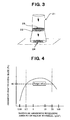
- Fig. 3 is a schematic perspective view of a test device for determining performances in the present invention.
- Fig. 4 is a graph showing the result of the determination.
- Fig. 1 depicts an anti-allergen filter according to an embodiment of the present invention.
- anti-allergen filter 1 is pleated. Relative to this anti-allergen filter 1, soiled air 2 is supplied from upstream side, and air having passed through the filter 1 is sent as cleaned air 3 from downstream side to an vehicle interior, etc.
- anti-allergen filter 1 is formed as a two-layer structure of a first filter layer 4 positioned at a downstream side in the air flow direction and a second filter layer 5 positioned at an upstream side in the air flow direction.
- a structure having three or more layers may be employed, for example, a structure having a plurality of layers of at least one of first filter layers 4 and second filter layers 5, or a structure having another layer (for example, another intermediate layer), may be employed.
- First filter layer 4 is formed as a layer containing an anti-allergen agent, and the anti-allergen agent is contained, for example, by loading the anti-allergen agent onto a filter substrate, holding the anti-allergen agent in the filter substrate, or kneading the anti-allergen agent into the filter substrate.
- the anti-allergen agent for example, at least one kind of agent may be employed by selecting at least one from the group consisting of a tannic acid, a gallotannine, an epicatechin gallate, an epicatechin, an epigallocatechin, an epigallocatechin gallate, an olive leaf extract and a ginkgo leaf extract.
- the content of the anti-allergen agent is controlled within a range of 0.01 to 20 g/m 2 .
- a polypropylene or polyethylene terephthalate non-woven fabric having a surface density in a range of 10 to 100 g/m 2 can be used as the filter substrate.
- Second filter layer 5 is formed as a filter layer containing a porous material with a moisture absorbing/releasing property so that a moisture absorbing/releasing performance within a predetermined range of moisture absorbing/releasing amount can be exhibited.
- the predetermined range of moisture absorbing/releasing amount it is set within a range of 0.2 to 20 g/m 2 .
- a porous material having such a moisture absorbing/releasing property particle-like or powder-like activated carbon can be used.
- Fig. 2 depicts an air cleaning system 11 using the above-described anti-allergen filter 1.
- a humidifying means 12 is connected so that moisture can be supplied directly to second filter layer 5, and a moisture recovery means 13 capable of recovering surplus moisture is disposed at a position immediately downstream of first filter layer 4.
- Humidifying means 12 can be formed, for example, as a humidifying means using guaze, hygroscopic fibers, etc., or utilizing capillarity, spray mist, ultrasonic wave, heater, etc.
- moisture to be supplied moisture generated in an air conditioning system or water stored in a separate water tank also may be utilized.
- moisture recovery means 13 can be formed, for example, as means using a moisture absorbent, etc., in order to recover a surplus amount of the moisture supplied to first filter layer 4 containing an anti-allergen agent.
- a specimen holding material 22 with a diameter of 6 cm was fitted into a dust sampler 21, thereon the above-described filter, which was prepared as a specimen to be determined 23 by being cut at a circular form having a diameter of 6 cm, was fitted, and they were set on a suction test device having a suction fan 24.
- fan 24 of the device was adjusted to get an air velocity of 0.1 m/sec.
- the specimen to be determined 23 was put in a polyethylene bag with a fastener, the mite and cedar pollen allergen was extracted by using 10 mL of phosphate buffer saline containing 10% of skimmed milk to prepare a solution to be determined. With the prepared solution to be determined, by using a method of enzyme-linked immunosorbent assey (ELISA method), the amount of mite and cedar pollen allergen was measured to determine the allergen reduction rate (allergen inactivating rate). In the determination, a value of 80% or more was set as a target value of allergen inactivating rate.
- ELISA method enzyme-linked immunosorbent assey
- a high allergen inactivating rate of 80% or more can be achieved, in particular, by controlling the moisture absorbing/releasing amount of the filter material within the range of 0.2 to 20 g/m 2 , this high allergen inactivating rate can be surely achieved.
- the anti-allergen filter and the air cleaning system using the anti-allergen filter according to the present invention can be applied to any field, and in particular, they are suitable to use for cleaning air in a vehicle interior, which is limited in installation.
Landscapes
- Chemical & Material Sciences (AREA)
- Chemical Kinetics & Catalysis (AREA)
- Filtering Materials (AREA)
- Disinfection, Sterilisation Or Deodorisation Of Air (AREA)
- Air-Conditioning For Vehicles (AREA)
- Filtering Of Dispersed Particles In Gases (AREA)
Abstract
An anti-allergen filter (1) and an air cleaning system (11) using the filter, the anti-allergen filter (1) comprises two or more filter layers arranged in an air flow direction, at least one layer positioned at a downstream side in the air flow direction comprises a first filter layer (4) containing an anti-allergen agent, and at least one layer positioned at an upstream side of the first filter layer (4) comprises a second filter layer (5) containing a porous material with a moisture absorbing/releasing property so that a moisture absorbing/releasing performance within a predetermined range of moisture absorbing/releasing amount can be exhibited. The filter (1) can always achieve both of an excellent performance for trapping allergen substances and a high inactivating rate for the trapped allergen substances stably, thereby exhibiting an excellent anti-allergen performance.
Description
- The present invention relates to an anti-allergen filter and an air cleaning system using the same, and specifically, to an anti-allergen filter suitable for cleaning air in a vehicle interior and the like, and an air cleaning system which uses the filter and which is structured so as to be able to exhibit a high performance.
- For example, accompanied with increase of interest and variation of needs with respect to quality of air in a vehicle interior, as a filter for cleaning air in a vehicle interior used in an air conditioning system and the like, various filter have been on the market, to which are given with not only conventional functions for dust collection and deodorization but also functions for trapping and inactivating allergen substances such as pollen and mite. Most of such conventional filters are formed so that an anti-allergen agent for inactivating allergen substances is impregnated into or loaded onto a filter substrate (for example,
JP-A-2005-218967 - Namely, in the conventional technologies, because the function for trapping allergen substances and the function for inactivating the trapped allergen substances are still poor, there is a problem that the allergen substances trapped by the filter are released again at a condition where the allergen substances are not inactivated.
- Accordingly, it would be desirable to provide an anti-allergen filter which can achieve both of an excellent performance for trapping allergen substances and a high inactivating rate due to an anti-allergen agent for the trapped allergen substances, thereby exhibiting an excellent anti-allergen performance, and to provide an air cleaning system using the anti-allergen filter which can always exhibit a high performance stably.
- In order to make a filter material containing an anti-allergen agent exhibit a high anti-allergen performance, it has been found that particularly existence of moisture at a specified range in amount is extremely effective, and in order to make the excellent anti-allergen performance exhibit stably, it has been found that combination of a filter layer containing an anti-allergen agent and a filter layer having a predetermined moisture absorbing/releasing property is effective. Thus, the present invention has been completed.
- Namely, an anti-allergen filter according to the present invention is characterized in that the filter comprises two or more filter layers arranged in an air flow direction, at least one layer positioned at a downstream side in the air flow direction comprises a first filter layer containing an anti-allergen agent, and at least one layer positioned at an upstream side of the first filter layer comprises a second filter layer containing a porous material with a moisture absorbing/releasing property so that a moisture absorbing/releasing performance within a predetermined range of moisture absorbing/releasing amount can be exhibited.
- In such an anti-allergen filter, the second filter layer containing a porous material with a moisture absorbing/releasing property is disposed at an upstream side of the first filter layer containing an anti-allergen agent and exhibiting an anti-allergen performance, and the second filter layer contains the porous material so that a moisture absorbing/releasing performance within a predetermined optimum range can be exhibited. Therefore, it becomes possible that the first filter layer is always kept under an environment with an optimum moisture amount, and while an excellent performance for trapping allergen substances can be maintained, a high anti-allergen performance due to the anti-allergen agent, that is, a high allergen inactivating rate, can be achieved and maintained.
- In this anti-allergen filter, it is preferred that the second filter layer has a moisture absorbing/releasing property in a range of 0.2 to 20 g/m2 in moisture absorbing/releasing amount. Namely, in order to exhibit such a preferable moisture absorbing/releasing performance, the porous material having the above-described moisture absorbing/releasing property is contained. If the moisture absorbing/releasing property is less than 0.2 g/m2, it is difficult to always give a desirable amount of moisture to the first filter layer stably. If the moisture absorbing/releasing property is more than 20 g/m2, the moisture amount becomes too much, and as shown in examples described later, the allergen inactivating rate due to the first filter layer is lowered.
- Further, in the anti-allergen filter according to the present invention, it is preferred the first filter layer contains the anti-allergen agent at a content in a range of 0.01 to 20 g/m2. If the content of the anti-allergen agent is less than 0.01 g/m2, it is difficult that the first filter layer exhibits a desirable anti-allergen performance. If the content of the anti-allergen agent is more than 20 g/m2, a remarkable improvement of the anti-allergen performance cannot be expected and the cost increases proportionally.
- As the porous material having a moisture absorbing/releasing property contained in the second filter layer, typically an activated carbon can be exemplified. Since such a porous material is formed as a porous state substantially over the entire area, moisture can be well absorbed from its surface, for example, a surface of particle material or powder material. As to releasing of moisture, moisture can be released naturally by equilibrium condition with an atmosphere around the porous material, and as the case may be, it can be released forcibly by heating due to a heater and the like.
- As a substrate of the first filter layer, for example, a polypropylene or polyethylene terephthalate non-woven fabric having a surface density in a range of 10 to 100 g/m2 can be used. If the surface density is too low, it may become difficult to maintain the form of the substrate for containing (for example, loading) the anti-allergen agent. If the surface density is too high, the resistance for air passage may become too great and the function as the filter may be damaged.
- As the anti-allergen agent contained in the first filter layer, for example, at least one selected from the group consisting of a tannic acid, a gallotannine, an epicatechin gallate, an epicatechin, an epigallocatechin, an epigallocatechin gallate, an olive leaf extract and a ginkgo leaf extract can be used. It is known that such an anti-allergen agent can achieve a high anti-allergen performance, that is, a high rate for inactivating allergen substances. Where, in the present invention, the olive leaf means the leaf part of "Olea europaea" (scientific name) in osmanthus family, and the ginkgo leaf means the leaf part of "Ginkgo biloba L." (scientific name) in ginkgo family.
- Further, although the anti-allergen filter according to the present invention can be used at a simple plane form, in order to exhibit an excellent performance efficiently in a limited space such as in a vehicle, it is preferred to use the anti-allergen filter at a pleated form. However, the form is not particularly limited thereto, other forms such as a wave form and a cylindrical form can be employed.
- Further, the anti-allergen filter according to the present invention is suitable for use for cleaning air in a vehicle interior, and it may be disposed, for example, at an appropriate position of an air path of an air conditioning system which communicates with the vehicle interior.
- An air cleaning system according to the present invention is a system using the above-described anti-allergen filter, and has a humidifying means capable of controlling a moisture supply amount. By this humidifying means, it becomes possible to adjust or control the second filter layer at the above-described optimum moisture absorbing/releasing performance stably.
- This humidifying means is preferably connected to the anti-allergen filter so that moisture is supplied to at least a portion positioned at an upstream side relative to the first filter layer in the air flow direction. By this, it becomes possible to easily adjust or control the second filter layer at the above-described optimum moisture absorbing/releasing performance stably.
- Further, the air cleaning system according to the present invention preferably has a moisture recovery means capable of recovering surplus moisture. As aforementioned, if moisture is too much, because the allergen inactivating rate due to the first filter layer is lowered, it is preferred to recover the surplus moisture properly.
- It is preferred that the moisture recovery means is disposed at a downstream side of the first filter layer in the air flow direction. If the moisture recovery means is disposed at an upstream side of the first filter layer, because it may remove also necessary moisture. By recovering surplus moisture at a downstream side of the first filter layer, a necessary amount of moisture can be ensured at the portion of the first filter layer.
- Such an air cleaning system is also suitable to be provided for a vehicle interior, and it may be formed and disposed, for example, at an appropriate position of an air path of an air conditioning system which communicates with the vehicle interior.
- Thus, in the anti-allergen filter and the air cleaning system using the filter according to the present invention, since the first filter layer having an anti-allergen performance and the second filter layer having an optimum moisture absorbing/releasing performance relative to the first filter layer are combined at an optimum formation, while an excellent performance for trapping allergen substances may be maintained, a high inactivating rate of the trapped allergen substances may be achieved.
- Further objects, features, and advantages of the present invention will be understood from the following detailed description of preferred embodiments of the present invention with reference to the accompanying figures.
- Embodiments of the invention now are described with reference to the accompanying figures, which are given by way of example only, and are not intended to limit the present invention.
-
Fig. 1 is a schematic perspective view of an anti-allergen filter according to an embodiment of the present invention. -
Fig. 2 is a schematic diagram of an air cleaning system according to an embodiment of the present invention. -
Fig. 3 is a schematic perspective view of a test device for determining performances in the present invention. -
Fig. 4 is a graph showing the result of the determination. -
- 1: anti-allergen filter
- 2: soiled air
- 3: cleaned air
- 4: first filter layer
- 5: second filter layer
- 11: air cleaning system
- 12: humidifying means
- 13: moisture recovery means
- 21: dust sampler
- 22: specimen holding material
- 23: specimen to be determined
- 23: suction fan
- Hereinafter, desirable embodiments of the present invention will be explained referring to the drawings.
-
Fig. 1 depicts an anti-allergen filter according to an embodiment of the present invention. In this embodiment,anti-allergen filter 1 is pleated. Relative to thisanti-allergen filter 1,soiled air 2 is supplied from upstream side, and air having passed through thefilter 1 is sent as cleaned air 3 from downstream side to an vehicle interior, etc. In this embodiment,anti-allergen filter 1 is formed as a two-layer structure of afirst filter layer 4 positioned at a downstream side in the air flow direction and asecond filter layer 5 positioned at an upstream side in the air flow direction. Although a two-layer structure is exemplified in this embodiment in order to simplify the explanation, a structure having three or more layers may be employed, for example, a structure having a plurality of layers of at least one offirst filter layers 4 andsecond filter layers 5, or a structure having another layer (for example, another intermediate layer), may be employed. -
First filter layer 4 is formed as a layer containing an anti-allergen agent, and the anti-allergen agent is contained, for example, by loading the anti-allergen agent onto a filter substrate, holding the anti-allergen agent in the filter substrate, or kneading the anti-allergen agent into the filter substrate. As the kind of the anti-allergen agent, for example, at least one kind of agent may be employed by selecting at least one from the group consisting of a tannic acid, a gallotannine, an epicatechin gallate, an epicatechin, an epigallocatechin, an epigallocatechin gallate, an olive leaf extract and a ginkgo leaf extract. As the content of the anti-allergen agent is controlled within a range of 0.01 to 20 g/m2. Further, as the filter substrate, as aforementioned, a polypropylene or polyethylene terephthalate non-woven fabric having a surface density in a range of 10 to 100 g/m2 can be used. -
Second filter layer 5 is formed as a filter layer containing a porous material with a moisture absorbing/releasing property so that a moisture absorbing/releasing performance within a predetermined range of moisture absorbing/releasing amount can be exhibited. As the predetermined range of moisture absorbing/releasing amount, it is set within a range of 0.2 to 20 g/m2. As a porous material having such a moisture absorbing/releasing property, particle-like or powder-like activated carbon can be used. -
Fig. 2 depicts anair cleaning system 11 using the above-describedanti-allergen filter 1. In thisair cleaning system 11, a humidifying means 12 is connected so that moisture can be supplied directly tosecond filter layer 5, and a moisture recovery means 13 capable of recovering surplus moisture is disposed at a position immediately downstream offirst filter layer 4. - Humidifying means 12 can be formed, for example, as a humidifying means using guaze, hygroscopic fibers, etc., or utilizing capillarity, spray mist, ultrasonic wave, heater, etc. As the moisture to be supplied, moisture generated in an air conditioning system or water stored in a separate water tank also may be utilized. Further, moisture recovery means 13 can be formed, for example, as means using a moisture absorbent, etc., in order to recover a surplus amount of the moisture supplied to
first filter layer 4 containing an anti-allergen agent. - The following examination was carried out in order to determine the performance of anti-allergen filter formed as described above and to confirm the propriety of the range of the moisture absorbing/releasing amount of the filter material (the moisture absorbing/releasing amount of second filter layer 5) defined in the present invention as a preferable range.
- As the method for the determination, as shown in
Fig. 3 , aspecimen holding material 22 with a diameter of 6 cm was fitted into adust sampler 21, thereon the above-described filter, which was prepared as a specimen to be determined 23 by being cut at a circular form having a diameter of 6 cm, was fitted, and they were set on a suction test device having asuction fan 24. At that condition,fan 24 of the device was adjusted to get an air velocity of 0.1 m/sec. About 10 mg of dust containing mite allergen for the determination of mite allergen, and about 3 mg of cedar pollen for the determination of cedar pollen allergen, were served to the determination surface, respectively. The specimen to be determined 23 was put in a polyethylene bag with a fastener, the mite and cedar pollen allergen was extracted by using 10 mL of phosphate buffer saline containing 10% of skimmed milk to prepare a solution to be determined. With the prepared solution to be determined, by using a method of enzyme-linked immunosorbent assey (ELISA method), the amount of mite and cedar pollen allergen was measured to determine the allergen reduction rate (allergen inactivating rate). In the determination, a value of 80% or more was set as a target value of allergen inactivating rate. In the determination of the above-described examination, a result that could achieve this target value was determined as a rank "○", and a result that could not achieve this target value was determined as a rank "×". The results of the examination are shown in Table 1 andFig. 4 .Table 1 Moisture absorbing/releasing amount of filter material Allergen inactivating rate Determination 0.01 g/m2 33 % × Desirable performance is not exhibited because moisture supply is poor. 0.2 g/ m 280 % ○ 1 g/m2 88 % ○ 10 g/m2 93 % ○ 20 g/ m 280 % ○ 100 g/m2 66 % × Desirable performance is not exhibited because moisture supply is too much. - As is evident from Table 1 and
Fig. 4 , it is understood that, by the anti-allergen filter according to the present invention, a high allergen inactivating rate of 80% or more can be achieved, in particular, by controlling the moisture absorbing/releasing amount of the filter material within the range of 0.2 to 20 g/m2, this high allergen inactivating rate can be surely achieved. - The anti-allergen filter and the air cleaning system using the anti-allergen filter according to the present invention can be applied to any field, and in particular, they are suitable to use for cleaning air in a vehicle interior, which is limited in installation.
Claims (13)
- An anti-allergen filter characterized in that said filter comprises two or more filter layers arranged in an air flow direction, at least one layer positioned at a downstream side in said air flow direction comprises a first filter layer containing an anti-allergen agent, and at least one layer positioned at an upstream side of said first filter layer comprises a second filter layer containing a porous material with a moisture absorbing/releasing property so that a moisture absorbing/releasing performance within a predetermined range of moisture absorbing/releasing amount can be exhibited.
- The anti-allergen filter according to claim 1, wherein said second filter layer has a moisture absorbing/releasing property in a range of 0.2 to 20 g/m2 in moisture absorbing/releasing amount.
- The anti-allergen filter according to claim 1 or 2, wherein said first filter layer contains said anti-allergen agent at a content in a range of 0.01 to 20 g/m2.
- The anti-allergen filter according to any preceding claim, wherein said porous material having a moisture absorbing/releasing property contained in said second filter layer comprises an activated carbon.
- The anti-allergen filter according to any preceding claim, wherein a substrate of said first filter layer comprises a polypropylene or polyethylene terephthalate non-woven fabric having a surface density in a range of 10 to 100 g/m2.
- The anti-allergen filter according to any preceding claim, wherein said anti-allergen agent contained in said first filter layer comprises at least one selected from the group consisting of a tannic acid, a gallotannine, an epicatechin gallate, an epicatechin, an epigallocatechin, an epigallocatechin gallate, an olive leaf extract and a ginkgo leaf extract.
- The anti-allergen filter according to any preceding claim, wherein said anti-allergen filter is pleated.
- The anti-allergen filter according to any preceding claim, wherein said anti-allergen filter is used for cleaning air in a vehicle interior.
- An air cleaning system using said anti-allergen filter according to any preceding claim and having a humidifying means capable of controlling a moisture supply amount.
- The air cleaning system according to claim 9, wherein said humidifying means is connected to said anti-allergen filter so that moisture is supplied to at least a portion positioned at an upstream side relative to said first filter layer in said air flow direction.
- The air cleaning system according to claim 9 or 10, wherein said air cleaning system has a moisture recovery means capable of recovering surplus moisture.
- The air cleaning system according to claim 11, wherein said moisture recovery means is disposed at a downstream side of said first filter layer in said air flow direction.
- The air cleaning system according to any of claims 9 to 12, wherein said air cleaning system is provided for a vehicle interior.
Applications Claiming Priority (1)
| Application Number | Priority Date | Filing Date | Title |
|---|---|---|---|
| JP2006333027A JP2008142627A (en) | 2006-12-11 | 2006-12-11 | Antiallergen filter and air cleaning system using the same |
Publications (1)
| Publication Number | Publication Date |
|---|---|
| EP1946815A1 true EP1946815A1 (en) | 2008-07-23 |
Family
ID=39262798
Family Applications (1)
| Application Number | Title | Priority Date | Filing Date |
|---|---|---|---|
| EP07023471A Withdrawn EP1946815A1 (en) | 2006-12-11 | 2007-12-04 | Anti-allergen filter and air cleaning system using the same |
Country Status (3)
| Country | Link |
|---|---|
| EP (1) | EP1946815A1 (en) |
| JP (1) | JP2008142627A (en) |
| CN (1) | CN101254377A (en) |
Cited By (4)
| Publication number | Priority date | Publication date | Assignee | Title |
|---|---|---|---|---|
| EP1985350A3 (en) * | 2007-04-26 | 2009-07-22 | Sanden Corporation | Anti-allergen filter |
| EP2314302A1 (en) * | 2009-10-14 | 2011-04-27 | Woongjin Coway Co., Ltd. | Composition for preventing infection of new influenza A (H1N1) virus comprising ginkgo extract, air filter comprising the same, and air cleaning device comprising the filter |
| EP2340842A1 (en) * | 2009-10-16 | 2011-07-06 | Woongjin Coway Co., Ltd. | Composition for prevention of influenza viral infection comprising tannic acid, air filter comprising the same and air cleaning device comprising the filter |
| DE102013021071A1 (en) * | 2013-12-18 | 2015-06-18 | Mann + Hummel Gmbh | Filter medium, filter element and filter assembly |
Families Citing this family (4)
| Publication number | Priority date | Publication date | Assignee | Title |
|---|---|---|---|---|
| AU2009327443C1 (en) * | 2008-12-18 | 2013-02-21 | 3M Innovative Properties Company | Shaped layered particle-containing nonwoven web |
| DE102015015791B4 (en) | 2015-12-05 | 2020-07-02 | Audi Ag | Air conditioning filter device |
| JP2017202782A (en) * | 2016-05-12 | 2017-11-16 | 株式会社豊田中央研究所 | Cleaner for car air conditioner |
| CN106739975A (en) * | 2016-12-22 | 2017-05-31 | 安徽乐金环境科技有限公司 | On-board air conditioner screen pack |
Citations (6)
| Publication number | Priority date | Publication date | Assignee | Title |
|---|---|---|---|---|
| US5015451A (en) * | 1987-05-27 | 1991-05-14 | Heinz Holter | Process, filter and device for making available high-quality breathing air |
| JP2002326944A (en) * | 2001-04-27 | 2002-11-15 | Shinto Fine Co Ltd | Anti-allergen composition and method for deactivating allergen |
| WO2004110593A1 (en) * | 2003-06-12 | 2004-12-23 | Matsushita Electric Industrial Co., Ltd. | Air cleaner, functional filter and method of manufacturing the filter, air cleaning filter, and air cleaner device |
| JP2005218967A (en) | 2004-02-05 | 2005-08-18 | Mitsubishi Heavy Ind Ltd | Filter for inactivating allergen and air conditioner for vehicle using the filter for inactivating allergen |
| EP1588710A1 (en) * | 2004-04-06 | 2005-10-26 | Shinto Fine Co., Ltd. | Anti-allergic composition and method for denaturing allergens |
| JP2006255579A (en) * | 2005-03-17 | 2006-09-28 | Toray Ind Inc | Anti-allergen processed air filter media |
Family Cites Families (5)
| Publication number | Priority date | Publication date | Assignee | Title |
|---|---|---|---|---|
| JP4407851B2 (en) * | 1999-12-27 | 2010-02-03 | ライオン株式会社 | Nonwoven filter |
| JP2005342595A (en) * | 2004-06-02 | 2005-12-15 | Daikin Ind Ltd | Filter device |
| JP4845349B2 (en) * | 2004-06-02 | 2011-12-28 | 大和化学工業株式会社 | Mite allergen deactivator |
| JP2006194468A (en) * | 2005-01-11 | 2006-07-27 | Mitsubishi Heavy Ind Ltd | Air shower device and allergen-free building using the same |
| JP2006231180A (en) * | 2005-02-24 | 2006-09-07 | Mitsubishi Heavy Ind Ltd | Air filter and its fablication method |
-
2006
- 2006-12-11 JP JP2006333027A patent/JP2008142627A/en active Pending
-
2007
- 2007-12-04 EP EP07023471A patent/EP1946815A1/en not_active Withdrawn
- 2007-12-10 CN CNA200710194219XA patent/CN101254377A/en active Pending
Patent Citations (6)
| Publication number | Priority date | Publication date | Assignee | Title |
|---|---|---|---|---|
| US5015451A (en) * | 1987-05-27 | 1991-05-14 | Heinz Holter | Process, filter and device for making available high-quality breathing air |
| JP2002326944A (en) * | 2001-04-27 | 2002-11-15 | Shinto Fine Co Ltd | Anti-allergen composition and method for deactivating allergen |
| WO2004110593A1 (en) * | 2003-06-12 | 2004-12-23 | Matsushita Electric Industrial Co., Ltd. | Air cleaner, functional filter and method of manufacturing the filter, air cleaning filter, and air cleaner device |
| JP2005218967A (en) | 2004-02-05 | 2005-08-18 | Mitsubishi Heavy Ind Ltd | Filter for inactivating allergen and air conditioner for vehicle using the filter for inactivating allergen |
| EP1588710A1 (en) * | 2004-04-06 | 2005-10-26 | Shinto Fine Co., Ltd. | Anti-allergic composition and method for denaturing allergens |
| JP2006255579A (en) * | 2005-03-17 | 2006-09-28 | Toray Ind Inc | Anti-allergen processed air filter media |
Cited By (6)
| Publication number | Priority date | Publication date | Assignee | Title |
|---|---|---|---|---|
| EP1985350A3 (en) * | 2007-04-26 | 2009-07-22 | Sanden Corporation | Anti-allergen filter |
| EP2314302A1 (en) * | 2009-10-14 | 2011-04-27 | Woongjin Coway Co., Ltd. | Composition for preventing infection of new influenza A (H1N1) virus comprising ginkgo extract, air filter comprising the same, and air cleaning device comprising the filter |
| EP2340842A1 (en) * | 2009-10-16 | 2011-07-06 | Woongjin Coway Co., Ltd. | Composition for prevention of influenza viral infection comprising tannic acid, air filter comprising the same and air cleaning device comprising the filter |
| US8603227B2 (en) | 2009-10-16 | 2013-12-10 | Woongjin Coway Co., Ltd. | Composition for prevention of influenza viral infection comprising tannic acid, air filter comprising the same and air cleaning device comprising the filter |
| DE102013021071A1 (en) * | 2013-12-18 | 2015-06-18 | Mann + Hummel Gmbh | Filter medium, filter element and filter assembly |
| US10300419B2 (en) | 2013-12-18 | 2019-05-28 | Mann+Hummel Gmbh | Filter medium, filter element and filter arrangement |
Also Published As
| Publication number | Publication date |
|---|---|
| CN101254377A (en) | 2008-09-03 |
| JP2008142627A (en) | 2008-06-26 |
Similar Documents
| Publication | Publication Date | Title |
|---|---|---|
| KR102385026B1 (en) | Filter medium, filter element and filter arrangement | |
| US5820644A (en) | Air filter | |
| EP2996791B1 (en) | Filter element, in particular air filter element, and filter system with a filter element | |
| CN101254377A (en) | Anti-allergen filter and air cleaning system using the same | |
| WO2020200950A1 (en) | Device for the combined reduction of the carbon dioxide and water or moisture content, motor vehicle, and method | |
| US10695705B2 (en) | Air filter comprising a multilayer filter material | |
| EP1985350A2 (en) | Anti-allergen filter | |
| US6197079B1 (en) | Pleated air filter and method for producing same | |
| US20060225574A1 (en) | Filter element and filter system | |
| JP2002273123A (en) | Chemical filter | |
| US20210213379A1 (en) | Filter medium comprising antiallergenic substances | |
| EP1279435A1 (en) | A filter and a method for making a filter | |
| JPH11235507A (en) | Filter medium | |
| JP2008206550A (en) | Absorbent sheet | |
| EP1829597B1 (en) | Method for treatment of exhaust gas | |
| JPH1157467A (en) | Laminated deodorizing filter media | |
| JP4369629B2 (en) | Chemical filter media and chemical filter unit | |
| JP2006159189A (en) | Adsorption filter | |
| KR20190023807A (en) | Multi-layer composite fibrous filter for Method and system for vehicle and manufacturing method thereof | |
| JP4932564B2 (en) | Gas removal filter medium, method for producing the same, and gas removal element using the gas removal filter medium | |
| EP3318313B1 (en) | Sorbent systems and methods | |
| KR20180026852A (en) | Filter system for air conditioner of vehicle | |
| US9199189B1 (en) | Filter medium having ozone and odor removal properties | |
| JP2007038091A (en) | Air filter medium and air filter | |
| US20250256232A1 (en) | Filter element with an anti-microbial finish and a fine filter layer |
Legal Events
| Date | Code | Title | Description |
|---|---|---|---|
| PUAI | Public reference made under article 153(3) epc to a published international application that has entered the european phase |
Free format text: ORIGINAL CODE: 0009012 |
|
| AK | Designated contracting states |
Kind code of ref document: A1 Designated state(s): AT BE BG CH CY CZ DE DK EE ES FI FR GB GR HU IE IS IT LI LT LU LV MC MT NL PL PT RO SE SI SK TR |
|
| AX | Request for extension of the european patent |
Extension state: AL BA HR MK RS |
|
| AKX | Designation fees paid | ||
| STAA | Information on the status of an ep patent application or granted ep patent |
Free format text: STATUS: THE APPLICATION IS DEEMED TO BE WITHDRAWN |
|
| 18D | Application deemed to be withdrawn |
Effective date: 20090123 |
|
| REG | Reference to a national code |
Ref country code: DE Ref legal event code: 8566 |