EP1942635A1 - Procédé d'exploitation d'un service par un système hôte à interface homme-machine, le système hôte et l'ensemble d'un appareil électronique mobile et du système hôte - Google Patents
Procédé d'exploitation d'un service par un système hôte à interface homme-machine, le système hôte et l'ensemble d'un appareil électronique mobile et du système hôte Download PDFInfo
- Publication number
- EP1942635A1 EP1942635A1 EP07291639A EP07291639A EP1942635A1 EP 1942635 A1 EP1942635 A1 EP 1942635A1 EP 07291639 A EP07291639 A EP 07291639A EP 07291639 A EP07291639 A EP 07291639A EP 1942635 A1 EP1942635 A1 EP 1942635A1
- Authority
- EP
- European Patent Office
- Prior art keywords
- service
- host system
- proxy
- machine interface
- operating
- Prior art date
- Legal status (The legal status is an assumption and is not a legal conclusion. Google has not performed a legal analysis and makes no representation as to the accuracy of the status listed.)
- Granted
Links
Images

Classifications
-
- H—ELECTRICITY
- H04—ELECTRIC COMMUNICATION TECHNIQUE
- H04L—TRANSMISSION OF DIGITAL INFORMATION, e.g. TELEGRAPHIC COMMUNICATION
- H04L67/00—Network arrangements or protocols for supporting network services or applications
- H04L67/34—Network arrangements or protocols for supporting network services or applications involving the movement of software or configuration parameters
-
- H—ELECTRICITY
- H04—ELECTRIC COMMUNICATION TECHNIQUE
- H04L—TRANSMISSION OF DIGITAL INFORMATION, e.g. TELEGRAPHIC COMMUNICATION
- H04L67/00—Network arrangements or protocols for supporting network services or applications
- H04L67/01—Protocols
- H04L67/04—Protocols specially adapted for terminals or networks with limited capabilities; specially adapted for terminal portability
-
- H—ELECTRICITY
- H04—ELECTRIC COMMUNICATION TECHNIQUE
- H04L—TRANSMISSION OF DIGITAL INFORMATION, e.g. TELEGRAPHIC COMMUNICATION
- H04L67/00—Network arrangements or protocols for supporting network services or applications
- H04L67/01—Protocols
- H04L67/12—Protocols specially adapted for proprietary or special-purpose networking environments, e.g. medical networks, sensor networks, networks in vehicles or remote metering networks
-
- H—ELECTRICITY
- H04—ELECTRIC COMMUNICATION TECHNIQUE
- H04L—TRANSMISSION OF DIGITAL INFORMATION, e.g. TELEGRAPHIC COMMUNICATION
- H04L67/00—Network arrangements or protocols for supporting network services or applications
- H04L67/2866—Architectures; Arrangements
- H04L67/289—Intermediate processing functionally located close to the data consumer application, e.g. in same machine, in same home or in same sub-network
-
- H—ELECTRICITY
- H04—ELECTRIC COMMUNICATION TECHNIQUE
- H04L—TRANSMISSION OF DIGITAL INFORMATION, e.g. TELEGRAPHIC COMMUNICATION
- H04L67/00—Network arrangements or protocols for supporting network services or applications
- H04L67/50—Network services
- H04L67/56—Provisioning of proxy services
-
- H—ELECTRICITY
- H04—ELECTRIC COMMUNICATION TECHNIQUE
- H04L—TRANSMISSION OF DIGITAL INFORMATION, e.g. TELEGRAPHIC COMMUNICATION
- H04L67/00—Network arrangements or protocols for supporting network services or applications
- H04L67/50—Network services
- H04L67/56—Provisioning of proxy services
- H04L67/59—Providing operational support to end devices by off-loading in the network or by emulation, e.g. when they are unavailable
-
- H—ELECTRICITY
- H04—ELECTRIC COMMUNICATION TECHNIQUE
- H04M—TELEPHONIC COMMUNICATION
- H04M1/00—Substation equipment, e.g. for use by subscribers
- H04M1/72—Mobile telephones; Cordless telephones, i.e. devices for establishing wireless links to base stations without route selection
- H04M1/724—User interfaces specially adapted for cordless or mobile telephones
- H04M1/72403—User interfaces specially adapted for cordless or mobile telephones with means for local support of applications that increase the functionality
- H04M1/72409—User interfaces specially adapted for cordless or mobile telephones with means for local support of applications that increase the functionality by interfacing with external accessories
- H04M1/72412—User interfaces specially adapted for cordless or mobile telephones with means for local support of applications that increase the functionality by interfacing with external accessories using two-way short-range wireless interfaces
Definitions
- the present invention relates to human machine interfaces (HMI or MMI / HMI for "man / human machine interface”) used both for remote services offered by operators and for resident services ("stand alone”), on devices or devices mobile electronic devices, also known as consumer electronic devices (CED), and on fixed computer stations or other radio bases comparable to fixed stations.
- HMI human machine interfaces
- MMI / HMI for "man / human machine interface”
- CED consumer electronic devices
- the CEDs may be mobile phones, laptop computers, personal digital assistants (PDAs), global positioning system (GPS) navigators, music players or other MP3 audio players ( as those of the protected brand "iPod”), etc.
- PDAs personal digital assistants
- GPS global positioning system navigators
- music players or other MP3 audio players as those of the protected brand "iPod"
- Mobile telephones may have access to various types of services offered by operators, such as broadcasting traffic information, traffic, tourism, meteorological, reservation, breakdown, commercial or stock exchange services, etc. ..
- the fixed stations can be desktop computers (PC "personal computer” or other) including multimedia applications, home automation bases (radio or powerline) used to control the automated equipment of the house (multimedia, heating or air conditioning, closures various, ...) or fixed telephone bases (wired or wireless such as DECT telephone bases) or embedded, such as radio-telephones of motor vehicles.
- PC personal computer
- multimedia applications multimedia applications
- home automation bases radio or powerline
- fixed telephone bases wireless or wireless such as DECT telephone bases
- embedded such as radio-telephones of motor vehicles.
- DECs are mobile devices, they are necessarily very small and have only one HMI insufficient for multimedia or Internet applications (WAP network) or even electronic mail: miniature screens, inappropriate input interfaces, sound transducers poor audio quality, mechanical mounting of the housing and poorly adapted device features, etc.
- the dimensions of the fixed stations are not limited.
- the stations can therefore be equipped with an ergonomic HMI that is adapted to the environment.
- GSM mobile phones global mobile system
- fixed telephone bases DECT exchange means allowing the user to contract only one subscription, the mobile being operational out from the home and the landline replacing the mobile when the mobile carrier is at home.
- motor vehicles whose cabin is equipped with a telephone device both autonomous and can be used in combination with the mobile phone of the driver or one of his passengers.
- the carrier of the mobile phone When the carrier of the mobile phone is near the fixed telephone of the vehicle, the latter detects the mobile phone, receives the subscriber details (contents of the SIM card) that it operates directly, with the benefit of using its HMI adapted to the environment of the passenger compartment and the driving of the vehicle.
- the man-machine interface of the host device here the vehicle's on-board phone
- the telephone service can only be used for one service, the telephone service.
- the host interface devices of the type above, being very specific and proprietary, they suffer from a lack of adaptability to services and a very low technological sustainability. In a word, they are not universal, and quickly become overwhelmed.
- the invention firstly relates to a method of operating at least one service in an environment external to a mobile electronic device, in which the service is exploitable, and using a host system. with a man-machine interface adapted to the environment, a method in which the mobile device is put in communication with the host system which detects the capacity of operation of the service by the mobile device, a proxy is downloaded into the host system; operation of the service and defer the operation of the service on the host system via its man-machine interface.
- the user-friendly GUI adapted to the environment in question is associated with the intelligence of the mobile device (CED) thanks to the proxy, which is a near-neighbor buffer software processing means serving as a proxy for the CED for transmitting queries.
- CED mobile device
- the invention has not consisted in increasing the processing or intelligence capabilities of the user's system, as it would have been usual to adapt better and more completely to the various technological devices and services available, but on the contrary emptying the system of its own processing functions to reduce it to a universal host machine interface (IHMH) through at least one proxy means.
- IHMH universal host machine interface
- the invention proposes to adapt the user-friendliness of the IHMH to the processing power of the CEDs.
- the service is a service offered by an operator and only exploitable by the mobile device, for example a guidance service.
- the service is a direct service of the mobile device, for example a dictionary service (it is said that the mobile device is an isolated device "stand alone").
- the operating proxy of the service can be downloaded from the mobile device operating the service or from a server.
- the invention also relates to a host system with a human machine interface for implementing the method of the invention, comprising means for reproducing information and control means for a user, a system characterized by the fact that it comprises as well at least one communication processor, a storage memory of a service operating proxy software and a microcontroller / processor for implementing the proxy software.
- At least one of the components of the set comprising a mass memory, an operational unit (CPU), a graphics controller, a voice control element (microphone, speaker), a "vehicle” bus controller (CAN, MOST).
- CPU operational unit
- GPU graphics controller
- voice control element microphone, speaker
- CAN vehicle bus controller
- the host system comprises a media hub software designed for downloading, storing and implementing the proxy software.
- the invention relates to a service operating assembly comprising at least one mobile service operating electronic device with a man-machine interface, a host system of the invention in an environment external to the mobile device with an interface.
- the host system is arranged to detect the presence of the mobile device and its ability to operate a service.
- the assembly of the invention comprises a proxy download server.
- the mobile device which does not need to be mounted mechanically according to ergonomics related to its use, it is possible to use the vehicle edge screen. , that is to say, the screen of the host system, which is of appropriate size, and the interfaces provided in the cabin, including high quality speakers and buttons on the steering wheel, which improves the security.
- a predetermined service is offered, according to a first implementation, by an operator center 2 on the Web 3.
- a CED 4 mobile electronic device here a GSM mobile phone, has access to it by its browser internet 5 and can exploit it classically including the browser 5, an application 9 treatment of service 1 or treatment of a direct service 9.
- the service 1 may for example be a reservation service, tourist information or weather, car navigation or a navigation service or email on the Internet. But this list is not exhaustive.
- Another implementation differs only in that the service 1 is replaced by a direct service 9, that is to say a service exclusively present in the apparatus 4, for example an application 9.
- the reference 9 represents an application as well as a service.
- the application 9 may for example be an electronic agenda application, dictionary, accounting, or other.
- the application 9 of the portable device 4 is connected to a publisher 6 and an HMI 7, arranged to format and reproduce the information to a user of the device 4.
- the HMI 7 conventionally comprises a screen and a keyboard (not marked).
- the mobile phone 4 has a local radio port here Bluetooth 8, connected to the editor 6, which is arranged to transmit and receive data to the radio port 8 as well as to the HMI 7, as will be described later.
- a host system 10 operating the same service 1 or 9 with its HMI 11 adapted to the passenger compartment and remaining in this cabin .
- the host system 10 and the telephone 4 form the assembly discussed above.
- the system 10 is a universal host machine interface (IHMH).
- the resources 5, 9, 6 of the telephone 4 are software implemented in a calculation unit 40 of the CED 4.
- the IHMH 10 detects the Bluetooth emissions of the CED 4, or conversely, by polling (known to those skilled in the art) thanks to the presence of a Bluetooth processor 14. An initial exchange of frames allows the IHMH 10 to know service 1 or 9 that can be used by the CED 4.
- a passenger or the driver of the vehicle owner of the phone 4 can either use his phone 4, and suffer the disadvantages described above, or, if it is operational, use the system or IHMH 10, with all the benefits also described above.
- the mobile phone 4 exploits the service 1 by the resources 5, 9 and 6 as if it were operated, controlled and controlled by its own HMI 7, but it is by the HMI 11 of the IHMH 10 via the Bluetooth link between the port 8 and the processor 14 that this operation and control / command are performed.
- the HMI of the telephone 4 is remote on the host system 10.
- proxies software models These softwares have functions of representation, of proxy, and they are coded for a determined environment, here the environment of the HMI 11, for a determined service 1 and independently of the characteristics of the CED 4.
- the processor 14 detects and receives the Bluetooth signals transmitted by the port 8 of the telephone 4 and transmits them to the proxy 12. These signals provide, for example, to the interface 11 RSS compliant data ("Really Simple Syndication” or “Rich Site Summary "or” RDF Site Summary ”) or other data of the same type, as explained below.
- the "RSS" of a website is a summary of the site representing the framing of its computer resources. It is a standard that can gather information from different applications of the application type 9 and allow a display or custom reproduction, here on the HMI 11, the information received by the user.
- the RSS data is here received in a media hub 13 (media hub), which contains a reader software RSS definition of presentation characteristics of information.
- RSS' refers to a family of Internet content syndication protocols based on extensible markup language (XML) technology used mainly by news sites, weblogs and podcasts.
- XML extensible markup language
- the implementation of RSS procedures is well known to those skilled in the art, either via a modem (not shown) of the phone 4, or by the proxy 12 corresponding to an RSS reader 61 here included in the editor 6 but can be included in the application 9 of the phone 4 depending on the application, and 21 included in the proxy 12.
- a hub is a hardware element for retrieving binary data (here RSS data) from a port, regenerating it, and rebroadcasting it over multiple ports by operating on the first OSI layer ("open system interconnection").
- RSS exchange technology allows the processing, by the hub 13 and the IHMH 10, of several different services 1 and of several different applications 9 of the telephone 4 to be operated according to the wishes of the customer. user, provided that these applications 9 or services 1 belong to all applications using RSS protocols.
- IHMH 10 For other applications that are incompatible with RSS protocols, for example the processing of e-mail or Internet browsing, another proxy 12, or other means indicated below, is required in IHMH 10 to ensure same functions of the HMI 11 and together a software 61 similar to the RSS reader is necessary in the phone 4.
- the concentrator 13 has much more extensive functions than an ordinary concentrator. Before the concentration of the RSS characteristics of the human-machine interface adapted to the environment of the IHMH 10, of the application 9 of the service 1, it orders the download. It downloads them from the CED 4 or the center 2 of the operator in the IHMH 10, by means of downloading 82, to reproduce them on the HMI 11.
- the hub 13 is still responsible for selecting the proxy 12 which is necessary for the requested service 1 and launching it when necessary, if it is present (otherwise it causes its downloading, as will be seen later, by controlling means download).
- the concentrator 13 is of the SPP type, so as to detect itself the presence of the mobile device 4. It is then he who also detects Bluetooth transmissions and initiates the proxies 12.
- the hub 13 may even possibly replace the proxy 12, for example for the transmission of emails.
- the IHMH 10 includes the OSI Bluetooth communication layers 20 (or “stacks") necessary for the proxies 12 and the concentrator 13.
- the HMI 11 finally comprises a control keyboard 16 (or a voice command comprising microphone and speaker) and a graphics controller 15 to be able to reproduce information on a screen 17 and exercise the control / command of the service 1.
- a control keyboard 16 or a voice command comprising microphone and speaker
- a graphics controller 15 to be able to reproduce information on a screen 17 and exercise the control / command of the service 1.
- an operational unit 18, or a microcontroller 18, and a mass memory 19 make it possible to manage the assembly.
- All functional means 12, 13, 15, 18, 20 above may preferably be programmed on separate processors (chips).
- each proxy 12 is previously installed in the IHMH 10 and the hub 13 is initialized to solicit it during use. If the proxy 12 is implemented on a processor, this processor is integrated in the IHMH 10.
- a proxy 12 becomes necessary for the operation of the service 1, it is downloaded in the IHMH 10 from a download server 30 which can be included in the center 2 of the service operator 1 itself via the CED 4. But the download server 30 can be independent and connected to the CED 4 in a conventional manner (USB or other) by a local network 31 or a direct computer connection 31.
- proxy download functions 41 and 81 respectively located in microcontrollers 40 and 18 have been provided.
- the download means 82 provided in the concentrator 13 can also be used.
- the proxy 12 is downloaded by the function 81 or 82 into an empty processor 12 'initially provided for this purpose in the IHMH 10.
- the concentrator 13 is initially designed to include the logical links that will enable it to activate the proxy 12 when it will be downloaded.
- the IHMH 10 may contain no proxy 12 but only the reserved locations 12 ', and, in use, the concentrator 13, detecting a telephone 4 by Bluetooth connection and detecting, in the initial frames of the Bluetooth exchanges, a need for proxy download 12, launches the download function 81 or 82 of the proxy in the reserved location 12 'of predetermined or computable address and stores this address along with the characteristics of the downloaded proxy 12 so to be able to launch it.
- the proxy 12 or the hub 13 detects the presence of the phone 4 either by voluntary triggering or by polling or periodic polling .
- a step 110 the two devices 4 and 10 carry out a pairing operation, by initial exchange of initial frames (for example type SPP).
- initial frames for example type SPP.
- the phone 4 offers the service 1 it has at the hub 13, for example one of the services that have been mentioned above.
- This operation can be bidirectional and immediately cause proxies downloads 12, as seen above.
- the user then has, in a step 130, the choice to use his phone 4 and its interface 7 or the IHMH 10 and its interface 11.
- the concentrator 13 selects the correct proxy 12, and therefore the right application 9, allowing a connection between the client / server type between the IHMH 10 and the CED 4 including the RSS software for defining the presentation characteristics of the information on the man - machine interface.
- the concentrator 13 selects the proxy 12 corresponding to the request entered on the HMI 11 and the proxy 12 transmits this request to the editor 6 which recognizes the application 9 corresponding to the proxy 12 and which transmits it to it.
- the hub 13 causes it to be downloaded beforehand, as well as the RSS data (or equivalent) needed by the function 82 (or the microcontroller 18 by its function 81) from the CED 4 in a reserved slot 12 before giving him control.
- the application 9 then processes, at a step 150, the service 1, according to the request, and at a step 160, retransmits the results or the requests of the service 1 to the HMI 11 by the same Bluetooth channel and the same proxy 12 .
- the HMI 11 displays or transmits, as the case may be, the results or the requests of the service 1 and can request in a next step 180 the expression of a new user request and cause the execution of a new step 150. And so on.
- BITE built-in test equipment integrated test equipment
Landscapes
- Engineering & Computer Science (AREA)
- Computer Networks & Wireless Communication (AREA)
- Signal Processing (AREA)
- Mobile Radio Communication Systems (AREA)
Abstract
Description
- La présente invention concerne les interfaces homme machine (IHM ou MMI/HMI pour « man/human machine interface ») utilisés tant pour des services distants offerts par des opérateurs que pour des services résidents (« stand alone »), sur des appareils ou dispositifs électroniques mobiles encore appelés CED (« consumer electronic device ») et sur des stations informatiques fixes ou autres bases radio assimilables à des stations fixes.
- Les CED peuvent être des téléphones mobiles, des ordinateurs portables (« laptop »), des assistants personnels (ou PDA pour « personal digital assistant »), des navigateurs GPS (« global positioning system »), des baladeurs ou autres lecteurs audio MP3 (comme ceux de la marque protégée « iPod »), etc.
- Les téléphones mobiles peuvent avoir accès eux-mêmes à divers types de services offerts par des opérateurs, services tels que de diffusion d'informations de navigation routière, de trafic, touristiques, météorologiques, de réservation, de dépannage, commerciales ou boursières, etc ...
- Les stations fixes peuvent être des ordinateurs de bureau (PC « personal computer » ou autres) notamment à applications multimédia, des bases domotiques (radio ou à courants porteurs) servant au contrôle des équipements automatisés de la maison (multimédia, chauffage ou climatisation, fermetures diverses, ...) ou des bases téléphoniques fixes (filaires ou sans fil telles que bases téléphoniques DECT) ou embarquées, telles que les radio-téléphones des véhicules automobiles.
- Comme les CED sont des appareils mobiles, ils sont nécessairement de taille très réduite et ne disposent que d'une IHM insuffisante pour des applications multimédia ou Internet (réseau WAP) ou même courrier électronique : écrans miniatures, interfaces d'entrée inappropriées, transducteurs sonores de mauvaise qualité audio, montages mécaniques du boîtier et fonctionnalités de l'appareil mal adaptés, etc ...
- Par contre, les dimensions des stations fixes ne sont pas limitées. Les stations peuvent donc être pourvues d'une IHM ergonomique et adaptée à l'environnement.
- Corrélativement, on a vu naître, sur le marché, des CED et stations fixes capables de communiquer entre eux grâce à des réseaux locaux de communication radio (Bluetooth, Wifi, USB radio...) ou filaires (USB pour « universal serial bus »).
- A titre d'exemple, il existe actuellement entre des téléphones mobiles GSM (« global system mobile ») et des bases téléphoniques fixes DECT des moyens d'échanges permettant à l'utilisateur de ne contracter qu'un abonnement, le mobile étant opérationnel hors du domicile et le téléphone fixe se substituant au mobile quand le porteur du mobile se trouve au domicile.
- De même, il existe des véhicules automobiles dont l'habitacle est équipé d'un dispositif téléphonique à la fois autonome et susceptible d'être utilisé en combinaison avec le téléphone mobile du conducteur ou de l'un de ses passagers.
- Quand le porteur du téléphone mobile se trouve à proximité du téléphone fixe du véhicule, ce dernier détecte le téléphone mobile, en reçoit les coordonnées d'abonné (contenu de la carte SIM) qu'il exploite directement, avec le bénéfice d'utiliser son IHM adapté à l'environnement de l'habitacle et à la conduite du véhicule.
- Mais bien que tous les services offerts par l'opérateur GSM du téléphone mobile (téléphonie mobile, navigation Internet, renseignements de voyage et de météorologie, diffusion multimédia, etc ...) soient accessibles par le téléphone de l'habitacle, ce dernier est incapable de les exploiter.
- Autrement dit, l'interface homme machine du dispositif hôte, ici le téléphone de bord du véhicule, n'est utilisable que pour un seul service, le service téléphonique. Il ne peut non plus être adapté à une quelconque évolution technologique des services du réseau téléphonique, dont on connaît la prolifération galopante. Il ne peut non plus être adapté à d'autres services sans adaptation complexe et onéreuse.
- En résumé, les dispositifs interfaces hôtes, du type ci-dessus, étant très spécifiques et propriétaires, ils souffrent d'une absence d'adaptabilité aux services et une pérennité technologique très faible. En un mot, ils ne sont pas universels, et deviennent très rapidement dépassés.
- La demanderesse a recherché à pallier ce manque d'adaptabilité et de pérennité des systèmes hôtes.
- A cet effet, l'invention concerne tout d'abord un procédé d'exploitation d'au moins un service dans un environnement externe à un appareil électronique mobile, dans lequel le service est exploitable, et à l'aide d'un système hôte à interface homme machine adapté à l'environnement, procédé dans lequel on met en communication l'appareil mobile et le système hôte qui détecte la capacité d'exploitation du service par l'appareil mobile, on télécharge dans le système hôte un proxy d'exploitation du service et on déporte l'exploitation du service sur le système hôte par l'intermédiaire de son interface homme machine.
- Ainsi, l'IHM conviviale et adaptée à l'environnement considéré est associée à l'intelligence de l'appareil mobile (CED) grâce au proxy, qui est un moyen de traitement logiciel tampon de proche voisinage servant de mandataire au CED pour la transmission de requêtes.
- L'invention a consisté non pas à augmenter les capacités de traitement ou d'intelligence du système de l'utilisateur, comme il eut été ordinaire de faire pour s'adapter mieux et plus complètement aux différents dispositifs technologiques et services disponibles, mais au contraire à vider le système de ses propres fonctions de traitement pour le réduire à une interface homme machine hôte universelle (IHMH) grâce à au moins un moyen mandataire.
- Ainsi, l'invention propose d'adapter la convivialité de l'IHMH à la puissance de traitement des CED.
- Dans une mise en oeuvre particulière du procédé de l'invention, le service est un service offert par un opérateur et seulement exploitable par l'appareil mobile, par exemple un service de guidage.
- Dans une autre mise en oeuvre du procédé de l'invention, le service est un service direct de l'appareil mobile, par exemple un service de dictionnaire (on dit alors que l'appareil mobile est un appareil isolé « stand alone »).
- Le proxy d'exploitation du service peut être téléchargé de l'appareil mobile d'exploitation du service ou d'un serveur.
- Avantageusement, pour exploiter le service depuis le système hôte, on télécharge aussi un logiciel de définition des caractéristiques de présentation des informations sur l'interface homme - machine du système hôte.
- L'invention concerne également un système hôte à interface homme machine pour la mise en oeuvre du procédé de l'invention, comprenant des moyens de reproduction d'informations et des moyens de commande pour un utilisateur, système caractérisé par le fait qu'il comprend aussi au moins un processeur de communication, une mémoire de stockage d'un logiciel proxy d'exploitation de service et un microcontrôleur / processeur de mise en oeuvre du logiciel proxy.
- Dans la forme de réalisation préférée du système hôte de l'invention, il est prévu au moins l'un des composants de l'ensemble comprenant une mémoire de masse, une unité opérationnelle (CPU), un contrôleur graphique, un élément de commande vocale (micro, haut parleur), un contrôleur de bus « véhicule » ( CAN, MOST).
- De préférence, le système hôte comporte un logiciel de concentrateur média (media hub) agencé pour le téléchargement, le stockage et la mise en oeuvre du logiciel proxy.
- L'invention concerne enfin un ensemble d'exploitation de service comportant au moins un appareil électronique mobile d'exploitation de service avec une interface homme - machine, un système hôte de l'invention dans un environnement externe à l'appareil mobile avec une interface homme - machine et des moyens agencés pour déporter l'exploitation de l'interface homme - machine de l'appareil sur l'interface homme - machine du système hôte.
- De préférence, le système hôte est agencé pour détecter la présence de l'appareil mobile et sa capacité d'exploitation d'un service.
- Dans une réalisation particulière, l'ensemble de l'invention comporte un serveur de téléchargement de proxy.
- Grâce à l'invention, dans l'exemple des véhicules, l'appareil mobile, qui n'a pas besoin d'être monté mécaniquement selon une ergonomie liée à son utilisation, il est possible d'utiliser l'écran de bord du véhicule, c'est-à-dire l'écran du système hôte, qui est de taille appropriée, et les interfaces prévues dans l'habitacle, intégrant notamment des haut parleurs de qualité et des boutons de commande sur le volant, ce qui améliore la sécurité.
- En outre, dans ce même exemple des véhicules, on peut prévoir des échanges de données entre l'appareil ou l'opérateur du service et le calculateur de bord du véhicule, par exemple encore pour l'envoi de données de test moteur à une station de dépannage.
- D'autres caractéristiques et avantages de la présente invention apparaîtront plus clairement à la lecture de la description ci-après du procédé, du système hôte d'exploitation de service et de l'ensemble du système et d'un appareil électronique mobile d'exploitation de service selon l'invention, faite en référence au dessin annexé sur lequel :
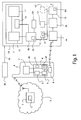
- la
figure 1 est un schéma par blocs fonctionnels de l'ensemble du système hôte d'exploitation de service et d'un appareil électronique mobile, et - la
figure 2 est un organigramme montrant les étapes du procédé de l'invention. - En référence à la
figure 1 , un service prédéterminé, illustré par le bloc 1, est offert, selon une première mise en oeuvre, par un centre opérateur 2 sur le Web 3. Un appareil électronique mobile CED 4, ici un téléphone mobile GSM, y a accès par son navigateur internet 5 et peut l'exploiter classiquement notamment par le navigateur 5, une application 9 de traitement du service 1 ou de traitement d'un service direct 9. - Le service 1 peut par exemple être un service de réservation, de renseignements touristiques ou météorologiques, de navigation automobile ou encore un service de navigation ou de courrier électronique sur Internet. Mais cette liste n'est pas exhaustive.
- Une autre mise en oeuvre, similaire à celle ci-dessus, n'en diffère qu'en ce que le service 1 est remplacé par un service direct 9, c'est-à-dire un service présent exclusivement dans l'appareil 4, par exemple une application 9. Dans la suite, la référence 9 représente aussi bien une application qu'un service.
- L'application 9 peut par exemple être une application d'agenda électronique, de dictionnaire, de comptabilité, ou autre.
- Quelle que soit la mise en oeuvre, l'application 9 de l'appareil portable 4 est reliée à un éditeur 6 et à une IHM 7, agencés pour mettre en forme et reproduire les informations à un utilisateur de l'appareil 4. L'IHM 7 comporte de manière classique un écran et un clavier (non repérés).
- Le téléphone mobile 4 comporte un port radio locale ici Bluetooth 8, relié à l'éditeur 6, qui est agencé pour transmettre et recevoir des données au port radio 8 aussi bien qu'à l'IHM 7, comme il sera décrit plus loin.
- Par ailleurs, et ici dans l'habitacle d'un véhicule (non représenté), est prévue un système hôte 10 d'exploitation du même service 1 ou 9 grâce à son IHM 11 adapté à l'habitacle et restant à demeure dans cet habitacle.
- L'habitacle d'un véhicule n'est considéré qu'à titre d'exemple ; on aurait pu aussi parler d'un domicile.
- Le système hôte 10 et le téléphone 4 forment l'ensemble dont il a été question plus haut.
- Ici, le système 10 est une interface homme machine hôte universelle (IHMH). Les ressources 5, 9, 6 du téléphone 4 sont des logiciels implantés dans une unité de calcul 40 du CED 4.
- L'IHMH 10 détecte les émissions Bluetooth du CED 4, ou inversement, par polling (connu de l'homme du métier) grâce à la présence d'un processeur Bluetooth 14. Un échange de trames initiales permet à l'IHMH 10 de connaître le service 1 ou 9 exploitable par le CED 4.
- Pour exploiter le service 1 ou 9, un passager ou le conducteur du véhicule propriétaire du téléphone 4 peut soit utiliser son téléphone 4, et subir les inconvénients décrits plus haut, soit, si il est opérationnel, utiliser le système ou IHMH 10, avec tous les avantages également décrits ci-dessus.
- Dans ce dernier cas, en effet, simultanément, le téléphone mobile 4 exploite le service 1 par les ressources 5, 9 et 6 comme s'il était exploité, contrôlé et commandé par sa propre IHM 7, mais c'est par l'IHM 11 de l'IHMH 10 via la liaison Bluetooth entre le port 8 et le processeur 14 que cette exploitation et ce contrôle / commande sont effectués. L'IHM du téléphone 4 est déporté sur le système hôte 10.
- Cela est rendu possible grâce à la présence dans l'IHMH 10 d'un proxy 12 de l'application 9 ou du service 1.
- L'homme du métier connaît le principe de fonctionnement des modèles logiciels proxies. Ces logiciels ont des fonctions de représentation, de mandataire, et ils sont codés pour un environnement déterminé, ici l'environnement de l'IHM 11, pour un service 1 déterminé et indépendamment des caractéristiques du CED 4.
- Le processeur 14 détecte et reçoit les signaux Bluetooth émis par le port 8 du téléphone 4 et les transmet au proxy 12. Ces signaux fournissent, par exemple, à l'interface 11 des données conformes RSS (« Really Simple Syndication » ou « Rich Site Summary » ou « RDF Site Summary ») ou autres données du même type, comme expliquées ci-dessous.
- Le « RSS » d'un site Internet est un résumé du site représentant le cadrage de ses ressources informatiques. Il constitue un standard pouvant rassembler les informations de différentes applications du type de l'application 9 et permettre un affichage ou une reproduction personnalisée, ici sur l'IHM 11, des informations reçues par l'utilisateur.
- Les données RSS sont ici reçues dans un concentrateur « média » 13 (media hub), qui contient un logiciel de lecture RSS de définition de caractéristiques de présentation d'informations.
- On rappelle que 'RSS' désigne une famille de protocoles de syndication de contenu sur Internet, à base de technologie XML (« extensible markup language ») utilisés principalement par les sites d'actualités, les weblogs et les podcasts. La mise en oeuvre de procédures RSS est bien connue de l'homme du métier, soit via un modem (non représenté) du téléphone 4, soit par le proxy 12 correspondant à un lecteur RSS 61 ici inclus dans l'éditeur 6 mais pouvant être inclus dans l'application 9 du téléphone 4 selon l'application, et 21 inclus dans le proxy 12.
- Ordinairement un concentrateur est un élément matériel permettant de récupérer des données binaires (ici des données RSS) sur un port, de les régénérer et de les rediffuser sur plusieurs ports en opérant sur la première couche OSI (« open system interconnection »).
- On comprendra que l'utilisation de cette technologie d'échanges RSS permet le traitement, par le concentrateur 13 et l'IHMH 10, de plusieurs services différents 1 et de plusieurs applications différentes 9 du téléphone 4 pour être exploitées selon les souhaits de l'utilisateur, pourvu que ces applications 9 ou services 1 appartiennent à l'ensemble des applications utilisant les protocoles RSS.
- En ce qui concerne les autres applications 9 incompatibles aux protocoles RSS, par exemple le traitement du courrier électronique ou de la navigation Internet, un autre proxy 12, ou un autre moyen désigné ci-dessous, est nécessaire dans l'IHMH 10 pour assurer les mêmes fonctions de l'IHM 11 et conjointement un logiciel 61 similaire au lecteur RSS est nécessaire dans le téléphone 4.
- Ici le concentrateur 13 a des fonctions bien plus étendues qu'un concentrateur ordinaire. Avant la concentration des caractéristiques RSS de l'interface homme - machine adaptées à l'environnement de l'IHMH 10, de l'application 9 du service 1, il en commande le téléchargement. Il les télécharge à partir du CED 4 ou du centre 2 de l'opérateur dans l'IHMH 10, grâce à des moyens de téléchargement 82, pour les reproduire sur l'IHM 11.
- Le concentrateur 13 est encore chargé de sélectionner le proxy 12 qui est nécessaire pour le service demandé 1 et de le lancer quand il faut, s'il est présent (sinon il provoque son téléchargement, comme on le verra plus loin, en commandant des moyens de téléchargement).
- De préférence le concentrateur 13 est du type SPP, de façon à détecter lui-même la présence de l'appareil mobile 4. C'est alors lui qui détecte aussi les émissions Bluetooth et lance les proxies 12.
- Le concentrateur 13 peut même éventuellement remplacer le proxy 12, par exemple pour la transmission des courriers électroniques.
- L'IHMH 10 comporte enfin les couches 20 (ou « stacks ») OSI de communication Bluetooth nécessaires aux proxies 12 et au concentrateur 13.
- L'IHM 11 comporte enfin un clavier de commande 16 (ou une commande vocale comportant micro et haut parleur) et un contrôleur graphique 15 pour pouvoir reproduire des informations sur_un écran 17 et exercer le contrôle - commande du service 1. Optionnellement, une unité opérationnelle 18, ou un microcontrôleur 18, et une mémoire de masse 19 permettent d'assurer la gestion de l'ensemble.
- Tous les moyens fonctionnels 12, 13, 15, 18, 20 ci-dessus peuvent de préférence être programmés sur des processeurs (chips) séparés.
- Selon un premier mode de mise en oeuvre, chaque proxy 12 est préalablement installé dans l'IHMH 10 et le concentrateur 13 est initialisé pour le solliciter lors de l'utilisation. Si le proxy 12 est implémenté sur un processeur, ce processeur est intégré à l'IHMH 10.
- Selon un second mode de mise en oeuvre, seuls les emplacements 12' des proxies 12 sont prévus et réservés. Lorsqu'un proxy 12 devient nécessaire pour l'exploitation du service 1, il est téléchargé dans l'IHMH 10 à partir d'un serveur de téléchargement 30 qui peut être inclus dans le centre 2 de l'opérateur de service 1 lui-même via le CED 4. Mais le serveur de téléchargement 30 peut être indépendant et relié au CED 4 de façon classique (USB ou autre) par un réseau local 31 ou une liaison informatique directe 31.
- Pour permettre le téléchargement des proxies 12, ont été prévues des fonctions 41 et 81 de téléchargement de proxy respectivement situées dans les microcontrôleurs 40 et 18. Mais on peut aussi utiliser les moyens de téléchargement 82 prévus dans le concentrateur 13.
- Le proxy 12 est téléchargé par la fonction 81 ou 82 dans un processeur vide 12' initialement prévu à cet effet dans l'IHMH 10. Corrélativement, le concentrateur 13 est initialement prévu pour comporter les liens logiques qui lui permettra d'activer le proxy 12 lorsque il sera téléchargé.
- Selon ce second mode de mise en oeuvre, l'IHMH 10 peut ne contenir aucun proxy 12 mais seulement les emplacements réservés 12' , et, lors de son utilisation, le concentrateur 13, détectant un téléphone 4 par liaison Bluetooth et détectant, dans les trames initiales des échanges Bluetooth, une nécessité de téléchargement de proxy 12, lance la fonction de téléchargement 81 ou 82 du proxy dans l'emplacement réservé 12' d'adresse prédéterminée ou calculable et mémorise cette adresse accompagnée des caractéristiques du proxy téléchargé 12 de façon à pouvoir en effectuer le lancement.
- Le fonctionnement global du système composé du centre 2 opérateur du service 1, du téléphone 4 et du système hôte IHMH 10 va maintenant être expliqué, en référence à la
figure 2 . - Quand un utilisateur porteur du téléphone 4 se trouve dans une zone Bluetooth de l'IHMH 10, lors d'une étape 100, le proxy 12 ou le concentrateur 13 détecte la présence du téléphone 4 soit par déclenchement volontaire, soit par polling ou sondage périodique.
- A une étape 110, les deux dispositifs 4 et 10 effectuent une opération de couplage Bluetooth (« pairing »), par échange de trames initiales classique (par exemple type SPP).
- Dans les trames initiales échangées, à une étape 120, le téléphone 4 propose le service 1 dont il dispose au concentrateur 13, par exemple d'un des services qui ont été évoqués ci-dessus. Cette opération peut être bidirectionnelle et provoquer immédiatement des téléchargements de proxies 12, comme on l'a vu ci-dessus.
- L'utilisateur a alors, à une étape 130, le choix d'utiliser son téléphone 4 et son interface 7 ou l'IHMH 10 et son interface 11.
- S'il préfère cette dernière solution, il lui suffit d'utiliser les commandes de l'interface 11. Sa requête déclenche alors une étape 140 qui déporte l'exploitation du service 1 sur le système hôte 10 par l'intermédiaire de son interface homme machine 11.
- Pour cela, le concentrateur 13 sélectionne le bon proxy 12, et par suite la bonne application 9, permettant une mise en relation du type client / serveur entre l'IHMH 10 et le CED 4 incluant le logiciel RSS de définition des caractéristiques de présentation des informations sur l'interface homme - machine.
- Plus précisément, le concentrateur 13 sélectionne le proxy 12 correspondant à la requête introduite sur l'IHM 11 et le proxy 12 transmet cette requête à l'éditeur 6 qui reconnaît l'application 9 correspondant au proxy 12 et qui la lui transmet.
- Si à cet instant le proxy 12 est encore absent, le concentrateur 13 provoque préalablement son téléchargement, ainsi que les données RSS (ou équivalent) dont a besoin, grâce à la fonction 82 (ou le microcontrôleur 18 par sa fonction 81) à partir du CED 4 dans un emplacement réservé 12 avant de lui céder le contrôle.
- L'application 9 traite alors, à une étape 150, le service 1, selon la requête, et à une étape 160, retransmet les résultats ou les requêtes du service 1 vers l'IHM 11 par le même canal Bluetooth et le même proxy 12.
- A une étape 170, l'IHM 11 affiche ou émet selon le cas les résultats ou les requêtes du service 1 et peut solliciter à une étape suivante 180 l'expression d'une nouvelle requête utilisateur et provoquer l'exécution d'une nouvelle étape 150. Et ainsi de suite.
- On voit que, simultanément, on traite le service 1 dans l'appareil électronique mobile 4 par l'application 9 et, pour en bénéficier, on exploite l'interface homme machine 11 de l'IHMH 10 grâce à un proxy 12.
- Inversement, si l'utilisateur préfère utiliser son téléphone 4, on peut prévoir qu'il lui suffise d'utiliser les commandes de l'interface 7. Il déclenche alors, lors d'une étape 240, une relation client / serveur inverse de la précédente pourvu que le téléphone 4 présente une structure symétrique de celle de l'IHMH 10. Des étapes suivantes 250 à 280 symétriques des étapes 150 à 180 ci-dessus se déroulent ensuite.
- Ainsi, et pour reprendre un exemple déjà évoqué, en utilisant un concentrateur bidirectionnel relié au bus informatique du véhicule, on peut provoquer des échanges de données entre le calculateur de bord du véhicule et un service de dépannage via le CED 4.
- On voit que, simultanément, on traite les équipements de test intégré BITE (« built-in test equipment ») dans l'IHMH 10 par son microcontrôleur 18 et, pour émettre le message contenant les résultats de test temps réel vers un service de dépannage, on exploite l'interface homme machine 7 et le navigateur 5 du CED 4 grâce à une application 9 d'émission de courrier électronique.
Claims (12)
- Procédé d'exploitation d'au moins un service (1) dans un environnement externe à un appareil électronique mobile (4), dans lequel le service (1) est exploitable, et à l'aide d'un système hôte (10) à interface homme machine (11) adapté à l'environnement, procédé dans lequel on met en communication l'appareil mobile (4) et le système hôte (10) qui détecte la capacité d'exploitation du service (1) par l'appareil mobile (4), on télécharge (81, 82) dans le système hôte (10) un proxy (12) d'exploitation du service (1) et on déporte (130) l'exploitation du service (1) sur le système hôte (10) par l'intermédiaire de son interface homme machine (11).
- Procédé selon la revendication 1, dans lequel le service est un service direct (9) de l'appareil mobile (4).
- Procédé selon la revendication 1, dans lequel le service (1) est un service offert par un opérateur (1, 2) et seulement exploitable par l'appareil mobile (4).
- Procédé selon l'une des revendications 1 à 3, dans lequel le proxy (12) d'exploitation du service (1, 9) est téléchargé (140 ; 81, 82) de l'appareil mobile (4) d'exploitation du service (1).
- Procédé selon l'une des revendications 1 à 3, dans lequel le proxy d'exploitation du service (1) est téléchargé d'un serveur (30).
- Procédé selon l'une des revendications 1 à 5, dans lequel, pour exploiter le service (1, 9) depuis le système hôte (10), on télécharge aussi (140) un logiciel de définition des caractéristiques de présentation des informations sur l'interface homme - machine (11) du système hôte (10).
- Système hôte (10) à interface (11) homme machine pour la mise en oeuvre du procédé selon les revendications 1 à 6, comprenant des moyens de reproduction d'informations (15) et des moyens de commande (16) pour un utilisateur, système caractérisé par le fait qu'il comprend aussi au moins un processeur de communication (14), une mémoire (12') de stockage d'un logiciel proxy (12) d'exploitation de service (1, 9) et un processeur (13) de mise en oeuvre du logiciel proxy (12).
- Système selon la revendication 7, dans lequel il est prévu au moins l'un des composants de l'ensemble comprenant une mémoire de masse (19), une unité opérationnelle (18), un contrôleur graphique (15), un élément de commande vocale (16), un contrôleur de bus véhicule.
- Système selon l'une des revendications 7 et 8, comportant un logiciel de concentrateur média (13) agencé pour le téléchargement (82), le stockage (12') et la mise en oeuvre du logiciel proxy (12).
- Ensemble d'exploitation de service (1) comportant au moins un appareil électronique mobile (4) d'exploitation de service (1) avec une interface homme - machine (7), un système hôte (10) dans un environnement externe à l'appareil mobile (4) avec une interface homme - machine (11) et des moyens agencés pour déporter l'exploitation de l'interface homme - machine (7) de l'appareil mobile (4) sur l'interface homme - machine (11) du système hôte (10).
- Ensemble selon la revendication 10, dans lequel le système hôte (10) est agencé pour détecter la présence de l'appareil mobile (4) et sa capacité d'exploitation d'un service (1).
- Ensemble selon l'une des revendications 10 et 11, comportant un serveur (30) de téléchargement de proxy (12).
Applications Claiming Priority (2)
| Application Number | Priority Date | Filing Date | Title |
|---|---|---|---|
| FR0700058A FR2911232B1 (fr) | 2007-01-05 | 2007-01-05 | Procede d'exploitation d'un service par un systeme hote a interface homme-machine, le systeme hote et l'ensemble d'un appareil electronique mobile et du systeme hote |
| US62109407A | 2007-01-08 | 2007-01-08 |
Publications (2)
| Publication Number | Publication Date |
|---|---|
| EP1942635A1 true EP1942635A1 (fr) | 2008-07-09 |
| EP1942635B1 EP1942635B1 (fr) | 2013-02-20 |
Family
ID=39212251
Family Applications (1)
| Application Number | Title | Priority Date | Filing Date |
|---|---|---|---|
| EP07291639A Active EP1942635B1 (fr) | 2007-01-05 | 2007-12-28 | Procédé d'exploitation d'un service par un système hôte à interface homme-machine et le système hôte |
Country Status (1)
| Country | Link |
|---|---|
| EP (1) | EP1942635B1 (fr) |
Cited By (1)
| Publication number | Priority date | Publication date | Assignee | Title |
|---|---|---|---|---|
| CN112153444A (zh) * | 2020-09-17 | 2020-12-29 | 中国第一汽车股份有限公司 | 车载多屏视频同步方法、装置、电子系统和存储介质 |
Citations (2)
| Publication number | Priority date | Publication date | Assignee | Title |
|---|---|---|---|---|
| WO2006063602A1 (fr) | 2004-12-14 | 2006-06-22 | Bayerische Motoren Werke Aktiengesellschaft | Systeme pour la mise a disposition d'une application logicielle presente sur un terminal mobile dans un vehicule automobile |
| WO2006067541A1 (fr) * | 2004-12-22 | 2006-06-29 | Nokia Corporation | Interface de telephone mobile s'utilisant dans un vehicule |
-
2007
- 2007-12-28 EP EP07291639A patent/EP1942635B1/fr active Active
Patent Citations (2)
| Publication number | Priority date | Publication date | Assignee | Title |
|---|---|---|---|---|
| WO2006063602A1 (fr) | 2004-12-14 | 2006-06-22 | Bayerische Motoren Werke Aktiengesellschaft | Systeme pour la mise a disposition d'une application logicielle presente sur un terminal mobile dans un vehicule automobile |
| WO2006067541A1 (fr) * | 2004-12-22 | 2006-06-29 | Nokia Corporation | Interface de telephone mobile s'utilisant dans un vehicule |
Cited By (1)
| Publication number | Priority date | Publication date | Assignee | Title |
|---|---|---|---|---|
| CN112153444A (zh) * | 2020-09-17 | 2020-12-29 | 中国第一汽车股份有限公司 | 车载多屏视频同步方法、装置、电子系统和存储介质 |
Also Published As
| Publication number | Publication date |
|---|---|
| EP1942635B1 (fr) | 2013-02-20 |
Similar Documents
| Publication | Publication Date | Title |
|---|---|---|
| US8996454B2 (en) | Remote management and access of databases, services and devices associated with a mobile terminal | |
| EP1922822B1 (fr) | Systeme universel d'enregistrement d'evenements/donnees | |
| US8676135B2 (en) | In-vehicle mobile music purchase | |
| EP3901764A1 (fr) | Messagerie de mise à jour pour dispositifs informatiques de véhicule | |
| US20080171514A1 (en) | Method for operating a service by a host system with a human-machine interface, the host system and the mobile electronic device and host system package | |
| FR2914080A1 (fr) | Systeme et procede de gestion de donnees en provenance et a destination d'un vehicule automobile. | |
| JP2010521108A (ja) | 移動デジタルラジオのプレイリストシステム | |
| EP3203445B1 (fr) | Systeme et procede d'identification automatique d'un modele de vehicule | |
| EP2413565A1 (fr) | Téléphone mobile comprenant un serveur de diffusion en flux avec des moyens de commande de la transformation d'un fichier avant sa diffusion | |
| WO2009124955A2 (fr) | Systeme et procede de communication distribue et modulaire comprenant au moins un serveur, au moins un terminal distant, et au moins un terminal mobile capable de communiquer avec le terminal distant relie en reseau audit serveur | |
| EP1942635B1 (fr) | Procédé d'exploitation d'un service par un système hôte à interface homme-machine et le système hôte | |
| FR2911751A1 (fr) | Procede et installation de telecommunication pour la fourniture d'un service a l'utilisateur d'un equipement personnel, support de donnees correspondant | |
| FR3048320A1 (fr) | Methode et systeme d'echange de donnees entre utilisateurs d'un vehicule | |
| EP3994579A1 (fr) | Procédé et système pour gérer une tâche de maintenance d'un véhicule automobile | |
| FR3001677A1 (fr) | Systeme telematique et procede de communication associe. | |
| FR3122307A1 (fr) | Procédé, dispositif et système de communication de données pour véhicule | |
| WO2001031879A1 (fr) | Utilisation des outils sim entre un reseau et un telephone mobile | |
| EP1578064B1 (fr) | Procédé d'accès à un service par l'intermédiaire d'un terminal relié à un réseau de communication | |
| Rasin et al. | The new wireless frontier: Home and vehicle connectivity | |
| EP4682721A1 (fr) | Procédé et dispositif de détermination d'un taux d'utilisation d'un ensemble d applications d'une catégorie d applications durant un trajet effectué par un véhicule | |
| EP2997751B1 (fr) | Adresse ip multicast fixe et unique tpeg | |
| FR3149745A1 (fr) | Procédé et dispositif de localisation d’un dispositif de communication mobile dans un habitacle d’un véhicule | |
| EP2947855A1 (fr) | Dispositif de communication entre une interface homme-machine d'un véhicule automobile et un téléphone mobile | |
| WO2012022922A1 (fr) | Terminal portable pour réseau mobile | |
| CA2652568A1 (fr) | Procede et systeme d'information du public |
Legal Events
| Date | Code | Title | Description |
|---|---|---|---|
| PUAI | Public reference made under article 153(3) epc to a published international application that has entered the european phase |
Free format text: ORIGINAL CODE: 0009012 |
|
| AK | Designated contracting states |
Kind code of ref document: A1 Designated state(s): AT BE BG CH CY CZ DE DK EE ES FI FR GB GR HU IE IS IT LI LT LU LV MC MT NL PL PT RO SE SI SK TR |
|
| AX | Request for extension of the european patent |
Extension state: AL BA HR MK RS |
|
| RAP1 | Party data changed (applicant data changed or rights of an application transferred) |
Owner name: CONTINENTAL AUTOMOTIVE FRANCE |
|
| 17P | Request for examination filed |
Effective date: 20081227 |
|
| AKX | Designation fees paid |
Designated state(s): AT BE BG CH CY CZ DE DK EE ES FI FR GB GR HU IE IS IT LI LT LU LV MC MT NL PL PT RO SE SI SK TR |
|
| 17Q | First examination report despatched |
Effective date: 20090319 |
|
| RTI1 | Title (correction) |
Free format text: METHOD FOR USE OF A SERVICE BY A HOST SYSTEM COMPRISING A HUMAN-MACHINE INTERFACE AND THE HOST SYSTEM |
|
| GRAJ | Information related to disapproval of communication of intention to grant by the applicant or resumption of examination proceedings by the epo deleted |
Free format text: ORIGINAL CODE: EPIDOSDIGR1 |
|
| GRAP | Despatch of communication of intention to grant a patent |
Free format text: ORIGINAL CODE: EPIDOSNIGR1 |
|
| GRAP | Despatch of communication of intention to grant a patent |
Free format text: ORIGINAL CODE: EPIDOSNIGR1 |
|
| GRAS | Grant fee paid |
Free format text: ORIGINAL CODE: EPIDOSNIGR3 |
|
| GRAA | (expected) grant |
Free format text: ORIGINAL CODE: 0009210 |
|
| AK | Designated contracting states |
Kind code of ref document: B1 Designated state(s): AT BE BG CH CY CZ DE DK EE ES FI FR GB GR HU IE IS IT LI LT LU LV MC MT NL PL PT RO SE SI SK TR |
|
| REG | Reference to a national code |
Ref country code: GB Ref legal event code: FG4D Free format text: NOT ENGLISH |
|
| REG | Reference to a national code |
Ref country code: CH Ref legal event code: EP |
|
| REG | Reference to a national code |
Ref country code: AT Ref legal event code: REF Ref document number: 597962 Country of ref document: AT Kind code of ref document: T Effective date: 20130315 |
|
| REG | Reference to a national code |
Ref country code: IE Ref legal event code: FG4D Free format text: LANGUAGE OF EP DOCUMENT: FRENCH |
|
| REG | Reference to a national code |
Ref country code: DE Ref legal event code: R096 Ref document number: 602007028529 Country of ref document: DE Effective date: 20130418 |
|
| REG | Reference to a national code |
Ref country code: AT Ref legal event code: MK05 Ref document number: 597962 Country of ref document: AT Kind code of ref document: T Effective date: 20130220 |
|
| REG | Reference to a national code |
Ref country code: NL Ref legal event code: VDEP Effective date: 20130220 |
|
| REG | Reference to a national code |
Ref country code: LT Ref legal event code: MG4D |
|
| PG25 | Lapsed in a contracting state [announced via postgrant information from national office to epo] |
Ref country code: SE Free format text: LAPSE BECAUSE OF FAILURE TO SUBMIT A TRANSLATION OF THE DESCRIPTION OR TO PAY THE FEE WITHIN THE PRESCRIBED TIME-LIMIT Effective date: 20130220 Ref country code: LT Free format text: LAPSE BECAUSE OF FAILURE TO SUBMIT A TRANSLATION OF THE DESCRIPTION OR TO PAY THE FEE WITHIN THE PRESCRIBED TIME-LIMIT Effective date: 20130220 Ref country code: IS Free format text: LAPSE BECAUSE OF FAILURE TO SUBMIT A TRANSLATION OF THE DESCRIPTION OR TO PAY THE FEE WITHIN THE PRESCRIBED TIME-LIMIT Effective date: 20130620 Ref country code: ES Free format text: LAPSE BECAUSE OF FAILURE TO SUBMIT A TRANSLATION OF THE DESCRIPTION OR TO PAY THE FEE WITHIN THE PRESCRIBED TIME-LIMIT Effective date: 20130531 Ref country code: BG Free format text: LAPSE BECAUSE OF FAILURE TO SUBMIT A TRANSLATION OF THE DESCRIPTION OR TO PAY THE FEE WITHIN THE PRESCRIBED TIME-LIMIT Effective date: 20130520 Ref country code: AT Free format text: LAPSE BECAUSE OF FAILURE TO SUBMIT A TRANSLATION OF THE DESCRIPTION OR TO PAY THE FEE WITHIN THE PRESCRIBED TIME-LIMIT Effective date: 20130220 |
|
| PG25 | Lapsed in a contracting state [announced via postgrant information from national office to epo] |
Ref country code: PT Free format text: LAPSE BECAUSE OF FAILURE TO SUBMIT A TRANSLATION OF THE DESCRIPTION OR TO PAY THE FEE WITHIN THE PRESCRIBED TIME-LIMIT Effective date: 20130620 Ref country code: PL Free format text: LAPSE BECAUSE OF FAILURE TO SUBMIT A TRANSLATION OF THE DESCRIPTION OR TO PAY THE FEE WITHIN THE PRESCRIBED TIME-LIMIT Effective date: 20130220 Ref country code: GR Free format text: LAPSE BECAUSE OF FAILURE TO SUBMIT A TRANSLATION OF THE DESCRIPTION OR TO PAY THE FEE WITHIN THE PRESCRIBED TIME-LIMIT Effective date: 20130521 Ref country code: LV Free format text: LAPSE BECAUSE OF FAILURE TO SUBMIT A TRANSLATION OF THE DESCRIPTION OR TO PAY THE FEE WITHIN THE PRESCRIBED TIME-LIMIT Effective date: 20130220 Ref country code: SI Free format text: LAPSE BECAUSE OF FAILURE TO SUBMIT A TRANSLATION OF THE DESCRIPTION OR TO PAY THE FEE WITHIN THE PRESCRIBED TIME-LIMIT Effective date: 20130220 Ref country code: FI Free format text: LAPSE BECAUSE OF FAILURE TO SUBMIT A TRANSLATION OF THE DESCRIPTION OR TO PAY THE FEE WITHIN THE PRESCRIBED TIME-LIMIT Effective date: 20130220 |
|
| PG25 | Lapsed in a contracting state [announced via postgrant information from national office to epo] |
Ref country code: SK Free format text: LAPSE BECAUSE OF FAILURE TO SUBMIT A TRANSLATION OF THE DESCRIPTION OR TO PAY THE FEE WITHIN THE PRESCRIBED TIME-LIMIT Effective date: 20130220 Ref country code: DK Free format text: LAPSE BECAUSE OF FAILURE TO SUBMIT A TRANSLATION OF THE DESCRIPTION OR TO PAY THE FEE WITHIN THE PRESCRIBED TIME-LIMIT Effective date: 20130220 Ref country code: RO Free format text: LAPSE BECAUSE OF FAILURE TO SUBMIT A TRANSLATION OF THE DESCRIPTION OR TO PAY THE FEE WITHIN THE PRESCRIBED TIME-LIMIT Effective date: 20130220 Ref country code: NL Free format text: LAPSE BECAUSE OF FAILURE TO SUBMIT A TRANSLATION OF THE DESCRIPTION OR TO PAY THE FEE WITHIN THE PRESCRIBED TIME-LIMIT Effective date: 20130220 Ref country code: EE Free format text: LAPSE BECAUSE OF FAILURE TO SUBMIT A TRANSLATION OF THE DESCRIPTION OR TO PAY THE FEE WITHIN THE PRESCRIBED TIME-LIMIT Effective date: 20130220 Ref country code: CZ Free format text: LAPSE BECAUSE OF FAILURE TO SUBMIT A TRANSLATION OF THE DESCRIPTION OR TO PAY THE FEE WITHIN THE PRESCRIBED TIME-LIMIT Effective date: 20130220 |
|
| PG25 | Lapsed in a contracting state [announced via postgrant information from national office to epo] |
Ref country code: CY Free format text: LAPSE BECAUSE OF FAILURE TO SUBMIT A TRANSLATION OF THE DESCRIPTION OR TO PAY THE FEE WITHIN THE PRESCRIBED TIME-LIMIT Effective date: 20130220 |
|
| PLBE | No opposition filed within time limit |
Free format text: ORIGINAL CODE: 0009261 |
|
| STAA | Information on the status of an ep patent application or granted ep patent |
Free format text: STATUS: NO OPPOSITION FILED WITHIN TIME LIMIT |
|
| PG25 | Lapsed in a contracting state [announced via postgrant information from national office to epo] |
Ref country code: IT Free format text: LAPSE BECAUSE OF FAILURE TO SUBMIT A TRANSLATION OF THE DESCRIPTION OR TO PAY THE FEE WITHIN THE PRESCRIBED TIME-LIMIT Effective date: 20130220 |
|
| 26N | No opposition filed |
Effective date: 20131121 |
|
| REG | Reference to a national code |
Ref country code: DE Ref legal event code: R097 Ref document number: 602007028529 Country of ref document: DE Effective date: 20131121 |
|
| BERE | Be: lapsed |
Owner name: CONTINENTAL AUTOMOTIVE FRANCE Effective date: 20131231 |
|
| REG | Reference to a national code |
Ref country code: CH Ref legal event code: PL |
|
| GBPC | Gb: european patent ceased through non-payment of renewal fee |
Effective date: 20131228 |
|
| PG25 | Lapsed in a contracting state [announced via postgrant information from national office to epo] |
Ref country code: LU Free format text: LAPSE BECAUSE OF FAILURE TO SUBMIT A TRANSLATION OF THE DESCRIPTION OR TO PAY THE FEE WITHIN THE PRESCRIBED TIME-LIMIT Effective date: 20131228 Ref country code: MC Free format text: LAPSE BECAUSE OF FAILURE TO SUBMIT A TRANSLATION OF THE DESCRIPTION OR TO PAY THE FEE WITHIN THE PRESCRIBED TIME-LIMIT Effective date: 20130220 |
|
| REG | Reference to a national code |
Ref country code: IE Ref legal event code: MM4A |
|
| PG25 | Lapsed in a contracting state [announced via postgrant information from national office to epo] |
Ref country code: CH Free format text: LAPSE BECAUSE OF NON-PAYMENT OF DUE FEES Effective date: 20131231 Ref country code: LI Free format text: LAPSE BECAUSE OF NON-PAYMENT OF DUE FEES Effective date: 20131231 Ref country code: BE Free format text: LAPSE BECAUSE OF NON-PAYMENT OF DUE FEES Effective date: 20131231 Ref country code: IE Free format text: LAPSE BECAUSE OF NON-PAYMENT OF DUE FEES Effective date: 20131228 |
|
| PG25 | Lapsed in a contracting state [announced via postgrant information from national office to epo] |
Ref country code: GB Free format text: LAPSE BECAUSE OF NON-PAYMENT OF DUE FEES Effective date: 20131228 |
|
| PG25 | Lapsed in a contracting state [announced via postgrant information from national office to epo] |
Ref country code: TR Free format text: LAPSE BECAUSE OF FAILURE TO SUBMIT A TRANSLATION OF THE DESCRIPTION OR TO PAY THE FEE WITHIN THE PRESCRIBED TIME-LIMIT Effective date: 20130220 |
|
| PG25 | Lapsed in a contracting state [announced via postgrant information from national office to epo] |
Ref country code: HU Free format text: LAPSE BECAUSE OF FAILURE TO SUBMIT A TRANSLATION OF THE DESCRIPTION OR TO PAY THE FEE WITHIN THE PRESCRIBED TIME-LIMIT; INVALID AB INITIO Effective date: 20071228 |
|
| PG25 | Lapsed in a contracting state [announced via postgrant information from national office to epo] |
Ref country code: MT Free format text: LAPSE BECAUSE OF FAILURE TO SUBMIT A TRANSLATION OF THE DESCRIPTION OR TO PAY THE FEE WITHIN THE PRESCRIBED TIME-LIMIT Effective date: 20130220 |
|
| REG | Reference to a national code |
Ref country code: FR Ref legal event code: PLFP Year of fee payment: 9 |
|
| REG | Reference to a national code |
Ref country code: FR Ref legal event code: PLFP Year of fee payment: 10 |
|
| REG | Reference to a national code |
Ref country code: FR Ref legal event code: PLFP Year of fee payment: 11 |
|
| REG | Reference to a national code |
Ref country code: DE Ref legal event code: R079 Ref document number: 602007028529 Country of ref document: DE Free format text: PREVIOUS MAIN CLASS: H04L0029080000 Ipc: H04L0065000000 |
|
| P01 | Opt-out of the competence of the unified patent court (upc) registered |
Effective date: 20230522 |
|
| PGFP | Annual fee paid to national office [announced via postgrant information from national office to epo] |
Ref country code: DE Payment date: 20241231 Year of fee payment: 18 |
|
| REG | Reference to a national code |
Ref country code: DE Ref legal event code: R082 Ref document number: 602007028529 Country of ref document: DE Representative=s name: MICHELSEN, MARKUS, DIPL.-PHYS. DR. PHIL. NAT., DE |
|
| PGFP | Annual fee paid to national office [announced via postgrant information from national office to epo] |
Ref country code: FR Payment date: 20251223 Year of fee payment: 19 |