EP1942125A1 - Compositions curable by ring opening metathesis polymerarization at low temperatures and their application in the dental field - Google Patents
Compositions curable by ring opening metathesis polymerarization at low temperatures and their application in the dental field Download PDFInfo
- Publication number
- EP1942125A1 EP1942125A1 EP06026426A EP06026426A EP1942125A1 EP 1942125 A1 EP1942125 A1 EP 1942125A1 EP 06026426 A EP06026426 A EP 06026426A EP 06026426 A EP06026426 A EP 06026426A EP 1942125 A1 EP1942125 A1 EP 1942125A1
- Authority
- EP
- European Patent Office
- Prior art keywords
- romp
- composition
- weight
- retarder
- composition according
- Prior art date
- Legal status (The legal status is an assumption and is not a legal conclusion. Google has not performed a legal analysis and makes no representation as to the accuracy of the status listed.)
- Withdrawn
Links
- 239000000203 mixture Substances 0.000 title claims abstract description 170
- 238000007152 ring opening metathesis polymerisation reaction Methods 0.000 title claims abstract description 101
- 239000003999 initiator Substances 0.000 claims abstract description 51
- ZRPFJAPZDXQHSM-UHFFFAOYSA-L 1,3-bis(2,4,6-trimethylphenyl)-4,5-dihydroimidazole;dichloro-[(2-propan-2-yloxyphenyl)methylidene]ruthenium Chemical compound CC(C)OC1=CC=CC=C1C=[Ru](Cl)(Cl)=C1N(C=2C(=CC(C)=CC=2C)C)CCN1C1=C(C)C=C(C)C=C1C ZRPFJAPZDXQHSM-UHFFFAOYSA-L 0.000 claims abstract description 46
- 239000000178 monomer Substances 0.000 claims abstract description 46
- 125000004433 nitrogen atom Chemical group N* 0.000 claims abstract description 40
- -1 heterocyclic amines Chemical class 0.000 claims abstract description 37
- 125000004429 atom Chemical group 0.000 claims abstract description 28
- 230000000977 initiatory effect Effects 0.000 claims abstract description 21
- 239000000126 substance Substances 0.000 claims abstract description 20
- 238000000034 method Methods 0.000 claims abstract description 17
- 230000000379 polymerizing effect Effects 0.000 claims abstract description 16
- 230000008569 process Effects 0.000 claims abstract description 16
- 238000002360 preparation method Methods 0.000 claims abstract description 8
- 239000005548 dental material Substances 0.000 claims abstract description 5
- 239000003054 catalyst Substances 0.000 claims description 44
- 239000000945 filler Substances 0.000 claims description 35
- 239000000463 material Substances 0.000 claims description 14
- 239000002904 solvent Substances 0.000 claims description 11
- RAXXELZNTBOGNW-UHFFFAOYSA-N imidazole Natural products C1=CNC=N1 RAXXELZNTBOGNW-UHFFFAOYSA-N 0.000 claims description 9
- 125000003518 norbornenyl group Chemical group C12(C=CC(CC1)C2)* 0.000 claims description 9
- 239000000470 constituent Substances 0.000 claims description 8
- 238000002156 mixing Methods 0.000 claims description 7
- 239000000049 pigment Substances 0.000 claims description 7
- RWRDLPDLKQPQOW-UHFFFAOYSA-N Pyrrolidine Chemical compound C1CCNC1 RWRDLPDLKQPQOW-UHFFFAOYSA-N 0.000 claims description 6
- 239000000654 additive Substances 0.000 claims description 6
- 239000003381 stabilizer Substances 0.000 claims description 5
- KAESVJOAVNADME-UHFFFAOYSA-N 1H-pyrrole Natural products C=1C=CNC=1 KAESVJOAVNADME-UHFFFAOYSA-N 0.000 claims description 4
- UJOBWOGCFQCDNV-UHFFFAOYSA-N 9H-carbazole Chemical compound C1=CC=C2C3=CC=CC=C3NC2=C1 UJOBWOGCFQCDNV-UHFFFAOYSA-N 0.000 claims description 4
- SIKJAQJRHWYJAI-UHFFFAOYSA-N Indole Chemical compound C1=CC=C2NC=CC2=C1 SIKJAQJRHWYJAI-UHFFFAOYSA-N 0.000 claims description 4
- IOJUPLGTWVMSFF-UHFFFAOYSA-N benzothiazole Chemical compound C1=CC=C2SC=NC2=C1 IOJUPLGTWVMSFF-UHFFFAOYSA-N 0.000 claims description 4
- 125000004432 carbon atom Chemical group C* 0.000 claims description 4
- 125000001047 cyclobutenyl group Chemical group C1(=CCC1)* 0.000 claims description 4
- 125000000522 cyclooctenyl group Chemical group C1(=CCCCCCC1)* 0.000 claims description 4
- 125000002433 cyclopentenyl group Chemical group C1(=CCCC1)* 0.000 claims description 4
- 238000011049 filling Methods 0.000 claims description 4
- 229910052751 metal Inorganic materials 0.000 claims description 4
- 239000002184 metal Substances 0.000 claims description 4
- 239000003607 modifier Substances 0.000 claims description 4
- HYZJCKYKOHLVJF-UHFFFAOYSA-N 1H-benzimidazole Chemical compound C1=CC=C2NC=NC2=C1 HYZJCKYKOHLVJF-UHFFFAOYSA-N 0.000 claims description 3
- 125000004122 cyclic group Chemical group 0.000 claims description 3
- 125000000524 functional group Chemical group 0.000 claims description 3
- BAXOFTOLAUCFNW-UHFFFAOYSA-N 1H-indazole Chemical compound C1=CC=C2C=NNC2=C1 BAXOFTOLAUCFNW-UHFFFAOYSA-N 0.000 claims description 2
- SYOANZBNGDEJFH-UHFFFAOYSA-N 2,5-dihydro-1h-triazole Chemical compound C1NNN=C1 SYOANZBNGDEJFH-UHFFFAOYSA-N 0.000 claims description 2
- IMSODMZESSGVBE-UHFFFAOYSA-N 2-Oxazoline Chemical compound C1CN=CO1 IMSODMZESSGVBE-UHFFFAOYSA-N 0.000 claims description 2
- RSEBUVRVKCANEP-UHFFFAOYSA-N 2-pyrroline Chemical compound C1CC=CN1 RSEBUVRVKCANEP-UHFFFAOYSA-N 0.000 claims description 2
- VHMICKWLTGFITH-UHFFFAOYSA-N 2H-isoindole Chemical compound C1=CC=CC2=CNC=C21 VHMICKWLTGFITH-UHFFFAOYSA-N 0.000 claims description 2
- NSPMIYGKQJPBQR-UHFFFAOYSA-N 4H-1,2,4-triazole Chemical compound C=1N=CNN=1 NSPMIYGKQJPBQR-UHFFFAOYSA-N 0.000 claims description 2
- KLSJWNVTNUYHDU-UHFFFAOYSA-N Amitrole Chemical compound NC1=NC=NN1 KLSJWNVTNUYHDU-UHFFFAOYSA-N 0.000 claims description 2
- ZCQWOFVYLHDMMC-UHFFFAOYSA-N Oxazole Chemical compound C1=COC=N1 ZCQWOFVYLHDMMC-UHFFFAOYSA-N 0.000 claims description 2
- WYNCHZVNFNFDNH-UHFFFAOYSA-N Oxazolidine Chemical compound C1COCN1 WYNCHZVNFNFDNH-UHFFFAOYSA-N 0.000 claims description 2
- WTKZEGDFNFYCGP-UHFFFAOYSA-N Pyrazole Chemical compound C=1C=NNC=1 WTKZEGDFNFYCGP-UHFFFAOYSA-N 0.000 claims description 2
- FZWLAAWBMGSTSO-UHFFFAOYSA-N Thiazole Chemical compound C1=CSC=N1 FZWLAAWBMGSTSO-UHFFFAOYSA-N 0.000 claims description 2
- 239000000835 fiber Substances 0.000 claims description 2
- 230000009477 glass transition Effects 0.000 claims description 2
- PZOUSPYUWWUPPK-UHFFFAOYSA-N indole Natural products CC1=CC=CC2=C1C=CN2 PZOUSPYUWWUPPK-UHFFFAOYSA-N 0.000 claims description 2
- RKJUIXBNRJVNHR-UHFFFAOYSA-N indolenine Natural products C1=CC=C2CC=NC2=C1 RKJUIXBNRJVNHR-UHFFFAOYSA-N 0.000 claims description 2
- ZLTPDFXIESTBQG-UHFFFAOYSA-N isothiazole Chemical compound C=1C=NSC=1 ZLTPDFXIESTBQG-UHFFFAOYSA-N 0.000 claims description 2
- CTAPFRYPJLPFDF-UHFFFAOYSA-N isoxazole Chemical compound C=1C=NOC=1 CTAPFRYPJLPFDF-UHFFFAOYSA-N 0.000 claims description 2
- JZRYQZJSTWVBBD-UHFFFAOYSA-N pentaporphyrin i Chemical compound N1C(C=C2NC(=CC3=NC(=C4)C=C3)C=C2)=CC=C1C=C1C=CC4=N1 JZRYQZJSTWVBBD-UHFFFAOYSA-N 0.000 claims description 2
- HNJBEVLQSNELDL-UHFFFAOYSA-N pyrrolidin-2-one Chemical compound O=C1CCCN1 HNJBEVLQSNELDL-UHFFFAOYSA-N 0.000 claims description 2
- ZVJHJDDKYZXRJI-UHFFFAOYSA-N pyrroline Natural products C1CC=NC1 ZVJHJDDKYZXRJI-UHFFFAOYSA-N 0.000 claims description 2
- 125000000168 pyrrolyl group Chemical group 0.000 claims description 2
- 239000006254 rheological additive Substances 0.000 claims description 2
- 150000003536 tetrazoles Chemical class 0.000 claims description 2
- VLLMWSRANPNYQX-UHFFFAOYSA-N thiadiazole Chemical compound C1=CSN=N1.C1=CSN=N1 VLLMWSRANPNYQX-UHFFFAOYSA-N 0.000 claims description 2
- 150000003142 primary aromatic amines Chemical class 0.000 claims 1
- 125000000623 heterocyclic group Chemical group 0.000 abstract description 2
- 150000001875 compounds Chemical class 0.000 description 16
- 238000005259 measurement Methods 0.000 description 14
- 238000006116 polymerization reaction Methods 0.000 description 14
- 238000006243 chemical reaction Methods 0.000 description 13
- 229920000642 polymer Polymers 0.000 description 12
- VYPSYNLAJGMNEJ-UHFFFAOYSA-N Silicium dioxide Chemical compound O=[Si]=O VYPSYNLAJGMNEJ-UHFFFAOYSA-N 0.000 description 11
- 238000005649 metathesis reaction Methods 0.000 description 11
- WPYMKLBDIGXBTP-UHFFFAOYSA-N benzoic acid Chemical compound OC(=O)C1=CC=CC=C1 WPYMKLBDIGXBTP-UHFFFAOYSA-N 0.000 description 9
- KJTLSVCANCCWHF-UHFFFAOYSA-N Ruthenium Chemical compound [Ru] KJTLSVCANCCWHF-UHFFFAOYSA-N 0.000 description 8
- 229920004482 WACKER® Polymers 0.000 description 8
- 229910052707 ruthenium Inorganic materials 0.000 description 8
- GWEVSGVZZGPLCZ-UHFFFAOYSA-N Titan oxide Chemical compound O=[Ti]=O GWEVSGVZZGPLCZ-UHFFFAOYSA-N 0.000 description 6
- 125000001797 benzyl group Chemical group [H]C1=C([H])C([H])=C(C([H])=C1[H])C([H])([H])* 0.000 description 6
- 239000011347 resin Substances 0.000 description 6
- 229920005989 resin Polymers 0.000 description 6
- 235000012239 silicon dioxide Nutrition 0.000 description 6
- ZMANZCXQSJIPKH-UHFFFAOYSA-N Triethylamine Chemical compound CCN(CC)CC ZMANZCXQSJIPKH-UHFFFAOYSA-N 0.000 description 5
- 239000003795 chemical substances by application Substances 0.000 description 5
- 230000000694 effects Effects 0.000 description 5
- 238000009472 formulation Methods 0.000 description 5
- JFNLZVQOOSMTJK-KNVOCYPGSA-N norbornene Chemical compound C1[C@@H]2CC[C@H]1C=C2 JFNLZVQOOSMTJK-KNVOCYPGSA-N 0.000 description 5
- 125000001424 substituent group Chemical group 0.000 description 5
- 0 *CCC(C1)C2C=CC1C2 Chemical compound *CCC(C1)C2C=CC1C2 0.000 description 4
- JMTFLSQHQSFNTE-UHFFFAOYSA-N 1-dodecylimidazole Chemical compound CCCCCCCCCCCCN1C=CN=C1 JMTFLSQHQSFNTE-UHFFFAOYSA-N 0.000 description 4
- 125000006539 C12 alkyl group Chemical group [H]C([H])([H])C([H])([H])C([H])([H])C([H])([H])C([H])([H])C([H])([H])C([H])([H])C([H])([H])C([H])([H])C([H])([H])C([H])([H])C([H])([H])* 0.000 description 4
- MCMNRKCIXSYSNV-UHFFFAOYSA-N Zirconium dioxide Chemical compound O=[Zr]=O MCMNRKCIXSYSNV-UHFFFAOYSA-N 0.000 description 4
- 238000007792 addition Methods 0.000 description 4
- 150000001336 alkenes Chemical class 0.000 description 4
- 125000003118 aryl group Chemical group 0.000 description 4
- 239000003086 colorant Substances 0.000 description 4
- 238000009826 distribution Methods 0.000 description 4
- 150000002148 esters Chemical class 0.000 description 4
- JRZJOMJEPLMPRA-UHFFFAOYSA-N olefin Natural products CCCCCCCC=C JRZJOMJEPLMPRA-UHFFFAOYSA-N 0.000 description 4
- 125000001997 phenyl group Chemical group [H]C1=C([H])C([H])=C(*)C([H])=C1[H] 0.000 description 4
- 239000000377 silicon dioxide Substances 0.000 description 4
- IAZDPXIOMUYVGZ-UHFFFAOYSA-N Dimethylsulphoxide Chemical compound CS(C)=O IAZDPXIOMUYVGZ-UHFFFAOYSA-N 0.000 description 3
- JUJWROOIHBZHMG-UHFFFAOYSA-N Pyridine Chemical compound C1=CC=NC=C1 JUJWROOIHBZHMG-UHFFFAOYSA-N 0.000 description 3
- 125000000217 alkyl group Chemical group 0.000 description 3
- 229910052681 coesite Inorganic materials 0.000 description 3
- 229910052906 cristobalite Inorganic materials 0.000 description 3
- 239000004205 dimethyl polysiloxane Substances 0.000 description 3
- 235000013870 dimethyl polysiloxane Nutrition 0.000 description 3
- 125000003438 dodecyl group Chemical group [H]C([H])([H])C([H])([H])C([H])([H])C([H])([H])C([H])([H])C([H])([H])C([H])([H])C([H])([H])C([H])([H])C([H])([H])C([H])([H])C([H])([H])* 0.000 description 3
- 239000011521 glass Substances 0.000 description 3
- 239000011159 matrix material Substances 0.000 description 3
- HZVOZRGWRWCICA-UHFFFAOYSA-N methanediyl Chemical compound [CH2] HZVOZRGWRWCICA-UHFFFAOYSA-N 0.000 description 3
- 229920000435 poly(dimethylsiloxane) Polymers 0.000 description 3
- 239000010453 quartz Substances 0.000 description 3
- 150000004756 silanes Chemical class 0.000 description 3
- 239000007787 solid Substances 0.000 description 3
- 229910052682 stishovite Inorganic materials 0.000 description 3
- 229910052905 tridymite Inorganic materials 0.000 description 3
- JANXZPFHGIMWSD-UHFFFAOYSA-N 7-oxabicyclo[2.2.1]hept-3-ene Chemical compound C1C(O2)CCC2=C1 JANXZPFHGIMWSD-UHFFFAOYSA-N 0.000 description 2
- CSCPPACGZOOCGX-UHFFFAOYSA-N Acetone Chemical compound CC(C)=O CSCPPACGZOOCGX-UHFFFAOYSA-N 0.000 description 2
- SNRUBQQJIBEYMU-UHFFFAOYSA-N Dodecane Natural products CCCCCCCCCCCC SNRUBQQJIBEYMU-UHFFFAOYSA-N 0.000 description 2
- LFQSCWFLJHTTHZ-UHFFFAOYSA-N Ethanol Chemical compound CCO LFQSCWFLJHTTHZ-UHFFFAOYSA-N 0.000 description 2
- NBIIXXVUZAFLBC-UHFFFAOYSA-N Phosphoric acid Chemical compound OP(O)(O)=O NBIIXXVUZAFLBC-UHFFFAOYSA-N 0.000 description 2
- 150000001298 alcohols Chemical class 0.000 description 2
- QRUDEWIWKLJBPS-UHFFFAOYSA-N benzotriazole Chemical compound C1=CC=C2N[N][N]C2=C1 QRUDEWIWKLJBPS-UHFFFAOYSA-N 0.000 description 2
- 239000012964 benzotriazole Substances 0.000 description 2
- 239000006229 carbon black Substances 0.000 description 2
- 239000011203 carbon fibre reinforced carbon Substances 0.000 description 2
- 238000009833 condensation Methods 0.000 description 2
- 230000005494 condensation Effects 0.000 description 2
- 230000007423 decrease Effects 0.000 description 2
- 125000002704 decyl group Chemical group [H]C([H])([H])C([H])([H])C([H])([H])C([H])([H])C([H])([H])C([H])([H])C([H])([H])C([H])([H])C([H])([H])C([H])([H])* 0.000 description 2
- 125000001495 ethyl group Chemical group [H]C([H])([H])C([H])([H])* 0.000 description 2
- 239000002241 glass-ceramic Substances 0.000 description 2
- 125000004051 hexyl group Chemical group [H]C([H])([H])C([H])([H])C([H])([H])C([H])([H])C([H])([H])C([H])([H])* 0.000 description 2
- 229930195733 hydrocarbon Natural products 0.000 description 2
- 150000002430 hydrocarbons Chemical class 0.000 description 2
- 229910052739 hydrogen Inorganic materials 0.000 description 2
- 239000001257 hydrogen Substances 0.000 description 2
- 125000004435 hydrogen atom Chemical group [H]* 0.000 description 2
- 239000011256 inorganic filler Substances 0.000 description 2
- 229910003475 inorganic filler Inorganic materials 0.000 description 2
- 239000002608 ionic liquid Substances 0.000 description 2
- 230000007246 mechanism Effects 0.000 description 2
- 229910044991 metal oxide Inorganic materials 0.000 description 2
- 150000004706 metal oxides Chemical class 0.000 description 2
- 125000002496 methyl group Chemical group [H]C([H])([H])* 0.000 description 2
- 229910052757 nitrogen Inorganic materials 0.000 description 2
- 125000002347 octyl group Chemical group [H]C([*])([H])C([H])([H])C([H])([H])C([H])([H])C([H])([H])C([H])([H])C([H])([H])C([H])([H])[H] 0.000 description 2
- 229910052760 oxygen Inorganic materials 0.000 description 2
- 239000002245 particle Substances 0.000 description 2
- 239000000843 powder Substances 0.000 description 2
- 239000000047 product Substances 0.000 description 2
- 150000003254 radicals Chemical class 0.000 description 2
- 230000000979 retarding effect Effects 0.000 description 2
- RMAQACBXLXPBSY-UHFFFAOYSA-N silicic acid Chemical compound O[Si](O)(O)O RMAQACBXLXPBSY-UHFFFAOYSA-N 0.000 description 2
- 229910052710 silicon Inorganic materials 0.000 description 2
- 239000000758 substrate Substances 0.000 description 2
- ORIZJEOWAFVTGA-UHFFFAOYSA-N 1-hexadecylimidazole Chemical compound CCCCCCCCCCCCCCCCN1C=CN=C1 ORIZJEOWAFVTGA-UHFFFAOYSA-N 0.000 description 1
- WNWIKUKDMAMESS-UHFFFAOYSA-N 1-imidazol-1-yldecan-1-one Chemical compound CCCCCCCCCC(=O)N1C=CN=C1 WNWIKUKDMAMESS-UHFFFAOYSA-N 0.000 description 1
- TZMGRMKTZVQDMX-UHFFFAOYSA-N 1-tetradecylimidazole Chemical compound CCCCCCCCCCCCCCN1C=CN=C1 TZMGRMKTZVQDMX-UHFFFAOYSA-N 0.000 description 1
- 125000003903 2-propenyl group Chemical group [H]C([*])([H])C([H])=C([H])[H] 0.000 description 1
- LUMNWCHHXDUKFI-UHFFFAOYSA-N 5-bicyclo[2.2.1]hept-2-enylmethanol Chemical compound C1C2C(CO)CC1C=C2 LUMNWCHHXDUKFI-UHFFFAOYSA-N 0.000 description 1
- YCNYCBYHUAGZIZ-UHFFFAOYSA-N 7-oxabicyclo[2.2.1]hept-2-ene Chemical compound O1C2CCC1C=C2 YCNYCBYHUAGZIZ-UHFFFAOYSA-N 0.000 description 1
- ZHNWKGCTEBVPNS-UHFFFAOYSA-N 7-oxabicyclo[2.2.1]hept-2-ene Chemical compound O1C2CCC1C=C2.O1C2CCC1C=C2 ZHNWKGCTEBVPNS-UHFFFAOYSA-N 0.000 description 1
- 238000010953 Ames test Methods 0.000 description 1
- 231100000039 Ames test Toxicity 0.000 description 1
- 229930185605 Bisphenol Natural products 0.000 description 1
- WQNWEFNMUFONJJ-UHFFFAOYSA-N CC(C)(C(C1(C)C)OC(C2C(C3)C=CC3C2)=O)C1OC(C(C1)C2C(C3=CC(C4)CC3C4C(OCC(C3)C4C=CC3C4)=O)=CC1C2)=O Chemical compound CC(C)(C(C1(C)C)OC(C2C(C3)C=CC3C2)=O)C1OC(C(C1)C2C(C3=CC(C4)CC3C4C(OCC(C3)C4C=CC3C4)=O)=CC1C2)=O WQNWEFNMUFONJJ-UHFFFAOYSA-N 0.000 description 1
- 235000006810 Caesalpinia ciliata Nutrition 0.000 description 1
- 241000059739 Caesalpinia ciliata Species 0.000 description 1
- OKTJSMMVPCPJKN-UHFFFAOYSA-N Carbon Chemical compound [C] OKTJSMMVPCPJKN-UHFFFAOYSA-N 0.000 description 1
- 238000005698 Diels-Alder reaction Methods 0.000 description 1
- MYMOFIZGZYHOMD-UHFFFAOYSA-N Dioxygen Chemical group O=O MYMOFIZGZYHOMD-UHFFFAOYSA-N 0.000 description 1
- FZWAYPUHWXSHGN-UHFFFAOYSA-N NCCCOC(C1C(C2)C=CC2C1)=O Chemical compound NCCCOC(C1C(C2)C=CC2C1)=O FZWAYPUHWXSHGN-UHFFFAOYSA-N 0.000 description 1
- LCVWVAVBFGHAFS-UHFFFAOYSA-N NCCCOCCOC(C1C(C2)C=CC2C1)=O Chemical compound NCCCOCCOC(C1C(C2)C=CC2C1)=O LCVWVAVBFGHAFS-UHFFFAOYSA-N 0.000 description 1
- 238000005481 NMR spectroscopy Methods 0.000 description 1
- 239000004952 Polyamide Substances 0.000 description 1
- 239000004721 Polyphenylene oxide Substances 0.000 description 1
- 239000012327 Ruthenium complex Substances 0.000 description 1
- BLRPTPMANUNPDV-UHFFFAOYSA-N Silane Chemical compound [SiH4] BLRPTPMANUNPDV-UHFFFAOYSA-N 0.000 description 1
- XUIMIQQOPSSXEZ-UHFFFAOYSA-N Silicon Chemical compound [Si] XUIMIQQOPSSXEZ-UHFFFAOYSA-N 0.000 description 1
- ULUAUXLGCMPNKK-UHFFFAOYSA-N Sulfobutanedioic acid Chemical class OC(=O)CC(C(O)=O)S(O)(=O)=O ULUAUXLGCMPNKK-UHFFFAOYSA-N 0.000 description 1
- 229910009527 YF3 Inorganic materials 0.000 description 1
- 229910009520 YbF3 Inorganic materials 0.000 description 1
- NIXOWILDQLNWCW-UHFFFAOYSA-M acrylate group Chemical group C(C=C)(=O)[O-] NIXOWILDQLNWCW-UHFFFAOYSA-M 0.000 description 1
- 125000004423 acyloxy group Chemical group 0.000 description 1
- 150000001335 aliphatic alkanes Chemical class 0.000 description 1
- 125000001931 aliphatic group Chemical group 0.000 description 1
- 125000003545 alkoxy group Chemical group 0.000 description 1
- 125000004453 alkoxycarbonyl group Chemical group 0.000 description 1
- 125000002877 alkyl aryl group Chemical group 0.000 description 1
- 125000004448 alkyl carbonyl group Chemical group 0.000 description 1
- 125000002947 alkylene group Chemical group 0.000 description 1
- PNEYBMLMFCGWSK-UHFFFAOYSA-N aluminium oxide Inorganic materials [O-2].[O-2].[O-2].[Al+3].[Al+3] PNEYBMLMFCGWSK-UHFFFAOYSA-N 0.000 description 1
- 229910000147 aluminium phosphate Inorganic materials 0.000 description 1
- 150000001412 amines Chemical class 0.000 description 1
- 125000001124 arachidoyl group Chemical group O=C([*])C([H])([H])C([H])([H])C([H])([H])C([H])([H])C([H])([H])C([H])([H])C([H])([H])C([H])([H])C([H])([H])C([H])([H])C([H])([H])C([H])([H])C([H])([H])C([H])([H])C([H])([H])C([H])([H])C([H])([H])C([H])([H])C([H])([H])[H] 0.000 description 1
- 125000003710 aryl alkyl group Chemical group 0.000 description 1
- 239000011324 bead Substances 0.000 description 1
- 125000002511 behenyl group Chemical group [H]C([*])([H])C([H])([H])C([H])([H])C([H])([H])C([H])([H])C([H])([H])C([H])([H])C([H])([H])C([H])([H])C([H])([H])C([H])([H])C([H])([H])C([H])([H])C([H])([H])C([H])([H])C([H])([H])C([H])([H])C([H])([H])C([H])([H])C([H])([H])C([H])([H])C([H])([H])[H] 0.000 description 1
- 230000009286 beneficial effect Effects 0.000 description 1
- 230000008901 benefit Effects 0.000 description 1
- 125000000649 benzylidene group Chemical group [H]C(=[*])C1=C([H])C([H])=C([H])C([H])=C1[H] 0.000 description 1
- 125000002619 bicyclic group Chemical group 0.000 description 1
- MKOSBHNWXFSHSW-UHFFFAOYSA-N bicyclo[2.2.1]hept-2-en-5-ol Chemical compound C1C2C(O)CC1C=C2 MKOSBHNWXFSHSW-UHFFFAOYSA-N 0.000 description 1
- FYGUSUBEMUKACF-UHFFFAOYSA-N bicyclo[2.2.1]hept-2-ene-5-carboxylic acid Chemical compound C1C2C(C(=O)O)CC1C=C2 FYGUSUBEMUKACF-UHFFFAOYSA-N 0.000 description 1
- NIDNOXCRFUCAKQ-UHFFFAOYSA-N bicyclo[2.2.1]hept-5-ene-2,3-dicarboxylic acid Chemical compound C1C2C=CC1C(C(=O)O)C2C(O)=O NIDNOXCRFUCAKQ-UHFFFAOYSA-N 0.000 description 1
- 230000015572 biosynthetic process Effects 0.000 description 1
- 150000001616 biphenylenes Chemical class 0.000 description 1
- IISBACLAFKSPIT-UHFFFAOYSA-N bisphenol A Chemical compound C=1C=C(O)C=CC=1C(C)(C)C1=CC=C(O)C=C1 IISBACLAFKSPIT-UHFFFAOYSA-N 0.000 description 1
- 238000009835 boiling Methods 0.000 description 1
- 125000002837 carbocyclic group Chemical group 0.000 description 1
- 229910052799 carbon Inorganic materials 0.000 description 1
- CREMABGTGYGIQB-UHFFFAOYSA-N carbon carbon Chemical compound C.C CREMABGTGYGIQB-UHFFFAOYSA-N 0.000 description 1
- 125000002915 carbonyl group Chemical group [*:2]C([*:1])=O 0.000 description 1
- 150000001735 carboxylic acids Chemical class 0.000 description 1
- 238000006555 catalytic reaction Methods 0.000 description 1
- 239000004568 cement Substances 0.000 description 1
- 239000000919 ceramic Substances 0.000 description 1
- 230000008859 change Effects 0.000 description 1
- 239000007795 chemical reaction product Substances 0.000 description 1
- 230000000052 comparative effect Effects 0.000 description 1
- 229920001577 copolymer Polymers 0.000 description 1
- 229910052593 corundum Inorganic materials 0.000 description 1
- 238000004132 cross linking Methods 0.000 description 1
- 238000006352 cycloaddition reaction Methods 0.000 description 1
- 150000001925 cycloalkenes Chemical class 0.000 description 1
- 125000000392 cycloalkenyl group Chemical group 0.000 description 1
- 125000003074 decanoyl group Chemical group [H]C([H])([H])C([H])([H])C([H])([H])C([H])([H])C([H])([H])C([H])([H])C([H])([H])C([H])([H])C([H])([H])C(*)=O 0.000 description 1
- 125000003963 dichloro group Chemical group Cl* 0.000 description 1
- 125000005442 diisocyanate group Chemical group 0.000 description 1
- KPUWHANPEXNPJT-UHFFFAOYSA-N disiloxane Chemical class [SiH3]O[SiH3] KPUWHANPEXNPJT-UHFFFAOYSA-N 0.000 description 1
- 229920001971 elastomer Polymers 0.000 description 1
- 238000005516 engineering process Methods 0.000 description 1
- 230000002708 enhancing effect Effects 0.000 description 1
- RTZKZFJDLAIYFH-UHFFFAOYSA-N ether Substances CCOCC RTZKZFJDLAIYFH-UHFFFAOYSA-N 0.000 description 1
- 150000002170 ethers Chemical class 0.000 description 1
- 125000001301 ethoxy group Chemical group [H]C([H])([H])C([H])([H])O* 0.000 description 1
- YVPJCJLMRRTDMQ-UHFFFAOYSA-N ethyl diazoacetate Chemical compound CCOC(=O)C=[N+]=[N-] YVPJCJLMRRTDMQ-UHFFFAOYSA-N 0.000 description 1
- 238000011156 evaluation Methods 0.000 description 1
- 230000001747 exhibiting effect Effects 0.000 description 1
- 239000012634 fragment Substances 0.000 description 1
- 239000003365 glass fiber Substances 0.000 description 1
- 239000011984 grubbs catalyst Substances 0.000 description 1
- 229910052736 halogen Inorganic materials 0.000 description 1
- 150000002367 halogens Chemical group 0.000 description 1
- 238000010438 heat treatment Methods 0.000 description 1
- 150000002391 heterocyclic compounds Chemical class 0.000 description 1
- 238000006459 hydrosilylation reaction Methods 0.000 description 1
- 125000002887 hydroxy group Chemical group [H]O* 0.000 description 1
- 238000010348 incorporation Methods 0.000 description 1
- 239000003112 inhibitor Substances 0.000 description 1
- 229910010272 inorganic material Inorganic materials 0.000 description 1
- 239000011147 inorganic material Substances 0.000 description 1
- 239000003446 ligand Substances 0.000 description 1
- 125000002463 lignoceryl group Chemical group [H]C([*])([H])C([H])([H])C([H])([H])C([H])([H])C([H])([H])C([H])([H])C([H])([H])C([H])([H])C([H])([H])C([H])([H])C([H])([H])C([H])([H])C([H])([H])C([H])([H])C([H])([H])C([H])([H])C([H])([H])C([H])([H])C([H])([H])C([H])([H])C([H])([H])C([H])([H])C([H])([H])C([H])([H])[H] 0.000 description 1
- 239000007788 liquid Substances 0.000 description 1
- 229920002521 macromolecule Polymers 0.000 description 1
- 125000002960 margaryl group Chemical group [H]C([*])([H])C([H])([H])C([H])([H])C([H])([H])C([H])([H])C([H])([H])C([H])([H])C([H])([H])C([H])([H])C([H])([H])C([H])([H])C([H])([H])C([H])([H])C([H])([H])C([H])([H])C([H])([H])C([H])([H])[H] 0.000 description 1
- 125000000956 methoxy group Chemical group [H]C([H])([H])O* 0.000 description 1
- 238000012986 modification Methods 0.000 description 1
- 230000004048 modification Effects 0.000 description 1
- 125000001421 myristyl group Chemical group [H]C([*])([H])C([H])([H])C([H])([H])C([H])([H])C([H])([H])C([H])([H])C([H])([H])C([H])([H])C([H])([H])C([H])([H])C([H])([H])C([H])([H])C([H])([H])C([H])([H])[H] 0.000 description 1
- 125000004957 naphthylene group Chemical group 0.000 description 1
- 230000007935 neutral effect Effects 0.000 description 1
- JFNLZVQOOSMTJK-UHFFFAOYSA-N norbornene Chemical compound C1C2CCC1C=C2 JFNLZVQOOSMTJK-UHFFFAOYSA-N 0.000 description 1
- RNYFPCBPUJIHRR-WCZCRHMRSA-N norbornenylethyl-poss® Chemical group C1([C@@H]2C[C@@H](C=C2)C1)CC[Si](O1)(O2)O[Si](O3)(C4CCCC4)O[Si](O4)(C5CCCC5)O[Si]1(C1CCCC1)O[Si](O1)(C5CCCC5)O[Si]2(C2CCCC2)O[Si]3(C2CCCC2)O[Si]41C1CCCC1 RNYFPCBPUJIHRR-WCZCRHMRSA-N 0.000 description 1
- 125000002801 octanoyl group Chemical group C(CCCCCCC)(=O)* 0.000 description 1
- 150000002894 organic compounds Chemical group 0.000 description 1
- 150000002895 organic esters Chemical class 0.000 description 1
- 239000012766 organic filler Substances 0.000 description 1
- 125000000962 organic group Chemical group 0.000 description 1
- 125000000913 palmityl group Chemical group [H]C([*])([H])C([H])([H])C([H])([H])C([H])([H])C([H])([H])C([H])([H])C([H])([H])C([H])([H])C([H])([H])C([H])([H])C([H])([H])C([H])([H])C([H])([H])C([H])([H])C([H])([H])C([H])([H])[H] 0.000 description 1
- 230000000737 periodic effect Effects 0.000 description 1
- 125000000843 phenylene group Chemical group C1(=C(C=CC=C1)*)* 0.000 description 1
- AQSJGOWTSHOLKH-UHFFFAOYSA-N phosphite(3-) Chemical class [O-]P([O-])[O-] AQSJGOWTSHOLKH-UHFFFAOYSA-N 0.000 description 1
- 229920002647 polyamide Polymers 0.000 description 1
- 229920000728 polyester Polymers 0.000 description 1
- 229920000570 polyether Polymers 0.000 description 1
- 229920001296 polysiloxane Polymers 0.000 description 1
- 238000001556 precipitation Methods 0.000 description 1
- 239000011164 primary particle Substances 0.000 description 1
- UMJSCPRVCHMLSP-UHFFFAOYSA-N pyridine Natural products COC1=CC=CN=C1 UMJSCPRVCHMLSP-UHFFFAOYSA-N 0.000 description 1
- 230000001698 pyrogenic effect Effects 0.000 description 1
- 238000003908 quality control method Methods 0.000 description 1
- 238000011160 research Methods 0.000 description 1
- 229910000077 silane Inorganic materials 0.000 description 1
- 239000010703 silicon Substances 0.000 description 1
- 239000011343 solid material Substances 0.000 description 1
- 125000006850 spacer group Chemical group 0.000 description 1
- 239000012798 spherical particle Substances 0.000 description 1
- 125000004079 stearyl group Chemical group [H]C([*])([H])C([H])([H])C([H])([H])C([H])([H])C([H])([H])C([H])([H])C([H])([H])C([H])([H])C([H])([H])C([H])([H])C([H])([H])C([H])([H])C([H])([H])C([H])([H])C([H])([H])C([H])([H])C([H])([H])C([H])([H])[H] 0.000 description 1
- 238000003860 storage Methods 0.000 description 1
- 238000006467 substitution reaction Methods 0.000 description 1
- 238000012360 testing method Methods 0.000 description 1
- 150000003852 triazoles Chemical class 0.000 description 1
- 125000000391 vinyl group Chemical group [H]C([*])=C([H])[H] 0.000 description 1
- 229920002554 vinyl polymer Polymers 0.000 description 1
- 238000004073 vulcanization Methods 0.000 description 1
- XLYOFNOQVPJJNP-UHFFFAOYSA-N water Substances O XLYOFNOQVPJJNP-UHFFFAOYSA-N 0.000 description 1
- 229910001845 yogo sapphire Inorganic materials 0.000 description 1
- XASAPYQVQBKMIN-UHFFFAOYSA-K ytterbium(iii) fluoride Chemical compound F[Yb](F)F XASAPYQVQBKMIN-UHFFFAOYSA-K 0.000 description 1
Images

Classifications
-
- A—HUMAN NECESSITIES
- A61—MEDICAL OR VETERINARY SCIENCE; HYGIENE
- A61K—PREPARATIONS FOR MEDICAL, DENTAL OR TOILETRY PURPOSES
- A61K6/00—Preparations for dentistry
- A61K6/80—Preparations for artificial teeth, for filling teeth or for capping teeth
- A61K6/884—Preparations for artificial teeth, for filling teeth or for capping teeth comprising natural or synthetic resins
- A61K6/891—Compounds obtained otherwise than by reactions only involving carbon-to-carbon unsaturated bonds
- A61K6/896—Polyorganosilicon compounds
-
- A—HUMAN NECESSITIES
- A61—MEDICAL OR VETERINARY SCIENCE; HYGIENE
- A61K—PREPARATIONS FOR MEDICAL, DENTAL OR TOILETRY PURPOSES
- A61K6/00—Preparations for dentistry
- A61K6/80—Preparations for artificial teeth, for filling teeth or for capping teeth
- A61K6/884—Preparations for artificial teeth, for filling teeth or for capping teeth comprising natural or synthetic resins
- A61K6/887—Compounds obtained by reactions only involving carbon-to-carbon unsaturated bonds
-
- A—HUMAN NECESSITIES
- A61—MEDICAL OR VETERINARY SCIENCE; HYGIENE
- A61K—PREPARATIONS FOR MEDICAL, DENTAL OR TOILETRY PURPOSES
- A61K6/00—Preparations for dentistry
- A61K6/90—Compositions for taking dental impressions
-
- C—CHEMISTRY; METALLURGY
- C08—ORGANIC MACROMOLECULAR COMPOUNDS; THEIR PREPARATION OR CHEMICAL WORKING-UP; COMPOSITIONS BASED THEREON
- C08L—COMPOSITIONS OF MACROMOLECULAR COMPOUNDS
- C08L65/00—Compositions of macromolecular compounds obtained by reactions forming a carbon-to-carbon link in the main chain; Compositions of derivatives of such polymers
Definitions
- the invention relates to a composition which is polymerizable by ring-opening metathesis polymerization (ROMP) comprising at least one monomer that is polymerizable by ROMP, at least one initiator of the Hoveyda-Grubbs type for initiating the ROMP and at least one retarder selected from the group consisting of heterocyclic amines having a ring with at least one N-atom and five or less atoms constituting the ring bearing the at least one N-atom.
- ROMP ring-opening metathesis polymerization
- the invention further relates to a process for the preparation of a composition which is polymerizable by ROMP, a dental material obtainable by polymerizing a composition according to the invention and the use of a substance selected from the group consisting of heterocyclic amines having a ring with at least one N-atom and five or less atoms constituting the ring bearing the at least one N-atom or of a mixture of two or more of such substances as a retarder in ROMP.
- Addition polymerizing reactions have been widely used in the field of dental applications. Usually silicon resins have been utilized and have been cured, often as a two-part system via hydrosilylation reaction.
- An advantage of such systems is their flexible working time which, depending on the requirements, can be adjusted broadly within a range of from less than about one minute up to several hours. The working time can generally be controlled via the components present in the composition to be polymerized or by specifically adding retarders or inhibitors to the catalyst component.
- a ROMP polymerizable composition generally can comprise a resin system that includes functionalities or groups that are curable by ROMP together with a metathesis catalyst such as a Ruthenium carbene complex.
- US 6,844,409 B2 relates to a composition curable by metathesis reaction comprising an olefin-containing resin system and metathesis catalyst.
- the metathesis is initiated by a Ruthenium carbene complex catalyst which is increased in activity by either an activity enhancing ligand or by incorporation of a catalyst accelerator into the described resin formulation.
- catalyst accelerators sulfosuccinate salts are described. Retardation of the ROMP-reaction is not mentioned in the document.
- US 2004/0225073 A1 describes a composition curable by a metathesis reaction upon mixing its components, which comprises an olefin-containing substrate, a metathesis catalyst and a reaction control agent for doing the progress of the metathesis reaction.
- the reaction control agent is an organic compound that contains carbon-carbon double and/or triple bonds and one or more Group 14 atoms and is present in an amount effective to slow the progress of the metathesis reaction.
- the document also describes the use of pyridine, triethylamin and benzotriazole as comparative retarders.
- US 2002/0153096 A1 relates to an adhesion agent composition
- an adhesion agent composition comprising at least one olefin compound having at least one metathesis active double bond, wherein the olefin is substituted or unsubstituted and at least one compatibilising functionality for interacting with the substrate surface.
- a retarder which does not become part of the polymer is not mentioned in the document.
- US 6,001,909 relates to a composition
- a composition comprising at least one tight cyclo olefin, a catalyst for the ring opening metathesis polymerization, a filler and a silane.
- the silanes are added in order to increase toughness, heat stability and dielectric loss factor of ROMP-polymerized systems.
- the silanes can carry substituents and are used in an amount of from 0.01 to 20 % by weight in relation to the weight to the composition. Curing is achieved by heating the sample for 2 hours to 80 ° C, 4 hours to 100 ° C and 1 hour to 150 °C.
- the present invention provides a composition which is polymerizable by ring-opening metathesis polymerization (ROMP) comprising at least one monomer that is polymerizable by ROMP, at least one initiator of the Hoveyda-Grubbs type for initiating the ROMP and at least one retarder selected from the group consisting of heterocyclic amines having a ring with at least one N-atom and five or less atoms constituting the ring bearing at least one N-atom.
- the retarder is able to form a complex with Ruthenium.
- a process for the preparation of a composition which is polymerizable by ring-opening metathesis polymerization is described, wherein at least one monomer that is polymerizable by ROMP and at least one initiator of the Hoveyda-Grubbs type for initiating the ROMP and at least one retarder selected from the group consisting of heterocyclic amines having a ring with at least one N-atom and five or less atoms constituting the ring bearing the at least one N-atom, are mixed.
- composition described according to the invention is present as a base component and a catalyst component, wherein the base component at least comprises one or more monomers polymerizable by ROMP and the catalyst component at least comprises at least one initiator of the Hoveyda-Grubbs type for initiating a ROMP and the retarder is present in the base component or the catalyst component or in both.
- a dental material obtainable by polymerizing a composition according to the invention or by polymerizing a composition obtainable according to a process as described according to the invention is described.
- the invention relates to the use of a substance selected from the group consisting of heterocyclic amines having a ring with at least N-atom and five or less atoms constituting the ring bearing the at least one N-atom or of a mixture of two or more of such substances as a retarder in ROMP.
- retarders described in the text of the invention it has been found that these retarders do not only facilitate a delay of the curing process of the curable composition but also allow for providing a composition with a tooth-coloured appearance or a composition, the colour of which can be adjusted to a tooth-coloured appearance by adding colourants or pigments.
- the invention relates to a composition which is polymerizable by ring-opening metathesis polymerization (ROMP) comprising
- the polymerizable composition preferably can comprise at least one monomer that is polymerizable by ROMP with a fraction of at least about 1 % by weight.
- the amount of monomer that has two or more moieties polymerizable by ROMP can be higher, e.g., at least about 10, about 20, about 30, about 40, about 50 or about 60 % by weight of the monomers in the composition or even higher, e.g., more than about 70, more than about 80, or even about 90 % by weight.
- composition according to the invention contains a monomer which is polymerizable by ROMP and comprises at least one C-C double bond in a cyclic structure.
- all types of monomers can be part of the composition which have one moiety or preferably two or more moieties that can be polymerized by ROMP.
- suitable monomers can follow the general formula B-A n wherein A is a moiety polymerizable by ROMP, e.g. cyclobutenyl, cyclopentenyl, cyclooctenyl or bicyclic ring systems like the often preferred norbornenyl and 7-oxa-norbornenyl groups, B is an organic or silicon-organic backbone with 1 to about 100, e.g., 1 to about 10 or 1 to about 5 or 1 to about 4 moieties polymerizable by ROMP, e.g., 1, 2 or 3 moieties polymerizable by ROMP, are attached, n being about 1 to about 100.
- A is a moiety polymerizable by ROMP, e.g. cyclobutenyl, cyclopentenyl, cyclooctenyl or bicyclic ring systems like the often preferred norbornenyl and 7-oxa-norbornenyl groups
- B is an organic or
- composition according to the invention can contain only one type of monomers according to the general formula B-A n . It is also possible that a composition according to the invention contains two or more different types of monomers according to the general formula B-A n .
- the composition according to the invention preferably contains at least one type of monomer according to the general formula B-A n , which has one or preferably two olefinically unsaturated double bonds which are curable by ROMP.
- the bicyclic ring systems which can be used according to the invention have no exocyclic C-C double bonds like (meth)acrylate groups so that the curing of the compositions takes place at least predominantly by ring-opening metathesis polymerization (ROMP).
- ROMP ring-opening metathesis polymerization
- the composition and especially the bicyclic ring system also does not contain terminal unsaturation especially vinyl or allyl groups as these sometimes may function as a chain-terminating agent during ROMP.
- addition of chain terminating agents in order to regulate polymerization can be preferred.
- compositions according to the invention can contain bicyclic ring systems with 1 to endocyclic double bond.
- Carbocyclic ring systems are particularly preferred as well as oxygen-substituted ring systems.
- Carbocyclic and heterocyclic bicyclo[x.y.z.] hydrocarbons with noticeable ring strain may often be particularly suitable, when x, y and z have values from 1 to 6. x is equal to about 2, y is equal to about 2 and z equal to 1.
- Preferred representatives of this composition class are derivatives of bicyclo[2.2.1]heptene or 7-Oxa-bicyclo[2.2.1]heptene in particular those with unsaturation in 5-position and substitution in 2- or 2,3- position to the ring.
- Substituents in 2- or 2,3-position to the ring are preferably carbon- silicon- or oxygen- functional and connect to an unreactive residue or to an organic or metalorganic spacer bridging between two, three, four or more ROMP-polymerizable groups.
- composition class Preferred representatives of this composition class are bicyclo[2.2.1]heptene derivatives and 7-Oxa-bicyclo[2.2.1]heptene derivatives, in particular those according to the following formulae, in which n, A, B, R 1 , R 2 , R 3 and R 4 , independently from each other, have the following meanings:
- radicals B, R 1 , R 2 , R 3 and R 4 can be bound in the endo- or exo position.
- the bicyclic compounds according to the above formulae are present in the form of stereoisomeric mixtures, in particular as racemates.
- Preferred compounds are often accordingly those in which at least one of the variables of the formulae has a preferred definition as described above. Also preferred can be those compounds in which several or all of the variables correspond to the preferred definitions.
- bicyclic ring systems are bicyclo[2.2.1]hept-2-en (norbornene), 7-oxa-bicyclo[2.2.1]hept-2-ene (7-oxa-norbornene) and substituted derivatives derived therefrom such as esters of bicyclo[2.2.1]hept-5-en-2-carboxylic acid or esters of bicyclo[2.2.1]hept-5-en-2,3-dicarboxylic acid, both with mono-, di- or multifunctional alcohols, esters of bicyclo[2.2.1]hept-5-en-2-ol or bicyclo[2.2.1]hept-5-en-2-methanol or bicyclo[2.2.1]hept-5-en-2-(methyloxy-(2-hydroxy)ethan with mono-, di- and multi carboxylic acids or the reaction products of the mentioned bicyclic alcohols with mono- or diisocyanates.
- the bicyclic ring systems listed are easily accessible through the known cyclisation reactions such as e.g. cyclo additions, especially Diels-Alder reactions. They are generally stable and not moisture-sensitive at room temperature and in the presence of conventional dental fillers.
- a composition according to the invention can contain a monomer selected from the group consisting of monomers comprising at least 2 moieties which are polymerizable by ROMP, monomers with at least one moiety selected from the group consisting of cyclobutenyl, cyclopentenyl, cyclooctenyl, norbornenyl and oxa-norbornenyl, monomers with at least one Si-atom, monomers according to the general formula B(-A) n wherein B is a monomeric oligomeric or polymeric organic or silicon-organic structural element and A is a structural element having at least one functional group which is polymerizable by ROMP and n is 1 to about 10,000 or 5 to about 1,000 or 10 to about 100.
- the polymerizable matrix composition comprises one or more oligomeric or prepolymeric structures e.g. polyether, polyester or polysiloxane or copolymeric compounds (PDMS) that are tethered and/or end-capped with groups that can undergo a ROMP reaction to form a cured article.
- oligomeric or prepolymeric structures e.g. polyether, polyester or polysiloxane or copolymeric compounds (PDMS) that are tethered and/or end-capped with groups that can undergo a ROMP reaction to form a cured article.
- An example of such polymer is quadrifunctional polydimethyl siloxane (PDMS), end-capped with norbornenyl (NBE) groups.
- the resin system may comprise any other polymerizable cycloalkenyl-functionalized siloxane based oligomers or polymers that may undergo polymerization via ROMP mechanism.
- Monomers taken from MONOMERLIST 1 may provide beneficial results.
- the composition contains at least one monomer with two moieties polymerizable by ROMP and a molecular weight of more than about 180, especially more than about 200 or more than about 250 or more than about 300.
- the upper limit for the molecular weight is not particularly limited, however, should be in a range where the handling of the composition with regard to its formability is still possible (the composition is not a solid and too viscous to be formed) and the material properties of the cured composition are in a desired range.
- the amount of monomer that is curable by ring-opening metathesis polymerization can often vary between about 10 and about 90 % by weight. In some cases an amount of about 15 to about 50 or about 20 to about 40 % by weight, can lead to good results.
- a composition according to the invention also contains at least one initiator of the Hoveyda-Grubbs type for initiating the ROMP.
- a Hoveyda-Grubbs Type initiator is defined as a ruthenium carbene complex with an ortho-alky-ether at the benzylidene residue, wherein this ether moiety coordinates to the ruthenium central atom.
- Preferred Hoveyda-Grubbs type initiators compounds are e.g. listed under CAS-Nos. [301224-40-8], [203714-71-1] or are substituted derivatives thereof.
- all initiators of the Hoveyda-Grubbs type can be used in a composition according to the invention.
- either initiators of the Hoveyda-Grubbs I type or of the Hoveyda-Grubbs II type can be used. It is also possible to use mixtures of two or more of Hoveyda-Grubbs I initiators or of Hoveyda-Grubbs II initiators or to mix one or more of Hoveyda-Grubbs I initiators with one or more Hoveyda-Grubbs II initiators according to the invention.
- An initiator of the Hoveyda-Grubbs type for initiating a ROMP can be present in an amount of about about 5 to about 10,000 ppm by weight, or from about 50 to about 6,000 ppm by weight or from about 70 to about 3,000 ppm by weight or about 100 to about 1,000 ppm or about 200 to about 600 ppm, relating to the weight of the entire composition.
- the inventive composition can comprise one initiator or a mixture of two or more initiators.
- the composition comprises a mixture of two or more initiators
- the mixture can consist of initiators only selected from the group of Hoveyda-Grubbs initiators of type I or only of initiators selected from the group consisting of Hoveyda-Grubbs initiators of the type II.
- the composition comprises mixtures of one or more initiators of the Hoveyda-Grubbs type I and one or more initiators of the Hoveyda-Grubbs type II. It can be preferred if the composition comprises one, two or three different initiators molecules, especially one or two different initiator molecules.
- Suitable initiators of the Hoveyda_Grubbs-Type are also disclosed in US 2003/220512 A (S. Blechert), WO 2005/053843 A (Boehringer Ingelheim GmbH), WO 200214376 A , (Hoveyda et. al), US 2004/254320 A (Kerr Corp.), WO 2004/035596 A (Boehringer Ingelheim GmbH) or DE 10 335 417 A (Arlt), the disclosure of which is expressly mentioned as a source of information with regard to the invention and the disclosure of which is regarded as being a part of the disclosure of the present text.
- a composition according to the invention comprises also a retarder.
- a retarder according to the invention is defined as being a compound which, if present, decreases the reaction rate of at least one reaction resulting in a ring opening metathesis polymerization as compared to a composition not comprising the retarder under basically identical conditions.
- a retarder according to the invention is a compound which slows down the setting behaviour of a composition comprising the retarder when polymerizing the composition by ROMP. It is also proven to be advantageous, if a retarder aids in keeping the peak reaction temperature of the composition during polymerization below a value of about 60°C, especially below a value of about 50°C.
- a retarder is chosen such that the time measured until an onset of the polymerization can be detected via measurement of viscosity increase is retarded as compared to a composition without the retarder under identical conditions. It can be preferred if the time until both compositions are cured, is basically identical.
- a retarder which can be used according to the invention is selected from the group consisting of heterocyclic amines having a ring with at least one N-atom and five or less atoms constituting the ring bearing at least one N-atom.
- Compounds exhibiting this characteristic structural element are preferably selected from the group consisting of pyrrole, pyrroline, pyrrolidine, pyrrolidone, porphine, indole, isoindole, carbazole, pyrazole, imidazole, indazole, benzimidazole, oxazole, isoxazole, thiazole, isothiazole, oxazoline, oxazolidine, benzthiazole, 1,2,3- and 1,2,4-triazole, aminotriazole, tetrazole, thiadiazole and their derivatives.
- the retarder is selected from the group consisting of heterocyclic amines with one, two, three or four N-atoms in a ring with five or less atoms or seven or more atoms constituting the ring.
- the retarder is selected from the group consisting of pyrrole, imidazole, benzimidazole and triazole.
- the retarder is usually neutral in charge, that is, the retarder is usually not of ionic nature.
- composition according to the invention comprises more than one type of retarder.
- a composition according to the invention can comprise two or more different types of retarders, e.g., two, three or four different types of retarder molecules.
- the retarder is selected such that it can form a complex with ruthenium. Whether a compound is capable of forming such a complex can, e.g., be determined by NMR measurements.
- Radicals being suitable as respective substituents can, e.g., be selected from the group consisting of capronyl, caprylyl, caprinyl, lauryl, myristyl, palmityl, margaryl, stearyl, arachyl, behenyl or lignoceryl as well as their branched isomers.
- the use of N-caprinylimidazol, N-laurylimidazol, N-myristylimidazol or N-palmitinylimidazol can be preferred.
- a retarder which has a boiling point above about 60°C, especially above about 100°C or above about 150°C or above about 200°C at ambient conditions, i.e., at a pressure of about 1013 mbar.
- a retarder which is liquid or which is a soluble solid. If the retarder is a soluble solid the composition should be chosen such that the retarder is soluble in the composition, either due to being soluble in one of the mandatory constituents or due to being soluble in a solvent which can be deliberately added.
- the retarder can be chosen such that the molar ratio of the retarder or a mixture of two or more retarders to the molar amount of metal atoms in the Hoveyda-Grubbs initiator is from about 10 : 1 to about 1 : 15 or about 5 : 1 to about 1 : 6.
- the molar ratio of the retarder or a mixture of two or more retarders to the molar amount of metal atoms in the Hoveyda-Grubbs initiator it can be advantageous if the molar ratio is chosen such that the onset of polymerization, as detectible by determination of the curing behaviour, is in a range of from about 30 to about 500 s (seconds) or from about 50 s to about 300 s, especially from about 60 s to about 240 s.
- Fig. 1 shows the curing behaviour of an example of the inventive composition determined with such a device.
- time between the onset of the polymerization and the end of the polymerization is within a range of about 3 min (minutes) to about 7 min especially from about 4 min to about 6 min.
- a composition according to the invention can contain the retarder in an amount of about 25 to about 60,000 ppm, based on the weight of the entire composition. In some instances it has proven to be successful if the amount of retarder is about 100 to about 30,000 ppm, or about 200 to about 25,000 ppm or about 300 to about 6,000 ppm each based on the weight of the entire composition.
- a composition in its polymerized state has a glass transition temperature of more than about 70 °C or more than about 90 °C or more than about 110°C.
- the composition comprises one or more additives selected from the group consisting of fillers, stabilizers, opacity modifiers, softeners, compatibilizers, solvents, rheology modifiers, colour pigments or fibers.
- the composition to be cured thus also can contain a filler or a mixture of two or more fillers, e.g., organic or inorganic fillers, preferably inorganic fillers.
- Fillers can be solid materials, e.g., ground inorganic materials like all modifications of SiO 2 (e.g. quartz, christobalite) or glasses or precipitated material or material obtained by sol-gel procedures like "chemical ceramics" or organic or inorganic fibres, felts or beads as well as highly dispersed fumed or precipitated fillers (SiO 2 , ZrO 2 or other metal oxides) or nanoshaped spherical or clustered metal oxides which preferably can enhance the mechanical properties of the cured composition.
- the size of used filler often ranges (but is not limited to) from several microns, down to a few nm.
- Preferred particulate fillers can be amorphous materials on the basis of mixed oxides comprising SiO 2 , ZrO 2 and/or TiO 2 as are described for example in DE 40 29 230 A1 , microfine fillers such as pyrogenic silicic acid or precipitation silicic acid as well a macro-or minifillers such as quartz, glass ceramic or glass powders with an average particle size of about 0.01 to about 5 ⁇ m as well as X-ray opaque fillers, such as ytterbium trifluoride. Furthermore glass fibres, polyamide or carbon fibres can be used as fillers.
- Preferred fillers can be mixtures of (a) amorphous spherical particles comprising silicon dioxide and up to about 20 mol-% of an oxide of at least one element of the groups I, II, III and IV of the periodic system with a refractive index of about 1.45 to about 1.58 and an average primary particle size of about 10 nm to about 10 ⁇ m and (b) quartz; glass ceramic or glass powders or their mixtures with a refractive index of about 1.45 to about 1.58 and an average particle size of about 0.5 to about 5 ⁇ m.
- a composition to be cured according to the invention can, e.g., contain only one type of filler. It is also possible and can be preferred that a composition to be cured contains two or more different types of fillers. Different types of fillers can differ in chemical constitution, shape, size, size distribution or other features or combinations of two or more of the above mentioned features.
- the fillers can be modified by interfacial compounds.
- Interfacial compounds are substances that chemically link to the surface of fillers, e.g., by condensation, and are able to incorporate into the polymer network produced by ROMP. Usually, they comprise two different functionalities. One functionality is able to chemically bond to the surface of the filler material, the second functionality is able to crosslink with the monomer matrix, normally through a ROMP reaction.
- Preferred substances are silanes described by the general formula X a R b SiR 1 (4-a-b) , wherein X is hydrogen, halogen, hydroxyl, alkoxy, acyloxy, alkylcarbonyl, alkoxycarbonyl or -NR" 2 preferably methoxy or ethoxy; R is alkyl, aryl, alkylaryl or arylalkyl; R" is hydrogen, alkyl or aryl; R 1 is an organic group comprising an unsaturated strained cycloaliphatic group that is able to incorporate into a polymeric network obtained by ROMP, preferably norbornenyl, 7-oxa-norbornenyl, cyclobutenyl, cyclopentenyl or cyclooctenyl, a is 1, 2 or 3; b is 0, 1 or 2 and (a+b ⁇ 4).
- Preferred examples are:
- interfacial compounds can also be used in mixture with such interfacial compounds which chemically link to the surface of fillers, e.g., by condensation, and are not able to be incorporated into the polymer network produced by ROMP.
- Illustrative examples include MeSi(OMe) 3 or C 6 H 5 Si(OMe) 3 .
- compositions to be cured can contain fillers in an amount of about 10 to about 90 % by weight, preferably in an amount of about 40 to about 85 or about 60 to about 80 % by weight. It can be preferred if the filler contains different compounds, differing with regard to their size, e.g. structural fillers and microfillers.
- the amount of micro fillers can be 0 to about 50 % by weight.
- Stabilizers to be optionally part of a composition according to the invention can generally be all stabilizers which do not harm a composition according to the invention.
- Suitable stabilizers can be organic esters of the phosphoric acid (phosphites) or alkyl or aryl phosphonates or those mentioned by Martin Dexter, Richard W. Thomas and Roswell E. King III, in Encyclopedia of Polymer Science and Technology Copyright ⁇ 2002 by John Wiley & Sons, Inc.; Vol. 5, 164-183 .
- a composition to be cured according to the invention can further contain one or more opacity modifiers.
- opacity modifiers substances can be used which have a high ability to scatter the light in the matrix, preferably substances which show sufficiently different refractive indices to the rest of the formulation e. g. TiO 2 , Al 2 O 3 , YF 3 or YbF 3 .
- Suitable solvents which can be used include water, alcohols like ethanol, acetone or DMSO or mixtures of two or more of these solvents. Ionic liquids are usually not included.
- the composition can also contain softeners.
- composition according to the invention can comprise
- composition according to the invention can have one or more of the following features:
- the invention also relates to a composition obtainable by mixing a base component and a catalyst component, wherein the base component or the catalyst component or both contain at least one retarder selected from the group consisting of heterocyclic amines having a ring with at least one N-atom and 5 or less atoms constituting the ring bearing the at least one N-atom.
- the base component and catalyst component can generally be mixed in any ratio desired. It can be preferred due to practical reasons, e.g., due to reasons of distribution of the constituents in the mixed composition or due to the use of mechanical mixing devices, if the catalyst component and the base component are mixed in a weight ratio of about 1 : 20 to about 1 : 1 or about 1 : 10 to about 1 : 2 or 1 : 5 to about 1: 4.
- the invention also relates to a process for the preparation of a composition which is polymerizable by ring-opening metathesis polymerization (ROMP) wherein
- the at least one monomer that is polymerizable by ROMP and the at least one initiator of the Hoveyda-Grubbs type for initiating the ROMP and the at least one retarder selected from the group consisting of heterocyclic amines having a ring with at least one N-atom and 5 or less atoms constituting the ring bearing the at least one N-atom are present in a base component and a catalyst component prior to mixing, and the base component at least comprises one or more monomers polymerizable by ROMP and the catalyst component at least comprises at least one initiator of the Hoveyda-Grubbs type for initiating a ROMP and the retarder is present in the base component or the catalyst component or in both.
- the base component can at least comprise
- the invention further relates to dental material obtainable by polymerizing a composition according to the invention or by polymerizing a composition obtainable according to a process according to the invention.
- the invention also relates to the use of a substance selected from the group consisting of heterocyclic amines having a ring with at least one N-atom and 5 or less atoms constituting the ring bearing the at least one N-atom or of a mixture of two or more of such substances as a retarder in ROMP.
- the invention also relates to the use of a material obtainable by polymerizing a composition according to the invention or by polymerizing a composition obtainable according to a process according to the invention for the preparation of temporary or permanent inlays, onlays, veneer shells, crowns, or bridges, impression materials or filling materials.
- the retarders used should not lead to a dark coloured and/or bad smelling compositions.
- the composition should be toxicologically harmless (e.g. showing a negative Ames test).
- the L*a*b* values were determined using a Lab scan (Hunter Lab, USA). The measurement was done either against a white or black coloured background, using 0°/45° measurement angle and 10° as a determination angle.
- Flexural strength and Youngs' Modulus were determined according to DIN EN ISO 4049 using a Zwick Universal Testing Machine (Zwick Company, Ulm, Germany).
- the Curometer used for measuring the time for onset (t A ) of the curing reaction in the examples was a Wallace-Shawburg Curometer (Croydon, GB).
- the Curometer measures the cure time of rubber and other cross linking polymers. It can also measure the setting time of resins, cements and dental impression and filling materials. The Curometer can be used for initial research into stock formulation and also for rapid evaluation of cure for quality control.
- Cure or "vulcanisation” usually refers to the change in a network molecular structure.
- the Curometer measures the times to beginning of cure and end of cure.
- the shape of the Curometer curve provides a picture of cure characteristic in which the "delay period" and rate of cure can be seen.
- the base and catalyst pastes were compounded by mixing the given components into a homogenous paste.
- the base and catalyst pastes were used after storage for about 1 h at ambient conditions (room temperature, 23°C).
- the base and catalyst pastes were mixed in a ratio of 10 : 1 (base : catalyst) and the physical parameters curing behaviour, flexural strength, Youngs's Modulus and L*a*b values were determined. The measured values are given below in Tables 1 and 2.
- compositions of the pastes are as given below:
- Base-paste 5.000 g Quarz, sil., 2.250 g T-Norbornene, 2.250g Benzoate, 0.500 g HDK H-2000 (Wacker Company, Germany).
- Catalyst-paste 0.0032 g Hoveyda-Grubbs 2, 0.880 g Z-Acetate, 0.120 g HDK H-2000.
- Paste 1 - with retarder Paste 1 R
- Base-paste 5.000g Quarz, sil., 2.250 g T-Norbornene, 2.270 g Benzoate, 0.500 g HDK H-2000 (Wacker Company, Germany), 0.001 g N-Laurylimidazole.
- Catalyst-paste 0.003 g Hoveyda-Grubbs 2, 0.880 g Z-Acetate, 0.120 g HDK H-2000.
- Fig. 1 shows a relevant fragment of the curing behaviour of paste 1 R measured with a curometer.
- the x-axis indicates the time and the y-axis the viscosity, with a high viscosity at the lower end and a low viscosity at the upper end.
- the length of two squares represents one minute, meaning, that 1/10 th of a square equals 3 s.
- Base-paste 5.000 g Quarz, sil., 2.250 g Z-Norbornene, 2.250 g Benzoate, 0.500 g HDK H-2000 (Wacker Company, Germany).
- Catalyst-paste 0.0032 g Hoveyda-Grubbs 2, 0.880 g Z-Acetate, 0.120 g HDK H-2000.
- Base-paste 5.000 g Quarz, sil., 2.250 g Z-Norbornene, 2.270 g Benzoate, 0.500 g HDK H-2000 (Wacker Company, Germany), 0.001 g N-Laurylimidazole.
- Catalyst-paste 0.003 g Hoveyda-Grubbs 2, 0.880 g Z-Acetate, 0.120 g HDK H-2000.
- Base-paste 5.000 g Quarz, sil., 2.250 g Z-Norbornene, 2.250 g Benzoate, 0.500 g HDK H-2000 (Wacker Company, Germany).
- Catalyst-paste 0.0032 g Hoveyda-Grubbs 2, 0.880 g Z-Acetate, 0.120 g HDK H-2000.
- Base-paste 5.000g Quarz, sil., 2.250 g Z-Norbornene, 2.270 g Benzoate, 0.500 g HDK H-2000 (Wacker Company, Germany), 0.016 g Norbornene-2-yl-methyl-imidazole.
- Catalyst-paste 0.003 g Hoveyda-Grubbs 2, 0.880 g Z-Acetate, 0.120 g HDK H-2000.
- Base-paste 5.000 g Quarz, sil., 2.250 g Z-Norbornene, 2.250 g Benzoate, 0.500 g HDK H-2000 (Wacker Company, Germany).
- Catalyst-paste 0.0032 g Hoveyda-Grubbs 2, 0.880 g Z-Acetate, 0.120 g HDK H-2000.
- Base-paste 5.000g Quarz, sil., 2.250 g Z-Norbornene, 2.270 g Benzoate, 0.500 g HDK H-2000 (Wacker Company, Germany), 0.009 g Triethylamine.
- Example 4 does not show a relevant retarding effect, as the measurement of t A is within the accuracy of measurement.
- composition according to Example 1 has already a tooth-like colour appearance.
- a further adjustment to a specific colour according to the Vita TM colour shade system can be done by adding organic colourants or pigments.
Landscapes
- Health & Medical Sciences (AREA)
- Oral & Maxillofacial Surgery (AREA)
- Epidemiology (AREA)
- Life Sciences & Earth Sciences (AREA)
- Animal Behavior & Ethology (AREA)
- General Health & Medical Sciences (AREA)
- Public Health (AREA)
- Veterinary Medicine (AREA)
- Plastic & Reconstructive Surgery (AREA)
- Dental Preparations (AREA)
Abstract
The invention relates to a composition which is polymerizable by ring-opening metathesis polymerization (ROMP) comprising at least one monomer that is polymerizable by ROMP, at least one initiator of the Hoveyda-Grubbs type for initiating the ROMP and at least one retarder selected from the group consisting of heterocyclic a means having a ring with at least one N-atom and five or less atoms constituting the ring bearing the at least one N-atom. The invention further relates to a process for the preparation of a composition which is polymerizable by ROMP, a dental material obtainable by polymerizing a composition according to the invention and the use of a substance selected from the group consisting of heterocyclic amines having a ring with at least one N-atom and five or less atoms constituting the ring bearing the at least one N-atom or of a mixture of two or more of such substances as a retarder in ROMP.
Description
- The invention relates to a composition which is polymerizable by ring-opening metathesis polymerization (ROMP) comprising at least one monomer that is polymerizable by ROMP, at least one initiator of the Hoveyda-Grubbs type for initiating the ROMP and at least one retarder selected from the group consisting of heterocyclic amines having a ring with at least one N-atom and five or less atoms constituting the ring bearing the at least one N-atom. The invention further relates to a process for the preparation of a composition which is polymerizable by ROMP, a dental material obtainable by polymerizing a composition according to the invention and the use of a substance selected from the group consisting of heterocyclic amines having a ring with at least one N-atom and five or less atoms constituting the ring bearing the at least one N-atom or of a mixture of two or more of such substances as a retarder in ROMP.
- Addition polymerizing reactions have been widely used in the field of dental applications. Mostly silicon resins have been utilized and have been cured, often as a two-part system via hydrosilylation reaction. An advantage of such systems is their flexible working time which, depending on the requirements, can be adjusted broadly within a range of from less than about one minute up to several hours. The working time can generally be controlled via the components present in the composition to be polymerized or by specifically adding retarders or inhibitors to the catalyst component.
- Due to reasons which have, e.g., been mentioned in the prior art (see, e.g.,
US 6,844,409 B2 ) addition polymerizable systems have many shortcomings. In order to remedy some of those shortcomings, another type of polymerization system has been developed where curing is achieved by a ring-opening metathesis polymerization (ROMP). - According to a definition given in
US 6,844,409 B2 , metathesis is often understood to mean the metal catalyzed redistribution of carbon-carbon double bonds. A ROMP polymerizable composition generally can comprise a resin system that includes functionalities or groups that are curable by ROMP together with a metathesis catalyst such as a Ruthenium carbene complex. -
US 6,844,409 B2 relates to a composition curable by metathesis reaction comprising an olefin-containing resin system and metathesis catalyst. The metathesis is initiated by a Ruthenium carbene complex catalyst which is increased in activity by either an activity enhancing ligand or by incorporation of a catalyst accelerator into the described resin formulation. As catalyst accelerators sulfosuccinate salts are described. Retardation of the ROMP-reaction is not mentioned in the document. - Slugovc, Demel and Stelzer describe in ChemCommun 2002, 2572-2573 the influence of N-substituted compounds on ROMP polymerization with a so-called super-Grubbs catalyst. The use of functional group bearing additives in large amounts and the influence of such additives on the polymerization behaviour is described. While generally effects of slowing down the polymerization and a large influence on the polymer properties is described, neither a tailored retardation of the polymerization reaction or the absence of a significant influence on the mechanical properties of the obtained polymer are described in the document.
- Matos and Lima-Neto Journal of molecular catalysis A: chemical 222 (2004) 81-85 describe the formation of a ruthenium complex which quantitatively polymerizes norbornene via ROMP in less than one minute at RT. While a decrease of catalyst activity upon the addition of ethyldiazoacetate is observed, the phenomenon of, retardation, leaving the general polymerization mechanism basically unchanged is not described in the document.
-
US 2004/0225073 A1 describes a composition curable by a metathesis reaction upon mixing its components, which comprises an olefin-containing substrate, a metathesis catalyst and a reaction control agent for doing the progress of the metathesis reaction. The reaction control agent is an organic compound that contains carbon-carbon double and/or triple bonds and one or more Group 14 atoms and is present in an amount effective to slow the progress of the metathesis reaction. The document also describes the use of pyridine, triethylamin and benzotriazole as comparative retarders. - Upon comparing the retardation properties of these compounds, the document comes to the conclusion that they either accelerate the curing process (triethylamin), suppress the curing reaction (benzotriazole) or have no effect at all (pyridine).
-
US 2002/0153096 A1 relates to an adhesion agent composition comprising at least one olefin compound having at least one metathesis active double bond, wherein the olefin is substituted or unsubstituted and at least one compatibilising functionality for interacting with the substrate surface. A retarder which does not become part of the polymer is not mentioned in the document. -
US 6,001,909 relates to a composition comprising at least one tight cyclo olefin, a catalyst for the ring opening metathesis polymerization, a filler and a silane. The silanes are added in order to increase toughness, heat stability and dielectric loss factor of ROMP-polymerized systems. The silanes can carry substituents and are used in an amount of from 0.01 to 20 % by weight in relation to the weight to the composition. Curing is achieved by heating the sample for 2 hours to 80 ° C, 4 hours to 100 ° C and 1 hour to 150 °C. - Yakov S. Vygodskii et al deal with the scope and limitations of Ring-Opening Metathesis Polymerization (ROMP) in ionic liquids (Macromolecules 2006, 39, 7821-7830).
- Due to the shortcomings of the systems described in the prior art, there was a need for improved compositions which are curable by ROMP, especially for compositions which can be used in the dental field.
- The present invention provides a composition which is polymerizable by ring-opening metathesis polymerization (ROMP) comprising at least one monomer that is polymerizable by ROMP, at least one initiator of the Hoveyda-Grubbs type for initiating the ROMP and at least one retarder selected from the group consisting of heterocyclic amines having a ring with at least one N-atom and five or less atoms constituting the ring bearing at least one N-atom. In some instance it has been found to be advantageous if the retarder is able to form a complex with Ruthenium.
- According to another aspect of the invention a process for the preparation of a composition which is polymerizable by ring-opening metathesis polymerization (ROMP) is described, wherein at least one monomer that is polymerizable by ROMP and at least one initiator of the Hoveyda-Grubbs type for initiating the ROMP and at least one retarder selected from the group consisting of heterocyclic amines having a ring with at least one N-atom and five or less atoms constituting the ring bearing the at least one N-atom, are mixed. It has under certain circumstances been found to be advantageous if the composition described according to the invention is present as a base component and a catalyst component, wherein the base component at least comprises one or more monomers polymerizable by ROMP and the catalyst component at least comprises at least one initiator of the Hoveyda-Grubbs type for initiating a ROMP and the retarder is present in the base component or the catalyst component or in both.
- In a further aspect of the invention a dental material obtainable by polymerizing a composition according to the invention or by polymerizing a composition obtainable according to a process as described according to the invention is described.
- Furthermore, the invention relates to the use of a substance selected from the group consisting of heterocyclic amines having a ring with at least N-atom and five or less atoms constituting the ring bearing the at least one N-atom or of a mixture of two or more of such substances as a retarder in ROMP.
- Moreover, the use of a material obtainable by polymerizing a composition according to the invention or by polymerizing a composition obtainable according to a process as described in the invention for the preparation of temporary or permanent inlays, onlays, veneer shells, crowns, or bridges, or filling materials is described.
- Using the retarders described in the text of the invention, it has been found that these retarders do not only facilitate a delay of the curing process of the curable composition but also allow for providing a composition with a tooth-coloured appearance or a composition, the colour of which can be adjusted to a tooth-coloured appearance by adding colourants or pigments.
- According to a first aspect, the invention relates to a composition which is polymerizable by ring-opening metathesis polymerization (ROMP) comprising
- a) at least one monomer that is polymerizable by ROMP,
- b) at least one initiator of the Hoveyda-Grubbs type for initiating the ROMP and
- c) at least one retarder selected from the group consisting of heterocyclic amines having a ring with at least one N-atom and 5 or less atoms constituting the ring bearing the at least one N-atom.
- The polymerizable composition preferably can comprise at least one monomer that is polymerizable by ROMP with a fraction of at least about 1 % by weight. The amount of monomer that has two or more moieties polymerizable by ROMP can be higher, e.g., at least about 10, about 20, about 30, about 40, about 50 or about 60 % by weight of the monomers in the composition or even higher, e.g., more than about 70, more than about 80, or even about 90 % by weight.
- In another embodiment, a composition according to the invention contains a monomer which is polymerizable by ROMP and comprises at least one C-C double bond in a cyclic structure.
- Generally, all types of monomers can be part of the composition which have one moiety or preferably two or more moieties that can be polymerized by ROMP.
- Generally, suitable monomers can follow the general formula B-An wherein A is a moiety polymerizable by ROMP, e.g. cyclobutenyl, cyclopentenyl, cyclooctenyl or bicyclic ring systems like the often preferred norbornenyl and 7-oxa-norbornenyl groups, B is an organic or silicon-organic backbone with 1 to about 100, e.g., 1 to about 10 or 1 to about 5 or 1 to about 4 moieties polymerizable by ROMP, e.g., 1, 2 or 3 moieties polymerizable by ROMP, are attached, n being about 1 to about 100. The composition according to the invention can contain only one type of monomers according to the general formula B-An. It is also possible that a composition according to the invention contains two or more different types of monomers according to the general formula B-An. The composition according to the invention preferably contains at least one type of monomer according to the general formula B-An, which has one or preferably two olefinically unsaturated double bonds which are curable by ROMP.
- In a further embodiment, the bicyclic ring systems which can be used according to the invention have no exocyclic C-C double bonds like (meth)acrylate groups so that the curing of the compositions takes place at least predominantly by ring-opening metathesis polymerization (ROMP). Furthermore, in some instances it can be advantageous if the composition and especially the bicyclic ring system also does not contain terminal unsaturation especially vinyl or allyl groups as these sometimes may function as a chain-terminating agent during ROMP. Despite that, however, addition of chain terminating agents in order to regulate polymerization can be preferred.
- The compositions according to the invention can contain bicyclic ring systems with 1 to endocyclic double bond. Carbocyclic ring systems are particularly preferred as well as oxygen-substituted ring systems.
- Carbocyclic and heterocyclic bicyclo[x.y.z.] hydrocarbons with noticeable ring strain may often be particularly suitable, when x, y and z have values from 1 to 6. x is equal to about 2, y is equal to about 2 and z equal to 1.
- Preferred representatives of this composition class are derivatives of bicyclo[2.2.1]heptene or 7-Oxa-bicyclo[2.2.1]heptene in particular those with unsaturation in 5-position and substitution in 2- or 2,3- position to the ring. Substituents in 2- or 2,3-position to the ring are preferably carbon- silicon- or oxygen- functional and connect to an unreactive residue or to an organic or metalorganic spacer bridging between two, three, four or more ROMP-polymerizable groups.
- Preferred representatives of this composition class are bicyclo[2.2.1]heptene derivatives and 7-Oxa-bicyclo[2.2.1]heptene derivatives, in particular those according to the following formulae,

- A =
- -CH2- or -O-;
- R1=
- -H; C1 to C12 alkyl, aryl or benzyl, preferably C1 to C12 alkyl, phenyl or benzyl, in particular methyl, ethyl, propyl butyl, hexyl, octyl, decyl, dodecyl, phenyl, benzyl; -C(=O) -OR5; -O-C(=O)-R5; -CH2-O-C(=O)-R5; R5 standing for -H, C1 to C12 alkyl, aryl or benzyl, preferably C1 to C12 alkyl, phenyl or benzyl, in particular methyl, ethyl, propyl butyl, hexyl, octyl, decyl, dodecyl, phenyl, benzyl;
- B =
- -O-, -CH2-, -CH2-O-, -CH2-O-(CH2-CH2-O)m- (with m=1,2,3,4 or 5), -C(=O)-, -C(=O)-O-, -C(=)O-(CH2CH2-O)m- or is absent;
- n =
- an integer from 1 to 6, preferably 1 to 4, especially 1 to 3;
- R2 =
- n-times substituted organic or metalorganic residue C1 to C50 that can contain O, N and Si atoms, preferably C1 to C12 alkylene, C6 to C24 arylene, preferably bisphenol type or tricyclodecane type backbones, biphenylenes, phenylene or naphthylene, discrete siloxanes or carbosilanes, for n=2 R2 can also be a single bond;
- R3, R4 =
- a single bond or C1 to C20 alkylene, preferably C1 to C12 alkylene, in particular C1 to C3 alkylene; a chemical bond, -O- or R4 and R4' together form a >CH-CH2-CH< radical;
- The radicals B, R1, R2, R3 and R4 can be bound in the endo- or exo position. Typically the bicyclic compounds according to the above formulae are present in the form of stereoisomeric mixtures, in particular as racemates.
- Preferred compounds are often accordingly those in which at least one of the variables of the formulae has a preferred definition as described above. Also preferred can be those compounds in which several or all of the variables correspond to the preferred definitions.
- Quite particularly preferred bicyclic ring systems are bicyclo[2.2.1]hept-2-en (norbornene), 7-oxa-bicyclo[2.2.1]hept-2-ene (7-oxa-norbornene) and substituted derivatives derived therefrom such as esters of bicyclo[2.2.1]hept-5-en-2-carboxylic acid or esters of bicyclo[2.2.1]hept-5-en-2,3-dicarboxylic acid, both with mono-, di- or multifunctional alcohols, esters of bicyclo[2.2.1]hept-5-en-2-ol or bicyclo[2.2.1]hept-5-en-2-methanol or bicyclo[2.2.1]hept-5-en-2-(methyloxy-(2-hydroxy)ethan with mono-, di- and multi carboxylic acids or the reaction products of the mentioned bicyclic alcohols with mono- or diisocyanates.
- Respective structural formulae for suitable bicyclic ring systems are given below. The formulae also represent the corresponding position isomers which result from the exchange of substituents R1, R2 and R3, with -R- = -(CH2)n-, wherein n is equal to 1 to and wherein the ring may contain O and N.
- Useful monomers are given in the lists below:
-


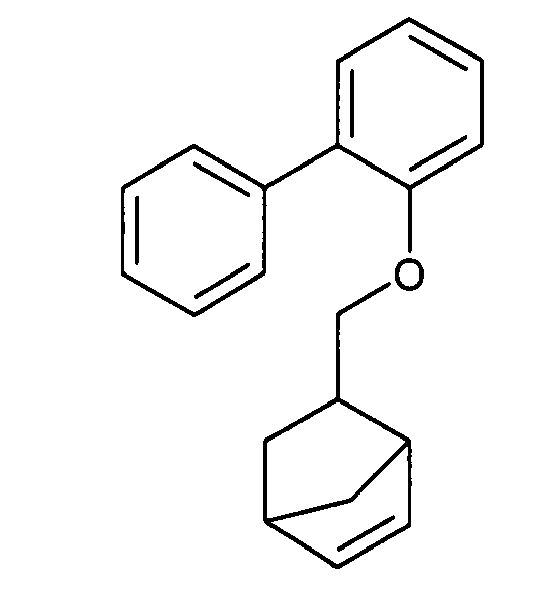

- With any norbornene (bicyclo[2.2.1]hept-5-enyl) group in the preceding formulas the corresponding 7-oxa-norbornene (7-oxa-bicyclo[2.2.1]hept-5-enyl) derivatives are comprised as well. For reason of simplicity stereoisomers at the norbornene moiety are generally not explicitly mentioned in the formulae. It should, however, be understood that all isomers either exo- or endo- to the norbornene ring and mixtures of both are comprised. The two-dimensional formula


- Accordingly, showing one enantiomeric Norbornenyl-Isomer in any case means also the other enantiomer or a mixture of those:

- The bicyclic ring systems listed are easily accessible through the known cyclisation reactions such as e.g. cyclo additions, especially Diels-Alder reactions. They are generally stable and not moisture-sensitive at room temperature and in the presence of conventional dental fillers.
- In a preferred embodiment, a composition according to the invention can contain a monomer selected from the group consisting of monomers comprising at least 2 moieties which are polymerizable by ROMP, monomers with at least one moiety selected from the group consisting of cyclobutenyl, cyclopentenyl, cyclooctenyl, norbornenyl and oxa-norbornenyl, monomers with at least one Si-atom, monomers according to the general formula
B(-A)n
wherein B is a monomeric oligomeric or polymeric organic or silicon-organic structural element and A is a structural element having at least one functional group which is polymerizable by ROMP and n is 1 to about 10,000 or 5 to about 1,000 or 10 to about 100. - In another embodiment of the invention, the polymerizable matrix composition comprises one or more oligomeric or prepolymeric structures e.g. polyether, polyester or polysiloxane or copolymeric compounds (PDMS) that are tethered and/or end-capped with groups that can undergo a ROMP reaction to form a cured article.
- Other useful oligomeric and polymeric monomers are described in the list below
-


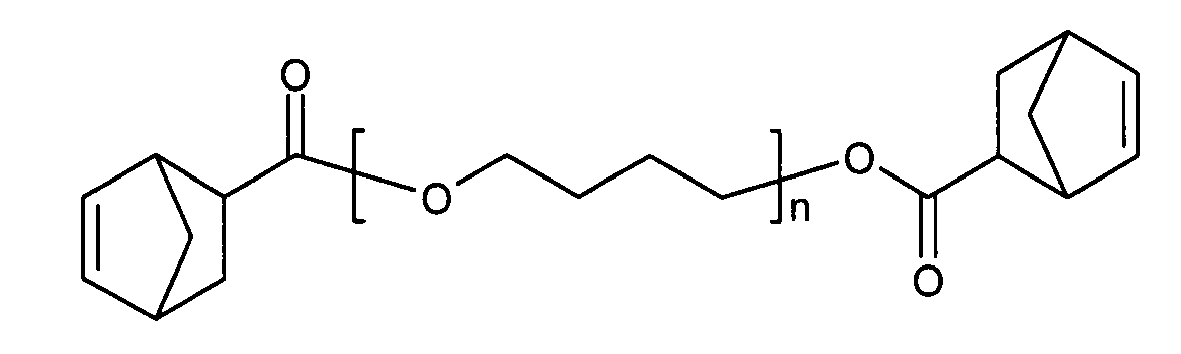
- Yet another category of oligomers and/or polymers that may be used in compositions of the invention include tri- or quadrifunctional oligomers or polymers having siloxane backbone end-functionalized or end-capped with an olefin group curable by a metathesis reaction, such as cycloalkenyl groups, for example norbornenyl or norbornenylethyl groups. An example of such polymer is quadrifunctional polydimethyl siloxane (PDMS), end-capped with norbornenyl (NBE) groups.
- In addition to the above categories of oligomers and polymers, the resin system may comprise any other polymerizable cycloalkenyl-functionalized siloxane based oligomers or polymers that may undergo polymerization via ROMP mechanism.
- Monomers taken from MONOMERLIST 1 may provide beneficial results.
- It can also be advantageous if the composition contains at least one monomer with two moieties polymerizable by ROMP and a molecular weight of more than about 180, especially more than about 200 or more than about 250 or more than about 300. The upper limit for the molecular weight is not particularly limited, however, should be in a range where the handling of the composition with regard to its formability is still possible (the composition is not a solid and too viscous to be formed) and the material properties of the cured composition are in a desired range.
- The amount of monomer that is curable by ring-opening metathesis polymerization (ROMP), can often vary between about 10 and about 90 % by weight. In some cases an amount of about 15 to about 50 or about 20 to about 40 % by weight, can lead to good results.
- A composition according to the invention also contains at least one initiator of the Hoveyda-Grubbs type for initiating the ROMP. In the context of the invention a Hoveyda-Grubbs Type initiator is defined as a ruthenium carbene complex with an ortho-alky-ether at the benzylidene residue, wherein this ether moiety coordinates to the ruthenium central atom. Preferred Hoveyda-Grubbs type initiators compounds are e.g. listed under CAS-Nos. [301224-40-8], [203714-71-1] or are substituted derivatives thereof.
- Generally, all initiators of the Hoveyda-Grubbs type can be used in a composition according to the invention. Thus, either initiators of the Hoveyda-Grubbs I type or of the Hoveyda-Grubbs II type can be used. It is also possible to use mixtures of two or more of Hoveyda-Grubbs I initiators or of Hoveyda-Grubbs II initiators or to mix one or more of Hoveyda-Grubbs I initiators with one or more Hoveyda-Grubbs II initiators according to the invention. It can be preferred if an initiator or a combination of initiators is used which allows for a curing temperature of the composition of below about 60°C, preferably below about 55 or below about 50 °C. It can also be advantageous, if the curing temperature is even below about 45 °C or below about 40 °C. Possible initiators to be used according to the invention are initiators according to the following formula


- An initiator of the Hoveyda-Grubbs type for initiating a ROMP can be present in an amount of about about 5 to about 10,000 ppm by weight, or from about 50 to about 6,000 ppm by weight or from about 70 to about 3,000 ppm by weight or about 100 to about 1,000 ppm or about 200 to about 600 ppm, relating to the weight of the entire composition. The inventive composition can comprise one initiator or a mixture of two or more initiators.
- If the composition comprises a mixture of two or more initiators, the mixture can consist of initiators only selected from the group of Hoveyda-Grubbs initiators of type I or only of initiators selected from the group consisting of Hoveyda-Grubbs initiators of the type II.
- It is, however, also possible that the composition comprises mixtures of one or more initiators of the Hoveyda-Grubbs type I and one or more initiators of the Hoveyda-Grubbs type II. It can be preferred if the composition comprises one, two or three different initiators molecules, especially one or two different initiator molecules.
- Suitable initiators of the Hoveyda_Grubbs-Type are also disclosed in
US 2003/220512 A (S. Blechert),WO 2005/053843 A (Boehringer Ingelheim GmbH),WO 200214376 A US 2004/254320 A (Kerr Corp.),WO 2004/035596 A (Boehringer Ingelheim GmbH) orDE 10 335 417 A (Arlt), the disclosure of which is expressly mentioned as a source of information with regard to the invention and the disclosure of which is regarded as being a part of the disclosure of the present text. - Besides the above-mentioned monomers and the initiator or initiators a composition according to the invention comprises also a retarder. Generally, a retarder according to the invention is defined as being a compound which, if present, decreases the reaction rate of at least one reaction resulting in a ring opening metathesis polymerization as compared to a composition not comprising the retarder under basically identical conditions. In a more narrow defined definition a retarder according to the invention is a compound which slows down the setting behaviour of a composition comprising the retarder when polymerizing the composition by ROMP. It is also proven to be advantageous, if a retarder aids in keeping the peak reaction temperature of the composition during polymerization below a value of about 60°C, especially below a value of about 50°C.
- It can also be desirable, if a retarder is chosen such that the time measured until an onset of the polymerization can be detected via measurement of viscosity increase is retarded as compared to a composition without the retarder under identical conditions. It can be preferred if the time until both compositions are cured, is basically identical.
- A retarder which can be used according to the invention is selected from the group consisting of heterocyclic amines having a ring with at least one N-atom and five or less atoms constituting the ring bearing at least one N-atom. Compounds exhibiting this characteristic structural element are preferably selected from the group consisting of pyrrole, pyrroline, pyrrolidine, pyrrolidone, porphine, indole, isoindole, carbazole, pyrazole, imidazole, indazole, benzimidazole, oxazole, isoxazole, thiazole, isothiazole, oxazoline, oxazolidine, benzthiazole, 1,2,3- and 1,2,4-triazole, aminotriazole, tetrazole, thiadiazole and their derivatives.
- In a further embodiment of the invention the retarder is selected from the group consisting of heterocyclic amines with one, two, three or four N-atoms in a ring with five or less atoms or seven or more atoms constituting the ring.
- In a further embodiment of the invention the retarder is selected from the group consisting of pyrrole, imidazole, benzimidazole and triazole.
- The retarder is usually neutral in charge, that is, the retarder is usually not of ionic nature.
- It has in some instances also been proven to be advantageous if the composition according to the invention comprises more than one type of retarder. Thus, a composition according to the invention can comprise two or more different types of retarders, e.g., two, three or four different types of retarder molecules. However, it has often proven to be successful if only one type of retarder is used.
- In another embodiment of the invention the retarder is selected such that it can form a complex with ruthenium. Whether a compound is capable of forming such a complex can, e.g., be determined by NMR measurements.
- If a composition according to the invention comprises two or more different types of retarders, it can be sufficient if only one of the retarders is able to form a complex with ruthenium, if such a retarder is desired.
- While it is possible to use the above-mentioned heterocyclic compounds as retarders themselves, it can also be advantageous if a composition according to the invention comprises a retarder which has at least one linear or branched aliphatic saturated substituent with about 1 to about 24, especially about 8 to about 18 C-atoms, preferably in N-position. However, other ring positions are also possible. Thus, retarders having two, three or four substituents as described in the text are also included.
- Radicals being suitable as respective substituents can, e.g., be selected from the group consisting of capronyl, caprylyl, caprinyl, lauryl, myristyl, palmityl, margaryl, stearyl, arachyl, behenyl or lignoceryl as well as their branched isomers. In a further embodiment of the invention the use of N-caprinylimidazol, N-laurylimidazol, N-myristylimidazol or N-palmitinylimidazol can be preferred.
- It can also be preferred if a retarder is used which has a boiling point above about 60°C, especially above about 100°C or above about 150°C or above about 200°C at ambient conditions, i.e., at a pressure of about 1013 mbar.
- While generally all types of retarders fulfilling the above conditions can be used, it can be advantageous if a retarder is used which is liquid or which is a soluble solid. If the retarder is a soluble solid the composition should be chosen such that the retarder is soluble in the composition, either due to being soluble in one of the mandatory constituents or due to being soluble in a solvent which can be deliberately added.
- In a further embodiment of the invention the retarder can be chosen such that the molar ratio of the retarder or a mixture of two or more retarders to the molar amount of metal atoms in the Hoveyda-Grubbs initiator is from about 10 : 1 to about 1 : 15 or about 5 : 1 to about 1 : 6.
- With regard to the molar ratio of the retarder or a mixture of two or more retarders to the molar amount of metal atoms in the Hoveyda-Grubbs initiator it can be advantageous if the molar ratio is chosen such that the onset of polymerization, as detectible by determination of the curing behaviour, is in a range of from about 30 to about 500 s (seconds) or from about 50 s to about 300 s, especially from about 60 s to about 240 s.
- The curing behaviour of the pastes can be determined using a Wallace-Shawburg Curometer as described below.
Fig. 1 shows the curing behaviour of an example of the inventive composition determined with such a device. - It has further proven to be successful if the time between the onset of the polymerization and the end of the polymerization is within a range of about 3 min (minutes) to about 7 min especially from about 4 min to about 6 min.
- A composition according to the invention can contain the retarder in an amount of about 25 to about 60,000 ppm, based on the weight of the entire composition. In some instances it has proven to be successful if the amount of retarder is about 100 to about 30,000 ppm, or about 200 to about 25,000 ppm or about 300 to about 6,000 ppm each based on the weight of the entire composition.
- In a further embodiment of the invention a composition in its polymerized state has a glass transition temperature of more than about 70 °C or more than about 90 °C or more than about 110°C.
- In a further embodiment of the invention, the composition comprises one or more additives selected from the group consisting of fillers, stabilizers, opacity modifiers, softeners, compatibilizers, solvents, rheology modifiers, colour pigments or fibers.
- The composition to be cured thus also can contain a filler or a mixture of two or more fillers, e.g., organic or inorganic fillers, preferably inorganic fillers. Fillers can be solid materials, e.g., ground inorganic materials like all modifications of SiO2 (e.g. quartz, christobalite) or glasses or precipitated material or material obtained by sol-gel procedures like "chemical ceramics" or organic or inorganic fibres, felts or beads as well as highly dispersed fumed or precipitated fillers (SiO2, ZrO2 or other metal oxides) or nanoshaped spherical or clustered metal oxides which preferably can enhance the mechanical properties of the cured composition. The size of used filler often ranges (but is not limited to) from several microns, down to a few nm.
- Preferred particulate fillers can be amorphous materials on the basis of mixed oxides comprising SiO2, ZrO2 and/or TiO2 as are described for example in
DE 40 29 230 A1 , microfine fillers such as pyrogenic silicic acid or precipitation silicic acid as well a macro-or minifillers such as quartz, glass ceramic or glass powders with an average particle size of about 0.01 to about 5 µm as well as X-ray opaque fillers, such as ytterbium trifluoride. Furthermore glass fibres, polyamide or carbon fibres can be used as fillers. - Preferred fillers can be mixtures of (a) amorphous spherical particles comprising silicon dioxide and up to about 20 mol-% of an oxide of at least one element of the groups I, II, III and IV of the periodic system with a refractive index of about 1.45 to about 1.58 and an average primary particle size of about 10 nm to about 10 µm and (b) quartz; glass ceramic or glass powders or their mixtures with a refractive index of about 1.45 to about 1.58 and an average particle size of about 0.5 to about 5 µm.
- A composition to be cured according to the invention can, e.g., contain only one type of filler. It is also possible and can be preferred that a composition to be cured contains two or more different types of fillers. Different types of fillers can differ in chemical constitution, shape, size, size distribution or other features or combinations of two or more of the above mentioned features.
- The fillers can be modified by interfacial compounds. Interfacial compounds are substances that chemically link to the surface of fillers, e.g., by condensation, and are able to incorporate into the polymer network produced by ROMP. Usually, they comprise two different functionalities. One functionality is able to chemically bond to the surface of the filler material, the second functionality is able to crosslink with the monomer matrix, normally through a ROMP reaction. Preferred substances are silanes described by the general formula XaRbSiR1 (4-a-b), wherein X is hydrogen, halogen, hydroxyl, alkoxy, acyloxy, alkylcarbonyl, alkoxycarbonyl or -NR"2 preferably methoxy or ethoxy; R is alkyl, aryl, alkylaryl or arylalkyl; R" is hydrogen, alkyl or aryl; R1 is an organic group comprising an unsaturated strained cycloaliphatic group that is able to incorporate into a polymeric network obtained by ROMP, preferably norbornenyl, 7-oxa-norbornenyl, cyclobutenyl, cyclopentenyl or cyclooctenyl, a is 1, 2 or 3; b is 0, 1 or 2 and (a+b <4). Preferred examples are:



- The interfacial compounds can also be used in mixture with such interfacial compounds which chemically link to the surface of fillers, e.g., by condensation, and are not able to be incorporated into the polymer network produced by ROMP. Illustrative examples include MeSi(OMe)3 or C6H5Si(OMe)3.
- The compositions to be cured can contain fillers in an amount of about 10 to about 90 % by weight, preferably in an amount of about 40 to about 85 or about 60 to about 80 % by weight. It can be preferred if the filler contains different compounds, differing with regard to their size, e.g. structural fillers and microfillers. The amount of micro fillers can be 0 to about 50 % by weight.
- Stabilizers to be optionally part of a composition according to the invention can generally be all stabilizers which do not harm a composition according to the invention. Suitable stabilizers can be organic esters of the phosphoric acid (phosphites) or alkyl or aryl phosphonates or those mentioned by Martin Dexter, Richard W. Thomas and Roswell E. King III, in Encyclopedia of Polymer Science and Technology Copyright © 2002 by John Wiley & Sons, Inc.; Vol. 5, 164-183.
- A composition to be cured according to the invention can further contain one or more opacity modifiers. As opacity modifiers substances can be used which have a high ability to scatter the light in the matrix, preferably substances which show sufficiently different refractive indices to the rest of the formulation e. g. TiO2, Al2O3, YF3 or YbF3.
- Suitable solvents which can be used include water, alcohols like ethanol, acetone or DMSO or mixtures of two or more of these solvents. Ionic liquids are usually not included.
- The composition can also contain softeners. Suitable softeners can be aliphatic or branched alkanes of monomeric, oligomeric and polymeric nature which can be hydrocarbons or substituted by oxygene like e.g. poly-THF, PEG, or carbonyls or esters, especially of the following structures:


- A composition according to the invention can comprise
- about 5 to about 85 % by weight of fillers,
- about 10 to about 85 % by weight of one or more monomers polymerizable by ROMP,
- about 0 to about 80 % by weight of one or more solvents,
- about 50 to about 6,000 ppm by weight of at least one initiator of the Hoveyda-Grubbs type for initiating a ROMP
- about 10 ppm by weight to about 1 % by weight of at least one retarder selected from the group consisting of heterocyclic amines having a ring with at least one N-atom and 5 or less atoms constituting the ring bearing the at least one N-atom and
- about 0 to about 70 % by weight of one or more additives,
with the proviso that the amounts of constituents of the composition add up to 100 % by weight. - A composition according to the invention can have one or more of the following features:
- the onset time for setting is at least about 0.5 min or at least about 1 min or at least about 1.5 min,
- the flexural strength of the cured product is at least about 50 MPa or at least about 60 MPa or at least about 70 MPa (measured according to DIN EN ISO 4049),
- the Youngs' Modulus of the cured product is at least about 900 MPa or at least about 1200 MPa or at least about 1500 MPa or at least about 1700 MPa (measured according to DIN EN ISO 4049),
- the curing temperature of the composition is below about 60 °C.
It has shown to be possible according to the invention that compositions curable by ROMP can be prepared, which can exhibit a tooth-like colour while still allowing for a tailored polymerization behaviour.
A colour classification system which is widely used in the dental field is the VITA™ dental shade guide. A more detailed description of the determination of tooth colours is given by Andres Baltzer and Vanik Kaufmann-Jinoian in Quintessenz Zahntechnik, 30, 7, 726-740 (2004).
It has been found that the cured inventive composition - without containing pigments or other colorants - can have a tooth-like colour appearance. Based on the measured L*a*b values, the colour of the composition can be aligned to the VITA™ colour system as mentioned above. This is possible, e.g. if the L*a*b values of the inventive composition are in a specific range.
Useful values for "L" include values higher than or equal to about 55 or 60 or 65. Useful values for "a" include values below or equal to about 10 or 5 or 0. Useful values for "b" include values below or equal to about 32 or 28 or 25. Useful values for the opacity include values below or equal to about 98 or 96 or 95.
Composition having L*a*b values in these ranges can be adjusted to dental colours of the VITA™ colour system by adding e.g. organic colorants or pigments such as carbon black or TiO2.
The composition according to the invention can be provided as a two component system, comprising a base component and a catalyst component. The base component at least comprises one or more monomers polymerizable by ROMP and the catalyst component at least comprises at least one initiator of the Hoveyda-Grubbs type for initiating a ROMP. The retarder is present in the base component or the catalyst component or in both.
Generally, a two component system according to the invention can comprise the necessary constituents in any distribution between the base component and the catalyst component, however, in a preferred embodiment the distribution is such that the above mentioned criteria can be satisfied.
It can, however, be preferred if in a composition according to the invention, the base component at least comprises - about 5 to about 85 or about 10 to about 80 % by weight of one or more fillers,
- about 10 to about 90 or about 15 to about 80 % by weight of one or more monomers polymerizable by ROMP,
- about 10 to about 80 or about 15 to about 70 % by weight of one or more fillers
- about 10 to about 80 or about 15 to about 70 % by weight of one or more solvents, and
- about 100 to about 2,000 ppm by weight of comprises at least one initiator of the Hoveyda-Grubbs type for initiating a ROMP,
- The invention also relates to a composition obtainable by mixing a base component and a catalyst component, wherein the base component or the catalyst component or both contain at least one retarder selected from the group consisting of heterocyclic amines having a ring with at least one N-atom and 5 or less atoms constituting the ring bearing the at least one N-atom.
- The base component and catalyst component can generally be mixed in any ratio desired. It can be preferred due to practical reasons, e.g., due to reasons of distribution of the constituents in the mixed composition or due to the use of mechanical mixing devices, if the catalyst component and the base component are mixed in a weight ratio of about 1 : 20 to about 1 : 1 or about 1 : 10 to about 1 : 2 or 1 : 5 to about 1: 4.
- The invention also relates to a process for the preparation of a composition which is polymerizable by ring-opening metathesis polymerization (ROMP) wherein
- a) at least one monomer that is polymerizable by ROMP and
- b) at least one initiator of the Hoveyda-Grubbs type for initiating the ROMP and
- c) at least one retarder selected from the group consisting of heterocyclic amines having a ring with at least one N-atom and 5 or less atoms constituting the ring bearing the at least one N-atom
are mixed. - In a further embodiment of the process according to the invention, the at least one monomer that is polymerizable by ROMP and the at least one initiator of the Hoveyda-Grubbs type for initiating the ROMP and the at least one retarder selected from the group consisting of heterocyclic amines having a ring with at least one N-atom and 5 or less atoms constituting the ring bearing the at least one N-atom are present in a base component and a catalyst component prior to mixing, and the base component at least comprises one or more monomers polymerizable by ROMP and the catalyst component at least comprises at least one initiator of the Hoveyda-Grubbs type for initiating a ROMP and the retarder is present in the base component or the catalyst component or in both.
- In a process according to the invention, the base component can at least comprise
- about 5 to about 85 or about 10 to about 80 % by weight of one or more fillers,
- about 10 to about 90 or about 15 to about 80 % by weight of one or more monomers polymerizable by ROMP,
- about 10 to about 80 or about 15 to about 70 % by weight of one or more fillers
- about 10 to about 80 or about 15 to about 70 % by weight of one or more solvents, and
- about 100 to about 2,000 ppm by weight of comprises at least one initiator of the Hoveyda-Grubbs type for initiating a ROMP,
- The invention further relates to dental material obtainable by polymerizing a composition according to the invention or by polymerizing a composition obtainable according to a process according to the invention.
- The invention also relates to the use of a substance selected from the group consisting of heterocyclic amines having a ring with at least one N-atom and 5 or less atoms constituting the ring bearing the at least one N-atom or of a mixture of two or more of such substances as a retarder in ROMP.
- The invention also relates to the use of a material obtainable by polymerizing a composition according to the invention or by polymerizing a composition obtainable according to a process according to the invention for the preparation of temporary or permanent inlays, onlays, veneer shells, crowns, or bridges, impression materials or filling materials.
- Especially for dental applications, the retarders used should not lead to a dark coloured and/or bad smelling compositions. As far as possible, the composition should be toxicologically harmless (e.g. showing a negative Ames test).
- The invention is further illustrated by examples, the content of which is not intended to limit the scope of the invention.
- The L*a*b* values were determined using a Lab scan (Hunter Lab, USA). The measurement was done either against a white or black coloured background, using 0°/45° measurement angle and 10° as a determination angle.
- Flexural strength and Youngs' Modulus were determined according to DIN EN ISO 4049 using a Zwick Universal Testing Machine (Zwick Company, Ulm, Germany).
- The Curometer used for measuring the time for onset (tA) of the curing reaction in the examples was a Wallace-Shawburg Curometer (Croydon, GB).
- The Curometer measures the cure time of rubber and other cross linking polymers. It can also measure the setting time of resins, cements and dental impression and filling materials. The Curometer can be used for initial research into stock formulation and also for rapid evaluation of cure for quality control.
- The terms "cure" or "vulcanisation" usually refers to the change in a network molecular structure. The Curometer measures the times to beginning of cure and end of cure. The shape of the Curometer curve provides a picture of cure characteristic in which the "delay period" and rate of cure can be seen.
- For the measurement of the setting behaviour 1 g base paste and 0.1 g catalyst paste were mixed and placed within 1 min into the measurement area of the Curometer. The Curometer run time is started with the beginning of the mixing. The measurement was conducted at ambient conditions (23 °C). The accuracy of measurement is about +/- 0.2 min.
- Chemical structures and names for the individual components used are:
- T-Norbornene:

- Z-Norbornene:

- Benzoate:

- N-Laurylimidazole:


- Z-Acetate:

- For the following examples the base and catalyst pastes were compounded by mixing the given components into a homogenous paste. The base and catalyst pastes were used after storage for about 1 h at ambient conditions (room temperature, 23°C).
- The base and catalyst pastes were mixed in a ratio of 10 : 1 (base : catalyst) and the physical parameters curing behaviour, flexural strength, Youngs's Modulus and L*a*b values were determined. The measured values are given below in Tables 1 and 2.
- The compositions of the pastes are as given below:
- Base-paste: 5.000 g Quarz, sil., 2.250 g T-Norbornene, 2.250g Benzoate, 0.500 g HDK H-2000 (Wacker Company, Germany).
- Catalyst-paste: 0.0032 g Hoveyda-Grubbs 2, 0.880 g Z-Acetate, 0.120 g HDK H-2000.
- Base-paste: 5.000g Quarz, sil., 2.250 g T-Norbornene, 2.270 g Benzoate, 0.500 g HDK H-2000 (Wacker Company, Germany), 0.001 g N-Laurylimidazole.
- Catalyst-paste: 0.003 g Hoveyda-Grubbs 2, 0.880 g Z-Acetate, 0.120 g HDK H-2000.
-
Fig. 1 shows a relevant fragment of the curing behaviour of paste 1 R measured with a curometer. The x-axis indicates the time and the y-axis the viscosity, with a high viscosity at the lower end and a low viscosity at the upper end. When the upper plateau of the graph is dropping by at least two squares, it is considered that the curing reaction has started. The length of two squares represents one minute, meaning, that 1/10th of a square equals 3 s. - Base-paste: 5.000 g Quarz, sil., 2.250 g Z-Norbornene, 2.250 g Benzoate, 0.500 g HDK H-2000 (Wacker Company, Germany).
- Catalyst-paste: 0.0032 g Hoveyda-Grubbs 2, 0.880 g Z-Acetate, 0.120 g HDK H-2000.
- Base-paste: 5.000 g Quarz, sil., 2.250 g Z-Norbornene, 2.270 g Benzoate, 0.500 g HDK H-2000 (Wacker Company, Germany), 0.001 g N-Laurylimidazole.
- Catalyst-paste: 0.003 g Hoveyda-Grubbs 2, 0.880 g Z-Acetate, 0.120 g HDK H-2000.
- Base-paste: 5.000 g Quarz, sil., 2.250 g Z-Norbornene, 2.250 g Benzoate, 0.500 g HDK H-2000 (Wacker Company, Germany).
- Catalyst-paste: 0.0032 g Hoveyda-Grubbs 2, 0.880 g Z-Acetate, 0.120 g HDK H-2000.
- Base-paste: 5.000g Quarz, sil., 2.250 g Z-Norbornene, 2.270 g Benzoate, 0.500 g HDK H-2000 (Wacker Company, Germany), 0.016 g Norbornene-2-yl-methyl-imidazole.
- Catalyst-paste: 0.003 g Hoveyda-Grubbs 2, 0.880 g Z-Acetate, 0.120 g HDK H-2000.
- Base-paste: 5.000 g Quarz, sil., 2.250 g Z-Norbornene, 2.250 g Benzoate, 0.500 g HDK H-2000 (Wacker Company, Germany).
- Catalyst-paste: 0.0032 g Hoveyda-Grubbs 2, 0.880 g Z-Acetate, 0.120 g HDK H-2000.
- Base-paste: 5.000g Quarz, sil., 2.250 g Z-Norbornene, 2.270 g Benzoate, 0.500 g HDK H-2000 (Wacker Company, Germany), 0.009 g Triethylamine.
- Catalyst-paste: 0.003 g Hoveyda-Grubbs 2, 0.880 g Z-Acetate, 0.120 g HDK H-2000.
Table 1 Paste 1 1R tA (begining of cure); [min] 0.6 2.8 Flexural strength; [MPa] 56.9 74.4 Youngs' modulus 1585 2137 Background for color measurement Black Black a* 1.09 -2.09 b* 7.05 3.28 L* 70.88 67.24 Opacity; [%] 94.46 84.62 Table 2 Paste 2 2R tA (beginning of cure); [min] 0.60 3.00 Flexural strength; [MPa] 66.0 74.8 Youngs' modulus 1519 1949 Backgrund for color measurement Black Black a* -2.52 -1.68 b* 4.08 3.87 L* 70.77 73.24 Opacity; [%] 91.55 90.35 Table 3 Paste 3 3R tA (beginning of cure); [min] 0.60 1.10 Flexural strength; [MPa] 66.0 73.7 Youngs' modulus 1519 1970 Backgrund for color measurement Black Black a* -2.52 -2.35 b* 4.08 4.44 L* 70.77 65.83 Opacity; [%] 91.55 84.19 Table 4 Paste 4 4R tA (beginning of cure); [min] 0.60 0.70 Flexural strength; [MPa] 66.0 71.4 Youngs' modulus 1519 1835 Backgrund for color measurement Black Black a* -2.52 -3.16 b* 4.08 4.21 L* 70.77 65.03 Opacity; [%] 91.55 86.37 - The composition of Example 4 does not show a relevant retarding effect, as the measurement of tA is within the accuracy of measurement.
- The composition according to Example 1 has already a tooth-like colour appearance. A further adjustment to a specific colour according to the Vita™ colour shade system can be done by adding organic colourants or pigments.
- This can be further illustrated with the values given in Table 5 below. As an example the L*a*b values for the shade A3 of the Vita™ colour shade system measured against a black background are given in Table 5.
Table 5 Lab values for colour of the Vita™ system, shade A3 a* 2.90 b* 20.80 L* 67.50 Opacity; [%] 91.70 - An adjustment to a specific shade is usually possible, if the measured L*a*b values are in a certain range. E.g., the formulations described above (Pastes 1 R and 2R) can be adjusted to an A3 shade in view of the fact, that the a- and b- values of the pastes are below the a- and b- values measured for the A3 shade. Likewise can be done if the L-value of the new formulation is higher than the one of a specific shade of the Vita™ colour shade system. In this case, a pigment such as carbon black lowering the L-value can be added.
Claims (23)
- A composition which is polymerizable by ring-opening metathesis polymerization (ROMP) comprisinga) at least one monomer that is polymerizable by ROMP,b) at least one initiator of the Hoveyda-Grubbs type for initiating the ROMP andc) at least one retarder selected from the group consisting of heterocyclic amines having a ring with at least one N-atom and 5 or less atoms constituting the ring bearing the at least one N-atom.
- A composition according to claim 1, wherein the retarder is able to form a complex with Ru.
- A composition according to one of the preceding claims, wherein the retarder is selected from the group consisting of heterocyclic amines with 1, 2, 3 or 4 N-atoms in a ring with 5 or less atoms.
- A composition according to one of the preceding claims, wherein the retarder is selected from the group consisting of pyrrole, pyrroline, pyrrolidine, pyrrolidone, porphine, indole, isoindole, carbazole, pyrazole, imidazole, indazole, benzimidazole, oxazole, isoxazole, thiazole, isothiazole, oxazoline, oxazolidine, benzothiazole, 1,2,3- and 1,2,4-triazole, aminotriazole, tetrazole, thiadiazole and their derivatives.
- A composition according to one of the preceding claims, wherein the retarder comprises at least one linear or branched aliphatic saturated substituent with 1 to 24 C-atoms, preferably in N-position.
- A composition according to one of the preceding claims, wherein the molar ratio of the retarder or a mixture of two or more retarders to metal atoms in the Hoveyda Grubbs initiator is about 10 : 1 to about 1 : 15.
- A composition according to one of the preceding claims, wherein the retarder is present in an amount of about 10 to about 30,000 ppm, based on the weight of the composition.
- A composition according to one of the preceding claims, wherein the monomer which is polymerizable by ROMP comprises at least one C-C double bond in a cyclic structure.
- A composition according to one of the preceding claims, wherein the composition contains a monomer selected from the group consisting of monomers comprising at least 2 moieties which are polymerizable by ROMP, monomers with at least one moiety selected from the group consisting of cyclobutenyl, cyclopentenyl, cyclooctenyl, norbornenyl and oxa-norbornenyl, monomers with at least one Si-atom, monomers according to the general formula
B(-A)n
wherein B is a monomeric oligomeric or polymeric organic or silicon-organic structural element and A is a structural element having at least one functional group which is polymerizable by ROMP and n is 1 to about 10000. - A composition according to one of the preceding claims, wherein the cured composition has a glass transition temperature of more than about 60 °C.
- A composition according to one of the preceding claims, wherein the composition comprises one or more additives selected from the group consisting of fillers, stabilizers, opacity modifiers, softeners, compatibilizers, solvents, rheology modifiers, colour pigments or fibers.
- A composition according to one of the preceding claims, wherein the composition comprises- about 5 to about 85% by weight of fillers,- about 10 to about 85% by weight of one or more monomers polymerizable by ROMP,- about 0 to about 80% by weight of one or more solvents,- about 50 to about 6,000 ppm by weight of at least one initiator of the Hoveyda-Grubbs type for initiating a ROMP,- about 10 ppm by weight to about 1 % by weight of at least one retarder selected from the group consisting of primary linear or branched aliphatic amines with 1 to 28 C-atoms, primary cycloaliphatic or primary aromatic amines with 5 to 28 C-atoms or heterocyclic amines having a ring with at least one N-atom and 5 or less atoms constituting the ring bearing the at least one N-atom and- about 0 to about 70 % by weight of one or more additives,with the proviso that the amounts of constituents of the composition add up to 100 % by weight.
- A composition according to one of the preceding claims, wherein the composition has one or more of the following features:- an onset time for setting of at least about 30 seconds,- the flexural strength of the cured product is at least about 50 MPa,- the Youngs Modulus of the cured product is at least about 900 MPa,- the curing temperature of the composition is below about 60 °C.
- A composition according to one of the preceding claims, wherein the L*a*b values of the composition fulfil at least one of the following requirements:- for "L": higher than or equal to about 55,- for "a": below or equal to about 10,- for "b": below or equal to about 32,- for opacity: below 98.
- A composition according to one of the preceding claims, wherein the composition is present as a base component and a catalyst component, wherein the base component at least comprises one or more monomers polymerizable by ROMP and the catalyst component at least comprises at least one initiator of the Hoveyda-Grubbs type for initiating a ROMP and the retarder is present in the base component or the catalyst component or in both.
- A composition according to claim 15, wherein the base component at least comprises- about 10 to about 90 % by weight of one or more fillers,- about 10 to about 90 % by weight of one or more monomers polymerizable by ROMP,and the catalyst component at least comprises- about 10 to about 80 % by weight of one or more fillers- about 20 to about 80% by weight of one or more solvents, and- about 300 to about 3000 ppm by weight of comprises at least one initiator of the Hoveyda-Grubbs type for initiating a ROMP.
- A composition obtainable by mixing a base component and a catalyst component according to claim 15 or claim 16, wherein the base component or the catalyst component or both contain at least one retarder selected from the group consisting of heterocyclic amines having a ring with at least one N-atom and 5 or less atoms constituting the ring bearing the at least one N-atom.
- A composition according to claim 17, wherein the base component and the catalyst component are mixed in a weight ratio of about 1 : 30 to about 2 : 1.
- A process for the preparation of a composition which is polymerizable by ring-opening metathesis polymerization (ROMP) whereina) at least one monomer that is polymerizable by ROMP andb) at least one initiator of the Hoveyda-Grubbs type for initiating the ROMP andc) at least one retarder selected from the group consisting of heterocyclic amines having a ring with at least one N-atom and 5 or less atoms constituting the ring bearing the at least one N-atom
are mixed. - A process according to claim 19, wherein the base component at least comprises- about 5 to about 85 % by weight of one or more fillers,- about 10 to about 90 % by weight of one or more monomers polymerizable by ROMP,
and the catalyst at least comprises- about 10 to about 80 % by weight of one or more fillers- about 10 to about 80 % by weight of one or more solvents, and- about 100 to about 2,000 ppm by weight of comprises at least one initiator of the Hoveyda-Grubbs type for initiating a ROMP,wherein the retarder is present in either the base component or the catalyst component or both, with the proviso that the amounts of constituents of the composition add up to 100 % by weight with respect to either the base or catalyst paste. - A dental material obtainable by polymerizing a composition according to claims 1 to 18 or by polymerizing a composition obtainable according to a process as claimed in claims 19 to 20.
- Use of a substance selected from the group consisting of heterocyclic amines having a ring with at least one N-atom and 5 or less atoms constituting the ring bearing the at least one N-atom or of a mixture of two or more of such substances as a retarder in ROMP.
- Use of a material obtainable by polymerizing a composition according to claims 1 to 18 or by polymerizing a composition obtainable according to a process as claimed in claims 19 to 20 for the preparation of temporary or permanent inlays, onlays, veneer shells, crowns, or bridges, impression materials or filling materials.
Priority Applications (6)
| Application Number | Priority Date | Filing Date | Title |
|---|---|---|---|
| EP06026426A EP1942125A1 (en) | 2006-12-20 | 2006-12-20 | Compositions curable by ring opening metathesis polymerarization at low temperatures and their application in the dental field |
| CN2007800478134A CN101583649B (en) | 2006-12-20 | 2007-12-18 | Compositions curable by ring-opening metathesis polymerization at low temperature and their use in the field of dentistry |
| PCT/US2007/087841 WO2008077001A1 (en) | 2006-12-20 | 2007-12-18 | Compositions curable by ring opening metathesis polymerization at low temperatures and their application in the dental field |
| EP07855221.3A EP2094760B1 (en) | 2006-12-20 | 2007-12-18 | Compositions curable by ring opening metathesis polymerization at low temperatures and their application in the dental field |
| JP2009543123A JP5269806B2 (en) | 2006-12-20 | 2007-12-18 | Compositions curable by ring-opening metathesis polymerization at low temperatures and their use in the dental field |
| US12/517,727 US8431625B2 (en) | 2006-12-20 | 2007-12-18 | Compositions curable by ring opening metathesis polymerization at low temperatures and their application in the dental field |
Applications Claiming Priority (1)
| Application Number | Priority Date | Filing Date | Title |
|---|---|---|---|
| EP06026426A EP1942125A1 (en) | 2006-12-20 | 2006-12-20 | Compositions curable by ring opening metathesis polymerarization at low temperatures and their application in the dental field |
Publications (1)
| Publication Number | Publication Date |
|---|---|
| EP1942125A1 true EP1942125A1 (en) | 2008-07-09 |
Family
ID=38006569
Family Applications (2)
| Application Number | Title | Priority Date | Filing Date |
|---|---|---|---|
| EP06026426A Withdrawn EP1942125A1 (en) | 2006-12-20 | 2006-12-20 | Compositions curable by ring opening metathesis polymerarization at low temperatures and their application in the dental field |
| EP07855221.3A Not-in-force EP2094760B1 (en) | 2006-12-20 | 2007-12-18 | Compositions curable by ring opening metathesis polymerization at low temperatures and their application in the dental field |
Family Applications After (1)
| Application Number | Title | Priority Date | Filing Date |
|---|---|---|---|
| EP07855221.3A Not-in-force EP2094760B1 (en) | 2006-12-20 | 2007-12-18 | Compositions curable by ring opening metathesis polymerization at low temperatures and their application in the dental field |
Country Status (5)
| Country | Link |
|---|---|
| US (1) | US8431625B2 (en) |
| EP (2) | EP1942125A1 (en) |
| JP (1) | JP5269806B2 (en) |
| CN (1) | CN101583649B (en) |
| WO (1) | WO2008077001A1 (en) |
Cited By (2)
| Publication number | Priority date | Publication date | Assignee | Title |
|---|---|---|---|---|
| WO2009113025A1 (en) * | 2008-03-13 | 2009-09-17 | Alenia Aeronautica S.P.A. | A composite material which is self-repairing even at low temperature |
| EP2933274A1 (en) * | 2014-04-16 | 2015-10-21 | Evonik Degussa GmbH | Method for the production of polymers by means of ring-opening polymerisation |
Families Citing this family (13)
| Publication number | Priority date | Publication date | Assignee | Title |
|---|---|---|---|---|
| ATE480216T1 (en) * | 2006-02-02 | 2010-09-15 | 3M Innovative Properties Co | SOLIDS OBTAINED THROUGH ROMP |
| EP1942125A1 (en) | 2006-12-20 | 2008-07-09 | 3M Innovative Properties Company | Compositions curable by ring opening metathesis polymerarization at low temperatures and their application in the dental field |
| DE102013008176A1 (en) | 2012-10-05 | 2014-04-10 | Voco Gmbh | Kit and method for the indirect chairside production of composite inlays |
| US9636641B2 (en) | 2015-03-31 | 2017-05-02 | Pall Corporation | Hydrophilically modified fluorinated membrane (I) |
| US9643130B2 (en) | 2015-03-31 | 2017-05-09 | Pall Corporation | Hydrophilically modified fluorinated membrane (IV) |
| US9724650B2 (en) | 2015-03-31 | 2017-08-08 | Pall Corporation | Hydrophilically modified fluorinated membrane (II) |
| US9649603B2 (en) | 2015-03-31 | 2017-05-16 | Pall Corporation | Hydrophilically modified fluorinated membrane (III) |
| US9630151B2 (en) | 2015-03-31 | 2017-04-25 | Pall Corporation | Hydrophilically modified fluorinated membrane (V) |
| US9849428B2 (en) | 2015-04-30 | 2017-12-26 | Pall Corporation | Hydrophilically modified fluorinated membrane (VI) |
| US10315168B2 (en) | 2015-07-31 | 2019-06-11 | Pall Corporation | Hydrophilic porous polytetrafluoroethylene membrane (II) |
| US9643131B2 (en) | 2015-07-31 | 2017-05-09 | Pall Corporation | Hydrophilic porous polytetrafluoroethylene membrane (I) |
| US10287400B2 (en) | 2016-04-14 | 2019-05-14 | Momentive Performance Materials Inc. | Curable silicone composition and applications and uses thereof |
| US10385210B2 (en) | 2017-06-20 | 2019-08-20 | Momentive Performance Materials Inc. | Curable silicone composition and applications and uses thereof |
Citations (2)
| Publication number | Priority date | Publication date | Assignee | Title |
|---|---|---|---|---|
| JP2001003028A (en) * | 1999-06-23 | 2001-01-09 | Sekisui Chem Co Ltd | Rough surface adhesive polymerizable composition, method for producing rough surface bonded body, and method for attaching anchor bolt to rough surface |
| US20060241257A1 (en) * | 2003-05-06 | 2006-10-26 | Kerr Corporation | Metathesis-curable composition with a reaction control agent |
Family Cites Families (28)
| Publication number | Priority date | Publication date | Assignee | Title |
|---|---|---|---|---|
| US4085192A (en) | 1973-05-11 | 1978-04-18 | Shell Oil Company | Selective removal of hydrogen sulfide from gaseous mixtures |
| JPS63128063A (en) | 1986-11-18 | 1988-05-31 | Mitsubishi Petrochem Co Ltd | Polyphenylene ether resin composition |
| JPH07116356B2 (en) | 1986-11-18 | 1995-12-13 | 三菱化学株式会社 | Polyphenylene ether resin composition |
| DE4029230C2 (en) | 1990-09-14 | 1995-03-23 | Ivoclar Ag | Polymerizable dental material |
| US5854299A (en) | 1993-09-10 | 1998-12-29 | Ciba Specialty Chemicals Corporation | Process for the polymerization of cyclic olefins and polymerizable composition |
| CA2205396A1 (en) | 1994-11-17 | 1996-05-30 | Ciba Specialty Chemicals Holding Inc. | Polymerizable composition and process for polymerizing cyclical olefins |
| DE59507446D1 (en) | 1994-11-17 | 2000-01-20 | Ciba Sc Holding Ag | CROSSLINKABLE MONOMERS AND COMPOSITION AND CROSSLINKED POLYMERS |
| DE59610089D1 (en) | 1995-11-02 | 2003-03-06 | Ciba Sc Holding Ag | Curable composition containing cycloolefin, silane and filler |
| WO1997032913A1 (en) | 1996-03-04 | 1997-09-12 | Ciba Specialty Chemicals Holding Inc. | Polymerizable composition |
| DE19742981B4 (en) | 1997-09-29 | 2013-07-25 | 3M Deutschland Gmbh | ROMP curable dental materials |
| DE19905093A1 (en) | 1999-02-01 | 2000-08-03 | Ivoclar Ag Schaan | Low shrinkage dental materials |
| ATE384082T1 (en) | 1999-02-05 | 2008-02-15 | Materia Inc | METATHESIS-ACTIVE ADHESION AGENTS AND METHODS FOR INCREASE THE ADHESION OF POLYMERS TO SURFACES |
| EP1313559B2 (en) | 2000-08-10 | 2012-10-24 | Trustees of Boston College | Recyclable metathesis catalysts |
| US6649146B2 (en) * | 2000-10-17 | 2003-11-18 | Kerr Corporation | Dental impression material utilizing ruthenium metathesis catalyst |
| US6455029B1 (en) * | 2000-10-17 | 2002-09-24 | Kerr Corporation | Dental impression material utilizing ruthenium catalyst |
| MXPA02002378A (en) * | 2001-03-12 | 2002-09-24 | Ciba Sc Holding Ag | Romp with alkoxy ether groups. |
| DE10205005A1 (en) | 2002-02-07 | 2003-08-21 | Neumag Gmbh & Co Kg | Method and apparatus for wetting a running filament bundle |
| AU2003232067A1 (en) * | 2002-05-06 | 2003-11-17 | Kerr Corporation | Composition curable by metathesis reaction |
| DE10222551A1 (en) | 2002-05-17 | 2003-11-27 | Bayer Ag | Novel transition metal complex compounds useful as catalysts in metathesis reactions |
| PL199412B1 (en) | 2002-10-15 | 2008-09-30 | Boehringer Ingelheim Int | Ruthenium new complexes as (pre) catalytic agents of permutation reaction, new derivatives of 2-alkoxy-5-nitrostyrene as intermediate compounds and method of their receiving |
| US7060770B2 (en) * | 2003-05-06 | 2006-06-13 | Kerr Corporation | Metathesis-curable composition with a reaction control agent |
| US7173097B2 (en) | 2003-05-06 | 2007-02-06 | Kerr Corporation | Metathesis-curable composition with a reaction control agent |
| EP1543875A1 (en) | 2003-12-04 | 2005-06-22 | Boehringer Ingelheim Pharma GmbH & Co. KG | Novel metathesis ruthenium catalyst |
| DE102004002178A1 (en) | 2004-01-15 | 2005-08-11 | Ivoclar Vivadent Ag | Dental matrials based on RÖMP composites |
| EP1614410B1 (en) | 2004-06-30 | 2011-08-10 | Ivoclar Vivadent AG | Dental materials polymerizable by photo-induced ring-opening metathesis polymerization of cyclic olefins |
| US7001590B1 (en) | 2004-11-15 | 2006-02-21 | Kerr Corporation | Metathesis-curable composition |
| ATE480216T1 (en) | 2006-02-02 | 2010-09-15 | 3M Innovative Properties Co | SOLIDS OBTAINED THROUGH ROMP |
| EP1942125A1 (en) | 2006-12-20 | 2008-07-09 | 3M Innovative Properties Company | Compositions curable by ring opening metathesis polymerarization at low temperatures and their application in the dental field |
-
2006
- 2006-12-20 EP EP06026426A patent/EP1942125A1/en not_active Withdrawn
-
2007
- 2007-12-18 EP EP07855221.3A patent/EP2094760B1/en not_active Not-in-force
- 2007-12-18 US US12/517,727 patent/US8431625B2/en not_active Expired - Fee Related
- 2007-12-18 CN CN2007800478134A patent/CN101583649B/en not_active Expired - Fee Related
- 2007-12-18 WO PCT/US2007/087841 patent/WO2008077001A1/en not_active Ceased
- 2007-12-18 JP JP2009543123A patent/JP5269806B2/en not_active Expired - Fee Related
Patent Citations (2)
| Publication number | Priority date | Publication date | Assignee | Title |
|---|---|---|---|---|
| JP2001003028A (en) * | 1999-06-23 | 2001-01-09 | Sekisui Chem Co Ltd | Rough surface adhesive polymerizable composition, method for producing rough surface bonded body, and method for attaching anchor bolt to rough surface |
| US20060241257A1 (en) * | 2003-05-06 | 2006-10-26 | Kerr Corporation | Metathesis-curable composition with a reaction control agent |
Non-Patent Citations (3)
| Title |
|---|
| CHRISTIAN SLUGOVC, SANDRA DEMEL, FRANZ STELZER: "Ring-opening metathesis polymerisation in donor solvents", CHEMICAL COMMUNICATIONS, 2002, pages 2572 - 2573, XP002434082 * |
| DATABASE WPI Week 200131, Derwent World Patents Index; AN 2001-294002, XP002434123 * |
| THOMAS WESKAMP, FLORIAN J. KOHL, WOLFGANG HIERINGER, DIETER GLEICH, WOLFGANG A. HERRMANN: "Hochaktive Rutheniumkatalysatoren für die Olefinmetathese: die Synergie N-heterocyclischer Carbene und koordinativ labiler Liganden", ANGEWANDTE CHEMIE, vol. 111, no. 16, 1999, pages 2573 - 2576, XP002434083 * |
Cited By (3)
| Publication number | Priority date | Publication date | Assignee | Title |
|---|---|---|---|---|
| WO2009113025A1 (en) * | 2008-03-13 | 2009-09-17 | Alenia Aeronautica S.P.A. | A composite material which is self-repairing even at low temperature |
| EP2933274A1 (en) * | 2014-04-16 | 2015-10-21 | Evonik Degussa GmbH | Method for the production of polymers by means of ring-opening polymerisation |
| US9309344B2 (en) | 2014-04-16 | 2016-04-12 | Evonik Degussa Gmbh | Process for preparing polymers by means of ring-opening polymerization |
Also Published As
| Publication number | Publication date |
|---|---|
| EP2094760A1 (en) | 2009-09-02 |
| WO2008077001A1 (en) | 2008-06-26 |
| US20100036015A1 (en) | 2010-02-11 |
| US8431625B2 (en) | 2013-04-30 |
| JP2010514678A (en) | 2010-05-06 |
| CN101583649B (en) | 2012-01-25 |
| CN101583649A (en) | 2009-11-18 |
| JP5269806B2 (en) | 2013-08-21 |
| EP2094760B1 (en) | 2017-05-31 |
Similar Documents
| Publication | Publication Date | Title |
|---|---|---|
| US8431625B2 (en) | Compositions curable by ring opening metathesis polymerization at low temperatures and their application in the dental field | |
| Xu et al. | Polymerization shrinkage kinetics and degree of conversion of resin composites | |
| KR100518998B1 (en) | Composition of Dental Self-Curing Resin Cements | |
| Azad et al. | Structure–properties relationships in dental adhesives: Effect of initiator, matrix monomer structure, and nano-filler incorporation | |
| Podgórski | Synthesis and characterization of novel dimethacrylates of different chain lengths as possible dental resins | |
| JP5383012B2 (en) | Dental material with low polymerization shrinkage | |
| US20040024113A1 (en) | Polymerizable compositions based on epoxides | |
| AU8714698A (en) | Dental compositions curable by ROMP | |
| JP2003192520A (en) | Dental impression material utilizing ruthenium metathesis catalyst | |
| US8178604B2 (en) | Solid materials obtainable by ring-opening metathesis polymerization | |
| US7001590B1 (en) | Metathesis-curable composition | |
| US7691919B2 (en) | Dental materials based on ROMP composites | |
| US7589132B2 (en) | Dental resins, dental composite materials, and method of manufacture thereof | |
| JP4755182B2 (en) | Dental composition containing Si-H functional carbosilane component | |
| US20040020597A1 (en) | Adhesive for silicon rubber lining materials | |
| JP2008505941A (en) | Dental composition comprising an epoxy functional polymerizable compound | |
| CN100560629C (en) | Stable cationic route crosslinkable/polymerizable dental compositions with high filler content | |
| Reis et al. | Investigation on the use of triphenyl bismuth as radiopacifier for (di) methacrylate dental adhesives | |
| KR100733425B1 (en) | Dental binary polymerized resin cement composition | |
| KR100881044B1 (en) | Photopolymerizable Dental Composition | |
| CN1988874A (en) | Dental compositions containing unsaturated carbosilane-containing components | |
| JP2007224301A (en) | Polyether-based composition curable by metathesis reaction | |
| JPH07101819A (en) | Dental resin composition having sustained releasability of fluorine ion | |
| JP2008505940A (en) | Dental composition comprising an unsaturated halogenated aryl alkyl ether component | |
| Shah | Investigation and control of filler-matrix interactions applied to dental composites |
Legal Events
| Date | Code | Title | Description |
|---|---|---|---|
| PUAI | Public reference made under article 153(3) epc to a published international application that has entered the european phase |
Free format text: ORIGINAL CODE: 0009012 |
|
| AK | Designated contracting states |
Kind code of ref document: A1 Designated state(s): AT BE BG CH CY CZ DE DK EE ES FI FR GB GR HU IE IS IT LI LT LU LV MC NL PL PT RO SE SI SK TR |
|
| AX | Request for extension of the european patent |
Extension state: AL BA HR MK RS |
|
| AKX | Designation fees paid | ||
| STAA | Information on the status of an ep patent application or granted ep patent |
Free format text: STATUS: THE APPLICATION IS DEEMED TO BE WITHDRAWN |
|
| 18D | Application deemed to be withdrawn |
Effective date: 20090110 |
|
| REG | Reference to a national code |
Ref country code: DE Ref legal event code: 8566 |