EP1939612A1 - Biosensor chip and process for producing the same - Google Patents
Biosensor chip and process for producing the same Download PDFInfo
- Publication number
- EP1939612A1 EP1939612A1 EP06811833A EP06811833A EP1939612A1 EP 1939612 A1 EP1939612 A1 EP 1939612A1 EP 06811833 A EP06811833 A EP 06811833A EP 06811833 A EP06811833 A EP 06811833A EP 1939612 A1 EP1939612 A1 EP 1939612A1
- Authority
- EP
- European Patent Office
- Prior art keywords
- potassium ferricyanide
- reaction chamber
- biosensor chip
- spacer
- capacity
- Prior art date
- Legal status (The legal status is an assumption and is not a legal conclusion. Google has not performed a legal analysis and makes no representation as to the accuracy of the status listed.)
- Withdrawn
Links
- 238000000034 method Methods 0.000 title claims description 7
- -1 potassium ferricyanide Chemical compound 0.000 claims abstract description 95
- 238000006243 chemical reaction Methods 0.000 claims abstract description 77
- 239000000758 substrate Substances 0.000 claims abstract description 63
- 108090000790 Enzymes Proteins 0.000 claims abstract description 39
- 102000004190 Enzymes Human genes 0.000 claims abstract description 39
- 239000013078 crystal Substances 0.000 claims abstract description 39
- 239000002245 particle Substances 0.000 claims abstract description 39
- 238000004519 manufacturing process Methods 0.000 claims description 16
- 239000003153 chemical reaction reagent Substances 0.000 claims description 14
- 238000010438 heat treatment Methods 0.000 claims description 11
- 238000007710 freezing Methods 0.000 claims description 10
- 230000008014 freezing Effects 0.000 claims description 10
- 239000002904 solvent Substances 0.000 claims description 10
- 238000002156 mixing Methods 0.000 claims description 8
- 239000011248 coating agent Substances 0.000 claims description 3
- 238000000576 coating method Methods 0.000 claims description 3
- 125000006850 spacer group Chemical group 0.000 abstract description 58
- 238000005259 measurement Methods 0.000 abstract description 33
- 239000000853 adhesive Substances 0.000 abstract description 19
- 229940088598 enzyme Drugs 0.000 description 35
- 239000007864 aqueous solution Substances 0.000 description 17
- 238000010586 diagram Methods 0.000 description 17
- LFQSCWFLJHTTHZ-UHFFFAOYSA-N Ethanol Chemical compound CCO LFQSCWFLJHTTHZ-UHFFFAOYSA-N 0.000 description 12
- 239000008280 blood Substances 0.000 description 12
- 210000004369 blood Anatomy 0.000 description 12
- 230000000694 effects Effects 0.000 description 7
- 108010015776 Glucose oxidase Proteins 0.000 description 6
- 239000004366 Glucose oxidase Substances 0.000 description 6
- 229940116332 glucose oxidase Drugs 0.000 description 6
- 235000019420 glucose oxidase Nutrition 0.000 description 6
- 238000001035 drying Methods 0.000 description 5
- 238000005842 biochemical reaction Methods 0.000 description 4
- 238000007650 screen-printing Methods 0.000 description 3
- CSCPPACGZOOCGX-UHFFFAOYSA-N Acetone Chemical compound CC(C)=O CSCPPACGZOOCGX-UHFFFAOYSA-N 0.000 description 2
- 230000004075 alteration Effects 0.000 description 2
- 238000006911 enzymatic reaction Methods 0.000 description 2
- 239000007788 liquid Substances 0.000 description 2
- 239000013081 microcrystal Substances 0.000 description 2
- 238000012986 modification Methods 0.000 description 2
- 230000004048 modification Effects 0.000 description 2
- 230000002485 urinary effect Effects 0.000 description 2
- XLYOFNOQVPJJNP-UHFFFAOYSA-N water Substances O XLYOFNOQVPJJNP-UHFFFAOYSA-N 0.000 description 2
- WQZGKKKJIJFFOK-GASJEMHNSA-N Glucose Natural products OC[C@H]1OC(O)[C@H](O)[C@@H](O)[C@@H]1O WQZGKKKJIJFFOK-GASJEMHNSA-N 0.000 description 1
- 238000001816 cooling Methods 0.000 description 1
- 238000012937 correction Methods 0.000 description 1
- 206010012601 diabetes mellitus Diseases 0.000 description 1
- 230000003467 diminishing effect Effects 0.000 description 1
- 238000004090 dissolution Methods 0.000 description 1
- 238000001704 evaporation Methods 0.000 description 1
- 230000008020 evaporation Effects 0.000 description 1
- 239000008103 glucose Substances 0.000 description 1
- 239000012212 insulator Substances 0.000 description 1
- 239000000203 mixture Substances 0.000 description 1
- 239000000615 nonconductor Substances 0.000 description 1
- 230000001376 precipitating effect Effects 0.000 description 1
- 230000035484 reaction time Effects 0.000 description 1
- 238000001226 reprecipitation Methods 0.000 description 1
- 239000000243 solution Substances 0.000 description 1
- 238000000935 solvent evaporation Methods 0.000 description 1
- 239000000126 substance Substances 0.000 description 1
- 238000012360 testing method Methods 0.000 description 1
Images




Classifications
-
- G—PHYSICS
- G01—MEASURING; TESTING
- G01N—INVESTIGATING OR ANALYSING MATERIALS BY DETERMINING THEIR CHEMICAL OR PHYSICAL PROPERTIES
- G01N27/00—Investigating or analysing materials by the use of electric, electrochemical, or magnetic means
- G01N27/26—Investigating or analysing materials by the use of electric, electrochemical, or magnetic means by investigating electrochemical variables; by using electrolysis or electrophoresis
- G01N27/28—Electrolytic cell components
- G01N27/30—Electrodes, e.g. test electrodes; Half-cells
- G01N27/327—Biochemical electrodes, e.g. electrical or mechanical details for in vitro measurements
-
- C—CHEMISTRY; METALLURGY
- C12—BIOCHEMISTRY; BEER; SPIRITS; WINE; VINEGAR; MICROBIOLOGY; ENZYMOLOGY; MUTATION OR GENETIC ENGINEERING
- C12Q—MEASURING OR TESTING PROCESSES INVOLVING ENZYMES, NUCLEIC ACIDS OR MICROORGANISMS; COMPOSITIONS OR TEST PAPERS THEREFOR; PROCESSES OF PREPARING SUCH COMPOSITIONS; CONDITION-RESPONSIVE CONTROL IN MICROBIOLOGICAL OR ENZYMOLOGICAL PROCESSES
- C12Q1/00—Measuring or testing processes involving enzymes, nucleic acids or microorganisms; Compositions therefor; Processes of preparing such compositions
- C12Q1/001—Enzyme electrodes
- C12Q1/002—Electrode membranes
-
- G—PHYSICS
- G01—MEASURING; TESTING
- G01N—INVESTIGATING OR ANALYSING MATERIALS BY DETERMINING THEIR CHEMICAL OR PHYSICAL PROPERTIES
- G01N27/00—Investigating or analysing materials by the use of electric, electrochemical, or magnetic means
- G01N27/26—Investigating or analysing materials by the use of electric, electrochemical, or magnetic means by investigating electrochemical variables; by using electrolysis or electrophoresis
Definitions
- This invention relates to a biosensor chip for performing a biochemical reaction using a very small amount of a sample to be measured.
- a biosensor chip is a sensor chip that causes a biochemical reaction such as an enzyme reaction and an antigen-antibody reaction on a very small amount of a sample introduced into a reaction chamber thereof and then outputs information obtained by the biochemical reaction via an electrode.
- Such biosensor chip utilizes the excellent molecular discrimination function of living body and enables a rapid and convenient measurement of a very small amount of a chemical substance.
- the biosensor chip is used as a blood sugar level sensor or as a urinary sugar level sensor for measuring a glucose amount (blood sugar level) in blood or a urinary sugar level for an in-home medical checkup (self-medical cares) for self-managing and preventing diabetes.
- This biosensor chip as an enzyme sensor 100, is provided with an electrode unit 102 formed on an electrically insulating substrate 101 and including two electrodes in the form of stripes as shown in Fig. 6 .
- a reaction layer 103 is closely fixed to one end portion of the electrode unit 102, and potassium ferricyanide is contained in the reaction layer 103 as one example of an electron mediator.
- a mask layer 105 having a window 104 is disposed above the electrode unit 102; a spacer 107 having a test liquid inlet 106 is disposed above the mask layer 105; and a protection layer 108 is disposed above the spacer 107. Therefore, the enzyme sensor 100 is formed of the electrically insulating substrate 101, the electrode unit 102, the mask layer 105, the spacer 107, and the protection layer 108 that are stacked.
- Patent Publication 2 As another example of the conventional biosensor chips, the one disclosed in Patent Publication 2 is known.
- a support electrode 201 and a standard reference electrode 202 are disposed on a first electrode insulator 200, and a second electrical insulator 203 is disposed on the electrodes.
- a notched portion 204 is formed, and a reagent 205 is placed on the support electrode 201 exposed in the notched portion 204.
- the reagent 205 contains an enzyme and potassium ferricyanide and a reagent prepared in the form of a liquid is dried on a surface of a support electrode 201 in the notched portion 204.
- An additional notched portion 206 is included for the purpose of facilitating electrical connection between the support electrode 201 and the standard reference electrode 202 and a potential difference meter.
- Patent Publication 1 JP-A-2001-311712
- Patent Publication 2 JP-T-9-500727
- the crystal particle size can be large since potassium ferricyanide is easily crystallized.
- a blood is introduced into the reaction chamber in the biosensor chip accommodating the potassium ferricyanide having the large crystal particle size, it is sometime impossible to perform a correct measurement since such potassium ferricyanide is not dissolved rapidly.
- a measurement value can be fluctuated due to a fluctuation in dissolved state of potassium ferricyanide.
- potassium ferricyanide in which crystal particles having a large size and crystal particle having a small size are mixed is gathered at an inlet of the reaction chamber, it is considered that it is difficult to introduce the blood used as the measurement reagent into the reaction chamber.
- An object of this invention is to provide a biosensor chip capable of a rapid and correct measurement, comprising a reaction chamber of a small capacity that enables a measurement of a very small amount of a measurement sample and potassium ferricyanide that has a very small crystal particle size and is disposed in the reaction chamber.
- a biosensor chip including: upper and lower substrates, at least two electrodes disposed on at least one of the upper and lower substrates, and a reaction chamber for performing a chemical reaction, wherein at least an enzyme and potassium ferricyanide are included as reagents to be placed in the reaction chamber; a capacity of the potassium ferricyanide placed in the reaction chamber is V ⁇ 0.1 mg or more when a capacity of the reaction chamber is V ⁇ L; and a maximum diameter of crystal particles of the potassium ferricyanide is 100 ⁇ m.
- the maximum diameter of the crystal particles of the potassium ferricyanide is 50 ⁇ m or less.
- the enzyme and the potassium ferricyanide are placed in the reaction chamber with a gap being defined therebetween.
- the upper and lower substrates are formed from one sheet, and the one sheet is folded to form the upper and lower substrates.
- a biosensor chip production method for producing a biosensor chip including upper and lower substrates, at least two electrodes disposed on at least one of the upper and lower substrates, and a reaction chamber for performing a chemical reaction, the method including: a step of coating at least an enzyme and potassium ferricyanide in the reaction chamber, and a step of freezing, heating, or mixing with a poor solvent the potassium ferricyanide in such a manner that a maximum diameter of crystal particles of the potassium ferricyanide becomes 100 ⁇ m or less and a capacity of the potassium ferricyanide placed in the reaction chamber becomes V ⁇ 0.1 mg or more when a capacity of the reaction chamber is V ⁇ L.
- one sheet is folded to form the upper and lower substrates.
- the potassium ferricyanide of very fine crystal particles is placed in the reaction chamber, the potassium ferricyanide is rapidly and uniformly dissolved by using a very small amount of a measurement sample, thereby enabling a correction measurement wherein a measurement result fluctuation is suppressed.
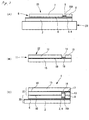
- Fig. 1 shows one example of embodiments of the biosensor chip according to this invention.
- a biosensor chip 1 has an insulating lower substrate 2, and two electrodes 3 and 4 are disposed on an upper surface of the lower substrate 2 in parallel to each other with a gap being defined therebetween (see Fig. 1(B) ).
- a lower spacer 5 is fixed on the electrodes 3 and 4 with an adhesive agent 6.
- the lower spacer 5 has a width W that is substantially the same as that of the lower substrate 2 and includes a long lower spacer 7 and a short lower spacer disposed with a gap being defined therebetween, and a lower groove 9 is formed between the long lower spacer and the short lower spacer.
- An upper spacer 11 is fixed on the lower spacer 5 with an adhesive agent 10.
- the upper spacer 11 has a size and a width that are the same as those of the lower spacer 5 and includes a long upper spacer 12 and a short upper spacer 13 disposed with a gap being defined therebetween, and an upper groove 14 is formed between the long upper spacer and the short upper spacer.
- An upper substrate 15 is' fixed on the upper spacer 11 with an adhesive agent 16. Therefore, this biosensor chip 1 has a structure that the lower substrate 2, the electrodes 3 and 4, the lower spacer 5, the upper spacer 11, and the upper substrate 15 are stacked. Though the lower substrate 2 and the upper substrate 15 are formed as separate members in this embodiment, the lower substrate 2 and the upper substrate 15 may be formed integrally. That is, it is possible to form a lower substrata and an upper substrate by folding one sheet into a laterally-faced U-shape.
- a space enclosed by the upper and lower substrates 2 and 15, the upper and lower long spacers 7 and 12, and the upper and lower short spacers 8 and 13 serves as a reaction chamber 17 as shown in Fig. 1(C) .
- the upper groove 9 and the lower groove 14 are opposed to each other to form the reaction chamber 17, and a capacity of the reaction chamber 17 is set to 0.3 ⁇ L or less.
- a capacity of the lower groove 9 can be set to 0.15 ⁇ L
- a capacity of the upper groove 14 can be set to 0.15 ⁇ L, so that each of the lower groove 9 and the upper groove 14 has the capacity that is half of that of' the reaction chamber 17.
- the capacity of the reaction chamber may be 0.3 ⁇ L or less, preferably 0.2 to 0.3 ⁇ L. Since an amount of the measurement reagent is very small when the capacity of the reaction chamber is 0.3 ⁇ L or less, it is possible to perform collection of the measurement reagent easily. When the capacity of the reaction chamber is more than 0.3 ⁇ L, a collection load of the measurement reagent, such as a blood draw load in the case of a blood sugar level measurement, is increased.
- An enzyme 18 is coated on the upper substrate 15 in the reaction chamber 17, so that a biochemical reaction such as an enzyme reaction and an antigen-antibody reaction is caused when the measurement reagent flows into the reaction chamber 17.
- Potassium ferricyanide 19 serving as an electron mediator is coated on the lower substrate 2 and the electrodes 3 and 4 in the reaction chamber 17, and the potassium ferricyanide 19 is disposed with a gap being defined between the potassium ferricyanide 19 and the enzyme 18. Since the enzyme 18 and the potassium ferricyanide 19 are not mixed, it is possible to maintain activity of the enzyme 18 for a long period of time. Since the capacity of the reaction chamber 17 is very small (0.3 ⁇ L), it is important to maintain a high enzyme activity in order to obtain a correct measurement result by using the very small amount of measurement reagent.
- a capacity of the potassium ferricyanide is also important, and it is necessary to keep the capacity of the potassium ferricyanide 1.9 to V ⁇ 0.1 mg or more when the capacity of the reaction chamber 17 is V.
- a required amount of the potassium ferricyanide is 0.03 mg or more.
- the potassium ferricyanide reacts with the very small amount of measurement reagent satisfactorily to give a correct measurement result.
- a dissolved state of the potassium ferricyanide influences on the measurement results when the very small amount of measurement reagent is introduced.
- a maximum diameter of crystal particles of the potassium ferricyanide is 100 ⁇ m or less in order to dissolve the potassium ferricyanide rapidly and uniformly.
- the maximum diameter of very fine crystal particles of the potassium ferricyanide is 100 ⁇ m or less, the potassium ferricyanide can be dissolved rapidly and uniformly in the reaction chamber of 0.3 ⁇ L or less, thereby obtaining a correct measurement.
- the maximum diameter of the crystal particles of the potassium ferricyanide is 100 ⁇ m or more, it is difficult to rapidly dissolve the potassium ferricyanide, thereby causing a fluctuation in measurement results and a long reaction time. Also, in the case where crystal particles having a large size and crystal particle having a small size are mixed in the potassium ferricyanide, a fluctuation in states of dissolution of the potassium ferricyanide is caused to make it difficult to obtain correct measurement results. Therefore, since the potassium ferricyanide is dissolved remarkably rapidly and uniformly when the maximum diameter of the crystal particles of the potassium ferricyanide is 50 ⁇ m or less, the maximum diameter of 50 ⁇ m or less is more preferable.
- the potassium ferricyanide having the maximum diameter of 100 ⁇ m or less or 50 ⁇ m or less by coating an aqueous solution containing the potassium ferricyanide in the reaction chamber 17 and then performing freezing, heating, or mixing with a poor solvent.
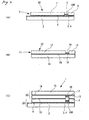
- FIG. 2 shows one embodiment of biosensor chip production method according to this invention.
- the component parts that are the same as those of the biosensor chip of Fig. 1 are denoted by the same reference numerals, and detailed description of such component parts is omitted in the following description.
- Fig. 2 (A) shows a lower part 20 including the lower substrate 2 of the biosensor chip 1.
- the electrodes 3 and 4 are attached to the lower substrate 2 by screen printing or the like, and the spacer 5 is attached with the adhesive agent 6.
- the aqueous solution containing the potassium ferricyanide 19 is coated on the lower groove 9 formed by the long spacer 7 and the short spacer 8.
- the lower part 20 of the biosensor chip 1 is disposed in a freezing apparatus 21 to freeze the aqueous solution containing the potassium ferricyanide 19.
- a freezing temperature may preferably be -20°C or less.
- the lower part 20 is taken out from the freezing apparatus 12 to be air-dried or to be vacuum-dried.
- a maximum diameter of the crystal particles of the potassium ferricyanide 19 measured after the drying is 100 ⁇ m or less.
- crystal particles of potassium ferricyanide that is quick-frozen by a freezing apparatus 21 had a maximum diameter of 50 ⁇ m or less.
- An upper part 22 including the upper substrate 15 of the biosensor chip 1 is formed as shown in Fig. 2(B) .
- the adhesive agent 16 is coated on the upper substrate 15 to attach the upper spacer 11.
- An aqueous solution containing the enzyme 18 is coated on the upper groove 14 formed by the long spacer 12 and the short spacer 13. Examples of the enzyme include glucose oxidase (GOD). After drying the aqueous solution containing the enzyme 18, the upper part 20 and the lower part 22 of the biosensor chip 1 are attached to each other with an adhesive agent 10 as shown in Fig. 2(C) .
- the reaction chamber 17 is formed by the upper groove 9 and the lower groove 14 that are opposed to each other.
- the reaction chamber 17 since the potassium ferricyanide 19 and the enzyme 18 are opposed to each other with a gap being defined therebetween, the enzyme 18 is not mixed with the potassium ferricyanide 19, and activity of the enzyme 18 is maintained.
- the reaction chamber 17 has a capacity of 0.3 ⁇ L or less and accommodates the potassium ferricyanide 19 in an amount of V ⁇ 0.1 mg or more when the capacity of the reaction chamber is V, and the maximum diameter of the crystal particles is 100 ⁇ m or less.
- Fig. 3 shows another embodiment of biosensor chip production method according to this invention.
- the component parts that are the same as those of the biosensor chip of Fig. 1 are denoted by the same reference numerals, and detailed description of such component parts is omitted in the following description.
- Fig. 3(A) shows a lower part 20 including the lower substrate 2 of the biosensor chip 1.
- the electrodes 3 and 4 are attached to the lower substrate 2 by screen printing or the like, and the spacer 5 is attached with the adhesive agent 6.
- An aqueous solution containing a potassium ferricyanide 19A is coated on the lower groove 9 formed by the long spacer 7 and the short spacer 8.
- a heating apparatus 23 is provided and the lower part 20 of the biosensor chip 1 including the lower substrate 2 is placed on a top face of the heating apparatus 23.
- the aqueous solution containing the potassium ferricyanide 19A is heated to evaporate moisture.
- the lower part 20 of the biosensor chip 1 is taken out from the heating apparatus 23 to be cooled.
- a maximum diameter of the crystal particles of the potassium ferricyanide 19A measured after the cooling is 100 ⁇ m or less.
- An upper part 22 including the upper substrate 15 of the biosensor chip 1 is formed as shown in Fig. 3 (B) .
- the adhesive agent 16 is coated on the upper substrate 15 to attach the upper spacer 11.
- An aqueous solution containing the enzyme 18 is coated on the upper groove 14 formed by the long spacer 12 and the short spacer 13. Examples of the enzyme include glucose oxidase (GOD). After drying the aqueous solution containing the enzyme 18, the upper part 20 and the lower part 22 of the biosensor chip 1 are attached to each other with an adhesive agent 10 as shown in Fig. 3(C) .
- the reaction chamber 17 is formed by the upper groove 9 and the lower groove 14 that are opposed to each other.
- the reaction chamber 17 has a capacity of 0.3 ⁇ L or less and accommodates the potassium ferricyanide 19A in an amount of V ⁇ 0.1 mg or more when the capacity of the reaction chamber is V, and the maximum diameter of the crystal particles is 100 ⁇ m or less.
- Fig. 4 shows yet another embodiment of the biosensor chip production method according to this invention.
- the component parts that are the same as those of the biosensor chip of Fig. 1 are denoted by the same reference numerals, and detailed description of such component parts is omitted in the following description.
- Fig. 4(A) shows a lower part 20 including the lower substrate 2 of the biosensor chip 1.
- the electrodes 3 and 4 are attached to the lower substrate 2 by screen printing or the like, and the spacer 5 is attached with the adhesive agent 6.
- An aqueous solution containing a potassium ferricyanide 19B is coated on the lower groove 9 formed by the long spacer 7 and the short spacer 8.
- ethanol which is a poor solvent for potassium ferricyanide is coated on the aqueous solution so that the aqueous solution is mixed with ethanol. Due to the presence of ethanol, the potassium ferricyanide is precipitated in the form of a microcrystal.
- Such method is known as a solvent reprecipitation method for precipitating microcrystal.
- the heating device used in the embodiment of Fig. 3 is not required, and it is possible to perform moisture evaporation at an ordinary temperature. Also, it is possible to use any of poor solvents of potassium ferricyanide insofar as the poor solvent dissolves well in water, and examples of such poor solvent include acetone.
- Fine crystal particles of the potassium ferricyanide 19B are precipitated by the mixing with ethanol.
- a maximum diameter of the crystal particles of the potassium ferricyanide 19B measured after the solvent evaporation is 100 ⁇ m or less. Also, when a mixing ratio of water and ethanol is set to 1:1 or more, fine crystal particles having a maximum diameter of 50 ⁇ m or less is precipitated, which is detected by measurement of crystal particles of the potassium ferricyanide 19B.
- An upper part 22 including the upper substrate 15 of the biosensor chip 1 is formed as shown in Fig. 4 (B) .
- the adhesive agent 16 is coated on the upper substrate 15 to attach the upper spacer 11.
- An aqueous solution containing the enzyme 18 is coated on the upper groove 14 formed by the long spacer 12 and the short spacer 13. Examples of the enzyme include glucose oxidase (GOD). After drying the aqueous solution containing the enzyme 18, the upper part 20 and the lower part 22 of the biosensor chip 1 are attached to each other with an adhesive agent 10 as shown in Fig. 4(C) .
- the reaction chamber 17 is formed by the upper groove 9 and the lower groove 14 that are opposed to each other.
- the reaction chamber 17 has a capacity of 0.3 ⁇ L or less and accommodates the potassium ferricyanide 19B in an amount of V ⁇ 0.1 mg or more when the capacity of the reaction chamber is V, and the maximum diameter of the crystal particles is 100 ⁇ m or less.
- the potassium ferricyanide As described above, it is possible to precipitate fine crystal particles of the potassium ferricyanide by subjecting the potassium ferricyanide to the freezing, the heating, or the mixing with poor solvent in the biosensor chip production method according to this invention. Since it is possible to maintain the maximum diameter of the crystal particles of the potassium ferricyanide which is used as the electron mediator to 100 ⁇ m or less, preferably to 50 ⁇ m or less, it is possible to dissolve the potassium ferricyanide in the reaction chamber having the capacity of 0.3 ⁇ L rapidly and uniformly by using a very small amount of measurement reagent.
- FIG. 5 shows one example of producing a biosensor chip by using one sheet substrate. As shown in Fig. 5(A) , this biosensor chip 1A has one insulating sheet substrate 25, and a left part of the sheet substrate 25 serves as a lower substrate 2A.
- a lower groove 9 is formed between the long and short lower spacers 7 and 8, and potassium ferricyanide 19 (19A, 19B) is placed in the groove 9. Fine crystal particles of the potassium ferricyanide 19 (19A, 19B) having a maximum crystal particle diameter of 100 ⁇ m or less are precipitated by subjecting an aqueous solution containing the potassium ferricyanide 19 (19A, 19B) to freezing, heating, or mixing with a poor solvent in accordance with the methods shown in Figs. 2 to 4 .
- a right part of the insulating sheet substrate 25 serves as an upper substrate 15A, and long and short upper spacers 12 and 13 are disposed on the substrate 15A via an adhesive agent.
- An upper groove 14 is formed between the long and short upper spacers 12 and 13, and an enzyme is placed in the groove 14.
- the method shown in Fig. 2 may be employed.
- the one insulating sheet substrate 25 is folded into a laterally-faced U shape as shown in Fig. 5(B) to attach the short spacers 8 and 13 to each other as well as the long spacers 7 and 12 to each other via an adhesive agent 10.
- a reaction chamber 17 is formed by the opposed upper and lower grooves 9 and 14.
- the potassium ferricyanide 19 (19A, 19B) and the enzyme is opposed with a gap being defined therebetween, so that activity of the enzyme is maintained.
Landscapes
- Chemical & Material Sciences (AREA)
- Life Sciences & Earth Sciences (AREA)
- Health & Medical Sciences (AREA)
- Organic Chemistry (AREA)
- Zoology (AREA)
- Proteomics, Peptides & Aminoacids (AREA)
- Analytical Chemistry (AREA)
- Engineering & Computer Science (AREA)
- General Health & Medical Sciences (AREA)
- Immunology (AREA)
- Molecular Biology (AREA)
- Physics & Mathematics (AREA)
- Biochemistry (AREA)
- Wood Science & Technology (AREA)
- Microbiology (AREA)
- Bioinformatics & Cheminformatics (AREA)
- Biophysics (AREA)
- General Engineering & Computer Science (AREA)
- Biotechnology (AREA)
- Genetics & Genomics (AREA)
- Chemical Kinetics & Catalysis (AREA)
- Electrochemistry (AREA)
- General Physics & Mathematics (AREA)
- Pathology (AREA)
- Apparatus Associated With Microorganisms And Enzymes (AREA)
- Investigating Or Analysing Biological Materials (AREA)
- Measuring Or Testing Involving Enzymes Or Micro-Organisms (AREA)
Abstract
It is intended to provide a biosensor chip capable of rapid and correct measurement, including a reaction chamber that enables a measurement of a very small amount of a measurement sample and has a small capacity and potassium ferricyanide having a very small crystal particle size disposed in the reaction chamber.
In a biosensor chip 1, electrodes 3 and 4 are disposed on the lower substrate 2, and lower spacer 5 (7 and 8) is adhered on the electrodes 3 and 4. An upper spacer 11 (12 and 13) is adhered to an upper substrate 15, and a lower spacer 5 is attached to the upper spacer 11 by and adhesive agent 10. A lower groove 9 is formed between long and short lower spacers 7 and 8, and an upper groove 14 is formed between long and short spacers 12 and 13, so that a reaction chamber 17 is formed by the upper and lower grooves 9 and 14. A capacity of the reaction chamber is 0.3 µL, and an enzyme 18 and potassium ferricyanide are disposed in the reaction chamber 17 in such a fashion as to oppose to each other with a gap being defined therebetween. A crystal particle diameter of the potassium ferricyanide is 100 µm or less, and amount of the potassium ferricyanide is V × 0.1 mg or more when the capacity of the reaction chamber 17 is V.
Description
- This invention relates to a biosensor chip for performing a biochemical reaction using a very small amount of a sample to be measured.
- A biosensor chip is a sensor chip that causes a biochemical reaction such as an enzyme reaction and an antigen-antibody reaction on a very small amount of a sample introduced into a reaction chamber thereof and then outputs information obtained by the biochemical reaction via an electrode. Such biosensor chip utilizes the excellent molecular discrimination function of living body and enables a rapid and convenient measurement of a very small amount of a chemical substance. For example, the biosensor chip is used as a blood sugar level sensor or as a urinary sugar level sensor for measuring a glucose amount (blood sugar level) in blood or a urinary sugar level for an in-home medical checkup (self-medical cares) for self-managing and preventing diabetes.
- As one example of conventional biosensor chips, the one disclosed in
Patent Publication 1 is known. This biosensor chip, as anenzyme sensor 100, is provided with anelectrode unit 102 formed on an electrically insulatingsubstrate 101 and including two electrodes in the form of stripes as shown inFig. 6 . Areaction layer 103 is closely fixed to one end portion of theelectrode unit 102, and potassium ferricyanide is contained in thereaction layer 103 as one example of an electron mediator. Amask layer 105 having awindow 104 is disposed above theelectrode unit 102; aspacer 107 having a testliquid inlet 106 is disposed above themask layer 105; and aprotection layer 108 is disposed above thespacer 107. Therefore, theenzyme sensor 100 is formed of the electricallyinsulating substrate 101, theelectrode unit 102, themask layer 105, thespacer 107, and theprotection layer 108 that are stacked. - As another example of the conventional biosensor chips, the one disclosed in
Patent Publication 2 is known. In this biosensor strip as shown inFig. 7 , asupport electrode 201 and astandard reference electrode 202 are disposed on afirst electrode insulator 200, and a secondelectrical insulator 203 is disposed on the electrodes. In this biosensor strip, anotched portion 204 is formed, and areagent 205 is placed on thesupport electrode 201 exposed in thenotched portion 204. Thereagent 205 contains an enzyme and potassium ferricyanide and a reagent prepared in the form of a liquid is dried on a surface of asupport electrode 201 in the notchedportion 204. An additional notchedportion 206 is included for the purpose of facilitating electrical connection between thesupport electrode 201 and thestandard reference electrode 202 and a potential difference meter. - Patent Publication 1:
JP-A-2001-311712
Patent Publication 2:JP-T-9-500727 - Recently, there is a demand for a biosensor chip in which a capacity of a reaction chamber for mixing and reacting an enzyme or an electron mediator with a measurement sample is downsized. For example, in the case of measuring a blood sugar level by using a blood of a subject as a measurement sample, it is possible to realize the blood sugar level measurement by drawing a very small amount of the blood, thereby diminishing a blood draw load on the subject. In the case where potassium ferricyanide is used as the electron mediator in the downsized reaction chamber of the biosensor chip, a crystal particle size of potassium ferricyanide presents a problem. When a mixture solution containing potassium ferricyanide is coated and dried inside the reaction chamber of the biosensor chip, the crystal particle size can be large since potassium ferricyanide is easily crystallized. When a blood is introduced into the reaction chamber in the biosensor chip accommodating the potassium ferricyanide having the large crystal particle size, it is sometime impossible to perform a correct measurement since such potassium ferricyanide is not dissolved rapidly. Also, in the case where potassium ferricyanide in which crystal particles having a large size and crystal particle having a small size are mixed is placed in the reaction chamber of the biosensor chip, a measurement value can be fluctuated due to a fluctuation in dissolved state of potassium ferricyanide. Further, when potassium ferricyanide in which crystal particles having a large size and crystal particle having a small size are mixed is gathered at an inlet of the reaction chamber, it is considered that it is difficult to introduce the blood used as the measurement reagent into the reaction chamber.
- An object of this invention is to provide a biosensor chip capable of a rapid and correct measurement, comprising a reaction chamber of a small capacity that enables a measurement of a very small amount of a measurement sample and potassium ferricyanide that has a very small crystal particle size and is disposed in the reaction chamber.
- According to this invention, there is provided a biosensor chip including: upper and lower substrates, at least two electrodes disposed on at least one of the upper and lower substrates, and a reaction chamber for performing a chemical reaction, wherein at least an enzyme and potassium ferricyanide are included as reagents to be placed in the reaction chamber; a capacity of the potassium ferricyanide placed in the reaction chamber is V × 0.1 mg or more when a capacity of the reaction chamber is V µL; and a maximum diameter of crystal particles of the potassium ferricyanide is 100 µm.
- Also, in the biosensor chip according to this invention, it is preferable that the maximum diameter of the crystal particles of the potassium ferricyanide is 50 µm or less.
- Also, in the biosensor chip according to this invention, it is preferable that the enzyme and the potassium ferricyanide are placed in the reaction chamber with a gap being defined therebetween.
- Also, in the biosensor chip according to this invention, it is preferable that the upper and lower substrates are formed from one sheet, and the one sheet is folded to form the upper and lower substrates.
- According to this invention, there is provided a biosensor chip production method for producing a biosensor chip including upper and lower substrates, at least two electrodes disposed on at least one of the upper and lower substrates, and a reaction chamber for performing a chemical reaction, the method including: a step of coating at least an enzyme and potassium ferricyanide in the reaction chamber, and a step of freezing, heating, or mixing with a poor solvent the potassium ferricyanide in such a manner that a maximum diameter of crystal particles of the potassium ferricyanide becomes 100 µm or less and a capacity of the potassium ferricyanide placed in the reaction chamber becomes V × 0.1 mg or more when a capacity of the reaction chamber is V µL.
- Further, in the biosensor production method according to this invention, it is preferable that one sheet is folded to form the upper and lower substrates.
- According to the biosensor chip and the biosensor production method according to this invention, since the potassium ferricyanide of very fine crystal particles is placed in the reaction chamber, the potassium ferricyanide is rapidly and uniformly dissolved by using a very small amount of a measurement sample, thereby enabling a correction measurement wherein a measurement result fluctuation is suppressed.
-
- [
Fig. 1 ]
Fig. 1 shows a biosensor chip according to this invention, wherein (A) is a diagram showing the biosensor chip from a lateral direction; (B) i.s a diagram showing a lower substrate and an electrode; and (C) is an enlarged view of a reaction chamber. - [
Fig. 2 ]
Fig. 2 shows diagrams for illustrating a biosensor chip production method, wherein (A) is a diagram for illustrating a lower part; (B) is a diagram for illustrating an upper part; and (C) is a diagram for illustrating the upper part and the lower part that are attached to each other. - [
Fig. 3 ]
Fig. 3 shows diagrams for illustrating a biosensor chip production method, wherein (A) is a diagram for illustrating a lower part; (B) is a diagram for illustrating an upper part; and (C) is a diagram for illustrating the upper part and the lower part that are attached to each other. - [
Fig. 4 ]
Fig. 4 shows diagrams for illustrating a biosensor chip production method, wherein (A) is a diagram for illustrating a lower part; (B) is a diagram for illustrating an upper part; and (C) is a diagram for illustrating the upper part and the lower part that are attached to each other. - [
Fig. 5 ]
Fig. 5 shows for illustrating a biosensor chip production method using one insulating substrate sheet, wherein (A) is a diagram for illustrating a state before folding the sheet, and (B) is a diagram for illustrating a state after folding the sheet. - [
Fig. 6 ]
Fig. 6 is a perspective view showing one example of conventional biosensor chip. - [
Fig. 7 ]
Fig. 7 is a diagram showing another example of conventional biosensor chip. -
- 1: biosensor
- 2: lower substrate
- 3, 4: electrode
- 5: lower spacer
- 6: adhesive agent
- 7: long lower spacer
- 8: short lower spacer
- 9: lower groove
- 10: adhesive agent
- 11: upper spacer
- 12: long upper spacer
- 13: short upper spacer
- 14: upper groove
- 15: upper substrate
- 16: adhesive agent
- 17: reaction chamber
- 18: enzyme
- 19, 19A, 19B: potassium ferricyanide
- Hereinafter, a biosensor chip and a biosensor chip production method according to this invention will be described in detail with reference to the drawings.
-
Fig. 1 shows one example of embodiments of the biosensor chip according to this invention. As shown inFig. 1(A) , abiosensor chip 1 has an insulatinglower substrate 2, and twoelectrodes lower substrate 2 in parallel to each other with a gap being defined therebetween (seeFig. 1(B) ). Alower spacer 5 is fixed on theelectrodes adhesive agent 6. Thelower spacer 5 has a width W that is substantially the same as that of thelower substrate 2 and includes a longlower spacer 7 and a short lower spacer disposed with a gap being defined therebetween, and alower groove 9 is formed between the long lower spacer and the short lower spacer. - An
upper spacer 11 is fixed on thelower spacer 5 with anadhesive agent 10. Theupper spacer 11 has a size and a width that are the same as those of thelower spacer 5 and includes a longupper spacer 12 and a shortupper spacer 13 disposed with a gap being defined therebetween, and anupper groove 14 is formed between the long upper spacer and the short upper spacer. Anupper substrate 15 is' fixed on theupper spacer 11 with anadhesive agent 16. Therefore, thisbiosensor chip 1 has a structure that thelower substrate 2, theelectrodes lower spacer 5, theupper spacer 11, and theupper substrate 15 are stacked. Though thelower substrate 2 and theupper substrate 15 are formed as separate members in this embodiment, thelower substrate 2 and theupper substrate 15 may be formed integrally. That is, it is possible to form a lower substrata and an upper substrate by folding one sheet into a laterally-faced U-shape. - A space enclosed by the upper and
lower substrates long spacers short spacers reaction chamber 17 as shown inFig. 1(C) . Theupper groove 9 and thelower groove 14 are opposed to each other to form thereaction chamber 17, and a capacity of thereaction chamber 17 is set to 0.3 µL or less. For example, when the capacity of thereaction chamber 17 is set to 0.3 µL, a capacity of thelower groove 9 can be set to 0.15 µL, and a capacity of theupper groove 14 can be set to 0.15 µL, so that each of thelower groove 9 and theupper groove 14 has the capacity that is half of that of' thereaction chamber 17. The capacity of the reaction chamber may be 0.3 µL or less, preferably 0.2 to 0.3 µL. Since an amount of the measurement reagent is very small when the capacity of the reaction chamber is 0.3 µL or less, it is possible to perform collection of the measurement reagent easily. When the capacity of the reaction chamber is more than 0.3 µL, a collection load of the measurement reagent, such as a blood draw load in the case of a blood sugar level measurement, is increased. - An
enzyme 18 is coated on theupper substrate 15 in thereaction chamber 17, so that a biochemical reaction such as an enzyme reaction and an antigen-antibody reaction is caused when the measurement reagent flows into thereaction chamber 17.Potassium ferricyanide 19 serving as an electron mediator is coated on thelower substrate 2 and theelectrodes reaction chamber 17, and thepotassium ferricyanide 19 is disposed with a gap being defined between thepotassium ferricyanide 19 and theenzyme 18. Since theenzyme 18 and thepotassium ferricyanide 19 are not mixed, it is possible to maintain activity of theenzyme 18 for a long period of time. Since the capacity of thereaction chamber 17 is very small (0.3 µL), it is important to maintain a high enzyme activity in order to obtain a correct measurement result by using the very small amount of measurement reagent. - In order to obtain the correct measurement result, a capacity of the potassium ferricyanide is also important, and it is necessary to keep the capacity of the potassium ferricyanide 1.9 to V × 0.1 mg or more when the capacity of the
reaction chamber 17 is V. For example, when the capacity of the reaction chamber is 0.3 µL, a required amount of the potassium ferricyanide is 0.03 mg or more. When the amount of potassium ferricyanide is V × 0.1 mg or more, the potassium ferricyanide reacts with the very small amount of measurement reagent satisfactorily to give a correct measurement result. - Further, in the reaction chamber having the very small capacity of 0.3 µL or less, a dissolved state of the potassium ferricyanide influences on the measurement results when the very small amount of measurement reagent is introduced. In the biosensor chip according to this invention, it is necessary that a maximum diameter of crystal particles of the potassium ferricyanide is 100 µm or less in order to dissolve the potassium ferricyanide rapidly and uniformly. When the maximum diameter of very fine crystal particles of the potassium ferricyanide is 100 µm or less, the potassium ferricyanide can be dissolved rapidly and uniformly in the reaction chamber of 0.3 µL or less, thereby obtaining a correct measurement.
- When the maximum diameter of the crystal particles of the potassium ferricyanide is 100 µm or more, it is difficult to rapidly dissolve the potassium ferricyanide, thereby causing a fluctuation in measurement results and a long reaction time. Also, in the case where crystal particles having a large size and crystal particle having a small size are mixed in the potassium ferricyanide, a fluctuation in states of dissolution of the potassium ferricyanide is caused to make it difficult to obtain correct measurement results. Therefore, since the potassium ferricyanide is dissolved remarkably rapidly and uniformly when the maximum diameter of the crystal particles of the potassium ferricyanide is 50 µm or less, the maximum diameter of 50 µm or less is more preferable. It is possible to obtain the potassium ferricyanide having the maximum diameter of 100 µm or less or 50 µm or less by coating an aqueous solution containing the potassium ferricyanide in the
reaction chamber 17 and then performing freezing, heating, or mixing with a poor solvent. - Hereinafter, a biosensor chip production method according to this invention will be described.
Fig. 2 shows one embodiment of biosensor chip production method according to this invention. The component parts that are the same as those of the biosensor chip ofFig. 1 are denoted by the same reference numerals, and detailed description of such component parts is omitted in the following description.Fig. 2 (A) shows alower part 20 including thelower substrate 2 of thebiosensor chip 1. Theelectrodes lower substrate 2 by screen printing or the like, and thespacer 5 is attached with theadhesive agent 6. The aqueous solution containing thepotassium ferricyanide 19 is coated on thelower groove 9 formed by thelong spacer 7 and theshort spacer 8. After that, thelower part 20 of thebiosensor chip 1 is disposed in a freezingapparatus 21 to freeze the aqueous solution containing thepotassium ferricyanide 19. A freezing temperature may preferably be -20°C or less. When thepotassium ferricyanide 19 is sufficiently frozen, thelower part 20 is taken out from the freezingapparatus 12 to be air-dried or to be vacuum-dried. By freezing and drying the aqueous solution containing thepotassium ferricyanide 19 as described above, it is possible to precipitate fine crystal particles of the potassium ferricyanide. A maximum diameter of the crystal particles of thepotassium ferricyanide 19 measured after the drying is 100 µm or less. Also, crystal particles of potassium ferricyanide that is quick-frozen by a freezingapparatus 21 had a maximum diameter of 50 µm or less. - An
upper part 22 including theupper substrate 15 of thebiosensor chip 1 is formed as shown inFig. 2(B) . Theadhesive agent 16 is coated on theupper substrate 15 to attach theupper spacer 11. An aqueous solution containing theenzyme 18 is coated on theupper groove 14 formed by thelong spacer 12 and theshort spacer 13. Examples of the enzyme include glucose oxidase (GOD). After drying the aqueous solution containing theenzyme 18, theupper part 20 and thelower part 22 of thebiosensor chip 1 are attached to each other with anadhesive agent 10 as shown inFig. 2(C) . Thereaction chamber 17 is formed by theupper groove 9 and thelower groove 14 that are opposed to each other. In thereaction chamber 17, since thepotassium ferricyanide 19 and theenzyme 18 are opposed to each other with a gap being defined therebetween, theenzyme 18 is not mixed with thepotassium ferricyanide 19, and activity of theenzyme 18 is maintained. Thereaction chamber 17 has a capacity of 0.3 µL or less and accommodates thepotassium ferricyanide 19 in an amount of V × 0.1 mg or more when the capacity of the reaction chamber is V, and the maximum diameter of the crystal particles is 100 µm or less. -
Fig. 3 shows another embodiment of biosensor chip production method according to this invention. The component parts that are the same as those of the biosensor chip ofFig. 1 are denoted by the same reference numerals, and detailed description of such component parts is omitted in the following description.Fig. 3(A) shows alower part 20 including thelower substrate 2 of thebiosensor chip 1. Theelectrodes lower substrate 2 by screen printing or the like, and thespacer 5 is attached with theadhesive agent 6. An aqueous solution containing apotassium ferricyanide 19A is coated on thelower groove 9 formed by thelong spacer 7 and theshort spacer 8. After that, aheating apparatus 23 is provided and thelower part 20 of thebiosensor chip 1 including thelower substrate 2 is placed on a top face of theheating apparatus 23. After starting theheating device 23, the aqueous solution containing thepotassium ferricyanide 19A is heated to evaporate moisture. When the moisture is sufficiently evaporated, thelower part 20 of thebiosensor chip 1 is taken out from theheating apparatus 23 to be cooled. By heating the aqueous solution containing thepotassium ferricyanide 19A as described above, it is possible to precipitate fine crystal particles of the potassium ferricyanide. A maximum diameter of the crystal particles of thepotassium ferricyanide 19A measured after the cooling is 100 µm or less. - An
upper part 22 including theupper substrate 15 of thebiosensor chip 1 is formed as shown inFig. 3 (B) . Theadhesive agent 16 is coated on theupper substrate 15 to attach theupper spacer 11. An aqueous solution containing theenzyme 18 is coated on theupper groove 14 formed by thelong spacer 12 and theshort spacer 13. Examples of the enzyme include glucose oxidase (GOD). After drying the aqueous solution containing theenzyme 18, theupper part 20 and thelower part 22 of thebiosensor chip 1 are attached to each other with anadhesive agent 10 as shown inFig. 3(C) . Thereaction chamber 17 is formed by theupper groove 9 and thelower groove 14 that are opposed to each other. In thereaction chamber 17, since thepotassium ferricyanide 19A and theenzyme 18 are opposed to each other with a gap being defined therebetween, theenzyme 18 is not mixed with thepotassium ferricyanide 19A, and activity of theenzyme 18 is maintained. Thereaction chamber 17 has a capacity of 0.3 µL or less and accommodates thepotassium ferricyanide 19A in an amount of V × 0.1 mg or more when the capacity of the reaction chamber is V, and the maximum diameter of the crystal particles is 100 µm or less. -
Fig. 4 shows yet another embodiment of the biosensor chip production method according to this invention. The component parts that are the same as those of the biosensor chip ofFig. 1 are denoted by the same reference numerals, and detailed description of such component parts is omitted in the following description.Fig. 4(A) shows alower part 20 including thelower substrate 2 of thebiosensor chip 1. Theelectrodes lower substrate 2 by screen printing or the like, and thespacer 5 is attached with theadhesive agent 6. An aqueous solution containing apotassium ferricyanide 19B is coated on thelower groove 9 formed by thelong spacer 7 and theshort spacer 8. After that, ethanol which is a poor solvent for potassium ferricyanide is coated on the aqueous solution so that the aqueous solution is mixed with ethanol. Due to the presence of ethanol, the potassium ferricyanide is precipitated in the form of a microcrystal. Such method is known as a solvent reprecipitation method for precipitating microcrystal. In the case of using ethanol, the heating device used in the embodiment ofFig. 3 is not required, and it is possible to perform moisture evaporation at an ordinary temperature. Also, it is possible to use any of poor solvents of potassium ferricyanide insofar as the poor solvent dissolves well in water, and examples of such poor solvent include acetone. Fine crystal particles of thepotassium ferricyanide 19B are precipitated by the mixing with ethanol. A maximum diameter of the crystal particles of thepotassium ferricyanide 19B measured after the solvent evaporation is 100 µm or less. Also, when a mixing ratio of water and ethanol is set to 1:1 or more, fine crystal particles having a maximum diameter of 50 µm or less is precipitated, which is detected by measurement of crystal particles of thepotassium ferricyanide 19B. - An
upper part 22 including theupper substrate 15 of thebiosensor chip 1 is formed as shown inFig. 4 (B) . Theadhesive agent 16 is coated on theupper substrate 15 to attach theupper spacer 11. An aqueous solution containing theenzyme 18 is coated on theupper groove 14 formed by thelong spacer 12 and theshort spacer 13. Examples of the enzyme include glucose oxidase (GOD). After drying the aqueous solution containing theenzyme 18, theupper part 20 and thelower part 22 of thebiosensor chip 1 are attached to each other with anadhesive agent 10 as shown inFig. 4(C) . Thereaction chamber 17 is formed by theupper groove 9 and thelower groove 14 that are opposed to each other. In thereaction chamber 17, since thepotassium ferricyanide 19B, and theenzyme 18 are opposed to each other with a gap being defined therebetween, theenzyme 18 is not mixed with thepotassium ferricyanide 19B, and activity of theenzyme 18 is maintained. Thereaction chamber 17 has a capacity of 0.3 µL or less and accommodates thepotassium ferricyanide 19B in an amount of V × 0.1 mg or more when the capacity of the reaction chamber is V, and the maximum diameter of the crystal particles is 100 µm or less. - As described above, it is possible to precipitate fine crystal particles of the potassium ferricyanide by subjecting the potassium ferricyanide to the freezing, the heating, or the mixing with poor solvent in the biosensor chip production method according to this invention. Since it is possible to maintain the maximum diameter of the crystal particles of the potassium ferricyanide which is used as the electron mediator to 100 µm or less, preferably to 50 µm or less, it is possible to dissolve the potassium ferricyanide in the reaction chamber having the capacity of 0.3 µL rapidly and uniformly by using a very small amount of measurement reagent.
- Though the examples in each of which the upper part including the upper substrate of the biosensor chip and the lower part including the lower substrate are attached to each other to produce the biosensor chip are described in the embodiments shown in
Figs. 2 to 4 , it is possible to produce a biosensor chip by using an integrated upper and lower substrate without using the separate upper substrate and the lower substrate in a biosensor chip production method according to this invention.Fig. 5 shows one example of producing a biosensor chip by using one sheet substrate. As shown inFig. 5(A) , thisbiosensor chip 1A has one insulatingsheet substrate 25, and a left part of thesheet substrate 25 serves as alower substrate 2A. On thelower substrate 2A, twoelectrodes lower spacers lower groove 9 is formed between the long and shortlower spacers groove 9. Fine crystal particles of the potassium ferricyanide 19 (19A, 19B) having a maximum crystal particle diameter of 100 µm or less are precipitated by subjecting an aqueous solution containing the potassium ferricyanide 19 (19A, 19B) to freezing, heating, or mixing with a poor solvent in accordance with the methods shown inFigs. 2 to 4 . - A right part of the insulating
sheet substrate 25 serves as anupper substrate 15A, and long and shortupper spacers substrate 15A via an adhesive agent. Anupper groove 14 is formed between the long and shortupper spacers groove 14. As one example of placing the enzyme, the method shown inFig. 2 may be employed. After that, the one insulatingsheet substrate 25 is folded into a laterally-faced U shape as shown inFig. 5(B) to attach theshort spacers long spacers adhesive agent 10. Thus, areaction chamber 17 is formed by the opposed upper andlower grooves reaction chamber 17, the potassium ferricyanide 19 (19A, 19B) and the enzyme is opposed with a gap being defined therebetween, so that activity of the enzyme is maintained. - Though this invention is described in detail and with reference to the specific embodiments in the foregoing, it is apparent to person skilled in the art that it is possible to add various modifications and alterations insofar as the modifications and alterations do not depart from the spirit and scope of this invention. This patent application is based on Japanese patent application filed on October 17, 2005 (Patent Application Number:
2005-302330
Claims (6)
- A biosensor chip comprising:upper and lower substrates,at least two electrodes disposed on at least one of the upper and lower substrates, anda reaction chamber for performing a chemical reaction, whereinat least an enzyme and potassium ferricyanide are included as reagents to be placed in the reaction chamber;a capacity of the potassium ferricyanide placed in the reaction chamber is V × 0.1 mg or more when a capacity of the reaction chamber is V µL; anda maximum diameter of crystal particles of the potassium ferricyanide is 100 µm.
- The biosensor chip according to claim 1, wherein
the maximum diameter of the crystal particles of the potassium ferricyanide may preferably be 50 µm or less. - The biosensor chip according to claim 1 or 2, wherein
the enzyme and the potassium ferricyanide are placed in the reaction chamber with a gap being defined therebetween. - The biosensor chip according to any one of claims 1 to 3, wherein
the upper and lower substrates are formed from one sheet, and
the one sheet is folded to form the upper and lower substrates. - A biosensor chip production method for producing a biosensor chip including upper and lower substrates, at least two electrodes disposed on at least one of the upper and lower substrates, and a reaction chamber for performing a chemical reaction, the method comprising:a step of coating at least an enzyme and potassium ferricyanide in the reaction chamber, anda step of freezing, heating, or mixing with a poor solvent the potassium ferricyanide in such a manner that a maximum diameter of crystal particles of the potassium ferricyanide becomes 100 µm or less and a capacity of the potassium ferricyanide placed in the reaction chamber becomes V × 0.1 mg or more when a capacity of the reaction chamber is V µL.
- The biosensor production method according to claim 5, wherein
one sheet is folded to form the upper and lower substrates.
Applications Claiming Priority (2)
| Application Number | Priority Date | Filing Date | Title |
|---|---|---|---|
| JP2005302330A JP2007113915A (en) | 2005-10-17 | 2005-10-17 | Biosensor chip and method for manufacturing biosensor chip |
| PCT/JP2006/320569 WO2007046334A1 (en) | 2005-10-17 | 2006-10-16 | Biosensor chip and process for producing the same |
Publications (1)
| Publication Number | Publication Date |
|---|---|
| EP1939612A1 true EP1939612A1 (en) | 2008-07-02 |
Family
ID=37962427
Family Applications (1)
| Application Number | Title | Priority Date | Filing Date |
|---|---|---|---|
| EP06811833A Withdrawn EP1939612A1 (en) | 2005-10-17 | 2006-10-16 | Biosensor chip and process for producing the same |
Country Status (10)
| Country | Link |
|---|---|
| US (1) | US20090020420A1 (en) |
| EP (1) | EP1939612A1 (en) |
| JP (1) | JP2007113915A (en) |
| KR (1) | KR20080067571A (en) |
| CN (1) | CN101163964A (en) |
| AU (1) | AU2006305299A1 (en) |
| CA (1) | CA2610092A1 (en) |
| NO (1) | NO20074900L (en) |
| RU (1) | RU2007135620A (en) |
| WO (1) | WO2007046334A1 (en) |
Families Citing this family (5)
| Publication number | Priority date | Publication date | Assignee | Title |
|---|---|---|---|---|
| JP4635258B2 (en) * | 2006-03-02 | 2011-02-23 | 独立行政法人産業技術総合研究所 | Biosensor |
| CN101650331B (en) * | 2009-08-27 | 2012-09-05 | 无锡爱康生物科技有限公司 | Enzyme bioelectrochemical sensing chip and preparation method thereof |
| CN101870452B (en) * | 2010-07-09 | 2012-09-19 | 上海交通大学 | Preparation method of MEMS wire biological microelectrode |
| CN107543847A (en) * | 2017-08-29 | 2018-01-05 | 浙江大学 | A kind of anti-interference electrochemical sensor and its method of testing |
| CN114441616B (en) * | 2021-12-30 | 2023-02-03 | 广州市赛特检测有限公司 | Method for modifying new coronavirus biological probe on electrochemical biosensor |
Family Cites Families (5)
| Publication number | Priority date | Publication date | Assignee | Title |
|---|---|---|---|---|
| JP2502666B2 (en) * | 1988-01-29 | 1996-05-29 | 松下電器産業株式会社 | Biosensor and manufacturing method thereof |
| EP0359831B2 (en) * | 1988-03-31 | 2007-06-20 | Matsushita Electric Industrial Co., Ltd. | Biosensor and process for its production |
| JP3856438B2 (en) * | 2001-06-14 | 2006-12-13 | 松下電器産業株式会社 | Biosensor |
| US20050072670A1 (en) * | 2002-03-01 | 2005-04-07 | Miwa Hasegawa | Biosensor |
| JP4038575B2 (en) * | 2003-07-25 | 2008-01-30 | 独立行政法人産業技術総合研究所 | Biosensor, biosensor device or biosensor storage method |
-
2005
- 2005-10-17 JP JP2005302330A patent/JP2007113915A/en not_active Withdrawn
-
2006
- 2006-10-16 AU AU2006305299A patent/AU2006305299A1/en not_active Abandoned
- 2006-10-16 CA CA002610092A patent/CA2610092A1/en not_active Abandoned
- 2006-10-16 EP EP06811833A patent/EP1939612A1/en not_active Withdrawn
- 2006-10-16 KR KR1020077023688A patent/KR20080067571A/en not_active Withdrawn
- 2006-10-16 RU RU2007135620/28A patent/RU2007135620A/en not_active Application Discontinuation
- 2006-10-16 CN CNA2006800130846A patent/CN101163964A/en active Pending
- 2006-10-16 WO PCT/JP2006/320569 patent/WO2007046334A1/en not_active Ceased
- 2006-10-16 US US11/921,166 patent/US20090020420A1/en not_active Abandoned
-
2007
- 2007-09-26 NO NO20074900A patent/NO20074900L/en not_active Application Discontinuation
Non-Patent Citations (1)
| Title |
|---|
| See references of WO2007046334A1 * |
Also Published As
| Publication number | Publication date |
|---|---|
| CA2610092A1 (en) | 2007-04-26 |
| AU2006305299A1 (en) | 2007-04-26 |
| WO2007046334A1 (en) | 2007-04-26 |
| US20090020420A1 (en) | 2009-01-22 |
| JP2007113915A (en) | 2007-05-10 |
| KR20080067571A (en) | 2008-07-21 |
| CN101163964A (en) | 2008-04-16 |
| RU2007135620A (en) | 2009-03-27 |
| NO20074900L (en) | 2008-07-17 |
Similar Documents
| Publication | Publication Date | Title |
|---|---|---|
| CN107576707B (en) | Analyte test sensor, system thereof and method for measuring at least one analyte | |
| CN101180403B (en) | Oxidizable species as internal reference for control solutions for biosensors | |
| EP2308991B1 (en) | Multi-analyte test strip with inline working electrodes and shared opposing counter/reference electrode | |
| Jothimuthu et al. | Zinc detection in serum by anodic stripping voltammetry on microfabricated bismuth electrodes | |
| US9039877B2 (en) | Electrode strip and sensor strip and manufacture method thereof and system thereof | |
| EP2284526B1 (en) | Biosensor system and method of measuring analyte concentration in blood sample | |
| US20110048972A1 (en) | Multi-analyte test strip with shared counter/reference electrode and inline electrode configuration | |
| Liao et al. | Preliminary investigations on a new disposable potentiometric biosensor for uric acid | |
| US20070205114A1 (en) | Method of detecting biosensor filling | |
| EP2900138B1 (en) | System and method for determining hematocrit insensitive glucose concentration | |
| EP1939612A1 (en) | Biosensor chip and process for producing the same | |
| CN208795691U (en) | A kind of beta-hydroxybutyric acid electrochemical sensor | |
| EP2297574B1 (en) | Bio-sensor | |
| CN101297196A (en) | gated amperometry | |
| D’Orazio | Electrochemical sensors: a review of techniques and applications in point of care testing | |
| KR100789651B1 (en) | Disposable biosensor | |
| Huang et al. | Wearable electrochemical biosensors for non-invasive sport doping control: sweat and saliva as dual biofluid platforms | |
| BRPI1011116A2 (en) | paper chromatographic separation device associated with electrochemical detection, method of operation and use of said device | |
| HK1155493B (en) | Multi-analyte test strip with inline working electrodes and shared opposing counter/reference electrode |
Legal Events
| Date | Code | Title | Description |
|---|---|---|---|
| PUAI | Public reference made under article 153(3) epc to a published international application that has entered the european phase |
Free format text: ORIGINAL CODE: 0009012 |
|
| 17P | Request for examination filed |
Effective date: 20070926 |
|
| AK | Designated contracting states |
Kind code of ref document: A1 Designated state(s): AT BE BG CH CY CZ DE DK EE ES FI FR GB GR HU IE IS IT LI LT LU LV MC NL PL PT RO SE SI SK TR |
|
| AX | Request for extension of the european patent |
Extension state: HR |
|
| STAA | Information on the status of an ep patent application or granted ep patent |
Free format text: STATUS: THE APPLICATION HAS BEEN WITHDRAWN |
|
| 18W | Application withdrawn |
Effective date: 20100819 |