EP1939438A2 - Duct burning mixed flow turbofan - Google Patents
Duct burning mixed flow turbofan Download PDFInfo
- Publication number
- EP1939438A2 EP1939438A2 EP07122367A EP07122367A EP1939438A2 EP 1939438 A2 EP1939438 A2 EP 1939438A2 EP 07122367 A EP07122367 A EP 07122367A EP 07122367 A EP07122367 A EP 07122367A EP 1939438 A2 EP1939438 A2 EP 1939438A2
- Authority
- EP
- European Patent Office
- Prior art keywords
- flow
- duct
- core
- fan
- disposed
- Prior art date
- Legal status (The legal status is an assumption and is not a legal conclusion. Google has not performed a legal analysis and makes no representation as to the accuracy of the status listed.)
- Granted
Links
- 239000007789 gas Substances 0.000 claims abstract description 23
- 239000000567 combustion gas Substances 0.000 claims abstract description 21
- 238000011144 upstream manufacturing Methods 0.000 claims abstract description 13
- 238000007599 discharging Methods 0.000 claims 1
- 238000013461 design Methods 0.000 description 7
- 239000000446 fuel Substances 0.000 description 7
- 230000003416 augmentation Effects 0.000 description 5
- 238000001816 cooling Methods 0.000 description 5
- 230000003190 augmentative effect Effects 0.000 description 4
- 238000007493 shaping process Methods 0.000 description 4
- 238000010276 construction Methods 0.000 description 3
- 238000009434 installation Methods 0.000 description 2
- 230000001133 acceleration Effects 0.000 description 1
- 238000012443 analytical study Methods 0.000 description 1
- 230000005465 channeling Effects 0.000 description 1
- 230000003247 decreasing effect Effects 0.000 description 1
- 238000001514 detection method Methods 0.000 description 1
- 239000013529 heat transfer fluid Substances 0.000 description 1
- 238000000034 method Methods 0.000 description 1
- 238000012986 modification Methods 0.000 description 1
- 230000004048 modification Effects 0.000 description 1
- 230000003068 static effect Effects 0.000 description 1
- 230000000153 supplemental effect Effects 0.000 description 1
- 238000012360 testing method Methods 0.000 description 1
- 239000002918 waste heat Substances 0.000 description 1
Images


Classifications
-
- F—MECHANICAL ENGINEERING; LIGHTING; HEATING; WEAPONS; BLASTING
- F02—COMBUSTION ENGINES; HOT-GAS OR COMBUSTION-PRODUCT ENGINE PLANTS
- F02K—JET-PROPULSION PLANTS
- F02K1/00—Plants characterised by the form or arrangement of the jet pipe or nozzle; Jet pipes or nozzles peculiar thereto
- F02K1/78—Other construction of jet pipes
- F02K1/82—Jet pipe walls, e.g. liners
-
- F—MECHANICAL ENGINEERING; LIGHTING; HEATING; WEAPONS; BLASTING
- F02—COMBUSTION ENGINES; HOT-GAS OR COMBUSTION-PRODUCT ENGINE PLANTS
- F02K—JET-PROPULSION PLANTS
- F02K3/00—Plants including a gas turbine driving a compressor or a ducted fan
- F02K3/02—Plants including a gas turbine driving a compressor or a ducted fan in which part of the working fluid by-passes the turbine and combustion chamber
- F02K3/04—Plants including a gas turbine driving a compressor or a ducted fan in which part of the working fluid by-passes the turbine and combustion chamber the plant including ducted fans, i.e. fans with high volume, low pressure outputs, for augmenting the jet thrust, e.g. of double-flow type
- F02K3/06—Plants including a gas turbine driving a compressor or a ducted fan in which part of the working fluid by-passes the turbine and combustion chamber the plant including ducted fans, i.e. fans with high volume, low pressure outputs, for augmenting the jet thrust, e.g. of double-flow type with front fan
-
- F—MECHANICAL ENGINEERING; LIGHTING; HEATING; WEAPONS; BLASTING
- F02—COMBUSTION ENGINES; HOT-GAS OR COMBUSTION-PRODUCT ENGINE PLANTS
- F02K—JET-PROPULSION PLANTS
- F02K3/00—Plants including a gas turbine driving a compressor or a ducted fan
- F02K3/02—Plants including a gas turbine driving a compressor or a ducted fan in which part of the working fluid by-passes the turbine and combustion chamber
- F02K3/04—Plants including a gas turbine driving a compressor or a ducted fan in which part of the working fluid by-passes the turbine and combustion chamber the plant including ducted fans, i.e. fans with high volume, low pressure outputs, for augmenting the jet thrust, e.g. of double-flow type
- F02K3/077—Plants including a gas turbine driving a compressor or a ducted fan in which part of the working fluid by-passes the turbine and combustion chamber the plant including ducted fans, i.e. fans with high volume, low pressure outputs, for augmenting the jet thrust, e.g. of double-flow type the plant being of the multiple flow type, i.e. having three or more flows
-
- F—MECHANICAL ENGINEERING; LIGHTING; HEATING; WEAPONS; BLASTING
- F02—COMBUSTION ENGINES; HOT-GAS OR COMBUSTION-PRODUCT ENGINE PLANTS
- F02K—JET-PROPULSION PLANTS
- F02K3/00—Plants including a gas turbine driving a compressor or a ducted fan
- F02K3/08—Plants including a gas turbine driving a compressor or a ducted fan with supplementary heating of the working fluid; Control thereof
- F02K3/105—Heating the by-pass flow
- F02K3/11—Heating the by-pass flow by means of burners or combustion chambers
-
- F—MECHANICAL ENGINEERING; LIGHTING; HEATING; WEAPONS; BLASTING
- F02—COMBUSTION ENGINES; HOT-GAS OR COMBUSTION-PRODUCT ENGINE PLANTS
- F02K—JET-PROPULSION PLANTS
- F02K3/00—Plants including a gas turbine driving a compressor or a ducted fan
- F02K3/08—Plants including a gas turbine driving a compressor or a ducted fan with supplementary heating of the working fluid; Control thereof
- F02K3/105—Heating the by-pass flow
- F02K3/115—Heating the by-pass flow by means of indirect heat exchange
Definitions
- This invention relates generally to gas turbine engines and more particularly to a turbofan engine having a duct burner.
- SLS sea-level static
- SFC specific fuel consumption
- engine diameter and length restrictions exhaust system shaping (i.e. for "low observables” purposes) that make it difficult to utilize an existing engine or even to define a new non-augmented engine that meets all of these needs.
- demanding "hot day”, high altitude, short runway requirements can be difficult to meet with unaugmented or "dry” versions of existing engines that also meet applicable fan diameter limitations.
- Augmented (afterburning) versions of these existing engines are typically too long and are not as amenable to special exhaust system shaping as non-afterburning versions.
- Non-augmented, higher fan pressure ratio engines can be defined that supply the needed thrust within the diameter and length constraints but they will have higher than desired cruise segment SFC levels.
- Duct burners i.e. augmentation systems placed in a bypass duct of an engine, have been demonstrated in the prior art.
- these duct burners required two separate exhausts, one for the primary stream and one for the augmented bypass stream, increasing the weight, complexity, and cost of the engine.
- a gas turbine engine including: a turbomachinery core operable to generating a first flow of pressurized combustion gases, the core having an exit plane; a fan disposed upstream of the core adapted to extract energy from the core and provide a first flow of pressurized air; a bypass duct surrounding the core which receives a portion of the flow of pressurized air from the fan; a duct burner disposed in the bypass duct, upstream of the exit plane, for generating a second flow of pressurized combustion gases; and an exhaust duct disposed downstream of the core and operable to receive and the first and second flows of pressurized combustion gases and to discharge the combined flows downstream.
- a gas turbine engine includes: a turbomachinery core operable to generating a first flow of pressurized combustion gases, the core having an exit plane; a fan disposed upstream of the core adapted to extract energy from the core and provide a first flow of pressurized air; a bypass duct surrounding the core which receives a portion of the flow of pressurized air from the fan a duct burner disposed in the bypass duct, upstream of the exit plane, for generating a second flow of pressurized combustion gases; an exhaust duct disposed downstream of the core and operable to receive and the first and second flows of pressurized combustion gases and to discharge the combined flows downstream; a first exhaust nozzle disposed downstream of the exhaust duct; a fan outer duct surrounding the bypass duct; a flade stage comprising a supplementary fan disposed in the fan outer duct and driven by the fan for generating a second flow of pressurized air; and a second exhaust nozzle disposed in the exhaust nozzle and adapted to discharge the second
- a method of operating a gas turbine engine includes: burning a fuel in a turbomachinery core having an exit plane, to produce a first flow of pressurized combustion gases; generating a first flow of pressurized air using a fan disposed upstream of the core; channeling a portion of the first flow of pressurized air to a duct burner disposed upstream of the exit plane; burning a fuel in the duct burner to produce a second flow of pressurized combustion gases; and combining the first and second flows of pressurized combustion gases in to a mixed exhaust flow downstream of the exit plane.
- Figure 1 illustrates a representative gas turbine engine, generally designated 10.
- the engine 10 has a longitudinal center line or axis A and an outer stationary annular casing 12 disposed concentrically about and coaxially along the axis A.
- the engine 10 has a fan 14, compressor 16, combustor 18, high pressure turbine 20, and low pressure turbine 22 arranged in serial flow relationship.
- pressurized air from the compressor 16 is mixed with fuel in the combustor 18 and ignited, thereby generating pressurized combustion gases.
- Some work is extracted from these gases by the high pressure turbine 20 which drives the compressor 16 via an outer shaft 24.
- the combustion gases then flow into the low pressure turbine 22, which drives the fan 14 via an inner shaft 26.
- a portion of the fan discharge flows through the compressor 16, combustor 18, and highpressure turbine 20, which are collectively referred to as the "core" 28 of the engine 10.
- Another portion of the fan discharge flows through an annular bypass duct 30 which surrounds the core 28. While the illustrated engine 10 has a conventional three-stage fan as is often found in military low-bypass turbofan engines, the principles of the present invention are equally applicable to other engine configurations so long as a bypass flow is present.
- a duct burner 32 comprising one or more fuel injectors 34 and flameholders 36 of a known configuration is disposed within the bypass duct 30, at a point upstream of an exit plane "E" of the flow from the core 28.
- Fuel feed and ignition fore the duct burner 32 are provided in a known manner, for example using the controls of the engine 10, similar to the manner in which a prior art afterburner would be controlled.
- the duct burner 32, or components thereof may be configured to selectively fold or retract out of the bypass duct 30, so as to minimize flow losses therein when the duct burner 32 is not being used. Cooling air for the duct burner liners and downstream exhaust system needs can be extracted in front of the duct burner 32 to obtain a cooling source at the appropriate temperature and pressure levels.
- An exhaust duct 38 is disposed downstream of the core 28, and receives the mixed air flow from both the core 28 and the bypass duct 30.
- a mixer 40 (for example a lobed or chute-type mixer) is disposed at the juncture of the core 28 and bypass duct 30 flow streams to promote efficient mixing of the two streams. If needed, the mixer 40 may be of the type which can selectively vary its open area, so as to control the back pressure on the fan 14. This type of mixer is sometimes referred to as a variable area bypass injector ("VABI").
- VABI variable area bypass injector
- a nozzle 42 having an inlet 44, a throat 46, and an exit 48 is disposed downstream of the exhaust duct 38.
- the throat area denoted “A8" in accordance with conventional practice, may be variable through the use of moveable components in the nozzle 42, in order to accommodate changes in the operating cycle flow when the duct burner 32 is cycled on and off. It may also be possible, depending on the selected duct temperature, to define a fixed A8 that would provide a useful level of maximum power augmented performance and an acceptable level of dry thrust and cruise SFC.
- the nozzle 42 is a so-called “2-D” design incorporating a serpentine flow path as "low observable" feature to reduce or prevent detection of the hot engine exhaust, and may include a thrust reverser or vectoring feature.
- the present invention may also be used with a conventional axisymmetric nozzle design (not shown).
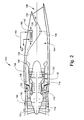
- FIG. 2 illustrates an alternative gas turbine engine which includes a duct burner, generally designated 110.
- the engine 110 is generally similar in construction to the engine 10 and includes outer stationary annular casing 112, a fan 114, compressor 116, combustor 118, high pressure turbine 120, and low pressure turbine 122 arranged in serial flow relationship.
- the engine 110 also includes a duct burner 132 as described above, disposed within a bypass duct 130, an exhaust duct 138, a mixer 140, and a nozzle 142 having an inlet 144, a throat 146, and an exit 148.
- the throat area A8 may be variable as described above.
- the nozzle 142 is a "2-D" design incorporating a serpentine flow path.
- the engine 110 also includes a supplementary fan, referred to as a "FLADE" stage 150 in the form of a ring of airfoils extending radially outwardly from an annular shroud 152 and driven by the fan 114.
- the FLADE stage 150 is positioned in a fan outer duct 154 which surrounds the bypass duct 130.
- the FLADE stage 150 provides an additional flow stream at a different flow and pressure ratio that than of the fan 114.
- the FLADE stage 150 can be used for optimizing installation losses (i.e. to allow the engine 110 to "swallow" excess airflow from a fixed geometry inlet at high speeds), and to provide additional nozzle cooling.
- airflow from the FLADE stage 150 may be discharged into an interior space 156 of the nozzle 142 to cool the nozzle surfaces, and then ejected through a slot or FLADE nozzle 158 in the nozzle 142 to provide some supplemental thrust.
- a heat exchanger 160 may be placed inside the interior space 156 of the nozzle 142.
- the heat exchanger 160 for example a liquid-to-air type, may be connected to a heat transfer fluid (e.g. fuel or oil) through lines 162 and 164. This allows waste heat to be rejected from the airframe (not shown) and also provides some thrust increase by increasing the temperature of the FLADE discharge flow.
- a heat transfer fluid e.g. fuel or oil
- Figure 3 illustrates another alternative gas turbine engine 210 which includes a duct burner.
- the engine 210 is generally similar in construction to the engine 10 and includes outer stationary annular casing 212, a fan 214, compressor 216, combustor 218, high pressure turbine 220, and low pressure turbine 222 arranged in serial flow relationship.
- the engine 210 also includes a duct burner 232 as described above, disposed within a bypass duct 230, and an exhaust duct 238 which receives the mixed flow from the bypass duct 230 and the engine core 228.
- the mixed flow exhaust is discharged through an outer nozzle 242.
- the outer nozzle 242 is a plug type and includes a centerbody 243, an inner shroud 245, and an outer shroud 247.
- the centerbody 243 is centered along the longitudinal axis A of the engine 210 and extends in an aft direction.
- the centerbody 243 includes, sequentially, a small-diameter tapered forward section, a throat section of increased diameter, and an aft section which tapers in diameter to form an aft-facing conical shape.
- the inner and outer shrouds 245 and 247 may be independently translated to achieve independently variable throat (A8) and exit plane (conventionally denoted "A9") areas during different operating conditions.
- A8 independently variable throat
- A9 exit plane
- the engine 210 also includes a supplementary fan, referred to as a "FLADE" stage 250 in the form of a ring of airfoils extending radially outwardly from an annular shroud 251 and driven by the fan 214.
- the FLADE stage 250 is positioned in a fan outer duct 254 which surrounds the bypass duct 230.
- the FLADE stage 250 provides an additional flow stream at a different flow and pressure ratio that than of the fan 214.
- the FLADE stage 250 can be used for optimizing installation losses (i.e. to allow the engine 210 to "swallow" excess airflow from a fixed geometry inlet at high speeds), to provide additional nozzle cooling, and to provide additional thrust.
- flow from the fan outer duct 254 is discharged thorough one or more radially-extending hollow struts 266 to an inner nozzle 268.
- the inner nozzle 266 is a plug type having a shroud 270 (which in this case is formed by a portion of the same structure that defines the centerbody 243 of the outer nozzle 242), and a plug 272.
- a nozzle throat 274 is defined between the narrowest portion of the shroud 270 and the widest portion of the plug 272.
- the plug 272 may be translated fore or aft using an actuator 276 to vary the throat area A8 in a known manner.
- the discharge of the FLADE stage flow through the fan outer duct 254, struts 266, and inner nozzle 268 in this manner provides cooling to structure of the entire exhaust system. This in turn allows higher exhaust temperatures to be used in the outer nozzle.
- Analytical studies and scale model tests have indicated that at a given level of jet velocity, jet noise can be reduced if the temperature of the jet exhaust is increased while pressure levels are decreased.
- fan pressure levels and duct burner temperature levels would be adjusted to arrive at the optimum combination of parameters to minimize jet noise at the prescribed level of mixed stream jet velocity needed to produce adequate take-off thrust.
- the duct burner 232 could also be used to minimize the engine size and time needed for transonic acceleration and climb to an optimum supersonic cruise flight condition.
- the duct burner systems described above can supply modest thrust increases for either existing engines, like military low-bypass military turbofan engines, or can be incorporated into a new engine design so a more optimum cruise cycle can be utilized.
- SLS thrust increases of about 15%-25% can be achieved with duct temperatures in the 1000° to 1300° C to (2000° to 2400° F) range.
- a 3.5 fan pressure ratio, moderate bypass ratio engine with a duct burner that provides about a 20% SLS thrust increase would have the same fan flow and take-off thrust as a 4.5 fan pressure ratio , lower bypass dry engine, while also providing about a 10 % lower subsonic cruise SFC.
Landscapes
- Engineering & Computer Science (AREA)
- Chemical & Material Sciences (AREA)
- Combustion & Propulsion (AREA)
- Mechanical Engineering (AREA)
- General Engineering & Computer Science (AREA)
- Structures Of Non-Positive Displacement Pumps (AREA)
- Jet Pumps And Other Pumps (AREA)
Abstract
Description
- This invention relates generally to gas turbine engines and more particularly to a turbofan engine having a duct burner.
- Some new aircraft designs under study have diverse propulsion needs in terms of sea-level static (SLS) take-off thrust levels, cruise thrust and specific fuel consumption (SFC) levels, engine diameter and length restrictions, and exhaust system shaping (i.e. for "low observables" purposes) that make it difficult to utilize an existing engine or even to define a new non-augmented engine that meets all of these needs. In particular, demanding "hot day", high altitude, short runway requirements can be difficult to meet with unaugmented or "dry" versions of existing engines that also meet applicable fan diameter limitations. Augmented (afterburning) versions of these existing engines are typically too long and are not as amenable to special exhaust system shaping as non-afterburning versions. Non-augmented, higher fan pressure ratio engines can be defined that supply the needed thrust within the diameter and length constraints but they will have higher than desired cruise segment SFC levels.
- What is needed in such situations is an augmentation system that can supply a modest (e.g. about 15-25%) increase in take-off thrust for either existing engines, such as low-bypass military turbofan engines, or can be incorporated into a new engine design so a more optimum cruise cycle can be utilized. This augmentation concept must also be compatible with the length and shaping needs of the exhaust system.
- Current engine augmentation systems are located in the engine tailpipe downstream of the rear frame. They can easily be sized to provide well in excess of the 15-25% thrust increase mentioned above, but will add appreciable length as well as not being highly adaptable to exhaust system shaping
- "Duct burners", i.e. augmentation systems placed in a bypass duct of an engine, have been demonstrated in the prior art. However, these duct burners required two separate exhausts, one for the primary stream and one for the augmented bypass stream, increasing the weight, complexity, and cost of the engine.
- The above-mentioned shortcomings in the prior art among others are addressed by the present invention, which according to one aspect provides a gas turbine engine, including: a turbomachinery core operable to generating a first flow of pressurized combustion gases, the core having an exit plane; a fan disposed upstream of the core adapted to extract energy from the core and provide a first flow of pressurized air; a bypass duct surrounding the core which receives a portion of the flow of pressurized air from the fan; a duct burner disposed in the bypass duct, upstream of the exit plane, for generating a second flow of pressurized combustion gases; and an exhaust duct disposed downstream of the core and operable to receive and the first and second flows of pressurized combustion gases and to discharge the combined flows downstream.
- According to another aspect of the invention, a gas turbine engine includes: a turbomachinery core operable to generating a first flow of pressurized combustion gases, the core having an exit plane; a fan disposed upstream of the core adapted to extract energy from the core and provide a first flow of pressurized air; a bypass duct surrounding the core which receives a portion of the flow of pressurized air from the fan a duct burner disposed in the bypass duct, upstream of the exit plane, for generating a second flow of pressurized combustion gases; an exhaust duct disposed downstream of the core and operable to receive and the first and second flows of pressurized combustion gases and to discharge the combined flows downstream; a first exhaust nozzle disposed downstream of the exhaust duct; a fan outer duct surrounding the bypass duct; a flade stage comprising a supplementary fan disposed in the fan outer duct and driven by the fan for generating a second flow of pressurized air; and a second exhaust nozzle disposed in the exhaust nozzle and adapted to discharge the second flow of pressurized air in a downstream direction.
- According to another aspect of the invention, a method of operating a gas turbine engine includes: burning a fuel in a turbomachinery core having an exit plane, to produce a first flow of pressurized combustion gases; generating a first flow of pressurized air using a fan disposed upstream of the core; channeling a portion of the first flow of pressurized air to a duct burner disposed upstream of the exit plane; burning a fuel in the duct burner to produce a second flow of pressurized combustion gases; and combining the first and second flows of pressurized combustion gases in to a mixed exhaust flow downstream of the exit plane.
- The invention may be best understood by reference to the following description taken in conjunction with the accompanying drawing figures in which:
-
Figure 1 is a schematic side cross-sectional view of a gas turbine engine constructed according to an aspect of the present invention; -
Figure 2 is a schematic side cross-sectional view of a gas turbine engine constructed according to another aspect of the present invention; and -
Figure 3 is a schematic side cross-sectional view of a gas turbine engine constructed according to yet another aspect of the present invention - Referring to the drawings wherein identical reference numerals denote the same elements throughout the various views,
Figure 1 illustrates a representative gas turbine engine, generally designated 10. Theengine 10 has a longitudinal center line or axis A and an outer stationaryannular casing 12 disposed concentrically about and coaxially along the axis A. Theengine 10 has afan 14,compressor 16,combustor 18, high pressure turbine 20, andlow pressure turbine 22 arranged in serial flow relationship. In operation, pressurized air from thecompressor 16 is mixed with fuel in thecombustor 18 and ignited, thereby generating pressurized combustion gases. Some work is extracted from these gases by the high pressure turbine 20 which drives thecompressor 16 via an outer shaft 24. The combustion gases then flow into thelow pressure turbine 22, which drives thefan 14 via an inner shaft 26. - A portion of the fan discharge flows through the
compressor 16,combustor 18, and highpressure turbine 20, which are collectively referred to as the "core" 28 of theengine 10. Another portion of the fan discharge flows through anannular bypass duct 30 which surrounds thecore 28. While the illustratedengine 10 has a conventional three-stage fan as is often found in military low-bypass turbofan engines, the principles of the present invention are equally applicable to other engine configurations so long as a bypass flow is present. - A
duct burner 32 comprising one ormore fuel injectors 34 andflameholders 36 of a known configuration is disposed within thebypass duct 30, at a point upstream of an exit plane "E" of the flow from thecore 28. Fuel feed and ignition fore theduct burner 32 are provided in a known manner, for example using the controls of theengine 10, similar to the manner in which a prior art afterburner would be controlled. If desired, theduct burner 32, or components thereof, may be configured to selectively fold or retract out of thebypass duct 30, so as to minimize flow losses therein when theduct burner 32 is not being used. Cooling air for the duct burner liners and downstream exhaust system needs can be extracted in front of theduct burner 32 to obtain a cooling source at the appropriate temperature and pressure levels. - An
exhaust duct 38 is disposed downstream of thecore 28, and receives the mixed air flow from both thecore 28 and thebypass duct 30. A mixer 40 (for example a lobed or chute-type mixer) is disposed at the juncture of thecore 28 andbypass duct 30 flow streams to promote efficient mixing of the two streams. If needed, themixer 40 may be of the type which can selectively vary its open area, so as to control the back pressure on thefan 14. This type of mixer is sometimes referred to as a variable area bypass injector ("VABI"). - A
nozzle 42 having aninlet 44, athroat 46, and anexit 48 is disposed downstream of theexhaust duct 38. The throat area, denoted "A8" in accordance with conventional practice, may be variable through the use of moveable components in thenozzle 42, in order to accommodate changes in the operating cycle flow when theduct burner 32 is cycled on and off. It may also be possible, depending on the selected duct temperature, to define a fixed A8 that would provide a useful level of maximum power augmented performance and an acceptable level of dry thrust and cruise SFC. In the illustrated example, thenozzle 42 is a so-called "2-D" design incorporating a serpentine flow path as "low observable" feature to reduce or prevent detection of the hot engine exhaust, and may include a thrust reverser or vectoring feature. However, the present invention may also be used with a conventional axisymmetric nozzle design (not shown). -
Figure 2 illustrates an alternative gas turbine engine which includes a duct burner, generally designated 110. Theengine 110 is generally similar in construction to theengine 10 and includes outer stationaryannular casing 112, afan 114, compressor 116,combustor 118,high pressure turbine 120, andlow pressure turbine 122 arranged in serial flow relationship. Theengine 110 also includes aduct burner 132 as described above, disposed within abypass duct 130, anexhaust duct 138, amixer 140, and anozzle 142 having aninlet 144, athroat 146, and anexit 148. The throat area A8 may be variable as described above. In the illustrated example, thenozzle 142 is a "2-D" design incorporating a serpentine flow path. - The
engine 110 also includes a supplementary fan, referred to as a "FLADE"stage 150 in the form of a ring of airfoils extending radially outwardly from anannular shroud 152 and driven by thefan 114. The FLADEstage 150 is positioned in a fanouter duct 154 which surrounds thebypass duct 130. The FLADEstage 150 provides an additional flow stream at a different flow and pressure ratio that than of thefan 114. The FLADEstage 150 can be used for optimizing installation losses (i.e. to allow theengine 110 to "swallow" excess airflow from a fixed geometry inlet at high speeds), and to provide additional nozzle cooling. For example, airflow from the FLADEstage 150 may be discharged into aninterior space 156 of thenozzle 142 to cool the nozzle surfaces, and then ejected through a slot orFLADE nozzle 158 in thenozzle 142 to provide some supplemental thrust. - Optionally, a
heat exchanger 160 may be placed inside theinterior space 156 of thenozzle 142. Theheat exchanger 160, for example a liquid-to-air type, may be connected to a heat transfer fluid (e.g. fuel or oil) throughlines -
Figure 3 illustrates another alternativegas turbine engine 210 which includes a duct burner. Theengine 210 is generally similar in construction to theengine 10 and includes outer stationaryannular casing 212, afan 214,compressor 216,combustor 218,high pressure turbine 220, andlow pressure turbine 222 arranged in serial flow relationship. - The
engine 210 also includes aduct burner 232 as described above, disposed within abypass duct 230, and anexhaust duct 238 which receives the mixed flow from thebypass duct 230 and theengine core 228. - The mixed flow exhaust is discharged through an
outer nozzle 242. While various types of nozzles may be used, in this example theouter nozzle 242 is a plug type and includes acenterbody 243, aninner shroud 245, and anouter shroud 247. Thecenterbody 243 is centered along the longitudinal axis A of theengine 210 and extends in an aft direction. Thecenterbody 243 includes, sequentially, a small-diameter tapered forward section, a throat section of increased diameter, and an aft section which tapers in diameter to form an aft-facing conical shape. The inner andouter shrouds US2006/0016171A1 , which is assigned to the assignee of the present invention. - The
engine 210 also includes a supplementary fan, referred to as a "FLADE"stage 250 in the form of a ring of airfoils extending radially outwardly from anannular shroud 251 and driven by thefan 214. The FLADEstage 250 is positioned in a fanouter duct 254 which surrounds thebypass duct 230. TheFLADE stage 250 provides an additional flow stream at a different flow and pressure ratio that than of thefan 214. TheFLADE stage 250 can be used for optimizing installation losses (i.e. to allow theengine 210 to "swallow" excess airflow from a fixed geometry inlet at high speeds), to provide additional nozzle cooling, and to provide additional thrust. - In the illustrated example, flow from the fan
outer duct 254 is discharged thorough one or more radially-extendinghollow struts 266 to aninner nozzle 268. Theinner nozzle 266 is a plug type having a shroud 270 (which in this case is formed by a portion of the same structure that defines thecenterbody 243 of the outer nozzle 242), and aplug 272. Anozzle throat 274 is defined between the narrowest portion of theshroud 270 and the widest portion of theplug 272. Theplug 272 may be translated fore or aft using anactuator 276 to vary the throat area A8 in a known manner. The discharge of the FLADE stage flow through the fanouter duct 254, struts 266, andinner nozzle 268 in this manner provides cooling to structure of the entire exhaust system. This in turn allows higher exhaust temperatures to be used in the outer nozzle. Analytical studies and scale model tests have indicated that at a given level of jet velocity, jet noise can be reduced if the temperature of the jet exhaust is increased while pressure levels are decreased. For theengine 210 shown, fan pressure levels and duct burner temperature levels would be adjusted to arrive at the optimum combination of parameters to minimize jet noise at the prescribed level of mixed stream jet velocity needed to produce adequate take-off thrust. Theduct burner 232 could also be used to minimize the engine size and time needed for transonic acceleration and climb to an optimum supersonic cruise flight condition. - The duct burner systems described above can supply modest thrust increases for either existing engines, like military low-bypass military turbofan engines, or can be incorporated into a new engine design so a more optimum cruise cycle can be utilized. For example, SLS thrust increases of about 15%-25% can be achieved with duct temperatures in the 1000° to 1300° C to (2000° to 2400° F) range.
- Engine designs that are fan flow and/or length limited due to airframe restrictions could benefit from this duct burning thrust augmentation concept by allowing a more cruise efficient, lower fan pressure ratio, higher bypass ratio engine to be used in place of the same thrust and fan flow size higher fan pressure ratio dry engine.
- For example, a 3.5 fan pressure ratio, moderate bypass ratio engine with a duct burner that provides about a 20% SLS thrust increase would have the same fan flow and take-off thrust as a 4.5 fan pressure ratio , lower bypass dry engine, while also providing about a 10 % lower subsonic cruise SFC.
- The foregoing has described a duct burner and a gas turbine engine incorporating a duct burner. While specific embodiments of the present invention have been described, it will be apparent to those skilled in the art that various modifications thereto can be made without departing from the spirit and scope of the invention. Accordingly, the foregoing description of the preferred embodiment of the invention and the best mode for practicing the invention are provided for the purpose of illustration only and not for the purpose of limitation, the invention being defined by the claims.
Claims (10)
- A gas turbine engine (10), comprising:(a) a turbomachinery core (28) operable to generating a first flow of pressurized combustion gases, the core (28) having an exit plane (E);(b) a fan (14) disposed upstream of the core (28) adapted to extract energy from the core (28) and generate a first flow of pressurized air;(c) a bypass duct (30) surrounding the core (28) which receives a portion of the flow of pressurized air from the fan (14);(d) a duct burner (32) disposed in the bypass duct (30), upstream of the exit plane (E), for receiving the first flow of pressurized air and generating a second flow of pressurized combustion gases; and(e) an exhaust duct (3 8) disposed downstream of the core (28) and operable to receive and the first and second flows of pressurized combustion gases and to discharge the combined flows downstream.
- The gas turbine engine (10) of claim 1 further including an exhaust nozzle (42) with a variable throat area (A8) disposed downstream of the exhaust duct (38).
- The gas turbine engine (10) of claim 2 wherein the exhaust nozzle (42) includes a serpentine flow path.
- The gas turbine engine (10) of any preceding claim further including:(a) a fan outer duct (154) surrounding the bypass duct (30); and(b) a flade stage (250) comprising a supplementary fan (214) disposed in the fan outer duct (154) and driven by the fan (214) for generating a second flow of pressurized air; and(c) a flade nozzle (158) disposed in the exhaust nozzle (142) and adapted to discharge the second flow of pressurized air in a downstream direction.
- The gas turbine engine (10) of claim 6 further including a heat exchanger (160) disposed in an interior space of the exhaust nozzle (142).
- The gas turbine engine (10) of any preceding claim wherein at least a portion of the duct burner (32) is moveable between an extended position within the bypass duct (30), and a retracted position outside of the bypass duct (30).
- The gas turbine engine (10) of any preceding claim further including a mixer (40) for receiving the first and second flows of pressurized combustion gases and discharging the combined flows to the exhaust duct (38), wherein an open area of the mixer (40) is selectively variable.
- A gas turbine engine (10), comprising:(a) a turbomachinery core (28) operable to generating a first flow of pressurized combustion gases, the core (28) having an exit plane (E);(b) a fan (14) disposed upstream of the core (28) adapted to extract energy from the core (28) and provide a first flow of pressurized air;(c) a bypass duct (30) surrounding the core (28) which receives a portion of the flow of pressurized air from the fan (14);(d) a duct burner (132) disposed in the bypass duct (130), upstream of the exit plane (E), for generating a second flow of pressurized combustion gases;(e) an exhaust duct (3 8) disposed downstream of the core (28) and operable to receive and the first and second flows of pressurized combustion gases and to discharge the combined flows downstream through a first exhaust nozzle (42) disposed downstream of the exhaust duct (38);(f) a fan outer duct (154) surrounding the bypass duct (130);(g) a flade stage (150) comprising a supplementary fan (114) disposed in the fan outer duct (154) and driven by the fan (114) for generating a second flow of pressurized air; and(h) a second exhaust nozzle (142) disposed in the exhaust nozzle (42) and adapted to discharge the second flow of pressurized air in a downstream direction.
- The gas turbine engine (10) of claim 8 in which the first nozzle (42) is plug nozzle having a variable throat area.
- The gas turbine engine (10) of claim 8 or claim 9 in which the first nozzle (42) has a variable exit area.
Applications Claiming Priority (1)
| Application Number | Priority Date | Filing Date | Title |
|---|---|---|---|
| US11/612,116 US7770381B2 (en) | 2006-12-18 | 2006-12-18 | Duct burning mixed flow turbofan and method of operation |
Publications (3)
| Publication Number | Publication Date |
|---|---|
| EP1939438A2 true EP1939438A2 (en) | 2008-07-02 |
| EP1939438A3 EP1939438A3 (en) | 2013-01-09 |
| EP1939438B1 EP1939438B1 (en) | 2014-05-14 |
Family
ID=39198193
Family Applications (1)
| Application Number | Title | Priority Date | Filing Date |
|---|---|---|---|
| EP07122367.1A Not-in-force EP1939438B1 (en) | 2006-12-18 | 2007-12-05 | Duct burning mixed flow turbofan |
Country Status (4)
| Country | Link |
|---|---|
| US (1) | US7770381B2 (en) |
| EP (1) | EP1939438B1 (en) |
| JP (1) | JP5220400B2 (en) |
| CA (1) | CA2613777C (en) |
Cited By (4)
| Publication number | Priority date | Publication date | Assignee | Title |
|---|---|---|---|---|
| CN102128101A (en) * | 2010-10-19 | 2011-07-20 | 靳北彪 | Jet engine with parallel combustion chambers |
| EP2159383A3 (en) * | 2008-08-25 | 2013-04-03 | General Electric Company | Gas turbine engine fan bleed heat exchanger system |
| RU2641191C1 (en) * | 2016-12-26 | 2018-01-16 | Федеральное государственное бюджетное образовательное учреждение высшего образования "Московский авиационный институт (национальный исследовательский университет)" | Afterburner of the two-convention turboreactive engine |
| EP4015796A3 (en) * | 2020-12-18 | 2022-08-17 | The Boeing Company | Systems and methods for expanding an operating speed range of a high speed flight vehicle |
Families Citing this family (33)
| Publication number | Priority date | Publication date | Assignee | Title |
|---|---|---|---|---|
| US9267463B2 (en) * | 2008-03-25 | 2016-02-23 | United Technologies Corp. | Gas turbine engine systems involving variable nozzles with flexible panels |
| US8356483B2 (en) * | 2008-04-10 | 2013-01-22 | United Technologies Corp | Gas turbine engine systems involving variable nozzles with sliding doors |
| KR20100032054A (en) * | 2008-09-17 | 2010-03-25 | 인제대학교 산학협력단 | Apparatus and method for alzheimer's disease diagnosis using eeg(electroencephalogram) analysis |
| US8572947B2 (en) * | 2008-12-31 | 2013-11-05 | Rolls-Royce Corporation | Gas turbine engine with ejector |
| US20110167792A1 (en) * | 2009-09-25 | 2011-07-14 | James Edward Johnson | Adaptive engine |
| US20110171007A1 (en) * | 2009-09-25 | 2011-07-14 | James Edward Johnson | Convertible fan system |
| US8695324B2 (en) * | 2009-11-20 | 2014-04-15 | General Electric Co. | Multistage tip fan |
| WO2012018615A1 (en) | 2010-07-26 | 2012-02-09 | Rolls-Royce Corporation | Gas turbine engine with ejector |
| US9016041B2 (en) | 2010-11-30 | 2015-04-28 | General Electric Company | Variable-cycle gas turbine engine with front and aft FLADE stages |
| US8984891B2 (en) | 2010-12-30 | 2015-03-24 | General Electric Company | Flade discharge in 2-D exhaust nozzle |
| US8789376B2 (en) | 2011-05-27 | 2014-07-29 | General Electric Company | Flade duct turbine cooling and power and thermal management |
| US9630706B2 (en) | 2013-02-22 | 2017-04-25 | Rolls-Royce Corporation | Positionable ejector member for ejector enhanced boundary layer alleviation |
| US9863366B2 (en) | 2013-03-13 | 2018-01-09 | Rolls-Royce North American Technologies Inc. | Exhaust nozzle apparatus and method for multi stream aircraft engine |
| WO2014160449A2 (en) * | 2013-03-13 | 2014-10-02 | Rolls-Royce North American Technologies, Inc. | Three stream, variable area fixed aperture nozzle with pneumatic actuation |
| US10400710B2 (en) * | 2013-05-07 | 2019-09-03 | General Electric Company | Secondary nozzle for jet engine |
| US9920710B2 (en) | 2013-05-07 | 2018-03-20 | General Electric Company | Multi-nozzle flow diverter for jet engine |
| CN103835836B (en) * | 2014-03-10 | 2015-09-09 | 金剑 | The gas turbine that a kind of bypass ratio is controlled |
| US10378477B2 (en) | 2015-04-30 | 2019-08-13 | Rolls-Royce North American Technologies Inc. | Nozzle for jet engines |
| US10137981B2 (en) * | 2017-03-31 | 2018-11-27 | General Electric Company | Electric propulsion system for an aircraft |
| FR3070184B1 (en) * | 2017-08-21 | 2019-08-23 | Safran Aircraft Engines | HOT AIR DELIVERY SYSTEM AT THE COLLAR OF A CONVERGENT-DIVERGENT SECONDARY PIPE |
| DE102017130568A1 (en) * | 2017-12-19 | 2019-06-19 | Rolls-Royce Deutschland Ltd & Co Kg | Discharge nozzle for a turbofan engine of a supersonic aircraft |
| DE102017130563A1 (en) * | 2017-12-19 | 2019-06-19 | Rolls-Royce Deutschland Ltd & Co Kg | Discharge nozzle for a turbofan engine of a supersonic aircraft |
| GB201912823D0 (en) * | 2019-09-06 | 2019-10-23 | Rolls Royce Plc | Gas turbine engine |
| US11300049B2 (en) * | 2020-03-09 | 2022-04-12 | Rolls-Royce North American Technologies Inc. | Inlet guide vane draw heat exchanger system |
| US11713733B2 (en) * | 2021-08-13 | 2023-08-01 | Pratt & Whitney Canada Corp. | Methods and systems for operating an engine to generate additional thrust |
| CN113565649A (en) * | 2021-08-16 | 2021-10-29 | 中国科学院工程热物理研究所 | Three-duct ACE engine with Flade fan and core machine driving fan stages |
| US12410753B2 (en) | 2022-11-01 | 2025-09-09 | General Electric Company | Gas turbine engine |
| US12428992B2 (en) | 2022-11-01 | 2025-09-30 | General Electric Company | Gas turbine engine |
| US12535033B2 (en) | 2022-11-01 | 2026-01-27 | General Electric Company | Gas turbine engine |
| US12196131B2 (en) | 2022-11-01 | 2025-01-14 | General Electric Company | Gas turbine engine |
| US12392290B2 (en) | 2022-11-01 | 2025-08-19 | General Electric Company | Gas turbine engine |
| US12503980B2 (en) | 2022-11-01 | 2025-12-23 | General Electric Company | Gas turbine engine |
| US12540551B1 (en) | 2025-07-01 | 2026-02-03 | General Electric Company | Gas turbine engines including splittered airfoils |
Citations (1)
| Publication number | Priority date | Publication date | Assignee | Title |
|---|---|---|---|---|
| US20060016171A1 (en) | 2004-07-23 | 2006-01-26 | Renggli Bernard J | Split shroud exhaust nozzle |
Family Cites Families (25)
| Publication number | Priority date | Publication date | Assignee | Title |
|---|---|---|---|---|
| US2887845A (en) * | 1956-09-07 | 1959-05-26 | Westinghouse Electric Corp | Fuel ignition apparatus |
| US3060679A (en) * | 1958-10-24 | 1962-10-30 | Gen Electric | Powerplant |
| FR1271544A (en) * | 1960-07-11 | 1961-09-15 | Nord Aviation | Combined turbojet-ramjet |
| US3677012A (en) * | 1962-05-31 | 1972-07-18 | Gen Electric | Composite cycle turbomachinery |
| US3693354A (en) * | 1971-01-22 | 1972-09-26 | Gen Electric | Aircraft engine fan duct burner system |
| US3797233A (en) * | 1973-06-28 | 1974-03-19 | United Aircraft Corp | Integrated control for a turbopropulsion system |
| US4137708A (en) * | 1973-07-02 | 1979-02-06 | General Motors Corporation | Jet propulsion |
| US3999378A (en) * | 1974-01-02 | 1976-12-28 | General Electric Company | Bypass augmentation burner arrangement for a gas turbine engine |
| CA1020365A (en) * | 1974-02-25 | 1977-11-08 | James E. Johnson | Modulating bypass variable cycle turbofan engine |
| US3987621A (en) * | 1974-06-03 | 1976-10-26 | United Technologies Corporation | Method for reducing jet exhaust takeoff noise from a turbofan engine |
| US4069661A (en) * | 1975-06-02 | 1978-01-24 | The United States Of America As Represented By The United States National Aeronautics And Space Administration | Variable mixer propulsion cycle |
| US4050242A (en) * | 1975-12-01 | 1977-09-27 | General Electric Company | Multiple bypass-duct turbofan with annular flow plug nozzle and method of operating same |
| US5832715A (en) * | 1990-02-28 | 1998-11-10 | Dev; Sudarshan Paul | Small gas turbine engine having enhanced fuel economy |
| US5154052A (en) * | 1990-05-07 | 1992-10-13 | General Electric Company | Exhaust assembly for a high speed civil transport aircraft engine |
| US5311735A (en) * | 1993-05-10 | 1994-05-17 | General Electric Company | Ramjet bypass duct and preburner configuration |
| US5867980A (en) * | 1996-12-17 | 1999-02-09 | General Electric Company | Turbofan engine with a low pressure turbine driven supercharger in a bypass duct operated by a fuel rich combustor and an afterburner |
| US7246484B2 (en) * | 2003-08-25 | 2007-07-24 | General Electric Company | FLADE gas turbine engine with counter-rotatable fans |
| US7395657B2 (en) * | 2003-10-20 | 2008-07-08 | General Electric Company | Flade gas turbine engine with fixed geometry inlet |
| FR2873408B1 (en) * | 2004-07-23 | 2008-10-17 | Snecma Moteurs Sa | TURBOREACTOR WITH A PROTECTION SCREEN OF THE FUEL RAMP OF A BURNER RING, THE BURNER RING AND THE PROTECTION SCREEN |
| US7059136B2 (en) * | 2004-08-27 | 2006-06-13 | General Electric Company | Air turbine powered accessory |
| US7140174B2 (en) * | 2004-09-30 | 2006-11-28 | General Electric Company | Methods and apparatus for assembling a gas turbine engine |
| US7188467B2 (en) * | 2004-09-30 | 2007-03-13 | General Electric Company | Methods and apparatus for assembling a gas turbine engine |
| US20060196164A1 (en) * | 2005-03-03 | 2006-09-07 | Donohue Thomas F | Dual mode turbo engine |
| US7437876B2 (en) * | 2005-03-25 | 2008-10-21 | General Electric Company | Augmenter swirler pilot |
| US7565804B1 (en) * | 2006-06-29 | 2009-07-28 | General Electric Company | Flameholder fuel shield |
-
2006
- 2006-12-18 US US11/612,116 patent/US7770381B2/en active Active
-
2007
- 2007-12-05 EP EP07122367.1A patent/EP1939438B1/en not_active Not-in-force
- 2007-12-06 CA CA2613777A patent/CA2613777C/en not_active Expired - Fee Related
- 2007-12-17 JP JP2007324194A patent/JP5220400B2/en not_active Expired - Fee Related
Patent Citations (1)
| Publication number | Priority date | Publication date | Assignee | Title |
|---|---|---|---|---|
| US20060016171A1 (en) | 2004-07-23 | 2006-01-26 | Renggli Bernard J | Split shroud exhaust nozzle |
Cited By (4)
| Publication number | Priority date | Publication date | Assignee | Title |
|---|---|---|---|---|
| EP2159383A3 (en) * | 2008-08-25 | 2013-04-03 | General Electric Company | Gas turbine engine fan bleed heat exchanger system |
| CN102128101A (en) * | 2010-10-19 | 2011-07-20 | 靳北彪 | Jet engine with parallel combustion chambers |
| RU2641191C1 (en) * | 2016-12-26 | 2018-01-16 | Федеральное государственное бюджетное образовательное учреждение высшего образования "Московский авиационный институт (национальный исследовательский университет)" | Afterburner of the two-convention turboreactive engine |
| EP4015796A3 (en) * | 2020-12-18 | 2022-08-17 | The Boeing Company | Systems and methods for expanding an operating speed range of a high speed flight vehicle |
Also Published As
| Publication number | Publication date |
|---|---|
| CA2613777A1 (en) | 2008-06-18 |
| US20080141655A1 (en) | 2008-06-19 |
| EP1939438A3 (en) | 2013-01-09 |
| US7770381B2 (en) | 2010-08-10 |
| JP5220400B2 (en) | 2013-06-26 |
| JP2008151134A (en) | 2008-07-03 |
| CA2613777C (en) | 2015-06-16 |
| EP1939438B1 (en) | 2014-05-14 |
Similar Documents
| Publication | Publication Date | Title |
|---|---|---|
| EP1939438B1 (en) | Duct burning mixed flow turbofan | |
| US6442930B1 (en) | Combined cycle pulse detonation turbine engine | |
| CN109028146B (en) | Hybrid combustor assembly and method of operation | |
| US7225623B2 (en) | Trapped vortex cavity afterburner | |
| US7134271B2 (en) | Thrust vectoring aft FLADE engine | |
| EP1533510B1 (en) | Two-spool variable cycle gas turbine engine | |
| US11236639B2 (en) | Gas turbine engine and an airflow control system | |
| EP1605207B1 (en) | Thrust augmentor for gas turbine engines | |
| US6666018B2 (en) | Combined cycle pulse detonation turbine engine | |
| US5311735A (en) | Ramjet bypass duct and preburner configuration | |
| US8984891B2 (en) | Flade discharge in 2-D exhaust nozzle | |
| EP3636906B1 (en) | Afterburner system | |
| GB2425573A (en) | Fladed turbojet engine | |
| US6868665B2 (en) | Methods and apparatus for operating gas turbine engines | |
| US11920539B1 (en) | Gas turbine exhaust nozzle noise abatement | |
| US12618381B2 (en) | Gas turbine exhaust nozzle noise abatement | |
| Orlando | Ramjet bypass duct and preburner configuration |
Legal Events
| Date | Code | Title | Description |
|---|---|---|---|
| PUAI | Public reference made under article 153(3) epc to a published international application that has entered the european phase |
Free format text: ORIGINAL CODE: 0009012 |
|
| AK | Designated contracting states |
Kind code of ref document: A2 Designated state(s): AT BE BG CH CY CZ DE DK EE ES FI FR GB GR HU IE IS IT LI LT LU LV MC MT NL PL PT RO SE SI SK TR |
|
| AX | Request for extension of the european patent |
Extension state: AL BA HR MK RS |
|
| PUAL | Search report despatched |
Free format text: ORIGINAL CODE: 0009013 |
|
| AK | Designated contracting states |
Kind code of ref document: A3 Designated state(s): AT BE BG CH CY CZ DE DK EE ES FI FR GB GR HU IE IS IT LI LT LU LV MC MT NL PL PT RO SE SI SK TR |
|
| AX | Request for extension of the european patent |
Extension state: AL BA HR MK RS |
|
| RIC1 | Information provided on ipc code assigned before grant |
Ipc: F02K 3/11 20060101AFI20121130BHEP Ipc: F02K 3/077 20060101ALI20121130BHEP Ipc: F02K 1/82 20060101ALI20121130BHEP Ipc: F02K 3/06 20060101ALI20121130BHEP |
|
| 17P | Request for examination filed |
Effective date: 20130709 |
|
| RBV | Designated contracting states (corrected) |
Designated state(s): AT BE BG CH CY CZ DE DK EE ES FI FR GB GR HU IE IS IT LI LT LU LV MC MT NL PL PT RO SE SI SK TR |
|
| AKX | Designation fees paid |
Designated state(s): DE FR GB SE |
|
| GRAP | Despatch of communication of intention to grant a patent |
Free format text: ORIGINAL CODE: EPIDOSNIGR1 |
|
| INTG | Intention to grant announced |
Effective date: 20140117 |
|
| GRAS | Grant fee paid |
Free format text: ORIGINAL CODE: EPIDOSNIGR3 |
|
| GRAA | (expected) grant |
Free format text: ORIGINAL CODE: 0009210 |
|
| AK | Designated contracting states |
Kind code of ref document: B1 Designated state(s): DE FR GB SE |
|
| REG | Reference to a national code |
Ref country code: GB Ref legal event code: FG4D |
|
| REG | Reference to a national code |
Ref country code: DE Ref legal event code: R096 Ref document number: 602007036672 Country of ref document: DE Effective date: 20140618 |
|
| REG | Reference to a national code |
Ref country code: SE Ref legal event code: TRGR |
|
| REG | Reference to a national code |
Ref country code: DE Ref legal event code: R097 Ref document number: 602007036672 Country of ref document: DE |
|
| PLBE | No opposition filed within time limit |
Free format text: ORIGINAL CODE: 0009261 |
|
| STAA | Information on the status of an ep patent application or granted ep patent |
Free format text: STATUS: NO OPPOSITION FILED WITHIN TIME LIMIT |
|
| 26N | No opposition filed |
Effective date: 20150217 |
|
| REG | Reference to a national code |
Ref country code: DE Ref legal event code: R097 Ref document number: 602007036672 Country of ref document: DE Effective date: 20150217 |
|
| REG | Reference to a national code |
Ref country code: FR Ref legal event code: PLFP Year of fee payment: 9 |
|
| REG | Reference to a national code |
Ref country code: FR Ref legal event code: PLFP Year of fee payment: 10 |
|
| REG | Reference to a national code |
Ref country code: FR Ref legal event code: PLFP Year of fee payment: 11 |
|
| PGFP | Annual fee paid to national office [announced via postgrant information from national office to epo] |
Ref country code: SE Payment date: 20191125 Year of fee payment: 13 Ref country code: DE Payment date: 20191119 Year of fee payment: 13 |
|
| PGFP | Annual fee paid to national office [announced via postgrant information from national office to epo] |
Ref country code: FR Payment date: 20191120 Year of fee payment: 13 |
|
| PGFP | Annual fee paid to national office [announced via postgrant information from national office to epo] |
Ref country code: GB Payment date: 20191122 Year of fee payment: 13 |
|
| REG | Reference to a national code |
Ref country code: DE Ref legal event code: R119 Ref document number: 602007036672 Country of ref document: DE |
|
| REG | Reference to a national code |
Ref country code: SE Ref legal event code: EUG |
|
| GBPC | Gb: european patent ceased through non-payment of renewal fee |
Effective date: 20201205 |
|
| PG25 | Lapsed in a contracting state [announced via postgrant information from national office to epo] |
Ref country code: FR Free format text: LAPSE BECAUSE OF NON-PAYMENT OF DUE FEES Effective date: 20201231 |
|
| PG25 | Lapsed in a contracting state [announced via postgrant information from national office to epo] |
Ref country code: GB Free format text: LAPSE BECAUSE OF NON-PAYMENT OF DUE FEES Effective date: 20201205 Ref country code: DE Free format text: LAPSE BECAUSE OF NON-PAYMENT OF DUE FEES Effective date: 20210701 Ref country code: SE Free format text: LAPSE BECAUSE OF NON-PAYMENT OF DUE FEES Effective date: 20201206 |