EP1935963A1 - Liquid-crystalline medium - Google Patents
Liquid-crystalline medium Download PDFInfo
- Publication number
- EP1935963A1 EP1935963A1 EP07023957A EP07023957A EP1935963A1 EP 1935963 A1 EP1935963 A1 EP 1935963A1 EP 07023957 A EP07023957 A EP 07023957A EP 07023957 A EP07023957 A EP 07023957A EP 1935963 A1 EP1935963 A1 EP 1935963A1
- Authority
- EP
- European Patent Office
- Prior art keywords
- compounds
- liquid
- formula
- alkyl
- independently
- Prior art date
- Legal status (The legal status is an assumption and is not a legal conclusion. Google has not performed a legal analysis and makes no representation as to the accuracy of the status listed.)
- Granted
Links
- 0 Cc1c(*)c(I)c(C)cc1 Chemical compound Cc1c(*)c(I)c(C)cc1 0.000 description 15
- OKQAUBOLDPWPGY-UHFFFAOYSA-N C=CC(CC1)CCC1c(cc1)ccc1-c(c(N)c1N)ccc1O Chemical compound C=CC(CC1)CCC1c(cc1)ccc1-c(c(N)c1N)ccc1O OKQAUBOLDPWPGY-UHFFFAOYSA-N 0.000 description 1
- BUZRPEZWIGWIGU-UHFFFAOYSA-N CC(C)(C)C(CC1)CCC1C(C)(C)C(Cc(c1c2F)ccc2F)C1(F)F Chemical compound CC(C)(C)C(CC1)CCC1C(C)(C)C(Cc(c1c2F)ccc2F)C1(F)F BUZRPEZWIGWIGU-UHFFFAOYSA-N 0.000 description 1
- QLSUTUREGQXYIS-UHFFFAOYSA-N CC(CC1)CCC1c(cc1)ccc1-c(ccc(-c1ccc(C)c(F)c1)c1F)c1F Chemical compound CC(CC1)CCC1c(cc1)ccc1-c(ccc(-c1ccc(C)c(F)c1)c1F)c1F QLSUTUREGQXYIS-UHFFFAOYSA-N 0.000 description 1
- XLNYELHUCMJCCL-UHFFFAOYSA-N CC(CC1)CCC1c(cc1)ccc1C(CC1=[F])=CC=C1c1ccc(C)cc1 Chemical compound CC(CC1)CCC1c(cc1)ccc1C(CC1=[F])=CC=C1c1ccc(C)cc1 XLNYELHUCMJCCL-UHFFFAOYSA-N 0.000 description 1
- DBLHOBLHKVAQSR-UHFFFAOYSA-N Cc(cc1)ccc1-c(cc1)cc(F)c1-c1ccc(C)cc1 Chemical compound Cc(cc1)ccc1-c(cc1)cc(F)c1-c1ccc(C)cc1 DBLHOBLHKVAQSR-UHFFFAOYSA-N 0.000 description 1
- QHSYDKVZCXQNFY-UHFFFAOYSA-N Cc(cc1)ccc1-c(cc1)ccc1C#Cc(c(F)cc(C)c1)c1F Chemical compound Cc(cc1)ccc1-c(cc1)ccc1C#Cc(c(F)cc(C)c1)c1F QHSYDKVZCXQNFY-UHFFFAOYSA-N 0.000 description 1
Classifications
-
- C—CHEMISTRY; METALLURGY
- C09—DYES; PAINTS; POLISHES; NATURAL RESINS; ADHESIVES; COMPOSITIONS NOT OTHERWISE PROVIDED FOR; APPLICATIONS OF MATERIALS NOT OTHERWISE PROVIDED FOR
- C09K—MATERIALS FOR MISCELLANEOUS APPLICATIONS, NOT PROVIDED FOR ELSEWHERE
- C09K19/00—Liquid crystal materials
- C09K19/04—Liquid crystal materials characterised by the chemical structure of the liquid crystal components, e.g. by a specific unit
- C09K19/42—Mixtures of liquid crystal compounds covered by two or more of the preceding groups C09K19/06 - C09K19/40
- C09K19/44—Mixtures of liquid crystal compounds covered by two or more of the preceding groups C09K19/06 - C09K19/40 containing compounds with benzene rings directly linked
-
- C—CHEMISTRY; METALLURGY
- C09—DYES; PAINTS; POLISHES; NATURAL RESINS; ADHESIVES; COMPOSITIONS NOT OTHERWISE PROVIDED FOR; APPLICATIONS OF MATERIALS NOT OTHERWISE PROVIDED FOR
- C09K—MATERIALS FOR MISCELLANEOUS APPLICATIONS, NOT PROVIDED FOR ELSEWHERE
- C09K19/00—Liquid crystal materials
- C09K19/04—Liquid crystal materials characterised by the chemical structure of the liquid crystal components, e.g. by a specific unit
- C09K19/42—Mixtures of liquid crystal compounds covered by two or more of the preceding groups C09K19/06 - C09K19/40
-
- C—CHEMISTRY; METALLURGY
- C09—DYES; PAINTS; POLISHES; NATURAL RESINS; ADHESIVES; COMPOSITIONS NOT OTHERWISE PROVIDED FOR; APPLICATIONS OF MATERIALS NOT OTHERWISE PROVIDED FOR
- C09K—MATERIALS FOR MISCELLANEOUS APPLICATIONS, NOT PROVIDED FOR ELSEWHERE
- C09K19/00—Liquid crystal materials
- C09K19/04—Liquid crystal materials characterised by the chemical structure of the liquid crystal components, e.g. by a specific unit
- C09K19/06—Non-steroidal liquid crystal compounds
- C09K19/08—Non-steroidal liquid crystal compounds containing at least two non-condensed rings
- C09K19/30—Non-steroidal liquid crystal compounds containing at least two non-condensed rings containing saturated or unsaturated non-aromatic rings, e.g. cyclohexane rings
- C09K19/3001—Cyclohexane rings
- C09K19/3003—Compounds containing at least two rings in which the different rings are directly linked (covalent bond)
-
- C—CHEMISTRY; METALLURGY
- C09—DYES; PAINTS; POLISHES; NATURAL RESINS; ADHESIVES; COMPOSITIONS NOT OTHERWISE PROVIDED FOR; APPLICATIONS OF MATERIALS NOT OTHERWISE PROVIDED FOR
- C09K—MATERIALS FOR MISCELLANEOUS APPLICATIONS, NOT PROVIDED FOR ELSEWHERE
- C09K19/00—Liquid crystal materials
- C09K19/04—Liquid crystal materials characterised by the chemical structure of the liquid crystal components, e.g. by a specific unit
- C09K19/06—Non-steroidal liquid crystal compounds
- C09K19/08—Non-steroidal liquid crystal compounds containing at least two non-condensed rings
- C09K19/30—Non-steroidal liquid crystal compounds containing at least two non-condensed rings containing saturated or unsaturated non-aromatic rings, e.g. cyclohexane rings
- C09K19/3001—Cyclohexane rings
- C09K19/3059—Cyclohexane rings in which at least two rings are linked by a carbon chain containing carbon to carbon triple bonds
-
- G—PHYSICS
- G02—OPTICS
- G02F—OPTICAL DEVICES OR ARRANGEMENTS FOR THE CONTROL OF LIGHT BY MODIFICATION OF THE OPTICAL PROPERTIES OF THE MEDIA OF THE ELEMENTS INVOLVED THEREIN; NON-LINEAR OPTICS; FREQUENCY-CHANGING OF LIGHT; OPTICAL LOGIC ELEMENTS; OPTICAL ANALOGUE/DIGITAL CONVERTERS
- G02F1/00—Devices or arrangements for the control of the intensity, colour, phase, polarisation or direction of light arriving from an independent light source, e.g. switching, gating or modulating; Non-linear optics
- G02F1/01—Devices or arrangements for the control of the intensity, colour, phase, polarisation or direction of light arriving from an independent light source, e.g. switching, gating or modulating; Non-linear optics for the control of the intensity, phase, polarisation or colour
- G02F1/13—Devices or arrangements for the control of the intensity, colour, phase, polarisation or direction of light arriving from an independent light source, e.g. switching, gating or modulating; Non-linear optics for the control of the intensity, phase, polarisation or colour based on liquid crystals, e.g. single liquid crystal display cells
- G02F1/133—Constructional arrangements; Operation of liquid crystal cells; Circuit arrangements
- G02F1/1333—Constructional arrangements; Manufacturing methods
-
- C—CHEMISTRY; METALLURGY
- C09—DYES; PAINTS; POLISHES; NATURAL RESINS; ADHESIVES; COMPOSITIONS NOT OTHERWISE PROVIDED FOR; APPLICATIONS OF MATERIALS NOT OTHERWISE PROVIDED FOR
- C09K—MATERIALS FOR MISCELLANEOUS APPLICATIONS, NOT PROVIDED FOR ELSEWHERE
- C09K19/00—Liquid crystal materials
- C09K19/04—Liquid crystal materials characterised by the chemical structure of the liquid crystal components, e.g. by a specific unit
- C09K19/06—Non-steroidal liquid crystal compounds
- C09K19/08—Non-steroidal liquid crystal compounds containing at least two non-condensed rings
- C09K19/10—Non-steroidal liquid crystal compounds containing at least two non-condensed rings containing at least two benzene rings
- C09K19/12—Non-steroidal liquid crystal compounds containing at least two non-condensed rings containing at least two benzene rings at least two benzene rings directly linked, e.g. biphenyls
- C09K2019/121—Compounds containing phenylene-1,4-diyl (-Ph-)
- C09K2019/123—Ph-Ph-Ph
-
- C—CHEMISTRY; METALLURGY
- C09—DYES; PAINTS; POLISHES; NATURAL RESINS; ADHESIVES; COMPOSITIONS NOT OTHERWISE PROVIDED FOR; APPLICATIONS OF MATERIALS NOT OTHERWISE PROVIDED FOR
- C09K—MATERIALS FOR MISCELLANEOUS APPLICATIONS, NOT PROVIDED FOR ELSEWHERE
- C09K19/00—Liquid crystal materials
- C09K19/04—Liquid crystal materials characterised by the chemical structure of the liquid crystal components, e.g. by a specific unit
- C09K19/06—Non-steroidal liquid crystal compounds
- C09K19/08—Non-steroidal liquid crystal compounds containing at least two non-condensed rings
- C09K19/30—Non-steroidal liquid crystal compounds containing at least two non-condensed rings containing saturated or unsaturated non-aromatic rings, e.g. cyclohexane rings
- C09K19/3001—Cyclohexane rings
- C09K19/3003—Compounds containing at least two rings in which the different rings are directly linked (covalent bond)
- C09K2019/3006—Cy-Cy-Cy
-
- C—CHEMISTRY; METALLURGY
- C09—DYES; PAINTS; POLISHES; NATURAL RESINS; ADHESIVES; COMPOSITIONS NOT OTHERWISE PROVIDED FOR; APPLICATIONS OF MATERIALS NOT OTHERWISE PROVIDED FOR
- C09K—MATERIALS FOR MISCELLANEOUS APPLICATIONS, NOT PROVIDED FOR ELSEWHERE
- C09K19/00—Liquid crystal materials
- C09K19/04—Liquid crystal materials characterised by the chemical structure of the liquid crystal components, e.g. by a specific unit
- C09K19/06—Non-steroidal liquid crystal compounds
- C09K19/08—Non-steroidal liquid crystal compounds containing at least two non-condensed rings
- C09K19/30—Non-steroidal liquid crystal compounds containing at least two non-condensed rings containing saturated or unsaturated non-aromatic rings, e.g. cyclohexane rings
- C09K19/3001—Cyclohexane rings
- C09K19/3059—Cyclohexane rings in which at least two rings are linked by a carbon chain containing carbon to carbon triple bonds
- C09K2019/3063—Cy-Ph-C≡C-Ph
-
- C—CHEMISTRY; METALLURGY
- C09—DYES; PAINTS; POLISHES; NATURAL RESINS; ADHESIVES; COMPOSITIONS NOT OTHERWISE PROVIDED FOR; APPLICATIONS OF MATERIALS NOT OTHERWISE PROVIDED FOR
- C09K—MATERIALS FOR MISCELLANEOUS APPLICATIONS, NOT PROVIDED FOR ELSEWHERE
- C09K2323/00—Functional layers of liquid crystal optical display excluding electroactive liquid crystal layer characterised by chemical composition
Definitions
- the invention relates to a liquid-crystalline medium based on a mixture of polar compounds having negative dielectric anisotropy, which contains at least one compound of formula I and at least one compound of formula I*, wherein
- LC phases which must satisfy a multiplicity of requirements. Particularly important here are chemical resistance to moisture, air and physical effects such as heat, radiation in the infra-red, visible and ultraviolet regions and direct and alternating electrical fields. Furthermore, LC phases which can be used industrially need a liquid-crystalline mesophase in a suitable temperature range and low viscosity.
- None of the series of compounds having a liquid-crystalline mesophase which have been disclosed hitherto includes a single compound which meets all these requirements. Generally, therefore, mixtures of from two to 25, preferably from three to 18, compounds are prepared to give substances which can be used as LC phases. However, ideal phases cannot easily be produced in this way, since liquid-crystal materials having substantially negative dielectric anisotropy and adequate long-term stability were hitherto not available.
- Matrix liquid-crystal displays are known. Examples of nonlinear elements which can be used to individually switch the individual pixels are active elements (i.e. transistors). This is then referred to as an "active matrix", and a differentiation can be made between two types:
- the electro-optical effect used is usually dynamic scattering or the guest-host effect.
- the use of monocrystalline silicon as substrate material restricts the display size, since even the modular assembly of various part-displays results in problems at the joins.
- the electro-optical effect used is usually the TN effect.
- TFTs comprising compound semi-conductors, such as, for example, CdSe, or TFTs based on polycrystalline or amorphous silicon. Intensive research efforts are being made worldwide in the latter technology.
- the TFT matrix is applied to the inside of one glass plate of the display, while the inside of the other glass plate carries the transparent counterelectrode. Compared with the size of the pixel electrode, the TFT is very small and has virtually no adverse effect on the image.
- This technology can also be extended to fully colour-compatible image displays, in which a mosaic of red, green and blue filters is arranged in such a manner that each filter element is located opposite a switchable pixel.
- the TFT displays disclosed hitherto usually operate as TN cells with crossed polarizers in transmitted light and are illuminated from the back.
- MLC displays of this type are particularly suitable for TV applications (for example pocket TV sets) or for high-information displays in automobile or aircraft construction.
- difficulties occur in MLC displays due to inadequate resistivity of the liquid-crystal mixtures [ TOGASHI, S., SEKIGUCHI, K., TANABE, H , YAMAMOTO, E., SORI-MACHI, K., TAJIMA, E., WATANABE, H., SHIMIZU, H., Proc. Eurodisplay 84, Sept. 1984: A 210-288 Matrix LCD Controlled by Double Stage Diode Rings, p. 141 ff, Par is; STROMER, M., Proc.
- the disadvantage of the MLC-TN displays disclosed hitherto is due to their comparatively low contrast, the relatively high viewing angle dependence and the difficulty of producing grey shades in these displays.
- EP 0 474 062 discloses MLC displays based on the ECB effect.
- the LC mixtures described therein are based on 2,3-difluorophenyl derivatives containing an ester, ether or ethyl bridge and have low values for the "voltage holding ratio" (HR) after exposure to UV and therefore cannot be used for displays of the projection type.
- HR voltage holding ratio
- the invention has the object of providing MLC displays, in particular projection displays, based on the ECB effect which do not have the abovementioned disadvantages, or do so only to a reduced extent, and at the same time have very high resistivities and very low temperature stability.
- the invention thus relates to a liquid-crystalline medium based on a mixture of polar compounds having negative dielectric anisotropy, which contains at least one compound of formula I and at least one compound of formula I*, wherein
- R 1 are preferably alkyl.
- R 2 is preferably alkyl.
- alkyl is a straight-chain alkyl with 1-6 carbon atoms.
- the compounds of the formula P are preferably used in the mixtures in amounts of 5 - 35 %.
- the invention furthermore relates to an electro-optical projection display having active or passive matrix addressing based on the ECB effect, characterised in that it contains, as dielectric, a liquid-crystalline medium as described above.
- the liquid-crystalline medium according to the invention preferably has a nematic phase from ⁇ 20 °C to ⁇ 70 °C, particularly preferably from ⁇ 30 °C to ⁇ 80 °C, very particularly preferably from ⁇ 40 °C to ⁇ 90 °C.
- the term "have a nematic phase” here means on the one hand that no smectic phase and no crystallisation are observed at low temperatures at the corresponding temperature and on the other hand that clearing does not occur on heating from the nematic phase.
- the investigation at low temperatures is carried out in a flow viscometer at the corresponding temperature and is checked by storage in test cells having a layer thickness corresponding to the electro-optical application for at least 100 hours.
- the medium is regarded as stable at this temperature.
- the corresponding times are 500 h and 250 h respectively.
- the clearing point is measured by conventional methods in capillaries.
- the liquid-crystal mixture preferably has a nematic phase range of at least 60 K and a flow viscosity V 20 of at most 30 mm 2 . s -1 at 20°C.
- the liquid-crystal mixture according to the invention has a ⁇ of -0.5 to -8.0, in particular of -3.0 to -6.0, where ⁇ denotes the dielectric anisotropy.
- the rotational viscosity ⁇ 1 is preferably ⁇ 200 mPa ⁇ s, in particular ⁇ 170 mpa ⁇ s.
- the values of the birefringence ⁇ n in the liquid-crystal mixture are generally between 0.07 and 0.25, preferably between 0.08 and 0.24.
- the liquid-crystal media according to the invention have a negative dielectric anisotropy and have relatively high absolute values of the dielectric anisotropy (
- the liquid-crystal media according to the invention have relatively small values for the threshold voltage (V 0 ). They are preferably in the range from 1.7 V to 2.5 V, particularly preferably ⁇ 2.3 V and very particularly preferably ⁇ 2.2 V.
- liquid-crystal media according to the invention have high values for the voltage holding ratio in liquid-crystal cells.
- they are ⁇ 95%, preferably ⁇ 97% and very particularly preferably ⁇ 99% and after 5 minutes in the oven at 100°C in the cells they are ⁇ 90%, preferably ⁇ 93% and very particularly preferably ⁇ 98%.
- liquid-crystal media having a low addressing voltage or threshold voltage have a lower voltage holding ratio than those having a greater addressing voltage or threshold voltage and vice versa.
- dielectrically positive compounds denotes compounds having a ⁇ > 1.5
- dielectrically neutral compounds denotes those having -1.5 ⁇ ⁇ ⁇ 1.5
- dielectrically negative compounds denotes those having ⁇ ⁇ -1.5.
- the dielectric anisotropy of the compounds is determined here by dissolving 10% of the compounds in a liquid-crystalline host and determining the capacitance of the resultant mixture in at least one test cell in each case having a layer thickness of 20 ⁇ m with homeotropic and with homogeneous surface alignment at 1 kHz.
- the measurement voltage is typically 0.5 V to 1.0 V, but is always lower than the capacitive threshold of the respective liquid-crystal mixture investigated.
- the host mixture used for dielectrically positive and dielectrically neutral compounds is ZLI-4792 and the host mixture used for dielectrically negative compounds is ZLI-2857, both from Merck KGaA, Germany.
- the values for the respective compounds to be investigated are obtained from the change in the dielectric constants of the host mixture after addition of the compound to be investigated and extrapolation to 100% of the compound employed. 10% of the compound to be investigated are dissolved in the host mixture. If the solubility of the substance is too low for this, the concentration is halved in steps until the investigation can be carried out at the desired temperature.
- threshold voltage relates to the capacitive threshold (V 0 ), also known as the Freedericksz threshold, unless explicitly indicated otherwise.
- V 0 capacitive threshold
- V 10 optical threshold for 10% relative contrast
- the electro-optical properties for example the threshold voltage (V 0 ) (capacitive measurement) and the optical threshold (V 10 ), are, like the switching behaviour, determined in test cells produced at Merck KGaA.
- the measurement cells have soda-lime glass substrates and are produced in an ECB or VA configuration with polyimide alignment layers (SE-1211 with diluent **26 (mixing ratio 1:1), both from Nissan Chemicals, Japan), which are rubbed perpendicular to one another.
- the area of the transparent, virtually square ITO electrodes is 1cm 2 .
- the layer thickness of the test cells used is selected in accordance with the birefringence of the liquid-crystal mixture investigated in such a way that the optical retardation is (0.33 ⁇ 0.01) ⁇ m.
- the polarisers one of which is located in front of and one of which is located behind the cell, form, with their absorption axes, an angle of 90° to one another and are on their respective adjacent substrate with these axes parallel to the rubbing direction.
- the layer thickness is usually about 4.0 ⁇ m.
- the cells are filled by means of capillary action under atmospheric pressure and are investigated in the unsealed state.
- a chiral dopant is not added to the liquid-crystal mixtures used, but the latter are also particularly suitable for applications in which doping of this type is necessary.
- the electro-optical properties and the response times of the test cells are determined in a DMS 301 measuring instrument from Autronic-Melchers, Düsseldorf, Germany, at a temperature of 20 °C.
- the addressing wave shape used is a rectangular wave having a frequency of 60 Hz.
- the voltage is quoted as V rms ( r oot m ean s quare).
- V rms r oot m ean s quare
- the voltage is increased from 0 V to twice the value of the optical threshold (2V 10 ) and back.
- the response times quoted apply to the entire time that passes from the change in the voltage until 90% of the respective total change in the light intensity occurs, i.e.
- the mixtures according to the invention are suitable for all active and passive VA-TFT applications, such as, for example, VAN, MVA, (S)-PVA and ASV. They are furthermore suitable for IPS (in-plane switching), FFS (fringe field switching) and PALC applications of negative ⁇ .
- the nematic liquid-crystal mixtures in the displays according to the invention generally comprise two components A and B, which themselves consist of one or more individual compounds.
- Component A has significantly negative dielectric anisotropy and gives the nematic phase a dielectric anisotropy of ⁇ -0.5. It preferably comprises compounds of the formulae I* and II.
- the proportion of component A is preferably between 45 and 100%, in particular between 60 and 100%.
- one (or more) individual compound(s) which has (have) a value of ⁇ of ⁇ -0.8 is (are) preferably selected. This value must be more negative, the smaller the proportion A in the mixture as a whole.
- Component B has pronounced nematogeneity and a flow viscosity of not greater than 30 mm 2 . s -1 , preferably not greater than 25 mm 2 . s -1 , at 20°C.
- Particularly preferred individual compounds in component B are extremely low-viscosity nematic liquid crystals having a flow viscosity of not greater than 18 mm 2 s -1 , preferably not greater than 12 mm 2 . s -1 , at 20°C.
- Component B is monotropically or enantiotropically nematic, has no smectic phases and is able to prevent the occurrence of smectic phases down to very low temperatures in liquid-crystal mixtures. For example, if various materials of high nematogeneity are added to a smectic liquid-crystal mixture, the nematogeneity of these materials can be compared through the degree of suppression of smectic phases that is achieved.
- liquid-crystal phases may also comprise more than 18 components, preferably 18 to 25 components.
- the phases preferably comprise 4 to 15, in particular 5 to 12, and particularly preferably ⁇ 10, compounds of the formulae I, I* and II and optionally III.
- the other constituents are preferably selected from nematic or nemato-genic substances, in particular known substances, from the classes of the azoxybenzenes, benzylideneanilines, biphenyls, terphenyls, phenyl or cyclohexyl benzoates, phenyl or cyclohexyl cyclohexanecarboxylates, phenylcyclohexanes, cyclohexylbiphenyls, cyclohexylcyclohexanes, cyclohexylnaphthalenes, 1,4-biscyclohexylbiphenyls or cyclohexylpyrimidines, phenyl- or cyclohexyldioxanes, optionally halogenated stilbenes, benzyl phenyl ethers, tolans and substituted cinnamic acid esters.
- R 9 and R 10 are different from one another, one of these radicals usually being an alkyl or alkoxy group.
- Other variants of the proposed substituents are also common. Many such substances or also mixtures thereof are commercially available. All these substances can be prepared by methods known from the literature.
- VA, IPS, FFS or PALC mixture according to the invention may also comprise compounds in which, for example, H, N, O, CI and F have been replaced by the corresponding isotopes.
- liquid-crystal displays corresponds to the usual geometry, as described, for example, in EP-A 0 240 379 .
- the mixtures according to the invention preferably comprise one or more of the compounds shown below.
- liquid-crystal mixtures which can be used in accordance with the invention are prepared in a manner which is conventional per se.
- the desired amount of the components used in lesser amount is dissolved in the components making up the principal constituent, advantageously at elevated temperature. It is also possible to mix solutions of the components in an organic solvent, for example in acetone, chloroform or methanol, and to remove the solvent again, for example by distillation, after thorough mixing.
- the dielectrics may also comprise further additives known to the person skilled in the art and described in the literature, such as, for example, UV absorbers, antioxidants, nanoparticles and free-radical scavengers. For example, 0-15% of pleochroic dyes, stabilisers or chiral dopants may be added.
- pleochroic dyes may be added, furthermore conductive salts, preferably ethyldimethyldodecylammonium 4-hexoxybenzoate, tetrabutylammonium tetraphenylboranate or complex salts of crown ethers (cf., for example, Haller et al., Mol. Cryst. Liq. Cryst. Volume 24, pages 249-258 (1973) ), may be added in order to improve the conductivity or substances may be added in order to modify the dielectric anisotropy, the viscosity and/or the alignment of the nematic phases. Substances of this type are described, for example, in DE-A 22 09 127 , 22 40 864 , 23 21 632 , 23 38 281 , 24 50 088 , 26 37 430 and 28 53 728 .
- Table A shows possible dopants which can be added to the mixtures according to the invention. If the mixtures comprise a dopant, it is employed in amounts of 0.01-4% by weight, preferably 0.1-1.0% by weight.
- Stabilisers which can be added, for example, to the mixtures according to the invention are shown below in Table B.
- the display used for measurement of the threshold voltage has two plane-parallel outer plates at a separation of 20 ⁇ m and electrode layers with overlying alignment layers of SE-1211 (Nissan Chemicals) on the insides of the outer plates, which effect a homeotropic alignment of the liquid crystals.
- VA mixtures for passive matrix applications are VA mixtures for passive matrix applications.
- CY-3-02 10.00 % Clearing point: +100.0 CY-3-04 16.00 % ⁇ II [1 kHz, 20 °C]: 4.2 CY-5-02 10.00 % ⁇ ⁇ [1 kHz, 20 °C]: 10.6 CPY-2-02 12.00 % ⁇ n [589 nm, 20°C]: +0.1427 CPY-3-02 12.00 % ⁇ [1 kHz, 20 °C]: -6.4 CCY-3-02 6.00 % CCY-3-03 6.00 % CCY-4-02 6.00 % CCY-5-02 6.00 % PYP-2-3 7.00 % PYP-2-4 3.00 % CPTP-301 3.00 % CPTP-302 3.00 %
- CY-3-02 10.00 % Clearing point: +100.0 CY-3-04 15.00 % ⁇ II [1 kHz, 20 °C]: 4.2 CY-5-02 10.00 % ⁇ [1 kHz, 20 °C]: 10.2 CPY-2-02 12.00 % ⁇ n [589 nm, 20 °C]: +0.1517 CPY-3-02 12.00 % ⁇ [1 kHz, 20°C]: -6.0 CCY-3-02 5.00 % CCY-3-03 5.00 % CCY-4-02 5.00 % CCY-5-02 5.00 % PYP-2-3 12.00 % PYP-2-4 2.00 % CPTP-301 4.00 % CPTP-302 3.00 %
- CY-3-O2 6.00 % Clearing point: +97.0 CY-3-O4 15.00 % ⁇ II [1 kHz, 20°C]: 3.8 CPY-2-O2 6.00 % ⁇ ⁇ [1 kHz, 20°C]: 6.0 PYP-2-3 12.00 % ⁇ n [589 nm, 20°C]: +0.2282 PYP-2-4 12.00 % ⁇ [1 kHz, 20°C]: -2.2 PTP-102 5.00 % PTP-201 5.00 % PTP-301 6.00 % PTP-302 6.00 % CPTP-301 5.00 % CPTP-302 5.00 % CPTP-303 5.00 % BCH-32 5.00 % PGIGI-3-F 7.00 %
- CY-3-O2 10.00 % Clearing point: +106.0 CY-3-O4 12.00 % ⁇ II [1kHz,20°C]: 3.9 CCY-3-O2 4.00 % ⁇ ⁇ [1 kHz, 20 °C]: 8.1 CCY-3-O3 4.00 % ⁇ n [589 nm, 20 °C]: +0.2006 CPY-2-O2 12.00 % ⁇ [1 kHz, 20 °C]: -4.2 CPY-3-O2 12.00 % PYP-2-3 13.00 % PYP-2-4 13.00 % PTP-102 5.00 % PTP-201 5.00 % CPTP-301 5.00 % CPTP-302 5.00 %
- CY-3-O2 8.00 % Clearing point: +91.0 CY-3-O4 16.00 % ⁇ II [1 kHz, 20°C]: 4.0 CPY-2-O2 11.00 % ⁇ ⁇ [1 kHz, 20°C]: 6.3 PYP-2-3 12.00 % ⁇ n [589 nm, 20 °C]: +0.2434 PYP-2-4 12.00 % ⁇ [1 kHz, 20°C]: -2.3 PTP-102 5.00 % PTP-201 5.00 % PPTUI-3-2 16.00 % PPTUI-3-4 15.00 %
- CY-3-O2 6.00 % Clearing point: +100.0 CY-3-O4 8.00 % ⁇ II [ 1 kHz, 20 °C]: 4.1 CPY-2-O2 5.00 % ⁇ ⁇ [1 kHz, 20°C]: 8.2 CPY-3-O2 5.00 % ⁇ n [589 nm, 20 °C]: +0.2468 PYP-2-3 10.00 % ⁇ [1 kHz, 20 °C]: -4.2 PYP-2-4 10.00 % PTP-102 5.00 % PTP-201 5.00 % PTP-301 3.50 % CPTP-301 5.00 % CPTP-302 3.50 % PTP-302FF 12.00 % PTP-502FF 12.00 % CPTP-302FF 5.00 % CPTP-502FF 5.00 %
- CY-3-O2 6.00 % Clearing point: +105.0 CY-3-O4 11.50 % ⁇ II [1 kHz, 20°C]: 4.2 CCY-3-O2 5.50 % ⁇ - [1 kHz, 20 °C]: 8.9 CPY-2-O2 12.00 % ⁇ n [589 nm, 20°C]: +0.1804 CPY-3-O2 12.00 % ⁇ - [1 kHz, 20°C]: -4.7 PYP-2-3 12.00 % LTS in cells at -20°C: > 1000 h PYP-2-4 12.00 % LTS in cells at -30°C: > 1000 h CK-3-F 5.00 % LTS in cells at -40°C: > 1000 h CK-5-F 5.00 % CC-5-V 4.50 % CPTP-301 5.00 % CPTP-302 5.00 % PTP-102 4.50 %
Landscapes
- Chemical & Material Sciences (AREA)
- Crystallography & Structural Chemistry (AREA)
- Engineering & Computer Science (AREA)
- Materials Engineering (AREA)
- Organic Chemistry (AREA)
- Physics & Mathematics (AREA)
- Nonlinear Science (AREA)
- Mathematical Physics (AREA)
- General Physics & Mathematics (AREA)
- Optics & Photonics (AREA)
- Liquid Crystal Substances (AREA)
Abstract


R1, R2, R1* and R2
are each independently alkyl or alkoxy with 1 to 8 C atoms, where one or more CH2-groups in these radicals can be replaced by -CH=CH-,

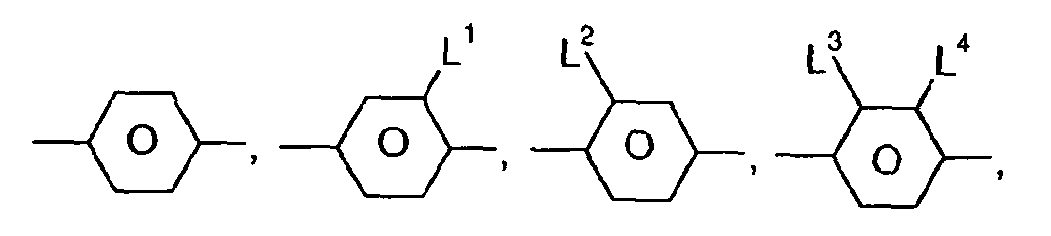

are each independently Cl, F, CF3 or CHF2, preferably L1-4 are each F, and
s
is 0 or 1,
and their use in an electro-optical display.
Description
- The invention relates to a liquid-crystalline medium based on a mixture of polar compounds having negative dielectric anisotropy, which contains at least one compound of formula I


- R1 R2 R1* and R2
- are each independently alkyl or alkoxy with 1 to 8 C atoms, where one or more CH2-groups in these radicals can be replaced by -CH=CH-,


- L1-4
- are each independently Cl, F, CF3 or CHF2, preferably L1-4 are each independently F, and
- s
- is 0 or 1,
- The principle of electrically controlled birefringence, the ECB effect, or the DAP effect (deformation of aligned phases) was described for the first time in 1971 (M. F. Schieckel and K. Fahrenschon, "Deformation of nematic liquid crystals with vertical orientation in electrical fields", Appl. Phys. Lett. 19 (1971), 3912). This was followed by papers by J. F. Kahn (Appl. Phys. Lett. 20 (1972), 1193) and G. Labrunie and J. Robert (J. Appl. Phys. 44 (1973), 4869).
- Papers by J. Robert and F. Clerc (SID 80 Digest Techn. Papers (1980), 30), J. Duchene (Displays 7 (1986), 3) and H. Schad (SID 82 Digest Techn. Papers (1982), 244) have shown that liquid-crystalline phases must have high values for the ratio between the elastic constants K3/K1, high values for the optical anisotropy Δn and values for the dielectric anisotropy Δε of -0.5 to -5 in order to be usable for high-information display elements based on the ECB effect. Electro-optical display elements based on the ECB effect have homeotropic edge alignment.
- The industrial application of this effect in electro-optical display elements requires LC phases which must satisfy a multiplicity of requirements. Particularly important here are chemical resistance to moisture, air and physical effects such as heat, radiation in the infra-red, visible and ultraviolet regions and direct and alternating electrical fields. Furthermore, LC phases which can be used industrially need a liquid-crystalline mesophase in a suitable temperature range and low viscosity.
- None of the series of compounds having a liquid-crystalline mesophase which have been disclosed hitherto includes a single compound which meets all these requirements. Generally, therefore, mixtures of from two to 25, preferably from three to 18, compounds are prepared to give substances which can be used as LC phases. However, ideal phases cannot easily be produced in this way, since liquid-crystal materials having substantially negative dielectric anisotropy and adequate long-term stability were hitherto not available.
- Matrix liquid-crystal displays (MLC displays) are known. Examples of nonlinear elements which can be used to individually switch the individual pixels are active elements (i.e. transistors). This is then referred to as an "active matrix", and a differentiation can be made between two types:
- 1. MOS (metal oxide semiconductor) transistors on silicon wafers as substrate,
- 2. Thin-film transistors (TFT) on a glass plate as substrate.
- In the case of type 1, the electro-optical effect used is usually dynamic scattering or the guest-host effect. The use of monocrystalline silicon as substrate material restricts the display size, since even the modular assembly of various part-displays results in problems at the joins.
- In the case of the more promising type 2, which is preferred, the electro-optical effect used is usually the TN effect. A distinction is made between two technologies: TFTs comprising compound semi-conductors, such as, for example, CdSe, or TFTs based on polycrystalline or amorphous silicon. Intensive research efforts are being made worldwide in the latter technology.
- The TFT matrix is applied to the inside of one glass plate of the display, while the inside of the other glass plate carries the transparent counterelectrode. Compared with the size of the pixel electrode, the TFT is very small and has virtually no adverse effect on the image. This technology can also be extended to fully colour-compatible image displays, in which a mosaic of red, green and blue filters is arranged in such a manner that each filter element is located opposite a switchable pixel.
- The TFT displays disclosed hitherto usually operate as TN cells with crossed polarizers in transmitted light and are illuminated from the back.
- The term MLC display here covers any matrix display containing integrated nonlinear elements, i.e. in addition to the active matrix, also displays containing passive elements such as varistors or diodes (MIM = metal-insulator-metal).
- MLC displays of this type are particularly suitable for TV applications (for example pocket TV sets) or for high-information displays in automobile or aircraft construction. In addition to problems with respect to the angle dependence of the contrast and the response times, difficulties occur in MLC displays due to inadequate resistivity of the liquid-crystal mixtures [TOGASHI, S., SEKIGUCHI, K., TANABE, H , YAMAMOTO, E., SORI-MACHI, K., TAJIMA, E., WATANABE, H., SHIMIZU, H., Proc. Eurodisplay 84, Sept. 1984: A 210-288 Matrix LCD Controlled by Double Stage Diode Rings, p. 141 ff, Paris; STROMER, M., Proc. Eurodisplay 84, Sept. 1984: Design of Thin Film Transistors for Matrix Addressing of Television Liquid Crystal Displays, p. 145 ff, Paris]. As the resistance decreases, the contrast of an MLC display worsens. Since the resistivity of the liquid-crystal mixture generally decreases over the life of an MLC display due to interaction with the internal surfaces of the display, a high (initial) resistance is very important for displays which must have acceptable resistance values over a long operating period.
- The disadvantage of the MLC-TN displays disclosed hitherto is due to their comparatively low contrast, the relatively high viewing angle dependence and the difficulty of producing grey shades in these displays.
-
EP 0 474 062 discloses MLC displays based on the ECB effect. The LC mixtures described therein are based on 2,3-difluorophenyl derivatives containing an ester, ether or ethyl bridge and have low values for the "voltage holding ratio" (HR) after exposure to UV and therefore cannot be used for displays of the projection type. - Thus, there continues to be a great demand for MLC displays having very high resistivity at the same time as a wide operating temperature range, short response times and low threshold voltage, with the aid of which various grey shades can be produced.
- The invention has the object of providing MLC displays, in particular projection displays, based on the ECB effect which do not have the abovementioned disadvantages, or do so only to a reduced extent, and at the same time have very high resistivities and very low temperature stability.
- It has now been found that this object can be achieved if nematic liquid-crystal mixtures containing at least one compound of the formula I and at least one compound of the formula I* are used in these display elements.
- The invention thus relates to a liquid-crystalline medium based on a mixture of polar compounds having negative dielectric anisotropy, which contains at least one compound of formula I


- R1, R2, R1* and R2
- are each independently alkyl or alkoxy with 1 to 8 C atoms, where one or more CH2-groups in these radicals can be replaced by -CH=CH-,


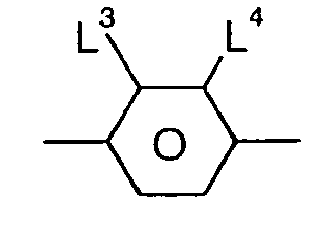
- L1-4
- are each independently Cl, F, CF3 or CHF2, preferably L1-4 are each independently F, and
- s
- is 0 or 1.
- Preferred embodiments are:
- a) A medium which contains one or more compounds selected from the formulae la to lh:


Alkyl, alkyl* and alkoxy (= O-alkyl) are in each case a straight chained residue containing 1 to 6 carbon atoms. The term "alkenyl" in formulae I and I* comprise streight chain and branched alkenyl groups with 2 to 7 C atoms. Straight chain alkenyl groups are preferred. Further preferred alkenyl groups are C2-C7-1 E-alkenyl, C4-C7-3E-alkenyl, C5-C7-4-alkenyl, C6-C7-5-alkenyl and C7-6-alkenyl, in particular C2-C7-1 E-alkenyl, C4-C7-3E-alkenyl and C5-C7-4-alkenyl. Of these, especially preferred alkenyl groups are vinyl, 1 E-propenyl, 1 E-butenyl, 1E-pentenyl, 1E-hexenyl, 1 E-heptenyl, 3-butenyl, 3E-pentenyl, 3E-hexenyl, 3E-heptenyl, 4-pentenyl, 4Z-hexenyl, 4E-hexenyl, 4Z-heptenyl, 5-hexenyl and 6-heptenyl. Alkenyl groups with up to 5 C atoms are particularly preferred. - b) A medium which contains one or more compounds selected from the formulae I*a to I*I,



Preferably in formula I* L1, L2, L3 and L4 are each F. In a preferred embodiment ring A and/or ring B is
- c) A medium containing at least one compound of the formula II,

- R3 and R4
- have the meanings given for R1 and R2
- Ring D
- is

- m
- is 0 or 1
- X1 and X2
- are each independently F, Cl, OCF3, OCHF2, CF3.


alkenyl. R4 is preferably alkyl or alkoxy. - d) A medium which additionally contains one or more compounds of the formula III,



- R5 and R6
- are each independently alkyl or alkoxy with 1 to 8 C atoms where one or more CH2-groups in these radicals can be replaced by -CH=CH- or -O-, and
- m
- is 0, 1 or 2.


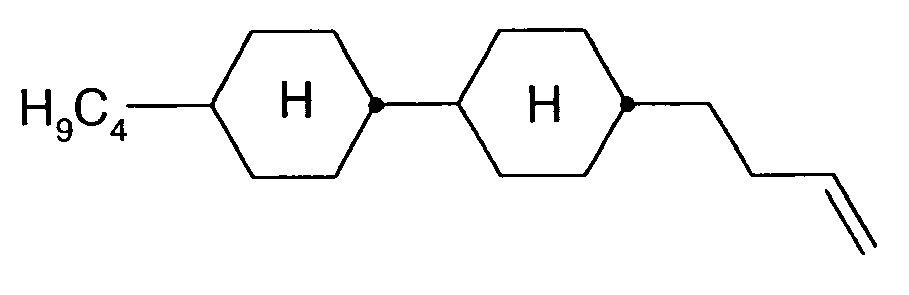


alkyl and
alkyl* each, independently of one another, denote a straight-chain alkyl radical having 1-6 C atoms. - e) A medium in which the proportion of compounds of the formula I in the mixture as a whole is from 2 to 45 % by weight.
- f) A medium in which the proportion of compounds of the formula I* in the mixture as a whole is at least 5-30 % by weight.
- g) A medium in which the proportion of compounds of the formula III in the mixture as a whole is from 0-20 % by weight, preferably from 5-30 %.
- h) A liquid-crystalline medium containing at least one compound selected from the formulae IIa to IIv




- alkyl and alkyl*
- are each independently C1-6-alkyl,
- alkenyl
- is C2-6-alkenyl, preferably CH2=CH, CH2=CHCH2CH2, CH3CH=CHCH2CH2, CH3CH=CH
- j) A liquid crystalline medium containing at least three compounds selected from the formulae IIIa to IIId:


- k) A liquid crystalline medium containing at least one compound selected from the formulae IVa to IVj,


- R7 and R8
- have the same meaning as given for R1, and
- L
- is H, F or Cl.
- l) A liquid-crystalline medium essentially comprising:
2-45 % by weight of one or more compounds of the formula I,
5-30 % by weight of one or more compounds of the formula I*,
20-85 % by weight of one or more compounds of the formula II,
0-20 % by weight of one or more compounds of the formula III. - m) Liquid-crystalline medium which additionally comprises one or more tetracyclic compounds of the formulae


- R8
- has one of the meanings indicated for R1 in Claim 1, and
- w and x
- each, independently of one another, denote 1 to 6.
- n) Liquid-crystalline medium which additionally comprises one or more compounds of the formula

where
R21 has the meanings indicated for R1, and m denotes 1-6. - o) Liquid-crystalline medium additionally comprising one or more biphenyls of the formulae B-1 to B-4


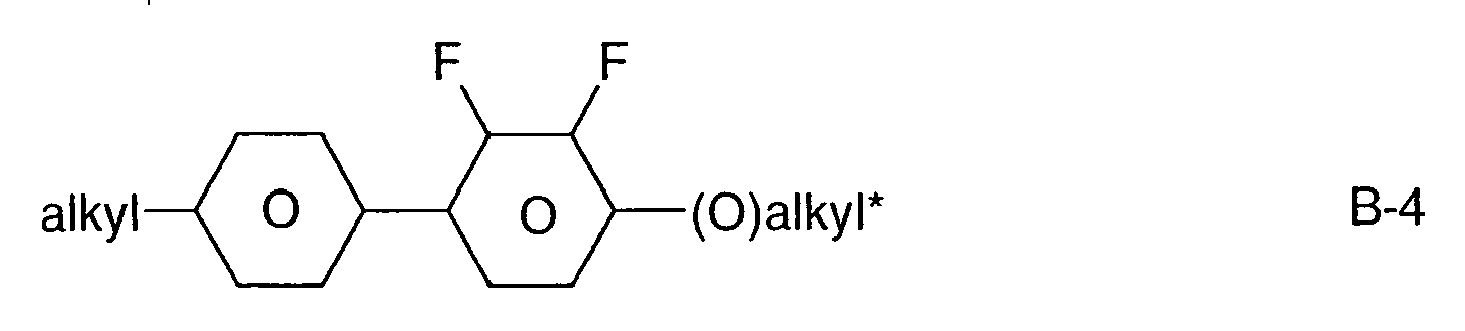
- alkyl and alkyl*
- each, independently of one another, denote a straight-chain alkyl having 1-6 C atoms, and
- alkenyl and alkenyl*
- each, independently of one another, denote a straight-chain alkenyl radical having 2-6 C atoms.
Of the compounds of the formulae B-1 to B-4, the compounds of the formulae B-1 and B-4 are particularly preferred.
Particularly preferred biphenyls are



- p) Liquid-crystalline medium which additionally comprises one or more compounds of the formulae


where
R22 has the meanings indicated for R1, and R23 denotes CH3, C2H5 or n-C3H7, and q denotes 1 or 2. - q) Liquid-crystalline medium additionally comprising at least one compound of the formulae Z-1 to Z-15

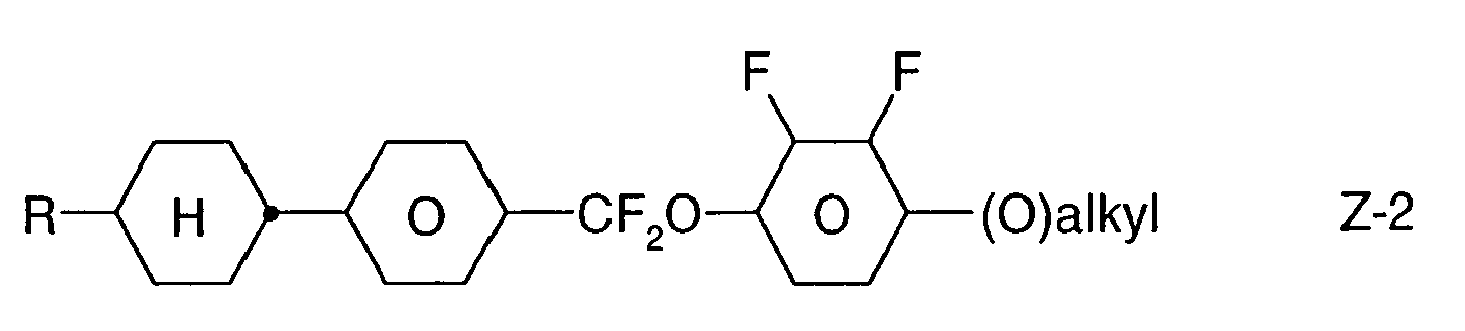





preferably in amounts of ≥ 5 % by weight, in particular ≥ 10 % by weight.
Particular preference is given to media which comprise one, two or more compounds of the formulae Z-1 to Z-9 and additionally one, two or more compounds of the formula II. Mixtures of this type preferably comprise ≥ 10% by weight of compounds of the formula II. - r) Liquid-crystalline medium comprising at least one compound of the formulae O-1 to O-12





- s) Preferred liquid-crystalline media according to the invention comprise one or more substances which contain a tetrahydronaphthyl or naphthyl unit, such as, for example, the compounds of the formulae N-1 to N-5


-C2H4-, -CH=CH-, -(CH2)4-, -(CH2)3O-, -O(CH2)3-, -CH=CHCH2CH2-, -CH2CH2CH=CH-, -CH2O-, -OCH2-, -COO-, -OCO-, -C2F4-, -CF=CF-, -CF=CH-, -CH=CF-, -CF2O-, -OCF2-, -CH2- or a single bond. - t) Preferred mixtures comprise one or more difluorobenzochromane compounds of the formula BC

RB1 and RB2 each, independently of one another, have the meaning of R1, preferably in amounts of 3 to 20% by weight, in particular in amounts of 3 to 15% by weight.
Particularly preferred compounds of the formula BC are compounds BC-1 to BC-7

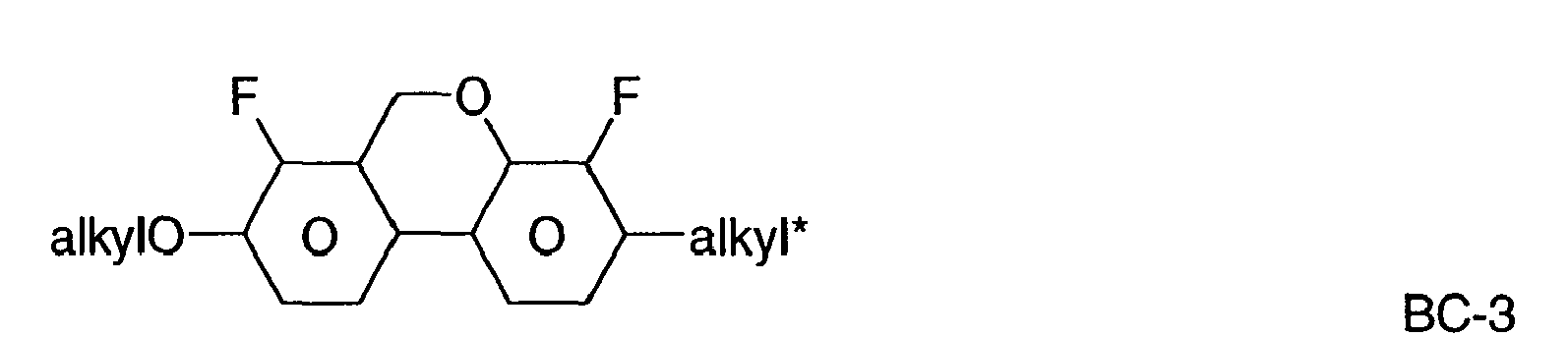


alkyl and alkyl* each, independently of one another, denote a straight-chain alkyl radical having 1-6 C atoms, and
alkenyl and alkenyl* each, independently of one another, denote a straight-chain alkenyl radical having 2-6 C atoms.
Very particularly preferred mixtures comprise one, two or three compounds of the formula BC-2. - u) Medium additionally contains one or more compounds selected from the group of compounds of the formula P


- In the formulae P-1 to P-3 R1 are preferably alkyl. R2 is preferably alkyl. "alkyl" is a straight-chain alkyl with 1-6 carbon atoms. The compounds of the formula P are preferably used in the mixtures in amounts of 5 - 35 %.
- The invention furthermore relates to an electro-optical projection display having active or passive matrix addressing based on the ECB effect, characterised in that it contains, as dielectric, a liquid-crystalline medium as described above.
- The liquid-crystalline medium according to the invention preferably has a nematic phase from ≤ 20 °C to ≥ 70 °C, particularly preferably from ≤ 30 °C to ≥ 80 °C, very particularly preferably from ≤ 40 °C to ≥ 90 °C.
- The term "have a nematic phase" here means on the one hand that no smectic phase and no crystallisation are observed at low temperatures at the corresponding temperature and on the other hand that clearing does not occur on heating from the nematic phase. The investigation at low temperatures is carried out in a flow viscometer at the corresponding temperature and is checked by storage in test cells having a layer thickness corresponding to the electro-optical application for at least 100 hours.
- If the storage stability at a temperature of -20 °C in a corresponding test cell is 1000 h or more, the medium is regarded as stable at this temperature. At temperatures of -30 °C and -40 °C, the corresponding times are 500 h and 250 h respectively. At high temperatures, the clearing point is measured by conventional methods in capillaries.
- The liquid-crystal mixture preferably has a nematic phase range of at least 60 K and a flow viscosity V20 of at most 30 mm2 . s-1 at 20°C.
- The liquid-crystal mixture according to the invention has a Δε of -0.5 to -8.0, in particular of -3.0 to -6.0, where Δε denotes the dielectric anisotropy. The rotational viscosity γ1 is preferably < 200 mPa·s, in particular < 170 mpa·s.
- The values of the birefringence Δn in the liquid-crystal mixture are generally between 0.07 and 0.25, preferably between 0.08 and 0.24.
- The liquid-crystal media according to the invention have a negative dielectric anisotropy and have relatively high absolute values of the dielectric anisotropy (|△ε|), which are preferably in the range from ≥ 2.0 to ≥ 4.5.
- The liquid-crystal media according to the invention have relatively small values for the threshold voltage (V0). They are preferably in the range from 1.7 V to 2.5 V, particularly preferably ≤ 2.3 V and very particularly preferably ≤ 2.2 V.
- In addition, the liquid-crystal media according to the invention have high values for the voltage holding ratio in liquid-crystal cells. In freshly filled cells at 20°C in the cells, they are ≥ 95%, preferably ≥ 97% and very particularly preferably ≥ 99% and after 5 minutes in the oven at 100°C in the cells they are ≥ 90%, preferably ≥ 93% and very particularly preferably ≥98%.
- In general, liquid-crystal media having a low addressing voltage or threshold voltage have a lower voltage holding ratio than those having a greater addressing voltage or threshold voltage and vice versa.
- For the present invention, the term "dielectrically positive compounds" denotes compounds having a △ε > 1.5, the term "dielectrically neutral compounds" denotes those having -1.5 ≤ △ε ≤ 1.5 and the term "dielectrically negative compounds" denotes those having △ε < -1.5. The dielectric anisotropy of the compounds is determined here by dissolving 10% of the compounds in a liquid-crystalline host and determining the capacitance of the resultant mixture in at least one test cell in each case having a layer thickness of 20 µm with homeotropic and with homogeneous surface alignment at 1 kHz. The measurement voltage is typically 0.5 V to 1.0 V, but is always lower than the capacitive threshold of the respective liquid-crystal mixture investigated.
- The host mixture used for dielectrically positive and dielectrically neutral compounds is ZLI-4792 and the host mixture used for dielectrically negative compounds is ZLI-2857, both from Merck KGaA, Germany. The values for the respective compounds to be investigated are obtained from the change in the dielectric constants of the host mixture after addition of the compound to be investigated and extrapolation to 100% of the compound employed. 10% of the compound to be investigated are dissolved in the host mixture. If the solubility of the substance is too low for this, the concentration is halved in steps until the investigation can be carried out at the desired temperature.
- All temperature values indicated for the present invention are in °C.
- For the present invention, the term "threshold voltage" relates to the capacitive threshold (V0), also known as the Freedericksz threshold, unless explicitly indicated otherwise. In the examples, as is generally customary, the optical threshold for 10% relative contrast (V10) is also determined and quoted.
- The electro-optical properties, for example the threshold voltage (V0) (capacitive measurement) and the optical threshold (V10), are, like the switching behaviour, determined in test cells produced at Merck KGaA. The measurement cells have soda-lime glass substrates and are produced in an ECB or VA configuration with polyimide alignment layers (SE-1211 with diluent **26 (mixing ratio 1:1), both from Nissan Chemicals, Japan), which are rubbed perpendicular to one another. The area of the transparent, virtually square ITO electrodes is 1cm2 . The layer thickness of the test cells used is selected in accordance with the birefringence of the liquid-crystal mixture investigated in such a way that the optical retardation is (0.33 ± 0.01) µm. The polarisers, one of which is located in front of and one of which is located behind the cell, form, with their absorption axes, an angle of 90° to one another and are on their respective adjacent substrate with these axes parallel to the rubbing direction. The layer thickness is usually about 4.0 µm. The cells are filled by means of capillary action under atmospheric pressure and are investigated in the unsealed state.
- Unless indicated otherwise, a chiral dopant is not added to the liquid-crystal mixtures used, but the latter are also particularly suitable for applications in which doping of this type is necessary.
- The electro-optical properties and the response times of the test cells are determined in a DMS 301 measuring instrument from Autronic-Melchers, Karlsruhe, Germany, at a temperature of 20 °C. The addressing wave shape used is a rectangular wave having a frequency of 60 Hz. The voltage is quoted as Vrms (root mean square). During measurement of the response times, the voltage is increased from 0 V to twice the value of the optical threshold (2V10) and back. The response times quoted apply to the entire time that passes from the change in the voltage until 90% of the respective total change in the light intensity occurs, i.e. τon ≡ t(0% to > 90%) and τoff ≡ t(100% to > 10%), i.e. also include the respective delay times. Since the individual response times are dependent on the addressing voltage, the sum of the two individual response times (Σ = τon + τoff) or the average response time (τav= (τon +τoff)/2) is also quoted in order to improve the comparability of the results.
- The mixtures according to the invention are suitable for all active and passive VA-TFT applications, such as, for example, VAN, MVA, (S)-PVA and ASV. They are furthermore suitable for IPS (in-plane switching), FFS (fringe field switching) and PALC applications of negative Δε.
- The nematic liquid-crystal mixtures in the displays according to the invention generally comprise two components A and B, which themselves consist of one or more individual compounds.
- Component A has significantly negative dielectric anisotropy and gives the nematic phase a dielectric anisotropy of ≤ -0.5. It preferably comprises compounds of the formulae I* and II.
- The proportion of component A is preferably between 45 and 100%, in particular between 60 and 100%.
- For component A, one (or more) individual compound(s) which has (have) a value of Δε of ≤ -0.8 is (are) preferably selected. This value must be more negative, the smaller the proportion A in the mixture as a whole.
- Component B has pronounced nematogeneity and a flow viscosity of not greater than 30 mm2 . s-1, preferably not greater than 25 mm2 . s-1, at 20°C.
- Particularly preferred individual compounds in component B are extremely low-viscosity nematic liquid crystals having a flow viscosity of not greater than 18 mm2 s-1, preferably not greater than 12 mm2 . s-1, at 20°C.
- Component B is monotropically or enantiotropically nematic, has no smectic phases and is able to prevent the occurrence of smectic phases down to very low temperatures in liquid-crystal mixtures. For example, if various materials of high nematogeneity are added to a smectic liquid-crystal mixture, the nematogeneity of these materials can be compared through the degree of suppression of smectic phases that is achieved.
- A multiplicity of suitable materials is known to the person skilled in the art from the literature. Particular preference is given to compounds of the formula III.
- In addition, these liquid-crystal phases may also comprise more than 18 components, preferably 18 to 25 components.
- The phases preferably comprise 4 to 15, in particular 5 to 12, and particularly preferably < 10, compounds of the formulae I, I* and II and optionally III.
- Besides compounds of the formulae I, I* and II, other constituents may also be present, for example in an amount of up to 45 % of the mixture as a whole, but preferably up to 35 %, in particular up to 10 %.
- The other constituents are preferably selected from nematic or nemato-genic substances, in particular known substances, from the classes of the azoxybenzenes, benzylideneanilines, biphenyls, terphenyls, phenyl or cyclohexyl benzoates, phenyl or cyclohexyl cyclohexanecarboxylates, phenylcyclohexanes, cyclohexylbiphenyls, cyclohexylcyclohexanes, cyclohexylnaphthalenes, 1,4-biscyclohexylbiphenyls or cyclohexylpyrimidines, phenyl- or cyclohexyldioxanes, optionally halogenated stilbenes, benzyl phenyl ethers, tolans and substituted cinnamic acid esters.
- The most important compounds which are suitable as constituents of liquid-crystal phases of this type can be characterised by the formula X
R9-L-G-E-R10 X
in which L and E each denote a carbo- or heterocyclic ring system from the group formed by 1,4-disubstituted benzene and cyclohexane rings, 4,4'-disubstituted biphenyl, phenylcyclohexane and cyclohexylcyclohexane systems, 2,5-disubstituted pyrimidine and 1,3-dioxane rings, 2,6-disubstituted naphthalene, di- and tetrahydronaphthalene, quinazoline and tetrahydroquinazoline,G denotes -CH=CH- -N(O)=N- -CH-CQ- -CH=N(O)- -C≡C- -CH2-CH2- -CO-O- -CH2-O- -CO-S- -CH2-S- -CH=N- -COO-Phe-COO- -CF2O- -CF=CF- -OCF2- -OCH2- -(CH2)4- -(CH2)3O- - In most of these compounds, R9 and R10 are different from one another, one of these radicals usually being an alkyl or alkoxy group. Other variants of the proposed substituents are also common. Many such substances or also mixtures thereof are commercially available. All these substances can be prepared by methods known from the literature.
- It goes without saying for the person skilled in the art that the VA, IPS, FFS or PALC mixture according to the invention may also comprise compounds in which, for example, H, N, O, CI and F have been replaced by the corresponding isotopes.
- The construction of the liquid-crystal displays according to the invention corresponds to the usual geometry, as described, for example, in
EP-A 0 240 379 . - The following examples are intended to explain the invention without limiting it. Above and below, percentages denote per cent by weight; all temperatures are indicated in degrees Celsius.
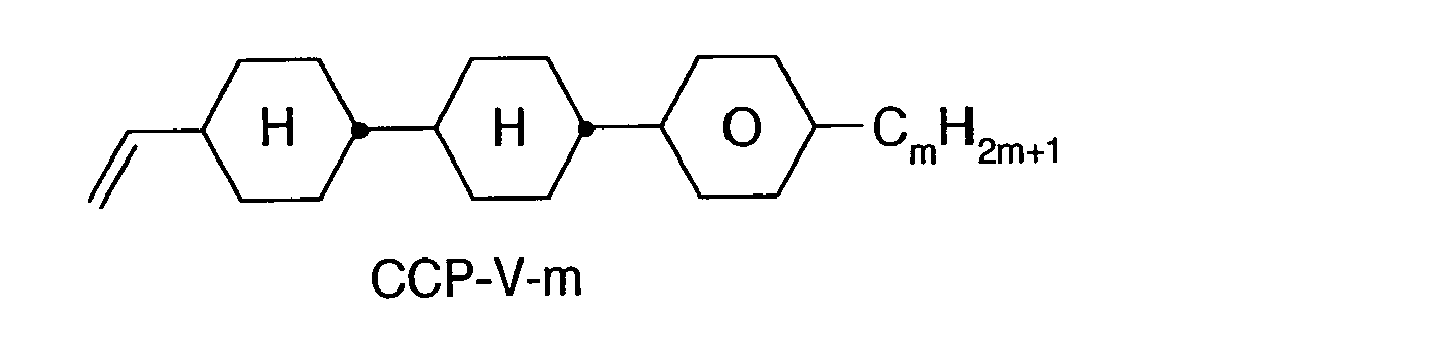
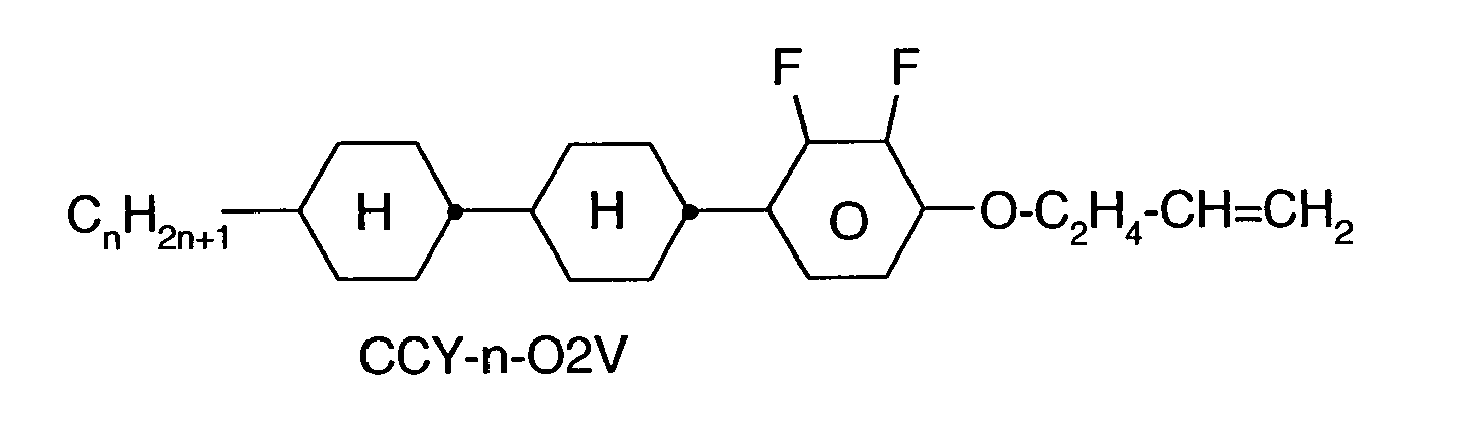
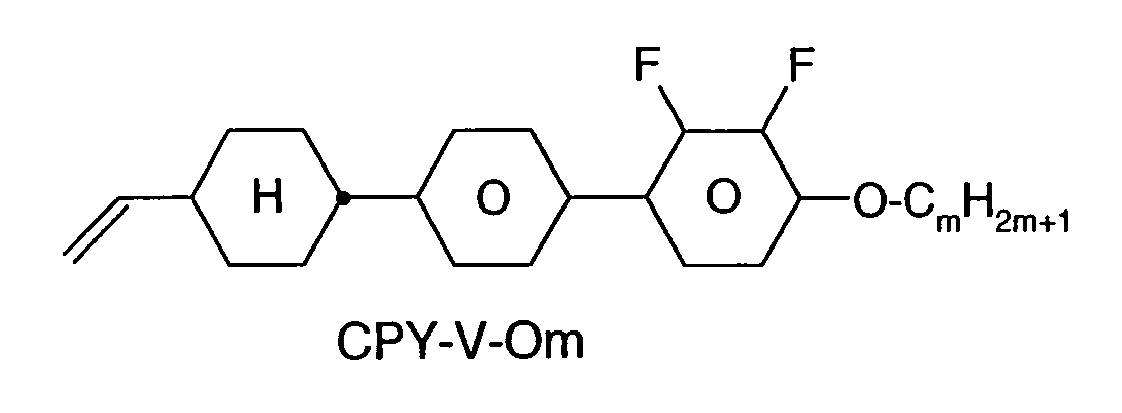
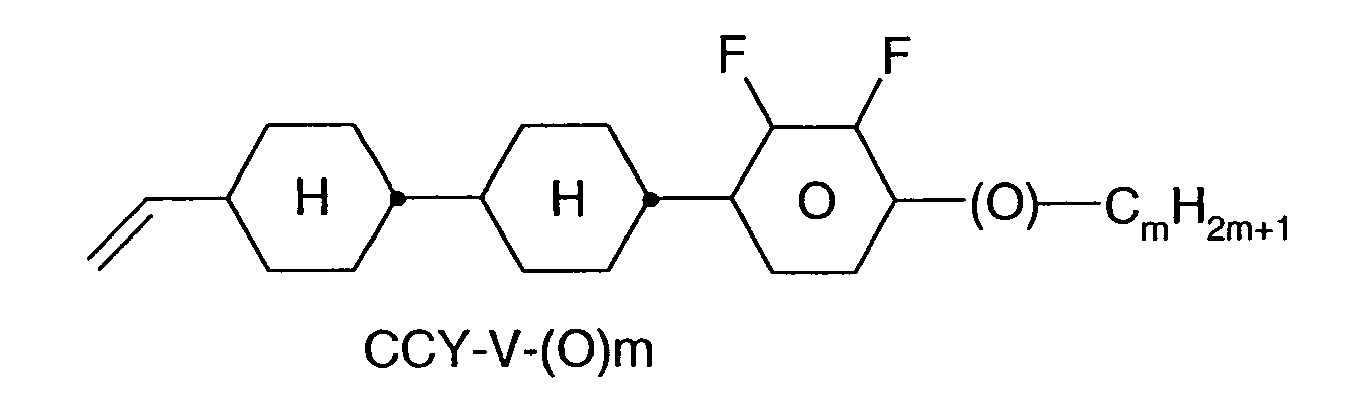
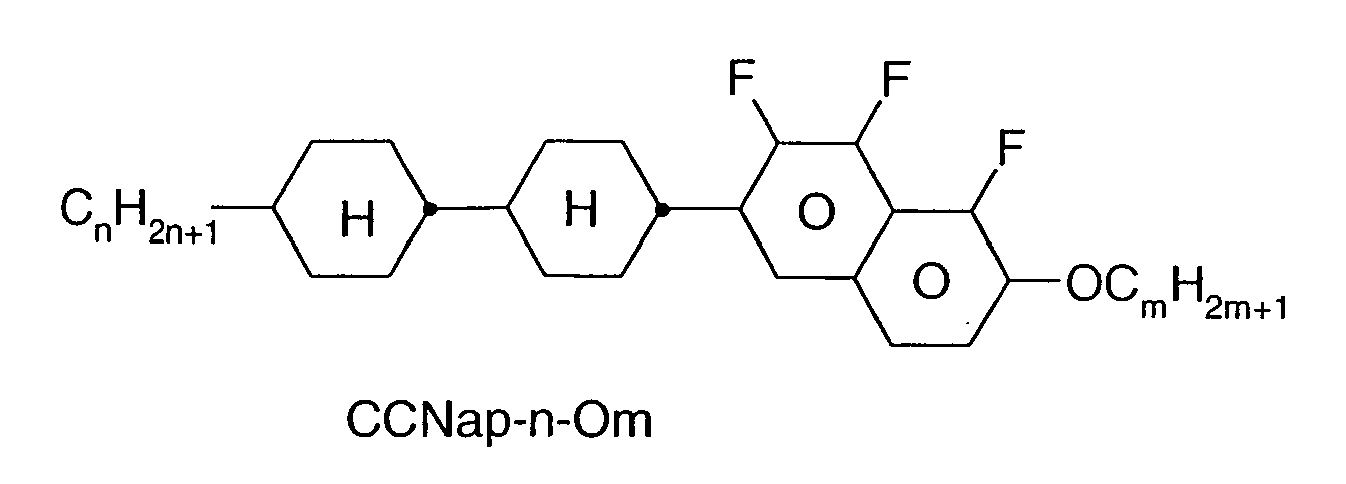
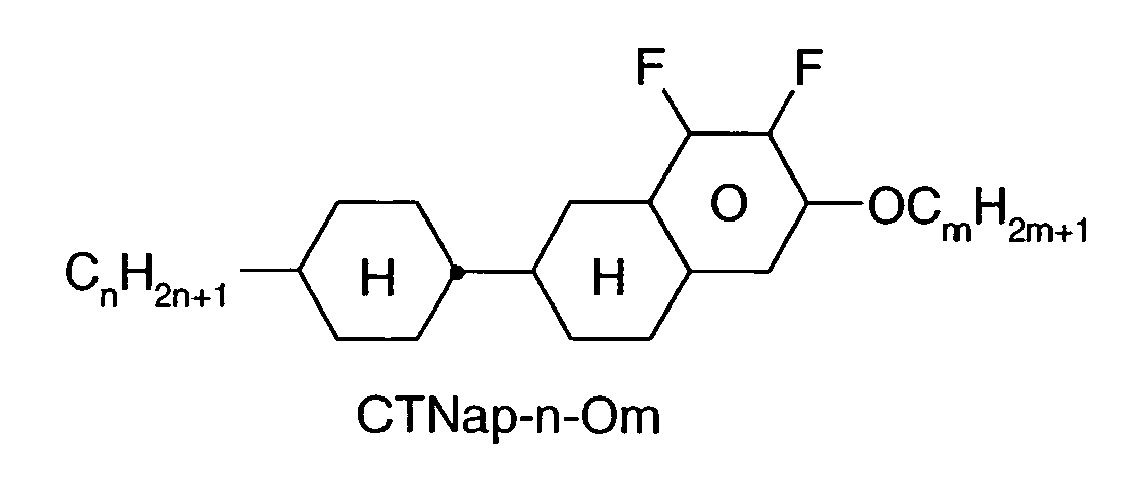
- Besides the compounds of the formulae I and I*, the mixtures according to the invention preferably comprise one or more of the compounds shown below.
- The following abbreviations are used:
(n, m, z: each, independently of one another, 1, 2, 3, 4, 5 or 6)














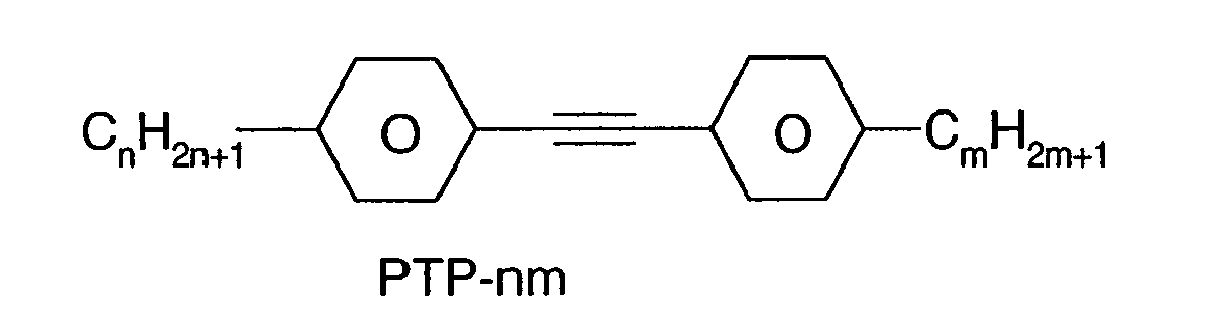


- The liquid-crystal mixtures which can be used in accordance with the invention are prepared in a manner which is conventional per se. In general, the desired amount of the components used in lesser amount is dissolved in the components making up the principal constituent, advantageously at elevated temperature. It is also possible to mix solutions of the components in an organic solvent, for example in acetone, chloroform or methanol, and to remove the solvent again, for example by distillation, after thorough mixing.
- The dielectrics may also comprise further additives known to the person skilled in the art and described in the literature, such as, for example, UV absorbers, antioxidants, nanoparticles and free-radical scavengers. For example, 0-15% of pleochroic dyes, stabilisers or chiral dopants may be added.
- For example, 0-15% of pleochroic dyes may be added, furthermore conductive salts, preferably ethyldimethyldodecylammonium 4-hexoxybenzoate, tetrabutylammonium tetraphenylboranate or complex salts of crown ethers (cf., for example, Haller et al., Mol. Cryst. Liq. Cryst. Volume 24, pages 249-258 (1973)), may be added in order to improve the conductivity or substances may be added in order to modify the dielectric anisotropy, the viscosity and/or the alignment of the nematic phases. Substances of this type are described, for example, in
DE-A 22 09 127 ,22 40 864 ,23 21 632 ,23 38 281 ,24 50 088 ,26 37 430 and28 53 728 . - Table A shows possible dopants which can be added to the mixtures according to the invention. If the mixtures comprise a dopant, it is employed in amounts of 0.01-4% by weight, preferably 0.1-1.0% by weight.


- Stabilisers which can be added, for example, to the mixtures according to the invention are shown below in Table B.


- The following examples are intended to explain the invention without limiting it. Above and below,
- Vo
- denotes the threshold voltage, capacitive [V] at 20°C
- Δn
- denotes the optical anisotropy measured at 20°C and 589 nm
- Δε
- denotes the dielectric anisotropy at 20°C and 1 kHz
- cl.p.
- denotes the clearing point [°C]
- K1
- denotes the elastic constant, "splay" deformation at 20°C [pN]
- K3
- denotes the elastic constant, "bend" deformation at 20°C [pN]
- γ1
- denotes the rotational viscosity measured at 20°C [mPa.s]
- LTS
- denotes the low-temperature stability (nematic phase), determined in test cells
- The display used for measurement of the threshold voltage has two plane-parallel outer plates at a separation of 20 µm and electrode layers with overlying alignment layers of SE-1211 (Nissan Chemicals) on the insides of the outer plates, which effect a homeotropic alignment of the liquid crystals.
- The following examples are VA mixtures for passive matrix applications.
-
CY-3-02 10.00 % Clearing point: +100.0 CY-3-04 16.00 % εII [1 kHz, 20 °C]: 4.2 CY-5-02 10.00 % ε┴ [1 kHz, 20 °C]: 10.6 CPY-2-02 12.00 % Δn [589 nm, 20°C]: +0.1427 CPY-3-02 12.00 % Δε [1 kHz, 20 °C]: -6.4 CCY-3-02 6.00 % CCY-3-03 6.00 % CCY-4-02 6.00 % CCY-5-02 6.00 % PYP-2-3 7.00 % PYP-2-4 3.00 % CPTP-301 3.00 % CPTP-302 3.00 % -
CY-3-02 10.00 % Clearing point: +100.0 CY-3-04 15.00 % εII [1 kHz, 20 °C]: 4.2 CY-5-02 10.00 % ε⊥ [1 kHz, 20 °C]: 10.2 CPY-2-02 12.00 % Δn [589 nm, 20 °C]: +0.1517 CPY-3-02 12.00 % Δε [1 kHz, 20°C]: -6.0 CCY-3-02 5.00 % CCY-3-03 5.00 % CCY-4-02 5.00 % CCY-5-02 5.00 % PYP-2-3 12.00 % PYP-2-4 2.00 % CPTP-301 4.00 % CPTP-302 3.00 % -
CY-3-02 4.00 % Clearing point: +111.0 CY-3-04 12.50 % εII [1 kHz, 20 °C]: 3.5 CCY-3-02 5.50 % ε⊥ [1 kHz, 20°C]: 6.7 CPY-2-02 12.00 % Δn [589 nm, 20 °C]: +0.1525 CPY-3-02 12.00 % Δε [1 kHz, 20°C]: -3.2 PYP-2-3 9.50 % PYP-2-4 9.50 % CPTP-301 5.00 % CPTP-302 2.50 % CC-4-V 17.50 % BCH-32 5.00 % CCPC-33 5.00 % -
CY-3-O2 6.00 % Clearing point: +97.0 CY-3-O4 15.00 % εII [1 kHz, 20°C]: 3.8 CPY-2-O2 6.00 % ε┴ [1 kHz, 20°C]: 6.0 PYP-2-3 12.00 % Δn [589 nm, 20°C]: +0.2282 PYP-2-4 12.00 % Δε [1 kHz, 20°C]: -2.2 PTP-102 5.00 % PTP-201 5.00 % PTP-301 6.00 % PTP-302 6.00 % CPTP-301 5.00 % CPTP-302 5.00 % CPTP-303 5.00 % BCH-32 5.00 % PGIGI-3-F 7.00 % -
CY-3-O2 CY-3-O4 CPY-2-O2 PYP-2-3 PYP-2-4 PTP-102 PTP-201 PTP-301 PTP-302 CPTP-301 CPTP-302 CPTP-303 BCH-32 PP-1-2V1 PGIGI-3-F 5.00 % 11.00 % 9.00 % 12.00 % 12.00 % 5.00 % 5.00 % 6.00 % 6.00 % 5.00 % 5.00 % 5.00 % 5.00 % 3.00 % 6.00 % Clearing point: εII [1 kHz, 20°C]: ε⊥ [1 kHz, 20 °C]: Δn [589 nm, 20°C]: Δε [1 kHz, 20 °C]: +101.0 3.7 5.7 +0.2349 -2.0 -
CY-3-O2 10.00 % Clearing point: +106.0 CY-3-O4 12.00 % εII[1kHz,20°C]: 3.9 CCY-3-O2 4.00 % ε┴ [1 kHz, 20 °C]: 8.1 CCY-3-O3 4.00 % Δn [589 nm, 20 °C]: +0.2006 CPY-2-O2 12.00 % Δε [1 kHz, 20 °C]: -4.2 CPY-3-O2 12.00 % PYP-2-3 13.00 % PYP-2-4 13.00 % PTP-102 5.00 % PTP-201 5.00 % CPTP-301 5.00 % CPTP-302 5.00 % -
CY-3-O2 13.00 % Clearing point: +80.0 CY-3-O4 18.00 % εII [1 kHz, 20 °C]: 4.1 CPY-2-O2 6.00 % ε⊥ [1 kHz, 20 °C]: 6.5 PYP-2-3 12.00 % Δn [589 nm, 20 °C]: +0.2292 PYP-2-4 12.00 % Δε [1 kHz, 20 °C]: -2.4 PTP-102 5.00 % PTP-201 5.00 % PPTUI-3-2 15.00 % PPTUI-3-4 14.00 % -
CY-3-O2 8.00 % Clearing point: +91.0 CY-3-O4 16.00 % ε II [1 kHz, 20°C]: 4.0 CPY-2-O2 11.00 % ε┴ [1 kHz, 20°C]: 6.3 PYP-2-3 12.00 % Δn [589 nm, 20 °C]: +0.2434 PYP-2-4 12.00 % Δε [1 kHz, 20°C]: -2.3 PTP-102 5.00 % PTP-201 5.00 % PPTUI-3-2 16.00 % PPTUI-3-4 15.00 % -
CY-3-O4 10.00 % Clearing point: +100.0 PYP-2-3 10.00 % εII [1 kHz, 20 °C]: 3.8 PYP-2-4 10.00 % ε⊥ [1 kHz, 20°C]: 6.8 CC-5-V 9.50 % Δn [589 nm, 20 °C]: +0.2405 PTP-102 5.00 % Δε [1 kHz, 20 °C]: -2.9 PTP-201 4.00 % PTP-301 4.00 % CPTP-301 4.50 % CPTP-302 4.50 % CPTP-303 4.50 % PTP-302FF 12.00 % PTP-502FF 12.00 % CPTP-302FF 5.00 % CPTP-502FF 5.00 % -
CY-3-O2 6.00 % Clearing point: +100.0 CY-3-O4 8.00 % ε II [ 1 kHz, 20 °C]: 4.1 CPY-2-O2 5.00 % ε┴ [1 kHz, 20°C]: 8.2 CPY-3-O2 5.00 % Δn [589 nm, 20 °C]: +0.2468 PYP-2-3 10.00 % Δε [1 kHz, 20 °C]: -4.2 PYP-2-4 10.00 % PTP-102 5.00 % PTP-201 5.00 % PTP-301 3.50 % CPTP-301 5.00 % CPTP-302 3.50 % PTP-302FF 12.00 % PTP-502FF 12.00 % CPTP-302FF 5.00 % CPTP-502FF 5.00 % -
CY-3-O2 6.00 % Clearing point: +105.0 CY-3-O4 11.50 % εII [1 kHz, 20°C]: 4.2 CCY-3-O2 5.50 % ε⊥- [1 kHz, 20 °C]: 8.9 CPY-2-O2 12.00 % Δn [589 nm, 20°C]: +0.1804 CPY-3-O2 12.00 % Δε- [1 kHz, 20°C]: -4.7 PYP-2-3 12.00 % LTS in cells at -20°C: > 1000 h PYP-2-4 12.00 % LTS in cells at -30°C: > 1000 h CK-3-F 5.00 % LTS in cells at -40°C: > 1000 h CK-5-F 5.00 % CC-5-V 4.50 % CPTP-301 5.00 % CPTP-302 5.00 % PTP-102 4.50 %
R1 and R2 have the meanings given in Claim 1.
Claims (12)
- Liquid-crystalline medium based on a mixture of polar compounds having negative dielectric anisotropy, which contains at least one compound of formula I

 R1 R2, R1* and R2' are each independently alkyl or alkoxy with 1 to 8 C atoms, where one or more CH2-groups in these radicals can be replaced by -CH=CH-,

 L1-4 are each independently Cl, F, CF3 or CHF2, preferably L1-4 are F, ands is 0 or 1.
 - Liquid-crystalline medium according to Claim 1, characterized in that it additionally contains one or more compounds of the formula II,
 R3 and R4 have the meanings given for R1 and R2Ring D is
- Medium according to Claim 1 or 2, characterized in that it additionally contains three or more compounds of the formula III,
 m is 0 or 1X1 and X2 are each independently F, Cl, OCF3, OCHF2, CF3.


 R5 and R6 are each independently alkyl or alkoxy with 1 to 8 C atoms where one or more CH2-groups in these radicals can be replaced by -CH=CH- or -O-.m is 0, 1 or 2.
 - Medium according to at least one Claims 1 to 4, characterized in that it additionally contains at least one compound of the formula IVa to IVj:





 R7 and R8 have the same meaning as given for R1 in claim 1, andL is H, F or Cl.
 - Medium according to at least one of Claims 1 to 4, characterized in that it comprises four or more compounds selected from the formulae I*, I and II and at least one compound of the formula III.
- Liquid-crystalline medium according to at least one of Claims 1 to 5, characterized in that it contains at least one compound selected from the formulae IIa to IIv


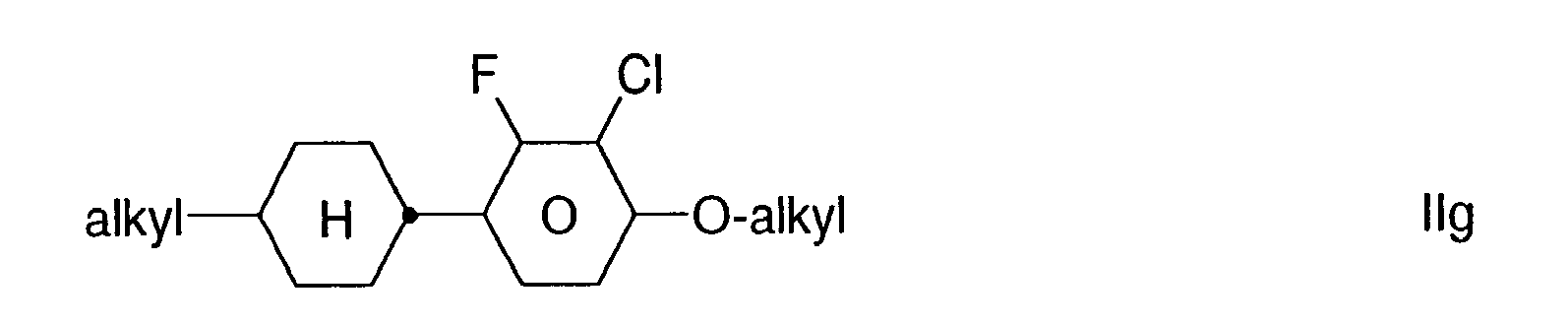



alkyl and alkyl* are each independently C1-6-alkyl, and alkenyl is C2-6-alkenyl, - Liquid-crystalline medium according to at least one of Claims 1 to 6, characterized in that it contains at least one compound of the formula IIa, IIb, IIc or IId.
- Medium according to at least one of Claims 1 to 7, characterized in that it contains at least one compound selected from the formulae IIIa to IIId:


- Liquid-crystalline medium according to at least one of Claims 1 to 8, characterized in that it contains
2-45 % by weight of one or more compounds of the formula I,
5-30 % by weight of one or more compounds of the formula I*,
20-85 % by weight of one or more compounds of the formula II,
0-20 % by weight of one or more compounds of the formula III.
wherein the total amount of the compounds of the formulae I, I*, II and III in the mixture is≤ 100 %. - Process for the preparation of a liquid-crystalline medium according to one or more of Claims 1 to 9, characterized in that compounds of the formulae I and I* are mixed with further mesogen compounds.
- Electro-optical display having active or passive matrix addressing based on the ECB effect, characterized in that it contains, as dielectric, a liquid-crystalline medium according to one of Claims 1 to 9.
- Display according to Claim 11, characterized in that it is a projection display.
Priority Applications (1)
| Application Number | Priority Date | Filing Date | Title |
|---|---|---|---|
| EP07023957A EP1935963B1 (en) | 2006-12-19 | 2007-12-11 | Liquid-crystalline medium |
Applications Claiming Priority (2)
| Application Number | Priority Date | Filing Date | Title |
|---|---|---|---|
| EP06026256A EP1935962A1 (en) | 2006-12-19 | 2006-12-19 | Liquid-crystalline medium |
| EP07023957A EP1935963B1 (en) | 2006-12-19 | 2007-12-11 | Liquid-crystalline medium |
Publications (2)
| Publication Number | Publication Date |
|---|---|
| EP1935963A1 true EP1935963A1 (en) | 2008-06-25 |
| EP1935963B1 EP1935963B1 (en) | 2010-02-10 |
Family
ID=37998378
Family Applications (2)
| Application Number | Title | Priority Date | Filing Date |
|---|---|---|---|
| EP06026256A Withdrawn EP1935962A1 (en) | 2006-12-19 | 2006-12-19 | Liquid-crystalline medium |
| EP07023957A Active EP1935963B1 (en) | 2006-12-19 | 2007-12-11 | Liquid-crystalline medium |
Family Applications Before (1)
| Application Number | Title | Priority Date | Filing Date |
|---|---|---|---|
| EP06026256A Withdrawn EP1935962A1 (en) | 2006-12-19 | 2006-12-19 | Liquid-crystalline medium |
Country Status (8)
| Country | Link |
|---|---|
| US (1) | US7803434B2 (en) |
| EP (2) | EP1935962A1 (en) |
| JP (1) | JP5410016B2 (en) |
| KR (1) | KR101458637B1 (en) |
| CN (1) | CN101323786B (en) |
| AT (1) | ATE457339T1 (en) |
| DE (1) | DE602007004705D1 (en) |
| TW (1) | TWI460253B (en) |
Cited By (2)
| Publication number | Priority date | Publication date | Assignee | Title |
|---|---|---|---|---|
| CN101629081A (en) * | 2008-07-17 | 2010-01-20 | 默克专利股份有限公司 | Liquid crystal medium |
| CN113755184A (en) * | 2021-10-12 | 2021-12-07 | 重庆汉朗精工科技有限公司 | Liquid crystal composition with large optical anisotropy and application thereof |
Families Citing this family (8)
| Publication number | Priority date | Publication date | Assignee | Title |
|---|---|---|---|---|
| KR101969811B1 (en) * | 2011-04-13 | 2019-04-17 | 디아이씨 가부시끼가이샤 | Nematic liquid crystal composition and liquid crystal display element using same |
| EP2514800B2 (en) * | 2011-04-21 | 2018-03-07 | Merck Patent GmbH | Compounds and liquid crystalline medium |
| CN102352260B (en) * | 2011-07-28 | 2014-11-26 | 深圳超多维光电子有限公司 | Liquid crystal composition and liquid crystal lens |
| KR102092042B1 (en) | 2013-01-24 | 2020-03-24 | 삼성디스플레이 주식회사 | Liquid crystal display device and manufacturing method of the same |
| WO2015162950A1 (en) * | 2014-04-25 | 2015-10-29 | Jnc株式会社 | Liquid crystal composition and liquid crystal display element |
| WO2021253628A1 (en) * | 2020-06-16 | 2021-12-23 | 石家庄诚志永华显示材料有限公司 | Liquid crystal composition, liquid crystal display element, and liquid crystal display |
| CN113801662B (en) * | 2020-06-16 | 2024-11-05 | 石家庄诚志永华显示材料有限公司 | Nematic liquid crystal composition, liquid crystal display element and liquid crystal display |
| WO2021253626A1 (en) * | 2020-06-16 | 2021-12-23 | 石家庄诚志永华显示材料有限公司 | Liquid crystal composition, and liquid crystal display element and liquid crystal display device |
Citations (8)
| Publication number | Priority date | Publication date | Assignee | Title |
|---|---|---|---|---|
| EP0474062A2 (en) | 1990-09-04 | 1992-03-11 | MERCK PATENT GmbH | Matrix liquid crystal display |
| US5378395A (en) | 1988-10-20 | 1995-01-03 | Merck Patent Gesellschaft Mit Beschrankter Haftung | Matrix liquid crystal display |
| WO1995004789A1 (en) | 1993-08-11 | 1995-02-16 | Merck Patent Gmbh | Supertwist liquid-crystal display |
| EP0709444A1 (en) * | 1994-10-05 | 1996-05-01 | Sumitomo Chemical Company Limited | Liquid crystal mixture and liquid crystal device comprising the same |
| US5702640A (en) | 1993-11-25 | 1997-12-30 | Merck Patent Gesellschaft Mit Beschrankter Haftung | High-multiplexed supertwist liquid-crystal display |
| US20040055529A1 (en) | 2002-09-11 | 2004-03-25 | Merck Patent Gmbh | Liquid-crystalline medium having high birefringence |
| US20060115606A1 (en) | 2004-11-26 | 2006-06-01 | Hideo Ichinose | Liquid crystal medium |
| US20060198968A1 (en) | 2005-03-03 | 2006-09-07 | Yasuyuki Goto | Chlorofluorobenzene liquid crystal compound, liquid crystal composition, and liquid crystal display device |
Family Cites Families (11)
| Publication number | Priority date | Publication date | Assignee | Title |
|---|---|---|---|---|
| WO1998027036A1 (en) * | 1996-12-16 | 1998-06-25 | Chisso Corporation | Difluorophenyl derivatives, liquid-crystal compounds, and liquid-crystal composition |
| US6066268A (en) * | 1997-08-29 | 2000-05-23 | Merck Patent Gesellschaft Mit Beschrankter Haftung | Liquid-crystalline medium |
| JP4355382B2 (en) * | 1997-11-17 | 2009-10-28 | メルク パテント ゲゼルシャフト ミット ベシュレンクテル ハフツング | Liquid crystal medium |
| DE69938744D1 (en) * | 1998-11-19 | 2008-06-26 | Merck Patent Gmbh | Supertwist nematic liquid crystal displays |
| JP4945836B2 (en) * | 2000-08-25 | 2012-06-06 | Dic株式会社 | Liquid crystal composition and liquid crystal display device using the same |
| JP4244556B2 (en) * | 2001-03-30 | 2009-03-25 | チッソ株式会社 | Liquid crystalline compound having bis (trifluoromethyl) phenyl ring, liquid crystal composition and liquid crystal display device |
| JP4972826B2 (en) * | 2001-04-10 | 2012-07-11 | Jnc株式会社 | Difluoroalkoxy-terminated compound, liquid crystal composition, and liquid crystal display device |
| JP4311055B2 (en) * | 2002-04-09 | 2009-08-12 | チッソ株式会社 | Liquid crystalline compound in which one of terminal groups is hydrogen, composition thereof, and liquid crystal display device containing the same |
| JP4655479B2 (en) * | 2004-01-28 | 2011-03-23 | Dic株式会社 | Nematic liquid crystal composition and liquid crystal display device using the same |
| JP5145711B2 (en) * | 2004-04-01 | 2013-02-20 | Jnc株式会社 | Benzene derivative, liquid crystal composition, and liquid crystal display device |
| KR101355300B1 (en) * | 2004-11-26 | 2014-01-23 | 샤프 가부시키가이샤 | Liquid crystal medium |
-
2006
- 2006-12-19 EP EP06026256A patent/EP1935962A1/en not_active Withdrawn
-
2007
- 2007-12-11 AT AT07023957T patent/ATE457339T1/en not_active IP Right Cessation
- 2007-12-11 EP EP07023957A patent/EP1935963B1/en active Active
- 2007-12-11 DE DE602007004705T patent/DE602007004705D1/en active Active
- 2007-12-18 KR KR1020070133319A patent/KR101458637B1/en not_active Expired - Fee Related
- 2007-12-18 JP JP2007326116A patent/JP5410016B2/en active Active
- 2007-12-18 TW TW096148472A patent/TWI460253B/en active
- 2007-12-19 US US11/960,023 patent/US7803434B2/en active Active
- 2007-12-19 CN CN200710307626.7A patent/CN101323786B/en active Active
Patent Citations (8)
| Publication number | Priority date | Publication date | Assignee | Title |
|---|---|---|---|---|
| US5378395A (en) | 1988-10-20 | 1995-01-03 | Merck Patent Gesellschaft Mit Beschrankter Haftung | Matrix liquid crystal display |
| EP0474062A2 (en) | 1990-09-04 | 1992-03-11 | MERCK PATENT GmbH | Matrix liquid crystal display |
| WO1995004789A1 (en) | 1993-08-11 | 1995-02-16 | Merck Patent Gmbh | Supertwist liquid-crystal display |
| US5702640A (en) | 1993-11-25 | 1997-12-30 | Merck Patent Gesellschaft Mit Beschrankter Haftung | High-multiplexed supertwist liquid-crystal display |
| EP0709444A1 (en) * | 1994-10-05 | 1996-05-01 | Sumitomo Chemical Company Limited | Liquid crystal mixture and liquid crystal device comprising the same |
| US20040055529A1 (en) | 2002-09-11 | 2004-03-25 | Merck Patent Gmbh | Liquid-crystalline medium having high birefringence |
| US20060115606A1 (en) | 2004-11-26 | 2006-06-01 | Hideo Ichinose | Liquid crystal medium |
| US20060198968A1 (en) | 2005-03-03 | 2006-09-07 | Yasuyuki Goto | Chlorofluorobenzene liquid crystal compound, liquid crystal composition, and liquid crystal display device |
Non-Patent Citations (2)
| Title |
|---|
| STROMER, M., PROC. EURODISPLAY 84, September 1984 (1984-09-01) |
| TOGASHI, S. ET AL., PROC. EURODISPLAY 84, vol. A 210-28, September 1984 (1984-09-01), pages 141 FF |
Cited By (4)
| Publication number | Priority date | Publication date | Assignee | Title |
|---|---|---|---|---|
| CN101629081A (en) * | 2008-07-17 | 2010-01-20 | 默克专利股份有限公司 | Liquid crystal medium |
| CN101629081B (en) * | 2008-07-17 | 2014-09-10 | 默克专利股份有限公司 | Liquid crystal medium |
| CN113755184A (en) * | 2021-10-12 | 2021-12-07 | 重庆汉朗精工科技有限公司 | Liquid crystal composition with large optical anisotropy and application thereof |
| CN113755184B (en) * | 2021-10-12 | 2023-11-10 | 重庆汉朗精工科技有限公司 | Liquid crystal composition with large optical anisotropy and application thereof |
Also Published As
| Publication number | Publication date |
|---|---|
| KR20080057175A (en) | 2008-06-24 |
| US7803434B2 (en) | 2010-09-28 |
| TW200848498A (en) | 2008-12-16 |
| JP2008266567A (en) | 2008-11-06 |
| JP5410016B2 (en) | 2014-02-05 |
| KR101458637B1 (en) | 2014-11-05 |
| EP1935963B1 (en) | 2010-02-10 |
| TWI460253B (en) | 2014-11-11 |
| CN101323786A (en) | 2008-12-17 |
| CN101323786B (en) | 2014-06-18 |
| EP1935962A1 (en) | 2008-06-25 |
| ATE457339T1 (en) | 2010-02-15 |
| DE602007004705D1 (en) | 2010-03-25 |
| US20080191166A1 (en) | 2008-08-14 |
Similar Documents
| Publication | Publication Date | Title |
|---|---|---|
| US6764722B2 (en) | Liquid-crystalline medium | |
| US8025935B2 (en) | Liquid-crystalline medium | |
| US7854970B2 (en) | Liquid-crystalline medium | |
| EP1935963B1 (en) | Liquid-crystalline medium | |
| EP2182046B1 (en) | Liquid-crystalline medium and liquid crystal display | |
| US8703013B2 (en) | Liquid crystalline medium | |
| JP5885903B2 (en) | Liquid crystal media | |
| US6740369B2 (en) | Liquid-crystalline medium | |
| US20110193020A1 (en) | Liquid-crystal medium | |
| EP2144975B1 (en) | Liquid- crystalline medium | |
| US20040099842A1 (en) | Liquid crystalline medium | |
| US6933022B2 (en) | Liquid crystalline medium | |
| US20060124896A1 (en) | Liquid-crystalline medium | |
| US6514580B2 (en) | Liquid-crystalline medium | |
| EP3130650B1 (en) | Liquid-crystalline medium | |
| EP3375844A1 (en) | Liquid-crystalline medium | |
| US6790489B2 (en) | Liquid-crystalline medium | |
| EP1251160B1 (en) | Liquid-crystalline medium |
Legal Events
| Date | Code | Title | Description |
|---|---|---|---|
| PUAI | Public reference made under article 153(3) epc to a published international application that has entered the european phase |
Free format text: ORIGINAL CODE: 0009012 |
|
| 17P | Request for examination filed |
Effective date: 20071211 |
|
| AK | Designated contracting states |
Kind code of ref document: A1 Designated state(s): AT BE BG CH CY CZ DE DK EE ES FI FR GB GR HU IE IS IT LI LT LU LV MC MT NL PL PT RO SE SI SK TR |
|
| AX | Request for extension of the european patent |
Extension state: AL BA HR MK RS |
|
| 17Q | First examination report despatched |
Effective date: 20080828 |
|
| AKX | Designation fees paid |
Designated state(s): AT BE BG CH CY CZ DE DK EE ES FI FR GB GR HU IE IS IT LI LT LU LV MC MT NL PL PT RO SE SI SK TR |
|
| GRAP | Despatch of communication of intention to grant a patent |
Free format text: ORIGINAL CODE: EPIDOSNIGR1 |
|
| GRAS | Grant fee paid |
Free format text: ORIGINAL CODE: EPIDOSNIGR3 |
|
| GRAA | (expected) grant |
Free format text: ORIGINAL CODE: 0009210 |
|
| AK | Designated contracting states |
Kind code of ref document: B1 Designated state(s): AT BE BG CH CY CZ DE DK EE ES FI FR GB GR HU IE IS IT LI LT LU LV MC MT NL PL PT RO SE SI SK TR |
|
| REG | Reference to a national code |
Ref country code: GB Ref legal event code: FG4D |
|
| REG | Reference to a national code |
Ref country code: CH Ref legal event code: EP |
|
| REG | Reference to a national code |
Ref country code: IE Ref legal event code: FG4D |
|
| REF | Corresponds to: |
Ref document number: 602007004705 Country of ref document: DE Date of ref document: 20100325 Kind code of ref document: P |
|
| REG | Reference to a national code |
Ref country code: DE Ref legal event code: R096 Ref document number: 602007004705 Country of ref document: DE Effective date: 20100325 |
|
| REG | Reference to a national code |
Ref country code: NL Ref legal event code: VDEP Effective date: 20100210 |
|
| LTIE | Lt: invalidation of european patent or patent extension |
Effective date: 20100210 |
|
| PG25 | Lapsed in a contracting state [announced via postgrant information from national office to epo] |
Ref country code: IS Free format text: LAPSE BECAUSE OF FAILURE TO SUBMIT A TRANSLATION OF THE DESCRIPTION OR TO PAY THE FEE WITHIN THE PRESCRIBED TIME-LIMIT Effective date: 20100610 Ref country code: LT Free format text: LAPSE BECAUSE OF FAILURE TO SUBMIT A TRANSLATION OF THE DESCRIPTION OR TO PAY THE FEE WITHIN THE PRESCRIBED TIME-LIMIT Effective date: 20100210 Ref country code: ES Free format text: LAPSE BECAUSE OF FAILURE TO SUBMIT A TRANSLATION OF THE DESCRIPTION OR TO PAY THE FEE WITHIN THE PRESCRIBED TIME-LIMIT Effective date: 20100521 Ref country code: PT Free format text: LAPSE BECAUSE OF FAILURE TO SUBMIT A TRANSLATION OF THE DESCRIPTION OR TO PAY THE FEE WITHIN THE PRESCRIBED TIME-LIMIT Effective date: 20100611 |
|
| PG25 | Lapsed in a contracting state [announced via postgrant information from national office to epo] |
Ref country code: SI Free format text: LAPSE BECAUSE OF FAILURE TO SUBMIT A TRANSLATION OF THE DESCRIPTION OR TO PAY THE FEE WITHIN THE PRESCRIBED TIME-LIMIT Effective date: 20100210 Ref country code: PL Free format text: LAPSE BECAUSE OF FAILURE TO SUBMIT A TRANSLATION OF THE DESCRIPTION OR TO PAY THE FEE WITHIN THE PRESCRIBED TIME-LIMIT Effective date: 20100210 Ref country code: LV Free format text: LAPSE BECAUSE OF FAILURE TO SUBMIT A TRANSLATION OF THE DESCRIPTION OR TO PAY THE FEE WITHIN THE PRESCRIBED TIME-LIMIT Effective date: 20100210 Ref country code: FI Free format text: LAPSE BECAUSE OF FAILURE TO SUBMIT A TRANSLATION OF THE DESCRIPTION OR TO PAY THE FEE WITHIN THE PRESCRIBED TIME-LIMIT Effective date: 20100210 Ref country code: AT Free format text: LAPSE BECAUSE OF FAILURE TO SUBMIT A TRANSLATION OF THE DESCRIPTION OR TO PAY THE FEE WITHIN THE PRESCRIBED TIME-LIMIT Effective date: 20100210 |
|
| PG25 | Lapsed in a contracting state [announced via postgrant information from national office to epo] |
Ref country code: GR Free format text: LAPSE BECAUSE OF FAILURE TO SUBMIT A TRANSLATION OF THE DESCRIPTION OR TO PAY THE FEE WITHIN THE PRESCRIBED TIME-LIMIT Effective date: 20100511 Ref country code: BE Free format text: LAPSE BECAUSE OF FAILURE TO SUBMIT A TRANSLATION OF THE DESCRIPTION OR TO PAY THE FEE WITHIN THE PRESCRIBED TIME-LIMIT Effective date: 20100210 Ref country code: NL Free format text: LAPSE BECAUSE OF FAILURE TO SUBMIT A TRANSLATION OF THE DESCRIPTION OR TO PAY THE FEE WITHIN THE PRESCRIBED TIME-LIMIT Effective date: 20100210 Ref country code: RO Free format text: LAPSE BECAUSE OF FAILURE TO SUBMIT A TRANSLATION OF THE DESCRIPTION OR TO PAY THE FEE WITHIN THE PRESCRIBED TIME-LIMIT Effective date: 20100210 Ref country code: CY Free format text: LAPSE BECAUSE OF FAILURE TO SUBMIT A TRANSLATION OF THE DESCRIPTION OR TO PAY THE FEE WITHIN THE PRESCRIBED TIME-LIMIT Effective date: 20100210 Ref country code: EE Free format text: LAPSE BECAUSE OF FAILURE TO SUBMIT A TRANSLATION OF THE DESCRIPTION OR TO PAY THE FEE WITHIN THE PRESCRIBED TIME-LIMIT Effective date: 20100210 Ref country code: SE Free format text: LAPSE BECAUSE OF FAILURE TO SUBMIT A TRANSLATION OF THE DESCRIPTION OR TO PAY THE FEE WITHIN THE PRESCRIBED TIME-LIMIT Effective date: 20100210 |
|
| PG25 | Lapsed in a contracting state [announced via postgrant information from national office to epo] |
Ref country code: BG Free format text: LAPSE BECAUSE OF FAILURE TO SUBMIT A TRANSLATION OF THE DESCRIPTION OR TO PAY THE FEE WITHIN THE PRESCRIBED TIME-LIMIT Effective date: 20100510 Ref country code: CZ Free format text: LAPSE BECAUSE OF FAILURE TO SUBMIT A TRANSLATION OF THE DESCRIPTION OR TO PAY THE FEE WITHIN THE PRESCRIBED TIME-LIMIT Effective date: 20100210 Ref country code: SK Free format text: LAPSE BECAUSE OF FAILURE TO SUBMIT A TRANSLATION OF THE DESCRIPTION OR TO PAY THE FEE WITHIN THE PRESCRIBED TIME-LIMIT Effective date: 20100210 |
|
| PLBE | No opposition filed within time limit |
Free format text: ORIGINAL CODE: 0009261 |
|
| STAA | Information on the status of an ep patent application or granted ep patent |
Free format text: STATUS: NO OPPOSITION FILED WITHIN TIME LIMIT |
|
| 26N | No opposition filed |
Effective date: 20101111 |
|
| PG25 | Lapsed in a contracting state [announced via postgrant information from national office to epo] |
Ref country code: DK Free format text: LAPSE BECAUSE OF FAILURE TO SUBMIT A TRANSLATION OF THE DESCRIPTION OR TO PAY THE FEE WITHIN THE PRESCRIBED TIME-LIMIT Effective date: 20100210 |
|
| REG | Reference to a national code |
Ref country code: DE Ref legal event code: R097 Ref document number: 602007004705 Country of ref document: DE Effective date: 20101111 |
|
| PG25 | Lapsed in a contracting state [announced via postgrant information from national office to epo] |
Ref country code: IT Free format text: LAPSE BECAUSE OF FAILURE TO SUBMIT A TRANSLATION OF THE DESCRIPTION OR TO PAY THE FEE WITHIN THE PRESCRIBED TIME-LIMIT Effective date: 20100210 |
|
| PG25 | Lapsed in a contracting state [announced via postgrant information from national office to epo] |
Ref country code: MC Free format text: LAPSE BECAUSE OF NON-PAYMENT OF DUE FEES Effective date: 20101231 |
|
| REG | Reference to a national code |
Ref country code: FR Ref legal event code: ST Effective date: 20110831 |
|
| PG25 | Lapsed in a contracting state [announced via postgrant information from national office to epo] |
Ref country code: FR Free format text: LAPSE BECAUSE OF NON-PAYMENT OF DUE FEES Effective date: 20110103 Ref country code: IE Free format text: LAPSE BECAUSE OF NON-PAYMENT OF DUE FEES Effective date: 20101211 |
|
| PG25 | Lapsed in a contracting state [announced via postgrant information from national office to epo] |
Ref country code: MT Free format text: LAPSE BECAUSE OF FAILURE TO SUBMIT A TRANSLATION OF THE DESCRIPTION OR TO PAY THE FEE WITHIN THE PRESCRIBED TIME-LIMIT Effective date: 20100210 |
|
| REG | Reference to a national code |
Ref country code: CH Ref legal event code: PL |
|
| PG25 | Lapsed in a contracting state [announced via postgrant information from national office to epo] |
Ref country code: HU Free format text: LAPSE BECAUSE OF FAILURE TO SUBMIT A TRANSLATION OF THE DESCRIPTION OR TO PAY THE FEE WITHIN THE PRESCRIBED TIME-LIMIT Effective date: 20100811 Ref country code: LU Free format text: LAPSE BECAUSE OF NON-PAYMENT OF DUE FEES Effective date: 20101211 |
|
| PG25 | Lapsed in a contracting state [announced via postgrant information from national office to epo] |
Ref country code: CH Free format text: LAPSE BECAUSE OF NON-PAYMENT OF DUE FEES Effective date: 20111231 Ref country code: TR Free format text: LAPSE BECAUSE OF FAILURE TO SUBMIT A TRANSLATION OF THE DESCRIPTION OR TO PAY THE FEE WITHIN THE PRESCRIBED TIME-LIMIT Effective date: 20100210 Ref country code: LI Free format text: LAPSE BECAUSE OF NON-PAYMENT OF DUE FEES Effective date: 20111231 |
|
| PGFP | Annual fee paid to national office [announced via postgrant information from national office to epo] |
Ref country code: GB Payment date: 20181205 Year of fee payment: 12 |
|
| GBPC | Gb: european patent ceased through non-payment of renewal fee |
Effective date: 20191211 |
|
| PG25 | Lapsed in a contracting state [announced via postgrant information from national office to epo] |
Ref country code: GB Free format text: LAPSE BECAUSE OF NON-PAYMENT OF DUE FEES Effective date: 20191211 |
|
| P01 | Opt-out of the competence of the unified patent court (upc) registered |
Effective date: 20230518 |
|
| PGFP | Annual fee paid to national office [announced via postgrant information from national office to epo] |
Ref country code: DE Payment date: 20251126 Year of fee payment: 19 |