EP1935896A1 - Novel optically active biaryl phosphorus compound and production process thereof - Google Patents
Novel optically active biaryl phosphorus compound and production process thereof Download PDFInfo
- Publication number
- EP1935896A1 EP1935896A1 EP07122766A EP07122766A EP1935896A1 EP 1935896 A1 EP1935896 A1 EP 1935896A1 EP 07122766 A EP07122766 A EP 07122766A EP 07122766 A EP07122766 A EP 07122766A EP 1935896 A1 EP1935896 A1 EP 1935896A1
- Authority
- EP
- European Patent Office
- Prior art keywords
- group
- denotes
- formula
- optically active
- hydrogen atom
- Prior art date
- Legal status (The legal status is an assumption and is not a legal conclusion. Google has not performed a legal analysis and makes no representation as to the accuracy of the status listed.)
- Withdrawn
Links
- -1 biaryl phosphorus compound Chemical class 0.000 title claims abstract description 111
- 229910052698 phosphorus Inorganic materials 0.000 title claims abstract description 42
- 239000011574 phosphorus Substances 0.000 title claims abstract description 39
- 238000004519 manufacturing process Methods 0.000 title claims description 25
- 125000001424 substituent group Chemical group 0.000 claims abstract description 90
- 125000000217 alkyl group Chemical group 0.000 claims abstract description 75
- 125000003118 aryl group Chemical group 0.000 claims abstract description 66
- 125000003545 alkoxy group Chemical group 0.000 claims abstract description 43
- 125000004435 hydrogen atom Chemical group [H]* 0.000 claims abstract description 32
- 125000005843 halogen group Chemical group 0.000 claims abstract description 23
- 125000000753 cycloalkyl group Chemical group 0.000 claims abstract description 20
- 125000002887 hydroxy group Chemical group [H]O* 0.000 claims abstract description 14
- 125000004423 acyloxy group Chemical group 0.000 claims abstract description 13
- 125000004104 aryloxy group Chemical group 0.000 claims abstract description 13
- 125000001188 haloalkyl group Chemical group 0.000 claims abstract description 13
- 125000006239 protecting group Chemical group 0.000 claims abstract description 11
- 125000004663 dialkyl amino group Chemical group 0.000 claims abstract description 10
- 125000000325 methylidene group Chemical group [H]C([H])=* 0.000 claims abstract 4
- 150000001875 compounds Chemical class 0.000 claims description 52
- 239000010948 rhodium Substances 0.000 claims description 34
- 239000003054 catalyst Substances 0.000 claims description 28
- MHOVAHRLVXNVSD-UHFFFAOYSA-N rhodium atom Chemical compound [Rh] MHOVAHRLVXNVSD-UHFFFAOYSA-N 0.000 claims description 27
- 229910052703 rhodium Inorganic materials 0.000 claims description 25
- 229910052751 metal Inorganic materials 0.000 claims description 24
- 239000002184 metal Substances 0.000 claims description 24
- 238000006243 chemical reaction Methods 0.000 claims description 23
- 239000003446 ligand Substances 0.000 claims description 9
- UFHFLCQGNIYNRP-UHFFFAOYSA-N Hydrogen Chemical compound [H][H] UFHFLCQGNIYNRP-UHFFFAOYSA-N 0.000 claims description 8
- 239000013543 active substance Substances 0.000 claims description 8
- 238000002360 preparation method Methods 0.000 claims description 7
- 150000001336 alkenes Chemical class 0.000 claims description 5
- 150000001450 anions Chemical class 0.000 claims description 5
- 125000000732 arylene group Chemical group 0.000 claims description 5
- JRZJOMJEPLMPRA-UHFFFAOYSA-N olefin Natural products CCCCCCCC=C JRZJOMJEPLMPRA-UHFFFAOYSA-N 0.000 claims description 5
- 238000011914 asymmetric synthesis Methods 0.000 claims description 3
- 230000003287 optical effect Effects 0.000 abstract description 23
- 238000007796 conventional method Methods 0.000 abstract description 2
- HEDRZPFGACZZDS-MICDWDOJSA-N Trichloro(2H)methane Chemical compound [2H]C(Cl)(Cl)Cl HEDRZPFGACZZDS-MICDWDOJSA-N 0.000 description 96
- 125000004432 carbon atom Chemical group C* 0.000 description 53
- VLKZOEOYAKHREP-UHFFFAOYSA-N n-Hexane Chemical compound CCCCCC VLKZOEOYAKHREP-UHFFFAOYSA-N 0.000 description 51
- YXFVVABEGXRONW-UHFFFAOYSA-N Toluene Chemical compound CC1=CC=CC=C1 YXFVVABEGXRONW-UHFFFAOYSA-N 0.000 description 48
- YMWUJEATGCHHMB-UHFFFAOYSA-N Dichloromethane Chemical compound ClCCl YMWUJEATGCHHMB-UHFFFAOYSA-N 0.000 description 43
- HEDRZPFGACZZDS-UHFFFAOYSA-N Chloroform Chemical compound ClC(Cl)Cl HEDRZPFGACZZDS-UHFFFAOYSA-N 0.000 description 34
- 239000000203 mixture Substances 0.000 description 34
- 125000001570 methylene group Chemical group [H]C([H])([*:1])[*:2] 0.000 description 21
- 239000005457 ice water Substances 0.000 description 20
- 238000005160 1H NMR spectroscopy Methods 0.000 description 18
- 238000004679 31P NMR spectroscopy Methods 0.000 description 18
- 125000001997 phenyl group Chemical group [H]C1=C([H])C([H])=C(*)C([H])=C1[H] 0.000 description 17
- 239000000243 solution Substances 0.000 description 17
- 238000001644 13C nuclear magnetic resonance spectroscopy Methods 0.000 description 16
- 230000014759 maintenance of location Effects 0.000 description 16
- 239000011541 reaction mixture Substances 0.000 description 15
- 125000002496 methyl group Chemical group [H]C([H])([H])* 0.000 description 14
- 125000000999 tert-butyl group Chemical group [H]C([H])([H])C(*)(C([H])([H])[H])C([H])([H])[H] 0.000 description 13
- IJGRMHOSHXDMSA-UHFFFAOYSA-N Atomic nitrogen Chemical compound N#N IJGRMHOSHXDMSA-UHFFFAOYSA-N 0.000 description 12
- UHOVQNZJYSORNB-UHFFFAOYSA-N Benzene Chemical compound C1=CC=CC=C1 UHOVQNZJYSORNB-UHFFFAOYSA-N 0.000 description 12
- 229910052731 fluorine Inorganic materials 0.000 description 12
- 238000002844 melting Methods 0.000 description 12
- 230000008018 melting Effects 0.000 description 12
- 239000007787 solid Substances 0.000 description 12
- 238000004821 distillation Methods 0.000 description 11
- 239000000126 substance Substances 0.000 description 11
- 239000000460 chlorine Substances 0.000 description 10
- 229910052757 nitrogen Inorganic materials 0.000 description 10
- ZDHXKXAHOVTTAH-UHFFFAOYSA-N trichlorosilane Chemical compound Cl[SiH](Cl)Cl ZDHXKXAHOVTTAH-UHFFFAOYSA-N 0.000 description 10
- RTZKZFJDLAIYFH-UHFFFAOYSA-N Diethyl ether Chemical compound CCOCC RTZKZFJDLAIYFH-UHFFFAOYSA-N 0.000 description 9
- 238000010898 silica gel chromatography Methods 0.000 description 9
- 125000004213 tert-butoxy group Chemical group [H]C([H])([H])C(O*)(C([H])([H])[H])C([H])([H])[H] 0.000 description 9
- KBPLFHHGFOOTCA-UHFFFAOYSA-N 1-Octanol Chemical compound CCCCCCCCO KBPLFHHGFOOTCA-UHFFFAOYSA-N 0.000 description 8
- KWKAKUADMBZCLK-UHFFFAOYSA-N 1-octene Chemical compound CCCCCCC=C KWKAKUADMBZCLK-UHFFFAOYSA-N 0.000 description 8
- XEKOWRVHYACXOJ-UHFFFAOYSA-N Ethyl acetate Chemical compound CCOC(C)=O XEKOWRVHYACXOJ-UHFFFAOYSA-N 0.000 description 8
- 229910004721 HSiCl3 Inorganic materials 0.000 description 8
- VYPSYNLAJGMNEJ-UHFFFAOYSA-N Silicium dioxide Chemical compound O=[Si]=O VYPSYNLAJGMNEJ-UHFFFAOYSA-N 0.000 description 8
- PPBRXRYQALVLMV-UHFFFAOYSA-N Styrene Chemical compound C=CC1=CC=CC=C1 PPBRXRYQALVLMV-UHFFFAOYSA-N 0.000 description 8
- WYURNTSHIVDZCO-UHFFFAOYSA-N Tetrahydrofuran Chemical compound C1CCOC1 WYURNTSHIVDZCO-UHFFFAOYSA-N 0.000 description 8
- 125000002252 acyl group Chemical group 0.000 description 8
- SJWFXCIHNDVPSH-UHFFFAOYSA-N octan-2-ol Chemical compound CCCCCCC(C)O SJWFXCIHNDVPSH-UHFFFAOYSA-N 0.000 description 8
- 239000004912 1,5-cyclooctadiene Substances 0.000 description 7
- WKBOTKDWSSQWDR-UHFFFAOYSA-N Bromine atom Chemical compound [Br] WKBOTKDWSSQWDR-UHFFFAOYSA-N 0.000 description 7
- ZAMOUSCENKQFHK-UHFFFAOYSA-N Chlorine atom Chemical compound [Cl] ZAMOUSCENKQFHK-UHFFFAOYSA-N 0.000 description 7
- PXGOKWXKJXAPGV-UHFFFAOYSA-N Fluorine Chemical compound FF PXGOKWXKJXAPGV-UHFFFAOYSA-N 0.000 description 7
- 125000003277 amino group Chemical group 0.000 description 7
- 239000012298 atmosphere Substances 0.000 description 7
- GDTBXPJZTBHREO-UHFFFAOYSA-N bromine Substances BrBr GDTBXPJZTBHREO-UHFFFAOYSA-N 0.000 description 7
- 229910052794 bromium Inorganic materials 0.000 description 7
- 229910052801 chlorine Inorganic materials 0.000 description 7
- 125000000113 cyclohexyl group Chemical group [H]C1([H])C([H])([H])C([H])([H])C([H])(*)C([H])([H])C1([H])[H] 0.000 description 7
- 125000001495 ethyl group Chemical group [H]C([H])([H])C([H])([H])* 0.000 description 7
- 239000011737 fluorine Substances 0.000 description 7
- 238000000034 method Methods 0.000 description 7
- 125000000956 methoxy group Chemical group [H]C([H])([H])O* 0.000 description 7
- PMZURENOXWZQFD-UHFFFAOYSA-L Sodium Sulfate Chemical compound [Na+].[Na+].[O-]S([O-])(=O)=O PMZURENOXWZQFD-UHFFFAOYSA-L 0.000 description 6
- ZMANZCXQSJIPKH-UHFFFAOYSA-N Triethylamine Chemical compound CCN(CC)CC ZMANZCXQSJIPKH-UHFFFAOYSA-N 0.000 description 6
- 125000001931 aliphatic group Chemical group 0.000 description 6
- 238000009835 boiling Methods 0.000 description 6
- 125000001511 cyclopentyl group Chemical group [H]C1([H])C([H])([H])C([H])([H])C([H])(*)C1([H])[H] 0.000 description 6
- YMWUJEATGCHHMB-DICFDUPASA-N dichloromethane-d2 Chemical compound [2H]C([2H])(Cl)Cl YMWUJEATGCHHMB-DICFDUPASA-N 0.000 description 6
- 125000000623 heterocyclic group Chemical group 0.000 description 6
- 125000000959 isobutyl group Chemical group [H]C([H])([H])C([H])(C([H])([H])[H])C([H])([H])* 0.000 description 6
- 125000001449 isopropyl group Chemical group [H]C([H])([H])C([H])(*)C([H])([H])[H] 0.000 description 6
- 125000004108 n-butyl group Chemical group [H]C([H])([H])C([H])([H])C([H])([H])C([H])([H])* 0.000 description 6
- 125000004123 n-propyl group Chemical group [H]C([H])([H])C([H])([H])C([H])([H])* 0.000 description 6
- QJGQUHMNIGDVPM-UHFFFAOYSA-N nitrogen group Chemical group [N] QJGQUHMNIGDVPM-UHFFFAOYSA-N 0.000 description 6
- SJYNFBVQFBRSIB-UHFFFAOYSA-N norbornadiene Chemical compound C1=CC2C=CC1C2 SJYNFBVQFBRSIB-UHFFFAOYSA-N 0.000 description 6
- 125000002914 sec-butyl group Chemical group [H]C([H])([H])C([H])([H])C([H])(*)C([H])([H])[H] 0.000 description 6
- 229910052938 sodium sulfate Inorganic materials 0.000 description 6
- LFQSCWFLJHTTHZ-UHFFFAOYSA-N Ethanol Chemical compound CCO LFQSCWFLJHTTHZ-UHFFFAOYSA-N 0.000 description 5
- ANSOKCGDSQQISA-UHFFFAOYSA-N [1-(2-diphenylphosphanyl-5,6,7,8-tetrahydronaphthalen-1-yl)-5,6,7,8-tetrahydronaphthalen-2-yl]-diphenylphosphane Chemical group C1CCCC(C=2C=3C(=CC=C4CCCCC4=3)P(C=3C=CC=CC=3)C=3C=CC=CC=3)=C1C=CC=2P(C=1C=CC=CC=1)C1=CC=CC=C1 ANSOKCGDSQQISA-UHFFFAOYSA-N 0.000 description 5
- 125000005428 anthryl group Chemical group [H]C1=C([H])C([H])=C2C([H])=C3C(*)=C([H])C([H])=C([H])C3=C([H])C2=C1[H] 0.000 description 5
- 125000001153 fluoro group Chemical group F* 0.000 description 5
- 238000006459 hydrosilylation reaction Methods 0.000 description 5
- 125000001624 naphthyl group Chemical group 0.000 description 5
- TVMXDCGIABBOFY-UHFFFAOYSA-N octane Chemical compound CCCCCCCC TVMXDCGIABBOFY-UHFFFAOYSA-N 0.000 description 5
- 125000005561 phenanthryl group Chemical group 0.000 description 5
- 150000003018 phosphorus compounds Chemical class 0.000 description 5
- 239000002904 solvent Substances 0.000 description 5
- 239000000758 substrate Substances 0.000 description 5
- LYXHWHHENVLYCN-QMDOQEJBSA-N (1z,5z)-cycloocta-1,5-diene;rhodium;tetrafluoroborate Chemical compound [Rh].F[B-](F)(F)F.C\1C\C=C/CC\C=C/1.C\1C\C=C/CC\C=C/1 LYXHWHHENVLYCN-QMDOQEJBSA-N 0.000 description 4
- VYXHVRARDIDEHS-UHFFFAOYSA-N 1,5-cyclooctadiene Chemical compound C1CC=CCCC=C1 VYXHVRARDIDEHS-UHFFFAOYSA-N 0.000 description 4
- 239000007832 Na2SO4 Substances 0.000 description 4
- XYFCBTPGUUZFHI-UHFFFAOYSA-N Phosphine Natural products P XYFCBTPGUUZFHI-UHFFFAOYSA-N 0.000 description 4
- UIIMBOGNXHQVGW-UHFFFAOYSA-M Sodium bicarbonate Chemical compound [Na+].OC([O-])=O UIIMBOGNXHQVGW-UHFFFAOYSA-M 0.000 description 4
- 238000010725 [2+2+2] cycloaddition reaction Methods 0.000 description 4
- TWKVUTXHANJYGH-UHFFFAOYSA-L allyl palladium chloride Chemical class Cl[Pd]CC=C.Cl[Pd]CC=C TWKVUTXHANJYGH-UHFFFAOYSA-L 0.000 description 4
- 238000004458 analytical method Methods 0.000 description 4
- 239000007864 aqueous solution Substances 0.000 description 4
- 239000012300 argon atmosphere Substances 0.000 description 4
- MUALRAIOVNYAIW-UHFFFAOYSA-N binap Chemical group C1=CC=CC=C1P(C=1C(=C2C=CC=CC2=CC=1)C=1C2=CC=CC=C2C=CC=1P(C=1C=CC=CC=1)C=1C=CC=CC=1)C1=CC=CC=C1 MUALRAIOVNYAIW-UHFFFAOYSA-N 0.000 description 4
- 230000015572 biosynthetic process Effects 0.000 description 4
- 125000006267 biphenyl group Chemical group 0.000 description 4
- 239000012267 brine Substances 0.000 description 4
- 235000019439 ethyl acetate Nutrition 0.000 description 4
- 125000004051 hexyl group Chemical group [H]C([H])([H])C([H])([H])C([H])([H])C([H])([H])C([H])([H])C([H])([H])* 0.000 description 4
- GRWIABMEEKERFV-UHFFFAOYSA-N methanol;oxolane Chemical compound OC.C1CCOC1 GRWIABMEEKERFV-UHFFFAOYSA-N 0.000 description 4
- 239000012044 organic layer Substances 0.000 description 4
- 125000001147 pentyl group Chemical group C(CCCC)* 0.000 description 4
- 239000011736 potassium bicarbonate Substances 0.000 description 4
- 229910000028 potassium bicarbonate Inorganic materials 0.000 description 4
- TYJJADVDDVDEDZ-UHFFFAOYSA-M potassium hydrogencarbonate Chemical compound [K+].OC([O-])=O TYJJADVDDVDEDZ-UHFFFAOYSA-M 0.000 description 4
- AKHNMLFCWUSKQB-UHFFFAOYSA-L sodium thiosulfate Chemical compound [Na+].[Na+].[O-]S([O-])(=O)=S AKHNMLFCWUSKQB-UHFFFAOYSA-L 0.000 description 4
- HPALAKNZSZLMCH-UHFFFAOYSA-M sodium;chloride;hydrate Chemical compound O.[Na+].[Cl-] HPALAKNZSZLMCH-UHFFFAOYSA-M 0.000 description 4
- 238000003756 stirring Methods 0.000 description 4
- 238000003786 synthesis reaction Methods 0.000 description 4
- 239000013077 target material Substances 0.000 description 4
- ZBTGSGZDTVIBOX-UHFFFAOYSA-N trichloro(octan-2-yl)silane Chemical compound CCCCCCC(C)[Si](Cl)(Cl)Cl ZBTGSGZDTVIBOX-UHFFFAOYSA-N 0.000 description 4
- XLYOFNOQVPJJNP-UHFFFAOYSA-N water Substances O XLYOFNOQVPJJNP-UHFFFAOYSA-N 0.000 description 4
- 125000004172 4-methoxyphenyl group Chemical group [H]C1=C([H])C(OC([H])([H])[H])=C([H])C([H])=C1* 0.000 description 3
- 0 Cc1c(*)c(*)c(C*C2)c2c1* Chemical compound Cc1c(*)c(*)c(C*C2)c2c1* 0.000 description 3
- OKKJLVBELUTLKV-UHFFFAOYSA-N Methanol Chemical compound OC OKKJLVBELUTLKV-UHFFFAOYSA-N 0.000 description 3
- ZMXDDKWLCZADIW-UHFFFAOYSA-N N,N-Dimethylformamide Chemical compound CN(C)C=O ZMXDDKWLCZADIW-UHFFFAOYSA-N 0.000 description 3
- CTQNGGLPUBDAKN-UHFFFAOYSA-N O-Xylene Chemical compound CC1=CC=CC=C1C CTQNGGLPUBDAKN-UHFFFAOYSA-N 0.000 description 3
- YMMUPYCJUJFUID-UHFFFAOYSA-N [6-(2-methoxynaphthalen-1-yl)-4,7-dimethyl-1,3-dihydro-2-benzofuran-5-yl]-diphenylphosphane Chemical compound COC1=CC=C2C=CC=CC2=C1C1=C(C)C=2COCC=2C(C)=C1P(C=1C=CC=CC=1)C1=CC=CC=C1 YMMUPYCJUJFUID-UHFFFAOYSA-N 0.000 description 3
- GYELMOQHFGJTPU-UHFFFAOYSA-N [6-(2-methoxynaphthalen-1-yl)-4,7-dimethyl-2,3-dihydro-1h-inden-5-yl]-diphenylphosphane Chemical compound COC1=CC=C2C=CC=CC2=C1C1=C(C)C=2CCCC=2C(C)=C1P(C=1C=CC=CC=1)C1=CC=CC=C1 GYELMOQHFGJTPU-UHFFFAOYSA-N 0.000 description 3
- 125000002777 acetyl group Chemical group [H]C([H])([H])C(*)=O 0.000 description 3
- 238000005349 anion exchange Methods 0.000 description 3
- 230000003197 catalytic effect Effects 0.000 description 3
- 125000004122 cyclic group Chemical group 0.000 description 3
- 125000000040 m-tolyl group Chemical group [H]C1=C([H])C(*)=C([H])C(=C1[H])C([H])([H])[H] 0.000 description 3
- 125000001160 methoxycarbonyl group Chemical group [H]C([H])([H])OC(*)=O 0.000 description 3
- 125000002950 monocyclic group Chemical group 0.000 description 3
- 239000003921 oil Substances 0.000 description 3
- 125000003854 p-chlorophenyl group Chemical group [H]C1=C([H])C(*)=C([H])C([H])=C1Cl 0.000 description 3
- 125000001037 p-tolyl group Chemical group [H]C1=C([H])C(=C([H])C([H])=C1*)C([H])([H])[H] 0.000 description 3
- 125000004437 phosphorous atom Chemical group 0.000 description 3
- 229910000073 phosphorus hydride Inorganic materials 0.000 description 3
- 125000003367 polycyclic group Chemical group 0.000 description 3
- 150000003284 rhodium compounds Chemical class 0.000 description 3
- 125000004434 sulfur atom Chemical group 0.000 description 3
- YLQBMQCUIZJEEH-UHFFFAOYSA-N tetrahydrofuran Natural products C=1C=COC=1 YLQBMQCUIZJEEH-UHFFFAOYSA-N 0.000 description 3
- 239000008096 xylene Substances 0.000 description 3
- RFFLAFLAYFXFSW-UHFFFAOYSA-N 1,2-dichlorobenzene Chemical compound ClC1=CC=CC=C1Cl RFFLAFLAYFXFSW-UHFFFAOYSA-N 0.000 description 2
- KRCGCBRVQYKMGR-UHFFFAOYSA-N 1-(6-diphenylphosphoryl-4,7-dimethyl-2,3-dihydro-1h-inden-5-yl)-2-methoxynaphthalene Chemical compound COC1=CC=C2C=CC=CC2=C1C1=C(C)C=2CCCC=2C(C)=C1P(=O)(C=1C=CC=CC=1)C1=CC=CC=C1 KRCGCBRVQYKMGR-UHFFFAOYSA-N 0.000 description 2
- WAPNOHKVXSQRPX-UHFFFAOYSA-N 1-phenylethanol Chemical compound CC(O)C1=CC=CC=C1 WAPNOHKVXSQRPX-UHFFFAOYSA-N 0.000 description 2
- YQTCQNIPQMJNTI-UHFFFAOYSA-N 2,2-dimethylpropan-1-one Chemical group CC(C)(C)[C]=O YQTCQNIPQMJNTI-UHFFFAOYSA-N 0.000 description 2
- 125000004180 3-fluorophenyl group Chemical group [H]C1=C([H])C(*)=C([H])C(F)=C1[H] 0.000 description 2
- DQKCNSMTFUJZSL-UHFFFAOYSA-N 5-diethoxyphosphoryl-6-(2-methoxynaphthalen-1-yl)-4,7-dimethyl-2-(4-methylphenyl)sulfonyl-1,3-dihydroisoindole Chemical compound C1C=2C(C)=C(C=3C4=CC=CC=C4C=CC=3OC)C(P(=O)(OCC)OCC)=C(C)C=2CN1S(=O)(=O)C1=CC=C(C)C=C1 DQKCNSMTFUJZSL-UHFFFAOYSA-N 0.000 description 2
- WTHJQTHLONXGLY-UHFFFAOYSA-N 5-diphenylphosphoryl-6-(2-methoxynaphthalen-1-yl)-4,7-dimethyl-1,3-dihydro-2-benzofuran Chemical compound COC1=CC=C2C=CC=CC2=C1C1=C(C)C=2COCC=2C(C)=C1P(=O)(C=1C=CC=CC=1)C1=CC=CC=C1 WTHJQTHLONXGLY-UHFFFAOYSA-N 0.000 description 2
- XKRFYHLGVUSROY-UHFFFAOYSA-N Argon Chemical compound [Ar] XKRFYHLGVUSROY-UHFFFAOYSA-N 0.000 description 2
- IAZDPXIOMUYVGZ-UHFFFAOYSA-N Dimethylsulphoxide Chemical compound CS(C)=O IAZDPXIOMUYVGZ-UHFFFAOYSA-N 0.000 description 2
- QUSNBJAOOMFDIB-UHFFFAOYSA-N Ethylamine Chemical compound CCN QUSNBJAOOMFDIB-UHFFFAOYSA-N 0.000 description 2
- ZHNUHDYFZUAESO-UHFFFAOYSA-N Formamide Chemical compound NC=O ZHNUHDYFZUAESO-UHFFFAOYSA-N 0.000 description 2
- KFZMGEQAYNKOFK-UHFFFAOYSA-N Isopropanol Chemical compound CC(C)O KFZMGEQAYNKOFK-UHFFFAOYSA-N 0.000 description 2
- LRHPLDYGYMQRHN-UHFFFAOYSA-N N-Butanol Chemical compound CCCCO LRHPLDYGYMQRHN-UHFFFAOYSA-N 0.000 description 2
- IMNFDUFMRHMDMM-UHFFFAOYSA-N N-Heptane Chemical compound CCCCCCC IMNFDUFMRHMDMM-UHFFFAOYSA-N 0.000 description 2
- KDLHZDBZIXYQEI-UHFFFAOYSA-N Palladium Chemical compound [Pd] KDLHZDBZIXYQEI-UHFFFAOYSA-N 0.000 description 2
- OFBQJSOFQDEBGM-UHFFFAOYSA-N Pentane Chemical compound CCCCC OFBQJSOFQDEBGM-UHFFFAOYSA-N 0.000 description 2
- DKGAVHZHDRPRBM-UHFFFAOYSA-N Tert-Butanol Chemical compound CC(C)(C)O DKGAVHZHDRPRBM-UHFFFAOYSA-N 0.000 description 2
- IOPQYDKQISFMJI-UHFFFAOYSA-N [1-[2-bis(4-methylphenyl)phosphanylnaphthalen-1-yl]naphthalen-2-yl]-bis(4-methylphenyl)phosphane Chemical group C1=CC(C)=CC=C1P(C=1C(=C2C=CC=CC2=CC=1)C=1C2=CC=CC=C2C=CC=1P(C=1C=CC(C)=CC=1)C=1C=CC(C)=CC=1)C1=CC=C(C)C=C1 IOPQYDKQISFMJI-UHFFFAOYSA-N 0.000 description 2
- 125000004390 alkyl sulfonyl group Chemical group 0.000 description 2
- 125000005530 alkylenedioxy group Chemical group 0.000 description 2
- XPNGNIFUDRPBFJ-UHFFFAOYSA-N alpha-methylbenzylalcohol Natural products CC1=CC=CC=C1CO XPNGNIFUDRPBFJ-UHFFFAOYSA-N 0.000 description 2
- 125000006615 aromatic heterocyclic group Chemical group 0.000 description 2
- 125000003710 aryl alkyl group Chemical group 0.000 description 2
- 125000004391 aryl sulfonyl group Chemical group 0.000 description 2
- QVGXLLKOCUKJST-UHFFFAOYSA-N atomic oxygen Chemical compound [O] QVGXLLKOCUKJST-UHFFFAOYSA-N 0.000 description 2
- 125000003236 benzoyl group Chemical group [H]C1=C([H])C([H])=C(C([H])=C1[H])C(*)=O 0.000 description 2
- 125000001231 benzoyloxy group Chemical group C(C1=CC=CC=C1)(=O)O* 0.000 description 2
- 125000001797 benzyl group Chemical group [H]C1=C([H])C([H])=C(C([H])=C1[H])C([H])([H])* 0.000 description 2
- 125000001584 benzyloxycarbonyl group Chemical group C(=O)(OCC1=CC=CC=C1)* 0.000 description 2
- 150000005347 biaryls Chemical group 0.000 description 2
- 125000004063 butyryl group Chemical group O=C([*])C([H])([H])C([H])([H])C([H])([H])[H] 0.000 description 2
- 239000007810 chemical reaction solvent Substances 0.000 description 2
- 238000010168 coupling process Methods 0.000 description 2
- 238000006880 cross-coupling reaction Methods 0.000 description 2
- DIOQZVSQGTUSAI-UHFFFAOYSA-N decane Chemical compound CCCCCCCCCC DIOQZVSQGTUSAI-UHFFFAOYSA-N 0.000 description 2
- 125000001664 diethylamino group Chemical group [H]C([H])([H])C([H])([H])N(*)C([H])([H])C([H])([H])[H] 0.000 description 2
- 125000002147 dimethylamino group Chemical group [H]C([H])([H])N(*)C([H])([H])[H] 0.000 description 2
- 125000003754 ethoxycarbonyl group Chemical group C(=O)(OCC)* 0.000 description 2
- 239000000706 filtrate Substances 0.000 description 2
- 125000005842 heteroatom Chemical group 0.000 description 2
- 125000003707 hexyloxy group Chemical group [H]C([H])([H])C([H])([H])C([H])([H])C([H])([H])C([H])([H])C([H])([H])O* 0.000 description 2
- 238000004128 high performance liquid chromatography Methods 0.000 description 2
- 238000009815 homocoupling reaction Methods 0.000 description 2
- 239000011261 inert gas Substances 0.000 description 2
- 125000004184 methoxymethyl group Chemical group [H]C([H])([H])OC([H])([H])* 0.000 description 2
- UFWIBTONFRDIAS-UHFFFAOYSA-N naphthalene-acid Natural products C1=CC=CC2=CC=CC=C21 UFWIBTONFRDIAS-UHFFFAOYSA-N 0.000 description 2
- 125000003261 o-tolyl group Chemical group [H]C1=C([H])C(*)=C(C([H])=C1[H])C([H])([H])[H] 0.000 description 2
- 229910052760 oxygen Inorganic materials 0.000 description 2
- 239000001301 oxygen Substances 0.000 description 2
- 125000003232 p-nitrobenzoyl group Chemical group [N+](=O)([O-])C1=CC=C(C(=O)*)C=C1 0.000 description 2
- 125000004817 pentamethylene group Chemical group [H]C([H])([*:2])C([H])([H])C([H])([H])C([H])([H])C([H])([H])[*:1] 0.000 description 2
- UYWQUFXKFGHYNT-UHFFFAOYSA-N phenylmethyl ester of formic acid Natural products O=COCC1=CC=CC=C1 UYWQUFXKFGHYNT-UHFFFAOYSA-N 0.000 description 2
- 125000001325 propanoyl group Chemical group O=C([*])C([H])([H])C([H])([H])[H] 0.000 description 2
- 238000000746 purification Methods 0.000 description 2
- 229920006395 saturated elastomer Polymers 0.000 description 2
- 239000000741 silica gel Substances 0.000 description 2
- 229910002027 silica gel Inorganic materials 0.000 description 2
- 125000003808 silyl group Chemical class [H][Si]([H])([H])[*] 0.000 description 2
- 229910000030 sodium bicarbonate Inorganic materials 0.000 description 2
- 235000017557 sodium bicarbonate Nutrition 0.000 description 2
- 235000011152 sodium sulphate Nutrition 0.000 description 2
- GGCZERPQGJTIQP-UHFFFAOYSA-N sodium;9,10-dioxoanthracene-2-sulfonic acid Chemical compound [Na+].C1=CC=C2C(=O)C3=CC(S(=O)(=O)O)=CC=C3C(=O)C2=C1 GGCZERPQGJTIQP-UHFFFAOYSA-N 0.000 description 2
- 239000000725 suspension Substances 0.000 description 2
- 230000002194 synthesizing effect Effects 0.000 description 2
- 125000001981 tert-butyldimethylsilyl group Chemical group [H]C([H])([H])[Si]([H])(C([H])([H])[H])[*]C(C([H])([H])[H])(C([H])([H])[H])C([H])([H])[H] 0.000 description 2
- 229910052723 transition metal Inorganic materials 0.000 description 2
- 150000003624 transition metals Chemical class 0.000 description 2
- 239000005052 trichlorosilane Substances 0.000 description 2
- 125000002023 trifluoromethyl group Chemical group FC(F)(F)* 0.000 description 2
- 125000000025 triisopropylsilyl group Chemical group C(C)(C)[Si](C(C)C)(C(C)C)* 0.000 description 2
- 125000000026 trimethylsilyl group Chemical group [H]C([H])([H])[Si]([*])(C([H])([H])[H])C([H])([H])[H] 0.000 description 2
- LSWMVKWCCMSCKW-UHFFFAOYSA-N (2-cyclohexyl-1-diphenylphosphanylethyl)-diphenylphosphane Chemical compound C1CCCCC1CC(P(C=1C=CC=CC=1)C=1C=CC=CC=1)P(C=1C=CC=CC=1)C1=CC=CC=C1 LSWMVKWCCMSCKW-UHFFFAOYSA-N 0.000 description 1
- QKZWXPLBVCKXNQ-UHFFFAOYSA-N (2-methoxyphenyl)-[2-[(2-methoxyphenyl)-phenylphosphanyl]ethyl]-phenylphosphane Chemical compound COC1=CC=CC=C1P(C=1C=CC=CC=1)CCP(C=1C(=CC=CC=1)OC)C1=CC=CC=C1 QKZWXPLBVCKXNQ-UHFFFAOYSA-N 0.000 description 1
- CDJHPMXMJUCLPA-UHFFFAOYSA-N (3-diphenylphosphanyl-2-bicyclo[2.2.1]hept-5-enyl)-diphenylphosphane Chemical compound C1C2C=CC1C(P(C=1C=CC=CC=1)C=1C=CC=CC=1)C2P(C=1C=CC=CC=1)C1=CC=CC=C1 CDJHPMXMJUCLPA-UHFFFAOYSA-N 0.000 description 1
- WSLDOOZREJYCGB-UHFFFAOYSA-N 1,2-Dichloroethane Chemical compound ClCCCl WSLDOOZREJYCGB-UHFFFAOYSA-N 0.000 description 1
- LZDKZFUFMNSQCJ-UHFFFAOYSA-N 1,2-diethoxyethane Chemical compound CCOCCOCC LZDKZFUFMNSQCJ-UHFFFAOYSA-N 0.000 description 1
- 125000002030 1,2-phenylene group Chemical group [H]C1=C([H])C([*:1])=C([*:2])C([H])=C1[H] 0.000 description 1
- WNXJIVFYUVYPPR-UHFFFAOYSA-N 1,3-dioxolane Chemical compound C1COCO1 WNXJIVFYUVYPPR-UHFFFAOYSA-N 0.000 description 1
- 125000001989 1,3-phenylene group Chemical group [H]C1=C([H])C([*:1])=C([H])C([*:2])=C1[H] 0.000 description 1
- RYHBNJHYFVUHQT-UHFFFAOYSA-N 1,4-Dioxane Chemical compound C1COCCO1 RYHBNJHYFVUHQT-UHFFFAOYSA-N 0.000 description 1
- PRBHEGAFLDMLAL-UHFFFAOYSA-N 1,5-Hexadiene Natural products CC=CCC=C PRBHEGAFLDMLAL-UHFFFAOYSA-N 0.000 description 1
- UUEXNZCLGKBYAR-UHFFFAOYSA-N 1-(6-dicyclohexylphosphoryl-4,7-dimethyl-2,3-dihydro-1h-inden-5-yl)-2-methoxynaphthalene Chemical compound COC1=CC=C2C=CC=CC2=C1C1=C(C)C=2CCCC=2C(C)=C1P(=O)(C1CCCCC1)C1CCCCC1 UUEXNZCLGKBYAR-UHFFFAOYSA-N 0.000 description 1
- DOCGLSWUIKHEGS-UHFFFAOYSA-N 1-(6-diethoxyphosphoryl-4,7-dimethyl-2,3-dihydro-1h-inden-5-yl)-2-methoxynaphthalene Chemical compound C1=CC=C2C(C3=C(C)C=4CCCC=4C(C)=C3P(=O)(OCC)OCC)=C(OC)C=CC2=C1 DOCGLSWUIKHEGS-UHFFFAOYSA-N 0.000 description 1
- AJNZWRKTWQLAJK-UHFFFAOYSA-N 1-[2-(2,5-dimethylphospholan-1-yl)phenyl]-2,5-dimethylphospholane Chemical compound CC1CCC(C)P1C1=CC=CC=C1P1C(C)CCC1C AJNZWRKTWQLAJK-UHFFFAOYSA-N 0.000 description 1
- WGOBPPNNYVSJTE-UHFFFAOYSA-N 1-diphenylphosphanylpropan-2-yl(diphenyl)phosphane Chemical compound C=1C=CC=CC=1P(C=1C=CC=CC=1)C(C)CP(C=1C=CC=CC=1)C1=CC=CC=C1 WGOBPPNNYVSJTE-UHFFFAOYSA-N 0.000 description 1
- 125000004343 1-phenylethyl group Chemical group [H]C1=C([H])C([H])=C(C([H])=C1[H])C([H])(*)C([H])([H])[H] 0.000 description 1
- GNMWFZWAAAJPLO-UHFFFAOYSA-N 2,4-diethylphosphetane Chemical group CCC1CC(CC)P1 GNMWFZWAAAJPLO-UHFFFAOYSA-N 0.000 description 1
- WDSCSGNNYCRSBO-UHFFFAOYSA-N 2,4-dimethylphosphetane Chemical group CC1CC(C)P1 WDSCSGNNYCRSBO-UHFFFAOYSA-N 0.000 description 1
- AAZCFOYBTCRVEJ-UHFFFAOYSA-N 2,5-diethylphospholane Chemical group CCC1CCC(CC)P1 AAZCFOYBTCRVEJ-UHFFFAOYSA-N 0.000 description 1
- FWXAUDSWDBGCMN-UHFFFAOYSA-N 3-diphenylphosphanylbutan-2-yl(diphenyl)phosphane Chemical compound C=1C=CC=CC=1P(C=1C=CC=CC=1)C(C)C(C)P(C=1C=CC=CC=1)C1=CC=CC=C1 FWXAUDSWDBGCMN-UHFFFAOYSA-N 0.000 description 1
- NGPJMZBMZXQOTD-UHFFFAOYSA-N 4-[4-(dimethylamino)-2-diphenylphosphanyl-6-methylphenyl]-3-diphenylphosphanyl-n,n,5-trimethylaniline Chemical group C=1C(N(C)C)=CC(C)=C(C=2C(=CC(=CC=2C)N(C)C)P(C=2C=CC=CC=2)C=2C=CC=CC=2)C=1P(C=1C=CC=CC=1)C1=CC=CC=C1 NGPJMZBMZXQOTD-UHFFFAOYSA-N 0.000 description 1
- CTYPJIUQROQJBG-UHFFFAOYSA-N 4-diphenylphosphanylpentan-2-yl(diphenyl)phosphane Chemical compound C=1C=CC=CC=1P(C=1C=CC=CC=1)C(C)CC(C)P(C=1C=CC=CC=1)C1=CC=CC=C1 CTYPJIUQROQJBG-UHFFFAOYSA-N 0.000 description 1
- FXAPKZKEAIVIKQ-UHFFFAOYSA-N 5-diethoxyphosphoryl-4,7-dimethyl-2-(4-methylphenyl)sulfonyl-6-(2-phenylmethoxynaphthalen-1-yl)-1,3-dihydroisoindole Chemical compound CCOP(=O)(OCC)C1=C(C)C=2CN(S(=O)(=O)C=3C=CC(C)=CC=3)CC=2C(C)=C1C(C1=CC=CC=C1C=C1)=C1OCC1=CC=CC=C1 FXAPKZKEAIVIKQ-UHFFFAOYSA-N 0.000 description 1
- JPJWRRFPOAIIHM-UHFFFAOYSA-N 5-diethoxyphosphoryl-6-(2-methoxynaphthalen-1-yl)-4,7-dimethyl-1,3-dihydro-2-benzofuran Chemical compound C1=CC=C2C(C3=C(C)C=4COCC=4C(C)=C3P(=O)(OCC)OCC)=C(OC)C=CC2=C1 JPJWRRFPOAIIHM-UHFFFAOYSA-N 0.000 description 1
- WABUAFNOUCXKMG-UHFFFAOYSA-N 5-diethoxyphosphoryl-6-(2-methoxynaphthalen-1-yl)-4-methyl-1,3-dihydro-2-benzofuran Chemical compound C1=CC=C2C(C3=CC=4COCC=4C(C)=C3P(=O)(OCC)OCC)=C(OC)C=CC2=C1 WABUAFNOUCXKMG-UHFFFAOYSA-N 0.000 description 1
- GVXXSXMVWBEOHT-UHFFFAOYSA-N 5-diethoxyphosphoryl-6-(2-methoxynaphthalen-1-yl)-4-phenyl-1,3-dihydro-2-benzofuran Chemical compound CCOP(=O)(OCC)C1=C(C=2C3=CC=CC=C3C=CC=2OC)C=C2COCC2=C1C1=CC=CC=C1 GVXXSXMVWBEOHT-UHFFFAOYSA-N 0.000 description 1
- RDDLAUVBWNJKLQ-UHFFFAOYSA-N 5-diphenylphosphoryl-6-(2-methoxynaphthalen-1-yl)-4-methyl-1,3-dihydro-2-benzofuran Chemical compound COC1=CC=C2C=CC=CC2=C1C1=CC=2COCC=2C(C)=C1P(=O)(C=1C=CC=CC=1)C1=CC=CC=C1 RDDLAUVBWNJKLQ-UHFFFAOYSA-N 0.000 description 1
- OKMZHSZNVVJEJM-UHFFFAOYSA-N 5-diphenylphosphoryl-6-(2-methoxynaphthalen-1-yl)-4-phenyl-1,3-dihydro-2-benzofuran Chemical compound COC1=CC=C2C=CC=CC2=C1C(C=1P(=O)(C=2C=CC=CC=2)C=2C=CC=CC=2)=CC=2COCC=2C=1C1=CC=CC=C1 OKMZHSZNVVJEJM-UHFFFAOYSA-N 0.000 description 1
- GXDJHGZHBKSJTN-UHFFFAOYSA-N 6-diethoxyphosphoryl-5-(2-methoxynaphthalen-1-yl)-4-methyl-1,3-dihydro-2-benzofuran Chemical compound C1=CC=C2C(C3=C(C)C=4COCC=4C=C3P(=O)(OCC)OCC)=C(OC)C=CC2=C1 GXDJHGZHBKSJTN-UHFFFAOYSA-N 0.000 description 1
- WXOZBUFMSJXLCV-UHFFFAOYSA-N 6-diethoxyphosphoryl-5-(2-methoxynaphthalen-1-yl)-4-methyl-7-phenyl-1,3-dihydro-2-benzofuran Chemical compound C1=2COCC=2C(C)=C(C=2C3=CC=CC=C3C=CC=2OC)C(P(=O)(OCC)OCC)=C1C1=CC=CC=C1 WXOZBUFMSJXLCV-UHFFFAOYSA-N 0.000 description 1
- OKVNZSYXKGGGDJ-UHFFFAOYSA-N 6-diphenylphosphoryl-5-(2-methoxynaphthalen-1-yl)-4-methyl-1,3-dihydro-2-benzofuran Chemical compound COC1=CC=C2C=CC=CC2=C1C1=C(C)C=2COCC=2C=C1P(=O)(C=1C=CC=CC=1)C1=CC=CC=C1 OKVNZSYXKGGGDJ-UHFFFAOYSA-N 0.000 description 1
- UTTMZVYXMNZXPT-AXDSSHIGSA-N CCC(CC1)C[C@H]1C(C)C Chemical compound CCC(CC1)C[C@H]1C(C)C UTTMZVYXMNZXPT-AXDSSHIGSA-N 0.000 description 1
- XDTMQSROBMDMFD-UHFFFAOYSA-N Cyclohexane Chemical compound C1CCCCC1 XDTMQSROBMDMFD-UHFFFAOYSA-N 0.000 description 1
- ZAFNJMIOTHYJRJ-UHFFFAOYSA-N Diisopropyl ether Chemical compound CC(C)OC(C)C ZAFNJMIOTHYJRJ-UHFFFAOYSA-N 0.000 description 1
- XTHFKEDIFFGKHM-UHFFFAOYSA-N Dimethoxyethane Chemical compound COCCOC XTHFKEDIFFGKHM-UHFFFAOYSA-N 0.000 description 1
- OTMSDBZUPAUEDD-UHFFFAOYSA-N Ethane Chemical compound CC OTMSDBZUPAUEDD-UHFFFAOYSA-N 0.000 description 1
- VGGSQFUCUMXWEO-UHFFFAOYSA-N Ethene Chemical compound C=C VGGSQFUCUMXWEO-UHFFFAOYSA-N 0.000 description 1
- 239000005977 Ethylene Substances 0.000 description 1
- PIICEJLVQHRZGT-UHFFFAOYSA-N Ethylenediamine Chemical compound NCCN PIICEJLVQHRZGT-UHFFFAOYSA-N 0.000 description 1
- BZLVMXJERCGZMT-UHFFFAOYSA-N Methyl tert-butyl ether Chemical compound COC(C)(C)C BZLVMXJERCGZMT-UHFFFAOYSA-N 0.000 description 1
- FXHOOIRPVKKKFG-UHFFFAOYSA-N N,N-Dimethylacetamide Chemical compound CN(C)C(C)=O FXHOOIRPVKKKFG-UHFFFAOYSA-N 0.000 description 1
- KJTLSVCANCCWHF-UHFFFAOYSA-N Ruthenium Chemical compound [Ru] KJTLSVCANCCWHF-UHFFFAOYSA-N 0.000 description 1
- BLRPTPMANUNPDV-UHFFFAOYSA-N Silane Chemical group [SiH4] BLRPTPMANUNPDV-UHFFFAOYSA-N 0.000 description 1
- MXGXXBYVDMVJAO-UHFFFAOYSA-N [1-[2-bis(3,5-dimethylphenyl)phosphanylnaphthalen-1-yl]naphthalen-2-yl]-bis(3,5-dimethylphenyl)phosphane Chemical group CC1=CC(C)=CC(P(C=2C=C(C)C=C(C)C=2)C=2C(=C3C=CC=CC3=CC=2)C=2C3=CC=CC=C3C=CC=2P(C=2C=C(C)C=C(C)C=2)C=2C=C(C)C=C(C)C=2)=C1 MXGXXBYVDMVJAO-UHFFFAOYSA-N 0.000 description 1
- CRELPJJGSLSRBO-UHFFFAOYSA-N [1-[2-bis(3,5-ditert-butyl-4-methoxyphenyl)phosphanylnaphthalen-1-yl]naphthalen-2-yl]-bis(3,5-ditert-butyl-4-methoxyphenyl)phosphane Chemical group C1=C(C(C)(C)C)C(OC)=C(C(C)(C)C)C=C1P(C=1C(=C2C=CC=CC2=CC=1)C=1C2=CC=CC=C2C=CC=1P(C=1C=C(C(OC)=C(C=1)C(C)(C)C)C(C)(C)C)C=1C=C(C(OC)=C(C=1)C(C)(C)C)C(C)(C)C)C1=CC(C(C)(C)C)=C(OC)C(C(C)(C)C)=C1 CRELPJJGSLSRBO-UHFFFAOYSA-N 0.000 description 1
- ZXLSIBHBPGQKLI-UHFFFAOYSA-N [1-[2-bis(3-methylphenyl)phosphanyl-5,6,7,8-tetrahydronaphthalen-1-yl]-5,6,7,8-tetrahydronaphthalen-2-yl]-bis(3-methylphenyl)phosphane Chemical group CC1=CC=CC(P(C=2C=C(C)C=CC=2)C=2C(=C3CCCCC3=CC=2)C=2C=3CCCCC=3C=CC=2P(C=2C=C(C)C=CC=2)C=2C=C(C)C=CC=2)=C1 ZXLSIBHBPGQKLI-UHFFFAOYSA-N 0.000 description 1
- MJRVUGAHDHEPEL-UHFFFAOYSA-N [1-[2-bis(3-methylphenyl)phosphanylnaphthalen-1-yl]naphthalen-2-yl]-bis(3-methylphenyl)phosphane Chemical group CC1=CC=CC(P(C=2C=C(C)C=CC=2)C=2C(=C3C=CC=CC3=CC=2)C=2C3=CC=CC=C3C=CC=2P(C=2C=C(C)C=CC=2)C=2C=C(C)C=CC=2)=C1 MJRVUGAHDHEPEL-UHFFFAOYSA-N 0.000 description 1
- VEYRFPIBBZGJTR-UHFFFAOYSA-N [1-[2-bis(4-methoxyphenyl)phosphanylnaphthalen-1-yl]naphthalen-2-yl]-bis(4-methoxyphenyl)phosphane Chemical group C1=CC(OC)=CC=C1P(C=1C(=C2C=CC=CC2=CC=1)C=1C2=CC=CC=C2C=CC=1P(C=1C=CC(OC)=CC=1)C=1C=CC(OC)=CC=1)C1=CC=C(OC)C=C1 VEYRFPIBBZGJTR-UHFFFAOYSA-N 0.000 description 1
- LPIWZWWQDQFJAT-UHFFFAOYSA-N [1-[2-bis(4-methylphenyl)phosphanyl-5,6,7,8-tetrahydronaphthalen-1-yl]-5,6,7,8-tetrahydronaphthalen-2-yl]-bis(4-methylphenyl)phosphane Chemical group C1=CC(C)=CC=C1P(C=1C(=C2CCCCC2=CC=1)C=1C=2CCCCC=2C=CC=1P(C=1C=CC(C)=CC=1)C=1C=CC(C)=CC=1)C1=CC=C(C)C=C1 LPIWZWWQDQFJAT-UHFFFAOYSA-N 0.000 description 1
- QWKBAJNZHNAEHD-UHFFFAOYSA-N [1-[2-bis(4-tert-butylphenyl)phosphanylnaphthalen-1-yl]naphthalen-2-yl]-bis(4-tert-butylphenyl)phosphane Chemical group C1=CC(C(C)(C)C)=CC=C1P(C=1C(=C2C=CC=CC2=CC=1)C=1C2=CC=CC=C2C=CC=1P(C=1C=CC(=CC=1)C(C)(C)C)C=1C=CC(=CC=1)C(C)(C)C)C1=CC=C(C(C)(C)C)C=C1 QWKBAJNZHNAEHD-UHFFFAOYSA-N 0.000 description 1
- YLHONAKGDMGEGG-UHFFFAOYSA-N [2-(2-diphenylphosphanyl-3,6-dimethylphenyl)-3,6-dimethylphenyl]-diphenylphosphane Chemical group CC1=CC=C(C)C(C=2C(=C(C)C=CC=2C)P(C=2C=CC=CC=2)C=2C=CC=CC=2)=C1P(C=1C=CC=CC=1)C1=CC=CC=C1 YLHONAKGDMGEGG-UHFFFAOYSA-N 0.000 description 1
- JQFWVWJCUZKNPZ-UHFFFAOYSA-N [2-(2-diphenylphosphanyl-4,6-dimethylphenyl)-3,5-dimethylphenyl]-diphenylphosphane Chemical group C=1C(C)=CC(C)=C(C=2C(=CC(C)=CC=2C)P(C=2C=CC=CC=2)C=2C=CC=CC=2)C=1P(C=1C=CC=CC=1)C1=CC=CC=C1 JQFWVWJCUZKNPZ-UHFFFAOYSA-N 0.000 description 1
- BPCUMCOSCYHFNL-UHFFFAOYSA-N [2-(2-diphenylphosphanyl-4-fluoro-6-methylphenyl)-5-fluoro-3-methylphenyl]-diphenylphosphane Chemical group CC=1C=C(F)C=C(P(C=2C=CC=CC=2)C=2C=CC=CC=2)C=1C=1C(C)=CC(F)=CC=1P(C=1C=CC=CC=1)C1=CC=CC=C1 BPCUMCOSCYHFNL-UHFFFAOYSA-N 0.000 description 1
- KRJVQCZJJSUHHO-UHFFFAOYSA-N [2-(2-diphenylphosphanyl-6-methoxyphenyl)-3-methoxyphenyl]-diphenylphosphane Chemical group COC=1C=CC=C(P(C=2C=CC=CC=2)C=2C=CC=CC=2)C=1C=1C(OC)=CC=CC=1P(C=1C=CC=CC=1)C1=CC=CC=C1 KRJVQCZJJSUHHO-UHFFFAOYSA-N 0.000 description 1
- WHLQQRGHOPIIMQ-UHFFFAOYSA-N [2-(2-diphenylphosphanyl-6-methylphenyl)-3-methylphenyl]-diphenylphosphane Chemical group CC=1C=CC=C(P(C=2C=CC=CC=2)C=2C=CC=CC=2)C=1C=1C(C)=CC=CC=1P(C=1C=CC=CC=1)C1=CC=CC=C1 WHLQQRGHOPIIMQ-UHFFFAOYSA-N 0.000 description 1
- UNROUNAUCFDWAU-UHFFFAOYSA-N [2-(6-diphenylphosphanyl-2,3-dimethoxyphenyl)-3,4-dimethoxyphenyl]-diphenylphosphane Chemical group C=1C=CC=CC=1P(C=1C=CC=CC=1)C=1C=CC(OC)=C(OC)C=1C1=C(OC)C(OC)=CC=C1P(C=1C=CC=CC=1)C1=CC=CC=C1 UNROUNAUCFDWAU-UHFFFAOYSA-N 0.000 description 1
- QXJARVSGJXWJQR-UHFFFAOYSA-N [2-(6-diphenylphosphanyl-3-methoxy-2,4-dimethylphenyl)-4-methoxy-3,5-dimethylphenyl]-diphenylphosphane Chemical group CC=1C(OC)=C(C)C=C(P(C=2C=CC=CC=2)C=2C=CC=CC=2)C=1C1=C(C)C(OC)=C(C)C=C1P(C=1C=CC=CC=1)C1=CC=CC=C1 QXJARVSGJXWJQR-UHFFFAOYSA-N 0.000 description 1
- QASBYAVLBAKYIJ-UHFFFAOYSA-N [2-[2-bis(2-methylphenyl)phosphanyl-6-methylphenyl]-3-methylphenyl]-bis(2-methylphenyl)phosphane Chemical group CC1=CC=CC=C1P(C=1C(=C(C)C=CC=1)C=1C(=CC=CC=1C)P(C=1C(=CC=CC=1)C)C=1C(=CC=CC=1)C)C1=CC=CC=C1C QASBYAVLBAKYIJ-UHFFFAOYSA-N 0.000 description 1
- DTMVLPFJTUJZAY-UHFFFAOYSA-N [2-[2-bis(4-methylphenyl)phosphanyl-6-methoxyphenyl]-3-methoxyphenyl]-bis(4-methylphenyl)phosphane Chemical group COC=1C=CC=C(P(C=2C=CC(C)=CC=2)C=2C=CC(C)=CC=2)C=1C=1C(OC)=CC=CC=1P(C=1C=CC(C)=CC=1)C1=CC=C(C)C=C1 DTMVLPFJTUJZAY-UHFFFAOYSA-N 0.000 description 1
- GHUNCMLPKZAPJK-UHFFFAOYSA-N [2-[2-bis(4-methylphenyl)phosphanyl-6-methylphenyl]-3-methylphenyl]-bis(4-methylphenyl)phosphane Chemical group C1=CC(C)=CC=C1P(C=1C(=C(C)C=CC=1)C=1C(=CC=CC=1C)P(C=1C=CC(C)=CC=1)C=1C=CC(C)=CC=1)C1=CC=C(C)C=C1 GHUNCMLPKZAPJK-UHFFFAOYSA-N 0.000 description 1
- ANORIOSKQLUYSX-UHFFFAOYSA-N [2-[2-diphenylphosphanyl-4,6-bis(trifluoromethyl)phenyl]-4-methoxy-3,5-dimethylphenyl]-diphenylphosphane Chemical group C=1C=CC=CC=1P(C=1C=CC=CC=1)C=1C=C(C(F)(F)F)C=C(C(F)(F)F)C=1C1=C(C)C(OC)=C(C)C=C1P(C=1C=CC=CC=1)C1=CC=CC=C1 ANORIOSKQLUYSX-UHFFFAOYSA-N 0.000 description 1
- OKIAVLQZZLXXGX-UHFFFAOYSA-N [2-[6-diphenylphosphanyl-3-methyl-2,4-bis(trifluoromethyl)phenyl]-4-methyl-3,5-bis(trifluoromethyl)phenyl]-diphenylphosphane Chemical group C=1C=CC=CC=1P(C=1C=CC=CC=1)C=1C=C(C(F)(F)F)C(C)=C(C(F)(F)F)C=1C1=C(C(F)(F)F)C(C)=C(C(F)(F)F)C=C1P(C=1C=CC=CC=1)C1=CC=CC=C1 OKIAVLQZZLXXGX-UHFFFAOYSA-N 0.000 description 1
- 125000002015 acyclic group Chemical group 0.000 description 1
- 230000002411 adverse Effects 0.000 description 1
- 150000001298 alcohols Chemical class 0.000 description 1
- 150000001338 aliphatic hydrocarbons Chemical class 0.000 description 1
- 150000001345 alkine derivatives Chemical class 0.000 description 1
- 125000004183 alkoxy alkyl group Chemical group 0.000 description 1
- 150000001408 amides Chemical class 0.000 description 1
- 229910052786 argon Inorganic materials 0.000 description 1
- 150000004945 aromatic hydrocarbons Chemical class 0.000 description 1
- 238000009876 asymmetric hydrogenation reaction Methods 0.000 description 1
- 125000004618 benzofuryl group Chemical group O1C(=CC2=C1C=CC=C2)* 0.000 description 1
- 125000001164 benzothiazolyl group Chemical group S1C(=NC2=C1C=CC=C2)* 0.000 description 1
- 125000004196 benzothienyl group Chemical group S1C(=CC2=C1C=CC=C2)* 0.000 description 1
- 125000004541 benzoxazolyl group Chemical group O1C(=NC2=C1C=CC=C2)* 0.000 description 1
- 238000006480 benzoylation reaction Methods 0.000 description 1
- ZDZHCHYQNPQSGG-UHFFFAOYSA-N binaphthyl group Chemical group C1(=CC=CC2=CC=CC=C12)C1=CC=CC2=CC=CC=C12 ZDZHCHYQNPQSGG-UHFFFAOYSA-N 0.000 description 1
- GPFIUEZTNRNFGD-UHFFFAOYSA-N bis(3,5-dimethylphenyl)phosphane Chemical compound CC1=CC(C)=CC(PC=2C=C(C)C=C(C)C=2)=C1 GPFIUEZTNRNFGD-UHFFFAOYSA-N 0.000 description 1
- AZEBUSRDBBMQGF-UHFFFAOYSA-N bis(3,5-ditert-butyl-4-methoxyphenyl)phosphane Chemical compound C1=C(C(C)(C)C)C(OC)=C(C(C)(C)C)C=C1PC1=CC(C(C)(C)C)=C(OC)C(C(C)(C)C)=C1 AZEBUSRDBBMQGF-UHFFFAOYSA-N 0.000 description 1
- ICFJFBGAFIUVKS-UHFFFAOYSA-N bis(3,5-ditert-butylphenyl)phosphane Chemical compound CC(C)(C)C1=CC(C(C)(C)C)=CC(PC=2C=C(C=C(C=2)C(C)(C)C)C(C)(C)C)=C1 ICFJFBGAFIUVKS-UHFFFAOYSA-N 0.000 description 1
- FWKICRREDMVWRF-UHFFFAOYSA-N bis(4-methoxyphenyl)phosphane Chemical compound C1=CC(OC)=CC=C1PC1=CC=C(OC)C=C1 FWKICRREDMVWRF-UHFFFAOYSA-N 0.000 description 1
- 150000001768 cations Chemical class 0.000 description 1
- 239000007809 chemical reaction catalyst Substances 0.000 description 1
- 229910001914 chlorine tetroxide Inorganic materials 0.000 description 1
- 238000004587 chromatography analysis Methods 0.000 description 1
- 125000000259 cinnolinyl group Chemical group N1=NC(=CC2=CC=CC=C12)* 0.000 description 1
- 239000012230 colorless oil Substances 0.000 description 1
- 230000008878 coupling Effects 0.000 description 1
- 238000005859 coupling reaction Methods 0.000 description 1
- 238000002425 crystallisation Methods 0.000 description 1
- 230000008025 crystallization Effects 0.000 description 1
- 125000001995 cyclobutyl group Chemical group [H]C1([H])C([H])([H])C([H])(*)C1([H])[H] 0.000 description 1
- 125000000582 cycloheptyl group Chemical group [H]C1([H])C([H])([H])C([H])([H])C([H])([H])C([H])(*)C([H])([H])C1([H])[H] 0.000 description 1
- 125000000640 cyclooctyl group Chemical group [H]C1([H])C([H])([H])C([H])([H])C([H])([H])C([H])(*)C([H])([H])C([H])([H])C1([H])[H] 0.000 description 1
- 125000001559 cyclopropyl group Chemical group [H]C1([H])C([H])([H])C1([H])* 0.000 description 1
- YDFQUNJANDYTEQ-UHFFFAOYSA-N dicyclohexyl-[1-(2-dicyclohexylphosphanyl-5,6,7,8-tetrahydronaphthalen-1-yl)-5,6,7,8-tetrahydronaphthalen-2-yl]phosphane Chemical group C1CCCCC1P(C=1C(=C2CCCCC2=CC=1)C=1C(=CC=C2CCCCC2=1)P(C1CCCCC1)C1CCCCC1)C1CCCCC1 YDFQUNJANDYTEQ-UHFFFAOYSA-N 0.000 description 1
- VJVGVDCTJLFWMY-UHFFFAOYSA-N dicyclohexyl-[1-(2-dicyclohexylphosphanylnaphthalen-1-yl)naphthalen-2-yl]phosphane Chemical group C1CCCCC1P(C=1C(=C2C=CC=CC2=CC=1)C=1C2=CC=CC=C2C=CC=1P(C1CCCCC1)C1CCCCC1)C1CCCCC1 VJVGVDCTJLFWMY-UHFFFAOYSA-N 0.000 description 1
- HDULBKVLSJEMGN-UHFFFAOYSA-N dicyclohexylphosphane Chemical compound C1CCCCC1PC1CCCCC1 HDULBKVLSJEMGN-UHFFFAOYSA-N 0.000 description 1
- WLLHDCZHPMDDPJ-UHFFFAOYSA-N dicyclopentyl-[1-(2-dicyclopentylphosphanyl-5,6,7,8-tetrahydronaphthalen-1-yl)-5,6,7,8-tetrahydronaphthalen-2-yl]phosphane Chemical group C1CCCC1P(C=1C(=C2CCCCC2=CC=1)C=1C(=CC=C2CCCCC2=1)P(C1CCCC1)C1CCCC1)C1CCCC1 WLLHDCZHPMDDPJ-UHFFFAOYSA-N 0.000 description 1
- GPAYUJZHTULNBE-UHFFFAOYSA-N diphenylphosphine Chemical compound C=1C=CC=CC=1PC1=CC=CC=C1 GPAYUJZHTULNBE-UHFFFAOYSA-N 0.000 description 1
- 230000000694 effects Effects 0.000 description 1
- 150000002170 ethers Chemical class 0.000 description 1
- 125000005448 ethoxyethyl group Chemical group [H]C([H])([H])C([H])([H])OC([H])([H])C([H])([H])* 0.000 description 1
- KTWOOEGAPBSYNW-UHFFFAOYSA-N ferrocene Chemical compound [Fe+2].C=1C=C[CH-]C=1.C=1C=C[CH-]C=1 KTWOOEGAPBSYNW-UHFFFAOYSA-N 0.000 description 1
- 238000001914 filtration Methods 0.000 description 1
- 125000002541 furyl group Chemical group 0.000 description 1
- 150000005826 halohydrocarbons Chemical class 0.000 description 1
- 125000001072 heteroaryl group Chemical group 0.000 description 1
- PYGSKMBEVAICCR-UHFFFAOYSA-N hexa-1,5-diene Chemical compound C=CCCC=C PYGSKMBEVAICCR-UHFFFAOYSA-N 0.000 description 1
- 125000002883 imidazolyl group Chemical group 0.000 description 1
- 229910052741 iridium Inorganic materials 0.000 description 1
- GKOZUEZYRPOHIO-UHFFFAOYSA-N iridium atom Chemical compound [Ir] GKOZUEZYRPOHIO-UHFFFAOYSA-N 0.000 description 1
- 238000006317 isomerization reaction Methods 0.000 description 1
- 125000005956 isoquinolyl group Chemical group 0.000 description 1
- 125000004170 methylsulfonyl group Chemical group [H]C([H])([H])S(*)(=O)=O 0.000 description 1
- 238000006899 multicomponent cycloaddition reaction Methods 0.000 description 1
- 230000000269 nucleophilic effect Effects 0.000 description 1
- 125000002971 oxazolyl group Chemical group 0.000 description 1
- ATYBXHSAIOKLMG-UHFFFAOYSA-N oxepin Chemical compound O1C=CC=CC=C1 ATYBXHSAIOKLMG-UHFFFAOYSA-N 0.000 description 1
- 125000004430 oxygen atom Chemical group O* 0.000 description 1
- 229910052763 palladium Inorganic materials 0.000 description 1
- VLTRZXGMWDSKGL-UHFFFAOYSA-M perchlorate Chemical compound [O-]Cl(=O)(=O)=O VLTRZXGMWDSKGL-UHFFFAOYSA-M 0.000 description 1
- 125000000843 phenylene group Chemical group C1(=C(C=CC=C1)*)* 0.000 description 1
- 125000003170 phenylsulfonyl group Chemical group C1(=CC=CC=C1)S(=O)(=O)* 0.000 description 1
- RVZJVYCTFGOEHX-UHFFFAOYSA-N phosphetane Chemical group C1CPC1 RVZJVYCTFGOEHX-UHFFFAOYSA-N 0.000 description 1
- 150000003003 phosphines Chemical class 0.000 description 1
- GWLJTAJEHRYMCA-UHFFFAOYSA-N phospholane Chemical group C1CCPC1 GWLJTAJEHRYMCA-UHFFFAOYSA-N 0.000 description 1
- 125000004592 phthalazinyl group Chemical group C1(=NN=CC2=CC=CC=C12)* 0.000 description 1
- 230000000704 physical effect Effects 0.000 description 1
- 125000000587 piperidin-1-yl group Chemical group [H]C1([H])N(*)C([H])([H])C([H])([H])C([H])([H])C1([H])[H] 0.000 description 1
- 239000002243 precursor Substances 0.000 description 1
- 125000003226 pyrazolyl group Chemical group 0.000 description 1
- 125000004076 pyridyl group Chemical group 0.000 description 1
- 125000000714 pyrimidinyl group Chemical group 0.000 description 1
- 125000002294 quinazolinyl group Chemical group N1=C(N=CC2=CC=CC=C12)* 0.000 description 1
- 125000005493 quinolyl group Chemical group 0.000 description 1
- 125000001567 quinoxalinyl group Chemical group N1=C(C=NC2=CC=CC=C12)* 0.000 description 1
- 230000035484 reaction time Effects 0.000 description 1
- 238000006722 reduction reaction Methods 0.000 description 1
- 229910052707 ruthenium Inorganic materials 0.000 description 1
- BCNVXENYEFNZAO-UHFFFAOYSA-N silepane Chemical group C1CCC[SiH2]CC1 BCNVXENYEFNZAO-UHFFFAOYSA-N 0.000 description 1
- DWRSCILTXDLQBG-UHFFFAOYSA-N silolane Chemical group C1CC[SiH2]C1 DWRSCILTXDLQBG-UHFFFAOYSA-N 0.000 description 1
- 150000003462 sulfoxides Chemical class 0.000 description 1
- 229910052717 sulfur Inorganic materials 0.000 description 1
- 125000005931 tert-butyloxycarbonyl group Chemical group [H]C([H])([H])C(OC(*)=O)(C([H])([H])[H])C([H])([H])[H] 0.000 description 1
- VZGDMQKNWNREIO-UHFFFAOYSA-N tetrachloromethane Chemical compound ClC(Cl)(Cl)Cl VZGDMQKNWNREIO-UHFFFAOYSA-N 0.000 description 1
- 125000001412 tetrahydropyranyl group Chemical group 0.000 description 1
- 125000005958 tetrahydrothienyl group Chemical group 0.000 description 1
- 125000000335 thiazolyl group Chemical group 0.000 description 1
- 125000001544 thienyl group Chemical group 0.000 description 1
- 125000004665 trialkylsilyl group Chemical group 0.000 description 1
- 125000005106 triarylsilyl group Chemical group 0.000 description 1
- 125000001889 triflyl group Chemical group FC(F)(F)S(*)(=O)=O 0.000 description 1
- 125000002221 trityl group Chemical group [H]C1=C([H])C([H])=C([H])C([H])=C1C([*])(C1=C(C(=C(C(=C1[H])[H])[H])[H])[H])C1=C([H])C([H])=C([H])C([H])=C1[H] 0.000 description 1
Classifications
-
- C—CHEMISTRY; METALLURGY
- C07—ORGANIC CHEMISTRY
- C07F—ACYCLIC, CARBOCYCLIC OR HETEROCYCLIC COMPOUNDS CONTAINING ELEMENTS OTHER THAN CARBON, HYDROGEN, HALOGEN, OXYGEN, NITROGEN, SULFUR, SELENIUM OR TELLURIUM
- C07F9/00—Compounds containing elements of Groups 5 or 15 of the Periodic Table
- C07F9/02—Phosphorus compounds
- C07F9/547—Heterocyclic compounds, e.g. containing phosphorus as a ring hetero atom
- C07F9/553—Heterocyclic compounds, e.g. containing phosphorus as a ring hetero atom having one nitrogen atom as the only ring hetero atom
- C07F9/572—Five-membered rings
- C07F9/5728—Five-membered rings condensed with carbocyclic rings or carbocyclic ring systems
-
- C—CHEMISTRY; METALLURGY
- C07—ORGANIC CHEMISTRY
- C07B—GENERAL METHODS OF ORGANIC CHEMISTRY; APPARATUS THEREFOR
- C07B53/00—Asymmetric syntheses
-
- C—CHEMISTRY; METALLURGY
- C07—ORGANIC CHEMISTRY
- C07F—ACYCLIC, CARBOCYCLIC OR HETEROCYCLIC COMPOUNDS CONTAINING ELEMENTS OTHER THAN CARBON, HYDROGEN, HALOGEN, OXYGEN, NITROGEN, SULFUR, SELENIUM OR TELLURIUM
- C07F9/00—Compounds containing elements of Groups 5 or 15 of the Periodic Table
- C07F9/02—Phosphorus compounds
- C07F9/28—Phosphorus compounds with one or more P—C bonds
- C07F9/38—Phosphonic acids [RP(=O)(OH)2]; Thiophosphonic acids ; [RP(=X1)(X2H)2(X1, X2 are each independently O, S or Se)]
- C07F9/40—Esters thereof
- C07F9/4003—Esters thereof the acid moiety containing a substituent or a structure which is considered as characteristic
- C07F9/4021—Esters of aromatic acids (P-C aromatic linkage)
-
- C—CHEMISTRY; METALLURGY
- C07—ORGANIC CHEMISTRY
- C07F—ACYCLIC, CARBOCYCLIC OR HETEROCYCLIC COMPOUNDS CONTAINING ELEMENTS OTHER THAN CARBON, HYDROGEN, HALOGEN, OXYGEN, NITROGEN, SULFUR, SELENIUM OR TELLURIUM
- C07F9/00—Compounds containing elements of Groups 5 or 15 of the Periodic Table
- C07F9/02—Phosphorus compounds
- C07F9/28—Phosphorus compounds with one or more P—C bonds
- C07F9/50—Organo-phosphines
- C07F9/5022—Aromatic phosphines (P-C aromatic linkage)
-
- C—CHEMISTRY; METALLURGY
- C07—ORGANIC CHEMISTRY
- C07F—ACYCLIC, CARBOCYCLIC OR HETEROCYCLIC COMPOUNDS CONTAINING ELEMENTS OTHER THAN CARBON, HYDROGEN, HALOGEN, OXYGEN, NITROGEN, SULFUR, SELENIUM OR TELLURIUM
- C07F9/00—Compounds containing elements of Groups 5 or 15 of the Periodic Table
- C07F9/02—Phosphorus compounds
- C07F9/28—Phosphorus compounds with one or more P—C bonds
- C07F9/50—Organo-phosphines
- C07F9/53—Organo-phosphine oxides; Organo-phosphine thioxides
- C07F9/5325—Aromatic phosphine oxides or thioxides (P-C aromatic linkage)
-
- C—CHEMISTRY; METALLURGY
- C07—ORGANIC CHEMISTRY
- C07F—ACYCLIC, CARBOCYCLIC OR HETEROCYCLIC COMPOUNDS CONTAINING ELEMENTS OTHER THAN CARBON, HYDROGEN, HALOGEN, OXYGEN, NITROGEN, SULFUR, SELENIUM OR TELLURIUM
- C07F9/00—Compounds containing elements of Groups 5 or 15 of the Periodic Table
- C07F9/02—Phosphorus compounds
- C07F9/547—Heterocyclic compounds, e.g. containing phosphorus as a ring hetero atom
- C07F9/655—Heterocyclic compounds, e.g. containing phosphorus as a ring hetero atom having oxygen atoms, with or without sulfur, selenium, or tellurium atoms, as the only ring hetero atoms
- C07F9/65515—Heterocyclic compounds, e.g. containing phosphorus as a ring hetero atom having oxygen atoms, with or without sulfur, selenium, or tellurium atoms, as the only ring hetero atoms the oxygen atom being part of a five-membered ring
- C07F9/65517—Heterocyclic compounds, e.g. containing phosphorus as a ring hetero atom having oxygen atoms, with or without sulfur, selenium, or tellurium atoms, as the only ring hetero atoms the oxygen atom being part of a five-membered ring condensed with carbocyclic rings or carbocyclic ring systems
-
- Y—GENERAL TAGGING OF NEW TECHNOLOGICAL DEVELOPMENTS; GENERAL TAGGING OF CROSS-SECTIONAL TECHNOLOGIES SPANNING OVER SEVERAL SECTIONS OF THE IPC; TECHNICAL SUBJECTS COVERED BY FORMER USPC CROSS-REFERENCE ART COLLECTIONS [XRACs] AND DIGESTS
- Y02—TECHNOLOGIES OR APPLICATIONS FOR MITIGATION OR ADAPTATION AGAINST CLIMATE CHANGE
- Y02P—CLIMATE CHANGE MITIGATION TECHNOLOGIES IN THE PRODUCTION OR PROCESSING OF GOODS
- Y02P20/00—Technologies relating to chemical industry
- Y02P20/50—Improvements relating to the production of bulk chemicals
- Y02P20/55—Design of synthesis routes, e.g. reducing the use of auxiliary or protecting groups
Definitions
- the invention relates to a phosphorus compound useful as a ligand of a metal catalyst and a production process thereof.
- transition metal complexes usable as a catalyst for an asymmetric reaction such as asymmetric hydrogenation reaction, asymmetric isomerization reaction, and asymmetric hydrosilylation reaction.
- complexes containing a transition metal such as ruthenium, rhodium, iridium,palladium, or the like and an optically active phosphine compound coordinated with the metal have widely been known as a high performance catalyst for an asymmetric synthesis reaction.
- an optically active phosphine compounds an optically active biaryl phosphine compound with axial asymmetry is useful as an optically active ligand of an asymmetric reaction catalyst (see, for example, Tetrahedron, 2005, Vol.
- the purpose of the invention is to provide such a production process and a novel biaryl phosphorus compound to be produced in such a manner.
- the invention includes:
- an optically active biaryl phosphorus compound in one step by reacting a diyne compound and an alkynyl phosphorus compound in the presence of a catalyst containing rhodium metal and an optically active bisphosphine, an optically active biaryl phosphorus compound can be produced easily using a substrate relatively easy to obtain and consequently, an axially asymmetric and optically active substance can be obtained without the step of optical resolution. Furthermore, a phosphorus compound within the scope of the invention can easily be produced and is useful as a ligand of a metal catalyst.
- a phosphorus compound of the invention is a phosphorus compound defined by the above-mentioned general formula (1) and can be produced by a production process of the invention, which will be described in detail below.
- R 1 denotes a hydrogen atom or a hydroxy protective group and examples of the hydroxy protective group defined by R 1 may include an alkyl, an aralkyl, an acyl, or a tri-substituted silyl group.
- the alkyl group defined by R 1 may include, for example, linear or branched alkyl groups having 1 to 15 carbon atoms, preferably 1 to 10 carbon atoms, and more preferably 1 to 6 carbon atoms. Specific examples are methyl, ethyl, n-propyl, isopropyl, n-butyl, sec-butyl, isobutyl, tert-butyl, pentyl, and hexyl group. These alkyl groups may have an alkoxy substituent group, and specific examples of the alkoxyalkyl may include methoxymethyl, ethoxyethyl, tert-butoxymethyl, and 2-methoxyethoxyethyl.
- the aralkyl group defined by R 1 may include, for example, benzyl, p-methoxybenzyl, 1-phenylethyl, and triphenylmethyl group.
- the acyl group defined by R 1 may include, for example, linear or branched aliphatic acyl groups having 1 to 10 carbon atoms or aromatic acyl groups. Specific examples may include acetyl, propanoyl, butyryl, pivaloyl, methoxycarbonyl, ethoxycarbonyl, benzyloxycarbonyl, benzoyl, and p-nitrobenzoyl group.
- the tri-substituted silyl group defined by R 1 may include, for example, trimethylsilyl, triethylsilyl, triisopropylsilyl, and tert-butyldimethylsilyl group.
- R 2 denotes a group defined by the above-mentioned formula (R 2 -1) or (R 2 -2), and in the formulas (R 2 -1) and (R 2 -2), R 7 denotes an alkyl, a cycloalkyl, an aryl, an alkoxy, or an aryloxy group.
- the alkyl group defined by R 7 may include, for example, linear or branched alkyl groups having 1 to 15 carbon atoms, preferably 1 to 10 carbon atoms, and more preferably 1 to 6 carbon atoms. Specific examples are methyl, ethyl, n-propyl, isopropyl, n-butyl, sec-butyl, isobutyl, tert-butyl, pentyl, and hexyl group.
- the cycloalkyl group defined by R 7 may include, for example, cycloalkyl groups having 3 to 8 carbon atoms, and specific examples are cyclopropyl, cyclobutyl, cyclopentyl, cyclohexyl, cycloheptyl, and cyclooctyl group.
- the aryl group defined by R 7 may include, for example, aryl groups having 6 to 18 carbon atoms, and specific examples are phenyl, naphthyl, anthryl, phenanthryl, and biphenyl group. These aryl groups may have a substituent group and examples of the substituent group may be linear or branched alkyl groups having 1 to 6 carbon atoms such as methyl and tert-butyl; linear or branched alkoxy groups having 1 to 6 carbon atoms such as methoxy and tert-butoxy; and halogen atoms such as chlorine, bromine, and fluorine; and a plurality of these substituent groups may be introduced into the aryl groups.
- aryl groups having substituent groups are p-tolyl, m-tolyl, o-tolyl, 3,5-xylyl, 3,5-di-tert-butylphenyl, p-tert-butylphenyl, p-methoxyphenyl, 3,5-di-tertbutyl-4-methoxyphenyl, p-chlorophenyl, and m-fluorophenyl group.
- the alkoxy group defined by R 7 may include, for example, linear or branched alkoxy groups having 1 to 15 carbon atoms, preferably 1 to 10 carbon atoms, and more preferably 1 to 6 carbon atoms. Specific examples are methoxy, ethoxy, n-propoxy, isopropoxy, n-butoxy, sec-butoxy, isobutoxy, tert-butoxy, pentyloxy, and hexyloxy group.
- the aryloxy group defined by R 7 may include, for example, aryloxy groups having 6 to 18 carbon atoms, and specific examples are phenyloxy, naphthyloxy, anthryloxy, phenanthryloxy, and biphenyloxy. These aryloxy groups may have a substituent group and examples of the substituent group are linear or branched alkyl groups having 1 to 6 carbon atoms such as methyl and tert-butyl; linear or branched alkoxy groups having 1 to 6 carbon atoms such as methoxy and tert-butoxy; and halogen atoms such as chlorine, bromine, and fluorine, and a plurality of these substituent groups may be introduced into the aryl group.
- R 3 , R 4 , R 5 , and R 6 may be the same or different and independently denote a hydrogen atom, an alkyl, an alkoxy, an acyloxy, a halogen atom, a haloalkyl, or a dialkylamino group.
- the alkyl group defined by R 3 , R 4 , R 5 , and R 6 may include, for example, linear or branched alkyl groups having 1 to 6 carbon atoms such as methyl and tert-butyl group;
- the alkoxy group may include, for example, linear or branched alkoxy groups having 1 to 6 carbon atoms such as methoxy and tert-butoxy group;
- the acyloxy group may include, for example, acyloxy groups having 2 to 10 carbon atoms such as acetoxy, propanoyloxy, trifluoroacetoxy, and benzoyloxy group;
- the halogen atom may include, for example, chlorine, bromine, and fluorine;
- the haloalkyl group may include, for example, haloalkyl groups having 1 to 4 carbon atoms such as trifluoromethyl group;
- dialylamino group may include, for example, dimethylamino and the diethylamino group.
- two among R 3 , R 4 , R 5 , and R 6 may form an aromatic ring optionally having a substituent group and in such a case, specific examples of the aromatic ring may be a benzene ring, a naphthyl ring, an anthryl ring, and a phenanthryl ring.
- the substituent group of the aromatic ring may be alkyl groups and halogen atoms, and specific examples may be the above-mentioned alkyl groups having 1 to 6 carbon atoms and a fluorine atom.
- two among R 3 , R 4 , R 5 , and R 6 may form a methylene chain optionally having a substituent group, and in such a case, the methylene chain may be preferably methylene chains having 3 to 5 carbon atoms, and specific examples are trimethylene, tetramethylene, and pentamethylene group.
- the substituent group of the methylene chain may include alkyl groups and halogen atoms, and specific examples may be the above-mentioned alkyl groups having 1 to 6 carbon atoms and a fluorine atom.
- two among R 3 , R 4 , R 5 , and R 6 may form a (poly)methylenedioxy group optionally having a substituent group and in such a case, specific examples of the (poly)methylenedioxy may be methylenedioxy, ethylenedioxy, and trimethylenedioxy group.
- the substituent group of the (poly)methylenedioxy may include alkyl groups and halogen atoms, and specific examples may be the above-mentioned alkyl groups having 1 to 6 carbon atoms and a fluorine atom.
- R 2 denotes a group defined by the above-mentioned formula (R 2 -1) or (R 2 -2), and in the general formulas (R 2 -1) and (R 2 -2), R 8 and R 9 independently denote a hydrogen atom, an alkyl, or an aryl group, and the alkyl group denoted by R 8 and R 9 may include, for example, linear or branched alkyl groups having 1 to 15 carbon atoms, preferably 1 to 10 carbon atoms, and more preferably 1 to 6 carbon atoms.
- the aryl group denoted by R 8 and R 9 may include, for example, aryl groups having 6 to 18 carbon atoms, and specific examples are phenyl, naphthyl, anthryl, phenanthryl, and biphenyl group.
- aryl groups may have a substituent group
- the substituent group may include, for example, linear or branched alkyl groups having 1 to 6 carbon atoms such as methyl, ethyl, n-propyl, isopropyl, n-butyl, sec-butyl, isobutyl, tert-butyl, pentyl, and hexyl group; linear or branched alkoxy groups having 1 to 6 carbon atoms such as methoxy, ethoxy, n-propoxy, isopropoxy, n-butoxy, sec-butoxy, isobutoxy, tert-butoxy, pentyloxy, and hexyloxy group; and halogen atoms such as chlorine, bromine, and fluorine, and a plurality of these substituent groups may exist in the aryl group.
- the divalent group denoted by Z in the formulas (R 2 -1) and (R 2 -2) may include, for example, an oxygen atom, a sulfur atom, a methylene chain, NR N , and Si (R Si ) 2 .
- R N denotes an alkyl, an aryl, an alkanesulfonyl, an arylsulfonyl, or an acyl group
- R Si denotes an alkyl or an aryl group or may form a ring with Si(R Si ) 2 .
- the methylene chain denoted by Z may include, for example, linear or branched methylene chains and examples are methylene, ethylene, trimethylene, propylene, isopropylidene, 2,3-butanediyl, and difluoromethylene group.
- the alkyl group denoted by R N of NR N and R Si of Si(R Si ) 2 may include, for example, linear or branched alkyl groups having 1 to 6 carbon atoms, and specific examples are the above-mentioned alkyl groups.
- the aryl group defined by R N and R Si may include the aryl groups having 6 to 18 carbon atoms, and specific examples are the above-mentioned aryl groups.
- the alkanesulfonyl and arylsulfonyl group defined by R N of NR N may include, for example, methanesulfonyl, trifluoromethanesulfonyl, benzenesulfonyl, and p-toluenesulfonyl group.
- the acyl group defined by R N may include, for example, linear or branched aliphatic acyl groups having 2 to 10 carbon atoms or aromatic acyl groups, and specific examples may include acetyl, propanoyl, butyryl, pivaloyl, methoxycarbonyl, ethoxycarbonyl, tert-butoxycarbonyl, benzyloxycarbonyl, benzoyl, and p-nitrobenzoyl group.
- the ring formed with Si (R Si ) 2 may be a silolane ring, a silane ring, or a silepane ring.
- the phosphorus compounds defined by the general formula (1) are preferably the phosphorus compounds defined by the general formula (3).
- the definitions of the reference characters in the general formula (3) and the examples of the groups denoted by the reference characters are the same as those described for the general formula (1).
- Preferable specific examples of the phosphorus compounds defined by the general formula (1) may be optically active biarylphosphine oxides or biarylphosphines exemplified in Examples described below.
- the phosphorus compounds defined by the general formula (1) and preferably by the general formula (3) are preferably axially asymmetric optically active compounds.
- the production process of an axially asymmetric optically active phosphorus compound of the invention involves, as described in the following schemes, causing reaction of a diyne compound defined by the general formula (2-1) with an alkynyl phosphorus compound defined by the general formula (3-1) or reaction of a diyne compound defined by the general formula (2-2) with an alkynyl phosphorus compound defined by the general formula (3-2) in the presence of a catalyst containing rhodium metal and an optically active bisphosphine compound and more particularly causing enantzo-selective [2+2+2] cycloaddition.
- the catalyst containing rhodium metal and an optically active bisphosphine compound used in the production process of the invention will be described.
- rhodium compounds may be used, and preferable rhodium compounds may be complexes of rhodium(I) having olefinic ligand.
- rhodium(I) complexes are [Rh(cod) 2 ]X, [Rh(nbd) 2 ]X, [RhCl(ethylene) 2 ] 2 , [RhCl(cod)] 2 , and [RhCl(nbd)] 2 .
- X denotes a counter anion
- cod denotes 1,5-cyclooctadiene
- nbd denotes norbornadiene.
- R 10 in combination with R 11 and/or R 12 in combination with R 13 may form a ring;
- Q denotes a divalent arylene group optionally having a substituent group or a ferrocenediyl group.
- the aryl group denoted by R 10 , R 11 , R 12 , or R 13 optionally having a substituent group may be an aryl group having 6 to 14 carbon atoms, and specific examples are phenyl, naphthyl, anthryl, phenanthryl, and biphenyl group. These aryl groups may have a substituent group, and the substituent group may be an alkyl, an alkoxy, an aryl, and a heterocyclic group.
- the alkyl group as a substituent group of the aryl groups may include, for example, linear or branched alkyl groups having 1 to 15 carbon atoms, preferably 1 to 10 carbon atoms, and more preferably 1 to 6 carbon atoms, and specific examples are methyl, ethyl, n-propyl, isopropyl, n-butyl, sec-butyl, isobutyl, and tert-butyl group.
- the alkoxy group as a substituent group of the aryl groups may include, for example, linear or branched alkoxy groups having 1 to 6 carbon atoms, and specific examples are methoxy, ethoxy, n-propoxy, isopropoxy, n-butoxy, sec-butoxy, isobutoxy, and tert-butoxy group.
- the aryl group as a substituent group of the aryl groups may include, for example, aryl groups having 6 to 14 carbon atoms, and specific examples are phenyl, naphthyl, anthryl, phenanthryl, and biphenyl group.
- the heterocyclic group as the substituent group of the aryl groups may include, for example, aliphatic heterocyclic groups and aromatic heterocyclic groups.
- the aliphatic heterocyclic groups may include, for example, 5- to 8-membered and preferably 5- or 6-membered mono-cyclic, polycyclic, and condensed ring type aliphatic heterocyclic groups having 2 to 14 carbon atoms and at least one, preferably 1 to 3 hetero atoms such as nitrogen, oxygen, and sulfur atoms.
- the aliphatic heterocyclic groups are 2-oxo pyrrolidyl, piperidino, piperadinyl, morpholino, tetrahydrofuryl, tetrahydropyranyl, and tetrahydrothienyl.
- the aromatic heterocyclic groups may include, for example, 5- to 8-membered and preferably 5- or 6-membered mono-cyclic, polycyclic, and condensed ring type heteroaryl groups having 2 to 15 carbon atoms and at least one, preferably 1 to 3 hetero atoms such as nitrogen, oxygen, and sulfur atoms.
- the cycloalkyl denoted by R 10 , R 11 , R 12 , and R 13 optionally having a substituent group may be 5- or 6-membered cycloalkyl groups, and preferable cycloalkyl groups are cyclopentyl and cyclohexyl group. These cycloalkyl groups may have one or more alkyl or alkoxy substituent groups as exemplified above for the aryl groups.
- the ring formed by combination of R 10 with R 11 and/or R 12 with R 13 may be 4-, 5-, or 6-membered rings containing a phosphorus atom to which R 10 , R 11 , R 12 , and R 13 are bound.
- Specific examples of the ring are phosphetane ring, phospholane ring, phosphane ring, 2,4-dimethylphosphetane ring, 2,4-diethylphosphetane ring, 2,5-dimethylphospolane ring, 2,5-diethylphospholane ring, 2,6-dimethylphosphane ring, and 2,6-diethylphosphane ring. These rings may be optically active substance.
- the divalent arylene denoted by Q optionally having a substituent group may be phenylene, biphenyldiyl, and binaphthalenediyl group.
- the phenylene group includes, for example, o- or m-phenylene group, and may have substituent groups selected from alkyl group such as methyl, ethyl, n-propyl, isopropyl, n-butyl, sec-butyl, isobutyl, and tert-butyl group; alkoxy group such as methoxy, ethoxy, n-propoxy, isopropoxy, n-butoxy, sec-butoxy, isobutoxy, and tert-butoxy group; hydroxyl group; amino group; and substituted amino group.
- the biphenyldiyl group and the binaphthalenediyl group are preferably have a 1,1' -biaryl-2,2'-diyl type structure, and may have substituent group selected from the above-mentioned alkyl group and alkoxy group; alkylenedioxy group such as methylenedioxy, ethylenedioxy, and trimethylenedioxy; hydroxyl group; amino group; and substituted amino group.
- the ferrocenediyl group also may have substituent groups, and the substituent groups may be, for example, the above-mentioned alkyl group, alkoxy group, alkylenedioxy groups, hydroxyl group, amino group, and substituted amino group.
- optically active bisphosphine compound defined by the general formula (5) may be conventionally known bisphosphines, and one example is a compound defined by the following general formula (6).
- R 14 and R 15 independently denote phenyl group optionally having a substituent group selected from a halogen atom, an alkyl group, and an alkoxy group, or denote cyclopentyl group or cyclohexyl group.
- the alkyl group as the substituent group of the phenyl may include, for example, linear or branched alkyl groups having 1 to 6 carbon atoms such as methyl and tert-butyl group;
- the alkoxy group as the substituent group of the phenyl may include, for example, linear or branched alkoxy groups having 1 to 6 carbon atoms such as methoxy and tert-butoxy group;
- the halogen atom as the substituent group of the phenyl may include, for example, chlorine, bromine, and fluorine.
- R 14 and R 15 are phenyl, p-tolyl, m-tolyl, 3,5-xylyl, p-tert-butylphenyl, p-methoxyphenyl, p-chlorophenyl, cyclopentyl, and cyclohexyl group.
- the binaphthyl ring that is the basic skeleton of the compound defined by the general formula (6) may have a substituent group, and the substituent group may include, for example, alkyl groups such as methyl and tert-butyl group; alkoxy groups such as methoxy and tert-butoxy group; trialkylsilyl groups such as trimethylsilyl, triisopropylsilyl, and tert-butyldimethylsilyl group; and triarylsilyl groups such as triphenylsilyl group.
- alkyl groups such as methyl and tert-butyl group
- alkoxy groups such as methoxy and tert-butoxy group
- trialkylsilyl groups such as trimethylsilyl, triisopropylsilyl, and tert-butyldimethylsilyl group
- triarylsilyl groups such as triphenylsilyl group.
- optically active bisphosphine compound defined by R 10 R 11 P-Q-PR 12 R 13 may be a compound defined by the following general formula (7).
- R 16 and R 17 independently denote phenyl group optionally having a substituent group selected from a halogen atom, an alkyl group, and an alkoxy group, or denote cyclopentyl, or cyclohexyl group.
- R 18 , R 19 , R 20 , R 21 , R 22 , and R 23 may be the same or different and independently denote a hydrogen atom, an alkyl group, an alkoxy group, an acyloxy group, a halogen atom, a haloalkyl group, or a dialkylamino group; two among R 18 , R 19 , and R 20 may form a methylene chain optionally having a substituent group or a (poly)methylenedioxy optionally having a substituent group; two among R 21 , R 22 , and R 23 may form a methylene chain optionally having a substituent group or a (poly)methylenedioxy optionally having a substituent group; R 20 and R 23 may form a methylene chain optionally having a substituent group or a (poly)methylenedioxy optionally having a substituent group; however, R 20 and R 23 are not a hydrogen atom.
- the alkyl group as the substituent group of the phenyl may include, for example, linear or branched alkyl groups having 1 to 6 carbon atoms such as methyl and tert-butyl group;
- the alkoxy group as the substituent group of the phenyl may include, for example, linear or branched alkoxy groups having 1 to 6 carbon atoms such as methoxy and tert-butoxy group;
- the halogen atom as the substituent group of the phenyl may include, for example, chlorine, bromine, and fluorine. A plurality of these substituent groups may be introduced into the phenyl group.
- R 16 and R 17 are phenyl, p-tolyl, m-tolyl, o-tolyl, 3,5-xylyl, 3,5-di-tert-butylphenyl, p-tert-butylphenyl, p-methoxyphenyl, 3,5-di-tert-butyl-4-methoxyphenyl, p-chlorophenyl, m-fluorophenyl, cyclopentyl, and cyclohexyl group.
- the alkyl group denoted by R 18 to R 23 may include, for example, linear or branched alkyl groups having 1 to 6 carbon atoms such as methyl and tert-butyl group;
- the alkoxy group may include, for example, linear or branched alkoxy groups having 1 to 6 carbon atoms such as methoxy and tert-butoxy group;
- the acyloxy group may include, for example, acyloxy groups having 2 to 10 carbon atoms such as acetoxy, propanoyloxy, trifluoroacetoxy, and benzoyloxy group;
- the halogen atom may include, for example, chlorine, bromine, and fluorine;
- the haloalkyl group may include, for example, haloalkyl groups having 1 to 4 carbon atoms such as trifluoromethyl group;
- the dialkylamino group may include, for example, dimethylamino and diethylamino group.
- the methylene chain preferably includes, for example, methylene chains having 3 to 5 carbon atoms, and specific examples are trimethylene, tetramethylene, and pentamethylene group.
- the substituent group in the methylene chain optionally having a substituent group may be an alkyl group and a halogen atom, and specific examples are the above-mentioned alkyl groups having 1 to 6 carbon atoms and a fluorine atom.
- R 18 , R 19 , and R 20 form a (poly)methylenedioxy group optionally having a substituent group and in the case where two of R 21 , R 22 , and R 23 form a (poly)methylenedioxy group optionally having a substituent group
- specific examples of the (poly)methylenedioxy group are methylenedioxy, ethylenedioxy, and trimethylenedioxy group.
- the substituent group in the (poly)methylenedioxy may be an alkyl group and a halogen atom, and specific examples are the above-mentioned alkyl groups having 1 to 6 carbon atoms and a fluorine atom.
- optically active bisphosphine compound defined by the general formulas (6) and (7) are 2,2'-bis(diphenylphosphino)-1,1'-binaphthyl, 2,2'-bis[di(p-tolyl)phosphino]-1,1'-binaphthyl, 2,2'-bis[di(m-tolyl)phosphino]-1,1'-binaphthyl, 2,2'-bis[di(3,5-xylyl)phosphino]-1,1'-binaphthyl, 2,2'-bis[di(p-tert-butylphenyl)phosphino]-1,1'-binaphthyl, 2,2'-bis[di(p-methoxyphenyl)phosphino]-1,1'-binaphthyl, 2,2'-bis[di(3,5-di-tert-butyl-4-methoxy
- optically active bisphosphine compound used in the invention may also include N,N-dimethyl-1-[1',2-bis(diphenylphosphino)ferrocenyl]ethyl amine, 2,3-bis(diphenylphosphino)butane, 1-cyclohexyl-2,2-bis(diphenylphosphino)ethane, 2,3-O-isopropylidene-2,3-dihydroxy-1,4-bis(diphenylphosphino)butane, 1,2-bis[(o-methoxyphenyl)phenylphosphino]ethane, 1,2-bis(2,5-dimethylphospholano) ethane, 5,6-bis(diphenylphosphino)-2-norbornene, N,N-bis(diphenylphosphino)-N,N'-bis(1-phenylethyl)ethylenediamine, 1,2-bis(diphenylphos
- the catalyst used in the invention is a catalyst containing rhodium metal and an optically active bisphosphine, as described above, as catalytic components, and is a compound defined by the following general formula (4).
- L denotes an optically active bisphosphine represented by R 10 R 11 P-Q-PR 12 R 13 ;
- Y denotes a non-conjugated diene compound;
- X denotes a counter anion;
- m denotes an integer of 1 or 2;
- R 10 , R 11 , R 12 , and R 13 independently denote an aryl group optionally having a substituent group or a cycloalkyl group optionally having a substituent group;
- optically active bisphosphine denoted by L that is R 10 R 11 P-Q-PR 12 R 13 , in the above formula, is as described above.
- the non-conjugated diene compound denoted by Y may be cyclic or acyclic, and in the case where the non-conjugated diene compound is a cyclic non-conjugated diene compound, the compound may include monocyclic, polycyclic, condensed cyclic, or bicyclo compounds.
- the non-conjugated diene compound may include, for example, a non-conjugated diene compound having a substituent group, that is, a substituted non-conjugated diene compound, and the substituent group is not particularly limited as long as it does not negatively affect the production process of the invention.
- Preferable non-conjugated diene compounds are, for example, 1,5-cyclooctadiene, bicyclo[2,2,1]hepta-2,5-diene, and 1,5-hexadiene.
- the counter anion denoted by X in the general formula (4) may include, for example, BF 4 , ClO 4 , CF 3 SO 3 (hereinafter, abbreviated as OTf), PF 6 , SbF 6 , B(3,5-(CF 3 ) 2 C 6 H 3 ) 4 , and BPh 4 .
- the compound defined by the general formula (4) used in the invention can be obtained by a conventionally known method as shown in the following scheme 1 under an inert gas atmosphere; or by reacting a commercially available rhodium-olefin complex with, for example, an optically active bisphosphine denoted by L in a solvent such as methanol, ethanol, isopropanol, butanol, toluene, or tetrahydrofuran and successively by counter-anion-exchange reaction with MX (M denotes a monovalent metal cation; and X denotes the same as described above) (accordingly, a compound (A) or (B) in the scheme 1 can be obtained), and optionally by further dissociating the olefin ligand by reacting the obtained compound with hydrogen gas (accordingly, a compound (C) in the scheme 1 can be obtained).
- the COD in the chemical formula denotes 1,5-cyclooctadiene (hereinafter, the
- the compound defined by the general formula (4) used in the invention can be obtained also by reacting a rhodium-bisolefin complex previously subjected to counter-anion exchange reaction with an optically active bisphosphine denoted by L and optionally by further dissociating the olefin ligand with hydrogen gas.
- the added amount of the optically active bisphosphine denoted by L to the number of moles of the rhodium metal of the rhodium-olefin complex shown in the scheme 1 or the scheme 2 is 1.0 to 2.4 times, more preferably 1.05 to 2.2 times since part of the bisphosphine may possibly be oxidized.
- the rhodium-olefin coordinated complex used for producing the compound as the catalyst defined by the general formula (4) may be various complexes depending on selected olefin ligands.
- a rhodium complex of 1,5-cyclooctadiene [Rh(COD)Cl] 2 and a rhodium complex of norbornadiene [Rh(NBD)Cl] 2 are particularly preferable.
- NBD denotes 2,5-norbornadiene (hereinafter, the same).
- silver salt (AgX) is preferably used as MX in terms of the handling easiness.
- the catalytic active species in the compound defined by the general formula (4) is [Rh(L) m ]X.
- a precursor thereof, for example, the compound (A): [Rh(L)(COD)]X in the above-mentioned scheme, may also be used in the production process of the invention.
- the compounds defined by the general formula (4) such as compounds (A), (B), and (C) in the above-mentioned scheme can be used for the production process of the invention without further purification after being prepared as a catalyst.
- the catalyst containing rhodium metal and an optically active bisphosphine can be used immediately after the preparation thereof. Specifically, a rhodium compound and an optically active bisphosphine are reacted to prepare the catalyst, and successively the above-mentioned diyne compound and alkynyl phosphorus compound may be added.
- a reaction solvent used in the production process of the invention is not particularly limited as long as it does not cause any adverse effect on the reaction, and examples may include amides such as N,N-dimethylformamide, formamide, and N,N-dimethylacetamide; halohydrocarbons such as dichloromethane, 1,2-dichloroethane, chloroform, tetrachlorocarbon, and o-dichlorobenzene; aliphatic hydrocarbons such as pentane, hexane, heptane, octane, decane, and cyclohexane; aromatic hydrocarbons such as benzene, toluene, xylene; non-nucleophilic alcohols such as tert-butanol; ethers such as diethyl ether, diisopropyl ether, tert-butyl methyl ether, dimethoxyethane, ethylene glycol diethyl ether,
- the usage of about 1 to 5 mol% of the catalyst containing rhodium metal and an optically active bisphosphine on the basis of conversion into rhodium metal is typically sufficient to the alkynyl compound defined by the formula of the reaction substrate (3-1) or (3-2).
- the reaction temperature for reacting the above-mentioned diyne compound and alkynyl compound naturally differs in accordance with the substrate used. However it is typically -20°C to 100°C and preferably in a range of 0° C to 50°C.
- the reaction time naturally differs in accordance with the substrate used. However, it is typically 30 minutes to 30 hours and preferably 1 hour to 20 hours.
- the reaction is preferably carried out in an inert gas such as nitrogen or argon.
- a compound in which a in a group defined by the formula (R 2 -1) or (R 2 -2) is 0 can easily be produced by a conventional reaction (e.g. a method of reduction reaction) of a compound in which the corresponding a is 1.
- optical purity was measured by HPLC (high performance liquid chromatography) using an optically active column.
- Example 5 30 mmol Ph Me 86% 91%ee, (-) 10 CH 2 0.60 mmol Cy Me 70% 96%ee, (+) 11 C (CO 2 Me) 2 0.20 mmol OEt Me 60% 96%ee 12 C(CH 2 OMe) 2 0.20 mmol OEt Me 37% 95%ee
- the catalyst amount in Example 5 was 1.0 mol%.
- the diyne compound (0.20 mmol) and the monoyne compound (0.20 mmol) dissolved in 1.0 mL of methylene chloride solution of were added to the solution, and stirred at room temperature for 1 hour. Next, the solvent was removed by distillation and purified by silica gel column chromatography to obtain the target material. The yield was 96%; optical purity was 96%ee; and the optical rotation was (-).
- the structural formula of (R)-BINAP is shown below.
- the diyne compound (0.30 to 0.60 mmol) and the monoyne compound (0.20 mmol) dissolved in 2 mL of methylene chloride solution were added to the solution, and stirred at room temperature for 1 hour. Next, the solvent was removed by distillation and purified by silica gel column chromatography to obtain target materials. The results are shown in Table 2.
- optically active biarylphosphine oxides were produced. Under an argon atmosphere, optically active bisphosphines (0.010 mmol), [Rh(COD) 2 ]BF 4 (0.010 mmol), and 1.0 mL of methylene chloride were placed into a schlenk tube and stirred for 5 minutes. Then, hydrogen gas was introduced into the schlenk tube, and the mixture was stirred for 1 hour. Successively, the reaction mixture was vacuum concentrated and dried, and 1.0 mL of methylene chloride was added thereto.
- the diyne compound (0.30 mmol) and the monoyne compound (0.20 mmol) dissolved in 2 mL of methylene chloride solution were added to the solution and stirred at room temperature for 16 hours. Next, the solvent was removed by distillation and purified by silica gel column chromatography to obtain target materials. The results are shown in Table 3.
- the structures of the optically active bisphosphines in the table are as follows.
- reaction mixture was heated to 110°C and stirred for 3 hours. After the resulting reaction mixture was cooled to room temperature, diethyl ether (60 mL) and saturated aq. sodium bicarbonate (800 ⁇ L) were added, and the mixture was stirred for 30 minutes. The reaction mixture was filtered through Celite, and the filtrate was dried with sodium sulfate. After silica gel was added, the mixture was concentrated under reduced pressure. The residue was purified by silica gel chromatography to obtain the titled compound (744 mg, 96%, 97%ee).
- reaction mixture was heated to 110°C and stirred for 3 hours. After the resulting reaction mixture was cooled to room temperature, diethyl ether (60 mL) and saturated aq. sodium bicarbonate (800 ⁇ L) were added, and the mixture was stirred for 30 minutes. The reaction mixture was filtered through Celite, and after the filtrate was dried with sodium sulfate. After silica gel was added, the mixture was concentrated under reduced pressure. The residue was purified by silica gel chromatography to obtain the title compound (694 mg, 89%, 92%ee).
Landscapes
- Chemical & Material Sciences (AREA)
- Organic Chemistry (AREA)
- Health & Medical Sciences (AREA)
- Life Sciences & Earth Sciences (AREA)
- Biochemistry (AREA)
- General Health & Medical Sciences (AREA)
- Molecular Biology (AREA)
- Organic Low-Molecular-Weight Compounds And Preparation Thereof (AREA)
- Catalysts (AREA)
Abstract

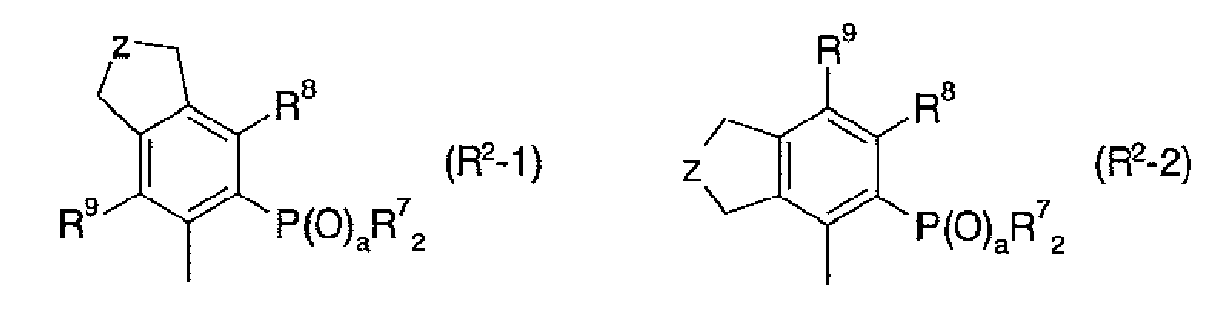
Description
- The invention relates to a phosphorus compound useful as a ligand of a metal catalyst and a production process thereof.
- Conventionally, many reports have been published on transition metal complexes usable as a catalyst for an asymmetric reaction such as asymmetric hydrogenation reaction, asymmetric isomerization reaction, and asymmetric hydrosilylation reaction. Especially, complexes containing a transition metal such as ruthenium, rhodium, iridium,palladium, or the like and an optically active phosphine compound coordinated with the metal have widely been known as a high performance catalyst for an asymmetric synthesis reaction. Among such optically active phosphine compounds, an optically active biaryl phosphine compound with axial asymmetry is useful as an optically active ligand of an asymmetric reaction catalyst (see, for example, Tetrahedron, 2005, Vol. 61, 5405-5432). Many of the processes to synthesize such an optically active biaryl compound involve homo- or cross-coupling of two aryl units, and require optical resolution to obtain an optically active substance after the coupling (see, for example,
JP-A-2000-16997 JP-A-10-182678 JP-A-10-182678 JP-T-10-501234 - As described above, although the synthesis of a biaryl compound having an axially asymmetric structure by way of enantio-selective [2+2+2] cycloaddition reaction has been known, no process for synthesizing a compound with a phosphorus atom site introduced into the biaryl skeleton thereof is hitherto known.
- Furthermore, it is indispensable to carry out optical resolution for a biaryl phosphorus compound synthesized by a conventional coupling method of aryl units and in some cases, one optical isomer may be unnecessary.
- Therefore, if it is possible to produce optically active biaryl phosphorus compound having high optical purity and axially asymmetric structure using a substrate relatively easy to obtain through a lessened number of steps, an axially asymmetric optically active substance can easily be obtained without the step of optical resolution, which is almost indispensable step in a conventional method. The purpose of the invention is to provide such a production process and a novel biaryl phosphorus compound to be produced in such a manner.
- As a result of keen examination to solve the problems, the inventors have found that it is possible to produce an axially asymmetric biaryl phosphorus compound having high optical purity in one step by enantio-selective [2+2+2] cycloaddition reaction of a diyne compound and an alkynyl phosphorus compound in the presence of a catalyst containing rhodium and an optically active bisphosphine, and have completed the present invention.
- The invention includes:
- 1. A phosphorus compound defined by the following general formula (1):


- 2. The phosphorus compound according to the above-mentioned 1, being an axially asymmetric optically active substance.
- 3. The phosphorus compound according to the above-mentioned 1, defined by the following general formula (3):


- 4. The phosphorus compound according to the above-mentioned 3, being an axially asymmetric optically active substance.
- 5. A production process of the phosphorus compound according to the above-mentioned 2,wherein a diyne compound defined by the following general formula (2-1) and an alkynyl phosphorus compound defined by the following general formula (3-1) are reacted using a catalyst containing rhodium metal and an optically active bisphosphine:

- 6. A production process of the phosphorus compound according to the above-mentioned 2,wherein a diyne compound defined by the following general formula (2-2) and an alkynyl phosphorus compound defined by the following general formula (3-2) are reacted using a catalyst containing rhodium metal and an optically active bisphosphine:

- 7. The production process according to the above-mentioned 5 or 6, wherein the catalyst containing rhodium metal and an optically active bisphosphine is a compound defined by the following general formula (4):
[Rh(L)m(Y)n]X (4)
in the formula (4), L denotes an optically active bisphosphine defined by the following formula (5) ; Y denotes a nonconjugated diene compound; X denotes a counter anion; m denotes an integer of 1 or 2; n denotes an integer of 0 or 1; however, in the case
where m = 1, n = 0 or n = 1; and in the case where m = 2, n = 0:
R10R11P-Q-PR12R13 (5)
in the formula (5), R10, R11, R12, and R13 independently denote an aryl group optionally having a substituent group or a cycloalkyl group optionally having a substituent group; R10 in combination with R11 and/or R12 in combination with R13 may form a ring; and Q denotes a divalent arylene group optionally having a substituent group or a ferrocenediyl group. - 8. The production process according to the above-mentioned 7, wherein the catalyst containing rhodium metal and an optically active bisphosphine is used immediately after preparation.
- 9. The production process according to the above-mentioned 7 or 8, wherein an olefin ligand is eliminated using hydrogen gas in preparing the catalyst containing rhodium metal and an optically active bisphosphine.
- 10. An asymmetric synthesis reaction using the axially asymmetric optically active compound according to the above-mentioned 2 or 4.
- According to the process of the invention, since it is possible to enantio-selectively produce an optically active biaryl phosphorus compound in one step by reacting a diyne compound and an alkynyl phosphorus compound in the presence of a catalyst containing rhodium metal and an optically active bisphosphine, an optically active biaryl phosphorus compound can be produced easily using a substrate relatively easy to obtain and consequently, an axially asymmetric and optically active substance can be obtained without the step of optical resolution. Furthermore, a phosphorus compound within the scope of the invention can easily be produced and is useful as a ligand of a metal catalyst.
- Hereinafter, the invention will be described in more detail.
- A phosphorus compound of the invention is a phosphorus compound defined by the above-mentioned general formula (1) and can be produced by a production process of the invention, which will be described in detail below. In the general formula (1), R1 denotes a hydrogen atom or a hydroxy protective group and examples of the hydroxy protective group defined by R1 may include an alkyl, an aralkyl, an acyl, or a tri-substituted silyl group.
- Herein, the alkyl group defined by R1 may include, for example, linear or branched alkyl groups having 1 to 15 carbon atoms, preferably 1 to 10 carbon atoms, and more preferably 1 to 6 carbon atoms. Specific examples are methyl, ethyl, n-propyl, isopropyl, n-butyl, sec-butyl, isobutyl, tert-butyl, pentyl, and hexyl group. These alkyl groups may have an alkoxy substituent group, and specific examples of the alkoxyalkyl may include methoxymethyl, ethoxyethyl, tert-butoxymethyl, and 2-methoxyethoxyethyl.
- The aralkyl group defined by R1 may include, for example, benzyl, p-methoxybenzyl, 1-phenylethyl, and triphenylmethyl group.
- The acyl group defined by R1 may include, for example, linear or branched aliphatic acyl groups having 1 to 10 carbon atoms or aromatic acyl groups. Specific examples may include acetyl, propanoyl, butyryl, pivaloyl, methoxycarbonyl, ethoxycarbonyl, benzyloxycarbonyl, benzoyl, and p-nitrobenzoyl group.
- The tri-substituted silyl group defined by R1 may include, for example, trimethylsilyl, triethylsilyl, triisopropylsilyl, and tert-butyldimethylsilyl group.
- In the general formula (1), R2 denotes a group defined by the above-mentioned formula (R2-1) or (R2-2), and in the formulas (R2-1) and (R2-2), R7 denotes an alkyl, a cycloalkyl, an aryl, an alkoxy, or an aryloxy group.
- Herein, the alkyl group defined by R7 may include, for example, linear or branched alkyl groups having 1 to 15 carbon atoms, preferably 1 to 10 carbon atoms, and more preferably 1 to 6 carbon atoms. Specific examples are methyl, ethyl, n-propyl, isopropyl, n-butyl, sec-butyl, isobutyl, tert-butyl, pentyl, and hexyl group.
- The cycloalkyl group defined by R7 may include, for example, cycloalkyl groups having 3 to 8 carbon atoms, and specific examples are cyclopropyl, cyclobutyl, cyclopentyl, cyclohexyl, cycloheptyl, and cyclooctyl group.
- The aryl group defined by R7 may include, for example, aryl groups having 6 to 18 carbon atoms, and specific examples are phenyl, naphthyl, anthryl, phenanthryl, and biphenyl group. These aryl groups may have a substituent group and examples of the substituent group may be linear or branched alkyl groups having 1 to 6 carbon atoms such as methyl and tert-butyl; linear or branched alkoxy groups having 1 to 6 carbon atoms such as methoxy and tert-butoxy; and halogen atoms such as chlorine, bromine, and fluorine; and a plurality of these substituent groups may be introduced into the aryl groups. Specific examples of these aryl groups having substituent groups are p-tolyl, m-tolyl, o-tolyl, 3,5-xylyl, 3,5-di-tert-butylphenyl, p-tert-butylphenyl, p-methoxyphenyl, 3,5-di-tertbutyl-4-methoxyphenyl, p-chlorophenyl, and m-fluorophenyl group.
- The alkoxy group defined by R7 may include, for example, linear or branched alkoxy groups having 1 to 15 carbon atoms, preferably 1 to 10 carbon atoms, and more preferably 1 to 6 carbon atoms. Specific examples are methoxy, ethoxy, n-propoxy, isopropoxy, n-butoxy, sec-butoxy, isobutoxy, tert-butoxy, pentyloxy, and hexyloxy group.
- The aryloxy group defined by R7 may include, for example, aryloxy groups having 6 to 18 carbon atoms, and specific examples are phenyloxy, naphthyloxy, anthryloxy, phenanthryloxy, and biphenyloxy. These aryloxy groups may have a substituent group and examples of the substituent group are linear or branched alkyl groups having 1 to 6 carbon atoms such as methyl and tert-butyl; linear or branched alkoxy groups having 1 to 6 carbon atoms such as methoxy and tert-butoxy; and halogen atoms such as chlorine, bromine, and fluorine, and a plurality of these substituent groups may be introduced into the aryl group.
- In the general formula (1), R3, R4, R5, and R6 may be the same or different and independently denote a hydrogen atom, an alkyl, an alkoxy, an acyloxy, a halogen atom, a haloalkyl, or a dialkylamino group.
- Herein, the alkyl group defined by R3, R4, R5, and R6 may include, for example, linear or branched alkyl groups having 1 to 6 carbon atoms such as methyl and tert-butyl group; the alkoxy group may include, for example, linear or branched alkoxy groups having 1 to 6 carbon atoms such as methoxy and tert-butoxy group; the acyloxy group may include, for example, acyloxy groups having 2 to 10 carbon atoms such as acetoxy, propanoyloxy, trifluoroacetoxy, and benzoyloxy group; the halogen atom may include, for example, chlorine, bromine, and fluorine; the haloalkyl group may include, for example, haloalkyl groups having 1 to 4 carbon atoms such as trifluoromethyl group; and dialylamino group may include, for example, dimethylamino and the diethylamino group.
- In the general formula (1), two among R3, R4, R5, and R6 may form an aromatic ring optionally having a substituent group and in such a case, specific examples of the aromatic ring may be a benzene ring, a naphthyl ring, an anthryl ring, and a phenanthryl ring. The substituent group of the aromatic ring may be alkyl groups and halogen atoms, and specific examples may be the above-mentioned alkyl groups having 1 to 6 carbon atoms and a fluorine atom.
- Furthermore, in the general formula (1), two among R3, R4, R5, and R6 may form a methylene chain optionally having a substituent group, and in such a case, the methylene chain may be preferably methylene chains having 3 to 5 carbon atoms, and specific examples are trimethylene, tetramethylene, and pentamethylene group. The substituent group of the methylene chain may include alkyl groups and halogen atoms, and specific examples may be the above-mentioned alkyl groups having 1 to 6 carbon atoms and a fluorine atom.
- Furthermore, in the general formula (1), two among R3, R4, R5, and R6 may form a (poly)methylenedioxy group optionally having a substituent group and in such a case, specific examples of the (poly)methylenedioxy may be methylenedioxy, ethylenedioxy, and trimethylenedioxy group. The substituent group of the (poly)methylenedioxy may include alkyl groups and halogen atoms, and specific examples may be the above-mentioned alkyl groups having 1 to 6 carbon atoms and a fluorine atom.
- In the general formula (1), R2 denotes a group defined by the above-mentioned formula (R2-1) or (R2-2), and in the general formulas (R2-1) and (R2-2), R8 and R9 independently denote a hydrogen atom, an alkyl, or an aryl group, and the alkyl group denoted by R8 and R9 may include, for example, linear or branched alkyl groups having 1 to 15 carbon atoms, preferably 1 to 10 carbon atoms, and more preferably 1 to 6 carbon atoms. Specific examples are methyl, ethyl, n-propyl, isopropyl, n-butyl, sec-butyl, isobutyl, tert-butyl, pentyl, and hexyl group.
- The aryl group denoted by R8 and R9 may include, for example, aryl groups having 6 to 18 carbon atoms, and specific examples are phenyl, naphthyl, anthryl, phenanthryl, and biphenyl group. These aryl groups may have a substituent group, and the substituent group may include, for example, linear or branched alkyl groups having 1 to 6 carbon atoms such as methyl, ethyl, n-propyl, isopropyl, n-butyl, sec-butyl, isobutyl, tert-butyl, pentyl, and hexyl group; linear or branched alkoxy groups having 1 to 6 carbon atoms such as methoxy, ethoxy, n-propoxy, isopropoxy, n-butoxy, sec-butoxy, isobutoxy, tert-butoxy, pentyloxy, and hexyloxy group; and halogen atoms such as chlorine, bromine, and fluorine, and a plurality of these substituent groups may exist in the aryl group.
- The divalent group denoted by Z in the formulas (R2-1) and (R2-2) may include, for example, an oxygen atom, a sulfur atom, a methylene chain, NRN, and Si (RSi)2. Herein, RN denotes an alkyl, an aryl, an alkanesulfonyl, an arylsulfonyl, or an acyl group, and RSi denotes an alkyl or an aryl group or may form a ring with Si(RSi)2.
- The methylene chain denoted by Z may include, for example, linear or branched methylene chains and examples are methylene, ethylene, trimethylene, propylene, isopropylidene, 2,3-butanediyl, and difluoromethylene group.
- The alkyl group denoted by RN of NRN and RSi of Si(RSi)2 may include, for example, linear or branched alkyl groups having 1 to 6 carbon atoms, and specific examples are the above-mentioned alkyl groups. The aryl group defined by RN and RSi may include the aryl groups having 6 to 18 carbon atoms, and specific examples are the above-mentioned aryl groups.
- The alkanesulfonyl and arylsulfonyl group defined by RN of NRN may include, for example, methanesulfonyl, trifluoromethanesulfonyl, benzenesulfonyl, and p-toluenesulfonyl group.
- The acyl group defined by RN may include, for example, linear or branched aliphatic acyl groups having 2 to 10 carbon atoms or aromatic acyl groups, and specific examples may include acetyl, propanoyl, butyryl, pivaloyl, methoxycarbonyl, ethoxycarbonyl, tert-butoxycarbonyl, benzyloxycarbonyl, benzoyl, and p-nitrobenzoyl group.
- The ring formed with Si (RSi)2 may be a silolane ring, a silane ring, or a silepane ring.
- In the invention, the phosphorus compounds defined by the general formula (1) are preferably the phosphorus compounds defined by the general formula (3). The definitions of the reference characters in the general formula (3) and the examples of the groups denoted by the reference characters are the same as those described for the general formula (1). Preferable specific examples of the phosphorus compounds defined by the general formula (1) may be optically active biarylphosphine oxides or biarylphosphines exemplified in Examples described below.
- Furthermore, in the invention, the phosphorus compounds defined by the general formula (1) and preferably by the general formula (3) are preferably axially asymmetric optically active compounds.
- Next, a production process of an axially asymmetric optically active phosphorus compound that is suitable for producing the phosphorus compound of the invention (referred to simply as a production process of the invention in some cases) will be described.
- The production process of an axially asymmetric optically active phosphorus compound of the invention involves, as described in the following schemes, causing reaction of a diyne compound defined by the general formula (2-1) with an alkynyl phosphorus compound defined by the general formula (3-1) or reaction of a diyne compound defined by the general formula (2-2) with an alkynyl phosphorus compound defined by the general formula (3-2) in the presence of a catalyst containing rhodium metal and an optically active bisphosphine compound and more particularly causing enantzo-selective [2+2+2] cycloaddition.

- Definitions of the reference characters R1, R2, R3, R4, R5, R6, R7, R8, R9, Z, and a and examples of the groups represented by these reference characters in the general formulas (2-1), (2-2), (3-1), and (3-2) described also in the schemes are the same as those described above for the general formula (1).
- The catalyst containing rhodium metal and an optically active bisphosphine compound used in the production process of the invention will be described.
- As the rhodium source for the rhodium metal used as one component of the catalyst of the invention, rhodium compounds may be used, and preferable rhodium compounds may be complexes of rhodium(I) having olefinic ligand. Specific examples of rhodium(I) complexes are [Rh(cod)2]X, [Rh(nbd)2]X, [RhCl(ethylene)2]2, [RhCl(cod)]2, and [RhCl(nbd)]2. In the above-mentioned chemical formulas of the complexes, X denotes a counter anion; cod denotes 1,5-cyclooctadiene; and nbd denotes norbornadiene.
- Examples of the optically active bisphosphine compound that is the other catalytic component used for the invention are those defined by the following general formula (5):
R10R11P-Q-PR12R13 (5)
in the formula, R10, R11, R12, and R13 independently denote an aryl group optionally having a substituent group or a cycloalkyl group optionally having a substituent group; R10 in combination with R11 and/or R12 in combination with R13 may form a ring; and Q denotes a divalent arylene group optionally having a substituent group or a ferrocenediyl group. - In the above formula, the aryl group denoted by R10, R11, R12, or R13 optionally having a substituent group may be an aryl group having 6 to 14 carbon atoms, and specific examples are phenyl, naphthyl, anthryl, phenanthryl, and biphenyl group. These aryl groups may have a substituent group, and the substituent group may be an alkyl, an alkoxy, an aryl, and a heterocyclic group.
- The alkyl group as a substituent group of the aryl groups may include, for example, linear or branched alkyl groups having 1 to 15 carbon atoms, preferably 1 to 10 carbon atoms, and more preferably 1 to 6 carbon atoms, and specific examples are methyl, ethyl, n-propyl, isopropyl, n-butyl, sec-butyl, isobutyl, and tert-butyl group.
- The alkoxy group as a substituent group of the aryl groups may include, for example, linear or branched alkoxy groups having 1 to 6 carbon atoms, and specific examples are methoxy, ethoxy, n-propoxy, isopropoxy, n-butoxy, sec-butoxy, isobutoxy, and tert-butoxy group.
- The aryl group as a substituent group of the aryl groups may include, for example, aryl groups having 6 to 14 carbon atoms, and specific examples are phenyl, naphthyl, anthryl, phenanthryl, and biphenyl group.
- The heterocyclic group as the substituent group of the aryl groups may include, for example, aliphatic heterocyclic groups and aromatic heterocyclic groups. The aliphatic heterocyclic groups may include, for example, 5- to 8-membered and preferably 5- or 6-membered mono-cyclic, polycyclic, and condensed ring type aliphatic heterocyclic groups having 2 to 14 carbon atoms and at least one, preferably 1 to 3 hetero atoms such as nitrogen, oxygen, and sulfur atoms. Specific examples of the aliphatic heterocyclic groups are 2-oxo pyrrolidyl, piperidino, piperadinyl, morpholino, tetrahydrofuryl, tetrahydropyranyl, and tetrahydrothienyl. On the other hand, the aromatic heterocyclic groups may include, for example, 5- to 8-membered and preferably 5- or 6-membered mono-cyclic, polycyclic, and condensed ring type heteroaryl groups having 2 to 15 carbon atoms and at least one, preferably 1 to 3 hetero atoms such as nitrogen, oxygen, and sulfur atoms. Specific examples are furyl, thienyl, pyridyl, pyrimidinyl, pyradinyl, pyridadinyl, pyrazolyl, imidazolyl, oxazolyl, thiazolyl, benzofuryl, benzothienyl, quinolyl, isoquinolyl, quinoxalyl, phthalazinyl, quinazolinyl, naphthyldinyl, cinnolinyl, benzoimidazolyl, benzoxazolyl, and benzothiazolyl group.
- The cycloalkyl denoted by R10, R11, R12, and R13 optionally having a substituent group may be 5- or 6-membered cycloalkyl groups, and preferable cycloalkyl groups are cyclopentyl and cyclohexyl group. These cycloalkyl groups may have one or more alkyl or alkoxy substituent groups as exemplified above for the aryl groups.
- Furthermore, the ring formed by combination of R10 with R11 and/or R12 with R13 may be 4-, 5-, or 6-membered rings containing a phosphorus atom to which R10, R11, R12, and R13 are bound. Specific examples of the ring are phosphetane ring, phospholane ring, phosphane ring, 2,4-dimethylphosphetane ring, 2,4-diethylphosphetane ring, 2,5-dimethylphospolane ring, 2,5-diethylphospholane ring, 2,6-dimethylphosphane ring, and 2,6-diethylphosphane ring. These rings may be optically active substance.
- The divalent arylene denoted by Q optionally having a substituent group may be phenylene, biphenyldiyl, and binaphthalenediyl group. The phenylene group includes, for example, o- or m-phenylene group, and may have substituent groups selected from alkyl group such as methyl, ethyl, n-propyl, isopropyl, n-butyl, sec-butyl, isobutyl, and tert-butyl group; alkoxy group such as methoxy, ethoxy, n-propoxy, isopropoxy, n-butoxy, sec-butoxy, isobutoxy, and tert-butoxy group; hydroxyl group; amino group; and substituted amino group. The biphenyldiyl group and the binaphthalenediyl group are preferably have a 1,1' -biaryl-2,2'-diyl type structure, and may have substituent group selected from the above-mentioned alkyl group and alkoxy group; alkylenedioxy group such as methylenedioxy, ethylenedioxy, and trimethylenedioxy; hydroxyl group; amino group; and substituted amino group. Furthermore, the ferrocenediyl group also may have substituent groups, and the substituent groups may be, for example, the above-mentioned alkyl group, alkoxy group, alkylenedioxy groups, hydroxyl group, amino group, and substituted amino group.
- Specific examples of the optically active bisphosphine compound defined by the general formula (5) may be conventionally known bisphosphines, and one example is a compound defined by the following general formula (6).

- In the above R14 and R15, the alkyl group as the substituent group of the phenyl may include, for example, linear or branched alkyl groups having 1 to 6 carbon atoms such as methyl and tert-butyl group; the alkoxy group as the substituent group of the phenyl may include, for example, linear or branched alkoxy groups having 1 to 6 carbon atoms such as methoxy and tert-butoxy group; and the halogen atom as the substituent group of the phenyl may include, for example, chlorine, bromine, and fluorine.
- Specific examples of R14 and R15 are phenyl, p-tolyl, m-tolyl, 3,5-xylyl, p-tert-butylphenyl, p-methoxyphenyl, p-chlorophenyl, cyclopentyl, and cyclohexyl group.
- The binaphthyl ring that is the basic skeleton of the compound defined by the general formula (6) may have a substituent group, and the substituent group may include, for example, alkyl groups such as methyl and tert-butyl group; alkoxy groups such as methoxy and tert-butoxy group; trialkylsilyl groups such as trimethylsilyl, triisopropylsilyl, and tert-butyldimethylsilyl group; and triarylsilyl groups such as triphenylsilyl group.
- Another specific example of the optically active bisphosphine compound defined by R10R11P-Q-PR12R13 may be a compound defined by the following general formula (7).

- In the above R16 and R17, the alkyl group as the substituent group of the phenyl may include, for example, linear or branched alkyl groups having 1 to 6 carbon atoms such as methyl and tert-butyl group; the alkoxy group as the substituent group of the phenyl may include, for example, linear or branched alkoxy groups having 1 to 6 carbon atoms such as methoxy and tert-butoxy group; and the halogen atom as the substituent group of the phenyl may include, for example, chlorine, bromine, and fluorine. A plurality of these substituent groups may be introduced into the phenyl group. Specific examples of R16 and R17 are phenyl, p-tolyl, m-tolyl, o-tolyl, 3,5-xylyl, 3,5-di-tert-butylphenyl, p-tert-butylphenyl, p-methoxyphenyl, 3,5-di-tert-butyl-4-methoxyphenyl, p-chlorophenyl, m-fluorophenyl, cyclopentyl, and cyclohexyl group.
- The alkyl group denoted by R18 to R23 may include, for example, linear or branched alkyl groups having 1 to 6 carbon atoms such as methyl and tert-butyl group; the alkoxy group may include, for example, linear or branched alkoxy groups having 1 to 6 carbon atoms such as methoxy and tert-butoxy group; the acyloxy group may include, for example, acyloxy groups having 2 to 10 carbon atoms such as acetoxy, propanoyloxy, trifluoroacetoxy, and benzoyloxy group; the halogen atom may include, for example, chlorine, bromine, and fluorine; the haloalkyl group may include, for example, haloalkyl groups having 1 to 4 carbon atoms such as trifluoromethyl group; and the dialkylamino group may include, for example, dimethylamino and diethylamino group.
- In the case where two of R18, R19, and R20 form a methylene chain optionally having a substituent group and in the case where two of R21, R22, and R23 form a methylene chain optionally having a substituent group, the methylene chain preferably includes, for example, methylene chains having 3 to 5 carbon atoms, and specific examples are trimethylene, tetramethylene, and pentamethylene group. The substituent group in the methylene chain optionally having a substituent group may be an alkyl group and a halogen atom, and specific examples are the above-mentioned alkyl groups having 1 to 6 carbon atoms and a fluorine atom.
- In the case where two of R18, R19, and R20 form a (poly)methylenedioxy group optionally having a substituent group and in the case where two of R21, R22 , and R23 form a (poly)methylenedioxy group optionally having a substituent group, specific examples of the (poly)methylenedioxy group are methylenedioxy, ethylenedioxy, and trimethylenedioxy group. The substituent group in the (poly)methylenedioxy may be an alkyl group and a halogen atom, and specific examples are the above-mentioned alkyl groups having 1 to 6 carbon atoms and a fluorine atom.
- Specific examples of the optically active bisphosphine compound defined by the general formulas (6) and (7) are 2,2'-bis(diphenylphosphino)-1,1'-binaphthyl, 2,2'-bis[di(p-tolyl)phosphino]-1,1'-binaphthyl, 2,2'-bis[di(m-tolyl)phosphino]-1,1'-binaphthyl, 2,2'-bis[di(3,5-xylyl)phosphino]-1,1'-binaphthyl, 2,2'-bis[di(p-tert-butylphenyl)phosphino]-1,1'-binaphthyl, 2,2'-bis[di(p-methoxyphenyl)phosphino]-1,1'-binaphthyl, 2,2'-bis[di(3,5-di-tert-butyl-4-methoxyphenyl)phosphino]-1, 1'-binaphthyl, 2,2'-bis[di(cyclopentyl)phosphzno]-1,1'-binaphthyl, 2,2'-bis[di(cyclohexyl)phosphino]-1,1'-binaphthyl, 2,2'-bis(diphenylphosphino)-5,5',6,6',7,7',8,8'-octahydro-1 ,1'-binaphthyl, 2,2'-bis(di-p-tolylphosphino)-5,5',6,6',7,7',8,8'-octahydro-1,1'-binaphthyl, 2,2'-bis(di-m-tolylphosphino)-5,5',6,6',7,7',8,8'-octahydro-1,1'-binaphthyl, 2,2'-bis(di-3,5-xylylphosphino)-5,5',6,6',7.7'.8.8'-octahydro-1,1'-binaphthyl, 2,2'-bis(di-p-tert-butylphenylphosphina)-5,5',6,6',7,7',8,8'-octahydro-1,1'-binaphthyl, 2,2'-bis(di-p-methoxyphenylphosphino)-5,5',6,6',7,7',8,8'-octahydro-1,1'-binaphthyl, 2,2'-bis(di-p-chlorophenylphosphino)-5,5',6,6',7,7',8,8'-octahydro-1,1'-binaphthyl, 2,2'-bis(dicyclopentylphosphino)-5,5',6,6',7,7',8,8'-octahydro-1,1'-binaphthyl, 2,2'-bis(dicyclohexylphosphino)-5,5',6,6',7,7',8,8'-octahydro-1,1'-binaphthyl, ((4,4'-bi-1,3-benzodioxole)-5,5'-diyl)bis(diphenylphosphine) (hereinafter, referred to as segphos), ((4,4'-bi-1,3-benzodioxole)-5,5'-diyl)bis(bis(3,5-dimethylphenyl)phosphine), ((4,4'-bi-1,3-benzodioxole)-5,5'-diyl)bis(bis(3,5-di-tert-butyl-4-methoxyphenyl)phosphine), ((4,4'-bi-1,3-benzodioxole)-5,5'-diyl)bis(bis(4-methoxyphenyl)phosphine), ((4,4'-bi-1,3-benzodioxole)-5,5'-diyl)bis(dicyclohexylphosphine), ((4,4'-bi-1,3-benzodioxole)-5,5'-diyl)bis(bis(3,5-di-tert-butylphenyl)phosphine), 2,2'-bis(diphenylphosphino)-4,4',6,6'-tetramethyl-5,5'-dimethoxy-1,1'-biphenyl, 2,2'-bis(di-p-methoxyphenylphosphino)-4,4',6,6'-tetramethyl-5,5'-dimethoxy-1,1'-biphenyl, 2,2'-bis(diphenylphosphino)-4,4',6,6'-tetra(trifluoromethyl)-5,5'-dimethyl-1,1'-biphenyl, 2,2'-bis(diphenylphosphino)-4,6-di(trifluoromethyl)-4',6'-dimethyl-5'-methoxy-1,1'-biphenyl, 2-dicyclohexylphosphino)-2'-diphenylphosphino-4,4',6,6'-tetramethyl-5,5'-dimethoxy-1,1'-biphenyl, 2,2'-bis(diphenylphosphino)-6,6'-dimethyl-1,1'-biphenyl, 2,2'-bis(diphenylphosphino)-4,4',6,6'-tetramethyl-1,1'-biphenyl), 2,2'-bis(diphenylphosphino)-3,3',6,6'-tetramethyl-1,1'-biphenyl, 2,2'-bis(diphenylphosphino)-4,4'-difluoro-6,6'-dimethyl-1,1'-biphenyl, 2,2'-bis(diphenylphosphino)-4,4'-bis(dimethylamino)-6,6'-di-methyl-1,1'-biphenyl, 2,2'-bis(di-p-tolylphosphino)-6,6'-dimethyl-1,1'-biphenyl, 2,2'-bis(di-o-tolylphosphino)-6,6'-dimethyl-1,1'-biphenyl, 2,2'-bis(di-m-fluorophenylphosphino)-6,6'-dimethyl-1,1'-biphenyl, 1,11-bis(diphenylphosphino)-5,7-dihydrobenzo[c,e]oxepine, 2,2'-bis(diphenylphosphino)-6,6'-dimethoxy-1,1'-biphenyl, 2,2'-bis(diphenylphosphino)-5,5',6,6'-tetramethoxy-1,1'-biphenyl, 2,2'-bis(di-p-tolylphosphino)-6,6'-dimethoxy-1,1'-biphenyl, 2,2'-bis(diphenyxphosphino)-4,4',5,5',6,6'-hexamethoxy-1,1'-biphenyl, 1,2-bis(2,5-dimethylphospholano)benzene, 1,2-bis(2,5-diethylphospholano)benzene, 1,2-bis(2,5-diisopropylphospholano)benzene, 1-(2,5-dimethylphospholano)-2-(diphenylphosphino)benzene, and 1,1'-bis(2,4-diethylphosphotano)ferrocene.
- Additionally, specific examples of the optically active bisphosphine compound used in the invention may also include N,N-dimethyl-1-[1',2-bis(diphenylphosphino)ferrocenyl]ethyl amine, 2,3-bis(diphenylphosphino)butane, 1-cyclohexyl-2,2-bis(diphenylphosphino)ethane, 2,3-O-isopropylidene-2,3-dihydroxy-1,4-bis(diphenylphosphino)butane, 1,2-bis[(o-methoxyphenyl)phenylphosphino]ethane, 1,2-bis(2,5-dimethylphospholano) ethane, 5,6-bis(diphenylphosphino)-2-norbornene, N,N-bis(diphenylphosphino)-N,N'-bis(1-phenylethyl)ethylenediamine, 1,2-bis(diphenylphosphino)propane, and 2,4-bis(diphenylphosphino)pentane.
- The catalyst used in the invention is a catalyst containing rhodium metal and an optically active bisphosphine, as described above, as catalytic components, and is a compound defined by the following general formula (4).
[Rh(L)m(Y)n]X (4)
In the formula (4), L denotes an optically active bisphosphine represented by R10R11P-Q-PR12R13; Y denotes a non-conjugated diene compound; X denotes a counter anion; m denotes an integer of 1 or 2; n denotes an integer of 1 or 2; however, in the case where m = 1, n = 0 or n = 1; and in the case where m = 2, n = 0; R10, R11, R12, and R13 independently denote an aryl group optionally having a substituent group or a cycloalkyl group optionally having a substituent group; R10 in combination with R11 and/or R12 in combination with R13 may form a ring; and Q denotes a divalent arylene group optionally having a substituent group or a ferrocenediyl group. - The optically active bisphosphine denoted by L, that is R10R11P-Q-PR12R13, in the above formula, is as described above.
- Next, the compound defined by the general formula (4) as an example of the catalyst containing rhodium metal and the optically active bisphosphine used in the invention will be described in more detail.
- In the general formula (4), the non-conjugated diene compound denoted by Y may be cyclic or acyclic, and in the case where the non-conjugated diene compound is a cyclic non-conjugated diene compound, the compound may include monocyclic, polycyclic, condensed cyclic, or bicyclo compounds. Furthermore, the non-conjugated diene compound may include, for example, a non-conjugated diene compound having a substituent group, that is, a substituted non-conjugated diene compound, and the substituent group is not particularly limited as long as it does not negatively affect the production process of the invention. Preferable non-conjugated diene compounds are, for example, 1,5-cyclooctadiene, bicyclo[2,2,1]hepta-2,5-diene, and 1,5-hexadiene.
- The counter anion denoted by X in the general formula (4) may include, for example, BF4, ClO4, CF3SO3 (hereinafter, abbreviated as OTf), PF6, SbF6, B(3,5-(CF3)2C6H3)4, and BPh4.
- The compound defined by the general formula (4) used in the invention can be obtained by a conventionally known method as shown in the following scheme 1 under an inert gas atmosphere; or by reacting a commercially available rhodium-olefin complex with, for example, an optically active bisphosphine denoted by L in a solvent such as methanol, ethanol, isopropanol, butanol, toluene, or tetrahydrofuran and successively by counter-anion-exchange reaction with MX (M denotes a monovalent metal cation; and X denotes the same as described above) (accordingly, a compound (A) or (B) in the scheme 1 can be obtained), and optionally by further dissociating the olefin ligand by reacting the obtained compound with hydrogen gas (accordingly, a compound (C) in the scheme 1 can be obtained). The COD in the chemical formula denotes 1,5-cyclooctadiene (hereinafter, the same)

- As shown in the following scheme 2, the compound defined by the general formula (4) used in the invention can be obtained also by reacting a rhodium-bisolefin complex previously subjected to counter-anion exchange reaction with an optically active bisphosphine denoted by L and optionally by further dissociating the olefin ligand with hydrogen gas.

- The added amount of the optically active bisphosphine denoted by L to the number of moles of the rhodium metal of the rhodium-olefin complex shown in the scheme 1 or the scheme 2 is 1.0 to 2.4 times, more preferably 1.05 to 2.2 times since part of the bisphosphine may possibly be oxidized.
- In the present invention, the rhodium-olefin coordinated complex used for producing the compound as the catalyst defined by the general formula (4) may be various complexes depending on selected olefin ligands. However, for reasons of availability, a rhodium complex of 1,5-cyclooctadiene [Rh(COD)Cl]2 and a rhodium complex of norbornadiene [Rh(NBD)Cl]2 are particularly preferable. In the chemical formula, NBD denotes 2,5-norbornadiene (hereinafter, the same).
- In the counter-anion-exchange reaction, for example, silver salt (AgX) is preferably used as MX in terms of the handling easiness.
- The catalytic active species in the compound defined by the general formula (4) is [Rh(L)m]X. However, a precursor thereof, for example, the compound (A): [Rh(L)(COD)]X in the above-mentioned scheme, may also be used in the production process of the invention.
- The compounds defined by the general formula (4) such as compounds (A), (B), and (C) in the above-mentioned scheme can be used for the production process of the invention without further purification after being prepared as a catalyst. Furthermore, in the production process of the invention, the catalyst containing rhodium metal and an optically active bisphosphine can be used immediately after the preparation thereof. Specifically, a rhodium compound and an optically active bisphosphine are reacted to prepare the catalyst, and successively the above-mentioned diyne compound and alkynyl phosphorus compound may be added.
- A reaction solvent used in the production process of the invention is not particularly limited as long as it does not cause any adverse effect on the reaction, and examples may include amides such as N,N-dimethylformamide, formamide, and N,N-dimethylacetamide; halohydrocarbons such as dichloromethane, 1,2-dichloroethane, chloroform, tetrachlorocarbon, and o-dichlorobenzene; aliphatic hydrocarbons such as pentane, hexane, heptane, octane, decane, and cyclohexane; aromatic hydrocarbons such as benzene, toluene, xylene; non-nucleophilic alcohols such as tert-butanol; ethers such as diethyl ether, diisopropyl ether, tert-butyl methyl ether, dimethoxyethane, ethylene glycol diethyl ether, tetrahydrofuran, 1,4-dioxane, and 1,3-dioxolane; and sulfoxides such as dimethyl sulfoxide. These reaction solvents may be used alone or in a suitable combination of two or more thereof.
- In the production process of the invention, the usage of about 1 to 5 mol% of the catalyst containing rhodium metal and an optically active bisphosphine on the basis of conversion into rhodium metal is typically sufficient to the alkynyl compound defined by the formula of the reaction substrate (3-1) or (3-2).
- In the production process of the invention, the reaction temperature for reacting the above-mentioned diyne compound and alkynyl compound naturally differs in accordance with the substrate used. However it is typically -20°C to 100°C and preferably in a range of 0° C to 50°C. The reaction time naturally differs in accordance with the substrate used. However, it is typically 30 minutes to 30 hours and preferably 1 hour to 20 hours. The reaction is preferably carried out in an inert gas such as nitrogen or argon.
- In addition, with respect to the phosphorus compound defined by the formula (1) or (3), a compound in which a in a group defined by the formula (R2-1) or (R2-2) is 0 can easily be produced by a conventional reaction (e.g. a method of reduction reaction) of a compound in which the corresponding a is 1.
- On completion of the reaction, post-treatment which is routinely carried out in this kind of field such as filtration, silica gel column chromatography, or the like is carried out, and purification such as crystallization, distillation, and various kinds of chromatography may be carried out alone or in combination to obtain an aimed optically active phosphorus compound.
- Hereinafter, the invention will be more specifically described by referring to the examples below. However, the invention is not limited to the illustrated examples.
- The optical purity was measured by HPLC (high performance liquid chromatography) using an optically active column.
-

- According to the above reaction scheme (Me denotes a methyl group. Hereinafter, the same), optically active biarylphosphine oxides were produced. Under an argon atmosphere, (R)-H8-BINAP (0.010 mmol), [Rh(COD)2]BF4 (0.010 mmol), and 1.0 mL of methylene chloride were placed into a schlenk tube, and stirred for 5 minutes. Then, hydrogen gas was introduced into the schlenk tube, and the mixture was stirred for 1 hour. Successively, the reaction mixture was vacuum concentrated and dried, and 1. 0 mL of methylene chloride was added thereto. The diyne compound (0.20 to 0.60 mmol) and the monoyne compound (0.20 mmol) shown in the above reaction formula dissolved in 2 mL of methylene chloride solution were added to the solution, and stirred at room temperature for 1 hour. Next, the solvent was removed by distillation and purified by silica gel column chromatography to obtain target materials. The types of the groups denoted by Z, R', and R" in the reaction formula of each example (Et is ethyl; Ts is p-toluenesulfonyl; Cy is cyclohexyl; MOM is methoxymethyl; Bn is benzyl; and Ph is phenyl. Hereinafter, the same) and the results are shown in Table 1. The structural formula of (R)-H8-BINAP is shown below.

(Table 1) Example Z Number of moles of diyne R' R" Yield Optical purity and optical rotation 1 NTs 0.20 mmol OEt MOM 99% 97%ee, (-) 2 NTs 0.20 mmol OEt Bn 99% 97%ee, (-) 3 NTs 0.20 mmol OEt Me 96% 96%ee, (+) 4 O 0.30 mmol OEt Me 99% 97%ee, (-) 5 O 0.30 mmol OEt Me 99% 97%ee, (-) 6 O 0.60 mmol Cy Me 99% 98%ee, (+) 7 O 0.30mmol Ph Me 92% 91%ee, (-) 8 CH2 0.30 mmol OEt Me 99% 98%ee, (-) 9 CH2 0. 30 mmol Ph Me 86% 91%ee, (-) 10 CH2 0.60 mmol Cy Me 70% 96%ee, (+) 11 C (CO2Me)2 0.20 mmol OEt Me 60% 96%ee 12 C(CH2OMe)2 0.20 mmol OEt Me 37% 95%ee -

- According to the above reaction formula, an optically active biarylphosphine oxide was produced. Under an argon atmosphere, (R)-BINAP (0.010 mmol), [Rh(COD)2]BF4 (0.010 mmol), and 1. 0 mL of methylene chloride were placed into a schlenk tube and stirred for 5 minutes. Then, hydrogen gas was introduced into the schlenk tube, and the mixture was stirred for 1 hour. Successively, the reaction solution was vacuum concentrated and dried, and 0.4 mL of methylene chloride was added thereto. The diyne compound (0.20 mmol) and the monoyne compound (0.20 mmol) dissolved in 1.0 mL of methylene chloride solution of were added to the solution, and stirred at room temperature for 1 hour. Next, the solvent was removed by distillation and purified by silica gel column chromatography to obtain the target material. The yield was 96%; optical purity was 96%ee; and the optical rotation was (-). The structural formula of (R)-BINAP is shown below.

-

- According to the above reaction formula, optically active biarylphosphine oxides were produced. Under an argon atmosphere, (R)-H8-BINAP (0.010 mmol), [Rh(COD)2]BF4 (0.010 mmol), and 1.0 mL of methylene chloride were placed into a schlenk tube and stirred for 5 minutes. Then, hydrogen gas was introduced into the schlenk tube, and the mixture was stirred for 1 hour. Successively, the reaction mixture was vacuum concentrated and dried, and 1.0 mL of methylene chloride was added thereto. The diyne compound (0.30 to 0.60 mmol) and the monoyne compound (0.20 mmol) dissolved in 2 mL of methylene chloride solution were added to the solution, and stirred at room temperature for 1 hour. Next, the solvent was removed by distillation and purified by silica gel column chromatography to obtain target materials. The results are shown in Table 2.
(Table 2) Example Ra Rb Number of moles of diyne R' Yield (%) Optical purity and optical rotation 14 Ph Me 0.30 mmol OEt (1-1) (1-2) 80 <1 (1-1) 86%ee,(-) 15 Ph H 0.60 mmol OEt (I-1) (1-2) 73 <1 (1-1) 96%ee,(-) 16 Ph H 0.60 mmol Ph (I-1) (1-2) 34 <1 (I-1) 74%ee,(-) 17 Me H 0.60 mmol Ph (1-1) 54 (1-1) 58%ee,(-) (1-2) 46 (1-2) 86%ee,(-) 18 Me H 0.30 mmol OEt (I-1) 65 (1-1) 93%ee,(+) (I-2) 35 (I-2) 87%ee,(-) -

- According to the above reaction formula, optically active biarylphosphine oxides were produced. Under an argon atmosphere, optically active bisphosphines (0.010 mmol), [Rh(COD)2]BF4 (0.010 mmol), and 1.0 mL of methylene chloride were placed into a schlenk tube and stirred for 5 minutes. Then, hydrogen gas was introduced into the schlenk tube, and the mixture was stirred for 1 hour. Successively, the reaction mixture was vacuum concentrated and dried, and 1.0 mL of methylene chloride was added thereto. The diyne compound (0.30 mmol) and the monoyne compound (0.20 mmol) dissolved in 2 mL of methylene chloride solution were added to the solution and stirred at room temperature for 16 hours. Next, the solvent was removed by distillation and purified by silica gel column chromatography to obtain target materials. The results are shown in Table 3.
The structures of the optically active bisphosphines in the table are as follows.
(Table 3) Example Optically active bisphosphine Yield (I-3/I-4) Optical purity and optical rotation 19 (R)-BINAP 35% (81/19) (1-3) 80%ee,(-) 20 (R)-tol-BINAP 45% (94/6) (1-3) 87%ee,(-) 21 (R)-xyl-BINAP 15% (81/19) 22 (R)-H8-BINAP 100% (65/35) (1-3) (1-4) 93%ee,(-)
87%ee,(-)23 (R)-segphos <10% -

- (-)-1-[6-(Diphenylphosphinoyl)-4,7-dimethylindan-5-yl]-2-methoxynaphthalene (800 mg, 1.59 mmol, 97%ee) was placed into a flask and the atmosphere in the flask was replaced with nitrogen. Triethylamine (4.4 mL, 31.8 mmol) was added to a solution of this naphthalene compound in xylene (40 mL), and cooled to 4°C. Further, trichlorosilane (800 µL, 7.95 mmol) was added dropwise, and the mixture was stirred for 30 minutes and then stirred at room temperature for 15 minutes. Further, the reaction mixture was heated to 110°C and stirred for 3 hours. After the resulting reaction mixture was cooled to room temperature, diethyl ether (60 mL) and saturated aq. sodium bicarbonate (800 µL) were added, and the mixture was stirred for 30 minutes. The reaction mixture was filtered through Celite, and the filtrate was dried with sodium sulfate. After silica gel was added, the mixture was concentrated under reduced pressure. The residue was purified by silica gel chromatography to obtain the titled compound (744 mg, 96%, 97%ee).
Mp 166°C; [α]D25 -37.3° (c 1.00, CH2Cl2, 97%ee); 1H-NMR (CD2Cl2, 300MHz) δ 7.90-7.80(m,2H), 7.36-7.10(m,14H), 3.50(s,3H), 3.03(t, J=7.4Hz, 2H), 2.93(t, J=8.0Hz, 2H), 2.17(dquint, J=7.3, 2.7, 2H), 1.77(s,3H), 1.75(s,3H); 31P-NMR (CD2Cl2,121MHz) δ=-11.0 (s) -
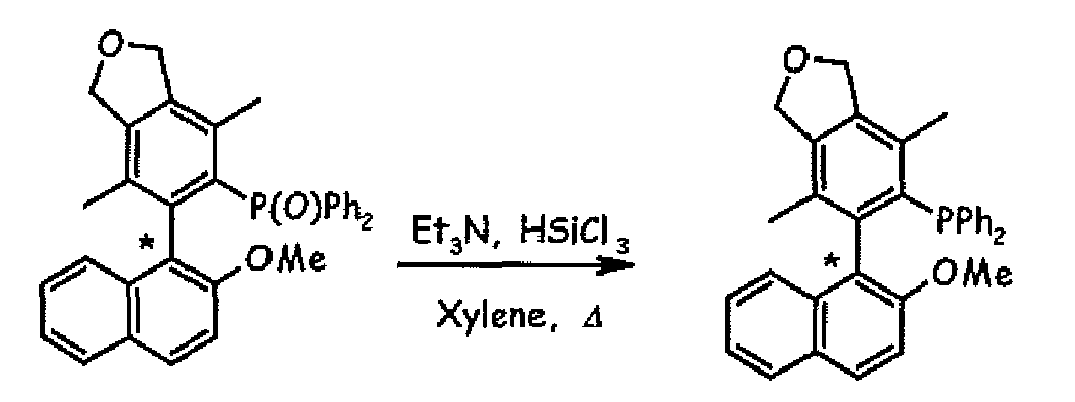
- (-)-5-(Diphenylphosphinoyl)-6-(2-methoxynaphthalen-1-yl)-4,7-dimethyl-1,3-dihydroisobenzofuran (800 mg, 1.59 mmol, 92%ee) was placed into a flask and the atmosphere in the flask was replaced with nitrogen. Triethylamine (4.4mL, 31.8 mmol) was added to a solution of this naphthalene compound in xylene (40 mL), and cooled to 4°C. Further, trichlorosilane (800 µL, 7.95 mmol) was added dropwise, and the mixture was stirred for 30 minutes and then stirred at room temperature for 15 minutes. Further, the reaction mixture was heated to 110°C and stirred for 3 hours. After the resulting reaction mixture was cooled to room temperature, diethyl ether (60 mL) and saturated aq. sodium bicarbonate (800 µL) were added, and the mixture was stirred for 30 minutes. The reaction mixture was filtered through Celite, and after the filtrate was dried with sodium sulfate. After silica gel was added, the mixture was concentrated under reduced pressure. The residue was purified by silica gel chromatography to obtain the title compound (694 mg, 89%, 92%ee).
Mp 159°C; [α]25 D-39.0° (c 1.00, CH2Cl2, 92%ee) ; 1H-NMR (CD2Cl2, 300MHz) δ 7.91-7.79 (m,2H), 7.35-7.10 (m,14H), 5.22(s,2H), 5.12(s,2H), 3.50(s,3H), 1.73(s,3H), 1.68(s,3H) ; 31P-NMR (CD2Cl2, 121MHz) δ=-11.9 (s) - Hereinafter, the structures and physical property data of the phosphorus compounds obtained in the examples are shown.
-

- Colorless solid; melting point : 77.3-78.9°C; [α]25 D -22.8° (c 20.8, CHCl3, 97%ee); IR (neat) 3300, 2900, 1580, 1210, 1020, 960 cm-1; 1H NMR (CDCl3, 300 MHz) δ 7.87 (d, J=8.7 Hz, 1H), 7.74-7.82 (m, 1H), 7.35 (d, J=9.3 Hz, 1H), 7.21-7.30 (m, 2H), 7.04-7.11 (m 1H), 5.24 (s, 2H), 5.18 (s, 2H), 3.84 (s, 3H), 3.55-3.83 (m, 3H), 3.30-3.40 (m, 1H), 2.60 (s, 3H), 1.62 (s, 3H), 1.02 (t, J=7.2, 3H), 0.85 (t, J=7.2 Hz, 3H); 13C NMR (CDCl3, 75MHz) δ 153.1, 141.8, 141.7, 140.3, 140.1, 138.7, 138.5, 133.7, 133.5, 133.4, 128.8, 128.63, 128.55, 128.5, 128.4, 127.5, 126.0, 125.8, 124.2, 123.32, 123.27, 122.8, 112.5, 74.20, 74.17, 74.1, 60.73, 60.71, 60.66, 60.6, 55.8, 18.81, 18.76, 16.1, 15.8, 15.7, 15.6, 15.5; 31P NMR (CDCl3, 121 MHz) δ 18.6; HRMS (FAB) calcd for C25H30O5P [M+H]+ 441.1831, found 441.1786; CHIRALPAK AD-H, hexane:2-PrOH=90:10, 1.0 mL/min, retention times: 8.56 min (major isomer) and 12.9 min (minor isomer).
-

- Pale yellow oil; [α]25 D -24.2° (c 4.47, CHCl3, 97%ee); IR (neat) 3350, 2850, 1230, 1040, 940 cm-1; 1H NMR (CDCl3, 300 MHz) δ 7.85 (d, J=9.0 Hz, 1H), 7.73-7.80 (m, 1H), 7.34 (d, J=9.0 Hz, 1H), 7.15-7.30 (m, 2H), 7.03-7.15 (m, 1H), 3.84 (s, 3H), 3.52-3.80 (m, 3H), 3. 18-3.34 (m, 1H), 3.01 (t, J=7.8 Hz, 2H), 2.96 (t, J = 7.8 Hz, 2H), 2.63 (s, 3H), 2.13 (quint, J=7.8 Hz, 2H), 1.65 (s, 3H), 1.00 (t, J = 7.2 Hz, 3H), 0.85 (t, J=7.2 Hz, 3H); 13C NMR (CDCl3, 75 MHz) δ 153.4, 147.2, 147.1, 143.7, 143.5, 138.7, 138.6, 136.0, 135.9, 133.9, 131.4, 131.2, 128.7, 128.3, 127.6, 126.7, 125.8, 125.0, 124.9, 124.8, 124.2, 122.9, 112.9, 60.74, 60.70, 60.67, 60.6, 56.1, 33.0, 32.85, 32.81, 23.5, 19.14, 19.08, 16.47, 16.46, 16.0, 15.9, 15.84, 15.78; 31P NMR (CDCl3, 121 MHz) δ 20.0 ; HRMS (FAB) calcd for C26H32O4P [M+H]+ 439.2038, found 439.2068; CHIRALPAK AD-H, hexane:2-PrOH=95:5, 1.0 mL/min, retention times: 9.57 min (major isomer) and 13.1 min (minor isomer).
-

- Colorless solid; melting point: 58.0-60.0°C; [α]25 D +0.71° (c 2.97, CHCl3, 95%ee); IR (neat) 3300, 2900, 1240, 1010cm-1; 1H NMR (CDCl3, 300 MHz) δ 7.91-7.74 (m, 5H), 7.16-7.40 (m, 4H), 6.97 (d, J=7.5 Hz, 1H), 4.59 (m, 4H), 3.82 (s, 3H), 3.52-3.52 (m, 3H), 3.18-3.32 (m, 1H), 2.55 (s, 3H), 2.44 (s, 3H), 1.59 (s, 3H), 0.99 (t, J=7.2 Hz, 3H), 0.83 (t, J=7.2 Hz, 3H); 13C NMR (CDCl3, 75 MHz) δ 153.2, 143.6, 140.7, 140.6, 139.1, 139.0, 136.0, 135.8, 135.2, 135.0, 133.7, 133.4, 130.4, 130.2, 129.8, 128.6, 127.8, 127.5, 126.9, 126.1, 124.2, 123.2, 123.12, 123.09, 112.7, 61.6, 61.1, 61.00, 60.97, 60.9, 56.0, 54.19, 54.16, 54.1, 21.4, 18.8, 18.7, 16.13, 16.11, 16.0, 15.9, 15.8, 15.7; 31P NMR (CDCl3 , 121 MHz) δ 18.0; HRMS (FAB) calcd for C32H37O6NPS [M+H]+ 594.2079, found 594.2047; CHIRALPAK AD-H, hexane:2-PrOH=80:20, 1.0 mL/min, retention times: 13.2 min (major isomer) and 18.7 min (minor isomer).
-

- Pale yellow oil; [α]25 D -12.4° (c 2.97, CHCl3, 98%ee); IR (neat) 3350, 2850, 1430, 1320, 1220, 1140, 1010, 930 cm-1; 1H NMR (CDCl3, 300 MHz) δ 7.75-7.88 (m, 4H), 7.52 (d, J=9.0 Hz, 1H), 7.37 (d, J=8.1 Hz, 2H), 7.18-7.34 (m, 2H), 6.98 (d, J=8.1 Hz, 1H), 5.20 (d, J=6.9 Hz, 1H), 5.05 (d, J=6.9 Hz, 1H), 4.73 (s, 2H), 4.67 (s, 2H), 3.47-3.80 (m, 3H), 3.35 (s, 3H), 3.15-3.35 (m, 1H), 2.55 (s, 3H), 2.45 (s, 3H), 1.61 (s, 3H), 0.96 (t, J=6.9 Hz, 3H), 0.88 (t, J=6.9 Hz, 3H); 13C NMR (CDCl3, 75 MHz) δ 151.4, 143.7., 140.4, 138.99, 138.95, 136.0, 135.0, 134.9, 133.8, 130.4, 130.2, 129.8, 129.4, 129.3, 128.9, 127.7, 127.5, 126.9, 126.0, 124.4, 124.32, 124.27, 123.5, 115.8, 94.7, 61.1, 61.0, 60.95, 60.89, 55.6, 54.13, 54.08, 54.0, 21.4, 18.8, 18.7, 16.1, 15.9, 15.81, 15.80, 15.7; 31P NMR (CDCl3, 121 MHz) δ 18.0 ; HRMS (FAB) calcd for C33H39O7NPS [M+H]+ 624.2185, found 624.2213; CHIRALPAK AD-H, hexane:2-PrOH=80:20, 1.0 mL/min, retention times: 13.2 min (major isomer) and 20.7 min (minor isomer).
-

- Colorless solid; melting point: 69.8-71.7 °C; [α]25D -14.9° (c 5.61, CHCl3, 97%ee); IR (neat) 3300, 2900, 1590, 1330, 1240, 1160, 1010 cm-1; 1H NMR (CDCl3, 300 MHz) δ 7.72-7. 90 (m, 4H), 7.37 (d, J=8.1 Hz, 2H), 7.15-7.35 (m, 8H), 6.98-7.05 (m, 1H), 5.14 (s, 2H), 4.74 (s, 2H), 4.66 (s, 2H), 3.02-3.80 (m, 4H), 2.55 (s, 3H), 2.44 (s, 3H), 1.58 (s, 3H), 0.94 (t, J=7.2 Hz, 3H), 0.80 (t, J=7.2 Hz, 3H); 13C NMR (CDCl3, 75 MHz) δ 152.5, 143.7, 140.9, 140.7, 139.00, 138.99, 137.6, 135.1, 134.9, 133.8, 133.5, 130.5, 130.2, 129.9, 129.5, 128.9, 128.8, 128.2, 127.8, 127.5, 127.3, 127.0, 126.3, 126.1, 124.4, 124.2, 124.1, 123.3, 114.5, 70.5, 61.1, 61.04, 60.97, 54.2, 54.14, 54.11, 21.5, 18.8, 18.7, 16.20, 16.19, 15.9, 15.84, 15.77, 15.7; 31P NMR (CDCl3, 121 MHz) δ 18.0; HRMS (FAB) calcd for C38H41O6NPS [M+H]+ 670.2392, found 670.2445; CHIRALCEL OD-H, hexane:2-PrOH=90:10, 1.0 mL/min, retention times: 21.4 min (minor isomer) and 26.4 min (major isomer).
-

- Colorless solid; melting point: 105.0-106.7°C; [α]25 D -147.2° (c 3.71, CHCl3, 91%ee); IR (neat) 3300, 2850, 1590, 1440, 1250, 1160, 1070 cm-1; 1H NMR (CDCl3, 300 MHz) δ 7.46-7.52 (m, 3H), 7.10-7.37 (m, 7H), 6.70-7.00 (m, 3H), 6.71-6.79 (m, 3H), 5.20 (s, 4H), 3.78 (s, 3H), 2.35 (s, 3H), 1.46 (s, 3H); 13C NMR (CDCl3, 75 MHz) δ 153.3, 141.91, 141.88, 139.6, 139.5, 139.4, 139.3, 136.2, 135.3, 135.2, 135.1, 134.9, 133.9, 133.7, 132.0, 131.3, 131.2, 130.8, 130.7, 130.64, 130.62, 130.2, 129.4, 129.00, 128.97, 128.8, 128.5, 127.7, 127.54, 127.52, 126.7, 126.5, 126.3, 124.7, 123.3, 122.0 120.9, 111.6, 74.50, 74.47, 74.4, 55.2, 19.9, 19.8, 16.2; 31P NMR (CDCl3, 121 MHz) δ 30.1; HRMS (FAB) calcd for C33H30O3P [M+H]+ 505.1933, found 505.1928; CHIRALPAK AD-H, hexane:2-PrOH=70:30, 1.0 mL/min, retention times: 14.2 min (major isomer) and 25.2 min (minor isomer).
-

-

- Colorless solid; melting point: 279°C (decomposed): [α]25 D -8.83° (c 4.61, CHCl3, 98%ee); IR (neat) 2800, 1590, 1440, 1240, 1140, 1060 cm-1; 1H NMR (CDCl3, 300 MHz) δ 7.87 (d, J=9.0 Hz, 1H), 7.78 (d, J=7.5 Hz, 1H), 7.31 (d, J=9.0 Hz, 1H), 7.15-7.28 (m, 2H), 7.01 (d, J=8.1 Hz, 1H), 5.23 (s, 2H), 5.21 (s, 2H), 3.85 (s, 3H), 2.44 (s, 3H), 0.92-1.98 (m, 25H); 13C NMR (CDCl3, 75 MHz) δ 153.2, 140.8, 140.7, 138.8, 138.7, 133.7, 130.7, 129.7, 129.0, 128.7, 128.0, 125.4, 124.8, 123.1, 123.0, 122.8, 112.1, 74.6, 74.4, 58.0, 55.6, 40.4, 40.2, 39.6, 39.3, 29.6, 27.0, 26.80, 26.76, 26.62, 26.56, 26.51, 26.46, 25.8, 25.7, 19.63, 19.60, 18.3, 16.4; 31P NMR (CDCl3, 121 MHz) δ-16.9; HRMS (FAB) calcd for C33H42O3P [M+H]+ 517.2872, found 517.2881; CHIRALPAK AD-H, hexane:2-PrOH=95:5, 1.2 mL/min, retention times: 25.1 min (minor isomer) and 32.0 min (major isomer).
-

- Colorless solid; melting point: 272° C (decomposed): [α]25 D -6.17° (c 4.20, CHCl3, 96%ee); IR (neat) 2900, 1590, 1440, 1260, 1.150, 1080 cm-1; 1H NMR (CDCl3, 300 MHz) 67.83 (d, J=9.0 Hz, 1H), 7.76 (d, J = 7.5 Hz, 1H), 7.29 (d, J=9.0 Hz, 1.H), 7.12-7.26 (m, 2H), 7.01 (d, J=8.1 Hz, 1H), 3.85 (s, 3H), 2.98 (t, J=4.5 Hz, 4H), 2.41 (s, 3H), 2.15 (quint, J=4.5 Hz, 2H), 0.78-1.90 (m, 25H); 13C NMR (CDCl3, 75 MHz) δ 153.2. 145.80, 145.77, 143.4, 133.9, 132.4, 128.7, 128.3, 127.8, 125.2, 124.9, 124.5, 124.4, 122.5, 112.2, 55.6, 45.7, 40.7, 40.4, 39.9, 39.5, 32.9, 30.8, 27.1, 27.04, 26.99, 26.9, 26.84, 26.80, 26.75, 26.64, 26.59, 26.54, 26.0, 25.74, 25.72, 23.4, 19.90, 19.87, 18.3, 16.5; 31P NMR (CDCl3 , 121 MHz) δ-17.3; HRMS (FAB) calcd for C34H44O2P [M+H]+ 515.3079, found 515.3074; CHIRALPAK AD-H, hexane:2-PrOH=95:5, 1.0 mL/min, retention times: 5.71 min (minor isomer) and 10.2 min (major isomer).
-

- Colorless solid; melting point: 54.1-56.0°C; [α]25 D -40.4° (c 3.13, CHCl3, 86%ee); IR (neat) 3300, 2800, 1580, 1240, 1020 cm-1; 1H NMR (CDCl3, 300 MHz) δ 7.89 (d, J=9.0 Hz, 1H), 7.60-7.84 (m, 1H), 7.26-7.50 (m, 8H), 7.19-7.26 (m, 1H), 5.22 (s, 2H), 4.91 (d, J=13.2 Hz, 1H), 4.86 (d, J=13.2 Hz, 1H), 3.92 (s, 3H), 3.33-3.48 (m, 2H), 2.93-3.08 (m, 2H), 1.72 (s, 3H), 0.67 (t, J=6.9 Hz, 3H), 0.64 (t, J=6.9 Hz, 3H); 13C NMR (CDCl3, 75 MHz) δ 153.97, 153.95, 141.94, 141.90, 140.64, 140.58, 140.5, 140.3, 138.9, 138.7, 138.5, 138.4, 133.7, 131.2, 131.0, 129.2, 129.1, 128.8, 128.7, 128.6, 127.7, 127.60, 127.58, 127.0, 126.6, 126.1, 125.0, 123.18, 123.16, 123.1, 113.2, 74.78, 74.76, 74.4, 74.3, 60.64, 60.58, 60.5, 56.4, 16.57, 16.55, 15.7, 15.60, 15.58, 15.5 ; 31P NMR (CDCl3 , 121 MHz) δ 16.7; HRMS (FAB) calcd for C30H32O5P [M+HF]+ 503.1987, found 503.2003; CHIRALPAK AD-H, hexane:2-PrOH=95:5, 1.0 mL/min, retention times: 15.0 min (major isomer) and 45.3 min (minor isomer).
-

- Colorless solid; melting point: 123.1-125.1°C; [α]25 D-14.9° (c 2.57, CHCl3, 96%ee); IR (neat) 2850, 1590, 1430, 1220, 1050, 940 cm-1; 1H NMR (CDCl3, 300 MHz) δ 7.88 (d, J=9.0 Hz, 1H), 7.83-7.77 (m, 1H), 7.47-7.26 (m, 9H), 7.11 (d, J=3.9 Hz, 1H), 5.21 (s, 2H), 4.81 (d J=12.6 Hz, 1H), 4.81 (d, J=12.6 Hz, 1H), 3.91 (s, 3H), 3.37-3.52 (m, 2H), 2.89-3.11 (m, 2H), 0.68 (t, J=6.9 Hz, 3H), 0.63 (t, J=6.9 Hz, 3H); 13C NMR (CDCl3, 75 MHz) δ 153.8, 142.5, 142.4, 141.4, 141.2, 141.1, 140.9, 140.20, 140.15, 139.3, 139.1, 133.7, 129.03, 128.96, 128.82, 128.81, 128..7, 128.6, 127.70, 127.66, 127.6, 127.3, 126.4, 126.1, 125.70, 125.65, 125.6, 124.4, 124.1, 123.2, 113.2, 74.11, 74.49., 73.89, 73.86, 60.8, 60.74, 60.72, 60.6, 45.5, 30.9, 15.7, 15.60, 15.57, 15.5; 31P NMR (CDCl3, 121 MHz) δ 16.7; HRMS (FAB) calcd for C29H30O5P [M+H]+ 489.1831, found 489.1783; CHIRALPAK AD, hexane:2-PrOH=85:15, 1.0 mL/min, retention times: 7.00 min (major isomer) and 46.0 min (minor isomer).
-

- Colorless solid; melting point: 68.0-69.9°C; [α]25 D +7.99° (c 1.37, CHCl3, 93%ee); IR (neat) 2800, 1570, 1220, 1000 cm-1; 1H NMR (CDCl3, 300 MHz) δ 7.86 (d, J=9.0 Hz, 1H), 7.75-7.81 (m, 1H), 7,32 (d, J=9.0 Hz, 1H), 7.27-7.30 (m, 3H), 6.93 (d, J=3.6 Hz, 1H), 5.20 (s, 2H), 5.18 (s, 2H), 3.84 (s, 3H), 3.60-3.84 (m, 3H), 3.22-3.40 (m, 1H), 2.63 (s, 3H), 1.02 (t, J=6.9 Hz, 3H), 0.85 (t, J=6. 9 Hz, 3H) ; 13C NMR (CDCl3, 75 MHz) δ 153.3, 150.1, 149.9, 142.41, 142.37, 141.3, 141.2, 139.4, 139.1, 136.8, 136.6, 133.9, 128.9, 128.7, 128.6, 128.4, 127.7, 126.05, 125.97, 125.9, 125.1, 123.1, 122.7, 122.4, 112.9, 74.8, 74.14, 74.12, 73.64, 73.61, 61.24, 61.17, 61.13, 61.05, 56.2, 19.23, 19.18, 18.3, 16.0, 15.9, 15.8, 15.7; 31P NMR (CDCl3, 121 MHz) δ 18.2; HRMS (FAB) calcd for C24H28O5P [Ma-H]+ 427.1674, found 427.1650; CHIRALPAK AD, hexane:2-PrOH=80:20, 1.0 mL/min, retention times: 6.60 min (major isomer) and 11.8 min (minor isomer).
-
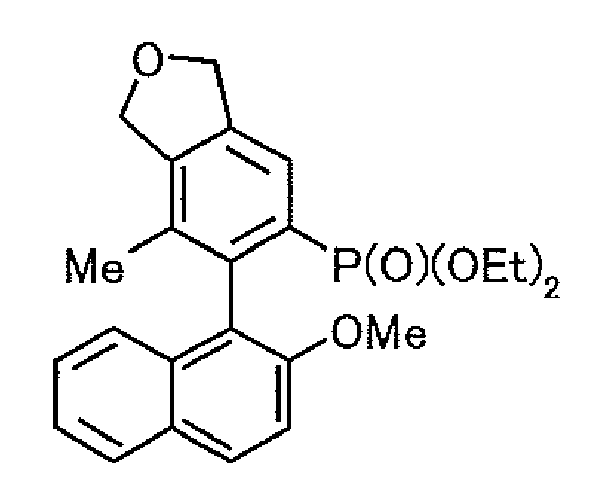
- Colorless solid; melting point: 136.1-138.0°C; [α]25 D -1.26° (c1.44, CHCl3, 87%ee); IR (neat); 2900, 1590, 1449, 1240, 1010, 800 cm-1; 1H NMR (CDCl3, 300 MHz) δ 7.85-8.00 (m, 2H), 7.75-7.83 (m, 1H), 7.36 (d, J=9.3 Hz, 1H), 7.21-7.33 (m, 2H), 6.98-7.09 (m, 1H), 5.27 (s, 2H), 5.19 (s, 2H), 3.87 (s, 3H), 3.65-3.78 (m, 1H), 3.44-3.61 (m, 3H), 1.75 (s, 3H), 0.97 (t, J=7.2 Hz, 3H), 0.68 (t, J=7.2Hz, 3H); 13C NMR (CDCl3, 75 MHz) δ 154.2, 143.2, 143.1, 139.0, 138.9, 137.9, 137.7, 133.8, 132.4, 132.2, 130.0, 129.6, 128.6, 127.7, 127.5, 126.1, 125.0, 124.7, 124.5, 123.2, 121.2, 121.1, 112.7, 74.30, 74.26, 73.6, 61.5, 61.43, 61.38, 61.3, 56.0, 16.27, 16.26, 16.0, 15.9, 15.5, 15.4; 31P NMR (CDCl3, 121 MHz) δ 19.0; HRMS (FAB) calcd for C24H28O5P [M+H]+ 427.1674, found 427.1631; CHIRALPAK AD-H, hexane:2-PrOH=85:15, 1.0 mL/min, retention times: 6.8 min (major isomer) and 10.5 min (minor isomer).
-

- Colorless solid; melting point: 129.1-131.0°C; [α]25 D-31.1° (c1.19, CHCl3, 74%ee); IR (neat) 3300, 2900, 1590, 1430, 1240, 1180, 1150, 680 cm-1; 1H NMR (CDCl3, 300 MHz) δ 7.50-7.60 (m, 2H), 7.38-7.47 (m, 2H), 7.11-7.32 (m, 3H), 6.90-7.11 (m, 10H), 6.73-6.90 (m, 5H), 5.23 (s, 2H), 4.86 (d, J=12. 9 Hz, 1H), 4.79 (d, J=12.9 Hz, 1H), 3.90 (s, 3H) ; 13C NMR (CDCl3, 75 MHz) δ 153.5, 142.8, 142.68, 142.65, 141.3, 141.1, 140.0, 139.9, 138.24, 138.18, 136.1, 135.6, 134.7, 133.5, 131.9, 130.43, 130.39, 130.3, 130.2, 130.1, 129.4, 129.3, 128.494, 128.491, 127.02, 126.97, 126.94, 126.85, 126.8, 126.7, 126.4, 125.6, 124.8, 124.6, 123.3, 111.9. 73.9, 55.6; 31P NMR (CDCl3, 121 MHz) δ 22.4; HRMS (FAB) calcd for C37H30O3P [M+H]+ 553.1933, found 553.1961; CHIRALPAK AD, hexane:2-PrOH=80:20, 1.0 mL/min, retention times: 8.84 min (major isomer) and 62.4 min (minor isomer).
-

- Yellow oil; [a]25 D-54.1° (c 2.85, CHCl3, 58%ee); IR (neat) 2850, 1590, 1440, 1250, 1150, 1060 cm-1; 1H NMR (CDCl3, 300 MHz) δ 7.45-7.61 (m, 3H), 7.14-7.38 (m, 7H), 6.87-7.08 (m, 3H), 6.68-6.87 (m, 4H), 5.17 (s, 4H), 3.74 (s, 3H), 2.41 (s, 3H); 13CNMR (CDCl3, 75MHz) δ 153.1, 142.3, 140.6, 140.4, 140.1, 140.0, 138.2, 138.0, 135.6, 135.0, 134.3, 133.9, 133.6, 131.5, 131.4, 131.3, 131.0, 130.9, 130.8, 130.7, 130.3, 130.2, 130.1, 129.8, 128.4, 127.7, 127.5, 127.4, 126.6, 126.5, 126.4, 125.4, 123.64, 123.58, 123.2, 123.0, 122.9, 111.7, 74.1, 73.7, 73.6, 55.3, 20.1, 20.0 ; 31P NMR (CDCl3, 121 MHz) δ 30.0 ; HRMS (FAB) calcd for C32H28O3P [M+H]+ 491.1776, found 491.1760; CHIRALPAK AD, hexane:2-PrOH=80:20, 1.0 mL/min, retention times: 11.4 min (major isomer) and 49.3 min (minor isomer).
-

- Colorless oil; [a]25 D-49.1° (c 0.665, CHCl3, 86%ee); IR (neat) 2800, 1570, 1.220, 1000 cm-1; 1H NMR (CDCl3, 300 MHz) δ 7.51-7.64 (m, 3H), 7.34-7.46 (m, 2H), 7.00-7.34 (m, 10H), 6.95 (d, J=9.3 Hz, 1H), 6.90 (d, J=8.1 Hz, 1H), 5.20 (s, 4H), 3.65 (s, 3H), 1.68 (s, 3H); 13C NMR (CDCl3, 75 MHz) δ 154.1, 143.0, 142.6, 138.0, 137.8, 133.4, 132.8, 131.7, 131.6, 131.4, 131.3, 130.79, 130.75, 130.6, 130.1, 128.3, 127.7, 127.52, 127.49, 127.3, 127.2, 126.1, 124.8, 124.5, 124.3, 123.1, 120.1, 120.0, 111.8, 74.3, 73.6, 55.4; 31P NMR (CDCl3, 121 MHz) δ 28.7; HRMS (FAB) calcd for C32H28O3P [M+H]+ 491.1776, found 491.1779; CHIRALPAK AD, hexane:2-PrOH=80:20, 1.0 mL/min, retention times: 10.6 min (major isomer) and 16.9 min (minor isomer).
-

- (-)-1-[6-(Diphenylphosphino)-4,7-dimethylindan-5-yl)-2-methoxynaphthalene (26.6 mg, 0.0547 mmol, 97%ee) and allylpalladium chloride dimer (5.0 mg, 0.0137 mmol) were placed into a flask and the atmosphere in the flask was replaced with nitrogen. Toluene (1 mL) was added to dissolve them, and the solution was stirred at 30°C for 30 minutes. After the prepared complex was transferred into a four-necked flask, toluene (26.3 mL) and styrene (3.1 mL=2.85 g, 27.3 mmol) were added thereto, and the mixture was stirred for 15 minutes. Further, a toluene (27.3 mL) solution of HSiCl3 (4.44 g, 32.3 mmol) was added dropwise over 1 hour, and then the mixture was stirred for 15 hours. HSiCl3 and toluene was removed by using a Liebig condenser. 4.3 g of silylated substance (17.7 mmol, 65%) was obtained after distillation under reduced pressure.
Boiling point: 120-123°C/20 Torr - KF (6.2 g, 106.2mmol) and KHCO3 (21.3 g, 212.4 mmol) were placed into a round flask, suspended in MeOH-THF (1:1, 85 mL), and cooled with ice water. To the suspension 4.2 g of the above obtained silylated substance (17.7 mmol) was added dropwise, and then the mixture was stirred still being cooled with ice water for 1 hour, and at room temperature for another 1 hour. Then, the mixture was cooled with ice water, and H2O2 (30% aqueous solution, 17.7 mL) was added dropwise still being kept in the bath overnight with stirring. The mixture was cooled with ice water, and Na2S2O3·5H2O (22.0 g, 88.5 mmol) was added thereto. The mixture was further stirred still being cooled with ice water for 1 hour and at room temperature for another 1 hour. The reaction mixture was filtered through Celite, and then concentrated in vacuo. After the remaining residue was extracted with EtOAc, the combined organic layers were washed with water and brine, dried with Na2SO4, and concentrated in vacuo. 1.6 g of sec-phenethyl alcohol (12.9 mmol, 73%) was obtained after distillation under reduced pressure.
Boiling point: 104°C/20 Torr
The optical purity of the obtained alcohol was 60%ee (S configuration).
Analytical method of optical purity:
Column; Chirasil-Dex CB, Injector temperature; 250°C, Detector temperature; 250°C, Oven; 115°C - (-)-5-(diphenylphosphino)-6-(2-methoxynaphthalen-1-yl)-4,7-dimethyl-1,3-dihydroisobenzofuran (26.7 mg, 0.0547 mmol, 92%ee) and allylpalladium chloride dimer (5.0 mg, 0.0137 mmol) were placed into a flask and the atmosphere in the flask was replaced with nitrogen. Toluene (1 mL) was added to dissolve them, and the solution was stirred at 30°C for 30 minutes. After the prepared complex was transferred into a four-necked flask, toluene (26.3 mL) and styrene (3.1 mL=2.85 g, 27.3 mmol) were added thereto, and the mixture was stirred for 15 minutes. Further, a toluene (27.3 mL) solution of HSiCl3 (4.44 g, 32.3 mmol) was added dropwise over 1 hour, and then the mixture was stirred for 15 hours. HSiCl3 and toluene was removed by using a Liebig condenser. 4.3 g of the silylated substance (17.5 mmol, 64%) was obtained after distillation under reduced pressure. Boiling point: 120-123°C/20 Torr
- KF (5.5 g, 94.2mmol) and KHCO3 (18.9 g, 188.4 mmol) were placed into a round flask, suspended in MeOH-THF (1:1, 75 mL), and cooled with ice water. To the suspension 3.8 g of the obtained silylated substance (15.7 mmol) was added dropwise, and then the mixture was stirred still being cooled with ice water for 1 hour and at room temperature for another 1 hour. Then, the mixture was cooled with ice water, and H2O2 (30% aqueous solution, 15.7 mL) was added dropwise still being kept in the bath overnight with stirring. The mixture was cooled with ice water, and Na2S2O3·5H2O (19.5 g, 78.6 mmol) was added thereto. The mixture was further stirred still being cooled with ice water for 1 hour and at room temperature for another 1 hour. The reaction mixture was filtered through Celite, and then concentrated in vacuo. After the remaining residue was extracted with EtOAc, the combined organic layers were washed with water and brine, dried with Na2SO4, and concentrated in vacuo. 1.4 g of sec-phenethyl alcohol (11.5 mmol, 73%) was obtained after distillation under reduced pressure.
Boiling point: 104°C/20 Torr
The optical purity of the obtained alcohol was 58%ee (S configuration). -

- (-)-1-[6-(Diphenylphosphino)-4,7-dimethylindan-5-yl]-2-methoxynaphthalene (26.6 mg, 0.0547 mmol, 97%ee) and allylpalladium chloride dimer (5.0 mg, 0.0137 mmol) were placed into a flask and the atmosphere in the flask was replaced with nitrogen. Toluene (1 mL) was added to dissolve them, and the solution was stirred at 30°C for 30 minutes. After the bath was set at 40°C, toluene (3 mL) and 1-octene (3.1 g, 27.3 mmol) were added thereto, and the mixture was stirred for 30 minutes. Further, HSiCl3 (4.44 g, 32.3 mmol) was added dropwise, and then the mixture was stirred for 24 hours. Analysis of the reaction mixture revealed that 2-trichlorosilyloctane/1-trichlorosilyloctane=76/24. HSiCl3 and toluene was removed by using a Liebig condenser. 1.6 g of silylated substance (6.6 mmol, 24%, 2-trichlorosilyloctane/1-trichlorosilyloctane=77/23) was obtained after distillation under reduced pressure.
Boiling point: 120-123°C/25 Torr - KF (1.9 g, 32.7 mmol) and KHCO3 (6.4 g, 63.9 mmol) were placed into a round flask, suspended in MeOH-THF (1:1, 26 mL), and cooled with ice water. 1.3 g of the above obtained silylated substance (5.3 mmol) was added dropwise, and then the mixture was stirred still being cooled with ice water for 1 hour, and at room temperature for another 1 hour. Then, the mixture was cooled with ice water, and H2O2 (30% aqueous solution, 5.3 mL) was added dropwise still being kept in the bath overnight with stirring. The mixture was cooled with ice water, and Na2S2O3·5H2O (6.6 g, 26.6 mmol) was added thereto. The mixture was further stirred still being cooled with ice water for 1 hour and at room temperature for another 1 hour. The reaction mixture was filtered through Celite, and concentrated under reduced pressure. After the remaining residue was extracted with EtOAc, the combined organic layers were washed with water and brine, dried with Na2SO4, and concentrated in vacuo. 410 mg of octanol (3.4 mmol, 59%, 2-octanol/1-octanol=71/29) was obtained after silica gel column chromatography.
The optical purity of the obtained 2-octanol was 94%ee (R configuration).
Analytical method of optical purity (analyzed after benzoylation) :
Column; CHIRALPAK AD-H - (-)-5-(diphenylphosphino)-6-(2-methoxynaphthalen-1-yl)-4,7-dimethyl-1,3-dihydroisobenzofuran (26.7 mg, 0.0547 mmol, 92%ee) and allylpalladium chloride dimer (5.0 mg, 0.0137 mmol) were placed into a flask and the atmosphere in the flask was replaced with nitrogen. Toluene (1 mL) was added to dissolve them, and the solution was stirred at 30°C for 30 minutes. After the bath was set at 40°C, toluene (3 mL) and 1-octene (3.1 g, 27.3 mmol) were added thereto, and the mixture was stirred for 30 minutes. Further, HSiCl3 (4.44 g, 32.3 mmol) was added dropwise, and then the mixture was stirred for 24 hours. Analysis of the reaction mixture revealed that 2-trichlorosilyloctane/1-trichlorosilyloctane=76/24. HSiCl3 and toluene was removed by using a Liebig condenser. 1.7 g of the silylated substance (6.9 mmol, 25%, 2-trichlorosilyloctane/1-trichlorosilyloctane=80/20) was obtained after distillation under reduced pressure. Boiling point: 120-123°C/25 Torr
- KF (2.0 g, 34.4 mmol) and KHCO3 (6.9 g, 68. 9 mmol) were placed into a round flask, suspended in MeOH-THF (1:1, 28 mL), and cooled with ice water. 1. 4 g of the obtained silylated substance (5.8 mmol) was added dropwise, and then the mixture was stirred still being cooled with ice water for 1 hour and at room temperature for another 1 hour. Then, the mixture was cooled with ice water, and H2O2 (30% aqueous solution, 5.8 mL) was added dropwise still being kept in the bath overnight with stirring. The mixture was cooled with ice water, and Na2S2O3·5H2O (7.2 g, 29.0 mmol) was added thereto. The mixture was further stirred still being cooled with ice water for 1 hour and at room temperature for another 1 hour. The reaction mixture was filtered through Celite, and concentrated in vacuo. After the remaining residue was extracted with EtOAc, the combined organic layers was washed with water and brine, dried with Na2SO4, and concentrated in vacuo. 460 mg of octanol (3.8 mmol, 61%, 2-octanol/1-octanol=71/29) was obtained after silica gel column chromatography.
The optical purity of the obtained 2-octanol was 85%ee (R configuration). - The above Ac and THF represent an acetyl group and tetrahydrofuran respectively.
Claims (10)
- A phosphorus compound defined by the following general formula (1):


- The phosphorus compound according to claim 1, which is an axially asymmetric optically active substance.
- The phosphorus compound according to claim 1, which is defined by the following general formula (3):


- The phosphorus compound as described in according to claim 3, which is an axially asymmetric optically active substance.
- A production process of the phosphorus compound as claimed in claim 2, which comprises reacting a diyne compound defined by the following general formula (2-1) with an alkynyl phosphorus compound defined by the following general formula (3-1) by the use of a catalyst containing rhodium metal and an optically active bisphosphine:

- A production process of the phosphorus compound as claimed in claim 2, which comprises reacting a diyne compound defined by the following general formula (2-2) with an alkynyl phosphorus compound defined by the following general formula (3-2) by the use of a catalyst containing rhodium metal and an optically active bisphosphine:
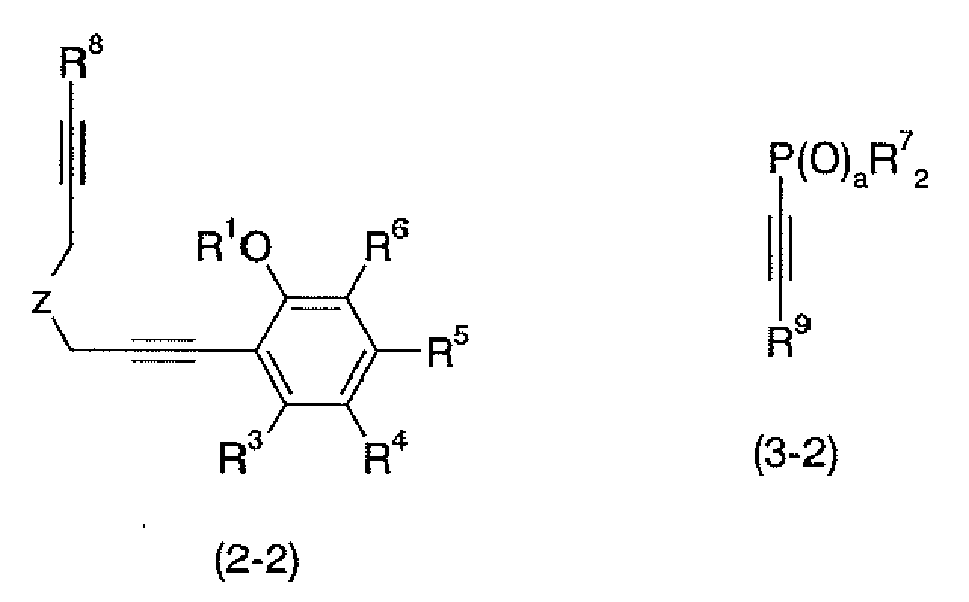
- The production process according to claim 5 or 6,
wherein the catalyst containing rhodium metal and an optically active bisphosphine is a compound defined by the following general formula (4):
[Rh(L)m(Y)n]X (4)
in the formula (4), L denotes an optically active bisphosphine defined by the following formula (5); Y denotes a nonconjugated diene compound; X denotes a counter anion; m denotes an integer of 1 or 2; n denotes an integer of 0 or 1; however, in the case where m = 1, n = 0 or n = 1; and in the case where m = 2, n = 0:
R10R11P-Q-PR12R13 (5)
in the formula (5), R10, R11, R12, and R23 independently denote an aryl group optionally having a substituent group or a cycloalkyl group optionally having a substituent group; R10 in combination with R11 and/or R12 in combination with R13 may form a ring; and Q denotes a divalent arylene group optionally having a substituent group or a ferrocenediyl group. - The production process according to claim 7, wherein the catalyst containing rhodium metal and an optically active bisphosphine is used immediately after preparation.
- The production process according to claim 7 or 8, wherein an olefin ligand is eliminated using hydrogen gas in preparing the catalyst containing rhodium metal and an optically active bisphosphine.
- An asymmetric synthesis reaction using the axially asymmetric optically active compound according to claim 2 or 4.
Applications Claiming Priority (1)
| Application Number | Priority Date | Filing Date | Title |
|---|---|---|---|
| JP2006333713 | 2006-12-11 |
Publications (1)
| Publication Number | Publication Date |
|---|---|
| EP1935896A1 true EP1935896A1 (en) | 2008-06-25 |
Family
ID=39032352
Family Applications (1)
| Application Number | Title | Priority Date | Filing Date |
|---|---|---|---|
| EP07122766A Withdrawn EP1935896A1 (en) | 2006-12-11 | 2007-12-10 | Novel optically active biaryl phosphorus compound and production process thereof |
Country Status (3)
| Country | Link |
|---|---|
| US (1) | US7683186B2 (en) |
| EP (1) | EP1935896A1 (en) |
| JP (1) | JP2008169201A (en) |
Cited By (1)
| Publication number | Priority date | Publication date | Assignee | Title |
|---|---|---|---|---|
| WO2009044130A1 (en) * | 2007-10-01 | 2009-04-09 | University Of Newcastle Upon Tyne | Biaryl diphosphines |
Families Citing this family (3)
| Publication number | Priority date | Publication date | Assignee | Title |
|---|---|---|---|---|
| JP5454756B2 (en) * | 2008-08-26 | 2014-03-26 | 国立大学法人 千葉大学 | Diphosphine compounds, transition metal complexes thereof, catalysts containing the transition metal complexes, phosphine oxide compounds and diphosphine oxide compounds |
| US9890184B2 (en) * | 2012-11-20 | 2018-02-13 | Riken | Complex and use of same |
| CN116987068A (en) * | 2023-08-02 | 2023-11-03 | 河南师范大学 | Preparation method of isocoumarin-naphthol biaryl compound |
Citations (3)
| Publication number | Priority date | Publication date | Assignee | Title |
|---|---|---|---|---|
| EP0614902A1 (en) * | 1993-03-12 | 1994-09-14 | Takasago International Corporation | Phosphine compounds and transition metal-phosphine complexes containing them as ligands |
| JPH10501234A (en) | 1994-06-01 | 1998-02-03 | メルク エンド カンパニー インコーポレーテッド | Synthetic method of binaphthyl derivative |
| EP0850945A1 (en) * | 1996-12-26 | 1998-07-01 | Takasago International Corporation | Chiral diphosphine compound, intermediate for preparing the same, transition metal complex having the same diphosphine compound as ligand and asymmetric hydrogenation catalyst |
Family Cites Families (7)
| Publication number | Priority date | Publication date | Assignee | Title |
|---|---|---|---|---|
| JP3313805B2 (en) * | 1993-03-12 | 2002-08-12 | 高砂香料工業株式会社 | Phosphine compounds and transition metal-phosphine complexes having the same as ligands |
| US5530150A (en) * | 1993-03-12 | 1996-06-25 | Takasago International Corporation | Phosphine compound, complex containing the phosphine compound as ligand, process for producing optically active aldehyde using the phosphine compound or the complex, and 4-[(R)-1'-formylethyl]azetidin-2-one derivatives |
| JPH07223976A (en) * | 1994-02-10 | 1995-08-22 | Sumitomo Chem Co Ltd | Process for producing optically active olefin compound |
| JP3445451B2 (en) * | 1996-10-24 | 2003-09-08 | 高砂香料工業株式会社 | Method for producing optically active diphosphine ligand |
| JP3146187B2 (en) | 1998-06-26 | 2001-03-12 | 高砂香料工業株式会社 | Novel method for producing diphosphine oxide |
| CA2427579C (en) * | 2000-11-17 | 2009-11-03 | The Penn State Research Foundation | Ortho substituted chiral phosphines and phosphinites and their use in asymmetric catalytic reactions |
| CN1166671C (en) * | 2001-12-07 | 2004-09-15 | 中国科学院上海有机化学研究所 | C2 unsymmetric chiral biphosphine ligand and its synthesizing method and application |
-
2007
- 2007-12-07 JP JP2007316471A patent/JP2008169201A/en active Pending
- 2007-12-07 US US12/000,083 patent/US7683186B2/en not_active Expired - Fee Related
- 2007-12-10 EP EP07122766A patent/EP1935896A1/en not_active Withdrawn
Patent Citations (4)
| Publication number | Priority date | Publication date | Assignee | Title |
|---|---|---|---|---|
| EP0614902A1 (en) * | 1993-03-12 | 1994-09-14 | Takasago International Corporation | Phosphine compounds and transition metal-phosphine complexes containing them as ligands |
| JPH10501234A (en) | 1994-06-01 | 1998-02-03 | メルク エンド カンパニー インコーポレーテッド | Synthetic method of binaphthyl derivative |
| EP0850945A1 (en) * | 1996-12-26 | 1998-07-01 | Takasago International Corporation | Chiral diphosphine compound, intermediate for preparing the same, transition metal complex having the same diphosphine compound as ligand and asymmetric hydrogenation catalyst |
| JPH10182678A (en) | 1996-12-26 | 1998-07-07 | Takasago Internatl Corp | Novel chiral diphosphine compound, intermediate for producing the same, transition metal complex having the diphosphine compound as a ligand, and asymmetric hydrogenation catalyst containing the complex |
Non-Patent Citations (7)
| Title |
|---|
| DOHERTY, SIMON ET AL: "Rhodium-Catalyzed Double [2 + 2 + 2] Cycloaddition of 1,4- Bis(diphenylphosphinoyl)buta-1,3-diyne with Tethered Diynes: A Modular, Highly Versatile Single-Pot Synthesis of NU-BIPHEP Biaryl Diphosphines", ORGANIC LETTERS , 9(23), 4925-4928 CODEN: ORLEF7; ISSN: 1523-7060, 16 October 2007 (2007-10-16), XP002469179 * |
| HELLER ET AL., CHEM. EUR. J., vol. 13, no. 4, 27 October 2006 (2006-10-27), pages 1117 - 1118 |
| HELLER ET AL: "Phosphorus-Bearing Axially Chiral Biaryls by Catalytic Asymmetric Cross-Cyclotrimerization and a First Application in Asymmetric Hydrosilylation", CHEM. EUR. J., vol. 13, no. 4, 27 October 2006 (2006-10-27), pages 1117 - 1128, XP002469177 * |
| KONDOH, AZUSA ET AL: "Synthesis of Bulky Phosphines by Rhodium-Catalyzed Formal [2 + 2 + 2] Cycloaddition Reactions of Tethered Diynes with 1-Alkynylphosphine Sulfides", JOURNAL OF THE AMERICAN CHEMICAL SOCIETY , 129(22), 6996-6997 CODEN: JACSAT; ISSN: 0002-7863, 11 May 2007 (2007-05-11), XP002469180 * |
| NISHIDA, GOUSHI ET AL: "Asymmetric assembly of aromatic rings to produce tetra-ortho-substituted axially chiral biaryl phosphorus compounds", ANGEWANDTE CHEMIE, INTERNATIONAL EDITION , 46(21), 3951-3954 CODEN: ACIEF5; ISSN: 1433-7851, 19 April 2007 (2007-04-19), XP002469181 * |
| ONODERA, GEN ET AL: "Ruthenium-Catalyzed Formation of Aryl(diphenyl)phosphine Oxides by Reactions of Propargylic Alcohols with Diphenylphosphine Oxide", ORGANIC LETTERS , 7(18), 4029-4032 CODEN: ORLEF7; ISSN: 1523-7060, 2005, XP002469178 * |
| ORGANIC LETTERS, vol. 8, 2006, pages 3489 - 3492 |
Cited By (1)
| Publication number | Priority date | Publication date | Assignee | Title |
|---|---|---|---|---|
| WO2009044130A1 (en) * | 2007-10-01 | 2009-04-09 | University Of Newcastle Upon Tyne | Biaryl diphosphines |
Also Published As
| Publication number | Publication date |
|---|---|
| US20080139822A1 (en) | 2008-06-12 |
| US7683186B2 (en) | 2010-03-23 |
| JP2008169201A (en) | 2008-07-24 |
Similar Documents
| Publication | Publication Date | Title |
|---|---|---|
| JP3148136B2 (en) | Novel chiral diphosphine compound, intermediate for producing the same, transition metal complex having the diphosphine compound as a ligand, and asymmetric hydrogenation catalyst containing the complex | |
| US5008457A (en) | Chiral phospholane transition metal catalysts | |
| Korff et al. | Preparation of chiral triarylphosphines by Pd-catalysed asymmetric P–C cross-coupling | |
| US6828271B2 (en) | Chiral ligands, transition-metal complexes thereof and uses thereof in asymmetric reactions | |
| US7683186B2 (en) | Optically active biaryl phosphorus compound and production process thereof | |
| Huo et al. | The Synthesis of Spirobitetraline Phosphoramidite Ligands and their Application in Rhodium‐Catalyzed Asymmetric Hydrogenation | |
| US5177230A (en) | Chiral phospholane transistor metal catalysts | |
| JP3789508B2 (en) | Optically active asymmetric diphosphine and method for obtaining optically active substance in the presence of the compound | |
| JP2003535869A (en) | Chiral ligands for asymmetric catalysts | |
| Fabra et al. | Surface-enhanced stereoselectivity in Mukaiyama aldol reactions catalyzed by clay-supported bis (oxazoline)–copper complexes | |
| US6316620B1 (en) | Electronically tuned ligands | |
| JP2003535834A (en) | Chiral monophosphites as ligands for asymmetric synthesis | |
| US20090227805A1 (en) | Axially Asymmetric Phosphorus Compound and Production Method Thereof | |
| US5322956A (en) | Chiral phospholane transition metal catalysts | |
| JP2008201760A (en) | Optically active spiro compound and method for producing the same | |
| US8013171B2 (en) | Axially asymmetric ester compound and production method thereof | |
| JP6950918B2 (en) | Asymmetric metallocene fused carbene, a method for producing the same, and a metal complex using the derivative as a ligand. | |
| US8222433B2 (en) | Axially asymmetric phosphorus compound and production method thereof | |
| JP2012031119A (en) | Axially chiral isoquinoline derivative, its production method, and asymmetric synthesis method | |
| EP1698609B1 (en) | Process for producing an alcohol or its silyl ether | |
| Niemeyer et al. | Selective synthesis of the 2-hydroxyferrocene-aldimine enantiomers—extended planar chiral analogues of the “flat” salicylaldimine ligand family | |
| US5756799A (en) | Chiral phosphinites | |
| JP5501636B2 (en) | Optically active transition metal complex having BIPHEP derivative as a ligand | |
| CN119143805A (en) | Planar chiral phosphine oxazole ligand compound based on cycloaralkyl skeleton and its synthesis process and application | |
| CN121342890A (en) | A chiral benzoxadiphosphine ligand, its complexes and applications |
Legal Events
| Date | Code | Title | Description |
|---|---|---|---|
| PUAI | Public reference made under article 153(3) epc to a published international application that has entered the european phase |
Free format text: ORIGINAL CODE: 0009012 |
|
| AK | Designated contracting states |
Kind code of ref document: A1 Designated state(s): AT BE BG CH CY CZ DE DK EE ES FI FR GB GR HU IE IS IT LI LT LU LV MC MT NL PL PT RO SE SI SK TR |
|
| AX | Request for extension of the european patent |
Extension state: AL BA HR MK RS |
|
| 17P | Request for examination filed |
Effective date: 20081016 |
|
| AKX | Designation fees paid |
Designated state(s): AT BE BG CH CY CZ DE DK EE ES FI FR GB GR HU IE IS IT LI LT LU LV MC MT NL PL PT RO SE SI SK TR |
|
| 17Q | First examination report despatched |
Effective date: 20090209 |
|
| STAA | Information on the status of an ep patent application or granted ep patent |
Free format text: STATUS: THE APPLICATION IS DEEMED TO BE WITHDRAWN |
|
| 18D | Application deemed to be withdrawn |
Effective date: 20111215 |