EP1933627B1 - Proofing tolerant yeast-leavened dough - Google Patents
Proofing tolerant yeast-leavened dough Download PDFInfo
- Publication number
- EP1933627B1 EP1933627B1 EP07747375A EP07747375A EP1933627B1 EP 1933627 B1 EP1933627 B1 EP 1933627B1 EP 07747375 A EP07747375 A EP 07747375A EP 07747375 A EP07747375 A EP 07747375A EP 1933627 B1 EP1933627 B1 EP 1933627B1
- Authority
- EP
- European Patent Office
- Prior art keywords
- dough
- bayanus
- yeast
- proofing
- strain
- Prior art date
- Legal status (The legal status is an assumption and is not a legal conclusion. Google has not performed a legal analysis and makes no representation as to the accuracy of the status listed.)
- Not-in-force
Links
Images

Classifications
-
- A—HUMAN NECESSITIES
- A21—BAKING; EDIBLE DOUGHS
- A21D—TREATMENT OF FLOUR OR DOUGH FOR BAKING, e.g. BY ADDITION OF MATERIALS; BAKING; BAKERY PRODUCTS
- A21D8/00—Methods for preparing or baking dough
- A21D8/02—Methods for preparing dough; Treating dough prior to baking
- A21D8/04—Methods for preparing dough; Treating dough prior to baking treating dough with microorganisms or enzymes
- A21D8/047—Methods for preparing dough; Treating dough prior to baking treating dough with microorganisms or enzymes with yeasts
Definitions
- the present invention provides a yeast-leavened dough exhibiting improved proofing tolerance. More particularly, the present invention relates to a fully proofed dough that is stable against overproofing, i.e. that can be stored for up to several hours without the occurrence of dough collapse.
- leavened dough is prepared by adding live yeast (baker's yeast) to the dough and by proofing the dough prior to baking.
- Proofing usually refers to a process by which pieces of yeast dough shaped to form bakery products are raised or enlarged preparatory to their being baked.
- pastries, rolls, breads and other bakery products must undergo proofing before being put in an oven to be baked.
- carbon dioxide is internally generated throughout the body of the dough to create myriad gas pockets. These gas pockets enlarge or raise the dough and also alter its texture.
- the present inventors have unexpectedly discovered that overproofing of yeast-leavened doughs can be avoided by leavening dough using a strain of Saccharomyces bayanus .
- the leavening action of S . bayanus was found to decrease substantially after the dough containing this yeast strain has undergone substantial leavening.
- the inventors have found that a fully proofed dough can be produced with the help of S. bayanus using standard proofing conditions, the only difference being that once the dough has been fully proofed, the leavening action effectively stops.
- S. bayanus is one of the 10 yeast species mentioned in the classification of Barnett et al., "Yeasts: Characteristics and Identification", 3rd ed., (2000), Cambridge University Press, Cambridge, UK. Unlike S. cerevisiae , which is another yeast species, S . bayanus is not employed commercially in the production of yeast-leavened dough. S. bayanus , however, is widely used in wine production, especially in the production of champagne. It is noted that S . bayanus has sometimes been referred to a S . cerevisiae ssp. bayanus . Throughout this document S . bayanus and S. cerevisiae ssp. bayanus. are considered synonyms.
- French patent application FR-A 2 683 123 describes a method of preparing yeast leavened bread using S . bayanus . No functional benefits associated with the use of this particular yeast species are reported.
- McKinnon et al. (Cereal Chem. (1996), 73(1); 45-50 ) describe the results of a study in which thirteen commercial wine yeast strains, including 4 different S . bayanus strains, were compared for gas production and formation of volatile compounds different than baker's yeast. The authors conclude that wine yeast may be used to prepare a liquid preferment to enhance bread aroma and flavour.
- the present invention relates to the use of Saccharomyces bayanus for enhancing the proofing tolerance of yeast-leavened dough.
- leavened dough refers to dough that has undergone a leavening process resulting in the formation of gas filled pockets throughout the dough.
- Freshly leavened doughs are characterised by the presence of elevated carbon dioxide levels in the gas filled pockets.
- Typical examples of leavened dough include bread dough, pastry dough (including e.g croissant and Danish pastry dough) and doughnut dough.
- Cake batters and the like are not encompassed by the term leavened dough.
- the benefits of the present invention are particularly pronounced in the preparation of bread dough and fine pastry dough. Most preferably the present method is used to prepare a leavened bread dough, especially a non-laminated bread dough.
- the yeast-leavened dough of the present invention has a specific volume of at least 1.4 ml/g.
- the specific volume of the yeast-leavened dough is at least 2.0 ml/g, more preferably at least 3.0 ml/g, even more preferably at least 4.0 ml/g and most preferably at least 4.5 ml/g.
- the inventors have achieved very good results with a S . bayanus strains exhibiting killer characteristics, i.e. strains that produce toxins that are fatal to other yeast strains.
- killer characteristics i.e. strains that produce toxins that are fatal to other yeast strains.
- the phenomena of killer yeasts were discovered in 1965. Killer yeasts produce toxins as either proteins or glycoproteins, and these toxins are fatal to other yeast strains.
- Not all yeast strains are sensitive to killer toxins, and yeasts are currently classified as killer strains, sensitive strains, unaffected strains and competitive yeast strains.
- the sensitive yeast strains cannot survive when significant quantities of killer toxins are present in the must.
- the insensitive strains are affected by the presence of killer toxins.
- Competitive yeast strains are not killer strains, and they are insensitive to killer toxins. Toxicity is measured observing the inhibition of growth of one yeast strain in the presence of another strain. Research shows the killer toxins are more effective at pH values between 4 and 5.
- the S . bayanus strain employed is a killer yeast S . cerevisiae Killer (ssp. bayanus ) deposited as IOC 18-2007 in the Collection de Levure d'Intérêt Biotechntechnik and sold by Institut Oentician de Champagne under the product code "IOC 18-2007”.
- the latter strain is employed to produce a yeast-leavened dough in accordance with the present invention.
- the S . bayanus strain employed is an S . bayanus strain deposited as IOC 11-1002 in the Collection de Levure d'Intérêt Biotechn Liste. This particular strain is commercially available from the Institut Oentician de Champagne, Epernay, France and is designated on the product sheet as Saccharomyces cerevisiae (anc. Saccharomyces bayanus ). On the product sheet the strain is described as having a high resistance to alcohol (>15 vol.%). It is further characterised as having a high alcohol conversion (16.5 g/l of sugar produces 1% of alcohol).
- a further aspect of the invention relates to a bakery composition containing viable cells of an S . bayanus strain selected from the group consisting of a killer yeast strain belonging to S . bayanus , an S . bayanus strain deposited as IOC 11-1002 in the Collection de Levure d'Intérêt Biotechn Liste and combinations thereof, in combination with one or more bakery ingredients selected from the group consisting of flour, bakery enzymes, oxidoreductants, emulsifiers, acidulants, hydrocolloids and flavours.
- the bakery composition of the present invention may suitably be combined with flour, water and optionally other bakery ingredients to produce a dough which may be leavened by the action of the viable yeast contained in the bakery composition.
- the bakery composition contains at least 10 6 cells, preferably at least 10 7 cells and most preferably at least 10 8 cells of the S . bayanus strain per gram.
- the bakery composition comprises at least one of:
- Another aspect of the invention relates to a method of preparing a baked or fried product from leavened dough, said method comprising the successive steps of:
- proofing times employed in the present method are within the range of 30-120 minutes.
- proofing time is within the range of 40-100 minutes, more preferably within the range of 60-90 minutes.
- the dough is proofed at a temperature of at least 15 °C, more preferably of at least 28 °C, most preferably of a least 35 °C.
- proofing temperature does not exceed 45 °C.
- Proofing is typically carried out at a relative humidity of at least 70%, preferably of at least 75%.
- the proofed dough obtained in the present method is surprisingly stable, i.e. prior to baking or frying it can be stored for several hours under proofing or ambient conditions, without the risk of e.g. dough collapse. Also, the proofed dough does not need to be stored under refrigerated conditions if it cannot be baked or fried immediately. This advantages of the present method are particularly manifest if prior to baking or frying the proofed dough is kept for more than 30 minutes at a temperature of at least 15 °C, especially under ambient conditions (usually 20-25 °C). This may, for instance, occur in case of line breakdown or if baking and dough production takes place at different locations.
- the proofed dough is stored under ambient conditions for more than 1 hour, even more preferably for more than 2 hours, especially for more than 4 hours and most preferably for more than 6 hours prior to baking or frying.
- the proofed dough is stored under ambient conditions for not more than 24 hours, preferably for not more than 16 hours prior to baking or frying.
- the proofed dough is baked after it has been stored under ambient conditions, without said proofed dough having been stored or transported under refrigerated or freezing conditions. It is known that dough collapse of especially yeast leavened doughs may be prevented or postponed by refrigerating or freezing the proofed dough, provided refrigeration or freezing occurs well before the dough is fully proofed.
- the present proofed dough offers the advantage that it will remain stable without the need of employing refrigerated or freezing conditions, even if said dough has been fully proofed.
- the stability of the proofed dough is not only manifest in the dough product obtained directly after proofing.
- the present proofed dough may advantageously be stored and/or transported under refrigerated or freezing conditions, following which the proofed dough can suitably be stored under ambient conditions for at least 30 minutes prior to baking or frying. Also after frozen or refrigerated storage, the present dough retains its stability and does not suffer from e.g. dough collapse.
- the proofed dough prior to baking or frying, is successively packaged, frozen and stored frozen. It is noted that the dough need not be fully proofed prior to freezing. As a matter of fact, it is preferred to partially proof the dough prior to freezing. Prior to baking or frying, the frozen proofed dough is thawed and kept under ambient or proofing conditions for at least 30 minutes, more preferably for at least 1 hour and even more preferably for at least 2 hours.
- This particular embodiment of the invention offers the advantage that the proofed dough may be produced in a dedicated professional bakery, whereas the baked or fried product can be produced from the proofed dough in a different location with much less skilled personnel.
- Storage and/or transportation under refrigerated or freezing conditions offers the advantage that the time period between proofed dough manufacture and baking can be varied considerably.
- the stability of the proofed dough under ambient or proofing conditions offers the important additional advantage that even when the pre-proofed dough has been removed from the freezer or refrigerator, it will be stable for several more hours.
- thawing of the frozen proofed dough high quality, freshly baked products may be produced therefrom on demand for up to 8 hours or more after thawing.
- S . bayanus is advantageously incorporated in the dough in a concentration of at least 10 5 cells per g of dough.
- S . bayanus is incorporated in the dough in a concentration of 5x10 5 -10 10 , more preferably of 5x10 6 -5x10 9 cells per g of dough.
- the present invention encompasses the use of S. bayanus in combination with other leavening agents, e.g. baker's yeast or acid/base leavening systems.
- leavening agents e.g. baker's yeast or acid/base leavening systems.
- at least 50%, preferably at least 70% and even more preferably at least 80% of the viable yeast cells contained in the yeast belong to S . bayanus .
- the present method does not employ an acid/base (or chemical) leavening system.
- the dough is shaped prior to proofing.
- shape refers to the manual or mechanical moulding of dough pieces into the desired shape.
- shaping also encompasses the action of filling tins with bread dough.
- the present method offers the advantage that it can suitably employ a resting period of up to 30 minutes prior to the shaping of the dough. Indeed, in a preferred embodiment of the invention, the present method employs a resting period of between 1 and 30 minutes, preferably of between 2 and 20 minutes, prior to shaping.
- Baked products of excellent quality can be obtained by the present method by baking the proofed dough in an oven that was previously preheated to a temperature of at least 160 °C, preferably of at least 200 °C.
- excellent products can be obtained by (deep) frying the dough in a frying medium having a temperature of at least 150 °C.
- the preparation of the leavened dough and the baking/frying operation are carried out in a different locations.
- the present invention offers the advantage that it enables the preparation of a storage stable dough that can be stored and transported under ambient conditions.
- the method of the present invention comprises the steps of mixing, forming, shaping, proofing and packaging the dough in one location, followed by transporting the dough by means of a motorised vehicle (e.g. a truck) to another location where the dough is baked.
- a motorised vehicle e.g. a truck
- dough preparation does not comprise the use of a preferment, in particular it does not comprise the use of liquid preferment..
- Yet another aspect of the present invention relates to a proofed, partially proofed or non-proofed dough containing flour, water and at least 10 5 cells/g, preferably at least 10 6 cells/g, more preferably at least 10 7 cells/g of an S. bayanus strain selected from the group consisting of a killer yeast strain belonging to S . bayanuss , a S. bayanus strain deposited as IOC 11-1002 in the Collection de Levure d'Intérêt Biotechn Liste and combinations thereof, . Even more preferably, the killer yeast strain is a S . bayanus strain deposited as IOC 18-2007 in the Collection de Levure d'Intérêt Biotechn Liste.
- the yeast-leavened dough typically has a specific volume of at least 1.4 ml/g, preferably of at least 2.0 ml/g. As explained herein before, such a yeast leavened dough offers the advantage of very good proofing tolerance.
- White tin breads were prepared on the basis of the following recipes: Recipe 1 Recipe 2 Wheat flour 4000 g 4000 g Water 2400 g 2520 g Salt 80 g 80 g Fat 1 80 g 80 g Baking improver 2 160 g 160 g Baker's yeast 3 120 g Dry yeast IOC 18-2007 4 - 80 g 1 Goldback® (Meistermarken, Germany) 2 Olympial® (BIB Ulmer Spatz, Germany) 3 Backhefe TM (Uniferm, Germany) 4 A yeast strain ex Institut Oenieux de Champagne, Epernay, France; designated in the product sheet as S. cerevisiae Killer (anc. bayanus )
- the dough ingredients were admixed in Diosna TM SP 15 Spiral mixer and kneaded for 2 (slow) + 6 (fast) minutes (dough temperature after kneading appr. 24 °C).
- the dough was allowed to rest for 15 minutes before it was divided in pieces of about 250 grams and transferred into tins.
- the dough pieces were proofed at 35 °C and a relative humidity of 75% for 1-8 hours. After proofing, samples were immediately transferred into a pre-heated oven, but only after half of the dough samples received a minor cut in a longitudinal direction (to minimise crumb separation underneath the crust).
- the tins were transferred into a preheated oven and baked for 25 minutes at 215 °C using repeated steam injections (2.5 l).
- Croissants were prepared on the basis of the following recipes: Recipe 1 Recipe 2 Wheat flour 2000 g 2000 g Water 1260 g 1240 g Salt 30 g 30 g Fat 1 40 g 40 g Baking improver 2 40 g 40 g Baker's yeast 3 60 g Dry yeast IOC 18-2007 4 40 g Lamination margarine 850 g 850 g 1 Goldback® (Meistermlarken, German) 2 Olympial® (BIB Ulmer Spatz, Germany) 3 Backhefe TM (Uniferm, Germany) 4 A yeast strain ex Institut Oenieux de Champagne, Epernay, France; designated in the product sheet as S. cerevisiae Killer (anc. bayanus )
- the dough ingredients were admixed in Diosna TM SP 15 Spiral mixer and kneaded for 2 (slow) + 4 (fast) minutes (dough temperature after kneading appr. 20 °C). The dough was allowed to rest for 15 minutes before it was laminated using 3 simple turns. From the resulting sheet (150 cm x 42 cm x 3 mm) 10 x 21 cm triangles were cut, each weighing about 70 g. These trangles were formed into croissants.
- White tin breads were prepared on the basis of the following recipes: 1 2 3 Wheat flour 1000 g 1000 g 1000 g Water (7.7 °C) 620 g 620 g 620 g Fat 1 20 g 20 g 20 g Salt 15g 15g 15g Baking improver 2 20 g 20 g 20 g S. cerevisiae Killer (anc. bayanus ) 3 20 g S. cerevisiae without killer factor 4 20 g S.
- the dough ingredients were admixed in Diosna TM SP 15 Spiral mixer and kneaded for 2 (slow) + 6 (fast) minutes (dough temperature after kneading appr. 24-25 °C).
- the dough was allowed to rest for 15 minutes before it was divided in pieces of about 250 grams and transferred into tins.
- the dough pieces were proofed at 35 °C and a relative humidity of 75% for 1-6 hours. After proofing, samples were immediately transferred into a pre-heated oven and baked for 30 minutes at 215 °C using repeated steam injections (2.0 1).
- White tin breads were prepared on the basis of the following recipes: Recipe 1 Recipe 2 Recipe 3 Wheat flour 2000 g 2000 g 2000 g Water 1260 g 1260 g 1200 g Salt 40 g 40 g 40 g Margarine 1 40 g 40 g 40 g Baking improver 2 40 g 40 g 40 g Dry yeast IOC 18-2007 3 40 g Dry yeast IOC 11-1002 4 40 g Baker's yeast 5 60 g 1 Goldback® (Meistermarken, German) 2 Olympial Frost ® (BIB Ulmer Spatz, Germany) 3 A yeast strain ex Institut Oenteil, Epernay, France; designated in the product sheet as S. cerevisiae Killer- (anc.
- Saccharomyces cerevisiae anc. Saccharomyces bayanus
- Backhefe TM Backhefe TM
- the dough ingredients were admixed in Diosna TM SP 15 Spiral mixer and kneaded for 2 (slow) + 6 (fast) minutes (dough temperature after kneading appr. 24 °C).
- the dough was allowed to rest for 15 minutes before it was divided in pieces of about 250 grams and transferred into tins.
- the dough pieces were proofed at 35 °C and a relative humidity of 75% for 1-6 hours.
- samples were immediately transferred into a pre-heated oven after the dough samples had received a minor cut in a longitudinal direction (to minimise crumb separation underneath the crust).
- the tins were transferred into a preheated oven and baked for 30 minutes at 215 °C using repeated steam injections (2 l).
Landscapes
- Life Sciences & Earth Sciences (AREA)
- Mycology (AREA)
- Microbiology (AREA)
- Engineering & Computer Science (AREA)
- Food Science & Technology (AREA)
- Bakery Products And Manufacturing Methods Therefor (AREA)
- Micro-Organisms Or Cultivation Processes Thereof (AREA)
- Two-Way Televisions, Distribution Of Moving Picture Or The Like (AREA)
- User Interface Of Digital Computer (AREA)
Abstract
Description
- The present invention provides a yeast-leavened dough exhibiting improved proofing tolerance. More particularly, the present invention relates to a fully proofed dough that is stable against overproofing, i.e. that can be stored for up to several hours without the occurrence of dough collapse.
- Traditionally, leavened dough is prepared by adding live yeast (baker's yeast) to the dough and by proofing the dough prior to baking. Proofing usually refers to a process by which pieces of yeast dough shaped to form bakery products are raised or enlarged preparatory to their being baked. Thus pastries, rolls, breads and other bakery products must undergo proofing before being put in an oven to be baked. When dough intermixed with live yeast is placed in a warm moist environment, carbon dioxide is internally generated throughout the body of the dough to create myriad gas pockets. These gas pockets enlarge or raise the dough and also alter its texture.
- When the proofed dough is baked, the resultant product is lighter and less chewy than dough products which are not raised prior to baking. Thus croissants, doughnuts, pan pizzas, rolls and breads must be properly proofed before being baked. Proofing therefore is the process by which the shaped yeast dough pieces are subjected to a moist, hot-air environment to raise the pieces, and a proofing cabinet is a chamber in which proofing takes place.
- The atmosphere in which proofing of yeast dough takes place within a cabinet needs to be controlled carefully to avoid underproofing or overproofing. Should the dough pieces receive excessive heat, they will rise too fast, thereby producing large gas pockets that cause the pieces to collapse during baking. On the other hand, insufficient heat results in dough pieces that are not fully raised, and when these pieces are baked they will have an undesirably dense structure. Excessive moisture in proofing causes the product to have a mushy surface, while insufficient moisture renders the surface of the baked product tough and rubbery.
- Properly proofed yeast dough pieces must be handled with great care as they are very vulnerable. Fully proofed yeast dough will quickly collapse due to overproofing. Overproofing results from the continued activity of the live yeast, resulting in excessive carbon dioxide production and weakening of the dough structure. In order to avoid the occurrence of overproofing proofed yeast dough pieces have to be baked shortly after proofing or they have to be stored under refrigerated conditions until baking.
- The present inventors have unexpectedly discovered that overproofing of yeast-leavened doughs can be avoided by leavening dough using a strain of Saccharomyces bayanus. Surprisingly, unlike common baker's yeast (usually S. cerevisiae), the leavening action of S. bayanus was found to decrease substantially after the dough containing this yeast strain has undergone substantial leavening. The inventors have found that a fully proofed dough can be produced with the help of S. bayanus using standard proofing conditions, the only difference being that once the dough has been fully proofed, the leavening action effectively stops. Thus, dough collapse as a result of excess carbon dioxide production is avoided even if the fully proofed dough is kept in a proofing cabinet or under ambient conditions for several hours. As a result, there is no need for highly skilled personnel to determine the optimum stage of proof. Furthermore, the logistics of bakery operations become much more simple to manage as it is no longer necessary to bake proofed dough within minutes after it has reached the optimum stage of proof.
- S. bayanus is one of the 10 yeast species mentioned in the classification of Barnett et al., "Yeasts: Characteristics and Identification", 3rd ed., (2000), Cambridge University Press, Cambridge, UK. Unlike S. cerevisiae, which is another yeast species, S. bayanus is not employed commercially in the production of yeast-leavened dough. S. bayanus, however, is widely used in wine production, especially in the production of champagne. It is noted that S. bayanus has sometimes been referred to a S. cerevisiae ssp. bayanus. Throughout this document S. bayanus and S. cerevisiae ssp. bayanus. are considered synonyms.
- French patent application
FR-A 2 683 123 - McKinnon et al. (Cereal Chem. (1996), 73(1); 45-50) describe the results of a study in which thirteen commercial wine yeast strains, including 4 different S. bayanus strains, were compared for gas production and formation of volatile compounds different than baker's yeast. The authors conclude that wine yeast may be used to prepare a liquid preferment to enhance bread aroma and flavour.
- Accordingly, the present invention relates to the use of Saccharomyces bayanus for enhancing the proofing tolerance of yeast-leavened dough.
- The term "leavened dough" as used herein refers to dough that has undergone a leavening process resulting in the formation of gas filled pockets throughout the dough. Freshly leavened doughs are characterised by the presence of elevated carbon dioxide levels in the gas filled pockets. Typical examples of leavened dough include bread dough, pastry dough (including e.g croissant and Danish pastry dough) and doughnut dough. Cake batters and the like are not encompassed by the term leavened dough. The benefits of the present invention are particularly pronounced in the preparation of bread dough and fine pastry dough. Most preferably the present method is used to prepare a leavened bread dough, especially a non-laminated bread dough.
- The advantages of the present invention are particularly apparent in case S. bayanus is employed in the preparation of a yeast-leavened dough that is fully proofed. The term "fully proofed" as used herein refers to a dough that has been leavened to maximum capacity under the proofing conditions employed. After reaching the "fully proofed" stage, there is generally a time window of not more than several minutes (depending on product, size, recipe) for the dough to be baked. Otherwise, dough collapse is inevitable. Dough collapse may be avoided by cooling or freezing the pre-proofed dough, but this usually needs to be done at around 2/3 of the proofing time needed to achieve a fully proofed dough.
- The benefits of the present invention are especially pronounced in case a proofed dough of high specific volume is obtained. Typically, the yeast-leavened dough of the present invention has a specific volume of at least 1.4 ml/g. Preferably, the specific volume of the yeast-leavened dough is at least 2.0 ml/g, more preferably at least 3.0 ml/g, even more preferably at least 4.0 ml/g and most preferably at least 4.5 ml/g.
- The inventors have achieved very good results with a S. bayanus strains exhibiting killer characteristics, i.e. strains that produce toxins that are fatal to other yeast strains. The phenomena of killer yeasts were discovered in 1965. Killer yeasts produce toxins as either proteins or glycoproteins, and these toxins are fatal to other yeast strains. Not all yeast strains are sensitive to killer toxins, and yeasts are currently classified as killer strains, sensitive strains, unaffected strains and competitive yeast strains. The sensitive yeast strains cannot survive when significant quantities of killer toxins are present in the must. The insensitive strains are affected by the presence of killer toxins. Competitive yeast strains are not killer strains, and they are insensitive to killer toxins. Toxicity is measured observing the inhibition of growth of one yeast strain in the presence of another strain. Research shows the killer toxins are more effective at pH values between 4 and 5. Several killer yeast strains are available commercially in active, dry form.
- In a particularly preferred embodiment of the present invention, the S. bayanus strain employed is a killer yeast S. cerevisiae Killer (ssp. bayanus) deposited as IOC 18-2007 in the Collection de Levure d'Intérêt Biotechnologique and sold by Institut Oenologique de Champagne under the product code "IOC 18-2007". Hence, in a particularly preferred embodiment, the latter strain is employed to produce a yeast-leavened dough in accordance with the present invention.
- According to another preferred embodiment, the S. bayanus strain employed is an S. bayanus strain deposited as IOC 11-1002 in the Collection de Levure d'Intérêt Biotechnologique. This particular strain is commercially available from the Institut Oenologique de Champagne, Epernay, France and is designated on the product sheet as Saccharomyces cerevisiae (anc. Saccharomyces bayanus). On the product sheet the strain is described as having a high resistance to alcohol (>15 vol.%). It is further characterised as having a high alcohol conversion (16.5 g/l of sugar produces 1% of alcohol).
- A further aspect of the invention relates to a bakery composition containing viable cells of an S. bayanus strain selected from the group consisting of a killer yeast strain belonging to S. bayanus, an S. bayanus strain deposited as IOC 11-1002 in the Collection de Levure d'Intérêt Biotechnologique and combinations thereof, in combination with one or more bakery ingredients selected from the group consisting of flour, bakery enzymes, oxidoreductants, emulsifiers, acidulants, hydrocolloids and flavours. The bakery composition of the present invention may suitably be combined with flour, water and optionally other bakery ingredients to produce a dough which may be leavened by the action of the viable yeast contained in the bakery composition. Typically, the bakery composition contains at least 106 cells, preferably at least 107 cells and most preferably at least 108 cells of the S. bayanus strain per gram.
- In another preferred embodiment, the bakery composition comprises at least one of:
- more than 5 wt.% of emulsifier;
- more than 0.05 wt.% of enzyme preparation. e.g. containing α-amylase and/or xylanase;
- more than 0.01 wt.% of ascorbic acid.
- Another aspect of the invention relates to a method of preparing a baked or fried product from leavened dough, said method comprising the successive steps of:
- a. forming a dough by combining flour, water, yeast and optionally one or more other bakery ingredients, at least 10%, preferably at least 50% of the viable yeast cells in said yeast belonging to S. bayanus;
- b. proofing the dough at a temperature in the range of 15-45 °C, typically at a relative humidity (RH) of at least 60%, to obtain a proofed dough with a specific volume of at least 1.4 ml/g; and
- c. baking or frying the proofed dough;
- Ordinarily, proofing times employed in the present method are within the range of 30-120 minutes. Preferably, proofing time is within the range of 40-100 minutes, more preferably within the range of 60-90 minutes. In a particularly preferred embodiment, the dough is proofed at a temperature of at least 15 °C, more preferably of at least 28 °C, most preferably of a least 35 °C. Usually, proofing temperature does not exceed 45 °C. Proofing is typically carried out at a relative humidity of at least 70%, preferably of at least 75%.
- The inventors have discovered that the proofed dough obtained in the present method is surprisingly stable, i.e. prior to baking or frying it can be stored for several hours under proofing or ambient conditions, without the risk of e.g. dough collapse. Also, the proofed dough does not need to be stored under refrigerated conditions if it cannot be baked or fried immediately. This advantages of the present method are particularly manifest if prior to baking or frying the proofed dough is kept for more than 30 minutes at a temperature of at least 15 °C, especially under ambient conditions (usually 20-25 °C). This may, for instance, occur in case of line breakdown or if baking and dough production takes place at different locations.
- In a particularly preferred embodiment, the proofed dough is stored under ambient conditions for more than 1 hour, even more preferably for more than 2 hours, especially for more than 4 hours and most preferably for more than 6 hours prior to baking or frying. Typically, the proofed dough is stored under ambient conditions for not more than 24 hours, preferably for not more than 16 hours prior to baking or frying.
- In one particular embodiment of the invention, the proofed dough is baked after it has been stored under ambient conditions, without said proofed dough having been stored or transported under refrigerated or freezing conditions. It is known that dough collapse of especially yeast leavened doughs may be prevented or postponed by refrigerating or freezing the proofed dough, provided refrigeration or freezing occurs well before the dough is fully proofed. The present proofed dough offers the advantage that it will remain stable without the need of employing refrigerated or freezing conditions, even if said dough has been fully proofed.
- The stability of the proofed dough is not only manifest in the dough product obtained directly after proofing. Indeed, the present proofed dough may advantageously be stored and/or transported under refrigerated or freezing conditions, following which the proofed dough can suitably be stored under ambient conditions for at least 30 minutes prior to baking or frying. Also after frozen or refrigerated storage, the present dough retains its stability and does not suffer from e.g. dough collapse.
- Accordingly, in a particularly preferred embodiment of the present method, prior to baking or frying, the proofed dough is successively packaged, frozen and stored frozen. It is noted that the dough need not be fully proofed prior to freezing. As a matter of fact, it is preferred to partially proof the dough prior to freezing. Prior to baking or frying, the frozen proofed dough is thawed and kept under ambient or proofing conditions for at least 30 minutes, more preferably for at least 1 hour and even more preferably for at least 2 hours. This particular embodiment of the invention offers the advantage that the proofed dough may be produced in a dedicated professional bakery, whereas the baked or fried product can be produced from the proofed dough in a different location with much less skilled personnel. Storage and/or transportation under refrigerated or freezing conditions offers the advantage that the time period between proofed dough manufacture and baking can be varied considerably. In addition, the stability of the proofed dough under ambient or proofing conditions offers the important additional advantage that even when the pre-proofed dough has been removed from the freezer or refrigerator, it will be stable for several more hours. Thus, following thawing of the frozen proofed dough, high quality, freshly baked products may be produced therefrom on demand for up to 8 hours or more after thawing.
- In accordance with the present invention S. bayanus is advantageously incorporated in the dough in a concentration of at least 105 cells per g of dough. Preferably, S. bayanus is incorporated in the dough in a concentration of 5x10⁵-1010, more preferably of 5x10⁶-5x10⁹ cells per g of dough.
- The present invention encompasses the use of S. bayanus in combination with other leavening agents, e.g. baker's yeast or acid/base leavening systems. According to a particularly preferred embodiment at least 50%, preferably at least 70% and even more preferably at least 80% of the viable yeast cells contained in the yeast belong to S. bayanus. Most preferably, all of the viable yeast cells employed in the present method belong to S. bayanus. In another preferred embodiment, the present method does not employ an acid/base (or chemical) leavening system.
- In another preferred embodiment of the invention, the dough is shaped prior to proofing. The term "shaping" refers to the manual or mechanical moulding of dough pieces into the desired shape. The term shaping also encompasses the action of filling tins with bread dough.
- The present method offers the advantage that it can suitably employ a resting period of up to 30 minutes prior to the shaping of the dough. Indeed, in a preferred embodiment of the invention, the present method employs a resting period of between 1 and 30 minutes, preferably of between 2 and 20 minutes, prior to shaping.
- Baked products of excellent quality can be obtained by the present method by baking the proofed dough in an oven that was previously preheated to a temperature of at least 160 °C, preferably of at least 200 °C. Likewise, excellent products can be obtained by (deep) frying the dough in a frying medium having a temperature of at least 150 °C.
- In a preferred embodiment of the invention, the preparation of the leavened dough and the baking/frying operation are carried out in a different locations. The present invention offers the advantage that it enables the preparation of a storage stable dough that can be stored and transported under ambient conditions. Thus, in a particularly preferred embodiment, the method of the present invention comprises the steps of mixing, forming, shaping, proofing and packaging the dough in one location, followed by transporting the dough by means of a motorised vehicle (e.g. a truck) to another location where the dough is baked. Thus, the present invention makes it possible to prepare freshly baked products anywhere an oven is available and without the need of refrigerated/frozen storage or transportation.
- The benefits of the present invention can be realised without the need of using a preferment. Thus, in a preferred embodiment of the present method dough preparation does not comprise the use of a preferment, in particular it does not comprise the use of liquid preferment..
- Yet another aspect of the present invention relates to a proofed, partially proofed or non-proofed dough containing flour, water and at least 105 cells/g, preferably at least 106 cells/g, more preferably at least 107 cells/g of an S. bayanus strain selected from the group consisting of a killer yeast strain belonging to S. bayanuss, a S. bayanus strain deposited as IOC 11-1002 in the Collection de Levure d'Intérêt Biotechnologique and combinations thereof, . Even more preferably, the killer yeast strain is a S. bayanus strain deposited as IOC 18-2007 in the Collection de Levure d'Intérêt Biotechnologique. The yeast-leavened dough typically has a specific volume of at least 1.4 ml/g, preferably of at least 2.0 ml/g. As explained herein before, such a yeast leavened dough offers the advantage of very good proofing tolerance.
- The invention is further illustrated by means of the following examples.
- White tin breads were prepared on the basis of the following recipes:
Recipe 1Recipe 2Wheat flour 4000 g 4000 g Water 2400 g 2520 g Salt 80 g 80 g Fat 1 80 g 80 g Baking improver 2 160 g 160 g Baker's yeast 3 120 g Dry yeast IOC 18-2007 4 - 80 g 1 Goldback® (Meistermarken, Germany)
2 Olympial® (BIB Ulmer Spatz, Germany)
3 Backhefe™ (Uniferm, Germany)
4 A yeast strain ex Institut Oenologique de Champagne, Epernay, France; designated in the product sheet as S. cerevisiae Killer (anc. bayanus) - The dough ingredients were admixed in Diosna™ SP 15 Spiral mixer and kneaded for 2 (slow) + 6 (fast) minutes (dough temperature after kneading appr. 24 °C). The dough was allowed to rest for 15 minutes before it was divided in pieces of about 250 grams and transferred into tins. Next the dough pieces were proofed at 35 °C and a relative humidity of 75% for 1-8 hours. After proofing, samples were immediately transferred into a pre-heated oven, but only after half of the dough samples received a minor cut in a longitudinal direction (to minimise crumb separation underneath the crust). The tins were transferred into a preheated oven and baked for 25 minutes at 215 °C using repeated steam injections (2.5 l).
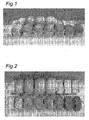
- The results so obtained are depicted in
figures 1, 2 and3 . In these photographs, the breads in the row marked "1" were leavened with the help of S. bayanus and the breads in the row marked "2" were leavened with ordinary baker's yeast.Figures 1 (frontal view) and 2 (top view) show breads that were not cut after proofing.Figure 3 (top view) shows breads that were cut after proofing. - The three photographs show that with both types of yeasts, after 2 hours of proofing, a well-leavened bread is obtained. Longer proofing of the dough containing baker's yeast resulted in severe overproofing and even total dough collapse after 6 hours. As evidenced by the photograph, the dough containing S. bayanus does not significantly increase in volume after 2 hours of proofing. Thus, with the help of this yeast strain, even after 8 hours of proofing, a good quality bread is still obtained.
- Croissants were prepared on the basis of the following recipes:
Recipe 1Recipe 2Wheat flour 2000 g 2000 g Water 1260 g 1240 g Salt 30 g 30 g Fat 1 40 g 40 g Baking improver 2 40 g 40 g Baker's yeast 3 60 g Dry yeast IOC 18-2007 4 40 g Lamination margarine 850 g 850 g 1 Goldback® (Meistermlarken, German)
2 Olympial® (BIB Ulmer Spatz, Germany)
3 Backhefe™ (Uniferm, Germany)
4 A yeast strain ex Institut Oenologique de Champagne, Epernay, France; designated in the product sheet as S. cerevisiae Killer (anc. bayanus) - The dough ingredients were admixed in Diosna™ SP 15 Spiral mixer and kneaded for 2 (slow) + 4 (fast) minutes (dough temperature after kneading appr. 20 °C). The dough was allowed to rest for 15 minutes before it was laminated using 3 simple turns. From the resulting sheet (150 cm x 42 cm x 3 mm) 10 x 21 cm triangles were cut, each weighing about 70 g. These trangles were formed into croissants.
- Next the dough pieces were proofed at 35 °C and a relative humidity of 75% four 1, 2, 3, 4, 5 or 6 hours. After proofing, samples were immediately transferred into a pre-heated oven and baked for 16 minutes at 210 °C using repeated steam injections (1.5 l). The croissants so obtained were evaluated by an expert panel. The results obtained are depicted in the following table:
Proofing time Recipe 1 Recipe 21 hour Stable Stable 2 hours Stable Stable 3 hours Stable Slightly weak 4 hours Stable Slightly weak 5 hours Stable Collapsed 6 hours Slightly weak Collapsed - White tin breads were prepared on the basis of the following recipes:
1 2 3 Wheat flour 1000 g 1000 g 1000 g Water (7.7 °C) 620 g 620 g 620 g Fat 1 20 g 20 g 20 g Salt 15g 15g 15g Baking improver 2 20 g 20 g 20 g S. cerevisiae Killer (anc. bayanus) 3 20 g S. cerevisiae without killer factor 4 20 g S. cerevisiae with killer factor5 20 g 1 Goldback® (Meistermarken, German)
2 Olympial® (BIB Ulmer Spatz, Germany)
3 Dry yeast IOC 18-2007, ex Institut Oenologique de Champagne, Epernay, France
4 Dry yeast Enoferm M2, ex Danstar Ferment AG, Zug, Switzerland
5 Dry yeast Vin 13, ex Anchor Biotechnologies, Eppindust, South Africa - The dough ingredients were admixed in Diosna™ SP 15 Spiral mixer and kneaded for 2 (slow) + 6 (fast) minutes (dough temperature after kneading appr. 24-25 °C). The dough was allowed to rest for 15 minutes before it was divided in pieces of about 250 grams and transferred into tins. Next the dough pieces were proofed at 35 °C and a relative humidity of 75% for 1-6 hours. After proofing, samples were immediately transferred into a pre-heated oven and baked for 30 minutes at 215 °C using repeated steam injections (2.0 1).
- The specific volume (SV) of the baked dough pieces was determined as well as the change of SV as a function of proofing time. This was done by determining the weight and the volume of the baked products. The following results were obtained:
Recipe 1Recipe 2Recipe 3 SV SV SV 1 hour 6.2 ml/g 3.3 ml/g 3.3 ml/ g 2 hours 6.7 ml/g 4.7 ml/g 4.6 ml/g 3 hours 6.7 ml/g 5.6 ml/g 6.1 ml/g 4 hours 7.0 ml/g 5.9 ml/g 7.1 ml/g 5 hours 6.7 ml/g 4.9 ml/g 6.2 ml/g 6 hours 6.3 ml/g 3.7 ml/g 6.6 ml/g - These results show that it took around 4 hours to fully proof the doughs made according to
recipes 2 and 3, these doughs started to collapse shortly after having been fully proofed. In contrast, the dough according torecipe 1 was already fully proofed after 1 hour and did not show signs of collapse until it had been proofed for 6 hours. - The results also show that both S. cerevisae with and without killer factor are not capable of delivering the proofing tolerance that is provided by a killer yeast strain belonging to S. bayanus
- White tin breads were prepared on the basis of the following recipes:
Recipe 1Recipe 2Recipe 3 Wheat flour 2000 g 2000 g 2000 g Water 1260 g 1260 g 1200 g Salt 40 g 40 g 40 g Margarine 1 40 g 40 g 40 g Baking improver 2 40 g 40 g 40 g Dry yeast IOC 18-2007 3 40 g Dry yeast IOC 11-1002 4 40 g Baker's yeast 5 60 g 1 Goldback® (Meistermarken, German)
2 Olympial Frost ® (BIB Ulmer Spatz, Germany)
3 A yeast strain ex Institut Oenologique de Champagne, Epernay, France; designated in the product sheet as S. cerevisiae Killer- (anc. bayanus)
4 A yeast strain ex Institut Oenologique de Champagne, Epernay, France; designated on the product sheet as Saccharomyces cerevisiae (anc. Saccharomyces bayanus)
5 Backhefe™ (Uniferm, Germany) - The dough ingredients were admixed in Diosna™ SP 15 Spiral mixer and kneaded for 2 (slow) + 6 (fast) minutes (dough temperature after kneading appr. 24 °C). The dough was allowed to rest for 15 minutes before it was divided in pieces of about 250 grams and transferred into tins. Next the dough pieces were proofed at 35 °C and a relative humidity of 75% for 1-6 hours. After proofing, samples were immediately transferred into a pre-heated oven after the dough samples had received a minor cut in a longitudinal direction (to minimise crumb separation underneath the crust). The tins were transferred into a preheated oven and baked for 30 minutes at 215 °C using repeated steam injections (2 l).
- The specific volume (SV) of the baked dough pieces was determined as well as the change of SV as a function of proofing time. This was done by determining the weight and the volume of the baked products. The following results were obtained:
Recipe 1Recipe 2Recipe 3 SV SV SV 1 hour 6.1 ml/g 6.2 ml/g 7.5 ml/ g 2 hours 6.3 ml/g 6.1 ml/g 9.4 ml/g 3 hours 6.3 ml/g 6.2 ml/g 11.4 ml/g 4 hours 5.9 ml/g 6.2 ml/g 10.4 ml/g 5 hours 6.1 ml/g 6.5 ml/g 9.5 ml/g 6 hours 6.5 ml/g 6.4 ml/g 8.8 ml/g - These results show that the dough pieces made according to recipe 3 were already overproofed after 1 hour and started collapsing after 3 hours. In contrast, both the dough pieces according to
recipe 1 andrecipe 2 were fully proofed after 1 hour, did not become overproofed and did not show signs of collapse even when proofed for up to 6 hours.
Claims (11)
- Use of Saccharomyces bayanus for enhancing the proofing tolerance of yeast-leavened dough.
- Use according to claim 1, wherein the yeast leavened dough is a fully proofed dough having a specific volume of at least 1.4 ml/g.
- Use according to any one of the preceding claims, wherein a killer yeast strain of S. bayanus is used.
- Use according to any one of the preceding claims, wherein a S. bayanus strain deposited as IOC 18-2007 in the Collection de Levure d'Intérêt Biotechnologique is employed.
- Use according to any one of claims 1-3, wherein an S. bayanus strain deposited as IOC 11-1002 in the Collection de Levure d'Intérêt Biotechnologique is employed.
- A bakery composition containing viable cells of an S. bayanus strain selected from the group consisting of a killer yeast strain belonging to S. bayanus, an S. bayanus strain deposited as IOC 11-1002 in the Collection de Levure d'Intérêt Biotechnologique and combinations thereof, in combination with one or more bakery ingredients selected from the group consisting of flour, bakery enzymes, oxidoreductants, emulsifiers, acidulants, hydrocolloids and flavours.
- Bakery composition according to claim 6, comprising at least 106 cells of the S. bayanus strain per gram.
- Bakery composition according to claim 6 or 7, comprising at least one of:- more than 5 wt.% of emulsifier;- more than 0.05 wt.% of enzyme preparation;- more than 0.01 wt.% of ascorbic acid.
- A method of preparing a baked or fried product from leavened dough, said method comprising the successive steps of:a. forming a dough by combining flour, water, yeast and optionally one or more other bakery ingredients, at least 10% of the viable yeast cells in said yeast belonging to S. bayanus;b. proofing the dough at a temperature in the range of 15-45 °C to obtain a proofed dough with a specific volume of at least 1.4 ml/g; andc. baking or frying the proofed dough;wherein prior to baking or frying the proofed dough is stored for more than 30 minutes.
- Method according to claim 9, wherein S. bayanus is incorporated in the dough in a concentration of at least 105 cells per g of dough.
- A dough containing flour, water and at least 105 cells/g, preferably at least 106 cells/g of an S. bayanus strain selected from the group consisting of a killer yeast strain belonging to S. bayanus, an S. bayanus strain deposited as IOC 11-1002 in the Collection de Levure d'Intérêt Biotechnologique and combinations thereof.
Priority Applications (1)
| Application Number | Priority Date | Filing Date | Title |
|---|---|---|---|
| EP07747375A EP1933627B1 (en) | 2006-04-12 | 2007-04-12 | Proofing tolerant yeast-leavened dough |
Applications Claiming Priority (4)
| Application Number | Priority Date | Filing Date | Title |
|---|---|---|---|
| EP06112567A EP1808074A1 (en) | 2006-04-12 | 2006-04-12 | Proofing tolerant yeast-leavened dough and use of Saccharomyces bayanus for enhancing proofing tolerance |
| EP06112672 | 2006-04-14 | ||
| EP07747375A EP1933627B1 (en) | 2006-04-12 | 2007-04-12 | Proofing tolerant yeast-leavened dough |
| PCT/NL2007/050151 WO2007117145A1 (en) | 2006-04-12 | 2007-04-12 | Proofing tolerant yeast-leavened dough |
Publications (2)
| Publication Number | Publication Date |
|---|---|
| EP1933627A1 EP1933627A1 (en) | 2008-06-25 |
| EP1933627B1 true EP1933627B1 (en) | 2009-06-17 |
Family
ID=38279797
Family Applications (1)
| Application Number | Title | Priority Date | Filing Date |
|---|---|---|---|
| EP07747375A Not-in-force EP1933627B1 (en) | 2006-04-12 | 2007-04-12 | Proofing tolerant yeast-leavened dough |
Country Status (6)
| Country | Link |
|---|---|
| EP (1) | EP1933627B1 (en) |
| AT (1) | ATE433665T1 (en) |
| DE (1) | DE602007001334D1 (en) |
| DK (1) | DK1933627T3 (en) |
| ES (1) | ES2328419T3 (en) |
| WO (1) | WO2007117145A1 (en) |
Families Citing this family (4)
| Publication number | Priority date | Publication date | Assignee | Title |
|---|---|---|---|---|
| DE102006011424A1 (en) * | 2006-03-11 | 2007-09-13 | Ulrich Gerhardt Consulting Gmbh - Bakery Management Consult - | Process for the production of bread rolls |
| US20120045544A1 (en) | 2009-02-20 | 2012-02-23 | Csm Nederland B.V. | Frozen dough comprising saccharomyces bayanus |
| EP2801257A1 (en) * | 2013-05-10 | 2014-11-12 | Casteggio Lieviti S.r.l. | Leavening preparation comprising a stabilized enzymatic mixture |
| JP7032643B2 (en) * | 2017-08-16 | 2022-03-09 | 国立大学法人帯広畜産大学 | Bread-making hybrid yeast with good flavor and flavor characteristics |
Family Cites Families (3)
| Publication number | Priority date | Publication date | Assignee | Title |
|---|---|---|---|---|
| JPS58158180A (en) * | 1982-03-15 | 1983-09-20 | Suntory Ltd | Killer yeast and its preparation |
| FR2683123B1 (en) * | 1991-11-06 | 1999-06-18 | Dassoux Georges | CHAMPAGNE LEAVEN BREAD. |
| JP2005073622A (en) * | 2003-09-02 | 2005-03-24 | Gumma Prefecture | Fused yeast producing trehalose, bread dough utilizing the yeast and method for producing bread |
-
2007
- 2007-04-12 ES ES07747375T patent/ES2328419T3/en active Active
- 2007-04-12 AT AT07747375T patent/ATE433665T1/en not_active IP Right Cessation
- 2007-04-12 DE DE602007001334T patent/DE602007001334D1/en active Active
- 2007-04-12 WO PCT/NL2007/050151 patent/WO2007117145A1/en not_active Ceased
- 2007-04-12 EP EP07747375A patent/EP1933627B1/en not_active Not-in-force
- 2007-04-12 DK DK07747375T patent/DK1933627T3/en active
Also Published As
| Publication number | Publication date |
|---|---|
| WO2007117145A1 (en) | 2007-10-18 |
| ES2328419T3 (en) | 2009-11-12 |
| ATE433665T1 (en) | 2009-07-15 |
| EP1933627A1 (en) | 2008-06-25 |
| DK1933627T3 (en) | 2009-07-13 |
| DE602007001334D1 (en) | 2009-07-30 |
Similar Documents
| Publication | Publication Date | Title |
|---|---|---|
| JP5629679B2 (en) | A novel method for producing frozen dough | |
| US10306898B2 (en) | Yeast-leavened dough and dry mix for preparing such a dough | |
| US6589583B1 (en) | Freezer to oven dough products | |
| AU2007200362A1 (en) | Dough compositions and related methods | |
| EP0305071A2 (en) | Process for making preproofed unbaked and frozen doughs | |
| RU2006132326A (en) | TASTE AMPLIFIER, BREAD TEST, BREAD PRODUCTS AND GRAIN PRODUCTS CONTAINING IT, ITS APPLICATION AS A SUBSTITUTE FOR BOILED SALT | |
| EP1933627A1 (en) | Proofing tolerant yeast-leavened dough | |
| US20120045544A1 (en) | Frozen dough comprising saccharomyces bayanus | |
| CA2485260C (en) | Dough compositions and related methods | |
| US4093748A (en) | Process for the preparation of bread | |
| EP1808074A1 (en) | Proofing tolerant yeast-leavened dough and use of Saccharomyces bayanus for enhancing proofing tolerance | |
| EP1662885B1 (en) | A method of baking frozen dough pieces | |
| US8980345B2 (en) | Fermented bakery dough tolerant to proofing | |
| KR20250118926A (en) | Manufacturing method of croissant using sugar-resistant yeast | |
| KR20250120542A (en) | Manufacturing method of bread using sugar-resistant yeast | |
| KR20250120501A (en) | Manufacturing method of bread using sugar-resistant yeast | |
| KR20250120500A (en) | Manufacturing method of bread using sugar-resistant yeast | |
| KR20250120544A (en) | Manufacturing method of bread using sugar-resistant yeast | |
| KR20250120465A (en) | Manufacturing method of bread using sugar-resistant yeast | |
| KR20250120498A (en) | Manufacturing method of bread using sugar-resistant yeast | |
| KR20250120543A (en) | Manufacturing method of bread using sugar-resistant yeast | |
| KR20250120475A (en) | Manufacturing method of bread using sugar-resistant yeast | |
| KR20250120502A (en) | Manufacturing method of bread using sugar-resistant yeast | |
| KR20250120504A (en) | Manufacturing method of bread using sugar-resistant yeast | |
| WO2007143093A2 (en) | Yeast-leavened dough compositions comprising yeast cell wall material |
Legal Events
| Date | Code | Title | Description |
|---|---|---|---|
| PUAI | Public reference made under article 153(3) epc to a published international application that has entered the european phase |
Free format text: ORIGINAL CODE: 0009012 |
|
| 17P | Request for examination filed |
Effective date: 20080411 |
|
| AK | Designated contracting states |
Kind code of ref document: A1 Designated state(s): AT BE BG CH CY CZ DE DK EE ES FI FR GB GR HU IE IS IT LI LT LU LV MC MT NL PL PT RO SE SI SK TR |
|
| GRAP | Despatch of communication of intention to grant a patent |
Free format text: ORIGINAL CODE: EPIDOSNIGR1 |
|
| GRAS | Grant fee paid |
Free format text: ORIGINAL CODE: EPIDOSNIGR3 |
|
| GRAA | (expected) grant |
Free format text: ORIGINAL CODE: 0009210 |
|
| AK | Designated contracting states |
Kind code of ref document: B1 Designated state(s): AT BE BG CH CY CZ DE DK EE ES FI FR GB GR HU IE IS IT LI LT LU LV MC MT NL PL PT RO SE SI SK TR |
|
| REG | Reference to a national code |
Ref country code: GB Ref legal event code: FG4D |
|
| REG | Reference to a national code |
Ref country code: CH Ref legal event code: EP |
|
| REG | Reference to a national code |
Ref country code: DK Ref legal event code: T3 |
|
| REG | Reference to a national code |
Ref country code: IE Ref legal event code: FG4D |
|
| REF | Corresponds to: |
Ref document number: 602007001334 Country of ref document: DE Date of ref document: 20090730 Kind code of ref document: P |
|
| REG | Reference to a national code |
Ref country code: SE Ref legal event code: TRGR |
|
| PG25 | Lapsed in a contracting state [announced via postgrant information from national office to epo] |
Ref country code: LT Free format text: LAPSE BECAUSE OF FAILURE TO SUBMIT A TRANSLATION OF THE DESCRIPTION OR TO PAY THE FEE WITHIN THE PRESCRIBED TIME-LIMIT Effective date: 20090617 Ref country code: FI Free format text: LAPSE BECAUSE OF FAILURE TO SUBMIT A TRANSLATION OF THE DESCRIPTION OR TO PAY THE FEE WITHIN THE PRESCRIBED TIME-LIMIT Effective date: 20090617 Ref country code: AT Free format text: LAPSE BECAUSE OF FAILURE TO SUBMIT A TRANSLATION OF THE DESCRIPTION OR TO PAY THE FEE WITHIN THE PRESCRIBED TIME-LIMIT Effective date: 20090617 |
|
| REG | Reference to a national code |
Ref country code: ES Ref legal event code: FG2A Ref document number: 2328419 Country of ref document: ES Kind code of ref document: T3 |
|
| PG25 | Lapsed in a contracting state [announced via postgrant information from national office to epo] |
Ref country code: PL Free format text: LAPSE BECAUSE OF FAILURE TO SUBMIT A TRANSLATION OF THE DESCRIPTION OR TO PAY THE FEE WITHIN THE PRESCRIBED TIME-LIMIT Effective date: 20090617 Ref country code: SI Free format text: LAPSE BECAUSE OF FAILURE TO SUBMIT A TRANSLATION OF THE DESCRIPTION OR TO PAY THE FEE WITHIN THE PRESCRIBED TIME-LIMIT Effective date: 20090617 Ref country code: LV Free format text: LAPSE BECAUSE OF FAILURE TO SUBMIT A TRANSLATION OF THE DESCRIPTION OR TO PAY THE FEE WITHIN THE PRESCRIBED TIME-LIMIT Effective date: 20090617 |
|
| PG25 | Lapsed in a contracting state [announced via postgrant information from national office to epo] |
Ref country code: IS Free format text: LAPSE BECAUSE OF FAILURE TO SUBMIT A TRANSLATION OF THE DESCRIPTION OR TO PAY THE FEE WITHIN THE PRESCRIBED TIME-LIMIT Effective date: 20091017 Ref country code: EE Free format text: LAPSE BECAUSE OF FAILURE TO SUBMIT A TRANSLATION OF THE DESCRIPTION OR TO PAY THE FEE WITHIN THE PRESCRIBED TIME-LIMIT Effective date: 20090617 Ref country code: RO Free format text: LAPSE BECAUSE OF FAILURE TO SUBMIT A TRANSLATION OF THE DESCRIPTION OR TO PAY THE FEE WITHIN THE PRESCRIBED TIME-LIMIT Effective date: 20090617 Ref country code: CZ Free format text: LAPSE BECAUSE OF FAILURE TO SUBMIT A TRANSLATION OF THE DESCRIPTION OR TO PAY THE FEE WITHIN THE PRESCRIBED TIME-LIMIT Effective date: 20090617 |
|
| PG25 | Lapsed in a contracting state [announced via postgrant information from national office to epo] |
Ref country code: SK Free format text: LAPSE BECAUSE OF FAILURE TO SUBMIT A TRANSLATION OF THE DESCRIPTION OR TO PAY THE FEE WITHIN THE PRESCRIBED TIME-LIMIT Effective date: 20090617 |
|
| PG25 | Lapsed in a contracting state [announced via postgrant information from national office to epo] |
Ref country code: BG Free format text: LAPSE BECAUSE OF FAILURE TO SUBMIT A TRANSLATION OF THE DESCRIPTION OR TO PAY THE FEE WITHIN THE PRESCRIBED TIME-LIMIT Effective date: 20090917 Ref country code: PT Free format text: LAPSE BECAUSE OF FAILURE TO SUBMIT A TRANSLATION OF THE DESCRIPTION OR TO PAY THE FEE WITHIN THE PRESCRIBED TIME-LIMIT Effective date: 20091017 |
|
| PLBE | No opposition filed within time limit |
Free format text: ORIGINAL CODE: 0009261 |
|
| STAA | Information on the status of an ep patent application or granted ep patent |
Free format text: STATUS: NO OPPOSITION FILED WITHIN TIME LIMIT |
|
| 26N | No opposition filed |
Effective date: 20100318 |
|
| PG25 | Lapsed in a contracting state [announced via postgrant information from national office to epo] |
Ref country code: GR Free format text: LAPSE BECAUSE OF FAILURE TO SUBMIT A TRANSLATION OF THE DESCRIPTION OR TO PAY THE FEE WITHIN THE PRESCRIBED TIME-LIMIT Effective date: 20090918 |
|
| PG25 | Lapsed in a contracting state [announced via postgrant information from national office to epo] |
Ref country code: MC Free format text: LAPSE BECAUSE OF NON-PAYMENT OF DUE FEES Effective date: 20100430 |
|
| PGFP | Annual fee paid to national office [announced via postgrant information from national office to epo] |
Ref country code: SE Payment date: 20100419 Year of fee payment: 4 |
|
| PG25 | Lapsed in a contracting state [announced via postgrant information from national office to epo] |
Ref country code: IE Free format text: LAPSE BECAUSE OF NON-PAYMENT OF DUE FEES Effective date: 20100412 |
|
| PG25 | Lapsed in a contracting state [announced via postgrant information from national office to epo] |
Ref country code: IT Free format text: LAPSE BECAUSE OF NON-PAYMENT OF DUE FEES Effective date: 20100412 |
|
| PG25 | Lapsed in a contracting state [announced via postgrant information from national office to epo] |
Ref country code: MT Free format text: LAPSE BECAUSE OF FAILURE TO SUBMIT A TRANSLATION OF THE DESCRIPTION OR TO PAY THE FEE WITHIN THE PRESCRIBED TIME-LIMIT Effective date: 20090617 |
|
| REG | Reference to a national code |
Ref country code: SE Ref legal event code: EUG |
|
| PG25 | Lapsed in a contracting state [announced via postgrant information from national office to epo] |
Ref country code: CY Free format text: LAPSE BECAUSE OF FAILURE TO SUBMIT A TRANSLATION OF THE DESCRIPTION OR TO PAY THE FEE WITHIN THE PRESCRIBED TIME-LIMIT Effective date: 20090617 |
|
| PG25 | Lapsed in a contracting state [announced via postgrant information from national office to epo] |
Ref country code: LU Free format text: LAPSE BECAUSE OF NON-PAYMENT OF DUE FEES Effective date: 20100412 Ref country code: HU Free format text: LAPSE BECAUSE OF FAILURE TO SUBMIT A TRANSLATION OF THE DESCRIPTION OR TO PAY THE FEE WITHIN THE PRESCRIBED TIME-LIMIT Effective date: 20091218 |
|
| PG25 | Lapsed in a contracting state [announced via postgrant information from national office to epo] |
Ref country code: TR Free format text: LAPSE BECAUSE OF FAILURE TO SUBMIT A TRANSLATION OF THE DESCRIPTION OR TO PAY THE FEE WITHIN THE PRESCRIBED TIME-LIMIT Effective date: 20090617 |
|
| PG25 | Lapsed in a contracting state [announced via postgrant information from national office to epo] |
Ref country code: SE Free format text: LAPSE BECAUSE OF NON-PAYMENT OF DUE FEES Effective date: 20110413 |
|
| REG | Reference to a national code |
Ref country code: NL Ref legal event code: SD Effective date: 20140120 |
|
| REG | Reference to a national code |
Ref country code: NL Ref legal event code: SD Effective date: 20140120 |
|
| REG | Reference to a national code |
Ref country code: GB Ref legal event code: 732E Free format text: REGISTERED BETWEEN 20140116 AND 20140122 |
|
| REG | Reference to a national code |
Ref country code: DE Ref legal event code: R081 Ref document number: 602007001334 Country of ref document: DE Owner name: BAKERY SUPPLIES EUROPE HOLDING B. V., NL Free format text: FORMER OWNER: CSM NEDERLAND B.V., DIEMEN, NL Effective date: 20140220 Ref country code: DE Ref legal event code: R081 Ref document number: 602007001334 Country of ref document: DE Owner name: BAKERY SUPPLIES EUROPE HOLDING B.V., NL Free format text: FORMER OWNER: CSM NEDERLAND B.V., DIEMEN, NL Effective date: 20140220 |
|
| REG | Reference to a national code |
Ref country code: FR Ref legal event code: TP Owner name: BAKERY SUPPLIES EUROPE HOLDING B.V., NL Effective date: 20140305 |
|
| REG | Reference to a national code |
Ref country code: CH Ref legal event code: NV Representative=s name: BRAUNPAT BRAUN EDER AG, CH Ref country code: CH Ref legal event code: PUE Owner name: BAKERY SUPPLIES EUROPE HOLDING B.V., NL Free format text: FORMER OWNER: CSM NEDERLAND B.V., NL |
|
| REG | Reference to a national code |
Ref country code: ES Ref legal event code: PC2A Owner name: BAKERY SUPPLIES EUROPE HOLDING B.V. Effective date: 20140926 |
|
| REG | Reference to a national code |
Ref country code: FR Ref legal event code: PLFP Year of fee payment: 9 |
|
| PG25 | Lapsed in a contracting state [announced via postgrant information from national office to epo] |
Ref country code: BE Free format text: LAPSE BECAUSE OF NON-PAYMENT OF DUE FEES Effective date: 20160430 |
|
| REG | Reference to a national code |
Ref country code: FR Ref legal event code: PLFP Year of fee payment: 10 |
|
| PG25 | Lapsed in a contracting state [announced via postgrant information from national office to epo] |
Ref country code: BE Free format text: LAPSE BECAUSE OF NON-PAYMENT OF DUE FEES Effective date: 20160430 |
|
| PGRI | Patent reinstated in contracting state [announced from national office to epo] |
Ref country code: BE Effective date: 20161027 |
|
| REG | Reference to a national code |
Ref country code: FR Ref legal event code: PLFP Year of fee payment: 11 |
|
| REG | Reference to a national code |
Ref country code: CH Ref legal event code: PCAR Free format text: NEW ADDRESS: HOLEESTRASSE 87, 4054 BASEL (CH) |
|
| REG | Reference to a national code |
Ref country code: FR Ref legal event code: PLFP Year of fee payment: 12 |
|
| PGFP | Annual fee paid to national office [announced via postgrant information from national office to epo] |
Ref country code: FR Payment date: 20210421 Year of fee payment: 15 Ref country code: IT Payment date: 20210430 Year of fee payment: 15 |
|
| PGFP | Annual fee paid to national office [announced via postgrant information from national office to epo] |
Ref country code: BE Payment date: 20210421 Year of fee payment: 15 Ref country code: GB Payment date: 20210422 Year of fee payment: 15 Ref country code: CH Payment date: 20210422 Year of fee payment: 15 Ref country code: ES Payment date: 20210519 Year of fee payment: 15 Ref country code: DK Payment date: 20210420 Year of fee payment: 15 |
|
| PGFP | Annual fee paid to national office [announced via postgrant information from national office to epo] |
Ref country code: NL Payment date: 20210421 Year of fee payment: 15 |
|
| PGFP | Annual fee paid to national office [announced via postgrant information from national office to epo] |
Ref country code: DE Payment date: 20220323 Year of fee payment: 16 |
|
| REG | Reference to a national code |
Ref country code: DK Ref legal event code: EBP Effective date: 20220430 |
|
| REG | Reference to a national code |
Ref country code: CH Ref legal event code: PL |
|
| REG | Reference to a national code |
Ref country code: NL Ref legal event code: MM Effective date: 20220501 |
|
| GBPC | Gb: european patent ceased through non-payment of renewal fee |
Effective date: 20220412 |
|
| REG | Reference to a national code |
Ref country code: BE Ref legal event code: MM Effective date: 20220430 |
|
| PG25 | Lapsed in a contracting state [announced via postgrant information from national office to epo] |
Ref country code: NL Free format text: LAPSE BECAUSE OF NON-PAYMENT OF DUE FEES Effective date: 20220501 Ref country code: LI Free format text: LAPSE BECAUSE OF NON-PAYMENT OF DUE FEES Effective date: 20220430 Ref country code: GB Free format text: LAPSE BECAUSE OF NON-PAYMENT OF DUE FEES Effective date: 20220412 Ref country code: FR Free format text: LAPSE BECAUSE OF NON-PAYMENT OF DUE FEES Effective date: 20220430 Ref country code: CH Free format text: LAPSE BECAUSE OF NON-PAYMENT OF DUE FEES Effective date: 20220430 |
|
| PG25 | Lapsed in a contracting state [announced via postgrant information from national office to epo] |
Ref country code: BE Free format text: LAPSE BECAUSE OF NON-PAYMENT OF DUE FEES Effective date: 20220430 |
|
| PG25 | Lapsed in a contracting state [announced via postgrant information from national office to epo] |
Ref country code: DK Free format text: LAPSE BECAUSE OF NON-PAYMENT OF DUE FEES Effective date: 20220430 |
|
| REG | Reference to a national code |
Ref country code: ES Ref legal event code: FD2A Effective date: 20230526 |
|
| P01 | Opt-out of the competence of the unified patent court (upc) registered |
Effective date: 20230526 |
|
| PG25 | Lapsed in a contracting state [announced via postgrant information from national office to epo] |
Ref country code: ES Free format text: LAPSE BECAUSE OF NON-PAYMENT OF DUE FEES Effective date: 20220413 |
|
| REG | Reference to a national code |
Ref country code: DE Ref legal event code: R119 Ref document number: 602007001334 Country of ref document: DE |
|
| PG25 | Lapsed in a contracting state [announced via postgrant information from national office to epo] |
Ref country code: DE Free format text: LAPSE BECAUSE OF NON-PAYMENT OF DUE FEES Effective date: 20231103 |
|
| PG25 | Lapsed in a contracting state [announced via postgrant information from national office to epo] |
Ref country code: IT Free format text: LAPSE BECAUSE OF NON-PAYMENT OF DUE FEES Effective date: 20220412 |