EP1933528A1 - Sécurisation d'accès à des services depuis un équipement communicant avec une entité personnelle - Google Patents
Sécurisation d'accès à des services depuis un équipement communicant avec une entité personnelle Download PDFInfo
- Publication number
- EP1933528A1 EP1933528A1 EP07122786A EP07122786A EP1933528A1 EP 1933528 A1 EP1933528 A1 EP 1933528A1 EP 07122786 A EP07122786 A EP 07122786A EP 07122786 A EP07122786 A EP 07122786A EP 1933528 A1 EP1933528 A1 EP 1933528A1
- Authority
- EP
- European Patent Office
- Prior art keywords
- command
- personal entity
- communicating equipment
- data
- communicating
- Prior art date
- Legal status (The legal status is an assumption and is not a legal conclusion. Google has not performed a legal analysis and makes no representation as to the accuracy of the status listed.)
- Granted
Links
Images



Classifications
-
- H—ELECTRICITY
- H04—ELECTRIC COMMUNICATION TECHNIQUE
- H04L—TRANSMISSION OF DIGITAL INFORMATION, e.g. TELEGRAPHIC COMMUNICATION
- H04L63/00—Network architectures or network communication protocols for network security
- H04L63/08—Network architectures or network communication protocols for network security for authentication of entities
- H04L63/0853—Network architectures or network communication protocols for network security for authentication of entities using an additional device, e.g. smartcard, SIM or a different communication terminal
-
- H—ELECTRICITY
- H04—ELECTRIC COMMUNICATION TECHNIQUE
- H04W—WIRELESS COMMUNICATION NETWORKS
- H04W12/00—Security arrangements; Authentication; Protecting privacy or anonymity
- H04W12/06—Authentication
- H04W12/068—Authentication using credential vaults, e.g. password manager applications or one time password [OTP] applications
-
- H—ELECTRICITY
- H04—ELECTRIC COMMUNICATION TECHNIQUE
- H04L—TRANSMISSION OF DIGITAL INFORMATION, e.g. TELEGRAPHIC COMMUNICATION
- H04L63/00—Network architectures or network communication protocols for network security
- H04L63/08—Network architectures or network communication protocols for network security for authentication of entities
- H04L63/0823—Network architectures or network communication protocols for network security for authentication of entities using certificates
-
- H—ELECTRICITY
- H04—ELECTRIC COMMUNICATION TECHNIQUE
- H04W—WIRELESS COMMUNICATION NETWORKS
- H04W4/00—Services specially adapted for wireless communication networks; Facilities therefor
-
- H—ELECTRICITY
- H04—ELECTRIC COMMUNICATION TECHNIQUE
- H04W—WIRELESS COMMUNICATION NETWORKS
- H04W74/00—Wireless channel access
-
- H—ELECTRICITY
- H04—ELECTRIC COMMUNICATION TECHNIQUE
- H04W—WIRELESS COMMUNICATION NETWORKS
- H04W8/00—Network data management
- H04W8/26—Network addressing or numbering for mobility support
Definitions
- the present invention relates to secure access to personalized services, whether near or distant, from a communicating equipment such as PDA PDA or a "Smartphone", which can interrogate a small personal entity of the card type. chip.
- the personal entity contains private user-specific data that is useful for accessing personalized services.
- This data is for example keys, certificates, authentication codes, passwords and personal codes as a PIN ("Personal Identity Number" in English).
- a personalized service can be an access to a virtual private network VPN ("Virtual Private Network" in English) for a secure connection of the communicating equipment to the private network of a company, an authentication of the user-customer having the card smart with secure servers such as a banking server, or secure messaging for sending and receiving signed and / or encrypted emails.
- VPN Virtual Private Network
- a smart card as a cryptographic resource is housed in a reader connected to the universal serial bus port USB (in English "Universal Serial Bus") or series of communicating equipment.
- the reader is in the form of an ISO card reader, or a dongle, the card and the reader then forming a single object.
- the card may include a crypto-processor.
- the user of the communicating equipment must acquire additional bulky removable equipment, the card reader and the card separated or integrated together.
- a method for securing data in a communicating equipment associated with a personal entity comprises in the communicating equipment establishment of a command including the data and which is formatted as a command transmitted by an external means to the communicating equipment and intended for the personal entity after an encapsulation of the command established in a command compatible with a network interface in the communicating equipment, a transmission of the command from the equipment communicating with the personal entity after uncapping of the compatible command in the command established in the network interface, and execution of an action in the personal entity according to the command.
- the invention makes use of the personal entity of the universal card type with removable circuit originally housed in the communicating equipment, without adding additional hardware, that is to say, while maintaining the initial size of the equipment communicating.
- a cryptographic means in the personal entity provides a secure means for performing any cryptographic action on the data to be secured, such as encryption or writing.
- the orders including the data are established by the equipment communicating advantageously with the known format commands, such as commands "ENVELOPE", which are transmitted according to the prior art by means external to the communicating equipment, such as servers, through a cellular radio network and which are able to be interpreted by an application personal resource management, for example SIM or USIM, adapted to the cellular network in the personal entity.
- commands established in the communicating equipment do not thus modify the order reception in the personal entity.
- the encapsulation of the established control and the decapsulation of the compatible control facilitates the direct access of a security means in the communicating equipment by means of cryptography in the personal entity, without resorting to an additional card reader.
- An address of the cryptographic means in which the action is executed is introduced into each command established in the communicating equipment, which enables the cryptography means in the personal entity to directly receive the commands and execute those that are intended for it without doing so. to intervene the application of management of personal resources.
- the invention also relates to communicating equipment and a personal entity associated to secure data.
- the communicating equipment may include means for establishing an order including the data and formatted as a command transmitted by an external means to the communicating equipment and intended for the personal entity and means for transmitting the command to the personal entity so an action executed in the personal entity according to the order.
- the personal entity may include means for performing an action based on a command including the data and formatted in the communicating equipment as a command transmitted by an external means to the communicating equipment and intended for the personal entity.
- the invention relates to computer programs capable of being implemented in the communicating equipment and the personal entity.
- communicating equipment EC can be a personal digital assistant communicating mobile PDA, or a "Smartphone".
- a personal entity EP can be a smart card housed with or without contact in the communicating equipment.
- an AP client service application in the communicating equipment EC when activated by the user of the personal entity EP, the application opens a communication channel with a service server through a telecommunications network.
- the service server may be an e-mail server or an enterprise LAN server.
- the application AP uses secure resources and private data in the personal entity EP so that the personal entity EP provides a signature identifying the user to the application which then introduces it into a request passed to the service server.
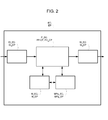
- FIG 2 there is shown a hardware architecture for the communicating equipment EC and the personal entity EP.
- the architecture comprises a memory M, a processing unit P equipped for example with one or more microprocessors and controlled by computer programs stored in a memory MPg implementing the method according to the invention.
- An input module Et and an output module St are respectively arranged at the input and at the output of the processing unit P.
- each element of the architecture of the communicating equipment EC and the personal entity EP is hereinafter designated in combination with the reference of the set EC, EP to which it belongs.
- the communicating equipment EC comprises a processor P_EC, a memory M_EC, a program memory MPg_EC, an input module Et_EC and an output module St_EC.
- the personal entity EP comprises a main processor PP_EP and a cryptographic processor PC_EP, a memory M_EP, a program memory MPg_EP, an input module Et_EP and an output module St_EP.
- the communicating equipment EC and the personal entity EP are represented in the form of functional blocks, most of which provide functions relating to the invention and may correspond to software and / or hardware modules.
- the communicating equipment EC comprises a graphical GUI user interface for keyboard and screen, a personal entity administration unit AD, an SEC security unit, an IC communication interface, in particular for formatting commands intended for the entity personal EP and an IR radio network interface for communicating with a communication network and the personal entity EP.
- the AD and SEC units and the IC communication interface are implemented in the MPg_EC program memory.
- the program memory MPg_EC contains an operating system and a runtime environment such as a virtual machine that can be compatible with the JAVA language.
- the virtual machine is related to a JAVA virtual machine implemented in the personal entity EP through a specific communication protocol, in particular to activate client applications installed in the communicating equipment EC and a cryptography unit CY of the entity EP when performing cryptographic functions.
- the memory M_EC comprises in particular one or more AP client applications, such as an APm e-mail (e-mail) application, an APe data writing application, a browser, a communication application with a local network, for example by link without Infrared type wire, or Bluetooth, or 802.xx, or satisfying the WiFi label (Wireless Fidelity), or a communication application with the Internet for secure transaction for example according to the method of public-key cryptography and secure SSL layers ( "Secure Sockets Layers”.
- the administration unit AD administers the personal entity EP and oversees the downloading and personalization of the cryptographic unit CY into the personal entity from the network, such as a digital cellular network, to which the equipment is attached. communicating.
- the unit AD is also used to import user keys and certificates in a predefined format, such as a PKCS12 ("Public-Key Cryptography Standards") cryptographic format, and to modify, for example, a PIN code of the user. user with the personal entity.
- PKCS12 Public-Key Cryptography Standards
- the security unit SEC provides cryptographic functionality to the AP client applications by involving the cryptographic unit CY in the personal entity EP at the request of any client application for data security.
- the SEC unit in cooperation with the cryptographic unit CY intervenes to authenticate the user by an enterprise local area network at the request of a client application for virtual private network VPN (Virtual Private Network).
- VPN Virtual Private Network
- a data signature may comprise a hash of data in a fingerprint performed by the SEC security unit.
- the security unit SEC comprises a library of small programs acting as interface type API ("Application Programming Interface" in English) with the client applications for cryptography and with the operating system of the processor P_EC.
- interface type API Application Programming Interface
- the IR radio network interface acts as a modem and is functionally related to the Et_EC and St_EC modules shown in FIG. figure 2 and connected for example through a serial link to a PES input and output port of the personal entity EP representative of the modules Et_EP and St_EP.
- the communication interface IC enables the security unit SEC to communicate with the cryptographic unit CY in the personal entity EP via first commands EV through the radio network interface IR and the serial link. and with the IR radio network interface via second AT commands.
- AT commands are formatted in the equipment communicating EC as known commands relating to messages between the communicating equipment and a communication network over the air.
- the first EV commands are in the format of the "ENVELOPE" commands conventionally used to access from an external entity, such as a server, through the communicating equipment EC transparent to the operating system in the personal entity EP.
- the EV commands relate to a set of commands and responses constituting pre-formatted Application Protocol Data Unit (APDU) application protocol data units according to a specific alternate asynchronous communication protocol between a mobile terminal and a smart card, designated for example by SIM Application Toolkit (SAT) according to ISO 7816-3 / 8 or 3GPP recommendation TS 51.014 or ETSI 123.048. Orders are always initiated by the communicating EC equipment.
- the personal entity EP is pro-active in order to initiate actions that are specific to it but after interrogation of the communicating equipment.
- the "ENVELOPE” commands are able to transfer data from an external means to the communicating equipment, such as a server, to the personal entity EP without the communicating equipment EC interpreting them.
- the EV commands according to the invention are established on the initiative of the security unit SEC in the communication interface IC of the communicating equipment EC and are also interpretable by the virtual machine implemented in the personal entity.
- EP similarly to an encapsulated short message received by the communicating equipment according to the prior art and transmitting directly to the personal entity a short message loading command of the type "ENVELOPE (SMS-PP DOWNLOAD)".
- the "ENVELOPE" EV commands are used for an AP client application to access data or command the execution of one of the applications, called applets, located in the personal entity EP and more particularly to access the unit of CY cryptography.
- the personal entity EP is not conventionally viewed as a smart card by the client applications AP which sees only the IR network interface, such as a modem, to which the personal entity EP is associated.
- the second AT commands can each encapsulate an EV "ENVELOPE” command and are compatible with the IR radio network interface.
- the communication interface IC comprises an interface, for example of the RIL ("Radio Interface Layer") type, which is supported by the upper layers comprising the SEC security unit and the CY cryptographic unit relating to the "ENVELOPE" EV commands.
- the communication interface IC encapsulates an EV command in an AT command in the form: "RIL_SendSimToolkitEnvelopeCmd" to trigger an applet (cardlet) in the personal entity, such as the cryptographic unit CY.
- the AT commands are desencapsulated into "ENVELOPE" commands by the IR network interface which transmits them directly to the personal entity EP without going through an additional card reader.
- the personal entity EP is for example a UICC (Universal Integrated Circuit Card) universal integrated circuit card.
- the program memory MPg_EP notably comprises a SIM (Subscriber Identity Module) application for the communicating equipment EC to function as a mobile of the GSM or GPRS type, and / or a USIM (Universal Subscriber Identity Module) application for the communicating equipment EC operates in third generation (3GPP) coded Division Multiple Access (CDMA) multiple division access (UMTS) of the Universal Mobile Telecommunications System (UMTS) or UMTS Terrestrial Radio Access Network (UTRAN) type.
- 3GPP third generation
- CDMA Coded Division Multiple Access
- UMTS Universal Mobile Telecommunications System
- UTRAN Universal Mobile Telecommunications System
- the program memory MPg_EP furthermore includes an operating system for the card which relies on a virtual machine of the "Java Card” type.
- the memory M_EP can in particular memorize characteristics of the profile of the user and the call numbers in a directory.
- the personal entity EP comprises, besides an operating system and a virtual machine of "Java Card” type running in the processors PP_EP and PC_EP, the cryptographic unit CY in the form of an applet which relies on on the cryptographic processor PC_EP connected with the main processor PP_EP to the input and output port PES.
- the cryptographic unit CY is addressable by a pre-recorded AdCY address in the memory M_EP. It supports private key operations as well as the management and storage of certificates, private keys and PIN personal codes in the M_EP memory and the generation of two keys.
- known encryption / decryption algorithms are implemented in the cryptographic unit CY that performs cryptographic actions to participate in securing user authentication for communication with a local area network, signing and encrypting data and emails, verifying signature and decryption of data and emails, and SSL-based communications, without any private key being extracted from the EP entity.
- the cryptographic unit CY directly receives commands "ENVELOPE" EV through the input and output port PES, without the intermediary of the main processor PP_EP, and recognizes the commands EV which include its AdCY address, acknowledges them with the security unit SEC and executes cryptographic actions requested in the EV commands.
- an MA (“email”) email established by the user by means of the GUI user interface of the communicating equipment EC is signed in the personal entity EP during steps S0 to S11 according to the method security of the invention, for example after entering a personal PIN code of the user and a verification thereof by the personal entity.
- the MA email is established using the graphical user interface GUI and recorded by means of an electronic mail application APm installed in the communicating equipment EC, the application APm asks determining an hash fingerprint HA at the security unit SEC in step S1.
- the security unit produces the hash fingerprint HA and the provides the communication interface IC in step S2.
- the communication interface IC establishes a first command "ENVELOPE” EV of the type “SendAPDU (COMPUTE_SIGNATURE (hash))” and introduces in address the AdCY address of the cryptographic unit CY in the personal entity EP and in data the imprint HA, in step S3.
- the EV command (AdCY, HA) thus constituted is encapsulated in an AT command compatible with the IR radio network interface and thus notified by the communication interface to the personal entity EP.
- the IR radio network interface analyzes the AT command and recognizes therein an EV command so as to decapsulate the AT command and to transmit the EV command (AdCY, HA) to the processors of the personal entity EP through the port PES, at step S4.
- the cryptographic unit CY thus receives the command "ENVELOPE” EV (AdCY, HA) produced by the communicating equipment EC, as if the command "ENVELOPE” had been established by an external entity which can be a server of a communication network to which the EC equipment is connected which is transparent to the ENVELOPE commands according to the prior art.
- step S5 the cryptographic unit CY in the personal entity EP compares the AdCY address in the EV command (AdCY, HA) to its pre-registered address in the M_EP memory and thus recognizes that the ENVELOPE command is intended for it. . If the compared addresses are different, the cryptographic unit CY can issue a response of the type "Status" specific to an error that may invite the application AP to renew its request for signature of email.
- ENVELOPE commands can be processed from as known by the SIM or USIM application, but also according to the invention specific ENVELOPE commands including the AdCY address can be addressed directly and processed by the cryptographic unit CY as an applet.
- the cryptographic unit CY then extracts the hash fingerprint HA from the EV command (AdCY, HA) in step S6 and applies a private key AC encryption algorithm to produce an SG signature of the MA email.
- the cryptographic unit CY inserts the signature SG in a response RP for example as defined according to ISO 7816-3 and provides it to the IR network interface in step S7.
- the IR interface encapsulates the signature SG in an AT response and transmits the AT response (RP (SG)) to the communication interface IC in step S8.
- the communication interface IC de-encapsulates the response AT (RP (SG)) in the response RP (SG), extracts the signature SG from the response RP (SG) and provides the signature to the unit SEC security in step S10.
- the security unit SEC memorizes the signature SG and communicates it to the electronic mail application APm in step S10.
- the AP application completes the MA email by associating it with the SG signature and controls the transmission of a message via the IC and IR interfaces of the communicating equipment EC to a SM mail server to which the user has sent the message .
- the security method according to the invention has the advantage of being able to use the personal entity EP, such as a UICC universal card integrated circuit chip card including a SIM or USIM application, as a security element in connection with native applications of EC communicating equipment using keys and / or certificates stored in software.
- the personal entity EP such as a UICC universal card integrated circuit chip card including a SIM or USIM application
- the security method allows the use of keys and / or certificates and key generation functions and certificates on the personal entity while said software does not provide it natively.
- the security unit SEC and the cryptographic unit CY cooperate to write a private key KP in a secure area of the memory M_EP of the personal entity EP accessible only by the cryptographic unit.
- the private key KP is assumed to have a size exceeding the maximum length of the data field of an "ENVELOPE" command.
- N the integer N being greater than 5.
- the private key write comprises steps of steps E0 to E9.
- an OS server managed by the mobile cellular network operator to which the communicating equipment EC is attached must download an application into the personal entity.
- the server is a secure transport server type HTTPS ("HyperText Transfer Protocol Secured" in English) and requires the user to enter a password in the communicating equipment EC to write a private key KP associated with the application to download. After verifying the password received by the server, the latter transmits to the communicating equipment EC an associated certificate CT to the private key KP.
- the administration unit AD calls a write application APe which requests the writing of the private key KP and the certificate previously imported from the server SE to the security unit SEC which makes this request to the IC communication interface.
- step E2 in the communication interface IC, the private key KP is segmented into N portions KP1 to KPN which are to be introduced in successive commands "ENVELOPE" EV1 to EVN.
- the first command EV1 contains the expected length of the private key KP expressed in bytes.
- Each command EVn with 1 ⁇ n ⁇ N, comprises the AdCY address of the cryptographic unit CY and a data field completely filled by the respective portion KPn of the private key KP having the maximum length of data field, to the exception most often of the last EVN command whose data field is partially filled by the final portion KPN of the key.
- a cycle of steps E3n to E8n is executed between the communication interface IC in the communicating equipment EC and the cryptography unit CY in the personal entity EP .
- step E3n the communication interface IC establishes the command EVn (AdCY, KPn) and encapsulates it in an AT command that is supplied to the IR radio network interface.
- the IR radio network interface analyzes the AT command (EVn (AdCY, KPn)) and recognizes therein an EV command so as to decapsulate the AT command and to transmit the command EVn (AdCY, KPn) to the processors of the personal entity EP through the port PES, at step E4n.
- step E5n the cryptographic unit CY recognizes that the command EVn (AdCY, KPn) is intended for it by comparing the AdCY address in the command EVn (AdCY, KPn) to its address in the memory M_EP.
- the cryptographic unit CY then extracts the private key portion KPn from the command EVn in step E6n and writes it to the memory M_EP.
- the cryptographic unit CY acknowledges this write of the private key portion KPn by returning a RPn response type "Status" to the IR network interface in step E7n.
- the network interface encapsulates the response RPn in an AT response and transmits the AT response (RPn) to the communication interface IC at step E8n.
- the communication interface IC disencapsulates the response AT (RPn) into the response RPn (Status) and then initiates the next cycle of steps E3n + 1 to E8n + 1 in a similar manner to the previous cycle of steps E3n to E8n .
- the cryptographic unit CY acknowledges the complete writing of the private key KP by returning a RPN response of "Status" type specific to a "end of recording” to the communication interface IC via the IR network interface, at steps E7N and E8N.
- the communication interface IC then confirms the private key write KP in the personal entity EP to the security unit SEC and the write application Ape, in the step E9.
- the read response data is segmented in the cryptographic unit CY into portions of data respectively included in successive responses RP.
- Each response RP is sent by the cryptographic unit CY via the IR network interface and an AT response encapsulation (RP) to the communication interface IC, following a data portion request command of the type "GET RESPONSE" transmitted by the communication interface IC.
- RP AT response encapsulation
- the data portions are extracted from the RP responses and are concatenated.
- the communicating equipment EC such as a mobile personal digital assistant PDA PDA, establishes a communication with a remote server OTP ("One Time Password" in English) to obtain one or several passwords. These passwords are passwords that can only be used once.
- OTP server calculates and transmits these passwords to the personal entity EP via the communicating equipment EC.
- the personal entity stores these passwords in the memory M_EP.
- the AD administration unit of the communicating equipment EC calls an AP application which requires a one-time password.
- This communicating equipment application sends the personal entity a read command to obtain a password.
- the read command is formatted as an EV command transmitted by an external means to the communicating equipment EC, the EV command is encapsulated in an AT command compatible with the IR radio network interface and the AT command is decapsulated by the IR interface according to the invention.
- the personal entity EP executes a reading of the password in the memory M_EP and transmits the password read to the communicating equipment EC.
- the invention described here relates to a method, a communicating equipment EC such as a personal digital assistant and a personal entity EP such as a smart card associated with the communicating equipment.
- the steps of the method of the invention are determined by the computer program instructions respectively incorporated into the communicating equipment EC and the personal entity EP.
- the programs comprise program instructions which, when said programs are executed respectively in the personal entity and the communicating equipment whose operation is then controlled by the execution of the programs, carry out the steps of the method according to the invention.
- the invention also applies to computer programs, in particular computer programs each recorded on or in a computer-readable data carrier and any data processing device, adapted to implement the invention.
- These programs may use any programming language, and be in the form of source code, object code, or intermediate code between source code and object code such as in a partially compiled form, or in any other form desirable to implement the method according to the invention.
- the information carrier may be any entity or device capable of storing programs.
- the medium may comprise storage means or recording medium on which the computer programs according to the invention are recorded, such as a ROM, for example a CD ROM or a microelectronic circuit ROM, or a USB key, or a magnetic recording medium, for example a diskette (floppy disc) or a hard disk.
- the information medium may be a transmissible medium such as an electrical or optical signal, which may be conveyed via an electrical or optical cable, by radio or by other means.
- the programs according to the invention may in particular be downloaded on an Internet-type network.
- the information carrier may be an integrated circuit in which the programs are incorporated, the circuit being adapted to execute or to be used in the execution of the methods according to the invention.
Landscapes
- Engineering & Computer Science (AREA)
- Computer Security & Cryptography (AREA)
- Computer Networks & Wireless Communication (AREA)
- Signal Processing (AREA)
- Computer Hardware Design (AREA)
- Computing Systems (AREA)
- General Engineering & Computer Science (AREA)
- Mobile Radio Communication Systems (AREA)
- Computer And Data Communications (AREA)
Abstract
Description
- La présente invention concerne l'accès sécurisé à des services personnalisés, qu'ils soient de proximité ou distants, depuis un équipement communicant tel qu'un assistant numérique personnel PDA ou un "Smartphone", pouvant interroger une petite entité personnelle du type carte à puce.
- L'entité personnelle contient en mémoire des données privées propres à un utilisateur et utiles pour accéder aux services personnalisés. Ces données sont par exemple des clés, certificats, codes d'authentification, mots de passe et codes personnels comme un code PIN ("Personal Identity Number" en anglais).
- Un service personnalisé peut être un accès à un réseau privé virtuel VPN ("Virtual Private Network" en anglais) pour une connexion sécurisée de l'équipement communicant au réseau privé d'une entreprise, une authentification de l'utilisateur-client possédant la carte à puce auprès de serveurs sécurisés comme un serveur bancaire, ou une messagerie sécurisée pour l'envoi et la réception de courriels signés et/ou chiffrés.
- Actuellement pour stocker des données privées utiles servant à sécuriser l'accès à des services personnalisés depuis un équipement communicant tel qu'un assistant numérique personnel, une carte à puce en tant que ressource cryptographique est logée dans un lecteur connecté au port à bus série universel USB (en anglais "Universal Serial Bus") ou série de l'équipement communicant. Le lecteur se présente sous forme d'un lecteur de carte ISO, ou bien d'un dongle, la carte et le lecteur formant alors un seul objet. La carte peut comprendre un crypto-processeur.
- Ainsi pour bénéficier de fonctions de sécurité, l'utilisateur de l'équipement communicant doit acquérir un matériel supplémentaire amovible encombrant, le lecteur de carte et la carte séparés ou intégrés ensemble.
- Pour pallier les inconvénients ci-dessus, un procédé pour sécuriser des données dans un équipement communicant associé à une entité personnelle est caractérisé en ce qu'il comprend dans l'équipement communicant un établissement d'une commande incluant les données et qui est formatée comme une commande transmise par un moyen externe à l'équipement communicant et destinée à l'entité personnelle après un encapsulage de la commande établie dans une commande compatible avec une interface de réseau dans l'équipement communicant, une transmission de la commande depuis l'équipement communicant à l'entité personnelle après un décapsulage de la commande compatible en la commande établie dans l'interface de réseau, et une exécution d'une action dans l'entité personnelle en fonction de la commande.
- L'invention recourt à l'entité personnelle du type carte universelle à circuit amovible logée à l'origine dans l'équipement communicant, sans ajouter de matériel supplémentaire, c'est-à-dire en maintenant l'encombrement initial de l'équipement communicant. Un moyen de cryptographie dans l'entité personnelle constitue un moyen sécuritaire pour exécuter toute action cryptographique sur les données à sécuriser, comme un chiffrement ou une écriture.
- Les commandes incluant les données sont établies par l'équipement communicant avantageusement au format connu de commandes, telles que des commandes "ENVELOPE", qui sont transmises selon la technique antérieure par des moyens externes à l'équipement communicant, tels que serveurs, à travers un réseau radio cellulaire et qui sont aptes à être interprétées par une application de gestion de ressources personnelles, par exemple SIM ou USIM, adaptée au réseau cellulaire dans l'entité personnelle. Les commandes établies dans l'équipement communicant ne modifient pas ainsi la réception de commande dans l'entité personnelle.
- L'encapsulation de la commande établie et la décapsulation de la commande compatible facilitent l'accès direct d'un moyen de sécurité dans l'équipement communicant au moyen de cryptographie dans l'entité personnelle, sans recourir à un lecteur de carte supplémentaire.
- Une adresse du moyen de cryptographie dans lequel l'action est exécutée est introduite dans chaque commande établie dans l'équipement communicant ce qui permet au moyen de cryptographie dans l'entité personnelle de recevoir directement les commandes et exécuter celles qui lui sont destinées sans faire intervenir l'application de gestion de ressources personnelles.
- L'invention est également relative à un équipement communicant et une entité personnelle associés pour sécuriser des données. L'équipement communicant peut comprendre un moyen pour établir une commande incluant les données et formatée comme une commande transmise par un moyen externe à l'équipement communicant et destinée à l'entité personnelle et un moyen pour transmettre la commande à l'entité personnelle afin qu'une action soit exécutée dans l'entité personnelle en fonction de la commande. L'entité personnelle peut comprendre un moyen pour exécuter une action en fonction d'une commande incluant les données et formatée dans l'équipement communicant comme une commande transmise par un moyen externe à l'équipement communicant et destinée à l'entité personnelle.
- Enfin l'invention se rapporte à des programmes d'ordinateur aptes à être mis en oeuvre dans l'équipement communicant et l'entité personnelle.
- D'autres caractéristiques et avantages de la présente invention apparaîtront plus clairement à la lecture de la description suivante de plusieurs réalisations de l'invention données à titre d'exemples non limitatifs, en référence aux dessins annexés correspondants dans lesquels :
- la
figure 1 est un bloc-diagramme schématique d'un équipement communicant et d'une entité personnelle associés selon l'invention ; - la
figure 2 montre schématiquement une architecture matérielle pour l'équipement communicant et l'entité personnelle ; - la
figure 3 est un algorithme du procédé selon l'invention pour sécuriser un courriel à transmettre par l'équipement communicant ; et - la
figure 4 est un algorithme du procédé selon l'invention pour sécuriser l'écriture d'une clé privée depuis l'équipement communicant. - En référence à la
figure 1 , un équipement communicant EC peut être un assistant numérique personnel communicant mobile PDA, ou un "Smartphone". Une entité personnelle EP peut être une carte à puce logée avec ou sans contact dans l'équipement communicant. - Par exemple lorsqu'une application de service cliente AP dans l'équipement communicant EC est activée par l'utilisateur de l'entité personnelle EP, l'application ouvre un canal de communication avec un serveur de service à travers un réseau de télécommunications. Le serveur de service peut être un serveur de messagerie électronique ou un serveur de réseau local d'entreprise. Préalablement selon l'invention, l'application AP recourt à des ressources sécurisées et des données privées dans l'entité personnelle EP afin que l'entité personnelle EP fournisse une signature identifiant l'utilisateur à l'application qui l'introduit ensuite dans une requête transmise au serveur de service.
- Dans la
figure 2 , on a représenté une architecture matérielle pour l'équipement communicant EC et l'entité personnelle EP. L'architecture comprend une mémoire M, une unité de traitement P équipée par exemple d'un ou de plusieurs microprocesseurs et pilotés par des programmes d'ordinateur mémorisés dans une mémoire MPg mettant en oeuvre le procédé selon l'invention. Un module d'entrée Et et un module de sortie St sont respectivement disposés en entrée et en sortie de l'unité de traitement P. - Afin d'éviter toute confusion, chaque élément de l'architecture de l'équipement communicant EC et l'entité personnelle EP est désigné ci-après en combinaison avec le repère de l'ensemble EC, EP auquel il appartient. Ainsi l'équipement communicant EC comprend un processeur P_EC, une mémoire M_EC, une mémoire de programme MPg_EC, un module d'entrée Et_EC et un module de sortie St_EC. L'entité personnelle EP comprend un processeur principal PP_EP et un processeur de cryptographie PC_EP, une mémoire M_EP, une mémoire de programme MPg_EP, un module d'entrée Et_EP et un module de sortie St_EP.
- Dans la
figure 1 , l'équipement communicant EC et l'entité personnelle EP sont représentés sous forme de blocs fonctionnels dont la plupart assurent des fonctions ayant un lien avec l'invention et peuvent correspondre à des modules logiciels et/ou matériels. - L'équipement communicant EC comprend une interface graphique d'utilisateur GUI pour clavier et écran, une unité d'administration d'entité personnelle AD, une unité de sécurité SEC, une interface de communication IC notamment pour formater des commandes destinées à l'entité personnelle EP et une interface de réseau radio IR pour communiquer avec un réseau de communication et l'entité personnelle EP.
- Les unités AD et SEC et l'interface de communication IC sont implémentées dans la mémoire de programme MPg_EC. La mémoire de programme MPg_EC contient un système d'exploitation et un environnement d'exécution comme par exemple une machine virtuelle pouvant être compatible avec le langage JAVA. La machine virtuelle est en relation avec une machine virtuelle JAVA implémentée dans l'entité personnelle EP à travers un protocole de communication spécifique, notamment pour activer des applications clientes installées dans l'équipement communicant EC et une unité de cryptographie CY de l'entité EP lors de l'exécution de fonctions cryptographiques.
- La mémoire M_EC comporte notamment une ou plusieurs applications clientes AP, telles qu'une application de courrier électronique (courriel) APm, une application d'écriture de données APe, un navigateur, une application de communication avec un réseau local par exemple par liaison sans fil de type infrarouge, ou Bluetooth, ou 802.xx, ou satisfaisant le label WiFi (Wireless Fidelity), ou une application de communication avec l'internet pour transaction sécurisée par exemple selon le procédé de cryptographie à clé publique et couches sécurisées SSL ("Secure Sockets Layers" en anglais).
- L'unité d'administration AD administre l'entité personnelle EP et supervise le téléchargement et la personnalisation de l'unité de cryptographie CY dans l'entité personnelle depuis le réseau, tel qu'un réseau cellulaire numérique, auquel est attaché l'équipement communicant. L'unité AD sert également à importer des clés et certificats d'utilisateur à un format prédéfini, tel qu'un format cryptographique PKCS12 ("Public-Key Cryptography Standards" en anglais), et à modifier par exemple un code personnel PIN de l'utilisateur possédant l'entité personnelle.
- L'unité de sécurité SEC fournit des fonctionnalités cryptographiques aux applications clientes AP en faisant intervenir l'unité de cryptographie CY dans l'entité personnelle EP à la demande de toute application cliente en matière de sécurisation de données. Par exemple, l'unité SEC en coopération avec l'unité de cryptographie CY intervient pour authentifier l'utilisateur par un réseau local d'entreprise à la demande d'une application cliente pour réseau privé virtuel VPN ("Virtual Private Network" en anglais), pour signer des données dans des courriels et/ou chiffrer de s courriels ou pour vérifier une signature reçue ou des données comme un code personnel ou un mot de passe et/ou déchiffrer des données chiffrées reçues à la demande d'une application de courrier électronique, ou pour naviguer dans des sites internet sécurisés selon le procédé SSL à la demande du navigateur, ou bien encore pour générer des bi-clés, c'est-à-dire des paires de clé de chiffrement et déchiffrement, à la demande d'une application d'échange de messages avec un autre équipement communicant par exemple. Comme on le verra en référence à la
figure 3 , une signature de données peut comprendre un hachage de données en une empreinte effectuée par l'unité de sécurité SEC. - L'unité de sécurité SEC comprend une librairie de petits programmes faisant office d'interface de type API ("Application Programming interface" en anglais) avec les applications clientes pour la cryptographie et avec le système d'exploitation du processeur P_EC.
- L'interface de réseau radio IR fait office de modem et est fonctionnellement liée aux modules Et_EC et St_EC montrés à la
figure 2 et reliés par exemple à travers une liaison série à un port d'entrée et de sortie PES de l'entité personnelle EP représentatif des modules Et_EP et St_EP. - L'interface de communication IC permet à l'unité de sécurité SEC de communiquer avec l'unité de cryptographie CY dans l'entité personnelle EP par l'intermédiaire de premières commandes EV à travers l'interface de réseau radio IR et la liaison série et avec l'interface de réseau radio IR par l'intermédiaire de deuxièmes commandes AT. Les commandes AT sont formatées dans l'équipement communicant EC comme des commandes connues relatives à des messages entre l'équipement communicant et un réseau de communication par liaison radio.
- Les premières commandes EV sont au format des commandes "ENVELOPE" utilisées classiquement pour accéder depuis une entité externe, comme un serveur, à travers l'équipement communicant EC transparent au système d'exploitation dans l'entité personnelle EP. Les commandes EV sont relatives à un jeu de commandes et réponses constituant des unités de données de protocole applicatif APDU ("Application Protocol Data Unit" en anglais) pré-formatées selon un protocole de communication asynchrone à l'alternat spécifique entre un terminal mobile et une carte à puce, désigné par exemple par SIM Application Toolkit (SAT) selon la norme ISO 7816-3/8 ou la recommandation 3GPP TS 51.014 ou ETSI 123.048. Les commandes sont toujours déclenchées à l'initiative de l'équipement communicant EC. L'entité personnelle EP est pro-active afin d'initier des actions qui lui sont propres mais après interrogation de l'équipement communicant.
- Selon la technique antérieure, les commandes "ENVELOPE" sont aptes à transférer des données d'un moyen externe à l'équipement communicant, comme un serveur, à l'entité personnelle EP sans que l'équipement communicant EC les interprète. En revanche, les commandes EV selon l'invention sont établies à l'initiative de l'unité de sécurité SEC dans l'interface de communication IC de l'équipement communicant EC et sont aussi interprétables par la machine virtuelle implémentée dans l'entité personnelle EP, de manière analogue à un message court encapsulé reçu par l'équipement communicant selon la technique antérieure et transmettant directement à l'entité personnelle une commande de chargement de message court du type "ENVELOPE (SMS-PP DOWNLOAD)".
- Les commandes "ENVELOPE" EV servent à ce qu'une application cliente AP accède à des données ou commande l'exécution de l'une des applications, dites applets, localisées dans l'entité personnelle EP et plus particulièrement accède à l'unité de cryptographie CY. L'entité personnelle EP n'est pas vue classiquement comme une carte à puce par les applications clientes AP qui ne voit que l'interface de réseau IR, comme un modem, à laquelle l'entité personnelle EP est associée.
- Les deuxièmes commandes AT peuvent encapsuler chacune une commande EV "ENVELOPE" et sont compatibles avec l'interface de réseau radio IR. Pour établir et gérer des commandes et réponses asynchrones AT, l'interface de communication IC comprend une interface par exemple du type RIL ("Radio Interface Layer" en anglais) qui est supportée par les couches supérieures comprenant l'unité de sécurité SEC et l'unité de cryptographie CY relatives aux commandes "ENVELOPE" EV. Ainsi selon l'invention, l'interface de communication IC encapsule une commande EV dans une commande AT sous la forme :
"RIL_SendSimToolkitEnvelopeCmd",
afin de déclencher une applet (cardlet) dans l'entité personnelle, comme l'unité de cryptographie CY. - Les commandes AT sont désencapsulées en commandes "ENVELOPE" par l'interface de réseau IR qui les transmet directement à l'entité personnelle EP sans passer par l'intermédiaire d'un lecteur de carte supplémentaire.
- L'entité personnelle EP est par exemple une carte à puce du type carte universelle à circuit intégré UICC ("Universal Integrated Circuit Card"). La mémoire de programme MPg_EP comprend notamment une application SIM (Subscriber Identity Module) pour que l'équipement communicant EC fonctionne comme un mobile du type GSM ou GPRS, et/ou une application USIM (Universal Subscriber Identity Module) pour que l'équipement communicant EC fonctionne en accès multiple à répartition par codes CDMA ("Coded Division Multiple Access" en anglais) de la troisième génération (3GPP) du type UMTS ("Universal Mobile Telecommunications System" en anglais) ou UTRAN (UMTS Terrestrial Radio Access Network).
- La mémoire de programme MPg_EP inclut en outre un système d'exploitation pour la carte qui s'appuie sur une machine virtuelle du type "Java Card".
- La mémoire M_EP peut notamment mémoriser des caractéristiques du profil de l'utilisateur et des numéros d'appel dans un annuaire.
- Comme représenté à la
figure 1 , l'entité personnelle EP comprend, outre un système d'exploitation et une machine virtuelle de type "Java Card" s'exécutant dans les processeurs PP_EP et PC_EP, l'unité de cryptographie CY sous forme d'une applet qui s'appuie sur le processeur de cryptographie PC_EP relié avec le processeur principal PP_EP au port d'entrée et de sortie PES. - L'unité de cryptographie CY est adressable par une adresse AdCY préenregistrée dans la mémoire M_EP. Elle supporte des opérations à clés privées ainsi que la gestion et le stockage de certificats, de clés privés et de codes personnels PIN dans la mémoire M_EP et la génération de bi-clés. Par exemple, des algorithmes de chiffrement/déchiffrement connus sont implémentés dans l'unité de cryptographie CY qui exécute des actions de cryptographie pour participer à la sécurisation d'une authentification d'utilisateur pour une communication avec un réseau local d'entreprise, la signature et le chiffrement de données et de courriels, la vérification de signature et le déchiffrement de données et de courriels, et de communications selon le procédé SSL, sans qu'aucune clé privée ne soit extraite de l'entité EP.
- Pour l'exécution de ces opérations, l'unité de cryptographie CY reçoit directement des commandes "ENVELOPE" EV par le port d'entrée et de sortie PES, sans l'intermédiaire du processeur principal PP_EP, et reconnaît les commandes EV qui incluent son adresse AdCY, les acquitte auprès de l'unité de sécurité SEC et exécute des actions de cryptographie demandées dans les commandes EV.
- En référence à la
figure 3 , un courriel MA ("email") établi par l'utilisateur au moyen de l'interface graphique d'utilisateur GUI de l'équipement communicant EC est signé dans l'entité personnelle EP au cours d'étapes S0 à S11 selon le procédé de sécurisation de l'invention, par exemple après une saisie d'un code personnel PIN de l'utilisateur et une vérification de celui-ci par l'entité personnelle. - Après qu'à l'étape S0, le courriel MA soit établi au moyen de l'interface graphique d'utilisateur GUI et enregistré au moyen d'une application de messagerie électronique APm installée dans l'équipement communicant EC, l'application APm demande la détermination d'une empreinte de hachage HA à l'unité de sécurité SEC à l'étape S1. L'unité de sécurité produit l'empreinte de hachage HA et la fournit à l'interface de communication IC à l'étape S2.
- L'interface de communication IC établit une première commande "ENVELOPE" EV du type "SendAPDU(COMPUTE_SIGNATURE(hash))" et y introduit en adresse l'adresse AdCY de l'unité de cryptographie CY dans l'entité personnelle EP et en données l'empreinte HA, à l'étape S3. La commande EV(AdCY, HA) ainsi constituée est encapsulée dans une commande AT compatible avec l'interface de réseau radio IR et ainsi notifiée par l'interface de communication à l'entité personnelle EP. L'interface de réseau radio IR analyse la commande AT et reconnaît dans celle-ci une commande EV de manière à décapsuler la commande AT et à transmettre la commande EV(AdCY, HA) aux processeurs de l'entité personnelle EP à travers le port PES, à l'étape S4.
- Dans l'entité personnelle EP, l'unité de cryptographie CY reçoit ainsi la commande "ENVELOPE" EV (AdCY, HA) produite par l'équipement communicant EC, comme si la commande "ENVELOPE" avait été établie par une entité externe qui peut être un serveur d'un réseau de communication auquel est relié l'équipement EC qui est transparent aux commandes ENVELOPE selon la technique antérieure.
- A l'étape S5, l'unité de cryptographie CY dans l'entité personnelle EP compare l'adresse AdCY dans la commande EV(AdCY, HA) à son adresse préenregistrée dans la mémoire M_EP et reconnaît ainsi que la commande ENVELOPE lui est destinée. Si les adresses comparées sont différentes, l'unité de cryptographie CY peut émettre une réponse de type "Status" propre à une erreur pouvant inviter l'application AP à renouveler sa demande de signature de courriel. Ainsi des commandes ENVELOPE peuvent être traitées de manière connue par l'application SIM ou USIM, mais aussi selon l'invention des commandes ENVELOPE spécifiques incluant l'adresse AdCY peuvent être adressées directement et traitées par l'unité de cryptographie CY en tant qu'applet.
- L'unité de cryptographie CY extrait ensuite l'empreinte de hachage HA de la commande EV(AdCY, HA) à l'étape S6 et lui applique un algorithme de chiffrement AC à clé privée pour produire une signature SG du courriel MA. L'unité de cryptographie CY insère la signature SG dans une réponse RP par exemple comme définie selon la norme ISO 7816-3 et la fournit à l'interface de réseau IR à l'étape S7. L'interface IR encapsule la signature SG dans une réponse AT et transmet la réponse AT(RP(SG)) à l'interface de communication IC à l'étape S8.
- Dans l'équipement communicant EC, l'interface de communication IC désencapsule la réponse AT(RP(SG)) en la réponse RP(SG), extrait la signature SG de la réponse RP(SG) et fournit la signature à l'unité de sécurité SEC à l'étape S10. L'unité de sécurité SEC mémorise la signature SG et la communique à l'application de messagerie électronique APm à l'étape S10. L'application AP complète le courriel MA en l'associant à la signature SG et commande la transmission d'un message via les interfaces IC et IR de l'équipement communicant EC à un serveur de messagerie SM auquel l'utilisateur a destiné le message.
- Le procédé de sécurisation selon l'invention présente l'avantage de pouvoir utiliser l'entité personnelle EP, telle qu'une carte à puce du type carte universelle à circuit intégré UICC incluant une application SIM ou USIM, comme élément de sécurité en relation avec des applications natives de l'équipement communicant EC utilisant des clés et/ou certificats stockés de manière logicielle.
- Sans impact sur les logiciels existants, le procédé de sécurisation permet l'utilisation de clés et/ou certificats et de fonctions de génération de bi-clés et de certificats sur l'entité personnelle alors que lesdits logiciels ne le prévoient pas nativement.
- Selon un autre exemple montré à la
figure 4 , l'unité de sécurité SEC et l'unité de cryptographie CY coopèrent pour écrire une clé privée KP dans une zone sécurisée de la mémoire M_EP de l'entité personnelle EP accessible seulement par l'unité de cryptographie. Dans cet exemple, la clé privée KP est supposée avoir une taille excédant la longueur maximale du champ de données d'une commande "ENVELOPE". Par exemple pour transmettre la clé privée KP, il est nécessaire de la segmenter dans les champs de données de N commandes "ENVELOPE" EV1 à EVN, l'entier N pouvant être supérieur à 5. - L'écriture de clé privée comprend des étapes d'étapes E0 à E9.
- Initialement à l'étape E0, par exemple un serveur SE géré par l'opérateur de réseau cellulaire pour mobiles auquel l'équipement communicant EC est rattaché doit télécharger une application dans l'entité personnelle. Le serveur est un serveur de transport sécurisé du type HTTPS ("HyperText Transfer Protocol Secured" en anglais) et requiert la saisie d'un mot de passe par l'utilisateur dans l'équipement communicant EC pour écrire une clé privée KP associée à l'application à télécharger. Après vérification du mot de passe reçu par le serveur, celui-ci transmet à l'équipement communicant EC un certificat CT associé à la clé privée KP. A l'étape E1, l'unité d'administration AD appelle une application d'écriture APe qui demande l'écriture de la clé privée KP et du certificat précédemment importés du serveur SE à l'unité de sécurité SEC qui formule cette demande à l'interface de communication IC.
- A l'étape E2, dans l'interface de communication IC, la clé privée KP est segmentée en N portions KP1 à KPN qui sont à introduire dans des commandes successives "ENVELOPE" EV1 à EVN. La première commande EV1 contient la longueur attendue de la clé privée KP exprimée en octets. Chaque commande EVn, avec 1 ≤ n ≤ N, comprend l'adresse AdCY de l'unité de cryptographie CY et un champ de données complètement remplie par la portion respective KPn de la clé privée KP ayant la longueur maximale de champ de données, à l'exception le plus souvent de la dernière commande EVN dont le champ de données est partiellement rempli par la portion finale KPN de la clé.
- Pour chaque commande EVn à notifier à l'unité de cryptographie CY, un cycle d'étapes E3n à E8n est exécuté entre l'interface de communication IC dans l'équipement communicant EC et l'unité de cryptographie CY dans l'entité personnelle EP.
- A l'étape E3n, l'interface de communication IC établit la commande EVn(AdCY, KPn) et l'encapsule dans une commande AT qui est fournie à l'interface de réseau radio IR. L'interface de réseau radio IR analyse la commande AT(EVn(AdCY, KPn)) et reconnaît dans celle-ci une commande EV de manière à décapsuler la commande AT et à transmettre la commande EVn(AdCY, KPn) aux processeurs de l'entité personnelle EP à travers le port PES, à l'étape E4n.
- A l'étape E5n, l'unité de cryptographie CY reconnaît que la commande EVn(AdCY, KPn) lui est destinée en comparant l'adresse AdCY dans la commande EVn(AdCY, KPn) à son adresse dans la mémoire M_EP. L'unité de cryptographie CY extrait ensuite la portion de clé privée KPn de la commande EVn à l'étape E6n et l'écrit dans la mémoire M_EP. Puis l'unité de cryptographie CY acquitte cette écriture de la portion de clé privée KPn en retournant une réponse RPn de type "Status" à l'interface de réseau IR à l'étape E7n. L'interface de réseau encapsule la réponse RPn dans une réponse AT et transmet la réponse AT(RPn) à l'interface de communication IC à l'étape E8n. L'interface de communication IC désencapsule la réponse AT (RPn) en la réponse RPn(Status) et initie alors le cycle suivant d'étapes E3n+1 à E8n+1 d'une manière analogue au cycle précédent d'étapes E3n à E8n.
- Dans le dernier cycle d'étapes E3N à E8N, lorsque la dernière portion KPN de la clé privée KP extraite de la commande EVN est écrite dans la mémoire M_EP à l'étape E6N, l'unité de cryptographie CY acquitte l'écriture complète de la clé privée KP en retournant une réponse RPN de type "Status" propre à une "fin d'enregistrement" à l'interface de communication IC via l'interface de réseau IR, à des étapes E7N et E8N. L'interface de communication IC confirme alors l'écriture de clé privée KP dans l'entité personnelle EP à l'unité de sécurité SEC et l'application d'écriture Ape, à l'étape E9.
- Suivant l'autre direction de l'entité personnelle EP vers équipement communicant EC, si des données lues par l'unité de cryptographie CY et à transmettre à l'équipement communicant EC ont une longueur supérieure à la longueur maximale du champ de données d'une réponse RP, les données de réponse lues sont segmentées dans l'unité de cryptographie CY en des portions de données respectivement incluses dans des réponses successives RP. Chaque réponse RP est envoyée par l'unité de cryptographie CY via l'interface de réseau IR et un encapsulage en réponse AT(RP) à l'interface de communication IC, à la suite d'une commande de requête de portion de données du type "GET RESPONSE" transmise par l'interface de communication IC. Dans l'interface de communication IC, les portions de données sont extraites des réponses RP et sont concaténées.
- Selon un autre exemple, lors d'une étape préalable, l'équipement communicant EC, tel qu'un assistant numérique personnel communicant mobile PDA, établit une communication avec un serveur distant OTP ("One Time Password" en anglais) pour obtenir un ou plusieurs mots de passe. Ces mots de passe sont des mots de passe qui ne peuvent être utilisés qu'une seule fois. Le serveur OTP calcule et transmet ces mots de passe à l'entité personnelle EP, via l'équipement communicant EC. L'entité personnelle stocke ces mots de passe dans la mémoire M_EP.
- Lors d'une étape ultérieure, l'unité d'administration AD de l'équipement communicant EC appelle une application AP qui nécessite un mot de passe utilisable une seule fois. Cette application de l'équipement communicant envoie à l'entité personnelle une commande de lecture pour obtenir un mot de passe. La commande de lecture est formatée comme une commande EV transmise par un moyen externe à l'équipement communicant EC, la commande EV est encapsulée dans une commande AT compatible avec l'interface de réseau radio IR et la commande AT est décapsulée par l'interface IR, conformément à l'invention. En réponse à la commande de lecture, l'entité personnelle EP exécute une lecture du mot de passe dans la mémoire M_EP et transmet le mot de passe lu à l'équipement communicant EC.
- L'invention décrite ici concerne un procédé, un équipement communicant EC tel qu'un assistant numérique personnel et une entité personnelle EP telle qu'une carte à puce associée à l'équipement communicant. Selon une implémentation, les étapes du procédé de l'invention sont déterminées par les instructions de programmes d'ordinateur incorporés respectivement dans l'équipement communicant EC et l'entité personnelle EP. Les programmes comportent des instructions de programme qui, lorsque lesdits programmes sont exécutés respectivement dans l'entité personnelle et l'équipement communicant dont le fonctionnement est alors commandé par l'exécution des programmes, réalisent les étapes du procédé selon l'invention.
- En conséquence, l'invention s'applique également à des programmes d'ordinateur, notamment des programmes d'ordinateur enregistrés chacun sur ou dans un support d'informations lisible par un ordinateur et tout dispositif de traitements de données, adapté à mettre en oeuvre l'invention. Ces programmes peuvent utiliser n'importe quel langage de programmation, et être sous la forme de code source, code objet, ou de code intermédiaire entre code source et code objet tel que dans une forme partiellement compilée, ou dans n'importe quelle autre forme souhaitable pour implémenter le procédé selon l'invention.
- Le support d'informations peut être n'importe quelle entité ou dispositif capable de stocker les programmes. Par exemple, le support peut comporter un moyen de stockage ou support d'enregistrement sur lequel sont enregistrés les programmes d'ordinateur selon l'invention, tel qu'une ROM, par exemple un CD ROM ou une ROM de circuit microélectronique, ou encore une clé USB, ou un moyen d'enregistrement magnétique, par exemple une disquette (floppy disc) ou un disque dur.
- D'autre part, le support d'informations peut être un support transmissible tel qu'un signal électrique ou optique, qui peut être acheminé via un câble électrique ou optique, par radio ou par d'autres moyens. Les programmes selon l'invention peuvent être en particulier téléchargés sur un réseau de type internet.
- Alternativement, le support d'informations peut être un circuit intégré dans lequel les programmes sont incorporés, le circuit étant adapté pour exécuter ou pour être utilisé dans l'exécution des procédés selon l'invention.
Claims (9)
- - Procédé pour sécuriser des données dans un équipement communicant (EC) associé à une entité personnelle (EP), caractérisé en ce qu'il comprend dans l'équipement communicant un établissement (S3, E3n) d'une commande (EV, EVn) incluant les données (HA, KP) et qui est formatée comme une commande transmise par un moyen externe à l'équipement communicant et destinée à l'entité personnelle après un encapsulage (S3, E3n) de la commande établie (EV, EVn) dans une commande (AT) compatible avec une interface de réseau dans l'équipement communicant (EC), une transmission (S4, E4n) de la commande depuis l'équipement communicant (EC) à l'entité personnelle (EP) après un décapsulage (S4, E4n) de la commande compatible en la commande établie dans l'interface de réseau, et une exécution (S6, E6n) d'une action dans l'entité personnelle en fonction de la commande.
- - Procédé conforme à la revendication 1 comprenant dans la commande (EV, EVn) une introduction (S3, E3n) d'une adresse d'un moyen de cryptographie (CY) de l'entité personnelle dans lequel l'action est exécutée.
- - Procédé conforme à la revendication 1 ou 2, comprenant une segmentation (E2) des données (KP) en des portions de données (KPn), des commandes (EVn) incluant respectivement les portions de données étant établies (E3n) et transmises à l'entité personnelle (EP) successivement.
- - Procédé conforme à l'une quelconque des revendications 1 à 3, selon lequel ladite action est un chiffrement (S6) de données (HA) extraites de la commande établie (EV).
- - Procédé conforme à l'une quelconque des revendications 1 à 3, selon lequel ladite action est une écriture (E6n) de données (KP) extraites de la commande établie (EVn) en mémoire (M_EP) de l'entité personnelle (EP).
- - Equipement communicant (EC) associé à une entité personnelle (EP) pour sécuriser des données, caractérisé en ce qu'il comprend un moyen (IC) pour établir une commande (EV, EVn) incluant les données (HA, KP) et qui est formatée comme une commande transmise par un moyen externe à l'équipement communicant et destinée à l'entité personnelle après un encapsulage de la commande établie (EV, EVn) dans une commande (AT) compatible avec une interface de réseau dans l'équipement communicant (EC), et un moyen (IC, IR) pour transmettre la commande à l'entité personnelle (EP) après un décapsulage de la commande compatible en la commande établie dans l'interface de réseau afin qu'une action soit exécutée dans l'entité personnelle en fonction de la commande.
- - Entité personnelle (EP) associée à un équipement communicant (EC) pour sécuriser des données, caractérisée en ce qu'elle comprend un moyen (CY) pour exécuter une action en fonction d'une commande incluant les données (HA, KP) et formatée dans l'équipement communicant comme une commande transmise par un moyen externe à l'équipement communicant et destinée à l'entité personnelle, ladite commande étant transmise à l'entité personnelle depuis l'équipement communicant (EC) après un encapsulage de la commande établie (EV, EVn) dans une commande (AT) compatible avec une interface de réseau dans l'équipement communicant (EC) et un décapsulage de la commande compatible en la commande établie dans l'interface de réseau.
- - Programme d'ordinateur apte à être mis en oeuvre dans un équipement communicant (EC) associé à une entité personnelle (EP) pour sécuriser des données, caractérisé en ce qu'il comprend des instructions qui, lorsque le programme est exécuté dans ledit équipement communicant, réalisent un établissement (S3, E3n) d'une commande (EV, EVn) incluant les données (HA, KP) et qui est formatée comme une commande transmise par un moyen externe à l'équipement communicant et destinée à l'entité personnelle après un encapsulage (S3, E3n) de la commande établie (EV, EVn) dans une commande (AT) compatible avec une interface de réseau dans l'équipement communicant (EC), et une transmission (S4, E4n) de la commande depuis l'équipement communicant (EC) à l'entité personnelle (EP) après un décapsulage (S4, E4n) de la commande compatible en la commande établie dans l'interface de réseau afin qu'une action soit exécutée dans l'entité personnelle en fonction de la commande.
- - Programme d'ordinateur apte à être mis en oeuvre dans une entité personnelle (EP) associée à un équipement communicant (EC) pour sécuriser des données, caractérisé en ce qu'il comprend des instructions qui, lorsque le programme est exécuté dans ladite entité personnelle, réalisent une exécution d'une action en fonction d'une commande incluant les données (HA, KP) et formatée dans l'équipement communicant comme une commande transmise par un moyen externe à l'équipement communicant et destinée à l'entité personnelle, ladite commande étant transmise à l'entité personnelle depuis l'équipement communicant (EC) après un encapsulage de la commande établie (EV, EVn) dans une commande (AT) compatible avec une interface de réseau dans l'équipement communicant (EC) et un décapsulage (S4, E4n) de la commande compatible en la commande établie dans l'interface de réseau.
Applications Claiming Priority (1)
| Application Number | Priority Date | Filing Date | Title |
|---|---|---|---|
| FR0655455 | 2006-12-12 |
Publications (3)
| Publication Number | Publication Date |
|---|---|
| EP1933528A1 true EP1933528A1 (fr) | 2008-06-18 |
| EP1933528B1 EP1933528B1 (fr) | 2017-04-26 |
| EP1933528B9 EP1933528B9 (fr) | 2018-05-23 |
Family
ID=37890232
Family Applications (1)
| Application Number | Title | Priority Date | Filing Date |
|---|---|---|---|
| EP07122786.2A Active EP1933528B9 (fr) | 2006-12-12 | 2007-12-10 | Sécurisation d'accès à des services depuis un équipement communicant avec une entité personnelle |
Country Status (1)
| Country | Link |
|---|---|
| EP (1) | EP1933528B9 (fr) |
Citations (3)
| Publication number | Priority date | Publication date | Assignee | Title |
|---|---|---|---|---|
| WO2004032557A1 (fr) * | 2002-10-07 | 2004-04-15 | Telefonaktiebolaget Lm Ericsson (Publ) | Ameliorations apportee a la securite et a la confidentialite dans des dispositifs de securite |
| EP1480411A2 (fr) * | 2003-05-20 | 2004-11-24 | Hitachi Ltd. | Carte à puce avec fonction de conversion de clé cryptographique |
| EP1608123A1 (fr) * | 2004-06-15 | 2005-12-21 | Axalto SA | Procédé et dispositif pour communiquer de messages HTTP avec des dispositifs portables |
-
2007
- 2007-12-10 EP EP07122786.2A patent/EP1933528B9/fr active Active
Patent Citations (3)
| Publication number | Priority date | Publication date | Assignee | Title |
|---|---|---|---|---|
| WO2004032557A1 (fr) * | 2002-10-07 | 2004-04-15 | Telefonaktiebolaget Lm Ericsson (Publ) | Ameliorations apportee a la securite et a la confidentialite dans des dispositifs de securite |
| EP1480411A2 (fr) * | 2003-05-20 | 2004-11-24 | Hitachi Ltd. | Carte à puce avec fonction de conversion de clé cryptographique |
| EP1608123A1 (fr) * | 2004-06-15 | 2005-12-21 | Axalto SA | Procédé et dispositif pour communiquer de messages HTTP avec des dispositifs portables |
Non-Patent Citations (3)
| Title |
|---|
| ARMAND NACHEF: "J2ME - JSR 177", SIMAGINE UNIVERSITY, 24 August 2005 (2005-08-24), XP002428140, Retrieved from the Internet <URL:http://www.simagine.axalto.com/summer2006pdf/SIMagine_JSR177-presentation2.pdf> [retrieved on 20070404] * |
| INTERNATIONAL STANDARD, ISO/IEC 7816-8, 6 January 2004 (2004-01-06), XP008077623 * |
| R. CRICCO: "Enhance your mobile services for Java handsets by using the SIM card", GEMPLUS, 21 December 2005 (2005-12-21), XP002428139, Retrieved from the Internet <URL:http://web.archive.org/web/20051221080614/http://www.javamedeveloper.com/downloads/gemplus/JSR177_ceo_v3.pdf> [retrieved on 20070404] * |
Also Published As
| Publication number | Publication date |
|---|---|
| EP1933528B1 (fr) | 2017-04-26 |
| EP1933528B9 (fr) | 2018-05-23 |
Similar Documents
| Publication | Publication Date | Title |
|---|---|---|
| US12300075B2 (en) | Contactless card personal identification system | |
| EP2050081B1 (fr) | Procede de routage de donnees d'application entrantes dans un chipset nfc, par identification de l'application | |
| EP3221815B1 (fr) | Procédé de sécurisation d'un jeton de paiement. | |
| EP1004101B1 (fr) | Terminal et systeme pour la mise en oeuvre de transactions electroniques securisees | |
| US8924714B2 (en) | Authentication with an untrusted root | |
| EP2912594B1 (fr) | Procédé de fourniture d'un service sécurisé | |
| EP2798867A1 (fr) | Plate-forme en nuage pour carte sim virtuelle | |
| WO2007115982A2 (fr) | Procede de protection d'identite, dispositifs, et produit programme d'ordinateur correspondants | |
| WO2006111626A2 (fr) | Procédé et dispositif d'acces a une carte sim logée dans un terminal mobile | |
| WO2007099062A2 (fr) | Gestion d'acces securise a un contenu numerique securise dans un objet communicant portable | |
| EP3238200A1 (fr) | Entité électronique sécurisée, appareil électronique et procédé de vérification de l'intégrité de données mémorisées dans une telle entité électronique sécurisée | |
| EP3423982A1 (fr) | Systeme ouvert et securise de signature electronique et procede associe | |
| EP2710779A1 (fr) | Procede de securisation d'une platforme d'authentification, dispositifs materiels et logiciels correspondants | |
| EP1933528B1 (fr) | Sécurisation d'accès à des services depuis un équipement communicant avec une entité personnelle | |
| CN112084485A (zh) | 数据获取方法、装置、设备以及计算机存储介质 | |
| EP2754262A1 (fr) | Procede d'authentification | |
| EP3673633B1 (fr) | Procédé d'authentification d'un utilisateur auprès d'un serveur d'authentification | |
| WO2025109113A1 (fr) | Procédés, dispositifs et système de transmission et d'acquisition d'une donnée | |
| EP2341688B1 (fr) | Procédé d'authentification securisée d'un terminal itinérant sur un réseau de télécommunications sans fil | |
| HK40104535A (en) | System and method to perform digital authentication using mulitple channels of communication | |
| WO2017060624A1 (fr) | Moyens de gestion d'accès à des données |
Legal Events
| Date | Code | Title | Description |
|---|---|---|---|
| PUAI | Public reference made under article 153(3) epc to a published international application that has entered the european phase |
Free format text: ORIGINAL CODE: 0009012 |
|
| AK | Designated contracting states |
Kind code of ref document: A1 Designated state(s): AT BE BG CH CY CZ DE DK EE ES FI FR GB GR HU IE IS IT LI LT LU LV MC MT NL PL PT RO SE SI SK TR |
|
| AX | Request for extension of the european patent |
Extension state: AL BA HR MK RS |
|
| 17P | Request for examination filed |
Effective date: 20081205 |
|
| 17Q | First examination report despatched |
Effective date: 20090112 |
|
| AKX | Designation fees paid |
Designated state(s): AT BE BG CH CY CZ DE DK EE ES FI FR GB GR HU IE IS IT LI LT LU LV MC MT NL PL PT RO SE SI SK TR |
|
| RAP1 | Party data changed (applicant data changed or rights of an application transferred) |
Owner name: ORANGE |
|
| REG | Reference to a national code |
Ref country code: DE Ref legal event code: R079 Ref document number: 602007050746 Country of ref document: DE Free format text: PREVIOUS MAIN CLASS: H04L0029060000 Ipc: H04W0012060000 |
|
| GRAP | Despatch of communication of intention to grant a patent |
Free format text: ORIGINAL CODE: EPIDOSNIGR1 |
|
| RIC1 | Information provided on ipc code assigned before grant |
Ipc: H04W 12/06 20090101AFI20161027BHEP Ipc: H04L 29/06 20060101ALI20161027BHEP |
|
| INTG | Intention to grant announced |
Effective date: 20161114 |
|
| GRAS | Grant fee paid |
Free format text: ORIGINAL CODE: EPIDOSNIGR3 |
|
| GRAA | (expected) grant |
Free format text: ORIGINAL CODE: 0009210 |
|
| AK | Designated contracting states |
Kind code of ref document: B1 Designated state(s): AT BE BG CH CY CZ DE DK EE ES FI FR GB GR HU IE IS IT LI LT LU LV MC MT NL PL PT RO SE SI SK TR |
|
| REG | Reference to a national code |
Ref country code: GB Ref legal event code: FG4D Free format text: NOT ENGLISH |
|
| REG | Reference to a national code |
Ref country code: CH Ref legal event code: EP |
|
| REG | Reference to a national code |
Ref country code: AT Ref legal event code: REF Ref document number: 888828 Country of ref document: AT Kind code of ref document: T Effective date: 20170515 |
|
| REG | Reference to a national code |
Ref country code: IE Ref legal event code: FG4D Free format text: LANGUAGE OF EP DOCUMENT: FRENCH |
|
| REG | Reference to a national code |
Ref country code: DE Ref legal event code: R096 Ref document number: 602007050746 Country of ref document: DE |
|
| REG | Reference to a national code |
Ref country code: NL Ref legal event code: MP Effective date: 20170426 |
|
| REG | Reference to a national code |
Ref country code: LT Ref legal event code: MG4D |
|
| REG | Reference to a national code |
Ref country code: AT Ref legal event code: MK05 Ref document number: 888828 Country of ref document: AT Kind code of ref document: T Effective date: 20170426 |
|
| PG25 | Lapsed in a contracting state [announced via postgrant information from national office to epo] |
Ref country code: NL Free format text: LAPSE BECAUSE OF FAILURE TO SUBMIT A TRANSLATION OF THE DESCRIPTION OR TO PAY THE FEE WITHIN THE PRESCRIBED TIME-LIMIT Effective date: 20170426 |
|
| PG25 | Lapsed in a contracting state [announced via postgrant information from national office to epo] |
Ref country code: AT Free format text: LAPSE BECAUSE OF FAILURE TO SUBMIT A TRANSLATION OF THE DESCRIPTION OR TO PAY THE FEE WITHIN THE PRESCRIBED TIME-LIMIT Effective date: 20170426 Ref country code: FI Free format text: LAPSE BECAUSE OF FAILURE TO SUBMIT A TRANSLATION OF THE DESCRIPTION OR TO PAY THE FEE WITHIN THE PRESCRIBED TIME-LIMIT Effective date: 20170426 Ref country code: GR Free format text: LAPSE BECAUSE OF FAILURE TO SUBMIT A TRANSLATION OF THE DESCRIPTION OR TO PAY THE FEE WITHIN THE PRESCRIBED TIME-LIMIT Effective date: 20170727 Ref country code: LT Free format text: LAPSE BECAUSE OF FAILURE TO SUBMIT A TRANSLATION OF THE DESCRIPTION OR TO PAY THE FEE WITHIN THE PRESCRIBED TIME-LIMIT Effective date: 20170426 Ref country code: ES Free format text: LAPSE BECAUSE OF FAILURE TO SUBMIT A TRANSLATION OF THE DESCRIPTION OR TO PAY THE FEE WITHIN THE PRESCRIBED TIME-LIMIT Effective date: 20170426 |
|
| REG | Reference to a national code |
Ref country code: FR Ref legal event code: PLFP Year of fee payment: 11 |
|
| PG25 | Lapsed in a contracting state [announced via postgrant information from national office to epo] |
Ref country code: PL Free format text: LAPSE BECAUSE OF FAILURE TO SUBMIT A TRANSLATION OF THE DESCRIPTION OR TO PAY THE FEE WITHIN THE PRESCRIBED TIME-LIMIT Effective date: 20170426 Ref country code: IS Free format text: LAPSE BECAUSE OF FAILURE TO SUBMIT A TRANSLATION OF THE DESCRIPTION OR TO PAY THE FEE WITHIN THE PRESCRIBED TIME-LIMIT Effective date: 20170826 Ref country code: SE Free format text: LAPSE BECAUSE OF FAILURE TO SUBMIT A TRANSLATION OF THE DESCRIPTION OR TO PAY THE FEE WITHIN THE PRESCRIBED TIME-LIMIT Effective date: 20170426 Ref country code: LV Free format text: LAPSE BECAUSE OF FAILURE TO SUBMIT A TRANSLATION OF THE DESCRIPTION OR TO PAY THE FEE WITHIN THE PRESCRIBED TIME-LIMIT Effective date: 20170426 Ref country code: BG Free format text: LAPSE BECAUSE OF FAILURE TO SUBMIT A TRANSLATION OF THE DESCRIPTION OR TO PAY THE FEE WITHIN THE PRESCRIBED TIME-LIMIT Effective date: 20170726 |
|
| REG | Reference to a national code |
Ref country code: DE Ref legal event code: R097 Ref document number: 602007050746 Country of ref document: DE |
|
| PG25 | Lapsed in a contracting state [announced via postgrant information from national office to epo] |
Ref country code: CZ Free format text: LAPSE BECAUSE OF FAILURE TO SUBMIT A TRANSLATION OF THE DESCRIPTION OR TO PAY THE FEE WITHIN THE PRESCRIBED TIME-LIMIT Effective date: 20170426 Ref country code: EE Free format text: LAPSE BECAUSE OF FAILURE TO SUBMIT A TRANSLATION OF THE DESCRIPTION OR TO PAY THE FEE WITHIN THE PRESCRIBED TIME-LIMIT Effective date: 20170426 Ref country code: SK Free format text: LAPSE BECAUSE OF FAILURE TO SUBMIT A TRANSLATION OF THE DESCRIPTION OR TO PAY THE FEE WITHIN THE PRESCRIBED TIME-LIMIT Effective date: 20170426 Ref country code: RO Free format text: LAPSE BECAUSE OF FAILURE TO SUBMIT A TRANSLATION OF THE DESCRIPTION OR TO PAY THE FEE WITHIN THE PRESCRIBED TIME-LIMIT Effective date: 20170426 Ref country code: DK Free format text: LAPSE BECAUSE OF FAILURE TO SUBMIT A TRANSLATION OF THE DESCRIPTION OR TO PAY THE FEE WITHIN THE PRESCRIBED TIME-LIMIT Effective date: 20170426 |
|
| PG25 | Lapsed in a contracting state [announced via postgrant information from national office to epo] |
Ref country code: IT Free format text: LAPSE BECAUSE OF FAILURE TO SUBMIT A TRANSLATION OF THE DESCRIPTION OR TO PAY THE FEE WITHIN THE PRESCRIBED TIME-LIMIT Effective date: 20170426 |
|
| PLBE | No opposition filed within time limit |
Free format text: ORIGINAL CODE: 0009261 |
|
| STAA | Information on the status of an ep patent application or granted ep patent |
Free format text: STATUS: NO OPPOSITION FILED WITHIN TIME LIMIT |
|
| 26N | No opposition filed |
Effective date: 20180129 |
|
| PG25 | Lapsed in a contracting state [announced via postgrant information from national office to epo] |
Ref country code: SI Free format text: LAPSE BECAUSE OF FAILURE TO SUBMIT A TRANSLATION OF THE DESCRIPTION OR TO PAY THE FEE WITHIN THE PRESCRIBED TIME-LIMIT Effective date: 20170426 |
|
| REG | Reference to a national code |
Ref country code: CH Ref legal event code: PL |
|
| REG | Reference to a national code |
Ref country code: IE Ref legal event code: MM4A |
|
| PG25 | Lapsed in a contracting state [announced via postgrant information from national office to epo] |
Ref country code: LU Free format text: LAPSE BECAUSE OF NON-PAYMENT OF DUE FEES Effective date: 20171210 Ref country code: MT Free format text: LAPSE BECAUSE OF FAILURE TO SUBMIT A TRANSLATION OF THE DESCRIPTION OR TO PAY THE FEE WITHIN THE PRESCRIBED TIME-LIMIT Effective date: 20170426 |
|
| REG | Reference to a national code |
Ref country code: BE Ref legal event code: MM Effective date: 20171231 |
|
| PG25 | Lapsed in a contracting state [announced via postgrant information from national office to epo] |
Ref country code: IE Free format text: LAPSE BECAUSE OF NON-PAYMENT OF DUE FEES Effective date: 20171210 |
|
| PG25 | Lapsed in a contracting state [announced via postgrant information from national office to epo] |
Ref country code: CH Free format text: LAPSE BECAUSE OF NON-PAYMENT OF DUE FEES Effective date: 20171231 Ref country code: BE Free format text: LAPSE BECAUSE OF NON-PAYMENT OF DUE FEES Effective date: 20171231 Ref country code: LI Free format text: LAPSE BECAUSE OF NON-PAYMENT OF DUE FEES Effective date: 20171231 |
|
| PG25 | Lapsed in a contracting state [announced via postgrant information from national office to epo] |
Ref country code: MC Free format text: LAPSE BECAUSE OF FAILURE TO SUBMIT A TRANSLATION OF THE DESCRIPTION OR TO PAY THE FEE WITHIN THE PRESCRIBED TIME-LIMIT Effective date: 20170426 Ref country code: HU Free format text: LAPSE BECAUSE OF FAILURE TO SUBMIT A TRANSLATION OF THE DESCRIPTION OR TO PAY THE FEE WITHIN THE PRESCRIBED TIME-LIMIT; INVALID AB INITIO Effective date: 20071210 |
|
| PG25 | Lapsed in a contracting state [announced via postgrant information from national office to epo] |
Ref country code: CY Free format text: LAPSE BECAUSE OF NON-PAYMENT OF DUE FEES Effective date: 20170426 |
|
| PG25 | Lapsed in a contracting state [announced via postgrant information from national office to epo] |
Ref country code: TR Free format text: LAPSE BECAUSE OF FAILURE TO SUBMIT A TRANSLATION OF THE DESCRIPTION OR TO PAY THE FEE WITHIN THE PRESCRIBED TIME-LIMIT Effective date: 20170426 |
|
| PG25 | Lapsed in a contracting state [announced via postgrant information from national office to epo] |
Ref country code: PT Free format text: LAPSE BECAUSE OF FAILURE TO SUBMIT A TRANSLATION OF THE DESCRIPTION OR TO PAY THE FEE WITHIN THE PRESCRIBED TIME-LIMIT Effective date: 20170426 |
|
| PGFP | Annual fee paid to national office [announced via postgrant information from national office to epo] |
Ref country code: DE Payment date: 20251126 Year of fee payment: 19 |
|
| PGFP | Annual fee paid to national office [announced via postgrant information from national office to epo] |
Ref country code: GB Payment date: 20251120 Year of fee payment: 19 |
|
| PGFP | Annual fee paid to national office [announced via postgrant information from national office to epo] |
Ref country code: FR Payment date: 20251120 Year of fee payment: 19 |