EP1930879A1 - Joint estimation of formant trajectories via bayesian techniques and adaptive segmentation - Google Patents
Joint estimation of formant trajectories via bayesian techniques and adaptive segmentation Download PDFInfo
- Publication number
- EP1930879A1 EP1930879A1 EP06020643A EP06020643A EP1930879A1 EP 1930879 A1 EP1930879 A1 EP 1930879A1 EP 06020643 A EP06020643 A EP 06020643A EP 06020643 A EP06020643 A EP 06020643A EP 1930879 A1 EP1930879 A1 EP 1930879A1
- Authority
- EP
- European Patent Office
- Prior art keywords
- bel
- formant
- bayesian
- filtering
- smoothing
- Prior art date
- Legal status (The legal status is an assumption and is not a legal conclusion. Google has not performed a legal analysis and makes no representation as to the accuracy of the status listed.)
- Granted
Links
- 238000000034 method Methods 0.000 title claims abstract description 55
- 230000011218 segmentation Effects 0.000 title claims description 7
- 230000003044 adaptive effect Effects 0.000 title description 3
- 238000009826 distribution Methods 0.000 claims abstract description 32
- 238000001914 filtration Methods 0.000 claims abstract description 25
- 238000009499 grossing Methods 0.000 claims abstract description 17
- 239000000203 mixture Substances 0.000 claims description 24
- 238000004422 calculation algorithm Methods 0.000 claims description 8
- 230000003993 interaction Effects 0.000 claims description 6
- 230000006870 function Effects 0.000 claims description 5
- 230000015572 biosynthetic process Effects 0.000 claims description 4
- 238000004364 calculation method Methods 0.000 claims description 4
- 238000003786 synthesis reaction Methods 0.000 claims description 4
- 238000007781 pre-processing Methods 0.000 claims description 3
- 238000004590 computer program Methods 0.000 claims 1
- 238000012545 processing Methods 0.000 abstract description 9
- 230000003595 spectral effect Effects 0.000 description 8
- 230000007704 transition Effects 0.000 description 7
- 238000013459 approach Methods 0.000 description 6
- 238000005259 measurement Methods 0.000 description 3
- 230000001755 vocal effect Effects 0.000 description 3
- 230000001419 dependent effect Effects 0.000 description 2
- 238000005315 distribution function Methods 0.000 description 2
- 238000011156 evaluation Methods 0.000 description 2
- 238000012423 maintenance Methods 0.000 description 2
- 239000002245 particle Substances 0.000 description 2
- 230000002441 reversible effect Effects 0.000 description 2
- 238000001228 spectrum Methods 0.000 description 2
- 238000012360 testing method Methods 0.000 description 2
- 241000408659 Darpa Species 0.000 description 1
- 102000005717 Myeloma Proteins Human genes 0.000 description 1
- 108010045503 Myeloma Proteins Proteins 0.000 description 1
- 235000009413 Ratibida columnifera Nutrition 0.000 description 1
- 241000510442 Ratibida peduncularis Species 0.000 description 1
- 238000004458 analytical method Methods 0.000 description 1
- 230000008859 change Effects 0.000 description 1
- 210000000860 cochlear nerve Anatomy 0.000 description 1
- 230000001143 conditioned effect Effects 0.000 description 1
- 230000003247 decreasing effect Effects 0.000 description 1
- 230000007850 degeneration Effects 0.000 description 1
- 238000010586 diagram Methods 0.000 description 1
- 230000000694 effects Effects 0.000 description 1
- 238000005516 engineering process Methods 0.000 description 1
- 230000002708 enhancing effect Effects 0.000 description 1
- 238000002474 experimental method Methods 0.000 description 1
- 238000009472 formulation Methods 0.000 description 1
- 230000005484 gravity Effects 0.000 description 1
- 230000006872 improvement Effects 0.000 description 1
- 230000007774 longterm Effects 0.000 description 1
- 238000004519 manufacturing process Methods 0.000 description 1
- 238000010606 normalization Methods 0.000 description 1
- 230000008569 process Effects 0.000 description 1
- 238000011160 research Methods 0.000 description 1
- 230000002123 temporal effect Effects 0.000 description 1
- 238000012549 training Methods 0.000 description 1
- 230000009466 transformation Effects 0.000 description 1
Images


Classifications
-
- G—PHYSICS
- G10—MUSICAL INSTRUMENTS; ACOUSTICS
- G10L—SPEECH ANALYSIS TECHNIQUES OR SPEECH SYNTHESIS; SPEECH RECOGNITION; SPEECH OR VOICE PROCESSING TECHNIQUES; SPEECH OR AUDIO CODING OR DECODING
- G10L25/00—Speech or voice analysis techniques not restricted to a single one of groups G10L15/00 - G10L21/00
- G10L25/48—Speech or voice analysis techniques not restricted to a single one of groups G10L15/00 - G10L21/00 specially adapted for particular use
-
- G—PHYSICS
- G10—MUSICAL INSTRUMENTS; ACOUSTICS
- G10L—SPEECH ANALYSIS TECHNIQUES OR SPEECH SYNTHESIS; SPEECH RECOGNITION; SPEECH OR VOICE PROCESSING TECHNIQUES; SPEECH OR AUDIO CODING OR DECODING
- G10L25/00—Speech or voice analysis techniques not restricted to a single one of groups G10L15/00 - G10L21/00
- G10L25/03—Speech or voice analysis techniques not restricted to a single one of groups G10L15/00 - G10L21/00 characterised by the type of extracted parameters
- G10L25/15—Speech or voice analysis techniques not restricted to a single one of groups G10L15/00 - G10L21/00 characterised by the type of extracted parameters the extracted parameters being formant information
Definitions
- the present invention relates generally relates to the field of automated processing of speech signals, and particularly to a technique for tracking (enhancing) the formants in speech signals.
- This technique can e.g. be used as a pre-processing step in order to improve the results of a subsequent automatic recognition of speech or the synthesis/imitation of speech with a formant based synthesizer.
- Automatic speech recognition is a field with a multitude of possible applications.
- the speech sounds In order to perform the recognition the speech sounds have to be identified from a speech signal.
- a very important cue for the recognition of speech sounds are the formant frequencies.
- the formant frequencies depend on the shape of the vocal tract and are the resonances of the vocal tract.
- the formant tracks can be used to develop formant based speech synthesis systems which learn how to produce the speech sounds by extracting the formant tracks from examples and then reproducing them.
- the present invention is oriented towards biological plausible and robust methods for formant tracking.
- a method is proposed which tracks the formants via Bayesian techniques in conjunction with adaptive segmentation.
- Figure 1 shows an overall architecture of a formant tracking system according to one embodiment of the invention.
- the system can be implemented by a computing system having acoustical sensing means.
- the described method works in the spectral domain as derived from the application of a Gammatone filterbank on the signal.
- the raw speech signal received by acoustical sensing means as sound pressure waves in a person's farfield is transformed into the spectro-temporal domain.
- This may be done by using the Patterson-Holdsworth auditory filterbank, which transforms complex sound stimuli like speech into a multichannel activity pattern like that observed in the auditory nerve and converts it into a spectrogram, also known as auditory image.
- a Gammatone filterbank may be used that consists of 128 channels covering the frequency range e.g. from 80 Hz to 8 kHz.
- a technique for the enhancement of formants in spectrograms like the one proposed in the pending patent EP 06 008 675.9 may be used before application of the method.
- any other techniques for the transformation into the spectral domain e.g. FFT, LPC
- any other techniques for the transformation into the spectral domain e.g. FFT, LPC
- any other techniques for the transformation into the spectral domain e.g. FFT, LPC
- a second-order low-pass filter unit may approximate the glottal flow spectrum.
- the glottal spectrum may be modeled by a monotonically decreasing function with a slope of -12 dB/oct.
- the relationship of lip volume velocity and sound pressure received at some distance from the mouth may be described by a first-order high pass filter, which changes the spectral characteristics by +6 dB/oct.
- an overall influence of -6 db/oct may be corrected via inverse filtering by emphasizing higher frequencies with +6 dB/oct.
- formants may be extracted from these spectrograms. This may be done by smoothing along the frequency axis, which causes the harmonics to spread and further forms peaks at formant locations. Therefore a Mexican Hat operator may be applied to the signal, where the kernel's parameters may be adjusted to the logarithmic arrangement of the Gammatone filterbank's channel center frequencies. In addition the filter responses may be normalized by the maximum at each sample and a sigmoid function may be applied. By doing so, formants may become visible in signal parts with relatively low energy and values may be converted into the range [0,1].
- a recursive Bayesian filter unit may be applied.
- the formant locations are sequentially estimated based on predefined formant dynamics and measurements embodied in the spectrogram.
- the filtering distribution may be modeled by a mixture of component distributions with associated weights, so that each formant under consideration is covered by one component. By doing so, the components independently evolve over time and only interact in the computation of the associated mixture weights.
- the first one is the sequential estimation of states encoding formant locations based on noisy observations.
- Bayesian filtering techniques have been proven to robustly work in such an environment.
- the second much harder problem is widely known as the data association problem. Due to unlabeled measurements the allocation of them to one of the formants is a crucial step in order to break up ambiguities. As in the case of tracking formants, this can not be achieved by focusing on only one target. Rather one has to look at the joint distribution of targets in conjunction with temporal constraints and target interactions.
- Bayes filters represent the state at time t by random variables x t , whereas uncertainty is introduced by a probabilistic distribution over x t , called the belief Bel(x t ). Bayes filters aim to sequentially estimate such beliefs over the state space conditioned on all information contained in the sensor data [6].
- Standard Bayes filters allow the pursuit of multiple hypotheses. Nevertheless, in practical implementations these filters can maintain multimodality only over a defined time-window. Longer durations cause the belief to migrate to one of the modes, subsequently discarding all other modes. Thus the standard Bayes filters are not suitable for multi-target tracking as in the case of tracking formants.
- the two-stage standard Bayes recursion for the sequential estimation of states may be reformulated with respect to the mixture modeling approach.
- a grid-based approximation may be used as an adequate representation of the belief.
- any other approximation of filtering distributions may be used instead (e.g. the one used in Kalman filters or particle filters).
- the mixture modeling of the filtering distribution may be recomputed via application of a function for reclustering, merging or splitting components.
- the component distributions as well as associated weights may be recalculated, so that the mixture approximation before and after the reclustering procedure are equal in distribution while maintaining the probabilistic character of the weights and each of the distributions.
- components may exchange probabilities and therewith perform a tracking by taking the interaction of formants into account.
- FIG. 2 shows a flowchart of a method according to one embodiment of the invention, which method can be carried out in an automatic manner by a computing system having acoustical sensing means.
- step 210 an auditory image of a speech signal is obtained by the acoustical sensing means.
- step 220 formant locations are sequentially estimated.
- step 230 the frequency range is segmented into subregions.
- step 240 the obtained component filtering distributions are smoothed.
- step 250 the exact formant locations are calculated.
- Figure 3 shows a trellis diagram composed of all possible nodes representing the assignment of a frequency sub region to a component that may be build up using this new variable. Furthermore transitions between nodes are included in the trellis, so that consecutive frequency sub regions assigned to the same component as well as consecutive frequency sub ranges assigned to consecutive components are connected.
- transitions are directed from the lower to the higher frequency sub range. Additionally probabilities were assigned to each node as well as to each transition.
- the formant specific frequency regions may be computed by calculating the most likely path starting from the node representing the assignment of the lowest frequency sub region to the first component and ending at the node representing the assignment of the highest frequency sub region to the last component.
- each frequency sub region may be assigned to the component for which the corresponding node is part of the most likely path. In this way contiguous and clear cut components are achieved.
- the problem of finding optimum component boundaries may be reformulated as calculating the most likely path through the trellis. Furthermore all possible frequency range segmentations are covered by paths through the trellis while taking the sequential order of formants into account.
- the probabilities assigned to nodes may be set according to the a priori probability distributions of components and the actual component filtering distribution.
- the probabilities of transitions may be set to some constant value.
- the likelihood of state x k , t m depends on the a priori probability distribution function (pdf) of component m as well as the actual m-th-component belief. Since the belief represents the past segmentation updated according to the motion and observation models, this formula applies some data-driven segment continuity constraint. Furthermore, the used a priori probability distribution function (pdf) antagonizes segment degeneration by application of long-term constraints. The transition probabilities can not be easily obtained, thus they were set to an empirically chosen value. Experiments showed, that a value of 0.5 for each transition probability is an appropriate choice.
- the most likely path can be computed by application of the Viterbi algorithm.
- any other cost-function may be used instead of the mentioned probabilities.
- any other algorithm for finding the most likely / the cheapest / the shortest path through the trellis may be used (e.g. the Dijkstra algorithm).
- the proposed Bayesian mixture filtering technique may be applied. This method not just results in the filtering distribution, it rather adaptively divides the frequency range into formant specific segments represented by mixture components. Thus in the following one can restrict further processing to those segments.
- the obtained component filtering distributions may be spectral sharpened and smoothed in time via Bayesian smoothing.
- the smoothing distribution may be recursively estimated based on predefined formant dynamics and the filtering distribution of components. This procedure works in the reverse time direction.
- B ⁇ el ( x t ) denote the belief in state x t regarding both past and future observations.
- the smoothing technique works in a very similar fashion with respect to standard Bayes filters, but in reverse time direction. It recursively estimates the smoothing distribution of states based on predefined system dynamics p(x t+1
- the Bayesian smoothing may be applied to component filtering distributions covering whole speech utterances. Likewise a block based processing may be used in order to ensure an online processing. Furthermore the Bayesian smoothing technique is not restricted to any kind of distribution approximation.
- the m-th formant location is set to the peak location of the m-th component smoothing distribution.
- the calculation may be easily done by peak picking, such that the location of the m-th formant at time t equals the peak in the smoothing distribution of component m.
- F m t arg max x k B ⁇ ⁇ el m x k , t
- peak picking e.g. center of gravity
- VTR-Formant database L. Deng, X. Cui, R. Pruvenok, J. Huang, S. Momen, Y. Chen, and A. Alwan, "A database of vocal tract resonance trajectories for research in speech processing," in Proceedings of the IEEE International Conference on Acoustics, Speech and Signal Processing (ICASSP), Toulouse, France, May 2006, pp. 60-63 .
- TIMIT database J. S. Garofolo, L. F. Lamel, W. M. Fisher, J. G. Fiscus, D. S. Pallett, N. L. Dahlgren, and V.
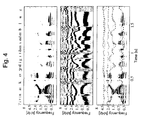
- Figure 4 shows the results of an evaluation of a method according to an embodiment of the invention using a typical example drawn from a subset of the VTR-Formant database. There the original spectrogram, the formant enhanced spectrogram as well as the estimated formant trajectories may be seen at the top, middle and bottom, respectively.
- a method for the estimation of formant trajectories was proposed that relies on the joint distribution of formants rather than using independent tracker instances for each formants. By doing so, interactions of trajectories were considered, which particularly improves the performance when the spectral gap between formants is small. Furthermore the method is robust against noise and clutter, since Bayesian techniques work well under such conditions and allow the analysis of multiple hypotheses per formant.
Landscapes
- Engineering & Computer Science (AREA)
- Computational Linguistics (AREA)
- Signal Processing (AREA)
- Health & Medical Sciences (AREA)
- Audiology, Speech & Language Pathology (AREA)
- Human Computer Interaction (AREA)
- Physics & Mathematics (AREA)
- Acoustics & Sound (AREA)
- Multimedia (AREA)
- Compression, Expansion, Code Conversion, And Decoders (AREA)
Abstract
- obtaining an auditory image of the speech signal;
- sequentially estimating formant locations;
- segmenting the frequency range into sub-regions;
- smoothing the obtained component filtering distributions; and
calculating the exact formant locations.
Description
- The present invention relates generally relates to the field of automated processing of speech signals, and particularly to a technique for tracking (enhancing) the formants in speech signals. Formants and their variation in time are important characteristics of speech signals. This technique can e.g. be used as a pre-processing step in order to improve the results of a subsequent automatic recognition of speech or the synthesis/imitation of speech with a formant based synthesizer.
- Automatic speech recognition is a field with a multitude of possible applications. In order to perform the recognition the speech sounds have to be identified from a speech signal. A very important cue for the recognition of speech sounds are the formant frequencies. The formant frequencies depend on the shape of the vocal tract and are the resonances of the vocal tract. Likewise the formant tracks can be used to develop formant based speech synthesis systems which learn how to produce the speech sounds by extracting the formant tracks from examples and then reproducing them.
- Only a few approaches exist, which use Bayesian techniques in order to track formants (see Y. Zheng and M. Hasegawa-Johnson: Particle Filtering Approach to Bayesian Formant Tracking, IEEE Workshop on Statistical Signal Processing, pp. 601-604, 2003). However, most of them use single tracker instances for each formant and thus perform an independent formant tracking.
- It is therefore an object of the invention to provide a method for tracking formants in speech signals with better performance, in particular when the spectral gap between formants is small. It is a further object of the invention to provide a method for tracking formants in speech signals that is robust against noise and clutter.
- This object is achieved by a method according to
independent claim 1. Advantageous embodiments are defined in the dependent claims. - These and other advantages, aspects and features of the present invention will become more apparent when studying the following detailed description, in conjunction with the annexed drawing in which:
- Fig. 1
- shows an overall architecture of a formant tracking system according to one embodiment of the invention.
- Fig. 2
- shows a flowchart of a method for tracking formants according to one embodiment of the invention.
- Fig. 3
- shows a trellis used for adaptive frequency range segmentation according to one embodiment of the invention.
- Fig. 4
- shows the results of an evaluation of a method according to an embodiment of the invention using a typical example drawn from a subset of the VTR-Formant database.
- The present invention is oriented towards biological plausible and robust methods for formant tracking. A method is proposed which tracks the formants via Bayesian techniques in conjunction with adaptive segmentation.
- Figure 1 shows an overall architecture of a formant tracking system according to one embodiment of the invention. The system can be implemented by a computing system having acoustical sensing means.
- The described method works in the spectral domain as derived from the application of a Gammatone filterbank on the signal. At the first preprocessing stage the raw speech signal received by acoustical sensing means as sound pressure waves in a person's farfield is transformed into the spectro-temporal domain. This may be done by using the Patterson-Holdsworth auditory filterbank, which transforms complex sound stimuli like speech into a multichannel activity pattern like that observed in the auditory nerve and converts it into a spectrogram, also known as auditory image. A Gammatone filterbank may be used that consists of 128 channels covering the frequency range e.g. from 80 Hz to 8 kHz.
- In one embodiment of the invention, a technique for the enhancement of formants in spectrograms like the one proposed in the pending patent
EP 06 008 675.9 - More particularly, in order to enhance formant structures in spectrograms, the spectral effects of all components involved in the speech production have to be considered. A second-order low-pass filter unit may approximate the glottal flow spectrum. The glottal spectrum may be modeled by a monotonically decreasing function with a slope of -12 dB/oct. The relationship of lip volume velocity and sound pressure received at some distance from the mouth may be described by a first-order high pass filter, which changes the spectral characteristics by +6 dB/oct. Thus an overall influence of -6 db/oct may be corrected via inverse filtering by emphasizing higher frequencies with +6 dB/oct. After the above mentioned pre-emphasis is achieved, formants may be extracted from these spectrograms. This may be done by smoothing along the frequency axis, which causes the harmonics to spread and further forms peaks at formant locations. Therefore a Mexican Hat operator may be applied to the signal, where the kernel's parameters may be adjusted to the logarithmic arrangement of the Gammatone filterbank's channel center frequencies. In addition the filter responses may be normalized by the maximum at each sample and a sigmoid function may be applied. By doing so, formants may become visible in signal parts with relatively low energy and values may be converted into the range [0,1].
- In order to track formants, a recursive Bayesian filter unit may be applied. The formant locations are sequentially estimated based on predefined formant dynamics and measurements embodied in the spectrogram. The filtering distribution may be modeled by a mixture of component distributions with associated weights, so that each formant under consideration is covered by one component. By doing so, the components independently evolve over time and only interact in the computation of the associated mixture weights.
- More specifically, while tracking multiple formants, two general problems arise. The first one is the sequential estimation of states encoding formant locations based on noisy observations. Here Bayesian filtering techniques have been proven to robustly work in such an environment.
- The second much harder problem is widely known as the data association problem. Due to unlabeled measurements the allocation of them to one of the formants is a crucial step in order to break up ambiguities. As in the case of tracking formants, this can not be achieved by focusing on only one target. Rather one has to look at the joint distribution of targets in conjunction with temporal constraints and target interactions.
- Here this will be done by application of a two-stage procedure. At first a Bayesian filtering technique will be applied to the signal, which solves the data association problem by consideration of continuity constraints and formant interactions. Subsequently a Bayesian smoothing method will be used in order to break up ambiguities resulting in continuous formant trajectories.
- Bayes filters represent the state at time t by random variables xt, whereas uncertainty is introduced by a probabilistic distribution over xt, called the belief Bel(xt). Bayes filters aim to sequentially estimate such beliefs over the state space conditioned on all information contained in the sensor data [6]. Let zt denote the observation at time t and □ a normalization constant, then the standard Bayes filter recursion can be written as follows:


- One crucial requirement while tracking multiple formants in conjunction is the maintenance of multimodality. Standard Bayes filters allow the pursuit of multiple hypotheses. Nevertheless, in practical implementations these filters can maintain multimodality only over a defined time-window. Longer durations cause the belief to migrate to one of the modes, subsequently discarding all other modes. Thus the standard Bayes filters are not suitable for multi-target tracking as in the case of tracking formants.
- In order to avoid these problems, the mixture filtering technique disclosed in J. Vermaak, A. Doucet, and P. Pérez, et al. ("Maintaining multimodality through mixture tracking," in Proceedings of the Ninth IEEE International Conference on Computer Vision (ICCV), Nice, France, October 2003, vol. 2, pp. 1110-1116) may be adapted to the problem of tracking formants. The key issue of this approach is the formulation of the joint distribution Bel(xt) through a non-parametric mixture of M component beliefs Belm(xt), so that each target is covered by one mixture component.

- According to this, the two-stage standard Bayes recursion for the sequential estimation of states may be reformulated with respect to the mixture modeling approach.
- Furthermore, since the state space is already discretized by application of the Gammatone filterbank and the number of used channels is manageable, a grid-based approximation may be used as an adequate representation of the belief. In alternative embodiments, any other approximation of filtering distributions may be used instead (e.g. the one used in Kalman filters or particle filters).
- Assuming N filter channels are used, the state space can be written as X = {x1, x2, ... , xN}. Hence the resulting formulas for the prediction and update steps are:


- Thus the new joint belief may be straightforwardly obtained by computing the belief of each component individually. An interaction of mixture components only takes place during the calculation of the new mixture weights.
- However, the more time steps will be computed the more diffuse component beliefs will become. Therefore, the mixture modeling of the filtering distribution may be recomputed via application of a function for reclustering, merging or splitting components. Thereby the component distributions as well as associated weights may be recalculated, so that the mixture approximation before and after the reclustering procedure are equal in distribution while maintaining the probabilistic character of the weights and each of the distributions. In this way components may exchange probabilities and therewith perform a tracking by taking the interaction of formants into account.
- More specifically, assume that a function for merging, splitting and reclustering components exists and returns sets R1, R2, ... , RM for M components, which divide the frequency range into contiguous formant specific segments. Then new mixture weights as well as component beliefs can be computed, so that the mixture approximation before and after the reclustering procedure are equal in distribution. Furthermore the probabilistic character of the mixture weights as well as of the component beliefs is maintained, since both still sum up to 1.


- These formulas show that previously overlapping probabilities switched their component affiliation. Thus components exchange parts of their probabilities in a mixture weight dependent manner. Furthermore it can be seen, that mixture weights change according to the amount of probabilities a component gave off and got. In this way a mixture of consecutive but separated components and therewith the maintenance of multimodality is achieved.
- However, up to this point the existence of a segmentation algorithm for finding optimum component boundaries was only assumed. It may be realized by application of a dynamic programming based algorithm for dividing the whole frequency range into formant specific contiguous parts. To this end, a new variable

- Figure 2 shows a flowchart of a method according to one embodiment of the invention, which method can be carried out in an automatic manner by a computing system having acoustical sensing means. In
step 210, an auditory image of a speech signal is obtained by the acoustical sensing means. Instep 220, formant locations are sequentially estimated. Then, instep 230, the frequency range is segmented into subregions. Instep 240, the obtained component filtering distributions are smoothed. Finally, instep 250, the exact formant locations are calculated. - Figure 3 shows a trellis diagram composed of all possible nodes representing the assignment of a frequency sub region to a component that may be build up using this new variable. Furthermore transitions between nodes are included in the trellis, so that consecutive frequency sub regions assigned to the same component as well as consecutive frequency sub ranges assigned to consecutive components are connected.
- In each case the transitions are directed from the lower to the higher frequency sub range. Additionally probabilities were assigned to each node as well as to each transition.
- Then, the formant specific frequency regions may be computed by calculating the most likely path starting from the node representing the assignment of the lowest frequency sub region to the first component and ending at the node representing the assignment of the highest frequency sub region to the last component.
- Finally each frequency sub region may be assigned to the component for which the corresponding node is part of the most likely path. In this way contiguous and clear cut components are achieved.
- More specifically, by constituting that

- What remains is an appropriate choice of node and transition probabilities. In one embodiment of the invention, the probabilities assigned to nodes may be set according to the a priori probability distributions of components and the actual component filtering distribution. The probabilities of transitions may be set to some constant value.
- More specifically, the following formula may be used:

- According to this, the likelihood of state

- Finally the most likely path can be computed by application of the Viterbi algorithm. Likewise any other cost-function may be used instead of the mentioned probabilities. Furthermore any other algorithm for finding the most likely / the cheapest / the shortest path through the trellis may be used (e.g. the Dijkstra algorithm).
- Using such an algorithm for finding optimum component boundaries, the proposed Bayesian mixture filtering technique may be applied. This method not just results in the filtering distribution, it rather adaptively divides the frequency range into formant specific segments represented by mixture components. Thus in the following one can restrict further processing to those segments.
- Nevertheless, uncertainties already included in observations can not be completely resolved. They rather result in a diffuse mixture beliefs at these locations.
- This limit of Bayesian mixture filtering is reasonable, because it relies on the assumption of the underlying process, which states should be estimated, to be Markovian. Thus the belief of a state xt only depends on observations up to time t. In order to achieve continuous trajectories also future observations have to be considered.
- That is where a Bayesian smoothing technique (S. J. Godsill, A. Doucet, and M. West, "Monte Carlo smoothing for nonlinear time series," Journal of the American Statistical Association, vol. 99, no. 465, pp. 156-168, 2004) comes into consideration. In one embodiment of the invention, the obtained component filtering distributions may be spectral sharpened and smoothed in time via Bayesian smoothing. Thus the smoothing distribution may be recursively estimated based on predefined formant dynamics and the filtering distribution of components. This procedure works in the reverse time direction.
- More specifically, let B̂el(xt ) denote the belief in state xt regarding both past and future observations. Then the smoothed component belief may be obtained by:


- As one can see the smoothing technique works in a very similar fashion with respect to standard Bayes filters, but in reverse time direction. It recursively estimates the smoothing distribution of states based on predefined system dynamics p(xt+1|xt) as well as the filtering distribution Bel(xt) in these states. By doing so, multiple hypothesis and therewith ambiguities in beliefs were resolved.
- In one embodiment of the invention, the Bayesian smoothing may be applied to component filtering distributions covering whole speech utterances. Likewise a block based processing may be used in order to ensure an online processing. Furthermore the Bayesian smoothing technique is not restricted to any kind of distribution approximation.
- Now what remains is the calculation of exact formant locations. In one embodiment of the invention, the m-th formant location is set to the peak location of the m-th component smoothing distribution.
- In other words, since the component distributions obtained are unimodal, the calculation may be easily done by peak picking, such that the location of the m-th formant at time t equals the peak in the smoothing distribution of component m.

- Likewise any other technique could be used instead of peak picking (e.g. center of gravity).
- In order to evaluate the proposed method some tests on the VTR-Formant database (L. Deng, X. Cui, R. Pruvenok, J. Huang, S. Momen, Y. Chen, and A. Alwan, "A database of vocal tract resonance trajectories for research in speech processing," in Proceedings of the IEEE International Conference on Acoustics, Speech and Signal Processing (ICASSP), Toulouse, France, May 2006, pp. 60-63.), a subset of the well known TIMIT database (J. S. Garofolo, L. F. Lamel, W. M. Fisher, J. G. Fiscus, D. S. Pallett, N. L. Dahlgren, and V. Zue, "DARPA TIMIT acoustic-phonetic continuous speech corpus," Tech. Rep. NISTIR 4930, National Institute of Standards and Technology, 1993.) with hand-labeled formant trajectories for F1-F3, were executed. Thereby the first four formant trajectories should be estimated. Accordingly four components plus one extra component covering the frequency range above F4 were used during mixture filtering.
- Figure 4 shows the results of an evaluation of a method according to an embodiment of the invention using a typical example drawn from a subset of the VTR-Formant database. There the original spectrogram, the formant enhanced spectrogram as well as the estimated formant trajectories may be seen at the top, middle and bottom, respectively.
- Furthermore a comparison to a state of the art approach proposed by Mustafa et al. (K. Mustafa and I. C. Bruce, "Robust formant tracking for continuous speech with speaker variability," IEEE Transactions on Audio, Speech and Language Processing, vol. 14, no. 2, pp. 435-444, 2006) was carried out. Therefore the training and test set of the VTR-Formant database were used, so that a total of 516 utterances were considered.
- The following table shows the square root of the mean squared error in Hz as well as the corresponding standard deviation (in brackets) calculated at time steps of 10 ms. Additionally the results were normalized by the mean formant frequencies resulting in a measurement in %.
Formant Gläser et al. Mustafa et al. F1 in Hz 142.08 (225.60) 214.85 (396.55) in % 27.94 (44.36) 42.25 (77.97) F2 in Hz 278.00 (499.35) 430.19 (553.98) in % 17.51 (31.45) 27.10 (34.89) F3 in Hz 477.15 (698.05) 392.82 (516.27) in % 18.78 (27.47) 15.46 (20.32) - Thereby one can see, that the proposed method clearly outperforms the state of the art approach proposed by Mustafa et al. at least for the first two formants. Since those are the most important ones with respect to the semantic message, these results show a significant performance improvement regarding speech recognition and speech synthesis systems.
- A method for the estimation of formant trajectories was proposed that relies on the joint distribution of formants rather than using independent tracker instances for each formants. By doing so, interactions of trajectories were considered, which particularly improves the performance when the spectral gap between formants is small. Furthermore the method is robust against noise and clutter, since Bayesian techniques work well under such conditions and allow the analysis of multiple hypotheses per formant.
Claims (15)
- Method for tracking the formant frequencies in a speech signal, comprising the steps of:- obtaining an auditory image of the speech signal;- sequentially estimating formant locations;- segmenting the frequency range into sub-regions;- smoothing the obtained component filtering distributions; and- calculating the exact formant locations.
- Method according to claim 1, wherein the step of sequentially estimating the formant locations uses a recursive Bayesian filter.
- Method according to claim 2, wherein the joint distribution Bel(xt) of the recursive Bayesian filter is expressed as a non-parametric mixture of M component beliefs Belm(xt) :

- Method according to claim 3, wherein the prediction and the update step of the recursive Bayesian filter are expressed as




- Method according to claim 1, wherein the segmentation is based on the calculation of an optimal path according to a cost function.
- Method according to claim 5, wherein the optimal path is calculated using the Viterbi-algorithm.
- Method according to claim 5, wherein the optimal path is calculated using the Dijkstra-algorithm.
- Method according to claim 1, wherein a motion model of the Bayesian filtering is learned from the data.
- Method according to claim 8, wherein the learning of the motion model of the Bayesian filtering of the current time step takes several time steps in the past into account.
- Method according to claim 8, wherein the learning of the motion model of the Bayesian filtering takes the interaction of the different formants into account.
- Method according to claim 1, wherein the obtained component filtering distributions are smoothed using Bayesian smoothing.
- Method according to claim 11, wherein the Bayesian smoothing recursively estimates the smoothing distribution of states based on predefined system dynamics p(xt+1|xt) and the filtering distribution Bel(xt) in these states.
- Use of one of the methods according to claims 1 to 12 as a pre-processing step of voice signals for a subsequent speech recognition.
- Use of one of the methods according to claims 1 to 12 for an artificial formant-based speech synthesis.
- Computer program product, comprising instructions that, when executed on a computer, implement a method according to one of claims 1 to 14.
Priority Applications (4)
| Application Number | Priority Date | Filing Date | Title |
|---|---|---|---|
| DE602006008158T DE602006008158D1 (en) | 2006-09-29 | 2006-09-29 | Joint estimation of formant trajectories using Bayesian techniques and adaptive segmentation |
| EP06020643A EP1930879B1 (en) | 2006-09-29 | 2006-09-29 | Joint estimation of formant trajectories via bayesian techniques and adaptive segmentation |
| JP2007231886A JP4948333B2 (en) | 2006-09-29 | 2007-09-06 | Joint estimation of formant trajectories by Bayesian technique and adaptive refinement |
| US11/858,743 US7881926B2 (en) | 2006-09-29 | 2007-09-20 | Joint estimation of formant trajectories via bayesian techniques and adaptive segmentation |
Applications Claiming Priority (1)
| Application Number | Priority Date | Filing Date | Title |
|---|---|---|---|
| EP06020643A EP1930879B1 (en) | 2006-09-29 | 2006-09-29 | Joint estimation of formant trajectories via bayesian techniques and adaptive segmentation |
Publications (2)
| Publication Number | Publication Date |
|---|---|
| EP1930879A1 true EP1930879A1 (en) | 2008-06-11 |
| EP1930879B1 EP1930879B1 (en) | 2009-07-29 |
Family
ID=37507306
Family Applications (1)
| Application Number | Title | Priority Date | Filing Date |
|---|---|---|---|
| EP06020643A Not-in-force EP1930879B1 (en) | 2006-09-29 | 2006-09-29 | Joint estimation of formant trajectories via bayesian techniques and adaptive segmentation |
Country Status (4)
| Country | Link |
|---|---|
| US (1) | US7881926B2 (en) |
| EP (1) | EP1930879B1 (en) |
| JP (1) | JP4948333B2 (en) |
| DE (1) | DE602006008158D1 (en) |
Families Citing this family (6)
| Publication number | Priority date | Publication date | Assignee | Title |
|---|---|---|---|---|
| US8793127B2 (en) * | 2002-10-31 | 2014-07-29 | Promptu Systems Corporation | Method and apparatus for automatically determining speaker characteristics for speech-directed advertising or other enhancement of speech-controlled devices or services |
| US8140328B2 (en) * | 2008-12-01 | 2012-03-20 | At&T Intellectual Property I, L.P. | User intention based on N-best list of recognition hypotheses for utterances in a dialog |
| US8311812B2 (en) * | 2009-12-01 | 2012-11-13 | Eliza Corporation | Fast and accurate extraction of formants for speech recognition using a plurality of complex filters in parallel |
| US9311929B2 (en) * | 2009-12-01 | 2016-04-12 | Eliza Corporation | Digital processor based complex acoustic resonance digital speech analysis system |
| WO2014039028A1 (en) * | 2012-09-04 | 2014-03-13 | Nuance Communications, Inc. | Formant dependent speech signal enhancement |
| CN105258789B (en) * | 2015-10-28 | 2018-05-11 | 徐州医学院 | A kind of extracting method and device of vibration signal characteristics frequency band |
Family Cites Families (6)
| Publication number | Priority date | Publication date | Assignee | Title |
|---|---|---|---|---|
| US3649765A (en) * | 1969-10-29 | 1972-03-14 | Bell Telephone Labor Inc | Speech analyzer-synthesizer system employing improved formant extractor |
| JPH0758437B2 (en) * | 1987-02-10 | 1995-06-21 | 松下電器産業株式会社 | Formant extractor |
| US6502066B2 (en) * | 1998-11-24 | 2002-12-31 | Microsoft Corporation | System for generating formant tracks by modifying formants synthesized from speech units |
| JP3453130B2 (en) * | 2001-08-28 | 2003-10-06 | 日本電信電話株式会社 | Apparatus and method for determining noise source |
| US7424423B2 (en) * | 2003-04-01 | 2008-09-09 | Microsoft Corporation | Method and apparatus for formant tracking using a residual model |
| KR100634526B1 (en) * | 2004-11-24 | 2006-10-16 | 삼성전자주식회사 | Formant tracking device and method |
-
2006
- 2006-09-29 EP EP06020643A patent/EP1930879B1/en not_active Not-in-force
- 2006-09-29 DE DE602006008158T patent/DE602006008158D1/en active Active
-
2007
- 2007-09-06 JP JP2007231886A patent/JP4948333B2/en not_active Expired - Fee Related
- 2007-09-20 US US11/858,743 patent/US7881926B2/en not_active Expired - Fee Related
Non-Patent Citations (5)
| Title |
|---|
| ACERO A.: "Formant analysis and synthesis using hidden Markov models", PROC. EUROSPEECH, vol. 1, 1999, pages 1047 - 1050, XP002412266 * |
| MALKIN J ET AL: "A Graphical Model for Formant Tracking", ACOUSTICS, SPEECH, AND SIGNAL PROCESSING, 2005. PROCEEDINGS. (ICASSP '05). IEEE INTERNATIONAL CONFERENCE ON PHILADELPHIA, PENNSYLVANIA, USA MARCH 18-23, 2005, PISCATAWAY, NJ, USA,IEEE, 18 March 2005 (2005-03-18), pages 913 - 916, XP010792187, ISBN: 0-7803-8874-7 * |
| VERMAAK J ET AL: "Maintaining multi-modality through mixture tracking", PROCEEDINGS OF THE EIGHT IEEE INTERNATIONAL CONFERENCE ON COMPUTER VISION. (ICCV). NICE, FRANCE, OCT. 13 - 16, 2003, INTERNATIONAL CONFERENCE ON COMPUTER VISION, LOS ALAMITOS, CA : IEEE COMP. SOC, US, vol. VOL. 2 OF 2. CONF. 9, 13 October 2003 (2003-10-13), pages 1110 - 1116, XP010662505, ISBN: 0-7695-1950-4 * |
| YANLI ZHENG ET AL: "Particle filtering approach to bayesian formant tracking", STATISTICAL SIGNAL PROCESSING, 2003 IEEE WORKSHOP ON ST. LOUIS, MO, USA SEPT. 28, - OCT. 1, 2003, PISCATAWAY, NJ, USA,IEEE, 28 September 2003 (2003-09-28), pages 601 - 604, XP010699987, ISBN: 0-7803-7997-7 * |
| YU SHI ET AL: "Spectrogram-based formant tracking via particle filters", 2003 IEEE INTERNATIONAL CONFERENCE ON ACOUSTICS, SPEECH, AND SIGNAL PROCESSING (CAT. NO.03CH37404) IEEE PISCATAWAY, NJ, USA, vol. 1, 2003, pages 168 - 171, XP002412267, ISBN: 0-7803-7663-3 * |
Also Published As
| Publication number | Publication date |
|---|---|
| JP4948333B2 (en) | 2012-06-06 |
| US7881926B2 (en) | 2011-02-01 |
| US20080082322A1 (en) | 2008-04-03 |
| JP2008090295A (en) | 2008-04-17 |
| DE602006008158D1 (en) | 2009-09-10 |
| EP1930879B1 (en) | 2009-07-29 |
Similar Documents
| Publication | Publication Date | Title |
|---|---|---|
| Wang et al. | Robust speech rate estimation for spontaneous speech | |
| US7321854B2 (en) | Prosody based audio/visual co-analysis for co-verbal gesture recognition | |
| CN119808789A (en) | Customer intention recognition and response system, method, device and medium based on LLM | |
| Shen et al. | A dynamic system approach to speech enhancement using the H/sub/spl infin//filtering algorithm | |
| EP1465154B1 (en) | Method of speech recognition using variational inference with switching state space models | |
| Cui et al. | Noise robust speech recognition using feature compensation based on polynomial regression of utterance SNR | |
| Reynolds et al. | A study of new approaches to speaker diarization. | |
| US11929058B2 (en) | Systems and methods for adapting human speaker embeddings in speech synthesis | |
| Makowski et al. | Automatic speech signal segmentation based on the innovation adaptive filter | |
| US7881926B2 (en) | Joint estimation of formant trajectories via bayesian techniques and adaptive segmentation | |
| Barker et al. | Speech fragment decoding techniques for simultaneous speaker identification and speech recognition | |
| Rosdi et al. | Isolated malay speech recognition using Hidden Markov Models | |
| Glaser et al. | Combining auditory preprocessing and bayesian estimation for robust formant tracking | |
| Wu et al. | A self-adapting gmm based voice activity detection | |
| Seneviratne et al. | Noise robust acoustic to articulatory speech inversion | |
| Meyer et al. | Predicting error rates for unknown data in automatic speech recognition | |
| Milner et al. | Robust acoustic speech feature prediction from noisy mel-frequency cepstral coefficients | |
| Zhou et al. | Linear and nonlinear speech feature analysis for stress classification | |
| Kalamani et al. | Continuous Tamil Speech Recognition technique under non stationary noisy environments | |
| US20030182110A1 (en) | Method of speech recognition using variables representing dynamic aspects of speech | |
| Ma et al. | Combining speech fragment decoding and adaptive noise floor modeling | |
| Dines et al. | Automatic speech segmentation with hmm | |
| Nagesh et al. | A robust speech rate estimation based on the activation profile from the selected acoustic unit dictionary | |
| Bahja et al. | An overview of the cate algorithms for real-time pitch determination | |
| Predawan et al. | Thai tone recognition using ant colony algorithm |
Legal Events
| Date | Code | Title | Description |
|---|---|---|---|
| PUAI | Public reference made under article 153(3) epc to a published international application that has entered the european phase |
Free format text: ORIGINAL CODE: 0009012 |
|
| 17P | Request for examination filed |
Effective date: 20070228 |
|
| AK | Designated contracting states |
Kind code of ref document: A1 Designated state(s): AT BE BG CH CY CZ DE DK EE ES FI FR GB GR HU IE IS IT LI LT LU LV MC NL PL PT RO SE SI SK TR |
|
| AX | Request for extension of the european patent |
Extension state: AL BA HR MK RS |
|
| GRAP | Despatch of communication of intention to grant a patent |
Free format text: ORIGINAL CODE: EPIDOSNIGR1 |
|
| AKX | Designation fees paid |
Designated state(s): DE FR GB |
|
| GRAS | Grant fee paid |
Free format text: ORIGINAL CODE: EPIDOSNIGR3 |
|
| GRAA | (expected) grant |
Free format text: ORIGINAL CODE: 0009210 |
|
| AK | Designated contracting states |
Kind code of ref document: B1 Designated state(s): DE FR GB |
|
| REG | Reference to a national code |
Ref country code: GB Ref legal event code: FG4D |
|
| REF | Corresponds to: |
Ref document number: 602006008158 Country of ref document: DE Date of ref document: 20090910 Kind code of ref document: P |
|
| PLBE | No opposition filed within time limit |
Free format text: ORIGINAL CODE: 0009261 |
|
| STAA | Information on the status of an ep patent application or granted ep patent |
Free format text: STATUS: NO OPPOSITION FILED WITHIN TIME LIMIT |
|
| 26N | No opposition filed |
Effective date: 20100503 |
|
| REG | Reference to a national code |
Ref country code: DE Ref legal event code: R084 Ref document number: 602006008158 Country of ref document: DE |
|
| REG | Reference to a national code |
Ref country code: DE Ref legal event code: R079 Ref document number: 602006008158 Country of ref document: DE Free format text: PREVIOUS MAIN CLASS: G10L0011000000 Ipc: G10L0021003000 |
|
| REG | Reference to a national code |
Ref country code: DE Ref legal event code: R084 Ref document number: 602006008158 Country of ref document: DE Effective date: 20140711 Ref country code: DE Ref legal event code: R079 Ref document number: 602006008158 Country of ref document: DE Free format text: PREVIOUS MAIN CLASS: G10L0011000000 Ipc: G10L0021003000 Effective date: 20140817 |
|
| REG | Reference to a national code |
Ref country code: GB Ref legal event code: 746 Effective date: 20150330 |
|
| REG | Reference to a national code |
Ref country code: FR Ref legal event code: PLFP Year of fee payment: 11 |
|
| REG | Reference to a national code |
Ref country code: FR Ref legal event code: PLFP Year of fee payment: 12 |
|
| REG | Reference to a national code |
Ref country code: FR Ref legal event code: PLFP Year of fee payment: 13 |
|
| PGFP | Annual fee paid to national office [announced via postgrant information from national office to epo] |
Ref country code: FR Payment date: 20190924 Year of fee payment: 14 |
|
| PGFP | Annual fee paid to national office [announced via postgrant information from national office to epo] |
Ref country code: GB Payment date: 20190924 Year of fee payment: 14 |
|
| PGFP | Annual fee paid to national office [announced via postgrant information from national office to epo] |
Ref country code: DE Payment date: 20190927 Year of fee payment: 14 |
|
| REG | Reference to a national code |
Ref country code: DE Ref legal event code: R119 Ref document number: 602006008158 Country of ref document: DE |
|
| GBPC | Gb: european patent ceased through non-payment of renewal fee |
Effective date: 20200929 |
|
| PG25 | Lapsed in a contracting state [announced via postgrant information from national office to epo] |
Ref country code: DE Free format text: LAPSE BECAUSE OF NON-PAYMENT OF DUE FEES Effective date: 20210401 Ref country code: FR Free format text: LAPSE BECAUSE OF NON-PAYMENT OF DUE FEES Effective date: 20200930 |
|
| PG25 | Lapsed in a contracting state [announced via postgrant information from national office to epo] |
Ref country code: GB Free format text: LAPSE BECAUSE OF NON-PAYMENT OF DUE FEES Effective date: 20200929 |