EP1930622A2 - Power transmission belts - Google Patents
Power transmission belts Download PDFInfo
- Publication number
- EP1930622A2 EP1930622A2 EP07023512A EP07023512A EP1930622A2 EP 1930622 A2 EP1930622 A2 EP 1930622A2 EP 07023512 A EP07023512 A EP 07023512A EP 07023512 A EP07023512 A EP 07023512A EP 1930622 A2 EP1930622 A2 EP 1930622A2
- Authority
- EP
- European Patent Office
- Prior art keywords
- belt
- elastomeric
- thermoplastic
- thermoplastic material
- section
- Prior art date
- Legal status (The legal status is an assumption and is not a legal conclusion. Google has not performed a legal analysis and makes no representation as to the accuracy of the status listed.)
- Granted
Links
- 230000005540 biological transmission Effects 0.000 title description 9
- 229920001971 elastomer Polymers 0.000 claims abstract description 33
- 239000013536 elastomeric material Substances 0.000 claims abstract description 30
- 239000012815 thermoplastic material Substances 0.000 claims abstract description 30
- 239000000806 elastomer Substances 0.000 claims abstract description 29
- 229920001169 thermoplastic Polymers 0.000 claims abstract description 27
- 239000004416 thermosoftening plastic Substances 0.000 claims abstract description 27
- 238000007906 compression Methods 0.000 claims abstract description 19
- 230000006835 compression Effects 0.000 claims abstract description 19
- 239000004744 fabric Substances 0.000 claims description 17
- 239000000463 material Substances 0.000 claims description 16
- 229920001577 copolymer Polymers 0.000 claims description 13
- 238000009413 insulation Methods 0.000 claims description 11
- 230000003014 reinforcing effect Effects 0.000 claims description 7
- 229920005989 resin Polymers 0.000 claims description 7
- 239000011347 resin Substances 0.000 claims description 7
- 229920005992 thermoplastic resin Polymers 0.000 claims description 7
- 125000000391 vinyl group Chemical group [H]C([*])=C([H])[H] 0.000 claims description 7
- 229920002554 vinyl polymer Polymers 0.000 claims description 7
- 229920002943 EPDM rubber Polymers 0.000 claims description 4
- 239000005062 Polybutadiene Substances 0.000 claims description 4
- 229920002857 polybutadiene Polymers 0.000 claims description 4
- 239000004814 polyurethane Substances 0.000 claims description 4
- KAKZBPTYRLMSJV-UHFFFAOYSA-N vinyl-ethylene Natural products C=CC=C KAKZBPTYRLMSJV-UHFFFAOYSA-N 0.000 claims description 4
- 244000043261 Hevea brasiliensis Species 0.000 claims description 3
- 229920000459 Nitrile rubber Polymers 0.000 claims description 3
- 239000004952 Polyamide Substances 0.000 claims description 3
- 229920006229 ethylene acrylic elastomer Polymers 0.000 claims description 3
- 229920003052 natural elastomer Polymers 0.000 claims description 3
- 229920001194 natural rubber Polymers 0.000 claims description 3
- 229920001084 poly(chloroprene) Polymers 0.000 claims description 3
- 229920002647 polyamide Polymers 0.000 claims description 3
- 229920001195 polyisoprene Polymers 0.000 claims description 3
- 229920000098 polyolefin Polymers 0.000 claims description 3
- 229920003225 polyurethane elastomer Polymers 0.000 claims description 3
- 229920003048 styrene butadiene rubber Polymers 0.000 claims description 3
- 150000003751 zinc Chemical class 0.000 claims description 3
- 125000003262 carboxylic acid ester group Chemical class [H]C([H])([*:2])OC(=O)C([H])([H])[*:1] 0.000 claims 1
- 150000001875 compounds Chemical class 0.000 description 11
- 239000003795 chemical substances by application Substances 0.000 description 6
- 229920002302 Nylon 6,6 Polymers 0.000 description 5
- 239000000203 mixture Substances 0.000 description 5
- -1 polypropylene Polymers 0.000 description 5
- 229920000742 Cotton Polymers 0.000 description 4
- 239000004677 Nylon Substances 0.000 description 4
- 239000006229 carbon black Substances 0.000 description 4
- 238000010276 construction Methods 0.000 description 4
- LSXWFXONGKSEMY-UHFFFAOYSA-N di-tert-butyl peroxide Chemical compound CC(C)(C)OOC(C)(C)C LSXWFXONGKSEMY-UHFFFAOYSA-N 0.000 description 4
- 229920001778 nylon Polymers 0.000 description 4
- 229920000728 polyester Polymers 0.000 description 4
- 239000005060 rubber Substances 0.000 description 4
- 230000001360 synchronised effect Effects 0.000 description 4
- 239000004342 Benzoyl peroxide Substances 0.000 description 3
- OMPJBNCRMGITSC-UHFFFAOYSA-N Benzoylperoxide Chemical compound C=1C=CC=CC=1C(=O)OOC(=O)C1=CC=CC=C1 OMPJBNCRMGITSC-UHFFFAOYSA-N 0.000 description 3
- 239000004743 Polypropylene Substances 0.000 description 3
- 239000004760 aramid Substances 0.000 description 3
- 229920003235 aromatic polyamide Polymers 0.000 description 3
- 235000019400 benzoyl peroxide Nutrition 0.000 description 3
- 230000007935 neutral effect Effects 0.000 description 3
- 229920001155 polypropylene Polymers 0.000 description 3
- 229920002451 polyvinyl alcohol Polymers 0.000 description 3
- FVQMJJQUGGVLEP-UHFFFAOYSA-N (2-methylpropan-2-yl)oxy 2-ethylhexaneperoxoate Chemical compound CCCCC(CC)C(=O)OOOC(C)(C)C FVQMJJQUGGVLEP-UHFFFAOYSA-N 0.000 description 2
- RIPYNJLMMFGZSX-UHFFFAOYSA-N (5-benzoylperoxy-2,5-dimethylhexan-2-yl) benzenecarboperoxoate Chemical compound C=1C=CC=CC=1C(=O)OOC(C)(C)CCC(C)(C)OOC(=O)C1=CC=CC=C1 RIPYNJLMMFGZSX-UHFFFAOYSA-N 0.000 description 2
- YSUIQYOGTINQIN-UZFYAQMZSA-N 2-amino-9-[(1S,6R,8R,9S,10R,15R,17R,18R)-8-(6-aminopurin-9-yl)-9,18-difluoro-3,12-dihydroxy-3,12-bis(sulfanylidene)-2,4,7,11,13,16-hexaoxa-3lambda5,12lambda5-diphosphatricyclo[13.2.1.06,10]octadecan-17-yl]-1H-purin-6-one Chemical compound NC1=NC2=C(N=CN2[C@@H]2O[C@@H]3COP(S)(=O)O[C@@H]4[C@@H](COP(S)(=O)O[C@@H]2[C@@H]3F)O[C@H]([C@H]4F)N2C=NC3=C2N=CN=C3N)C(=O)N1 YSUIQYOGTINQIN-UZFYAQMZSA-N 0.000 description 2
- 229920003189 Nylon 4,6 Polymers 0.000 description 2
- 229920002292 Nylon 6 Polymers 0.000 description 2
- 229920000305 Nylon 6,10 Polymers 0.000 description 2
- 229920000577 Nylon 6/66 Polymers 0.000 description 2
- 239000004372 Polyvinyl alcohol Substances 0.000 description 2
- VYPSYNLAJGMNEJ-UHFFFAOYSA-N Silicium dioxide Chemical compound O=[Si]=O VYPSYNLAJGMNEJ-UHFFFAOYSA-N 0.000 description 2
- 238000005299 abrasion Methods 0.000 description 2
- TZYHIGCKINZLPD-UHFFFAOYSA-N azepan-2-one;hexane-1,6-diamine;hexanedioic acid Chemical compound NCCCCCCN.O=C1CCCCCN1.OC(=O)CCCCC(O)=O TZYHIGCKINZLPD-UHFFFAOYSA-N 0.000 description 2
- 150000001733 carboxylic acid esters Chemical class 0.000 description 2
- 238000009472 formulation Methods 0.000 description 2
- 229920001903 high density polyethylene Polymers 0.000 description 2
- 239000004700 high-density polyethylene Substances 0.000 description 2
- 238000000034 method Methods 0.000 description 2
- 238000013508 migration Methods 0.000 description 2
- 230000005012 migration Effects 0.000 description 2
- 150000002978 peroxides Chemical class 0.000 description 2
- 229920000642 polymer Polymers 0.000 description 2
- 235000019422 polyvinyl alcohol Nutrition 0.000 description 2
- 239000004800 polyvinyl chloride Substances 0.000 description 2
- GHMLBKRAJCXXBS-UHFFFAOYSA-N resorcinol Chemical compound OC1=CC=CC(O)=C1 GHMLBKRAJCXXBS-UHFFFAOYSA-N 0.000 description 2
- GJBRNHKUVLOCEB-UHFFFAOYSA-N tert-butyl benzenecarboperoxoate Chemical compound CC(C)(C)OOC(=O)C1=CC=CC=C1 GJBRNHKUVLOCEB-UHFFFAOYSA-N 0.000 description 2
- ODBCKCWTWALFKM-UHFFFAOYSA-N 2,5-bis(tert-butylperoxy)-2,5-dimethylhex-3-yne Chemical compound CC(C)(C)OOC(C)(C)C#CC(C)(C)OOC(C)(C)C ODBCKCWTWALFKM-UHFFFAOYSA-N 0.000 description 1
- DMWVYCCGCQPJEA-UHFFFAOYSA-N 2,5-bis(tert-butylperoxy)-2,5-dimethylhexane Chemical compound CC(C)(C)OOC(C)(C)CCC(C)(C)OOC(C)(C)C DMWVYCCGCQPJEA-UHFFFAOYSA-N 0.000 description 1
- XMNIXWIUMCBBBL-UHFFFAOYSA-N 2-(2-phenylpropan-2-ylperoxy)propan-2-ylbenzene Chemical compound C=1C=CC=CC=1C(C)(C)OOC(C)(C)C1=CC=CC=C1 XMNIXWIUMCBBBL-UHFFFAOYSA-N 0.000 description 1
- OEPOKWHJYJXUGD-UHFFFAOYSA-N 2-(3-phenylmethoxyphenyl)-1,3-thiazole-4-carbaldehyde Chemical compound O=CC1=CSC(C=2C=C(OCC=3C=CC=CC=3)C=CC=2)=N1 OEPOKWHJYJXUGD-UHFFFAOYSA-N 0.000 description 1
- XRXANEMIFVRKLN-UHFFFAOYSA-N 2-hydroperoxy-2-methylbutane Chemical compound CCC(C)(C)OO XRXANEMIFVRKLN-UHFFFAOYSA-N 0.000 description 1
- WBCLZGYCULJPDT-UHFFFAOYSA-N 2-tert-butylperoxy-2,5-dimethylhexane Chemical compound CC(C)CCC(C)(C)OOC(C)(C)C WBCLZGYCULJPDT-UHFFFAOYSA-N 0.000 description 1
- BIISIZOQPWZPPS-UHFFFAOYSA-N 2-tert-butylperoxypropan-2-ylbenzene Chemical compound CC(C)(C)OOC(C)(C)C1=CC=CC=C1 BIISIZOQPWZPPS-UHFFFAOYSA-N 0.000 description 1
- FRIBMENBGGCKPD-UHFFFAOYSA-N 3-(2,3-dimethoxyphenyl)prop-2-enal Chemical compound COC1=CC=CC(C=CC=O)=C1OC FRIBMENBGGCKPD-UHFFFAOYSA-N 0.000 description 1
- 229920000049 Carbon (fiber) Polymers 0.000 description 1
- IMROMDMJAWUWLK-UHFFFAOYSA-N Ethenol Chemical compound OC=C IMROMDMJAWUWLK-UHFFFAOYSA-N 0.000 description 1
- 229920000219 Ethylene vinyl alcohol Polymers 0.000 description 1
- 101000576320 Homo sapiens Max-binding protein MNT Proteins 0.000 description 1
- JHWNWJKBPDFINM-UHFFFAOYSA-N Laurolactam Chemical compound O=C1CCCCCCCCCCCN1 JHWNWJKBPDFINM-UHFFFAOYSA-N 0.000 description 1
- YIVJZNGAASQVEM-UHFFFAOYSA-N Lauroyl peroxide Chemical compound CCCCCCCCCCCC(=O)OOC(=O)CCCCCCCCCCC YIVJZNGAASQVEM-UHFFFAOYSA-N 0.000 description 1
- 229920000571 Nylon 11 Polymers 0.000 description 1
- 229920000299 Nylon 12 Polymers 0.000 description 1
- 229920000572 Nylon 6/12 Polymers 0.000 description 1
- 229920000393 Nylon 6/6T Polymers 0.000 description 1
- 229920000007 Nylon MXD6 Polymers 0.000 description 1
- 229920006121 Polyxylylene adipamide Polymers 0.000 description 1
- 229920000297 Rayon Polymers 0.000 description 1
- 229910000831 Steel Inorganic materials 0.000 description 1
- 229920010741 Ultra High Molecular Weight Polyethylene (UHMWPE) Polymers 0.000 description 1
- XTXRWKRVRITETP-UHFFFAOYSA-N Vinyl acetate Chemical compound CC(=O)OC=C XTXRWKRVRITETP-UHFFFAOYSA-N 0.000 description 1
- BZHJMEDXRYGGRV-UHFFFAOYSA-N Vinyl chloride Chemical compound ClC=C BZHJMEDXRYGGRV-UHFFFAOYSA-N 0.000 description 1
- 238000010521 absorption reaction Methods 0.000 description 1
- BAPJBEWLBFYGME-UHFFFAOYSA-N acrylic acid methyl ester Natural products COC(=O)C=C BAPJBEWLBFYGME-UHFFFAOYSA-N 0.000 description 1
- 239000004917 carbon fiber Substances 0.000 description 1
- 238000006243 chemical reaction Methods 0.000 description 1
- 238000004132 cross linking Methods 0.000 description 1
- 238000011161 development Methods 0.000 description 1
- 230000018109 developmental process Effects 0.000 description 1
- UFRKOOWSQGXVKV-UHFFFAOYSA-N ethene;ethenol Chemical compound C=C.OC=C UFRKOOWSQGXVKV-UHFFFAOYSA-N 0.000 description 1
- 229920001038 ethylene copolymer Polymers 0.000 description 1
- 239000004715 ethylene vinyl alcohol Substances 0.000 description 1
- 239000011152 fibreglass Substances 0.000 description 1
- 239000004615 ingredient Substances 0.000 description 1
- 238000004519 manufacturing process Methods 0.000 description 1
- VNWKTOKETHGBQD-UHFFFAOYSA-N methane Chemical compound C VNWKTOKETHGBQD-UHFFFAOYSA-N 0.000 description 1
- 238000002156 mixing Methods 0.000 description 1
- 229920006111 poly(hexamethylene terephthalamide) Polymers 0.000 description 1
- 229920002577 polybenzoxazole Polymers 0.000 description 1
- 229920002635 polyurethane Polymers 0.000 description 1
- 229920000915 polyvinyl chloride Polymers 0.000 description 1
- 239000005033 polyvinylidene chloride Substances 0.000 description 1
- 230000005855 radiation Effects 0.000 description 1
- 239000002964 rayon Substances 0.000 description 1
- 230000002787 reinforcement Effects 0.000 description 1
- 230000035939 shock Effects 0.000 description 1
- 239000000377 silicon dioxide Substances 0.000 description 1
- 239000004759 spandex Substances 0.000 description 1
- 230000003068 static effect Effects 0.000 description 1
- 239000010959 steel Substances 0.000 description 1
- CIHOLLKRGTVIJN-UHFFFAOYSA-N tert‐butyl hydroperoxide Chemical compound CC(C)(C)OO CIHOLLKRGTVIJN-UHFFFAOYSA-N 0.000 description 1
- 229920001187 thermosetting polymer Polymers 0.000 description 1
- 229940070710 valerate Drugs 0.000 description 1
- NQPDZGIKBAWPEJ-UHFFFAOYSA-N valeric acid Chemical compound CCCCC(O)=O NQPDZGIKBAWPEJ-UHFFFAOYSA-N 0.000 description 1
Images

Classifications
-
- F—MECHANICAL ENGINEERING; LIGHTING; HEATING; WEAPONS; BLASTING
- F16—ENGINEERING ELEMENTS AND UNITS; GENERAL MEASURES FOR PRODUCING AND MAINTAINING EFFECTIVE FUNCTIONING OF MACHINES OR INSTALLATIONS; THERMAL INSULATION IN GENERAL
- F16G—BELTS, CABLES, OR ROPES, PREDOMINANTLY USED FOR DRIVING PURPOSES; CHAINS; FITTINGS PREDOMINANTLY USED THEREFOR
- F16G1/00—Driving-belts
- F16G1/28—Driving-belts with a contact surface of special shape, e.g. toothed
-
- F—MECHANICAL ENGINEERING; LIGHTING; HEATING; WEAPONS; BLASTING
- F16—ENGINEERING ELEMENTS AND UNITS; GENERAL MEASURES FOR PRODUCING AND MAINTAINING EFFECTIVE FUNCTIONING OF MACHINES OR INSTALLATIONS; THERMAL INSULATION IN GENERAL
- F16G—BELTS, CABLES, OR ROPES, PREDOMINANTLY USED FOR DRIVING PURPOSES; CHAINS; FITTINGS PREDOMINANTLY USED THEREFOR
- F16G5/00—V-belts, i.e. belts of tapered cross-section
- F16G5/20—V-belts, i.e. belts of tapered cross-section with a contact surface of special shape, e.g. toothed
Definitions
- the present invention is directed to power transmission belts. More specifically, the invention is directed to power transmission belts having improved characteristics achieved by the use of a blended rubber and thermoplastics composition.
- the belt In conventional power transmission belts, the belt has an inner compression section, an outer tension section, and an intermediate neutral plane. Typically, helically wound reinforcing cords are located within the neutral plane and so the neutral plane is also referred to as the load carrying zone.
- Such belts also having a variety of groove and rib configurations, using longitudinal or transverse grooves or a combination of both. The grooves are located in the inner compression section of the belt. The grooves assist in engaging a pulley in the power transmission system. For some belts, grooves and rib configurations may also be provided in the outer tension section.
- the present invention is directed to a power transmission belt.
- the belt contains therein a compound providing the belt with improved properties in regards to belt growth, wicking, abrasion, and durability.
- a belt having a compression section, a tension section, and a load carrying section disposed between the compression section and the tension section.
- the belt has an elastomeric/thermoplastic material, the elastomeric/thermoplastic material has 50 to 90 parts per hundred of an elastomer and 10 to 50 parts per hundred thermoplastic.
- the elastomeric/thermoplastic material is formed from 60 to 80 parts per hundred elastomer and 20 to 40 parts per hundred thermoplastic.
- the elastomer of the elastomeric/thermoplastic material is selected from the group consisting of natural rubber, polychloroprene, acrylonitrile-butadiene copolymers, polyisoprene, zinc salts of unsaturated carboxylic acid ester grafted hydrogenated nitrile butadiene elastomers, styrene-butadiene rubbers, polybutadiene, ethylene propylene diene monomer rubber, hydrogenated acrylonitrile-butadiene copolymers, polyurethane, and ethylene-acrylic elastomers.
- the elastomer of the elastomeric/thermoplastic material is a butadiene copolymer.
- thermoplastic of the elastomeric/thermoplastic material is selected from the group consisting of polyolefin thermoplastic resins, polyamide thermoplastic resins, and vinyl resins.
- thermoplastic of the elastomeric/thermoplastic material is a vinyl resin.
- the elastomeric/thermoplastic material forms an insulation layer in the belt, the insulation layer being located in the compression section of the belt.
- the belt has at least one drive surface.
- the drive surface has a fabric layer bonded to the outer surface of the belt and the elastomeric/thermoplastic material impregnates the fabric layer.
- the load carrying section of the belt has reinforcing cords therein.
- the cords are embedded in a material, the embedding material being the elastomeric/thermoplastic material.
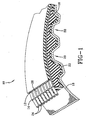
- FIG. 1 illustrates an endless power transmission belt 10.
- the belt 10 is particularly adapted to be used in associated sheaves in accordance with techniques known in the art.
- the belt is particularly suited for use in synchronous drive applications.
- the belt 10 is adapted to be used in so-called torque sensing drives, application where shock loads of varying belt tension are imposed on the belt, applications where the belt is operated at variable speeds, applications where the belt is spring-loaded to control its tension and the like.
- the belt 10 comprises a tension section or backing 12, a cushion, or compression, section 16, a load-carrying section 14 disposed between the tension section 12 and cushion section 16, and a fabric layer 18 adhered to drive surface 20.
- the belt may have an insulation layer 22 located between the cushion section 16 and the fabric layer 18 to prevent or decrease rubber from the cushion section 16 from permeating through the fabric 18 to the drive surface 20.
- the belts of the present invention there is at least one drive surface 20 having a fabric layer 18 bonded to the outer surface.
- the belt 10 may have multiple drive surfaces of two or more.
- a fabric layer may also be on the non-drive outer surface of the belt.
- the fabric layer 18 may be made from a woven, non-woven or knitted fabric.
- the fabrics for use in the present invention are made of conventional materials including nylon (such as nylon 4, 6, nylon 6, 6 and nylon 6), cotton, polyester, cotton/polyester, nylon/polyester, cotton/nylon, Lycra TM (segmented polyurethane), aramid, rayon and the like.
- the fabric is made of nylon 6, 6.
- the load-carrying section 14 has load-carrying means in the form of load-carrying filament or cords 24 embedded in a compound 26.
- the cords may be transverse or parallel to the length of the belt.
- the cords 24 or filaments may be made of any suitable material; examples of such materials include aramid, fiberglass, nylon, polyester, cotton, steel, carbon fiber and polybenzoxazole.
- the drive surface 20 of the belt 10 of FIG. 1 is synchronous.
- the belts of the present invention also include those belts where the drive surface of the belt may be smooth, single V-grooved, and multi-V-grooved.
- Representative examples of synchronous include belts having trapezoidal or curvilinear teeth.
- the elastomers for use in the tension section 12 and the compression section 16 may be the same or different.
- Conventional elastomers which may be used in one or both of these sections include natural rubber, polychloroprene, acrylonitrile-butadiene copolymers (NBR), polyisoprene, zinc salts of unsaturated carboxylic acid ester grafted hydrogenated nitrile butadiene elastomers, styrene-butadiene rubbers, polybutadiene, ethylene propylene diene monomer rubber (EPDM), hydrogenated acrylonitrile-butadiene copolymers (HNBR), polyurethane, and ethylene-acrylic elastomers.
- natural rubber polychloroprene, acrylonitrile-butadiene copolymers (NBR), polyisoprene, zinc salts of unsaturated carboxylic acid ester grafted hydrogenated nitrile butadiene elasto
- the insulation layer 22 is a blend of an elastomer and a thermoplastic.
- the compound 26 has 50-90 parts per hundred (pph) elastomer and 10-50 pph thermoplastic, with preferred amounts of 60-80 pph elastomer and 20-40 pph thermoplastic.
- elastomer identifies thermosetting high polymers that solidify or set irreversibly when heated, usually due to a cross-linking reaction induced by heat or radiation of the material. Most elastomers have the ability to stretch and retract rapidly to approximately their original length when released.
- thermoplastic identifies a class of high polymers that soften when exposed to heat and returns to its original condition when cooled to room temperature.
- the elastomer component of the insulation layer 22 is selected from conventional elastomers used in manufacturing belts and includes, but is not limited to, the list of elastomers set forth above in the discussion of elastomers for use in the tension section 12 and compression section 16 of the belt 10.
- Preferred elastomers are butadiene copolymers such as polybutadiene, NBR, and HNBR.
- the thermoplastic component may be: polyolefin thermoplastic resins, such as high density polyethylene (HDPE), ultrahigh molecular weight polyethylene (UHMWPE), polypropylene (PP), and ethylene propylene copolymer thermoplastic resin; polyamide thermoplastic resins, such as nylon 6 (N6), nylon 66 (N66), nylon 46 (N46), nylon 11 (N11), nylon 12 (N12), nylon 610 (N610), nylon 612 (N612), nylon 6/66 copolymer (N6/66), nylon 6/66/610 copolymer (N6/66/610), nylon MXD6 (MxD6), nylon 6T, nylon 6/6T copolymer, nylon 66/PP copolymer, and nylon 66/PPS copolymer; or vinyl resins, such as vinyl acetate (EVA), polyvinylalcohol (PVA), vinyl alcohol/ethylene copolymer (EVOH), polyvinylidene chloride (PVDC), polyvinyl chloride (P
- the compound also contains curing agents.
- Curing agents which may be employed in the compositions of the invention include, for example, di-tertbutyl peroxide, dicumyl peroxide, benzoyl peroxide, 2,4-dichlorobenzol peroxide, t-butyl-cumyl peroxide, t-butyl perbenzoate, t-butyl peroxide, t-butylperoxy (2-ethyl hexanoate), 2,5-dimethyl-2,5-di(benzoylperoxy)-hexane, benzoyl peroxide, 2,5-dimethyl-2,5-(t-butyl peroxy)-hexane, 1,1-ditert-butyl peroxy-3,3,5-trimethyl cyclohexane, 4,4-ditert-butyl peroxy n-butyl valerate and n-butyl-4,4
- Additional curing agents which may be employed include diacyl or dialkyl peroxides such as ⁇ , ⁇ '-bis(t-butylperoxy)-isopropylbenzene, 2,5-dimethyl-2,5-di(t-butylperoxy) hexane, di-t-butyl peroxide, 2,5-dimethyl-2,5-di-(t-butylperoxy)hexyne-3, lauroyl peroxide, t-butyl hydroperoxide, t-amyl hydroperoxide, cumene hydroperoxide, t-butyl perbenzoate, t-butyl peroxide, t-butylperoxy (2-ethyl hexanoate), 2,5-dimethyl-2,5-di (benzoylperoxy)-hexane and benzoyl peroxide. All of the above curing agents are commercially available. The amount of curing agent may vary, and will generally range
- the compound also contains a reinforcement material such as carbon black.
- a reinforcement material such as carbon black.
- the amount of carbon black will vary from 15 to 75 phr rubber. A portion of the carbon black may be specifically treated to be electro-conductive to reduce static build up in the belt 10.
- An exemplary formulation for the compound is as follows: Table Ingredient Parts per Hundred Rubber HNBR 70 Polyvinyl chloride 30 Carbon black 65 Silica 15 Peroxide 5 Curing co-agent 3.5 Resorcinol 10
- a belt having a construction of the type illustrated in FIG. 1 was assembled.
- the reinforcing cords 24 were of a typical aramid construction.
- the elastomeric/thermoplastic compound having the formulation as identified in the above Table was used to form the insulation layer 22.
- This belt was tested against a control belt of similar construction, the control belt having no elastomeric/thermoplastic compound therein.
- the belts were placed in a humidity chamber (100% rh, RT) for 14 days. After fifteen days, the control belt experienced a decrease in length of about 0.40 mm, while the test belts had a length decrease of not more than 0.15 mm - less than half of the length decrease of the control belt.
- elastomers are generally air impervious, some elastomers have greater impermeability characteristics than others. Typically, in belt construction, as there is no isolate air chamber to maintain, elastomers with greater impermeability characteristics are not typical chosen to construct power transmission belts. As air travels into the belt, it may carry moisture into the belt, and be absorbed by the cords 24. If the cords are formed of a material that absorbs moisture, the cords will expand, causing the belt to shrink. Such shrinkage can occur in either the circumferential or lateral direction of the belt. The blending of the thermoplastic into the elastomer reduces air and moisture migration into the belt - reducing moisture absorption by the cords and improving belt life.
- the elastomeric/thermoplastic compound disclosed may also be used in other areas, such as the embedding material 26 to prevent moisture migration in to the load carrying cords 24.
- the elastomeric/thermoplastic compound also assists in abrasion resistance of the belt as the compound can penetrate the fabric.
- the elastomeric/thermoplastic compound also improves the adhesion between the various layers and elements of the belt.
- FIG. 2 illustrates a poly-v belt 30.
- the belt 30 has a tension section 32, a load carrying section 34, and compression section 36.
- the compression section 36 has a plurality of longitudinal ribs 38 with a plurality of transverse grooves 40.
- the load carrying section 34 has longitudinal reinforcing cords 42 embedded in a suitable material 44.
- the elastomeric/thermoplastic material may be used as the material 44 in which the reinforcing cords 42 are embedded.
- the compression section may be provided with an additional layer formed of the elastomeric/thermoplastic material.
Landscapes
- Engineering & Computer Science (AREA)
- General Engineering & Computer Science (AREA)
- Mechanical Engineering (AREA)
- Laminated Bodies (AREA)
- Compositions Of Macromolecular Compounds (AREA)
- Belt Conveyors (AREA)
- Ropes Or Cables (AREA)
- Devices For Conveying Motion By Means Of Endless Flexible Members (AREA)
- Reciprocating Pumps (AREA)
- Lining Or Joining Of Plastics Or The Like (AREA)
Abstract
Description
- The present invention is directed to power transmission belts. More specifically, the invention is directed to power transmission belts having improved characteristics achieved by the use of a blended rubber and thermoplastics composition.
- In conventional power transmission belts, the belt has an inner compression section, an outer tension section, and an intermediate neutral plane. Typically, helically wound reinforcing cords are located within the neutral plane and so the neutral plane is also referred to as the load carrying zone. Such belts also having a variety of groove and rib configurations, using longitudinal or transverse grooves or a combination of both. The grooves are located in the inner compression section of the belt. The grooves assist in engaging a pulley in the power transmission system. For some belts, grooves and rib configurations may also be provided in the outer tension section.
- Developments in the automotive industry have resulted in higher engine output in a more compact engine compartment. As a result, power transmission belts on these engines have been required to operate under high load, at high tensions and at high temperatures while reducing belt width. This environment demands a high quality belt capable of withstanding these severe conditions. One method to improve the properties of such belts has been to improve the materials from which the belts are made.
- The present invention is directed to a power transmission belt. The belt contains therein a compound providing the belt with improved properties in regards to belt growth, wicking, abrasion, and durability.
- Disclosed is a belt having a compression section, a tension section, and a load carrying section disposed between the compression section and the tension section. The belt has an elastomeric/thermoplastic material, the elastomeric/thermoplastic material has 50 to 90 parts per hundred of an elastomer and 10 to 50 parts per hundred thermoplastic. Alternatively, the elastomeric/thermoplastic material is formed from 60 to 80 parts per hundred elastomer and 20 to 40 parts per hundred thermoplastic.
- In one aspect of the invention, the elastomer of the elastomeric/thermoplastic material is selected from the group consisting of natural rubber, polychloroprene, acrylonitrile-butadiene copolymers, polyisoprene, zinc salts of unsaturated carboxylic acid ester grafted hydrogenated nitrile butadiene elastomers, styrene-butadiene rubbers, polybutadiene, ethylene propylene diene monomer rubber, hydrogenated acrylonitrile-butadiene copolymers, polyurethane, and ethylene-acrylic elastomers.
- In another aspect of the invention, the elastomer of the elastomeric/thermoplastic material is a butadiene copolymer.
- In another aspect of the invention, the thermoplastic of the elastomeric/thermoplastic material is selected from the group consisting of polyolefin thermoplastic resins, polyamide thermoplastic resins, and vinyl resins. Alternatively, the thermoplastic of the elastomeric/thermoplastic material is a vinyl resin.
- In another aspect of the invention, the elastomeric/thermoplastic material forms an insulation layer in the belt, the insulation layer being located in the compression section of the belt.
- In another aspect of the invention, the belt has at least one drive surface. The drive surface has a fabric layer bonded to the outer surface of the belt and the elastomeric/thermoplastic material impregnates the fabric layer.
- In another aspect of the invention, the load carrying section of the belt has reinforcing cords therein. The cords are embedded in a material, the embedding material being the elastomeric/thermoplastic material.
- The invention will be described by way of example and with reference to the accompanying drawings in which:
-
FIG. 1 is a perspective view of a synchronous drive belt; and -
FIG. 2 is a perspective view of a timing v-belt. - The following language is of the best presently contemplated mode or modes of carrying out the invention. This description is made for the purpose of illustrating the general principles of the invention and should not be taken in a limiting sense. The scope of the invention is best determined by reference to the appended claims. The reference numerals as depicted in the drawings are the same as those referred to in the specification.
-
FIG. 1 illustrates an endlesspower transmission belt 10. Thebelt 10 is particularly adapted to be used in associated sheaves in accordance with techniques known in the art. The belt is particularly suited for use in synchronous drive applications. Thebelt 10 is adapted to be used in so-called torque sensing drives, application where shock loads of varying belt tension are imposed on the belt, applications where the belt is operated at variable speeds, applications where the belt is spring-loaded to control its tension and the like. - The
belt 10 comprises a tension section orbacking 12, a cushion, or compression,section 16, a load-carryingsection 14 disposed between thetension section 12 andcushion section 16, and afabric layer 18 adhered to drivesurface 20. The belt may have aninsulation layer 22 located between thecushion section 16 and thefabric layer 18 to prevent or decrease rubber from thecushion section 16 from permeating through thefabric 18 to thedrive surface 20. - In the belts of the present invention, there is at least one
drive surface 20 having afabric layer 18 bonded to the outer surface. In the embodiment shown inFIG. 1 , there is onedrive surface 20 having afabric layer 18. In accordance with other embodiments, thebelt 10 may have multiple drive surfaces of two or more. A fabric layer may also be on the non-drive outer surface of the belt. Thefabric layer 18 may be made from a woven, non-woven or knitted fabric. The fabrics for use in the present invention are made of conventional materials including nylon (such as nylon 4, 6, nylon 6, 6 and nylon 6), cotton, polyester, cotton/polyester, nylon/polyester, cotton/nylon, Lycra™ (segmented polyurethane), aramid, rayon and the like. Preferably, the fabric is made of nylon 6, 6. - The load-carrying
section 14 has load-carrying means in the form of load-carrying filament orcords 24 embedded in acompound 26. The cords may be transverse or parallel to the length of the belt. Thecords 24 or filaments may be made of any suitable material; examples of such materials include aramid, fiberglass, nylon, polyester, cotton, steel, carbon fiber and polybenzoxazole. - The
drive surface 20 of thebelt 10 ofFIG. 1 is synchronous. In accordance with other embodiments, the belts of the present invention also include those belts where the drive surface of the belt may be smooth, single V-grooved, and multi-V-grooved. Representative examples of synchronous include belts having trapezoidal or curvilinear teeth. - The elastomers for use in the
tension section 12 and thecompression section 16 may be the same or different. Conventional elastomers which may be used in one or both of these sections include natural rubber, polychloroprene, acrylonitrile-butadiene copolymers (NBR), polyisoprene, zinc salts of unsaturated carboxylic acid ester grafted hydrogenated nitrile butadiene elastomers, styrene-butadiene rubbers, polybutadiene, ethylene propylene diene monomer rubber (EPDM), hydrogenated acrylonitrile-butadiene copolymers (HNBR), polyurethane, and ethylene-acrylic elastomers. - In the
belt 10, theinsulation layer 22 is a blend of an elastomer and a thermoplastic. Thecompound 26 has 50-90 parts per hundred (pph) elastomer and 10-50 pph thermoplastic, with preferred amounts of 60-80 pph elastomer and 20-40 pph thermoplastic. Herein, the term elastomer identifies thermosetting high polymers that solidify or set irreversibly when heated, usually due to a cross-linking reaction induced by heat or radiation of the material. Most elastomers have the ability to stretch and retract rapidly to approximately their original length when released. Herein, the term thermoplastic identifies a class of high polymers that soften when exposed to heat and returns to its original condition when cooled to room temperature. - The elastomer component of the
insulation layer 22 is selected from conventional elastomers used in manufacturing belts and includes, but is not limited to, the list of elastomers set forth above in the discussion of elastomers for use in thetension section 12 andcompression section 16 of thebelt 10. Preferred elastomers are butadiene copolymers such as polybutadiene, NBR, and HNBR. - The thermoplastic component may be: polyolefin thermoplastic resins, such as high density polyethylene (HDPE), ultrahigh molecular weight polyethylene (UHMWPE), polypropylene (PP), and ethylene propylene copolymer thermoplastic resin; polyamide thermoplastic resins, such as nylon 6 (N6), nylon 66 (N66), nylon 46 (N46), nylon 11 (N11), nylon 12 (N12), nylon 610 (N610), nylon 612 (N612), nylon 6/66 copolymer (N6/66), nylon 6/66/610 copolymer (N6/66/610), nylon MXD6 (MxD6), nylon 6T, nylon 6/6T copolymer, nylon 66/PP copolymer, and nylon 66/PPS copolymer; or vinyl resins, such as vinyl acetate (EVA), polyvinylalcohol (PVA), vinyl alcohol/ethylene copolymer (EVOH), polyvinylidene chloride (PVDC), polyvinyl chloride (PVC), vinyl chloride/vinylidene chloride copolymer, and vinylidene chloride/methylacrylate copolymer. Preferred thermoplastics are the vinyl resin thermoplastics.
- In addition to the elastomer and thermoplastic components, the compound also contains curing agents. Curing agents which may be employed in the compositions of the invention include, for example, di-tertbutyl peroxide, dicumyl peroxide, benzoyl peroxide, 2,4-dichlorobenzol peroxide, t-butyl-cumyl peroxide, t-butyl perbenzoate, t-butyl peroxide, t-butylperoxy (2-ethyl hexanoate), 2,5-dimethyl-2,5-di(benzoylperoxy)-hexane, benzoyl peroxide, 2,5-dimethyl-2,5-(t-butyl peroxy)-hexane, 1,1-ditert-butyl peroxy-3,3,5-trimethyl cyclohexane, 4,4-ditert-butyl peroxy n-butyl valerate and n-butyl-4,4-bis(t-butyl peroxy) valerate. Additional curing agents which may be employed include diacyl or dialkyl peroxides such as α,α'-bis(t-butylperoxy)-isopropylbenzene, 2,5-dimethyl-2,5-di(t-butylperoxy) hexane, di-t-butyl peroxide, 2,5-dimethyl-2,5-di-(t-butylperoxy)hexyne-3, lauroyl peroxide, t-butyl hydroperoxide, t-amyl hydroperoxide, cumene hydroperoxide, t-butyl perbenzoate, t-butyl peroxide, t-butylperoxy (2-ethyl hexanoate), 2,5-dimethyl-2,5-di (benzoylperoxy)-hexane and benzoyl peroxide. All of the above curing agents are commercially available. The amount of curing agent may vary, and will generally range from 0.1 to 10 phr.
- The compound also contains a reinforcement material such as carbon black. The amount of carbon black will vary from 15 to 75 phr rubber. A portion of the carbon black may be specifically treated to be electro-conductive to reduce static build up in the
belt 10. - An exemplary formulation for the compound is as follows:
Table Ingredient Parts per Hundred Rubber HNBR 70 Polyvinyl chloride 30 Carbon black 65 Silica 15 Peroxide 5 Curing co-agent 3.5 Resorcinol 10 - A belt having a construction of the type illustrated in
FIG. 1 was assembled. The reinforcingcords 24 were of a typical aramid construction. The elastomeric/thermoplastic compound having the formulation as identified in the above Table was used to form theinsulation layer 22. This belt was tested against a control belt of similar construction, the control belt having no elastomeric/thermoplastic compound therein. The belts were placed in a humidity chamber (100% rh, RT) for 14 days. After fifteen days, the control belt experienced a decrease in length of about 0.40 mm, while the test belts had a length decrease of not more than 0.15 mm - less than half of the length decrease of the control belt. - While elastomers are generally air impervious, some elastomers have greater impermeability characteristics than others. Typically, in belt construction, as there is no isolate air chamber to maintain, elastomers with greater impermeability characteristics are not typical chosen to construct power transmission belts. As air travels into the belt, it may carry moisture into the belt, and be absorbed by the
cords 24. If the cords are formed of a material that absorbs moisture, the cords will expand, causing the belt to shrink. Such shrinkage can occur in either the circumferential or lateral direction of the belt. The blending of the thermoplastic into the elastomer reduces air and moisture migration into the belt - reducing moisture absorption by the cords and improving belt life. Because moisture may be absorbed through any layer of the belt, the elastomeric/thermoplastic compound disclosed may also be used in other areas, such as the embeddingmaterial 26 to prevent moisture migration in to theload carrying cords 24. When the compound is used in the insulation layer, the elastomeric/thermoplastic compound also assists in abrasion resistance of the belt as the compound can penetrate the fabric. The elastomeric/thermoplastic compound also improves the adhesion between the various layers and elements of the belt. -
FIG. 2 illustrates a poly-v belt 30. Thebelt 30 has atension section 32, aload carrying section 34, andcompression section 36. Thecompression section 36 has a plurality oflongitudinal ribs 38 with a plurality oftransverse grooves 40. Theload carrying section 34 has longitudinal reinforcingcords 42 embedded in asuitable material 44. - The elastomeric/thermoplastic material may be used as the
material 44 in which the reinforcingcords 42 are embedded. Alternatively, the compression section may be provided with an additional layer formed of the elastomeric/thermoplastic material.
Claims (14)
- A belt having a compression section, a tension section, and a load carrying section disposed between the compression section and the tension section, the belt comprising an elastomeric/thermoplastic material, the elastomeric/thermoplastic material comprising 50 to 90 parts per hundred of an elastomer and 10 to 50 parts per hundred thermoplastic.
- The belt of claim 1 wherein the elastomeric/thermoplastic material comprises 60 to 80 parts per hundred elastomer and 20 to 40 parts per hundred thermoplastic.
- The belt of claim 1 wherein the elastomer of the elastomeric/thermoplastic material is selected from the group consisting of natural rubber, polychloroprene, acrylonitrile-butadiene copolymers, polyisoprene, zinc salts of unsaturated carboxylic acid ester grafted hydrogenated nitrile butadiene elastomers, styrene-butadiene rubbers, polybutadiene, ethylene propylene diene monomer rubber, hydrogenated acrylonitrile-butadiene copolymers, polyurethane, and ethylene-acrylic elastomers.
- The belt of claim 1 wherein the elastomer of the elastomeric/thermoplastic material is a butadiene copolymer.
- The belt of claim 1 wherein the thermoplastic of the elastomeric/thermoplastic material is selected from the group consisting of polyolefin thermoplastic resins, polyamide thermoplastic resins, and vinyl resins.
- The belt of claim 1 wherein the thermoplastic of the elastomeric/thermoplastic material is a vinyl resin.
- The belt of claim 1 wherein the elastomeric/thermoplastic material forms an insulation layer in the belt, the insulation layer being located in the compression section of the belt.
- The belt of claim 1, the belt having at least one drive surface, the drive surface having a fabric layer bonded to the outer surface of the belt, the elastomeric/thermoplastic material impregnating the fabric layer.
- The belt of claim 1, the load carrying section comprising reinforcing cords embedded in a material, the embedding material being the elastomeric/thermoplastic material.
- A belt having a compression section, a tension section, and a load carrying section disposed between the compression section and the tension section, the belt comprising an elastomeric/thermoplastic material, the elastomeric/thermoplastic material comprising 50 to 90 parts per hundred of an elastomer and 10 to 50 parts per hundred thermoplastic wherein the elastomer is a butadiene copolymer and the thermoplastic is a vinyl resin.
- The belt of claim 10 wherein the elastomeric/thermoplastic material comprises 60 to 80 parts per hundred elastomer and 20 to 40 parts per hundred thermoplastic.
- The belt of claim 10 wherein the elastomeric/thermoplastic material forms an insulation layer in the belt, the insulation layer being located in the compression section of the belt.
- The belt of claim 10, the belt having at least one drive surface, the drive surface having a fabric layer bonded to the outer surface of the belt, the elastomeric/thermoplastic material impregnating the fabric layer.
- The belt of claim 10, the load carrying section comprising reinforcing cords embedded in a material, the embedding material being the elastomeric/thermoplastic material.
Applications Claiming Priority (1)
| Application Number | Priority Date | Filing Date | Title |
|---|---|---|---|
| US11/633,774 US8142316B2 (en) | 2006-12-05 | 2006-12-05 | Power transmission belts |
Publications (3)
| Publication Number | Publication Date |
|---|---|
| EP1930622A2 true EP1930622A2 (en) | 2008-06-11 |
| EP1930622A3 EP1930622A3 (en) | 2009-12-09 |
| EP1930622B1 EP1930622B1 (en) | 2012-03-28 |
Family
ID=39148438
Family Applications (1)
| Application Number | Title | Priority Date | Filing Date |
|---|---|---|---|
| EP07023512A Ceased EP1930622B1 (en) | 2006-12-05 | 2007-12-05 | Power transmission belts |
Country Status (5)
| Country | Link |
|---|---|
| US (1) | US8142316B2 (en) |
| EP (1) | EP1930622B1 (en) |
| JP (1) | JP2008185210A (en) |
| CN (1) | CN101245823B (en) |
| BR (1) | BRPI0704610A (en) |
Cited By (5)
| Publication number | Priority date | Publication date | Assignee | Title |
|---|---|---|---|---|
| ITTO20120419A1 (en) * | 2012-05-09 | 2013-11-10 | Dayco Europe Srl | POLI-V BELT INCLUDING A LAYER OF THERMOPLASTIC MATERIAL AND A KNITTED FABRIC IMMERSED IN AN ELASTOMERIC LAYER |
| EP2489899A4 (en) * | 2009-10-13 | 2014-05-21 | Gates Unitta Asia Co | Toothed belt |
| EP3290744A1 (en) * | 2016-09-05 | 2018-03-07 | Arntz Beteiligungs GmbH & Co. KG | Power transmission belt |
| AT15675U1 (en) * | 2011-01-26 | 2018-04-15 | Seboe Gyula | COTTON EMBOSSED TEXTILE MATERIAL FROM MIXED BASE MATERIALS |
| US10450140B2 (en) | 2014-08-20 | 2019-10-22 | Arntz Beteiligungs Gmbh & Co. Kg | Force transmission belt |
Families Citing this family (28)
| Publication number | Priority date | Publication date | Assignee | Title |
|---|---|---|---|---|
| CN1899806B (en) * | 2005-07-19 | 2014-11-19 | 三之星机带株式会社 | Power transmission belt and method of making a power transmission belt |
| FR2936291B1 (en) * | 2008-09-23 | 2011-06-03 | Hutchinson | POWER TRANSMISSION BELT. |
| JP5355324B2 (en) * | 2009-09-16 | 2013-11-27 | ゲイツ・ユニッタ・アジア株式会社 | Toothed belt |
| JP6121995B2 (en) | 2011-06-21 | 2017-04-26 | イー・アイ・デュポン・ドウ・ヌムール・アンド・カンパニーE.I.Du Pont De Nemours And Company | Method for producing heat-stabilized polyamide-filled acrylate polymer |
| EP2723811B1 (en) | 2011-06-21 | 2015-08-26 | E. I. du Pont de Nemours and Company | Heat-stabilised polyamide-filled acrylate copolymer and process for its production |
| JP5688360B2 (en) * | 2011-06-30 | 2015-03-25 | 積水化成品工業株式会社 | Polyolefin resin foam sheet |
| DE102011114918A1 (en) * | 2011-10-06 | 2013-04-11 | Arntz Beteiligungs Gmbh & Co. Kg | V-ribbed belt and method for its production |
| DE102011121643A1 (en) * | 2011-12-20 | 2013-06-20 | Arntz Beteiligungs Gmbh & Co. Kg | Belt with textile overlay |
| DE102011121656A1 (en) * | 2011-12-20 | 2013-06-20 | Arntz Beteiligungs Gmbh & Co. Kg | Belt with multilayer impregnated textile cover |
| JP2014088756A (en) * | 2012-10-02 | 2014-05-15 | Hayashi Bussan Co Ltd | Guide sign |
| US9068066B2 (en) | 2012-12-04 | 2015-06-30 | E I Du Pont De Nemours And Company | Heat resistant hydrocarbon elastomer compositions |
| US9062193B2 (en) | 2012-12-04 | 2015-06-23 | E. I. Du Pont De Nemours And Company | Heat aging resistant ethylene vinyl acetate copolymer composition and process for its production |
| US9051460B2 (en) | 2012-12-04 | 2015-06-09 | E.I. Du Pont De Nemours And Company | Heat resistant hydrocarbon elastomer compositions |
| EP2881342B1 (en) * | 2013-08-02 | 2016-12-14 | Veyance Technologies, Inc. | Conveyor belt |
| US9829066B2 (en) * | 2014-04-07 | 2017-11-28 | Gates Corporation | Electrically conductive power transmission belt |
| CN106461018B (en) * | 2014-04-30 | 2019-05-31 | 戴科欧洲有限公司 | POLY-V-belt including thermoplastic layer |
| CH710216A2 (en) * | 2014-10-07 | 2016-04-15 | Kölbl Eng Und Consulting Gmbh | Mat or belt. |
| CN105218909B (en) * | 2015-10-11 | 2017-09-26 | 宁波伏龙同步带有限公司 | A kind of timing belt and its manufacture method |
| CN105237843B (en) * | 2015-10-11 | 2018-02-16 | 宁波伏龙同步带有限公司 | A kind of timing belt |
| US10220545B2 (en) | 2016-04-30 | 2019-03-05 | Contitech Antriebssysteme Gmbh | Water based urethane as predip for carbon fiber cord |
| CA3053234C (en) * | 2017-04-24 | 2022-05-31 | Mitsuboshi Belting Ltd. | Toothed belt |
| KR102678061B1 (en) * | 2017-04-27 | 2024-06-25 | 게이츠 코포레이션 | Synchronization belt with unidirectional fabric reinforcement |
| EP3887139A4 (en) * | 2018-11-30 | 2022-08-10 | Godsey, Gregory, A. | HELICAL BELT ASSEMBLY, METHOD OF USE AND ASSOCIATED KIT |
| CN113386105A (en) * | 2020-03-13 | 2021-09-14 | 科沃斯机器人股份有限公司 | Self-moving robot, synchronous belt and preparation method of synchronous belt |
| EP4141286B1 (en) * | 2020-07-03 | 2024-10-09 | Bando Chemical Industries, Ltd. | Transmission belt |
| EP4348075A1 (en) * | 2021-05-24 | 2024-04-10 | Dayco Europe S.R.L. | Power transmission belt |
| US12208587B2 (en) | 2021-07-01 | 2025-01-28 | Contitech Deutschland Gmbh | Wrapped taped belt |
| IT202200015111A1 (en) * | 2022-07-19 | 2024-01-19 | Dayco Europe Srl | POWER TRANSMISSION BELT AND RELATED TRANSMISSION SYSTEM |
Family Cites Families (44)
| Publication number | Priority date | Publication date | Assignee | Title |
|---|---|---|---|---|
| US3607502A (en) * | 1969-02-27 | 1971-09-21 | Owens Corning Fiberglass Corp | Industrial belt construction and method of manufacturing same |
| US3660974A (en) * | 1970-08-31 | 1972-05-09 | Owens Corning Fiberglass Corp | Industrial belt construction |
| US3965055A (en) * | 1972-09-21 | 1976-06-22 | Uniroyal Inc. | Free curing rubber composition |
| US3888805A (en) * | 1972-11-29 | 1975-06-10 | Gen Tire & Rubber Co | Method for bonding polyamides to rubber, adhesive for the same, and adhesive coated polyamide reinforcing elements |
| US3919025A (en) * | 1972-12-11 | 1975-11-11 | Dayco Corp | Endless power transmission belt and method of making same |
| US3872937A (en) * | 1972-12-18 | 1975-03-25 | Gen Tire & Rubber Co | Composite of polyamide bonded to rubber |
| US4056591A (en) * | 1973-12-26 | 1977-11-01 | Monsanto Company | Process for controlling orientation of discontinuous fiber in a fiber-reinforced product formed by extrusion |
| US3981206A (en) * | 1975-08-20 | 1976-09-21 | Dayco Corporation | Endless power transmission belt |
| US4192790A (en) | 1976-02-25 | 1980-03-11 | Uniroyal, Inc. | Elastomeric composition having reduced Mooney viscosity |
| US4024773A (en) * | 1976-06-01 | 1977-05-24 | Dayco Corporation | Endless power transmission belt structure |
| US4123946A (en) * | 1977-05-02 | 1978-11-07 | Dayco Corporation | Endless power transmission belt and method of making same |
| US4216679A (en) * | 1978-12-04 | 1980-08-12 | Dayco Corporation | Power transmission belt |
| US4461859A (en) * | 1981-11-16 | 1984-07-24 | Ppg Industries, Inc. | Method of preparing a phenolic aldehyde resin and resin composition for an adhesive system to be applied to glass fibers |
| US4501771A (en) * | 1982-02-22 | 1985-02-26 | Dayco Corporation | Elastomer-coated bias reinforcement fabric and method for producing same |
| EP0708134B1 (en) * | 1988-12-23 | 2001-11-14 | Bando Chemical Industries, Ltd. | Process of bonding aromatic polyamide fibers to rubber compounds |
| JPH074359Y2 (en) * | 1990-07-10 | 1995-02-01 | 三ツ星ベルト株式会社 | Toothed belt |
| US5281651A (en) * | 1992-01-29 | 1994-01-25 | Exxon Chemical Patents Inc. | Compatibilization of dissimilar elastomer blends using ethylene/acrylate/acrylic acid terpolymers |
| JP2704096B2 (en) | 1992-06-19 | 1998-01-26 | 横浜ゴム株式会社 | hose |
| US5501908A (en) * | 1993-03-26 | 1996-03-26 | Bando Chemical Industries, Ltd. | Rubber composition and transmission belt using the same |
| EP0656388B1 (en) * | 1993-11-26 | 2001-04-11 | Atofina | Thermoplastic rubber polymer alloys adherent to thermoplastics |
| JPH07167221A (en) * | 1993-12-17 | 1995-07-04 | Bando Chem Ind Ltd | Power transmission belt |
| JPH07208557A (en) * | 1994-01-13 | 1995-08-11 | Bando Chem Ind Ltd | Toothed belt |
| JPH07208558A (en) * | 1994-01-13 | 1995-08-11 | Bando Chem Ind Ltd | Toothed belt |
| US5651995A (en) * | 1994-09-30 | 1997-07-29 | Nippon Zeon Co., Ltd. | Highly saturated nitrile rubber, process for producing same, vulcanizable rubber composition, aqueous emulsion and adhesive composition |
| US5645504A (en) | 1995-09-29 | 1997-07-08 | The Gates Corporation | Power transmission belt with teeth reinforced with a fabric material |
| WO1997016485A1 (en) * | 1995-11-02 | 1997-05-09 | The Yokohama Rubber Co., Ltd. | Thermoplastic elastomer composition, process for the production of the composition, and lowly permeable hoses produced by using the same |
| KR100272125B1 (en) | 1996-05-29 | 2000-11-15 | 하기와라 세이지 | Pneumatic tire made by using lowly permeable thermoplastic elastomer composition in gas-barrier layer and thermoplas .... |
| US6056656A (en) * | 1997-03-04 | 2000-05-02 | Bando Chemical Industries, Ltd. | V-ribbed belt |
| US6359071B1 (en) | 1998-01-13 | 2002-03-19 | The Yokohama Rubber Co., Ltd. | Thermoplastic elastomer composition, process for producing the same, and pneumatic tire and hose made with the same |
| JP2000009186A (en) * | 1998-04-20 | 2000-01-11 | Mitsuboshi Belting Ltd | Toothed belt |
| WO2000004098A1 (en) | 1998-07-16 | 2000-01-27 | Aktieselskabet Roulunds Fabriker | Elastomeric composition and the use thereof in an article subject to dynamic loading |
| US6352488B1 (en) * | 1999-03-05 | 2002-03-05 | The Goodyear Tire & Rubber Company | Power transmission belt |
| US7160949B2 (en) * | 2000-01-21 | 2007-01-09 | Mitsui Chemicals, Inc. | Olefin block copolymers, processes for producing the same and uses thereof |
| US6860962B2 (en) * | 2000-03-16 | 2005-03-01 | Dayco Products, Llc | Adhesive composition and method for adhering textiles to EPDM rubber |
| US6409621B1 (en) | 2000-05-12 | 2002-06-25 | The Goodyear Tire & Rubber Company | Power transmission belt |
| US6491598B1 (en) * | 2000-10-09 | 2002-12-10 | The Goodyear Tire & Rubber Company | Power transmission belt |
| US6558282B2 (en) * | 2001-01-20 | 2003-05-06 | The Goodyear Tire & Rubber Company | Fabric cushion v-ribbed belt |
| CA2338900A1 (en) * | 2001-02-28 | 2002-08-28 | Bayer Inc. | Articles for dynamic load applications |
| DE60204373T2 (en) * | 2001-03-16 | 2006-05-04 | The Goodyear Tire & Rubber Co., Akron | Triebriemen with cut carbon fibers |
| JP2003201373A (en) * | 2001-10-23 | 2003-07-18 | Jsr Corp | Rubber composition, method for producing the same, and rubber molded product |
| US6824871B2 (en) * | 2002-11-14 | 2004-11-30 | The Goodyear Tire & Rubber Company | Subcoat for poly (p-phenylene-2,6-benzobisoxazole) fibers |
| JP4448288B2 (en) | 2003-04-25 | 2010-04-07 | バンドー化学株式会社 | V-ribbed belt |
| AT500085B1 (en) * | 2003-05-28 | 2007-01-15 | Semperit Ag Holding | SPLICE STRUCTURE FOR LENGTH PROFILES |
| US7942773B2 (en) * | 2005-06-27 | 2011-05-17 | The Gates Corporation Ip Law Dept. | Banded power transmission V-belt |
-
2006
- 2006-12-05 US US11/633,774 patent/US8142316B2/en not_active Expired - Fee Related
-
2007
- 2007-12-03 BR BRPI0704610-3A patent/BRPI0704610A/en not_active Application Discontinuation
- 2007-12-04 JP JP2007314024A patent/JP2008185210A/en active Pending
- 2007-12-05 EP EP07023512A patent/EP1930622B1/en not_active Ceased
- 2007-12-05 CN CN2007101691492A patent/CN101245823B/en not_active Expired - Fee Related
Non-Patent Citations (1)
| Title |
|---|
| None |
Cited By (8)
| Publication number | Priority date | Publication date | Assignee | Title |
|---|---|---|---|---|
| EP2489899A4 (en) * | 2009-10-13 | 2014-05-21 | Gates Unitta Asia Co | Toothed belt |
| US9353827B2 (en) | 2009-10-13 | 2016-05-31 | Gates Unitta Asia Company | Toothed belt |
| AT15675U1 (en) * | 2011-01-26 | 2018-04-15 | Seboe Gyula | COTTON EMBOSSED TEXTILE MATERIAL FROM MIXED BASE MATERIALS |
| ITTO20120419A1 (en) * | 2012-05-09 | 2013-11-10 | Dayco Europe Srl | POLI-V BELT INCLUDING A LAYER OF THERMOPLASTIC MATERIAL AND A KNITTED FABRIC IMMERSED IN AN ELASTOMERIC LAYER |
| WO2013168123A1 (en) * | 2012-05-09 | 2013-11-14 | Dayco Europe S.R.L. | Poly-v belt comprising a layer of thermoplastic material and a knitted fabric embedded in an elastomeric layer |
| US9394968B2 (en) | 2012-05-09 | 2016-07-19 | Dayco Europe S.R.L. | Poly-V belt comprising a layer of thermoplastic material and a knitted fabric embedded in an elastomeric layer |
| US10450140B2 (en) | 2014-08-20 | 2019-10-22 | Arntz Beteiligungs Gmbh & Co. Kg | Force transmission belt |
| EP3290744A1 (en) * | 2016-09-05 | 2018-03-07 | Arntz Beteiligungs GmbH & Co. KG | Power transmission belt |
Also Published As
| Publication number | Publication date |
|---|---|
| EP1930622B1 (en) | 2012-03-28 |
| BRPI0704610A (en) | 2008-09-16 |
| CN101245823B (en) | 2011-05-18 |
| US20080132370A1 (en) | 2008-06-05 |
| EP1930622A3 (en) | 2009-12-09 |
| JP2008185210A (en) | 2008-08-14 |
| CN101245823A (en) | 2008-08-20 |
| US8142316B2 (en) | 2012-03-27 |
Similar Documents
| Publication | Publication Date | Title |
|---|---|---|
| EP1930622B1 (en) | Power transmission belts | |
| US6443866B1 (en) | Power transmission belt | |
| US8507391B2 (en) | Elastic articles, particularly drive belts, having a textile overlay and a bonding agent made from meltable plastic | |
| US20170299017A1 (en) | Cross linked elastomeric facing on cast polyurethane synchronous drive belts | |
| US8944948B2 (en) | Flat belt | |
| EP1154171B1 (en) | Power transmission belt | |
| KR101516934B1 (en) | Friction transmission belt and method for producing same | |
| US7244207B2 (en) | Frictional forced power transmission belt and belt drive system with the same | |
| EP1429046B1 (en) | Method of treating an aromatic polyamide fiber | |
| US6294600B1 (en) | Rubber composition and power transmission belt incorporating the rubber composition | |
| US6007897A (en) | Fabric and toothed belt using fabric | |
| CN107868349B (en) | Rubber composition for transmission belt and transmission belt using the same | |
| US11933383B2 (en) | Twisted cord for core wire of transmission belt, manufacturing method and use of same, and transmission belt | |
| JP4837274B2 (en) | Transmission belt | |
| US12467517B2 (en) | Power transmission belt and its transmission system | |
| JP2007009966A (en) | Transmission belt | |
| EP4500052B1 (en) | Power transmission belt and related transmission system | |
| JP2006153059A (en) | Transmission belt | |
| JP2005155908A (en) | V-ribbed belt | |
| JP2006282763A (en) | METHOD FOR PRODUCING BONDED BODY OF ETHYLENE-alpha-OLEFIN ELASTOMER COMPOSITION AND FIBER AND POWER TRANSMISSION BELT |
Legal Events
| Date | Code | Title | Description |
|---|---|---|---|
| PUAI | Public reference made under article 153(3) epc to a published international application that has entered the european phase |
Free format text: ORIGINAL CODE: 0009012 |
|
| AK | Designated contracting states |
Kind code of ref document: A2 Designated state(s): AT BE BG CH CY CZ DE DK EE ES FI FR GB GR HU IE IS IT LI LT LU LV MC MT NL PL PT RO SE SI SK TR |
|
| AX | Request for extension of the european patent |
Extension state: AL BA HR MK RS |
|
| PUAL | Search report despatched |
Free format text: ORIGINAL CODE: 0009013 |
|
| AK | Designated contracting states |
Kind code of ref document: A3 Designated state(s): AT BE BG CH CY CZ DE DK EE ES FI FR GB GR HU IE IS IT LI LT LU LV MC MT NL PL PT RO SE SI SK TR |
|
| AX | Request for extension of the european patent |
Extension state: AL BA HR MK RS |
|
| 17P | Request for examination filed |
Effective date: 20100225 |
|
| 17Q | First examination report despatched |
Effective date: 20100325 |
|
| AKX | Designation fees paid |
Designated state(s): DE FR GB IT |
|
| GRAP | Despatch of communication of intention to grant a patent |
Free format text: ORIGINAL CODE: EPIDOSNIGR1 |
|
| GRAS | Grant fee paid |
Free format text: ORIGINAL CODE: EPIDOSNIGR3 |
|
| GRAA | (expected) grant |
Free format text: ORIGINAL CODE: 0009210 |
|
| AK | Designated contracting states |
Kind code of ref document: B1 Designated state(s): DE FR GB IT |
|
| REG | Reference to a national code |
Ref country code: GB Ref legal event code: FG4D |
|
| REG | Reference to a national code |
Ref country code: DE Ref legal event code: R096 Ref document number: 602007021559 Country of ref document: DE Effective date: 20120524 |
|
| PLBE | No opposition filed within time limit |
Free format text: ORIGINAL CODE: 0009261 |
|
| STAA | Information on the status of an ep patent application or granted ep patent |
Free format text: STATUS: NO OPPOSITION FILED WITHIN TIME LIMIT |
|
| 26N | No opposition filed |
Effective date: 20130103 |
|
| REG | Reference to a national code |
Ref country code: DE Ref legal event code: R097 Ref document number: 602007021559 Country of ref document: DE Effective date: 20130103 |
|
| REG | Reference to a national code |
Ref country code: FR Ref legal event code: PLFP Year of fee payment: 9 |
|
| REG | Reference to a national code |
Ref country code: FR Ref legal event code: PLFP Year of fee payment: 10 |
|
| REG | Reference to a national code |
Ref country code: DE Ref legal event code: R082 Ref document number: 602007021559 Country of ref document: DE Representative=s name: DREISS PATENTANWAELTE PARTG MBB, DE Ref country code: DE Ref legal event code: R081 Ref document number: 602007021559 Country of ref document: DE Owner name: CONTITECH USA, INC. (N.D.GES.D. STAATES DELAWA, US Free format text: FORMER OWNER: VEYANCE TECHNOLOGIES, INC., FAIRLAWN, OHIO, US |
|
| REG | Reference to a national code |
Ref country code: FR Ref legal event code: PLFP Year of fee payment: 11 |
|
| REG | Reference to a national code |
Ref country code: FR Ref legal event code: CD Owner name: AMCOR GROUP GMBH, US Effective date: 20180103 |
|
| PGFP | Annual fee paid to national office [announced via postgrant information from national office to epo] |
Ref country code: GB Payment date: 20181218 Year of fee payment: 12 Ref country code: FR Payment date: 20181220 Year of fee payment: 12 |
|
| PGFP | Annual fee paid to national office [announced via postgrant information from national office to epo] |
Ref country code: DE Payment date: 20181231 Year of fee payment: 12 Ref country code: IT Payment date: 20181220 Year of fee payment: 12 |
|
| REG | Reference to a national code |
Ref country code: DE Ref legal event code: R119 Ref document number: 602007021559 Country of ref document: DE |
|
| GBPC | Gb: european patent ceased through non-payment of renewal fee |
Effective date: 20191205 |
|
| PG25 | Lapsed in a contracting state [announced via postgrant information from national office to epo] |
Ref country code: FR Free format text: LAPSE BECAUSE OF NON-PAYMENT OF DUE FEES Effective date: 20191231 Ref country code: DE Free format text: LAPSE BECAUSE OF NON-PAYMENT OF DUE FEES Effective date: 20200701 Ref country code: GB Free format text: LAPSE BECAUSE OF NON-PAYMENT OF DUE FEES Effective date: 20191205 Ref country code: IT Free format text: LAPSE BECAUSE OF NON-PAYMENT OF DUE FEES Effective date: 20191205 |