EP1930553A2 - Centrifugal compressor - Google Patents
Centrifugal compressor Download PDFInfo
- Publication number
- EP1930553A2 EP1930553A2 EP07254615A EP07254615A EP1930553A2 EP 1930553 A2 EP1930553 A2 EP 1930553A2 EP 07254615 A EP07254615 A EP 07254615A EP 07254615 A EP07254615 A EP 07254615A EP 1930553 A2 EP1930553 A2 EP 1930553A2
- Authority
- EP
- European Patent Office
- Prior art keywords
- rotor
- turbine engine
- clearance
- centrifugal compressor
- disposed
- Prior art date
- Legal status (The legal status is an assumption and is not a legal conclusion. Google has not performed a legal analysis and makes no representation as to the accuracy of the status listed.)
- Withdrawn
Links
- 230000003068 static effect Effects 0.000 claims abstract description 67
- 230000001052 transient effect Effects 0.000 claims description 20
- 230000033001 locomotion Effects 0.000 claims description 17
- 238000000034 method Methods 0.000 claims description 8
- 230000008569 process Effects 0.000 claims description 8
- 230000004044 response Effects 0.000 claims description 5
- 238000012544 monitoring process Methods 0.000 claims description 4
- 239000007789 gas Substances 0.000 description 15
- 230000000694 effects Effects 0.000 description 3
- 230000008901 benefit Effects 0.000 description 2
- 230000007246 mechanism Effects 0.000 description 2
- 230000001133 acceleration Effects 0.000 description 1
- 238000009825 accumulation Methods 0.000 description 1
- 230000003750 conditioning effect Effects 0.000 description 1
- 230000008602 contraction Effects 0.000 description 1
- 239000000446 fuel Substances 0.000 description 1
- 239000007788 liquid Substances 0.000 description 1
- 238000004519 manufacturing process Methods 0.000 description 1
- 238000012986 modification Methods 0.000 description 1
- 230000004048 modification Effects 0.000 description 1
- 238000010248 power generation Methods 0.000 description 1
- 238000005086 pumping Methods 0.000 description 1
Images





Classifications
-
- F—MECHANICAL ENGINEERING; LIGHTING; HEATING; WEAPONS; BLASTING
- F04—POSITIVE - DISPLACEMENT MACHINES FOR LIQUIDS; PUMPS FOR LIQUIDS OR ELASTIC FLUIDS
- F04D—NON-POSITIVE-DISPLACEMENT PUMPS
- F04D29/00—Details, component parts, or accessories
- F04D29/05—Shafts or bearings, or assemblies thereof, specially adapted for elastic fluid pumps
- F04D29/051—Axial thrust balancing
-
- F—MECHANICAL ENGINEERING; LIGHTING; HEATING; WEAPONS; BLASTING
- F01—MACHINES OR ENGINES IN GENERAL; ENGINE PLANTS IN GENERAL; STEAM ENGINES
- F01D—NON-POSITIVE DISPLACEMENT MACHINES OR ENGINES, e.g. STEAM TURBINES
- F01D11/00—Preventing or minimising internal leakage of working-fluid, e.g. between stages
- F01D11/08—Preventing or minimising internal leakage of working-fluid, e.g. between stages for sealing space between rotor blade tips and stator
-
- F—MECHANICAL ENGINEERING; LIGHTING; HEATING; WEAPONS; BLASTING
- F01—MACHINES OR ENGINES IN GENERAL; ENGINE PLANTS IN GENERAL; STEAM ENGINES
- F01D—NON-POSITIVE DISPLACEMENT MACHINES OR ENGINES, e.g. STEAM TURBINES
- F01D11/00—Preventing or minimising internal leakage of working-fluid, e.g. between stages
- F01D11/08—Preventing or minimising internal leakage of working-fluid, e.g. between stages for sealing space between rotor blade tips and stator
- F01D11/14—Adjusting or regulating tip-clearance, i.e. distance between rotor-blade tips and stator casing
- F01D11/20—Actively adjusting tip-clearance
- F01D11/22—Actively adjusting tip-clearance by mechanically actuating the stator or rotor components, e.g. moving shroud sections relative to the rotor
-
- F—MECHANICAL ENGINEERING; LIGHTING; HEATING; WEAPONS; BLASTING
- F02—COMBUSTION ENGINES; HOT-GAS OR COMBUSTION-PRODUCT ENGINE PLANTS
- F02C—GAS-TURBINE PLANTS; AIR INTAKES FOR JET-PROPULSION PLANTS; CONTROLLING FUEL SUPPLY IN AIR-BREATHING JET-PROPULSION PLANTS
- F02C3/00—Gas-turbine plants characterised by the use of combustion products as the working fluid
- F02C3/04—Gas-turbine plants characterised by the use of combustion products as the working fluid having a turbine driving a compressor
- F02C3/08—Gas-turbine plants characterised by the use of combustion products as the working fluid having a turbine driving a compressor the compressor comprising at least one radial stage
-
- F—MECHANICAL ENGINEERING; LIGHTING; HEATING; WEAPONS; BLASTING
- F02—COMBUSTION ENGINES; HOT-GAS OR COMBUSTION-PRODUCT ENGINE PLANTS
- F02C—GAS-TURBINE PLANTS; AIR INTAKES FOR JET-PROPULSION PLANTS; CONTROLLING FUEL SUPPLY IN AIR-BREATHING JET-PROPULSION PLANTS
- F02C7/00—Features, components parts, details or accessories, not provided for in, or of interest apart form groups F02C1/00 - F02C6/00; Air intakes for jet-propulsion plants
- F02C7/06—Arrangements of bearings; Lubricating
-
- F—MECHANICAL ENGINEERING; LIGHTING; HEATING; WEAPONS; BLASTING
- F04—POSITIVE - DISPLACEMENT MACHINES FOR LIQUIDS; PUMPS FOR LIQUIDS OR ELASTIC FLUIDS
- F04D—NON-POSITIVE-DISPLACEMENT PUMPS
- F04D29/00—Details, component parts, or accessories
- F04D29/05—Shafts or bearings, or assemblies thereof, specially adapted for elastic fluid pumps
- F04D29/052—Axially shiftable rotors
-
- F—MECHANICAL ENGINEERING; LIGHTING; HEATING; WEAPONS; BLASTING
- F04—POSITIVE - DISPLACEMENT MACHINES FOR LIQUIDS; PUMPS FOR LIQUIDS OR ELASTIC FLUIDS
- F04D—NON-POSITIVE-DISPLACEMENT PUMPS
- F04D29/00—Details, component parts, or accessories
- F04D29/05—Shafts or bearings, or assemblies thereof, specially adapted for elastic fluid pumps
- F04D29/056—Bearings
- F04D29/059—Roller bearings
-
- F—MECHANICAL ENGINEERING; LIGHTING; HEATING; WEAPONS; BLASTING
- F04—POSITIVE - DISPLACEMENT MACHINES FOR LIQUIDS; PUMPS FOR LIQUIDS OR ELASTIC FLUIDS
- F04D—NON-POSITIVE-DISPLACEMENT PUMPS
- F04D29/00—Details, component parts, or accessories
- F04D29/60—Mounting; Assembling; Disassembling
- F04D29/62—Mounting; Assembling; Disassembling of radial or helico-centrifugal pumps
- F04D29/622—Adjusting the clearances between rotary and stationary parts
-
- F—MECHANICAL ENGINEERING; LIGHTING; HEATING; WEAPONS; BLASTING
- F04—POSITIVE - DISPLACEMENT MACHINES FOR LIQUIDS; PUMPS FOR LIQUIDS OR ELASTIC FLUIDS
- F04D—NON-POSITIVE-DISPLACEMENT PUMPS
- F04D29/00—Details, component parts, or accessories
- F04D29/60—Mounting; Assembling; Disassembling
- F04D29/62—Mounting; Assembling; Disassembling of radial or helico-centrifugal pumps
- F04D29/624—Mounting; Assembling; Disassembling of radial or helico-centrifugal pumps especially adapted for elastic fluid pumps
-
- F—MECHANICAL ENGINEERING; LIGHTING; HEATING; WEAPONS; BLASTING
- F05—INDEXING SCHEMES RELATING TO ENGINES OR PUMPS IN VARIOUS SUBCLASSES OF CLASSES F01-F04
- F05D—INDEXING SCHEME FOR ASPECTS RELATING TO NON-POSITIVE-DISPLACEMENT MACHINES OR ENGINES, GAS-TURBINES OR JET-PROPULSION PLANTS
- F05D2240/00—Components
- F05D2240/50—Bearings
- F05D2240/52—Axial thrust bearings
Definitions
- the invention relates to compressors and, more particularly, relates to centrifugal compressors with minimized running clearances.
- Gas turbine engines are also used to provide ground-based power for many applications that include ground vehicle power, electrical power generation, and pumping of various liquids and gases. All these gas turbines employ compressors of two main types, that is, (1) axial compressors and (2) centrifugal compressors. Centrifugal compressors turn airflow perpendicular to the axis of rotation. Centrifugal compressors do work on the airflow by accelerating the flow to the higher blade velocity that occurs at the outer diameter of each blade.
- centrifugal compressor performance is characterized by the pressure ratio across the compressor, the rate at which air or other gases are pumped through-the compressor, and an efficiency factor that indicates how much additional work is required relative to an ideal compressor.
- FIG. 2 a gas turbine engine 10 equipped with a single stage centrifugal compressor 12, without any axial compressor stages on its shaft, that is turned by a single stage turbine 14 is shown.
- both the static structures and rotating structures of the centrifugal compressor 12 move.
- the relative motions of the static structures alone cause the static wall to move away and toward the rotating blades.
- the deflections of the structures caused by pressure, radial and axial thermal expansion, and radial and axial tolerance stack-ups lead to open compressor clearances.
- the pressure deflections in absolute terms relative to a reference point within the compressor tend to be at their maximum at take-off power or a maximum power condition in flight.
- FIG. 3 illustrates a cold build clearance 16 between a static wall contour 18 and a rotor blade 20 of the centrifugal compressor 12.
- the static wall contour 18 and rotating blade contour 20 do not match.
- These static and rotating contours 18, 20 and the cold build clearance 16 between them are configured so that the static and rotating contours (18 and 20) will coincide (within some margin to accommodate manufacturing variations and prevent rub) at the most severe transient "pinch point" condition.
- a perfect matching of the contours of the rotor blades and the static structures 18, 20 for cruise or a mid-power condition is not possible because the hot re-burst transient condition sets the contour and the minimum clearance between the static structure and rotating structure.
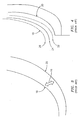
- FIG. 4 shows the static structure contour 18 with respect to the rotating structure contour 20 at a transient minimum state ("hot re-burst") 22, a steady state (“cruise”) 24, and a transient maximum state (“decel”) 26.
- the dotted lines of the hot re-burst 22 and decel 26 indicate a shifting static structure moving forward and aft, inward and outward, all at different rates than the rotating structure contour which is a fixed reference for purposes of explanation. It is important to note that the cruise contour 24 falls within the hot re-burst 22 and decel 26 and therefore can never be perfectly matched to the rotor.
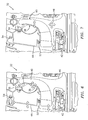
- FIG. 6 the static structures and rotating structures of the centrifugal compressor 32 are shown.
- the arrows shown in FIG. 6 indicate the relative motions of the static structures alone that cause a first static wall 38 to move away and toward a rotating blade 40.
- the double-headed arrows describe the effects of pressure deflection, radial and axial thermal expansion, and radial and axial tolerance stack-ups that lead up to open compressor clearances.
- the pressure deflections, in absolute terms, relative to a ball bearing 42 as a reference point, tend to be at their maximum at maximum power for the engine operating condition with maximum engine inlet pressure, e.g., ambient pressure for ground based gas turbines, sea level pressure for many aircraft gas turbines.
- FIG. 7 the static structures and rotating structures of the centrifugal compressor 32 are shown again.
- the arrows shown indicate the relative motions of the rotating structure alone.
- FIG. 8 illustrates a compressor flow path 50 of the zero running clearance centrifugal compressor 32.
- the static wall 38, thrust bearing 42, static structure wall 44, and a centrifugal compressor bore 46 are all experiencing radial and axial thermal expansion and pressure deflections. There will be a gross accumulation of movement starting at the thrust bearing 42 that is exhibited by the innermost static wall 44.
- a W-seal 52 disposed between and in contact with both the innermost static wall 44 and static wall 38 allows for the thermal expansion and axial movement of the innermost static wall 44 with respect to the static wall 38. The accumulated thermal expansion and pressure deflection is so great that the static wall 38 constantly expands.
- the W-seal 52 permits the static wall 38 to expand in the direction of the arrows shown in FIG. 6 so that stress does not build up. Without the W-seal 52, the static wall 38 would either need to be restrained or permitted to move freely. If restrained, a greater amount of stress would build up. In contrast, if permitted to move freely, the static wall 38 and flanges 54 and 56 would build up more movement and interfere with the rotating structures, that is, the rotating blade 40.
- the zero running clearance centrifugal compressor 32 in conjunction with the tower shaft engagement device 34, rotor shift device 36, and optionally a sensor 60 that work together with an engine control computer to allow a positioning of the rotor that best matches the contour of the static wall 38.
- the objective of the shifting of the rotor relative to the static wall is to maintain the minimum clearance possible while preventing rub of the rotating and static structures.
- the rotor shift device 36 at the thrust bearing 42 shifts the rotating structure under the command of the electronic engine control.
- the optional sensor 60 may track the clearance present between the static wall 38 and rotating blade 40 at any selected location or at multiple locations.
- the optional sensor 60 may be any sensor capable of monitoring the position of the static wall 38 with respect to the rotating blade 40.
- a microwave sensor may be utilized that is programmed with an algorithm to act as a conditioning circuit and works in conjunction with the electronic engine controller (not shown) of the gas turbine engine 30.
- the control logic of the algorithm will execute and implement the mechanics behind opening and minimizing the clearance to the extent possible using the rotor shift device 36.
- the rotor shift device will move the thrust bearing assembly axially, that is, thrust bearing 42, and in turn the rotating blade 40 with respect to the static wall 38.
- one skilled in the art may produce an axial shift mechanism that by hydraulic pressure or mechanical means can shift the rotor from one position to another in an amount of time that is less than the time necessary to accelerate the engine from low power to maximum power. In this way the rotor shifting can precede the engine transients entirely and the maximum benefit can be realized from the optimally contoured rotor and adjacent wall structure.
- the centrifugal compressor of the present invention permits the gap between the rotor and the static structure to be held to a minimum clearance during steady state and transient operation by shifting the rotor axially to compensate for the relative motion of both rotating and static parts.
- the clearance adjustment improves both compressor efficiency and stability.
- the rotor shift device at the thrust bearing shifts the rotating structure under the command of the electronic engine control and the optional sensor is capable of continuously reading the clearance between the rotor and the static structure.
- FIG. 10 illustrates one of many possible alternative mechanisms for the rotor shift device 36 that achieves the desired axial rotor shift.
- This alternative includes a spur gear 61 attached to a bearing mount 62.
- the gear arrangement 63 includes a gear 64 for engaging the spur gear 61 attached to the bearing mount 62.
- the bearing mount 62 also has a screw thread portion 65 that mates with a screw thread portion 66 of the casing 67.
- Rotation of shaft 68 via the motor 69 causes the bearing mount 62 to rotate relative to the casing 67.
- the screw thread engagement between the casing 67 and the bearing mount 62 causes the rotating bearing mount 61 to travel axially.
- the main shaft bearing 70 and attached centrifugal rotor assembly 71 travel axially as well.
- actuation system 72 gear arrangement 63, and actuation motor 69 is one example of how the axial movement of the centrifugal rotor assembly 71 can be accomplished.
- the present invention is not limited to this example described herein.
Landscapes
- Engineering & Computer Science (AREA)
- Mechanical Engineering (AREA)
- General Engineering & Computer Science (AREA)
- Chemical & Material Sciences (AREA)
- Combustion & Propulsion (AREA)
- Structures Of Non-Positive Displacement Pumps (AREA)
Abstract
a centrifugal compressor (32) having a rotor; at least one centrifugal compressor bore (46) mounted to the rotor; at least one blade (40) mounted to each of the at least one centrifugal bore (46) and disposed proximate to at least one static wall (38,44); a turbine (14) disposed in connection with the centrifugal compressor (32); a thrust bearing (42) disposed in connection with the rotor; and means for moving said rotor with reference to the at least one static wall (38,44) attached to the thrust bearing (42).
Description
- The invention relates to compressors and, more particularly, relates to centrifugal compressors with minimized running clearances.
- Many personal, commercial, and military aircraft are powered by gas turbine engines. Gas turbine engines are also used to provide ground-based power for many applications that include ground vehicle power, electrical power generation, and pumping of various liquids and gases. All these gas turbines employ compressors of two main types, that is, (1) axial compressors and (2) centrifugal compressors. Centrifugal compressors turn airflow perpendicular to the axis of rotation. Centrifugal compressors do work on the airflow by accelerating the flow to the higher blade velocity that occurs at the outer diameter of each blade.
- Referring now to
FIGS. 1A and 1B , a single stage centrifugal compressor and a multi-stage centrifugal compressor are shown. Generally, centrifugal compressor performance is characterized by the pressure ratio across the compressor, the rate at which air or other gases are pumped through-the compressor, and an efficiency factor that indicates how much additional work is required relative to an ideal compressor. - Referring now to
FIG. 2 , agas turbine engine 10 equipped with a single stagecentrifugal compressor 12, without any axial compressor stages on its shaft, that is turned by asingle stage turbine 14 is shown. During operation, both the static structures and rotating structures of thecentrifugal compressor 12 move. The relative motions of the static structures alone cause the static wall to move away and toward the rotating blades. In addition, the deflections of the structures caused by pressure, radial and axial thermal expansion, and radial and axial tolerance stack-ups lead to open compressor clearances. The pressure deflections in absolute terms relative to a reference point within the compressor tend to be at their maximum at take-off power or a maximum power condition in flight. However, absolute maximum deflection alone does not set the contour of the static structure adjacent to the rotor. The contour is set by another significant mismatch between the contour of the static wall and the rotating blades which arises from the different rates of thermal expansion of the rotor and the static wall parts. The worst-case scenario that exaggerates the effect of the thermal mismatch is when a "hot-reburst" occurs. A hot-reburst is a sequence where high power is set for a long time, followed by a critical low-power period and then an acceleration back-to-high-power is performed. This circumstance will set the contours of the rotating and static structure and the magnitude of the mismatch relative to steady state mid-power such that at mid-power there is a significant mismatch between the two walls. -
FIG. 3 illustrates acold build clearance 16 between astatic wall contour 18 and arotor blade 20 of thecentrifugal compressor 12. When the turbine engine is not operating, thestatic wall contour 18 and rotatingblade contour 20 do not match. These static androtating contours cold build clearance 16 between them are configured so that the static and rotating contours (18 and 20) will coincide (within some margin to accommodate manufacturing variations and prevent rub) at the most severe transient "pinch point" condition. Thus, a perfect matching of the contours of the rotor blades and thestatic structures FIG. 4 shows thestatic structure contour 18 with respect to therotating structure contour 20 at a transient minimum state ("hot re-burst") 22, a steady state ("cruise") 24, and a transient maximum state ("decel") 26. The dotted lines of thehot re-burst 22 anddecel 26 indicate a shifting static structure moving forward and aft, inward and outward, all at different rates than the rotating structure contour which is a fixed reference for purposes of explanation. It is important to note that thecruise contour 24 falls within thehot re-burst 22 and decel 26 and therefore can never be perfectly matched to the rotor. - Therefore, there exists a need to compensate for the relative motion of both the static structures and rotating structures and maintain a minimum clearance between the static structures and rotating structures during steady state and transient operation.
- In accordance with the present invention, a turbine engine broadly comprising an engine housing enclosing: a centrifugal compressor including: a rotor; at least one centrifugal compressor bore mounted to the rotor; at least one blade mounted to each of the at least one centrifugal bore and disposed proximate to at least one static wall; a turbine disposed in connection with the centrifugal compressor; a thrust bearing disposed in connection with the rotor; and means for moving the rotor with reference to the at least one static wall attached to the thrust bearing.
- In accordance with another aspect of the present invention, a process for generating a zero running clearance in a centrifugal compressor of a turbine engine broadly comprising the steps of providing a centrifugal compressor having a clearance between at least one blade of a rotor of the centrifugal compressor and at least one static wall disposed proximate to the at least one blade; operating a turbine engine at a steady state operating efficiency; decelerating the turbine engine to a transient maximum state from the steady state or a transient minimum state; rebursting the turbine engine to the transient minimum state from the steady state or the transient maximum state; and adjusting the clearance in response to the deceleration or the reburst to maintain the steady state operating efficiency.
- The details of one or more embodiments of the invention are set forth in the accompanying drawings and the description below. Other features and advantages of the invention will be apparent from the description and drawings, and from the claims.
-
-
FIG. 1A is a representation of a single stage centrifugal compressor of the prior art; -
FIG. 1B is a representation of a multi-stage centrifugal compressor of the prior art; -
FIG. 2 is a representation of a cross-sectional view of a gas turbine engine equipped with a centrifugal compressor turned by a single stage turbine of the prior art; -
FIG. 3 is a representation of a cold build clearance between a static structure contour and a rotating structure contour of the centrifugal compressor of the prior art; -
FIG. 4 is a representation of the static structure contour with respect to the rotating structure contour at various operating states of the gas turbine engine of the prior art; -
FIG. 5 is a representation of a cross-sectional view of a gas turbine engine equipped with a zero running clearance centrifugal compressor, a tower shaft engagement device and a rotor shift device of the present invention; -
FIG. 6 is a representation of the movement of the static structures with respect to the rotating structures within the centrifugal compressor ofFIG. 5 ; -
FIG. 7 is a representation of the movement of the rotating structures with respect to the static structures within the centrifugal compressor ofFIG. 5 ; -
FIG. 8 is representation of the compressor flow path of the centrifugal compressor ofFIG. 5 ; -
FIG. 9 is a representation of a static structure contour with respect to a rotating structure contour at a various operating states of a gas turbine engine equipped with a zero running clearance centrifugal compressor of the present invention; and -
FIG. 10 is a representation of an alternative rotor shift device for the gas turbine engine ofFIG. 5 . - Like reference numbers and designations in the various drawings indicate like elements.
-
FIG. 5 illustrates a cross-sectional view of agas turbine engine 30 equipped with a zero running clearancecentrifugal compressor 32, a towershaft engagement device 34 and arotor shift device 36. The towershaft engagement device 34 keeps the tower shaft properly engaged to the main rotor shaft attached tocompressor 32. The tower shaft powers the gear box, hydraulic pumps, fuel pumps, and other engine components as known to one of ordinary skill in the art. Therotor shift device 36 moves the rotor of the centrifugal compressor axially. The towershaft engagement device 34 accommodates this axial motion to maintain proper engagement of the gears connecting the main rotor shaft and the tower shaft. This tower shaft engagement device may be an active device or may be a passive design solution as known to one of ordinary skill in the art. - Referring now to
FIG. 6 , the static structures and rotating structures of thecentrifugal compressor 32 are shown. The arrows shown inFIG. 6 indicate the relative motions of the static structures alone that cause a firststatic wall 38 to move away and toward a rotatingblade 40. The double-headed arrows describe the effects of pressure deflection, radial and axial thermal expansion, and radial and axial tolerance stack-ups that lead up to open compressor clearances. The pressure deflections, in absolute terms, relative to a ball bearing 42 as a reference point, tend to be at their maximum at maximum power for the engine operating condition with maximum engine inlet pressure, e.g., ambient pressure for ground based gas turbines, sea level pressure for many aircraft gas turbines. - Referring to
FIG. 7 , the static structures and rotating structures of thecentrifugal compressor 32 are shown again. In this representation, the arrows shown indicate the relative motions of the rotating structure alone. These arrows described the effects of radial and axial tolerance stack up, transient thermal expansion and contraction, and pressure deflection leading to open compressor clearances. -
FIG. 8 illustrates acompressor flow path 50 of the zero running clearancecentrifugal compressor 32. Thestatic wall 38, thrust bearing 42,static structure wall 44, and acentrifugal compressor bore 46 are all experiencing radial and axial thermal expansion and pressure deflections. There will be a gross accumulation of movement starting at the thrust bearing 42 that is exhibited by the innermoststatic wall 44. A W-seal 52 disposed between and in contact with both the innermoststatic wall 44 andstatic wall 38 allows for the thermal expansion and axial movement of the innermoststatic wall 44 with respect to thestatic wall 38. The accumulated thermal expansion and pressure deflection is so great that thestatic wall 38 constantly expands. While thestatic wall 38 is bolted atflanges seal 52 permits thestatic wall 38 to expand in the direction of the arrows shown inFIG. 6 so that stress does not build up. Without the W-seal 52, thestatic wall 38 would either need to be restrained or permitted to move freely. If restrained, a greater amount of stress would build up. In contrast, if permitted to move freely, thestatic wall 38 andflanges rotating blade 40. - As mentioned earlier in
FIG. 4 , the axial and radial movements of thestatic wall 38 with respect to therotating blade 40 are mismatched. For purposes of explanation, therotating blade 40 is fixed as a reference to illustrate how thestatic wall 38 moves with reference to therotating blade 40. The transient extremes, that is, thetransient minimum 22 and transient maximum 26, around thesteady state 24 represent the extremes of motion of thestatic wall 38. When the zero running clearancecentrifugal compressor 32 is not employed, any point chosen on the transient maximum reflects the fact that therotating blade 40 has not cooled as much as thestatic wall 38 due to the difference in their respective thicknesses. When theturbine engine 30 is reactivated or experiences a re-burst during operation, thestatic wall 38 will achieve the maximum interference represented by thetransient minimum 22. - Referring now to
FIG. 9 , the zero running clearancecentrifugal compressor 32 in conjunction with the towershaft engagement device 34,rotor shift device 36, and optionally asensor 60 that work together with an engine control computer to allow a positioning of the rotor that best matches the contour of thestatic wall 38. The objective of the shifting of the rotor relative to the static wall is to maintain the minimum clearance possible while preventing rub of the rotating and static structures. Therotor shift device 36 at the thrust bearing 42 shifts the rotating structure under the command of the electronic engine control. The minimum steady state clearance betweenrotating blade 40 andstatic wall 38 may then be achieved as shown inFIG. 9 . Operation of thecentrifugal compressor 32 at thesteady state condition 24 shown inFIG. 9 provides the most efficient operation possible while preventing rub. - When employed, the
optional sensor 60 may track the clearance present between thestatic wall 38 androtating blade 40 at any selected location or at multiple locations. Theoptional sensor 60 may be any sensor capable of monitoring the position of thestatic wall 38 with respect to therotating blade 40. For example, a microwave sensor may be utilized that is programmed with an algorithm to act as a conditioning circuit and works in conjunction with the electronic engine controller (not shown) of thegas turbine engine 30. The control logic of the algorithm will execute and implement the mechanics behind opening and minimizing the clearance to the extent possible using therotor shift device 36. The rotor shift device will move the thrust bearing assembly axially, that is, thrustbearing 42, and in turn therotating blade 40 with respect to thestatic wall 38. It is important to note that one skilled in the art may produce an axial shift mechanism that by hydraulic pressure or mechanical means can shift the rotor from one position to another in an amount of time that is less than the time necessary to accelerate the engine from low power to maximum power. In this way the rotor shifting can precede the engine transients entirely and the maximum benefit can be realized from the optimally contoured rotor and adjacent wall structure. - The centrifugal compressor of the present invention permits the gap between the rotor and the static structure to be held to a minimum clearance during steady state and transient operation by shifting the rotor axially to compensate for the relative motion of both rotating and static parts. The clearance adjustment improves both compressor efficiency and stability. The rotor shift device at the thrust bearing shifts the rotating structure under the command of the electronic engine control and the optional sensor is capable of continuously reading the clearance between the rotor and the static structure.
-
FIG. 10 illustrates one of many possible alternative mechanisms for therotor shift device 36 that achieves the desired axial rotor shift. This alternative includes aspur gear 61 attached to abearing mount 62. Thegear arrangement 63 includes agear 64 for engaging thespur gear 61 attached to thebearing mount 62. The bearing mount 62 also has ascrew thread portion 65 that mates with ascrew thread portion 66 of thecasing 67. Rotation ofshaft 68 via themotor 69, causes the bearing mount 62 to rotate relative to thecasing 67. The screw thread engagement between thecasing 67 and the bearing mount 62 causes the rotating bearing mount 61 to travel axially. As a result, the main shaft bearing 70 and attachedcentrifugal rotor assembly 71 travel axially as well. - The above-described
actuation system 72,gear arrangement 63, andactuation motor 69 is one example of how the axial movement of thecentrifugal rotor assembly 71 can be accomplished. However, as one of ordinary skill in the art will recognize, the present invention is not limited to this example described herein. - One or more embodiments of the present invention have been described. Nevertheless, it will be understood that various modifications may be made without departing from the scope of the invention. Accordingly, other embodiments are within the scope of the following claims.
Claims (17)
- A turbine engine (30), comprising:an engine housing enclosing:a centrifugal compressor (32) including:a rotor;at least one centrifugal compressor bore (46) mounted to said rotor;at least one blade (40) mounted to each of said at least one centrifugal bore (46) and disposed proximate to at least one static wall (38,44);a turbine (14) disposed in connection with said centrifugal compressor (32);a thrust bearing (42) disposed in connection with said rotor;
andmeans for moving said rotor with reference to said at least one static wall (38,44) attached to said thrust bearing (42). - The turbine engine (30) of claim 1, wherein said at least one blade (40) is disposed proximate to a first static wall (38).
- The turbine engine (30) of claim 1 or 2, wherein said means for moving said rotor comprises a rotor shifting apparatus (36).
- The turbine engine (30) of any of claims 1 to 3, further comprising a tower shaft disposed in connection with a rotor shaft of said rotor, and a tower shaft engagement device (34) disposed in connection with said tower shaft.
- The turbine engine (30) of claim 4, wherein said tower shaft device (34) is disposed in contact with at least one gear disposed between said rotor and said tower shaft.
- The turbine engine (30) of any preceding claim, wherein a first end of said thrust bearing (42) is connected to a second static wall (44) and a second end of said thrust bearing (42) is connected to said rotor.
- The turbine engine (30) of any preceding claim, further comprising a sensor (60) mounted to said at least one static wall (38,44) and disposed proximate to said at least one blade (40).
- The turbine engine (30) of any preceding claim, further comprising an electronic engine controller.
- The turbine engine (30) of any of claims 1 to 6, further comprising an electronic engine controller disposed in communication with a sensor (60) mounted to said at least one static wall (38,44) and disposed proximate to said at least one blade (40).
- The turbine engine (30) of any preceding claim, wherein said means for moving said rotor further comprises means for moving said rotor axially with reference to said at least one static wall (38,44).
- A process for generating a zero running clearance in a centrifugal compressor (32) of a turbine engine (30), comprising the steps of:providing a centrifugal compressor (32) having a clearance between at least one blade (40) of a rotor of said centrifugal compressor (32) and at least one static wall (38,44) disposed proximate to said at least one blade (40);operating a turbine engine (30) at a steady state operating efficiency;decelerating said turbine engine (30) to a transient maximum state (26) from said steady state (24) or a transient minimum state (22);rebursting said turbine engine to said transient minimum state (22) from said steady state (24) or said transient maximum state (26); andadjusting said clearance in response to said deceleration or said reburst to maintain said steady state operating efficiency.
- The process of claim 11, further comprising monitoring said clearance using a sensor (60).
- The process of claim 12, wherein monitoring comprises monitoring said clearance using a sensor (60) mounted to said at least one static wall (38,44) and disposed proximate to said blade (40).
- The process of any of claims 11 to 13, wherein adjusting further comprises shifting said rotor in an axial motion to substantially decrease said clearance.
- The process of claim 14, wherein adjusting further comprises shifting said rotor in an axial motion to substantially decrease said clearance in response to said deceleration.
- The process of claim 14, wherein adjusting further comprises shifting said rotor in an axial motion to substantially decrease said clearance in response to said reburst.
- The process of any of claims 11 to 13, further comprising maintaining said steady state operating efficiency through adjusting said clearance in response to said deceleration or said reburst.
Applications Claiming Priority (1)
| Application Number | Priority Date | Filing Date | Title |
|---|---|---|---|
| US11/635,123 US7824151B2 (en) | 2006-12-06 | 2006-12-06 | Zero running clearance centrifugal compressor |
Publications (2)
| Publication Number | Publication Date |
|---|---|
| EP1930553A2 true EP1930553A2 (en) | 2008-06-11 |
| EP1930553A3 EP1930553A3 (en) | 2011-03-02 |
Family
ID=39111028
Family Applications (1)
| Application Number | Title | Priority Date | Filing Date |
|---|---|---|---|
| EP07254615A Withdrawn EP1930553A3 (en) | 2006-12-06 | 2007-11-28 | Centrifugal compressor |
Country Status (3)
| Country | Link |
|---|---|
| US (1) | US7824151B2 (en) |
| EP (1) | EP1930553A3 (en) |
| JP (1) | JP2008144758A (en) |
Cited By (3)
| Publication number | Priority date | Publication date | Assignee | Title |
|---|---|---|---|---|
| ITCO20110031A1 (en) * | 2011-07-28 | 2013-01-29 | Nuovo Pignone Spa | TRAIN OF TURBOCHARGERS WITH ROTATING SUPPORTS AND METHOD |
| WO2014130159A1 (en) * | 2013-02-23 | 2014-08-28 | Ottow Nathan W | Blade clearance control for gas turbine engine |
| EP2678575B1 (en) * | 2011-02-25 | 2019-10-09 | Flowserve Management Company | Bearing carrier with multiple lubrication slots |
Families Citing this family (23)
| Publication number | Priority date | Publication date | Assignee | Title |
|---|---|---|---|---|
| US8087880B2 (en) * | 2008-12-03 | 2012-01-03 | General Electric Company | Active clearance control for a centrifugal compressor |
| US8147178B2 (en) * | 2008-12-23 | 2012-04-03 | General Electric Company | Centrifugal compressor forward thrust and turbine cooling apparatus |
| US9200536B2 (en) | 2011-10-17 | 2015-12-01 | United Technologies Corporation | Mid turbine frame (MTF) for a gas turbine engine |
| US8769816B2 (en) | 2012-02-07 | 2014-07-08 | Siemens Aktiengesellschaft | Method of assembling a gas turbine engine |
| US9121302B2 (en) | 2012-07-12 | 2015-09-01 | Hamilton Sundstrand Corporation | Radial compressor blade clearance control system |
| FR3008750B1 (en) * | 2013-07-18 | 2015-07-17 | Snecma | TURBOMACHINE CENTRIFUGAL COMPRESSOR COVER FIXED BY THE DOWNSTAIR NEAR ITS UPSTREAM EDGE, TURBOMACHINE HAVING THIS COVER. |
| US10260524B2 (en) | 2013-10-02 | 2019-04-16 | United Technologies Corporation | Gas turbine engine with compressor disk deflectors |
| US9266618B2 (en) | 2013-11-18 | 2016-02-23 | Honeywell International Inc. | Gas turbine engine turbine blade tip active clearance control system and method |
| US10323536B2 (en) | 2015-04-09 | 2019-06-18 | United Technologies Corporation | Active clearance control for axial rotor systems |
| US10309409B2 (en) | 2016-05-26 | 2019-06-04 | Rolls-Royce Corporation | Impeller shroud with pneumatic piston for clearance control in a centrifugal compressor |
| US10458429B2 (en) | 2016-05-26 | 2019-10-29 | Rolls-Royce Corporation | Impeller shroud with slidable coupling for clearance control in a centrifugal compressor |
| US10309410B2 (en) * | 2016-05-26 | 2019-06-04 | Rolls-Royce Corporation | Impeller shroud with deflecting outer member for clearance control in a centrifugal compressor |
| US10352329B2 (en) | 2016-05-26 | 2019-07-16 | Rolls-Royce Corporation | Impeller shroud with thermal actuator for clearance control in a centrifugal compressor |
| US10408226B2 (en) * | 2016-05-26 | 2019-09-10 | Rolls-Royce Corporation | Segregated impeller shroud for clearance control in a centrifugal compressor |
| US10731666B2 (en) * | 2017-10-27 | 2020-08-04 | Rolls-Royce North American Technologies Inc. | Impeller shroud with closed form refrigeration system for clearance control in a centrifugal compressor |
| US10704560B2 (en) * | 2018-06-13 | 2020-07-07 | Rolls-Royce Corporation | Passive clearance control for a centrifugal impeller shroud |
| CN109162929A (en) * | 2018-07-27 | 2019-01-08 | 湖南山水节能科技股份有限公司 | centrifugal pump |
| US11085319B2 (en) * | 2019-06-21 | 2021-08-10 | Pratt & Whitney Canada Corp. | Gas turbine engine tip clearance control system |
| US11187247B1 (en) | 2021-05-20 | 2021-11-30 | Florida Turbine Technologies, Inc. | Gas turbine engine with active clearance control |
| US11746670B2 (en) * | 2021-12-27 | 2023-09-05 | Pratt & Whitney Canada Corp. | Impeller shroud assembly and method for operating same |
| US12421863B2 (en) | 2023-07-21 | 2025-09-23 | Rtx Corporation | Turbine engine tip clearance control system with thrust bearing |
| US12345162B2 (en) | 2023-11-17 | 2025-07-01 | Rolls-Royce Corporation | Adjustable position impeller shroud for centrifugal compressors |
| US12345163B2 (en) | 2023-11-17 | 2025-07-01 | Rolls-Royce Corporation | Travel stop for a tip clearance control system |
Citations (1)
| Publication number | Priority date | Publication date | Assignee | Title |
|---|---|---|---|---|
| EP0578285A1 (en) | 1992-06-22 | 1994-01-12 | General Motors Corporation | Turbomachine with active tip-clearance control |
Family Cites Families (9)
| Publication number | Priority date | Publication date | Assignee | Title |
|---|---|---|---|---|
| US2977758A (en) * | 1955-02-18 | 1961-04-04 | Rolls Royce | Propeller driving gas-turbine engines |
| US3045894A (en) * | 1957-05-22 | 1962-07-24 | Frederick W Ross | Gas turbine engine |
| US5658125A (en) * | 1995-02-28 | 1997-08-19 | Allison Engine Company, Inc. | Magnetic bearings as actuation for active compressor stability control |
| US6058791A (en) * | 1998-03-19 | 2000-05-09 | Alliedsignal, Inc. | Accessory mechanical drive for a gas turbine engine |
| US6273671B1 (en) * | 1999-07-30 | 2001-08-14 | Allison Advanced Development Company | Blade clearance control for turbomachinery |
| US6692222B2 (en) * | 2002-05-14 | 2004-02-17 | The Board Of Trustees Of The Leland Stanford Junior University | Micro gas turbine engine with active tip clearance control |
| US7424823B2 (en) * | 2004-10-19 | 2008-09-16 | Techno-Sciences, Inc. | Method of determining the operating status of a turbine engine utilizing an analytic representation of sensor data |
| US7341426B2 (en) * | 2004-12-29 | 2008-03-11 | United Technologies Corporation | Gas turbine engine blade tip clearance apparatus and method |
| US7455495B2 (en) * | 2005-08-16 | 2008-11-25 | United Technologies Corporation | Systems and methods for monitoring thermal growth and controlling clearances, and maintaining health of turbo machinery applications |
-
2006
- 2006-12-06 US US11/635,123 patent/US7824151B2/en active Active
-
2007
- 2007-11-21 JP JP2007301136A patent/JP2008144758A/en active Pending
- 2007-11-28 EP EP07254615A patent/EP1930553A3/en not_active Withdrawn
Patent Citations (1)
| Publication number | Priority date | Publication date | Assignee | Title |
|---|---|---|---|---|
| EP0578285A1 (en) | 1992-06-22 | 1994-01-12 | General Motors Corporation | Turbomachine with active tip-clearance control |
Cited By (7)
| Publication number | Priority date | Publication date | Assignee | Title |
|---|---|---|---|---|
| EP2678575B1 (en) * | 2011-02-25 | 2019-10-09 | Flowserve Management Company | Bearing carrier with multiple lubrication slots |
| ITCO20110031A1 (en) * | 2011-07-28 | 2013-01-29 | Nuovo Pignone Spa | TRAIN OF TURBOCHARGERS WITH ROTATING SUPPORTS AND METHOD |
| WO2013014198A1 (en) * | 2011-07-28 | 2013-01-31 | Nuovo Pignone S.P.A. | Turbo - compressor train with rolling bearings and related assembly method |
| AU2012288836B2 (en) * | 2011-07-28 | 2016-09-08 | Nuovo Pignone S.P.A. | Turbo - compressor train with rolling bearings and related assembly method |
| RU2623058C2 (en) * | 2011-07-28 | 2017-06-21 | Нуово Пиньоне С.п.А. | Turbocompressor unit (versions) |
| WO2014130159A1 (en) * | 2013-02-23 | 2014-08-28 | Ottow Nathan W | Blade clearance control for gas turbine engine |
| US9587507B2 (en) | 2013-02-23 | 2017-03-07 | Rolls-Royce North American Technologies, Inc. | Blade clearance control for gas turbine engine |
Also Published As
| Publication number | Publication date |
|---|---|
| US20080134659A1 (en) | 2008-06-12 |
| US7824151B2 (en) | 2010-11-02 |
| JP2008144758A (en) | 2008-06-26 |
| EP1930553A3 (en) | 2011-03-02 |
Similar Documents
| Publication | Publication Date | Title |
|---|---|---|
| US7824151B2 (en) | Zero running clearance centrifugal compressor | |
| US5977677A (en) | Combination bearing for gas turbine engine | |
| US11987369B2 (en) | Turbomachine with unducted dual propellers | |
| US6273671B1 (en) | Blade clearance control for turbomachinery | |
| JP6200418B2 (en) | Variable pitch nozzles for radial turbines, especially auxiliary power source turbines | |
| EP4001663B1 (en) | Improved bearing cooling schemes for aircraft fans | |
| FI122720B (en) | Control solution for a turbocharger | |
| US11441485B2 (en) | Electric motor control for demand fuel pumping system | |
| CN111894890B (en) | Seal assembly for compressor | |
| US11085319B2 (en) | Gas turbine engine tip clearance control system | |
| CN114934857A (en) | Variable-cycle turbine engine | |
| CN114592927A (en) | Fast Response Active Gap Control System with Piezoelectric Actuators | |
| US11994066B2 (en) | Thermal management system | |
| GB2564935A (en) | Turbomachine including a cooling and turbine clearance control system and an air supply scoop for said system | |
| US4932206A (en) | Guide vane assembly for auxiliary power unit | |
| US12510002B2 (en) | Lubrication system for a turbine engine | |
| US12281581B1 (en) | Module for an aircraft turbine engine | |
| RU2806953C2 (en) | Gas turbine engine with uncapped counter-rotating propellers | |
| US12392371B2 (en) | Air turbine starter with fluid damping assembly | |
| EP4711587A1 (en) | Propulsion system including a turbine engine | |
| EP4707558A1 (en) | Turbine engine control system | |
| EP4707545A1 (en) | Propulsion system including a turbine engine | |
| US20260071561A1 (en) | Propulsion system including a turbine engine | |
| CN121079490A (en) | Housing for an aircraft turbine engine | |
| Williams | Air motor powered high temperature actuation systems |
Legal Events
| Date | Code | Title | Description |
|---|---|---|---|
| PUAI | Public reference made under article 153(3) epc to a published international application that has entered the european phase |
Free format text: ORIGINAL CODE: 0009012 |
|
| AK | Designated contracting states |
Kind code of ref document: A2 Designated state(s): AT BE BG CH CY CZ DE DK EE ES FI FR GB GR HU IE IS IT LI LT LU LV MC MT NL PL PT RO SE SI SK TR |
|
| AX | Request for extension of the european patent |
Extension state: AL BA HR MK RS |
|
| RIC1 | Information provided on ipc code assigned before grant |
Ipc: F02C 3/08 20060101ALI20101021BHEP Ipc: F04D 29/05 20060101ALI20101021BHEP Ipc: F02C 7/06 20060101ALI20101021BHEP Ipc: F01D 11/22 20060101AFI20080311BHEP |
|
| PUAL | Search report despatched |
Free format text: ORIGINAL CODE: 0009013 |
|
| AK | Designated contracting states |
Kind code of ref document: A3 Designated state(s): AT BE BG CH CY CZ DE DK EE ES FI FR GB GR HU IE IS IT LI LT LU LV MC MT NL PL PT RO SE SI SK TR |
|
| AX | Request for extension of the european patent |
Extension state: AL BA HR MK RS |
|
| AKY | No designation fees paid | ||
| REG | Reference to a national code |
Ref country code: DE Ref legal event code: R108 |
|
| 17P | Request for examination filed |
Effective date: 20110831 |
|
| RBV | Designated contracting states (corrected) |
Designated state(s): DE GB |
|
| REG | Reference to a national code |
Ref country code: DE Ref legal event code: R108 Effective date: 20111109 |
|
| 17Q | First examination report despatched |
Effective date: 20111219 |
|
| GRAP | Despatch of communication of intention to grant a patent |
Free format text: ORIGINAL CODE: EPIDOSNIGR1 |
|
| INTG | Intention to grant announced |
Effective date: 20130403 |
|
| STAA | Information on the status of an ep patent application or granted ep patent |
Free format text: STATUS: THE APPLICATION IS DEEMED TO BE WITHDRAWN |
|
| 18D | Application deemed to be withdrawn |
Effective date: 20130814 |